Article

CuO/ZnO Modified C4N Monolayer for SF6 Decomposition: Experimental Analysis and First-Principles Simulation


1
Guangdong Power Grid Co., Ltd., Guangzhou 510013, China
2
State Key Laboratory of Power Grid Environmental Protection, School of Electrical Engineering and Automation, Wuhan University, Wuhan 430072, China
*
Author to whom correspondence should be addressed.
Catalysts 2026, 16(8), 696; https://doi.org/10.3390/catal16080696
Submission received: 30 June 2026 / Revised: 25 July 2026 / Accepted: 27 July 2026 / Published: 30 July 2026

Abstract

Sulfur hexafluoride (SF6) serves as an essential insulating and arc-extinguishing medium in power facilities, while it is an extremely potent greenhouse gas with an ultra-long atmospheric lifetime. To realize efficient medium-temperature harmless disposal of waste SF6, two-dimensional stable C4N monolayers were adopted as substrates to load ZnO and CuO nanoparticles for composite catalyst fabrication. XRD, TEM, and EDS characterizations confirmed the uniform dispersion of the metal oxides without destroying the C4N two-dimensional skeleton. Comparative experiments proved that an NH3 reducing atmosphere significantly accelerates SF6 decomposition. The 3:1 CuO-modified catalyst achieved a maximum SF6 conversion of 91%, and a CaO additive effectively restrained high-temperature sintering and irreversible HF halogen poisoning, boosting overall catalytic efficiency by approximately 30%. DFT adsorption simulations revealed totally different active centers: hollow sites dominate ZnO-C4N with broad adsorption capacity for SO2, SO2F2, and other fluorinated intermediates, whereas surface O sites of CuO-C4N exhibit exclusive strong chemisorption toward SO2. Combined with macroscopic kinetics and atomic-scale interfacial interaction rules, their distinct stepwise defluorination pathways were illustrated. This study offers solid experimental data and microscopic theoretical guidance for designing advanced C4N-based catalysts for waste SF6 abatement.

1. Introduction

Sulfur hexafluoride (SF6) possesses outstanding insulation, arc-extinguishing, and heat conduction properties, which makes it widely deployed in high-voltage circuit breakers, transformers, and gas-insulated switchgear (GIS) [1,2,3]. Regulated by the Kyoto Protocol, SF6 features an ultra-high global warming potential (GWP) of approximately 23,900 times that of CO2 and an atmospheric lifetime exceeding 3000 years [4,5]. Massive waste SF6 is generated as aging power equipment is retired globally, and its direct emission causes severe greenhouse pollution, making low-cost, high-efficiency disposal technology an urgent research target [6].
Multiple technical routes have been proposed for SF6 degradation, including high-temperature pyrolysis, plasma treatment, photocatalysis, and thermal catalytic decomposition [7,8,9]. Simple thermal cracking requires temperatures above 1000 °C and produces disordered toxic fluorinated byproducts; plasma and photocatalytic approaches suffer high operating costs and limited processing throughput, restricting industrial application [10]. Thermal catalysis can lower the reaction temperature and regulate the product distribution, emerging as the most promising technical scheme for practical engineering [11]. A variety of catalytic materials including metal oxides, as well as phosphate and carbon-based composites have been explored for SF6 abatement [12,13].
Two-dimensional Cx layered materials represented by C3N and C4N have attracted extensive attention in adsorption and catalysis due to their large specific surface area and abundant nitrogen active sites [14,15,16]. Compared with C3N, C4N exhibits superior thermal and corrosion resistance under medium-high temperature SF6 reaction environments, yet pure C4N can barely activate the stable SF6 molecules [17,18]. Transition metal oxides ZnO and CuO possess rich surface-active sites and are widely used to modify carbon-based carriers to construct heterojunction catalysts [19,20,21,22]. Loading ZnO and CuO onto C4N can build heterogeneous interfaces to modulate surface electron distribution and enhance SF6 adsorption activation capacity [23,24].
Most existing works have only reported macroscopic catalytic behavior of single metal oxides or carbon carriers [25,26,27], lacking atomic-scale DFT investigations of SF6 adsorption on CuO/ZnO-modified C4N [28]. DFT serves as a standard first-principles method for interfacial simulation [29]. Its theoretical basis was laid by Hohenberg and Kohn, then extended via the Kohn–Sham equations [30,31]. The PBE functional [32] and DFT-D3 dispersion correction [33] are commonly used for catalytic surface calculations. The Delley-developed DMol3 module [34,35] is widely employed to simulate fluorine-containing gas adsorption on solid surfaces [36].
In this work, C4N monolayer supported CuO/ZnO composite catalysts were synthesized, and multi-condition thermal catalytic experiments combined with XRD/TEM/EDS characterizations were carried out. DFT calculations via DMol3 based on classic Hohenberg–Kohn and Kohn–Sham theory were performed to systematically study the adsorption behaviors of SF6, CO2, SO2, SOF2, SO2F2 on different active sites. By correlating macroscopic conversion data with atomic interfacial rules, the intrinsic difference in SF6 degradation pathways of two composite catalysts was clarified. This work fills the research gap on C4N-based bimetallic catalysts for SF6 treatment and provides theoretical support for subsequent catalyst optimization.

2. Results

2.1. Analysis of Catalytic Performance

2.1.1. Morphological Characterizations of Catalysts

XRD measurement (XRD-6100, Shimadzu Corporation, Kyoto, Japan) was conducted to analyze the crystal phase of the 3:1 CuO/ZnO-C4N catalyst, as shown in Figure 1. The diffraction peaks match the standard PDF cards of CuO and ZnO, confirming the successful generation of metal oxide crystalline phases.
To quantify the crystallite dimension of metal oxide nanoparticles, we calculated grain sizes using the Scherrer equation:
  D = K λ β c o s θ
where D stands for crystallite size with the unit of nm; K is the shape factor; λ is the wavelength of the X-ray source, and Cu Kα radiation with a wavelength of 1.5406 Å is utilized in the present test; β refers to the full width at half maximum (FWHM) of each diffraction peak; θ is half of the diffraction angle of the corresponding peak.
Based on the spectral data of the CuO (110) and ZnO (111) characteristic diffraction peaks, the average crystallite sizes of CuO and ZnO were solved to be 18–24 nm and 16–22 nm, respectively.
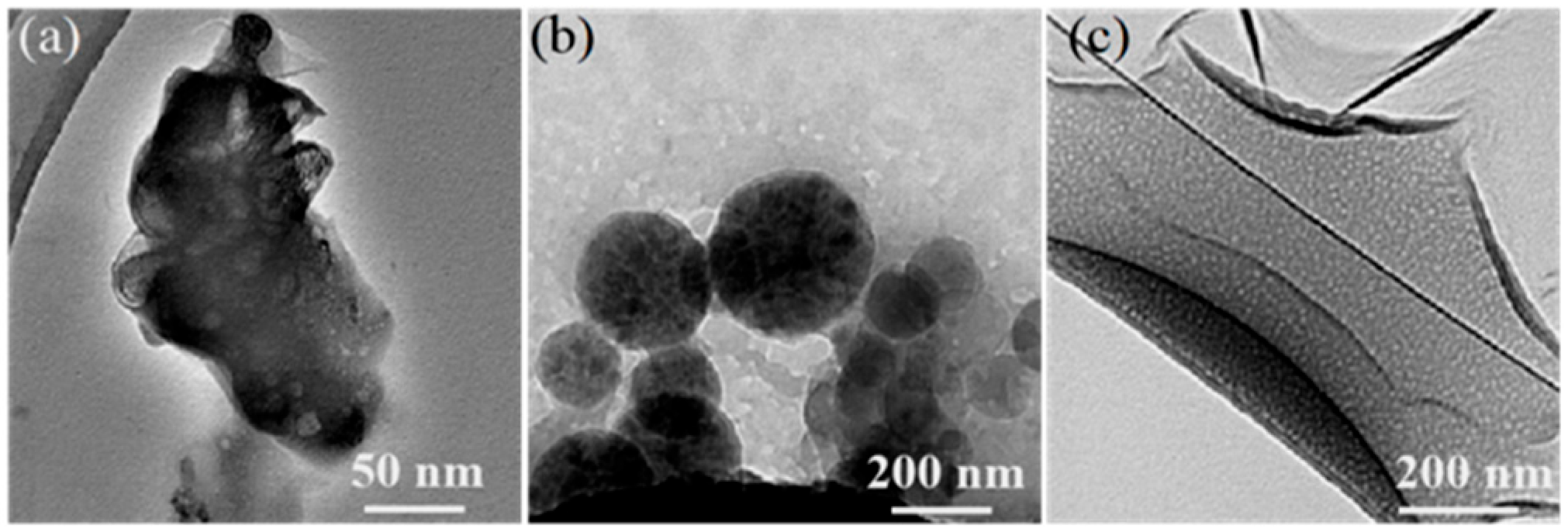
Figure 2 displays transmission electron microscopy (TEM) (JEM-F200, JEOL Ltd., Tokyo, Japan) images of CuO/ZnO-C4N. It can be observed that the ZIF-8 organic framework was transformed into wrinkled carbon skeleton films after calcination, coating nanoparticles, and providing a highly tunable surface and pore structure for CuO and ZnO particles.
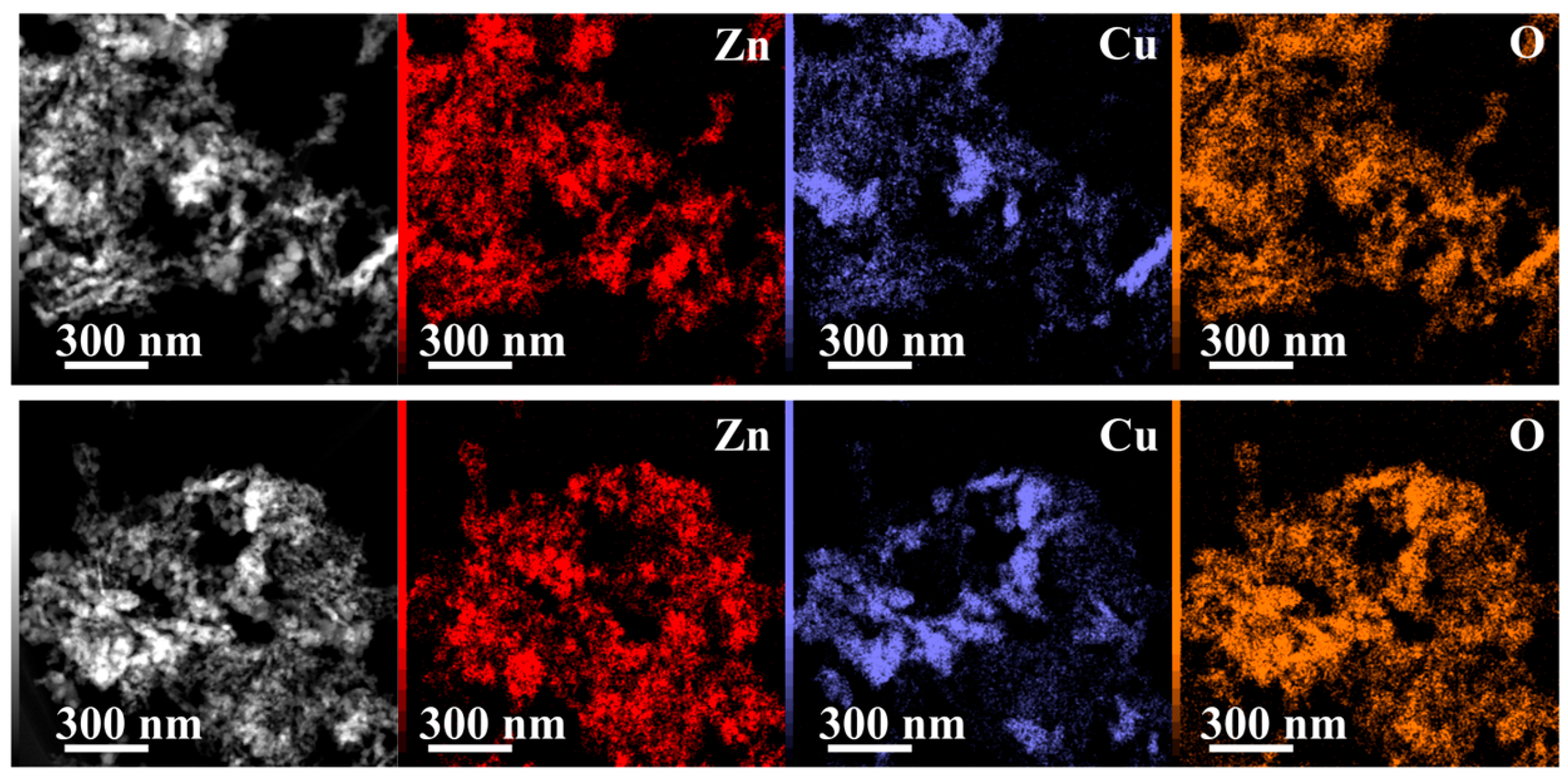
Figure 3 presents the energy-dispersive X-ray spectroscopy (EDS) (Sigma 300, Carl Zeiss AG, Oberkochen, Germany) mappings obtained from two randomly selected regions on the catalyst surface. Point scanning images of the two regions reveal that Cu, Zn, and O elements exhibit uniform and highly overlapping distribution on the catalyst surface. For Zn element, dense and homogeneous distribution without obvious aggregation or segregation is observed in the scanning regions of different scales. The distribution of Cu elements highly coincides with Zn, showing synchronous spatial uniformity, which proves uniform mixing of Cu and Zn in the catalyst. Oxygen elements cover the entire scanning area with a distribution range consistent with Cu and Zn, demonstrating homogeneous dispersion of oxygen and formation of uniform composite oxides with Cu and Zn.

2.1.2. Catalytic Performance Analysis

First, reaction gas screening experiments were carried out. Three typical industrial atmospheres including inert atmosphere (He), oxidizing atmosphere (air), and reducing atmosphere (NH3) were selected, corresponding to three gas systems: 2% SF6/98% He, 2% SF6/95% air, and 2% SF6/2% NH3/96% Ar. All blank experiments were performed at 600 °C, 0.2 MPa, and a flow rate of 5 mL·min−1, with the blank test results summarized in Table 1. Although previous research [4] reported trace SF6 decomposition at 300 °C, this study found that the blank conversion rate of SF6 under an inert atmosphere remained below 11% at 600 °C. This originates from the ultrahigh stability and recovery characteristics of SF6 molecules, fully verifying the limitation of pure thermal treatment in breaking S–F bonds and the low efficiency of simple pyrolysis. The oxidation effect of O2 in an air atmosphere raises the conversion rate to 17% with limited improvement, while the reducing atmosphere containing NH3 delivers optimal performance with a conversion rate of 31%, nearly doubling that under a He atmosphere, which preliminarily confirms the mild promoting effect of NH3 on SF6 pyrolysis.
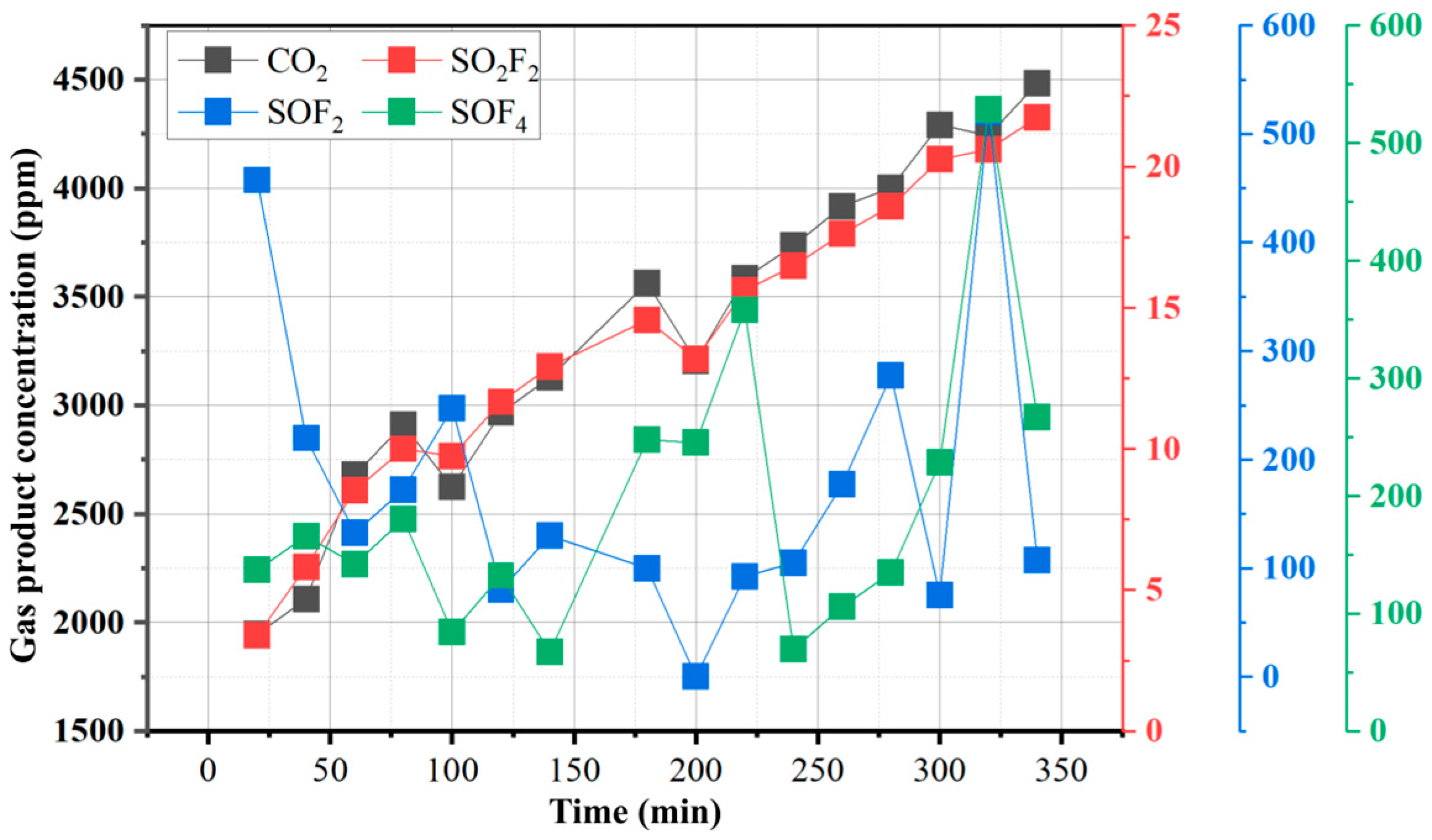
To analyze product differences under an oxidative atmosphere, concentration curves of each product at 700 °C and 0.2 MPa in air were plotted as in Figure 4. CO2 was the dominant product generated by high-temperature oxidation of the C4N carbon skeleton, which damaged the catalyst long-term stability. SOF2 and SOF4 were the main sulfur-containing intermediates, while almost no SO2 could be detected. In contrast, the NH3 reducing system delivered much higher SF6 conversion and SO2 selectivity, so an NH3 atmosphere was adopted for subsequent catalytic tests.
It can be seen that the concentrations of the intermediates SOF2 and SOF4 fluctuate significantly in the initial stage. The SF6 decomposition system involves various fluorinated species with complex mutual transformation, and such concentration fluctuation of fluorine-containing by-products is intrinsic to this reaction system. The observed concentration peaks stem from incomplete defluorination in the early reaction period. As the reaction proceeds, these intermediates further cleave S–F bonds and transform into stable SO2, which gradually lowers the intermediate concentrations.
When catalysts were added under an air atmosphere at 700 °C, conversion varied greatly with pressure (Table 2). The optimal pressure was 0.4 MPa with a conversion of 38%, while conversion dropped sharply to 12% at 0.6 MPa and 26% at 0.2 MPa. Such a trend can be attributed to the adsorption equilibrium of reactants and intermediates on catalyst surfaces. Elevated pressure leads to competitive adsorption between SF6 and fluorinated intermediates, inhibiting the activation of SF6 molecules. Under an NH3 reducing atmosphere, catalysts with different Cu/Zn ratios exhibited distinct activity. The initial conversion of 3:1 CuO/ZnO-C4N reached 39%, higher than 29% of the 1:1 counterpart. Time-resolved conversion curves of catalysts with/without CaO additive at 500 °C, 0.2 MPa are presented below. The 1:1 catalyst peaked at 85% at 7 h, whereas the 3:1 catalyst achieved a maximum conversion of 92%. The richer surface CuO active sites of the 3:1 sample enhanced SF6 adsorption and activation capacity. Without CaO, the initial conversion of 1:1 catalyst was only 14%, rising to 56% at 1 h and stabilizing at 50–55%, around 30% lower than the CaO-containing group.
Product selectivity profiles under different catalyst formulations and temperatures are provided below. At 500 °C without CaO, SOF2 and SOF4 dominated the early-stage intermediates, and SO2 selectivity only increased after 6 h. After adding CaO, SO2 generation accelerated and its selectivity rose from 4 h with a peak value of 55%. For the 3:1 catalyst at 500 °C, the ascending trend of SO2 selectivity was delayed until 10 h. At 600 °C with CaO, the product distribution became dispersed, and SO2 selectivity peaked at 54% within 2 h. Compared with existing catalysts requiring 650–750 °C, the present system realized mild-temperature degradation, yet further optimization on sulfur product selectivity is required. From the valence variation of sulfur species before and after the reaction, we can infer the core function of NH3. SF6 features S in the highest +6 oxidation state, which is chemically stable and hard to reduce. NH3 acts as the critical reducing agent that provides hydrogen radicals, lowering the valence of S atoms stepwise and facilitating S–F bond cleavage. Meanwhile, the redox reaction between NH3 and CuO generates in situ H2O, which serves as an oxygen source to produce target products like SO2 and accelerates the continuous defluorination of low-fluoride intermediates. Without NH3, SF6 can barely be reduced to low-valence sulfur species, resulting in extremely low conversion efficiency.
To further assess the performance of CuO/ZnO-C4N, we compared its catalytic activity and product selectivity with reported SF6 decomposition catalysts. Typical γ-Al2O3, AlPO4/γ-Al2O3 and FeOOH-SiC require temperatures above 650 °C for high SF6 conversion [13,37,38]. Owing to the heterojunction between CuO, ZnO, and wrinkled C4N monolayer, our catalyst activates SF6 starting at 500 °C under milder conditions. At 500 °C in an NH3 atmosphere, the 3:1 Cu/Zn catalyst delivers a peak SF6 conversion of 91%, outperforming most phosphate and single metal oxide counterparts at the same medium temperature. In addition, most prior works lack direct GC–MS quantification of sulfur-containing products and rely on error-prone alkaline absorption. Here, online GC–MS confirmed the catalyst reaches a maximum SO2 selectivity of 97% while suppressing toxic SO2F2. Though phosphate catalysts favor SO3 production, their SF6 conversion at moderate temperatures is low. Overall, CuO/ZnO-C4N exhibits integrated strengths in mild-temperature SF6 degradation and selective SO2 generation.

2.2. Adsorption Simulation Analysis of SF6 on ZnO-C4N Surface

Comprehensive macroscopic thermal catalytic experimental results indicate that an NH3 reducing atmosphere and a high Cu doping ratio can effectively improve SF6 degradation capacity. Macroscopic catalytic performance is essentially determined by molecular adsorption behavior and interfacial interaction strength on the catalyst surfaces. Therefore, DFT first-principles simulations are adopted below to analyze the interaction laws between SF6 and its decomposition species on catalytic substrates from microscopic parameters including adsorption configuration, adsorption energy, and charge transfer, revealing the underlying differentiated catalytic activity mechanisms of ZnO-C4N and CuO-C4N.

2.2.1. Adsorption Behavior of SF6 on Various Sites

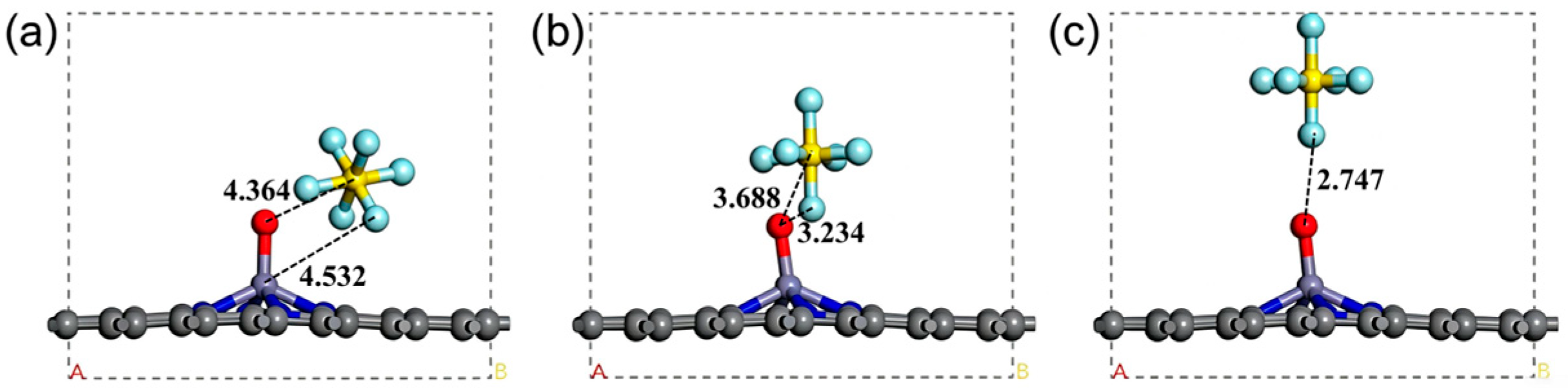
SF6 molecules were placed at hollow, N, and O sites of ZnO-C4N for geometric optimization, with the optimized adsorption configurations illustrated in Figure 5. Geometric configuration analysis reveals obvious repulsion between surface O atoms of the material and F atoms in SF6 at O sites, accompanied by overall offset of SF6 molecules and slight deformation of C4N nanosheets. Molecular offset and interfacial repulsion are weakened at N sites, while SF6 molecules bind most tightly with the substrate at hollow sites, presenting the most remarkable molecular configuration variation and strongest interfacial interaction. This phenomenon demonstrates inherent electrostatic repulsion between O and F atoms, which hinders stable chemical bond formation. SF6 decomposition relies on S–F bond cleavage and F atom desorption, and hollow sites can effectively destabilize F atoms.
Spontaneous adsorption of SF6 occurs on all sites of ZnO-C4N. Hollow sites exhibit the largest absolute adsorption energy (−0.253 eV), proving the strongest adsorption stability and serving as the optimal active sites for SF6 activation on ZnO-C4N. O sites deliver the smallest absolute adsorption energy with the weakest adsorption effect, consistent with the morphological analysis results.

2.2.2. Adsorption Characteristics of SF6 Decomposition Intermediates

Adsorption calculations were conducted for four typical SF6 decomposition products including CO2, SO2, SO2F2, and SOF2. The optimized adsorption configurations are shown in Figure 6, and the adsorption energies alongside Mulliken charge transfer quantities are listed in Table 3. From the perspective of molecular geometry, S atoms in SO2 and SO2F2 molecules display strong oxygen affinity, which enables strong interfacial bonding with surface O atoms of ZnO, stabilizing the decomposition products and driving the forward progress of the SF6 decomposition reactions. No obvious bond cleavage was observed after adsorption of all the gas molecules, yet strong adsorption effectively weakens the internal chemical bonds of molecules, providing energy foundations for subsequent thermal catalytic bond breaking.
Combining adsorption energy and charge transfer data shows that SO2 delivers an adsorption energy of −2.790 eV with a far larger absolute value than other gases, accompanied by prominent positive charge transfer, which verifies strong chemical adsorption between SO2 and ZnO-C4N with intense interfacial electron exchange. SO2F2 exhibits an adsorption energy of −1.425 eV, also corresponding to strong adsorption with massive negative charge transfer. In contrast, CO2, SOF2, and SF6 possess small absolute adsorption energies dominated by weak physical adsorption, with negligible charge transfer and faint interfacial interactions.

2.3. Adsorption Simulation Analysis of SF6 on CuO-C4N Surface

2.3.1. Adsorption Behavior of SF6 on Various Sites

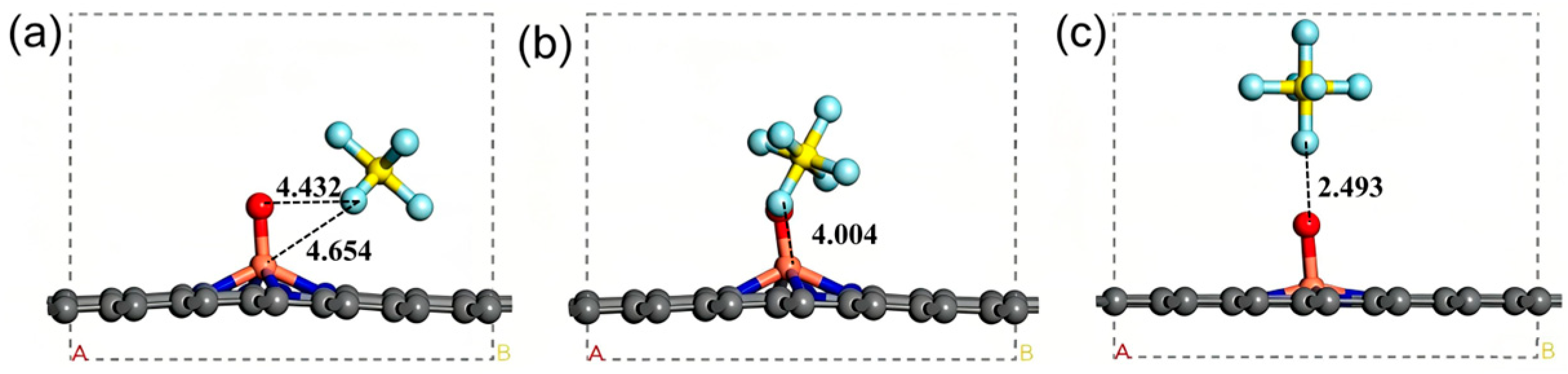
Figure 7 displays the optimized adsorption configurations of SF6 at three types of sites on CuO-C4N. Similar to ZnO-C4N, electrostatic repulsion exists between surface O atoms of CuO and F atoms in SF6, yet the electronic properties of Cu elements alter the overall interfacial interactions: SF6 molecules show no obvious offset at O sites with weak adsorption attraction; interfacial interactions at N sites are moderate; hollow sites deliver the weakest adsorption effect. This originates from the affinity between Cu atoms and SF6 molecules, which offsets partial O–F atomic repulsion and changes the optimal active sites of CuO-C4N.
The O sites of CuO-C4N possess the largest absolute adsorption energy (−0.862 eV), followed by the N sites, while the hollow sites present the lowest adsorption energy. This result is completely opposite to ZnO-C4N, revealing that modification with different metal oxides induces significant variations in surface active site distribution and electronic structures of composite materials, directly altering the adsorption preference toward SF6. The O and N sites constitute core regions for SF6 activation on CuO-C4N.

2.3.2. Adsorption Characteristics of SF6 Decomposition Intermediates

Adsorption calculations were performed for CO2, SO2, SO2F2, and SOF2. The optimized adsorption configurations are presented in Figure 8, and the adsorption energies with Mulliken charge transfer quantities are summarized in Table 4. Configuration observation demonstrates that all decomposition species except SO2 exhibit weak repulsion trends with CuO-C4N surfaces, characterized by enlarged atomic distances and molecular geometries departing from the substrates. This indicates that CuO-C4N delivers an extremely high selective adsorption capacity toward SO2 to directionally enrich this product, yet it lacks sufficient adsorption capacity for other fluorinated decomposition intermediates.
From adsorption energy and charge transfer perspectives, SO2 presents an adsorption energy of −3.316 eV on CuO-C4N, representing the strongest adsorption interaction among all molecules with remarkable charge transfer corresponding to intense chemical adsorption. SO2F2 and SOF2 deliver moderate adsorption energies with negligible charge transfer and weak interfacial interactions. CO2 exhibits moderate adsorption affinity, while SF6 itself shows the weakest adsorption capacity.

2.4. Comparative Analysis of Adsorption Performance Between ZnO-C4N and CuO-C4N

DFT results reveal completely different active centers for the two catalysts. Hollow sites dominate ZnO-C4N and trap SF6 more stably, while surface O sites act as core active regions on CuO-C4N. ZnO-C4N shows universal adsorption toward SO2, SO2F2, and other fluorinated intermediates, supporting continuous multi-step defluorination. In contrast, CuO-C4N only strongly adsorbs SO2 with a weak affinity for other byproducts, enabling selective product enrichment. Both materials undergo intense electron exchange with SO2 via orbital hybridization to weaken the S–F bonds. ZnO-C4N suits deep SF6 degradation, whereas CuO-C4N fits targeted tail gas control.

2.5. Analysis of Catalytic Decomposition Mechanism

XRD, TEM, and EDS verify uniform CuO/ZnO loading on intact C4N frameworks with abundant heterogeneous interfaces lowering the SF6 dissociation barriers. Single thermal treatment barely decomposes SF6, proving surface adsorption pre-activation is indispensable. SF6 is captured at optimal sites, and O–F electrostatic repulsion plus interfacial charge transfer break the S–F bonds to generate low-fluorine intermediates. Under NH3 reduction, the intermediates gradually defluorinate into SO2 and SOF2. CaO removes HF and inhibits catalyst sintering/halogen poisoning to sustain long-term activity. The divergent adsorption behaviors originate from intrinsic electronic differences between Zn and Cu, consistent with both experimental conversion data and DFT calculations.

3. Materials and Methods

3.1. Experimental Reagents

All chemical reagents used in experiments were analytical grade without further purification before use. Zinc nitrate hexahydrate, copper nitrate trihydrate, 2-methylimidazole, methanol, ethanol, and sodium borohydride were purchased from Sinopharm Chemical Reagent Co., Ltd (Beijing, China). High-purity SF6, NH3, and He (purity ≥ 99.999%) were obtained from Wuhan Special Gas Co., Ltd. (Wuhan, China). Quartz cotton and calcium oxide (CaO) were supplied by Aladdin Reagent Co., Ltd. (Shanghai, China).

3.2. Catalyst Preparation

MOF-derived materials have been widely adopted to fabricate supported metal oxide catalysts, in which ZIF-8 serves as a self-sacrificial template to construct carbon–nitrogen skeletons under inert atmosphere [39,40,41]. Benefiting from the inherent porous structure of ZIF-8, metal species can be homogeneously confined within the pore channels, which effectively suppresses particle aggregation during thermal treatment. Herein, CuO/ZnO-C4N composite catalysts were synthesized via a ZIF-8 template route combined with liquid-phase reduction and subsequent calcination. The detailed preparation procedures are described as follows:
  • Synthesis of ZIF-8 precursor. ZIF-8 was prepared via a typical solution assembly method. In brief, 3.36 g Zn(NO3)2·6H2O (0.07 mol L−1) and 7.40 g 2-methylimidazole (0.56 mol L−1) were separately dissolved in 160 mL methanol. The zinc solution was slowly blended into the ligand solution under continuous stirring. After stirring for 30 min at room temperature, the mixture was statically aged for 24 h. The white precipitate was centrifuged, rinsed repeatedly with methanol, and dried at 70 °C for 12 h to obtain pure ZIF-8 powder.
  • Fabrication of Cu-modified ZIF-8 intermediate. An amount of 1.0 g of ZIF-8 powder (5.56 mmol Zn2+) was uniformly dispersed in 80 mL methanol by ultrasonication for 30 min. Subsequently, 1.34 g Cu(NO3)2·3H2O (5.56 mmol) was added and stirred for 1 h to achieve sufficient Cu2+ adsorption. A total of 1.06 g NaBH4 (13.9 mmol) dissolved in 60 mL deionized water was added dropwise within 4 min for liquid-phase reduction. The reaction continued for another 1 h. The solid product was centrifuged, washed with deionized water and ethanol, and vacuum-dried at 50 °C for 12 h. For the 3:1 Cu/Zn sample, the dosages of copper salt and NaBH4 were tripled while the ZIF-8 amount remained unchanged.
  • Synthesis of CuO/ZnO-C4N catalyst. The dried Cu@ZIF-8 precursor was calcined in a flowing nitrogen atmosphere. The temperature was increased to 350 °C at a heating rate of 1 °C min−1 and maintained for 6 h. During pyrolysis, the ZIF-8 organic framework was thermally decomposed and reconstructed into a wrinkled C4N carbon–nitrogen monolayer skeleton, while the adsorbed metal species were simultaneously converted into CuO and ZnO nanoparticles. After natural cooling and grinding, the final CuO/ZnO-C4N composite catalyst was obtained.

3.3. Thermal Catalytic Experimental Procedure

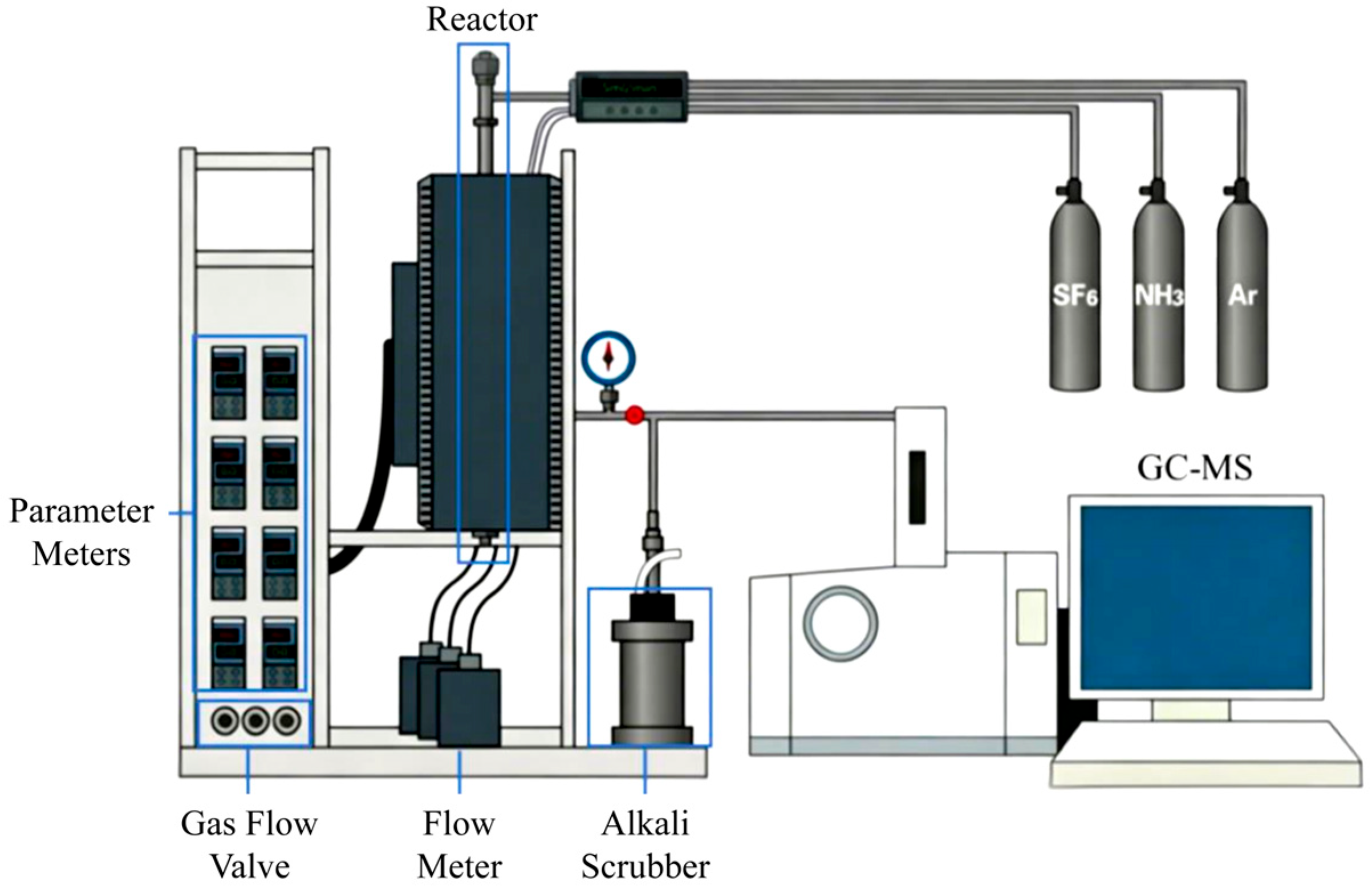
A vertical fixed-bed thermal catalytic reaction platform was built to verify the macroscopic catalytic performance of the composite materials, as shown in Figure 9. Experimental steps: accurately weigh 1.0 g catalyst and 0.5 g CaO additive, mix uniformly, and fill into the quartz cotton support layer in the middle section of the reactor; repeatedly vacuumize and fill with nitrogen 3 times to replace the residual air in the pipelines; introduce the reaction gas, heat to the set temperature, and stabilize under constant temperature; collect the tail gas with Teflon sampling bags every 1 h, and conduct qualitative and quantitative detection of SF6 and decomposition products through GC–MS (QP2010 Ultra, Shimadzu Corporation, Kyoto, Japan). After the experiments, nitrogen was introduced to purge the pipelines, and the tail gas was discharged after an alkali washing treatment. The mass ratio of catalyst to CaO additive (2:1) was determined based on our preliminary tests [26,27], which verified that 0.5 g CaO matched with 1.0 g catalyst achieves optimal anti-poisoning and anti-sintering effects.

3.4. First-Principles Computational Methods and Model Construction

3.4.1. Computational Parameter Settings

All simulation calculations in this work were performed based on density functional theory (DFT) using the Dmol3 module [30,31,35]. The exchange-correlation functional adopted the Perdew–Burke–Ernzerhof (PBE) functional within the generalized gradient approximation (GGA) [32]. The interaction between valence electrons and ionic cores was described by Kleinman–Bylander norm-conserving ultrasoft pseudopotentials [42]. A basis set cutoff of 400 eV was selected after systematic energy convergence tests to balance the computational accuracy and cost. The Brillouin zone was sampled using a 3 × 3 × 1 Monkhorst–Pack k-point mesh [43]. The convergence criteria for geometric structure optimization are as follows: atomic force less than 0.03 eV·Å−1, total system energy convergence precision below 1.0 × 10⁻⁵ eV·atom−1. A vacuum layer with a thickness of 15 Å was constructed to eliminate interlayer interactions. Van der Waals dispersion correction (DFT-D3) [33] was incorporated during calculations to accurately characterize the weak interactions between the gas molecules and the material surfaces.

3.4.2. Model and Adsorption Site Construction

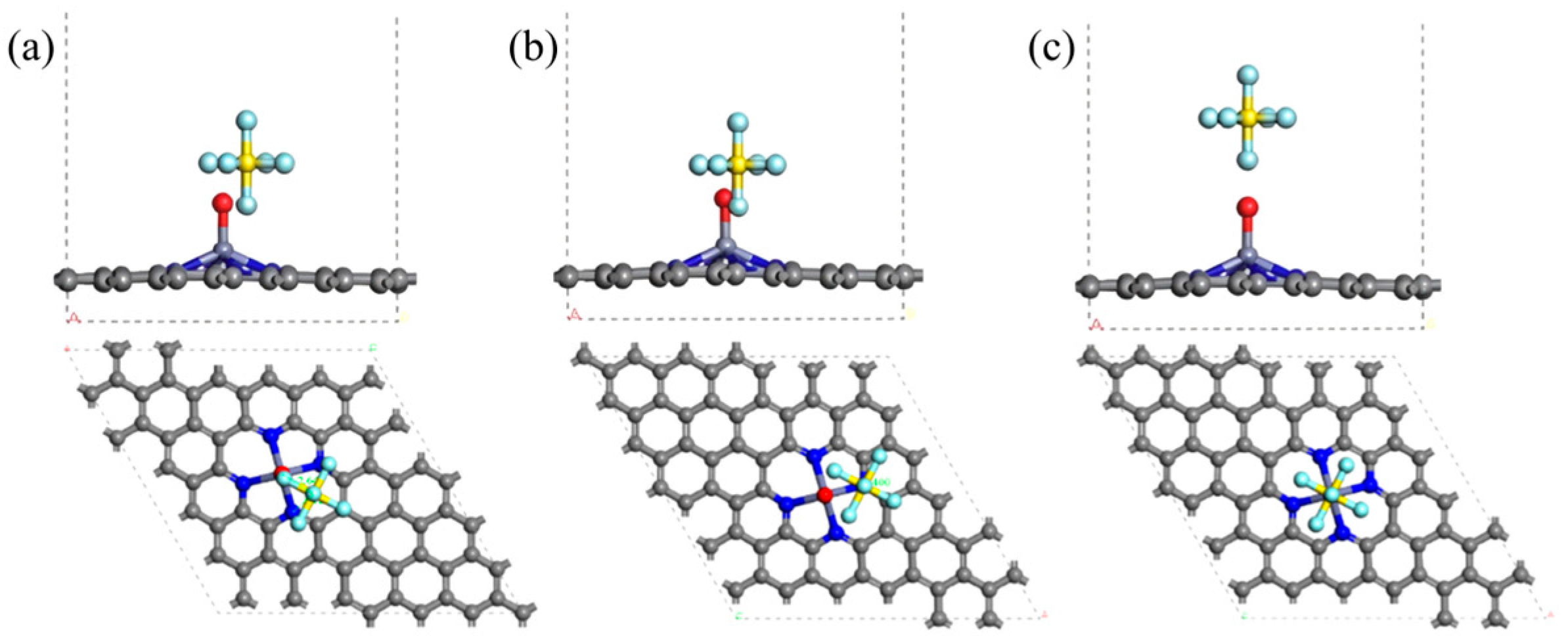
A two-dimensional C4N monolayer supercell model was built based on the C4N crystal structure obtained from the experimental characterizations. ZnO and CuO clusters were loaded onto the substrate surface separately, and geometric optimization was conducted to acquire the ZnO-C4N and CuO-C4N composite models. Combined with the surface structures of the materials, three typical adsorption sites (hollow sites, N sites, and O sites) were selected for adsorption calculations of SF6 and its decomposition species. Molecules including SF6, SO2, SOF2, SO2F2, and CO2 were placed above each site at initial positions for structural optimization and energy calculations. The initial structural models of SF6 placed at three representative active sites on the C4N monolayer before geometric relaxation are illustrated in Figure 10, containing both side and top views of the supercell slab.

3.4.3. Calculation of Adsorption Energy and Charge Transfer

Adsorption energy, Eads, serves as the core index to evaluate the adsorption strength, defined by Equation (2):
Eads = Etotal − Esub − Egas
where Etotal denotes the total energy of the whole system after the gas molecules are adsorbed on the material surface (eV); Esub represents the energy of the pure catalytic substrate (eV); Egas is the energy of the isolated gas molecules (eV). A negative Eads indicates an exothermic adsorption process, and a larger absolute value corresponds to stronger adsorption and a more stable system structure.
Mulliken population analysis was employed to calculate the total charge transfer Qt of the system, characterizing the electron transfer laws at the gas–solid interface and analyzing the types of interfacial interactions.

4. Conclusions

In this work, a two-dimensional C4N monolayer was employed as a carrier to fabricate CuO/ZnO bimetallic composite catalysts for medium-temperature SF6 abatement. Systematic catalytic experiments, XRD, TEM, and EDS microstructural characterizations, and DFT first-principles adsorption calculations were combined to reveal the macroscopic degradation performance and atomic-scale interfacial mechanism of the as-prepared materials. The core findings are summarized as follows:
(1)
The impregnation-calcination strategy enables uniform dispersion of CuO and ZnO nanoparticles on intact C4N skeletons without structural collapse. Atmosphere screening verifies that NH3 reducing conditions greatly promote SF6 conversion, and the catalyst with a Cu/Zn molar ratio of 3:1 delivers a maximum SF6 conversion efficiency of 91%. Incorporated CaO effectively alleviates catalyst sintering and irreversible HF-induced halogen poisoning, raising the overall catalytic activity by approximately 30%.
(2)
DFT calculations identified totally distinct intrinsic active sites for ZnO-C4N and CuO-C4N. Hollow sites dominate SF6 activation on ZnO-C4N, while surface O-top sites serve as the primary reactive centers on CuO-C4N. Electrostatic repulsion between surface oxygen and fluorine atoms acts as the key driving force for stretching and breaking S–F bonds; strong chemical adsorption accompanied by intensive interfacial electron transfer occurs between both catalysts and SO2 intermediates.
(3)
The two composites exhibit divergent catalytic selectivity. ZnO-C4N shows universal adsorption affinity toward all fluorinated SF6 decomposition species, making it suitable for thorough harmless disposal of waste SF6. In contrast, CuO-C4N possesses exclusive selective adsorption for SO2, which can be exploited for targeted recovery of sulfur-containing products from exhaust streams. The DFT-derived interfacial interaction rules are highly consistent with the measured conversion and product distribution data obtained from thermal experiments.
(4)
Heterojunctions formed by loaded CuO/ZnO modulate the surface electronic distribution of C4N substrates. The inherent electronic discrepancy between Zn and Cu species accounts for the different catalytic activity and selectivity of the two materials. This study establishes a fundamental atomic-level understanding of bimetallic C4N-based catalysts and provides experimental and theoretical guidance for designing high-efficiency catalysts to mitigate SF6 greenhouse gas emissions.
Nevertheless, the present investigation is mainly based on static DFT adsorption simulations and short-duration batch catalytic experiments. High-temperature dynamic evolution and long-term continuous performance remain to be explored. Complementary techniques including in situ characterizations and AIMD simulations could be implemented in future work to further corroborate the reaction pathway proposed herein.

Author Contributions

Conceptualization, Z.C. and F.Z.; methodology, K.Z., D.S., Z.L. (Zhihui Li), X.W., Z.L. (Zihan Li) and H.J.; software, Z.L. (Zhihui Li); validation, K.Z., D.S., Z.L., X.W., Z.L. (Zihan Li) and H.J.; formal analysis, Z.C.; investigation, K.Z. and D.S.; resources, F.Z.; data curation, Z.C. and D.S.; writing—original draft preparation, Z.C. and D.S.; writing—review and editing, F.Z., K.Z., X.W., Z.L. (Zihan Li) and H.J.; visualization, Z.L. (Zhihui Li).; supervision, F.Z.; project administration, F.Z.; funding acquisition, F.Z. All authors have read and agreed to the published version of the manuscript.

Funding

This research was funded by the National Natural Science Foundation of China, grant number 52277161.

Data Availability Statement

The raw experimental data, DFT output files, TEM characterization images, and GC–MS test data supporting the conclusions of this study are available on request from the corresponding author.

Conflicts of Interest

Zhenhua Cai and Dongwei Sun are employees of Guangdong Power Grid Co., Ltd. This study was not funded by Guangdong Power Grid Co., Ltd. company.

Abbreviations

The following abbreviations are used in this manuscript:
SF6Sulfur hexafluoride
C4NTetracarbon mononitride monolayer
DFTDensity Functional Theory
EDSEnergy Dispersive X-ray Spectroscopy
TEMTransmission Electron Microscopy
GISGas Insulated Switchgear
GC–MSGas Chromatography–Mass Spectroscopy

References

  1. Cui, Z.; Li, Y.; Xiao, S.; Tian, S.; Tang, J.; Hao, Y.; Zhang, X. Recent progresses, challenges and proposals on SF6 emission reduction approaches. Sci. Total Environ. 2024, 906, 167347. [Google Scholar] [CrossRef] [PubMed]
  2. Zhang, H.Y.; Zeng, F.P.; Lei, Z.C. A Novel Diagnosis Method Based on the Feature Selection Algorithm and Convolutional Neural Network for SF6 Gas-Insulated Equipment. IEEE Trans. Dielectr. Electr. Insul. 2023, 30, 1247–1282. [Google Scholar] [CrossRef]
  3. Zeng, F.P.; Guo, X.N.; Feng, X.X. Theoretical study of SF6 adsorption on Ti3C2Tx. Appl. Surf. Sci. 2022, 597, 153721. [Google Scholar] [CrossRef]
  4. Sovacool, B.K.; Griffiths, S.; Kim, J. Climate change and industrial F-gases: A critical and systematic review of developments, sociotechnical systems and policy options for reducing synthetic greenhouse gas emissions. Renew. Sustain. Energy Rev. 2021, 141, 110799. [Google Scholar] [CrossRef]
  5. An, M.; Prinn, R.G.; Western, L.M.; Zhao, X.; Yao, B.; Hu, J.; Ganesan, A.L.; Mühle, J.; Weiss, R.F.; Krummel, P.B.; et al. Sustained growth of sulfur hexafluoride emissions in China inferred from atmospheric observations. Nat. Commun. 2024, 15, 1997. [Google Scholar] [CrossRef] [PubMed]
  6. Ko, G.; Seo, Y. Formation and dissociation behaviors of SF6 hydrates in the presence of a surfactant and an antifoaming agent. Chem. Eng. J. 2020, 400, 125924. [Google Scholar] [CrossRef]
  7. Rabie, M.; Franck, C.M. Assessment of Eco-friendly Gases for Electrical Insulation to Replace the Most Potent Industrial Greenhouse Gas SF6. Environ. Sci. Technol. 2018, 52, 369–380. [Google Scholar] [CrossRef] [PubMed]
  8. Parthiban, A.; Gopal, A.R.; Siwayanan, P. Disposal methods, health effects and emission regulations for sulfur hexafluoride. J. Hazard. Mater. 2021, 417, 125097. [Google Scholar] [CrossRef] [PubMed]
  9. Chu, F.Y. SF6 decomposition in gas-insulated equipment. IEEE Trans. Electr. Insul. 1986, EI-21, 693–725. [Google Scholar] [CrossRef]
  10. Zhou, S.; Teng, F.; Tong, Q. Mitigating Sulfur Hexafluoride Emission from Electrical Equipment in China. Sustainability 2018, 10, 2190. [Google Scholar] [CrossRef]
  11. Xiong, H.; Chen, T.; Liu, H. Research on thermal catalytic degradation of SF6 waste gas based on phosphate materials. High Volt. Appar. 2021, 57, 180–185. [Google Scholar]
  12. Zhang, X.X.; Wang, Y.; Tian, S.S. Effect of O2 on thermal catalytic degradation of SF6 waste gas over CePO4. High Volt. Eng. 2022, 48, 2152–2158. [Google Scholar]
  13. Meng, X.; Hu, J.H.; Dong, B.X. Rectified SiC-Fe2O3 heterostructures for high efficient activation and degradation of sulfur hexafluoride. Chem. Eng. J. 2022, 450, 137949. [Google Scholar] [CrossRef]
  14. Zhang, X.X.; Li, Y.L.; Hu, X.X. Experimental and simulation research on UV photocatalytic degradation of high-concentration SF6. High Volt. Eng. 2019, 45, 2212–2218. [Google Scholar]
  15. Tan, L.; Nie, C.Y.; Ao, Z.M.; Sun, H.Q.; An, T.C.; Wang, S. Novel Two-Dimensional Crystalline Carbon Nitrides beyond g-C3N4: Structure and Applications. J. Mater. Chem. A 2021, 9, 17–33. [Google Scholar] [CrossRef]
  16. Hou, Q.H.; Yong, Y.L.; Yuan, X.B.; Wei, X.S.; Liu, Z.Y.; Cui, H.L.; Li, X.L.; Li, X.H. The Defective C3N Monolayers as High-Efficient Hydrogen Purification Membranes: DFT Calculations and MD Simulations. Colloids Surf. A Physicochem. Eng. Asp. 2024, 680, 132715. [Google Scholar] [CrossRef]
  17. Zhang, Y.; Li, Y.L.; Cui, Z.L. Simulation and experiment on the catalytic degradation of high-concentration SF6 under UV light. AIP Adv. 2018, 8, 055113. [Google Scholar] [CrossRef]
  18. Cui, H.; Yan, C.; Jia, P.F.; Cao, W. Adsorption and Sensing Behaviors of SF6 Decomposed Species on Ni-Doped C3N Monolayer: A First-Principles Study. Appl. Surf. Sci. 2020, 512, 145759. [Google Scholar] [CrossRef]
  19. Zhang, X.X.; Zhang, G.Z.; Wu, Y.Q. Synergistic treatment of SF6 by dielectric barrier discharge/γ-Al2O3 catalysis. AIP Adv. 2018, 8, 125109. [Google Scholar] [CrossRef]
  20. Zhu, K.X.; Zeng, F.P. Study on the Catalytic Degradation of Strong Greenhouse Gas SF6 Using a Two-Dimensional Metal Organic Framework. In Proceedings of the 2024 IEEE 5th International Conference on Dielectrics (ICD); IEEE: New York, NY, USA, 2024. [Google Scholar]
  21. Zhang, Z.Q.; Xu, X.W.; Duan, P.J.; Shao, Y.; Wang, Q.; Qin, Z.H.; Bai, C.W.; Chen, X.J.; Wang, J.; Yang, F.Q.; et al. Heterointerface-Engineered ZnO/CuO Bimetallic Sites Enable Pollutant-Directed Conversion with In Situ Catalyst Regeneration. Nat. Commun. 2026, 17, 4841. [Google Scholar] [CrossRef] [PubMed]
  22. Zeng, F.P.; Zhu, K.X. Molecular Thermodynamic Evaluation of Various Cu-Doped ZIF-8 Ratios for SF6 Catalysis. IEEE Trans. Dielectr. Electr. Insul. 2025, 32, 408–415. [Google Scholar] [CrossRef]
  23. Cui, Z.L.; Zhang, X.X.; Tian, Y. Effects of Glass Beads Packing on SF6 abatement by packed bed plasma. Plasma Chem. Plasma Process. 2020, 40, 43–59. [Google Scholar] [CrossRef]
  24. Tian, Y.; Zhang, X.X.; Tang, B.W. SF6 abatement in packed bed plasma reactor: Study towards the effect of O2 concentration. RSC Adv. 2019, 9, 34827–34836. [Google Scholar] [CrossRef] [PubMed]
  25. Zeng, F.P.; Zhu, K.X. Cu-ZnO Heterojunction Catalytic SF6/H2 Gas Conversion Mechanism and Reaction Network Construction. IEEE Trans. Dielectr. Electr. Insul. 2023, 30, 667–673. [Google Scholar] [CrossRef]
  26. Li, Z.H.; Zeng, F.P.; Zhu, K.X.; Li, H.T.; Wang, X.Y.; Jiang, H. A High-Performance CuO/ZnO Catalyst for SF6 Catalytic Degradation with Ammonia Promotion. In Proceedings of the 6th International Symposium on Plasma and Energy Conversion (iSPEC 2025), Hong Kong, China, 3–6 December 2026; pp. 67–77. [Google Scholar]
  27. Zhu, K.X.; Zeng, F.P.; Li, Z.H.; Lv, L.L.; Jiang, H.; Chen, G.Z.; Wang, X.Y.; Tang, J. Highly Efficient SF6 Degradation Solution Based on CuO-ZnO with Exceptional Stability. J. Environ. Chem. Eng. 2025, 13, 115954. [Google Scholar] [CrossRef]
  28. Shi, S.; Li, Y.; Cui, Z. Recent advances in degradation of the most potent industrial greenhouse gas sulfur hexafluoride. Chem. Eng. J. 2023, 470, 144166. [Google Scholar] [CrossRef]
  29. Zeng, F.; Cai, R.; Li, C. TiO2/SiC supported catalyst for efficient thermocatalytic conversion of SF6 waste gas. J. Phys. D Appl. Phys. 2024, 57, 135502. [Google Scholar] [CrossRef]
  30. Hohenberg, P.; Kohn, W. Inhomogeneous electron gas. Phys. Rev. 1964, 136, B864–B871. [Google Scholar] [CrossRef]
  31. Kohn, W.; Sham, L.J. Self-consistent equations including exchange and correlation effects. Phys. Rev. 1965, 140, A1133–A1138. [Google Scholar] [CrossRef]
  32. Perdew, J.P.; Burke, K.; Ernzerhof, M. Generalized gradient approximation made simple. Phys. Rev. Lett. 1996, 77, 3865–3868. [Google Scholar] [CrossRef] [PubMed]
  33. Grimme, S.; Antony, J.; Ehrlich, S.; Krieg, H. A consistent and accurate ab initio parametrization of density functional dispersion correction (DFT-D3) for the 94 elements H-Pu. J. Chem. Phys. 2010, 132, 154104. [Google Scholar] [PubMed]
  34. Delley, B. An all-electron numerical method for solving the local density functional for polyatomic molecules. J. Chem. Phys. 1990, 92, 508–517. [Google Scholar] [CrossRef]
  35. Delley, B. From molecules to solids with the DMol3 approach. J. Chem. Phys. 2000, 113, 7756–7764. [Google Scholar] [CrossRef]
  36. Zeng, F.P.; Zhu, K.X.; Chen, X.Y. Analysis of the Thermal Decomposition Path of SF6 on Cu and its Oxides. Plasma Chem. Plasma Process. 2022, 42, 1361–1380. [Google Scholar] [CrossRef]
  37. Kashiwagi, D.; Takai, A.; Takubo, T.; Nagaoka, K.; Inoue, T.; Takita, Y. Metal phosphate catalysts effective for degradation of sulfur hexafluoride. Ind. Eng. Chem. Res. 2009, 48, 632–640. [Google Scholar] [CrossRef]
  38. Zhang, X.; Li, X.; Wang, Y.; Meng, F.; Zou, Y.; Tian, S.; Cui, Z. Experimental study on thermal catalytic degradation of SF6 waste gas by metal phosphate. J. Electr. Eng. Technol. 2023, 18, 1251–1262. [Google Scholar] [CrossRef]
  39. Ban, L.; Li, H.; Huang, X.; Xu, Y.; Guo, X.; Zhang, Y.; Zhao, J.; Zhao, Y. Metal–Organic-Framework-Derived CuO–ZnO@CN Hollow Nanoreactors: Precise Structural Control and Efficient Catalytic Performance. Langmuir 2024, 40, 24312–24322. [Google Scholar] [CrossRef] [PubMed]
  40. Lu, H.; Wang, X.C.; Wang, C.Y.; Wang, Q.H.; Xie, J.J.; Wang, W.M.; Fu, Z.Y.; Zou, Z.Y. Bio-inspired design of hierarchically porous ZIF-8 derived Fe–N–C bifunctional catalysts for enhanced zinc-air battery performance. Carbon 2026, 248, 121157. [Google Scholar] [CrossRef]
  41. Chen, F.; Liu, S.Y.; Huang, H.; Wang, B.; Liu, Z.H.; Jiang, X.Y.; Xiang, W.J.; Yang, G.H.; Liu, G.B.; Peng, X.B.; et al. Fast synthesis of Cu@zeolitic imidazolate framework-8 (ZIF-8) derived Cu/ZnO catalysts via a facile mechanical grinding method for CO2 hydrogenation to methanol. Chem. Sci. 2024, 16, 2273–2286. [Google Scholar] [CrossRef] [PubMed]
  42. Kleinman, L.; Bylander, D.M. Efficacious form for model pseudopotentials. Phys. Rev. Lett. 1982, 48, 1425–1428. [Google Scholar] [CrossRef]
  43. Monkhorst, H.J.; Pack, J.D. Special points for Brillouin-zone integrations. Phys. Rev. B 1976, 13, 5188–5192. [Google Scholar] [CrossRef]
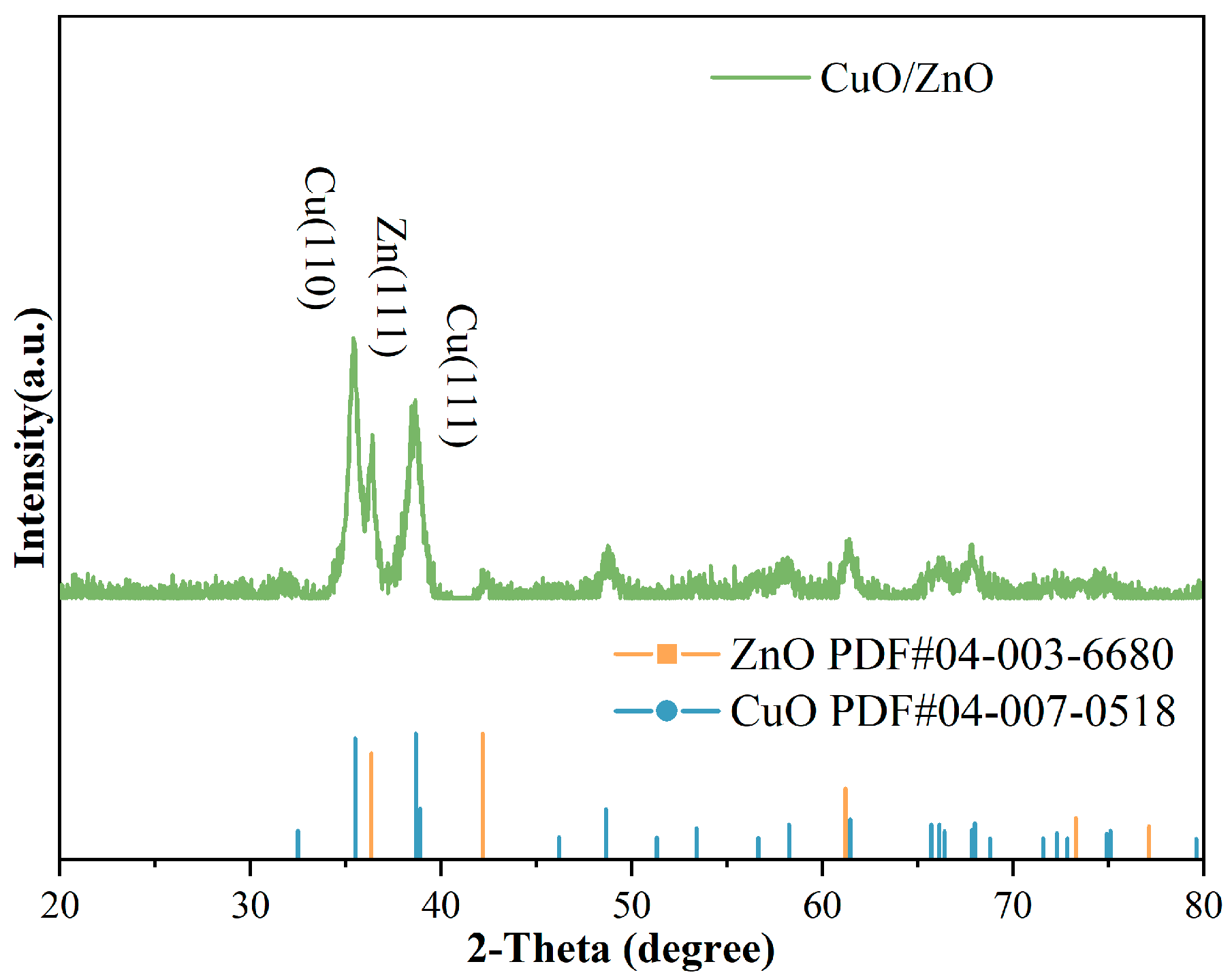
Figure 1. XRD pattern of 3:1 CuO/ZnO-C4N composite catalyst. Standard diffraction peaks of CuO and ZnO are marked for reference.
Catalysts 16 00696 g001
Figure 2. TEM images of CuO/ZnO-C4N composite catalyst. (a) High-magnification TEM view of CuO/ZnO nanoparticles (scale bar = 50 nm); (b) Low-magnification TEM image showing the overall dispersion of the oxide nanoparticles (scale bar = 200 nm); (c) TEM background view of the support substrate (scale bar = 200 nm).
Catalysts 16 00696 g002
Figure 3. EDS images of CuO/ZnO-C4N composite catalyst.
Catalysts 16 00696 g003
Figure 4. Time-dependent concentration curves of various products under 2% SF6/98% air atmosphere at 700 °C and 0.2 MPa.
Catalysts 16 00696 g004
Figure 5. Optimized adsorption configurations of SF6 at different sites on ZnO-C4N. (a) hollow; (b) N sites; (c) O sites.
Catalysts 16 00696 g005
Figure 6. Optimized adsorption configurations of SF6 at different sites on ZnO-C4N. (a) CO2; (b) SO2; (c) SO2F2; (d) SOF2.
Catalysts 16 00696 g006
Figure 7. Optimized adsorption configurations of SF6 at different sites on CuO-C4N. (a) hollow; (b) N sites; (c) O sites.
Catalysts 16 00696 g007
Figure 8. Optimized adsorption configurations of SF6 at different sites on CuO-C4N. (a) CO2; (b) SO2; (c) SO2F2; (d) SOF2.
Catalysts 16 00696 g008
Figure 9. Schematic diagram of vertical fixed-bed thermal catalytic reaction platform.
Catalysts 16 00696 g009
Figure 10. Side and top views of initial slab models of SF6 located at three typical active sites on the C4N monolayer prior to geometric optimization. (a) Hollow site; (b) N site; (c) O site.
Catalysts 16 00696 g010
Table 1. Blank SF6 conversion rates under different reaction gas systems.
Reaction Gas SystemTemperaturePressureFlow RateMaximum Conversion Rate
2% SF6/98% He600 °C0.2 MPa5 mL·min−111%
2% SF6/98% Air600 °C0.2 MPa5 mL·min−117%
2% SF6/2% NH3/96% Ar600 °C0.2 MPa5 mL·min−131%
Table 2. SF6 conversion rates under 2% SF6/98% air atmosphere with varied operating conditions.
TemperaturePressureFlow RateMaximum Conversion Rate
700 °C0.4 MPa5 mL·min−138%
700 °C0.6 MPa5 mL·min−112%
700 °C0.2 MPa5 mL·min−126%
Table 3. Adsorption energies and charge transfer quantities of various gas molecules on ZnO-C4N.
Gas MoleculeEads/eVQt/e
CO2−0.254−0.032
SO2−2.7900.087
SO2F2−1.425−0.477
SOF2−0.068−0.010
SF6−0.045−0.018
Table 4. Adsorption energies and charge transfer quantities of various gas molecules on CuO-C4N.
Gas MoleculeEads/eVQt/e
CO2−0.622−0.019
SO2−3.3160.075
SO2F2−0.479−0.007
SOF2−0.460−0.007
SF6−0.020−0.024
Disclaimer/Publisher’s Note: The statements, opinions and data contained in all publications are solely those of the individual author(s) and contributor(s) and not of MDPI and/or the editor(s). MDPI and/or the editor(s) disclaim responsibility for any injury to people or property resulting from any ideas, methods, instructions or products referred to in the content.