Review

Research Progress on Fenton Process for Industrial Wastewater Treatment: A Comprehensive Review

1
College of Hydraulic Engineering, Shaanxi A&F Technology University, Yangling 712100, China
2
State Key Laboratory of Water Engineering Ecology and Environment in Arid Area, Xi’an University of Technology, Xi’an 710048, China
3
School of Environment and Natural Resources, Zhejiang University of Science & Technology, Hangzhou 310023, China
4
Power China Northwest Engineering Corporation Limited, Xi’an 710065, China
5
Xi’an Tap Water Second Engineering Co., Ltd., 20 Huancheng West Road South Section, Xi’an 710082, China
*
Authors to whom correspondence should be addressed.
Catalysts 2026, 16(7), 644; https://doi.org/10.3390/catal16070644
Submission received: 2 June 2026 / Revised: 12 July 2026 / Accepted: 13 July 2026 / Published: 15 July 2026

Abstract

Industrial wastewater containing refractory organic compounds, heavy metals, and emerging contaminants poses a significant challenge to conventional treatment methods due to their high chemical stability and toxicity. This review systematically summarizes recent advances in Fenton-based advanced oxidation processes (AOPs) for industrial wastewater treatment, with a particular focus on the paradigm shift from homogeneous to heterogeneous catalytic systems. Homogeneous Fenton processes, which rely on Fe2+/H2O2 reactions, exhibit rapid reaction kinetics but are severely limited by a narrow operational pH range (2–4) and the generation of substantial iron sludge. In contrast, heterogeneous Fenton systems employing immobilized or supported catalysts—such as iron-loaded zeolites, metal–organic frameworks, and carbon-based composites—broaden the applicable pH range to near-neutral conditions (4–8), enable catalyst recovery and reuse over multiple cycles, and enhance process sustainability by reducing iron leaching and sludge production. Integration with external energy inputs—such as photo, electricity, or ultrasound—can further promote radical generation and mass transfer, improving degradation efficiency while reducing chemical consumption. Practical applications in treating wastewater from textile, pharmaceutical, and electroplating industries have demonstrated effective contaminant removal and enhanced biodegradability. However, most current research remains at the laboratory scale, with long-term catalyst stability, operational costs, and scalability representing major barriers to large-scale implementation. Future research should focus on developing stable and regenerable catalysts, advancing pilot-scale studies of integrated systems, and conducting long-term evaluations under real wastewater conditions to promote the development of efficient, low-carbon, and sustainable solutions for industrial wastewater treatment.

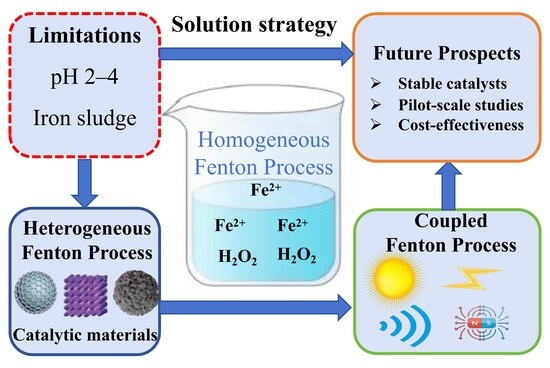
Graphical Abstract

1. Introduction

The accelerating pace of global industrialization has precipitated a substantial increase in the discharge of industrial wastewater, characterized by complex matrices containing elevated concentrations of persistent pollutants. These include refractory organic compounds—such as polycyclic aromatic hydrocarbons (PAHs) and endocrine-disrupting chemicals—alongside heavy metals and emerging contaminants like microplastics and antibiotic resistance genes [1,2]. The environmental and public health implications are severe: these contaminants not only inflict devastating damage on aquatic ecosystems but also exhibit a propensity for bioaccumulation through trophic transfer, posing significant long-term risks to human health [3,4]. Conventional biological treatment processes, exemplified by the activated sludge process, frequently prove inadequate for such wastewater streams, achieving chemical oxygen demand (COD) removal efficiencies below 40% while concurrently grappling with inherent limitations including excessive sludge production and protracted hydraulic retention times [5]. Consequently, there is an urgent and pressing need to develop innovative, efficient, and sustainable treatment technologies, a pursuit of considerable scientific and engineering significance.
Conventional Biological Treatment Processes, while cost-effective for readily biodegradable waste, demonstrate limited efficacy against high-strength, recalcitrant industrial wastewater, often resulting in low COD removal (<40%) and requiring extended treatment durations [6,7]. In recent years, with the advancement of advanced oxidation processes (AOPs), technologies such as ozone oxidation, photocatalysis, persulfate activation, and the Fenton process have been widely applied in industrial wastewater treatment [8,9,10]. Ozone-based catalytic processes exhibit selectivity in oxidizing pollutants, often resulting in relatively low oxidant utilization rates of 30–45% [11]. When treating bromide-containing wastewater, they can readily generate highly carcinogenic bromate, leading to secondary pollution [12]. Most efficient photocatalytic reactions rely on ultraviolet light; while solar energy is affected by weather and day–night cycles, artificial ultraviolet (UV) sources increase electricity consumption and operational costs [13]. Persulfate activation processes tend to elevate sulfate concentrations in effluent, affecting salinity, and chloride (Cl)) commonly present in water can react with sulfate radicals, consuming oxidants and potentially forming less reactive chlorine radicals, thereby reducing treatment efficiency [14]. In contrast, the Fenton process primarily utilizes iron to catalyze hydrogen peroxide, generating highly reactive hydroxyl radicals (·OH). Under optimized conditions (pH 3.5, catalyst concentration 0.1 g/L, H2O2 concentration 0.23 mol/L, room temperature, and Fe2O3-on-ZrO2–2 as the catalyst), it can achieve pollutant (Tetracycline Hydrochloride) removal rates exceeding 95%, while offering advantages such as simple operation, moderate operating costs, and ease of integration with biological treatment processes [15,16].
As a quintessential homogeneous AOP, the classic Fenton process operates via a chain reaction mechanism initiated by the Fe2+-catalyzed decomposition of hydrogen peroxide (H2O2) to yield ·OH [17,18,19]. Under optimized acidic conditions (pH ≈ 3), the rate constant for this reaction can reach 76 M−1s−1. Recent mechanistic insights highlight the critical influence of iron speciation on reaction kinetics; for instance, complexation of Fe2+ with organic ligands like citrate can enhance the reaction rate by 30–40%, offering novel avenues for process intensification [20]. From an application standpoint, the Fenton process exhibits robust performance, achieving 85–95% removal efficiency for model organic pollutants (e.g., phenol, chlorophenols) with mineralization degrees typically between 60 and 80% [21]. Kinetic analyses further corroborate that pollutant degradation often adheres to pseudo-second-order kinetics, with apparent rate constants ranging from 10−2 to 10−1 min−1 [22]. These findings not only deepen the fundamental understanding of Fenton chemistry but also provide a critical foundation for its engineering application in treating complex industrial effluents. Nevertheless, a closer examination reveals conflicting results across studies. For example, while some authors report pseudo-second-order kinetics as universally applicable [23], others have observed first-order or mixed-order behavior depending on the pollutant-to-oxidant ratio and the presence of radical scavengers [24]. Such discrepancies highlight the need for a more nuanced kinetic framework that accounts for the dynamic speciation of iron and the competitive consumption of radicals by background organic matter—an aspect that current reviews have largely neglected.
Despite its advantages, the classical Fenton process confronts several persistent challenges that hinder its widespread practical implementation [25]. A primary limitation is its narrow operational pH window (optimal range 2.5–3.5), which necessitates costly and often unsustainable acidification of wastewater whose native pH is typically neutral to alkaline (6–9) [26]. Furthermore, the process generates considerable quantities of iron-rich sludge, estimated at 15–30 kg (with ~98% moisture content) per ton of treated wastewater, thereby creating secondary disposal problems [27]. It is important to note that the term “iron sludge” is used inconsistently in the literature: some studies refer to it as “iron sludge” to emphasize its origin, while others use “iron sludge” generically. This terminological ambiguity can lead to confusion when comparing sludge management strategies. Moreover, the reported sludge generation rates vary widely (15–30 kg/ton), likely due to differences in wastewater composition and operating conditions, yet few studies have systematically investigated the factors controlling sludge yield—a critical gap for process optimization.
To overcome these technical bottlenecks, substantial research efforts have been directed toward material innovation and process modification. In the realm of catalyst development, engineered magnetic composite catalysts (e.g., Fe3O4@C) have successfully expanded the effective pH range to 5.0–6.5 while achieving magnetic recovery efficiencies exceeding 90% [28]. Regarding process optimization, electro-Fenton systems mitigate sludge production by 40–60% through the electrochemical regeneration of Fe2+, while ultrasound-assisted Fenton processes leverage cavitation effects to enhance treatment efficiency by 25–30% and reduce chemical consumption by over 30% [29,30,31]. These innovations represent significant strides toward making Fenton-based technologies more viable for full-scale industrial deployment.
Currently, several comprehensive reviews have already been published, focusing on the application of Fenton processes in wastewater treatment, covering a range of target compounds and process configurations [18,32,33,34,35,36]. However, over the past decade, research focus on the Fenton process has shifted from laboratory-scale optimization toward enhancements for practical engineering applications. Therefore, this review mainly explores the treatment performance and pollutant removal mechanisms of different Fenton processes across various industrial wastewaters, along with an in-depth analysis of their evolution trends, key influencing factors in practical applications, and economic feasibility. Unlike previous reviews that have largely provided descriptive summaries, this work aims to critically evaluate the evidence, highlighting areas of consensus and disagreement, and identifying knowledge gaps that hinder the translation of laboratory findings to full-scale implementation.
This article aims to systematically review and critically evaluate the latest research progress and engineering application trends of Fenton-based processes in the field of industrial wastewater treatment. The review focuses primarily on the following three aspects: (i) the treatment efficiency of Fenton processes for different categories of industrial wastewater; (ii) an in-depth analysis of degradation mechanisms and process intensification methods for various industrial wastewaters using Fenton oxidation; (iii) the influence of different operational factors on the treatment performance of Fenton processes; and (iv) economic Evaluation of Fenton-Based Processes. By comprehensively discussing these research directions, this review seeks to provide both theoretical foundations and technical references for the development of efficient, stable, and cost-effective Fenton treatment technologies, thereby facilitating their large-scale engineering applications in industrial wastewater treatment.

2. Methodology

This study conducted a comprehensive literature review using major international interdisciplinary research platforms, including Web of Science, Scopus, and Science Direct. The search employed the following keyword combinations: “advanced oxidation processes,” “Fenton process,” “homogeneous Fenton process,” “heterogeneous Fenton process,” and “industrial wastewater.” The retrieval process followed the classification framework proposed in reference [37] and adopted a “semi-systematic” review approach.
A total of 1203 initial records were retrieved. The screening process was conducted in two stages. First, titles and abstracts were reviewed based on predefined inclusion criteria: (i) peer-reviewed journal articles published in English; (ii) studies involving the treatment of real or synthetic industrial wastewater using Fenton-based processes; (iii) studies reporting clear experimental parameters and performance data (e.g., COD removal rate, TOC removal rate). Exclusion criteria included: (i) conference abstracts, book chapters, and non-English publications; (ii) studies limited to pure water systems and unrelated to industrial applications; (iii) duplicate publications. After title/abstract screening, 892 records were excluded. The remaining 311 full-text articles were assessed for eligibility, and 114 articles that did not meet the inclusion criteria or had insufficient data were ultimately excluded. Consequently, 197 papers were included in this review.
Given the significant variability in treatment efficiency among different Fenton processes for industrial wastewater, as well as the notable performance differences even when the same process is applied to the same type of wastewater, this review focuses on three main aspects: the treatment performance of various Fenton processes for industrial wastewater, the influence of different factors on treatment performance, and the economic feasibility of each Fenton-based method. Due to the high heterogeneity in experimental conditions (wastewater characteristics, reactor configuration, operating parameters) among the included studies, a quantitative meta-analysis was not feasible. Therefore, a qualitative thematic synthesis approach was adopted, whereby key data were extracted and compared in a narrative manner. The quality of individual studies was assessed based on the completeness of experimental design, the reproducibility of data reporting, and the replicability of results.
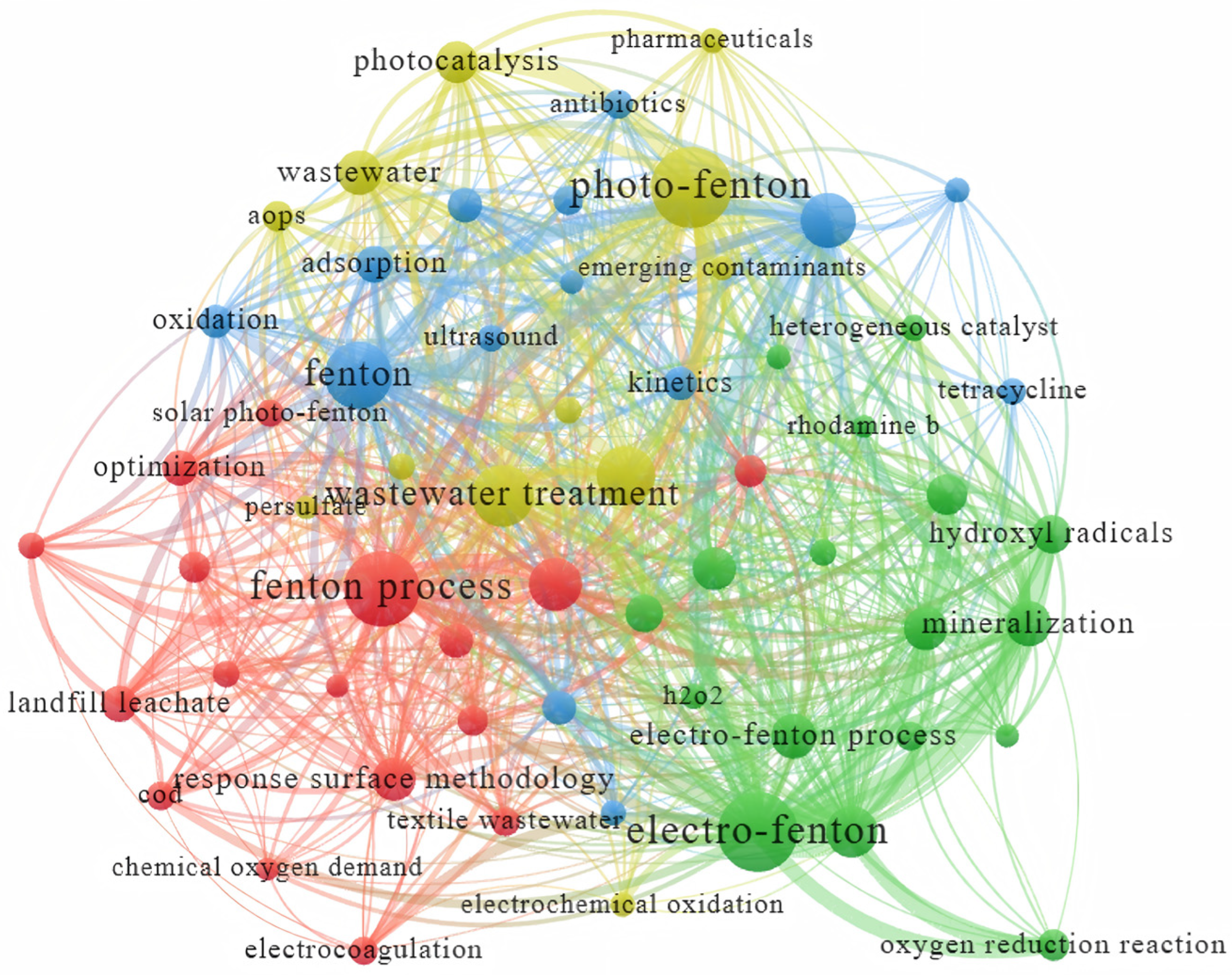
According to the cluster analysis results of publications collected from 2006 to 2025 (Figure 1), the red cluster in the visualization map corresponds to the early-stage research focused on exploring practical wastewater application scenarios of the traditional homogeneous Fenton process. The blue cluster covers core fundamental mechanism studies of Fenton reactions, including hydroxyl radical generation pathways, degradation kinetics and other related topics. The yellow cluster gathers the research and development of modified Fenton technologies such as photo-Fenton, as well as the application of multi-process coupled AOPs for treating emerging trace contaminants. The green cluster points to the fast-growing research direction of electro-Fenton systems in recent years. This thematic division fully demonstrates the progressive development logic of this field, which evolves stepwise from engineering feasibility verification, systematic theoretical framework construction, to the current pursuit of low-energy-consumption large-scale practical deployment, and also provides valuable reference for further exploring the understudied research gaps in this domain.

3. Classical Homogeneous Fenton Process and Its Limitations

The homogeneous Fenton Process is an advanced oxidation technology whose core principle involves utilizing soluble Fe2+ to catalytically decompose H2O2 under acidic conditions, generating highly oxidative ·OH [34,38]. These radicals can efficiently degrade organic pollutants in water, ultimately mineralizing them into CO2, H2O and inorganic salts [39]. The homogeneous Fenton process involves chemical reactions as represented by Equations (1)–(6).
Fe2+ + H2O2 → Fe3+ + ·OH + OH (k = 40–80 L·mol−1·s−1, ΔG = −36 kJ/mol)
Fe3+ + H2O2 → Fe2+ + ·O2H + H+ (k = 10−3–10−2 L·mol−1·s−1, ΔG = 22.2 kJ/mol)
·OH + H2O2 →·O2H + H2O (k = 2.7 × 10⁷ L·mol−1·s−1, ΔG = −167 kJ/mol)
·OH + Fe2+ → Fe3+ + OH (k = 3.2 × 10⁸ L·mol−1·s−1, ΔG = −109 kJ/mol)
·O2H + Fe3+ → Fe2+ + O2 + H+ (k = 1.2 × 10³ L·mol−1·s−1, ΔG = −79 kJ/mol)
Fe3+ + 3OH → Fe(OH)3↓ (pH > 4) (k ≈ 109 L·mol−1·s−1, ΔG = −219 kJ/mol)
The core of the Fenton reaction lies in the Fe2+/Fe3+ cycle driving the generation and transformation of reactive oxygen species. In the initial step, Fe2+ reacts with H2O2 to produce the strongly oxidizing hydroxyl radical (·OH) and Fe3+. Subsequently, Fe3+ reacts slowly with H2O2 to regenerate Fe2+ and release the hydroperoxyl radical (·O2H). The generated ·OH can further oxidize H2O2 or react with Fe2+, while ·O2H reduces Fe3+ and releases O2. Finally, at pH > 4, Fe3+ rapidly precipitates as Fe(OH)3, limiting the recycling of iron ions. The above reaction network collectively determines the oxidation efficiency and pH dependence of the Fenton system.
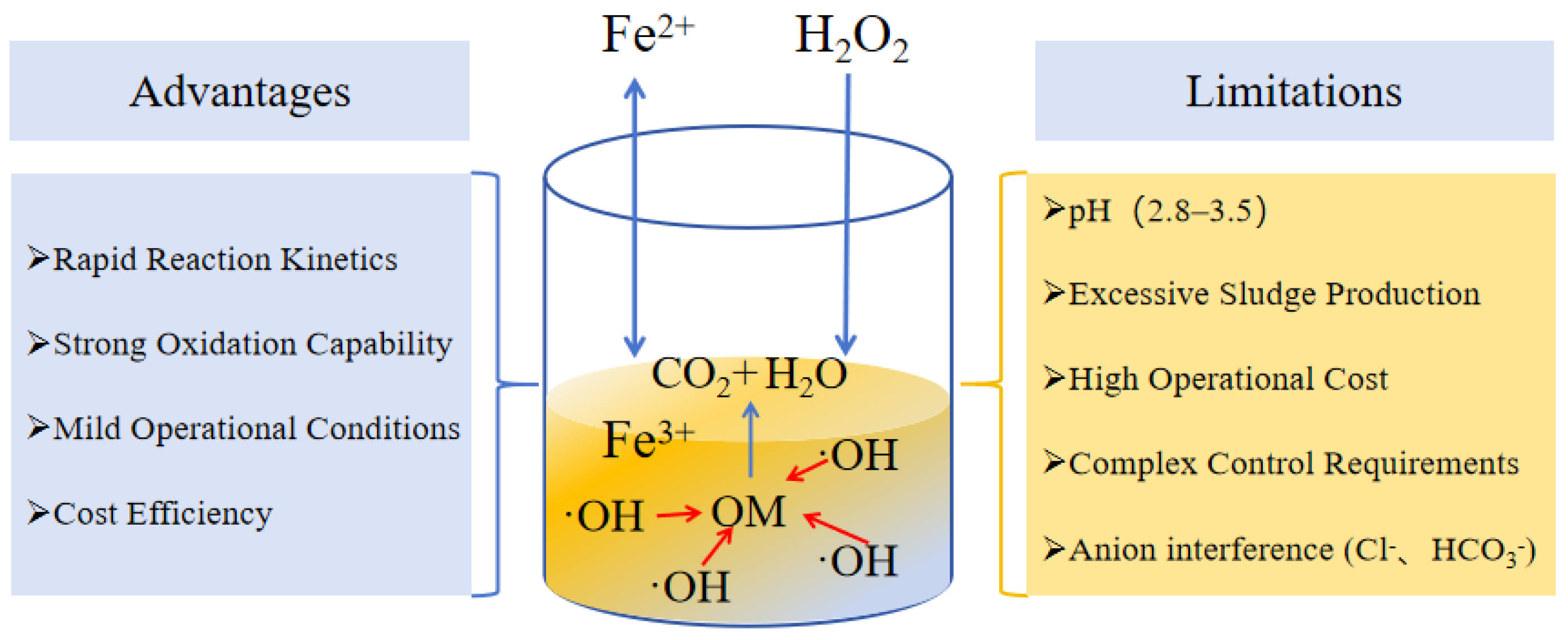
As a classical AOP, the homogeneous Fenton system offers significant advantages for wastewater remediation. However, it is constrained by several inherent technical limitations (Figure 2). Its primary strengths include the following: (i) rapid reaction kinetics (under acidic conditions (pH 2.5–3.5), ·OH are generated at rates between 10−6 and 10−9 M−1 s−1—this enables effective degradation of recalcitrant organic contaminants, such as aromatic compounds and phenolics); (ii) high oxidative power (with a redox potential of approximately 2.8 V, ·OH can non-selectively mineralize a broad spectrum of organic pollutants to CO2 and H2O); (iii) mild operational conditions (the process operates efficiently at ambient temperature and pressure, requiring relatively simple equipment); and (iv) cost efficiency (iron salts act as low-cost catalysts, while H2O2 serves as an environmentally benign oxidant [40,41]).
Due to these advantages, the homogeneous Fenton process can degrade a wide range of pollutants. For example, it efficiently removes refractory organic compounds such as dyes and pesticides, achieving a rapid reduction in chemical oxygen demand (COD) and color [42]. The process also features simple operation and easily controllable reaction conditions. Moreover, iron ions provide a synergistic flocculation effect, which aids in removing suspended solids and heavy metals [43]. Notably, ·OH can disrupt viral protein capsids and nucleic acids, offering strong inactivation of pathogens such as enteric viruses. This makes the process a reliable supplement for medical wastewater disinfection [44]. As a pretreatment or advanced treatment unit, the Fenton process demonstrates strong compatibility and low retrofitting costs, holding significant application value in industrial and medical wastewater treatment.
Nevertheless, the classic homogeneous Fenton process still presents several limitations that restrict its large-scale application in practical industrial wastewater treatment [45] (Figure 2). These limitations are summarized below.
(i) Narrow optimal pH range. The classical homogeneous Fenton process typically operates best at pH 2.5–3.5. Under these acidic conditions, the solubility and activity of Fe2+ are maximized, while Fe3+ precipitation as iron hydroxide is inhibited. This ensures efficient ·OH generation and reaction rates. When pH exceeds 4.0, Fe2+/Fe3+ tends to hydrolyze in near-neutral or alkaline environments, forming Fe(OH)2/Fe(OH)3 precipitates. Consequently, the concentration of active iron in solution decreases, and the radical generation rate drops significantly [46]. Under alkaline conditions, H2O2 undergoes non-radical catalytic decomposition to produce O2 and H2O (2H2O2 → O2 + 2H2O), wasting the oxidant [47]. When pH falls below 2.0, Fe2+ may combine with excess H+ to form stable complexes (Fe(H2O)62+), reducing its reactivity with H2O2 [48]. Excessively high H+ concentrations promote side reactions that consume ·OH. At extremely low pH, the excessive stability of H2O2 makes its O–O bond difficult to cleave catalytically by Fe2+, leading to a decline in radical yield [49]. In practical applications, the need to add large amounts of acid for pH adjustment and subsequent neutralization to a neutral level before discharge significantly increases chemical costs and sludge production. This pH sensitivity is a critical bottleneck. Even minor fluctuations in influent pH can cause drastic performance drops, making the process unreliable for wastewater streams with variable acidity. Moreover, the energy and chemical footprint of pH adjustment is often underestimated in laboratory studies.
(ii) Generation of substantial iron sludge. This is the second major drawback. Approximately 3–5 kg of iron sludge (dry weight) is produced per ton of treated wastewater [50,51]. This sludge readily adsorbs heavy metals and toxic organic compounds, posing a risk of secondary contamination to soil and water bodies if not handled properly [52]. Furthermore, sludge accumulation can clog pipelines and reduce reaction efficiency. Economically, the costs of dewatering, transportation, and specialized disposal significantly increase operational expenses. If the sludge is classified as hazardous waste, disposal costs rise even further, typically accounting for 15–30% of the total process cost [53]. These factors critically limit the large-scale application of the technology. It is worth noting that sludge management is not merely a cost issue but also an environmental liability. The potential leaching of adsorbed contaminants from improperly disposed sludge can offset the treatment benefits, raising questions about the overall sustainability of the homogeneous Fenton process.
(iii) Low H2O2 utilization efficiency. Research indicates that approximately 30–50% of the added H2O2 undergoes non-productive decomposition, primarily via non-radical pathways, rather than contributing to the generation of ·OH [54,55,56]. This inefficient consumption reduces the oxidative capacity available for pollutant degradation. It also increases operational costs due to wasteful chemical use. Moreover, factors such as inappropriate pH, high iron concentrations, or the presence of scavengers can exacerbate premature H2O2 decomposition, further constraining the economic and practical viability of the process [57]. This low efficiency is particularly problematic because H2O2 is often the most expensive reagent in the process. The reported 30–50% loss is likely a conservative estimate under real wastewater conditions, where competing reactions are more severe. Consequently, the actual cost per unit of pollutant removal can be substantially higher than theoretical predictions.
(iv) Interference from common anions. In the classical homogeneous Fenton process, anions widely present in wastewater, such as Cl and HCO3 ions, compete with ·OH through radical scavenging mechanisms. They generate reaction intermediates with lower oxidation potentials (Cl·, CO3·) [15,52,58]. This significantly reduces the degradation kinetics and mineralization efficiency of target pollutants. Such interference not only leads to unproductive consumption of H2O2 (approximately 30–50% of H2O2 is decomposed inefficiently as a result), but also forces the system to increase oxidant dosage to maintain treatment effectiveness, thereby raising operational costs and secondary pollution risks [56]. Furthermore, the complexation of anions with iron catalysts may alter the structure of active sites, further limiting the engineering applicability of the process under complex water quality conditions. The impact of anions is often overlooked in simplified laboratory studies using deionized water. In real wastewater, the combined effect of multiple anions can be synergistic, leading to even greater inhibition. This makes the homogeneous Fenton process particularly unsuitable for saline or high-alkalinity waste streams without extensive pretreatment.
Despite these constraints, the homogeneous Fenton process remains a cornerstone technology, providing a critical mechanistic foundation. To overcome these inherent limitations, particularly concerning pH sensitivity and sludge generation, research has increasingly shifted towards heterogeneous Fenton systems, which immobilize iron catalysts on solid supports. This transition aims to enhance operational flexibility, catalyst reusability, and overall process sustainability for practical wastewater treatment applications.

4. Modified Homogeneous Fenton Process

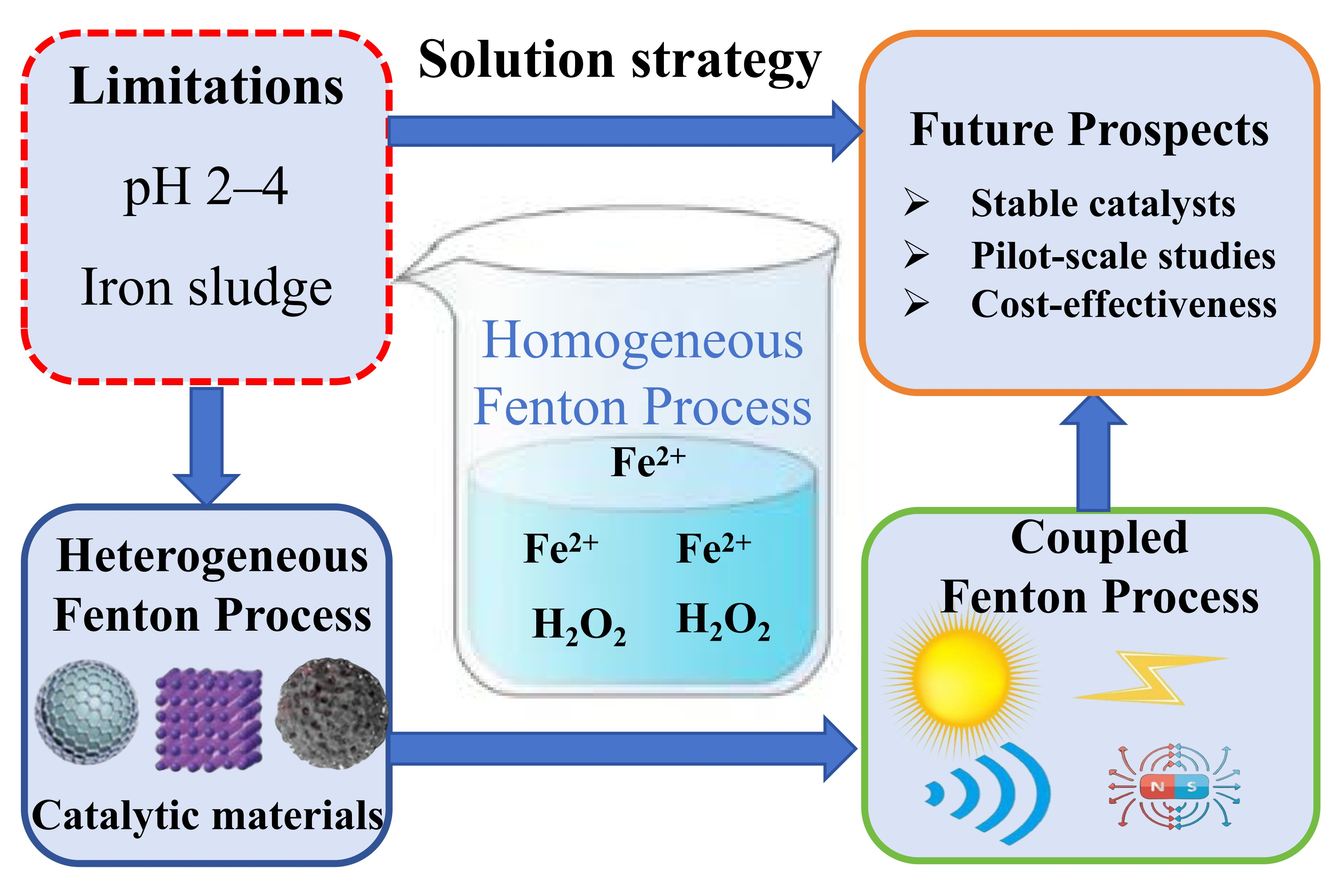
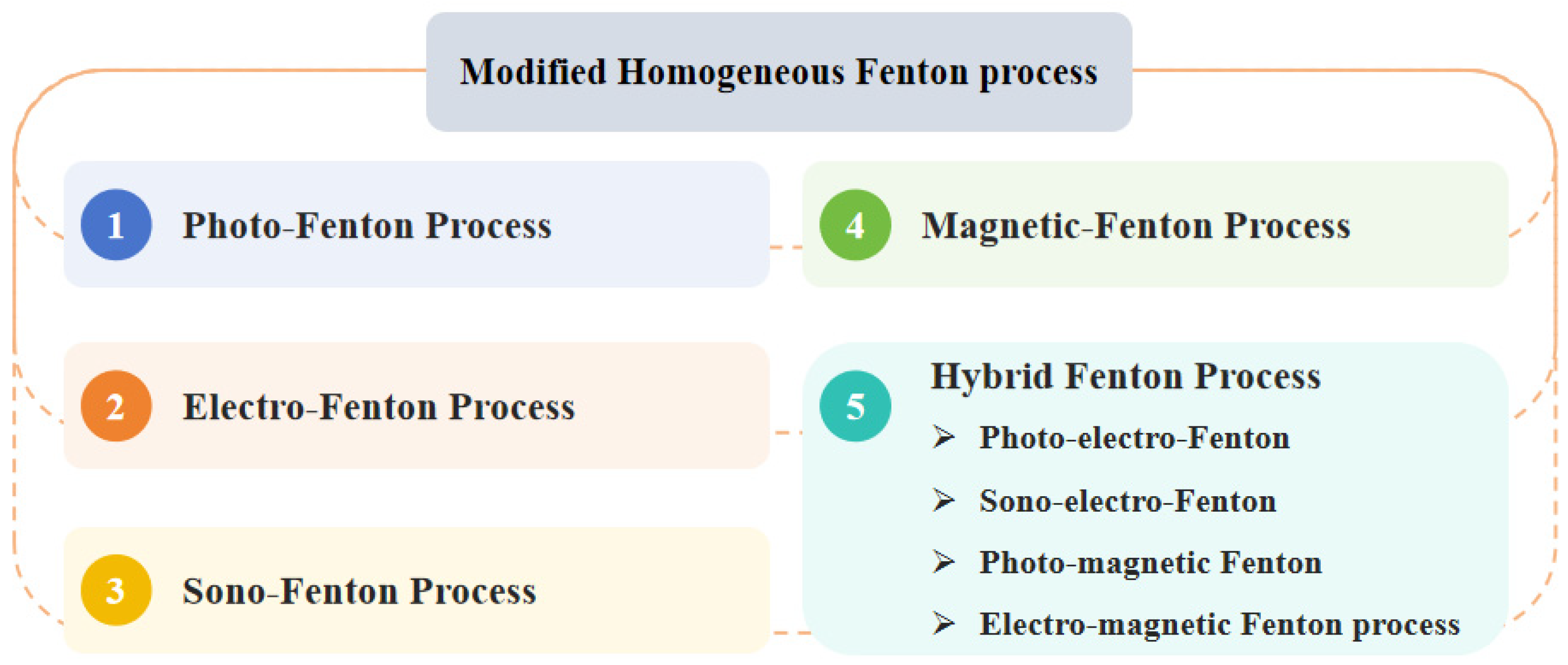
To overcome the inherent limitations of classical homogeneous Fenton processes, research focus has gradually shifted toward targeted modification and optimization of conventional systems, leading to the development of modified homogeneous Fenton processes (Figure 3) [59]. While retaining the core advantages of homogeneous systems, including rapid reaction kinetics and high ·OH, these improved processes aim to broaden the operational pH range, suppress iron sludge formation, enhance oxidant utilization efficiency, and strengthen the system’s resistance to complex water matrix interference. Based on energy input modes and reaction mechanisms, these advanced processes include Photo-Fenton, Electro-Fenton, Sono–electro-Fenton, Magnetic Fenton, as well as coupled configurations of these technologies [60,61,62,63,64,65].

4.1. Photo-Fenton Process

The homogeneous photo-Fenton process achieves sustained and efficient generation of ·OH through the synergistic interaction of UV or visible light (wavelengths below 450 nm) and Fenton reagents [66,67]. Its mechanism involves two key pathways: First, the traditional Fenton reaction in which Fe2+ catalyzes the decomposition of H2O2 to produce ·OH (Fe2+ + H2O2 → Fe3+ + ·OH + OH). Second, the photochemical cycle pathway, wherein UV light both directly photolyzes H2O2 to generate ·OH (H2O2 + hν → 2·OH) and promotes the reduction of Fe3+ to Fe2+ (Fe3+ + H2O2 + hν → Fe2+ + ·OOH + H+) [68]. This dual mechanism breaks the kinetic limitations of the iron cycle in traditional Fenton systems, significantly enhancing oxidation efficiency. As a result, the process demonstrates excellent broad-spectrum degradation capability for various structurally complex refractory organic compounds (e.g., antibiotics, dye intermediates, PAHs), while maintaining activity over a relatively wide pH range (2–8) [69,70]. This substantially reduces the operational costs and environmental risks associated with strong acid adjustment.
However, the industrial application of this process still faces challenges related to multi-scale coupling complexity and energy efficiency bottlenecks [18,71]. At the microscale reaction level, iron ions in the homogeneous system readily form complexes with coexisting anions in wastewater (Cl, CO32−, PO43−) or undergo quenching reactions (Cl + ·OH → Cl· + OH), which not only reduce the utilization efficiency of radicals but may also generate more toxic halogenated by-products [72]. At the macroscale engineering level, the limitations are prominently manifested in: (i) the strong coupling between light energy transfer efficiency and wastewater physicochemical properties, where high turbidity and high chromaticity severely attenuate light radiation intensity, leading to “optical dead zones” within the reactor and forcing reliance on energy-intensive artificial UV sources; (ii) the challenge of secondary pollution and resource recovery from iron sludge, as the post-reaction addition of alkaline agents to precipitate soluble iron generates large quantities of iron-containing sludge, with disposal costs accounting for approximately 15–30% of total operational expenses; and (iii) the optimization dilemma of reagent dosing, where excessive H2O2 addition triggers radical scavenging effects (H2O2 + ·OH → H2O + ·OOH), while insufficient dosing leads to stagnation of the iron cycle, making dynamic and precise control difficult under fluctuating real-world water quality conditions [53,73]. It should be noted that the claimed pH range of 2–8 is often based on lab-scale studies using synthetic wastewater; in real industrial effluents containing high concentrations of competing anions or organic ligands, the effective pH window may be considerably narrower, and the reported degradation efficiencies may not be directly transferable. Current research is seeking breakthroughs through multi-technology integration strategies, such as developing solar-focused photo-Fenton hybrid systems to reduce energy consumption, constructing iron–organic acid complexation systems to broaden the applicable pH range and inhibit iron precipitation, and coupling electrochemical assistance to achieve in situ regeneration of iron ions and electrosynthesis of H2O2 [74,75,76]. These efforts aim to advance the process toward efficient, low-carbon industrial applications.

4.2. Electro-Fenton Process

The electro-Fenton process represents an innovative and synergistic integration of electrochemistry and Fenton chemistry, holding significant promise for the degradation of refractory organic pollutants in industrial wastewater [77,78]. Its core mechanism relies on the in situ and continuous supply of the two essential reagents: H2O2 is generated at the cathode (a carbon-based gas diffusion electrode) through the two-electron oxygen reduction reaction (O2 + 2H+ + 2e → H2O2), while the catalytic Fe2+ is regenerated from Fe3+ via cathodic reduction (Fe3+ + e → Fe2+) [79]. This coupling establishes a self-sustaining cycle that drives the classical Fenton reaction (Fe2+ + H2O2 → Fe3+ + ·OH + OH), enabling efficient and on-demand production of ·OH, the primary oxidizing agent [78].
The key advantages of this process for industrial applications include a substantial reduction in chemical consumption and iron sludge production (by 40–70%), a broader operational pH range, and enhanced process controllability through current/voltage regulation [78,80,81]. However, its practical implementation faces notable limitations. High energy consumption (typically 30–100 kWh/kg COD), associated with overpotentials and competing reactions, alongside the cost and durability of specialized electrodes, remain primary economic constraints. Furthermore, challenges in reactor scale-up—concerning uniform mass transfer, current distribution, and adaptability to complex wastewater matrices containing radical scavengers (Cl, CO32−)—must be addressed to advance the technology from laboratory and pilot-scale studies to full-scale industrial adoption [81,82]. The reported energy consumption range is quite broad, and many studies fail to account for the energy required for aeration or pumping, which can significantly increase the total energy footprint. Moreover, the long-term stability of carbon-based gas diffusion electrodes under real wastewater conditions—especially in the presence of fouling agents—remains inadequately documented, raising concerns about maintenance costs and operational reliability.

4.3. Sono-Fenton Process

The sono-Fenton process constitutes a cutting-edge advanced oxidation technology that synergistically couples ultrasonic irradiation with the classical Fenton reaction (Fe2+/H2O2) to tackle industrial wastewater challenges [63,83]. Its underlying mechanism is driven by the amplified generation of ·OH: ultrasonic cavitation not only induces the direct pyrolysis of water molecules into ·OH but also accelerates H2O2 decomposition and facilitates the Fe2+/Fe3+ redox cycle, thereby significantly boosting radical yield [65]. Moreover, the micro-jets and shockwaves generated by cavitation dramatically enhance mass transfer and reactant dispersion, ensuring optimal contact between pollutants and reactive species. This process has proven highly effective in degrading recalcitrant organic contaminants in industrial effluents—such as phenolic compounds, dyes, pharmaceuticals, and pesticides—often achieving mineralization rates exceeding 80% under optimized conditions [84,85].
The primary merits of this technology encompass exceptional oxidation efficiency, a substantially broader operational pH window (3–8) compared to conventional Fenton systems, and a marked reduction in iron sludge production owing to intensified iron cycling [86,87]. Nevertheless, its large-scale implementation is constrained by notable challenges. The substantial energy demand of ultrasonic generators presents a major economic hurdle, while the persistent cavitation poses engineering risks, such as the erosion of reactor components. Furthermore, complex industrial wastewater matrices containing high concentrations of radical scavengers or suspended particulates can severely attenuate ultrasonic propagation and quench active radicals, thereby compromising treatment efficacy [88]. It is worth noting that the reported mineralization rates are often obtained under idealized lab conditions (low pollutant concentrations, short treatment times, and controlled pH). In real industrial effluents with high organic loads or suspended solids, cavitation efficiency drops sharply, and the energy cost per unit of pollutant removed can become prohibitively high. Additionally, the long-term effects of cavitation on electrode and reactor materials are rarely quantified in a systematic way. Consequently, future research is pivoting towards the development of energy-efficient pulsed-ultrasound strategies, the design of robust sonocatalytic materials, and the optimization of hybrid systems to achieve scalable and cost-effective wastewater remediation [89].

4.4. Magnetic Fenton Process

The Magnetic Fenton process is an innovative AOP that modulates Fenton reaction kinetics through externally applied magnetic fields [90]. Its fundamental mechanism relies on the synergistic effect between magnetic catalysts (Fe3O4/γ-Fe2O3) and the magnetic field: on the one hand, the Lorentz force accelerates the redox cycling of Fe3+/Fe2+, enhancing the reduction efficiency of Fe3+ by 3–5 times, thereby enabling continuous and efficient generation of ·OH; on the other hand, magnetic gradient forces significantly improve micro-mixing within the reaction system, increasing mass transfer coefficients by 40–80% and ensuring sufficient contact between pollutants and reactive species [91,92]. Key advantages of this process include efficient magnetic separation and recovery of catalysts (>95%), a reaction rate 2–4 times higher than that of conventional Fenton systems, a broader operational pH range (3–8), and a 30–50% reduction in iron sludge production [93]. However, its application faces technical challenges such as high energy consumption in high-gradient magnetic separation systems (>10 kW/m3), susceptibility to surface passivation of magnetic catalysts, and interference from paramagnetic substances in complex aqueous matrices [94]. The claimed enhancement factors (3–5 times for Fe3+ reduction, 40–80% for mass transfer) are typically derived from idealized bench-scale experiments with well-defined magnetic field configurations. In practice, the spatial inhomogeneity of magnetic fields in larger reactors can lead to uneven catalyst distribution and reduced overall performance. Moreover, the long-term stability of magnetic nanoparticles under continuous operation—especially against aggregation and leaching—remains a critical concern that is often glossed over in proof-of-concept studies.
In the field of industrial wastewater treatment, the Magnetic Fenton process demonstrates significant potential for degrading recalcitrant organic pollutants. It has been successfully applied to treat antibiotics in pharmaceutical wastewater, persistent organic pollutants in chemical industrial effluents, and various dyes in textile dyeing wastewater, achieving mineralization rates exceeding 80% under optimized conditions [95,96]. The technology also shows promising performance in the advanced treatment of high-salinity oil and gas produced water and complex landfill leachate [97,98]. Currently, to advance its large-scale application, research efforts are focusing on developing low-energy pulsed magnetic field systems, designing anti-passivation core–shell structured magnetic catalysts, and constructing hybrid processes such as magneto-electrochemical integration, aiming to further address economic and stability challenges in engineering scale-up [99].

4.5. Hybrid Fenton Process

While the aforementioned Fenton-based processes exhibit distinct advantages in specific wastewater treatment scenarios, they still face challenges such as efficiency limitations, high energy consumption, and stringent operational conditions. To further overcome these technical bottlenecks, recent research has focused on integrating multiple processes to establish synergistic enhancement systems. Examples include photo-electro-Fenton, sono–electro-Fenton, photo-magnetic Fenton, and electro-magnetic Fenton coupling processes, which have demonstrated notable potential in the advanced treatment of complex industrial wastewater.
Li et al. investigated the degradation of Rhodamine B (RhB) in wastewater using alloyed snowflake-shaped Pt-modified Cu2O nanoclusters as a photo-electro-Fenton catalyst under near-infrared irradiation (808 nm, 2.0 W·cm−2, 5 min) coupled with a direct-current electric field (110 V, 50 Hz, Cv ≤ 1 mvrms, CC ≤ 5 mARms). The treatment achieved a degradation efficiency of 96.13% within 2 h. The catalyst also exhibited excellent reusability and minimal environmental toxicity, demonstrating its promising potential for the remediation of organic pollutants in wastewater [100]. Ghjeer et al. developed an innovative hybrid Sono–Electro-Fenton process entirely powered by photovoltaic energy for the treatment of hospital wastewater. Under optimized conditions—44.53 min reaction time, 15 mA/cm2 current density, and 100 W ultrasonic power—the process achieved removal efficiencies of 97.52% for COD, 96.667% for phenol, and 95.652% for turbidity, with a specific energy consumption of 2.38 kWh/kg COD. These results demonstrate an economical and environmentally friendly approach for the efficient degradation of hospital wastewater [101]. Zhang et al. integrated the photo-Fenton process with a magnetic MXene–porous polydopamine catalyst for the degradation of methylene blue. The results demonstrated that 99.89% removal of methylene blue was achieved within 30 min, and the catalyst retained over 53% degradation efficiency after 10 consecutive cycles. These findings indicate that the photo-Fenton process coupled with the magnetic catalyst exhibits excellent performance in the treatment of actual wastewater [102]. Wang et al. applied a copper-doped magnetic graphene oxide catalyst in an electro-Fenton process to treat palm oil mill effluent. The results showed that removal efficiencies of 89% for COD and 48.1% for total organic carbon (TOC) were achieved within 90 min, demonstrating effective pollutant degradation under controllable energy consumption. Moreover, the process was able to reduce treatment costs, indicating that the magnetically coupled Fenton process is a promising alternative for high-strength wastewater treatment [103]. The aforementioned studies demonstrate that multi-technology coupled Fenton processes exhibit significant advantages in the treatment of industrial wastewater, offering a promising solution for the efficient and cost-effective remediation of refractory industrial effluents. While these hybrid processes show impressive removal efficiencies, it is important to recognize that many of these studies are conducted under highly controlled conditions with synthetic or spiked wastewater. The synergistic benefits claimed often lack rigorous quantification against the sum of individual processes, and the additional complexity and capital cost of integrating multiple energy inputs (light, ultrasound, electric field) may offset the performance gains in real-world applications. Furthermore, the long-term operational stability and maintenance requirements of such multi-field systems remain largely unexplored.

5. Heterogeneous Fenton Process

The heterogeneous Fenton oxidation system exhibits superior performance compared to conventional homogeneous processes, as evidenced by the chemical reactions shown in Equations (7)–(13) [32,104]. This advanced technology utilizes immobilized iron-based catalysts that effectively overcome the pH limitations inherent in traditional Fenton systems, with certain modified catalyst formulations demonstrating exceptional stability even under near-neutral pH conditions [105]. This process effectively suppresses the ineffective decomposition of H2O2 through surface coordination mechanisms, thereby improving its utilization efficiency while substantially reducing iron sludge production and enabling catalyst recycling [106]. The design of structured catalysts (membrane reactors, fixed beds) further facilitates continuous-flow operation, enhancing its engineering applicability [107].
Fe3+ + H2O2 → Fe2+ + HO2· + H+ (k = 10−3–10−2 L·mol−1·s−1, ΔG = 22.2 kJ/mol)
Fe2+ + H2O2 → Fe3+ + OH + ·OH (k = 40–80 L·mol−1·s−1, ΔG = −28.5 kJ/mol)
·OH + R → CO2 + H2O + LMWAs (k = 109–1010 L·mol−1·s−1, ΔG = −200 kJ/mol)
Fe3+ + e → Fe2+ (k = 105–106 L·mol−1·s−1, ΔG = −74.3 kJ/mol)
Cu+ + H2O2 → Cu2+ + ·OH + OH (k = 103–104 L·mol−1·s−1, ΔG = −21.9 kJ/mol)
H2O2 +·OH → HO2· + H2O (k = 2.7 × 10⁷ L·mol−1·s−1, ΔG = −20 kJ/mol)
Fe2+ + O2 → Fe3+ + O2· (k = 10−3–10−2 L·mol−1·s−1, ΔG = 30 kJ/mol)
In recent years, research on heterogeneous Fenton processes for industrial wastewater treatment has primarily focused on: (i) the development of novel, efficient, and stable heterogeneous catalysts aimed at enhancing active site density, improving H2O2 activation efficiency, and suppressing metal ion leaching [36,108,109]; (ii) the introduction of external energy fields or integration with other technologies to overcome mass transfer limitations and achieve process intensification with optimized energy consumption [110,111]; and (iii) a shift from treating synthetic wastewater to treating complex real industrial effluents, with the goal of evaluating the applicability and robustness of the process under practical conditions [112,113].
Early research on heterogeneous Fenton catalysts primarily focused on natural iron-containing minerals (goethite, hematite) or simple supported iron-based materials (Fe/activated carbon), which aimed to validate the feasibility of heterogeneous systems [114,115,116]. However, these catalysts suffered from limited active sites, severe metal leaching, and a narrow effective pH range. Subsequently, structurally well-defined synthetic metal oxides (nano-Fe3O4) achieved enhanced catalytic activity through controlled synthesis, and the introduction of magnetic recovery significantly promoted the practical application of the process [117]. Nevertheless, challenges such as activity inhibition under neutral conditions and metal leaching persisted. In the 2010s, research shifted toward modified, composite, and multi-metal catalysts. Strategies such as doping, constructing heterojunctions (g-C3N4/Fe2O3), or leveraging bimetallic synergistic effects (Fe-Cu) were employed to optimize electronic structures and interfacial properties [106,118]. These advancements not only improved H2O2 utilization efficiency but also drew attention to the contribution of non-radical pathways.
In recent years, nonradical pathways have emerged as a key frontier in Fenton-like processes, offering significant advantages over traditional radical mechanisms, including higher selectivity, less interference from background water matrices, and lower oxidant consumption. The most widely studied nonradical pathways include singlet oxygen generation and surface-mediated electron transfer. Singlet oxygen is typically produced via the decomposition of peroxymonosulfate or hydrogen peroxide over metal-doped carbon catalysts, where the catalyst surface promotes energy transfer rather than radical formation [119]. On the other hand, surface-mediated electron transfer involves the direct oxidation of organic pollutants at the catalyst–oxidant interface without releasing free radicals, usually driven by the formation of high-valent metal–oxygen species or electron-deficient carbon surfaces [120]. The selectivity of these nonradical pathways can be tailored by modulating catalyst properties such as defect density, metal coordination environment, and heteroatom doping [121]. For example, nitrogen-doped carbon nanotubes have been demonstrated to preferentially generate 1O2, thereby efficiently degrading electron-rich pollutants such as phenols and dyes [122]. Concurrently, catalyst design has entered a new stage characterized by atomic-level dispersion and structural engineering [123]. Single-atom catalysts (Fe–N–C) maximize atom utilization efficiency and provide uniform active sites; metal-free carbon catalysts aim to fundamentally eliminate metal leaching; and structured catalysts (active layers coated on nickel foam or ceramic membranes) facilitate the transition from powder to engineered components, matching practical applications such as continuous-flow reactors [124,125,126]. Despite the promising prospects, challenges remain in the in situ identification of reactive species and in understanding the interplay between radical and nonradical pathways under real wastewater conditions [127]. Future research should focus on developing advanced characterization tools (e.g., in situ Raman spectroscopy, electron paramagnetic resonance) and integrating nonradical Fenton-like processes with renewable energy sources to enhance sustainability.
The enhanced heterogeneous Fenton process has evolved from a single chemical oxidation system reliant on H2O2 to an integrated multi-field coupled system [128,129]. By introducing electrochemical assistance, an electro-Fenton system is constructed, enabling the continuous in situ generation of H2O2 and iron cycling, which significantly improves the removal efficiency of recalcitrant organic pollutants (dyes, pharmaceutical intermediates) [99,130,131]. Coupling with ultrasonic cavitation or UV/visible light irradiation forms synergistic “sono-Fenton” or “photo-Fenton” processes, utilizing physical effects to enhance mass transfer, promote the generation of reactive species, and broaden the applicable pH range [84,85]. Concurrently, mechanistic studies of the process have deepened, with the regulation of non-radical-dominated pathways (singlet oxygen, surface-mediated electron transfer) enhancing resistance to interference in complex water matrices (high salinity, high organic content) and enabling selective oxidation of target pollutants [132,133]. For engineering applications, the research focus has shifted toward intelligent process control, dynamically optimizing reaction conditions based on real-time water quality parameters, and integrating with biological treatment, membrane separation, and other units to form efficient and stable combined processes [134,135]. Furthermore, the “waste treats waste” strategy utilizing solid wastes (red mud, acid pickling waste liquid) as iron sources, along with full life-cycle environmental and economic assessments, further drives the technology toward low-carbon and sustainable development [41,130,136].
In recent years, heterogeneous Fenton processes have moved from laboratory-scale ideal systems to practical applications in complex real wastewater matrices [137]. The main challenges remain the synergistic optimization of adaptability to actual water quality, process stability, and engineering economic feasibility. For example, when treating printing and dyeing wastewater, high concentrations of dyes, auxiliaries, and salts severely inhibit the efficiency of conventional homogeneous Fenton processes [32,77]. To address this, magnetic Fe3O4@carbon core–shell catalysts have been developed. These catalysts enable rapid magnetic separation and recovery after reaction, while the hydrophobic carbon layer effectively shields against Cl poisoning, significantly enhancing decolorization efficiency over a broad pH range [49,138]. Current research frontiers focus on intelligent control systems that use online monitoring of key parameters to adjust H2O2 dosage and pH in real time, thereby coping with fluctuations in wastewater quality. Meanwhile, life cycle assessment is employed to quantify the environmental footprint, driving the technology from “efficient degradation” toward “low-carbon integration” [139]. Notably, recent mechanistic studies have revealed the critical role of non-radical-dominated pathways in complex water matrices. By designing catalysts with specific structures, selective oxidation of pollutants can be achieved, offering more targeted support for upgrading and stable operation of industrial wastewater treatment plants.
However, several critical issues remain. First, the long-term stability and reusability of core–shell catalysts under real wastewater conditions are still insufficiently documented; catalyst deactivation due to surface fouling or structural degradation may offset the benefits of magnetic recovery. Second, the economic cost of synthesizing such nanostructured catalysts, especially at industrial scale, is rarely addressed in current studies. Third, while non-radical pathways show promise for selective oxidation, their reaction rates are often lower than those of radical pathways, and the byproducts formed may be more toxic or recalcitrant. Finally, intelligent control systems rely heavily on accurate and robust sensors, which are still expensive and prone to fouling in harsh wastewater environments. These limitations highlight the gap between laboratory breakthroughs and reliable, cost-effective full-scale implementation.

6. Application of Fenton Process in Industrial Wastewater Treatment

With the continuous increase in industrial wastewater discharge containing high concentrations of refractory organic pollutants, conventional biological treatment technologies often exhibit significant limitations in removing such contaminants [140,141]. Wastewaters from textile, dyeing, pharmaceutical, and petrochemical industries typically contain complex organic compounds—such as benzene derivatives, halogenated hydrocarbons, and dye intermediates—which present severe environmental challenges due to their toxicity and resistance to biodegradation [142,143]. Against this backdrop, the Fenton process has attracted growing attention due to its remarkable effectiveness in treating complex industrial wastewater. Table 1 summarizes representative applications of Fenton-based processes in industrial wastewater treatment.

6.1. Textile Dyeing Wastewater

Textile dyeing wastewater is characterized by complex composition, containing high concentrations of recalcitrant synthetic dyes (azo and anthraquinone dyes), substantial amounts of auxiliary chemicals, and heavy metals [146]. It exhibits poor biodegradability (BOD5/COD < 0.2), along with strong acidity/alkalinity (pH 2–12), high salinity (5–20 g/L NaCl), and significant temperature fluctuations (40–70 °C) [154]. The presence of toxic compounds such as aniline derivatives and halogenated hydrocarbons poses severe ecological risks, making the treatment of this wastewater particularly challenging [155].
Dobrosz-Gómez et al. successfully applied the Fenton–Neutralization process to treat textile wastewater highly contaminated with Acid Black 194 (AB194) dye. Under optimized operating conditions (Fenton stage: [Fe2+] = 834 mg/L, [H2O2] = 6078 mg/L, pH = 2.0; Neutralization stage: 2.05 g/L slaked lime), the treatment achieved remarkable removal efficiencies of 89% for COD and 75% for TOC, along with near-complete decolorization (>99%). The treated effluent exhibited significantly reduced acute toxicity, as evidenced by the increased lethal concentration 50% value for Artemia salina from 15 mg/L to 170 mg/L. Molecular weight distribution analysis confirmed effective degradation of high-molecular-weight pollutants, demonstrating the process’s capability for industrial textile wastewater treatment [144]. A. Kothai et al. experimentally investigated the hybrid electrocoagulation (EC) and Fenton process for textile wastewater treatment. The study employed aluminum electrode-based EC (8–16 V) coupled with Fenton’s reagent (Fe2+/H2O2 ratios ranging from 3 g + 30 mL to 5 g + 50 mL). Results demonstrated that under optimal conditions (EC at 14 V for 60 min; AOP with 4 g Fe2+ + 40 mL H2O2), the removal efficiencies reached 82% and 86% for COD, 92% for BOD, and up to 96% for chroma. This research quantitatively revealed the significant impacts of voltage and reagent dosage on treatment performance, providing a validated dual-process technical solution for textile effluent remediation [145]. However, this study did not address electrode passivation issues, and the consumption of aluminum electrodes may introduce secondary pollution, requiring further verification of long-term economic viability.

6.2. Pharmaceutical Wastewater

Pharmaceutical wastewater demonstrates notable ecological risk characteristics derived from residual raw materials, intermediate products, and by-products generated during manufacturing processes [156]. This wastewater typically contains high concentrations of refractory organic compounds, including residual active pharmaceutical ingredients, organic solvents, and synthetic intermediates, resulting in poor biodegradability [157,158]. The water quality parameters exhibit extreme fluctuations, potentially combining strongly acidic cleaning wastewater with highly alkaline extraction waste streams. Particularly concerning is the persistent stress exerted on aquatic ecosystems by residual antimicrobial agents, while the hypersalinity may disrupt microbial community structures in treatment systems [159]. To address these characteristics, modern treatment approaches generally require integration of multi-stage physicochemical processes with enhanced biological technologies to achieve compliant discharge standards [160].
Scaria et al. conducted a systematic comparison between ·OH-based and sulfate radical-based AOPs for pharmaceutical wastewater pretreatment, with particular focus on heterogeneous Fenton (Fe3O4-rGO/H2O2) and persulfate activation (Fe3O4-rGO/PS) systems [147]. Key findings demonstrate that under optimal conditions (pH 3, 300 mg/L catalyst + 150 mM H2O2), the heterogeneous Fenton process achieved 68.7% TOC removal within 180 min, while maintaining 64.6% efficiency at the wastewater’s natural pH (6.75). In contrast, the persulfate system (400 mg/L catalyst + 5 mM PS) showed pH-dependent performance—reaching 59.5% TOC removal at pH 3 but declining sharply to 20.8% under neutral pH conditions [147]. Notably, Fenton treatment induced significant accumulation of inorganic salts, necessitating subsequent polishing steps. This study provides critical operational guidance for selecting pretreatment technologies for high-organic-load pharmaceutical wastewater, particularly highlighting the pH-adaptability advantages of heterogeneous Fenton systems for industrial applications.
Liao et al. developed an innovative pulsed switching peroxi-coagulation coupled with electro-Fenton process for treating Metronidazole (MNZ)—containing pharmaceutical wastewater [148]. The experimental results demonstrated that under optimal operational parameters (pulse frequency 6 s:1 s, current density 20 mA/cm2 H2O2 + 5 mA/cm2 Fe2+), the pulsed switching photoelectro-fenton coupled system achieved 96.9% degradation efficiency for synthetic wastewater containing 200 mg/L MNZ within 80 min, while generating substantial ·OH with a peak concentration of 321 μM [148]. Mechanistic investigation through LC-MS analysis identified seven intermediate products, elucidating the degradation pathway involving sequential oxidation of hydroxyl/carboxyl groups and imidazole ring cleavage [148]. This study presents a pH-robust solution for treating highly toxic MNZ wastewater, with the pulsed operation strategy additionally achieving over 60% reduction in iron sludge production compared to conventional processes.

6.3. Electroplating Wastewater

Electroplating wastewater represents a typical highly toxic industrial effluent characterized by elevated concentrations of heavy metal ions (Cr(VI), Cu(II), Ni(II), Zn(II)), strong complexing agents (EDTA, citrate), and diverse organic additives [161]. This wastewater typically exhibits strong acidity (pH 1–3), accompanied by high conductivity (10–50 mS/cm) and COD (200–2000 mg/L) [162]. The stable existence of heavy metal–organic complexes in the wastewater renders conventional precipitation methods ineffective for treatment, with potential formation of bioaccumulative toxic intermediates [3,163]. Furthermore, electroplating wastewater demonstrates significant fluctuations in composition and contains additional contaminants such as cyanides and phosphates, posing long-term ecological risks due to its complex and variable nature. Therefore, the application of Fenton-based processes for electroplating wastewater treatment holds significant positive implications for ecological security.
Liu et al. developed an integrated stepwise alkalization–Fenton–chlorination process for simultaneous electroplating wastewater treatment and resource recovery [150]. The study investigated a three-stage treatment scheme for wastewater collected from a Guangzhou electroplating plant (initial pH 1.1, containing Ag 624.9 mg/L, Ni 914.7 mg/L, etc.). The process involved: (i) NaOH-mediated stepwise alkalization to pH 3 for selective recovery of high-purity (98.4%) Fe(PO3)3 precipitates; (ii) Ca(OH)2 adjustment to pH 9 for synchronous removal of multiple heavy metals; and (iii) Fenton oxidation under optimized conditions (H2O2/COD ratio = 2.0, Fe2+/H2O2 molar ratio = 1.11, pH 3) [150]. This innovative approach synergistically combined fractional metal precipitation with advanced oxidation technologies, where the 2000 g centrifugation and Fe(PO3)3 reutilization demonstrated significant engineering applicability. However, the process is cumbersome, and repeated pH adjustment in actual operation may increase chemical costs. Moreover, the degradation efficiency of residual complexes in the Fenton stage was not separately evaluated, and the economic viability of resource recovery requires further calculation.
Beyond process innovation, various Fenton-like catalysts have been effectively applied in electroplating wastewater treatment. Song et al. developed a novel Fe/Mn/Cu/tourmaline composite Fenton-like catalyst for treating simulated electroplating wastewater containing organic phosphonate scale inhibitors (HEDP) [164]. The catalyst, prepared via the impregnation–calcination method, exhibited multi-metal synergistic effects, achieving 86.79% mineralization of HEDP under optimized conditions (pH 3.0, 4 mmol/L H2O2, 2.4 g/L catalyst, 20 °C), with 93.71% phosphate recovery through ferric Cl precipitation. Mechanistic studies confirmed ·OH and superoxide radicals as the primary reactive species. The catalyst maintained 63.2% TOC removal after six cycles and demonstrated excellent adaptability to four classes of organic phosphorus pollutants [164]. This technology provides a novel approach for advanced electroplating wastewater treatment with simultaneous phosphorus resource recovery.

6.4. Petrochemical Wastewater

Petrochemical wastewater is typically characterized by high COD, elevated oil content, and significant pH fluctuations [165]. It contains typical pollutants including benzene series compounds (15–300 mg/L), PAHs, phenols (20–800 mg/L), sulfides, and cyanides [166,167]. Notably, this wastewater exhibits three distinctive features: (i) complex pollutant composition containing over 200 organic compounds such as alkanes, alkenes, and aromatic hydrocarbons; (ii) highly variable biodegradability (BOD5/COD ratio of 0.2–0.6, with some refinery wastewater showing ratios below 0.3) [168]; (iii) presence of characteristic contaminants like acrylonitrile (1–50 mg/L) and naphthenic acids (30–400 mg/L) [169]. The total dissolved solids (TDS) concentration typically ranges from 2000 to 15,000 mg/L, along with inorganic pollutants including heavy metals (Ni, Cr, Zn, etc.) and ammonia nitrogen (30–600 mg/L) [170,171].
Ahmadi et al. investigated the treatment of high-salinity petrochemical wastewater using an ultrasonically enhanced electro-Fenton (US/EF) process and its persulfate-activated hybrid system [172]. Under optimized conditions (pH 5.0, 1.2 V applied voltage, 300 W ultrasonic power, 2 cm electrode spacing), the US/EF process achieved 94.1% COD removal within 210 min, while the persulfate ultrasonic electro-Fenton system (with 0.75 mM persulfate addition) reduced the reaction time to 120 min with 91.7% COD removal efficiency. Mechanistic studies verified the synergistic action of ·OH and sulfate radicals, with GC-MS analysis demonstrating the conversion of recalcitrant PAHs into aliphatic intermediates. Notably, the BOD5/COD ratio increased from 0.13 to 0.41, indicating significant improvement in wastewater biodegradability [172]. This study presents an energy-efficient solution for advanced petrochemical wastewater treatment while elucidating the catalytic enhancement mechanisms of multi-technology integration. However, the ultrasonic energy consumption is relatively high (300 W), and the effects of electrode corrosion and ultrasonic cavitation on catalyst lifespan were not evaluated, raising concerns about economic feasibility in industrial scale-up.
In addition, the photo-assisted electro-Fenton (PAEF) process has also been investigated for petrochemical wastewater treatment. Moattar et al. applied the PAEF process to treat saline petrochemical wastewater, achieving 65.95% COD removal under optimized conditions (pH 3, applied voltage of 3 V/cm, reaction time of 144.8 min, and initial COD of 849.5 mg/L) [173]. GC-MS analysis revealed the degradation of dibenzocarbazole into simpler intermediates such as phenylacetic acid, confirming the dominant role of ·OH in the process. This study pioneered the integration of UV irradiation with electro-Fenton for actual petrochemical wastewater treatment, offering an energy-efficient (3 V/cm) and secondary pollution-free solution for high-salinity refractory industrial wastewater [173]. However, further research is needed to address challenges in electrode material selection and scale-up effects.

6.5. Papermaking Wastewater

Papermaking wastewater demonstrates complex pollutant characteristics with substantial quality variations, typically containing high-concentration organic pollutants (COD 1500–25,000 mg/L) and exhibiting poor biodegradability (BOD5/COD = 0.15–0.40), mainly originating from dissolved macromolecules like lignin and hemicellulose during pulping processes [174]. The wastewater contains various characteristic contaminants including chlorophenolic compounds and resin acids that inhibit biological treatment, along with high concentrations of suspended fibers (SS 500–3000 mg/L) and intense color (800–5000 PCU) [175,176]. It shows extreme pH fluctuations (2–12) and may contain trace heavy metals, with pulping black liquor reaching exceptionally high COD levels exceeding 100,000 mg/L [177,178]. This complex multiphase composition with high toxicity presents significant challenges for conventional biological treatment processes. Therefore, it requires the development of specialized pretreatment and advanced combined treatment technologies.
Given the advantages of the Fenton process, it is commonly employed for treating papermaking wastewater. Wang et al. demonstrated that the addition of iron sludge significantly enhanced the anaerobic digestion efficiency of actual papermaking wastewater [179]. Experimental results revealed that needle-like iron oxide (FeOOH) in iron sludge acted as an efficient electron transfer medium, increasing the system’s electron transport activity by 59%. Moreover, it enriched dissimilatory iron-reducing bacteria and hydrogenotrophic methanogens, thereby promoting the decomposition of refractory organics and methane synthesis pathways. Under a sludge loading of 1.93 g COD/(g MLSS·d), the addition of 4 g iron sludge elevated the COD removal efficiency by 11.77% (reaching 77.17%), boosted methane yield by 15.12%, and maximized the methane content in biogas by up to 15.2%. Microbial mechanism analysis indicated that iron sludge stimulated microorganisms to secrete more coenzyme F420 while reducing charge transfer resistance, thereby enhancing direct interspecies electron transfer [179]. This study provides a novel strategy for synergistic optimization of iron sludge resource utilization and high-load refractory wastewater treatment.
Although the strong oxidative properties of the Fenton process can be employed for treating papermaking wastewater, it may potentially increase wastewater toxicity. Di et al. systematically evaluated the detoxification efficiency and toxicity mechanisms of the Fenton process for pulping wastewater treatment [180]. Their study found that while the Fenton treatment reduced conventional indicators such as COD, it significantly increased acute toxicity (the toxicity unit for luminescent bacteria rose from 2.76 to 5.12, and for Daphnia magna from 0.33 to 0.84). Zebrafish experiments further confirmed irreversible oxidative damage. Toxicity identification evaluation combined with non-target screening revealed that organic pollutants were the primary toxic contributors, with newly generated pollutants such as trihexyl phosphate and elevated levels of existing pollutants like dihexyl phthalate being particularly critical. The toxicological priority index identified trihexyl phosphate, dihexyl phthalate, and dinonyl phthalate as priority control pollutants [180]. The study demonstrated that the oxidation of phenolic derivatives into toxic intermediates during the Fenton process was the main cause of increased toxicity, challenging the conventional view that advanced oxidation inevitably reduces toxicity.
To mitigate this specific risk, we recommend optimizing Fenton reaction parameters (pH, H2O2/Fe2+ ratio, and reaction time) to minimize the formation of toxic byproducts, and coupling the process with post-treatment steps such as biological treatment or adsorption to remove residual intermediates. Importantly, this phenomenon of increased acute toxicity after Fenton treatment is not limited to papermaking wastewater; similar observations have been reported in other wastewater types, including textile dyeing and pharmaceutical wastewaters, where the generation of toxic intermediates during oxidation has been documented [181,182]. Therefore, a separate emphasis on intermediate products and toxicity evaluation is warranted [154]. Current practice requires mandatory monitoring of byproduct formation, especially halogenated organic compounds, which are of particular concern due to their persistence and potential health risks. We suggest that future studies and regulatory frameworks should place greater focus on the identification and control of toxic intermediates in Fenton-based advanced oxidation processes. These findings provide new insights for ecological risk control in industrial wastewater advanced treatment.

6.6. Landfill Leachate

Landfill leachate, as a typical high-strength organic wastewater, exhibits distinctive water quality characteristics including extremely high pollutant concentrations (COD 5000–80,000 mg/L, BOD5/COD 0.4–0.6) and substantial dissolved organic matter [183,184]. Severe ammonia nitrogen pollution (500–3000 mg/L) leads to significant carbon-to-nitrogen ratio imbalance, while heavy metals such as zinc and lead are detected with concentrations decreasing as landfill age increases [33,185,186]. The leachate contains persistent organic pollutants including phthalate esters and PAHs, posing potential environmental and health risks [187]. The water quality shows systematic temporal variations—freshly generated leachate is acidic and gradually becomes alkaline with prolonged landfilling [188]. These unique characteristics present technical challenges in treatment processes, such as biological toxicity inhibition and poor biodegradability. Consequently, specialized combined treatment technologies are necessary.
Brito et al. proposed an innovative landfill leachate treatment process integrating Fenton oxidation with two-stage membrane distillation, achieving dual objectives of ammonia recovery and zero liquid discharge [189]. The primary stage employing polypropylene hollow fiber membranes at pH 12 achieved 97.84% ammonia removal (79% recovery rate), while the secondary stage using polytetrafluoroethylene flat-sheet membranes at the optimal temperature of 55 °C produced high-purity permeate (99.33% COD removal). For the membrane concentrate with 25–50% elevated organic content, optimized Fenton parameters (Fe2+ 21.5 g/L, H2O2 80 mL) demonstrated 88.69% COD elimination [189]. This integrated system not only addressed critical limitations of conventional Fenton processes and membrane technologies, but also enhanced energy efficiency through staged thermal utilization, thereby establishing a viable industrial pathway for resource-oriented leachate management.
Li et al. developed an innovative heterogeneous chemo-electro-Fenton process using iron oxide-loaded granular activated carbon for treating membrane-concentrated landfill leachate [190]. The chemically catalyzed system achieved 93.9% COD removal and 80.2% decolorization efficiency within 2 h under optimized conditions (pH 5, H2O2 30 mL/L, catalyst 45 g/L) determined by orthogonal array testing. The electro-Fenton system demonstrated superior performance at pH 6, 8 V applied voltage and 16.67 g/L catalyst loading, attaining 95.7% COD, 99% color, and 94.9% total nitrogen removal after 4 h treatment, with remarkably low energy consumption of 0.098 kWh/(g COD). Radical quenching tests revealed distinct degradation mechanisms: ·OH dominated in chemical systems, while synergistic effects of ClO and ·OH operated in electro-Fenton. This hybrid process breaks the conventional Fenton’s pH limitation. It maintains >86% COD removal after 10 catalyst reuses, and circumvents H2O2 transportation risks through cathodic in situ generation [190]. Spectroscopic analyses confirmed efficient destruction of recalcitrant humic substances, establishing a technically and economically viable solution for mature compost leachate valorization.

7. Factors Influencing Fenton Processes

The Fenton process, as an efficient AOP, has been widely applied in industrial wastewater treatment. Its treatment efficacy is influenced by multiple critical parameters, including pH value, molar ratio of H2O2 to Fe2+, reaction temperature, initial pollutant concentration, and catalyst type [191]. These operational factors collectively govern the generation rate and reactivity of ·OH, thereby directly determining the oxidation efficiency and operational costs of the Fenton process.

7.1. pH

The pH dependence of the Fenton process fundamentally manifests as a macroscopic expression of dynamically regulated multiple chemical equilibria within its reaction system [192]. From a thermodynamic perspective, pH values collectively determine catalytic efficiency by influencing three key aspects: (i) the redox potential of iron species (stability regions of Fe2+/Fe3+ in Eh-pH diagrams); (ii) the dissociation equilibrium of peroxide (H2O2 ↔ HO2 + H+, pKa = 11.6); (iii) the competitive reactions between ·OH generation and quenching (k = 3 × 10⁹ M−1s−1) [193]. Within the optimal pH window, these equilibria achieve synergistic optimization: both the solubility product of Fe2+ and the activation energy barrier of H2O2 (Ea ≈ 35 kJ/mol) reside in favorable ranges, thereby sustaining efficient radical chain reactions (·OH generation rate reaching 10−6–10−5 M/s) [194]. When pH > 4, the iron hydrolysis precipitation reaction (Fe3+ + 3H2O → Fe(OH)3↓ + 3H+, ΔG = −27.6 kJ/mol) thermodynamically dominates, while under pH < 2 conditions, the strongly protonated environment drives the system away from optimal reaction pathways (formation constant of H3O2+, Kf = 1.58 × 10¹² M−1) [195]. This pH-dependent behavior essentially reflects the complex equilibrium relationships arising from the coupled interactions among transition metal catalysis, radical chemistry, and solution chemistry. Although the optimal pH range (2.5–3.5) is well established, real industrial wastewaters often deviate significantly from this window. Adjusting pH to such a narrow range requires substantial acid/base consumption, raising both operational costs and secondary pollution risks. Future research should focus on developing pH-robust catalysts or coupling Fenton with other processes to mitigate this limitation.

7.2. H2O2 Dosage

The precise control of H2O2 dosage represents a critical parameter governing multiple reaction equilibria in the Fenton treatment of industrial wastewater [196]. Thermodynamic and kinetic analyses demonstrate that maintaining a molar ratio of H2O2 to Fe2+ within 10:1 to 15:1 achieves optimal process performance [197]. This specific range ensures sufficient ·OH generation through the fundamental Fenton reaction (Fe2+ + H2O2 → Fe3+ + ·OH + OH, k = 76.5 M−1s−1) At the same time, it prevents three major adverse effects: (i) radical scavenging via H2O2 + ·OH → HO2· + H2O (k = 3.3 × 10⁷ M−1s−1); (ii) formation of inert iron complexes through excessive ligand coordination; and (iii) inhibition of catalytic iron cycling [198,199]. Kinetic modeling reveals that applying H2O2 at 1.2–1.5 times the theoretical demand achieves the best compromise between oxidation efficiency (η > 85%) and iron regeneration rate (>90%) [22]. These findings provide fundamental guidelines for oxidant dosing strategies in industrial applications. Notably, wastewater matrix effects—particularly interference from Cl and carbonate ions—must be carefully considered. These ions can significantly alter the effective utilization efficiency of H2O2 through competing reaction pathways and complexation equilibria.
While the recommended H2O2:Fe2+ ratio of 10:1–15:1 is widely cited, it is derived from idealized laboratory conditions. In practice, the optimal ratio can vary dramatically depending on the target pollutant structure and background organic load. A more adaptive dosing strategy, such as real-time monitoring of residual H2O2 or ORP, could improve cost-effectiveness.

7.3. Temperature

The influence of temperature on Fenton process efficacy manifests through three fundamental dimensions: reaction kinetics, radical generation efficiency, and iron species transformation [200]. Thermodynamic analysis reveals that elevated temperatures (25–50 °C) significantly accelerate the Fe2+/Fe3+ redox cycling and enhance the rate of ·OH generation from H2O2 decomposition (with a 2–3-fold increase in rate constant k per 10 °C increment) [201,202]. However, exceeding a critical threshold (>60 °C typically) induces excessive thermal decomposition of H2O2, leading to substantial oxidant waste [202]. Notably, temperature elevation modulates the system’s oxidation–reduction potential, with ·OH oxidation potential decreasing from 2.8 V at 20 °C to 2.5 V at 40 °C [203]. This characteristic enhances the selective degradation efficiency (by 15–20%) of recalcitrant organic compounds (PAHs and halogenated hydrocarbons) under elevated temperatures. For practical implementation, a careful balance between thermal effects and operational costs is essential. We recommend employing the Arrhenius equation to develop wastewater-specific temperature–reaction rate models, thereby optimizing the trade-off between energy consumption and treatment performance.
The reported 2–3-fold increase in rate constant per 10 °C is based on simplified kinetics that may not account for competing side reactions at higher temperatures. In real wastewaters, elevated temperatures can also accelerate undesirable reactions such as the formation of stable iron–organic complexes, which reduce catalytic activity. Moreover, the energy cost of heating large volumes of industrial effluent is often prohibitive. A more sustainable approach might involve localized heating or coupling with exothermic processes. The trade-off between enhanced degradation and increased energy consumption should be quantified using life-cycle cost analysis, not just kinetic models.

7.4. Catalyst Selection

Catalyst selection serves as a critical factor determining both the treatment efficiency and economic viability of Fenton processes, with its influence primarily reflected in three key aspects:
(i)
Reaction kinetics: Various catalysts exhibit significant differences in their ability to lower the activation energy barrier for H2O2 decomposition [204]. While homogeneous Fe2+ catalysts demonstrate optimal kinetic performance (k = 76.5 M−1s−1), they are limited by a narrow optimal pH range (2.5–3.5) [205].
(ii)
Radical generation pathway: Heterogeneous catalysts (α-Fe2O3, Fe3O4) can regulate ·OH generation selectivity through surface coordination effects, improving degradation efficiency for chlorinated organic compounds by 30–40% [32,206].
(iii)
Recycling stability: Supported catalysts (graphene-supported iron or carbon nanotube composites) effectively suppress iron sludge formation while extending catalyst lifespan by 5–8 times in continuous-flow reactors [207].
Recent studies show that bimetallic catalysts can enhance COD removal efficiency by 15–25% through synergistic electron transfer mechanisms. However, potential heavy metal leaching risks require attention [208]. We recommend using density functional theory calculations to predict adsorption energy between catalyst active sites and target pollutants. This should be combined with response surface methodology to optimize the matching between catalyst composition and reaction conditions [209,210].

7.5. Wastewater Quality Characteristics

The water quality characteristics of industrial wastewater have a decisive impact on the treatment efficiency of the Fenton process. This impact is primarily manifested in four aspects: pH, organic composition, inorganic ions, and suspended solids [199,211]. Deviation of pH from the optimal range (2.5–3.5) significantly reduces reaction efficiency. When pH > 4, Fe(OH)3 colloids form, leading to catalyst deactivation [212]. Different organic compounds exhibit significant variations in degradation kinetics. Aromatic compounds reach a degradation rate constant of 3.2 × 10⁹ M−1s−1, while heteroatom-containing organics form complexes with iron, consuming 15–25% of active catalysts [213,214]. Inorganic ions such as HCO3 decrease COD removal efficiency by 8–12% per 100 mg/L increase, while PO43− forms precipitates with Fe3+ [215,216]. Suspended solids (>200 mg/L) mask catalyst active sites, reducing H2O2 utilization by 30–50%. Negatively charged colloids like humic acid adsorb Fe3+ through electrostatic interactions, affecting reaction mass transfer [217]. Effective mitigation strategies include developing pH-adaptive catalysts, adopting oxidation–coagulation hybrid processes, and implementing ultrasound-assisted technologies.

8. Economic Evaluation of Fenton-Based Processes

The cost structures of different Fenton-based processes vary significantly, and a systematic comparison across process types and wastewater categories is essential for guiding practical application [218]. The primary economic burden of the classical homogeneous Fenton process lies in chemical consumption, particularly hydrogen peroxide (H2O2) and chemicals used for pH adjustment, such as H2SO4 and NaOH [41]. For example, treating industrial wastewater with high organic loads often requires large doses of H2O2 and extensive pH regulation, which can account for 60–80% of the total operating cost [73]. In photo-Fenton processes, although grid electricity consumption is avoided, the production of H2O2 remains the dominant cost factor [219]. Moreover, the need for UV or solar light sources adds capital and maintenance costs, especially in regions with limited sunlight [220]. In contrast, intensified homogeneous processes such as electro-Fenton can reduce reagent consumption by electrochemically generating active species in situ. Research by Gümüş & Akbal indicates that the operating cost for phenol degradation using electro-Fenton can be approximately 26% lower than that of conventional homogeneous Fenton [221]. However, this economic advantage may be offset by substantial electricity consumption and the cost associated with electrode material degradation and replacement. Electrode replacement alone can account for 40–60% of the total capital investment, thereby potentially diminishing the overall cost-effectiveness [221]. For different wastewater categories, the economic performance of electro-Fenton also varies—treating high-conductivity wastewaters can reduce energy costs, while low-conductivity streams require additional electrolyte addition, increasing chemical expenses.
Heterogeneous Fenton processes, employing separable and regenerable solid catalysts, demonstrate promising long-term economic potential. The key advantage of this approach is the reduction in iron sludge generation and continuous chemical consumption. A study by Ribeiro et al. shows that using industrial iron residues (iron dust) as a heterogeneous catalyst for treating pulp bleaching wastewater can reduce costs by approximately 11% compared to homogeneous processes [222]. The reusability of catalysts (Fe3O4-based catalysts) further distributes the unit treatment cost [99]. For instance, after five consecutive uses, the catalyst cost per cubic meter of wastewater can decrease by 40–50% [222]. Although the initial preparation or investment for heterogeneous catalysts may be higher, their lower operational and maintenance costs during long-term operation render them more economically competitive in large-scale continuous treatment scenarios. Existing studies have shown that for small-scale batch treatment, the homogeneous Fenton process is usually the most economical option; whereas for continuous large-scale treatment, electro-Fenton and heterogeneous Fenton processes are more cost-effective due to reduced chemical consumption and lower sludge disposal costs [223,224].
Furthermore, the choice of catalyst and reactor design significantly influences the economic outcome. For example, using natural minerals (e.g., pyrite or magnetite) as catalysts can lower material costs by 30–50% compared to synthetic catalysts [225]. Therefore, process selection requires a trade-off between initial capital expenditure and long-term operating costs. Priority should be given to developing low-cost, high-efficiency heterogeneous catalysts to achieve economic optimization. Future research should also focus on life-cycle cost analysis and scale-up studies to validate these economic projections under real-world conditions.

9. Future Development Directions and Challenges

Despite the significant potential demonstrated by various Fenton processes in treating recalcitrant wastewater, their large-scale implementation continues to confront multiple challenges related to economic viability, engineering reliability, and environmental sustainability. This perspective argues that future research must undergo a paradigm shift from a singular focus on treatment efficacy toward a multidimensional integration of “process intensification, resource recovery, system integration, and intelligent control”. The core challenges lie in resolving the iron sludge dilemma, minimizing energy and chemical inputs, and developing predictable, controllable smart process systems (Figure 4).
Firstly, regarding catalytic materials, the research focus is transitioning from merely pursuing “heterogenization” to the rational design of “functionalized” materials. Next-generation materials must not only exhibit high activity and stability but also possess multifunctional characteristics such as magnetic responsiveness for rapid separation, broad pH adaptability to overcome traditional acidic limitations, and integrated “catalysis-adsorption-sensing” capabilities [119,226]. Secondly, it is imperative to reconceptualize iron sludge and chemical consumption from a “waste/cost” perspective to a “resource” pathway. This includes investigating the targeted conversion of iron sludge into value-added products (iron-based catalysts or pigments) and developing on-site electrochemical or photocatalytic synthesis technologies for H2O2 to enable on-demand supply and cost reduction [227]. Thirdly, the process philosophy needs to evolve from a “unit process” approach to a “synergistic system.” This involves deep coupling with electrochemical techniques, membrane technology, or anaerobic biological treatment to construct energy-efficient, functionally integrated treatment networks [228,229]. Finally, the operational mode urgently requires advancement from “empirical control” to a “digital twin” framework. This entails integrating mechanistic models, machine learning, and smart sensors to build a predictive, self-adaptive, and optimized intelligent control system [70,230].
However, realizing this vision faces several profound challenges. The primary scientific challenge is the “selective oxidation” problem within complex water matrices. The high concentrations of coexisting inorganic ions and natural organic matter in real wastewater can severely scavenge radicals, leading to inefficient target pollutant removal and chemical wastage [231]. Future research needs to focus on developing catalytic systems with molecular recognition capabilities or precisely defining the actual effective oxidant dosage under co-existing interference conditions. Secondly, from an environmental sustainability standpoint, there is a current lack of quantitative assessment based on a full life-cycle perspective. Most studies remain at the laboratory level of degradation efficiency, failing to systematically quantify the environmental footprint of the entire chain from catalyst production, chemical transportation, and operational energy consumption to final waste disposal. This necessitates the widespread application of Life Cycle Assessment methodologies and comprehensive non-targeted screening with toxicity tracing of degradation intermediates [232].
The translational gap from laboratory to engineering scale constitutes another critical bottleneck. Significant disparities exist between ideal laboratory conditions and the complex environment of industrial-scale operations, currently exacerbated by a severe shortage of standardized scale-up design guidelines and performance evaluation methods. To bridge this gap, it is essential to establish standardized mass-transfer-reaction testing protocols for gas–liquid-solid multiphase Fenton systems and vigorously develop reactor simulation and optimization tools based on Computational Fluid Dynamics to address mixing, mass transfer, and short-circuiting issues in large-scale applications.
In summary, the future of Fenton-based technology does not lie in the pursuit of infinitely high oxidation efficiency, but in striving for an optimal balance between techno-economic feasibility, environmental friendliness, and operational robustness. This demands close collaboration among multidisciplinary researchers—including engineers in the environmental engineering, materials science, chemistry, data science, and industrial sectors—to collectively drive the technology’s complete transformation from an “excellent laboratory oxidation technique” to a “reliable industrial engineering solution.” The value of future breakthrough research will be reflected in whether it provides reliable data, models, or universal design principles addressing the core challenges of iron sludge resource recovery, energy/chemical minimization, system intelligence, and holistic environmental benefit assessment.

10. Conclusions

This review systematically outlines the latest research progress and application prospects of the Fenton process in industrial wastewater treatment. Studies indicate that although the traditional homogeneous Fenton process has been widely adopted due to its strong oxidizing capability and rapid reaction kinetics, its inherent limitations—such as a narrow applicable pH range and substantial iron sludge production—severely hinder its large-scale application. To address these bottlenecks, research focus has shifted toward heterogeneous Fenton processes and enhanced technologies coupled with external energy fields. Heterogeneous catalysts significantly improve process sustainability by broadening the operable pH range and enabling catalyst recovery, while enhancement techniques effectively boost reaction efficiency and pollutant degradation performance through external energy input. In treating typical industrial wastewaters such as textile dyeing, pharmaceutical, and electroplating effluents, Fenton-based technologies have demonstrated excellent pollutant removal and biodegradability enhancement. However, challenges related to operational costs, catalyst stability, and byproduct control persist in practical engineering applications. Future research should focus on developing high-performance, long-lasting catalysts, optimizing process integration, and advancing pilot- and full-scale validation to ultimately achieve efficient, economical, and sustainable implementation of Fenton technology in complex industrial wastewater treatment.

Author Contributions

Q.R.: Formal Analysis. S.L.: Conceptualization. X.Z.: Funding Acquisition, Conceptualization. X.L. (Xiaolin Li): Writing—Review and Editing, Writing—Original Draft. Q.R.: Writing—Original Draft. J.T.: Writing—Original Draft, Formal Analysis. Y.W.: Writing—Review and Editing, Conceptualization. X.L. (Xiaoliang Li): Project Administration. Y.S.: Investigation. R.L.: Formal Analysis. All authors have read and agreed to the published version of the manuscript.

Funding

The Science and Technology Plan Project of Yangling Demonstration Zone (Project No. 2025CYFZ-18), the National Natural Science Foundation of China (No. 52170053), and the Provincial–Ministerial Level Project Cultivation Program of Yangling Vocational & Technical College (SJ2024-002).

Data Availability Statement

No new data were created or analyzed in this study. Data sharing is not applicable to this article.

Acknowledgments

The present work was supported by the three aforementioned funds. The authors are highly appreciative of this support.

Conflicts of Interest

Dr. Yifan Wang was employed by Power China Northwest Engineering Corporation Limited. Rui Lu was employed by Xi’an Tap Water Second Engineering Co., Ltd. The remaining authors declare that the research was conducted in the absence of any commercial or financial relationships that could be construed as a potential conflict of interest.

Abbreviations

CODChemical oxygen demand
AOPsAdvanced oxidation processes
ClChloride
TOCTotal organic carbon
·OHHydroxyl radicals
H2O2Hydrogen peroxide
))Ultrasonic irradiation
UV irradiation
ECElectrocoagulation
MNZMetronidazole
BOD55-day Biochemical Oxygen Demand
US/EFUltrasonically enhanced electro-Fenton
TSSTotal Suspended Solids
PAEFphoto-assisted electro-Fenton
UVUltraviolet

References

  1. Ozyildiz, G.; Bodur, M.; Dilsizoglu-Akyol, N.; Kilicarpa, A.; Olmez-Hanci, T.; Cokgor, E.; Kilinc, C.; Okutan, H.C.; Insel, G. Simulating the impact of ozonation on biodegradation characteristics of industrial wastewater concentrated with membrane filtration. J. Environ. Chem. Eng. 2023, 11, 109286. [Google Scholar] [CrossRef] [Scilit]
  2. Park, J.W.; Kim, S.Y.; Noh, J.H.; Bae, Y.H.; Lee, J.W.; Maeng, S.K. A shift from chemical oxygen demand to total organic carbon for stringent industrial wastewater regulations: Utilization of organic matter characteristics. J. Environ. Manag. 2022, 305, 114412. [Google Scholar] [CrossRef] [Scilit] [PubMed]
  3. Azmi, L.S.; Jabit, N.A.; Ismail, S.; Ku Ishak, K.E.H.; Abdullah, T.K. Membrane filtration technologies for sustainable industrial wastewater treatment: A review of heavy metal removal. Desalin. Water Treat. 2025, 323, 101321. [Google Scholar] [CrossRef] [Scilit]
  4. Lu, H.Y.; Hou, L.F.; Zhang, Y.; Cao, X.Q.; Xu, X.; Shang, Y.N. Pilot-scale and large-scale Fenton-like applications with nano-metal catalysts: From catalytic modules to scale-up applications. Water Res. 2024, 266, 122425. [Google Scholar] [CrossRef] [Scilit] [PubMed]
  5. Li, J.; Cheng, W.; Wang, H.; Luo, Y.; Liu, Q.; Wang, X.; Wang, L.; Zhang, T. Reverse osmosis and nanofiltration processes in industrial wastewater treatment: The recent progress, challenge, and future opportunity. Sep. Purif. Technol. 2025, 362, 131687. [Google Scholar] [CrossRef] [Scilit]
  6. Sisay, Z.; Li, Y.; Tabassum, S. Biological treatment of Per- and polyfluoroalkyl substances (PFAS) in industrial wastewater and biosolids: A comprehensive review. J. Environ. Chem. Eng. 2025, 13, 118527. [Google Scholar] [CrossRef] [Scilit]
  7. Feng, Y.; Yang, C.; Li, J.; Ding, X.; Xia, R.; Hu, M.; Tian, Y.; Pan, Y.; Zhang, Q.; Li, A. Acclimatization of salt-tolerant bacteria in a pilot-scale biological treatment system for actual high-salinity wastewater from a chemical industrial park. J. Environ. Chem. Eng. 2025, 13, 117397. [Google Scholar] [CrossRef] [Scilit]
  8. Han, S.; Wang, W.; Xu, Z.; Qi, L. Research and perspective of heterogeneous catalytic oxidation by ozone in the removal of pollutants from industrial wastewater: A review. J. Ind. Eng. Chem. 2025, 147, 20–38. [Google Scholar] [CrossRef] [Scilit]
  9. Raj, A.; Tembhurkar, A.R. Evolution of photocatalysis process for degradation of residual xanthate in wastewater from mineral processing industry—A review. J. Water Process Eng. 2024, 67, 106130. [Google Scholar] [CrossRef] [Scilit]
  10. Van Tri, D.; Barcelo, D.; Le Luu, T. The performances of persulfate activators to degrade the persistent organic pollutants in industrial wastewater. Case Stud. Chem. Environ. Eng. 2023, 8, 100539. [Google Scholar] [CrossRef] [Scilit]
  11. Jiang, F.; Xu, X.; Feng, X.; Wang, M.; Zhang, C.; Mao, Y.; Xing, M.; Li, P.; Han, Q.; Pan, H.; et al. Ceramsite catalyst derived from printed circuit board sludge for catalytic ozonation treatment of coking wastewater: Performance and mechanism. J. Hazard. Mater. 2025, 497, 139613. [Google Scholar] [CrossRef] [Scilit] [PubMed]
  12. Koo, J.-W.; Lee, J.; Nam, S.-H.; Kye, H.; Kim, E.; Kim, H.; Lee, Y.; Hwang, T.-M. Evaluation of the prediction of micropollutant elimination during bromide ion-containing industrial wastewater ozonation using the ROH, O3 value. Chemosphere 2023, 338, 139450. [Google Scholar] [CrossRef] [Scilit] [PubMed]
  13. Okab, A.A.; Jabbar, Z.H.; Graimed, B.H.; Alwared, A.I.; Ammar, S.H.; Hussein, M.A. A comprehensive review highlights the photocatalytic heterojunctions and their superiority in the photo-destruction of organic pollutants in industrial wastewater. Inorg. Chem. Commun. 2023, 158, 111503. [Google Scholar] [CrossRef] [Scilit]
  14. Huang, K.; Zhu, X.; Xu, D.; Zhou, L. Effect of chloride ions on the degradation of phenanthrene by persulfate activated by zero-valent iron nanoparticles loaded with carbon. J. Environ. Chem. Eng. 2025, 13, 116180. [Google Scholar] [CrossRef] [Scilit]
  15. Befenzi, H.; Ezzariai, A.; Mechichi, T.; Kouisni, L.; Hafidi, M.; Record, E.; El Fels, L. Degradation of antibiotics by homogeneous and heterogeneous Fenton processes: A review. J. Hazard. Mater. Adv. 2025, 17, 100522. [Google Scholar] [CrossRef] [Scilit]
  16. Zhang, T.; Liu, X.; Jiang, Y.; Zheng, X.; Zhang, J.; Li, Y.; Li, D.; Lin, K. Photo-Fenton degradation of tetracycline hydrochloride with Fe2O3-on-ZrO2 polypods derived from MIL-88B-on-UiO-66-NH2 within full pH range: Kinetics, degradation pathway and mechanism insight. Appl. Surf. Sci. 2023, 621, 156715. [Google Scholar] [CrossRef] [Scilit]
  17. Ahmed, Y.; Maya, A.A.S.; Akhtar, P.; AlMohamadi, H.; Mohammad, A.W.; Ashekuzzaman, S.M.; Olbert, A.I.; Uddin, M.G. Advancements and challenges in Fenton-based advanced oxidation processes for antibiotic removal in wastewater: From the laboratory to practical applications. J. Environ. Chem. Eng. 2025, 13, 115068. [Google Scholar] [CrossRef] [Scilit]
  18. Brillas, E. A review on the application of single and combined Fenton, photo-Fenton, and electrochemical advanced oxidation processes to remove diclofenac from aqueous media. J. Environ. Chem. Eng. 2025, 13, 115443. [Google Scholar] [CrossRef] [Scilit]
  19. Lin, Y.M.; Qiao, J.L.; Sun, Y.K.; Dong, H.Y. The profound review of Fenton process: What’s the next step? J. Environ. Sci. 2025, 147, 114–130. [Google Scholar] [CrossRef] [Scilit] [PubMed]
  20. Wang, Z.-H.; Huang, G.-X.; Zhang, Y.-J.; Zeng, H.-W.; Hua, T.-W.; Yu, H.-Q. Comparation of direct oxidative transfer process (DOTP) with Fenton and ozonation processes for water treatment. Water Res. 2025, 287, 124430. [Google Scholar] [CrossRef] [Scilit] [PubMed]
  21. Feng, A.; Jia, Y.; Zhang, K.; Tian, Z.; Tian, S.; Wang, X.; Chi, Y.; Fu, C. Removal of organic pollutants from secondary treated effluent of a chemical industrial park using synchronized oxidation-adsorption (SOA), coagulation and Fenton processes: A comparison study. J. Environ. Chem. Eng. 2025, 13, 117214. [Google Scholar] [CrossRef] [Scilit]
  22. da Silva, F.P.; Fernandes de Moraes, M.G.; da Fonseca, F.V. Kinetic modeling and dynamic simulation of the Fenton process for the treatment of produced water. Chem. Eng. Sci. 2025, 316, 121872. [Google Scholar] [CrossRef] [Scilit]
  23. Tchuifon Tchuifon, D.R.; Fotsop, C.G.; Mafo, S.G.M.; Solefack Feudjio, F.D.; Dongmo, S.D.M.; Ndifor-Angwafor, N.G. Unveiling the photocatalytic activity of Cu/Fe2O3@gC3N4 nanosheet as an efficient fenton-like catalyst for reactive blue 19 removal: Optimization and kinetics studies. Hybrid Adv. 2025, 9, 100424. [Google Scholar] [CrossRef] [Scilit]
  24. Yuan, R.; Qin, Y.; Li, H.; Huang, H.; He, X. Research on Fenton-like process for removing pollutants from wastewater based on simple modified natural wolframite: Efficiency and mechanism. Environ. Technol. Innov. 2025, 40, 104477. [Google Scholar] [CrossRef] [Scilit]
  25. Pelalak, R.; Hassani, A.; Heidari, Z.; Zhou, M. State-of-the-art recent applications of layered double hydroxides (LDHs) material in Fenton-based oxidation processes for water and wastewater treatment. Chem. Eng. J. 2023, 474, 145511. [Google Scholar] [CrossRef] [Scilit]
  26. Ziembowicz, S.; Kida, M. Limitations and future directions of application of the Fenton-like process in micropollutants degradation in water and wastewater treatment: A critical review. Chemosphere 2022, 296, 134041. [Google Scholar] [CrossRef] [Scilit] [PubMed]
  27. Li, S.; Huang, D.; Cheng, M.; Wei, Z.; Du, L.; Wang, G.; Chen, S.; Lei, L.; Chen, Y.; Li, R. Application of sludge biochar nanomaterials in Fenton-like processes: Degradation of organic pollutants, sediment remediation, sludge dewatering. Chemosphere 2022, 307, 135873. [Google Scholar] [CrossRef] [Scilit] [PubMed]
  28. Mahdavihezaveh, K.; Nankali, M.; Gholami Akerdi, A.; Noor, N.; Bahrami, H. Fabrication of a novel porous PPY/PS/CNT/Fe3O4 nanofiber cathode for efficient Electro-Fenton degradation of Acid Blue 92 dye. Electrochim. Acta 2025, 519, 145788. [Google Scholar] [CrossRef] [Scilit]
  29. Li, X.; Wang, Z.; Qin, X.; Xu, C.; Zhang, F. High-efficiency and low-energy hydrophilic cathode for heterogeneous electro-Fenton wastewater purification. J. Environ. Chem. Eng. 2025, 13, 118422. [Google Scholar] [CrossRef] [Scilit]
  30. Lincy Sophia, R.; Jagatheesan, R.; Christopher, C.; Selvakumar, M.S. Electro-Fenton process: A sustainable reagent for selective oxidation of benzyl alcohol. J. Indian Chem. Soc. 2025, 102, 101822. [Google Scholar] [CrossRef] [Scilit]
  31. Wang, Y.; Liu, P.; Lv, R.; Yu, P.; Zhang, H.; Liu, X.; Wang, L. Recent advances in two-electron oxygen reduction catalysts for electro-Fenton technology. J. Energy Chem. 2025, 106, 455–474. [Google Scholar] [CrossRef] [Scilit]
  32. Ahmad, A.; Kumar, P.; Singh, S.P. Recent advancements in heterogeneous cathode catalysts for in-situ hydrogen peroxide synthesis in bio-electro-Fenton process and its application in wastewater treatment: A review. J. Environ. Chem. Eng. 2025, 13, 117109. [Google Scholar] [CrossRef] [Scilit]
  33. Bakhtiyari-Ramezani, M.; Mohammadi, F.; Azizi, M.; Ziveh, N.; Amani, F. Comprehensive study of pollution removal from landfill leachate with emphasis on phenolic compounds and heavy metals using non-thermal plasma technology. Waste Manag. Bull. 2025, 3, 100233. [Google Scholar] [CrossRef] [Scilit]
  34. Clarizia, L.; Russo, D.; Di Somma, I.; Marotta, R.; Andreozzi, R. Homogeneous photo-Fenton processes at near neutral pH: A review. Appl. Catal. B Environ. 2017, 209, 358–371. [Google Scholar] [CrossRef] [Scilit]
  35. Paździor, K.; Bilińska, L.; Ledakowicz, S. A review of the existing and emerging technologies in the combination of AOPs and biological processes in industrial textile wastewater treatment. Chem. Eng. J. 2019, 376, 120597. [Google Scholar] [CrossRef] [Scilit]
  36. Wang, N.; Yang, Y.; Wang, K.; Liu, Y.; Liu, X.; Hou, Z.; Zou, S.; Liu, X.; Zou, W.; Wang, P. A comprehensive review on heterogeneous Fenton-like catalyst for the oxidation degradation of organics in wastewater. J. Water Process Eng. 2025, 72, 107444. [Google Scholar] [CrossRef] [Scilit]
  37. Snyder, H. Literature review as a research methodology: An overview and guidelines. J. Bus. Res. 2019, 104, 333–339. [Google Scholar] [CrossRef] [Scilit]
  38. Cao, J.; Li, J.; Yang, B.; Chen, Z.; Mahjoub, A.R.; Xing, M. Gambling of homogeneous and heterogeneous Fenton in wastewater treatment. Cell Rep. Phys. Sci. 2024, 5, 101966. [Google Scholar] [CrossRef] [Scilit]
  39. Oliveira, W.V.; Silva, M.C.F.; Araújo, B.R.; Romão, L.P.C. Assessment of homogeneous electro-Fenton process coupled with microbial fuel cell utilizing Serratia sp. AC-11 for glyphosate degradation in aqueous phase. J. Environ. Manag. 2024, 370, 122797. [Google Scholar] [CrossRef] [Scilit] [PubMed]
  40. Yao, Y.; Yang, J.; Zhu, C.; Lu, L.; Fang, Q.; Xu, C.; He, Z.; Song, S.; Shen, Y. Unveiling the metallic size effect on O2 adsorption and activation for enhanced electro-Fenton degradation of aromatic compounds. J. Hazard. Mater. 2024, 462, 132739. [Google Scholar] [CrossRef] [Scilit] [PubMed]
  41. Patiño-Arévalo, C.D.; Alemán-Luna, E.M.; Zárate-Navarro, M.A.; Ocampo-Pérez, R.; Romero-Cano, L.A.; Zárate-Guzmán, A.I. Comparison of the environmental impact of Fenton and Fenton-like reactions in heterogeneous and homogeneous phase applied to organic pollutant degradation through life cycle assessment. Environ. Res. 2025, 285, 122517. [Google Scholar] [CrossRef] [Scilit] [PubMed]
  42. Liu, R.; Dai, J.; Yin, X.; Zhu, H.; Wei, K.; Han, W. Pilot-scale electro-assisted Fenton process for treatment of hindered amine light stabilizer industrial wastewater. Sep. Purif. Technol. 2025, 360, 130855. [Google Scholar] [CrossRef] [Scilit]
  43. Mazarji, M.; Minkina, T.; Sushkova, S.; Mandzhieva, S.; Barakhov, A.; Barbashev, A.; Dudnikova, T.; Lobzenko, I.; Giannakis, S. Decrypting the synergistic action of the Fenton process and biochar addition for sustainable remediation of real technogenic soil from PAHs and heavy metals. Environ. Pollut. 2022, 303, 119096. [Google Scholar] [CrossRef] [Scilit] [PubMed]
  44. Yang, W.; Liu, Y.; Meng, S.; Liu, Y.; Zhan, S.; Sun, Y.; Li, Y. Interface-engineering induced medical wastewater purification and ammonia recovery via selective hydroxyl radical generation. Water Res. 2026, 297, 125634. [Google Scholar] [CrossRef] [Scilit] [PubMed]
  45. Bello, M.M.; Abdul Raman, A.A.; Asghar, A. A review on approaches for addressing the limitations of Fenton oxidation for recalcitrant wastewater treatment. Process Saf. Environ. Prot. 2019, 126, 119–140. [Google Scholar] [CrossRef] [Scilit]
  46. Tiar, K.; Soualah, A.; Bisio, C.; Guidotti, M. Effect of initial solution pH on 4-nitrophenol oxidation through homogeneous/heterogeneous photo-Fenton process using goethite/H2O2 system. J. Photochem. Photobiol. A Chem. 2024, 447, 115184. [Google Scholar] [CrossRef] [Scilit]
  47. Zuo, S.; Wang, Y.; Wan, J.; Yi, J. Hydrogen bonding network in the electrical double layer mediates fast proton skipping to Get Rid of Fenton reaction pH dependence enables highly efficient alkaline water purification. Water Res. 2025, 268, 122612. [Google Scholar] [CrossRef] [Scilit] [PubMed]
  48. You, Y.; Song, L.; Guo, Y.; Zhang, X.; Hu, S. Coupled homogeneous-heterogeneous Fenton-like system to highly efficiently degrade tetracycline in water at circumneutral pH: Mechanism and toxicity evaluation. J. Water Process Eng. 2025, 72, 107569. [Google Scholar] [CrossRef] [Scilit]
  49. Xue, X.; Chen, Y.; Xiao, Y.; Wang, S.; Zhang, H.; Wang, J.; Zhang, W.-H. One-step pyrolysis of pulp and paper mill wastes for Fe0/Fe3O4/Cu0@biochar: A pH—Responsive Fenton-like catalyst with switchable ROS pathways and enhanced electron transfer for efficient organic dye degradation. Chem. Eng. J. 2026, 533, 174900. [Google Scholar] [CrossRef] [Scilit]
  50. Sandoval, M.A.; Fuentes, R.; Coreño, O.; García, V.; Salazar-González, R. Integrated EC and hn-SPEF treatment of slaughterhouse wastewater and iron-sludge valorization in fired bricks: A circular-economy approach. Chem. Eng. J. 2025, 526, 171379. [Google Scholar] [CrossRef] [Scilit]
  51. Bautista, P.; Mohedano, A.F.; Casas, J.A.; Zazo, J.A.; Rodriguez, J.J. An overview of the application of Fenton oxidation to industrial wastewaters treatment. J. Chem. Technol. Biotechnol. 2008, 83, 1323–1338. [Google Scholar] [CrossRef] [Scilit]
  52. Liu, H.; Tang, S.; Wang, Z.; Zhang, Q.; Yuan, D. Organic cocatalysts improved Fenton and Fenton-like processes for water pollution control: A review. Chemosphere 2024, 353, 141581. [Google Scholar] [CrossRef] [Scilit] [PubMed]
  53. Grisales-Cifuentes, C.M.; Prato-Garcia, D.; Robayo-Avendaño, A. Are continuous Fenton processes a sustainable alternative for addressing complex wastewater matrices? An environmental study using a life cycle perspective. J. Environ. Chem. Eng. 2025, 13, 117844. [Google Scholar] [CrossRef] [Scilit]
  54. Tian, Q.; Jiang, Y.; Duan, X.; Li, Q.; Gao, Y.; Xu, X. Low-peroxide-consumption fenton-like systems: The future of advanced oxidation processes. Water Res. 2025, 268, 122621. [Google Scholar] [CrossRef] [Scilit] [PubMed]
  55. Bokare, A.D.; Choi, W. Review of iron-free Fenton-like systems for activating H2O2 in advanced oxidation processes. J. Hazard. Mater. 2014, 275, 121–135. [Google Scholar] [CrossRef] [Scilit] [PubMed]
  56. Yang, B.; Zhou, P.; Zhang, G.; Zhao, W.; Xie, D.; Xu, W. Halide ions in homogeneous Fenton/Fenton-like systems: The double-edged sword effect from molecular mechanisms to selective regulation of high-salinity wastewater. J. Hazard. Mater. 2026, 506, 141639. [Google Scholar] [CrossRef] [Scilit] [PubMed]
  57. Wang, D.; Ren, H.; Sun, Y.; Yang, C.; Liu, F. Fe(III)-MGDA complexation-mediated Fenton-like reaction for efficient degradation of metronidazole in simulated organic wastewater at neutral pH. J. Environ. Chem. Eng. 2025, 13, 119765. [Google Scholar] [CrossRef] [Scilit]
  58. Imene Aouni, S.; Benguerba, Y.; Ghodbane, H.; Boublia, A.; Lakikza, I.; Boualleg, L.; Abdel-Halim, K.S.; Albrahim, M.; Merouani, S. Degradation of basic fuchsin using iron salt-activated sodium percarbonate in a homogeneous Fenton system. Sep. Purif. Technol. 2025, 374, 133628. [Google Scholar] [CrossRef] [Scilit]
  59. Zhang, W.; Wang, L.; Hou, C.; Zhu, Z.; Wang, C. Novel ternary heterojunction for sustainable water decontamination via photo-Fenton process: Enhanced electron transfer and accelerated Fe(III)/Fe(II) cycle. Chem. Eng. J. 2025, 520, 166479. [Google Scholar] [CrossRef] [Scilit]
  60. Jorge, N.; Teixeira, A.R.; Lucas, M.S.; Peres, J.A. Combined long-term aerated storage and photo-Fenton process for winery wastewater treatment: Operational conditions optimization. Environ. Res. 2025, 284, 122203. [Google Scholar] [CrossRef] [Scilit] [PubMed]
  61. Patil, M.S.; Sheikh, A.D.; Sharma, K.K.K. A coupled adsorption-photo-Fenton process of ZnFe2O4/rGO nanocomposite optimized for efficient dye degradation. J. Water Process Eng. 2025, 75, 108008. [Google Scholar] [CrossRef] [Scilit]
  62. Das, A.; Koner, S.; Adak, A. Degradation of antibiotics by anodic oxidation (AO) and electro Fenton (EF) process—A comparative review. J. Environ. Manag. 2025, 390, 126262. [Google Scholar] [CrossRef] [Scilit] [PubMed]
  63. Oturan, M.A.; Sirés, I.; Oturan, N.; Pérocheau, S.; Laborde, J.-L.; Trévin, S. Sonoelectro-Fenton process: A novel hybrid technique for the destruction of organic pollutants in water. J. Electroanal. Chem. 2008, 624, 329–332. [Google Scholar] [CrossRef] [Scilit]
  64. Chen, W.-S.; Huang, C.-P. Decomposition of nitrotoluenes in wastewater by sonoelectrochemical and sonoelectro-Fenton oxidation. Ultrason. Sonochem. 2014, 21, 840–845. [Google Scholar] [CrossRef] [Scilit] [PubMed]
  65. Nguyen, L.H.; Nguyen, X.H.; Van Thai, N.; Le, H.N.; Thi, T.T.B.; Thi, K.T.B.; Nguyen, H.M.; Le, M.T.; Van, H.T.; Nguyet, D.T.A. Promoted degradation of ofloxacin by ozone integrated with Fenton-like process using iron-containing waste mineral enriched by magnetic composite as heterogeneous catalyst. J. Water Process Eng. 2022, 49, 103000. [Google Scholar] [CrossRef] [Scilit]
  66. Gou, Y.; Chen, P.; Yang, L.; Li, S.; Peng, L.; Song, S.; Xu, Y. Degradation of fluoroquinolones in homogeneous and heterogeneous photo-Fenton processes: A review. Chemosphere 2021, 270, 129481. [Google Scholar] [CrossRef] [Scilit] [PubMed]
  67. Giannakis, S. A review of the concepts, recent advances and niche applications of the (photo) Fenton process, beyond water/wastewater treatment: Surface functionalization, biomass treatment, combatting cancer and other medical uses. Appl. Catal. B Environ. 2019, 248, 309–319. [Google Scholar] [CrossRef] [Scilit]
  68. Ranara, A.N.A.; Arreza, R.N.; Tan, T.K.C.; Aviso, K.B.; Choi, A.E.S. Towards sustainable wastewater treatment: Cost and efficiency trade-offs in the photo-fenton process. Results Eng. 2025, 27, 106142. [Google Scholar] [CrossRef] [Scilit]
  69. Liu, M.; Lv, W.; Zeng, F.; Wang, C.; Guo, X.; Zhou, B.; Wu, Y. Fabrication of complex hydrogels based on pullulan, nanocellulose and carbon dots using photo-Fenton process to eliminate doxycycline contamination. Carbohydr. Polym. 2025, 368, 124157. [Google Scholar] [CrossRef] [Scilit] [PubMed]
  70. Palma, D.; Antela, K.U.; Prevot, A.B.; Cervera, M.L.; Morales-Rubio, A.; Sáez-Hernández, R. Artificial neural networks applied to photo-Fenton process: An innovative approach to wastewater treatment. Water Sci. Eng. 2025, 18, 324–334. [Google Scholar] [CrossRef] [Scilit]
  71. Clemente, E.; Domingues, E.; Quinta-Ferreira, R.M.; Leitão, A.; Martins, R.C. Solar photo-Fenton and persulphate-based processes for landfill leachate treatment: A critical review. Sci. Total Environ. 2024, 912, 169471. [Google Scholar] [CrossRef] [Scilit] [PubMed]
  72. Vallés, I.; Silvestre, J.; Mora, M.; Micó, P.; Amat, A.M.; Blazquez-Moraleja, A.; Santos-Juanes, L.; Arques, A. Cross effects between water matrix and catechol on the photo-Fenton process: Minimizing the inhibition of inorganic anions and implications on photon absorption. Chem. Eng. J. 2026, 540, 177387. [Google Scholar] [CrossRef] [Scilit]
  73. Malato, S.; Fernández-Ibáñez, P.; Maldonado, M.I.; Blanco, J.; Gernjak, W. Decontamination and disinfection of water by solar photocatalysis: Recent overview and trends. Catal. Today 2009, 147, 1–59. [Google Scholar] [CrossRef] [Scilit]
  74. Herney-Ramirez, J.; Vicente, M.A.; Madeira, L.M. Heterogeneous photo-Fenton oxidation with pillared clay-based catalysts for wastewater treatment: A review. Appl. Catal. B Environ. 2010, 98, 10–26. [Google Scholar] [CrossRef] [Scilit]
  75. Jain, B.; Singh, A.K.; Kim, H.; Lichtfouse, E.; Sharma, V.K. Treatment of organic pollutants by homogeneous and heterogeneous Fenton reaction processes. Environ. Chem. Lett. 2018, 16, 947–967. [Google Scholar] [CrossRef] [Scilit]
  76. Clausi, M.; Savino, S.; Cangialosi, F.; Eramo, G.; Fornaro, A.; Quatraro, L.; Pinto, D.; D’Accolti, L. Pollutants abatement in aqueous solutions with geopolymer catalysts: A photo fenton case. Chemosphere 2023, 344, 140333. [Google Scholar] [CrossRef] [Scilit] [PubMed]
  77. Emeji, I.C.; Patel, B. Recent advancements in the catalytic electro-fenton process for sustainable and effective degradation of hazardous organic compounds in wastewater. Int. J. Electrochem. Sci. 2025, 20, 101049. [Google Scholar] [CrossRef] [Scilit]
  78. Yin, J.; Zhang, H.; Luo, M.; Zhao, J.; Zhou, X.; Wang, F.; Zhou, H.; Yuan, Y.; Liu, Y.; Shi, Y.; et al. Electro-Fenton process for wastewater treatment: From selective H2O2 generation to efficient •OH conversion. Chem. Eng. J. 2025, 507, 160709. [Google Scholar] [CrossRef] [Scilit]
  79. Brillas, E. Progress of homogeneous and heterogeneous electro-Fenton treatments of antibiotics in synthetic and real wastewaters. A critical review on the period 2017–2021. Sci. Total Environ. 2022, 819, 153102. [Google Scholar] [CrossRef] [Scilit] [PubMed]
  80. Nidheesh, P.V.; Ganiyu, S.O.; Thiam, A. Application of biochar in electro-Fenton process: Advantages and recent advancements. J. Environ. Chem. Eng. 2024, 12, 112726. [Google Scholar] [CrossRef] [Scilit]
  81. Li, X.; Jia, X.; Zhang, C.; Jiang, X.; Jiang, F.; Hu, Y.; Liu, Z.; Liu, Z. A Comprehensive Overview of Advances in Heterogeneous Electro-Fenton Processes for Effective Water Treatment. Sep. Purif. Technol. 2025, 361, 131470. [Google Scholar] [CrossRef] [Scilit]
  82. Wang, J.; Shi, G.; Liu, R.; Liu, S.; Zhang, Y.; Yu, J.; Wu, D. Meta-analysis of electro-Fenton degradation efficiency: Unraveling the impacts of process parameters and cathode materials. J. Water Process Eng. 2025, 77, 108481. [Google Scholar] [CrossRef] [Scilit]
  83. Chauhan, R.; Dinesh, G.K.; Alawa, B.; Chakma, S. A critical analysis of sono-hybrid advanced oxidation process of ferrioxalate system for degradation of recalcitrant pollutants. Chemosphere 2021, 277, 130324. [Google Scholar] [CrossRef] [Scilit] [PubMed]
  84. Ghjeer, A.Y.; Abbar, A.H. A comparative study of four technologies (Fenton, Sono-Fenton (SF), Electro-Fenton (EF), and Sono-Electro-Fenton (SEF)) for hospital wastewater treatment. Case Stud. Chem. Environ. Eng. 2023, 8, 100519. [Google Scholar] [CrossRef] [Scilit]
  85. Boualam, O.; Mardi, L.; El Alami, S.; Ibaghline, H.; Tanji, K.; El Gaidoumi, A.; Belaabed, R.; Knidri, H.E.; Addaou, A.; Laajeb, A. Innovative use of iron-impregnated natural illite as a catalyst for phenol purification through Fenton, sono-Fenton, photo-Fenton, and sono-photo-Fenton technologies. J. Environ. Chem. Eng. 2025, 13, 117333. [Google Scholar] [CrossRef] [Scilit]
  86. Li, H.; Lei, H.; Yu, Q.; Li, Z.; Feng, X.; Yang, B. Effect of low frequency ultrasonic irradiation on the sonoelectro-Fenton degradation of cationic red X-GRL. Chem. Eng. J. 2010, 160, 417–422. [Google Scholar] [CrossRef] [Scilit]
  87. Asaithambi, P.; Yesuf, M.B.; Govindarajan, R.; Selvakumar, P.; Niju, S.; Pandiyarajan, T.; Kadier, A.; Duc Nguyen, D.; Alemayehu, E. Sono-alternating current-electro-Fenton process for the removal of color, COD and determination of power consumption from distillery industrial wastewater. Sep. Purif. Technol. 2023, 319, 124031. [Google Scholar] [CrossRef] [Scilit]
  88. Ojo, B.O.; Arotiba, O.A.; Mabuba, N. Coupling piezo-polarization effect on Ti/BaZrTiO3 anode with sonoelectro-Fenton oxidation for the removal of aspirin in wastewater. Electrochim. Acta 2023, 459, 142501. [Google Scholar] [CrossRef] [Scilit]
  89. Merouani, S.; Dehane, A.; Hamdaoui, O.; Ashokkumar, M. Review of ultrasonication-assisted Fenton processes for degrading aqueous pollutants. Ultrason. Sonochem. 2026, 124, 107725. [Google Scholar] [CrossRef] [Scilit] [PubMed]
  90. Gamboa-Savoy, F.; Onfray, C.; Hassan, N.; Salazar, C.; Thiam, A. Enhanced catalytic reduction of emerging contaminant by using magnetic CuFe2O4@MIL-100(Fe) in Fenton-based electrochemical processes. Chemosphere 2023, 337, 139231. [Google Scholar] [CrossRef] [Scilit] [PubMed]
  91. Ben Ayed, S.; Mansour, L.; Vaiano, V.; Halim Harrath, A.; Ayari, F.; Rizzo, L. Magnetic Fe3O4-natural iron ore/calcium alginate beads as heterogeneous catalyst for Novacron blue dye degradation in water by (photo)Fenton process. J. Photochem. Photobiol. A Chem. 2023, 438, 114566. [Google Scholar] [CrossRef] [Scilit]
  92. Qiu, B.; Zhou, X.; Li, W.; Zhu, H.; Yu, L.; Yuan, C.; Dou, R.; Sun, M.; Wang, S. A magnetically induced self-assembly of Ru@Fe3O4/rGO cathode for diclofenac degradation in electro-Fenton process. Environ. Res. 2024, 242, 117781. [Google Scholar] [CrossRef] [Scilit] [PubMed]
  93. Foko, R.U.N.; Fotsop, C.G.; Tchuifon, D.R.T.; Banenzoué, C.; Azebaze, A.G.B. Green synthesis of magnetic type Zeolites 4A as catalyst for the elimination of quinoline yellow by the Fenton process: Optimization and kinetic investigation. Hybrid Adv. 2025, 9, 100401. [Google Scholar] [CrossRef] [Scilit]
  94. Çako, E.; Gunasekaran, K.D.; Rajendran, S.; Zielińska-Jurek, A. Recent advances on magnetic carbon-related materials in advanced oxidation processes of emerging pollutants degradation. Water Resour. Ind. 2024, 31, 100241. [Google Scholar] [CrossRef] [Scilit]
  95. Ranjbar, E.; Baghdadi, M.; Ghiassi, R.; Akbari, Z. Peroxydisulfate activation using magnetic graphite intercalation compounds: A promising system for pharmaceuticals removal in treated wastewater matrix. Chem. Eng. Process.—Process Intensif. 2023, 192, 109489. [Google Scholar] [CrossRef] [Scilit]
  96. Kemprai, R.; Sut, N.; Hazarika, S.; Pal, S.; Bhuyan, B.K.; Gogoi, P. Magnetically recoverable Fe3O4-lignin nanocomposites as a sustainable Fenton-like catalyst for dye degradation. Chem. Phys. 2026, 607, 113144. [Google Scholar] [CrossRef] [Scilit]
  97. Ai, L.; Guo, L.; Lei, Y.; Wu, B.; Tang, C.; Chen, X.; Zheng, K.; Chen, Y.; Jin, W.; Li, H. Magnetic sludge-bamboo biochar as 3D particle electrodes for electrocatalytic landfill leachate remediation and toxicity assessment. Chem. Eng. J. 2026, 539, 176886. [Google Scholar] [CrossRef] [Scilit]
  98. Chen, L.; Xu, P.; Zhang, Y.; Betts, D.; Ghurye, G.L.; Wang, H. Au-TiO2 nanoparticles enabled catalytic treatment of oil and gas produced water in slurry and vacuum membrane distillation systems. J. Water Process Eng. 2024, 65, 105745. [Google Scholar] [CrossRef] [Scilit]
  99. Tchuifon, D.R.T.; Fotsop, C.G.; Tchaptchet, T.H.; Mekuete, L.B.K.; Feudjio, F.D.S.; Fongang, J.G.; Nguena, K.L.T.; Hosseini-Bandegharaei, A.; Bektenov, N.; Azebaze, A.G.B. Magnetic porous (Cu-MOF@Fe3O4) materials-based metal organic framework as heterogeneous catalytic supports for optimized tartrazine yellow (E102) dye degradation by Fenton-like process. J. Mol. Struct. 2025, 1348, 143535. [Google Scholar] [CrossRef] [Scilit]
  100. Li, J.; Guo, P.; Li, E.; Zhao, C.; Yan, X.; Xu, P. Snowflake-sharped Pt modified Cu2O alloyed nanoclusters for photo-electro fenton degradation of dye contaminant. J. Alloys Compd. 2025, 1036, 181860. [Google Scholar] [CrossRef] [Scilit]
  101. Ghjeer, A.Y.; Hameed, K.K.; Abbar, A.H.; Fadhala, G.M. Hybrid Sono-Electro-Fenton (SEF) process driven by photovoltaic (PV) energy for sustainable hospital effluent treatment. Bioresour. Technol. 2026, 439, 133352. [Google Scholar] [CrossRef] [Scilit] [PubMed]
  102. Zhang, W.; Zhang, Q.; Yang, X.; Ran, M.; Ding, Y.; La, P. A magnetic MXene-porous polydopamine multi-interface catalyst for highly efficient photo-Fenton degradation of methylene blue. Mater. Sci. Eng. B 2026, 325, 119120. [Google Scholar] [CrossRef] [Scilit]
  103. Wang, K.K.; Chai, P.V.; Ng, L.Y.; Thung, W.E.; Panpranot, J. Electro-Fenton treatment of anaerobic digested palm oil mill effluent using Cu-doped magnetic graphene oxide: Performance and techno-economic evaluation. J. Environ. Chem. Eng. 2026, 14, 122790. [Google Scholar] [CrossRef] [Scilit]
  104. Maya, A.A.S.; Akhtar, P.; Hossen, M.A.; Alam, M.J.; AlMohamadi, H.; Ahmed, Y. Heterogeneous Fenton-assisted antibiotic removal from wastewater: Effect of FeWO4 nanomaterial morphology across four Fenton processes. Water Res. X 2025, 29, 100354. [Google Scholar] [CrossRef] [Scilit]
  105. Fan, R.; Zhang, Y.; Shao, C.; Ren, S.; Tian, X.; Wang, A. Fabrication of a dual-functional trilayer bimetallic (Fe/Cu) metal-organic framework cathode for boosting ciprofloxacin degradation via the heterogeneous electro-Fenton process over a wide pH range. Chem. Eng. J. 2025, 521, 166283. [Google Scholar] [CrossRef] [Scilit]
  106. Iberache, N.; Díez, A.M.; Hadfi, A.; Errami, M.; Pazos, M.; Sanroman, M.Á. High-efficiency removal of imidacloprid from wastewater by heterogeneous electro-Fenton process using MnFe2O4/g-C3N4 catalyst in a wide range of pH. Sep. Purif. Technol. 2025, 372, 133517. [Google Scholar] [CrossRef] [Scilit]
  107. P, S.; Kumar, V.; Thakur, C.; Ghosh, P. Taguchi optimization of COD removal by heterogeneous Fenton process using copper ferro spinel catalyst in a fixed bed reactor—RTD, kinetic and thermodynamic study. J. Environ. Chem. Eng. 2019, 7, 102859. [Google Scholar] [CrossRef] [Scilit]
  108. Luo, J.; Du, X.; Ye, Q.; Fu, D. Review: Graphite Phase Carbon Nitride Photo-Fenton Catalyst and its Photocatalytic Degradation Performance for Organic Wastewater. Catal. Surv. Asia 2022, 26, 294–310. [Google Scholar] [CrossRef] [Scilit]
  109. Kifle, G.A.; Huang, Y.; Xiang, M.; Wang, W.; Wang, C.; Li, C.; Li, H. Heterogeneous activation of peroxygens by iron-based bimetallic nanostructures for the efficient remediation of contaminated water. A review. Chem. Eng. J. 2022, 442, 136187. [Google Scholar] [CrossRef] [Scilit]
  110. Li, L.; Wang, W.; Shen, Z.; Yan, X.; Niu, C.; Zeng, Q.; Wang, J.; Liu, Y. Trimetallic synergy of Fe-Co-Mo cathode for efficient non-radical degradation in a heterogeneous photo-electro-Fenton process. Chem. Eng. J. 2025, 506, 159890. [Google Scholar] [CrossRef] [Scilit]
  111. Zhong, X.; Royer, S.; Zhang, H.; Huang, Q.; Xiang, L.; Valange, S.; Barrault, J. Mesoporous silica iron-doped as stable and efficient heterogeneous catalyst for the degradation of C.I. Acid Orange 7 using sono–photo-Fenton process. Sep. Purif. Technol. 2011, 80, 163–171. [Google Scholar] [CrossRef] [Scilit]
  112. Ateş, S.; Ateş, A.E. From decarbonization to wastewater detoxification: A solar-driven electro-Fenton like membrane system for real pharmaceutical industry wastewater. Chem. Eng. J. 2026, 531, 173938. [Google Scholar] [CrossRef] [Scilit]
  113. Teferi, G.T.; Gebeyehu, A.W.; Weldemichael, T.G.; Nure, J.F. Iron-based heterogeneous catalyst for electro-Fenton degradation of ceftriaxone in hospital effluent. Desalin. Water Treat. 2026, 325, 101605. [Google Scholar] [CrossRef] [Scilit]
  114. Guimaraes, I.R.; Giroto, A.; Oliveira, L.C.A.; Guerreiro, M.C.; Lima, D.Q.; Fabris, J.D. Synthesis and thermal treatment of cu-doped goethite: Oxidation of quinoline through heterogeneous fenton process. Appl. Catal. B Environ. 2009, 91, 581–586. [Google Scholar] [CrossRef] [Scilit]
  115. Guimarães, I.R.; Oliveira, L.C.A.; Queiroz, P.F.; Ramalho, T.C.; Pereira, M.; Fabris, J.D.; Ardisson, J.D. Modified goethites as catalyst for oxidation of quinoline: Evidence of heterogeneous Fenton process. Appl. Catal. A Gen. 2008, 347, 89–93. [Google Scholar] [CrossRef] [Scilit]
  116. Lan, Q.; Li, F.-B.; Sun, C.-X.; Liu, C.-S.; Li, X.-Z. Heterogeneous photodegradation of pentachlorophenol and iron cycling with goethite, hematite and oxalate under UVA illumination. J. Hazard. Mater. 2010, 174, 64–70. [Google Scholar] [CrossRef] [Scilit] [PubMed]
  117. Alizadeh, Z.; Rezaee, A. Tetracycline removal using microbial cellulose@nano-Fe3O4 by adsorption and heterogeneous Fenton-like processes. J. Mol. Liq. 2022, 366, 120199. [Google Scholar] [CrossRef] [Scilit]
  118. Xue, Y.; Zhou, B.; Chen, Y.; Wang, J.; Yang, L.; Zhou, Q.; Lan, W.; Fang, S. Hydroxyl-rich g-C3N4 supported copper-cobalt oxide nano-fenton-like catalyst for aromatic pollution removal from aqueous solutions. Process Saf. Environ. Prot. 2026, 207, 108434. [Google Scholar] [CrossRef] [Scilit]
  119. Cheng, X.; Guo, H.; Li, W.; Yang, B.; Wang, J.; Zhang, Y.; Du, E. Metal-free carbocatalysis for persulfate activation toward nonradical oxidation: Enhanced singlet oxygen generation based on active sites and electronic property. Chem. Eng. J. 2020, 396, 125107. [Google Scholar] [CrossRef] [Scilit]
  120. Peng, W.; Li, D.; Qin, D.; Luo, H.; Qin, F.; Weng, H.; Chen, L.; Zhang, C. Maximizing singlet oxygen generation: Cobalt single-atom advanced oxidation system for efficient and selective degradation of phenolic pollutants in actual waters. Chem. Eng. J. 2025, 519, 165195. [Google Scholar] [CrossRef] [Scilit]
  121. Yang, D.; Xie, C.; Li, Y.; Wu, Z.; Li, Y.; Lu, J.; Hong, P.; He, J.; Zhu, Z.; Kong, L. Enhanced tetracycline degradation through nonradical processes by modulating the exposure of active sites on the iron nanoconfined catalysts. Sep. Purif. Technol. 2024, 349, 127878. [Google Scholar] [CrossRef] [Scilit]
  122. Zhang, X.; Zhang, Y.; Chen, Y.; Lin, R.; Yang, X. Enhanced electrocatalytic production of H2O2 at N-doped porous carbon air-diffusion cathodes for water treatment via electro-Fenton. Environ. Res. 2025, 286, 122856. [Google Scholar] [CrossRef] [Scilit] [PubMed]
  123. Ma, D.; Lai, C.; Yi, H.; Huo, X.; Li, L.; Zhang, M.; Xu, F.; Yan, H.; Hu, S.; Luo, Y. Confinement strategies for the design of efficient heterogeneous Fenton-like catalysts: From nano-space to atomic scale. Coord. Chem. Rev. 2025, 522, 216241. [Google Scholar] [CrossRef] [Scilit]
  124. Zhao, Q.; Wu, X.; Wang, Y.; Yan, C.; Fu, Y.; Li, X.; Su, R.; Gao, M. Dual function of Fe to boost the H2O2 selectivity and activation of S doped N-rich biochar catalyst in heterogeneous electro-Fenton system for tetracycline degradation. Appl. Surf. Sci. 2026, 725, 165825. [Google Scholar] [CrossRef] [Scilit]
  125. Chung, Y.; Han, S.; Oh, G.; Seo, J.; Kim, H.; Son, C.; Wong, M.S.; Jang, D.; Kang, S. The fabrication of a novel Fenton-like catalytic ceramic membrane hybrid process for advanced water treatment at neutral pH. J. Water Process Eng. 2026, 82, 109431. [Google Scholar] [CrossRef] [Scilit]
  126. Li, B.; Gao, N.; Liao, Y.; Zhang, Y.; Mao, Y. Photo-Fenton ceramic composite membrane with Ag-doped FeOOH film for synergistically enhanced dye removal. J. Water Process Eng. 2024, 64, 105728. [Google Scholar] [CrossRef] [Scilit]
  127. Wu, J.H.; Yu, H.Q. Confronting the Mysteries of Oxidative Reactive Species in Advanced Oxidation Processes: An Elephant in the Room. Environ. Sci. Technol. 2024, 58, 18496–18507. [Google Scholar] [CrossRef] [Scilit] [PubMed]
  128. Deng, J.; Zhou, D.; Long, S.; Garcia-Rodriguez, O.; Lefebvre, O. Electrocatalytic dexamethasone mineralization on carbon-black particle multi-electrode system through the combination of homo- and heterogeneous electro-Fenton. Chem. Eng. J. 2025, 523, 168130. [Google Scholar] [CrossRef] [Scilit]
  129. Zhou, C.; Zeng, Z.; Yu, X.; Li, Y.; Wei, H.; Zhao, Q.; Chen, X.; Zhang, H. Enhanced degradation of tetracycline by oxygen-doped porous rod-shaped g-C3N4/FeOOH photocatalysts in visible light-driven photocatalytic coupled photo-Fenton system. J. Alloys Compd. 2026, 1064, 187672. [Google Scholar] [CrossRef] [Scilit]
  130. Li, T.; Chen, Y.; Li, Y.; Chu, Z.; Zhang, H.; Lin, J.; Li, Y.; Xue, A.; Chen, L. High removal efficiency of antibiotic and dyes by heterogeneous photo-Fenton process using red mud and waste Maotai distillers’ grains as catalyst precursors. Appl. Surf. Sci. 2025, 692, 162701. [Google Scholar] [CrossRef] [Scilit]
  131. Zhou, Y.; Qin, F.; Wang, W.; Huang, C.; Hou, C.; Hu, J.; Qin, D.; Weng, H.; Luo, H.; Fang, Q.; et al. The double driving mechanism involved ultrafast Fenton-like process for efficient degradation of pharmaceuticals in hospital wastewater. Chem. Eng. J. 2026, 527, 171643. [Google Scholar] [CrossRef] [Scilit]
  132. Chai, Y.; Qin, P.; Wu, Z.; Bai, M.; Li, W.; Pan, J.; Cao, R.; Chen, A.; Jin, D.; Peng, C. A coupled system of flow-through electro-Fenton and electrosorption processes for the efficient treatment of high-salinity organic wastewater. Sep. Purif. Technol. 2021, 267, 118683. [Google Scholar] [CrossRef] [Scilit]
  133. Meng, Q.; Fu, R.; Huang, L.; Xie, Z.; Tang, Y.; Zhao, K. Resorcinol-formaldehyde resin as co-catalyst in Fenton-like reaction: Synergistic enhancement of Fe3+/Fe2+ cycling via phenolic hydroxyl redox and conjugated-structure mediated electron transfer. J. Clean. Prod. 2025, 530, 146831. [Google Scholar] [CrossRef] [Scilit]
  134. Wang, Z.; Qi, J.; Zhao, Y.; Jiang, H.; Han, B.; He, H.; He, M.; Ma, J. Graphitic carbon nitride membranes intercalated with nano-sized Fe-MOF for enhanced water purification via synergistic separation and Fenton-like processes. Chemosphere 2023, 340, 139937. [Google Scholar] [CrossRef] [Scilit] [PubMed]
  135. Wahid, F.; Wang, S.; Yan, M.; Zhang, Y.; Dai, X.; Tian, Q. Fabrication of a superhydrophobic membrane with effective oil/water separation and Fenton-like catalytic degradation of organic dyes. J. Membr. Sci. 2025, 722, 123911. [Google Scholar] [CrossRef] [Scilit]
  136. Belbel, H.; Delimi, R.; Benredjem, Z.; Tayebi, T. Use of metallurgical waste as a catalyst in electro-Fenton process for degradation of dyes from aqueous solution. Desalin. Water Treat. 2022, 273, 261–269. [Google Scholar] [CrossRef] [Scilit]
  137. Arias, D.M.; Olvera Vargas, P.; Vidal Sánchez, A.N.; Olvera-Vargas, H. Integrating electro-Fenton and microalgae for the sustainable management of real food processing wastewater. Chemosphere 2024, 360, 142372. [Google Scholar] [CrossRef] [Scilit] [PubMed]
  138. Jaber, R.H.; Ebrahim, S.E.; Omar, F.M. Fe3O4@BiOCl@GO Core/shell heterojunction nanocomposite as a magnetically recyclable photocatalyst for complete visible light degradation and deep mineralization of dyes in wastewater. Results Eng. 2026, 29, 108620. [Google Scholar] [CrossRef] [Scilit]
  139. Miklos, D.B.; Remy, C.; Jekel, M.; Linden, K.G.; Drewes, J.E.; Hübner, U. Evaluation of advanced oxidation processes for water and wastewater treatment—A critical review. Water Res. 2018, 139, 118–131. [Google Scholar] [CrossRef] [Scilit] [PubMed]
  140. Lee, J.; Shin, Y.; Boo, C.; Hong, S. Performance, limitation, and opportunities of acid-resistant nanofiltration membranes for industrial wastewater treatment. J. Membr. Sci. 2023, 666, 121142. [Google Scholar] [CrossRef] [Scilit]
  141. Dvořák, L.; Gómez, M.; Dolina, J.; Černín, A. Anaerobic membrane bioreactors—A mini review with emphasis on industrial wastewater treatment: Applications, limitations and perspectives. Desalin. Water Treat. 2016, 57, 19062–19076. [Google Scholar] [CrossRef] [Scilit]
  142. Ali, S.S.; Sabry, R.; Ali, H.M.; Gadallah, H.; Mansor, E.S.; Abdallah, H.; Shalaby, M.; Shaban, A.M. Integrated system of anoxic/activated sludge and ultrafiltration membrane for zero liquid discharge of pharmaceutical industrial wastewater treatment. J. Environ. Chem. Eng. 2023, 11, 109068. [Google Scholar] [CrossRef] [Scilit]
  143. Jha, S.; Gaur, R.; Shahabuddin, S.; Tyagi, I.; Giri, J.; Kanan, M. Utilizing low-cost mausambi peel-derived adsorbents for the effective treatment of complex industrial dye mixture in wastewater: Unravelling the adsorption mechanism. Clean. Eng. Technol. 2025, 26, 100951. [Google Scholar] [CrossRef] [Scilit]
  144. Dobrosz-Gómez, I.; Quintero-Arias, J.-D.; Gómez-García, M.-Á. Fenton advanced oxidation process for the treatment of industrial textile wastewater highly polluted with acid-black 194 dye. Case Stud. Chem. Environ. Eng. 2024, 9, 100672. [Google Scholar] [CrossRef] [Scilit]
  145. Kothai, A.; Sathishkumar, C.; Muthupriya, R.; Sankar, K.S.; Dharchana, R. Experimental investigation of textile dyeing wastewater treatment using aluminium in electro coagulation process and Fenton’s reagent in advanced oxidation process. Mater. Today Proc. 2021, 45, 1411–1416. [Google Scholar] [CrossRef] [Scilit]
  146. Blanco, J.; Torrades, F.; Morón, M.; Brouta-Agnésa, M.; García-Montaño, J. Photo-Fenton and sequencing batch reactor coupled to photo-Fenton processes for textile wastewater reclamation: Feasibility of reuse in dyeing processes. Chem. Eng. J. 2014, 240, 469–475. [Google Scholar] [CrossRef] [Scilit]
  147. Scaria, J.; Nidheesh, P.V. Pre-treatment of real pharmaceutical wastewater by heterogeneous Fenton and persulfate oxidation processes. Environ. Res. 2023, 217, 114786. [Google Scholar] [CrossRef] [Scilit] [PubMed]
  148. Liao, Y.; Ye, Y.; Chen, X.; Xin, H.; Ma, S.; Lin, S.; Luo, H. Treatment of metronidazole pharmaceutical wastewater using pulsed switching peroxi-coagulation combined with electro-Fenton process. Water Cycle 2024, 5, 167–175. [Google Scholar] [CrossRef] [Scilit]
  149. Kantar, C.; Oral, O.; Oz, N.A. Ligand enhanced pharmaceutical wastewater treatment with Fenton process using pyrite as the catalyst: Column experiments. Chemosphere 2019, 237, 124440. [Google Scholar] [CrossRef] [Scilit] [PubMed]
  150. Liu, G.-B.; Wei, C.-H.; Liu, T.; Luo, H.-Y.; Zhou, H.; Rong, H.-W.; Chen, D.; Ngo, H.H. Electroplating wastewater treatment and resource recovery via a hybrid process of stepwise alkalization, Fenton, and chlorination. Sep. Purif. Technol. 2024, 339, 126658. [Google Scholar] [CrossRef] [Scilit]
  151. Davarnejad, R.; Mohammadi, M.; Ismail, A.F. Petrochemical wastewater treatment by electro-Fenton process using aluminum and iron electrodes: Statistical comparison. J. Water Process Eng. 2014, 3, 18–25. [Google Scholar] [CrossRef] [Scilit]
  152. Fang, S.; Wang, C.; Chao, B. Operating conditions on the optimization and water quality analysis on the advanced treatment of papermaking wastewater by coagulation/Fenton process. Desalin. Water Treat. 2016, 57, 12755–12762. [Google Scholar] [CrossRef] [Scilit]
  153. Yang, H.-R.; Li, C.; Zhang, C.; Lan, X.; Dong, X.; Jiang, Y.-H.; Zheng, Y.-M.; Yuan, Z.-H. Synergistic coupling of bipolar membrane electrodialysis and Fenton process for sustainable management of landfill leachate reverse osmosis concentrate. Chem. Eng. J. 2025, 516, 164133. [Google Scholar] [CrossRef] [Scilit]
  154. Sobczak, M.; Bujnowicz, S.; Bilińska, L. Fenton and electro-Fenton treatment for industrial textile wastewater recycling. Comparison of by-products removal, biodegradability, toxicity, and re-dyeing. Water Resour. Ind. 2024, 31, 100256. [Google Scholar] [CrossRef] [Scilit]
  155. Ariaeenejad, S.; Sadeghian Motahar, S.F. A collagen-hydrolyzing halotolerant protease for enhanced dye decolorization and toxicity reduction in high-salinity textile tannery wastewater. J. Hazard. Mater. Adv. 2025, 18, 100669. [Google Scholar] [CrossRef] [Scilit]
  156. Wang, J.; Hui, X.; Liu, H.; Dai, X. Classification, characteristics, harmless treatment and safety assessment of antibiotic pharmaceutical wastewater (APWW): A comprehensive review. Chemosphere 2024, 366, 143504. [Google Scholar] [CrossRef] [Scilit] [PubMed]
  157. Yu, Y.; Cui, J.; Liu, J.; Yang, C.; Yang, R.; Tian, L.; Duan, L.; Liu, D. Fugitive VOCs emitted by pharmaceutical wastewater treatment plant: Pollution characteristic, odor activity, ozone formation potential and health risk. Total Environ. Eng. 2024, 1, 100001. [Google Scholar] [CrossRef] [Scilit]
  158. Yang, C.; Sun, R.; Cui, J.; Yao, B.; Guo, Y. Analysis of dissolved organic matter characteristics in pharmaceutical wastewater via spectroscopy combined with Fourier-transform ion cyclotron resonance mass spectrometry. J. Hazard. Mater. 2024, 479, 135706. [Google Scholar] [CrossRef] [Scilit] [PubMed]
  159. Shi, Y.; Li, S.; Wang, L.; Yu, Q.; Shen, G.; Li, J.; Xu, K.; Ren, H.; Geng, J. Compositional characteristics of dissolved organic matter in pharmaceutical wastewater effluent during ozonation. Sci. Total Environ. 2021, 778, 146278. [Google Scholar] [CrossRef] [Scilit] [PubMed]
  160. Gharibian, S.; Hazrati, H. Towards practical integration of MBR with electrochemical AOP: Improved biodegradability of real pharmaceutical wastewater and fouling mitigation. Water Res. 2022, 218, 118478. [Google Scholar] [CrossRef] [Scilit] [PubMed]
  161. Li, Q.; Chen, Y.; Zong, J.; Cheng, Q. Research on evaporation concentration and crystallization characteristics of electroplating wastewater: KCl Solution. Int. J. Heat Mass Transf. 2026, 254, 127651. [Google Scholar] [CrossRef] [Scilit]
  162. Li, Z.; Du, C. Current status and research trends of electroplating wastewater treatment: Systematic review and bibliometric analysis. Desalination 2025, 613, 119004. [Google Scholar] [CrossRef] [Scilit]
  163. Yu, X.; Hou, Y.; Ren, X.; Sun, C.; Wang, M. Research progress on the removal, recovery and direct high-value materialization of valuable metal elements in electroplating/electroless plating waste solution. J. Water Process Eng. 2022, 46, 102577. [Google Scholar] [CrossRef] [Scilit]
  164. Song, S.; Qin, Y.; Huang, S.; Huang, H.; Chen, Y. Preparation of Fe/Mn/Cu/tourmaline Fenton-like catalyst and the mechanism for degrading organic phosphorous scale inhibitors in simulated electroplating wastewater. Colloids Surf. A Physicochem. Eng. Asp. 2025, 706, 135760. [Google Scholar] [CrossRef] [Scilit]
  165. Tian, X.; Song, Y.; Shen, Z.; Zhou, Y.; Wang, K.; Jin, X.; Han, Z.; Liu, T. A comprehensive review on toxic petrochemical wastewater pretreatment and advanced treatment. J. Clean. Prod. 2020, 245, 118692. [Google Scholar] [CrossRef] [Scilit]
  166. Peng, J.; Feng, Y.; Xiao, A.; Li, B.; Ding, D.; Wang, G.; Dong, R. A review of emission characteristics and risk assessments of volatile organic compounds in petrochemical industry areas. Environ. Pollut. 2025, 367, 125576. [Google Scholar] [CrossRef] [Scilit] [PubMed]
  167. Gu, Y.; Meng, J.; Duo, J.; Khim, J.S.; Wang, T.; Su, G.; Li, Q.; Shi, B.; Sun, B.; Zhang, Y.; et al. Environmental fate and transformation mechanisms of chlorinated organic pollutants from the petrochemical industry: Insights for pollution control and remediation. J. Hazard. Mater. 2024, 480, 136329. [Google Scholar] [CrossRef] [Scilit] [PubMed]
  168. Jain, M.; Majumder, A.; Ghosal, P.S.; Gupta, A.K. A review on treatment of petroleum refinery and petrochemical plant wastewater: A special emphasis on constructed wetlands. J. Environ. Manag. 2020, 272, 111057. [Google Scholar] [CrossRef] [Scilit] [PubMed]
  169. Kou, Y.; Yang, B.; Jiang, J.; Sun, H.; Zhang, R.; Li, Z.; Wang, Q.; Shi, Q.; Chen, C. Characteristics of dissolved organic matter in point-source wastewaters at a petrochemical plant: Molecular constituents and contributions to the influent of wastewater treatment plant. Environ. Res. 2023, 238, 117157. [Google Scholar] [CrossRef] [Scilit] [PubMed]
  170. Jin, W.; Song, K.; Zhai, C.; Wang, S.; Zheng, M.; Feng, Z. Low ecological risks for heavy metals and total petroleum hydrocarbons on typical coastal petrochemical sewage discharge waters: Monitoring and evaluation under One Health framework. Mar. Pollut. Bull. 2025, 218, 118163. [Google Scholar] [CrossRef] [Scilit] [PubMed]
  171. Jourtani, M.J.; Shanehsazzadeh, A.; Ardalan, H.; Almasi, Z. Assessing petrochemical effluent effect on heavy metal pollution in Musa Estuary: A numerical modeling approach. Mar. Pollut. Bull. 2024, 201, 116201. [Google Scholar] [CrossRef] [Scilit] [PubMed]
  172. Ahmadi, M.; Haghighifard, N.J.; Soltani, R.D.C.; Tobeishi, M.; Jorfi, S. Treatment of a saline petrochemical wastewater containing recalcitrant organics using Electro-Fenton process: Persulfate and ultrasonic intensification. Desalin. Water Treat. 2019, 169, 241–250. [Google Scholar] [CrossRef] [Scilit]
  173. Moattar, M.; Lotfi, M.; Jorfi, S. Evaluation of photo-assisted electro-Fenton process for the treatment of a saline petrochemical wastewater. Desalin. Water Treat. 2019, 149, 138–149. [Google Scholar] [CrossRef] [Scilit]
  174. Fan, X.; Niu, G.; Liu, R.; Qin, J.; Yi, X.; Tu, J.; Li, X.; Huang, M. Effective evaluation of greenhouse gases (GHGs) emissions from anoxic/oxic (A/O) process of regenerated papermaking wastewater treatment through hybrid deep learning techniques: Leveraging the critical role of water quality indicators. J. Environ. Manag. 2025, 380, 125094. [Google Scholar] [CrossRef] [Scilit] [PubMed]
  175. Ma, L.; Chen, Z.; Xu, C.; Li, F.; Jin, H.; Shi, L.; Hu, H.-Y. Water Meta-cycle model and indicators for industrial processes- the pulp & paper case in China. Resour. Conserv. Recycl. 2018, 139, 228–236. [Google Scholar] [CrossRef] [Scilit]
  176. Di, F.; Han, D.; Wan, J.; Wang, G.; Zhu, B.; Wang, Y.; Yang, S. New insights into toxicity reduction and pollutants removal during typical treatment of papermaking wastewater. Sci. Total Environ. 2024, 915, 169937. [Google Scholar] [CrossRef] [Scilit] [PubMed]
  177. Nam, H.; Lee, H.; Kim, S.; Bae, J.; Shah, N.S.; Al-Anazi, A.; Han, C. Removal of contaminants in paper dyeing wastewater by Fenton and photo-Fenton processes with biological treatment. Appl. Catal. O Open 2024, 196, 207015. [Google Scholar] [CrossRef] [Scilit]
  178. Sátiro, J.; Marchiori, L.; Morais, M.V.; Marinho, T.; Florencio, L.; Gomes, A.; Muñoz, R.; Albuquerque, A.; Simões, R. Integrating photobioreactors and constructed wetlands for paper pulp industry wastewater treatment: A nature-based system approach. J. Water Process Eng. 2025, 71, 107237. [Google Scholar] [CrossRef] [Scilit]
  179. Wang, X.; Li, X.; Xie, Y.; Zhang, J.; Ran, J.; Zhang, M.; Zhang, L.; Zhang, A.; Zhu, C. Enhancing anaerobic digestion of actual papermaking wastewater with addition of Fenton sludge. J. Water Process Eng. 2024, 63, 105520. [Google Scholar] [CrossRef] [Scilit]
  180. Di, F.; Han, D.; Wan, J.; Wang, G.; Wang, Y. Evaluation of the detoxification effect and toxicity mechanism of Fenton process for pulping wastewater treatment. J. Water Process Eng. 2025, 70, 107041. [Google Scholar] [CrossRef] [Scilit]
  181. Peng, F.-J.; Li, S.; You, W.-D.; Wang, X.-Y.; Feng, X.-J.; Yang, B.; Ying, G.-G. Toxicity assessment of wastewater using a battery of bioassays in two textile wastewater treatment plants from a large industrial park in Guangxi, Southwest China. Sci. Total Environ. 2025, 966, 178766. [Google Scholar] [CrossRef] [Scilit] [PubMed]
  182. Sahu, A.; Poler, J.C. Removal and degradation of dyes from textile industry wastewater: Benchmarking recent advancements, toxicity assessment and cost analysis of treatment processes. J. Environ. Chem. Eng. 2024, 12, 113754. [Google Scholar] [CrossRef] [Scilit]
  183. Jia, H.; Zhang, S.; Sun, Z.; Wang, Y.; Bai, R. Migrating characteristics of pollutants from landfill leachate in cold regions and impact on hydrothermal conditions. J. Clean. Prod. 2025, 493, 144882. [Google Scholar] [CrossRef] [Scilit]
  184. Ma, J.; Ma, M.; Li, J.; Yang, Q.; Wan, Y.; Zhao, K.; Zhang, Y.; Liu, L.; Fei, X. Distribution and characteristics of Microplastics in leachate and underneath soil of two informal landfills. Waste Manag. 2025, 195, 155–166. [Google Scholar] [CrossRef] [Scilit] [PubMed]
  185. Esmaeili Nasrabadi, A.; Ramavandi, B.; Bonyadi, Z.; Farjadfard, S.; Fattahi, M. Landfill leachates as a significant source for emerging pollutants of phthalic acid esters: Identification, occurrence, characteristics, fate, and transport. Chemosphere 2024, 356, 141873. [Google Scholar] [CrossRef] [Scilit] [PubMed]
  186. Lestari, P.; Purwiandono, G.; Amalia, A.N.; Ma’Rufi, E.K.I.; Firdaus, M.R.; Wacano, D. Coexistence of microplastic particles and heavy metals in landfill leachate: A case study of a landfill in Indonesia. Case Stud. Chem. Environ. Eng. 2025, 11, 101082. [Google Scholar] [CrossRef] [Scilit]
  187. Kalmykova, Y.; Moona, N.; Strömvall, A.-M.; Björklund, K. Sorption and degradation of petroleum hydrocarbons, polycyclic aromatic hydrocarbons, alkylphenols, bisphenol A and phthalates in landfill leachate using sand, activated carbon and peat filters. Water Res. 2014, 56, 246–257. [Google Scholar] [CrossRef] [Scilit] [PubMed]
  188. Khurana, P.; Shu, X.; Kaur, G.; Pulicharla, R.; Kumar, P.; Brar, S.K. Long-chain perfluoro carboxylic acids in landfill leachate: Extraction, detection and biodegradation. J. Environ. Manag. 2025, 373, 123518. [Google Scholar] [CrossRef] [Scilit] [PubMed]
  189. Brito, F.S.L.; Lebron, Y.A.R.; Moravia, W.G.; Amaral, M.C.S. Integration of two-stage membrane distillation and fenton-based process for landfill leachate treatment: Ammonia and water recovery and advancement towards zero liquid discharge. Sep. Purif. Technol. 2025, 353, 128430. [Google Scholar] [CrossRef] [Scilit]
  190. Li, P.; Yin, Z.; Chi, C.; Wang, Y.; Wang, Y.; Liu, H.; Lv, Y.; Jiang, N.; Wu, S. Treatment of membrane-concentrated landfill leachate by heterogeneous chemical and electrical Fenton processes with Iron-loaded granular activated carbon catalysts. J. Environ. Chem. Eng. 2024, 12, 112337. [Google Scholar] [CrossRef] [Scilit]
  191. de Luna, M.D.G.; Veciana, M.L.; Colades, J.I.; Su, C.-C.; Lu, M.-C. Factors that influence degradation of acetaminophen by Fenton processes. J. Taiwan Inst. Chem. Eng. 2014, 45, 565–570. [Google Scholar] [CrossRef] [Scilit]
  192. Giannakis, S.; Liu, S.; Carratalà, A.; Rtimi, S.; Bensimon, M.; Pulgarin, C. Effect of Fe(II)/Fe(III) species, pH, irradiance and bacterial presence on viral inactivation in wastewater by the photo-Fenton process: Kinetic modeling and mechanistic interpretation. Appl. Catal. B Environ. 2017, 204, 156–166. [Google Scholar] [CrossRef] [Scilit]
  193. Wang, P.; Kang, F.; Huang, X.; Luo, Z.; Zou, J.; Yang, M.; Sun, M.; Yu, X.; Zeng, H. A pH-responsive production of hydroxyl radical in Fenton process. Environ. Sci. Ecotechnol. 2025, 25, 100566. [Google Scholar] [CrossRef] [Scilit] [PubMed]
  194. Zong, Q.; Niu, X.; Cheng, X.; Liu, Y.; Liu, C.; Shi, T.; Liu, J.; Yang, X.; Wang, W.; Guo, Z.; et al. Advanced solar photo-Fenton-like process with directly growing nano-heterojunctions on graphite fiber felt for phenolic wastewater treatment: Synergistically expand the pH activity range and facilitate the Fe(III)/Fe(II) cycle. Chemosphere 2025, 373, 143980. [Google Scholar] [CrossRef] [Scilit] [PubMed]
  195. Dong, H.; Lin, Y.; Feng, M.; Dai, Y.; Dai, Z.; Duan, X.; Dewil, R.; Guan, X. Unexpected tetracycline antibiotics degradation in the Fenton process under near-neutral pH conditions: Performance and mechanism. J. Hazard. Mater. 2025, 495, 138858. [Google Scholar] [CrossRef] [Scilit] [PubMed]
  196. Costa de Aguirre, M.; Aresté-Saló, L.; Graells, M.; Pérez-Moya, M. Exploiting a dosage model to enhance Photo-Fenton process performance. Catal. Today 2024, 430, 114537. [Google Scholar] [CrossRef] [Scilit]
  197. Nasr Esfahani, K.; Pérez-Moya, M.; Graells, M. Modelling of the photo-Fenton process with flexible hydrogen peroxide dosage: Sensitivity analysis and experimental validation. Sci. Total Environ. 2022, 839, 155941. [Google Scholar] [CrossRef] [Scilit] [PubMed]
  198. Neyens, E.; Baeyens, J. A review of classic Fenton’s peroxidation as an advanced oxidation technique. J. Hazard. Mater. 2003, 98, 33–50. [Google Scholar] [CrossRef] [Scilit] [PubMed]
  199. Pignatello, J.J.; Oliveros, E.; MacKay, A. Advanced oxidation processes for organic contaminant destruction based on the Fenton reaction and related chemistry. Crit. Rev. Environ. Sci. Technol. 2006, 36, 1–84. [Google Scholar] [CrossRef] [Scilit]
  200. Li, Y.; Wang, C.; Pan, S.; Zhao, X.; Liu, N. Mn doping improves in-situ H2O2 generation and activation in electro-Fenton process by Fe/Mn@CC cathode using high-temperature shock technique. Chemosphere 2022, 307, 136074. [Google Scholar] [CrossRef] [Scilit] [PubMed]
  201. Ahile, U.J.; Wuana, R.A.; Itodo, A.U.; Sha’Ato, R.; Dantas, R.F. Stability of iron chelates during photo-Fenton process: The role of pH, hydroxyl radical attack and temperature. J. Water Process Eng. 2020, 36, 101320. [Google Scholar] [CrossRef] [Scilit]
  202. Cheng, Z.; Yang, B.; Chen, Q.; Shen, Z.; Yuan, T. Quantitative relationships between molecular parameters and reaction rate of organic chemicals in Fenton process in temperature range of 15.8 °C–60 °C. Chem. Eng. J. 2018, 350, 534–540. [Google Scholar] [CrossRef] [Scilit]
  203. Rossi, A.F.; Amaral-Silva, N.; Martins, R.C.; Quinta-Ferreira, R.M. Heterogeneous Fenton using ceria based catalysts: Effects of the calcination temperature in the process efficiency. Appl. Catal. B Environ. 2012, 111–112, 254–263. [Google Scholar] [CrossRef] [Scilit]
  204. Zhao, B.; Wang, X.; Shang, H.; Li, X.; Li, W.; Li, J.; Xia, W.; Zhou, L.; Zhao, C. Degradation of trichloroacetic acid with an efficient Fenton assisted TiO2 photocatalytic hybrid process: Reaction kinetics, byproducts and mechanism. Chem. Eng. J. 2016, 289, 319–329. [Google Scholar] [CrossRef] [Scilit]
  205. Rashid Ahmed, H.; Kayani, K.F. A comparative review of Fenton-like processes and advanced oxidation processes for Methylene Blue degradation. Inorg. Chem. Commun. 2024, 170, 113467. [Google Scholar] [CrossRef] [Scilit]
  206. Garzón-Cucaita, V.; Castellanos, N.J.; Carriazo, J.G. Particles of Cu-Co mixed oxide and Ag supported on multibranched α-Fe2O3 as heterogeneous Fenton-like catalysts. Surf. Interfaces 2025, 72, 107272. [Google Scholar] [CrossRef] [Scilit]
  207. Jiang, Y.; Peng, C.; Chen, W.; Zhou, H.; Zhou, K.; Zhu, F.; Jiang, J. Regeneration of LiFePO4 from spent lithium-ion battery recycling wastewater via Fenton oxidation-selective precipitation. Chem. Commun. 2025, 61, 11998–12001. [Google Scholar] [CrossRef] [Scilit] [PubMed]
  208. Wang, F.; Gao, Y.; Fu, H.F.; Liu, S.S.; Wei, Y.W.; Wang, P.; Zhao, C.; Wang, J.F.; Wang, C.C. Almost 100% electron transfer regime over Fe-Co dual-atom catalyst toward pollutants removal: Regulation of peroxymonosulfate adsorption mode. Appl. Catal. B-Environ. Energy 2023, 339, 123178. [Google Scholar] [CrossRef] [Scilit]
  209. Zhang, L.; Chen, R.; Liu, Y.; Ding, C.; Wang, Y.; Chen, X.; Ji, Y.; Liu, Y.; Hang, X. Heterogeneous Fenton degradation of enrofloxacin over quinone-modified MIL-101: Density functional theory calculation and mechanism insight. J. Environ. Chem. Eng. 2025, 13, 116817. [Google Scholar] [CrossRef] [Scilit]
  210. Luo, J.; Wang, Z.; Chen, B.; Li, Y.; Li, P.; Zhang, Y. Mn(II) enhanced in-situ homogenous Fenton-like reaction for efficient degradation of amantadine: Experimental and density functional theory calculations. J. Environ. Chem. Eng. 2025, 13, 118746. [Google Scholar] [CrossRef] [Scilit]
  211. Di, F.; Han, D.; Wan, J.; Wang, G.; Wang, Y. Enhanced biochemical treatment of pulping wastewater by Fenton process: Water quality optimization and detoxification efficiency. J. Environ. Chem. Eng. 2024, 12, 114702. [Google Scholar] [CrossRef] [Scilit]
  212. Xu, S.-L.; Wang, W.; Song, Y.; Tang, R.; Hu, Z.-H.; Zhou, X.; Yu, H.-Q. Expanding the pH range of Fenton-like reactions for pollutant degradation: The impact of acidic microenvironments. Water Res. 2025, 270, 122851. [Google Scholar] [CrossRef] [Scilit] [PubMed]
  213. Khader, E.H.; Muslim, S.A.; Saady, N.M.C.; Ali, N.S.; Salih, I.K.; Mohammed, T.J.; Albayati, T.M.; Zendehboudi, S. Recent advances in photocatalytic advanced oxidation processes for organic compound degradation: A review. Desalin. Water Treat. 2024, 318, 100384. [Google Scholar] [CrossRef] [Scilit]
  214. Rubina, S.; Feby, K.A.; Anas, S. Advances in photodegradation of organic pollutants using polymer supported Fenton catalysts. Tetrahedron Green Chem 2025, 5, 100073. [Google Scholar] [CrossRef] [Scilit]
  215. Giri, A.S.; Golder, A.K. Decomposition of drug mixture in Fenton and photo-Fenton processes: Comparison to singly treatment, evolution of inorganic ions and toxicity assay. Chemosphere 2015, 127, 254–261. [Google Scholar] [CrossRef] [Scilit] [PubMed]
  216. Ratanatamskul, C.; Chintitanun, S.; Masomboon, N.; Lu, M.-C. Inhibitory effect of inorganic ions on nitrobenzene oxidation by fluidized-bed Fenton process. J. Mol. Catal. A Chem. 2010, 331, 101–105. [Google Scholar] [CrossRef] [Scilit]
  217. dos Santos, A.J.; Sirés, I.; Alves, A.P.M.; Martínez-Huitle, C.A.; Brillas, E. Vermiculite as heterogeneous catalyst in electrochemical Fenton-based processes: Application to the oxidation of Ponceau SS dye. Chemosphere 2020, 240, 124838. [Google Scholar] [CrossRef] [Scilit] [PubMed]
  218. Ribeiro, J.P.; Sarinho, L.; Nunes, M.I. Application of life cycle assessment to Fenton processes in wastewater treatment—A review. J. Water Process Eng. 2024, 57, 104692. [Google Scholar] [CrossRef] [Scilit]
  219. Gallego-Schmid, A.; Tarpani, R.R.Z.; Miralles-Cuevas, S.; Cabrera-Reina, A.; Malato, S.; Azapagic, A. Environmental assessment of solar photo-Fenton processes in combination with nanofiltration for the removal of micro-contaminants from real wastewaters. Sci. Total Environ. 2019, 650, 2210–2220. [Google Scholar] [CrossRef] [Scilit] [PubMed]
  220. Spasiano, D.; Marotta, R.; Malato, S.; Fernandez-Ibañez, P.; Di Somma, I. Solar photocatalysis: Materials, reactors, some commercial, and pre-industrialized applications. A comprehensive approach. Appl. Catal. B Environ. 2015, 170–171, 90–123. [Google Scholar] [CrossRef] [Scilit]
  221. Gümüş, D.; Akbal, F. Comparison of Fenton and electro-Fenton processes for oxidation of phenol. Process Saf. Environ. Prot. 2016, 103, 252–258. [Google Scholar] [CrossRef] [Scilit]
  222. Ribeiro, J.P.; Sarinho, L.; Neves, M.C.; Nunes, M.I. Valorisation of residual iron dust as Fenton catalyst for pulp and paper wastewater treatment. Environ. Pollut. 2022, 310, 119850. [Google Scholar] [CrossRef] [Scilit] [PubMed]
  223. Babuponnusami, A.; Muthukumar, K. A review on Fenton and improvements to the Fenton process for wastewater treatment. J. Environ. Chem. Eng. 2014, 2, 557–572. [Google Scholar] [CrossRef] [Scilit]
  224. Zhang, M.-H.; Dong, H.; Zhao, L.; Wang, D.-X.; Meng, D. A review on Fenton process for organic wastewater treatment based on optimization perspective. Sci. Total Environ. 2019, 670, 110–121. [Google Scholar] [CrossRef] [Scilit] [PubMed]
  225. He, J.; Yang, X.; Men, B.; Wang, D. Interfacial mechanisms of heterogeneous Fenton reactions catalyzed by iron-based materials: A review. J. Environ. Sci. 2016, 39, 97–109. [Google Scholar] [CrossRef] [Scilit] [PubMed]
  226. Wang, R.; Yang, R.; Zhang, T.; Li, Z.; Sun, Y.; Qu, L. An all-in-one platform: Core-shell Fe3O4@ZIF-8 for tetracycline removal via coupled adsorption and Fenton-like catalysis. J. Water Process Eng. 2026, 88, 110223. [Google Scholar] [CrossRef] [Scilit]
  227. Wu, Z.; Mao, W.; Zhou, X.; Zhang, Q.; Shen, X.; Liu, Y.; Yu, H.; Chen, F. Reutilization of Fenton sludge as an iron source for the promotion of anammox processes: Performance and microbial community. Process Saf. Environ. Prot. 2026, 206, 108311. [Google Scholar] [CrossRef] [Scilit]
  228. Rocha, R.S.; Nogueira, B.; Souto, R.S.; Lanza, M.R.V.; Rodrigo, M.A. New insights on efficient electrochemical production of hydrogen peroxide. Electrochim. Acta 2025, 533, 146546. [Google Scholar] [CrossRef] [Scilit]
  229. Ma, X.; Deng, X.; Yuan, F.; Wang, Q.; Low, Z.-X.; Zhong, Z.; Wang, H.; Xing, W. Challenges and opportunities in catalytic membrane-based oxidation-filtration systems for water remediation. Chem. Eng. J. 2025, 519, 165546. [Google Scholar] [CrossRef] [Scilit]
  230. Gul, S.; Hussain, S.; Khan, H.; Arshad, M.; Khan, J.R.; Motheo, A.d.J. Integrated AI-driven optimization of Fenton process for the treatment of antibiotic sulfamethoxazole: Insights into mechanistic approach. Chemosphere 2024, 357, 141868. [Google Scholar] [CrossRef] [Scilit] [PubMed]
  231. Gürtekin, E.; Çelik, A.; Aydin, E. Degradation and mineralization of tetracycline and oxytetracycline by Fenton process: Effect of inorganic anions. Desalin. Water Treat. 2022, 261, 299–307. [Google Scholar] [CrossRef] [Scilit]
  232. Shao, Y.; Huang, J.; Gong, Q.; Nie, W.; Sun, F.; Li, X.; Gao, W.; Li, G.; Qin, H.; Gao, M.; et al. Constructing Asymmetric Fe–S–Co Sites to Activate PMS for Sustainable Water Remediation: Low-Toxicity Degradation Pathways and Life Cycle Assessment. Process Saf. Environ. Prot. 2026, 214, 109051. [Google Scholar] [CrossRef] [Scilit]
Figure 1. Co-occurrence clustering analysis of Fenton process-related papers by the VosViewer software Version 1.6.20 (The red cluster focuses on the Fenton process and its application in wastewater treatment; the green cluster centers on electro-Fenton and electrochemical oxidation; the blue cluster relates to photo-Fenton and advanced oxidation processes; and the yellow cluster involves photocatalysis and emerging pollutants such as antibiotics).
Catalysts 16 00644 g001
Figure 2. Advantages and Limitations of the Classic Fenton Process.
Catalysts 16 00644 g002
Figure 3. Common Modified Homogeneous Fenton Processes.
Catalysts 16 00644 g003
Figure 4. The main challenges and key prospects of the Fenton process in the future.
Catalysts 16 00644 g004
Table 1. Applications of various Fenton-based processes in industrial wastewater treatment.
Kinds of WastewaterTreatment ProcessScaleOperating
Conditions
ParametersRemovalReference
Textile Dyeing WastewaterHomogeneous FentonLab
Borosilicate glass reactor
Real wastewater
250 mL
[Fe2] = 834 mg/L
[H2O2] = 6078 mg/L
pH = 2.0
Time = 180 min
T = 20 °C
COD
TOC
Total Suspended Solids (TSS)
89%
75%
96%
[144]
Textile Dyeing WastewaterElectrocoagulation and FentonLab
Beaker
Real wastewater
300 mL
[Fe2] = 4 g/L
[H2O2] = 40 mg/L
pH = 3.0, 6.0
Time = 60 min
COD
5-day Biochemical Oxygen Demand (BOD5)
94%
92%
[145]
Textile Dyeing WastewaterPhoto-Fenton coupled to SBRLab
Cylindrical Pyrex thermostatic cell
real wastewater
2000 mL
[Fe2] = 66.5 mg/Lg/L
[H2O2] = 1518 mg/L
pH = 2.7, 6.0
Time = 200 min
T = 25 °C
COD
TOC
E. coli
97%
95%
100%
[146]
Pharmaceutical WastewaterHeterogeneous Fenton
and persulfate oxidation processes
Lab
Beaker
Real wastewater
300 mL
[Fe3O4-rGO] = 300 mg/L
[H2O2] = 150 mmol
pH = 3.0
Time = 180 min
TOC
COD
68.70%
Fluctuating variations
[147]
Pharmaceutical WastewaterElectro-Fenton processLab
Plexiglass reactor
Real MNZ pharmaceutical wastewater
400 mL
Current density = 20 mA/cm2
[Fe2] = 580–870 mg/L
[H2O2] = 3.3 ± 0.3 g/L
Time = 30 min
Metronidazole (MNZ)
COD
96.90 ± 1.20%
86–90%
[148]
Pharmaceutical WastewaterPyrite Heterogeneous Fenton process Lab
Real wastewater
Pyrite packed
column
250 mL
[H2O2] = 680 mg/L
[C6H8O7] = 192 mg/L
[Pyrite] = 25 g
pH = 4.0
TOC
Diclofenac
86–90%
100%
[149]
Electroplating WastewaterAlkalization, Fenton, and chlorinationLab
Beaker
Real wastewater
100 mL
Mass H2O2/COD = 2.0
MolarFe2+/H2O2 = 1.11
Time = 60 min
COD
NH3-N
Ni
93.0%
97.2%
99.9%
[150]
Petrochemical wastewaterElectro-Fenton processLab
Cylindrical glass cell
Real wastewater
400 mL
Current density = 59.7 mA/cm2
pH = 2.67
[H2O2] = 1.23 mL/L
Molar H2O2/Fe2+ = 1.23
Time = 73 min
COD
Color
67.3%
71.58%
[151]
Papermaking wastewaterCoagulation/Fenton ProcessLab
Real wastewater
Beaker
1000 mL
[Fe2] = 4 mmol/L
[H2O2] = 4 mmol/L
pH = 3.0
Time = 30 min
COD
Color
86.50%
>95%
[152]
Landfill leachateBipolar membrane
-electrodialysis and Fenton oxidation
Lab
Real wastewater
Beaker
1000 mL
[H2O2] = 1 g/L
Molar H2O2/Fe2+ = 4
pH = 3.0
Time = 90 min
COD
TOC
Cl
92.5%
83.2%
97.1%
[153]
Disclaimer/Publisher’s Note: The statements, opinions and data contained in all publications are solely those of the individual author(s) and contributor(s) and not of MDPI and/or the editor(s). MDPI and/or the editor(s) disclaim responsibility for any injury to people or property resulting from any ideas, methods, instructions or products referred to in the content.