Article

Phosphate Modification Promotes Low-Temperature NH3-SCO over Cu/CeO2 Through Coupled Regulation of Surface Acidity and Oxygen Species

School of Environmental Science and Engineering, Nanjing Tech University, Nanjing 210009, China
*
Author to whom correspondence should be addressed.
Catalysts 2026, 16(7), 628; https://doi.org/10.3390/catal16070628
Submission received: 4 June 2026 / Revised: 29 June 2026 / Accepted: 1 July 2026 / Published: 11 July 2026
(This article belongs to the Special Issue Green Catalytic Materials for Environmental Application)

Abstract

Selective catalytic oxidation of ammonia (NH3-SCO) is a promising technology for ammonia abatement. Cu/CeO2 catalysts have attracted extensive attention because of their strong metal–support interaction and favorable redox properties. However, their practical application is still limited by insufficient low-temperature catalytic activity and unsatisfactory control of by-product formation. Herein, phosphate-functionalized Cu/CeO2 catalysts were fabricated to regulate surface acidity and oxygen species behavior, thereby promoting low-temperature NH3-SCO activity. The optimal Acid-Cu/CeO2 catalyst achieved 90% NH3 conversion at 260 °C, corresponding to a 192 °C decrease in T90 compared with pristine Cu/CeO2 (452 °C). Kinetic analysis showed that the apparent activation energy decreased from 125.78 to 84.70 kJ mol−1 after phosphoric acid modification. In addition, Acid-Cu/CeO2 maintained relatively high N2 selectivity and lower NOx selectivity over the tested temperature range, indicating that phosphate modification suppresses the deep oxidation of NH3 to NOx by-products. Structural and surface characterization results demonstrated that Cu species remained highly dispersed on CeO2 after modification, while surface phosphate species modified the local electronic environment and redistributed oxygen species. O 1s XPS and O2-TPD results revealed that phosphate modification decreased the static surface adsorbed/defect-related oxygen fraction but improved the accessibility and mobility of labile surface/subsurface or weakly bound lattice oxygen species. Py-IR and DRIFTS results further showed that phosphate modification increased Brønsted/Lewis acidity, enhanced NH3 adsorption and N-H activation, and facilitated the formation and subsequent consumption of NHx/-NHO-related intermediates under reaction conditions. This work provides insights into phosphate-mediated regulation of surface acidity and oxygen mobility and offers a strategy for designing efficient low-temperature Cu/CeO2-based NH3-SCO catalysts.

1. Introduction

Ammonia (NH3) has been recognized as a critical atmospheric pollutant that contributes significantly to the formation of fine particulate matter (PM2.5) and tropospheric ozone, leading to severe air quality degradation and adverse impacts on human health and ecosystems [1]. With the widespread implementation of selective catalytic reduction (SCR) technology for NOx abatement in industrial flue gas and diesel vehicles, ammonia slip has become an increasingly prominent environmental issue [2]. NH3-SCO, which selectively converts NH3 into N2 and H2O, has emerged as a promising approach for ammonia emission control because of its high efficiency, relatively low operating cost, and potential to suppress secondary pollutants when high N2 selectivity is achieved [3]. The core challenge in NH3-SCO technology lies in developing catalysts that can achieve complete ammonia conversion at low temperatures (<300 °C) while maintaining high N2 selectivity and long-term stability under complex industrial conditions [4]. Extensive research has demonstrated that the catalytic performance of NH3-SCO catalysts is primarily governed by surface acidity and redox properties [4,5,6,7]. Surface acidic sites play a fundamental role in NH3 adsorption and activation, which are the initial steps of the NH3-SCO reaction. In this context, the acid-site concentration affects the ability of the catalyst to adsorb NH3, whereas acid-site strength influences the stability and reactivity of adsorbed NH3 species. Acid-site strength can be considered from two related aspects: the thermodynamic interaction strength between NH3 and surface acid sites, and the thermal stability of adsorbed NH3 species, which is commonly reflected by the NH3 desorption temperature range in NH3-TPD or NH3-TPD-FTIR measurements. For low-temperature NH3-SCO, suitable acid strength is essential: weak acid sites may not retain NH3 effectively under reaction conditions, whereas excessively strong acid sites may hinder NH3 activation and subsequent conversion. Therefore, optimizing both the acid-site concentration and strength distribution of surface acid sites is important for improving low-temperature NH3-SCO performance. Jablonska et al. [4] systematically reviewed the role of surface acidity in transition metal oxide catalysts for NH3-SCO and concluded that both Brønsted (B) and Lewis (L) acid sites are essential for efficient ammonia activation. Specifically, Lewis acid sites are responsible for the adsorption of NH3 to form coordinated NH3 species, while Brønsted acid sites facilitate the formation of NH4+ intermediates [5,7]. Phosphorus-containing zeolitic catalysts also provide important guidance for understanding the role of phosphorus-related structures in NH3 adsorption and activation. SAPO-34, a representative CHA-type silicoaluminophosphate molecular sieve, contains phosphorus as an intrinsic framework element and possesses abundant acid sites that are beneficial for NH3 storage and low-temperature NH3-related reactions. Previous studies on Cu/SAPO-34 have shown that the acid content of SAPO-34 can significantly influence low-temperature NH3-SCR activity, while excessive acidity may also affect NH3 oxidation behavior at higher temperatures [8]. Cu- and Fe-modified SAPO-34 catalysts have also been widely investigated for NH3-SCR, where isolated Cu2+ species, Fe-related species, and framework-derived acid sites jointly contribute to NH3/NOx adsorption, redox cycling, and broad-temperature catalytic activity [9,10]. In addition, Cu-containing silicoaluminophosphate CHA catalysts have been examined in both NH3-SCR and NH3-SCO reactions, further demonstrating that phosphorus-containing zeolitic frameworks can regulate Cu dispersion, surface acidity, NH3 adsorption, and oxidation selectivity [11,12,13,14]. These studies indicate that phosphorus-containing structures are effective for constructing NH3-affinitive acidic environments and provide a useful conceptual basis for introducing phosphate species onto Cu/CeO2 to regulate surface acidity and NH3 activation behavior [10].
Although these systems are mainly used in NH3-SCR rather than NH3-SCO, they demonstrate that phosphorus-containing structures can effectively regulate acid-site distribution and NH3 activation behavior. Therefore, introducing phosphate species onto Cu/CeO2 is a rational strategy to tune surface acidity while simultaneously modifying the oxygen-related redox properties of CeO2. Sun et al. [15] reported that the construction of abundant surface acid sites on CuO/CeO2 catalysts significantly enhanced NH3 adsorption capacity and improved low-temperature catalytic activity. Similarly, Liu et al. [16] demonstrated that phosphorus modification of CuCeZr mixed metal catalysts increased both the number and strength of surface acid sites, leading to superior NH3-SCO performance. In addition, Sun et al. [17] demonstrated that the catalytic conversion of NH3 to N2 can be promoted by optimizing the balance between Brønsted and Lewis acid sites on Pt/SiO2-Al2O3 catalysts. Specifically, Brønsted acid sites can stabilize NH3 in the form of NH4+ species, whereas Lewis acid sites facilitate coordinated NH3 adsorption and N-H bond activation to generate reactive NHx intermediates. Therefore, an appropriate Brønsted/Lewis acid-site distribution is essential for coupling NH3 adsorption–activation with subsequent nitrogen-forming reaction steps. The second key factor governing NH3-SCO performance is the presence and reactivity of surface active oxygen species, which are responsible for the oxidation of activated NH3 intermediates. Surface active oxygen species, including superoxide (O2), peroxide (O22−), and lattice oxygen (O2−), participate in the dehydrogenation of adsorbed NH3 and the formation of key reaction intermediates such as nitrosyl (NO) and nitrate (NO3) species. Guan et al. [18] designed reactive bridging O2− species within atomic Cu-O-Fe sites, which enabled fast Cu redox for NH3 conversion and direct NO adsorption to promote N-N coupling toward N2, achieving 99% N2 selectivity at 100% conversion. Karatok et al. [19] demonstrated that surface atomic oxygen species on Ag (111) selectively catalyzed N–H bond cleavage, yielding mostly N2 along with minor amounts of NO and N2O. For Cu-based catalysts, Sun et al. [15] found that the concentration of Cu+-Ov-Ce3+ interfacial sites, which are rich in active lattice oxygen, was positively correlated with NH3 oxidation activity. Similarly, Ran et al. [20] reported that support-dependent N2 selectivity of CuO-based NH3-SCO catalysts was closely related to the mobility and reactivity of surface lattice oxygen species. Recent studies by Guan et al. [21] also revealed that the catalytic activity of NH3-SCO at low temperatures scaled proportionally with the concentration of Cu(II) superoxo species. Furthermore, Jablonska et al. [4] reported that surface-active oxygen species can react with adsorbed NH3 to form nitrate/nitrite-related intermediates, which may further participate in nitrogen-forming reaction steps with adsorbed NH3 or NHx species. Cu/CeO2 composites have attracted extensive research attention due to the fact that the high dispersion of active Cu species facilitated the formation of oxygen vacancies and enhanced the redox properties of the catalyst through the Ce3+/Ce4+ redox cycle [22]. Phosphate species can form P-O-Ce structures, regulate acid-site distribution, and modify redox/oxygen behavior of CeO2-based catalysts. Surface phosphate species can interact with CeO2 through P-O-Ce bonding and electron-withdrawing effects, thereby modifying the Ce3+/Ce4+ distribution, surface oxygen species behavior, and acid-site properties of ceria-based catalysts. In this context, phosphate modification provides a feasible strategy to regulate both acidity and redox-related oxygen behavior in Cu/CeO2 catalysts for low-temperature NH3-SCO [23]. Although previous studies have shown that both sulfate and phosphate modification can improve the performance of CeO2-based catalysts in NH3-SCR, the selection of phosphate modification in this work is based on the specific requirements of Cu/CeO2-catalyzed low-temperature NH3-SCO. Phosphate species can form stable P-O-Ce surface structures on CeO2, thereby modifying the surface electronic environment and oxygen species behavior. Meanwhile, phosphorus-containing surface species can regulate the distribution of acid sites, which is beneficial for NH3 adsorption and activation. Compared with sulfate modification, phosphate modification avoids the pre-introduction of sulfur-containing species, which could interfere with the evaluation of SO2 poisoning and sulfur resistance. In addition, compared with SiO2 or H3BO3 modification, H3PO4 provides a more direct route to construct phosphate-related surface structures on Cu/CeO2. Therefore, phosphoric acid was selected as the surface modifier in this work to regulate both surface acidity and oxygen species behavior of Cu/CeO2 catalysts for low-temperature NH3-SCO. However, despite the promising NH3-SCO performance of Cu/CeO2-based catalysts arising from the synergistic interaction between Cu species and CeO2, their practical application still requires further improvement in low-temperature activity and durability under complex reaction atmospheres, particularly in the presence of SO2 and H2O [24,25]. Herein, phosphate-modified Cu/CeO2 catalysts were prepared through a facile phosphoric acid treatment strategy for low-temperature NH3-SCO. The aim of this work is to investigate how surface phosphate modification regulates the physicochemical properties, surface acidity, oxygen species, and catalytic behavior of Cu/CeO2 catalysts. The relationship between phosphate modification and NH3-SCO performance was systematically examined by catalytic activity tests, kinetic analysis, XRD, XPS, O2-TPD, Py-IR, and operando DRIFTS measurements. This study is expected to provide useful insights into the role of phosphate modification in Cu/CeO2-based NH3-SCO catalysts and provide a rational strategy for designing advanced low-temperature NH3-SCO catalysts.

2. Results and Discussion

2.1. Structural Characterization

To investigate the crystalline structure of the CeO2 support and the dispersion state of Cu species, CeO2, Cu/CeO2, and Acid-Cu/CeO2 were characterized by XRD, TEM, and HRTEM. As shown in Figure 1a, all samples exhibited a series of characteristic diffraction peaks at 2θ = 28.5°, 33.1°, 47.4°, 56.3°, 59.1°, 69.4°, 76.7°, and 79.1°, which can be assigned to the (111), (200), (220), (311), (222), (400), (331), and (420) planes of cubic fluorite CeO2, respectively [26,27]. No additional diffraction peaks corresponding to crystalline CuO, Cu2O, or metallic Cu species were observed in Cu/CeO2 or Acid-Cu/CeO2, indicating that no large crystalline Cu-containing phase was formed after Cu introduction or phosphoric acid treatment.
Compared with pristine CeO2, Cu/CeO2 showed slight changes in peak intensity and peak width, suggesting that the introduction of Cu species influenced the crystallization behavior and local structural environment of CeO2 [28]. After phosphoric acid treatment, Acid-Cu/CeO2 retained the main diffraction peaks of cubic fluorite CeO2, indicating that the bulk CeO2 crystalline framework was preserved.
Meanwhile, no phosphate-related crystalline phases were detected for Acid-Cu/CeO2. This result suggests that the introduced phosphate species may be highly dispersed on the catalyst surface or present in an amorphous state below the XRD detection limit. Similar structural features have been reported for phosphate-modified ceria systems, where surface phosphate species were introduced while the fluorite CeO2 framework was largely retained [29,30]. The slight variation in diffraction intensity after phosphoric acid treatment is mainly associated with surface etching and surface reconstruction rather than the formation of a new crystalline phase.
The TEM/HRTEM results further support this interpretation. Compared with Cu/CeO2, Acid-Cu/CeO2 exhibits a more irregular morphology with locally roughened and reconstructed edges, indicating that phosphoric acid treatment induces surface etching of CeO2 (Figure 1b,c). Nevertheless, clear lattice fringes with an interplanar spacing of 0.31 nm are observed for both Cu/CeO2 and Acid-Cu/CeO2, corresponding to the CeO2 (111) plane [31]. This confirms that the fluorite CeO2 framework is retained after phosphoric acid treatment. In addition, no distinguishable Cu-containing nanoparticles or crystalline CuOx domains are observed in the selected TEM/HRTEM regions. Corroborating the XRD results, these observations suggest that the Cu species are highly dispersed on the CeO2 support without forming detectable crystalline Cu-containing phases [15,32,33]. The ICP-OES results further confirm the successful introduction of Cu species (Table S1). The Cu contents of Cu/CeO2 and Acid-Cu/CeO2 are 1.37 and 1.11 wt%, respectively, which are close to the nominal Cu loading of 1.5 wt%. The slight decrease in Cu content after phosphoric acid treatment may be related to the partial removal of weakly attached Cu species during acid etching and washing. Meanwhile, the Ce contents of Cu/CeO2 and Acid-Cu/CeO2 remain comparable, indicating that the bulk Ce-containing framework is largely retained after phosphoric acid treatment.

2.2. Surface Electronic Structure Analysis

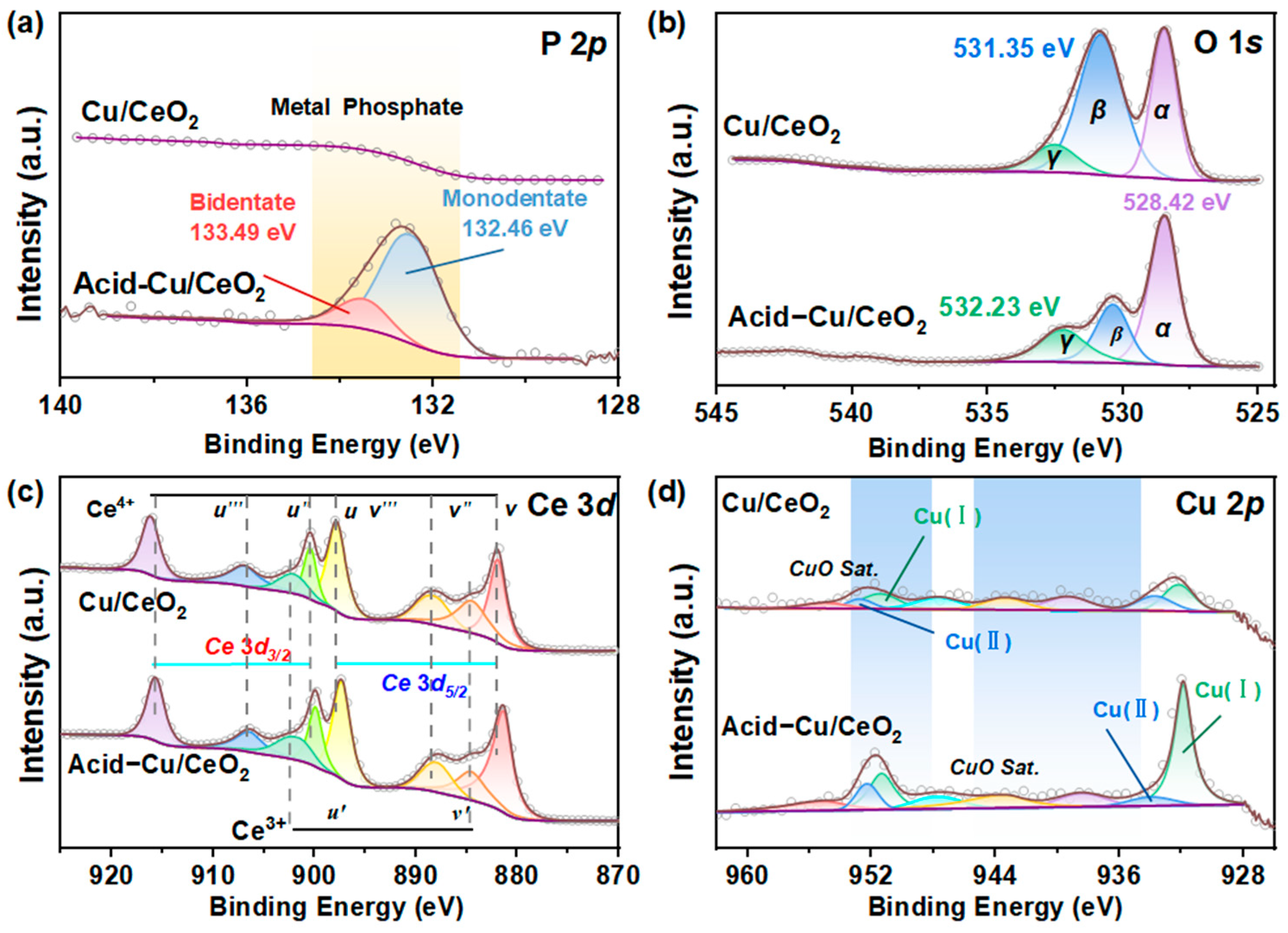
To further analyze the effects of phosphate modification on the surface elemental composition, electronic structure and oxygen species distribution of the Cu/CeO2 samples, XPS characterization was performed on both catalysts. The high-resolution Ce 3d XPS spectra of the Cu/CeO2 and Acid-Cu/CeO2 samples are presented in Figure 2a. Both samples exhibit typical Ce 3d spin–orbit splitting features, in which the Ce 3d5/2 and Ce 3d3/2 components are denoted as the v and u series, respectively. According to previous reports, the v′ and u′ peaks can be assigned to Ce3+ species, whereas the remaining peaks are mainly associated with Ce4+ species [34,35]. This indicates the coexistence of Ce3+ and Ce4+ on the surfaces of both Cu/CeO2 and Acid-Cu/CeO2, reflecting the non-stoichiometric nature of the CeO2 surface. As summarized in Table S2, the relative Ce3+ content decreases from 20.52% for Cu/CeO2 to 18.44% for Acid-Cu/CeO2 after phosphoric acid treatment, accompanied by an increase in the Ce4+ proportion. This result indicates that phosphate modification does not promote Ce3+ formation. Instead, the electron-withdrawing phosphate species decrease the relative concentration of surface Ce3+ and shift the surface cerium species toward a higher oxidation state [15,29,30]. Therefore, phosphate modification mainly alters the surface electronic environment and Ce3+/Ce4+ distribution of Cu/CeO2, rather than increasing the amount of Ce3+-related oxygen vacancies [29,36]. As shown in Figure 2b, analysis of the Cu 2p XPS spectra indicates that the copper species on the surfaces of both Cu/CeO2 and Acid-Cu/CeO2 catalysts exist in mixed valence states. Both samples exhibit characteristic spin–orbit splitting peaks corresponding to Cu 2p3/2 and Cu 2p1/2, as well as characteristic satellite peaks of Cu2+ species in the range of 940.0–948.0 eV [37,38]. After deconvolution, the relative contents of Cu+ and Cu2+ were calculated and summarized in Table S3. For Cu/CeO2, the surface Cu species are mainly composed of Cu2+, with Cu+ and Cu2+ contents of 33.73% and 66.27%, respectively. After phosphoric acid treatment, the Cu+ content increases to 49.82%, whereas the Cu2+ content decreases to 50.18% in Acid-Cu/CeO2. This result indicates that phosphoric acid modification increases the relative proportion of reduced Cu+ species and promotes a more balanced Cu+/Cu2+ distribution on the catalyst surface [39]. The increased Cu+ fraction suggests that phosphate modification modifies the local electronic environment of Cu species and may facilitate the Cu+/Cu2+ redox cycle, which is beneficial for NH3 activation and subsequent oxidation steps in NH3-SCO [15,31,36].
Combined with the absence of copper-related crystalline diffraction peaks in the XRD patterns and the lack of observable CuOx nanoparticles in TEM/HRTEM images, these XPS results are consistent with the highly dispersed state of Cu species on the CeO2 support before and after phosphoric acid treatment. The O 1s spectra were further analyzed to clarify the evolution of surface oxygen species. As shown in Figure 2c, the O 1s spectra can be divided into three components, denoted as Oα, Oβ, and Oγ [40]. Among them, Oα is mainly assigned to lattice oxygen species, Oβ is generally associated with surface adsorbed oxygen or defect-related oxygen species, and Oγ is primarily related to surface hydroxyl groups, adsorbed water, or weakly adsorbed oxygen species [41].
As shown in Table S4, the Oβ content of Cu/CeO2 is 55.56%, and its Orela ((Oβ + Oγ)/(Oα + Oβ + Oγ)) value reaches 66.11%, indicating a relatively high proportion of surface-related oxygen species. After phosphoric acid treatment, the Oα content of Acid-Cu/CeO2 significantly increases from 33.89% to 55.25%, whereas the Oβ content decreases from 55.56% to 24.86%, and the Orela value also decreases to 44.75%. These results demonstrate that phosphoric acid modification markedly alters the distribution of surface oxygen species over Cu/CeO2 and increases the relative proportion of lattice oxygen species [15,31,40].
Combined with the catalytic activity results, Acid-Cu/CeO2 exhibits higher NH3-SCO activity despite its lower proportion of Oβ species. This indicates that the enhanced catalytic activity is not governed solely by the static surface adsorbed oxygen/defect-related oxygen fraction obtained from XPS. Instead, the availability and mobility of lattice or subsurface oxygen species may be more closely related to the superior NH3-SCO performance of Acid-Cu/CeO2, which is further supported by the O2-TPD results discussed below. Therefore, compared with the total amount of surface adsorbed oxygen species, the lattice/subsurface oxygen behavior regulated by phosphate modification is more relevant to the improved catalytic performance [15,20,41]. Figure 2d presents the P 2p XPS spectra of Cu/CeO2 and Acid-Cu/CeO2. The untreated Cu/CeO2 sample shows no discernible P 2p signal, whereas Acid-Cu/CeO2 exhibits a clear P 2p signal in the 132–134 eV range, confirming that phosphorus species were successfully introduced onto the catalyst surface by phosphoric acid treatment [29,30,42]. In addition, the surface elemental composition was semi-quantitatively analyzed from the XPS survey spectrum (Table S5). For Acid-Cu/CeO2, the surface P concentration is estimated to be 3.75 at. %, and the corresponding surface P: Cu atomic ratio is approximately 0.76. This result further supports the successful introduction of phosphorus-containing species on the catalyst surface [29,30,43]. The P 2p spectrum of Acid-Cu/CeO2 can be deconvoluted into two components centered at 132.46 and 133.49 eV, which can be assigned to phosphate species with different coordination environments, generally associated with monodentate and bidentate phosphate species [43,44]. This interpretation is consistent with previous studies on phosphate-modified ceria and P/CeO2 catalysts, where surface phosphate species were shown to interact with CeO2 through phosphate–ceria interfacial structures and to modify the local electronic environment, acid-site distribution, and redox behavior of ceria [6,29].
Monodentate phosphate species containing terminal P-OH groups may contribute to the formation of Brønsted acid sites and surface electron-withdrawing effects, while bidentate phosphate species can interact with adjacent Ce sites through Ce-O-P linkages, thereby modifying the local coordination environment and oxygen species mobility [30,43,44]. Because phosphate species possess electron-withdrawing characteristics, their introduction can decrease the surface electron density around Ce species and modify the surface Ce3+/Ce4+ equilibrium [29,30,43]. This interpretation is consistent with the Ce 3d XPS results, where the relative Ce3+ content decreases and the Ce4+ proportion increases after phosphate modification. Therefore, the introduced phosphate species are considered an important factor responsible for the changes in surface acidity, surface electronic structure, and oxygen species distribution of Acid-Cu/CeO2. However, the individual catalytic contributions of monodentate and bidentate phosphate species cannot be quantitatively separated based solely on P 2p XPS.

2.3. NH3-SCO Catalytic Performance Evaluation

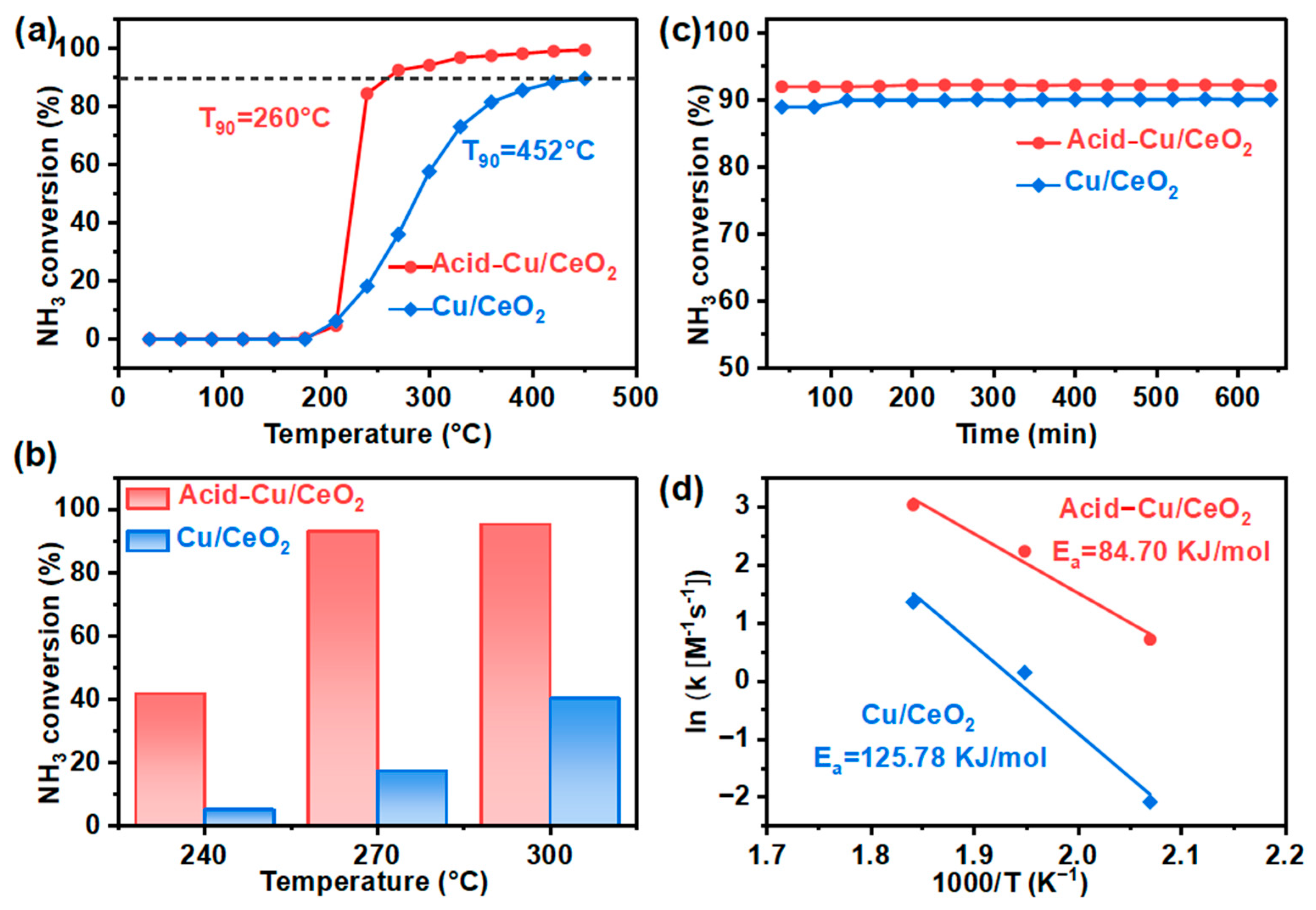
To evaluate the effect of phosphoric acid surface modification on the NH3-SCO performance of Cu/CeO2 catalysts, NH3 conversion activity, stability, and kinetic tests were conducted over Cu/CeO2 and Acid-Cu/CeO2. Overall, Acid-Cu/CeO2 exhibited markedly higher NH3 conversion than pristine Cu/CeO2 in the low- and medium-temperature range, together with improved reaction stability and a lower apparent activation energy, indicating that phosphoric acid surface modification effectively enhanced the NH3-SCO performance of Cu/CeO2 [15,16,24]. As shown in Figure 3a, the NH3 conversion over both Cu/CeO2 and Acid-Cu/CeO2 gradually increased with increasing reaction temperature, but their temperature-dependent catalytic behaviors were markedly different. Below 200 °C, both catalysts exhibited very limited NH3 conversion, indicating that NH3 adsorption, activation, and oxidative conversion were insufficient in this temperature range [20,24]. When the temperature increased above 200 °C, the NH3 conversion over Acid-Cu/CeO2 increased sharply and reached approximately 90% at 260 °C. In contrast, Cu/CeO2 showed a much slower increase in NH3 conversion and required a significantly higher temperature to reach the same conversion level. The T90 values of Acid-Cu/CeO2 and Cu/CeO2 were 260 °C and 452 °C, respectively, demonstrating that phosphoric acid modification substantially improved the low-temperature NH3-SCO activity of Cu/CeO2.
Figure 3b further compares the NH3 conversion of the two catalysts at 240, 270, and 300 °C based on the same catalytic activity data shown in Figure 3a. Acid-Cu/CeO2 showed much higher NH3 conversion than Cu/CeO2 at all three temperatures. Specifically, Acid-Cu/CeO2 achieved approximately 84.4%, 92.7%, and 95.4% NH3 conversion at 240, 270, and 300 °C, respectively, whereas Cu/CeO2 showed only about 18.25%, 36.58%, and 57.9% conversion at the same temperatures. These results further confirm that phosphoric acid modification effectively enhances the low-temperature NH3-SCO activity of Cu/CeO2.
The catalytic stability results are shown in Figure 3c. Under T90 conditions, the NH3 conversion over Acid-Cu/CeO2 remained above 90% during 600 min of continuous reaction, with no obvious deactivation observed, indicating its good reaction stability. By comparison, the NH3 conversion over Cu/CeO2 was generally lower than that over Acid-Cu/CeO2. This result suggests that phosphoric acid surface modification not only improves the low- and medium-temperature activity of Cu/CeO2 but also helps maintain a high NH3 conversion level during long-term reaction. To further compare the kinetic behavior of the two catalysts, the apparent activation energies of Cu/CeO2 and Acid-Cu/CeO2 in the NH3-SCO reaction were calculated based on the Arrhenius equation. As shown in Figure 3d, the Ea values of Cu/CeO2 and Acid-Cu/CeO2 were 125.78 kJ/mol and 84.70 kJ/mol, respectively. Compared with Cu/CeO2, Acid-Cu/CeO2 exhibited a lower apparent activation energy, indicating that phosphoric acid modification reduced the energy barrier of the NH3-SCO reaction and enabled NH3 adsorption, activation, and subsequent oxidative conversion to proceed more readily at lower temperatures [3,15,24]. This result is consistent with the lower T90 value of Acid-Cu/CeO2, further confirming the positive role of phosphoric acid surface modification in enhancing the low- and medium-temperature reaction activity of Cu/CeO2.
In summary, phosphoric acid surface modification significantly improved the NH3-SCO performance of Cu/CeO2, resulting in higher NH3 conversion in the low- and medium-temperature range, a lower T90 value, good reaction stability, and a lower apparent activation energy. These results indicate that the introduction of surface phosphate species effectively optimizes the surface reaction environment of Cu/CeO2 and promotes low-temperature NH3 conversion, providing an experimental basis for further elucidating the performance enhancement mechanism from the perspectives of surface acidity, oxygen species distribution, and electronic structure [15,29,31].
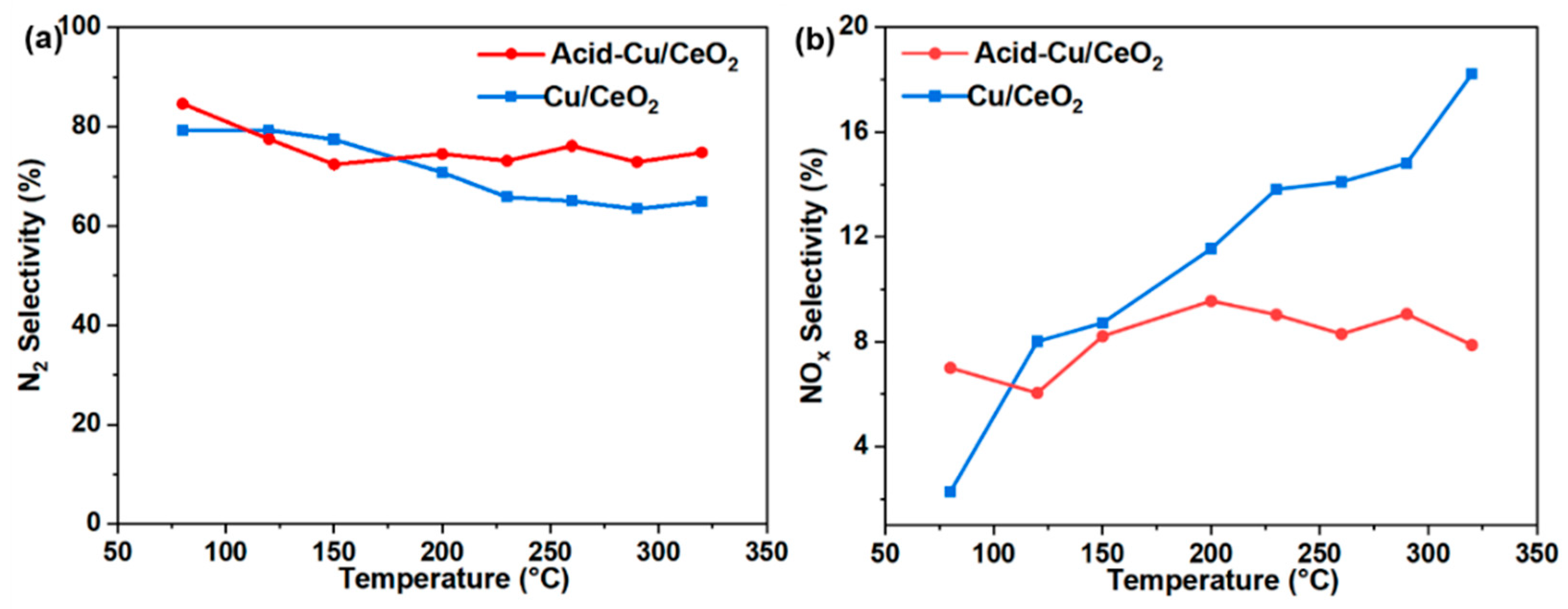
The product selectivity was further analyzed to evaluate the N2 formation ability and NOx by-product formation over the two catalysts [24,27]. As shown in Figure 4a, Acid-Cu/CeO2 maintains relatively high N2 selectivity over the tested temperature range, with the N2 selectivity remaining mostly above 70%. In contrast, the N2 selectivity of Cu/CeO2 gradually decreases as the reaction temperature increases, especially above 200 °C. This indicates that phosphoric acid modification is beneficial for maintaining N2 selectivity during NH3-SCO. The NOx selectivity results further support this conclusion. As shown in Figure 4b, the NOx selectivity of Cu/CeO2 increases continuously with increasing temperature, reaching a much higher value at elevated temperatures. This suggests that NH3 is more readily over-oxidized to NOx species on unmodified Cu/CeO2 [21,24]. In comparison, Acid-Cu/CeO2 shows lower and more stable NOx selectivity over the same temperature range, indicating that phosphoric acid modification suppresses the deep oxidation of NH3 to NOx. Combined with the higher NH3 conversion and improved N2 selectivity, these results demonstrate that Acid-Cu/CeO2 not only promotes NH3 activation but also favors the selective conversion of NH3 toward N2 rather than NOx by-products.
To further contextualize the catalytic performance of Acid-Cu/CeO2, representative NH3-SCO catalysts reported in the literature were compared [24,27]. As summarized in Table S6, CuO/TiO2 catalysts with gradient oxidative dual sites achieved a T90 of approximately 270 °C under 500 ppm NH3 and 5 vol% O2, while Cu-attapulgite catalysts generally required around 300 °C to reach 90% NH3 conversion under similar NH3/O2 feeds [3,45,46]. CuO/CeO2 nanorod catalysts also showed excellent NH3-SCO activity, with a T90 value of approximately 250 °C under the reported reaction conditions [15]. Cu-Ce-Zr mixed oxides exhibited a comparable T90 value of around 260 °C, where coordinated Cu species and reactive oxygen species were identified as key factors governing NH3 activation and N2 selectivity [40]. In addition, phosphate-containing hydroxyapatite-supported Cu catalysts required a higher temperature of approximately 350 °C to reach 90% NH3 conversion, with an N2 selectivity of about 84% [47]. In comparison, Acid-Cu/CeO2 reaches a T90 of 260 °C under 500 ppm NH3, 2 vol% O2, and a WHSV of 30,000 mL gcat−1 h−1, while maintaining relatively high N2 selectivity and lower NOx selectivity. These comparisons indicate that phosphate modification enables Cu/CeO2 to achieve competitive low-temperature NH3-SCO performance under relatively mild oxygen concentration [15,24,27,40].
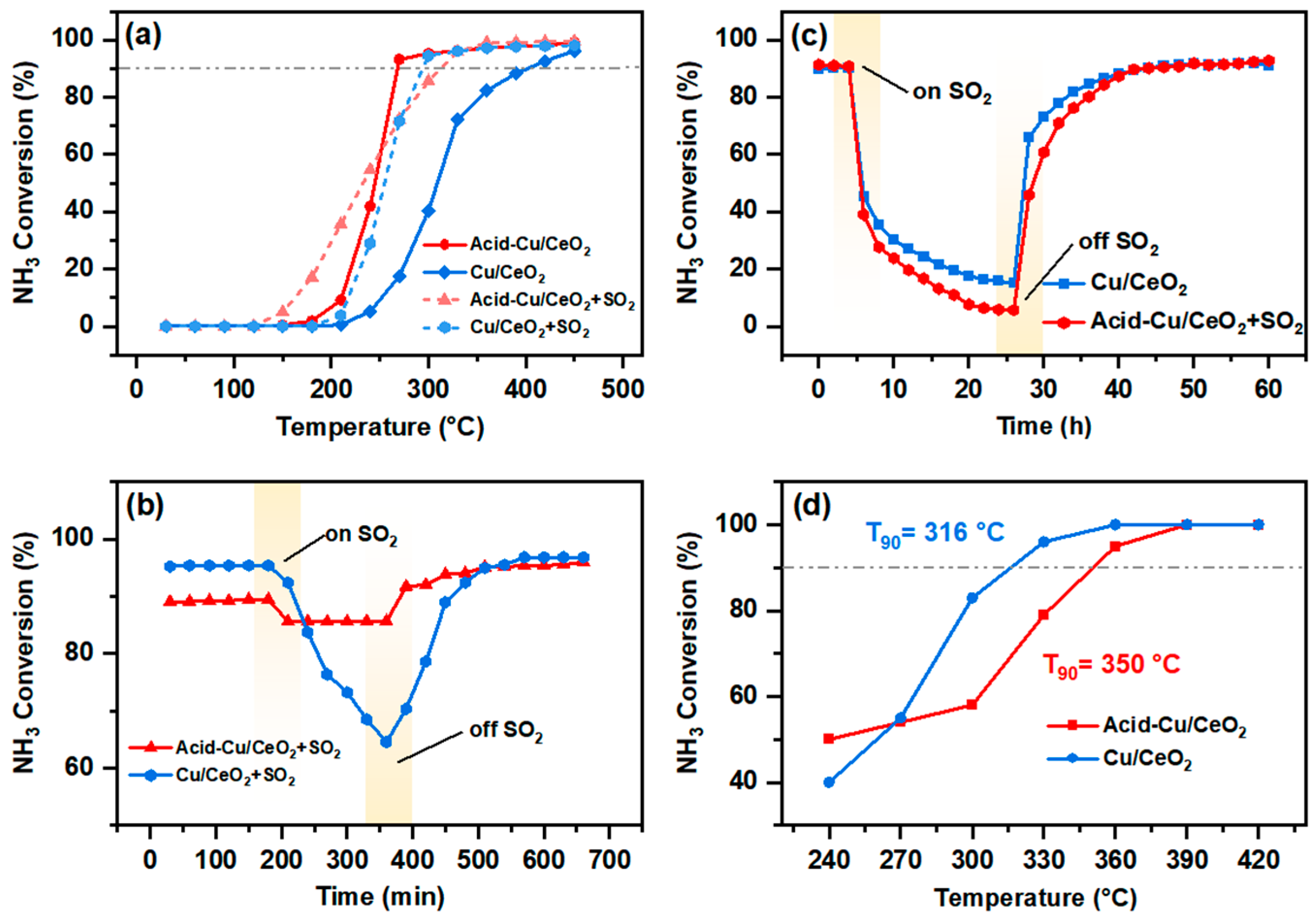
As a typical poison for NH3-SCO, SO2 causes catalyst deactivation via competing for active sites and forming inert sulfate species; thus, sulfur resistance is an important evaluation criterion for their practical application [6,24,26,48]. To evaluate the effect of phosphoric acid modification on sulfur resistance, 10 ppm SO2 was introduced into the reaction atmosphere, and the SO2 resistance of Cu/CeO2 and Acid-Cu/CeO2 was investigated, as shown in Figure 5a. Under SO2-free conditions, Acid-Cu/CeO2 showed higher NH3 conversion than Cu/CeO2, confirming its superior low- and medium-temperature activity. After SO2 introduction, both catalysts were affected, and Acid-Cu/CeO2 did not exhibit a clear sulfur-resistance advantage.
The 12 h SO2-resistance tests were conducted at the corresponding T90 temperatures determined under SO2-free conditions, namely 452 °C for Cu/CeO2 and 260 °C for Acid-Cu/CeO2 (Figure 5b). After SO2 introduction, the NH3 conversion over both catalysts decreased to different extents, indicating the inhibitory effect of SO2 on NH3-SCO. After SO2 removal, the NH3 conversion recovered rapidly. For Cu/CeO2, the conversion even became slightly higher than its initial SO2-free level, which is regarded as a transient overshoot during the SO2 on-off process rather than a stable promotional effect of SO2 [49,50]. Therefore, this result mainly indicates that the SO2-induced inhibition is reversible under the present test conditions.
When the SO2 exposure time was extended to 48 h, the NH3 conversion of both catalysts continuously decreased to below 20%, demonstrating severe deactivation under prolonged SO2 treatment (Figure 5c). After SO2 was removed from the feed gas, the NH3 conversion over both catalysts recovered rapidly, indicating that the SO2-induced inhibition was largely reversible under the present reaction conditions. This recovery behavior suggests that the deactivation during short-term SO2 exposure was mainly associated with reversible adsorption or labile sulfur-containing surface species, rather than irreversible destruction of the active sites [51,52]. However, prolonged SO2 exposure still caused a significant decrease in NH3 conversion, demonstrating that SO2 remains a critical poisoning component for both catalysts. After SO2 removal, the activity partially recovered for both catalysts, but the post-treatment light-off behavior differed significantly between the two samples [49,52]. The T90 of Cu/CeO2 decreased by 102 °C, whereas that of Acid-Cu/CeO2 increased by 56 °C, indicating different surface evolution behaviors during SO2 treatment. Overall, SO2 significantly inhibited the NH3-SCO activity of both catalysts, especially under long-term exposure. Nevertheless, their rapid recovery after SO2 removal suggests that the poisoning process was mainly reversible. Although phosphoric acid modification improved the intrinsic NH3-SCO activity of Cu/CeO2, it did not provide a consistently positive effect on SO2 resistance [53].

2.4. Analysis of Surface Oxygen Species and Acidic Sites

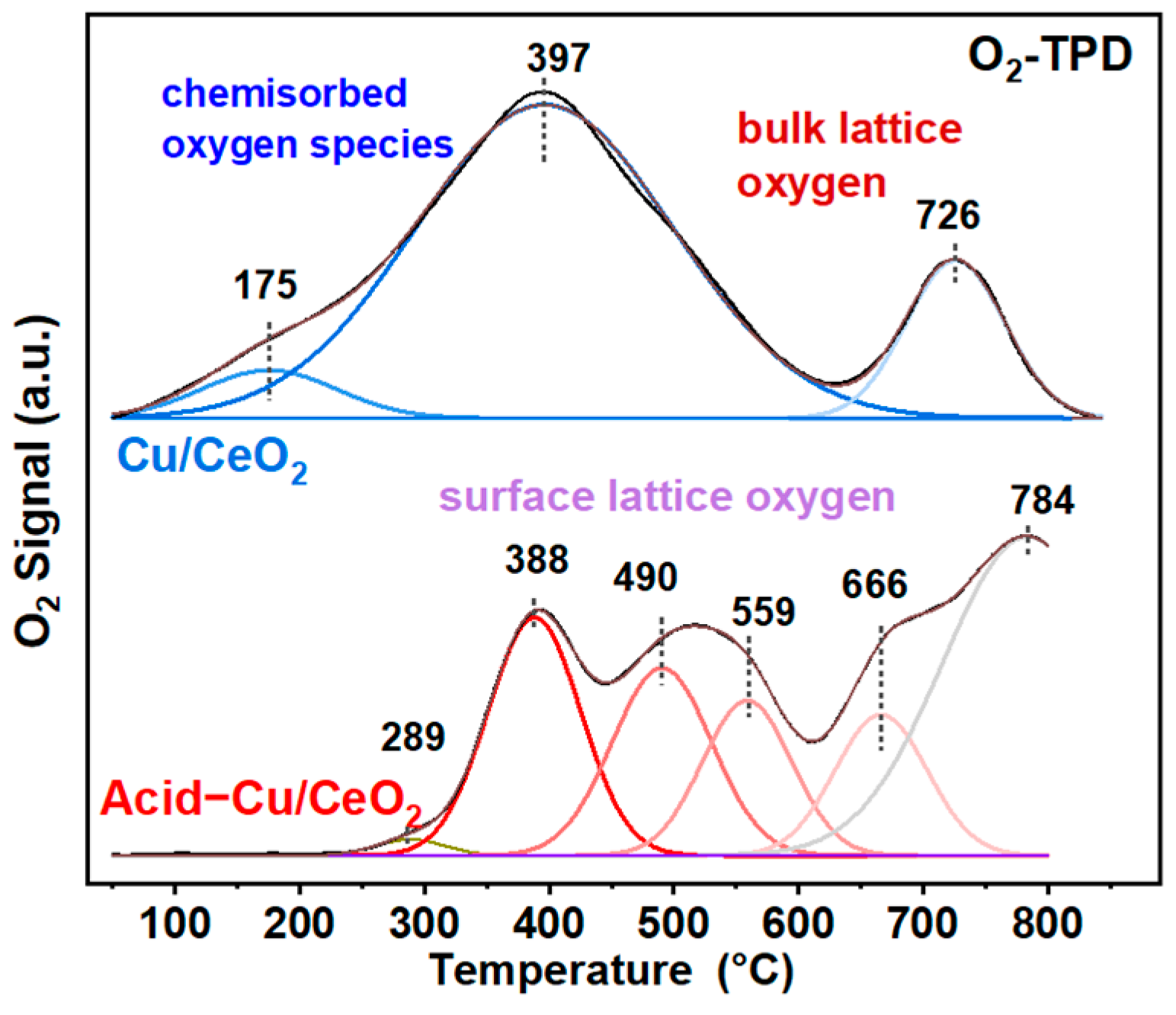
As shown in Figure 6, the O2-TPD profile of unmodified Cu/CeO2 exhibits three main desorption features. The weak low-temperature peak at 175 °C can be assigned to weakly chemisorbed oxygen species [40,54,55]. The desorption peak centered at 397 °C is related to surface/subsurface labile oxygen species, while the high-temperature peak at 726 °C is generally associated with bulk lattice oxygen [56]. The relatively weak low-temperature desorption signal suggests that unmodified Cu/CeO2 contains a limited amount of readily desorbed surface oxygen species. After phosphoric acid modification, the O2 desorption behavior of Acid-Cu/CeO2 changes markedly. Several desorption peaks appear at 289, 388, 490, 559, 666, and 784 °C, indicating a more complex distribution of oxygen species. The peak at 289 °C can be attributed to chemisorbed oxygen species with relatively weak binding [14,57]. More importantly, the medium-temperature desorption peaks at 388, 490, and 559 °C are more reasonably assigned to surface/subsurface labile oxygen species and weakly bound lattice oxygen species, rather than being solely attributed to surface adsorbed oxygen. These oxygen species can participate in the oxidative dehydrogenation of adsorbed NHx species and reaction intermediates during the NH3-SCO reaction [15,24,40]. The high-temperature peaks at 666 and 784 °C are attributed to lattice oxygen species with stronger binding [56,58]. It should be noted that the enhanced medium-temperature O2 desorption behavior of Acid-Cu/CeO2 does not directly contradict the decreased Oβ fraction observed in the O 1s XPS results. XPS reflects the quasi-static surface oxygen composition, whereas O2-TPD reflects the temperature-dependent release and mobility of oxygen species during heating. Therefore, the decreased Oβ fraction in XPS indicates a lower relative amount of static surface adsorbed/defect-related oxygen species, while the enhanced medium-temperature O2 desorption peaks indicate improved accessibility and mobility of labile surface/subsurface or weakly bound lattice oxygen species [15,40]. This suggests that phosphoric acid modification redistributes oxygen species and improves the mobility of oxygen species involved in NH3-SCO [29,30]. This interpretation is consistent with previous studies on Cu–Ce-based NH3-SCO catalysts, in which the mobility and reactivity of surface/subsurface oxygen species, rather than only the static amount of adsorbed oxygen detected by XPS, were considered crucial for NH3 activation and selective oxidation [15,28,40].
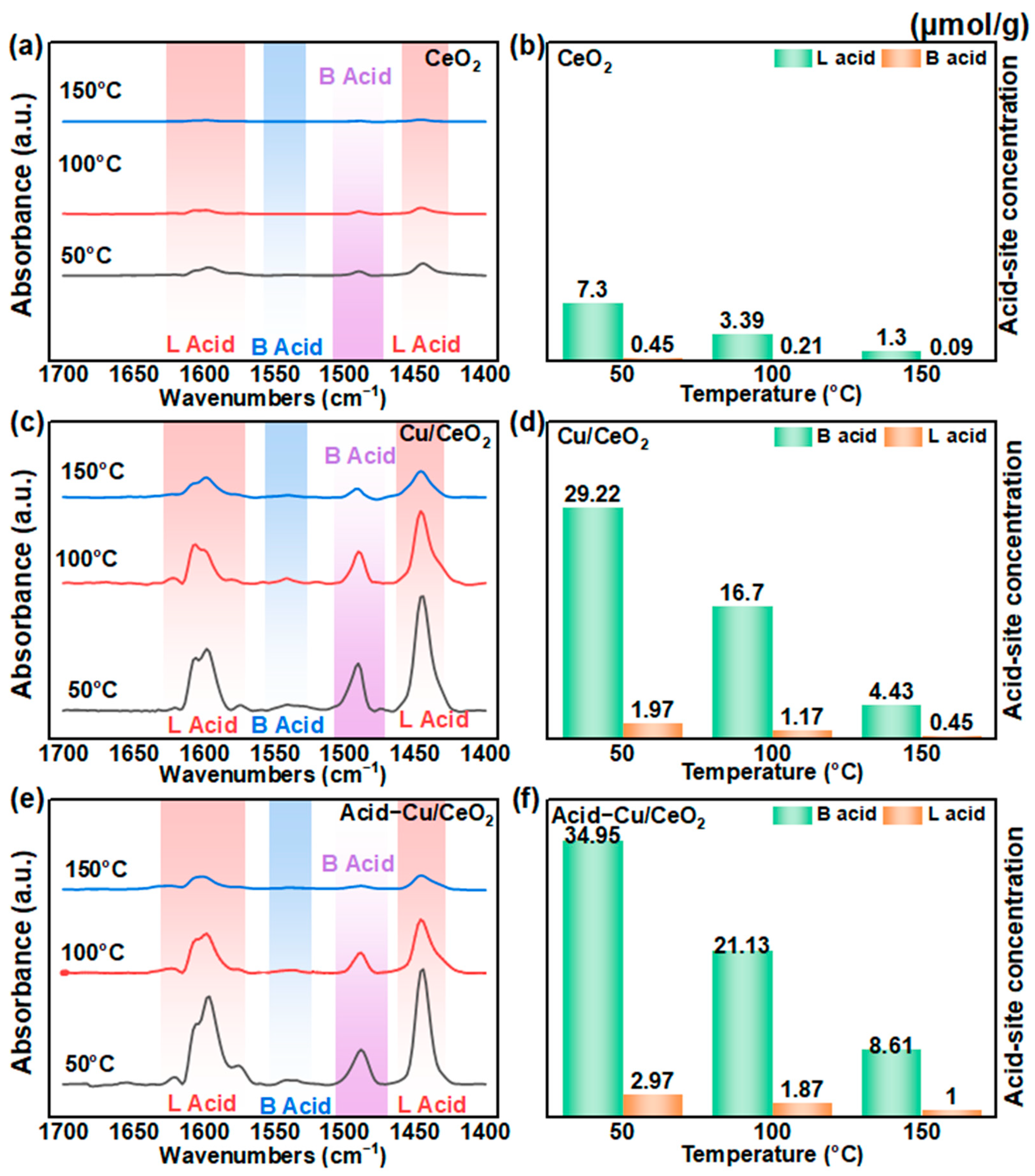
To further distinguish the surface acid properties associated with NH3 adsorption and activation, Py-IR was performed over CeO2, Cu/CeO2, and Acid-Cu/CeO2 [48,59,60]. As shown in Figure 7, the bands around 1540 cm−1 are assigned to pyridine adsorbed on Brønsted acid sites, while the bands around 1440 and 1600 cm−1 are attributed to pyridine coordinated to Lewis acid sites [61,62]. The band near 1490 cm−1 is generally associated with pyridine adsorbed on both Brønsted and Lewis acid sites [48,59]. In NH3-SCO, Brønsted acid sites can stabilize NH3 in the form of NH4+ species, whereas Lewis acid sites can adsorb NH3 as coordinated NH3 species and participate in N-H bond activation [60]. It should be noted that, for Cu/CeO2-based redox catalysts, Lewis acid sites detected by Py-IR mainly correspond to pyridine-coordinated surface cationic sites, including Cu and Ce species. These sites may also participate in redox-related reaction steps. Therefore, the Py-IR results are mainly used here to compare the relative Brønsted/Lewis acid-site distribution among different samples under identical conditions, rather than to completely separate acidity from redox properties [61,62].
For CeO2, the intensities of both Brønsted and Lewis acid bands gradually decrease as the desorption temperature increases from 50 to 150 °C, indicating the progressive desorption of weakly adsorbed pyridine species (Figure 7a). As summarized in Table S7, the Brønsted acid-site concentrations of CeO2 are 0.45, 0.21, and 0.09 μmol g−1 at 50, 100, and 150 °C, respectively, while the Lewis acid-site concentrations are 7.30, 3.39, and 1.30 μmol g−1. The total acid-site concentration decreases from 7.75 to 1.39 μmol g−1 as the desorption temperature increases, indicating that most acid sites on CeO2 are weak or medium-strength acid sites. After Cu introduction, Cu/CeO2 exhibits a much higher acid-site concentration than CeO2, especially in the Lewis acid region (Figure 7c,d). The total acid-site concentrations of Cu/CeO2 are 31.19, 17.87, and 4.88 μmol g−1 at 50, 100, and 150 °C, respectively. Specifically, the Lewis acid-site concentrations increase to 29.22, 16.70, and 4.43 μmol g−1, while the Brønsted acid-site concentrations increase to 1.97, 1.17, and 0.45 μmol g−1. These results indicate that Cu introduction significantly increases the number of pyridine-accessible acid sites, with Lewis acid sites remaining the dominant acid species. The enhanced Lewis acidity is closely related to the formation of surface Cu species and Ce-related cationic sites, which can provide more coordination sites for NH3 adsorption and activation [31,36,42]. After phosphoric acid treatment, Acid-Cu/CeO2 shows further increased acid-site concentration compared with Cu/CeO2 (Figure 7e,f). The total acid-site concentrations of Acid-Cu/CeO2 reach 37.92, 22.99, and 9.61 μmol g−1 at 50, 100, and 150 °C, respectively, which are higher than those of Cu/CeO2 at all corresponding desorption temperatures. Both Brønsted and Lewis acid sites are enhanced after phosphoric acid treatment. The Brønsted acid-site concentrations increase to 2.97, 1.87, and 1.00 μmol g−1, while the Lewis acid-site concentrations increase to 34.95, 21.13, and 8.61 μmol g−1 at 50, 100, and 150 °C, respectively. Moreover, Acid-Cu/CeO2 retains higher total acid-site concentrations at 150 °C than Cu/CeO2, suggesting that phosphoric acid modification not only increases the acid-site concentration but also improves the retention of medium-strength acid sites [6,29,63]. The acidity-regulation effect is also consistent with previous reports on H3PO4-modified CeO2 and phosphate-functionalized ceria, where phosphate species were demonstrated to introduce or strengthen acid sites and simultaneously modify the redox behavior of ceria [6,29,48,63].
These Py-IR results demonstrate that phosphoric acid modification effectively regulates and strengthens the surface acidity of Cu/CeO2. The increased Brønsted acid sites can promote NH3 adsorption and stabilization as NH4+ species, while the abundant Lewis acid sites can provide coordination sites for NH3 activation [48]. Therefore, the superior NH3-SCO performance of Acid-Cu/CeO2 is closely related to the enhanced and redistributed Brønsted/Lewis acid sites, together with the modified Cu+/Cu2+ redox state and improved oxygen species mobility discussed above [15,24,63].

2.5. Mechanistic Insights into NH3-SCO

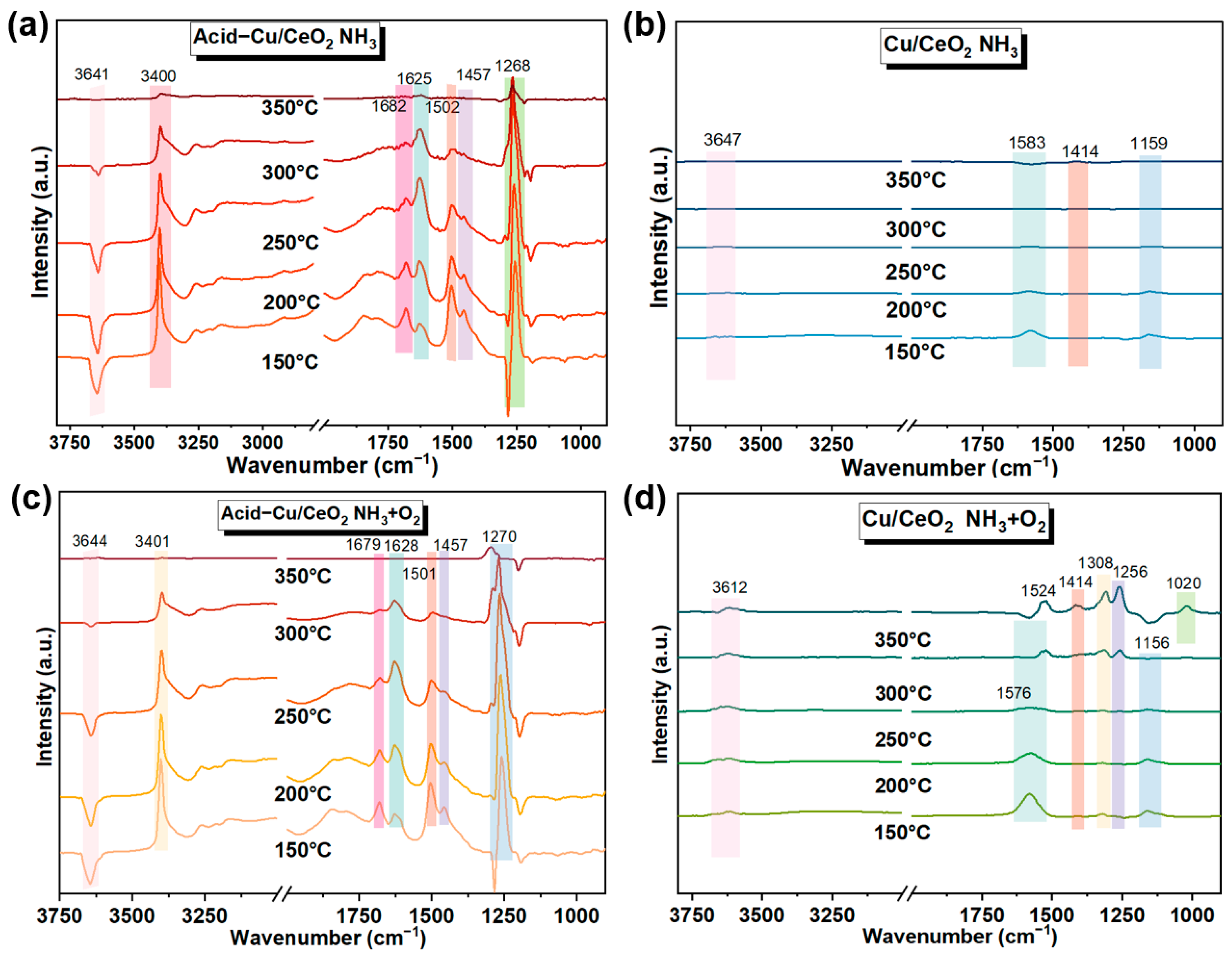
To clarify the NH3 adsorption behavior and surface intermediate evolution over the two catalysts, DRIFTS experiments were first performed under NH3 adsorption conditions, followed by operando DRIFTS measurements under NH3 + O2 reaction conditions. As shown in Figure 8a, Acid-Cu/CeO2 exhibits several distinct bands at 3641, 3400, 1682, 1625, 1502, 1457, and 1268 cm−1 under the NH3 atmosphere. The negative band at 3641 cm−1 is assigned to the consumption or perturbation of surface -OH groups, indicating that surface hydroxyl species participate in NH3 adsorption and activation [64,65]. The band at 3400 cm−1 corresponds to the N-H stretching vibration [66,67]. The band at 1682 cm−1 is attributed to NH3 adsorbed on Brønsted acid sites, while the band at 1268 cm−1 is assigned to NH3 coordinated on Lewis acid sites [68,69]. The band at 1502 cm−1 can be assigned to -NH2 species generated by the initial dehydrogenation of adsorbed NH3, whereas the band at 1457 cm−1 is associated with -NH species [70,71]. In addition, the band at 1625 cm−1 can be attributed to -NHO-related intermediates [72,73]. With increasing temperature, the Lewis-acid-related NH3 adsorption band gradually weakens, while the -NH2, -NH, and -NHO-related bands first become evident and then decrease at higher temperatures. This evolution indicates that NH3 adsorbed on Acid-Cu/CeO2 is progressively activated through N-H bond cleavage. Specifically, Lewis-bound NH3 is first dehydrogenated to form -NH2 species, which are further converted into -NH species and subsequently into -NHO-related intermediates. At elevated temperatures, these reactive intermediates are further transformed or consumed during the NH3-SCO reaction. In contrast, as shown in Figure 8b, Cu/CeO2 shows much weaker NH3 adsorption features, with bands observed at 3647, 1583, 1414, and 1159 cm−1. The band at 3647 cm−1 corresponds to the N-H stretching vibration. The bands at 1583 and 1159 cm−1 are assigned to NH3 coordinated on Lewis acid sites, while the band at 1414 cm−1 is attributed to NH3 adsorbed on Brønsted acid sites [74,75]. Compared with Acid-Cu/CeO2, the weaker band intensities over Cu/CeO2 indicate its limited NH3 adsorption capacity. In addition, no obvious -NH2, -NH, or -NHO-related bands are observed over Cu/CeO2 under the NH3 atmosphere, suggesting that the activation and stepwise dehydrogenation of adsorbed NH3 are much less efficient on the unmodified catalyst. After introducing O2, operando DRIFTS measurements were further performed to investigate the oxidative transformation of NH3-derived intermediates during NH3-SCO. As shown in Figure 8c, Acid-Cu/CeO2 exhibits characteristic bands at 3644, 3401, 1679, 1628, 1501, 1457, and 1270 cm−1 under the NH3 + O2 atmosphere. The negative band at 3644 cm−1 is assigned to the consumption or perturbation of surface -OH groups, indicating that surface hydroxyl species are involved in the NH3-SCO reaction. The band at 3401 cm−1 corresponds to the N-H stretching vibration [76,77,78]. The band at 1679 cm−1 is attributed to NH3 adsorbed on Brønsted acid sites, while the band at 1270 cm−1 is assigned to NH3 coordinated on Lewis acid sites. The band at 1501 cm−1 is assigned to -NH2 species, and the band at 1457 cm−1 is associated with -NH species [64,79]. The band at 1628 cm−1 is attributed to -NHO-related intermediates formed through the interaction between dehydrogenated NHx species and surface hydroxyl or oxygen species [80,81]. Compared with the NH3-only atmosphere, the presence of O2 promotes the oxidative transformation of adsorbed NH3 species. With increasing temperature, the bands associated with -NH2, -NH, and -NHO-related intermediates gradually decrease after their formation, indicating that these intermediates are continuously consumed through further oxidation or coupling reactions. As shown in Figure 8d, Cu/CeO2 exhibits bands at 3612, 1576, 1524, 1414, 1308, 1256, 1156, and 1020 cm−1 under NH3 + O2 reaction conditions. The band at 3612 cm−1 corresponds to the N-H stretching vibration [82,83]. The bands at 1576 and 1156 cm−1 are assigned to NH3 coordinated on Lewis acid sites, while the band at 1414 cm−1 is attributed to NH3 adsorbed on Brønsted acid sites [3,84]. The band at 1524 cm−1 can be assigned to -NH2 species, indicating that part of the adsorbed NH3 can undergo initial dehydrogenation on Cu/CeO2 [85,86,87]. The bands at 1308, 1256, and 1020 cm−1 are mainly assigned to nitrate/nitrite-related species generated from the oxidation of adsorbed NH3 [15,68,75,88]. With increasing temperature, these NOx-related bands become more pronounced, indicating that NH3-derived intermediates are readily oxidized to nitrate/nitrite species and tend to accumulate on the Cu/CeO2 surface. These DRIFTS observations are consistent with previous NH3-SCO mechanistic studies, in which adsorbed NH3, NHx intermediates, and nitrate/nitrite-related species were identified as key surface species during NH3 activation and oxidative transformation [24,81,89,90].
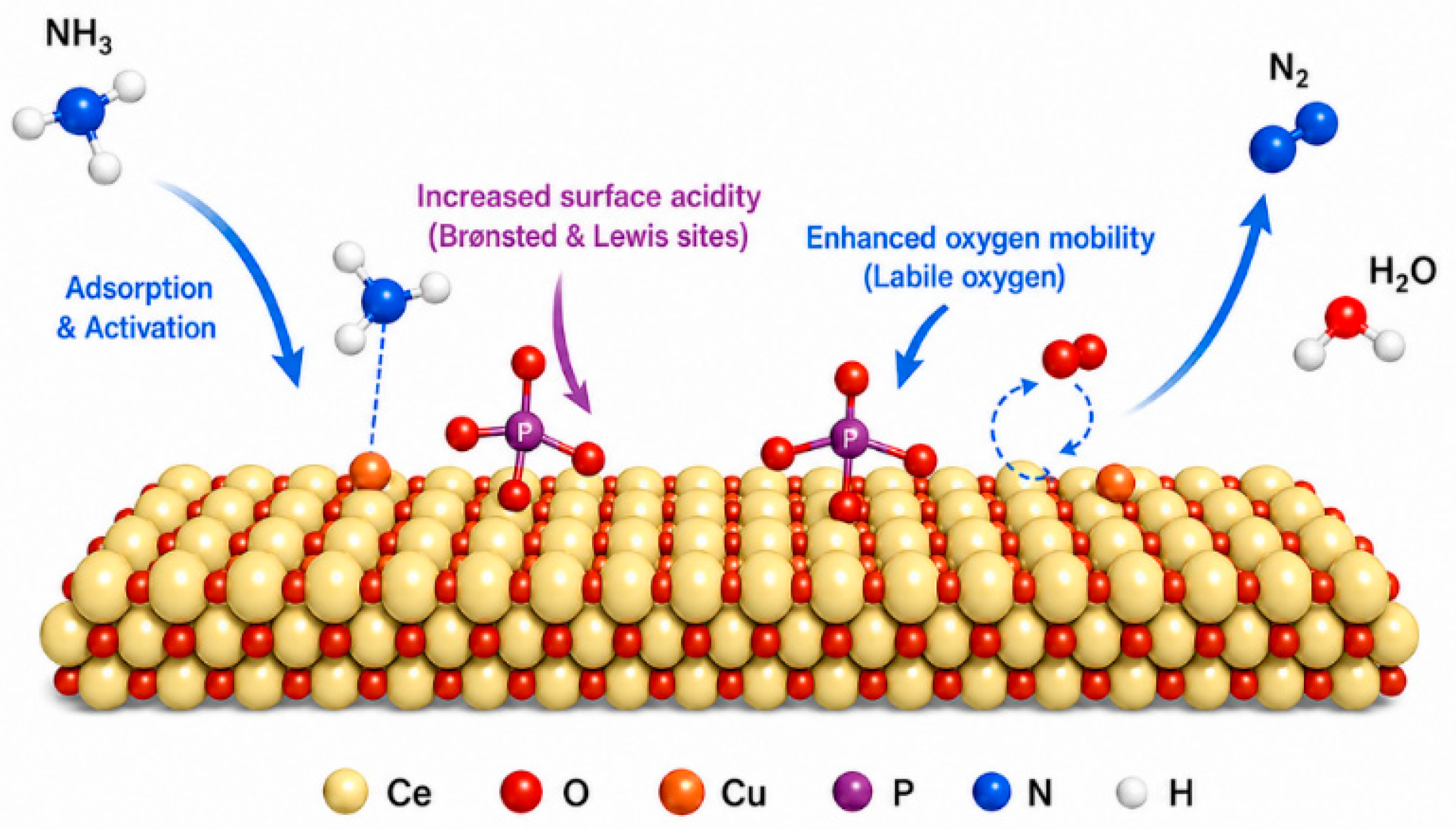
Overall, the DRIFTS results reveal distinct NH3 activation and intermediate transformation behaviors over the two catalysts. Acid-Cu/CeO2 shows stronger NH3 adsorption on Brønsted and Lewis acid sites, more evident formation of -NH2, -NH, and -NHO-related intermediates, and continuous consumption of these intermediates at elevated temperatures [42,48,63]. This indicates that phosphoric acid modification promotes NH3 adsorption, N-H bond activation, and subsequent transformation of NHx-derived species [68,71,72]. In contrast, Cu/CeO2 exhibits weaker NH3 adsorption and less efficient NHx intermediate formation, while nitrate/nitrite-related species accumulate more obviously under NH3 + O2 conditions (Figure 9) [24,27,68].

3. Experimental Section

3.1. Preparation of Catalysts

Cu/CeO2: 1.96 g Ce(NO3)3·6H2O (>99.5%, Shanghai Aladdin Co., Ltd., Shanghai, China) and 16.88 g NaOH (95%, Shanghai E & Chemical Technology Co., Ltd., Shanghai, China) were dissolved in 10 mL and 30 mL of deionized water, respectively. After mixing and stirring for 30 min, a calculated amount of Cu(NO3)2·3H2O (99%, Shanghai Aladdin Co., Ltd., China) corresponding to a nominal Cu loading of 1.5 wt% was added dropwise and stirred for another 30 min. Hydrothermal treatment was carried out at 180 °C for 24 h, followed by centrifugation, washing, and calcination at 500 °C for 4 h with a heating rate of 10 °C min−1 from room temperature.
Acid-Cu/CeO2: 600 mg of Cu/CeO2 was dispersed in 20 mL of anhydrous ethanol (analytical grade, Shanghai Sinopharm Chemical Reagent Co., Ltd., Shanghai, China) and ultrasonicated for 15 min. 18 mL of 0.1 mol/L H3PO4 (analytical reagent, Shanghai Sinopharm Chemical Reagent Co., Ltd., China) was added, corresponding to a nominal P amount of 1.80 mmol and a nominal P:Cu atomic ratio of 12.7:1 based on the 1.5 wt% Cu loading. The volume was adjusted to 20 mL with ethanol. Ultrasonic etching was performed for 20 min using a commercial ultrasonic cleaner (KT-5200DT, Nanjing Kulike Technology Co., Ltd., Nanjing, China) at a fixed power of 250 W and a frequency of 40 kHz under continuous-wave mode at room temperature. The product was centrifuged at 5000 rpm for 5 min, washed three times with deionized water, and dried at 80 °C in an oven overnight.

3.2. Catalytic Activity Evaluation

The NH3-SCO performance of all catalysts was evaluated in a fixed-bed quartz reactor. Typically, 0.10 g of catalyst powder with a particle size of 60–80 mesh was loaded into the reactor and fixed between two layers of quartz wool. The total gas flow rate was 50 mL min−1, and the feed gas consisted of 500 ppm NH3 (NH3 purity ≥ 99.999%), 2 vol% O2 (O2 purity ≥ 99.999%), and N2 as the balance gas. All gases used in the catalytic activity and SO2-resistance tests were supplied by Nanjing Special Gas Co., Ltd., Nanjing, China. The weight hourly space velocity (WHSV) was 30,000 mL gcat−1 h−1. The temperature was increased from room temperature to 500 °C at a ramp rate of 6 °C min−1. At each target temperature, the catalyst was held for 25 min to reach steady state before the outlet gas was analyzed. The outlet NH3 concentration was quantitatively measured using an ammonia gas analyzer (Thermo Scientific Model 17i, Whaltman, MA, USA). NH3 conversion was calculated according to the following equation:
X NH 3 = [ NH 3 inlet ] [ NH 3 outlet ] [ NH 3 inlet ] × 100 %
S N 2 = { [ NH 3 inlet ] NH 3 outlet [ NO outlet ] [ NO 2 outlet ] 2 × [ N 2 O outlet ] / [ NH 3 inlet ] [ NH 3 outlet ] } × 100 %
For the kinetic analysis, the apparent reaction rates were calculated from the steady-state NH3 conversion data obtained in the low-conversion region during the catalytic activity tests. The NH3 conversion values used for the Arrhenius plots were selected from the light-off measurements under identical reaction conditions, rather than from the selected-temperature bar chart or the long-term stability tests. The apparent NH3 conversion rate was calculated according to the inlet NH3 molar flow rate, NH3 conversion, and catalyst mass. The apparent activation energy was then obtained from the slope of the linear relationship between ln r and 1/T based on the Arrhenius equation.
To evaluate SO2 resistance, 10 ppm SO2 (99.99%) was introduced into the reaction atmosphere while maintaining the same NH3, O2, and N2 balance gas composition, catalyst mass, and total flow rate. For the SO2-containing activity tests, the catalytic performance was measured under the same temperature-programmed protocol in the presence of 10 ppm SO2. For the SO2 on-off stability tests, the catalysts were first stabilized under SO2-free reaction conditions at their corresponding T90 temperatures, followed by the introduction of 10 ppm SO2 into the feed gas. After SO2 exposure, SO2 was removed from the gas stream, and the recovery behavior of NH3 conversion was continuously monitored under the original SO2-free reaction atmosphere. In addition, post-SO2 activity tests were conducted after the SO2-resistance experiments to evaluate the changes in catalytic light-off behavior.

3.3. Characterization of Catalysts

Comprehensive physicochemical characterization was conducted to establish the relationship between the structural properties, surface acidity, oxygen species characteristics, and NH3-SCO catalytic performance of the catalysts. X-ray diffraction (XRD) was employed to characterize the crystal structure and phase composition of the samples. X-ray photoelectron spectroscopy (XPS) was used to analyze the surface elemental composition, chemical states, and electronic structure of the catalysts. Oxygen temperature-programmed desorption (O2-TPD) was performed to investigate the distribution, activity, and mobility of surface oxygen species. Pyridine adsorption infrared spectroscopy (Py-IR) was used to distinguish and quantify Brønsted and Lewis acid sites. Furthermore, operando diffuse reflectance infrared Fourier transform spectroscopy (operando DRIFTS) was applied to monitor the dynamic evolution of surface adsorbed species and key intermediates during the NH3-SCO reaction, thereby elucidating the reaction pathway and structure–activity relationship of the catalysts. The instrument models and detailed testing parameters are provided in the Supporting Information.

4. Conclusions

In this work, phosphate-modified Cu/CeO2 catalysts were prepared by a facile phosphoric acid surface treatment and applied to low-temperature NH3-SCO. Acid-Cu/CeO2 retained the cubic fluorite structure of CeO2, while Cu species remained highly dispersed after modification. Compared with pristine Cu/CeO2, Acid-Cu/CeO2 showed markedly enhanced NH3-SCO activity, with the T90 decreasing from 452 to 260 °C and the apparent activation energy decreasing from 125.78 to 84.70 kJ mol−1. In addition, Acid-Cu/CeO2 exhibited relatively higher N2 selectivity and lower NOx selectivity, indicating that phosphate modification promotes selective NH3 conversion toward N2 while suppressing excessive NOx formation. Characterization results revealed that surface phosphate species regulate the surface electronic structure and reaction environment of Cu/CeO2. XPS results showed that phosphate modification decreased the relative Ce3+ concentration, increased the Ce4+ proportion, and regulated the Cu+/Cu2+ distribution on the catalyst surface. Meanwhile, O 1s XPS and O2-TPD results indicated that the improved activity is more closely related to oxygen species redistribution and mobility rather than simply to the amount of static surface adsorbed/defect-related oxygen species. Py-IR and DRIFTS results further confirmed that phosphate modification increased Brønsted/Lewis acidity, enhanced NH3 adsorption and N-H activation, and promoted the formation and consumption of NHx/-NHO-related intermediates. Overall, phosphate surface modification improves the low-temperature NH3-SCO performance of Cu/CeO2 by jointly regulating surface acidity, Cu/Ce electronic states, and oxygen species mobility.

Supplementary Materials

The following supporting information can be downloaded at: https://www.mdpi.com/article/10.3390/catal16070628/s1, Figure S1: NH3 conversion over CeO2 catalyst as a function of temperature; Table S1: ICP-OES elemental analysis results of Cu/CeO2 and Acid-Cu/CeO2 catalysts; Table S2: Relative Ce3+ and Ce4+ contents calculated from the Ce 3d XPS spectra of Cu/CeO2 and Acid-Cu/CeO2 catalysts; Table S3: Relative Cu1+ and Cu2+ contents calculated from the Cu 2p XPS spectra of Cu/CeO2 and Acid-Cu/CeO2 catalysts; Table S4: Relative contents of Oα, Oβ, Oγ and Orela obtained from the O 1s XPS fitting results of Cu/CeO2 and Acid-Cu/CeO2 catalysts; Table S5: Surface elemental composition of Acid-Cu/CeO2 estimated from XPS survey spectra; Table S6: Comparison of Ammonia Selective Catalytic Oxidation Performance of Different Catalysts; Table S7: Quantitative acid site results of CeO2, Cu/CeO2 and Acid-Cu/CeO2 catalysts measured by Py-IR at different desorption temperatures.

Author Contributions

Writing—original draft, Data curation, S.M.; Writing—review and editing, Formal analysis, H.L.; Data curation, Formal analysis, Y.H. (Yuchen Huang); Conceptualization, Data curation, K.S.; Conceptualization, Data curation, Y.H. (Yuejia Huang); Supervision, Funding acquisition, Project administration, Y.F.; Validation, Methodology, Y.D. All authors have read and agreed to the published version of the manuscript.

Funding

We acknowledge the National Natural Science Foundation of China (No. 22306094) for the financial support and Jiangsu Future Membrane Technology Innovation Center (No. BM2021804).

Data Availability Statement

The data presented in this study are available upon request from the corresponding author.

Conflicts of Interest

The authors declare no conflicts of interest.

References

  1. Plautz, J. Ammonia, a Poorly Understood Smog Ingredient, Could Be Key to Limiting Deadly Pollution. Science 2018. Available online: https://www.science.org/content/article/ammonia-poorly-understood-smog-ingredient-could-be-key-limiting-deadly-pollution# (accessed on 3 June 2026).
  2. Chen, Y.; Zhang, Q.; Cai, X.; Zhang, H.; Lin, H.; Zheng, C.; Guo, Z.; Hu, S.; Chen, L.; Tao, S.; et al. Rapid Increase in China’s Industrial Ammonia Emissions: Evidence from Unit-Based Mapping. Environ. Sci. Technol. 2022, 56, 3375–3385. [Google Scholar] [CrossRef] [Scilit] [PubMed]
  3. Wang, Y.; Lan, T.; Han, L.; Pensa, E.; Shen, Y.; Li, X.; Xu, Z.; Chen, X.; Wang, M.; Xue, X.; et al. Non-Precious Metal Catalysts with Gradient Oxidative Dual Sites Boost Bimolecular Activation for Catalytic Oxidation Reactions. Angew. Chem. Int. Ed. 2025, 64, e202506018. [Google Scholar] [CrossRef] [Scilit] [PubMed]
  4. Jabłońska, M.; Mollá Robles, A. A Comparative Mini-Review on Transition Metal Oxides Applied for the Selective Catalytic Ammonia Oxidation (NH3-SCO). Materials 2022, 15, 4770. [Google Scholar] [CrossRef] [Scilit] [PubMed]
  5. An, W.; Zhao, T.; Niu, B.; Tian, Z.; Guan, S.; Duan, X.; Wei, Z.; Li, G.; Zhang, F.; Cheng, J.; et al. The PtCu Bimetal Clusters with Close Contact Confined by Zeolite Enhances the Performance of the NH3-SCO Reaction through Cuδ+–Ptδ− Interface Induced by Electron Transfer. Appl. Catal. B Environ. Energy 2026, 384, 126200. [Google Scholar] [CrossRef] [Scilit]
  6. Song, Z.; Wang, J.; Zhang, Q.; Ren, D.; Liu, H.; Ning, P.; Zhang, X.; Kang, H.; Liu, B.; Mao, Y. Comparison of Sulfuric Acid- or Phosphoric Acid-Modified CeO2 and the Influence of Surface Acidity and Redox Property on Its Activity toward NH3-SCR. Res. Chem. Intermed. 2019, 45, 645–661. [Google Scholar] [CrossRef] [Scilit]
  7. Lin, M.; An, B.; Niimi, N.; Jikihara, Y.; Nakayama, T.; Honma, T.; Takei, T.; Shishido, T.; Ishida, T.; Haruta, M.; et al. Role of the Acid Site for Selective Catalytic Oxidation of NH3 over Au/Nb2O5. ACS Catal. 2019, 9, 1753–1756. [Google Scholar] [CrossRef] [Scilit]
  8. Gao, F.; Walter, E.D.; Washton, N.M.; Szanyi, J.; Peden, C.H.F. Synthesis and Evaluation of Cu-SAPO-34 Catalysts for Ammonia Selective Catalytic Reduction. 1. Aqueous Solution Ion Exchange. ACS Catal. 2013, 3, 2083–2093. [Google Scholar] [CrossRef] [Scilit]
  9. Yu, T.; Wang, J.; Shen, M.; Li, W. NH3-SCR over Cu/SAPO-34 Catalysts with Various Acid Contents and Low Cu Loading. Catal. Sci. Technol. 2013, 3, 3234–3241. [Google Scholar] [CrossRef] [Scilit]
  10. Doan, T.; Dam, P.; Nguyen, K.; Vuong, T.H.; Le, M.T.; Pham, T.H. Copper-Iron Bimetal Ion-Exchanged SAPO-34 for NH3-SCR of NOx. Catalysts 2020, 10, 321. [Google Scholar] [CrossRef] [Scilit]
  11. Wang, D.; Zhang, L.; Li, J.; Kamasamudram, K.; Epling, W.S. NH3-SCR over Cu/SAPO-34—Zeolite Acidity and Cu Structure Changes as a Function of Cu Loading. Catal. Today 2014, 231, 64–74. [Google Scholar] [CrossRef] [Scilit]
  12. Jabłońska, M. Progress on Selective Catalytic Ammonia Oxidation (NH3-SCO) over Cu-Containing Zeolite-Based Catalysts. ChemCatChem 2020, 12, 4490–4500. [Google Scholar] [CrossRef] [Scilit]
  13. Dong, A.; Yang, Z.; Wang, W. Mixed Catalyst SmMn2O5/Cu-SAPO34 for NH3-Selective Catalytic Oxidation. ACS Omega 2022, 7, 8633–8639. [Google Scholar] [CrossRef] [Scilit] [PubMed]
  14. Schiavoni, M.; Campisi, S.; Gervasini, A. Effect of Cu Deposition Method on Silico Aluminophosphate Catalysts in NH3-SCR and NH3-SCO Reactions. Appl. Catal. A Gen. 2017, 543, 162–172. [Google Scholar] [CrossRef] [Scilit]
  15. Sun, H.; Wang, H.; Qu, Z. Construction of CuO/CeO2 Catalysts via the Ceria Shape Effect for Selective Catalytic Oxidation of Ammonia. ACS Catal. 2023, 13, 1077–1088. [Google Scholar] [CrossRef] [Scilit]
  16. Liu, Q.; Mi, J.; Chen, X.; Wang, S.; Chen, J.; Li, J. Effects of Phosphorus Modification on the Catalytic Properties and Performance of CuCeZr Mixed Metal Catalyst for Simultaneous Removal of CO and NOx. Chem. Eng. J. 2021, 423, 130228. [Google Scholar] [CrossRef] [Scilit]
  17. Sun, M.; Zhou, S.; Wang, S.; Song, C. Optimized Design Method for Pt/SiO2–Al2O3 with High NH3-SCO Activity and Thermal Stability. ACS Omega 2022, 7, 3177–3184. [Google Scholar] [CrossRef] [Scilit] [PubMed]
  18. Guan, X.; Han, R.; Asakura, H.; Wang, Z.; Xu, S.; Wang, B.; Kang, L.; Liu, Y.; Marlow, S.; Tanaka, T.; et al. Designing Reactive Bridging O2 at the Atomic Cu–O–Fe Site for Selective NH3 Oxidation. ACS Catal. 2022, 12, 15207–15217. [Google Scholar] [CrossRef] [Scilit] [PubMed]
  19. Karatok, M.; Vovk, E.I.; Koc, A.V.; Ozensoy, E. Selective Catalytic Ammonia Oxidation to Nitrogen by Atomic Oxygen Species on Ag(111). J. Phys. Chem. C 2017, 121, 22985–22994. [Google Scholar] [CrossRef] [Scilit]
  20. Ran, M.; Dong, Y.; Zhang, X.; Lin, S.; Liu, P.; Yang, Y.; Song, H.; Du, X.; Zheng, C.; Gao, X. Experimental and Theoretical Insights into the Support-Dependent N2 Selectivity of CuO-Based NH3-SCO Catalysts. J. Mater. Chem. A 2025, 13, 19742–19752. [Google Scholar] [CrossRef] [Scilit]
  21. Guan, X.; Asakura, H.; Han, R.; Xu, S.; Liu, H.-X.; Chen, L.; Yao, Z.; Yan, J.; Tanaka, T.; Guo, Y.; et al. Cascade NH3 Oxidation and N2O Decomposition via Bifunctional Co and Cu Catalysts. ACS Catal. 2023, 13, 13816–13827. [Google Scholar] [CrossRef] [Scilit] [PubMed]
  22. Cao, Y.; Chen, X.; Zhu, S.; Zhou, H.; Chen, C.; Liu, S.; Jia, W. Shape Effect of Cu and Ce Species over Modified Attapulgite Catalysts: Dual Reactivity and Sulfur Resistance in NH3-SCR and NH3-SCO. Energy Fuels 2025, 39, 2098–2112. [Google Scholar] [CrossRef] [Scilit]
  23. Zhang, N.; Tong, J.; Miyazaki, S.; Zhao, S.; Kubota, H.; Jing, Y.; Mine, S.; Toyao, T.; Shimizu, K. Mechanism of NH3-SCR over P/CeO2 Catalysts Investigated by Operando Spectroscopies. Environ. Sci. Technol. 2023, 57, 16289–16295. [Google Scholar] [CrossRef] [Scilit] [PubMed]
  24. Gao, F.; Liu, Y.; Sani, Z.; Tang, X.; Yi, H.; Zhao, S.; Yu, Q.; Zhou, Y. Advances in Selective Catalytic Oxidation of Ammonia (NH3-SCO) to Dinitrogen in Excess Oxygen: A Review on Typical Catalysts, Catalytic Performances and Reaction Mechanisms. J. Environ. Chem. Eng. 2021, 9, 104575. [Google Scholar] [CrossRef] [Scilit]
  25. Zhang, X.; Wang, H.; Jiang, X.; Li, S.; Zhu, Z.; Zheng, C.; Gao, X. Study of Synergistic Effect between CuO and CeO2 over CuO@CeO2 Core–Shell Nanocomposites for NH3-SCO. Catal. Sci. Technol. 2019, 9, 2968–2981. [Google Scholar] [CrossRef] [Scilit]
  26. Górecka, S.; Pacultová, K.; Górecki, K.; Smýkalová, A.; Pamin, K.; Obalová, L. Cu-Mg-Fe-O-(Ce) Complex Oxides as Catalysts of Selective Catalytic Oxidation of Ammonia to Dinitrogen (NH3-SCO). Catalysts 2020, 10, 153. [Google Scholar] [CrossRef] [Scilit]
  27. Jabłońska, M.; Palkovits, R. Copper-Based Catalysts for the Selective Ammonia Oxidation into Nitrogen and Water Vapour—Recent Trends and Open Challenges. Appl. Catal. B Environ. 2016, 181, 332–351. [Google Scholar] [CrossRef] [Scilit]
  28. Guo, X.; Qiu, Z.; Mao, J.; Zhou, R. Shape-Controlled CuxCe1−xO2 Nanorods Catalyst and the Active Components Functioned in Selective Oxidation of CO in Hydrogen-Rich Stream. J. Power Sources 2020, 451, 227757. [Google Scholar] [CrossRef] [Scilit]
  29. Nelson, N.C.; Wang, Z.; Naik, P.; Manzano, J.S.; Pruski, M.; Slowing, I.I. Phosphate Modified Ceria as a Brønsted Acidic/Redox Multifunctional Catalyst. J. Mater. Chem. A 2017, 5, 4455–4466. [Google Scholar] [CrossRef] [Scilit]
  30. Dai, Q.; Zhang, Z.; Yan, J.; Wu, J.; Johnson, G.; Sun, W.; Wang, X.; Zhang, S.; Zhan, W. Phosphate-Functionalized CeO2 Nanosheets for Efficient Catalytic Oxidation of Dichloromethane. Environ. Sci. Technol. 2018, 52, 13430–13437. [Google Scholar] [CrossRef] [Scilit] [PubMed]
  31. Ren, Z.; Peng, F.; Li, J.; Liang, X.; Chen, B. Morphology-Dependent Properties of Cu/CeO2 Catalysts for the Water-Gas Shift Reaction. Catalysts 2017, 7, 48. [Google Scholar] [CrossRef] [Scilit]
  32. Jiang, Y.; Mao, K.; Li, J.; Duan, D.; Li, J.; Wang, X.; Zhong, Y.; Zhang, C.; Liu, H.; Gong, W.; et al. Pushing the Performance Limit of Cu/CeO2 Catalyst in CO2 Electroreduction: A Cluster Model Study for Loading Single Atoms. ACS Nano 2023, 17, 2620–2628. [Google Scholar] [CrossRef] [Scilit] [PubMed]
  33. Rabee, A.I.M.; Abed, H.; Vuong, T.H.; Bartling, S.; Kraußer, L.; Atia, H.; Rockstroh, N.; Kondratenko, E.V.; Brückner, A.; Rabeah, J. CeO2-Supported Single-Atom Cu Catalysts Modified with Fe for RWGS Reaction: Deciphering the Role of Fe in the Reaction Mechanism by In Situ/Operando Spectroscopic Techniques. ACS Catal. 2024, 14, 10913–10927. [Google Scholar] [CrossRef] [Scilit] [PubMed]
  34. Wang, Y.; Zhang, Q.; Lin, Y.; Huang, W.; Ding, D.; Zheng, Y.; Chen, M.; Wan, H. Insight into the High Efficiency of Cu/CeO2(110) Catalysts for Preferential Oxidation of CO from Hydrogen Rich Fuel. Appl. Surf. Sci. 2021, 566, 150707. [Google Scholar] [CrossRef] [Scilit]
  35. Adak, S.; Pal, R.S.; Khan, T.S.; Banerjee, D.; Sasidharan, M.; Sekar, G. Role of Interfacial Cu-Ions in Polycrystalline Cu-CeO2: In Situ Raman, In Situ DRIFT and DFT Studies for Preferential Oxidation of CO in Presence of Excess H2. ChemistrySelect 2021, 6, 13051–13059. [Google Scholar] [CrossRef] [Scilit]
  36. Martínez-Arias, A.; Gamarra, D.; Hungría, A.B.; Fernández-García, M.; Munuera, G.; Hornés, A.; Bera, P.; Conesa, J.C.; Cámara, A.L. Characterization of Active Sites/Entities and Redox/Catalytic Correlations in Copper-Ceria-Based Catalysts for Preferential Oxidation of CO in H2-Rich Streams. Catalysts 2013, 3, 378–400. [Google Scholar] [CrossRef] [Scilit]
  37. Górecka, S.; Pacultová, K.; Fridrichová, D.; Górecki, K.; Bílková, T.; Žebrák, R.; Obalová, L. Catalytic Oxidation of Ammonia over Cerium-Modified Copper Aluminium Zinc Mixed Oxides. Materials 2021, 14, 6581. [Google Scholar] [CrossRef] [Scilit] [PubMed]
  38. Guo, J.; Peng, Y.; Zhang, Y.; Yang, W.; Gan, L.; Li, K.; Chen, J.; Li, J. Comparison of NH3-SCO Performance over CuOx/H-SSZ-13 and CuOx/H-SAPO-34 Catalysts. Appl. Catal. A Gen. 2019, 585, 117119. [Google Scholar] [CrossRef] [Scilit]
  39. Tong, X.; Yu, J.; Zhang, L.; Sun, J. Fabrication of Stable Cu-Ce Catalyst with Active Interfacial Sites for NOx Elimination by Flame Spray Pyrolysis. Catalysts 2022, 12, 432. [Google Scholar] [CrossRef] [Scilit]
  40. Qu, Z.; Wang, Z.; Zhang, X.; Wang, H. Role of Different Coordinated Cu and Reactive Oxygen Species on the Highly Active Cu–Ce–Zr Mixed Oxides in NH3-SCO: A Combined In Situ EPR and O2-TPD Approach. Catal. Sci. Technol. 2016, 6, 4491–4502. [Google Scholar] [CrossRef] [Scilit]
  41. Ning, Z.; Wen, L.; Li, R.; Xin, K.; Liu, P.; Liu, L.; Sun, Y.; Zhu, Y.; Ning, P. Oxygen Vacancy-Enriched Cu/CeO2–ZrO2 Catalyst with Highly Dispersed Cu0 towards Plasma Catalytic Advanced CO2 Utilization. J. Clean. Prod. 2024, 442, 141010. [Google Scholar] [CrossRef] [Scilit]
  42. Gong, L.; Jie, W.; Liu, Y.; Lin, X.; Deng, W.; Qiu, M.; Hu, X.; Liu, Q. Enhanced Activity for CO Preferential Oxidation over CuO Catalysts Supported on Nanosized CeO2 with High Surface Area and Defects. Catalysts 2021, 11, 884. [Google Scholar] [CrossRef] [Scilit]
  43. Zhang, L.; Deng, W.; Cai, Y.; Dai, Q.; Guo, L. Comparative Studies of Phosphate-Modified CeO2 and Al2O3 for Mechanistic Understanding of Dichloromethane Oxidation and Chloromethane Formation. ACS Catal. 2020, 10, 13109–13122. [Google Scholar] [CrossRef] [Scilit]
  44. Ta, K.M.; Cooke, D.J.; Gillie, L.J.; Parker, S.C.; Seal, S.; Wilson, P.B.; Phillips, R.M.; Skelton, J.M.; Molinari, M. Infrared and Raman Diagnostic Modeling of Phosphate Adsorption on Ceria Nanoparticles. J. Phys. Chem. C 2023, 127, 20183–20193. [Google Scholar] [CrossRef] [Scilit] [PubMed]
  45. Zhang, X.; Lan, T.; Yi, Q.; Wang, Y.; Cheng, D.; Zhang, D. Zeolite-Like Ion-Exchanged Cu-Attapulgite Catalysts for Promoted Selective Oxidation of Ammonia. Environ. Sci. Nano 2024, 11, 2457–2466. [Google Scholar] [CrossRef] [Scilit]
  46. Weissenberger, T.; Zapf, R.; Pennemann, H.; Kolb, G. Effect of the Active Metal on the NOx Formation during Catalytic Combustion of Ammonia SOFC Off-Gas. Catalysts 2022, 12, 1186. [Google Scholar] [CrossRef] [Scilit]
  47. Campisi, S.; Galloni, M.G.; Gervasini, A. Unlocking Catalytic Efficiency: How Preparation Strategies and Copper Loading Enhance Hydroxyapatite Catalysts for NH3 Oxidation. Catalysts 2025, 15, 405. [Google Scholar] [CrossRef] [Scilit]
  48. Damma, D.; Ettireddy, P.R.; Reddy, B.M.; Smirniotis, P.G. A Review of Low Temperature NH3-SCR for Removal of NOx. Catalysts 2019, 9, 349. [Google Scholar] [CrossRef] [Scilit]
  49. Liu, G.; Zhang, W.; He, P.; Guan, S.; Yuan, B.; Li, R.; Sun, Y.; Shen, D. H2O and/or SO2 Tolerance of Cu-Mn/SAPO-34 Catalyst for NO Reduction with NH3 at Low Temperature. Catalysts 2019, 9, 289. [Google Scholar] [CrossRef] [Scilit]
  50. Liu, G.; Zhang, W.; He, P.; Shen, D.; Wu, C.; Gong, C. Effect of Transition Metal Additives on the Catalytic Performance of Cu-Mn/SAPO-34 for Selective Catalytic Reduction of NO with NH3 at Low Temperature. Catalysts 2019, 9, 685. [Google Scholar] [CrossRef] [Scilit]
  51. Hao, S.; Cai, Y.; Sun, C.; Sun, J.; Tang, C.; Dong, L. High Resistance of SO2 and H2O over Monolithic Mn-Fe-Ce-Al-O Catalyst for Low Temperature NH3-SCR. Catalysts 2020, 10, 1329. [Google Scholar] [CrossRef] [Scilit]
  52. Gao, Y.; Cao, L.; Wu, X.; Zhang, X.; Ma, Z.; Ran, R.; Si, Z.; Weng, D.; Wang, B. Protection Effect of Ammonia on CeNbTi NH3-SCR Catalyst from SO2 Poisoning. Catalysts 2022, 12, 1430. [Google Scholar] [CrossRef] [Scilit]
  53. Du, H.; Niu, S.; Wang, H.; Li, Y.; Wang, Y. Insight into the Promoting Role of Er Modification on SO2 Resistance for NH3-SCR at Low Temperature over FeMn/TiO2 Catalysts. Catalysts 2021, 11, 618. [Google Scholar] [CrossRef] [Scilit]
  54. Tian, Y.; Han, Z.; Wu, X.; Zhang, X.; Wang, Z.; Ma, D. Sn Modulation Function on Active Intermediate Species for Enhancing NH3-SCO Performance of Cu/Ce0.3TiOx Catalyst. J. Energy Inst. 2025, 119, 101976. [Google Scholar] [CrossRef] [Scilit]
  55. Sihaib, Z.; Puleo, F.; Garcia-Vargas, J.M.; Retailleau, L.; Descorme, C.; Liotta, L.F.; Valverde, J.L.; Gil, S.; Giroir-Fendler, A. Manganese Oxide-Based Catalysts for Toluene Oxidation. Appl. Catal. B Environ. 2017, 209, 689–700. [Google Scholar] [CrossRef] [Scilit]
  56. Quan, Y.-H.; Miao, C.; Li, T.; Wang, N.; Wu, M.-M.; Zhang, N.; Zhao, J.-X.; Ren, J. Effect of Preparation Methods on the Structure and Catalytic Performance of CeO2 for Toluene Combustion. J. Fuel Chem. Technol. 2021, 49, 211–219. [Google Scholar] [CrossRef] [Scilit]
  57. El Arrouji, I.; Chen, C.; Toyir, J.; Larabi, C.; Szeto, K.C.; de Mallmann, A.; Taoufik, M.; Oulmekki, A. NH3-Selective Catalytic Reduction of NOx to N2 over Ceria Supported WOx Based Catalysts: Influence of Tungsten Content. Catalysts 2021, 11, 950. [Google Scholar] [CrossRef] [Scilit]
  58. Zhu, Q.; Wang, A.; Zhang, J.; Guo, Y.; Guo, Y.; Wang, L.; Zhan, W. Low-Temperature NH3-SCR on Cex-Mn-Tiy Mixed Oxide Catalysts: Improved Performance by the Mutual Effect between Ce and Ti. Catalysts 2022, 12, 471. [Google Scholar] [CrossRef] [Scilit]
  59. Wang, X.; Cong, Q.; Chen, L.; Shi, Y.; Shi, Y.; Li, S.; Li, W. The Alkali Resistance of CuNbTi Catalyst for Selective Reduction of NO by NH3: A Comparative Investigation with VWTi Catalyst. Appl. Catal. B Environ. 2019, 246, 166–179. [Google Scholar] [CrossRef] [Scilit]
  60. Krishna, V.; Naresh, G.; Kumar, V.V.; Sarkari, R.; Padmasri, A.H.; Venugopal, A. Synthesis of 2,6-Dimethylpyrazine by Dehydrocyclization of Aqueous Glycerol and 1,2-Propanediamine over CuCrO Catalyst: Rationalization of Active Sites by Pyridine and Formic Acid Adsorbed IR Studies. Appl. Catal. B Environ. 2016, 193, 58–66. [Google Scholar] [CrossRef] [Scilit]
  61. Barzetti, T.; Selli, E.; Moscotti, D.; Forni, L. Pyridine and Ammonia as Probes for FTIR Analysis of Solid Acid Catalysts. J. Chem. Soc. Faraday Trans. 1996, 92, 1401–1407. [Google Scholar] [CrossRef] [Scilit]
  62. Xu, W.; Tian, R.; Gao, C.; Wang, C.; Chen, Y.; Wang, R.; Peng, J.; An, S.; Li, P. Improved Surface Acidity of CeO2/TiO2 Catalyst by Cu Doping to Enhance the SCR Catalytic Activity. Sci. Rep. 2024, 14, 23604. [Google Scholar] [CrossRef] [Scilit] [PubMed]
  63. Yi, T.; Zhang, Y.; Li, J.; Yang, X. Promotional Effect of H3PO4 on Ceria Catalyst for Selective Catalytic Reduction of NO by NH3. Chin. J. Catal. 2016, 37, 300–307. [Google Scholar] [CrossRef] [Scilit]
  64. Chen, L.; Wang, Y.; Wang, X.; Wang, Q.; Li, B.; Li, S.; Zhang, S.; Li, W. Brønsted Acid Enhanced Hexagonal Cerium Phosphate for the Selective Catalytic Reduction of NO with NH3: In Situ DRIFTS and DFT Investigation. J. Hazard. Mater. 2022, 424, 127334. [Google Scholar] [CrossRef] [Scilit] [PubMed]
  65. Wang, F.; Ma, J.; He, G.; Chen, M.; Zhang, C.; He, H. Nanosize Effect of Al2O3 in Ag/Al2O3 Catalyst for the Selective Catalytic Oxidation of Ammonia. ACS Catal. 2018, 8, 2670–2682. [Google Scholar] [CrossRef] [Scilit]
  66. Zhang, Y.; Yue, X.; Huang, T.; Shen, K.; Lu, B. In Situ DRIFTS Studies of NH3-SCR Mechanism over V2O5-CeO2/TiO2-ZrO2 Catalysts for Selective Catalytic Reduction of NOx. Materials 2018, 11, 1307. [Google Scholar] [CrossRef] [Scilit] [PubMed]
  67. Hadjiivanov, K.I. Identification of Neutral and Charged NxOy Surface Species by IR Spectroscopy. Catal. Rev. Sci. Eng. 2000, 42, 71–144. [Google Scholar] [CrossRef] [Scilit]
  68. Ran, M.; Dong, Y.; Zhang, X.; Li, W.; Wang, Z.; Lin, S.; Yang, Y.; Song, H.; Wu, W.; Liu, S.; et al. Unraveling the Mechanistic Origin of High N2 Selectivity in Ammonia Selective Catalytic Oxidation on CuO-Based Catalyst. Environ. Sci. Technol. 2024, 58, 12249–12259. [Google Scholar] [CrossRef] [Scilit] [PubMed]
  69. Zhu, M.; Lai, J.K.; Tumuluri, U.; Wu, Z.; Wachs, I.E. Nature of Active Sites and Surface Intermediates during SCR of NO with NH3 by Supported V2O5–WO3/TiO2 Catalysts. J. Am. Chem. Soc. 2017, 139, 15624–15627. [Google Scholar] [CrossRef] [Scilit] [PubMed]
  70. Chen, T.; Liu, D.; Zhang, M.; He, Y.; Zhao, L.; Wang, Y.; Wang, Q.; Xu, G.; He, H. Cascade Catalysis on Dual-Atom Iridium-Tungsten Catalysts for Enhanced Ammonia Selective Oxidation. Nat. Commun. 2025, 16, 11179. [Google Scholar] [CrossRef] [Scilit] [PubMed]
  71. Chen, L.; Ren, S.; Chen, T.; Li, X.; Wang, M.; Chen, Z.; Liu, Q. Low-Temperature NH3-SCR Performance and In Situ DRIFTS Study on Zeolite X-Supported Different Crystal Phases of MnO2 Catalysts. Catalysts 2023, 13, 682. [Google Scholar] [CrossRef] [Scilit]
  72. Tian, Y.; Han, Z.; Li, M.; Zhao, H.; Zeng, Q.; Li, Y.; Ma, D. Rational Design Strategy for High-Performance NH3-SCO Catalysts: Synergy of Acid Sites and Surface Adsorbed Oxygen on Ru/CeSnOx-S Catalyst. Chem. Eng. J. 2025, 520, 166240. [Google Scholar] [CrossRef] [Scilit]
  73. Chen, L.; Ren, S.; Chen, T.; Li, X.; Chen, Z.; Wang, M.; Liu, Q.; Yang, J. Effect of Different Zinc Species on Mn-Ce/CuX Catalyst for Low-Temperature NH3-SCR Reaction: Comparison of ZnCl2, Zn(NO3)2, ZnSO4 and ZnCO3. Catalysts 2023, 13, 1219. [Google Scholar] [CrossRef] [Scilit]
  74. Cao, W.; Li, C.; Lin, Z.; Cui, Q.; Zhou, L.; Li, T.; Shi, J.; Yue, Y. Oxygen Vacancy-Mediated H2O Dissociation Enhances H2O Resistance of WO3/FeCuSSZ-13 for Low-Temperature Selective Catalytic Reduction of NOx. ACS Catal. 2026, 16, 5138–5149. [Google Scholar] [CrossRef] [Scilit]
  75. Chen, L.; Guan, X.; Fei, Z.; Asakura, H.; Zhang, L.; Wang, Z.; Su, X.; Yao, Z.; Keenan, L.L.; Hayama, S.; et al. Tuning the Selectivity of NH3 Oxidation via Cooperative Electronic Interactions between Platinum and Copper Sites. Nat. Commun. 2025, 16, 26. [Google Scholar] [CrossRef] [Scilit] [PubMed]
  76. Cheng, S.; Han, Z.; Zhao, H.; Li, Y.; Lu, S. A Novel Bifunctional Pt/Ce/WZrOx Catalyst for Efficient Selective Oxidation of High-Concentration NH3. Chem. Eng. J. 2024, 479, 147876. [Google Scholar] [CrossRef] [Scilit]
  77. Xu, D.; Qu, W.; Liu, J.; Chen, J.; Fang, X.; Chen, L.; Ma, Z.; Liu, X.; Tang, X.; Chen, Y. Active Sites of NO Selective Catalytic Reduction over V2O5–WO3/TiO2. J. Mater. Chem. A 2023, 11, 24644–24650. [Google Scholar] [CrossRef] [Scilit]
  78. Liu, T.; Yang, R.; Zhang, G.; Wu, W.; Yang, Z.; Lin, R.; Wang, X.; Jiang, Y. Mechanism of Selective Catalytic Reduction of NO with NH3 over CeO2-TiO2: Insight from In Situ DRIFTS and DFT Calculations. Appl. Surf. Sci. 2021, 568, 150764. [Google Scholar] [CrossRef] [Scilit]
  79. Duan, C.; Wang, M.; Zhang, Y.; Lian, Z.; Shan, W. In Situ Construction of Cu+–Ov–Ce3+ Sites on CeO2 for Efficient NH3 Oxidation. Adv. Sci. 2025, 12, e2511023. [Google Scholar] [CrossRef] [Scilit] [PubMed]
  80. Ma, L.; Seo, C.Y.; Nahata, M.; Chen, X.; Li, J.; Schwank, J.W. Shape Dependence and Sulfate Promotion of CeO2 for Selective Catalytic Reduction of NO with NH3. Appl. Catal. B Environ. 2018, 232, 246–259. [Google Scholar] [CrossRef] [Scilit]
  81. Tian, Y.; Han, Z.; Cao, F.; Li, M.; Zhao, H.; Zeng, Q.; Li, Y.; Ma, D. Modification of the W/CeZrOx Catalyst with Transition Metal Cu for Selective Catalytic Oxidation of NH3. Energy Fuels 2025, 39, 7445–7454. [Google Scholar] [CrossRef] [Scilit]
  82. Chen, J.; Yu, Z.; Wu, J.; Ding, Z.-B.; Lang, L.; Fang, L.; Yin, X.; Rui, Z. Improving Synergistic Catalysis of CuOx/AgOy/TiO2 for Promoting Selective Catalytic Oxidation of Ammonia. Chem. Eng. J. 2025, 508, 161201. [Google Scholar] [CrossRef] [Scilit]
  83. Wang, C.; Li, Z.; Qiu, J.; Sun, X.; Ma, Y.; Wang, C.; Li, K.; Ning, P.; Li, K.; Wang, F. Synthesis of Efficient Pt/Al2O3 Catalyst for the Simultaneous Removal of NH3 and CO: Revealing the Rate-Determining Factor. Appl. Catal. B Environ. Energy 2025, 374, 125367. [Google Scholar] [CrossRef] [Scilit]
  84. Wang, C.; Li, Y.; Li, Z.; Meng, C.; Ma, Y.; Sun, X.; Ning, P.; Li, K.; Wang, F. Design Strategies for High-Performance NH3-SCO Catalysts: Identifying and Modulating Direct Anchoring Sites for Ag on TiO2. Environ. Sci. Technol. 2024, 58, 16075–16084. [Google Scholar] [CrossRef] [Scilit] [PubMed]
  85. Wu, B.; Wu, Y.; Li, J.; Zheng, X.; Hu, L.; Zhang, B. In Situ Gas-Modulating Electron Structure of Pt to Boost NH3-SCO Reactions over Pt/Fe3O4. Sep. Purif. Technol. 2025, 359, 130514. [Google Scholar] [CrossRef] [Scilit]
  86. Ji, Z.; Xie, S.; Chen, H.; Zhang, P.; Luo, D.; Chai, Y.; Wang, Z. Study on Improving NH3 Oxidation Reaction Performance of Pt/Al2O3 Supported Catalysts through Optimization of Porous Structures. Appl. Catal. A Gen. 2026, 709, 120663. [Google Scholar] [CrossRef] [Scilit]
  87. Liu, Y.; Pu, Y.; Du, C.; Xu, J.; Dun, Y.; Wang, C.; Zhao, Y.; Huang, J.; Shan, B.; Chen, R. Tandem Confinement of Sub-Nanometer Pt–Cu Sites in USY Zeolite Enables High NH3-SCO Selectivity across an Ultra-Wide Temperature Window. J. Catal. 2026, 453, 116463. [Google Scholar] [CrossRef] [Scilit]
  88. Chen, L.; Guan, X.; Yao, Z.; Hayama, S.; Spronsen, M.A.; Karagoz, B.; Held, G.; Hopkinson, D.G.; Allen, C.S.; Callison, J.; et al. Lowering the Cu–O Bond Energy in CuO Nanocatalysts Enhances the Efficiency of NH3 Oxidation. Nat. Commun. 2025, 16, 9412. [Google Scholar] [CrossRef] [Scilit] [PubMed]
  89. Mu, X.; Bian, X.; Bai, Y.; Zha, M.; Huang, Y.; Wei, J. Research Progress on Zeolite-Type High-Temperature NH3-SCR Catalysts. Catalysts 2025, 15, 1060. [Google Scholar] [CrossRef] [Scilit]
  90. Duan, Y.; Wang, L.; Zhang, Y.; Du, W.; Zhang, Y. The Study of C3H6 Impact on Selective Catalytic Reduction by Ammonia (NH3-SCR) Performance over Cu-SAPO-34 Catalysts. Catalysts 2021, 11, 1327. [Google Scholar] [CrossRef] [Scilit]
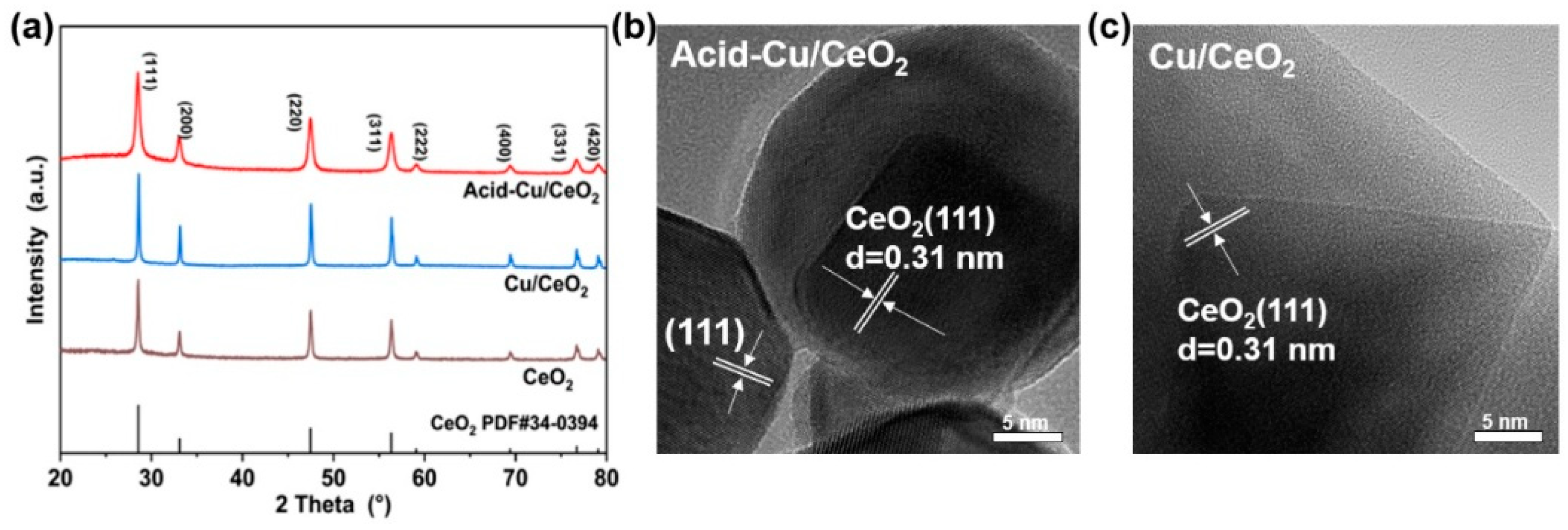
Figure 1. (a) XRD patterns of CeO2, Cu/CeO2, and Acid-Cu/CeO2 catalysts; HRTEM images of (b) Acid-Cu/CeO2 and (c) Cu/CeO2 catalysts.
Catalysts 16 00628 g001
Figure 2. XPS spectra of Cu/CeO2 and Acid-Cu/CeO2: (a) Ce 3d; (b) Cu 2p; (c) O 1s; (d) P 2p.
Catalysts 16 00628 g002
Figure 3. Catalytic NH3 oxidation performance of Cu/CeO2 and Acid-Cu/CeO2: (a) NH3 conversion as a function of reaction temperature; (b) NH3 conversion at three selected temperatures (240, 270, and 300 °C). Reaction conditions: 500 ppm NH3, 2 vol% O2, total flow rate = 50 mL/min, and WHSV = 30,000 mL gcat−1h−1; (c) Long-term stability test for NH3 conversion at T90 over 600 min; (d) Arrhenius plots and apparent activation energies.
Catalysts 16 00628 g003
Figure 4. Temperature-dependent product selectivity over Acid-Cu/CeO2 and Cu/CeO2 catalysts during NH3-SCO: (a) N2 selectivity and (b) NOx selectivity. Reaction conditions: 500 ppm NH3, 2 vol% O2, N2 balance, total flow rate = 50 mL min−1, catalyst mass = 0.10 g.
Catalysts 16 00628 g004
Figure 5. Sulfur resistance performance of Cu/CeO2 and Acid-Cu/CeO2: (a) Temperature-programmed NH3 conversion curves of the samples in the presence and absence of SO2; (b) 12 h long-term stability curves of the catalysts at T90; (c) 48 h long-term stability curves of the catalysts at T90; (d) Catalytic activity test of the catalysts after SO2 poisoning test.
Catalysts 16 00628 g005
Figure 6. O2-TPD profiles of Cu/CeO2 and Acid-Cu/CeO2 catalysts.
Catalysts 16 00628 g006
Figure 7. Py-IR spectra of (a) CeO2, (b) Cu/CeO2 and (c) Acid−Cu/CeO2; (df) corresponding concentration of Brønsted acid sites and Lewis acid sites calculated from the above spectra.
Catalysts 16 00628 g007
Figure 8. DRIFTS spectra of (a) Acid-Cu/CeO2 and (b) Cu/CeO2 under NH3 adsorption conditions, and operando DRIFTS spectra of (c) Acid-Cu/CeO2 and (d) Cu/CeO2 under NH3 + O2 reaction conditions at different temperatures.
Catalysts 16 00628 g008
Figure 9. Schematic illustration of phosphate-modified Cu/CeO2 for low-temperature NH3-SCO.
Catalysts 16 00628 g009
Disclaimer/Publisher’s Note: The statements, opinions and data contained in all publications are solely those of the individual author(s) and contributor(s) and not of MDPI and/or the editor(s). MDPI and/or the editor(s) disclaim responsibility for any injury to people or property resulting from any ideas, methods, instructions or products referred to in the content.