


Abstract
A novel K-resistant CeSbTi mixed oxide catalyst was prepared by co-precipitation method for ammonia selective catalytic reduction (NH3-SCR) of NOx. The experimental results show that the introduction of Sb2O5 can significantly improve the catalytic activity of the CeTi catalyst. The modulated CeSbTi catalyst has good resistance to K, and the NOx conversion rate was as high as 95% after K poisoning. Its superior catalytic activity could be ascribed to the large specific surface area with increased acid sites and more oxygen defects and Ce3+ species after the introduction of Sb2O5, which prompt NH3 adsorption and activation. In addition, NH3-SCR reaction over CeSbTi and K/CeSbTi catalysts follows the E-R mechanism. The introduced Sb-O bond as the base capture site preferentially binds to potassium and releases part of the active Ce sites, thus retaining more acid sites and oxygen defects to a certain extent.
1. Introduction
Nitrogen oxides (NOx) are a major contributor to environmental issues including acid rain, stratospheric ozone depletion, and photochemical smog [1]. These pollutants pose serious risks to human health and ecosystems. Currently, selective catalytic reduction (SCR) is the most widely used and effective technology for NOx removal. However, in practical applications, SCR catalysts are easily deactivated by fly ash components in flue gas [2]. The flue gas generated from coal- and biomass-fired power plants contains substantial amounts of alkali or alkaline earth metals (e.g., K, Na, Ca) [3,4], which can damage the surface acidity and redox ability of SCR catalysts, leading to catalyst deactivation [5,6].
Antimony oxide has been employed as a promoter in some NH3-SCR catalysts due to its favorable surface acidity. For instance, Kwon et al. introduced Sb and Mo into a VTi catalyst and observed that the resulting VMoSbTi catalyst exhibited enhanced catalytic activity, with the Mo–Sb addition suppressing the reaction between terminal V=O and SO2 (g) [7]. Similarly, Wu et al. synthesized Sb-doped CeVO4 catalysts via a hydrothermal method and found that Sb species reduced the crystallization of CeVO4 while improving surface acidity and reducibility [8]. These studies suggest that Sb2O5 may serve as a promising additive for CeTi catalysts to optimize alkali metal tolerance, owing to its ability to enhance reducibility and surface acidity, as well as the possible synergistic interaction between Sb and Ce species.
In this work, we developed a CeSbTi catalyst with improved resistance to potassium poisoning. Through a series of characterizations, we investigated the influence of Sb2O5 addition on the physicochemical properties of CeSbTi. The positive effect on alkali metal tolerance was explored, and the surface reaction behavior before and after alkali metal poisoning was examined.
2. Results and Discussion
2.1. Catalyst Performance
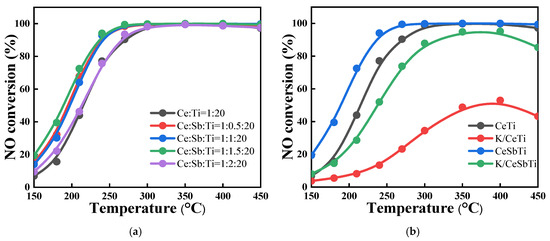
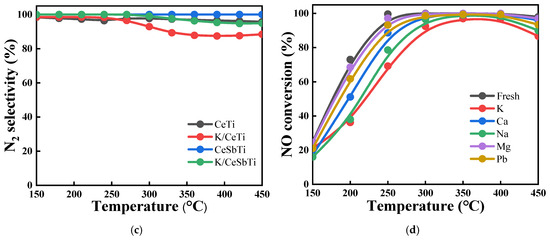
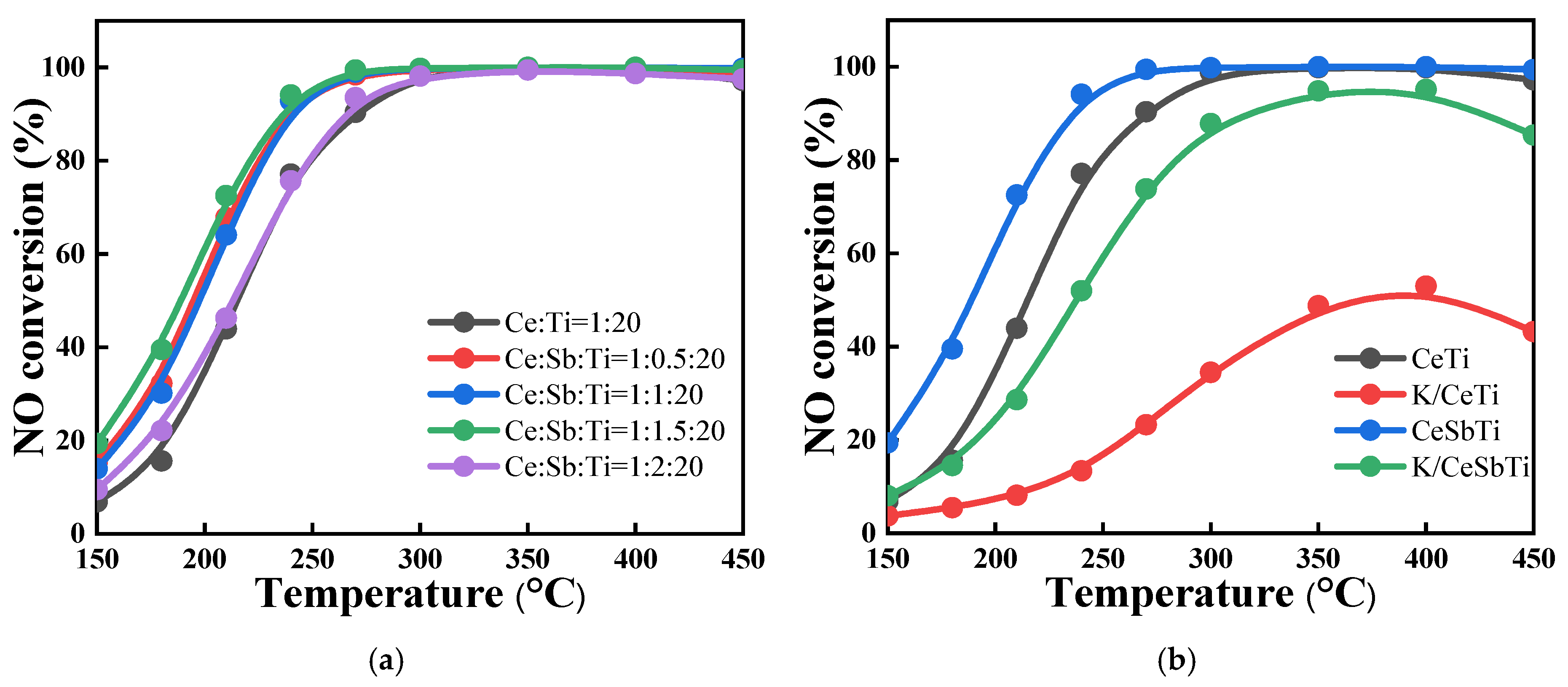
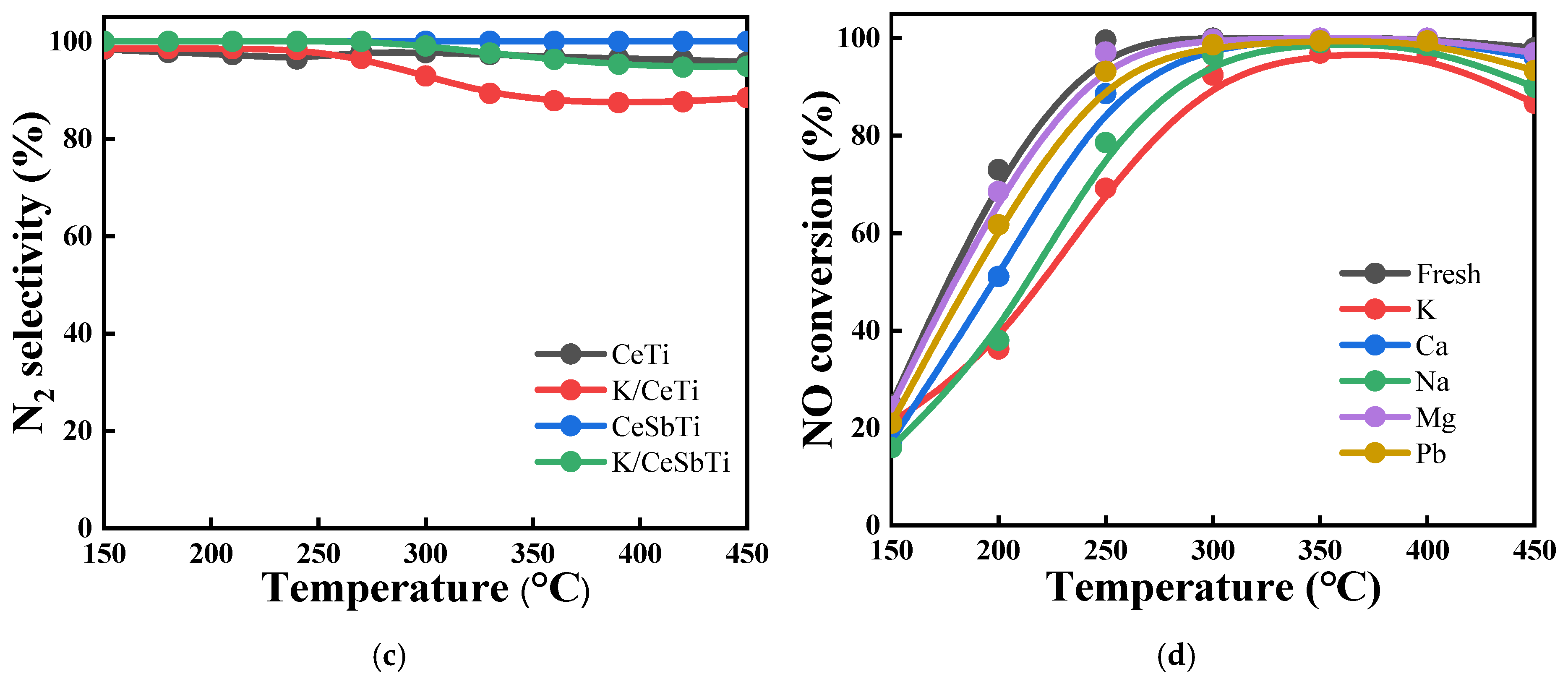
As shown in Figure 1a, the NH3-SCR performance of CeSbTi catalysts with different Sb feeding ratios was evaluated. The catalyst with a Ce:Sb:Ti molar ratio of 1:1.5:20 exhibited the best SCR performance, achieving over 90% NO conversion in the temperature range of 240–450 °C, which is similar to that of a commercial V2O5–WO3/TiO2 catalyst [6]. The introduction of Sb broadens the active temperature window of the CeTi catalyst. In contrast, the SbTi catalyst (without Ce) showed only about 20% NO conversion in the range of 150–350 °C (Figure S1). The alkali resistance of CeTi and CeSbTi (Ce:Sb:Ti = 1:1.5:20) was then evaluated (Figure 1b). After K poisoning, K/CeSbTi maintained nearly 90% NO conversion in the temperature window of 300–400 °C, while the maximum NO conversion of K/CeTi was only 52.9%. These results indicate that Sb improves both low-temperature catalytic activity and alkali resistance. The stability and N2 selectivity of NH3-SCR catalysts are critical for practical applications. As shown in Figure 1c, the introduction of Sb improves the N2 selectivity of CeTi; CeSbTi exhibits nearly 100% N2 selectivity in the range of 150–450 °C. Regarding stability (Figure S2), when CeSbTi and K/CeSbTi were operated at 250 °C for 24 h, their NO conversion remained unchanged, indicating excellent stability.
Figure 1.
(a) The conversion rate of NO with different content of Sb. (b) The NO conversion rate of CeTi, K/CeTi, CeSbTi, K/CeSbTi and SbTi. (c) The N2 selectivity of CeTi, K/CeTi, CeSbTi and K/CeSbTi. (d) The NO conversion of fresh and poisoning CeSbTi catalyst.
The flue gas produced by biomass fuel combustion also contains substantial amounts of alkali metals, alkaline earth metals, and heavy metals such as Na, Ca, Mg, and Pb. Therefore, the tolerance of CeSbTi to these metals was also tested (Figure 1d). CeSbTi shows good tolerance to all of them. The order of toxicity to CeSbTi is: K > Na > Ca > Pb > Mg.
2.2. Crystal Structure, Micro Morphology and Surface Analysis
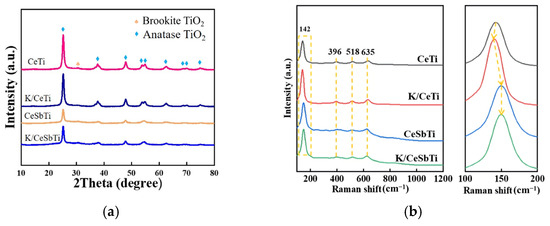
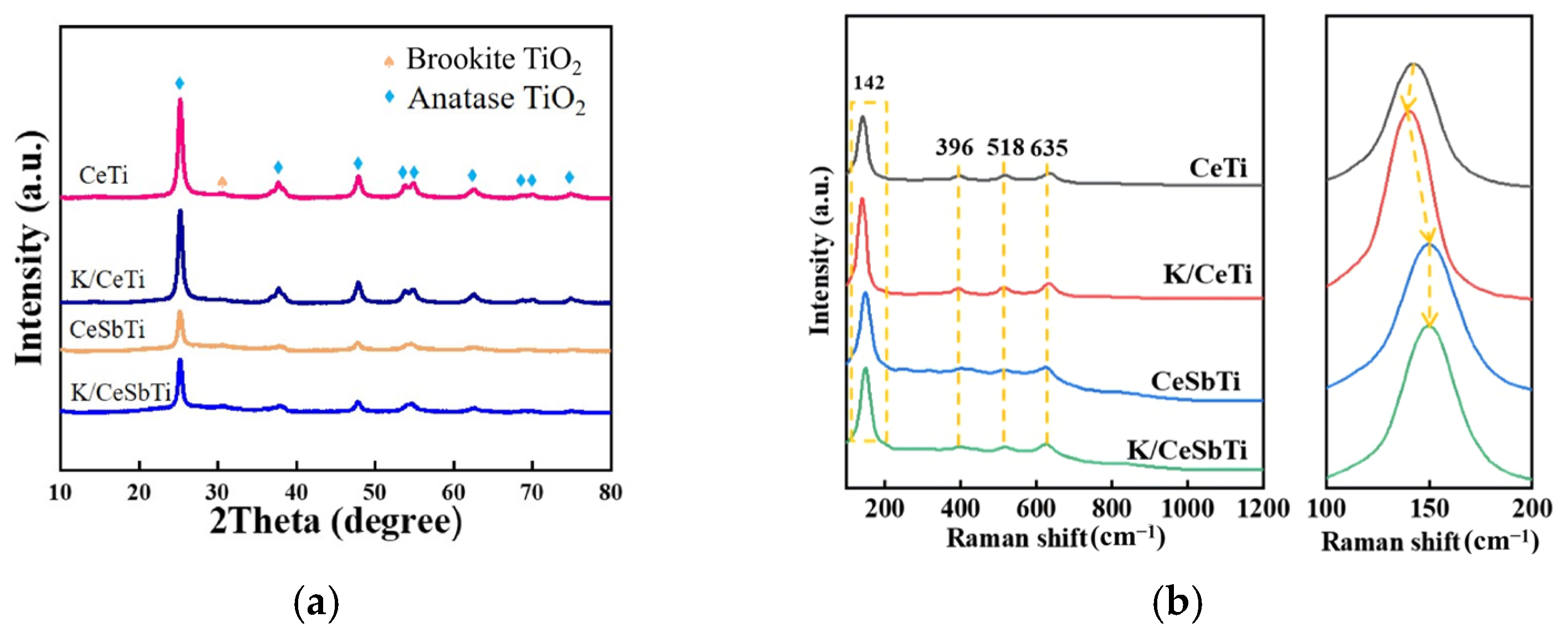
XRD patterns of the catalysts are shown in Figure 2a. XRD patterns of all catalysts contain diffraction peaks of anatase TiO2 (PDF #21-1272). A low-intensity peak at 31° is observed in all samples, which can be assigned to brookite TiO2 (PDF # 76-1936).The average crystallite sizes of anatase TiO2 were calculated using the Scherrer equation based on the (101) diffraction peak. The grain size decreases from 42 nm (CeTi) to 31 nm (CeSbTi), indicating that the addition of Sb2O5 inhibits the growth of TiO2 crystallites [9]. This suggests that Sb species act as a structural promoter, limiting particle sintering and maintaining smaller crystallite sizes. After potassium loading, the grain sizes of both catalysts decrease slightly from 42 nm to 38 nm for K/CeTi, and from 31 nm to 25 nm for K/CeSbTi. No diffraction peaks corresponding to CeOx, SbOx, or K-containing species are detected in any of the catalysts. This indicates that Ce, Sb and K species are present as amorphous phases or are highly dispersed on the TiO2 surface [10].
Figure 2.
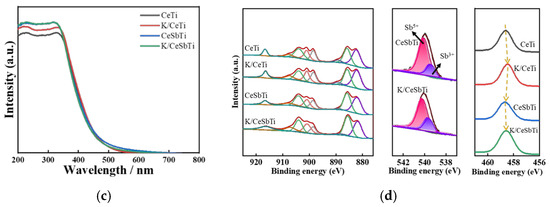
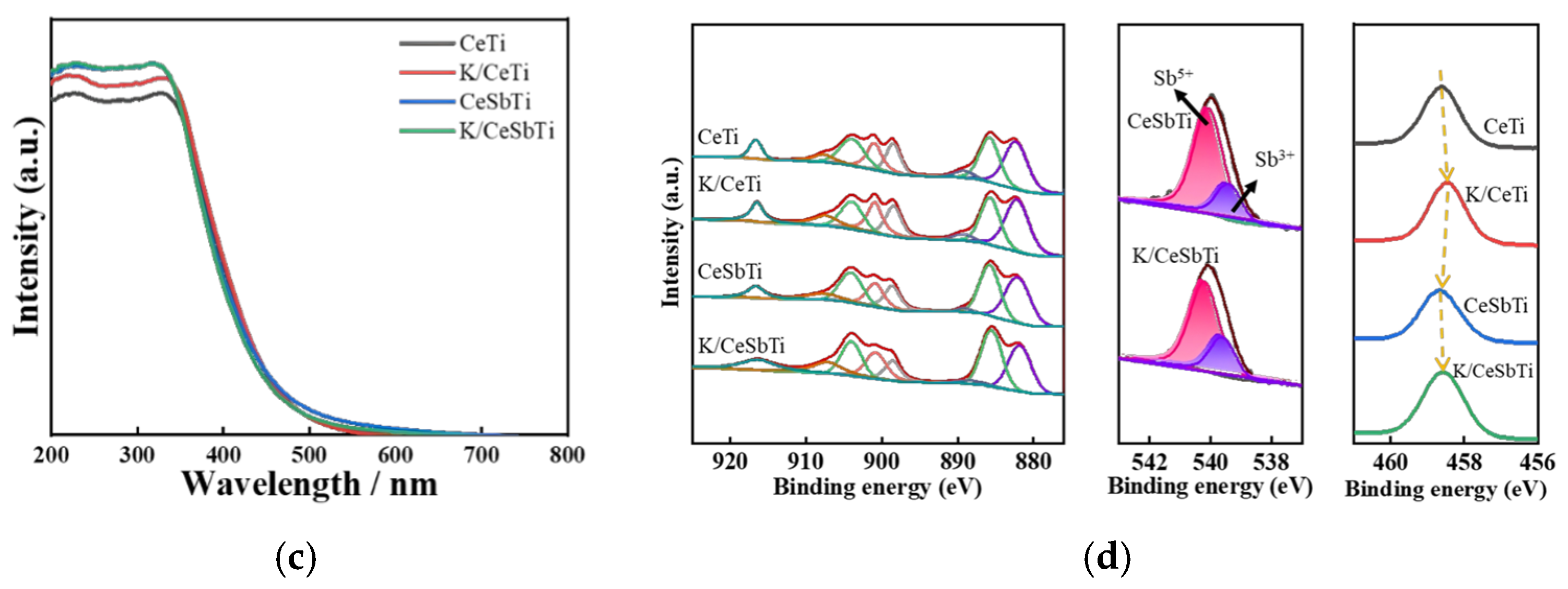
(a) XRD patterns of CeTi, K/CeTi, CeSbTi and K/CeSbTi. (b) Raman patterns of CeTi, K/CeTi, CeSbTi and K/CeSbTi. (Partial enlarged view within the range of 100~200 cm−1). (c) UV-vis DRS spectrum of CeTi, K/CeTi, CeSbTi and K/CeSbTi. (d) The XPS spectra of Ce 3d (right), Sb 3d3/2 (middle), Ti 2p3/2 (left).
Raman spectra of the catalysts are presented in Figure 2b. All catalysts exhibit five characteristic peaks of anatase TiO2 at approximately 144 (Eg), 197 (Eg), 397 (B1g), 515 (A1g + B1g), and 639 cm−1 (Eg) [11,12], which is consistent with the XRD results. In the magnified view of the 100–200 cm−1 region, the K/CeTi catalyst shows an increased band intensity and a slight blue shift relative to CeTi, indicating that the introduction of K affects the lattice structure of TiO2. For the CeSbTi catalyst, the main Eg peak exhibits a red shift relative to CeTi, which is ascribed to the incorporation of Sb into the TiO2 lattice. After K poisoning, the peak position of K/CeSbTi remains almost unchanged compared to CeSbTi, indicating that the presence of Sb suppresses the K-induced lattice distortion of TiO2.
The morphology of all catalysts was observed by SEM, revealing uniformly distributed nanoparticles (Figure S3). No significant morphological difference was observed between the fresh and K-poisoned samples. EDS mapping analysis (Figure S4) confirmed that all elements (Ce, Ti, Sb, and K where applicable) are evenly distributed on the catalyst surfaces. To determine the BET surface areas of the catalysts, N2 adsorption–desorption experiments were conducted (Figure S5 and Table 1). Among the fresh catalysts, CeSbTi exhibits a higher specific surface area than CeTi, indicating that the introduction of Sb optimizes the textural properties of the CeTi catalyst. A larger BET surface area provides more active sites for SCR reactions, which is favorable for gas adsorption and activation [13]. After potassium loading, the specific surface area of the CeTi catalyst increases unexpectedly. This may be attributed to K2O-induced changes in the crystallinity or structural reorganization of the CeTi catalyst during thermal treatment [14]. After K loading, the total pore volume of CeTi and CeSbTi both increased; this may be attributed to the deposition of toxic species primarily on the outer surface of the catalysts without affecting the interior, which simultaneously increases the number of accumulated pores on the material surface, thereby increasing the pore volume of the materials [15]. In contrast, the specific surface area of the CeSbTi catalyst decreases after K loading, which is likely due to a surface covering effect of K2O species [16].
Table 1.
Physical properties of four catalysts.
In the UV-vis DRS spectrum (Figure 2c), the light absorption edge of TiO2 is around 400 nm [17], and the light absorption intensity is weak in the visible light region. Compared with TiO2, the CeTi catalyst exhibits an absorption edge at 460 nm (band gap of ~2.70 eV), extending into the visible light region and resulting in a red-shift phenomenon. This red-shift is attributed to the formation of Ti–O–Ce bonds upon Ce introduction, which facilitates electron transfer and shifts the Fermi level. When Sb is further introduced, the absorption edge of CeSbTi shifts to 442 nm (band gap of ~2.81 eV), indicating a slight blue shift relative to CeTi. This blue shift suggests that the addition of Sb reduces the polymerization degree of CeOx species and improves their dispersion, thereby promoting the reduction performance of the catalyst. After potassium poisoning, a slight blue shift in the absorption edge is observed, which may be due to the weakening of the Ce–Ti interaction by K.
XPS characterizes the valence states of different elements on the catalyst surface. In Figure 2d, the Ce 3d spectrum is deconvoluted into eight characteristic peaks [18,19]. The Ce3+ ratios of the CeTi, K/CeTi, CeSbTi, and K/CeSbTi catalysts were 34.7%, 29.8%, 47.2%, and 44.3%, respectively. In principle, compared with Ce4+, Ce3+ ions possess an electronic density of states closer to the Fermi level, which is known to enhance O2 activation and promote the generation of reactive oxygen species, thereby improving the redox ability. This is consistent with the H2-TPR results [20,21]. The introduction of Sb can form a redox cycle (Sb3+ + 2Ce4+ ↔ Sb5+ + 2Ce3+) [22], which induces the formation of Ce3+ and enhances the redox capacity. For K-poisoned catalysts, the Ce3+ ratios of K/CeTi and K/CeSbTi decreased, indicating that K inhibited the redox ability of the catalysts. As summarized in Table 2, the surface element distributions of fresh and poisoned catalysts are presented. The Ce content on the CeTi catalyst surface decreased after potassium poisoning, which may be caused by K covering the Ce active sites. In contrast, the Ce content on the CeSbTi surface remained almost unchanged after potassium poisoning, while the Sb content decreased. This suggests that Sb–O sites preferentially bind to potassium ions, thereby protecting the Ce active sites.
Table 2.
XPS analysis results.
The Sb 3d XPS spectra of CeSbTi catalysts divided into two photoelectron peaks at ~530.5 eV and ~540.2 eV, which could be ascribed to the Sb 3d5/2 and Sb 3d3/2 sublevels, respectively [23]. Since the Sb 3d5/2 sublevels were completely overlapped with the O 1s spectra, only the Sb 3d3/2 spectra were fitted in order to avoid the interference of the O 1s core-level. The Sb 3d3/2 spectrum is divided into two peaks at ~539.5 eV and ~540.6 eV, Sb5+ and Sb3+. The ratio of Sb is shown in Table 2. After the CeSbTi catalyst was poisoned by K, the proportion of Sb5+ decreased, and the binding energy also shifted to a lower position, this may be due to interaction of K and Sb. In the XPS spectrum of Ti 2p3/2, for the poisoned catalyst, the binding energy of K/CeTi shifted to a lower position, indicating that K inhibited the interaction of Ce and Ti. While K/CeSbTi exhibits a slightly smaller offset, it shows a higher Ti 2p3/2 binding energy than the K/CeTi catalyst, indicating that Sb species can reduce the negative impact of K poisoning on the Ce–Ti interaction.
2.3. Surface Acidity and Redox
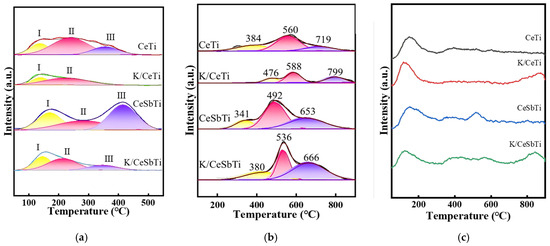
The surface acidity of a catalyst plays an important role in the SCR reaction; therefore, NH3-TPD was employed to evaluate the NH3 adsorption/desorption behavior of the catalysts, and the results are shown in Figure 3a. All catalysts exhibit a continuous desorption band in the range of 100–500 °C, which corresponds to acid sites with different thermal stabilities, including physisorbed/weakly adsorbed NH3 (I), medium-strength acid sites (II), and strong acid sites (III) [24,25]. These three types of acid sites are observed on CeTi, CeSbTi, and K/CeSbTi catalysts, whereas K/CeTi lacks strong acid sites. The integrated NH3-TPD peak area reflects the relative amount of acid sites on the catalyst surface [26]. The integrated NH3 desorption peak areas are summarized in Table 3 for semi-quantitative comparison. CeSbTi exhibits the largest normalized peak area (543.7), indicating that it possesses the most acid sites, which can be attributed to the introduction of Sb. After K poisoning, the surface acidity of both CeTi and CeSbTi catalysts is impaired to varying degrees. As shown in Table 3, strong acid sites exhibit the most pronounced decline in peak area contribution after poisoning, suggesting that K+ preferentially binds to strong acid sites. Moreover, the peak area retention ratio of K/CeSbTi (48.1%) is higher than that of K/CeTi (33.0%), indicating that the introduction of Sb can partially preserve the acid sites of the CeSbTi catalyst against K poisoning.
Figure 3.
(a) NH3-TPD profiles, (b) H2-TPR profiles, and (c) O2-TPD profiles of CeTi, K/CeTi, CeSbTi, and K/CeSbTi.
Table 3.
NH3-TPD analysis results.
The reduction behavior of the catalyst was tested by H2-TPR (Figure 3b). For the CeTi catalyst, the reduction peaks at 384 °C are attributed to the reduction in surface-capping oxygen, the reduction peaks at 560 °C are attributed to the reduction in surface lattice oxygen and the reduction peaks at 719 °C are attributed to the reduction in bulk lattice oxygen. For the CeSbTi catalyst, the decrease in the reduction temperature after the adding of Sb indicates that Sb improves the reducibility of the catalyst. In addition, CeSbTi and K/CeSbTi catalysts have higher and sharper reduction peaks than CeTi and K/CeTi catalysts, due to the high dispersion and high reducibility of Ce species. Compared with the fresh catalyst and the poisoned catalyst, the reduction peak of the poisoned catalyst moved to a higher temperature, which indicates that the K poisoning weakened the reducibility of the catalyst. The reduction temperature of K/CeSbTi catalyst is lower than that of CeTi catalyst, indicating that CeSbTi catalyst still has good reducibility after poisoning.
The oxygen adsorption performance and surface acidity are two important factors that affect catalytic activity. The oxygen adsorption properties of the catalyst surface were investigated by O2-TPD. As shown in Figure 3c, three O2 desorption peaks are observed in the desorption profile. The peak at 50–300 °C is attributed to chemically adsorbed oxygen, the desorption peak at 300–700 °C corresponds to oxygen chemically adsorbed on oxygen vacancies, and the peak above 700 °C is assigned to lattice oxygen. The relative amounts of adsorbed oxygen, defect oxygen, and lattice oxygen can be estimated by curve integration for semi-quantitative comparison [27]. As presented in Table 4, CeSbTi exhibits a higher defect oxygen peak area due to the addition of SbOx, and a greater amount of oxygen vacancies facilitates oxygen adsorption; consequently, the CeSbTi catalyst displays higher catalytic activity. After K poisoning, the peak areas of adsorbed oxygen and defect oxygen decrease, while that of lattice oxygen increases, indicating that K inhibits oxygen adsorption, which in turn adversely affects the SCR reaction. Furthermore, the total oxygen peak area retention ratio of K/CeSbTi (85.4%) is higher than that of K/CeTi, suggesting that the introduction of Sb can partially preserve the oxygen species.
Table 4.
O2-TPD analysis results.
2.4. Catalytic Mechanism
2.4.1. NH3 and NO + O2 Adsorption
The in situ DRIFTS spectra are presented in Kubelka–Munk units. This transformation converts diffuse reflectance spectra into linearized absorbance units, which corrects for scattering effects and enhances the contrast of weak bands, thereby facilitating the identification and comparison of adsorbed species [28].
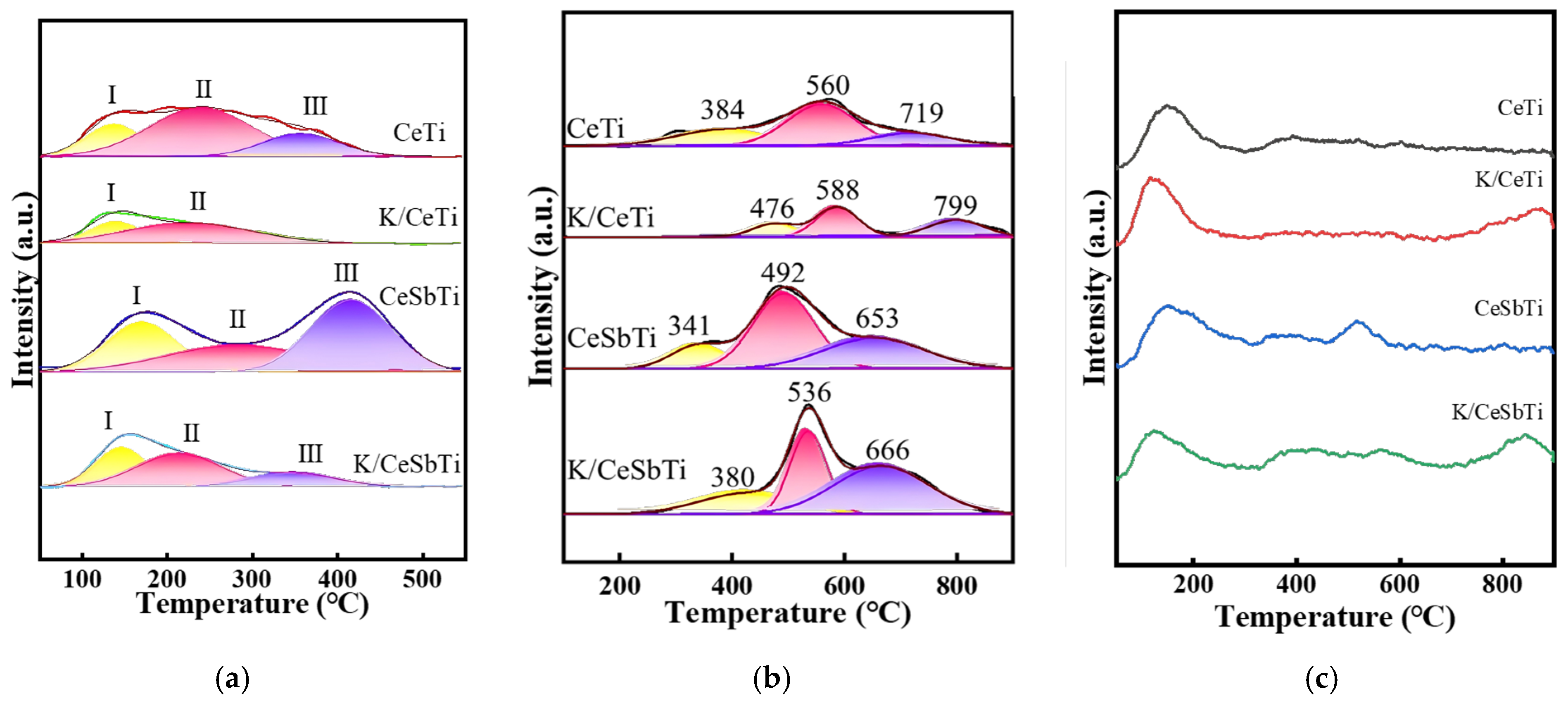
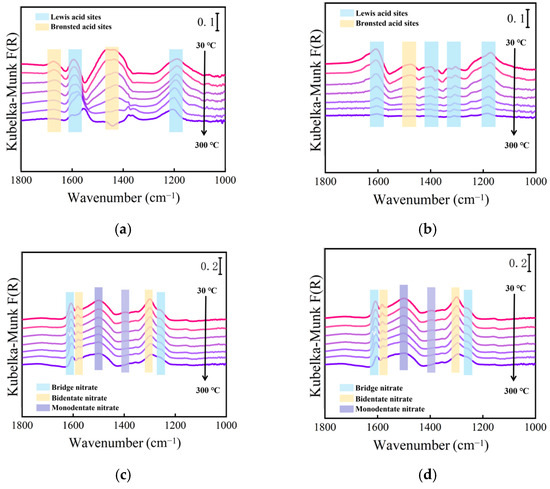
To further determine the adsorption of NH3 by the catalysts, in situ DRIFTS experiments of NH3 adsorption were carried out at elevated temperatures. The in situ DRIFTS spectra of NH3 adsorbed on CeSbTi and K/CeSbTi are shown in Figure 4a,b. For the CeSbTi catalyst, after one hour of NH3 adsorption, characteristic peaks corresponding to symmetric and asymmetric bending vibrations of N-H on Lewis acid sites (1593 and 1186 cm−1) and absorption peaks of NH4+ species on Brønsted acid sites (1670, 1463, and 1436 cm−1) appeared [29,30]. After CeSbTi was poisoned by K, the number and strength of Brønsted acid sites (1474 cm−1) on K/CeSbTi decreased, while the impact on Lewis acid sites (1608, 1400, 1306, and 1172 cm−1) was less pronounced. This indicates that K preferentially binds to Brønsted acid sites on CeSbTi, resulting in their significant reduction [31,32]. As the temperature increased, the absorption peaks of NH3 species on both CeSbTi and K/CeSbTi gradually decreased. At 300 °C, only the adsorption peaks of Lewis acid sites remained, while those of Brønsted acid sites disappeared. This observation indicates that Lewis acid sites on CeSbTi are much more stable than Brønsted acid sites, suggesting that Brønsted acid sites play a more important role in the low-temperature NH3-SCR process. Therefore, it can be inferred that CeSbTi retains strong Lewis acid sites after K poisoning, which accounts for its better alkali resistance. Meanwhile, the weakening of Brønsted acid site strength results in the lower low-temperature catalytic activity of K/CeSbTi.
Figure 4.
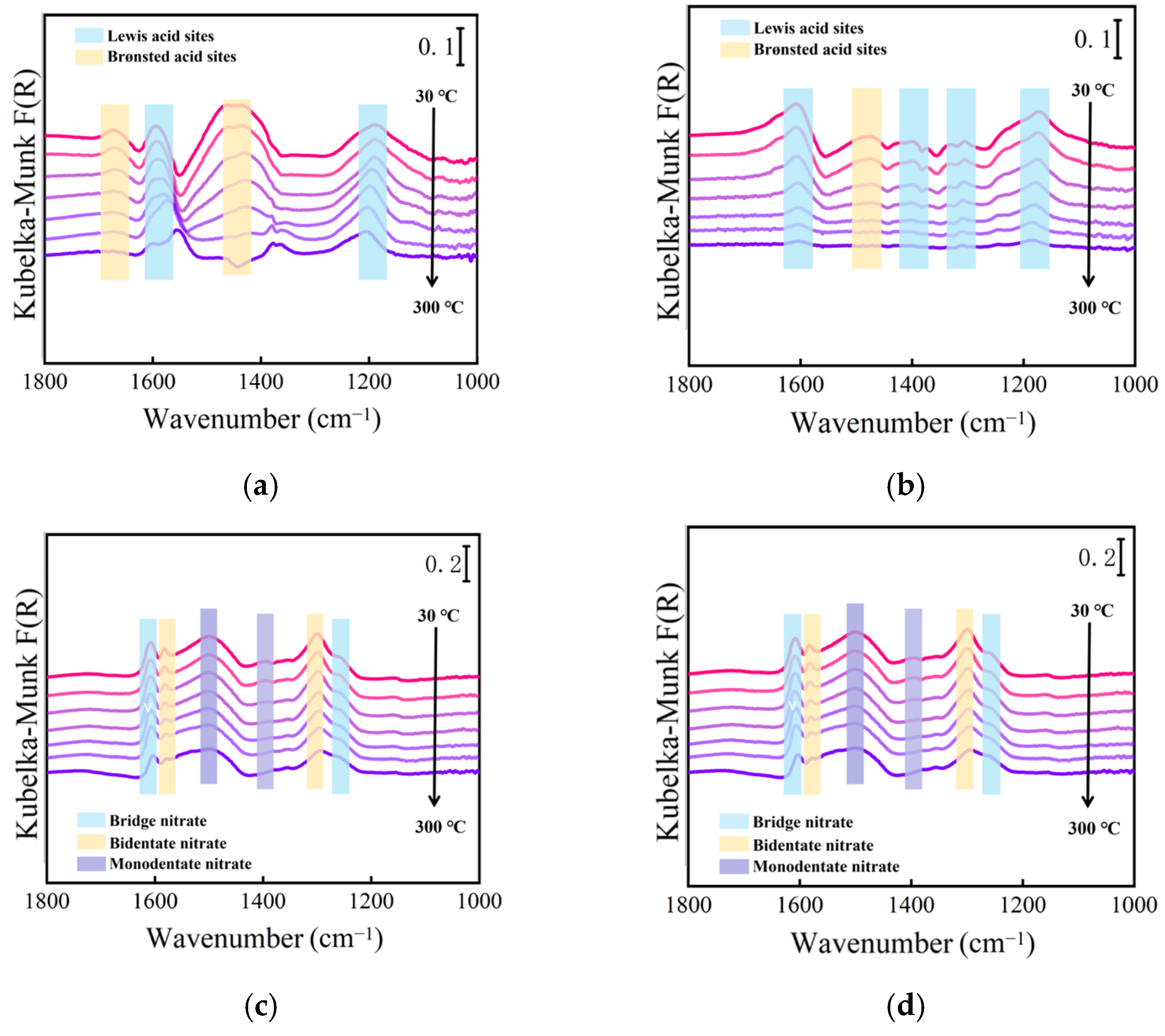
In situ DRIFTS of NH3 adsorption over (a) CeSbTi, (b) K/CeSbTi. In situ DRIFTS of NO + O2 adsorption over (c) CeSbTi, (d) K/CeSbTi. Spectra are presented in Kubelka–Munk units F(R) = (1 − R)2/2R.
To further investigate the NO adsorption behavior, in situ DRIFTS experiments of NO adsorption were carried out on CeSbTi and K/CeSbTi at elevated temperatures (Figure 4c,d). For the CeSbTi catalyst, after exposure to NO + O2, peaks attributed to bridging nitrate (1625 and 1243 cm−1), bidentate nitrate (1582 and 1283 cm−1), and monodentate nitrate (1538 and 1396 cm−1) were observed [33,34]. As the temperature increased, the intensity of these peaks gradually decreased. Notably, the monodentate nitrate peaks (1538 and 1396 cm−1) preferentially disappeared or transformed at lower temperatures, indicating their poor thermal stability. The bridging nitrate (1625/1243 cm−1) and bidentate nitrate (1582/1283 cm−1) species exhibited relatively higher stability. After K poisoning (K/CeSbTi, Figure 4d), the types of nitrate species remained unchanged, but the peak intensities decreased significantly. Moreover, the remaining species showed little change with increasing temperature, suggesting that K poisoning promotes the formation of nitrate species with enhanced thermal stability. After K poisoning, more stable adsorbed NOx species are formed on the catalyst surface, which is unfavorable for the low-temperature SCR reaction.
2.4.2. Reaction Between NH3 and NOx Species
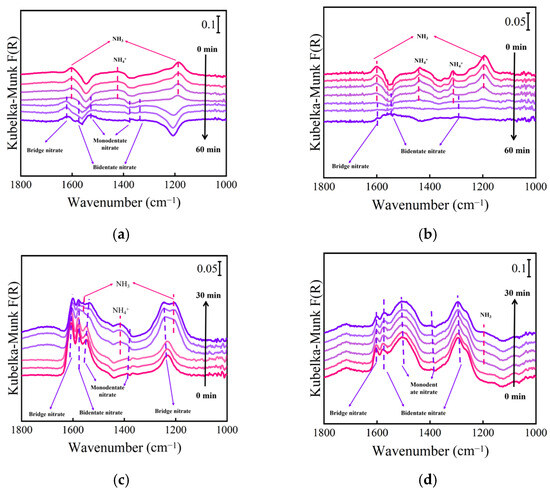
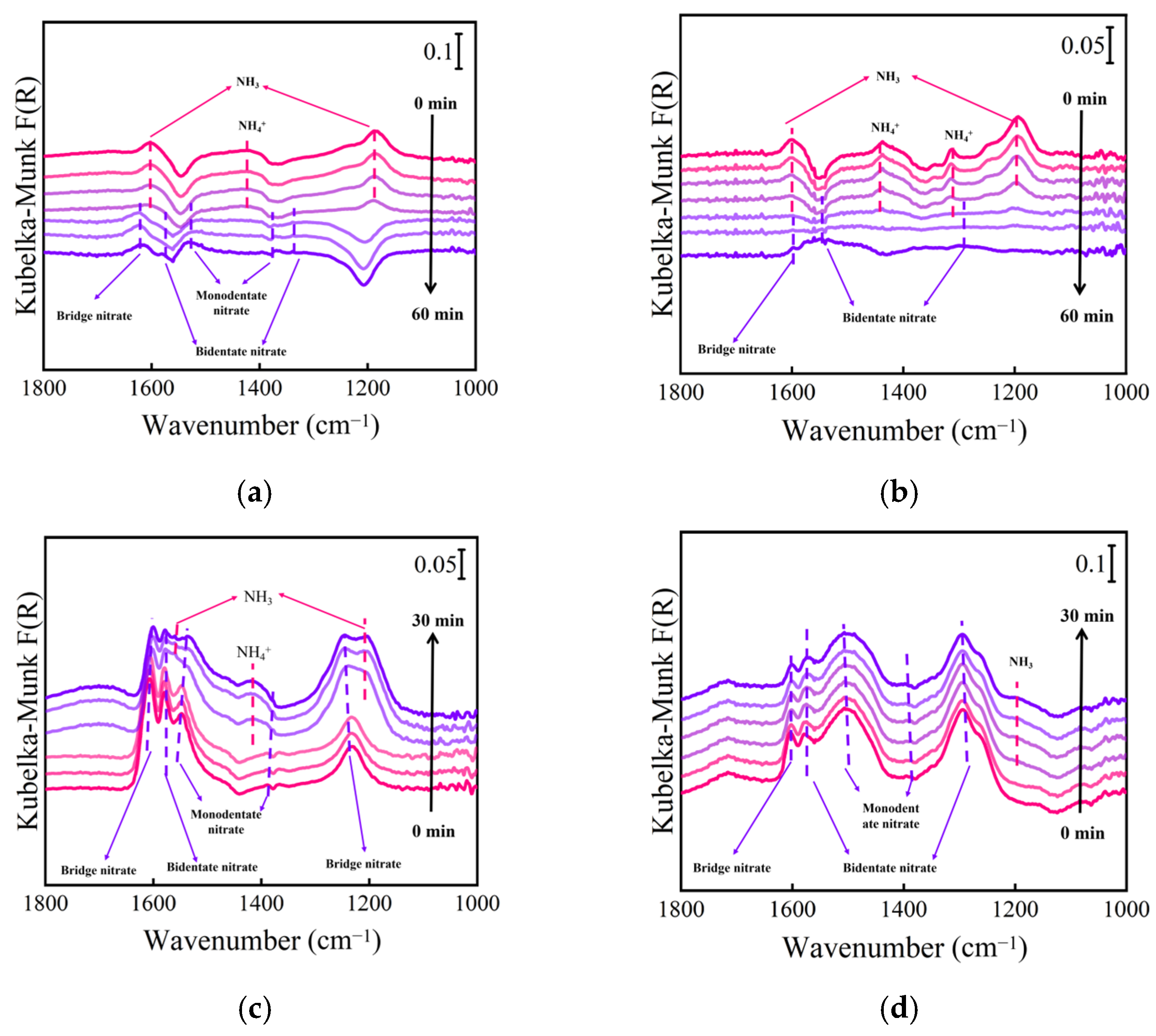
To explore the reaction between adsorbed NH3 and NOx species, an in situ DRIFTS experiment of pre-adsorbed NH3 followed by NO + O2 was carried out at 250 °C. As shown in Figure 5a, after pre-adsorption of NH3 on the CeSbTi catalyst, NH3 species adsorbed on Lewis acid sites (1603 and 1181 cm−1) and Brønsted acid sites (1419 and 1360 cm−1) were observed on the catalyst surface [35,36]. After the introduction of NO + O2, all peaks gradually weakened over time and disappeared after 20 min. Simultaneously, peaks attributed to bidentate nitrate (1581 and 1339 cm−1), monodentate nitrate (1538 and 1373 cm−1), and bridging nitrate (1613 cm−1) species emerged and grew over time [37]. For the K/CeSbTi catalyst (Figure 5b), obvious NH3 species adsorbed on Lewis and Brønsted acid sites were also observed, indicating that CeSbTi remains highly acidic after potassium poisoning. After the introduction of NO + O2, all peaks gradually weakened and disappeared after 30 min. Bridging and bidentate nitrate species were eventually observed on K/CeSbTi after 60 min. The fact that adsorbed NH3 species on both catalysts can react with gaseous NO is consistent with an Eley–Rideal (E-R)-type pathway.
Figure 5.
In situ DRIFTS of NO + O2 adsorption after the pre-adsorption of NH3 over these catalysts at 250 °C: (a) CeSbTi, (b) K/CeSbTi. catalysts. In situ DRIFTS of adsorption NH3 after the pre-adsorption of NO + O2 over these catalysts at 250 °C: (c) CeSbTi, (d) K/CeSbTi. catalysts. Spectra are presented in Kubelka–Munk units F(R) = (1 − R)2/2R.
To explore the reaction between adsorbed NOx and NH3 species, an in situ DRIFTS experiment of pre-adsorbed NO + O2 followed by NH3 was carried out at 250 °C. As shown in Figure 5c, after pre-adsorption of NO + O2 on the CeSbTi catalyst, peaks attributed to bridging nitrate (1608 and 1232 cm−1), monodentate nitrate (1548 and 1388 cm−1), and bidentate nitrate (1580 cm−1) species were observed on the catalyst surface [38]. After the introduction of NH3, the intensity of these nitrate peaks decreased only slightly over time and did not disappear by the end of the experiment. In addition, after 10 min of NH3 flow, characteristic peaks of NH3 species adsorbed on Lewis acid sites (1562 and 1206 cm−1) and Brønsted acid sites (1418 cm−1) appeared on the CeSbTi catalyst. For the K/CeSbTi catalyst (Figure 5d), after pre-adsorption of NO + O2, peaks attributed to bridging nitrate, monodentate nitrate, and bidentate nitrate species were observed on the catalyst surface [39]. After the introduction of NH3, the intensity of these nitrate peaks decreased only slightly over time and did not disappear by the end of the experiment. Moreover, after 5 min of NH3 flow, characteristic peaks of NH3 species adsorbed on Lewis acid sites (1206 cm−1) appeared on the K/CeSbTi catalyst. Because the NOx species pre-adsorbed on CeSbTi and K/CeSbTi hardly reacted with NH3, these results further support that the catalytic mechanism over both catalysts is dominated by an Eley–Rideal (E-R) pathway.
2.5. Reaction Mechanism
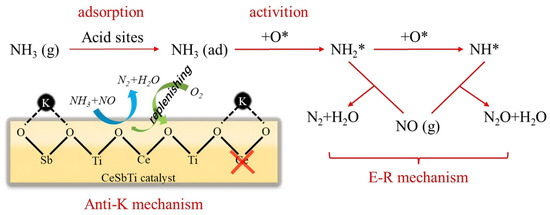
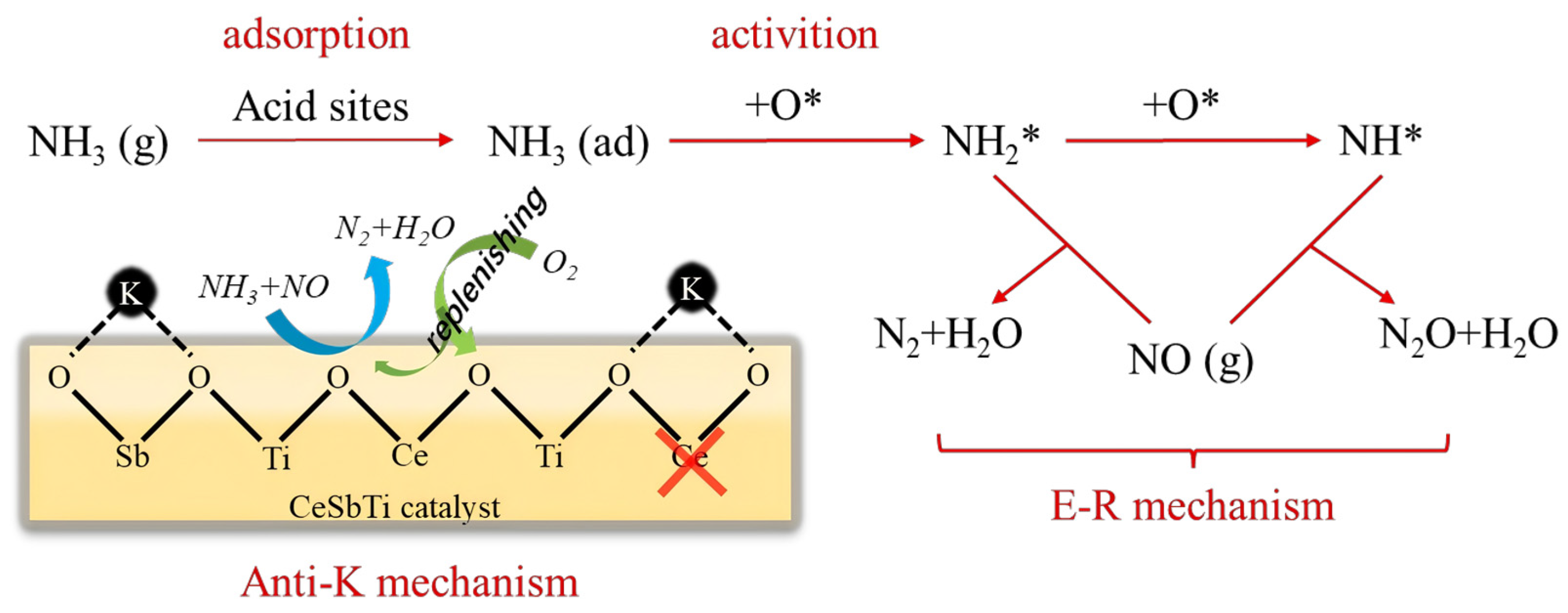
As shown in Figure 6. First, NH3 gas is adsorbed on the catalyst surface, and the adsorbed NH3 is oxidized to NH2. The generated NH2 reacts with gaseous NO to produce N2 and H2O, which follows the Eley–Rideal (E-R) reaction mechanism. However, overoxidation of NH2 generates NH, which further reacts with NO in the non-selective catalytic reduction (NSCR) reaction to form N2O and H2O. This side reaction is the main cause of reduced N2 selectivity of the catalyst.
Figure 6.
Schematic diagram of the catalytic reaction and alkali resistance mechanism. * represents reaction intermediates.
For the K-poisoned CeTi catalyst, K species reduce the number of acid sites on the catalyst surface, which is unfavorable for NH3 adsorption. In addition, K species shield the Ce active sites and lower the Ce3+/Ce4+ ratio, thereby decreasing the concentration of defect oxygen. This further inhibits oxygen adsorption, reduces the redox ability of the catalyst, and suppresses the activation of adsorbed NH3 species.
Compared with the CeTi catalyst, the CeSbTi catalyst exhibits much better retention of catalytic activity after K poisoning. Characterization results show no significant differences in specific surface area or crystal structure between the fresh and K-poisoned catalysts, indicating that these factors are not the primary cause of the observed activity difference. Notably, XPS results further reveal that antimony oxide species show a clear tendency to bind with K after poisoning, and the decrease in the Ce3+/Ce4+ ratio on CeSbTi is significantly smaller than that on CeTi. These results indirectly support the hypothesis that antimony oxide species act as “alkali capture sites”, preferentially binding to K and thereby protecting a portion of Ce active sites from K attack.
3. Materials and Methods
3.1. Catalyst Preparation
CeTi catalyst was synthesized by a co-precipitation method. Typically, 4.34 g of Ce(NO3)3·6H2O (10 mmol, AR, Sinopharm Chemical Reagent Co., Ltd., Shanghai, China) was dissolved in 100 mL of ethanol (AR, Sinopharm Chemical Reagent Co., Ltd., Shanghai, China) solution and stirred for 10 min. Then, 6.81 mL of tetrabutyl titanate (20 mmol, AR, Sinopharm Chemical Reagent Co., Ltd., Shanghai, China) was added and the mixture was stirred for 30 min. Ammonia solution (25 wt%, 98%, Sinopharm Chemical Reagent Co., Ltd., Shanghai, China) was added dropwise to adjust the pH to 10, and the mixture was allowed to settle for 24 h. The precipitate was filtered by suction, rinsed with deionized water and ethanol until the pH reached 7, dried in an oven at 110 °C for 12 h, and finally calcined in a muffle furnace (KSL-1100X, Hefei Kejing Materials Technology Co., Ltd., Hefei, China) at 500 °C for 5 h with a heating rate of 5 °C/min. The molar ratio of Ce:Ti was 1:20.
CeSbTi catalysts with different Sb loadings were also prepared by the co-precipitation method. Different amounts of SbCl3 (AR, Sinopharm Chemical Reagent Co., Ltd., Shanghai, China) and 0.434 g (1 mmol) of Ce(NO3)3·6H2O were dissolved in 100 mL of ethanol solution, and the subsequent procedure was the same as that for CeTi. The molar ratios of Ce:Sb:Ti were 1:0.5:20, 1:1:20, 1:1.5:20, and 1:2:20, corresponding to SbCl3 amounts of 0.114 g, 0.228 g, 0.342 g, and 0.456 g, respectively. Based on preliminary activity screening (Figure 1a), the catalyst with a molar ratio of 1:1:20 (denoted as CeSbTi) was selected for further characterization.
K-poisoned catalysts (1 wt% K) were prepared as follows: 1 g of CeTi or CeSbTi was dispersed in deionized water, and 0.0212 g of KNO3 (0.21 mmol, AR, Sinopharm Chemical Reagent Co., Ltd., Shanghai, China) was added. The suspension was stirred for 20 min and then dried at 70 °C using a rotary evaporator (RE-52, Shanghai Yarong Biochemical Instrument Factory, Shanghai, China). The resulting powder was calcined in air at 500 °C for 5 h. The obtained catalysts were denoted as K/CeTi and K/CeSbTi, respectively. The same method was used to prepare catalysts poisoned with 1 wt% Pb, Na, Ca, and Mg (results shown in Figure 1d).
3.2. Catalyst Characterization
X-ray diffraction (XRD) patterns were recorded on a Rigaku SmartLab diffractometer (Rigaku Corporation, Tokyo, Japan) using Cu Kα radiation (λ = 1.5406 Å). The measurements were performed in the 2θ range of 10–80° with a scanning speed of 6°/min. The crystallite sizes of anatase TiO2 were calculated using the Scherrer equation:
where K = 0.89, λ = 1.5406 Å, β is the full width at half maximum (FWHM) of the (101) diffraction peak, and θ is the Bragg angle.
D = Kλ/(β cos θ),
UV-vis-NIR diffuse reflectance spectra (DRS) were recorded on an Agilent Cary 5000 UV-vis-NIR spectrophotometer (Agilent Cary, Santa Clara, CA, USA) using BaSO4 as a reference, with a wavelength range of 200–800 nm. The band gap energy (Eg) was calculated from the absorption edge (λedge) using the equation:
Eg = 1240/λedge,
X-ray photoelectron spectroscopy (XPS) was performed on a Thermo Scientific EscaLab 250Xi spectrometer (Thermo Fisher Scientific, Waltham, MA, USA) using monochromatic Al Kα radiation (hν = 1486.6 eV). Binding energies were calibrated using the C 1s peak at 284.6 eV. Spectra were deconvoluted using XPSPEAK (Version: 4.1) software.
Raman spectra were recorded on a Horiba LabRAM HR Evolution confocal Raman microscope (Horiba Scientific, Kyoto, Japan) using a 532 nm laser as the excitation source.
N2 physisorption was performed on a Micromeritics TriStar II 3020 analyzer (Micromeritics Instrument Corporation, Norcross, GA, USA). Prior to measurement, approximately 0.1 g of sample was degassed at 300 °C for 12 h under vacuum. The specific surface area was calculated using the Brunauer–Emmett–Teller (BET) method. The pore size distribution was determined using the Barrett–Joyner–Halenda (BJH) model applied to the adsorption branch of the isotherm.
NH3 temperature-programmed desorption (NH3-TPD) and H2 temperature-programmed reduction (H2-TPR) were carried out on a Tianjin Xianquan TP-5076 system (Tianjin Xianquan Instrument Co., Ltd., Tianjin, China). For NH3-TPD, 0.08 g of catalyst was pretreated in He flow at 300 °C for 1 h, cooled to 50 °C, and then exposed to 1 vol% NH3/He for 1 h. After purging with N2 at 50 °C for 1 h to remove weakly adsorbed NH3, the sample was heated to 500 °C at a ramp rate of 10 °C/min. The desorbed NH3 was monitored using a thermal conductivity detector (TCD). The integrated peak areas were normalized by sample mass and are reported as relative values. For H2-TPR, 0.08 g of sample was pretreated in He flow at 300 °C for 60 min and cooled to 50 °C. After baseline stabilization in 10 vol% H2/Ar flow at 50 °C for 1 h, the temperature was ramped to 900 °C at a rate of 10 °C/min while monitoring H2 consumption using a TCD.
In situ DRIFTS was conducted on a Thermo Scientific Nicolet iS 50 FTIR spectrometer (Thermo Fisher Scientific, Waltham, MA, USA) with an in situ cell and a high-sensitivity detector. Spectra were acquired in Kubelka–Munk mode.
Steady-state experiments: The catalyst was heated to 300 °C in N2 flow and held at this temperature for 30 min. After pretreatment, the sample was cooled and background spectra were recorded at various temperatures. Upon reaching the target temperature, NH3 (or NO + O2) was introduced for 1 h, followed by purging with N2 for 15 min to remove weakly adsorbed species. Spectra were then collected at each temperature point (after stabilization for 10 min) under N2 flow.
Transient experiments: For the reaction between pre-adsorbed NH3 and NO + O2, the sample was pretreated in N2 at 300 °C for 30 min, cooled to 250 °C, and a background spectrum was recorded. NH3 was then introduced for 1 h, followed by N2 purging for 15 min. Subsequently, the gas flow was switched to NO + O2, and spectra were recorded continuously for 1 h using an automatic sampling program. For the reaction between pre-adsorbed NO + O2 and NH3, the same pretreatment procedure was applied. After recording the background at 250 °C, NO + O2 was introduced for 1 h, followed by N2 purging for 15 min. Finally, NH3 was introduced, and spectra were recorded at 1 min intervals for 1 h.
3.3. Catalytic Activity Measurements
The catalytic performance was evaluated in a quartz fixed-bed reactor (inner diameter: 8 mm) using 300 mg of catalyst (40–60 mesh) at temperatures ranging from 150 to 500 °C. The total flow rate was 300 mL/min, corresponding to a gas hourly space velocity (GHSV) of approximately 60,000 h−1. The feed gas composition was as follows: 500 ppm NO, 500 ppm NH3, 5 vol% O2, balance N2 (detailed in Table S1). NO, NO2, and N2O concentrations were measured online using a portable Fourier transform infrared multi-component gas analyzer (Model DX4000 GASMAT, Gasmet Technologies Oy, Helsinki, Finland). The reaction system (Model VDRT-SMT, WoDe Instrument Co., Ltd., Shanghai, China) was used for catalytic activity testing. The temperature was increased at a rate of 10 °C/min, and data were recorded after stabilizing at each test point for 10 min. All feed gases (NO, NH3, O2, and N2) were supplied by Jinhou Special Gas Co., Ltd. (Jinhou, Haikou, China), Deli Meisel Gas Co., Ltd. (Deli Meisel, Foshan, China), and Date Gas Co., Ltd. (Date, Dalian, China).Detailed gas specifications and sources are provided in Table S1.
The NO conversion (XNO) and N2 selectivity were calculated using the following equations:
where [NO]in and [NO]out are the inlet and outlet NO concentrations, respectively, and [N2O]out is the outlet N2O concentration.
XNO = ([NOx]in − [NOx]out)/[NOx]in × 100%,
4. Conclusions
The modulated CeSbTi mixed oxide catalyst exhibits a wider active temperature window and better alkali resistance than the CeTi catalyst. Physicochemical characterization reveals that the addition of Sb2O5 increases the specific surface area and provides more acid sites, which promote NH3 adsorption and activation. Moreover, the Sb–Ce interaction enhances the Ce3+ concentration and oxygen vacancy density, leading to improved redox ability. After K poisoning, a possible interaction between Sb and K may contribute to the protection of Ce active sites; however, other factors—including surface acidity, increased specific surface area, or enhanced redox ability—also contribute to the improved alkali resistance of the CeSbTi catalyst. The catalyst also demonstrates good stability, high N2 selectivity, and strong anti-toxicity. Collectively, these results suggest that the CeSbTi catalyst is promising for practical applications.
Supplementary Materials
The following supporting information can be downloaded at https://www.mdpi.com/article/10.3390/catal16060545/s1: Figure S1: NO conversion of CeTi, SbTi and CeSbTi; Figure S2: Stability of CeSbTi and K/CeSbTi; Figure S3: Sem images of (a) CeTi, (b) K/CeTi, (c) CeSbTi and (d) K/CeSbTi; Figure S4: EDS mapping images of (a) CeTi, (b) K/CeTi, (c) CeSbTi and (d) K/CeSbTi; Figure S5: N2 adsorption–desorption isotherms of the fresh and poisoned catalysts, Figure S6: Pore size distribution curves of the fresh and poisoned catalysts, Table S1: Gases used in the evaluation of denitration performance. Table S2: Absorption edge and band gap energy of the studied catalysts.
Author Contributions
Conceptualization, J.Z. and S.L.; methodology, J.Z. and M.L.; software, X.L.; validation, M.L., J.Z. and S.L.; formal analysis, J.Z.; investigation, J.Z.; resources, X.L.; data curation, J.Z.; writing—original draft preparation, J.Z.; writing—review and editing, M.L.; visualization, J.Z.; supervision, J.L.; project administration, Y.M.; funding acquisition, H.J. All authors have read and agreed to the published version of the manuscript.
Funding
This research was funded by Hainan Holdings Special Glass Technology Co., Ltd. (Hainan Provincial Science and Technology Special Project ZDYF2024GXJS309) and the Joint Fund Project of National Natural Science Foundation of China (grant number U22A20124, “Research on composition, structure and preparation mechanism of ultra-high pressure resistant glass-ceramics for application in deep sea”). The APC was funded by Hainan Holdings Special Glass Technology Co., Ltd.
Data Availability Statement
All data generated or analyzed during this study are included in this published article and its Supplementary Information Files.
Conflicts of Interest
Author Junge Li and Xiang Liang were employed by the company Hainan Holdings Special Glass Technology Co., Ltd. The remaining authors declare that the research was conducted in the absence of any commercial or financial relationships that could be construed as a potential conflict of interest.
Abbreviations
The following abbreviations are used in this manuscript:
| SCR | Selective catalytic reduction |
| NOx | Nitrogen oxides |
| NH3 | Ammonia |
| SEM | Scanning electron microscope |
| EDS | Energy Dispersive Spectroscopy |
| XRD | X-ray Photoelectron Spectroscopy) |
| BET | Brunauer–Emmett–Teller |
| XPS | X-ray Photoelectron Spectroscopy |
| H2-TPR | Hydrogen Temperature-Programmed Reduction |
| NH3-TPD | Ammonia Temperature-Programmed Desorption |
| O2-TPD | Oxygen Temperature-Programmed Desorption |
| In Situ DRIFTs | In situ diffuse reflectance infrared Fourier transform spectroscopy |
References
- Skalska, K.; Miller, J.S.; Ledakowicz, S. Trends in NOx abatement: A review. Sci. Total Environ. 2010, 408, 3976–3989. [Google Scholar] [CrossRef] [Scilit] [PubMed]
- Chang, H.; Shi, C.; Li, M.; Zhang, T.; Wang, C.; Jiang, L.; Wang, X. The effect of cations (NH4+, Na+, K+, and Ca2+) on chemical deactivation of commercial SCR catalyst by bromides. Chin. J. Catal. 2018, 39, 710–717. [Google Scholar] [CrossRef] [Scilit]
- Kong, M.; Liu, Q.; Jiang, L.; Tong, W.; Yang, J.; Ren, S.; Tian, Y. K+ deactivation of V2O5-WO3/TiO2 catalyst during selective catalytic reduction of NO with NH3: Effect of vanadium content. Chem. Eng. J. 2019, 370, 518–526. [Google Scholar] [CrossRef] [Scilit]
- Fang, D.; He, F.; Xie, J. Characterization and performance of common alkali metals and alkaline earth metals loaded Mn/TiO2 catalysts for NOx removal with NH3. J. Energy Inst. 2019, 92, 319–331. [Google Scholar] [CrossRef] [Scilit]
- Huang, L.; Zeng, Y.; Chang, Z.; Zong, Y.; Wang, H.; Zhang, S.; Yu, Y. Promotional effect of phosphorus modification on improving the Na resistance of V2O5-MoO3/TiO2 catalyst for selective catalytic reduction of NOx by NH3. Mol. Catal. 2021, 506, 119542. [Google Scholar] [CrossRef] [Scilit]
- Gao, F.Y.; Tang, X.L.; Yi, H.H.; Zhao, S.Z.; Zhang, T.T.; Li, D.; Ma, D. Alkali Metal Poisoning and Regeneration of Commercial SCR DeNOx Catalyst (V2O5–WO3/TiO2). Chin. Sci. Bull. 2014, 59, 2560–2566. [Google Scholar] [CrossRef] [Scilit]
- Kwon, D.W.; Choi, J.; Nam, K.B.; Ha, H.P. New Insight into the Role of Mo–Sb Addition towards VMoSbTi Catalysts with Enhanced Activity for Selective Catalytic Reduction with NH3. Chem. Eng. J. 2022, 428, 132078. [Google Scholar] [CrossRef] [Scilit]
- Wu, G.L.; Guo, R.T.; Liu, Y.Z.; Duan, C.P.; Miao, Y.F.; Gu, J.W.; Pan, W.G. Promoting Effect of Sb on the Selective Catalytic Reduction of NO with NH3 over CeVO4 Catalyst. J. Energy Inst. 2021, 95, 77–86. [Google Scholar] [CrossRef] [Scilit]
- Ma, S.; Gao, W.; Yang, Z.; Lin, R.; Wang, X.; Zhu, X.; Jiang, Y. Superior Ce–Nb–Ti Oxide Catalysts for Selective Catalytic Reduction of NO with NH3. J. Energy Inst. 2021, 94, 73–84. [Google Scholar] [CrossRef] [Scilit]
- Kang, K.; Yao, X.; Cao, J.; Li, Z.; Rong, J.; Luo, W.; Chen, Y. Enhancing the K resistance of CeTiOx catalyst in NH3-SCR reaction by CuO modification. J. Hazard. Mater. 2021, 402, 123551. [Google Scholar] [CrossRef] [Scilit]
- Liu, Z.; Liu, H.; Feng, X.; Ma, L.; Cao, X.; Wang, B. Ni-Ce-Ti as a superior catalyst for the selective catalytic reduction of NOx with NH3. Mol. Catal. 2018, 445, 179–186. [Google Scholar] [CrossRef] [Scilit]
- Fei, Z.; Yang, Y.; Wang, M.; Tao, Z.; Liu, Q.; Chen, X.; Qiao, X. Precisely fabricating Ce-O-Ti structure to enhance performance of Ce-Ti based catalysts for selective catalytic reduction of NO with NH3. Chem. Eng. J. 2018, 353, 930–939. [Google Scholar] [CrossRef] [Scilit]
- Kang, L.; Han, L.; He, J.; Li, H.; Yan, T.; Chen, G.; Zhang, D. Improved NOx Reduction in the Presence of SO2 by Using Fe2O3-Promoted Halloysite-Supported CeO2–WO3 Catalysts. Environ. Sci. Technol. 2019, 53, 938–945. [Google Scholar] [CrossRef] [Scilit]
- Fatemeh, S.A.; Sara, D. Optimizing the green synthesis of antibacterial TiO2-anatase phase nanoparticles derived from spinach leaf extract. Sci. Rep. 2024, 14, 22440. [Google Scholar]
- Wang, P.L. Study on DeNOx Activity and Poisoning Resistance of Cerium-Titanate Nanotube Supported Core-Shell Catalysts. Ph.D. Thesis, Zhejiang University, Hangzhou, China, 2018. [Google Scholar]
- Li, Y.; Cai, S.X.; Wang, P.L.; Yan, T.; Zhang, J.; Zhang, D. Improved NOx Reduction over Phosphate-Modified Fe2O3/TiO2 Catalysts via Tailoring Reaction Paths by In Situ Creating Alkali-Poisoning Sites. Environ. Sci. Technol. 2021, 55, 9276–9284. [Google Scholar] [CrossRef] [Scilit] [PubMed]
- Liu, X.C.; Feng, X.L.; Zhou, K.X.; Yang, Y.; Zuo, C.G.; Du, H.L. Preparation and Properties of Nano-TiO2 by Sol-Gel Method. Rare Met. Mater. Eng. 2016, 45, 436–438. [Google Scholar]
- Liu, J.; Li, X.; Zhao, Q.; Ke, J.; Xiao, H.; Lv, X.; Wang, S. Mechanistic investigation of the enhanced NH3-SCR on cobalt-decorated Ce-Ti mixed oxide: In situ FTIR analysis for structure-activity correlation. Appl. Catal. B Environ. 2017, 200, 297–308. [Google Scholar] [CrossRef] [Scilit]
- Yao, X.; Zhao, R.; Chen, L.; Du, J.; Tao, C.; Yang, F. Selective catalytic reduction of NOx by NH3 over CeO2 supported on TiO2: Comparison of anatase, brookite, and rutile. Appl. Catal. B Environ. 2017, 208, 82–93. [Google Scholar] [CrossRef] [Scilit]
- Montemore, M.M.; Van Spronsen, M.A.; Madix, R.J.; Friend, C.M. O2 Activation by Metal Surfaces: Implications for Bonding and Reactivity on Heterogeneous Catalysts. Chem. Rev. 2018, 118, 2816–2862. [Google Scholar] [CrossRef] [Scilit] [PubMed]
- Li, Q.; Liang, M.; Han, X.; Hou, Y.; Huang, Z. Insight into the enhancing activity and stability of Ce modified V2O5/AC during cyclic desulfurization-regeneration-denitrification. J. Hazard. Mater. 2022, 424, 127397. [Google Scholar] [CrossRef] [Scilit]
- Liu, Z.; Liu, H.; Zeng, H.; Xu, Q. A novel Ce–Sb binary oxide catalyst for the selective catalytic reduction of NOx with NH3. Catal. Sci. Technol. 2016, 6, 8063–8071. [Google Scholar] [CrossRef] [Scilit]
- Kwon, D.W.; Kim, D.H.; Lee, S.; Kim, J.; Ha, H.P. A Dual Catalytic Strategy by the Nature of the Functionalization Effect as Well as Active Species on Vanadium-Based Catalyst for Enhanced Low Temperature SCR. Appl. Catal. B Environ. 2021, 295, 120288. [Google Scholar] [CrossRef] [Scilit]
- Liu, Q.; Mi, J.; Chen, X.; Wang, S.; Chen, J.; Li, J. Effects of phosphorus modification on the catalytic properties and performance of CuCeZr mixed metal catalyst for simultaneous removal of CO and NOx. Chem. Eng. J. 2021, 423, 130228. [Google Scholar] [CrossRef] [Scilit]
- Ma, L.; Seo, C.Y.; Nahata, M.; Chen, X.; Li, J.; Schwank, J.W. Shape dependence and sulfate promotion of CeO2 for selective catalytic reduction of NOx with NH3. Appl. Catal. B Environ. 2018, 232, 246–259. [Google Scholar] [CrossRef] [Scilit]
- Yao, H.Y.; Cai, S.X.; Yang, B.; Han, L.P.; Han, L.; Wang, P.; Li, H.; Zhang, D. In Situ Decorated MOF-Derived Mn–Fe Oxides on Fe Mesh as Novel Monolithic Catalysts for NOx Reduction. New J. Chem. 2020, 44, 2357–2366. [Google Scholar] [CrossRef] [Scilit]
- Liu, H.; Fan, Z.; Sun, C.; Yu, S.; Feng, S.; Chen, W.; Dong, L. Improved Activity and Significant SO2 Tolerance of Samarium Modified CeO2–TiO2 Catalyst for NO Selective Catalytic Reduction with NH3. Appl. Catal. B Environ. 2019, 244, 671–683. [Google Scholar] [CrossRef] [Scilit]
- Cai, S.; Xu, T.; Wang, P.; Han, L.; Impeng, S.; Li, Y.; Zhang, D. Self-Protected CeO2-SnO2@SO42−/TiO2 Catalysts with Extraordinary Resistance to Alkali and Heavy Metals for NOx Reduction. Environ. Sci. Technol. 2020, 54, 12752–12760. [Google Scholar] [CrossRef] [Scilit]
- Hao, Y.; Wang, Y.; Zhang, T.; Liu, Y.; Fan, Q.Y.; Jiang, Y.; Zeng, S. Cu Docking-Activated Nb Incorporation in Multivariate CuO–Nb2O5/CeO2 Catalysts for Selective Reduction of NOx with NH3. Appl. Catal. B Environ. 2024, 340, 123456. [Google Scholar] [CrossRef] [Scilit]
- Zhong, C.; Ren, Y.; Yin, C.; Wang, R.; Hou, J.; Wang, L.; Song, Y. Design, Synthesis, and Insights into the Redox Mechanism of Highly Efficient One-Pot Cu-ZSM-5 Catalysts for the Reduction of NOx by NH3-SCR at Low Temperatures. ACS Catal. 2023, 13, 10927–10944. [Google Scholar] [CrossRef] [Scilit]
- Hu, X.; Qu, W.; Chen, J.; Xu, D.; Liu, J.; Dong, Y.; Tang, X. Speeding up Low-Temperature SCR with Reactants-Coupling Dual Catalytic Sites. Chem. Eng. J. 2022, 440, 135789. [Google Scholar] [CrossRef] [Scilit]
- Huang, L.; Zha, K.; Namuangruk, S.; Junkaew, A.; Zhao, X.; Li, H.; Zhang, D. Promotional Effect of the TiO2(001) Facet in the Selective Catalytic Reduction of NO with NH3: In Situ DRIFTS and DFT Studies. Catal. Sci. Technol. 2016, 6, 8516–8524. [Google Scholar] [CrossRef] [Scilit]
- Hu, X.; Wang, Z.; Liu, X.; Wang, X.; Xiong, C.; Wang, L.; Li, C. Simultaneous Abatement of NOx and CO Using Tandem Catalyst System via Reactant- and Energy-Co-Promoting Effect. Mol. Catal. 2024, 557, 113988. [Google Scholar] [CrossRef] [Scilit]
- Chen, Y.; Zhang, Z.; Liu, L.; Mi, L.; Wang, X. In Situ DRIFTS Studies on MnO Nanowires Supported by Activated Semi-Coke for Low Temperature Selective Catalytic Reduction of NO with NH3. Appl. Surf. Sci. 2016, 366, 139–147. [Google Scholar] [CrossRef] [Scilit]
- Wang, D.; Peng, Y.; Xiong, S.C.; Li, B.; Gan, L.N.; Lu, C.M.; Li, J.H. De-Reducibility Mechanism of Titanium on Maghemite Catalysts for the SCR Reaction: An In Situ DRIFTS and Quantitative Kinetics Study. Appl. Catal. B Environ. 2018, 221, 556–564. [Google Scholar] [CrossRef] [Scilit]
- Ma, Z.; Wu, X.; Härelind, H.; Weng, D.; Wang, B.; Si, Z. NH3-SCR Reaction Mechanisms of NbO/Ce0.75 Zr0.25O2 Catalyst: DRIFTS and Kinetics Studies. J. Mol. Catal. A Chem. 2016, 423, 327–336. [Google Scholar] [CrossRef] [Scilit]
- Zhang, Z.; Li, R.; Wang, M.; Li, Y.; Tong, Y.; Yang, P.; Zhu, Y. Two steps synthesis of CeTiOx oxides nanotube catalyst: Enhanced activity, resistance of SO2 and H2O for low temperature NH3-SCR of NOx. Appl. Catal. B Environ. 2021, 282, 119542. [Google Scholar] [CrossRef] [Scilit]
- Gong, P.; Xie, J.; Cheng, X.; Fang, D.; He, F.; Li, F.; Qi, K. Elucidate the promotional effects of Sn on Ce-Ti catalysts for NH3-SCR activity. J. Energy Inst. 2020, 93, 1053–1063. [Google Scholar] [CrossRef] [Scilit]
- Zhang, P.; Wang, P.; Chen, A.; Han, L.; Yan, T.; Zhang, J.; Zhang, D. Alkali-Resistant Catalytic Reduction of NOx by Using Ce–O–B Alkali-Capture Sites. Environ. Sci. Technol. 2021, 55, 11970–11978. [Google Scholar] [CrossRef] [Scilit] [PubMed]

Disclaimer/Publisher’s Note: The statements, opinions and data contained in all publications are solely those of the individual author(s) and contributor(s) and not of MDPI and/or the editor(s). MDPI and/or the editor(s) disclaim responsibility for any injury to people or property resulting from any ideas, methods, instructions or products referred to in the content. |
© 2026 by the authors. Licensee MDPI, Basel, Switzerland. This article is an open access article distributed under the terms and conditions of the Creative Commons Attribution (CC BY) license.