Article

The Structure–Property Relationship in a Zirconia-Grafted Zeolite Beta and Its Catalytic Performance for the Reaction of Ethanol–Acetaldehyde into 1,3-Butadiene


Research Institute of Petroleum Processing, Sinopec, Beijing 100083, China
*
Authors to whom correspondence should be addressed.
Catalysts 2026, 16(6), 542; https://doi.org/10.3390/catal16060542
Submission received: 8 May 2026 / Revised: 31 May 2026 / Accepted: 10 June 2026 / Published: 11 June 2026
(This article belongs to the Special Issue State of the Art and Future Challenges in Zeolite Catalysts)

Abstract

An efficient catalyst for the reaction of ethanol–acetaldehyde into 1,3-butadiene (EATB) is prepared through the grafting of zirconia into a zeolite Beta lattice. The grafting is achieved through the dealumination of a zeolite framework by acid treatment followed by zirconia impregnation, leading to the substitution of aluminum in the zeolite framework by zirconia. The catalyst with zirconia grafted into the zeolite framework promotes desirable catalyst properties like high zirconium dispersion, stability, and the close proximity of Lewis acid, Bronsted acid, and medium basic sites. The phase, the coordination of zirconia, the location of the active center and the cooperative synergism were elucidated through various characterization techniques, including X-ray diffraction, Raman spectroscopy, N2 adsorption, UV–vis spectroscopy, XPS, 29Si MAS NMR, NH3-TPD, Py-IR, CO-IR and CO2-TPD. The catalytic results show that a suitable phase and content of zirconia were needed to improve the ethanol–acetaldehyde conversion, butadiene selectivity and catalyst stability. Among the catalysts, m+t-ZrOx-Beta-H2O-9020 (m = monoclinic, t = tetragonal ZrO2 phase) achieved the best butadiene selectivity of 82–73% at the conversion of 100–66%, run over 200 h. The results allow us to propose a Lewis acid–medium basic pairing for the Si–O–Zr–O–Si group, where the adjacent Si-OH is the active center for reactions.

1. Introduction

1,3-butadiene (BD) is an important monomer for synthetic rubber and polymer intermediates. It is typically obtained as a byproduct from ethylene production via naphtha steam cracking. In recent years, the growing use of shale gas as a feedstock for ethene production has led to a decline in BD supply [1]. An alternative and sustainable route to BD production is therefore needed. The catalytic conversion of ethanol into BD has stimulated a new wave of research, with this being a promising substitute for the dominant naphtha-based method [2,3,4,5,6,7,8,9].
Zirconia is widely used as a catalyst for various reactions, including alcohol dehydration, CO/CO2 hydrogenation, alkane isomerization, and the selective oxidation of alcohols and alkanes [10,11,12,13,14,15,16,17]. It exhibits three different phases: monoclinic (m-ZrO2), tetragonal (t-ZrO2), and cubic (c-ZrO2). The first two are the catalytically relevant phases. The coordination environments of zirconium and oxygen in zirconia polymorphs are different [18], which strongly influences their catalytic properties. Li et al. [16] found that m-ZrO2 favors the synthesis of isobutene from CO hydrogenation, whereas ethylene and propylene are the main products on t-ZrO2. Bell and co-workers [17] reported that Cu/ZrO2 catalysts with m-ZrO2 are nearly an order of magnitude more active for methanol synthesis from CO and H2, and that they exhibit higher methanol selectivity compared with those with t-ZrO2. These findings demonstrate that the zirconia phase can fundamentally determine the reaction pathway and product distribution.
Recent developments have made Zr-based catalysts highly promising for the conversion of ethanol into BD. Zhang et al. [19] investigated the catalytic performance of Zr-incorporated SiBEA zeolites in this reaction. The catalyst achieved 43.2% conversion of ethanol–acetaldehyde and 73.9% BD selectivity at 6 h on stream. After 30 h, however, the conversion and selectivity decreased to 26.3% and 67.3%, respectively. The metal zirconium tends to aggregate and leach during the preparation and reaction process, which causes catalyst deactivation. Mesoporous supports have been used to extend catalyst stability. Cheong et al. [20] dispersed zirconia clusters on a mesoporous silica support with ultra-large interconnected nanopores. High BD selectivity (up to 73%) and ethanol conversion (up to 96%) were achieved, but only for 42 h. Zhang Tao et al. [21] prepared Mg–Zr/MFI nanosheet catalysts by wet impregnation. The BD selectivity reached 74.6% with 41.5% total conversion, and the catalyst operated for 168 h without deactivation. Despite this progress, the relationship between the zirconia phase and the catalytic property in this reaction has not been established. In particular, how the phase controls the nature and density of the active sites remains unknown, which is essential for developing efficient and stable catalysts that meet industrial needs.
The conversion of ethanol–acetaldehyde into BD (EATB) involves multiple sequential steps [22]. An effective catalyst must integrate multiple well-balanced active centers that operate together to drive the sequential transformations [23]. These centers include Brønsted-type hydroxyl groups and Lewis acid sites, along with basic metal sites. The synergistic effect between these sites is crucial for maintaining reaction flux and suppressing side reactions. Incorporating metal species into the zeolite framework can be an effective strategy to achieve the required combination of functions. Grafting zirconia into the zeolite framework at vacant T-sites (crystallographic tetrahedral sites) via a dissolution–precipitation process is one of the developed routes for EATB catalysts [24]. Compared to conventional methods such as impregnation and dry mixing, grafting produces different catalytic properties. However, the grafting procedure needs to be investigated carefully. The solvent type has an impact on the phase of zirconia [25]. The synthesis conditions also affect the particle size, the dispersion of zirconium, the crystallinity of the ZrOx-Beta catalysts, and the synergistic effect between the defect sites generated by acid leaching and the grafted metal species [26].
In the present work, we test the hypothesis that the monoclinic ZrO2 phase promotes the formation of open Zr sites (Si–O–Zr–OH) in the zeolite Beta framework. These open sites, together with adjacent Si–OH groups, create Lewis acid–medium base pairs that serve as the active centers for the ethanol–acetaldehyde to butadiene (EATB) reaction. To test this hypothesis, a series of ZrOx-Beta catalysts with controlled ZrO2 phases were prepared by grafting zirconia onto dealuminated–recrystallized Si-Beta. The structural properties and acid–base characteristics of the catalysts were correlated with the EATB performance to establish the structure–activity relationship.

2. Results and Discussion

2.1. Preparation and Characterization of ZrOx-Beta Catalysts

The ZrOx-Beta catalysts were first prepared by a dissolution and precipitation process using Si-Beta as a support and 2.0 wt% ZrO2 content. Preparation and characterization for the zirconia can be found in the Supporting Information (Figures S1–S5 and Tables S1–S3).

2.1.1. Preparation and Characterization of Zeolite Beta

For the ETB process, zeolite Beta underwent a dealumination process and a metallization process to prepare the heteroatom-incorporated zeolite catalyst, both of which may damage the structure of zeolite Beta and affect the catalytic properties of the catalysts. A more complete structure of zeolite Beta, as obtained by recrystallization, can improve the catalytic performance of the catalysts [19].
The XRD profiles of the Si-Beta sample are shown in Figure S6 and Table S4. The sample has the characteristic diffraction peaks of zeolite Beta at 2θ = 7.6° and 22.4°, indicating that the BEA framework was retained after dealumination and recrystallization. The relative crystallinity of the as-made Si-Beta was 90.2%, which decreased to 75.4% after calcination (Table S4).
The TEM micrographs of samples (Figure S7) indicate that the crystal morphology of samples become more regular after recrystallization; also, the particle size was smaller (ranging from 20–30 nm) after recrystallization.
The textural properties of samples show that the surface area, micropore area and micropore volume of samples were increased, indicating the presence of a more complete structure in the samples after recrystallization, which is consistent with the XRD results (Table S5). The increase in surface area and mesopore volume of Si-Beta indicates a decrease in the particle size of the sample, which is consistent with the TEM result.

2.1.2. The Phase/Dispersion of Zirconium and Crystallinity of the ZrOx-Beta Catalyst

The XRD diffraction patterns of ZrOx-Beta catalysts are consistent with those of the Beta zeolite (Figure S8). No diffraction peaks due to zirconia were detected, indicating the absence of bulk crystalline ZrO2. Combined with the UV–Raman results (Figure S9), which show characteristic bands of crystalline ZrO2 phases but no bands of amorphous ZrO2, the ZrO2 crystallites are concluded to be highly dispersed, with a size below the XRD detection limit of ~4 nm.
The UV–Raman spectra provide more information about the ZrO2 phase and dispersion, as shown in Figure S9. Bands at 560 cm−1 and 476 cm−1 ascribed to the three-dimensional amorphous ZrO2 [14] were hardly found in ZrOx-Beta catalysts, which indicates that ZrO2 crystallites were highly dispersed over the catalyst, with crystallite sizes being smaller than 4 nm. The major bands assigned to the t-ZrO2 phase [27,28,29] were at 438, 327 and 277 cm−1 for the t-ZrOx-Beta-EtOH-8003 catalyst at 80 °C 3 h, while the bands at 400, 340, 316 and 185 cm−1 assigned to the m-ZrO2 phase appeared on the m-ZrOx-Beta-H2O-HDP-9048 and m-ZrOx-Beta-H2O-HDP-15020 catalysts. The mixture phase of t-ZrO2/m-ZrO2 for the m+t-ZrOx-Beta-H2O-HDP-9020 and m+t-ZrOX-Beta-NDP-9006 catalysts.
The XRD pattern and UV Raman spectra show that the t-ZrO2 phase was obtained during the ethanol synthesis, whereas the mixture of t-ZrO2/m-ZrO2 was formed at 90 °C for 6 h–20 h during the water–urea synthesis; the m-ZrO2 phase was transformed at extended time, high temperature and high pressure.
Also, the relative crystallinity of the ZrOx-Beta catalysts changed, as shown in Table S6. The decrease in crystallinity occurred in the following order: m-ZrOx-Beta-mix > m+t-ZrOx-Beta-H2O-NDP-9006 > m+t-ZrOx-Beta-H2O-HDP-9020 > m-ZrOx-Beta-H2O-HDP-9048 > m-ZrOx-Beta-H2O-HDP-15020. This is due to the fact that the crystallinity of the Beta zeolite was affected by the large amount of -OH generated during the hydrolysis process of the urea. The crystallinity of the catalyst t-ZrOx-Beta-EtOH-NDP-8003 was comparable to that of the m-ZrOx-Beta-mix.
The surface area and pore volume of the ZrOx-Beta samples are shown in Table S7. Compared to Si-Beta, the surface area and pore volume decreases for ZrOx-Beta samples in the following order: m-ZrOx-Beta-mix > t-ZrOx-Beta-EtOH-NDP-8003 > (m+t)-ZrOx-Beta-H2O-NDP-9006 > (m+t)-ZrOx-Beta-H2O-HDP-9020 > m-ZrOx-Beta-H2O-HDP-9048 > m-ZrOx-Beta-H2O-HDP-15020. The loss is more obvious for the catalysts prepared in the water–urea solvent, especially for the catalysts under higher temperatures and extended time conditions. This finding indicates that the major parts of the ZrO2 were on the micropore surface and on the micropores of the samples prepared under high-temperature and extended time conditions using urea/H2O.
Therefore, (m+t)-ZrO2 crystallites measuring < 4 nm were found on the micropores of the m+t-ZrOx-Beta-H2O-NDP-9006 and m+t-ZrOx-Beta-H2O-HDP-9020 samples with higher crystallinity.

2.1.3. The Coordination of Zr in the ZrOx-Beta Catalyst

The Zr 3d XPS spectra and the binding energy of samples were shown in Figure S10. Compared to ZrO2 and m-ZrOx-Beta-mix samples, an obvious shift of the Zr 3d5/2 binding energy in the range of 0.5–1.5 eV was found for the ZrOx-Beta samples [29]. This indicates that an interaction between ZrO2 and Si-Beta occurred; this finding is in line with results reported for ZrBEA [30], Zr-KIT-5 [31], and Zr-UTD-1 [32].
The Zr coordination of samples was studied using UV–vis diffuse reflectance spectra, as shown in Figure S11. The absorbance of bulk ZrO2 was around 220–240 nm, which can be ascribed to the octahedral coordination state [33,34,35]; the absorbance was at 190–210 nm, which can be attributed to the ligand-to-metal charge transfer (LMCT) from an O2− ion to an isolated Zr4+ ion in a tetrahedral configuration. Among the catalysts, the m+t-ZrOx-Beta-H2O-HDP-9020, m-ZrOx-Beta-H2O-HDP-9048 and m-ZrOx-Beta-H2O-HDP-15020 have a higher Zr4+-O2− characteristic peak at 190 nm and a lower characteristic peak at 230 nm, indicating that a significant portion of zirconium was incorporated into the zeolite Beta framework in a tetrahedral environment.
The 29Si MAS NMR spectra (Figure S12) and deconvolution results (Table S13) were recorded to identify the coordination of zirconium on the Si-Beta. The two characteristic peaks at −110 ppm and −101 ppm were attributed to the Q4 (4Si,0Al) and Q3 (3Si,1Al) species, respectively. Compared with Si-Beta, the Q3/Q4 ratio increased in the following order: m+t-ZrOx-Beta-H2O-HDP-9020 < m-ZrOx-Beta-H2O-HDP-9048 < m-ZrOx-Beta-mix < m+t-ZrOx-Beta-H2O-NDP-9006 < t-ZrOx-Beta-EtOH-NDP-8003 < m-ZrOx-Beta-H2O-HDP-15020. The Q3/Q4 ratio of m+t-ZrOx-Beta-HDP-9020 sample was the lowest, which indicated that more Zr-O-Si bonds were generated between Zr and the Si-OH groups on the surface of Beta zeolite, which is similar with the result of UV–vis and XPS results.

2.1.4. The Acidity and Basicity of ZrOx-Beta Catalysts

The acidic properties of samples were measured by NH3-TPD, Py-IR and CO-IR. The basicity of the sample was measured using CO2-TPD.
The NH3-TPD profiles and deconvolution results of samples are shown in Figure S13 and Table 1. For the catalysts prepared in water–urea solvent (m+t-ZrOx-Beta-H2O-HDP-9020, m-ZrOx-Beta-H2O-HDP-9048, and m-ZrOx-Beta-H2O-HDP-15020), the amount of strong acid sites (350–600 °C) was quite low and the weak acidity (100–350 °C) was dominant; meanwhile, for other samples, the amount of acidity and the distribution of acid sites were the opposite. The amount of acid in t-ZrO2-EtOH-NDP-8003 (471 mmol/g cat) was 1.78 times that of m+t-ZrO2-H2O-HDP-9020 (264 mmol/g cat), and the amount of acid sites with strong t-ZrO2-EtOH-NDP-8003 (238 mmol/g cat) was 4.41 times that of m+t-ZrO2-H2O-HDP-9020 (54 mmol/g cat).
The Py-IR spectra of the catalysts were shown in Figure S14. The bands at 1446 and 1608 cm−1 corresponded to pyridine’s interaction with its Lewis acid sites. A weak band at 1543 cm−1 corresponded to the Bronsted acid sites. This revealed that the catalysts have dominant Lewis acid sites and a lower amount of Bronsted acid sites. Considering the results of XPS, UV–vis and 29Si MAS NMR, the Lewis acid sites might be originated from the Zr-O-Si bonds in the catalysts, and Bronsted acid sites might come from Si-OH of zeolite Beta.
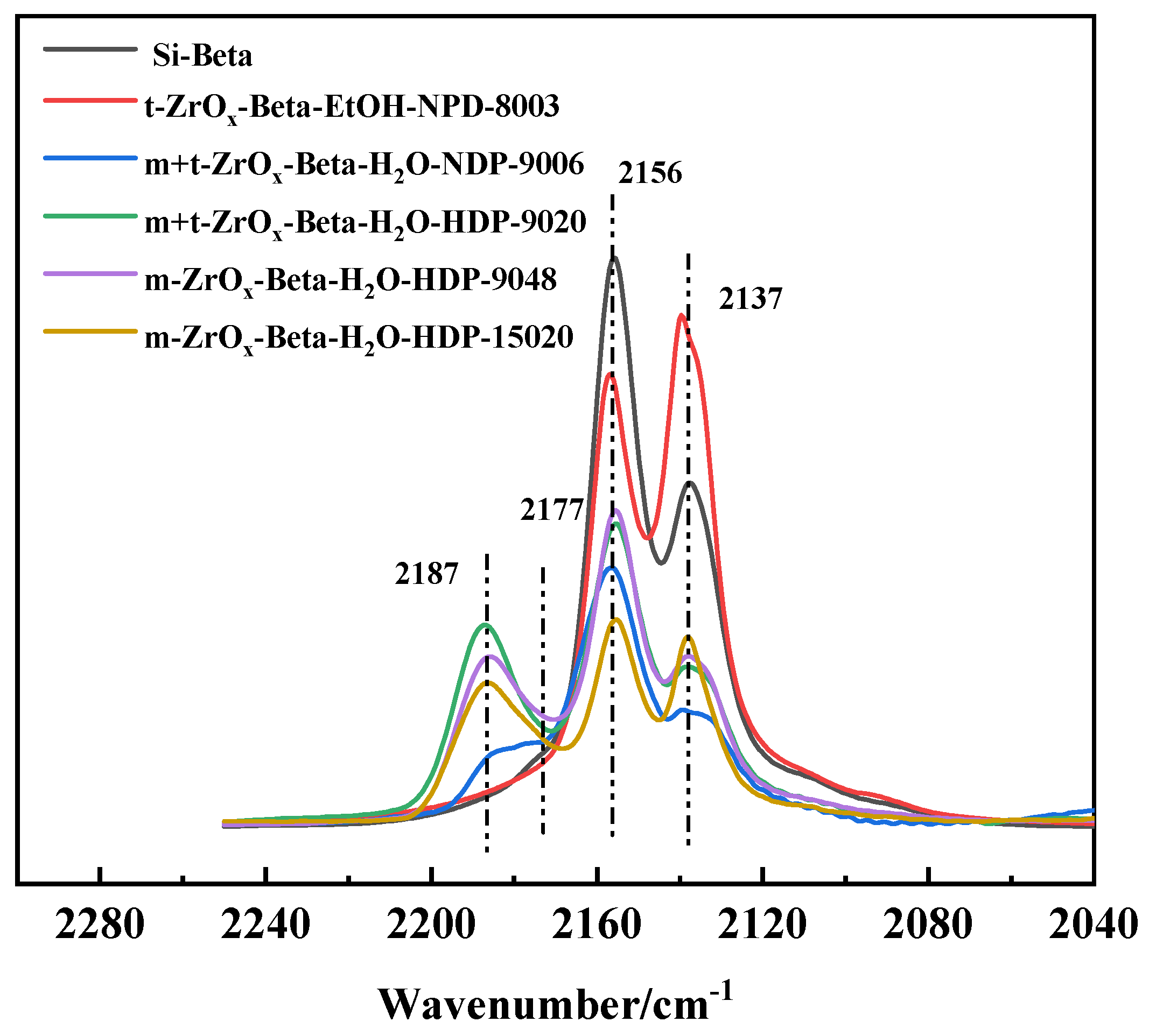
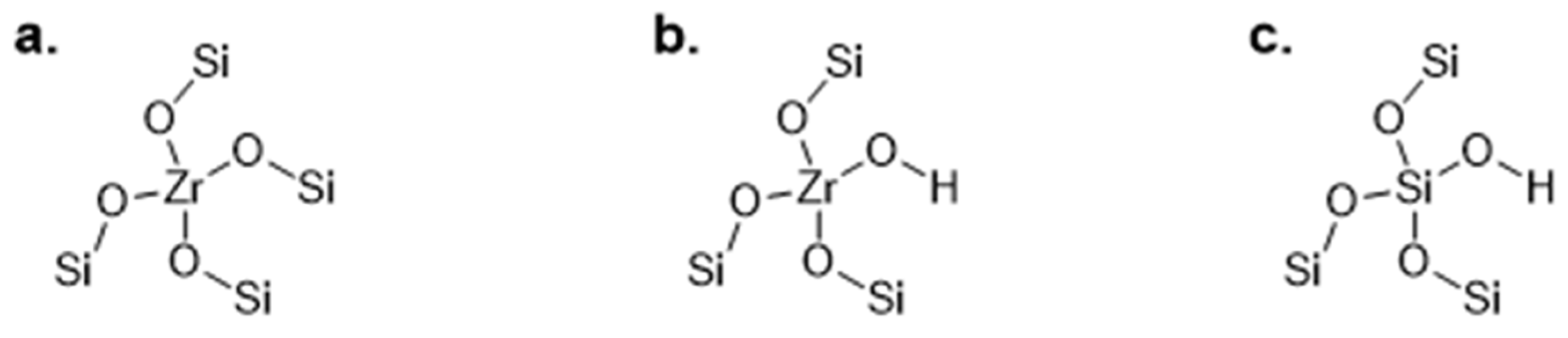
The acid sites on the catalysts were further explored using CO-IR spectroscopy, which is an appropriate technique for distinguishing Lewis sites of different types (Scheme 1, Figure 1 and Table 2). In accordance with Ivanova [36] and DFT calculation [37], the bands at 2187 cm−1 and 2177 cm−1 corresponded to the Lewis sites, which were ascribed to CO adsorption on the open sites (CO-Zr(OSi)3OH) and the closed sites (CO-Zr(OSi)4), respectively. The CO-HOSi(OSi)3 complex yields 2156 cm−1 and physisorbed CO yields the C-O vibrational frequency of 2137 cm−1. The results show that the relative number of open sites (CO-Zr(OSi)3OH, 2187 cm−1) increases in the following order: m-ZrOx-Beta-H2O-HDP-15020 < m-ZrOx-Beta-H2O-HDP-9048 < m+t-ZrOx-Beta-H2O-HDP-9020. m+t-ZrOx-Beta-H2O-NDP-9006 has the highest relative number of close sites (CO-Zr(OSi)4) among the catalysts. The relative amount of CO-HOSi(OSi)3 increases in the following order: m-ZrOx-Beta-H2O-HDP-15020 ≈ m-ZrOx-Beta-H2O-HDP-9020 < m+t-ZrOx-Beta-H2O-HDP-9048 < m+t-ZrOx-Beta-H2O-NDP-9006 < t-ZrOx-Beta-EtOH-NPD-8003 < Si-Beta. This was consistent with the 29Si MAS NMR results (Figure S12 and Table S13).
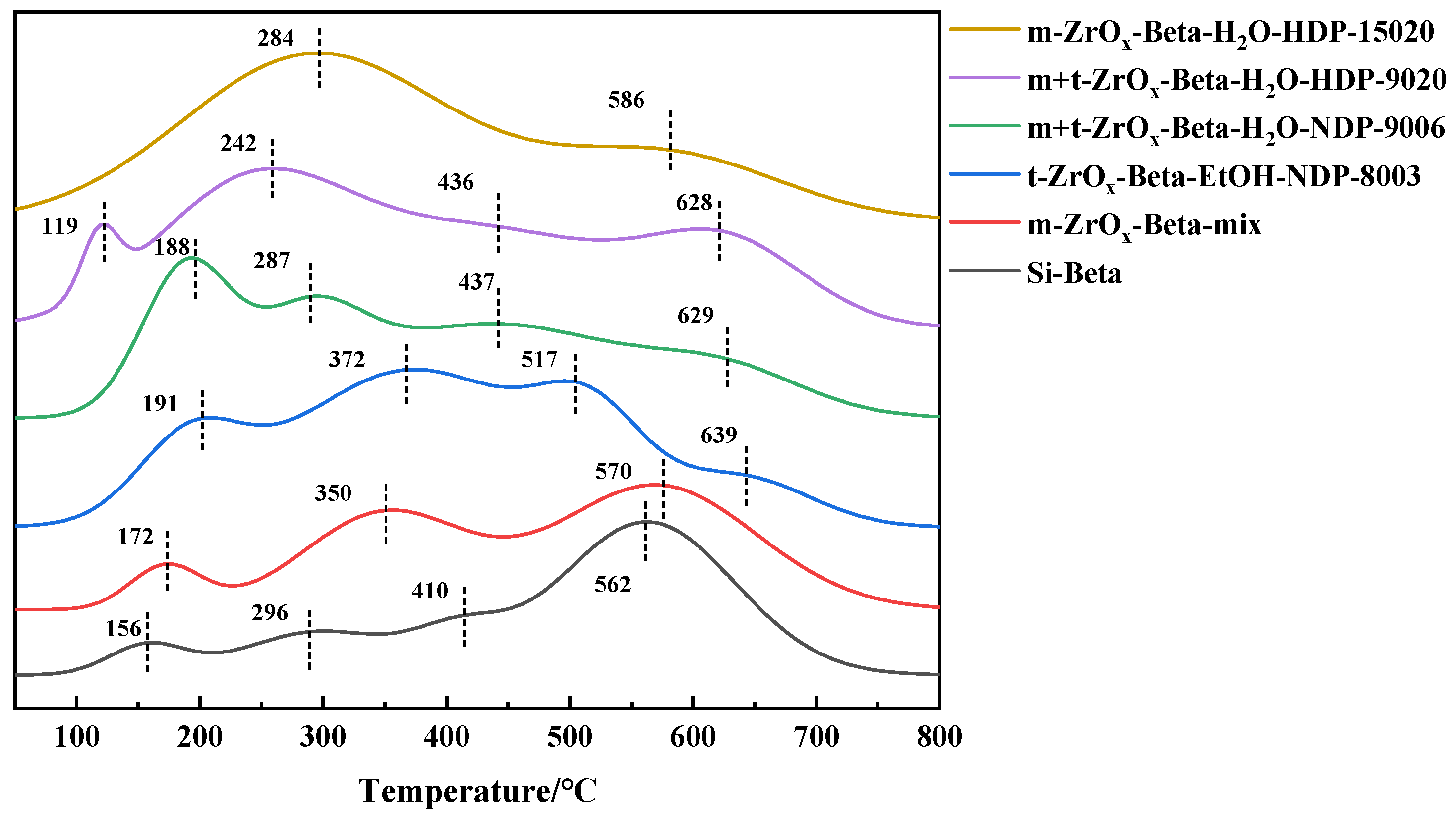
The basicity of the catalysts was studied using CO2-TPD, as shown in Figure 2 and Table 3. The pure Si-Beta support shows a large peak above 500 °C, which accounts for 69.0% of its total area. This peak is not caused by strong basic sites but represents the dehydroxylation of silanol nests. For the physically mixed m-ZrOx-Beta-mix, this high-temperature peak still exists at 57.3%. However, this peak disappears in the grafted catalysts, which proves that silanol groups were consumed to form Zr-O-Si bonds during the preparation. Among the samples, m+t-ZrOx-Beta-H2O-HDP-9020 shows the best basic properties. It has the highest percentage of strong basic sites at 18.3% and a high amount of weak–strong basic sites at 78.5%. These basic sites come from the oxygen and hydroxyl groups of the grafted zirconium species. The high density of these sites helps the catalyst work with the Lewis acid sites to form acid–base pairs. In contrast, the m+t-ZrOx-Beta-H2O-HDP-15020 sample shows a distinct peak at 586 °C. This peak is caused by the dehydroxylation of new silanol defects created by the loss of crystallinity during preparation, rather than true strong basicity.
Across the series of grafted catalysts, the acid–base properties vary systematically with the ZrO2 phase. The weak/strong acidity ratio from NH3-TPD (Table 1) increases with the monoclinic ZrO2 content: from 0.98 for the pure t-ZrO2 catalyst (t-ZrOx-Beta-EtOH-NDP-8003) to 2.28–3.91 for the mixed-phase catalysts, and further to 5.95–9.96 for the monoclinic catalysts. This trend indicates that the m-ZrO2 phase generates predominantly weak acid sites, whereas t-ZrO2 contributes the strong acid sites. The CO-IR data (Table 2) reveal a parallel trend in the distribution of Lewis acid sites. Open Zr sites (2187 cm−1, CO-Zr(OSi)3OH) are absent in the t-ZrO2-only catalyst but appear in all m-ZrO2-containing catalysts, with the highest fraction (33.4%) observed for m+t-ZrOx-Beta-H2O-HDP-9020. Closed Zr sites (2177 cm−1, CO-Zr(OSi)4) dominate in the t-ZrO2 catalyst and the m+t-ZrOx-Beta-H2O-NDP-9006 catalyst (26.9%), but are nearly absent in those prepared under sufficient hydrothermal conditions (2.5–2.6% for 9020 and 9048). The CO2-TPD results (Table 3) show that m+t-ZrOx-Beta-H2O-HDP-9020 possesses the highest proportion of strong basic sites (18.3%) and a high fraction of weak–strong basic sites (78.5%), giving a total basic site content of 96.8% without interference from silanol dehydroxylation. In contrast, m-ZrOx-Beta-H2O-HDP-15020 exhibits a distinct dehydroxylation peak (20.8%) arising from silanol defects created by the loss of crystallinity under harsh preparation conditions, which reduces its effective basicity. Overall, m+t-ZrOx-Beta-H2O-HDP-9020 combines the most favorable acid–base characteristics among the catalysts studied: a moderately high weak/strong acidity ratio (3.91), the highest fraction of open Lewis acid sites (33.4%), and the highest content of accessible basic sites (96.8%).
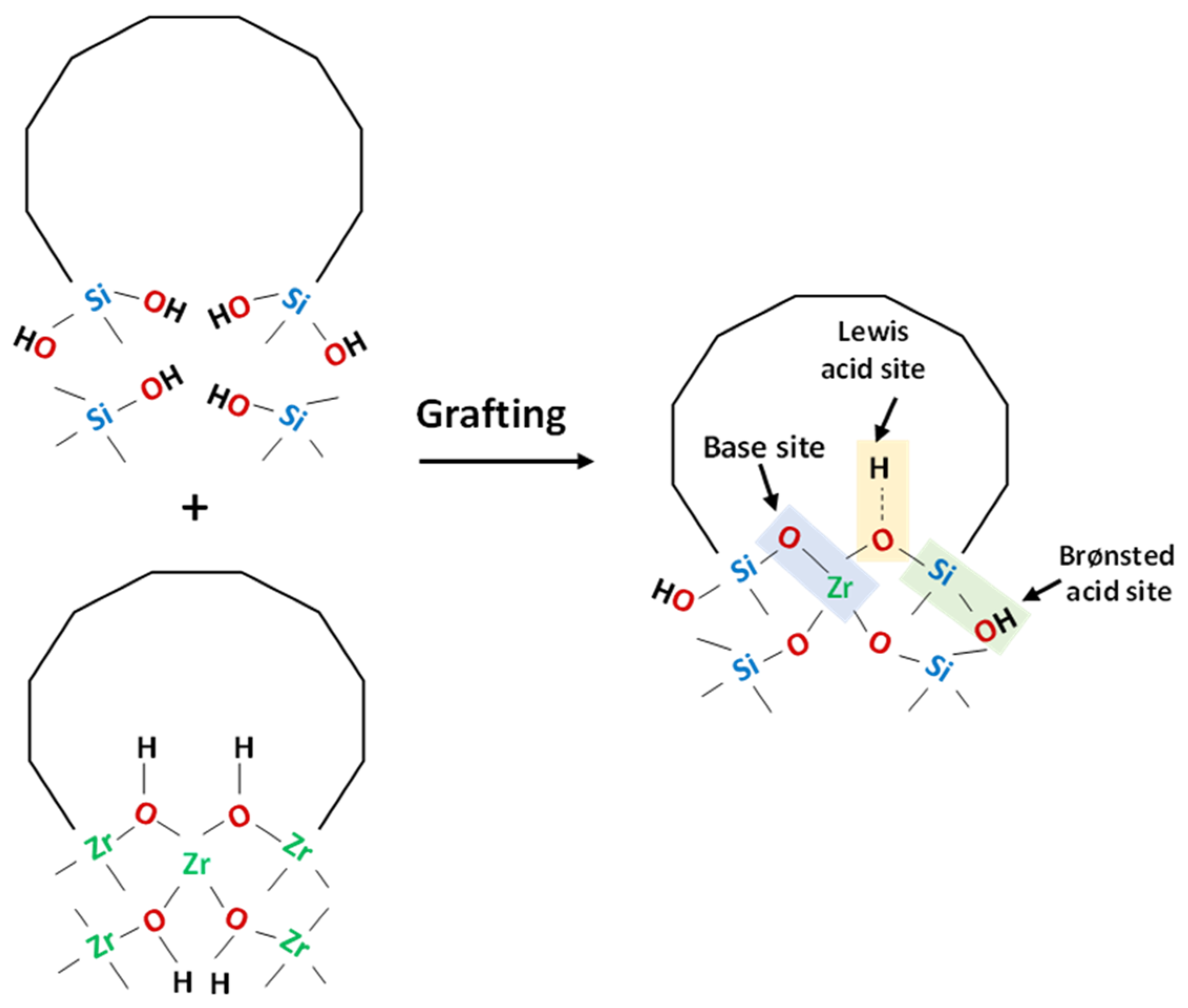
The results obtained from various characterization techniques were consolidated and correlated with each other in order to determine the structure of active sites. As the support of Si-Beta, the silanol nests/silanol defects generated by dealumination and recrystallization [38] provide anchoring sites for the zirconium. As the (m+t)-ZrO2, more Zr-OH formed with water–urea solution. Successful grafting of Zr on Si-Beta results in the appearance of Zr-O-Si (Figures S8, S10 and S12), which not only provides the atomic level dispersion of Zr, but also improves the possibility for close proximity between zirconium-originated base sites and zeolite-originated acid sites. The structure of active sites is represented in Scheme 2. Such a grafting of zirconia in the zeolite framework is liable to form with m-ZrO2, which highlights the significance of the zirconia phase in the catalyst synthesis protocol.

2.2. The Catalytic Performance of ZrOx-Beta Catalysts

2.2.1. The Catalytic Performance of Catalysts with Different Preparation Methods

The catalytic performances of ZrOx-Beta catalysts in the reaction of EATB were shown in Figure S15 and Table 4. For the m-ZrOx-Beta-mix, the products are mainly ethylene (56–27 wt%), ethyl ether (15–4 wt%), and heavy products (crotonaldehyde, ethyl acetate, 1,3,5-hexatriene, long-chain unsaturated aldehydes/ketones, dimethylbenzaldehyde, etc.) (22–8 wt%). Only a small amount of BD was detected (11–4 wt%). This demonstrates that ethanol dehydration reactions are promoted on this catalyst. After inducing 2 wt% ZrO2 to Si-Beta support by grafting, the selectivity of 1,3-BD was increased to 52–89%. Meanwhile, crotonaldehyde, the aldol condensation product, was also produced. Evidently, the Zr species provides active catalytic sites for aldol condensation and the MPV reaction by grafting. The catalysts prepared by grafting were different from the mechanically mixed catalysts (m-ZrOx-Beta-mix). Over the m+t-ZrOx-Beta-H2O-HDP-9020 catalyst, the selectivity of 1,3-BD was remarkably higher and the operating time was longer than that over the other catalysts. Therefore, the best catalytic properties were found in those catalysts with a significant portion of zirconium incorporated into the Si-Beta framework in a tetrahedral environment and more zirconium atoms in the open sites (Zr(OSi)3OH) with Lewis sites. The m+t-ZrOx-Beta-H2O-HPD-9020 catalyst was found to be most suitable catalyst.

2.2.2. The Catalytic Performance of Catalysts with Different Loading of ZrO2

The ZrOx-Beta catalysts were secondly prepared with different loading of ZrO2, and the characterization results can be found in Figures S16–S22 and Tables S10–S15. The performance of ZrOx-Beta catalysts with different loadings were evaluated and these are shown in Figure S23 and Table S16. For the m+t-ZrOx-Beta-H2O-HDP-9020-2 catalyst, the selectivity of 1,3-BD was the highest (87–61%), and the operating time is the longest (91 h) among the catalysts, which is consistent with the result of XPS, 29Si MAS NMR and CO-IR. A 2.0 wt% ZrO2 was set as the optimal loading on Beta for further studies in the following section.

2.2.3. The Catalytic Performance of m+t-ZrOx-Beta-H2O-HDP-9020-2

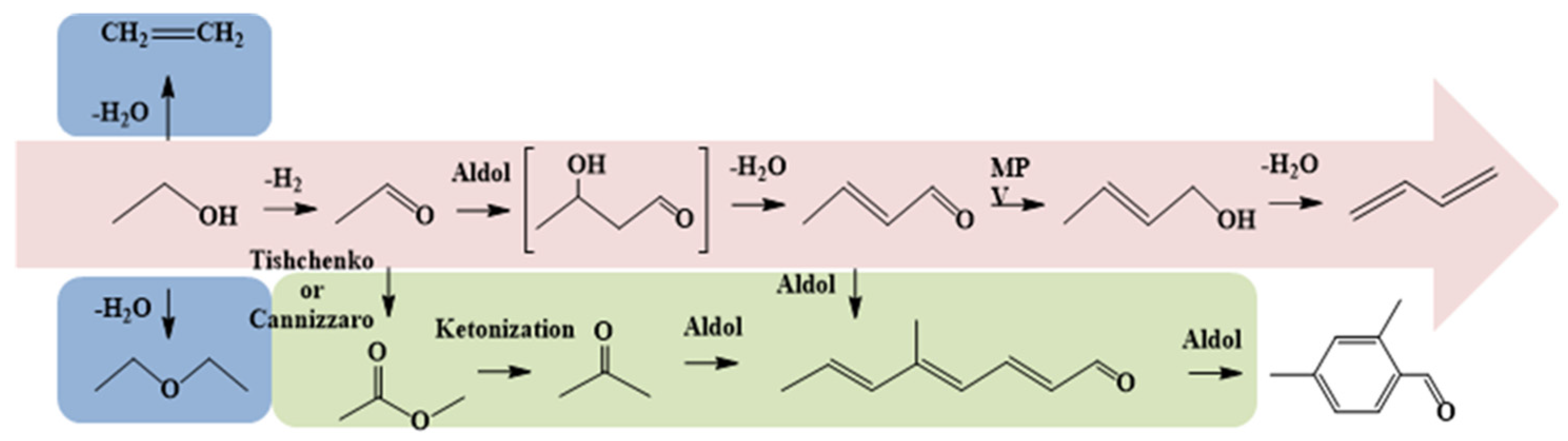
The synergistic effect between these active sites is important for improving reaction performance, but it is also necessary to reduce side reactions. The reaction of EATB involves a complex reaction network, and the reaction intermediates are active and apt to undergo side reactions (Scheme 3). The main side reactions and products are as follows [39]: (1) Dehydration of ethanol generates ethylene and ether, and ethylene polymerization may generate coke precursors. By adding water to the raw material, the rate of ethanol dehydration reaction can be inhibited, and the main reaction rate can be increased. (2) Acetaldehyde undergoes the Tishchenko or Cannizzaro reactions to disproportionate into acetates. And the acetone can be formed via the Ketonization reaction of acetates. The self-condensation/cross-condensation reaction of acetaldehyde and acetone generates long-chain unsaturated aldehydes/ketones, which are converted into 2,4-dimethylbenzaldehyde through cyclization reaction, possibly covering the active site and causing catalyst deactivation [40,41]. By adjusting the alcohol/aldehyde ratio, the consumption of acetaldehyde can be promoted and the generation of 2,4-dimethylbenzaldehyde can be reduced, as shown in Scheme 3.
To elucidate the deactivation mechanism, the spent m+t-ZrOx-Beta-H2O-HDP-9020-2 catalysts after 91 and 200 h on stream were characterized by XRD, N2 physisorption, and TGA (Figures S24 and S25 and Table S17). The XRD patterns of the spent catalysts retain the characteristic diffraction peaks of the BEA topology, confirming that the zeolite framework remains intact during the reaction. The BET surface area decreases from 498 m2 g−1 (fresh) to 267 m2 g−1 after 91 h and 183 m2 g−1 after 200 h, while the micropore volume declines from 0.14 to 0.04 cm3 g−1 (Table S17). This progressive loss of porosity is attributed to carbonaceous deposits blocking the micropores. The TGA profiles (Figure S25) confirm coke formation, with major weight loss occurring above 350 °C. This high-temperature weight loss is characteristic of heavy carbonaceous species derived from the condensation of aldehyde-derived byproducts. The coke quantity increases with time on stream. These results indicate that deactivation proceeds primarily through micropore blockage by coke, rather than through the structural collapse of the zeolite framework.
Using m+t-ZrOx-Beta-H2O-HDP-9020-2 as a catalyst, the molar ratio of alcohol/aldehyde at 1.0:1, the conversion rate of the raw material is 100.0–38.8%, the selectivity for butadiene is 87.3–61.4%, the selectivity for ethylene is 6.6–22.8%, and the selectivity for heavy matter is 0–8.4%. It can operate stably for 91 h (Figure S26). At the molar ratio of alcohol/aldehyde of 2.0:1, the conversion rate of the raw material is 98.8–62.6%, the selectivity for butadiene is 86.9–63.3%, the selectivity for ethylene is 6.2–17.3%, and the selectivity for heavy products is 1.3–13.2%. It can operate stably for 153 h. Compared with the catalytic performance under the condition of alcohol aldehyde ratio of 1.0:1, the raw material conversion rate and butadiene selectivity have been improved, and the stable operating time has been extended from 91 h to 153 h (Figure S27). Continuing to increase the alcohol aldehyde ratio to 3.5:1 results in a decrease in catalytic performance, with raw material conversion rates ranging from 100.0 to 73.4%, butadiene selectivity ranging from 66.4 to 59.7%, and ethylene selectivity ranging from 20.1 to 30.8%. Thus, the appropriate alcohol aldehyde ratio is 2.0:1.
Under the conditions of an alcohol aldehyde ratio of 2.0:1 and the addition of 2% and 10% H2O, the m+t-ZrOx-Beta-H2O-HPD-9020-2 catalyst exhibits better catalytic performance under 2% H2O than that under 10% H2O. (Figure S28 and Table S18).
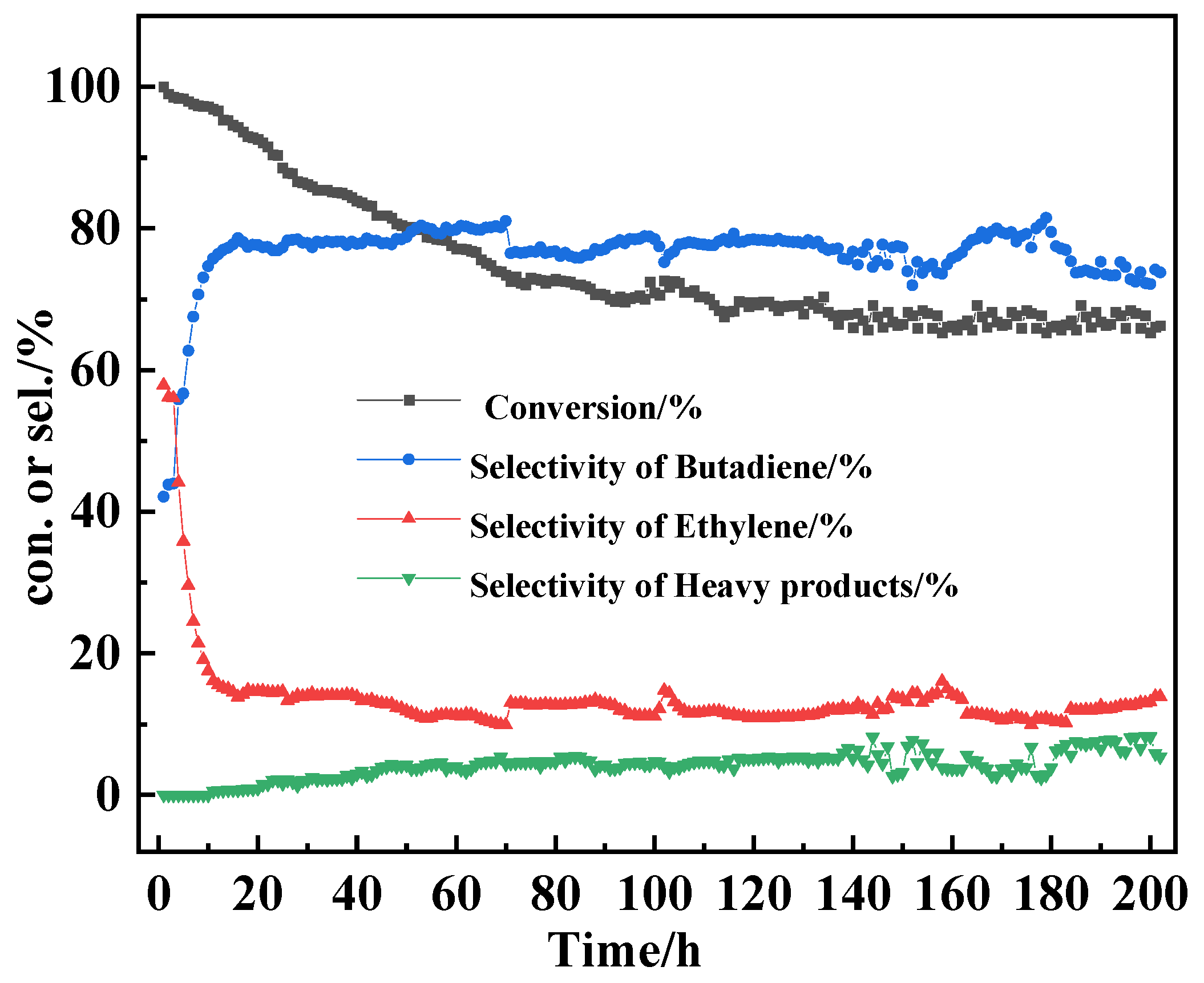
The most suitable reaction conditions in the EATB reaction are the alcohol/aldehyde ratio of 2.0:1 and the addition of 2% water (Figure 3). Compared to other conditions, the raw material conversion rate is improved ranging from 100.0 to 66.1%, BD selectivity is increased ranging from 81.5 to 73.1%, heavy products is reduced, ethylene selectivity is slightly reduced, and stable operation time is extended to over 200 h. Compared to Zhang Tao et al. [21], the conversion rate (41.5%) and one-way operation time (168 h) were further improved.

2.3. Speculation on the Structure–Activity Relationship Between Catalysts and Catalytic Performance

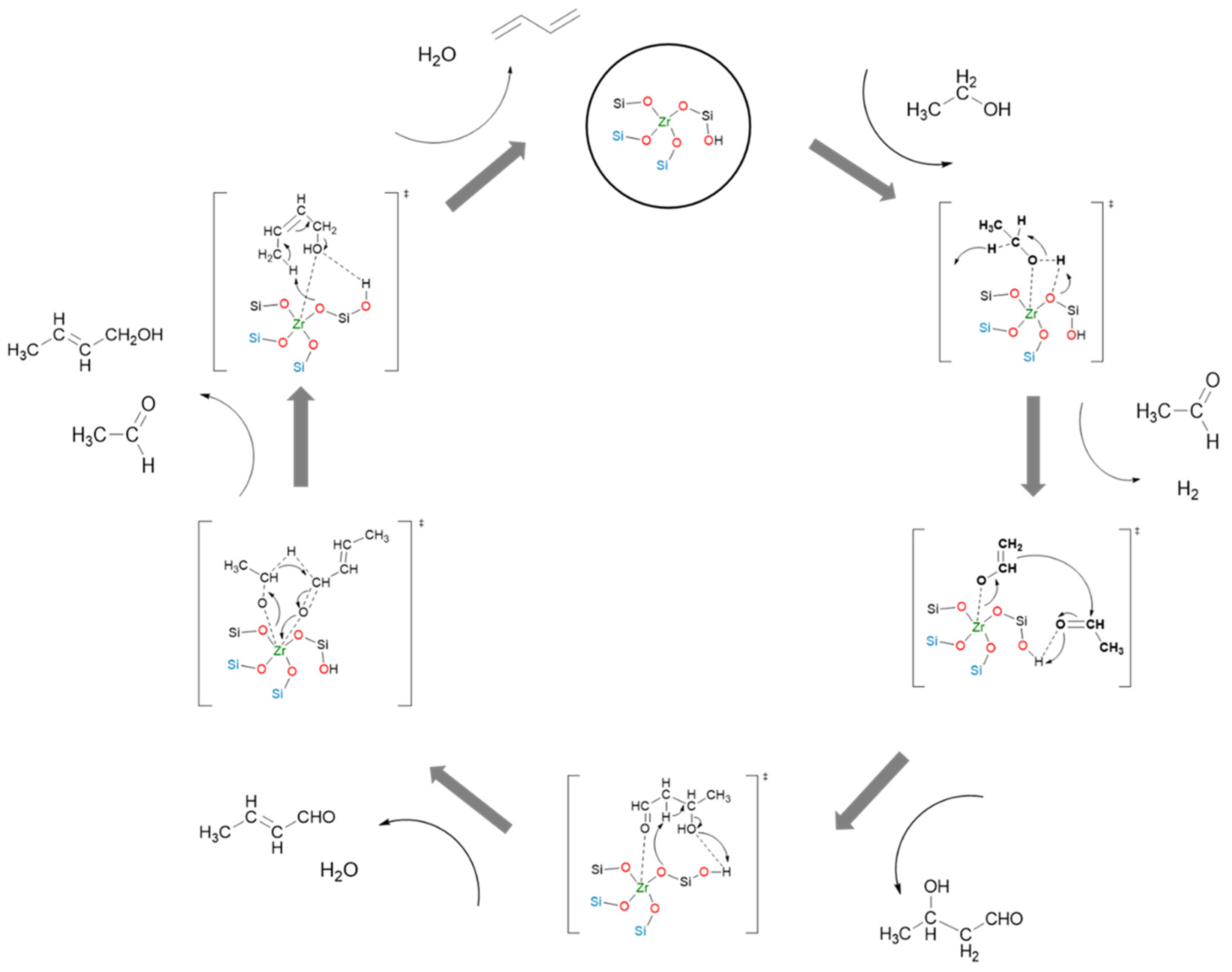
The monoclinic phase ZrO2 in the ZrOx-Beta catalyst can promote the formation of Si-O-Zr-OH structure, with more Zr-OH assisting proton transfer and providing suitable Lewis acid sites [39]. The abundant Si-OH on the Beta zeolite support with higher crystallinity can provide weak B acid sites, thereby improving the dehydration reaction and extending the catalyst’s stability, as shown in Scheme 4.
The results suggest that the catalytic performance of ZrOx-Beta catalysts depends on the content of open Zr(IV) Lewis sites. The higher catalytic performance of open sites could be attributed to their higher proton transfer ability and higher crystallinity of Beta zeolite.
The ZrOx-Beta catalyst integrated multiple, well-balanced active centers, including Lewis acid/Bronsted acid/basic metal sites, that operate in concert to drive the sequential transformations with high efficiency and stability.

3. Materials and Methods

3.1. Preparation of Zeolite Beta by Dealumination

The dealumination process was employed to prepare zeolite Beta. For dealumination, 1 g of HBeta zeolite (SiO2/Al2O3 = 20, preparation by Changling catalyst company, Yueyang, China) was mixed with 10 mL of 13 M HNO3 solution (AR, 96%, Shanghai Aladdin Biochemical Technology Co., Ltd., Shanghai, China) at 80 °C for 12 h. The obtained product was separated by filtration and washed with deionized water until pH = 6–7. Then, the above sample was dried overnight at 100 °C to obtain Si-Beta (with Si/Al ratio of ~1000).

3.2. Preparation of Zr-Incorporated Beta Zeolite Catalysts

Dissolution and precipitation processes were employed to prepare the ZrOx-Beta catalysts. As a typical synthesis, 1.0 g of the Si-Beta was stirring for 3 h at 353 K in 100 mL of ethanol or water–urea solution containing appropriate amounts of ZrO(NO3)2 (AR, 99.5%, Shanghai Aladdin Biochemical Technology Co., Ltd.). The mixture was transferred to a three-necked flask (NDP) or Teflon-lined autoclave (HDP) and heated to 80–150 °C for 3–20 h. The obtained suspension was stirred in air at 353 K until solvent was evaporated. The resulting solids, dried in the air at 353 K for 24 h, were finally calcined at 823 K for 5 h. a-ZrOx-Beta-b-c-d-e-f, where a is the phase of ZrO2 (monoclinic and tetragonal), b is the solvent used, c is the reaction vessel (NDP and HDP), d is temperature, e is time, and f is the content of ZrO2 in the catalyst

3.3. Catalysts Characterization

Powder X-ray diffraction (XRD) patterns were collected on a PANalytical diffractometer (Malvern, UK) using Cu Kα radiation. Elemental compositions (Si, Al, Zr) were determined by X-ray fluorescence (XRF) on a Type 3013 spectrometer (Nihon Riken Electric Co., Ltd., New Taipei City, Taiwan). Nitrogen adsorption–desorption isotherms were measured at −196 °C on a Micromeritics ASAP 2010 instrument (Norcross, GA, USA). Prior to measurement, the sample was degassed at 350 °C under vacuum (1.33 × 10⁻² Pa) for 15 h. The specific surface area was calculated by the BET method, and the total pore volume was taken from the adsorbed amount at P/P0 ≈ 0.98.
UV–vis diffuse reflectance spectra were acquired on an Agilent CARY300 spectrophotometer (Santa Clara, CA, USA) over the range 190–800 nm with a step size of 1 nm. Ultraviolet (UV) Raman spectra were recorded on a LabRam-HR Raman spectrometer (Horiba-Jobin Yvon, Kyoto, Japan) equipped with a CCD detector, using a 325 nm laser (1 mW) focused through a 50× long-working-distance objective. The spectral resolution was 4 cm−1. X-ray photoelectron spectroscopy (XPS) was performed on a Thermo Fisher ESCALab 250 spectrometer (Waltham, MA, USA) with Al Kα radiation; binding energies were referenced to the C 1s line at 284.8 eV. 29Si magic-angle spinning (MAS) NMR spectra were acquired at a 29Si frequency of 99.352 MHz with a spinning rate of 10.0 kHz, a π/2 pulse length of 5.0 μs, and a recycle delay of 30 or 60 s (ca. 1000 transients).
NH3 temperature-programmed desorption (NH3-TPD) was carried out on a Micromeritics AutoChem II 2920 analyzer (Norcross, GA, USA). The sample (20–40 mesh) was pretreated in He at 500 °C for 1 h, saturated with NH3 at 100 °C, and purged with He for 30 min. Desorption was monitored from 100 to 600 °C at a ramp of 10 °C min−1 using a thermal conductivity detector (TCD). Pyridine-adsorbed IR (Py-IR) spectra were collected on a BIO-RAD FTS3000 spectrometer (Hercules, CA, USA) in the range 1600–1300 cm−1. A self-supported wafer was activated at 550 °C for 1 h under vacuum (<10−5 Pa), exposed to pyridine vapor at room temperature for 0.5 h, and spectra were recorded after evacuation at 200 and 350 °C.
CO-IR spectra were recorded in transmission mode on a Nicolet 6700 FTIR spectrometer (Thermo Fisher Scientific, Waltham, MA, USA) with a DTGS detector. A self-supported wafer (~20 mg) was activated under vacuum at 450 °C for 3 h (ramp: 5 K min−1). After cooling, a reference spectrum was recorded (128 scans, 4 cm−1 resolution). CO (99.99997% purity) was introduced in calibrated aliquots into a liquid-nitrogen-cooled cell, and spectra were recorded at liquid nitrogen temperature after each dose until saturation. Spectral subtraction and curve-fitting were performed using the OMNIC 7.3 package.
CO2 temperature-programmed desorption (CO2-TPD) was performed on the same AutoChem II 2920 instrument. The sample (0.2 g) was pretreated in He (30 mL min−1) at 500 °C for 1 h, cooled to 50 °C, and exposed to a 10 vol% CO2/He mixture (30 mL min−1) for 30 min. After purging with He for 1 h to remove physisorbed CO2, the desorption profile was recorded from 50 to 800 °C at 10 °C min−1.

3.4. Catalytic Evaluation

The catalytic evaluation was carried out in a fixed-bed flow quartz reactor with an inner diameter of 12 mm at 493–673 K and 0.5 MPa. A measure of 4 g ZrOx-Beta was loaded into the reactor (sieve fraction, 0.25–0.5 mm). Nitrogen was used as the carrier gas (450 mL·min−1). Before the reaction, samples were heated to 723 K under flowing nitrogen for 1 h. Ethanol and acetaldehyde were fed into the catalytic reactor by passing nitrogen. The weight hourly space velocity (WHSV) was 2.0 g (EtOH+AcH)·gcat−1·h−1. The reagent and reaction products were analyzed on a gas chromatograph (Shimadzu GC-2010 PLUS, Kyoto, Japan) equipped with an FID detector and a capillary column (DB-624, 30 m × 0.32 mm) for organic compounds.
Catalytic activity was characterized by the conversion of reactant (Xi), selectivity to products (Sj):
Total   conversion = Total   C   moles ( C   mole   unreacted   EtOH + C   mole   unreacted   AcH ) Total   C   moles   ×   100 %
BD   selectivity = C   mole   BD   in   products Total   C   moles   in   products   except   for   EtOH   and   AcH   ×   100 %
The catalytic data reported in this work were obtained from single time-on-stream runs. The TOS profiles with product analysis at regular intervals are provided in full in the Supporting Information (Figures S15 and S23–S26).

4. Conclusions

ZrOx-Beta catalysts were synthesized by a dissolution–precipitation method to enhance the catalytic properties in EATB reaction. A significant portion of Zr species were homogeneously dispersed and tetrahedrally isolated in the framework of zeolite Beta, forming Zr-O-Si bonds. The incorporation of Zr resulted in the formation of Lewis acid sites and suitable basic sites. The open sites of Zr were formed, resulting in good catalytic properties. m+t-ZrOx-Beta-H2O-9020 was the most-yielding catalyst compared with the other reported catalysts, with the best butadiene selectivity of 82–73% at a conversion of 100–66%, and a run time of 200 h. The zirconia phase, the open sites of Zr, and the content of H2O in the feed were crucial in the reaction.

Supplementary Materials

The following supporting information can be downloaded at: https://www.mdpi.com/article/10.3390/catal16060542/s1. References [42,43] are cited in the Supplementary Materials.

Author Contributions

Conceptualization, Y.B. and Y.W.; methodology, H.Y. (Hui Yuan) and X.S.; validation, Y.B., M.X., H.Y. (Huili Yu) and L.W.; investigation, Y.B. and Y.W.; data curation, Y.B. and Y.W.; writing—original draft preparation, Y.B. and Y.W.; writing—review and editing, Y.W., H.Y. (Hui Yuan), Y.X. and X.S.; supervision, Y.W. and Y.X.; project administration, X.S. All authors have read and agreed to the published version of the manuscript.

Funding

This research received no external funding.

Data Availability Statement

The original contributions presented in this study are included in the article and Supplementary Materials. Further inquiries can be directed to the corresponding authors.

Conflicts of Interest

All authors are employees of Sinopec. Sinopec had no role in the design of the study; in the collection, analyses, or interpretation of data; in the writing of the manuscript; or in the decision to publish the results.

References

  1. Ezinkwo, G.O.; Tretyakov, V.P.; Aliyu, A.; Ilolov, A.M. Fundamental Issues of Catalytic Conversion of Bio-Ethanol into Butadiene. Chembioeng. Rev. 2014, 1, 194–203. [Google Scholar] [CrossRef]
  2. Jones, M.D.; Keir, C.G.; Di Iulio, C.; Robertson, R.A.; Williams, C.V.; Apperley, D.C. Investigations into the conversion of ethanol into 1,3-butadiene. Catal. Sci. Technol. 2011, 1, 267–272. [Google Scholar] [CrossRef]
  3. Makshina, E.V.; Janssens, W.; Sels, B.F.; Jacobs, P.A. Catalytic study of the conversion of ethanol into 1,3-butadiene. Catal. Today 2012, 198, 338–344. [Google Scholar] [CrossRef]
  4. Angelici, C.; Weckhuysen, B.M.; Bruijnincx, P.C.A. Chemocatalytic Conversion of Ethanol into Butadiene and Other Bulk Chemicals. ChemSusChem 2013, 6, 1595–1614. [Google Scholar] [CrossRef]
  5. Sushkevich, V.L.; Ivanova, I.I. Ag-Promoted ZrBEA Zeolites Obtained by Post-Synthetic Modification for Conversion of Ethanol to Butadiene. ChemSusChem 2016, 9, 2216–2225. [Google Scholar] [CrossRef] [PubMed]
  6. Makshina, E.V.; Dusselier, M.; Janssens, W.; Degreve, J.; Jacobs, P.A.; Sels, B.F. Review of old chemistry and new catalytic advances in the on-purpose synthesis of butadiene. Chem. Soc. Rev. 2014, 43, 7917–7953. [Google Scholar] [CrossRef]
  7. Angelici, C.; Velthoen, M.E.Z.; Weckhuysen, B.M.; Bruijnincx, P.C.A. Effect of Preparation Method and CuO Promotion in the Conversion of Ethanol into 1,3-Butadiene over SiO2-MgO Catalysts. ChemSusChem 2014, 7, 2505–2515. [Google Scholar] [CrossRef]
  8. Lewandowski, M.; Babu, G.S.; Vezzoli, M.; Jones, M.D.M.B.; Owen, R.E.; Mattia, D.; Plucinski, P.; Mikolajska, E.; Ochenduszko, A.; Apperley, D.C. Investigations into the conversion of ethanol to 1,3-butadiene using MgO:SiO2 supported catalysts. Catal. Commun. 2014, 49, 25–28. [Google Scholar] [CrossRef]
  9. Janssens, W.; Makshina, E.V.; Vanelderen, P.; De Clippel, F.; Houthoofd, K.; Kerkhofs, S.; Martens, J.A.; Jacobs, P.A.; Sels, B.F. Ternary Ag/MgO-SiO2 Catalysts for the Conversion of Ethanol into Butadiene. ChemSusChem 2015, 8, 994–1008. [Google Scholar] [CrossRef] [PubMed]
  10. Tanabe, K. Surface and catalytic properties of ZrO2. Mater. Chem. Phys. 1985, 13, 347–364. [Google Scholar] [CrossRef]
  11. Yamaguchi, T. Application of ZrO2 as a catalyst and a catalyst support. Catal. Today 1994, 20, 199–217. [Google Scholar] [CrossRef]
  12. Asakura, K.; Aoki, M.; Iwasawa, Y. Selective isopentane formation from CH3OH on a new one-atomic layer ZrO2/ZSM-5 hybrid catalyst. Catal. Lett. 1988, 1, 395–403. [Google Scholar] [CrossRef]
  13. Stichert, W.; Schüth, F.; Kuba, S.; Knözinger, H. Monoclinic and Tetragonal High Surface Area Sulfated Zirconias in Butane Isomerization: CO Adsorption and Catalytic Results. J. Catal. 2001, 198, 277–285. [Google Scholar] [CrossRef]
  14. Gao, X.; Fierro, J.L.G.; Wachs, I.E. Structural Characteristics and Catalytic Properties of Highly Dispersed ZrO2/SiO2 and V2O5/ZrO2/SiO2 Catalysts. Langmuir 1999, 15, 3169–3178. [Google Scholar] [CrossRef]
  15. Li, W.; Liu, H.; Iglesia, E. Structures and properties of zirconia-supported ruthenium oxide catalysts for the selective oxidation of methanol to methyl formate. J. Phys. Chem. B 2006, 110, 23337–23342. [Google Scholar] [CrossRef]
  16. He, D.; Ding, Y.; Luo, H.; Li, C. Effects of zirconia phase on the synthesis of higher alcohols over zirconia and modified zirconia. J. Mol. Catal. A Chem. 2004, 208, 267–271. [Google Scholar] [CrossRef]
  17. Rhodes, M.D.; Bell, A.T. The effects of zirconia morphology on methanol synthesis from CO and H2 over Cu/ZrO2 catalysts: Part II. Transient-response infrared studies. J. Catal. 2005, 233, 210–220. [Google Scholar] [CrossRef]
  18. Jacob, K.H.; Knözinger, E.; Benier, S. Adsorption sites on polymorphic zirconia. J. Mater. Chem. 1993, 3, 651–657. [Google Scholar] [CrossRef]
  19. Zhang, M.; Qin, Y.; Jiang, H.; Wang, L. Protective desilication of beta zeolite: A mechanism study and its application in ethanol-acetaldehyde to 1,3-butadiene. Microporous Mesoporous Mater. 2021, 326, 111359. [Google Scholar] [CrossRef]
  20. Cheong, J.L.; Shao, Y.; Tan, S.J.R.; Li, X.; Zhang, Y.; Lee, S.S. Highly Active and Selective Zr/MCF Catalyst for Production of 1,3-Butadiene from Ethanol in a Dual Fixed Bed Reactor System. ACS Sustain. Chem. Eng. 2016, 4, 4887–4894. [Google Scholar] [CrossRef]
  21. Li, X.; Pang, J.; Wang, C.; Li, L.; Pan, X.; Zheng, M.; Zhang, T. Conversion of ethanol to 1,3-butadiene over high-performance Mg–ZrOx/MFI nanosheet catalysts via the two-step method. Green Chem. 2020, 22, 2852–2861. [Google Scholar] [CrossRef]
  22. Sushkevich, V.L.; Ivanova, I.I. Mechanistic study of ethanol conversion into butadiene over silver promoted zirconia catalysts. Appl. Catal. B-Environ. 2017, 215, 36–49. [Google Scholar] [CrossRef]
  23. Li, X.; Zhao, Y.; Pang, J.; Gao, P.; Zheng, M.; Hou, G. Recent Advances in Metal–Zeolite Catalysts for Ethanol to 1,3-Butadiene Conversion: Active Metal Sites, Mechanisms, and Future Challenges. ACS Catal. 2025, 15, 5053–5085. [Google Scholar] [CrossRef]
  24. Bin Samsudin, I.; Zhang, H.; Jaenicke, S.; Chuah, G.K. Recent advances in catalysts for the conversion of ethanol to butadiene. Chem.-Asian J. 2020, 15, 4199–4214. [Google Scholar] [CrossRef]
  25. Caracoche, M.C.; Rivas, P.C.; Cervera, M.M.; Caruso, R.; Benavídez, E.R.; de Sanctis, O.A.; Escobar, M.E. Zirconium oxide structure prepared by the sol-gel route: I, the role of the alcoholic solvent. J. Am. Ceram. Soc. 2001, 83, 377–384. [Google Scholar] [CrossRef]
  26. Lanzafame, P.; Papanikolaou, G.; Perathoner, S.; Centi, G.; Giordano, G.; Migliori, M. Weakly acidic zeolites: A review on uses and relationship between nature of the active sites and catalytic behaviour. Microporous Mesoporous Mater. 2020, 300, 110157. [Google Scholar] [CrossRef]
  27. Li, M.; Feng, Z.; Xiong, G.; Ying, P.; Xin, Q.; Li, C. Phase Transformation in the Surface Region of Zirconia Detected by UV Raman Spectroscopy. J. Phys. Chem. B 2001, 105, 8107–8111. [Google Scholar] [CrossRef]
  28. Schild, C.; Wokaun, A.; Koeppel, R.A.; Baiker, A. ChemInform Abstract: XRD and Raman Identification of the Zirconia Modifications in Copper/Zirconia and Palladium/Zirconia Catalysts Prepared from Amorphous Precursors. J. Catal. 1991, 130. [Google Scholar] [CrossRef]
  29. Mercera, P.D.L.; Van Ommen, J.G.; Doesburg, E.B.M.; Burggraaf, A.J.; Ross, J.R.H. Zirconia as a support for catalysts Evolution of the texture and structure on calcination in air. Appl. Catal. 1990, 57, 127–148. [Google Scholar] [CrossRef]
  30. Ivanova, I.I.; Sushkevich, V.L.; Taarning, E. Ethanol conversion into butadiene over Zr-containing molecular sieves doped with silver. Green Chem. 2015, 17, 2552–2559. [Google Scholar] [CrossRef]
  31. Ramanathan, A.; Zhu, H.; Maheswari, R.; Subramaniam, B. Novel zirconium containing cage type silicate (Zr-KIT-5): An efficient Friedel–Crafts alkylation catalyst. Chem. Eng. J. 2015, 278, 113–121. [Google Scholar] [CrossRef]
  32. Ramanathan, A.; Villalobos, M.C.C.; Kwakernaak, C.; Telalovic, S.; Hanefeld, U. Zr-TUD-1: A Lewis acidic, three-dimensional, mesoporous, zirconium-containing catalyst. Chem.-Eur. J. 2008, 14, 961–972. [Google Scholar] [CrossRef]
  33. Newalkar, B.L.; Olanrewaju, J.; Komarneni, S. Microwave-Hydrothermal Synthesis and Characterization of Zirconium Substituted SBA-15 Mesoporous Silica. J. Phys. Chem. B 2001, 105, 8356–8360. [Google Scholar] [CrossRef]
  34. Tang, Y.; Zong, E.; Wan, H.; Xu, Z.; Zheng, S.; Zhu, D. Zirconia functionalized SBA-15 as effective adsorbent for phosphate removal. Microporous Mesoporous Mater. 2012, 155, 192–200. [Google Scholar] [CrossRef]
  35. Tang, B.; Dai, W.; Sun, X.; Wu, G.; Guan, N.; Hunger, M.; Li, L. Mesoporous Zr-Beta zeolites prepared by a post-synthetic strategy as a robust Lewis acid catalyst for the ring-opening aminolysis of epoxides. Green Chem. 2015, 17, 1744–1755. [Google Scholar] [CrossRef]
  36. Sushkevich, V.L.; Vimont, A.; Travert, A.; Ivanova, I.I. Spectroscopic Evidence for Open and Closed Lewis Acid Sites in ZrBEA Zeolites. J. Phys. Chem. C 2015, 119, 17633–17639. [Google Scholar] [CrossRef]
  37. Sushkevich, V.L.; Palagin, D.; Ivanova, I.I. With Open Arms: Open Sites of ZrBEA Zeolite Facilitate Selective Synthesis of Butadiene from Ethanol. ACS Catal. 2015, 5, 4833–4836. [Google Scholar] [CrossRef]
  38. Qi, X.; Li, Z.; Jing, Y.; Yin, Y.; Lu, X.; He, L.; Dai, C.; Song, C.; Ma, X. Zirconium-Containing Amorphous Zeolite Promotes Ethanol-to-Butadiene. ACS Sustain. Chem. Eng. 2026, 14, 5213–5225. [Google Scholar] [CrossRef]
  39. Gonell, F.; Corma, A.; Boronat, M. Structure–reactivity relationship in isolated Zr sites present in Zr-zeolite and ZrO2 for the Meerwein–Ponndorf–Verley reaction. Catal. Sci. Technol. 2017, 7, 2865–2873. [Google Scholar] [CrossRef]
  40. Sushkevich, V.L.; Ivanova, I.I.; Tolborg, S.; Taarning, E. Meerwein–Ponndorf–Verley–Oppenauer reaction of crotonaldehyde with ethanol over Zr-containing catalysts. J. Catal. 2014, 316, 121–129. [Google Scholar] [CrossRef]
  41. Yan, T.; Yang, L.; Dai, W.; Wang, C.; Wu, G.; Guan, N.; Hunger, M.; Li, L. On the deactivation mechanism of zeolite catalyst in ethanol to butadiene conversion. J. Catal. 2018, 367, 7–15. [Google Scholar] [CrossRef]
  42. Li, W.; Huang, H.; Li, H.; Zhang, W.; Liu, H. Facile Synthesis of Pure Monoclinic and Tetragonal Zirconia Nanoparticles and Their Phase Effects on the Behavior of Supported Molybdena Catalysts for Methanol-Selective Oxidation. Langmuir ACS J. Surf. Colloids 2008, 24, 8358–8366. [Google Scholar] [CrossRef]
  43. Fernández López, E.; Sánchez-Escribano, V.; Panizza, M.; Carnasciali, M.M.; Busca, G. Vibrational and electronic spectroscopic properties of zirconia powders. J. Mater. Chem. 2001, 11, 1891–1897. [Google Scholar] [CrossRef]
Scheme 1. Configurations of closed (a), open (b) and Si-OH (c) sites of the ZrOx-Beta.
Catalysts 16 00542 sch001
Figure 1. The CO-IR spectra of catalysts.
Catalysts 16 00542 g001
Figure 2. The CO2-TPD spectra of catalysts.
Catalysts 16 00542 g002
Scheme 2. The structure and formation of active sites.
Catalysts 16 00542 sch002
Scheme 3. The reaction network of ethanol–acetaldehyde into 1,3-butadiene.
Catalysts 16 00542 sch003
Figure 3. The catalytic properties of m+t-ZrOx-Beta-H2O-HDP-9020-2 catalysts with the molar ratio of alcohol/aldehyde at 2.0:1 and the addition of 2%.
Catalysts 16 00542 g003
Scheme 4. The reaction of ethanol–acetaldehyde into 1,3-butadiene on the Si-O-Zr-OH of the ZrOx-Beta catalyst. Structures marked with denote transition states (activated complexes) along the reaction pathway.
Catalysts 16 00542 sch004
Table 1. The amount of acidity by NH3-TPD.
SamplesAmount of Acidity/μmol·g−1Amount of Acidity/μmol·g−1Weak Acidity/Strong Acidity
Weak (100–350 °C)Strong (350–600 °C)
ZrO24522230.95
Si-Beta208931150.81
m-ZrOx-Beta-mix191911000.91
t-ZrOx-Beta-EtOH-NDP-80034712332380.98
m+t-ZrOx-Beta-H2O-NDP-9006289201882.28
m+t-ZrOx-Beta-H2O-HDP-9020264211543.91
m-ZrOx-Beta-H2O-HDP-9048329282475.95
m-ZrOx-Beta-H2O-HDP-15020285259269.96
Table 2. The amount of CO-IR spectra.
Sample2185 cm−1
CO-Zr(OH)(OSi)3
2176 cm−1
CO-Zr(OSi)4
2156 cm−1
CO-OHSi(OSi)3
2138 cm−1
CO
Si-Beta//57.342.8
t-ZrOx-Beta-EtOH-NDP-8003/3.536.859.7
m+t-ZrOx-Beta-H2O-NDP-90063.326.930.139.7
m+t-ZrOx-Beta-H2O-HDP-902033.42.528.136.0
m-ZrOx-Beta-H2O-HDP-904830.72.630.436.3
m-ZrOx-Beta-H2O-HDP-1502026.514.025.534.0
Table 3. The number of CO2-TPD spectra.
Sample100–200 °C
Weak Basicity
200–500 °C
Weak–Strong Basicity
>500 °C
Strong Basicity
>500 °C
Dehydroxylation
Si-Beta5.725.3/69.0
m-ZrOx-Beta-mix7.035.8/57.3
t-ZrOx-Beta-EtOH-NDP-800312.277.210.6/
m+t-ZrOx-Beta-H2O-NDP-900624.364.411.3/
m+t-ZrOx-Beta-H2O-HDP-90203.278.518.3/
m-ZrOx-Beta-H2O-HDP-15020/79.2/20.8
Table 4. Catalytic performance of ZrOx-Beta catalysts in EATB reaction.
SamplesTime/hConversion/%Selectivity of Butadiene/%Selectivity of Ehtylene/%Selectivity of Heavy Products/%
MaxMinMaxMinMaxMinMaxMin
m-ZrOx-Beta-mix-65391145627228
t-ZrOx-Beta-EtOH-NDP-8003251009382612411135
m+t-ZrOx-Beta-H2O-NDP-90062999748460124177
m+t-ZrOx-Beta-H2O-HDP-90209110039876123780
m-ZrOx-Beta-H2O-HDP-904888100688362127210
m-ZrOx-Beta-H2O-HDP-150202410053895227790
Disclaimer/Publisher’s Note: The statements, opinions and data contained in all publications are solely those of the individual author(s) and contributor(s) and not of MDPI and/or the editor(s). MDPI and/or the editor(s) disclaim responsibility for any injury to people or property resulting from any ideas, methods, instructions or products referred to in the content.