Article

Chlorine-Doped Co3O4 Accelerates Interfacial Charge Transfer for Efficient Peroxymonosulfate Activation: Radical-Dominated Bisphenol A Degradation

1
Zhejiang Key Laboratory of Green Construction and Intelligent Operation & Maintenance for Coastal Infrastructure, College of Civil Engineering, Zhejiang University of Technology, Hangzhou 310023, China
2
Taizhou Research Institute of Intelligent Construction on Coastal Soft Soil, Zhejiang University of Technology, Taizhou 318000, China
*
Author to whom correspondence should be addressed.
Catalysts 2026, 16(5), 483; https://doi.org/10.3390/catal16050483
Submission received: 18 April 2026 / Revised: 7 May 2026 / Accepted: 12 May 2026 / Published: 21 May 2026

Abstract

Cobalt oxide (Co3O4), a transition metal oxide with a cubic spinel structure, shows high potential in peroxymonosulfate (PMS) activation, while its catalytic efficiency is often limited by sluggish interfacial charge transfer. In this study, a chlorine-doped Co3O4 (Cl-Co3O4) was synthesized via a hydrothermal method for the degradation of bisphenol A (BPA) through PMS activation. Systematic characterizations and electrochemical tests demonstrated that chlorine doping could effectively modulate the surface electronic structure of the catalyst, significantly reducing the interfacial charge transfer resistance. Degradation performance evaluations revealed that, compared to pristine Co3O4, Cl-Co3O4 exhibited a significantly enhanced BPA degradation, achieving near-complete removal of BPA within 15 min under neutral to weakly alkaline conditions. The optimal operational parameters were determined as catalyst dosage of 0.20 g/L, PMS concentration of 0.10 mM and initial pH of 7.0–9.0, with the pseudo-first-order rate constant reaching 0.37 min−1. High-concentration NO3 showed weak inhibition, while Cl showed moderate inhibition; 50 mM HCO3 drastically reduced the rate constant to 0.05 min−1 and almost completely suppressed the reaction. Sulfate (SO4) and superoxide (O2) radicals were the primary reactive species in this system, explicitly excluding the role of the non-radical electron transfer pathway. Furthermore, three plausible BPA degradation pathways involving C-C bond cleavage, hydroxylation and C-O bond breakage were proposed with 19 intermediates identified. Ecotoxicological assessments based on ECOSAR verified that both acute and chronic toxicity of the intermediates to fish, daphnid and green algae decreased gradually, and the final small-molecule products exhibited significantly lower toxicity than the parent BPA. This study provides a novel strategy for enhancing the PMS activation performance of cobalt-based catalysts by modulating their electronic structures via halogen doping.

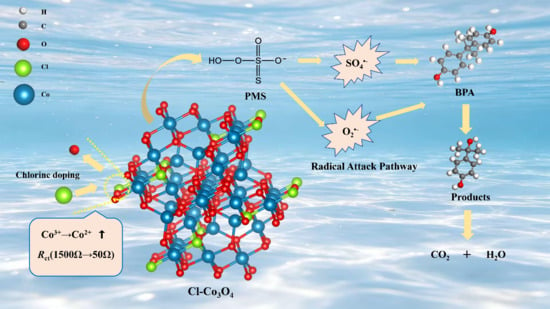
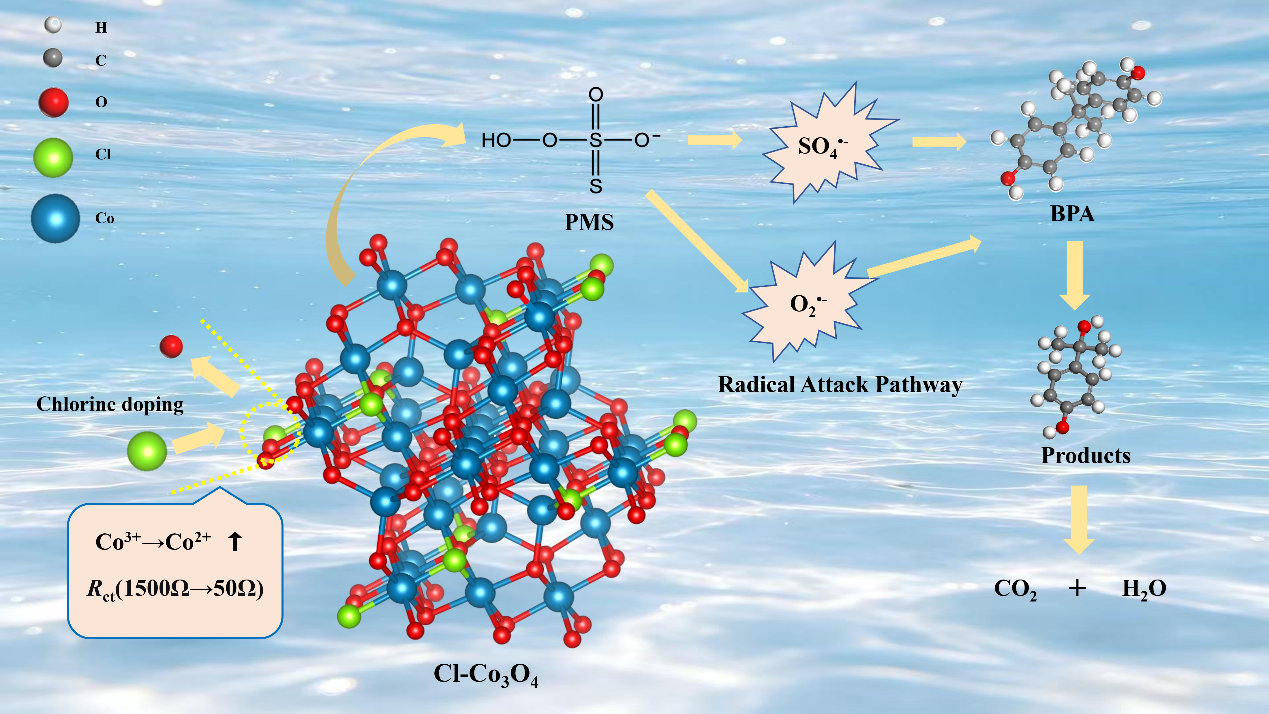
Graphical Abstract

1. Introduction

Bisphenol A (BPA), a typical endocrine-disrupting chemical (EDC), is ubiquitously detected in aquatic environments worldwide, posing a significant threat to water security and human health [1,2]. Even trace amounts of BPA can severely impact living organisms by mimicking estrogens, antagonizing androgens, and disrupting thyroid functions. Such endocrine interference can trigger a wide range of health issues, including immune and reproductive disorders, cognitive deficits, and an elevated risk of obesity and diabetes [3,4]. Conventional water treatment processes face severe challenges in eliminating such micropollutants: physical adsorption merely achieves the phase transfer of pollutants rather than their complete degradation [5,6]; biological degradation is typically sluggish [7]; and traditional advanced oxidation processes (AOPs) are often hindered by catalyst instability and the potential generation of toxic by-products [1]. Therefore, there is an urgent need to develop efficient and sustainable treatment technologies capable of deeply mineralizing recalcitrant organic pollutants like BPA. Recently, sulfate radical-based advanced oxidation processes (SR-AOPs) have emerged as a highly promising solution to these challenges. Compared to traditional hydroxyl radicals (HO•), sulfate radicals (SO4) possess a higher oxidation potential (2.5–3.1 V), a longer half-life (30–40 μs), and a broader applicable pH range, thereby exhibiting superior oxidative capability and environmental adaptability [8,9,10]. Peroxymonosulfate (PMS), a commonly used oxidant precursor in SR-AOPs, can be effectively activated by energy inputs (e.g., UV [9,11,12], heat, ultrasound [13]) or heterogeneous catalysts (e.g., transition metal ions [14,15] and metal oxides [10]) to continuously generate highly reactive SO4, realizing the efficient degradation of organic contaminants [8,16].
Among diverse heterogeneous catalysts, spinel cobalt oxide (Co3O4) has been extensively investigated owing to its outstanding thermodynamic advantages in PMS activation [17,18]. The abundant Co2+/Co3+ redox couples in its lattice serve as the pivotal active sites for driving PMS activation. Previous studies have demonstrated that crystal facet engineering (e.g., exposing the (111) facet rich in oxygen vacancies and high Co2+/Co3+ ratios) can significantly boost its catalytic performance [19]. However, pristine Co3O4 suffers from inherent limitations: large charge transfer resistance, limited exposed active sites, and sluggish redox cycling kinetics of Co2+/Co3+ [20,21]. These drawbacks severely restrict its PMS activation efficiency, frequently resulting in a sharp decline in catalytic performance under practical, neutral-to-mildly alkaline water conditions.
To overcome the bottlenecks of pristine Co3O4, elemental doping has been verified as a direct and robust strategy to reconstruct the electronic structure and local coordination environment of catalysts [22,23,24,25,26]. Specifically, anion doping has proven highly effective in modulating electronic properties and enhancing catalytic activity [23,24]. The introduction of heteroatoms can induce lattice distortion, enrich oxygen vacancies, and regulate metal valence distribution, thereby fundamentally reducing the interfacial electron transfer resistance. For instance, nitrogen (N) doping can steer the PMS activation pathway from radical-dominated to non-radical-dominated by forming Co-N active sites that promote singlet oxygen (1O2) generation [27]; selenium (Se) doping can downshift the 3d-band center of Co, optimize the adsorption–desorption equilibrium of reactive oxygen species, and remarkably increase both the Co2+ proportion and oxygen vacancy density [28].
Building upon these findings, halogens, a class of anions with strong electron-withdrawing effects, are demonstrating even more remarkable potential in electronic structure modulation. For example, Chen et al. synthesized F-Co3O4 and confirmed that highly electronegative fluorine atoms can induce electron delocalization of Co active centers and elevate their spin states, effectively guiding PMS activation via a non-radical pathway involving surface-bound complexes (PMS*) [29]. These studies indicate that the introduction of strongly electronegative elements can flexibly regulate the PMS activation mechanism. Among halogens, chlorine (Cl) holds distinct advantages due to its high electronegativity (χ = 3.16) and an ionic radius comparable to that of oxygen. Substituting oxygen sites with chlorine in the Co3O4 lattice induces profound localized lattice strain, generating abundant structural defects and oxygen vacancies [30]. This structural modification not only increases the proportion of low-valent metal species (Co2+), but also drastically curtails the interfacial electron transfer resistance, creating favorable conditions for PMS activation. More importantly, the incorporation of Cl atoms can directly reconfigure the band structure, valence distribution, and spin states of the catalyst, which serve as the core driving forces dictating the PMS activation mechanism. However, systematic studies on how Cl-doping precisely governs the PMS activation mechanism of Co3O4 through such electronic structural modulation remain scarce. In particular, the identification of the dominant reactive species and the elucidation of the activation mechanism in the Cl-doped Co3O4/PMS system require further investigation.
In this study, for the first time, a chlorine-doped Co3O4 (Cl-Co3O4) catalyst was synthesized via a hydrothermal method, and a Cl-Co3O4/PMS system was constructed for the highly efficient degradation of BPA. The micromorphology, crystal structure, and surface chemical states of the material were characterized, followed by an evaluation of its catalytic performance and general applicability for treating various organic pollutants. The influence of essential operational parameters, including catalyst dosage, initial pH, PMS concentration, and co-existing anions, was also investigated. Furthermore, the underlying activation mechanism was elucidated by identifying the predominant reactive species and analyzing the interfacial charge transfer behaviors. Ultimately, the degradation pathways of BPA were proposed, alongside an eco-toxicity assessment of the intermediate products.

2. Results and Discussion

2.1. Catalysts Characterization

2.1.1. X-Ray Diffraction and Fourier Transform Infrared

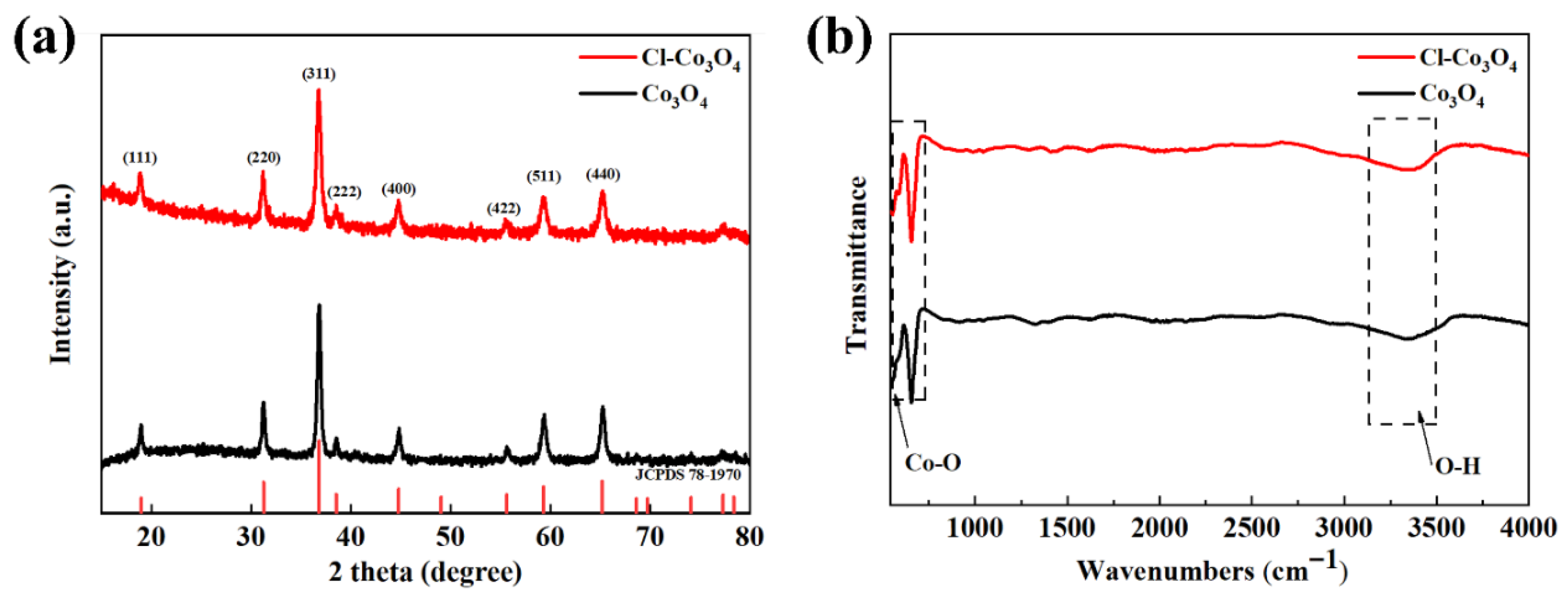
As illustrated in Figure 1a, the XRD patterns of both pristine Co3O4 and Cl-Co3O4 closely match the reference pattern for spinel-structured Co3O4 (JCPDS No. 78-1970) [31]. Distinct diffraction peaks appear at 2θ = 19.0°, 31.2°, 36.8°, 38.4°, 44.7°, 55.4°, 59.2°, and 61.5°, assignable to the (111), (220), (311), (222), (400), (422), (511), and (440) reflections, respectively, which are the hallmarks of the cubic inverse spinel framework. Figure 1a shows that the absence of extra or shifted peaks in Cl-Co3O4 confirmed that Cl substitution did not induce structural distortion or phase segregation as well as the host lattice remained intact. Nevertheless, a modest decrease in peak intensity was observed for the doped sample relative to its undoped counterpart, likely reflecting subtle lattice strain or a marginal reduction in long-range crystalline order induced by Cl incorporation [32]. To probe the surface chemical bonding and functional group composition of Cl-Co3O4, FTIR spectroscopy was employed. Figure 1b indicates that the FTIR spectra of pristine Co3O4 and Cl-Co3O4 were nearly superimposable in the fingerprint region, particularly between 400–800 cm−1, demonstrating retention of the fundamental spinel lattice upon chlorine incorporation. Specifically, two sharp, intense bands at ~560 cm−1 and ~660 cm−1 were assigned to the tetrahedral (A-site) and octahedral (B-site) Co-O stretching vibrations, respectively, which signified vibrational modes diagnostic of the normal spinel Co3O4 structure [31]. In addition, the persistence of these peaks confirms that the core crystallographic framework is not disrupted by Cl doping. Furthermore, a broad absorption band centered at ~3400 cm−1 arises from O-H stretching vibrations of physisorbed water and surface hydroxyl groups, a ubiquitous feature reflecting ambient moisture uptake on transition metal oxide surfaces.
Compared with pure-phase Co3O4, neither new obvious characteristic absorption peaks appeared in the infrared spectrum of Cl-Co3O4, nor the positions, shapes and relative intensities of the original characteristic peaks changed significantly. The above results indicated that under the doping conditions of this experiment, Cl mainly entered the Co3O4 system in the form of anion doping or surface adsorption, and did not form new covalent chemical bonds or characteristic functional groups on the material surface. The introduction of Cl did not destroy the original crystal coordination environment and main chemical bond structure of Co3O4. The regulation effect on the physicochemical properties and catalytic performance of the material was not attributed to the generation of new functional groups. Instead, it was more likely related to doping-induced redistribution of the electronic structure, changes in the oxygen vacancy concentration, and modulation of the surface charge state [32].

2.1.2. Scanning Electron Microscopy

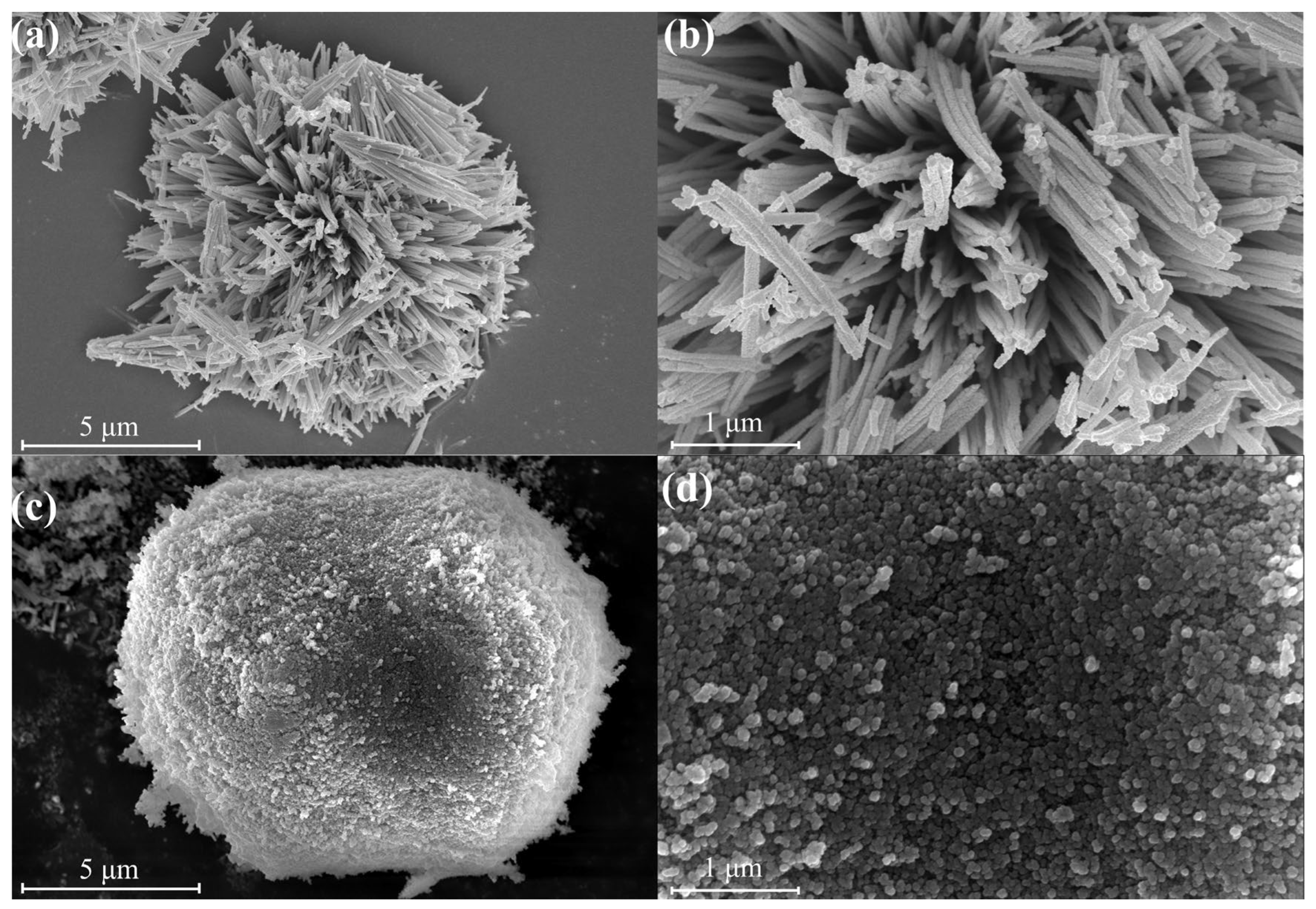
As displayed in Figure 2, chlorine doping induces a marked morphological transition of Co3O4 from a porous flower-like assembly to a dense spherical structure. The undoped sample consists of radially aligned ultrathin nanosheets (Figure 2a,b), forming an interconnected mesoporous network with inter-sheet gaps of 20–50 nm. In contrast, Cl-Co3O4 exhibits compact, smooth-surfaced spherical particles built from tightly packed nanocrystals, with significantly reduced porosity (Figure 2c,d). This compaction is attributed to the substitution of O2− (1.40 Å) by the larger Cl ion (1.81 Å), which introduces local lattice strain and distortion. To relieve this strain, the crystal growth favors a more close-packed arrangement, ultimately yielding dense spherical morphology [33]. The Cl-Co3O4 sample exhibits a dense spherical morphology, which is a morphological consequence of Cl incorporation rather than a contributor to the enhanced catalytic performance. Notably, compared with the flower-like pristine Co3O4, this dense spherical structure possesses a lower specific surface area. Therefore, the improved activity cannot be explained by morphological advantages; instead, it should be exclusively attributed to the electronic structure modulation induced by Cl doping, as will be elaborated in the following sections.
The dense spherical structure of Cl-Co3O4 possesses better structural stability. In the PMS activation reaction system, the highly oxidative free radical environment may cause corrosion and structural damage to the catalyst surface. The nanosheet structure of flower-like Co3O4 was relatively fragile and was prone to structural collapse or loss of active components under intense reaction conditions, leading to rapid decline in catalytic activity. In contrast, the dense spherical particles of Cl-Co3O4 were composed of closely packed nanoparticles, and the overall structure was more stable, effectively resisting mechanical stress and chemical corrosion during the reaction process, demonstrating superior cycling stability.
The EDS elemental distribution analysis results were shown in Figure S1a–e. For the pure Co3O4 sample, the Co element (Figure S1a) and O element (Figure S1b) were uniformly distributed in the flower-like microsphere region, which was in complete correspondence with the SEM morphology, confirming the uniform distribution characteristics of Co and O elements in the Co3O4 sample. For the Cl-Co3O4 sample, the Co element (Figure S1c), O element (Figure S1d), and Cl element (Figure S1e) all showed uniform distribution features. The uniform distribution of the Cl element indicated that the Cl element had been successfully doped into the Co3O4 lattice without obvious element segregation or local enrichment. The EDS analysis results verified the successful preparation of Cl-Co3O4 materials.

2.1.3. X-Ray Photoelectron Spectroscopy

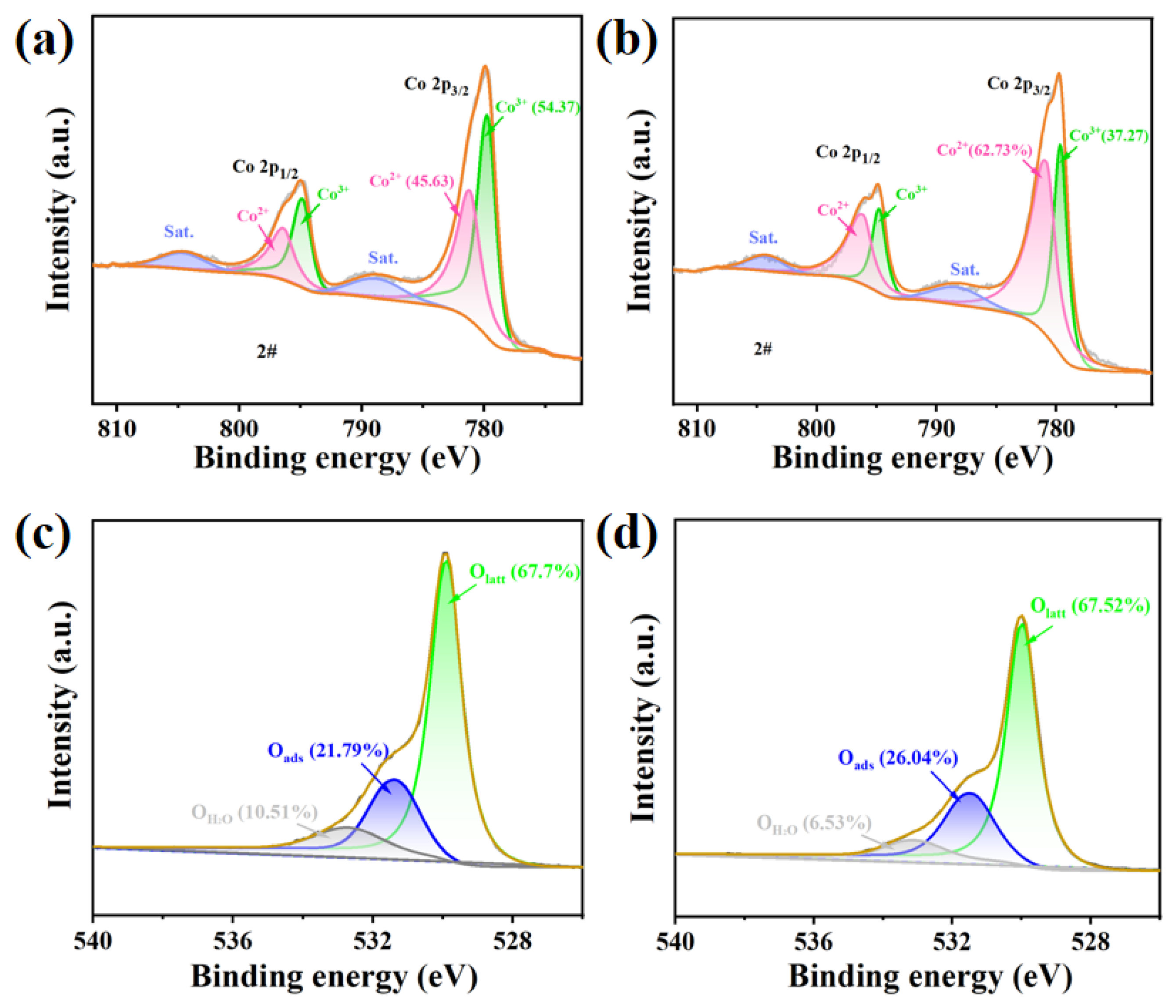
The surface chemical states of pristine Co3O4 and Cl-Co3O4 were investigated by XPS, as summarized in Figure 3 and Figure S2. The survey spectra (Figure S2a,b) display characteristic Co 2p, O 1s, and C 1s peaks for both samples. Notably, a distinct Cl 2p signal appears exclusively in the Cl-Co3O4 spectrum, directly confirming the successful incorporation of chlorine into the Co3O4 lattice. The Co 2p core-level spectra (Figure 3a,b) of both samples exhibit typical spin–orbit doublets (Co 2p3/2 and Co 2p1/2) accompanied by satellite features, consistent with previous reports [34,35]. Peak fitting of the Co 2p3/2 region resolves two contributions: a lower-binding-energy component at ~779.80 eV assigned to Co3+, and a higher-binding-energy component at ~781.50 eV corresponding to Co2+. Quantitative analysis reveals that Cl doping significantly alters the Co2+/Co3+ ratio. In pristine Co3O4, the relative contents of Co2+ and Co3+ are 45.63% and 54.37%, respectively. After Cl incorporation, the Co2+ content rises markedly to 62.73%, while Co3+ drops to 37.27%. Such an increase in Co2+ proportion suggests that Cl substitution promotes the reduction of Co3+ to Co2+, likely accompanied by the generation of oxygen vacancies to maintain charge neutrality.
The O 1s high-resolution spectra (Figure 3c,d) further support this interpretation. Three deconvoluted peaks are identified: lattice oxygen (Olatt) at ~529.50 eV, surface-adsorbed oxygen species (Oads) at ~531.20 eV, and hydroxyl or molecular water (OH2O) at ~533.0 eV. Compared with pristine Co3O4, Cl-Co3O4 exhibits a higher Oads content (26.04% vs. 21.79%) and a lower OH2O content (6.53% vs. 10.51%). The increase in adsorbed oxygen is widely recognized as an indicator of enriched surface oxygen vacancies. This trend is fully consistent with the observed rise in Co2+ concentration, collectively demonstrating that chlorine doping effectively tailors the surface electronic structure and oxygen vacancy density of Co3O4, which may enhance its catalytic activity in PMS activation.

2.2. Catalytic Performance of Chlorine-Doped Co3O4

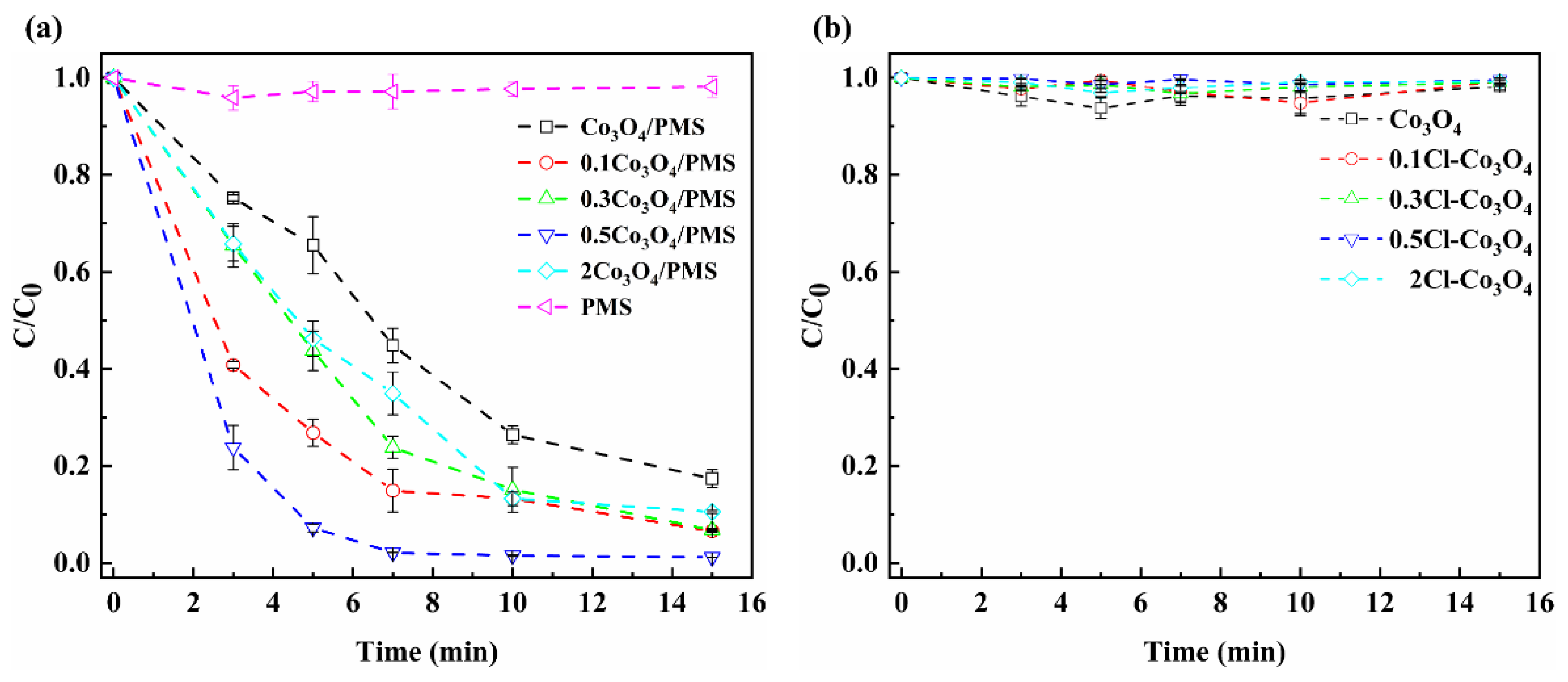
Figure 4 illustrates the adsorption behavior and catalytic degradation performance of BPA in different systems. As depicted in Figure 4a, PMS alone exhibited a negligible removal of BPA within 15 min, indicating its limited intrinsic oxidation capacity [36]. Upon the addition of pristine Co3O4, the removal efficiency of the Co3O4/PMS system increased significantly to approximately 80.71%. In comparison, the Cl-Co3O4/PMS systems displayed vastly superior catalytic performance. Notably, the Cl-Co3O4/PMS system achieved an exceptional removal efficiency of 98.79% within 15 min, resulting in the near–complete elimination of BPA. This underscores that Cl-doping substantially boosts the catalytic efficiency of Co3O4 for PMS activation to generate reactive species. Furthermore, Figure 4b presents the adsorption kinetics of BPA over pristine Co3O4 and four Co3O4 variants with varying Cl-doping ratios (0.10, 0.30, 0.50, and 2.0). The results revealed that none of the materials exhibited obvious physical adsorption towards BPA. Taking these observations together, it can be concluded that the contribution of physical adsorption to BPA removal is negligible. The highly efficient elimination of BPA is exclusively attributed to the catalytic oxidation process driven by the Co3O4/PMS system, confirming that the Cl-doping strategy effectively optimizes the intrinsic catalytic activity of the material.
To evaluate the versatility of the catalytic system, Figure S3 compares the degradation performance of five typical organic pollutants in the Co3O4/PMS and Cl-Co3O4/PMS systems. As illustrated in Figure S3a–e, the degradation efficiency of the Cl-Co3O4/PMS system was significantly superior to that of pristine Co3O4/PMS. Specifically, the Cl-Co3O4/PMS system achieved near-complete elimination of sulfachlorpyridazine sodium (SCP) within 6 min, and over 95.21% removal for BPA, sulfamethoxazole (SMX), and sulfadiazine (SDZ) within 10–14 min. In stark contrast, the pristine Co3O4/PMS system only yielded removal efficiencies of 80.71% for BPA and 30.22% for Phenol after 16 min. The pseudo-first-order rate constants (kobs, Figure S3f) further quantitatively confirmed this trend. In the Cl-Co3O4/PMS system, the rate constants followed the order of SCP (~0.40 min−1) > BPA (~0.25 min−1) > SDZ ≈ SMX (0.15~0.20 min−1) > Phenol (~0.05 min−1). This rate discrepancy (up to 8-fold) primarily originates from the distinct molecular structures of the substrates. Sulfonamides (SCP, SDZ, SMX) contain easily oxidizable sulfonamide groups and heterocycles, leading to their rapid degradation [37,38]. In contrast, phenol degraded the slowest because of the high stability of its benzene ring. In summary, Cl-doping not only remarkably boosts the intrinsic catalytic activity of Co3O4, but also endows the system with an excellent broad-spectrum applicability for diverse organic pollutants.

2.3. Effects of Reaction Conditions

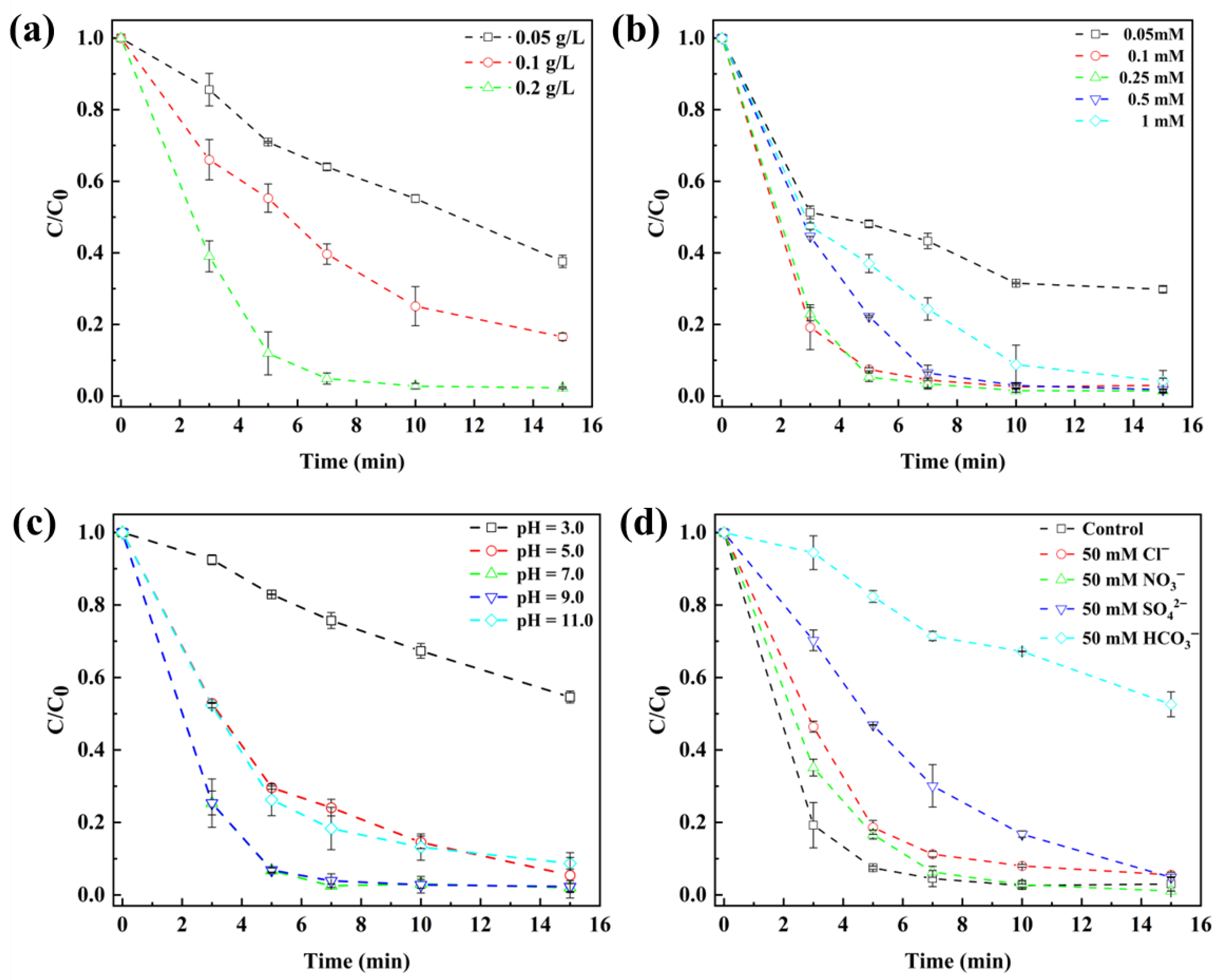
The effects of key reaction parameters on BPA degradation by the Cl-Co3O4/PMS system are summarized in Figure 5 and Figure S4. Increasing the catalyst dosage from 0.05 to 0.20 g/L led to a sharp rise in the 15 min removal efficiency (from 62.38% to nearly 100%), with the corresponding pseudo-first-order rate constant (kobs) increasing from 0.06 to 0.32 min−1. This positive correlation reflects the availability of more active sites for PMS activation and radical generation [39,40]. In contrast, the PMS concentration showed a non-monotonic influence. The kobs peaked at 0.37 min−1 with 0.10 mM PMS but declined to 0.23 min−1 when the concentration was raised to 1.0 mM. A moderate PMS level supplies sufficient precursors for sulfate and hydroxyl radicals (SO4 and HO•). However, excessive PMS not only blocks surface active sites but also induces radical-scavenging side reactions [41,42]. Hence, the optimal conditions were identified as 0.20 g/L catalyst and 0.10 mM PMS.
Initial solution pH exerted a bell-shaped effect on the degradation kinetics. Strongly acidic conditions (pH 3.0) severely suppressed the reaction (kobs = 0.03 min−1), attributed to catalyst surface protonation and H+-mediated quenching of SO4. The best performance occurred at near-neutral to weakly alkaline pH (7.0–9.0), where nearly complete BPA removal was achieved within 6 min and the maximum kobs reached 0.37 min−1. Under these conditions, the predominant PMS species is HSO5, which is readily activated. At pH 11.0, the BPA degradation dropped (kobs = 0.18 min−1), as PMS tends to decompose into low-activity SO52− and excessive OH vigorously scavenges radicals [41,42]. The robust activity in the pH range of 7.0–9.0 underscores the practical potential of the Cl-Co3O4/PMS system.
The influence of common coexisting anions (50 mM) was also evaluated (Figure 5d and Figure S4). The inhibitory effect followed the order of HCO3 > SO42− > Cl > NO3, with kobs values decreasing to 0.05, 0.18, 0.23, and 0.33 min−1, respectively. High concentrations of Cl and NO3 cause only mild inhibition due to their moderate radical-scavenging ability [43]. SO42− primarily hinders the reaction by competing with PMS for adsorption on active sites. The most severe suppression by HCO3 arises from its dual role: it is an efficient radical quencher that converts SO4 and HO• into the less reactive CO3, and its buffering capacity shifts the solution pH to a less favorable range [44]. These results provided valuable guidance for applying the Cl-Co3O4/PMS process in realistic water matrices.
The cycling stability of a catalyst is crucial for evaluating its practical application value. As shown in Figure S5a, Cl-Co3O4 maintained excellent catalytic activity over six consecutive cycles. The BPA removal rate within 15 min slightly decreased from 98.79% in the 1st cycle to 97.18% in the 2nd cycle, and remained stable at around 91.21% in the 3rd and 4th cycles. It remained above 90.03% even in the 5th cycle. The minor activity loss of merely 9.97% indicates the outstanding reusability of the Cl-Co3O4 catalyst. Moreover, the leaching of cobalt ions during the cycling tests was monitored. As shown in Figure S5b, the maximum leaching concentration of cobalt ions is 0.3368 mg/L, which is far below the Chinese drinking water standard (Co ≤ 1.0 mg/L, [45]), confirming negligible secondary metal pollution. As a heterogeneous catalyst, its facile separation and recovery, coupled with the minimal cobalt leaching, significantly improve process economics and reduce water treatment costs, demonstrating great potential for practical applications.

2.4. Investigation of the Reaction Mechanism

2.4.1. Identification of the Main Reactive Species

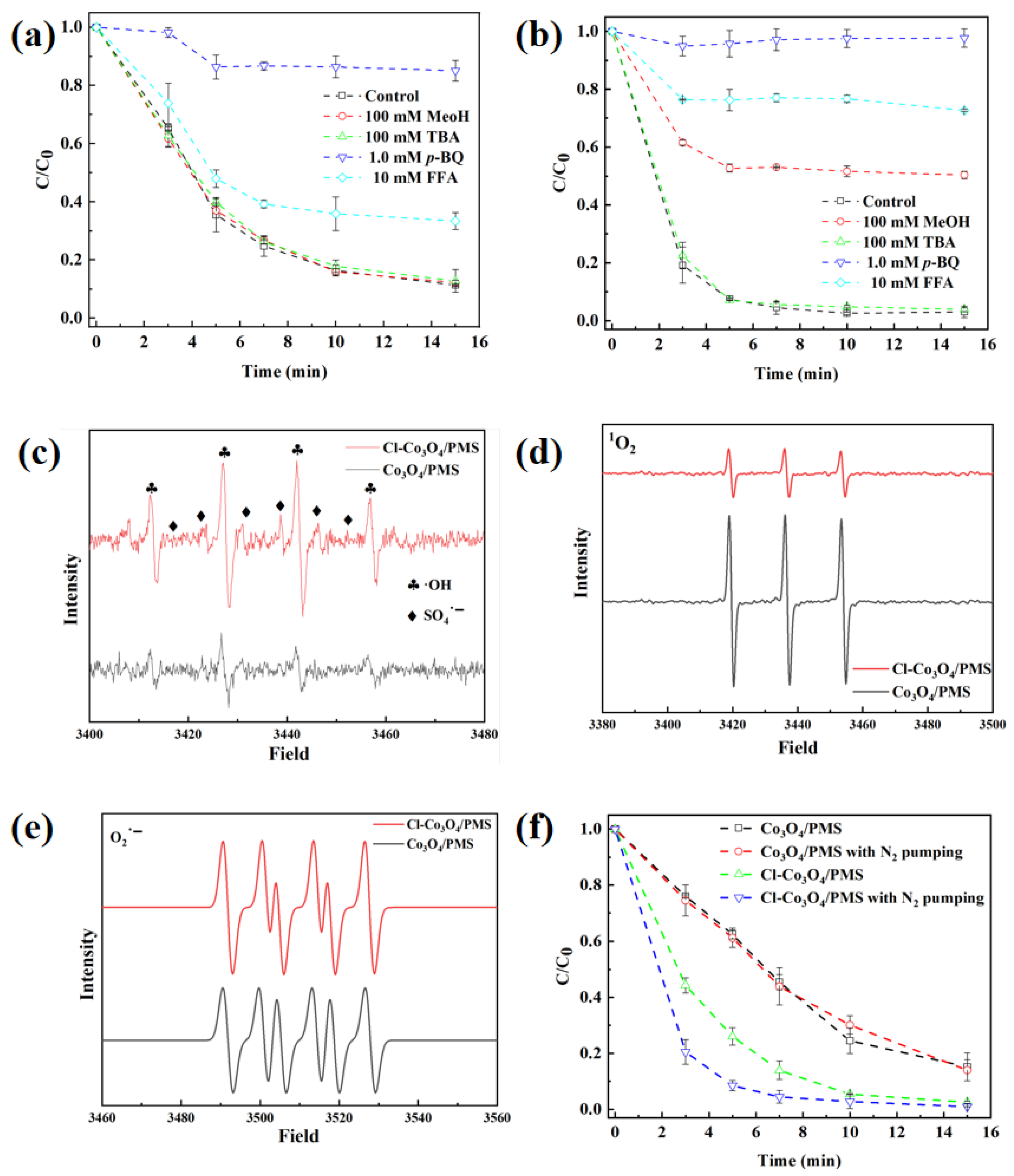
Figure 6a shows the quenching results of the Co3O4/PMS system. In the control group (without quencher), the BPA removal reached 88.71% within 15 min. After adding 100 mM methanol (MeOH) or 100 mM tert-butyl alcohol (TBA), the degradation curves almost overlapped with that of the control, with inhibition ratios of only 4.12% and 8.37%, respectively. Methanol quenches both SO4 and HO•, whereas TBA selectively quenches HO• [46]. These results suggest that HO• and SO4 contribute only marginally to BPA degradation in the Co3O4/PMS system. However, upon addition of 1 mM p-benzoquinone (p-BQ), BPA degradation was strongly suppressed, giving an inhibition ratio of 88.40%. With 10 mM furfuryl alcohol (FFA), the degradation rate also decreased, and the C/C0 value was 0.35 at 16 min, corresponding to 68.21% inhibition. Given that p−BQ is an effective quencher for O2 and FFA is a selective quencher for 1O2, these results indicate that O2 is the dominant reactive species in the Co3O4/PMS system, while 1O2 may also make a certain contribution.
Figure 6b displays the quenching results of the Cl-Co3O4/PMS system. The quenching pattern differs markedly from that of the Co3O4/PMS system. After adding 100 mM methanol, BPA degradation was significantly inhibited. Because methanol quenches both SO4 and HO•, this observation suggests that either SO4 or HO• plays an important role in the Cl-Co3O4/PMS system. Upon addition of 100 mM TBA, the degradation curve was slightly higher than that of the control, indicating a relatively limited contribution of HO•. Therefore, the pronounced inhibition by methanol is mainly attributed to quenching of SO4. The addition of 1.0 mM p-BQ almost completely suppressed BPA degradation, yielding the strongest inhibition, which confirms that O2 remains a key reactive species in this system. With 10 mM FFA, the degradation rate clearly declined. However, given that FFA can undergo competitive adsorption on the catalyst surface, further validation via EPR and N2 purging was necessary to clarify the exact role of 1O2 (as discussed in the following section).
A comparison of the quenching results between the two systems reveals that Cl doping substantially changes the composition and relative contributions of the reactive species. In the Co3O4/PMS system, O2 is the dominant reactive species, whereas the contributions of SO4 and HO• are negligible. In contrast, for the Cl-Co3O4/PMS system, besides O2 still being the major species, the contribution of SO4 significantly increases and the role of 1O2 is also enhanced. This change is likely related to Cl doping altering the electronic structure and surface properties of Co3O4, thereby promoting the conversion of PMS into multiple reactive species. Cl doping probably accelerates PMS activation by enhancing the efficiency of the Co3+/Co2+ redox cycle, and simultaneously facilitates both the radical pathway (generating SO4) and the non-radical pathway, leading to a marked improvement in catalytic degradation efficiency.
Quenching experiments (Figure 6) suggested multiple reactive species involved in BPA degradation in the Cl-Co3O4/PMS system, which was further confirmed by EPR spectroscopy and probe compound tests. Figure 6c showed typical peaks of DMPO/SO4 and DMPO/HO• adducts in both Cl-Co3O4/PMS and Co3O4/PMS systems, with significantly higher signal intensities of the two radicals in the Cl-Co3O4 system, confirming Cl doping promotes radical generation.
Figure 6d revealed a weaker 1O2 signal in the Cl-Co3O4/PMS system than in the Co3O4/PMS system, which is consistent with Ref. [47]. However, N2 purging experiments (Figure 6f) showed no observable decrease in BPA degradation efficiency after the removal of dissolved oxygen, directly excluding the contribution of 1O2. This weaker EPR signal is entirely inconsistent with the disproportionately strong inhibition observed upon the addition of FFA, confirming that the FFA-induced inhibition originated solely from competitive adsorption on the catalyst surface. Consequently, 1O2 is ruled out from the degradation mechanism. Figure 6e displayed a stronger O2 signal in the Cl-doped system, in agreement with quenching results that identify O2 as a key reactive species and demonstrate that Cl doping enhances its generation. The negligible effect of N2 purging on degradation further indicates that O2 is derived from PMS activation rather than dissolved oxygen.
Figure S6 presents the results of reactive species verification experiments using benzoic acid (BA, a selective probe for HO•) and atrazine (ATZ, a selective probe for SO4). Figure S6a shows the degradation curves of BA in the Co3O4/PMS system, BA degradation was extremely low, with only 7.32% removal after 15 min, indicating very limited generation of HO• in this system. In contrast, the Cl-Co3O4/PMS system exhibited a significantly enhanced degradation capacity for BA, with a fast initial degradation rate that gradually slowed down, reaching 60.65% removal at 15 min. This result confirms that Cl doping markedly promotes the generation of HO•, consistent with the EPR detection showing a higher HO• signal intensity in the Cl-doped system. Figure S6b displays the degradation curves of ATZ: the Co3O4/PMS system also had a low degradation efficiency for ATZ, with only 35.21% removal after 15 min, suggesting limited generation of SO4 in this system. However, the Cl-Co3O4/PMS system displayed an extremely high degradation efficiency for ATZ, achieving 92.51% removal at 15 min. This strongly demonstrates that Cl doping significantly enhances the generation capacity of SO4, which is in excellent agreement with the pronounced inhibitory effect of methanol on this system, as observed in the quenching experiments. Collectively, the degradation results of the two probe compounds reveal that the degradation efficiency of ATZ (92.51%) in the Cl-Co3O4/PMS system is significantly higher than that of BA (60.65%), indicating that both the generation amount and reactivity of SO4 are higher than those of HO•. This is corroborated by the quenching experiment results, where methanol exerted a significant inhibitory effect, while tert-butanol (TBA) showed only a weak inhibitory effect. This further confirms that SO4 is the dominant radical species for pollutant degradation in this system, with HO• playing only a secondary role. These results provided direct experimental evidence for the reaction mechanism that Cl doping promotes PMS activation and enhances radical generation, and further solidify the core contribution of SO4 to BPA degradation in the Cl-Co3O4/PMS system.
Methyl phenyl sulfoxide (PMSO) is a characteristic probe compound for detecting high-valent metal species (e.g., Co(IV) = O), which can be selectively oxidized by high-valent metal species to produce methyl phenyl sulfone (PMSO2) through an oxygen-atom transfer reaction with high selectivity [48]. If high-valent metal species are present in the system, the amount of PMSO degraded should be approximately stoichiometric (1:1) with the amount of PMSO2 generated. Figure S7 shows the degradation curves of PMSO and the generation curves of PMSO2 in both Co3O4/PMS and Cl-Co3O4/PMS systems. From the PMSO degradation curves, both systems exhibited relatively low degradation efficiency toward PMSO, indicating that PMSO exhibits limited reactivity in these catalytic systems. More critically, the generation of PMSO2 was extremely low in both catalytic systems. These results clearly rule out the dominant role of high-valent metal species in the catalytic degradation process [49].

2.4.2. Electrochemical Measurements

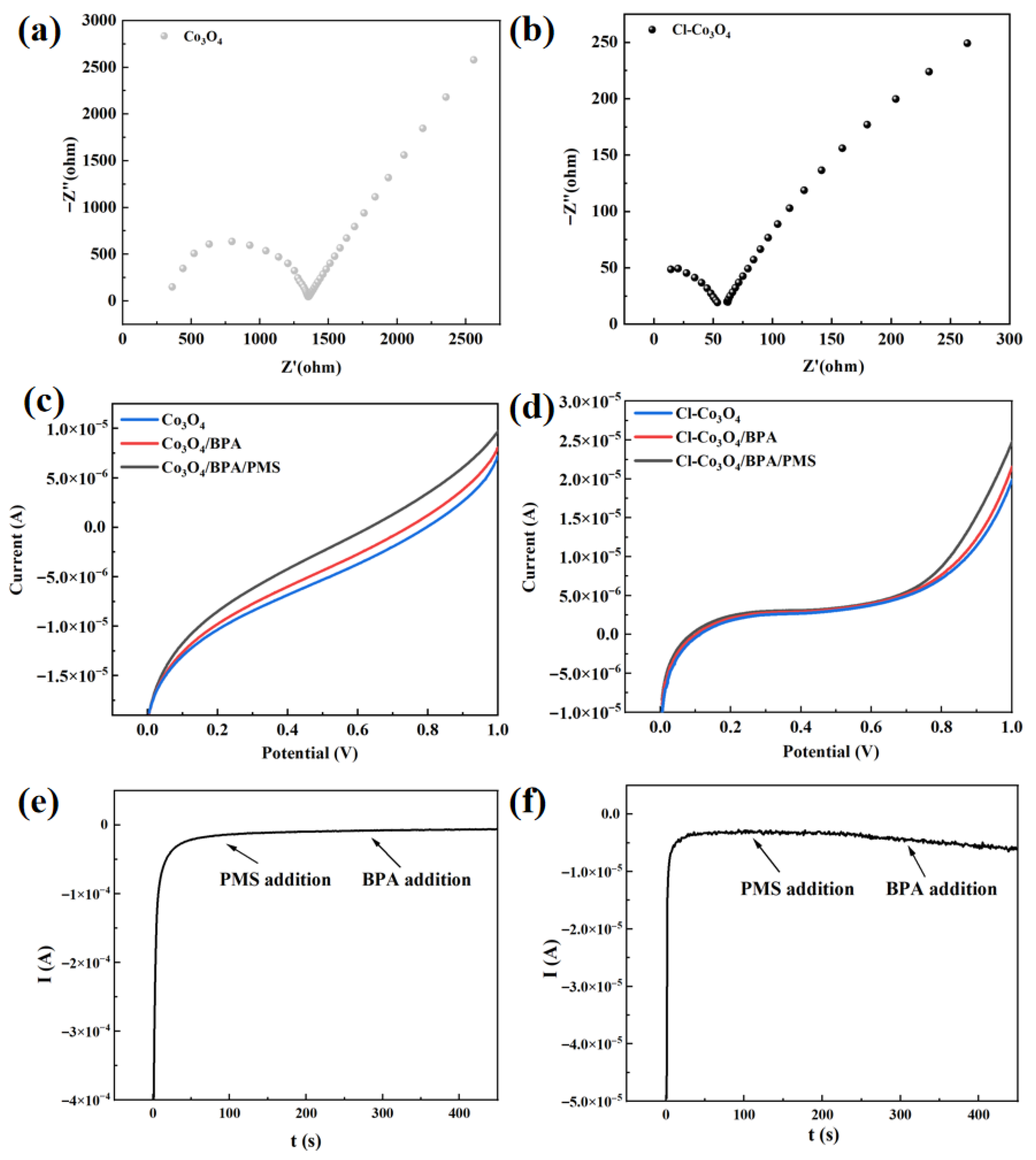
To unveil the intrinsic mechanism of the enhanced catalytic activity induced by Cl doping, electrochemical measurements were conducted. The electrochemical properties of pristine Co3O4 and Cl-Co3O4 were evaluated by electrochemical impedance spectroscopy (EIS) and linear sweep voltammetry (LSV), as presented in Figure 7. The Nyquist plots (Figure 7a,b) reveal a dramatic reduction in charge transfer resistance (Rct) upon chlorine doping: from ~1500 Ω for Co3O4 to only ~50 Ω for Cl-Co3O4, i.e., one-thirtieth of the pristine value. Such a sharp decrease indicates that Cl incorporation substantially enhances the electron conduction efficiency of the material [50,51]. This improvement is further corroborated by the LSV curves (Figure 7c,d). At an applied potential of 1.0 V, Cl-Co3O4 delivers a current response of 2.5 × 10⁻⁵ A, roughly three times that of pristine Co3O4 (~8.0 × 10⁻⁶ A), accompanied by a steeper slope. The markedly lowered Rct and enhanced electrocatalytic activity imply that Cl doping optimizes the surface electronic structure and accelerates the Co3+/Co2+ redox cycle. Consequently, electron transfer from the catalyst to PMS is significantly enhanced, which fundamentally accounts for the efficient generation of reactive radicals (e.g., SO4 and O2) in the Cl-Co3O4/PMS system, consistent with the quenching and EPR results.
To further elucidate the degradation pathway, chronoamperometric (i-t) measurements were conducted (Figure 7e,f) [52]. For pristine Co3O4, the current initially increases rapidly and then stabilizes into a plateau. Upon PMS addition at ~100 s, no significant current variation is observed. Crucially, subsequent addition of BPA at ~200 s also fails to induce any noticeable current response. An identical trend is seen for Cl-Co3O4: the current stabilizes during the initial stage, remains unchanged after PMS introduction, and stays at −1.0 × 10⁻⁵ A upon BPA addition. The absence of a current surge upon BPA addition in both catalysts demonstrates that direct electron transfer from BPA to the catalyst/PMS complex does not occur in either system. This result unequivocally rules out the involvement of a non-radical electron-transfer mechanism in the BPA degradation process, reinforcing the conclusion that radical-mediated pathways dominate the reaction.

2.4.3. Proposed Catalytic Mechanism

In the initial stage of the reaction, PMS molecules are first adsorbed onto the active sites on the Cl-Co3O4 surface. Cl doping optimizes the electronic structure of the material and significantly reduces the charge transfer resistance (from 1500 Ω to 50 Ω), creating favorable conditions for subsequent electron transfer processes. After PMS adsorption, Co2+ on the catalyst surface transfers one electron to PMS, causing cleavage of the O-O bond to generate SO4 and Co3+ (Equation (1)) [53]. Subsequently, Co3+ can react with another PMS molecule to produce SO5 and be reduced back to Co2+ (Equation (2)), completing the Co3+/Co2+ redox cycle [54]. SO5 further decomposes to generate O2 (Equation (3)), while a portion of SO4 can react with H2O to produce HO• (Equation (4)). The quenching experiments and EPR results indicate that O2 and SO4 are the major reactive species for BPA degradation, with HO• playing a secondary role. Although EPR detection confirmed the presence of 1O2, the BPA degradation efficiency did not decrease significantly after removing dissolved oxygen in the N2 purging experiments, suggesting that 1O2 makes a limited contribution to BPA degradation. The PMSO probe experiments ruled out oxygen-atom transfer mediated by high-valent cobalt species (e.g., Co(IV) = O) [55]. In the chronoamperometry (i-t) test under open-circuit potential, no significant current change was observed upon BPA addition, further confirming the absence of a non-radical electron transfer mechanism. Cl doping not only improves the efficiency of the Co3+/Co2+ redox cycle, but also promotes the efficient generation of radicals during PMS activation.
Co2+ + HSO5 → Co3+ + SO4 + OH
Co3+ + HSO5 → Co2+ + SO5 + H+
SO5 → O2 + SO4/SO5 + H2O → O2 + SO42− + 2H+
SO4 + H2O → HO• + SO42− + H+

2.5. Degradation Pathway and Toxicity Analysis of BPA

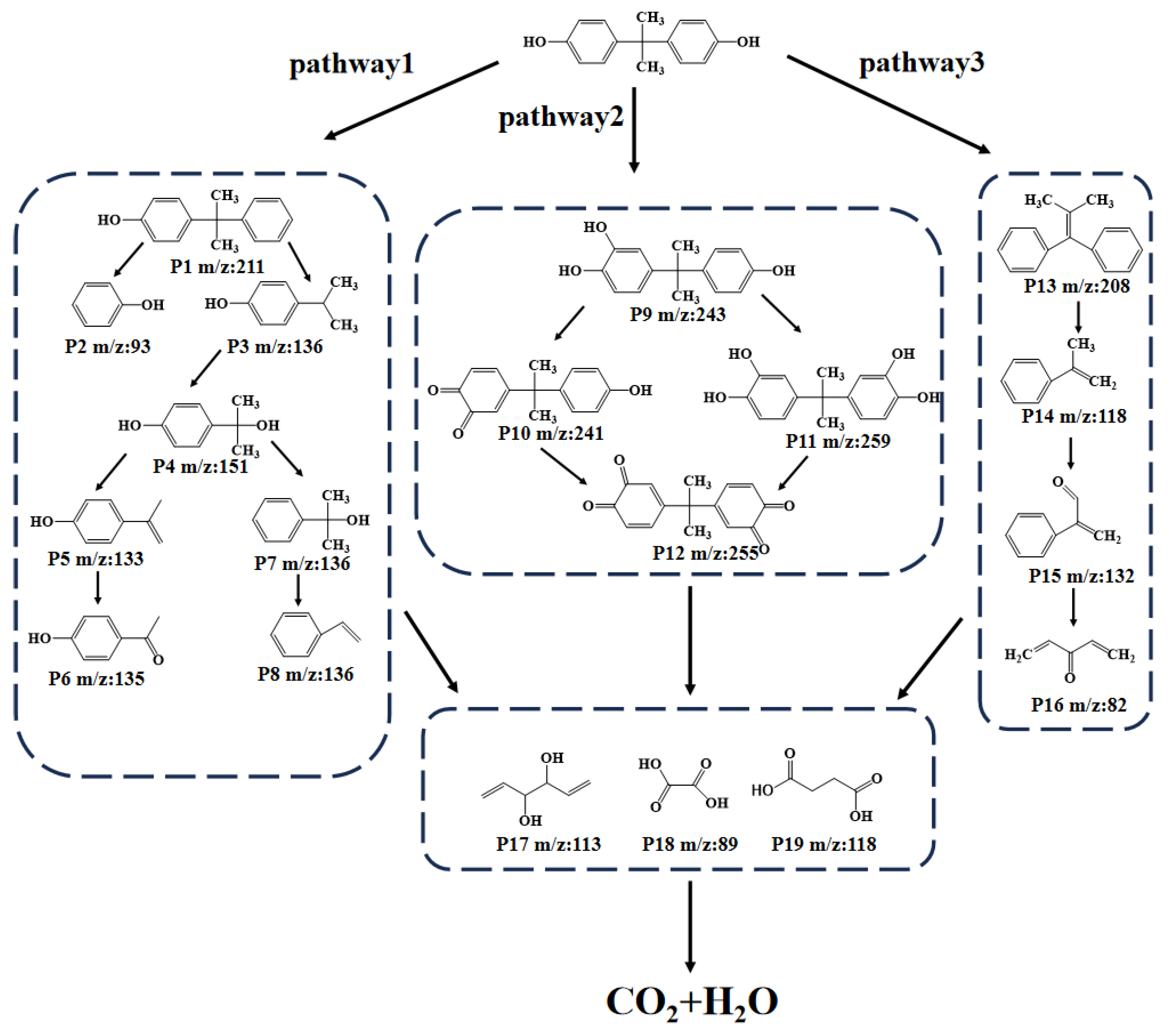
To elucidate the possible degradation pathways of BPA, liquid chromatography-mass spectrometry (LC-MS) was employed to identify the intermediate products generated during the catalytic reaction. BPA and its degradation products detected by LC-MS are shown in Figure S8. Based on the identified intermediates, three major degradation pathways of BPA are presented in Figure 8. In Pathway 1, the electron-rich alkyl carbon atom is attacked and converted to P4 (4-isopropanolphenol). The subsequent oxidation of P4 proceeds through two parallel routes: one leads to P5 (p-isopropenylphenol) via dehydrogenation, while the other yields P6 (4-hydroxyacetophenone) through further hydroxylation and C-C bond scission. Such dual-route behavior is commonly observed in SO4-dominated AOP systems, where the high redox potential of SO4 (2.5–3.1 V) facilitates successive electron transfer steps [56]. The aromatic ring of P9 may be further attacked to form P11 (dihydroxylated bisphenol A), which can be oxidized to P12 (a quinone derivative of dihydroxylated bisphenol A). The formation of quinoid intermediates is particularly significant, as these species exhibit altered electronic structures that can either enhance or reduce subsequent reactivity depending on the prevailing radical environment [57]. The C-O bond on the benzene ring is cleaved, and the hydroxyl group is removed from BPA to form P13 (diphenyl,2-methylprop-1-ene-1,1-diyl). By breaking the C-C bond connecting the two benzene rings, this product can be further degraded to P14 (prop-1-en-2-ylbenzene). Subsequently, these single-ring intermediates may be oxidized to P16. Finally, the small molecules lose electrons and undergo oxidation, leading to further ring cleavage and eventual mineralization to CO2 and H2O [56,58].
After elucidating BPA degradation pathways, the ecological toxicity of BPA and its 19 intermediates was further predicted and evaluated using ECOSAR to comprehensively assess the environmental safety of the Cl-Co3O4/PMS system. Figure S9 presents acute and chronic toxicity data for three typical aquatic organisms (fish, daphnid, green algae) as a heatmap. For acute toxicity (evaluated by Log(LC50/EC50), higher values = lower toxicity), BPA and initial products P1–P5 showed relatively high toxicity. This initial persistence of toxicity can be rationalized by the structural similarity between these early intermediates and the parent compound; even after the first attack by radicals, the phenolic rings and the central isopropylidene bridge remain largely intact, preserving the endocrine-disrupting structural motif [59]. As degradation proceeded, intermediates P6–P12 exhibited reduced toxicity, while late-stage products P17–P19 had significantly lower acute toxicity (Log values 3–6). For chronic toxicity (evaluated by Log(Chv), higher values = lower toxicity), a similar trend was observed: BPA had high chronic toxicity, whereas P17–P19 showed much lower chronic toxicity.
Overall, toxicity gradually decreased during degradation. Initial partial structural disruption slightly reduced toxicity, while subsequent benzene ring opening and alkyl chain cleavage produced small molecules with further reduced toxicity. Final products P17–P19 were nearly completely detoxified. These results demonstrate that the Cl-Co3O4/PMS system efficiently removes BPA and effectively reduces the ecological toxicity of its degradation products, providing a critical basis for its safe application in actual water treatment.

3. Materials and Methods

3.1. Chemicals

The details of chemicals and reagents were provided in Text S1 in Supporting Information (SI).

3.2. Material Characterizations

The microscopic nanostructures and elemental compositions of Co3O4 were observed through scanning electron microscope (SEM) (including an energy dispersive spectrometer detector). The model of the SEM was Gemini 500, produced by Zeiss of Oberkochen, Germany. The phase and crystal structure of Co3O4 were characterized by X-ray diffraction (XRD) (X’Pert PRO, PANalytical Co., Almelo, The Netherlands): a Cu target Kα ray (λ = 0.15 nm) was selected, with a voltage of 40 kV and a current of 40 mA, and the diffraction angle (2θ) range was from 10° to 80°, with a scanning rate of 10° min−1. The elemental composition and the valence states and forms of each element of Co3O4 were analyzed by XPS. The instrument model of XPS was Thermo Scientific K-Alpha (Waltham, MA, USA). The elemental composition was obtained from the full spectrum of XPS, and the valence states and existence forms of each element were obtained from the fine spectra of each element. The valence bonds existing in Co3O4 were analyzed by Fourier transform infrared spectroscopy (FTIR, Thermo Fisher Scientific, Newark, DE, USA). The instrument model of FTIR was Nicolet 6700, produced by Thermo Fisher Scientific of the United States. The scanning range of FTIR was 400–4000 cm−1. The electron paramagnetic resonance (EPR) determination of different Co3O4 was carried out, with the instrument model being Bruker EMXplus (Billerica, MA, USA).

3.3. Synthesis of Cl-Co3O4 Materials

A homogeneous aqueous solution was prepared by dissolving cobalt(II) nitrate hexahydrate (Co(NO3)2·6H2O), urea (CO(NH2)2), and ammonium chloride (NH4Cl) in 80 mL of deionized water at carefully controlled molar ratios. The reagents were added sequentially under gentle agitation to avoid localized concentration gradients, and the resulting mixture was subjected to vigorous magnetic stirring at room temperature for 30 min to ensure full dissolution and molecular-level homogeneity, yielding a clear, translucent pink solution characteristic of Co2+-urea-chloride complex formation. After the aforementioned stirring operation, the well-mixed solution was then quantitatively transferred into a 100 mL polytetrafluoroethylene (PTFE)-lined stainless steel autoclave, which was then heated in an oven to 120 °C and maintained at this temperature for 6 h. After natural cooling to ambient temperature for approximately 12 h, the solid product was thoroughly washed three times with deionized water to remove residual nitrates, ammonium salts, and unreacted urea, followed by two additional washes with anhydrous ethanol to eliminate organic impurities and facilitate solvent evaporation during drying. The purified solid was then transferred to a vacuum drying oven and dried at 60 °C overnight. Lastly, the dried powder was subjected to thermal treatment in a muffle furnace under ambient air, with the temperature ramped up at 5 °C/min to 350 °C, followed by a 2 h isothermal annealing step. Upon completion of the reaction and subsequent cooling to room temperature, the Cl-Co3O4 product was collected. A series of Cl-Co3O4 samples with varying chlorine incorporation levels were prepared by systematically adjusting the chlorine precursor dosage during synthesis.

3.4. Experimental Procedure

The catalytic degradation reaction of BPA was carried out on a magnetic stirrer with a stirring speed of 650 r/min. The reaction temperature was maintained at 24 ± 1 °C. All reactions were conducted in 100 mL beakers. The routine operation of the experiment was as follows: First, 100 mL of a 10 mg/L BPA solution was added to the beaker, then 0.2 g/L of solid catalyst and PMS solution were added to start the reaction. The reaction lasted for 15 min. Samples were taken at regular time intervals, with 1 mL of the suspension sample being taken each time. The sample was filtered through a 0.22 μm water-based filter membrane and 0.10 mol/L Na2S2O3 solution was immediately added to terminate the reaction. The initial pH of the reaction system was adjusted with 1.0 mol/L sodium hydroxide solution and 1.0 mol/L hydrochloric acid solution.

3.5. Analytical Methods

Details of the analytical methods are described in Text S2.

4. Conclusions

In conclusion, Cl doping significantly enhances the catalytic activity of Co3O4 for PMS activation toward BPA degradation. Under optimized conditions, the Cl-Co3O4/PMS system achieves nearly 98.79% BPA removal, with a degradation rate constant more than twice that of the pristine Co3O4/PMS system. Quenching experiments, EPR measurements and probe tests confirm that O2 and SO4 are the major reactive species, while high-valent metal species and non-radical electron transfer mechanisms are ruled out. Electrochemical tests reveal that Cl doping reduces the charge transfer resistance from ~1500 Ω to ~50 Ω and enhances the electrocatalytic activity by approximately three-fold, thereby accelerating the Co3+/Co2+ redox cycle and promoting radical generation. BPA is degraded via three pathways, and toxicity assessment shows that the ecological toxicity of the degradation products gradually decreases, with late-stage products exhibiting significantly lower toxicity than BPA. This work provides a promising Cl-Co3O4 catalyst for efficient and environmentally safe wastewater treatment.

Supplementary Materials

The following supporting information can be downloaded at: https://www.mdpi.com/article/10.3390/catal16050483/s1.

Author Contributions

Conceptualization, J.D.; Methodology, K.L. and J.H.; Software, J.H.; Validation, W.C.; Resources, K.L.; Data curation, Z.P. and W.C.; Writing—original draft, Z.P.; Writing—review & editing, J.D. and B.S.; Supervision, J.D. and B.S. All authors have read and agreed to the published version of the manuscript.

Funding

This research was funded by National Natural Science Foundation of China, grant number U24A20187, 51978618; Zhejiang Provincial Natural Science Foundation, grant number LZ24E080005.

Data Availability Statement

Data are contained within the article and Supplementary Materials.

Conflicts of Interest

The authors declare no conflict of interest.

References

  1. Yang, J.; Ding, Z.; Zhang, S.; Xia, M.; Wang, F.; Lei, W.; Wang, F.; Shi, M. Advanced monitoring and elimination of bisphenol A in aquatic environments: A critical review. J. Water Process Eng. 2026, 81, 109184. [Google Scholar] [CrossRef]
  2. Xiao, C.; Wang, L.; Zhou, Q.; Huang, X. Hazards of bisphenol A (BPA) exposure: A systematic review of plant toxicology studies. J. Hazard. Mater. 2020, 384, 121488. [Google Scholar] [CrossRef]
  3. Tang, Y.; Qin, G.; Qian, N.; Zeng, X.; Li, R.; Lai, K.P. Bisphenol A and its replacement chemicals as endocrine disruptors and obesogens. Environ. Chem. Ecotoxicol. 2025, 7, 696–705. [Google Scholar] [CrossRef]
  4. Zhang, X.; Guo, N.; Jin, H.; Liu, R.; Zhang, Z.; Cheng, C.; Fan, Z.; Zhang, G.; Xiao, M.; Wu, S.; et al. Bisphenol A drives di(2-ethylhexyl) phthalate promoting thyroid tumorigenesis via regulating HDAC6/PTEN and c-MYC signaling. J. Hazard. Mater. 2022, 425, 127911. [Google Scholar] [CrossRef]
  5. Inyinbor, A.A.; Vega-Ramírez, E.; Chaparro-Garnica, J.; Cazorla-Amoros, D. Fast kinetics of BPA adsorption onto biomass based activated carbons (ACs): Mechanism of adsorption and economic advantage. Sustain. Mater. Technol. 2026, 47, e01927. [Google Scholar] [CrossRef]
  6. Catherine, H.N.; Tan, K.-H.; Shih, Y.-H.; Doong, R.-A.; Manu, B.; Ding, J.-Y. Surface interaction of tetrabromobisphenol A, bisphenol A and phenol with graphene-based materials in water: Adsorption mechanism and thermodynamic effects. J. Hazard. Mater. Adv. 2023, 9, 100227. [Google Scholar] [CrossRef]
  7. Xu, H.; Zhang, W.; Zhu, S.; Shen, B.; Li, X.; Jiang, B.; Wang, L.; Corvini, P.F.X.; Häggblom, M.M.; Ji, R. Synergistic transformation of alkylbisphenols (BPA, BPE, and BPF) mediated by ammonia-oxidizing bacteria and heterotrophic bacteria in nitrifying activated sludge. J. Hazard. Mater. 2026, 505, 141472. [Google Scholar] [CrossRef]
  8. Wang, C.; Ren, S.; Cao, T.; Wang, J.; Peng, R.; Lv, Z.; Zhu, X.; Song, Y.; Na, J.; Mao, Y. Sulfate radicals-based advanced oxidation process (SR-AOPs): The future enabled by MOFs-based nanofibers. Chem. Eng. J. 2024, 496, 154352. [Google Scholar] [CrossRef]
  9. Jun, B.; Choi, J.; Son, Y. Ultrasonic Activation of Persulfate for the Removal of BPA in 20, 28 and 300 kHz Systems. Ultrason. Sonochem. 2025, 114, 107281. [Google Scholar] [CrossRef]
  10. Wang, Z.; Wang, Z.; Li, W.; Lan, Y.; Chen, C. Performance comparison and mechanism investigation of Co3O4-modified different crystallographic MnO2 (α, β, γ, and δ) as an activator of peroxymonosulfate (PMS) for sulfisoxazole degradation. Chem. Eng. J. 2022, 427, 130888. [Google Scholar] [CrossRef]
  11. Shao, B.; Hu, C.; Zhao, H.; Xiao, C.; Du, E.; Cai, A.; Deng, J. Degradation of ambroxol by UV/chloramine process: Kinetics, degradation pathway, and control of the risk of highly toxic disinfection by-products. Environ. Pollut. 2024, 363, 125091. [Google Scholar] [CrossRef]
  12. Zheng, H.; Huang, S.; Huang, J.; Xu, M.; Shao, B.; Ma, X.; Zhou, S.; Deng, J. Trade-offs in microplastic-adsorbed iopamidol degradation by UV-AOPs: Molecular-level insights into deiodination pathways versus iodinated disinfection by-products formation. Water Res. 2025, 286, 124234. [Google Scholar] [CrossRef] [PubMed]
  13. Mojiri, A.; Zhou, J.L.; Farahani, S. Advancements in photocatalysis and machine learning for bisphenol A (BPA) degradation in aquatic systems: A critical review. J. Clean. Prod. 2025, 518, 145919. [Google Scholar] [CrossRef]
  14. Gao, Y.-Q.; Rao, Y.-Y.; Ning, H.; Chen, J.-X.; Zeng, Q.; Tian, F.-X.; Gao, N.-Y. Comparative investigation of diclofenac degradation by Fe2+/chlorine and Fe2+/PMS processes. Sep. Purif. Technol. 2022, 297, 121555. [Google Scholar] [CrossRef]
  15. Zhou, X.; Luo, H.; Sheng, B.; Chen, X.; Wang, Y.; Chen, Q.; Zhou, J. Cu2+/Cu+ cycle promoted PMS decomposition with the assistance of Mo for the degradation of organic pollutant. J. Hazard. Mater. 2021, 411, 125050. [Google Scholar] [CrossRef]
  16. Liao, Y.; Sun, W.; Yang, Y.; Zhang, T.-T.; Zhang, J.; Li, T.; Weng, B.; Younas, M.; Qiu, Z. Carbon cloth supported MOF-derived Co3O4 catalyst for membrane catalytic reactor assembly: Antibiotics degradation and hospital wastewater treatment. Chem. Eng. J. 2026, 535, 175386. [Google Scholar] [CrossRef]
  17. Sheng, J.; Liu, L.; Li, W.; Xu, J.; Wu, H.; Jiang, H. Synergistic regulation of S/C dual vacancies in Co3O4@SC for 1O2-dominated peroxymonosulfate activation: Mechanism and herbicide degradation. Chem. Eng. J. 2026, 528, 172268. [Google Scholar] [CrossRef]
  18. Chen, Z.; Bao, Y.; Ran, M.; Wang, J.; Cao, J.; Jia, D.; Xing, M. Phenoxyl radical-mediated peroxymonosulfate activation for efficient water remediation. Water Res. 2026, 297, 125682. [Google Scholar] [CrossRef]
  19. Zhu, G.; Tan, W.; Gu, T.; Dou, A.; Xu, Q. Influence of Co3O4 crystal planes on peroxymonosulfate activation: Reactive oxygen species generation and pollutant degradation. Appl. Surf. Sci. 2025, 709, 163742. [Google Scholar] [CrossRef]
  20. Zeng, H.; Ling, X.; Zhu, H.; Deng, J.; Ma, X.; Zhang, H.; Deng, L.; Shi, Z.; Li, X. Unraveling spongy Co3O4 mediated activation of peroxymonosulfate: Overlooked involvement of instantaneously produced high-valent-cobalt-oxo. Chemosphere 2022, 305, 135323. [Google Scholar] [CrossRef] [PubMed]
  21. Zhao, C.; Jiang, Z.; Zhang, B.; Li, Z.; Zhou, X.; Xiao, L.; Zhang, W.; Zhang, Y. Unveiling the size and surface effects of spinel Co3O4 on the activity of oxygen evolution. Nano Today 2026, 68, 103004. [Google Scholar] [CrossRef]
  22. Chong, L.; Gao, G.; Wen, J.; Li, H.; Xu, H.; Green, Z.; Sugar, J.D.; Kropf, A.J.; Xu, W.; Lin, X.M.; et al. La- and Mn-doped cobalt spinel oxygen evolution catalyst for proton exchange membrane electrolysis. Science 2023, 380, 609–616, Correction in Science 2025, 388, eadz5020. [Google Scholar] [CrossRef]
  23. Yu, X.; Wang, Q.; Zhu, B.; Wang, S.; Zhang, J.; Chen, C. Modulating the coordination environment of Co for enhanced near-infrared photothermal catalytic biomass conversion. Chem. Eng. J. 2026, 530, 173816. [Google Scholar] [CrossRef]
  24. Li, G.; Yin, F.; Lei, Z.; Zhao, X.; He, X.; Li, Z.; Yu, X. Se-doped cobalt oxide nanoparticle as highly-efficient electrocatalyst for oxygen evolution reaction. Int. J. Hydrogen Energy 2022, 47, 216–227. [Google Scholar] [CrossRef]
  25. Chen, H.; Yang, Y.; Li, X.; Duan, H. Engineering N-Co3O4 support to stabilize active Pd structures for methane combustion with enhanced activity and water resistance. J. Alloys Compd. 2025, 1039, 183198. [Google Scholar] [CrossRef]
  26. Shenashen, M.A.; Hassen, D.; El-Safty, S.A.; Isago, H.; Elmarakbi, A.; Yamaguchi, H. Axially oriented tubercle vein and X-crossed sheet of N-Co3O4@C hierarchical mesoarchitectures as potential heterogeneous catalysts for methanol oxidation reaction. Chem. Eng. J. 2017, 313, 83–98. [Google Scholar] [CrossRef]
  27. Meng, W.; Li, X.; Zhang, Y.; Wan, H.; Liu, C.; Wang, W. Initiating nonradical-dominated persulfate activation by N doping on Co3O4 enables efficient organic pollutant degradation. J. Environ. Chem. Eng. 2022, 10, 108273. [Google Scholar] [CrossRef]
  28. Zhang, W.; Chang, L.; Tan, J.; Zhang, X.; Chai, H.; Huang, Y. Co3O4 electronic-structure tuning via Se doping for peroxymonosulfate activation: Synergy of reactive-oxygen species generation and adsorption–desorption strength. Sep. Purif. Technol. 2023, 327, 124933. [Google Scholar] [CrossRef]
  29. Chen, C.; Zhao, Y.; Zhang, K.; Li, Y.; Wu, Q.; Mao, K.; Wu, X.-L.; Su, J.; Zhang, H. Fluorine-induced spin-state tuning in Co3O4 enhances nonradical peroxymonosulfate activation efficiency. Appl. Catal. B Environ. Energy 2025, 378, 125574. [Google Scholar] [CrossRef]
  30. Xiao, M.; Wu, Q.; Ku, R.; Zhou, L.; Long, C.; Liang, J.; Mavrič, A.; Li, L.; Zhu, J.; Valant, M.; et al. Self-adaptive amorphous CoOxCly electrocatalyst for sustainable chlorine evolution in acidic brine. Nat. Commun. 2023, 14, 5356. [Google Scholar] [CrossRef] [PubMed]
  31. Mijit, E.; Chen, K.; Rodrigues, J.E.F.S.; Hu, Z.; Nataf, L.; Trapananti, A.; Di Cicco, A.; Baudelet, F. Crystal and electronic structure of Co3O4 spinel under pressure probed by XANES and Raman spectroscopy. Phys. Rev. B 2021, 103, 024105. [Google Scholar] [CrossRef]
  32. Mu, G.; Zeng, Y.; Zheng, Y.; Cao, Y.; Liu, F.; Liang, S.; Zhan, Y.; Jiang, L. Oxygen vacancy defects engineering on Cu-doped Co3O4 for promoting effective COS hydrolysis. Green Energy Environ. 2023, 8, 831–841. [Google Scholar] [CrossRef]
  33. Ha, H.; Jin, K.; Park, S.; Lee, K.-G.; Cho, K.H.; Seo, H.; Ahn, H.-Y.; Lee, Y.H.; Nam, K.T. Highly selective active chlorine generation electrocatalyzed by Co3O4 nanoparticles: Mechanistic investigation through in situ electrokinetic and spectroscopic analyses. J. Phys. Chem. Lett. 2019, 10, 1226–1233. [Google Scholar] [CrossRef] [PubMed]
  34. Zhong, H.; Zeng, C.; Lai, J.; Liu, G.; Jin, L.; Liu, C.; Qi, X. Enhanced oxygen evolution by activating vacancy defects on metal–organic framework-derived Co3O4/NC. Carbon Neutraliz. 2025, 4, e70030. [Google Scholar] [CrossRef]
  35. Liu, R.; Yan, Y.; Dun, L.; Yang, T.; Qin, B.; Wang, P.; Cai, W.; Liu, S.; Zheng, X. Oxygen vacancy-mediated high-entropy oxide electrocatalysts for efficient oxygen evolution reaction. Mater. Today Catal. 2025, 8, 100086. [Google Scholar] [CrossRef]
  36. Chen, H.; Li, X.; Li, W.; Feng, J.; Zhao, Y.; Zhang, H.; Ren, Y. Nitrogen-doped biochar/MnO2 as an efficient PMS activator for synergistic BPA degradation via non-free radical pathways in the water. J. Environ. Chem. Eng. 2024, 12, 112446. [Google Scholar] [CrossRef]
  37. Yang, H.; Zhuang, S.; Hu, Q.; Hu, L.; Yang, L.; Au, C.; Yi, B. Competitive reactions of hydroxyl and sulfate radicals with sulfonamides in Fe2+/S2O82− system: Reaction kinetics, degradation mechanism and acute toxicity. Chem. Eng. J. 2018, 339, 32–41. [Google Scholar] [CrossRef]
  38. Yin, R.; Guo, W.; Wang, H.; Du, J.; Zhou, X.; Wu, Q.; Zheng, H.; Chang, J.; Ren, N. Selective degradation of sulfonamide antibiotics by peroxymonosulfate alone: Direct oxidation and nonradical mechanisms. Chem. Eng. J. 2018, 334, 2539–2546. [Google Scholar] [CrossRef]
  39. Liang, J.; Fu, L. Activation of peroxymonosulfate (PMS) by Co3O4 quantum dots decorated hierarchical C@Co3O4 for degradation of organic pollutants: Kinetics and radical-nonradical cooperation mechanisms. Appl. Surf. Sci. 2021, 563, 150335. [Google Scholar] [CrossRef]
  40. Zeng, L.; Li, K.; Huang, F.; Zhu, X.; Li, H. Effects of Co3O4 nanocatalyst morphology on CO oxidation: Synthesis process map and catalytic activity. Chin. J. Catal. 2016, 37, 908–922. [Google Scholar] [CrossRef]
  41. Buxton, G.V.; Greenstock, C.L.; Helman, W.P.; Ross, A. Critical Review of rate constants for reactions of hydrated electrons, hydrogen atoms and hydroxyl radicals (OH/·O in Aqueous Solution. J. Phys. Chem. Ref. Data 1988, 17, 513–886. [Google Scholar] [CrossRef]
  42. Neta, P.; Huie, R.E.; Ross, A.B. Rate constants for reactions of inorganic radicals in aqueous solution. J. Phys. Chem. Ref. Data 1988, 17, 1027–1284. [Google Scholar] [CrossRef]
  43. Niu, P.; Li, C.; Kong, C.; Zhang, N.; Xin, B.; Wang, F.; Wang, A.; Wang, D.; Jia, C.; Hao, J. Catalytic performance of alkaline earth metals doped-Co3O4 for azo dye degradation by peroxymonosulfate activation. Colloids Surf. A Physicochem. Eng. Asp. 2023, 675, 132030. [Google Scholar] [CrossRef]
  44. Gao, L.; Guo, Y.; Zhan, J.; Yu, G.; Wang, Y. Assessment of the validity of the quenching method for evaluating the role of reactive species in pollutant abatement during the persulfate-based process. Water Res. 2022, 221, 118730. [Google Scholar] [CrossRef] [PubMed]
  45. GB 25467-2010; Emission Standard of Pollutants for Copper, Nickel, Cobalt Industry. Ministry of Ecology and Environment the People’s Republic of China: Beijing, China, 2017.
  46. Yuan, R.; Hu, L.; Yu, P.; Wang, Z.; Wang, H.; Fang, J. Co3O4 nanocrystals/3D nitrogen-doped graphene aerogel: A synergistic hybrid for peroxymonosulfate activation toward the degradation of organic pollutants. Chemosphere 2018, 210, 877–888. [Google Scholar] [CrossRef]
  47. Li, H.; Zhang, X.; Yang, S.; Sun, Y.; Qian, J. Discerning the relevance of singlet oxygen in pollutant degradation in peroxymonosulfate activation processes. Environ. Sci. Technol. 2024, 58, 14005–14012. [Google Scholar] [CrossRef]
  48. Zong, Y.; Guan, X.; Xu, J.; Feng, Y.; Mao, Y.; Xu, L.; Chu, H.; Wu, D. Unraveling the overlooked involvement of high-valent cobalt-oxo species generated from the cobalt(II)-activated peroxymonosulfate process. Environ. Sci. Technol. 2020, 54, 16231–16239. [Google Scholar] [CrossRef]
  49. Cao, Y.; Wang, Z.; He, S.; Shi, L.; Guo, K.; Fang, J. Reinvestigation on high-valent cobalt for the degradation of micropollutants in the Co(II)/peroxymonosulfate system: Roles of Co(III). Environ. Sci. Technol. 2024, 58, 3564–3575. [Google Scholar] [CrossRef] [PubMed]
  50. Lazanas, A.C.; Prodromidis, M.I. Electrochemical impedance spectroscopy—A tutorial. ACS Meas. Sci. Au 2023, 3, 162–193, Correction in ACS Meas. Sci. Au 2025, 5, 156. [Google Scholar] [CrossRef]
  51. Wang, S.; Zhang, J.; Gharbi, O.; Vivier, V.; Gao, M.; Orazem, M.E. Electrochemical impedance spectroscopy. Nat. Rev. Methods Primers 2021, 1, 41. [Google Scholar] [CrossRef]
  52. Lee, H.; Lee, H.-J.; Jeong, J.; Lee, J.; Park, N.-B.; Lee, C. Activation of persulfates by carbon nanotubes: Oxidation of organic compounds by nonradical mechanism. Chem. Eng. J. 2015, 266, 28–33. [Google Scholar] [CrossRef]
  53. Singh, S.; Kumar, P.; Patidar, R.; Srivastava, V.C.; Lo, S.-L.; Štangar, U.L. Catalytic oxidation of Bisphenol A with Co3+ rich spinel Co3O4: Performance evaluation with peroxymonosulfate activation and mineralization mechanism. J. Environ. Chem. Eng. 2023, 11, 110023. [Google Scholar] [CrossRef]
  54. An, N.; Chen, N.; Feng, C.; Zhang, S.; Li, Z.; Liu, T.; Liu, Y.; Lu, W.; Feng, Z.; Gao, H.; et al. Dynamic Co(II)/Co(III) cycle driven by outer- and inner-sphere electron transfer for sustained peroxymonosulfate activation. Environ. Sci. Technol. 2025, 59, 19570–19581. [Google Scholar] [CrossRef]
  55. Khiem, T.C.; Huy, N.N.; Kwon, E.; Wacławek, S.; Ebrahimi, A.; Oh, W.-D.; Ghotekar, S.; Tsang, Y.F.; Chen, W.-H.; Lin, K.-Y.A. Tailoring oxygen vacancies in Co3O4 yolk-shell nanospheres via for boosted peroxymonosulfate activation: Single-electron transfer and high-valent Co-oxo species-dominated non-radical pathways. Chem. Eng. J. 2023, 476, 146404. [Google Scholar] [CrossRef]
  56. Han, Q.; Wang, M.; Sun, F.; Yu, B.; Dong, Z.; Li, P.; Luo, J.; Li, M.; Jin, X.; Dai, Z. Effectiveness and degradation pathways of bisphenol A (BPA) initiated by hydroxyl radicals and sulfate radicals in water: Initial reaction sites based on DFT prediction. Environ. Res. 2023, 216, 114601. [Google Scholar] [CrossRef]
  57. Wang, J.; Zheng, M.; Deng, Y.; Liu, M.; Chen, Y.; Gao, N.; Du, E.; Chu, W.; Guo, H. Generality and diversity on the kinetics, toxicity and DFT studies of sulfate radical-induced transformation of BPA and its analogues. Water Res. 2022, 219, 118506. [Google Scholar] [CrossRef]
  58. Kolvenbach, B.; Schlaich, N.; Raoui, Z.; Prell, J.; Zühlke, S.; Schäffer, A.; Guengerich, F.P.; Corvini, P.F.X. Degradation Pathway of Bisphenol A: Does ipso Substitution Apply to Phenols Containing a Quaternary α-Carbon Structure in the para Position? Appl. Environ. Microbiol. 2007, 73, 4776–4784. [Google Scholar] [CrossRef]
  59. Terasaki, M.; Nomachi, M.; Edmonds, J.S.; Morita, M. Impurities in industrial grade 4,4′-isopropylidene diphenol (bisphenol A): Possible implications for estrogenic activity. Chemosphere 2004, 55, 927–931. [Google Scholar] [CrossRef]
Figure 1. (a) XRD patterns of Co3O4 and Cl-Co3O4; (b) FTIR spectra of Co3O4 and Cl-Co3O4.
Catalysts 16 00483 g001
Figure 2. (a,b) SEM images of Co3O4; (c,d) SEM images of Cl-Co3O4.
Catalysts 16 00483 g002
Figure 3. (a,b) Co 2p XPS spectra of Co3O4 and Cl-Co3O4; (c,d) O 1s XPS spectra of Co3O4 and Cl-Co3O4.
Catalysts 16 00483 g003
Figure 4. (a) Removal efficiency of BPA in different systems; (b) Adsorption performance of different materials for BPA. (Conditions: [BPA]0 = 10 mg/L; [Catalyst]0 = 0.20 g/L; T = 25 °C; initial pH = 7.0 ± 0.2).
Catalysts 16 00483 g004
Figure 5. (a) Effect of Cl-Co3O4 dosage on BPA removal; (b) Effect of PMS concentration on BPA removal; (c) Effect of initial pH on BPA removal; (d) BPA removal under high-concentration anions. (Conditions: [BPA]0 = 10 mg/L; [Catalyst]0 = 0.05~0.20 g/L; T = 25 °C; initial pH = 3.0 ± 0.2~11.0 ± 0.2).
Catalysts 16 00483 g005
Figure 6. (a) Quenching experiments of the Co3O4/PMS system; (b) Quenching experiments of the Cl−Co3O4/PMS system; (c) EPR spectra of SO4 and HO•; (d) EPR spectrum of 1O2; (e) EPR spectrum of O2; (f) N2 purging experiment (Conditions: [BPA]0 = 10 mg/L; [PMS]0 = 0.1 mM; [Catalyst]0 = 0.2 g/L; T = 25 °C; initial pH = 7.0 ± 0.2).
Catalysts 16 00483 g006
Figure 7. (a,c) EIS and LSV curves of Co3O4; (b,d) EIS and LSV curves of Cl-Co3O4; (e) i-t curve of Co3O4; (f) i-t curve of Cl-Co3O4.
Catalysts 16 00483 g007
Figure 8. Possible pathways for BPA degradation in the Cl-Co3O4/PMS system.
Catalysts 16 00483 g008
Disclaimer/Publisher’s Note: The statements, opinions and data contained in all publications are solely those of the individual author(s) and contributor(s) and not of MDPI and/or the editor(s). MDPI and/or the editor(s) disclaim responsibility for any injury to people or property resulting from any ideas, methods, instructions or products referred to in the content.