Article

Structure–Activity Relationships in D–π–A Covalent Organic Frameworks for Photocatalytic Water Splitting: Insights from DFT and TD-DFT Calculations

1
College of Medicine, Hainan Vocational University of Science and Technology, Haikou 571126, China
2
Laboratory of Electrochemical Energy Storage and Energy Conversion of Hainan Province, School of Chemistry and Chemical Engineering, Hainan Normal University, Haikou 571158, China
3
College of Information and Communication Engineering, Hainan University, Haikou 570228, China
*
Authors to whom correspondence should be addressed.
Catalysts 2026, 16(5), 482; https://doi.org/10.3390/catal16050482
Submission received: 23 April 2026 / Revised: 10 May 2026 / Accepted: 18 May 2026 / Published: 21 May 2026
(This article belongs to the Section Computational Catalysis)

Abstract

Covalent organic frameworks (COFs) are promising crystalline porous polymers for photocatalysis, yet their strong excitonic effects and rapid carrier recombination limit efficiency. However, strong excitonic effects and rapid electron–hole recombination remain key challenges. Herein, we employ density functional theory (DFT) and time-dependent density functional theory (TD-DFT) to systematically investigate the structure–activity relationships of three D–π–A-type COFs (COF-alkene, TapbBtt-COF, and TtaTpa-COF) for photocatalytic overall water splitting. Benchmarking identifies the M06L functional, SMD solvent model, and 6-311+G(2d,p) basis set as optimal. Our results reveal that molecular planarity, D–π–A configuration, and charge separation collectively govern performance. TtaTpa-COF exhibits the narrowest Eex (2.47 eV), longest absorption wavelength (502.15 nm), and lowest hole–electron overlap (0.51), enabling efficient carrier separation. For the hydrogen evolution reaction (HER), TtaTpa-COF shows the most favorable *H adsorption free energy (0.04 eV) and lowest LUMO level (−2.8 eV), yielding the highest activity. Notably, the D–π–A system governs active-site selectivity: COF-alkene favors the alkene-linked carbon, whereas the other two favor imine nitrogen. For the oxygen evolution reaction (OER), all follow the adsorbate evolution mechanism with *OOH formation as the rate-determining step. TtaTpa-COF exhibits the lowest limiting potential (4.33 eV), indicating superior water oxidation kinetics. This work establishes a clear structure–activity relationship linking D–π–A architecture to photocatalytic performance, providing a rational design framework for high-activity COF-based photocatalysts.

1. Introduction

Photocatalytic water splitting is a clean and sustainable approach for hydrogen production that converts solar energy into chemical energy, holding significant importance in addressing the global energy crisis and environmental pollution [1,2]. Since Fujishima and Honda first reported the use of a TiO2 electrode for water splitting, inorganic photocatalysts such as metal oxides, nitrides, and sulfides have been extensively studied [3]. However, these materials generally suffer from issues such as wide band gaps, low visible-light utilization efficiency, and rapid recombination of photogenerated electron–hole pairs, severely limiting their quantum efficiency and stability in practical applications [4]. To overcome these challenges, metal-free photocatalysts have gradually become a research hotspot [5]. Among them, materials like graphitic carbon nitride (g-C3N4), conjugated microporous polymers, and linear conjugated polymers have attracted attention due to their tunable electronic structures and good chemical stability [6,7,8]. Recently, covalent organic frameworks (COFs), as a type of crystalline organic porous material [9], have demonstrated significant potential in the field of photocatalytic water splitting owing to their high specific surface area, designable skeletal structure, excellent visible-light response, and tunable band positions [10]. A systematic comparison of COF-based semiconductors with conventional inorganic photocatalysts (oxides, nitrides, and sulfides) is provided in Table S1 in the Supporting Information.
Beyond their high specific surface areas and regular pore structures, COFs offer exceptional stability, ensuring long-term performance in harsh photocatalytic environments [11]. Their pre-designable skeletons also allow precise control over the incorporation of active sites and charge-transfer pathways. Importantly, COFs typically possess conjugated π-backbones, exhibiting semiconductor characteristics with band structures that can be precisely tuned by selecting different nodes and linkers [12]. However, the strong excitonic effects and rapid electron–hole recombination in COFs limit their photocatalytic efficiency [13].
To address this issue, the introduction of donor–acceptor (D-A) structures in COFs has proven to be effective [14]. These structures promote the photogenerated electron transfer from donor to acceptor units, effectively suppressing recombination and prolonging carrier lifetimes. Moreover, the chemical nature of the connecting bonds (e.g., imine, alkene, amide) plays an important role in adjusting stability, light absorption, charge transport, and exciton binding energy, providing an additional strategy for performance optimization [15]. For example, Mo et al. synthesized a cyano-substituted alkene-linked COF (COF-alkene) via the Knoevenagel condensation reaction, where a triphenylbenzene (Tpa) node served as the donor and a cyano-substituted alkene as the acceptor, forming strong D-A interactions [16]. Under visible light (λ > 420 nm) irradiation with triethanolamine (TEOA) as a sacrificial agent and 3 wt% Pt as a cocatalyst, it achieved a hydrogen evolution rate of 2.33 mmol·h−1·g−1, with an apparent quantum efficiency (AQE) of 6.7% at 420 nm. Femtosecond transient absorption (fs-TA) spectroscopy revealed an excited-state lifetime of up to 705 ps, demonstrating excellent charge separation ability. Yang et al. constructed an imine-linked TtaTpa-COF, using a triazine unit as an electron-deficient acceptor and a triphenylbenzene unit (Tpa) as an electron-rich donor [17]. In an ascorbic acid (AA) system, the protonation effect of the imine bond significantly enhanced light absorption and charge separation, resulting in a hydrogen evolution rate of 10.8 mmol·g−1·h−1. Furthermore, Qin et al. designed a TapbBtt-COF with a distinctive D-A structure, which features directional charge transfer channels between benzotrithiophene and triazine units [18]. It achieved efficient photochemical production of hydrogen peroxide under pure water and sacrificial agent-free conditions with a production rate of 1.41 mmol·g−1·h−1.
Density functional theory (DFT) and time-dependent density functional theory (TD-DFT) have emerged as key computational tools for studying the structure–activity relationships of COFs [19,20,21,22,23]. DFT can accurately analyze ground-state electronic configurations and charge distributions, while TD-DFT extends to excited-state processes such as light absorption and charge transfer, providing crucial support for understanding the photocatalytic mechanisms of COF-based semiconductors. For example, Younas et al. used DFT to calculate the Gibbs free energy changes for the hydrogen evolution reaction (HER) catalyzed by COFs, laying a thermodynamic foundation for evaluating their hydrogen production performance [24]. TD-DFT studies have shown that D–π–A units can significantly modulate the photoelectric behavior of polymers and small molecules. Our previous research has shown that the D–π–A structure and π-conjugated length have a significant impact on the photoelectric properties of triazine-based COFs with alkene linkages, which facilitates the regulation of charge separation [25]. Additionally, halogen substitution can effectively promote charge separation, while moderate introduction of π-conjugated units helps optimize band structures and enhance light-harvesting ability [26]. Chugh et al. systematically investigated the effects of substituents (-H, -CH3, -OCH3, -NO2) on the electronic properties of β-ketoenamine-based COFs using DFT calculations [27]. Thermodynamic calculations further indicated that electron-withdrawing groups could shift the HER active sites from the Tp nodes to the linkers, thereby suppressing carrier recombination and making redox reactions more spontaneous. These theoretical studies have successfully established structure–activity relationships from molecular structures to macroscopic photocatalytic performance, precisely describing electron excitation and transition processes, and laying a solid foundation for the rational design of efficient COF photocatalysts.
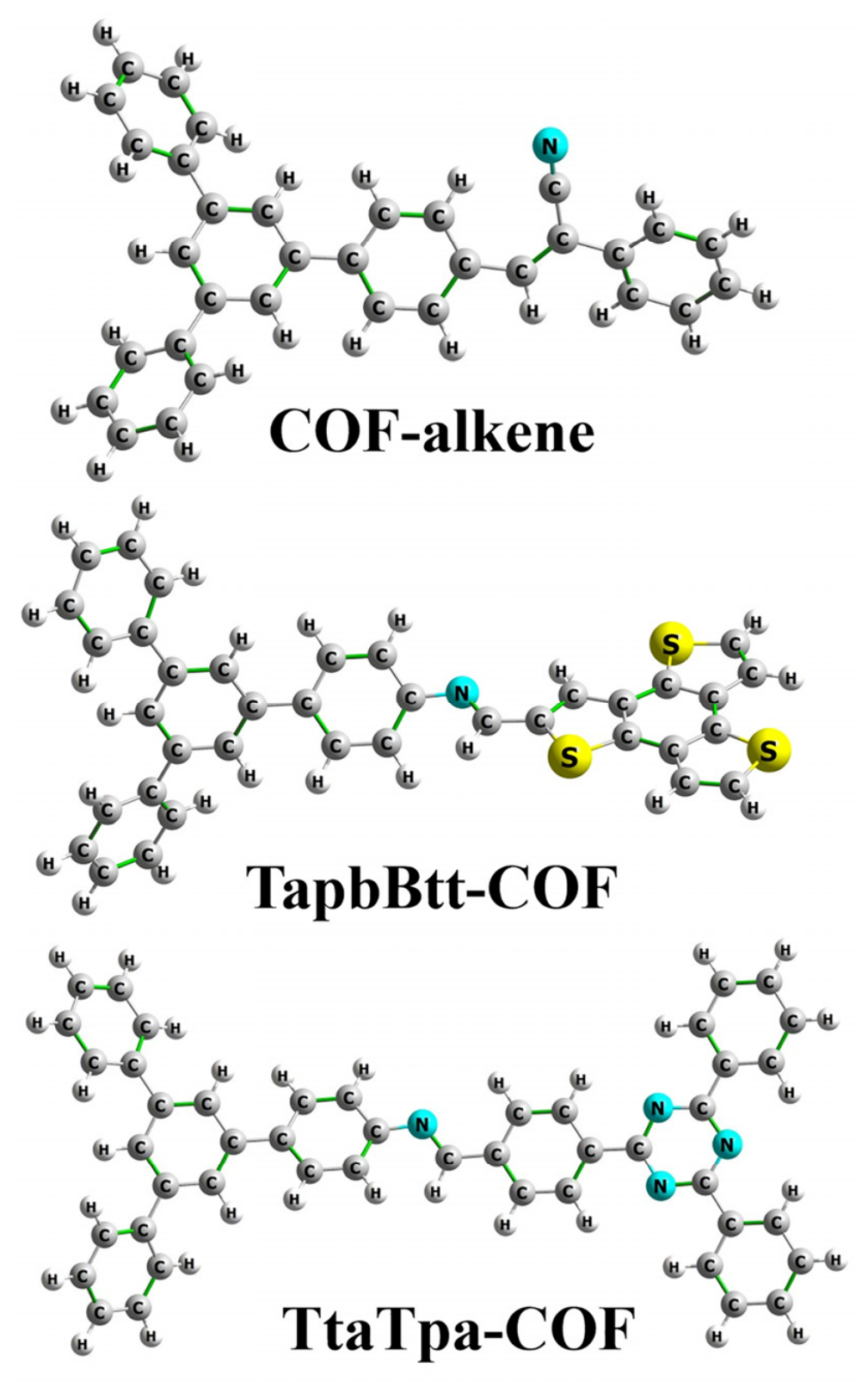
Despite experimental investigations into the photocatalytic applications of materials such as COF-alkene, TapbBtt-COF, and TtaTpa-COF (see Figure 1), comprehensive and in-depth theoretical studies are still lacking regarding how different D–π–A building units systematically modulate the electronic structures of COFs and the structure–activity relationships that govern their photocatalytic performance. Herein, we employed DFT and TD-DFT calculations to systematically investigate the relationship between the electronic structures and photocatalytic performance of three COFs featuring a D–π–A architecture constructed from triphenyl-benzene and different aromatic diamines. The specific research contents are as follows. Section 2.1 presents a benchmarking study to identify the optimal DFT functional for accurately describing the COF system. Section 2.2 analyzes the structural planarity and polarity of the three COFs, including their dipole moments and dihedral angles. Section 2.3 examines the frontier molecular orbitals, where HOMO/LUMO energy levels and distributions are calculated to evaluate the thermodynamic feasibility for photocatalysis. Section 2.4 simulates the UV–vis absorption spectra and analyzes the charge separation efficiency. Section 2.5 systematically investigates the photocatalytic performance and structure–activity relationships, covering hydrogen adsorption sites and their corresponding energies for HER, as well as the OER mechanism and water adsorption behavior. By comparing the three COFs in terms of their electronic configurations, excited-state optical properties, charge transfer behaviors, and HER/OER reactivities, the intrinsic structure–activity relationships between D–π–A building units and photocatalytic performance are revealed, providing theoretical guidance for the rational design of efficient metal-free photocatalysts.

2. Results and Discussion

2.1. Benchmarking Study

To systematically evaluate the influence of different DFT functionals, solvent models, and basis sets on the accuracy of simulated UV–vis absorption spectra, benchmark tests were conducted on three COFs. Using the 6-311+G(2d,p) basis set and the SMD solvent model, four commonly used functionals, M06L, ωB97X, CAM-B3LYP, and TPSSh were assessed for their performance in predicting the UV–vis absorption spectra of these materials. Among the three COFs, TtaTpa-COF exhibits the longest S0→S1 absorption wavelength (see Table S2 of Supporting Information), based on the single-point calculations at the M06L/6-311+G(2d,p) level within SMD model. Meanwhile, TtaTpa-COF exhibits a substantially longer calculated λmax (502.15 nm) than COF-alkene (390.48 nm) and TapbBtt-COF (422.93 nm). This indicates that the strong intramolecular charge transfer effect arising from its D-π-A structure effectively extends the absorption wavelength, yielding a theoretical λmax that closely matches the experimental value of 476 nm. The λmax calculated for TtaTpa-COF at the TPSSh/6-311+G(2d,p) level (461.43 nm) is closer to the experimental value. For COF-alkene, whose experimental absorption onset lies above 420 nm, the values obtained with ωB97X-D and CAM-B3LYP are significantly lower (below 350 nm), indicating that range-separated functionals introduce a pronounced blue shift due to an overemphasis on long-range correction. Given the requirements for subsequent mechanistic studies of the hydrogen evolution reaction (HER) and the oxygen evolution reaction (OER), the M06L functional demonstrates stable and reliable computational performance across all systems and is therefore selected as the optimal functional. At the M06L/6-311+G(2d,p) level, the effects of three solvent models, SMD, CPCM, and IEFPCM on the UV-Vis absorption spectra were further examined. The three models yield similar results (Table S3), with the S0→S1 peak ranging from 498.61 to 502.15 nm, and the SMD model gives the longest absorption wavelength. Among the three models, SMD was chosen because it includes additional cavity-dispersion-solvent-structure (CDS) terms and has been shown to provide the most accurate solvation free energies for organic molecules in aqueous solution. Given the minor impact of solvent effects and the overall good performance of the SMD model, it was adopted for subsequent calculations.
Using TtaTpa-COF as an example, the influence of basis set size was evaluated at the M06L/SMD level. As listed in Table S4, the varying the basis set from Def2-SVP (494.21 nm) and 6-311+G(2d,p) (502.15 nm) to aug-cc-pVDZ (500.15 nm) changes the absorption wavelength by less than 8 nm, indicating that basis set convergence has been achieved. Accordingly, the 6-311+G(2d,p) basis set was chosen to balance computational accuracy and cost. In summary, the M06L functional, SMD solvent model, and 6-311+G(2d,p) basis set are identified as the optimal theoretical combination for describing the optoelectronic properties of this class of COF materials. All subsequent calculations were carried out using the same level of theory.

2.2. Structural Planarity and Polarity of COFs

The optoelectronic properties of COFs are governed by their light-harvesting efficiency and charge separation, both closely linked to their building blocks [28]. Figure 1 presents the optimized ground-state configurations of COFs, while Table 1 summarizes their D-π-A units, dihedral angles (∠Φ), and S1 excited-state dipole moments (μ). Structural planarity, a key factor influencing π-delocalization and charge mobility [29], is determined by ∠Φ, the smaller angles indicate better planarity. As listed in Table 1, TtaTpa-COF exhibits the smallest ∠Φ (4.8°) due to the triazine (PT) group, demonstrating excellent planarity. In contrast, COF-alkene shows a larger torsion angle (35.5°) from its C–C single bond, while TapbBtt-COF possesses a moderate ∠Φ of 11.8° owing to the highly coplanar benzotrithiophene (Btt) unit.
The μ values vary with the electronic properties of the D-π-A units. TapbBtt-COF has the highest μ (4.50 D), attributed to the strong electron-donating Btt unit combined with the polar imine linker, which promotes significant intramolecular charge separation. COF-alkene follows with 4.18 D, where the cyano group acts as a strong electron-withdrawing group, creating a pronounced D-A polarization with the Tpb donor. TtaTpa-COF shows the smallest μ (3.05 D); despite its best planarity, the highly symmetric PT acceptor leads to a more uniform charge distribution, reducing the dipole moment.

2.3. Frontier Molecular Orbitals

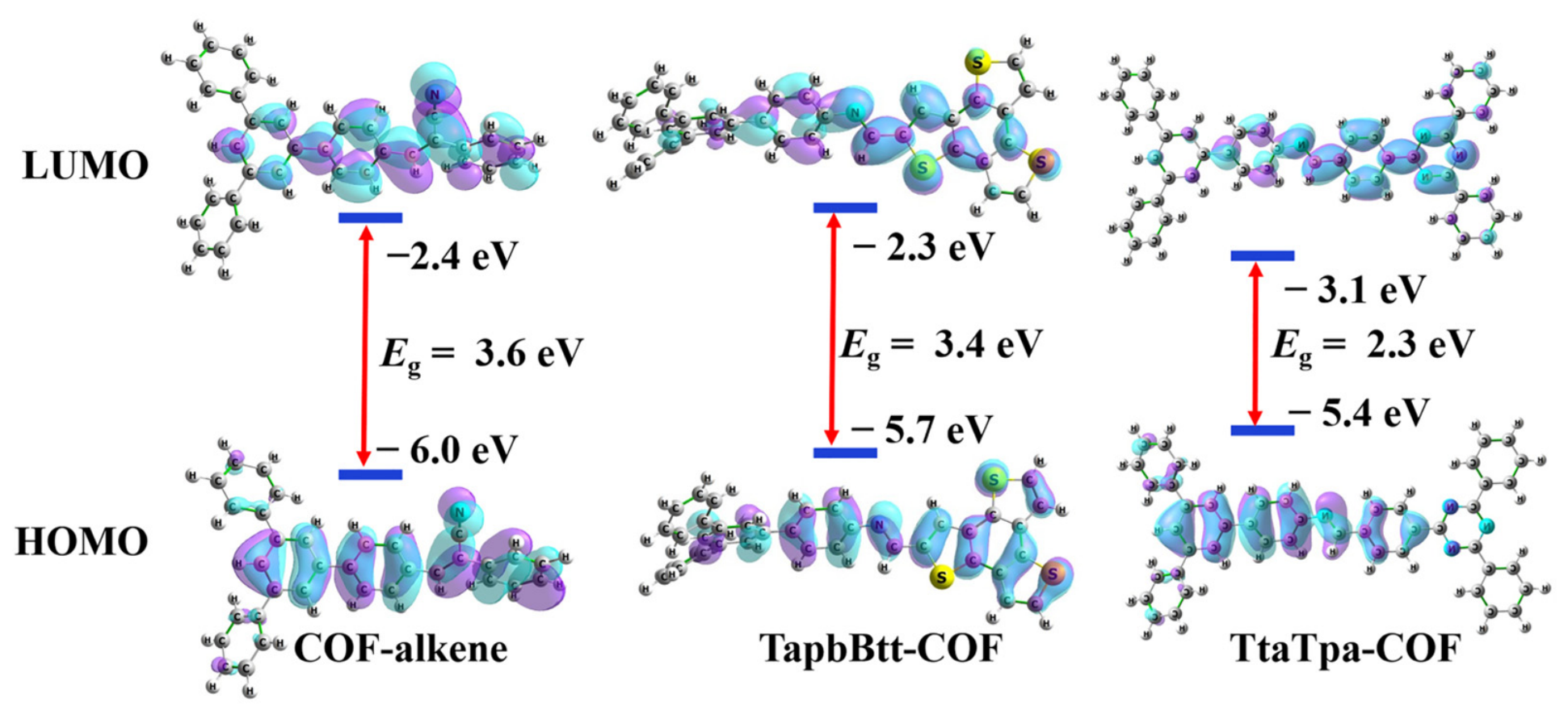
To understand the optical absorption properties of different COFs from an electronic structure perspective, this study systematically analyzed their frontier molecular orbital (FMO) distributions, energy levels, and band gaps (Figure 2, Table S5) at the M06L/6-311+G(2d,p) level of theory. The results demonstrate that constructing intramolecular electron D-A units or introducing specific functional groups effectively tunes the HOMO/LUMO energy levels and energy gaps (Eg), thereby influencing the λmax of COFs.
For COF-alkene, a conjugated framework, the HOMO and LUMO are uniformly distributed across the sp2-conjugated π bonds, exhibiting typical local π→π* transition characteristics. According to the computational results (Figure 2), its HOMO and LUMO levels are −5.7 eV and −2.6 eV, respectively, yielding the Eg of 3.1 eV. The introduced cyano group (−C≡N) acts as a strong electron-withdrawing group that primarily lowers the LUMO energy. In TapbBtt-COF, the electron-rich Btt unit is connected to Tpb via imine (−N=CH2−) linkage. Its HOMO and LUMO levels are −5.4 eV and −2.5 eV, respectively, with the Eg of 2.9 eV. Among the three materials, TtaTpa-COF exhibits the most pronounced D–A character: the HOMO is localized on the Tpb donor (−5.6 eV), while the LUMO is concentrated on the PT acceptor (−2.8 eV). This spatial orbital separation facilitates efficient intramolecular charge transfer, reducing the Eg to 2.8 eV. The theoretically calculated λmax is in good agreement with the experimental value (476 nm) [17]. Overall, rationally designing D–A structures or introducing electron-withdrawing/donating groups represents an effective strategy for tuning the electronic structure and optical absorption properties of COFs. Based on the well-established thermodynamic criteria for photocatalytic water splitting [30,31], the calculated HOMO/LUMO energy levels (Figure 2) indicate that all three COFs are thermodynamically feasible for overall water splitting.

2.4. Optoelectronic Properties and UV-Vis Absorption Spectra

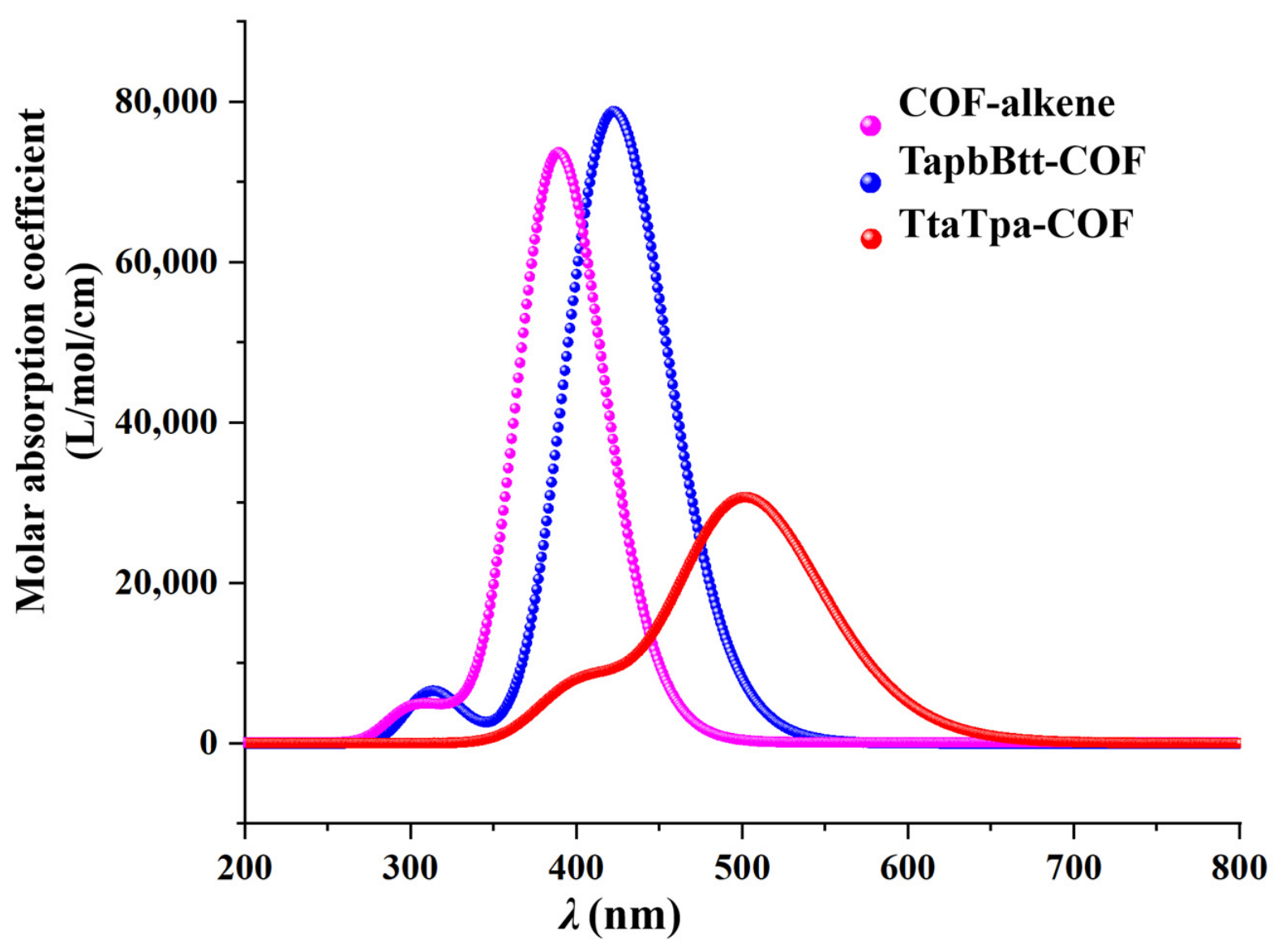
The broad absorption range of COFs enhances solar energy utilization efficiency, thereby contributing to excellent photocatalytic hydrogen evolution performance [32]. To analyze their optoelectronic properties, the simulated UV-vis absorption spectra (Figure 3) of the COFs were simulated using the TD-DFT method at the M06L/6-311+G(2d,p) level of theory in an aqueous phase environment. The main photoelectric parameters, including excited state, oscillator strength (ƒ), excitation energy (Eex/eV), maximum absorption wavelength λmax/nm), transition composition (%), and hole–electron overlap integral (Overlap), are listed in Table 2.
The three COFs possess different D–π–A structural combinations, which significantly influence their optoelectronic properties. As shown in Figure 3, COF-alkene and TapbBtt-COF exhibit strong absorption peaks in the UV region, while TtaTpa-COF shows a significantly red-shifted absorption peak extending into the visible region, demonstrating superior visible-light harvesting capability. As listed in Table 2, a common trend across the three COFs is that the S0→S1 transition dominates the excitation spectra, characterized by the largest oscillator strengths and predominantly HOMO→LUMO contributions. In the TtaTpa-COF, the S0→S1 main transition contributes 95.3%, features the lowest Eex (2.47 eV) and the longest λmax (502.15 nm), and exhibits a relatively low ƒ (0.56). The orbital overlap integral is 0.51, indicating that although the D-A structure induces effective charge transfer, the hole and electron still exhibit a certain degree of conjugated overlap. High planarity facilitates π-electron delocalization, which is key to its low Eex. The S1 transition of TapbBtt-COF is also HOMO→LUMO (95.3%), exhibiting the highest ƒ (1.45), an absorption peak at 422.93 nm, and an orbital overlap integral of 0.72, indicating strong electronic coupling and high transition probability. Although its Eex (2.93 eV) is slightly higher than that of TtaTpa-COF, its high ƒ gives it an advantage in light harvesting. COF-alkene exhibits a HOMO→LUMO transition (95.8%) with the highest Eex (3.18 eV), the shortest λmax (390.48 nm), an ƒ of 1.36, and the largest orbital overlap integral (0.77), consistent with its local π→π* transition characteristics. The large torsion angle likely disrupts conjugation continuity, leading to a higher Eex. In the S0→S2 and S0→S3 high-energy transitions, the ƒ values of the three COFs are generally very low (mostly close to 0), with absorption peaks ranging from 327 to 474 nm, indicating that local excitation components dominate these high-energy excited states. In summary, TtaTpa-COF achieves the lowest Eex and the longest λmax due to its excellent planarity and typical D-A structure. TapbBtt-COF exhibits the highest transition probability while maintaining a moderate absorption wavelength, making it suitable for efficient light harvesting. COF-alkene is dominated by local transitions and shows the shortest absorption wavelength. These differences provide a basis for material selection for different photocatalytic or optoelectronic applications.

2.5. Photocatalytic Performance and Structure–Activity Relationships

The photocatalytic water splitting performance of the three COFs is governed by their D-π-A structures, FMO energy levels, and reaction thermodynamics. Based on their electronic structures, optical absorption, and reaction free energies, the HER and OER catalytic capabilities are systematically analyzed below. To avoid ambiguity, we first clarify the notation: the asterisk (*) represents the COF surface active site, and *OH, *O, *OOH, and *O2 are the corresponding adsorbed intermediates, following standard heterogeneous (electro)catalysis notation.
All three COFs meet the thermodynamic requirements for overall water splitting. Notably, TtaTpa-COF features the narrowest Eex (2.47 eV), longest λmax (502.15 nm), and lowest hole–electron overlap (0.51), enabling efficient carrier separation. TapbBtt-COF exhibits the highest ƒ (1.45), ensuring strong light absorption. In contrast, COF-alkene has a large ∠Φ (35.5°), which limits π-delocalization and promotes carrier recombination.
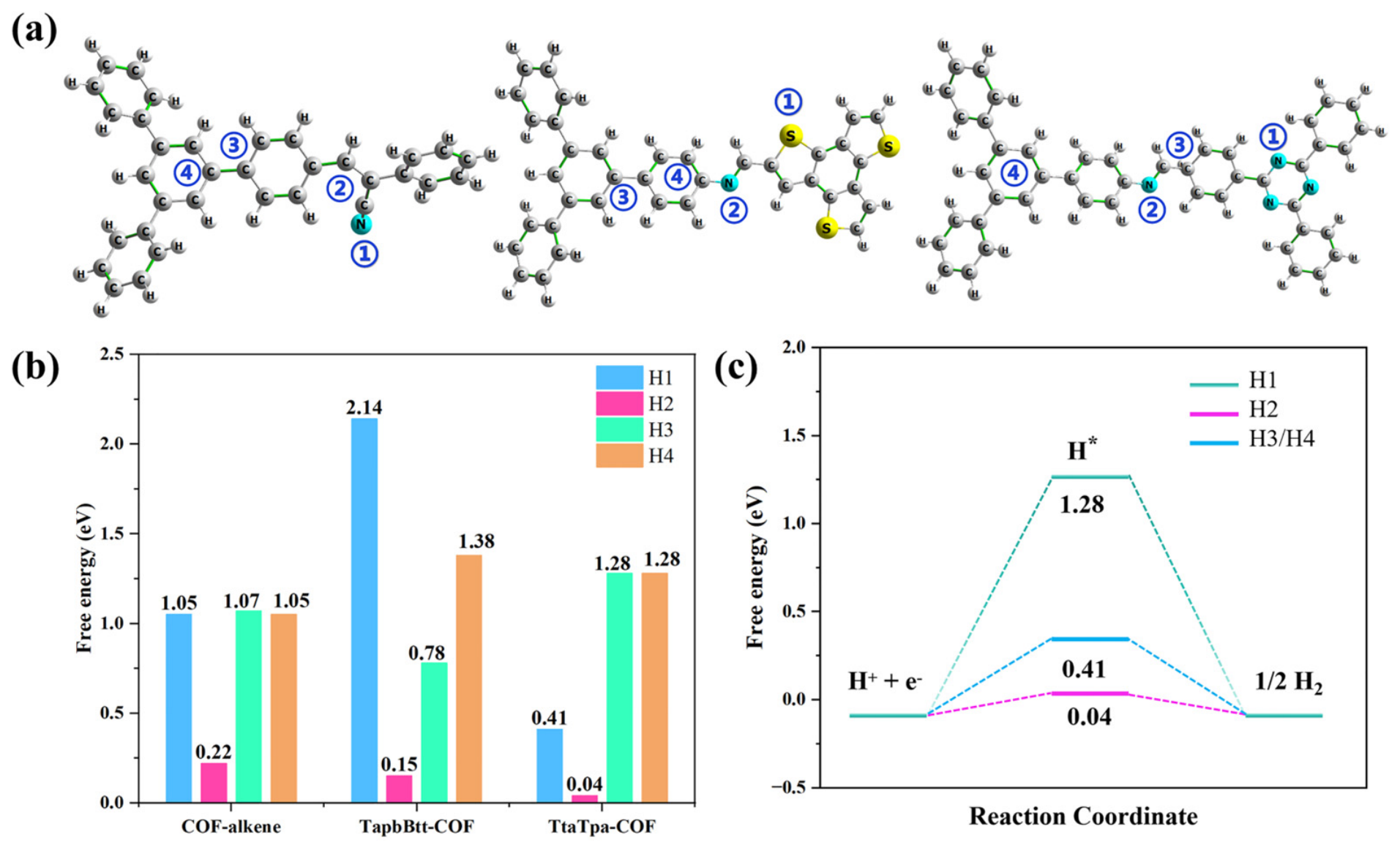
HER catalytic performance is governed by the *H adsorption free energy (ΔGH), with an ideal catalyst approaching 0 eV for balanced *H adsorption and desorption [33]. The photocatalytic HER proceeds via a two-step mechanism: first, H+ migrates to the COF surface, where photogenerated electrons transfer from the LUMO to reduce H+ to *H; subsequently, adjacent *H intermediates couple to form H2. To identify the optimal active sites for this process, four potential sites per COF were screened, as shown in Figure 4a. The optimized geometric configurations of these potential sites are provided in Figure S1. The free energy of H adsorption (ΔGH) at different sites on three COFs is presented in Figure 4b. Due to their distinct D-π-A structures, the optimal *H adsorption sites vary: for COF-alkene, it is at the electron-rich alkene-linked C atom (ΔGH = 0.22 eV), attributed to π-electron delocalization; for TapbBtt-COF and TtaTpa-COF, the optimal sites are at the imine N atoms (ΔGH = 0.15 eV and 0.04 eV, respectively), benefiting from the D-π-A conjugation effect. Figure 4c shows the free energy profile for the HER at the optimal active site of TtaTpa-COF. Among three COFs, TtaTpa-COF exhibits the most ideal ΔGH and the lowest LUMO (−2.8 eV), resulting in the strongest photogenerated electron reduction capability and thus the highest HER activity, followed by TapbBtt-COF.
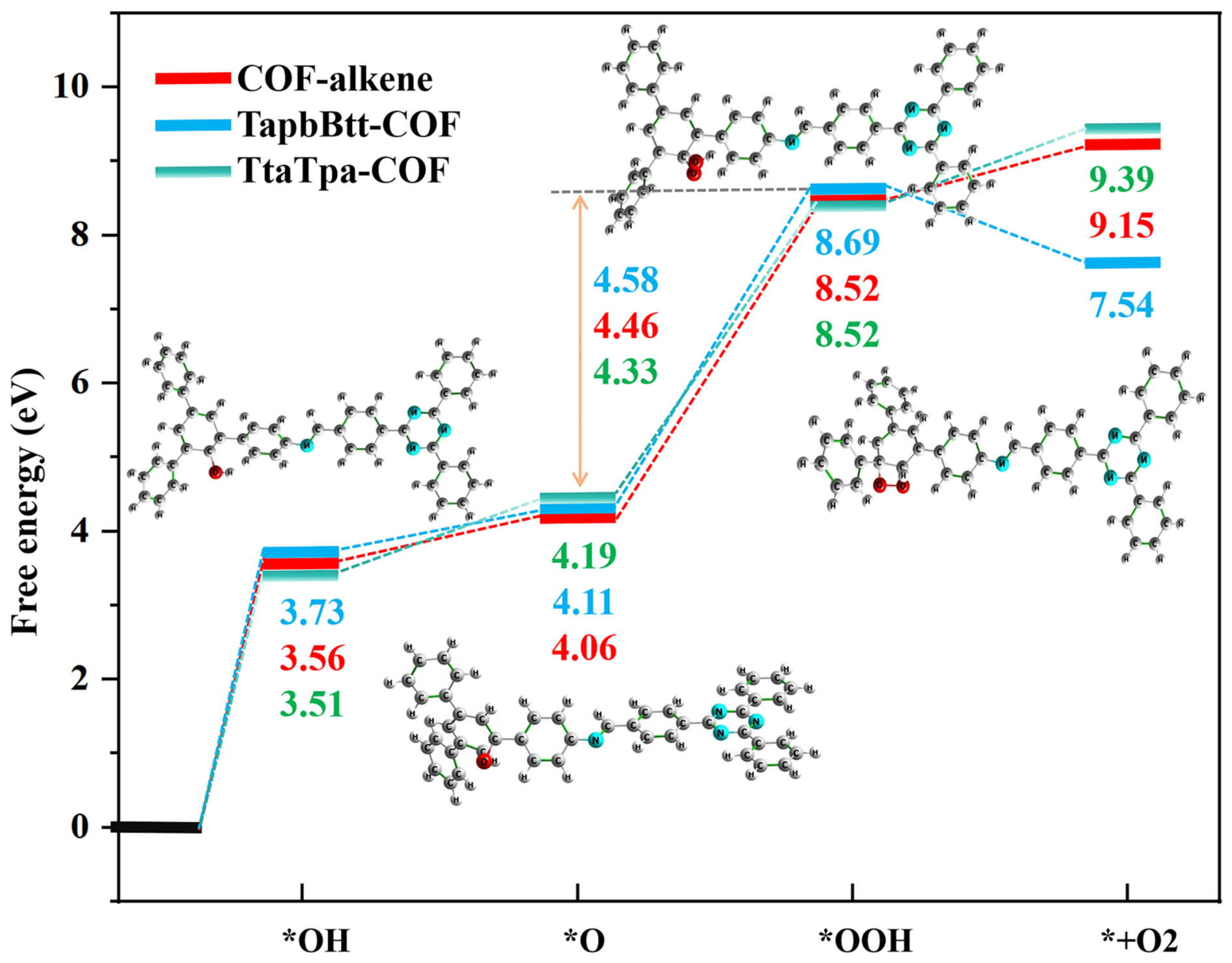
As the kinetic rate-determining step of photocatalytic overall water splitting, OER performance is primarily governed by the adsorption free energies of intermediates, reaction pathway selectivity, and the rate-determining step barrier [34,35]. Based on the adsorbate evolution mechanism (AEM) proposed by Nørskov et al. [36], we considered that the OER processes follow a single-active-site four-step proton-electron transfer mechanism. The specific reaction steps are as follows: first, a water adsorbs onto the active site, where a photogenerated hole transfers from the HOMO energy level to the active site, oxidizing the adsorbed H2O molecule to form the *OH intermediate while releasing H+ and e; second, the *OH intermediate is further oxidized to form the *O intermediate; third, the *O intermediate reacts with a H2O from the solution to form the *OOH intermediate, which is the rate-determining step for the OER process; fourth, the *OOH intermediate is further oxidized, undergoing O-O bond coupling to form an O2, which then desorbs, regenerating the active site. The free energy diagrams for the OER on three COFs, along with the optimized geometries of the intermediates on TtaTpa-COF, are shown in Figure 5. The optimized geometries of the intermediates on the other two COFs are presented in Figure S2. The calculation results indicate that their *OH adsorption free energies (ΔGOH) range from 3.51 to 3.73 eV. Combined with thermodynamic selectivity, all fall within the 4e oxidation dominant region, indicating that the OER process primarily produces O2. The limiting potentials corresponding to the rate-determining step exhibit distinct differences: TtaTpa-COF (4.33 eV) < COF-alkene (4.46 eV) < TapbBtt-COF (4.58 eV), indicating that TtaTpa-COF has the lowest OER kinetic barrier and is therefore more favorable for efficient water oxidation. TtaTpa-COF, due to the strong electron deficiency in its PT acceptor unit, exhibits slightly stronger adsorption (4.19 eV) of the *O intermediate, leading to a modest increase in the rate-determining step barrier. TapbBtt-COF shows a notably low ΔGO2 of 7.54 eV for *O2 formation, demonstrating that O2 evolution is thermodynamically more favorable on TapbBtt-COF.
In summary, the structure–activity relationship between the D-π-A structures and photocatalytic performance of the three COFs is as follows: The conjugated backbone promotes spatial charge separation, enhances interfacial transfer, and provides sufficient redox driving forces for water splitting. The D-π-A system governs HER site selectivity by modulating electron distribution, COF-alkene uses an electron-rich alkene carbon as the active site, while TapbBtt-COF and TtaTpa-COF use imine nitrogen. All three COFs meet the thermodynamic requirements for water splitting, with outstanding HER activity and *OOH formation as the common OER rate-determining step. Their catalytic performance correlates strongly with their electronic structures, providing a theoretical foundation for designing high-activity COF-based photocatalysts.

3. Computational Details

All calculations were performed using the BDF software package (Version 2024A) [37]. All calculations were performed within the framework of the nonrelativistic Hamiltonian, which is sufficient for the present system consisting solely of light elements. Theoretical models of the three COFs were constructed based on experimentally reported structures [16,17,18]. The ground-state geometries of the COFs were optimized at the GB3LYP/6-31+G(d,p) level of theory. To confirm that each theoretical model corresponded to a local energy minimum, frequency calculations were conducted at the M06L/6-31+G(d,p) level of theory. The optimized Cartesian coordinates of all COFs are provided in the Supporting Information. To systematically evaluate the influence of different DFT functionals, solvent models, and basis sets on the accuracy of simulated UV–vis absorption spectra, benchmark tests were performed on the three COFs. Using the 6-311+G(2d,p) basis set and the SMD solvent model [38], four commonly used functionals, M06L [39], ωB97X [40], CAM-B3LYP [41], and TPSSh [42], were assessed for their performance in predicting the UV–vis absorption spectra of these materials. The results indicated that the M06L functional exhibited stable and reliable computational performance across all systems and was therefore selected as the optimal functional. At the M06L/6-311+G(2d,p) level, the effects of three solvent models, SMD, CPCM [43], and IEFPCM [44] on the UV–vis absorption spectra were further examined. The three models yielded similar results, with the SMD model giving the longest absorption wavelength and demonstrating good overall performance; thus, it was adopted for subsequent calculations. Using TtaTpa-COF as an example, the influence of basis set size was evaluated at the M06L/SMD level. When the basis set was varied from Def2-SVP [45] and 6-311+G(2d,p) to aug-cc-pVDZ [46], the change in UV–vis absorption wavelength was less than 8 nm, indicating that basis set convergence had been achieved. Accordingly, the 6-311+G(2d,p) basis set was chosen to balance computational accuracy and cost. In summary, the M06L functional, SMD solvent model, and 6-311+G(2d,p) basis set were identified as the optimal theoretical combination for describing the optoelectronic properties of this class of COF materials, and all subsequent calculations were performed at this level of theory. The first three excited states were calculated using TD-DFT at the M06L/6-311+G(2d,p) level of theory [47]. UV–vis absorption spectra were simulated, with a focus on the maximum oscillator strength (ƒ). The solvent effect was accounted for using the SMD model with water as the solvent in both DFT and TD-DFT calculations. Natural transition orbital (NTO) [48] analysis was performed on the excited states to further elucidate the electron transition characteristics. The contributions of the major orbital transitions, the corresponding excitation energies, and the hole–electron overlap (ρ) were calculated. Free energy calculations were performed for the HER and OERs. For HER, the free energy of H+ adsorption (ΔGH) on different COFs was calculated. For OER, the free energy profiles of four common intermediates (*OH, *O, *OOH, and *O2) on the COFs were calculated. The free energy was obtained as follows: first, the free energy correction (Gcorr) was obtained from frequency calculations; second, the single-point energy (ESP) was calculated at the M06L/6-311+G(2d,p) level of theory. The total free energy (Gtotal) was then calculated as Gtotal = Gcorr + ESP. Based on this method, the adsorption free energies of each reaction intermediate were calculated, and the reaction free energy profiles for HER and OER were constructed accordingly.

4. Conclusions

In this work, DFT and TD-DFT calculations were systematically employed to investigate the structure–property relationships governing the optoelectronic and photocatalytic performance of three D–π–A-type COFs (COF-alkene, TapbBtt-COF, and TtaTpa-COF). By integrating quantitative electronic structure analysis, excited-state characterization, and thermodynamic evaluation of HER/OER pathways, we demonstrate that the overall photocatalytic water splitting performance of these COFs is critically determined by three interrelated factors: molecular planarity, D–π–A electronic configuration, and charge separation efficiency. Our results show that TtaTpa-COF, featuring a highly planar structure and a typical D–A configuration with triazine as the acceptor, exhibits the narrowest Eex (2.47 eV), the longest λmax (502.15 nm), and the lowest hole–electron overlap (0.51), enabling efficient carrier separation and visible-light harvesting. TapbBtt-COF, with its strong electron-donating Btt unit and moderate planarity, shows the highest oscillator strength (1.45), making it advantageous for light absorption. In contrast, COF-alkene suffers from poor planarity and limited π-delocalization, leading to higher carrier recombination. HER activity is governed by the *H adsorption free energy. TtaTpa-COF shows the most ideal value (0.04 eV) and the lowest LUMO level (−2.8 eV), thus exhibiting the strongest proton reduction capability. The active sites are structure-dependent: COF-alkene favors the alkene-linked C atom, while the imine N atoms serve as the active centers in TapbBtt-COF and TtaTpa-COF. For OER, all three COFs follow the adsorbate evolution mechanism with *OOH formation as the common rate-determining step. TtaTpa-COF possesses the lowest limiting potential (4.33 eV), indicating more favorable water oxidation kinetics, whereas TapbBtt-COF shows a slightly higher barrier due to stronger *O adsorption on the electron-deficient triazine unit. In summary, the conjugated D–π–A backbone effectively promotes spatial separation of photogenerated carriers and provides sufficient redox driving forces for water splitting. This work establishes a clear structure–activity relationship linking D–π–A architecture, molecular planarity, and electronic structure to photocatalytic performance, offering a rational design framework for high-activity COF-based photocatalysts for overall water splitting.

Supplementary Materials

The following supporting information can be downloaded at https://www.mdpi.com/article/10.3390/catal16050482/s1. Table S1: Comparison of key features between conventional inorganic semiconductors and COF-based semiconductors for photocatalytic water splitting. Table S2: Benchmark of DFT functionals for calculated λmax (nm) of COFs from single-point calculations at the 6-311+G(2d,p) level within SMD model. Table S3: Solvent model benchmark for TtaTpa-COF from single-point calculations at M06L/6-311+G(2d,p) level. Table S4: Basis set benchmark for TtaTpa-COF from single-point calculations at M06L/6-311+G(2d,p) level with the SMD solvent model. Table S5: FMO energies (EHOMO and ELUMO) and energy gaps (Eg) of COFs from single-point calculations at the M06L/6-311+G(2d,p) level within SMD model. Energy unit in eV. Figure S1: Optimized geometric configurations of four potential sites on COFs. Figure S2: Optimized geometries of intermediates on COF-alkene and TapbBtt-COF.

Author Contributions

Conceptualization, X.L.; software, X.L.; data curation, T.L. and M.L.; writing—original draft preparation, H.Z.; writing—review and editing, X.L.; resources, Q.W.; supervision, X.L. and Q.W.; funding acquisition, Q.W. All authors have read and agreed to the published version of the manuscript.

Funding

This research was funded by the National Natural Science Foundation of China (No.21905053), Teaching Reform Project of Hainan Normal University (hsjg2025-12 and 202511658003), Education Department of Hainan Province (Hnjg2026ZC-23) and Less Developed Regions of the National Natural Science Foundation of China (No. 62463003).

Data Availability Statement

Data is contained within the article or Supplementary Material.

Acknowledgments

We gratefully acknowledge the financial support from the Grants for the Innovation Center of Academician Sun Shigang’s Team in Hainan Province. We also gratefully acknowledge HZWTECH for providing computation facilities.

Conflicts of Interest

The authors declare no competing financial interest.

References

  1. Acar, C.; Dincer, I.; Naterer, G.F. Review of Photocatalytic Water-Splitting Methods for Sustainable Hydrogen Production. Int. J. Energy Res. 2016, 40, 1449–1473. [Google Scholar] [CrossRef]
  2. Liu, J.; Liu, Y.; Liu, N.; Han, Y.; Zhang, X.; Huang, H.; Lifshitz, Y.; Lee, S.-T.; Zhong, J.; Kang, Z. Metal-Free Efficient Photocatalyst for Stable Visible Water Splitting Via a Two-Electron Pathway. Science 2015, 347, 970–974. [Google Scholar] [CrossRef]
  3. Fujishima, A.; Rao, T.N.; Tryk, D.A. TiO2 Photocatalysts and Diamond Electrodes. Electrochim. Acta 2000, 45, 4683–4690. [Google Scholar] [CrossRef]
  4. Zhang, P.; Wang, T.; Chang, X.; Gong, J. Effective Charge Carrier Utilization in Photocatalytic Conversions. Acc. Chem. Res. 2016, 49, 911–921. [Google Scholar] [CrossRef]
  5. Rahman, M.Z.; Kibria, M.G.; Mullins, C.B. Metal-Free Photocatalysts for Hydrogen Evolution. Chem. Soc. Rev. 2020, 49, 1887–1931. [Google Scholar] [CrossRef]
  6. Fu, J.; Yu, J.; Jiang, C.; Cheng, B. g-C3N4-Based Heterostructured Photocatalysts. Adv. Energy Mater. 2018, 8, 1701503. [Google Scholar] [CrossRef]
  7. Wan, Y.; Sun, P.; Shi, L.; Yan, X.; Zhang, X. Three-Dimensional Fully Conjugated Covalent Organic Frameworks for Efficient Photocatalytic Water Splitting. J. Phys. Chem. Lett. 2023, 14, 1234–1241. [Google Scholar] [CrossRef] [PubMed]
  8. Du, X.; Ji, H.; Xu, Y.; Du, S.; Feng, Z.; Dong, B.; Wang, R.; Zhang, F. Covalent Organic Framework without Cocatalyst Loading for Efficient Photocatalytic Sacrificial Hydrogen Production from Water. Nat. Commun. 2025, 16, 3024. [Google Scholar] [CrossRef]
  9. Diercks, C.S.; Yaghi, O.M. The Atom, the Molecule, and the Covalent Organic Framework. Science 2017, 355, eaal1585. [Google Scholar] [CrossRef] [PubMed]
  10. Sun, H.; Ji, H.; Qiao, D.; Xu, Y.; Qu, X.; Qi, Y.; Feng, Z.; Zhang, X.; Zhang, F.; Wang, R. Vinylene-Linked Covalent Organic Frameworks Based on Phenanthroline for Visible-Light-Driven Bifunctional Photocatalytic Water Splitting. Chem. Eng. J. 2025, 507, 160448. [Google Scholar] [CrossRef]
  11. Mishra, B.; Alam, A.; Chakraborty, A.; Kumbhakar, B.; Ghosh, S.; Pachfule, P.; Thomas, A. Covalent Organic Frameworks for Photocatalysis. Adv. Mater. 2025, 37, 2413118. [Google Scholar] [CrossRef] [PubMed]
  12. Jiang, D.; Tan, V.G.W.; Gong, Y.; Shao, H.; Mu, X.; Luo, Z.; He, S. Semiconducting Covalent Organic Frameworks. Chem. Rev. 2025, 125, 6203–6308. [Google Scholar] [CrossRef]
  13. Wang, X.X.; Zhang, C.R.; Bi, R.X.; Peng, Z.H.; Song, A.M.; Zhang, R.; He, H.X.; Qi, J.X.; Gong, J.W.; Niu, C.P. Reducing the Exciton Binding Energy of Covalent Organic Framework through Π-Bridges to Enhance Photocatalysis. Adv. Funct. Mater. 2025, 35, 2421623. [Google Scholar] [CrossRef]
  14. Liu, H.; Zhu, S.; Zhi, Y.; Yue, H.; Liu, X. Donor–Acceptor Type Covalent Organic Frameworks: Design, Optimization Strategies and Applications. Chem. Sci. 2025, 16, 12768–12803. [Google Scholar] [CrossRef]
  15. Xia, Y.; Zhang, W.; Yang, S.; Wang, L.; Yu, G. Research Progress in Donor−Acceptor Type Covalent Organic Frameworks. Adv. Mater. 2023, 35, 2301190. [Google Scholar] [CrossRef] [PubMed]
  16. Mo, C.; Yang, M.; Sun, F.; Jian, J.; Zhong, L.; Fang, Z.; Feng, J.; Yu, D. Alkene-Linked Covalent Organic Frameworks Boosting Photocatalytic Hydrogen Evolution by Efficient Charge Separation and Transfer in the Presence of Sacrificial Electron Donors. Adv. Sci. 2020, 7, 1902988. [Google Scholar] [CrossRef]
  17. Yang, J.; Acharjya, A.; Ye, M.Y.; Rabeah, J.; Li, S.; Kochovski, Z.; Youk, S.; Roeser, J.; Grüneberg, J.; Penschke, C. Protonated Imine-Linked Covalent Organic Frameworks for Photocatalytic Hydrogen Evolution. Angew. Chem. Int. Ed. 2021, 60, 19797–19803. [Google Scholar] [CrossRef]
  18. Qin, C.; Wu, X.; Tang, L.; Chen, X.; Li, M.; Mou, Y.; Su, B.; Wang, S.; Feng, C.; Liu, J. Dual Donor-Acceptor Covalent Organic Frameworks for Hydrogen Peroxide Photosynthesis. Nat. Commun. 2023, 14, 5238. [Google Scholar] [CrossRef] [PubMed]
  19. Hussain, M.; Song, X.; Shah, S.; Hao, C. TD-DFT Insights into the Sensing Potential of the Luminescent Covalent Organic Framework for Indoor Pollutant Formaldehyde. Spectrochim. Acta A 2020, 224, 117432. [Google Scholar] [CrossRef]
  20. Hussain, M.; Song, X.; Zhao, J.; Luo, Y.; Hao, C. Impact of Electronically Excited State Hydrogen Bonding on Luminescent Covalent Organic Framework: A TD-DFT Investigation. Mol. Phys. 2019, 117, 823–830. [Google Scholar] [CrossRef]
  21. Li, X.; Niu, Y.; Ma, K.; Huang, X.; Wang, Q.; Liang, Z. Theoretical Study on the Influence of Building Blocks in Benzotrithiophene-Based Covalent Organic Frameworks for Optoelectronic Properties. Catalysts 2025, 15, 647. [Google Scholar] [CrossRef]
  22. Li, X.; Yang, H.; Qiao, J.; Wei, M.; Wang, Q. Machine Learning-Assisted Property Prediction and Virtual Screening of Polyimides for Flexible Electronic Applications. Chem. Eng. J. 2026, 537, 176113. [Google Scholar] [CrossRef]
  23. Li, X.; Yang, H.; Tao, Y.; Wang, Q.; Shi, T.; Li, L. Interpretable Machine Learning Combined TD-DFT Calculations for the Study of Colorless Transparency Polyimides. Macromolecules 2025, 58, 2266–2275. [Google Scholar] [CrossRef]
  24. Younas, M.; Yar, M.; AlMohamadi, H.; Mahmood, T.; Ayub, K.; Khan, A.L.; Yasin, M.; Gilani, M.A. A Rational Design of Covalent Organic Framework Supported Single Atom Catalysts for Hydrogen Evolution Reaction: A DFT Study. Int. J. Hydrogen Energy 2024, 51, 758–773. [Google Scholar] [CrossRef]
  25. Li, X.; Zhang, X.; Deng, Y.; Li, M.; Wu, G.; Li, L.; Wang, Q. Donor-Acceptor Architecture and Charge Transfer Modulation in Olefin-Linked Triazine Frameworks. Mater. Chem. Phys. 2025, 347, 131411. [Google Scholar] [CrossRef]
  26. Li, X.; Li, M.; Wu, G.; Deng, Y.; Li, W.; Li, Y.; Zhou, H.; Su, Z. Unraveling Structure-Property Relationships in Benzothiadiazole-Based Covalent Organic Frameworks for Enhanced Optoelectronic Properties: A Density Functional Theory/Time-Dependent Density Functional Theory Study. ChemPhysChem 2025, 26, e202500612. [Google Scholar] [CrossRef]
  27. Chugh, P.; Sarma, D.; Mahata, A. Linker Engineering in Β-Ketoenamine-Based Covalent Organic Frameworks for Photocatalytic Water Splitting. J. Phys. Chem. C 2025, 129, 13194–13202. [Google Scholar] [CrossRef]
  28. Souto, M.; Strutyński, K.; Melle-Franco, M.; Rocha, J. Electroactive Organic Building Blocks for the Chemical Design of Functional Porous Frameworks (MOFs and COFs) in Electronics. Chem. Eur. J. 2020, 26, 10912–10935. [Google Scholar] [CrossRef]
  29. Wu, L.-C.; Chung, W.-C.; Wang, C.-C.; Lee, G.-H.; Lu, S.-I.; Wang, Y. A Charge Density Study of Π-Delocalization and Intermolecular Interactions. Phys. Chem. Chem. Phys. 2015, 17, 14177–14184. [Google Scholar] [CrossRef] [PubMed]
  30. Wang, L.; Wan, Y.; Ding, Y.; Wu, S.; Zhang, Y.; Zhang, X.; Zhang, G.; Xiong, Y.; Wu, X.; Yang, J. Conjugated Microporous Polymer Nanosheets for Overall Water Splitting Using Visible Light. Adv. Mater. 2017, 29, 1702428. [Google Scholar] [CrossRef] [PubMed]
  31. Wang, C.; Zhang, H.; Luo, W.; Sun, T.; Xu, Y. Ultrathin Crystalline Covalent-Triazine-Framework Nanosheets with Electron Donor Groups for Synergistically Enhanced Photocatalytic Water Splitting. Angew. Chem. Int. Ed. 2021, 60, 25381–25390. [Google Scholar] [CrossRef] [PubMed]
  32. Wang, L.-J.; Dong, P.-Y.; Zhang, G.; Zhang, F.-M. Review and Perspectives of Β-Keto-Enamine-Based Covalent Organic Framework for Photocatalytic Hydrogen Evolution. Energy Fuels 2023, 37, 6323–6347. [Google Scholar] [CrossRef]
  33. Wang, J.; Liu, J.; Zhang, B.; Ji, X.; Xu, K.; Chen, C.; Miao, L.; Jiang, J. The Mechanism of Hydrogen Adsorption on Transition Metal Dichalcogenides as Hydrogen Evolution Reaction Catalyst. Phys. Chem. Chem. Phys. 2017, 19, 10125–10132. [Google Scholar] [CrossRef]
  34. Takanabe, K. Photocatalytic Water Splitting: Quantitative Approaches toward Photocatalyst by Design. ACS Catal. 2017, 7, 8006–8022. [Google Scholar] [CrossRef]
  35. Zhang, R.; Yang, Z.-D.; Yang, Y.; Zhang, F.-M.; Zhang, G. Understanding Photocatalytic Overall Water Splitting of Β-Ketoenamine COFs through the N–C Site Synergistic Mechanism. ACS Appl. Mater. Interfaces 2023, 15, 57265–57272. [Google Scholar]
  36. Nørskov, J.K.; Rossmeisl, J.; Logadottir, A.; Lindqvist, L.; Kitchin, J.R.; Bligaard, T.; Jonsson, H. Origin of the Overpotential for Oxygen Reduction at a Fuel-Cell Cathode. J. Phys. Chem. B 2004, 108, 17886–17892. [Google Scholar] [CrossRef] [PubMed]
  37. Liu, S.W.; Wang, F.; Li, L.M. The Beijing Density Functional (BDF) Program Package: Methodologies and Applications. J. Theor. Comput. Chem. 2003, 2, 257–272. [Google Scholar] [CrossRef]
  38. Marenich, A.V.; Cramer, C.J.; Truhlar, D.G. Universal Solvation Model Based on Solute Electron Density and on a Continuum Model of the Solvent Defined by the Bulk Dielectric Constant and Atomic Surface Tensions. J. Phys. Chem. B 2009, 113, 6378–6396. [Google Scholar] [CrossRef] [PubMed]
  39. Zhao, Y.; Truhlar, D.G. The M06 Suite of Density Functionals for Main Group Thermochemistry, Thermochemical Kinetics, Noncovalent Interactions, Excited States, and Transition Elements: Two New Functionals and Systematic Testing of Four M06-Class Functionals and 12 Other Functionals. Theor. Chem. Acc. 2008, 120, 215–241. [Google Scholar]
  40. Mardirossian, N.; Head-Gordon, M. ωB97X-V: A 10-Parameter, Range-Separated Hybrid, Generalized Gradient Approximation Density Functional with Nonlocal Correlation, Designed by a Survival-of-the-Fittest Strategy. Phys. Chem. Chem. Phys. 2014, 16, 9904–9924. [Google Scholar] [CrossRef]
  41. Yanai, T.; Tew, D.P.; Handy, N.C. A New Hybrid Exchange–Correlation Functional Using the Coulomb-Attenuating Method (CAM-B3LYP). Chem. Phys. Lett. 2004, 393, 51–57. [Google Scholar] [CrossRef]
  42. Staroverov, V.N.; Scuseria, G.E.; Tao, J.; Perdew, J.P. Comparative Assessment of a New Nonempirical Density Functional: Molecules and Hydrogen-Bonded Complexes. J. Chem. Phys. 2003, 119, 12129–12137. [Google Scholar] [CrossRef]
  43. Takano, Y.; Houk, K. Benchmarking the Conductor-Like Polarizable Continuum Model (CPCM) for Aqueous Solvation Free Energies of Neutral and Ionic Organic Molecules. J. Chem. Theory Comput. 2005, 1, 70–77. [Google Scholar] [CrossRef] [PubMed]
  44. Klamt, A.; Moya, C.; Palomar, J. A Comprehensive Comparison of the IEFPCM and SS(V)PE Continuum Solvation Methods with the COSMO Approach. J. Chem. Theory Comput. 2015, 11, 4220–4225. [Google Scholar] [CrossRef]
  45. Hellweg, A.; Rappoport, D. Development of New Auxiliary Basis Functions of the Karlsruhe Segmented Contracted Basis Sets Including Diffuse Basis Functions (def2-SVPD, def2-TZVPPD, and def2-QZVPPD) for RI-MP2 and RI-CC Calculations. Phys. Chem. Chem. Phys. 2015, 17, 1010–1017. [Google Scholar] [CrossRef]
  46. Wiberg, K.B. Basis Set Effects on Calculated Geometries: 6-311++G** Vs. Aug-Cc-PvDz. J. Comput. Chem. 2004, 25, 1342–1346. [Google Scholar] [CrossRef] [PubMed]
  47. Martin, R.L. Natural Transition Orbitals. J. Chem. Phys. 2003, 118, 4775–4777. [Google Scholar] [CrossRef]
  48. Wang, Z.; Li, Z.; Zhang, Y.; Liu, W. Analytic Energy Gradients of Spin-Adapted Open-Shell Time-Dependent Density Functional Theory. J. Chem. Phys. 2020, 153, 164109. [Google Scholar] [CrossRef]
Figure 1. Triphenyl-benzene-based COF with various D–π–A structures.
Catalysts 16 00482 g001
Figure 2. FMOs, HOMO and LUMO energy levels, and energy gaps of COFs.
Catalysts 16 00482 g002
Figure 3. Simulated UV-vis absorption spectra of COFs.
Catalysts 16 00482 g003
Figure 4. (a) Schematic diagram of potential active sites for the HER on three COFs. (b) ΔGH of H adsorption at different active sites. (c) Free energy profile of the HER at the optimal active site of TtaTpa-COF.
Catalysts 16 00482 g004
Figure 5. Free energy diagrams for OER over COFs, with optimized geometries of intermediates on TtaTpa-COF.
Catalysts 16 00482 g005
Table 1. Construction of D–π–A units, dihedral angles (∠Φ in degrees) and dipole moments (μ, in Debye) of COFs.
COFsDπA∠Φμ
COF-alkeneCatalysts 16 00482 i001
Aniline
(An)
—C≡N
Cyano
Catalysts 16 00482 i002
Triphenylbenzene
(Tpb)
35.54.18
TapbBtt-COFCatalysts 16 00482 i002
Tpb
—N=CH2
Imine
Catalysts 16 00482 i003
Benzotrithiophene
(Btt)
11.84.50
TtaTpa-COFCatalysts 16 00482 i002
Tpb
—N=CH2
Imine
Catalysts 16 00482 i004
Triazine
(PT)
4.83.05
Table 2. Photoelectric parameters of COFs, including excited state, major orbital, oscillator strength (ƒ), excitation energy (Ee/eV), maximum absorption wavelength (λmax/nm), composition (%) and overlap.
COFsStateMajor OrbitalEex
(eV)
ƒComposition
(%)
λmax
(nm)
Overlap
COF-alkeneS0→S1HOMO→LUMO3.181.3695.8390.480.77
S0→S2HOMO-1→LUMO3.420.0196.9362.930.22
S0→S3HOMO-2→LUMO3.790.0596.6327.030.51
TapbBtt-COFS0→S1HOMO→LUMO2.931.4595.3422.930.72
S0→S2HOMO-1→LUMO3.180.0394.0389.990.48
S0→S3HOMO-3→LUMO3.480.0086.9356.070.58
TtaTpa-COFS0→S1HOMO→LUMO2.470.5695.3502.150.51
S0→S2HOMO-1→LUMO2.610.0099.6474.480.11
S0→S3HOMO→LUMO+12.710.0099.8457.660.12
Disclaimer/Publisher’s Note: The statements, opinions and data contained in all publications are solely those of the individual author(s) and contributor(s) and not of MDPI and/or the editor(s). MDPI and/or the editor(s) disclaim responsibility for any injury to people or property resulting from any ideas, methods, instructions or products referred to in the content.