Engineering Polyaniline Nanofibers/TiO2 for Enhanced Photocatalytic Degradation of Organic Contaminants: In-Depth Structural and Mechanistic Insights



Abstract
1. Introduction
2. Results and Discussion
2.1. The Photocatalyst’s Morphological and Optical Properties
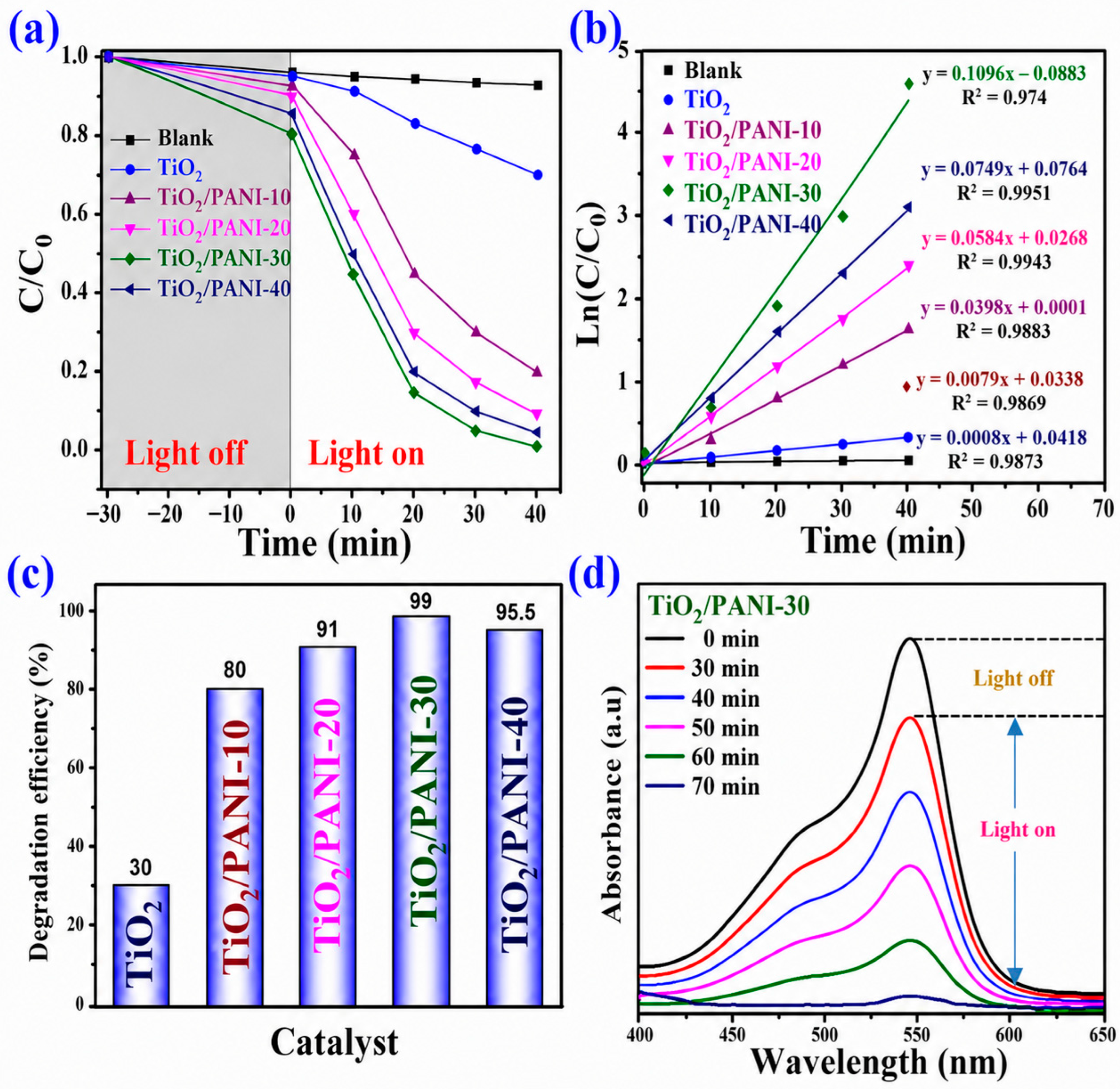
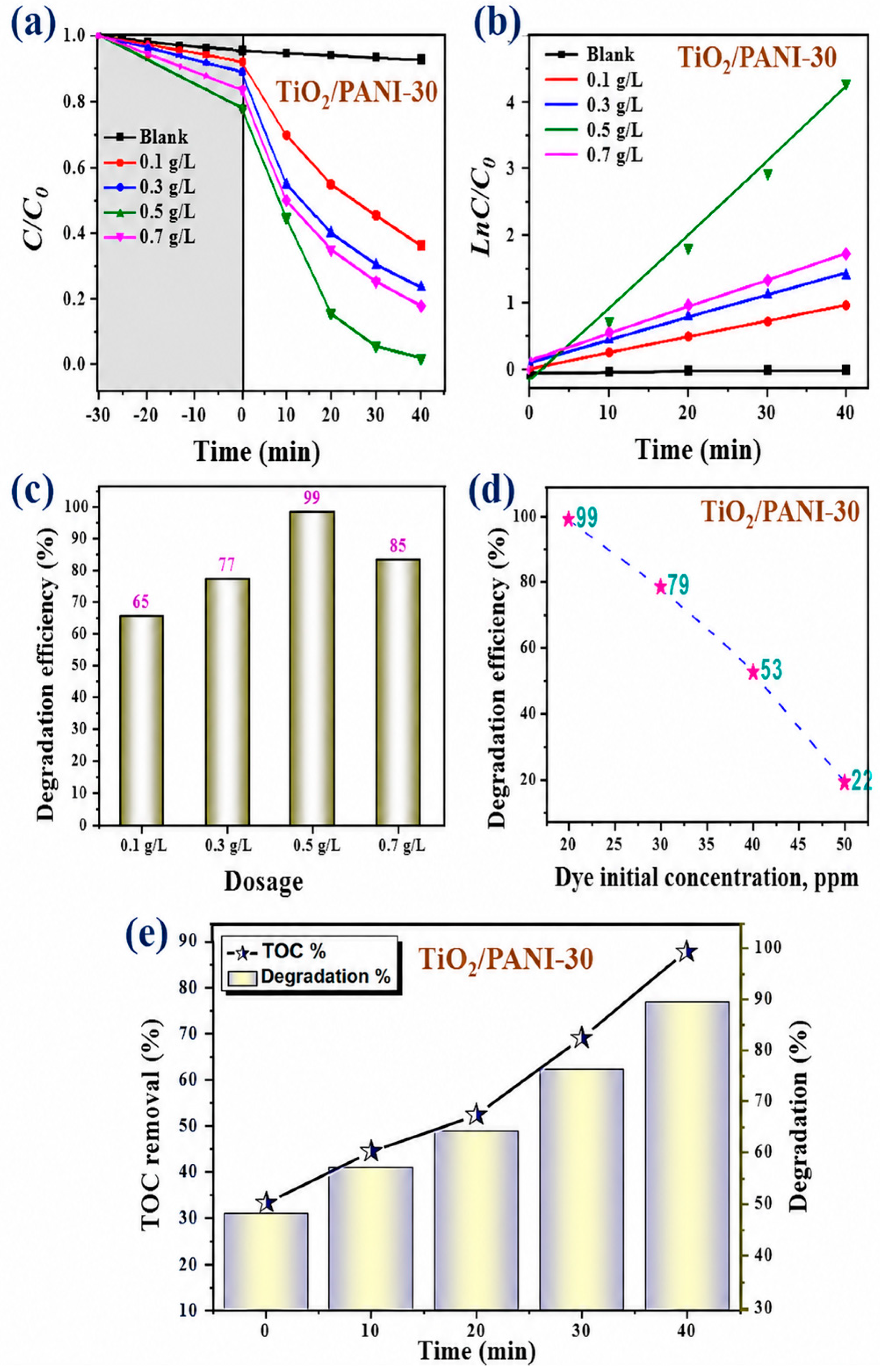
2.2. Experimental Investigation of Photocatalytic Degradation
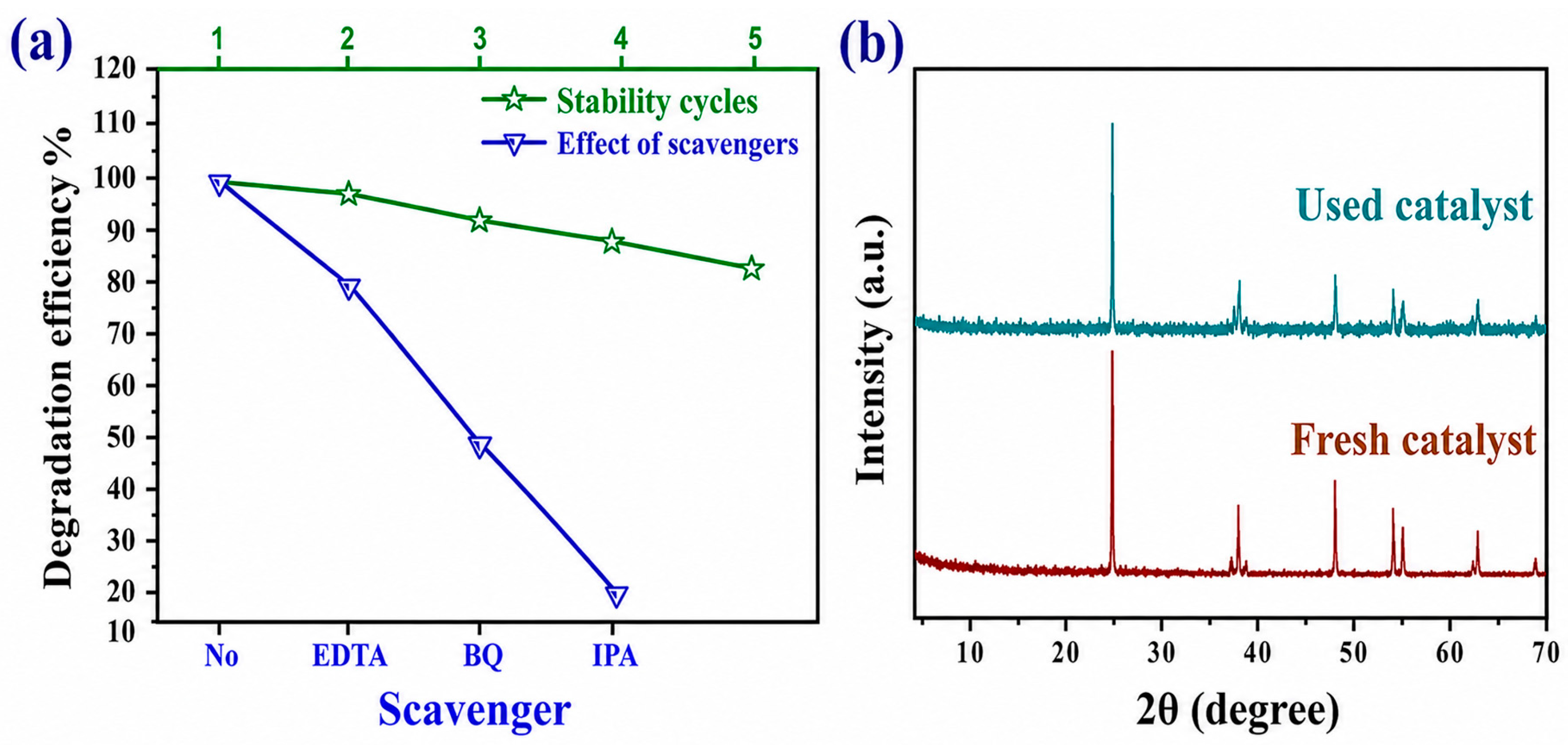
2.3. Evaluation of Stability and Identification of Reactive Species
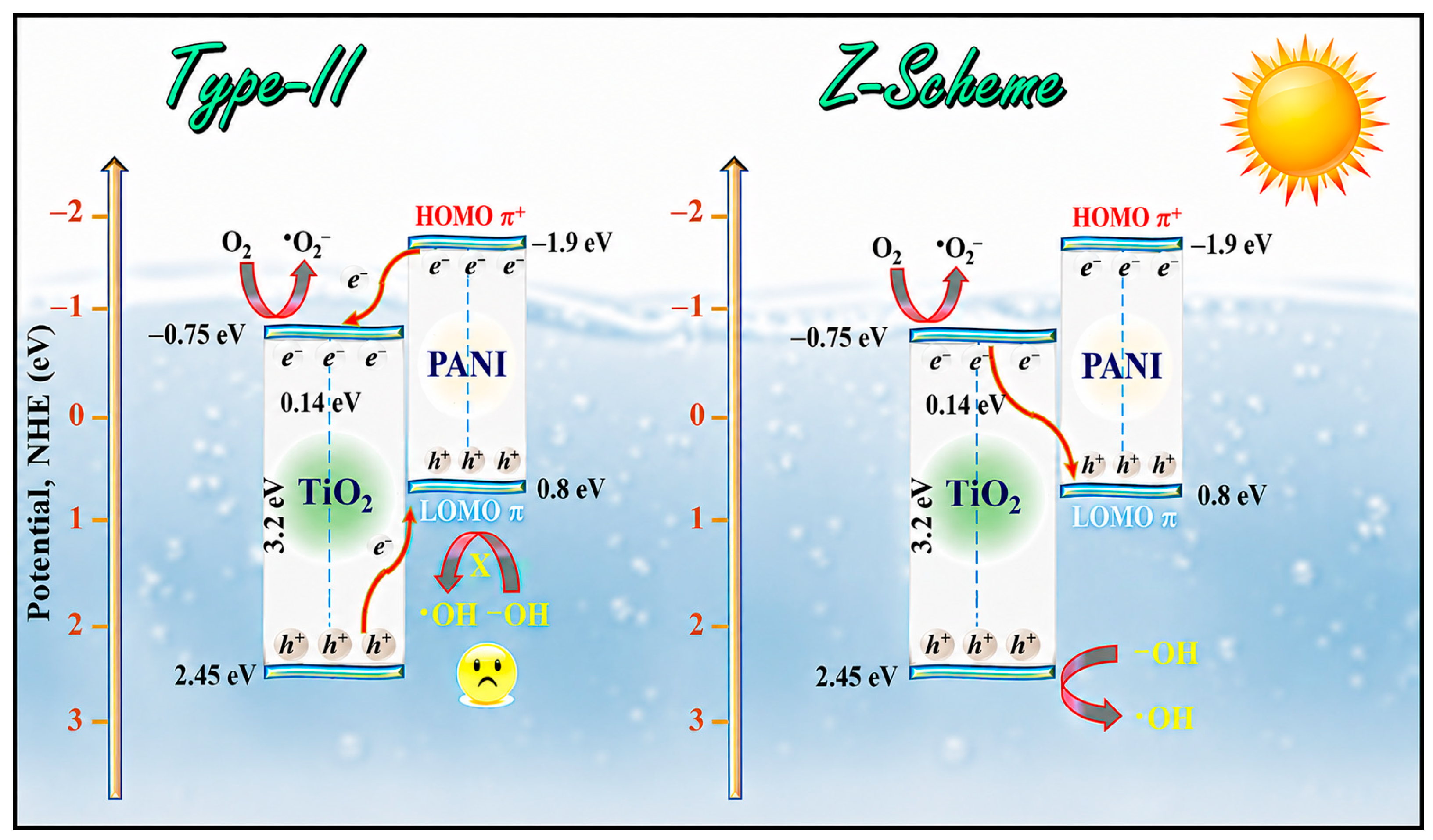
2.4. The Suggested Z-Scheme Pathway During the Photo-Catalytic Process
3. Experimental
3.1. Materials and Chemicals
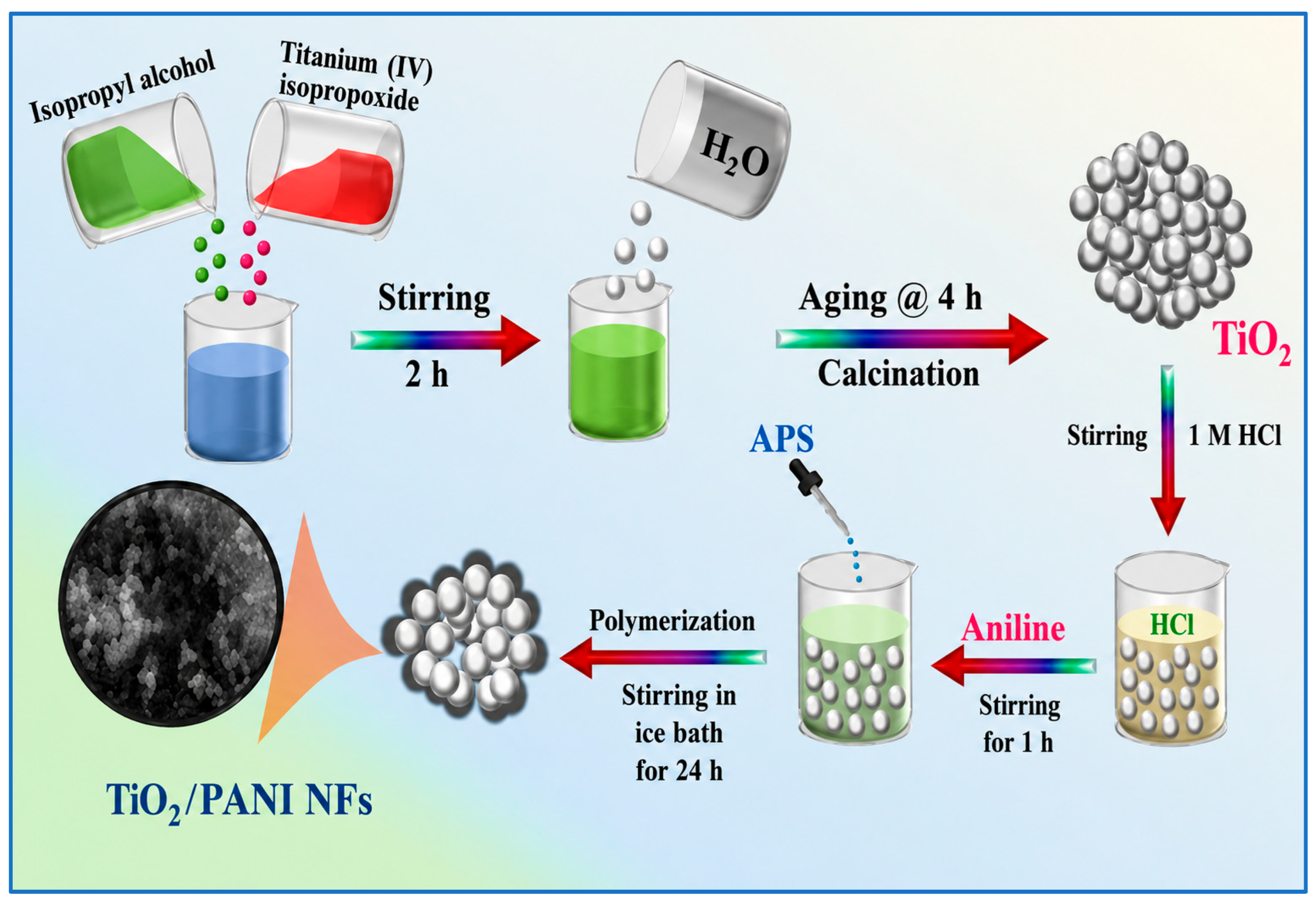
3.2. Preparation of TiO2 NPs
3.3. Synthesis of TiO2/Polyaniline Nanofibers (PANI NFs)
3.4. Investigating the Photocatalytic Effectiveness Toward the Degradation of BF Dye
4. Conclusions
Author Contributions
Funding
Data Availability Statement
Conflicts of Interest
References
- Dhanasekaran, E.; Sriharan, N.; Senthil, T.S.; Sivakumar, N. Efficient photocatalytic degradation of Zn and Gd-doped BiOBr 3D microspheres using reactive dyes under visible light. Mater. Sci. Eng. B 2026, 323, 118779. [Google Scholar] [CrossRef]
- Kourmousi, M.; Tsitsou, E.; Tzevelekidis, P.; Kostakis, M.G.; Linganiso-Dziike, C.E.; Efthimiadou, E.K.; Mitsopoulou, C.A. Visible-light-driven photocatalytic degradation of dyes in wastewater using L-lysine-based carbon Dot/TiO2 nanocomposites. Carbon Trends 2026, 23, 100620. [Google Scholar] [CrossRef]
- Mllaoiy, L.; Bakiz, B.; Bouddouch, A.; Villain, S.; Taoufyq, A.; Guinneton, F.; Gavarri, J.R.; Benlhachemi, A. Construction of p-ZnBi2O4/n-BiOBr heterojunctions for efficient visible-light photocatalytic degradation of dyes. Mater. Adv. 2026, 7, 1790–1804. [Google Scholar] [CrossRef]
- Mo, J.; Hwang, J.E.; Jegal, J.; Kim, J. Pretreatment of a dyeing wastewater using chemical coagulants. Dye. Pigment. 2007, 72, 240–245. [Google Scholar] [CrossRef]
- Paul, S.; Basumatary, F.; Das, B.; Basumatary, S. Exploring the adsorption behavior of malachite green dye onto g-C3N4/ZnFeAl-layered triple hydroxide composite. Next Mater. 2026, 10, 101383. [Google Scholar] [CrossRef]
- El-Sabban, H.A.; Mubarak, M.F.; Diab, M.A. PPy-NTs/C/TiO2/poly(ether sulfone) porous composite membrane: Efficient ultrafiltration of Evans blue dye from industrial wastewater. Synth. Met. 2023, 297, 117383. [Google Scholar] [CrossRef]
- Liu, N.; Tang, C.; Guo, Y.; Zheng, C. Synergistic integration of nanoscale zero-valent Iron and biological treatment for environmental remediation: Mechanisms, system configurations, and performance optimization. Environ. Sci. Nano 2026, 13, 106–121. [Google Scholar] [CrossRef]
- Alazaiza, M.Y.D.; Alzghoul, T.M.; Farobie, O.; Al-Yazeedi, A.A.; Amr, S.S.A.; Bashir, M.J.K. Advanced Oxidation Processes in Water Treatment: Mapping 15 Years of Scientific Progress and Collaboration. Environments 2026, 13, 103. [Google Scholar] [CrossRef]
- El-Sabban, H.A.; Hegazey, R.M.; Hamdy, A.; Moustafa, Y. Study on Highly Efficient Z-Scheme p–n Heterojunction Fe3O4/N-Bi2MoO6: Synthesis, Characterization and Visible-Light-Excited Photocatalytic Activity. J. Mol. Struct. 2022, 1269, 133755. [Google Scholar] [CrossRef]
- Roy, M.; Saha, R. Dyes and their removal technologies from wastewater: A critical review. Intell. Environ. Data Monit. Pollut. Manag. 2020, 82, 127–160. [Google Scholar] [CrossRef]
- Getaneh, S.A.; Temam, A.G.; Nwanya, A.C.; Awada, C.; Alnaim, N.; Alshoaibi, A.; Akpan, P.; Ejikeme, P.M.; Zhu, C.; Ezugwu, S.; et al. Exploring the Advanced Synthesis Strategies and Photocatalytic Application of Nanostructured TiO2-Based Photocatalysts: A Comprehensive Review. JOM 2026, 78, 3457–3475. [Google Scholar] [CrossRef]
- Alekseeva, O.V.; Shibaeva, V.D.; Noskov, A.V.; Agafonov, A.V. Synthesis and photocatalytic activity of the TiO2/g-C3N4 composites: Influence of the TiO2 particles morphology (rod or spherical) on degradation of organic dye. Phys. B Condens. Matter 2026, 727, 418302. [Google Scholar] [CrossRef]
- Wen, X.; Liao, L.; He, Y.; Jin, Y.; Ren, P.; He, L.; Jiang, C.; Yuan, W. Construction and performance regulation of TiO2/Bi2O3 photocatalyst with Z-scheme heterojunction. J. Photochem. Photobiol. A Chem. 2026, 476, 117074. [Google Scholar] [CrossRef]
- Roopashree, B.N.; Gurushantha, K.; Ashly, P.C.; Kottam, N.; Meena, S.; Raghu, G.K.; Sunajadevi, K.R.P. Fabrication of LaCoO3/g-C3N5 Z-scheme photo catalyst for Allura Red dye degradation, ascorbic acid sensing and hydrogen evolution studies. Next Mater. 2026, 11, 101775. [Google Scholar] [CrossRef]
- Amari, A.; Ali, A.B.M.; Ismail, M.A.; Diab, M.A.; El-Sabban, H.A.; Saitov, E.; Reyimberganov, A.; Elboughdiri, N. Enhanced photocatalytic water splitting for green hydrogen production and enrofloxacin degradation using a novel In2S3-Based ternary photocatalyst: Fabrication and mechanism insights. Surf. Interfaces 2025, 58, 105816. [Google Scholar] [CrossRef]
- Bai, Y.; Osman, H.; Lin, H.; Diab, M.A.; Abdulrahman, A.; El-Sabban, H.A.; Atamurotov, F.; Jumanazarov, D.; Amari, A. Synthesis of a novel Cu2O/BiFeO3@Ti3C2 MXene Z-scheme heterojunction for enhanced photocatalytic wastewater treatment and N2 fixation: Mechanistic insights and optimization. J. Water Process Eng. 2025, 73, 107708. [Google Scholar] [CrossRef]
- Guesmi, T.; Alkhafaji, A.; Al-Ghamdi, H.; Singh, P.K.; El-Sabban, H.A.; Mahariq, I.; Dilnoza, B.; Abduvokhidov, A.; Usanov, S.; Haggam, R.A. Visible-light-responsive Zn3V2O8–Bi2WO6 photocatalyst with enhanced photocatalytic redox performance for H2O2 generation and levofloxacin degradation: Charge separation enhancement and mechanistic investigation. J. Water Process Eng. 2026, 87, 110020. [Google Scholar] [CrossRef]
- Huang, J.; Ali, A.B.M.; Abdulrahman, A.; Kadhum, A.A.H.; Samad, S.; Osman, H.; Diab, M.A.; Karimov, M.; El-Sabban, H.A.; Saitov, E. Constructing a novel Z-scheme Fe2O3/ZnIn2S4@Bi2WO6 photocatalyst for boosting removal of non-biodegradable ciprofloxacin and long-term stable CO2 conversion. J. Water Process Eng. 2025, 72, 107632. [Google Scholar] [CrossRef]
- Marouani, I.; Hassan, W.H.; Jasim, D.J.; Almadani, N.; El-Sabban, H.A.; Mahariq, I.; Karimov, M.; Abdullayev, N.; Abduvokhidov, A.; Haggam, R.A. MOF-oxide Z-scheme ZnWO4@NH2-UiO-66 for coupled visible-light CO2 Photoreduction and pharmaceutical pollutant degradation: RSM–CCD optimization, DFT calculations and mechanistic insights. Sep. Purif. Technol. 2026, 395, 137826. [Google Scholar] [CrossRef]
- Alshammari, M.S.; Hassan, W.H.; Al-Zahiwat, M.M.; Osman, H.; El-Sabban, H.A.; Diab, M.A.; Atamuratova, Z.; Saitov, E.; Amari, A. Novel environmentally benign dual Z-scheme SrTiO3/g-C3N4/ZnO heterojunction for efficient H2 evolution and polluted water treatment: Optimization, mechanism interpretations and toxicity assessment. FlatChem 2025, 50, 100841. [Google Scholar] [CrossRef]
- Hasnan, N.S.N.; Nordin, N.A.; Mohamed, M.A. Synergistic interaction and hybrid association of conducting polymer photocatalysts/photoelectrodes for emerging visible light active photocatalytic applications. J. Mater. Chem. A 2024, 12, 27892–27931. [Google Scholar] [CrossRef]
- Kumari, J.; Singh, A.; Rawat, A.; Srivastava, S.K.; Gupta, A.K. Polyaniline-based ternary composites for the photocatalytic degradation of organic pollutants in wastewater: Multifunctional properties, synthetic routes, and mechanistic insights. RSC Sustain. 2026, 4, 1252–1284. [Google Scholar] [CrossRef]
- Ren, H.; Li, J.; Niu, Y.; Zhang, W.; Lv, Y.; Wang, Y.; Song, C. Preparation of Z-Scheme BiVO4/g-C3N4/PANI Heterojunction and Its Photocatalytic Degradation of Enrofloxacin. Ind. Eng. Chem. Res. 2025, 64, 8652–8664. [Google Scholar] [CrossRef]
- Oyetade, J.A.; Machunda, R.L.; Hilonga, A. Functional impacts of polyaniline in composite matrix of photocatalysts: An instrumental overview. RSC Adv. 2023, 13, 15467–15489. [Google Scholar] [CrossRef]
- Gilja, V.; Novaković, K.; Travas-Sejdic, J.; Hrnjak-Murgić, Z.; Roković, M.K.; Žic, M. Stability and Synergistic Effect of Polyaniline/TiO2 Photocatalysts in Degradation of Azo Dye in Wastewater. Nanomaterials 2017, 7, 412. [Google Scholar] [CrossRef] [PubMed]
- Kalikeri, S.; Kamath, N.; Gadgil, D.J.; Shetty Kodialbail, V. Visible light-induced photocatalytic degradation of Reactive Blue-19 over highly efficient polyaniline-TiO2 nanocomposite: A comparative study with solar and UV photocatalysis. Environ. Sci. Pollut. Res. 2017, 25, 3731–3744. [Google Scholar] [CrossRef] [PubMed]
- Kafash, S.; Moghaddam, H.M.; Hashemi Karouei, S.F.; Khatibani, A.B. Facile template-free synthesis of PANI/TiO2 nanocomposite with enhanced photocatalytic activity for methyl orange degradation. Mater. Sci. Eng. B 2025, 321, 118548. [Google Scholar] [CrossRef]
- Wang, F.; Min, S.X. TiO2/polyaniline composites: An efficient photocatalyst for the degradation of methylene blue under natural light. Chin. Chem. Lett. 2007, 18, 1273–1277. [Google Scholar] [CrossRef]
- Ali, S.A.; Ahmad, T. Enhanced hydrogen generation via overall water splitting using novel MoS2-BN nanoflowers assembled TiO2 ternary heterostructures. Int. J. Hydrogen Energy 2023, 48, 22044–22059. [Google Scholar] [CrossRef]
- Zhang, X.; Wu, J.; Meng, G.; Guo, X.; Liu, C.; Liu, Z. One-step synthesis of novel PANI–Fe3O4@ZnO core–shell microspheres: An efficient photocatalyst under visible light irradiation. Appl. Surf. Sci. 2016, 366, 486–493. [Google Scholar] [CrossRef]
- Wadhai, S.; Jadhav, Y.; Thakur, P. Synthesis of metal-free phosphorus doped graphitic carbon nitride-P25 (TiO2) composite: Characterization, cyclic voltammetry and photocatalytic hydrogen evolution. Sol. Energy Mater. Sol. Cells 2021, 223, 110958. [Google Scholar] [CrossRef]
- A’srai, A.I.M.; Razali, M.H.; Amin, K.A.M.; Osman, U.M. CuO/TiO2 nanocomposite photocatalyst for efficient MO degradation. Dig. J. Nanomater. Biostruct. 2023, 18, 1005–1124. [Google Scholar] [CrossRef]
- Motawea, E.A.; El-Sabban, H.A.; Kang, J.H.; Ko, Y.G. Efficient multifunctional PPy-NTs/PEI@alginate@NiFe2O4 magnetic beads for heavy metals removal: Experimental design and optimization interpretations. Int. J. Biol. Macromol. 2024, 282, 137437. [Google Scholar] [CrossRef]
- Yarmohamadi-Vasel, M.; Modarresi-Alam, A.R.; Noroozifar, M.; Hadavi, M.S. An investigation into the photovoltaic activity of a new nanocomposite of (polyaniline nanofibers)/(titanium dioxide nanoparticles) with different architectures. Synth. Met. 2019, 252, 50–61. [Google Scholar] [CrossRef]
- Trejo-Valdez, M.; Hernández-Guzmán, S.R.; Manriquez-Ramírez, M.E.; Sobral, H.; Martínez-Gutiérrez, H.; Torres-Torres, C. Removal of aqueous chromium and environmental CO2 by using photocatalytic TiO2 doped with tungsten. J. Hazard. Mater. 2019, 370, 196–202. [Google Scholar] [CrossRef]
- Munusamy, S.; Sivasankaran, R.P.; Sivaranjan, K.; Sabhapathy, P.; Narayanan, V.; Mohammad, F.; Sagadevan, S. Gallium nitride-polyaniline-polypyrrole hybrid nanocomposites as an efficient electrochemical sensor for mebendazole detection in drugs. Electrochim. Acta 2023, 448, 142148. [Google Scholar] [CrossRef]
- He, S.; Duan, C.; Wang, S.; Yu, Y.; Kei Chan, Y.; Shi, X.; Huang, J.; Wang, S.; Peng, S.; Deng, Y. Fusion Peptide-Engineered Polyetheretherketone Implants with Photo-Assisted Anti-Pathogen and Enhanced Angiogenesis for in vivo Osseointegrative Fixation. Chem. Eng. J. 2022, 446, 137453. [Google Scholar] [CrossRef]
- Zhou, D.; Kang, Z.; Liu, X.; Yan, W.; Cai, H.; Xu, J.; Zhang, D. High sensitivity ammonia QCM sensor based on ZnO nanoflower assisted cellulose acetate-polyaniline composite nanofibers. Sens. Actuators B Chem. 2023, 392, 134072. [Google Scholar] [CrossRef]
- Hu, Q.; Wang, Z.; Chang, J.; Wan, P.; Huang, J.; Feng, L. Design and preparation of hollow NiO sphere- polyaniline composite for NH3 gas sensing at room temperature. Sens. Actuators B Chem. 2021, 344, 130179. [Google Scholar] [CrossRef]
- Li, M.; Dong, B.; Chang, Z.; Dang, H.; Ma, S.; Li, W. Synthesis of TiO2/g-C3N4 Photocatalyst with Recovered TiO2 from Spent SCR Catalyst for Photodegrading Rhodamine B. Waste Biomass Valorization 2022, 14, 687–701. [Google Scholar] [CrossRef]
- Liu, C.; Chen, J.; Che, H.; Huang, K.; Charpentier, P.A.; Xu, W.Z.; Shi, W.; Dong, H.J. Construction and enhanced photocatalytic activities of a hydrogenated TiO2 nanobelt coated with CDs/MoS2 nanosheets. RSC Adv. 2017, 7, 8429–8442. [Google Scholar] [CrossRef]
- Sharma, S.; Kumar, D.; Khare, N. Hierarchical PANI/CdS nanoarchitecture system for visible light induced photocatalytic dye degradation and photoelectrochemical water splitting. Polymer 2021, 231, 124117. [Google Scholar] [CrossRef]
- Tolosana-Moranchel, A.; Pecharromán, C.; Faraldos, M.; Bahamonde, A. Strong effect of light scattering by distribution of TiO2 particle aggregates on photocatalytic efficiency in aqueous suspensions. Chem. Eng. J. 2021, 403, 126186. [Google Scholar] [CrossRef]
- Li, G.; Lv, L.; Fan, H.; Ma, J.; Li, Y.; Wan, Y.; Zhao, X.S. Effect of the agglomeration of TiO2 nanoparticles on their photocatalytic performance in the aqueous phase. J. Colloid Interface Sci. 2010, 348, 342–347. [Google Scholar] [CrossRef]
- Pellegrino, F.; Pellutiè, L.; Sordello, F.; Minero, C.; Ortel, E.; Hodoroaba, V.D.; Maurino, V. Influence of agglomeration and aggregation on the photocatalytic activity of TiO2 nanoparticles. Appl. Catal. B Environ. 2017, 216, 80–87. [Google Scholar] [CrossRef]
- Ajmal, A.; Majeed, I.; Malik, R.N.; Idriss, H.; Nadeem, M.A. Principles and mechanisms of photocatalytic dye degradation on TiO2 based photocatalysts: A comparative overview. RSC Adv. 2014, 4, 37003–37026. [Google Scholar] [CrossRef]
- Reza, K.M.; Kurny, A.; Gulshan, F. Parameters affecting the photocatalytic degradation of dyes using TiO2: A review. Appl. Water Sci. 2015, 7, 1569–1578. [Google Scholar] [CrossRef]
- Saeedi, S.N.; Rasoulifard, M.H.; Dorraji, M.S.S.; Douroudgari, H.; Sehati, N. Enhanced photocatalytic degradation of organic pollutants using a TiO2–clay nanocomposite in a rotary photoreactor with experimental and theoretical insights. Sci. Rep. 2025, 15, 38193. [Google Scholar] [CrossRef] [PubMed]
- Kumar, A.; Raorane, C.J.; Syed, A.; Bahkali, A.H.; Elgorban, A.M.; Raj, V.; Kim, S.C. Synthesis of TiO2, TiO2/PAni, TiO2/PAni/GO nanocomposites and photodegradation of anionic dyes Rose Bengal and thymol blue in visible light. Environ. Res. 2023, 216, 114741. [Google Scholar] [CrossRef]
- Bouziani, A.; Yahya, M.; Naciri, Y.; Hsini, A.; Khan, M.A.; Sillanpää, M.; Celik, G. Development of polyaniline coated titania-hematite composite with enhanced photocatalytic activity under sun-like irradiation. Surf. Interfaces 2022, 34, 102328. [Google Scholar] [CrossRef]
- Qutub, N.; Singh, P.; Sabir, S.; Umar, K.; Sagadevan, S.; Oh, W.C. Synthesis of Polyaniline Supported CdS/CdS-ZnS/CdS-TiO2 Nanocomposite for Efficient Photocatalytic Applications. Nanomaterials 2022, 12, 1355. [Google Scholar] [CrossRef] [PubMed]
- Sharma, S.; Sharma, A.; Chauhan, N.S.; Tahir, M.; Kumari, K.; Mittal, A.; Kumar, N. TiO2/Bi2O3/PANI nanocomposite materials for enhanced photocatalytic decontamination of organic pollutants. Inorg. Chem. Commun. 2022, 146, 110093. [Google Scholar] [CrossRef]
- Aminuddin, N.F.; Nawi, M.A.; Bahrudin, N.N. Enhancing the optical properties of immobilized TiO2/polyaniline bilayer photocatalyst for methyl orange decolorization. React. Funct. Polym. 2022, 174, 105248. [Google Scholar] [CrossRef]
- Hu, K.; Li, R.; Ye, C.; Wang, A.; Wei, W.; Hu, D.; Qiu, R.; Yan, K. Facile synthesis of Z-scheme composite of TiO2 nanorod/g-C3N4 nanosheet efficient for photocatalytic degradation of ciprofloxacin. J. Clean. Prod. 2020, 253, 120055. [Google Scholar] [CrossRef]
- Wang, D.; Ren, B.; Chen, S.; Liu, S.; Feng, W.; Sun, Y. Novel BiVO4/TiO2 composites with Z-scheme heterojunction for photocatalytic degradation. Mater. Lett. 2023, 330, 133229. [Google Scholar] [CrossRef]
- Kuang, X.; Fu, M.; Kang, H.; Lu, P.; Bai, J.; Yang, Y.; Gao, S. Enhanced Photocatalytic Performance of Multifunctional Composite Ag-Ag2Se@CdSe/3DOM TiO2 with Dual Z-Scheme Heterostructures Coupling Ag NPs: Degradation, Hydrogen Production and Antibacterial Activity. J. Alloys Compd. 2025, 1021, 179571. [Google Scholar]
- Zhang, D.; Dong, G.; Zhang, X.; Tan, X.; Nie, X.; Xia, D.; Zhao, M.; Meng, L.; Zhang, W. Construction and performance insights into an S-scheme BiOBr/CeMo8O14/r-GO heterojunction for photodegrading levofloxacin via activation of peroxymonosulfate. J. Rare Earths, 2026; in press. [CrossRef]
- Li, J.; Nie, X.; Meng, L.; Zhang, X.; Bai, L.; Chai, D.F.; Zhang, W.; Zhang, Z.; Dong, G. Microwave-assisted hydrothermal synthesis of Ag/Bi2MoO6/ZnO heterojunction with nano Ag as electronic accelerator pump for high-efficienty photocatalytic degradation of levofloxacin. Appl. Surf. Sci. 2024, 678, 161143. [Google Scholar] [CrossRef]
- Han, P.D.; Dong, G.H.; Zhang, X.J.; Chai, D.F.; Su, T.; Zhang, Z.F.; Zhao, M.; Li, J.L.; Zhang, W.Z. Microwave-assisted preparation of Z scheme heterojunction by anchoring ZnFe2O4 on tubular-like g-C3N4 for peroxymonosulfate activation towards levofloxacin degradation. J. Cent. South Univ. 2025, 32, 894–918. [Google Scholar] [CrossRef]
- Qi, Y.; Zhou, G.; Wu, Y.; Wang, H.; Yan, Z.; Wu, Y. In-situ construction of In2O3/In2S3-CdIn2S4 Z-scheme heterojunction nanotubes for enhanced photocatalytic hydrogen production. J. Colloid Interface Sci. 2024, 664, 107–116. [Google Scholar] [CrossRef]
- Li, J.; Shi, Q.; Ha, L.; Sun, Y.; Shi, H. In-situ construction of dual Z-scheme TiO2/CuBi2O4/Bi2O2CO3 heterojunction for exceptional visible-light photocatalytic tetracycline removal. J. Mater. Sci. 2025, 60, 7247–7258. [Google Scholar] [CrossRef]
- Kanmani, S.S.; Ramachandran, K. Synthesis and characterization of TiO2/ZnO core/shell nanomaterials for solar cell applications. Renew. Energy 2012, 43, 149–156. [Google Scholar] [CrossRef]
- Ouzar, A.; Goutomo, B.T.; Nam, K.J.; Kim, I.K. Enhanced removal of malachite green from wastewater using nonthermal plasma gliding arc discharge combined with ferrate oxidation. Desalin. Water Treat. 2024, 320, 100743. [Google Scholar] [CrossRef]



| Photocatalyst | Dye | Light Source | Degradation (%) | Time (min) | Stability/Reusability | Key Feature | Ref. |
|---|---|---|---|---|---|---|---|
| TiO2/PANI/GO | - Thymol Blue - Rose Bengal | UV-365 nm Hanovia lamp | 60 97 | 180 | Stable over 3 cycles Stable over 3 cycles | Ternary composite | [49] |
| PANI@Fe2O3@TiO2 | Methylene Blue | sun-like radiation Osram Ultra-Vitalux lamp (300 W) | 96 | 120 | Stable over 4 cycles | Ternary composite | [50] |
| PANI/CdS PANI/CdS-ZnS PANI/CdS-TiO2 | Acid Blue-29 | Visible light A halogen liner lamp (500 W, 9500 Lumens) | 82.2 89.9 86.4 | 90 | Stable over 5 cycles | Comparison between different composites | [51] |
| TiO2/Bi2O3/PANI | Rhodamine B | Visible LEDs | 99.6 | 50 | Stable over 4 cycles | Ternary composite | [52] |
| TiO2/polyaniline bilayer | Methyl orange | 45 W fluorescent lamp | 100 | 60 | Stable over 10 cycles | Bilayer composite | [53] |
| TiO2/PANI nanofibers | Basic Fuchsin | Visible light (420 nm cutoff) | 99 | 40 | Stable over 5 cycles | Z-scheme heterojunction | Present work |
Disclaimer/Publisher’s Note: The statements, opinions and data contained in all publications are solely those of the individual author(s) and contributor(s) and not of MDPI and/or the editor(s). MDPI and/or the editor(s) disclaim responsibility for any injury to people or property resulting from any ideas, methods, instructions or products referred to in the content. |
© 2026 by the authors. Licensee MDPI, Basel, Switzerland. This article is an open access article distributed under the terms and conditions of the Creative Commons Attribution (CC BY) license.
Share and Cite
Diab, M.A.; El-Sabban, H.A.; Kim, Y. Engineering Polyaniline Nanofibers/TiO2 for Enhanced Photocatalytic Degradation of Organic Contaminants: In-Depth Structural and Mechanistic Insights. Catalysts 2026, 16, 464. https://doi.org/10.3390/catal16050464
Diab MA, El-Sabban HA, Kim Y. Engineering Polyaniline Nanofibers/TiO2 for Enhanced Photocatalytic Degradation of Organic Contaminants: In-Depth Structural and Mechanistic Insights. Catalysts. 2026; 16(5):464. https://doi.org/10.3390/catal16050464
Chicago/Turabian StyleDiab, Mohamed. A., Heba A. El-Sabban, and Youngsoo Kim. 2026. "Engineering Polyaniline Nanofibers/TiO2 for Enhanced Photocatalytic Degradation of Organic Contaminants: In-Depth Structural and Mechanistic Insights" Catalysts 16, no. 5: 464. https://doi.org/10.3390/catal16050464
APA StyleDiab, M. A., El-Sabban, H. A., & Kim, Y. (2026). Engineering Polyaniline Nanofibers/TiO2 for Enhanced Photocatalytic Degradation of Organic Contaminants: In-Depth Structural and Mechanistic Insights. Catalysts, 16(5), 464. https://doi.org/10.3390/catal16050464