Review

Theoretical Insights and Design Strategies of Metal–Nitrogen–Carbon Catalysts for Electrochemical Nitrogen Reduction Reaction


Key Laboratory of Automobile Materials, Ministry of Education, School of Materials Science and Engineering, Jilin University, Changchun 130022, China
*
Authors to whom correspondence should be addressed.
Catalysts 2026, 16(5), 456; https://doi.org/10.3390/catal16050456
Submission received: 12 April 2026 / Revised: 8 May 2026 / Accepted: 8 May 2026 / Published: 13 May 2026
(This article belongs to the Special Issue Young Researchers in Electrocatalysis)

Abstract

Electrochemical nitrogen reduction reaction (NRR) is a sustainable and environmentally friendly method for ammonia synthesis, offering a promising alternative to the Haber–Bosch method. Despite its considerable potential, NRR is still plagued by a scarcity of efficient catalysts. Metal–nitrogen–carbon (M–N–C) catalysts exhibit unique advantages in achieving excellent NRR performance. Theoretical calculations are crucial in understanding and guiding the design of M–N–C catalysts. Herein, we summarize the theoretical progress and rational designs of M–N–C catalysts for NRR. The fundamental mechanisms of NRR are introduced, and the activity, selectivity, and stability exhibited by the M–N–C catalysts are analyzed in depth. Additionally, several design strategies for M–N–C catalysts are provided, including adjusting the central metal atoms, regulating the coordinative environments, and applying computational data-driven approaches to optimize the structures of M–N–C catalysts. Finally, a summary and outlook of M–N–C catalysts for NRR are given.

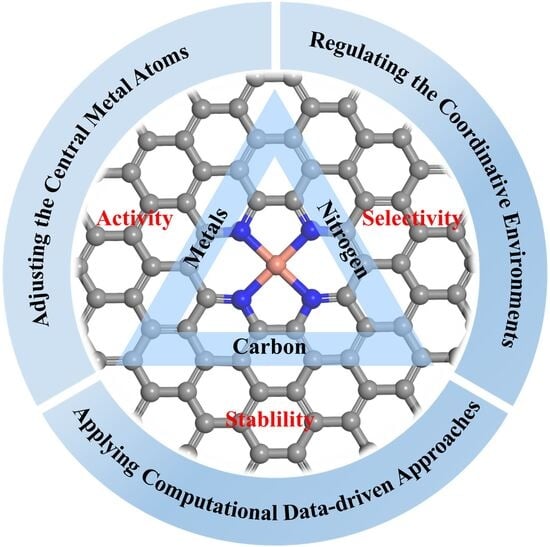
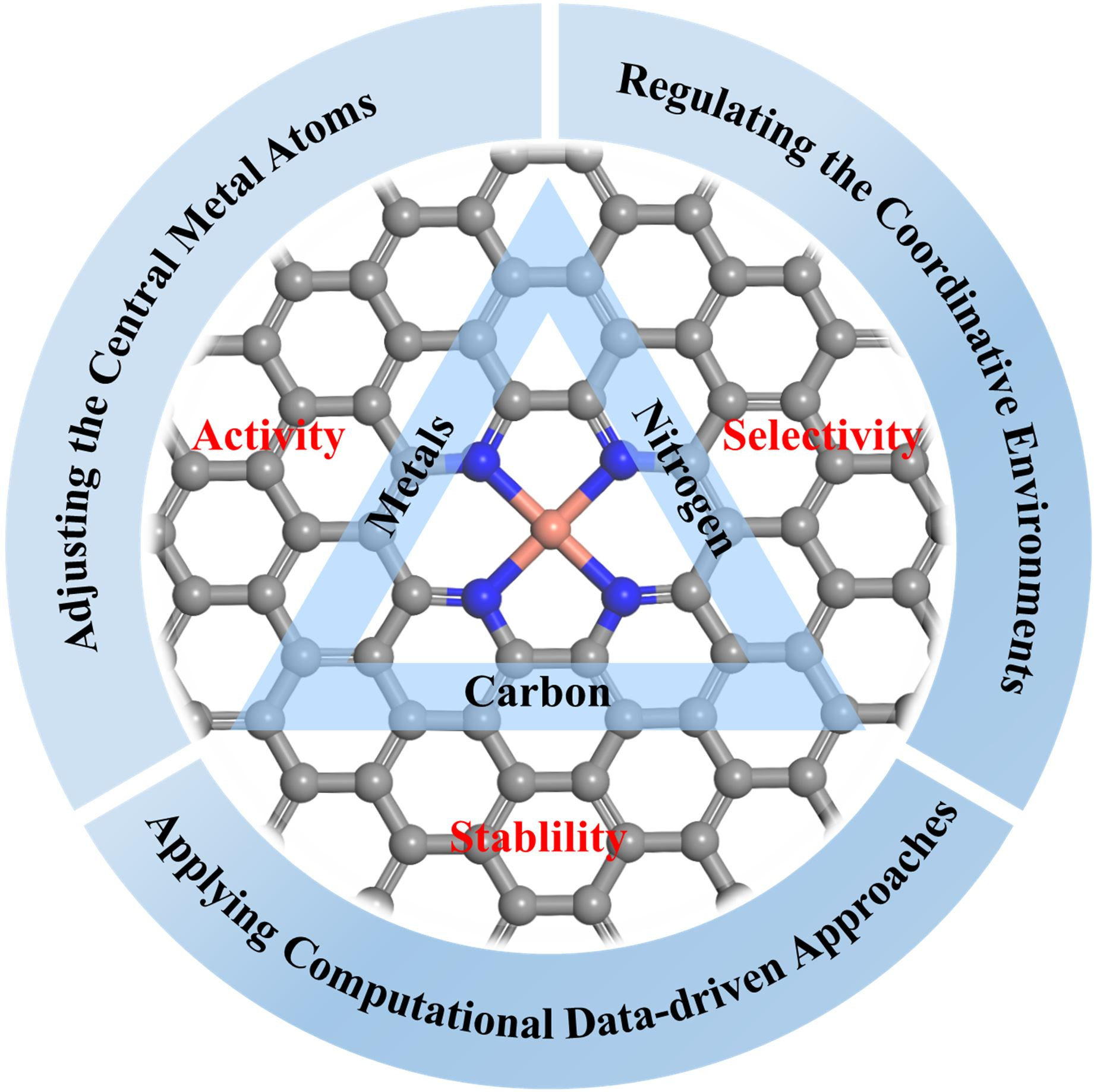
Graphical Abstract

1. Introduction

Ammonia (NH3) is one of the most productive chemical products in the world, with a significant impact on the global economy [1,2]. NH3 plays an indispensable role in various industrial processes and daily human activities, thereby representing a critical factor in societal progress [3,4,5]. Approximately 80% of synthesized NH3 is utilized in fertilizers, making it a vital component in food production and significantly contributing to food security for the majority of the world’s population [6,7]. In addition to its agricultural applications, NH3 is extensively used in the chemical industry for the production of explosives, plastics, synthetic fibers, and pharmaceuticals [8]. Furthermore, NH3 holds considerable potential as a hydrogen carrier for energy conversion applications [9]. These characteristics underscore the essential role of NH3 in current and future industrial applications [10].
The predominant industrial method for large-scale NH3 synthesis is the Haber–Bosch method, which operates under relatively harsh conditions, requiring high temperatures (350–450 °C) and pressures (150–200 bar) [11]. Such dependence arises from both feedstock supply and process energy consumption. In conventional ammonia plants, fossil resources are used not only to provide heat and compression energy for high-temperature and high-pressure operation, but more importantly to produce the H2 feedstock, mainly through steam-methane reforming [12,13]. In methane-fed Haber–Bosch systems, a large fraction of direct CO2 emissions is associated with methane used as the H2 source rather than with fuel combustion for process heating [14]. According to International Energy Agency, NH3 production accounts for approximately 2% of global final energy consumption and 1.3% of energy-related CO2 emissions. About 40% of the total energy input is used as feedstock to supply hydrogen, while the remaining energy is consumed as process energy, mainly for heat generation [15]. Therefore, the environmental burden of the Haber–Bosch process originates from both fossil-derived H2 production and energy-intensive thermochemical operation. Given the escalating global energy and ecological crises, the urgent need for the development of clean and sustainable NH3 production methods has become more apparent [16]. In contrast, the electrochemical nitrogen reduction reaction (NRR) provides a distinct route for sustainable NH3 synthesis. It can directly use nitrogen (N2) as the nitrogen source and water or the electrolyte as the proton source under ambient conditions, thereby avoiding the separate fossil-fuel-based H2 production step required in conventional ammonia synthesis [17,18]. When powered by renewable electricity, electrochemical NRR can couple NH3 synthesis with solar, wind, or other low-carbon electricity sources, converting electrical energy into chemical energy stored in NH3 [3,19,20,21]. Moreover, electrochemical systems are generally compatible with modular and scalable device architectures, making them attractive for decentralized or on-site NH3 production near agricultural or industrial demand centers [14,22,23,24]. Such local production could improve the utilization of geographically distributed renewable energy and reduce the need for long-distance NH3 transportation [14]. Compared with the centralized Haber–Bosch process, electrochemical NRR offers several practical advantages, including mild operating conditions, direct use of abundant reactants, renewable-electricity compatibility, simplified process configuration, and reduced dependence on large-scale high-pressure infrastructure [17,19,20,21,22]. Therefore, electrochemical NRR is regarded as a promising route for sustainable NH3 synthesis. Nevertheless, its practical development remains constrained by several intrinsic limitations. First, the N≡N triple bond possesses an extremely high bond dissociation energy of approximately 941 kJ mol−1, and the nonpolar nature of N2 further makes its adsorption and activation on catalyst surfaces kinetically difficult [3]. Second, the complete conversion of one N2 molecule into two NH3 molecules requires a six-proton/six-electron transfer process, which involves multiple adsorbed intermediates and successive proton-coupled electron transfer (PCET) steps. As a result, even if N2 can be adsorbed on the catalytic site, the subsequent hydrogenation steps may still suffer from large reaction free energy changes (ΔG) and sluggish reaction kinetics. Third, in aqueous electrolytes, the hydrogen evolution reaction (HER) usually occurs in a similar potential range to NRR and competes with NRR for both protons and electrons. This side reaction consumes protons and electrons that should participate in NH3 formation, thereby lowering the selectivity toward NRR [17]. In addition, the low solubility and slow mass transport of N2 in aqueous electrolytes further limit the local N2 concentration near the electrode surface, while water and protons are much more readily available for HER [25]. These combined factors usually result in low NH3 yield rates and limited Faradaic efficiencies (FEs), which remain major obstacles to the practical application of electrochemical NRR [3,17,26]. Consequently, the advancement of electrochemical NRR relies heavily on the development of highly efficient catalysts that demonstrate exceptional activity, selectivity, and stability.
Traditional heterogeneous catalysts, especially metal-based catalysts, exhibit excellent performance in many electrocatalytic processes [27]. For example, a Mo (110) nanofilm was reported to achieve aqueous N2 electroreduction at a low overpotential, suggesting that exposed metal facets can strongly affect N2 activation and reaction selectivity [28]. Among metal catalysts, noble metals have been widely investigated because of their favorable electronic structures and suitable interactions with N2 or nitrogen-containing intermediates. Ru is a representative noble metal because it is an efficient catalyst in the Haber–Bosch process and has also been studied as a promising electrocatalyst for NRR [29]. Studies on Ru electrodes have provided mechanistic insights into N2 adsorption, protonation, and the competition between NRR and HER. Pd nanoparticles were also demonstrated to catalyze ambient ammonia synthesis at a low overpotential, highlighting the role of metal-mediated hydrogenation in N2 reduction [30]. These studies indicate that noble-metal catalysts can serve as important benchmark systems for understanding NRR activity and selectivity. However, their scarcity and high cost limit their large-scale practical application, motivating the exploration of more abundant and structurally tunable catalytic systems. In addition to pure metal catalysts, metal-based composite catalysts have been developed to improve NRR performance by constructing metal–support interfaces and regulating local electronic structures. In these systems, the support is not merely an inert carrier but can participate in charge redistribution, stabilize small metal clusters or nanoparticles, and modulate the adsorption behavior of NRR intermediates. For example, Au sub-nanoclusters anchored on TiO2 exhibited high activity and selectivity for N2 conversion to NH3 under ambient conditions, demonstrating that the interaction between ultrasmall Au clusters and oxide supports can create efficient active sites for NRR [31]. Biological catalysts also provide important inspiration for artificial NRR catalyst design. In nature, nitrogenase enzymes can convert atmospheric N2 to NH3 under ambient conditions through complex metal–sulfur cofactors. In particular, FeMo-cofactor-containing nitrogenases have been extensively studied as natural models for N2 binding, activation, and multi-electron/proton transfer [32]. The cooperative roles of multiple metal centers, surrounding ligands, and the local proton/electron transfer environment in nitrogenases also highlight the importance of precisely regulating both the active metal center and its coordination environment. To further enhance the effective participation of metal atoms in catalytic processes, improving atom utilization efficiency and selectivity remains a key focus in catalyst development [33,34]. Since the discovery by Zhang et al. in 2011 that single Pt atoms dispersed on FeOx exhibited CO oxidation activity, single atom catalysts (SACs) have attracted considerable attention [35]. The excellent catalytic performance of SACs is attributed to three factors: the low coordinative environments of the metal, quantum size effects, and metal–support interactions (MSI) [34,36,37,38]. Furthermore, the well-defined and uniform active sites of SACs are conducive to boosting catalytic selectivity [36,39]. To stabilize these isolated atoms and prevent their migration and aggregation, a suitable substrate with strong MSI is essential. Carbon-based materials are extensively utilized for NRR due to their high specific surface area, excellent conductivity, abundant defect sites, and structural tunability, which are thus widely acknowledged as promising substrates for stabilizing metal atoms and modulating the electronic structure of metal centers [40]. The incorporation of nitrogen not only enhances the binding strength but also induces favorable modifications to the electronic structure [41]. Given the critical role of nitrogen in promoting metal-site activity, more N-doped carbon systems such as CxNy frameworks (e.g., C2N, CN, and C3N4) have also been studied [42,43,44,45].
Metal–nitrogen–doped carbon (M–N–C) materials have demonstrated remarkable performance in NRR. The M–N–C materials possess several notable advantages: (i) they maximize utilization of metal atoms, ensuring atomic-level efficiency; (ii) the density of effective active sites can be significantly increased; (iii) the low coordinative environments of the central metal atoms (CMAs) enhance electrocatalytic activity; (iv) the strong interaction between the metal centers and the substrates redistributes electrons around the active centers, facilitating efficient electron transfer to reactants and thereby improving catalytic performance [37,46,47,48]. These properties make M–N–C materials particularly promising for optimizing the activity, selectivity, and stability of heterogeneous catalysts in electrochemical NRR applications. In recent years, the research on M–N–C catalysts for NRR has made remarkable progress, highlighting the great potential of M–N–C catalysts in electrocatalysis [49,50,51]. For example, Geng et al. reported a MOF-derived Ru single-atom catalyst with isolated Ru atoms dispersed on nitrogen-doped carbon for electrochemical N2 reduction. This catalyst achieved a high NH3 yield rate of 120.9 μg h−1 mgcat−1, highlighting the potential of atomically dispersed M–N–C coordination sites for NRR. The well-defined Ru-N/C structure also provides a useful model for theoretical studies of NRR [52]. The geometric and electronic configurations of the active centers in M–N–C materials play a pivotal role in enhancing the catalytic performance of NRR. Specifically, fine-tuning both the CMAs and their coordinative environments is crucial for achieving ideal geometric and electronic structures. Some reviews have systematically summarized the preparation, characterization, and performance of M–N–C catalysts for NRR [53,54,55,56]. Furthermore, theoretical calculations have also been instrumental in understanding and designing M–N–C catalysts [57,58]. Among these, density functional theory (DFT) calculations can not only provide insights into the electronic interactions at catalytic sites but also reveal the mechanisms of the catalytic reaction [59,60,61]. With the continuous advancement of DFT methodologies, computation-guided catalyst design has emerged as one of the most promising strategies for advancing catalyst research.
In this review, we summarize recent advancements in M–N–C electrocatalysts for NRR, and offer insights into their catalytic behavior and rational design strategies from theoretical calculations. Firstly, the fundamental understanding of NRR mechanisms is introduced, highlighting the activity, selectivity, and stability of M–N–C catalysts for NRR. Then, general strategies for enhancing the performance of M–N–C materials through adjusting the central metal atoms, regulating the coordinative environments, and applying computational data-driven approaches are extracted from recent theoretical research progress. These strategies provide guidance for the selection and design of M–N–C catalysts at the atomic level. Finally, the future research directions and challenges in this research field are briefly discussed.

2. Fundamentals of Electrochemical NRR

2.1. Mechanisms of NRR

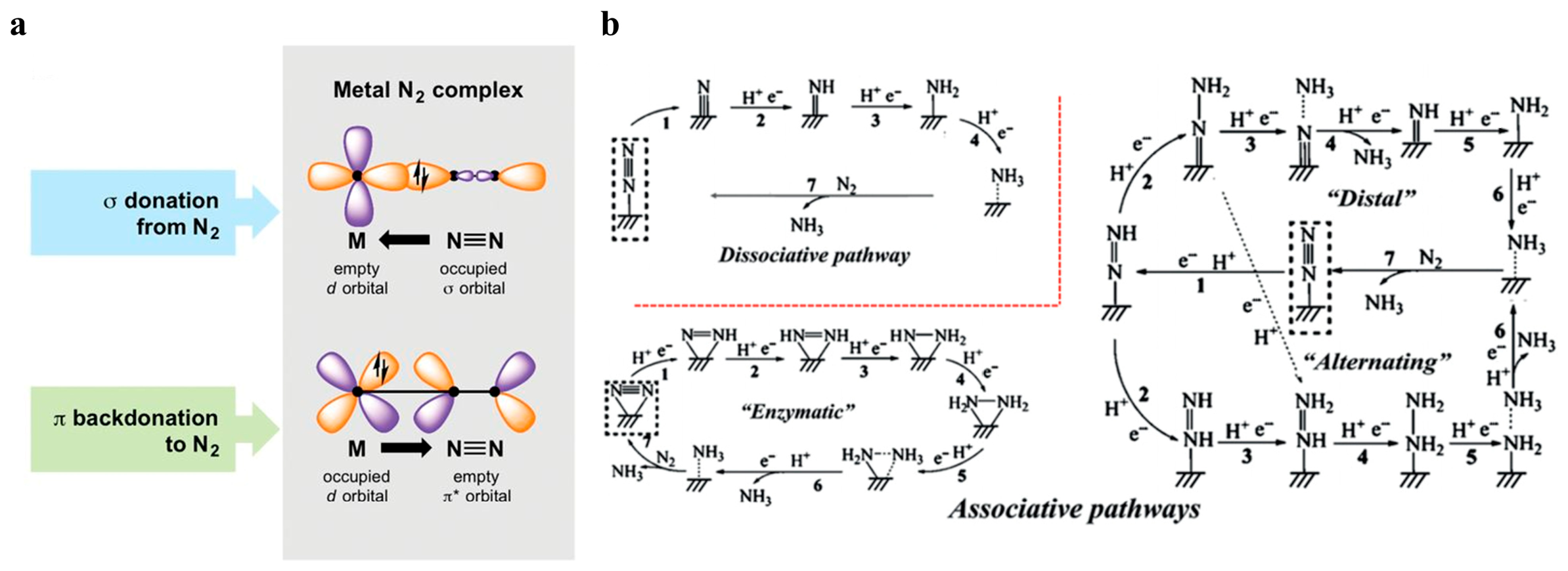
In general, the electrochemical NRR involves two major steps: the adsorption of N2 on the catalyst surface and the sequential hydrogenation of the adsorbed N2 to form NH3 [51,62]. The adsorption and effective activation of N2 on the catalyst surface are prerequisites for the initiation of NRR. However, the N≡N bond has an extremely high bond dissociation energy (941 kJ mol−1), rendering N2 relatively chemically inert [6,63]. Transition metal (TM) centers are particularly effective for N2 activation because their vacant and occupied d states can interact with the frontier orbitals of N2 [64]. As shown in Figure 1a, the empty d orbitals of TMs accept the lone-pair electrons from N2, while the occupied d orbitals of TMs back-donate electrons to the antibonding orbitals (π*) of N2 [65]. The “acceptance-donation” mechanism of electrons can effectively weaken N≡N bond and activate N2, facilitating subsequent hydrogenation steps [66,67]. According to the N≡N bond cleavage mechanism, the mechanisms of electrochemical NRR can be classified into dissociative and associative mechanisms (Figure 1b) [18].
In theoretical studies of electrochemical NRR, ΔG diagrams are commonly used to compare the thermodynamic feasibility of different reaction pathways. Each elementary step is described by ΔG, which reflects the thermodynamic difficulty of forming or transforming a specific adsorbed intermediate under a given computational model [68]. Because NRR involves the transfer of multiple protons and electrons, most hydrogenation steps are treated as PCET processes. In such steps, one proton and one electron are transferred to the adsorbed intermediate, leading to the sequential formation of species such as *N2H, *NHNH, *NH2, and *NH3. Among all elementary electrochemical steps, the potential-determining step (PDS), sometimes termed the potential-limiting step (PLS), is defined as the step with the largest uphill ΔG along a given pathway. The corresponding value is denoted as ΔGPDS or ΔGPLS in different studies. The PDS/PLS is therefore a thermodynamic descriptor that identifies the most difficult potential-dependent step. By contrast, the rate-determining step (RDS) is a kinetic concept determined by the activation barrier of an elementary step. Thus, the PDS/PLS and RDS may be related, but they are not necessarily identical. The limiting potential (UL) is used to estimate the minimum electrode potential required to make all electrochemical steps thermodynamically favorable. In general, a smaller ΔGPDS or ΔGPLS and a less negative UL indicate a more favorable predicted NRR activity from the thermodynamic perspective. In addition, comparison between the ΔG of NRR and the competing HER is often used to evaluate reaction selectivity.

2.1.1. Dissociative Mechanism

In the dissociative mechanism, the N≡N bond is completely broken before hydrogenation, and both nitrogen atoms are reduced to NH3. Owing to the relative inertness of the N≡N bond, few catalysts can facilitate NRR via the dissociative mechanism [69].

2.1.2. Associative Mechanism

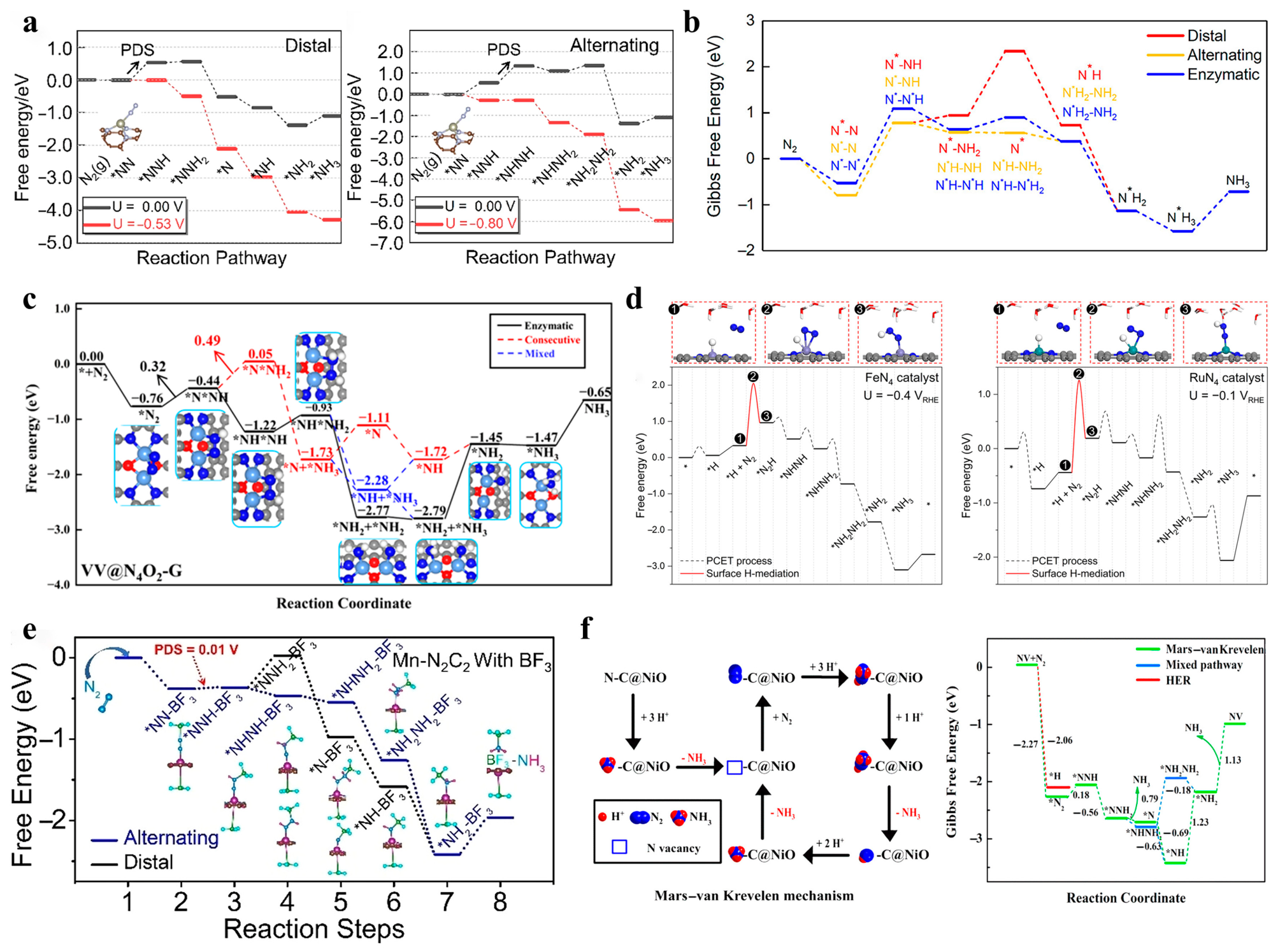
Current research focuses on the associative mechanism, in which the N≡N bond is progressively weakened through stepwise hydrogenation. Depending on the different initial adsorption configurations of N2, the associative mechanism can be divided into different pathways: the distal pathway and alternative pathway of N2 end-on adsorption and the enzymatic pathway of N2 side-on adsorption. Understanding the mechanisms and pathways of electrochemical NRR is essential for elucidating the role of catalysts, thereby providing a robust theoretical basis for the design of M–N–C catalysts with excellent performance. These mechanisms can be elucidated through theoretical studies such as DFT calculations. Liu et al. reported a detailed reaction pathway for NRR on TcN3 supported on carbon nanotubes (CNTs) [70]. DFT calculations revealed that N2 is adsorbed at the active site in the end-on configuration. Along the distal pathway, the first protonation step (*N2 → *N2H) is identified as PDS with a ΔG of 0.53 eV. In contrast, the alternating pathway encounters a higher ∆G of 0.80 eV during the formation of *NH-*NH. As a result, the reaction preferentially proceeds via the distal pathway (Figure 2a). Zang et al. reported a single-atom Cu-N2 catalyst supported on nitrogen-doped carbon [71]. DFT calculations revealed that the side-on adsorption configuration required for the enzymatic pathway is unfavorable at the isolated Cu site. In contrast, N2 prefers to adsorb through an end-on configuration and proceeds via the alternating associative pathway. The ∆G for *NNH → *NHNH in this path is lower than that for *NNH → *NNH2 in the distal path, resulting in a more favorable ∆G profile along the alternating mechanism (Figure 2b). In double-atom catalysts (DACs), the enzymatic mechanism is often preferred. For example, in the recently reported DACs with N4O2 coordination on graphene (VV@N4O2-G) system, DFT calculations revealed that the first protonation step serves as PDS [72]. The subsequent formation of the *NHNH intermediate is thermodynamically downhill, rendering the enzymatic pathway more favorable than the consecutive pathway. The overall UL is calculated to be −0.32 V (Figure 2c).
In summary, stabilizing the *NNH intermediate while avoiding large ∆G increases in subsequent hydrogenation steps is crucial for determining the most favorable reaction pathway. The single-atom active site often favors end-on N2 adsorption and thus tends to follow either the distal or alternating mechanism, depending on the thermodynamic stability of the intermediates. In contrast, dual-atom and multi-atom catalysts capable of side-on adsorption can more effectively stabilize bridged intermediates such as *NH2NH2, thereby making the subsequent hydrogenation steps thermodynamically more favorable and directing the reaction toward the enzymatic pathway.

2.1.3. Other Mechanisms

Recent theoretical analyses have revealed several non-classical NRR pathways in specific catalyst systems, providing new insights and guidance for catalyst design. Chen et al. identified a surface H-mediated mechanism on FeN4 and RuN4 SACs, where adsorbed *H assists in activating N2 to form *N2H. This mechanism avoids direct PCET, which is crucial to overcome the sluggish reaction kinetics (Figure 2d) [73]. Barman et al. demonstrated that on Mn-N2C2, the Lewis acid species BF3 can coordinate with *NNH intermediate in situ, elongate the N≡N bond length, and significantly reduce UL to 0.01 V (Figure 2e) [74]. Chen et al. revealed the Mars–van Krevelen mechanism during NRR on N-C@NiO, which is similar to the behavior observed in transition metal nitrides: N-doped porous carbon serves as the active matrix, where surface lattice nitrogen captures H to form and release NH3, leaving behind nitrogen vacancies that are subsequently replenished by gaseous N2, thus establishing a closed, self-healing catalytic cycle (Figure 2f) [75].

2.2. Performance of M–N–C for NRR

Understanding the relationship between the structure and performance of M–N–C materials can provide critical theoretical guidance for designing more efficient NRR catalysts. The unique MSI in M–N–C offers significant opportunities to regulate the active sites and optimize the activity, selectivity, and stability for NRR [76]. The excellent performance of M–N–C originates from the following aspects:
  • Activity. The catalytic activity of M–N–C is widely attributed to modifications in the electronic properties of the active sites. When metal atoms interact with a substrate, the orbital hybridization occurs between the metal and nitrogen atoms [53]. The doped nitrogen atoms and carbon substrates can serve as electron donors or acceptors, inducing the redistribution of electrons around the metal active sites [77]. Normally, the electrons of the metal atoms are transferred to more electronegative nitrogen atoms, which modulates the d-band center of the metals [78]. In recent years, several studies have revealed that electrons of the metal active sites in M–N–C can be transferred to the adsorbed N2 molecules, which play a key role in NRR [79]. Therefore, adjusting the electronic MSI of M–N–C is critical for optimizing the catalytic activity of M–N–C.
  • Selectivity. M–N–C materials have well-defined active sites, which help to improve the selectivity of NRR. M–N–C can inhibit HER through geometric and electronic effects [80,81,82,83]. The geometric effects of M–N–C restrict the adsorption to the top site of the active metal centers. The preferential adsorption of N2 at the active sites will inhibit the adsorption of H atoms on M–N–C. Additionally, owing to the MSI of M–N–C, the electrons in the metal atoms will be transferred to the substrates, leading to a positive charge of metal atoms. The charge repulsion between the positively charged metal and the H further prevents the adsorption of H atoms at the active sites, thereby enhancing the NRR selectivity with M–N–C.
  • Stability. The stability of M–N–C materials is primarily attributed to the strong interaction between the metal active sites and the substrates. The non-metallic nitrogen ligands generate highly localized acceptor-like state near the Fermi level, resulting in strong interactions with the metal atoms [53,84]. This interaction suppresses atomic migration and prevents the agglomeration of metal atoms. Owing to the chemical bonding properties of the metal atoms on the N-doped carbon substrates, M–N–C exhibits satisfactory stability for NRR.

2.3. Computational Models of NRR

Due to the inherent complexity of electrochemical systems, various computational models have been developed to accurately describe the electrode/electrolyte interface, catalytic environment, and realistic reaction mechanisms, thereby providing theoretical support for the rational design of NRR catalysts.

2.3.1. Electrode Potential Models

Electrode potential is a central variable in electrochemical NRR because it affects proton–electron transfer thermodynamics, the stability of charged or polar intermediates, and the competition between NRR and HER [85]. The computational hydrogen electrode (CHE) model is the most widely used framework for evaluating electrochemical free-energy changes [86,87]. In this model, the chemical potential of a proton–electron pair is referenced to half of the chemical potential of H2 at 0 V versus Reversible Hydrogen Electrode (RHE) [88]. CHE therefore enables the construction of ΔG diagrams, identification of PDS, and estimation of UL using static DFT calculations. Owing to its simplicity and low computational cost, CHE is particularly useful for comparing reaction pathways and screening large numbers of candidate catalysts. Nevertheless, CHE treats the electrode potential through a thermodynamic correction and usually does not explicitly describe electrode charging, interfacial electric fields, electric double-layer structures, or potential-dependent solvent responses. To address these limitations, several electrode-potential models have been developed for more realistic electrochemical interfaces. Early continuum-interface approaches combined DFT with modified Poisson–Boltzmann theory to describe liquid–solid interfaces and electrostatic screening effects [89,90]. Grand-canonical DFT and joint DFT enabled the electron number to vary with the electronic chemical potential, providing a first-principles route to constant-potential simulations [91,92]. Constant-potential approaches, including the constant electrode potential (CEP) and constant potential model (CPM), further allow the electrode charge to adjust to a target electrode potential and can be combined with implicit solvation, explicit solvent, or Ab initio molecular dynamics (AIMD) [51,93,94]. These methods provide complementary strategies for treating surface charge effects and potential-dependent interfacial processes more explicitly. For NRR, such constant-potential methods are particularly useful when interfacial charge redistribution or solvent effects strongly affect calculated energetics. For example, Ji et al. compared Ru-Nx single-atom sites using the conventional constant charge model (CCM) and CPM combined with grand canonical DFT [95]. The CCM results suggested Ru-N3 as the more favorable site, whereas CPM identified Ru-N4 as more active with a less negative UL. This contrast shows that constant-potential charge effects can alter the predicted NRR activity trend. In addition, constant-potential and grand-canonical studies have been used to analyze potential-dependent NRR/HER competition and intermediate coadsorption, providing mechanistic information beyond conventional CHE-based thermodynamic screening [51,96]. Therefore, CHE and CEP/CPM should be regarded as complementary rather than mutually exclusive models. CHE-based static DFT is efficient for broad thermodynamic screening and descriptor construction, whereas CEP/CPM-based calculations are more suitable for detailed mechanistic analysis of selected systems under more realistic electrochemical conditions.

2.3.2. Solvation Models

Solvation models are used to describe the electrolyte environment and are essential for accurately simulating the NRR process at solid–liquid interfaces. Common methods include implicit and explicit solvation models. The implicit solvation model treats the interface as a dielectric continuum. The explicit solvation model includes solvent molecules and interfacial cations, providing a more realistic depiction of the interface structure, but it will increase the amount of calculation. The hybrid implicit-explicit solvation model combines the strengths of both approaches, offering a more accurate description of solvent effects in electrocatalytic environments. Wu et al. used grand canonical DFT combined with a hybrid solvation model to systematically evaluate the adsorption behavior of *N2 and *H on Ru-N4 catalyst under different electrode potentials [96]. This model effectively reflects the interactions between protons/intermediates and the electrode in the electrolyte solution, offering mechanistic insights into the competition between NRR and HER.

2.3.3. Reaction Kinetics

The CHE model analyzes electrochemical processes through thermodynamic ΔG diagrams, which cannot reflect the kinetic barriers along the actual reaction pathways. Despite the complexity of calculating electrochemical activation barriers, kinetic analysis is essential for elucidating the reaction mechanism. Chen et al. investigated the NRR process on Ru-N4 catalyst and found that the formation of *NNH exhibits high thermodynamic and kinetic barriers, thereby limiting the overall activity and selectivity of NRR [73]. Further analysis revealed that coadsorbed N2 significantly raises the energy barrier of HER compared to the bare Ru-N4 site, effectively suppressing HER. The overall results indicate that kinetic energy barriers, especially the kinetic barrier for *NNH formation, are the dominant factors affecting the competition between NRR and HER.

2.3.4. Molecular Dynamics

Molecular dynamics (MD) simulation is an important computational strategy for electrolyte simulation, which helps to build electrochemical microenvironments that closely resemble realistic systems and bridges the gap between theoretical calculations and experiments. Classical molecular dynamics (cMD) uses empirical force fields to simulate atomic motion and is suitable for large-scale systems. AIMD evaluates interatomic forces from electronic-structure calculations and can describe bond formation and cleavage, charge transfer, proton transfer, and interfacial reaction events. Therefore, cMD is more suitable for large-scale electrolyte and solvent-structure sampling, whereas AIMD is particularly useful for investigating local reaction mechanisms and dynamic interfacial processes [97]. Explicit solvent molecules can be included in both cMD and AIMD [98]. In cMD, they are commonly used to sample solvent organization, ion distributions, and interfacial microenvironments, while in AIMD, they help describe local solvent participation in proton transfer, hydrogen bonding, and interfacial reaction events. By combining sampling techniques (meta-dynamics, slow-growth, and blue-moon ensemble) with (constrained) AIMD modeling strategies, a ΔG profile along the reaction path is obtained, and the activation energy is extracted. Qian et al. used AIMD to investigate the effects of electrode potential and aqueous environment at the solid–liquid interface of the Fe-N4-C catalyst [99]. The results suggested that the water environment can facilitate N2 adsorption. The calculated results underscore the importance of incorporating realistic solvation environments and electrode potential into NRR simulations.
In summary, these computational methods serve as powerful tools for revealing the catalytic mechanisms of NRR, enabling a deeper understanding of the reaction processes under conditions closer to realistic electrochemical environments and offering valuable theoretical guidance for the rational design of efficient electrocatalysts.

3. Design Strategies of M–N–C Catalysts

In recent years, M–N–C electrocatalysts have shown remarkable progress in NRR. To further enhance their catalytic performance, it is crucial to precisely control the factors that directly affect the electronic structure of active sites by tuning the CMAs and the surrounding coordinative environments [46]. In this section, we focus on design strategies, such as adjusting the CMAs, regulating the coordinative environments, and utilizing computational data-driven approaches, to improve the catalytic performance of M–N–C for NRR.

3.1. Adjusting the Central Metal Atoms

The catalytic activity of M–N–C materials is primarily attributed to the atomically dispersed metal atoms, which are recognized as the critical regions for active sites. Therefore, selecting appropriate CMAs emerges as a crucial task in optimizing the catalytic performance of M–N–C materials. CMAs exert a significant influence on NRR, with factors such as the specific type of metal species, the number of d electrons, and the energy levels of the d orbitals playing decisive roles in determining catalytic performance. Furthermore, both the quantity and combination of CMAs impact the linear scaling relationships (LSR) of adsorbed intermediates, thereby changing the overall performance. By precisely adjusting the structure of CMAs, the electrocatalytic performance of M–N–C materials could be enhanced.
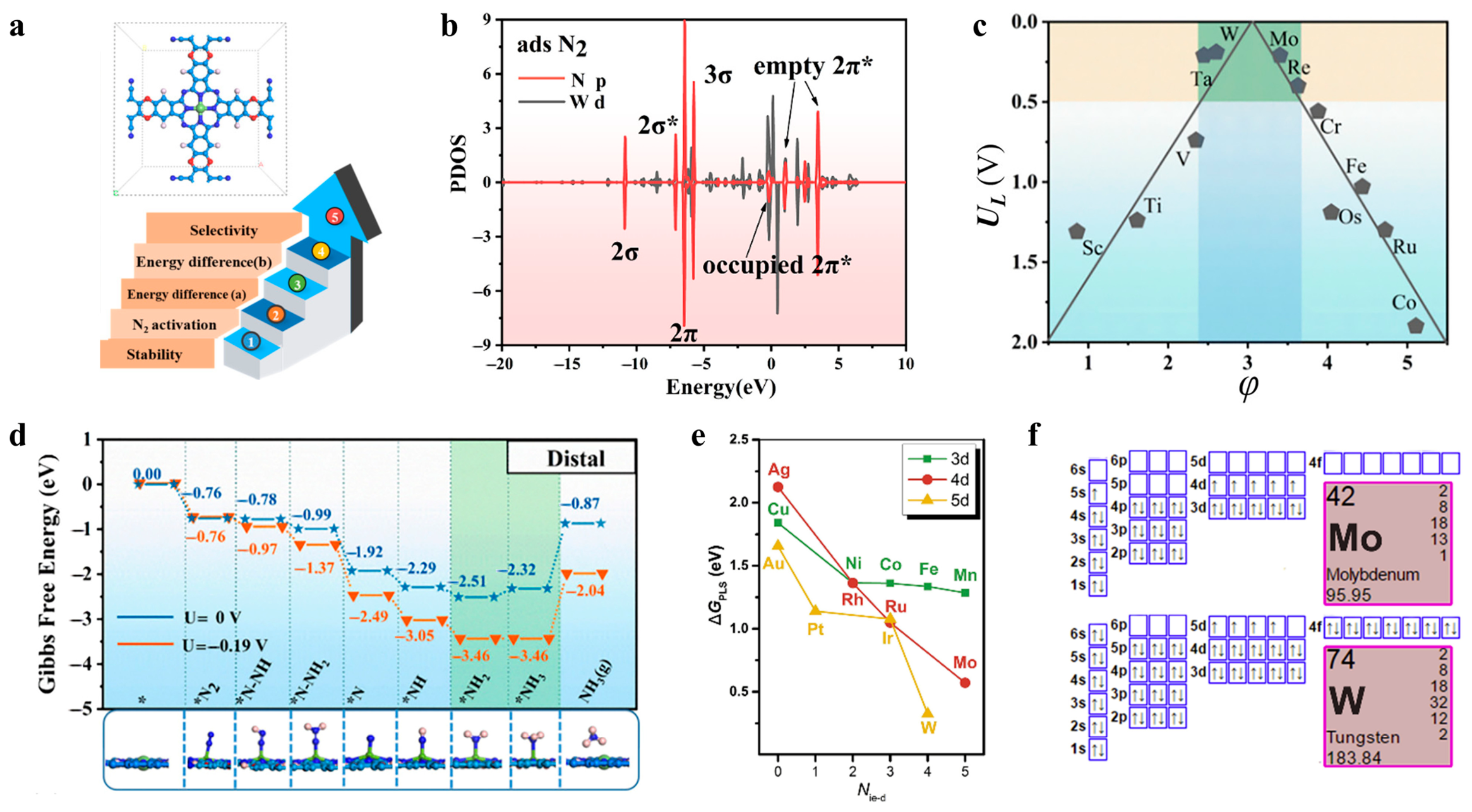
For SACs, the intrinsic electronic structure of the central metal primarily determines N2 activation. Wang et al. embedded TM atoms into a two-dimensional (2D) COF Pc-TFPN (TMPc-TFPN), and presented its structure, as well as a five-step strategy for screening efficient NRR catalysts (Figure 3a) [100]. Further electronic-structure analysis indicated that significant hybridization occurred between the W-5d orbitals and the orbitals of adsorbed N2 (Figure 3b). The W site can both accept electrons from the bonding orbitals (σ) of N2 and donate electrons back into its π* orbitals, thereby effectively weakening the N≡N bond. A simple descriptor φ involving the electronegativity of TM atoms and the number of d electrons was proposed, and a volcanic relationship between φ and UL was established. The descriptor φ can effectively predict NRR activity of SACs (Figure 3c). Among all candidates, WPc-TFPN was identified as the optimal catalyst with a UL of −0.19 V (Figure 3d). From the above M–N–C system and many related studies, it can be seen that the most active SACs are often associated with group VIB TMs [62,101,102]. This trend was further explained in Chen’s work [103]. They proposed a bidirectional activation mechanism of NRR based on the M/C2N system. They specifically elucidated the relationship between the number of isolated electrons in d orbitals (Nie-d) of CMAs and their catalytic activity of NRR. The larger the Nie-d is, the more conducive it is to reducing ΔG of PDS within the same period (Figure 3e). Through the electron distribution diagram of Mo and W orbitals, metal centers with more isolated d electrons can more readily accept electrons from the σ orbitals of N2 and donate electrons back into π* orbitals, making them more suitable for the bidirectional activation of N2 (Figure 3f). These findings provide a higher-level electronic structure criterion for screening SACs: metals with moderately available empty orbitals and actively occupied d orbitals should be prioritized, rather than evaluating catalyst performance solely by the adsorption energy of an individual intermediate.
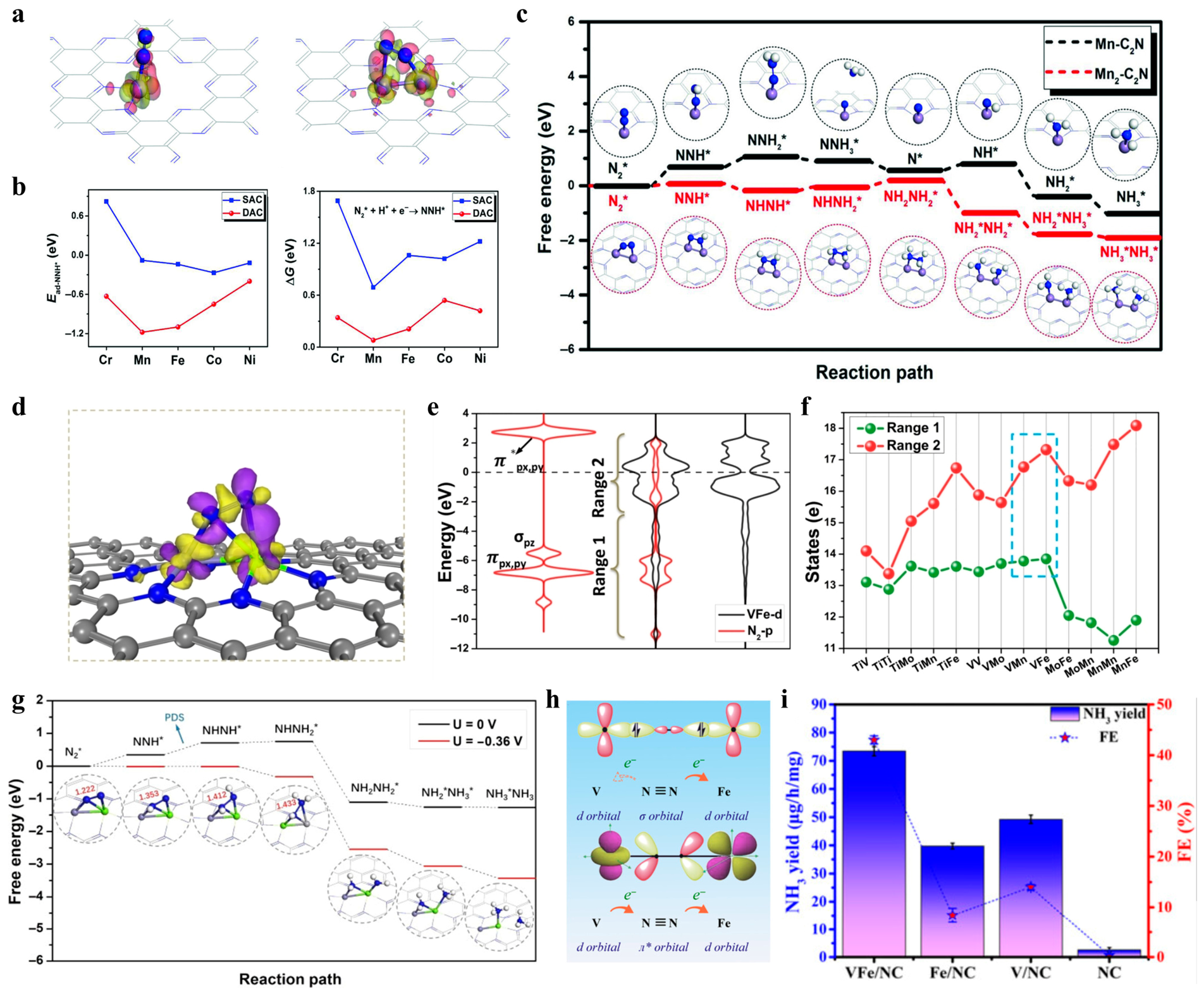
SACs are most suitable for identifying the intrinsic electronic effects of different metal centers and establishing active descriptors. However, SACs usually provide only top-site adsorption configurations for N2 and NRR intermediates, making it difficult to effectively overcome the LSR between *N2 and *NHx. To address this issue, neighboring metal centers were further introduced to construct dual-atom sites [104,105,106]. Chen et al. systematically investigated the catalytic performance of SACs and DACs based on TMs (TM = Cr, Mn, Fe, Co, and Ni) anchored on C2N (a 2D material with uniformly distributed pyridine-like nitrogen pores) for the challenging NRR process [107]. A key distinction between SACs and DACs lies in the adsorption configurations of N2. Specifically, N2 is adsorbed at the top site on SACs, whereas it is done at the bridge site on DACs (Figure 4a). This bridge-site adsorption configuration facilitates stronger interactions between CMAs and N2 molecule, promoting greater electron transfer to the π* orbitals of N2 and thereby enhancing N2 activation. In terms of ∆G, DACs exhibit a significant reduction in the ∆G of PDS at N2* + H + e → NNH* due to the strong adsorption energy of NNH* species (Figure 4b). Figure 4c presents the ∆G of NRR pathways and intermediate structures for Mn-C2N and Mn2-C2N. Notably, Mn2-C2N follows the enzymatic mechanism, reducing the ∆G of the PDS to 0.23 eV. This superior performance is attributed to the synergistic effect between two Mn atoms, which not only enhances the flexibility of the catalytic sites (bridge site) but also alters the reaction pathway. In addition, the adsorption energy of N2 on Mn2-C2N is stronger (−0.65 eV) than that of H* (−0.16 eV), effectively suppressing the HER. In summary, this study systematically elucidates the advantages of DACs over SACs in terms of catalytic activity, selectivity, and stability through theoretical calculations. The key advantage of homonuclear DACs lies in their bridge-site adsorption configurations and dual-center synergy.
Beyond homonuclear DACs, heteronuclear DACs have emerged as a promising frontier in research. Sun et al. systematically evaluated the catalytic performance of 15 different DACs for NRR, revealing the synergistic effects between the metal atoms that enhance the catalytic performance and offer new insights for designing M–N–C catalysts [108]. The charge density difference (CDD) diagram (Figure 4d) reveals significant electron transfer between N2 molecule and the active site on VFe-N-C, especially in the V-N and Fe-N regions, which indicates effective activation of N2 and weakening of the N≡N bond. Moreover, in the VFe-N-C, electron transfer from V to Fe increases the positive charge on the V atom, thereby enhancing its interaction with N2. To further elucidate this electron transfer process, the “electron elevator” model is proposed in Figure 4e,f, where electrons enter the low energy level d orbitals of the metal atoms from the N2 σ orbitals (the “entrance” of the elevator), and then electrons transfer to the high energy d orbitals that match the π* orbitals of N2 (the “exit” of the elevator). This model effectively explains the efficient electron transport and the mechanism of N2 activation. The VFe-N-C catalyst demonstrates the best NRR performance among all the DACs studied, with a UL as low as −0.36 V via enzymatic mechanism (Figure 4g). Specifically, the positively charged metal active site in the VFe-N-C catalyst inhibits H adsorption, while the adsorption energy for N2 is much stronger than that for H, ensuring high selectivity toward NH3 formation. The excellent performance is attributed to the synergistic effects between the V and Fe atoms, which optimize both the adsorption energy and configuration of N2. The analysis of the electronic structure and adsorption behavior provides new insights into the heteronuclear atoms of M–N–C, while the “electron elevator” model offers a theoretical basis for the design of NRR catalysts. Meanwhile, Wang et al. also revealed the fundamental difference between heteronuclear DACs and SACs through the adsorption diagram of N2 on the V–Fe site (Figure 4h) [109]. Two different metal centers can cooperatively construct a more suitable electron-transfer pathway, rather than relying on a single center to simultaneously accomplish electron acceptance and back-donation. Experimental comparisons of NH3 yield and FE among different samples further showed that VFe/NC achieved an NH3 yield of 73.44 μg h−1 mgcat−1 and a FE of 43%, both of which were significantly higher than those of the corresponding SACs, thus providing strong support for theoretical prediction (Figure 4i). Heteronuclear DACs can simultaneously improve N2 activation and intermediate adsorption through asymmetric electronic structures and site-specific cooperation, thereby optimizing the overall reaction pathway.
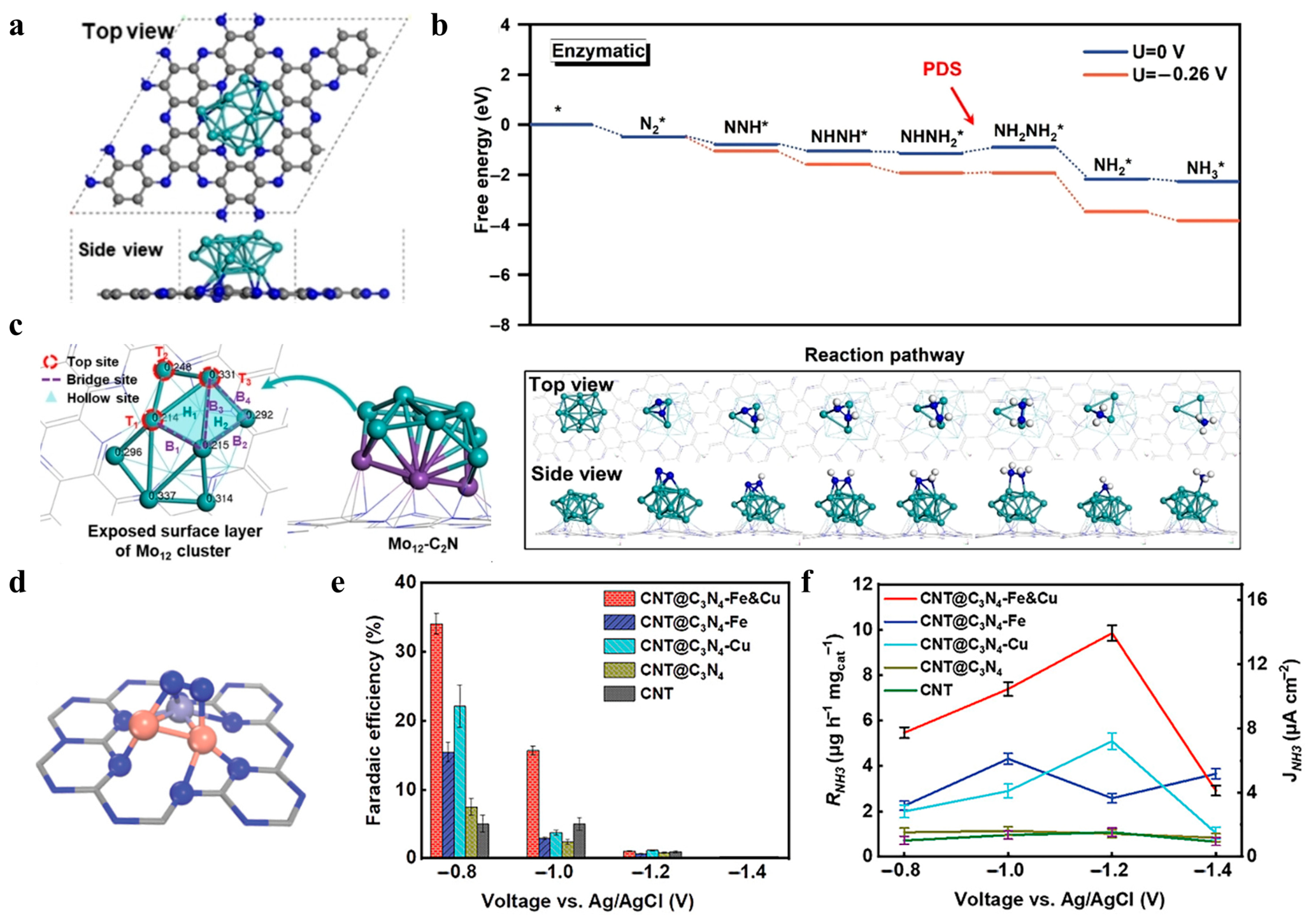
Metal clusters supported on N-doped carbon substrates also exhibit distinct advantages compared to atomically dispersed catalysts, as they not only retain the merits of atomic-level catalysts but also offer more abundant active sites and more stable structures [42,110,111]. The catalytic performance of NRR on a C2N monolayer loaded with Mo12 clusters was investigated using DFT calculations [112]. The combined catalytic structure is depicted in Figure 5a. Figure 5c reveals that the diverse active sites of the Mo12 cluster offer an ideal reaction environment for NRR, and N2 is the most stable at H1 site with the most negative adsorption energy. Among the various NRR pathways of Mo12-C2N, the enzymatic mechanism is identified as the optimal pathway with a low UL of −0.26 V (Figure 5b). Its unique multi-active-site structure appreciably enhances charge redistribution and effectively stabilizes reaction intermediates, thereby mitigating the ΔG associated with the hydrogenation step. Wang et al. reported that the unique cavities on graphitic carbon nitride (g-C3N4) were utilized to precisely confine multiple Fe and Cu atoms (CNT@C3N4-Fe&Cu) for NRR (Figure 5d) [113]. They introduced a strategy for the regulation of active centers at the sub-nanometer scale. The catalyst achieves FE of 34.0% at −0.8 V (Figure 5e). The synergistic effect of Fe and Cu atoms significantly enhances NRR performance with a NH3 yield rate of 9.86 μg h−1 mgcat−1, which is better than that of single metal centers of Fe and Cu (Figure 5f). The superior performance of CNT@C3N4-Fe&Cu is primarily attributed to the synergistic interaction between Fe and Cu atoms, which enhances the adsorption and activation of N2 molecules by optimizing electron transfer, thereby elevating the rate and selectivity of NH3 formation. The advantage of cluster sites lies not only in providing a larger number of active sites, but more importantly in enabling different elementary steps to proceed at different local metal sites. In this way, they can alleviate the intrinsic conflict faced by a single site that must simultaneously accommodate N2 activation, successive hydrogenation, and NH3 release, while also weakening the limitation imposed by LSR through multi-metal synergy.
These results provide valuable insights into the design of metal numbers and species in M–N–C catalysts for NRR applications. The CMA is the structural unit that directly determines the NRR activity of M–N–C catalysts. Its species, quantities, and combination modes affect the local electronic structure of metal sites, while also altering the adsorption configuration of N2, the stability of key intermediates, and the charge transfer behavior, thereby jointly influencing the NRR pathway and catalytic performance. Changing the metal species mainly regulates the electronic configuration of the metal center and the intensity of the metal–adsorbent interaction. Changing the number of metal atoms can alter the adsorption configurations of NRR intermediates, thereby weakening the constraint of LSR.

3.2. Regulating the Coordinative Environments

NRR performance of M–N–C materials can be enhanced not only by optimizing the CMAs but also by regulating the coordinative environments surrounding CMAs. According to the ligand field theory, the d orbital configuration and the electronic properties of CMAs are profoundly affected by the surrounding coordination atoms [46]. Modifications in the coordinative environments, which encompass altering the coordination numbers, changing the type of coordinating atoms, or adjusting the geometric configuration, can effectively tailor the electronic structure and catalytic properties of M–N–C materials. Therefore, rational design and regulation of the coordinative environments around the active sites are essential for developing catalysts with superior NRR performance.
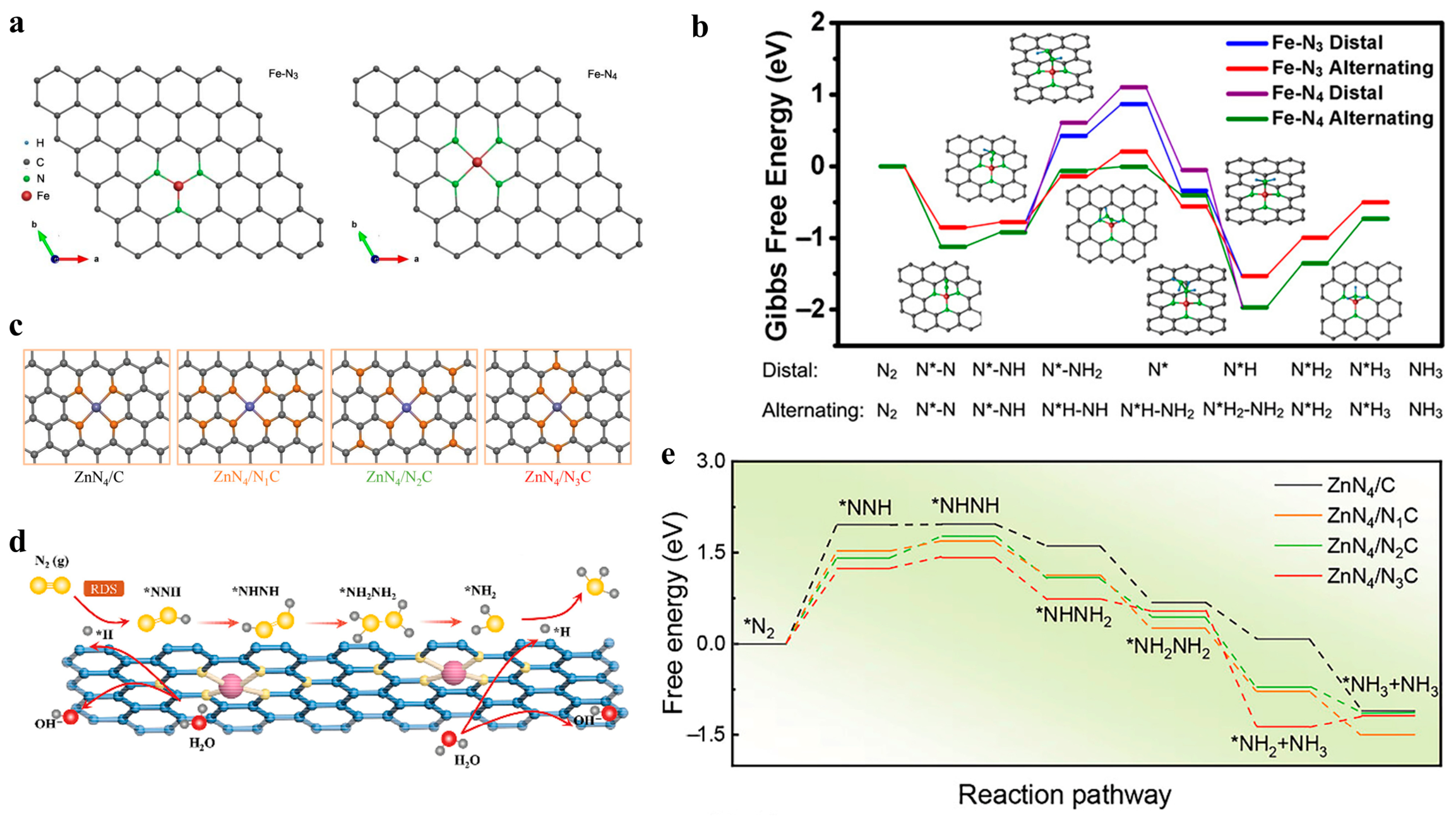
The change in the N coordination number within the first coordination shell can directly alter the local electronic structure and magnetism of the metal center, thereby affecting N2 adsorption and activation [114]. Yang et al. systematically investigated the effect of N coordination number for NRR using Fe atom embedded in Nx-doped (x = 3 and 4) graphene as models (Figure 6a) [115]. The ΔG diagram shows that Fe-N3 exhibits a lower ΔGPDS of 0.915 eV in the alternating pathway (Figure 6b), which suggests that a moderate decrease in the N coordination number can improve the NRR performance. Adjacent N species that are not directly coordinated to the metal center can also affect NRR performance. Kong et al. proposed an electrocatalyst that utilizes atomically dispersed Zn active sites to significantly improve the performance of NRR [116]. The Zn1N-C catalyst consists of Zn (I) atom supported on a hollow porous N-doped carbon substrate, and three structural models (ZnN4/N1C, ZnN4/N2C, and ZnN4/N3C) are shown in Figure 6c. Computational analysis of the NRR ΔG diagram and proposed reaction mechanisms for these models denote that the ZnN4/N1C configuration exhibits the best performance of NRR (Figure 6d,e). This finding indicates that nitrogen atoms near Zn-N4 active sites can effectively lower the ΔGPDS of NRR, thereby facilitating NH3 synthesis. The synergistic interaction between atomically dispersed Zn (I) active sites and adjacent graphitic nitrogen atoms is identified as a key factor in improving NRR efficiency.
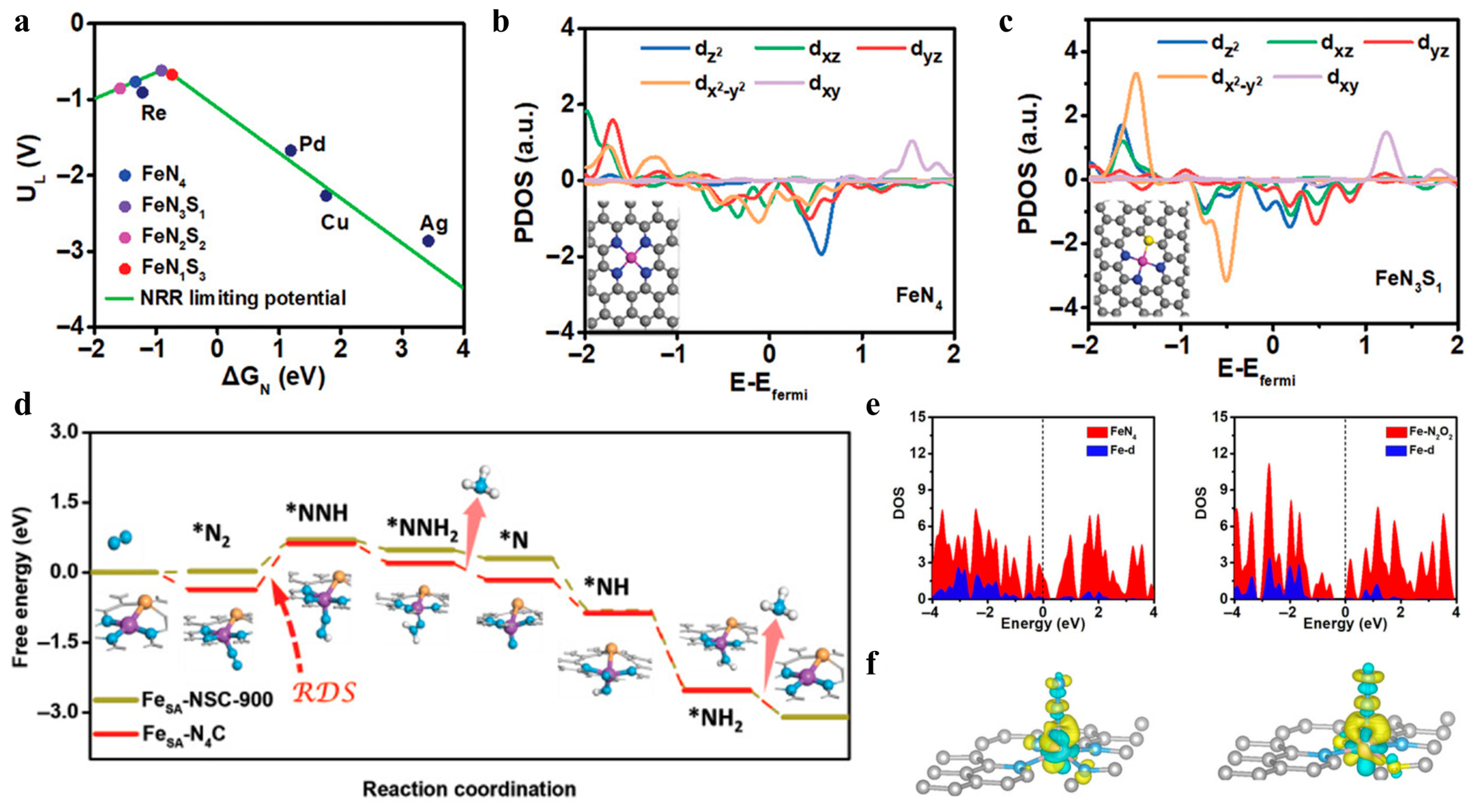
In addition to changing the coordination of nitrogen, introducing heteroatom doping or replacing part of nitrogen atoms can also modulate the electronic state of CMAs [117]. Li et al. employed a combination of theoretical calculations and experimental studies to investigate the role of S doping in tuning the performance and mechanism of the single-atom iron catalyst (FeSA-NSC) for NRR, demonstrating that the S atom is crucial in regulating the electronic structure and spin states of the Fe active center [118]. Specifically, the FeN3S1 catalyst is optimally positioned on the volcano plot, exhibiting an ideal ΔG of *N adsorption (ΔG*N) and UL, which indicates superior catalytic activity of NRR (Figure 7a). Compared to the conventional FeN4 coordination structure, the FeN3S1 configuration alters the electronic state distribution of Fe by doping S atoms. This modification causes the spin-down portion of the dx2-y2 orbitals to shift below the Fermi level, thereby optimizing the d-orbitals distribution of the Fe center and enhancing the ability of the Fe center to adsorb and activate N2 molecules (Figure 7b,c). Further analysis of the ΔG reveals that the PDS (*N2 → *NNH) for FeN3S1 has a ΔG of 0.46 eV, which is significantly lower than the 0.99 eV for FeN4, indicating higher catalytic activity (Figure 7d). S doping can manipulate the local spin state of Fe atom, enabling the metal center to achieve more moderate N2 adsorption and hydrogenation capabilities. In addition, another study on Fe atoms anchored on N, O-codoped carbon (Fe-N2O2) showed a distinct electronic structure compared with FeN4 [119]. The introduction of O decreases the Fe d-state density near the Fermi level, yet promotes greater electron transfer from Fe to the adsorbed N2, thereby increasing occupation of the N2 π* orbitals and facilitating N2 activation (Figure 7e,f).
A more general examination of coordinative environment suggests that the key factor is not a specific type of heteroatom, but rather how the number and arrangement of coordinating atoms cooperatively modify the orbital splitting and electronic properties of the metal center. Using Fe-XmYn (X, Y = B, C, N, O, m + n = 4) as models, Zhang et al. systematically analyzed NRR activity of various heterocoordinated SACs [120]. Through in-depth mechanism studies of the NRR process from the aspects of structure, energy, and electronic parameters, they found that the quantity and arrangement of heteroatom doping play decisive roles in regulating the degree of d-orbital splitting energy and the magnetic moment of the Fe, thereby significantly affecting the electronic properties and NRR activity. These relationships reveal the complex interplay among these factors and their resulting influence on the activity of Fe-XmYn. The second coordination shell can also affect NRR behavior [117]. Zhao et al. investigated the NRR catalyst of Fe atom supported on B/N codoped carbon (Fe-N4-B) [121]. In Fe-N4-B, the introduction of B increases the positive character of the Fe site, making it more favorable as a Lewis acidic center for binding the Lewis basic N2 molecule. Overall, the incorporation of nonmetal heteroatoms changes the local orbital occupation and spin state distribution of active sites, optimizes the electronic states and intermediate adsorption behavior, and thus tunes the NRR performance [122,123,124,125,126].
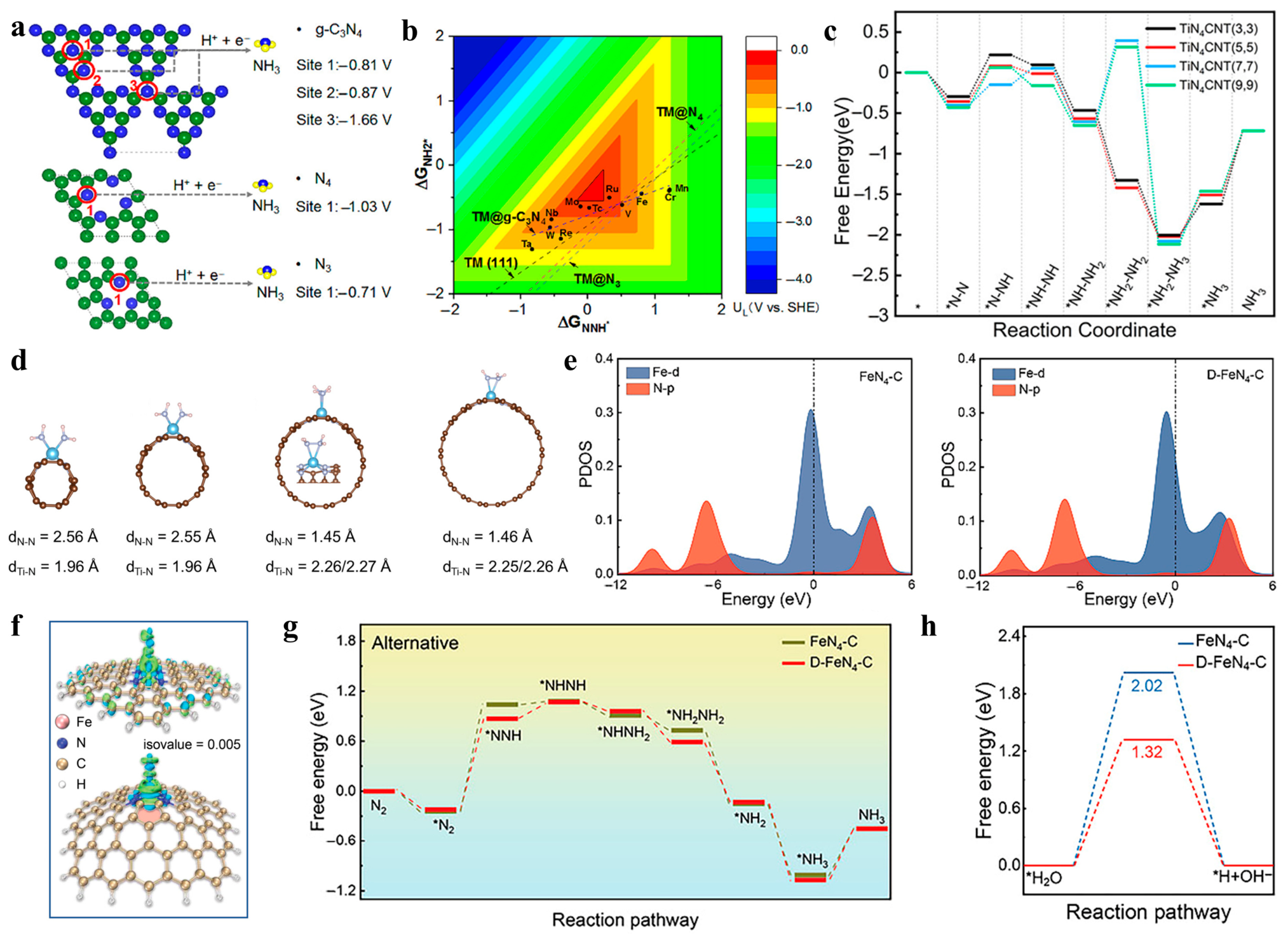
The chemical environment of the carbon substrate can also significantly influence the performance of the active center [127,128,129]. Liu et al. investigated the NRR activity of different TM atoms embedded in three types of N-doped carbon substrates (TM@g-C3N4, TM@N4, and TM@N3), and found that TM@N4 with a four-coordinate N environment is the most stable (Figure 8a) [130]. The contour map correlating the UL with ΔG of *NNH and *NH2 further shows that Ru@g-C3N4 is closest to the ideal region and is one of the most promising candidate systems (Figure 8b). These results indicate that the support can indirectly influence NRR activity by modulating the scaling relationship between the adsorption energies of key intermediates. Therefore, in the design of M–N–C catalysts, the support itself should be regarded as a “macroligand” that needs to be synergistically matched with the metal center. Defects and the local chemical space within the carbon substrate can also act cooperatively with M-N sites to further affect NRR performance [102]. Yuan et al. investigated the NRR performance of Ti SAC with N4 coordination on carbon nanotubes (CNTs) with different curvatures [131]. Structural analysis indicates that TiN4 with a higher curvature substrate facilitates N–N bond cleavage in *NH2NH2, thereby lowering the overpotential (Figure 8c,d). The synergy between the substrate chemical environment and metal catalysis is a promising strategy for optimizing catalytic performance. Kong et al. introduced intrinsic carbon defects around Fe-N4 sites to construct the D-FeN-C system [132]. Carbon defects modify the distribution of Fe-d and N-p states, making the Fe site adjacent to the defect a more suitable electronic structure for NRR (Figure 8e). The corresponding CDD results further indicate that the introduction of carbon defects enhances electron transfer from the Fe site to N2 (Figure 8f). On this basis, carbon defects can markedly reduce the barriers associated with water dissociation and subsequent proton supply, thereby improving the overall NRR performance by accelerating *NNH formation (Figure 8g,h).
Overall, the promoting effect of the coordinative environment on NRR fundamentally lies in reconstructing the local coordination field and reaction microenvironment around the metal center through multilevel structural regulation. For active sites, the number, type, and spatial arrangement of the coordinating atoms surrounding the metal center jointly determine the local coordination field, which further affects the charge distribution of the metal site, d-orbital splitting, spin state, and the adsorption strength of key intermediates such as *N2, *NNH, and *NHx. Therefore, rational design of the coordinative environment provides a powerful complement to central-metal engineering for improving the activity, selectivity, and stability of M–N–C catalysts.

3.3. Applying Computational Data-Driven Approaches

The M–N–C system, composed of multiple elements, provides a high-dimensional composition space for the catalytic design due to the diversity of metal species and coordinating configurations. Additionally, the NRR involves multiple reaction intermediates and complex reaction pathways, making the traditional trial-and-error approach of catalyst design time-consuming and cost-ineffective. In recent years, with the rapid development of computational techniques, theoretical calculations have become valuable tools for understanding the mechanisms of NRR at the atomic scale [133]. The theoretical calculations have significantly accelerated the identification and verification of catalytic descriptors, thus driving the efficient design and development of effective NRR catalysts. By applying high-throughput screening (HTS) and machine learning (ML) approaches to design M–N–C catalysts, the performance of M–N–C for NRR can be accurately predicted [134,135,136,137,138,139,140]. In this section, the utilization of data-driven strategies to accelerate the design and exploration of M–N–C materials is summarized. Data availability is a critical issue in ML-assisted NRR catalyst design. At present, most datasets used in data-driven NRR studies are computationally generated from DFT calculations rather than obtained directly from experiments. This is mainly because standardized experimental datasets for electrochemical NRR remain limited. Experimental NRR results are strongly affected by electrolyte composition, cell configuration, potential scale, ammonia detection method, and contamination control, which makes direct comparison and model training difficult [141,142]. Therefore, rigorous isotope-labeling protocols and false-positive elimination procedures are essential for reliable experimental data collection [143,144]. In contrast, DFT-generated datasets can provide relatively consistent adsorption energies, ΔG, UL, and stability descriptors for model training. Nevertheless, these datasets are also influenced by exchange-correlation functionals, solvation treatments, electrode–potential models, and free-energy corrections. Accordingly, current ML models for NRR are usually trained on small-to-medium computational datasets, ranging from tens to thousands of catalyst structures. For example, Zhang et al. screened 1626 initial structures and identified 45 promising candidates based on ML and symbolic-regression analysis [145]. These features indicate that data quality, standardization, and transferability are as important as model accuracy in data-driven NRR catalyst design.
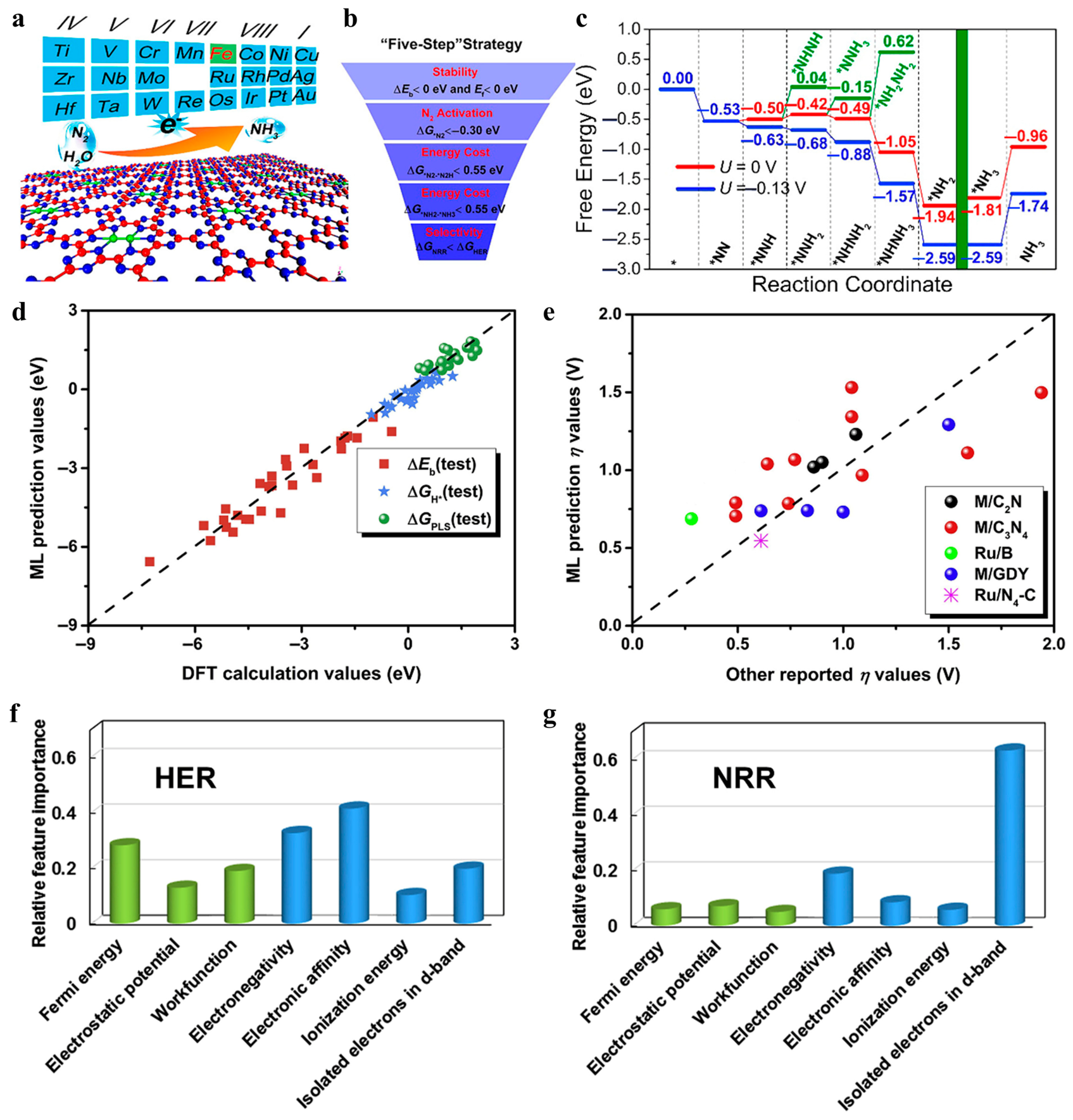
Lv et al. conducted a study focusing on the potential of DACs for NRR using HTS through DFT [146]. Figure 9a illustrates the 23 TMs screened in the study for constructing TM2/g-CN in NRR. They proposed a systematic “five-step” HTS strategy to identify efficient NRR electrocatalysts (Figure 9b). This strategy involves five screening criteria: (i) ΔEb < 0 eV (energy difference between the Eb and the cohesive energy of TM atoms on g-CN) and Ef < 0 eV (formation energy); (ii) ΔG*N2 < −0.30 eV (∆G of *N2 adsorption); (iii) ΔG*N2-*N2H < 0.55 eV (∆G of the initial protonation step); (iv) ΔG*NH2-*NH3 < 0.55 eV (∆G of the final protonation step); (v) ΔGNRR < ΔGHERG of PDS for NRR and HER). Through this comprehensive screening strategy, they identified Fe2/g-CN as a highly efficient NRR electrocatalyst, exhibiting a UL of −0.13 V in NRR, significantly lower than that of most DACs (Figure 9c). The proposed screening strategy integrates stability, activity, and selectivity into a single evaluation framework, providing a reliable approach for the rapid discovery of high-performance NRR catalysts.
Although the HTS method is effective in simplifying the screening of NRR catalysts, further optimization becomes increasingly necessary when dealing with large datasets. In the context of electrocatalytic design, ML has enhanced the ability to process large-scale data and uncover patterns [147,148]. ML plays a crucial role in establishing the correlations between catalytic performance and the intrinsic structure, electronic properties, and bonding interactions of materials [54,149]. Chen et al. conducted a comprehensive investigation on SACs supported on 2D substrates, such as C3N4, graphdiyne, C2N, etc. [103]. The comparison between ML model predictions and DFT calculations for three key properties (ΔGPLS; ΔGH*, where ΔGH* is the adsorption ΔG of hydrogen; and ΔEb-M, where ΔEb-M is the binding energy of the metal atom) demonstrates the high accuracy of the ML model, confirming its potential to guide the catalyst design (Figure 9d). Figure 9e presents a comparison of the ML-predicted overpotential values with reported literature data, highlighting the practical applicability of the ML model in real catalytic performance evaluation.
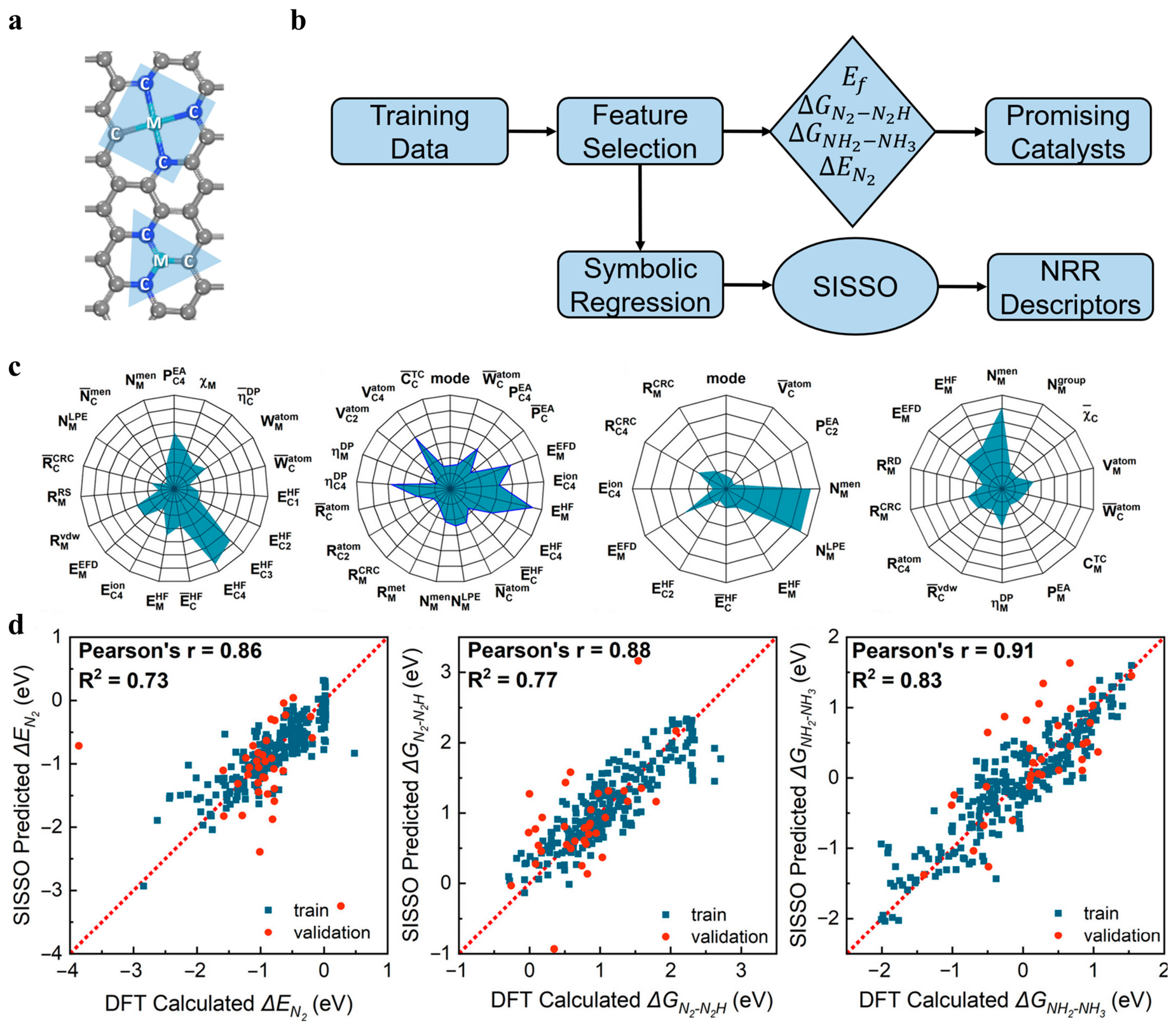
Figure 9f,g provide the relative feature importance of HER and NRR, showing that Nie-d is the primary determinant of the catalytic activity of NRR. This supports the critical role of the bidirectional activation mechanism in active sites. These results suggest that ML can significantly accelerate the selection of highly efficient catalysts by integrating electron transfer mechanisms with feature optimization strategies. Zhang et al. also examined the effects of different coordinative environments on the activity and stability of SACs for NRR using graphene as a substrate via ML [145]. Figure 10a illustrates the structures of three-coordinated and four-coordinated SACs, where metal atoms form stable bonds with ligands. Figure 10b summarizes four key target properties, providing a comprehensive evaluation of catalytic performance. By combining ML and symbolic regression, the study screened 1626 initial structures and identified 45 high-performance candidates based on criteria including Ef < 0, ΔEN2 < −0.50 eV (the adsorption energy of N2), ΔG*N2-*N2H, and ΔG*NH2-*NH3 < 0.55 eV. Among these, Mo-B2CN has the lowest ∆G of PDS, demonstrating excellent NRR activity. Then, the feature importance associated with the four key target properties was identified (Figure 10c). Through statistical analysis of the collected data, computable descriptors are identified to evaluate the activity of NRR catalysts. To further establish physically interpretable relationships between intrinsic catalyst features and catalytic properties, the Screening and Sparsifying Operator (SISSO) method was employed. SISSO is a compressed-sensing-based symbolic regression method for identifying low-dimensional descriptors from a large number of candidate features [150,151]. In a typical SISSO workflow, primary physical and chemical features, such as atomic radius, electronegativity, ionization potential, electron affinity, and valence-electron number, are first collected as basic input variables. These primary features are then mathematically combined through algebraic operators to generate a much larger feature space. SISSO subsequently screens the most relevant feature combinations and selects sparse descriptors that can best correlate with target properties. Therefore, SISSO provides numerical predictions and yields explicit mathematical expressions that help reveal the underlying structure–property relationship. This feature makes SISSO particularly useful for catalyst design based on small-to-medium DFT datasets, where highly complex black-box ML models may suffer from limited interpretability and reduced transferability. Figure 10d compares the predicted values of the Screening and Sparsifying Operator (SISSO) descriptor and the DFT-calculated values for ΔEN2, ΔG*N2-*N2H, and ΔG*NH2-*NH3, indicating that the concise expression obtained by symbolic regression can also describe the catalytic behavior well.
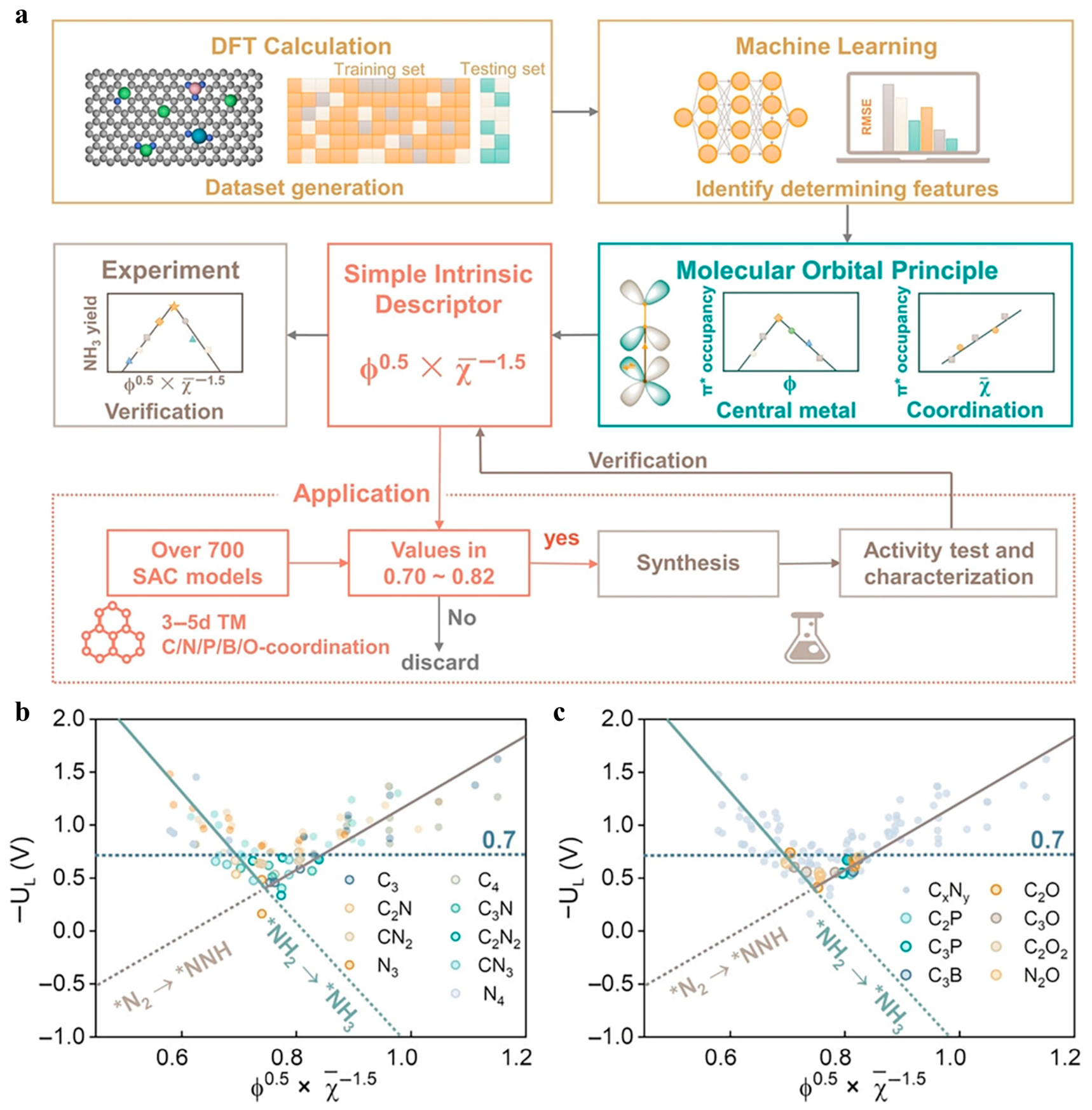
In addition to developing predictive models for specific datasets, recent studies have also begun to construct more universal descriptor systems [79,152]. Lin et al. proposed a simple activity descriptor by combining DFT calculations with ML to accelerate the HTS of SACs for electrocatalytic NRR [153]. Figure 11a summarizes its overall process. First, key features are identified by DFT calculations and ML analysis. A simple descriptor is then constructed by considering the molecular-orbital interactions between the central metal and the coordinative environment, which is used for candidate structure screening and experimental verification. Figure 11b,c present the volcanic relationship between −UL and the descriptor. The descriptor can effectively unify the activity trends of SAC systems with different nonmetal coordinative environments. Such an integrated and general descriptor is closer to universal design principles. It is of great significance for establishing a theoretical NRR design framework across metal centers and coordinative environments. The developed ML model, with its accuracy and generality, may serve as a tool for large-scale screening of M–N–C combinations. More importantly, the combination of HTS and ML not only enhances the screening efficiency but also uncovers structure–activity rules with physical significance, providing effective guidance for the rational design of M–N–C catalysts.
Overall, HTS and ML play complementary roles in the theoretical NRR research. HTS, based on clear mechanism criteria, transforms the vast material space into clear screening standards, making it particularly effective for rapidly excluding unstable or low-activity candidate systems. ML is more powerful in extracting key structure–property relationships from large datasets and identifying descriptors with predictive capabilities. The resulting descriptors can generally be classified into three categories: the first category includes reaction-step descriptors which directly describe the formation and conversion of key intermediates; the second category includes electronic-structure descriptors which are used to reveal the connection between the intrinsic electronic characteristics of the CMA and the activation ability of N2; the third category includes comprehensive universal descriptors which can unify activity trends under different supports and different coordinative environments. The true value of data-driven approaches does not merely lie in reducing computational costs, but rather in facilitating the transformation of scattered case studies into transferable structure–property design principles, thereby promoting the M–N–C catalyst design from empirical search to descriptor-guided rational discovery.

4. Summary and Outlook

In modern society, NH3 is recognized as an indispensable industrial raw material. The electrocatalytic NRR is anticipated to be a low-cost, environmentally friendly, and sustainable method for NH3 synthesis under ambient conditions. Among the diverse array of catalysts available, M–N–C materials distinguish themselves through their unique advantages for NRR, which encompass high atomic utilization efficiency, strong MSI, and well-defined active sites. This review presents a comprehensive summary of recent advancements in M–N–C catalysts aimed at improving NRR performance. Initially, the fundamental mechanisms of electrochemical NRR are introduced, followed by a discussion on the catalytic activity, reaction selectivity, and stability of M–N–C catalysts. The investigation uncovers that the electronic structure of the active sites can be effectively modulated by the adjustment of MSI within the M–N–C framework, thereby providing deeper insights into how the CMAs and coordinative environments influence the reactivities. Building upon this foundational understanding, several design strategies are emphasized, including adjusting the CMAs, regulating the coordinative environments, and leveraging computational data-driven approaches to enhance the activity, selectivity, and stability of M–N–C catalysts. Despite significant progress in the field of NRR, M–N–C catalysts still face numerous challenges and opportunities. Future research should concentrate on the following key aspects:
  • Accuracy of theoretical calculation. Although various synthetic methods have been employed to prepare M–N–C materials, the trial-and-error approach of experiments is both time-consuming and costly. DFT calculations have proven to be a powerful tool for guiding the selection of elements and the structural design of M–N–C catalysts. However, the current calculation models and reaction conditions are often highly idealized, neglecting factors such as temperature, pressure, and solvent effects. This creates a significant gap between theoretical research and practical experiments. It is urgent to develop more advanced computational techniques and strategies that can simulate catalytic activity to get closer to the real conditions. Solvation models and complex molecular dynamics have attracted increasing attention in this context [7,154,155]. The combined application of these advanced theoretical techniques will provide a robust tool for more comprehensive theoretical research. They can reduce the deviation between theoretical and experimental results and enhance the accuracy and adaptability of theoretical calculation results.
  • Development of characterization techniques. Accurately characterizing the electronic state changes during the NRR process remains a significant challenge. Current characterization techniques are proficient in identifying the features of atomically dispersed metal active sites. However, many studies have demonstrated that the variations in nitrogen and carbon coordination numbers around the CMAs significantly influence catalytic performance. However, the existing characterization techniques (e.g., HAADF-STEM, AC-TEM, and XAS) are only for local information and average statistics, which are insufficient for precisely judging the local N-doped carbon structures near the CMAs [46,156]. Therefore, developing more advanced characterization techniques that can accurately determine the coordination structure remains a critical challenge for future research.
  • Design of catalytic descriptors. Current catalyst screening efforts based on DFT calculations are often hindered by different algorithms and inconsistencies in calculation accuracy, which restrict their ability to offer comprehensive and systematic design guidance. Developing universal catalytic descriptors that transcend the limitations of LSR represents a crucial approach in advancing catalyst design [157]. These descriptors serve as essential tools for theoretical screening, enabling the identification of promising catalysts. By constructing rational descriptors derived from simple parameters, such as bond length and valence electron number, researchers can provide clear and actionable guidance for the design of M–N–C catalysts [158,159]. Furthermore, the well-defined active sites in M–N–C catalysts offer an ideal platform for the development of accurate descriptors, facilitating a deeper understanding of the structure–property relationship and advancing the rational design of catalytic systems.
  • AI-assisted catalyst discovery. The rapidly expanding chemical and structural space of M–N–C catalysts makes traditional trial-and-error screening increasingly inefficient. Artificial intelligence (AI) offers powerful tools for accelerating catalyst discovery by identifying structure–property relationships from DFT-generated and literature-derived datasets. For example, Kim et al. developed a slab graph convolutional neural network to predict catalytic properties and accelerate the discovery of N2 electroreduction catalysts [160]. More recently, He et al. proposed an ML-driven four-step screening strategy to shorten the screening process for high-performance NRR electrocatalysts [148]. These studies show that AI methods can efficiently predict key catalytic parameters, including adsorption energies, UL, reaction selectivity, and catalyst stability, thereby reducing the need for exhaustive DFT calculations. To further improve the reliability and applicability of AI-assisted catalyst design, future studies should establish standardized NRR databases covering catalyst structures, calculation settings, solvation models, electrode potentials, key intermediates, and experimental validation. The integration of high-throughput DFT, interpretable AI models, and experimental feedback will provide an important pathway for advancing M–N–C catalyst design from empirical screening toward closed-loop intelligent discovery.

Author Contributions

Conceptualization, J.Y. and Q.J.; investigation, J.Y.; data curation, J.Y.; writing—original draft preparation, J.Y.; writing—review and editing, J.Y., Z.W. and Q.J.; supervision, Z.W. and Q.J.; funding acquisition, Q.J. All authors have read and agreed to the published version of the manuscript.

Funding

This work was funded by National Natural Science Foundation of China (No. 52130101).

Data Availability Statement

The data and figures published in this review paper are reproduced with permission.

Conflicts of Interest

The authors declare no conflicts of interest.

References

  1. Shi, Y.; Zhao, Z.; Yang, D.; Tan, J.; Xin, X.; Liu, Y.; Jiang, Z. Engineering photocatalytic ammonia synthesis. Chem. Soc. Rev. 2023, 52, 6938–6956. [Google Scholar] [CrossRef] [PubMed]
  2. John, J.; MacFarlane, D.R.; Simonov, A.N. The why and how of NOx electroreduction to ammonia. Nat. Catal. 2023, 6, 1125–1130. [Google Scholar] [CrossRef]
  3. Qing, G.; Ghazfar, R.; Jackowski, S.T.; Habibzadeh, F.; Ashtiani, M.M.; Chen, C.-P.; Smith, M.R., III; Hamann, T.W. Recent Advances and Challenges of Electrocatalytic N2 Reduction to Ammonia. Chem. Rev. 2020, 120, 5437–5516. [Google Scholar] [CrossRef]
  4. Xu, X.; Hu, L.; Li, Z.; Xie, L.; Sun, S.; Zhang, L.; Li, J.; Luo, Y.; Yan, X.; Hamdy, M.S.; et al. Oxygen vacancies in Co3O4 nanoarrays promote nitrate electroreduction for ammonia synthesis. Sustain. Energy Fuels 2022, 6, 4130–4136. [Google Scholar] [CrossRef]
  5. Choudhary, A.; Halder, A.; Aggarwal, P.; Govind Rao, V. Plasmonic chemistry for sustainable ammonia production. Commun. Mater. 2024, 5, 69. [Google Scholar] [CrossRef]
  6. Dai, T.-Y.; Yang, C.-C.; Jiang, Q. Recent progress on catalyst design of nitrogen reduction reaction by density functional theory. Sci. China Mater. 2024, 67, 1101–1123. [Google Scholar] [CrossRef]
  7. Yao, X.; Halpren, E.; Liu, Y.Z.; Shan, C.H.; Chen, Z.W.; Chen, L.X.; Singh, C.V. Intrinsic and external active sites of single-atom catalysts. iScience 2023, 26, 107275. [Google Scholar] [CrossRef] [PubMed]
  8. Yang, H.; Chen, Z.; Kou, S.; Lu, G.; Chen, D.; Liu, Z. Carbon-supported catalysts with atomically dispersed metal sites for oxygen electroreduction: Present and future perspectives. J. Mater. Chem. A 2021, 9, 15919–15936. [Google Scholar] [CrossRef]
  9. Kojima, Y. Hydrogen storage materials for hydrogen and energy carriers. Int. J. Hydrogen Energy 2019, 44, 18179–18192. [Google Scholar] [CrossRef]
  10. MacFarlane, D.R.; Cherepanov, P.V.; Choi, J.; Suryanto, B.H.R.; Hodgetts, R.Y.; Bakker, J.M.; Ferrero Vallana, F.M.; Simonov, A.N. A Roadmap to the Ammonia Economy. Joule 2020, 4, 1186–1205. [Google Scholar] [CrossRef]
  11. Li, S.; Fu, X.; Nørskov, J.K.; Chorkendorff, I. Towards sustainable metal-mediated ammonia electrosynthesis. Nat. Energy 2024, 9, 1344–1349. [Google Scholar] [CrossRef]
  12. Kyriakou, V.; Garagounis, I.; Vourros, A.; Vasileiou, E.; Stoukides, M. An Electrochemical Haber–Bosch Process. Joule 2020, 4, 142–158. [Google Scholar] [CrossRef]
  13. Jabarivelisdeh, B.; Jin, E.; Christopher, P.; Masanet, E. Model-Based Analysis of Ammonia Production Processes for Quantifying Energy Use, Emissions, and Reduction Potentials. ACS Sustain. Chem. Eng. 2022, 10, 16280–16289. [Google Scholar] [CrossRef]
  14. Smith, C.; Hill, A.K.; Torrente-Murciano, L. Current and future role of Haber–Bosch ammonia in a carbon-free energy landscape. Energy Environ. Sci. 2020, 13, 331–344. [Google Scholar] [CrossRef]
  15. IEA. Ammonia Technology Roadmap: Towards More Sustainable Nitrogen Fertiliser Production; IEA: Paris, France, 2021. [Google Scholar]
  16. Wang, L.; Wang, D.; Li, Y. Single-atom catalysis for carbon neutrality. Carbon Energy 2022, 4, 1021–1079. [Google Scholar] [CrossRef]
  17. Chen, J.; Cheng, H.; Ding, L.-X.; Wang, H. Competing hydrogen evolution reaction: A challenge in electrocatalytic nitrogen fixation. Mater. Chem. Front. 2021, 5, 5954–5969. [Google Scholar] [CrossRef]
  18. Zhao, X.; Hu, G.; Chen, G.F.; Zhang, H.; Zhang, S.; Wang, H. Comprehensive Understanding of the Thriving Ambient Electrochemical Nitrogen Reduction Reaction. Adv. Mater. 2021, 33, 2007650. [Google Scholar] [CrossRef]
  19. Shen, H.; Choi, C.; Masa, J.; Li, X.; Qiu, J.; Jung, Y.; Sun, Z. Electrochemical ammonia synthesis: Mechanistic understanding and catalyst design. Chem 2021, 7, 1708–1754. [Google Scholar] [CrossRef]
  20. Ren, Y.; Yu, C.; Wang, L.; Tan, X.; Wang, Z.; Wei, Q.; Zhang, Y.; Qiu, J. Microscopic-Level Insights into the Mechanism of Enhanced NH3 Synthesis in Plasma-Enabled Cascade N2 Oxidation-Electroreduction System. J. Am. Chem. Soc. 2022, 144, 10193–10200. [Google Scholar] [CrossRef]
  21. Yang, Y.; Zhang, W.; Tan, X.; Jiang, K.; Zhai, S.; Li, Z. Atomic-level reactive sites for electrocatalytic nitrogen reduction to ammonia under ambient conditions. Coord. Chem. Rev. 2023, 489, 215196. [Google Scholar] [CrossRef]
  22. Peramaiah, K.; Ramalingam, V.; Fu, H.-C.; Alsabban, M.M.; Ahmad, R.; Cavallo, L.; Tung, V.; Huang, K.-W.; He, J.-H. Optically and Electrocatalytically Decoupled Si Photocathodes with a Porous Carbon Nitride Catalyst for Nitrogen Reduction with Over 61.8% Faradaic Efficiency. Adv. Mater. 2021, 33, 2100812. [Google Scholar] [CrossRef]
  23. Schiffer, Z.J.; Manthiram, K. Electrification and Decarbonization of the Chemical Industry. Joule 2017, 1, 10–14. [Google Scholar] [CrossRef]
  24. Fu, X.; Pedersen, J.B.; Zhou, Y.; Saccoccio, M.; Li, S.; Sažinas, R.; Li, K.; Andersen, S.Z.; Xu, A.; Deissler, N.H.; et al. Continuous-flow electrosynthesis of ammonia by nitrogen reduction and hydrogen oxidation. Science 2023, 379, 707–712. [Google Scholar] [CrossRef]
  25. Moon, Y.H.; Kim, N.Y.; Kim, S.M.; Jang, Y.J. Recent Advances in Electrochemical Nitrogen Reduction Reaction to Ammonia from the Catalyst to the System. Catalysts 2022, 12, 1015. [Google Scholar] [CrossRef]
  26. Wang, M.; Liu, S.; Qian, T.; Liu, J.; Zhou, J.; Ji, H.; Xiong, J.; Zhong, J.; Yan, C. Over 56.55% Faradaic efficiency of ambient ammonia synthesis enabled by positively shifting the reaction potential. Nat. Commun. 2019, 10, 341. [Google Scholar] [CrossRef] [PubMed]
  27. Shao, M.; Chang, Q.; Dodelet, J.-P.; Chenitz, R. Recent Advances in Electrocatalysts for Oxygen Reduction Reaction. Chem. Rev. 2016, 116, 3594–3657. [Google Scholar] [CrossRef]
  28. Yang, D.; Chen, T.; Wang, Z. Electrochemical reduction of aqueous nitrogen (N2) at a low overpotential on (110)-oriented Mo nanofilm. J. Mater. Chem. A 2017, 5, 18967–18971. [Google Scholar] [CrossRef]
  29. Yao, Y.; Wang, H.; Yuan, X.-z.; Li, H.; Shao, M. Electrochemical Nitrogen Reduction Reaction on Ruthenium. ACS Energy Lett. 2019, 4, 1336–1341. [Google Scholar] [CrossRef]
  30. Wang, J.; Yu, L.; Hu, L.; Chen, G.; Xin, H.; Feng, X. Ambient ammonia synthesis via palladium-catalyzed electrohydrogenation of dinitrogen at low overpotential. Nat. Commun. 2018, 9, 1795. [Google Scholar] [CrossRef]
  31. Shi, M.-M.; Bao, D.; Wulan, B.-R.; Li, Y.-H.; Zhang, Y.-F.; Yan, J.-M.; Jiang, Q. Au Sub-Nanoclusters on TiO2 toward Highly Efficient and Selective Electrocatalyst for N2 Conversion to NH3 at Ambient Conditions. Adv. Mater. 2017, 29, 1606550. [Google Scholar] [CrossRef]
  32. Rutledge, H.L.; Tezcan, F.A. Electron Transfer in Nitrogenase. Chem. Rev. 2020, 120, 5158–5193. [Google Scholar] [CrossRef]
  33. Shi, Z.; Yang, W.; Gu, Y.; Liao, T.; Sun, Z. Metal–Nitrogen–Doped Carbon Materials as Highly Efficient Catalysts: Progress and Rational Design. Adv. Sci. 2020, 7, 2001069. [Google Scholar] [CrossRef]
  34. Wu, D.; He, B.; Wang, Y.; Lv, P.; Ma, D.; Jia, Y. Double-atom catalysts for energy-related electrocatalysis applications: A theoretical perspective. J. Phys. D Appl. Phys. 2022, 55, 203001. [Google Scholar] [CrossRef]
  35. Qiao, B.; Wang, A.; Yang, X.; Allard, L.F.; Jiang, Z.; Cui, Y.; Liu, J.; Li, J.; Zhang, T. Single-atom catalysis of CO oxidation using Pt1/FeOx. Nat. Chem. 2011, 3, 634–641. [Google Scholar] [CrossRef]
  36. Chen, Y.; He, T.; Liu, Y.; Liu, Y.; Liu, Y.-N.; Liu, C.; Zhang, Y. Electronic engineering to enhance bifunctional activity of carbon-based single-atom catalysts in rechargeable zinc-air batteries. Curr. Opin. Electrochem. 2023, 37, 101206. [Google Scholar] [CrossRef]
  37. Chen, Y.; Ji, S.; Chen, C.; Peng, Q.; Wang, D.; Li, Y. Single-Atom Catalysts: Synthetic Strategies and Electrochemical Applications. Joule 2018, 2, 1242–1264. [Google Scholar] [CrossRef]
  38. Yang, X.-F.; Wang, A.; Qiao, B.; Li, J.; Liu, J.; Zhang, T. Single-Atom Catalysts: A New Frontier in Heterogeneous Catalysis. Acc. Chem. Res. 2013, 46, 1740–1748. [Google Scholar] [CrossRef]
  39. Long, X.; Huang, F.; Yao, Z.; Li, P.; Zhong, T.; Zhao, H.; Tian, S.; Shu, D.; He, C. Advancements in Electrocatalytic Nitrogen Reduction: A Comprehensive Review of Single-Atom Catalysts for Sustainable Ammonia Synthesis. Small 2024, 20, 2400551. [Google Scholar] [CrossRef]
  40. Zhao, Y.; Yan, L.; Zhao, X. Development of Carbon-Based Electrocatalysts for Ambient Nitrogen Reduction Reaction: Challenges and Perspectives. ChemElectroChem 2022, 9, e202101126. [Google Scholar] [CrossRef]
  41. Guan, W.; Shao, H.; Zhang, C.; Qiu, X.; Zhao, J.; Wang, Y.; Zhang, L.; Shao, M.; Hu, J. Strategies for the regulation of specific active sites in metal–nitrogen–carbon. Nano Energy 2024, 120, 109149. [Google Scholar] [CrossRef]
  42. Yang, X.J.; Wen, Z.; Wang, Z.L.; Jiang, Q. Os1B11N12/C2N as an Efficient Electrocatalyst for Nitrogen Reduction Reaction. ChemSusChem 2022, 15, e202102648. [Google Scholar] [CrossRef]
  43. Mushtaq, M.A.; Arif, M.; Fang, X.; Yasin, G.; Ye, W.; Basharat, M.; Zhou, B.; Yang, S.; Ji, S.; Yan, D. Photoelectrochemical reduction of N2 to NH3 under ambient conditions through hierarchical MoSe2@g-C3N4 heterojunctions. J. Mater. Chem. A 2021, 9, 2742–2753. [Google Scholar] [CrossRef]
  44. Kumar, P.; Singh, G.; Guan, X.; Lee, J.; Bahadur, R.; Ramadass, K.; Kumar, P.; Kibria, M.G.; Vidyasagar, D.; Yi, J.; et al. Multifunctional carbon nitride nanoarchitectures for catalysis. Chem. Soc. Rev. 2023, 52, 7602–7664. [Google Scholar] [CrossRef]
  45. Askins, E.J.; Zoric, M.R.; Li, M.; Luo, Z.; Amine, K.; Glusac, K.D. Toward a mechanistic understanding of electrocatalytic nanocarbon. Nat. Commun. 2021, 12, 3288. [Google Scholar] [CrossRef] [PubMed]
  46. Tang, T.; Wang, Z.; Guan, J. Optimizing the Electrocatalytic Selectivity of Carbon Dioxide Reduction Reaction by Regulating the Electronic Structure of Single-Atom M–N–C Materials. Adv. Funct. Mater. 2022, 32, 2111504. [Google Scholar] [CrossRef]
  47. Zhu, C.; Fu, S.; Shi, Q.; Du, D.; Lin, Y. Single-Atom Electrocatalysts. Angew. Chem. Int. Ed. Engl. 2017, 56, 13944–13960. [Google Scholar] [CrossRef]
  48. Wu, G.; Zelenay, P. Activity versus stability of atomically dispersed transition-metal electrocatalysts. Nat. Rev. Mater. 2024, 9, 643–656. [Google Scholar] [CrossRef]
  49. Faraji, S.; Wang, Z.; Lopez-Rivera, P.; Liu, M. Advancements in computational approaches for rapid metal site discovery in carbon-based materials for electrocatalysis. Energy Adv. 2023, 2, 1781–1799. [Google Scholar] [CrossRef]
  50. Chhetri, A.; Biswas, A.; Podder, S.; Dey, R.S.; Mitra, J. Strategic design of VO2 encased in N-doped carbon as an efficient electrocatalyst for the nitrogen reduction reaction in neutral and acidic media. Nanoscale 2024, 16, 9426–9435. [Google Scholar] [CrossRef]
  51. Choi, C.; Gu, G.H.; Noh, J.; Park, H.S.; Jung, Y. Understanding potential-dependent competition between electrocatalytic dinitrogen and proton reduction reactions. Nat. Commun. 2021, 12, 4353. [Google Scholar] [CrossRef] [PubMed]
  52. Geng, Z.; Liu, Y.; Kong, X.; Li, P.; Li, K.; Liu, Z.; Du, J.; Shu, M.; Si, R.; Zeng, J. Achieving a Record-High Yield Rate of 120.9 for N2 Electrochemical Reduction over Ru Single-Atom Catalysts. Adv. Mater. 2018, 30, 1803498. [Google Scholar] [CrossRef] [PubMed]
  53. Song, W.; Xiao, C.; Ding, J.; Huang, Z.; Yang, X.; Zhang, T.; Mitlin, D.; Hu, W. Review of Carbon Support Coordination Environments for Single Metal Atom Electrocatalysts (SACS). Adv. Mater. 2024, 36, 2301477. [Google Scholar] [CrossRef]
  54. Majumder, M.; Saini, H.; Dědek, I.; Schneemann, A.; Chodankar, N.R.; Ramarao, V.; Santosh, M.S.; Nanjundan, A.K.; Kment, Š.; Dubal, D.; et al. Rational Design of Graphene Derivatives for Electrochemical Reduction of Nitrogen to Ammonia. ACS Nano 2021, 15, 17275–17298. [Google Scholar] [CrossRef]
  55. Han, X.; Zhang, T.; Wang, X.; Zhang, Z.; Li, Y.; Qin, Y.; Wang, B.; Han, A.; Liu, J. Hollow mesoporous atomically dispersed metal–nitrogen–carbon catalysts with enhanced diffusion for catalysis involving larger molecules. Nat. Commun. 2022, 13, 2900. [Google Scholar] [CrossRef]
  56. Tang, T.; Wang, Z.; Guan, J. Structural optimization of carbon-based diatomic catalysts towards advanced electrocatalysis. Coord. Chem. Rev. 2023, 492, 215288. [Google Scholar] [CrossRef]
  57. Zhang, Y.; Yu, Z.; She, F.; Wei, L.; Zeng, Z.; Li, H. Design of molecular MNC dual-atom catalysts for nitrogen reduction starting from surface state analysis. J. Colloid Interface Sci. 2023, 640, 983–989. [Google Scholar] [CrossRef] [PubMed]
  58. Wang, S.; Shi, L.; Bai, X.; Li, Q.; Ling, C.; Wang, J. Highly Efficient Photo-/Electrocatalytic Reduction of Nitrogen into Ammonia by Dual-Metal Sites. ACS Cent. Sci. 2020, 6, 1762–1771. [Google Scholar] [CrossRef]
  59. Zhao, X.; Levell, Z.H.; Yu, S.; Liu, Y. Atomistic Understanding of Two-dimensional Electrocatalysts from First Principles. Chem. Rev. 2022, 122, 10675–10709. [Google Scholar] [CrossRef]
  60. Marzari, N.; Ferretti, A.; Wolverton, C. Electronic-structure methods for materials design. Nat. Mater. 2021, 20, 736–749. [Google Scholar] [CrossRef]
  61. Jain, A.; Shin, Y.; Persson, K.A. Computational predictions of energy materials using density functional theory. Nat. Rev. Mater. 2016, 1, 15004. [Google Scholar] [CrossRef]
  62. Chen, Z.; Zhao, J.; Cabrera, C.R.; Chen, Z. Computational Screening of Efficient Single-Atom Catalysts Based on Graphitic Carbon Nitride (g-C3N4) for Nitrogen Electroreduction. Small Methods 2019, 3, 1800368. [Google Scholar] [CrossRef]
  63. Wang, S.; Qian, C.; Zhou, S. Accelerating the development of electrocatalysts for electrochemical nitrogen fixation through theoretical and computational approaches. Mater. Chem. Front. 2023, 7, 4259–4280. [Google Scholar] [CrossRef]
  64. Lv, C.; Zhong, L.; Yao, Y.; Liu, D.; Kong, Y.; Jin, X.; Fang, Z.; Xu, W.; Yan, C.; Dinh, K.N.; et al. Boosting Electrocatalytic Ammonia Production through Mimicking “π Back-Donation”. Chem 2020, 6, 2690–2702. [Google Scholar] [CrossRef]
  65. Légaré, M.-A.; Bélanger-Chabot, G.; Dewhurst, R.D.; Welz, E.; Krummenacher, I.; Engels, B.; Braunschweig, H. Nitrogen fixation and reduction at boron. Science 2018, 359, 896–900. [Google Scholar] [CrossRef]
  66. Tong, W.; Huang, B.; Wang, P.; Li, L.; Shao, Q.; Huang, X. Crystal-Phase-Engineered PdCu Electrocatalyst for Enhanced Ammonia Synthesis. Angew. Chem. Int. Ed. Engl. 2020, 59, 2649–2653. [Google Scholar] [CrossRef]
  67. Li, J.; Chen, S.; Quan, F.; Zhan, G.; Jia, F.; Ai, Z.; Zhang, L. Accelerated Dinitrogen Electroreduction to Ammonia via Interfacial Polarization Triggered by Single-Atom Protrusions. Chem 2020, 6, 885–901. [Google Scholar] [CrossRef]
  68. Chen, Z.; Liu, C.; Sun, L.; Wang, T. Progress of Experimental and Computational Catalyst Design for Electrochemical Nitrogen Fixation. ACS Catal. 2022, 12, 8936–8975. [Google Scholar] [CrossRef]
  69. Ellingsson, V.; Iqbal, A.; Skúlason, E.; Abghoui, Y. Nitrogen Reduction Reaction to Ammonia on Transition Metal Carbide Catalysts. ChemSusChem 2023, 16, e202300947. [Google Scholar] [CrossRef] [PubMed]
  70. Liu, W.; Guo, K.; Xie, Y.; Liu, S.; Chen, L.; Xu, J. High efficiency carbon nanotubes-based single-atom catalysts for nitrogen reduction. Sci. Rep. 2023, 13, 9926. [Google Scholar] [CrossRef]
  71. Zang, W.; Yang, T.; Zou, H.; Xi, S.; Zhang, H.; Liu, X.; Kou, Z.; Du, Y.; Feng, Y.P.; Shen, L.; et al. Copper Single Atoms Anchored in Porous Nitrogen-Doped Carbon as Efficient pH-Universal Catalysts for the Nitrogen Reduction Reaction. ACS Catal. 2019, 9, 10166–10173. [Google Scholar] [CrossRef]
  72. Dong, H.; Sun, H.; Xing, G.; Liu, S.; Duan, X.; Liu, J. First-Principles Study of Bimetallic Pairs Embedded on Graphene Co-Doped with N and O for N2 Electroreduction. Molecules 2024, 29, 779. [Google Scholar] [CrossRef]
  73. Chen, Z.; Wang, T. Toward High-Performance Electrochemical Ammonia Synthesis by Circumventing the Surface H-Mediated N2 Reduction. JACS Au 2024, 4, 4023–4031. [Google Scholar] [CrossRef]
  74. Barman, N.; Kapse, S.; Thapa, R. Electronic Descriptor to Identify the Activity of SACs for E-NRR and Effect of BF3 as Electrolyte Ion. ChemSusChem 2025, 18, e202400902. [Google Scholar] [CrossRef]
  75. Chen, Y.; Wu, B.; Sun, B.; Wang, N.; Hu, W.; Komarneni, S. N-Doped Porous Carbon Self-Generated on Nickel Oxide Nanosheets for Electrocatalytic N2 Fixation with a Faradaic Efficiency beyond 30%. ACS Sustain. Chem. Eng. 2019, 7, 18874–18883. [Google Scholar] [CrossRef]
  76. Chen, J.; Zhang, Y.; Zhang, Z.; Hou, D.; Bai, F.; Han, Y.; Zhang, C.; Zhang, Y.; Hu, J. Metal–support interactions for heterogeneous catalysis: Mechanisms characterization techniques and applications. J. Mater. Chem. A 2023, 11, 8540–8572. [Google Scholar] [CrossRef]
  77. Shen, H.; Gracia-Espino, E.; Ma, J.; Zang, K.; Luo, J.; Wang, L.; Gao, S.; Mamat, X.; Hu, G.; Wagberg, T.; et al. Synergistic Effects between Atomically Dispersed Fe–N–C and C–S–C for the Oxygen Reduction Reaction in Acidic Media. Angew. Chem. Int. Ed. Engl. 2017, 56, 13800–13804. [Google Scholar] [CrossRef] [PubMed]
  78. Xiao, B.B.; Yang, L.; Yu, L.B.; Song, E.H.; Jiang, Q. The VN3 embedded graphane with the improved selectivity for nitrogen fixation. Appl. Surf. Sci. 2020, 513, 145855. [Google Scholar] [CrossRef]
  79. Guo, X.; Gu, J.; Lin, S.; Zhang, S.; Chen, Z.; Huang, S. Tackling the Activity and Selectivity Challenges of Electrocatalysts toward the Nitrogen Reduction Reaction via Atomically Dispersed Biatom Catalysts. J. Am. Chem. Soc. 2020, 142, 5709–5721. [Google Scholar] [CrossRef]
  80. Seh, Z.W.; Kibsgaard, J.; Dickens, C.F.; Chorkendorff, I.; Nørskov, J.K.; Jaramillo, T.F. Combining theory and experiment in electrocatalysis: Insights into materials design. Science 2017, 355, eaad4998. [Google Scholar] [CrossRef]
  81. van Deelen, T.W.; Hernández Mejía, C.; de Jong, K.P. Control of metal–support interactions in heterogeneous catalysts to enhance activity and selectivity. Nat. Catal. 2019, 2, 955–970. [Google Scholar] [CrossRef]
  82. Ren, Y.; Yu, C.; Tan, X.; Huang, H.; Wei, Q.; Qiu, J. Strategies to suppress hydrogen evolution for highly selective electrocatalytic nitrogen reduction: Challenges and perspectives. Energy Environ. Sci. 2021, 14, 1176–1193. [Google Scholar] [CrossRef]
  83. Yang, J.; Li, W.; Wang, D.; Li, Y. Electronic Metal–Support Interaction of Single-Atom Catalysts and Applications in Electrocatalysis. Adv. Mater. 2020, 32, 2003300. [Google Scholar] [CrossRef] [PubMed]
  84. Qiao, Z.; Hwang, S.; Li, X.; Wang, C.; Samarakoon, W.; Karakalos, S.; Li, D.; Chen, M.; He, Y.; Wang, M.; et al. 3D porous graphitic nanocarbon for enhancing the performance and durability of Pt catalysts: A balance between graphitization and hierarchical porosity. Energy Environ. Sci. 2019, 12, 2830–2841. [Google Scholar] [CrossRef]
  85. Jiang, L.; Bai, X.; Zhi, X.; Jiao, Y. New Mechanistic Insights into Electrokinetic Competition Between Nitrogen Reduction and Hydrogen Evolution Reactions. Adv. Energy Mater. 2024, 14, 2303809. [Google Scholar] [CrossRef]
  86. Nørskov, J.K.; Rossmeisl, J.; Logadottir, A.; Lindqvist, L.; Kitchin, J.R.; Bligaard, T.; Jónsson, H. Origin of the Overpotential for Oxygen Reduction at a Fuel-Cell Cathode. J. Phys. Chem. B 2004, 108, 17886–17892. [Google Scholar] [CrossRef]
  87. He, Y.; Liu, S.; Wang, M.; Ji, H.; Zhang, L.; Cheng, Q.; Qian, T.; Yan, C. Advancing the Electrochemistry of Gas-Involved Reactions through Theoretical Calculations and Simulations from Microscopic to Macroscopic. Adv. Funct. Mater. 2022, 32, 2208474. [Google Scholar] [CrossRef]
  88. Han, Y.; Xu, H.; Li, Q.; Du, A.; Yan, X. DFT-assisted low-dimensional carbon-based electrocatalysts design and mechanism study: A review. Front. Chem. 2023, 11, 1286257. [Google Scholar] [CrossRef]
  89. Jinnouchi, R.; Anderson, A.B. Electronic structure calculations of liquid–solid interfaces: Combination of density functional theory and modified Poisson–Boltzmann theory. Phys. Rev. B 2008, 77, 245417. [Google Scholar] [CrossRef]
  90. Ojha, K.; Arulmozhi, N.; Aranzales, D.; Koper, M.T.M. Double Layer at the Pt(111)–Aqueous Electrolyte Interface: Potential of Zero Charge and Anomalous Gouy-Chapman Screening. Angew. Chem. Int. Ed. Engl. 2020, 59, 711–715. [Google Scholar] [CrossRef] [PubMed]
  91. Sundararaman, R.; Goddard, W.A., III; Arias, T.A. Grand canonical electronic density-functional theory: Algorithms and applications to electrochemistry. J. Chem. Phys. 2017, 146, 114104. [Google Scholar] [CrossRef] [PubMed]
  92. Melander, M.M.; Kuisma, M.J.; Christensen, T.E.K.; Honkala, K. Grand-canonical approach to density functional theory of electrocatalytic systems: Thermodynamics of solid–liquid interfaces at constant ion and electrode potentials. J. Chem. Phys. 2019, 150, 041706. [Google Scholar] [CrossRef]
  93. Zeng, L.; Wu, T.; Ye, T.; Mo, T.; Qiao, R.; Feng, G. Modeling galvanostatic charge-discharge of nanoporous supercapacitors. Nat. Comput. Sci. 2021, 1, 725–731. [Google Scholar] [CrossRef]
  94. Chen, J.W.; Zhang, Z.; Yan, H.M.; Xia, G.J.; Cao, H.; Wang, Y.G. Pseudo-adsorption and long-range redox coupling during oxygen reduction reaction on single atom electrocatalyst. Nat. Commun. 2022, 13, 1734. [Google Scholar] [CrossRef] [PubMed]
  95. Ji, Y.; Li, Y.; Dong, H.; Ding, L.; Li, Y. Ruthenium single-atom catalysis for electrocatalytic nitrogen reduction unveiled by grand canonical density functional theory. J. Mater. Chem. A 2020, 8, 20402–20407. [Google Scholar] [CrossRef]
  96. Wu, T.; Melander, M.M.; Honkala, K. Coadsorption of NRR and HER Intermediates Determines the Performance of Ru-N4 toward Electrocatalytic N2 Reduction. ACS Catal. 2022, 12, 2505–2512. [Google Scholar] [CrossRef]
  97. Re Fiorentin, M.; Bianchi, M.G.; Christiansen, M.A.H.; Ciotti, A.; Risplendi, F.; Wang, W.; Jónsson, E.Ö.; Jónsson, H.; Cicero, G. Methodological Frameworks for Computational Electrocatalysis: From Theory to Practice. Small Methods 2026, 10, e01542. [Google Scholar] [CrossRef] [PubMed]
  98. Garcia Carcamo, R.A.; Shi, J.; Estejab, A.; Xie, T.; Bhattacharjee, S.; Biswas, S.; Bodenschatz, C.J.; Chen, X.; Maurya, M.; Zhang, X.; et al. A Perspective on Multiscale Modeling of Explicit Solvation-Enabled Simulations of Catalysis at Liquid–Solid Interfaces. ACS Catal. 2025, 15, 7448–7457. [Google Scholar] [CrossRef]
  99. Qian, S.-J.; Cao, H.; Chen, J.-W.; Chen, J.-C.; Wang, Y.-G.; Li, J. Critical Role of Explicit Inclusion of Solvent and Electrode Potential in the Electrochemical Description of Nitrogen Reduction. ACS Catal. 2022, 12, 11530–11540. [Google Scholar] [CrossRef]
  100. Wang, J.; Zhang, Z.; Li, Y.; Qu, Y.; Li, Y.; Li, W.; Zhao, M. Screening of Transition-Metal Single-Atom Catalysts Anchored on Covalent–Organic Frameworks for Efficient Nitrogen Fixation. ACS Appl. Mater. Interfaces 2022, 14, 1024–1033. [Google Scholar] [CrossRef]
  101. Xue, Z.; Zhang, X.; Qin, J.; Liu, R. High-throughput identification of high activity and selectivity transition metal single-atom catalysts for nitrogen reduction. Nano Energy 2021, 80, 105527. [Google Scholar] [CrossRef]
  102. Kuai, S.; Dong, H.; Duan, X.; Wang, M.; Liu, J. Single TM–N4 Anchored on Topological Defective Graphene for Electrocatalytic Nitrogen Reduction: A DFT Study. Catalysts 2025, 15, 1135. [Google Scholar] [CrossRef]
  103. Chen, Z.W.; Lu, Z.; Chen, L.X.; Jiang, M.; Chen, D.; Singh, C.V. Machine-learning-accelerated discovery of single-atom catalysts based on bidirectional activation mechanism. Chem Catal. 2021, 1, 183–195. [Google Scholar] [CrossRef]
  104. Han, L.; Ren, Z.; Ou, P.; Cheng, H.; Rui, N.; Lin, L.; Liu, X.; Zhuo, L.; Song, J.; Sun, J.; et al. Modulating Single-Atom Palladium Sites with Copper for Enhanced Ambient Ammonia Electrosynthesis. Angew. Chem. Int. Ed. Engl. 2021, 60, 345–350. [Google Scholar] [CrossRef]
  105. Xu, N.; He, Y.; Wang, M.; Cheng, C.; Cheng, Q.; Liu, S.; Ji, H.; Yan, C.; Rosei, F. Breaking scaling relations in nitrogen reduction with asymmetrical heterobimetallic FeCo sites to boost ammonia synthesis. Mater. Chem. Front. 2024, 8, 851–858. [Google Scholar] [CrossRef]
  106. Zhang, Z.; Xu, X. g-C3N4-Supported Metal-Pair Catalysts toward Efficient Electrocatalytic Nitrogen Reduction: A Computational Evaluation. Adv. Theory Simul. 2022, 5, 2100579. [Google Scholar] [CrossRef]
  107. Chen, Z.W.; Yan, J.M.; Jiang, Q. Single or Double: Which Is the Altar of Atomic Catalysts for Nitrogen Reduction Reaction? Small Methods 2019, 3, 1800291. [Google Scholar] [CrossRef]
  108. Sun, C.N.; Wang, Z.L.; Lang, X.Y.; Wen, Z.; Jiang, Q. Synergistic Effect of Active Sites of Double-Atom Catalysts for Nitrogen Reduction Reaction. ChemSusChem 2021, 14, 4593–4600. [Google Scholar] [CrossRef] [PubMed]
  109. Wang, Y.; Wang, J.; Li, H.; Li, Y.; Li, J.; Wei, K.; Peng, F.; Gao, F. Nitrogen Reduction Reaction: Heteronuclear Double-Atom Electrocatalysts. Small Struct. 2023, 4, 2200306. [Google Scholar] [CrossRef]
  110. Han, B.; Meng, H.; Li, F.; Zhao, J. Fe3 Cluster Anchored on the C2N Monolayer for Efficient Electrochemical Nitrogen Fixation. Catalysts 2020, 10, 974. [Google Scholar] [CrossRef]
  111. Pei, W.; Hou, L.; Yu, X.; Xia, W.; Wang, Z.; Liu, Y.; Zhou, S.; Tu, Y.; Zhao, J. Graphitic carbon nitride supported trimeric metal clusters as electrocatalysts for N2 reduction reaction. J. Catal. 2024, 429, 115232. [Google Scholar] [CrossRef]
  112. Chen, Y.; Zhao, M.; Wang, Z.; Jiang, Q. Mo Cluster Support on C2N as a Highly-efficient Catalyst for Electrocatalytic Nitrogen Reduction Reaction. ChemPhysChem 2023, 24, e202300012. [Google Scholar] [CrossRef]
  113. Wang, X.; Qiu, S.; Feng, J.; Tong, Y.; Zhou, F.; Li, Q.; Song, L.; Chen, S.; Wu, K.H.; Su, P.; et al. Confined Fe–Cu Clusters as Sub-Nanometer Reactors for Efficiently Regulating the Electrochemical Nitrogen Reduction Reaction. Adv. Mater. 2020, 32, 2004382. [Google Scholar] [CrossRef]
  114. Nong, W.; Qin, S.; Huang, F.; Liang, H.; Yang, Z.; Qi, C.; Li, Y.; Wang, C. Designing C3N-supported single atom catalysts for efficient nitrogen reduction based on descriptor of catalytic activity. Carbon 2021, 182, 297–306. [Google Scholar] [CrossRef]
  115. Yang, H.; Liu, Y.; Luo, Y.; Lu, S.; Su, B.; Ma, J. Achieving High Activity and Selectivity of Nitrogen Reduction via Fe–N3 Coordination on Iron Single-Atom Electrocatalysts at Ambient Conditions. ACS Sustain. Chem. Eng. 2020, 8, 12809–12816. [Google Scholar] [CrossRef]
  116. Kong, Y.; Li, Y.; Sang, X.; Yang, B.; Li, Z.; Zheng, S.; Zhang, Q.; Yao, S.; Yang, X.; Lei, L.; et al. Atomically Dispersed Zinc(I) Active Sites to Accelerate Nitrogen Reduction Kinetics for Ammonia Electrosynthesis. Adv. Mater. 2022, 34, e2103548. [Google Scholar] [CrossRef]
  117. Li, L.; Yu, W.; Gong, W.; Wang, H.; Chiang, C.-L.; Lin, Y.; Zhao, J.; Zhang, L.; Lee, J.-M.; Zou, G. Sulfur-induced electron redistribution of single molybdenum atoms promotes nitrogen electroreduction to ammonia. Appl. Catal. B 2023, 321, 122038. [Google Scholar] [CrossRef]
  118. Li, Y.; Ji, Y.; Zhao, Y.; Chen, J.; Zheng, S.; Sang, X.; Yang, B.; Li, Z.; Lei, L.; Wen, Z.; et al. Local Spin-State Tuning of Iron Single-Atom Electrocatalyst by S-Coordinated Doping for Kinetics-Boosted Ammonia Synthesis. Adv. Mater. 2022, 34, e2202240. [Google Scholar] [CrossRef]
  119. Li, Y.; Li, J.; Huang, J.; Chen, J.; Kong, Y.; Yang, B.; Li, Z.; Lei, L.; Chai, G.; Wen, Z.; et al. Boosting Electroreduction Kinetics of Nitrogen to Ammonia via Tuning Electron Distribution of Single-Atomic Iron Sites. Angew. Chem. Int. Ed. Engl. 2021, 60, 9078–9085. [Google Scholar] [CrossRef] [PubMed]
  120. Zhang, Y.; Wang, Y.; Ma, N.; Li, Y.; Liang, B.; Luo, S.; Fan, J. Establishing an orbital-level understanding of active origins of heteroatom-coordinated single-atom catalysts: The case of N2 reduction. J. Colloid Interface Sci. 2023, 650, 961–971. [Google Scholar] [CrossRef] [PubMed]
  121. Zhao, Y.; Zhang, S.; Han, C.; Lu, Q.; Fu, Q.; Jiang, H.; Yang, L.; Xing, Y.; Zheng, Q.; Shen, J.; et al. Effect of boron nitrogen modulation in metal atoms anchoring on flower-like carbon superstructure for efficient ammonia electrosynthesis. Chem. Eng. J. 2023, 468, 143517. [Google Scholar] [CrossRef]
  122. Gu, Y.; Xi, B.; Tian, W.; Zhang, H.; Fu, Q.; Xiong, S. Boosting Selective Nitrogen Reduction via Geometric Coordination Engineering on Single-Tungsten-Atom Catalysts. Adv. Mater. 2021, 33, e2100429. [Google Scholar] [CrossRef]
  123. Han, L.; Hou, M.; Ou, P.; Cheng, H.; Ren, Z.; Liang, Z.; Boscoboinik, J.A.; Hunt, A.; Waluyo, I.; Zhang, S.; et al. Local Modulation of Single-Atomic Mn Sites for Enhanced Ambient Ammonia Electrosynthesis. ACS Catal. 2021, 11, 509–516. [Google Scholar] [CrossRef]
  124. Zhang, J.; Yang, W.; Sun, C. Synergetic effect between non-metals and dual metal catalysts for nitrogen reduction reaction. Inorg. Chem. Front. 2023, 10, 4746–4753. [Google Scholar] [CrossRef]
  125. Shi, L.; Bi, S.; Qi, Y.; He, R.; Ren, K.; Zheng, L.; Wang, J.; Ning, G.; Ye, J. Anchoring Mo Single-Atom Sites on B/N Codoped Porous Carbon Nanotubes for Electrochemical Reduction of N2 to NH3. ACS Catal. 2022, 12, 7655–7663. [Google Scholar] [CrossRef]
  126. Wang, X.; Yang, L.-M. Efficient modulation of the catalytic performance of electrocatalytic nitrogen reduction with transition metals anchored on N/O-codoped graphene by coordination engineering. J. Mater. Chem. A 2022, 10, 1481–1496. [Google Scholar] [CrossRef]
  127. Ma, Z.; Lv, P.; Wu, D.; Li, X.; Chu, K.; Ma, D.; Jia, Y. V (Nb) Single Atoms Anchored by the Edge of a Graphene Armchair Nanoribbon for Efficient Electrocatalytic Nitrogen Reduction: A Theoretical Study. Inorg. Chem. 2022, 61, 17864–17872. [Google Scholar] [CrossRef] [PubMed]
  128. Zhang, Y.; Zhang, H.; Chen, X. Inspired by nitrogenase: Who is the better electron donor for FeMo active site in nitrogen reduction reaction? Mater. Today Energy 2025, 49, 101839. [Google Scholar] [CrossRef]
  129. Li, X.; Zhou, Q.; Wang, S.; Li, Y.; Liu, Y.; Gao, Q.; Wu, Q. Tuning the Coordination Environment to Effect the Electrocatalytic Behavior of a Single-Atom Catalyst toward the Nitrogen Reduction Reaction. J. Phys. Chem. C 2021, 125, 11963–11974. [Google Scholar] [CrossRef]
  130. Liu, X.; Jiao, Y.; Zheng, Y.; Jaroniec, M.; Qiao, S.Z. Building Up a Picture of the Electrocatalytic Nitrogen Reduction Activity of Transition Metal Single-Atom Catalysts. J. Am. Chem. Soc. 2019, 141, 9664–9672. [Google Scholar] [CrossRef]
  131. Yuan, S.; Meng, G.; Liu, D.; Zhao, W.; Zhu, H.; Chi, Y.; Ren, H.; Guo, W. Synergy of Substrate Chemical Environments and Single-Atom Catalysts Promotes Catalytic Performance: Nitrogen Reduction on Chiral and Defected Carbon Nanotubes. ACS Appl. Mater. Interfaces 2022, 14, 52544–52552. [Google Scholar] [CrossRef]
  132. Kong, Y.; Wu, L.; Yang, X.; Li, Y.; Zheng, S.; Yang, B.; Li, Z.; Zhang, Q.; Zhou, S.; Lei, L.; et al. Accelerating Protonation Kinetics for Ammonia Electrosynthesis on Single Iron Sites Embedded in Carbon with Intrinsic Defects. Adv. Funct. Mater. 2022, 32, 2205409. [Google Scholar] [CrossRef]
  133. Chen, Z.W.; Chen, L.X.; Wen, Z.; Jiang, Q. Understanding electro-catalysis by using density functional theory. Phys. Chem. Chem. Phys. 2019, 21, 23782–23802. [Google Scholar] [CrossRef]
  134. Chen, H.; Yang, Y.; Jiao, C.; Zhuo, Z.; Mao, J.; Liu, Y. Theoretical screening of cooperative N-bridged dual-atom sites for efficient electrocatalytic nitrogen reduction with remolding insight. Nano Res. 2024, 17, 3413–3422. [Google Scholar] [CrossRef]
  135. Li, S.; Zhang, H.; Holby, E.F.; Zelenay, P.; Kort-Kamp, W.J.M. Machine learning-guided design, synthesis, and characterization of atomically dispersed electrocatalysts. Curr. Opin. Electrochem. 2024, 48, 101578. [Google Scholar] [CrossRef]
  136. Ling, C.; Ouyang, Y.; Li, Q.; Bai, X.; Mao, X.; Du, A.; Wang, J. A General Two-Step Strategy–Based High-Throughput Screening of Single Atom Catalysts for Nitrogen Fixation. Small Methods 2018, 3, 1800376. [Google Scholar] [CrossRef]
  137. Mukherjee, M.; Dutta, S.; Ghosh, M.; Basuchowdhuri, P.; Datta, A. Performance of the nitrogen reduction reaction on metal bound g-C6N6: A combined approach of machine learning and DFT. Phys. Chem. Chem. Phys. 2022, 24, 17050–17058. [Google Scholar] [CrossRef]
  138. Wang, S.; Qian, C.; Zhou, S. Machine Learning Design of Single-Atom Catalysts for Nitrogen Fixation. ACS Appl. Mater. Interfaces 2023, 15, 40656–40664. [Google Scholar] [CrossRef]
  139. Xu, L.; Huang, Y.; Lin, H.; Du, R.; Wang, M.; Ma, F.; Wei, X.; Zhu, G.; Zhang, J. High-throughput screening of carbon nitride single-atom catalysts for nitrogen fixation based on machine learning. J. Mater. Chem. A 2024, 12, 33053–33065. [Google Scholar] [CrossRef]
  140. Liu, H.; Li, J.; Arbiol, J.; Yang, B.; Tang, P. Catalytic reactivity descriptors of metal–nitrogen–doped carbon catalysts for electrocatalysis. EcoEnergy 2023, 1, 154–185. [Google Scholar] [CrossRef]
  141. Choi, J.; Suryanto, B.H.R.; Wang, D.; Du, H.-L.; Hodgetts, R.Y.; Ferrero Vallana, F.M.; MacFarlane, D.R.; Simonov, A.N. Identification and elimination of false positives in electrochemical nitrogen reduction studies. Nat. Commun. 2020, 11, 5546. [Google Scholar] [CrossRef] [PubMed]
  142. Tang, C.; Qiao, S.-Z. How to explore ambient electrocatalytic nitrogen reduction reliably and insightfully. Chem. Soc. Rev. 2019, 48, 3166–3180. [Google Scholar] [CrossRef]
  143. Andersen, S.Z.; Čolić, V.; Yang, S.; Schwalbe, J.A.; Nielander, A.C.; McEnaney, J.M.; Enemark-Rasmussen, K.; Baker, J.G.; Singh, A.R.; Rohr, B.A.; et al. A rigorous electrochemical ammonia synthesis protocol with quantitative isotope measurements. Nature 2019, 570, 504–508. [Google Scholar] [CrossRef]
  144. Kolen, M.; Ripepi, D.; Smith, W.A.; Burdyny, T.; Mulder, F.M. Overcoming Nitrogen Reduction to Ammonia Detection Challenges: The Case for Leapfrogging to Gas Diffusion Electrode Platforms. ACS Catal. 2022, 12, 5726–5735. [Google Scholar] [CrossRef] [PubMed]
  145. Zhang, S.; Lu, S.; Zhang, P.; Tian, J.; Shi, L.; Ling, C.; Zhou, Q.; Wang, J. Accelerated Discovery of Single-Atom Catalysts for Nitrogen Fixation via Machine Learning. Energy Environ. Mater. 2023, 6, e12304. [Google Scholar] [CrossRef]
  146. Lv, X.; Wei, W.; Huang, B.; Dai, Y.; Frauenheim, T. High-Throughput Screening of Synergistic Transition Metal Dual-Atom Catalysts for Efficient Nitrogen Fixation. Nano Lett. 2021, 21, 1871–1878. [Google Scholar] [CrossRef]
  147. Zhang, Y.; Wang, Y.; Ma, N.; Fan, J. Directly predicting N2 electroreduction reaction free energy using interpretable machine learning with non-DFT calculated features. J. Energy Chem. 2024, 97, 139–148. [Google Scholar] [CrossRef]
  148. He, C.; Chen, D.; Zhang, W.X. Machine learning-driven shortening the screening process towards high-performance nitrogen reduction reaction electrocatalysts with four-step screening strategy. J. Colloid Interface Sci. 2024, 676, 22–32. [Google Scholar] [CrossRef]
  149. Singh, A.N.; Anand, R.; Zafari, M.; Ha, M.; Kim, K.S. Progress in Single/Multi Atoms and 2D-Nanomaterials for Electro/Photocatalytic Nitrogen Reduction: Experimental, Computational and Machine Learning Developments. Adv. Energy Mater. 2024, 14, 2304106. [Google Scholar] [CrossRef]
  150. Ouyang, R.; Curtarolo, S.; Ahmetcik, E.; Scheffler, M.; Ghiringhelli, L.M. SISSO: A compressed-sensing method for identifying the best low-dimensional descriptor in an immensity of offered candidates. Phys. Rev. Mater. 2018, 2, 083802. [Google Scholar] [CrossRef]
  151. Purcell, T.A.R.; Scheffler, M.; Ghiringhelli, L.M. Recent advances in the SISSO method and their implementation in the SISSO++ code. J. Chem. Phys. 2023, 159, 114110. [Google Scholar] [CrossRef]
  152. Zhao, W.; Chen, L.; Zhang, W.; Yang, J. Single Mo1(W1, Re1) atoms anchored in pyrrolic-N3 doped graphene as efficient electrocatalysts for the nitrogen reduction reaction. J. Mater. Chem. A 2021, 9, 6547–6554. [Google Scholar] [CrossRef]
  153. Lin, X.; Wang, Y.; Chang, X.; Zhen, S.; Zhao, Z.J.; Gong, J. High-Throughput Screening of Electrocatalysts for Nitrogen Reduction Reactions Accelerated by Interpretable Intrinsic Descriptor. Angew. Chem. Int. Ed. Engl. 2023, 62, e202300122. [Google Scholar] [CrossRef] [PubMed]
  154. Gauthier, J.A.; Ringe, S.; Dickens, C.F.; Garza, A.J.; Bell, A.T.; Head-Gordon, M.; Nørskov, J.K.; Chan, K. Challenges in Modeling Electrochemical Reaction Energetics with Polarizable Continuum Models. ACS Catal. 2019, 9, 920–931. [Google Scholar] [CrossRef]
  155. Unke, O.T.; Chmiela, S.; Sauceda, H.E.; Gastegger, M.; Poltavsky, I.; Schütt, K.T.; Tkatchenko, A.; Müller, K.-R. Machine Learning Force Fields. Chem. Rev. 2021, 121, 10142–10186. [Google Scholar] [CrossRef] [PubMed]
  156. Mitchell, S.; Pérez-Ramírez, J. Atomically precise control in the design of low-nuclearity supported metal catalysts. Nat. Rev. Mater. 2021, 6, 969–985. [Google Scholar] [CrossRef]
  157. Lin, X.; Du, X.; Wu, S.; Zhen, S.; Liu, W.; Pei, C.; Zhang, P.; Zhao, Z.-J.; Gong, J. Machine learning-assisted dual-atom sites design with interpretable descriptors unifying electrocatalytic reactions. Nat. Commun. 2024, 15, 8169. [Google Scholar] [CrossRef]
  158. Xu, H.; Cheng, D.; Cao, D.; Zeng, X.C. Revisiting the universal principle for the rational design of single-atom electrocatalysts. Nat. Catal. 2024, 7, 207–218. [Google Scholar] [CrossRef]
  159. Liu, X.; Qi, L.; Song, E.; Gao, W. Effective Descriptor for Nitrogen Reduction on Atomic Catalysts. Catal. Lett. 2022, 153, 300–310. [Google Scholar] [CrossRef]
  160. Kim, M.; Yeo, B.C.; Park, Y.; Lee, H.M.; Han, S.S.; Kim, D. Artificial Intelligence to Accelerate the Discovery of N2 Electroreduction Catalysts. Chem. Mater. 2020, 32, 709–720. [Google Scholar] [CrossRef]
Figure 1. (a) “Acceptance-donation” mechanism for N2 activation. The black arrows indicate the direction of electron transfer [65]. Reprinted with permission from Ref. [65]. Copyright 2018, Science. (b) Mechanisms of NRR. The black arrows indicate possible electron transfer and reaction directions, the dashed boxes highlight adsorbed nitrogen-containing species, and the red dashed line separates the dissociative pathway from the associative pathways [18]. Reprinted with permission from Ref. [18]. Copyright 2021, Wiley-VCH.
Catalysts 16 00456 g001
Figure 2. (a) Comparison of distal and alternating pathways on TcN3@(8, 0) CNT [70]. Under a Creative Commons license CC BY 4.0. (b) Free energy (ΔG) diagram of NRR on Cu-N2 along the distal, alternating, and enzymatic pathways [71]. Reprinted with permission from Ref. [71]. Copyright 2019, American Chemical Society. (c) ΔG diagram of NRR on VV@N4O2-G. The arrows indicate the ΔG between adjacent NRR intermediates, and the values beside the arrows represent the corresponding ΔG values [72]. Under a Creative Commons license CC BY 4.0. (d) Surface H-mediated mechanism on FeN4 and RuN4 catalyst [73]. Under a Creative Commons license CC BY 4.0. (e) ΔG diagram of NRR on Mn-N2C2 with BF3 [74]. Reprinted with permission from Ref. [74]. Copyright 2025, Wiley-VCH. (f) Mars–van Krevelen mechanism on N-C@NiO catalyst. The black arrows indicate reaction directions [75]. Reprinted with permission from Ref. [75]. Copyright 2019, American Chemical Society. The asterisk (*) denotes an adsorbed species.
Catalysts 16 00456 g002
Figure 3. (a) Structure of TMPc-TFPN with TM-N4 active centers and schematic illustration of the proposed five-step strategy for screening efficient NRR catalysts. (b) The partial density of states (PDOS) of N2 adsorbed on WPc-TFPN. The σ* and π* denote antibonding orbitals, and the arrows highlight the relevant orbital/electronic features. (c) Volcano plots based on the descriptor φ on TMPc-TFPN. (d) ΔG profile and intermediate structures for NRR on WPc-TFPN [100]. Reprinted with permission from Ref. [100]. Copyright 2021, American Chemical Society. (e) ΔG of the potential limiting step (ΔGPLS) for NRR on M/C2N as a function of the number of isolated d electrons (Nie-d) for metals. (f) Electron distributions in the orbitals of Mo and W atoms [103]. Reprinted with permission from Ref. [103]. Copyright 2021, Elsevier. The asterisk (*) denotes an adsorbed species.
Catalysts 16 00456 g003
Figure 4. (a) The charge density difference (CDD) of N2 on Mn-C2N and Mn2-C2N. The yellow and red isosurfaces represent electron accumulation and depletion, respectively. (b) The adsorption energy and ΔG of NNH* species on SACs and DACs. (c) ΔG diagram of NRR on Mn-C2N and Mn2-C2N [107]. Reprinted with permission from Ref. [107]. Copyright 2018, Wiley-VCH. (d) The CDD of N2* on VFe-N-C. The yellow and purple isosurfaces indicate electron accumulation and depletion, respectively. (e) The PDOS of free N2 and N2* on VFe-N-C. (f) The numbers of electronic states of TM1TM2 d orbitals (red) and N2* p orbitals (green). (g) ΔG diagram and structures of intermediates for NRR on VFe-N-C [108]. Reprinted with permission from Ref. [108]. Copyright 2021, Wiley-VCH. (h) Schematic of N2 binding to the V–Fe dual-metal sites on V/Fe-N-C. The arrows indicate possible electron-transfer directions between the V/Fe dual-metal sites and N2. (i) NH3 yield and Faradaic efficiency (FE) of the different samples [109]. Under a Creative Commons license CC BY 4.0.
Catalysts 16 00456 g004
Figure 5. (a) The structure of Mo12 cluster on C2N. (b) ΔG profile of the enzymatic NRR pathway on Mo12-C2N and the corresponding adsorption configurations of the intermediates. (c) The Hirshfeld charge of multiple adsorption sites on Mo12-C2N. The white, gray, blue, cyan, and purple spheres represent H, C, N, surface Mo atoms, and bottom Mo atoms, respectively [112]. Reprinted with permission from Ref. [112]. Copyright 2023, Wiley-VCH. (d) Adsorption configuration of an N2* on CuFe2 supported g-C3N4. (e) FEs and (f) NH3 yield rates of the different catalysts [113]. Under a Creative Commons license CC BY 4.0. The asterisk (*) denotes an adsorbed species.
Catalysts 16 00456 g005
Figure 6. (a) Optimized structures of Fe-Nx graphene (x = 3 and 4). (b) ΔG diagram for NRR on Fe-N3 and Fe-N4 [115]. Reprinted with permission from Ref. [115]. Copyright 2020, American Chemical Society. (c) The structures of ZnN4/C, ZnN4/N1C, ZnN4/N2C, and ZnN4/N3C. (d) A proposed mechanism for NRR. The arrows indicate reaction directions and H-transfer processes involving H2O/OH. (e) ΔG diagram for NRR [116]. Reprinted with permission from Ref. [116]. Copyright 2021, Wiley-VCH.
Catalysts 16 00456 g006
Figure 7. (a) Limiting potential (UL) for NRR as a function of ΔG of *N adsorption (ΔG*N). The PDOS of (b) FeN4 and (c) FeN3S1. (d) ΔG diagram of FeN3S1 and FeN4 for NRR [118]. Reprinted with permission from Ref. [118]. Copyright 2022, Wiley-VCH. (e) Total DOS and Fe d states of the optimized FeN4 and Fe-N2O2 structures. (f) The CDD of *N2 adsorbed on FeN4 and Fe-N2O2. The yellow and cyan isosurfaces represent electron accumulation and depletion, respectively [119]. Reprinted with permission from Ref. [119]. Copyright 2021, Wiley-VCH.
Catalysts 16 00456 g007
Figure 8. (a) Decomposition energies of N-doped supports, including g-C3N4 and N-doped carbon with four or three N coordination. (b) Comparison of the UL of SACs with different metal centers and supports [130]. Reprinted with permission from Ref. [130]. Copyright 2019, American Chemical Society. (c) ΔG diagram of the enzymatic pathway on TiN4CNT. (d) Optimized *NH2NH2 adsorption configurations on TiN4CNT [131]. Reprinted with permission from Ref. [131]. Copyright 2022, American Chemical Society. (e) PDOS of Fe atom and N atom in FeN4-C and D-FeN4-C models. (f) CDD of *N2 adsorbed on FeN4-C and D-FeN4-C. The green and blue isosurfaces represent electron accumulation and depletion, respectively. ΔG profile for NRR (g) and water dissociation process (h) on FeN4-C and D-FeN4-C [132]. Reprinted with permission from Ref. [132]. Copyright 2022, Wiley-VCH. The asterisk (*) denotes an adsorbed species.
Catalysts 16 00456 g008
Figure 9. (a) Schematic diagram of 23 TMs doped on g-CN substrate for NRR. The arrow indicates the electron/proton transfer process during NRR. (b) The strategy for screening NRR catalysts includes five stepwise screening criteria. (c) ΔG diagram for NRR on Fe2/g-CN catalyst. The green highlighted region marks the key reaction step emphasized in the ΔG profile. [146]. Reprinted with permission from Ref. [146]. Copyright 2021, American Chemical Society. (d) Comparison of ΔGPLS, ΔGH*, and ΔEb values as predicted from machine learning (ML) and DFT calculations. (e) Comparison of overpotential values between ML-predicted and literature-reported. The feature importance in the ML models for HER (f) and NRR (g). The green bars represent catalyst-level electronic-structure features, whereas the blue bars represent intrinsic atomic/electronic features of the central metal atoms [103]. Reprinted with permission from Ref. [103]. Copyright 2021, Elsevier. The asterisk (*) denotes an adsorbed species.
Catalysts 16 00456 g009
Figure 10. (a) The structures of M-N4-C and M-N3-C. The blue-highlighted sites denote the N-coordination environment. (b) The computational framework building. The arrows indicate the workflow direction. (c) Feature importance for the selected target properties, including Ef, ΔEN2, ΔG*N2-*N2H, and ΔG*NH2-*NH3. (d) Comparison of target properties predicted by Screening and Sparsifying Operator (SISSO) descriptors and calculated by DFT, including ΔEN2, ΔG*N2-*N2H, and ΔG*NH2-*NH3 [145]. Reprinted with permission from Ref. [145]. Copyright 2022, Wiley-VCH.
Catalysts 16 00456 g010
Figure 11. (a) Workflow diagram from high-throughput screening to clarification of the structure–activity relationship. (b) Correlation between −UL and the descriptor for TM-NC SACs. The solid lines indicate the volcano-type activity trend. (c) Volcano plot of −UL versus descriptor for central metals with different nonmetal-doped coordinative environments [153]. Reprinted with permission from Ref. [153]. Copyright 2023, Wiley-VCH.
Catalysts 16 00456 g011
Disclaimer/Publisher’s Note: The statements, opinions and data contained in all publications are solely those of the individual author(s) and contributor(s) and not of MDPI and/or the editor(s). MDPI and/or the editor(s) disclaim responsibility for any injury to people or property resulting from any ideas, methods, instructions or products referred to in the content.