Article

Simultaneous Adsorptive Removal of Arsenic(V) and Congo Red by a MgZnFe LDH/Triazole Composite with Electrocatalytic Urea Oxidation Application


by
Samar M. Mahgoub
1,
Abdelghafar M. Abu-Elsaoud
2,
Seham M. Hamed
2,
Ahmed A. Allam
2,
Saber A. A. Elsuccary
3,*,
Mahmoud M. Ghuniem
4,
Hend A. Mahmoud
4,
Vehaan Subramanian
5 and
Rehab Mahmoud
6,7,*
1
Materials Science and Nanotechnology Department, Faculty of Postgraduate Studies for Advanced Sciences, Beni-Suef University, Beni Suef 62511, Egypt
2
Department of Biology, College of Science, Imam Mohammad Ibn Saud Islamic University (IMSIU), Riyadh 11623, Saudi Arabia
3
Department of Chemistry, College of Science, United Arab Emirates University, Al Ain 15551, United Arab Emirates
4
Ministry of Agriculture and Land Reclamation, Agricultural Research Center, Central Laboratory of Residue Analysis of Pesticides and Heavy Metals in Foods (QCAP Egypt), 7-Nadi El-said Street, Dokki, Giza 12311, Egypt
5
Dubai College, Dubai P.O. Box 837, United Arab Emirates
6
Chemistry Department, Faculty of Science, Beni-Suef University, Beni-Suef 62511, Egypt
7
Department of Chemistry, Faculty of Science, Chulalongkorn University, Bangkok 10330, Thailand
*
Authors to whom correspondence should be addressed.
Catalysts 2026, 16(5), 434; https://doi.org/10.3390/catal16050434
Submission received: 25 March 2026 / Revised: 23 April 2026 / Accepted: 28 April 2026 / Published: 7 May 2026
(This article belongs to the Section Catalysis for Sustainable Energy)

Abstract

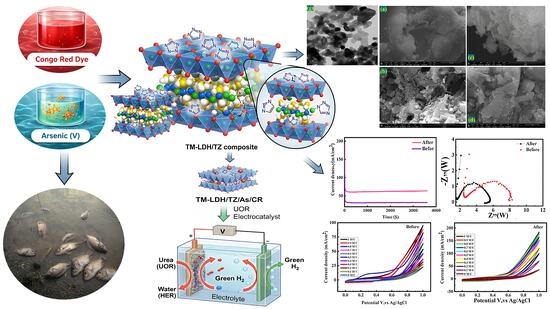
Water contamination by arsenic(V) [As(V)] and Congo red (CR) dye poses concurrent threats to public health and aquatic ecosystems, particularly in regions where metallurgical and textile industries coexist. Developing a single adsorbent capable of simultaneously addressing these chemically distinct pollutants, while recovering value from the spent material remains an open challenge in sustainable water treatment. This study reports the synthesis and evaluation of a novel ternary MgZnFe-LDH/1,2,4-triazole composite (TM-LDH/TZ), engineered for the concurrent adsorptive removal of As(V) and CR, and the subsequent repurposing of the pollutant-loaded material as an electrocatalyst for the urea oxidation reaction (UOR). The composite was prepared via co-precipitation and triazole surface grafting, then characterized by FTIR, XRD, BET, TGA, FESEM, and HRTEM. Batch adsorption experiments examined the influence of pH, adsorbent dose, initial concentration, and temperature, with equilibrium data modeled through Langmuir, Freundlich, Temkin, and the statistically grounded Advanced Monolayer Model (AMM); kinetics were assessed using pseudo-first/second-order and Elovich models. Maximum Langmuir adsorption capacities reached 204.75 mg g−1 for As(V) and 499.72 mg g−1 for CR simultaneously at pH 5 and 25 °C, surpassing the majority of previously reported single-pollutant adsorbents. Elovich and pseudo-second-order kinetics confirmed chemisorption as the governing pathway for As(V) and CR, respectively, while AMM thermodynamic analysis verified spontaneous adsorption across all experimental conditions. The spent composite delivered a UOR peak current density of 184.67 mA cm−2 that is nearly twice that of the fresh material, with a reduced charge-transfer resistance of 1.19 Ω, and removal efficiency remained above 85% through three successive regeneration cycles. The bifunctional design, coupling high-capacity dual-pollutant removal with catalytic valorization of waste, positions TM-LDH/TZ as a circular-economy-aligned platform for advanced water remediation.

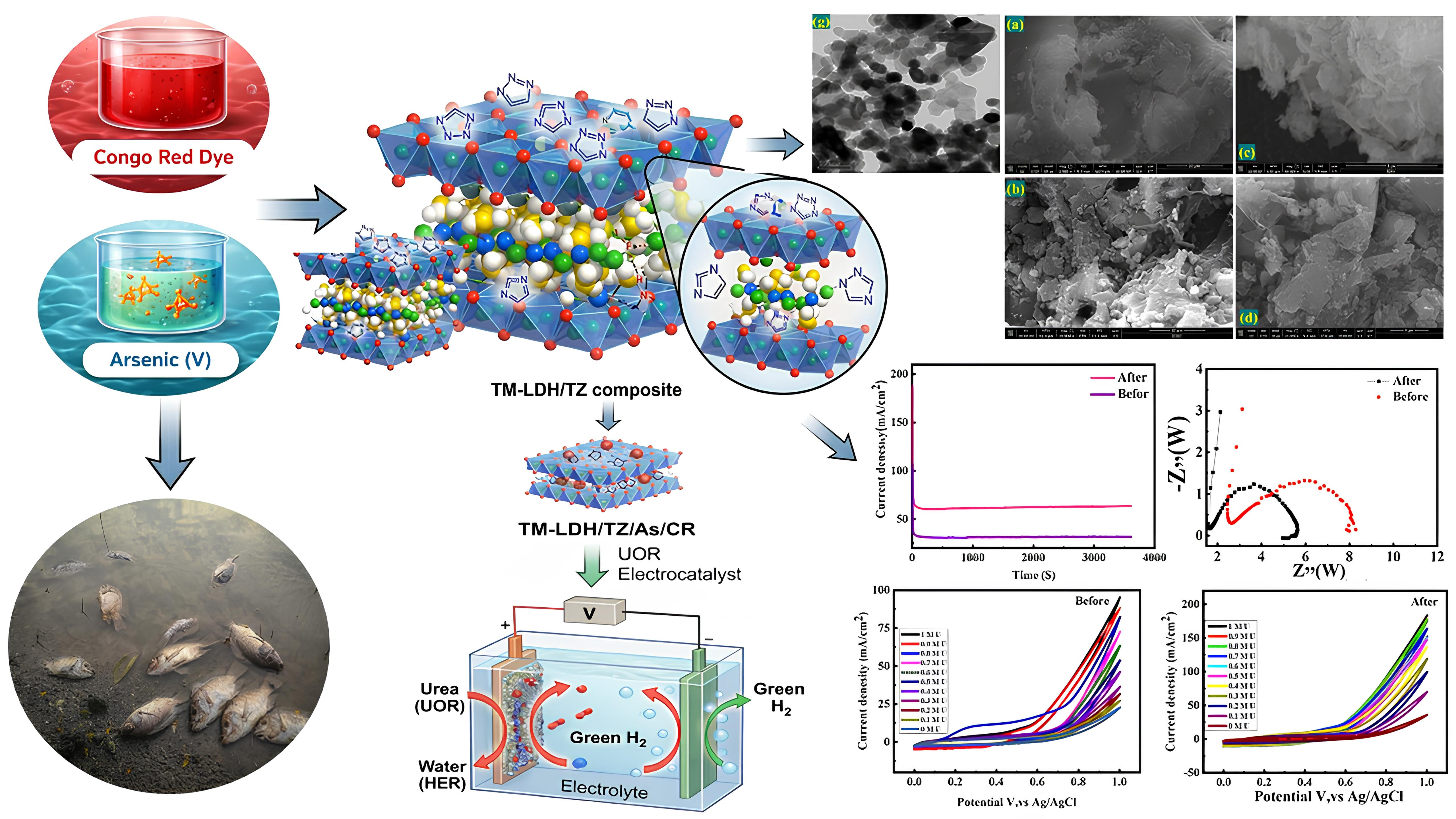
Graphical Abstract

1. Introduction

Clean water is increasingly threatened by toxic pollutants, with arsenic (As) and Congo red (CR) dye representing particular concerns due to their frequent co-occurrence in industrial effluents, especially where metallurgical and textile operations overlap [1,2]. Agricultural irrigation with arsenic-contaminated groundwater in proximity to textile production areas further intensifies this dual-pollutant burden. Understanding and addressing this co-occurrence is therefore a pressing environmental and public health priority. Arsenic, a Group 1 carcinogen, exposes over 230 million people globally to groundwater levels exceeding WHO guidelines, existing primarily as arsenate [As(V)] under oxic conditions [1,3,4,5].
Congo red, a recalcitrant diazo dye, sees 10–20% of its annual production (over 800,000 tonnes) discharged as wastewater, where it generates carcinogenic aromatic amines and disrupts aquatic ecosystems [6,7,8].
While each contaminant has been studied individually, their simultaneous removal remains underexplored despite heightened co-occurrence risks.
Existing treatment methods face significant limitations. Coagulation generates toxic sludge, ion-exchange suffers from fouling, and membrane processes are energy-intensive [9,10,11]. Biological degradation of CR is slow and yields toxic intermediates, while photocatalysis requires strict conditions [6,7,11,12]. Adsorption therefore emerges as the most practical approach, offering high efficiency, operational simplicity, and the unique ability to capture chemically distinct contaminants simultaneously via complementary surface interactions on a single, well-designed material [12,13,14].
Ternary layered double hydroxides (LDHs), particularly MgZnFe-LDH, provide an ideal scaffold for this task. The metal centers offer distinct functions: Fe(III) supplies high-affinity sites for As(V) inner-sphere complexation, Zn(II) enhances stability, and Mg(II) increases charge density for anionic CR capture [14,15,16]. Functionalization with 1,2,4-triazole further augments versatility, introducing π–π stacking and hydrogen bonding capabilities for CR without occluding Fe–OH arsenate sites [17,18,19,20].
Despite significant advances in both LDH-based adsorption and triazole-functionalized materials, three critical knowledge gaps remain unaddressed. First, no single material has been rationally designed for the simultaneous removal of As(V) and Congo red from competitive binary co-contaminated solutions; prior studies invariably address each contaminant in isolation, leaving such systems largely uncharacterized. Second, MgZnFe-LDH functionalized with 1,2,4-triazole has not been reported, and the synergistic roles of the individual metal centers and the triazole ligand in enabling dual-pollutant capture—specifically the non-competitive operation of Fe–OH arsenate binding sites alongside triazole-mediated CR adsorption sites—remain unexplored. Third, the valorization of dual-pollutant-loaded LDH composites as electrocatalysts for the urea oxidation reaction has not been demonstrated, representing a missed opportunity for circular-economy integration in water remediation.
To address these gaps, we synthesized a novel MgZnFe-LDH/1,2,4-triazole composite (TM-LDH/TZ) via co-precipitation and post-functionalization, and evaluated it for simultaneous As(V) and CR removal from binary solutions using conventional isotherm and kinetic models alongside advanced thermodynamic analysis via the grand-canonical Advanced Monolayer Model. The spent, pollutant-loaded material was further tested as a UOR electrocatalyst. The novelty of this work is threefold: (i) the first rational design of a bifunctional MgZnFe-LDH/1,2,4-triazole composite with non-competing arsenate and dye adsorption sites engineered through targeted metal–function assignments; (ii) the first systematic evaluation of simultaneous As(V) and CR removal from binary co-contaminated solutions using a triazole-functionalized ternary LDH, with mechanistic interpretation via statistical thermodynamic modeling; and (iii) the first demonstration that a dual-pollutant-loaded LDH adsorbent can be directly repurposed as an electrochemically enhanced UOR catalyst, establishing a proof-of-concept for circular-economy-aligned water remediation platforms.

2. Results and Discussion

2.1. Characterization of Synthesized Adsorbents

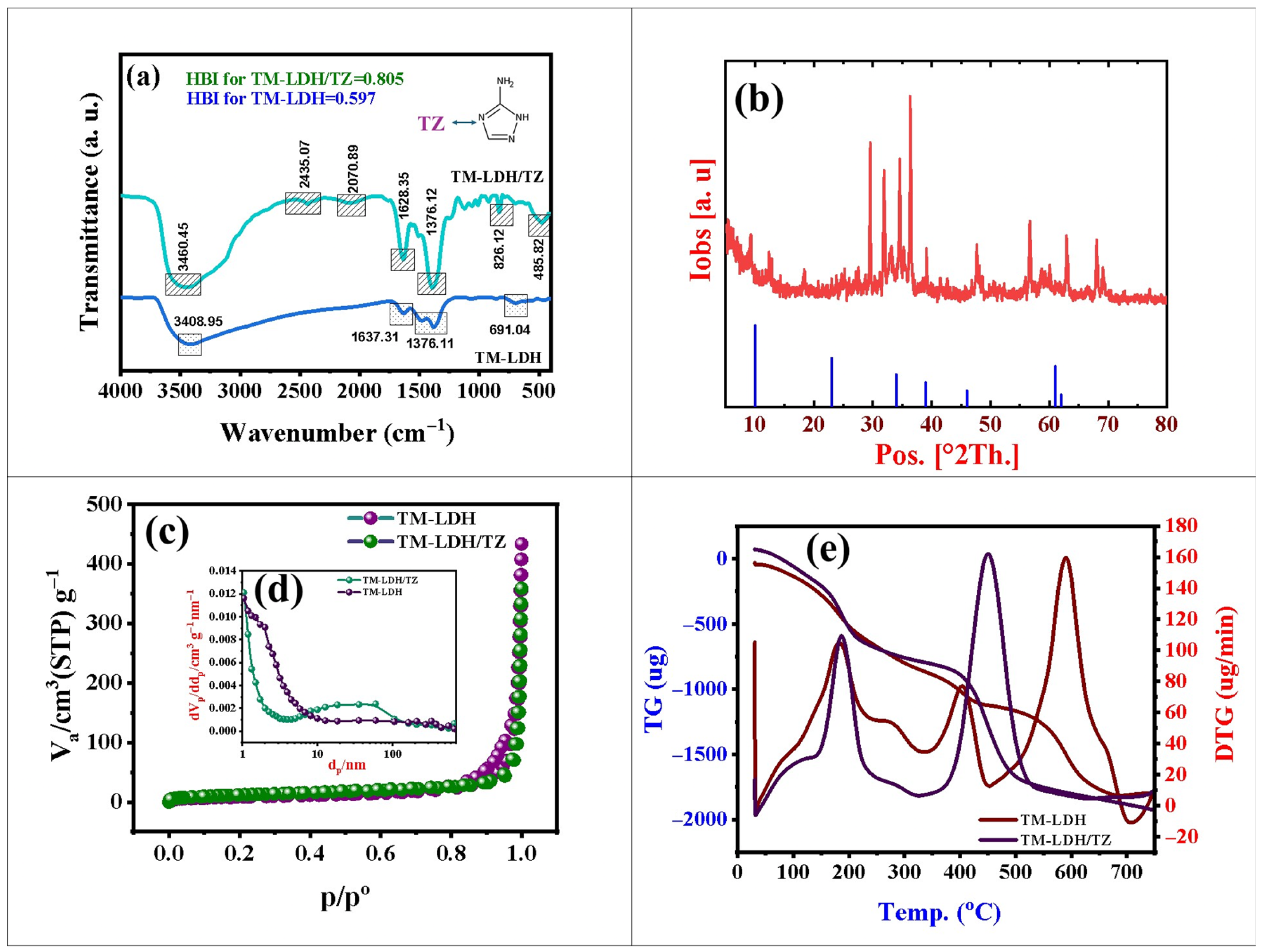
FTIR spectra confirmed successful composite synthesis. The TM-LDH spectrum shows a broad O–H stretching band at 3408.95 cm−1, H–O–H bending at 1637.31 cm−1, asymmetric NO3 stretching at 1376.11 cm−1, and M–O/O–M–O lattice vibrations below 1000 cm−1. Upon triazole grafting, the O–H band shifted to 3460.45 cm−1 with enhanced hydrogen bond intensity (HBI = 0.805 vs. 0.597 for the parent LDH), and new C = N/C = C bands at 1500–1600 cm−1 and C–N vibrations at 1000–1200 cm−1 confirmed successful functionalization [21] (Figure 1a). XRD patterns (Figure 1b) and Figure S1 show characteristic LDH reflections at 11.27°, 22.53°, 34.01°, and 60.01° for the (003), (006), (101), and (110) planes, with a d003 spacing of 13.26 Å consistent with interlayer nitrate (JCPDS#51–0045) [22,23]. Phase purity was confirmed by the absence of discrete metal hydroxide or oxide peaks. Upon TZ incorporation, the dominant peak shifted to 2θ ≈ 29.7°, with a crystallite size increasing to 643.53 Å (Scherrer equation, K = 0.94), indicating TZ-driven layer expansion and crystal growth [24].
BET analysis (Figure 1c) revealed Type III isotherms with H3 hysteresis. TM-LDH had SBET = 367.6 m2 g−1; after functionalization, SBET reduced to 155.6 m2 g−1 (Table 1), consistent with partial mesopore blockage by TZ (Figure 1d), while the mean pore diameter increased from 6.70 to 7.50 nm, preserving favorable diffusion pathways. TGA (Figure 1e) revealed three decomposition stages: surface/interlayer water loss (50–250 °C), TZ decomposition and layer dehydroxylation (250–450 °C), and residual carbonate collapse (500–650 °C).
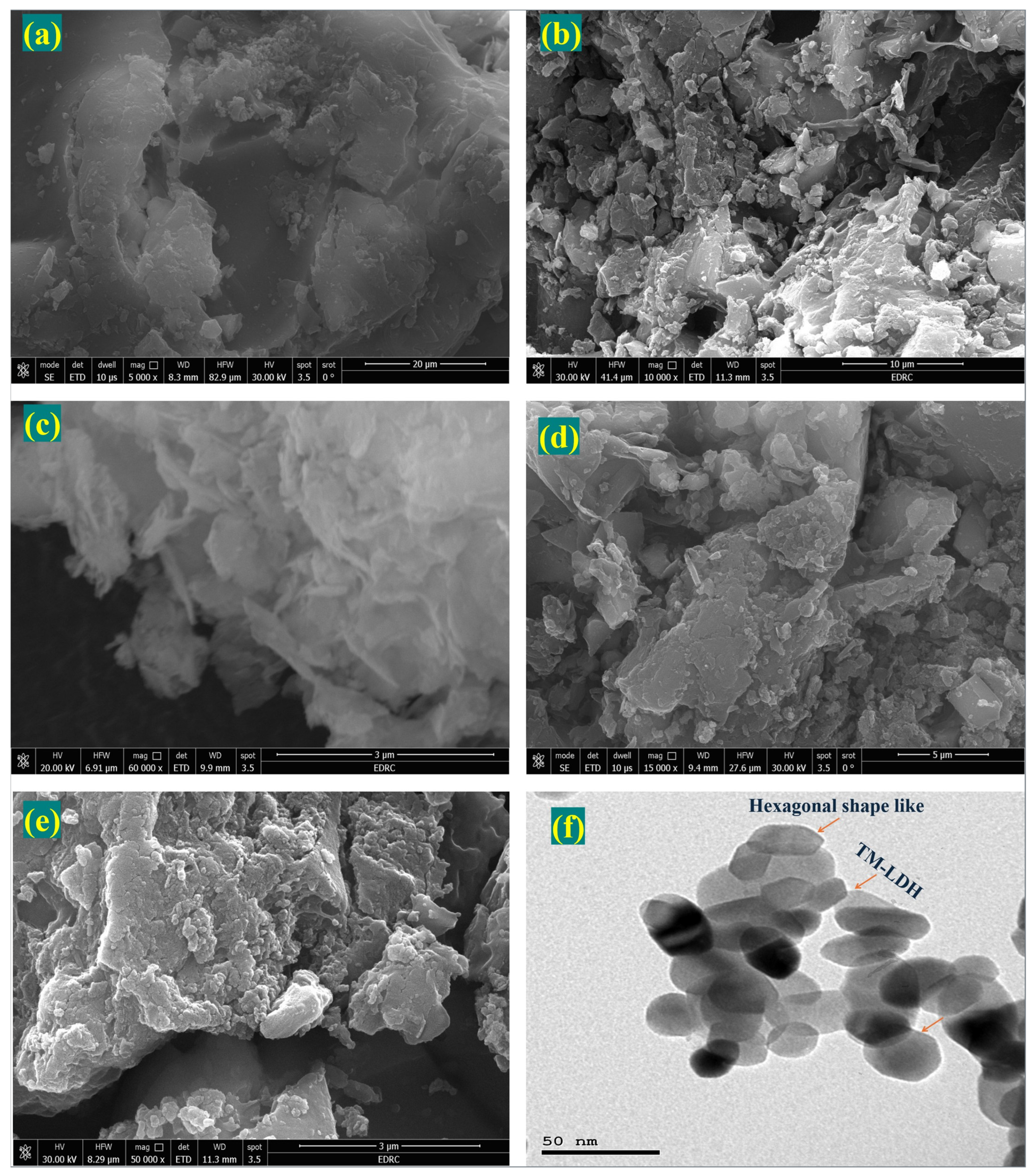
FESEM images (Figure 2a–e) revealed distinct morphologies for the two prepared materials. TM-LDH (Figure 2a–c) exhibited typical agglomerated platelet-like and sheet structures with irregular shapes and considerable surface roughness, creating a high density of edge sites and defects. The TM-LDH/TZ composite (Figure 2d,e) showed a more open, sponge-like or foam-like architecture with loosely aggregated fine particles. This morphology suggests that TZ functionalization inhibited the dense stacking of LDH layers, leading to a more porous and accessible structure with a potentially higher external surface area, favorable for rapid adsorption.
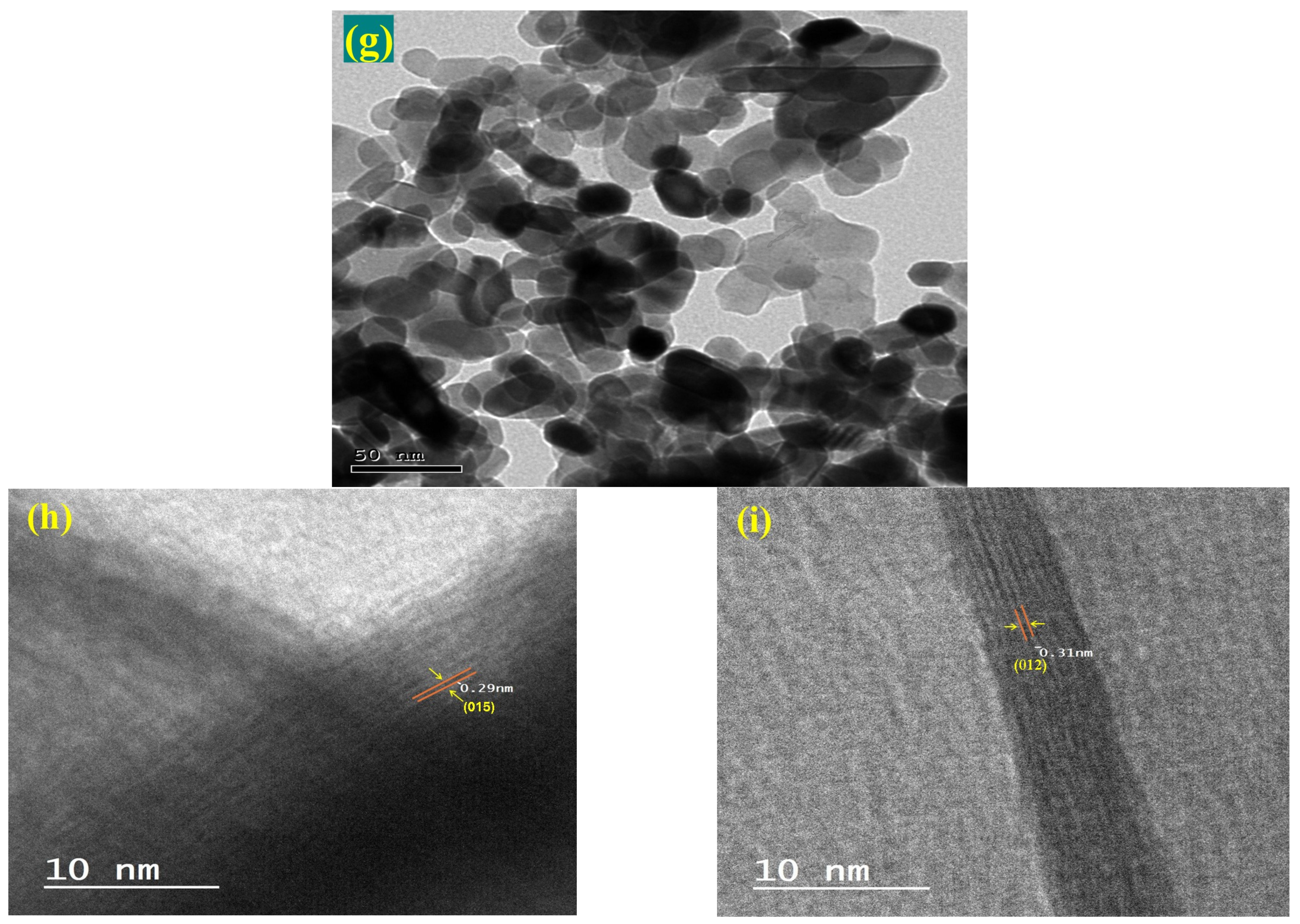
The morphology and crystal structure of the prepared TM-LDH/TZ adsorbent were characterized by high-resolution transmission electron microscopy (HRTEM), as shown in Figure 2f–g. The particles exhibit a hexagonal shape with relatively smooth surfaces, characteristic of thin-layered, brucite-like LDH structures. Compared to pristine LDH, the composite shows increased aggregation and stacking of nanosheets, likely due to intermolecular interactions between LDH layers and 1,2,4-triazole (TZ) molecules, promoting closer packing and partial nanosheet overlap. Contrast variations within aggregates indicate overlapping nanosheets and TZ distributed on or between LDH layers (Figure 2g).
Lattice fringe spacings of 0.31 nm and 0.29 nm correspond to the (012) and (015) crystallographic planes (Figure 2h–i), respectively—characteristic reflections of hydrotalcite-like layered structures. Using Bragg’s law with Cu Kα radiation (λ = 0.15406 nm), these d-spacings yield XRD peak positions at approximately 2θ ≈ 28.8° and 30.8°, consistent with standard LDH phases. Minor peak shifts may arise from metal substitution (Mg, Zn, Fe), lattice strain, or interlayer species, but the values remain within typical LDH identification ranges.

2.2. Effect of Solution pH on Simultaneous As(V) and CR Removal

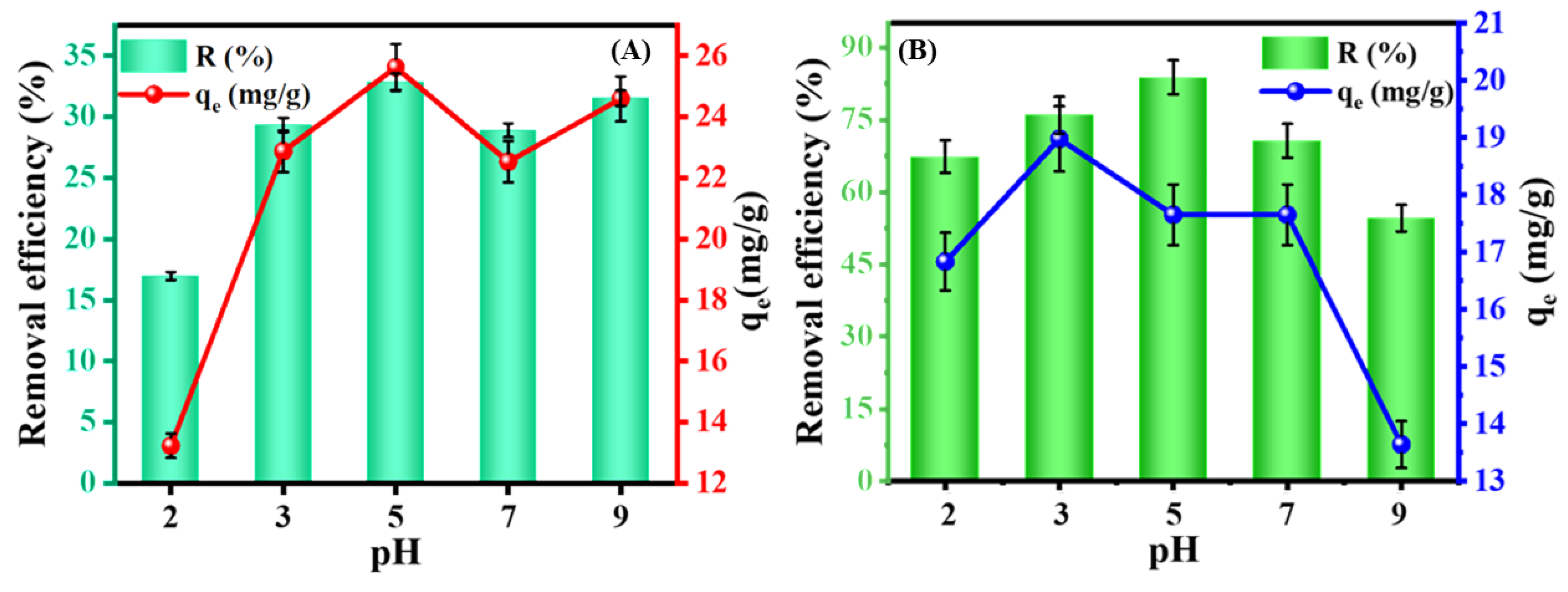
Solution pH is among the most critical parameters governing ionic pollutant adsorption because it simultaneously controls the surface charge of the adsorbent and the speciation of each adsorbate in solution [9,25]. To identify the pH range that maximizes the simultaneous removal of both contaminants, experiments were conducted at pH 2–9 (Figure 3). The point of zero charge (pHpzc) of TM-LDH/TZ was determined by the pH drift method to be 7.0 (Figure S2), consistent with values reported for Fe-containing ternary LDH materials [26,27]. Below pHpzc, the composite surface carries a net positive charge that provides a strong electrostatic driving force for the uptake of anionic pollutants.

2.2.1. As(V)

The percentage removal R (%) and equilibrium capacity qe of As(V) followed a non-monotonic pattern with pH (Figure 3a). Uptake was minimal at pH 2 (R ≈ 17%, qe ≈ 13 mg/g), rose sharply to a maximum at pH 5 (R ≈ 35%, qe ≈ 26 mg/g), and declined progressively above pH 7. The suppressed removal at pH 2 reflects two cooperating effects, including intense competition from Cl ions introduced for pH adjustment and protonation of triazole nitrogen atoms and surface hydroxyl groups under strongly acidic conditions, which partially neutralizes the electrostatic affinity for arsenate and imposes steric crowding at active sites [9,28]. At pH 5, As(V) exists as H2AsO4 and HAsO42−, and the highly positive TM-LDH/TZ surface provides strong electrostatic attraction for both species, alongside inner-sphere ligand exchange at Fe–OH sites [15,16]. Above pH 7 (=pHpzc) the net surface charge becomes neutral and then negative, which reduces electrostatic attraction, and increasing OH concentration competes directly with arsenate for the same Fe–OH binding sites [9,14]. pH 5 was therefore selected as the optimal value for all subsequent As(V) adsorption experiments.

2.2.2. Congo Red

Congo red removal exhibited a complementary but distinct pH dependence (Figure 3b). Maximum removal (R ≈ 83%, qe ≈ 19 mg/g) was achieved at pH 5–6, and adsorption declined sharply at pH ≥ 8. Because CR carries two sulfonate (–SO3) groups, it is inherently anionic across the entire pH range investigated [6,7]. At pH < pHpzc (7.0), the protonated TM-LDH/TZ surface generates strong Coulombic attraction for CR sulfonate anions, while π–π stacking between the triazole ring and the naphthalene–biphenyl aromatic system of CR provides an additional non-electrostatic driving force that is largely independent of pH [18,19]. The pronounced CR removal persists even at pH 2–3, where electrostatic attraction is weakened, further confirming the substantial contribution of π–π stacking and hydrophobic interactions to CR retention [19,29]. Deprotonation of surface functional groups above pH 7 reduces the electrostatic contribution and causes the observed decline in R (%) [26]. Based on these findings, pH 5 was adopted as the common optimal pH for simultaneous adsorption of both pollutants in all subsequent experiments, as it balances maximum combined removal without requiring extreme pH adjustment.

2.3. Effect of Adsorbent Dosage

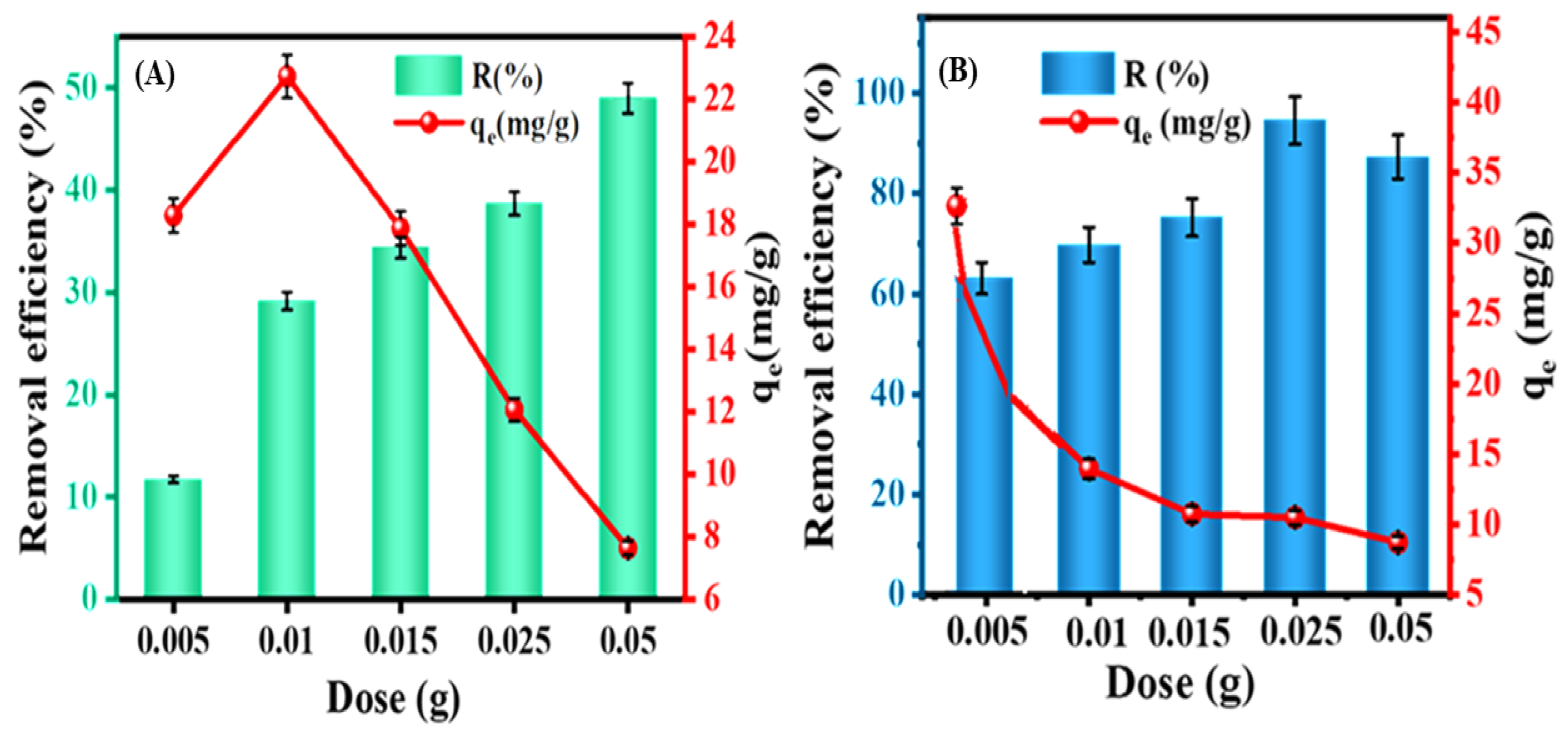
Dosage was varied over 0.1–1.0 g L−1 at pH 5, 25 °C, and 24 h (Figure 4). For As(V), R(%) increased monotonically (12% → 49%) with dose as additional Fe–OH sites became available, while qe declined (22 → 7 mg g−1) due to progressive site unsaturation [9,14]. CR removal showed a non-monotonic response: a transient dip at the second dose point is attributed to the onset of nanoplatelet aggregation, reducing exposed π–π stacking sites, before recovering to a maximum of ≈93% at 0.8 g L−1; qe (CR) decreased from ≈40 to 9 mg g−1. A dose of 1.0 g L−1 was selected as the optimum, achieving near-maximal As(V) removal while maintaining CR removal above 85%.

2.4. Effect of Initial Concentration and Temperature on Equilibrium Uptake

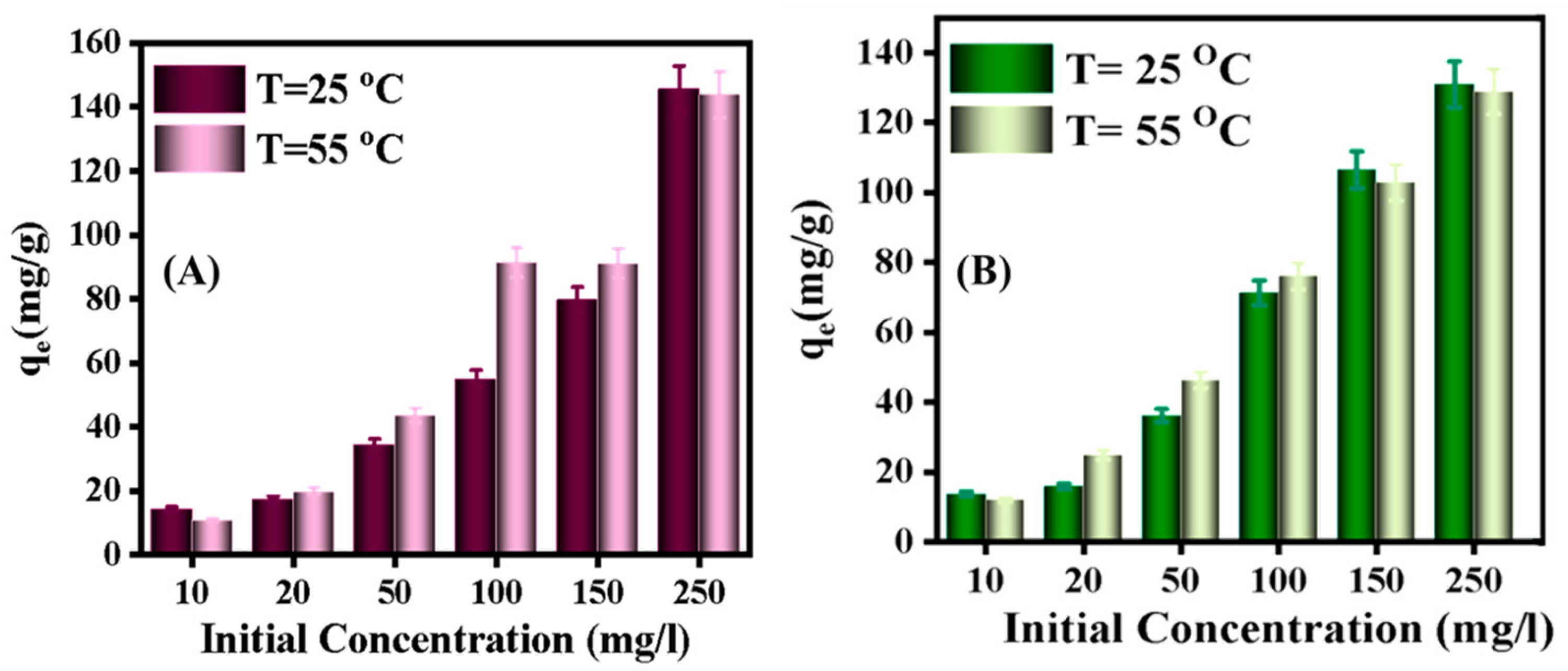
Increasing initial pollutant concentration (10–250 mg L−1) progressively increased qe for both pollutants, approaching saturation at high concentrations, while R(%) declined due to site saturation (Figure 5). Temperature effects differed: As(V) uptake increased at 55 °C relative to 25 °C at intermediate concentrations, indicative of an endothermic process; CR adsorption showed only minor temperature dependence, consistent with a predominantly exothermic mechanism [14,30]. These contrasting thermal behaviors, corroborated by the isotherm parameters (Section 2.5), reflect distinct adsorption pathways for each pollutant on the TM-LDH/TZ surface.

2.5. Equilibrium Isotherm Analysis

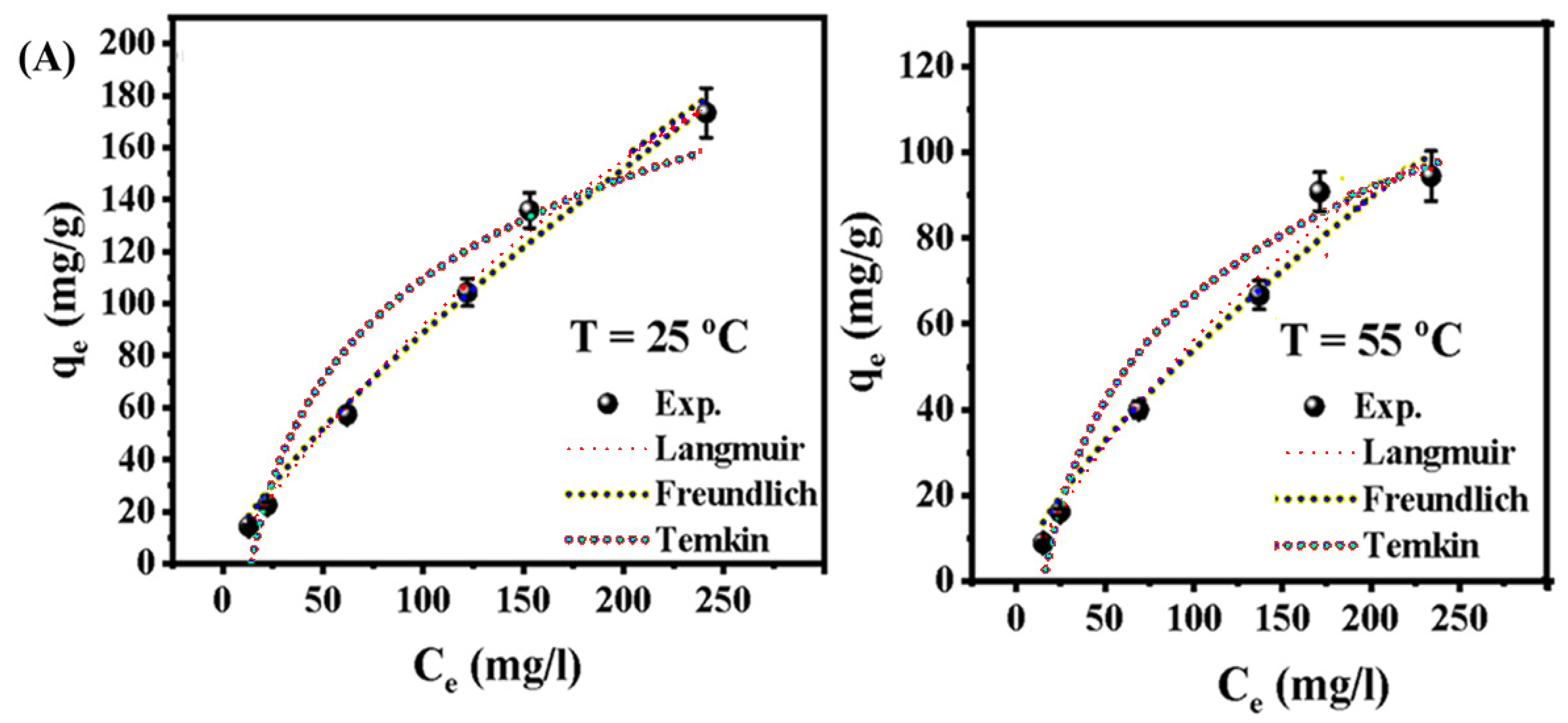
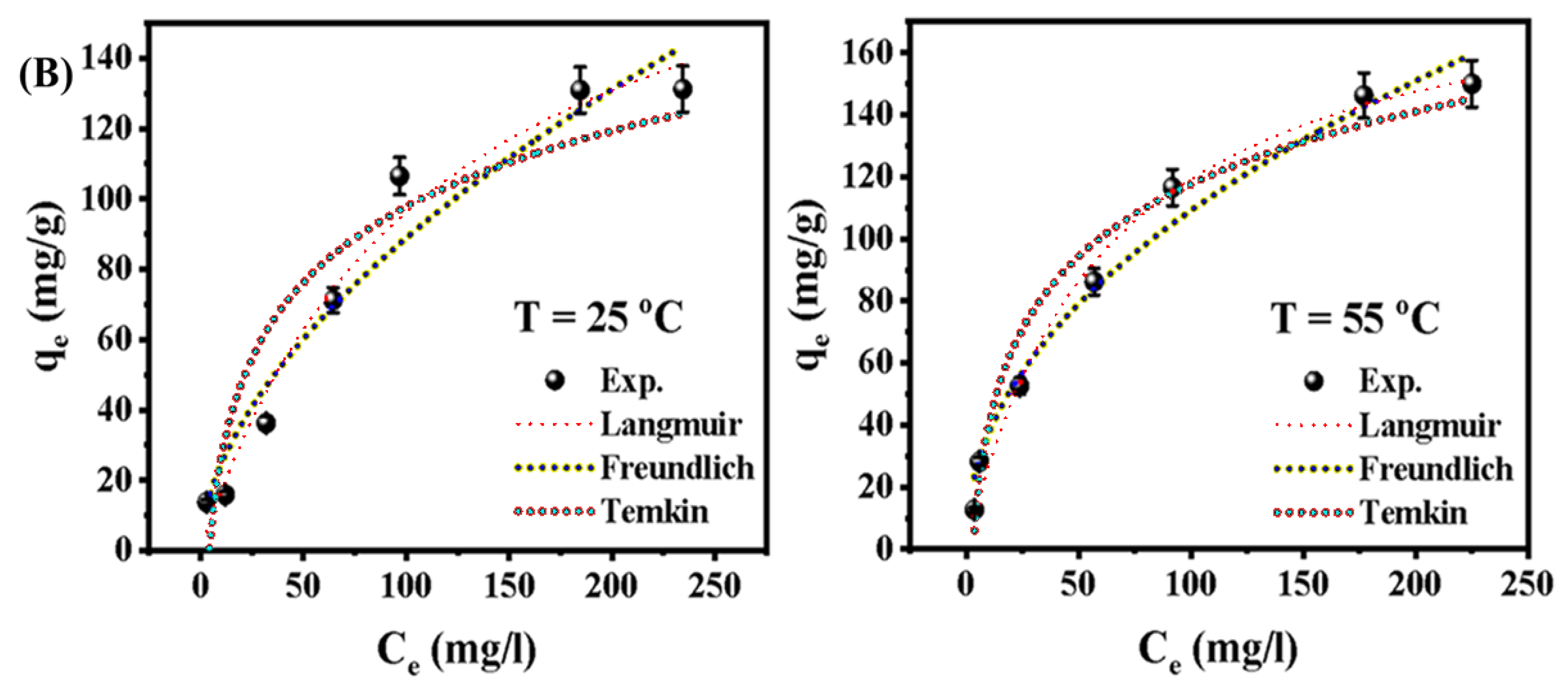
To quantitatively describe the equilibrium distribution of As(V) and CR between the TM-LDH/TZ surface and solution, and to elucidate the surface energetics and heterogeneity of adsorption, equilibrium data collected at 25 °C and 55 °C were fitted by non-linear least-squares regression to the Langmuir, Freundlich, and Temkin isotherm models. The fitted isotherms are presented in Figure 6A,B, and the derived parameters are compiled in Table 2.
Among the three tested isotherm models, the Langmuir model provided the best description of both As(V) and CR adsorption at 25 °C and 55 °C, with the highest adjusted R2 values (≥0.971 for As(V); ≥0.988 for CR) and excellent agreement between fitted curves and experimental data (Figure 6A,B). This indicates monolayer adsorption onto a finite number of energetically equivalent, non-interacting binding sites, consistent with the coordinative and electrostatic nature of the adsorbate–adsorbent interactions [14,31].
The maximum Langmuir capacity (qmax) of TM-LDH/TZ for As(V) was 204.75 mg g−1 at 25 °C, decreasing slightly to 192.86 mg g−1 at 55 °C. For CR, qmax was 499.72 mg g−1 at 25 °C, declining to 257.17 mg g−1 at 55 °C, reflecting exothermic adsorption. The As(V) capacity compares favorably with LDH-based adsorbents (e.g., calcined MgAl-LDH: 80–150 mg g−1 [14], NiAlFe-LDH composites (60–180 mg g−1) [30], and Zr-UiO-66-NH2 (100–220 mg g−1). The CR capacity substantially exceeds most binary LDH systems and approaches the best ternary LDH materials [32,33], confirming the synergistic role of triazole functionalization. The Freundlich model also gave good fits (Adj-R2 = 0.941–0.980 for As(V); 0.974–0.987 for CR), with 1/n < 1 under all conditions (0.47–0.56 for As(V); 0.73–0.77 for CR), confirming favorable, non-linear adsorption on an energetically heterogeneous surface. Higher 1/n values for CR indicate greater surface-energy heterogeneity, consistent with multiple binding mechanisms (electrostatic, π–π, hydrogen bonding) [18,19]. The increase in KF for As(V) with rising temperature (6.705 → 12.735 (mg g−1) (L mg−1)1/n) confirms the endothermic nature of arsenate uptake.

2.6. Kinetics Analysis

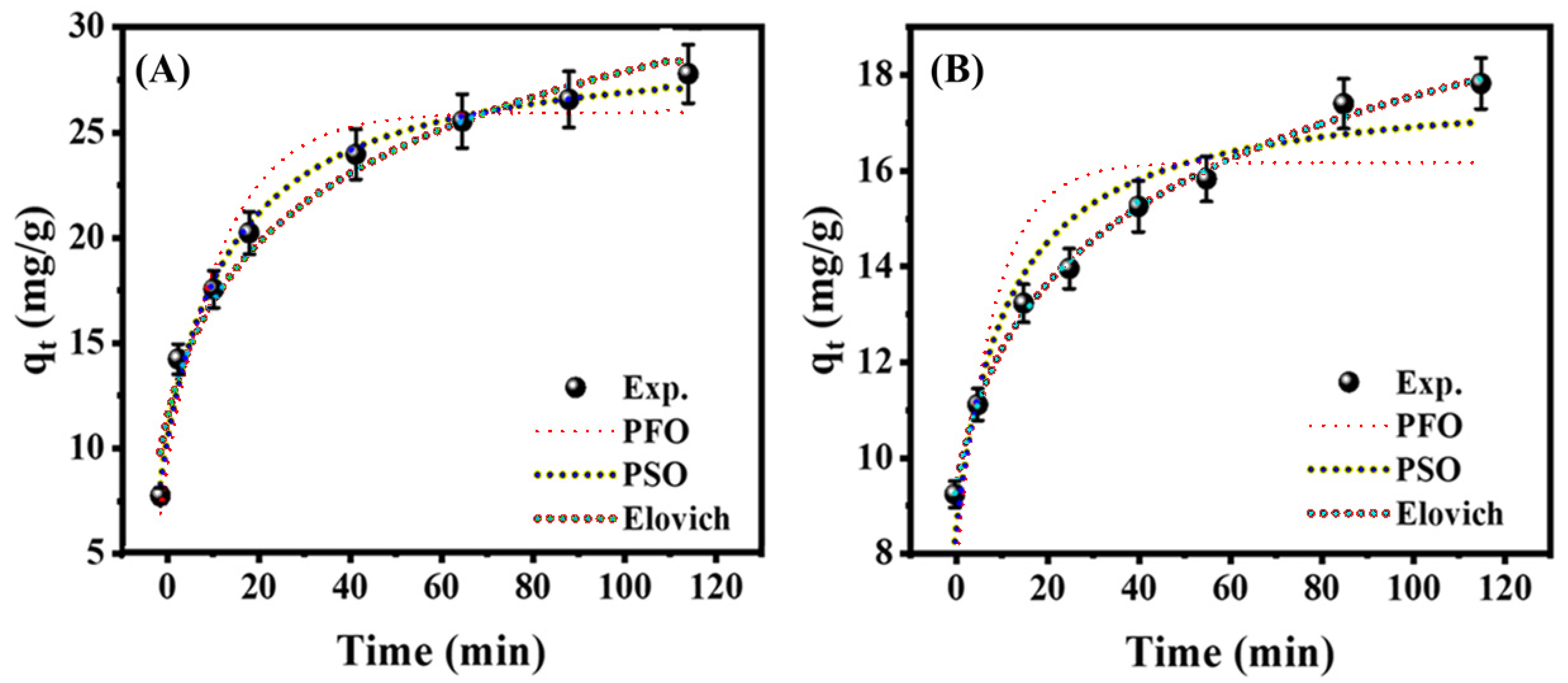
Time-resolved uptake was monitored over 120 min (Figure 7; Table 3). Both As(V) and CR showed rapid initial uptake during the first 30–45 min—reflecting the high site availability and steep concentration gradient—before reaching apparent equilibrium by 120 and 90 min, respectively [25]. The faster equilibration of CR is consistent with its multiple available interaction modes (electrostatic, π–π, H-bonding), facilitating rapid multi-point attachment [19,26].
Among the three kinetic models applied, the Elovich model provided the best description of As(V) uptake (R2 = 0.997), while the pseudo-second-order (PSO) model best described CR (R2 = 0.991); both substantially outperformed the pseudo-first-order (PFO) model (R2(As(V)) = 0.779; R2(CR) = 0.955), confirming that PFO kinetics cannot capture the energetically complex TM-LDH/TZ surface [25,34].
The best-fit Elovich parameters for As(V) (α = 0.363 mg g−1 min−1, β = 15.45 g mg−1) reflect chemisorptive uptake on a surface with a continuous distribution of binding site energies—behavior characteristic of arsenate inner-sphere complexation across structurally diverse Fe–OH environments [9,29,35]; the large β indicates progressively increasing activation energy with coverage due to steric hindrance and lateral repulsion. For CR, the PSO-derived qe (29.42 mg g−1) and k2 (0.0027 g mg−1 min−1) imply a bimolecular rate-limiting surface interaction, most plausibly the formation of ion-pair complexes between CR sulfonate groups and protonated surface sites, combined with triazole π–π engagement [18,19].
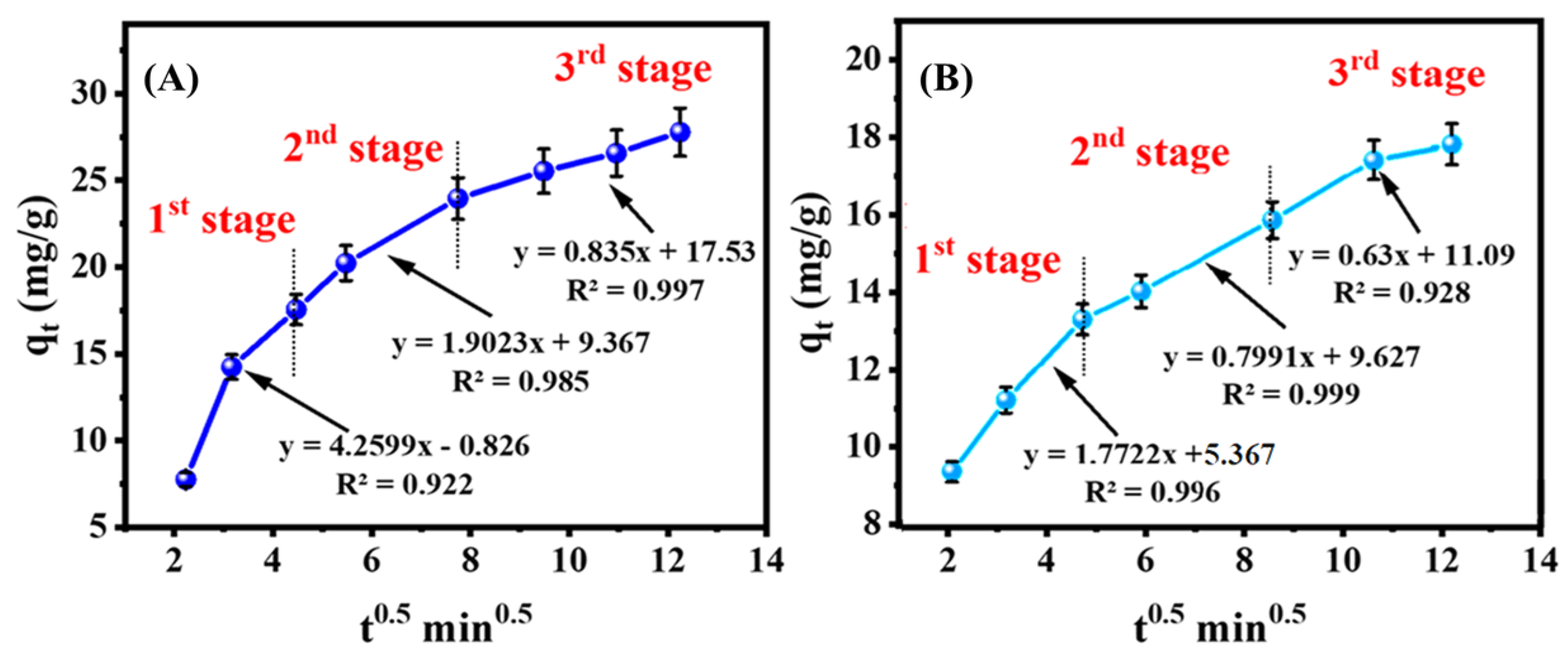
Application of the Weber–Morris intraparticle diffusion model revealed three consecutive linear segments in qt vs. t1/2 plots (Figure 8; Table 4), with non-zero intercepts at each stage, demonstrating that intraparticle diffusion is not the sole rate-limiting step. Instead, adsorption is governed by the sequential interplay of external film diffusion (Stage 1), intraparticle mesopore diffusion (Stage 2), and surface site equilibration (Stage 3) [28,36].

2.7. Adsorbent Material Regeneration and Reusability

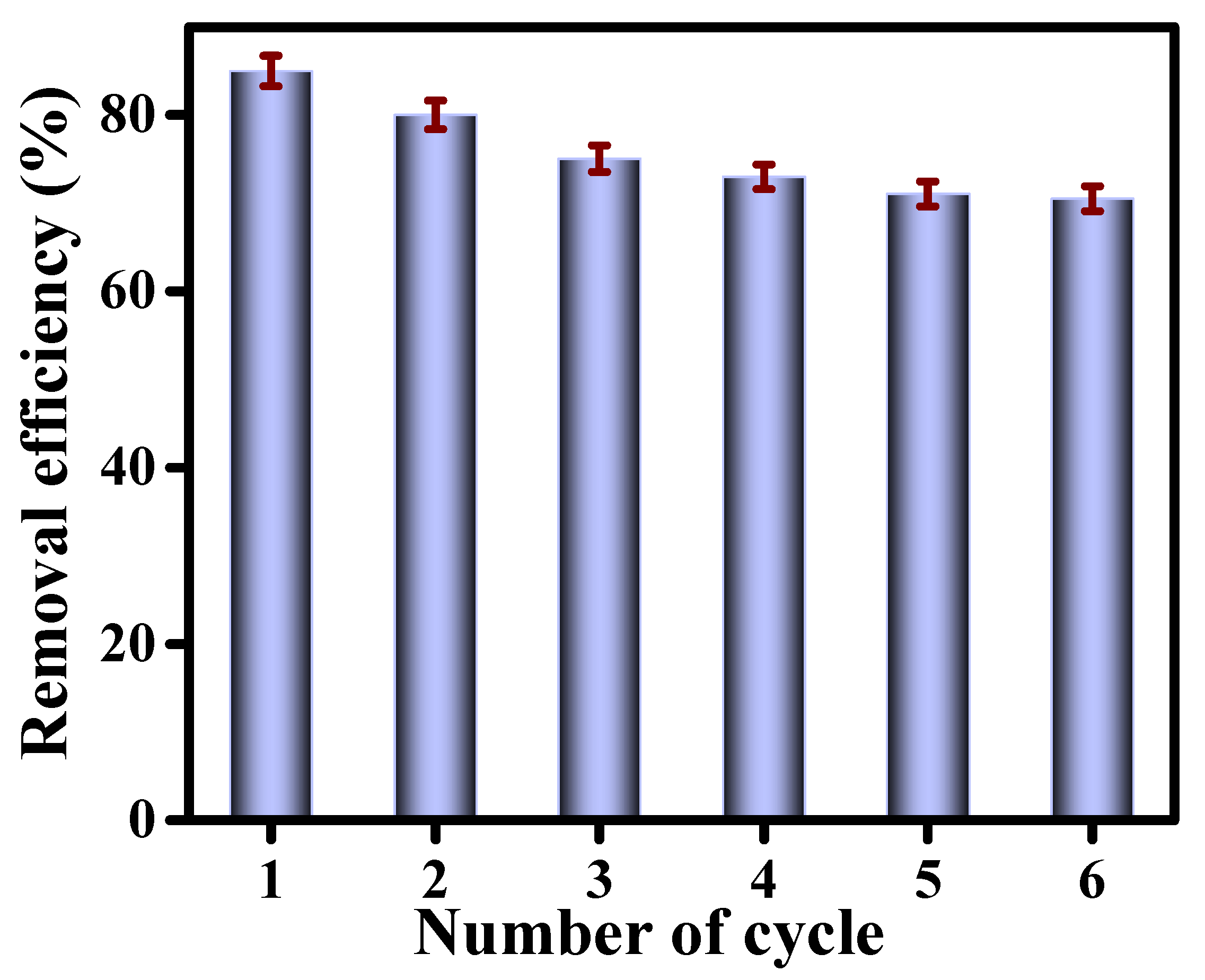
The practical viability of TM-LDH/TZ requires efficient regeneration and stable reuse. Six adsorption–desorption cycles were performed using sequential NaOH washes (0.1 M for CR, 0.5 M for As(V)). Removal efficiency decreased marginally from cycle 1 to cycle 6, reaching 66.86% (Figure 9). This loss is attributed to alkaline leaching [14,37], incomplete desorption of strongly bound inner-sphere Fe–O–As complexes, and minor structural reorganization of interlayer galleries after repeated cycling [9,30]. Overall, TM-LDH/TZ can be regenerated and reused for at least six cycles without significant capacity loss, supporting its practical and economic viability over single-use adsorbents.

2.8. The Advanced Monolayer Model

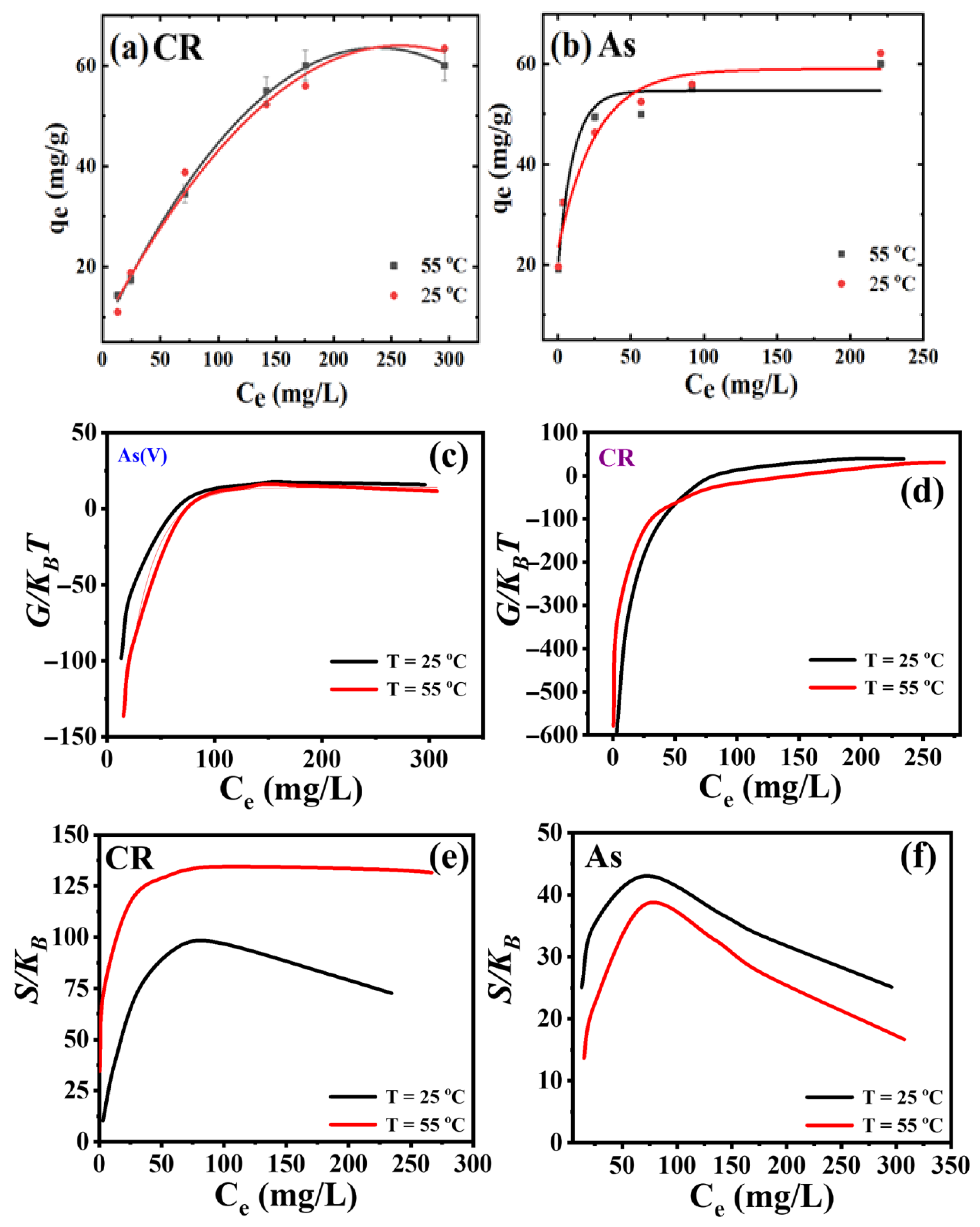
The adsorption mechanism of As(V) and Congo red (CR) onto TM-LDH/TZ was interpreted using the Advanced Monolayer Model (AMM), which provided the best fit to experimental data at 25 °C and 55 °C (Figure 10a,b). Three categories of AMM-derived parameters were analyzed: steric parameters (n, NM, Qsat) and energetic parameters (ΔE) [38,39,40].
The steric parameter n indicates the number of pollutant molecules per active site. For As(V) and CR, n values (Table S2) revealed orientation-dependent adsorption geometries. The adsorption energy ΔE was negative for both pollutants (Table S2), confirming energetically favorable interactions. For As(V), ΔE ranged from −22.10 to −29.32 kJ mol−1, indicating moderately strong physicochemical adsorption dominated by electrostatic attraction and ion-exchange mechanisms [38]. Both |ΔE| and Qsat increased with temperature, showing that thermal energy enhances surface–adsorbate interactions.
Gibbs free energy (ΔG) was negative across all conditions (Figure 10c,d), confirming spontaneous adsorption requiring no external energy input. Configurational entropy (Figure 10e,f) increased with pollutant concentration up to half-saturation, reflecting disorder from intense adsorbate–surface interactions, then declined to zero at full saturation, indicating a highly ordered monolayer [40]. These results establish TM-LDH/TZ as an energy-efficient adsorbent for simultaneous As(V) and CR removal.

2.9. Urea Oxidation Reaction (UOR)

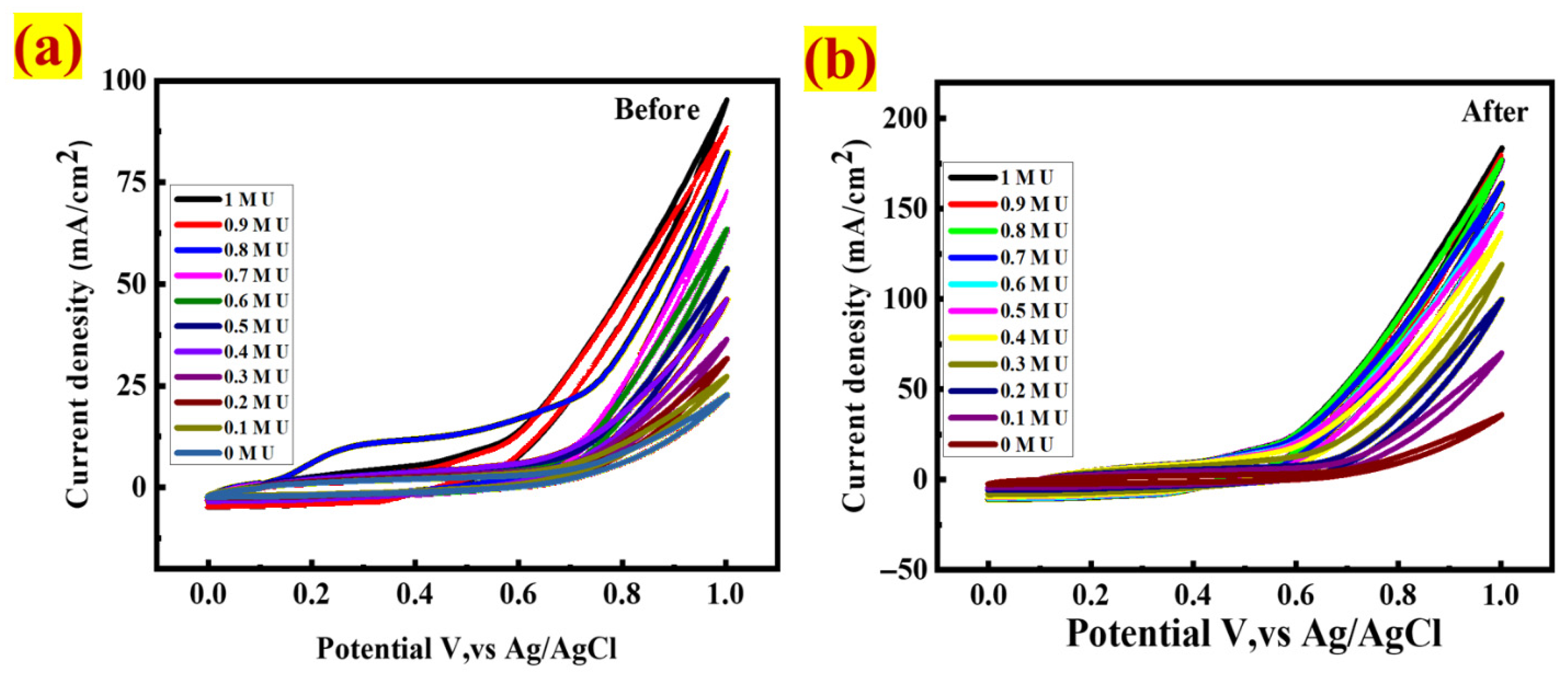
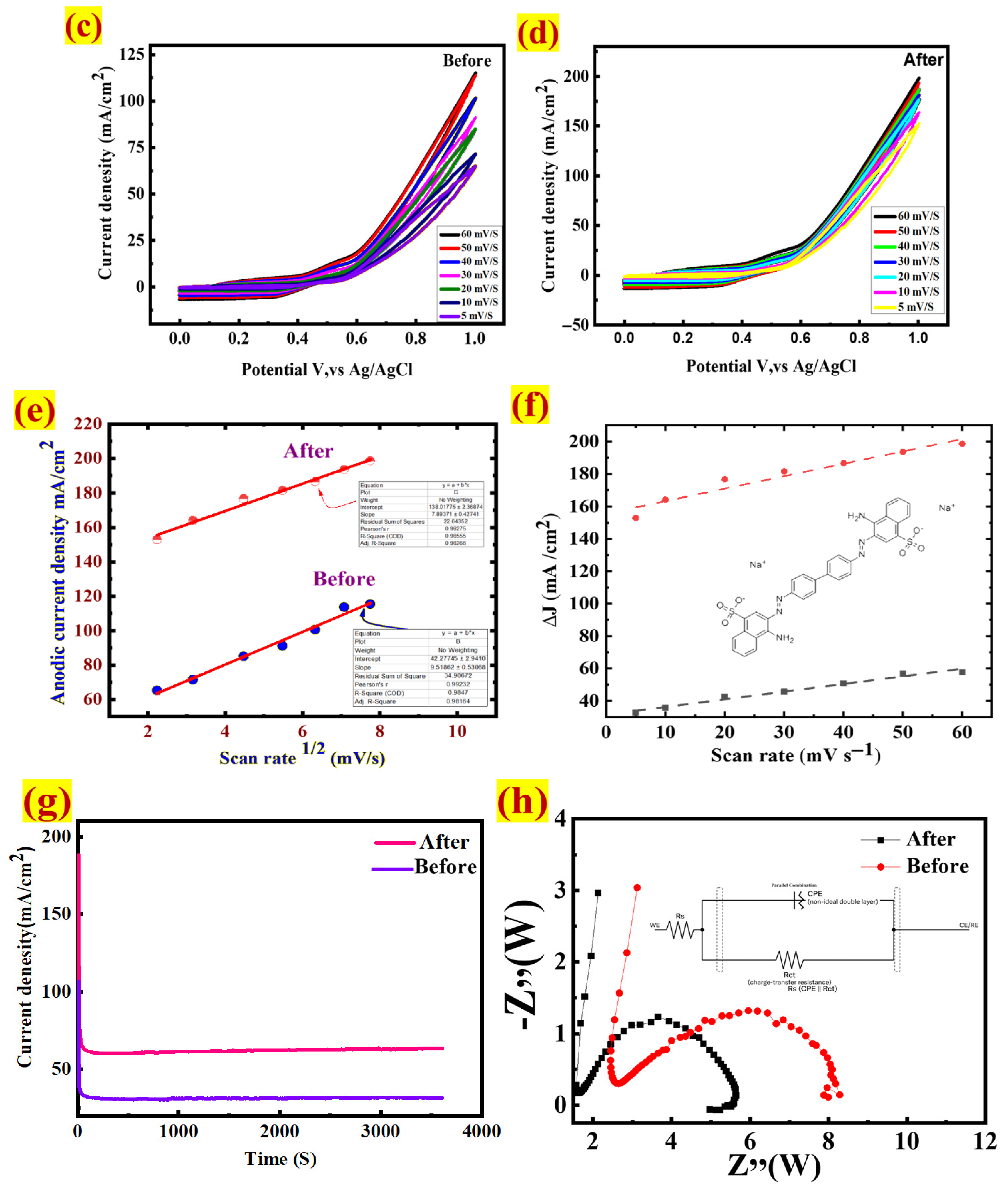
The electrocatalytic activity of fresh TM-LDH/TZ and spent TM-LDH/TZ/As/CR toward the urea oxidation reaction (UOR) was investigated (Figure 11). The fresh electrode showed increasing anodic current density with urea concentration, reaching 95.72 mA cm−2 at 1.0 M due to enhanced substrate availability and mass transport [41]. The spent electrode delivered a substantially higher peak current density (184.67 mA cm−2 at 1.0 M), a nearly two-fold enhancement, indicating that adsorbed As(V) and CR species induce favorable surface restructuring that improves electrolyte penetration, ionic conductivity, and active-site accessibility [42]. Triazole N atoms and LDH hydroxyl groups act as hydrogen bond acceptors for urea –NH2 groups, further boosting activity [43]. Scan-rate dependence (Figure 11c,d) showed that anodic current increased systematically with scan rate, and a linear relationship between peak current density (jpa) and ν1/2 (Figure 11e) confirmed diffusion-controlled UOR kinetics for both electrodes [44]. The steeper slope for the spent electrode indicates a larger electroactive surface area. Double-layer capacitance (C𝒹𝓁) from non-faradaic measurements (Figure 11f) gave values of 0.76 mF cm−2 (spent) vs. 0.47 mF cm−2 (fresh), corresponding to electrochemically active surface area (ECSA) values of 0.18 cm2 and 0.02 cm2, respectively—a nine-fold increase attributed to surface roughness and heteroatom (N, S) contributions from CR [45]. Chronoamperometry at 1.45 V vs. RHE for 3600 s (Figure 11g) showed stable current responses (spent: 64.80 mA cm−2; fresh: 34.50 mA cm−2) with negligible decay, confirming structural integrity and minimal leaching risk [46]. Electrochemical impedance spectroscopy (EIS) at 1.45 V (Figure 11h) revealed a smaller semicircle for the spent electrode, with charge-transfer resistance R𝒸𝓉 ≈ 1.19 Ω vs. 1.32 Ω for the fresh electrode (fitted to equivalent circuit Rs(CPE∥R𝒸𝓉); Table 5). Rs values were nearly identical (~1.45 Ω), confirming that differences are intrinsic to the electrodes. We notice that from Figure 11g that the apparent straight-line feature observed is located in the low-frequency region rather than the high-frequency domain. This behavior is characteristic of the Warburg impedance, which reflects diffusion-controlled processes. In typical electrochemical impedance spectroscopy (EIS) responses, the high-frequency region corresponds to the solution resistance and charge-transfer resistance, usually represented by a semicircle, while the low-frequency region may exhibit a linear trend associated with ion diffusion within the material. The observed inclined line in our plots is therefore consistent with diffusion-limited transport rather than an error in measurement.
The spent electrode also showed higher CPE-T (7.60 × 10⁻⁴ vs. 4.70 × 10⁻⁴ S·sn, a 62% increase) and a marginally higher CPE-n (0.88 vs. 0.85), indicating enhanced wettability and a more homogeneous double-layer distribution from N/S-containing groups [47]. Collectively, these results demonstrate that pollutant-laden spent TM-LDH/TZ/As/CR is a more active, stable, and kinetically faster UOR catalyst than the fresh material, validating the circular-economy valorization concept.
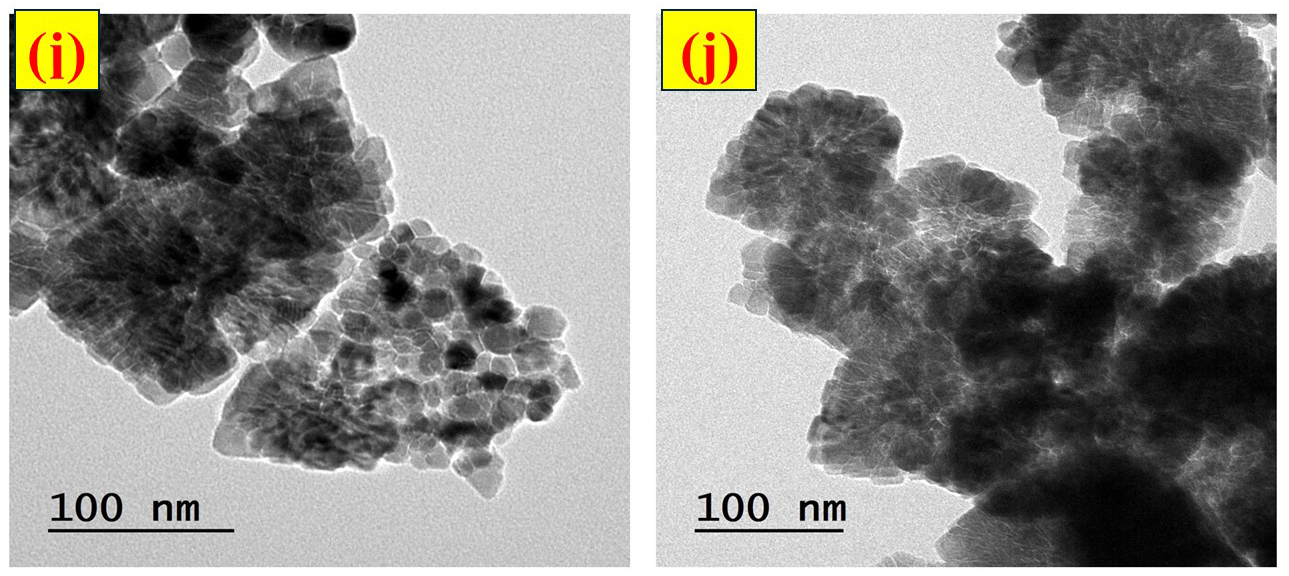
The structural stability and reusability of TM-LDH/TZ were evaluated after CR and As adsorption, followed by urea oxidation. HRTEM (Figure 11i) showed that the layered nanosheet morphology (hexagonal plate-like) was largely preserved [48], with compact, interconnected aggregates characteristic of coprecipitated LDHs [49]. Darker regions indicated successful pollutant uptake via electrostatic interaction and anion exchange. Importantly, the layered structure remained intact without noticeable damage, confirming structural robustness for integrated pollutant removal and energy conversion (Figure 11k) [48,49]. The Tafel slope of fresh TM-LDH/TZ was 28.60 mV dec−1, indicating fast UOR kinetics [50]. After adsorption, the slope increased slightly to 58.57 mV dec−1 due to partial active-site coverage and increased charge-transfer resistance, but the value remains low, confirming retained catalytic activity and excellent reusability [51] (Figure S3).

2.10. Comparison with Previously Reported Adsorbents

The maximum Langmuir adsorption capacities of TM-LDH/TZ (qmax (As(V)) = 204.75 mg g−1; qmax (CR) = 499.72 mg g−1) both exceed the best-performing comparable single-pollutant adsorbents reported in the literature (Table 6). Critically, these capacities were achieved simultaneously from a competitive binary solution, whereas all literature values derive from single-solute experiments—highlighting the unique bifunctional design of TM-LDH/TZ, where non-competing Fe–OH and triazole sites operate independently for each pollutant.

3. Experimental Section

3.1. Materials and Reagents

Zinc nitrate hexahydrate (Zn(NO3)2·6H2O, purity ≥ 99%), magnesium nitrate hexahydrate (Mg(NO3)2·6H2O, purity ≥ 99%), iron(III) nitrate nonahydrate (Fe(NO3)3·9H2O, purity ≥ 98%), sodium hydroxide (NaOH, purity ≥ 98%), sodium chloride (NaCl, purity ≥ 99.5%), 1,2,4-triazole (purity ≥ 99%), arsenic acid standard solution (H3AsO4, 0.5 M, the source of arsenate As(V)), and Congo red dye (CR, molecular formula C32H22N6Na2O6S2) were procured from Sigma-Aldrich (St. Louis, MO, USA). Hydrochloric acid (HCl, 37%) and absolute ethanol (purity ≥ 99.8%) were all of analytical reagent grade. Ultrapure deionized water with a resistivity of 18.2 MΩ cm (Milli-Q system, Merck, Germany) was used in all stages of the work, including synthesis, adsorption testing, and electrochemical measurements.

3.2. Synthesis of MgZnFe Layered Double Hydroxide (TM-LDH)

MgZnFe-LDH was prepared by the co-precipitation method. First, a mixed-metal solution (Solution A) was made by dissolving Zn(NO3)2·6H2O (0.02 mol), Mg(NO3)2·6H2O (0.01 mol), and Fe(NO3)3·9H2O (0.01 mol) in 100 mL of deionized water, giving a Zn:Mg: Fe molar ratio of 2:1:1. An alkaline NaOH solution (0.1 M) was added dropwise to solution A under vigorous stirring at 60 °C until the pH reached 10.0.The resulting precipitate (ppt) was aged at 65 °C for 18 h with continuous stirring. The precipitate was collected by centrifugation (8000 rpm, 10 min), washed repeatedly with deionized water until neutral pH, and dried at 80 °C for 24 h. The dry powder was ground gently in an agate mortar and labeled TM-LDH.

3.3. Preparation of the LDH/Triazole Composite (TM-LDH/TZ)

Surface modification of MgZnFe-LDH with 1,2,4-triazole was carried out through a solvent-based grafting approach. One gram of MgZnFe-LDH was dispersed in 80 mL of ethanol by ultrasonication at 40 kHz for 30 min to produce a stable suspension. In a separate flask, 1,2,4-triazole (0.5 g, 7.24 mmol) was dissolved in 20 mL of ethanol. The triazole solution was added dropwise to the LDH suspension while stirring at 60 °C for 24 h. Over this period, triazole molecules bind to metal sites exposed at the edges and surfaces of the LDH layers (Zn2+, Mg2+, Fe3+) through nitrogen-donor coordination, while a portion of the triazolate anions enter the interlayer space by displacing resident carbonate or nitrate anions. The composite was recovered by centrifugation at 8000 rpm for 15 min, washed three times with ethanol to remove any unbound triazole, dried under vacuum at 60 °C for 24 h, and stored in a sealed container until needed.

3.4. Characterization of the Synthesized Adsorbent

The structural, chemical, morphological, and thermal properties of the synthesized materials were investigated using complementary techniques. Fourier transform infrared spectroscopy (FTIR) and powder X-ray diffraction (XRD) with Cu Kα radiation were used to examine chemical composition and crystalline structure. Nitrogen adsorption–desorption measurements at 77 K, analyzed via the Brunauer–Emmett–Teller (BET) method, provided specific surface area, pore volume, and average pore diameter. Thermogravimetric analysis (TGA) evaluated thermal stability and decomposition behavior under controlled heating. Surface morphology and nanoscale structure were examined using field-emission scanning electron microscopy (FESEM) and high-resolution transmission electron microscopy (HRTEM). Residual As(V) concentrations in filtered samples were quantified by inductively coupled plasma mass spectrometry (ICP-MS), while Congo red concentrations were determined spectrophotometrically at λmax = 498 nm.

3.5. Batch Adsorption Experiments

Working As(V) stock solutions (1000 mg L−1) were freshly prepared by diluting arsenic acid standard (H3AsO4, 0.5 M, Sigma-Aldrich) with deionized water. Congo red stock solutions (1000 mg L−1) were prepared by dissolving the dye in deionized water with continuous stirring. All binary test solutions were obtained by diluting these stocks with Milli-Q water immediately before each experiment. As(V) stocks were stored at 4 °C in amber glass bottles and used within 48 h; CR stocks were prepared fresh on the day of use.
All adsorption experiments targeted the simultaneous removal of As(V) and CR from binary aqueous solutions. Experiments were conducted in 100 mL conical flasks containing 50 mL of solution, sealed and shaken at 200 rpm on a thermostatic orbital shaker. After each experiment, the suspension was filtered through a 0.45 μm PVDF membrane, and the filtrate was analyzed as described in Section 2.4. The percentage removal was calculated from Equation (1).
Removal (%) = [(C0 − Ce)/C0] × 100
The equilibrium adsorption capacity qe (mg g−1) was calculated from Equation (2):
qe = (C0 − Ce) × V/m
In both equations, C0 and Ce are the initial and equilibrium pollutant concentrations (mg L−1), V is the volume of solution (L), and m is the mass of TM-LDH/TZ added (g).

3.5.1. Effect of Initial Solution pH

pH was varied from 2 to 9 (adjusted with 0.1 M HCl or NaOH) using 0.05 g TM-LDH/TZ in binary solutions of 50 mg L−1 As(V) and 100 mg L−1 CR at 25 °C. The point of zero charge (pHpzc) of TM-LDH/TZ was determined using the pH drift method using 0.01 M NaCl solutions [27].

3.5.2. Effect of Adsorbent Dose

Dose was varied from 0.005 to 0.05 g per 50 mL (0.1–1.0 g L−1) at fixed initial concentrations (As(V) = 50 mg L−1; CR = 100 mg L−1), pH 5.0, 25 °C, 24 h.

3.5.3. Effect of Initial Concentration and Temperature

Initial concentrations of As(V) and CR were varied simultaneously from 10 to 250 mg L−1 at 25 and 55 °C (optimal dose and pH), with 24 h equilibration.

3.5.4. Equilibrium Isotherm Modeling

Equilibrium data at 25 and 55 °C were fitted by non-linear least-squares regression (OriginPro 2023b) to the Langmuir (Equation (3)), Freundlich (Equation (4)), and Temkin (Equation (5)) models:
qe = (qmax ⋯ KL ⋯ Ce)/(1 + KL ⋯ Ce)
qe = KF ⋯ Ce(1/n)
qe = (RT/bT) ⋯ ln (AT ⋯ Ce)
where qmax (mg g−1) is maximum monolayer capacity, KL (L mg−1) is the Langmuir affinity constant, KF is the Freundlich capacity coefficient, 1/n is the heterogeneity index, AT (L g−1) and bT (J mol−1) are Temkin constants, and R (8.314 J mol−1 K−1) and T (K) are the gas constant and absolute temperature, respectively. Model quality was assessed by R2 and adjusted R2.

3.5.5. Adsorption Kinetics

Kinetic experiments tracked uptake over 0–120 min (C0(As(V)) = 50 mg L−1; C0(CR) = 100 mg L−1; optimal dose; pH 5; 25 °C). Three models were fitted by non-linear regression: pseudo-first-order (PFO, Equation (6)), pseudo-second-order (PSO, Equation (7)), and Elovich (Equation (8)):
qt = qe [1 − exp (−k1 t)]
qt = (k2 qe2 t)/(1 + k2 qe t)
qt = (1/β) ln(αβ) + (1/β) ln(t)
The Weber–Morris intraparticle diffusion model (Equation (9)) was additionally applied to delineate mass-transfer stages [50]:
qt = kid t0.5 + C
where kpi (mg g−1 min−1/2) is the stage-i diffusion rate constant and Ci (mg g−1) is the boundary-layer intercept.

3.5.6. Statistical Thermodynamic Analysis Using the Advanced Monolayer Model

The equilibrium data at 25 and 55 °C were analyzed using the Advanced Monolayer Model (AMM) derived from the grand canonical ensemble [63,64]. The AMM describes uptake density Q (mg g−1) as:
Q = n × NM × Cen/(c1n + Cen)
where n is the number of adsorbate molecules per active site (steric parameter), NM (mg g−1) is the active site density, and c1 (mg L−1) is the half-saturation concentration (Q = Qsat/2). Mean adsorption energy ΔE (kJ mol−1), configurational entropy S, and Gibbs free energy ΔG were calculated from Equations (11)–(13):
c1 = Cs × exp (−ΔE/RT)
S = −kB [θ ln θ + (1 − θ) ln (1 − θ)]
ΔG = ΔE + RT ln (θ/(1 − θ))
All AMM parameters were extracted by non-linear least-squares regression (OriginPro 2023b). Fit quality was assessed by R2, χ2, RMSE, MAPE, and HYBRID error functions [38,39,40,63,64].

3.5.7. Adsorbent Regeneration and Reusability

The regenerability and reusability of TM-LDH/TZ were evaluated over three consecutive adsorption–desorption cycles. Each adsorption step used a binary solution (As(V) = 50 mg/L, CR = 100 mg/L, pH 5.0, 25 °C, 24 h). The spent adsorbent was recovered by centrifugation (5000 rpm, 10 min). CR was desorbed using 50 mL of 0.1 M NaOH (200 rpm, 2 h), followed by As(V) desorption with 50 mL of 0.5 M NaOH under the same conditions. The regenerated material was washed with deionized water to neutral pH, dried at 60 °C, and reused. Removal efficiency after each cycle was recorded to track performance over three reuse rounds.

3.6. Electrocatalytic Performance Toward Urea Oxidation Reaction (UOR)

All electrochemical measurements were performed on a CHI 760E electrochemical workstation (CH Instruments, USA) using a conventional three-electrode configuration. A modified glassy carbon electrode (GCE, 5 mm diameter, 0.196 cm2 geometric area) served as the working electrode, while a platinum wire and a Hg/HgO (1 M KOH) electrode were used as the counter and reference electrodes, respectively.

3.6.1. Electrode Preparation

Before modification, the GCE was polished sequentially with 1.0, 0.3, and 0.05 µm alumina slurries, rinsed thoroughly with deionized water, and dried under a nitrogen stream. To prepare the catalyst ink, 5 mg of the active material (either fresh TM-LDH/TZ or spent TM-LDH/TZ/As/CR) was dispersed in a mixture of 750 µL deionized water, 200 µL ethanol, and 50 µL Nafion® (5 wt%, Sigma-Aldrich). The mixture was ultrasonicated for 30 min to form a homogeneous ink. Subsequently, 10 µL of the ink was drop-cast onto the clean GCE surface and dried under an infrared lamp, yielding a catalyst loading of approximately 0.1 mg/cm2.

3.6.2. Electrochemical Measurements

All potentials measured against the Hg/HgO reference electrode were converted to the reversible hydrogen electrode (RHE) scale using the Nernst equation:
ERHE = EHg/HgO + 0.098 + 0.059 × pH
Before each experiment, the electrolyte was purged with high-purity N2 gas for 30 min to eliminate dissolved oxygen, and an N2 atmosphere was maintained over the solution during measurements.

3.6.3. UOR Activity and Kinetics

Cyclic voltammetry (CV) was employed to evaluate the UOR activity. To study the effect of urea concentration, CV curves were recorded at a fixed scan rate of 10 mV s−1 in 1 M KOH containing varying concentrations of urea (0.1, 0.3, 0.5, 0.7, and 1.0 M) within a potential window of 1.0 to 1.7 V vs. RHE.
The reaction kinetics were investigated by performing CV measurements in 1 M KOH + 1.0 M urea at various scan rates ranging from 10 to 100 mV/s. The anodic peak current density (jpa) was plotted against the square root of the scan rate to assess the diffusion-controlled nature of the UOR process.

3.6.4. Electrochemically Active Surface Area (ECSA)

The ECSA was estimated from the electrochemical double-layer capacitance (Cdl). CV measurements were conducted in a non-Faradaic potential region (1.10 to 1.20 V vs. RHE) at scan rates of 5, 10, 20, 30, 40, 50, and 60 mV s−1. The charging current (ic) at 1.15 V vs. RHE was plotted against the scan rate, and the Cdl was derived from the linear slope (ic = ν × Cdl). The ECSA was then calculated using the specific capacitance of a flat standard electrode (40 μF cm−2) according to the equation:
ECSA = Cdl/40μF cm−2 per cm2

3.6.5. Stability and Electrochemical Impedance Spectroscopy (EIS)

The short-term operational stability of the electrodes was assessed by chronoamperometry at a fixed potential of 1.45 V vs. RHE for 3600 s in a 1 M KOH + 1.0 M urea solution.
Electrochemical impedance spectroscopy (EIS) measurements were performed at 1.45 V vs. RHE over a frequency range of 100 kHz to 0.1 Hz with an AC amplitude of 10 mV. The impedance data were fitted using a Randles-type equivalent circuit, Rs(CPE ‖ Rct), where Rs represents the solution resistance, CPE is the constant phase element describing non-ideal double-layer capacitance, and Rct is the charge-transfer resistance. Curve fitting was carried out using ZView software (Scribner Associates, Southern Pines, NC, USA), employing a complex nonlinear least-squares (CNLS) algorithm.

4. Conclusions

The MgZnFe-LDH/1,2,4-triazole (TM-LDH/TZ) composite demonstrates that rational multi-component design can simultaneously remove chemically dissimilar pollutants. Fe3+ provides inner-sphere complexation for As(V), Mg2+ enhances surface charge and anion exchange, and 1,2,4-triazole enables π–π, hydrogen bonding, and electrostatic interactions for Congo red. This synergy creates non-competing adsorption pathways, with Langmuir isotherms and kinetic analyses confirming monolayer uptake via combined mass-transfer and surface interactions. The spent adsorbent was successfully repurposed as an electrocatalyst for urea oxidation, illustrating a circular-economy approach that eliminates secondary waste. TM-LDH/TZ maintained performance over multiple adsorption–desorption cycles, highlighting structural robustness and stable triazole–metal coordination. Overall, this study presents a scalable strategy for bifunctional LDH composites, enabling simultaneous pollutant removal and post-use catalytic valorization for sustainable water treatment.
It should be noted that the present study focused on As(V), the thermodynamically dominant arsenic species under the oxic, circumneutral conditions characteristic of the co-contaminated surface waters and oxidized groundwater systems targeted in this work. As(III), which predominates only under strongly reducing conditions and exists as an uncharged neutral species (H3AsO3) across the environmental pH range (pKa1 = 9.23), requires prior chemical oxidation to As(V) before efficient removal by LDH-based adsorption systems—a pre-treatment step that is standard practice in drinking water engineering. Systematic investigation of variable As: CR concentration ratios in kinetic experiments, and evaluation of TM-LDH/TZ performance in As(III)-containing systems following oxidative pre-treatment, represent important directions for future research.

Supplementary Materials

The following supporting information can be downloaded at: https://www.mdpi.com/article/10.3390/catal16050434/s1, Table S1: The statistical error analysis for AMM for the As metal ions and CR dye molecules adsorption on TM-LDH/TZ at 25 °C and 55 °C. Table S2: Steric and energetic parameters of the multilayer model for As(V) and Congo Red adsorption on MgZnFe-LDH/Tz at 25 °C and 55 °C. Figure S1: XRD pattern for the prepared TM-LDH. Figure S2: The point of zero charge measurements indicates a point of zero charge (pHpzc) at approximately 7. Figure S3: The UOR Performance of the prepared Sample before and after absorption in 1.00 M KOH and 1M Urea (a) LSV Curve and (B) Tafel plots.

Author Contributions

S.M.M. contributed to conceptualization, methodology, and writing—original draft preparation. A.M.A.-E. and S.M.H. were responsible for investigation, data curation, and formal analysis. A.A.A. contributed to methodology and validation. S.A.A.E. supervised the work, contributed to project administration, and reviewed and edited the manuscript. M.M.G. and H.A.M. participated in characterization, resources, and data interpretation. V.S. contributed to scientific analysis and experimental work, validation. R.M. contributed to conceptualization, supervision, writing—review and editing, and acted as the corresponding author. All authors have read and agreed to the published version of the manuscript.

Funding

This work was supported and funded by the Deanship of Scientific Research at Imam Mohammad Ibn Saud Islamic University (IMSIU) (grant number IMSIU-DDRSP2601).

Data Availability Statement

The datasets generated and/or analyzed during the current study are available from the corresponding author on reasonable request.

Conflicts of Interest

The authors declare no conflicts of interest.

References

  1. Bundschuh, J.; Niazi, N.K.; Alam, M.A.; Berg, M.; Herath, I.; Tomaszewska, B.; Maity, J.P.; Ok, Y.S. Global arsenic dilemma and sustainability. J. Hazard. Mater. 2022, 436, 129197. [Google Scholar] [CrossRef]
  2. Patel, K.S.; Pandey, P.K.; Martín-Ramos, P.; Corns, W.T.; Varol, S.; Bhattacharya, P.; Zhu, Y. A review on arsenic in the environment: Contamination, mobility, sources, and exposure. RSC Adv. 2023, 13, 8803–8821. [Google Scholar] [CrossRef] [PubMed]
  3. Smedley, P.L.; Kinniburgh, D.G. A review of the source, behaviour and distribution of arsenic in natural waters. Appl. Geochem. 2002, 17, 517–568. [Google Scholar] [CrossRef]
  4. Guidelines, T. Guidelines for Drinking-Water Quality: Fourth Edition Incorporating the First and Second Addenda; World Health Organization: Geneva, Switzerland, 2022; pp. 3–6. [Google Scholar]
  5. Chandel, M.; Sharma, A.K.; Thakur, K.; Sharma, D.; Brar, B.; Mahajan, D.; Kumari, H.; Pankaj, P.P.; Kumar, R. Poison in the water: Arsenic’s silent assault on fish health. J. Appl. Toxicol. 2024, 44, 1282–1301. [Google Scholar] [CrossRef]
  6. Oladoye, P.O.; Bamigboye, M.O.; Ogunbiyi, O.D.; Akano, M.T. Toxicity and decontamination strategies of Congo red dye. Groundw. Sustain. Dev. 2022, 19, 100844. [Google Scholar] [CrossRef]
  7. Siddiqui, S.I.; Allehyani, E.S.; Al-Harbi, S.A.; Hasan, Z.; Abomuti, M.A.; Rajor, H.K.; Oh, S. Investigation of Congo red toxicity towards different living organisms: A review. Processes 2023, 11, 807. [Google Scholar] [CrossRef]
  8. Hernández-Zamora, M.; Martínez-Jerónimo, F. Congo red dye diversely affects organisms of different trophic levels: A comparative study with microalgae, cladocerans, and zebrafish embryos. Environ. Sci. Pollut. Res. 2019, 26, 11743–11755. [Google Scholar] [CrossRef]
  9. Mohan, D.; Pittman, C.U., Jr. Arsenic removal from water/wastewater using adsorbents—A critical review. J. Hazard. Mater. 2007, 142, 1–53. [Google Scholar] [CrossRef] [PubMed]
  10. Chatterjee, S.; De, S. Adsorptive removal of arsenic from groundwater using a novel high flux polyacrylonitrile (PAN)–laterite mixed matrix ultrafiltration membrane. Environ. Sci. Water Res. Technol. 2015, 1, 227–243. [Google Scholar] [CrossRef]
  11. Shokri, E.; Yegani, R. Novel adsorptive mixed matrix membrane by incorporating modified nanoclay with amino acid for removal of arsenic from water. J. Water Environ. Nanotechnol. 2017, 2, 88–95. [Google Scholar]
  12. Crini, G.; Lichtfouse, E. Advantages and disadvantages of techniques used for wastewater treatment. Environ. Chem. Lett. 2019, 17, 145–155. [Google Scholar] [CrossRef]
  13. Ali, I. New generation adsorbents for water treatment. Chem. Rev. 2012, 112, 5073–5091. [Google Scholar] [CrossRef]
  14. Ahmed, M.A.; Mohamed, A.A. A systematic review of layered double hydroxide-based materials for environmental remediation of heavy metals and dye pollutants. Inorg. Chem. Commun. 2023, 148, 110325. [Google Scholar] [CrossRef]
  15. Dixit, S.; Hering, J.G. Comparison of arsenic (V) and arsenic (III) sorption onto iron oxide minerals: Implications for arsenic mobility. Environ. Sci. Technol. 2003, 37, 4182–4189. [Google Scholar] [CrossRef]
  16. Jain, A.; Raven, K.P.; Loeppert, R.H. Arsenite and arsenate adsorption on ferrihydrite: Surface charge reduction and net OH-release stoichiometry. Environ. Sci. Technol. 1999, 33, 1179–1184. [Google Scholar] [CrossRef]
  17. Wang, J.H.; Gaber, T.A.; Kuo, S.-W.; El-Mahdy, A.F.M. π-Electron-extended triazine-based covalent organic framework as photocatalyst for organic pollution degradation and H2 production from water. Polymers 2023, 15, 1685. [Google Scholar] [CrossRef]
  18. Sun, M.; Han, S.; Feng, J.; Li, C.; Ji, X.; Feng, J.; Sun, H. Recent advances of triazine-based materials for adsorbent based extraction techniques. Top. Curr. Chem. 2021, 379, 24. [Google Scholar] [CrossRef]
  19. Sanjabi, A.; Azizian, S.; Torabi, M.; Zolfigol, M.A.; Yarie, M. On the applicability of triazine-based covalent organic polymer as adsorbent for dye removal from aqueous solution. Microporous Mesoporous Mater. 2022, 348, 112367. [Google Scholar] [CrossRef]
  20. Gharbi, S.; Méndez-Gil, N.; Hriz, K.; Majdoub, M.; Gómez-Lor, B. Truxene-Based Porous Triazole-Linked Polymers for Dye Removal through Synergetic Adsorption and Photodegradation. ACS Appl. Polym. Mater. 2023, 5, 2359–2366. [Google Scholar] [CrossRef]
  21. Amer, A.; Sayed, G.H.; Ramadan, R.M.; Rabie, A.M.; Negm, N.A.; Farag, A.A.; Mohammed, E.A. Assessment of 3-amino-1H-1, 2, 4-triazole modified layered double hydroxide in effective remediation of heavy metal ions from aqueous environment. J. Mol. Liq. 2021, 341, 116935. [Google Scholar] [CrossRef]
  22. Mahmoud, R.; Kotb, N.M.; GadelHak, Y.; El-Ela, F.I.A.; Shehata, A.Z.; Othman, S.I.; Allam, A.A.; Rudayni, H.A.; Zaher, A. Investigation of ternary Zn-Co-Fe layered double hydroxide as a multifunctional 2D layered adsorbent for moxifloxacin and antifungal disinfection. Sci. Rep. 2024, 14, 806. [Google Scholar] [CrossRef]
  23. Naseem, S.; Gevers, B.; Boldt, R.; Labuschagné, F.J.W.J.; Leuteritz, A. Comparison of transition metal (Fe, Co, Ni, Cu, and Zn) containing tri-metal layered double hydroxides (LDHs) prepared by urea hydrolysis. RSC Adv. 2019, 9, 3030–3040. [Google Scholar] [CrossRef]
  24. Thiyagarajan, S. Pyridine dicarboxylic acid derived polyesters: Prospects for developing safe, circular and sustainable materials. Curr. Opin. Green Sustain. Chem. 2025, 53, 101014. [Google Scholar] [CrossRef]
  25. Ho, Y.-S.; McKay, G. Pseudo-second order model for sorption processes. Process Biochem. 1999, 34, 451–465. [Google Scholar] [CrossRef]
  26. Mohamed, E.A.; Ahmed, H.M.; Altalhi, A.A.; Al-Shamiri, H.A.S.; Negm, N.A. Highly efficient and rapid removal of Congo red dye from textile wastewater using facile synthesized Mg/Ni/Al layered double hydroxide. Sci. Rep. 2025, 15, 2183. [Google Scholar] [CrossRef]
  27. Kosmulski, M. The pH dependent surface charging and points of zero charge. X. Update. Adv. Colloid Interface Sci. 2023, 319, 102973. [Google Scholar] [CrossRef] [PubMed]
  28. Weber, W.J., Jr.; Morris, J.C. Kinetics of adsorption on carbon from solution. J. Sanit. Eng. Div. 1963, 89, 31–59. [Google Scholar] [CrossRef]
  29. Tan, K.L.; Hameed, B.H. Insight into the adsorption kinetics models for the removal of contaminants from aqueous solutions. J. Taiwan Inst. Chem. Eng. 2017, 74, 25–48. [Google Scholar] [CrossRef]
  30. Fu, Y.; Fu, X.; Song, W.; Li, Y.; Li, X.; Yan, L. Recent progress of layered double hydroxide-based materials in wastewater treatment. Materials 2023, 16, 5723. [Google Scholar] [CrossRef]
  31. Langmuir, I. The adsorption of gases on plane surfaces of glass, mica and platinum. J. Am. Chem. Soc. 1918, 40, 1361–1403. [Google Scholar] [CrossRef]
  32. Singh, N.B.; Nagpal, G.; Agrawal, S. Water purification by using adsorbents: A review. Environ. Technol. Innov. 2018, 11, 187–240. [Google Scholar] [CrossRef]
  33. Li, H.; Budarin, V.; Clark, J.; North, M.; Wu, X. Rapid and Efficient Adsorption of Methylene Blue Dye From Aqueous Solution by Hierarchically Porous, Activated Starbons®: Mechanism and Porosity Dependence. J. Hazard. Mater. 2022, 436, 129174. [Google Scholar] [CrossRef]
  34. Simonin, J.-P. On the comparison of pseudo-first order and pseudo-second order rate laws in the modeling of adsorption kinetics. Chem. Eng. J. 2016, 300, 254–263. [Google Scholar] [CrossRef]
  35. Waychunas, G.A.; Rea, B.A.; Fuller, C.C.; Davis, J.A. Surface chemistry of ferrihydrite: Part 1. EXAFS studies of the geometry of coprecipitated and adsorbed arsenate. Geochim. Cosmochim. Acta 1993, 57, 2251–2269. [Google Scholar] [CrossRef]
  36. Largitte, L.; Pasquier, R. A review of the kinetics adsorption models and their application to the adsorption of lead by an activated carbon. Chem. Eng. Res. Des. 2016, 109, 495–504. [Google Scholar] [CrossRef]
  37. Hadnadjev-Kostic, M.; Vulic, T.; Karanovic, D.; Tomic, A.; Cvetkovic, D. Layered Double Hydroxide-Based Materials for Wastewater Treatment: Recent Progress in Multifunctional Environmental Applications. Processes 2025, 13, 3757. [Google Scholar] [CrossRef]
  38. Yacoub, S.I.; Saber, S.G.; Ali, R.A.M.; Lima, E.C.; dos Reis, G.S.; Al-Olayan, E.; Salama, Y.F.; Mobarak, M.; Seliem, M.K. CTAB-modified alkali-activated binder derived from Favia corals and glass waste: A novel bio-based adsorbent for effective removal of Mn (VII) ions from aqueous solutions. J. Ind. Eng. Chem. 2025, 147, 406–421. [Google Scholar] [CrossRef]
  39. Arif, M.A.; Abdel-Gawwad, H.A.; Elshimy, A.S.; Seliem, M.K.; Ali, M.A.; Maodaa, S.N.; Federowicz, K.; Mobarak, M.; Bendary, H.I.; Salama, Y.F. Facile synthesis and characterization of metakaolin/carbonate waste-based geopolymer for Cr (VI) remediation: Experimental and theoretical studies. Inorg. Chim. Acta 2024, 564, 121939. [Google Scholar] [CrossRef]
  40. Sharib, A.S.A.A.A.; Mobarak, M.; Elshimy, A.S.; Al-arifi, N.; Salama, Y.F.; Li, Z.; Selim, A.Q.; Seliem, M.K. Facile and green fabrication of an effective and low-cost alkali-activated binder using carbonized limestone: Characterization, experiments, and statistical physics formalism for ibuprofen adsorption. Sustain. Chem. Pharm. 2024, 41, 101701. [Google Scholar] [CrossRef]
  41. Wei, L.; Zhang, L.; Li, L.; Su, J. Tuning built-in potential of NiP/NiFe LDH pn junction towards efficient electrocatalytic water and urea oxidation. Int. J. Hydrogen Energy 2024, 82, 64–72. [Google Scholar] [CrossRef]
  42. Sari, F.N.I.; Tran, N.T.T.; Ke, M.-T.; Purba, Y.; Huynh, T.M.D.; Ting, J.-M. Suppression of oxygen electrooxidation toward enhanced urea electrooxidation via balancing the adsorption of OH–and urea intermediates in quaternary-metal LDH. Chem. Eng. J. 2025, 515, 163966. [Google Scholar] [CrossRef]
  43. Edet, U.A.; Ifelebuegu, A.O. Kinetics, Isotherms, and Thermodynamic Modeling of the Adsorption of Phosphates from Model Wastewater Using Recycled Brick Waste. Processes 2020, 8, 665. [Google Scholar] [CrossRef]
  44. Peng, K.; Liu, L.; Bhuvanendran, N.; Qiao, F.; Lei, G.; Lee, S.Y.; Xu, Q.; Su, H. Effective regulation on catalytic performance of nickel–iron–vanadium layered double hydroxide for urea oxidation via sulfur incorporation. Mater. Adv. 2023, 4, 1354–1362. [Google Scholar] [CrossRef]
  45. Li, J.; Yu, H.; Chi, J.; Luo, X.; Li, T.; Shao, Z. An efficient NiCoSe 4/NiCo-LDH/CF catalyst for the co-production of value-added formate and hydrogen via selective methanol electro-oxidation. J. Mater. Chem. A 2024, 12, 25791–25800. [Google Scholar] [CrossRef]
  46. Liang, C.; Zou, P.; Nairan, A.; Zhang, Y.; Liu, J.; Liu, K.; Hu, S.; Kang, F.; Fan, H.J.; Yang, C. Exceptional performance of hierarchical Ni–Fe oxyhydroxide@ NiFe alloy nanowire array electrocatalysts for large current density water splitting. Energy Environ. Sci. 2020, 13, 86–95. [Google Scholar] [CrossRef]
  47. Song, Y.; Sha, W.; Jiao, T.; Wang, C.; Tian, J.; Liu, P.; Xu, B.; Guo, J.; Liang, J. Interface-engineered Co3S4/CoMo2S4 nanosheets as efficient bifunctional electrocatalysts for alkaline overall water splitting. Nanotechnology 2021, 32, 455706. [Google Scholar] [CrossRef] [PubMed]
  48. Dou, L.; Fan, T.; Zhang, H. A novel 3D oxide nanosheet array catalyst derived from hierarchical structured array-like CoMgAl-LDH/graphene nanohybrid for highly efficient NO x capture and catalytic soot combustion. Catal. Sci. Technol. 2015, 5, 5153–5167. [Google Scholar] [CrossRef]
  49. Mahgoub, S.M.; Alawam, A.S.; Rudayni, H.A.; Allam, A.A.; Radalla, A.M.; Tawab, D.A.; Mahmoud, R. Delafloxacin and Mercury adsorption via a triple-layered metallic hydroxide nanocomposite: Insights into the adsorption mechanism, sustainability, and eco-friendliness studies. Surf. Interfaces 2025, 64, 106360. [Google Scholar] [CrossRef]
  50. Pitchai, C.; Chen, C.-M. Electrochemically enhanced oxygen evolution and urea oxidation reactions with advanced high-entropy LDH nanoneedles. Sustain. Energy Fuels 2025, 9, 1829–1838. [Google Scholar] [CrossRef]
  51. Mandari, K.K.; Eragari, R.R.; Kang, M. NiCoFe-LDH deposited on Bi4Ti3O12 nanosheets for electrocatalytic oxygen evolution and urea oxidation reactions under alkaline conditions. Fuel 2026, 419, 138823. [Google Scholar] [CrossRef]
  52. Singh, S.; Naik, T.S.S.K.; U, B.; Khan, N.A.; Wani, A.B.; Behera, S.K.; Nath, B.; Bhati, S.; Singh, J.; Ramamurthy, P.C. A systematic study of arsenic adsorption and removal from aqueous environments using novel graphene oxide functionalized UiO-66-NDC nanocomposites. Sci. Rep. 2022, 12, 15802. [Google Scholar] [CrossRef]
  53. Kalimuthu, P.; Kim, Y.; Subbaiah, M.P.; Jeon, B.-H.; Jung, J. Novel magnetic Fe@ NSC nanohybrid material for arsenic removal from aqueous media. Chemosphere 2022, 308, 136450. [Google Scholar] [CrossRef] [PubMed]
  54. Yang, F.; Zhu, F.; Shi, H.; Dong, X.; Sheng, J.; Zhou, J. Magnetic Nanofibers in Heavy Metal Arsenic (V) Pollution Control Research. Langmuir 2025, 41, 9392–9405. [Google Scholar] [CrossRef] [PubMed]
  55. Dutta, S.; Manna, K.; Srivastava, S.K.; Gupta, A.K.; Yadav, M.K. Hollow polyaniline microsphere/Fe3O4 nanocomposite as an effective adsorbent for removal of arsenic from water. Sci. Rep. 2020, 10, 4982. [Google Scholar] [CrossRef]
  56. Rahman, M.A.; Lamb, D.; Rahman, M.M.; Bahar, M.M.; Sanderson, P. Adsorption–desorption behavior of arsenate using single and binary iron-modified biochars: Thermodynamics and redox transformation. ACS Omega 2022, 7, 101–117. [Google Scholar] [CrossRef]
  57. Zhao, Y.; Shi, H.; Du, Z.; Zhou, J.; Yang, F. Removal of As (V) from aqueous solution using modified Fe3O4 nanoparticles. R. Soc. Open Sci. 2023, 10, 221234. [Google Scholar] [CrossRef] [PubMed]
  58. Rathee, G.; Awasthi, A.; Sood, D.; Tomar, R.; Tomar, V.; Chandra, R. A new biocompatible ternary Layered Double Hydroxide Adsorbent for ultrafast removal of anionic organic dyes. Sci. Rep. 2019, 9, 16225. [Google Scholar] [CrossRef]
  59. Wu, K.; Pan, X.; Zhang, J.; Zhang, X.; Salah Zene, A.; Tian, Y. Biosorption of Congo red from aqueous solutions based on self-immobilized mycelial pellets: Kinetics, isotherms, and thermodynamic studies. Acs Omega 2020, 5, 24601–24612. [Google Scholar] [CrossRef]
  60. Din, S.U.; Ofudje, E.A.; Al-Ahmary, K.M.; Alqahtani, Z.; Al-Mhyawi, S.R.; Alshdoukhi, I.F.; Elamin, N.Y.; Al-Otaibi, J.S. Sorghum husks as potential low cost adsorbent for Congo red adsorption. Sci. Rep. 2025, 15, 38265. [Google Scholar] [CrossRef]
  61. Parimelazhagan, V.; Chinta, A.; Shetty, G.G.; Maddasani, S.; Tseng, W.-L.; Ethiraj, J.; Ayyakannu Sundaram, G.; Kumar, A.S.K. Process optimization and equilibrium, thermodynamic, and kinetic modeling of toxic Congo red dye adsorption from aqueous solutions using a copper ferrite nanocomposite adsorbent. Molecules 2024, 29, 418. [Google Scholar] [CrossRef]
  62. Aderibigbe, D.O.; Dabo, O.S.; Akinwumi, V.O.; Giwa, A.-R.A. Competitive adsorption of Congo red by sawdust in the presence of reactive black 5 and the effect of ionic strength. Water Pract. Technol. 2025, 20, 1042–1059. [Google Scholar] [CrossRef]
  63. Seliem, M.K.; ElShimmy, A.S.; Mobarak, M.; Seliem, A.Q.; Salah, A.M.; Almarhoon, Z.M.; Li, Z.; Salama, Y.F.; Bendary, H.I. A magnetic bio-based adsorbent prepared from Fe3O4 nanoparticles impregnated with diatom frustules and sodium alginate for methylene blue uptake: Advanced modeling and mechanism. Sep. Sci. Technol. 2024, 59, 99–111. [Google Scholar] [CrossRef]
  64. Ali, M.A.; Badawy, A.M.; Seliem, A.Q.; Bendary, H.I.; Lima, E.C.; Al-Dossari, M.; Abd EL-Gawaad, N.S.; dos Reis, G.S.; Mobarak, M.; Hassan, A.M. Macroscopic and microscopic levels of methylene blue adsorption on a magnetic bio-based adsorbent: In-depth study using experiments, advanced modeling, and statistical thermodynamic analysis. Magnetochemistry 2024, 10, 91. [Google Scholar] [CrossRef]
Figure 1. (a) FTIR spectrum and (b) XRD of the composite and the representative card; (c,d) BET; and (e) TGA for TM-LDH and TM-LDH/TZ.
Catalysts 16 00434 g001
Figure 2. SEM images of the prepared (ac) TM-LDH; (d,e) TM-LDH/TZ; HRTEM images (f,g) for TM-LDH and TM-LDH/TZ, respectively and (h,i) HRTEM images for prepared LDH.
Catalysts 16 00434 g002aCatalysts 16 00434 g002b
Figure 3. Effect of solution pH on As(V) (A) and Congo Red (B) adsorption by LDH/Tz. Maximum simultaneous removal of both pollutants occurs at pH 5, reflecting optimal surface charge and adsorption interactions.
Catalysts 16 00434 g003
Figure 4. Effect of TM-LDH/TZ dosage on the adsorption of (A) As(V) and (B) Congo Red (CR) at pH 5, 25 °C, and 24 h. Removal efficiency (R, %) generally increases with adsorbent dose, while equilibrium capacity (qₑ) decreases due to site saturation. Optimal simultaneous removal of both pollutants is achieved at 1.0 g L−1.
Catalysts 16 00434 g004
Figure 5. Effect of initial concentration (10–250 mg L−1) and temperature (25 and 55 °C) on the equilibrium adsorption capacity (qₑ) of TM-LDH/TZ for simultaneous removal of (A) arsenic (As(V)) and (B) Congo red (CR). The adsorption capacity increased with increasing initial concentration for both pollutants, approaching saturation at higher concentrations.
Catalysts 16 00434 g005
Figure 6. Equilibrium adsorption isotherms of (A) As(V) and (B) Congo Red (CR) on TM-LDH/TZ at 25 °C and 55 °C. Experimental data (symbols) are fitted with Langmuir, Freundlich, and Temkin models (lines). The Langmuir model provides the best fit, indicating monolayer adsorption on energetically equivalent sites.
Catalysts 16 00434 g006aCatalysts 16 00434 g006b
Figure 7. Adsorption kinetics of (A) As(V) and (B) Congo Red (CR) on TM-LDH/TZ at 25 °C. Experimental qt–t data (symbols) are fitted with pseudo-first-order (PFO), pseudo-second-order (PSO), and Elovich models (lines). The Elovich model best describes As(V) adsorption, while PSO provides the best fit for CR, reflecting chemisorption and multi-point surface interactions.
Catalysts 16 00434 g007
Figure 8. Intraparticle diffusion analysis of (A) As(V) and (B) Congo Red (CR) adsorption on TM-LDH/TZ using the Weber–Morris model. Three consecutive linear stages indicate that adsorption is controlled by a combination of external film diffusion (Stage 1), intraparticle pore diffusion (Stage 2), and surface site equilibration (Stage 3), rather than by intraparticle diffusion alone.
Catalysts 16 00434 g008
Figure 9. Regeneration and reusability of TM-LDH/TZ for As(V) and Congo Red (CR) adsorption over six consecutive adsorption–desorption cycles.
Catalysts 16 00434 g009
Figure 10. Advanced Monolayer Model (AMM) analysis of adsorption. (a,b) Isotherms of Arsenate and Congo red adsorption onto TM-LDH/TZ at 25 and 55 °C, showing experimental data and model fits. (c,d) Gibbs free energy (ΔG) versus concentration, showing negative values under all conditions, confirming spontaneous adsorption. (e,f) Configurational entropy versus concentration, indicating a maximum at half-saturation followed by a decline at surface saturation.
Catalysts 16 00434 g010
Figure 11. Electrocatalytic UOR performance of TM-LDH/TZ and TM-LDH/TZ/As/CR electrodes. Cyclic voltammograms of (a) TM-LDH/TZ and (b) TM-LDH/TZ/As/CR at varying urea concentrations (0.1–1.0 M) in 1 M KOH. Scan-rate-dependent CVs of (c) TM-LDH/TZ and (d) TM-LDH/TZ/As/CR in 1 M KOH + 1.0 M urea. (e) Linear relationship between anodic peak current density and ν1/2, confirming diffusion-controlled kinetics. (f) relation between ΔJ and scan rate. (g) Chronoamperometric stability test at 1.45 V vs. RHE for 3600 s. (h) Nyquist plots from EIS measurements illustrating the charge-transfer resistance of both electrodes. (i,j) TEM images of TM-LDH/Tz/As/CR before and after urea oxidation, respectively.
Catalysts 16 00434 g011aCatalysts 16 00434 g011bCatalysts 16 00434 g011c
Table 1. Textural properties of TM-LDH and TM-LDH/TZ.
SampleSBET (m2/g)Mean Pore Diameter (nm)Total Pore Volume (cm3/g)
TM-LDH367.606.700.62
TM-LDH/TZ155.607.500.29
Table 2. Isotherm parameters for simultaneous As(V) and CR adsorption on TM-LDH/TZ.
ModelParameterUnitAs(V) 25 °CAs(V) 55 °CCR 25 °CCR 55 °C
Langmuirqmaxmg/g204.75192.86499.72257.17
KLL/mg8.80 × 10−31.61 × 10−22.30 × 10−32.80 × 10⁻³
R20.980.980.990.99
Adj-R20.970.90.990.99
FreundlichKF(mg/g)
(L/mg) 1/n
6.7112.742.261.926
1/n0.570.470.770.73
R20.950.980.990.98
Adj-R20.940.980.990.97
TemkinATL/g0.230.330.070.07
bTJ/mol31.1233.7155.8335.43
R20.870.970.920.94
Adj-R20.850.960.900.93
Table 3. Kinetic model parameters for simultaneous As(V) and CR adsorption on TM-LDH/TZ at 25 °C.
ModelParameterUnitAs(V)CR
PFOqemg g−116.1725.96
k1min−10.120.06
R20.780.96
PSOqemg g−117.8529.42
k2g mg−1 min−19.50 × 10−32.70 × 10−3
R20.940.99
Elovichαmg g−1 min−10.360.17
βg mg−115.455.13
R20.990.98
Table 4. Weber–Morris intraparticle diffusion parameters for As(V) and CR adsorption on TM-LDH/TZ.
SystemkP1C1R2 (S1)kP2C2R2 (S2)kP3C3R2 (S3)
As(V)1.775.380.990.809.620.990.6311.090.94
CR4.26−0.830.921.919.370.980.8317.530.99
Units: kPi in mg g−1 min−1/2, Ci in mg g−1.
Table 5. Equivalent circuit parameters extracted from EIS fitting for the TM-LDH/TZ and TM-LDH/TZ/As/CR electrodes at 1.45 V vs. RHE in 1 M KOH + 1.0 M urea.
ParameterUnitTM-LDH/TZ (Fresh)TM-LDH/TZ/As/CR (Spent)
RsΩ1.451.42
CPE-TS·sn4.70 × 10−47.60 × 10⁻⁴
CPE-n (ideality factor)0.850.88
RctΩ1.321.19
χ2 (goodness of fit)<10−3<10−3
Table 6. Comparison of maximum adsorption capacities (qmax) for As(V) and Congo Red (CR) removal under optimal conditions.
AdsorbentDescriptionqmax (mg g−1)pHT (°C)IsothermReference
(A) As(V)
UiO-66-NDC/GOMOF–graphene oxide nanocomposite147.06325Langmuir[52]
Fe@NSC nanohybridFe-modified C, N, S carbon via PANI calcination178.65~625Langmuir[53]
PAN/Fe3O4@CTAB nanofibersElectrospun magnetic nanofiber membrane138.66~625Langmuir[54]
PNHM/Fe3O4-40Hollow polyaniline microsphere/Fe3O4 nanocomposite83.08727Freundlich[55]
Zr–FeCl3BSBCZr–Fe-modified biosolid biochar67.28622Langmuir[56]
Fe3O4@CTAB nanoparticlesSurfactant-coated magnetite (co-precipitation)55.67625Langmuir[57]
MgZnFe LDH/TriazoleLDH functionalized with triazole204.75525LangmuirThis study
(B) Congo Red (CR)
AdsorbentDescriptionqmax (mg g−1)pHT (°C)IsothermReference
NiFeTi-LDHTernary LDH380625Freundlich[58]
Mg/Ni/Al-LDHTernary LDH450625Langmuir[26]
Mycelial pelletsAspergillus fumigatus + Pseudomonas putida co-culture316.46530Langmuir[59]
SHTH3PO4-treated sorghum husks77.14240Langmuir[60]
CuFe2O4 nanocompositeCopper ferrite via sol–gel synthesis64.725.529Langmuir[61]
SawdustRice/hardwood low-cost bio-adsorbent27.29525Langmuir[62]
MgZnFe LDH/TriazoleLDH functionalized with triazole499.72525LangmuirThis study
Disclaimer/Publisher’s Note: The statements, opinions and data contained in all publications are solely those of the individual author(s) and contributor(s) and not of MDPI and/or the editor(s). MDPI and/or the editor(s) disclaim responsibility for any injury to people or property resulting from any ideas, methods, instructions or products referred to in the content.