Review

The Use of Titanium Compounds as Supports and Cocatalysts/Additives for Low-Temperature Fuel Cell Catalysts


Scuola Sciemza Materiali, 16016 Genova, Italy
Catalysts 2026, 16(5), 416; https://doi.org/10.3390/catal16050416
Submission received: 28 February 2026 / Revised: 29 March 2026 / Accepted: 22 April 2026 / Published: 2 May 2026
(This article belongs to the Special Issue 15th Anniversary of Catalysts: Feature Papers in Electrocatalysis)

Abstract

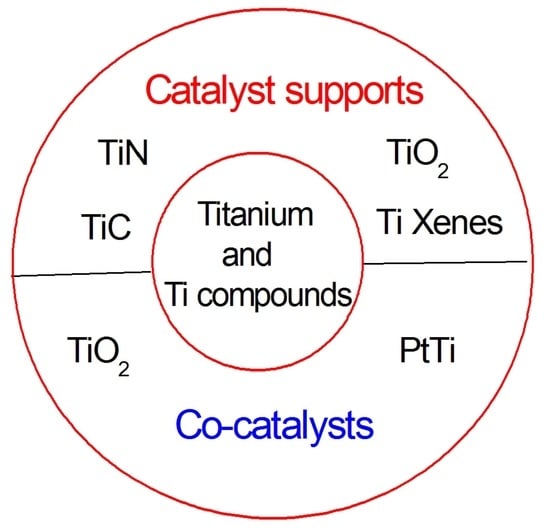
Among different non-carbon materials, due to their high corrosion resistance and chemical stability, titanium-based compounds, such as TiO2, TiN, TiC and Ti3C2Tx, are potential supports for PEMFC catalysts. In addition to its main function as a support, due to its catalytic properties, TiO2 is also used as co-catalyst/additive in the catalyst layer. In this work, the use of titanium compounds as catalyst supports and co-catalysts in the membrane electrode assembly of PEMFCs is overviewed and discussed.

Graphical Abstract

1. Introduction

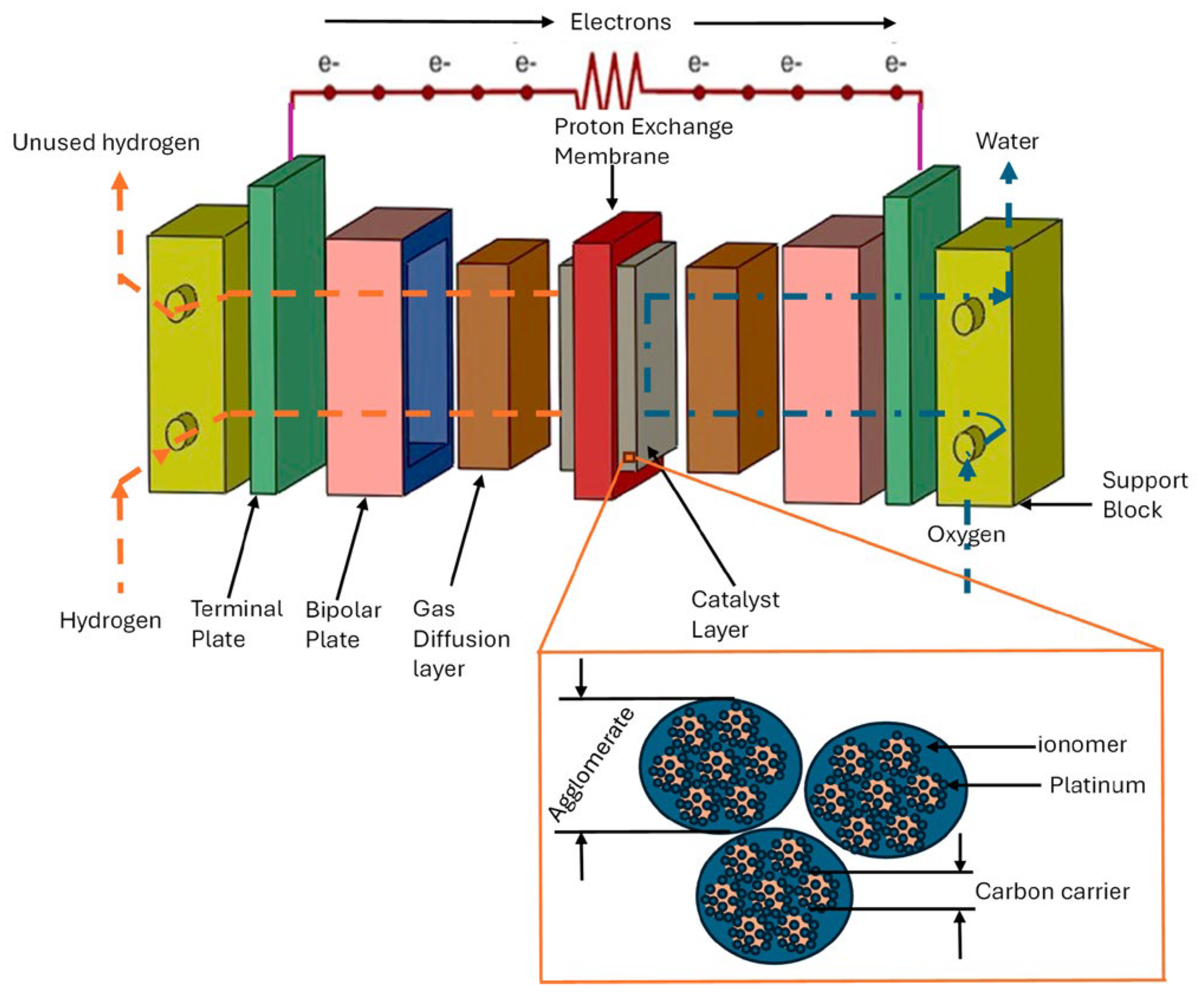
Fuel cells have attracted attention as they are eco-friendly energy generators that convert chemical energy to electrical energy electrochemically. Recent valuable reviews discuss different types of fuel cells and their history, fundamentals, and applications [1,2,3,4]. A schematic diagram of a typical polymer electrolyte fuel cell (PEMFC) and catalyst layer (CL) structural design is reported in Scheme 1.
Low-temperature PEM fuel cells (LT-FCs) operate at 60–100 °C using a solid polymer electrolyte. High-temperature fuel cells (HT-FCs), such as solid oxide fuel cells (SOFCs), operate at 600–1000 °C using a solid ceramic electrolyte. Due to the low operating temperature, the reaction kinetics in LT-FCs are slow, so platinum (Pt) and platinum group metals (PGMs) are required as the catalyst on the anode and cathode to lower the activation energy, making (LT-FCs) expensive. To reduce the cost, the PGM content has to be the low as possible, so to maximize their surface area, it is dispersed on a conductive support as carbon-based materials. Moreover, the use of PtTi alloys or TiO2 as co-catalysts allows the reduction of the Pt content in the electrode, decreasing the cost. Conversely, as HT-FCs operate at high temperatures, due to the enhanced kinetics, they can use cheaper, non-noble catalysts, so they do not need to be dispersed on a support.
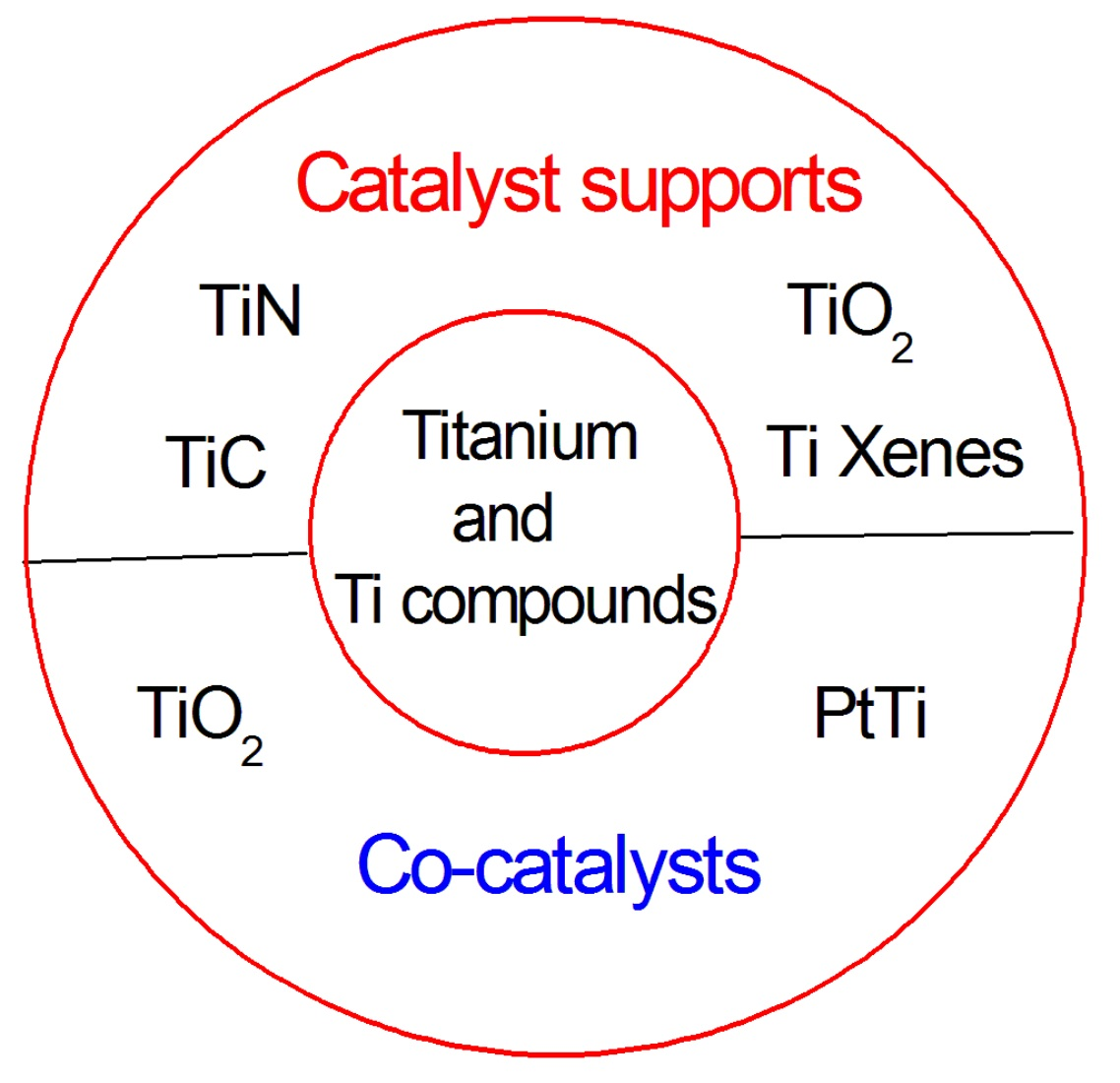
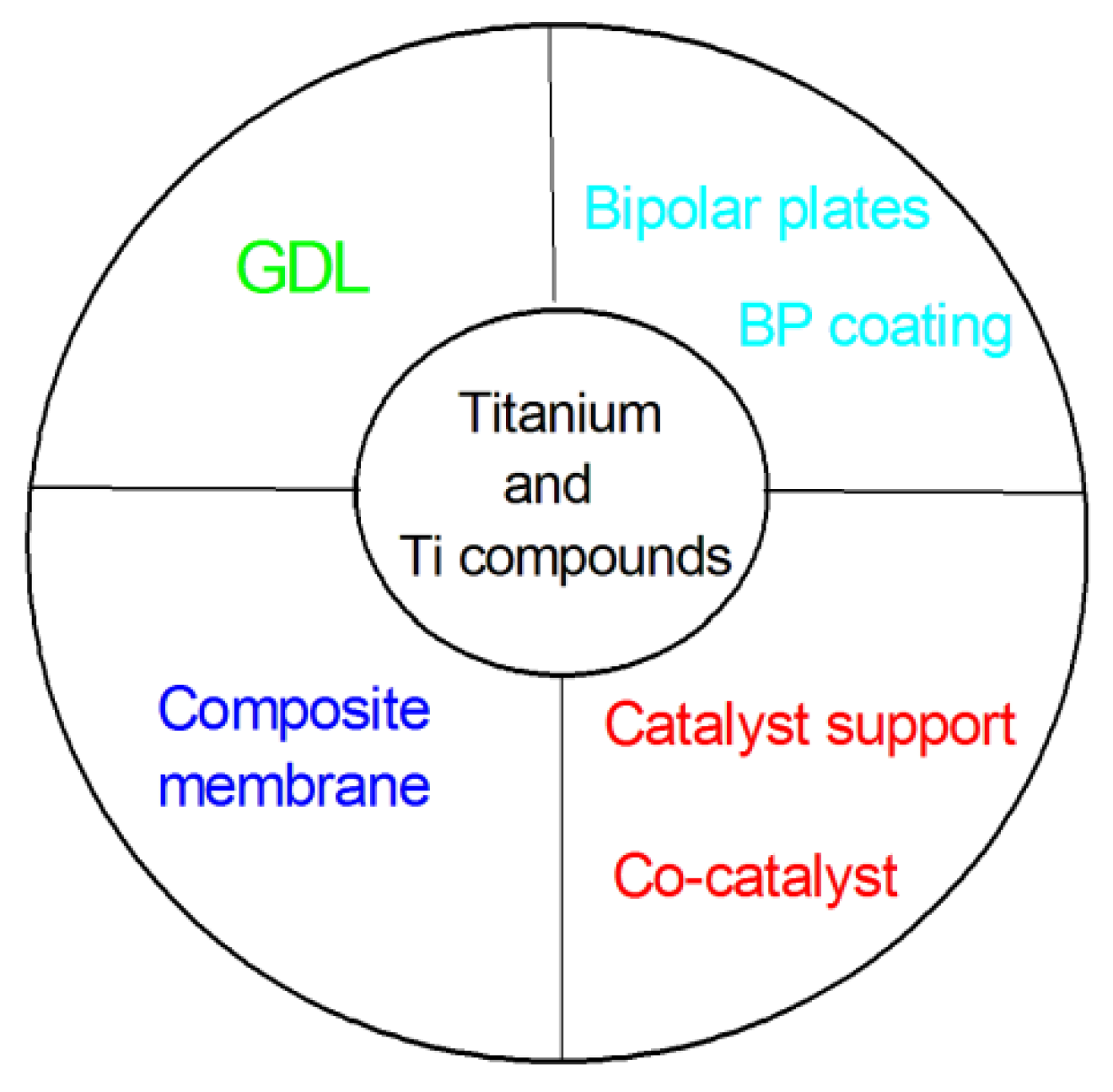
Among different metals, titanium (Ti) is the most versatile for polymer electrolyte fuel cell (PEMFC) application: indeed, bare Ti and Ti compounds can play many roles, such as bipolar plates (BPs) and BP coating, gas diffusion layer (GDL), catalyst support, co-catalyst, as well as additives in composite membranes, as shown in Scheme 2.
Among titanium compounds, titanium oxide (TiO2), titanium nitride (TiN) and titanium carbide (TiC) are the most suitable for use in PEMFCs. TiO2 is a cost-effective and efficient material, possessing some interesting characteristics such as low cost, high thermal stability, high mechanical–chemical stability, and high photo-activity. TiO2 enhances the performance of the PEMFC either as a catalyst support or co-catalyst or as a membrane additive. The use of TiO2 in composite membranes as well as a catalyst in low-temperature fuel cells was reviewed by Abdullah and Kamarudin [6]. TiN is a refractory solid exhibiting extreme hardness, thermal/electrical conductivity, and a high melting point. The use and the main properties, including electrical conductivity and corrosion resistance, of TiN as protective coatings on metal bipolar plates of PEMFCs has been discussed in recent reviews [7,8,9]. Among transition metal carbides, TiC has attracted interest because of its high stability under different harsh conditions. Furthermore, TiC possesses high corrosion resistance and high conductivity. These properties make TiC an interesting material for its use as a support in fuel cells [10]. Recently, Ti3C2Tx, a MXene belonging to a class of new graphene-like compounds, has attracted great interest [11]. Ti3C2Tx presents a large specific surface area, superior chemical and thermal stability, and excellent electrical conductivity. These characteristics make Ti3C2Tx a suitable catalyst support for application in PEMFC [12]. In addition, Ti can form stable PtTi alloy catalysts for oxygen reduction and low-molecular-weight alcohol oxidation. TiC, TiO2, and TiN, as well as their doped compounds, have also been proposed as electrocatalysts for the ORR. However, TiC presents considerably lower catalytic activity than Pt [10]. On the other hand, TiO2 is not an effective electrocatalyst because of its low conductivity and poor reactivity, due to intrinsic insulating properties [13]. Finally, TiN can facilitate the formation of a conductive path to the catalyst surface but cannot act as a catalyst itself, owing to its instability at temperature > 60 °C in acidic media [14]. Currently, these compounds are not yet capable of replacing the commonly used precious catalysts in fuel cells and therefore will not be considered in this review. In this work, the use of titanium compounds as catalyst supports and co-catalysts in the membrane electrode assembly of PEMFCs is overviewed and discussed. In the last year, the research focus shifted from fundamental feasibility to material durability, cost reduction, and system integration. Current research focuses on nanotechnology, producing cheaper catalysts (non-platinum alternatives) and non-carbon support and advanced membrane materials. The use of TiO2 and PtTi co-catalysts decreases Pt content, reducing the cost of maintaining performance.

2. Catalyst Support

Carbon black and nanostructured carbon materials are commonly used as catalyst supports in low-temperature fuel cells, but the low stability of carbon nanoparticles under PEMFC operating conditions leads to a decrease in Pt surface area, due to both Pt particle sintering and Pt loss [15].
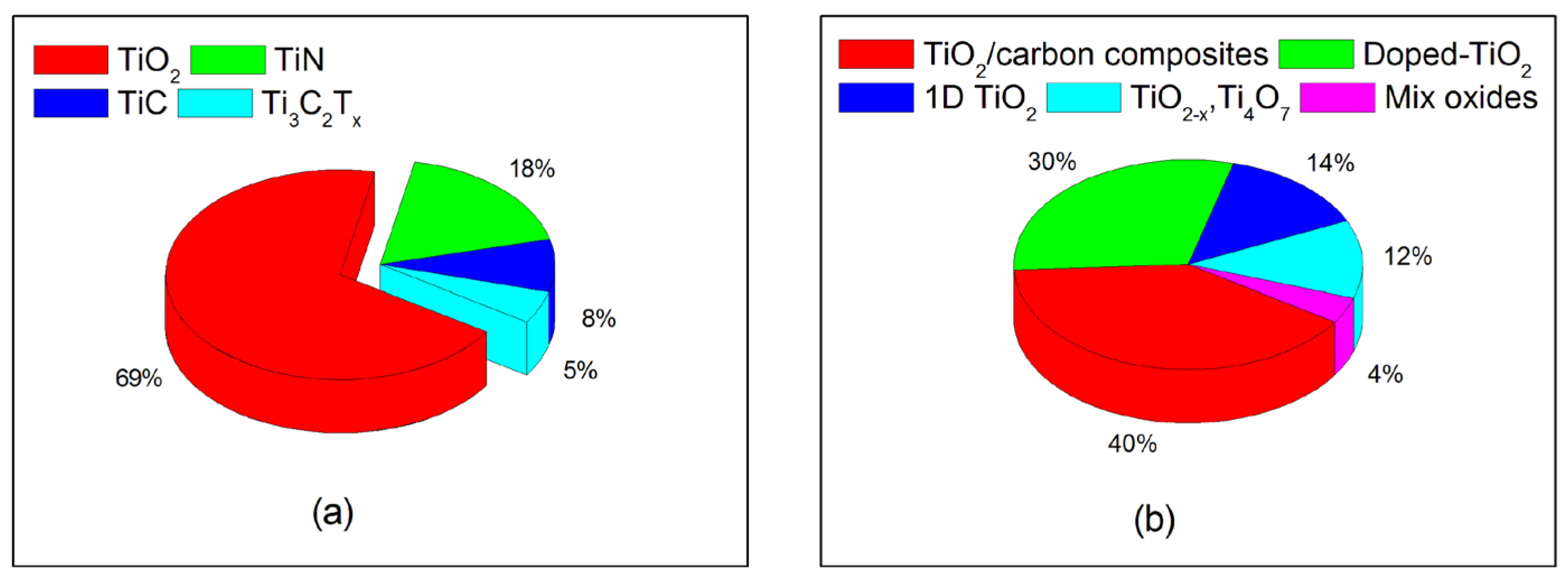
For these reasons, research efforts have been dedicated to non-carbon catalyst supports with high corrosion resistance in fuel cell environments [15]. Sinniah et al. [16] reported a number of works on the use of carbon-free compounds as Pt nanoparticle supports since 2015. SnO2, TiO2, and TiN were the most investigated compounds, followed by Mo2C, SiO2, and TiC. Their remarkable activity and durability were ascribed to the unique strong metal support interaction (SMSI) between the transition metals and Pt. More recently, two-dimensional MXenes also emerged as potential Pt catalyst supports. Due to their high corrosion resistance and chemical stability, titanium-based compounds, such as TiO2, TiN, TiC, and Ti3C2Tx, are potential supports for PEMFC catalysts. As can be seen in Figure 1a, among them, TiO2 was the most widely studied and used compound for a fuel cell catalyst support, followed by TiN. We have compared carbon-based and titanium-based materials in terms of cost, synthesis complexity, and scalability. Carbon-based materials are the lower-cost option for catalyst supports in industrial applications, while titanium-based supports are generally more expensive but offer superior durability and stability. Under severe operating conditions (high potential, acid environments), titanium-based supports are favored for their long-term cost-effectiveness despite higher initial material prices. A way to combine the low cost of carbon with the high durability of titanium is to use hybrid carbon-based-titanium-based supports. Carbon supports generally require less complex synthesis, although structures like CNTs require advanced methods, such as chemical vapor deposition (CVD). On the other hand, the synthesis of engineered (e.g., doped Ti-suboxides) Ti-based supports frequently requires high-temperature sintering to control crystal phases (anatase/rutile), which can lead to sintering and reduced surface area, or advanced methods like sol–gel or chemical vapor deposition to achieve specific surface properties. Carbon supports are highly scalable, with well-established production methods, whereas for Ti-based supports, the scalability is a major hurdle. While standard TiO2 is cheap, high-surface-area engineered TiO2 often faces challenges in industrial-scale production.

2.1. TiO2

Among transition metal oxides, TiO2 is the most widely used carbon-alternative fuel cell catalyst support for its low cost, high stability, low toxicity, excellent corrosion resistance, and strong metal–support interaction [15,16,17]. A drawback regarding the use of TiO2 nanoparticles as a catalyst support, however, is mainly its poor electrical conductivity as well as its low surface area, giving rise to low Pt nanoparticle dispersion. As reported in a recent review [18], to overcome this hindrance, the use of TiO2 mixed with or supported on carbon materials, doped TiO2, shaped/nanostructured TiO2, substoichiometric TiO2, and TiO2 mixed with inorganic oxides were proposed. As can be seen in Figure 1b, TiO2/carbon composites and doped TiO2 were the most investigated catalyst support. As reported by Antolini [19], the methanol oxidation under dark conditions of TiO2-supported and conventional carbon-supported Pt catalysts were compared in different papers. For most of these works, TiO2/carbon composites or nanostructured TiO2 were used as catalyst supports. The specific activity (SA) of all Pt/TiO2 catalysts was higher than that of Pt/C catalysts, due to the co-catalytic effect of TiO2 on methanol oxidation. For most Pt/TiO2 catalysts (76%), the mass activity (MA) was higher and the methanol oxidation onset potential was lower than those of Pt/C catalysts. In almost all of these cases, the Pt/TiO2 catalysts with a lower MA also presented a higher onset potential, ascribed to the large Pt particle size and the low surface area of the TiO2 particle. Moreover, the presence of TiO2 increased the poisoning tolerance, as well as the long time durability of Pt/TiO2 with respect to Pt/C.

2.1.1. TiO2/Carbon Composites

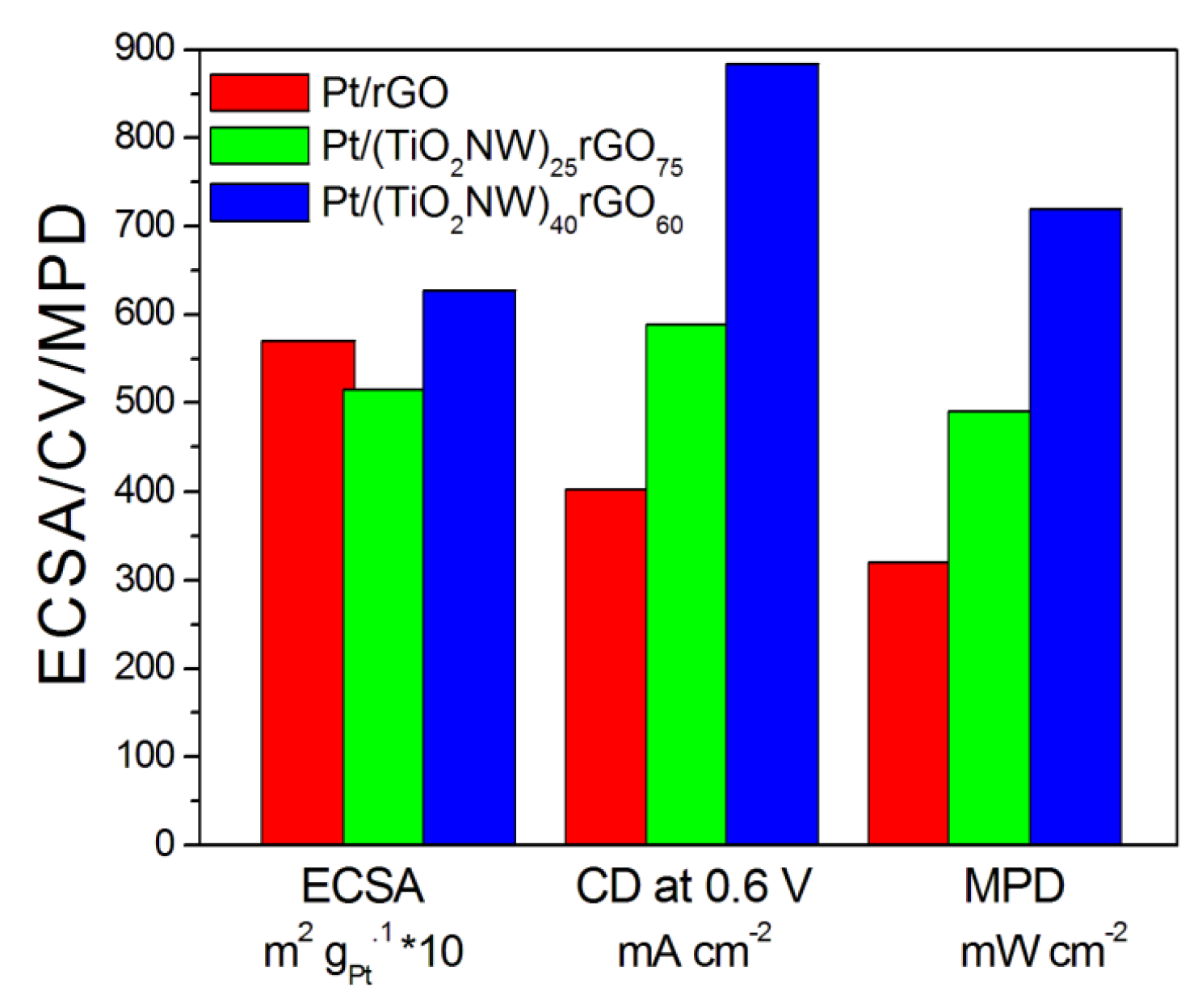
There are essentially two type of ceramic–carbon composites used as a fuel cell catalyst support: (1) ceramic materials supported on a carbon substrate, where the carbon stabilizes highly dispersed ceramic particles, lead to a high specific surface area; (2) mixed ceramic–carbon materials, that is, true hybrid supports with enhanced properties, such as higher electron conductivity (by the presence of carbon) and/or higher corrosion resistance (by the presence of the ceramic oxide) than the single materials [20]. TiO2 mixed with or supported on carbon materials, such as carbon black (CB) [21,22,23], carbon nanotubes (CNTs) [24,25,26], and graphene (G) [27,28,29], is the most common way to increase the electrical conductivity and/or the surface area of the support. The combination of conductive carbon and corrosion-resistant TiO2 results in a suitable support for low-temperature fuel cell catalysts. In addition, as the contact between carbon and platinum in fuel cell cathodes can catalyze carbon corrosion through electrochemical oxidation, particularly at high potentials, the ceramic supported on carbon avoids direct contact between carbon and Pt, and it protects the carbon from the harsh, acidic, high-potential environment, thus reducing corrosion and increasing durability. The use of stoichiometric TiO2 nanoparticles as part of the composite, however, not only reduces the conductivity of the support, but it also makes the formation of a strong interaction between Pt and the metal oxide difficult. Thus, in many cases, instead of stoichiometric TiO2 nanoparticles, to further improve the electrical conductivity of the composites, either doped TiO2, substoichiometric/defective TiO2, or 1D nanostructures are used in composite supports. Considering that the use of TiO2-based supported catalysts for methanol oxidation has been previously discussed [19], only the use of TiO2/carbon composite supported catalysts for the oxygen reduction reaction (ORR) are reported in the following part of this section. Almost all these composite supported catalysts showed a higher ORR activity and a higher durability than the catalysts supported on TiO2 and carbon alone. Li et al. [21] used a warm plasma (WP)-synthesized TiO2 and carbon to form mixed (TiO2)x-C4−x (x = 1, 2, 3) composites by a solvent evaporation method. The Pt particles were deposited on these substrates by a ethylene glycol reduction method. These composite supports gave rise to a uniform Pt dispersion and a Pt electronic reconfiguration. The Pt/TiO2–C3 catalyst showed an ultra-small Pt size (ca. 2.15 nm) and outperformed Pt/C catalyst, achieving 1.24 times higher electrochemically surface area (ECSA), 1.85 times higher MA, and 1.5 times higher SA than Pt/C. Moreover, the Pt/TiO2x-C4-x catalysts showed almost half the losses in ECSA, MA, and SA after an accelerated stress test (AST) than those of Pt/C. The outstanding ORR activity and enhanced durability were ascribed to the synergic effect of TiO2 (strong metal support interaction (SMSI), oxygen vacancies, and corrosion resistance) and carbon (high surface area and electrical conductivity). A way to mitigate the loss in fuel cell performance, due to lower catalyst loading on the substrate, is the reduction of catalyst particle size, providing more active sites. However, the small particle size leads to particle agglomeration, giving rise to a reduction in catalyst activity. To overcome this drawback, Cao et al. [24] proposed a CNT-supported porous TiO2 film that immobilizes PtCo nanoparticles (2 nm size) loaded on the support while protecting the CNTs inside. PtCo/TiO2/CNT showed a MA only slightly lower than that of PtCo/CNT, but showed a MA loss of 8 and 11% following 5 k and 30 k potential cycles at 0.6–1.0 V and 1.0–1.5 V, respectively, compared to 74 and 68% MA loss for PtCo/CNT. Among various TiO2, 1D structures have advantages such as higher aspect ratio, higher conductivity, and high dispersion on graphene than conventional TiO2 nanoparticles [30], making them suitable for TiO2/G composite preparation and use as a catalyst support. Baskaran et al. [27] prepared 1D TiO2 nanowires/reduced graphene oxide (rGO) composites for their use as PEMFC catalyst supports. Pt nanoparticles were supported on TiO2/rGO composites in the TiO2 range of 0–75 wt% by a polyol reduction method. The optimum composition was 40 wt% TiO2 nanowires. The improved performance was ascribed to the strong SMSI between Pt and Ti, enhancing the ORR activity. The performance of the catalyst supported on TiO2/rGO with more than 50 wt% TiO2 was lower than Pt/rGO, owing to the excessive agglomeration of TiO2, resulting in a sluggish charge transport within the composite. The histogram of the ECSA, the current density (CD) at 0.6 V, and the MPD of (TiO2)xG1−x-supported Pt catalysts are shown in Figure 2.
The ECSA values of the catalysts were slightly different, while CD and MPD increased with the TiO2 content. The Pt/rGO catalyst delivered a current density of 403 mA·cm−2 at 0.6 V and a maximum power density (MPD) of 321 mW·cm−2, whereas the optimized (Pt/TiO2)40-rGO60 catalyst delivered a performance more than twice that of Pt/rGO. However, the utilization of TiO2/carbon-based composite materials as a catalyst support is not an optimal choice because the problems regarding the stability of the carbon during fuel cell operation remain. Moreover, it has to be remarked that most of these works have been carried out by out-of-cell tests, whose results do not always agree with those by fuel cell tests.

2.1.2. Doped TiO2

Metal Doped Titanium Oxide (M-TiO2, M < 0.3)
Doping with n-type dopants, such as Nb, V and Ta, is one of the best methods of improving the electrical conductivity of TiO2. Among them, Nb is one of the most effective dopants and is used for the generation of n-type TiO2 crystallites the most. Nb modifies the band structure of TiO2 and generates additional carriers in its conduction band. The 4d orbitals of Nb strongly hybridize with the 3d ones of Ti and form a d-natured conduction band, originating the metallic conductivity of Nb-TiO2 [31]. Sheppard et al. [32] concluded that the properties of Nb-TiO2 arise from defects such as oxygen vacancies and Nb-doping in Ti sites. These defects are compensated by either electrons or Ti interstitials. However, excessive doping, above 10–20%, can lead to the segregation of Nb, the formation of second phases, or disruption of the crystal lattice, which lowers structural stability and electrical performance. The literature suggests that an Nb concentration of 5–10% is sufficient to significantly enhance conductivity without inducing severe structural damage or secondary phases. In most these works, the Nb content is 10%. Doping 10% Nb into TiO2 would increase its conductivity ∼1600 fold [33]. Moreover, Nb doping decreases the particle size and increases surface area of TiO2. By out-of-cell and fuel cell tests, it was observed that the catalysts supported on Nb-TiO2 showed higher/similar catalytic activity and/or higher stability [33,34,35,36,37,38,39,40,41,42,43,44] than the same catalysts supported on carbon. The improved catalytic activity of Pt/Nb-TiO2 was ascribed to the high dispersion of Pt nanoparticles on the Nb-TiO2 support, and to the SMSI between Pt and Nb-TiO2, promoting the adsorption of oxygen or fuel on the catalyst surface. The enhanced stability was ascribed to the higher corrosion resistance of Nb-TiO2 than carbon in an acidic environment and the strong SMSI, hindering Pt sintering.
Kim et al. [45] evaluated the effect of different transition metal doping in Pt/M-TiO2 (M = V, Cr, and Nb) on the ORR activity of Pt/Pt/M-TiO2. Among them, the Pt/V-TiO2 showed the best ORR activity and stability. On this basis, Barthi and Cheruvally [46] compared the performance of a V-doped TiO2-supported Pt catalyst (Pt/V-TiO2) as the cathode catalyst in a PEMFC to that of undoped TiO2 supported Pt, prepared in the same way.
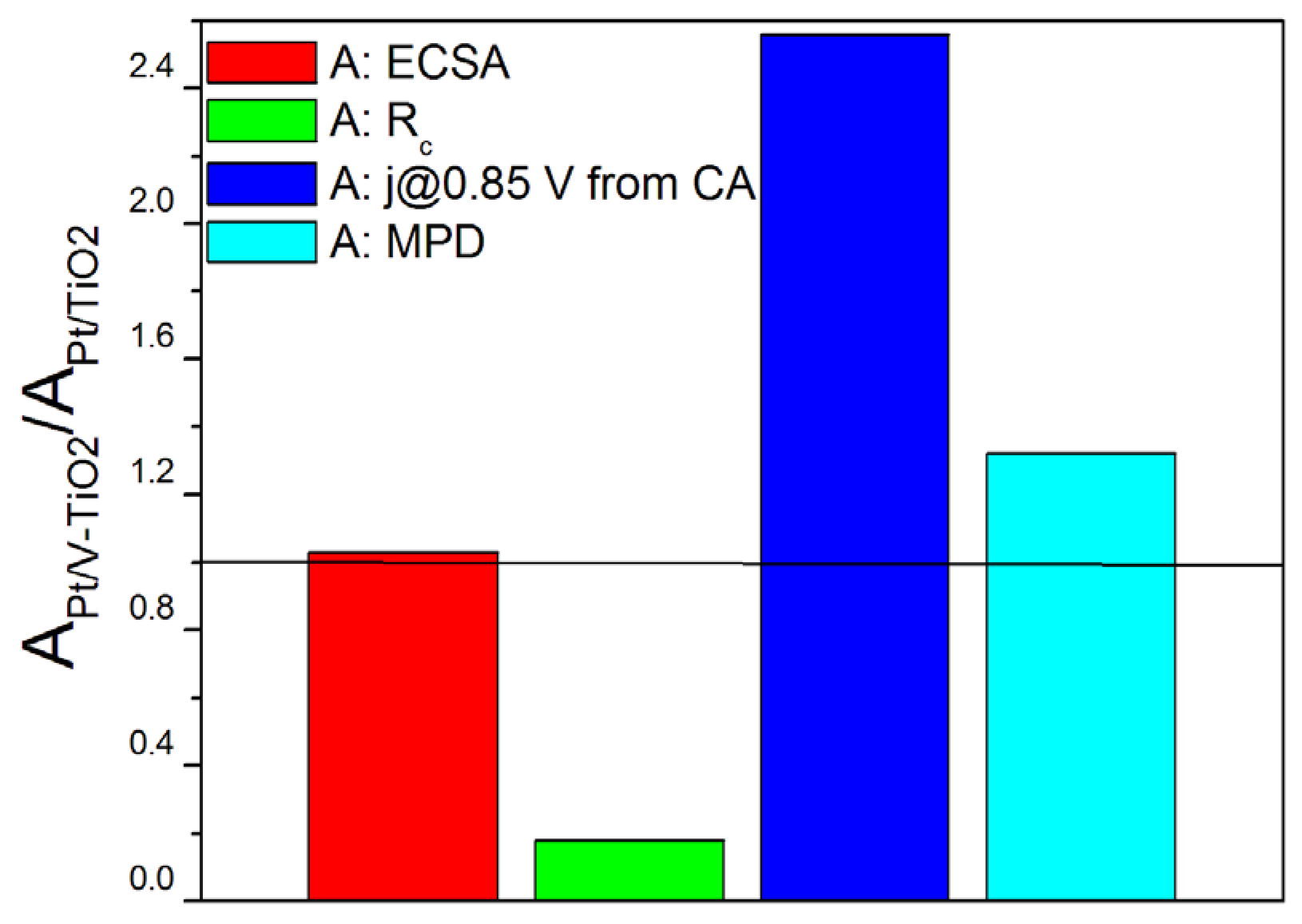
The single PEMFCs with Pt/V-TiO2 and Pt/TiO2 delivered a cell voltage at 50 mA·cm−2 of 0.817 and 0.732 V, respectively. The histogram of the APt/V-TiO2-to-APt/TiO2 ratio (A: ECSA, charge transfer resistance for cathode (Rc), current density at 0.85 V (j0.85) from chronoamperometry (CA), and MPD) is reported in Figure 3. As can be seen in Figure 3, the ECSA was not affected by the presence of V. Instead, the presence of V remarkably increased the conductivity, thus decreasing the Rc and considerably increased the j0.85. An increase in the MPD can also be observed. The better performance of Pt/V-TiO2 than Pt/TiO2 was ascribed to the higher electrical conductivity and stronger SMSI between Pt and V-TiO2 support.
Non-Metal Doped Titanium Oxide
Nitrogen doping generates defects and modifies the electronic band structure of TiO2, improving the interaction with catalysts like Pt. Carbon doping can further enhance the electronic conductivity of the TiO2 support. C- and N-doped TiO2 strongly enhances the stability and activity of the catalyst. Doping hinders catalyst particle agglomeration, resulting in high fuel cell durability, especially under harsh operating conditions. Two papers were addressed to C and N co-doped TiO2 as Pt supports in PEMFCs. Dhanasekaran et al. [47] evaluated the performance as cathode catalysts of Pt supported on N- and C-doped TiO2. Pt supported on optimum levels of N- and C-doped TiO2 in the optimum composition showed improved cell performance compared to Pt supported on undoped TiO2. Lee et al. [48] prepared N,C co-doped mixed-phase TiO2 nanoparticles with a decreased (compared to that of pristine TiO2) band gap and containing Ti3+ ions, oxygen vacancies, and Ti–X bonds (X = O, OH, N, C). The doping level was controlled by dopant (urea) loading, while the abundance of defect sites resulted in an enhanced metal–support interaction for Pt/N,C co-doped TiO2. This catalyst showed high ORR activity and durability. The MPD decreased by only 4% against 52% for Pt/C under single PEMFC operation conditions.

2.1.3. TinO2n−1 and TiO2−x

Sub-Stoichiometric TinO2n−1 (4 ≤ n ≤ 10)
The Ti–O system presents a sub-stoichiometric composition of the general formula TinO2n−1 (Magneli phases), with n between 4 and 10 [49]. Among this series of distinct oxides, Ti4O7 presents the highest electrical conductivity (>103 S·cm−1 at room temperature) [50]. In addition, these oxides show high oxidation resistance in an acid environment. On the basis of these conductive and oxidation-resistant properties, TinO2n−1 phases, particularly Ti4O7, have attracted attention as a possible support for fuel cell catalysts [51,52,53,54,55,56,57,58]. First, Ioroi et al. [51,52] evaluated the performance of Ti4O7-supported Pt as an anode catalyst in a single PEMFC and compared it to that of Pt/C. The performance of the single PEMFC with 5 wt% Pt/Ti4O7 as the anode catalyst was similar to that of the cell with 20 wt% Pt/C, while the performance as the cathode catalyst was lower than that of Pt/C, due to the larger Pt particle size on Ti4O7 than that on carbon, resulting in a lower ECSA. A high-potential holding test showed that the Pt/Ti4O7 catalyst is stable up to 1.5 V. A single PEMFC with a Pt/Ti4O7 cathode operating at 80 °C for 350 h showed remarkable voltage stability. Chisaka et al. [53] prepared Ti4O7 particles from titanium oxysulfate (TiOSO4) and polyethylene glycol by a carbothermal reduction reaction, obtaining fine Ti4O7 particles, forming aggregates with a broad pore size distribution. When commercial TiO2 powders were used as precursors, much larger Ti4O7 particles (Ti4O7-L) were obtained. Tests in PEMFCs indicated that the optimum 20 wt% Pt/Ti4O7 is effective for both the anode hydrogen oxidation (HOR) and cathode ORR. ADTs under PEMFC conditions were performed on the TinO2n−1 and Pt/C catalysts [54,55,56,57,58]. The Pt/TinO2n−1 catalysts showed outstanding electrochemical stability. The Pt particles supported on the carbon aggregated, while the morphology of the Pt supported on TinO2n−1 remained almost unchanged, resulting in a higher ECSA loss of Pt/C with respect to that of Pt/TinO2n−1. The superior durability of Pt/Ti4O7 was ascribed to the high stability of Ti4O7 and the SMSI between Pt and Ti4O7.
TiO2 with Oxygen Vacancies (TiO2−x)
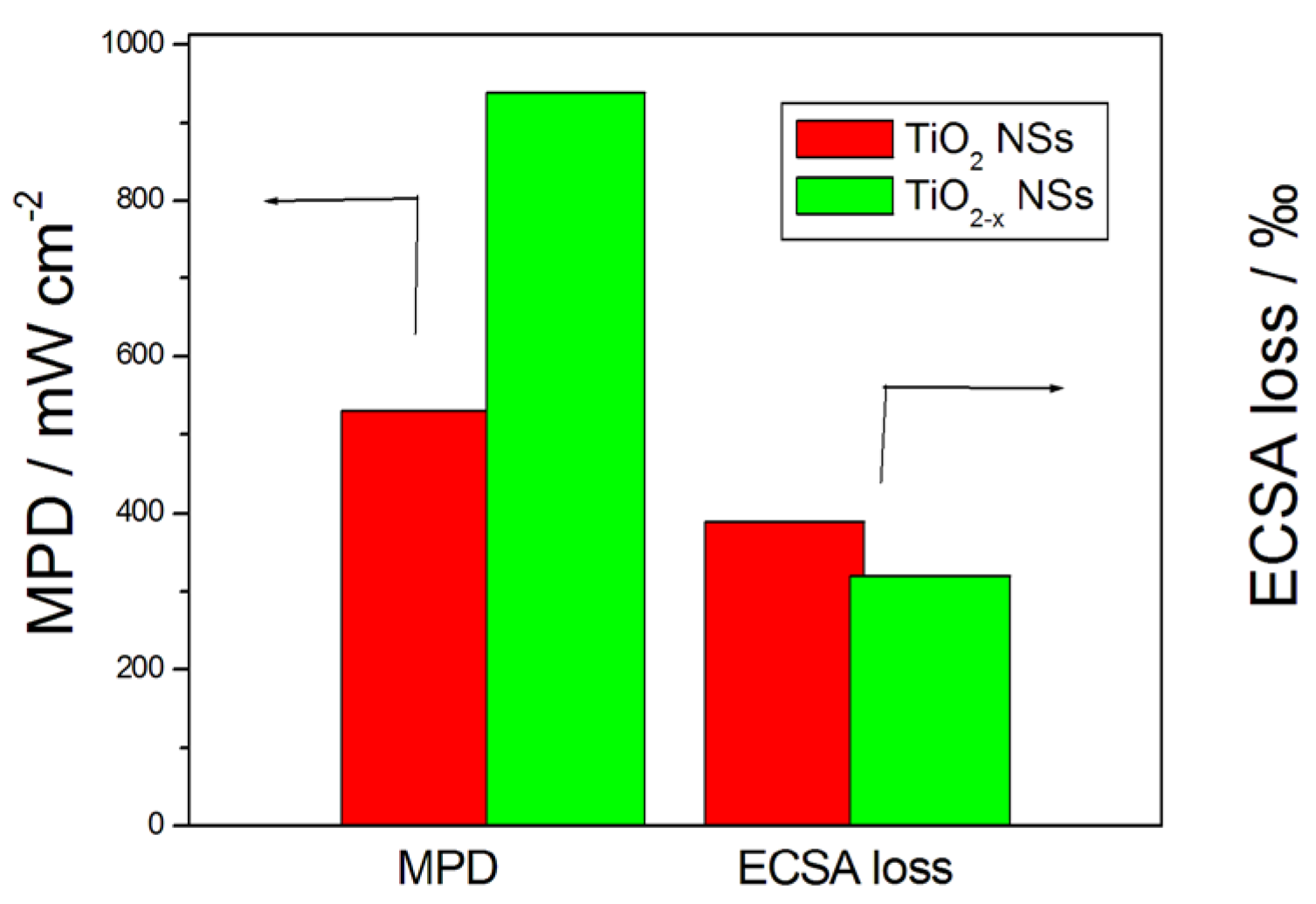
Oxygen vacancies (OV) are a kind of crystal defect, which can essentially change the crystal structure of transition metal oxides and then modify their intrinsic properties [59]. Defective TiO2 with oxygen vacancies recently gained intensive attention due to its abundant electron-rich sites, enhancing electronic interaction between supports and metals [60]. Pt 4f core-level spectra of Pt-TiO2−x shifted to lower binding energy, which indicates a d-band center shift relative to Fermi level, reducing the adsorption of the intermediates on the catalyst surface and improving ORR activity [61]. In addition, oxygen vacancies on TiO2 can be used as anchor sites to adsorb metal ions and immobilize the metal nanoparticles. Different studies reported the use of bare TiO2−x [62,63,64,65,66,67] and TiO2−x–carbon composites [23,25,68] as fuel cell catalyst supports, mainly for the ORR but also for the MOR. As reported in these works, the catalysts supported on TiO2−x and TiO2−x–carbon composites showed a higher catalytic activity and durability than the same catalysts supported on stoichiometric TiO2 and conventional carbon. Two times higher activity and three times higher stability in methanol oxidation reaction, a 0.12 V negative shift of the CO oxidation peak potential and a 0.07 V positive shift of the oxygen reaction potential were obtained for Pt supported on TiO2−x support compared to Pt supported on pristine TiO2 support [62]. Naik et al. [63] evaluated two-dimensional TiO2−x nanosheet (NS)-supported Pt nanoparticles as ORR catalysts in PEMFCs. TiO2−x NSs showed enhanced electronic conduction compared with TiO2 NSs. Pt/TiO2−x NSs showed outstanding ORR activity, due to a strong SMSI between the Pt and the TiO2−x NSs. Both MA and SA of the Pt/TiO2 NSs and Pt/TiO2−x NSs catalysts were higher than that of Pt/C, due to the SMSI between TiO2 and Pt, particularly in the presence of oxygen vacancies.
The CO adsorption on Pt/TiO2 NSs and Pt/TiO2−x was weakened by electron transfer to Pt from TiO2 NSs support, due to the negative shift in Pt 4f peaks. The performance of cathode catalysts in PEMFC, as well as the stability of the Pt/TiO2−x NSs and Pt/TiO2 NS catalysts were evaluated. The histograms of the MPD and the ECSA loss are reported in Figure 4. The fuel cell using the Pt–TiO2−x NSs catalyst delivered a higher power density than the cell with Pt/TiO2. The ECSA decrease of the Pt–TiO2−x NSs was smaller than that of the Pt–TiO2 NSs, showing outstanding stability during fuel cell operation. Yan et al. [25] evaluated a TiO2−x/CNT composite material as a support for Pt nanoparticles. The oxygen vacancy facilitated interactions between TiO2−x and Pt, enhancing the anchoring of Pt and avoiding particle growth. The catalytic activity and the durability of the Pt/TiO2−x/CNT catalyst were higher than those of Pt/C. Si et al. [68] prepared N-doped carbon materials containing TiO2 via pyrolysis of MIL-125(Ti)–NH2 in either N2/(TiO2-NC)N or H2/Ar gas (TiO2−x-NC)HA. A high content of oxygen vacancies were obtained on TiO2 surface in H2/Ar gas, enhancing the interaction between TiO2 and Pt. The Pt/(TiO2−x-NC)HA catalysts showed higher activity and stability for methanol oxidation than Pt/(TiO2-NC)N and Pt/C catalysts. However, the stability of these vacancies is a major concern, as they tend to vanish when exposed to oxidative environments, such as the cathode of a PEMFC, where the vacancies can be re-oxidized. Several strategies can be used to stabilize them: (i) Introducing acceptor-type dopants, such as Fe3+, Mo6+ and Nb5+, into the lattice, making oxygen vacancies less prone to filling in oxidative environments; (ii) doping with non-metals like N or F, lowering the formation energy of vacancies; (iii) using conductive carbon materials to form composite supports, helping in anchoring the metal particles more robustly and improving the overall conductivity, which can help maintain the defective structure of TiO2. Moreover, the vacancies can be partially regenerated through potential cycling techniques in a hydrogen-containing atmosphere, which can reduce the surface and re-introduce oxygen vacancies.
The similarities and differences in the promoting effect of TiO2−x support and sub-stoichiometric TinO2n−1 were compared [18]. The similarities include improved electronic conductivity and SMSI, resulting in enhanced electrocatalytic performance. The differences are mainly due to the crystal phase and morphologies. The sub-stoichiometric TinO2n−1 is composed by the Magnéli phase with a spherical shape. Conversely, TiO2−x supports with oxygen vacancies are mainly composed of the rutile and anatase phases with tunable morphologies like rod, sheets, and porosity. TiO2−x has a higher proportion of oxygen vacancies, leading to their superior electronic conductivity. The oxygen vacancies induce SMSI and then promote electrocatalytic performance. However, the formation of Magnéli phase at higher temperatures is energy-consuming. Moreover, TiO2−x tends to be oxidized into TiO2 during long-term fuel cell operation.

2.1.4. One-Dimensional (1D) TiO2

Nanostructured materials, with a typical dimension of less than 100 nm, have attracted attention for their use as a catalyst support. Such materials include spheroidal nanoparticles, nanosheets, and nanofibers together with 1D nanotubes, nanowires, and nanorods. In view of their high stability, high surface area, and moderate electrical conductivity, 1D TiO2 nanotubes (TONTs) were tested as fuel cell catalyst supports [69,70,71,72,73,74,75,76,77,78,79]. The nanotube structure presents many advantages such as support of electrocatalysts associated with specific geometry. The geometry of the arrays enhances the loading and dispersion of catalysts, and the highly porous structure facilitates the permeation of reactant species, resulting in an enhancement of catalytic activity. Pt, Pd, PtRu, PtNi, PtCo, and PtAg supported on TONTs were investigated for MOR and ORR by both out-of-cell tests and as an anode or cathode catalyst in low-temperature fuel cells, showing higher catalytic activity and durability than the same catalysts supported on TiO2 nanoparticles as well as on carbon-supported catalysts. For example, Manidakam et al. [69] deposited Pt nanoparticles on TiO2 nanotubes (Pt/TONT) by a chemical impregnation method. They compared the electrochemical performance of Pt/TONT for both the ORR and the MOR with that of TiO2 nanoparticle-supported Pt (Pt/TiO2-NP) and commercial Pt/C. The ORR onset potential showed a shift of 50 mV towards higher values and a 12% increase in SA with respect to Pt/C. Pt/TONT also showed a MA 17-fold higher than that of Pt/C and 3.4-fold higher than that of Pt/TiO2-NP. The ADT test showed a 12% ECSA loss for Pt/TONT, 40% for Pt/TiO2-NP, and 76% for Pt/C following 10,000 cycles. The Pt/TONT also showed enhanced MOR activity compared to both Pt/TiO2-NP and Pt/C. The enhanced performance of Pt/TONT was ascribed to an increase in oxygen defects on its surface, improving the charge transfer between Pt and TONT.
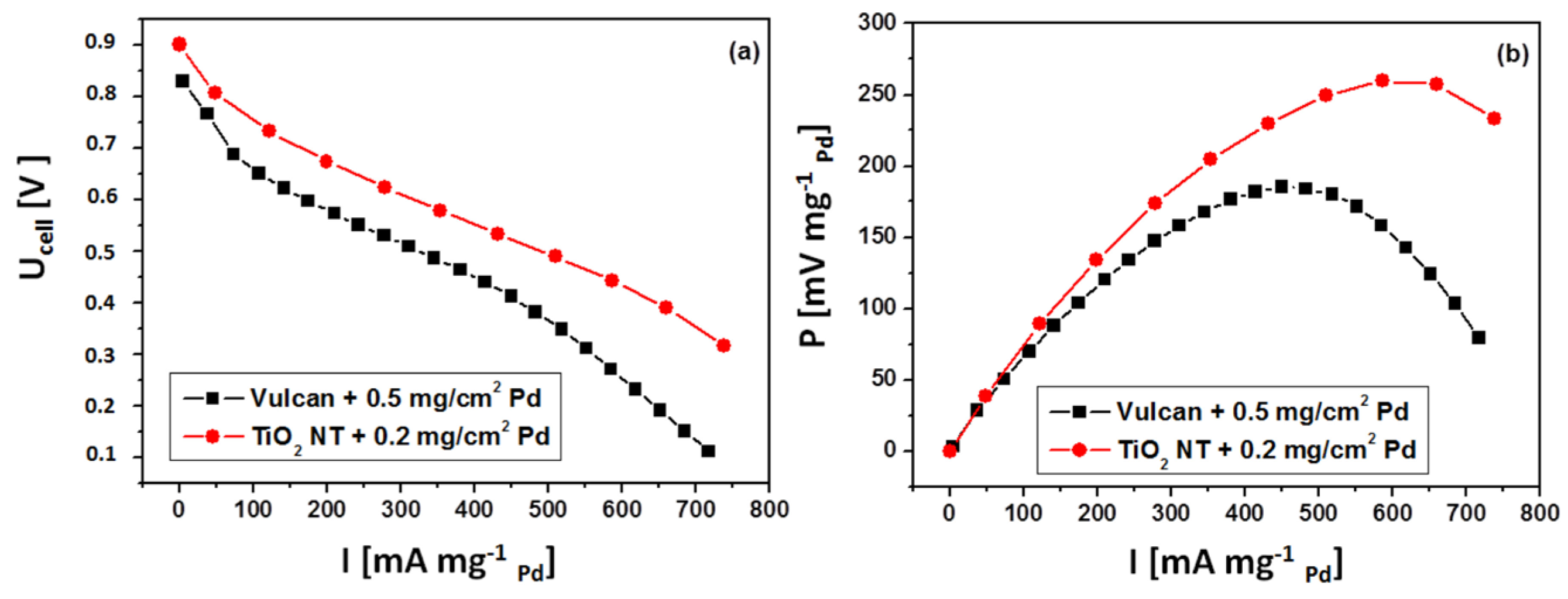
Pisarek et al. [70] used Pd/TONT as an anode catalyst for a direct formic acid fuel cell (DFAFC). Polarization and power density curves of DFAFCs with Pd/TONT and Pd/C anode catalysts are shown in Figure 5. The MPD of the cell with Pd/TONT was 70% higher than that of the cell with Pd/C. This is surprising considering that the Pd/C catalyst has much smaller and well-dispersed Pd nanoparticles (~3 nm) than the Pd/TONT (~10 nm) and, as a consequence, a remarkably higher ECSA (~60 m2·g−1 vs. ~10 m2·g−1). Many factors could explain this result such as the SIMS, the hydrophilicity of TiO2, and the thin layer of Pd nanoparticles on top of TONT, which allows a better diffusion of formic acid to the catalyst and removal of CO2. Moreover, small carbon-supported crystallites, having higher contribution of edges, are less effective for formic acid electrooxidation than the larger TONT-supported Pd nanoparticles, which have a higher amount of crystal planes. As previously reported, to increase the conductivity, TONT/carbon-based composites, such as TONT/C [80,81,82] and TONT/graphene [27], were investigated as catalyst supports, and the results were very promising, showing enhanced activity and durability of the catalyst for the MOR [80,81,82] and the ORR [27].

2.1.5. TiO2-MOx Mixed Oxide Supports

TiO2-MOx (M: transition metal) binary oxides used as fuel cell catalyst supports can be in the form of either solid solution [83,84,85] or separate oxides [86,87,88]. In the case of Ti1−xMxO2 solid solutions, what distinguishes M-doped TiO2 from TiO2-MOx mixed oxide is the amount of M. The transition threshold between M-doped TiO2 and TiO2-MOx mixed oxide can be set at a value of M = 0.3 mol. The most used mixed oxides as catalyst supports for fuel cell applications were TiO2–RuO2 [83,86,87,88,89,90,91]. In most of these works, the Ru content was 30%. These materials showed high electrical conductivity and high chemical stability in an acidic and oxidative environment.
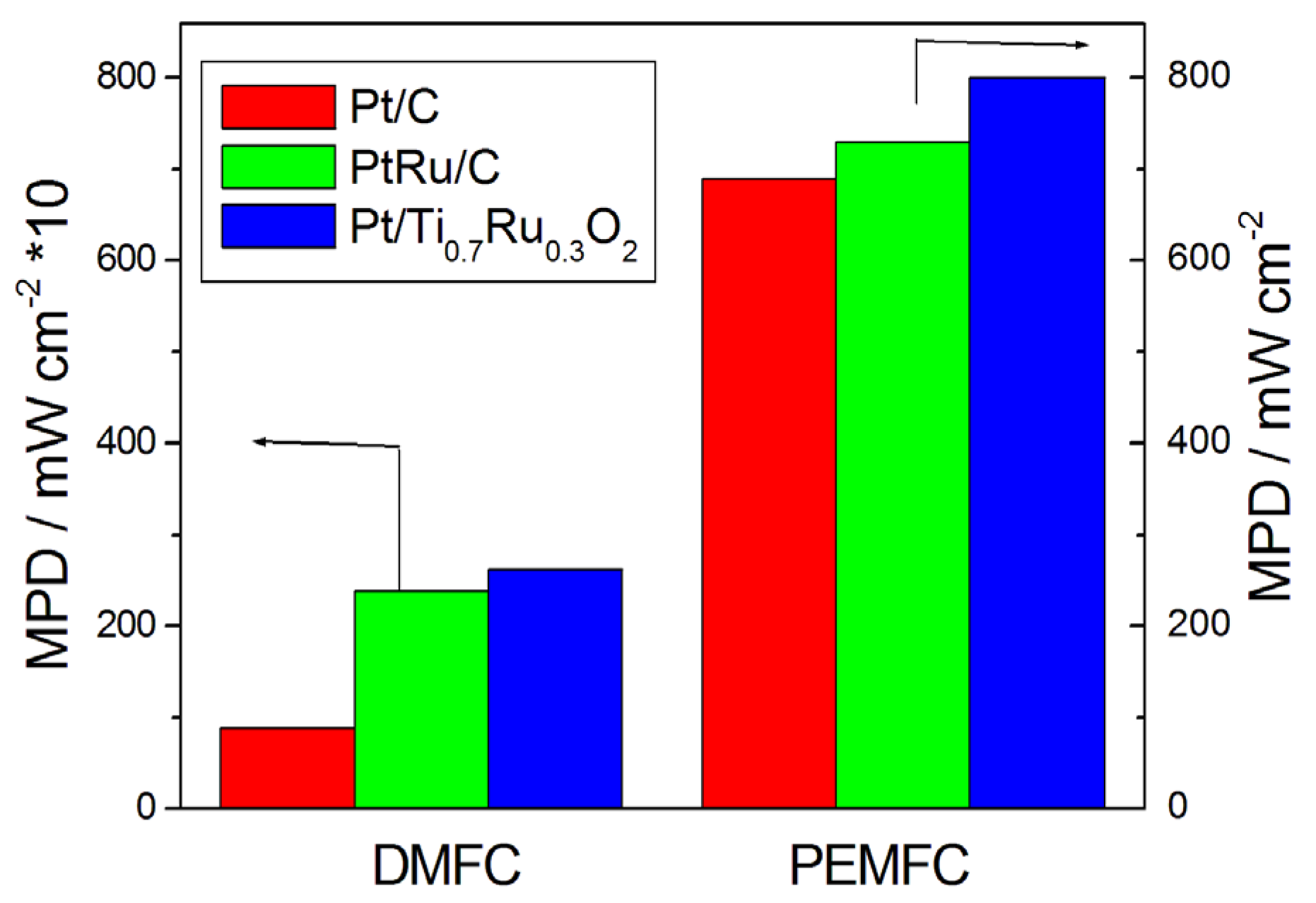
Ti0.7Ru0.3O2, as a catalyst support, provides various advantages in terms of its high surface area, as well as the SIMS between Pt and the co-catalytic metals in the support, leading to highly dispersed and well-anchored Pt catalyst particles. Ti0.7Ru0.3O2 acts as a co-catalyst, improving Pt activity by the ‘bifunctional mechanism’, related to the high proton conductivity of hydrated Ti0.7Ru0.3O2, and the electronic effect between Pt and Ti0.7Ru0.3O2, decreasing the interaction between Pt and the intermediate species. Ho et al. [83] evaluated the performance of DMFCs and PEMFCs with Pt/Ti0.7Ru0.3O2, Pt/C, and PtRu/C as anode catalysts. The histograms of the MPD of these fuel cells operating at 60 °C are shown in Figure 6. As can be seen in Figure 6, both DMFC and PEMFC with Pt/Ti0.7Ru0.3O2 as the anode catalyst delivered the highest MPD. Lo et al. [86] evaluated the stability of hydrous and anhydrous TiO2–RuO2 (TRO) powders. Through an ADT test, it was observed that the anhydrous TRO-a support has a 10-fold higher electrochemical stability than carbon. Unlike with carbon, Pt supported on TRO does not accelerate the corrosion rate of the support. The Pt particle size on the surface of the TRO support was in the 4–8 nm range. The performance of the PEMFC with Pt/TRO-a (40 wt% Pt) as anode and cathode catalysts was only slightly lower than that with Pt/C. The lower performance was attributed both to the lower MA of the Pt/TRO-a catalyst (larger Pt particle size) as well as enhanced ohmic and transport losses. The PEMFC with Pt/TRO-h instead delivered a poor performance due to flooding. The performance at 100% RH of PEMFCs with Pt/TRO-a and Pt supported on high-surface-area carbon (Pt/HSAC) was evaluated. Despite the lower ECSA, the initial performance of the PEMFC with Pt/TRO-a was only slightly lower (especially at lower current densities) compared to that with Pt/HSAC. Whereas the cell with Pt/HSAC showed a very remarkable loss in performance, the PEMFC with Pt/TRO showed minimal loss in performance upon exposure to 1000 start–stop cycles.

2.2. TiN

2.2.1. Pure and Doped TiN Nanoparticles

Transition metal nitrides (TMNs) are considered as promising supports for low-temperature fuel cell catalysts [4]. Among TMNs, the high electrical conductivity and corrosion resistance make TiN the most investigated [16,92,93]. Unlike carbon, electron transfer from TiN to supported Pt enhances Pt electronic density [94,95], resulting in a more weak adsorption of surface-blocking oxygen species, as well as higher catalytic activity and durability than Pt/C.
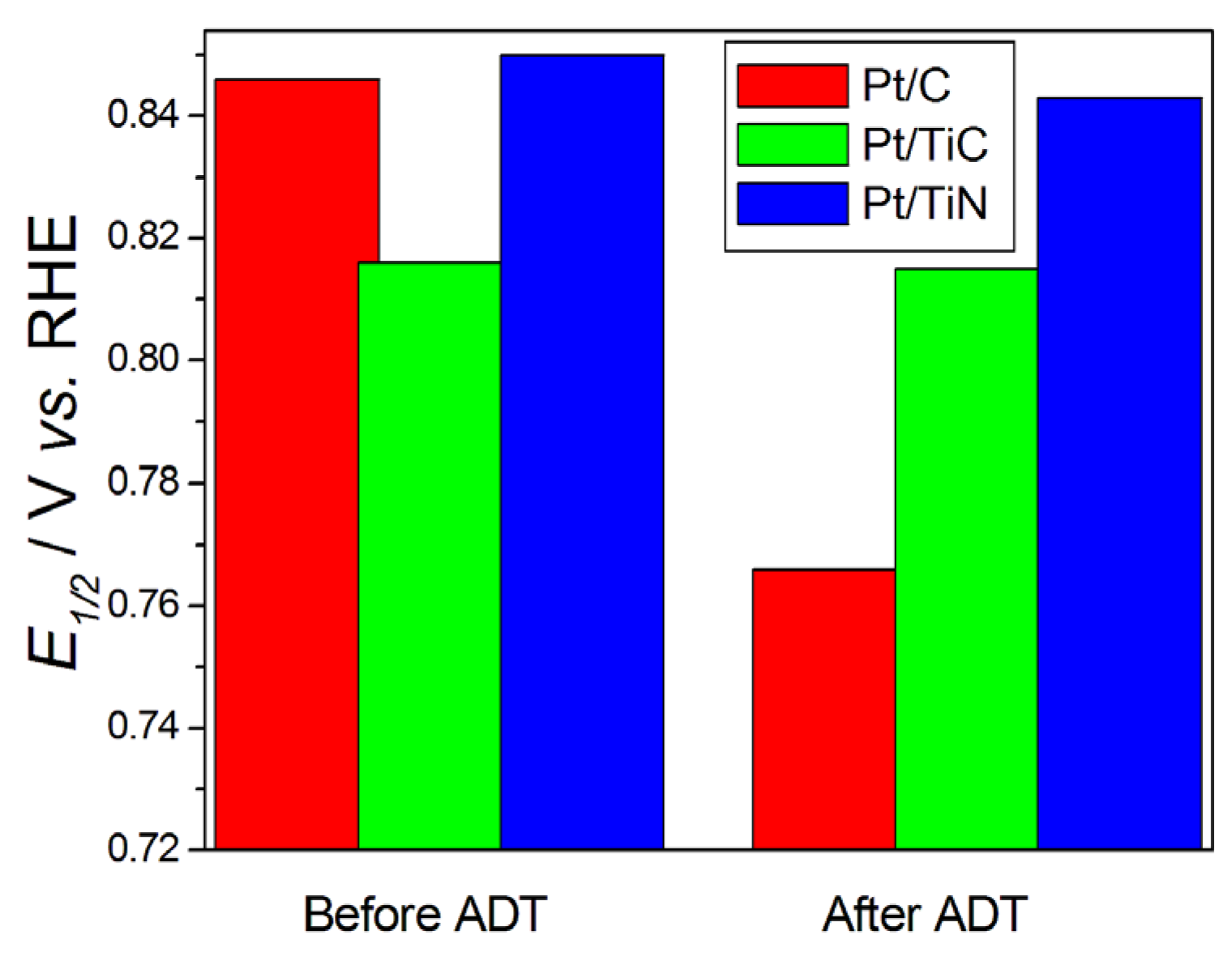
TiN nanoparticles were tested as fuel cell catalyst support by out-of-cell tests [94,96,97,98,99,100,101,102]. A higher ORR and MOR activity, as well as a higher stability of TiN-supported catalysts than carbon-supported catalysts, was observed. Yue et al. [101,102] compared the ORR activity of Pt/TiN, Pt/TiC, and Pt/C. The histograms of the half-wave potential (E1/2) of Pt/TiN, Pt/TiC, and Pt/C before and after ADT are shown in Figure 7. The E1/2 of Pt/TiN was higher than that of Pt/C and Pt/TiC, particularly after ADT, indicating a higher stability of Pt/TiN compared to Pt/TiC and Pt/C. By TiN doping with 5–10 at% M (M = Nb, Mo, Co, Ni, V), the catalytic activity and durability of TiMN-supported catalysts was higher than that of TiN-supported catalysts, ascribed to the modification of the electronic structure of the catalyst in the presence of a second metal [103,104,105,106,107]. However, the poor charge transfer and/or mass transfer of TiN nanoparticles is a limitation for the catalytic activity and durability. Moreover, the low surface area of TiN nanoparticles generally leads to a low dispersion of the catalyst and, in turn, to poor catalytic activity. To address these issues, the use of either pure and doped 1D TiN or pure and doped TiN–carbon composites was proposed.

2.2.2. Pure and Doped 1D TiN

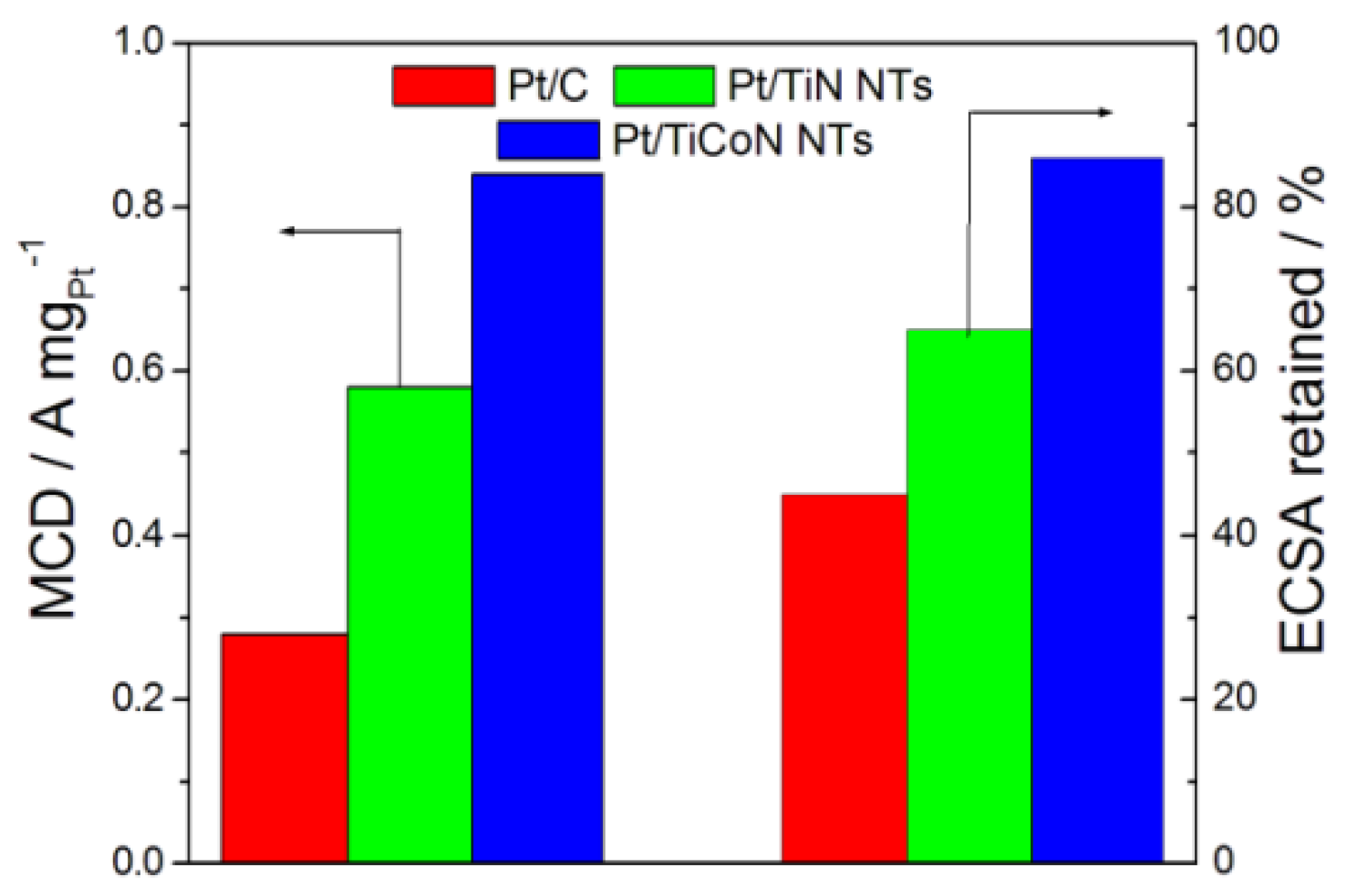
The high surface area and excellent conductivity of 1D nanostructures make 1D TiN materials, such as TiN nanotubes (NTs) [108,109,110,111,112], TiN nanofibers [113], and TiN nanorods [114], suitable for their use as supports for fuel cell catalysts. The high catalytic activity and the good CO tolerance of 1D TiN-supported catalysts were due to the co-catalytic effect of TiN, the strong TiN-Pt interaction, and the unique structure of 1D TiN [109]. Further enhancement of the activity and stability was obtained by doping 1D TiN with transition metals (TMs) in the atomic fraction 0.05–0.1 [115,116,117,118,119]. Generally, pure and doped 1D TiN and carbon-supported catalysts have similar particle size and ECSA. However, following aging tests, the catalysts supported on doped 1D TiN showed a lower ECSA loss than that of the same catalysts supported on undoped 1D TiN and on carbon. Chen et al. [115] evaluated the MOR activity and durability of Pt supported on TiN NTs, TiCoN NTs, and carbon black.
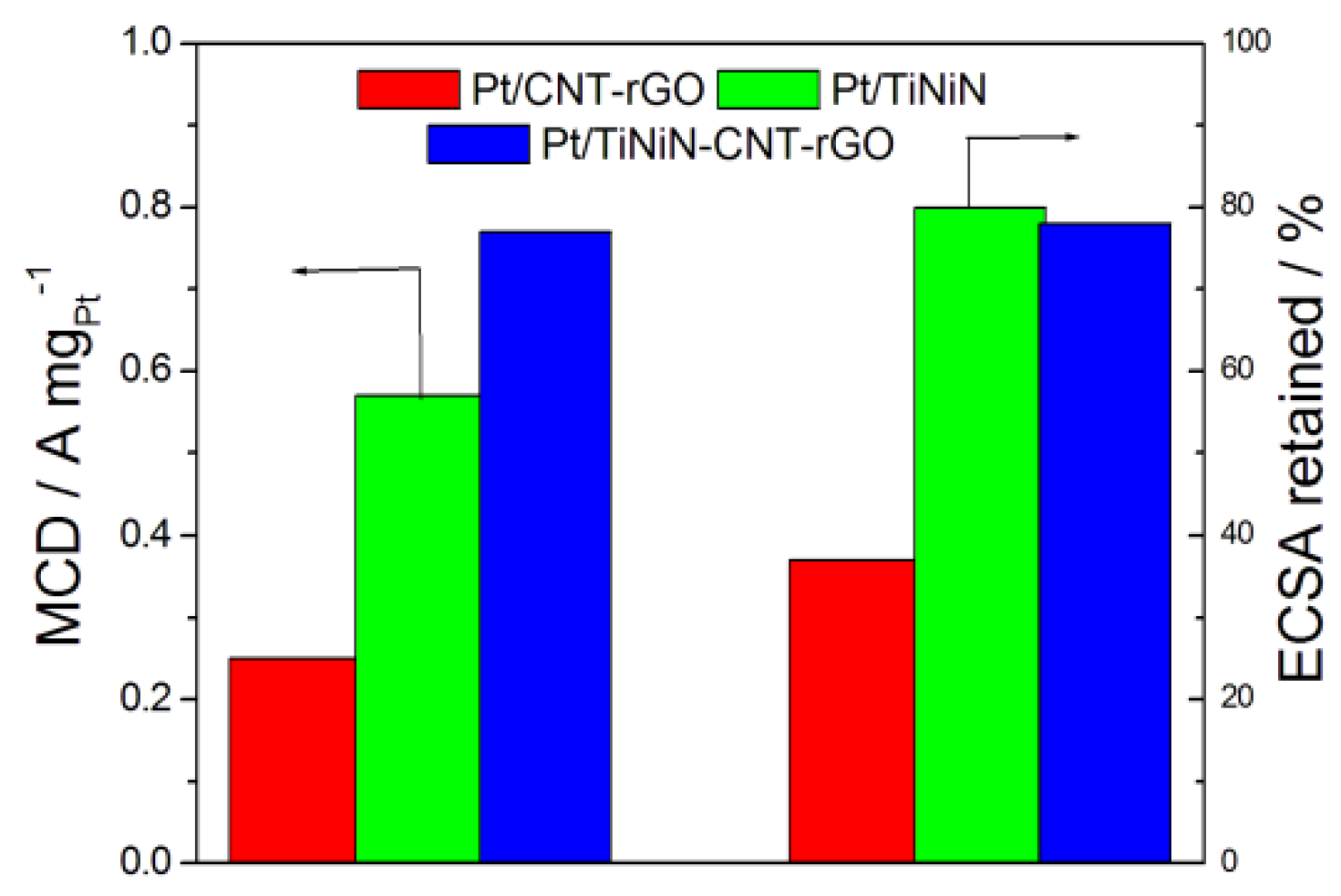
The Pt/Ti0.95Co0.05N NTs catalyst delivered a noticeable increase in MOR activity and durability compared to Pt/TiN NTs and Pt/C. An enhancement of both the maximum current density (MCD) and ECSA retained in the order Pt/C < Pt/TIN NTs < Pt/TiCoN NTs can be observed in the histogram in Figure 8. The outstanding stability of Pt/TiCoN NTs was ascribed to the strong electronic coupling between Pt and Ti0.95Co0.05N NTs, due to Co doping and the NT supports. Pt/TiCoN NTs showed the lowest onset potential for CO oxidation, followed by Pt/TiN NTs and Pt/C. Co donated electrons to Pt, leading to a decrease in Pt d-band vacancy, weakening reaction intermediate bonding [116] and facilitating CO removal with respect to TiN support.

2.2.3. Pure and Doped TiN-Carbon Material Composites

To increase the specific surface area of pure and doped TiN nanoparticles, they were supported on high-surface-area carbon materials, such as carbon black [120,121,122], carbon nanotubes (CNTs) [123,124,125,126,127,128], graphene (G) [129,130], and mixed carbon nanotube-reduced graphene oxide (CNT-rGO) [131]. These composites presented a higher catalytic activity and durability of the supported catalysts than those supported on single nitride and carbon-based supports. For example, Zhang et al. [120] combined the outstanding corrosion resistance and SMSI of TiN with the high conductivity of carbon, forming a TiN@C composite with a TiN core and a porous carbon shell. The composite TiN@C support showed a higher corrosion resistance than bare carbon. Liu et al. [131] synthesized a TiNiN-decorated three-dimensional (3D) CNT-rGO support, resulting in the formation of large accessible pores, facilitating the contact of catalyst and electrolyte. The surface area of TiNiN/CNT-rGO was remarkably higher than that of TiNiN.
The MCD increased in the order Pt/CNT-rGO < Pt/TiNiN < Pt/TiNiN/CNT-rGO (Figure 9). The Pt/TiNiN and Pt/TiNiN/CNT-rGO catalysts presented a higher MCD than Pt/CNT-rGO, related to the co-catalytic effect of TiNiN. The higher activity of Pt/TiNiN/CNT-rGO than that of Pt/TiNiN was due to improved electrical conductivity. These catalysts have the same Pt particle size and Pt loading [126,131], but given the surface area of TiNiN/CNT-rGO is higher than that of TiNiN, the Pt interparticle distance (xi) on the TiNiN/CNT-rGO support is higher than that on the TiNiN one. As catalytic activity can decrease with decreasing xi [132], a higher xi can result in higher MOR activity. On the other hand, the high ECSA-retaining properties of both Pt/TiNiN and Pt/TiNiN/CNT-rGO catalysts (Figure 9) was ascribed to strong Pt-TiNiN interactions.

2.3. TiC

2.3.1. TiC Nanoparticles

Among TM carbides, TiC attracted growing interest because of its outstanding stability under a variety of harsh conditions [10] and its high conductivity (300–800 S·m−1), making it a promising candidate as a fuel cell catalyst support. Due to a strong overlap between metal d-bands and C-2p orbitals, noble metal (NM) atoms preferentially adsorb at C sites while favoring the electron transfer from C to NM. The strong interaction between NM atoms and TiC surface allows us to retain the configuration as well as avoid clustering, thus enhancing the stability of electrodes while retaining its catalytic activity. Despite these positive features for the use as catalyst/catalyst support, a facile synthesis process for porous TiC with high surface area is still a challenge. Mirshekari and Shirvanian [133] carried out a comparative study on the ORR activity and stability of TiO2, TiN, and TiC-supported Pt catalysts in PEMFC environment. The ECSA values for the Pt/TiO2, Pt/TiN, and Pt/TiC catalysts were 7.15, 3.35, and 26.41 m2gPt, respectively. The ORR current for the Pt/TiO2 and Pt/TiC catalysts was nearly the same within the activation region (0.8–0.95 V), while Pt/TiC showed a higher ORR current at a lower overpotential. The E1/2 value for the Pt/TiC catalyst was 0.81 V, whereas that for Pt/TiO2 and Pt/TiN was 0.78 V and 0.62 V, respectively, indicating a higher ORR activity for Pt/TiC than Pt/TiO2 and Pt/TiN. The number of electrons transferred (n) for the Pt/TiO2, Pt/TiN, and Pt/TiC catalysts were 3.0, 3.9, and 4.0, respectively, indicating that Pt/TiN and Pt/TiC approach the n values related to the four-electron transfer pathway, while the Pt/TiO2 catalyst has the highest fraction of the two-electron transfer pathway. The highest ORR activity of the Pt/TiC catalyst can be explained by the higher ECSA and/or the strong electronic interaction between Pt and TiC support. It should also be remarked that TiC can be oxidized at high potentials (above 0.95 V vs. RHE), forming a TiOx layer on the surface. Thus, it is possible that the ORR performance of the Pt/TiC catalyst was affected by the presence of the TiOx layer. The Pt/TiC catalyst also showed higher stability in PEMFC acidic media than Pt/TiO2 and Pt/TiN, with a slight increase in ECSA and no reduction in ORR current after ADT. Chamgordani et al. [134] synthesized Pt/TiO2, Pt/TiO2−x, and Pt/TiC catalysts, and their ORR activity and stability were compared to those of Pt/C. Among the synthesized catalysts, Pt/TiC shows superior ORR activity in acidic media with a higher E1/2 and a lower Tafel slope. Both Pt/TiC and Pt/TiO2−x catalysts showed higher stability compared to Pt/C. Through fuel cell tests, the Pt/TiC catalyst delivered good performance with a MPD of 573 mW·cm−2 and a current density of 694 mA·cm−2 at 0.6 V, despite a low cathode loading of 0.1 mgPt·cm−2. Roca-Ayas et al. [135] observed an improved catalytic activity towards the CO and methanol electrooxidation on TiC, ascribed to the presence of surface oxides at the Pt/support interface. In particular, the current density obtained for Pt/TiC, activated up to 1.0 V, was 2-fold higher than that achieved with the commercial PtRu/C catalyst, the benchmark catalyst for methanol oxidation. Ou et al. [136] used TiC as Pt support for methanol electrooxidation. The CO tolerance of Pt/TiC was improved compared to that of Pt/C. The forward anodic peak current (If) to the reverse anodic peak current (Ib) ratio of Pt/TiC was compared with that of Pt/C. The If/Ib ratio was used to evaluate the catalyst tolerance to methanol oxidation intermediate species. A higher If/Ib value implies a higher amount of complete oxidation of methanol to carbon dioxide. A higher If/Ib value was observed for Pt/TiC, indicating that most of the methanol oxidation intermediate species were oxidized to CO2 in the forward scan, ascribed to a co-catalytic effect of TiC. A lower peak current of Pt/TiC electrode than Pt/C may depend on the lower ECSA of TiC-supported Pt. Chiwata et al. [137] prepared TiC-supported Pt nanoparticles with and without heat treatment at 600 °C in 1% H2/N2. Hemispherical Pt nanocrystals were found to be dispersed uniformly on the TiC support after heat treatment. They found that the ORR mass activity of Pt/TiC at 0.85 V was comparable to that of Pt/C, but the durability of Pt/TiC was much higher than that of Pt/C. It was reported that, if clustered and segregated noble metals electrocatalysts are loaded on TiC support, there is a fair possibility of formation of surface oxycarbide or oxide layers over TiC, which are formed by oxidative electrochemical conditions at >0.92 V vs. RHE as pointed out earlier [10,138]. Unfortunately, these layers are insulating as opposed to highly conducting TiC, which may lower the specific electrochemical activity of the electrocatalyst. To increase the surface area, 1D TiC and TiC/carbon composites were proposed as fuel cell catalyst supports.

2.3.2. One-Dimensional TiC

Qiu et al. [139] proposed bark-structured TiC nanowires (NWs) as a Pt support. The Pt nanoparticles deposited onto the TiC NWs showed higher ECSA, higher MOR activity, and long-term durability than Pt/C. The unique 1D nanostructure of the TiC NWs provides fast transport and a short diffusion path for electroactive species, as well as a high utilization of catalysts. The enhanced electrocatalytic properties were also due to the high electrical conductivity and excellent chemical/electrochemical stability of TiC. Liu et al. [140] utilized mechanically resilient mats consisting of overlaid electrospun nanofibers with self-generated TiC crystallites embedded in a carbon matrix as a novel support for Pt nanoparticles. The ORR activity of Pt was remarkably improved, ascribed to the high specific surface area of the support and the synergetic effect of TiC and Pt.

2.3.3. TiC/Carbon Composites

Zhao [141] used an epitaxial TiC/nanodiamond (ND) composite as a support for Pt. The Pt/TiC/ND catalyst showed much higher activity and stability for the MOR and the ORR than the Pt/ND catalyst. The high durability of Pt/TiC/ND was ascribed to the chemical stability of the ND core and the anchoring effect of the TiC layer to Pt. Zhao et al. [142] prepared an ordered mesoporous carbon/titanium carbide composite (OMC/TiC) and utilized it as a Pt support. The Pt/OMC/TiC catalyst showed a higher activity for the MOR and the ORR than that of Pt/OMC and Pt/C catalysts. Zheng et al. [143] grew TiC on the surface of carbon black by the sol–gel method coupled with high-temperature treatment (TiC-C). Based on the SMSI between TiC and Pt, the prepared Pt/TiC-C catalyst showed twice the mass ORR activity than that of Pt/C. Moreover, Pt/TiC-C showed higher durability than Pt/C, preventing the aggregation and dissolution of Pt nanoparticles.

2.4. Ti MXenes

2.4.1. Pure Ti MXenes

Mn+1XnTn, (MXenes) are layered metal carbide, nitride, and carbonitride compounds, where M is a transition metal, X is C and/or N, T is a surface termination group (–OH, –O and –F), and n can be associated with three different integers 1,2,3 [144]. They are formed by a unique sandwich structure, where X is the central layer and M is the outer layer, surrounded by the terminal groups). The electronic properties of MXenes mainly depend on the outer metal layer and surface functionalized substituents. MXenes have higher electrical conductivity compared to other 2D materials, where Ti-based MXenes have conductivities of up to 2.4·103 S·cm−1 [145]. MXenes possess excellent stability and hydrophilicity due to terminal groups. These characteristics make them appropriate support materials. In Ti-based layered MXenes, Ti layers make the catalyst resistant to corrosion, and C layers give electronic conductivity for charge transfer. In addition, the layered Ti MXenes provides a large surface area for metal nanoparticle deposition, and –F termination reduces carbon corrosion in fuel cell environment and prevents Pt dissolution and Ostwald ripening [144]. Two-dimensional Ti3C2Tx can modify the electronic structure of supported metal nanoparticles, improving catalytic activity and CO poisoning tolerance. Furthermore, a SMSI between the 2D MXene and supported nanoparticles was pointed out both by theoretical simulations and experimental results, attesting that MXene can be a suitable fuel cell catalyst support material. The use of MXenes as supports for oxygen reduction and low-molecular-weight alcohol oxidation fuel cell catalysts has been reported in recent valuable reviews [10,12,144,146]. In the first works, Xie et al. supported Pt nanoparticles on Ti3C2X2 (X = OH, F) nanosheets [147] and on-surface Al leached Ti3AlC2 [148] as a carbon-alternative supports for their use in a fuel cell corrosive environment.
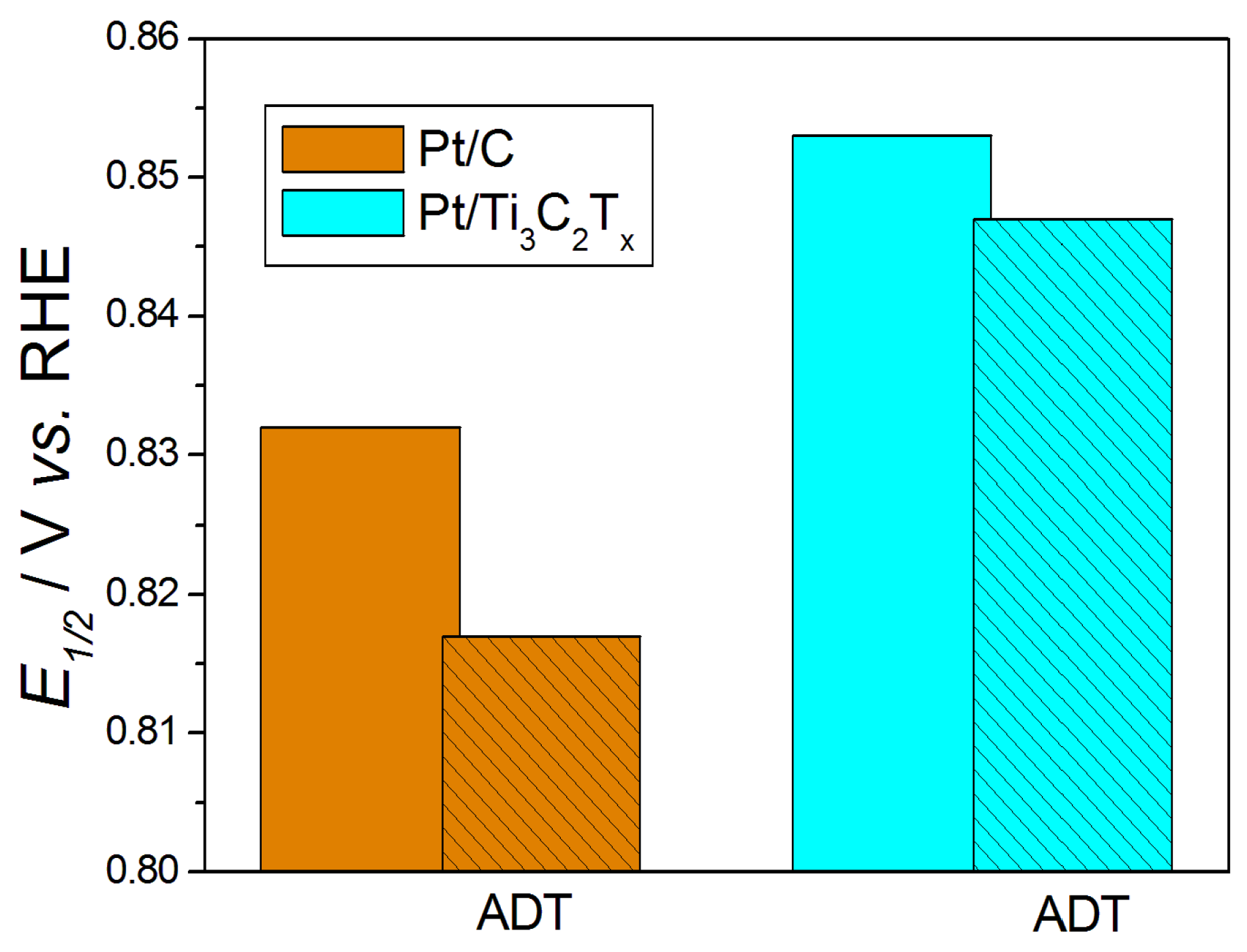
These Ti MXene-supported Pt catalysts showed much enhanced activity and durability for the ORR than Pt/C. Zhang et al. [149] investigated the ORR activity of Pt nanoparticles supported on accordion-like Ti3C2Tx nanosheets in both alkaline and acidic solutions. The Pt/Ti3C2Tx catalysts displayed enhanced ORR activity and stability compared to Pt/C, especially under alkaline conditions. As can be seen in Figure 10, before cycling, E1/2 was 0.853 V for Pt/Ti3C2Tx, 21 mV more positive than 0.832 V of Pt/C. After ADT, the E1/2 of Pt/Ti3C2Tx negatively moves to 0.847 V, 30 mV higher than Pt/C (0.817 V), indicating the outstanding ORR activity and durability of the Pt/Ti3C2Tx catalyst. Wang et al. [150] prepared a Ti3C2 MXene-supported Pt catalyst and used it for MOR for the first time. Pt/Ti3C2Tx showed outstanding MOR activity, ca. three times higher than that of Pt/C.

2.4.2. Ti3C2Tx/CNT(rGO) Composites

A drawback of the use of Ti3C2Tx nanosheets as a catalyst support is related to its aggregation or restacking, which decreases the number of the active sites and limits electron transport, reducing the catalytic performance. An effective strategy to prevent restacking of MXene nanosheets and enhance the conductivity is the addition of CNT to MXenes [151,152]. The presence of CNT, acting as spacer between the Ti3C2Tx nanosheets, can effectively prevent Ti3C2Tx restacking. Another drawback is the structure distortion of the Pt cluster induced by MXene, which is disadvantageous to oxygen desorption. This problem can also be overcome by the addition of CNT to Ti3C2Tx, stabilizing the Pt cluster [151]. Xu et al. [151] utilized a Ti3C2Tx-CNT (1:1) composite as a Pt support. The Pt/Ti3C2Tx-CNT catalyst showed higher ORR activity and durability than the conventional Pt/C catalyst. The mass activity of Pt/Ti3C2Tx-CNT was 3.4-fold greater than that of Pt/C, and the ECSA of the Pt/Ti3C2Tx-CNT catalysts showed only a 6% drop compared to Pt/C (27%) after 2000 potential cycling. Zhang et al. [152] prepared a (Ti3C2Tx)y-(MWCNTs)1−y (0 ≤ y ≤ 1) composite by a solvothermal method, where 2D Ti3C2Tx nanosheets were intercalated and connected by conductive 1D MWCNTs, avoiding Ti3C2Tx restacking. Then, Pt nanoparticles were deposited on the composite support. The Pt/(Ti3C2Tx)0.5-(MWCNTs)0.5 catalyst showed the maximum ECSA value, ascribed to the higher dispersion of Pt nanoparticles, and outstanding MOR activity and CO tolerance, higher than that of Pt/Ti3C2Tx and Pt/MWCNTs. Yang et al. [153,154] fabricated 3D hybrid architectures formed by RGO and Ti3C2Tx nanosheets as cobuilding blocks. This structure presented highly interconnected porous carbon networks, large specific surface areas, and good electron conductivity. Then, Pt and Pd were deposited on this composite for methanol [153] and formic acid [154] oxidation, respectively. The resulting 3D Pt(Pd)/RGO–Ti3C2Tx showed higher catalytic activity, CO tolerance, and long-term stability than the same catalysts supported on carbon black, CNT, RGO, and Ti3C2Tx.

3. Co-Catalyst/Additive

First, it has to be remarked that, in the literature, the difference between catalyst-metal oxide dispersion and metal oxide supported catalyst is often insufficiently underlined. In the former case, the metal oxide only acts as an additive/co-catalyst and not as a support, and the size of metal catalyst and metal oxide particles are not correlated. Whereas in the latter case, the particle size of the metal catalyst depends on, and is considerably lower than, the particle size of the metal oxide, and, in addition to its main function as a support, as previously reported, it can also have catalytic properties [15]. Generally, pure and doped TiN and TiC are not used as additives/co-catalysts in polymer electrolyte fuel cells. Thus, in the following sections, only the use of TiO2 as co-catalyst/additive in the catalyst layer will be reported and discussed.

3.1. TiO2 Co-Catalyst/Additive

When TiO2 acts as a co-catalyst, it facilitates the typical fuel cell reactions of oxygen reduction and hydrogen and low-molecular-weight alcohol oxidation, and enhances the catalytic activity of the catalyst, ascribed to the hypo-d-electron character of TiO2, generating strong interactions with hyper-d-electron character metals, such as platinum [155]. These interactions give rise to a Pt–Pt bond decrease, the inhibition of hydroxyl chemisorption, and the shift in the formation of Pt-OH to higher potentials, thus facilitating the ORR [155]. Moreover, synergistic effects between TiO2 and Pt also promote the oxidation of small organic molecules, according to the bifunctional mechanism. The bifunctional mechanism can be ascribed to the co-catalytic role of TiO2: the intermediate alcohol oxidation products, such as CO coming from the incomplete electrooxidation of methanol, adsorbed on Pt react with the OH ions adsorbed on TiO2, forming non-poisonous CO2 and refreshing the Pt active site. In the bifunctional mechanism, the following reaction takes place:
COads + OHads → CO2 + H+ + e
TiO2 can also act as an additive: in this case, it does not participate in the catalytic process, but can improve the catalytic activity in different ways, such as increasing Pt dispersion during synthesis, protecting Pt from agglomeration, enhancing the hydrophilic properties of the catalyst layer, and enhancing the proton transport.

3.1.1. TiO2 as a Cathode Co-Catalyst/Additive for the ORR

First, Shim et al. [156] evaluated the catalytic activity of carbon-supported Pt–TiO2 (TiO2 5–20%) catalysts by cyclic voltammetry and PEMFC tests. Compared to Pt/C, all the Pt-TiO2/C catalysts showed higher ECSA, MA and PEMFC performance, with a maximum performance for 15% TiO2. The adsorption strength of oxygen on a Pt surface was weakened by TiO2 presence. The enhancement of ECSA and PEMFC performance were ascribed to synergic effects, based on the adlineation model, with the formation of an interface between Pt and TiO2, and by spillover, due to surface diffusion of intermediates. Selavarani et al. [157] investigated the performance of a PEMFC with a carbon-supported Pt-TiO2 as the cathode catalyst. The PEMFC with Pt-TiO2/C in the Pt:TiO2 atomic ratio 2:1 annealed at 750 °C as the cathode catalyst delivered a power density at 0.6 V of 750 mW·cm−2, higher than that of the cell with Pt/C as the cathode catalyst (620 mW·cm−2), ascribed to the better dispersion of Pt in the Pt-TiO2 catalyst. Moreover, Pt-TiO2/C showed only 6% loss in the ECSA after 5000 potential cycles compared to 25% for Pt/C. To enhance the durability of Pt/C as cathode catalyst for PEMFCs, Chung et al. [158] prepared a TiO2-coated Pt/C (TiO2/Pt/C) by atomic layer deposition (ALD). The TiO2/Pt/C catalyst with 2 nm TiO2-protective layer showed similar ORR activity with Pt/C, but with higher durability. After ADT, the reduction of ECSA value for the Pt/C catalysts was ca. 90%, while a lower value of ECSA reduction (60%) for the TiO2/Pt/C catalysts was observed. The decrease in the PEMFC performance of the PEMFC with the Pt/C catalysts was larger than that of the cell with the TiO2/Pt/C catalysts. The TiO2 layer was effective in preventing carbon corrosion and enhancing the interaction between Pt and carbon support, avoiding Pt agglomeration, but was not effective for suppressing Pt dissolution. Chaisubanan et al. [159] incorporated three types of commercial metal oxides (CeO2, MoO2, and TiO2) on the PtCo/C catalyst layer. Among them, the catalyst with TiO2 showed the highest ORR activity and stability. The incorporation of TiO2 at low loading (0.03–0.06 mg·cm−2) increased the power density at 0.6 V of the PEMFC, with TiO2-PtCo/C as the cathode catalyst, than that of the cell with PtCo/C, due to higher ECSA, lower internal contact resistance, and better hydrophilic properties [160]. Moreover, TiO2 remarkably improved the stability in acid solution and during PEMFC operation. Pt low-coordination facets (100), (110), and (111) are the main Pt crystal planes, with (111) being the most stable due to its higher coordination number. The lower coordination sites of Pt, (100) and (110), are more soluble under harsh PEMFC operating conditions than Pt (111) [161]. The (100) and (110) sites will prompt Pt surface atoms to peel off by electrochemical oxidation and dissolution, giving rise to Pt electrochemical corrosion. A way to overcome this drawback is the use of a protective layer that selectively protects low-coordinated Pt sites [161]. On this basis, Liu et al. [162] proposed a nitrogen-doped titania (N-TiO2)-stabilized Pt/C catalyst, achieved by selective ALD of TiO2 followed by nitrogen doping. N-TiO2 selectively deposits on the low-coordination sites of Pt and keeps the exposure of Pt (111) sites, without changing their size and distribution. The selective decoration of N-TiO2 shields the low coordination sites of Pt, hindering the degradation of low-coordinated sites and preventing the electrochemical degradation and aggregation of Pt. The N-TiO2 shield enhances the ORR activity and durability of Pt/C. Pt/C@N-TiO2 was tested as the cathode catalyst. In a PEMFC, in a wide potential range, the current density of Pt/C@N-TiO2 was higher than that of Pt/C. The initial MPD of the cell with Pt/C@N-TiO2 (1300 mW·cm−2) was slight higher than that of the cell with Pt/C (1210 mW·cm−2). After 30,000 potential cycles, the MPD of the PEMFC with Pt/C showed a decrease of 19.8%, remarkably higher than the decrease of MPD of the cell with Pt/C@N-TiO2 (3.1%). The MA loss of the cell with Pt/C@N-TiO2 was only 8.3%, far less than that of the cell with Pt/C (37.9%).
A drawback of direct alcohol fuel cells is the crossover of the fuel from the anode to cathode across the proton exchange membrane. The alcohol crossover gives rise to parasitic alcohol oxidation on the cathode, leading to a mixed potential that not only lowers fuel utilization efficiency but also adversely affects the cathode performance and consequently the overall fuel cell efficiency [163]. Methanol/ethanol crossover in a DEFC can be mitigated either by using an alcohol impermeable membrane or by employing an alcohol-tolerant ORR catalyst. [163,164]. There are two types of alcohol-tolerant catalysts, that is, catalysts with lower MOR activity than Pt, reducing methanol adsorption and catalysts with higher MOR activity to decrease CO poisoning [163]. It was observed that the addition of TiO2 enhances the alcohol tolerance of Pt/C [165,166,167]. First, an improved methanol tolerance of Pt-TiO2/C (Pt:Ti = 1:1) than Pt/C was observed by Xiong and Manthiram [165], but the reason for the higher methanol tolerance was not well clarified. Then, Selvarani et al. [166] investigated the methanol tolerance of Pt-TiO2/C with different atomic ratios, prepared by the sol–gel method, followed by heat treatment at 750 °C. Pt-TiO2/C with the Pt:Ti atomic ratio of 2:1 showed enhanced methanol tolerance than Pt/C. The DMFC with Pt-TiO2/C (2:1) as the cathode catalyst delivered a higher MPD (180 mW·cm−2) than the cell with P/C as the cathode catalyst (80 mW·cm−2). The methanol adsorption–dehydrogenation process requires at least three neighboring Pt atoms (ensemble effect). As the probability of finding three neighboring Pt atoms on the surface of Pt-TiO2/C (2:1) and Pt-TiO2/C (1:1) is lower than that on Pt/C and Pt-TiO2/C (3:1) surfaces, the methanol oxidation current is lower for Pt-TiO2/C (2:1) and Pt-TiO2/C (1:1). Meenakshi et al. [167] prepared Pt-TiO2/C catalysts in different Pt:Ti atomic ratios, namely 1:1, 2:1, and 3:1, followed by heat treatment at 750 °C. Among them, the Pt-TiO2/C (2:1) catalyst showed the highest ORR activity both in the presence and the absence of ethanol. The direct ethanol fuel cell (DEFC) with Pt-TiO2/C (2:1) as the cathode catalyst delivered a MPD of 41 mW·cm−2, higher than that of the cell with Pt/C (21 mW·cm−2). The higher ethanol tolerance of the Pt-TiO2/C catalyst than that of Pt/C was ascribed to two effects. The spillover effect, where reactive species (like OH radicals) generated at the TiO2 site migrate (spillover) to the Pt site, reducing the Pt–CO bond strength and removing adsorbed CO from alcohol oxidation, and the ensemble effect, due to the presence of TiO2 around Pt active sites, blocking ethanol adsorption on Pt sites.
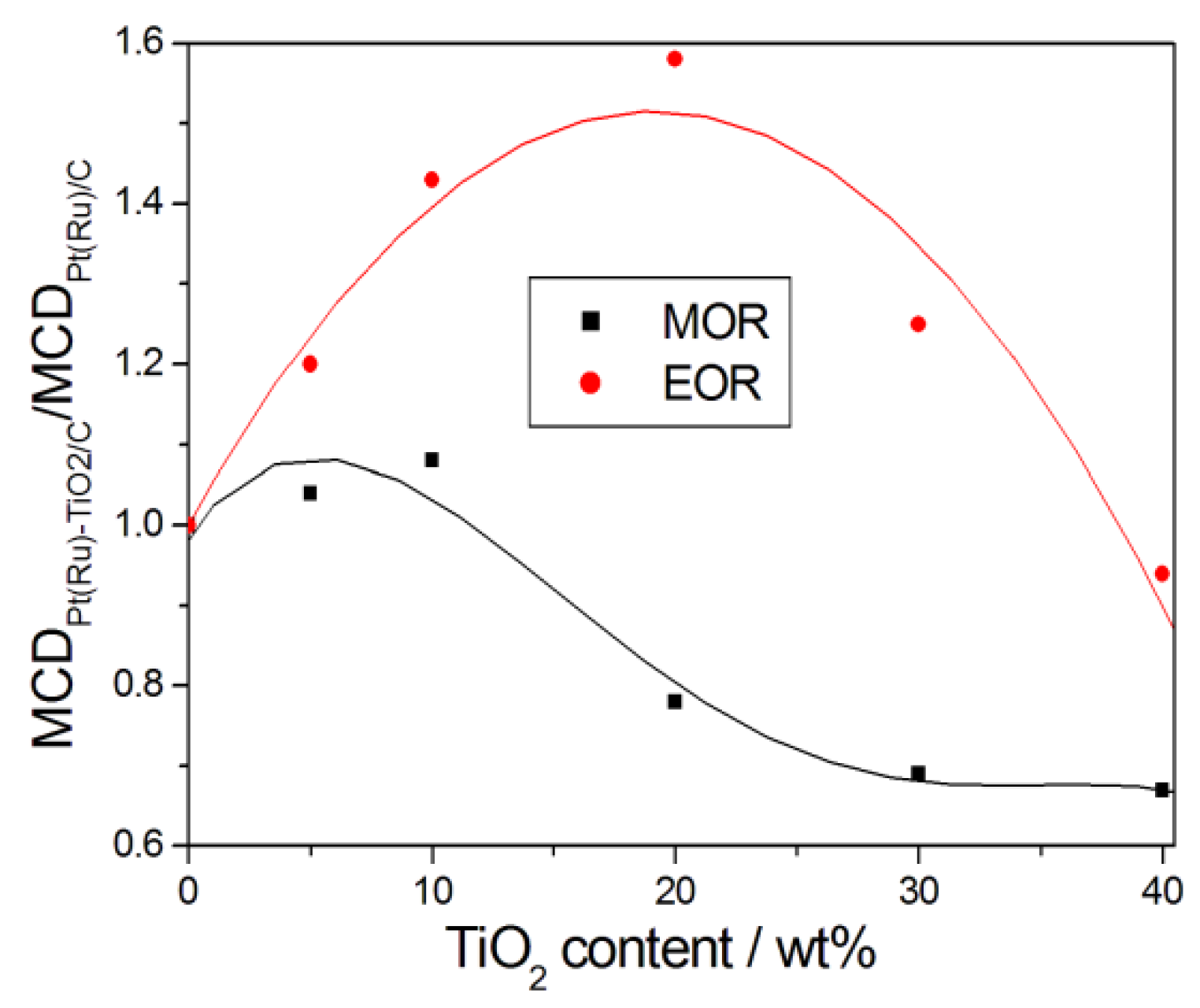
To summarize, the presence of TiO2 gives rise to two counteracting effects, both increasing the alcohol tolerance: a decrease in MOR/EOR activity by the ensemble effect, decreasing alcohol adsorption, and an increase in MOR/EOR activity due to TiO2 presence, enhancing the oxidation of CO. The former effect prevails at low TiO2 contents, while the latter is predominant for high TiO2 contents.
SO2, an air contaminant, may be fed with air at the PEMFC cathode, leading to Pt site deactivation. Thus, the improvement of the SO2 tolerance of cathode catalysts is a necessity to avoid this drawback. Liu et al. [168] tested Pt-TiO2/C as an ORR SO2-tolerant catalyst. Among different TiO2 contents, the Pt-TiO2/C catalyst with 20 wt% TiO2 showed the highest ORR activity and SO2 tolerance: the ORR kinetic current density was 20.5% higher and the degradation rate in SO2 presence was 50% lower than those of Pt/C. The fast removal of poisonous SO2 from the Pt surface was ascribed to the interaction between Pt and TiO2 as well as the high amount of hydroxyl groups on the surface of TiO2.

3.1.2. TiO2 as Anode Co-Catalyst/Additive for HOR, MOR and EOR

The use of Pt-TiO2/C and Pt-WO3-TiO2/C catalysts in the PEMFC anode electrode was reported by Shim et al. [156] and Nagarajan et al. [169,170], respectively. In all these works, the higher hydrogen oxidation (HOR) activity of Pt-TiO2 than Pt was not due to a co-catalytic effect, but to a larger ECSA. Carbon-supported Pt-WO3-TiO2 catalysts in various compositions (Pt-W-Ti 0:5:5, 2:4:4, 4:3:3, 6:2:2, 8:1:1, and 10:0:0 wt%) were investigated as anode materials [169]. Among them, the Pt-W-Ti 4:3:3 composition presented the highest HOR activity. The amount of Pt was reduced from 1.76 to 0.704 mg·cm−2. The presence of WO3-TiO2 additives improves the proton transport within the Pt surface through the inclusion of WO3-TiO2 molecules between Pt particles. In the presence of WO3-TiO2, the effective utilization of platinum was much higher than 10 wt% Pt/C. This catalyst delivered a higher performance in single PEMFC than bare Pt/C.
Many works addressed MOR [171,172,173,174,175,176,177] and EOR [175,178,179,180] on carbon-supported Pt-TiO2 catalysts, using both conventional spherical/cubo-octahedral TiO2 nanoparticle and TiO2 nanotubes (TONTs), for their use as anode catalysts in DMFCs and DEFCs, respectively. Wang et al. [171] as well as Yu and Xi [178] evaluated the effect of the amount of TiO2 nanoparticles in the Pt-TiO2 and PtRu-TiO2 catalysts on MOR and EOR activity, respectively. The dependence of the maximum current density in the presence of TiO2 (MCDPt(Ru)-TiO2/C) to the MCD of bare Pt(Ru)/C (MCDPt(Ru)/C) ratio on TiO2 content is shown in Figure 11. An optimal value of TiO2 content, that is, 10 wt% for the MOR and 20 wt% for the EOR, can be observed in Figure 11. The difference in the optimal TiO2 content could depend on the different sizes of the TiO2 nanoparticles. The improvement in MOR activity by TiO2 addition to PtRu/C was low because the MOR activity of PtRu/C is considerably higher than that of Pt/C, reducing the effect of TiO2 presence. The enhancement of MOR/EOR activity for low TiO2 content was ascribed to a synergistic effect between Pt(Ru) and TiO2 nanoparticles, facilitating the removal of CO-like intermediates from the surface of the catalyst: OH species can easily form on the surface of TiO2 during the oxidation process, facilitating the conversion of poisonous CO into CO2, according to the bifunctional mechanism. For TiO2 content above the optimal value, a percolation effect takes place: the formation of TiO2 clusters in the presence of too much TiO2 can block the path of electron transportation to the catalyst. Moreover, the alcohol adsorption–dehydrogenation process, requiring at least three neighboring Pt atoms, is reduced by the ensemble effect. In the case of PtRu/C catalysts, Ru can dissolve or be dealloyed from PtRu alloy particles during fuel cell operation [181], resulting in activity loss. In the presence of TiO2, the dissolved Ru species during fuel cell operation may be trapped on the surface of TiO2 nanoparticles, preventing dissolved Ru from diffusing into the electrolyte, improving the stability of DMFC performance [171]. This positive effect of TiO2 was also reported by Saida et al. [172]. Following an ADT by potential cycling, almost all of MOR activity of PtRu/C was lost. Conversely, in the case of PtRu- TiO2/C, methanol oxidation was still observed after ADT, with the best catalyst showing ca. 10-fold higher MOR activity than PtRu/C. The enhanced durability of the catalyst was ascribed to TiO2 suppressing the Ru loss from the catalyst.
The research group of the Shanghai Jiao Tong University investigated the effect of the addition of TONTs to low-Pt content (5%) carbon-supported PtNi on both MOR [173] and EOR [179]. The MOR activity of carbon-supported Pt(5%)Ni(10%)-TONT (10%) was higher than that of 20% Pt/C. The ECSA of PtNi-TONT/C was larger than that of the commercial PtRu/C catalyst. A lower onset potential for the EOR was observed for the PtNi-TONT/C catalyst compared to PtRu/C. The EOR current density delivered by the PtNi-TONT/C catalyst was roughly 75% of that by the Pt-Ru/C catalyst. However, the Pt content of the former was only 25% of the latter. In conclusion, the presence of TONTs modifies the electronic structure of Pt, generating more metallic sites. More hydroxide groups are also generated, facilitating the oxidative removal of the reaction intermediates.
Song et al. [180] compared the effect of TiO2 nanoparticle and TONT addition to Pt/C on the EOR activity. The ECSA for Pt-TONT/C and Pt-TiO2/C catalysts was almost the same, being 1.39 times larger than Pt/C catalyst, showing that both TONT and TiO2 can increase the ECSA of Pt. The EOR activity of Pt-TONT/C, however, was much higher than that of Pt-TiO2/C, indicating that, with respect to TiO2, the addition of TONT has other advantages besides preventing catalyst from aggregating. A reason for the higher EOR activity of Pt-TONT/C is that TONTs contain much more structural water in itself than TiO2. The TONT–OH bonds on Pt-TONT/C can directly donate hydroxide species to Pt sites to oxidize CO, leading to outstanding EOR activity. Conversely, TiO2 must activate the H2O in the electrolyte at a certain potential to form hydroxide species to oxidize CO. Another reason was the nature of hydrophilic tube-structure of TONT, which favors faster mass diffusion in the catalytic layer during ethanol oxidation. Xiao et al. [174] added titanate compounds such as nanotubes, nanobelts and nanorods to Pt/C. Following addition of these nanomaterials, the MOR activity of Pt/C remarkably increased. The 1D co-catalysts with suitable porous channels and higher proton conductivity could accelerate the methanol oxidation. Moreover, the co-catalysts contain more adsorbed and structural water could increase the oxidation of intermediates. In other works, the higher MOR/EOR activity of Pt-TiO2/C than that of Pt/C was ascribed to a uniform and enhanced Pt dispersion along with narrow size distribution with a smaller particle size [175,176], as well as decreased charge transfer resistance [177]. Finally, Zhang et al. [182] observed that the addition of TiO2 to rGO-supported Pd improved the MOR. The OH ions adsorbed on TiO2 nanoparticles contributed to converting poisonous CO to non-poisonous CO2 to refresh the active surface of Pd.

3.2. Ti as Co-Catalyst in PtTi Alloys

3.2.1. PtTi Alloys as Cathode Catalysts for the ORR

Combinatorial screenings of PtM binary and PtTiM ternary alloys for the ORR were carried out by He et al. [183,184]. Among different alloys, PtCo, PtNi, PtZn, and PtCu showed the highest ORR activity, but presented poor chemical stability in acid media. On the other hand, PtW, PtTi, and PtSe showed a low ORR activity improvement than Pt, but good chemical stability [183]. To improve the ORR activity of PtTi while maintaining high stability, PtTiM (M = Co, Cr, Cu, Fe, Mn, Mo, Ni, Pd, Ta, V, W and Zr) ternary alloys were evaluated by a thin film-based combinatorial high throughput screening. Among these PtTiM alloys, PtTiNi, PtTiCu, and PtTiV, showed the highest ORR activity, with a tenfold, an eightfold, and a sixfold enhancement compared to that of bare Pt, while maintaining a high chemical stability [184]. Different theoretical studies of PtTi nanoparticles for potential use as PEMFC catalysts were carried out by using density functional theory (DFT [185,186,187,188]. Jennings et al. [185,186] investigated the influence of PtTi alloy composition on structural properties and on the ORR kinetics and poisoning effects. Changes in d-band properties, related to changes in PtTi composition, were correlated with differences in OH- and CO-binding energies. They found that a Pt-rich PtTi alloy gives rise to a downshift in d-center, compared to bare Pt, which correlates with a weakening of the OH and CO adsorption energies. Duan et al. [187] investigated the Pt segregation on the (111) surface of an ordered Pt3Ti crystal using DFT calculations and a Monte Carlo (MC) simulation method. Through MC simulation, when Pt concentration is above 75 % (off-stoichiometry), Pt atoms tend to segregate to the surface, forming a Pt outermost layer (Pt-skin), while the second and lower layers maintain the ordered Pt3Ti structure. In addition, DFT calculations indicated that the d-band center of the Pt-segregated Pt3Ti (111) surface would downshift by 0.21 eV with respect to that of a pure Pt (111) surface. Accordingly, O adsorption energy on the Pt-segregated Pt3Ti (111) surface was weaker than that on the pure Pt (111) surface, resulting in an enhanced ORR activity on Pt3Ti alloy. The results of a DFT study on the ORR pathway on a Pt-segregated Pt3Ti (111) surface indicated that the ORR proceeds via a H2O2 dissociation mechanism, whose activation energy for the rate-determining step was remarkably lower than on the pure Pt (111) surface, explaining the experimental higher ORR activity of Pt3Ti than Pt [188]. Moreover, the DFT calculations predicted an enhanced stability of the Pt3Ti (111) surface against Pt dissolution and oxidation compared to the Pt (111) surface.
On this basis, experimental works were addressed to the evaluation of disordered and ordered PtTi alloys as ORR catalysts for their use as cathode materials in fuel cells. In all cases, the ORR activity and stability of PtTi catalysts were higher than those of bare Pt.
Disordered PtTi Alloys
The ORR activity of disordered PtTi alloys was evaluated in some works [189,190,191,192]. First, Stamenkovic et al. [189] reported a relationship in electrocatalytic trends on Pt3M (M = Ni, Co, Fe, Ti, V) surfaces between the experimentally determined surface electronic structure (the d-band center) and ORR activity. This relationship exhibits ‘volcano-type’ behavior, and among these Pt3M catalysts, the ORR activity of Pt3Ti was the lowest, only slightly higher than that of bare Pt, confirming the results of the combinatorial screening of PtM alloys [183]. Ding et al. [190] synthesized carbon-supported disordered PtTi alloy nanoparticles with different Pt:Ti ratios by heat treatment at temperatures from 500 °C to 950 °C, a H2/N2 atmosphere using Pt2(dba)3 (dba = bis-dibenzylidene acetone), and TiCl4(THF)2 as precursors. Among the various compositions, Pt75Ti25 showed the highest ORR activity, with a twofold improvement compared to Pt/C. Duan et al. [191] fabricated hierarchical nanoporous (HNP) PtTi alloy with bimodal pore/ligament size distributions and controllable bimetallic ratio from a Pt10Ti10Al80 alloy by a two-step dealloying process. The HNP Pt3Ti alloy showed higher specific activity than Pt/C and nanoporous Pt. Moreover, the mass activity of HNP Pt3Ti was nearly 3.0 times of that of Pt/C and 2.5 times of that of nanoporous Pt. This result was ascribed to the hierarchical ligament/pore structure and the alloying effect of Ti in the Pt–skin surface alloy. The stability of HNP PtTi, nanoporous Pt and Pt/C was also evaluated by a potentiostatic method. At the beginning the potentiostatic currents decreased rapidly for all catalysts due to the formation of double layer capacitance. Then, the current decreased with time due to the loss of surface active sites caused by the adsorption of intermediate species on the catalyst surface. The current decay on HNP Pt75Ti25 was much slower than on nanoporous Pt and Pt/C catalysts. After 3600 s, the currents of the HNP Pt3Ti alloy showed a value of 24% of the initial current, while that of nanoporous Pt and Pt/C decreased to 16% and 7%. Kim et al. [192] fabricated glass carbon (GC)-supported Pt and Pt/TiO2 catalysts by plasma-enhanced atomic layer deposition (PEALD) at a substrate temperature of 250 °C. Trimethyl(methyl-cyclopentadienyl) platinum (IV) and tetrakis(dimethylamido) titanium were used as the Pt and Ti precursors. Then, the Pt deposited on TiO2 layer was submitted to thermal annealing in H2 at temperatures between 500 and 900 °C, leading to the formation of a Pt3Ti alloy. The catalyst annealed at 800 °C showed a MA increase of more than 2 times compared to pure Pt nanoparticles prepared by ALD and commercial Pt/C. A 3-fold improvement of the specific activity for the ALD Pt3Ti catalyst compared to a polycrystalline Pt electrode was observed. The improvement of the ORR activity of the Pt3Ti alloy was ascribed to a combination of strain and ligand effects. Moreover, the ORR activity of Pt3Ti was retained following 10,000 ADT cycles, due to the intrinsic stability of the bulk Pt3Ti, as supported by a near-negligible amount of Ti dissolution.
Ordered PtTi Alloys
As reported in a recent review [193], the ORR-specific activity and the stability of ordered A3M, AM3, and AM (A = Pt, Pd; M = first row transition metal) catalysts were higher than those of the disordered ones. However, the synthesis of ordered platinum titanium nanoparticles with small particle size is a challenge, as they have to be synthesized at high temperatures (≥700 °C) under H2 atmosphere, due to the high oxophilicity of Ti and the significantly different reversible potentials for the reduction of Pt vs. Ti ions [192]. Nanoparticle agglomeration occurs during the thermal treatment, limiting the use of traditional synthesis techniques. To address the aggregation of nanoparticles, Pt3Ti alloy nanoparticles were synthesized at 700 °C in a surfactant-free-KCl matrix [194], or sulfur anchoring was used to limit particle aggregation [195]. Herzog et al. [196] varied wet-chemical synthesis parameters such as reductive annealing temperatures and precursor ratios and studied their effect on the phase structure, particle size, alloying degree, and ordering degree. They observed that, by adjusting the initial Ti amount at a reduction temperature of 700 °C, it is possible to prepare a PtTi/C catalyst, with a maximum amount of Ti being alloyed in the disordered PtTi and ordered Pt3Ti phases without the major formation of TiO2 crystallites and excessive particle growth. Jeon and McGinn [197] prepared Pt100−xTix/C (x = 0, 25, 50, and 75) catalysts by sequential impregnation of Pt and Ti on the carbon support followed by annealing at 900 °C under H2/Ar. The sizes of the Pt-Ti crystallites were 2.4, 4.2, 5.1, 5.7, and 6.7 nm for the Pt/C, Pt/C-900, and annealed Pt75Ti25/C-900, Pt50Ti50/C-900, and Pt25Ti75/C-900 catalysts, respectively. The annealed Pt-Ti catalysts were mixtures of Pt, Pt3Ti, Ti3O5, and a small amount of TiO2. The presence of the ordered Pt3Ti phase was observed in both the Pt50Ti50/C-900 and Pt25Ti75/C-900 catalysts, whereas the Pt3Ti phase was not observed in the Pt75Ti25/C-900 catalyst, although the composition of this catalyst is the same than the Pt3Ti phase. The ORR-specific activity of the Pt75Ti25/C catalyst only slightly increased to 15 μA·cm−2 compared with 11.9 and 13.8 μA·cm−2 values of the Pt/C and Pt/C-900 catalysts, respectively. Conversely, the ORR-specific activity of the Pt50Ti50/C-900 and Pt25Ti75/C-900 catalysts remarkably increased to 32.3 and 30.2 μA·cm−2, respectively. The high ORR activity of these catalysts was ascribed both to TiO2 and Pt3Ti presence. The methanol tolerance of these catalysts was also investigated: as expected, due to the higher MOR activity, in the presence of methanol, both the Pt50Ti50/C-900 and Pt25Ti75/C-900 catalysts showed poor ORR activity. Park et al. [198] synthesized carbon-supported ordered Pt-Ti alloy nanoparticles by wet chemical reduction of Pt and Ti precursors, followed by heat treatment at 800 °C. The catalysts with Ti precursor molar compositions of 40% and 25% formed ordered Pt3Ti and Pt8Ti phases, respectively. The ORR polarization curves of the catalysts before and after 1500 electrochemical cycles between 0.6 and 1.1 V showed little change, indicating the high stability of the ordered Pt3Ti and Pt8Ti alloys, while Pt/C showed a low stability. Farid et al. [199] prepared PtTiC catalysts by plasma magnetron co-sputtering of Pt and Ti at high Ar pressure. The formation of the intermetallic Pt3Ti phase was observed. Deposition at 0.15 mbar Ar pressure results in the formation of conical nanopillars like structures with a high ECSA, playing an essential role in the electrochemical activity, durability, and cell performance of the catalyst. The best assembled MEA showed a MPD of 604 mW·cm−2, close to that of the MEA with Pt/C (618 W·cm−2). Moreover, for the PtTi catalyst, nine-times higher MA power density and five-times higher SA power density were obtained compared to Pt/C. Kim et al. [200] prepared carbon-supported ordered Pt3Ti nanoparticles using a commercial Pt/C catalyst as the starting material. A TiO2 overlayer was formed on the Pt/C by hydrolysis of titanium (IV) butoxide in the presence of benzyl alcohol, followed by annealing at 700 °C in flowing H2. The Pt3Ti nanoparticles were well distributed on the carbon surface with an average size of 4.2 nm. The presence of TiO2 layers avoided nanoparticle aggregation during the thermal annealing. Conversely, when the Pt/C was annealed in the absence of TiO2 layers, the particle size increased from 3.2 to 6.2 nm.
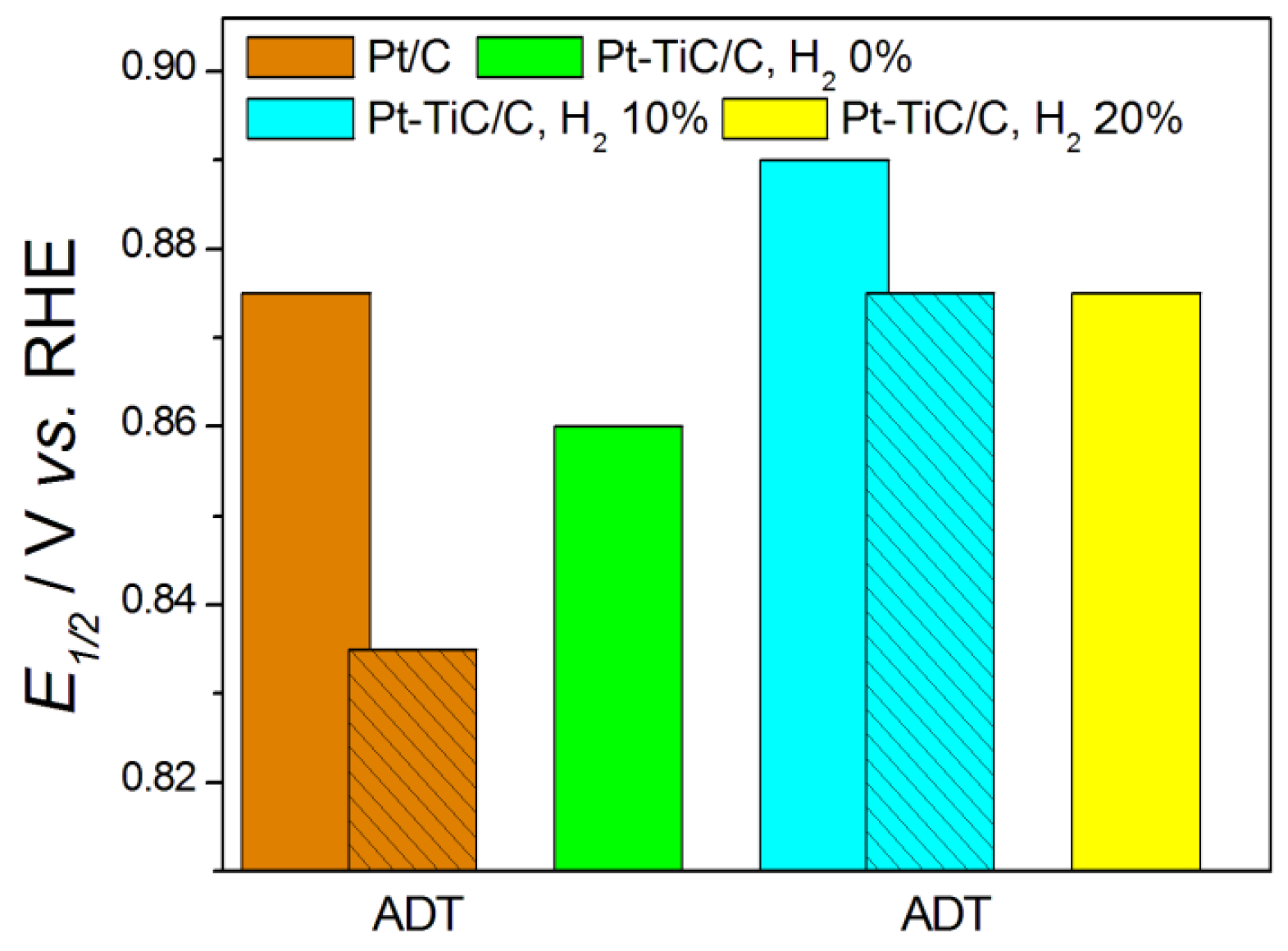
As can be seen in the histograms of Figure 12, among all catalysts, the Pt-Ti/C prepared with 10 vol% H2 flow had the highest E1/2. This catalyst showed a lower change in E1/2 than Pt/C after ADT, indicating a higher stability of Pt-Ti/C 10% H2 than Pt/C. The intermetallic Pt–Ti/C showed enhanced mass activity and durability for the ORR, and, following an ADT, unlike Pt/C, the ECSA showed little change. Gunji et al. [201] prepared carbon-supported Pt-Ti alloy nanoparticles. The as-prepared spherical Pt-Ti NPs were disordered and surrounded by high-index facets. After vacuum-annealing, ordered Pt0.75Ti0.25 alloy nanoparticles, surrounded by the low-index (111) facets and with low surface area, were obtained. Notwithstanding the ORR activity of the ordered structure needing to be higher than that of the disordered one, the spherical Pt-Ti alloy nanoparticles showed higher ORR activity than pure Pt or even faceted Pt0.75Ti0.25 alloy nanoparticles.
Compared to binary alloys, ternary alloys present a higher flexibility in tuning the Pt electronic structure for catalyst optimization [202]. Zhao et al. [203] synthesized ordered Pt3Co0.6Ti0.4 nanoparticles (∼3 nm) supported on ZIF-8-derived mesoporous carbon (Pt3Co0.6Ti0.4/DMC). The Pt3Co0.6Ti0.4/DMC catalyst showed faster ORR kinetics than Pt3Co/DMC and Pt/C with minimal activity loss (20.1%) and only 5 mV decay in half-wave potential after 20,000 potential cycles. More importantly, its improved performances was confirmed by a H2/air PEMFC test. Theoretical calculations indicated that the substitution of Ti for Co gives rise to a strengthened ligand effect and optimizes the surface electronic structure of Pt3Co0.6Ti0.4, leading to a remarkably enhanced ORR activity.

3.2.2. PtTi Alloys as Anode Catalysts for the MOR

Both atomically disordered and ordered Pt-Ti alloy nanoparticles show a much lower affinity for CO adsorption than either pure Pt or PtRu nanoparticles: The interaction with Ti modifies the electronic structure of Pt, altering the d-band center, which weakens CO binding and promotes faster reaction kinetics. As reported in the previous section, Jeon and McGinn [197] prepared Pt100−xTix/C (x = 0, 25, 50, and 75) catalysts by sequential impregnation of Pt and Ti on the carbon support followed by annealing at 900 °C under H2/Ar. The presence of the ordered Pt3Ti phase was observed in both the Pt50Ti50/C-900 and Pt25Ti75/C-900 catalysts. The Pt50Ti50/C-900 and Pt25Ti75/C-900 catalysts showed 103% and 198% higher MOR activity, respectively, than Pt/C-900 catalyst at 0.7 V vs. RHE. Abe et al. [204] synthesized Pt3Ti alloy nanoparticles by reducing Pt(1,5-cyclooctadiene)Cl2 and Ti(tetrahydrofuran)2Cl4 with sodium naphthalide in tetrahydrofuran, forming atomically disordered Pt3Ti nanoparticles (particle size 3 nm). These atomically disordered Pt3Ti nanoparticles were transformed to larger atomically ordered Pt3Ti nanoparticles (particle size = 37 nm) by annealing at temperatures > 400 °C. Atomically ordered Pt3Ti nanoparticles showed higher methanol oxidation current densities than pure Pt, PtRu, or atomically disordered Pt3Ti nanoparticles. Cui et al. [189] prepared ordered Pt3Ti nanoparticle catalysts with ultra-small particle sizes by a KCl-nanoparticle method. This catalyst showed enhanced catalytic activity and stability for methanol oxidation compared to pure Pt.
Two papers reported an effective strategy of coupling Pt-Ti intermetallics with TiOx to develop highly active MOR catalysts [200,201]. Sanetuntikul et al. [205] prepared Pt-titanium intermetallic nanoparticles on a unique hierarchical carbon/TiO2 structure, consisting of Pt8Ti and TiO2 nanoparticles dispersed in N-doped carbon. The Pt8Ti-TiO2/C catalyst showed a 50 mV positive onset potential and 10 times higher SA for the MOR than Pt/C. A DMFC with Pt8Ti-TiO2/C as the anode catalyst showed 4.6 times higher power density than that with Pt/C as the anode catalyst at 0.35 V and 60 °C. Moreover, Pt8Ti-TiO2/C showed an ECSA decay of 23% after 3000 CV cycles, whereas Pt/C catalyst showed a decay of 90%. The outstanding stability of Pt8Ti-TiO2/C was ascribed to TiO2, which is chemically resistant in the electrolyte medium. Similarly, Zhang et al. [206] prepared a carbon-supported intermetallic Pt3Ti nanocatalyst coupled with amorphous TiOx (Pt3Ti-TiOx/C). The TiOx not only confines Pt3Ti nanoparticles during the synthesis and electrocatalytic process by a strong metal–oxide interaction but also promotes H2O dissociation to form more OH species, supporting the conversion of adsorbed CO. The Pt3Ti-TiOx/C catalyst showed a remarkable enhancement of MA (2.15 A·mgPt–1) for methanol oxidation compared with Pt3Ti/C and Pt/C, as well as a high MA retention (~71%) after the durability test.

4. Conclusions and Perspectives

Due to their high corrosion resistance and chemical stability, titanium-based compounds, such as TiO2, TiN, TiC, and Ti3C2Tx, are potential supports for PEMFC catalysts. Among them, TiO2 was the most widely investigated fuel cell catalyst support for its co-catalytic effect, not present in the other Ti-based compounds. Among transition metal oxides, TiO2 is the most widely used carbon-alternative fuel cell catalyst support for its low cost, high stability, low toxicity, excellent corrosion resistance, and strong metal–support interaction. A drawback regarding the use of TiO2 nanoparticles as catalyst supports, however, is mainly their poor electrical conductivity as well as their low surface area, giving rise to low Pt nanoparticle dispersion. To overcome this hindrance, the use of TiO2 mixed with or supported on carbon materials, doped-TiO2, shaped/nanostructured TiO2, substoichiometric TiO2, and TiO2 mixed with inorganic oxides were proposed.
TiN and TiC were used in the form of pure nanoparticles and, for TiO2, as pure and doped carbon composites. More recently, two-dimensional MXenes also emerged as potential Pt catalyst supports. However, few tests were carried out in fuel cells for TiN-, TiC-, and Ti Xenes-supported catalysts.
The use of Ti-based compound/carbon-based composites is useful in improving the catalytic activity of Ti-base compounds, but they present the same problems of stability during fuel cell operation observed for pure carbon materials. The limited use of TiC as a PEMFC catalyst support in PEMFC can be related to its instability at temperatures > 60 °C and/or acidic condition with the formation of a non-conductive TiO2 layer. To summarize, all Ti-based supported catalysts showed considerably higher stability than the same catalysts supported on carbon. However, they also present, albeit to a lesser degree, instability under acidic or high-temperature/high potential conditions. TiN behaves passively in sulfuric acid media at temperatures higher than 60 °C, due to the formation of –OH groups on its surface, which reduces its electrical conductivity, thereby inhibiting its electron transportation properties. After a solubility test at 95 °C, the TiC phase remained unchanged. However at 200 °C, some TiO2, which is insoluble in acidic media, was observed, indicating that TiC is not stable at 200 °C in 1.0 M H2SO4. TiC is electrochemically unstable and undergoes a surface oxidation at around 0.95 V. The formation of insulating titanium oxycarbide or oxide can be catalyzed by the presence of Pt, modifying the metal–support interface. Therefore, the electron-blocking oxycarbide or oxide layer lowers the overall activity of the catalyst. In addition, the gaseous product of TiC electrooxidation cannot cause the detachment of Pt from the support surface, seriously decreasing the catalyst performance. TiO2 is the most stable: it is insoluble in dilute alkali and dilute acid, but soluble in hot concentrated sulfuric acid.
Some types of Ti-based compounds and the catalytic activity of supported catalysts are reported in Table 1. A concise comparison of Ti-based supports, conventional carbon supports, and Ti–carbon hybrid systems in terms of key properties such as electrical conductivity, durability, and catalytic performance is reported in Table 2.
Future research directions should address hybrid support systems that combine titanium-based materials with highly conductive nanostructures, such as MXenes, graphene, or carbon nanotubes. These hybrid systems may simultaneously improve electrical conductivity and corrosion resistance while maintaining strong metal–support interactions.
TiO2 was also used as a co-catalyst/additive in carbon-supported catalysts for the ORR and MOR with promising results. Due to their high stability, PtTi alloys were investigated as ORR catalysts, but their activity for oxygen reduction was lower than that most PtM alloys (M = transition metal). The ORR and MOR activities of ordered PtTi alloys were higher than those of disordered ones, but ordered alloys have to be prepared at high temperatures, leading to a decrease in their surface area. The catalytic activity of carbon-supported catalyst with TiO2 and PiTi co-catalyst/additives is reported in Table 3.
Some challenges, such metal leaching and scalability, are related to the use of non-carbon support for fuel cell catalysts. Up till now, no complete non-carbon supports that do not leach in the catalyst layer have been reported. Metals used in non-carbon supports, such as TiO2 and Ti4O7, leach as cations to some extent. The leached cations exchange H+ in the sulfate groups in catalyst layers and membranes, decreasing proton conductivity. It was reported that Ta-doped TiOx, possessing radical scavenging properties, can suppress leaching [207]. On this basis, future works should deal on doped Ti-based supports to reduce the amount of Ti leaching. To suppress titanium ion dissolution in acidic PEMFC environments and improve the durability of titanium-based supports, several surface protection technologies can be applied beyond titanium doping. These technologies focus on creating dense, conductive, and corrosion-resistant protective layers or on modifying the surface chemistry to enhance SMSI.
The synthesis of supported catalysts can be difficult to scale up without affecting their characteristics. Few studies have addressed large-scale production of carbon- and non-carbon-supported catalysts. Many catalysts reported in the literature use samples no larger than a few dozen milligrams. Few works on the scalability of Ti-base supports have been reported [208,209,210]. Ti4O7 is a promising carbon-free conductive material due to its high electrical conductivity and electrochemical stability, but this compound was not widely used, due to the difficulty of its mass production. To overcome this drawback, Chisaka et al. [208] developed a novel and inexpensive way to increase the production batch size, that is, the mass of carbon-free Ti4O7 synthesized in a single reaction. By doping Ti4O7 with vanadium by using a conventional high-temperature synthesis route, the production batch size was successfully increased. V cations were found to not exist in the V5+ form, instead being reduced to V4+/V3+ in the Ti4O7 lattice without segregating to form other phases, and the production batch size increased with increasing V/Ti atomic ratio up to 0.10, resulting in the synthesis of 2 g of (Ti0.91V0.09)4O7. By increasing the V/Ti ratio to 0.20, the vanadium species segregated to form a mixture of Ti4O7 and (Ti0.5V0.5)2O3 or V2O3 phases. Scaling the production of 2D materials is a challenge due to synthesis bottlenecks. This challenge typically comes from bottom-up synthesis, limiting the production to the substrate size or precursor availability for chemical synthesis and/or exfoliation. Conversely, MXenes, a large class of 2D TMN and/or TMC, are obtained by a top-down synthesis. The selective wet etching process does not have similar synthesis constraints as with some other 2D materials. The reaction occurs in the whole volume; the process can be readily scaled with reactor volume. On this basis, Schuck et al. [209] prepared 2D Ti3C2Tx using two batch sizes, 1 and 50 g, to be evaluated if large-volume synthesis influences the structure or composition of MXene flakes. They observed that the materials obtained in both batch sizes are essentially identical, indicating that Ti MXenes structure or properties do not change with scaling synthesis. Liu et al. [210] used a molten-salt flux method to synthesize large quantities of single-crystalline TiO2 nanowires with controllable dimensions. In addition, in situ dopant incorporation of different transition metals allows us to modulate the catalytic properties. Future works should focus the identification of new methods, such as metal doping, to increase batch size of Ti-based supports, maintaining their properties.

Funding

This research received no external funding.

Data Availability Statement

No new data were created in this study. Data sharing is not applicable to this article.

Conflicts of Interest

The author declares no conflicts of interest.

References

  1. Qasem, N.A.A.; Abdulrahman, G.A.Q. A recent comprehensive review of fuel Cells: History, types, and applications. Int. J. Energy Res. 2024, 2024, 7271748. [Google Scholar] [CrossRef]
  2. Osman, S.H.; Kamarudin, S.K.; Shaari, N.; Zakaria, Z. Low-temperature fuel cell technology development and issues: An overview. Arab. J. Sci. Eng. 2025, 50, 9675–9688. [Google Scholar] [CrossRef]
  3. Su, H.; Hu, Y.H. Progress in low-temperature solid oxide fuel cells with hydrocarbon fuels. Chem. Eng. J. 2020, 402, 126735. [Google Scholar] [CrossRef]
  4. Vallejo-Cervantes, C.; Espinoza-Andaluz, M.; Iranzo, A. Technical review of commercial LT-PEMFC technologies: Performance, applications and challenges. Int. J. Hydrogen Energy 2025, 176, 151480. [Google Scholar] [CrossRef]
  5. Okonkwo, P.C. Proton exchange membrane fuel cell catalyst layer degradation mechanisms: A succinct review. Catalysts 2025, 15, 97. [Google Scholar] [CrossRef]
  6. Abdullah, N.; Kamarudin, S. Titanium dioxide in fuel cell technology: An overview. J. Power Sources 2015, 278, 109–118. [Google Scholar] [CrossRef]
  7. Liu, R.; Jia, Q.; Zhang, B.; Lai, Z.; Chen, L. Protective coatings for metal bipolar plates of fuel cells: A review. Int. J. Hydrogen Energy 2022, 47, 22915–22937. [Google Scholar] [CrossRef]
  8. Ding, R.; Li, Y.; Liu, J.; Zhan, K.; Jiang, X.; Wang, Z.; Zhao, B.; Li, D.; Ji, V. Recent progress in the preparation and performance of protective coatings on metal bipolar plates of proton exchange membrane fuel cells—A review. Appl. Mater. Today 2025, 42, 10256. [Google Scholar]
  9. Antolini, E. Transition metal nitrides: Essential and potential use in low-temperature fuel cells. J. Electroanal. Chem. 2025, 979, 118926. [Google Scholar] [CrossRef]
  10. Saha, S.; Rajbongshi, B.M.; Ramani, V.; Verma, A. Titanium carbide: An emerging electrocatalyst for fuel cell and electrolyser. Int. J. Hydrogen Energy 2021, 46, 12801–12821. [Google Scholar] [CrossRef]
  11. Huang, W.X.; Li, Z.P.; Li, D.D.; Hu, Z.H.; Wu, C.; Lv, K.L.; Li, Q. Ti3C2 MXene: Recent progress in its fundamentals, synthesis, and applications. Rare Met. 2022, 41, 3268–3300. [Google Scholar]
  12. Junaidi, N.H.A.; Wong, W.Y.; Loh, K.S.; Rahman, S.; Daud, W.R.W. A comprehensive review of MXenes as catalyst supports for the oxygen reduction reaction in fuel cells. Int. J. Energy Res. 2021, 45, 15760–15782. [Google Scholar] [CrossRef]
  13. Pei, D.N.; Gong, L.; Zhang, A.Y.; Zhang, X.; Chen, J.J.; Mu, Y.; Yu, H.Q. Defective titanium dioxide single crystals exposed by high-energy {001} facets for efficient oxygen reduction. Nat. Commun. 2015, 6, 8696. [Google Scholar] [CrossRef]
  14. Avasarala, B.; Haldar, P. On the stability of TiN-based electrocatalysts for fuel cell applications. Int. J. Hydrogen Energy 2011, 36, 3965–3974. [Google Scholar] [CrossRef]
  15. Antolini, E.; Gonzalez, E.R. Ceramic materials as supports for low-temperature fuel cell catalysts. Solid State Ion. 2009, 180, 746–763. [Google Scholar] [CrossRef]
  16. Sinniah, J.D.; Wong, W.Y.; Loh, K.S.; Yunus, R.M.; Timmiati, S.N. Perspectives on carbon-alternative materials as Pt catalyst supports for a durable oxygen reduction reaction in proton exchange membrane fuel cells. J. Power Sources 2022, 534, 231422. [Google Scholar] [CrossRef]
  17. Cao, X.l.; Li, Q.X.; Yao, Y.F.; Xu, Q.J. Recent progress for TiO2 as the support of electrocatalysts in fuel cell applications. Adv. Mater. Res. 2013, 860–863, 812–815. [Google Scholar] [CrossRef]
  18. Chen, K.; Shen, T.; Lu, Y.; Hu, Y.; Wang, J.; Zhang, J.; Wang, D. Engineering titanium oxide-based support for electrocatalysis. J. Energy Chem. 2022, 67, 168–183. [Google Scholar] [CrossRef]
  19. Antolini, E. Photo-assisted methanol oxidation on Pt-TiO2 catalysts for direct methanol fuel cells: A short review. Appl. Catal. B Environ. 2018, 237, 491–503. [Google Scholar] [CrossRef]
  20. Antolini, E. Composite materials: An emerging class of fuel cell catalyst supports. Appl. Catal. B Environ. 2010, 100, 413–426. [Google Scholar]
  21. Li, X.H.; Li, X.S.; Zhu, X.; Di, L.B.; Zhu, A.M. TiO2-carbon supported platinum electrocatalysts for oxygen reduction reaction: Synthesis, high activity and enhanced durability. Int. J. Hydrogen Energy 2024, 51, 1508–1517. [Google Scholar] [CrossRef]
  22. Timperman, L.; Gago, A.S.; Alonso-Vante, N. Oxygen reduction reaction increased tolerance and fuel cell performance of Pt and RuxSey onto oxide–carbon composites. J. Power Sources 2011, 196, 4290–4297. [Google Scholar] [CrossRef]
  23. Wang, Z.; Jin, X.; Chen, F.; Kuang, X.; Min, J.; Duan, H.; Li, J.; Chen, J. Oxygen vacancy induced interaction between Pt and TiO2 to improve the oxygen reduction performance. J. Colloid Interface Sci. 2023, 650, 901–912. [Google Scholar] [CrossRef] [PubMed]
  24. Cao, F.; Zhang, H.; Duan, X.; Li, X.; Ding, R.; Hua, K.; Rui, Z.; Wu, Y.; Yuan, M.; Wang, J.; et al. Coating porous TiO2 films on carbon nanotubes to enhance the durability of ultrafine PtCo/CNT nanocatalysts for the oxygen reduction reaction. ACS Appl. Mater. Interfaces 2022, 14, 51975–51982. [Google Scholar] [CrossRef] [PubMed]
  25. Yan, A.; Wang, X.; Zhu, L.; Liu, X.; Wang, Z. Oxygen vacancy strategy enhancing the performance of TiO2/CNT supported ultrafine Pt catalyst for the oxygen reduction reaction. J. Electroanal. Chem. 2024, 974, 118734. [Google Scholar] [CrossRef]
  26. Yoon, Y.H.; Lee, S.; Kim, M.; Park, J.; Son, H.; Kim, M.; Tak, Y.; Lee, G. Highly durable Pt electrocatalyst on a hybrid support for boosting the sustainability of polymer electrolyte membrane fuel cells. Int. J. Hydrogen Energy 2024, 74, 392–403. [Google Scholar] [CrossRef]
  27. Bhaskaran, R.; Selvaganesh, S.V.; Dhanasekaran, P.; Chetty, R. Hybrid 1D titanium oxide nanowire—Reduced graphene oxide nanocomposites as efficient catalyst support for PEMFC. Electrochim. Acta 2024, 496, 144517. [Google Scholar] [CrossRef]
  28. Sekhar, Y.C.; Raghavendra, P.; Maiyalagan, T.; Loka, S.S. Bimetallic platinum–ruthenium nanoparticles immobilized on reduced graphene oxide-TiO2 (RGO-TiO2) support for ethanol electro oxidation in acidic media. Int. J. Hydrogen Energy 2022, 47, 40407–40414. [Google Scholar]
  29. Sravani, B.; Chandrashekar, Y.; Chandana, P.S.; Maiyalagan, T.; Sarma, L.S. Bimetallic PtCu-decorated reduced graphene oxide (RGO)-TiO2 nanocomposite for efficient oxygen reduction reaction. Synth. Met. 2020, 266, 116433. [Google Scholar] [CrossRef]
  30. Pan, X.; Zhao, Y.; Liu, S.; Korzeniewski, C.L.; Wang, S.; Fan, Z. Comparing graphene-TiO2 nanowire and graphene-TiO2 nanoparticle composite photocatalysts. ACS Appl. Mater. Interfaces 2012, 4, 3944–3950. [Google Scholar]
  31. Hitosugi, T.; Kamisaka, H.; Yamashita, K.; Nogawa, H.; Furubayashi, Y.; Nakao, S.; Yamada, N.; Chikamatsu, A.; Kumigashira, H.; Oshima, M.; et al. Electronic band structure of transparent conductor: Nb-doped anatase TiO2. Appl. Phys. Exp. 2008, 1, 111203. [Google Scholar] [CrossRef]
  32. Sheppard, L.R.; Bak, T.; Nowotny, J. Electrical properties of niobium-doped titanium dioxide. 3. Thermoelectric Power. J. Phys. Chem. C 2008, 112, 611–617. [Google Scholar] [CrossRef]
  33. Nguyen, S.T.; Yang, Y.; Wang, X. Ethanol electro-oxidation activity of Nb-doped-TiO2 supported PdAg catalysts in alkaline media. Appl. Catal. B Environ. 2012, 113, 261–270. [Google Scholar] [CrossRef]
  34. Huang, S.Y.; Ganesan, P.; Popov, B.N. Electrocatalytic activity and stability of niobium-doped titanium oxide supported platinum catalyst for polymer electrolyte membrane fuel cells. Appl. Catal. B Environ. 2010, 96, 224–231. [Google Scholar] [CrossRef]
  35. Sun, S.; Zhang, G.; Sun, X.; Cai, M.; Ruthkosky, M. Highly stable and active Pt/Nb-TiO2 carbon-free electrocatalyst for proton exchange membrane fuel cells. J. Nanotechnol. 2012, 2012, 389505. [Google Scholar] [CrossRef]
  36. Xu, W.; Yan, L.; Wang, H.; Liaw, S.; Luo, H. Niobium-doped titanium dioxide on a functionalized carbon supported palladium catalyst for enhanced ethanol electro-oxidation. RSC Adv. 2017, 7, 34618–34623. [Google Scholar] [CrossRef]
  37. Kim, M.; Kwon, C.R.; Eom, K.S.; Kim, J.H.; Cho, E.A. Electrospun Nb-doped TiO2 nanofiber support for Pt nanoparticles with high electrocatalytic activity and durability. Sci. Rep. 2017, 7, 44411. [Google Scholar] [CrossRef]
  38. He, C.; Sankarasubramanian, S.; Matanovic, I.; Atanassov, P.; Ramani, V. Understanding the oxygen reduction reaction activity and oxidative stability of Pt supported on Nb-doped-TiO2. ChemSusChem 2019, 12, 3468–3480. [Google Scholar] [CrossRef]
  39. Noh, K.J.; Nam, I.; Han, J.W. Nb-TiO2 nanotubes as catalyst supports with high activity and durability for oxygen reduction. Appl. Surf. Sci. 2020, 521, 146330. [Google Scholar] [CrossRef]
  40. Park, K.W.; Seol, K.S. Nb-TiO2 supported Pt cathode catalyst for polymer electrolyte membrane fuel cells. Electrochem. Commun. 2007, 9, 2256–2260. [Google Scholar] [CrossRef]
  41. Elezovic, N.R.; Babic, B.M.; Radmilovic, V.R.; Vracar, L.; Krstajic, N.V. Nb–TiO2 supported platinum nanocatalyst for oxygen reduction reaction in alkaline solutions. Electrochim. Acta 2011, 56, 9020–9026. [Google Scholar] [CrossRef]
  42. Garcia, B.L.; Fuentes, R.; Weidner, H.W. Low-temperature synthesis of a PtRu/Nb0.1Ti0.9O2 electrocatalyst for methanol oxidation. Electrochem. Solid-State Lett. 2007, 10, B108–B110. [Google Scholar] [CrossRef]
  43. Chevallier, L.; Bauer, A.; Cavaliere, S.; Hui, R.; Roziere, J.; Jones, D.J. Mesoporous nanostructured Nb-doped titanium dioxide microsphere catalyst supports for PEM fuel cell electrodes. ACS Appl. Mater. Interfaces 2012, 4, 1752–1759. [Google Scholar] [CrossRef]
  44. Choi, H.; Kim, J.; Lee, G.; Tak, Y. Nb-doped TiO2 support with enhanced durability as a cathode for polymer electrolyte membrane fuel cells. Nanotechnology 2020, 31, 03LT01. [Google Scholar] [CrossRef]
  45. Kim, J.H.; Kwon, G.; Lim, H.; Zhu, C.; You, H.; Kim, Y.T. Effects of transition metal doping in Pt/M-TiO2 (M = V, Cr, and Nb) on oxygen reduction reaction activity. J. Power Sources 2016, 320, 188–195. [Google Scholar] [CrossRef]
  46. Barthi, A.; Cheruvally, G. V-doped TiO2 supported Pt as a promising oxygen reduction reaction catalyst: Synthesis, characterization and in-situ evaluation in proton exchange membrane fuel cell. J. Power Sources 2017, 363, 413–421. [Google Scholar]
  47. Dhanasekaran, P.; Selvaganesh, S.V.; Bhat, S.D. Nitrogen and carbon doped titanium oxide as an alternative and durable electrocatalyst support in polymer electrolyte fuel cells. J. Power Sources 2016, 304, 360–372. [Google Scholar] [CrossRef]
  48. Lee, E.; Park, C.; Lee, D.W.; Lee, G.; Park, H.Y.; Jang, J.H.; Kim, H.J.; Sung, Y.E.; Tak, Y.; Yoo, S.J. Tunable synthesis of N,C-codoped Ti3+-enriched titanium oxide support for highly durable PEMFC cathode. ACS Catal. 2020, 10, 12080–12090. [Google Scholar] [CrossRef]
  49. Andersson, S.; Collen, B.; Kuylenstierna, U.; Magneli, A.; Pestmalis, H.; Åsbrink, S. Phase analysis studies on the titanium-oxygen system. Acta Chem. Scand. 1957, 11, 1641–1652. [Google Scholar] [CrossRef]
  50. Bartholomew, R.F.; Frankl, D.R. Electrical properties of some titanium oxides. Phys. Rev. 1969, 187, 828. [Google Scholar] [CrossRef]
  51. Ioroi, T.; Siroma, Z.; Fujiwara, N.; Yamazaki, S.; Yasuda, K. Sub-stoichiometric titanium oxide-supported platinum electrocatalyst for polymer electrolyte fuel cells. Electrochem. Comm. 2005, 7, 183–188. [Google Scholar] [CrossRef]
  52. Ioroi, T.; Senoh, H.; Siroma, Z.; Yamazaki, S.; Fujiwara, N.; Yasuda, K. Stability of corrosion-resistant Magnéli-phase Ti4O7-supported PEMFC catalysts at high potentials. J. Electrochem. Soc. 2008, 155, B321–B327. [Google Scholar] [CrossRef]
  53. Chisaka, M.; Nagano, W.; Delgertsetseg, B.; Takeguchi, T. Inexpensive gram scale synthesis of porous Ti4O7 for high performance polymer electrolyte fuel cell electrodes. Chem. Commun. 2021, 57, 12772. [Google Scholar] [CrossRef]
  54. Krishnan, P.; Advani, S.G.; Prasad, A.K. Magneli phase TinO2n−1 as corrosion-resistant PEM fuel cell catalyst support. J. Solid State Electrochem. 2012, 16, 2515–2521. [Google Scholar] [CrossRef]
  55. Yao, C.; Li, F.; Li, X.; Xia, D. Fiber-like nanostructured Ti4O7 used as durable fuel cell catalyst support in oxygen reduction catalysis. J. Mater. Chem. 2012, 22, 16560–16565. [Google Scholar] [CrossRef]
  56. Zhang, L.; Kim, J.; Zhang, J.; Nan, F.; Gauquelin, N.; Botton, G.A.; He, P.; Bashyam, R.; Knights, S. Ti4O7 supported Ru@Pt core–shell catalyst for CO-tolerance in PEM fuel cell hydrogen oxidation reaction. Appl. Energy 2013, 103, 507–513. [Google Scholar] [CrossRef]
  57. Wu, Q.-M.; Ruan, J.-M.; Zhou, Z.-C.; Sang, S. Magneli phase titanium sub-oxide conductive ceramic TinO2n−1 as support for electrocatalyst toward oxygen reduction reaction with high activity and stability. J. Cent. S. Univ. 2015, 22, 1212–1219. [Google Scholar] [CrossRef]
  58. Thakare, J.; Masud, J. Magnéli TiO2 as a High Durability Support for the Proton Exchange Membrane (PEM) Fuel Cell Catalysts. Energies 2022, 15, 4437. [Google Scholar] [CrossRef]
  59. Chen, X.; Liu, L.; Huang, F. Black titanium dioxide (TiO2) nanomaterials. Chem. Soc. Rev. 2015, 44, 1861–1885. [Google Scholar] [CrossRef]
  60. Shen, J.; Xu, D.; Ji, J.; Zhang, Q.; Fan, X. In situ evolved defective TiO2 as robust support for CoB-catalyzed hydrolysis of NaBH4. Int. J. Hydrogen Energy 2023, 48, 1001–1010. [Google Scholar] [CrossRef]
  61. Naik, K.M.; Higuchi, E.; Inoue, H. Pt nanoparticle-decorated two-dimensional oxygen-deficient TiO2 nanosheets as an efficient and stable electrocatalyst for the hydrogen evolution reaction. Nanoscale 2020, 12, 11055–11062. [Google Scholar] [CrossRef]
  62. Shi, F.; Baker, L.R.; Hervier, A.; Somorjai, G.A.; Komvopoulos, K. Tuning the electronic structure of titanium oxide support to enhance the electrochemical activity of platinum nanoparticles. Nano Lett. 2013, 13, 4469–4474. [Google Scholar] [CrossRef]
  63. Naik, K.M.; Higuchi, E.; Inoue, H. Two-dimensional oxygen-deficient TiO2 nanosheets-supported Pt nanoparticles as durable catalyst for oxygen reduction reaction in proton exchange membrane fuel cells. J. Power Sources 2020, 455, 227972. [Google Scholar] [CrossRef]
  64. Li, J.; Zhou, H.; Zhuo, H.; Wei, Z.; Zhuang, G.; Zhong, X.; Deng, S.; Li, X.; Wang, J. Oxygen vacancies on TiO2 promoted the activity and stability of supported Pd nanoparticles for the oxygen reduction reaction. J. Mater. Chem. A 2018, 6, 2264–2272. [Google Scholar] [CrossRef]
  65. Chen, Y.; Chen, J.; Zhang, J.; Xue, Y.; Wang, G.; Wang, R. Anchoring highly dispersed Pt electrocatalysts on TiOx with strong metal–support interactions via an oxygen vacancy-assisted strategy as durable catalysts for the oxygen reduction reaction. Inorg. Chem. 2022, 61, 5148–5156. [Google Scholar] [CrossRef] [PubMed]
  66. Shi, W.; Park, H.U.; Park, A.H.; Xue, L.; Kim, S.K.; Park, G.G.; Kwon, Y.U. Boosting electrocatalytic performance and durability of Pt nanoparticles by conductive MO2−x (M = Ti, Zr) supports. Appl. Catal. B Environ. Energy 2023, 331, 122692. [Google Scholar] [CrossRef]
  67. Lian, B.; Chen, J.; Li, L.; Deng, S.; Wang, K.; Yan, W.; Zhang, J. Bifunctional Pt/TiO2-Ov catalysts for enhanced electron transfer and CO tolerance in acidic HOR and ORR. Front. Energy 2025, 19, 793–803. [Google Scholar] [CrossRef]
  68. Si, Y.; Zhang, Z.; Ji, Y. MOFs-derived TiO2-x on N-doped carbon materials with high concentration of oxygen vacancies as Pt supports and co-catalysts for methanol electrooxidation. Electrochem. Commun. 2024, 159, 107648. [Google Scholar] [CrossRef]
  69. Manikandan, M.; Vedarajan, R.; Kodiyath, R.; Abe, H.; Ueda, S.; Dakshnamoorthy, A.; Rajalakshmi, N.; Dhathathreyan, K.S.; Ramesh, G.V. Pt decorated free-standing TiO2 nanotube arrays: Highly active and durable electrocatalyst for oxygen reduction and methanol oxidation reactions. J. Nanosci. Nanotechnol. 2016, 16, 8269–8278. [Google Scholar] [CrossRef]
  70. Pisarek, M.; Kędzierzawski, P.; Andrzejczuk, M.; Hołdyński, M.; Mikołajczuk-Zychora, A.; Borodziński, A.; Janik-Czachor, M. TiO2 nanotubes with Pt and Pd nanoparticles as catalysts for electro-oxidation of formic acid. Materials 2020, 13, 1195. [Google Scholar] [CrossRef]
  71. Wang, M.; Guo, D.; Li, H. High activity of novel Pd/TiO2 nanotube catalysts for methanol electro-oxidation. J. Solid State Chem. 2005, 178, 1996–2000. [Google Scholar] [CrossRef]
  72. Macak, J.M.; Barczuk, P.J.; Tsuchiya, H.; Nowakowska, M.Z.; Ghicov, A.; Chojak, M.; Bauer, S.; Virtanen, S.; Kulesza, P.J.; Schmuki, P. Self-organized nanotubular TiO2 matrix as support for dispersed Pt/Ru nanoparticles: Enhancement of the electrocatalytic oxidation of methanol. Electrochem. Comm. 2005, 7, 1417–1422. [Google Scholar] [CrossRef]
  73. Kang, S.H.; Sung, Y.E.; Smyrl, W.H. The effectiveness of sputtered PtCo catalysts on TiO2 nanotube arrays for the oxygen reduction reaction. J. Electrochem. Soc. 2008, 155, B1128–B1135. [Google Scholar] [CrossRef]
  74. Lim, D.H.; Lee, W.J.; Wheldon, J.; Macy, N.L.; Smyrl, W.H. Electrochemical characterization and durability of sputtered Pt catalysts on TiO2 nanotube arrays as a cathode material for PEFCs. J. Electrochem. Soc. 2010, 157, B862–B867. [Google Scholar] [CrossRef]
  75. Ju, J.; Chen, X.; Shi, Y.; Wu, D. A novel PdAg/TiO2 nanotube electrocatalyst for methanol electro-oxidation. Fuel 2013, 108, 850–854. [Google Scholar] [CrossRef]
  76. Zhang, C.; Yu, H.; Li, Y.; Fu, L.; Gao, Y.; Song, W.; Shao, Z.; Yi, B. Simple synthesis of Pt/TiO2 nanotube arrays with high activity and stability. J. Electroanal. Chem. 2013, 701, 14–19. [Google Scholar] [CrossRef]
  77. Ozkan, S.; Valle, F.; Mazare, A.; Hwang, I.; Taccardi, N.; Zazpe, R.; Macak, J.M.; Cerri, I.; Schmuki, P. Optimized polymer electrolyte membrane fuel cell electrode using TiO2 nanotube arrays with well-defined spacing. ACS Appl. Nano Mater. 2020, 3, 4157–4170. [Google Scholar] [CrossRef]
  78. Preethi, L.K.; Antony, R.P.; Mathews, T.; Dash, S.T.; Tyagi, A.K. Enhanced electrocatalytic activity of Pt/TiO2 nanotube composites towards methanol oxidation in acid and alkaline media. J. Nanosci. Nanotechnol. 2016, 16, 10117–10124. [Google Scholar] [CrossRef]
  79. Cao, H.Z.; Huang, K.L.; Wu, L.K.; Hou, G.Y.; Tang, Y.P.; Zheng, G.Q. Enhanced catalytic performance of Pt/TNTs composite electrode by reductive doping of TNTs. Appl. Surf. Sci. 2016, 364, 257–263. [Google Scholar] [CrossRef]
  80. Sui, X.L.; Wang, Z.; Yang, M.; Huo, L.; Gu, D.M.; Yin, G. Investigation on C–TiO2 nanotubes composite as Pt catalyst support for methanol electrooxidation. J. Power Sources 2014, 255, 43–51. [Google Scholar] [CrossRef]
  81. Abdullah, M.; Kamarudin, S.K.; Shyuan, L.K. TiO2 nanotube-carbon (TNT-C) as support for Pt-based catalyst for high methanol oxidation reaction in direct methanol fuel cell. Nanoscale Res. Lett. 2016, 11, 553. [Google Scholar]
  82. Su, N.; Hu, X.; Zhang, J.; Huang, H.; Cheng, J.; Yu, J.; Yu, J.; Ge, C. Plasma-induced synthesis of Pt nanoparticles supported on TiO2 nanotubes for enhanced methanol electro-oxidation. Appl. Surf. Sci. 2017, 399, 403–410. [Google Scholar]
  83. Ho, V.T.T.; Pillai, K.C.; Chou, H.L.; Pan, C.J.; Rick, J.; Su, W.N.; Hwang, B.J.; Lee, J.F.; Sheu, H.S.; Chuang, W.T. Robust non-carbon Ti0.7Ru0.3O2 support with co-catalytic functionality for Pt: Enhances catalytic activity and durability for fuel cells. Energy Environ. Sci. 2011, 4, 4194–4200. [Google Scholar]
  84. Kumar, A.; Ramani, V. Strong metal–support interactions enhance the activity and durability of platinum supported on tantalum-modified titanium dioxide electrocatalysts. ACS Catal. 2014, 4, 1516–1525. [Google Scholar] [CrossRef]
  85. Ayyubov, I.; Tálas, E.; Borbáth, I.; Pászti, Z.; Silva, C.; Szegedi, A.; Kuncser, A.; Yazici, M.S.; Sajó, I.S.; Szabó, T.; et al. Composites of titanium–molybdenum mixed oxides and non-traditional carbon materials: Innovative supports for platinum electrocatalysts for polymer electrolyte membrane fuel cells. Nanomaterials 2024, 14, 1053. [Google Scholar] [PubMed]
  86. Lo, C.-P.; Wang, G.; Kumar, A.; Ramani, V.K. TiO2–RuO2 electrocatalyst supports exhibit exceptional electrochemical stability. Appl. Catal. B Environ. 2013, 140, 133–140. [Google Scholar] [CrossRef]
  87. Homberger, E.; Bergmann, A.; Schmies, H.; Kühl, S.; Wang, G.; Drnec, J.; Sandbeck, D.J.; Ramani, V.; Cherevko, S.; Mayrhofer, K.J.; et al. In Situ stability studies of platinum nanoparticles supported on ruthenium–titanium mixed oxide (RTO) for fuel cell cathodes. ACS Catal. 2018, 8, 9675–9683. [Google Scholar] [CrossRef]
  88. Zheng, J.; Huang, K.; Hou, G.; Zhang, H.; Cao, H. A highly active Pt nanocatalysts supported on RuO2 modified TiO2-NTs for methanol electrooxidation with excellent CO tolerance. Int. J. Hydrogen Energy 2019, 44, 31506–31514. [Google Scholar] [CrossRef]
  89. Parrondo, J.; Han, T.; Niangar, E.; Ramani, V. Platinum supported on titanium–ruthenium oxide is a remarkably stable electrocatayst for hydrogen fuel cell vehicles. Proc. Natl. Acad. Sci. USA 2013, 111, 45–50. [Google Scholar] [CrossRef]
  90. Abdel-Aziz, A.B.; El Nashar, R.M.; Ghayad, I.-M.; Heakal, F.E. Binary Ti/(TiO2-RuO2) and ternary (Ti/TiO2-RuO2-IrO2) mixed metal oxidesas promising catalysts for alkaline electrochemical oxidation of methanol. Fuel 2025, 381, 133620. [Google Scholar] [CrossRef]
  91. Belmesov, A.A.; Baranov, A.A.; Levchenko, A.V. Anodic electrocatalysts for fuel cells based on Pt/Ti1–xRuxO2. Russ. J. Electrochem. 2018, 54, 493–499. [Google Scholar] [CrossRef]
  92. Abdelkareem, M.A.; Wilberforce, T.; Elsaid, K.; Sayed, E.T.; Abdelghani, E.A.M.; Olabi, A.G. Transition metal carbides and nitrides as oxygen reduction reaction catalyst or catalyst support in proton exchange membrane fuel cells. Int. J. Hydrogen Energy 2021, 46, 23529–23547. [Google Scholar] [CrossRef]
  93. Zhang, J.; Hu, H.; Liu, X.; Li, D.S. Development of the applications of titanium nitride in fuel cells. Mater. Today Chem. 2019, 11, 42–59. [Google Scholar] [CrossRef]
  94. Yang, S.; Chung, D.Y.; Tak, Y.J.; Kim, J.; Han, H.; Yu, J.S.; Soon, A.; Sung, Y.E.; Lee, H. Electronic structure modification of platinum on titanium nitride resulting in enhanced catalytic activity and durability for oxygen reduction and formic acid oxidation. Appl. Catal. B Environ. 2015, 174–175, 35–42. [Google Scholar] [CrossRef]
  95. Kwon, J.A.; Kim, M.S.; Shin, D.Y.; Kim, J.Y.; Lim, D.H. First-principles understanding of durable titanium nitride (TiN) electrocatalyst supports. J. Ind. Eng. Chem. 2017, 49, 69–75. [Google Scholar] [CrossRef]
  96. Avarasala, B.; Murray, Y.; Li, W.; Haldar, P. Titanium nitride nanoparticles based electrocatalysts for proton exchange membrane fuel cells. J. Mater. Chem. 2009, 19, 1803–1805. [Google Scholar] [CrossRef]
  97. Avarasala, B.; Haldar, P. Electrochemical oxidation behavior of titanium nitride based electrocatalysts under PEM fuel cell conditions. Electrochim. Acta 2010, 55, 9024–9034. [Google Scholar] [CrossRef]
  98. Kakinuma, K.; Wakasugi, Y.; Uchida, M.; Kamino, T.; Uchida, H.; Watanabe, M. Electrochemical activity and durability of platinum catalysts supported on nanometer-size titanium nitride particles for polymer electrolyte fuel cells. Electrochemistry 2011, 79, 399–403. [Google Scholar] [CrossRef][Green Version]
  99. Thotiyl, M.M.O.; Sampath, S. Electrochemical oxidation of ethanol in acid media on titanium nitride supported fuel cell catalysts. Electrochim. Acta 2011, 56, 3549–3554. [Google Scholar] [CrossRef]
  100. Kumar, R.; Pasupathi, S.; Pollet, B.G.; Scott, K. Nafion-stabilised platinum nanoparticles supported on titanium nitride: An efficient and durable electrocatalyst for phosphoric acid based polymer electrolyte fuel cells. Electrochim. Acta 2013, 109, 365–369. [Google Scholar] [CrossRef]
  101. Yue, R.; Xia, M.; Wang, M.; Chen, P.; Gong, W.M.; Liao, S.; Li, Z.; Gao, F.; Zhang, L.; Wang, J. TiN and TiC as stable and promising supports for oxygen reduction reaction: Theoretical and experimental study. Appl. Surf. Sci. 2019, 495, 143620. [Google Scholar] [CrossRef]
  102. Xiao, Y.; Fu, Z.; Zhan, G.; Pan, Z.; Xiao, C.; Wu, S.; Chen, C.; Hu, G.; Wei, Z. Increasing Pt methanol oxidation reaction activity and durability with a titanium molybdenum nitride catalyst support. J. Power Sources 2015, 273, 33–40. [Google Scholar] [CrossRef]
  103. Yang, M.; Van Wassen, A.R.; Guarecuco, R.; Abruna, H.D.; DiSalvo, F.J. Nano-structured ternary niobium titanium nitrides as durable non-carbon supports for oxygen reduction reaction. Chem. Commun. 2013, 49, 10853–10855. [Google Scholar] [CrossRef] [PubMed]
  104. Kim, Y.-H.; Lee, H.; Choi, D.-S.; Kim, J.; Jang, H.-S.; Kim, N.-Y.; Joo, J.-B. Synthesis of Hollow Mesoporous TiN Nanostructures as An Efficient Catalyst Support for Methanol Electro-Oxidation. Catalysts 2021, 11, 763. [Google Scholar] [CrossRef]
  105. Xiao, Y.; Zhan, G.; Fu, Z.; Pan, Z.; Xiao, C.; Wu, S.; Chen, C.; Hu, G.; Wei, Z. Titanium cobalt nitride supported platinum catalyst with high activity and stability for oxygen reduction reaction. J. Power Sources 2015, 284, 296–304. [Google Scholar] [CrossRef]
  106. Tian, X.; Luo, J.; Nan, H.; Zou, H.; Chen, R.; Shu, T.; Li, X.; Li, Y.; Song, H.; Liao, S.; et al. Transition metal nitride coated with atomic layers of Pt as a low-cost, highly stable electrocatalyst for the oxygen reduction reaction. J. Am. Chem. Soc. 2016, 138, 1575–1583. [Google Scholar] [CrossRef]
  107. Zhang, B.; Pan, Z.; Yu, K.; Feng, G.; Xiao, J.; Wu, S.; Li, J.; Chen, C.; Lin, Y.; Hu, G.; et al. Titanium vanadium nitride supported Pt nanoparticles as high-performance catalysts for methanol oxidation reaction. J. Solid State Electrochem. 2017, 21, 3065–3070. [Google Scholar] [CrossRef]
  108. Xiao, Y.; Zhan, G.; Fu, Z.; Pan, Z.; Xiao, C.; Wu, S.; Chen, C.; Hu, G.; Wei, Z. Robust non-carbon titanium nitride nanotubes supported Pt catalyst with enhanced catalytic activity and durability for methanol oxidation reaction. Electrochim. Acta 2014, 131, 279–285. [Google Scholar] [CrossRef]
  109. Pan, Z.; Xiao, Y.; Fu, Z.; Zhan, G.; Wu, S.; Xiao, C.; Hua, G.; Wei, Z. Hollow and porous titanium nitride nanotubes as high-performance catalyst supports for oxygen reduction reaction. J. Mater. Chem. A 2014, 2, 13966–13975. [Google Scholar] [CrossRef]
  110. Yu, F.; Xie, Y.; Tang, H.; Yang, N.; Meng, X.; Wang, X.; Tian, X.L.; Yang, X. Platinum decorated hierarchical porous structures composed of ultrathin titanium nitride nanoflakes for efficient methanol oxidation reaction. Electrochim. Acta 2018, 24, 216–224. [Google Scholar] [CrossRef]
  111. Nan, H.; Dang, D.; Tian, X.L. Structural engineering of robust titanium nitride as effective platinum support for the oxygen reduction reaction. J. Mater. Chem. A 2018, 6, 6065–6073. [Google Scholar] [CrossRef]
  112. Zhou, Q.; Pan, Z.; Wu, D.; Hu, G.; Wu, S.; Chen, C.; Lin, L.; Lin, Y. Pt-CeO2/TiN NTs derived from metal organic frameworks as high-performance electrocatalyst for methanol electrooxidation. Int. J. Hydrogen Energy 2018, 44, 10646–10652. [Google Scholar] [CrossRef]
  113. Kim, H.; Cho, M.K.; Kwon, J.A.; Jung, Y.H.; Lee, K.J.; Kim, N.Y.; Kim, M.J.; Yoo, S.J.; Jang, J.H.; Kim, H.J.; et al. Highly efficient and durable TiN nanofiber electrocatalyst supports. Nanoscale 2015, 7, 18429–18434. [Google Scholar] [CrossRef]
  114. Jiang, S.; Yi, B.; Zhang, H.; Song, W.; Bai, Y.; Yu, H.; Shao, Z. Vertically aligned titanium nitride nanorod arrays as supports of platinum–palladium–cobalt catalysts for thin-film proton exchange membrane fuel cell electrodes. ChemElectroChem 2016, 3, 734–740. [Google Scholar] [CrossRef]
  115. Chen, X.; Li, W.; Pan, Z.; Xu, Y.; Liu, G.; Hu, G.; Wu, S.; Li, J.; Chen, C.; Lin, Y. Non-carbon titanium cobalt nitride nanotubes supported platinum catalyst with high activity and durability for methanol oxidation reaction. Appl. Surf. Sci. 2018, 440, 193–201. [Google Scholar] [CrossRef]
  116. Feng, G.; Pan, Z.; Xu, Y.; Chen, C.; Xia, G.; Zhang, Y.; Shi, S.; Deng, X. Platinum decorated mesoporous titanium cobalt nitride nanorods catalyst with promising activity and CO-tolerance for methanol oxidation reaction. Int. J. Hydrogen Energy 2018, 43, 17064–17068. [Google Scholar] [CrossRef]
  117. Feng, G.; Xiao, J.; Pan, Z.; Li, W.; Wu, S.; Li, J.; Chen, C.; Lin, Y.; Hu, G.; Xu, Y. Non-carbon 1D mesoporous titanium vanadium nitride as supports of Pt nanoparticles for methanol electrooxidation. Electrochim. Acta 2018, 259, 1162–1169. [Google Scholar] [CrossRef]
  118. Li, W.; Pan, Z.; Huang, Z.; Zhou, Q.; Xu, Y.; Wu, S.; Chen, C.; Lin, Y.; Hu, G. Pt nanoparticles supported on titanium iron nitride nanotubes prepared as a superior electrocatalysts for methanol electrooxidation. Int. J. Hydrogen Energy 2018, 43, 9777–9786. [Google Scholar] [CrossRef]
  119. Chen, X.; Pan, Z.; Zhou, Q.; Huang, Z.; Xu, Y.; Hu, G.; Wu, S.; Chen, C.; Lin, L.; Lin, Y. Pt nanoparticles supported on non-carbon titanium chromium nitride nanotubes with high activity and durability for methanol oxidation reaction. J. Solid State Electrochem. 2019, 23, 315–324. [Google Scholar] [CrossRef]
  120. Zhang, H.; Liu, J.; Li, X.; Duan, X.; Yuan, M.; Cao, F.; Kui, K.; Zhang, Y.; Wang, Y.; Gu, Z.; et al. TiN@C core–shell support for improving Pt catalyst corrosion resistance. RSC Adv. 2022, 12, 25035–25040. [Google Scholar] [CrossRef] [PubMed]
  121. Sui, X.L.; Li, C.Z.; Zhao, L.; Wang, Z.B.; Gu, D.M.; Huang, G.S. Porous g-C3N4 derived nano-titanium nitride modified carbon black as ultra-fine PtRu catalyst support for methanol electro-oxidation. Int. J. Hydrogen Energy 2018, 43, 5153–5162. [Google Scholar] [CrossRef]
  122. Tang, M.; Ding, H.; Zhang, Y.; Long, Y.; Liu, J.; Jin, M.; Yi, H.; Luo, L.; Lu, S.Y.; Zhang, J. Pt nanoparticles supported on N-doped carbon/mesoporous TiN particle composites as catalysts for the methanol oxidation reaction. ACS Appl. Nano Mater. 2024, 7, 1606–1614. [Google Scholar] [CrossRef]
  123. Higgins, D.C.; Choi, J.Y.; Wu, J.; Lopez, A.; Chen, Z. Titanium nitride–carbon nanotube core–shell composites as effective electrocatalyst supports for low temperature fuel cells. J. Mater. Chem. 2012, 22, 3727–3732. [Google Scholar] [CrossRef]
  124. Higgins, D.C.; Chen, Z. Coaxial TiN-CNT composites as effective low temperature fuel cell electrocatalyst supports. ECS Trans. 2013, 50, 1801–1807. [Google Scholar] [CrossRef]
  125. Zhan, G.; Fu, Z.; Sun, D.; Pan, Z.; Xiao, C.; Wu, S.; Chen, C.; Hu, G.; Wei, Z. Platinum nanoparticles decorated robust binary transition metal nitride–carbon nanotubes hybrid as an efficient electrocatalyst for the methanol oxidation reaction. J. Power Sources 2016, 326, 84–92. [Google Scholar] [CrossRef]
  126. Liu, G.; Pan, Z.; Zhang, B.; Xiao, J.; Xia, G.; Zhao, Q.; Shi, S.; Hu, G.; Xiao, C.; Wei, Z.; et al. A novel TiN coated CNTs nanocomposite CNTs@TiN supported Pt electrocatalyst with enhanced catalytic activity and durability for methanol oxidation reaction. Int. J. Hydrogen Energy 2017, 42, 12467–12476. [Google Scholar] [CrossRef]
  127. Chen, S.; Huang, Q.; Yang, W.; Zou, H.; Mai, H.; Wang, J.H. PtCoN supported on TiN-modified carbon nanotubes (PtCoN/TiN–CNT) as efficient oxygen reduction reaction catalysts in acidic medium. Int. J. Hydrogen Energy 2018, 43, 14337–14346. [Google Scholar] [CrossRef]
  128. Zhou, Q.; Yu, K.; Pan, Z.; Huang, Z.; Xu, Y.; Hu, G.; Wu, S.; Chen, C.; Lin, L.; Lin, Y. Research on a novel Ni-doped TiN modified N-doped CNTs supported Pt catalysts and their synergistic effect for methanol electrooxidation. Int. J. Hydrogen Energy 2018, 42, 22519–22528. [Google Scholar] [CrossRef]
  129. Liu, B.; Huo, L.; Si, R.; Liu, J.; Zhang, J. A general method for constructing two-dimensional layered mesoporous mono- and binary-transition-metal nitride/graphene as an ultra-efficient support to enhance Its catalytic activity and durability for electrocatalytic application. ACS Appl. Mater. Interfaces 2016, 8, 18770–18787. [Google Scholar] [CrossRef] [PubMed]
  130. Haldorai, Y.; Arreaga-Salas, D.; Rak, C.S.; Huh, Y.S.; Han, Y.K.; Voit, W. Platinized titanium nitride/graphene ternary hybrids for direct methanol fuel cells and titanium nitride/graphene composites for high performance supercapacitors. Electrochim. Acta 2016, 220, 465–474. [Google Scholar] [CrossRef]
  131. Liu, G.; Pan, Z.; Li, W.; Yu, K.; Xia, G.; Zhao, Q.; Shi, S.; Hu, G.; Xiao, C.; Wei, Z. The effect of titanium nickel nitride decorated carbon nanotubes-reduced graphene oxide hybrid support for methanol oxidation. Appl. Surf. Sci. 2017, 410, 70–78. [Google Scholar] [CrossRef]
  132. Antolini, E. Structural parameters of supported fuel cell catalysts: The effect of particle size, inter-particle distance and metal loading on catalytic activity and fuel cell performance. Appl. Catal. B Environ. 2016, 181, 298–313. [Google Scholar] [CrossRef]
  133. Mirshekari, G.R.; Shirvanian, A.P. A comparative study on catalytic activity and stability of TiO2, TiN, and TiC supported Pt electrocatalysts for oxygen reduction reaction in proton exchange membrane fuel cells environment. J. Electroanal. Chem. 2019, 840, 391–399. [Google Scholar] [CrossRef]
  134. Chamgordani, K.C.; Taghiabadi, M.M.; Gahribi, H. Titanium-based-supported Pt nanoparticles as highly stable cathode catalyst for low Pt-loading proton exchange membrane fuel cell. Int. J. Hydrogen Energy 2024, 88, 120–131. [Google Scholar] [CrossRef]
  135. Roca-Ayas, M.; Garcia, G.; Pena, M.A.; Martinez-Huert, M.V. Titanium carbide and carbonitride electrocatalyst supports: Modifying Pt–Ti interface properties by electrochemical potential cycling. J. Mater. Chem. A 2014, 2, 18786–18790. [Google Scholar] [CrossRef]
  136. Ou, Y.; Cui, X.; Zhang, X.; Jiang, Z. Titanium carbide nanoparticles supported Pt catalysts for methanol electrooxidation in acidic media. J. Power Sources 2010, 195, 1365–1369. [Google Scholar] [CrossRef]
  137. Chiwata, M.; Kakinuma, K.; Wakisaka, M.; Uchida, M.; Deki, S.; Watanabe, M.; Uchida, H. Oxygen reduction reaction activity and durability of Pt catalysts supported on titanium carbide. Catalysts 2015, 5, 966–980. [Google Scholar] [CrossRef]
  138. Ignaszak, A.; Song, C.; Zhu, W.; Zhang, J.; Bauer, A.; Baker, R.; Neburchilov, V.; Ye, S.; Campbell, S. Titanium carbide and its core-shelled derivative TiC@TiO2 as catalyst supports for proton exchange membrane fuel cells. Electrochim. Acta 2012, 69, 397–405. [Google Scholar] [CrossRef]
  139. Qiu, Z.; Huang, H.; Du, J.; Tao, X.; Xia, Y.; Feng, T.; Gan, Y.; Zhang, W. Biotemplated synthesis of bark-structured TiC nanowires as Pt catalyst supports with enhanced electrocatalytic activity and durability for methanol oxidation. J. Mater. Chem. A 2014, 2, 8003–8008. [Google Scholar] [CrossRef]
  140. Liu, H.; Wang, F.; Zhao, Y.; Fong, H. Mechanically resilient electrospun TiC nanofibrous mats surface-decorated with Pt nanoparticles for oxygen reduction reaction with enhanced electrocatalytic activities. Nanoscale 2013, 5, 3643–3647. [Google Scholar] [CrossRef] [PubMed]
  141. Zhao, Y.; Wang, Y.; Cheng, X.; Dong, L.; Zhang, Y.; Zang, J. Platinum nanoparticles supported on epitaxial TiC/nanodiamond as an electrocatalyst with enhanced durability for fuel cells. Carbon 2014, 67, 409–416. [Google Scholar] [CrossRef]
  142. Zhao, G.; Zhao, T.; Yan, X.; Zeng, L.; Xu, J. Ordered mesoporous carbon/titanium carbide composites as support materials for platinum catalysts. Energy Technol. 2016, 4, 1064–1070. [Google Scholar] [CrossRef]
  143. Zheng, C.; Sun, X.; Qin, Y.; Guo, Y.; Yan, J.; Tong, X. Titanium carbide/carbon-supported platinum nanoparticles boost oxygen reduction reaction for fuel cells. J. Electron. Mater. 2023, 52, 342–350. [Google Scholar]
  144. Peera, S.G.; Liu, C.; Shim, J.; Sahu, A.K.; Lee, T.G.; Selvaraj, M.; Koutavarapu, R. MXene (Ti3C2Tx) supported electrocatalysts for methanol and ethanol electrooxidation: A review. Ceram. Int. 2021, 47, 28106–28121. [Google Scholar] [CrossRef]
  145. Ling, Z.; Ren, C.E.; Zhao, M.; Yang, J.; Giammarco, J.M.; Qiu, J.; Barsoum, M.W.; Gogotsi, Y. Flexible and conductive MXene films and nanocomposites with high capacitance. Proc. Natl. Acad. Sci. USA 2014, 111, 16676–16681. [Google Scholar] [CrossRef]
  146. He, J.; Butson, J.D.; Gu, R.; Loy, A.C.M.M.; Fan, Q.; Qu, L.; Li, G.K.; Gu, Q. MXene-supported single-atom electrocatalysts. Adv. Sci. 2025, 12, 2414674. [Google Scholar] [CrossRef]
  147. Xie, X.; Chen, S.; Ding, W.; Nie, Y.; Wei, Z. An extraordinarily stable catalyst: Pt NPs supported on two-dimensional Ti3C2X2 (X = OH, F) nanosheets for oxygen reduction reaction. Chem. Commun. 2013, 49, 10112–10114. [Google Scholar] [CrossRef]
  148. Xie, X.; Xue, Y.; Li, L.; Chen, S.; Nie, Y.; Ding, W.; Wei, Z. Surface Al leached Ti3AlC2 as a substitute for carbon for use as a catalyst support in a harsh corrosive electrochemical system. Nanoscale 2014, 6, 11035–11040. [Google Scholar]
  149. Zhang, C.; Ma, B.; Zhou, Y.; Wang, C. Highly active and durable Pt/MXene nanocatalysts for ORR in both alkaline and acidic conditions. J. Electroanal. Chem. 2020, 865, 114142. [Google Scholar] [CrossRef]
  150. Wang, Y.; Wang, J.; Han, G.; Du, C.; Deng, Q.; Gao, Y.; Yin, G.; Song, Y. Pt decorated Ti3C2 MXene for enhanced methanol oxidation reaction. Ceram. Int. 2019, 45, 2411–2417. [Google Scholar] [CrossRef]
  151. Xu, C.; Fan, C.; Zhang, X.; Chen, H.; Liu, X.; Fu, Z.; Wang, R.; Hong, T.; Cheng, J. MXene (Ti3C2Tx) and carbon nanotube hybrid-supported platinum catalysts for the high-performance oxygen reduction reaction in PEMFC. ACS Appl. Mater. Interfaces 2020, 12, 19539–19546. [Google Scholar] [CrossRef] [PubMed]
  152. Zhang, X.; Zhang, J.; Cao, H.; Li, Y. Preparation of Pt/(Ti3C2Tx)y-(MWCNTs)1-y electrocatalysts via a facile and scalable solvothermal strategy for high-efficiency methanol oxidation. Appl. Catal. A 2019, 585, 117181. [Google Scholar] [CrossRef]
  153. Yang, C.; Jiang, Q.; Li, W.; He, H.; Yang, L.; Lu, Z.; Huang, H. Ultrafine Pt nanoparticle-decorated 3D hybrid architectures built from reduced graphene oxide and MXene nanosheets for methanol oxidation. Chem. Mater. 2019, 31, 9277–9287. [Google Scholar] [CrossRef]
  154. Yang, C.; He, H.; Jiang, Q.; Liu, X.; Shah, S.P.; Huang, H.; Li, W. Pd nanocrystals grown on MXene and reduced graphene oxide co-constructed three-dimensional nanoarchitectures for efficient formic acid oxidation reaction. Int. J. Hydrogen Energy 2021, 46, 589–598. [Google Scholar] [CrossRef]
  155. Lavacchi, A.; Bellini, M.; Berretti, E.; Chen, Y.X.; Marchionni, A.; Miller, H.A.; Vizza, F. Titanium dioxide nanomaterials in electrocatalysis for energy. Curr. Opin. Electrochem. 2021, 28, 100720. [Google Scholar] [CrossRef]
  156. Shim, J.; Lee, C.R.; Lee, H.K.; Lee, J.; Cairns, E.J. Electrochemical characteristics of Pt–WO3/C and Pt–TiO2/C electrocatalysts in a polymer electrolyte fuel cell. J. Power Sources 2001, 102, 172–177. [Google Scholar] [CrossRef]
  157. Selvarani, G.; Maheswari, S.; Sridhar, P.; Pitchumani, S.; Shukla, A.K. A PEFC With Pt-TiO2/C as oxygen-reduction catalyst. J. Fuel Cell Sci. Technol. 2011, 8, 021003. [Google Scholar] [CrossRef]
  158. Chung, S.; Choun, M.; Jeong, B.; Lee, J.K.; Lee, J. Atomic layer deposition of ultrathin layered TiO2 on Pt/C cathode catalyst for extended durability in polymer electrolyte fuel cells. J. Energy Chem. 2016, 25, 258–264. [Google Scholar] [CrossRef]
  159. Chaisubanan, N.; Hunsom, M.; Vergnes, H.; Pruksathorn, K. Effect of MO2 (M = Ce, Mo, Ti) layer on activity and stability of PtCo/C catalysts during an oxygen reduction reaction. Energy Convers. Manag. 2016, 114, 348–355. [Google Scholar] [CrossRef]
  160. Chaisubanan, N.; Pruksathorn, K.; Vergnes, H.; Senocq, F.; Hunsom, M. Stability of TiO2 promoted PtCo/C catalyst for oxygen reduction reaction. Int. J. Electrochem. Sci. 2016, 11, 1012–1028. [Google Scholar] [CrossRef]
  161. Lopes, P.P.; Li, D.; Lv, H.; Wang, C.; Tripkovic, D.; Zhu, Y.; Schimmenti, R.; Daimon, H.; Kang, Y.; Snyder, J.; et al. Eliminating dissolution of platinum-based electrocatalysts at the atomic scale. Nat. Mater. 2020, 19, 1207–1214. [Google Scholar] [CrossRef]
  162. Liu, H.; Lu, Q.; Gao, Y.; Huang, C.; Zhang, A.; Liu, F.; Xu, H.; Liu, X.; Shan, B.; Chen, R. Nitrogen doped titania stabilized Pt/C catalyst via selective atomic layer deposition for fuel cell oxygen reduction. Chem. Eng. J. 2023, 463, 142405. [Google Scholar] [CrossRef]
  163. Antolini, E.; Lopes, T.; Gonzalez, E.R. An overview of platinum-based catalysts as methanol-resistant oxygen reduction materials for direct methanol fuel cells. J. Alloys Comp. 2008, 461, 253–262. [Google Scholar] [CrossRef]
  164. Lopes, T.; Antolini, E.; Gonzalez, E.R. Carbon supported Pt-Pd alloy as an ethanol tolerant oxygen reduction electrocatalyst for direct ethanol fuel cells. Int. J. Hydrogen Energy 2008, 33, 5563–5570. [Google Scholar] [CrossRef]
  165. Xiong, L.; Manthiram, A. Synthesis and characterization of methanol tolerant Pt/TiOx/C nanocomposites for oxygen reduction in direct methanol fuel Cells. Electrochim. Acta 2004, 49, 4163–4170. [Google Scholar] [CrossRef]
  166. Selvarani, G.; Maheswari, S.; Sridhar, P.; Pitchumani, S.; Shukla, A.K. Carbon-supported Pt-TiO2 as a methanol-tolerant oxygen-reduction catalyst for DMFCs . J. Electrochem. Soc. 2009, 156, 1354–1360. [Google Scholar] [CrossRef]
  167. Meenakshi, S.; Nishanth, K.G.; Sridhar, P.; Pitchumani, S. Spillover effect induced Pt-TiO2/C as ethanol tolerant oxygen reduction reaction catalyst for direct ethanol fuel cells. Electrochim. Acta 2014, 135, 52–59. [Google Scholar] [CrossRef]
  168. Liu, Y.; Ye, J.; Kong, F.; Du, C.; Zuo, P.; Du, L.; Yin, G. Pt/C-TiO2 as oxygen reduction electrocatalysts against sulfur poisoning. Catalysts 2022, 12, 571. [Google Scholar] [CrossRef]
  169. Nagarajan, M.; Kalaignan, G.P.; Pathanjali, G.A. Novel synthesis and characterization of nanocomposite Pt-WO3-TiO2/C electrocatalyst for PEMFC. Ionics 2013, 19, 127–135. [Google Scholar] [CrossRef]
  170. Nagarajan, M.; Kalaignan, G.P.; Pathanjali, G.A. Novel anodes for fuel cell using nanostructured tungsten and titanium based electrocatalysts. Int. J. Hydrogen Energy 2011, 36, 14829–14837. [Google Scholar] [CrossRef]
  171. Wang, W.; Wang, H.; Key, J.; Linkov, V.; Ji, S.; Wang, R. Nanoparticulate TiO2-promoted PtRu/C catalyst for methanol oxidation. Ionics 2013, 19, 529–534. [Google Scholar] [CrossRef][Green Version]
  172. Saida, T.; Ogiwara, N.; Takasu, Y.; Sugimoto, W. Titanium oxide nanosheet modified PtRu/C electrocatalyst for direct methanol fuel cell anodes. J. Phys. Chem. C 2010, 114, 13390–13396. [Google Scholar] [CrossRef]
  173. Jiang, Q.Z.; Wu, X.; Shen, M.; Ma, Z.F.; Zhu, X.Y. Low-Pt content carbon-supported Pt-Ni-TiO2 nanotube electrocatalyst for direct methanol fuel cells. Catal. Lett. 2008, 124, 434–438. [Google Scholar]
  174. Xiao, P.; Guo, X.; Guo, D.-J.; Song, H.-Q.; Sun, J.; Lv, Z.; Liu, Y.; Qiu, X.-P.; Zhu, W.-T.; Chen, L.-Q.; et al. Study on the co-catalytic effect of titanium dioxide and titanate nanomaterials on platinum-based catalysts in direct alcohol fuel cells. Elecrochim. Acta 2011, 58, 541–550. [Google Scholar]
  175. Hasa, B.; Kalamaras, E.; Papaioannou, E.I.; Sygellou, L.; Katsaounis, A. Electrochemical oxidation of alcohols on Pt–TiO2 binary electrodes. Int. J. Hydrogen Energy 2013, 38, 15395–15404. [Google Scholar]
  176. Tian, J.; Sun, G.; Jiang, L.; Yan, S.; Mao, Q.; Xin, Q. Highly stable PtRuTiOx/C anode electrocatalyst for direct methanol fuel cells. Electrochem. Commun. 2007, 9, 563–568. [Google Scholar] [CrossRef]
  177. Hameed, R.M.; Abdel, R.S.; El-Khatib, A.K.; Fetohi, A.E. Preparation and characterization of Pt–CeO2/C and Pt–TiO2 /C electrocatalysts with improved electrocatalytic activity for methanol oxidation. Appl. Surf. Sci. 2016, 367, 382–390. [Google Scholar] [CrossRef]
  178. Yu, L.; Xi, J. TiO2 nanoparticles promoted Pt/C catalyst for ethanol electro-oxidation. Electrochim. Acta 2012, 67, 166–171. [Google Scholar]
  179. Shen, L.; Jiang, Q.Z.; Gan, T.; Shen, M.; Rodriguez Varela, F.J.; Ocampo, A.L.; Ma, Z.F. TiO2 nanotubes promoted Pt-NI/C catalyst with low Pt content as anode catalyst for direct ethanol fuel cells. J. New Mater. Electrochem. Syst. 2010, 13, 205–211. [Google Scholar]
  180. Song, H.; Qiu, X.; Li, X.; Li, F.; Zhu, W.; Chen, L. TiO2 nanotubes promoting Pt/C catalysts for ethanol electro-oxidation in acidic media. J. Power Sources 2007, 170, 50–54. [Google Scholar] [CrossRef]
  181. Antolini, E. The problem of Ru dissolution from Pt–Ru catalysts during fuel cell operation: Analysis and solutions. J. Solid State Electrochem. 2011, 15, 455–472. [Google Scholar] [CrossRef]
  182. Zhang, H.; Han, X.; Zhao, Y. Pd-TiO2 nanoparticles supported on reduced graphene oxide: Green synthesis and improved electrocatalytic performance for methanol oxidation. J. Electroanal. Chem. 2017, 799, 84–91. [Google Scholar] [CrossRef]
  183. He, T.; Kreidler, E.; Xiong, L.; Ding, E. Combinatorial screening and nano-synthesis of platinum binary alloys for oxygen electroreduction. J. Power Sources 2007, 165, 87–910. [Google Scholar] [CrossRef]
  184. He, T.; Kreidler, E.R. Combinatorial screening of PtTiMe ternary alloys for oxygen electroreduction. Phys. Chem. Chem. Phys. 2008, 10, 3731–3738. [Google Scholar] [CrossRef] [PubMed]
  185. Jennings, P.C.; Pollet, B.G.; Johnston, R.L. Theoretical studies of Pt-Ti nanoparticles for potential use as PEMFC electrocatalysts. Phys. Chem. Chem. Phys. 2012, 14, 3134–3139. [Google Scholar] [CrossRef]
  186. Jennings, P.C.; Pollet, B.G.; Johnston, R.L. Electronic properties of Pt–Ti nanoalloys and the effect on reactivity for use in PEMFCs. J. Phys. Chem. C 2012, 116, 15241–15250. [Google Scholar] [CrossRef]
  187. Duan, Z.; Zhong, J.; Wang, G. Modeling surface segregation phenomena in the (111) surface of ordered Pt3Ti crystal. J. Chem. Phys. 2010, 133, 114701. [Google Scholar] [CrossRef]
  188. Kattel, S.; Duan, Z.; Wang, G. Density functional theory study of an oxygen reduction reaction on a Pt3Ti alloy electrocatalyst. J. Phys. Chem. C 2013, 117, 7107–7113. [Google Scholar] [CrossRef]
  189. Stamenkovic, V.R.; Mun, B.S.; Arenz, M.; Mayrhofers, K.J.J.; Lucas, C.S.; Wang, G.; Ross, P.N.; Markovic, N.M. Trends in electrocatalysis on extended and nanoscale Pt-bimetallic alloy surfaces. Nat. Mater. 2007, 6, 241–247. [Google Scholar] [CrossRef]
  190. Ding, E.; More, K.L.; He, T. Preparation and characterization of carbon-supported PtTi alloy electrocatalysts. J. Power Sources 2008, 175, 794–799. [Google Scholar] [CrossRef]
  191. Duan, H.; Hao, Q.; Xu, C. Hierarchical nanoporous PtTi alloy as highly active and durable electrocatalyst toward oxygen reduction reaction. J. Power Sources 2015, 280, 483–490. [Google Scholar] [CrossRef]
  192. Kim, Y.; Xu, S.; Park, J.; Dadlani, A.L.; Vinogradova, O.; Krishnamurthy, D.; Orazov, M.; Lee, D.U.; Dull, S.; Schindler, P.; et al. Improving intrinsic oxygen reduction activity and stability: Atomic layer deposition preparation of platinum-titanium alloy catalysts. Appl. Catal. B Environ. 2022, 300, 120741. [Google Scholar] [CrossRef]
  193. Antolini, E. Alloy vs. intermetallic compounds: Effect of the ordering on the electrocatalytic activity for oxygen reduction and the stability of low temperature fuel cell catalysts. Appl. Catal. B Environ. 2017, 217, 201–213. [Google Scholar] [CrossRef]
  194. Cui, Z.; Chen, H.; Zhao, M.; Marshall, D.; Yu, Y.; Abruña, H.; DiSalvo, F.J. Synthesis of structurally ordered Pt3Ti and Pt3V nanoparticles as methanol oxidation catalysts. J. Am. Chem. Soc. 2014, 136, 10206–10209. [Google Scholar] [CrossRef]
  195. Yang, C.L.; Wang, L.N.; Yin, P.; Kiu, J.; Chen, M.X.; Yan, Q.Q.; Wang, Z.S.; Xu, S.L.; Chu, S.Q.; Cui, C.; et al. Sulfur-anchoring synthesis of platinum intermetallic nanoparticle catalysts for fuel cells. Science 2021, 374, 459–464. [Google Scholar] [CrossRef]
  196. Herzog, A.; Kühl, S.; Lu, J.; Amitrano, R.; Selve, S.; Schmidt, J.; Merzdorf, T.; Strasser, P. Synthetic design of active and stable bimetallic PtTi nanoparticle electrocatalysts for efficient oxygen reduction at fuel cell cathodes. J. Mater. Chem. A 2024, 12, 25334–25345. [Google Scholar] [CrossRef]
  197. Jeon, M.K.; McGinn, P.J. Effect of Ti addition to Pt/C catalyst on methanol electro-oxidation and oxygen electro-reduction reactions. J. Power Sources 2010, 195, 2664–2668. [Google Scholar] [CrossRef]
  198. Park, H.Y.; Jeon, T.Y.; Lee, K.S.; Yoo, S.J.; Sung, Y.E.; Jang, J.H. Carbon-supported ordered Pt-Ti alloy nanoparticles as durable oxygen reduction reaction electrocatalyst for polymer electrolyte membrane fuel cells. J. Electrochem. Sci. Technol. 2016, 7, 269–276. [Google Scholar] [CrossRef][Green Version]
  199. Farid, I.; Chutia, J.; Bailung, H. Co-sputtered low platinum loaded PtTi binary electrocatalysts for Proton Exchange Membrane (PEM) fuel cells. J. Chem. Sci. 2022, 134, 10. [Google Scholar] [CrossRef]
  200. Kim, J.; Yang, S.; Lee, H. Platinum–titanium intermetallic nanoparticle catalysts for oxygen reduction reaction with enhanced activity and durability. Electrochem. Commun. 2016, 66, 66–70. [Google Scholar] [CrossRef]
  201. Gunji, T.; Tanabe, T.; Saravanan, G.; Kaneko, S.; Yoshikawa, H.; Matsushita, Y.; Sekido, N.; Xu, Y.; Ueda, S.; Abe, H.; et al. Enhanced activity for oxygen reduction reactions by carbon-supported high-index-facet Pt-Ti nanoparticles. Electrochemistry 2015, 83, 7–11. [Google Scholar] [CrossRef]
  202. Zhang, S.; Zhang, X.; Jiang, G.; Zhu, H.; Guo, S.; Su, D.; Lu, G.; Sun, S. Tuning nanoparticle structure and surface strain for catalysis optimization. J. Am. Chem. Soc. 2014, 136, 7734–7739. [Google Scholar] [CrossRef]
  203. Zhao, W.; Chi, B.; Liang, L.; Yang, P.; Zhang, W.; Ge, X.; Wang, L.; Cui, Z.; Liao, S. Optimizing the electronic structure of ordered Pt–Co–Ti ternary intermetallic catalyst to boost acidic oxygen reduction. ACS Catal. 2022, 12, 7571–7578. [Google Scholar] [CrossRef]
  204. Abe, H.; Matsumoto, F.; Alden, L.R.; Warren, S.C.; Abruña, H.D.; Francis, J.; Disalvo, F.J. Electrocatalytic performance of fuel oxidation by Pt3Ti nanoparticles. J. Am. Chem. Soc. 2008, 130, 5452–5458. [Google Scholar] [CrossRef]
  205. Sanetuntikul, J.; Ketpang, K.; Shanmugam, S. Hierarchical nanostructured Pt8Ti-TiO2/C as an efficient and durable anode catalyst for direct methanol fuel cells. ACS Catal. 2015, 5, 7321–7327. [Google Scholar] [CrossRef]
  206. Zhang, L.; Zhang, J.; Tan, W.; Zhong, C.; Tu, Y.F.; Song, H.; Du, L.; Liao, S.; Cui, Z. Amorphous TiOx stabilized intermetallic Pt3Ti nanocatalyst for methanol oxidation reaction. Nano Lett. 2023, 23, 5187–5193. [Google Scholar] [CrossRef]
  207. Xie, H.; Xie, X.; Hu, G.; Prabhakaran, V.; Saha, S.; Gonzalez-Lopez, L.; Phakatkar, A.H.; Hong, M.; Wu, M.; Shahbazian-Yassar, R.; et al. Ta–TiOx nanoparticles as radical scavengers to improve the durability of Fe–N–C oxygen reduction catalysts. Nat. Energy 2022, 7, 281–289. [Google Scholar] [CrossRef]
  208. Chisaka, M.; Nagano, W.; Takahashi, S.; Delgertsetseg, B.; Wakita, H.; Takeguchi, T. Vanadium doping to increase the production batch size of Carbon-Free Ti4O7: A new strategy for its mass production. J. Electroanal. Chem. 2023, 934, 117308. [Google Scholar] [CrossRef]
  209. Shuck, C.E.; Sarycheva, A.; Anayee, M.; Levitt, A.; Zhu, Y.; Uzun, S.; Balitskyv, V.; Zahorodna, V.; Gogotsi, O.; Gogotsi, Y. Scalable Synthesis of Ti3C2Tx MXene. Adv. Eng. Mater. 2020, 22, 1901241. [Google Scholar] [CrossRef]
  210. Liu, B.; Chen, H.M.; Liu, C.; Andrews, S.C.; Hahn, C.; Yang, P. Large-scale synthesis of transition-metal-doped TiO2 nanowires with controllable overpotential. J. Am. Chem. Soc. 2013, 135, 9995–9998. [Google Scholar] [CrossRef]
Scheme 1. Schematic diagram of a typical PEMFC and catalyst layer (CL) structural design. Reproduced from Ref. [5], copyright 2025, with permission from MDPI.
Catalysts 16 00416 sch001
Scheme 2. The use of titanium and titanium compounds in PEMFCs.
Catalysts 16 00416 sch002
Figure 1. Pie chart of (a) Ti-based compounds and (b) different types of TiO2 as potential catalyst supports from data in Scopus.
Catalysts 16 00416 g001
Figure 2. Histograms of the ECSA, the current density (CD) at 0.6 V, and the MPD for Pt/(TiO2)25-rGO75x, Pt/(TiO2)40-rGO60, and Pt/rGO from data in Ref. [27]. *: multiplier.
Catalysts 16 00416 g002
Figure 3. Histogram of the APt/V-TiO2-to-APt/TiO2 ratio (A: ECSA, charge transfer resistance for cathode (Rc), current density at 0.85 V (j0.85)), and MPD) from data in Ref. [46]. Black line: APt/V-TiO2-to-APt/TiO2 = 1.
Catalysts 16 00416 g003
Figure 4. Histograms of the MPD and the ECSA loss for Pt/TiO2 and Pt/TiO2−x from data in Ref. [63].
Catalysts 16 00416 g004
Figure 5. Comparison of the current–voltage curves (a) and power vs. specific current (b) for electrooxidation of 3 M HCOOH when using Pd/Vulcan or Pd/TiO2 as anode catalysts. Reproduced from Ref. [70], copyright 2020, with permission from MDPI.
Catalysts 16 00416 g005
Figure 6. Histograms of the MPD for DMFCs and PEMFC operating at 60 °C with Pt/Ti0.7Ru0.3O2, and commercial Pt/C and PtRu/C as anode catalysts from data in Ref. [83]. *: multiplier.
Catalysts 16 00416 g006
Figure 7. Histograms of the E1/2 of Pt/C, Pt/TiC, and Pt/TiN catalysts before and after ADT in O2-saturated 0.1 M HClO4 at a scan rate of 5 mV·s−1 and rotation rate of 1600 rpm from data in Refs. [101,102].
Catalysts 16 00416 g007
Figure 8. Histograms of the maximum current density (MCD) and ECSA retained for Pt/TiCoN NTs, Pt/TiN NTs, and Pt/C from data in Ref. [115].
Catalysts 16 00416 g008
Figure 9. Histograms of the maximum current density (MCD) and ECSA retained for the Pt/CNT-rGO, Pt/TiNiN, and Pt/TiNiN/CNT-rGO catalysts from data in Ref. [131].
Catalysts 16 00416 g009
Figure 10. E1/2 of Pt/C and Pt/Ti3C2Tx before/after ADT at 1600 rmp in O2-saturated KOH (0.1 mol·L−1) at 10 mV·s−1 from data in Ref. [149].
Catalysts 16 00416 g010
Figure 11. Dependence of the maximum current density in the presence of TiO2 (MCDPt(Ru)-TiO2/C) to the MCD of bare Pt(Ru)/C (MCDPt(Ru)/C) ratio on TiO2 content in the Pt-TiO2 and PtRu-TiO2 catalysts from data in Refs. [171,178].
Catalysts 16 00416 g011
Figure 12. Histogram of the E1/2 in O2-saturated 0.1 M HClO4 solution for the Pt/C and the Pt–Ti/C catalysts prepared with 0, 10, 20 vol% H2 flow, and E1/2 before and after ADT for Pt/C and Pt–Ti/C prepared with 10 vol% H2 flow from data in Ref. [200]. ADT was performed by repeating CV in the range of 0.6–1.0 V 10,000 times.
Catalysts 16 00416 g012
Table 1. Types of Ti-based compounds and catalytic activity of supported catalysts. NM: noble metal.
CompoundTypeReactionActivityRef.
TiO2TiO2/carbon composites, 1D TiO2MORNM/TiO2 > NM/C[19]
TiO2/carbon compositesORRNM/TiO2-C > NM/C, NM/TiO2[21,22,23,24,25,26,27,28,29]
Doped-TiO2ORR (10)
MOR, EOR
NM/Doped-TiO2 ≥ NM/C > NM/TiO2[33,34,35,36,37,38,39,40,41,42,43,44,45,46,47,48]
TinO2n−1

TiO2−x
HOR
ORR
ORR, MOR
NM/TinO2n−1 = NM/C
NM/TinO2n−1 = NM/C
NM/TiO2−x > NM/TiO2, NM/C
[51,52,53]

[23,25,62,63,64,65,66,67,68]
1D TiO2ORR, MORNM/TONT > NM/TiO2, NM/C[69,70,71,72,73,74,75,76,77,78,79,80,81,82]
TiO2-MOx mixed oxideMOR,NM/TRO > NM/C, NM/PtRu[83,84,85,86,87,88,89,90,91]
TiNBare TiNORR, MORPt/TN > Pt/C[94,96,97,98,99,100,101,102]
Doped-TiNORRNM/Doped-TiN > NM/TiN[103,104,105,106,107]
1D pure/doped TiN MORNM/doped TiNNT > NM/TiNNT > NM/C[108,109,110,111,112,113,114,115,116,117,118,119]
Pure/doped TiN/carbon compositesMOR, ORRNM/TiN-C > NM/C, NM/TiN[120,121,122,123,124,125,126,127,128,129,130,131]
TiCTiC nanoparticlesORR, MORNM/TiC > NM/C[133,134,135,136,137]
1D TiCMOR, ORRNM/TiC > NM/C[139,140]
TiC/carbon compositesORR, MORNM/TiC > NM/C[141,142]
Ti MXenesBare Ti3C2X2ORR, MORNM/Ti3C2X2 > NM/C[147,148,149,150]
Ti3C2X2/carbon compositesORR, MORNM/Ti3C2X2 carbon > NM/C[151,152,153,154]
Table 2. Concise comparison of some properties of C-based (C), Ti-based (T), and hybrid C-based–Ti-based (C-T) supports.
PropertyOrder
ConductibilityC > C-Ti > Ti
ECSAPt/C > Pt/C-Ti > Pt/T
Catalytic activityPt/C-T > Pt/C ≥ Pt/T
DurabilityPt/T > Pt/C-T > Pt/C
Table 3. Catalytic activity of carbon-supported catalyst with TiO2 and PiTi co-catalyst/additives.
CompoundTypeReactionActivityRef.
TiO2 ORRPt-TiO2/C ≥ Pt/C
Pt-TiO2/C > Pt-MoO2/C, Pt-CeO2/C
PtCo-TiO2 > PtCo/C
Pt-TiO2/C ≥ Pt/C (high alcohol tolerance)
[156,157,158]
[159]
[160]
[165,166,167]
HORPt-TiO2/C ≥ Pt/C
Pt-WO3-TiO2/C
[156]
[169,170]
MORPt-TiO2/C ≥ Pt/C
PtRu-TiO2/C ≥ PtRC
PtNi-TONT/C > PtRu/C
Pt-TONT/C > Pt-TiO2/C ≥ Pt/C
[171,172,173,174,175,176,177]
[178]
[173]
EORPt-TiO2/C ≥ Pt/C
PtNi-TONT/C < PtRu/C
[175,178,179,180]
[179]
PtTi alloysDisordered alloyORRPt3Ti/C > Pt/C[189,190,191,192]
Ordered alloyORRPt3Ti/C > Pt/C[197,199,200]
Ordered alloyMORPt3Ti/C > PtRu/C, Pt/C, disordered Pt3Ti/C[194,197,204]
Disclaimer/Publisher’s Note: The statements, opinions and data contained in all publications are solely those of the individual author(s) and contributor(s) and not of MDPI and/or the editor(s). MDPI and/or the editor(s) disclaim responsibility for any injury to people or property resulting from any ideas, methods, instructions or products referred to in the content.