Review

Recent Advances in ZrO2-Based Catalysts for the Catalytic Oxidation of Formaldehyde

1
School of Environment and Architecture, University of Shanghai for Science and Technology, Shanghai 200093, China
2
Shanghai Environmental Monitoring Center, Shanghai 200235, China
*
Authors to whom correspondence should be addressed.
These authors contributed equally to this work.
Catalysts 2026, 16(5), 415; https://doi.org/10.3390/catal16050415
Submission received: 23 March 2026 / Revised: 11 April 2026 / Accepted: 27 April 2026 / Published: 2 May 2026
(This article belongs to the Special Issue Catalysis and Sustainable Green Chemistry)

Abstract

Formaldehyde (HCHO) is a typical volatile organic compound (VOC) that poses significant risks to human health. Long-term exposure, even at low concentrations, has been associated with various malignant diseases, including nasopharyngeal, colon, and brain cancers. Common technologies for HCHO abatement include ventilation, adsorption, photocatalysis, and catalytic oxidation. Among these methods, catalytic oxidation is regarded as the most promising due to its high removal efficiency, low cost, minimal energy consumption, and no toxic by-products. In recent years, supported catalysts with excellent room-temperature activity and high dispersibility have attracted considerable attention. These catalysts can usually be divided into two categories: noble metal catalysts and non-noble metal catalysts. Zirconia (ZrO2) has become an ideal support owing to its advantages of high specific surface area, abundant and tunable acid–base sites, and strong metal–support interaction (SMSI). Various modification strategies have been developed to improve the catalytic performance of ZrO2-based systems, such as the construction of phase interfaces and the stabilization of single-atom species. This review summarizes the recent research progress of ZrO2-based systems for the catalytic oxidation of formaldehyde. It provides a detailed discussion of the physicochemical properties of ZrO2 supports and the reaction mechanisms involved, and highlights achievements in crystal phase regulation, elemental doping, metal–support interaction, and composite modification. Finally, future challenges and development directions for these catalysts are also outlined.

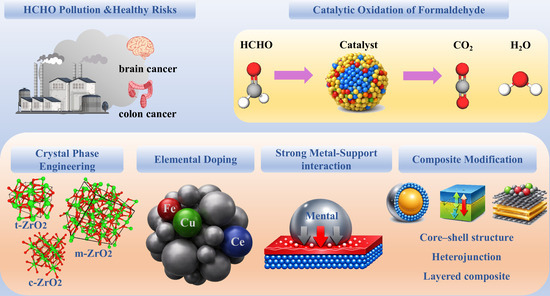
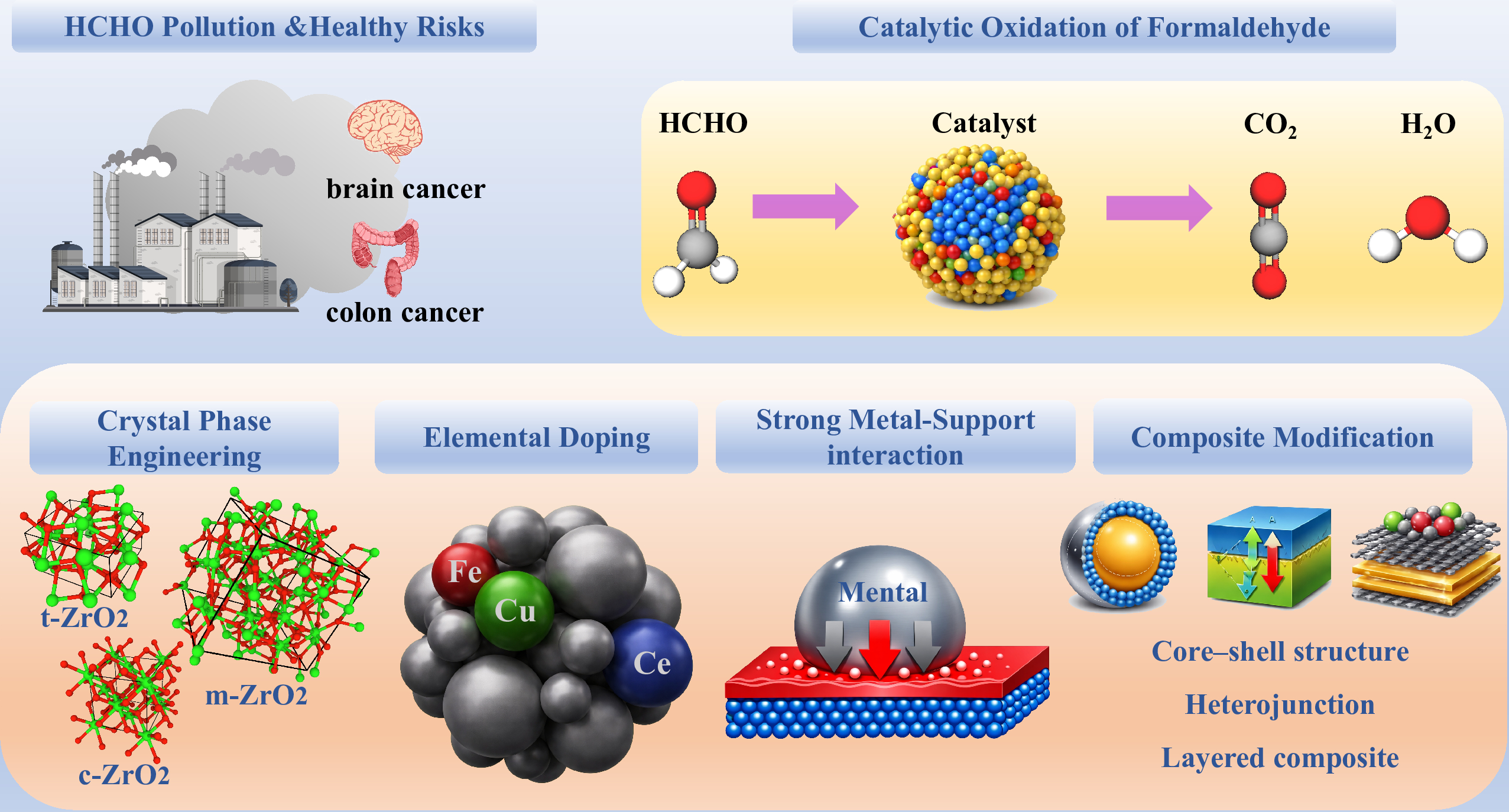
Graphical Abstract

1. Introduction

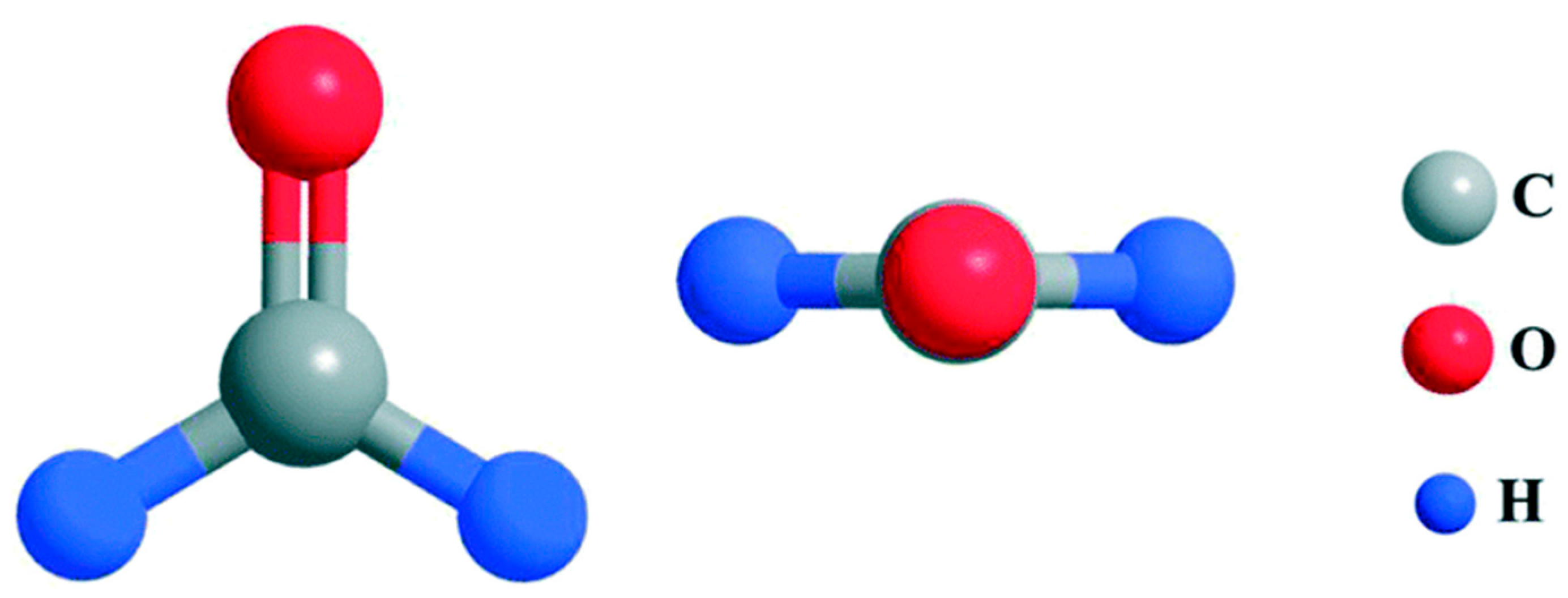
Formaldehyde (HCHO), also known as methanal, is the simplest saturated aldehyde whose molecular structure is illustrated in Figure 1 [1]. The bond length of C=O is approximately 1.207 Å, while the bond length of C–H is around 1.102 Å. Formaldehyde usually exists as a colorless gas or liquid. It is difficult to detect at low concentrations, whereas at elevated concentrations it exhibits a strong, pungent, and irritating odor. Because the C=O bond in formaldehyde is strongly polarized and the α–C–H bond is readily activated, many heterogeneous catalytic oxidation pathways are initiated by the activation of HCHO with reactive oxygen species or hydroxyl radicals on the surface, typically accompanied by C–H bond cleavage or H–atom abstraction, followed by the continuous formation of surface species such as formates and carbonates, and ultimately complete conversion to CO2 and H2O [2]. It should be emphasized that formaldehyde is not intrinsically resistant to degradation in the atmosphere. It can be rapidly removed through photochemical processes and interactions with hydroxyl radicals, resulting in an atmospheric lifetime on the order of only a few hours. However, once continuous emission sources such as wood-based panels and related products are present, indoor concentrations over extended periods can remain detectable, or even exceed regulatory limits. Meanwhile, formaldehyde plays a significant role in atmospheric chemistry as a key oxidation intermediate and an important observational tracer for volatile organic compounds (VOCs). It is widely used to constrain emissions of biogenic VOC, such as isoprene, and to better understand associated photochemical processes [3].
In modern society, people spend approximately 80–90% of their time indoors, making indoor air quality a critical concern. As a key component of resin adhesives, formaldehyde is extensively used in the furniture and building-material industries, and its release can persist for up to 15 years. In response to its health risks, many countries and regions have implemented increasingly stringent regulations. For example, under the Toxic Substances Control Act (TSCA), the United States has established mandatory limits on formaldehyde emissions from composite wood products, which fully entered into force on 22 March 2019. These limits restrict emissions from hardwood plywood, medium-density fiberboard, and particleboard within 0.05 ppm, 0.11 ppm, and 0.09 ppm, respectively. Similarly, China implemented the revised Indoor Air Quality Standard on 1 February 2023, updating and refining concentration limits and analytical methods for pollutants, including formaldehyde. The European Union also strengthened its regulatory framework. On 17 July 2023, it published an amendment to the REACH regulation in the Official Journal that added restrictions on formaldehyde released from furniture, articles, and the interiors of road vehicles. Typical HCHO concentrations and the corresponding health risks are summarized in Table 1. Formaldehyde has been classified as a Group 1 carcinogen by the International Agency for Research on Cancer (IARC) [4,5]. Long-term exposure can damage the respiratory system and increase mortality risk [6], and has also been associated with malignant diseases such as leukemia, brain cancer, and nasopharyngeal carcinoma [7,8]. Indoor formaldehyde mainly originates from decoration and construction materials [9,10], especially engineered wood products such as plywood and blockboard. Additional sources include decorative materials, such as wall fabrics, wallpaper, synthetic-fiber carpets, foamed plastics, paints, and coatings, as well as cigarette smoke and the combustion of certain organic materials. Given its widespread sources and persistent emissions, formaldehyde pollution remains a serious environmental and public health issue. The growing global emphasis on regulatory control highlights the urgent need to mitigate exposure while advancing greener industrial practices. As a result, further research on efficient HCHO abatement technologies is of considerable importance.
At present, technologies for HCHO abatement can be broadly categorized into physical, chemical, and biological approaches [11]. These include phytoremediation [12], physical adsorption [13,14], plasma treatment [15], photocatalytic oxidation [16,17,18,19,20,21,22,23,24], and thermal catalytic oxidation [25,26,27,28,29,30,31,32,33,34,35], as summarized in Table 2. Photocatalytic oxidation usually depends on photogenerated electron–hole pairs together with radical species such as ·O2 and ·OH, and therefore operates under relatively mild conditions, although its gas-phase reaction rate and solar-energy utilization are often limited. Plasma treatment, by contrast, activates pollutants through energetic electrons, ions, ozone, and radical species, which gives rapid initial decomposition capability but may also increase the risk of by-product formation in the absence of appropriate catalytic synergy. Thermocatalytic oxidation mainly relies on surface reactive oxygen species, lattice oxygen, and hydroxyl groups, and is generally more advantageous in terms of low-temperature activity and long-term stability.
Among these methods, thermal catalytic oxidation is a purely thermocatalytic process. The essence of thermal catalytic HCHO oxidation is to regulate the adsorption configuration and electronic-state distribution of reactants through active sites, thereby lowering the energy barriers for key bond-breaking and bond-forming steps and facilitating the complete conversion of reaction intermediates into CO2 and H2O [44,45,46,47]. Notably, this technology can achieve complete HCHO decomposition even at room temperature and offers several advantages, including high purification efficiency, controllable selectivity, no requirement for external energy input, and no secondary pollution [48,49,50]. It is therefore both efficient and economical and has become a research hotspot in recent years. In essence, the catalyst lowers the overall activation barrier and regulates the generation of reactive oxygen species and hydroxyl groups, thereby enhancing HCHO activation and accelerating the oxidation process [51]. Within such systems, catalyst selection directly determines process performance, and the central challenge lies in developing highly efficient catalysts that combine excellent low-temperature activity with long-term stability.
Current research on catalytic materials mainly focuses on three categories. The first comprises noble metal catalysts based on Pt [52,53,54,55], Au [56,57,58], Pd [59,60,61,62], and Ag [63,64,65,66,67,68]. The second category involves transition-metal catalysts based on Cu [69,70,71], Mn [72,73,74], and Co [71,75,76]. The third includes composite metal oxides, such as MnOx [77,78,79] and Co3O4 [80,81,82]. The catalytic performance of both transition-metal-based catalysts and supported noble metal catalysts is strongly influenced by the properties of the oxide component. Although transition metals are abundant and cost-effective, their low-temperature activities are often inferior to those of noble metals, primarily due to their relatively weak ability to generate reactive surface oxygen [83]. In contrast, supported noble metal catalysts typically display higher activity and can achieve complete HCHO oxidation at lower temperatures. However, their practical application is constrained by the high cost and limited availability of noble metals. Therefore, it is imperative to develop catalysts that utilize only trace amounts of precious metals while maintaining high activity and stability. In this context, the role of support has evolved beyond that of a simple carrier for noble metal nanoparticles; it is now expected to actively facilitate oxygen activation and ensure favorable metal dispersion.
Common catalyst supports include Al2O3 [30,68,84,85], SiO2 [30,55,57,62], TiO2 [21,31,76,86,87], and ZrO2 [83,88,89,90,91,92]. Among these, ZrO2 exhibits a high specific surface area and a surface rich in hydroxyl groups as well as tunable acidic/basic sites, which are beneficial for HCHO adsorption and activation. In addition, ZrO2 can establish strong metal–support interactions with active components, thereby enhancing catalytic efficiency in HCHO oxidation. It also possesses excellent mechanical properties and thermal resistance. Given the relatively high abundance of zirconium in the Earth’s crust, ZrO2 is comparatively cost-effective, further increasing its attractiveness as a catalyst support.
To further clarify the performance and advantages of ZrO2 supports in the formaldehyde oxidation system, we conducted a comparative analysis of ZrO2 with other commonly used supports, including TiO2, CeO2, and Al2O3. According to the literature [83], under identical catalyst preparation and formaldehyde catalytic oxidation reaction conditions, the formaldehyde conversion activity follows the order: Pt/Al2O3 > Pt/ZrO2 > Pt/CeO2 > Pt/TiO2. While this order is specific to the experimental system of the study, it clarifies the performance differences and underlying action mechanisms of different supports, and provides valuable reference for optimizing the performance of ZrO2-based catalysts and selecting their application scenarios. This study confirms that, as a non-reducible oxide, the core advantage of ZrO2 lies in its effective inhibition of the partial oxidation of Pt species. This addresses a key limitation of reducible supports such as CeO2 and TiO2, which readily induce Pt oxidation and result in a significant decline in room-temperature catalytic activity. Meanwhile, the type of metal precursor has a negligible effect on the catalytic performance of ZrO2-supported catalysts, giving these catalysts enhanced robustness and stability in the preparation process compared with CeO2 and TiO2, whose catalytic properties are highly susceptible to precursor residues and inert by-products. In terms of comprehensive catalytic performance, ZrO2-supported catalysts achieve a favorable balance between initial activity and cycling stability. Its room-temperature initial activity is second only to that of Al2O3 with a high specific surface area, and significantly higher than those of CeO2 and TiO2. During the oxidation-reduction cycle regeneration process, ZrO2-based catalysts deactivate far less than Pt/Al2O3, which effectively compensates for the defect of Al2O3 that is vulnerable to irreversible deactivation caused by Pt particle sintering. In contrast, CeO2 facilitates low-temperature oxidation of formaldehyde intermediates through lattice oxygen and achieves excellent cycling anti-deactivation performance via strong metal–support interaction. TiO2 enables high dispersion of Pt nanoparticles and serves as a classic support for formaldehyde catalytic oxidation. Although the initial activity of CeO2 and TiO2 is inferior to that of ZrO2, they exhibit unique advantages in long-term cycling application scenarios. Al2O3 achieves the highest initial activity via its ultrahigh specific surface area and abundant surface hydroxyl groups, making it preferable for short-term high-activity applications. Overall, the ZrO2 support exhibits distinct advantages in its excellent ability to maintain the active metallic state of Pt, preparation stability, and well-balanced comprehensive catalytic performance. It is a promising support material in the room-temperature formaldehyde oxidation system, and provides broad optimization space for the structural design and performance regulation of high-efficiency formaldehyde catalytic oxidation catalysts.
In recent years, substantial progress has been achieved in ZrO2-based catalysts through modifications such as crystal-phase regulation, elemental doping, and the incorporation of active components. Even so, dedicated reviews focusing specifically on ZrO2 as a support for HCHO oxidation remain scarce, and a systematic understanding of its interactions with active phases, as well as the underlying catalytic mechanisms, is still lacking. This review, therefore, summarizes recent progress in ZrO2-based catalysts for HCHO oxidation, to clarify structure–performance relationships and deepen mechanistic understanding to support practical applications. It begins with an overview of the basic structural characteristics of ZrO2 supports, followed by a brief discussion of the catalytic mechanisms of HCHO oxidation. Subsequently, recent advances in ZrO2-based catalysts are highlighted, with particular emphasis on crystal-phase regulation, elemental doping, metal–support interactions, and composite modification. It is expected that this review can provide useful insights for the rational design and synthesis of advanced zirconia-based catalytic materials.

2. Properties of ZrO2 Supports

ZrO2 is an important transition-metal oxide that exists in three polymorphs. These crystal phases can be transformed through temperature regulation or doping [93], and each exhibits good thermal stability within a specific temperature range. In addition, the surface of ZrO2 contains abundant hydroxyl groups and acidic/basic sites that can interact strongly with active components [94], thereby regulating the dispersion and electronic states of active species. Because ZrO2 is relatively inexpensive [95] and also exhibits excellent thermal and chemical stability [96], it can maintain structural integrity under harsh reaction conditions, particularly at elevated temperatures. These characteristics make it an attractive and reliable support material for catalytic oxidation reactions.

Physicochemical Properties

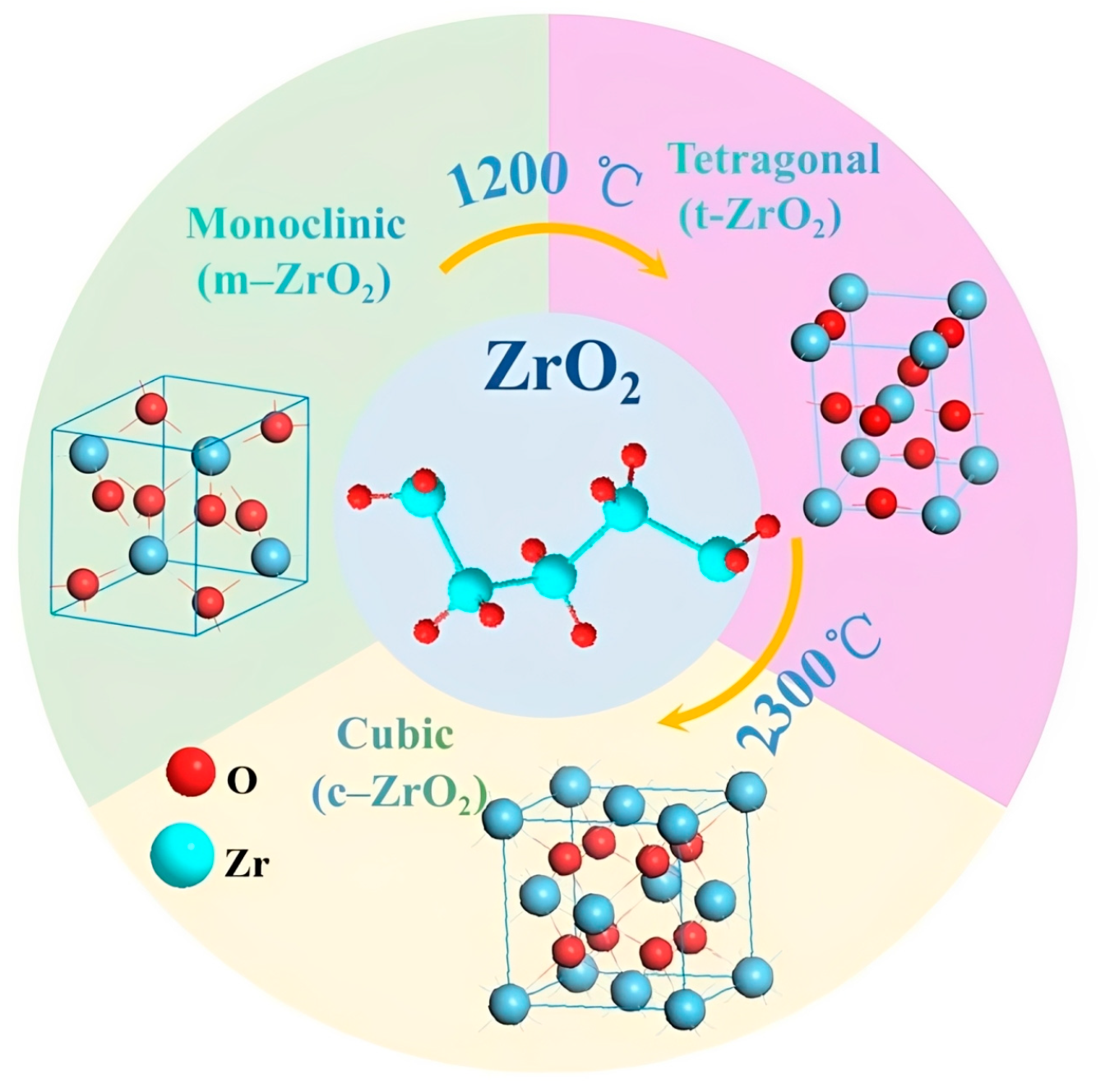
As shown in Figure 2, the crystal structure of ZrO2 is strongly temperature-dependent, with three distinct polymorphs appearing over different temperature ranges. Monoclinic ZrO2 (m-ZrO2) is stable below 1175 °C and contains four Zr atoms and eight O atoms per unit cell. Tetragonal ZrO2 (t-ZrO2), stable from 1175 °C to 2370 °C, exhibits a fluorite-like structure in which each Zr atom is coordinated to eight O atoms with unequal bond lengths. Cubic ZrO2 (c-ZrO2), stable from 2370 °C to 2706 °C, adopts an ideal fluorite structure, where each Zr atom is symmetrically coordinated by eight oxygen atoms [94,97]. Among these polymorphs, only the monoclinic phase is thermodynamically stable at room temperature [98,99]. The tetragonal phase is metastable under ambient conditions, yet it is valuable in catalysis because of its superior mechanical strength and favorable physicochemical properties. Although the tetragonal phase typically forms at high temperatures, its formation temperature can be significantly reduced by decreasing the crystallite size or introducing dopants into the lattice [89]. Doping not only facilitates phase transformation but also stabilizes high-temperature phases, enabling tetragonal or cubic ZrO2 to persist at room temperature [92]. Common dopants include Ni, Mg, Ce, La, and Y. By modifying the lattice structure, these dopants can alter the phase-transition temperatures [100,101] and further enhance the thermal stability and catalytic performance of ZrO2-based materials.
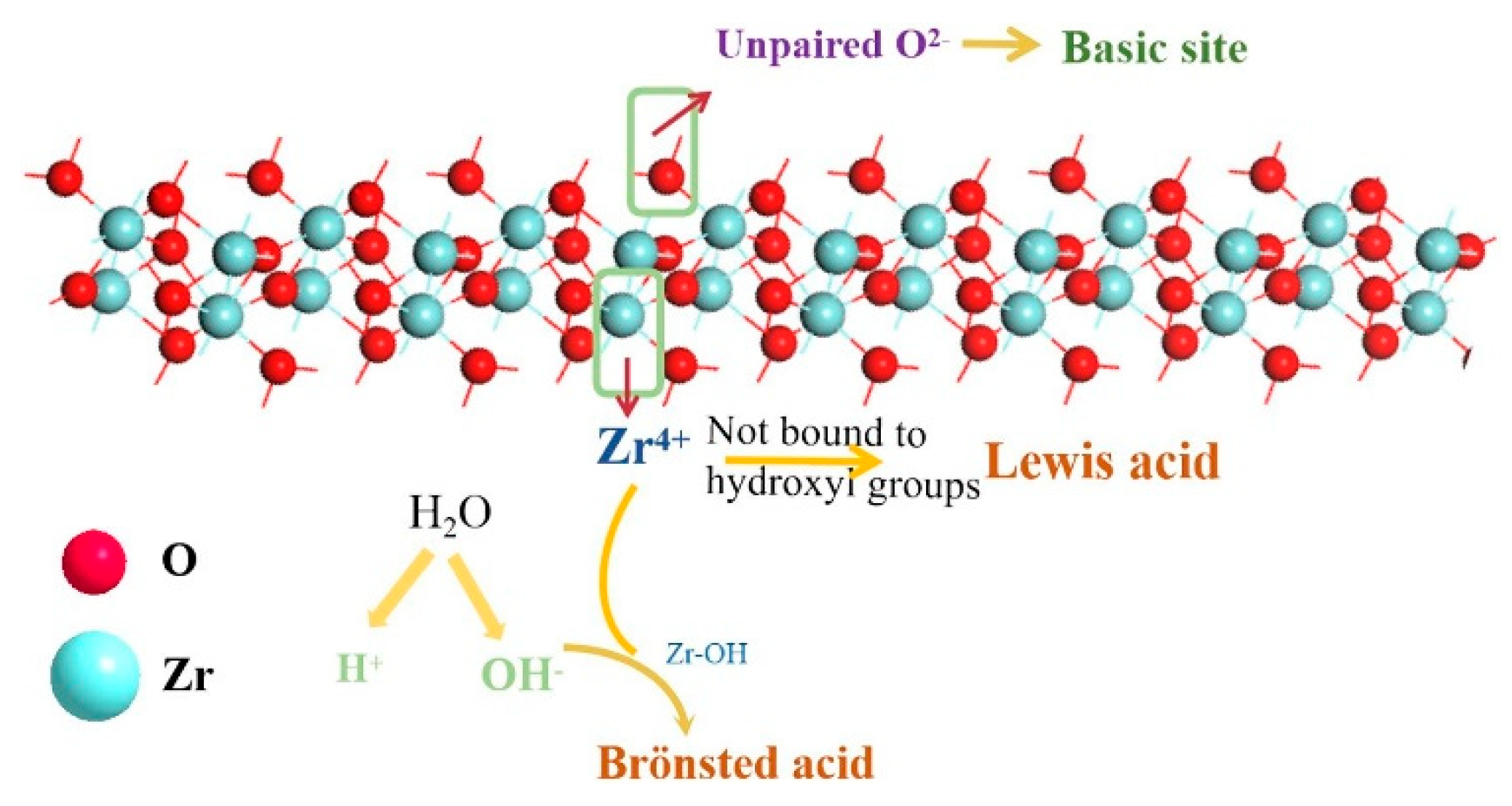
Due to its chemical stability, ZrO2-based catalysts generally retain their structural and catalytic integrity after repeated use [102]. The surface of ZrO2 contains both acidic and basic sites, which contribute to its excellent catalytic performance in HCHO oxidation. As illustrated in Figure 3, the acidic centers on ZrO2 include both Lewis and Brönsted acid sites [94]. Lewis’s acid sites mainly arise from Zr4+ species generated when the ZrO2 lattice is disrupted, and these sites are not bound to hydroxyl groups. Brönsted sites, on the other hand, originate from the Zr–OH bond formed with dissociated water that interacts with Zr4+, producing Zr–O–H structures. Basic sites are associated with unpaired O2− species. Compared with the tetragonal and cubic phases, in which oxygen atoms are eightfold coordinated, the monoclinic phase contains a higher proportion of O2− species. Specifically, among the seven oxygen ions in monoclinic ZrO2, three possess unpaired electrons capable of accepting protons from acidic compounds, making the monoclinic phase more basic [103]. Functionally, the acidic sites on ZrO2 can adsorb and activate the carbonyl oxygen of formaldehyde, whereas basic sites facilitate water activation to generate hydroxyl radicals. The synergistic interaction between these two types of sites promotes the oxidative decomposition of HCHO. Although acid–base balance has been well recognized to play a crucial role in HCHO activation and intermediate conversion over ZrO2-based catalysts, a universally applicable quantitative criterion for optimal acid–base balance across various systems has not been established yet. Most existing studies provide qualitative or semi-quantitative evidence based on spectroscopic characterization, adsorption behavior analysis, or catalytic activity trends, rather than developing a transferable descriptor that can be directly applied to different ZrO2 phases, defect structures, and supported metal configurations. Therefore, the quantitative optimal ratio of effective acid–base balance still awaits further systematic investigation and establishment.
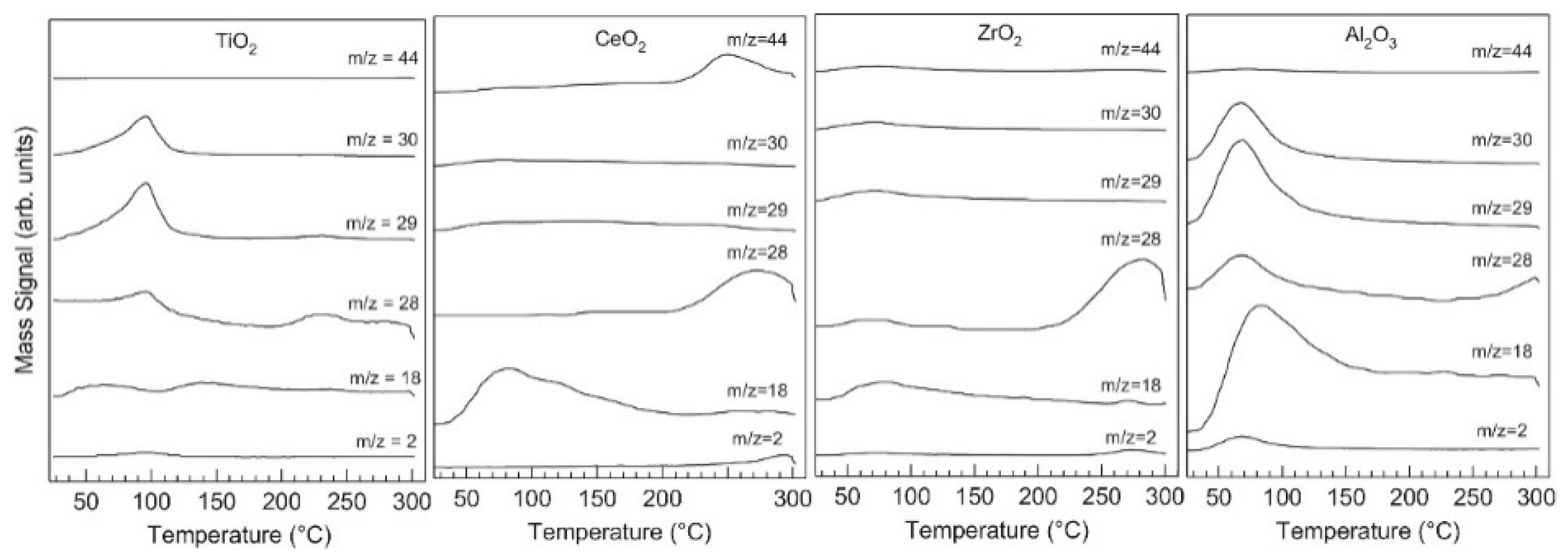
ZrO2 possesses a high specific surface area and rich surface hydroxyl groups (–OH), which endow the material with abundant active adsorption sites for HCHO. In addition, its basic surface facilitates the generation and stability of key intermediates during HCHO adsorption and activation. For example, Colussi et al. [83] studied the TPD experiments and found that bare ZrO2 adsorbs HCHO differently from acidic supports such as Al2O3 and TiO2. As shown in Figure 4, the signals that are characteristic of formaldehyde at m/z = 29 and 30 are almost negligible, whereas the characteristic of CO shows a strong signal at m/z = 28, which appears in the range of 230–300 °C. This finding indicates that ZrO2, as a basic support, tends to form stable intermediates with HCHO rather than desorbing intact HCHO molecules. Watanabe et al. [104] studied the catalytic behavior of ZrO2 in supercritical water at 673 K and 25–40 MPa. Using the CH3OH/CO yield ratio as an indicator of the product distribution of HCHO conversion, they quantified the effective OH concentration on the ZrO2 surface as 10−8 mol/L. This finding confirms that ZrO2 behaves as a typical basic catalyst. The surface hydroxyls on ZrO2 serve as basic sites, which facilitate the dissociation of adsorbed water and increase the concentration of OH. Consequently, the Cannizzaro reaction (2HCHO + H2O → CH3OH + HCOOH) is promoted under these specific supercritical water and alkaline conditions described in the study, driving the conversion of HCHO in this experimental system. Critically, this pathway is mainly validated for basic ZrO2 surfaces under specific supercritical water/alkaline environments and cannot be generalized as the dominant reaction route for all ZrO2-based HCHO oxidation systems. This study further posited that, based on the electronegativities of metal ions, the strong basicity of ZrO2 originates from the low electronegativity and large ionic radius of Zr4+. Compared with other oxides, the basicity order CeO2 > ZrO2 > MoO3 > TiO2 (rutile) > TiO2 (anatase) demonstrates that ZrO2 surpasses acidic supports such as TiO2 in catalytic HCHO conversion. Overall, the catalytic performance of ZrO2 is highly dependent on the balance between acidic and basic sites. Besides, the acid–base ratio on the catalyst will influence its performance in the formaldehyde catalytic reaction. Therefore, identifying an appropriate acid–base ratio is a crucial approach to enhancing the oxidation efficiency of HCHO.

3. Overview of ZrO2-Based Catalysts

ZrO2-based catalysts show excellent performance in the catalytic oxidation of HCHO. According to the properties of active components, their dispersion states, and the structural characteristics of supports, these catalysts can be broadly divided into four categories: noble metal-loaded systems, transition-metal-oxide-loaded systems, crystal-phase/phase-interface engineering systems, and single-atom catalyst (SAC) systems. Among them, noble metal-loaded catalysts exhibit the most prominent advantages in the low-temperature range, particularly Pt-based ones. Their catalytic performance is not solely determined by the intrinsic activity of noble metals, but also relies on the continuous supply of reactive oxygen species from surface defects and SMSI interfaces of ZrO2, as well as the accelerated deep oxidation of intermediates. Transition-metal-oxide-loaded catalysts (such as MnOx, Co3O4) outperform in cost and resource availability. These catalysts usually maintain oxidation capacity through reversible valence cycling, lattice oxygen migration, and replenishment. Given their activity is relatively limited at low temperatures, strategies such as doping, compositing, and defect engineering are commonly adopted to enhance the efficiency of oxygen migration and activation. Crystal and phase-interface engineering can modulate the surface coordination environment and charge distribution to optimize interfacial electron transfer and lower the initial C–H activation energy barrier. This, in turn, improves the low-temperature kinetics and inhibits the accumulation of inert intermediates such as some carbonates. Single-atom catalyst (SAC) systems hold the core advantages of maximum atomic utilization and well-defined active sites. However, their performance is highly dependent on the matching between continuous oxidation capacity and anchoring sites such as oxygen vacancies, defects, and a stable coordination environment. Table 3 presents a summary of the research on the use of ZrO2-based catalysts for the catalytic oxidation of formaldehyde.

3.1. Noble Metal-Loaded ZrO2

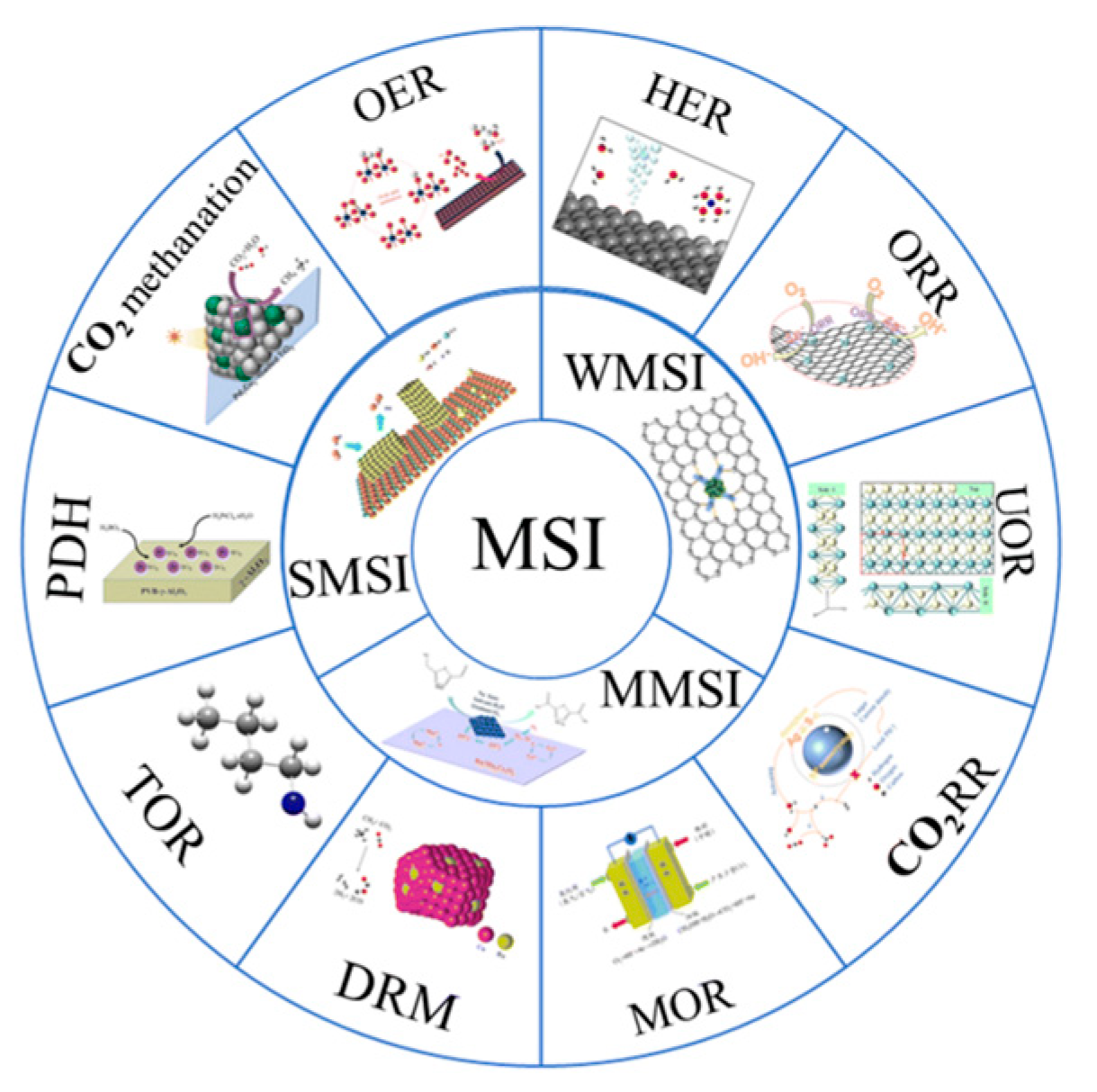
In recent years, noble metals have attracted the interest of many researchers in HCHO catalysis due to their outstanding low-temperature activity and high selectivity [11]. Noble metals can act synergistically with acidic and basic sites, hydroxyl groups, and defect sites on the surface of ZrO2, enabling precise regulation of the adsorption configuration of reactants as well as the generation efficiency of reactive oxygen species and hydroxyl groups. However, in ZrO2-based catalytic systems, the dominant factor governing catalytic performance is not the intrinsic activity of the noble metal. Instead, it relies heavily on the continuous generation of reactive oxygen species available for the reaction via strong metal–support interactions (SMSIs) and on the efficient conversion of reaction intermediates into CO2 and H2O. The classification of SMSI mechanisms is displayed in Figure 5. It has been reported that the formation of specific metal–support interfaces facilitates SMSIs [109], and the corresponding interfacial sites are favorable for the activation of reactive oxygen species. Accordingly, constructing tailored SMSI interfaces is a critical strategy for improving the HCHO oxidation efficiency of noble metal-loaded ZrO2 catalysts.

3.2. Transition-Metal-Oxide-Loaded ZrO2

Although noble metal-loaded catalysts exhibit excellent catalytic activity, noble metals themselves suffer from high cost and limited natural reserves. In contrast, transition-metal oxides offer distinct advantages of low cost, more abundant raw material reserves, simple preparation procedures, and good stability, with particularly prominent superiority in fabrication cost and raw material availability. Moreover, under harsh reaction conditions such as high temperature, high pressure, and strongly corrosive reaction environments, the active noble metal phases are prone to sintering or poisoning, which directly leads to catalyst deactivation. For these reasons, the use of transition-metal oxides as active components is an important direction to reduce the dosage of noble metals and even realize noble metal-free catalytic systems. Common transition-metal oxides include MnOx, Co3O4, and CuO. These oxides usually rely on reversible valence cycling and the migration and replenishment of lattice oxygen to maintain sustained oxidation capacity. When coupled with ZrO2, the ZrO2 support fulfills two core functions. On one hand, the support can inhibit aggregation and sintering of the active phase through metal–support interactions. On the other hand, the acidic/basic sites and hydroxyl groups on the ZrO2 surface can modify the adsorption and desorption behaviors of HCHO and H2O and thus influence the formation and removal rates of intermediates such as formates and carbonates.

3.3. ZrO2 Crystal-Phase/Phase-Interface Engineering Systems

It is widely recognized that ZrO2 exists in three polymorphs. Among these, monoclinic ZrO2 (m-ZrO2), tetragonal ZrO2 (t-ZrO2), and the phase interface formed between them can alter the surface coordination environment and electronic structure. This, in turn, affects oxygen activation and the initial C–H activation step during the catalytic oxidation of HCHO. The core of phase-interface engineering lies in improving interfacial charge transfer efficiency and the generation rate of reactive oxygen species by modifying the structure and charge distribution, while also lowering the energy barriers of key reaction steps. It has been reported that the t-m phase interface can significantly enhance catalytic HCHO oxidation at room temperature. This enhancement is attributed to the optimized interfacial electron transfer characteristics and gas adsorption configurations, which facilitate C-H bond cleavage and subsequent oxidation at low temperature [108]. When crystal and phase-interface engineering are combined with noble metal loading, the resulting interfacial effect often becomes even more pronounced. Yang et al. prepared Pt/ZrO2 catalysts on the mixed m/t phase of ZrO2 supports, and reported that the activities of these catalysts were markedly higher than that of catalysts supported on pure m-ZrO2. Besides, the catalysts achieved complete HCHO oxidation near ambient temperature [90]. This report indicated that mixed-phase interfaces favor the construction of more efficient interfacial active sites and improve the generation of reactive oxygen species, thereby enhancing low-temperature kinetics. These studies further confirm that the crystal phase ratio and interface structure of ZrO2 itself can strongly influence the rate of low-temperature HCHO oxidation.

3.4. Single-Atom Catalyst (SAC) Systems

The defining feature of single-atom catalysts (SACs) is that isolated or individual noble metal atoms are usually anchored to a specific support. Owing to their unique coordination environments and electronic structures, SACs are expected to offer superior catalytic activity and selectivity [111]. Among the supports of SACs, transition-metal oxides such as ZrO2, TiO2, and CeO2 can trigger strong metal–support interactions with single-atom noble metals [112], thus enhancing activity and long-term stability in oxidation reactions [113,114,115]. ZrO2 simultaneously possesses excellent thermal stability, chemical resistance, redox surface properties, and low cost, making it a competent support for loading single atoms. Currently, Pt-loaded ZrO2 catalysts have already been successfully prepared [116], demonstrating promising catalytic applications, including ammonia oxidation [117], photocatalysis [118,119], and hydrogenation reactions [120,121]. Peng et al. [88] proposed that ZrO2 nanoparticles can regulate the electronic structure of Ir single atoms and thus enhance HCHO oxidation at room temperature. Their results suggest that ZrO2 not only modifies the electronic state of the single-atom center but also promotes the activation of adsorbed oxygen, thereby providing a facile strategy to design low-loading single-atom catalysts with high catalytic activity toward HCHO oxidation. Overall, ZrO2 can serve both as a defect-rich anchoring platform that stabilizes single-atom centers and inhibits migration/aggregation, and as an interactive support that triggers charge redistribution through SMSI, thus modulating the ability of single atoms to activate O2 and H2O and to generate reactive oxygen species. When the room-temperature reaction is limited by O2 activation and the deep oxidation of intermediates, this strategy can provide a more sustainable solution to simultaneously balance activity, stability, and noble metal utilization.

3.5. Mechanisms of HCHO Oxidation over ZrO2-Based Catalysts

In the catalytic reaction mechanisms, three classical surface reaction models are broadly recognized: the Eley-Rideal (E-R), Langmuir-Hinshelwood (L-H), and Mars-van Krevelen (MVK) mechanisms. In the oxidation reaction of HCHO, the reaction mainly proceeds through the E-R mechanism if HCHO and O2 share the same adsorption site. When HCHO and O2 are adsorbed on separate active sites, such as hydroxyl sites and active metal sites, the reactions proceed through the L-H mechanism. Additionally, when oxygen vacancies are easily formed on the catalyst surface, such as the oxygen storage-discharge cycle of CeO2, HCHO oxidation is mainly described by the MVK mechanism [122,123,124,125].
According to Sun’s report [11], the mechanism of catalytic HCHO oxidation involves multiple steps, including the adsorption, activation, and oxidation reaction of formaldehyde molecules. Adsorption is the first step of the entire reaction process. As directly verified by in situ characterization experiments, in the presence of water, surface reactive oxygen species can generate hydroxyl groups, and HCHO molecules can be adsorbed by hydrogen bonds with these hydroxyl groups. This step is in line with the classic MVK, L-H, and E-R models. When strong metal–support interactions are present, HCHO may also adsorb on oxygen vacancies or the bridging sites of certain material surface atoms. These adsorption behaviors are also identified and confirmed by in situ spectroscopic observations. On ZrO2-based catalysts, catalytic HCHO oxidation is initially driven by OH species on the basic ZrO2 surface, which is revealed by in situ characterization of surface species under reaction conditions. Watanabe et al. [104] demonstrated that HCHO first undergoes a Cannizzaro reaction on ZrO2 to form methanol and formic acid (2HCHO + H2O → CH3OH + HCOOH), which constitutes a key intermediate step in HCHO activation. It should be noted that the methanol and formic acid generated via the Cannizzaro reaction of formaldehyde on ZrO2 surfaces are both transient intermediates, and no significant accumulation of these species occurs during the reaction process. This reaction pathway was derived from product distribution analysis and kinetic experiments. Formic acid then decomposes by decarboxylation to form CO2 and H2 (HCOOH → H2 + CO2). A small fraction can also dehydrate to CO and H2O, and the resulting CO can be further oxidized to CO2 through the water–gas shift reaction (H2O + CO → H2 + CO2), ultimately realizing the complete conversion of formaldehyde to CO2 and H2O. In other words, an effective catalyst in this process must fulfill the following core functions: efficient HCHO adsorption, sufficient supply of reactive oxygen species, promotion of electron transfer, and acceleration of the decomposition of surface intermediates.
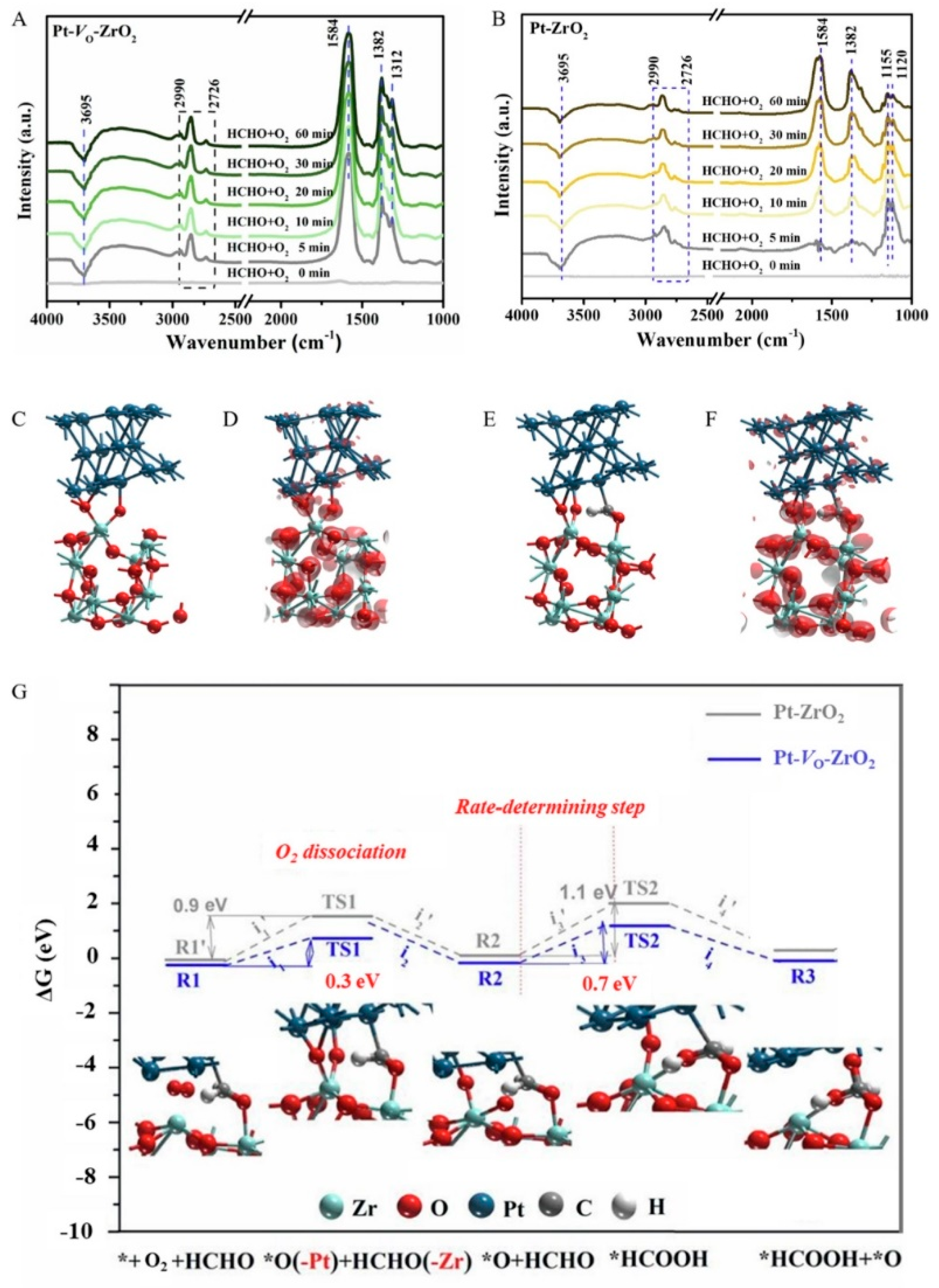
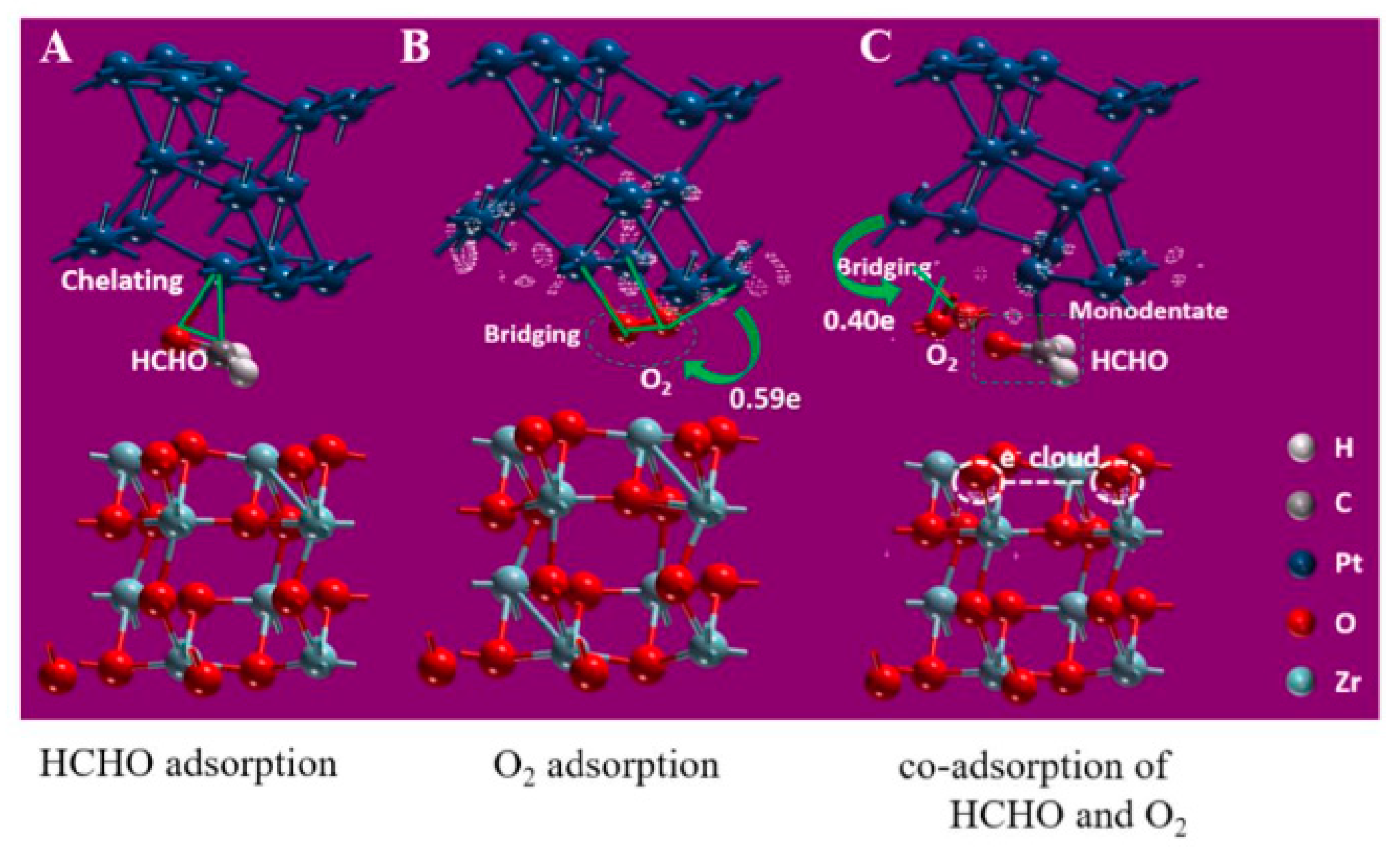
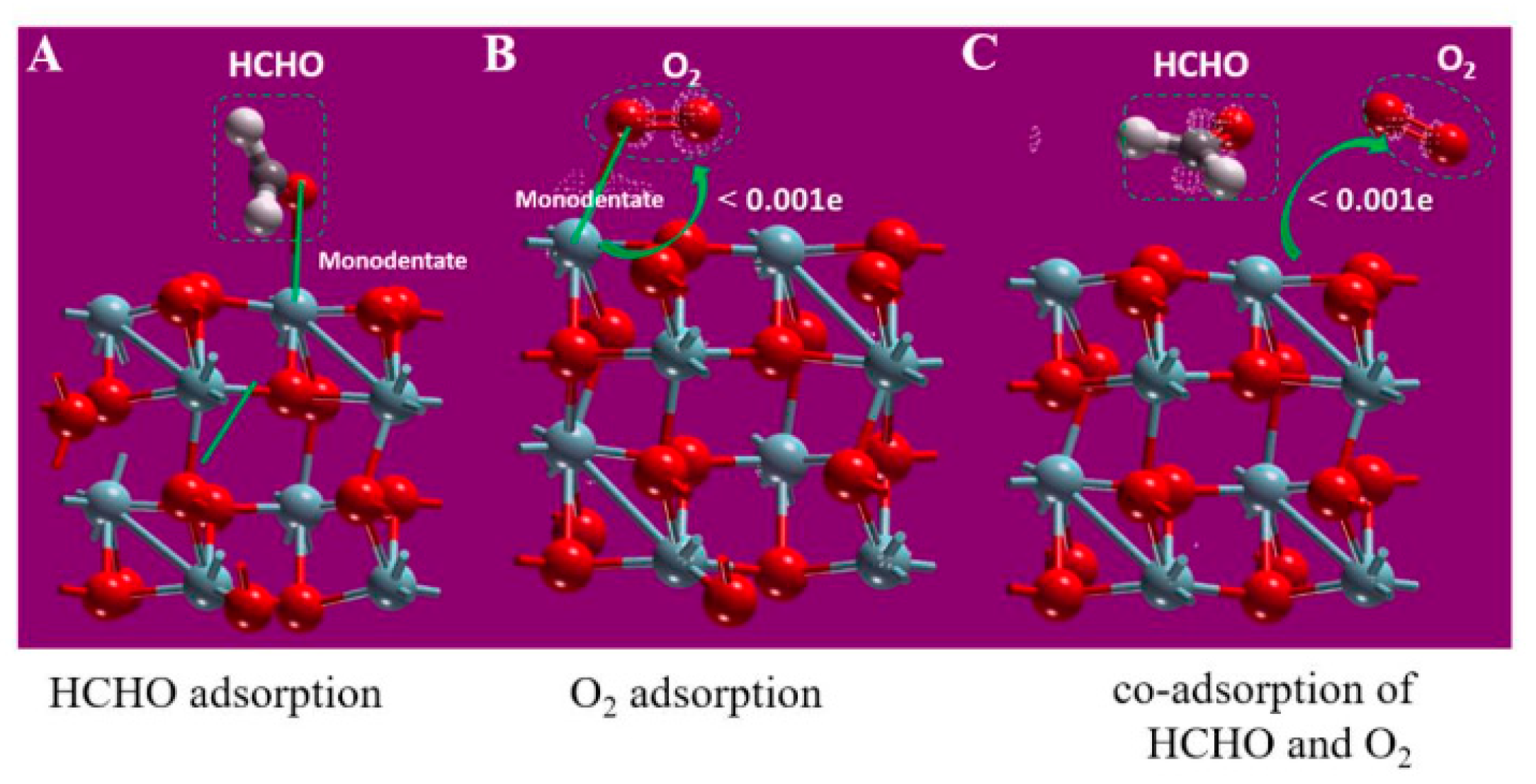
Peng et al. [105] further elucidated the oxygen-vacancy-mediated reaction pathway via in situ diffuse reflectance infrared Fourier transform spectroscopy (in situ DRIFTS) and density functional theory (DFT) calculations. As directly observed by in situ DRIFTS experiments, HCHO is first adsorbed near the oxygen vacancies on the ZrO2 surface. The active oxygen species (O*) at the Pt–ZrO2 interface attack the C–H bond of HCHO to directly form a formate intermediate rather than the DOM intermediate, thus avoiding the accumulation of inert species. As the DFT calculations show in Figure 6G, the activation barrier of O2 dissociation on the Pt–VO–ZrO2 system is only 0.3 eV, which is far lower than the 0.9 eV calculated for the defect-free Pt–ZrO2. Therefore, oxygen vacancies substantially reduce the reaction barrier, enabling the direct formation of formate without the extra energy barrier consumption caused by the generation of inert DOM intermediates. Meanwhile, both in situ observations and DFT results confirm that oxygen vacancies promote the dissociation of H2O to form hydroxyl groups (–OH), which react rapidly with formate species to produce CO2 and H2O (HCOO + ·OH → CO2 + H2O). The consumed oxygen vacancies can be quickly replenished via the adsorption and dissociation of O2, forming a cycle of oxygen vacancies, active oxygen, and hydroxyl groups. As further revealed by DFT charge density and electron transfer analysis (Figure 6C–F, Figure 7 and Figure 8), oxygen vacancies act as an electron transport channel to connect the ZrO2 (110) and Pt (111) crystal planes. A total of 1.56 electrons are transferred from the Zr/Pt sites to the co-adsorption sites of HCHO and O2, which is a quantitative result from DFT, not only activating O2 to generate O* but also promoting the dissociation of H2O into –OH, realizing the synergistic oxidation of O* and –OH.

3.6. Practical Catalytic Performance of ZrO2-Based Catalysts

To clarify the actual performance of ZrO2-based catalysts in the catalytic oxidation of formaldehyde, this study further evaluated their catalytic performance under conditions of ultra-low formaldehyde concentrations and closer to realistic indoor environments. Most reported studies on ZrO2-based catalysts are conducted under laboratory conditions, and specific tests under actual indoor conditions have not yet been carried out. Even so, several practically relevant trends can be identified from these laboratory experimental results. For instance, the Pt–VO–ZrO2 catalyst achieved over 95% HCHO removal and conversion at 20 °C [105]. Under continuous flow conditions, approximately 1 ppm of HCHO could be reduced to below 0.05 ppm, which demonstrates the potential of this interfacial system for purifying formaldehyde at ultra-low concentrations. Meanwhile, for Ce0.8Zr0.2Oy, the HCHO removal efficiency gradually increased as relative humidity rose to 50%, and remained above 90% for 300 min at room temperature [126]. This finding suggests that moderate humidity facilitates oxygen activation, hydroxyl generation, and the subsequent oxidation of intermediates. In recent research [105], a ZrO2-coupled Ir single-atom catalyst exhibited excellent room-temperature activity, achieving over 95% HCHO conversion at 20 °C with only 0.25 wt% Ir loading, while maintaining high activity across a broad humidity range of 20% to 75%. These results confirm that ZrO2-based catalysts hold good potential for indoor formaldehyde abatement under room-temperature, low-concentration, and variable-humidity conditions, though further testing under real indoor conditions is still required.

4. Structural Regulation and Modification Strategies for ZrO2-Based Catalysts

4.1. Crystal-Phase Regulation

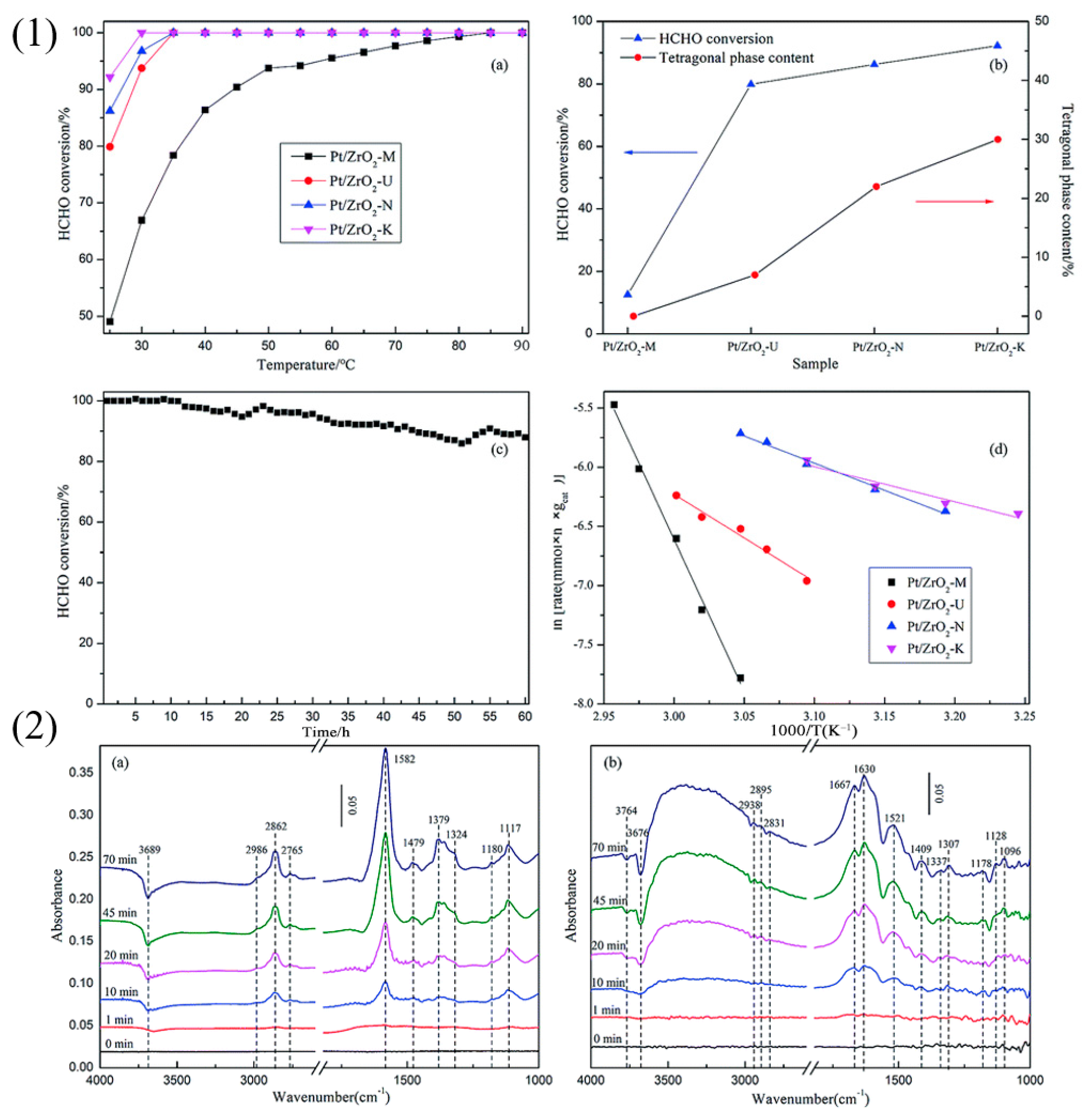
It is widely recognized that the catalytic performance is generally closely related to polymorphism. Crystal structure and the associated transformations can exert a pronounced influence on the physicochemical and catalytic properties of the material [127,128,129]. In the catalytic HCHO experiments performed in supercritical water at 673 K and 30 MPa, Watanabe et al. [104] found that a ZrO2 catalyst initially composed of a mixed monoclinic-tetragonal (m-t) phase with a BET surface area of 68 m2/g transformed completely into pure monoclinic ZrO2 after reaction, yet no structural collapse was observed for the post-reaction catalyst. Its effective surface OH concentration remained at 10−8 mol/L, and the CH3OH/CO yield ratio from catalytic HCHO conversion stayed at 8.0, showing no significant change from the pre-reaction value. These observations confirm the outstanding hydrothermal stability of ZrO2 and its tolerance toward phase transformation, which provides an important experimental basis for the high-temperature modification of ZrO2 supports and their use in complex aqueous environments. Building on the understanding of crystal structure, several groups have sought to improve catalytic performance by altering the crystal phase or introducing mixed-phase structures. For example, Yang and co-workers [90] prepared a special m-t mixed-phase Pt/ZrO2 catalyst and found that the Pt/ZrO2–K sample with the greatest amount of interfacial structure could completely oxidize 100 ppm HCHO near room temperature, as shown in Figure 9(1). Moreover, this m-t mixed-phase structure suppressed the formation of inert carbonate species during HCHO oxidation. As shown in Figure 9(2), in situ DRIFTS detected only the characteristic peaks of formate species (1582 and 1379 cm−1 for υ(COO), 2986, 2862 and 2765 cm−1 for υ(CH)) and dioxymethylene (DOM) species (1479, 1324, 1180 and 1117 cm−1), with no characteristic peaks associated with carbonate species observed. In contrast, the pure monoclinic Pt/ZrO2–M catalyst exhibited distinct carbonate characteristic peaks at 1667 cm−1 (υ(C=O)) and 1178 cm−1 (υₐₛ(COO)), confirming that the mixed-phase structure effectively inhibits inert intermediates and maintains an efficient catalytic cycle. The m-t interface can induce more defect structures and cationic Ptδ+ species, which exhibit higher activity for HCHO oxidation than the metallic Pt0 species located near the pure monoclinic or pure tetragonal phases. These findings demonstrate that the crystal phase of ZrO2 has a pronounced effect on catalytic behavior and that regulating the phase composition is an effective strategy to optimize surface properties and the distribution of active sites.

4.2. Support–Active-Component Interactions

As a support, ZrO2 can modulate the dispersion, electronic state, and chemical properties of active components through strong metal–support interactions (SMSIs), thereby enhancing catalytic activity [130]. Oxygen vacancies serve as the key bridge for constructing high-efficiency SMSI interfaces. The ZrO2 surface is rich in oxygen vacancies, and it is well established that the active centers of heterogeneous catalysts are closely correlated to surface defects [131]. An oxygen vacancy is an electron-rich center, with two excess electrons generated upon the formation of one vacancy. If H2O or O2 adsorbs near these vacancies, the corresponding electrons can be transferred to produce abundant reactive surface oxygen species, thereby improving adsorption and catalytic performance [132]. Similar conclusions have also been reached for other transition-metal-oxide supports. Tong et al. [133], based on the EPR and Raman spectroscopy characterizations, found that the sulfate-derived Pt/MnO2–S catalyst, with its rich oxygen-vacancy population, achieved complete conversion of 200 ppm HCHO at 50 °C and performed much better than catalysts prepared from other precursors. The situ DRIFTS further revealed that oxygen vacancies promote HCHO adsorption and activation to form DOM intermediates while accelerating lattice oxygen migration and replenishment, thereby creating a stable cycle between oxygen vacancies and reactive oxygen species.
During catalytic oxidation, HCHO is activated through interactions with reactive oxygen species and gradually decomposes into intermediates such as DOM, formates, and carbonates before eventually being oxidized to CO2 and H2O. The reaction pathway of this process is strongly dependent on the oxygen content of the system, which is consistent with the “butterfly-shape dual-pathway mechanism” reported by Tong et al. [133] for Pt/MnO2 catalysts. Under oxygen-rich conditions, surface reactive oxygen species dominate HCHO oxidation and enable rapid conversion, whereas in oxygen-deficient environments, lattice oxygen participates in the reaction, leading to the transient accumulation of formate intermediates, which are then gradually oxidized. DFT calculations further confirmed that oxygen vacancies can significantly reduce the adsorption energies of O2 and HCHO (Eads(O2) = −5.992 eV, Eads(HCHO) = −10.370 eV), thus promoting the activation of reactants. This rule is equally applicable to ZrO2-based catalysts, for which surface oxygen vacancies can accelerate electron transfer, generate reactive oxygen species, and promote the rapid conversion of intermediates. Accordingly, enhancing the oxygen-vacancy concentration is an effective strategy to enhance the catalytic performance of ZrO2-based catalysts.
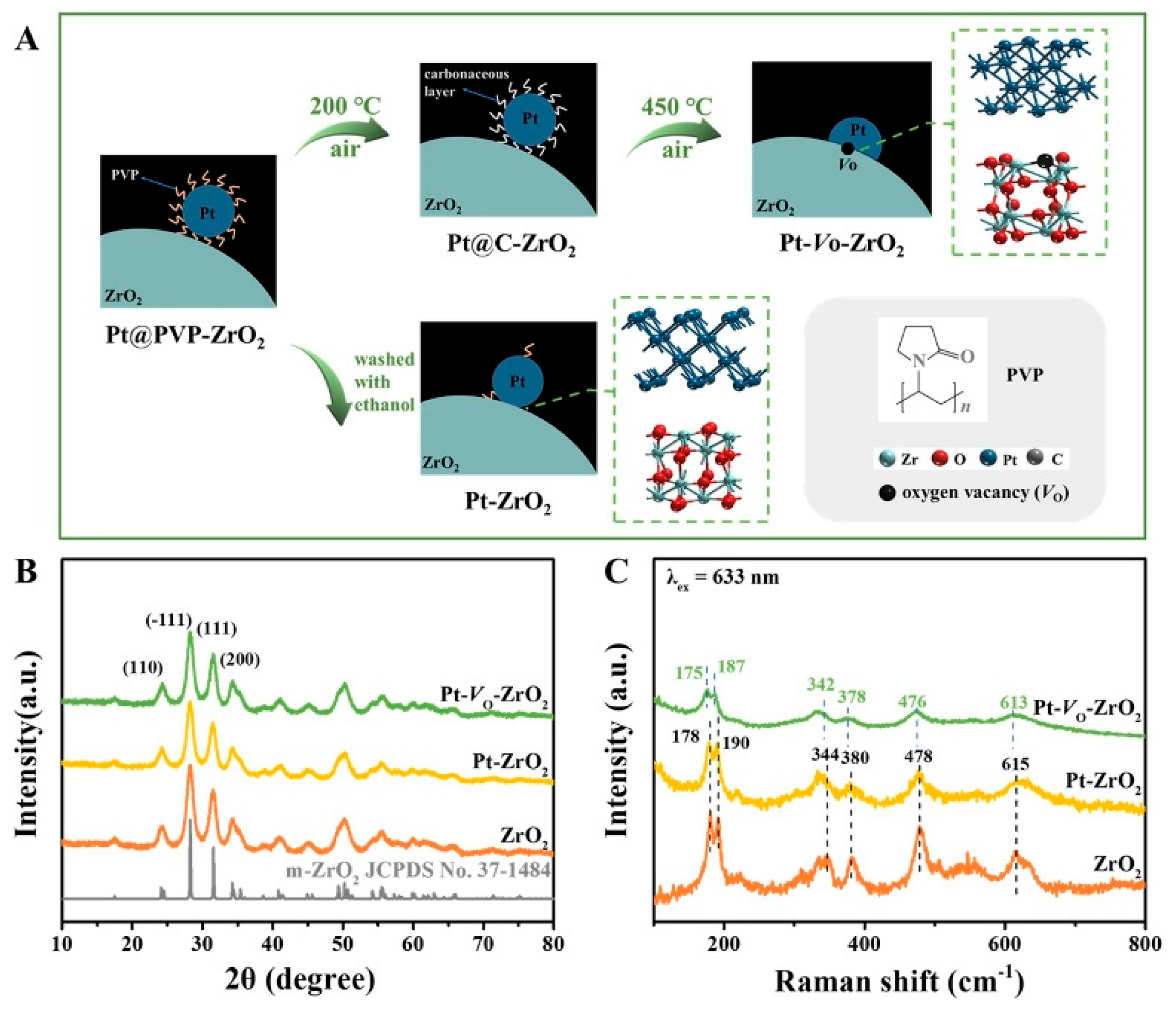
Peng et al. [105] prepared a monoclinic ZrO2 support (m-ZrO2) by a modified P123-assisted hydrothermal method, introduced abundant oxygen vacancies onto its surface through a two-step calcination procedure, followed by loading Pt nanoparticles to fabricate a Pt–VO–ZrO2 catalyst. On this basis, they proposed the concept of an oxygen-vacancy-regulated SMSI interface, in which VO sites on the ZrO2 surface capture and activate O2 to form active oxygen atoms (O*) with an activation barrier of only 0.3 eV, far lower than that of a defect-free ZrO2 system. Meanwhile, VO acts as an electron-transport channel connecting the ZrO2 (110) surface and Pt (111), which constructs a stable Pt–VO–ZrO2 interface and markedly strengthens charge transfer between the metal and the support. The preparation procedure and structural characterization are shown in Figure 10. The synergy between oxygen vacancies and SMSI enables high dispersion of noble metal nanoparticles, with an average particle size of 2–5 nm, and induces the partial conversion of Pt0 to oxidized species such as Pt2+ and Pt4+. These oxidized species, together with surface hydroxyls and reactive oxygen on ZrO2, achieve efficient activation of HCHO and O2. As a result, the 0.87 wt% Pt–VO–ZrO2 catalyst achieved a HCHO conversion of 95% for 100 ppm HCHO at 20 °C, with no obvious decay in activity after 720 min of continuous reaction. It can also reduce even 1 ppm HCHO to below 0.05 ppm, demonstrating outstanding room temperature activity and stability. Similarly, Peng et al. [88] prepared an Ir1–N–C/ZrO2 catalyst and found that ZrO2 nanoparticles can tune the electronic properties of single Ir atoms through charge redistribution, which synergistically promotes the activation of adsorbed oxygen and lattice oxygen to generate reactive oxygen species. In addition, the Ir–C–Zr channel accelerates the decomposition of ·O2 into O*, and the resulting reactive oxygen species can rapidly oxidize HCHO into DOM, formate species, CO2, and H2O. The TPO experiments conducted by Colussi et al. [83] also showed that bare ZrO2 generates a CO2 characteristic peak in the range of 250–300 °C, whereas Pt/ZrO2 shows a significantly lower CO2 formation temperature with no HCHO signal detected. This further confirms that the synergistic interaction between Pt and ZrO2 can effectively promote the decomposition and oxidation of adsorbed HCHO. In summary, strong interfacial interactions are crucial for anchoring metal nanoparticles, weakening Zr–O bonds, and enabling interfacial electron or oxygen atom transfer, all of which are core guidelines for the design of high-efficiency ZrO2-based catalysts [134,135].

4.3. Elemental Doping

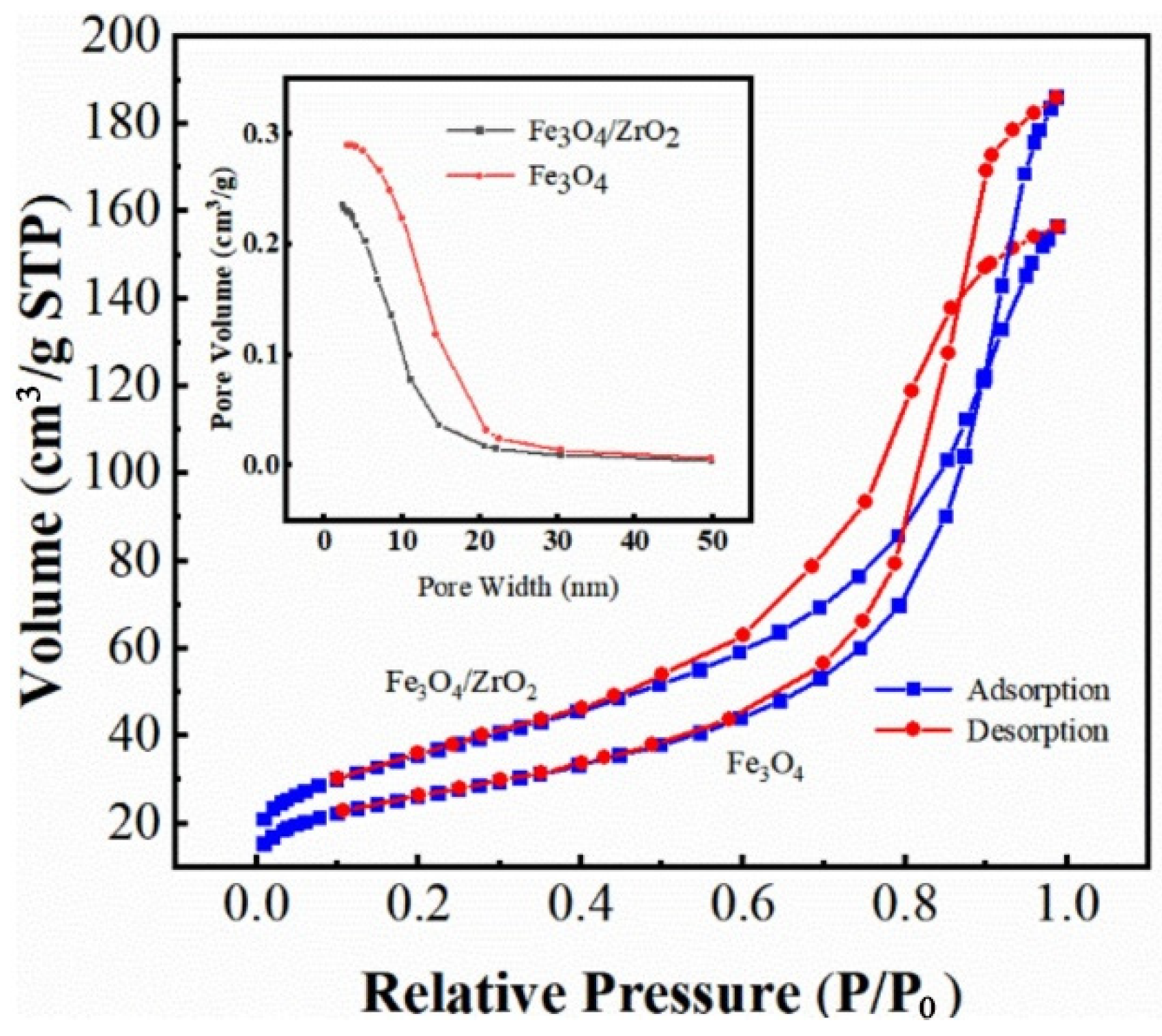
Elemental doping is an important strategy for regulating the electronic structure and surface properties of ZrO2-based catalysts. The introduction of heteroatoms can alter the lattice structure of ZrO2, the density of acidic/basic sites, and the oxygen-vacancy concentration, thereby enhancing catalytic performance. Metal dopants can be mainly divided into two categories: transition metal elements (Fe, Co, Ni, Cu, etc.) and rare earth elements (Ce, La, Nd, Y, etc.). Transition-metal dopants can introduce new active sites, simultaneously tailor the electronic structure of ZrO2, and strengthen its interaction with HCHO molecules. Beyond single-element doping, compositing ZrO2 with transition-metal oxides or rare earth oxides is also an effective modification strategy. Liu et al. [136] prepared an Fe3O4/ZrO2 composite catalyst by low-temperature co-precipitation. The introduction of ZrO2 increased the specific surface area of Fe3O4 from 92.96 to 128.96 m2/g, thereby effectively suppressing the loss of active sites caused by the magnetic aggregation of Fe3O4. Besides, the electronic interaction between Fe and Zr also promoted the generation of reactive oxygen species. As shown in Figure 11, Fe3O4/ZrO2 exhibits a typical mesoporous structure with pores concentrated in the range of 0–15 nm and an average pore size of 7.509 nm. Its high specific surface area and rational pore structure effectively suppress the loss of active sites caused by the magnetic aggregation of Fe3O4. In this composite system, ZrO2 acts as the support to provide a high specific surface area and stable structural framework, while the transition-metal oxide supplies active centers; the synergy between the two optimizes catalytic behavior. Similarly, this composite strategy can be extended to HCHO catalytic oxidation. Composites of ZrO2 with transition-metal oxides such as MnOx and Co3O4 are expected to improve catalytic activity by suppressing aggregation and promoting electron transfer, opening new avenues for the composite modification of ZrO2-based catalysts. Wyrwalski et al. [92] confirmed that 5 mol% Y2O3 doping can fully stabilize ZrO2 in the tetragonal phase, preventing phase transformation even at low temperature. Meanwhile, the ionic radius mismatch between Y3+ (0.090 nm) and Zr4+ (0.072 nm) induces lattice distortion and generates abundant anion vacancies. These oxygen vacancies not only enhance the oxygen-storage/release capacity of the support but also improve the adsorption and anchoring of active components, thereby providing abundant active sites for subsequent catalytic reactions. Shi et al. [137] prepared CexZr1−xOy composite catalysts by a hydrothermal method using Pluronic F127 as the template, which achieved an HCHO conversion of 84.69% at room temperature after 6 h, and maintained more than 80% of its initial activity after 17 h. The core advantage of this system lies in the Ce–Zr synergy: the valence mismatch between Ce3+ and Zr4+ induces abundant oxygen vacancies, which activate O2 to generate reactive adsorbed oxygen species that accelerate HCHO oxidation in synergy with hydroxyl groups. This strategy provides a useful quantitative reference for the precise structural regulation of ZrO2-based catalysts.

4.4. Other Modification Strategies

Besides elemental doping, grain size is another key factor governing the stability of t-ZrO2. Li et al. [138] confirmed by low-temperature XRD and HRTEM characterization that the martensitic transformation temperature (MS) of t-ZrO2 exhibits a linear correlation with the negative square root of its grain size (MS = D· d t Z r O 2 1 / 2 + E). When d t Z r O 2 is reduced to the critical size of 20 nm, t-ZrO2 can remain completely stable in the temperature range of 203.15–293.15 K without transforming into the monoclinic phase. This finding provides a new strategy for crystal-phase regulation: by reducing the grain size to 20 nm or below, low-temperature stabilization of t-ZrO2 can be achieved without elemental doping, thereby avoiding the influence of dopant-induced lattice distortion on catalytic sites. In addition, compositing ZrO2 with mineral materials is a promising modification route. Divakar et al. [139] prepared an FAp@ZrO2 composite catalyst through a facile preparation process. The combination of ZrO2 and fluorapatite (FAp) not only preserves the Lewis acidic sites of ZrO2 and the basic sites of FAp, but also constructs a synergistic acid–base bifunctional surface. Meanwhile, it also endows the catalyst with a favorable mesoporous structure, featuring a specific surface area of 47.2 m2/g and an average pore size of 14 nm, which enhances substrate adsorption and reaction efficiency. The system integrates a stable structural framework, basic sites, and acidic active centers to deliver improved catalytic performance. And this strategy could be extended to catalytic HCHO oxidation: combining ZrO2 with mineral materials such as fluorapatite and zeolites is expected to strengthen the adsorption and activation of HCHO through acid–base-site synergy, thereby opening up a new direction for the composite modification of ZrO2-based catalysts.

5. Conclusions and Outlook

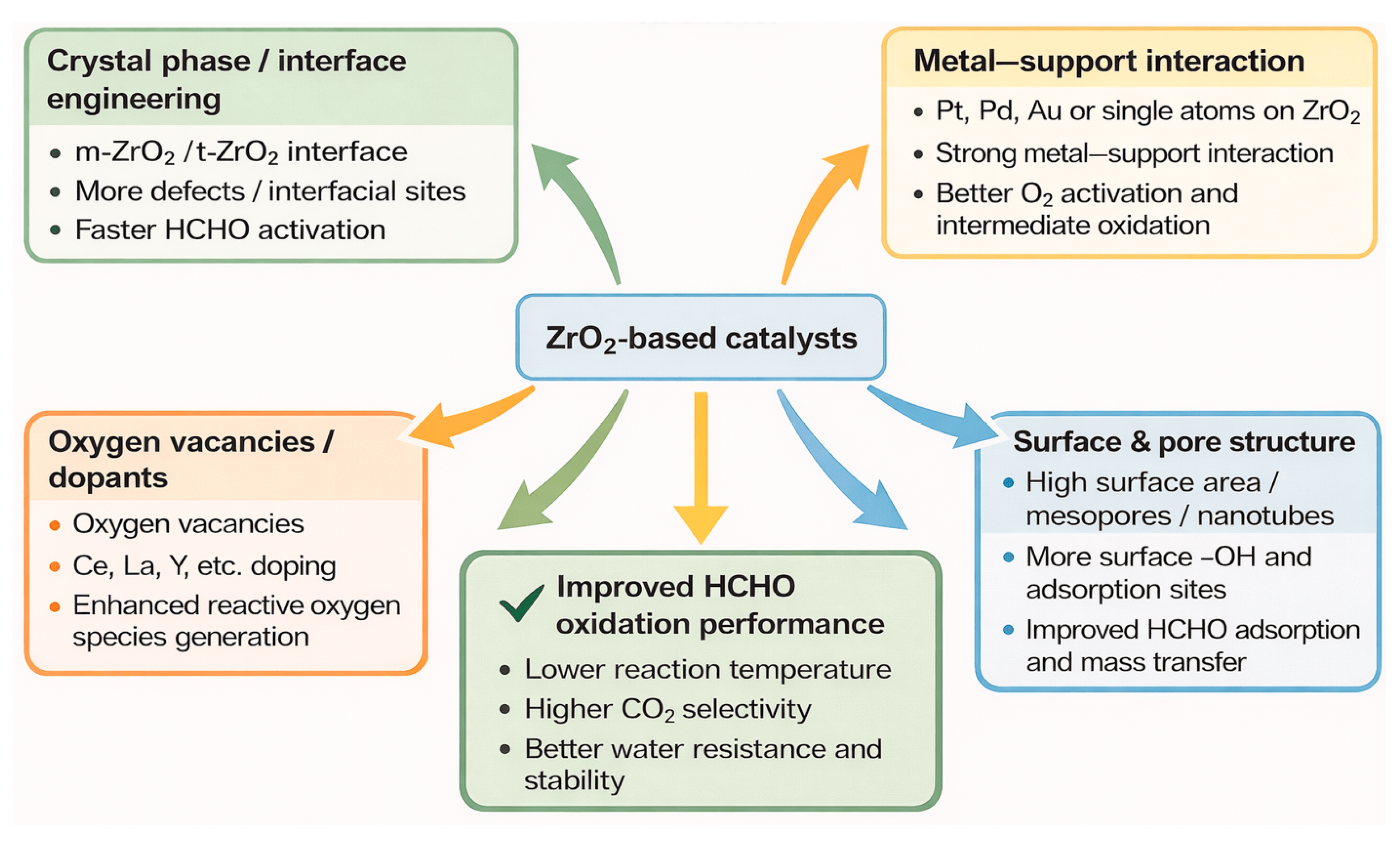
This review systematically summarizes recent research on ZrO2-based catalysts for catalytic HCHO oxidation, with a focus on the physicochemical properties of ZrO2 supports, catalytic reaction mechanisms, as well as structural regulation and modification strategies. It also provides an in-depth discussion on the influence of laws of key factors, including crystal-phase regulation, elemental doping, strong metal–support interactions (SMSIs), and composite modification on catalytic performance. Benefiting from its excellent thermal stability, unique surface acid–base properties, and synergistic interactions with active components, ZrO2 has become an ideal support for catalytic HCHO oxidation, and rational structural design enables highly efficient HCHO conversion at room temperature. The main structure–activity relationships of ZrO2-based catalysts for HCHO oxidation are illustrated in Figure 12.
The core mechanism of catalytic HCHO oxidation follows the three classical adsorption–reaction models: MVK, L-H, and E-R. In the presence of water, reactive oxygen species on the catalyst surface can be converted into hydroxyl groups. HCHO molecules adsorb onto these surface hydroxyl groups through hydrogen bonding, and are then gradually oxidized to CO2 and H2O through key intermediates including DOM and formate species, or alternatively first converted to CO followed by deep oxidation via the water–gas shift reaction. A preliminary consensus has been reached regarding the influence of reaction conditions on catalytic performance: elevated temperature facilitates HCHO activation and intermediate conversion; an optimal relative humidity window of 30–75% can balance reactant adsorption and active site exposure; HCHO with a low initial concentration is more liable to be completely removed; a lower space velocity prolongs the contact time between reactants and the catalyst; the optimal dosage of the catalyst ranges from 100 mg to 200 mg, and excessive addition yields limited improvement in catalytic efficiency.
At present, it is difficult to identify a single catalyst family that can be universally recognized as optimal across all evaluation criteria for ZrO2-based catalysts. Instead, the selection of a more suitable catalyst family is contingent on the specific evaluation metrics that are prioritized, especially when considering the balance among activity, noble metal loading, water resistance, and long-term stability. The Ir single-atom system anchored on ZrO2 nanoparticles stands out as one of the most well-balanced options available to date when minimal noble metal loading is prioritized alongside high room temperature activity and broad humidity tolerance. This system achieves over 95% HCHO conversion at 20 °C with only 0.25 wt% Ir loading and maintains conversion rates above 80% even at 75% relative humidity (RH) [88], though its long-term stability under complex real-world operating conditions requires further investigation. For researchers prioritizing the classical Pt/ZrO2 platform with comprehensive mechanistic evidence, the oxygen-vacancy-associated Pt–VO–ZrO2 system remains a highly reliable benchmark. It exhibits room temperature catalytic activity, and direct experimental evidence confirms VO-assisted strong metal–support interaction (SMSI), the generation of reactive O* species, and rapid mineralization of reaction intermediates [105]. Nevertheless, its activity declines under high humidity conditions, indicating that moisture tolerance has not been fully optimized, and additional in-depth studies are needed to assess its long-term stability during continuous operation [105]. Ce–Zr mixed oxides represent a promising avenue for reducing catalyst costs while preserving room temperature activity. Through oxygen-vacancy engineering and the Ce3+/Ce4+ redox cycle, these oxides deliver high catalytic activity without relying on high noble metal loading [126,140]. However, their water resistance and long-term stability under harsh operating conditions still need to be enhanced to compete with noble metal-based catalyst systems. Overall, it remains challenging to identify a catalyst system that exhibits perfect performance across all aspects, including activity, precious metal loading, water resistance, and long-term stability. Each type of system has its own inherent advantages and drawbacks. Taking multiple factors into comprehensive consideration, the Ir single-atom system coupled with ZrO2 nanoparticles may be closer to the level of comprehensive optimization compared with other catalyst systems. Nevertheless, the long-term stability of this system under complex practical operating conditions still needs to be improved, and there remains room for further optimization of its overall performance.
Key strategies to improve the stability of ZrO2-based catalysts include the following aspects: optimizing the pore structure, surface defects, and morphology of the support; strengthening the interaction between active components and the support to suppress migration and aggregation of active species; and doping with transition metals or non-metal elements to regulate the electronic structure of active sites and improve sintering resistance. Nevertheless, ZrO2-based catalysts still face challenges in practical applications, including the high usage of noble metals, insufficient efficiency for the removal of ultralow-concentration HCHO, and limited resistance to interference under complex environmental conditions. Future work may therefore focus on these directions.
Overall, although no single universally transferable descriptor has yet been established across all systems, a relatively consistent trend has emerged: a higher density of effective oxygen vacancies, more favorable interfacial charge redistribution, and more stable regulation of the active-metal oxidation state generally correspond to stronger O2 activation, faster deep oxidation of intermediates, and better room temperature activity. In Pt–VO–ZrO2, for example, oxygen vacancies not only favor the formation of interfacial reactive oxygen species, but also alter the co-adsorption behavior of HCHO and O2 and the subsequent reaction pathway. Similar roles of defect structure, electron transfer, and local coordination environment have also been implicated in Ce–Zr mixed oxides and ZrO2-coupled single-atom systems, where they affect both the reaction rate and the humidity response.

5.1. Optimization of Catalytic Systems

Future catalyst design should focus on the anchoring of single atoms or subnanometer noble metal species (including Pt, Pd, and Ag) on defect-rich ZrO2 or ZrO2-based composite supports (such as ZrO2–CeO2 and ZrO2–MnO2). By exploiting strong metal–support interactions together with oxygen-vacancy effects, this design strategy is expected to achieve complete HCHO oxidation at room temperature or even below 0 °C while minimizing the loading of noble metals. Another important direction is the development of noble metal-free or low-noble metal formulations, which can be realized by constructing interfacial heterojunctions between ZrO2 and transition-metal oxides such as Co3O4 and MnOx and by utilizing defect engineering, including oxygen vacancies and lattice distortion, to increase the concentration of reactive oxygen species and improve electron-transfer efficiency.

5.2. Machine Learning-Assisted Design

Data-driven methods such as machine learning (ML) [141] can be introduced to construct dedicated databases for ZrO2-based catalysts by integrating preparation parameters, including dopant ratio, template dosage, and calcination temperature, with structural descriptors such as grain size, oxygen-vacancy concentration, specific surface area, and acid–base-site density, together with reaction conditions and catalytic performance data. Algorithms such as extreme gradient boosting (XGBoost) can then be employed to construct performance-prediction models, while SHAP analysis can be applied to quantify the contributions of metal–support interactions, active-component electronegativity, specific surface area, and related factors. This data-driven framework enables rapid screening of the optimal structural combinations, and effectively avoids blind trial and error in conventional experiments. In the future, an integrated loop of experimental validation, data accumulation, model prediction, and process optimization could be established, together with a standardized catalytic-evaluation protocol that minimizes interference caused by differences in testing conditions, thus accelerating the industrial deployment of high-performance ZrO2-based catalysts for HCHO oxidation.
In summary, ZrO2-based catalysts have broad application prospects in the field of HCHO catalytic oxidation. Through the deep integration of materials innovation, process optimization, and data-driven research and development, these catalysts are expected to realize large-scale application in real indoor air purification scenarios and provide efficient, stable, and economical solutions for the control of formaldehyde pollution.

Author Contributions

Conceptualization, supervision, funding acquisition, writing—review and editing, F.C.; Writing—original draft preparation, investigation, X.C.; Investigation, J.X.; Investigation, F.H.; Investigation, H.Y.; Writing—review and editing, D.-G.L. All authors have read and agreed to the published version of the manuscript.

Funding

This research was funded by the National Key Research and Development Program of China (Grant number 2024YFE0211700).

Data Availability Statement

All data generated or analyzed during this study are included in the published article.

Conflicts of Interest

The authors declare no conflicts of interest.

References

  1. Ye, J.; Yu, Y.; Fan, J.; Cheng, B.; Yu, J.; Ho, W. Room-temperature formaldehyde catalytic decomposition. Environ. Sci. Nano 2020, 7, 3655–3709. [Google Scholar] [CrossRef]
  2. Yachmenev, A.; Yurchenko, S.N.; Jensen, P.; Thiel, W. A new “spectroscopic” potential energy surface for formaldehyde in its ground electronic state. J. Chem. Phys. 2011, 134, 244307. [Google Scholar] [CrossRef] [PubMed]
  3. Wolfe, G.M.; Kaiser, J.; Hanisco, T.F.; Keutsch, F.N.; de Gouw, J.A.; Gilman, J.B.; Graus, M.; Hatch, C.D.; Holloway, J.; Horowitz, L.W.; et al. Formaldehyde production from isoprene oxidation across NOx regimes. Atmos. Chem. Phys. 2016, 16, 2597–2610. [Google Scholar] [CrossRef]
  4. Checkoway, H.; Boffetta, P.; Mundt, D.J.; Mundt, K.A. Critical review and synthesis of the epidemiologic evidence on formaldehyde exposure and risk of leukemia and other lymphohematopoietic malignancies. Cancer Causes Control 2012, 23, 1747–1766. [Google Scholar] [CrossRef]
  5. Justo Alonso, M.; Madsen, H.; Liu, P.; Jørgensen, R.B.; Jørgensen, T.B.; Christiansen, E.J.; Myrvang, O.A.; Bastien, D.; Mathisen, H.M. Evaluation of low-cost formaldehyde sensors calibration. Build. Environ. 2022, 222, 109380. [Google Scholar] [CrossRef]
  6. Yu, S.; Zhu, Q.; Yu, M.; Zhou, C.; Meng, R.; Bai, G.; Huang, B.; Xiao, Y.; Wu, W.; Guo, Y.; et al. The association between long-term exposure to ambient formaldehyde and respiratory mortality risk: A national study in China. Ecotoxicol. Environ. Saf. 2024, 283, 116860. [Google Scholar] [CrossRef]
  7. Tang, X.J.; Bai, Y.; Duong, A.; Smith, M.T.; Li, L.Y.; Zhang, L.P. Formaldehyde in China: Production, consumption, exposure levels, and health effects. Environ. Int. 2009, 35, 1210–1224. [Google Scholar] [CrossRef]
  8. Faria, D.L.; Scatolino, M.V.; de Oliveira, J.E.; Gonçalves, F.G.; Soriano, J.; de Paula Protásio, T.; Lelis, R.C.C.; de Carvalho, L.M.H.; Mendes, L.M.; Junior, J.B.G. Cardanol-based adhesive with reduced formaldehyde emission to produce particleboards with waste from bean crops. Environ. Sci. Pollut. Res. 2023, 30, 48270–48287. [Google Scholar] [CrossRef]
  9. Chen, R.; Sun, Z.; Hardacre, C.; Tang, X.; Liu, Z. The current status of research on the catalytic oxidation of formaldehyde. Catal. Rev. 2024, 66, 1028–1083. [Google Scholar] [CrossRef]
  10. Chai, L.; Zhai, W.; Liu, X.; Xing, G.; Zhang, B.; Zang, J.; Yang, Y.; Ma, K.; Zhang, J. Room temperature catalysts for high effective degradation of formaldehyde: Research progresses and challenges. ChemistrySelect 2024, 9, e202304418. [Google Scholar] [CrossRef]
  11. Sun, G.; Gao, Y.; Luo, X.; Lian, L.; He, J.; Xie, S.; Su, J.; Liu, T.; Xu, L. Recent advances in formaldehyde catalytic oxidation catalysts. Inorganics 2025, 13, 345. [Google Scholar] [CrossRef]
  12. Han, Y.; Lee, J.; Haiping, G.; Kim, K.-H.; Wanxi, P.; Bhardwaj, N.; Oh, J.-M.; Brown, R.J.C. Plant-based remediation of air pollution: A review. J. Environ. Manag. 2022, 301, 113860. [Google Scholar] [CrossRef]
  13. Becker, A.; Israfilov, N.; Ehrstein, E.; Lara-Ibeas, I.; Planeix, J.-M.; Louis, B.; Le Calvé, S. Adsorption of gaseous formaldehyde on Y zeolites and on metal-organic frameworks. Microporous Mesoporous Mater. 2022, 343, 112136. [Google Scholar] [CrossRef]
  14. Chen, J.; Zhou, Z.; Miao, Y.; Liu, H.; Huang, W.; Chen, Y.; Jia, L.; Zhang, W.; Huang, J. Preparation of CS@BAC composite aerogel with excellent flame-retardant performance, good filtration for PM2.5 and strong adsorption for formaldehyde. Process Saf. Environ. Prot. 2023, 173, 354–365. [Google Scholar] [CrossRef]
  15. Su, G.; Xiong, J.; Li, Q.; Luo, S.; Zhang, Y.; Zhong, T.; Harper, D.P.; Tang, Z.; Xie, L.; Chai, X.; et al. Gaseous formaldehyde adsorption by eco-friendly, porous bamboo carbon microfibers obtained by steam explosion, carbonization, and plasma activation. Chem. Eng. J. 2023, 455, 140686. [Google Scholar] [CrossRef]
  16. Deng, B.; Chen, Z.; Yang, L.; Guo, J.; Cheng, C.; Li, X.; Zhang, S.; Luo, S. Converting formaldehyde in methanol with MoO2 under irradiation: A pollution-free strategy for cleaning air. J. Hazard. Mater. 2024, 466, 133606. [Google Scholar] [CrossRef]
  17. Kuk, S.K.; Ji, S.M.; Kang, S.; Yang, D.S.; Kwon, H.J.; Koo, M.S.; Oh, S.; Lee, H.C. Singlet-oxygen-driven photocatalytic degradation of gaseous formaldehyde and its mechanistic study. Appl. Catal. B Environ. 2023, 328, 122463. [Google Scholar] [CrossRef]
  18. Cho, M.-S.; Vikrant, K.; Boukhvalov, D.W.; Kim, K.-H. The photocatalytic efficacy of potassium hydroxide–based modification of titanium dioxide in the oxidative destruction of gaseous formaldehyde. Small 2025, 21, 2501387. [Google Scholar] [CrossRef]
  19. Wu, Y.; Liu, Y.; Shen, Z.; Song, M. S-scheme heterojunction Bi2MoO6/WO3 toward efficient photocatalytic oxidation of indoor gaseous formaldehyde under indoor temperature, humidity and sunlight irradiation conditions. Build. Environ. 2025, 282, 113297. [Google Scholar] [CrossRef]
  20. Wang, F.; Xie, J.; Zhang, S.; Huang, C. Superior performance of the δ-MnO2 ultrathin nanoflower for photocatalytic HCHO oxidation. Inorg. Chem. 2025, 64, 6275–6285. [Google Scholar] [CrossRef]
  21. Guo, Y.; Gao, P.; Han, Q.; Feng, L.; Zhang, L. Enhancing visible light degradation of gaseous formaldehyde with CuOx/OVs-TiO2 photocatalyst loaded wallpaper: Preparation, efficacy and mechanism. Chemosphere 2025, 371, 144051. [Google Scholar] [CrossRef] [PubMed]
  22. Ma, Y.; Zhan, X.; Han, Y.; Cui, W.; Ye, X.; Li, J. The BiOBr/Bi2WO6/2K-g-C3N4 tri-heterojunction photocatalyst efficiently catalyzes the degradation of gaseous formaldehyde. Mater. Sci. Semicond. Process. 2025, 198, 109771. [Google Scholar] [CrossRef]
  23. Chang, F.; Kou, Y.; Liu, H.; Bai, W.; Bao, W.; Wu, F. N-p heterojunction composites Bi20TiO32-Bi2S3: Fabrication and efficient photocatalytic NO removal. J. Environ. Manag. 2026, 399, 128633. [Google Scholar] [CrossRef]
  24. Chang, F.; Li, J.; Kou, Y.; Bao, W.; Shi, Z.; Zhu, G.; Kong, Y. The intense charge migration and efficient photocatalytic NO removal of the S-scheme heterojunction composites Bi7O9I3-BiOBr. Sep. Purif. Technol. 2025, 353, 128402. [Google Scholar] [CrossRef]
  25. Zhao, W.; Wang, G.; Song, S.; Wen, M.; Li, G.; An, T. Enhanced pizeopotential-mediated catalytic oxidation mechanism of formaldehyde and anti-deactivation performance onto ZnO surface. Appl. Catal. B Environ. Energy 2024, 353, 124057. [Google Scholar] [CrossRef]
  26. Wang, X.; Zhao, J.; Zhao, C.; Zhang, Y.; Mahmud, S.; Zhang, J. Ceramic fiber paper-based manganese oxides catalyst for room temperature formaldehyde oxidation. Catal. Lett. 2025, 155, 65. [Google Scholar] [CrossRef]
  27. Zhang, X.; Guo, L.; Wang, Y.; Lv, B.; Huang, Z.; Wu, X.; Zhao, H.; Jing, G.; Shen, H. Y single atoms boost MnO2 for efficient ambient formaldehyde catalytic oxidation. Sep. Purif. Technol. 2025, 362, 131962. [Google Scholar] [CrossRef]
  28. Chen, M.; Huang, X.; Zhong, Z.; Wang, P. MnO2·MnO nanocrystalline as a highly efficient cooperative catalyst for formaldehyde oxidation. Appl. Surf. Sci. 2025, 705, 163530. [Google Scholar] [CrossRef]
  29. Wang, F.; Zhang, Z.; Shi, J.; Zhang, K. Facile synthesis of highly active and ultrastable palladium catalysts for formaldehyde oxidation. ChemistrySelect 2025, 10, e202405669. [Google Scholar] [CrossRef]
  30. Hua, Y.; Wang, H.; Ding, Y.; Chang, Y.; Qu, Z. HPMo/SiO2||Ag/Al2O3 bifunctional catalyst for low-temperature formaldehyde oxidation via tandem catalysis. Chem. Eng. J. 2025, 519, 165479. [Google Scholar] [CrossRef]
  31. Zhong, Z.; Chen, M.; Huang, X.; Wang, P. Design and synthesis of Pt/TiO2 catalyst with abundant surface hydroxyl for formaldehyde oxidation. J. Hazard. Mater. 2025, 487, 137302. [Google Scholar] [CrossRef]
  32. Liu, X.; Li, J.; Guo, J.; Zhang, Y.; Wang, W.; Wu, F.; You, Z.; Hao, Z.; Zhang, Z. Porous graphitized carbon-supported Pt for catalytic oxidation of carbon monoxide and formaldehyde under ambient conditions. Sep. Purif. Technol. 2025, 361, 131512. [Google Scholar] [CrossRef]
  33. Zhang, W.; Xu, Y.; Lin, J. Enhanced efficient catalytic oxidation of formaldehyde using lignin-based fibers supported manganese dioxide. J. Mater. Sci. 2025, 60, 5765–5781. [Google Scholar] [CrossRef]
  34. Chen, T.-Y.; Liu, Y.; Li, Z.; Shen, X.; Zhan, J.; Zhou, H.; Yi, X. Alpha-MnO2 catalyst with high formaldehyde oxidation and moisture resistance by joint cerium modification and phosphoric acid post-treatment. Environ. Res. 2025, 279, 121788. [Google Scholar] [CrossRef]
  35. Wang, R.; Yu, C.; Gong, J.; Su, Q.; Chen, H.; Yang, C.; Sun, S.; Huang, Z.; Shen, H.; Zhao, H.; et al. Identification of active sites for formaldehyde oxidation on mesoporous Pt/CeO2 catalyst at ambient temperature and low humidity. Fuel 2025, 392, 134905. [Google Scholar] [CrossRef]
  36. Khalifa, A.A.; Alalaiwat, D.; Khan, E. Phytoremediation of formaldehyde by three selected non-native indoor plant species. Int. J. Phytoremediat. 2024, 26, 1802–1814. [Google Scholar] [CrossRef] [PubMed]
  37. Ji, W.; Ren, M.; Jin, H.; Lou, Y.; Wang, S.; Fan, X.; Tabassum, S. Ball milling-assisted synthesis of attapulgite-rice husk biochar composites for efficient formaldehyde removal: Experimental and computational insights. Sep. Purif. Technol. 2025, 367, 132918. [Google Scholar] [CrossRef]
  38. Xu, K.; Zhou, X.; Zhang, H.; Chen, H. Construction of hierarchical porous composite aerogel for high-efficient removal of low-level gaseous formaldehyde. Small 2025, 21, 2503361. [Google Scholar] [CrossRef]
  39. Li, F.; Zhu, T.; Yang, J.; Yuan, B.; Zhang, X.; Ju, Q.; Li, C.; Wang, M.; Zhang, X. Biodegradable porous adsorbent for efficient formaldehyde removal from indoor air. Environ. Res. 2025, 275, 121453. [Google Scholar] [CrossRef] [PubMed]
  40. Xu, J.; Guo, M.; Lin, M.; Ma, C.; Chen, G. Three-dimensional nitrogen-doped modified activated carbon/graphene composite aerogel for highly efficient removal of indoor formaldehyde. J. Environ. Chem. Eng. 2025, 13, 115576. [Google Scholar] [CrossRef]
  41. Zheng, H.; Liu, Y.; Liu, Y.; Bai, S.; Ji, J.; Tian, S.; Tang, Z. Formaldehyde and water adsorption in MFI zeolite Channels: A molecular simulation study. J. Mol. Liq. 2025, 431, 127804. [Google Scholar] [CrossRef]
  42. Zheng, X.; Cui, Y.; Wu, Y.; Zhou, X.; Zhao, K.; Zhang, H.; Fang, L. Revealing the mechanism of pore surface structure in adsorption of trace formaldehyde by constructing monolithic carbon with multiple uniform micropores and surface species. Environ. Sci. Technol. 2025, 59, 12397–12407. [Google Scholar] [CrossRef]
  43. Liu, Y.; Zhang, S.-Y.; Lian, H.-Y.; Chen, T.-Y.; Zhan, J.; Zhou, H.; Yi, X. DBD-air-plasma fabrication of N-doped Li-CoOx substrate for loading Ag to promote the successive adsorption and oxidation of airborne HCHO. Appl. Surf. Sci. 2025, 685, 162034. [Google Scholar] [CrossRef]
  44. Zhang, C.; He, H.; Tanaka, K.-i. Catalytic performance and mechanism of a Pt/TiO2 catalyst for the oxidation of formaldehyde at room temperature. Appl. Catal. B Environ. 2006, 65, 37–43. [Google Scholar] [CrossRef]
  45. He, Y.; Ji, H. In-Situ DRIFTS study on catalytic oxidation of formaldehyde over Pt/TiO2 under mild conditions. Chin. J. Catal. 2010, 31, 171–175. [Google Scholar] [CrossRef]
  46. Li, S.; Lu, X.; Guo, W.; Zhu, H.; Li, M.; Zhao, L.; Li, Y.; Shan, H. Formaldehyde oxidation on the Pt/TiO2(101) surface: A DFT investigation. J. Organomet. Chem. 2012, 704, 38–48. [Google Scholar] [CrossRef]
  47. Huang, H.; Leung, D.Y.C. Complete oxidation of formaldehyde at room temperature using TiO2 supported metallic Pd nanoparticles. ACS Catal. 2011, 1, 348–354. [Google Scholar] [CrossRef]
  48. Liu, J.; Wang, Y.; Dai, Z.; Jia, C.Q.; Yang, L.; Liu, J.; Chen, Y.; Yao, L.; Wang, B.; Huang, W.; et al. Recent advances in Zeolite-Based catalysts for volatile organic compounds decontamination by thermal catalytic oxidation. Sep. Purif. Technol. 2024, 330, 125339. [Google Scholar] [CrossRef]
  49. Jang, Y.; Lee, Y.H.; Eom, H.; Lee, S.M.; Kim, S.S. Effect of preparation method of noble metal supported catalyts on formaldehyde oxidation at room temperature: Gas or liquid phase reduction. J. Environ. Sci. 2022, 122, 201–216. [Google Scholar] [CrossRef]
  50. Nie, L.; Yu, J.; Jaroniec, M.; Tao, F.F. Room-temperature catalytic oxidation of formaldehyde on catalysts. Catal. Sci. Technol. 2016, 6, 3649–3669. [Google Scholar] [CrossRef]
  51. Liu, X.; Miao, W.; Xie, L.; Li, B.; Wu, Y.; Wang, W. Catalytic degradation of formaldehyde in advanced composite materials: The role of modification treatments and heterogeneous interfaces. Chem. Eng. J. 2025, 512, 162312. [Google Scholar] [CrossRef]
  52. Shi, Y.; Qiao, Z.; Liu, Z.; Zuo, J. Cerium Doped Pt/TiO2 for catalytic oxidation of low concentration formaldehyde at room temperature. Catal. Lett. 2019, 149, 1319–1325. [Google Scholar] [CrossRef]
  53. Zheng, Z.; Zhang, C.; Li, J.; Fang, D.; Tan, P.; Fang, Q.; Chen, G. Efficient catalytic oxidation of formaldehyde by defective g–C3N4–anchored single-atom Pt: A DFT study. Chemosphere 2024, 361, 142517. [Google Scholar] [CrossRef] [PubMed]
  54. Hu, Q.; Liu, K.; Ye, J.; Ming, L.; Xu, J.; Cao, S. Hierarchical Pt/NiCo2O4 nanosheets decorated carbon nanofibers for room-temperature catalytic formaldehyde oxidation. Appl. Surf. Sci. 2023, 623, 157012. [Google Scholar] [CrossRef]
  55. Wang, J.; He, G.; Wang, C.; Chen, X.; Liu, X.; Li, Y.; Shan, W.; He, H. HCHO oxidation on Pt-Na/SiO2 catalyst with ultralow Pt loading: New insight into the effect of Si support and Na promoter. Appl. Catal. B Environ. Energy 2024, 347, 123787. [Google Scholar] [CrossRef]
  56. Bu, Y.; Chen, Y.; Jiang, G.; Hou, X.; Li, S.; Zhang, Z. Understanding of Au-CeO2 interface and its role in catalytic oxidation of formaldehyde. Appl. Catal. B Environ. 2020, 260, 118138. [Google Scholar] [CrossRef]
  57. Chen, D.; Shi, J.; Shen, H. High-dispersed catalysts of core–shell structured Au@SiO2 for formaldehyde catalytic oxidation. Chem. Eng. J. 2020, 385, 123887. [Google Scholar] [CrossRef]
  58. Chen, D.; Zhai, M.; Zhang, J.; Miao, L.; Li, K.; Wang, Z.; Wang, X. Incorporation of NiO on attapulgite supported Au catalyst for HCHO removal at low temperature. Surf. Interfaces 2025, 60, 106083. [Google Scholar] [CrossRef]
  59. Chen, H.; Zhang, R.; Wang, H.; Bao, W.; Wei, Y. Encapsulating uniform Pd nanoparticles in TS-1 zeolite as efficient catalyst for catalytic abatement of indoor formaldehyde at room temperature. Appl. Catal. B Environ. 2020, 278, 119311. [Google Scholar] [CrossRef]
  60. Li, Y.; Wang, C.; Zhang, C.; He, H. Formaldehyde oxidation on Pd/TiO2 catalysts at room temperature: The effects of surface oxygen vacancies. Top. Catal. 2020, 63, 810–816. [Google Scholar] [CrossRef]
  61. Tomar, S.; Bhadoria, B.S.; Jeong, H.; Choi, J.H.; Lee, S.-C.; Bhattacharjee, S. Single-atom Pd catalyst on a CeO2 (111) surface for methane oxidation: Activation barriers and reaction pathways. J. Phys. Chem. C 2024, 128, 8580–8589. [Google Scholar] [CrossRef]
  62. Wang, C.; Wang, J.; Li, Y.; Chen, X.; Li, Z.; Zhang, C.; Zheng, Y.; Shan, W.; He, H. The performance and mechanism of HCHO oxidation on Pd/SiO2 catalysts with different Pd particle sizes. Appl. Surf. Sci. 2024, 657, 159840. [Google Scholar] [CrossRef]
  63. Duan, C.; Meng, M.; Huang, H.; Wang, H.; Ding, H.; Zhang, Q. Ag-promoted Cr/MnO2 catalyst for catalytic oxidation of low-concentration formaldehyde at room temperature. Phys. Chem. Chem. Phys. 2023, 25, 10155–10165. [Google Scholar] [CrossRef] [PubMed]
  64. Jiang, G.; Su, Y.; Li, H.; Chen, Y.; Li, S.; Bu, Y.; Zhang, Z. Insight into the Ag-CeO2 interface and mechanism of catalytic oxidation of formaldehyde. Appl. Surf. Sci. 2021, 549, 149277. [Google Scholar] [CrossRef]
  65. Lu, S.; Su, C.; Wang, G.; Wang, H.; Xia, W.; Cui, J.; Zhu, Q. Metal–organic frameworks derived Ag/Co3O4–MnO2 for the catalytic oxidation of formaldehyde. React. Kinet. Mech. Catal. 2022, 135, 687–703. [Google Scholar] [CrossRef]
  66. Dong, N.; Fu, J.; Ye, Q.; Chen, M.; Fu, Z.; Dai, H. Effect of preparation method on catalytic performance of Ag/OMS-2 for the oxidation of ethyl acetate and formaldehyde. Catal. Surv. Asia 2020, 24, 259–268. [Google Scholar] [CrossRef]
  67. Ding, Y.; Wang, H.; Huang, B.; Chang, Y.; Hua, Y.; Qu, Z. Controlled growth of silver nanoparticles by metal–support interaction for enhanced tandem catalytic oxidation of HCHO at low temperature. ACS Catal. 2025, 15, 1411–1421. [Google Scholar] [CrossRef]
  68. Lu, S.; Sun, N.; He, N.; Zheng, F.; Jiang, Y.; Fu, H.; Liu, J.; Fang, Y. Mesoporous Ag-K-Al2O3 catalysts prepared via a one-pot evaporation induced self-assembly approach and their application in catalytic oxidation of formaldehyde. Appl. Surf. Sci. 2025, 679, 161203. [Google Scholar] [CrossRef]
  69. Chen, Z.; Yang, L.; Liu, X.; Li, H.; Li, X.; Cheng, C.; Zhu, Y.; Luo, S. Enhanced oxygen activation over self-supporting Cu2+ doped Co3O4 nanoneedle arrays for efficient HCHO oxidation at room temperature. Sep. Purif. Technol. 2024, 338, 126542. [Google Scholar] [CrossRef]
  70. Liu, J.; Sun, X.; Dong, L.; Hou, T.; Chen, S. Interlayer Cu2+ modulation of local electronic structures in CuO1-x@Cu-MnO2 core-shell nanoarrays for synergistic photothermal formaldehyde degradation. Appl. Catal. B Environ. Energy 2025, 371, 125279. [Google Scholar] [CrossRef]
  71. Zhao, Q.; Xiang, N.; Wen, S.; Huo, H.; Li, Q. ZIF-67 derived Cu-Co mixed oxides for efficient catalytic oxidation of formaldehyde at low-temperature. Catalysts 2023, 13, 117. [Google Scholar] [CrossRef]
  72. Yan, G.; Du, X.; Guo, X.; Cao, X.; Shi, H. NaBH4 reduced Mn-doped cobalt tetroxide R-MnxCo3−xO4 catalysts with plentiful oxygen vacancies for HCHO oxidation at low temperature. New J. Chem. 2024, 48, 8314–8323. [Google Scholar] [CrossRef]
  73. Duan, C.; Zhou, Y.; Meng, M.; Huang, H.; Ding, H.; Zhang, Q.; Huang, R.; Yan, M. Research on the elimination of low-concentration formaldehyde by Ag loaded onto Mn/CeO2 catalyst at room temperature. Phys. Chem. Chem. Phys. 2023, 25, 24495–24507. [Google Scholar] [CrossRef]
  74. Du, X.; Li, C.; Zhang, J.; Zhao, L.; Li, S.; Lyu, Y.; Zhang, Y.; Zhu, Y.; Huang, L. Highly efficient simultaneous removal of HCHO and elemental mercury over Mn-Co oxides promoted Zr-AC samples. J. Hazard. Mater. 2021, 408, 124830. [Google Scholar] [CrossRef]
  75. Wen, W.; Wang, C.; Chen, X.; Wang, J.; Li, Y.; Wang, F.; Shan, W.; Ning, P.; Li, K. Optimization of Co-N-C catalyst with enhanced accessible active sites for HCHO oxidation through high-temperature pyrolysis. Fuel 2025, 398, 135565. [Google Scholar] [CrossRef]
  76. Liu, L.; Jing, G.; Xu, C.; Zhang, X.; Zhang, X.; Guo, L.; Huang, Z.; Wu, X.; Zhao, H.; Yuan, C.-S.; et al. Exceptional formaldehyde oxidation at room temperature on Co single-atom functionalized TiO2 nanowires via highly effective O2 activation. Appl. Catal. B Environ. Energy 2024, 344, 123634. [Google Scholar] [CrossRef]
  77. He, T.; Rong, S.; Ding, D.; Zhou, Y.; Zhang, N.; He, W. Facet-controlled synthesis of Mn3O4 nanorods for photothermal synergistic catalytic oxidation of carcinogenic airborne formaldehyde. ACS Catal. 2023, 13, 8049–8062. [Google Scholar] [CrossRef]
  78. Kim, W.-K.; Verma, S.; Ahmadi, Y.; Cho, M.-S.; Kim, K.-H. The effects of metal-oxide content in MnO2-activated carbon composites on reactive adsorption and catalytic oxidation of formaldehyde and toluene in air. Sci. Total Environ. 2024, 926, 172137. [Google Scholar] [CrossRef]
  79. Wang, Y.; Liu, K.; Wu, J.; Hu, Z.; Huang, L.; Zhou, J.; Ishihara, T.; Guo, L. Unveiling the Effects of alkali metal ions intercalated in layered MnO2 for formaldehyde catalytic oxidation. ACS Catal. 2020, 10, 10021–10031. [Google Scholar] [CrossRef]
  80. Wang, X.; Wang, J.; Song, D.; Feng, J.; Li, Z. Highly unsaturated oxygen promotes formaldehyde catalytic oxidation on the defective Co3O4 (111) surface: A DFT study. J. Catal. 2025, 448, 116172. [Google Scholar] [CrossRef]
  81. Fan, Z.; Zhang, Z.; Fang, W.; Yao, X.; Zou, G.; Shangguan, W. Low-temperature catalytic oxidation of formaldehyde over Co3O4 catalysts prepared using various precipitants. Chin. J. Catal. 2016, 37, 947–954. [Google Scholar] [CrossRef]
  82. Bai, B.; Qiao, Q.; Li, J.; Hao, J. Progress in research on catalysts for catalytic oxidation of formaldehyde. Chin. J. Catal. 2016, 37, 102–122. [Google Scholar] [CrossRef]
  83. Colussi, S.; Boaro, M.; de Rogatis, L.; Pappacena, A.; de Leitenburg, C.; Llorca, J.; Trovarelli, A. Room temperature oxidation of formaldehyde on Pt-based catalysts: A comparison between ceria and other supports (TiO2, Al2O3 and ZrO2). Catal. Today 2015, 253, 163–171. [Google Scholar] [CrossRef]
  84. Wang, X.; Yang, F.; Yi, J.; Kong, J.; Gong, J.; Yuan, A.; Rui, Z.; Ji, H. Constructing synergy of sufficient hydroxyl and oxygen in PtNi/Al2O3 enables room-temperature catalytic HCHO oxidation. AIChE J. 2023, 69, e17895. [Google Scholar] [CrossRef]
  85. Tiwari, M.; Vinu, R. In situ and ex situ catalytic microwave pyrolysis of biomass pellets using Ni/Al2O3 for hydrogen and bio-oil production. J. Anal. Appl. Pyrolysis 2025, 189, 107044. [Google Scholar] [CrossRef]
  86. He, M.; Cao, Y.; Ji, J.; Li, K.; Huang, H. Superior catalytic performance of Pd-loaded oxygen-vacancy-rich TiO2 for formaldehyde oxidation at room temperature. J. Catal. 2021, 396, 122–135. [Google Scholar] [CrossRef]
  87. Zhu, Y.; Yeung, P.H.; Lo, T.W.; Chai, Y.; Wong, Y.L.; Chen, Y.; Yang, H.; Yu, W.; Zayats, A.V.; Xie, F.; et al. Packed bed optofluidic microreactors with Au decorated TiO2 nanoflowers for visible light photocatalytic water purification. NPJ Clean Water 2025, 8, 7. [Google Scholar] [CrossRef]
  88. Peng, S.; Rao, Y.; Li, T.; Zhang, Y.; Cao, J.-j.; Lee, S.; Huang, Y. Regulating the electronic structure of Ir single atoms by ZrO2 nanoparticles for enhanced catalytic oxidation of formaldehyde at room temperature. Chin. Chem. Lett. 2024, 35, 109219. [Google Scholar] [CrossRef]
  89. Mittal, A.; Kumar, G.; Saroha, B.; Peppel, T.; Kumar, V.; Kumar, S.; Kumar, N. ZrO2 based nanostructures: A sustainable, economical, green and efficient organocatalyst. J. Mol. Liq. 2024, 398, 124223. [Google Scholar] [CrossRef]
  90. Yang, X.; Yu, X.; Lin, M.; Ge, M.; Zhao, Y.; Wang, F. Interface effect of mixed phase Pt/ZrO2 catalysts for HCHO oxidation at ambient temperature. J. Mater. Chem. A 2017, 5, 13799–13806. [Google Scholar] [CrossRef]
  91. Chen, Y.; Zhang, S.; Yang, X. Interfacial adsorption and catalysis of single-atom Pt-loaded ZrO2 surfaces for enhancing formaldehyde oxidation. Surf. Interfaces 2024, 52, 104871. [Google Scholar] [CrossRef]
  92. Wyrwalski, F.; Lamonier, J.F.; Siffert, S.; Aboukaïs, A. Additional effects of cobalt precursor and zirconia support modifications for the design of efficient VOC oxidation catalysts. Appl. Catal. B Environ. 2007, 70, 393–399. [Google Scholar] [CrossRef]
  93. Chitoria, A.K.; Mir, A.; Shah, M.A. A review of ZrO2 nanoparticles applications and recent advancements. Ceram. Int. 2023, 49, 32343–32358. [Google Scholar] [CrossRef]
  94. Zhang, R.; Wang, K.; Xing, Y.; Li, C.; Gao, X.; Ma, Q.; Zhao, T.-s.; Zhang, J. Research advances on ZrO2-based catalysts for CO hydrogenation to isobutene. Fuel 2025, 380, 133139. [Google Scholar] [CrossRef]
  95. Zhang, Y.; Wang, T.; Mei, L.; Yang, R.; Guo, W.; Li, H.; Zeng, Z. Rational design of cost- effective metal-doped ZrO2 for oxygen evolution reaction. Nano-Micro Lett. 2024, 16, 180. [Google Scholar] [CrossRef]
  96. Nematov, D.D.; Burhonzoda, A.S.; Kholmurodov, K.T.; Lyubchyk, A.I.; Lyubchyk, S.I. A detailed comparative analysis of the structural stability and electron-phonon properties of ZrO2: Mechanisms of water adsorption on t-ZrO2 (101) and t-YSZ (101) Surfaces. Nanomaterials 2023, 13, 2657. [Google Scholar] [CrossRef] [PubMed]
  97. Mosavari, M.; Khajehhaghverdi, A.; Mehdinavaz Aghdam, R. Nano-ZrO2: A review on synthesis methodologies. Inorg. Chem. Commun. 2023, 157, 111293. [Google Scholar] [CrossRef]
  98. Sternik, M.; Parlinski, K. Lattice vibrations in cubic, tetragonal, and monoclinic phases of ZrO2. J. Chem. Phys. 2005, 122, 064707. [Google Scholar] [CrossRef] [PubMed]
  99. Kattel, S.; Yu, W.; Yang, X.; Yan, B.; Huang, Y.; Wan, W.; Liu, P.; Chen, J.G. CO2 hydrogenation over oxide-supported PtCo catalysts: The role of the oxide support in determining the product selectivity. Angew. Chem. Int. Ed. 2016, 55, 7968–7973. [Google Scholar] [CrossRef]
  100. Jithin, P.V.; Dhamodaran, A.; Prajisha, K.P.; Suman, S.; Sankaran, K.J.; Ramesh, A.; K, S.; Kurian, J. Structural and optical properties of Ce-stabilized tetragonal phase and intense blue emission of monoclinic phase in ZrO2 nanoparticles. J. Lumin. 2025, 277, 120933. [Google Scholar] [CrossRef]
  101. Bozo, C.; Guilhaume, N.; Garbowski, E.; Primet, M. Combustion of methane on CeO2–ZrO2 based catalysts. Catal. Today 2000, 59, 33–45. [Google Scholar] [CrossRef]
  102. Kerru, N.; Gummidi, L.; Maddila, S.; Jonnalagadda, S.B. Gadolinium oxide loaded zirconia and multi-component synthesis of novel dihydro-pyrazolo[3,4-d]pyridines under green conditions. Sustain. Chem. Pharm. 2020, 18, 100316. [Google Scholar] [CrossRef]
  103. Maruya, K.-i.; Komiya, T.; Hayakawa, T.; Lu, L.; Yashima, M. Active sites on ZrO2 for the formation of isobutene from CO and H2. J. Mol. Catal. A Chem. 2000, 159, 97–102. [Google Scholar] [CrossRef]
  104. Watanabe, M.; Osada, M.; Inomata, H.; Arai, K.; Kruse, A. Acidity and basicity of metal oxide catalysts for formaldehyde reaction in supercritical water at 673 K. Appl. Catal. A Gen. 2003, 245, 333–341. [Google Scholar] [CrossRef]
  105. Peng, S.; Li, R.; Huang, Y.; Zhang, Y.; Cao, J.-j.; Lee, S. Interfacial dependent reactive oxygen species generation over Pt-ZrO2 nanoparticles for catalytic oxidation of formaldehyde at room temperature. Appl. Surf. Sci. 2022, 600, 154056. [Google Scholar] [CrossRef]
  106. Peng, S.; Rao, Y.; Huang, Y.; Li, T.; Li, R.; Cao, J.-j.; Lee, S. N-Coordinated Ir single atoms anchored on carbon octahedrons for catalytic oxidation of formaldehyde under ambient conditions. Catal. Sci. Technol. 2022, 12, 4001–4011. [Google Scholar] [CrossRef]
  107. Tan, H.; Chen, D.; Li, N.; Xu, Q.; Li, H.; He, J.; Lu, J. Platinum-Supported Zirconia Nanotube Arrays Supported on Graphene Aerogels Modified with Metal–Organic Frameworks: Adsorption and Oxidation of Formaldehyde at Room Temperature. Chem.-A Eur. J. 2019, 25, 16718–16724. [Google Scholar] [CrossRef] [PubMed]
  108. Zhang, Y.; Huang, Y.; Lee, S.C.; Cao, J.-j. The mechanism of room temperature catalytic C–H dissociation and oxygenation of formaldehyde over nano-zirconia phase-junction. Chem. Eng. J. 2020, 380, 122498. [Google Scholar] [CrossRef]
  109. Kopelent, R.; Tereshchenko, A.; Guda, A.; Smolentsev, G.; Artiglia, L.; Sushkevich, V.L.; Bugaev, A.; Sadykov, I.I.; Baidya, T.; Bodnarchuk, M.; et al. Enhanced Reducibility of the Ceria–Tin Oxide Solid Solution Modifies the CO Oxidation Mechanism at the Platinum–Oxide Interface. ACS Catal. 2021, 11, 9435–9449. [Google Scholar] [CrossRef]
  110. Chen, J.; Zhang, Y.; Zhang, Z.; Hou, D.; Bai, F.; Han, Y.; Zhang, C.; Zhang, Y.; Hu, J. Metal–support interactions for heterogeneous catalysis: Mechanisms, characterization techniques and applications. J. Mater. Chem. A 2023, 11, 8540–8572. [Google Scholar] [CrossRef]
  111. Beniya, A.; Higashi, S. Towards dense single-atom catalysts for future automotive applications. Nat. Catal. 2019, 2, 590–602. [Google Scholar] [CrossRef]
  112. Tauster, S.J.; Fung, S.C.; Garten, R.L. Strong metal-support interactions. Group 8 noble metals supported on titanium dioxide. J. Am. Chem. Soc. 1978, 100, 170–175. [Google Scholar] [CrossRef]
  113. Zhang, L.; Bao, Q.; Zhang, B.; Zhang, Y.; Wan, S.; Wang, S.; Lin, J.; Xiong, H.; Mei, D.; Wang, Y. Distinct role of surface hydroxyls in single-atom Pt1/CeO2 catalyst for room-temperature formaldehyde oxidation: Acid–base versus redox. JACS Au 2022, 2, 1651–1660. [Google Scholar] [CrossRef]
  114. Jing, M.; Song, W.; Li, Y.; Zhao, Z.; Liu, J.; Henkelman, G. Theoretical study of structure sensitivity on Au-doped CeO2 surfaces for formaldehyde oxidation: The effect of crystal planes and Au doping. Chem. Eng. J. 2022, 433, 133599. [Google Scholar] [CrossRef]
  115. Tang, Y.; Zhao, S.; Long, B.; Liu, J.-C.; Li, J. On the Nature of support effects of metal dioxides MO2 (M = Ti, Zr, Hf, Ce, Th) in single-atom gold catalysts: Importance of quantum primogenic effect. J. Phys. Chem. C 2016, 120, 17514–17526. [Google Scholar] [CrossRef]
  116. Ding, S.; Chen, H.-A.; Mekasuwandumrong, O.; Hülsey, M.J.; Fu, X.; He, Q.; Panpranot, J.; Yang, C.-M.; Yan, N. High-temperature flame spray pyrolysis induced stabilization of Pt single-atom catalysts. Appl. Catal. B Environ. 2021, 281, 119471. [Google Scholar] [CrossRef]
  117. Tan, W.; Cai, Y.; Yu, H.; Xie, S.; Wang, M.; Ye, K.; Ma, L.; Ehrlich, S.N.; Gao, F.; Dong, L.; et al. Tuning the interaction between platinum single atoms and ceria by Zirconia doping for efficient catalytic ammonia oxidation. Environ. Sci. Technol. 2023, 57, 15747–15758. [Google Scholar] [CrossRef]
  118. Dong, S.; Liu, W.; Liu, S.; Li, F.; Hou, J.; Hao, R.; Bai, X.; Zhao, H.; Liu, J.; Guo, L. Single atomic Pt on amorphous ZrO2 nanowires for advanced photocatalytic CO2 reduction. Mater. Today Nano 2022, 17, 100157. [Google Scholar] [CrossRef]
  119. Dong, S.; Li, Y.; Zhang, X.; Hu, H.; Yan, B.; Ren, J.; Wan, L.; Zhao, H.; Sun, F. Pt single-atom loaded on nonmetallic elements (C, N, P, S) doped ZrO2 in photocatalytic hydrogen evolution: First principles. Mater. Des. 2023, 231, 112068. [Google Scholar] [CrossRef]
  120. Ren, X.; Li, J.; Wang, S.; Zhang, D.; Wang, Y. Preparation and catalytic performance of ZrO2-supported Pt single-atom and cluster catalyst for hydrogenation of 2,4-dinitrotoluene to 2,4-toluenediamine. J. Chem. Technol. Biotechnol. 2020, 95, 1675–1682. [Google Scholar] [CrossRef]
  121. Zhang, Y.; Zhou, J. Synergistic catalysis by a hybrid nanostructure Pt catalyst for high-efficiency selective hydrogenation of nitroarenes. J. Catal. 2021, 395, 445–456. [Google Scholar] [CrossRef]
  122. Sun, Y.; Wang, F.; He, L.; Cai, T.; Wang, X.; Zhang, T.; Wang, N.; Sun, Q. Integration of ultrasmall Pt clusters with silanol groups in pure silica zeolites for robust formaldehyde oxidation. Chem.-A Eur. J. 2025, 31, e202500405. [Google Scholar] [CrossRef] [PubMed]
  123. Zhu, D.; Huang, Y.; Shi, X.; Li, R.; Wang, Z.; Peng, W.; Cao, J.; Lee, S. Enhancing molecular oxygen activation by nitrogen-doped carbon encapsulating FeNi alloys with ultra-low Pt loading. PNAS Nexus 2025, 4, pgae594. [Google Scholar] [CrossRef]
  124. Sun, Y.; Zhang, Y.; Hou, B.; He, Y.; Weng, W.; Zhu, Y.; Wang, Z. Catalytic ozonation of formaldehyde with an oxygen-vacancy-rich MnOx/γ-Al2O3 catalyst at room temperature. Catalysts 2024, 14, 885. [Google Scholar] [CrossRef]
  125. Zhou, J.; Qin, L.; Xiao, W.; Zeng, C.; Li, N.; Lv, T.; Zhu, H. Oriented growth of layered-MnO2 nanosheets over α-MnO2 nanotubes for enhanced room-temperature HCHO oxidation. Appl. Catal. B Environ. 2017, 207, 233–243. [Google Scholar] [CrossRef]
  126. Tang, R.; Yang, Z.; Liu, X.; Jia, L.; Wang, F.; Duan, K.; Liu, T. Effect of humidity on formaldehyde oxidation over Ce0.8Zr0.2Oy catalyst. J. Wuhan Univ. Technol.-Mater. Sci. Ed. 2024, 39, 1108–1115. [Google Scholar] [CrossRef]
  127. Pakharukova, V.P.; Moroz, E.M.; Zyuzin, D.A.; Ishchenko, A.V.; Dolgikh, L.Y.; Strizhak, P.E. Structure of Copper oxide species supported on monoclinic Zirconia. J. Phys. Chem. C 2015, 119, 28828–28835. [Google Scholar] [CrossRef]
  128. LaVerne, J.A. H2 Formation from the Radiolysis of Liquid Water with Zirconia. J. Phys. Chem. B 2005, 109, 5395–5397. [Google Scholar] [CrossRef]
  129. Guan, S.-H.; Zhang, X.-J.; Liu, Z.-P. Energy Landscape of Zirconia Phase Transitions. J. Am. Chem. Soc. 2015, 137, 8010–8013. [Google Scholar] [CrossRef]
  130. Yang, X.; Ma, X.; Yu, X.; Ge, M. Exploration of strong metal-support interaction in zirconia supported catalysts for toluene oxidation. Appl. Catal. B Environ. 2020, 263, 118355. [Google Scholar] [CrossRef]
  131. Wang, H.; Zhang, J.; Hang, X.; Zhang, X.; Xie, J.; Pan, B.; Xie, Y. Half-metallicity in single-layered manganese dioxide nanosheets by defect engineering. Angew. Chem. Int. Ed. 2015, 54, 1195–1199. [Google Scholar] [CrossRef]
  132. Chen, Y.; Huang, Z.; Zhou, M.; Ma, Z.; Chen, J.; Tang, X. Single Silver adatoms on nanostructured manganese oxide surfaces: Boosting oxygen activation for benzene abatement. Environ. Sci. Technol. 2017, 51, 2304–2311. [Google Scholar] [CrossRef] [PubMed]
  133. Tong, W.; Yang, J.; Ji, Y.; Wu, H. Unraveling the role of oxygen species in Pt/MnO2 catalysts for low-temperature HCHO abatement: A precursor-dependent study. J. Taiwan Inst. Chem. Eng. 2026, 181, 106541. [Google Scholar] [CrossRef]
  134. Xu, Q.; Lei, W.; Li, X.; Qi, X.; Yu, J.; Liu, G.; Wang, J.; Zhang, P. Efficient removal of formaldehyde by nanosized gold on well-defined CeO2 nanorods at room temperature. Environ. Sci. Technol. 2014, 48, 9702–9708. [Google Scholar] [CrossRef] [PubMed]
  135. Bruix, A.; Rodriguez, J.A.; Ramírez, P.J.; Senanayake, S.D.; Evans, J.; Park, J.B.; Stacchiola, D.; Liu, P.; Hrbek, J.; Illas, F. A new type of strong metal–support interaction and the production of H2 through the transformation of water on Pt/CeO2(111) and Pt/CeOx/TiO2(110) Catalysts. J. Am. Chem. Soc. 2012, 134, 8968–8974. [Google Scholar] [CrossRef]
  136. Liu, Z.; Gan, H.; Li, X.; Xiong, S.; Xu, M.; Guo, Q.; Xue, D. Synthesis and characterization of Fe3O4/ZrO2 and degradation of tetracycline in water by activated peroxymonosulfate. Chem. Eng. Sci. 2025, 317, 122121. [Google Scholar] [CrossRef]
  137. Huiqiu, S.; Ruijiu, T.; Lijuan, J.; Tiancheng, L.; Kaijiao, D. Pluronic F127-assisted hydrothermal synthesis of CexZr1−xOy for room temperature catalytic oxidation of formaldehyde. J. Yunnan Univ. Nat. Sci. Ed. 2025, 47, 734–742. [Google Scholar] [CrossRef]
  138. Li, H.; Qian, W.; Zhang, Z.; Wang, S.; Chen, Y.; Zhang, F.; Hou, Z.; Gao, G.; Zhao, Q.; Zhan, H. The phase stability of t-ZrO2 realized by grain size at cryogenic temperature in ZrO2/TiO2 composite. Mater. Des. 2024, 239, 112741. [Google Scholar] [CrossRef]
  139. Divakar, B.; Muralidhar, P.; Ganja, H.; Maddila, S. A robust and reusable FAp@ZrO2 nanocomposite for the efficient synthesis of quinoline-3-carboxylates. J. Mol. Struct. 2026, 1354, 144917. [Google Scholar] [CrossRef]
  140. Yang, Z.; Liu, X.; Jia, L.; Wang, F.; Liu, T.; Xia, Y.; Xue, H. Regulation of oxygenvacancies in Ceria-Zirconia nanocatalysts by Pluronic P123-templated for room temperature formaldehyde total oxidation. Catal. Lett. 2024, 154, 503–512. [Google Scholar] [CrossRef]
  141. Cao, X.; Huang, J.; Du, K.; Tian, Y.; Hu, Z.; Luo, Z.; Wang, J.; Guo, Y. Machine-learning-assisted descriptors identification for indoor formaldehyde oxidation catalysts. Environ. Sci. Technol. 2024, 58, 8372–8379. [Google Scholar] [CrossRef] [PubMed]
Figure 1. Ball-and-stick models of an HCHO molecule from front and top views. Reprinted with permission from Ref. [1]. Copyright 2020 Copyright Jiawei Ye.
Catalysts 16 00415 g001
Figure 2. Crystal structures of the different ZrO2 polymorphs. Reprinted with permission from Ref. [94]. Copyright 2025 Ruijie Zhang.
Catalysts 16 00415 g002
Figure 3. Schematic illustration of acidic and basic sites on the surface of ZrO2. Reprinted with permission from Ref. [94]. Copyright 2025 Ruijie Zhang.
Catalysts 16 00415 g003
Figure 4. Temperature-programmed desorption profiles in He over HCHO-treated bare supports, illustrating the support-dependent transformation of adsorbed formaldehyde species. Reprinted with permission from Ref. [83]. Copyright 2015 Sara Colussi.
Catalysts 16 00415 g004
Figure 5. Schematic diagram of research on metal–support interactions (MSIs). Reprinted with permission from Ref. [110]. Copyright 2023 Jian Chen.
Catalysts 16 00415 g005
Figure 6. (A) Time-on-stream intensity of in situ DRIFTS spectra over Pt–VO–ZrO2 in a flow of HCHO and O2 for 60 min; (B) Time-on-stream intensity of in situ DRIFTS spectra over Pt–ZrO2 in a flow of HCHO and O2 for 60 min; (C) O2 adsorption configuration at the Pt–VO–ZrO2 interface; (D) the corresponding electron-density difference. (E) The co-adsorption HCHO and O2 configurations and (F) the corresponding electron density difference over Pt-VO-ZrO2. (G) The free energy for the reaction pathway of HCHO transformed into HCOOH at the Pt-VO-ZrO2 interface. Spheres in light blue, red, and dark blue denote Zr, O, and Pt atoms. Reprinted with permission from Ref. [105]. Copyright 2022 Shiqi Peng.
Catalysts 16 00415 g006
Figure 7. (A) Adsorption configurations and electron-density differences in HCHO; (B) Adsorption configurations and electron-density differences of O2; (C) Adsorption configurations and electron-density differences in HCHO/O2 on ZrO2. Reprinted with permission from Ref. [105]. Copyright 2022 Shiqi Peng.
Catalysts 16 00415 g007
Figure 8. (A) Adsorption configurations and electron-density differences in HCHO; (B) Adsorption configurations and electron-density differences of O2; (C) Adsorption configurations and electron-density differences in HCHO + O2 on Pt–ZrO2. Reprinted with permission from Ref. [105]. Copyright 2022 Shiqi Peng.
Catalysts 16 00415 g008
Figure 9. (1) (a) HCHO conversion over Pt/ZrO2 catalysts; (b) The relationship between the catalytic activity of Pt/ZrO2 catalysts at 25 °C and the tetragonal phase content in supports; (c) The stability test of the Pt/ZrO2–K catalyst at 30 °C; (d) Arrhenius plots of reaction rates obtained from the kinetic test over as-prepared Pt/ZrO2 catalysts. (2) (a) Dynamic changes in in situ DRIFTS of Pt/ZrO2–K catalysts as a function of time in a flow of O2 + HCHO + N2 at room temperature; (b) Dynamic changes in in situ DRIFTS of Pt/ZrO2–M catalysts as a function of time in a flow of O2 + HCHO + N2 at room temperature. Reprinted with permission from Ref. [90]. Copyright 2017 Xueqin Yang.
Catalysts 16 00415 g009
Figure 10. (A) Schematic synthesis of Pt–VO–ZrO2; (B) XRD patterns and (C) Raman spectra excited at 633 nm for ZrO2, Pt–ZrO2, and Pt–VO–ZrO2. Reprinted with permission from Ref. [105]. Copyright 2022 Shiqi Peng.
Catalysts 16 00415 g010
Figure 11. N2 adsorption–desorption isotherms and pore-size distributions of Fe3O4 and Fe3O4/ZrO2 [136]. Copyright 2025, Elsevier.
Catalysts 16 00415 g011
Figure 12. Main structure–activity relationships of ZrO2-based catalysts for HCHO oxidation.
Catalysts 16 00415 g012
Table 1. HCHO concentrations and associated hazards.
HCHO Concentration (mg·m−3)Hazard
0.06–0.07Detectable odor irritation
<1.2Only slight irritation to the human body
>3.6Markedly enhanced irritation to the human body
4.8–6.0Thirty minutes of exposure may cause tearing, itchy eyes, and throat dryness; exposure to 5 mg·m−3 HCHO can immediately lower blood pressure
12–24May cause dyspnea, coughing, and headache
≥60May cause pneumonia, pulmonary edema, or even death
Table 2. Major HCHO abatement technologies and their characteristics.
CategoryTechnologyMechanismAdvantagesDisadvantagesRef.
Biological methodPhytoremediationPlants absorb formaldehyde through respiration and then decompose, transform, or assimilate it through their own metabolic activitiesSimple operation; environmentally friendly; can also improve indoor decorationLimited uptake capacity; plants are prone to disease or death at high HCHO concentrations; regular maintenance is required, so it can only serve as an auxiliary measure[12,36]
Physical methodPhysical adsorptionFormaldehyde molecules are retained on the surface of porous adsorbents through van der Waals forces, thereby lowering indoor HCHO concentrationMaterials are readily available; common adsorbents include porous materials such as activated carbon, molecular sieves, porous clay minerals, and activated alumina, and the cost is relatively lowWeak binding may lead to desorption; adsorption capacity is limited, and once saturated, the adsorbent loses effectiveness and may cause secondary HCHO release[13,14,37,38,39,40,41,42]
Chemical methodPlasma treatment1. High-energy electrons interact directly with formaldehyde molecules; 2. reactive groups generated by the plasma chemically react with formaldehyde to achieve degradationCan be carried out at room temperature; HCHO purification efficiency can exceed 80%High equipment cost; secondary pollution may be generated during the process[15,43]
Chemical methodPhotocatalytic oxidationSemiconductor materials are photoexcited under irradiation and catalyze HCHO oxidation, thereby accelerating degradationEnvironmentally friendly; relatively high catalytic efficiencyMainly relies on ultraviolet light, so the utilization of natural light is low; by-products such as formic acid and methanol may be generated, causing secondary pollution[16,17,18,19,20,21,22,23,24]
Chemical methodThermal catalytic oxidationThe catalyst lowers the energy barrier for HCHO oxidation and promotes the complete oxidation of formaldehyde to H2O and CO2 under thermal conditionsComplete HCHO degradation can be achieved at room temperature, with no secondary pollution; high catalytic activity and fast reaction rateHigh requirements on catalyst performance; catalytic materials with both low-temperature activity and long-term stability still need to be developed[25,26,27,28,29,30,31,32,33,34,35]
Table 3. Overview of typical ZrO2-based catalysts for HCHO oxidation.
CatalystMetal LoadingPreparation MethodReaction ConditionsRemoval EfficiencyT90Stability DurationRef.
Pt/ZrO20.93 wt.%Incipient-wetness impregnation of commercial ZrO2 using H2PtCl6·6H2O or (NH3)4Pt(NO3)2, followed by drying at 110 °C overnight and calcination at 500 °C for 3 h.100 ppm HCHO, 20 vol.% O2; total flow rate = 300 mL/min58% at R.T./2 h catalytic test on reduced catalyst; lower conversion after oxidation–reduction regeneration[83]
Pt–ZrO20.85 wt.%Deposition of PVP-capped Pt colloid on m-ZrO2 prepared by a modified P123-assisted hydrothermal method.100 ppm HCHO; 21 vol.% O2; GHSV = 60,000 mL·(g·h)−1; RH = 30%79.3% at 20 °C//[105]
0.87Pt–VO–ZrO20.87 wt.%Pt–ZrO2 precursor further calcined in static air at 200 °C for 2 h and 450 °C for 4 h to generate the oxygen-vacancy-associated Pt–VO–ZrO2 interface.100 ppm HCHO; 21 vol.% O2; GHSV = 60,000 mL·(g·h)−1; RH = 30% and 75%95% at 20 °C≤20720 min at 20 °C[105]
Pt/ZrO2–M0.84 wt.%Pure m-ZrO2 support prepared hydrothermally from ZrOCl2·8H2O with NH4OH (140 °C, 24 h), then calcined at 500 °C for 4 h; Pt loaded by PtCl4 impregnation followed by NaBH4 reduction.100 ppm HCHO; 21 vol.% O2; GHSV = 60,000 mL·(g·h)−1; RH = 30% and 75%100% at 85 °C≤85/[90]
Pt/ZrO2–K0.88 wt.%Mixed-phase ZrO2–K support prepared by precipitation of ZrOCl2·8H2O into 1.8 mol L−1 KOH solution at room temperature, then calcined at 500 °C for 4 h; Pt loaded by PtCl4 impregnation followed by NaBH4 reduction.100 ppm HCHO; 21 vol.% O2; GHSV = 60,000 mL·(g·h)−1; RH = 30% and 75%100% at 30 °C≤3060 h at 30 °C; 88% conversion after 60 h[90]
Ir1–N–C/ZrO2/Carbonization of Ir/UiO–66–NH2 under flowing N2 at 700 °C for 3 h gives the black Ir1–N–C/ZrO2 intermediate.100 ppm HCHO; 20 vol.% O2; WHSV = 600,000 mL·h−1·gcat−1; RH = 30%85% at R.T.//[106]
Pt/ZrO2–GA–MOF-57 wt.%Surface-casting synthesis of Pt/ZrO2 nanotube arrays using SBA-15-OH as template, boiling-water-bath assembly into graphene aerogel, followed by KH550/succinic-anhydride surface functionalization and stepwise self-assembly growth of MOF-5.50 ppm HCHO; HCHO flow rate = 20 mL/min90% at 70 °C= 7024 h continuous reaction at 100 °C; efficiency remained above 99%[107]
N–C/ZrO2//100 ppm HCHO; 20 vol.% O2; WHSV = 600,000 mL·h−1·gcat−1; RH = 30%80% at R.T.//[106]
Nano-ZrO2 phase junction/Co-precipitation of ZrOCl2·8H2O with NH3·H2O followed by calcination; TMZ-400 is the optimal tetragonal–monoclinic phase-junction sample.50 and 100 ppm HCHO; 21 vol.% O2; WHSV = 600,000 mL·h−1·gcat−1; RH = 30%92% at 40 °C≤40/[108]
Note: “VO” stands for oxygen vacancies. “RH” stands for relative humidity. “R.T.” stands for room temperature.
Disclaimer/Publisher’s Note: The statements, opinions and data contained in all publications are solely those of the individual author(s) and contributor(s) and not of MDPI and/or the editor(s). MDPI and/or the editor(s) disclaim responsibility for any injury to people or property resulting from any ideas, methods, instructions or products referred to in the content.