Review

Advances in Tar Steam Reforming Catalysts: A Review Focusing on Natural Minerals and Ni-Based Catalysts

1
School of Energy Science and Engineering, Harbin Institute of Technology, Harbin 150001, China
2
Key Laboratory of Thermal Science and Power Engineering of Ministry of Education, Department of Energy and Power Engineering, Tsinghua University, Beijing 100084, China
*
Authors to whom correspondence should be addressed.
Catalysts 2026, 16(5), 411; https://doi.org/10.3390/catal16050411
Submission received: 28 February 2026 / Revised: 7 April 2026 / Accepted: 21 April 2026 / Published: 2 May 2026

Abstract

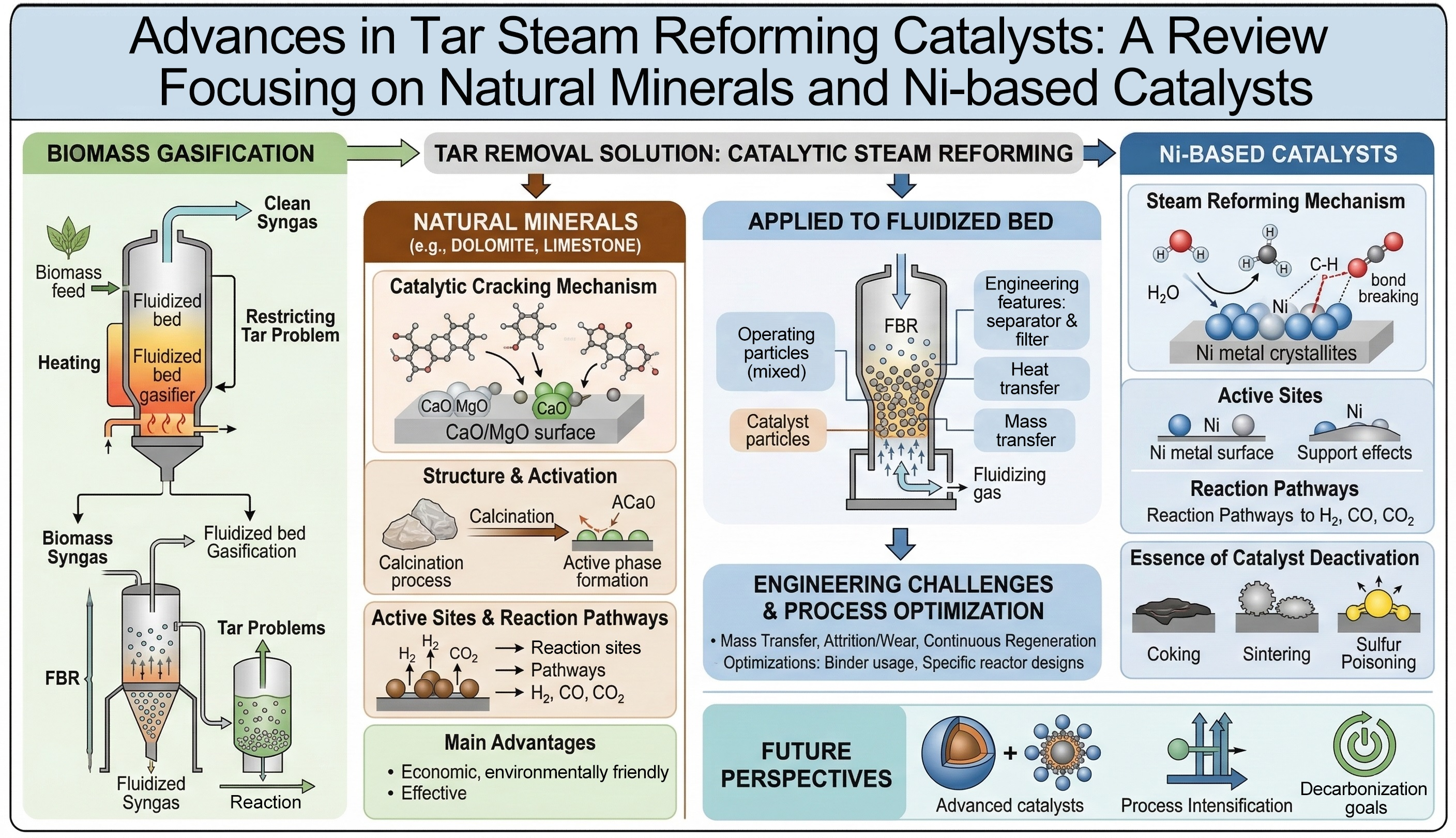
Biomass gasification technology is a crucial pathway for obtaining clean syngas and achieving efficient utilization of carbon resources. However, tar is one of the main factors restricting the industrialization of biomass gasification technology. Among various solutions, catalytic steam reforming is regarded as the most promising solution. Currently, natural minerals and Ni-based catalysts have been demonstrated to be effective and economically viable for tar removal, which are widely used in industrial fluidized beds. Therefore, the basic reaction principles of tar steam reforming were briefly introduced. The development of tar steam reforming catalysts, focusing mainly on natural minerals and Ni-based catalysts, have been studied in this review. The catalytic cracking mechanisms of natural minerals such as dolomite and limestone, as well as the steam reforming mechanism of Ni-based catalysts, have been thoroughly summarized. In addition, the active sites of the catalysts, reaction pathways, and the essence of catalyst deactivation are discussed. Based on this, the catalytic effect of these two catalysts for steam reforming of tar in the fluidized bed was summarized. Further, the engineering challenges (such as mass transfer, wear, and continuous regeneration) and the corresponding process optimization measures were comprehensively reviewed, and future perspectives are discussed.

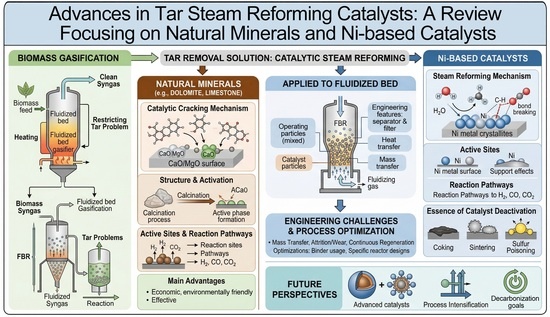
Graphical Abstract

1. Introduction

Due to the global energy crisis and challenges posed by climate change, the development of renewable clean energy is extremely urgent. Biomass energy has garnered significant attention due to its abundant reserves, carbon-neutral properties, and its potential to be converted into a variety of energy products [1,2,3]. Among various utilization methods, gasification is one of the most promising thermochemical methods for producing high-quality, hydrogen-rich syngas from low-grade biomass [4,5,6]. This syngas can be utilized directly in gas turbines for electricity generation and combustion for heat, or catalytically converted into liquid fuels, such as methanol and dimethyl ether, as well as high-value chemicals [7], positioning it as a cornerstone for the efficient and high-value utilization of biomass.
However, the biomass gasification process inevitably generates a complex and viscous by-product known as tar. Composed primarily of aromatics such as benzene, toluene, and naphthalene, tar condenses within the gasification system and downstream equipment, leading to severe operational issues including pipeline blockages, equipment corrosion, and catalyst poisoning [8]. These problems not only reduce syngas yield and waste resources but also significantly hinder the long-term stable operation of biomass gasification systems. Effective tar removal is essential before syngas can be utilized in internal combustion engines, gas engines, and particularly in fuel cells and methanol synthesis [9], ensuring higher efficiency in downstream applications and protecting subsequent equipment [10]. Consequently, tar management is one of the most critical and pressing challenges for the widespread advancement of biomass gasification technology [11].
The main technical approaches for the issue of tar include physical removal (e.g., scrubbing, filtration), thermal cracking, and catalytic reforming. Among them, physical methods merely transfer the tar from one phase to another without achieving true elimination, and they also generate wastewater. And thermal cracking demands extremely high temperatures, leading to substantial energy consumption. In contrast, catalytic methods, particularly catalytic steam reforming technology, can efficiently convert tar molecules into smaller molecular syngas components (H2 and CO) under relatively mild conditions. This method not only removes tar but also enhances both the yield and quality of syngas, thereby improving overall biomass utilization efficiency. Consequently, it has become a key focus in tar removal research and is widely regarded as a valuable and promising strategy [12].
The core elements of catalytic steam reforming technology are the catalyst and the reactor. Among the various catalysts, the low-cost and naturally abundant mineral catalysts, along with highly active and selective nickel-based catalysts, have become the mainstream choices for both research and industrial applications due to their outstanding cost-effectiveness. For instance, natural minerals such as dolomite (CaMg(CO3)2) and limestone (primarily CaCO3) are widely studied because of their availability and affordability. After calcination, these materials produce CaO, which plays an active role in the reforming process. During the biomass gasification process, CaO exhibits excellent activity in cracking tar. Additional non-condensable gases are obtained through tar cracking to improve the quality of the product gas [13]. Zhang et al. [14] evaluated the reactivity of dolomite and limestone toward hydrogen production during high-temperature steam gasification of biomass. The results show that dolomite and limestone have a good catalytic effect on the tar content in the gasification product. At the same time, dolomite and limestone increase the proportion of H2 in the gasification product, from 58.4% to 68.9% and 71.8%, respectively. In addition, olivine ((Mg,Fe)2SiO4) and limonite (FeO(OH)·nH2O) are also excellent catalysts for tar reforming. The excellent catalytic effect of Ni-based catalysts in removing tar has been proven [15]. Shi et al. [16] investigated a kind of Ni@ZSM-5 catalyst with Ni encapsulated in the cavity of hollow ZSM-5. At the temperature of 750 °C, tar conversion with the Ni@ZSM-5 catalyst reached 92.2%. Apart from the catalysts, the selection of the reactor is even more crucial. The fluidized bed reactor, due to its unique fluid dynamics characteristics, is widely regarded as the ideal equipment for achieving the large-scale and continuous application of these two types of catalysts. The catalytic effect on the removal/elimination of tar will be significantly changed.
Natural minerals and Ni-based catalysts for tar removal cover a wide range of aspects with a continuously expanding connotation. In recent years, numerous studies have reported the application of natural minerals and Ni-based catalysts for the treatment of tar-containing synthetic gas or tar model compounds. However, there is a scarcity of reviews that simultaneously analyze and compare the performance of both catalyst categories in tar steam reforming, and systematic reviews focusing specifically on their application in fluidized bed reactors are even more lacking. To facilitate the better industrial application of these efficient and cost-effective catalysts, a comprehensive understanding ranging from their mechanisms of action to their implementation in fluidized bed systems is essential.
Therefore, this study aims to systematically present the recent advances along this technological chain. Firstly, the characteristics of biomass tar and the fundamental principles of its steam reforming are elucidated. Then, a focused overview of the types and properties of natural minerals and nickel-based catalysts, their catalytic reforming mechanisms, the nature of their deactivation, and strategies for modification and optimization are provided. The advantages and disadvantages of these catalysts, along with their suitable application scenarios, are compared. Subsequently, the benefits of employing fluidized bed reactors for tar steam reforming are analyzed in depth. The performance of these two catalyst classes within such reactors is reviewed, and the specific requirements of fluidized beds regarding catalyst mechanical strength and particle size distribution are discussed. Finally, current challenges and future research directions are summarized, aiming to provide a valuable reference for the efficient catalytic conversion and resource utilization of biomass tar.

2. The Issue of Biomass Tar

2.1. The Formation and Composition of Tar

Tar is the main by-product of biomass gasification, formed through complex chain reactions of cellulose, hemicellulose, and lignin during the process of biomass gasification. The formation mechanism of tar is crucial for controlling and removing tar during the gasification process. The formation of tar occurs through complex thermochemical reactions. After entering the gasifier, biomass first undergoes drying and then begins to decompose. At low temperatures (approximately 300–500 °C), the thermal cleavage of glycosidic bonds in cellulose and hemicellulose, along with the partial breakdown of lignin’s phenylpropane units, leads to the generation of oxygenated organic compounds such as alcohols, carboxylic acids, ketones, and aldehydes. These constitute the primary tar, which retains much of the oxygen functionality of the original biomass [17]. As the temperature increases (approximately 500–700 °C), primary tar undergoes secondary conversion through dehydroxylation, demethoxylation, and demethylation reactions. These reactions involve the elimination of hydroxyl (–OH), methoxy (–OCH3), and methyl (–CH3) groups, resulting in the formation of alkylated monoaromatic and diaromatic compounds. This stage marks a transition from oxygen-rich to oxygen-lean aromatic structures, driven by the increasing instability of oxygen-containing functional groups at elevated temperatures [18]. At higher temperatures (above 700 °C), further cracking and recombination occur. The secondary tar intermediates undergo ring condensation and polymerization reactions, progressively forming more stable, polycyclic aromatic structures [19]. The tertiary tar is predominantly composed of polycyclic aromatic hydrocarbons (PAHs), such as naphthalene, methyl acenaphthylene, and benzo[a]pyrene [20]. These PAHs are stabilized by extensive π-conjugation and are notably resistant to further cracking, making their removal particularly challenging. The overall transformation from primary to tertiary tar reflects a progressive decrease in oxygen content and an increase in aromaticity, governed by competing reaction pathways including bond scission, oligomerization, and cyclization. In summary, as the reaction temperature increases, oxygen-containing hydrocarbons can be converted into light hydrocarbons, aromatics, and alkenes. Subsequently, these hydrocarbons are transformed into higher-content and larger polycyclic aromatic hydrocarbons.
Given the diversity of institutions and researchers engaged in biomass gasification, there are numerous definitions and sampling techniques for tar. Therefore, the gasification task of the IEA Bioenergy Agreement, the US Department of Energy (DOE), and the DGXVII of the European Commission have agreed to define tar as hydrocarbons with a molecular weight higher than that of benzene [21]. Tar is a dark brown viscous liquid. Multiple researchers [7,22] have expounded that tar, as a mixture of polycyclic aromatic hydrocarbons, has high stability, making it difficult to be converted.
The composition and yield of tar produced by biomass gasification also depend on the chemical composition of the biomass raw material and the operating conditions, such as the type of biomass, gasification temperature, pressure, gas residence time, S/B ratio, and air equivalence ratio (ER), etc. Temperature is one of the important parameters in terms of tar formation [19,23]. Typically, the operating temperature for gasification ranges from 700 to 1200 °C. However, due to the low ash melting point of biomass and the high reactivity of biochar, most studies on biomass gasification have adopted a temperature range of 800 to 1000 °C [24]. Some studies have evaluated the impact of gasification temperature on the tar content in the product gas, showing that when the gasification temperature is lowered, the tar content in the product gas will be higher. However, when the gasification temperature is increased, due to the enhanced cracking and reforming reactions of tar, the tar content will significantly decrease [25]. Tian et al. [26] investigated the effects of gasification reaction temperature (700–900 °C) on gas distribution, lower heating value (LHV) of gas steam, tar content, gas yield, and H2/CO ratio with a fluidized bed gasifier for the air–steam gasification of rice husk. As the temperature increased from 700 °C to 900 °C, the tar yield decreased from 7.51 to 0.15 g/Nm3 for coal bottom ash and from 19.75 to 2.17 g/Nm3 for silica sand. Meanwhile, the increase in temperature also affects the tar composition. As the temperature rises, the tar composition evolves to more stable secondary and tertiary tar (of higher molecular weight) [27].
Steam is regarded as the most suitable gasification agent for producing synthetic gas rich in hydrogen [28]. By means of steam gasification, syngas with a high heating value is obtained, and it also has the additional advantage of avoiding the costly separation process [29]. Among them, the S/B ratio is one of the key parameters in the steam gasification process. It is defined as the mass flow rate of steam entering the reactor divided by the mass flow rate of biomass. An increase in the S/B ratio promotes the water–gas shift reaction equilibrium to shift towards the product side, resulting in higher gas production under the same conditions, while promoting the tar reforming and coke gasification reactions. However, excessive steam may lead to a decrease in temperature, thereby promoting the generation of tar. Research on the effect of the S/B ratio on the tar composition is relatively scarce. It is generally agreed that an increase in steam will change the composition of tar, leading to a reduction in the amount of light tar compounds [30].
Furthermore, air and pure oxygen have been widely used as gasifiers because they can facilitate combustion and partial oxidation reactions, providing the necessary energy for the gasification process. ER is a key factor influencing the gasification performance of air/oxygen [31]. During the biomass gasification process, the ER value typically varies between 0.20 and 0.40. An ER value lower than 0.2 results in incomplete gasification and the production of low calorific value gases, thereby generating more tar and carbon black [32]. As the ER increases, the O2 in the air promoted the oxidation of heterocycles and light aromatics, causing the cleavage of C-H and C-O bonds, as well as the formation of free H and O radicals. These free radicals enhanced the dimerization reaction and the H2-abstraction-C2H2 addition sequence reactions, thereby forming more cyclic aromatic hydrocarbons [30].
The composition of biomass also affects the yield and composition of tar. Lignocellulosic biomass is mainly composed of cellulose, hemicellulose, and lignin. The tar components produced by the decomposition of these three components are different. Moreover, biomass with a high lignin content results in a high tar yield, while biomass with a high cellulose or fixed carbon content leads to a low tar content [17].
Generally, tar consists of over a hundred substances and its composition is very complex. The Dutch Energy Research Center (ECN) classifies tar based on the size and number of aromatic ring structures, as shown in Table 1 [21]. An increase in temperature has a positive effect on the decomposition of class 1 and class 2 tar, while the concentration of class 3 and class 5 tar increases with the rise in temperature.

2.2. The Hazards and Limitations of Tar

Tar is the most difficult-to-handle and most unpleasant product during the gasification process, which is the general view. Problems, such as equipment blockage, corrosion, efficiency decline, and environmental pollution, are caused by tar after condensation. When the tar in the support gas is below the dew point (about 300 °C), it will quickly condense. Mixing and combining tar with water, fly ash, and other particles, adhering to the cleaning equipment and gas pipelines, will ultimately lead to system blockage and operation interruption. The acidic components in tar also cause severe corrosion to downstream pipelines and equipment. These problems result in a decrease in overall process efficiency and an increase in equipment management and maintenance costs. At the same time, the generation of tar leads to a decrease in the output and energy of syngas in the gasification products.
To prevent subsequent equipment blockage, each equipment has certain standards for the content of tar in the syngas, as shown in Table 2 [33,34,35,36,37,38]. And when the syngas is used for chemical synthesis, there are also certain standards for the content of tar. It is important to note that the underlying tolerance for tar varies considerably among downstream technologies due to differences in operating principles and susceptibility to tar-induced issues. For boiler and steam turbine combinations, the working fluid is isolated from the combustion gases, rendering tar-related corrosion, fouling, and plugging negligible; thus, no strict tar limits are typically imposed [39]. In contrast, gas turbines are exposed to combustion products, and although the high-temperature environment helps maintain tar in the vapor phase, tar concentrations below 5 mg Nm−3 are generally recommended to prevent carbon deposition [33], fouling, and blade erosion. Gas engines exhibit a higher tar tolerance, with acceptable levels up to approximately 100 mg Nm−3, though heavy tar species require particular attention to avoid deposition on engine manifolds and cylinder walls. Solid oxide fuel cells (SOFCs) demand the most stringent tar control, typically below 1 mg Nm−3, as tar-derived carbon deposition can rapidly deactivate the anode catalyst, compromising both electrical efficiency and long-term durability. These distinct tolerance levels underscore the importance of tailoring gas cleaning strategies to the specific downstream application. For the chemical synthesis process, the product gases containing tar can also cause similar problems. During the chemical synthesis process, catalysts are used, and they may lose their activity due to the formation of coke from tar. Because the coke can clog the active sites of the catalyst, the overall number of active sites of the catalyst will decrease.

2.3. Tar Treatment Technology

Currently, the commonly used methods for removing tar include two types: internal treatment within the gasifier (primary method) and gas purification (secondary method). The secondary methods include physical methods (such as spray method, gas/liquid separation, or filtration) and chemical methods through heat or catalytic cracking [40].
The physical removal methods are mainly divided into wet purification methods and dry purification methods [41]. The wet purification methods mainly use water to remove some tar from the combustible gas, and adding a small amount of alkali can improve the purification effect. The dry purification methods mainly remove tar through multi-stage filters. Table 3 reveals significant differences in the tar removal performance among various gas purification systems. In the physical filtration system, the sand bed filter operating at low temperatures (10–20 °C) achieved a high tar removal rate (50–97%) due to the condensation of heavy tar, while the bag filter operating at 130 °C had limited tar removal capacity (0–50%), highlighting the strong temperature dependence of tar removal. The scrubber in the wet cleaning system exhibited a high particle removal rate, but the tar removal rate was relatively low, indicating that such systems are mainly designed for particle control. In contrast, the Venturi scrubber had a better tar removal rate. The wet electrostatic precipitator had excellent particle removal rate (>99%), but the tar removal rate was only at a medium level, further confirming this characteristic. In comparison, the rotating particle separator operating at 130 °C achieved balanced removal of particles (85–90%) and tar (30–70%), suitable for scenarios requiring the retention of gas-sensible heat. The fixed-bed tar adsorber operating at 80 °C could achieve a 50% tar removal rate, indicating its role as a post-treatment step. Overall, the selection of gas purification technology requires a trade-off between tar removal efficiency, particle removal capacity, operating temperature, and downstream requirements. Although the low-temperature system has better tar removal performance, it leads to gas cooling, which may be unfavorable for applications such as integrated gasification combined cycle or solid oxide fuel cells that require hot gas. On the other hand, the high-temperature separation technology can maintain gas sensible heat, but when strict tar limit requirements are imposed, additional tar purification steps may be necessary. Furthermore, although sand bed filters and Venturi scrubbers have good tar removal effects, they cannot truly remove the tar [42]. This tar will remain in the filter and the wastewater, resulting in the loss of energy in the tar. Therefore, treating the generated wastewater and cleaning the residual tar in the equipment are the main obstacles in the application of this technology.
Compared with physical methods, the chemical removal method can convert the tar components into non-condensable gas components (such as CO, CO2, H2, CH4), mainly including thermal cracking method [43] and catalytic conversion method [7]. The thermal cracking method mainly achieves this by subjecting the tar molecules to reactions such as bond-breaking dehydrogenation, dealkylation, and some other free radical reactions at high temperatures to transform them into small-molecule gases or other compounds. And the catalytic conversion method efficiently converts tar at low temperatures. In recent years, although plasma methods have become attractive and developed rapidly [44], they still have considerable challenges to overcome before practical application.
The operating conditions, such as temperature, pressure, and gasifiers, play a crucial role in the thermal cracking of tar [45,46,47]. The optimal parameters can effectively reduce tar formation. Generally, high temperatures promote better cracking of tar [48], and increased pressure may facilitate the elimination of phenols, polycyclic aromatic hydrocarbon (PAH) formation, carbonization stability, and the recombination of light hydrocarbons under varying gas pressures. Additionally, the use of different gasifiers also affects the composition of the gas produced. The air gasifier may reduce the calorific value of the produced gas due to dilution. To date, the steam introduction system has attracted great attention for the reformation of biomass tar and tar model compounds [49]. However, thermal cracking requires temperatures above 1000 °C to completely convert tar, increasing costs and energy consumption. In addition, although the commonly used temperature is relatively high, the reaction rate of the tar converting into lighter gases is still relatively low, which results in significant kinetic limitations. Therefore, to achieve the desired tar conversion rate, an extremely long gas residence time is required, which may further affect the design of the reactor and the process efficiency.
In comparison, the catalytic conversion method can achieve efficient conversion at lower temperatures, which has attracted extensive attention from scholars. The catalytic conversion method has more advantages in terms of energy efficiency and can improve the composition of syngas, converting high-furan-containing tar into valuable gas fractions [33]. The catalytic conversion method mainly includes catalytic cracking and catalytic steam reforming methods. The key lies in the selection of the catalyst. The catalyst can lower the reaction temperature of tar, promoting reactions such as tar cracking, steam reforming, thermal cracking, and steam dealkylation, thereby facilitating the conversion of tar into valuable fuel gases.

3. Catalytic Steam Reforming of Tar

Catalytic steam reforming is regarded as a potential technology that can convert tar into H2 and CO in the presence of steam, thereby removing tar from gaseous products [50,51,52]. During the steam reforming process, catalysis occurs in the tar where hydrocarbons undergo dehydrogenation. This results in the formation of carbon at the catalyst active sites, which can further react with steam to form CO. The kinetic limitations associated with tar elimination can be improved by varying the temperature and using the catalysts.

3.1. The Principle of Catalytic Steam Reforming

Tar steam reforming is a complex physical and chemical process involving multiple components and multiple pathways. The core of this process lies in using the catalytic effect to facilitate the reaction between tar molecules and steam, converting them into small-molecule syngas. The presence of the catalyst can effectively remove tar. During the catalytic steam reforming process, many reactions occur simultaneously, and the product distribution results arise from the competition among these reactions. These reactions [17,20,36,41,53,54] can be summarized in Table 4. A deeper understanding of the underlying mechanisms is essential for rational catalyst design and process optimization.
The steam reforming of tar over metal-based catalysts proceeds via a series of elementary steps occurring on the catalyst surface. Initially, tar molecules (typically aromatic hydrocarbons) adsorb onto active metal sites, where C–C and C–H bonds are progressively cleaved [55]. Concurrently, steam adsorbs and dissociates on the catalyst surface, generating adsorbed oxygen species (OH* and O*). These oxygen species react with the carbonaceous intermediates formed during tar decomposition, leading to the formation of H2, CO, and CO2, which subsequently desorb from the surface. At the same time, carbon deposits forms on the surface of the catalyst. Carbon deposition occurs via polymerization of aromatic intermediates, methane decomposition, and the Boudouard reaction [56]. Deposited carbon encapsulates active sites and blocks pores, leading to progressive catalyst deactivation [57]. At this point, the presence of water vapor not only promotes the water-gas shift reaction to proceed in the direction of products [58], but it also enhances the production of phenol, making it easier to undergo catalytic recombination and reduce the concentration of other oxygen-containing substances [59]. Water vapor also plays an important role in reducing surface carbon content [60]. The steam gasification reaction (C + H2O → CO + H2), as a self-regenerating mechanism, can remove the carbon deposits on the catalyst surface, thereby delaying catalyst deactivation and extending its service life. Maintaining an appropriate hydrogen–carbon ratio is of utmost importance: Insufficient steam will accelerate carbon deposition, while excessive steam will dilute the product gas. Optimizing this balance ensures that the rate of carbon deposition gasification matches the rate of carbon deposition, thereby achieving sustained catalytic activity.
It is expected that all tar can be converted by steam into simpler and lighter molecules like H2 and CO. The effect of tar reforming is mainly influenced by factors such as temperature and steam-to-carbon ratio (S/C) [61]. The tar steam reforming is an endothermic reaction. High temperature is conducive to the shift in equilibrium to the right, thereby increasing the tar conversion. Appropriate increase in steam volume can not only promote the main reaction but also gasify carbon deposits through the water–gas reaction. However, an excessively high proportion of water vapor will increase energy consumption and the burden of wastewater treatment.
At present, the main research methods for evaluating the catalytic performance of tar steam reforming include two approaches: one is to use actual tar or tar model compounds (such as benzene, toluene, naphthalene, etc.) as the reaction raw materials [58,62,63], directly assessing the catalytic performance of the catalyst; the other is to use the tar-containing synthesis gas produced by biomass gasification to examine the tar removal effect of the catalyst.

3.2. The Selection of Catalysts

The use of catalysts helps to enhance the cracking and reforming reactions of tar. The criteria for selecting an appropriate catalyst are based on multiple factors, including catalytic activity, resistance to deactivation, stability, reusability, mechanical strength, cost, and gas production requirements [45,64]. The catalyst should have good resistance to carbon deposition and sintering, as well as certain mechanical strength and recyclability. Currently, the catalysts used for removing tar mainly include transition metal catalysts, alkaline metals, carbon/biochar, and natural minerals (limestone, dolomite, etc.). In addition, some precious metal catalysts (rhodium, platinum) and non-precious metal catalysts (potassium, magnesium, cobalt) have also been investigated for tar cracking [65,66].
Precious metal catalysts such as Pt, Rh and Ru exhibit excellent capabilities for reprocessing tar [67,68]. They have high resistance to impurities like sulfides and strong resistance to coke deposition. However, the high cost hinders the application of precious metals in large-scale systems. While alkali metals (such as Li, Na, K) have been reported to effectively increase gas yield and quality during tar reforming [69,70]. However, the main problem with alkali catalysts is difficult to be regenerated. Nevertheless, during the gasification process, the evaporation of alkali metals leads to difficulties in recovery, particle aggregation, and subsequent loss of activity, which increases the cost of its use.
Coal, obtained through carbonization and activation, has a rich pore structure. Combining coal and biomass for gasification to reduce the production of tar has been reported. Especially, low-rank coal (lignite), which has abundant organic matter and a porous structure, have the potential to prepare metal catalysts through ion exchange [71]. However, the growing depletion of coal resources presents a critical energy challenge. Among renewable energy sources, biomass, as a representative carbon energy, is expected to be further utilized. Biochar, due to its highly porous structure, has been used as a cheap catalyst or catalyst support for the tar conversion [72]. The macroscopic and mesoscopic porous structures of biochar not only improve the dispersion of loaded catalyst species but also promote the transfer of reactants to the internal active sites. Compared with other catalysts, catalysts based on lignin biochar exhibit higher catalytic activity in reducing tar and have stronger resistance to poisoning [73]. Anniwaer et al. [74] conducted a steam gasification experiment of cedar wood using biochar as a catalyst. The results showed that biochar could reduce the tar yield. Although biochar as a catalyst or catalyst support can be consumed through the gasification reaction, the consumption of biochar is an advantage. The consumption of biochar exposes the metal active sites covered by carbon deposits. Moreover, due to its low price, biochar does not need to be considered for regeneration, and it can be directly disposed of or recycled during the gasification process, making it economically advantageous.
Transition metal catalysts, especially nickel, exhibit superior catalytic activity in converting tar through cracking and reforming reactions during biomass gasification, significantly improving the quality of the gas. Ni-based catalysts have been widely studied and used for eliminating biomass tar due to their low cost, high tar-degradation activity, methane upgrading, and WGS reactions [75]. However, Ni-based catalysts face challenges such as loss activity, poisoning, carbon deposition on the catalyst surface, and sintering. Ni-based catalysts further enhance the catalyst performance by relying on the support and the optimal metal promoters [76], improving the catalytic activity and stability of the catalyst during the tar reforming process.
Natural minerals, such as dolomite, olivine, and shells, are inexpensive and abundantly available in nature. They can be directly used as catalysts or can be utilized after some pre-treatment (such as calcination). Olivine and dolomite are widely used natural catalysts in fluidized bed gasifiers, while CaO is more commonly used as a CO2 absorber.
Among various catalysts, the inexpensive and readily available natural mineral catalysts and the nickel-based catalysts with high activity and selectivity have become mainstream in research and industrial applications due to their outstanding cost-performance advantages. It is important to note that the application strategy varies considerably with catalyst type. Natural minerals, which typically exhibit low catalytic activity, are commonly employed as primary catalysts, i.e., introduced directly into the gasification reactor (in situ) under high-temperature conditions. In contrast, Ni-based catalysts possess high catalytic activity and are therefore predominantly utilized in secondary catalytic reactors operated at milder temperatures. This distinction underscores that each catalyst type is suited for different process configurations and optimization strategies. The following will provide a detailed review and introduction of these two types of catalysis.

3.3. Natural Mineral

Natural minerals have long served as catalysts for the cracking of tar, featuring high activity, low cost, and abundant natural resources. It has been proven that natural minerals play a significant role in the catalytic steam reforming process of tar. Currently, the natural minerals used in the tar steam reforming process mainly include dolomite, olivine, limestone, and limonite. However, the catalytic activity of these minerals is limited in their original state. In practical applications, they are usually subjected to thermal pre-treatment (calcination) before use to induce phase transformation and generate active oxide species responsible for the cracking and reforming of tar. Therefore, although this section focuses on natural minerals as catalyst precursors, the discussion must necessarily cover their calcined derivatives and the resulting active phases.

3.3.1. The Types and Characteristics of Natural Mineral

Limestone is one of the typical representatives of natural minerals. Limestone is inexpensive and naturally readily available, and exhibits good tar removal performance [77]. The main component of limestone is CaO, which is regarded as the precursor of CaO. CaO has been proven to be a good catalyst for the removal of tar [78,79]. As a carbon absorber for CO2, CaO reacts with CO2 to form CaCO3. As the partial pressure of CO2 decreases, the water–gas shift reaction will intensify in the direction of producing H2 [80,81], thereby increasing the hydrogen content in the syngas. Secondly, since the carbonation reaction of CaO is an exothermic reaction, the released heat can also provide the necessary energy to promote the endothermic gasification process. At the same time, CaO promotes the cracking of tar [82]. The O2− ions that form active sites on CaO have a spatially dispersed electron cloud, which can overlap with the orbitals of incoming molecules, destabilizing the π electron cloud of tar compounds and making their aromatic rings unstable, thereby causing ring breakage [83]. Compared with pure CaO, the calcined limestone usually contains small amounts of impurities (such as Fe2O3, MgO, and Al2O3), which are considered to play a catalytic role in tar removal [84,85]. Weerachanchai et al. [86] investigated the effect of steam gasification conditions on products properties in a bubbling fluidized bed reactor, using larch wood as the starting material. The result showed that major compositions of gas products observed from using calcined limestone was H2 and CO2. Moreover, the efficiency of capturing carbon dioxide from calcined limestone and its ability in converting CO to H2 and CO2 via water–gas shift reaction will decrease as the gasification temperature increases. Steam gasification at 750 °C by using calcined limestone generated the least tar emission of 3.23%, which indicates that the calcination of limestone has a good effect in removing tar.
Among natural mineral catalysts, dolomite and olivine attract significant attention from scholars due to their excellent catalytic properties. Dolomite plays a crucial role in the process of tar removal due to its low cost and ease of processing [87,88]. Dolomite is a calcium–magnesium mineral that also contains some other trace minerals, such as SiO2, Fe2O3, and Al2O3, with a general chemical formula of CaMg(CO3)2. The calcination of dolomite at high temperatures leads to the decomposition of carbonate minerals to form MgO-CaO, which is the main active catalytic component. The weight percentage of CaO and MgO is the main determinant of the effectiveness of dolomite. Yu et al. [61] investigated the ability of five types of dolomite to catalyze the low-temperature gasification of tar in a fluidized bed using birchwood as the raw material. The results showed that the dolomite with the lowest content of CaO and MgO had the lowest efficiency in tar cracking. The synergistic effect between CaO and MgO enhances the catalytic performance of dolomite, which is superior to that of single CaO. CaO can effectively catalyze the cracking of tar. However, the presence of MgO inhibits the formation of stable carbonaceous materials on the surface of CaO, thereby preventing coke deposition and the inactivation of CaO active sites, which leads to more efficient decomposition of tar and capture of CO2, resulting in an increase in the production of H2 [54]. Moreover, the iron content in dolomite is also believed to affect the steam reforming rate of the tar and water–gas transfer reaction.
Compared to dolomite, olivine has stronger wear resistance and hardness, making it more suitable for use in fluidized bed reactors [89]. Olivine is another natural and inexpensive mineral composed of silicate containing Fe and Mg. Its general chemical formula is (Mg, Fe)2SiO4, and its catalytic effect on the decomposition of tar is related to the content of MgO and Fe2O3 [90]. Currently, many studies have been conducted to determine and understand the catalytic effect of olivine [91], and olivine is more effective on light tar than heavy tar [92]. The detailed reaction mechanism of olivine catalyzing tar reforming is as follows [40]: When the ratio of PH2/PH2O (partial pressure) is higher than 1.5, the reactive atmosphere will be further reduced, and FexOy will be reduced to Fe0. This reduction step may also occur in the presence of CO. The iron active sites on the surface of olivine catalyze the toluene polymerization reaction, resulting in the deposition of carbonaceous solids on the catalyst and the generation of a large amount of H2. The generated carbonaceous deposits react with steam through steam reforming or gasification reactions to produce CO and H2. The WGS reaction may also occur in the gas phase, generating CO2. Finally, in an oxidative atmosphere (i.e., a large amount of H2O and O2), Fe0 is oxidized, generating iron (Fe(III), Fe(II), and Fe0) with different oxidation steps.
Iron exhibits higher activity for tar removing when it is in a lower oxidation state [93]. The reactive gas atmosphere (i.e., oxidation or reduction) is a key parameter for the catalytic activity of olivine. Nitsch et al. [94] compared the conversion behavior of phenolic tar on olivine and sand at 850 °C, and found that a high vapor pressure would promote the oxidation of olivine and inhibit its catalytic activity. At a lower vapor pressure, although the number of active sites decreased, the tar exhibited higher reactivity in steam reforming. Yang et al. [95] discovered that olivine could more effectively inhibit tar content at a temperature of 700 °C and a S/B ratio of 0.9.
The natural mineral with the same iron content as olivine is limonite. Limonite is a low-grade and low-cost iron ore that contains iron species with catalytic activity for the decomposition of tar [96]. Kannari et al. [97] used limonite ore calcined at 900 °C as the bed material in a fluidized bed for the catalytic decomposition of phenol (a biomass tar model). The results showed that limonite has a good catalytic effect on the steam reforming process of phenol and can achieve 24 h steam reforming of phenol. Therefore, limonite is a promising mineral deposit material that can be used in internal circulating fluidized bed systems for long-term catalytic decomposition of tar.
Calcite is also a natural mineral. After calcination, it can be used as a bed material for biomass gasification in a fluidized bed, and it has a certain catalytic effect on tar cracking [98]. However, compared with dolomite and olivine, the research on calcite is the least. Table 5 summarizes different natural minerals used for tar removing. It includes scenarios using tar model compounds and actual tar as feedstocks. It is worth noting that the tar conversion efficiency of natural mineral catalysts depends on the type and origin of the mineral, as well as the operating conditions. Therefore, different research results may be difficult to be directly compared. Furthermore, it is sometimes difficult to achieve both tar conversion and H2 production simultaneously. Therefore, determining the appropriate operating conditions is necessary.

3.3.2. Modification Strategy

The natural mineral properties can be improved through calcination, which helps enhance chemical activity and mechanical strength, and the natural mineral properties can also be improved by loading active metals (such as Fe, Ni). Through calcination, the pore volume and pore size are increased, providing a larger internal surface area. This promotes mass transfer and makes the material more active [105]. However, it should be noted that excessive calcination temperatures may lead to particle sintering, resulting in a loss of active surface area and diminished catalytic performance [53]. After calcination, dolomite decomposes to a mixture of CaO and MgO, while limestone decomposes primarily to CaO. Both calcined materials exhibit excellent catalytic performance, significantly reducing the tar content in the syngas. The calcination process triggers a series of changes, thereby enhancing the catalytic activity. For carbonate minerals such as dolomite and limestone, thermal decomposition releases carbon dioxide and generates oxide phases. This oxidized state can remove tar through catalytic steam reforming and dry reforming (carbon dioxide reforming) reactions, thereby improving the catalytic performance. Furthermore, CaO acts as an adsorbent for CO2 through the carbonation process (CaO + CO2 → CaCO3), reducing the partial pressure of CO2 and causing the water–gas exchange reaction to shift towards the production of hydrogen. The exothermic nature of the carbonation reaction also provides heat to support the endothermic gasification process. These mechanisms collectively enhance the high catalytic activity of the calcined minerals for tar removal. Zhang et al. [106] reported that when rice husk was gasified in a laboratory-scale bubble fluidized bed, calcined dolomite reduced the tar content by 88%, while uncalcined dolomite reduced it by 73%. Hu et al. [107] studied the catalytic performance of dolomite and olivine in bio-oil steam reforming, and the results showed that after calcination treatment, the catalytic activity of both samples was superior to that of the uncalcined samples. Therefore, calcination not only improves the performance of dolomite but also significantly enhances the tar removal ability of olivine.
Only the naturally processed minerals after calcination are used to meet the tar content requirements. Therefore, additional metal loading or treatment is needed to further remove the tar [108]. Chang et al. [109] prepared Ni/dolomite catalysts using dolomite as the support for the tar gasification, and compared them with un-loaded dolomite that was calcined at 550 °C. The results showed that compared with the calcined dolomite, loading the active metal Ni on the dolomite could significantly improve the catalytic activity of the catalyst, with the H2 yield increasing by 33%, the syngas yield increasing by 7%, and the CH4 yield decreasing by 59%. Meng et al. [110] prepared iron-based and nickel-based catalysts on an olivine matrix using different methods (thermal fusion (TF) and wet immersion (WI)), and investigated the effects of phenol and naphthalene vapor reforming on these catalysts. The results showed that the TF method enabled Fe to migrate into the olivine structure, and the added Ni only substitutes for a portion of Mg, which results in better dispersion of the active metals in the catalyst, enhancing its potential in high-wear environments, and thereby facilitating its stable catalytic activity. Niu et al. [111] prepared a La/Dol catalyst through impregnation modification of dolomite with La (NO3)3 as an additive. The results show that La2O3 in the catalyst promotes the secondary cracking of tar. As a result, the tar content of the liquid phase product is obviously reduced, and the number of functional groups is also reduced. La2O3 on a dolomite surface occupies active sites, so carbon filaments are not suitable for accumulation and carbon deposition is inhibited.
Furthermore, natural minerals can also enhance the catalytic activity of tar cracking by introducing active metals such as Fe. Felice et al. [112] prepared Fe/dolomite using the impregnation technique and conducted a test on tar conversion using toluene as the tar model compound in a fixed-bed microreactor. The results showed that the addition of Fe significantly enhances the reforming ability of dolomite for toluene, while at the same time increasing the proportion of H2 in the produced gas. Olivine has slightly lower activity in biomass gasification and tar reforming, but it has higher resistance to damage compared to dolomite. Adding certain metals to olivine helps enhance its ability to restructure tar. Virginie et al. [113] investigated Fe/olivine catalyst effectiveness regarding tar primary reduction during biomass gasification in dual fluidized beds. The research results show that replacing olivine with iron/olivine significantly reduces the amount of tar produced. At 850 °C, the tar content can be reduced by up to 65%. The catalyst structure was maintained despite the large number of oxidizing–reducing cycles. The Fe/olivine not only plays a catalytic role in the cracking/reforming of tar, but also acts as an oxygen carrier to transfer oxygen from the combustion chamber to the gasifier. Pan et al. [91] conducted experimental research in a pyrolysis–reforming–combustion decoupled triple bed gasification (DTBG) system and agreed with this view.

3.3.3. Advantages and Limitations

Natural mineral catalysts (such as dolomite, limestone, olivine, and limonite) have gained significant attention in the field of biomass gasification and tar removal due to their abundant resources, low cost, and environmental friendliness. However, these minerals encounter common challenges such as insufficient mechanical strength and poor low-temperature activity in industrial applications, which directly affect their applicable scenarios and reactor selection.
For instance, dolomite is regarded as the most popular and inexpensive tar removal catalyst. Dolomite can reduce the tar in the synthesis gas and alter the distribution of tar components, but it is difficult to convert heavy tar using dolomite. Dolomite is in an inactive state due to its vulnerability to being damaged during the gasification process. Although dolomite has been proven to be an excellent choice for tar reforming catalysts, its fragile nature poses problems during the process. Even after being burned, dolomite is prone to deactivation due to carbon deposition, abrasion, elution, and sintering, resulting in a continuous decline in strength over time [31]. Dolomite is relatively soft and prone to wear in the fluidized bed, generating a large number of fine particles that may block the pipelines in the downstream processes. Poor wear resistance is the main problem with calcined dolomite [114]. Dolomite after calcination becomes brittle. While the olivine maintains good mechanical strength and has relatively high wear resistance, thus being suitable for use in fluidized bed reactors [107]. However, due to its low resistance to wear, this solid is not suitable for use in fluidized bed reactors. The advantages and limitations of commonly used catalysts in the tar removal process are shown in Table 6.

3.4. Ni-Based Catalyst

The Ni-based catalyst has long been used as a catalyst for the cracking of tar, and it has high activity. The Ni-based catalysts are commercial catalysts, mainly prepared from the precursor Ni(NO3)2. They are widely used in the petrochemical industry for the reforming of naphtha and methane. The Ni-based catalysts have attracted much attention due to their excellent catalytic performance and relatively low cost. It exhibits excellent performance in breaking C-C, C-H and O-H bonds during the tar cracking process [115]. In addition to reducing the tar content, the Ni-based catalysts can also improve the quality of gaseous products in gasification. Especially within the wide temperature range of 500 to 950 °C, it is effective for the steam reforming process [116]. Rownaghi and Huhnke [117] reported that the toluene conversion rate catalyzed by NiO could reach 100% at 750 °C. The Ni-based catalyst not only reduces the tar content but also increases the H2 production, and is mainly used for the primary removal of tar and the secondary gas reforming after gasification. Although its price is higher than that of most natural ores, it is more active in converting heavy hydrocarbons, methane reforming, and the WGS reaction [118]. Wang et al. [119] compared the removal effect of tar by Ni-based catalysts and dolomite, and the results showed that Ni-based catalysts had a better removal effect of tar than dolomite. El Rub et al. [43] also reached the same conclusion, stating that for phenol removal, nickel > dolomite > olivine.
In the early stage of research on Ni-based catalysts, the main type used was the Raney catalyst. The Raney catalyst is a commercial Ni-based catalyst consisting of fine-grained solid particles of nickel–aluminum alloy, which is widely applied in various organic synthesis reactions. Its catalytic activity for different tar model compounds varies; among them, it has the highest catalytic conversion activity for benzene and the lowest for naphthalene [40]. Ni-based catalysts have an effective effect on tar decomposition. However, the main limitation of using nickel-containing catalysts is that if the produced gas contains a large amount of tar and other pollutants (such as sulfur compounds), the catalyst may be severely deactivated.

3.4.1. The Selection of Support

Supporting materials are regarded as the backbone of any catalytic material. Strong bonding between the active metal and the support is necessary to prevent the leaching of the active metal. Additionally, the support can be used to regulate acidity, alkalinity, and oxygen vacancies. Generally, the selection of the support should be based on its acidity and basicity, specific surface area, pore structure, and electronic properties. The pore structure directly affects heat transfer and material transfer, which plays a decisive role in determining the rate of gas/solid reactions. High specific surface area is conducive to providing more catalytic active sites; otherwise, a higher surface acidity will increase the tendency of carbon deposition and reduce the catalytic efficiency [120]. Currently, the impregnation method is commonly used to load Ni onto the support. Four categories, including oxides, carbon-based substances, mineral supports, and zeolites, were summarized.
Among the various supports, γ-Al2O3 is one of the most promising supports for Ni-based catalysts because of its large surface area and good mechanical strength. Li et al. [121] prepared a nano-NiO/γ-Al2O3 catalyst using γ-Al2O3 as the support and applied it to the research on the production of hydrogen-rich syngas from rice husk steam gasification. When the temperature was 800 °C, S/B was 1.33, and ER was 0.22, the tar removal rate reached as high as 99%, and the gas yield was significantly improved. Artetxe et al. [122] studied the catalytic effect of Ni/Al2O3 on the steam reforming of different tar model compounds. Furthermore, the study also found that the properties of coke formed from toluene and anisole differ. The use of toluene increases the content of amorphous coke, while using anisole enhances its graphitization degree. This might explain why toluene is more easily used as a tar model substance than other aromatic hydrocarbons. Besides directly using Al2O3 as the support, alternative substances containing Al2O3, such as fly ash, were also selected. It also contains components like Fe2O3, CaO, SiO2, MgO, K2O, etc., which have been proven to be active in the catalytic process. The preparation of catalysts using fly ash will greatly enhance its application value. The catalytic effect of Ni catalysts, with other oxides as supports, on tar is shown in Table 7. For benzene reforming at 973 K, the support composition significantly affects catalytic activity. While Ni/γ-Al2O3 achieved 82.5% conversion, Ni/ZrO2 showed much lower activities (38.8%). Notably, the mixed oxide support CeO2–ZrO2 exhibited the highest conversion (87.2%), likely due to enhanced oxygen mobility and redox properties that promote coke gasification. For toluene reforming over perovskite-supported Ni catalysts at 873 K, Ni/LaAlO3 achieved the highest conversion (81%), while Ni/BaTiO3 showed lower activities (41%). Meanwhile, Ni/α-Al2O3-ash achieved 93.2% phenol conversion at a relatively low temperature (723 K), indicating that ash-derived supports can offer comparable or even superior performance to conventional supports under milder conditions.
Another class of supports with distinct advantages is ceramic foams. It is of great significance to study the catalytic performance of NiO/ceramic foam catalysts for the steam reforming of biomass gasification tar compounds, due to the high porosity, excellent high-temperature stability, extremely low operating pressure drop, and large specific surface area of ceramic foam [123]. It is worth noting that there are few reports on nickel-based catalysts supported on ceramic foam for catalytic reforming of biomass gasification tar. Gao et al. [124] studied the catalytic reforming effect of Ni/ceramic foam catalyst on benzene, which was used as a tar model compound. The results showed that when the S/C molar ratio was 1.0, and as the temperature increased from 700 °C to 900 °C, the H2 yield increased from 140.67 to 182.06 (g/kg benzene).
While oxide supports like Al2O3 dominate the literature, carbon-based materials have emerged as promising alternatives, particularly those derived from biomass. Biomass-derived biochar has a well-developed pore structure, abundant oxygen-containing functional groups, and a high specific surface area. Moreover, alkali and alkaline earth metals (AAEMs) present in biomass remain in the char after pyrolysis and can contribute to catalytic activity. Krerkkaiwan et al. [125] reported that AAEMs containing biomass char have promising catalytic effects in reducing the tar content from biomass gasification. Biomass char is also a good catalyst support. Due to its well-developed surface pore structure, biomass char can be used as a support for Ni [126,127,128]. Yao et al. [129] prepared Ni/WC, Ni/RC, and Ni/CC catalysts by using wheat straw char (WC), rice husk char (RC), and cotton stalk char (CC) as catalysts or catalyst supports. The results showed that the content of AAEMs in the biomass char significantly affects its catalytic effect. Among them, the cotton stalk char with high AAEM content exhibited the highest catalytic activity after loading Ni, and the H2 yield could reach 92.08 mg/g biomass. Hu et al. [130] prepared Ni/PWC (PWC: pine wood pyrolysis char) and Ni/PWA (PWA: pine wood activated char) for tar removal using an impregnating approach. The Ni/PWA had the best tar removal effect, reaching up to 92.55%. Phenols and PAHs in the tar were almost totally eliminated. This is because Ni/PWA has more mesopores, which is conducive to the diffusion of large tar molecules during the tar removal process and is also beneficial for the cracking of the tar. Moreover, more oxygen-containing functional groups, like C-O, are present on the surface of PWA, which can provide acidic sites and facilitate the removal of tar molecules.
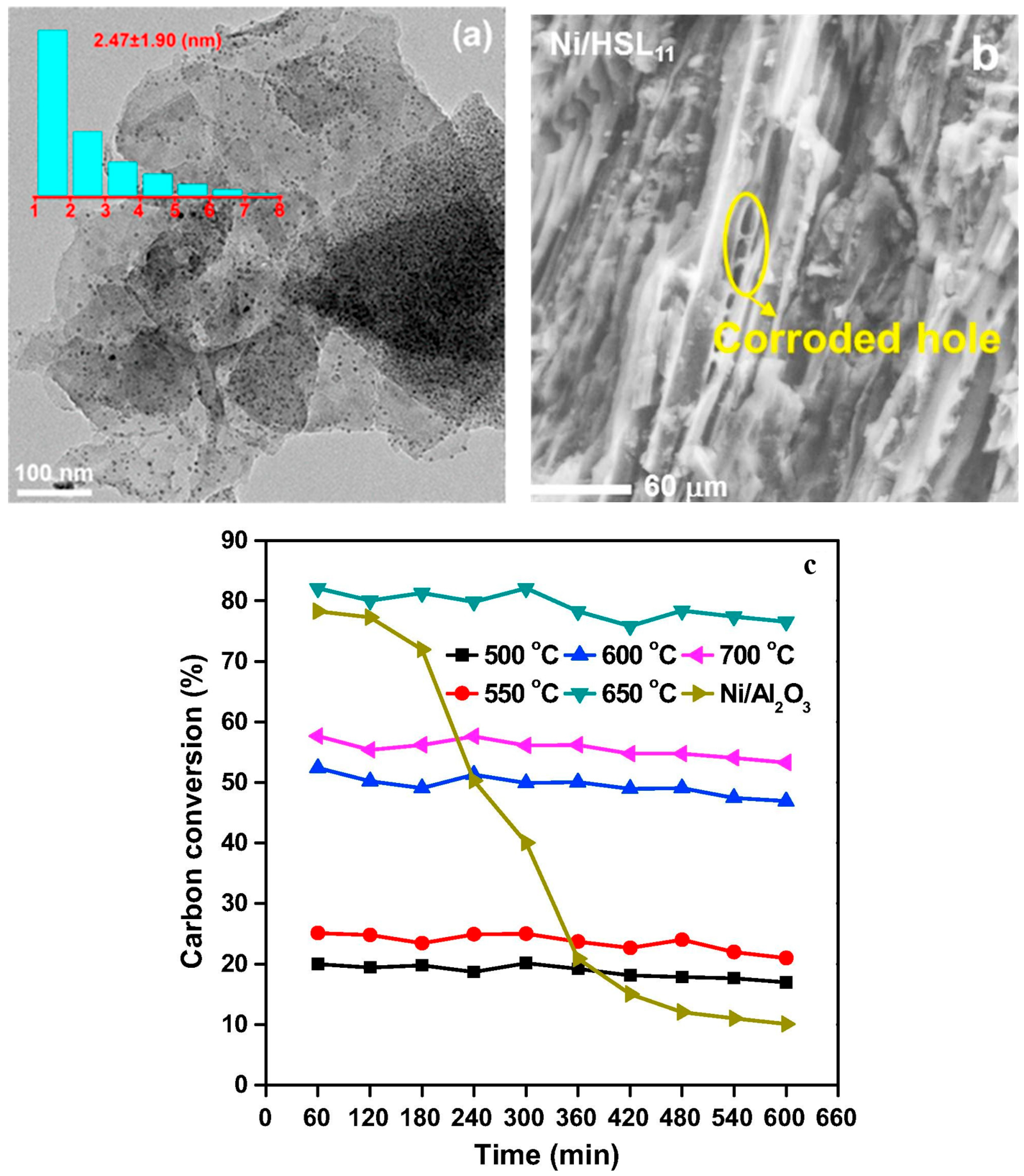
Beyond conventional biochar, layered carbon materials have shown great potential in the preparation of catalytic supports due to their high specific surface area (SSA) and unique π-conjugated electronic system [131]. Layered carbon materials loaded with nickel have been proven to be effective in catalyzing the conversion of aromatic compounds [132]. Among them, lignite with a porous structure has been confirmed to be a potential support. Ren er al. [133] prepared highly desirable and layered carbon supported Ni catalyst via ion exchange with Shengli lignite after removing organic ash by the hydrochloric acid treatment. The Ni was uniformly dispersed in the carbon framework (Figure 1a). In addition, some corroded holes were produced in the layered support after HCl treatment (Figure 1b), which provides a great space for accommodating metallic Ni and volatiles reforming. At 650 °C, the catalytic efficiency of this catalyst for toluene steam reforming reached 82.1%, which is significantly higher than that of commercial Ni-based catalysts.
In contrast to synthetic supports, natural minerals offer a low-cost and readily available alternative. Natural minerals such as dolomite are also used as support for Ni-based catalysts [134,135]. This method can not only enhance the catalytic performance of dolomite by loading NiO but also promote the dispersion of nickel due to the presence of MgO. At the same time, it effectively prevents nickel deactivation caused by sintering. Wang et al. [51] conducted catalytic cracking experiments using naphthalene as the tar model and Ni–dolomite as the catalysts. The fresh catalyst had very high catalytic activity, with the conversion rate of naphthalene reaching up to 94.8%. In addition, other natural minerals such as olivine are also excellent Ni supports [127]. As shown in Table 7, at higher temperatures, Ni/olivine achieved complete toluene conversion (100%) at 1023 K, demonstrating the potential of natural minerals as cost-effective supports for high-temperature tar reforming applications.
Zeolites represent yet another important class of catalyst supports. The catalytic cracking temperature of HZSM-5 is lower than that of other catalysts, making it a superior catalyst [136]. Additionally, HZSM-5 is also widely used as a support for Ni-based catalysts due to its distinct pore structure, extremely high surface area, and high surface acidity. HZSM-5 has been used as a support for steam reforming of Ni-based catalysts. Wu et al. [137] investigated the catalytic effect of Ni/HZSM-5 on the steam reforming of toluene. The results showed that the Ni/HZSM-5 catalyst with low nickel loading had poor catalytic activity, while the catalyst with high nickel loading exhibited poor resistance to coking. When the Ni loading was 9 wt.%, the toluene conversion rate reached a maximum of 82.4%. After adding the MgO promoter, the steam reforming performance of a Ni/HZSM-5 catalyst with a relatively low content of active metals (3 wt.%) was significantly improved.
Moreover, as shown in Table 7, the different substances were used as support for Ni. Collectively, these results underscore the critical role of support selection in optimizing catalytic performance for tar reforming applications.
Table 7. The tar removal effects of Ni-based catalysts on different supports.
Tar KindCatalystsConditionTar ConversionReference
Benzene15 wt.% Ni/γ-Al2O3T = 973 K82.5%[138]
15 wt.% Ni/ZrO238.8%
15 wt.% Ni/CeO257.7%
15 wt.% Ni/CeO2(75%)–ZrO2(25%)87.2%
Toluene10 wt.% Ni/LaAlO3T = 873 K
S/C = 3.0
W/F = 13.5 g h mol−1
81%[139]
10 wt.% Ni/LaFeO355%
10 wt.% Ni/BaTiO341%
10 wt.% Ni/SrTiO365%
10 wt.% Ni/SrCeO366%
TolueneNi/olivineT = 1023 K
S/C = 2.3
100%[140]
Benzene5% Ni/mayeniteT = 1073 K84%[141]
Phenol97%
Phenol15% Ni/α-Al2O3-ashT = 723 K,
S/C = 10
93.2[142]
15% Ni/γ-Al2O3-ash98.6%
Pine sawdust2% Ni/charT = 1073 K98.34 g/kg biomass[143]
4% Ni/char54.82 g/kg biomass
6% Ni/char25.17 g/kg biomass
8% Ni/char13.49 g/kg biomass

3.4.2. Inactivation Mechanism

During the steam reforming process, the performance and stability of the catalyst are influenced by the characteristics of the support. Ni-based catalysts may suffer from deactivation problems due to coke formation, nickel particle sintering, and poisoning by sulfur, chlorine, and alkali metals. Among these, carbon deposition on the Ni particles is the main cause of deactivation. The growth of carbon filaments is caused by the decomposition of methane on the Ni-based surface, forming active carbon species [144]. These carbons undergo a series of reactions with H2O or CO2, such as Reaction (9) and Reaction (12). When using an alkaline catalyst support, the adsorption of H2O and CO2 can be increased to enhance the carbon gasification rate. However, when there are strong acidic sites in the Ni-based catalyst (such as Lewis acid sites), carbon gasification reactions are suppressed, leading to an increase in carbon deposition formation. In addition, carbon deposits can also be formed through the Boudouard reaction, as well as through the polymerization and condensation of aromatic intermediates to generate polycyclic carbonaceous structures. The relative contribution of each pathway depends on the operating conditions, such as temperature, steam-to-carbon (S/C) ratio, and the composition of tar species. A low S/C ratio is conducive to the formation of carbon through methane decomposition and the Boudouard reaction, while insufficient steam partial pressure limits the gasification of deposited carbon, thereby causing the catalyst to accelerate its deactivation. Although high temperatures can promote the cracking of tar, they can also accelerate the formation rate of carbon, especially through methane decomposition and aromatic condensation. Continuous carbon deposition not only causes physical blockage on the support surface but also causes the active metals to be encapsulated by carbon, reducing the speed at which reactants reach the metals, thereby increasing the rate of catalyst deactivation during the tar reforming process.
In addition to carbon deposition, Ni-based catalysts are more prone to sintering at high temperatures, resulting in catalyst deactivation [145]. The sintering mechanism includes particle migration, particle coalescence, or Ostwald ripening [146]. As the tar reforming reaction proceeds, the collapse of the catalyst support structure and aggregation of metal particles result in a reduction in the number of Ni active sites. Additionally, a solid-state reaction occurs between the catalyst and the support, thereby resulting in catalyst deactivation.
The Ni-based catalysts can also suffer from sulfur poisoning during use, which may result in the formation of fine filaments of coke on the catalyst surface and lead to loss of activity due to the strong chemical adsorption between nickel and sulfur [147]. The sulfur poisoning phenomenon is caused by nickel sulfides (NiS) and the generation of hydrogen gas, and it occurs when nickel reacts with hydrogen sulfide (H2S) [148].

3.4.3. Modification Measures

In order to achieve high performance in tar steam reforming, the catalyst should have high activity for both hydrocarbons and oxygen-containing compounds. Beyond supporting Ni on suitable supports, Ni-based catalysts are also modified with other metal promoters (Ce, La, K, Co, Li, Fe) to enhance the performance of the catalysts, including improving catalytic activity and enhancing resistance to carbon deposition and poisoning [149,150,151]. These promoters can activate H2O to generate O2−, thereby effectively reducing the formation of coke [86]. Therefore, the metal promoters introduced into Ni-based catalysts mainly follow the following principles: (i) changing the surface acidity and basicity to reduce the formation of surface carbon; (ii) adding other components to improve the resistance to coke formation; (iii) adding other metal components through a synergistic effect to strengthen the effect of Ni; (iv) enhancing the mechanical strength of the catalyst. The following will introduce four types of promoters: alkali and alkaline earth metal, rare earth metal promoters, transition metal promoters (bimetallic systems), and core–shell and structured catalysts.
Some of these metals, such as alkaline and alkaline earth metals (AAEMs), are believed to promote hydrocarbon decomposition and water–gas shift reactions during biomass reforming [152], inhibit the high-temperature sintering of Ni-based catalysts, and significantly enhance the carbon resistance and metal sintering resistance of the Ni-based catalysts. Among these, alkali metals (K, Na) exhibit strong basicity and effectively promote tar cracking, but they are prone to volatilization at high temperatures, leading to gradual deactivation. In contrast, alkaline earth metals (Mg, Ca) offer better thermal stability; additionally, CaO acts as a CO2 sorbent, shifting the equilibrium toward H2 production. Studies have shown that adding Mg to the Ni-Fe/zeolite catalyst can enhance the hydrogenation cracking reaction and improve its resistance to carbon deposition [153]. Besides Mg, alkali metals and alkaline earth metals such as K and Ca are also beneficial for improving the performance of Ni-based catalysts. Zhang et al. [154] studied the potential influence of common alkali metals and alkaline earth metals (K, Ca, Mg) loaded onto Ni/La0.7Sr0.3AlO3−x on the catalytic activity for toluene steam reforming. The results showed that the presence of K, Ca, and Mg not only enhanced the reducibility of Ni particles and inhibited the sintering of Ni, but also reduced the formation of coking. However, the loading amount should be appropriate; excessive loading would lead to a decrease in catalytic activity. Calcined dolomite can not only be used as a support for Ni but also as a promoter. Tan et al. [134] prepared catalysts by a co-impregnation method with dolomite promoters and various oxide supports (Al2O3, La2O3, CeO2, and ZrO2), which were used in the steam reforming of the complex gasified biomass tar model compounds. The results showed that the addition of dolomite additives reduces unnecessary carbon dioxide emissions. Moreover, the addition of dolomite additives also improves the interaction between the metal and the support as well as the anti-deactivation ability.
Al2O3 is a common support for Ni-based catalysts. However, the service life of Ni/Al2O3 in the tar reforming process is limited. Therefore, rare earth oxides such as La and Ce need to be added to enhance the stability of the Ni-based catalyst. The development of supported metal catalysts for the steam reforming of biomass pyrolysis tar is mainly achieved by modifying the catalytic active elements with promoters, such as modifying Ni with CeO2 [155]. Among the modification strategies of the catalyst, promoters are considered to be the most crucial means to achieve high catalytic activity and stability at low temperatures. They can solve problems related to carbon deposition and Brönsted acid centers. The synergy between the bimetallic active sites optimizes the adsorption performance and redox characteristics of the target gases [156]. CeO2 has the ability to cycle easily between the reduced and oxidized states (i.e., Ce3 + − Ce4+). Therefore, the presence of CeO2 can accelerate the reaction rate occurring through the redox mechanism. At the same time, the stronger interaction between Ni and CeO2 provides higher coke formation resistance, thereby enhancing the catalytic reforming activity. J. Ashok et al. [157] found that the promoting effect of CeO2 can enhance the reducibility of surface Ni, inhibit coke deposition, and thereby promote the stability of Ni-based catalysts. In the steam gasification of biomass and its derived compounds, in addition to Ce, La2O3 is also commonly used as a promoter for Ni/Al2O3 catalysts [158]. An appropriate amount of La2O3 can effectively promote the dispersion of nickel, thereby enhancing the catalytic activity [159,160]. However, the loading of La should be appropriate; excessive La can form an undesirable LaAlO3 at 1000 °C [161]. When there are higher acid site densities in the catalyst, it will increase carbon formation [56]. An appropriate amount of basic La2O3 reduces the acidity of γ-Al2O3, thereby enhancing its adsorption capacity for CO2 and reducing the formation of coke on the catalyst surface [162]. Mazumder et al. [163] prepared La2O3-promoted Ni/γ-Al2O3 catalysts with different La contents. The results shown that compared with the nickel catalysts loaded only on γ-Al2O3, adding 5 wt.% La2O3 would generate more easily reducible NiO sites (low-temperature peak), which was achieved by reducing the formation of NiAl2O4 (high-temperature peak). In this regard, La2O3 weakened the interaction between nickel and alumina and limited the formation of nickel–aluminate, thereby reducing coke formation. However, excessive La2O3 would promote the formation of LaAlO3, which causes nickel grain agglomeration and increases the formation of coke. Moreover, CeO2 is more effective for coke mitigation under steam-rich conditions, while La2O3 provides better long-term stability in high-temperature applications.
Additionally, introducing transition metal promoters (bimetallic systems), such as Fe and Co, to modify the electronic and geometric properties of the active sites, thereby achieving a synergistic catalytic effect and improving the tar reforming performance. But heavy metals like Cd and Se are not introduced to prevent catalyst poisoning. Ni–Fe and Ni–Co alloys exhibit enhanced resistance to carbon deposition due to the dilution of surface Ni sites and the promotion of carbon gasification. Ni–Cu bimetallic catalysts show improved low-temperature activity, but Cu tends to sinter at elevated temperatures, limiting their application in high-temperature tar reforming. As an active phase, Fe can be added to Ni-based catalysts to promote the reducibility of the Ni type [153]. However, the reduction in carbon formation/deactivation of this catalyst is due to the presence of FeNi3 alloy in the catalyst structure [164]. Therefore, Mg was added to the Ni-Fe/zeolite catalyst to enhance the hydrocracking reaction and improve the carbon deposition tolerance [153]. Wang et al. [165] reported that adding Co to Ni/Al2O3 could enhance its catalytic activity for steam reforming of tar and its ability to resist coke deposition.
Recently, core–shell structured or encapsulated catalysts have been proven to be highly carbon-resistant for CO2 reforming methane reaction [166,167]. Li et al. [168] prepared NiCo@NiCo phyllosilicate@CeO2 core–shell hollow catalysts, which have been firstly designed via a facile hydrothermal and precipitation method. The results showed that NiCo@NiCo phyllosilicate@CeO2 core–shell hollow catalysts show promising applications in the toluene reforming reaction. Among them, the small-sized CeO2 nanocrystals enable a strong interaction between NiCo alloys and a high concentration of oxygen vacancies, which ensures that this catalyst has high resistance to sintering.
There are other active factors. Koike et al. [169] demonstrated that adding a certain amount of MnOx to the Ni/Al2O3 catalyst could significantly enhance its catalytic performance in the steam reforming process of the tar produced from the pyrolysis of pine wood, including improving the activity and reducing the effect of coke deposition. Adding Mn to Ni/dolomite can inhibit carbon deposition and provide stable catalytic activity for the reforming of toluene vapor. Heo et al. [170] investigated the catalytic activity and carbon deposition for toluene steam reforming by adding promoters such as Mn on 10 wt.% Ni-based catalysts. The results showed that the addition of Mn significantly improves the tar removal performance and hydrogen production performance of Ni/dolomite. The introduction of an additive to facilitate the catalyst’s generation of more acid sites is necessary. Lu et al. [171] introduced phosphorus (P) into char-supported nickel (Ni) catalysts for steam reforming of tar. Compared with Ni/γ-Al2O3, the (P + Ni)/20% O-C catalyst achieved the highest H2 yield and the lowest tar yield (4.9%), which can be attributed to the function of the (P + Ni)/20%O-C catalyst in converting heavy tar into light fractions. This means that most polycyclic substances are cracked into small-molecule products.
In addition, precious metal catalysts such as Pt, Rh, and Ru perform exceptionally well in tar steam reforming. However, these catalysts are not suitable for practical applications due to their high cost and are more suitable for modified nickel materials. The promotion of nickel catalysts with small amounts of noble metals has been proven to significantly enhance the activity of methane reforming [172], and it can also effectively resist catalyst deactivation caused by coke formation and metal oxidation. Lysne et al. [173] investigated the noble metal promotion (Pt/Pd/Rh) effect using hydrotalcite-derived Ni-Co/Mg(Al)O catalysts for bio-syngas tar steam reforming. The study found that the addition of these precious metals could improve the in situ activation performance of the bio-syngas and did not require any pre-reduction steps (without tar formation conditions). Besides doping modification, the effect of tar removal was also enhanced by directly mixing Ni-based catalysts with other catalysts [5,174].

3.5. Comparison of Natural Minerals and Ni-Based Catalysts

In the field of biomass gasification tar removal, the selection of catalysts directly determines the removal efficiency, process economy, and reactor design. Natural mineral catalysts (such as dolomite, limestone, olivine, and limonite) and supported Ni-based catalysts are currently the two most extensively studied types of catalytic materials. There are significant differences between them in terms of catalytic activity, stability, cost, and application scenarios (Table 8). A thorough understanding of their performance characteristics is of great significance for catalyst selection and process design. Natural minerals are suitable for primary purification, while high-performance Ni-based catalysts are suitable for deep reforming and hydrogen production.

4. Industrial Application Support: Fluidized Bed

Different types of biomass gasifiers can be customized to offer various sizes and designs, mainly divided into fixed-bed and fluidized-bed gasifiers. The fixed-bed gasifiers have traditionally been used for biomass gasification. These gasifiers are simple in design and sturdy, with high carbon conversion rates, long residence times, and low gas flow rates during operation, making them suitable for small-scale thermal energy and power production applications [17]. However, they are highly sensitive to the moisture content of the biomass, and the heat and mass transfer between the solid biomass in the reactor and the gasifying agent is low and uneven, which hinders their large-scale application and prevents them from functioning effectively in large-scale applications [175]. The fluidized bed is based on the fluidization principle. When the fluidizing medium passes through the bed, the particles in the bed enter a dynamic “fluid-like” state. This characteristic provides high mixing between different phases and gas–solid contact, improving the reaction rate and conversion efficiency. Therefore, this technology is more attractive and economically viable for large-scale applications.

4.1. The Process and Advantages

Fluidized bed gasifiers have the advantages of large processing capacity, continuous operation, and ease of scaling up, making them suitable for medium- and large-scale gasification systems. They mainly include two types: bubble fluidized bed gasifier (BFBG) and circulating fluidized bed gasifier (CFBG). BFBG typically operates at a lower fluidization speed (generally below 5 m/s, with a common range of 1–3 m/s), forming a bubbling fluidized bed characterized by the presence of discrete gas bubbles rising through a dense phase of solid particles [36]. Currently, this type of system still faces challenges such as the formation of non-uniform bed structures and particle segregation. In contrast, CFBG has a turbulent fluidization state and a fluidization speed that can be 3–5 times that of BFBG. Therefore, it can achieve a sufficient mixture of biomass, bed material, and gasifying agent in a shorter time, thereby improving heat and mass transfer efficiency and reaction rate. Thus, CFBG has higher gasification efficiency, carbon conversion rate, and extremely low tar production. Additionally, it has lower requirements for raw materials and can handle large amounts of raw materials, making it more suitable for large-scale applications. However, issues such as solid particle circulation need to be considered, which make the structural design more complex and the investment and operation costs relatively higher [176].
Since the particles are in a moving state during the fluidization process, frequent collisions between the particles impose high requirements on the mechanical strength of the bed material. The maintenance of the fluidization state requires the reasonable control of the fluidization wind speed, and this state is also affected by the particle size distribution of the bed material. Moreover, the deposition of coke on the surface of the bed material will change the particle properties, thereby affecting the fluidization quality. Therefore, the bed material needs to be selected reasonably according to the process requirements.

4.2. Two-Step Pyrolysis-Reforming Process

The gasification process involves multiple overlapping steps, which makes it impossible to separately control and optimize different steps in traditional gasifiers. The multi-stage gasification process separates and combines the pyrolysis and gasification steps in a single controlled environment. In recent years, the two-step catalytic steam reforming process, as an effective strategy for hydrogen production, has received increasing attention [177]. The pyrolysis step is typically carried out at approximately 500 °C to ensure complete devolatilization of the biomass. Subsequently, the catalytic steam reforming step is conducted at temperatures ranging from 600 to 800 °C over metal-supported catalysts. The volatile stream exiting the pyrolysis reactor passes through the catalytic bed and reacts with steam at the active sites of the catalyst. This decoupled configuration offers several advantages: (i) the pyrolysis and reforming steps can be independently optimized, allowing precise control over the temperature, residence time, and steam-to-carbon ratio in each stage; (ii) the catalyst is not directly exposed to the complex biomass matrix or the alkali metals present in the feedstock, thereby reducing deactivation by poisoning; (iii) compared to single-stage configurations, the overall process achieves higher hydrogen yields and lower tar content in the syngas [178]. Additionally, Kargbo et al. [179] recently evaluated the economic feasibility of two-stage gasification systems and reported that they are approximately 25% more economical than single-stage systems. However, combining different reactors increases process complexity [180]. Various reactor configurations have been proposed for the pyrolysis and in-line steam reforming steps, such as fixed bed coupled with fixed bed, spouted bed coupled with fluidized bed, and rotary kiln coupled with fixed bed. Each configuration presents distinct advantages and limitations depending on the feedstock characteristics and process requirements.
Due to its simple design, ease of operation, and low investment cost, the method of combining two fixed-bed reactors for the pyrolysis and reforming steps has been widely adopted [181]. Šulc et al. [64] also used a fixed-bed reactor configuration, but in this case, the first stage was an upward fixed-bed reactor. They fixed the temperature of the first stage at 670 °C, the second stage at 950 °C, and reported that the tar content decreased from 6.8 g per cubic meter to 45.1 milligrams per cubic meter. Restrepo et al. [182] designed, constructed, and operated a 50-kilowatt two-stage downward gasifier equipped with a complete gas purification system, and reported that the gas quality was sufficient for use in solid oxide fuel cells. However, the heat transfer limitation of the fixed bed may lead to temperature gradients, especially for low thermal conductivity biomass feedstocks, and this system is not suitable for continuous operation unless multiple reactors are connected in parallel and switched. Additionally, using fixed-bed reactors for the reforming step may encounter operational problems related to the deposition of coke on the catalyst surface, which leads to bed clogging, and this is not suitable for continuous operation.
Several authors have reported the operation conditions in continuous-flow fluidized beds and jet beds [183]. The main advantages of these reactors lie in their suitable gas–solid contact characteristics, high heat and mass transfer rates between phases, and isothermal nature of the bed. In the rapid pyrolysis reactor, the first operation step is characterized by a high heating rate and extremely short residence time, ensuring efficient conversion of biomass into volatile substances while reducing the coke yield (liquid portion or bio-oil is maximized), and increasing the hydrogen potential in the process [184]. Combined with fluidized bed reformers, it can achieve continuous catalyst regeneration and stable operation. This configuration, with its superior mass and heat transfer characteristics and high processing capacity, is suitable for large-scale applications [185]. However, fluidized bed reactors have limitations related to feed and particle size within the bed, with reduced fluidization being the main drawback.
In addition, the combination of rotary kilns and fixed beds is also a very good approach. Efika et al. [186] studied a two-stage continuous helical kiln reactor for producing syngas through the pyrolysis of waste wood. The thermal helical kiln reactor has the advantages of continuous feed and good temperature control, and can handle various biomass types, including raw materials with high moisture content. When used in combination with a fixed-bed reformer, the pyrolysis and reforming stages can be independently optimized, but the catalyst replacement in the fixed-bed reformer requires regular shutdowns.
It should be noted that the use of a rapid pyrolysis reactor in the pyrolysis-reforming process offers practical advantages for large-scale operations. It reduces the amount of tar produced and enhances the hydrogen production potential. Moreover, the fluidized bed has an edge over the fixed bed in engineering applications, not only due to its superior heat and mass transfer capabilities, but also because it enables catalyst regeneration strategies. Therefore, the lifespan of the catalyst depends on its ability to avoid failure due to coke deposition, metal sintering, and poisoning. In fact, the pyrolysis-reforming process is severely limited by the rapid catalyst deactivation rate.

4.3. The Interaction Between the Fluidized Bed and the Catalyst

The application of fluidized beds in biomass gasification has been extensively studied [40]. In this reactor, the bed material not only serves as the fluidizing medium but also functions as a catalyst for tar removal. Reports have been published on the application of inexpensive and readily available natural minerals and Ni-based catalysts with high catalytic activity in the fluidized-bed system [187,188,189].
Taking dolomite as an example, the presence of dolomite in the fluidized bed helps to reduce the tar content and increase the gas output rate [190]. However, the mechanical strength of dolomite is relatively low, and it is prone to powdering and wear due to particle collisions during the fluidization process, resulting in a reduction in the effective catalytic dosage. To address this issue, continuous catalyst replenishment or loading of metals can be used to enhance its mechanical strength, thereby alleviating the aforementioned drawbacks. Compared to dolomite, olivine has better mechanical strength. Some researchers [104,191] have studied that the presence of olivine in the reactor leads to a decrease in tar content, an increase in syngas yield, an increase in H2 and CO2 content, and a decrease in CO and CH4 content. This effect is attributed to the catalytic activity of olivine in removing tar and the water–gas shift reaction. Olivine produces fewer particles and has less impact on coke deposition and wear resistance, and has higher mechanical strength, equivalent to sand [192]. Olivine is suitable as a circulating fluidized bed material due to its wear resistance and mechanical properties.
The Ni-based catalyst exhibits excellent catalytic performance for hydrogen production from biomass gasification and tar removal in fixed-bed reactors [193]. The Ni-based catalyst also shows good tar removal performance in fluidized beds. Peng et al. [194] explored air-steam gasification of wood residue in a research scale fluidized bed, using Ni/Al2O3 and Ni/CeO2/Al2O3 as catalysts. The results showed that the addition of the catalyst significantly reduces the tar yield. Ni/CeO2/Al2O3 is more suitable for biomass conversion and hydrogen production than Ni/Al2O3. Table 9 shows the application effects of natural minerals and Ni-based catalysts in the fluidized bed. High tar conversion efficiency does not automatically translate into high hydrogen yield or favorable selectivity. Some catalysts that effectively crack tar produce excessive CH4 or CO, thereby lowering H2 yield and the H2/CO ratio.

5. Challenges and Future Prospects

Addressing the issue of biomass tar resource utilization is of great significance for achieving high-quality utilization of biomass energy and promoting the further development of biomass gasification technology. Research on tar gasification can improve resource utilization efficiency and provide theoretical guidance for tar reduction during biomass or biochar gasification. Existing studies have predominantly focused on using one or several major components of tar as model compounds [197]. Due to the more complex composition of real tar, the degradation patterns observed with these compounds cannot accurately reflect the behavior of actual tar feedstocks. Consequently, comprehensively establishing the process mechanism based on real tar feeding is beneficial for understanding the overall process chemistry and simulating catalyst development. Furthermore, direct research on tar gasification has mostly been confined to fixed-bed reactors, lacking investigations into the tar gasification process in continuously fed fluidized beds. Elucidating the mechanism of tar steam gasification for hydrogen production based on continuous feeding in a fluidized bed holds significant engineering guidance for reducing tar yield during biomass gasification and achieving efficient tar treatment.
Low-cost and naturally abundant mineral catalysts, along with highly active and selective nickel-based catalysts, have been extensively studied due to their outstanding cost-effectiveness [198,199]. Natural minerals such as dolomite or limestone suffer from poor mechanical strength, leading to catalyst attrition during particle collisions. Ni-based catalysts, on the other hand, are prone to deactivation issues caused by coke formation, sintering of nickel particles, and poisoning by sulfur, chlorine, and alkali metals. Nevertheless, leveraging their advantages in price and performance, both catalyst types possess significant application potential in industrial production. Therefore, current research focuses on balancing the high activity and long lifespan of nickel-based catalysts, as well as enhancing the mechanical strength and low-temperature activity of natural mineral catalysts. Simultaneously, the durability of catalysts during long-term operation is a factor that cannot be overlooked in engineering applications. Addressing the issue of insufficient mechanical strength in natural minerals (e.g., limestone, dolomite), approaches such as synthesizing metal/calcium oxide composite catalysts via co-precipitation or sol–gel methods offer feasible pathways for improvement. Future studies should systematically optimize synthesis parameters, including precursor concentration, pH, and calcination temperature, to achieve improved attrition resistance while maintaining high tar conversion efficiency. For Ni-based catalysts, specific strategies to enhance durability and inhibit deactivation include: (i) incorporating rare earth oxide promoters (e.g., CeO2, La2O3) to enhance coke gasification through oxygen mobility; (ii) developing bimetallic systems (e.g., Ni–Fe, Ni–Co) to dilute surface Ni sites and reduce coking propensity; (iii) designing core–shell structures (e.g., Ni@SiO2) to physically prevent sintering. Meanwhile, the catalytic pyrolysis process was analyzed in terms of its mechanism using characterization techniques, thereby further optimizing the catalyst. Validating catalyst performance through long-term stability tests (>100 h) and pilot-scale studies are encouraged. However, these catalyst systems still face bottlenecks related to lifespan and cost, hindering large-scale industrial application. While improving tar removal performance, cost considerations must be taken into account, necessitating further research on catalyst enhancement. Developing a cost model that can quantify the trade-off relationship between the lifespan, activity, and material cost of catalysts will be crucial for determining the most economically feasible catalytic system suitable for large-scale application. Additionally, leveraging the respective characteristics of these catalysts, a staged catalysis strategy could be constructed: employing natural minerals for preliminary tar removal, followed by deep reforming using nickel-based catalysts to further increase hydrogen yield. Future research should focus on optimizing the operational parameters at each stage, including temperature and the ratio of steam to carbon, and on investigating the synergistic effect between natural minerals and nickel-based catalysts to maximize the efficiency of the entire process. This approach may open up a new avenue for the catalytic gasification of biomass and the removal of tar.

6. Conclusions

Biomass gasification is regarded as one of the most promising solutions for addressing the energy crisis and achieving environmental sustainability. However, tar formation remains a major obstacle hindering the commercialization of biomass gasification. As a mixture of polycyclic aromatic hydrocarbons, tar exhibits high stability, making it difficult to convert. Among the various treatment methods, catalytic steam reforming is considered the most promising solution. It can not only efficiently remove tar but also crack it into high-value syngas (H2 + CO). The most critical factor in catalytic steam reforming is the selection of the catalyst, as the use of a catalyst helps enhance tar cracking and reforming reactions.
Among the numerous catalysts available, low-cost and naturally abundant mineral catalysts, along with highly active and selective nickel-based catalysts, have become the mainstream choices for both research and industrial applications due to their outstanding cost-effectiveness. Natural minerals suffer from poor catalytic activity, necessitating further enhancement of their chemical activity and mechanical strength through methods such as calcination or metal loading. They also face challenges including insufficient mechanical strength and poor low-temperature activity. In contrast, Ni-based catalysts exhibit excellent catalytic activity and relatively low cost. However, Ni-based catalysts are prone to deactivation due to coke deposition, sintering of nickel particles, and poisoning by sulfur, chlorine, and alkali metals. Therefore, it is necessary to employ supports, metallic active components, and promoters to further enhance the performance and lifetime of Ni-based catalysts.
The ultimate goal of improving catalyst performance is to meet the requirements for engineering applications. Fluidized bed reactors are considered reliable reactors due to their large processing capacity, continuous operation capability, and ease of scale-up. Among them, circulating fluidized beds, which operate in a turbulent fluidization regime, are particularly favored for their high heat and mass transfer efficiency. However, the collision between bed material particles imposes higher demands on the mechanical strength of the bed material. Natural minerals and Ni-based catalysts have demonstrated outstanding application potential in fluidized beds due to their good tar removal performance, making them the subject of extensive research.
Furthermore, to meet the demands of fluidized bed processes and industrial applications, the comprehensive performance of catalysts still needs further improvement, with a focus on balancing deactivation resistance, mechanical strength, and catalytic activity. Future research should focus on: (i) enhancing the mechanical strength and low-temperature activity of natural minerals through advanced synthesis methods such as co-precipitation and sol–gel; (ii) improving the durability of Ni-based catalysts via promoter incorporation (e.g., CeO2, La2O3), bimetallic formulations (Ni–Fe, Ni–Co), and core–shell architectures; (iii) validating catalyst performance through long-term stability tests (>100 h) and pilot-scale studies; (iv) exploring cascading strategies that combine natural minerals for primary tar removal with Ni-based catalysts for deep reforming, optimizing operating parameters to maximize overall efficiency and H2 yield.

Author Contributions

Conceptualization and data curation, X.S.; methodology, D.Z.; writing—original draft preparation, X.S.; writing—review and editing, M.Z. and R.B. All authors have read and agreed to the published version of the manuscript.

Funding

This research is funded by the Yunnan Provincial Key Research and Development Program, Project No. 202503AR080001, entitled Key Technologies for Unlocking and Enhancing Power Source-Side Regulation Capabilities to Ensure Supply Security and Promote Grid Integration.

Data Availability Statement

The raw data supporting the conclusions of this article will be made available by the authors on request.

Conflicts of Interest

The authors declare no conflicts of interest.

References

  1. Tezer, Ö.; Karabağ, N.; Öngen, A.; Çolpan, C.Ö.; Ayol, A. Biomass Gasification for Sustainable Energy Production: A Review. Int. J. Hydrogen Energy 2022, 47, 15419–15433. [Google Scholar] [CrossRef]
  2. Faizan, M.; Song, H. Critical Review on Catalytic Biomass Gasification: State-of-Art Progress, Technical Challenges, and Perspectives in Future Development. J. Clean. Prod. 2023, 408, 137224. [Google Scholar] [CrossRef]
  3. Song, H.; Yang, G.; Xue, P.; Li, Y.; Zou, J.; Wang, S.; Yang, H.; Chen, H. Recent Development of Biomass Gasification for H2 Rich Gas Production. Appl. Energy Combust. Sci. 2022, 10, 100059. [Google Scholar] [CrossRef]
  4. Sansaniwal, S.K.; Pal, K.; Rosen, M.A.; Tyagi, S.K. Recent Advances in the Development of Biomass Gasification Technology: A Comprehensive Review. Renew. Sustain. Energy Rev. 2017, 72, 363–384. [Google Scholar] [CrossRef]
  5. Dong, J.; Nzihou, A.; Chi, Y.; Weiss-Hortala, E.; Ni, M.; Lyczko, N.; Tang, Y.; Ducousso, M. Hydrogen-Rich Gas Production from Steam Gasification of Bio-Char in the Presence of CaO. Waste Biomass Valorization 2017, 8, 2735–2746. [Google Scholar] [CrossRef]
  6. Rubinsin, N.J.; Karim, N.A.; Timmiati, S.N.; Lim, K.L.; Isahak, W.N.R.W.; Pudukudy, M. An Overview of the Enhanced Biomass Gasification for Hydrogen Production. Int. J. Hydrogen Energy 2024, 49, 1139–1164. [Google Scholar] [CrossRef]
  7. Han, J.; Kim, H. The Reduction and Control Technology of Tar during Biomass Gasification/Pyrolysis: An Overview. Renew. Sustain. Energy Rev. 2008, 12, 397–416. [Google Scholar] [CrossRef]
  8. Ramadhani, B.; Kivevele, T.; Kihedu, J.H.; Jande, Y.A.C. Catalytic Tar Conversion and the Prospective Use of Iron-Based Catalyst in the Future Development of Biomass Gasification: A Review. Biomass Convers. Biorefinery 2022, 12, 1369–1392. [Google Scholar] [CrossRef]
  9. Singh, S.; Kumar Bhaumik, S.; Dong, L.; Li, C.-Z.; Vuthaluru, H. An Integrated Two-Step Process of Reforming and Adsorption Using Biochar for Enhanced Tar Removal in Syngas Cleaning. Fuel 2022, 307, 121935. [Google Scholar] [CrossRef]
  10. Wang, N.; He, H.; Wang, Y.; Xu, B.; Harding, J.; Yin, X.; Tu, X. Machine Learning-Driven Optimization of Ni-Based Catalysts for Catalytic Steam Reforming of Biomass Tar. Energy Convers. Manag. 2024, 300, 117879. [Google Scholar] [CrossRef]
  11. Ren, J.; Cao, J.-P.; Zhao, X.-Y.; Liu, Y.-L. Recent Progress and Perspectives of Catalyst Design and Downstream Integration in Biomass Tar Reforming. Chem. Eng. J. 2022, 429, 132316. [Google Scholar] [CrossRef]
  12. Prabhansu; Karmakar, M.K.; Chandra, P.; Chatterjee, P.K. A Review on the Fuel Gas Cleaning Technologies in Gasification Process. J. Environ. Chem. Eng. 2015, 3, 689–702. [Google Scholar] [CrossRef]
  13. Valle, B.; García-Gómez, N.; Remiro, A.; Bilbao, J.; Gayubo, A.G. Dual Catalyst-Sorbent Role of Dolomite in the Steam Reforming of Raw Bio-Oil for Producing H2-Rich Syngas. Fuel Process. Technol. 2020, 200, 106316. [Google Scholar] [CrossRef]
  14. Zhang, B.; Zhang, L.; Yang, Z.; He, Z. An Experiment Study of Biomass Steam Gasification over NiO/Dolomite for Hydrogen-Rich Gas Production. Int. J. Hydrogen Energy 2017, 42, 76–85. [Google Scholar] [CrossRef]
  15. Du, Z.-Y.; Zhang, Z.-H.; Xu, C.; Wang, X.-B.; Li, W.-Y. Low-Temperature Steam Reforming of Toluene and Biomass Tar over Biochar-Supported Ni Nanoparticles. ACS Sustain. Chem. Eng. 2019, 7, 3111–3119. [Google Scholar] [CrossRef]
  16. Shi, L.; Su, Y.; Yang, L.; Xiong, Y.; Zhang, S. Enhancing the Tar Removal Efficiency and Gas Production for the Pyrolysis of Biomass through the Nickel-Based Hollow Zeolite. J. Energy Inst. 2025, 118, 101914. [Google Scholar] [CrossRef]
  17. Cortazar, M.; Santamaria, L.; Lopez, G.; Alvarez, J.; Zhang, L.; Wang, R.; Bi, X.; Olazar, M. A Comprehensive Review of Primary Strategies for Tar Removal in Biomass Gasification. Energy Convers. Manag. 2023, 276, 116496. [Google Scholar] [CrossRef]
  18. Zhou, B.; Dichiara, A.; Zhang, Y.; Zhang, Q.; Zhou, J. Tar Formation and Evolution during Biomass Gasification: An Experimental and Theoretical Study. Fuel 2018, 234, 944–953. [Google Scholar] [CrossRef]
  19. Valderrama Rios, M.L.; González, A.M.; Lora, E.E.S.; Almazán del Olmo, O.A. Reduction of Tar Generated during Biomass Gasification: A Review. Biomass Bioenergy 2018, 108, 345–370. [Google Scholar] [CrossRef]
  20. Molino, A.; Chianese, S.; Musmarra, D. Biomass Gasification Technology: The State of the Art Overview. J. Energy Chem. 2016, 25, 10–25. [Google Scholar] [CrossRef]
  21. Rabou, L.P.L.M.; Zwart, R.W.R.; Vreugdenhil, B.J.; Bos, L. Tar in Biomass Producer Gas, the Energy Research Centre of The Netherlands (ECN) Experience: An Enduring Challenge. Energy Fuels 2009, 23, 6189–6198. [Google Scholar] [CrossRef]
  22. Ponzio, A.; Kalisz, S.; Blasiak, W. Effect of Operating Conditions on Tar and Gas Composition in High Temperature Air/Steam Gasification (HTAG) of Plastic Containing Waste. Fuel Process. Technol. 2006, 87, 223–233. [Google Scholar] [CrossRef]
  23. Gil-Lalaguna, N.; Sánchez, J.L.; Murillo, M.B.; Rodríguez, E.; Gea, G. Air–Steam Gasification of Sewage Sludge in a Fluidized Bed. Influence of Some Operating Conditions. Chem. Eng. J. 2014, 248, 373–382. [Google Scholar] [CrossRef]
  24. Hanchate, N.; Ramani, S.; Mathpati, C.S.; Dalvi, V.H. Biomass Gasification Using Dual Fluidized Bed Gasification Systems: A Review. J. Clean. Prod. 2021, 280, 123148. [Google Scholar] [CrossRef]
  25. Meng, J.; Wang, X.; Zhao, Z.; Zheng, A.; Huang, Z.; Wei, G.; Lv, K.; Li, H. Highly Abrasion Resistant Thermally Fused Olivine as In-Situ Catalysts for Tar Reduction in a Circulating Fluidized Bed Biomass Gasifier. Bioresour. Technol. 2018, 268, 212–220. [Google Scholar] [CrossRef]
  26. Tian, Y.; Zhou, X.; Yang, Y.; Nie, L. Experimental Analysis of Air-Steam Gasification of Biomass with Coal-Bottom Ash. J. Energy Inst. 2020, 93, 25–30. [Google Scholar] [CrossRef]
  27. Cortazar, M.; Alvarez, J.; Lopez, G.; Amutio, M.; Santamaria, L.; Bilbao, J.; Olazar, M. Role of Temperature on Gasification Performance and Tar Composition in a Fountain Enhanced Conical Spouted Bed Reactor. Energy Convers. Manag. 2018, 171, 1589–1597. [Google Scholar] [CrossRef]
  28. Tian, Y.; Zhou, X.; Lin, S.; Ji, X.; Bai, J.; Xu, M. Syngas Production from Air-Steam Gasification of Biomass with Natural Catalysts. Sci. Total Environ. 2018, 645, 518–523. [Google Scholar] [CrossRef] [PubMed]
  29. Cortazar, M.; Lopez, G.; Alvarez, J.; Arregi, A.; Amutio, M.; Bilbao, J.; Olazar, M. Experimental Study and Modeling of Biomass Char Gasification Kinetics in a Novel Thermogravimetric Flow Reactor. Chem. Eng. J. 2020, 396, 125200. [Google Scholar] [CrossRef]
  30. Guo, S.; Wei, X.; Li, J.; Che, D.; Liu, H.; Sun, B.; Wang, Q. Experimental Study on Product Gas and Tar Removal in Air–Steam Gasification of Corn Straw in a Bench-Scale Internally Circulating Fluidized Bed. Energy Fuels 2020, 34, 1908–1917. [Google Scholar] [CrossRef]
  31. Cao, Y.; Bai, Y.; Du, J. Air-Gasification of Pine Sawdust Using Dolomite as in-Bed Material: Effects of Gasification Conditions on Product Characteristics. J. Energy Inst. 2021, 95, 187–192. [Google Scholar] [CrossRef]
  32. Alauddin, Z.A.B.Z.; Lahijani, P.; Mohammadi, M.; Mohamed, A.R. Gasification of Lignocellulosic Biomass in Fluidized Beds for Renewable Energy Development: A Review. Renew. Sustain. Energy Rev. 2010, 14, 2852–2862. [Google Scholar] [CrossRef]
  33. Asadullah, M. Biomass Gasification Gas Cleaning for Downstream Applications: A Comparative Critical Review. Renew. Sustain. Energy Rev. 2014, 40, 118–132. [Google Scholar] [CrossRef]
  34. Sikarwar, V.S.; Zhao, M.; Clough, P.; Yao, J.; Zhong, X.; Memon, M.Z.; Shah, N.; Anthony, E.J.; Fennell, P.S. An Overview of Advances in Biomass Gasification. Energy Environ. Sci. 2016, 9, 2939–2977. [Google Scholar] [CrossRef]
  35. Zeng, X.; Ueki, Y.; Yoshiie, R.; Naruse, I.; Wang, F.; Han, Z.; Xu, G. Recent Progress in Tar Removal by Char and the Applications: A Comprehensive Analysis. Carbon Resour. Convers. 2020, 3, 1–18. [Google Scholar] [CrossRef]
  36. Situmorang, Y.A.; Zhao, Z.; Yoshida, A.; Abudula, A.; Guan, G. Small-Scale Biomass Gasification Systems for Power Generation (<200 kW Class): A Review. Renew. Sustain. Energy Rev. 2020, 117, 109486. [Google Scholar] [CrossRef]
  37. Xu, C.C.; Donald, J.; Byambajav, E.; Ohtsuka, Y. Recent Advances in Catalysts for Hot-Gas Removal of Tar and NH3 from Biomass Gasification. Fuel 2010, 89, 1784–1795. [Google Scholar] [CrossRef]
  38. Huang, J.; Schmidt, K.G.; Bian, Z. Removal and Conversion of Tar in Syngas from Woody Biomass Gasification for Power Utilization Using Catalytic Hydrocracking. Energies 2011, 4, 1163–1177. [Google Scholar] [CrossRef]
  39. Asadullah, M. Barriers of Commercial Power Generation Using Biomass Gasification Gas: A Review. Renew. Sustain. Energy Rev. 2014, 29, 201–215. [Google Scholar] [CrossRef]
  40. Morin, M.; Nitsch, X.; Pécate, S.; Hémati, M. Tar Conversion over Olivine and Sand in a Fluidized Bed Reactor Using Toluene as Model Compound. Fuel 2017, 209, 25–34. [Google Scholar] [CrossRef][Green Version]
  41. Devi, L.; Ptasinski, K.J.; Janssen, F.J.J.G. A Review of the Primary Measures for Tar Elimination in Biomass Gasification Processes. Biomass Bioenergy 2003, 24, 125–140. [Google Scholar] [CrossRef]
  42. Hasler, P.; Nussbaumer, T. Gas Cleaning for IC Engine Applications from Fixed Bed Biomass Gasification. Biomass Bioenergy 1999, 16, 385–395. [Google Scholar] [CrossRef]
  43. Abu El-Rub, Z.; Bramer, E.A.; Brem, G. Experimental Comparison of Biomass Chars with Other Catalysts for Tar Reduction. Fuel 2008, 87, 2243–2252. [Google Scholar] [CrossRef]
  44. Liu, Y.; Song, J.; Diao, X.; Liu, L.; Sun, Y. Removal of Tar Derived from Biomass Gasification via Synergy of Non-Thermal Plasma and Catalysis. Sci. Total Environ. 2020, 721, 137671. [Google Scholar] [CrossRef] [PubMed]
  45. Narnaware, S.L.; Panwar, N.L. Catalysts and Their Role in Biomass Gasification and Tar Abetment: A Review. Biomass Convers. Biorefinery 2025, 15, 29541–29571. [Google Scholar] [CrossRef]
  46. Sun, H.; Feng, D.; Zhang, Y.; Sun, S.; Zhao, Y.; Zhang, F. Regeneration of Deactivated Biochar for Catalytic Tar Reforming by Partial Oxidation: Effect of Oxygen Concentration and Regeneration Time. Fuel 2022, 330, 125572. [Google Scholar] [CrossRef]
  47. Mishra, S.; Upadhyay, R.K. Review on Biomass Gasification: Gasifiers, Gasifying Mediums, and Operational Parameters. Mater. Sci. Energy Technol. 2021, 4, 329–340. [Google Scholar] [CrossRef]
  48. Zeng, X.; Wang, F.; Sun, Y.; Zhang, J.; Tang, S.; Xu, G. Characteristics of Tar Abatement by Thermal Cracking and Char Catalytic Reforming in a Fluidized Bed Two-Stage Reactor. Fuel 2018, 231, 18–25. [Google Scholar] [CrossRef]
  49. Singh, S.; Kumar Bhaumik, S.; Dong, L.; Vuthaluru, H. Enhanced Tar Removal in Syngas Cleaning through Integrated Steam Catalytic Tar Reforming and Adsorption Using Biochar. Fuel 2023, 331, 125912. [Google Scholar] [CrossRef]
  50. Tan, R.S.; Tuan Abdullah, T.A.; Abdul Jalil, A.; Md Isa, K. Optimization of Hydrogen Production from Steam Reforming of Biomass Tar over Ni/Dolomite/La2O3 Catalysts. J. Energy Inst. 2020, 93, 1177–1186. [Google Scholar] [CrossRef]
  51. Wang, T.J.; Chang, J.; Wu, C.Z.; Fu, Y.; Chen, Y. The Steam Reforming of Naphthalene over a Nickel–Dolomite Cracking Catalyst. Biomass Bioenergy 2005, 28, 508–514. [Google Scholar] [CrossRef]
  52. Torres, C.; Rostom, S.; de Lasa, H. An Eco-Friendly Fluidizable FexOy/CaO-γ-Al2O3 Catalyst for Tar Cracking during Biomass Gasification. Catalysts 2020, 10, 806. [Google Scholar] [CrossRef]
  53. Islam, M.W. A Review of Dolomite Catalyst for Biomass Gasification Tar Removal. Fuel 2020, 267, 117095. [Google Scholar] [CrossRef]
  54. Inayat, M.; Sulaiman, S.A.; Kurnia, J.C. Catalytic Co-Gasification of Coconut Shells and Oil Palm Fronds Blends in the Presence of Cement, Dolomite, and Limestone: Parametric Optimization via Box Behnken Design. J. Energy Inst. 2019, 92, 871–882. [Google Scholar] [CrossRef]
  55. Guan, G.; Kaewpanha, M.; Hao, X.; Abudula, A. Catalytic Steam Reforming of Biomass Tar: Prospects and Challenges. Renew. Sustain. Energy Rev. 2016, 58, 450–461. [Google Scholar] [CrossRef]
  56. Abidin, S.Z.; Osazuwa, O.U.; Othman, N.H.; Setiabudi, H.D.; Sulaiman, S. Recent Progress on Catalyst Development in Biomass Tar Steam Reforming: Toluene as a Biomass Tar Model Compound. Biomass Convers. Biorefinery 2024, 14, 15187–15222. [Google Scholar] [CrossRef]
  57. Buentello-Montoya, D.; Zhang, X.; Li, J.; Ranade, V.; Marques, S.; Geron, M. Performance of Biochar as a Catalyst for Tar Steam Reforming: Effect of the Porous Structure. Appl. Energy 2020, 259, 114176. [Google Scholar] [CrossRef]
  58. Li, Q.; Wang, Q.; Kayamori, A.; Zhang, J. Experimental Study and Modeling of Heavy Tar Steam Reforming. Fuel Process. Technol. 2018, 178, 180–188. [Google Scholar] [CrossRef]
  59. Constantinou, D.A.; Fierro, J.L.G.; Efstathiou, A.M. The Phenol Steam Reforming Reaction towards H2 Production on Natural Calcite. Appl. Catal. B Environ. 2009, 90, 347–359. [Google Scholar] [CrossRef]
  60. Min, Z.; Asadullah, M.; Yimsiri, P.; Zhang, S.; Wu, H.; Li, C.-Z. Catalytic Reforming of Tar during Gasification. Part I. Steam Reforming of Biomass Tar Using Ilmenite as a Catalyst. Fuel 2011, 90, 1847–1854. [Google Scholar] [CrossRef]
  61. Yu, Q.-Z.; Brage, C.; Nordgreen, T.; Sjöström, K. Effects of Chinese Dolomites on Tar Cracking in Gasification of Birch. Fuel 2009, 88, 1922–1926. [Google Scholar] [CrossRef]
  62. Zhang, Z.; Qin, C.; Ou, Z.; Ran, J. Resistance of Ni/Perovskite Catalysts to H2S in Toluene Steam Reforming for H2 Production. Int. J. Hydrogen Energy 2020, 45, 26800–26811. [Google Scholar] [CrossRef]
  63. Zhang, H.; Zhu, F.; Li, X.; Xu, R.; Li, L.; Yan, J.; Tu, X. Steam Reforming of Toluene and Naphthalene as Tar Surrogate in a Gliding Arc Discharge Reactor. J. Hazard. Mater. 2019, 369, 244–253. [Google Scholar] [CrossRef]
  64. Šulc, J.; Štojdl, J.; Richter, M.; Popelka, J.; Svoboda, K.; Smetana, J.; Vacek, J.; Skoblja, S.; Buryan, P. Biomass Waste Gasification–Can Be the Two Stage Process Suitable for Tar Reduction and Power Generation? Waste Manag. 2012, 32, 692–700. [Google Scholar] [CrossRef]
  65. Xu, D.; Yang, L.; Ding, K.; Zhang, Y.; Gao, W.; Huang, Y.; Sun, H.; Hu, X.; Syed-Hassan, S.S.A.; Zhang, S.; et al. Mini-Review on Char Catalysts for Tar Reforming during Biomass Gasification: The Importance of Char Structure. Energy Fuels 2020, 34, 1219–1229. [Google Scholar] [CrossRef]
  66. Koike, M.; Hisada, Y.; Wang, L.; Li, D.; Watanabe, H.; Nakagawa, Y.; Tomishige, K. High Catalytic Activity of Co-Fe/α-Al2O3 in the Steam Reforming of Toluene in the Presence of Hydrogen. Appl. Catal. B Environ. 2013, 140–141, 652–662. [Google Scholar] [CrossRef]
  67. Guo, S.; Liu, S.; Liu, G. Modulation of Rh Species in Rh/Al2O3/FeCrAl-Foam Structured Catalysts for Steam Reforming of Toluene. Chem. Eng. J. 2024, 480, 148237. [Google Scholar] [CrossRef]
  68. Oh, G.; Park, S.Y.; Seo, M.W.; Kim, Y.K.; Ra, H.W.; Lee, J.-G.; Yoon, S.J. Ni/Ru–Mn/Al2O3 Catalysts for Steam Reforming of Toluene as Model Biomass Tar. Renew. Energy 2016, 86, 841–847. [Google Scholar] [CrossRef]
  69. Xu, C.; Du, Z.; Yang, S.; Ma, H.; Feng, J. Effects of Inherent Potassium on the Catalytic Performance of Ni/Biochar for Steam Reforming of Toluene as a Tar Model Compound. Chin. J. Chem. Eng. 2021, 35, 189–195. [Google Scholar] [CrossRef]
  70. Hirohata, O.; Wakabayashi, T.; Tasaka, K.; Fushimi, C.; Furusawa, T.; Kuchonthara, P.; Tsutsumi, A. Release Behavior of Tar and Alkali and Alkaline Earth Metals during Biomass Steam Gasification. Energy Fuels 2008, 22, 4235–4239. [Google Scholar] [CrossRef]
  71. Cao, J.-P.; Liu, T.-L.; Ren, J.; Zhao, X.-Y.; Wu, Y.; Wang, J.-X.; Ren, X.-Y.; Wei, X.-Y. Preparation and Characterization of Nickel Loaded on Resin Char as Tar Reforming Catalyst for Biomass Gasification. J. Anal. Appl. Pyrolysis 2017, 127, 82–90. [Google Scholar] [CrossRef]
  72. Guo, F.; Liang, S.; Jia, X.; Peng, K.; Jiang, X.; Qian, L. One-Step Synthesis of Biochar-Supported Potassium-Iron Catalyst for Catalytic Cracking of Biomass Pyrolysis Tar. Int. J. Hydrogen Energy 2020, 45, 16398–16408. [Google Scholar] [CrossRef]
  73. Fuentes-Cano, D.; Gómez-Barea, A.; Nilsson, S.; Ollero, P. Decomposition Kinetics of Model Tar Compounds over Chars with Different Internal Structure to Model Hot Tar Removal in Biomass Gasification. Chem. Eng. J. 2013, 228, 1223–1233. [Google Scholar] [CrossRef]
  74. Anniwaer, A.; Chaihad, N.; Zahra, A.C.A.; Yu, T.; Kasai, Y.; Kongparakul, S.; Samart, C.; Abudula, A.; Guan, G. Steam Co-Gasification of Japanese Cedarwood and Its Commercial Biochar for Hydrogen-Rich Gas Production. Int. J. Hydrogen Energy 2021, 46, 34587–34598. [Google Scholar] [CrossRef]
  75. Santamaria, L.; Artetxe, M.; Lopez, G.; Cortazar, M.; Amutio, M.; Bilbao, J.; Olazar, M. Effect of CeO2 and MgO Promoters on the Performance of a Ni/Al2O3 Catalyst in the Steam Reforming of Biomass Pyrolysis Volatiles. Fuel Process. Technol. 2020, 198, 106223. [Google Scholar] [CrossRef]
  76. Wei, J.; Wang, M.; Wang, F.; Song, X.; Yu, G.; Liu, Y.; Vuthaluru, H.; Xu, J.; Xu, Y.; Zhang, H.; et al. A Review on Reactivity Characteristics and Synergy Behavior of Biomass and Coal Co-Gasification. Int. J. Hydrogen Energy 2021, 46, 17116–17132. [Google Scholar] [CrossRef]
  77. Schmid, M.; Hafner, S.; Biollaz, S.; Schneebeli, J.; Waizmann, G.; Scheffknecht, G. Steam-Oxygen Gasification of Sewage Sludge: Reduction of Tar, H2S and COS with Limestone as Bed Additive. Biomass Bioenergy 2021, 150, 106100. [Google Scholar] [CrossRef]
  78. Jordan, C.A.; Akay, G. Effect of CaO on Tar Production and Dew Point Depression during Gasification of Fuel Cane Bagasse in a Novel Downdraft Gasifier. Fuel Process. Technol. 2013, 106, 654–660. [Google Scholar] [CrossRef]
  79. Li, B.; Magoua Mbeugang, C.F.; Huang, Y.; Liu, D.; Wang, Q.; Zhang, S. A Review of CaO Based Catalysts for Tar Removal during Biomass Gasification. Energy 2022, 244, 123172. [Google Scholar] [CrossRef]
  80. Kuo, J.-H.; Wey, M.-Y.; Chen, W.-C. Woody Waste Air Gasification in Fluidized Bed with Ca- and Mg-Modified Bed Materials and Additives. Appl. Therm. Eng. 2013, 53, 42–48. [Google Scholar] [CrossRef]
  81. Li, B.; Yang, H.; Wei, L.; Shao, J.; Wang, X.; Chen, H. Absorption-Enhanced Steam Gasification of Biomass for Hydrogen Production: Effects of Calcium-Based Absorbents and NiO-Based Catalysts on Corn Stalk Pyrolysis-Gasification. Int. J. Hydrogen Energy 2017, 42, 5840–5848. [Google Scholar] [CrossRef]
  82. Zhou, C.; Stuermer, T.; Gunarathne, R.; Yang, W.; Blasiak, W. Effect of Calcium Oxide on High-Temperature Steam Gasification of Municipal Solid Waste. Fuel 2014, 122, 36–46. [Google Scholar] [CrossRef]
  83. Udomsirichakorn, J.; Basu, P.; Salam, P.A.; Acharya, B. Effect of CaO on Tar Reforming to Hydrogen-Enriched Gas with in-Process CO2 Capture in a Bubbling Fluidized Bed Biomass Steam Gasifier. Int. J. Hydrogen Energy 2013, 38, 14495–14504. [Google Scholar] [CrossRef]
  84. Wang, Z.; Zhang, J.; Wu, J.; He, T.; Wu, J. Evaluation of Different Oxygen Carriers for Chemical Looping Reforming of Toluene as Tar Model Compound in Biomass Gasification Gas: A Thermodynamic Analysis. Atmosphere 2022, 13, 887. [Google Scholar] [CrossRef]
  85. Delgado, J.; Aznar, M.P.; Corella, J. Biomass Gasification with Steam in Fluidized Bed:  Effectiveness of CaO, MgO, and CaO−MgO for Hot Raw Gas Cleaning. Ind. Eng. Chem. Res. 1997, 36, 1535–1543. [Google Scholar] [CrossRef]
  86. Weerachanchai, P.; Horio, M.; Tangsathitkulchai, C. Effects of Gasifying Conditions and Bed Materials on Fluidized Bed Steam Gasification of Wood Biomass. Bioresour. Technol. 2009, 100, 1419–1427. [Google Scholar] [CrossRef] [PubMed]
  87. Varjani, S. Efficient Removal of Tar Employing Dolomite Catalyst in Gasification: Challenges and Opportunities. Sci. Total Environ. 2022, 836, 155721. [Google Scholar] [CrossRef]
  88. Rapagnà, S.; Gallucci, K.; Foscolo, P.U. Olivine, Dolomite and Ceramic Filters in One Vessel to Produce Clean Gas from Biomass. Waste Manag. 2018, 71, 792–800. [Google Scholar] [CrossRef] [PubMed]
  89. Devi, L.; Ptasinski, K.J.; Janssen, F.J.J.G.; van Paasen, S.V.B.; Bergman, P.C.A.; Kiel, J.H.A. Catalytic Decomposition of Biomass Tars: Use of Dolomite and Untreated Olivine. Renew. Energy 2005, 30, 565–587. [Google Scholar] [CrossRef]
  90. Cortazar, M.; Lopez, G.; Alvarez, J.; Amutio, M.; Bilbao, J.; Olazar, M. Behaviour of Primary Catalysts in the Biomass Steam Gasification in a Fountain Confined Spouted Bed. Fuel 2019, 253, 1446–1456. [Google Scholar] [CrossRef]
  91. Pan, Y.; Abulizi, A.; Talifu, D.; Tursun, Y.; Xu, S. Catalytic Gasification of Biomass and Coal Blend with Fe2O3/Olivine in a Decoupled Triple Bed. Fuel Process. Technol. 2019, 194, 106121. [Google Scholar] [CrossRef]
  92. Marinkovic, J.; Thunman, H.; Knutsson, P.; Seemann, M. Characteristics of Olivine as a Bed Material in an Indirect Biomass Gasifier. Chem. Eng. J. 2015, 279, 555–566. [Google Scholar] [CrossRef]
  93. Virginie, M.; Courson, C.; Niznansky, D.; Chaoui, N.; Kiennemann, A. Characterization and Reactivity in Toluene Reforming of a Fe/Olivine Catalyst Designed for Gas Cleanup in Biomass Gasification. Appl. Catal. B Environ. 2010, 101, 90–100. [Google Scholar] [CrossRef]
  94. Nitsch, X.; Commandré, J.-M.; Clavel, P.; Martin, E.; Valette, J.; Volle, G. Conversion of Phenol-Based Tars over Olivine and Sand in a Biomass Gasification Atmosphere. Energy Fuels 2013, 27, 5459–5465. [Google Scholar] [CrossRef]
  95. Yang, H.M.; Liu, J.G.; Zhang, H.; Han, X.X.; Jiang, X.M. Experimental Research for Biomass Steam Gasification in a Fluidized Bed. Energy Sources Part A Recovery Util. Environ. Eff. 2019, 41, 1993–2006. [Google Scholar] [CrossRef]
  96. Tsubouchi, N.; Mochizuki, Y.; Byambajav, E.; Takahashi, S.; Hanaoka, Y.; Ohtsuka, Y. Catalytic Performance of Limonite Ores in the Decomposition of Model Compounds of Biomass-Derived Tar. Energy Fuels 2017, 31, 3898–3904. [Google Scholar] [CrossRef]
  97. Kannari, N.; Satomi, C.; Oyama, Y.; Takarada, T. Durability Studies of Limonite Ore for Catalytic Decomposition of Phenol as a Model Biomass Tar in a Fluidized Bed. Biomass Bioenergy 2017, 107, 86–92. [Google Scholar] [CrossRef]
  98. Constantinou, D.A.; Fierro, J.L.G.; Efstathiou, A.M. A Comparative Study of the Steam Reforming of Phenol towards H2 Production over Natural Calcite, Dolomite and Olivine Materials. Appl. Catal. B Environ. 2010, 95, 255–269. [Google Scholar] [CrossRef]
  99. Quitete, C.P.B.; Souza, M.M.V.M. Application of Brazilian Dolomites and Mixed Oxides as Catalysts in Tar Removal System. Appl. Catal. Gen. 2017, 536, 1–8. [Google Scholar] [CrossRef]
  100. Gusta, E.; Dalai, A.K.; Uddin, M.A.; Sasaoka, E. Catalytic Decomposition of Biomass Tars with Dolomites. Energy Fuels 2009, 23, 2264–2272. [Google Scholar] [CrossRef]
  101. Zou, X.; Chen, T.; Liu, H.; Zhang, P.; Chen, D.; Zhu, C. Catalytic Cracking of Toluene over Hematite Derived from Thermally Treated Natural Limonite. Fuel 2016, 177, 180–189. [Google Scholar] [CrossRef]
  102. Devi, L.; Ptasinski, K.J.; Janssen, F.J.J.G. Pretreated Olivine as Tar Removal Catalyst for Biomass Gasifiers: Investigation Using Naphthalene as Model Biomass Tar. Fuel Process. Technol. 2005, 86, 707–730. [Google Scholar] [CrossRef]
  103. Pérez, P.; Aznar, P.M.; Caballero, M.A.; Gil, J.; Martín, J.A.; Corella, J. Hot Gas Cleaning and Upgrading with a Calcined Dolomite Located Downstream a Biomass Fluidized Bed Gasifier Operating with Steam−Oxygen Mixtures. Energy Fuels 1997, 11, 1194–1203. [Google Scholar] [CrossRef]
  104. Christodoulou, C.; Grimekis, D.; Panopoulos, K.D.; Pachatouridou, E.P.; Iliopoulou, E.F.; Kakaras, E. Comparing Calcined and Un-Treated Olivine as Bed Materials for Tar Reduction in Fluidized Bed Gasification. Fuel Process. Technol. 2014, 124, 275–285. [Google Scholar] [CrossRef]
  105. Anis, S.; Zainal, Z.A. Tar Reduction in Biomass Producer Gas via Mechanical, Catalytic and Thermal Methods: A Review. Renew. Sustain. Energy Rev. 2011, 15, 2355–2377. [Google Scholar] [CrossRef]
  106. Zhang, G.; Liu, H.; Wang, J.; Wu, B. Catalytic Gasification Characteristics of Rice Husk with Calcined Dolomite. Energy 2018, 165, 1173–1177. [Google Scholar] [CrossRef]
  107. Hu, G.; Xu, S.; Li, S.; Xiao, C.; Liu, S. Steam Gasification of Apricot Stones with Olivine and Dolomite as Downstream Catalysts. Fuel Process. Technol. 2006, 87, 375–382. [Google Scholar] [CrossRef]
  108. Waheed, Q.M.K.; Wu, C.; Williams, P.T. Pyrolysis/Reforming of Rice Husks with a Ni–Dolomite Catalyst: Influence of Process Conditions on Syngas and Hydrogen Yield. J. Energy Inst. 2016, 89, 657–667. [Google Scholar] [CrossRef]
  109. Chang, A.C.-C.; Chang, L.-S.; Tsai, C.-Y.; Chan, Y.-C. Steam Reforming of Gasification-Derived Tar for Syngas Production. Int. J. Hydrogen Energy 2014, 39, 19376–19381. [Google Scholar] [CrossRef]
  110. Meng, J.; Zhao, Z.; Wang, X.; Chen, J.; Zheng, A.; Huang, Z.; Wei, G.; Li, H. Steam Reforming and Carbon Deposition Evaluation of Phenol and Naphthalene Used as Tar Model Compounds over Ni and Fe Olivine-Supported Catalysts. J. Energy Inst. 2019, 92, 1765–1778. [Google Scholar] [CrossRef]
  111. Niu, Y.; Song, Z.; Li, Y.; Wang, W.; Wen, J.; Zheng, K. Performance Research of Lanthanum-Loaded Dolomite Catalyst for Pine Catalytic Gasification. J. Fuel Chem. Technol. 2021, 49, 47–54. [Google Scholar] [CrossRef]
  112. Di Felice, L.; Courson, C.; Niznansky, D.; Foscolo, P.U.; Kiennemann, A. Biomass Gasification with Catalytic Tar Reforming: A Model Study into Activity Enhancement of Calcium- and Magnesium-Oxide-Based Catalytic Materials by Incorporation of Iron. Energy Fuels 2010, 24, 4034–4045. [Google Scholar] [CrossRef]
  113. Virginie, M.; Adánez, J.; Courson, C.; de Diego, L.F.; García-Labiano, F.; Niznansky, D.; Kiennemann, A.; Gayán, P.; Abad, A. Effect of Fe–Olivine on the Tar Content during Biomass Gasification in a Dual Fluidized Bed. Appl. Catal. B Environ. 2012, 121–122, 214–222. [Google Scholar] [CrossRef]
  114. Richardson, Y.; Blin, J.; Julbe, A. A Short Overview on Purification and Conditioning of Syngas Produced by Biomass Gasification: Catalytic Strategies, Process Intensification and New Concepts. Prog. Energy Combust. Sci. 2012, 38, 765–781. [Google Scholar] [CrossRef]
  115. Chan, F.L.; Tanksale, A. Review of Recent Developments in Ni-Based Catalysts for Biomass Gasification. Renew. Sustain. Energy Rev. 2014, 38, 428–438. [Google Scholar] [CrossRef]
  116. Dou, B.; Zhang, H.; Song, Y.; Zhao, L.; Jiang, B.; He, M.; Ruan, C.; Chen, H.; Xu, Y. Hydrogen Production from the Thermochemical Conversion of Biomass: Issues and Challenges. Sustain. Energy Fuels 2019, 3, 314–342. [Google Scholar] [CrossRef]
  117. Rownaghi, A.A.; Huhnke, R.L. Producing Hydrogen-Rich Gases by Steam Reforming of Syngas Tar over CaO/MgO/NiO Catalysts. ACS Sustain. Chem. Eng. 2013, 1, 80–86. [Google Scholar] [CrossRef]
  118. Acevedo-Paez, J.C.; Arenas-Castiblanco, E.; Posso, F.; Alarcón, E.; Villa, A.L.; Jahromi, H.; Adhikari, S. Effect of Calcium and Potassium on Activity of Mordenite-Supported Nickel Catalyst for Hydrogen Production from Biomass Gasification. Int. J. Hydrogen Energy 2024, 52, 1248–1262. [Google Scholar] [CrossRef]
  119. Wang, T.; Chang, J.; Lv, P.; Zhu, J. Novel Catalyst for Cracking of Biomass Tar. Energy Fuels 2005, 19, 22–27. [Google Scholar] [CrossRef]
  120. Zhang, D.; Wei, W.; Lu, L.; Jin, H.; Guo, L. Variation of Pore Structure in Zhundong Coal Particle with Stepped K2CO3 Loading during Supercritical Water Gasification. Fuel 2021, 305, 121457. [Google Scholar] [CrossRef]
  121. Li, J.; Liu, J.; Liao, S.; Yan, R. Hydrogen-Rich Gas Production by Air–Steam Gasification of Rice Husk Using Supported Nano-NiO/γ-Al2O3 Catalyst. Int. J. Hydrogen Energy 2010, 35, 7399–7404. [Google Scholar] [CrossRef]
  122. Artetxe, M.; Alvarez, J.; Nahil, M.A.; Olazar, M.; Williams, P.T. Steam Reforming of Different Biomass Tar Model Compounds over Ni/Al2O3 Catalysts. Energy Convers. Manag. 2017, 136, 119–126. [Google Scholar] [CrossRef]
  123. Richardson, J.T.; Peng, Y.; Remue, D. Properties of Ceramic Foam Catalyst Supports: Pressure Drop. Appl. Catal. Gen. 2000, 204, 19–32. [Google Scholar] [CrossRef]
  124. Gao, N.; Wang, X.; Li, A.; Wu, C.; Yin, Z. Hydrogen Production from Catalytic Steam Reforming of Benzene as Tar Model Compound of Biomass Gasification. Fuel Process. Technol. 2016, 148, 380–387. [Google Scholar] [CrossRef]
  125. Krerkkaiwan, S.; Mueangta, S.; Thammarat, P.; Jaisat, L.; Kuchonthara, P. Catalytic Biomass-Derived Tar Decomposition Using Char from the Co-Pyrolysis of Coal and Giant Leucaena Wood Biomass. Energy Fuels 2015, 29, 3119–3126. [Google Scholar] [CrossRef]
  126. Wang, B.-S.; Cao, J.-P.; Zhao, X.-Y.; Bian, Y.; Song, C.; Zhao, Y.-P.; Fan, X.; Wei, X.-Y.; Takarada, T. Preparation of Nickel-Loaded on Lignite Char for Catalytic Gasification of Biomass. Fuel Process. Technol. 2015, 136, 17–24. [Google Scholar] [CrossRef]
  127. Shen, Y.; Zhao, P.; Shao, Q.; Takahashi, F.; Yoshikawa, K. In Situ Catalytic Conversion of Tar Using Rice Husk Char/Ash Supported Nickel–Iron Catalysts for Biomass Pyrolytic Gasification Combined with the Mixing-Simulation in Fluidized-Bed Gasifier. Appl. Energy 2015, 160, 808–819. [Google Scholar] [CrossRef]
  128. Hu, J.; Jia, Z.; Zhao, S.; Wang, W.; Zhang, Q.; Liu, R.; Huang, Z. Activated Char Supported Fe-Ni Catalyst for Syngas Production from Catalytic Gasification of Pine Wood. Bioresour. Technol. 2021, 340, 125600. [Google Scholar] [CrossRef] [PubMed]
  129. Yao, D.; Hu, Q.; Wang, D.; Yang, H.; Wu, C.; Wang, X.; Chen, H. Hydrogen Production from Biomass Gasification Using Biochar as a Catalyst/Support. Bioresour. Technol. 2016, 216, 159–164. [Google Scholar] [CrossRef] [PubMed]
  130. Zhang, M.; Fan, G.; Liu, N.; Yang, M.; Li, X.; Wu, Y. Tar Removal in Pine Pyrolysis Catalyzed by Bio-Char Supported Nickel Catalyst. J. Anal. Appl. Pyrolysis 2023, 169, 105843. [Google Scholar] [CrossRef]
  131. Stankovich, S.; Dikin, D.A.; Dommett, G.H.B.; Kohlhaas, K.M.; Zimney, E.J.; Stach, E.A.; Piner, R.D.; Nguyen, S.T.; Ruoff, R.S. Graphene-Based Composite Materials. Nature 2006, 442, 282–286. [Google Scholar] [CrossRef] [PubMed]
  132. Hu, Y.; Wu, P.; Yin, Y.; Zhang, H.; Cai, C. Effects of Structure, Composition, and Carbon Support Properties on the Electrocatalytic Activity of Pt-Ni-Graphene Nanocatalysts for the Methanol Oxidation. Appl. Catal. B Environ. 2012, 111–112, 208–217. [Google Scholar] [CrossRef]
  133. Ren, J.; Cao, J.-P.; Yang, F.-L.; Zhao, X.-Y.; Tang, W.; Cui, X.; Chen, Q.; Wei, X.-Y. Layered Uniformly Delocalized Electronic Structure of Carbon Supported Ni Catalyst for Catalytic Reforming of Toluene and Biomass Tar. Energy Convers. Manag. 2019, 183, 182–192. [Google Scholar] [CrossRef]
  134. Tan, R.S.; Tuan Abdullah, T.A.; Mahmud, S.A.; Md Zin, R.; Md Isa, K. Catalytic Steam Reforming of Complex Gasified Biomass Tar Model toward Hydrogen over Dolomite Promoted Nickel Catalysts. Int. J. Hydrogen Energy 2019, 44, 21303–21314. [Google Scholar] [CrossRef]
  135. Sui, Q.; Chen, M.; Wang, L.; Bi, X. La–Ni Modified Calcined Dolomite for Enhanced Hydrogen Production from Biomass Gasification: A Combined Experimental and DFT Study. Ind. Eng. Chem. Res. 2025, 64, 22655–22674. [Google Scholar] [CrossRef]
  136. Chen, G.-Y.; Liu, C.; Ma, W.-C.; Yan, B.-B.; Ji, N. Catalytic Cracking of Tar from Biomass Gasification over a HZSM-5-Supported Ni–MgO Catalyst. Energy Fuels 2015, 29, 7969–7974. [Google Scholar] [CrossRef]
  137. Wu, W.; Fan, Q.; Yi, B.; Liu, B.; Jiang, R. Catalytic Characteristics of a Ni–MgO/HZSM-5 Catalyst for Steam Reforming of Toluene. RSC Adv. 2020, 10, 20872–20881. [Google Scholar] [CrossRef]
  138. Park, H.J.; Park, S.H.; Sohn, J.M.; Park, J.; Jeon, J.-K.; Kim, S.-S.; Park, Y.-K. Steam Reforming of Biomass Gasification Tar Using Benzene as a Model Compound over Various Ni Supported Metal Oxide Catalysts. Bioresour. Technol. 2010, 101, S101–S103. [Google Scholar] [CrossRef]
  139. Sekine, Y.; Mukai, D.; Murai, Y.; Tochiya, S.; Izutsu, Y.; Sekiguchi, K.; Hosomura, N.; Arai, H.; Kikuchi, E.; Sugiura, Y. Steam Reforming of Toluene over Perovskite-Supported Ni Catalysts. Appl. Catal. Gen. 2013, 451, 160–167. [Google Scholar] [CrossRef]
  140. Świerczyński, D.; Libs, S.; Courson, C.; Kiennemann, A. Steam Reforming of Tar from a Biomass Gasification Process over Ni/Olivine Catalyst Using Toluene as a Model Compound. Appl. Catal. B Environ. 2007, 74, 211–222. [Google Scholar] [CrossRef]
  141. Di Carlo, A.; Borello, D.; Sisinni, M.; Savuto, E.; Venturini, P.; Bocci, E.; Kuramoto, K. Reforming of Tar Contained in a Raw Fuel Gas from Biomass Gasification Using Nickel-Mayenite Catalyst. Int. J. Hydrogen Energy 2015, 40, 9088–9095. [Google Scholar] [CrossRef]
  142. Xu, Y.; Zhu, Y.; Shen, P.; Chen, G.; Li, X. Production of Hydrogen by Steam Reforming of Phenol over Ni/Al2O3-Ash Catalysts. Int. J. Hydrogen Energy 2022, 47, 13592–13603. [Google Scholar] [CrossRef]
  143. Hu, M.; Laghari, M.; Cui, B.; Xiao, B.; Zhang, B.; Guo, D. Catalytic Cracking of Biomass Tar over Char Supported Nickel Catalyst. Energy 2018, 145, 228–237. [Google Scholar] [CrossRef]
  144. Ren, Y.; Ma, Y.-Y.; Mo, W.-L.; Guo, J.; Liu, Q.; Fan, X.; Zhang, S.-P. Research Progress of Carbon Deposition on Ni-Based Catalyst for CO2-CH4 Reforming. Catalysts 2023, 13, 647. [Google Scholar] [CrossRef]
  145. Albertazzi, S.; Basile, F.; Brandin, J.; Einvall, J.; Fornasari, G.; Hulteberg, C.; Sanati, M.; Trifirò, F.; Vaccari, A. Effect of Fly Ash and H2S on a Ni-Based Catalyst for the Upgrading of a Biomass-Generated Gas. Biomass Bioenergy 2008, 32, 345–353. [Google Scholar] [CrossRef]
  146. Sehested, J.; Gelten, J.A.P.; Remediakis, I.N.; Bengaard, H.; Nørskov, J.K. Sintering of Nickel Steam-Reforming Catalysts: Effects of Temperature and Steam and Hydrogen Pressures. J. Catal. 2004, 223, 432–443. [Google Scholar] [CrossRef]
  147. Galadima, A.; Masudi, A.; Muraza, O. Catalyst Development for Tar Reduction in Biomass Gasification: Recent Progress and the Way Forward. J. Environ. Manag. 2022, 305, 114274. [Google Scholar] [CrossRef] [PubMed]
  148. Hepola, J.; Simell, P. Sulphur Poisoning of Nickel-Based Hot Gas Cleaning Catalysts in Synthetic Gasification Gas: II. Chemisorption of Hydrogen Sulphide. Appl. Catal. B Environ. 1997, 14, 305–321. [Google Scholar] [CrossRef]
  149. Quitete, C.P.B.; Bittencourt, R.C.P.; Souza, M.M.V.M. Steam Reforming of Tar Using Toluene as a Model Compound with Nickel Catalysts Supported on Hexaaluminates. Appl. Catal. Gen. 2014, 478, 234–240. [Google Scholar] [CrossRef]
  150. Li, D.; Tamura, M.; Nakagawa, Y.; Tomishige, K. Metal Catalysts for Steam Reforming of Tar Derived from the Gasification of Lignocellulosic Biomass. Bioresour. Technol. 2015, 178, 53–64. [Google Scholar] [CrossRef]
  151. Taufiq-Yap, Y.H.; Sivasangar, S.; Salmiaton, A. Enhancement of Hydrogen Production by Secondary Metal Oxide Dopants on NiO/CaO Material for Catalytic Gasification of Empty Palm Fruit Bunches. Energy 2012, 47, 158–165. [Google Scholar] [CrossRef]
  152. Hu, S.; Jiang, L.; Wang, Y.; Su, S.; Sun, L.; Xu, B.; He, L.; Xiang, J. Effects of Inherent Alkali and Alkaline Earth Metallic Species on Biomass Pyrolysis at Different Temperatures. Bioresour. Technol. 2015, 192, 23–30. [Google Scholar] [CrossRef]
  153. Ahmed, T.; Xiu, S.; Wang, L.; Shahbazi, A. Investigation of Ni/Fe/Mg Zeolite-Supported Catalysts in Steam Reforming of Tar Using Simulated-Toluene as Model Compound. Fuel 2018, 211, 566–571. [Google Scholar] [CrossRef]
  154. Zhang, Z.; Ou, Z.; Qin, C.; Ran, J.; Wu, C. Roles of Alkali/Alkaline Earth Metals in Steam Reforming of Biomass Tar for Hydrogen Production over Perovskite Supported Ni Catalysts. Fuel 2019, 257, 116032. [Google Scholar] [CrossRef]
  155. de Caprariis, B.; Bracciale, M.P.; De Filippis, P.; Hernandez, A.D.; Petrullo, A.; Scarsella, M. Steam Reforming of Tar Model Compounds over Ni Supported on CeO2 and Mayenite. Can. J. Chem. Eng. 2017, 95, 1745–1751. [Google Scholar] [CrossRef]
  156. Santana, H.E.P.; Jesus, M.; Santos, J.; Rodrigues, A.C.; Pires, P.; Ruzene, D.S.; Silva, I.P.; Silva, D.P. Lignocellulosic Biomass Gasification: Perspectives, Challenges, and Methods for Tar Elimination. Sustainability 2025, 17, 1888. [Google Scholar] [CrossRef]
  157. Ashok, J.; Kawi, S. Steam Reforming of Toluene as a Biomass Tar Model Compound over CeO2 Promoted Ni/CaO–Al2O3 Catalytic Systems. Int. J. Hydrogen Energy 2013, 38, 13938–13949. [Google Scholar] [CrossRef]
  158. Cheng, H.; Lu, X.; Zhang, Y.; Ding, W. Hydrogen Production by Reforming of Simulated Hot Coke Oven Gas over Nickel Catalysts Promoted with Lanthanum and Cerium in a Membrane Reactor. Energy Fuels 2009, 23, 3119–3125. [Google Scholar] [CrossRef]
  159. Cui, Y.; Zhang, H.; Xu, H.; Li, W. The CO2 Reforming of CH4 over Ni/La2O3/α-Al2O3 Catalysts: The Effect of La2O3 Contents on the Kinetic Performance. Appl. Catal. Gen. 2007, 331, 60–69. [Google Scholar] [CrossRef]
  160. Lim, S.-S.; Lee, H.-J.; Moon, D.-J.; Kim, J.-H.; Park, N.-C.; Shin, J.-S.; Kim, Y.-C. Autothermal Reforming of Propane over Ce Modified Ni/LaAlO3 Perovskite-Type Catalysts. Chem. Eng. J. 2009, 152, 220–226. [Google Scholar] [CrossRef]
  161. Mazumder, J.; de Lasa, H.I. Fluidizable La2O3 Promoted Ni/γ-Al2O3 Catalyst for Steam Gasification of Biomass: Effect of Catalyst Preparation Conditions. Appl. Catal. B Environ. 2015, 168–169, 250–265. [Google Scholar] [CrossRef]
  162. Zhang, Y.; Zhou, Y.; Liu, H.; Wang, Y.; Xu, Y.; Wu, P. Effect of La Addition on Catalytic Performance of PtSnNa/ZSM-5 Catalyst for Propane Dehydrogenation. Appl. Catal. Gen. 2007, 333, 202–210. [Google Scholar] [CrossRef]
  163. Mazumder, J.; de Lasa, H.I. Ni Catalysts for Steam Gasification of Biomass: Effect of La2O3 Loading. Catal. Today 2014, 237, 100–110. [Google Scholar] [CrossRef]
  164. Baidya, T.; Cattolica, R.J.; Seiser, R. High Performance Ni-Fe-Mg Catalyst for Tar Removal in Producer Gas. Appl. Catal. Gen. 2018, 558, 131–139. [Google Scholar] [CrossRef]
  165. Wang, L.; Li, D.; Koike, M.; Watanabe, H.; Xu, Y.; Nakagawa, Y.; Tomishige, K. Catalytic Performance and Characterization of Ni–Co Catalysts for the Steam Reforming of Biomass Tar to Synthesis Gas. Fuel 2013, 112, 654–661. [Google Scholar] [CrossRef]
  166. Li, Z.; Kawi, S. Multi-Ni@Ni Phyllosilicate Hollow Sphere for CO2 Reforming of CH4: Influence of Ni Precursors on Structure, Sintering, and Carbon Resistance. Catal. Sci. Technol. 2018, 8, 1915–1922. [Google Scholar] [CrossRef]
  167. Zhao, X.; Xue, Y.; Lu, Z.; Huang, Y.; Guo, C.; Yan, C. Encapsulating Ni/CeO2-ZrO2 with SiO2 Layer to Improve It Catalytic Activity for Steam Reforming of Toluene. Catal. Commun. 2017, 101, 138–141. [Google Scholar] [CrossRef]
  168. Li, Z.; Li, M.; Ashok, J.; Kawi, S. NiCo@NiCo phyllosilicate@CeO2 Hollow Core Shell Catalysts for Steam Reforming of Toluene as Biomass Tar Model Compound. Energy Convers. Manag. 2019, 180, 822–830. [Google Scholar] [CrossRef]
  169. Koike, M.; Ishikawa, C.; Li, D.; Wang, L.; Nakagawa, Y.; Tomishige, K. Catalytic Performance of Manganese-Promoted Nickel Catalysts for the Steam Reforming of Tar from Biomass Pyrolysis to Synthesis Gas. Fuel 2013, 103, 122–129. [Google Scholar] [CrossRef]
  170. Heo, D.H.; Lee, R.; Hwang, J.H.; Sohn, J.M. The Effect of Addition of Ca, K and Mn over Ni-Based Catalyst on Steam Reforming of Toluene as Model Tar Compound. Catal. Today 2016, 265, 95–102. [Google Scholar] [CrossRef]
  171. Lu, G.; Bai, Y.; Ren, L.; Wang, J.; Song, X.; Yu, G. Role of Phosphorus (P) Additive in the Performance of Char-Supported Nickel (Ni) Catalyst on Tar Reforming. Energy Convers. Manag. 2020, 225, 113471. [Google Scholar] [CrossRef]
  172. Li, D.; Nakagawa, Y.; Tomishige, K. Methane Reforming to Synthesis Gas over Ni Catalysts Modified with Noble Metals. Appl. Catal. Gen. 2011, 408, 1–24. [Google Scholar] [CrossRef]
  173. Lysne, A.; Saxrud, I.; Snidaro, R.L.G.; Blekkan, E.A. Noble Metal (Pt, Pd and Rh) Promoted Ni-Co/Mg(Al)O Catalysts for Steam Reforming of Tar Impurities from Biomass Gasification. J. Catal. 2024, 436, 115567. [Google Scholar] [CrossRef]
  174. Sisinni, M.; Di Carlo, A.; Bocci, E.; Micangeli, A.; Naso, V. Hydrogen-Rich Gas Production by Sorption Enhanced Steam Reforming of Woodgas Containing TAR over a Commercial Ni Catalyst and Calcined Dolomite as CO2 Sorbent. Energies 2013, 6, 3167–3181. [Google Scholar] [CrossRef]
  175. Zeng, X.; Shao, R.; Wang, F.; Dong, P.; Yu, J.; Xu, G. Industrial Demonstration Plant for the Gasification of Herb Residue by Fluidized Bed Two-Stage Process. Bioresour. Technol. 2016, 206, 93–98. [Google Scholar] [CrossRef] [PubMed]
  176. Ahmad, A.A.; Zawawi, N.A.; Kasim, F.H.; Inayat, A.; Khasri, A. Assessing the Gasification Performance of Biomass: A Review on Biomass Gasification Process Conditions, Optimization and Economic Evaluation. Renew. Sustain. Energy Rev. 2016, 53, 1333–1347. [Google Scholar] [CrossRef]
  177. Xu, G.; Murakami, T.; Suda, T.; Matsuzaw, Y.; Tani, H. Two-Stage Dual Fluidized Bed Gasification: Its Conception and Application to Biomass. Fuel Process. Technol. 2009, 90, 137–144. [Google Scholar] [CrossRef]
  178. Santamaria, L.; Lopez, G.; Fernandez, E.; Cortazar, M.; Arregi, A.; Olazar, M.; Bilbao, J. Progress on Catalyst Development for the Steam Reforming of Biomass and Waste Plastics Pyrolysis Volatiles: A Review. Energy Fuels 2021, 35, 17051–17084. [Google Scholar] [CrossRef] [PubMed]
  179. Kargbo, H.O.; Ng, K.S.; Phan, A.N. Evaluation of the Economic Feasibility of a Two-Stage Gasification System for Hydrogen, Liquid Fuels and Energy Production from Residues. Energy Convers. Manag. 2022, 253, 115126. [Google Scholar] [CrossRef]
  180. Heidenreich, S.; Foscolo, P.U. New Concepts in Biomass Gasification. Prog. Energy Combust. Sci. 2015, 46, 72–95. [Google Scholar] [CrossRef]
  181. Wu, C.; Williams, P.T. Pyrolysis–Gasification of Plastics, Mixed Plastics and Real-World Plastic Waste with and without Ni–Mg–Al Catalyst. Fuel 2010, 89, 3022–3032. [Google Scholar] [CrossRef]
  182. Restrepo, S.Y.G.; Rocha, M.H.; Lora, E.E.S.; Venturini, O.J.; Cobas, V.R.M.; Maya, D.M.Y. Design and Operation of a Gas Cleaning System for Biomass Gasification in a Two-Stage Air-Blown Downdraft Gasifier to Meet Quality Requirements of Solid Oxide Fuel Cells. Biomass Convers. Biorefinery 2023, 13, 8239–8265. [Google Scholar] [CrossRef]
  183. Santamaria, L.; Lopez, G.; Arregi, A.; Amutio, M.; Artetxe, M.; Bilbao, J.; Olazar, M. Influence of the Support on Ni Catalysts Performance in the In-Line Steam Reforming of Biomass Fast Pyrolysis Derived Volatiles. Appl. Catal. B Environ. 2018, 229, 105–113. [Google Scholar] [CrossRef]
  184. Bridgwater, A.V. Review of Fast Pyrolysis of Biomass and Product Upgrading. Biomass Bioenergy 2012, 38, 68–94. [Google Scholar] [CrossRef]
  185. Czernik, S.; French, R.J. Production of Hydrogen from Plastics by Pyrolysis and Catalytic Steam Reform. Energy Fuels 2006, 20, 754–758. [Google Scholar] [CrossRef]
  186. Efika, C.E.; Wu, C.; Williams, P.T. Syngas Production from Pyrolysis–Catalytic Steam Reforming of Waste Biomass in a Continuous Screw Kiln Reactor. J. Anal. Appl. Pyrolysis 2012, 95, 87–94. [Google Scholar] [CrossRef]
  187. Lin, C.-L.; Liu, Y.-Y.; Su, E.-C. Optimization of a Two-Stage Fluidized Bed System for Hydrogen Production by Catalytic Gasification of Municipal Solid Waste. J. Environ. Chem. Eng. 2025, 13, 117193. [Google Scholar] [CrossRef]
  188. Świerczyński, D.; Courson, C.; Bedel, L.; Kiennemann, A.; Guille, J. Characterization of Ni−Fe/MgO/Olivine Catalyst for Fluidized Bed Steam Gasification of Biomass. Chem. Mater. 2006, 18, 4025–4032. [Google Scholar] [CrossRef]
  189. Nam, H.; Wang, Z.; Shanmugam, S.R.; Adhikari, S.; Abdoulmoumine, N. Chemical Looping Dry Reforming of Benzene as a Gasification Tar Model Compound with Ni- and Fe-Based Oxygen Carriers in a Fluidized Bed Reactor. Int. J. Hydrogen Energy 2018, 43, 18790–18800. [Google Scholar] [CrossRef]
  190. André, R.N.; Pinto, F.; Franco, C.; Dias, M.; Gulyurtlu, I.; Matos, M.A.A.; Cabrita, I. Fluidised Bed Co-Gasification of Coal and Olive Oil Industry Wastes. Fuel 2005, 84, 1635–1644. [Google Scholar] [CrossRef]
  191. Göransson, K.; Söderlind, U.; Engstrand, P.; Zhang, W. An Experimental Study on Catalytic Bed Materials in a Biomass Dual Fluidised Bed Gasifier. Renew. Energy 2015, 81, 251–261. [Google Scholar] [CrossRef]
  192. Soomro, A.; Chen, S.; Ma, S.; Xu, C.; Sun, Z.; Xiang, W. Elucidation of Syngas Composition from Catalytic Steam Gasification of Lignin, Cellulose, Actual and Simulated Biomasses. Biomass Bioenergy 2018, 115, 210–222. [Google Scholar] [CrossRef]
  193. Khalifa, O.; Xu, M.; Zhang, R.; Iqbal, T.; Li, M.; Lu, Q. Steam Reforming of Toluene as a Tar Model Compound with Modified Nickel-Based Catalyst. Front. Energy 2022, 16, 492–501. [Google Scholar] [CrossRef]
  194. Peng, W.X.; Wang, L.S.; Mirzaee, M.; Ahmadi, H.; Esfahani, M.J.; Fremaux, S. Hydrogen and Syngas Production by Catalytic Biomass Gasification. Energy Convers. Manag. 2017, 135, 270–273. [Google Scholar] [CrossRef]
  195. Rapagnà, S.; Jand, N.; Kiennemann, A.; Foscolo, P.U. Steam-Gasification of Biomass in a Fluidised-Bed of Olivine Particles. Biomass Bioenergy 2000, 19, 187–197. [Google Scholar] [CrossRef]
  196. Berrueco, C.; Montané, D.; Matas Güell, B.; del Alamo, G. Effect of Temperature and Dolomite on Tar Formation during Gasification of Torrefied Biomass in a Pressurized Fluidized Bed. Energy 2014, 66, 849–859. [Google Scholar] [CrossRef]
  197. Sayas, S.; Vivó, N.; Da Costa-Serra, J.F.; Chica, A. Toluene Steam Reforming over Nickel Based Catalysts. Int. J. Hydrogen Energy 2021, 46, 17472–17480. [Google Scholar] [CrossRef]
  198. Zou, X.; Chen, T.; Zhang, P.; Chen, D.; He, J.; Dang, Y.; Ma, Z.; Chen, Y.; Toloueinia, P.; Zhu, C.; et al. High Catalytic Performance of Fe-Ni/Palygorskite in the Steam Reforming of Toluene for Hydrogen Production. Appl. Energy 2018, 226, 827–837. [Google Scholar] [CrossRef]
  199. Xu, T.; Wang, X.; Xiao, B.; Liu, W. Single-Step Production of Hydrogen-Rich Syngas from Toluene Using Multifunctional Ni-Dolomite Catalysts. Chem. Eng. J. 2021, 425, 131522. [Google Scholar] [CrossRef]
Figure 1. Characterization and catalytic performance of Ni/HSL11. (a) TEM image (particle size distribution inset) of Ni/HSL11; (b) TEM image (particle size distribution inset) of Ni/HSL11; (c) toluene conversion of TSR under different temperatures. Redrawn with permission from ref. [133].
Catalysts 16 00411 g001
Table 1. Classification of tar compounds. (Reprinted with permission from [21]. Copyright 2026 American Chemical Society.)
Tar ClassClass NameProperties
1GC undetectablevery heavy, 7- and higher ring compounds
2heterocycliccyclic hydrocarbons with heteroatoms, (highly) water soluble, e.g., phenol, cresol, and pyridine
3light aromaticcompounds that usually do not pose problems regarding condensation or water solubility, e.g., toluene, styrene, and xylene
4light polyaromatic2- and 3-ring compounds that condense at intermediate temperatures at relatively high concentrations, e.g., naphthalene, phenanthrene, and anthracene
5heavy polyaromatic4−6-ring compounds that condense at high temperatures and low concentrations, e.g., fluoranthene, pyrene, chrysene, perylene, and benzo(ghi)perylene
Table 2. Tar limitations and problems associated with devices and fuel synthesis.
Tar LimitationsProblems
Gas engines 50 mg Nm−3Pipeline blockage
Gas turbines5 mg Nm−3 Turbine blade structure blockage and wear
Fuel cells 1 mg Nm−3 Causing corrosion and carbon deposition, resulting in degradation of the anode
Compressors50–500 mg Nm−3
Internal combustion engine50 mg Nm−3
Methanol synthesis1 mg Nm−3Pollute the subsequent equipment and affect the synthesis process
Fisher Tropsh synthesis1 mg Nm−3
Table 3. Reduction of tars in various producer gas cleaning systems [31].
SampleTemperature (°C)Particle Reduction (%)Tar Reduction (%)
Sand bed filter10–20 °C70–9950–97
Wash tower50–6060–9810–25
Venturi scrubber 50–90
Rotational atomizer<10095–99
Wet electrostatic precipitator40–50>990–60
Fabric filter13070–950–50
Rotational particle separator13085–9030–70
Fixed-bed tar adsorber80 50
Table 4. Main reactions during the process of tar steam reforming.
NoReaction NameEquation Δ H 298 0 /(kJ·mol−1)
1Hydrocarbon steam reforming C x H y + x H 2 O x + 1 2 y H 2 + CO >0
2Dry reforming C x H y + x CO 2 1 2 y H 2 + 2 x CO >0
3Hydro dealkylation C x H y + H 2 C x 1 H y 2   + CH 4 <0
4Carbon formation C x H y x C   + 1 2   y H 2 >0
5 C n H m O k + n k H 2 O n CO +   ( m / 2 + n k ) H 2 >0
6 C n H m O k + 2 n k H 2 O n CO 2   +   ( m / 2 + 2 n k ) H 2 >0
7Methanation reactions 2 CO + 2 H 2 CH 4   + CO 2 −247
8 CO 2 + 4 H 2 CH 4   +   2 H 2 O −165
9Water gas reaction C + H 2 O CO + H 2 +131
10Water-gas shift CO + H 2 O CO 2   +   H 2 −41
11Methane steam reforming CH 4 + H 2 O ( g ) 3 H 2 + CO +206
12Boudouard reaction C + CO 2 2 CO +172
13Hydrogasification C + 2 H 2 CH 4 −74.8
Table 5. Summary of different types of natural minerals used in the literature.
NoNatural MineralsExperimental ConditionsTemperature
(°C)
Tar ConversionHydrogen ProductionReference
1Brazilian dolomiteToluene was used as a model compound; S/C = 1.5400–650Close to 100% (max)Exceed 30%[99]
2Dolomites from Canada, Australia, and JapanA double-bed microreactor in a two-stage process650–80080% tar conversion was achieved at 800 °C using a Canadian dolomite with 0.9 wt.% Fe.1053 cm3 of H2/g of biomass (Australian dolomite, 750 °C)[100]
3DolomitePhenol was used as a model compound70090%4.2 vol.% (N2 excluded)[43]
4OlivinePhenol was used as a model compound70042.7%12.8 vol.% (N2 excluded)[43]
5Dolomite—SalaNaphthalene was used as a model compound75032.9% [61]
6Dolomite—Zhejiang75012.3% [61]
7Dolomite—Shanxi75013.2% [61]
8Dolomite—Anhui75013.4% [61]
9Natural limoniteToluene was used as a model compound500–80050–99% [101]
10Pre-treated olivineNaphthalene was used as a model compound90081.1%1.84 vol.%[102]
11Calcined dolomiteAn atmospheric and bubbling fluidized bed gasifier800–85090–95%Increases by 16−23 vol.%, dry basis[103]
12DolomiteThe lab-scale atmospheric bubbling fluidized bed gasifier; Light aromatic compounds90071% [89]
13OlivineThe lab-scale atmospheric bubbling fluidized bed gasifier; Light aromatic compounds90057% [89]
14Calcined olivineThe circulating fluidized bed gasifier; Sunflower8000.7% (C in tar/incoming C)29.2%[104]
15Calcined olivineThe circulating fluidized bed gasifier; Willow8000.79% (C in tar/incoming C)27.1%[104]
16Calcined olivineThe circulating fluidized bed gasifier; Sunflower7502.9% (C in tar/incoming C)28.2%[104]
17Calcined olivineThe circulating fluidized bed gasifier; Willow7501.3% (C in tar/incoming C)23.7%[104]
Table 6. The advantages, limitations, and applicable scenarios of major natural minerals.
Natural MineralsAdvantagesLimitationsApplicable Scenarios
DolomiteHigh cost-effectiveness; abundant reserves; high catalytic efficiency; non-toxicWeak activity in cracking tar (uncalcined dolomite); attrition; elutriation; coke formationFixed-bed reactor
LimestoneCheap; diverse sources; low environmental loadLoose particle structure; poor wear resistance; carbon deposits; sinteringFixed bed; mobile bed
OlivineHigh mechanical strength; relatively good wear resistance; abundant resourcesRelatively low tar removal efficiencyFluidized bed gasifier
LimoniteHigh iron content; simple post-processingLoose structure; poor mechanical strength; poor low-temperature activityFixed bed; low-speed fluidized beds after being strengthened
Table 8. The differences between natural minerals and Ni-based catalysts.
Natural MineralsNi-Based Catalysts
Typical exampleLimestone, dolomite, olivine, limoniteNi/γ-Al2O3, Ni/olivine; Ni/CeO2
AdvantageRich in resources, low in cost and environmentally friendlyHigh catalytic activity, significant increase in hydrogen production rate
Temperature requirement>800 °C (High temperature inhibits the CO2 adsorption capacity of CaO)600~850 °C
Mechanical strengthLow (Limestone, dolomite); olivine is relatively highHigher, capable of being molded and strengthened
Anti-coking performanceHigherPoor, requires corrective measures
CostLowerHigher
Environmental friendlinessNo post-processing requiredRequires recycling and disposal
DeficiencyInsufficient mechanical strength; poor low-temperature activity; susceptible to sintering and deactivationCarbon deposition deactivation; sensitive to impurities; sintering
Optimizing wayCalcination; loading of metalsSupport; metal active substance; promoter
Application scenariosFixed bed, movable bed, fluidized bed (Enhance mechanical strength or replenish the catalyst in time)Fluidized bed, circulating fluidized bed, fixed bed
Table 9. The application of natural minerals and Ni-based catalysts in fluidized beds.
NoCatalystsReactorExperimental ConditionsRemaining TarHydrogen ProductionReference
1OlivineBubbling fluidized-bed gasifierT = 1043 K, S/B = 10.6 g/Nm355.5%[195]
2Calcined dolomiteBubbling fluidized-bed gasifierT = 1043 K, S/B = 12.4 g/Nm352.2%[195]
3LimestoneBubbling fluidized bedT = 923 K, S/B = 3.4126.71 g/Nm3243.76 mL/g biomass[83]
4DolomitePressurized fluidized bedT = 1123 K, P = 0.5 MPa,
S/B = 1.6
0.26 g/Nm339.79%[196]
5Ni/Al2O3Research scale fluidized bedT = 1096 K, S/B = 0.714.72%36.17%[194]
6Ni/CeO2/Al2O3Research scale fluidized bedT = 1096 K, S/B = 0.712.94%42.52%[194]
7DolomiteFluidized bedT = 1073 K, S/B = 0.54.3%40%[28]
8OlivineFluidized bedT = 1073 K, S/B = 0.55.5%Less than 40%[28]
9LimeFluidized bedT = 1073 K, S/B = 0.56.1%Less than 40%[28]
Disclaimer/Publisher’s Note: The statements, opinions and data contained in all publications are solely those of the individual author(s) and contributor(s) and not of MDPI and/or the editor(s). MDPI and/or the editor(s) disclaim responsibility for any injury to people or property resulting from any ideas, methods, instructions or products referred to in the content.