Article

Ni-MOFs/CNTs Nanohybrid Catalysts for Thermoelectric Hydrogen Peroxide

School of Chemistry and Chemical Engineering, Jiangsu University, Zhenjiang 212013, China
*
Authors to whom correspondence should be addressed.
Catalysts 2026, 16(5), 409; https://doi.org/10.3390/catal16050409
Submission received: 23 March 2026 / Revised: 11 April 2026 / Accepted: 20 April 2026 / Published: 1 May 2026
(This article belongs to the Special Issue Feature Papers in "Industrial Catalysis" Section, 3rd Edition)

Abstract

Harnessing low-grade thermal energy from industrial processes and the environment represents an attractive route toward sustainable chemical production. In this work, we report a thermoelectrocatalytic (TE-Catal) system capable of converting small temperature gradients into chemical energy for hydrogen peroxide (H2O2) generation. A hybrid catalyst composed of nickel-based metal–organic frameworks (Ni-MOFs) nanoparticles integrated with carbon nanotubes (CNTs), Ni-MOFs/CNTs, was synthesized through a facile one-pot strategy. Under a temperature gradient, the thermoelectric response of the Ni-MOFs induces charge carrier generation through the Seebeck effect, enabling interfacial redox reactions that produce H2O2. However, rapid recombination of thermally generated carriers typically limits catalytic efficiency. By coupling Ni-MOFs with conductive CNTs networks, charge separation and transport are significantly enhanced due to the strong interfacial interaction and the high electrical conductivity of CNTs. As a result, the Ni-MOFs/CNTs nanohybrids exhibit greatly improved H2O2 generation rate of ~111.7 µmol g−1 h−1 compared with pristine Ni-MOFs (31.8 µmol g−1 h−1). Thermoelectric electrochemical measurements confirm that the CNT incorporation effectively promotes carrier migration and suppresses recombination. This study demonstrates the potential of MOF-based thermoelectric nanostructures for transforming waste heat into valuable chemical products.

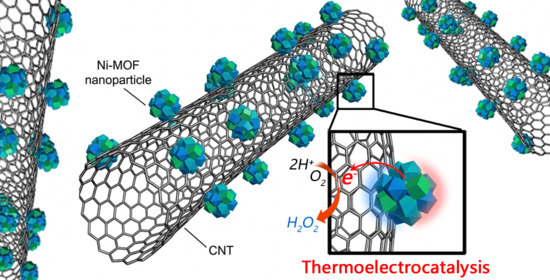
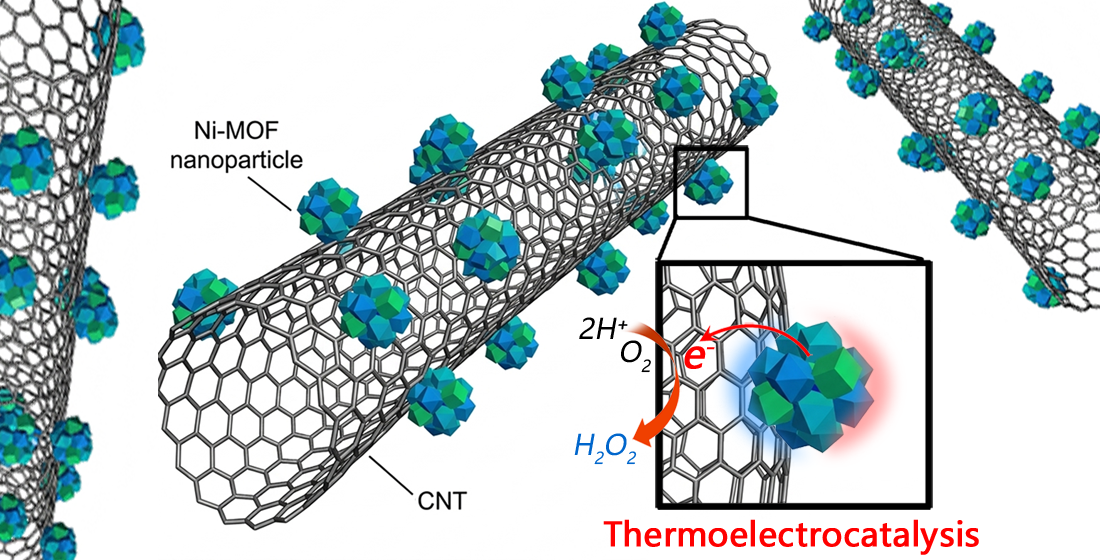
Graphical Abstract

1. Introduction

Large quantities of thermal energy are lost during industrial processes and energy conversion systems. It has been estimated that nearly two-thirds of primary energy is dissipated as low-grade heat [1,2,3], particularly in chemical manufacturing and petrochemical industries [4]. Recovering and utilizing this wasted thermal energy is therefore an important challenge for sustainable energy technologies. One promising strategy involves converting temperature gradients into useful forms of energy using thermoelectric (TE) materials [5]. Thermoelectric materials generate an electrical potential when exposed to a temperature difference, a phenomenon known as the Seebeck effect [6,7,8,9,10,11,12,13]. This property enables the direct conversion of thermal energy into electrical energy. Beyond traditional power generation, recent studies have demonstrated that TE materials can also drive chemical reactions [14,15,16,17]. In the past few years, some intriguing studies have demonstrated the successful coupling of the TE effect with the electrochemical process to directly convert thermal energy into chemical energy, referred to as thermoelectrocatalysis (TE-Catal) [18,19]. TE materials, particularly nanostructures, can generate free charges under a temperature gradient, leading to active radicals that initiate surface redox reactions. For instance, recent advances have shown the application of Bi2Te3 TE nanomaterials in biomedical cancer treatment and catalytic synthesis under a small temperature gradient [20,21,22,23,24,25]. This unique catalytic effect offers a promising approach for harvesting low-grade waste heat (<100 °C) in industrial processes, such as cooling water from equipment and warm air from ventilation systems. In such TE-Catal systems, principally charge carriers generated under a temperature gradient participate in redox reactions at the catalyst surface, thereby transforming thermal energy into chemical energy [6,8,26,27,28,29,30,31,32,33,34].
Hydrogen peroxide (H2O2) is an important chemical that is widely used in environmental remediation and chemical synthesis due to its high oxidation potential and its advantage as a clean oxidant that produces only water as a byproduct [35]. Conventional industrial production relies on the anthraquinone process, which is energy-intensive and requires complex infrastructure. Consequently, developing alternative approaches for on-site and sustainable H2O2 production has attracted considerable attention [36]. TE-driven catalysis offers a promising route to achieve this goal by utilizing ubiquitous low-grade heat sources.
Metal–organic frameworks (MOFs) have emerged as a versatile class of functional materials owing to their tunable structures, large surface areas, and abundant active sites. In particular, nickel-based MOFs (Ni-MOFs) have demonstrated interesting electronic properties and catalytic activities in various electrochemical and redox reactions [37,38,39,40]. Moreover, recent works showed that Ni-MOFs also demonstrate near-room temperature TE properties [41]. However, their relatively poor electrical conductivity still largely restricts the efficient charge migration, which limits their catalytic performance in TE-Catal systems.
The integration of one-dimensional (1D) carbon nanotubes (CNTs) into heterogeneous catalytic systems has gained significant traction due to their extraordinary synergy of mechanical robustness, high aspect ratio, and superior electronic transport properties, which frequently outperform those of conventional carbonaceous supports [42,43,44,45]. In the context of semiconductor-based catalysis, CNTs usually serve a dual functional role: first, they act as effective charge reservoirs, facilitating the rapid extraction of excited electrons from the semiconductor surface to mitigate deleterious charge recombination; second, their extended network functions as a conductive bridge, promoting long-range electron migration for surface reaction [46,47,48,49]. Leveraging these unique attributes, the coupling of CNTs with Ni-MOFs is expected to offer a strategic pathway to enhance the separation and utilization of TE-generated carriers, thereby enhancing the efficiency of TE-driven redox processes.
In this study, we report a TE-Catal system for H2O2 generation using Ni-MOFs/CNTs nanohybrids as catalysts. The Ni-MOFs nanoparticles (NPs) were grown in the presence of multi-walled CNTs to form an interconnected hybrid nanoarchitecture. When a small temperature gradient (ΔT) is applied, the TE effect within the Ni-MOFs generates charge carriers that participate in oxygen reduction reactions to produce H2O2. Compared with pristine Ni-MOFs, the Ni-MOFs/CNTs nanohybrids exhibit significantly enhanced catalytic activity due to improved carrier separation and transport at the MOF–CNT interface. This work highlights the potential of MOFs-based TE-Catal for converting waste heat into valuable chemical products.

2. Results and Discussion

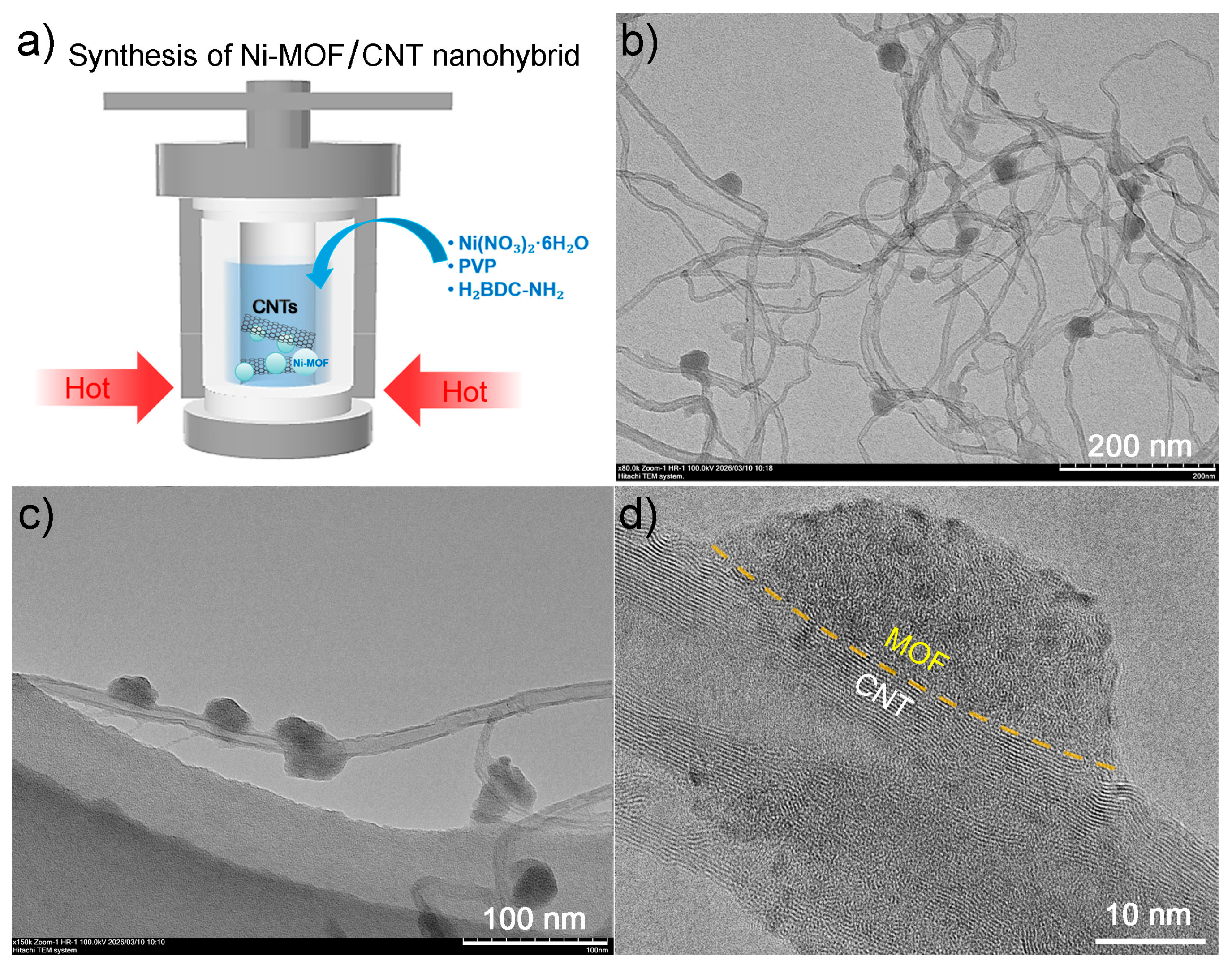
The fabrication procedure of the Ni-MOFs/CNTs nanohybrids is illustrated schematically in Figure 1a. In a typical synthesis, the acid-pretreated CNTs were introduced into the precursor solution containing nickel ions and organic ligands, followed by a solvothermal reaction that enabled an in-situ growth of Ni-MOF NPs on the CNTs surface (see experimental part for details). The morphology and microstructure of the obtained samples were first investigated using transmission electron microscopy (TEM). As shown in Figure 1b,c, the morphology of the resulting Ni-MOFs/CNTs hybrids show that Ni-MOF NPs are uniformly anchored onto the one-dimensional network of CNTs, forming an interconnected hybrid nanoarchitecture, where the 1D CNTs serve as bridges or backbones, while the Ni-MOF NPs are distributed along their surfaces (Figure 1c). The high-resolution TEM image in Figure 1d clearly displays the tubular multi-walled structure of CNTs in close contact with the Ni-MOF framework crystals with distinct lattice fringes, indicating the formation of a well-defined heterostructure. The TEM characterization confirms the successful formation of the Ni-MOFs/CNTs nanohybrids. It is noted that the acid treatment to CNTs prior to synthesis is essential in forming the hybrid structure, since the O-containing groups on the CNT surface that resulted from the treatment can greatly favor the in-situ nucleation and anchoring of the Ni-MOF NPs on CNT surface.
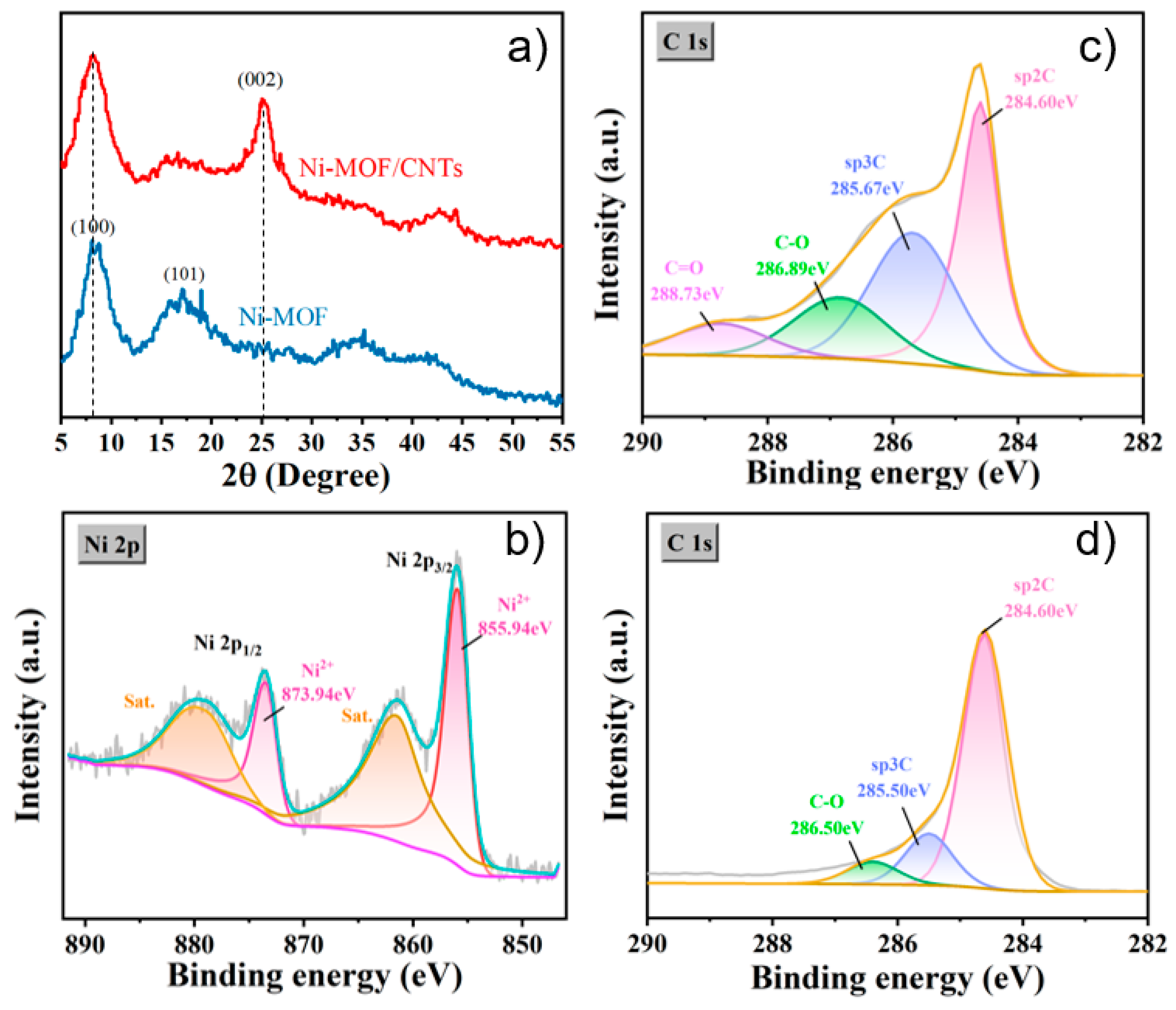
The crystalline structures of the synthesized samples were examined using X-ray diffraction (XRD) spectrometer. As shown in Figure 2a, the Ni-MOFs NPs presents two characteristic diffraction bands of (100) and (101). After incorporating with CNTs, a new peak appears at ~25°, corresponding to the typical (002) diffraction of the CNTs; the patterns that belong to the Ni-MOFs still remain largely unchanged, suggesting that the introduction of CNTs does not disrupt the crystal structure of the Ni-MOFs framework. The surface chemical states of the key elements in the catalysts were further analyzed by X-ray photoelectron spectroscopy (XPS). As shown in Figure 2b, the Ni 2p spectrum of the Ni-MOFs/CNTs, after deconvolution, exhibits two peaks centered at 855.94 (2p3/2) and 873.94 eV (2p1/2), corresponding to the Ni2+ species in Ni-MOFs; in addition to the two main bands, the accompanied shoulder peaks can be assigned to the typical Ni-based coordination compounds. The C 1s spectra of Ni-MOFs/CNTs and pristine CNTs are illustrated in Figure 2c and Figure 2d, respectively. The C 1s band of the Ni-MOFs/CNTs hybrids (Figure 2c), which can be deconvoluted into the contributions from sp2 C, sp3 C, the C-O and C=O bonds, is distinct from that of pristine CNTs (Figure 2d); in particular, the contribution from C-O and C=O components are more pronounced. This variation is highly likely attributed to two primary factors: first, the inherent presence of sp3 C within the 2-aminoterephthalic acid ligands of the Ni-MOFs structure; and second, the formation of strong coupling or bonding at the CNT-MOFs interface. The interfacial coupling of CNTs and MOFs may lead to charge redistribution within the hybrid structure, which is expected to facilitate electron transport during catalytic reactions.
Crucially, this pronounced presence of sp3 C in the Ni-MOFs/CNTs nanohybrids does not compromise the electrical performance, as the long-range π-conjugated sp2 network of the CNTs remains their primary conductive backbone. This is confirmed by the electrochemical measurement shown below, where the nanohybrid demonstrates significantly lower charge-transfer resistance than the pristine MOFs, proving that the 1D CNTs effectively maintain high-conductivity pathways for carrier transport.
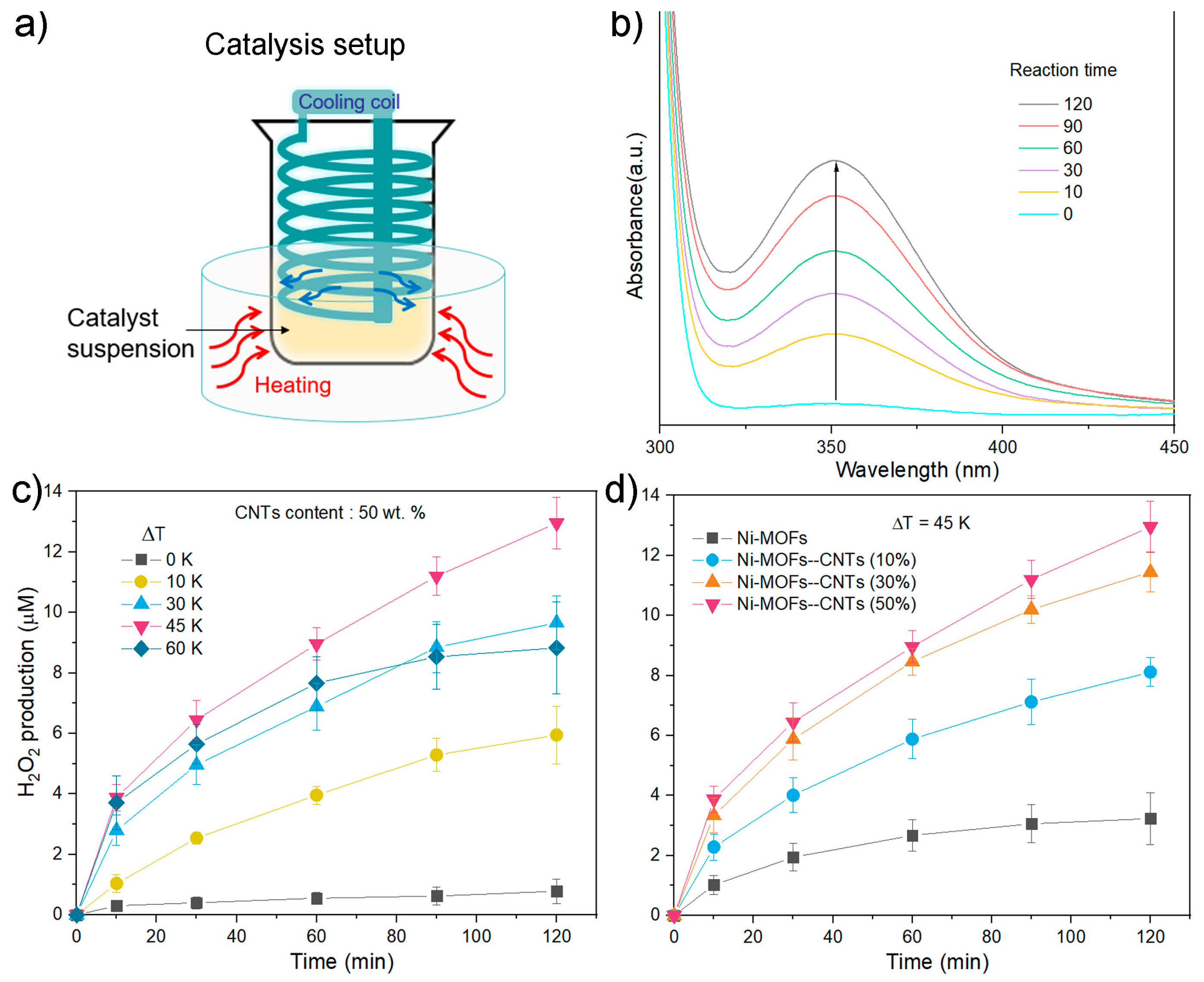
The TE-Catal activity of the catalysts was evaluated by measuring the production of H2O2 under a temperature gradient ΔT. The experimental configuration is illustrated in Figure 3a. In this setup, the catalyst suspension was heated in an oil bath (Thot) while a cooling coil connected to a circulating chiller (Tcold, 5 °C) was immersed in the solution to cool the suspension, eventually creating a ΔT, i.e., ΔT = Thot − Tcold. By varying the oil bath temperature, the ΔT can be facilely adjusted. The generated H2O2 was quantified using a classic colorimetric method based on the iodide reaction, and the absorbance of the solution at 351 nm was monitored using a UV–visible spectroscopy. As shown in Figure 3b, the characteristic absorption peak corresponding to the H2O2 detection reagent gradually increases with reaction time when the TE catalyst is used, indicating continuous production of H2O2 during the TE-Catal process. The influence of temperature gradient on the catalytic activity was also investigated. As illustrated in Figure 3c, increasing ΔT leads to a gradual enhancement in H2O2 production for the Ni-MOFs/CNTs catalyst with CNTs content of 50 wt.%. When the temperature difference increases from 10 K to approximately 45 K, the amount of produced H2O2 rises significantly with the maximum production rate of ~111.7 µmol g−1 h−1. However, further increasing the temperature gradient results in a decrease in H2O2 concentration, which can be attributed to the thermal instability and accelerated decomposition of H2O2 at elevated temperatures. We also observed that the H2O2 generation in the absence of O2, i.e., using N2-purged water, is largely suppressed, implying the strong O2-dependent catalysis. Without temperature gradient (ΔT = 0 K), i.e., simply heating the suspension to 50 °C with the lack of simultaneous cooling, the production of H2O2 is negligible, underlining the TE nature of the catalyst. It should be noted that the ΔT reported herein represents the macroscopic temperature difference between the external heat source (Thot) and the internal cooling interface (Tcold). In a stirred suspension system, the spatial temperature profile is dynamic and non-linear. As the Ni-MOFs/CNTs particles circulate through the reactor via convection and stirring, they experience a transient thermal field. This effective gradient acts as the driving force to initiate the Seebeck effect within the nanohybrids. While the exact ΔT experienced by a single NP at a specific micro-second is challenging to probe, the correlation between the macroscopic ΔT and the H2O2 yield (Figure 3c) confirms that the global temperature gradient is the primary regulator of the TE-Catal process, distinguishing it from conventional equilibrium thermocatalysis.
To evaluate the effect of CNT incorporation, a series of Ni-MOFs/CNTs composites with different CNT contents were tested under a fixed temperature gradient (ΔT ≈ 45 K). As presented in Figure 3d, the catalytic performance improves markedly after introducing CNTs. While pristine Ni-MOFs produce only a small amount of H2O2 with a production rate of ~31.8 µmol g−1 h−1, within the reaction period, the Ni-MOFs/CNTs hybrids exhibit substantially enhanced and sustained H2O2 generation. The catalytic efficiency increases progressively by reaching the maximum production rate of 111.7 µmol g−1 h−1 as the CNTs loading increases from 10 wt.% to 50 wt.%, which is ~3.5 times higher than that of pristine Ni-MOFs. This improvement could be attributed to the enhanced electrical conductivity and charge transport provided by the CNT network. However, when the CNT content exceeds a certain threshold, the catalytic performance shows little additional improvement, possibly because excessive CNTs reduce the relative number of active Ni-MOFs catalytic sites. Therefore, the sample with 50 wt.% CNT loading was selected as the optimized catalyst and used for subsequent studies.
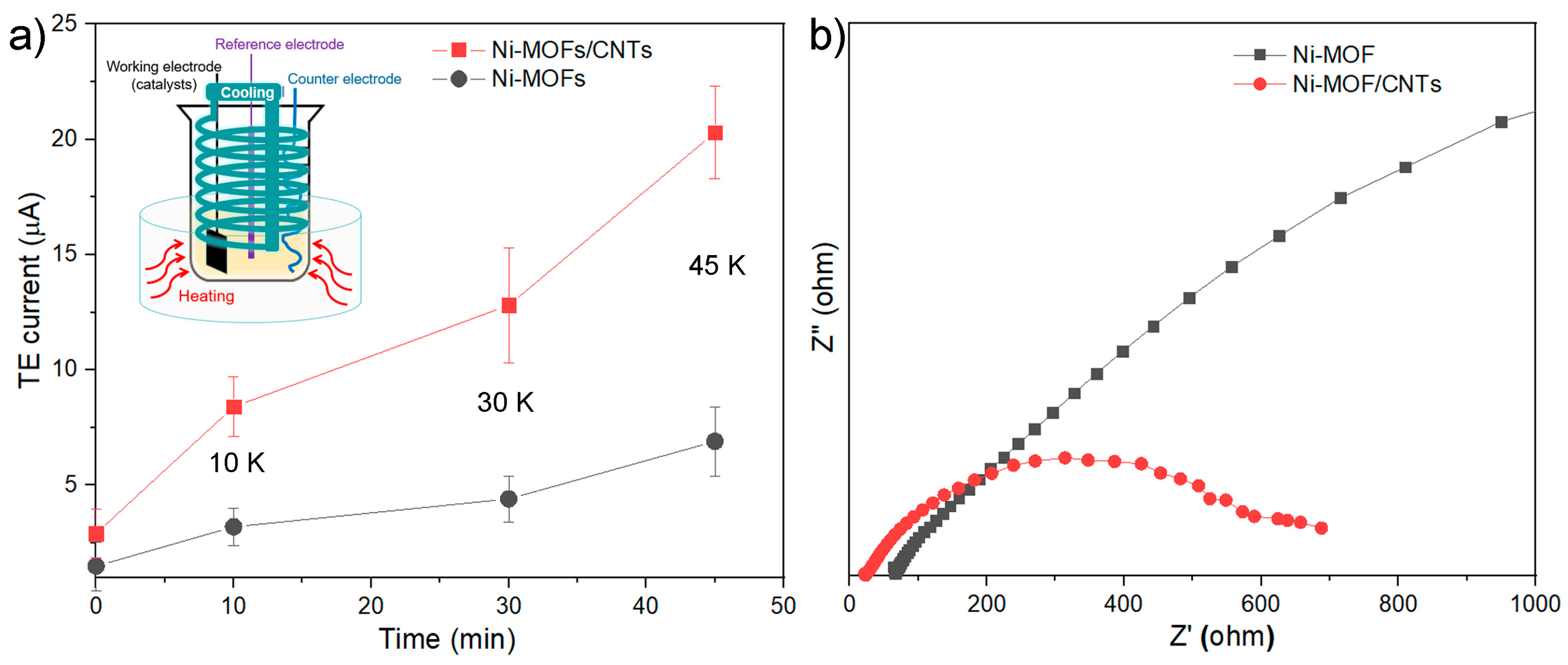
To gain further insight into the TE charge transport behavior, TE current measurements were conducted using a three-electrode electrochemical system with the catalysts deposited on conductive substrates as the working electrodes (Figure 4a inset). To elucidate the intrinsic charge-transfer kinetics of the Ni-MOFs/CNTs without interference from external redox species, electrochemical measurements were conducted in N2-saturated electrolytes. By purging the system of dissolved O2, we eliminated the parasitic oxygen reduction current, allowing for the isolation of the pure TE response (Seebeck-driven carrier migration). This distinction is critical, because while the actual catalytic production of H2O2 in the suspension reactor is an O2-dependent process, the electrochemical characterization under N2 serves as a diagnostic tool to verify that the heterostructure possesses the necessary conductivity and charge-separation efficiency to drive such a reaction. The high current density observed in the N2-purged TE-tests correlates directly with the material’s ability to supply electrons to the surface for catalysis. As shown in Figure 4a, the Ni-MOFs/CNTs hybrid electrode exhibits a significantly stronger current response compared with the pristine Ni-MOFs electrode when subjected to increasing temperature gradients. The current intensity increases with ΔT, indicating efficient and sustained charge generation/separation in the hybrid catalyst. Electrochemical impedance spectroscopy (EIS) measurements further reveal that the Ni-MOFs/CNTs hybrid exhibits a much smaller semicircle diameter in the Nyquist plot compared with pristine Ni-MOFs, indicating significantly reduced charge transfer resistance. These results demonstrate that the incorporation of CNTs effectively enhances the electrical conductivity and charge transport capability of the catalyst.
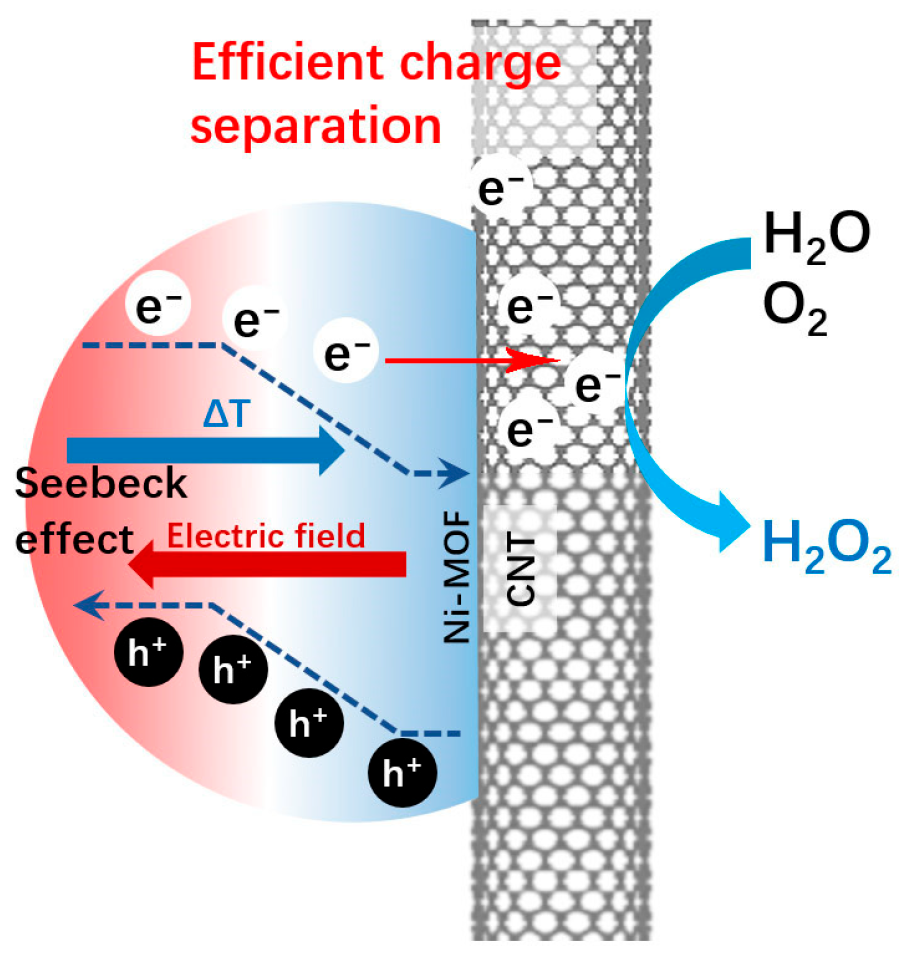
Based on our observations, the literature reports as well as our previous work [20,42,50], a possible mechanism for the TE-driven H2O2 generation over the Ni-MOFs/CNTs catalyst is proposed (Figure 5): when a small temperature gradient is applied to the Ni-MOFs/CNTs nanohybrids, the Seebeck effect of Ni-MOFs induces directional migration of charge carriers from the hot side to the cold side of the catalyst, generating an internal electric field within the material. This TE field causes band bending across the catalyst, facilitating the separation of electron–hole pairs.
The presence of CNTs plays a crucial role in this process. Due to their excellent electrical conductivity, CNTs act as efficient pathways for electron transport, allowing the thermally generated electrons to migrate rapidly away from the Ni-MOFs active sites. This process suppresses charge recombination and prolongs the lifetime of the charge carriers. The separated electrons can then participate in the oxygen reduction reaction at the catalyst surface, producing H2O2, while the corresponding holes are highly likely consumed through oxidation reactions. As a result, the Ni-MOFs/CNTs hybrid structure significantly enhances the overall efficiency of TE catalysis for H2O2 production.

3. Materials and Methods

3.1. Materials

Nickel nitrate hexahydrate (Ni(NO3)2·6H2O), 2-aminoterephthalic acid (H2BDC-NH2), polyvinylpyrrolidone (PVP), ethanol, and N,N-dimethylformamide (DMF) were purchased from Shanghai Aladdin Biochemical Technology Co., Ltd. (Shanghai, China). Carbon nanotubes (CNTs) were also obtained from Aladdin (Shanghai, China). Potassium iodide (KI), sodium hydroxide (NaOH), potassium hydrogen phthalate (C8H5O4K), and ammonium molybdate tetrahydrate were supplied by Sinopharm Chemical Reagent Co., Ltd. (Shanghai, China). Nitric acid was used for CNT pretreatment. All chemicals were used as received without additional purification. Deionized water (Milli-Q grade) was used throughout all experiments.

3.2. Characterization

The morphology and microstructure of the synthesized materials were examined using a Thermo Fisher Scientific Talos F200X TEM (Waltham, MA, USA). The crystalline structures of the samples were analyzed by XRD using a Rigaku D/max-2550 VB diffractometer (Akishima-shi, Japan) with Cu Kα radiation. XPS measurements were carried out on an Thermo Fisher Scientific ESCALAB 250 Xi spectrometer (Waltham, MA, USA) to determine the chemical states of the elements. UV-visible absorption spectra were recorded on a Shimadzu UV-3600i Plus spectrophotometer (Nakagyo-ku, Japan). All measurements were performed at the Characterization Center and laboratories of Jiangsu University, Zhenjiang, China.

3.3. Pretreatment of Carbon Nanotubes

To improve the dispersibility of CNTs and introduce oxygen-containing functional groups on their surface, the CNTs were subjected to an acid treatment prior to use. In a typical process, 2 g of CNTs were dispersed in 120 mL of concentrated nitric acid under ultrasonication to obtain a uniform suspension. The mixture was then transferred to a three-necked flask and refluxed at 120 °C for 4 h. After the reaction, the CNTs were collected by filtration and thoroughly washed with deionized water until the pH of the filtrate became neutral. The treated CNTs were subsequently dried in a vacuum oven at 60 °C overnight before further use.

3.4. Synthesis of Ni-MOF Nanomaterials

Ni-MOF nanomaterials were prepared via a solvothermal method based on a previously reported procedure with slight modifications. In a typical synthesis, 50 mg of Ni(NO3)2·6H2O, 120 mg of PVP, and 13 mg of 2-aminoterephthalic acid (H2BDC-NH2) were dissolved in a mixed solvent consisting of 40 mL of DMF and 24 mL of anhydrous ethanol. The resulting solution was magnetically stirred for 30 min to ensure complete dissolution of the reagents.
The homogeneous solution was then transferred into a 100 mL Teflon-lined stainless-steel autoclave and heated at 150 °C for 20 h. After naturally cooling to room temperature, the green precipitate was collected by centrifugation. The product was washed three times with DMF and ethanol alternately to remove residual organic species and unreacted precursors. Finally, the obtained solid was dried in a vacuum oven at 120 °C for 12 h to obtain Ni-MOFs powder.

3.5. Synthesis of Ni-MOF/CNT Nanohybrids

Ni-MOF/CNT hybrid materials were synthesized through an in-situ growth strategy. First, a desired amount of pretreated CNTs was dispersed in the mixed solvent of DMF and ethanol under ultrasonication for 30 min to obtain a stable suspension. Subsequently, Ni(NO3)2·6H2O, H2BDC-NH2, and PVP were added to the CNT suspension with the same composition used for the synthesis of pristine Ni-MOF.
After magnetic stirring for 30 min, the mixture was transferred to a Teflon-lined autoclave and maintained at 150 °C for 20 h. During the solvothermal process, Ni-MOF nanostructures nucleated and grew directly on the surface of CNTs, forming an interconnected hybrid structure. The obtained products were separated by centrifugation, washed several times with DMF and ethanol, and finally dried under vacuum at 120 °C for 12 h. A series of Ni-MOFs/CNTs composites were prepared by varying the mass ratio of CNTs relative to Ni-MOFs (0, 10, 30, 50, and 70 wt.%).

3.6. Thermoelectric Catalytic Generation of Hydrogen Peroxide

For the thermoelectric catalytic experiments, 60 mg of catalyst was dispersed in 50 mL of deionized water in a 100 mL-beaker with ultrasonic treatment to obtain a uniform suspension. The solution was then bubbled with O2 for 30 min to ensure sufficient dissolved oxygen for the reaction.
A cooling coil connected to a circulating chiller was placed into the reaction solution, while the beaker was positioned in an oil bath to establish a temperature gradient. The cooling water temperature was maintained at 5 °C. The temperature difference (ΔT) across the system was approximately defined as the difference between the oil bath temperature and the cooling water temperature. By adjusting the oil bath temperature, ΔT values of different magnitudes could be obtained.
During the reaction, the suspension was continuously stirred to maintain uniform temperature distribution and mass transport.

3.7. Determination of Hydrogen Peroxide Concentration

The concentration of generated hydrogen peroxide was quantified using a colorimetric iodide method. Two detection solutions were prepared in advance. Solution A consisted of 0.4 M KI, 0.06 M NaOH, and 0.1 mM ammonium molybdate, while solution B contained 0.1 M potassium hydrogen phthalate.
During the catalytic reaction, 1 mL of the reaction solution was withdrawn at predetermined time intervals and mixed with 0.5 mL of solution A and 0.5 mL of solution B. The mixture was allowed to react for several minutes to develop the characteristic color. The absorbance of the solution was then measured at 351 nm using a UV-visible spectrophotometer, and the concentration of H2O2 was calculated based on a calibration curve.

3.8. Electrochemical Measurements

Thermoelectric electrochemical measurements were performed using a CHI760e electrochemical workstation (Shanghai Chenhua Instrument Co., Ltd., Shanghai, China) in a conventional three-electrode configuration. Catalyst-coated copper substrates were used as the working electrodes, while an Ag/AgCl electrode and a platinum mesh served as the reference electrode and counter electrode, respectively. The electrolyte solution was 0.1 M Na2SO4 that had been purged with nitrogen to remove dissolved oxygen.
The electrochemical cell was placed in a setup similar to that used for the catalytic experiments, where a cooling coil and an oil bath were used to generate a controlled temperature gradient across the electrode. The thermoelectric current response was recorded under different temperature differences (ΔT). Electrochemical impedance spectroscopy (EIS) measurements were also conducted to evaluate the charge transfer properties of the catalysts.

4. Conclusions

In summary, Ni-MOFs/CNTs nanohybrids were developed as efficient catalysts for TE-driven H2O2 generation. Under a temperature gradient, the Seebeck effect in Ni-MOFs generates charge carriers for surface reaction of H2O2 formation; the introduction of CNTs significantly enhances catalytic performance exhibiting higher H2O2 production rate compared with pristine Ni-MOFs. Rather than acting as a simple support, the 1D CNTs serve as a conductive backbone that decouples Seebeck-driven charge generation from recombination, showcasing an effective strategy to improve TE-Catal activity. Although current efficiency of the Ni-MOFs/CNTs is still inferior to the established photocatalytic systems, the ability to drive redox chemistry using low-grade waste heat represents a significant step toward sustainable chemical synthesis. Moreover, future research can be focused on the detailed mechanism investigation, atomic-level interface engineering and the application of this TE paradigm to other high-overpotential reactions, such as CO2 reduction and N2 fixation, advancing the development of zero-emission chemical manufacturing.

Author Contributions

Conceptualization, F.W. and J.Z.; methodology, L.Z. and H.L.; formal analysis and writing—original draft preparation; L.Z.; writing—review and editing, F.W. and J.Z.; supervision, F.W.; funding acquisition, F.W. All authors have read and agreed to the published version of the manuscript.

Funding

This work is supported by the funding from National Natural Science Foundation of China (NSFC No. 22075126 and 22350710187), Jiangsu Provincial Senior Talent Program (Dengfeng Project) and the Ministry of Human Resources and Social Security of China (S20240318, S20250261).

Data Availability Statement

The data presented in this study are available on request from the corresponding authors.

Conflicts of Interest

The authors declare no conflicts of interest.

References

  1. Woolley, E.; Luo, Y.; Simeone, A. Industrial waste heat recovery: A systematic approach. Sustain. Energy Technol. Assess. 2018, 29, 50–59. [Google Scholar] [CrossRef]
  2. Forman, C.; Muritala, I.K.; Pardemann, R.; Meyer, B. Estimating the global waste heat potential. Renew. Sustain. Energy Rev. 2016, 57, 1568–1579. [Google Scholar] [CrossRef]
  3. Firth, A.; Zhang, B.; Yang, A. Quantification of global waste heat and its environmental effects. Appl. Energy 2019, 235, 1314–1334. [Google Scholar] [CrossRef]
  4. Liu, Y.; Yang, M.; Ding, Y.; Wang, M.; Qian, F. Process modelling, optimisation and analysis of heat recovery energy system for petrochemical industry. J. Clean. Prod. 2022, 381, 135133. [Google Scholar] [CrossRef]
  5. Torras, S.; Oliet, C.; Rigola, J.; Oliva, A. Drain water heat recovery storage-type unit for residential housing. Appl. Therm. Eng. 2016, 103, 670–683. [Google Scholar] [CrossRef]
  6. Meng, M.; Wang, J.; Kang, H.; Tala. Enhancement of photothermoelectric performance of TiO2 promoted by the Seebeck effect. J. Alloys Compd. 2025, 1043, 184206. [Google Scholar] [CrossRef]
  7. Chen, Y.-C.; Chang, C.-C.; Lu, K.-C.; Jian, W.-B.; Chang, C.-Y.; Chang, C.-C. Dynamic Seebeck effect in nanojunctions of nickel-chelated DNA. Phys. Rev. Appl. 2024, 22, 044046. [Google Scholar] [CrossRef]
  8. Yue, S.; Cheng, H.; He, H.; Guan, X.; Le, Q.; Shu, X.; Shi, S.; Chen, J.; Ouyang, J. Photo-enhanced Seebeck effect of a highly conductive thermoelectric material. J. Mater. Chem. A 2021, 9, 16725–16732. [Google Scholar] [CrossRef]
  9. Fedorov, D.V.; Gradhand, M.; Tauber, K.; Bauer, G.E.W.; Mertig, I. Seebeck effect in nanomagnets. J. Phys. Condens. Matter 2022, 34, 085801. [Google Scholar] [CrossRef]
  10. Dey, D.; Patra, B.K. Seebeck effect in a thermal QCD medium in the presence of strong magnetic field. Phys. Rev. D 2020, 102, 096011. [Google Scholar] [CrossRef]
  11. Ansermet, J.-P.; Brechet, S.D. Magnetic Contribution to the Seebeck Effect. Entropy 2018, 20, 912. [Google Scholar] [CrossRef]
  12. Zimbovskaya, N.A. Seebeck effect in molecular junctions. J. Phys. Condens. Matter 2016, 28, 183002. [Google Scholar] [CrossRef] [PubMed]
  13. Maran, A.L.O.; Henao, N.C.; Silva, E.A.; Schaeffer, L.; Ando Junior, O.H. Use of the Seebeck Effect for Energy Harvesting. IEEE Lat. Am. Trans. 2016, 14, 4106–4114. [Google Scholar] [CrossRef]
  14. Liu, C.; Zhang, Z.; Peng, Y.; Li, F.; Miao, L.; Nishibori, E.; Chetty, R.; Bai, X.; Si, R.; Gao, J.; et al. Charge transfer engineering to achieve extraordinary power generation in GeTe-based thermoelectric materials. Sci. Adv. 2023, 9, eadh0713. [Google Scholar] [CrossRef]
  15. Zhang, X.; Zhao, L.-D. Thermoelectric materials: Energy conversion between heat and electricity. J. Mater. 2015, 1, 92–105. [Google Scholar] [CrossRef]
  16. Shi, X.; Song, S.; Gao, G.; Ren, Z. Global band convergence design for high-performance thermoelectric power generation in Zintls. Science 2024, 384, 757–762. [Google Scholar] [CrossRef]
  17. Chen, Z.G.; Shi, X.; Zhao, L.D.; Zou, J. High-performance SnSe thermoelectric materials: Progress and future challenge. Prog. Mater. Sci. 2018, 97, 283–346. [Google Scholar] [CrossRef]
  18. Zhang, Y.; Li, S.; Zhang, J.; Zhao, L.-D.; Lin, Y.; Liu, W.; Rosei, F. Thermoelectrocatalysis: An emerging strategy for converting waste heat into chemical energy. Natl. Sci. Rev. 2024, 11, nwae036. [Google Scholar] [CrossRef]
  19. Tang, Y.; Liu, X.; Tekinalp, H.; Ozcan, S.; Zhao, X.; Li, Y. Thermoelectrocatalysis: Leveraging thermoelectric effects for enhanced catalytic performance. Mater. Today Energy 2025, 54, 102060. [Google Scholar] [CrossRef]
  20. Li, C.; Zhang, X.; Pei, J.; Wang, Z.; Xu, Y.; Hu, Y.; Zhang, Y.; Zhang, L.; Qian, J.; Li, L.; et al. Utilizing Waste Heat to Drive Selective Green Organic Conversion through a Thermoelectrocatalytic Process. Small Methods 2025, 9, e00956. [Google Scholar] [CrossRef]
  21. Lin, Y.-J.; Khan, I.; Saha, S.; Wu, C.-C.; Barman, S.R.; Kao, F.-C.; Lin, Z.-H. Thermocatalytic hydrogen peroxide generation and environmental disinfection by Bi2Te3 nanoplates. Nat. Commun. 2021, 12, 180. [Google Scholar] [CrossRef]
  22. Zhang, N.; Zheng, F.; Huang, B.; Ji, Y.; Shao, Q.; Li, Y.; Xiao, X.; Huang, X. Exploring Bi2Te3 Nanoplates as Versatile Catalysts for Electrochemical Reduction of Small Molecules. Adv. Mater. 2020, 32, 1906477. [Google Scholar] [CrossRef]
  23. Jiang, X.; Yang, M.; Fang, Y.; Yang, Z.; Dai, X.; Gu, P.; Feng, W.; Chen, Y. A Photo-Activated Thermoelectric Catalyst for Ferroptosis-/Pyroptosis-Boosted Tumor Nanotherapy. Adv. Healthc. Mater. 2023, 12, 2300699. [Google Scholar] [CrossRef] [PubMed]
  24. Yoon, J.; Jang, H.; Oh, M.-W.; Hilberath, T.; Hollmann, F.; Jung, Y.S.; Park, C.B. Heat-fueled enzymatic cascade for selective oxyfunctionalization of hydrocarbons. Nat. Commun. 2022, 13, 3741. [Google Scholar] [CrossRef] [PubMed]
  25. Yuan, X.; Kang, Y.; Dong, J.; Li, R.; Ye, J.; Fan, Y.; Han, J.; Yu, J.; Ni, G.; Ji, X.; et al. Self-triggered thermoelectric nanoheterojunction for cancer catalytic and immunotherapy. Nat. Commun. 2023, 14, 5140. [Google Scholar] [CrossRef]
  26. Yemata, T.A.; Kyaw, A.K.K.; Zheng, Y.; Xu, J.; Chin, W.S.; Zhu, Q.; Hayashi, Y. Interface engineering in polymer thermoelectric composites: Harnessing energy-filtering effects to overcome the Seebeck-conductivity trade-off. J. Mater. Chem. A 2025, 13, 35976–35998. [Google Scholar] [CrossRef]
  27. Yang, F.; Zhang, X.; Wang, F.; Liu, L.; Tang, L.; Lin, J.; Li, Y. Investigation of Seebeck coefficient in organic materials under a magnetic field. Indian J. Phys. 2025, 99, 55–60. [Google Scholar] [CrossRef]
  28. Nan, B.; Xu, G.; Yang, Q.; Zhang, B.; Zhou, X. Innovative design and optimized performance of thermoelectric transistor driven by the Seebeck effect. Energy Convers. Manag. 2023, 283, 116880. [Google Scholar] [CrossRef]
  29. Kim, M.-J.; Cho, J.-M.; Lee, W.-Y.; Kang, M.-S.; Kim, Y.-H.; Kim, G.-S.; Sim, Y.; Yoon, Y.-G.; Seong, M.-J.; Zhang, Z.-B.; et al. Independent enhancement of the in-plane Seebeck effect in 2D PtSe2/PtSe2 homostructures via a facile interface tuning method. Acta Mater. 2024, 268, 119776. [Google Scholar] [CrossRef]
  30. Gayner, C.; Sharma, R.; Malik, I.; Kumar, M.; Singh, S.; Kumar, K.; Tahalyani, J.; Srivastava, T.; Kar, K.K.; Yokoi, H.; et al. Enhanced thermoelectric performance of PbSe-graphene nanocomposite manufactured with acoustic cavitation induced defects. Nano Energy 2022, 94, 106943. [Google Scholar] [CrossRef]
  31. Lee, W.Y.; Kang, M.S.; Choi, J.W.; Kim, S.H.; Park, N.W.; Kim, G.S.; Kim, Y.H.; Saitoh, E.; Yoon, Y.G.; Lee, S.K. Abnormal Seebeck Effect in Vertically Stacked 2D/2D PtSe2/PtSe2 Homostructure. Adv. Sci. 2022, 9, 2203455. [Google Scholar] [CrossRef] [PubMed]
  32. Ma, H.; Li, S.; Su, M.; Feng, J. Research on thermoelectric seebeck effect and water-ion interaction mechanism of alkali-activated fly ash/slag materials. J. Build. Eng. 2025, 113, 114082. [Google Scholar] [CrossRef]
  33. Kakemoto, H. Colossal Seebeck coefficient of thermoelectric material calculated by space charge effect, and phonon drag background. arXiv 2024, arXiv:2404.01311. [Google Scholar] [CrossRef]
  34. Akbar, Z.A.; Jeon, J.-W.; Jang, S.-Y. Intrinsically self-healable, stretchable thermoelectric materials with a large ionic Seebeck effect. Energy Environ. Sci. 2020, 13, 2915–2923. [Google Scholar] [CrossRef]
  35. Haider, Z.; Imran, M.; Muhmood, T. Photoelectrochemical Production of Peroxydisulfate (PDS), a Clean Oxidant: Recent Development and Challenges. Int. J. Mol. Sci. 2026, 27, 3066. [Google Scholar] [CrossRef]
  36. Zhang, X.; Zhou, Q.; Li, C.; Su, H.; Chen, T.; Cui, P.; Ban, C.; Tao, Y.; Wang, J.; Jiang, Y.; et al. Thermodynamic and Kinetic Modulation of Artificial H2O2 Photosynthesis via Spatial Control of Redox Catalytic Sites. J. Am. Chem. Soc. 2026, 148, 11068–11080. [Google Scholar] [CrossRef]
  37. He, Y.; Talin, A.A.; Allendorf, M.D. Thermoelectric Properties of 2D Ni3(HITP)2 and 3D Cu3(BTC)2 MOFs: First-Principles Studies. ECS J. Solid State Sci. Technol. 2017, 6, N236–N242. [Google Scholar] [CrossRef]
  38. Ning, S.; Zhang, Z.; Hu, N.; Lv, N.; Jiang, M.; Qi, N.; Chen, Z. Tunable thermoelectric performance in metal–organic framework Ni(BDC) studied by first principles. Microporous Mesoporous Mater. 2024, 364, 112880. [Google Scholar] [CrossRef]
  39. Mahmoudi Gahrouei, M.; Vlastos, N.; D’Souza, R.; Odogwu, E.C.; de Sousa Oliveira, L. Benchmark Investigation of SCC-DFTB against Standard and Hybrid DFT to Model Electronic Properties in Two-Dimensional MOFs for Thermoelectric Applications. J. Chem. Theory Comput. 2024, 20, 3976–3992. [Google Scholar] [CrossRef] [PubMed]
  40. He, Y.; Zou, Y.; Sun, L.; Xu, F.; Xia, Y.; Chen, Y.; Wang, S.; Hu, Z.; Hao, S.; Xiang, C. Multifunctional phase-change materials with Ni-MOF/MXene hierarchical network for thermal energy storage, photothermal conversion, and excellent electromagnetic shielding. J. Energy Storage 2025, 119, 116385. [Google Scholar] [CrossRef]
  41. Fan, Y.; Liu, Z.; Chen, G. Recent Progress in Designing Thermoelectric Metal-Organic Frameworks. Small 2021, 17, e2100505. [Google Scholar] [CrossRef]
  42. Li, C.; Li, S.; Zhao, L.; Zhang, J. Bi2Te3/Carbon Nanotube Hybrid Nanomaterials as Catalysts for Thermoelectric Hydrogen Peroxide Generation. Molecules 2024, 29, 5242. [Google Scholar] [CrossRef] [PubMed]

  43. Zhang, J.; Dai, M.; Zhang, S.; Dai, M.; Zhang, P.; Wang, S.; He, Z. Recent Progress on Carbon-Nanotube-Based Materials for Photocatalytic Applications: A Review. Sol. RRL 2022, 6, 2200243. [Google Scholar] [CrossRef]
  44. Zheng, Y.; Liu, T.; Tai, J.; Ma, N. Recent Advances in Carbon-Based Catalysts for Heterogeneous Asymmetric Catalysis. Molecules 2025, 30, 2643. [Google Scholar] [CrossRef] [PubMed]
  45. Adeoye, S.A.; Amama, P.B. Catalytic applications of carbon nanotubes in energy and environmental remediation: Multifunctional roles and design strategy. Nanoscale 2026, 18, 8953–8990. [Google Scholar] [CrossRef]
  46. Weng, J.; Liu, Y.; Huang, X. Synthesis of in situ grown CNTs on MOF-derived Ni@CNT with tailorable microstructures toward regulation of electromagnetic wave absorption performance. Carbon 2025, 231, 119678. [Google Scholar] [CrossRef]
  47. Chen, A.; Tang, N.; Wei, Y.; Shi, S.; Zhou, C.; He, Q.; Ding, J. Efficient and environmentally friendly uric acid voltametric sensor based on Ni-MOF and carboxylated multi-walled carbon nanotubes nanocomposites. J. Environ. Chem. Eng. 2024, 12, 113388. [Google Scholar] [CrossRef]
  48. Wang, L.; Jiao, Y.; Yao, S.; Li, P.; Wang, R.; Chen, G. MOF-derived NiO/Ni architecture encapsulated into N-doped carbon nanotubes for advanced asymmetric supercapacitors. Inorg. Chem. Front. 2019, 6, 1553–1560. [Google Scholar] [CrossRef]
  49. Yin, H.; Zhu, J.; Chen, J.; Gong, J.; Nie, Q. MOF-derived in situ growth of carbon nanotubes entangled Ni/NiO porous polyhedrons for high performance glucose sensor. Mater. Lett. 2018, 221, 267–270. [Google Scholar] [CrossRef]
  50. Abisharani, J.; Wan, Y.; Yu, Q.; Xu, Y.; Jiang, Y.; Qian, J.; Li, S.; Li, L.; Wong, S.Y.; Li, X.; et al. MoS2/CoS2 heterostructures as a thermoelectric-catalyst for H2O2 generation under a small temperature gradient. Chem. Commun. 2025, 61, 9920–9923. [Google Scholar] [CrossRef]
Figure 1. (a) Schematic illustration for the synthesis of Ni-MOFs/CNTs nanohybrids. (b,c) TEM images of the Ni-MOFs/CNTs nanohybrids at different magnifications. (d) HR-TEM image of the heterojunction of Ni-MOFs/CNTs. Dashed line marks the interface of the two materials.
Catalysts 16 00409 g001
Figure 2. (a) XRD patterns of Ni-MOFs and Ni-MOFs/CNTs nanohybrids. Dash lines marks the peak position. XPS spectra of Ni 2p (b) and C 1s (c) of Ni-MOF/CNTs nanohybrids. (d) XPS spectrum of C 1s of CNTs.
Catalysts 16 00409 g002
Figure 3. (a) Schematic illustration of TE catalysis setup. (b) Detection of H2O2: Colorimetric UV–Visible absorption spectral evolution of the TE catalysis using Ni-MOFs/CNTs nanohybrids (CNTs 50 wt.%). (c) Catalytic production of H2O2 using Ni-MOFs/CNTs nanohybrids at different temperature gradients (0, 10, 30, 45 and 60 K). (d) Catalytic production of H2O2 using Ni-MOFs/CNTs nanohybrids with different CNT loading at ΔT = 45 K.
Catalysts 16 00409 g003
Figure 4. (a) Electrochemical TE current results with ΔT = 10, 30 and 45 K for Ni-MOFs and Ni-MOFs/CNTs electrodes. Inset shows the schematic setup of the TE electrochemical cell. (b) EIS Nyquist plots of Ni-MOFs and Ni-MOFs/CNTs electrodes (ΔT = 45 K).
Catalysts 16 00409 g004
Figure 5. Scheme of the TE mechanism Catalytic of Ni-MOFs/CNTs upon ΔT-driven charge separation for surface reaction.
Catalysts 16 00409 g005
Disclaimer/Publisher’s Note: The statements, opinions and data contained in all publications are solely those of the individual author(s) and contributor(s) and not of MDPI and/or the editor(s). MDPI and/or the editor(s) disclaim responsibility for any injury to people or property resulting from any ideas, methods, instructions or products referred to in the content.