Article

Synergistic Effect of Pt/Co Dual Clusters on Covalent Organic Frameworks for Highly Selective Photocatalytic CO2 Reduction to Ethylene

1
Faculty of Chemical Engineering, Kunming University of Science and Technology, Kunming 650500, China
2
Key Laboratory of Yunnan Province for Synthesizing Sulfur-Containing Fine Chemicals, Kunming 650500, China
3
The Innovation Team for Volatile Organic Compounds Pollutants Control and Resource Utilization of Yunnan Province, Kunming 650500, China
4
Faculty of Environmental Science and Engineering, Kunming University of Science and Technology, Kunming 650500, China
*
Author to whom correspondence should be addressed.
Catalysts 2026, 16(5), 401; https://doi.org/10.3390/catal16050401
Submission received: 9 March 2026 / Revised: 2 April 2026 / Accepted: 8 April 2026 / Published: 30 April 2026

Abstract

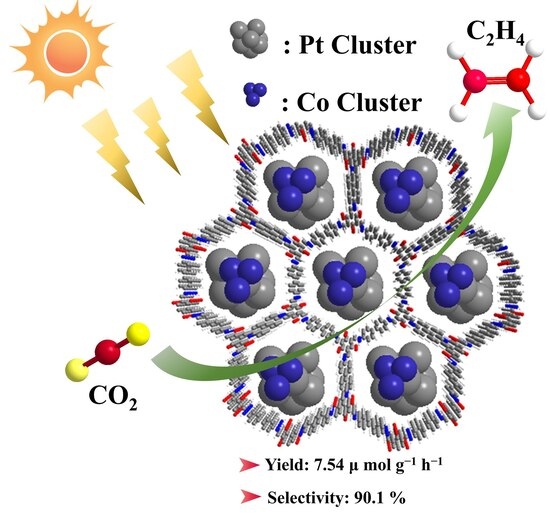
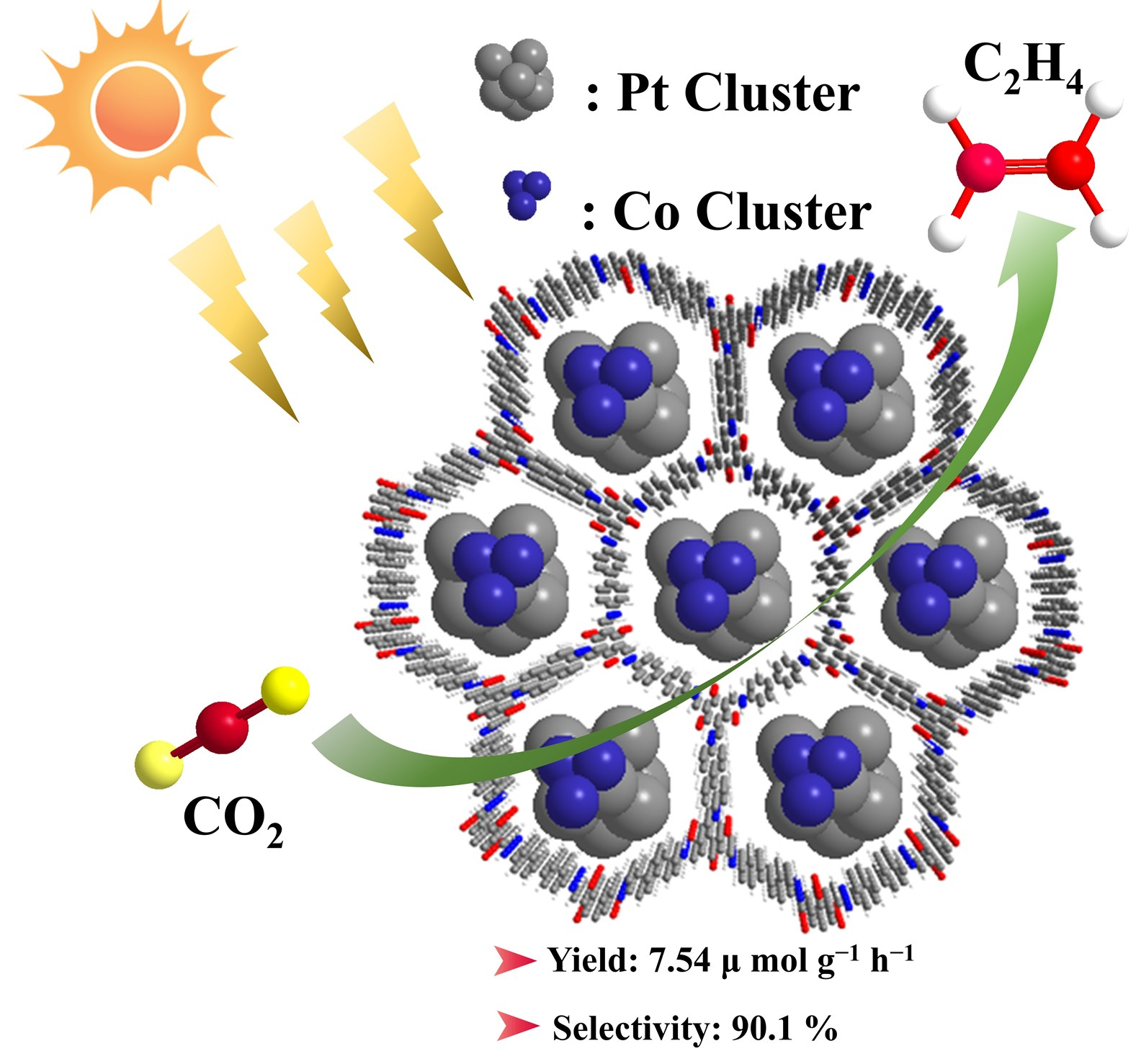
To address the critical challenges of sluggish C-C coupling kinetics and the propensity for over hydrogenation to ethane (C2H6) in the photocatalytic CO2 reduction to ethylene (C2H4), this study designed a synergistic bimetallic Pt/Co cluster catalyst supported on a covalent organic framework (COF), designated as PtCo-TpBD COF. This catalyst is designed to modulate the adsorption of key intermediates via Co clusters to suppress over-hydrogenation, while leveraging Pt clusters to promote C-C coupling, thereby achieving highly selective C2H4 production. Through a series of structural characterization analyses, it was confirmed that Pt/Co clusters were successfully confined within the pores of the COF, and significant electronic interactions were observed. In situ infrared spectroscopy revealed that the introduction of Co clusters effectively weakens the adsorption strength of the CO* intermediate, while the incorporation of Pt clusters promotes C-C coupling. In visible-light-driven gas-phase CO2 reduction, this catalyst delivered exceptional activity, reaching an C2H4 formation rate of 7.54 μmol g−1 h−1 and an C2H4 selectivity of 90.1%, along with remarkable inhibition of deep hydrogenation byproducts including C2H6. This study not only provides a successful example for constructing efficient bifunctional photocatalysts to achieve highly selective conversion of CO2 to C2H4, but also highlights the great potential of COFs as advanced platforms for integrating multifunctional metal clusters and precisely tuning catalytic selectivity.

Graphical Abstract

1. Introduction

Since the Industrial Revolution, excessive anthropogenic emissions of carbon dioxide have triggered a severe global climate change crisis. Converting this greenhouse gas into high-value chemicals and fuels represents one of the promising strategies for achieving the goal of carbon neutrality [1]. Among the various CO2 conversion technologies, solar-driven photocatalytic CO2 reduction is regarded as one of the most promising sustainable development approaches [2,3]. However, due to the limited efficiency of electron transfer in photocatalytic processes, multi-electron reduction reactions remain challenging; the reduction products are predominantly C1 species derived from two-electron transfers, thereby hindering the formation of higher-value C2 products [4,5]. Among the various C2 reduction products, C2H4 possesses exceptionally high industrial value, as it can be transformed through a series of chemical reactions into thousands of high-value chemicals [6,7,8,9]. However, as C2H4 is an unsaturated C2 hydrocarbon, it is highly susceptible to competing reactions during photocatalytic CO2 reduction. The system frequently yields monocarbon products (CO, CH4) alongside over-hydrogenated C2 by-products (C2H6), resulting in poor C2H4 selectivity. As a result, creating photocatalysts with high selectivity for CO2 conversion to C2H4 is recognized as a prominent frontier and an important challenge in catalysis.
COFs represent a category of crystalline, microporous polymeric materials assembled from lightweight elements such as carbon, hydrogen, oxygen, and nitrogen, connected through robust covalent linkages. Their precisely defined molecular configurations, exceptionally large surface areas, orderly and adjustable pore architectures, and outstanding chemical durability make COFs highly promising candidates for designing advanced heterogeneous catalysts [10,11,12]. Notably, these frameworks offer the ability to spatially restrict metal clusters or even individual atoms within their pores or structural nodes, fostering strong electronic coupling between the embedded metal centers and the organic scaffold [13,14].
In recent years, numerous studies have reported the construction of catalysts containing Pt active sites for the highly selective photocatalytic reduction of CO2 to C2H4. Compared with conventional Cu-based catalysts, which typically suffer from low ethylene selectivity [15,16,17], Pt-based catalysts exhibit higher selectivity for C2H4 production due to their unique electronic structure and distinct intermediate adsorption characteristics [18,19,20]. However, existing studies mostly focus on Pt active sites loaded on inorganic metal semiconductor supports, while research on COF-based Pt catalysts for ethylene generation remains unexplored. This is primarily because the highly selective generation of C2H4 requires catalysts to simultaneously promote C-C coupling and suppress the over-hydrogenation of intermediates [21], a dual requirement that is difficult to achieve with single-metal components; hence, the introduction of a second metal to form a synergistic effect with Pt is necessary. Furthermore, since COFs inherently lack metal sites and cannot directly provide localized multimetallic active centers essential for C-C coupling, conventional COF-based systems struggle to achieve high-selectivity C2H4 production. In 2024, Liu et al. suppressed CO gas adsorption on Mn-based catalysts via Co doping [22]. Inspired by this finding, we hypothesized that introducing Co element could modulate Pt’s adsorption of CO*, prevent over-hydrogenation to CH4 and C2H6, and thereby enhance C2H4 selectivity. Consequently, the precise construction of Pt/Co bimetallic catalytic centers within covalent organic frameworks represents an ideal strategy to resolve the aforementioned contradiction.
In this work, PtCo-TpBD COF materials featuring bimetallic active sites were fabricated by loading Pt and Co clusters onto TpBD COF, achieving the highly selective photocatalytic production of ethylene from carbon dioxide. AC-TEM confirms that Pt and Co exist in the form of metallic clusters. In situ infrared spectroscopy and CO-TPD profiles confirm that Pt clusters serve as active sites for C2 product generation by promoting C-C coupling, while the introduction of cobalt modulates the catalyst’s adsorption of CO*, suppressing the over-hydrogenation of reaction intermediates to form by-products such as methane and ethane. Benefiting from the above bimetallic synergistic mechanism, the catalyst achieved a C2H4 production rate of 7.54 μmol g−1 h−1 and an electron selectivity as high as 90.1% under visible-light irradiation. In conclusion, this work deeply elucidates the complex synergistic effects of multimetallic species in photocatalytic processes and highlights the exceptional capability of COFs as multifunctional catalytic carriers to integrate diverse active centers for precise reaction modulation. It establishes a novel design paradigm for developing next-generation photocatalysts that combine high efficiency with long-term stability.

2. Results and Discussion

2.1. Morphological and Structural Characterization

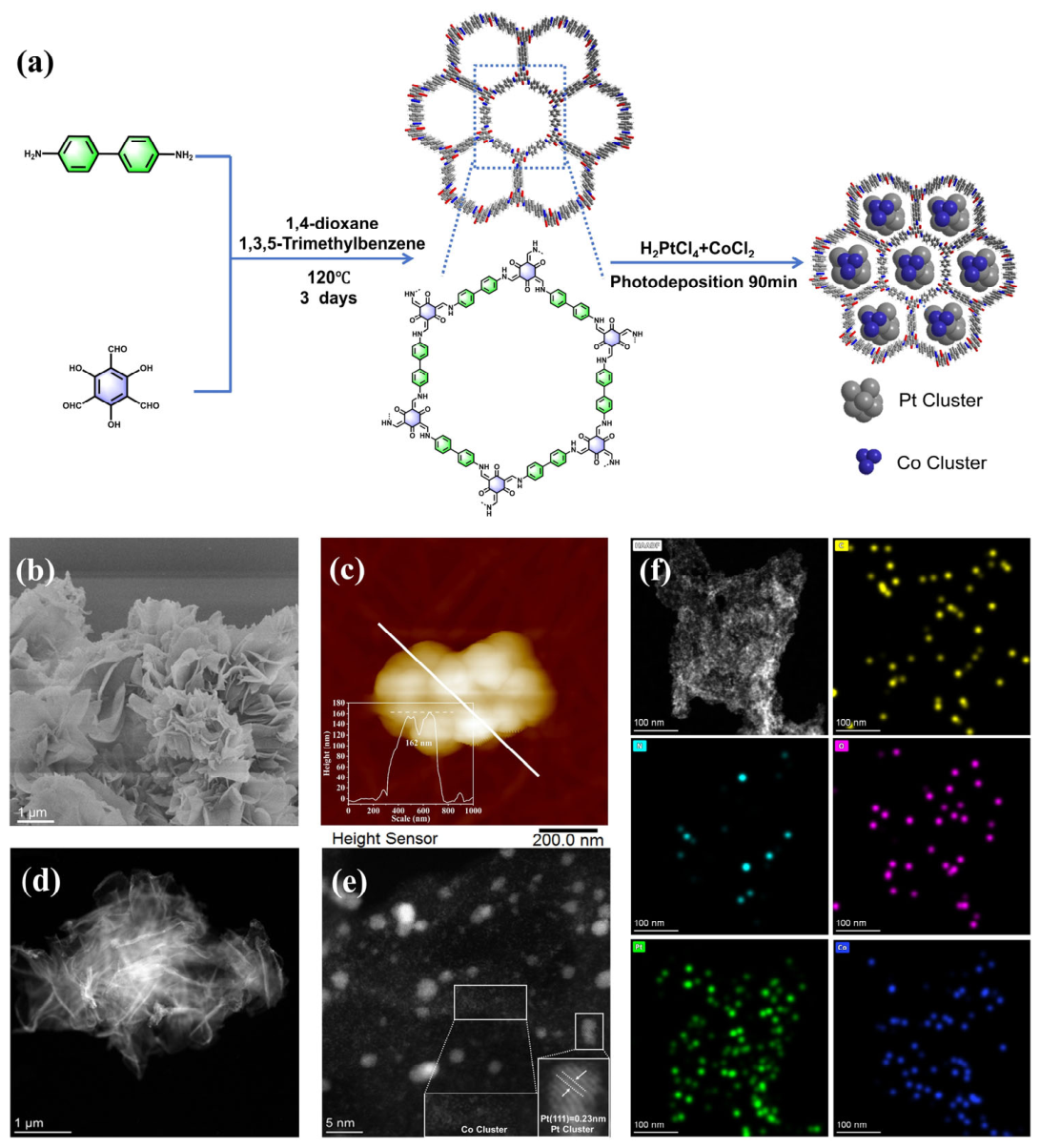
As shown in Figure 1a, TpBD COF was synthesized via a β-ketoenamine condensation reaction, and Pt/Co clusters were confined within the COF pores by a photodeposition method. Zeta potential measurements revealed that the surface of TpBD COF carried a negative charge of −25.9 mV (Figure S1), which enables the covalent organic framework to more stably anchor positively charged Pt and Co clusters.
Figure 1b presents an SEM image showing the morphological features of TpBD COF, which exhibits an overall flower-like architecture composed of interwoven and stacked nanosheets. AFM revealed that the height of the stacked COF nanosheets was 162 nm (Figure 1c). The morphology of PtCo-TpBD COF remained unchanged compared with that of TpBD COF, indicating that the incorporation of Pt and Co did not alter the COF’s morphology (Figure S2). AC-TEM revealed that Pt and Co clusters were uniformly distributed on the surface of TpBD COF. The Pt clusters formed relatively large crystalline domains with an interplanar spacing of approximately 0.23 nm, consistent with the (111) lattice plane of metallic Pt [23], whereas the Co atoms aggregated into small clusters lacking long-range crystalline order (Figure 1d,e). As shown in Figure S3, statistical analysis of the Pt cluster size distribution reveals an average diameter of 2.05 nm. Element mapping of PtCo-TpBD COF (Figure 1f) revealed the coexistence and uniform dispersion of C, N, O, Co, and Pt throughout the composite, confirming the excellent supporting capability of the COF for the growth of Pt and Co clusters.
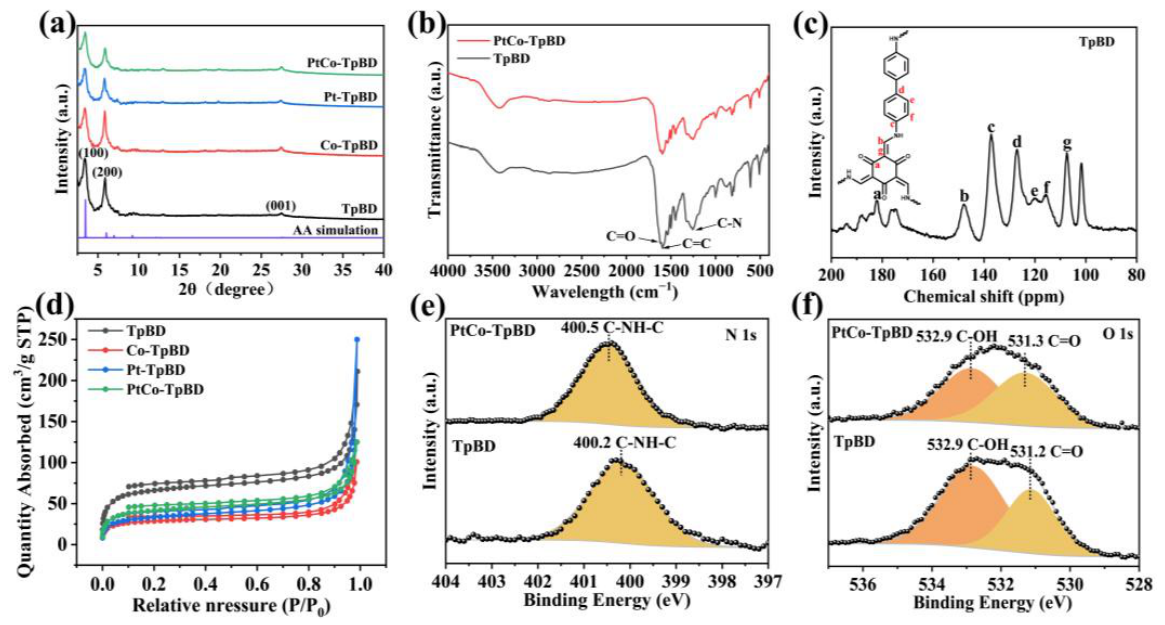
PXRD was performed to determine the crystal structure of the synthesized sample. As shown in Figure 2a, the diffraction peaks at 3.4°, 5.9°, and 27.4° can be assigned to the (100), (200), and (001) crystal planes of TpBD COF [24], indicating the formation of an ordered crystalline structure. To gain insight into the crystal structure, XRD simulations were performed, which revealed that the AA stacking model closely matched the experimental XRD pattern (Figure S4). The PXRD patterns of Co-TpBD COF, Pt-TpBD COF, and PtCo-TpBD COF were highly similar to that of TpBD COF, confirming that the introduction of Pt/Co clusters did not disrupt the crystalline structure of the COF.
The chemical structures of the synthesized COFs were examined using FTIR spectroscopy. As illustrated in Figure 2b, TpBD COF displays characteristic absorption bands at 1253, 1596, and 1617 cm−1, which are assignable to C-N, C=C, and C=O functionalities, respectively. The appearance of the C=C stretching vibration serves as evidence for the successful construction of a β-ketoenamine COF [25]. In comparison with the FTIR spectrum of TpBD COF (Figure S5), the carbonyl band of 2,4,6-Trihydroxy-benzene-1,3,5-tricarbaldehyde centered at 1641 cm−1 is notably diminished, and the N-H stretching vibrations of benzidine in the 3200–3450 cm−1 range are no longer present. These spectral changes suggest the occurrence of keto-enol tautomerization between the aldehyde and amine moieties of the monomers, further validating the formation of the COF structure [26]. The FTIR profiles of both TpBD COF and PtCo-TpBD COF are nearly identical, indicating that the incorporation of Pt and Co clusters leaves the fundamental chemical framework of TpBD COF unchanged. To further investigate the chemical environment of carbon atoms in the COF material, this study employed solid-state 13C CP-MAS NMR spectroscopy for analysis. As shown in Figure 2c, TpBD COF presents a resonance signal in the 184–188 ppm range, which is characteristic of carbonyl carbons. Additionally, a peak near 107–108 ppm is observed, corresponding to the keto-enol tautomeric structure and confirming the successful assembly of the β-ketoenamine COF [27].
TGA of the COFs under an N2 atmosphere revealed that the COF possesses high thermal stability, and the introduction of Pt and Co clusters does not compromise its thermal stability (Figure S6). To investigate the porosity and specific surface area of the samples, N2 adsorption–desorption measurements were performed at 77 K (Figure 2d). The N2 adsorption curves of TpBD COF, Co-TpBD COF, Pt-TpBD COF, and PtCo-TpBD COF all exhibit a sharp rise in the low-pressure region, displaying typical Type I isotherm characteristics, which indicate the presence of abundant micropores [28]. The specific surface areas were calculated to be 251.9 m2 g−1 for TpBD COF, 124.4 m2 g−1 for Co-TpBD COF, 111.3 m2 g−1 for Pt-TpBD COF, and 157.8 m2 g−1 for PtCo-TpBD COF. The decrease in surface area after metal loading is attributed to the adsorption of Pt and Co clusters on the pore walls [29], demonstrating the successful confinement of the clusters within the COF pores [30]. The pore size distribution plots reveal that the dominant pore sizes of TpBD COF, Co-TpBD COF, Pt-TpBD COF, and PtCo-TpBD COF are centered at 1.28 nm, 1.26 nm, 1.34 nm, and 1.27 nm, respectively, confirming the presence of abundant micropores in the COFs (Figure S7). Materials with abundant microporous structures generally exhibit strong adsorption capacity for CO2 molecules. These outstanding structural properties provide the fundamental prerequisites for the application of COF materials in photocatalysis.
The elemental composition and chemical states of the materials were characterized using XPS. XPS survey spectra confirmed that the PtCo-TpBD COF is composed of C, N, O, Co, and Pt, with no observable contaminant elements, thereby verifying the effective incorporation of Pt and Co clusters (Figure S8a). The atomic percentages of various elements are presented in Table S2. For the TpBD COF, the C 1s region was resolved into three distinct components at binding energies of 284.7, 286.3, and 288.3 eV, which are associated with C=C, C-N, and C=O functional groups, respectively [31] (Figure S8b). The N 1s spectrum showed a single feature, corresponding to the C-NH-C units within the framework [32] (Figure 2e). Meanwhile, the O 1s spectrum displayed two peaks located at 531.2 eV and 532.9 eV, ascribed to C=O and C-OH bonds, respectively [33] (Figure 2f). In the Pt 4f spectrum of PtCo-TpBD COF, two doublets were identified, corresponding to the Pt 4f7/2 and Pt 4f5/2 transitions (Figure S8c). The binding energies at 74.6 eV and 71.3 eV were assigned to metallic Pt0, whereas signals at 76.2 eV and 72.7 eV indicated the presence of Pt2+ species [34]. Similarly, the Co 2p spectrum displays two main peaks at binding energies of 780.4 eV and 796.2 eV, which are assigned to the spin–orbit split components of Co 2p3/2 and Co 2p1/2, respectively. The observed binding energy positions are consistent with the characteristic peaks of Co2+ ions [35] (Figure S8d). Notably, compared with the pristine TpBD COF, the N 1s spectrum of the C-NH-C group in PtCo-TpBD COF shifts toward higher binding energies by 0.3 eV, accompanied by a concurrent shift of 0.1 eV in the C=O characteristic peak in the O 1s region. The observed positive shifts in binding energy suggest significant coordination interactions between the Pt/Co clusters and the N and O heteroatoms in the COF skeleton. Such strong chemical bonding not only facilitates the stable anchoring of the metal clusters within the COF pores but, more importantly, establishes an efficient electron transfer channel that promotes the migration of photogenerated electrons from the N and O sites of the COF to the metal active centers. This electron transfer significantly increases the electron cloud density at the metal sites, enabling the electron-rich metal centers to more effectively stabilize positively charged reaction intermediates and lower the reaction energy barriers, thereby markedly enhancing the photocatalytic CO2 reduction performance.

2.2. Photocatalytic CO2 Reduction Performance

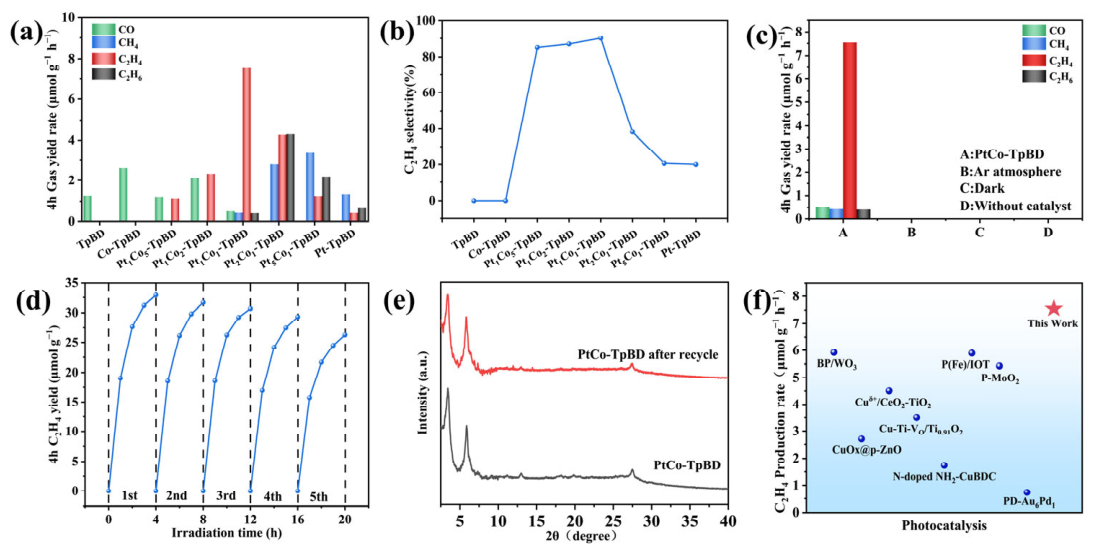
The CO2 reduction performance of the catalyst was evaluated. The reaction was carried out under visible-light irradiation in a mixed solution of acetonitrile/water (CH3CN/H2O, 1:10, v/v), without the addition of any photosensitizer and sacrificial agent. As shown in Figure 3a, after 4 h of reaction, TpBD COF exhibited a CO production rate of 1.26 μmol g−1 h−1, with no other carbon-containing products detected. After loading Co clusters, the COF exhibited a CO production rate of 2.62 μmol g−1 h−1, indicating that the incorporation of Co clusters promotes CO generation. As the loading amount of Pt clusters increases, the C2 product ethylene begins to form and reaches its maximum yield in the catalyst with a Pt:Co mass ratio of 1:1. Under this optimal ratio, the synthesized catalyst achieves a C2H4 production rate of 7.54 μmol g−1 h−1 and an electron selectivity of 90.1%, representing the best performance combination within the present study. As shown in Table S3, ICP-OES analysis of Pt1Co1-TpBD COF was performed to determine the actual mass fractions of Pt and Co loaded on the COF. The results indicate that the mass fraction of Pt is 1.05%, while that of Co is 0.44%. As the Co cluster loading gradually decreased, CH4 and C2H6 began to appear as products, and the selectivity toward C2H4 progressively declined (Figure 3b). The above performance data indicate that Pt clusters play a significant role in promoting the formation of C2 products; however, relying solely on Pt clusters leads to relatively low selectivity toward ethylene, whereas the incorporation of Co clusters enhances ethylene selectivity.
The photocatalytic CO2 reduction performance of PtCo-TpBD COF was examined under different reaction conditions (Figure 3c). When the reaction was performed under an argon atmosphere, no detectable carbon-containing products were generated in the photocatalytic system. This result confirms that CO2 was the sole carbon source during the reaction, ruling out interference from other carbon sources. When neither a photocatalyst nor light illumination was applied, the reaction mixture yielded no detectable products, demonstrating that the simultaneous presence of both light and catalyst is indispensable for the process to proceed. A 20 h recycling test of the PtCo-TpBD COF catalyst revealed that the ethylene production rate from CO2 reduction remained essentially stable over five consecutive cycles (Figure 3d). By comparing the XRD patterns before and after the reaction (Figure 3e), it can be seen that the main diffraction peaks of the catalyst almost completely overlap, indicating that the COF retained its original crystalline structure after the reaction. No changes were observed in the FTIR spectra of the catalyst after the reaction compared to those before the reaction (Figure S9), indicating that the COF exhibits excellent stability in the photocatalytic CO2 reduction reaction. As shown in Figure S10, AC-TEM images of PtCo-TpBD COF after five cyclic reactions reveal that Pt and Co remain in the cluster state without significant agglomeration or leaching. As shown in Table S4, ICP-OES analysis of the post-reaction sample further indicates that the loadings of Pt and Co remain virtually unchanged. These results demonstrate that the catalyst possesses excellent photocatalytic stability. The activity of this work in photocatalytic CO2 reduction to C2H4 presents a striking contrast to that of currently reported catalysts [36,37,38,39,40,41,42,43] (Figure 3f).

2.3. Investigation of the CO2 Reduction Mechanism over the Catalyst

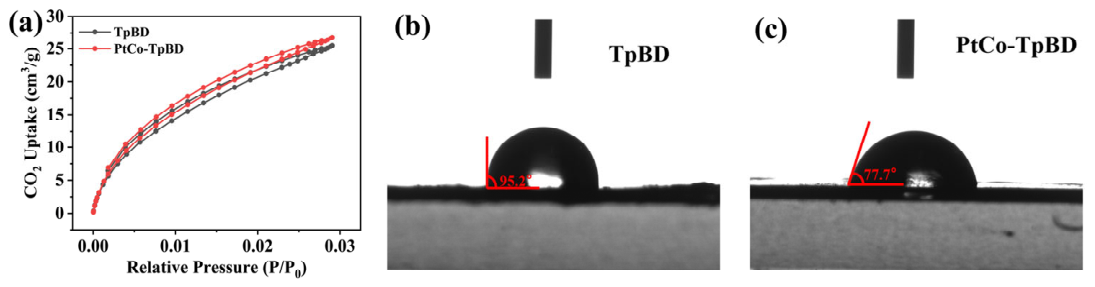
CO2 adsorption tests were performed to analyze the CO2 adsorption properties of the COF (Figure 4a). Compared with TpBD COF, PtCo-TpBD COF exhibited a slightly higher CO2 uptake, indicating that the introduction of Pt and Co clusters can enhance the catalyst’s CO2 adsorption capacity. This facilitates the supply of sufficient reactant for subsequent reactions and is one of the important factors contributing to the improvement of its catalytic performance. Contact angle measurements with aqueous solution were carried out (Figure 4b,c). The results showed that the contact angles of TpBD COF and PtCo-TpBD COF were 95.2° and 77.7°, respectively. This indicates that the introduction of Pt and Co clusters improved the hydrophilicity of the catalyst. Enhanced hydrophilicity helps improve the interfacial contact between the COF and the liquid-phase reaction medium, thereby promoting efficient interfacial charge transfer. This creates more favorable conditions for the hydrogenation of reaction intermediates, facilitating the generation of C2H4.
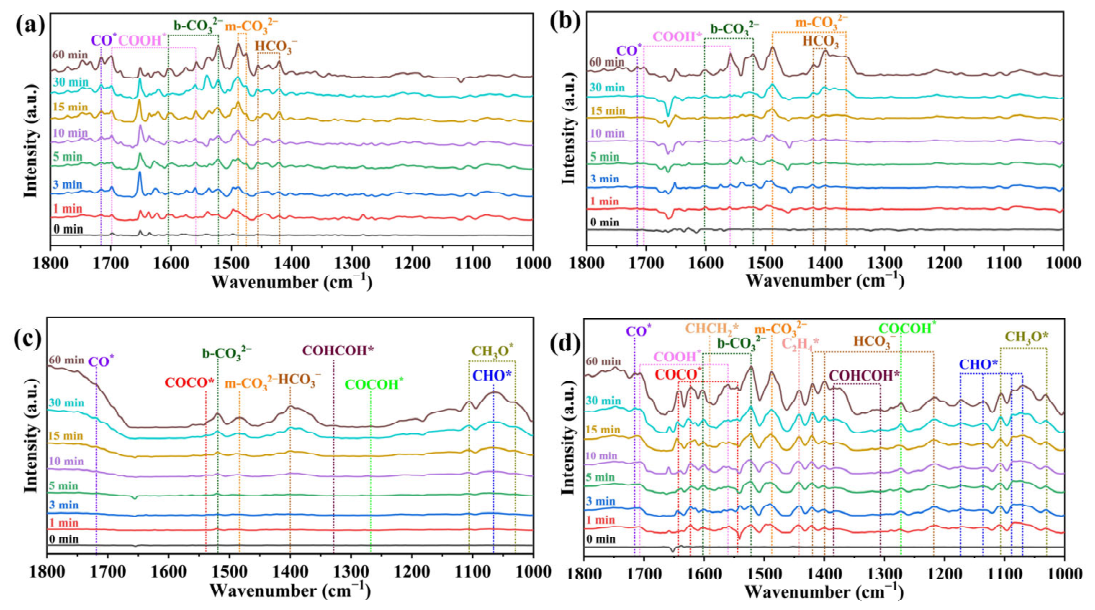
In situ FTIR experiments were conducted under a CO2 atmosphere to identify the intermediates of C2 products (Figure 5a–d). At 0 min, before xenon lamp irradiation, no distinct characteristic peaks were observed in the in situ FTIR spectra of all catalysts. After xenon lamp irradiation, distinct characteristic peaks appeared in the FTIR spectra, and the peak intensities gradually increased within 60 min. All catalysts exhibited characteristic peaks of CO32− and HCO3 in their FTIR spectra, indicating that CO2 was adsorbed onto the catalyst surface. All catalysts exhibited characteristic peaks corresponding to the intermediates COOH* and CO* in their spectra. COOH* is a key intermediate for CO formation, and the presence of the CO* intermediate lays the foundation for both CO generation and the subsequent C-C coupling to form the COCO* intermediate [44]. Upon loading Co clusters, the peak intensity of the COOH* intermediate increased significantly, while that of the CO* intermediate decreased. This indicates that Co clusters can lower the energy barrier for COOH* formation, but they destabilize the key C2 product intermediate COCO*, making it prone to premature desorption and conversion to CO, thereby suppressing C2 product generation. After loading Pt clusters, characteristic peaks of the CH3O* intermediate appeared in the spectra of both Pt-TpBD COF and PtCo-TpBD COF, providing direct evidence for CH4 formation [45]. In the in situ FTIR spectra of Pt-TpBD COF, characteristic peaks of COCO* appear at 1538 cm−1, COCOH* at 1267 cm−1, and COHCOH* at 1329 cm−1. For the PtCo-TpBD COF material, in situ FTIR spectra detected COCO* characteristic peaks at 1544, 1622, and 1643 cm−1, a COCOH* feature at 1272 cm−1, and COHCOH* signatures at 1306 and 1385 cm−1 [46,47,48]. COCO*, COCOH*, and COHCOH* are identified as key intermediates in the C-C coupling reaction. This suggests that on the catalyst surface, two CO2 molecules initially undergo C-C coupling to form COCO*, which subsequently undergoes stepwise hydrogenation using protons and electrons derived from water, ultimately converting into C2 hydrocarbons. In the in situ FTIR spectra of PtCo-TpBD COF, characteristic peaks for CHCH2* and C2H4* at 1590 cm−1 and 1442 cm−1 were detected [48,49], which are absent in Pt-TpBD COF. As key reaction intermediates in the ethylene generation pathway, the appearance of these species provides strong evidence that PtCo-TpBD COF exhibits a high propensity for C2H4 formation via the C-C coupling reaction. Notably, the CO* characteristic peak in the FTIR spectrum of Pt-TpBD COF is stronger than that of PtCo-TpBD COF, whereas the peaks for COCO*, COCOH* and COHCOH* are weaker than those of PtCo-TpBD COF. The above results demonstrate that Pt-TpBD COF exhibits an exceptionally strong adsorption propensity toward the CO* intermediate. This excessive adsorption hinders the desorption kinetics of the intermediate, which not only limits the overall yield of C2 products but also predisposes the intermediate to deep hydrogenation toward the by-product C2H6, thereby significantly reducing C2H4 selectivity. In contrast, the introduction of Co clusters finely tunes the CO* adsorption strength while accelerating intermediate desorption to overcome the kinetic bottleneck; it effectively suppresses over-hydrogenation side reactions, ultimately achieving a simultaneous increase in both C2H4 yield and selectivity.
To visually elucidate the regulatory effect of Co clusters on the CO* adsorption behavior of the catalyst, CO-TPD experiments were conducted, as shown in Figure S11. Experimental data indicate that, compared with Pt-TpBD COF, PtCo-TpBD COF exhibits a 10 °C decrease in the CO desorption temperature along with a significant reduction in peak area. This suggests that the introduction of Co clusters effectively weakens the adsorption strength of CO*, thereby optimizing the desorption kinetics of the intermediate.
Based on the analysis of in situ infrared spectroscopy, we can deduce the respective roles of Pt and Co clusters in the photocatalytic reduction of CO2 to C2H4. The presence of Pt clusters plays a decisive role in enabling C-C coupling of the reaction intermediate CO*. However, when only Pt clusters are present, the catalyst adsorbs CO* too strongly, which leads to excessive hydrogenation yielding C2H6, reduces C2H4 selectivity, and slows intermediate desorption, thereby decreasing catalytic activity. The introduction of Co clusters facilitates the desorption of the reaction intermediate CO*, but if the desorption occurs too early, it will shorten the residence time of the CO* intermediate on the active sites, hinder the C-C coupling reaction, and consequently be unfavorable for the formation of C2 products. Therefore, the synergistic effect of Pt and Co clusters can modulate the catalyst’s adsorption ability toward CO*, preventing its premature desorption that would preclude C2 product formation, while also avoiding excessively strong adsorption that leads to over-hydrogenation to C2H6 and thus reduces C2H4 selectivity. Based on the above analysis, the possible pathway for CO2 reduction to C2H4 on the PtCo-TpBD COF photocatalyst is described by Equations (1)–(9).
CO2 + *→CO2*
CO2* + e + H+→COOH*
COOH* + e + H+→CO*
CO* + CO*→COCO*
COCO* + e + H+→COCOH*
COCOH* + e + H+→COHCOH*
COHCOH* + 5e + 5H+→CHCH2*
CHCH2* + e + H+→C2H4*
C2H4*→C2H4

2.4. Optical and Electrochemical Characterization

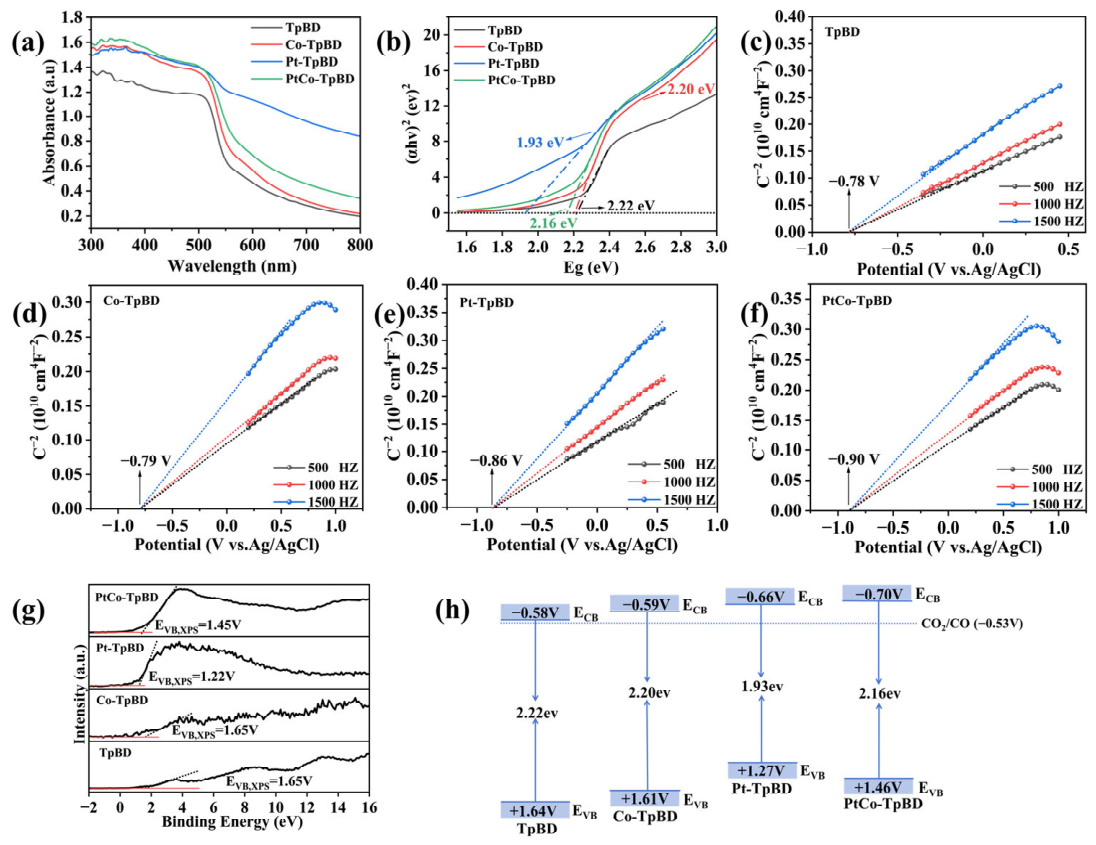
The light-harvesting properties and electronic band structure of the photocatalysts were evaluated using UV-Vis DRS (Figure 6a). DRS analysis revealed that after modification with Pt and Co clusters, the absorption edge of the materials red-shifted and the absorbance increased, indicating that metal coordination enhanced the delocalization effect. Consequently, the visible-light absorption ability of PtCo-TpBD COF was improved, leading to a higher utilization of solar energy. Notably, the DRS of Pt-TpBD COF exhibited the strongest absorbance, indicating that Pt clusters have the most significant effect on altering the absorbance of the COF. The optical band gaps of the COFs were estimated using the Kubelka–Munk equation: TpBD COF, Co-TpBD COF, Pt-TpBD COF, and PtCo-TpBD COF exhibited band gaps of 2.22 eV, 2.20 eV, 1.93 eV, and 2.16 eV, respectively (Figure 6b).
Mott–Schottky measurements were performed to estimate the conduction band positions of the synthesized samples (Figure 6c–f). It can be seen that, due to the positive slope, all catalysts exhibit the characteristics of n-type semiconductors. The conduction band positions of TpBD COF, Co-TpBD COF, Pt-TpBD COF, and PtCo-TpBD COF were determined to be −0.58 V, −0.59 V, −0.66 V, and −0.70 V versus NHE, respectively. The valence band (VB) potential of the COFs was further determined by XPS VB analysis, and the results are in good agreement with the VB potentials calculated from Mott–Schottky and DRS measurements (Figure 6g). By combining the band gap energies calculated from UV-Vis DRS with the conduction band positions obtained from Mott–Schottky measurements, the electronic band structures of the four photocatalysts were plotted (Figure 6h). All of them meet the potential requirements for the CO2 reduction reaction. Moreover, PtCo-TpBD COF possesses the most negative CB position, which provides a sufficient driving force for reduction to overcome the thermodynamic limitation of CO2 reduction, thereby facilitating multi-electron transfer and the formation of deeply reduced products.
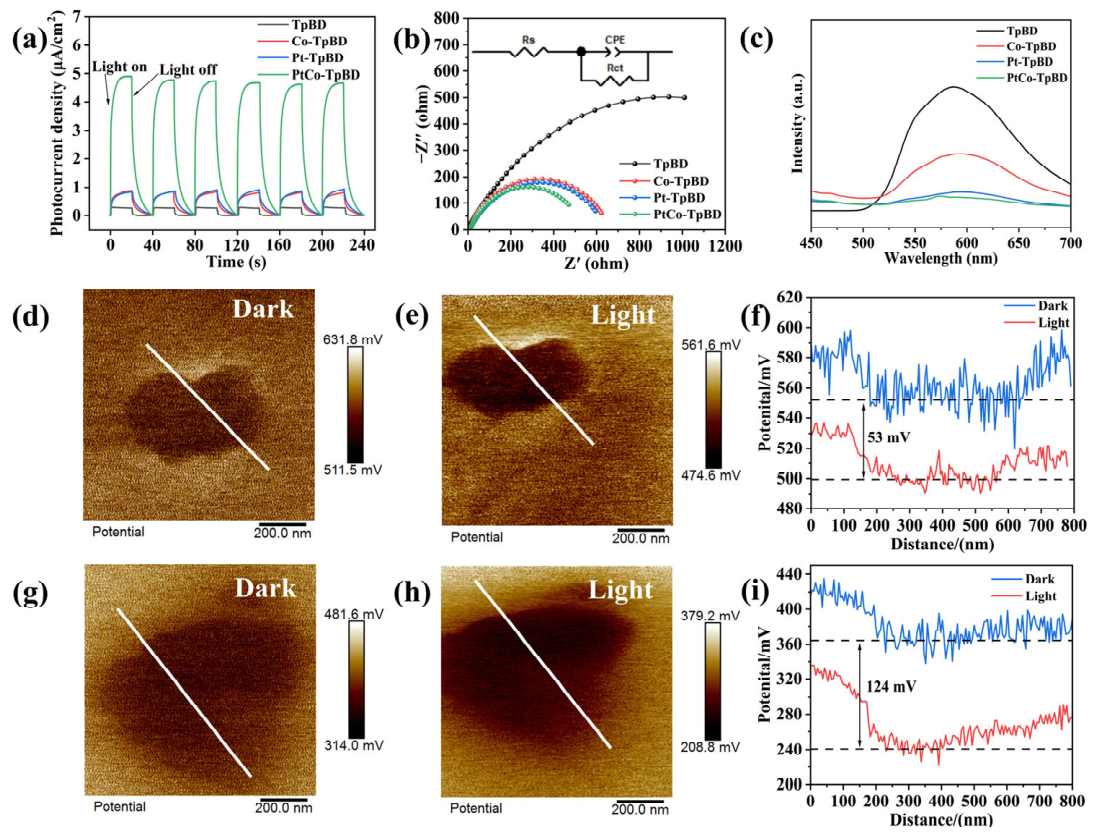
To evaluate the performance of TpBD COF, Co-TpBD COF, Pt-TpBD COF, and PtCo-TpBD COF in terms of charge separation and migration, a series of electrochemical techniques were employed, including transient photocurrent measurements, EIS, LSV, and CV. The photocurrent responses showed a clear progression in magnitude from TpBD COF to Co-TpBD COF, then to Pt-TpBD COF, and reached the highest value for PtCo-TpBD COF (Figure 7a). Concurrently, the semicircular arc in the Nyquist plot obtained from EIS became progressively smaller across the same series (Figure 7b). Under light irradiation, PtCo-TpBD COF generated a markedly stronger photocurrent, implying more efficient production of photogenerated electrons and improved charge separation. A reduced semicircle radius in the EIS spectra signifies a lower interfacial charge-transfer resistance, suggesting that the introduction of Pt and Co clusters significantly enhances electron mobility. The CV curves display reduction peaks in the low-potential range and oxidation peaks at higher potentials. Among the samples, PtCo-TpBD COF presented the most extensive redox peak area, indicative of its strong charge storage capacity and pronounced surface redox activity (Figure S12a). LSV results demonstrated that PtCo-TpBD COF achieves the smallest overpotential for the hydrogen evolution reaction (HER), reflecting its superior proton reduction kinetics, which may promote CO2 reduction through a hydrogen-assisted mechanism (Figure S12b).
As shown in steady-state PL spectra in Figure 7c, PtCo-TpBD COF exhibits the lowest emission intensity. Since PL intensity is positively correlated with the recombination of photogenerated electrons and holes, this indicates that PtCo-TpBD COF possesses the most efficient charge separation. KPFM experiments were conducted to visualize the spatial charge separation phenomena in the samples, thereby gaining further insight into their carrier separation capabilities. As shown in Figure 7d–f, TpBD COF exhibited the smallest surface potential change under dark-light conditions, measuring 53 mV. In contrast, PtCo-TpBD COF displayed a markedly larger surface potential variation of 124 mV under the same conditions (Figure 7g–i), providing strong evidence that the introduction of Pt and Co clusters significantly enhances charge separation in the COF.

3. Experimental Section

3.1. Chemicals

2,4,6-Trihydroxybenzene-1,3,5-tricarbaldehyde was acquired from Beijing MREDA Technology Co., Ltd. (Beijing, China), while anhydrous ethanol was supplied by Tianjin Zhiyuan Chemical Reagent Co., Ltd. (Tianjin, China). Ultra-high-purity carbon dioxide gas (99.999%) was procured from Kunming Guangruida Special Gases Co., Ltd. (Kunming, China). Benzidine, 1,4-dioxane, 1,3,5-trimethylbenzene, chloroplatinic acid hexahydrate, cobalt(II) chloride, acetonitrile, and tetrahydrofuran were all sourced from Shanghai Aladdin Biochemical Technology Co., Ltd. (Shanghai, China). All chemicals used were of analytical reagent grade and were employed directly without additional purification. Throughout the experimental procedures, deionized water was utilized as the solvent or medium.

3.2. Synthesis of TpBD COF

Building upon a previously reported protocol [50] with minor adjustments, 2,4,6-trihydroxybenzene-1,3,5-tricarbaldehyde (0.3 mmol) and benzidine (0.45 mmol) were introduced into a Pyrex ampoule. Subsequently, 0.5 mL of 6 M acetic acid aqueous solution, 1.5 mL of 1,4-dioxane, and 1.5 mL of mesitylene were added to the reaction vessel. The resulting mixture was subjected to ultrasonic treatment at ambient temperature for 5 min, then promptly frozen in liquid nitrogen (77 K). Following three cycles of freeze–pump–thaw, the tube was sealed under reduced pressure using a flame-sealing technique. The uniformly mixed solution was placed in a heating oven set to 120 °C and kept undisturbed for 72 h. Upon completion, the solid precipitate was collected via filtration and rinsed repeatedly three times each with anhydrous ethanol and tetrahydrofuran. For further purification, the material was extracted continuously in a Soxhlet apparatus using tetrahydrofuran as the solvent for 24 h and finally dried under vacuum at 120 °C for 12 h to yield the target COF.

3.3. Synthesis of PtCo-TpBD COF

An amount of 100 mg of TpBD COF was added to 60 mL of ethanol, followed by dispersing aqueous solutions of H2PtCl4 (8 mg/mL) and CoCl2 (10 mg/mL) into the above suspension. After purging with argon for 30 min, the reaction mixture was stirred and irradiated with a full-spectrum xenon lamp under an argon atmosphere for 90 min. After standing for 12 h, the mixture was dried in a vacuum oven at 60 °C for 12 h to obtain PtCo-TpBD COF. During synthesis, a total of 10 mg of platinum and cobalt elements were added. The resulting catalyst, denoted as PtxCoy-TpBD, was prepared with a Pt:Co mass ratio of x:y. Materials prepared with 2660 μL of H2PtCl4 aqueous solution were denoted as Pt-TpBD. Samples containing 445 μL of H2PtCl4 aqueous solution and 1835 μL of CoCl2 aqueous solution were labeled Pt1Co5-TpBD. Those with 885 μL of H2PtCl4 and 1465 μL of CoCl2 were named Pt1Co2-TpBD. With 1330 μL of H2PtCl4 and 1100 μL of CoCl2, the material was designated Pt1Co1-TpBD. For 1775 μL of H2PtCl4 and 735 μL of CoCl2, the sample was referred to as Pt2Co1-TpBD. With 2215 μL of H2PtCl4 and 365 μL of CoCl2, the catalyst was termed Pt5Co1-TpBD. The sample prepared using 2200 μL of CoCl2 aqueous solution alone was denoted Co-TpBD.

3.4. Materials Characterization

The concentrations of platinum and cobalt present on the sample surfaces were quantified using an Agilent (Santa Clara, CA, USA) 5800 inductively coupled plasma optical emission spectrometer (ICP-OES) from the United States. Surface topography and particle dimensions were observed with a ZEISS (Oberkochen, Germany) Gemini 500 field-emission scanning electron microscope (FE-SEM). Energy-dispersive X-ray spectroscopy (EDS) was employed to map the elemental distribution across the sample surfaces. Crystal plane indices and interplanar spacings were determined using a Thermo Fisher (Waltham, MA, USA) Spectra 300 aberration-corrected scanning transmission electron microscope (AC-STEM). Powder X-ray diffraction (PXRD) analysis was conducted on a Bruker D8 Advance instrument (Berlin, Germany) over a 2θ range of 2.5–40°. For the 2.5–10° interval, data were collected in low-angle mode with a step size of 1° min−1, while the 10–40° range was scanned in standard mode at 10° min−1. The complete XRD pattern was generated by combining the datasets from both angular regions. Fourier-transform infrared (FTIR) spectra were acquired using a Thermo Scientific (Waltham, MA, USA) Nicolet 6700 spectrometer. Room-temperature solid-state 13C high-resolution nuclear magnetic resonance (NMR) spectra were recorded on a Bruker AVANCE NEO 600 solid-state NMR system (Berlin, Germany). Specific surface area and pore characteristics were evaluated using a Micromeritics 3Flex automated physisorption analyzer (Norcross, GA, USA). Nitrogen adsorption–desorption isotherms were measured at 77 K following a 3 h degassing step at 120 °C. The CO2 uptake capacity of the materials was also assessed with the same Micromeritics 3Flex instrument, with adsorption–desorption isotherms obtained at 273.15 K in a CO2 environment after 7 h of pretreatment at 120 °C. Thermogravimetric analysis (TGA) was performed on a Hitachi STA200 thermal analyzer (Tokyo, Japan). Water contact angles were measured using a Dataphysics OCA 20 goniometer (Filderstadt, Germany). X-ray photoelectron spectroscopy (XPS) measurements were carried out on a Thermo Fisher K-Alpha system (Waltham, MA, USA). UV-Vis diffuse reflectance spectra (DRS) were collected in the 200–800 nm range with a Hitachi UH5700 spectrophotometer (Tokyo, Japan), using pure powder compacts of the samples. Steady-state photoluminescence (PL) spectra were obtained using an Edinburgh FLS 1000 spectrometer (Edinburgh, UK). The surface potential of the photocatalyst materials was probed via Kelvin probe force microscopy (KPFM) on a Bruker Dimension Icon system (Berlin, Germany). In situ diffuse reflectance infrared Fourier transform spectroscopy (DRIFTS) during CO2 reactions was conducted using a Nicolet Nexus 6700 spectrometer (Waltham, MA, USA) equipped with a mercury cadmium telluride (MCT) detector. CO-TPD measurements were performed on the photocatalysts using an Altamira Instruments AMI-300 chemisorption analyzer (Pittsburgh, PA, USA).

3.5. Photoelectrochemical Test

Mott-Schottky analysis, transient photocurrent, Linear Sweep Voltammetry (LSV), Cyclic Voltammetry (CV), and Electrochemical Impedance Spectroscopy (EIS) were conducted using a CHI660e workstation from Chenhua Instruments (Shanghai, China). To fabricate the working electrode, 10 mg of the catalyst powder was first dispersed in 5 mL of ethanol containing 100 μL of a 5 wt% Nafion solution, producing a uniform slurry. This suspension was then carefully drop-cast onto a square FTO glass substrate (1.0 cm × 1.0 cm) to form an evenly distributed thin layer. The coated substrate was subsequently dried in an oven at 60 °C for 12 h to yield the final working electrode. In all measurements, a platinum sheet acted as the counter electrode, while a saturated Ag/AgCl electrode was employed as the reference. For transient photocurrent, Mott–Schottky analysis and LSV experiments, the electrolyte consisted of 0.5 M aqueous Na2SO4. EIS measurements were performed in a 0.5 M Na2SO4 solution supplemented with 0.01 M K3[Fe(CN)6]. CV tests were carried out in a 0.5 M Na2SO4 medium containing equimolar amounts (1:1 ratio) of 0.01 M K3[Fe(CN)6] and K4[Fe(CN)6].

3.6. Photocatalytic CO2 Reduction

Photocatalytic CO2 reduction experiments were conducted using an automated multifunctional reaction platform (model MC-SPB10 PT, Beijing Zhongjiao Jinyuan Technology Co., Ltd., Beijing, China). This setup includes a vacuum pump, a 300 W xenon light source, and a dedicated circulating water cooling unit tailored for photochemical reactors. In a typical run, 50 mg of the catalyst was dispersed into a solvent mixture composed of 100 mL of ultrapure water and 10 mL of acetonitrile; the mixture was sonicated to achieve homogeneity before being transferred into the reaction chamber. To ensure an airtight environment, the reactor was tightly sealed with high-vacuum grease. Before illumination, the internal atmosphere was evacuated using the vacuum pump until the pressure reached approximately −80 kPa, after which high-purity CO2 (99.999%) was introduced to bring the pressure to a stable −30 kPa. This evacuation-refill cycle was repeated three times to reduce the presence of air as much as possible. The reaction cell was then exposed to light, with the temperature controlled at 6 °C through the recirculating cooling system. Gaseous products, including hydrocarbons and H2, were sampled hourly and analyzed using a GC9790Plus gas chromatograph (Taizhou, China) outfitted with both flame ionization (FID) and thermal conductivity (TCD) detectors.

4. Conclusions

In summary, this work has designed a Pt/Co bimetallic cluster co-catalyst supported on a COF, which facilitates the highly selective photocatalytic reduction of CO2 to C2H4. The successful confinement of Pt/Co clusters was confirmed by AC-TEM, N2-BET, and XPS analyses. The photocatalytic reduction mechanism was elucidated through in situ FTIR analysis. The introduction of Pt clusters promoted C-C coupling, while the incorporation of Co clusters modulated the catalyst’s adsorption capacity for the reaction intermediate CO, suppressing excessive hydrogenation that would otherwise lead to the formation of by-products such as CH4 and C2H6, and thereby enhancing the selectivity toward C2H4. Therefore, PtCo-TpBD COF promotes the highly selective photocatalytic reduction of CO2 to C2H4, with an electron selectivity of 90.1% for C2H4 and a C2H4 production rate of 7.51 μmol g−1 h−1. This work demonstrates that COF-confined Pt/Co bimetallic clusters can modulate both the reaction pathway and the adsorption behavior of intermediates through synergistic effects, thereby achieving highly selective generation of C2H4. This work provides a new strategy and theoretical basis for the future design of efficient photocatalysts for CO2 reduction to C2 products.

Supplementary Materials

The following supporting information can be downloaded at https://www.mdpi.com/article/10.3390/catal16050401/s1, Figure S1: Zeta potential of TpBD COF; Figure S2: SEM images of PtCo-TpBD COF; Figure S3: Size distribution histogram of Pt clusters in PtCo-TpBD COF; Figure S4: top and side views of AA-stacking structure for TpBD COF; Figure S5: FTIR spectrum of the building blocks of covalent organic frameworks; Figure S6: TGA curves of (a) TpBD COF and (b) PtCo-TpBD COF over the temperature range of 50 to 800°C under nitrogen atmosphere with heating rate of 10°C min−1; Figure S7: The pore size distributions of (a) TpBD COF, (b) Co-TpBD COF, (c) Pt-TpBD COF and (d) PtCo-TpBD COF; Figure S8: (a) XPS survey spectra, high-resolution XPS spectra of (b) C 1s, (c) Pt 4f and (d) Co 2p; Figure S9: FT-IR spectra of PtCo-TpBD COF after recycle experiment; Figure S10: AC-TEM image of PtCo-TpBD COF after recycle experiment; Figure S11: CO-TPD profile of PtCo-TpBD COF; Figure S12: (a) CV tests and (b) LSV curves; Table S1: Fractional atomic coordinates for the unit cell of TpBD COF; Table S2: Based on the element percentage data obtained from XPS semi-quantitative analysis; Table S3: ICP-OES results of PtCo-TpBD COF; Table S4: ICP-OES results of PtCo-TpBD after photocatalytic reaction; Table S5: The comparison of gas products and yields of photocatalytic selectivity among some representative photocatalysts reported in the literature in recent years and in this work [36,37,38,39,40,41,42,43].

Author Contributions

B.C.: Writing—review & editing, Writing—original draft, Methodology, Investigation, Formal analysis, Data curation, Conceptualization. H.W.: Writing—review & editing, Resources, Project administration, Funding acquisition, Conceptualization Resources. B.Z.: Software, Resources. L.Y.: Formal analysis. Y.L.: Formal analysis, Resources. All authors have read and agreed to the published version of the manuscript.

Funding

Funding was provided by the Applied Basic Research Foundation of Yunnan Province, grant number 202401CF070105, and the Kunming University of Science and Technology ‘Double First-Class’ Initiative Joint Special Fund-General Program, grant number 202301BE070001-016.

Data Availability Statement

The data that support the findings of this study are available from the corresponding author upon reasonable request.

Acknowledgments

We are deeply grateful for the generous financial support.

Conflicts of Interest

The authors state that there are no known competing financial interests or personal relationships that could be perceived as influencing the work reported in this paper.

References

  1. Burkart, M.D.; Hazari, N.; Tway, C.L.; Zeitler, E.L. Opportunities and Challenges for Catalysis in Carbon Dioxide Utilization. ACS Catal. 2019, 9, 7937–7956. [Google Scholar] [CrossRef]
  2. Long, D.; Li, J.; Qian, G.; Tang, L.; Ma, S.; Li, W.; Yu, X. Photocatalytic Reduction of Low-Concentration CO2: Progress and Challenges. Coord. Chem. Rev. 2026, 549, 217246. [Google Scholar] [CrossRef]
  3. Long, D.; Qian, G.; Ma, S.; Yu, X.; Li, W. Two-dimensional photocatalysts for photoreduction of CO2. Renew. Sust. Energy. Rev. 2026, 226, 116222. [Google Scholar] [CrossRef]
  4. Zhu, H.; Guo, R.; Liu, C.; Cui, H.; Liu, M.; Pan, W. Recent progress on photocatalytic reduction of CO2 to C2+ products. J. Mater. Chem. A 2024, 12, 21677–21703. [Google Scholar] [CrossRef]
  5. Jiang, M.; Huang, K.; Liu, J.; Wang, D.; Wang, Y.; Wang, X.; Li, Z.; Wang, X.; Geng, Z.; Hou, X.; et al. Magnetic-Field-Regulated TiO2 {100} Facets: A Strategy for C-C Coupling in CO2 Photocatalytic Conversion. Chem 2020, 6, 2335–2346. [Google Scholar] [CrossRef]
  6. Guo, W.; Yin, J.; Xu, Z.; Li, W.; Peng, Z.; Weststrate, C.J.; Yu, X.; He, Y.; Cao, Z.; Wen, X.; et al. Visualization of on-surface ethylene polymerization through ethylene insertion. Science 2022, 375, 1188–1191. [Google Scholar] [CrossRef]
  7. Yu, S.; Wang, X.; Sun, X.; Gao, Y.; Zhao, Y.; Ning, X.; Ji, G.; Lu, Y.; Yang, J.; Liu, Z.; et al. Cyano-functionalized polyethylenes from ethylene/acrylamide copolymerization. Nat. Commun. 2025, 16, 2461. [Google Scholar] [CrossRef] [PubMed]
  8. Pagar, V.V.; RajanBabu, T.V. Tandem catalysis for asymmetric coupling of ethylene and enynes to functionalized cyclobutanes. Science 2018, 361, 68–72. [Google Scholar] [CrossRef]
  9. Wolpers, A.; Baffie, F.; Verrieux, L.; Perrin, L.; Monteil, V.; D’Agosto, F. Iodine-Transfer Polymerization (ITP) of Ethylene and Copolymerization with Vinyl Acetate. Angew. Chem. Int. Ed. 2020, 59, 19304–19310. [Google Scholar] [CrossRef]
  10. Zeng, Y.; Zou, R.; Zhao, Y. Covalent Organic Frameworks for CO2 Capture. Adv. Mater. 2016, 28, 2855–2873. [Google Scholar] [CrossRef]
  11. Fang, Y.; Liu, Y.; Huang, H.; Sun, J.; Hong, J.; Zhang, F.; Wei, X.; Gao, W.; Shao, M.; Guo, Y.; et al. Design and synthesis of broadband absorption covalent organic framework for efficient artificial photocatalytic amine coupling. Nat. Commun. 2024, 15, 4856. [Google Scholar] [CrossRef] [PubMed]
  12. Li, Q.; Xu, Y.; Lin, Z.; Sun, Z.; Liu, Y. Fluorinated covalent organic frameworks enhanced CO2 adsorption for boosting photocatalytic CO2 reduction. Sep. Purif. Technol. 2025, 367, 132992. [Google Scholar] [CrossRef]
  13. Shen, Y.; Pan, T.; Wang, L.; Ren, Z.; Zhang, W.; Huo, F. Programmable Logic in Metal-Organic Frameworks for Catalysis. Adv. Mater. 2021, 33, 2007442. [Google Scholar] [CrossRef] [PubMed]
  14. Hasija, V.; Patial, S.; Raizada, P.; Khan, A.A.P.; Asiri, A.M.; Le, Q.V.; Nguyen, V.; Singh, P. Covalent organic frameworks promoted single metal atom catalysis: Strategies and applications. Coord. Chem. Rev. 2022, 452, 214298. [Google Scholar] [CrossRef]
  15. Yang, T.; Dong, Y.; Liu, C.; Jun, Z.; Sun, X.; Zhang, J.; Cao, X.; Chen, X.; Zhu, Y. Supramolecules Containing Homogeneous Electron-rich Cu Sites for Photocatalytic CO2 Reduction to C2H6. Adv. Funct. Mater. 2025, 35, 2422348. [Google Scholar] [CrossRef]
  16. Fu, N.; Li, X.; Qin, L.; He, J.; Li, X.; Zhang, C. Construction of S-deficient In2S3/Vs-CuIn5S8 heterojunctions for photocatalytic reduction of CO2 to multi-carbon products. J. Colloid. Interface. Sci. 2026, 703, 139109. [Google Scholar] [CrossRef]
  17. Zhang, Q.; Gao, S.; Zhao, X.; Wang, H.; Guo, Y.; Liu, Z.; Wang, J. Multi-enzyme reaction inspired photocatalysis for solar-driven CO2 reduction to ethane. Chem. Sci. 2025, 16, 15166–15176. [Google Scholar] [CrossRef]
  18. Shen, Y.; Jia, T.; Wu, J.; Zhou, H.; Ou, M.; He, P.; Fu, Z.; Zhou, F.; Lin, J.; Chen, Z. Orbital-Level-Directed Selective CO2-to-C2H4 Photoreduction via Se Vacancies and Plasmonic Pt. ACS Nano 2026, 20, 4393–4403. [Google Scholar] [CrossRef]
  19. Liu, Q.; Cheng, H.; Wun, C.K.T.; Chen, T.; Lo, T.W.B.; Wang, F. Oxygen-tolerant photocatalytic conversion of simulated flue gas to ethylene. Chem 2025, 11, 102391. [Google Scholar] [CrossRef]
  20. Zhang, Y.; Wei, T.; Ding, D.; Wang, K.; Di, J.; Tseng, J.; She, Y.; Li, M.M.; Xia, J.; Li, H. Aggregation-Induced Equidistant Dual Pt Atom Pairs for Effective CO2 Photoreduction to C2H4. ACS Catal. 2025, 15, 5614–5622. [Google Scholar] [CrossRef]
  21. Yang, T.; Liu, C.; Sun, X.; Dong, Y.; Chen, X.; Jiang, X.; Zhu, Y. Destabilization of the *CH2COH intermediate enables targeted photocatalytic conversion of CO2 to C2H4. Appl. Catal. B Environ. Energy 2026, 380, 125759. [Google Scholar] [CrossRef]
  22. Liu, T.; Su, S.; He, L.; Xie, Y.; Liu, L.; Wang, G.; Ren, Q.; Xu, K.; Jiang, L.; Xu, J.; et al. Getting insight into the CO tolerance over Co-modified MnSm/Ti catalyst for NH3-SCR of NOx at low temperature: Experiments and DFT studies. Fuel 2024, 356, 129616. [Google Scholar] [CrossRef]
  23. Xiong, Y.; Ma, Y.; Zou, L.; Han, S.; Chen, H.; Wang, S.; Gu, M.; Shen, Y.; Zhang, L.; Xia, Z.; et al. N-doping induced tensile-strained Pt nanoparticles ensuring an excellent durability of the oxygen reduction reaction. J. Catal. 2020, 382, 247–255. [Google Scholar] [CrossRef]
  24. Biswal, B.P.; Chandra, S.; Kandambeth, S.; Lukose, B.; Heine, T.; Banerjee, R. Mechanochemical Synthesis of Chemically Stable Isoreticular Covalent Organic Frameworks. J. Am. Chem. Soc. 2013, 135, 5328–5331. [Google Scholar] [CrossRef]
  25. Yin, L.; Zhao, Y.; Xing, Y.; Tan, H.; Lang, Z.; Ho, W.; Wang, Y.; Li, Y. Structure-Property relationship in β-keto-enamine-based covalent organic frameworks for highly efficient photocatalytic hydrogen production. Chem. Eng. J. 2021, 419, 129984. [Google Scholar] [CrossRef]
  26. Zhang, W.; Wang, S.; Wen, N.; Zhao, J.; Guo, W.; Wu, S.; Zhang, P.; Lin, Q.; Xu, J.; Long, J. TiO2-promoted electron-tunneling of COF-based MIS nanostructures for efficient photocatalytic hydrogen production. Mater. Today Chem. 2022, 26, 101150. [Google Scholar] [CrossRef]
  27. Huang, T.; Kou, J.; Yuan, H.; Guo, H.; Yuan, K.; Li, H.; Wang, F.; Dong, Z. Linker Modulation of Covalent Organic Frameworks at Atomic Level for Enhanced and Selective Photocatalytic Oxidation of Thioether. Adv. Funct. Mater. 2025, 35, 2413943. [Google Scholar] [CrossRef]
  28. Ran, H.; Liu, X.; Fan, J.; Yang, Y.; Zhang, L.; Guo, Q.; Zhu, B.; Xu, Q. Engineering BiOBr/TpBD-COF S-scheme heterointerface via phase transformation strategy for boosted photocatalytic hydrogen generation. J. Mater. 2025, 11, 100918. [Google Scholar] [CrossRef]
  29. Ai, L.; Wang, Q.; Chen, X.; Jiang, G. One-dimensional phenanthroline-based covalent organic framework bearing single cobalt atoms for efficient photocatalytic CO2 reduction. Aggregate 2024, 5, e582. [Google Scholar] [CrossRef]
  30. Liu, Y.; Li, L.; Tan, H.; Ye, N.; Gu, Y.; Zhao, S.; Zhang, S.; Luo, M.; Guo, S. Fluorination of Covalent Organic Framework Reinforcing the Confinement of Pd Nanoclusters Enhances Hydrogen Peroxide Photosynthesis. J. Am. Chem. Soc. 2023, 145, 19877–19884. [Google Scholar] [CrossRef]
  31. Bao, S.; Tan, Q.; Wang, S.; Guo, J.; Lv, K.; Carabineiro, S.A.C.; Wen, L. TpBD COF@ZnIn2S4 nanosheets: A novel S-scheme heterojunction with enhanced photoreactivity for hydrogen production. Appl. Catal. B Environ. Energy 2023, 330, 122624. [Google Scholar] [CrossRef]
  32. Zhou, G.; Zheng, L.; Wang, D.; Xing, Q.; Li, F.; Ye, P.; Xiao, X.; Li, Y.; Zou, J. A general strategy via chemically covalent combination for constructing heterostructured catalysts with enhanced photocatalytic hydrogen evolution. Chem. Commun. 2019, 55, 4150–4153. [Google Scholar] [CrossRef] [PubMed]
  33. Zhang, X.; Zhang, J.; Miao, J.; Wen, X.; Chen, C.; Zhou, B.; Long, M. Keto-enamine-based covalent organic framework with controllable anthraquinone moieties for superior H2O2 photosynthesis from O2 and water. Chem. Eng. J. 2023, 466, 143085. [Google Scholar] [CrossRef]
  34. Tang, W.; Zeng, J.; Bian, F.; Lin, H.; Zhao, H.; Lu, Z. Engineering heteroatomic structures in Pt single-atom anchored covalent organic frameworks for enhanced photocatalytic hydrogen evolution reaction. J. Mater. Chem. A 2025, 13, 19682–19694. [Google Scholar] [CrossRef]
  35. Zhang, F.; Ma, J.; Tan, Y.; Yu, G.; Qin, H.; Zheng, L.; Liu, H.; Li, R. Construction of Porphyrin Porous Organic Cage as a Support for Single Cobalt Atoms for Photocatalytic Oxidation in Visible Light. ACS Catal. 2022, 12, 5827–5833. [Google Scholar] [CrossRef]
  36. Gao, W.; Bai, X.; Gao, Y.; Liu, J.; He, H.; Yang, Y.; Han, Q.; Wang, X.; Wu, X.; Wang, J.; et al. Anchoring of black phosphorus quantum dots onto WO3 nanowires to boost photocatalytic CO2 conversion into solar fuels. Chem. Commun. 2020, 56, 7777–7780. [Google Scholar] [CrossRef]
  37. Wang, W.; Deng, C.; Xie, S.; Li, Y.; Zhang, W.; Sheng, H.; Chen, C.; Zhao, J. Photocatalytic C–C Coupling from Carbon Dioxide Reduction on Copper Oxide with Mixed-Valence Copper(I)/Copper(II). J. Am. Chem. Soc. 2021, 143, 2984–2993. [Google Scholar] [CrossRef]
  38. Wang, T.; Chen, L.; Chen, C.; Huang, M.; Huang, Y.; Liu, S.; Li, B. Engineering Catalytic Interfaces in Cuδ+/CeO2-TiO2 Photocatalysts for Synergistically Boosting CO2 Reduction to Ethylene. ACS Nano 2022, 16, 2306–2318. [Google Scholar] [CrossRef]
  39. Shen, Y.; Ren, C.; Zheng, L.; Xu, X.; Long, R.; Zhang, W.; Yang, Y.; Zhang, Y.; Yao, Y.; Chi, H.; et al. Room-temperature photosynthesis of propane from CO2 with Cu single atoms on vacancy-rich TiO2. Nat. Commun. 2023, 14, 1117. [Google Scholar] [CrossRef]
  40. Guo, F.; He, Z.; Wang, P.; Zhang, X.; Yu, H.; Wang, Q.; Sun, W. Construction of N-doped copper metal-organic frameworks for promoting photocatalytic carbon dioxide reduction to ethylene. Sci. China Chem. 2025, 68, 601–609. [Google Scholar] [CrossRef]
  41. Liang, F.; Peng, Y.; Lin, K.A.; Huang, P. Photoreduction of carbon dioxide into methane and ethylene using TiO2 inverse opal-derived PCN-222(M). J. Environ. Chem. Eng. 2024, 12, 113825. [Google Scholar] [CrossRef]
  42. Luo, G.; Liu, H.; Wang, R.; Duan, C.; Sun, M.; Lu, Y.; Ou, Z.; Hu, Z. Construction of a red phosphorus-molybdenum dioxide electron-rich interface for efficient photocatalytic reduction of carbon dioxide. J. Colloid Interface Sci. 2025, 684, 346–354. [Google Scholar] [CrossRef]
  43. Chen, Q.; Chen, X.; Fang, M.; Chen, J.; Li, Y.; Xie, Z.; Kuang, Q.; Zheng, L. Photo-induced Au-Pd alloying at TiO2 {101} facets enables robust CO2 photocatalytic reduction into hydrocarbon fuels. J. Mater. Chem. A 2019, 7, 1334–1340. [Google Scholar] [CrossRef]
  44. Qiu, X.; Zhu, H.; Huang, J.; Liao, P.; Chen, X. Highly Selective CO2 Electroreduction to C2H4 Using a Metal-Organic Framework with Dual Active Sites. J. Am. Chem. Soc. 2021, 143, 7242–7246. [Google Scholar] [CrossRef] [PubMed]
  45. Zhang, L.; Hussain, S.; Li, Q.; Yang, J. PdCu alloy anchored defective titania for photocatalytic conversion of carbon dioxide into methane with 100% selectivity. J. Energy Chem. 2024, 91, 254–265. [Google Scholar] [CrossRef]
  46. Jia, J.; Luo, Y.; Wu, H.; Wang, Y.; Jia, X.; Wan, J.; Dang, Y.; Liu, G.; Xie, H.; Zhang, Y. Nickel selenide/g-C3N4 heterojunction photocatalyst promotes C-C coupling for photocatalytic CO2 reduction to ethane. J. Colloid Interface Sci. 2024, 658, 966–975. [Google Scholar] [CrossRef] [PubMed]
  47. Chen, X.; Liu, C.; Yang, T.; Jiang, X.; Yang, Y.; Su, J.; Yi, J.; Dong, Y. Cu atom pairs within covalent organic frameworks facilitate the photocatalytic reduction of CO2 to C2H6. Appl. Catal. B Environ. Energy 2025, 377, 125499. [Google Scholar] [CrossRef]
  48. Zhou, Q.; Guo, Y.; Zhu, Y. Reticular copper dual sites embedded with semiconductor particles for selective CO2-to-C2H4 photoreduction. Nat. Catal. 2025, 8, 728–739. [Google Scholar] [CrossRef]
  49. Tang, Z.; Wang, Y.; Qin, T.; Wei, Y.; Xiong, J.; Wang, X.; Li, X.; Liu, M.; Liu, Y.; Liu, X.; et al. Near-unity CO2-to-ethylene photoconversion over low coordination single-atom catalysts. Nat. Commun. 2026, 17, 2081. [Google Scholar] [CrossRef]
  50. Xiong, K.; Wang, Y.; Zhang, F.; Li, X.; Lang, X. Linker length-dependent photocatalytic activity of β-ketoenamine covalent organic frameworks. Appl. Catal. B Environ. Energy 2023, 322, 122135. [Google Scholar] [CrossRef]
Figure 1. (a) Synthetic scheme of TpBD COF and PtCo-TpBD COF, (b) SEM images of TpBD COF, (c) AFM topography images of TpBD COF, (d,e) AC-TEM images of the PtCo-TpBD COF with scale bars of 1 μm and 5 nm, (f) Element mapping.
Catalysts 16 00401 g001
Figure 2. (a) PXRD patterns of TpBD COF, Co-TpBD COF, Pt-TpBD COF, and PtCo-TpBD COF; (b) FT-IR spectra of TpBD COF and PtCo-TpBD COF; (c) Solid-state 13C CP-MAS NMR spectra of TpBD COF; (d) N2 adsorption and desorption isotherms; (e) N 1s XPS spectra; (f) O 1s XPS spectra.
Catalysts 16 00401 g002
Figure 3. (a) Photocatalytic CO2 reduction performance of TpBD COF with different Pt and Co cluster loadings, (b) C2H4 selectivity of TpBD COF with different Pt and Co cluster loadings, (c) Formation rates of PtCo-TpBD COF under different testing conditions, (d) Cyclic stability experiments of PtCo-TpBD COF, (e) PXRD pattern of PtCo-TpBD COF after recycle experiment, (f) Comparison of C2H4 generation rate of PtCo-TpBD COF with other related photocatalysts in the literature.
Catalysts 16 00401 g003
Figure 4. (a) CO2 adsorption–desorption isotherms at 273 K. Measured water contact angles of (b) TpBD COF and (c) PtCo-TpBD COF.
Catalysts 16 00401 g004
Figure 5. In situ FTIR spectra of (a) TpBD COF, (b) Co-TpBD COF, (c) Pt-TpBD COF, and (d) PtCo-TpBD COF.
Catalysts 16 00401 g005
Figure 6. (a) UV-vis DRS; (b) Tauc plots spectra; Mott–Schottky plots of (c) TpBD COF, (d) Co-TpBD COF, (e) Pt-TpBD COF, and (f) PtCo-TpBD COF; (g) VB XPS spectra; (h) Schematic energy band structure diagrams.
Catalysts 16 00401 g006
Figure 7. (a) Transient photocurrents. (b) EIS Nyquist plots. (c) Steady-state PL spectra, KPFM images of TpBD COF in the dark (d) and under light (e) respectively; and (f) The corresponding contact potential difference of TpBD COF. KPFM images of PtCo-TpBD COF in the dark (g) and under light (h) respectively; and (i) The corresponding contact potential difference of PtCo-TpBD COF.
Catalysts 16 00401 g007
Disclaimer/Publisher’s Note: The statements, opinions and data contained in all publications are solely those of the individual author(s) and contributor(s) and not of MDPI and/or the editor(s). MDPI and/or the editor(s) disclaim responsibility for any injury to people or property resulting from any ideas, methods, instructions or products referred to in the content.