Article

Comparative Evaluation of Fungal Pyranose Oxidases for Boosting Enzymatic Saccharification of Lignocellulosic Biomass


1
School of Life Science and Engineering, Jining University, Qufu 273155, China
2
State Key Laboratory of Microbial Technology, Shandong University, Qingdao 266237, China
3
School of Life Sciences, Qufu Normal University, Qufu 273165, China
*
Author to whom correspondence should be addressed.
Catalysts 2026, 16(5), 371; https://doi.org/10.3390/catal16050371
Submission received: 1 April 2026 / Revised: 16 April 2026 / Accepted: 20 April 2026 / Published: 22 April 2026

Abstract

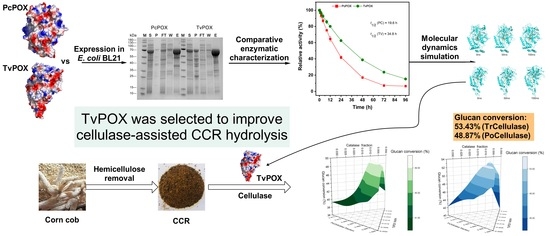
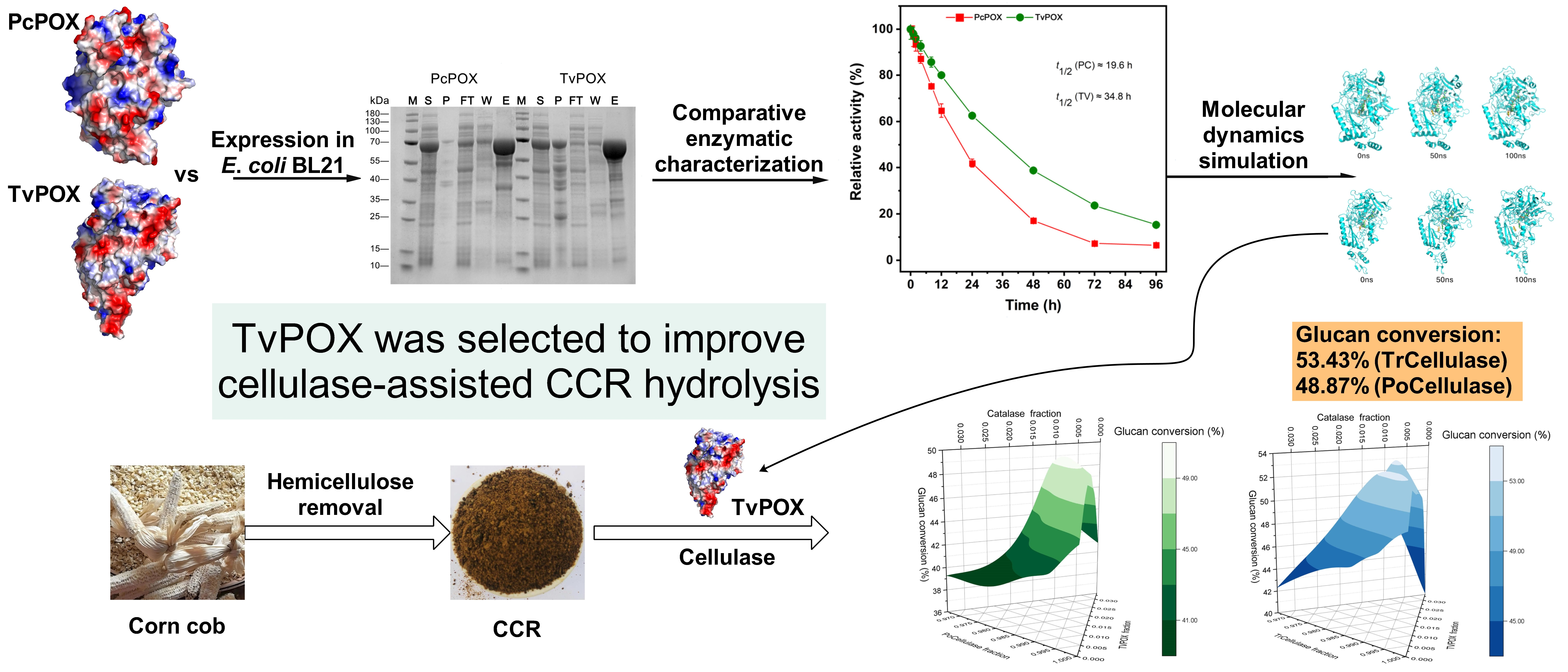
Pyranose oxidases (POXs, EC 1.1.3.10) are a class of fungal FAD-dependent oxidoreductases with potential for lignocellulosic bioconversion because they generate H2O2 during sugar oxidation. Despite their known catalytic properties, the role of these enzymes in promoting lignocellulose enzymatic saccharification remains largely unexplored. In this study, POXs from Phanerochaete chrysosporium (PcPOX) and Trametes versicolor (TvPOX) were comparatively evaluated through biochemical characterization, kinetic analysis, molecular simulation, and supplementation for lignocellulose hydrolysis. PcPOX exhibited a broader substrate spectrum and a slightly higher optimum temperature, whereas TvPOX demonstrated greater stability under acidic and hydrolysis-relevant conditions and a longer half-life at 50 °C. TvPOX also showed a numerically lower apparent Km toward D-glucose, while the apparent catalytic efficiencies were comparable between the two enzymes. Molecular simulation results suggested more stable glucose binding in TvPOX. Accordingly, TvPOX was selected for hydrolysis experiments and was shown to increase the measured glucan conversion of phosphoric acid-swollen cellulose, Avicel, and corncob residue. Mixture design analysis further indicated that this positive effect depended on balanced peroxide regulation, with low catalase supplementation providing better performance. These results identify TvPOX as a promising auxiliary enzyme for cellulase-based lignocellulosic saccharification.

Graphical Abstract

1. Introduction

Efficient conversion of lignocellulosic biomass into fermentable sugars remains constrained by biomass recalcitrance and limited enzymatic accessibility [1]. Therefore, oxidative auxiliary enzymes have attracted increasing interest because controlled redox chemistry, particularly H2O2 supply, can enhance polysaccharide deconstruction, whereas excess H2O2 may also impair enzyme performance [2]. Pyranose oxidase (POX; pyranose:oxygen 2-oxidoreductase, EC 1.1.3.10) is a fungal FAD-dependent GMC oxidoreductase that oxidizes pyranose sugars while producing H2O2, making it a promising partner in cellulase-based systems [3]. POX has also been recognized as a key H2O2-generating enzyme in white-rot fungi during lignocellulose degradation [3,4].
However, the application of POX in lignocellulosic bioconversion remains underexplored. Existing studies have shown that fungal POXs differ markedly in substrate specificity, pH preference, thermal stability, and catalytic behavior, suggesting that their performance may vary substantially under process-relevant conditions [5,6,7]. This is particularly important for biomass saccharification, which is typically performed under mildly acidic conditions at elevated temperatures and may involve residual pretreatment-derived inhibitors or other medium components that affect enzyme activity [8,9,10]. Among white-rot fungi, Phanerochaete chrysosporium and Trametes versicolor are representative lignocellulose degraders with well-characterized oxidative enzyme systems [11,12]. Nevertheless, comparative information on their POXs under hydrolysis-relevant conditions remains limited, and the structural basis for differences in glucose binding and operational behavior remains unclear.
In this study, POXs from P. chrysosporium (PcPOX) and T. versicolor (TvPOX) were comparatively investigated through sequence analysis, recombinant expression, biochemical characterization, and molecular simulation. Their catalytic properties toward glucose and their tolerance to hydrolysis-relevant conditions were systematically evaluated, and the better-performing enzyme was subsequently incorporated into cellulase-mediated hydrolysis of phosphoric acid-swollen cellulose, Avicel, and corncob residue. In addition, cellulase/POX/catalase combinations were optimized using a constrained mixture design to evaluate how peroxide generation and removal influence glucan conversion. This study provides insights into source-dependent differences in fungal POXs and offers a practical basis for integrating peroxide-generating auxiliary enzymes into cellulase-based lignocellulosic bioconversion.

2. Results and Discussion

2.1. Bioinformatic Analysis and Recombinant Expression of PcPOX and TvPOX

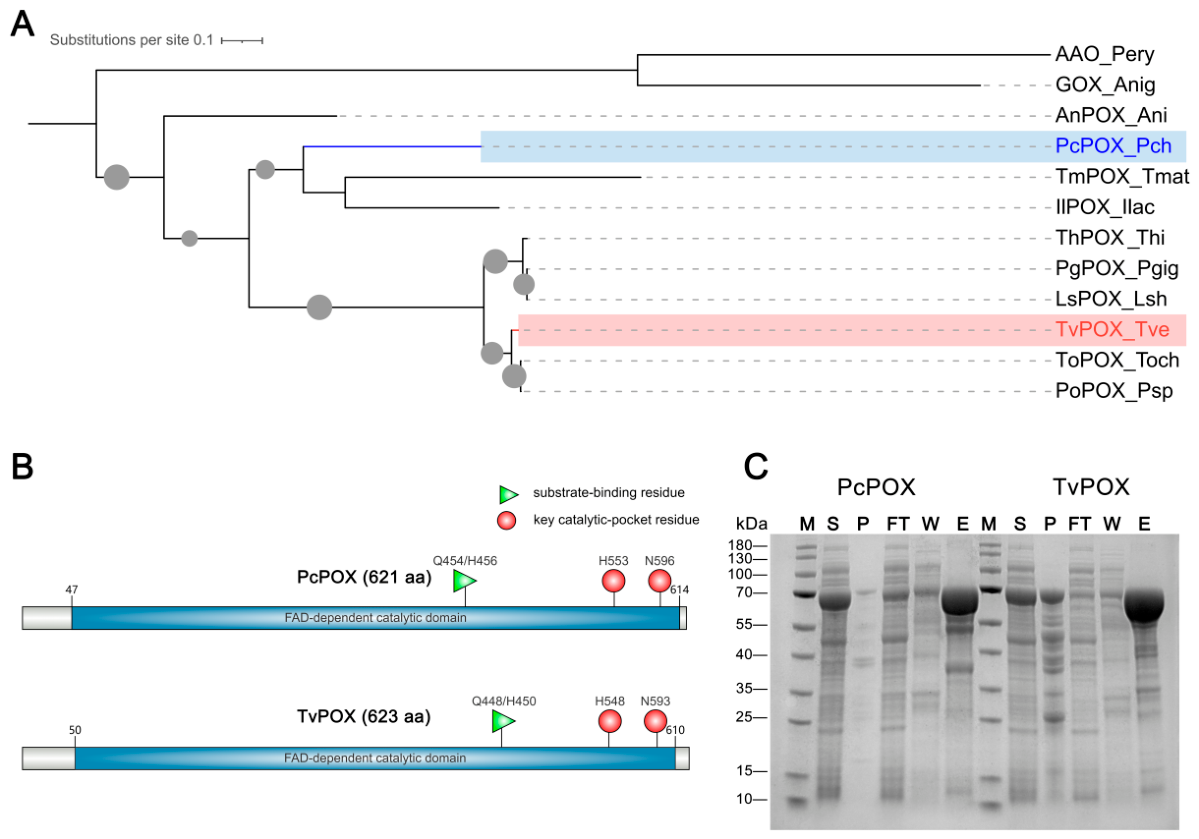
PcPOX and TvPOX were selected as representative fungal pyranose oxidases for comparative analysis. Phylogenetic analysis showed that both enzymes clustered within the fungal POX family but were distributed in distinct clades (Figure 1A), indicating evolutionary divergence despite their shared functional annotation. Both proteins exhibited a similar overall domain organization, each containing a conserved FAD-dependent catalytic domain. In addition, representative substrate-binding residues (Q454/H456 in PcPOX and Q448/H450 in TvPOX) and key catalytic pocket residues (H553/N596 in PcPOX and H548/N593 in TvPOX) were conserved (Figure 1B). These results are consistent with previous studies showing that fungal POXs share a canonical FAD-dependent catalytic framework despite species-dependent sequence diversification [3,4,5,6,13].
Recombinant expression in E. coli yielded protein bands for both enzymes at approximately 65–70 kDa, consistent with the predicted molecular masses (Figure 1C). Both proteins were predominantly present in the soluble fraction, and Ni2+ affinity chromatography efficiently enriched the target proteins, yielding elution fractions with minimal contaminating bands. These results are consistent with previous reports showing that fungal GMC oxidoreductases can be heterologously expressed in soluble form in bacterial hosts [7,14].
Quantitative analysis further showed that the total amount of purified protein PcPOX was higher than that for TvPOX (49.33 ± 0.53 vs. 36.88 ± 3.44 mg) and the total activity was also higher (10,309.15 ± 236.40 vs. 7198.26 ± 23.11 U). However, no significant difference was observed in the specific activity between the two enzymes under the tested conditions (208.97 ± 5.30 vs. 195.17 ± 18.23 U/mg). These results suggest that the primary difference between the two recombinant enzymes under the present expression conditions lies not in catalytic competence per unit protein, but in expression yield and/or folding efficiency in the heterologous host.

2.2. Comparative Biochemical Characterization

2.2.1. Effects of pH and Temperature on the Activity and Stability

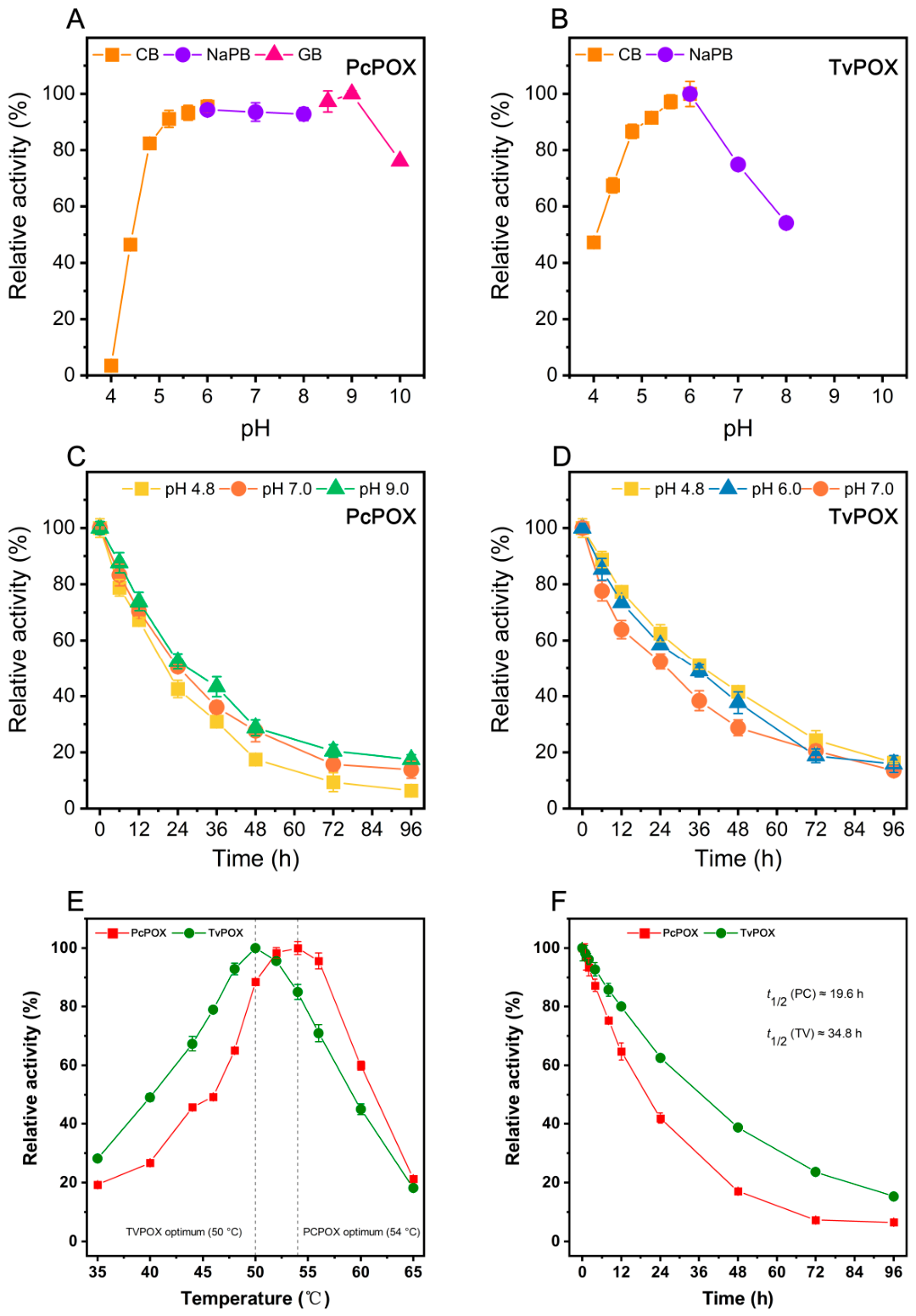
The pH–activity profiles of PcPOX and TvPOX, determined at 30 °C under standard assay conditions, were distinct. PcPOX showed negligible activity at pH 4.0, followed by a sharp increase between pH 5.0 and 8.0, reaching a maximum around pH 9.0 before declining at pH 10.0 (Figure 2A). In contrast, TvPOX maintained high activity within a narrower acidic range, primarily between pH 5.0 and 6.0, and its activity decreased substantially at higher pH values (Figure 2B). This difference indicates that PcPOX has a broader pH tolerance in terms of instantaneous catalytic activity, whereas TvPOX is better adapted to mildly acidic conditions relevant to biomass hydrolysis.
The temperature dependence of activity showed optimum temperatures of 54 °C for PcPOX and 50 °C for TvPOX (Figure 2E). Although PcPOX exhibited a slightly higher temperature optimum, thermal deactivation at 50 °C and pH 4.8 revealed a clear stability advantage for TvPOX. PcPOX deactivated more rapidly, with a kd of 0.0354 h−1 and a half-life of 19.6 h, whereas TvPOX showed a lower kd of 0.0199 h−1 and a substantially longer half-life of 34.8 h (Figure 2F). This extended half-life indicates greater persistence under hydrolysis-relevant conditions. Such source-dependent variation is consistent with the functional diversification reported for fungal POXs and related AA3/GMC oxidoreductases, where evolutionary divergence is often accompanied by differences in stability and process fitness [4,15].
From an application perspective, this distinction is particularly important. In industrial biomass saccharification, enzymes are required to function over extended periods under mildly acidic and moderately elevated temperature conditions, and operational stability can directly influence sugar release and overall process efficiency [8,16,17]. Therefore, although PcPOX exhibited broader catalytic tolerance and a slightly higher optimum temperature, the superior stability of TvPOX under hydrolysis-relevant conditions makes it a more suitable candidate for downstream saccharification applications. This observation is consistent with previous reports demonstrating substantial variation in thermostability among pyranose oxidases from different sources [18,19].

2.2.2. Substrate Specificity and Kinetic Properties

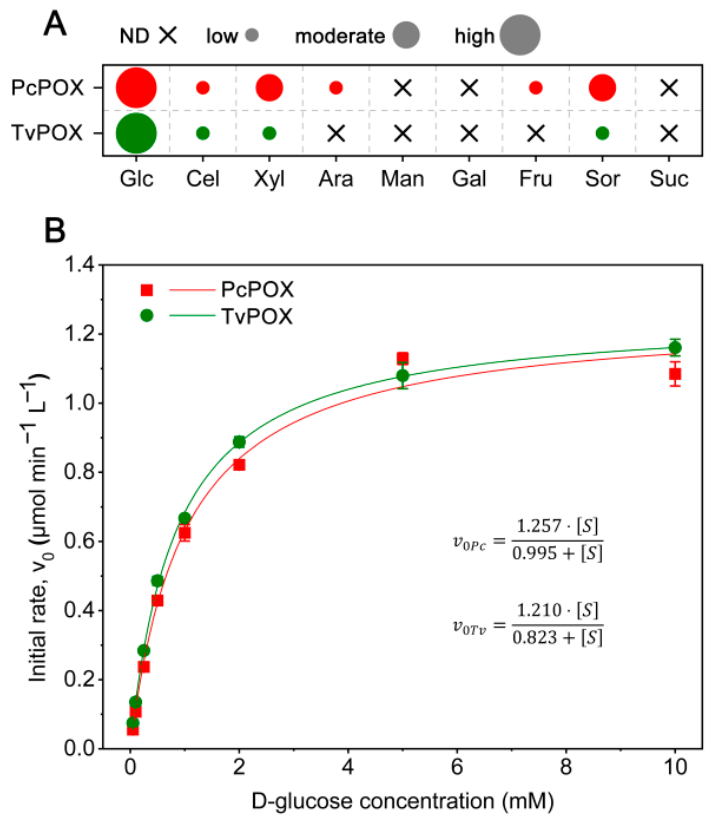
Substrate specificity assays showed that PcPOX had a broader substrate spectrum than TvPOX. PcPOX exhibited the highest activity toward D-glucose, moderate activity toward L-sorbose and D-xylose, and lower but detectable activity toward cellobiose, L-arabinose, and D-fructose. No activity was detected toward D-mannose, D-galactose, or sucrose. In contrast, TvPOX exhibited high activity almost exclusively toward D-glucose, with only weak activity toward cellobiose, D-xylose, and L-sorbose (Figure 3A). These results indicate that PcPOX is catalytically more promiscuous, whereas TvPOX shows greater specificity toward glucose. It should be noted that the substrate specificity assays were performed at pH 4.8 and 50 °C, which are hydrolysis-relevant conditions. Thus, the observed differences reflect the relative substrate preferences of the two enzymes under these common assay conditions.
Kinetic analysis of D-glucose at pH 4.8 and 50 °C showed that TvPOX displayed a numerically lower apparent Km value than PcPOX (0.823 ± 0.090 vs. 0.995 ± 0.117 mM). However, this difference was not statistically significant under the tested conditions. The apparent Vmax values were similar (1.210 ± 0.042 vs. 1.257 ± 0.045 µmol L−1·min−1 for TvPOX and PcPOX, respectively), and the corresponding apparent kcat values were also comparable (13.66 s−1 for TvPOX vs. 15.17 s−1 for PcPOX). Accordingly, the calculated catalytic efficiencies were also similar, with TvPOX showing only a slightly higher numerical value (1.66 × 10⁴ vs. 1.52 × 10⁴ M−1 s−1) (Figure 3B). Taken together, these results indicate that TvPOX and PcPOX have comparable catalytic performance toward D-glucose under the test conditions. The main advantage of TvPOX therefore appears to be its greater stability under acidic and moderately elevated temperature conditions.
This pattern is consistent with previous studies showing that fungal POXs and related AA3_2 oxidoreductases can differ substantially in substrate range, whereas D-glucose remains the preferred substrate for many well-characterized fungal POXs [4,15]. For the present application, a narrower but stronger preference for glucose may be advantageous, as glucose is abundant during cellulase-mediated cellulose deconstruction and represents the most relevant substrate for peroxide generation in saccharification systems.

2.2.3. Effects of Metal Ions, Chemical Reagents, and Ionic Liquids on the Activity

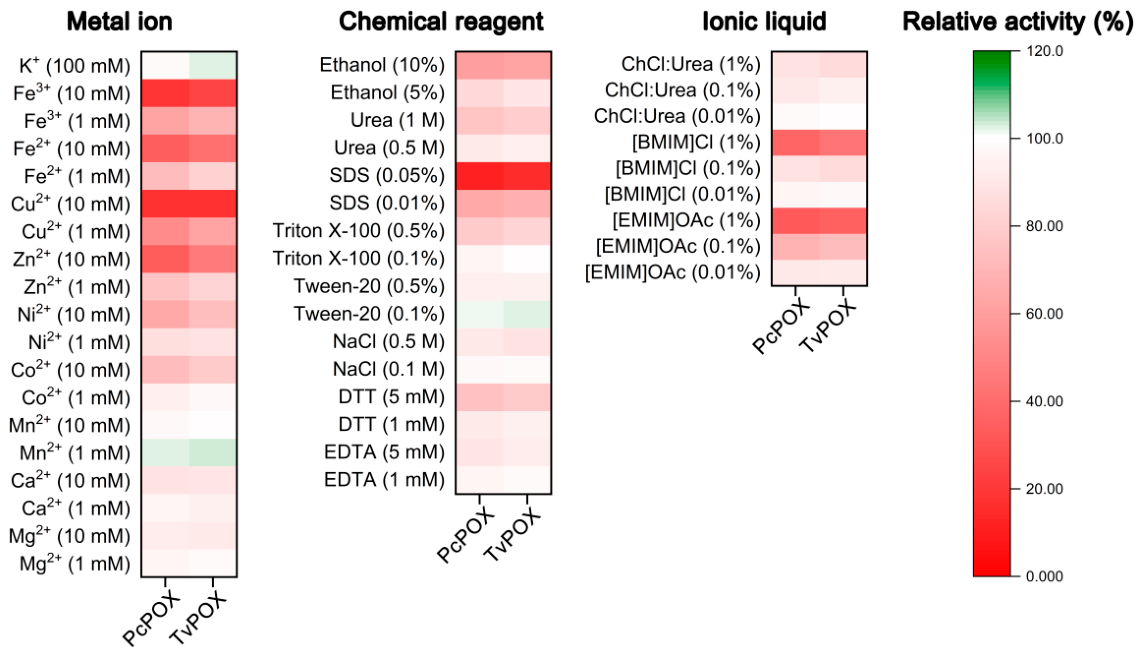
The effects of additives further differentiated the two enzymes in terms of process robustness. Mg2+ and Ca2+ caused only minimal changes in activity at both 1 and 10 mM, with relative activity remaining close to 100%. In contrast, transition metals, particularly Cu2+, Fe2+, and Fe3+, markedly inhibited both enzymes, and Fe3+ reduced activity to approximately 10–20% of the control. TvPOX showed slightly greater tolerance than PcPOX toward Zn2+ and Ni2+ (Figure 4), suggesting that it may be less sensitive to specific metal-associated perturbations.
Among chemical reagents, ethanol (10%) and SDS (0.05%) caused near-complete inactivation of both enzymes, whereas Triton X-100 caused moderate inhibition. EDTA (1–5 mM), Tween-20, and DTT had relatively minor effects. With respect to ionic liquids, both [EMIM]OAc and [BMIM]Cl reduced activity at 1% concentration, whereas lower concentrations (0.1% and 0.01%) caused only minor inhibition. Notably, ChCl: urea at 1% maintained relatively high activity, particularly for TvPOX (Figure 4).
These results indicate that TvPOX is not only more stable at acidic pH and 50 °C, but also somewhat more tolerant to several hydrolysis-relevant chemical factors. This property is particularly important in lignocellulosic biorefinery applications, where residual salts, pretreatment-derived compounds, and trace solvents may persist in hydrolysates and impair enzyme performance [20,21]. Therefore, the additive tolerance profile provides further support for selecting TvPOX for supplementation experiments in cellulase-based hydrolysis systems.

2.3. Comparative Molecular Dynamics Analysis of Glucose Binding in PcPOX and TvPOX

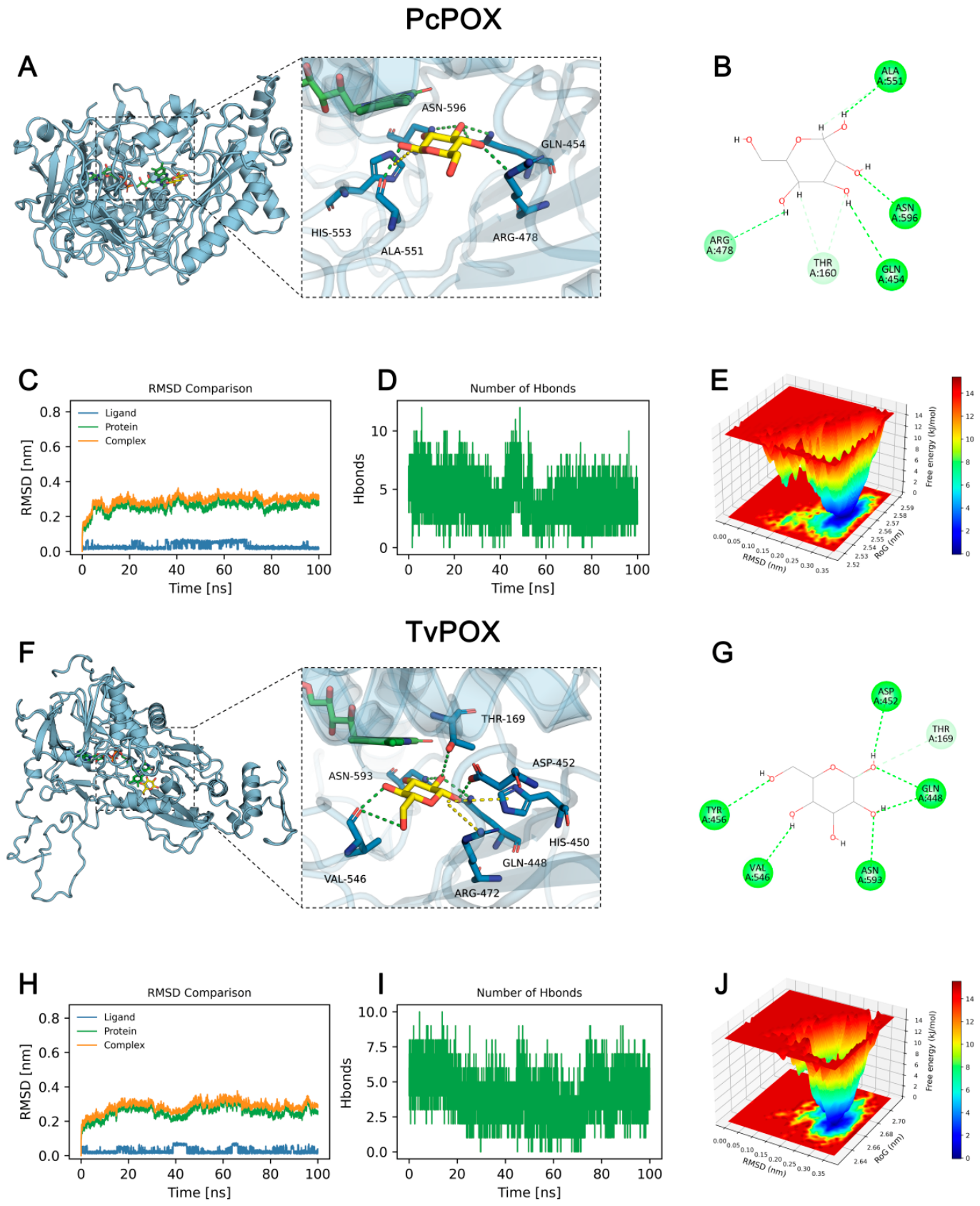
To further elucidate the kinetic differences between the two enzymes, glucose binding in PcPOX and TvPOX was analyzed using molecular docking and 100 ns molecular dynamics (MD) simulations. In PcPOX, glucose formed hydrogen bonds with Arg478, Asn596, Ala551, and Gln454, together with a polar contact involving His553 (Figure 5A,B). In TvPOX, glucose interacted with a broader set of residues, including Val546, Gln448, Asn593, Asp452, Thr169, Arg472, and His450 (Figure 5F,G), indicating a more extensive interaction network within the binding pocket.
The MD trajectories remained stable throughout the 100 ns simulations for both complexes, as shown by the RMSD profiles (Figure 5C,H). Hydrogen bond analysis nevertheless showed that protein–glucose interactions in TvPOX were somewhat more persistent than those in PcPOX (Figure 5D,I). Moreover, the free-energy landscapes of the two complexes revealed dominant low-energy basins in both cases; however, the basin for TvPOX was narrower and deeper (Figure 5E,J), supporting the presence of a more stable substrate-bound conformational state.
MM/GBSA calculations also yielded a numerically more favorable binding free energy for TvPOX (−22.16 ± 3.09 kcal·mol−1) than for PcPOX (−17.49 ± 2.92 kcal·mol−1). However, this difference should be interpreted cautiously in the absence of clear statistical significance. The computational results were broadly consistent with the experimental trend, in which TvPOX displayed a numerically lower apparent Km and a longer half-life at 50 °C, while both enzymes showed similar apparent kcat and kcat/Km values. Thus, any potential advantage of TvPOX under the tested conditions is more likely related to enhanced stability rather than to a statistically supported difference in catalytic turnover or substrate binding.
This conclusion is consistent with recent studies on fungal AA3/GMC oxidoreductases, which show that substrate recognition and binding behavior are strongly influenced by structural diversification in the substrate-binding region [7,15]. Taken together, the computational and kinetic results support the view that TvPOX is better suited than PcPOX to function as a glucose-responsive, peroxide-generating auxiliary enzyme in cellulose hydrolysis systems.

2.4. Synergistic Effect of Pyranose Oxidase and Cellulase on Cellulose Hydrolysis

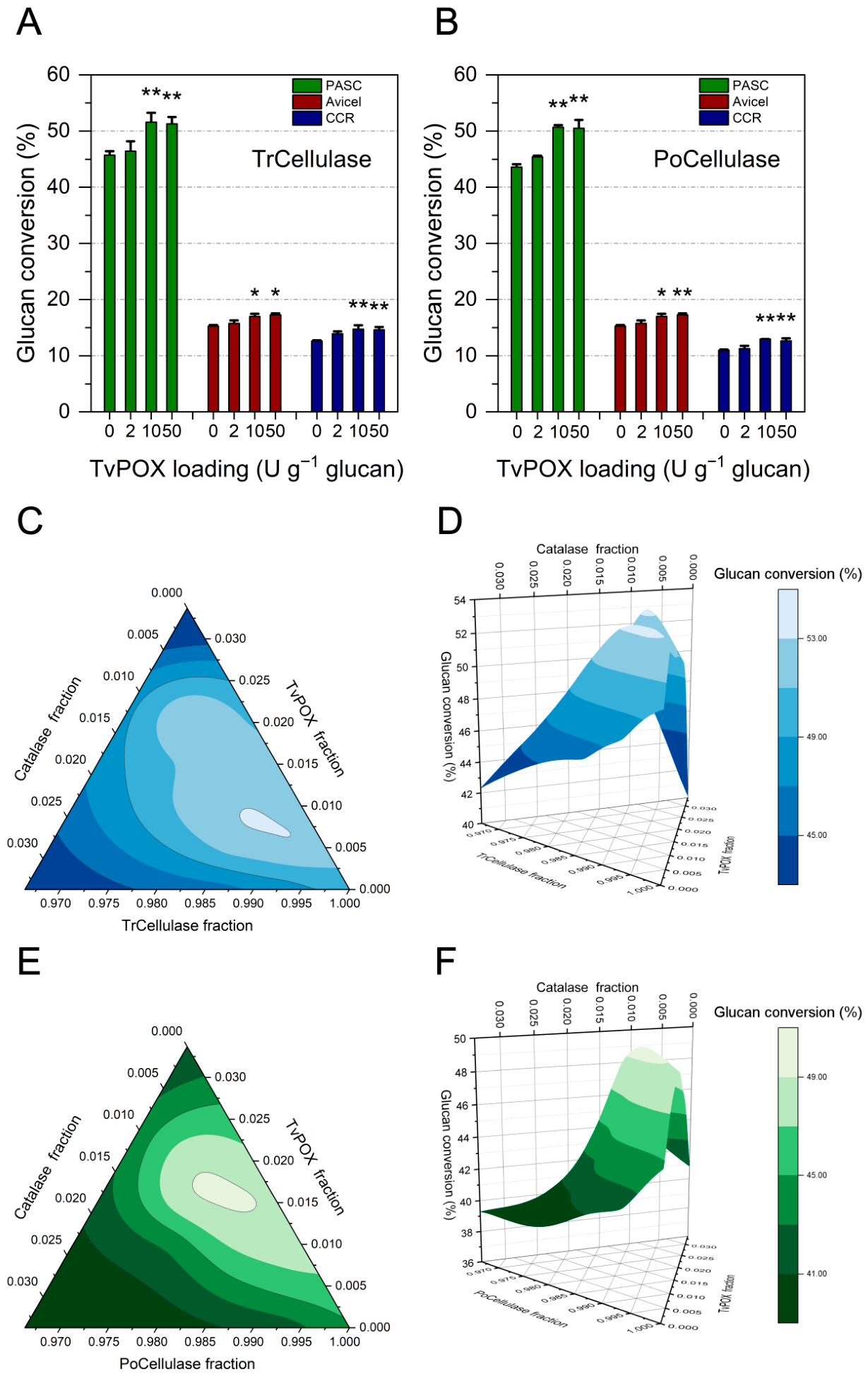
Based on the superior stability and process tolerance of TvPOX, this enzyme was selected for cellulase supplementation experiments. To assess whether its promoting effect was conserved across cellulase systems with different enzymatic backgrounds, two cellulase preparations, TrCellulase from Trichoderma reesei and PoCellulase from Penicillium oxalicum, were evaluated in parallel. TvPOX enhanced cellulase-mediated hydrolysis of all three tested substrates, namely PASC, Avicel, and CCR, in both the TrCellulase and PoCellulase systems (Figure 6A,B). At 10 U TvPOX g−1 glucan, glucan conversion in the TrCellulase system increased from 45.7% to 51.6% for PASC, from 14.97% to 17.16% for Avicel, and from 12.60% to 14.72% for CCR. A similar enhancement was observed in the PoCellulase system, where glucan conversion increased from 43.6% to 50.7% for PASC, from 15.26% to 17.01% for Avicel, and from 14.66% to 17.26% for CCR. However, increasing the TvPOX dosage to 50 U g−1 glucan did not result in further improvement, indicating that the beneficial effect of TvPOX is dosage-dependent rather than directly proportional to enzyme loading.
These results indicate that moderate TvPOX supplementation enhances cellulase-based saccharification across substrates with varying structural complexity and that this positive effect is not restricted to a single cellulase preparation. A plausible explanation is that TvPOX-generated H2O2 may support H2O2-dependent oxidative cleavage by lytic polysaccharide monooxygenases (LPMOs), which are copper-dependent auxiliary enzymes that oxidatively cleave glycosidic bonds in recalcitrant cellulose and thereby improve substrate accessibility to classical cellulases, particularly in the more cellulose-centered systems represented by PASC and Avicel [2,22,23]. Under this scenario, a controlled supply of H2O2 could enhance cellulose deconstruction, whereas excessive peroxide accumulation may accelerate enzyme inactivation and disrupt the balance of the hydrolysis system [24,25]. This interpretation is consistent with previous studies showing that H2O2 can act as an efficient co-substrate for LPMO-catalyzed oxidative cleavage and that LPMO action can promote cellulose fibrillation, cellulase adsorption, and saccharification efficiency [2,23,26]. For the lignocellulosic substrate CCR, an additional substrate-specific mechanism should also be considered, because the enhancement observed in this system may not be explained solely by cellulose-centered oxidative cleavage. Besides the possible LPMO-assisted oxidative cleavage of cellulose, TvPOX-generated H2O2 may also participate in peroxidase-mediated and/or radical-mediated oxidation of lignin or lignin-derived phenolics, which could partially disrupt the lignin-carbohydrate matrix and improve cellulose accessibility to hydrolytic enzymes [27,28]. This possibility is mechanistically distinct from the situation in pure cellulosic substrates such as PASC and Avicel. However, because LPMO activity, peroxidase activity, radical intermediates, and oxidation products derived from cellulose or lignin were not directly measured in the present study, these pathways are discussed here as plausible interpretations rather than direct experimental proof. In addition, because hydrolysis efficiency in this study was evaluated based on released glucose in the hydrolysate, the measured glucan conversion should be interpreted with some caution. Since D-glucose is also a substrate of pyranose oxidase, part of the released glucose may have been further oxidized during hydrolysis in the TvPOX-supplemented systems. Possible oxidation products were not quantified in the present study. Therefore, the reported glucan conversion values represent net glucose accumulation rather than a complete product balance, meaning that the true extent of substrate depolymerization may have been underestimated in the POX-containing systems.
To further clarify the balance between peroxide generation and removal, a constrained mixture design was applied using CCR hydrolysis in the presence of cellulase, TvPOX, and catalase, and the design matrix together with the corresponding glucan conversion values is shown in Table 1. In the TrCellulase system, glucan conversion increased from 49.83% in the cellulase-only control to 53.46% at a TrCellulase/TvPOX/catalase ratio of 9.729/0.205/0.066 mg protein g−1. In the PoCellulase system, glucan conversion increased from 44.71% to 49.31% at 9.813/0.154/0.033 mg protein g−1 (Figure 6C–F). In contrast, catalase alone reduced glucan conversion in both systems, with values of 45.92–47.58% for TrCellulase and 40.95–41.85% for PoCellulase, indicating that excessive peroxide removal is detrimental when no additional peroxide-generating auxiliary enzyme is present.
Importantly, when catalase was combined with low levels of TvPOX, glucan conversion exceeded that of the cellulase-only control, whereas higher catalase loading (0.132 mg protein g−1) again reduced performance. The fitted mixture models were significant for both systems (p = 0.038 for TrCellulase and p = 0.005 for PoCellulase), and the cellulase × TvPOX and TvPOX × catalase interactions were significant, whereas the cellulase × catalase interaction was not or only marginally significant (Table 2 and Table 3). Model-based optimization predicted optimal formulations of 9.830/0.122/0.048 mg protein g−1 for the TrCellulase system and 9.820/0.149/0.031 mg protein g−1 for the PoCellulase system, corresponding to predicted glucan conversions of 53.43% and 48.87%, respectively.
These findings strongly indicate that the positive effect of TvPOX depends on controlled peroxide regulation rather than maximal peroxide production. A moderate level of catalase may help prevent excessive H2O2 accumulation and thereby protect the enzymatic system, whereas excessive catalase may suppress the oxidative contribution required for improved hydrolysis. Therefore, the beneficial role of TvPOX in saccharification appears to arise from its ability to supply peroxide in a controlled manner, which may support different oxidative contributions depending on substrate type and can be further tuned by limited catalase addition. Overall, these results support the view that TvPOX is not only biochemically more robust than PcPOX but also a more suitable candidate for integration into cellulase-based lignocellulosic biomass conversion systems.

3. Materials and Methods

3.1. Sequence Retrieval, Phylogenetic Analysis, and Conserved-Residue Annotation

The amino acid sequences of PcPOX from P. chrysosporium, TvPOX from T. versicolor, representative fungal pyranose oxidases, and two non-POX GMC oxidoreductases were retrieved from UniProt using the corresponding accession numbers. Detailed information on the sequences used in the phylogenetic analysis is provided in Table S1. Multiple sequence alignment was performed using the MAFFT online server (https://mafft.cbrc.jp/alignment/server/, accessed on 15 June 2025) with default settings. Phylogenetic analysis was conducted using the NGPhylogeny.fr platform (https://ngphylogeny.fr/, accessed on 15 June 2025, Advanced workflow). After alignment curation with trimAl, a maximum-likelihood phylogenetic tree was generated using PhyML with Smart Model Selection (SMS). Arylalcohol oxidase from Pleurotus eryngii and glucose oxidase from Aspergillus niger were used as outgroups, and the resulting tree was exported in Newick format and visualized using iTOL (https://itol.embl.de/, accessed on 17 June 2025).
Protein domain organization was analyzed using InterPro (https://www.ebi.ac.uk/interpro/, accessed on 18 June 2025). Representative substrate-binding and catalytic pocket residues were identified based on sequence alignment and comparison with previously characterized fungal pyranose oxidases.

3.2. Gene Synthesis, Heterologous Expression, and Purification of Recombinant PcPOX and TvPOX

The coding sequences of PcPOX and TvPOX were synthesized with codon optimization for Escherichia coli expression and cloned into the pET-22b(+) vector using NdeI and XhoI restriction sites. Internal restriction sites were removed during gene synthesis. The resulting plasmids encoded C-terminal His-tagged proteins and were transformed into E. coli BL21 via heat shock, with transformants selected on LB agar containing 100 mg L−1 ampicillin.
For protein expression, a single colony was inoculated into 5 mL LB medium supplemented with 100 mg L−1 ampicillin and cultured overnight at 37 °C and 220 rpm. The culture was then transferred to 1 L LB medium containing ampicillin and grown at 37 °C until the OD600 reached 0.6–0.8. Protein expression was induced with 0.3 mM IPTG at 18 °C for 12–16 h. Cells were harvested by centrifugation at 8000 rpm for 10 min at 4 °C.
Cell pellets were resuspended in 100 mM potassium phosphate buffer (pH 8.0) containing 250 mM NaCl and 5% (w/v) glycerol, and lysed by sonication on ice. Insoluble debris was removed by centrifugation at 12,000 rpm for 1.5 h at 4 °C, and the supernatant was collected for purification.
Recombinant PcPOX and TvPOX were purified using Ni-NTA resin. The lysate was incubated with pre-equilibrated resin at 4 °C for 1.5 h, washed with 30 mM imidazole in KPi buffer, and eluted with 250 mM imidazole. Eluted proteins were concentrated and desalted by ultrafiltration, flash-frozen in liquid nitrogen, and stored at −80 °C until use.
Protein purity and molecular weight were verified by 12% SDS-PAGE, and protein concentrations were determined using the Bradford method with bovine serum albumin as the standard.

3.3. Enzyme Activity Assays

3.3.1. POX Activity Assay

POX activity was determined using an HRP-coupled hydrogen peroxide assay with D-glucose as the substrate. Unless otherwise stated, the reaction mixture contained 50 mM potassium phosphate buffer (pH 6.5), 100 mM D-glucose, 1 mM ABTS, 2 U horseradish peroxidase, and an appropriate amount of enzyme in a total volume of 1.0 mL. The reaction was carried out at 30 °C for 3 min, and the increase in absorbance at 420 nm was monitored spectrophotometrically. One unit (U) of POX activity was defined as the amount of enzyme required to oxidize 2 μmol of ABTS per min under the assay conditions [6].

3.3.2. Catalase Activity Assay

Catalase activity was measured using a commercial catalase activity assay kit (Beyotime Institute of Biotechnology, Haimen, Jiangsu, China) according to the manufacturer’s instructions. One unit (U) of catalase activity was defined as the amount of enzyme that consumes 1 μmol H2O2 per min under the assay conditions.

3.3.3. Filter Paper Activity Assay

Filter paper activity (FPA) of cellulase preparations was measured using Whatman No. 1 filter paper as the substrate. Reducing sugars released during hydrolysis were quantified using the dinitrosalicylic acid (DNS) method with glucose as the standard. FPA was determined according to the IUPAC-recommended cellulase assay procedure and expressed as filter paper units (FPU). One FPU was defined as the amount of enzyme required to release 1 μmol of glucose equivalent per min under the assay conditions [29]. Cellulase loadings used in hydrolysis experiments were calculated on this basis.

3.4. Biochemical Characterization of PcPOX and TvPOX

3.4.1. Effect of pH on Enzyme Activity and Stability

The effect of pH on PcPOX and TvPOX activity was determined at 30 °C under the standard assay conditions, using citrate buffer (CB), sodium phosphate buffer (NaPB), and glycine–NaOH buffer (GB) over a pH range of 4.0–10.0. The activity measured at each pH was normalized to the maximum value for the corresponding enzyme, which was set to 100%.
For pH stability analysis, PcPOX was incubated at pH 4.8, 7.0, and 9.0, whereas TvPOX was incubated at pH 4.8, 6.0, and 7.0, using the corresponding buffers. Enzyme samples were incubated at 50 °C for up to 96 h. Aliquots were withdrawn at the indicated time points, and residual activity was measured under standard assay conditions. Residual activity was expressed as a percentage of the initial activity.

3.4.2. Temperature Optimum and Thermal Deactivation Kinetics

The effect of temperature on PcPOX and TvPOX activity was determined under standard assay conditions at temperatures ranging from 35 to 65 °C. The activity at each temperature was normalized to the maximum activity of the corresponding enzyme, which was set to 100%.
Thermal stability was evaluated by pre-incubating the enzymes in citrate buffer (pH 4.8) at 50 °C. Samples were withdrawn at the indicated time points, and residual activity was measured under standard assay conditions. Thermal deactivation kinetics were fitted to a first-order model:
A t = A 0 e k d t
where A t is the residual activity at time t , A 0 is the initial activity, and k d is the deactivation rate constant. The half-life ( t 1 / 2 ) was calculated as:
t 1 / 2 = ln 2 / k d

3.4.3. Substrate Specificity and Kinetic Analysis

Substrate specificity of PcPOX and TvPOX was evaluated at pH 4.8 and 50 °C using D-glucose, cellobiose, D-xylose, L-arabinose, D-mannose, D-galactose, D-fructose, L-sorbose, and sucrose as substrates (100 mM). Enzyme activities were measured under these assay conditions and expressed relative to the activity toward D-glucose, which was set to 100% for each enzyme.
Kinetic parameters toward D-glucose were determined at pH 4.8 and 50 °C. Apparent initial reaction rates were estimated from H2O2 formation during the first 3 min of the reaction using D-glucose concentrations ranging from 0.05 to 10 mM. The enzyme loading was 0.02 U mL−1. The kinetic data were fitted to the Michaelis–Menten equation by nonlinear regression:
v = V m a x [ S ] K m + [ S ]
where v is the initial reaction rate, [ S ] is the substrate concentration, V m a x is the maximum reaction rate, and K m is the Michaelis constant. Apparent k c a t values were calculated from V m a x based on the molar enzyme subunits (active sites), using a theoretical subunit molecular mass of approximately 69 kDa deduced from the amino acid sequence of the recombinant enzyme. Apparent catalytic efficiency was expressed as k c a t / K m .

3.4.4. Effects of Metal Ions, Chemical Reagents, and Ionic Liquids

The effects of metal ions, chemical reagents, and ionic liquids on the activity of PcPOX and TvPOX were evaluated under standard assay conditions in the presence of the tested additives. Metal ions were added at final concentrations of 1 and 10 mM. Chemical reagents and ionic liquids were tested at the concentrations indicated in Figure 4. Enzyme activity was measured immediately after the addition of each additive to the reaction system. Activity in the absence of additives was defined as 100%, and relative activity was expressed as a percentage of this value.

3.5. Molecular Docking and Molecular Dynamics Simulation

The same computational workflow was applied to PcPOX and TvPOX. Protein-ligand complex structures with D-glucose were first predicted using Boltz-2 [30]. The top-ranked docking pose was selected based on model confidence and the geometrical plausibility of ligand binding. The resulting complex served as the initial structure for an all-atom molecular dynamics (MD) simulation in AMBER 24 [31]. Ligand parameters were generated with antechamber using the AM1-BCC charge model, and the ligand and protein were described using the GAFF2 and ff14SB force fields, respectively. Each system was solvated in a TIP3P water box and neutralized with K+/Cl ions [32].
Following energy minimization, the system was gradually heated to 298.15 K, equilibrated under NVT and NPT conditions, and subsequently subjected to a 100 ns production run. Binding free energies were estimated using the MM/GBSA method based on trajectories from 90 to 100 ns [33]. The total binding free energy was decomposed into van der Waals, electrostatic, polar solvation, and nonpolar solvation contributions. Entropic contributions were not included.

3.6. Enzymatic Hydrolysis of Cellulosic Substrates

Phosphoric acid-swollen cellulose (PASC) was prepared from Avicel PH-101 (microcrystalline cellulose, Sigma-Aldrich, St. Louis, MO, USA) as previously described [34]. After preparation, PASC was thoroughly washed with deionized water to neutral pH and stored at 4 °C until use. Avicel PH-101 was used directly as received without further treatment. Corncob residue (CCR) was used as the lignocellulosic substrate and refers to the solid residue obtained after hemicellulose extraction from corncob [35]. Prior to enzymatic hydrolysis, CCR was dried, milled, and sieved to a particle size of 0.30–0.45 mm.
The effect of TvPOX supplementation on cellulase-mediated hydrolysis was evaluated using PASC, Avicel, and CCR as substrates. Hydrolysis reactions were carried out in 50 mM citrate buffer (pH 4.8) at 50 °C for 24 h with shaking at 50 rpm. Substrate loadings were 10 g L−1 for PASC, 20 g L−1 for Avicel, and 50 g L−1 for CCR. These substrate loadings were selected based on previous studies and adjusted according to the properties of the different substrates [36,37,38]. Two cellulase preparations, TrCellulase from Trichoderma reesei and PoCellulase from Penicillium oxalicum (both provided by Baiyin Sainuo Biotechnology Co., Ltd., Baiyin, China), were used as two different cellulolytic backgrounds. Previous proteomic analysis of related P. oxalicum and T. reesei cellulase preparations showed that both systems contained major cellulolytic components, including CBH, EG, BG, and detectable LPMO, although their relative proportions differed [39]. However, the detailed composition of the specific TrCellulase and PoCellulase batches used in the present study was not independently characterized. In the hydrolysis experiments, the two cellulase preparations were used at 10 FPU g−1 glucan, and TvPOX was supplemented at 0, 2, 10, and 50 U g−1 glucan.
At the end of hydrolysis, the reaction mixtures were centrifuged at 12,000× g for 10 min, and the released glucose in the supernatant was quantified by HPLC equipped with an Aminex HPX-87P column and a refractive index detector. Glucan conversion was calculated based on released glucose only, whereas oxidized soluble products potentially generated in the presence of TvPOX were not quantified. Glucan conversion was calculated based on the initial glucan content of the substrate according to the following equation:
G l u c a n   c o n v e r s i o n   ( % ) = G l u c o s e r e l e a s e d S u b s t r a t e w e i g h t × G l u c a n c o n t e n t × 0.9 × 100
where 0.9 is the conversion factor from glucose to anhydroglucose units in glucan.

3.7. Mixture Design and Optimization of Cellulase/TvPOX/Catalase Formulations

A constrained mixture design was employed to optimize the proportions of cellulase, TvPOX, and catalase during CCR hydrolysis. Hydrolysis reactions were conducted at pH 4.8 for 72 h using 50 g L−1 CCR and a fixed total protein loading of 10 mg protein g−1 glucan to ensure comparability among formulations and economic feasibility. Cellulase was used as the major component, whereas TvPOX and catalase were varied at lower proportions to evaluate their auxiliary roles in peroxide regulation and removal during hydrolysis. The TvPOX range was defined based on the results in Figure 6 and its specific activity (195.17 ± 18.23 U mg−1). In each mixture, TrCellulase (or PoCellulase), TvPOX, and catalase (C6319, Macklin, Shanghai, China) were varied according to the experimental design. Glucan conversion was used as the response variable. The mixture design matrix and the corresponding glucan conversion values for the TrCellulase- and PoCellulase-based systems are summarized in Table 1.
The experimental data were fitted to a quadratic mixture model, and model significance was evaluated by analysis of variance (ANOVA). Contour plots and three-dimensional response surfaces were generated to visualize the effects of enzyme proportions and to identify the optimal formulation. The regression statistics for the TrCellulase/TvPOX/catalase and PoCellulase/TvPOX/catalase systems are presented in Table 2 and Table 3, respectively.

3.8. Statistical Analysis

All experiments were performed in triplicate unless otherwise stated, and results are presented as the mean ± standard deviation. Statistical significance was evaluated using one-way analysis of variance (ANOVA) followed by appropriate post hoc tests, or by Student’s t-test where applicable. Differences were considered statistically significant at p < 0.05. Kinetic parameters were obtained by nonlinear regression, and thermal deactivation data were fitted to a first-order exponential decay model.

4. Conclusions

This study comparatively evaluated PcPOX and TvPOX, demonstrating clear source-dependent differences in their biochemical properties and application potential. Although both enzymes shared conserved catalytic features, TvPOX exhibited greater stability under acidic and hydrolysis-relevant conditions, along with slightly stronger glucose binding, as supported by kinetic analysis and molecular simulations. Based on these advantages, TvPOX was selected for cellulase-based lignocellulose hydrolysis, and consistently enhanced glucan conversion of PASC, Avicel, and corncob residue. Moreover, constrained mixture design showed that the beneficial effect of TvPOX depends on balanced peroxide regulation, with low catalase supplementation further enhancing hydrolysis performance, whereas excessive peroxide removal or the absence of TvPOX is less favorable. Overall, these results identify TvPOX as a more suitable fungal POX for integration into cellulase-based lignocellulosic bioconversion and provide a practical basis for developing peroxide-regulated auxiliary enzyme systems for biomass saccharification.

Supplementary Materials

The following supporting information can be downloaded at: https://www.mdpi.com/article/10.3390/catal16050371/s1, Table S1: Amino acid sequences used for phylogenetic analysis of fungal pyranose oxidases and outgroup GMC oxidoreductases.

Author Contributions

X.-L.H.: Methodology, Formal analysis, Writing—original draft. Z.-M.W.: Investigation, Formal analysis. W.-H.X.: Data curation, Formal analysis. Z.-Y.L.: Software, Visualization. W.-X.S.: Methodology, Supervision, Funding acquisition. G.-D.L.: Resources, Writing—review and editing, Funding acquisition. All authors have read and agreed to the published version of the manuscript.

Funding

This work was supported by the Shandong Provincial Natural Science Foundation (ZR2022MC116, ZR2020MC157, and ZR2024YQ058), the National Natural Science Foundation of China (32570084), the SKLMT Frontiers and Challenges Project (SKLMTFCP-2023-04), and the Intramural Joint Program Fund of the State Key Laboratory of Microbial Technology (SKLMTIJP-2024-10 and SKLMTIJP-2025-2).

Institutional Review Board Statement

Not applicable.

Data Availability Statement

The raw data supporting the conclusions of this article will be made available by the authors on request.

Conflicts of Interest

The authors declare no conflicts of interest.

References

  1. Li, Y.; Song, W.; Han, X.; Wang, Y.; Rao, S.; Zhang, Q.; Zhou, J.; Li, J.; Liu, S.; Du, G. Recent progress in key lignocellulosic enzymes: Enzyme discovery, molecular modifications, production, and enzymatic biomass saccharification. Bioresour. Technol. 2022, 363, 127986. [Google Scholar] [CrossRef] [PubMed]
  2. Bissaro, B.; Rohr, A.K.; Muller, G.; Chylenski, P.; Skaugen, M.; Forsberg, Z.; Horn, S.J.; Vaaje-Kolstad, G.; Eijsink, V.G.H. Oxidative cleavage of polysaccharides by monocopper enzymes depends on H2O2. Nat. Chem. Biol. 2017, 13, 1123–1128. [Google Scholar] [CrossRef] [PubMed]
  3. Giffhorn, F. Fungal pyranose oxidases: Occurrence, properties and biotechnical applications in carbohydrate chemistry. Appl. Microbiol. Biotechnol. 2000, 54, 727–740. [Google Scholar] [CrossRef]
  4. Abrera, A.T.; Sutzl, L.; Haltrich, D. Pyranose oxidase: A versatile sugar oxidoreductase for bioelectrochemical applications. Bioelectrochemistry 2020, 132, 107409. [Google Scholar] [CrossRef]
  5. Artolozaga, M.J.; Kubatova, E.; Volc, J.; Kalisz, H.M. Pyranose 2-oxidase from Phanerochaete chrysosporium—Further biochemical characterisation. Appl. Microbiol. Biotechnol. 1997, 47, 508–514. [Google Scholar] [CrossRef]
  6. Leitner, C.; Volc, J.; Haltrich, D. Purification and characterization of pyranose oxidase from the white rot fungus Trametes multicolor. Appl. Environ. Microbiol. 2001, 67, 3636–3644. [Google Scholar] [CrossRef]
  7. Sutzl, L.; Foley, G.; Gillam, E.M.J.; Boden, M.; Haltrich, D. The GMC superfamily of oxidoreductases revisited: Analysis and evolution of fungal GMC oxidoreductases. Biotechnol. Biofuels 2019, 12, 118. [Google Scholar] [CrossRef]
  8. Basera, P.; Chakraborty, S.; Sharma, N. Lignocellulosic biomass: Insights into enzymatic hydrolysis, influential factors, and economic viability. Discov. Sustain. 2024, 5, 311. [Google Scholar] [CrossRef]
  9. Bensah, E.C.; Mensah, M. Chemical pretreatment methods for the production of cellulosic ethanol: Technologies and innovations. Int. J. Chem. Eng. 2013, 2013, 719607. [Google Scholar] [CrossRef]
  10. Zhang, H.; Han, L.; Dong, H. An insight to pretreatment, enzyme adsorption and enzymatic hydrolysis of lignocellulosic biomass: Experimental and modeling studies. Renew. Sustain. Energy Rev. 2021, 140, 110758. [Google Scholar] [CrossRef]
  11. Machado, A.S.; Valadares, F.; Silva, T.F.; Milagres, A.M.F.; Segato, F.; Ferraz, A. The secretome of Phanerochaete chrysosporium and Trametes versicolor grown in microcrystalline cellulose and use of the enzymes for hydrolysis of lignocellulosic materials. Front. Bioeng. Biotechnol. 2020, 8, 826. [Google Scholar] [CrossRef] [PubMed]
  12. Tisma, M.; Znidarsic-Plazl, P.; Selo, G.; Tolj, I.; Speranda, M.; Bucic-Kojic, A.; Planinic, M. Trametes versicolor in lignocellulose-based bioeconomy: State of the art, challenges and opportunities. Bioresour. Technol. 2021, 330, 124997. [Google Scholar] [CrossRef]
  13. Daniel, G.; Volc, J.; Kubatova, E. Pyranose oxidase, a major source of H2O2 during wood degradation by Phanerochaete chrysosporium, Trametes versicolor, and Oudemansiella mucida. Appl. Environ. Microbiol. 1994, 60, 2524–2532. [Google Scholar] [CrossRef]
  14. Maresova, H.; Vecerek, B.; Hradska, M.; Libessart, N.; Becka, S.; Saniez, M.H.; Kyslik, P. Expression of the pyranose 2-oxidase from Trametes pubescens in Escherichia coli and characterization of the recombinant enzyme. J. Biotechnol. 2005, 120, 387–395. [Google Scholar] [CrossRef]
  15. Zhao, H.; Karppi, J.; Mototsune, O.; Poshina, D.; Svartstrom, J.; Nguyen, T.T.M.; Vo, T.M.; Tsang, A.; Master, E.; Tenkanen, M. Substrate specificity mapping of fungal CAZy AA3_2 oxidoreductases. Biotechnol. Biofuels Bioprod. 2024, 17, 47. [Google Scholar] [CrossRef]
  16. Chaudhari, Y.B.; Varnai, A.; Sorlie, M.; Horn, S.J.; Eijsink, V.G.H. Engineering cellulases for conversion of lignocellulosic biomass. Protein Eng. Des. Sel. 2023, 36, gzad002. [Google Scholar] [CrossRef]
  17. Wang, K.; Shen, Z.; Wang, X.; Li, Z.; Cheng, S. Advances in enhancing the enzymatic saccharification process of lignocellulosic biomasses for bioethanol production. Biomass Bioenergy 2024, 191, 107450. [Google Scholar] [CrossRef]
  18. Santema, L.L.; Rozeboom, H.J.; Borger, V.P.; Kaya, S.G.; Fraaije, M.W. Identification of a robust bacterial pyranose oxidase that displays an unusual pH dependence. J. Biol. Chem. 2024, 300, 107885. [Google Scholar] [CrossRef] [PubMed]
  19. Spadiut, O.; Nguyen, T.T.; Haltrich, D. Thermostable variants of pyranose 2-oxidase showing altered substrate selectivity for glucose and galactose. J. Agric. Food Chem. 2010, 58, 3465–3471. [Google Scholar] [CrossRef] [PubMed]
  20. Ovejero-Perez, A.; Nakasu, P.Y.S.; Hopson, C.; Costa, J.M.; Hallett, J.P. Challenges and opportunities on the utilisation of ionic liquid for biomass pretreatment and valorisation. npj Mater. Sustain. 2024, 2, 7. [Google Scholar] [CrossRef] [PubMed]
  21. Pereira, E.; Pereira, D.T.V.; Rabelo, S.C.; Ceriani, R.; da Costa, A.C. Green solvent pretreatments for lignocellulosic biorefineries: A review. J. Environ. Chem. Eng. 2025, 13, 115303. [Google Scholar] [CrossRef]
  22. Ma, L.; Zhu, C.; Han, Y.; Yin, Y.; Lou, S.; Liu, J.; Yang, Y.; Gao, J.; Wang, M.; Meng, X. Characteristic of a lytic polysaccharide monooxygenase MsLPMO2 from Morchella sextelata exhibiting ability to degrade cellulose by oxidation. Chem. Eng. J. 2025, 503, 158631. [Google Scholar] [CrossRef]
  23. Moon, M.; Lee, J.P.; Park, G.W.; Lee, J.S.; Park, H.J.; Min, K. Lytic polysaccharide monooxygenase (LPMO)-derived saccharification of lignocellulosic biomass. Bioresour. Technol. 2022, 359, 127501. [Google Scholar] [CrossRef] [PubMed]
  24. Chorozian, K.; Karnaouri, A.; Georgaki-Kondyli, N.; Karantonis, A.; Topakas, E. Assessing the role of redox partners in TthLPMO9G and its mutants: Focus on H2O2 production and interaction with cellulose. Biotechnol. Biofuels Bioprod. 2024, 17, 19. [Google Scholar] [CrossRef]
  25. Kadic, A.; Varnai, A.; Eijsink, V.G.H.; Horn, S.J.; Liden, G. In situ measurements of oxidation-reduction potential and hydrogen peroxide concentration as tools for revealing LPMO inactivation during enzymatic saccharification of cellulose. Biotechnol. Biofuels 2021, 14, 46. [Google Scholar] [CrossRef]
  26. Eibinger, M.; Sattelkow, J.; Ganner, T.; Plank, H.; Nidetzky, B. Single-molecule study of oxidative enzymatic deconstruction of cellulose. Nat. Commun. 2017, 8, 894. [Google Scholar] [CrossRef]
  27. Kumar, A.; Arora, P.K. Biotechnological Applications of Manganese Peroxidases for Sustainable Management. Front. Environ. Sci. 2022, 10, 875157. [Google Scholar] [CrossRef]
  28. Kumar, A.; Chandra, R. Ligninolytic enzymes and its mechanisms for degradation of lignocellulosic waste in environment. Heliyon 2020, 6, e03170. [Google Scholar] [CrossRef]
  29. Ghose, T.K. Measurement of cellulase activities. Pure Appl. Chem. 1987, 59, 257–268. [Google Scholar] [CrossRef]
  30. Passaro, S.; Corso, G.; Wohlwend, J.; Reveiz, M.; Thaler, S.; Somnath, V.R.; Getz, N.; Portnoi, T.; Roy, J.; Stark, H.; et al. Boltz-2: Towards accurate and efficient binding affinity prediction. bioRxiv 2025. [Google Scholar] [CrossRef]
  31. Salomon-Ferrer, R.; Case, D.A.; Walker, R.C. An overview of the Amber biomolecular simulation package. WIREs Comput. Mol. Sci. 2012, 3, 198–210. [Google Scholar] [CrossRef]
  32. Maier, J.A.; Martinez, C.; Kasavajhala, K.; Wickstrom, L.; Hauser, K.E.; Simmerling, C. ff14SB: Improving the accuracy of protein side chain and backbone parameters from ff99SB. J. Chem. Theory Comput. 2015, 11, 3696–3713. [Google Scholar] [CrossRef]
  33. Genheden, S.; Ryde, U. The MM/PBSA and MM/GBSA methods to estimate ligand-binding affinities. Expert Opin. Drug Discov. 2015, 10, 449–461. [Google Scholar] [CrossRef] [PubMed]
  34. Vaaje-Kolstad, G.; Westereng, B.; Horn, S.J.; Liu, Z.; Zhai, H.; Sorlie, M.; Eijsink, V.G. An oxidative enzyme boosting the enzymatic conversion of recalcitrant polysaccharides. Science 2010, 330, 219–222. [Google Scholar] [CrossRef]
  35. Zhao, X.; Zhang, L.; Liu, D. Comparative study on chemical pretreatment methods for improving enzymatic digestibility of crofton weed stem. Bioresour. Technol. 2008, 99, 3729–3736. [Google Scholar] [CrossRef]
  36. Bunterngsook, B.; Eurwilaichitr, L.; Thamchaipenet, A.; Champreda, V. Binding characteristics and synergistic effects of bacterial expansins on cellulosic and hemicellulosic substrates. Bioresour. Technol. 2015, 176, 129–135. [Google Scholar] [CrossRef] [PubMed]
  37. Lou, H.; Zeng, M.; Hu, Q.; Cai, C.; Lin, X.; Qiu, X.; Yang, D.; Pang, Y. Nonionic surfactants enhanced enzymatic hydrolysis of cellulose by reducing cellulase deactivation caused by shear force and air-liquid interface. Bioresour. Technol. 2018, 249, 1–8. [Google Scholar] [CrossRef] [PubMed]
  38. Wang, Y.; Li, K.; Li, M.; Lv, S.; Wang, Y.; Liu, H.; Zhong, Y. Improvement of the capacity to hydrolyze corncob residues through deciphering the lignocellulolytic enzyme system of a hyper-cellulolytic mutant strain Trichoderma reesei CU7-4. Biotechnol. Biofuels Bioprod. 2025, 18, 105. [Google Scholar] [CrossRef]
  39. Song, W.; Han, X.; Qian, Y.; Liu, G.; Yao, G.; Zhong, Y.; Qu, Y. Proteomic analysis of the biomass hydrolytic potentials of Penicillium oxalicum lignocellulolytic enzyme system. Biotechnol. Biofuels 2016, 9, 68. [Google Scholar] [CrossRef]
Figure 1. Phylogenetic analysis of representative fungal pyranose oxidases (A), domain organization and representative functional residues of PcPOX and TvPOX (B), and SDS-PAGE analysis of recombinant expression and purification (C). In panel A, the blue and red labels highlight PcPOX and TvPOX, respectively; grey circles indicate internal nodes, with sizes proportional to bootstrap support values, and dashed lines are for label alignment. M, molecular weight marker; S, supernatant; P, pellet; FT, flow-through; W, wash; E, elution. The major protein band in the elution fraction appeared at approximately 65–70 kDa based on comparison with the protein marker.
Catalysts 16 00371 g001
Figure 2. pH dependence of activity (A,B), pH stability (C,D), temperature dependence of activity (E), and thermal stability at 50 °C and pH 4.8 (F) for recombinant PcPOX and TvPOX. Data are shown as mean ± SD (n = 3).
Catalysts 16 00371 g002
Figure 3. Substrate specificity of PcPOX and TvPOX toward different sugars (A) and Michaelis-Menten kinetics toward D-glucose (B). Glc, D-glucose; Cel, cellobiose; Xyl, D-xylose; Ara, L-arabinose; Man, D-mannose; Gal, D-galactose; Fru, D-fructose; Sor, L-sorbose; Suc, sucrose. Data are shown as mean ± SD (n = 3).
Catalysts 16 00371 g003
Figure 4. Effects of metal ions, chemical reagents, and ionic liquids on the relative activity of PcPOX and TvPOX.
Catalysts 16 00371 g004
Figure 5. Comparative docking and molecular dynamics analyses of glucose binding in PcPOX (AE) and TvPOX (FJ), including predicted binding modes (A,F), two-dimensional interaction maps (B,G), RMSD profiles during 100 ns simulations (C,H), time-dependent changes in hydrogen bonds (D,I), and free energy landscapes (E,J). Green dashed lines indicate hydrogen bonds, and labeled residues represent amino acids involved in substrate interactions.
Catalysts 16 00371 g005
Figure 6. Effects of TvPOX supplementation on glucan conversion of different cellulosic substrates with TrCellulase (A) and PoCellulase (B), and contour and three-dimensional response surfaces of glucan conversion from CCR in the TrCellulase/TvPOX/catalase (C,D) and PoCellulase/TvPOX/catalase (E,F) systems. Asterisks indicate statistically significant differences compared with the corresponding cellulase-only control (* p < 0.05, ** p < 0.01).
Catalysts 16 00371 g006
Table 1. Mixture design matrix and glucan conversion of CCR hydrolysis with TrCellulase or PoCellulase supplemented by TvPOX and catalase.
Cellulase
(mg/g Glucan)
TvPOX
(mg/g Glucan)
Catalase
(mg/g Glucan)
Glucan Conversion (%)
TrCellulasePoCellulase
10.0000.0000.00049.83 ± 0.3544.71 ± 0.81
9.8680.0000.13245.92 ± 0.7440.95 ± 0.41
9.7950.2050.00050.49 ± 0.0647.02 ± 0.51
9.6630.2050.13248.35 ± 0.8743.02 ± 0.03
9.9340.0000.06647.58 ± 0.2941.85 ± 0.65
9.8980.1030.00051.63 ± 0.9947.94 ± 0.92
9.7290.2050.06653.46 ± 1.0448.52 ± 0.83
9.7660.1030.13251.09 ± 1.1243.41 ± 0.28
9.8320.1030.06652.92 ± 0.3947.67 ± 0.35
9.9160.0510.03353.35 ± 0.0446.35 ± 0.33
9.8500.0510.09952.19 ± 0.5344.38 ± 0.43
9.8130.1540.03352.19 ± 0.4049.31 ± 0.14
9.7470.1540.09950.74 ± 0.4448.74 ± 0.29
The total protein loading was fixed at 10 mg/g glucan in all runs. Glucan conversion values for the two cellulase systems were obtained using the same mixture design matrix. Cellulase refers to TrCellulase in the TrCellulase system and PoCellulase in the PoCellulase system.
Table 2. Mixture regression statistics for glucan conversion in the TrCellulase/TvPOX/catalase system during CCR hydrolysis.
Analysis of VariancedfSeq SSAdj SSAdj MSFp
Regression548.609748.60979.72194.450.038
Linear217.297630.639815.31997.010.021
Quadratic331.312131.312110.43744.780.041
TrCellulase × TvPOX19.666216.993616.99367.780.027
TrCellulase × Catalase12.10277.97717.97713.650.098
TvPOX × Catalase119.543219.543219.54328.950.020
Residual error715.292415.29242.1846
Total1263.9021
Table 3. Mixture regression statistics for glucan conversion in the PoCellulase/TvPOX/catalase system during CCR hydrolysis.
Analysis of VariancedfSeq SSAdj SSAdj MSFp
Regression581.906081.906016.38129.630.005
Linear257.179724.583812.29197.220.020
Quadratic324.726424.72648.24214.840.039
PoCellulase × TvPOX19.775912.391212.39127.280.031
PoCellulase × Catalase10.44457.63407.63404.490.072
TvPOX × Catalase114.506014.506014.50608.520.022
Residual error711.913411.91341.7019
Total1293.8194
Disclaimer/Publisher’s Note: The statements, opinions and data contained in all publications are solely those of the individual author(s) and contributor(s) and not of MDPI and/or the editor(s). MDPI and/or the editor(s) disclaim responsibility for any injury to people or property resulting from any ideas, methods, instructions or products referred to in the content.