

Polyaniline-Encapsulated Cu-NA-MOFs: Facile Synthesis and Dual-Role Electrocatalytic Activity


Abstract
1. Introduction
2. Experimental Approach
2.1. Reagents and Apparatus
2.2. Preparation of Polyaniline@Cu-NA-MOF Nanocomposite
2.2.1. Synthesis Polyaniline
2.2.2. Synthesis of Copper-Based Organic Framework (Cu-NA-MOF)
2.2.3. Synthesis of PANI@CuNA-MOF Nanocomposite
2.2.4. Electrical Conductivity Behavior of the PANI@Cu-NA-MOF Nanocomposite
2.3. Characterization
2.4. Water-Splitting Studies
3. Results and Discussions
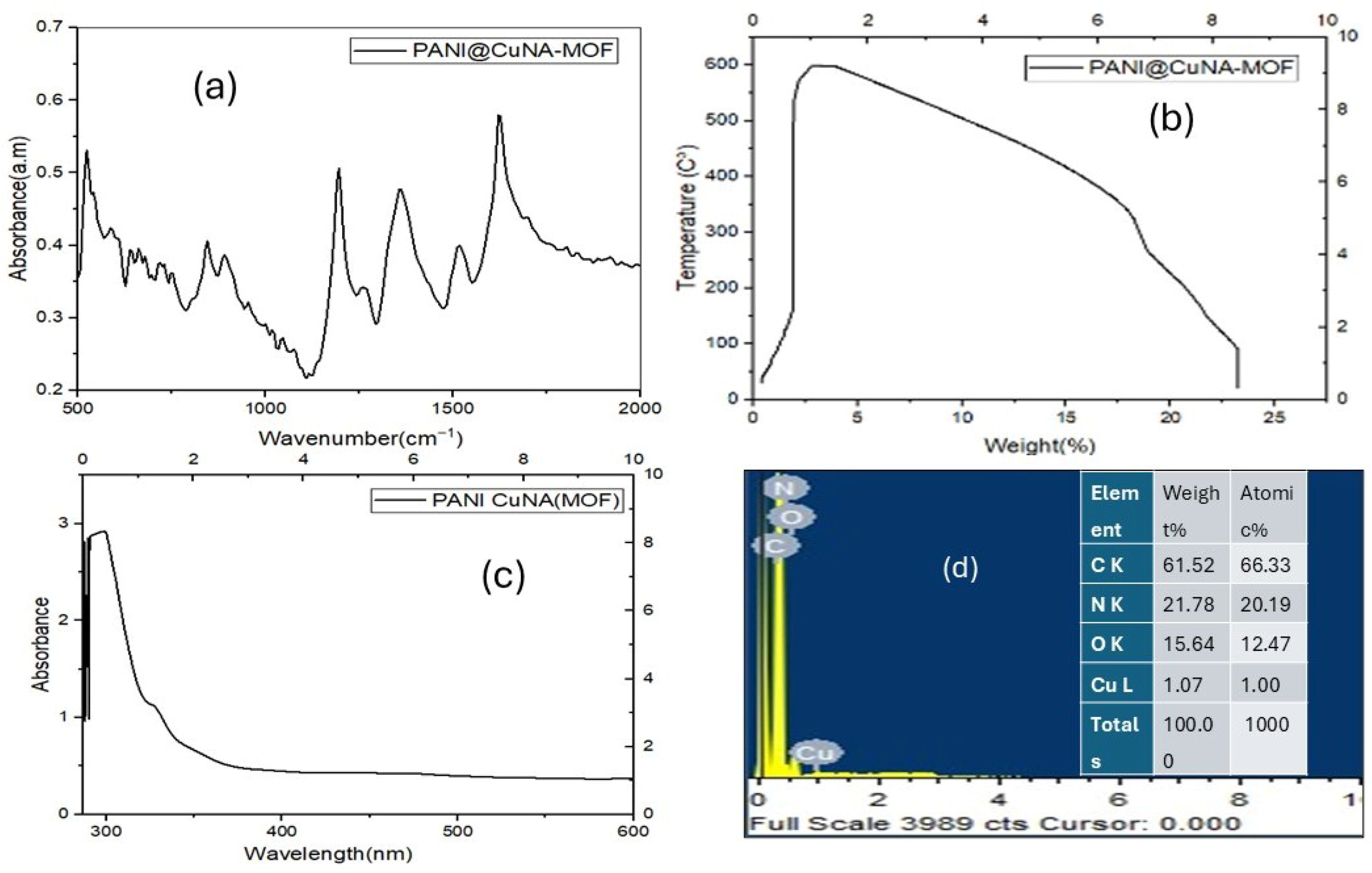
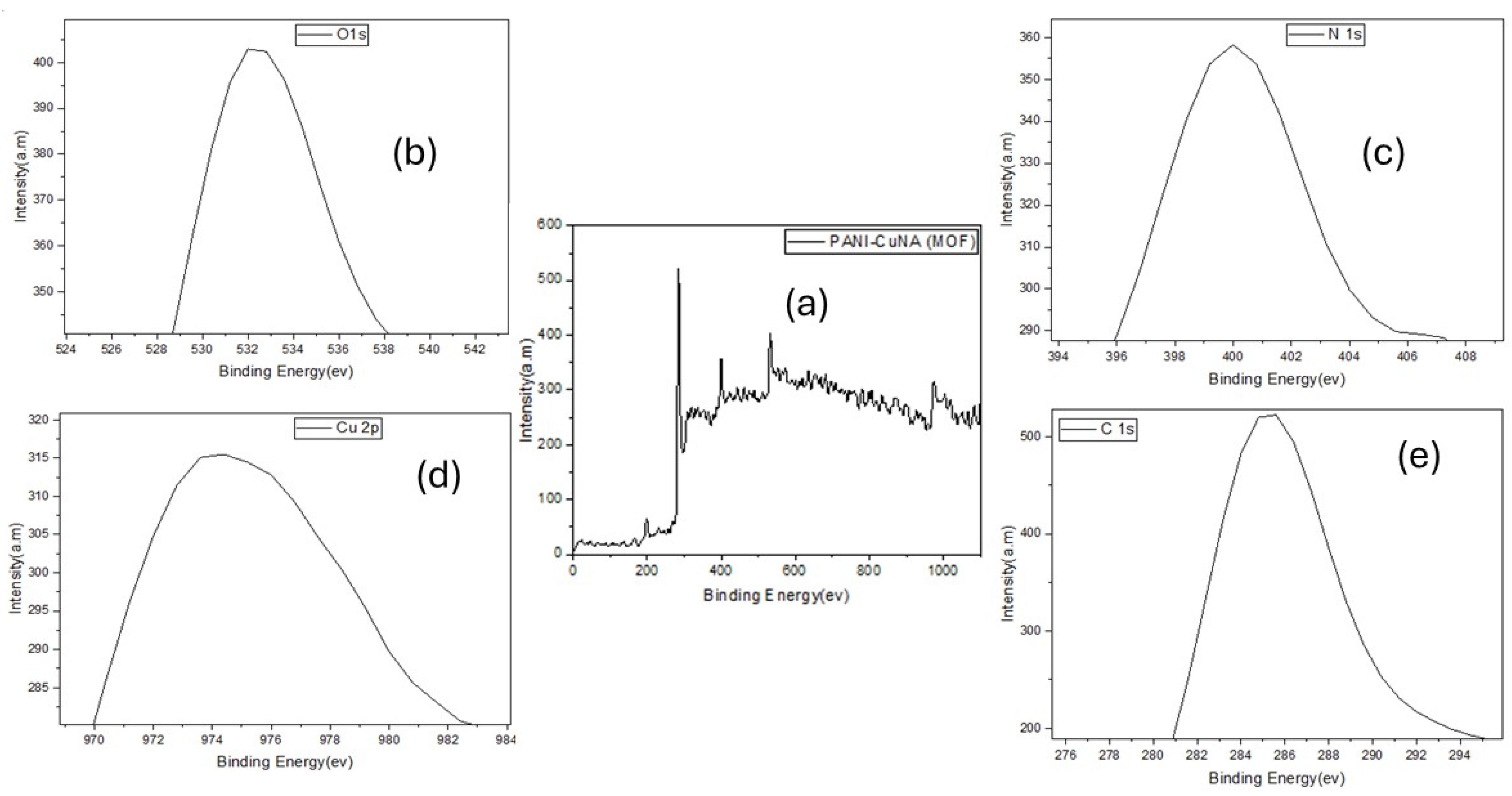
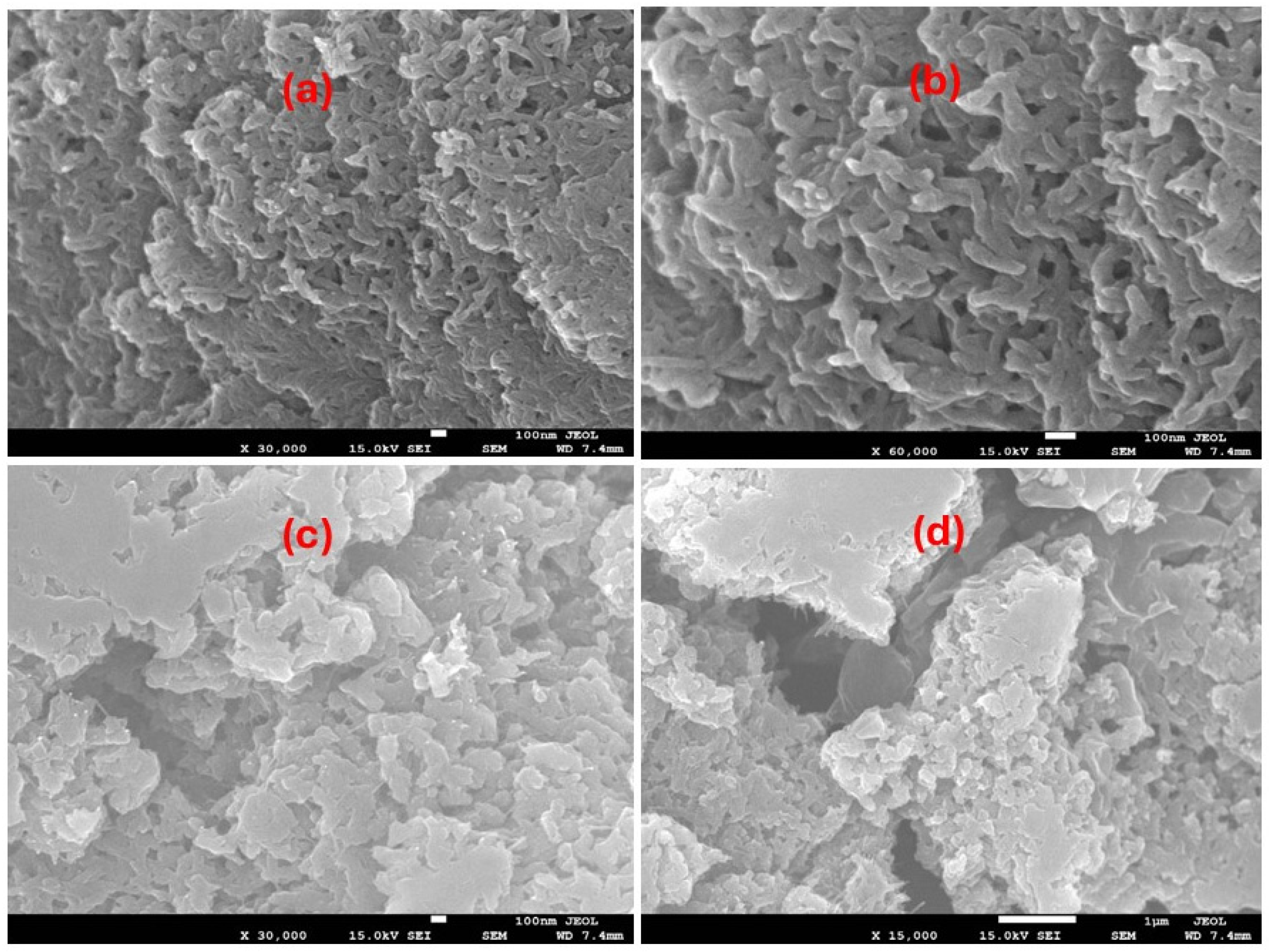
3.1. Characterization
3.2. Electrical Conductivity Study
3.3. Catalytic Study
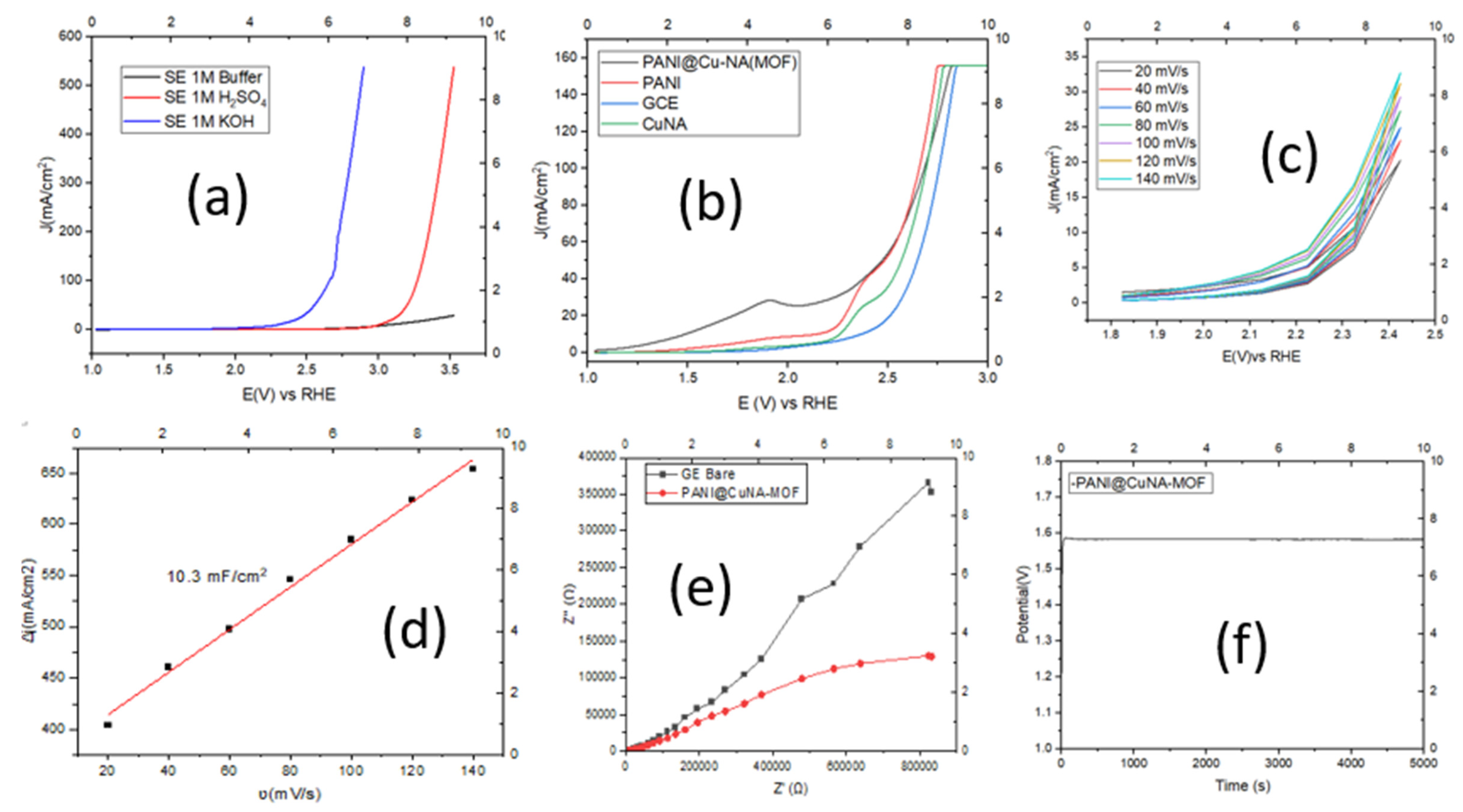
3.3.1. Oxygen Evaluation Reaction of PANI@CuNA-MOF Catalyst
- i.
- M + H2O → M–OH + H+ + e−—initial adsorption and first oxidation
- ii.
- M–OH → M–O + H+ + e−—formation of surface oxide
- iii.
- M–O + H2O → M–OOH + H+ + e−—rate-limiting O–O bond formation
- iv.
- M–OOH → M + O2 + H+ + e−—oxygen release and catalyst regeneration
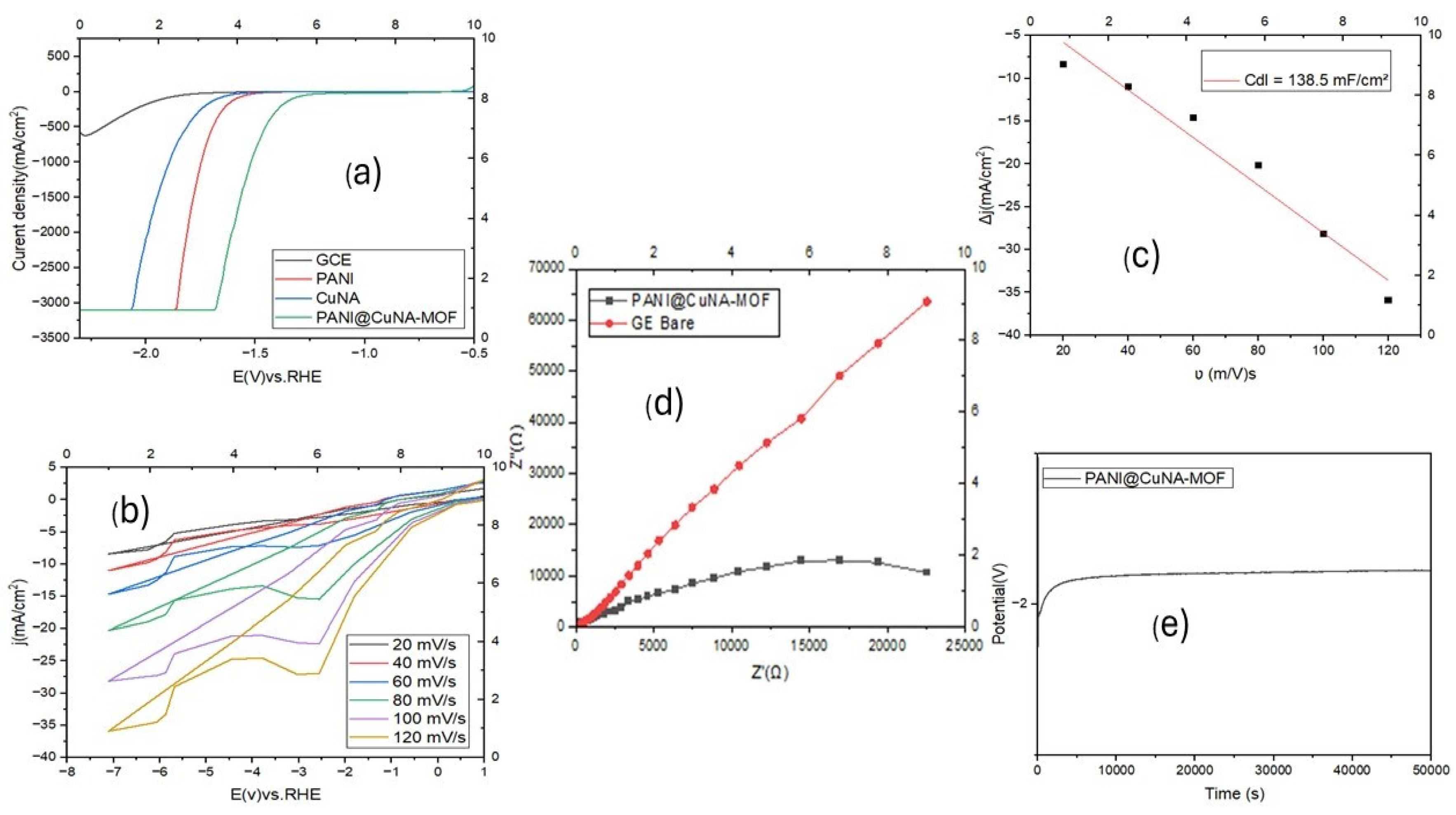
3.3.2. Hydrogen Evolution Reaction (HER) Activity of PANI@CuNA-MOF Catalyst
4. Conclusions
Author Contributions
Funding
Data Availability Statement
Acknowledgments
Conflicts of Interest
References
- Chu, S.; Majumdar, A. Opportunities and challenges for a sustainable energy future. Nature 2012, 488, 294–303. [Google Scholar] [CrossRef] [PubMed]
- Turner, J.A. Sustainable Hydrogen Production. Science 2024, 305, 972–974. [Google Scholar] [CrossRef] [PubMed]
- Seh, Z.W.; Kibsgaard, J.; Dickens, C.F.; Chorkendorff, I.; Nørskov, J.K.; Jaramillo, T.F. Combining theory and experiment in electrocatalysis: Insights into materials design. Science 2017, 355, eaad4998. [Google Scholar] [CrossRef]
- Mallouk, T.E. Divide and conquer. Nat. Chem. 2013, 5, 362–363. [Google Scholar] [CrossRef] [PubMed]
- Yang, J.Y.; Smith, S.E.; Liu, T.; Dougherty, W.G.; Hoffert, W.A.; Kassel, W.S.; DuBois, M.R.; DuBois, D.L.; Bullock, R.M. Two Pathways for Electrocatalytic Oxidation of Hydrogen by a Nickel Bis(diphosphine) Complex with Pendant Amines in the Second Coordination Sphere. J. Am. Chem. Soc. 2013, 135, 9700–9712. [Google Scholar] [CrossRef]
- McCrory, C.C.L.; Jung, S.; Ferrer, I.M.; Chatman, S.M.; Peters, J.C.; Jaramillo, T.F. Benchmarking Hydrogen Evolving Reaction and Oxygen Evolving Reaction Electrocatalysts for Solar Water Splitting Devices. J. Am. Chem. Soc. 2015, 137, 4347–4357. [Google Scholar] [CrossRef]
- Roger, I.; Shipman, M.A.; Symes, M.D. Earth-abundant catalysts for electrochemical and photoelectrochemical water splitting. Nat. Rev. Chem. 2017, 1, 0003. [Google Scholar] [CrossRef]
- Reier, T.; Oezaslan, M.; Strasser, P. Electrocatalytic Oxygen Evolution Reaction (OER) on Ru, Ir, and Pt Catalysts: A Comparative Study of Nanoparticles and Bulk Materials. ACS Catal. 2012, 2, 1765–1772. [Google Scholar] [CrossRef]
- Sheng, W.; Zhuang, Z.; Gao, M.; Zheng, J.; Chen, J.G.; Yan, Y. Correlating hydrogen oxidation and evolution activity on platinum at different pH with measured hydrogen binding energy. Nat. Commun. 2015, 6, 5848. [Google Scholar] [CrossRef]
- Jamesh, M.-I.; Sun, X. Recent progress on earth abundant electrocatalysts for oxygen evolution reaction (OER) in alkaline medium to achieve efficient water splitting—A review. J. Power Sources 2018, 400, 31–68. [Google Scholar] [CrossRef]
- Kibsgaard, J.; Chorkendorff, I. Considerations for the scaling-up of water splitting catalysts. Nat. Energy 2019, 4, 430–433. [Google Scholar] [CrossRef]
- Suen, N.-T.; Hung, S.-F.; Quan, Q.; Zhang, N.; Xu, Y.-J.; Chen, H.M. Electrocatalysis for the oxygen evolution reaction: Recent development and future perspectives. Chem. Soc. Rev. 2017, 46, 337–365. [Google Scholar] [CrossRef]
- You, B.; Sun, Y. Innovative Strategies for Electrocatalytic Water Splitting. Acc. Chem. Res. 2018, 51, 1571–1580. [Google Scholar] [CrossRef] [PubMed]
- Lyons, M.E.G.; Brandon, M.P. The significance of electrochemical impedance spectra recorded during active oxygen evolution for oxide covered Ni, Co and Fe electrodes in alkaline solution. J. Electroanal. Chem. 2009, 631, 62–70. [Google Scholar] [CrossRef]
- Fabbri, E.; Habereder, A.; Waltar, K.; Kötz, R.; Schmidt, T.J. Developments and perspectives of oxide-based catalysts for the oxygen evolution reaction. Catal. Sci. Technol. 2014, 4, 3800–3821. [Google Scholar] [CrossRef]
- Song, F.; Hu, X. Exfoliation of layered double hydroxides for enhanced oxygen evolution catalysis. Nat. Commun. 2014, 5, 4477. [Google Scholar] [CrossRef]
- Ledendecker, M.; Calderón, S.K.; Papp, C.; Steinrück, H.; Antonietti, M.; Shalom, M. The Synthesis of Nanostructured Ni 5 P 4 Films and their Use as a Non-Noble Bifunctional Electrocatalyst for Full Water Splitting. Angew. Chemie Int. Ed. 2015, 54, 12361–12365. [Google Scholar] [CrossRef]
- Muzaffar, N.; Afzal, A.M.; Hegazy, H.H.; Iqbal, M.W. Recent advances in two-dimensional metal-organic frameworks as an exotic candidate for the evaluation of redox-active sites in energy storage devices. J. Energy Storage 2023, 64, 107142. [Google Scholar] [CrossRef]
- Wang, H.; Lee, J.-M. Recent advances in structural engineering of MXene electrocatalysts. J. Mater. Chem. A 2020, 8, 10604–10624. [Google Scholar] [CrossRef]
- Zhang, Z.; Liu, J.; Wang, J.; Wang, Q.; Wang, Y.; Wang, K.; Wang, Z.; Gu, M.; Tang, Z.; Lim, J.; et al. Single-atom catalyst for high-performance methanol oxidation. Nat. Commun. 2021, 12, 5235. [Google Scholar] [CrossRef]
- Kong, D.; Wang, H.; Cha, J.J.; Pasta, M.; Koski, K.J.; Yao, J.; Cui, Y. Synthesis of MoS 2 and MoSe 2 Films with Vertically Aligned Layers. Nano Lett. 2013, 13, 1341–1347. [Google Scholar] [CrossRef] [PubMed]
- Zhang, J.; Wang, T.; Pohl, D.; Rellinghaus, B.; Dong, R.; Liu, S.; Zhuang, X.; Feng, X. Interface Engineering of MoS2/Ni3S2 Heterostructures for Highly Enhanced Electrochemical Overall-Water-Splitting Activity. Angew. Chemie Int. Ed. 2016, 55, 6702–6707. [Google Scholar] [CrossRef] [PubMed]
- Vrubel, H.; Hu, X. Molybdenum Boride and Carbide Catalyze Hydrogen Evolution in both Acidic and Basic Solutions. Angew. Chemie Int. Ed. 2012, 51, 12703–12706. [Google Scholar] [CrossRef] [PubMed]
- Louie, M.W.; Bell, A.T. An Investigation of Thin-Film Ni–Fe Oxide Catalysts for the Electrochemical Evolution of Oxygen. J. Am. Chem. Soc. 2013, 135, 12329–12337. [Google Scholar] [CrossRef]
- Tian, J.; Liu, Q.; Asiri, A.M.; Sun, X. Self-Supported Nanoporous Cobalt Phosphide Nanowire Arrays: An Efficient 3D Hydrogen-Evolving Cathode over the Wide Range of pH 0–14. J. Am. Chem. Soc. 2014, 136, 7587–7590. [Google Scholar] [CrossRef]
- Anantharaj, S.; Ede, S.R.; Karthick, K.; Sankar, S.S.; Sangeetha, K.; Karthik, P.E.; Kundu, S. Precision and correctness in the evaluation of electrocatalytic water splitting: Revisiting activity parameters with a critical assessment. Energy Environ. Sci. 2018, 11, 744–771. [Google Scholar] [CrossRef]
- Jiao, L.; Jiang, H.-L. Metal-organic frameworks for catalysis: Fundamentals and future prospects. Chin. J. Catal. 2023, 45, 1–5. [Google Scholar] [CrossRef]
- Wang, Q.; Astruc, D. State of the Art and Prospects in Metal–Organic Framework (MOF)-Based and MOF-Derived Nanocatalysis. Chem. Rev. 2020, 120, 1438–1511. [Google Scholar] [CrossRef]
- Furukawa, H.; Cordova, K.E.; O’Keeffe, M.; Yaghi, O.M. The Chemistry and Applications of Metal-Organic Frameworks. Science 2013, 341, 1230444. [Google Scholar] [CrossRef]
- Shen, K.; Zhang, L.; Chen, X.; Liu, L.; Zhang, D.; Han, Y.; Chen, J.; Long, J.; Luque, R.; Li, Y.; et al. Ordered macro-microporous metal-organic framework single crystals. Science 2018, 359, 206–210. [Google Scholar] [CrossRef]
- Zhao, M.; Yuan, K.; Wang, Y.; Li, G.; Guo, J.; Gu, L.; Hu, W.; Zhao, H.; Tang, Z. Metal–organic frameworks as selectivity regulators for hydrogenation reactions. Nature 2016, 539, 76–80. [Google Scholar] [CrossRef] [PubMed]
- Shih, S.-M.; Lin, L.-C. Water Adsorption in Metal–Organic Frameworks: Characteristics, Mechanisms, and Structure–Property Relationships. J. Am. Chem. Soc. 2025, 147, 34791–34803. [Google Scholar] [CrossRef] [PubMed]
- Zhang, T.; Lin, W. Metal–organic frameworks for artificial photosynthesis and photocatalysis. Chem. Soc. Rev. 2014, 43, 5982–5993. [Google Scholar] [CrossRef] [PubMed]
- Kornienko, N.; Zhao, Y.; Kley, C.S.; Zhu, C.; Kim, D.; Lin, S.; Chang, C.J.; Yaghi, O.M.; Yang, P. Metal–Organic Frameworks for Electrocatalytic Reduction of Carbon Dioxide. J. Am. Chem. Soc. 2015, 137, 14129–14135. [Google Scholar] [CrossRef]
- Lin, K.-S.; Adhikari, A.K.; Ku, C.-N.; Chiang, C.-L.; Kuo, H. Synthesis and characterization of porous HKUST-1 metal organic frameworks for hydrogen storage. Int. J. Hydrogen Energy 2012, 37, 13865–13871. [Google Scholar] [CrossRef]
- Stassen, I.; Burtch, N.C.; Talin, A.A.; Falcaro, P.; Allendorf, M.D.; Ameloot, R. An updated roadmap for the integration of metal–organic frameworks with electronic devices and chemical sensors. Chem. Soc. Rev. 2017, 46, 3185–3241, Correction in Chem. Soc. Rev. 2017, 46, 3853. https://doi.org/10.1039/C7CS90048A.. [Google Scholar] [CrossRef]
- Downes, C.A.; Marinescu, S.C. Electrocatalytic Metal–Organic Frameworks for Energy Applications. ChemSusChem 2017, 10, 4374–4392. [Google Scholar] [CrossRef]
- Chen, W.; Liu, Z.; Tian, J.; Li, J.; Ma, J.; Cheng, X.; Li, G. Building Congested Ketone: Substituted Hantzsch Ester and Nitrile as Alkylation Reagents in Photoredox Catalysis. J. Am. Chem. Soc. 2016, 138, 12312–12315. [Google Scholar] [CrossRef]
- Liu, M.; Peng, Y.; Chen, W.; Cao, S.; Chen, S.; Meng, F.L.; Jin, Y.; Hou, C.-C.; Zou, R.; Xu, Q. Metal-organic frameworks for carbon-neutral catalysis: State of the art, challenges, and opportunities. Coord. Chem. Rev. 2024, 506, 215726. [Google Scholar] [CrossRef]
- Zarkov, A. Sol–Gel Technology Applied to Materials Science: Synthesis, Characterization and Applications. Materials 2024, 17, 462. [Google Scholar] [CrossRef]
- Li, H.-Y.; Zhao, S.-N.; Zang, S.-Q.; Li, J. Functional metal–organic frameworks as effective sensors of gases and volatile compounds. Chem. Soc. Rev. 2020, 49, 6364–6401. [Google Scholar] [CrossRef]
- Zhou, Y.; Zhan, Z. Conjugated Microporous Polymers for Heterogeneous Catalysis. Chem.—Asian J. 2018, 13, 9–19. [Google Scholar] [CrossRef] [PubMed]
- Xu, Y.; Jin, S.; Xu, H.; Nagai, A.; Jiang, D. Conjugated microporous polymers: Design, synthesis and application. Chem. Soc. Rev. 2013, 42, 8012. [Google Scholar] [CrossRef] [PubMed]
- Zhang, C.; Wu, B.-H.; Ma, M.-Q.; Wang, Z.; Xu, Z.-K. Ultrathin metal/covalent–organic framework membranes towards ultimate separation. Chem. Soc. Rev. 2019, 48, 3811–3841. [Google Scholar] [CrossRef] [PubMed]
- Li, J.; Wang, X.; Zhao, G.; Chen, C.; Chai, Z.; Alsaedi, A.; Hayat, T.; Wang, X. Metal–organic framework-based materials: Superior adsorbents for the capture of toxic and radioactive metal ions. Chem. Soc. Rev. 2018, 47, 2322–2356. [Google Scholar] [CrossRef]
- Li, H.; Wang, L.; Yu, G. Covalent organic frameworks: Design, synthesis, and performance for photocatalytic applications. Nano Today 2021, 40, 101247. [Google Scholar] [CrossRef]
- Salunkhe, R.R.; Kaneti, Y.V.; Yamauchi, Y. Metal–Organic Framework-Derived Nanoporous Metal Oxides toward Supercapacitor Applications: Progress and Prospects. ACS Nano 2017, 11, 5293–5308. [Google Scholar] [CrossRef]
- Ciriminna, R.; Fidalgo, A.; Pandarus, V.; Béland, F.; Ilharco, L.M.; Pagliaro, M. The Sol–Gel Route to Advanced Silica-Based Materials and Recent Applications. Chem. Rev. 2013, 113, 6592–6620. [Google Scholar] [CrossRef]
- Wu, Z.; Parvez, K.; Feng, X.; Müllen, K. Graphene-based in-plane micro-supercapacitors with high power and energy densities. Nat. Commun. 2013, 4, 2487. [Google Scholar] [CrossRef]
- Gu, Z.-G.; Zhang, J. Epitaxial growth and applications of oriented metal–organic framework thin films. Coord. Chem. Rev. 2019, 378, 513–532. [Google Scholar] [CrossRef]
- Pierre, A.C. Introduction to Sol-Gel Processing; Springer International Publishing: Cham, Switzerland, 2020. [Google Scholar] [CrossRef]
- Kaßner, L.; Kronawitt, J.; Klimm, D.; Seifert, A.; Spange, S. Molecular aspects on the amino acid-mediated sol–gel process of tetramethoxysilane in water. J. Sol-Gel. Sci. Technol. 2019, 90, 250–262. [Google Scholar] [CrossRef]
- Omkaramurthy, B.M.; Krishnamurthy, G.; Foro, S. Synthesis and characterization of mesoporous crystalline copper metal–organic frameworks for electrochemical energy storage application. SN Appl. Sci. 2020, 2, 342. [Google Scholar] [CrossRef]
- Nakamoto, K. Infrared and Raman Spectra of Inorganic and Coordination Compounds; Wiley: Hoboken, NJ, USA, 2008. [Google Scholar] [CrossRef]
- Sapurina, I.; Stejskal, J. The mechanism of the oxidative polymerization of aniline and the formation of supramolecular polyaniline structures. Polym. Int. 2008, 57, 1295–1325. [Google Scholar] [CrossRef]
- Arasi, A.Y.; Jeyakumari, J.J.L.; Sundaresan, B.; Dhanalakshmi, V.; Anbarasan, R. The structural properties of Poly(aniline)—Analysis via FTIR spectroscopy. Spectrochim. Acta Part A Mol. Biomol. Spectrosc. 2009, 74, 1229–1234. [Google Scholar] [CrossRef] [PubMed]
- Bhadra, S.; Khastgir, D.; Singha, N.K.; Lee, J.H. Progress in preparation, processing and applications of polyaniline. Prog. Polym. Sci. 2009, 34, 783–810. [Google Scholar] [CrossRef]
- Rojas, S.; Rodríguez-Diéguez, A.; Horcajada, P. Metal–Organic Frameworks in Agriculture. ACS Appl. Mater. Interfaces 2022, 14, 16983–17007. [Google Scholar] [CrossRef]
- Li, X.; Yang, X.; Xue, H.; Pang, H.; Xu, Q. Metal–organic frameworks as a platform for clean energy applications. EnergyChem 2020, 2, 100027. [Google Scholar] [CrossRef]
- Wang, S.; Zhao, L.; Li, J.; Tian, X.; Wu, X.; Feng, L. High valence state of Ni and Mo synergism in NiS2-MoS2 hetero-nanorods catalyst with layered surface structure for urea electrocatalysis. J. Energy Chem. 2022, 66, 483–492. [Google Scholar] [CrossRef]
- Li, M.; Gu, Y.; Chang, Y.; Gu, X.; Tian, J.; Wu, X.; Feng, L. Iron doped cobalt fluoride derived from CoFe layered double hydroxide for efficient oxygen evolution reaction. Chem. Eng. J. 2021, 425, 130686. [Google Scholar] [CrossRef]
- Zha, M.; Pei, C.; Wang, Q.; Hu, G.; Feng, L. Electrochemical oxygen evolution reaction efficiently boosted by selective fluoridation of FeNi3 alloy/oxide hybrid. J. Energy Chem. 2020, 47, 166–171. [Google Scholar] [CrossRef]
- Liu, Z.; Zhang, C.; Liu, H.; Feng, L. Efficient synergism of NiSe2 nanoparticle/NiO nanosheet for energy-relevant water and urea electrocatalysis. Appl. Catal. B Environ. 2020, 276, 119165. [Google Scholar] [CrossRef]
- Myasoedova, T.N.; Nedoedkova, O.V.; Kalusulingam, R.; Popov, Y.V.; Mikheykin, A.S.; Konstantinov, A.S.; Zhengyou, L.; Mikhailova, T.S.; Shmatko, V.A.; Yalovega, G.E. Fabrication of Ni-Polyaniline/Graphene Oxide Composite Electrode with High Capacitance and Water Splitting Activity. ChemPhysChem 2024, 25, e202300795. [Google Scholar] [CrossRef]
- Lahkar, S.; Brahma, R.; Dolui, S.K. Iron Doped Titania/Polyaniline Composite: An Efficient Electrocatalyst for Hydrogen Evolution Reaction in Acidic Medium. Catal. Res. 2023, 3, 1–13. [Google Scholar] [CrossRef]
- Kareem, N.; Karim, I.; Alsalhi, S.A.; Makasana, J.; Rekha, M.M.; Kumar, G.S.; Al-Anber, M.A.; Das, S.N.; Chaudhary, R.R.; Kumar, A.; et al. CuFe2O4 embedded on polyaniline nanosheet a promising electrocatalyst for OER. J. Indian Chem. Soc. 2025, 102, 101759. [Google Scholar] [CrossRef]
- Moradi-Alavian, S.; Kazempour, A.; Ashassi-Sorkhabi, H.; Asghari, E.; Mehrdad, A. Positional effects of chlorine-substituted polyaniline reinforced with feco2s4 on HER and supercapacitor performance. Sci. Rep. 2025, 15, 33606. [Google Scholar] [CrossRef]
- Milikić, J.; Mišurović, J.; Rakočević, L.; Pašti, I.A.; Ćirić-Marjanović, G.; Šljukić, B. Polyaniline prepared by Fe3O4 catalysed eco-friendly synthesis as electrocatalyst for efficient water electrolysis. J. Electrochem. Sci. Eng. 2024, 15, 2438. [Google Scholar] [CrossRef]



| Catalyst System | Reaction | Overpotential (mV @10 mA/cm2) | Tafel Slope (mV/dec) | Stability | Reference |
|---|---|---|---|---|---|
| Ni–PANI/GO | HER/OER | ~250–400 | ~70–120 | Good | [64] |
| Fe–TiO2/PANI | HER | ~180 | ~144 | ~7–8 h | [65] |
| CuFe2O4/PANI | OER | ~218 | ~37 | Excellent | [66] |
| PANI@FeCo2S4 | HER | ~395 | ~53.8 | Stable | [67] |
| Fe3O4–PANI | HER | ~200–350 | ~60–120 | Good | [68] |
| PANI@CuNA-MOF | OER/HER | 270/210 | - | ~20 h | Current Study |
Disclaimer/Publisher’s Note: The statements, opinions and data contained in all publications are solely those of the individual author(s) and contributor(s) and not of MDPI and/or the editor(s). MDPI and/or the editor(s) disclaim responsibility for any injury to people or property resulting from any ideas, methods, instructions or products referred to in the content. |
© 2026 by the authors. Licensee MDPI, Basel, Switzerland. This article is an open access article distributed under the terms and conditions of the Creative Commons Attribution (CC BY) license.
Share and Cite
AlShahrani, H.S.; Marwani, H.M.; Alzahrani, K.A.; Anjum, K.; Khan, A. Polyaniline-Encapsulated Cu-NA-MOFs: Facile Synthesis and Dual-Role Electrocatalytic Activity. Catalysts 2026, 16, 370. https://doi.org/10.3390/catal16040370
AlShahrani HS, Marwani HM, Alzahrani KA, Anjum K, Khan A. Polyaniline-Encapsulated Cu-NA-MOFs: Facile Synthesis and Dual-Role Electrocatalytic Activity. Catalysts. 2026; 16(4):370. https://doi.org/10.3390/catal16040370
Chicago/Turabian StyleAlShahrani, Hussain S., Hadi M. Marwani, Khalid A. Alzahrani, Kahkashan Anjum, and Anish Khan. 2026. "Polyaniline-Encapsulated Cu-NA-MOFs: Facile Synthesis and Dual-Role Electrocatalytic Activity" Catalysts 16, no. 4: 370. https://doi.org/10.3390/catal16040370
APA StyleAlShahrani, H. S., Marwani, H. M., Alzahrani, K. A., Anjum, K., & Khan, A. (2026). Polyaniline-Encapsulated Cu-NA-MOFs: Facile Synthesis and Dual-Role Electrocatalytic Activity. Catalysts, 16(4), 370. https://doi.org/10.3390/catal16040370