Article

Polyaniline-Encapsulated Cu-NA-MOFs: Facile Synthesis and Dual-Role Electrocatalytic Activity
1
Chemistry Department, Faculty of Science, King Abdulaziz University, Jeddah 21589, Saudi Arabia
2
Center of Excellence for Advanced Materials Research, Faculty of Science, King Abdulaziz University, Jeddah 21589, Saudi Arabia
3
Department of Physical Sciences, Chemistry Division, College of Science, Jazan University, Jazan 45142, Saudi Arabia
*
Author to whom correspondence should be addressed.
Catalysts 2026, 16(4), 370; https://doi.org/10.3390/catal16040370
Submission received: 1 March 2026 / Revised: 6 April 2026 / Accepted: 14 April 2026 / Published: 21 April 2026
(This article belongs to the Topic Advances in Hydrogen Energy)

Abstract

The world’s growing need for energy, fueled by industrial expansion and a rising population, continues to be a challenge for the scientific community. The heavy reliance on fossil fuels that contribute to environmental degradation and public health concerns, is shifting toward sustainable alternatives, with hydrogen production via advanced catalysts as an energy source emerging as a promising solution. This transition addresses the challenges posed by harmful combustion emissions. In this study, we developed an innovative PANI@Cu-NA-MOF nanocomposite catalyst through a sol–gel synthesis approach that strategically integrates conducting polymers with metal–organic frameworks. The catalyst was characterized using different sets of techniques. Surface morphology and elemental composition were investigated using SEM-EDX, while structural analysis was carried out with FTIR that helped to identify the chemical bonds and functional groups, and UV-Vis spectroscopy provided information on its light absorption properties. In addition, TGA was used to evaluate thermal behavior, and XPS offered detailed surface chemical analysis. It was observed by morphology that PANI@Cu-NA-MOF is a noncapsular-like structure. It is thermally highly stable; a TGA study showed that up to 550 °C, almost 2.5% of weight was lost. The single peak in UV-Vis is the preparation of a successful composite. XPS and FTIR reveal the required peaks of functional groups and elements. The PANI@Cu-NA-MOF composite turned out to be quite effective for water electrolysis, requiring an overpotential of just 0.47 V to drive the reaction. When tested against the reversible hydrogen electrode, we observed onset potentials of 1.6 V/RHE for the oxygen evolution reaction and 0.2 V/RHE for the hydrogen evolution reaction. What makes this particularly interesting is that such performance significantly cuts down on the energy needed for electrolysis, which could make hydrogen production much more practical. Since hydrogen burns cleanly and offers a real alternative to fossil fuels, having an efficient catalyst like this brings us one step closer to sustainable energy.

1. Introduction

The world’s increasing energy consumption, combined with the urgent challenge of climate change, necessitates a shift away from fossil fuels towards sustainable and clean energy alternatives [1]. Hydrogen is increasingly seen as a key player in the future of energy, and for good reason. With an impressive energy density of 142 MJ kg−1, it packs a lot of power—and when it burns, the only byproduct is water, meaning zero carbon emissions [2,3]. So how do we produce it cleanly? One of the most promising routes is electrochemical water splitting, especially when powered by renewable sources like solar or wind [4,5]. The process itself involves two main reactions: hydrogen evolution at the cathode and oxygen evolution at the anode. But here is the challenge—splitting water into hydrogen and oxygen (2H2O → 2H2 + O2) does not happen easily on its own. It is thermodynamically uphill, requiring 237.2 kJ mol−1 or 1.23 V per electron to proceed. That is where efficient electrocatalysts come in—they help lower the kinetic barriers and make the whole reaction practical at useful rates [6,7].
At present, the most effective electrocatalysts rely on noble metals; platinum (Pt) and its alloys are unmatched for the HER, while oxides of iridium (Ir) and ruthenium (Ru) set the standard for the OER [8,9]. Unfortunately, the widespread use of these materials in industrial electrolyzers is constrained by their prohibitively high cost, extreme scarcity, and often limited long-term stability [10,11]. These significant drawbacks have motivated a global research initiative focused on developing efficient, durable, and affordable electrocatalysts made from earth-abundant elements [12,13].
There has been significant headway in replacing precious metals with more abundant alternatives, and the list of materials explored so far is extensive—transition metal oxides [14,15], hydroxides [16], phosphides [17,18], sulfides [19,20], selenides [21], nitrides [22], and carbides [23] have all shown potential. Take NiFe-layered double hydroxides as an example: they deliver OER performance in alkaline media that stands shoulder to shoulder with noble metal oxides [24]. Similarly, compounds like Ni2P and CoP stand out for their bifunctional activity—they can handle both HER and OER efficiently, likely because they bind hydrogen just right [25]. But it is not all smooth sailing. Problems like particle clumping, insufficient active sites, and limited long-term durability continue to hold many of these materials back [26].
Meanwhile, metal–organic frameworks—better known as MOFs—have emerged as a fresh and exciting direction in electrocatalysis. Built from metal nodes connected by organic linkers, these porous materials offer an impressive degree of tunability that researchers are eager to exploit [27,28]. These structures are created by connecting metal ions or clusters through organic linker molecules, which self-assemble into well-structured, crystalline networks, creating structured networks with one, two, or three dimensions [29]. Their exceptional characteristics include extraordinarily high specific surface areas (sometimes surpassing 7000 m2 g−1), adjustable pore sizes, and, crucially, the capacity for precise molecular-level control over their chemical and structural properties [30,31]. This inherent tunability opens the door for the rational design of catalytic sites, which can lead to enhanced activity and selectivity [32].
Copper-based MOFs are especially promising in this field. Copper is an inexpensive and readily available transition metal that displays versatile redox chemistry (Cu0/Cu+/Cu2+), a trait highly advantageous for catalysis [33]. Additionally, the flexible coordination environment of copper ions can produce distinct structural features that may act as effective catalytic centers for both HER and OER [34]. Employing a straightforward organic linker like nicotinic acid (isonicotinic acid) enables the construction of stable Cu-MOFs designed with open metal sites and functional groups that can take part in proton-coupled electron transfer, which lies at the heart of water-splitting reactions [35].
However, the direct use of pristine MOFs in electrocatalysis is frequently constrained by two major weaknesses: inherently low electrical conductivity and limited stability in aqueous electrolytes, particularly under applied voltage [36,37]. The majority of MOFs behave as electrical insulators because electrons are localized between the metal clusters and organic linkers, hindering efficient electron flow through the material during catalysis [38]. This poor conductivity can obscure the true activity of the catalytic sites, resulting in high overpotentials and slow reaction rates [39]. Although approaches such as developing 2D conductive MOFs or incorporating redox-active linkers have been investigated to improve conductivity, their synthesis is often difficult to scale [40].
One practical way around the conductivity limitation is to combine MOFs with highly conductive materials, forming composite structures that benefit from both components working together [41]. Conducting polymers fit this role particularly well. Take polyaniline, polypyrrole, or PEDOT as examples—these materials have extended π-conjugated backbones that allow them to conduct electricity effectively. They are also stable under various conditions, relatively easy to synthesize, and have been widely studied [42].
Polyaniline (PANI) is particularly notable due to its unique doping chemistry, excellent stability in water, and low cost [43]. Combining MOFs with PANI can produce composites that leverage the strengths of both materials: the MOF contributes its high surface area and precisely defined active sites, while PANI provides a robust network for rapid charge transport [44]. Close contact at the interface between the MOF and PANI allows for efficient electron transfer into the MOF particles, effectively connecting them to the electrode and ensuring their active sites are fully utilized [45]. Furthermore, the MOF’s porous architecture can help prevent the PANI chains from agglomerating, thus preserving a large electroactive surface area [46].
The method used to create the composite is critical to its final characteristics and performance. Simple physical blending often leads to poor interfacial contact and non-uniform mixtures [47]. In contrast, the sol–gel technique provides a superior bottom-up pathway for fabricating hybrid materials [48]. The process essentially takes a liquid sol, where colloidal particles are suspended, and converts it into a solid gel structure. Its principal benefits for producing MOF–polymer composites are significant. It enables molecular-level mixing, where precursors are combined homogeneously in solution, resulting in a uniform distribution of components [49]. It also fosters enhanced interfacial interactions, as the in situ formation of one component within the other promotes strong chemical and physical bonds that are vital for efficient charge transfer [50]. Moreover, the sol–gel process offers control over morphology, allowing for the tuning of textural properties like porosity and particle size by adjusting parameters such as pH, temperature, and concentration [51]. One advantage is that it works under mild conditions, frequently at or near room temperature, so that sensitive frameworks are not compromised [52].
Guided by these design principles, this paper focuses on creating and evaluating a novel electrocatalyst capable of driving both halves of water splitting. This is achieved by integrating a copper-based MOF with a conductive polyaniline network. The selected MOF is built from copper and nicotinic acid (NA), chosen for its anticipated catalytic activity and structural stability. This Cu-NA-MOF is then composed of PANI using an optimized sol–gel synthesis protocol. The central aim is to create a composite material, referred to as PANI@Cu-NA-MOF, that effectively circumvents the limitations of its individual constituents. We propose that the PANI matrix will establish a highly conductive network throughout the MOF, dramatically improving charge transport during electrocatalysis. At the same time, the Cu-NA-MOF is expected to offer plenty of accessible catalytic sites while also keeping PANI chains from clumping together. By working together, these two components should create a composite that performs better and lasts longer when catalyzing both HER and OER in alkaline conditions. Once synthesized, we took a close look at the PANI@Cu-NA-MOF composite—examining its structure, morphology, and electrochemical behavior—and then put it through its paces to see how well it really works as a bifunctional electrocatalyst, revealing its considerable potential for practical application in water-splitting technologies.

2. Experimental Approach

2.1. Reagents and Apparatus

All chemicals used in this work—including aniline, hydrochloric acid (HCl), ammonium persulfate ((NH4)2S2O8), nicotinic acid, copper acetate, ethylene glycol, and Nafion—were purchased from Sigma-Aldrich (St. Louis, MO, USA). All reagents were of analytical grade and were used exactly as received, with no further purification applied. To fully characterize the synthesized materials, a range of analytical techniques was employed. Surface morphology was observed via scanning electron microscopy (SEM) on a TESCAN MIRA3 FEG-SEM (TESCAN, Brno-Kohoutovice, Czech Republic). Functional groups were identified by Fourier transform infrared (FTIR) spectroscopy using a Thermo-Scientific Nicolet iS20 spectrometer (Thermo Fisher Scientific, Waltham, MA, USA). Ultraviolet–visible (UV-Vis) absorption spectra were recorded on a Shimadzu UV-2600 spectrophotometer (Shimadzu Corporation, Kyoto, Japan). Thermogravimetric analysis (TGA) was conducted using a TA Instruments Q50 thermogravimetric analyzer (TA Instruments, model TGA-Q500, New Castle, DE, USA), while X-ray photoelectron spectroscopy (XPS) was carried out on a Kratos Axis Supra spectrometer (Kratos Analytical Ltd., Manchester, UK). Electrochemical measurements for water splitting were performed using a PalmSens EmStat4S potentiostat in a three-electrode cell configuration. The working electrode was either a bare glassy carbon electrode (GCE, 1.3 mm diameter) or one modified with the polyaniline@Cu-NA-MOF composite. A Ag/AgCl electrode (in 3 M KCl) served as the reference electrode, and a platinum wire (1 mm diameter) was used as the counter electrode.

2.2. Preparation of Polyaniline@Cu-NA-MOF Nanocomposite

2.2.1. Synthesis Polyaniline

Polyaniline (PANI) was synthesized through oxidative polymerization of the aniline monomer. A series of 1%, 3%, 5%, and 7% aniline monomer solutions were prepared in 1 M hydrochloric acid (HCl) in separate 250 mL conical flasks. Separately, a 1 M standard stock solution of ammonium persulfate (APS) as the oxidizing agent was also prepared in 1 M HCl. For each polymerization, a fixed volume (50 mL) of the APS solution was mixed with each of the 1%, 3%, 5%, and 7% aniline monomer solutions separately, dropwise in a 250 mL conical flask over ice and at the maintained temperature of 5 °C, and the mixture was stirred for 2 h. The addition rate was carefully controlled to ensure a homogeneous mixture. A color change to dark greenish black signaled the formation of the emeraldine salt form of PANI (PANI-ES). The reaction flask was then kept in a refrigerator overnight to allow for the polymerization to proceed to completion.

2.2.2. Synthesis of Copper-Based Organic Framework (Cu-NA-MOF)

The copper-based metal–organic framework (Cu-NA MOF) was synthesized following a previously reported method with slight modifications [53]. First, 0.123 g (1 mmol) of nicotinic acid (NA) and 0.1 g (0.5 mmol) of copper(II) acetate monohydrate were each dissolved separately in 20 mL of a mixed solvent consisting of deionized water and ethylene glycol in a 1:1 ratio. Both solutions were heated and stirred at 80 °C for 10 min. The copper acetate solution was then rapidly added to the NA solution under vigorous stirring at 1000 rpm. After 10 min of intense stirring, the resulting mixture was centrifuged at 7000 rpm. The obtained solid was washed three times with deionized water at 60 °C, and three times with absolute ethanol to remove any impurities. Finally, the purified product was dried using a freeze-drying method, yielding a blue powder which was stored at 4 °C for further use.

2.2.3. Synthesis of PANI@CuNA-MOF Nanocomposite

As separately prepared polyaniline slurries and Cu-NA MOF were mixed slowly in a 500 mL conical flask with gentle stirring, for up to 1 h in a cold bath, and kept for 24 h at below 5 degree centigrade in a refrigerator, with pH maintained below 5 by using a dilute HCl solution. Now, after 24 h, the obtained product was filtered with Whatmen filter paper in a Buckener funnel and washed by DMW and ethanol until it was free from all impurities and then was kept drying in an oven overnight for further characterization and application.

2.2.4. Electrical Conductivity Behavior of the PANI@Cu-NA-MOF Nanocomposite

To prepare the composite sample for electrical measurements, it was first purified by treatment with a 1 M hydrochloric acid (HCl) solution, then thoroughly rinsed with deionized water to remove any residual acid. The cleaned sample was dried in an oven at a temperature between 40 and 50 °C until completely dry. Next, 200 mg of the dried material was finely ground using an agate mortar and pestle. The resulting powder was pressed into pellets at room temperature using a hydraulic press under a force of 25 kN, which was maintained for 20 min. The thickness of each pellet was carefully measured with a micrometer to ensure accuracy in later calculations. Finally, the electrical conductivity of the pellets was measured. Through the basis of higher conductivity, the best sample was selected for further study.

2.3. Characterization

The synthesized PANI@CuNA-MOF composite was characterized using comprehensive analytical techniques. To examine the crystalline structure and crystallinity of the materials, X-ray diffraction (XRD) analysis was conducted. An Arl Xtra diffractometer equipped with a Cu-Kα radiation source was used, with data collected across a 2θ range of 15–80° at a scan speed of 5°/min. Scanning electron microscopy was used to take a closer look at the morphology and to analyze the elemental composition (JEOL, JSM-7600F, Tokyo, Japan). For elemental identification, the SEM was equipped with an energy-dispersive X-ray spectroscopy (EDX) detector from Oxford. Further surface analysis was conducted using X-ray photoelectron spectroscopy (XPS) on a Kα 1 instrument, which provided information on both the elements present and their chemical binding states (1066 eV). Meanwhile, functional groups such as M–O bonds were identified via Fourier transform infrared (FTIR) spectroscopy, which was carried out using a Thermo Fisher-Scientific instrument (Nicolet, iS50, Madison, USA). The electrochemical properties of the sample were evaluated using two complementary techniques. Electrochemical impedance spectroscopy (EIS) was performed over a frequency range of 100 kHz to 1 mHz, and the resulting data were fitted to an equivalent circuit using Autolab EIS software (Version1.10). Cyclic voltammetry (CV) was also carried out across a potential window of 0 to 1.0 V, at a scan rate of 100 mV/s, with a step potential of 8 mV. All measurements were conducted on a PalmSens EmStat4S potentiostat to gain insight into electron mobility and overall electrochemical behavior.

2.4. Water-Splitting Studies

Water-splitting performance was evaluated through electrochemical studies, with general experimental conditions detailed in Section 2.1. For electrocatalyst preparation, 100 μg of the as-synthesized PANI@CuNA-MOF was dispersed in a 10% ethanolic solution and, subsequently, was applied to the surface of a glassy carbon electrode (GCE), which was prepared by applying a single drop of liquid Nafion as a binder onto its surface. The electrochemical performance was evaluated using linear sweep voltammetry (LSV) to obtain current–voltage profiles. For evaluating OER performance, measurements were conducted in 1 M KOH solution that had been purged beforehand. Linear sweep voltammetry (LSV) was performed by scanning the potential from 0.6 V to 1.8 V (vs. Ag/AgCl) at a rate of 100 mV/s, with a step potential of 8 mV and an amplitude of 5 mV. HER activity was assessed in an acidic medium of 0.5 M H2SO4. For 1 M KOH aqueous solution, the potential was swept from 0 V to −1.5 V (vs. Ag/AgCl) at a scan rate of 100 mV/s, with an AC amplitude of 5 mV and a step potential of 8 mV. All measured potentials were then converted to the reversible hydrogen electrode (RHE) scale using the Nernst equation, where E_RHE and E_Ag/AgCl denote the potentials versus those of the RHE and the Ag/AgCl reference electrode, respectively.

3. Results and Discussions

We successfully synthesized a PANI@CuNA-MOF nanocomposite via the well-established sol–gel method and characterized it using various spectrophotometric techniques. The material’s characteristics made it a promising candidate for energy applications, and so we employed it to fabricate a water-splitting electrode. Its catalytic activity was then investigated through electrochemical testing of both the oxygen evolution reaction (OER) and hydrogen evolution reaction (HER).

3.1. Characterization

Morphological characterization via SEM analysis (Figure 1) revealed that the nanocomposite consists of a mixture of nanostructures at different magnifications (Figure 1) and shows well-defined nanocrystals which edges are identified. These sites act as potential centers for catalytic reactions. Together with oxygen vacancies (O-vacancies), they facilitate the movement of electrons between the catalyst and the electrolyte, improving overall performance, confirming that the chosen synthesis method successfully yielded high-quality, well-defined nanocrystals.
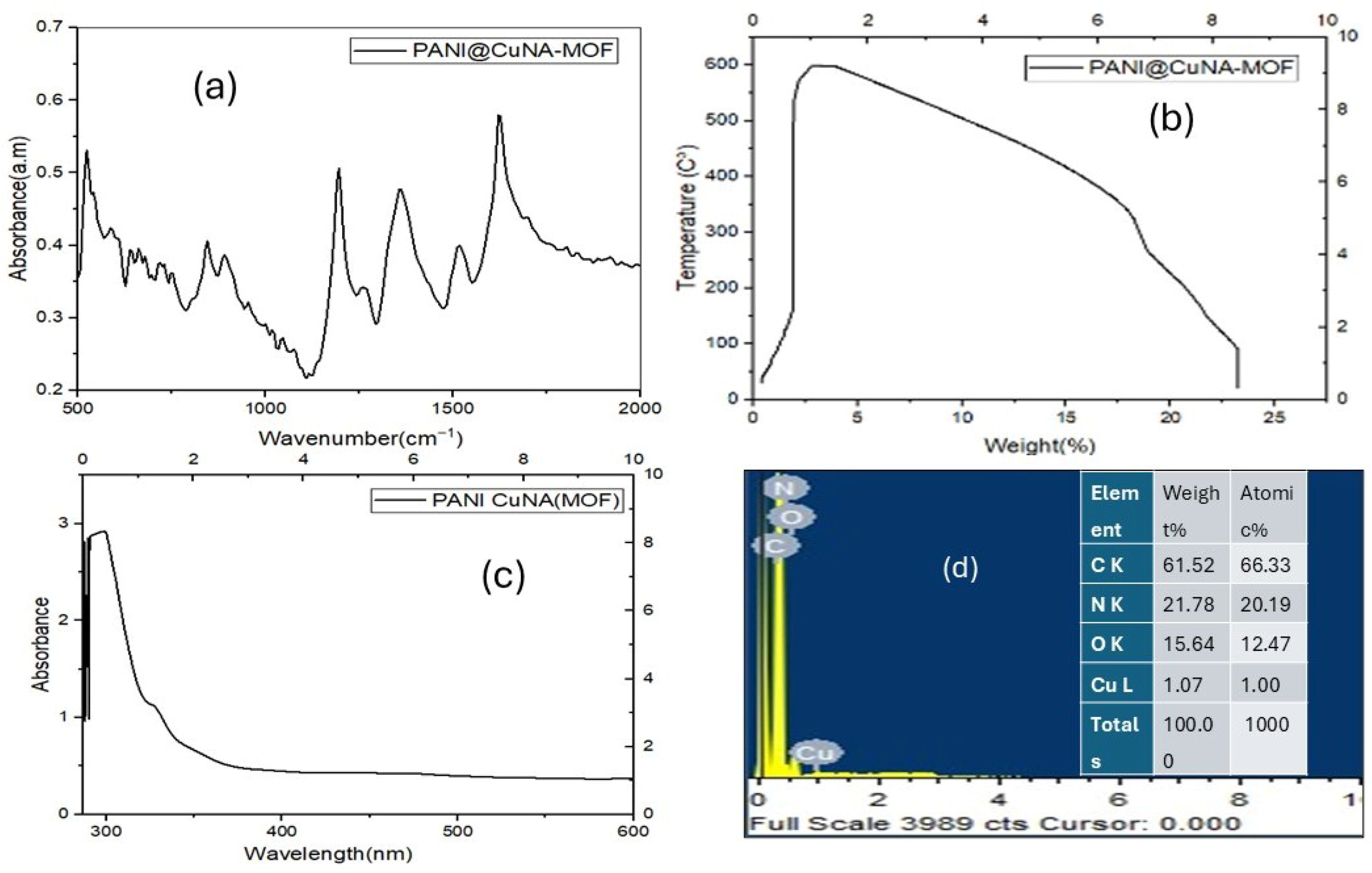
An FTIR study (Figure 2a) was conducted to confirm the successful composition of the PANI@CuNA-MOF composite and to reveal the interactions between its components and the characteristics of the Cu-based metal–organic framework [53]. The peaks at 724 and 752 cm−1 show the presence of C-H out-of-plane bending vibrations from the benzene ring, a feature common to both the organic linker and the polyaniline structure [54,55]. The prominent peaks at 844 and 896 cm−1 establish the existence of out-of-plane hydrogen bending vibrations in a disubstituted benzene ring (a characteristic feature of the polyaniline structure) [56]. Peaks appearing in the 1195–1264 cm−1 region arise from C-N stretching modes associated with the benzenoid and quinoid segments of the polyaniline backbone, confirming its presence [57]. A peak observed at 1362 cm−1 reflects C=N stretching from the quinoid parts of the polymer structure [55]. The most telling features in the spectrum are the intense peaks at 1517 cm−1 and 1626 cm−1, which correspond to C=C and C=N stretching vibrations from the aromatic rings present in both the MOF linker and the polyaniline backbone [53,56]. Looking at the full FTIR data, it is clear that the composite was formed as intended. The spectrum further hints at π-π interactions, and possibly hydrogen bonding, connecting the MOF framework with the conductive PANI polymer.
The TGA results (Figure 2b) for the PANI@CuNA-MOF composite demonstrate excellent thermal stability up to approximately 550 °C, as evident from the TGA curve where mass remains relatively stable until this critical point. The initial minor mass loss—up to roughly 150 °C—is due to the evaporation of adsorbed water and solvents from the material’s surface [57]. A much larger weight loss follows between 250 and 400 °C, caused by the thermal breakdown of the polyaniline chains [58]. Finally, the sharp decrease observed from 400 to 550 °C corresponds to the decomposition of the organic linker in the MOF structure [57]. The final residual mass (~1.9%) at high temperatures indicates the formation of stable inorganic residues, most likely copper oxide (CuO), confirming the hybrid nature of the composite. This outstanding thermal stability of up to 550 °C makes it a suitable candidate for high-temperature applications.
The UV-Vis spectrum (Figure 2c) of the PANI@CuNA-MOF composite confirms its successful synthesis and electronic properties. The characteristic absorption band at approximately 430 nm is a definitive signature of polaronic transitions. The presence of the conductive emeraldine salt form of PANI is confirmed by these features. The broad absorption tail that extends into visible and near-infrared further indicates strong electronic interaction between the PANI and the Cu-MOF, likely due to metal-to-ligand charge transfer (MLCT) and π-π interactions at their interface. This effective coupling, combined with a narrow optical band gap, are properties that position the composite as a promising material for applications under visible light, including photocatalysis and solar energy conversion.
Figure 2d shows the EDX spectrum, which was collected to confirm the elemental composition of the composite, with the results clearly indicating the successful integration of its components. The spectrum revealed a dominant presence of carbon (61.52 wt%) and nitrogen (21.78 wt%), which are the primary constituents of the polyaniline (PANI) backbone and the nicotinic acid organic linker. The significant nitrogen content is a particularly strong marker for the successful incorporation of PANI into the structure. Furthermore, the detection of oxygen (15.64 wt%) is consistent with the carboxylate groups of the linker molecule, while the definitive signal for copper (1.07 wt%) confirms that the copper-based metal–organic framework is present. This collective elemental signature, showcasing the key elements from both the conducting polymer and the MOF, provides direct and compelling evidence for the formation of the intended PANI@Cu-NA-MOF hybrid material.
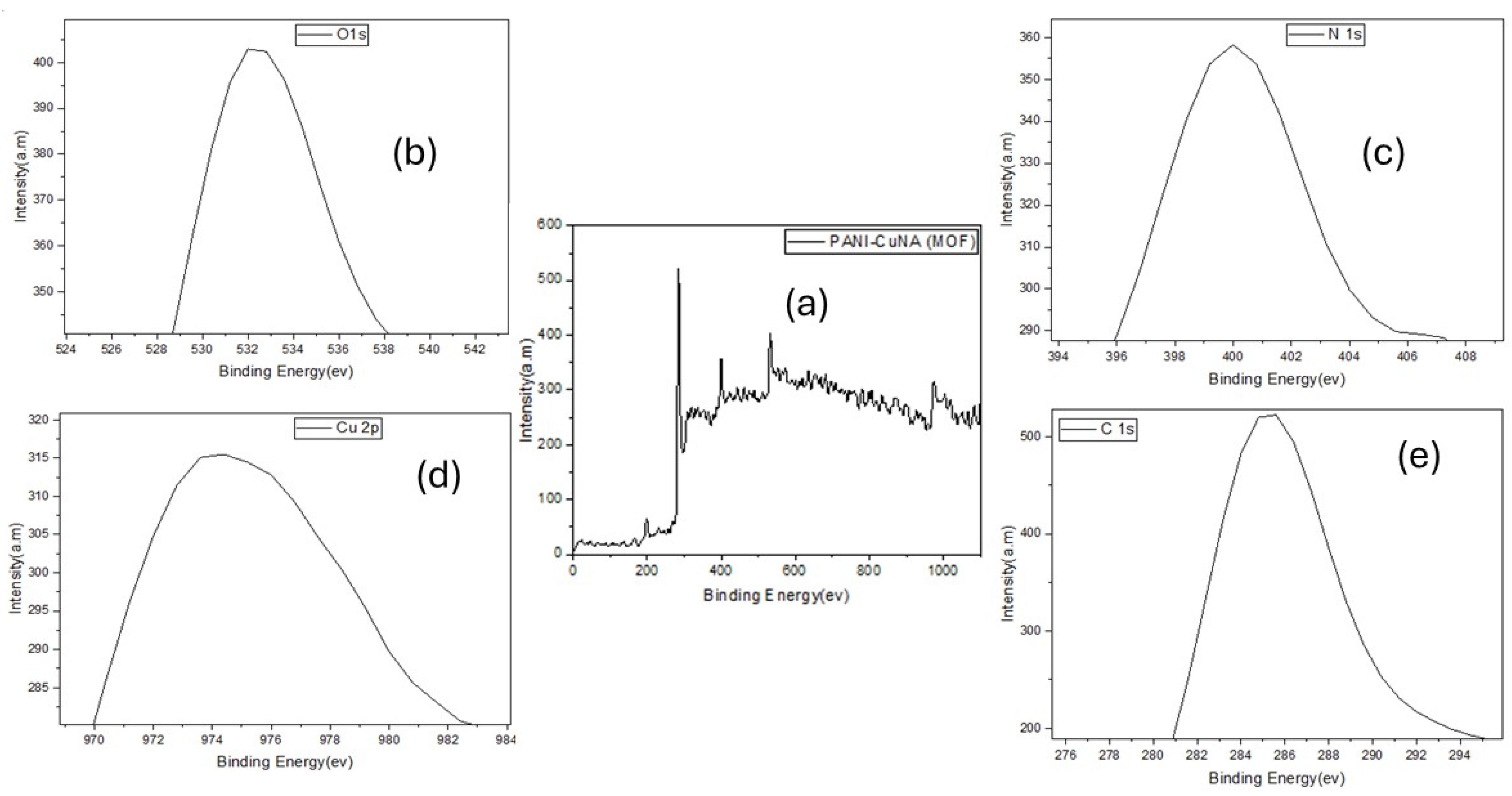
The XPS analysis (Figure 3) of the PANI@CuNA-MOF composite clearly confirms its successful synthesis, showing distinct peaks for all characteristic elements. Looking at Figure 3b,e, the C 1s peak at 284.8 eV and the O 1s peak at 531 eV are attributed to the organic framework and the PANI structure. The N 1s peak at 399.5 eV in Figure 3c, on the other hand, verifies that polyaniline is indeed part of the composite. The Cu 2p peak at 933 eV (Figure 3d) confirms the metal nodes of the MOF, and the Cl 2p signal indicates successful doping of PANI. Together, these findings confirm that the PANI@CuNA-MOF hybrid material was successfully formed.

3.2. Electrical Conductivity Study

The electrical conductivity of pellets made from the PANI@Cu-NA-MOF composite was evaluated using the four-point probe technique, a highly reliable method for determining the conductivity of semi-conducting materials. This method is strongly preferred as it effectively overcomes limitations inherent to conventional two-probe methods. Among the limitations are the rectifying effects commonly seen at metal–semiconductor interfaces and the injection of minority carriers by one of the contacts. These phenomena can shift the potential at other contacts and artificially affect the conductance readings, compromising accuracy.
To determine the electrical conductivity of the composite sample, we applied the following equations:
The corrected electrical resistivity (ρ) was determined using Equation (1):
ρ = ρ0 × G7(W/S)
where ρ is the corrected resistivity (Ω·cm), ρ0 represents the uncorrected resistivity (Ω·cm).
G7(W/S) is the geometric correction factor used when the bottom surface is non-conducting.
This factor depends on: W: the sample’s thickness (cm);
S: the spacing separating the measurement probes (cm).
The specific relationships are defined as follows:
The correction factor is given by:
G7(W/S) = (2S/W) × ln(2)
The uncorrected resistivity is calculated from:
ρ0 = (V/I) × 2πS
Finally, the electrical conductivity is obtained from:
σ = 1/ρ
The electrical conductivity of the prepared pellets was measured using the four-point probe technique. To optimize the composite’s performance, a series of samples were synthesized with varying polyaniline content (1%, 2%, 5%, and 7%) while maintaining a constant Cu-NA-MOF concentration. The electrical characterization revealed a distinct optimum, with the sample containing 5% polyaniline exhibiting a peak conductivity of approximately 73 S/cm. This value was substantially higher than those observed for composites with either lower or higher PANI loadings. This result underscores that an optimal balance of components is critical, and, in this system, the 5% PANI formulation most effectively establishes a continuous and efficient conductive network throughout the composite structure.

3.3. Catalytic Study

3.3.1. Oxygen Evaluation Reaction of PANI@CuNA-MOF Catalyst

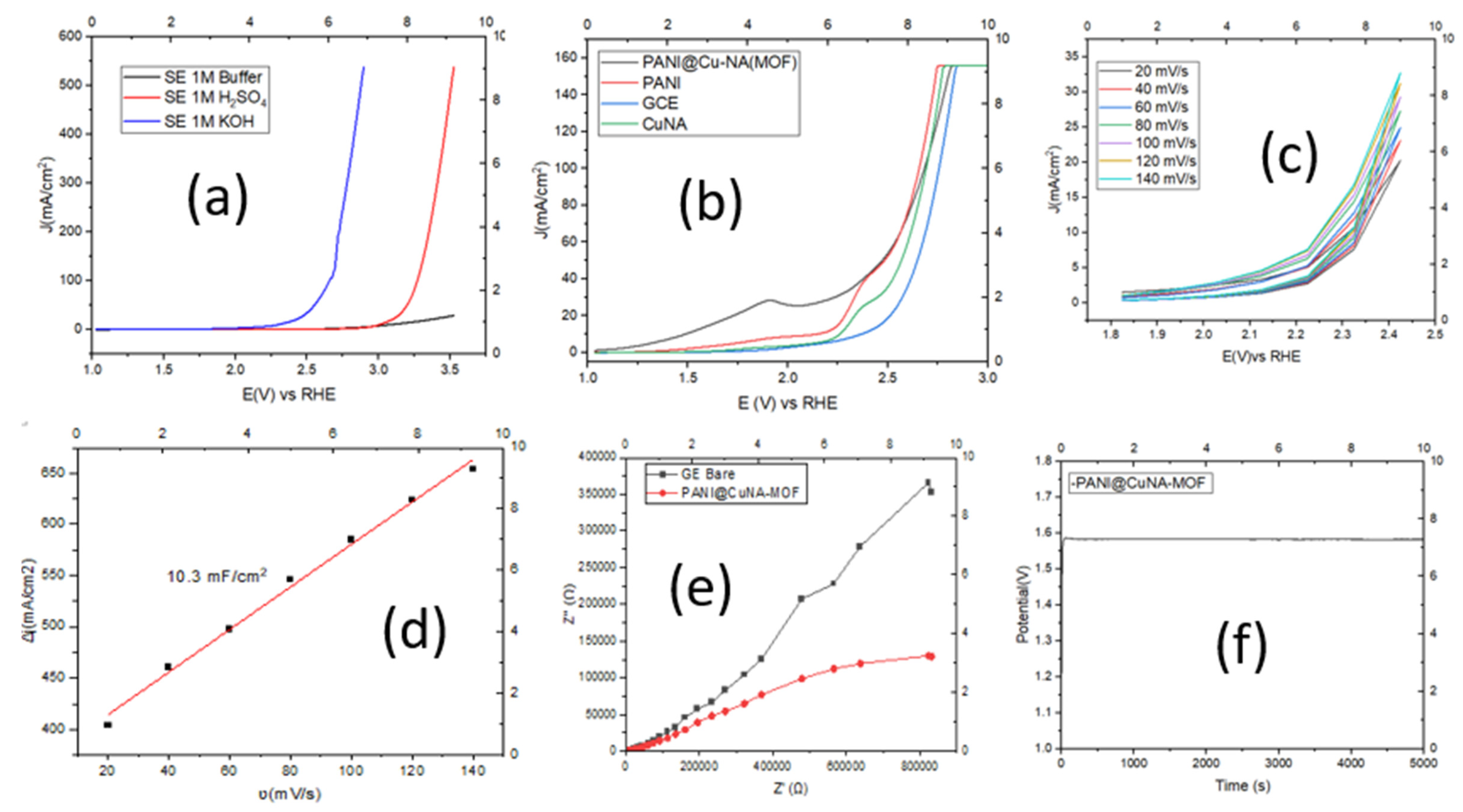
To evaluate the performance of the PANI@CuNA-MOF catalyst for the oxygen evolution reaction (OER), we first optimized the supporting electrolyte by testing different media with varying pH: 1 M KOH, 1 M phosphate-buffered saline (PBS, pH 7.0), and 1 M sulfuric acid. The linear sweep voltammograms obtained from these trials are shown in Figure 4a. Among the electrolytes tested, 1 M KOH delivered the best performance, with the smallest onset potential recorded at 1.4 V vs. RHE—corresponding to an overpotential of 0.361 V when the electrolyte was saturated with pure oxygen at 1 bar. In contrast, the PBS solution proved to be the least effective, exhibiting the highest onset potential of 2.4 V vs. RHE (an overpotential of 0.62 V under the same oxygen-saturated conditions). Moreover, the lowest overpotential recorded to achieve a current density of 10 mA/cm2 was 0.27 V, which occurred in 1 M KOH. This points to 1 M KOH being the most suitable electrolyte for the oxygen evolution reaction (OER). At this current density, we calculated a turnover frequency (TOF) of 0.01 s−1. On the basis of these observations, 1 M KOH was selected as the optimal supporting electrolyte moving forward. These findings are consistent with the fundamental principles of OER chemistry—under alkaline conditions such as those in 1 M KOH, the plentiful supply of hydroxyl ions (OH) helps drive the oxygen oxidation reaction forward. Conversely, in an acidic environment, the scarcity of hydroxyl ions and the high concentration of protons (H+) create a kinetic barrier for water oxidation, severely restricting oxygen production. This mechanistic understanding confirms that the liberation of oxygen occurs most readily in alkaline media, effectively requiring minimal overpotential, which aligns perfectly with the experimental findings.
The performance of the synthesized PANI@CuNA-MOF catalyst demonstrates remarkable competitiveness with commercially available noble-metal-based benchmarks such as IrO2. For comparison, IrO2—a widely recognized industrial standard for the oxygen evolution reaction (OER)—exhibits an onset potential of 1.55 V and requires an overpotential of 0.49 V to reach a current density of 10 mA/cm2 under alkaline conditions [58]. In comparison, the developed catalyst exhibits a competitive level of performance, establishing PANI@CuNA-MOF as a promising candidate that could offer a more affordable route compared to traditional noble-metal-based catalysts, with strong potential for sustainable energy applications [58]. This catalyst performs so well in the oxygen evolution reaction because it offers a large surface area with plenty of accessible sites, achieved through the sol–gel synthesis method. Overall, the catalyst’s strong performance in the oxygen evolution reaction comes down to its large surface area and the abundance of accessible active sites it provides, competitively benchmarking against catalysts recently considered as state of the art in the literature. Its excellent activity is reflected in three key metrics: a notably low onset potential, a very low overpotential to reach a current density of 10 mA cm−2, and consistently high overall current outputs. This comparative analysis confirms PANI@CuNA-MOF as a highly promising, cost-effective alternative to more expensive counterparts, highlighting its strong potential for sustainable energy applications (Figure 4b). To evaluate the electrochemical performance, a control study was carried out in 1 M KOH, comparing PANI@CuNA-MOF with bare GCE, PANI, and CuNA. At a potential of 1.4 V, the PANI@CuNA-MOF-modified electrode reached a current density of 10 mA/cm2. By comparison, at the same applied potential, the bare GCE delivered only a tiny current density of 0.2 mA/cm2. In contrast, PANI and CuNA performed significantly better, reaching 4.5 mA/cm2 and 7 mA/cm2, respectively.
The real surface area involved in the electrochemical reaction of the PANI@CuNA-MOF-modified glassy carbon electrode (GE) was further assessed by examining the relationship between scan rate and oxidation current, as shown in Figure 4c,d. From the plot of Δj as a function of scan rate, we determined the double-layer capacitance (Cdl), a parameter directly linked to the electrochemically active surface area. With a calculated Cdl value of 10.3 mF/cm2, and considering that electrodes with a flat geometry typically exhibits a Cdl of 30 μF/cm2, the roughness factor, defined as the ratio between the actual electrochemically active area and the geometric area, turned out to be 343. Based on this roughness factor and the electrode’s cross-sectional area of 0.0201 cm2, the ECSA of the PANI@CuNA-MOF layer was estimated to be 6.90 cm2.
When compared to the geometric surface area of the bare glassy carbon electrode, which is 0.07 cm2, the PANI@CuNA-MOF-modified electrode exhibited more than a ninefold increase in active surface area. This substantial enhancement in ECSA facilitates more efficient anion and charge exchange between the electrode surface and the electrolyte, thereby contributing to a significantly enhanced oxygen evolution reaction activity relative to the unmodified GE [58,59,60,61,62,63].
The proposed mechanism illustrates the oxygen evolution reaction (OER) as a multi-step process involving sequential electron transfers, as outlined in steps (i) to (iv). In this pathway, water first adsorbs onto the catalyst surface to form MOH, which is then oxidized to M–O, before progressing to the higher-energy MOOH intermediate. The formation of M–OOH represents the rate-limiting step because it requires the greatest energetic input for O–O bond formation and ultimately leads to O2 release.
i.
M + H2O → M–OH + H+ + e—initial adsorption and first oxidation
ii.
M–OH → M–O + H+ + e—formation of surface oxide
iii.
M–O + H2O → M–OOH + H+ + e—rate-limiting O–O bond formation
iv.
M–OOH → M + O2 + H+ + e—oxygen release and catalyst regeneration
Furthermore, the electrochemical characterization results presented in Figure 4e confirmed the enhanced performance of the PANI@CuNA-MOF-modified electrode. In electrochemical impedance spectroscopy (EIS), in the Nyquist plot, the semicircle corresponds to the charge-transfer resistance (Rct). A smaller semicircle means lower resistance, which translates to faster electron and ion transfer at the interface between the electrode and electrolyte. An Rct of 196 Ω was obtained for the PANI@CuNA-MOF electrode, which is considerably lower than the 596 Ω measured for the bare GE. This drop in charge-transfer resistance points to better electrical conductivity and faster electron movement through the modified electrode.
The PANI@CuNA-MOF catalyst proved to be highly stable during a 5000 s OER test (Figure 4f). It exhibited only an 11% loss in current density under chronoamperometric conditions and a 30% potential shift in chronopotentiometry, with both indicating good durability. This robust performance was further confirmed by an accelerated durability test, where the catalyst exhibited an impressively low potential loss of only 3% after 5000 cycles at a current density of 10 mA/cm2. This underscores its viability as a stable and durable catalyst, making it well-suited for OER applications.

3.3.2. Hydrogen Evolution Reaction (HER) Activity of PANI@CuNA-MOF Catalyst

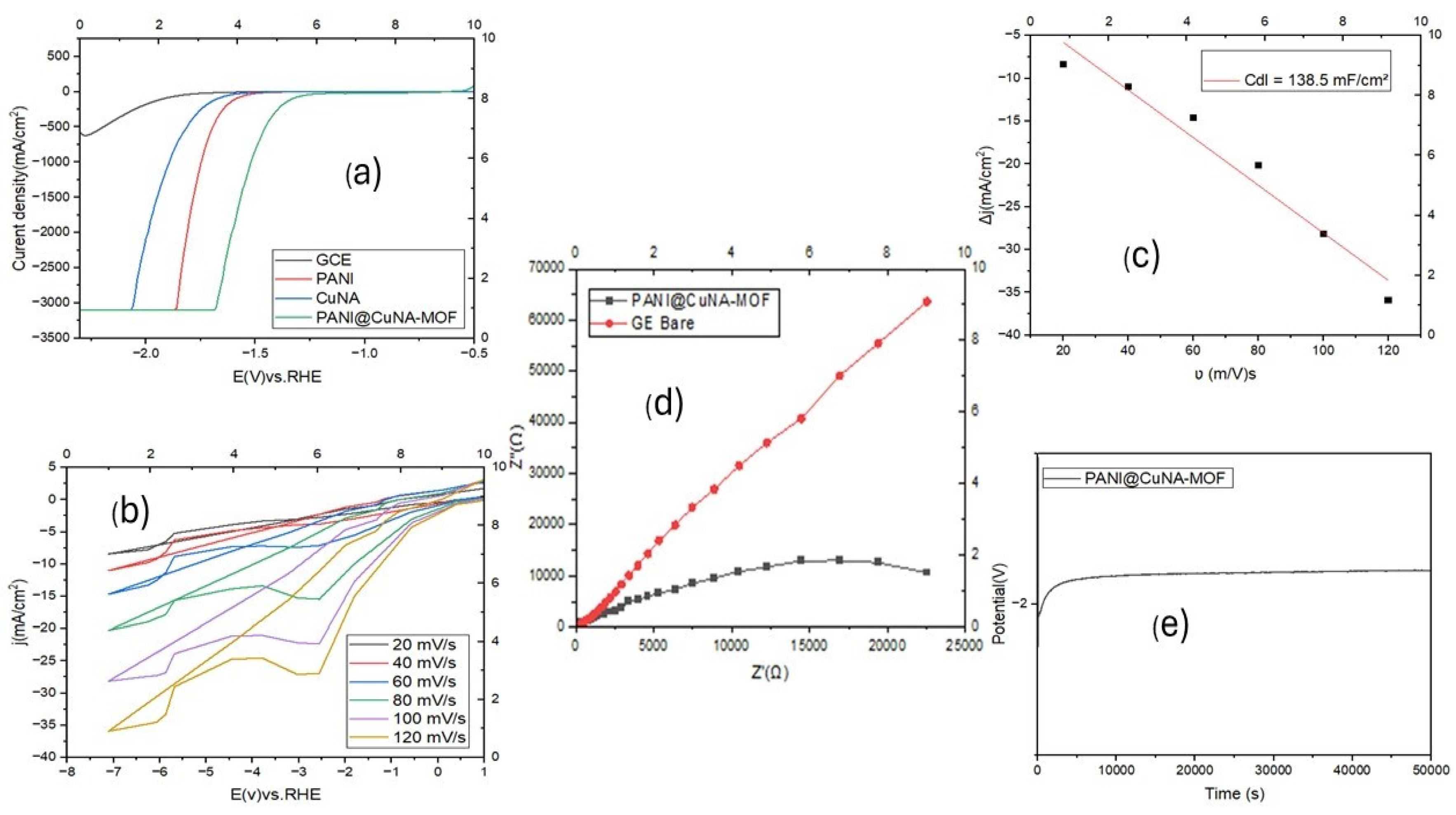
In Figure 5a, we present a control study conducted in 1 M KOH that compares how the PANI@CuNA-MOF-modified electrode and the bare GCE perform in terms of current density in comparison to PANI and CuNA. The results speak for themselves: the PANI@CuNA-MOF electrode reached 10 mA/cm2 at 1.6 V; the bare GCE, by comparison, struggled to reach even 0.5 mA/cm2 at 2.4 V. Both PANI and CuNA electrodes were able to hit 10 mA/cm2, but at the expense of higher applied potentials—1.8 V for PANI and 2.1 V for CuNA.
To determine the electrochemically active surface area (ECSA) of the PANI@CuNA-MOF-modified electrode, we plotted the scan rate against the current measured in the non-Faradaic region, as shown in Figure 5b,c. The linear fit of Δj against scan rate produced a slope of 0.277. Applying the formula *Cdl = |slope|/2*, we were able to determine the double-layer capacitance. This calculation resulted in a Cdl value of 138.5 mF/cm2, which is directly correlated to the ECSA. Compared to the specific capacitance of a standard flat electrode (Cdls = 30 μF/cm2), the electrode’s roughness factor, defined as the real electrochemically active area divided by the geometric area, was found to be 4617. This high factor corresponds to an ECSA of 92.8 cm2 for the PANI@CuNA-MOF layer, given an electrode geometrical area of 0.0201 cm2.
The electrochemical double-layer capacitance came out quite high at Cdl = 138.5 mF/cm2, indicating that the synthesized material possesses a significantly large electrochemically active surface area compared to its simple geometric area. This substantial increase in effective surface area originates from the material’s porous morphology and nanostructured architecture, which effectively transforms a flat surface into a highly textured, sponge-like structure replete with countless pores and crevices. The material’s large surface area positions it as a promising option for electrocatalytic use as it supplies a wealth of active sites for the electrochemical processes, thereby enhancing its overall catalytic efficiency and performance.
Further electrochemical characterization, presented in Figure 5d, confirmed the enhanced performance of the PANI@CuNA-MOF-modified electrode. In electrochemical impedance spectroscopy (EIS), the semicircle observed in the Nyquist plot reflects the charge-transfer resistance (Rct). A reduced Rct—indicated by a smaller semicircle—points to faster electron and ion transfer at the electrode–electrolyte interface. The PANI@CuNA-MOF electrode exhibited an Rct value of 340 Ω, which is substantially lower than the 1075 Ω measured for the bare glassy carbon electrode. This improved charge transfer points to better overall conductivity and faster electron transport in the modified electrode.
The developed PANI@CuNA-MOF electrocatalyst demonstrated remarkable and complete stability throughout a rigorous 5000 s HER test in an acidic medium, as shown in Figure 5e. The chronoamperometry study revealed an exceptionally minimal current density loss of only 10%, confirming its robust and enduring catalytic activity. Concurrently, the potential shift recorded via chronopotentiometry was a mere 20%, further underscoring its electrochemical resilience. A comparative table for results of the current study and the recently published literature is given in Table 1 [64,65,66,67,68].

4. Conclusions

This study describes a simple and economical synthesis route for creating a bifunctional electrocatalyst based on PANI@CuNA-MOF. This novel material was thoroughly characterized and demonstrated outstanding activity in electrochemical water splitting, effectively catalyzing both the hydrogen and oxygen evolution reactions (HER and OER). The catalyst’s high activity stems from its shown remarkable performance in water splitting, efficiently driving both the hydrogen and oxygen evolution reactions (HER and OER). For HER in acidic conditions, the catalyst required a low onset potential of −1.8 V and needed only 210 mV of overpotential to achieve a current density of 10 mA/cm2. For the oxygen evolution reaction in alkaline media, the PANI@CuNA-MOF catalyst exhibited an onset potential of 1.6 V, corresponding to an overpotential of 270 mV. Most notably, the catalyst also proved to be highly durable, holding up well during 5000 s of continuous operation for both reactions with only a slight drop in current or potential. This study presents a promising, cost-effective catalyst for large-scale clean hydrogen production, supporting the goal of sustainable energy development.

Author Contributions

Conceptualization, H.S.A. and H.M.M.; methodology, H.S.A., H.M.M. and A.K.; validation, K.A.A., K.A. and K.A.; formal analysis, H.S.A.; investigation, A.K.; resources, H.M.M.; data curation, A.K.; writing—original draft preparation, H.S.A.; writing—review and editing, A.K.; visualization, A.K.; supervision, H.M.M. All authors have read and agreed to the published version of the manuscript.

Funding

The Scientific Endowment and the Deanship of Scientific Research, King Abdulaziz University.

Data Availability Statement

The raw data supporting the conclusions of this article will be made available by the authors on request.

Acknowledgments

This Project was funded by KAU Endowment (WAQF) at King Abdulaziz University, Jeddah, under grant. The authors, therefore, acknowledge with thanks WAQF and the Deanship of Scientific Research (DSR) for technical and financial support.

Conflicts of Interest

The authors declare no conflict of interests.

References

  1. Chu, S.; Majumdar, A. Opportunities and challenges for a sustainable energy future. Nature 2012, 488, 294–303. [Google Scholar] [CrossRef] [PubMed]
  2. Turner, J.A. Sustainable Hydrogen Production. Science 2024, 305, 972–974. [Google Scholar] [CrossRef] [PubMed]
  3. Seh, Z.W.; Kibsgaard, J.; Dickens, C.F.; Chorkendorff, I.; Nørskov, J.K.; Jaramillo, T.F. Combining theory and experiment in electrocatalysis: Insights into materials design. Science 2017, 355, eaad4998. [Google Scholar] [CrossRef]
  4. Mallouk, T.E. Divide and conquer. Nat. Chem. 2013, 5, 362–363. [Google Scholar] [CrossRef] [PubMed]
  5. Yang, J.Y.; Smith, S.E.; Liu, T.; Dougherty, W.G.; Hoffert, W.A.; Kassel, W.S.; DuBois, M.R.; DuBois, D.L.; Bullock, R.M. Two Pathways for Electrocatalytic Oxidation of Hydrogen by a Nickel Bis(diphosphine) Complex with Pendant Amines in the Second Coordination Sphere. J. Am. Chem. Soc. 2013, 135, 9700–9712. [Google Scholar] [CrossRef]
  6. McCrory, C.C.L.; Jung, S.; Ferrer, I.M.; Chatman, S.M.; Peters, J.C.; Jaramillo, T.F. Benchmarking Hydrogen Evolving Reaction and Oxygen Evolving Reaction Electrocatalysts for Solar Water Splitting Devices. J. Am. Chem. Soc. 2015, 137, 4347–4357. [Google Scholar] [CrossRef]
  7. Roger, I.; Shipman, M.A.; Symes, M.D. Earth-abundant catalysts for electrochemical and photoelectrochemical water splitting. Nat. Rev. Chem. 2017, 1, 0003. [Google Scholar] [CrossRef]
  8. Reier, T.; Oezaslan, M.; Strasser, P. Electrocatalytic Oxygen Evolution Reaction (OER) on Ru, Ir, and Pt Catalysts: A Comparative Study of Nanoparticles and Bulk Materials. ACS Catal. 2012, 2, 1765–1772. [Google Scholar] [CrossRef]
  9. Sheng, W.; Zhuang, Z.; Gao, M.; Zheng, J.; Chen, J.G.; Yan, Y. Correlating hydrogen oxidation and evolution activity on platinum at different pH with measured hydrogen binding energy. Nat. Commun. 2015, 6, 5848. [Google Scholar] [CrossRef]
  10. Jamesh, M.-I.; Sun, X. Recent progress on earth abundant electrocatalysts for oxygen evolution reaction (OER) in alkaline medium to achieve efficient water splitting—A review. J. Power Sources 2018, 400, 31–68. [Google Scholar] [CrossRef]
  11. Kibsgaard, J.; Chorkendorff, I. Considerations for the scaling-up of water splitting catalysts. Nat. Energy 2019, 4, 430–433. [Google Scholar] [CrossRef]
  12. Suen, N.-T.; Hung, S.-F.; Quan, Q.; Zhang, N.; Xu, Y.-J.; Chen, H.M. Electrocatalysis for the oxygen evolution reaction: Recent development and future perspectives. Chem. Soc. Rev. 2017, 46, 337–365. [Google Scholar] [CrossRef]
  13. You, B.; Sun, Y. Innovative Strategies for Electrocatalytic Water Splitting. Acc. Chem. Res. 2018, 51, 1571–1580. [Google Scholar] [CrossRef] [PubMed]
  14. Lyons, M.E.G.; Brandon, M.P. The significance of electrochemical impedance spectra recorded during active oxygen evolution for oxide covered Ni, Co and Fe electrodes in alkaline solution. J. Electroanal. Chem. 2009, 631, 62–70. [Google Scholar] [CrossRef]
  15. Fabbri, E.; Habereder, A.; Waltar, K.; Kötz, R.; Schmidt, T.J. Developments and perspectives of oxide-based catalysts for the oxygen evolution reaction. Catal. Sci. Technol. 2014, 4, 3800–3821. [Google Scholar] [CrossRef]
  16. Song, F.; Hu, X. Exfoliation of layered double hydroxides for enhanced oxygen evolution catalysis. Nat. Commun. 2014, 5, 4477. [Google Scholar] [CrossRef]
  17. Ledendecker, M.; Calderón, S.K.; Papp, C.; Steinrück, H.; Antonietti, M.; Shalom, M. The Synthesis of Nanostructured Ni 5 P 4 Films and their Use as a Non-Noble Bifunctional Electrocatalyst for Full Water Splitting. Angew. Chemie Int. Ed. 2015, 54, 12361–12365. [Google Scholar] [CrossRef]
  18. Muzaffar, N.; Afzal, A.M.; Hegazy, H.H.; Iqbal, M.W. Recent advances in two-dimensional metal-organic frameworks as an exotic candidate for the evaluation of redox-active sites in energy storage devices. J. Energy Storage 2023, 64, 107142. [Google Scholar] [CrossRef]
  19. Wang, H.; Lee, J.-M. Recent advances in structural engineering of MXene electrocatalysts. J. Mater. Chem. A 2020, 8, 10604–10624. [Google Scholar] [CrossRef]
  20. Zhang, Z.; Liu, J.; Wang, J.; Wang, Q.; Wang, Y.; Wang, K.; Wang, Z.; Gu, M.; Tang, Z.; Lim, J.; et al. Single-atom catalyst for high-performance methanol oxidation. Nat. Commun. 2021, 12, 5235. [Google Scholar] [CrossRef]
  21. Kong, D.; Wang, H.; Cha, J.J.; Pasta, M.; Koski, K.J.; Yao, J.; Cui, Y. Synthesis of MoS 2 and MoSe 2 Films with Vertically Aligned Layers. Nano Lett. 2013, 13, 1341–1347. [Google Scholar] [CrossRef] [PubMed]
  22. Zhang, J.; Wang, T.; Pohl, D.; Rellinghaus, B.; Dong, R.; Liu, S.; Zhuang, X.; Feng, X. Interface Engineering of MoS2/Ni3S2 Heterostructures for Highly Enhanced Electrochemical Overall-Water-Splitting Activity. Angew. Chemie Int. Ed. 2016, 55, 6702–6707. [Google Scholar] [CrossRef] [PubMed]
  23. Vrubel, H.; Hu, X. Molybdenum Boride and Carbide Catalyze Hydrogen Evolution in both Acidic and Basic Solutions. Angew. Chemie Int. Ed. 2012, 51, 12703–12706. [Google Scholar] [CrossRef] [PubMed]
  24. Louie, M.W.; Bell, A.T. An Investigation of Thin-Film Ni–Fe Oxide Catalysts for the Electrochemical Evolution of Oxygen. J. Am. Chem. Soc. 2013, 135, 12329–12337. [Google Scholar] [CrossRef]
  25. Tian, J.; Liu, Q.; Asiri, A.M.; Sun, X. Self-Supported Nanoporous Cobalt Phosphide Nanowire Arrays: An Efficient 3D Hydrogen-Evolving Cathode over the Wide Range of pH 0–14. J. Am. Chem. Soc. 2014, 136, 7587–7590. [Google Scholar] [CrossRef]
  26. Anantharaj, S.; Ede, S.R.; Karthick, K.; Sankar, S.S.; Sangeetha, K.; Karthik, P.E.; Kundu, S. Precision and correctness in the evaluation of electrocatalytic water splitting: Revisiting activity parameters with a critical assessment. Energy Environ. Sci. 2018, 11, 744–771. [Google Scholar] [CrossRef]
  27. Jiao, L.; Jiang, H.-L. Metal-organic frameworks for catalysis: Fundamentals and future prospects. Chin. J. Catal. 2023, 45, 1–5. [Google Scholar] [CrossRef]
  28. Wang, Q.; Astruc, D. State of the Art and Prospects in Metal–Organic Framework (MOF)-Based and MOF-Derived Nanocatalysis. Chem. Rev. 2020, 120, 1438–1511. [Google Scholar] [CrossRef]
  29. Furukawa, H.; Cordova, K.E.; O’Keeffe, M.; Yaghi, O.M. The Chemistry and Applications of Metal-Organic Frameworks. Science 2013, 341, 1230444. [Google Scholar] [CrossRef]
  30. Shen, K.; Zhang, L.; Chen, X.; Liu, L.; Zhang, D.; Han, Y.; Chen, J.; Long, J.; Luque, R.; Li, Y.; et al. Ordered macro-microporous metal-organic framework single crystals. Science 2018, 359, 206–210. [Google Scholar] [CrossRef]
  31. Zhao, M.; Yuan, K.; Wang, Y.; Li, G.; Guo, J.; Gu, L.; Hu, W.; Zhao, H.; Tang, Z. Metal–organic frameworks as selectivity regulators for hydrogenation reactions. Nature 2016, 539, 76–80. [Google Scholar] [CrossRef] [PubMed]
  32. Shih, S.-M.; Lin, L.-C. Water Adsorption in Metal–Organic Frameworks: Characteristics, Mechanisms, and Structure–Property Relationships. J. Am. Chem. Soc. 2025, 147, 34791–34803. [Google Scholar] [CrossRef] [PubMed]
  33. Zhang, T.; Lin, W. Metal–organic frameworks for artificial photosynthesis and photocatalysis. Chem. Soc. Rev. 2014, 43, 5982–5993. [Google Scholar] [CrossRef] [PubMed]
  34. Kornienko, N.; Zhao, Y.; Kley, C.S.; Zhu, C.; Kim, D.; Lin, S.; Chang, C.J.; Yaghi, O.M.; Yang, P. Metal–Organic Frameworks for Electrocatalytic Reduction of Carbon Dioxide. J. Am. Chem. Soc. 2015, 137, 14129–14135. [Google Scholar] [CrossRef]
  35. Lin, K.-S.; Adhikari, A.K.; Ku, C.-N.; Chiang, C.-L.; Kuo, H. Synthesis and characterization of porous HKUST-1 metal organic frameworks for hydrogen storage. Int. J. Hydrogen Energy 2012, 37, 13865–13871. [Google Scholar] [CrossRef]
  36. Stassen, I.; Burtch, N.C.; Talin, A.A.; Falcaro, P.; Allendorf, M.D.; Ameloot, R. An updated roadmap for the integration of metal–organic frameworks with electronic devices and chemical sensors. Chem. Soc. Rev. 2017, 46, 3185–3241, Correction in Chem. Soc. Rev. 2017, 46, 3853. https://doi.org/10.1039/C7CS90048A.. [Google Scholar] [CrossRef]
  37. Downes, C.A.; Marinescu, S.C. Electrocatalytic Metal–Organic Frameworks for Energy Applications. ChemSusChem 2017, 10, 4374–4392. [Google Scholar] [CrossRef]
  38. Chen, W.; Liu, Z.; Tian, J.; Li, J.; Ma, J.; Cheng, X.; Li, G. Building Congested Ketone: Substituted Hantzsch Ester and Nitrile as Alkylation Reagents in Photoredox Catalysis. J. Am. Chem. Soc. 2016, 138, 12312–12315. [Google Scholar] [CrossRef]
  39. Liu, M.; Peng, Y.; Chen, W.; Cao, S.; Chen, S.; Meng, F.L.; Jin, Y.; Hou, C.-C.; Zou, R.; Xu, Q. Metal-organic frameworks for carbon-neutral catalysis: State of the art, challenges, and opportunities. Coord. Chem. Rev. 2024, 506, 215726. [Google Scholar] [CrossRef]
  40. Zarkov, A. Sol–Gel Technology Applied to Materials Science: Synthesis, Characterization and Applications. Materials 2024, 17, 462. [Google Scholar] [CrossRef]
  41. Li, H.-Y.; Zhao, S.-N.; Zang, S.-Q.; Li, J. Functional metal–organic frameworks as effective sensors of gases and volatile compounds. Chem. Soc. Rev. 2020, 49, 6364–6401. [Google Scholar] [CrossRef]
  42. Zhou, Y.; Zhan, Z. Conjugated Microporous Polymers for Heterogeneous Catalysis. Chem.—Asian J. 2018, 13, 9–19. [Google Scholar] [CrossRef] [PubMed]
  43. Xu, Y.; Jin, S.; Xu, H.; Nagai, A.; Jiang, D. Conjugated microporous polymers: Design, synthesis and application. Chem. Soc. Rev. 2013, 42, 8012. [Google Scholar] [CrossRef] [PubMed]
  44. Zhang, C.; Wu, B.-H.; Ma, M.-Q.; Wang, Z.; Xu, Z.-K. Ultrathin metal/covalent–organic framework membranes towards ultimate separation. Chem. Soc. Rev. 2019, 48, 3811–3841. [Google Scholar] [CrossRef] [PubMed]
  45. Li, J.; Wang, X.; Zhao, G.; Chen, C.; Chai, Z.; Alsaedi, A.; Hayat, T.; Wang, X. Metal–organic framework-based materials: Superior adsorbents for the capture of toxic and radioactive metal ions. Chem. Soc. Rev. 2018, 47, 2322–2356. [Google Scholar] [CrossRef]
  46. Li, H.; Wang, L.; Yu, G. Covalent organic frameworks: Design, synthesis, and performance for photocatalytic applications. Nano Today 2021, 40, 101247. [Google Scholar] [CrossRef]
  47. Salunkhe, R.R.; Kaneti, Y.V.; Yamauchi, Y. Metal–Organic Framework-Derived Nanoporous Metal Oxides toward Supercapacitor Applications: Progress and Prospects. ACS Nano 2017, 11, 5293–5308. [Google Scholar] [CrossRef]
  48. Ciriminna, R.; Fidalgo, A.; Pandarus, V.; Béland, F.; Ilharco, L.M.; Pagliaro, M. The Sol–Gel Route to Advanced Silica-Based Materials and Recent Applications. Chem. Rev. 2013, 113, 6592–6620. [Google Scholar] [CrossRef]
  49. Wu, Z.; Parvez, K.; Feng, X.; Müllen, K. Graphene-based in-plane micro-supercapacitors with high power and energy densities. Nat. Commun. 2013, 4, 2487. [Google Scholar] [CrossRef]
  50. Gu, Z.-G.; Zhang, J. Epitaxial growth and applications of oriented metal–organic framework thin films. Coord. Chem. Rev. 2019, 378, 513–532. [Google Scholar] [CrossRef]
  51. Pierre, A.C. Introduction to Sol-Gel Processing; Springer International Publishing: Cham, Switzerland, 2020. [Google Scholar] [CrossRef]
  52. Kaßner, L.; Kronawitt, J.; Klimm, D.; Seifert, A.; Spange, S. Molecular aspects on the amino acid-mediated sol–gel process of tetramethoxysilane in water. J. Sol-Gel. Sci. Technol. 2019, 90, 250–262. [Google Scholar] [CrossRef]
  53. Omkaramurthy, B.M.; Krishnamurthy, G.; Foro, S. Synthesis and characterization of mesoporous crystalline copper metal–organic frameworks for electrochemical energy storage application. SN Appl. Sci. 2020, 2, 342. [Google Scholar] [CrossRef]
  54. Nakamoto, K. Infrared and Raman Spectra of Inorganic and Coordination Compounds; Wiley: Hoboken, NJ, USA, 2008. [Google Scholar] [CrossRef]
  55. Sapurina, I.; Stejskal, J. The mechanism of the oxidative polymerization of aniline and the formation of supramolecular polyaniline structures. Polym. Int. 2008, 57, 1295–1325. [Google Scholar] [CrossRef]
  56. Arasi, A.Y.; Jeyakumari, J.J.L.; Sundaresan, B.; Dhanalakshmi, V.; Anbarasan, R. The structural properties of Poly(aniline)—Analysis via FTIR spectroscopy. Spectrochim. Acta Part A Mol. Biomol. Spectrosc. 2009, 74, 1229–1234. [Google Scholar] [CrossRef] [PubMed]
  57. Bhadra, S.; Khastgir, D.; Singha, N.K.; Lee, J.H. Progress in preparation, processing and applications of polyaniline. Prog. Polym. Sci. 2009, 34, 783–810. [Google Scholar] [CrossRef]
  58. Rojas, S.; Rodríguez-Diéguez, A.; Horcajada, P. Metal–Organic Frameworks in Agriculture. ACS Appl. Mater. Interfaces 2022, 14, 16983–17007. [Google Scholar] [CrossRef]
  59. Li, X.; Yang, X.; Xue, H.; Pang, H.; Xu, Q. Metal–organic frameworks as a platform for clean energy applications. EnergyChem 2020, 2, 100027. [Google Scholar] [CrossRef]
  60. Wang, S.; Zhao, L.; Li, J.; Tian, X.; Wu, X.; Feng, L. High valence state of Ni and Mo synergism in NiS2-MoS2 hetero-nanorods catalyst with layered surface structure for urea electrocatalysis. J. Energy Chem. 2022, 66, 483–492. [Google Scholar] [CrossRef]
  61. Li, M.; Gu, Y.; Chang, Y.; Gu, X.; Tian, J.; Wu, X.; Feng, L. Iron doped cobalt fluoride derived from CoFe layered double hydroxide for efficient oxygen evolution reaction. Chem. Eng. J. 2021, 425, 130686. [Google Scholar] [CrossRef]
  62. Zha, M.; Pei, C.; Wang, Q.; Hu, G.; Feng, L. Electrochemical oxygen evolution reaction efficiently boosted by selective fluoridation of FeNi3 alloy/oxide hybrid. J. Energy Chem. 2020, 47, 166–171. [Google Scholar] [CrossRef]
  63. Liu, Z.; Zhang, C.; Liu, H.; Feng, L. Efficient synergism of NiSe2 nanoparticle/NiO nanosheet for energy-relevant water and urea electrocatalysis. Appl. Catal. B Environ. 2020, 276, 119165. [Google Scholar] [CrossRef]
  64. Myasoedova, T.N.; Nedoedkova, O.V.; Kalusulingam, R.; Popov, Y.V.; Mikheykin, A.S.; Konstantinov, A.S.; Zhengyou, L.; Mikhailova, T.S.; Shmatko, V.A.; Yalovega, G.E. Fabrication of Ni-Polyaniline/Graphene Oxide Composite Electrode with High Capacitance and Water Splitting Activity. ChemPhysChem 2024, 25, e202300795. [Google Scholar] [CrossRef]
  65. Lahkar, S.; Brahma, R.; Dolui, S.K. Iron Doped Titania/Polyaniline Composite: An Efficient Electrocatalyst for Hydrogen Evolution Reaction in Acidic Medium. Catal. Res. 2023, 3, 1–13. [Google Scholar] [CrossRef]
  66. Kareem, N.; Karim, I.; Alsalhi, S.A.; Makasana, J.; Rekha, M.M.; Kumar, G.S.; Al-Anber, M.A.; Das, S.N.; Chaudhary, R.R.; Kumar, A.; et al. CuFe2O4 embedded on polyaniline nanosheet a promising electrocatalyst for OER. J. Indian Chem. Soc. 2025, 102, 101759. [Google Scholar] [CrossRef]
  67. Moradi-Alavian, S.; Kazempour, A.; Ashassi-Sorkhabi, H.; Asghari, E.; Mehrdad, A. Positional effects of chlorine-substituted polyaniline reinforced with feco2s4 on HER and supercapacitor performance. Sci. Rep. 2025, 15, 33606. [Google Scholar] [CrossRef]
  68. Milikić, J.; Mišurović, J.; Rakočević, L.; Pašti, I.A.; Ćirić-Marjanović, G.; Šljukić, B. Polyaniline prepared by Fe3O4 catalysed eco-friendly synthesis as electrocatalyst for efficient water electrolysis. J. Electrochem. Sci. Eng. 2024, 15, 2438. [Google Scholar] [CrossRef]
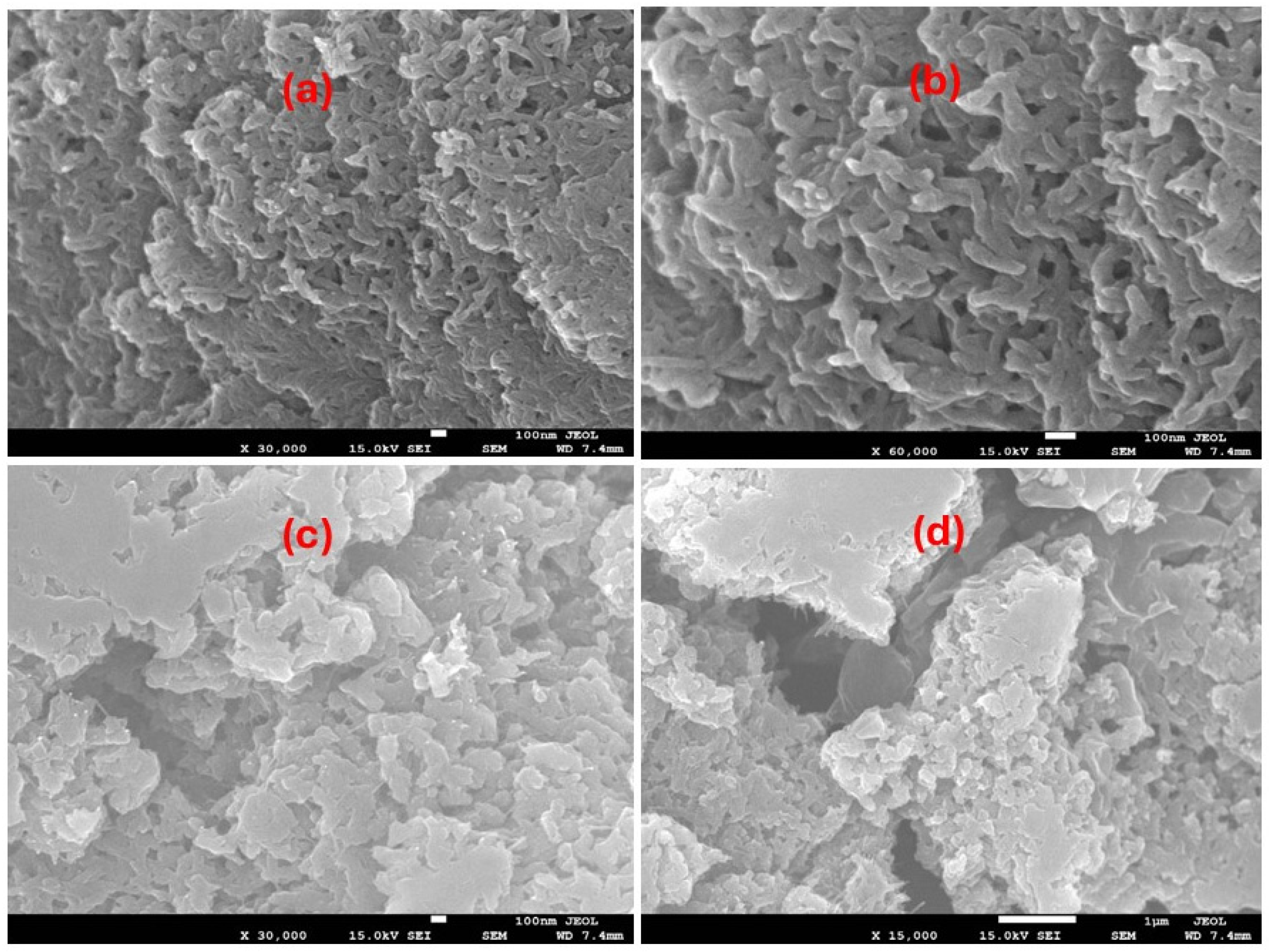
Figure 1. Scanning electron microscope (SEM) image of PANI (a,b) and PANI@CuNA-MOF (c,d) under different magnifications.
Catalysts 16 00370 g001
Figure 2. (a) FTIR spectrum of PANI@CuNA-MOF. (b) TGA of PANI@CuNA-MOF. (c) UV spectrum of PANI@CuNA-MOF, while (d) shows EDX of PANI@CuNA-MOF.
Catalysts 16 00370 g002
Figure 3. (a) shows XPS of PANI@CuNA-MOF composite while (b) shows O1s stretching vibration; (c) N1s; (d) Cu2p; and (e) C1s.
Catalysts 16 00370 g003
Figure 4. OER reaction studies: (a) supporting electrolyte optimization; (b) control study. (c) Effect of scan rate on OER. (d) Double-layer capacitance (Cdl) determination. (e) EIS spectrum of PANI@CuNA-MOF. (f) Stability chronopotentiometry.
Catalysts 16 00370 g004
Figure 5. HER reaction studies. (a) Control study. (b) Effect of scan rate on HER. (c) Double-layer capacitance (Cdl) determination. (d) EIS spectrum of PANI@CuNA-MOF. (e) Stability chronopotentiometry.
Catalysts 16 00370 g005
Table 1. Comparison of OER/HER electrochemical results of Cu-NA-MOF with other catalysts.
Catalyst SystemReactionOverpotential (mV @10 mA/cm2)Tafel Slope (mV/dec)StabilityReference
Ni–PANI/GOHER/OER~250–400~70–120Good[64]
Fe–TiO2/PANIHER~180~144~7–8 h[65]
CuFe2O4/PANIOER~218~37Excellent[66]
PANI@FeCo2S4HER~395~53.8Stable[67]
Fe3O4–PANIHER~200–350~60–120Good[68]
PANI@CuNA-MOFOER/HER270/210-~20 hCurrent Study
Disclaimer/Publisher’s Note: The statements, opinions and data contained in all publications are solely those of the individual author(s) and contributor(s) and not of MDPI and/or the editor(s). MDPI and/or the editor(s) disclaim responsibility for any injury to people or property resulting from any ideas, methods, instructions or products referred to in the content.