Review

Solar-Driven Catalytic Wastewater Treatment: A Unified Photonic–Thermal Framework for Advanced Oxidation and Disinfection Mechanisms

by
Carlos E. Barrera-Díaz
1,*,
Bernardo A. Frontana-Uribe
1,2,
Gabriela Roa-Morales
1,*,
Patricia Balderas-Hernández
1 and
Pedro Avila-Pérez
1
1
Centro Conjunto de Investigación en Química Sustentable, UAEM-UNAM, Carretera Toluca-Atlacomulco km. 14.5, Unidad San Cayetano, Toluca 50200, Mexico
2
Instituto de Química, Universidad Nacional Autónoma de México, Circuito Exterior, Ciudad Universitaria, Coyoacán, Ciudad de México 04510, Mexico
*
Authors to whom correspondence should be addressed.
Catalysts 2026, 16(4), 341; https://doi.org/10.3390/catal16040341
Submission received: 23 February 2026 / Revised: 22 March 2026 / Accepted: 7 April 2026 / Published: 10 April 2026

Abstract

Increasing water demand and the rising complexity of wastewater matrices, driven by pharmaceuticals, personal care products, and recalcitrant industrial contaminants, require advanced catalytic solutions capable of efficient mineralization under sustainable conditions. Solar-driven processes have attracted growing attention; however, ultraviolet disinfection, heterogeneous photocatalysis, and photo-Fenton systems are commonly treated as independent approaches without mechanistic integration. This review presents a unified photonic–thermal catalytic framework for solar-driven wastewater treatment, emphasizing the interplay between photon absorption, charge-carrier separation, reactive oxygen species generation, and radical-mediated oxidation pathways. The contributions of ultraviolet, visible, and infrared radiation are analyzed in terms of catalyst activation, persulfate and ozone activation mechanisms, and temperature-enhanced reaction kinetics governed by Arrhenius behavior. Particular attention is given to photothermal effects that modulate surface reaction rates, mass transfer, and catalyst stability. By integrating mechanistic insights with reactor-level considerations, this work provides a rational basis for the design of robust solar catalytic systems with enhanced activity, selectivity, and scalability for real wastewater applications.

1. Overview

The protection of freshwater resources is increasingly constrained by the combined pressures of population growth, urbanization, industrialization, and climate variability, which intensify the volume and complexity of municipal and industrial wastewater streams requiring treatment prior to discharge or reuse. Despite advances in sanitation infrastructure, global assessments continue to report substantial gaps in wastewater treatment coverage and safe management [1]. At the same time, modern water management frameworks emphasize not only pollutant removal but also energy efficiency, sustainability, and resource recovery, positioning wastewater treatment within the broader context of circular-economy strategies [2,3].
Conventional wastewater treatment technologies face increasing challenges associated with the persistence of recalcitrant organic contaminants and emerging micropollutants, fluctuating influent compositions, and the growing energy demand required to meet more stringent discharge and reuse standards. In this context, advanced oxidation processes (AOPs) have gained prominence as complementary or polishing technologies because they generate highly reactive species capable of degrading a wide range of organic contaminants [4]. However, the scalability of many AOPs remains limited by their energy intensity, prompting sustained interest in treatment strategies that exploit renewable energy sources.
Solar radiation-driven wastewater treatment offers a compelling alternative by enabling the direct use of sunlight as a multifunctional energy input, encompassing photochemical, photophysical, and thermal effects. Early solar-based treatment approaches were predominantly focused on the ultraviolet (UV) fraction of sunlight, which drives direct photolysis, solar disinfection, and UV-activated AOPs. While effective, this UV-centric paradigm inherently underutilizes the solar resource, as ultraviolet radiation constitutes only a minor fraction of the solar spectrum reaching the Earth’s surface [5].
Recent research has therefore shifted toward the valorization of the complete solar spectrum, including the visible (Vis) and infrared (IR) regions. The visible range, which accounts for the largest portion of solar irradiance, has motivated extensive efforts in the development of visible-light-responsive and solar-spectrum-active catalysts, such as doped semiconductors, heterojunction architectures, plasmonic materials, carbon-based composites, and metal–organic framework-derived systems [6,7,8]. These materials are designed to extend light absorption beyond the UV region, enhance charge separation, and sustain oxidative pathways under natural sunlight, thereby improving the efficiency and robustness of solar-driven photocatalytic and photo-assisted oxidation processes.
Simultaneously, the infrared component of solar radiation is increasingly recognized for its thermal contribution to wastewater treatment processes. IR-driven solar heating can elevate water temperature, leading to enhanced reaction kinetics, improved mass transfer, increased diffusion coefficients, and reduced solution viscosity, all of which favor faster contaminant degradation and improved overall treatment performance [9,10]. These thermal effects are particularly relevant in solar reactors, where moderate temperature increases can synergistically amplify chemical oxidation, biological activity, and phase-transfer phenomena without additional external energy input.
Importantly, the simultaneous utilization of UV–Vis–IR radiation enables synergistic treatment pathways in which photochemical radical generation, visible-light-driven catalysis, and thermally enhanced kinetics operate concurrently. This integrated solar-spectrum approach has facilitated the development of hybrid solar-assisted treatment systems, including solar-enhanced photo-Fenton processes, solar photocatalysis coupled with electrochemical oxidation or ozonation, and solar thermal pretreatment strategies that improve biological or chemical treatment efficiency [4,8,10]. As a result, solar radiation is no longer regarded solely as an auxiliary energy source, but rather as a central process driver capable of reducing external energy demands while sustaining advanced wastewater treatment pathways.
This review critically examines the current state of solar radiation–driven wastewater treatment, with emphasis on mechanistic understanding, catalyst and material development and system integration. Particular attention is given to the evolution from UV-dependent approaches toward full-spectrum (UV–Vis–IR) solar utilization, highlighting both the opportunities and challenges associated with translating these advances into efficient, and sustainable treatment technologies.

2. Fundamentals of Solar Radiation Relevant to Wastewater Treatment

2.1. Solar Spectrum and Terrestrial Availability

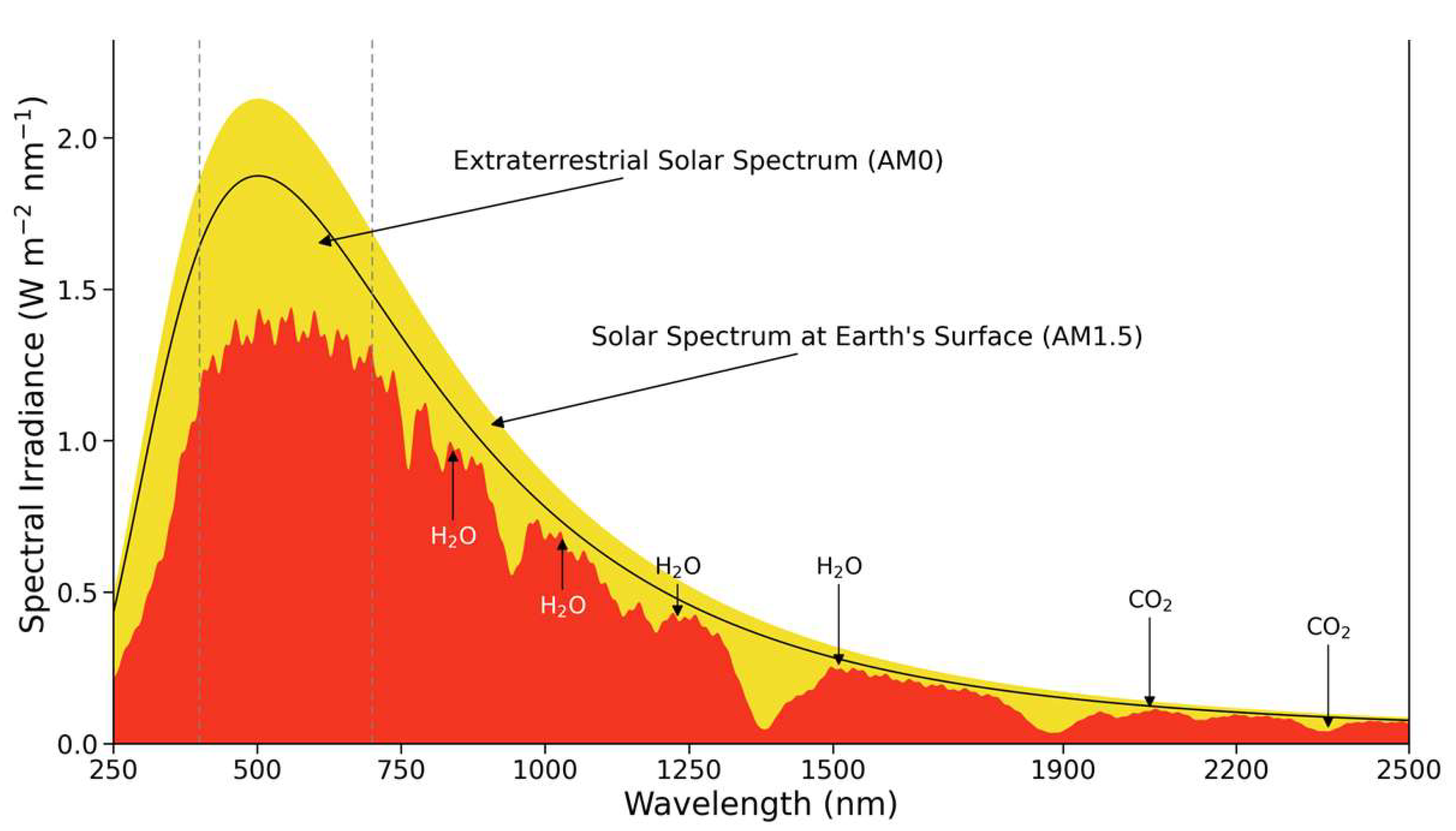
Solar radiation incident at the Earth’s surface spans ultraviolet (UV), visible (Vis), and infrared (IR) wavelengths, but its spectral composition is strongly conditioned by atmospheric transmission. Standard reference spectra such as the air mass 1.5 distribution illustrate that ultraviolet radiation (≈280–400 nm) represents only a small fraction of the total energy flux, whereas visible (≈400–700 nm) and infrared (>700 nm) wavelengths dominate the solar energy available for terrestrial applications [11,12]. This spectral imbalance has direct implications for solar-driven wastewater treatment, as processes relying exclusively on UV photons inherently exploit only a limited portion of the available solar resource.
Figure 1 presents the spectrum of solar radiation: the yellow region represents the extraterrestrial solar spectrum, corresponding to the irradiance emitted by the Sun before atmospheric interaction, while the red region represents the solar radiation that effectively reaches the Earth’s surface. The reduction between both spectra results from atmospheric absorption and scattering, mainly by ozone in the ultraviolet and by water vapor and carbon dioxide in the infrared. Therefore, the terrestrial solar spectrum is characterized by limited UV availability, dominant visible-light irradiance, and significant infrared contributions.
Atmospheric absorption by ozone (primarily in the UV), water vapor, and carbon dioxide (mainly in the IR), together with Rayleigh and aerosol scattering, leads to strong temporal and spatial variability in surface irradiance [11,13]. As a result, the spectral distribution of sunlight varies with solar zenith angle, altitude, season, and cloud cover, which can significantly affect treatment performance in outdoor systems. These effects are particularly relevant for comparative studies conducted at different geographic locations or under variable meteorological conditions.
To address this variability, wavelength-resolved atmospheric radiative transfer models such as SMARTS are frequently used to estimate site-specific spectral irradiance [13,14]. Such models allow researchers to assess the relative contributions of UV, visible, and IR radiation under realistic conditions, enabling more rational matching between reactor design, catalyst absorption properties, and the available solar spectrum.

2.2. Ultraviolet Radiation and Photochemical Initiation

The ultraviolet fraction of solar radiation plays a central role in photochemical processes relevant to wastewater treatment. UV photons can induce direct photolysis of contaminants that absorb in this spectral region, leading to bond cleavage and molecular transformation. In addition, UV radiation can activate advanced oxidation processes (AOPs) by promoting the formation of reactive oxygen species (ROS), including hydroxyl radicals, which exhibit high oxidation potentials and low selectivity toward organic substrates [15,16].
Below there are some examples of UV photolysis and UV-induced radical formation.
(1)
Direct UV photolysis of organic contaminants
When an organic molecule (R) absorbs UV photons, electronic excitation can lead to bond cleavage:
R + h ν   ( U V )     R *     R 1 · + R 2 ·
This mechanism applies to UV-absorbing pollutants such as dyes, phenols, pesticides, and pharmaceuticals, where excited states undergo homolytic bond scission. In the photolysis reaction (1), R represents a generic organic contaminant molecule capable of absorbing ultraviolet radiation. Upon absorption of a UV photon (hν), the molecule is promoted to an electronically excited state, denoted as R*. This excited state is typically short-lived and can undergo various deactivation pathways, including homolytic bond cleavage. The resulting species, R1• and R2•, correspond to organic radical fragments formed after bond dissociation, where the dot (•) indicates the presence of an unpaired electron. These radical intermediates are highly reactive and can subsequently participate in secondary reactions, such as oxidation by dissolved oxygen or further transformation by reactive oxygen species, ultimately leading to molecular degradation or mineralization.
(2)
UV photolysis of nitrate ions
N O 3 + h ν     N O 2 · + O ·
O + H 2 O     OH + O H
NO3 denotes the nitrate ion, a common constituent of natural waters and wastewaters. Under UV irradiation, nitrate can undergo photolysis to form a nitrogen dioxide radical (NO2•) and an oxygen-centered radical (O•). The oxygen radical is highly unstable in aqueous media and rapidly reacts with water molecules to produce hydroxyl radicals (•OH) and hydroxide ions (OH).
(3)
UV excitation of semiconductor photocatalysts (TiO2)
T i O 2 + h ν   ( λ < 387 n m )     e C B + h V B +
h V B + + H 2 O     OH + H +
e C B + O 2     O 2 ·
In semiconductor photocatalysis, TiO2 represents a wide-bandgap photocatalyst. When TiO2 absorbs UV photons with energy equal to or greater than its bandgap, an electron ( e C B ) is promoted from the valence band to the conduction band, leaving behind a positive hole ( h V B + ) in the valence band. These charge carriers can migrate to the catalyst surface, where the photogenerated hole oxidizes adsorbed water or hydroxide ions to form hydroxyl radicals (•OH), while the photogenerated electron reduces dissolved oxygen to form superoxide radicals (O2). These reactive species drive subsequent oxidation reactions at the catalyst–solution interface, leading to the transformation and eventual mineralization of organic pollutants.
In this section, TiO2 is presented as a representative semiconductor photocatalyst due to its extensive use as a model material in photocatalytic studies. Nevertheless, the fundamental mechanisms described, including photogenerated charge carrier formation and subsequent reactive oxygen species production, are generally applicable to other wide-bandgap oxide semiconductors such as ZnO and SnO2, as well as to heterostructured nanocomposites (e.g., ZnO/CuO) that have also been explored for solar-driven wastewater treatment. Equation (4) is valid for TiO2 with an anatase-type crystal structure and may not be directly applicable to rutile, due to differences in band gap energy (approximately 3.2 eV for anatase and 3.0 eV for rutile), which influence light absorption and photocatalytic activity.
These mechanisms underpin classical solar disinfection and solar-assisted AOPs, where UV-A radiation (≈315–400 nm) contributes to microbial inactivation and contaminant degradation through both direct and indirect pathways. However, under natural sunlight, the intensity of UV radiation is relatively low compared to artificial UV sources, resulting in slower reaction rates and longer treatment times, particularly in optically dense wastewaters [16].
Furthermore, UV-driven processes are highly sensitive to light attenuation caused by turbidity, suspended solids, and dissolved organic matter. This limitation has historically restricted UV-based solar treatment systems to relatively clear waters or shallow reactors. Consequently, while UV radiation remains mechanistically important, its limited availability under natural conditions has driven the development of complementary strategies that harness additional portions of the solar spectrum.

2.3. Visible Light Utilization and Catalyst Development

Visible light constitutes the largest fraction of solar irradiance reaching the Earth’s surface and has therefore become the focus of intense research efforts in solar-driven wastewater treatment. Unlike UV radiation, visible light is only weakly absorbed by water, necessitating the use of engineered photocatalysts capable of converting visible photons into chemical reactivity. This requirement has stimulated extensive innovation in catalyst design over the past decade [17,18,19,20,21].
Key strategies include band-gap narrowing through metal or nonmetal doping, construction of heterojunctions to enhance charge separation, incorporation of plasmonic nanoparticles to exploit localized surface plasmon resonance, and development of carbon-based or metal–organic framework-derived composites [17,18,19,20]. These materials extend light absorption into the visible range and improve the utilization of the dominant component of solar radiation.
Visible-light-responsive catalysts enable higher overall photon utilization and improve treatment robustness under fluctuating solar conditions. Importantly, visible-light activation also facilitates operation at near-neutral pH and in complex matrices, addressing some of the practical limitations associated with UV-dependent systems. Next there are some examples of the use of visible light.
(1)
Visible-light excitation of narrow-bandgap or modified semiconductors
For visible-light-responsive catalysts, photon absorption promotes charge separation even under λ > 400 nm:
C a t a l y s t + h ν   ( Vis )     e C B + h V B +
(2)
Surface oxidation under visible light (near-neutral pH)
Photogenerated holes oxidize surface-adsorbed water or hydroxide ions without requiring acidic conditions:
h V B + + H 2 O     OH + H +
Or
h V B + + O H     O H
This explains why visible-light-driven systems can operate efficiently at near-neutral pH, unlike classical photo-Fenton processes.
(3)
Reduction reactions and oxygen activation under visible light
Photogenerated electrons reduce dissolved oxygen to form reactive oxygen species:
e C B + O 2     O 2 ·
O 2 · + H +     H O 2 ·
2 H O 2 ·     H 2 O 2 + O 2
H 2 O 2 + h ν     2 O H
These pathways illustrate how visible-light photocatalysis indirectly generates hydroxyl radicals even when direct UV excitation is limited.
(4)
Heterojunction catalysts for enhanced charge separation
In composite catalysts, such as g-C3N4/TiO2, BiVO4/WO3, or ZnO/graphene, interfacial charge transfer reduces recombination:
e CB ,   A     e CB ,   B ; h VB ,   B +     h VB ,   A +
This spatial separation of charges enhances ROS generation under visible light and improves performance in complex wastewater matrices.
CB and VB denote the conduction band and valence band of a semiconductor photocatalyst, respectively. Conversely, h+_{VB} denotes a photogenerated hole in the valence band, corresponding to the absence of an electron after excitation.
These charge carriers are the fundamental reactive entities in photocatalysis. The conduction-band electrons ( e C B ) participate primarily in reduction reactions, such as the reduction of dissolved oxygen to superoxide radicals (O2). The valence-band holes ( h V B + ) act as strong oxidizing agents and can oxidize adsorbed water molecules or hydroxide ions to generate hydroxyl radicals (•OH). The efficiency of a photocatalytic process is therefore governed by the generation, separation, transport, and surface reactivity of these charge carriers.
(5)
Plasmonic enhancement under visible light
Metal nanoparticles (e.g., Ag, Au) absorb visible photons via localized surface plasmon resonance (LSPR):
A g 0 + h ν   ( Vis )     A g 0 *
A g 0 *     e hot + A g +
Hot electrons injected into the semiconductor conduction band participate in reduction reactions, expanding visible-light utilization.

2.4. Infrared Radiation and Thermal Enhancement

The infrared component of solar radiation contributes primarily through thermal effects, which are critical for understanding real solar reactor performance. IR radiation is efficiently absorbed by water and reactor materials, leading to elevated operating temperatures in outdoor systems. Even modest temperature increases (typically 5–20 °C) can significantly enhance treatment performance by accelerating reaction kinetics according to Arrhenius behavior, increasing diffusion coefficients, reducing viscosity, and improving mass-transfer rates [9,22].
Higher temperatures also influence adsorption–desorption equilibria and surface reaction rates in heterogeneous catalytic systems, which can shift the rate-controlling step from mass transfer to intrinsic kinetics. These effects are particularly important in slurry and immobilized photocatalytic reactors, where transport limitations frequently dominate [9].
Consequently, IR-driven heating can synergistically amplify photochemical processes driven by UV and visible radiation, enabling higher apparent reaction rates without additional energy input. This reinforces the importance of explicitly considering IR radiation when evaluating full-spectrum solar wastewater treatment systems.

2.5. Interaction of Solar Radiation with Wastewater Matrices

The interaction of solar radiation with wastewater is strongly influenced by the matrix’s optical and chemical characteristics. Turbidity, suspended solids, and chromophoric dissolved organic matter attenuate UV and visible radiation through absorption and scattering, reducing photon penetration depth and creating spatial heterogeneities in irradiance [16,23]. These effects can severely limit photochemical efficiency, particularly in deep or poorly mixed reactors.
Chemical composition further modulates treatment performance. Common inorganic ions such as bicarbonate and chloride can act as radical scavengers, while nitrate and nitrite may participate in secondary photochemical pathways [15,24]. Natural organic matter can simultaneously act as a photosensitizer and a radical sink, complicating mechanistic interpretation.
Temperature increases induced by IR radiation can further modify speciation equilibria and reaction rates, reinforcing the coupled nature of photonic, thermal, and chemical effects in real wastewater systems.

2.6. Measurement, Calibration, and Dosimetry Under Natural Sunlight

Accurate characterization of solar radiation is essential for reproducibility, comparison, and scale-up of solar-driven wastewater treatment processes. Because natural sunlight is inherently variable, studies should report measurement methodology, calibration procedures, and temporal resolution alongside irradiance and fluence values [25,26].
Broadband pyranometers are widely used to measure global irradiance, with classification and performance requirements defined by ISO 9060 and best-practice deployment described by the World Meteorological Organization [27,28]. However, broadband measurements alone are insufficient when treatment mechanisms depend on specific spectral regions.
Spectroradiometric measurements provide wavelength-resolved irradiance data necessary for catalyst–spectrum matching and mechanistic interpretation [11,14]. When spectral measurements are impractical, chemical actinometry offers a validated alternative for quantifying photon flux and absorbed photon dose within optically complex reactors [29]. The use of standardized photochemical terminology, as recommended by IUPAC, is essential to avoid ambiguity and ensure comparability across studies [30].

2.7. Coupled Photonic–Thermal Effects and Reactor Implications

Solar-driven wastewater treatment must be understood as a coupled photonic–thermal–transport process, in which treatment performance depends on radiation absorption, heat generation, and hydrodynamics. In many solar AOPs, the relevant driving force is the absorbed photon rate within the reacting volume, rather than the incident irradiance alone, motivating the use of metrics such as the local volumetric rate of photon absorption (LVRPA) and apparent quantum yield [31,32,33].
From an engineering perspective, reactor design must balance efficient UV–visible photon capture with beneficial utilization of IR-driven heating. Shallow-depth and thin-film reactors minimize optical losses in turbid matrices, while compound parabolic collectors and trough systems enhance solar capture and enable continuous operation [16,18,19]. When these factors are properly integrated, full-spectrum solar reactors can achieve synergistic performance gains that exceed those predicted from photochemistry alone.

3. Solar-Driven Disinfection of Wastewater

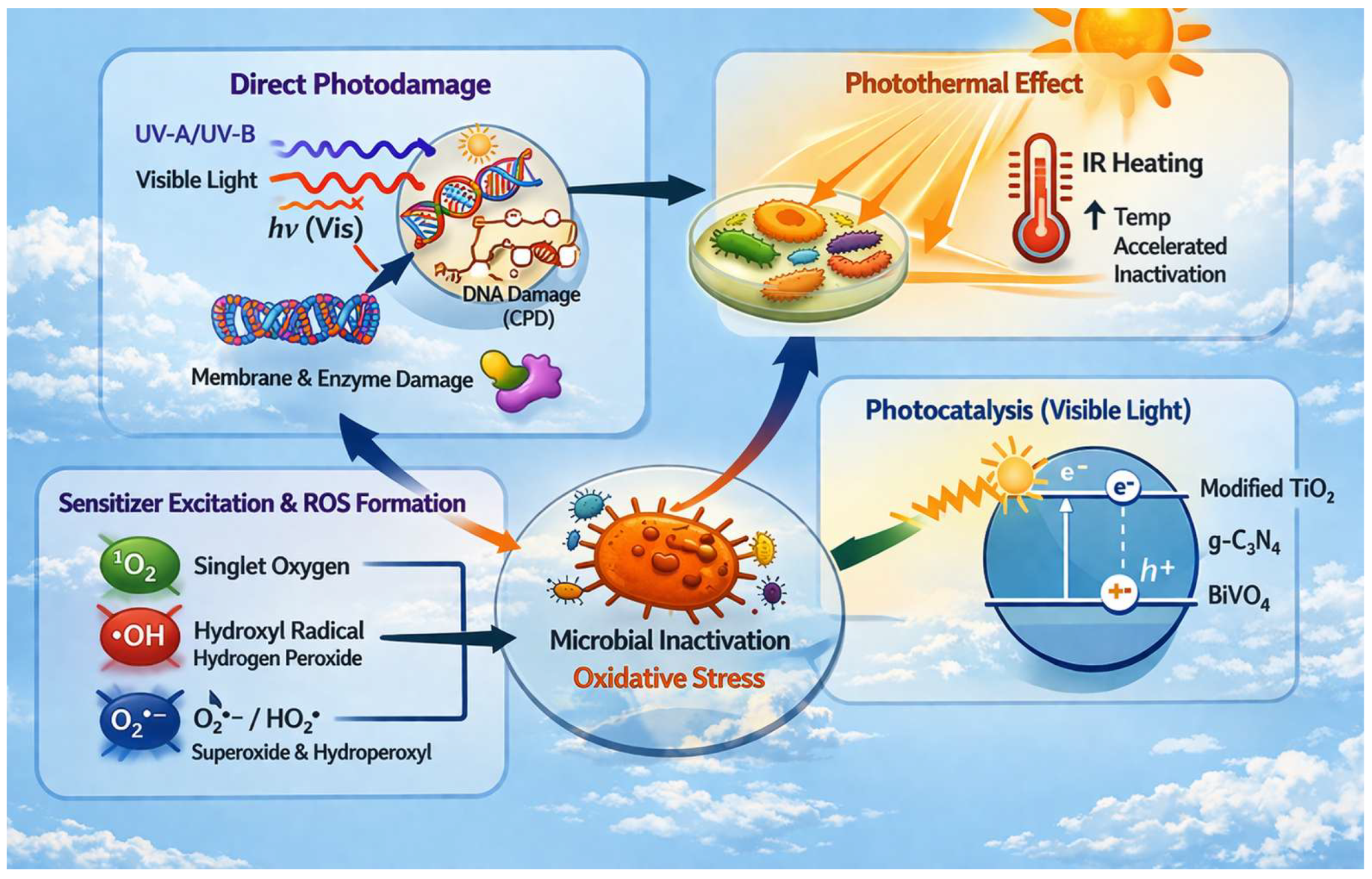
Solar-driven disinfection refers to pathogen inactivation achieved by sunlight through (i) direct photochemical damage and (ii) indirect oxidative stress mediated by photo-produced reactive intermediates, often intensified by photothermal heating. While classic solar water disinfection (SODIS) was developed for point-of-use drinking water treatment, its mechanistic basis and reactor concepts are increasingly being adapted to decentralized wastewater reuse contexts (e.g., effluents for irrigation, emergency sanitation, and polishing of biologically treated wastewater), where microbial risk is the dominant design driver. Field evidence shows that solar disinfection can deliver substantial reductions of indicator bacteria under realistic sunlight, provided that optical attenuation (turbidity, color, dissolved organic matter) is controlled and exposure conditions are properly managed [34,35,36]. Figure 2 shows the different pathways that disinfection can take place.

3.1. Direct Photoinactivation Pathways

Direct inactivation occurs when endogenous microbial chromophores absorb photons and convert that energy into lethal molecular damage. In sunlight-driven disinfection, UV-A (320–400 nm) is typically the most important band reaching the water in meaningful intensities, but short-wavelength UV (when available) and visible-light excitation of endogenous sensitizers can contribute depending on the microorganism and matrix [34,35].
Representative photochemical “damage initiation” steps can be expressed generically as:
(1)
Excitation of a microbial chromophore (C).
C + h ν C *
(2)
Direct bond cleavage or photochemical lesion formation.
C * C damaged
For nucleic acids, one commonly cited outcome is formation of cyclobutane pyrimidine dimers (CPDs) in DNA/RNA upon UV absorption (shown here schematically for adjacent thymine bases, T):
DNA-T-T + hν→DNA-(T=T)(CPD lesion)
In practice, sunlight disinfection rarely relies on a single lesion type: damage is typically multi-target (nucleic acids + membranes + enzymes), and indirect oxidative pathways become decisive in most real waters [34,35].

3.2. Indirect Photoinactivation via Photo-Produced Reactive Intermediates

Indirect pathways dominate when sunlight excites sensitizers (dissolved organic matter, natural pigments, extracellular polymeric substances, iron complexes, or engineered photocatalysts). The sensitizer transfers energy or electrons to oxygen/water to generate reactive oxygen species that oxidize critical biomolecules. This framework is central in modern mechanistic interpretations of SODIS and in the transition toward solar photocatalytic disinfection [35,36,37]. The reactions that take place are described below:
(1)
Sensitizer excitation and energy transfer (singlet oxygen)
S e n s + h ν S e n s *
S e n s * + O 2 S e n s + O 2 1
(2)
Electron-transfer route (superoxide → hydrogen peroxide → hydroxyl radical)
S e n s * + O 2 S e n s · + + O 2 ·
2 O 2 · + 2 H + H 2 O 2 + O 2
H 2 O 2 + h ν 2   ·   O H
(3)
Iron-assisted
F e 2 + + H 2 O 2 F e 3 + + · O H + O H
In the reaction schemes, Sens denotes a photosensitizer, which is any molecule or material capable of absorbing solar radiation and transferring the absorbed energy or electrons to surrounding species. Photosensitizers can be naturally occurring (e.g., chromophoric dissolved organic matter, extracellular polymeric substances, iron complexes) or engineered (e.g., organic dyes, immobilized sensitizers, or catalyst-bound light absorbers). Upon excitation (Sens*), these species generate reactive oxygen species through energy transfer (e.g., singlet oxygen, 1O2) or electron-transfer pathways, thereby contributing indirectly to microbial inactivation via oxidative stress [35,36,37].

3.3. Solar Photocatalytic Disinfection: Catalysts Enabling Full-Spectrum (UV–Vis) Utilization

A major limitation of “UV-dependent” solar disinfection is photon utilization efficiency: UV is a small fraction of terrestrial solar irradiance, and optical attenuation in wastewaters disproportionately suppresses UV transmission. Consequently, a central research direction is the use of visible-light-responsive photocatalysts and photothermal/photocatalytic composites that better exploit the solar spectrum (UV–Vis and, indirectly, IR via heating) [37,38,39].
For semiconductor photocatalysis, the canonical band-process reactions for ROS generation are:
(1)
Charge separation
S C + h ν e C B + h V B +
(2)
Oxidation route
h V B + + H 2 O · O H + H +
Or
h V B + + O H · O H
(3)
Reduction route
e C B + O 2 O 2 ·
O 2 · + H + H O 2 ·
2 H O 2 · H 2 O 2 + O 2
The symbol SC refers to a semiconductor photocatalyst, which is a solid material characterized by a valence band and a conduction band separated by an energy gap. When SC absorbs photons with energy equal to or greater than its band gap, electrons are promoted from the valence band to the conduction band, generating electron–hole pairs (( e C B ) and ( h V B + )). These charge carriers migrate to the catalyst surface, where they drive oxidation and reduction reactions that produce reactive oxygen species such as •OH, O2, and H2O2.
Examples of catalyst families being actively explored for solar disinfection (especially under visible light) include modified TiO2 (doping/heterojunctions), g-C3N4-based systems, BiVO4, and plasmonic or metal-decorated composites designed to improve charge separation and extend absorption into the visible; recent reviews emphasize that realistic sunlight testing and real-matrix validation remain the key gap between laboratory efficacy and field relevance [37,38,39,40,41,42,43].

3.4. Photothermal Synergy: The Role of IR and Elevated Water Temperature

A defining practical advantage of solar disinfection is the synergy between radiation dose and temperature. IR-rich solar heating increases bulk water temperature, which (i) accelerates reaction kinetics for oxidative damage and repair inhibition, (ii) increases membrane permeability and protein denaturation susceptibility, and (iii) can reduce the required exposure time at sufficiently high temperatures. Standard SODIS guidance explicitly notes that when water temperatures exceed ~50 °C, required exposure times can drop substantially, reflecting a coupled photo–thermal lethality mechanism [35,41,42].

3.5. Practical Constraints in Wastewater Matrices and Current Mitigation Strategies

For wastewater, disinfection performance is strongly governed by optical attenuation (suspended solids, turbidity, chromophoric dissolved organic matter), radical scavenging (bicarbonate/carbonate, NOM), and microbial shielding/aggregation. These factors explain why identical solar doses can yield very different log-reductions across matrices and why reactor hydrodynamics (mixing, thin-film designs) and pretreatments (clarification, filtration) are commonly necessary for robust outcomes [35,40,43].
Recent systematic analyses also indicate growing interest in hybridization: integrating solar disinfection with AOP concepts (e.g., catalyst-assisted or oxidant-assisted routes) to shorten treatment time, reduce regrowth, and target more resistant organisms. Feasibility, however, remains conditioned by catalyst availability, operational simplicity, and local solar resource variability [44].

4. Solar-Driven Advanced Oxidation Processes

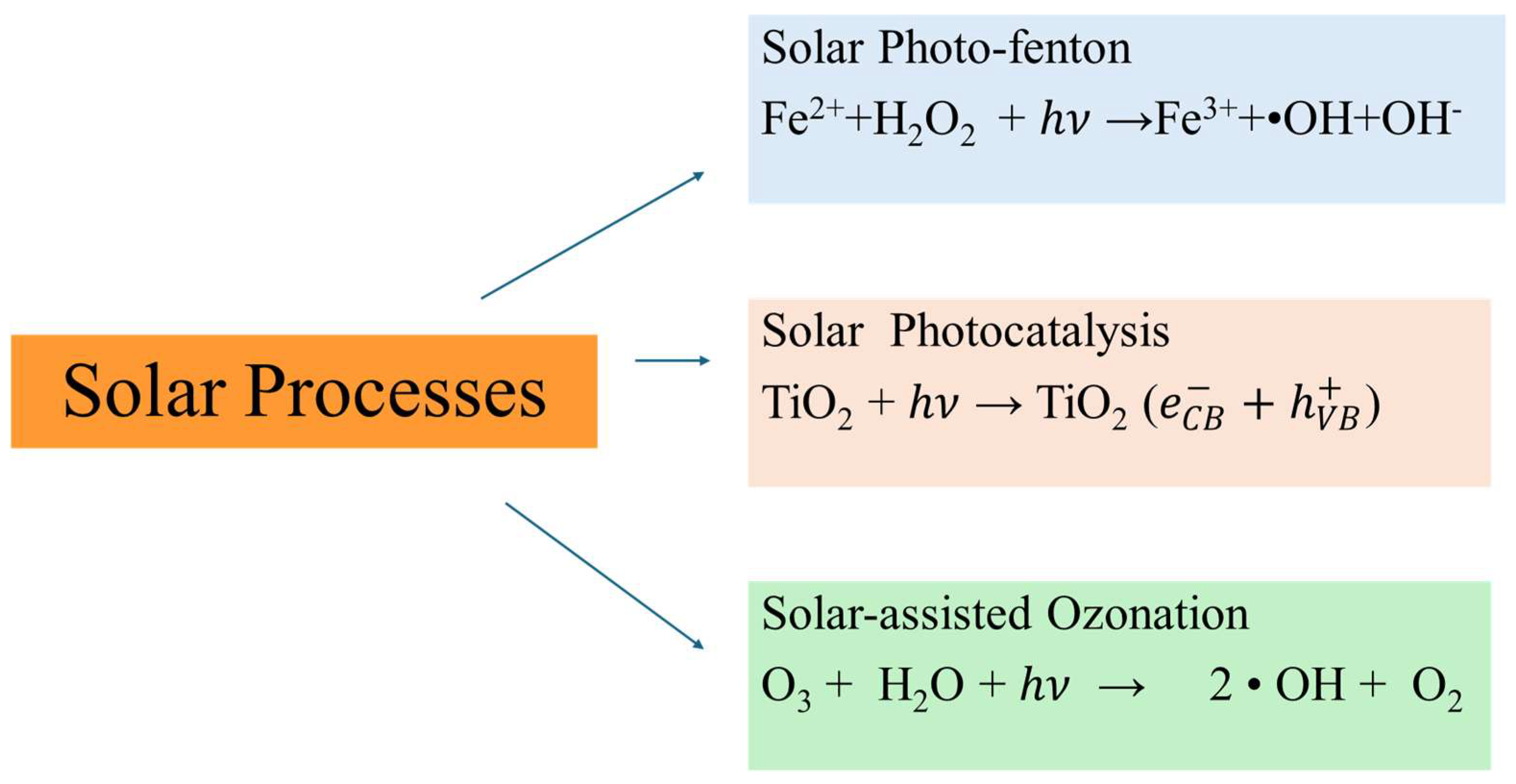
Solar-driven advanced oxidation processes (Solar AOPs) exploit natural sunlight to generate highly reactive transient species—primarily hydroxyl radicals (•OH), but also superoxide (O2), singlet oxygen (1O2), and sulfate radicals in some systems—that are capable of non-selectively oxidizing a wide range of organic pollutants. Compared with conventional AOPs driven by artificial UV sources, Solar AOPs offer the advantages of reduced electrical energy demand, intrinsic coupling with photothermal effects, and suitability for decentralized or low-infrastructure settings. Over the past two decades, three families of Solar AOPs have emerged as particularly relevant for wastewater treatment: solar photo-Fenton, solar photocatalysis, and solar-assisted ozonation [45,46,47]. Figure 3 shows a schematic diagram of these processes.

4.1. Solar Photo-Fenton Processes

This is the most extensively studied Solar AOP and is based on the classical Fenton reaction between ferrous iron and hydrogen peroxide, coupled with solar irradiation to regenerate Fe2+ and enhance radical production. Under sunlight, especially in the UV-A and visible range, ferric species are photoreduced, sustaining the catalytic cycle and increasing •OH yields [45,48].
The core reactions can be summarized as:
(1)
Dark Fenton reaction
F e 2 + + H 2 O 2 F e 3 + + · O H + O H
(2)
Solar photo-reduction of ferric species
F e 3 + ( O H ) + h ν F e 2 + + · O H
(3)
Overall catalytic cycle
F e 2 + H 2 O 2 , h ν F e 2 + + ROS
Solar irradiation thus accelerates Fe2+ regeneration and reduces the accumulation of Fe3+, which is a major limitation of dark Fenton systems. Traditionally, solar photo-Fenton operates optimally at acidic pH (≈2.5–3), but substantial research has focused on extending operation toward near-neutral pH using iron chelates (e.g., citrate, EDDS, oxalate) or heterogeneous iron sources [45,46,47,48,49,50,51].

4.2. Solar Photocatalysis

Relies on semiconductor materials that absorb solar photons and generate electron–hole pairs, which subsequently drive surface redox reactions leading to reactive oxygen species formation. While early work focused on UV-active TiO2, recent efforts emphasize visible-light-responsive materials to better exploit the solar spectrum [46,52].
The fundamental reaction scheme is:
(1)
Photon absorption and charge separation
S C + h ν e C B + h V B +
(2)
Oxidation reactions
h V B + + H 2 O · O H + H +
or
h V B + + O H · O H
(3)
Reduction reaction
e C B + O 2 O 2 ·
These species further evolve into H2O2 and •OH, sustaining oxidative degradation pathways. Modified TiO2, g-C3N4, BiVO4, WO3, ZnFe2O4, and heterojunction or plasmonic composites have been widely investigated for solar wastewater treatment [46,52,53,54].
Solar photocatalysis is particularly attractive for treating emerging contaminants at low concentrations, as it can operate under ambient conditions and near-neutral pH, although catalyst recovery, deactivation, and light penetration remain critical challenges for large-scale application [53,54,55].

4.3. Solar-Assisted Ozonation

Solar-assisted ozonation combines the strong oxidizing power of ozone with solar irradiation to enhance radical formation and pollutant degradation. In aqueous systems, ozone reacts selectively with certain functional groups, but its efficiency is greatly increased when decomposed into •OH radicals under photochemical or catalytic conditions [47,56].
Key reactions include:
(1)
Ozone photolysis
O 3 + h ν O 2 + O ( 1 D
(2)
Radical formation
O ( 1 D + H 2 O 2 · O H
(3)
Indirect ozone decomposition
O 3 + O H H O 2 · + O 2
Solar irradiation accelerates ozone decomposition, increases •OH yields, and improves treatment performance compared with ozonation alone. When coupled with photocatalysts or electrochemical ozone generation, solar-assisted ozonation becomes particularly effective for refractory organics and industrial wastewaters [47,56,57].

4.4. Radical Generation Pathways in Solar AOPs

Across Solar AOPs, pollutant degradation is governed by the generation and interplay of multiple reactive species. Hydroxyl radicals (•OH) are the dominant oxidants in most systems, but superoxide (O2), hydroperoxyl radicals (HO2•), singlet oxygen (1O2), and photogenerated holes also contribute depending on the process and matrix [45,46,47].
The relative importance of these species depends on water composition, pH, oxidant availability, catalyst properties, and solar spectrum. For example, bicarbonate and carbonate ions can scavenge •OH to form less reactive carbonate radicals, whereas natural organic matter can act both as a radical sink and a photosensitizer [58,59]. Understanding these pathways is essential for process optimization and for predicting performance in real wastewaters.

4.5. Removal of Organic Pollutants and Emerging Contaminants

Solar AOPs have been successfully applied to the degradation of a broad spectrum of organic pollutants, including dyes, phenols, pharmaceuticals, personal care products, antibiotics, pesticides, and endocrine-disrupting compounds. Numerous pilot- and field-scale studies demonstrate that solar photo-Fenton and solar photocatalysis can achieve high removal efficiencies under realistic solar conditions [48,49,50,51,53,54,55].
For emerging contaminants present at trace levels, Solar AOPs offer a particularly attractive polishing step after biological treatment, where conventional processes are often ineffective. Nevertheless, challenges remain related to oxidant consumption, formation of transformation products, iron or catalyst management, and variability of solar irradiance, underscoring the need for integrated design and long-term performance assessment [45,46,47,59]. Table 1 shows some applications of Solar AOPs.
Malato et al. reported that solar photo-Fenton processes generally achieve higher mineralization efficiencies compared to photocatalysis and other AOPs due to enhanced hydroxyl radical production under irradiation [5]. Similarly, Oller et al. demonstrated that photo-Fenton processes outperform other advanced oxidation processes in terms of COD and TOC removal for industrial wastewater treatment under comparable conditions [65].
These studies highlight that process performance is strongly dependent on operating conditions and that no single technology can be universally identified as the most effective.

5. Solar Heating in Wastewater Treatment

Solar-driven wastewater treatment is intrinsically a photonic–thermal coupled system, because terrestrial sunlight contains a dominant infrared (IR) fraction that is converted into heat within water. This photothermal contribution is increasingly recognized as a design lever because modest temperature rises can accelerate chemical kinetics, improve mass transfer, and intensify disinfection. Recent research emphasizes that combining sunlight absorption (UV–Vis) with photothermal conversion (IR → heat) can substantially enhance robustness under variable irradiance [66,67,68].

Temperature-Enhanced Kinetics

Arrhenius-type temperature dependence of reaction rates is described in the following equation:
k ( T ) = A e x p E a R T
where k is the apparent rate constant, A is the pre-exponential factor, Ea is activation energy, R is the gas constant, and T is absolute temperature. This indicates that the reaction rate is influenced by the temperature. In practical solar reactors, increases of only ~5–20 °C—commonly achieved by solar heating in closed or semi-closed systems—can translate into meaningful increases in oxidation rates, particularly for processes with non-trivial activation barriers [66,67,68,69].
Recent Solar AOP studies explicitly quantify temperature as a controlling variable. For solar photo-Fenton, the key radical-generation step is:
F e 2 + + H 2 O 2 F e 3 + + · O H + O H
Solar irradiation sustains Fe2+ regeneration, while elevated temperature can accelerate both initiation and subsequent oxidation sequences. A recent kinetic assessment of solar photo-Fenton mediated by ferric chelates reports the combined influence of photon absorption and temperature on micropollutant removal and bacterial inactivation, reinforcing that thermal effects must be included in mechanistic and engineering interpretations [69].
Beyond intrinsic kinetics, higher temperature reduces water viscosity and increases diffusivity, which can strengthen mass transfer to catalytic surfaces and accelerate gas–liquid transfer. In wastewater systems where optical attenuation and aggregation can shift control toward transport and contact efficiency, thermal enhancement can reduce the time required to reach a given removal target by improving mixing effectiveness and boundary-layer transport [70,71].
Recent studies show that heating wastewater significantly enhances pollutant degradation rates by accelerating intrinsic reaction kinetics, improving oxidant activation, and intensifying mass-transfer processes. This effect is frequently achieved through photothermal conversion of infrared (IR) radiation, which raises bulk or localized temperatures without external energy input. It is also emphasized that even moderate temperature increases can stabilize treatment performance under fluctuating irradiance and reduce treatment time, particularly when photothermal effects are intentionally integrated into advanced oxidation process (AOP) design rather than treated as incidental phenomena [72,73].
Heat-activated sulfate-radical-based advanced oxidation processes (SR-AOPs) represent an important thermally enhanced pathway for the degradation of recalcitrant contaminants. These systems include persulfate (PS) and peroxymonosulfate (PMS), in which increasing temperature promotes oxidant activation and enhances the formation of sulfate radicals (SO4) and hydroxyl radicals (•OH), thereby increasing apparent reaction rate constants and improving pollutant mineralization:
S2O82− + heat → 2 SO4
SO4 + H2O → •OH + SO42− + H+
Both laboratory-scale and real-wastewater investigations demonstrate that thermally activated persulfate systems—either operated independently or combined with photonic inputs—can substantially outperform non-heated analogues, highlighting temperature as a critical operational variable in oxidation-based wastewater treatment processes [74,75,76,77,78].
Temperature also plays a decisive role in ozonation and photocatalytic oxidation pathways. In aqueous ozonation, increasing temperature modifies ozone decomposition kinetics and promotes the formation of radical intermediates responsible for non-selective oxidation:
O3 + OH → HO2 + O2
HO2 + O3 → HO2• + O3
O3 + H+ → HO3• → •OH + O2
The resulting hydroxyl radicals significantly enhance the oxidation capacity of the system. Similarly, in heterogeneous photocatalytic systems, photothermal heating resulting from solar absorption by catalysts or reactor materials can accelerate surface reactions, improve charge-carrier transport, and increase pollutant degradation rates relative to strictly isothermal conditions [79,80,81,82]. Table 2 summarizes representative examples of enhanced pollutant degradation achieved through solar-driven processes.
Although numerous studies report a positive effect of temperature on photocatalytic processes, opposite trends have also been observed. For example, Hong et al. reported that increasing the temperature to 35–40 °C led to a significant decrease in the degradation efficiency of volatile organic compounds using a Ga2O3 photocatalyst [91]. Similarly, Chen et al. observed that, for a Cu/TiO2 system, increasing the reaction temperature to 50 °C resulted in a noticeable decrease in the apparent reaction rate constant [92]. These findings indicate that the effect of temperature is system-dependent and can be influenced by several factors.
In particular, the decrease in photocatalytic efficiency at higher temperatures has been attributed to increased recombination of photogenerated charge carriers, which reduces the availability of electrons and holes for surface redox reactions. Additionally, changes in adsorption–desorption equilibria, oxygen solubility, and surface reaction dynamics may also contribute to reduced performance under certain conditions. Therefore, careful evaluation of catalyst properties, reaction mechanisms, and operating conditions is required to determine whether temperature enhances or inhibits pollutant degradation in photocatalytic systems.
Under typical solar-driven conditions, water temperatures in passive or semi-enclosed reactors generally range between 30 and 50 °C, depending on solar irradiance, reactor configuration, hydraulic residence time, and climatic conditions. However, higher temperatures (up to 60–70 °C) can be achieved in intensified systems such as compound parabolic collectors (CPCs), solar concentrators, or photothermal materials that enhance infrared absorption [34,35,65].
These temperature ranges are lower than the conventional 40–80 °C typically reported for purely thermal persulfate activation; nevertheless, recent studies demonstrate that moderate temperature increases (10–30 °C above ambient) can significantly enhance persulfate activation kinetics when combined with photochemical or catalytic pathways. In solar-driven systems, temperature acts synergistically with irradiation by accelerating oxidant decomposition, improving mass transfer, and facilitating radical generation (SO4 and •OH), even under sub-optimal thermal conditions [66,73].
Moreover, photothermal effects can generate localized heating at catalyst surfaces, where temperatures may exceed bulk values, thereby promoting oxidant activation at the solid–liquid interface. This localized energy input partially compensates for the lower bulk temperatures typically observed in solar reactors and contributes to the overall enhancement of degradation rates [73,74].
Beyond macroscopic temperature increases, photothermal materials can influence catalytic reactions through several interfacial mechanistic pathways. When photothermal materials absorb solar radiation—particularly in the visible and near-infrared regions—the absorbed photon energy is partially dissipated through non-radiative relaxation processes that generate lattice vibrations (phonons). This photonic-to-thermal conversion produces localized heating directly at the catalyst surface, creating temperature gradients that can exceed the bulk solution temperature. Such localized heating lowers activation barriers, enhances surface reaction kinetics, and accelerates catalytic oxidation processes occurring at active sites [93,94].
In plasmonic photothermal materials such as Au, Ag, or Cu nanoparticles, photon absorption can induce localized surface plasmon resonance (LSPR), in which collective oscillations of conduction electrons generate energetic charge carriers:
Au + hν → Au*(LSPR)
The excited plasmonic state subsequently relaxes through the generation of hot electrons and holes:
Au*(LSPR) → Au + e(hot) + h+(hot)
These hot carriers can participate directly in catalytic redox reactions by transferring electrons to dissolved oxygen or oxidants, initiating the formation of reactive oxygen species responsible for pollutant degradation. This plasmon-driven charge-transfer mechanism has been widely reported in solar photocatalysis and plasmon-assisted catalytic systems [93,94,95,96,97].
For example, hot electrons may activate molecular oxygen to produce superoxide radicals:
O2 + e(hot) → O2
O2 + H+ → HO2
2 HO2• → H2O2 + O2
The hydrogen peroxide produced can further generate hydroxyl radicals through Fenton-type reactions:
H2O2 + Fe2+ → Fe3+ + •OH + OH
Hot electrons can also activate persulfate oxidants:
S2O82− + e → SO4 + SO42−
Another mechanistic pathway arises from the coupling between photothermal heating and photocatalytic charge separation in semiconductor catalysts. Under solar irradiation, semiconductor photocatalysts generate electron–hole pairs:
Semiconductor + hν → e(CB) + h+(VB)
Photothermal heating can enhance charge-carrier mobility and suppress electron–hole recombination, thereby facilitating interfacial redox reactions such as:
h+(VB) + H2O → •OH + H+
e(CB) + O2 → O2
The simultaneous occurrence of photothermal heating, plasmon-mediated hot-carrier injection, and photochemical radical generation therefore creates a synergistic catalytic environment that enhances pollutant degradation kinetics. These mechanisms demonstrate that photothermal materials act not only as passive heat sources but also as active catalytic components capable of modifying the local reaction environment, facilitating charge transfer, and promoting oxidant activation pathways in solar-driven wastewater treatment systems [93,95].

6. Future Perspectives

Future developments in solar-driven catalytic water treatment will likely rely on the integration of several technological and conceptual advances. Materials innovation is progressively shifting from UV-dependent systems toward broadband solar utilization, particularly through the development of visible-light-responsive catalytic materials. In parallel, the integration of solar electricity with electrochemical and photoelectrochemical oxidation may enable on-site oxidant generation and anodic oxidation driven directly by renewable energy sources, thereby reducing operational emissions and improving overall process sustainability [98,99,100,101].
At the system level, coupling solar photochemical processes with photothermal effects, optimized reactor configurations, and scalable solar disinfection strategies could provide cost-effective solutions for decentralized water treatment and water reuse. However, practical deployment will require standardized performance validation, improved field monitoring, and user-centered system design to ensure reliable operation under variable solar conditions [100,101,102].
However, several barriers still limit the practical implementation of solar-powered electrochemical systems for wastewater treatment. These include: (i) the intermittency of solar irradiation and the consequent need for energy storage or hybrid energy management strategies; (ii) the cost, durability, and long-term stability of electrode and photoelectrode materials under highly oxidative conditions; (iii) performance limitations in real wastewater matrices due to fouling, radical scavenging, and competing reactions; and (iv) the complexity associated with scaling up laboratory systems to continuous or industrial operation.
Recent studies support these limitations. For instance, photovoltaic-driven electrochemical systems require energy management strategies, such as battery integration, to ensure continuous operation under variable solar conditions [103]. Furthermore, recent reviews highlight that electrode material cost, reactor engineering, and scale-up remain critical bottlenecks for industrial deployment [104,105]. Finally, recent analyses of photoelectrochemical systems emphasize that material stability, reusability, wastewater matrix effects, and by-product formation remain major challenges for practical implementation [98].
Finally, solar-driven treatment technologies should be considered within the broader framework of the circular water economy, where water reuse, energy recovery, and resource efficiency are integrated into sustainable water management strategies. Continued advances in mechanistic understanding, materials design, and reactor engineering will be essential to translate laboratory-scale efficiencies into reliable large-scale applications [35,106,107,108,109].

Author Contributions

Conceptualization, C.E.B.-D., investigation G.R.-M. and P.B.-H.; writing B.A.F.-U. and P.A.-P. All authors have read and agreed to the published version of the manuscript.

Funding

This research was funded by UAEMéx through project No. 7158/2024ECON.

Data Availability Statement

No new data were created or analyzed in this study. Data sharing is not applicable to this article.

Acknowledgments

The authors gratefully acknowledge the support provided by the Joint Center for Research in Sustainable Chemistry (Centro Conjunto de Investigaciones en Química Sustentable, UAEM–UNAM) during the development of this study. During the preparation of this manuscript/study, the authors used ChatGPT5.3 for the purposes of generating graphics and the English grammar revision. The authors have reviewed and edited the output and take full responsibility for the content of this publication.

Conflicts of Interest

The authors declare no conflicts of interest.

References

  1. UN-Water. Progress on Wastewater Treatment—2024 Update; UN-Water: Geneva, Switzerland, 2024; Available online: https://www.unwater.org/publications/progress-wastewater-treatment-2024-update (accessed on 15 February 2025).
  2. UNESCO World Water Assessment Programme (WWAP). The United Nations World Water Development Report 2024: Water for Prosperity and Peace; UNESCO: Paris, France, 2024; Available online: https://unesdoc.unesco.org/ark:/48223/pf0000388948 (accessed on 15 February 2025).
  3. United Nations Statistics Division. The Sustainable Development Goals Report 2024—Goal 6: Clean Water and Sanitation; UN DESA: New York, NY, USA, 2024; Available online: https://unstats.un.org/sdgs/report/2024/Goal-06/ (accessed on 15 February 2025).
  4. Hübner, U.; Spahr, S.; Lutze, H.V.; Wieland, A.; Rüting, S.; Gernjak, W.; Wenk, J. Advanced oxidation processes for water and wastewater treatment: Guidance for systematic future research. Heliyon 2024, 10, e30402. [Google Scholar] [CrossRef]
  5. Malato, S.; Fernández-Ibáñez, P.; Maldonado, M.I.; Blanco, J.; Gernjak, W. Decontamination and disinfection of water by solar photocatalysis: Recent overview and trends. Catal. Today 2009, 147, 1–59. [Google Scholar] [CrossRef]
  6. Ding, Y.; Li, Z.; Zhang, S.; Yang, G.; Zheng, R.; Wang, C. Visible-light-driven photocatalytic water body purification on 2D carbon materials. J. Environ. Manag. 2025, 392, 126774. [Google Scholar] [CrossRef] [PubMed]
  7. Zhang, Y.; Wang, Y.; Xu, W.; Wu, Y.; Zeng, C.; Wang, Y.; Zhong, W.; Yang, R. Increased solar absorption and promoted photocarrier separation in atomically thin 2D carbon nitride sheets for enhanced visible-light photocatalysis. Chem. Eng. J. 2022, 431, 133219. [Google Scholar] [CrossRef]
  8. Ashina, C.; Pugazhenthiran, N.; Mangalaraja, R.V.; Sathishkumar, P. Review on enhancing solar photocatalysis for sustainable degradation of invisible environmental pollutants. Renew. Sustain. Energy Rev. 2025, 214, 115490. [Google Scholar] [CrossRef]
  9. Metcalf&Eddy; Tchobanoglous, G.; Stensel, H.D.; Tsuchihashi, R.; Burton, F.L. Wastewater Engineering: Treatment and Resource Recovery, 5th ed.; McGraw-Hill Education: New York, NY, USA, 2014. [Google Scholar]
  10. El-Gawad, H.A.; Ghaly, M.Y.; El Hussieny, N.F.; Abdel Kreem, M.; Reda, Y. Novel collector design and optimized photo-Fenton model for sustainable industry textile wastewater treatment. Sci. Rep. 2024, 14, 8573. [Google Scholar] [CrossRef]
  11. ASTM G173-03; Standard Tables for Reference Solar Spectral Irradiances: Direct Normal and Hemispherical on 37° Tilted Surface. ASTM International: West Conshohocken, PA, USA, 2020.
  12. National Renewable Energy Laboratory (NREL). Reference Air Mass 1.5 Solar Spectral Irradiance (ASTM G173); NREL: Golden, CO, USA, 2003. Available online: https://www.nrel.gov (accessed on 15 February 2025).
  13. Gueymard, C.A. SMARTS2: A Simple Model of the Atmospheric Radiative Transfer of Sunshine—Algorithms and Performance Assessment. FSEC-PF-270-95; Florida Solar Energy Center: Cocoa, FL, USA, 1995. [Google Scholar]
  14. Gueymard, C.A. Parameterized transmittance model for direct beam and circumsolar spectral irradiance. Sol. Energy 2001, 71, 325–346. [Google Scholar] [CrossRef]
  15. Pignatello, J.J.; Oliveros, E.; MacKay, A. Advanced oxidation processes for organic contaminant destruction based on the Fenton reaction and related chemistry. Crit. Rev. Environ. Sci. Technol. 2006, 36, 1–84. [Google Scholar] [CrossRef]
  16. Malato, S.; Blanco, J.; Vidal, A.; Alarcón, D.; Maldonado, M.I.; Cáceres, J.; Gernjak, W. Applied studies in solar photocatalytic detoxification: An overview. Sol. Energy 2003, 75, 329–336. [Google Scholar] [CrossRef]
  17. Chong, M.-N.; Jin, B.; Chow, C.-W.K.; Saint, C. Recent developments in photocatalytic water treatment technology: A review. Water Res. 2010, 44, 2997–3027. [Google Scholar] [CrossRef]
  18. Spasiano, D.; Marotta, R.; Malato, S.; Fernández-Ibáñez, P.; Di Somma, I. Solar photocatalysis: Materials, reactors, some commercial and pre-industrialized applications. A comprehensive approach. Appl. Catal. B Environ. 2015, 170–171, 90–123. [Google Scholar] [CrossRef]
  19. Robert, D.; Malato, S. Solar photocatalysis: A clean process for water detoxification. Sci. Total Environ. 2002, 291, 85–97. [Google Scholar] [CrossRef] [PubMed]
  20. Ferreira, M.E.C.; Bergamasco, R.; Yamaguchi, N.U. Recent advances in heterogeneous solar photocatalytic reactors for wastewater treatment. J. Water Process Eng. 2025, 73, 107734. [Google Scholar] [CrossRef]
  21. Li, J.; Li, Y.; Selishchev, D.; Zhang, G. Near-infrared responsive photocatalysts for environmental remediation and energy conversion: A review. Chemosphere 2024, 367, 143599. [Google Scholar] [CrossRef]
  22. El-Gawad, H.A.; Ebrahiem, E.E.; Ghaly, M.Y.; Afify, A.A.; Mohamed, R.M. An application of advanced oxidation process on industrial crude oily wastewater treatment. Sci. Rep. 2023, 13, 3420. [Google Scholar] [CrossRef] [PubMed]
  23. Wenk, J.; von Gunten, U.; Canonica, S. Effect of dissolved organic matter on the transformation of contaminants induced by excited triplet states and the hydroxyl radical. Environ. Sci. Technol. 2011, 45, 1334–1340. [Google Scholar] [CrossRef]
  24. Canonica, S.; Hellrung, B.; Wirz, J. Oxidation of phenols by triplet aromatic ketones in aqueous solution. J. Phys. Chem. A 2000, 104, 1226–1232. [Google Scholar] [CrossRef]
  25. Bolton, J.R.; Stefan, M.I. Fundamental photochemical approach to the concepts of fluence (UV dose) and electrical energy efficiency in photochemical degradation reactions. Res. Chem. Intermed. 2002, 28, 857–870. [Google Scholar] [CrossRef]
  26. Miklos, D.B.; Remy, C.; Jekel, M.; Linden, K.G.; Drewes, J.E.; Hübner, U. Evaluation of advanced oxidation processes for water and wastewater treatment—A critical review. Water Res. 2018, 139, 118–131. [Google Scholar] [CrossRef]
  27. ISO 9060:2018; Solar Energy: Specification and Classification of Instruments for Measuring Hemispherical Solar and Direct Solar Radiation. ISO: Geneva, Switzerland, 2018.
  28. World Meteorological Organization (WMO). Guide to Meteorological Instruments and Methods of Observation (WMO-No. 8); WMO: Geneva, Switzerland, 2024. [Google Scholar]
  29. Kuhn, H.-J.; Braslavsky, S.E.; Schmidt, R. Chemical actinometry (IUPAC Technical Report). Pure Appl. Chem. 2004, 76, 2105–2146. [Google Scholar] [CrossRef]
  30. Braslavsky, S.E. Glossary of terms used in photochemistry, 3rd edition (IUPAC Recommendations 2006). Pure Appl. Chem. 2007, 79, 293–465. [Google Scholar] [CrossRef]
  31. Brandi, R.J.; Alfano, O.M.; Cassano, A.E. Modeling of radiation absorption in a flat-plate photocatalytic reactor. Chem. Eng. Sci. 1996, 51, 3169–3184. [Google Scholar] [CrossRef]
  32. Romero, R.L.; Alfano, O.M.; Cassano, A.E. Cylindrical photocatalytic reactors: Radiation absorption and scattering effects produced by suspended fine particles in an annular space. Ind. Eng. Chem. Res. 1997, 36, 3094–3109. [Google Scholar] [CrossRef]
  33. Wang, D.; Mueses, M.A.; Colina-Márquez, J.A.; Machuca-Martínez, F.; Grčić, I.; Peralta, R.; Puma, G.L. Engineering and modeling perspectives on photocatalytic reactors for water treatment. Water Res. 2021, 202, 117421. [Google Scholar] [CrossRef] [PubMed]
  34. McGuigan, K.G.; Conroy, R.M.; Mosler, H.-J.; du Preez, M.; Ubomba-Jaswa, E.; Fernández-Ibáñez, P. Solar water disinfection (SODIS): A review from bench-top to roof-top. J. Hazard. Mater. 2012, 235–236, 29–46. [Google Scholar] [CrossRef] [PubMed]
  35. García-Gil, Á.; García-Muñoz, R.A.; McGuigan, K.G.; Marugán, J. Solar water disinfection to produce safe drinking water: A review of parameters, enhancements, and modelling approaches to make SODIS faster and safer. Molecules 2021, 26, 3431. [Google Scholar] [CrossRef] [PubMed]
  36. Chaúque, B.J.M.; Rott, M.B. Solar disinfection (SODIS) technologies as alternative for large-scale public drinking water supply: Advances and challenges. Chemosphere 2021, 281, 130754. [Google Scholar] [CrossRef]
  37. Cowie, B.E.; Porley, V.; Robertson, N. Solar disinfection (SODIS) provides a much underexploited opportunity for researchers in photocatalytic water treatment (PWT). ACS Catal. 2020, 10, 11779–11782. [Google Scholar] [CrossRef]
  38. Silerio-Vázquez, F.; Núñez-Núñez, C.M.; Proal-Nájera, J.B.; Alarcón-Herrera, M.T. A systematic review on solar heterogeneous photocatalytic water disinfection: Advances over time, operation trends, and prospects. Catalysts 2022, 12, 1314. [Google Scholar] [CrossRef]
  39. Chen, Z.; Pan, M.; Cheng, C.; Luo, J.; Deng, X. Water disinfection: Advances in photocatalysis and piezo/triboelectric catalysis with progressively enhanced energy utilization. SusMat 2024, 4, e232. [Google Scholar] [CrossRef]
  40. García-Gil, Á.; García-Muñoz, R.A.; Martínez-García, A.; Polo-López, M.I.; Gebreyesus, A.W.; Teferi, M.; Asmelash, A.; Conroy, R.M.; McGuigan, K.G.; Marugán, J. Solar water disinfection in large-volume containers: From the laboratory to the field. A case study in Tigray, Ethiopia. Sci. Rep. 2022, 12, 18933. [Google Scholar] [CrossRef]
  41. Pretorius, M.; Jeon, I.; Martínez-Fausto, M.M.; Novelli, N.; Galindo Arevalo, J.L.; Ryberg, E.; Derby, M.M.; Kim, M.J.; Dyson, A. Building-integrated solar water disinfection system for reliable year-round drinking water safety. npj Clean Water 2026. [Google Scholar] [CrossRef]
  42. Dunlop, P.S.M.; Ciavola, M.; Rizzo, L.; Byrne, J.A. Inactivation and injury assessment of Escherichia coli during solar and photocatalytic disinfection in LDPE bags. Chemosphere 2011, 85, 1160–1166. [Google Scholar] [CrossRef] [PubMed]
  43. Chaúque, B.J.M.; Brandão, F.G.; Rott, M.B. Development of solar water disinfection systems for large-scale public supply: State of the art, improvements and paths to the future—A systematic review. J. Environ. Chem. Eng. 2022, 10, 107887. [Google Scholar] [CrossRef]
  44. Afitiri, A.; Aram, S.A.; Martienssen, M. Systematic review of the effects of advanced oxidation processes integration with solar water disinfection for improved drinking water production. Waste Manag. Bull. 2024, 1, 52–59. [Google Scholar] [CrossRef]
  45. Yang, Y.; Pignatello, J.J.; Ma, J.; Mitch, W.A. Comparison of halide impacts on the efficiency of contaminant degradation by sulfate and hydroxyl radical-based advanced oxidation processes (AOPs). Environ. Sci. Technol. 2014, 48, 2344–2351. [Google Scholar] [CrossRef]
  46. Marotta, R.; Spasiano, D.; Di Somma, I.; Andreozzi, R. Photodegradation of naproxen and its photoproducts in aqueous solution at 254 nm: A kinetic investigation. Water Res. 2013, 47, 373–383. [Google Scholar] [CrossRef]
  47. Nawrocki, J.; Kasprzyk-Hordern, B. The efficiency and mechanisms of catalytic ozonation. Appl. Catal. B Environ. 2010, 99, 27–42. [Google Scholar] [CrossRef]
  48. Malato, S.; Blanco, J.; Vidal, A.; Richter, C. Photocatalysis with solar energy at a pilot-plant scale: An overview. Appl. Catal. B Environ. 2002, 37, 1–15. [Google Scholar] [CrossRef]
  49. Klamerth, N.; Malato, S.; Agüera, A.; Fernández-Alba, A.R. Photo-Fenton and modified photo-Fenton at neutral pH for the treatment of emerging contaminants in wastewater treatment plant effluents: A comparison. Water Res. 2013, 47, 833–840. [Google Scholar] [CrossRef]
  50. De Laat, J.; Hervé, G. Catalytic decomposition of hydrogen peroxide by Fe(III) in homogeneous aqueous solution: Mechanism and kinetic modeling. Environ. Sci. Technol. 1999, 33, 2726–2732. [Google Scholar] [CrossRef]
  51. Clarizia, L.; Russo, D.; Di Somma, I.; Marotta, R.; Andreozzi, R. Homogeneous photo-Fenton processes at near neutral pH: A review. Appl. Catal. B Environ. 2017, 209, 358–371. [Google Scholar] [CrossRef]
  52. Kumar, S.G.; Devi, L.G. Review on modified TiO2 photocatalysis under UV/visible light: Selected results and related mechanisms on interfacial charge carrier transfer dynamics. J. Phys. Chem. A 2011, 115, 13211–13241. [Google Scholar] [CrossRef] [PubMed]
  53. Herrmann, J.-M. Heterogeneous photocatalysis: Fundamentals and applications to the removal of various types of aqueous pollutants. Catal. Today 1999, 53, 115–129. [Google Scholar] [CrossRef]
  54. Boonprakob, N.; Wetchakun, N.; Phanichphant, S.; Waxler, D.; Sherrell, P.; Nattestad, A.; Chen, J.; Inceesungvorn, B. Enhanced visible-light photocatalytic activity of g-C3N4/TiO2 films. J. Colloid Interface Sci. 2014, 417, 402–409. [Google Scholar] [CrossRef]
  55. Comninellis, C.; Kapalka, A.; Malato, S.; Parsons, S.A.; Poulios, I.; Mantzavinos, D. Advanced oxidation processes for water treatment: Advances and trends for R&D. J. Chem. Technol. Biotechnol. 2008, 83, 769–776. [Google Scholar] [CrossRef]
  56. von Gunten, U. Ozonation of drinking water: Part I. Oxidation kinetics and product formation. Water Res. 2003, 37, 1443–1467. [Google Scholar] [CrossRef]
  57. Staehelin, J.; Hoigné, J. Decomposition of ozone in water: Rate of initiation by hydroxide ions and hydrogen peroxide. Environ. Sci. Technol. 1982, 16, 676–681. [Google Scholar] [CrossRef]
  58. Buxton, G.V.; Greenstock, C.L.; Helman, W.P.; Ross, A.B. Critical review of rate constants for reactions of hydrated electrons, hydrogen atoms and hydroxyl radicals (•OH/•O) in aqueous solution. J. Phys. Chem. Ref. Data 1988, 17, 513–886. [Google Scholar] [CrossRef]
  59. Canonica, S.; Laubscher, H. Inhibitory effect of dissolved organic matter on triplet-induced oxidation of aquatic contaminants. Photochem. Photobiol. Sci. 2008, 5, 547–551. [Google Scholar] [CrossRef]
  60. Klamerth, N.; Malato, S.; Maldonado, M.I.; Agüera, A.; Fernández-Alba, A.R. Application of photo-Fenton as a tertiary treatment of emerging contaminants in municipal wastewater. Environ. Sci. Technol. 2010, 44, 1792–1798. [Google Scholar] [CrossRef] [PubMed]
  61. Clarizia, L.; Spasiano, D.; Di Somma, I.; Marotta, R.; Andreozzi, R.; Dionysiou, D.D. Copper-modified TiO2 catalysts for hydrogen generation through photoreforming of organics: A short review. Int. J. Hydrogen Energy 2014, 39, 16812–16831. [Google Scholar] [CrossRef]
  62. Amor, C.; De Torres-Socías, E.; Peres, J.A.; Maldonado, M.I.; Oller, I.; Malato, S.; Lucas, M.S. Mature landfill leachate treatment by coagulation/flocculation combined with Fenton and solar photo-Fenton processes. J. Hazard. Mater. 2015, 286, 261–268. [Google Scholar] [CrossRef] [PubMed]
  63. von Gunten, U. Ozonation of drinking water: Part II. Disinfection and by-product formation in presence of bromide, iodide or chlorine. Water Res. 2003, 37, 1469–1487. [Google Scholar] [CrossRef]
  64. Dong, F.; Li, Y.; Wang, Z.; Ho, W. Enhanced visible-light photocatalytic activity and oxidation ability of porous graphene-like g-C3N4 nanosheets via thermal exfoliation. Appl. Surf. Sci. 2015, 358, 393–403. [Google Scholar] [CrossRef]
  65. Oller, I.; Malato, S.; Sánchez-Pérez, J.A. Combination of Advanced Oxidation Processes and Biological Treatments for Wastewater Decontamination—A Review. Sci. Total Environ. 2011, 409, 4141–4166. [Google Scholar] [CrossRef]
  66. Tang, Z.; Ma, D.; Chen, Q.; Wang, Y.; Sun, M.; Lian, Q.; Shang, J.; Wong, P.K.; He, C.; Xia, D.; et al. Nanomaterial-enabled photothermal-based solar water disinfection processes: Fundamentals, recent advances, and mechanisms. J. Hazard. Mater. 2022, 437, 129373. [Google Scholar] [CrossRef]
  67. Sah, A.; Mandal, A.K.; Tiwari, S.; Mukherji, S.; Subramaniam, C. Scalable and high-throughput photothermal water disinfection with negligible CO2 footprint utilizing nanostructured carbon coatings. npj Clean Water 2023, 6, 75. [Google Scholar] [CrossRef]
  68. Sandoval, M.A.; Vidal, J.; Calzadilla, W.; Salazar, R. Solar (electrochemical) advanced oxidation processes as efficient treatments for degradation of pesticides. Curr. Opin. Electrochem. 2022, 36, 101125. [Google Scholar] [CrossRef]
  69. Soriano-Molina, P.; De Carluccio, M.; García Sánchez, J.L.; Casas López, J.L.; Rizzo, L.; Sánchez Pérez, J.A. Delving into the kinetics of solar photo-Fenton with Fe3+-IDS coupling bacterial inactivation and microcontaminant removal. Appl. Catal. B Environ. Energy 2025, 366, 125064. [Google Scholar] [CrossRef]
  70. Barbón, A.; Vesperinas, D.; Bayón, L.; García-Mollaghanc, D.; Ghodbane, M. Numerical simulation of a solar water disinfection system based on a small-scale linear Fresnel reflector. RSC Adv. 2023, 13, 155–171. [Google Scholar] [CrossRef] [PubMed]
  71. García-Gil, Á.; Valverde, R.; García-Muñoz, R.A.; McGuigan, K.G.; Marugán, J. Solar water disinfection in high-volume containers: Are naturally occurring substances attenuating factors of radiation? Chem. Eng. J. 2020, 399, 125852. [Google Scholar] [CrossRef]
  72. Bodzek, M.; Konieczny, K.; Kwiecińska-Mydlak, A. Nano-photocatalysis in water and wastewater treatment. Desalination Water Treat. 2021, 243, 51–74. [Google Scholar] [CrossRef]
  73. Sai Kumar, A.; Prasad Pabba, D.; Ramesh Reddy, N.; Woo Joo, S. Emerging photocatalytic systems for environmental and energy applications: A comprehensive review of mechanisms, materials, and future directions. J. Alloys Compd. 2025, 1031, 180934. [Google Scholar] [CrossRef]
  74. Li, N.; Wu, S.; Dai, H.; Cheng, Z.; Peng, W.; Yan, B.; Chen, G.; Wang, S.; Duan, X. Thermal activation of persulfates for organic wastewater purification: Heating modes, mechanism and influencing factors. Chem. Eng. J. 2022, 450, 137976. [Google Scholar] [CrossRef]
  75. Arvaniti, O.S.; Ioannide, A.A.; Mantzavinos, D.; Frontistis, D. Heat-activated persulfate for the degradation of micropollutants in water: A comprehensive review and future perspectives. J. Environ. Manag. 2022, 318, 115568. [Google Scholar] [CrossRef]
  76. El-Monem, H.A.; Mahanna, H.; El-Halwany, M.; Samy, M. Photo-thermal activation of persulfate for the efficient degradation of synthetic and real industrial wastewaters: System optimization and cost estimation. Environ. Sci. Pollut. Res. 2024, 31, 24153–24162. [Google Scholar] [CrossRef]
  77. Talbi, A.; Merouani, S.; Dehane, A.; Bouchoucha, H.; Abdessemed, A.; Mohamed, B.S.O. Thermo-catalytic persulfate activation in tubular microreactors for advanced oxidation of Safranin O: Insights into process benefits and limitations. Processes 2025, 13, 1494. [Google Scholar] [CrossRef]
  78. Ranaweera, R.; Wu, X.; Ng, D.; Reineck, P.; Zhang, J.; Williams, M.; Fan, L.; Xie, Z. Comparative study of adsorption, thermally activated peroxymonosulfate and wet air oxidation for tetracycline removal and wastewater treatment. J. Water Process Eng. 2025, 72, 107559. [Google Scholar] [CrossRef]
  79. Huang, Z.; Ma, J.; von Gunten, U. Temperature effects on ozonation: Impacts on kinetics of organic amines abatement, bromate formation and disinfection. Water Res. 2026, 290, 124954. [Google Scholar] [CrossRef]
  80. Yu, J.; Wang, J.; Yu, H.; Hu, J.; Jiang, L.; Wang, W. Development of Ti4O7 reactive electrochemical membrane and electrochemical oxidation of naphthols in aqueous solution. Process Saf. Environ. Prot. 2024, 182, 497–508. [Google Scholar] [CrossRef]
  81. Wang, Y.; Zeng, Y.; Xiao, Z.; Chen, P.; Huang, S.; Xu, Z.; Lv, W.; Liu, G. Concentrated solar energy-driven photothermal efficient degradation and mineralization of fluoroquinolone antibiotics in various water bodies. Chem. Eng. J. 2024, 501, 157739. [Google Scholar] [CrossRef]
  82. Zarei, A.A.; Bazrafshan, E.; Mosafer, J.; Foroughi, M.; Khaksefidi, M.; Teimori Boghsani, G.; Mohammadi, L.; Dargahi, A. In situ chemical oxidation of tinidazole in aqueous media by heat-activated persulfate: Kinetics, thermodynamic, and mineralization studies. Appl. Water Sci. 2024, 14, 71. [Google Scholar] [CrossRef]
  83. Rasool, B.S.; Abbas, A.K.; Haddad, R. Photocatalytic innovations in environmental remediation: Mechanisms, materials, and challenges for persistent organic pollutant removal. Environ. Monit. Assess. 2025, 197, 1086. [Google Scholar] [CrossRef]
  84. Dong, L.; Xia, Y.; Hu, Z.; Zhang, M.; Qiao, W.; Wang, X.; Yang, S. Research progress of persulfate activation technology. Environ. Sci. Pollut. Res. 2024, 31, 31771–31786. [Google Scholar] [CrossRef]
  85. Huang, Y.; Zhao, S.; Chen, K.; Huang, B.; Jin, R. A review of persulfate-based advanced oxidation system for decontaminating organic wastewater via non-radical regime. Front. Environ. Sci. Eng. 2024, 18, 134. [Google Scholar] [CrossRef]
  86. Ghorbani, M.; Salem, S. Removal of chemical oxygen demand from industrial estate sewage over hybridized anatase-graphene oxide-carbon nanotubes nanocomposite under solar irradiation. Process Saf. Environ. Prot. 2021, 149, 581–590. [Google Scholar] [CrossRef]
  87. Forouzesh, M.; Ebadi, A.; Abedini, F. Thermocatalytic persulfate activation for metronidazole removal in the continuous operation. Sep. Purif. Technol. 2021, 258, 118055. [Google Scholar] [CrossRef]
  88. Cheng, S.; Zhou, R.; Zhou, P.; Liu, F.; Zhou, Q. A review on the mediated role of peroxymonosulfate in contaminated water remediation. Desalination 2026, 617, 119456. [Google Scholar] [CrossRef]
  89. Díaz, M.A.; Blanco, D.; Chandia-Jaure, R.; Cataldo-Cunich, A.; Poblete, V.H.; Aguirre-Nuñez, C.; Almendro-Candel, M.B. Ozonation for low-load greywater treatment: A review and experimental considerations for small-scale systems. Water 2025, 17, 1195. [Google Scholar] [CrossRef]
  90. Wang, X.; Wang, X.; Zhang, H.; Zhang, J.; Li, Z.; Wang, X.; Xu, J.; Cao, D.; Li, J.; Lu, C. Photothermal-assisted photocatalytic degradation of tetracycline in simulated natural water by BiVO4/CuBi2O4 Z-scheme heterojunction: Mechanisms insight, degradation pathways and toxicity assessment. Process Saf. Environ. Prot. 2024, 188, 1292–1305. [Google Scholar] [CrossRef]
  91. Hong, D.; Kwak, J.; Cha, H.; Ryou, H.; Kim, S.; Hwang, W.S.; Kim, H. Temperature-Dependent Degradation of Volatile Organic Compounds Using Ga2O3 Photocatalyst. Inorganics 2025, 13, 326. [Google Scholar] [CrossRef]
  92. Chen, Y.-W.; Hsu, Y.-H. Effects of Reaction Temperature on the Photocatalytic Activity of TiO2 with Pd and Cu Cocatalysts. Catalysts 2021, 11, 966. [Google Scholar] [CrossRef]
  93. Linic, S.; Christopher, P.; Ingram, D.B. Plasmonic-metal nanostructures for efficient conversion of solar to chemical energy. Nat. Mater. 2011, 10, 911–921. [Google Scholar] [CrossRef] [PubMed]
  94. Clavero, C. Plasmon-induced hot-electron generation at nanoparticle/metal-oxide interfaces for photovoltaic and photocatalytic devices. Nat. Photonics 2014, 8, 95–103. [Google Scholar] [CrossRef]
  95. Baffou, G.; Quidant, R. Thermo-plasmonics: Using metallic nanostructures as nano-sources of heat. Laser Photonics Rev. 2012, 7, 171–187. [Google Scholar] [CrossRef]
  96. Zhang, X.; Chen, Y.L.; Liu, R.S.; Tsai, D.P. Plasmonic photocatalysis. Rep. Prog. Phys. 2013, 76, 046401. [Google Scholar] [CrossRef]
  97. Xu, Z.; Chen, P.; Xue, Y.; Yang, Y.; Xiao, Z.; Lv, W.; Liu, G.; Sun, W. Concentrated solar as a spectrally matched photonic platform for chlorophenol contaminant abatement. Water Res. 2026, 288, 124589. [Google Scholar] [CrossRef]
  98. Santos, G.A.; Ali, A.Z.; Lettieri, P. Sustainable advanced wastewater treatment via photoelectrocatalytic oxidation: Insights from life cycle assessment. npj Clean Water 2025, 8, 94. [Google Scholar] [CrossRef]
  99. Brosler, P.; Girão, A.V.; Silva, R.F.; Tedim, F.; Oliveira, J. Electrochemical advanced oxidation processes using diamond technology: A critical review. Environments 2023, 10, 15. [Google Scholar] [CrossRef]
  100. Hiller, C.X.; Hübner, U.; Fajnorová, S.; Schwartz, T.; Drewes, J.E. Antibiotic microbial resistance (AMR) removal efficiencies by conventional and advanced wastewater treatment processes: A review. Sci. Total Environ. 2019, 685, 596–608. [Google Scholar] [CrossRef] [PubMed]
  101. Reyneke, B.; Morris, T.C.; Fernández-Ibáñez, P.; McGuigan, K.G.; Heida, A.; Hamilton, K.A.; Khan, W. Decentralised solar-based water treatment—Bridging the last mile to water security in low- and middle-income countries? Water Secur. 2023, 20, 100146. [Google Scholar] [CrossRef]
  102. Molinos-Senante, M.; Poch, M.; Rosso, D.; Garrido-Baserba, M. From wastewater treatment plants to decentralized resource factories. npj Clean Water 2024, 7, 46. [Google Scholar] [CrossRef]
  103. Millán, M.; Fernández-Marchante, C.M.; Lobato, J.; Cañizares, P.; Rodrigo, M.A. Management of Solar Energy to Power Electrochemical Wastewater Treatments. J. Water Process Eng. 2021, 41, 102056. [Google Scholar] [CrossRef]
  104. Li, J.; Ren, J.; Li, S.; Li, G.; Li, M.M.-J.; Li, R.; Kang, Y.S.; Zou, X.; Luo, Y.; Liu, B.; et al. Potential Industrial Applications of Photo/Electrocatalysis: Recent Progress and Future Challenges. Green Energy Environ. 2024, 9, 859–876. [Google Scholar] [CrossRef]
  105. Nath, S. Electrochemical Wastewater Treatment Technologies Through Life Cycle Assessment: A Review. ChemBioEng Rev. 2024, 11, e202400016. [Google Scholar] [CrossRef]
  106. Rodrigues, C.; Martins, T.A.E.; Amaral, L. From efficiency to circularity in the wastewater sector: A review of performance indicators in regulated countries. Water 2025, 17, 2226. [Google Scholar] [CrossRef]
  107. Organisation for Economic Co-Operation and Development; Inter-American Development Bank. The Circular Water Economy in Latin America; OECD Publishing: Paris, France, 2025. [Google Scholar]
  108. García-Gil, Á.; Martínez, A.; Polo-López, M.I.; Marugán, J. Kinetic modeling of the synergistic thermal and spectral actions on the inactivation of viruses in water by sunlight. Water Res. 2020, 183, 116074. [Google Scholar] [CrossRef]
  109. Martín-Sómer, M.; Moreira, J.; Moreno, J.; Marugán, J. Optimizing solar disinfection: Cost-effective solutions with simple collectors. J. Environ. Chem. Eng. 2026, 14, 120718. [Google Scholar] [CrossRef]
Figure 1. Solar spectral irradiance distribution comparing the extraterrestrial solar spectrum (AM0) and the solar spectrum at the Earth’s surface (AM1.5). The attenuation observed at the surface is mainly caused by atmospheric absorption by water vapor (H2O) and carbon dioxide (CO2). The ultraviolet (UV), visible, and infrared spectral regions relevant for solar-driven catalytic processes are indicated.
Catalysts 16 00341 g001
Figure 2. Solar-driven disinfection pathways.
Catalysts 16 00341 g002
Figure 3. Schematic diagram of Solar AOPs.
Catalysts 16 00341 g003
Table 1. Representative applications of Solar AOPs for the removal of wastewater pollutants.
Solar ProcessPollutant TreatedTreatment EfficiencyRef.
Solar photo-FentonCarbamazepine>90% removal under natural sunlight[60]
Solar photo-Fenton Emerging
pharmaceuticals
80–95% degradation within 60–90 min[61]
Solar photocatalysis
(TiO2-based)
textile wastewater85–100% color removal and significant COD reduction[62]
Solar-assisted ozonationPhenolic
compounds
>95% degradation and
enhanced mineralization
[63]
Solar photocatalysis
(g-C3N4-based)
Antibiotics70–90% degradation under
simulated solar light
[64]
Table 2. Role of heating in accelerating pollutant degradation in wastewater treatment.
ProcessPollutantRelevant InformationRef.
Photothermal-
assisted solar AOPs
Organic
contaminants
Solar IR radiation increases degradation kinetics [66]
Photothermal–photocatalytic systemsPharmaceuticals and dyesLocalized heating enhances charge carrier utilization and accelerates photocatalytic degradation[83]
Heat-activated persulfate oxidationRecalcitrant
Organic
pollutants
increasing temperature activates persulfate, enhancing pollutant degradation[84]
Heat-activated persulfate Persistent
organic
thermal activation significantly increases apparent rate constants [85]
Photothermal persulfate activationDyes,
Pharmaceutical, real wastewater
Synergistic effects of heat and light, leading to faster degradation [86]
Thermo-catalytic persulfate microreactorAzo dyesControlled temperature elevation in microreactors accelerates dye degradation[87]
Thermal sulfate-radical oxidationMixed organic
pollutants
Superior degradation performance[88]
Temperature-controlled ozonationMicropollutants
microorganisms
Elevated temperature alters ozone decomposition kinetics, increasing radical-mediated oxidation rates[89]
Photothermal-
assisted photocatalysis
TetracyclineCatalyst and solution heating significantly increases degradation kinetics[90]
Disclaimer/Publisher’s Note: The statements, opinions and data contained in all publications are solely those of the individual author(s) and contributor(s) and not of MDPI and/or the editor(s). MDPI and/or the editor(s) disclaim responsibility for any injury to people or property resulting from any ideas, methods, instructions or products referred to in the content.