2.1. Structural and Morphological Characterization
X-ray diffraction (XRD) is a crucial technique for characterizing the crystal structure, phase composition, and crystallinity of catalysts.
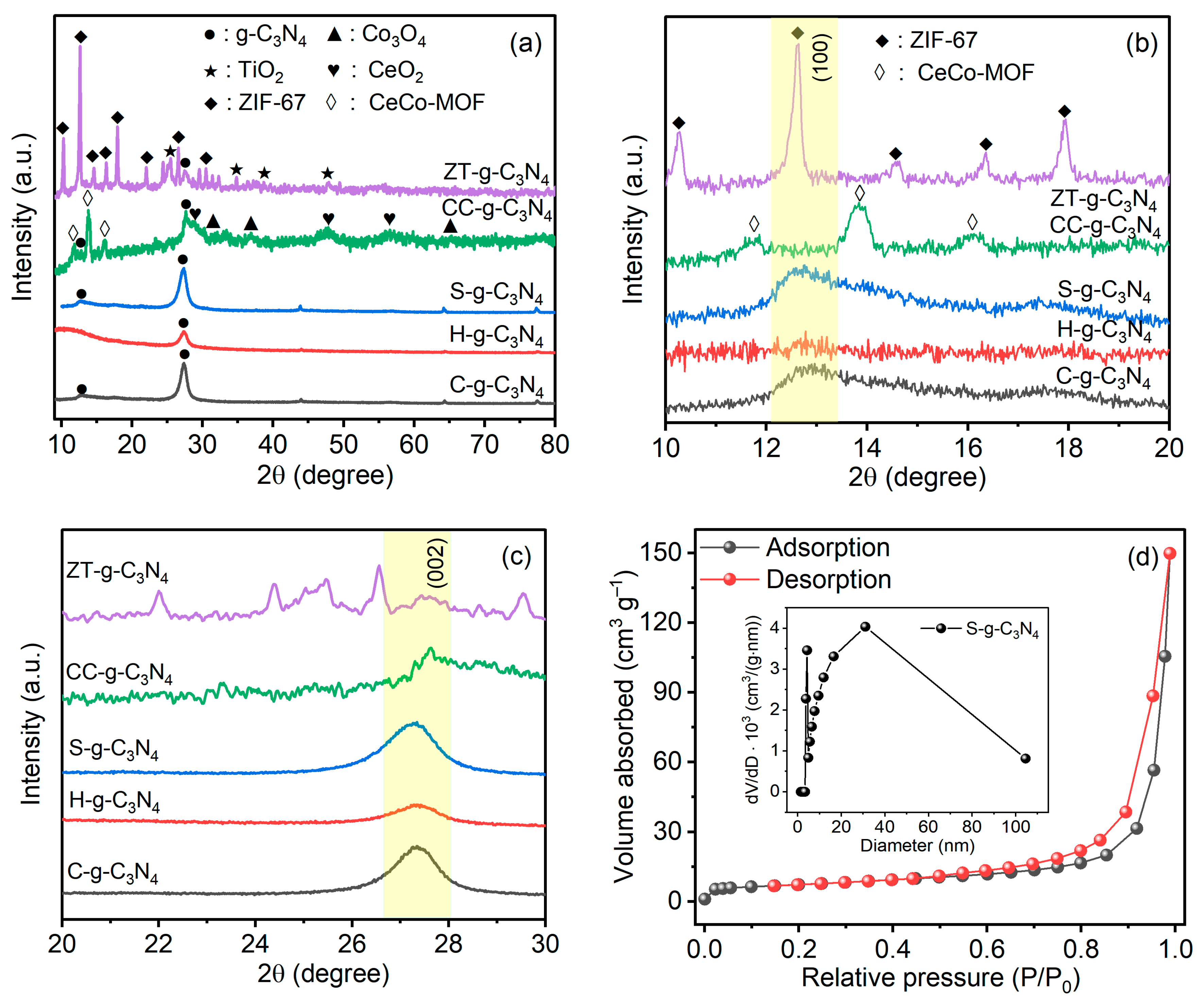
Figure 1 presents the XRD patterns of C-g-C
3N
4, H-g-C
3N
4, S-g-C
3N
4, CC-g-C
3N
4, and ZT-g-C
3N
4.
The XRD patterns for C-g-C
3N
4, H-g-C
3N
4 and S-g-C
3N
4 all display the characteristic diffraction peaks of graphitic carbon nitride at 2θ = 12.8°, 27.2°, and 43.8°. The peaks at 2θ = 12.8° and 27.2° correspond to the (100) and (002) crystal planes of g-C
3N
4 [
15] (JCPDS No. 87-1526). The diffraction peak of the (100) plane originates from the in-plane periodic arrangement of triazine ring units within the g-C
3N
4 structure, while the (002) peak is attributed to the long-range order formed by interlayer π-π stacking. This indicates the successful synthesis of g-C
3N
4 as the fundamental framework of the composite materials, maintaining its typical graphite-like layered crystal structure. The XRD peaks of the pure-phase C-g-C
3N
4 and S-g-C
3N
4 obtained by calcination are sharper, suggesting that the high-temperature treatment promotes the oriented growth of g-C
3N
4 crystals and enhances crystallinity. This is because the high-temperature environment facilitates the thorough polymerization of the melamine precursor and improves the ordering of the interlayer arrangement [
23]. Compared to C-g-C
3N
4 and S-g-C
3N
4, the H-g-C
3N
4 sample exhibits broader and less intense diffraction peaks. This loss of crystallinity is attributed to the hydrothermal treatment, which can introduce structural defects and partially disrupt the long-range order of the heptazine units, leading to a more disordered framework.
For the CC-g-C
3N
4 composite, as shown in the magnified view (inset of
Figure 1b,c), the g-C
3N
4 (100) peak is not clearly distinguishable, likely due to structural disruption and dilution by the MOF-derived phases. Only the (002) peak exhibits a slight shift from ~27.2° to 27.6° remains observable. These subtle changes suggest possible interfacial interactions between g-C
3N
4 and the incorporated metal oxide nanoparticles, which may exert a mild compressive effect on the g-C
3N
4 framework. Several additional diffraction peaks are observed, indicating a multiphase composition. Peaks at 11.8°, 13.7°, and 16.0° correspond to residual CeCo-MOF, confirming partial retention of the MOF structure after calcination. Diffraction peaks at 31.3°, 36.9°, and 65.2° are indexed to the (220), (311), and (440) planes of cubic Co
3O
4 (JCPDS No. 42-1467), while peaks at 28.5°, 47.5°, and 56.3° correspond to the (111), (220), and (311) planes of cubic CeO
2 (JCPDS No. 04-0593). The coexistence of these phases confirms the successful construction of a multiphase heterojunction comprising g-C
3N
4, residual MOF, Co
3O
4, and CeO
2. The highly dispersed nature of these oxide nanoparticles on the g-C
3N
4 surface is advantageous for exposing more active sites while promoting interfacial transfer of photogenerated charge carriers.
For the prepared ZT-g-C
3N
4 composite composed of ZIF-67, TiO
2, and g-C
3N
4, similar to the CC-g-C
3N
4 composite, the (002) diffraction peaks of g-C
3N
4 become broad. Meanwhile, the pattern exhibits sharp characteristic diffraction peaks at 2θ = 10.2°, 12.6°, and 17.9°, which match well with the (002), (112), and (200) crystal planes of standard ZIF-67 (CCDC Deposition Number 67-1073). These peaks are hallmark features of the rhombic dodecahedral topology of ZIF-67, confirming its successful integration with g-C
3N
4 and TiO
2 [
24,
25]. Additionally, a series of diffraction peaks appearing at 2θ = 29.5°, 30.5°, 31.4°, 32.3°, and 34.8° are all attributable to ZIF-67, further confirming its high crystallinity. These peaks are sharp and show no significant shift, indicating that the crystal structure of ZIF-67 remained intact during the composite formation, preserving good crystalline integrity. The high crystallinity of ZIF-67 is closely related to its unique porous structure and surface active sites, which can provide ample channels for reactant adsorption and interfaces for charge transfer in photocatalytic reactions [
26]. Concurrently, the absence of impurity-related diffraction peaks in the pattern suggests that no unwanted chemical reactions occurred during the composite synthesis. The components are likely combined through physical interactions or weak chemical bonding, which helps preserve their respective structural advantages.
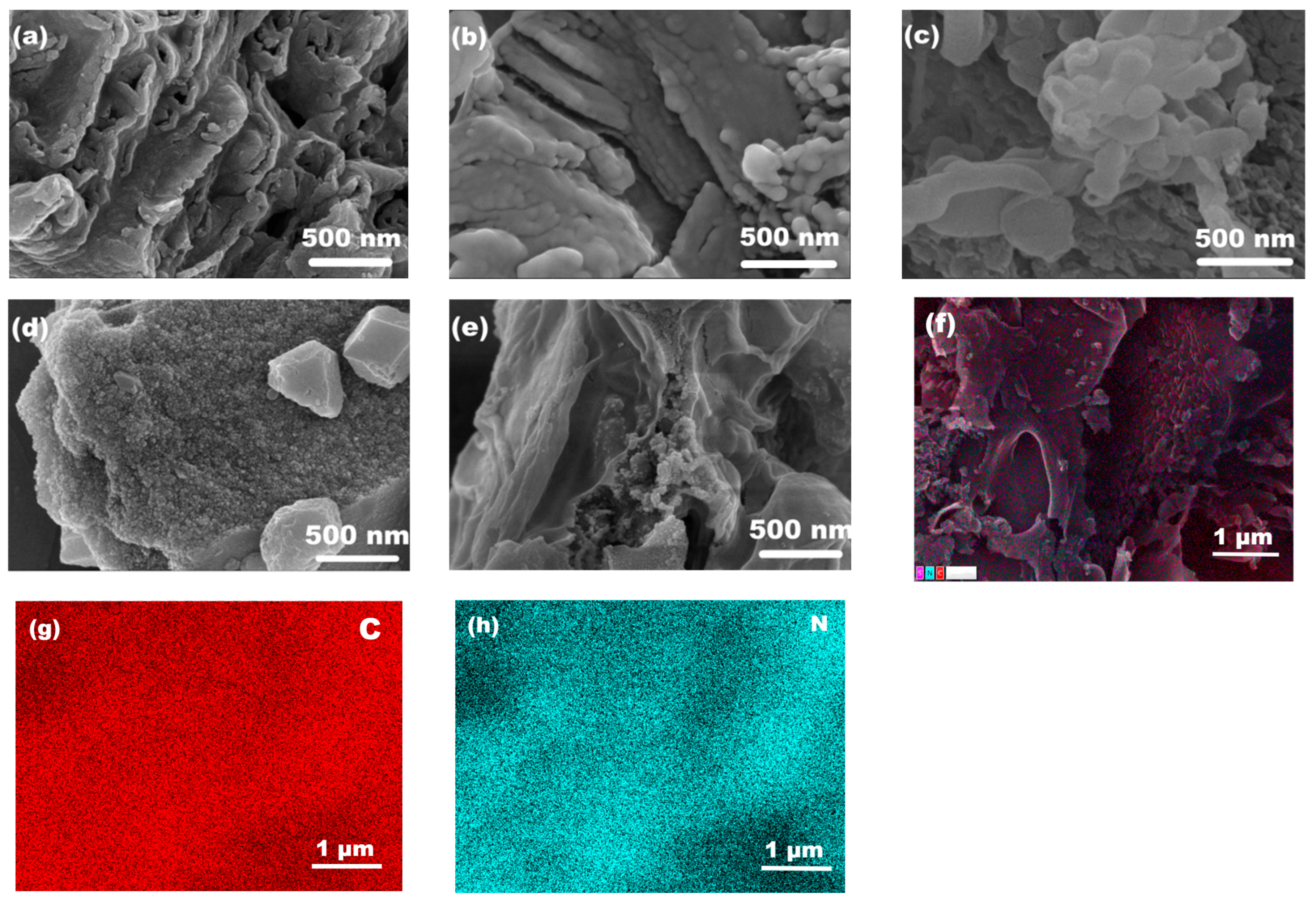
Figure 2 illustrates the morphological characteristics of the synthesized materials. As shown in
Figure 2b, the C-g-C
3N
4 sample exhibits a flaky structure with dimensions around 1 μm. Its surface is covered with agglomerates of nanoparticles (approximately 50–100 nm in size), which adhere to each other, forming rough surface regions. The H-g-C
3N
4 sample
Figure 2c displays vesicle-like or petal-like aggregates formed by the curling and aggregation of thin lamellar units. The individual lamellae are remarkably thin (<50 nm) and show significant curling and folding, with some regions forming “hollow vesicle” structures measuring about 100–300 nm in size, which is a typical product of the hydrothermal environment.
The S-g-C
3N
4 sample presents a morphology of stacked, curled nanosheets with porous and wrinkled features. Statistical analysis of SEM images (
Figure S4a) reveals that the sample yielding a particle size distribution of 10 ± 3 nm (
Figure S4d), and the individual sheets have an average thickness of 40 ± 3 nm (
Figure S4e). They curl and stack together to form aggregates with interlayer pores ranging from 50 to 200 nm in size. N
2 adsorption–desorption isotherms show a pore size distribution centered at 31 nm (
Figure 1c). This structure retains the typical layered characteristics of g-C
3N
4, but sulfur doping facilitates sheet curling and prevents excessive agglomeration. Furthermore, the presence of fine protrusions and depressions on the surface suggests that the introduction of sulfur atoms may have altered the growth interface of g-C
3N
4, increasing surface defects and active sites. Compared to the flat layered structure of pristine g-C
3N
4, sulfur doping induces sheet curling and pore formation, likely because the intercalation of sulfur atoms expands the interlayer distance and disrupts some interlayer forces, making the sheets more prone to curling and creating pores during stacking.
The ZT-g-C
3N
4 sample (
Figure 2d) exhibits a heterogeneous structure with two distinct components. The matrix consists of agglomerated rough nanoparticles with an average size of 15 ± 3 nm (based on 100 particle counts from
Figure 2d), with an uneven, porous surface, corresponding to the composite phase of g-C
3N
4 and TiO
2. Well-defined cubic particles with edge lengths of 250 to 350 nm are attached to this matrix, representing the characteristic cubic morphology of ZIF-67. The intact cubic structure of ZIF-67 indicates that the composite synthesis conditions were mild, preserving the intrinsic morphology and properties of each component and combining the morphological and porous advantages of ZIF-67 with the photocatalytic activity of g-C
3N
4 and TiO
2.
The CC-g-C
3N
4 sample (
Figure 2e) shows a biphasic composite structure. It retains the typical curled layered features of g-C
3N
4, while nanoparticle agglomerates (average size: 12 ± 4 nm, based on 30 particle counts from
Figure 2f), corresponding to the CeCoO
x component, are uniformly attached to the surface and within the pores of the layered framework. The uniform dispersion of CeCoO
x as nanoparticles ensures more sufficient interfacial contact with the substrate, leading to more pronounced heterojunction effects.
The EDS elemental mapping of S-g-C
3N
4 (
Figure 2f–h) reveals that the C signal is distributed continuously across the entire aggregate, aligning perfectly with its morphology. This indicates that carbon is the dominant element, uniformly distributed without significant deficiency, consistent with the matrix characteristics of S-g-C
3N
4. The N signal completely overlaps with the C distribution area and shows uniform intensity, confirming nitrogen as another primary element. Together with carbon, it forms the basic C-N network skeleton of S-g-C
3N
4, with no local deficiency or enrichment of N, suggesting a structurally intact matrix. Due to the low sulfur doping concentration, EDS mapping was insufficient to resolve the spatial distribution of sulfur. Therefore, XPS analysis was used to confirm the incorporation of sulfur into the g-C
3N
4 framework. This distribution state facilitates the modulation of the electronic structure of g-C
3N
4 by sulfur, providing a structural foundation for enhancing properties such as photocatalytic performance.
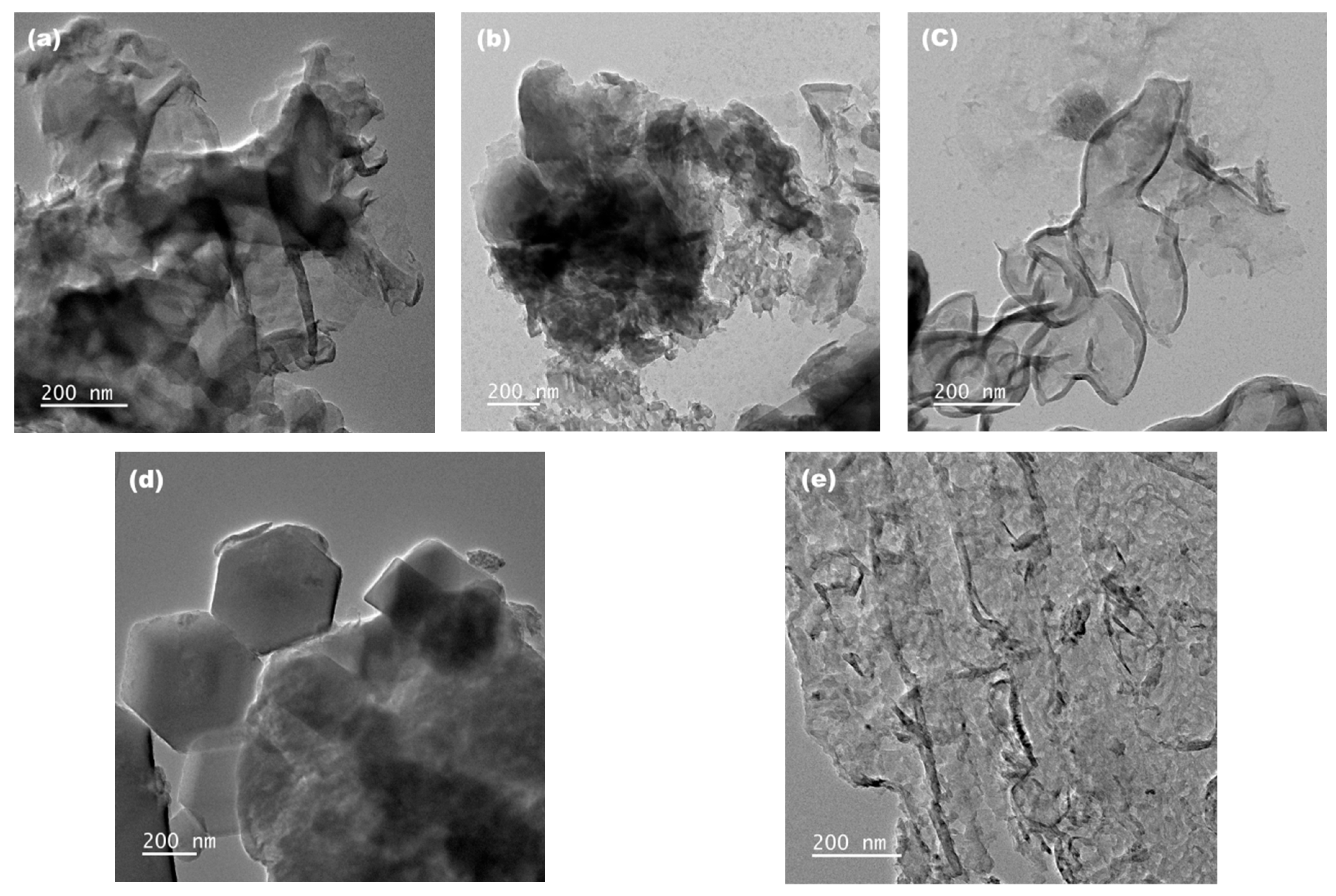
To obtain clearer insights into the sample morphology, TEM analysis was performed.
Figure 3 presents the TEM images of S-g-C
3N
4, C-g-C
3N
4, H-g-C
3N
4, ZT-g-C
3N
4, and CC-g-C
3N
4. As shown in panel (
Figure 3b), the C-g-C
3N
4 sample appears as thick layered aggregates with a size of about 1 μm (
Figure 3b). Some pores with an average size of about 40 × 15 nm (
Figure S4g). In contrast, the H-g-C
3N
4 sample (
Figure 3c) displays ultrathin, discrete, “wrinkled vesicle-like” nanosheets with thicknesses of only 13 ± 2 nm (
Figure S4i, based on 20 measurements from
Figure 3c). These sheets are more dispersed without significant agglomeration, and some are curled to form hollow vesicle structures with an average size of 350 × 135 nm. The mild hydrothermal environment limits sheet agglomeration, promoting the growth of g-C
3N
4 as ultrathin discrete sheets, while surface tension induces curling into vesicles, creating a hierarchical porous structure.
The S-g-C
3N
4 sample (
Figure 3a) shows aggregates of thin, curled nanosheets. Statistical analysis of TEM images reveals an average sheet thickness of 25 ± 4 nm (
Figure S4h), which is comparable to that of H-g-C
3N
4. The sheet thickness is comparable to that in (
Figure 3c), with obvious wrinkles at the edges. The sheets are stacked together but not severely agglomerated. Compared to the flat layers of pristine g-C
3N
4, sulfur doping makes the sheets more prone to curling and thinning. This structure is beneficial for increasing the specific surface area and introducing defect sites. N
2 adsorption–desorption measurements (
Figure 1c) confirm this structural evolution, with S-g-C
3N
4 exhibiting a BET surface area of 25.58 m
2/g. The corresponding pore size distribution (Barrett–Joyner–Halenda method) shows a broad peak centered at approximately 31 nm (inset of
Figure 1c), consistent with the TEM observations. The thin curled sheets shorten the transport path for photogenerated charge carriers, which is favorable for charge separation in photocatalysis. The ZT-g-C
3N
4 sample (
Figure 3d) exhibits a heterogeneous structure composed of a matrix and cubic particles. ZIF-67 retains its own cubic morphology while forming intimate interfacial contact with g-C
3N
4 and TiO
2. The CC-g-C
3N
4 sample (
Figure 3e) displays a composite structure combining a layered framework with nanoparticles, which is consistent with the SEM observations.
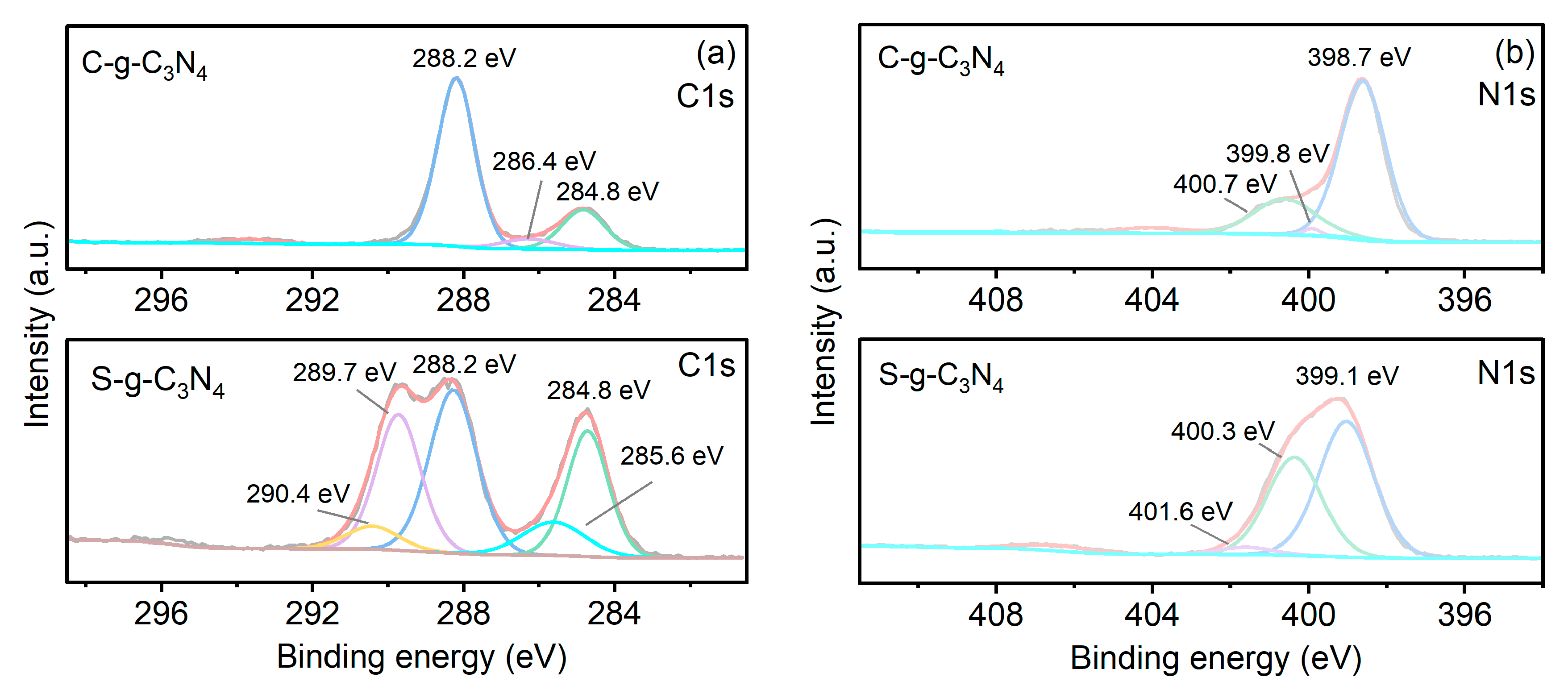
Figure 4 displays the XPS spectra of C-g-C
3N
4 and S-g-C
3N
4. As shown in the C 1s spectrum (
Figure 4a), three peaks located at 288.2 eV, 284.8 eV, and 286.2 eV are observed for C-g-C
3N
4, corresponding to sp
2-hybridized carbon atoms (N-C=N), adventitious carbon (C-C/C-H), and C-NHx (x = 1, 2), respectively. For S-g-C
3N
4, in addition to the peak for sp
2-hybridized carbon (N-C=N) at 288.2 eV, the intensity of the adventitious carbon (C-C/C-H) peak at 284.8 eV is significantly enhanced. Meanwhile, new peaks emerge at 289.7 eV and 290.4 eV. This is primarily attributed to the different electronegativity between S and N atoms. After S substitutes for N sites, the electron cloud density of the surrounding C atoms increases, resulting in a slight shift in their peaks. Furthermore, a new peak appears around 285.6 eV, indicating the formation of C-S-C bonds.
For the N 1s spectrum (
Figure 4b), three peaks are identified for C-g-C
3N
4. The peak observed at 398.7 eV corresponds to sp
2-hybridized pyridinic nitrogen (C-N=C) within the triazine or heptazine ring structures, and the signal at 399.8 eV is ascribed to tertiary nitrogen (N-(C)
3) at ring junction sites or amino-containing nitrogen (C-N-H) present at the edges of the catalyst. And the peak at 400.7 eV is attributed to amino or protonated amino groups (-NH
2, -NH
3+), typically associated with surface-adsorbed water or molecules. Similar spectra are obtained for H-g-C
3N
4 (
Figure S1).
For S-g-C
3N
4, the N 1s peaks shift overall to 399.1 eV, 400.3 eV, and 401.6 eV. Concurrently, the peak area of pyridinic nitrogen (399.1 eV) decreases, which is mainly due to the substitution of lattice N by S. These results confirm the successful doping of S into g-C
3N
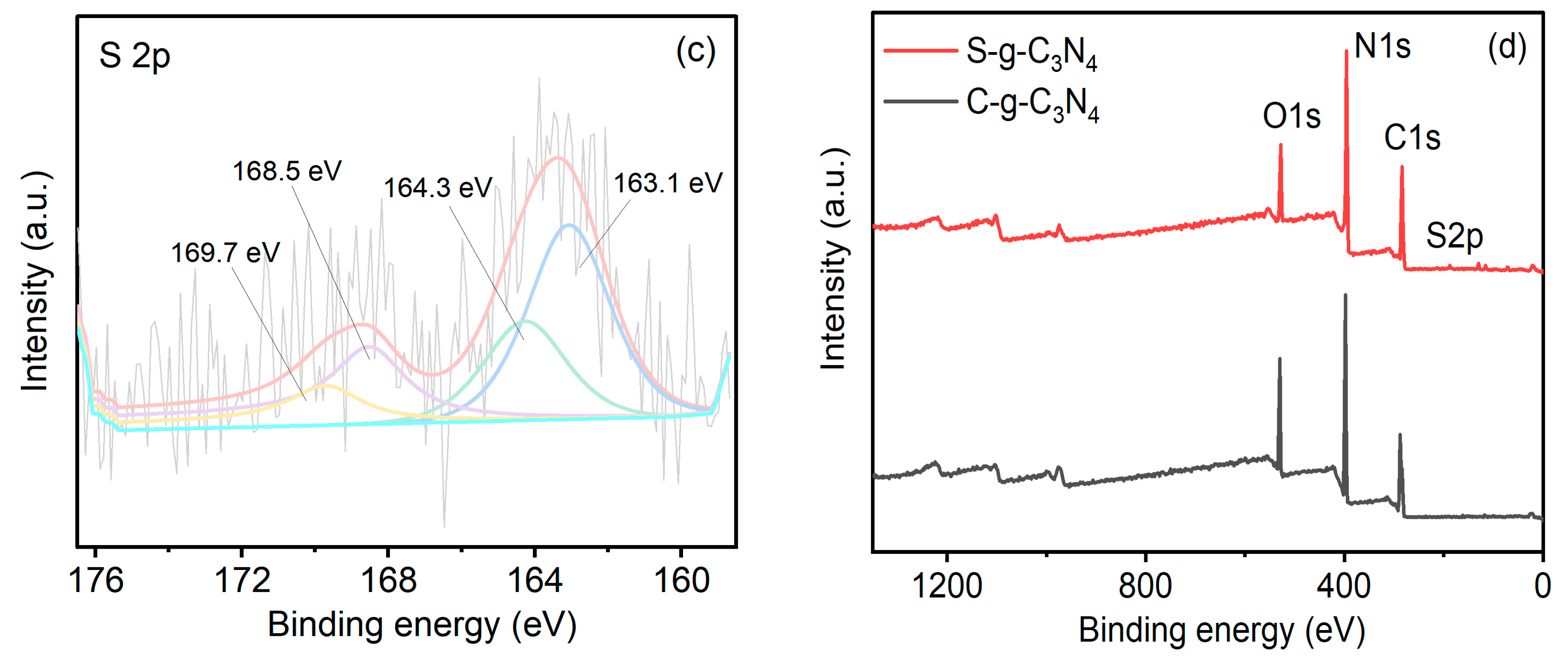
4, where S substitutes for lattice N and forms C-S-C bonds. To clarify the nature of sulfur incorporation in the S-g-C
3N
4 sample, XPS S 2p spectrum was carefully analyzed following standard peak-fitting protocols (
Figure 4c). The spectrum was deconvoluted with spin–orbit splitting constraints. The fitted peaks at 163.1 eV and 164.3 eV are attributed to the S 2p
3/2 and S 2p
1/2 components of C-S bonds, indicating that sulfur is incorporated into the g-C
3N
4 framework by substituting lattice nitrogen. An additional doublet at 168.5 eV and 169.7 eV corresponds to oxidized sulfur species (C-SO
x), likely formed at the edges or defect sites. No peaks corresponding to S-S or metal-S bonds were detected, confirming that sulfur is chemically bonded within the carbon nitride network rather than existing as physically adsorbed species or separate sulfur phases. Based on these assignments, the sulfur incorporation in this work is predominantly substitutional, with a minor fraction present as surface-bound oxidized species.
The XPS spectrum of CC-g-C
3N
4 is shown in
Figure S2. The C 1s spectrum of CC-g-C
3N
4 was calibrated at 284.80 eV. The peak at 285.09 eV is assigned to C-O or C-N bonds, while the peak at 288.16 eV corresponds to O=C-N groups in the g-C
3N
4 framework, confirming the presence of graphitic carbon nitride. The N 1s spectrum was deconvoluted into three peaks with consistent FWHM. The peak at 397.54 eV is assigned to sp
2-hybridized nitrogen (C=N-C) in the triazine units of g-C
3N
4. The peak at 398.38 eV corresponds to pyridinic/structural nitrogen in the g-C
3N
4 framework. The peak at 400.09 eV is attributed to bridging N-(C)
3 groups or terminal N-H defects. This fitting is consistent with the typical structure of graphitic carbon nitride. The O 1s spectrum with peak at 529.23 eV is assigned to lattice oxygen (O
2−) in Co
3O
4 and CeO
2. The peak at 530.53 eV corresponds to oxygen vacancies and surface hydroxyl groups (M-OH), which favor charge separation. The peak at 532.07 eV is attributed to adsorbed oxygen or surface adsorbed water. The Co 2p spectrum was deconvoluted into six peaks consistent with the Co
3O
4 spinel structure. The peaks at 778.20, 779.83 eV (2p
3/2) and 793.02, 794.70 eV (2p
3/2) are assigned to Co
3+ in octahedral sites. The peak at 784.40 eV (2p
3/2) corresponds to Co
2+ in tetrahedral sites. The satellite peak at 800.55 eV is characteristic of Co
2+ in cobalt oxides. The Ce 3d XPS spectrum (
Figure S2e) reveals the coexistence of Ce(IV) and Ce(III) species, originating from CeO
2 and the residual CeCo-MOF, respectively. The peaks at 881.59 eV, 878.45 eV, 901.61 eV, and 912.54 eV are characteristic of Ce(IV) in CeO
2, while the peaks at 884.53 eV, 896.83 eV, and 903.96 eV correspond to Ce(III) species associated with the CeCo-MOF. The presence of both Ce(IV) and Ce(III) peaks confirms that the CeCo-MOF structure is partially retained after calcination, consistent with the XRD results (
Figure 1). The binding energies are in good agreement with literature values for CeO
2 (Ce 3d
5/2 at ~882 eV, Ce 3d
3/2 at ~900 eV) and Ce(III)-based MOFs.
For ZT-g-C
3N
4 (
Figure S3), the C 1s spectrum of ZT-g-C
3N
4 was calibrated at 284.84 eV (adventitious carbon). The peak at 286.10 eV is assigned to C-O or C-N bonds, while the peak at 288.06 eV corresponds to O=C-N groups in the g-C
3N
4 framework, confirming the presence of graphitic carbon nitride. All peaks were fitted with uniform FWHM to ensure physical validity. The N 1s spectrum was deconvoluted into three peaks characteristic of g-C
3N
4. The dominant peak at 397.49 eV is attributed to sp
2-hybridized nitrogen (C=N-C) in triazine units. The peak at 399.89 eV corresponds to bridging nitrogen (N-(C)
3) connecting adjacent triazine units, and the weak peak at 398.60 eV reflects fine structural features. This fitting aligns with the standard g-C
3N
4 structure. The Ti 2p
3/2 located at 459.51 eV and Ti 2p
1/2 at 465.17 eV. The Co 2p XPS spectrum of ZT-g-C
3N
4 was fitted with four peaks corresponding to the Co 2p
3/2 and Co 2p
1/2 doublet and their characteristic satellites. The Co 2p
3/2 main peak at 781.41 eV and the corresponding Co 2p
1/2 peak at 796.89 eV exhibit a spin–orbit splitting of 15.5 eV, which is consistent with literature values for Co
2+ in ZIF-67. The satellite peaks at 786.35 eV and 802.01 eV, with energy separations of 5.0 eV and 5.1 eV from their respective main peaks, are characteristic of high-spin Co
2+ species. These results confirm that the ZIF-67 structure is preserved during composite formation with g-C
3N
4 and TiO
2, which is consistent with the XRD analysis (
Figure 1).
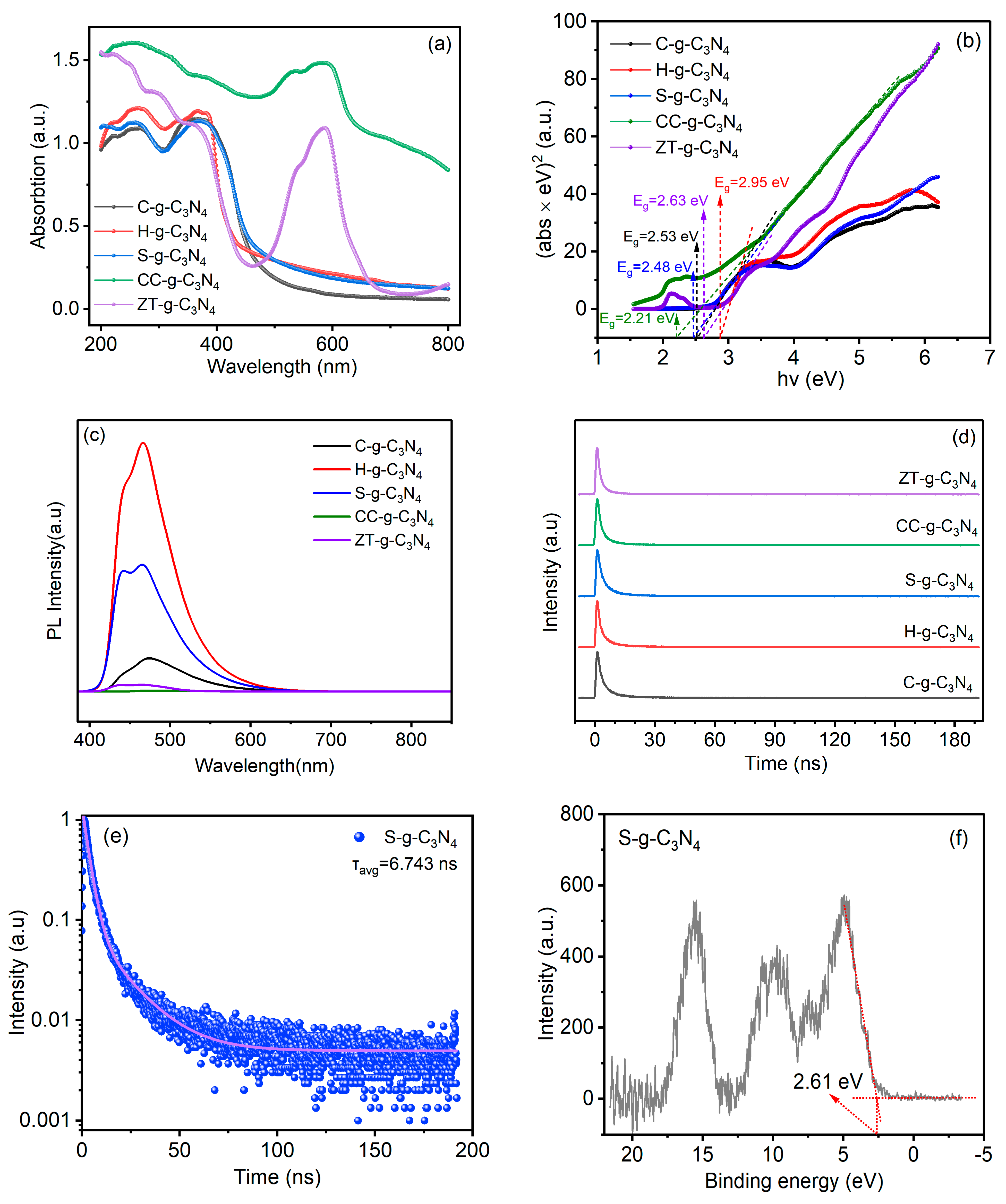
Figure 5a,b presents the UV–Vis absorption spectra of C-g-C
3N
4, H-g-C
3N
4, S-g-C
3N
4, CC-g-C
3N
4, and ZT-g-C
3N
4. As shown in
Figure 5a, the absorption edge of C-g-C
3N
4 is located near 460 nm, which is characteristic of the typical bandgap of g-C
3N
4. For H-g-C
3N
4, the absorption edge is blue-shifted compared to C-g-C
3N
4, consistent with its larger bandgap (
Figure 5b, 2.95 eV vs. 2.53 eV). This blue-shift is attributed to the hydrothermal treatment, which alters the crystallinity and nanostructure of g-C
3N
4, leading to a widening of the bandgap. Notably, despite the blue-shifted bandgap, H-g-C
3N
4 exhibits slightly enhanced absorption in the region of 200–400 nm and 450–600 nm compared to C-g-C
3N
4. This apparent contradiction can be possibly explained by two factors. First, the hydrothermal treatment introduces sub-bandgap defect states within the bandgap, which act as additional absorption centers in the visible light region. Second, the unique vesicle-like nanosheet structure of H-g-C
3N
4 (
Figure 2c) significantly increases the specific surface area and enhances light scattering, leading to higher overall absorption intensity despite the blue-shifted absorption edge. These combined effects result in enhanced visible light absorption even with a widened bandgap.
It is well established that g-C
3N
4 is an indirect semiconductor [
13]. Therefore, the band gap energies (E
g) of all samples were estimated from Tauc plots constructed using the Kubelka–Munk function transformed according to the indirect transition mode, i.e., plotting (αhν)
1/2 versus photon energy (hν). The absorption edge of S-g-C
3N
4 shows a slight red shift, indicating that S doping introduces impurity energy levels and reduces the bandgap to approximately 2.48 eV (
Figure 5b). The substitution of N atoms in g-C
3N
4 by S atoms, whose 3p orbital energy level lies between the p orbitals of C and N, introduces impurity states within the bandgap, thereby lowering the energy required for electron transitions.
For CC-g-C
3N
4, the absorption edge is significantly red-shifted to ~580 nm, with further enhanced absorption in the visible region. The introduction of intermediate energy levels from the d-orbitals of Ce/Co contributes to this bandgap narrowing. Similarly, the absorption edge of ZT-g-C
3N
4 is red-shifted to ~600 nm, exhibiting strong absorption across the 500–700 nm visible range. The composite of ZIF-67 and TiO
2 not only forms heterojunctions but also introduces the broad-spectrum response of TiO
2, collectively narrowing the bandgap and enabling wide-spectrum light absorption. The bandgaps of C-g-C
3N
4, H-g-C
3N
4, CC-g-C
3N
4, and ZT-g-C
3N
4 were determined to be 2.50 eV, 2.63 eV, 2.21 eV, and 2.95 eV, respectively, from their corresponding Tauc plots (
Figure 5b). It should be noted that the bandgap of H-g-C
3N
4 (2.95 eV) represents a slight red-shift compared to pristine g-C
3N
4, consistent with its slightly enhanced visible light absorption observed in
Figure 5a.
To further investigate the defect states in H-g-C
3N
4, PL spectroscopy was performed. As shown in
Figure 5c, H-g-C
3N
4 exhibits a significantly higher PL intensity compared to C-g-C
3N
4, indicating a higher density of defect states that facilitate radiative recombination. These defect states, likely introduced during the hydrothermal treatment, are consistent with the observed sub-bandgap absorption in the visible region (
Figure 5a). While these defects contribute to enhanced visible light absorption, they also act as recombination centers for photogenerated charge carriers, leading to the lower photocatalytic activity of H-g-C
3N
4 (
Figure 6a).
2.2. Photocatalytic Performance Evaluation
The photocatalytic performances of S-g-C
3N
4, ZT-g-C
3N
4, C-g-C
3N
4, CC-g-C
3N
4 and H-g-C
3N
4 were assessed via the degradation of RhB under simulated solar light irradiation (
Figure 6). All degradation experiments were performed in triplicate to ensure reproducibility. The reported data represent mean values, and error bars in the figures indicate standard deviations. The degradation ratio is defined as C/C
0, where C and C
0 represent the residual and initial concentrations of RhB, respectively.
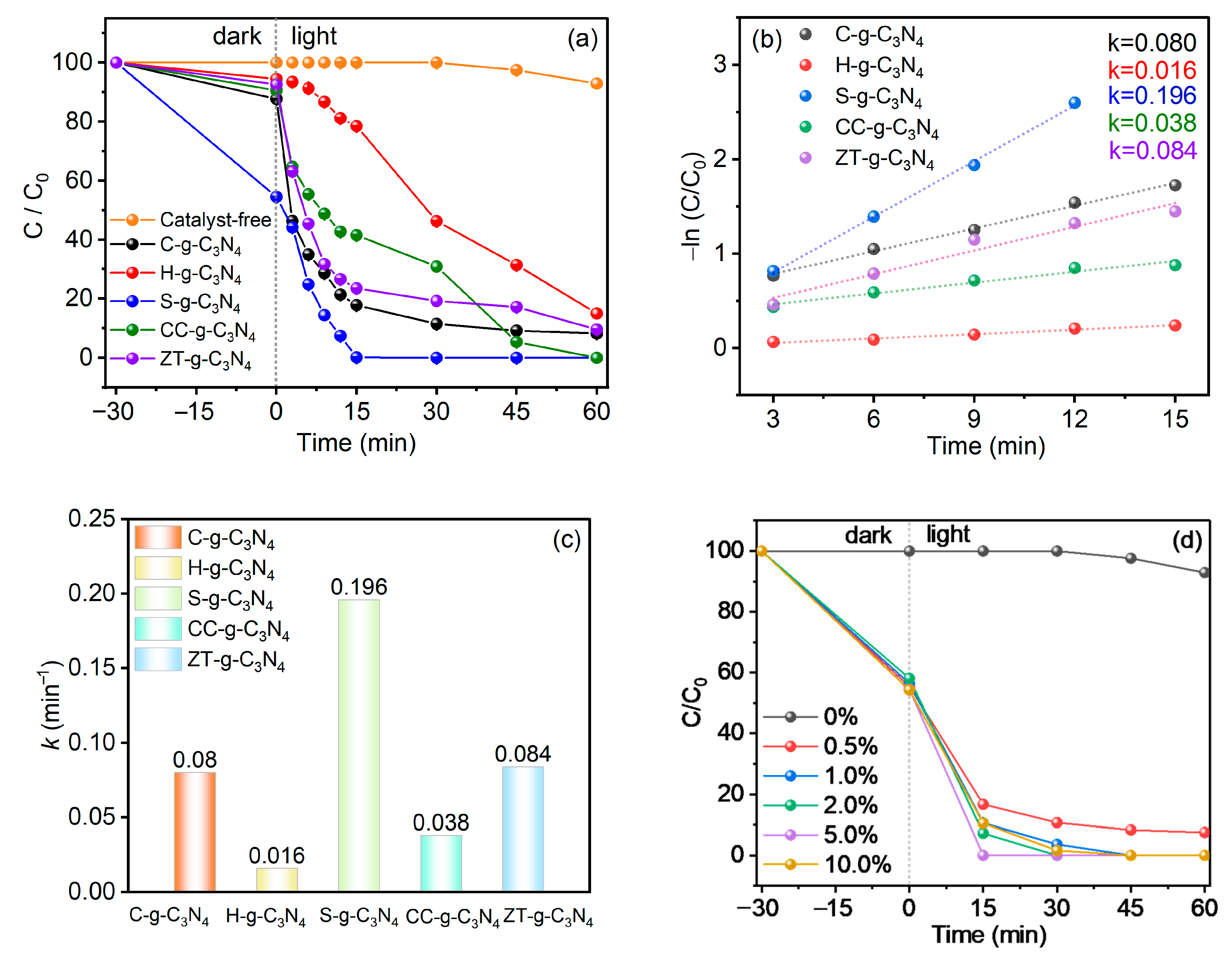
As shown in
Figure 6a, the reaction suspension was first stirred in darkness for 30 min to establish the equilibrium between adsorption and desorption. All degradation experiments were performed in triplicate, and the data points in
Figure 6a represent mean values with error bars indicating standard deviations. After 60 min of irradiation, the self-degradation of RhB in the absence of any catalyst was negligible. S-g-C
3N
4 demonstrated the most superior activity, achieving nearly 100% degradation within 15 min. CC-g-C
3N
4 showed a degradation efficiency of only 59.02% at the 30 min mark, which increased significantly to 94.46% at 45 min. C-g-C
3N
4 achieved 91.78% degradation at 60 min, while H-g-C
3N
4 and ZT-g-C
3N
4 reached 84.97% and 90.35%, respectively. Based on the final degradation efficiencies after 60 min of irradiation, the performances ranked as follows: S-g-C
3N
4 (100%) ≈ CC-g-C
3N
4 (100%) > C-g-C
3N
4 (91.78%) > ZT-g-C
3N
4 (90.35%) > H-g-C
3N
4 (84.97%). Among all tested materials, S-g-C
3N
4 exhibited the strongest capability for photocatalytic RhB degradation. These results collectively indicate that these four catalysts all possess favorable degradation performance.
Kinetic analysis was performed by fitting the initial degradation stage (0–15 min) to the pseudo-first-order model: ln(C
0/C) = kt, where k is the apparent rate constant. This interval was chosen because it yields excellent linear fits (R
2 > 0.95 for all samples) and represents the intrinsic photocatalytic activity before the accumulation of intermediates affects the kinetics. Both pseudo-first-order and pseudo-second-order kinetic models were evaluated for all samples (
Table S1). While the pseudo-second-order model generally gave better R
2 values for most samples, H-g-C
3N
4 showed an unacceptably poor fit (R
2 = 0.46). Therefore, to maintain consistent model comparison across all catalysts, the pseudo-first-order model was adopted. This model yields acceptable R
2 for all samples, enabling reliable comparison of their photocatalytic activities.
As shown in
Figure 6b, the apparent pseudo-first-order rate constants (k) for RhB degradation were determined. The catalysts can be ranked according to their k values as follows: S-g-C
3N
4 (0.196 min
−1) > ZT-g-C
3N
4 (0.084 min
−1) > C-g-C
3N
4 (0.080 min
−1) > CC-g-C
3N
4 (0.038 min
−1) > H-g-C
3N
4 (0.016 min
−1). This kinetic analysis further confirms the superior activity of S-g-C
3N
4.
To benchmark the performance of our S-g-C
3N
4 against recent literature, we compared its photocatalytic activity with previously reported S-doped g-C
3N
4 and other modified g-C
3N
4 photocatalysts under normalized conditions. As summarized in
Table S1, the comparison takes into account key parameters such as catalyst dosage, pollutant concentration, light source, and the apparent rate constant (k) per unit mass of catalyst. Our S-g-C
3N
4 exhibits a rate constant of 0.196 min
−1. This value is competitive with or superior to recently reported S-g-C
3N
4 systems and some other modified g-C
3N
4 photocatalysts under comparable conditions.
To investigate the influence of S doping content on photocatalytic activity, a series of S-g-C
3N
4 samples with varying S concentrations were prepared and evaluated for RhB degradation. As shown in
Figure 6d, the degradation efficiency exhibits a volcanic trend with increasing S content. It initially enhances progressively, reaches an optimum at a moderate doping level, and then slightly declines upon further increase. This phenomenon can be attributed to the dual role of S doping in modifying the physicochemical properties of g-C
3N
4. At low to moderate doping levels, S atoms are incorporated into the g-C
3N
4 lattice by substituting N atoms or occupying interstitial sites. This substitution introduces impurity energy levels within the bandgap, effectively narrowing the band gap, enabling more efficient utilization of solar energy. Moreover, S doping creates lattice defects that act as charge trapping centers, prolonging the lifetime of photogenerated electrons and holes and suppressing their recombination. However, at excessive doping levels, the photocatalytic performance declines. This deterioration can be explained by the excessive S atoms may act as recombination centers for photogenerated electron–hole pairs rather than separation promoters. When the doping concentration exceeds the optimal threshold, the impurity sites become too abundant, trapping charge carriers and facilitating their recombination before they can participate in surface redox reactions [
27]. Furthermore, excessive S incorporation could lead to the formation of undesirable by-products or surface passivation layers that block active sites. Therefore, the S-g-C
3N
4 with moderate S content exhibits the highest photocatalytic activity due to the synergistic optimization of light absorption, charge separation efficiency, and surface active sites.
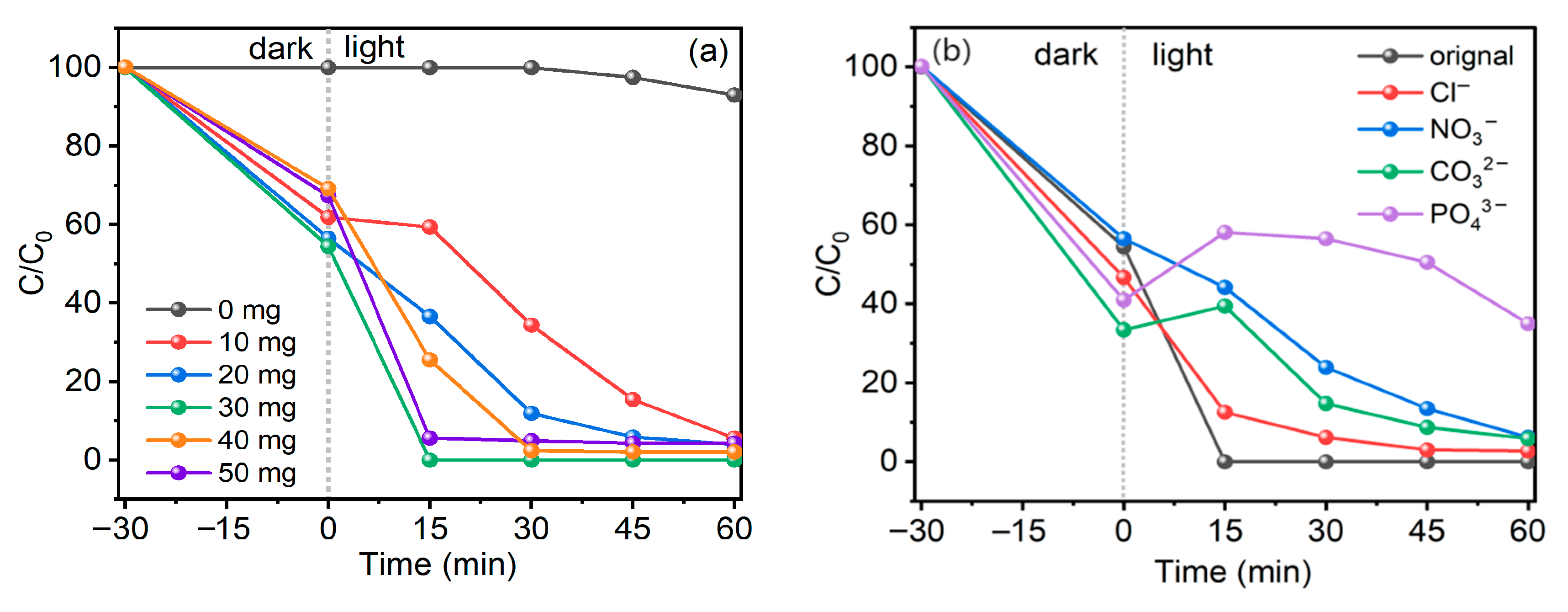
To elucidate the influence of catalyst dosage on photocatalytic activity,
Figure 7a investigates the photocatalytic degradation behavior of RhB under different catalyst loadings. The initial RhB concentration was fixed at 10 mg/L, and the catalyst dosage was set at 0, 10, 20, and 30 mg. The results show that during the dark adsorption period (0–15 min), the adsorption of RhB significantly increased with higher catalyst dosages. This is attributed to the greater number of adsorption sites provided by the larger amount of catalyst. In the subsequent photodegradation stage (after 15 min of irradiation), the RhB concentration continued to decrease upon light exposure. A positive correlation was found between the catalyst dosage and the RhB degradation efficiency. The group with 10 mg of catalyst exhibited a relatively slow degradation rate, whereas near-complete degradation of RhB was achieved within 60 min in the group with 30 mg of catalyst. The concentration of RhB in the blank control group (0 mg catalyst) showed no significant change, confirming that the RhB degradation is predominantly driven by the photocatalytic action of the catalyst, effectively ruling out interference factors such as self-degradation. These findings indicate that increasing the catalyst dosage provides more photocatalytic active sites while simultaneously enhancing the adsorption and enrichment of RhB molecules. These two effects work synergistically to improve the overall photocatalytic degradation efficiency.
To simulate the influence of coexisting anions in actual wastewater on the photocatalytic degradation of RhB, experiments were conducted with a fixed initial RhB concentration of 10 mg/L and a catalyst dosage of 30 mg. Equal concentrations of Cl
−, NO
3−, CO
32− and PO
43− (added in the form of their sodium salts) were separately introduced into the system. A control group without additional ions was used for comparison, and their degradation performance under simulated sunlight was evaluated (
Figure 7b). The results indicate that during the dark adsorption stage (−30 to 0 min), the adsorption behavior of RhB in all anion-containing groups (Cl
−, NO
3−, CO
32− and PO
43−) was nearly identical to that of the control group without added anions. This suggests that none of the tested anions significantly compete with RhB for adsorption sites on the catalyst surface under dark conditions, including PO
43−. Upon illumination, the degradation profiles of the Cl
−, NO
3− and CO
32− groups remained close to that of the control group, achieving near-complete degradation of RhB within 60 min. This indicates that these three anions have little influence on the photocatalytic activity of the catalyst under the tested conditions. In contrast, the PO
43− group exhibited a distinct behavior: a rapid increase in RhB concentration was observed immediately after light irradiation, indicating photo-induced desorption of RhB from the catalyst surface. This desorption is likely caused by changes in surface charge upon photogeneration of electron–hole pairs, which disrupts the interaction between phosphate-adsorbed catalyst and RhB molecules. Following this initial desorption, the degradation rate slowed significantly, and the final degradation efficiency after 60 min was much lower than that of the other groups.
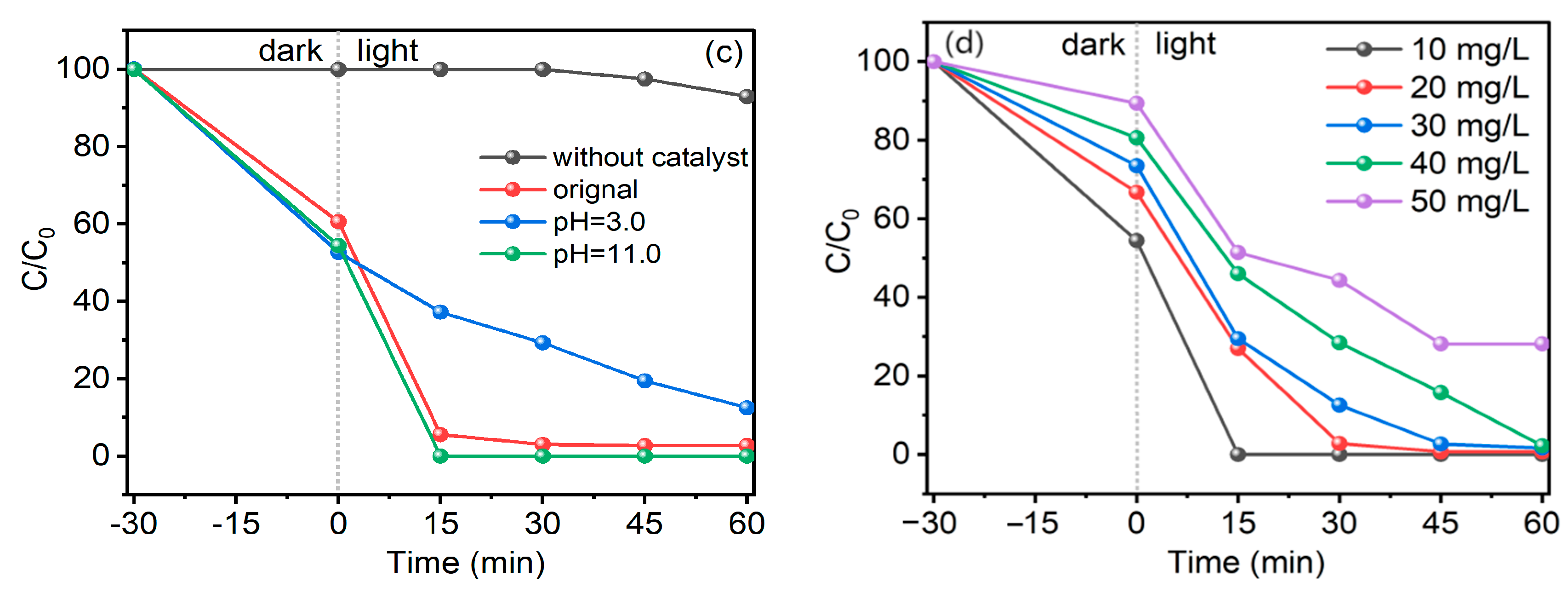
To clarify the influence of solution pH on the photocatalytic degradation of RhB, experiments were conducted with a fixed initial RhB concentration of 10 mg/L and a catalyst dosage of 30 mg. Four groups were established for comparison: a blank control (no catalyst), the original pH, pH = 3 (acidic), and pH = 11 (alkaline). Their degradation performance under simulated sunlight is compared in
Figure 7c. The results show that during the dark adsorption stage, the RhB concentration decreased significantly in the original pH, pH = 3, and pH = 11 groups, far exceeding the blank control. However, the adsorption capacity under acidic conditions was notably lower than that under the original and alkaline pH, indicating that the acidic environment weakened the catalyst’s adsorption capability for RhB. In the photodegradation stage, the RhB concentration decreased rapidly and continuously under both the original and alkaline pH conditions, achieving nearly complete degradation within 60 min. In contrast, under acidic conditions, the degradation rate slowed noticeably after illumination began, resulting in a final degradation efficiency much lower than the other two conditions. For the blank control group, the RhB concentration showed no significant change, ruling out interference from self-degradation and confirming that the degradation process is primarily driven by the photocatalyst.
The underlying reasons for this phenomenon may be as follows. Under acidic conditions, RhB exists in a cationic form. If the catalyst surface is positively charged in an acidic environment, electrostatic repulsion would weaken RhB adsorption. Conversely, in an alkaline environment, the occurrence of electrostatic interaction between RhB and the catalyst surface is more likely, thereby enhancing the cooperative effect of adsorption and degradation processes. Furthermore, under acidic conditions, the generation of reactive oxygen species (such as hydroxyl radicals, ·OH) on the catalyst surface may be inhibited, and the separation efficiency of photogenerated charge carriers could be affected, thereby leading to reduced catalytic degradation performance.
The initial concentration of the target pollutant stands as a critical parameter for the practical implementation of photocatalytic technology. In this experiment, with the catalyst dosage fixed at 30 mg, the effect of the initial RhB concentration of 10, 20, 30, 40, and 50 mg/L on the degradation performance was investigated (
Figure 7d). The results indicate that in the low-concentration range (10–30 mg/L), there was no significant difference in the amount of RhB adsorbed during the dark adsorption stage across different concentrations, and the degradation rates after illumination were similar. Specifically, the groups with 10, 20, and 30 mg/L all achieved near-complete degradation of RhB within 45 min. This demonstrates that the catalyst is endowed with ample active sites and favorable light utilization efficiency, and fluctuations in concentration exert minimal influence on the degradation result. In the high-concentration range (40–50 mg/L), the degradation rate began to slow for the 40 mg/L group, and a significant decline in degradation efficiency was observed for the 50 mg/L group, with incomplete degradation even after 60 min, showing a clear concentration inhibition effect. This can be attributed to the following reasons in the low-concentration range: the number of accessible active sites over the catalytic material and the generation of photogenerated charge carriers can match the degradation demand for RhB, meaning solution transparency is good, and the catalyst receives sufficient photons. Simultaneously, the number of RhB molecules does not exceed the capacity of the active sites and reactive oxygen species, resulting in stable degradation efficiency.
When the concentration increases to 40–50 mg/L, the deeper color of the RhB solution enhances the shielding of simulated sunlight, leading to a decrease in the photon flux reaching the catalyst surface and a reduction in the generation of photogenerated electron–hole pairs. Excessive RhB molecules and intermediates generated in the initial stage simultaneously compete for the limited active sites on the catalyst surface and for reactive species (e.g., ∙OH, h+) in the solution, significantly reducing the probability of effective reactions. Furthermore, the high concentration of RhB may alter the interfacial potential of the solution, weakening the catalyst’s adsorption capacity for RhB and further decreasing the degradation efficiency. Therefore, diluting the pollutant to a suitable concentration is economically practical, with 10 mg/L identified as the optimal RhB concentration in this study.
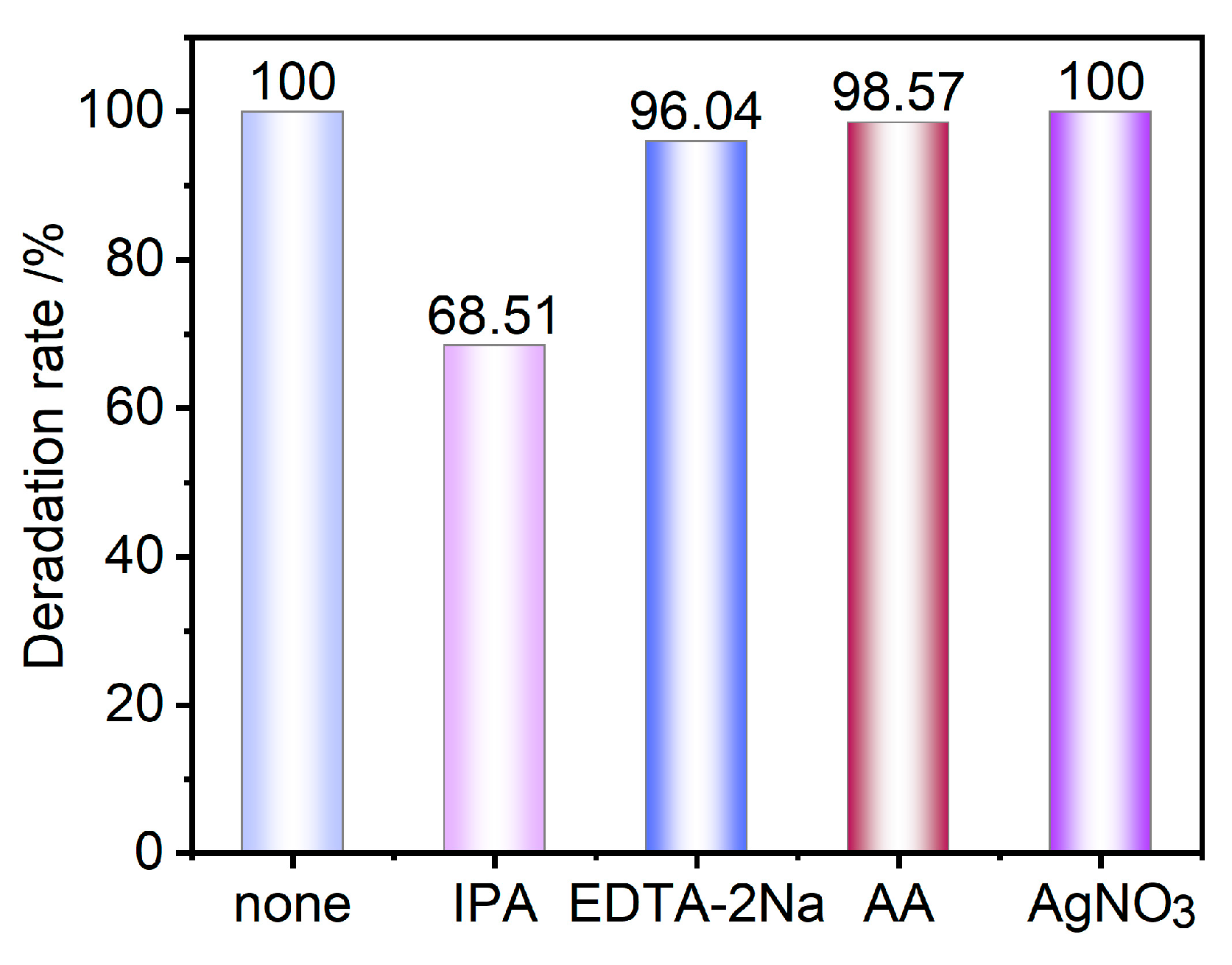
To figure out the dominant active species that participate in the photocatalytic degradation of RhB on S-g-C
3N
4, trapping experiments were conducted by introducing different radical scavengers. Isopropanol (IPA) was used for hydroxyl radicals (∙OH), disodium ethylenediaminetetraacetate (EDTA-2Na) for holes (h
+), ascorbic acid (AA) for superoxide radicals (∙O
2−), and silver nitrate (AgNO
3) for electrons (e
−). The results are presented in
Figure 8.
As shown in
Figure 8, the degradation efficiency of RhB decreased significantly upon the addition of IPA, the ∙OH scavenger. This indicates that IPA effectively captured the ∙OH generated in the system and concurrently demonstrates the efficient separation of photogenerated electron–hole pairs (e
−-h
+) on the catalyst surface. The addition of EDTA-2Na, the h
+ scavenger, led to only a slight reduction in degradation efficiency, suggesting that h
+ plays a secondary role in the reaction. In contrast, the effects of AA (∙O
2− scavenger) and AgNO
3 (e
− scavenger) on the degradation efficiency were negligible.
Therefore, it can be concluded that ∙OH serves as the dominant reactive species in the photocatalytic degradation process of RhB using S-g-C3N4 as the catalyst, while h+ participates partially. The roles of ∙O2− and e− are not significant in this system.
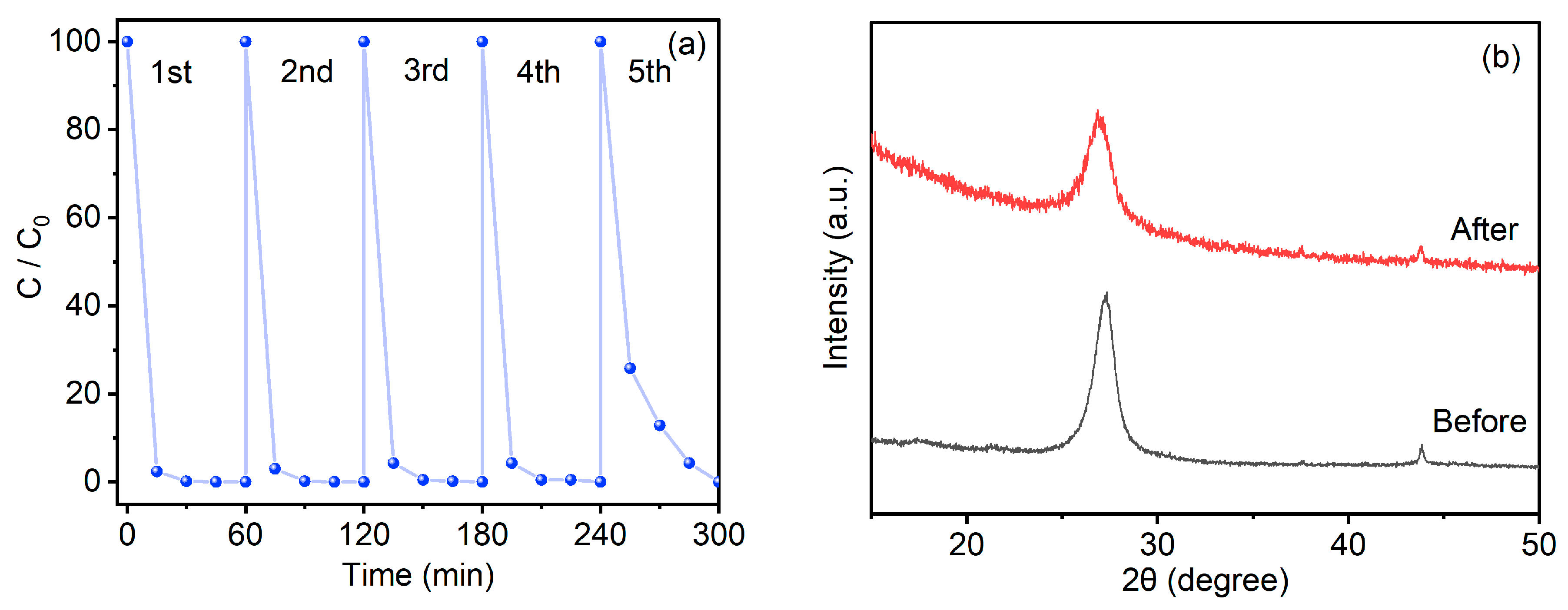
To evaluate the cycling stability of the catalyst, five consecutive photocatalytic degradation cycles of RhB were performed on the target sample. The results are presented in
Figure 9a. As shown in
Figure 9a, the S-g-C
3N
4 catalyst maintained high degradation efficiency throughout five consecutive cycles. In each cycle, near-complete removal of RhB was achieved within 60 min of irradiation. However, a gradual decrease in the degradation rate was observed from the fifth cycle with slightly slower kinetics compared to the first cycle. Specifically, while the first cycle achieved complete degradation within 15 min, the fifth cycle required approximately 30 min to reach similar removal efficiency. Despite this slowdown in rate, the final degradation efficiency after 60 min remained 100% in all five cycles.
The XRD patterns of S-g-C
3N
4 before and after the photocatalytic cycles are shown in
Figure 9b. Comparison of the XRD patterns before and after five reaction cycles reveals that the positions and intensities of the characteristic diffraction peaks remain essentially unchanged, indicating that the crystal structure of S-g-C
3N
4 is well-preserved during photocatalysis. No additional peaks corresponding to secondary phases or structural decomposition products were observed, confirming that the bulk structure of the catalyst is stable under the reaction conditions.
To investigate whether sulfur leaching occurs during the photocatalytic process, the reaction solution after five cycles was collected and analyzed by inductively coupled plasma optical emission spectroscopy (ICP-OES) (
Table S4). The concentration of leached sulfur in the solution was found to be below 0.1 ppm, which is near the detection limit and negligible compared to the total sulfur content in the catalyst. This result confirms that the doped sulfur atoms are tightly bound within the g-C
3N
4 framework and do not leach into the solution during photocatalysis. The strong chemical bonding of sulfur in the form of C–S and N–S bonds, as evidenced by XPS analysis (
Figure 4c), contributes to this excellent stability against leaching.
The as-prepared S-g-C
3N
4 composite exhibited exceptional photocatalytic activity for the degradation of RhB under simulated sunlight. Nearly 100% of RhB was decomposed within 15 min, demonstrating a degradation efficiency superior to that of pristine g-C
3N
4 and many reported results (
Table S3) [
26,
28,
29,
30,
31,
32,
33,
34,
35,
36,
37,
38,
39,
40,
41]. This activity can be primarily attributed to the effective S doping, which optimizes the band structure and enhances charge carrier separation. Furthermore, the catalyst maintained its high activity over multiple cycles, indicating not only high efficiency but also robust stability.
Total organic carbon (TOC) removal is a critical parameter to evaluate the mineralization efficiency of organic pollutants, distinguishing complete degradation to CO2 and H2O from mere decolorization. Due to instrument availability constraints, direct TOC measurements were not conducted in the present work, which will be systematically investigated in future studies. However, indirect evidence from radical trapping experiments and catalyst reusability tests supports the mineralization capability of S-g-C3N4.
As shown in
Figure 8, radical trapping experiments revealed that ·OH and h
+ are the primary reactive species responsible for RhB degradation. These species, particularly ·OH, are known to effectively attack and break down aromatic rings, leading to the deep mineralization of organic pollutants into CO
2 and H
2O. The generation of ·OH, which has a high oxidation potential (E
0 = +2.8 V vs. NHE), suggests that the degradation process extends beyond chromophore cleavage to complete mineralization.
Furthermore, the catalyst exhibited excellent stability over five consecutive cycles (
Figure 9), with only a slight decline in activity. This indicates that the active sites are not easily poisoned or blocked by accumulated intermediates—a strong indicator of efficient mineralization. If the degradation process were primarily driven by decolorization without mineralization, the accumulation of intermediate products on the catalyst surface would likely lead to rapid deactivation in subsequent cycles. The sustained high activity over multiple cycles thus indirectly supports the occurrence of effective mineralization.
2.3. Photoelectrochemical Characterization
To gain deeper insight into the charge carrier dynamics, time-resolved photoluminescence (TRPL) measurements were performed on pristine g-C
3N
4- and g-C
3N
4-based samples. As shown in
Figure S6, PL spectroscopy, including emission (PL Em) and excitation (PL Ex) spectra, was employed to investigate the separation and migration behavior of photogenerated charge carriers in various modified g-C
3N
4 samples. The PL Ex spectra reveal that all samples exhibit excitation peaks centered at 350–450 nm with a main peak around 400 nm, consistent with the intrinsic bandgap (~2.7 eV) of g-C
3N
4, indicating their effective photoresponse range covers the UV–visible region. Among them, H-g-C
3N
4 and S-g-C
3N
4 show higher excitation intensity, suggesting superior light absorption ability. Notably, S-g-C
3N
4 displays a distinct shoulder peak at 420–430 nm, implying that S doping introduces shallow defect levels and further broadens the photoresponse range.
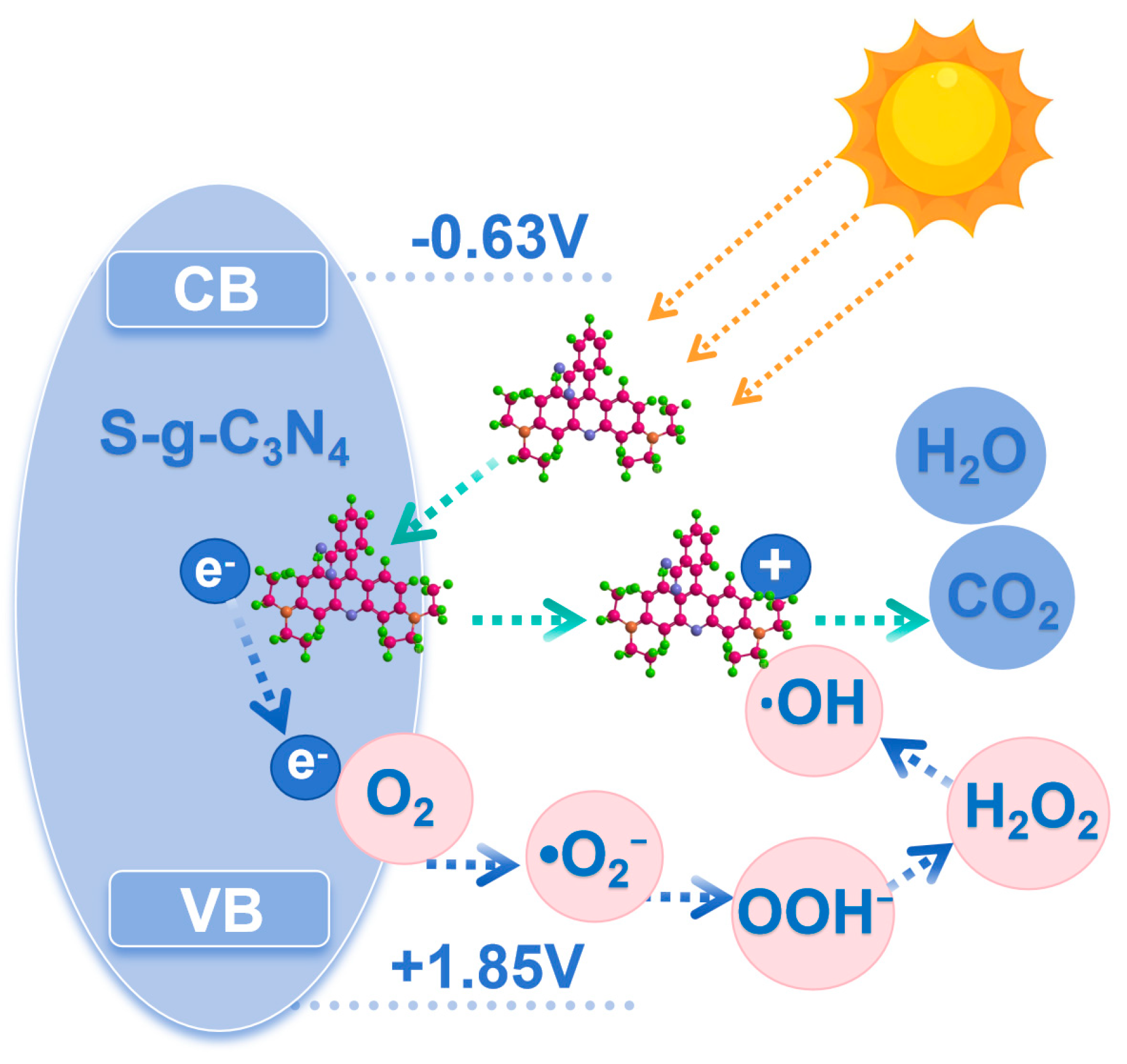
The PL emission spectra demonstrate that H-g-C3N4 exhibits the strongest emission peak, indicating the fastest recombination rate of photogenerated electron–hole pairs, which aligns with its lowest photocatalytic degradation activity. After modification, the PL intensities of S-g-C3N4, C-g-C3N4, ZT-g-C3N4, and CC-g-C3N4 are significantly reduced, confirming that the modification strategies effectively suppress carrier recombination. It is noteworthy that although ZT-g-C3N4 and CC-g-C3N4 show near-baseline PL intensity with the best charge separation ability, their catalytic activity is lower than that of S-g-C3N4. This can be attributed to overly deep defect levels, which lead to “irreversible trapping” of charge carriers, preventing them from effectively participating in surface reactions. Combined with PL spectra and radical trapping experiments, S-g-C3N4 achieves a balance between high light absorption efficiency and moderate charge separation efficiency: it not only broadens the photoresponse range and enhances photon capture via S doping, but also moderately suppresses carrier recombination, allowing more electrons and holes to migrate to the surface to reduce O2 to ·O2− and oxidize H2O/OH− to ·OH, respectively, ultimately exhibiting the optimal RhB photocatalytic degradation activity.
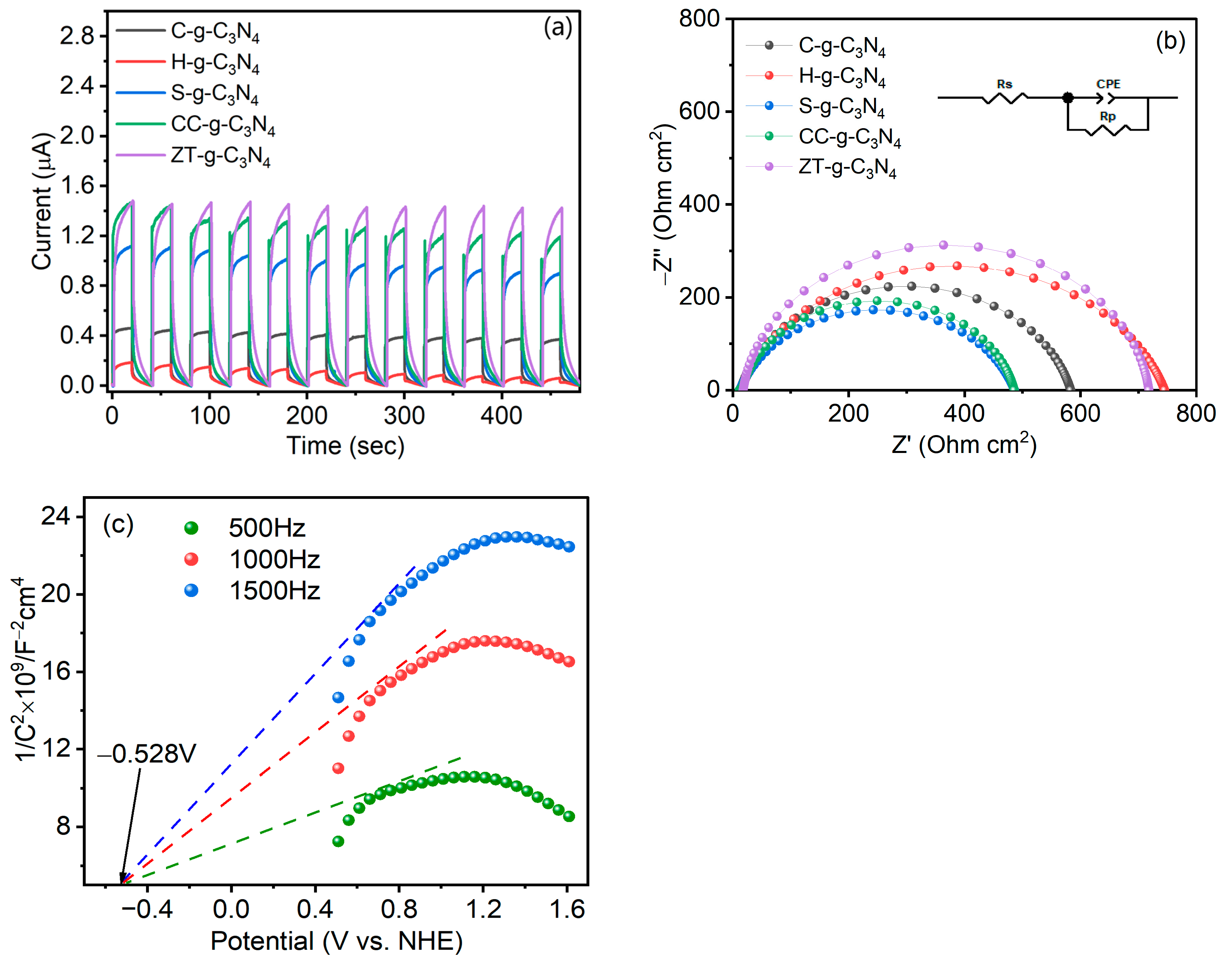
The separation and migration efficiency of photogenerated charge carriers represents a critical factor governing photocatalytic performance. In this study, the charge carrier behavior of different materials was systematically evaluated through transient photocurrent response and electrochemical impedance spectroscopy (EIS) and TRPL.
Figure 10a presents the transient photocurrent analysis results of S-g-C
3N
4, ZT-g-C
3N
4, C-g-C
3N
4, CC-g-C
3N
4, and H-g-C
3N
4 samples. Transient photocurrent intensity is a direct reflection of the separation efficiency of photogenerated carriers. The C-g-C
3N
4 and H-g-C
3N
4 exhibited relatively low photocurrent density, which indicates a high likelihood of photogenerated electron–hole pair recombination. In contrast, S-g-C
3N
4 showed a significantly higher photocurrent density than the pristine g-C
3N
4, demonstrating that S doping markedly improved charge carrier separation efficiency. This improvement is consistent with the prolonged charge carrier lifetime observed in TRPL measurements (
Figure S6), confirming that sulfur doping effectively suppresses radiative recombination. This improvement is attributed to the impurity energy levels introduced by S atoms, which can act as charge transfer mediators, facilitating the directional separation of photogenerated electrons and holes while reducing their recombination. Furthermore, ZT-g-C
3N
4 and CC-g-C
3N
4 also exhibited relatively large current densities. This can be ascribed to the strengthened interfacial charge transfer facilitated by their respective heterojunction structures.
Figure 10b presents the EIS Nyquist plots of the S-g-C
3N
4, ZT-g-C
3N
4, C-g-C
3N
4, CC-g-C
3N
4, and H-g-C
3N
4 samples. The plots measured over a frequency range of 100 kHz to 0.1 Hz. The whole plots and a magnified view of the 0–150 Ω range are provided in
Figure S7. The arc radius of the semicircle in the EIS profile is indicative of the interfacial charge transfer resistance. S-g-C
3N
4 exhibits the smallest semicircle radius, indicating the lowest charge transfer resistance. This is consistent with its highest photocurrent density among the g-C
3N
4 series (
Figure 10a) and its superior photocatalytic activity (
Figure 6a), confirming that sulfur doping effectively reduces charge transfer resistance and enhances charge separation efficiency. ZT-g-C
3N
4 presents an interesting case: it exhibits a high photocurrent density (
Figure 10a) but a relatively large EIS semicircle radius. This apparent contradiction can be explained by considering the different physical processes probed by these techniques. The high photocurrent indicates efficient bulk charge separation, facilitated by the heterojunctions formed between g-C
3N
4, TiO
2, and ZIF-67. However, the large EIS arc suggests high interfacial charge transfer resistance, likely due to non-ideal band alignment at the heterojunction interfaces, creating additional barriers for charge transfer to the electrode. Furthermore, multiple interfaces in the ternary composite that introduce cumulative impedance. These results collectively demonstrate that bulk charge separation efficiency and interfacial charge transfer are not necessarily correlated with photocatalytic activity. The overall photocatalytic performance depends on a combination of factors, including charge transport properties, band edge positions, and surface chemical environment. For S-g-C
3N
4, the optimal combination of moderate bulk separation, low interfacial resistance, and favorable band edge positions yields the highest photocatalytic activity.
To determine the flat band potential and charge carrier type of the samples, Mott–Schottky measurements were performed at frequencies of 500, 1000, and 1500 Hz in 0.5 M Na
2SO
4 (pH = 7) using an Ag/AgCl reference electrode. The results are presented in
Figure 10c, and the key parameters for S-g-C
3N
4 are summarized here. As shown in
Figure 10c, the Mott–Schottky plots of S-g-C
3N
4 exhibit positive slopes across all measured frequencies, confirming that S-g-C
3N
4 is an n-type semiconductor. The flat band potential (E
fb) was determined from the x-intercept of the linear region of the 1/C
2 vs. potential plot. For S-g-C
3N
4, the flat band potential is −0.528 V vs. NHE. For n-type semiconductors, the conduction band minimum (CBM) is typically 0.1–0.2 V more negative than the flat band potential. Therefore, the CBM of S-g-C
3N
4 is estimated to be approximately −0.63 V vs. NHE. Combining this with the band gap energy (E
g = 2.48 eV) obtained from the Tauc plot (
Figure 5b), the valence band maximum (VBM) is calculated to be +1.85 V vs. NHE (CBM + E
g = −0.63 + 2.48 = +1.85 V). The Mott–Schottky plots for C-g-C
3N
4, H-g-C
3N
4, CC-g-C
3N
4, and ZT-g-C
3N
4 are provided in
Figure S5.




 ,
,