Article

Strong Metal–Support Interaction in Rh/TiO2 Catalysts for Reductive Deuteration of Quinoline

1
CAS Key Laboratory of Science and Technology on Applied Catalysis, Dalian Institute of Chemical Physics, Chinese Academy of Sciences, Dalian 116023, China
2
University of Chinese Academy of Sciences, Beijing 100049, China
*
Authors to whom correspondence should be addressed.
Catalysts 2026, 16(4), 301; https://doi.org/10.3390/catal16040301
Submission received: 27 February 2026 / Revised: 19 March 2026 / Accepted: 25 March 2026 / Published: 31 March 2026
(This article belongs to the Section Catalytic Materials)

Abstract

Reductive deuteration of N-heterocycles provides an efficient route to deuterated scaffolds, yet achieving controlled deuterium incorporation in quinoline remains challenging. Herein, we report a high-temperature H2-treated Rh/TiO2 catalyst (Rh/TiO2–H500) that enables efficient reductive deuteration of quinoline using D2O as a deuterium source. Structural characterization reveals that reduction at 500 °C induces a pronounced strong metal–support interaction (SMSI), leading to partial TiOx encapsulation of Rh nanoparticles and interfacial electron transfer that generates electron-rich Rh0 species. This optimized interfacial structure promotes cooperative C–H activation and effective H/D transfer across the reduced quinoline framework, affording high deuterium incorporation at multiple positions of 1,2,3,4-tetrahydroquinoline (THQ). These results highlight the importance of SMSI-driven electronic and interfacial modulation in regulating reductive H/D exchange over heterogeneous catalysts.

Graphical Abstract

1. Introduction

Deuterated pharmaceuticals have emerged as a promising direction in modern drug development owing to their demonstrated advantages in enhancing pharmacokinetic properties, reducing toxic metabolite formation, and suppressing stereoisomeric interconversion in chiral drugs [1,2,3]. Heterocycles occupy a central position in contemporary medicinal chemistry, with more than 85% of bioactive compounds containing at least one heterocyclic scaffold [4], among which nitrogen-containing rings are particularly prevalent. Statistical analyses reveal that over 80% of small-molecule drugs approved by the U.S. FDA contain at least one nitrogen-containing heterocycle [5]. Moreover, both the structural diversity and synthetic utilization of nitrogen heterocycles have continued to increase over the past decade, underscoring their critical importance in modern drug design.
Among various nitrogen-containing heterocycles, 1,2,3,4-tetrahydroquinoline (THQ), readily accessible by the reduction of quinoline, represents a privileged three-dimensional scaffold embedded in bioactive molecules [6]. THQ and its derivatives exhibit a broad spectrum of biological activities, including antibacterial, anticancer, antimalarial, anti-inflammatory, antihypertensive, and anti-asthmatic agents, underscoring their broad pharmaceutical relevance [7,8,9,10,11,12]. Consequently, the development of efficient strategies for the synthesis of deuterated THQ derivatives is of considerable interest. In particular, the establishment of efficient and highly selective multi-site (C2, C3, C4, and C8 positions) deuteration methodologies for THQ is important for the structural optimization and functional modulation of deuterated pharmaceuticals.
Direct hydrogen-deuterium (H/D) exchange, i.e., the in-situ replacement of a C–H bond with a C–D bond in a single step, represents one of the most efficient, straightforward, and cost-effective strategies for deuterium labeling [1,13,14]. However, direct H/D exchange of THQ remains challenging. In homogeneous catalytic systems, transition metals tend to coordinate with the aromatic π-system of THQ [15], facilitating Csp2–H activation. As a result, preferential deuteration at the aromatic ring is commonly observed, whereas activation of the Csp3–H bonds is kinetically disfavored. In contrast, heterogeneous catalysts are capable of promoting deuteration under hydrogenative conditions [16,17,18]; however, extended metallic surfaces typically allow multiple, non-selective adsorption geometries. Such unrestricted surface interactions facilitate not only Csp3–H H/D exchange but also subsequent H/D exchange at residual Csp2–H sites. As a consequence, deuterium incorporation often becomes non-discriminatory, leading to extensive or even near-complete deuteration across both Csp3–H and aromatic positions. Therefore, achieving selective deuteration at the Csp3–H of THQ while preserving the aromatic ring remains a significant and unresolved challenge.
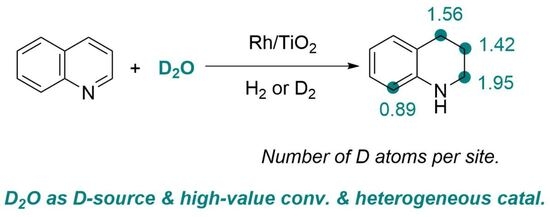
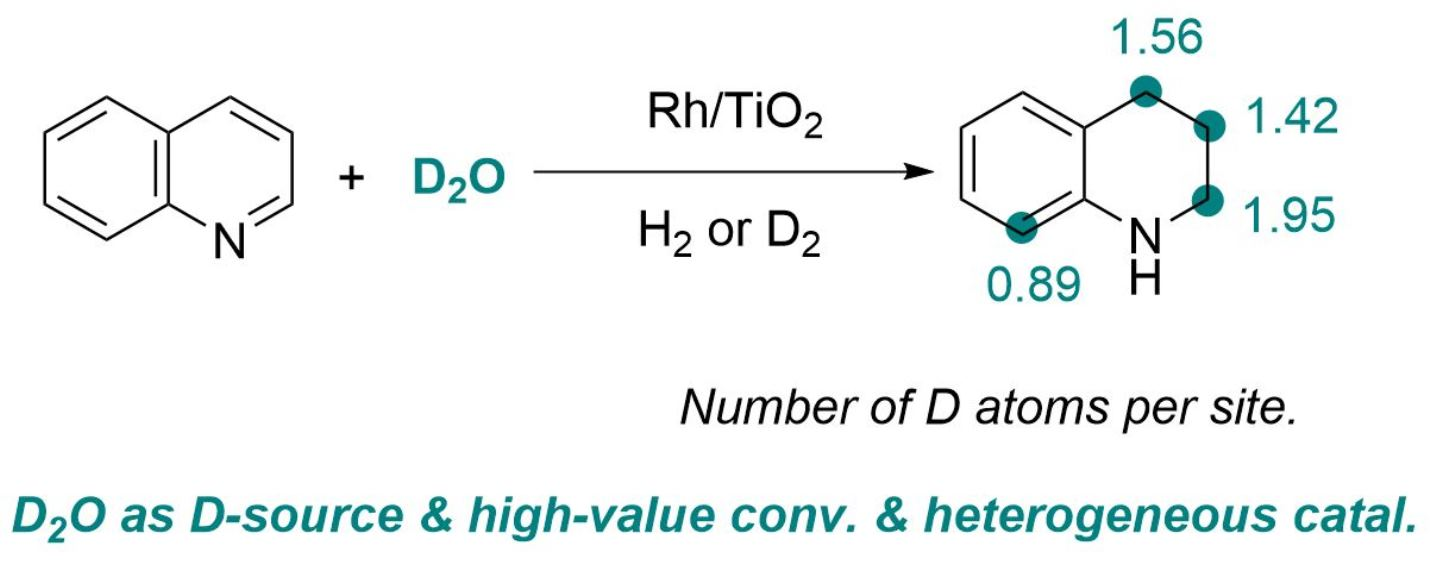
In this work, we developed a high-temperature H2-treated Rh/TiO2 catalyst (Rh/TiO2–H500) featuring a pronounced strong metal–support interaction (SMSI) that is capable of addressing this longstanding challenge. We found that this catalyst enables selective Csp3–H deuteration of THQ, via a reductive deuteration pathway, wherein quinoline first undergoes deuterative hydrogenation followed by controlled H/D exchange on the saturated framework, rather than indiscriminate over-deuteration. Distinct from conventional nanoparticle catalysts, the SMSI-enabled platform generates moderately encapsulated Rh nanoparticles. This partial TiOx overlayer effectively suppresses extended π-adsorption of the aromatic ring, thereby minimizing undesired deuteration at residual sp2 positions. Meanwhile, interfacial electron transfer enriches the Rh centers toward a metallic Rh0 state [19,20], enhancing their intrinsic ability to promote efficient H/D transfer at the sp3 sites of the THQ, affording high levels of deuteration at C2 (1.95), C3 (1.42), C4 (1.56), and the remote C8 position (0.89). Collectively, these findings establish a clear structure–activity relationship and demonstrate that SMSI-driven electronic modulation and interfacial confinement provide a viable strategy for achieving selective Csp3–H deuteration in pharmaceutically relevant N-heterocycles.

2. Results and Discussion

2.1. Catalyst Synthesis and Characterization

The Rh/TiO2 catalyst was synthesized via an impregnation method. Typically, RhCl3·3H2O was impregnated onto TiO2 (P25), one of the most commonly used commercial TiO2 supports, consisting of approximately 80% anatase (TiO2-A) and 20% rutile (TiO2-R) phases, with a nominal Rh loading of 0.1 wt%. The obtained sample was calcined at 450 °C for 4 h in static air and then reduced under a 10 vol.% H2/He atmosphere for 4 h at different temperatures to investigate its SMSI state. The resulting catalysts are denoted as Rh/TiO2-HX, where X represents the reduction temperature. The actual Rh loading, determined by inductively coupled plasma-optical emission spectroscopy (ICP-OES), was 0.1 wt%, which is in good agreement with the nominal value of 0.1 wt% (Table S1), indicating efficient loading of the Rh precursor during the preparation process. X-ray diffraction (XRD) results show that Rh/TiO2-H200 and Rh/TiO2-H500 exhibit the characteristic diffraction peaks of TiO2 (P25). However, when the reduction temperature increased to 800 °C, the anatase phase became unstable and underwent a phase transformation, leading to the conversion of TiO2 into the thermodynamically stable rutile phase (Figure 1a). The XRD result indicates no characteristic diffraction peaks of Rh species in any of the samples, suggesting that the Rh species may exist as highly dispersed ultrafine nanoparticles (NPs) or clusters, or their loading is below the detection limit of XRD.
N2 physisorption adsorption–desorption isotherms were recorded at 77 K for the Rh/TiO2 samples treated at different reduction temperatures. As shown in Figure 1b, all samples exhibit typical type-IV isotherms [21]. The specific surface areas and pore structure parameters show only minor variations with 200 °C and 500 °C reduction temperatures (Table 1), indicating that the reduction process does not destroy the bulk porous structure of the support. However, under reduction at 800 °C, there is a drastic decrease in BET surface area from approximately 43 m2/g to 3 m2/g, likely due to the transformation of the anatase to rutile phase, accompanied by pronounced grain growth and structural densification [22]. This severe structural collapse induces excessive SMSI, resulting in the encapsulation of Rh species by a dense TiOx overlayer, which reduces the exposure of Rh active sites.
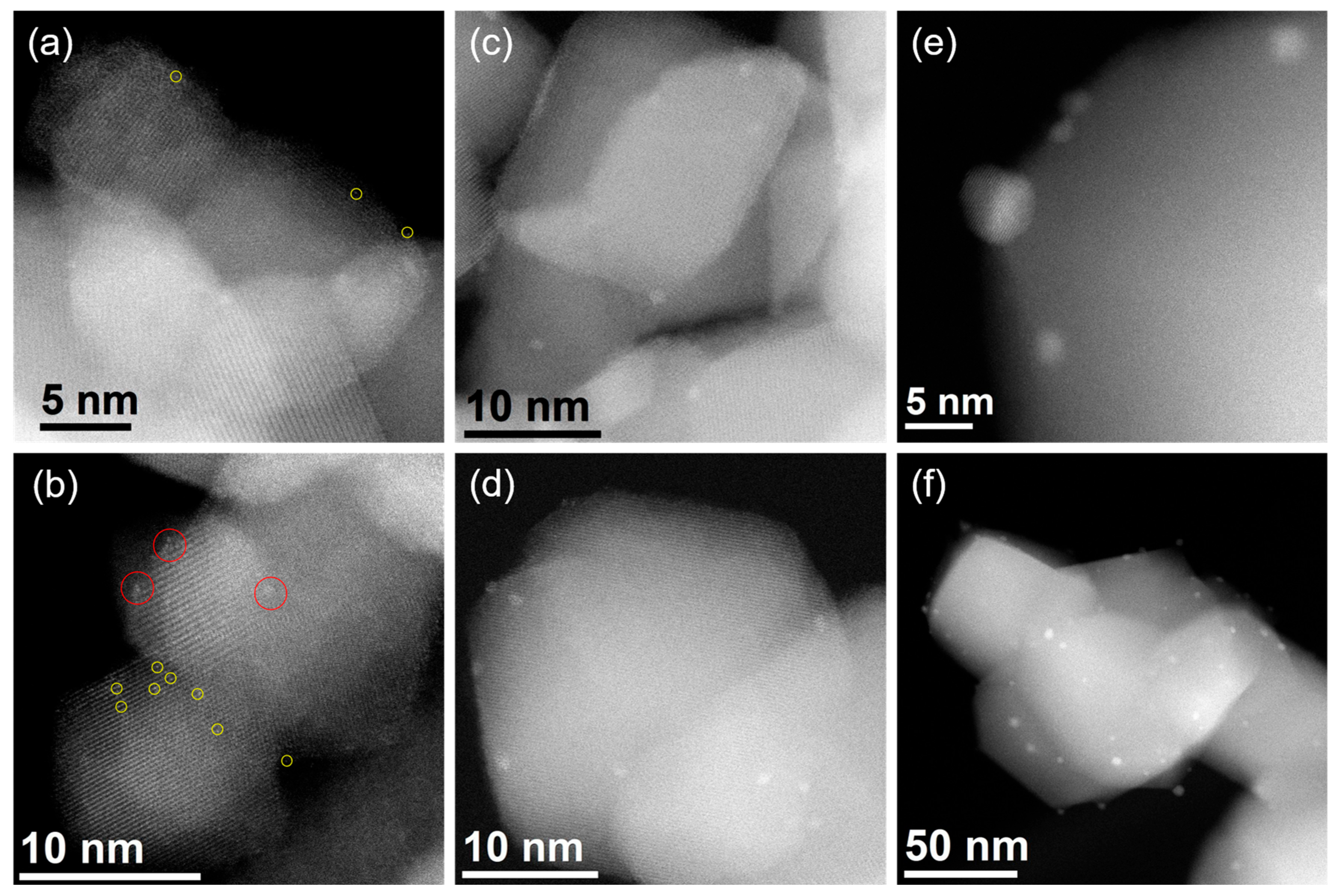
To further elucidate the distributions of the Rh species, aberration-corrected high-angle annular dark-field scanning transmission electron microscopy (AC-HAADF-STEM) was employed. For the Rh/TiO2-H200 sample, AC-HAADF-STEM images show ultra-small clusters and atomically dispersed species (Figure 2a,b). It is worth noting that relatively small Rh NPs are observed when the reduction temperature increases to 500 °C (Figure 2c,d), most probably originating from partial encapsulation induced by SMSI under high-temperature reduction, thus suppressing excessive aggregation and growth of Rh NPs. After reduction at 800 °C, pronounced growth of both Rh NPs and the TiO2 support can be observed (Figure 2e,f). According to previous literature reports [19,23,24], the migration of TiOx species and its encapsulation of metal clusters can be attributed to SMSI.
Electron transfer is a typical characteristic of supported catalysts with SMSI, which can significantly alter the adsorption behavior of reactive molecules and active intermediate species to change the catalytic performance. Therefore, in situ diffuse reflection infrared Fourier transform spectroscopy (in situ DRIFTS) was employed to investigate the electronic structure of Rh species using CO as an adsorption probe molecule.
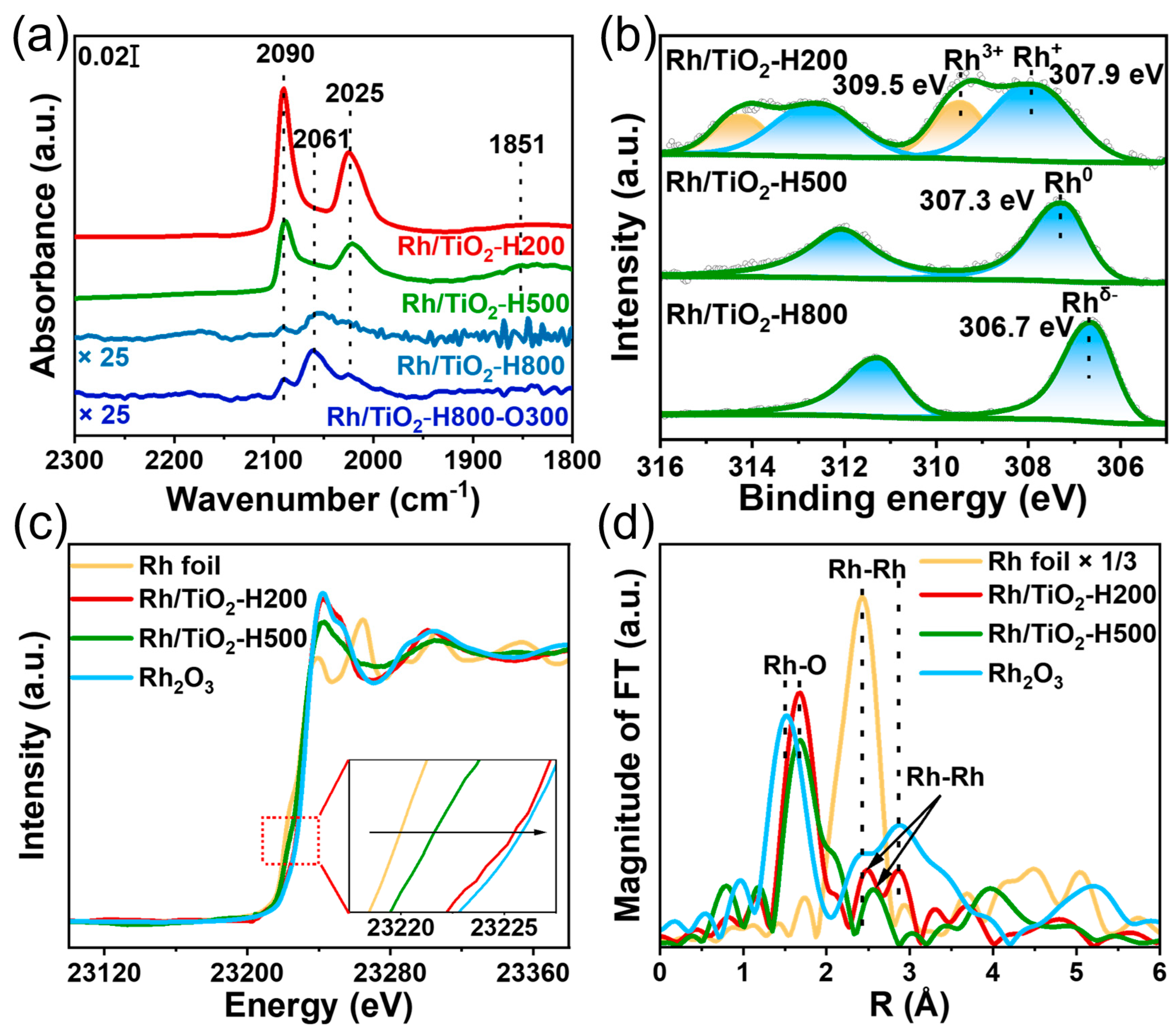
As shown in Figure 3a, two distinct CO adsorption bands are observed at approximately 2090 and 2025 cm−1 on the Rh/TiO2-H200 sample, which can be assigned to the symmetric and asymmetric stretching vibrations of Rhδ+(CO)2 dicarbonyl species. On this sample, they are attributed to CO adsorption on Rh single atoms (CO-Rh1) [25,26], indicating that the Rh species are atomically dispersed. This result is in good agreement with the AC-HAADF-STEM observations. For the Rh/TiO2-H500 sample, distinct CO adsorption bands appear at 2088, 2021, and 1851 cm−1. The former two are attributed to CO adsorption on Rh single atoms with a lower oxidation state (more electron-rich Rh species), while the latter at 1851 cm−1 is likely associated with the bridged CO adsorption on Rh NPs [27]. It should be noted that the intensity of the dicarbonyl bands is significantly weakened, indicating that a substantial portion of the Rh species aggregates to form NPs. Moreover, compared with Rh/TiO2-H200, a subtle red shift is observed, suggesting electron transfer from the TiO2 support to Rh species, resulting in a reduced oxidation state and the formation of electron-rich Rh NPs. This result is also consistent with the particle growth observed by AC-HAADF-STEM. For the Rh/TiO2-H800 sample, CO adsorption is extremely weak, with only a band observed at 2061 cm−1, which is likely associated with the linear CO adsorption on Rh NPs [27], attributed to the high-temperature leading to the formation of a dense encapsulation layer, resulting in only a very limited number of Rh active sites remaining exposed. After subsequent oxidation at 300 °C, the CO adsorption capacity is restored and significantly enhanced [28,29]. The reversibility of this adsorption behavior further confirms the formation of SMSI between the Rh species and the TiO2 support.
In addition, the generation of oxygen vacancies (Ov) in the support can effectively activate the TiO2 surface and induce surface structural disorder, thereby facilitating the formation of a TiOx encapsulation layer [30,31]. Electron paramagnetic resonance (EPR) was used to measure the possible presence of Ov. As shown in Figure S1, increasing the reduction temperature from 200 °C to 500 °C leads to a pronounced enhancement in the Ov signal, indicating that the formation of oxygen vacancies promotes surface activation of the support and contributes to the development of SMSI. However, upon further increasing the reduction temperature to 800 °C, the Ov signal does not increase further [32], suggesting that oxygen vacancy generation does not monotonically increase with reduction temperature [33]. It should be noted that all these measurements were performed ex situ, indicating that the Ov in all samples remains stable even upon air exposure and therefore possesses relatively good stability.
The oxidation state of Rh was investigated using quasi in situ X-ray photoelectron spectroscopy (XPS) and in situ X-ray absorption spectroscopy (XAS). The Rh 3d XPS spectra of the Rh/TiO2-H200 sample can be fitted with two components with Rh 3d5/2 binding energy (B.E.) at 309.5 and 307.9 eV, assigned to Rh3+ and Rh+, respectively (as shown in Figure 3b) [34]. After reduction at 500 °C, only a peak assigned to Rh0 species (~307.3 eV) appeared [35], suggesting that the oxidation state of Rh decreases to completely metallic (Figure 3b). Increasing the reduction temperature results in a further decrease in the B.E. of Rh species in Rh/TiO2-H800 (~306.7 eV), confirming that the formation of SMSI during high-temperature reduction is accompanied by electron transfer from the support to the metal.
Consistently, the Rh K-edge X-ray absorption near-edge structure (XANES) spectra (Figure 3c) showed that the absorption edge position of the Rh/TiO2 samples of the catalysts gradually shifts toward that of Rh foil, indicating a continuous decrease in the average oxidation state of the Rh species [36]. These observations demonstrate that the electron transfer between Rh and the TiO2 support can be effectively regulated during the high-temperature reduction process. This result is in good agreement with the XPS observations. Furthermore, the EXAFS spectra in R space were fitted to explore the local coordination environment of Rh. As shown in Figure 3d, all samples reduced at different temperatures exhibit similar oscillation features, with the dominant scattering peak located at approximately 1.7 Å, corresponding to the Rh-O bond in the first coordination shell [37]. The detailed fitting parameters are summarized in Table S2. The slight differences in the fitting results among different samples can be attributed to variations in the strong interaction between Rh and the TiO2 support. Consistent conclusions are further supported by the wavelet transform (WT)-EXAFS analysis (Figure S2), where the Rh-Rh scattering signal in the Rh/TiO2-H500 sample is clearly shifted toward a higher k region. This result indicates that high-temperature reduction not only promotes the growth of Rh NPs but also drives the Rh species toward a more metallic zero-valent state, providing an optimal structure–activity relationship for multi-position quinoline deuteration. These findings are in excellent agreement with the results obtained from HRTEM and XPS characterizations.
Collectively, these results indicate that the Rh/TiO2-H500 catalyst achieves an optimal balance between surface activation of the support and suppression of excessive structural reconstruction, thereby providing favorable conditions for the effective establishment of SMSI. The resulting TiOx encapsulation layer facilitates electron transfer to Rh NPs, rendering them electron-rich.

2.2. Catalytic Performance

The catalytic performance of Rh/TiO2–HX catalysts was first evaluated for the reductive deuteration of quinoline at 80 °C under D2 (balloon) using D2O as the deuterium source and solvent (Table 2). A clear dependence of both yield and deuterium incorporation on the reduction temperature of the catalyst was observed.
The Rh/TiO2–H200 catalyst afforded a moderate yield of 78%, accompanied by relatively low deuterium incorporation at all examined positions (C2: 1.66, C3: 1.25, C4: 0.92, C8: 0.66; entry 1). This limited activity may originate from insufficiently developed interfacial structure and incomplete optimization of the metal–support interaction. Upon increasing the reduction temperature to 500 °C, the catalytic performance improved markedly. Rh/TiO2–H500 delivered a near-quantitative yield of 98% together with significantly enhanced deuterium incorporation at multiple positions (C2: 1.93, C3: 1.46, C4: 1.25, C8: 0.76; entry 2). Both conversion and isotope incorporation were simultaneously promoted, indicating that moderate high-temperature reduction effectively optimizes the catalyst structure. Under these conditions, partial SMSI formation and interfacial electron transfer likely generate electron-enriched Rh0 species and accessible metal ensembles, facilitating both quinoline hydrogenation and subsequent H/D exchange on the reduced framework. [28,38,39,40].
Further increasing the reduction temperature to 800 °C led to a decrease in catalytic performance. Rh/TiO2–H800 gave a lower yield of 70% and reduced deuterium incorporation, particularly at the C8 position (0.37; entry 3). This decline may be attributed to excessive encapsulation and diminished exposure of Rh active sites under overly strong SMSI conditions.
Extending the reaction time from 12 h to 24 h (entry 4) resulted in only marginal changes in deuterium incorporation, suggesting that isotopic exchange had approached saturation under the standard conditions. Increasing the reaction temperature to 100 °C (entry 5) significantly enhanced deuterium incorporation across all positions (C2: 1.95, C3: 1.42, C4: 1.56, C8: 0.89), highlighting the temperature sensitivity of the reductive H/D exchange process.
As a control experiment, pristine TiO2 exhibited negligible activity (<2% yield; entry 6), confirming that Rh is essential for catalytic transformation.
To clarify the role of D2O and the origin of deuterium incorporation, a series of control experiments were conducted (Table 2, entries 7–9). When D2 was replaced by H2 in the presence of D2O (entry 7), substantial deuterium incorporation was still observed, suggesting that D2O is likely the major, if not the sole, deuterium source. This was further verified by a control experiment using H2O and D2, where D2 was the only possible deuterium source (entry 8); it shows that the product was exclusively THQ with no subsequent H/D exchange product. This set of experiments demonstrates that D2O, rather than D2, is the major deuterium source. To further clarify the role of D2 (or H2), a reaction in the N2 and D2O was conducted (entry 9). It shows no reaction occurred and quinoline remained unchanged, indicating that D2O alone cannot promote the reaction and that a reducing atmosphere is essential. Taken together, it is clear that D2O is the major or even sole deuterium source while D2 (or H2) plays a reductant role to hydrogenate quinoline and/or reduce the catalyst during reaction, demonstrating that a reducing atmosphere is strictly required. Collectively, these findings confirm that the reaction proceeds via a distinct two-step pathway: quinoline is first reduced to THQ, followed by H/D exchange, in which D2O provides the deuterium atoms.
For comparison, a homogeneous Rh catalyst was evaluated using RhCl3·3H2O with the same Rh loading. Under otherwise identical conditions, only 24% yield of THQ was obtained, together with relatively low deuterium incorporation (C2: 1.57, C3: 1.14, C4: 0.72, C8: 0.56; entry 10). These results highlight the clear advantage of the heterogeneous Rh/TiO2-HX catalysts in promoting this transformation.
Collectively, these results reveal a volcano-type relationship between catalytic performance and reduction temperature, with Rh/TiO2–H500 displaying the optimal balance between active-site accessibility and interfacial electronic modulation [41,42,43]. In this system, the interfacial TiOx overlayer effectively suppresses π-adsorption of the aromatic ring on the metal surface, while continuously distributed metal clusters or small Rh nanoparticles facilitate the activation of multiple Csp3-H bonds in THQ, enabling highly selective H/D exchange with nearly quantitative yields and excellent deuterium incorporation.
To evaluate the structural stability of the catalyst and to verify the heterogeneous nature of the process, the post-reaction samples were systematically characterized. ICP–OES analysis showed that the Rh loading remained essentially unchanged at 0.10 wt% after catalysis (Table S1), indicating negligible Rh leaching during the reaction. This result confirms that the catalytic transformation proceeds in a truly heterogeneous manner rather than via dissolved Rh species.
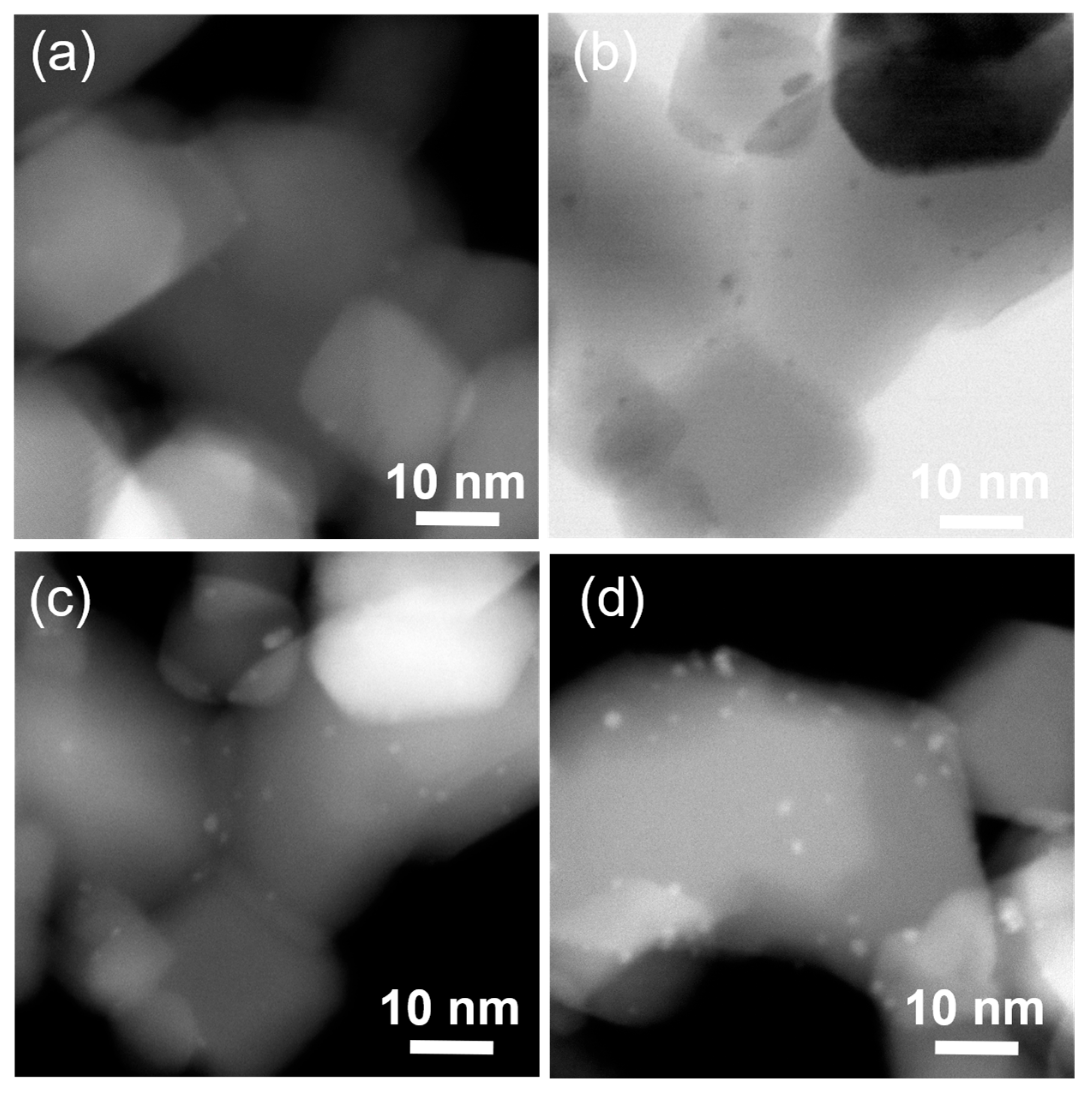
High-resolution TEM (HRTEM) imaging further revealed that Rh/TiO2–H500 retained its structural integrity after the reaction. No discernible aggregation or particle growth was observed, and the Rh species remained highly dispersed on the TiO2 surface (Figure 4a–d). The particle size distribution was comparable to that of the fresh catalyst, suggesting that the moderate SMSI-induced interfacial structure suppresses sintering under the reductive deuteration conditions.
Collectively, these results demonstrate that the Rh/TiO2–H500 catalyst operates as a stable heterogeneous system, maintaining both structural integrity and active-site dispersion after the reaction.

3. Materials and Methods

3.1. Reagents and Product Characterization

RhCl3·3H2O was obtained from Sigma-Aldrich (St. Louis, MO, USA). TiO2 (P25) was obtained from Evonik (Essen, Germany). All other reagents were purchased from commercial suppliers Le Yan (Shanghai, China), Energy Chemical (Beijing, China), and used without further purification unless otherwise noted.

3.2. Catalyst Preparation and Characterization

3.2.1. The Preparation Procedures for a Series of Rh/TiO2 Catalysts

Rh/TiO2: The catalyst was prepared by an impregnation method. Typically, 200 mL of ultrapure water was added to 2 g of TiO2 (P25) support, and 50 mL of ultrapure water was added to 5 mg of RhCl3·3H2O. Both suspensions were ultrasonically dispersed for 30 min, followed by stirring for 10 min. Subsequently, the RhCl3·3H2O solution was introduced into the TiO2 suspension using a peristaltic pump at a constant flow rate. The resulting mixture was stirred for 4 h and then aged for an additional 2 h to allow precipitation. The obtained solid was separated by centrifugation, washed three times with ultrapure water, and dried at 80 °C for 12 h. Finally, the dried sample was calcined at 450 °C for 4 h in a muffle furnace, and the resulting catalyst was denoted as Rh/TiO2.
Rh/TiO2–HX: The Rh/TiO2 catalyst was reduced under 10 vol.% H2/He atmosphere at X °C for 4 h with a heating rate of 2 °C/min, and the resulting sample was denoted as Rh/TiO2–HX.

3.2.2. Details for the Catalyst Characterization Techniques

ICP-OES: The inductively coupled plasma optical emission spectroscopy (ICP–OES) measurements were carried out using a PerkinElmer Avio 550 Max instrument (Waltham, MA, USA). The procedure was as follows: a precisely weighed amount of the powder sample was placed in a beaker, and an appropriate volume of aqua regia or concentrated nitric acid was added. The mixture was then subjected to microwave-assisted digestion to completely dissolve the catalyst sample. The resulting solution was diluted to 100 mL with deionized water to obtain a clear and transparent solution. Prior to analysis, the concentrations of the target metal elements were adjusted to fall within the 1~10 ppm range, after which ICP-OES measurements were performed.
XRD: The crystal structure of the catalysts was analyzed using an Empyrean X-ray diffractometer (XRD) manufactured by PANalytical (Almelo, The Netherlands). The instrument was equipped with a Cu Ka radiation source (λ = 1.5418 Å), operating at a voltage of 40 kV and a current of 40 mA. Data were collected in continuous scan mode over a 2θ range of 10~80° with a scanning rate of 15 °/min.
BET: The specific surface area of the samples was measured using Quadrasorb-evo (Quantachrome, Boynton Beach, FL, USA) physical adsorption analyzer based on the Brunauer–Emmett–Teller (BET) method. In the measurement procedure, 0.1 g of the sample was first degassed under vacuum at 300 °C for 6 h to remove surface-adsorbed moisture and other impurities. Subsequently, the treated sample was subjected to N2 adsorption–desorption isotherm measurements at −196 °C. The specific surface area was calculated by fitting the nitrogen adsorption data according to the BET theory.
HRTEM: High-resolution transmission electron microscopy (HRTEM) observations were conducted on a JEOL JEM-F200 field-emission TEM (Tokyo, Japan) operating at an acceleration voltage of 200 kV. The sample preparation procedure was as follows: approximately 2 mg of the sample was placed in a sample tube and dispersed in an appropriate amount of anhydrous ethanol via ultrasonication to form a homogeneous suspension. After allowing the suspension to settle, the supernatant was collected using a disposable pipette and dropped onto a copper grid with a microfilm. The grid was then dried under an infrared lamp until the solvent completely evaporated. This drop-casting process was repeated three times to ensure uniform dispersion of the sample on the copper grid.
AC-HAADF-STEM: Aberration-corrected high-angle annular dark-field scanning transmission electron microscopy (AC-HAADF-STEM) measurements were performed on a JEOL JEM-ARM200F STEM (Tokyo, Japan) microscope equipped with a CEOS probe corrector, operated at an accelerating voltage of 200 kV. The sample preparation procedure was the same as described above.
In situ XPS: In situ X-ray photoelectron spectroscopy (XPS) measurements were carried out on a Thermo Scientific Escalab 250 Xi+ instrument (Waltham, MA, USA) using an Al Kα X-ray source (hν = 1486.6 eV, 15 kV, 10 mA). During measurements, an electron flood gun was employed to compensate for surface charging. All binding energy data were calibrated with respect to the C 1s peak of surface adventitious carbon (284.8 eV). For sample preparation, the materials were ground into a fine powder and then pressed into ~1 mm thick pellets using a pressing mold, which were subsequently mounted on the sample holder and degassed under vacuum for 12 h. For Rh/TiO2-HX samples (where X denotes different reduction temperatures), the fresh catalysts were pretreated under a 10 vol.% H2/He atmosphere at X °C for 4 h prior to analysis. After reduction, the samples were cooled to room temperature and in situ transferred to the ultra-high vacuum (UHV, 1 × 10⁻⁷ mbar) analysis chamber for XPS measurement without exposure to air.
In situ CO-DRIFTS: In situ diffuse reflectance infrared Fourier-transform spectroscopy (DRIFTS) measurements were performed on a Bruker Equinox 70 spectrometer (Ettlingen, Germany) equipped with an MCT detector, with multiple scans collected for each spectrum. The instrument was operated at a resolution of 4 cm−1, with 64 scans recorded over a spectral range of 4000–400 cm−1. The specific experimental procedure was as follows: For Rh/TiO2-HX (X ≤ 500 °C), the fresh Rh/TiO2 catalyst was initially pretreated at X °C for 4 h under a 10 vol.% H2/He atmosphere. For the Rh/TiO2-H800 sample, the catalyst was first reduced at 800 °C for 4 h in the fixed-bed reactor, and subsequently pretreated in situ in the DRIFTS cell at 200 °C for 2 h under a 10 vol.% H2/He atmosphere. For the Rh/TiO2-H800-O300 sample, the catalyst was first oxidized under 20 vol.% O2/He atmosphere at 300 °C for 2 h, followed by pretreatment under 10 vol.% H2/He atmosphere at 200 °C for 2 h. After cooling to room temperature, a background spectrum was first collected. Subsequently, a 5 vol.% CO/He mixture gas was introduced into the reaction cell for CO adsorption experiments, and infrared spectra were continuously recorded over time, with spectra collected every 30 s until the adsorption signal reached a steady state. Subsequently, the gas atmosphere was switched to He for purging, while the dynamic evolution of the spectra during CO desorption was recorded.
XAS: Rh K-edge XAS analysis was performed with Si (311) crystal monochromators at the BL 14 W beamlines at the Shanghai Synchrotron Radiation Facility (SSRF) (Shanghai, China). Before the analysis at the beamline, samples were pressed into thin sheets with 1 cm in diameter and sealed using Kapton tape film. The XAFS spectra were recorded at room temperature in fluorescence mode. The XAS spectra of the standard sample Rh foil was also recorded in fluorescence mode for an accurate comparison. The spectra were processed and analyzed by the software codes Athena and Artemis.

3.3. General Procedure for Site-Selective H/D Exchange of Quinolines

A 25 mL Schlenk tube was charged with the substrate (0.2 mmol), Rh/TiO2–HX catalyst (100 mg, 0.5 mol% Rh/quinoline), D2O (2.0 mL), and a magnetic stir bar. The reaction system was evacuated using a Schlenk line and then purged with D2 from a gas sampling bag repeatedly five times, and finally, the system was pressurized with D2 (1 atm). The Schlenk tube was then placed in a thermostatic oil bath and stirred at 800 rpm at 80 °C for 12 h. After the reaction, the Schlenk tube was removed from the oil bath and cooled to room temperature, and the reaction effluent gas was carefully discharged. The reaction solution was extracted with dichloromethane (3 × 10 mL), and the combined organic phases were concentrated under a rotary evaporator. Subsequently, the resulting products were directly characterized by 1H NMR spec-troscopy to determine the deuterium incorporation. In parallel, approximately 200 μL of the reaction solution in the NMR tube was diluted with ethyl acetate to a total volume of 1.5 mL and subsequently analyzed by GC-FID to measure the reaction yield.

3.4. Product Analysis

The deuterium incorporation of the deuterated products was analyzed by liquid-state NMR spectroscopy (1H NMR). Measurements were performed on a JEOL JNM-ECZL400S 400 MHz NMR spectrometer (Tokyo, Japan). Data are reported as follows: chemical shift in ppm (δ), multiplicity (s = singlet, d = doublet, t = triplet, q = quartet, brs = broad singlet, m = multiplet), coupling constant (Hz), and integration. 1H NMR measurement was performed using CDCl3 as the deuterated solvent to provide a uniform field lock.

4. Conclusions

In summary, a series of Rh/TiO2 catalysts with tunable SMSI were obtained via high-temperature H2 treatment. Among them, Rh/TiO2–H500 exhibits an optimal interfacial structure characterized by moderate TiOx encapsulation and interfacial electron transfer, leading to the formation of electron-enriched metallic Rh species while maintaining accessible contiguous metal ensembles. This optimized catalyst enables efficient reductive deuteration of quinoline through a sequential hydrogenation–H/D exchange pathway, affording high levels of deuterium incorporation in THQ at C2 (1.95), C3 (1.42), C4 (1.56), and C8 (0.89). Structural and spectroscopic analyses reveal a clear volcano-type relationship between reduction temperature, SMSI intensity, and catalytic performance, highlighting the importance of balancing active-site exposure and interfacial electronic modulation. These findings demonstrate that rational regulation of SMSI provides an effective strategy for controlling reductive H/D exchange over heterogeneous catalysts and offers mechanistic insight into the selective deuteration of pharmaceutically relevant N-heterocycles.

Supplementary Materials

The following supporting information can be downloaded at: https://www.mdpi.com/article/10.3390/catal16040301/s1, Figure S1: EPR spectra of the different Rh samples. Figure S2: WT analysis of (a) Rh foil, (b) Rh2O3, (c) Rh/TiO2-H200 and (d) Rh/TiO2-H500 catalysts. Table S1: ICP-OES of a series of Rh/TiO2 catalysts.; Table S2: EXAFS data fitting results of Rh/TiO2-HX catalysts and reference samples.

Author Contributions

W.Z. prepared the catalysts, performed the reaction, and carried out the characterizations. X.-T.M. and B.Q. co-wrote the manuscript. X.-T.M. and B.Q. conceived and supervised the project. All authors have read and agreed to the published version of the manuscript.

Funding

This research was funded by National Key Research and Development Program of China, grant number 2021YFA1500503; National Natural Science Foundation of China, grant number 22302199, 22310802000; the NSFC Centre for Single-Atom Catalysis, grant number 22388102; the Energy Revolution S&T Program of Yulin Innovation Institute of Clean Energy, grant number 22388102 E411040316.

Data Availability Statement

The authors declare that the data supporting the findings of this study are available within the paper and its Supplementary Materials.

Conflicts of Interest

The authors declare no competing interests.

Abbreviations

The following abbreviations are used in this manuscript:
SMSIStrong metal–support interaction
THQ1,2,3,4-tetrahydroquinoline
HRTEMhigh-resolution transmission electron microscopy
AC-HAADF-STEMaberration-corrected high-angle annular dark-field scanning transmission electron microscopy
DRIFTSdiffuse reflection infrared Fourier transform
Ovoxygen vacancies
XPSX-ray photoelectron spectroscopy
XASX-ray absorption spectroscopy
XANESX-ray absorption near-edge structure
EXAFSextended X-ray absorption fine structure
NPsnanoparticles
B.E.binding energy
GC-FIDGas Chromatography-Flame Ionization Detection

References

  1. Prakash, G.; Paul, N.; Oliver, G.A.; Werz, D.B.; Maiti, D. C-H deuteration of organic compounds and potential drug candidates. Chem. Soc. Rev. 2022, 51, 3123–3163. [Google Scholar] [CrossRef] [PubMed]
  2. Elison, C.; Elliott, H.W.; Laursen, R.; Rapoport, H. Effect of deuteration of N-CH3 group on potency and enzymatic N-demethylation of morphine. Science 1961, 134, 1078–1079. [Google Scholar] [CrossRef]
  3. Russak, E.M.; Bednarczyk, E.M. Impact of deuterium substitution on the pharmacokinetics of pharmaceuticals. Ann. Pharmacother. 2019, 53, 211–216. [Google Scholar] [CrossRef]
  4. Qadir, T.; Amin, A.; Sharma, P.K.; Jeelani, I.; Abe, H. A review on medicinally important heterocyclic compounds. Open Med. Chem. J. 2022, 16, e187410452202280. [Google Scholar] [CrossRef]
  5. Marshall, C.M.; Federice, J.G.; Bell, C.N.; Cox, P.B.; Njardarson, J.T. An update on the nitrogen heterocycle compositions and properties of US FDA-approved pharmaceuticals (2013–2023). J. Med. Chem. 2024, 67, 11622–11655. [Google Scholar] [CrossRef]
  6. Katritzky, A.R.; Rachwal, S.; Rachwal, B. Recent progress in the synthesis of 1,2,3,4,-tetrahydroquinolines. Tetrahedron 1996, 52, 15031–15070. [Google Scholar] [CrossRef]
  7. Jo, H.; Choi, M.; Kumar, A.S.; Jung, Y.; Kim, S.; Yun, J.; Kang, J.S.; Kim, Y.; Han, S.; Jung, J.; et al. Development of novel 1,2,3,4-tetrahydroquinoline scaffolds as potent NF-κB inhibitors and cytotoxic agents. ACS Med. Chem. Lett. 2016, 7, 385–390. [Google Scholar] [CrossRef] [PubMed]
  8. Karthikeyan, S.; Grishina, M.; Kandasamy, S.; Mangaiyarkarasi, R.; Ramamoorthi, A.; Chinnathambi, S.; Pandian, G.N.; Kennedy, J.L. A review on medicinally important heterocyclic compounds and importance of biophysical approach of underlying the insight mechanism in biological environment. J. Biomol. Struct. Dyn. 2023, 41, 14599–14619. [Google Scholar] [CrossRef]
  9. Nammalwar, B.; Bunce, R. Recent syntheses of 1,2,3,4-tetrahydroquinolines, 2,3-dihydro-4(1H)-quinolinones and 4(1H)-quinolinones using domino reactions. Molecules 2013, 19, 204–232. [Google Scholar] [CrossRef] [PubMed]
  10. Asolkar, R.N.; Schroeder, D.; Heckmann, R.; Lang, S.; Wagner-Doebler, I.; Laatsch, H. Helquinoline, a new tetrahydroquinoline antibiotic from janibacter limosus Hel 1. J. Antibiot. 2004, 57, 17–23. [Google Scholar] [CrossRef]
  11. Su, D.S.; Lim, J.J.; Tinney, E.; Wan, B.L.; Young, M.B.; Anderson, K.D.; Rudd, D.; Munshi, V.; Bahnck, C.; Felock, P.J.; et al. Substituted tetrahydroquinolines as potent allosteric inhibitors of reverse transcriptase and its key mutants. Bioorg. Med. Chem. Lett. 2009, 19, 5119–5123. [Google Scholar] [CrossRef]
  12. Escribano, A.; Mateo, A.I.; Martin de la Nava, E.M.; Mayhugh, D.R.; Cockerham, S.L.; Beyer, T.P.; Schmidt, R.J.; Cao, G.; Zhang, Y.; Jones, T.M.; et al. Design and synthesis of new tetrahydroquinolines derivatives as CETP inhibitors. Bioorg. Med. Chem. Lett. 2012, 22, 3671–3675. [Google Scholar] [CrossRef]
  13. Atzrodt, J.; Derdau, V.; Kerr, W.J.; Reid, M. C−H functionalisation for hydrogen isotope exchange. Angew. Chem. Int. Ed. 2018, 57, 3022–3047. [Google Scholar] [CrossRef]
  14. Pfeifer, V.; Zeltner, T.; Fackler, C.; Kraemer, A.; Thoma, J.; Zeller, A.; Kiesling, R. Palladium nanoparticles for the deuteration and tritiation of benzylic positions on complex molecules. Angew. Chem. Int. Ed. 2021, 60, 26671–26676. [Google Scholar] [CrossRef]
  15. Bains, A.K.; Sau, A.; Portela, B.S.; Paton, R.S.; Miyake, G.M.; Damrauer, N.H. Reduction and deuteration of N-heteroarenes using an organic photoredox catalyst. Chem 2025, 102822. [Google Scholar] [CrossRef]
  16. Bu, F.; Deng, Y.; Xu, J.; Yang, D.; Li, Y.; Li, W.; Lei, A. Electrocatalytic reductive deuteration of arenes and heteroarenes. Nature 2024, 634, 592–599. [Google Scholar] [CrossRef] [PubMed]
  17. Zhao, W.; Liang, T.; Zheng, D.; Qiu, J.; Zheng, J.; Wu, Y.; Xu, W.; Liu, L.; Ye, F. Nickel-catalyzed quantitative deuterated reduction of quinolines and alkenes. Chin. Chem. Lett. 2025, 112035. [Google Scholar] [CrossRef]
  18. Zhang, J.; Spreckelmeyer, N.; Lammert, J.; Wiethoff, M.A.; Milner, M.J.; Mück-Lichtenfeld, C.; Studer, A. Photocatalytic hydrogenation of quinolines to form 1,2,3,4-tetrahdyroquinolines using water as the hydrogen atom donor. Angew. Chem. Int. Ed. 2025, 64, e202502864. [Google Scholar] [CrossRef]
  19. Tauster, S. Strong metal-support interactions. Acc. Chem. Res. 1987, 20, 389–394. [Google Scholar] [CrossRef]
  20. Luo, Z.; Zhao, G.; Pan, H.; Sun, W. Strong metal–support interaction in heterogeneous catalysts. Adv. Energy Mater. 2022, 12, 2201395. [Google Scholar] [CrossRef]
  21. Broekhoff, J.C.P. Mesopore determination from nitrogen sorption isotherms: Fundamentals, scope, limitations. Stud. Surf. Sci. Catal. 1979, 3, 663–684. [Google Scholar]
  22. Diebold, U. The surface science of titanium dioxide. Surf. Sci. Rep. 2003, 48, 53–229. [Google Scholar] [CrossRef]
  23. Ohyama, J.; Yamamoto, A.; Teramura, K.; Shishido, T.; Tanaka, T. Modification of metal nanoparticles with TiO2 and metal–support interaction in photodeposition. ACS Catal. 2011, 1, 187–192. [Google Scholar] [CrossRef]
  24. Tang, H.; Su, Y.; Zhang, B.; Lee, A.F.; Isaacs, M.A.; Wilson, K.; Li, L.; Ren, Y.; Huang, J.; Haruta, M.; et al. Classical strong metal-support interactions between gold nanoparticles and titanium dioxide. Sci. Adv. 2017, 3, e1700231. [Google Scholar] [CrossRef] [PubMed]
  25. Liu, B.; Sun, Y.; Li, M.; Fan, Z.; Chen, X.; Lan, X.; Zhong, Q.; Wang, T. Molecular understanding of heterogeneous hydroformylation on Rh1/CeO2: Morphology effects. ACS Catal. 2024, 14, 15956–15964. [Google Scholar] [CrossRef]
  26. Han, B.; Li, Q.; Jiang, X.; Guo, Y.; Jiang, Q.; Su, Y.; Li, L.; Qiao, B. Switchable tuning CO2 hydrogenation selectivity by encapsulation of the Rh nanoparticles while exposing single atoms. Small 2022, 18, e2204490. [Google Scholar] [CrossRef] [PubMed]
  27. Matsubu, J.; Yang, V.; Christopher, P. Isolated metal active site concentration and stability control catalytic CO2 reduction selectivity. J. Am. Chem. Soc. 2015, 137, 3076–3084. [Google Scholar] [CrossRef]
  28. Han, B.; Guo, Y.; Huang, Y.; Xi, W.; Xu, J.; Luo, J.; Qi, H.; Ren, Y.; Liu, X.; Qiao, B.; et al. Strong metal-support interactions between Pt single atoms and TiO2. Angew. Chem. Int. Ed. 2020, 59, 11824–11829. [Google Scholar] [CrossRef]
  29. Xu, M.; Peng, M.; Tang, H.; Zhou, W.; Qiao, B.; Ma, D. Renaissance of strong metal-support interactions. J. Am. Chem. Soc. 2024, 146, 2290–2307. [Google Scholar] [CrossRef] [PubMed]
  30. Haller, G.L.; Resasco, D.E. Metal–support interaction: Group VIII metals and reducible oxides. Adv. Catal. 1989, 36, 173–235. [Google Scholar]
  31. Qiao, B.; Wang, A.; Yang, X.; Allard, L.F.; Jiang, Z.; Cui, Y.; Liu, J.; Li, J.; Zhang, T. Single-atom catalysis of CO oxidation using Pt1/FeOx. Nat. Chem. 2011, 3, 634–641. [Google Scholar] [CrossRef]
  32. Wahlstrom, E.; Vestergaard, E.K.; Schaub, R.; Rønnau, A.; Vestergaard, M.; Lægsgaard, E.; Stensgaard, I.; Besenbacher, F. Electron transfer-induced dynamics of oxygen molecules on the TiO2(110) surface. Science 2004, 303, 511–513. [Google Scholar] [CrossRef]
  33. Tang, H.; Wei, J.; Liu, F.; Qiao, B.; Pan, X.; Li, L.; Liu, J.; Wang, J.; Zhang, T. Strong metal–support interactions between gold nanoparticles and nonoxides. J. Am. Chem. Soc. 2015, 138, 56–59. [Google Scholar] [CrossRef]
  34. Li, Z.; Li, R.; Jing, H.; Xiao, J.; Xie, H.; Hong, F.; Ta, N.; Zhang, X.; Zhu, J.; Li, C. Blocking the reverse reactions of overall water splitting on a Rh/GaN–ZnO photocatalyst modified with Al2O3. Nat. Catal. 2023, 6, 80–88. [Google Scholar] [CrossRef]
  35. Lang, R.; Li, T.; Matsumura, D.; Miao, S.; Ren, Y.; Cui, Y.; Tan, Y.; Qiao, B.; Li, L.; Wang, A.; et al. Hydroformylation of olefins by a Rhodium single-atom catalyst with activity comparable to RhCl(PPh3)3. Angew. Chem. Int. Ed. 2016, 55, 16054–16058. [Google Scholar] [CrossRef] [PubMed]
  36. Chen, L.; Meira, D.; Kovarik, L.; Szanyi, J. Hydrogen spillover is regulating minority Rh1 active sites on TiO2 in room-temperature ethylene hydrogenation. ACS Catal. 2024, 14, 7369–7380. [Google Scholar] [CrossRef]
  37. Shen, R.; Liu, Y.; Liu, S.; Jiang, J.; Liu, T.; Mehdi, S.; Xiao, T.; Liang, E.; Li, B. Symmetry-broken atomic ensemble induced by mandated charge for efficient water dissociation in hydrogen generation. J. Energy Chem. 2025, 103, 274–281. [Google Scholar] [CrossRef]
  38. Du, E.; Yang, J.; Huai, L.; Hao, P.; Lv, M.; Chen, Z.; Chen, Y.; Zhang, J. Quantifying interface-dependent active sites induced by strong metal–support interactions on Au/TiO2 in 2,5-Bis(hydroxymethyl)furan oxidation. ACS Catal. 2024, 15, 54–62. [Google Scholar] [CrossRef]
  39. Jiang, Z.; Li, Y.; Tang, Z.; Yuan, D.; Lin, F. Strong metal–support interactions in catalytic oxidation of VOCs: Mechanistic insights, support engineering strategies, and emerging catalyst design paradigms. Environ. Sci. Technol. 2025, 59, 19644–19666. [Google Scholar] [CrossRef] [PubMed]
  40. Chen, H.; Yang, Z.; Wang, X.; Polo-Garzon, F.; Halstenberg, P.W.; Wang, T.; Suo, X.; Yang, S.Z.; Meyer, H.M.; Wu, Z.; et al. Photoinduced strong metal–support interaction for enhanced catalysis. J. Am. Chem. Soc. 2021, 143, 8521–8526. [Google Scholar] [CrossRef]
  41. Liu, T.; Wang, H. Synthesis of tetrahydroquinoline via hydrosilylation-transfer hydrogenation of quinoline with silane and water catalyzed by a switchable Lewis and Brønsted acid system. Tetrahedron 2025, 187, 134910. [Google Scholar] [CrossRef]
  42. Sorribes, I.; Liu, L.; Doménech-Carbó, A.; Corma, A. Nanolayered cobalt–molybdenum sulfides as highly chemo- and regioselective catalysts for the hydrogenation of quinoline derivatives. ACS Catal. 2018, 8, 4545–4557. [Google Scholar] [CrossRef]
  43. Sahoo, B.; Kreyenschulte, C.; Agostini, G.; Lund, H.; Bachmann, S.; Scalone, M.; Junge, K.; Beller, M. A robust iron catalyst for the selective hydrogenation of substituted (iso)quinolones. Chem. Sci. 2018, 9, 8134–8141. [Google Scholar] [CrossRef] [PubMed]
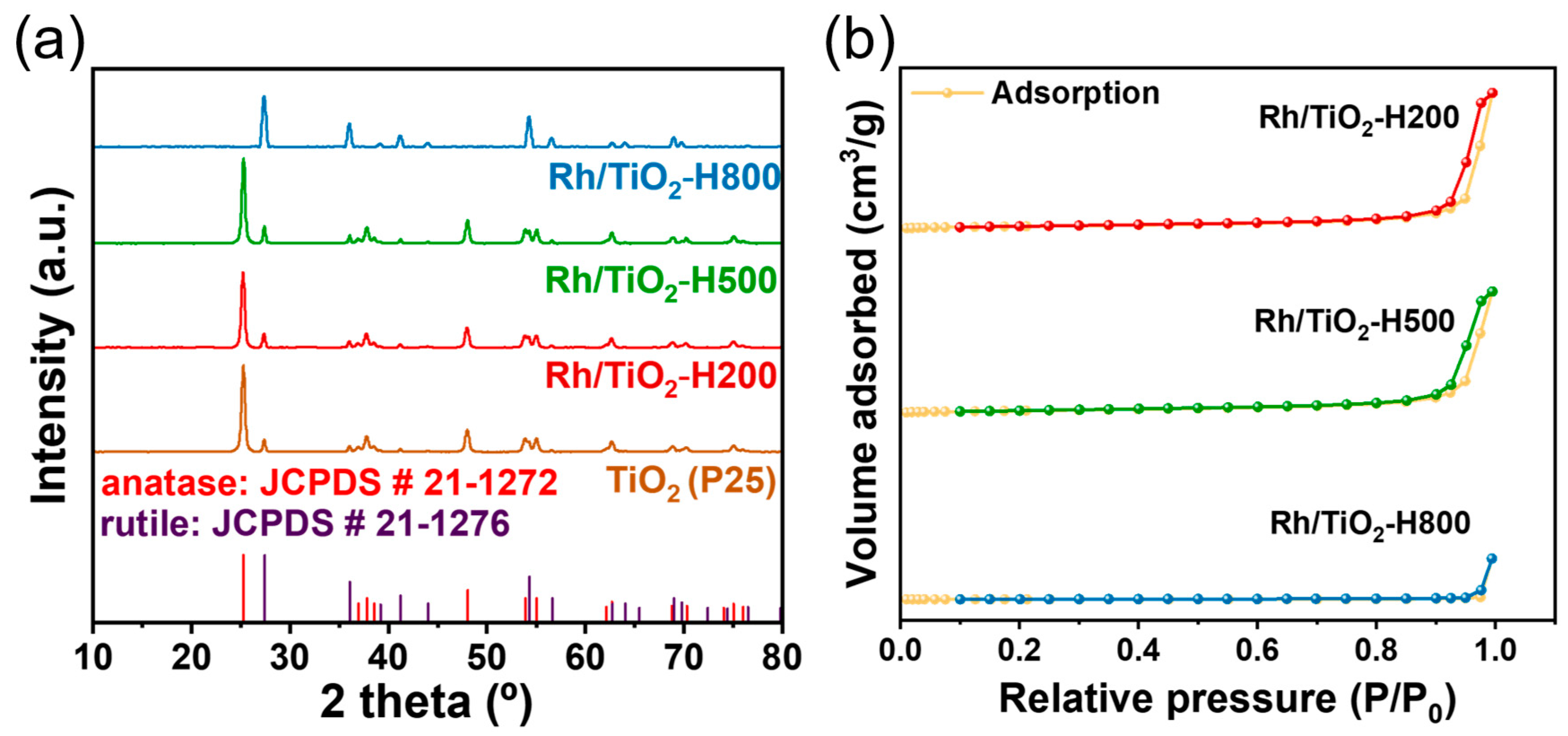
Figure 1. XRD patterns and N2 adsorption–desorption isotherms of Rh/TiO2–HX catalysts. (a) XRD pattern. (b) N2 adsorption–desorption isotherms. The samples were degassed at 300 °C for 6 h before N2 adsorption.
Catalysts 16 00301 g001
Figure 2. AC-HAADF-STEM images of (a,b) Rh/TiO2-H200; (c,d) Rh/TiO2-H500; and (e,f) Rh/TiO2-H800. Rh single atoms and Rh clusters are highlighted with yellow and red circles, respectively.
Catalysts 16 00301 g002
Figure 3. Spectroscopic evidence for the SMSI in Rh/TiO2–HX catalysts. (a) In situ DRIFTS spectra of CO adsorption on Rh/TiO2–HX catalysts. (b) Rh 3d XPS spectra of Rh/TiO2–HX catalysts. (c) Rh K-edge XANES and (d) Rh R-space EXAFS of Rh/TiO2–HX catalysts.
Catalysts 16 00301 g003
Figure 4. (ad) HRTEM images of Rh/TiO2-H500 after the reaction.
Catalysts 16 00301 g004
Table 1. Surface area of Rh/TiO2-HX catalysts.
EntryCatalystSurface Area (m2/g)
1Rh/TiO2-H20044.3
2Rh/TiO2-H50042.8
3Rh/TiO2-H8003.3
Table 2. The performance of reductive deuteration of quinolines (1) on various catalysts.
Catalysts 16 00301 i001
EntryCatalystConditionYield (2)x D at C2x D at C3x D at C4x D at C8
1Rh/TiO2-H200D2/D2O78%1.661.250.920.66
2Rh/TiO2-H500D2/D2O98%1.931.461.250.76
3Rh/TiO2-H800D2/D2O70%1.901.541.170.37
4 aRh/TiO2-H500D2/D2O98%1.931.451.270.77
5 bRh/TiO2-H500D2/D2O99%1.951.421.560.89
6 bTiO2D2/D2O<2%N.D.N.D.N.D.N.D.
7 bRh/TiO2-H500H2/D2O97%1.871.341.40.83
8 bRh/TiO2-H500D2/H2O96%N.D.N.D.N.D.N.D.
9 bRh/TiO2-H500N2/D2O<2%N.D.N.D.N.D.N.D.
10 bRhCl3·3H2OD2/D2O24%1.571.140.720.56
Reaction conditions: the reactions were conducted with quinoline (1) (0.20 mmol), Rh/TiO2–H500 (0.5 mol% Rh, relative to substrate), and D2O (2.0 mL) under D2 (balloon) for 12 h at 80 °C. Yield was determined by GC-FID, and the deuterium incorporation was determined by 1H NMR analysis. a 24 h. b 100 °C. N.D.: not detected.
Disclaimer/Publisher’s Note: The statements, opinions and data contained in all publications are solely those of the individual author(s) and contributor(s) and not of MDPI and/or the editor(s). MDPI and/or the editor(s) disclaim responsibility for any injury to people or property resulting from any ideas, methods, instructions or products referred to in the content.