Review

Hydrophobic Surface Modification of Microporous and Mesoporous Titanosilicates and Its Impact on Catalytic Performance in Epoxidation Reactions: A Review


by
Ana Belen Lozada
1,2,
Ayleen Villacrés
1,2,
Diana Endara
2,
Ernesto de la Torre
2,
Eric M. Gaigneaux
1 and
Lucia E. Manangon-Perugachi
2,*
1
Institute of Condensed Matter and Nanosciences (IMCN), Université catholique de Louvain (UCLouvain), Place Louis Pasteur 1, P.O. Box L4.01.09, 1348 Louvain-la-Neuve, Belgium
2
Department of Extractive Metallurgy, Escuela Politecnica Nacional, Quito 170517, Ecuador
*
Author to whom correspondence should be addressed.
Catalysts 2026, 16(4), 299; https://doi.org/10.3390/catal16040299
Submission received: 20 December 2025 / Revised: 16 February 2026 / Accepted: 9 March 2026 / Published: 31 March 2026

Abstract

Titanosilicates are Lewis acid catalysts widely applied in liquid-phase olefin epoxidation; however, in the presence of water, their performance is often limited by structural instability, active-site deactivation, and competing side reactions. This review critically examines hydrophobization strategies—based on controlled reduction in silanol groups or incorporation of organic functionalities—and discusses the experimental approaches used to evaluate surface hydrophobicity, including water adsorption measurements, infrared spectroscopy of silanols, contact angle analysis, and complementary spectroscopic methods. Although direct quantitative comparison among studies is hindered by differences in reaction systems and the lack of standardized catalytic metrics, consistent trends emerge. Lower silanol densities are generally associated with improved preservation of isolated tetrahedral Ti (IV) sites, higher H2O2 utilization efficiency, and reduced secondary epoxide ring-opening, leading to enhanced activity and selectivity under comparable conditions. These improvements are attributed to decreased local water activity, suppression of non-productive oxidant decomposition, and stabilization of Ti-peroxo intermediates responsible for direct epoxidation. Incorporation of organic groups produces a similar beneficial effect when introduced in moderate amounts, increasing surface hydrophobicity without significantly perturbing Ti coordination. However, beyond an optimal loading, catalytic performance declines due to pore blockage, diffusion limitations, and partial masking of active sites, revealing a threshold behavior. Fluoride also plays a dual role: when used during synthesis, it influences the insertion and distribution of framework Ti, whereas as a post-treatment, it primarily regulates silanol density and surface polarity while preserving active sites. Finally, hydrophobicity cannot be considered independently, as its impact depends on the solvent, oxidant, olefin nature, and active-site location, which collectively govern activity, selectivity, and catalyst stability.

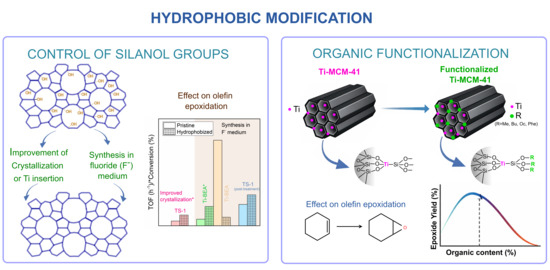
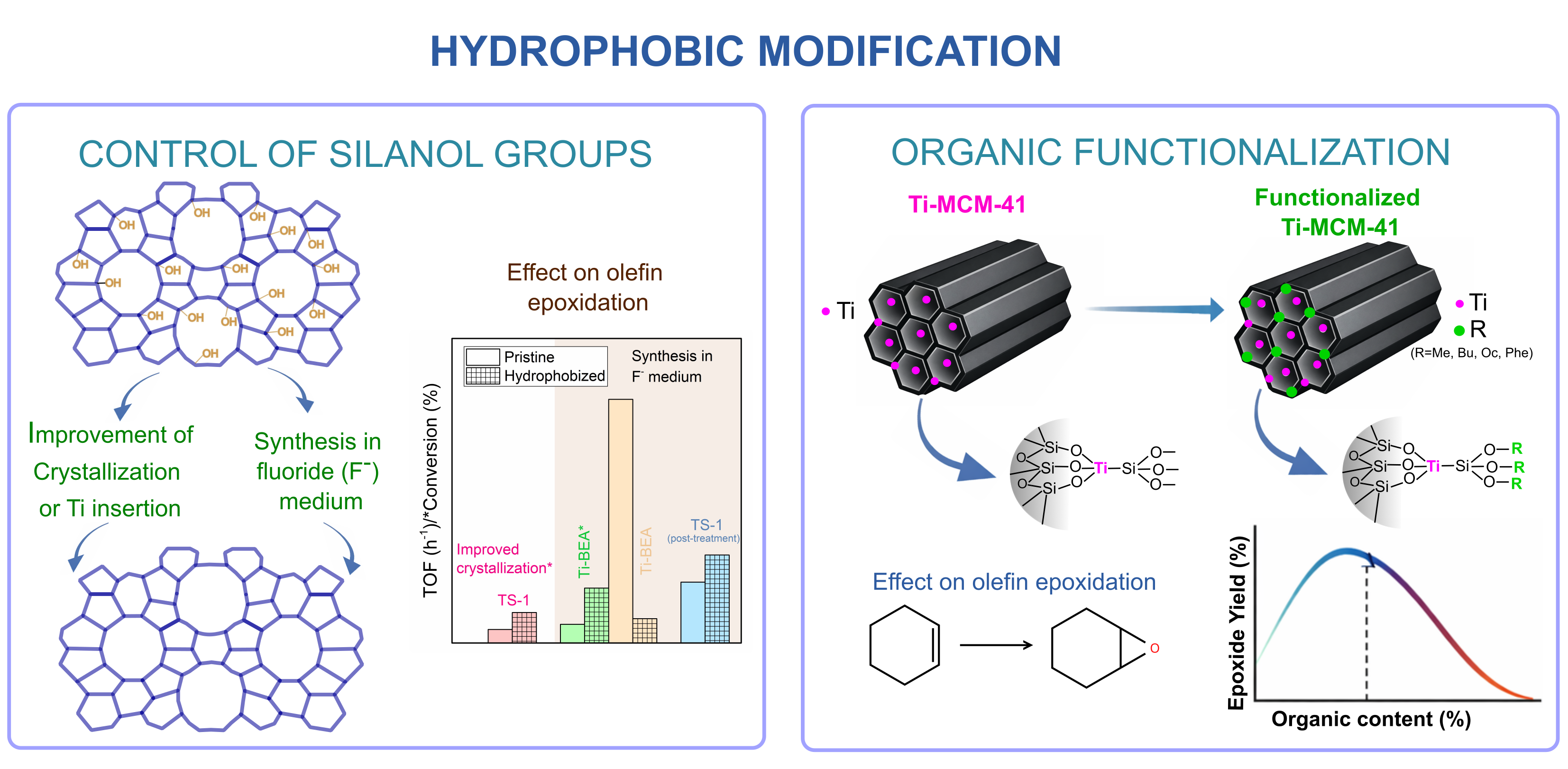
Graphical Abstract

1. Introduction

Titanosilicates are important materials with fast development since the synthesis of the first TS-1 [1,2,3,4,5]. They are used in the selective oxidation of organic compounds, displaying high catalytic activity [1,2,6,7,8,9,10,11]. The growing application of these heterogeneous catalysts for both the petrochemical and fine chemical industries has resulted in a substantial production of titanosilicates with improved catalytic performance, which could replace the traditional ones [12].
The active sites in titanosilicates are Ti atoms in tetrahedral coordination inserted into the silica framework (framework-Ti). Previous studies have shown that isomorphous substitution of Ti into the TS-1 framework is limited to a maximum atomic ratio of about 2.5% (Ti/(Si + Ti)) [13]. Beyond this composition, octahedral Ti species form outside the framework (extraframework Ti), which are catalytically inactive in selective oxidation reactions. In these reactions, Ti active sites interact with the oxidant, such as H2O2 or organic peroxides, to generate Ti-peroxo intermediate species (Ti-OOH or Ti-OOR), which are the active oxidation centers [14,15,16]. The tetrahedral Ti sites function as Lewis acid centers that activate the oxidant, enabling formation of the activated complex that subsequently reacts with substrates such as olefins during epoxidation [17,18,19,20,21].
Some alternatives have been used to improve the catalytic performance of titanosilicates, such as improving the textural properties [2,12], controlling the nature of the active sites [1,22], and modifying the hydrophobic/phylic surface character. In recent years, the adjustment of hydrophobicity/philicity of materials such as metal-organic frameworks (MOFs) [23,24,25], aluminosilicates [26], and titanosilicates [27] has received more attention due to its great influence on their catalytic properties.
In the field of titanosilicates, the effect of hydrophobization has been particularly studied in the epoxidation of olefins in the liquid phase. Early studies proposed that the hydrophobicity of titanosilicates influences the competitive adsorption between non-polar substrates (olefin) and polar products (epoxide) [28,29], motivating efforts to increase the hydrophobic character of titanosilicates to improve the olefin adsorption. Later, studies showed that epoxidation proceeds via an Eley-Rideal [30] mechanism, where only the oxidant is adsorbed on the catalyst’s surface. Under these conditions, a hydrophobic surface facilitates the rapid desorption of epoxide, preventing over-oxidation to diols.
Moreover, the hydrophobic environment reduces the adsorption of water, which is crucial because water promotes epoxide ring-opening and can deactivate the Ti active sites [31]. Water is added to the reaction together with the oxidant. For example, the commercially available H2O2 is normally a 30% (w/w) solution in water. Thus, the modification of the hydrophobicity of the surface of titanosilicates could regulate the interaction between the catalyst with both the reactants and products and prevent side reactions, resulting in high conversion and/or selectivity [32].
Several crystalline and amorphous titanosilicates have been hydrophobized by different methodologies. TS-1, which is already a hydrophobic titanosilicate, was further hydrophobized by controlling the silanol surface density to improve its catalytic activity. The improved hydrophobic character and Ti dispersion of TS-1 yielded a significant increment in the activity of the catalyst [33]. Also, hydrophobic TS-1 functionalized by post-grafting achieved higher epoxide selectivity than the non-modified one [34]. The microporous TS-1 zeolite enables the efficient oxidation of small substrates; however, its performance is limited for larger molecules due to diffusion constraints. To address this limitation, large-pore titanosilicate zeolites were developed. Ti-Beta, for example, provides improved molecular accessibility compared to TS-1, but is intrinsically more hydrophilic [35]. A common strategy to decrease the density of external silanol groups and increase hydrophobicity is to synthesize Ti-Beta in fluoride medium instead of alkaline conditions [36,37,38]. While hydrophobic Ti-Beta was traditionally considered more effective in epoxidation reactions, recent work by Bregante et al. [38] showed that hydrophilic Ti-Beta can exhibit turnover rates up to two orders of magnitude higher than hydrophobic samples, indicating that the impact of hydrophobicity on catalytic performance requires further clarification.
Other large-pore titanosilicates, such as Ti-MCM-41 [39,40,41,42,43], Ti-MCM-48 [41], and Ti-SBA-15 [32], and amorphous Ti-SiO2 [11,44,45,46,47,48] were functionalized by one-pot and post-grafting procedures and showed greater catalytic performance in the epoxidation of olefins.
It is notable that the hydrophobic properties of catalyst surfaces display an important role in the adsorption/desorption processes and consequently, in the catalytic performance of titanosilicates. In fact, several researchers have studied the hydrophobization of these materials, and the modification resulted in positive, negative, or non-significant effects on their catalytic activity. Even though the modification of hydrophobicity has been addressed in previous investigations, the variety of types of titanosilicates and the analytical techniques used to measure this property have not allowed for a consensus on the catalytic effects of hydrophobization. To the best of our knowledge, there is not yet a review article analyzing this effect. For this reason, a comparison and discussion about the effects of hydrophobization of titanosilicates will be addressed here, considering the type of titanosilicate, the hydrophobization strategy, the surface characterization, and the catalytic system.

2. Overview of the Topic

2.1. Types of Titanosilicates: Active Site, Acidity, and Textural Properties

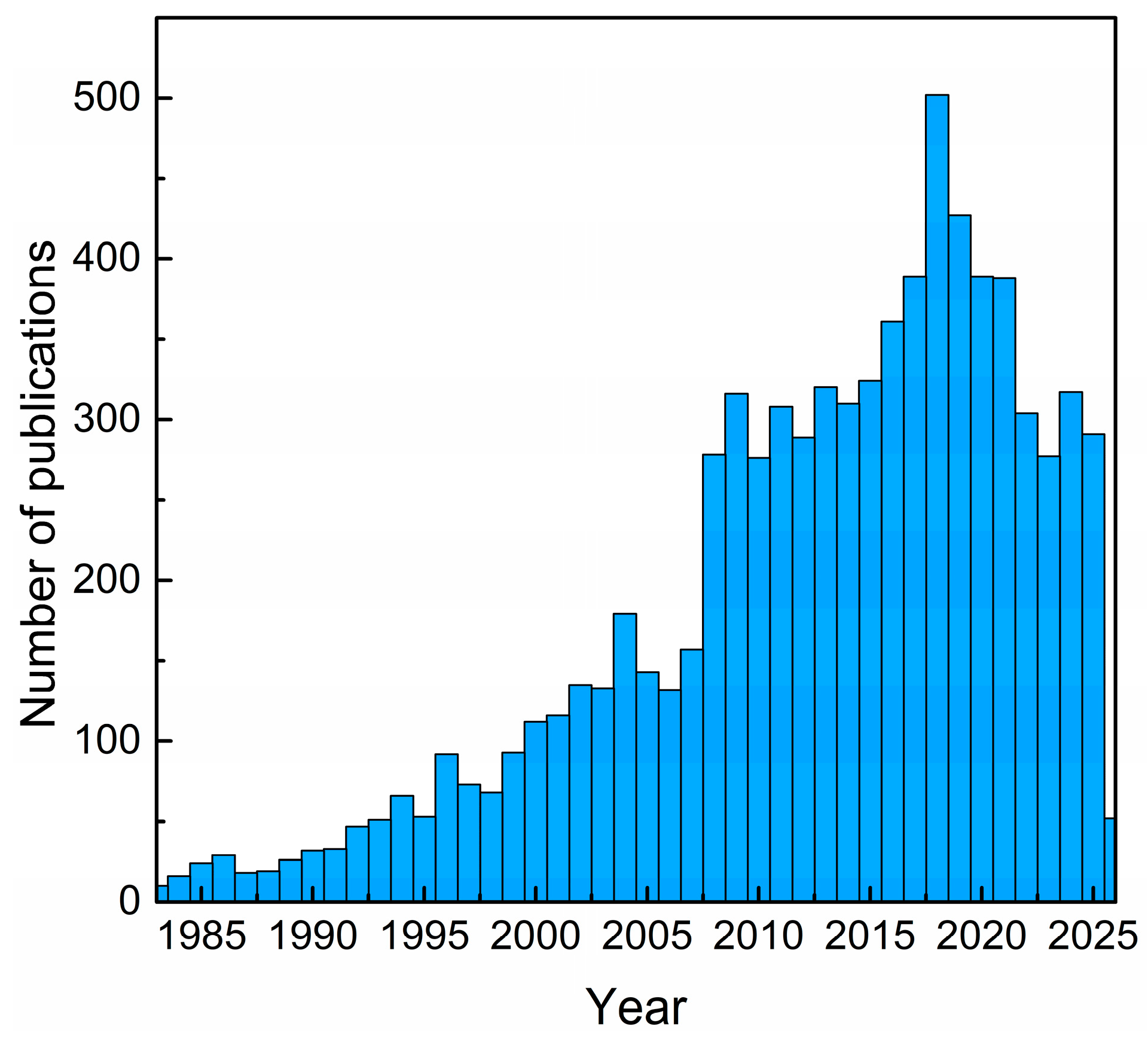
Titanosilicates, both crystalline and amorphous, have attracted sustained interest since their initial discovery due to their high catalytic activity in selective oxidation reactions [1,2,3,4,5]. Crystalline titanosilicates have been widely applied in the liquid-phase oxidation of organic substrates such as alkanes, alkenes, alcohols, and aromatics, typically using hydrogen peroxide or organic peroxides as oxidants [1,2,6]. Amorphous titanosilicates have also been established as effective catalysts for olefin epoxidation [7,8,9,10,11,49]. Since the synthesis of the first titanosilicate zeolite, TS-1, in 1983, research efforts have continuously expanded the structural diversity and catalytic applications of these materials. This continuous interest is reflected in the steady growth in the number of publications on titanosilicates over the years (Figure 1).
In this work, titanosilicates are considered materials in which titanium atoms are incorporated into a silica matrix. For analysis purposes, they are classified into two main groups: (i) titanosilicates with a zeolite structure (Ti-zeolites), which have a well-defined crystal framework, and (ii) titanosilicates without a zeolite structure (Ti-SiO2), characterized by an amorphous organization of the silica network. Their active site, associated acidity, and the main structural differences between the two types of materials are described below.

2.1.1. Active Sites of Titanosilicates

Titanosilicate catalysts contain isolated Ti(IV) centers embedded within a silica matrix, where they function as redox-active sites capable of activating H2O2 or organic peroxides to form Ti-OOH and Ti-OOR intermediates—the key oxidizing species in olefin epoxidation [1,50]. These Ti(IV) atoms are introduced primarily through isomorphous substitution of Si4+ by Ti4+ during synthesis, producing framework-bound, molecularly dispersed sites. Although Pauling’s radius-ratio rules suggest that Ti4+ is too large to fit in a perfect tetrahedral environment, the Ti-O radius ratio (0.515) exceeds the 0.225–0.414 range characteristic of tetrahedral geometry [51], flexible structures such as MFI can accommodate distorted (“pseudotetrahedral”) TiO4 environments [52], which gives rise to the canonical reactivity of TS-1 and related materials.
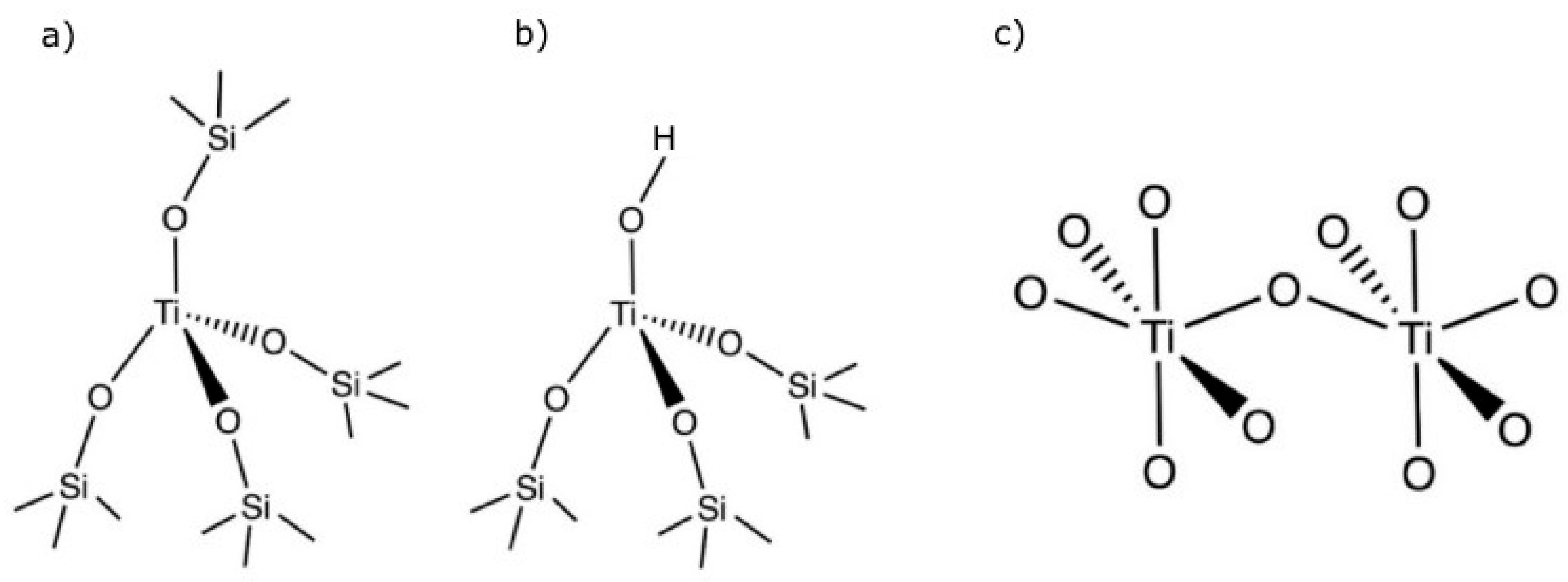
In TS-1 and related Ti-zeolites, the incorporation of framework Ti (FW-Ti, Figure 2a,b) is limited to approximately 2.5 mol% Ti/(Ti + Si). The lattice can no longer compensate for the strain imposed by Ti-O bond lengths, leading to the formation of extraframework Ti species (EFW-Ti, Figure 2c) such as octahedral TiO6 units, anatase-like TiO2 domains, or small TiOₓ clusters [53]. These species differ markedly from framework Ti in electronic structure and catalytic behavior; they often promote unselective oxidation or accelerate H2O2 decomposition rather than epoxide formation [54,55]. Similar substitution limits and defect-dependent behaviors have been reported for other titanosilicates, including Ti-Beta [56], Ti-MCM-41 [57], and amorphous Ti-SiO2, though the precise limit depends on framework topology, defect density, and preparation method.
The catalytic relevance of each Ti species is therefore closely tied to its coordination environment and the local microstructure. Early interpretations assumed that the only active sites were isolated, closed tetrahedral Ti(OSi)4 units. More recent work, however, demonstrates a much broader family of catalytically competent Ti(IV) environments. Yu et al. [58], identified at least four microenvironments in MWW-type titanosilicates—Ti(OSi)4(OTiO5)2, Ti(OSi)4, Ti(OSi)3OH, and Ti(OSi)3OH(HO-Si)n—and established a clear activity hierarchy for H2O2 epoxidation, in which closed or partially blocked sites are far less active than open Ti(OSi)3OH environments. In particular, open Ti(OSi)3OH sites exhibit stronger Lewis acidity and form Ti-OOH intermediates more efficiently, while Ti(OSi)3OH(HO-Si)n environments containing additional silanol nests further stabilize peroxo intermediates by hydrogen bonding and suppress unproductive H2O2 decomposition.
This framework is consistent with findings by Bregante et al. [38] for Ti-BEA, where highly hydrophilic environments rich in (SiOH)4 nests produce epoxidation turnover rates up to two orders of magnitude higher than nearly hydrophobic, defect-poor analogs. Importantly, these enhancements do not arise from changes in the intrinsic electronic structure of Ti(IV) but from cooperative hydrogen-bond networks involving Ti-OOH species, vicinal silanols, and confined water that stabilize key transition states. Broader group IV/V substitution studies corroborate that the kinetically relevant oxidizing species are Ti-OOH and Ti-(O2)2− peroxo complexes reacting with olefins via an Eley–Rideal mechanism, in which only the oxidant—not the olefin—is adsorbed [30].
More recent spectroscopic and computational work, summarized by Wang et al. [59] expands the palette of relevant Ti species even further. Beyond classical tetrahedral TiO4, titanosilicates may contain framework-associated penta- and hexa-coordinated Ti species—including mononuclear TiO6, Ti(OH)4(OSi)2 units, and binuclear Ti-O-Ti motifs, that can exhibit comparable or even superior activity for certain oxidation reactions. These species often arise from local flexibility, defect rearrangement, or interaction with water and silanol groups, emphasizing that catalysis in titanosilicates cannot be fully described by a single coordination environment.
The microenvironment surrounding Ti, especially its degree of hydrophobicity/philicity, plays a decisive role in determining which Ti species form and how they function. Hydrophilic surfaces rich in silanol groups tend to stabilize higher-coordination Ti species, promote water adsorption, and facilitate epoxide ring-opening, reducing selectivity and in some cases deactivating Ti sites [22,23,24]. Conversely, hydrophobic surfaces promote rapid epoxide desorption, suppress competitive water adsorption, and help maintain Ti in its active tetrahedral or pseudotetrahedral configuration. Thus, understanding Ti-active sites requires integrating not only Ti coordination but also the interplay between framework flexibility, defect chemistry, and surface hydrophobicity, all of which collectively dictate the formation, stability, and catalytic behavior of Ti species.
The identification of these species relies on a suite of spectroscopic and structural techniques, including FTIR and Raman vibrational spectroscopy, EPR, XPS, DR UV-Vis, and EXAFS/XANES. In MFI materials, FW-Ti is typically associated with IR/Raman features near 960 cm−1 and UV-Vis bands at 200–210 nm, whereas absorptions at 260–280 nm indicate octahedral TiO6 species and those at 310–330 nm reflect anatase-like TiO2. Resonant UV-Raman and advanced XANES/EXAFS methods now enable discrimination among TiO4, framework-associated TiO6, and highly dispersed TiO2 clusters even at low concentrations. The comprehensive correlation of these signatures with local coordination provided by Vayssilov [1] and more recently by Wang et al. [59] remains a key reference for interpreting Ti speciation across titanosilicate families.

2.1.2. Acidity of Titanosilicates

Because this review covers both amorphous and zeolitic titanosilicates, it is first necessary to outline how acidity arises in zeolite frameworks, since the presence or absence of framework charge directly determines the type and strength of acid sites that can coexist with Ti active centers.
The acidity of zeolitic materials depends strongly on the nature of the heteroatoms incorporated into the silica framework. In aluminosilicate zeolites, isomorphous substitution of Si4+ by Al3+ generates a negatively charged lattice that must be balanced by extra-framework cations [50,60]. When the compensating cation is H+, Brønsted acid sites (BAS) form as bridging hydroxyls (≡Si-OH-Al≡), while partially coordinated Al species or extra-framework Al contribute Lewis acid sites (LAS) [61]. These hydroxylated centers increase the hydrophilicity of the material because they strongly interact with water [62,63]. These acid groups significantly increase hydrophilicity because hydroxyls readily adsorb water [64]. In contrast, defect-free siliceous frameworks dominated by Si-O-Si linkages are inherently hydrophobic and resist water adsorption, whereas surfaces rich in silanol groups readily retain water molecules and water clusters [65]. Hydrophilicity thus increases with rising silanol density, and indeed the hydrophobicity index (HI) has been shown to decrease with increasing concentration of Brønsted acid sites [63].
In titanosilicates such as TS-1, substitution of Si4+ by Ti4+ does not introduce a formal framework charge, and therefore does not create Brønsted acidity analogous to aluminosilicates [50,51].
Early studies demonstrated that dehydrated, well-defined TS-1 lacks detectable BAS associated with Ti, as evidenced by pyridine adsorption followed by FT-IR spectroscopy and 1H MAS NMR [51]. Although some authors have proposed the existence of titanol (Ti-OH) groups that might act as proton donors [66], direct spectroscopic evidence remains limited and often ambiguous. In hydrated or defect-rich samples, OH groups can be observed; however, the consensus is that these signals arise predominantly from silanol nests (Si-OH) generated at framework defects rather than from Brønsted-acidic Ti-OH groups [67]. Thus, any measurable BAS in titanosilicates typically originates from defect-derived silanols, not from the Ti centers themselves.
The dominant acidity in well-defined titanosilicates is Lewis acidity, arising from tetrahedral Ti(IV) centers capable of coordinating and activating molecules such as H2O2 [54]. These Ti sites act as strong Lewis acids due to their vacant d-orbitals and distorted coordination, enabling the formation of Ti-OOH and Ti-OOR peroxo intermediates crucial for selective oxidation. Recent studies show that Lewis acidity varies depending on the local microenvironment of Ti: closed Ti(OSi)4 units exhibit weaker acidity, whereas open Ti(OSi)3OH and defect-associated Ti(OSi)3OH(HO-Si)n species display significantly stronger Lewis character and higher H2O2 activation efficiency [58,68]. Moreover, penta- and hexa-coordinated Ti species, previously considered inactive, can also act as Lewis acid sites under certain conditions, particularly in defective or partially hydrated environments [59].
Hydrophilic materials enriched in silanol nests or trace Al retain more water, which can solvate Ti-OOH intermediates and assist proton-transfer steps, but also promote epoxide ring-opening and undesired side reactions [38]. Conversely, hydrophobic surfaces limit water adsorption, preserve Ti in its active tetrahedral/pseudotetrahedral form, and accelerate epoxide desorption, thereby improving selectivity [37]. In Ti-Beta, for example, reducing Al content lowers silanol density and increases hydrophobicity, modifying both acid character and catalytic behavior [64]. Hydrophobic modification, therefore, tunes the effective Lewis acidity of Ti not by altering the Ti center itself but by controlling the degree of solvation, hydrogen-bonding interactions, and hydroxyl coverage within its microenvironment.
Advanced spectroscopic techniques (including FTIR with pyridine or nitrile probes, UV-Vis, Raman, photoluminescence, XPS, and XANES/EXAFS) remain essential to distinguishing Brønsted vs. Lewis acid sites and identifying the coordination state of Ti [1,64]. Vibrational features around 1450 and 1610 cm−1 indicate Lewis-bound pyridine, while Ti-perturbed Si-O stretches near 960 cm−1 and UV-Vis bands at 200–210 nm are characteristic of framework Ti4+ [69].

2.1.3. Titanosilicates Based on Zeolite Frameworks (Ti-Zeolite)

Ti-zeolites have a crystalline structure composed of SiO4 tetrahedral units in which one or more Si atoms can be replaced by Ti atoms without introducing negative charges [70]. Ti-zeolites have been used as catalysts of selective oxidation reactions (e.g., epoxidation of olefins, hydroxylation of phenol, ammoximation of ketone, oxidative desulfurization and oxidation of pyridine derivatives) [71]. The differences in shape, size and channel topology of zeolites enable their use in a wide range of industrial applications. Ti-zeolites are important not only for the technical performance but also because they are environmentally friendly, since the optimization of these catalysts has turned certain processes more efficient and less waste is generated, following the principles of green chemistry [2].
Research on Ti-zeolites has advanced rapidly over the last four decades, and their development has been closely tied to advances in synthesis, structure elucidation, and catalytic applications. In this line, several comprehensive reviews have shaped our current understanding. Ratnasamy and colleagues [22] in 2004, provided an influential state-of-the-art discussion on the nature of Ti active sites and intermediate species in crystalline titanosilicates provided an influential state-of-the-art discussion on the nature of Ti active sites and intermediate species in crystalline titanosilicates. Later in 2014, Moliner and Corma [70] highlighted progress in the preparation of ordered titanosilicates, with particular emphasis on how textural engineering influences catalytic behavior. Xu and Wu in 2017 [12] further expanded this perspective by summarizing advances in topology control, crystal morphology, and the evolution of the local chemical environment in Ti-containing zeolites. The catalytic implications of these structural features were then synthesized by Přech [2] in 2018, who reviewed the performance of titanosilicates in selective oxidation reactions.
Přech has also proposed a valuable and systematic classification of Ti-zeolites based on their textural properties, pore architecture, and distribution of Ti active sites, an organizational framework that remains widely used. In this scheme, Ti-zeolites are categorized into four groups: (i) conventional Ti-zeolites (Table 1) which display uniform microporous structures without significant mesoporosity or structural defects; (ii) hierarchical Ti-zeolites combining intrinsic zeolitic micropores with secondary mesopores (20–430 Å) that enhance diffusion; (iii) lamellar Ti-zeolites consisting of layered crystalline units separated by mesoporous regions; and (iv) mesoporous titanosilicates which lack long-range crystalline order but possess an ordered system of mesopores (~20 Å) [2]. This classification is especially valuable for correlating framework architecture with catalytic performance, diffusion behavior, and the accessibility of Ti sites.
Since the synthesis of TS-1 in 1983, more than 30 Ti-zeolites have been developed. However, only a few of them, including Ti-Beta, Ti-MWW, and Ti-MOR, have been used on an industrial scale [12,71]. TS-1 has been efficiently used as a catalyst for the oxidation of small molecules using aqueous H2O2 as oxidant. However, TS-1 and other medium-pore Ti-zeolites such as Ti-YNU-2 [72] presented limitations in the diffusion of reactants and products due to its intrinsic microporosity. Large substrates such as linear olefins or phenol cannot access the internal active sites, causing the reaction to occur only on the outer surface [73,74]. In order to solve this limitation, new Ti-zeolites have been synthesized, including large-pore Ti-zeolites as Ti-MCM-41 [57], Ti-MCM-48 [75], Ti-Beta [76] and Ti-MOR [77], and extra-large Ti-UTL [78]. Another alternative to improve the porosity and exposure of the active sites is the introduction of mesoporous systems in the intrinsic microporosity to obtain hierarchical zeolites [13,71,74,79] or lamellar zeolites such as Ti-MFI [80], Ti-MWW [81] and Ti-FER [82,83]. The synthesis of nanocrystals of Ti-zeolites has also appeared as an interesting strategy to increase the specific surface area of these materials [84]. The improvement of the textural properties allows the diffusion of bulky substrates. However, these materials display more hydrophilicity, which affects their catalytic performance, compared to TS-1 [54,85,86]. For this reason, modifying the hydrophobicity of the catalyst surface could enhance the catalytic performance, as it has been proposed by some researchers [40,87,88].
To bring this overview in line with current developments, it is essential to highlight several more recent and impactful reviews. Bai and Yu [71], in 2021, discussed strategies for generating hierarchical TS-1 zeolites and their impact on mass transport and catalytic efficiency. Luan et al. (2022) [79] summarized advances in TS-1 synthesis, including low-cost precursors, solvent-free methods, and nano- and hierarchical architectures. Wang and co-workers [89], in 2024, provided an extensive overview of the synthesis and emerging applications of TS-1 in green oxidation processes, whereas Yang and Li [90] examined the mechanistic and technological evolution of TS-1-catalyzed propylene epoxidation. Most recently, Xue and Li [91] and Wang and Zhang [59] revisited the nature of active species in TS-1 at the atomic scale, highlighting new insights into framework and extra-framework Ti, defect-associated Ti environments, and the role of water and solvent in shaping activity.
Beyond diffusion considerations, pore architecture in Ti-zeolites plays a decisive role in shaping the physicochemical environment of the Ti active sites. In conventional microporous systems such as TS-1, the highly siliceous and defect-poor framework creates a relatively hydrophobic and spatially confined environment, which has been associated with enhanced stabilization of Ti-hydroperoxo intermediates formed upon interaction with H2O2 [22,59,91]. This confinement limits competitive adsorption of water and suppresses non-productive oxidant decomposition, thereby improving catalytic efficiency in selective oxidation reactions. Consequently, activity and selectivity are governed not only by pore size, but also by the polarity and local coordination environment surrounding the isolated framework Ti species.
When hierarchical, lamellar or mesoporous architectures are introduced, the increase in external surface area and mesoporosity enhances accessibility of bulky reactants. However, these modifications are frequently accompanied by a higher density of silanol groups and structural defects, leading to increased surface hydrophilicity. Such changes alter the local electronic environment of Ti sites and may influence the stability and reactivity of Ti-peroxo species in aqueous media. Although improved mass transport can enhance conversion for large substrates, the more polar environment may promote water adsorption and affect selectivity in epoxidation reactions. Therefore, the catalytic performance of Ti-zeolites reflects a delicate balance between diffusional accessibility, framework confinement, and hydrophobic character.

2.1.4. Titanosilicates Without Zeolite Frameworks (Ti-SiO2)

The discovery of TS-1 represents a breakthrough in the oxidation of organic compounds with solid catalysts under mild conditions. However, due to the mass-transfer limitations in microporous TS-1, several large and ultra-large Ti-zeolites have been synthesized. There is an increasing interest in the fabrication of titanosilicates with even larger pore sizes and a higher number of Ti active sites that can be used with bulkier substrates. In this way, amorphous titanosilicates with no zeolitic framework (Ti-SiO2), also called titania-silica (TiO2-SiO2) mixed oxides, have been prepared for oxidation reactions [3,8].
The first Ti-SiO2 was synthesized by Shell researchers in 1971 [92] and they were used as a catalyst for propylene epoxidation with alkylhydroperoxides as oxidants. The active sites of this type of catalyst are tetrahedral Ti isolated by O-Si fragments. The formation of Ti-O-Si bonds renders chemical stability to the Ti-SiO2 catalysts and prevents leaching problems [93]. Also, the dispersion of titanium into the silica matrix generates Lewis acid sites. The catalyst acidity increases with the higher dispersion of titanium in the silica matrix [94].
Ti-SiO2 catalysts can be prepared by the sol-gel method. The first attempts to use sol–gel to synthesize Ti-SiO2 for cyclohexene and cyclooctene epoxidation with H2O2 were reported by Neumann et al. in 1993 [95]. Ti-SiO2 was efficient in the olefin’s epoxidation after 20 h [95]. The influence of the sol-gel preparation method and drying conditions on the structural and chemical properties of Ti-SiO2 was studied by Hutter et al. in the 1990s [3]. It has been demonstrated that with appropriate preparation and drying conditions, an amorphous material with high surface area and outstanding titania dispersion (20%wt TiO2) in silica matrix can be achieved. In a second part of their investigation, Hutter et al. reported on the catalytic properties of Ti-SiO2 for epoxidation of olefins [96]. High catalytic activity and selectivity can be expected for Ti-SiO2 with mesoporous structure regarding the epoxidation of linear or cyclic olefins and electron-deficient olefins such as α-isophorone, which are difficult to epoxidize [93].
The remarkable catalytic activity of Ti-SiO2 is related to its textural and structural properties (mesoporosity and high dispersion of Ti). Therefore, the Ti content has an influence on the structural and catalytic properties of Ti-SiO2 catalysts and consequently in the accessibility of the reactants on the Ti active sites in tetrahedral coordination [3]. Initially, it was determined that an increase in the content of Ti from 2 to 20 wt% TiO2 increased the Si-O-Ti heteroconnectivity, so a maximum of 20 wt% TiO2 was appropriate for epoxidation catalysts. An increase to 30 wt% TiO2 leads to agglomerates of TiO2, bad dispersion of Ti and lower catalytic activity. Another relevant factor that regulates the textural properties is the aging of the wet sol-gel which strengthens the gel network and thereby preserves the porous network of the dried gel [97].
Ti-SiO2 catalysts are commonly used for olefin isomerization [98,99,100], aromatics amination [98], alcohols dehydration [101], aromatics dealkylation [101] and selective oxidation [45,46,102,103,104,105,106,107,108,109,110,111,112,113]. Since the first synthesis of Ti-SiO2, several researchers have focused on the study of this group of materials. A review, published by Davis and Liu in 1997, summarizes valuable information about the microstructural characteristics and catalytic activity of Ti-SiO2 catalysts [114]. Other applications of Ti-SiO2 in the catalytic field can be found in the literature [106,108,115,116,117,118,119,120].
However, unlike crystalline Ti-zeolites, amorphous titanium silicalites have a high density of surface silanol groups and structural defects, which gives them a markedly hydrophilic character [111,112,121]. The absence of a hydrophobic crystalline framework and confinement effects means that Ti sites in tetrahedral coordination are more exposed to the reaction medium. In systems that use H2O2 as an oxidant, this surface polarity favors the competitive adsorption of water molecules on the Ti-O-Si centers, which can alter the stability of the active Ti-hydroperoxo species and promote the unproductive decomposition of the oxidant [111,121,122]. Consequently, catalytic activity depends not only on titanium dispersion and mesoporosity, but also on the degree of condensation of the Si-O-Si network and the density of silanols, parameters that determine the local polarity around the active site.
Hydrophobic modification of the surface, through silylation treatments or adjustment of the synthesis and drying conditions, has been shown to reduce water affinity and improve oxidative efficiency in epoxidation reactions [44,111,112]. Thus, in amorphous Ti-SiO2, catalytic performance results from a delicate balance between textural accessibility, dispersion of Ti in tetrahedral coordination, and control of surface polarity.

2.2. Description of the Hydrophobization Methodologies and Techniques for Measuring the Hydrophobicity of Titanosilicates

2.2.1. Hydrophobicity Basics

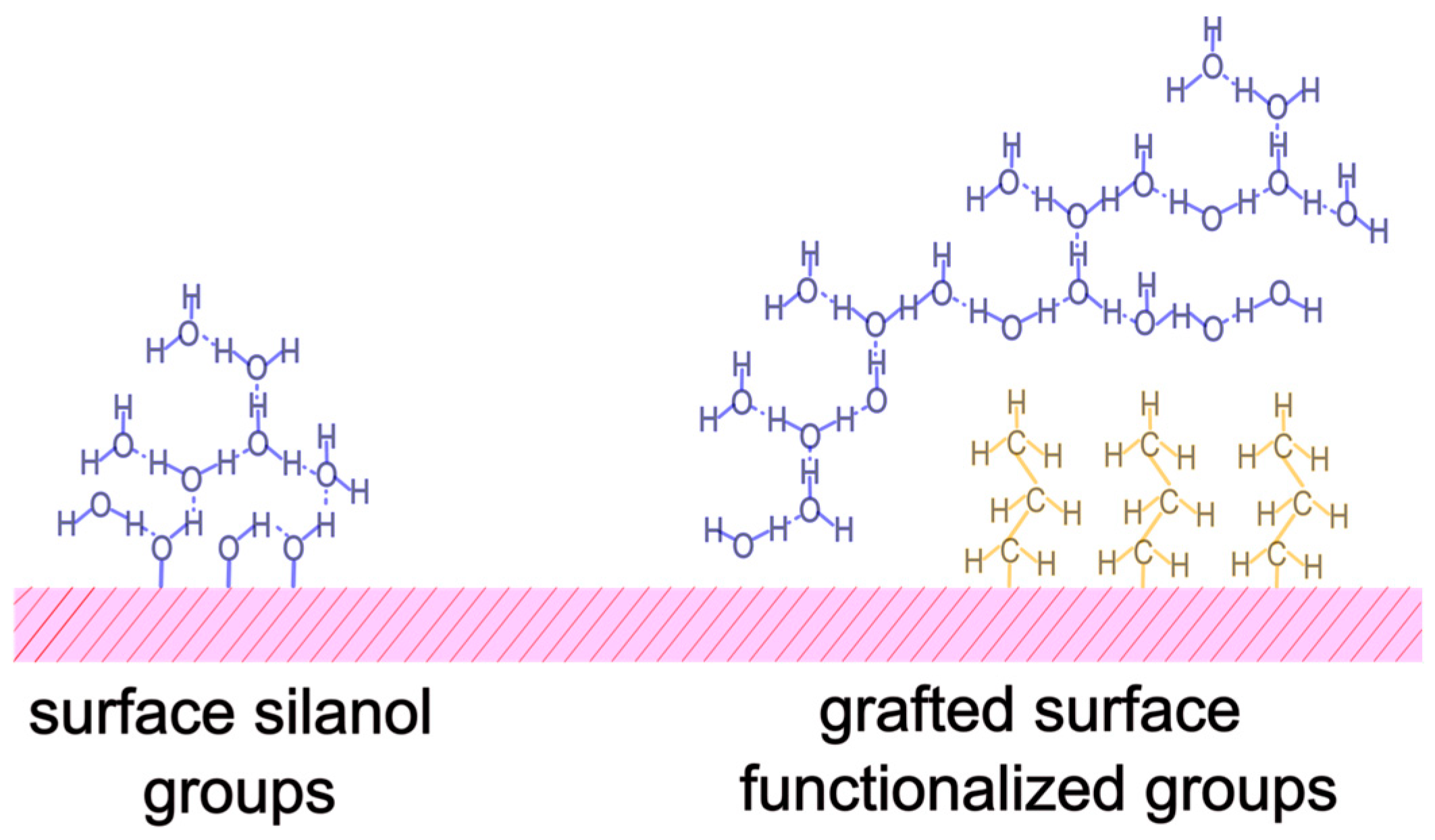
The term hydrophobicity/philicity refers to the affinity that exists between a solid surface and water. A hydrophobic surface can be defined similarly to a hydrophobic substance. Nonpolar substances are hydrophobic and have low solubility in water at room temperature. The accumulation of the nonpolar molecules in aqueous media produces a high cohesive energy density of water that decreases the interface between the nonpolar substance and water, explaining the hydrophobic effect. Therefore, to transfer nonpolar molecules into an aqueous medium, the enormously stable hydrogen bond among water molecules must be disrupted (Figure 3) [123,124].
Although there are some analytical techniques that provide information about the hydrophobicity of flat surfaces, there is no specific technique for porous solid surfaces. The hydrophobic effect in solids is related to the absence of interfacial interactions with water or similar dipolar and protic molecules. And more exactly, a better definition can be achieved by contemplating the possible forces between a solid surface and an adsorbate molecule. The interactions of water with a solid surface are commonly generated from specific surface sites such as functional groups that can act as Brønsted or Lewis acids or bases (Table 2) [123].
The mutual molecular interactions that affect the wettability of a solid surface are reflected in a macroscopic parameter known as contact angle (CA) formed between the solid phase boundary and the liquid phase [125]. It is possible to quantify the hydrophobicity of the solid surface as a function of the CA. However, there are some limitations to measuring the CA of rough solid surfaces or surfaces with defects such as functional groups (i.e., silanol groups) [123].
It should be noted that hydrophobicity/hydrophilicity is a relevant property that must be considered for the synthesis of porous solid catalysts. The catalytic performance of a solid catalyst is not only associated with the active sites but is also influenced by the catalyst’s wettability, which affects the adsorption and desorption processes and mass transfer on the surface. Adjustment of the surface hydrophobicity could enhance the activity, selectivity and lifetime of catalysts [126]. Thus, it is necessary to inquire into the concepts of hydrophobicity to apply the measuring techniques in the correct form.

2.2.2. Methodologies for Hydrophobization of Titanosilicates

Two main strategies to increase the surface hydrophobicity of titanosilicates can be distinguished in the literature. The first strategy is controlling the surface density of silanol groups. It is well established that defect-free siliceous surfaces dominated by Si-O-Si bonds exhibit hydrophobic behavior [65], whereas surfaces containing hydroxyl groups (Si-OH) and bridging hydroxyl groups (i.e., Si-OH-Ti, Si-OH-Al) are intrinsically hydrophilic [62]. Consequently, an increase in the surface density of silanol groups enhances the hydrophilic character of titanosilicates, leading to greater water adsorption [64]. The silanol surface density can be controlled by improving the crystallinity of titanosilicates (which at the same time may improve the incorporation of Ti) and by synthesizing them in fluoride (F) medium instead of OH medium.
The second strategy relies on surface functionalization with organic groups targeting both the external surface and the internal porosity, where the active sites are located. This can be achieved either by “one-pot functionalization” [127,128] or “post-grafting” of organic groups [88]. Both approaches effectively increase surface hydrophobicity, thereby generating environments that can markedly influence the reactivity of microporous and mesoporous titanosilicates.
Control of Silanol Surface Density
The density of silanol defects in titanosilicates is governed by the crystallization conditions, which can be adjusted through the synthesis parameters, such as the silica source, templates, and structure-directing agents (SDAs). Crystallization of titanosilicates is more complex than that of aluminosilicates as Ti(IV) displays a weaker structure-directing role compared to Al(III). Moreover, the Ti-O bond (1.80 Å) is longer than the Si-O bond (1.61 Å), which distorts the structure around Ti and results in a slow isomorphous substitution of Si by Ti(IV) and the formation of undesired phases. Fan et al. [33] demonstrated that (NH4)2CO3 acts as an effective crystallization-mediating agent, improving the isomorphous incorporation of Ti(IV) into the silica framework of TS-1 while significantly reducing the density of silanol defects. Highly crystallized TS-1 has fewer Si-OH terminal groups and is more hydrophobic.
Structure-directing agents (SDAs), such as tetraethylammonium hydroxide (TEAOH) and TPAOH, have also been shown to improve Ti insertion in silicalite-1, leading to a progressive decrease in the population of silanol protons H-bonded to siloxy oxygens at defect sites [129].
An alternative methodology to control the density of silanol groups in titanosilicates involves starting from an aluminosilicate framework, followed by dealumination and subsequent titanium insertion. In microporous and mesoporous silica-based materials, extended Si-O-Si and Si-O-M networks enhance heteroatom coordination, limit hydrolysis and leaching, and promote a hydrophobic environment that prevents the formation of water phases near them, thereby preventing the deactivation of active sites in aqueous media. Silica and metal oxide networks (Si-O-Si, Si-O-M) are present in Brønsted and Lewis acid oxides [64].
In aluminosilicates, framework composition plays a key role in water affinity. The low silicious zeolites (Si/Al = 1–2) possess high amounts of AlO4 units and Si-O-Al bridges, so they are more hydrophilic than high silicious zeolites (Si/Al = 10–∞) [130]. The Al-O bond is more polar (40% covalent and 60% ionic bond) than the Si-O bond (100% covalent bond), and thus, strong interactions with water are produced [131]. Moreover, silanol groups and bridging hydroxyl groups form hydrophilic domains in the silica framework [62], and these polar hydroxyl groups adsorb water. Thus, water uptake decreases with increasing Si/Al ratio, as reported for ZSM-5 [132,133], Beta [62], MCM-41 [134], and Ti-Beta [37].
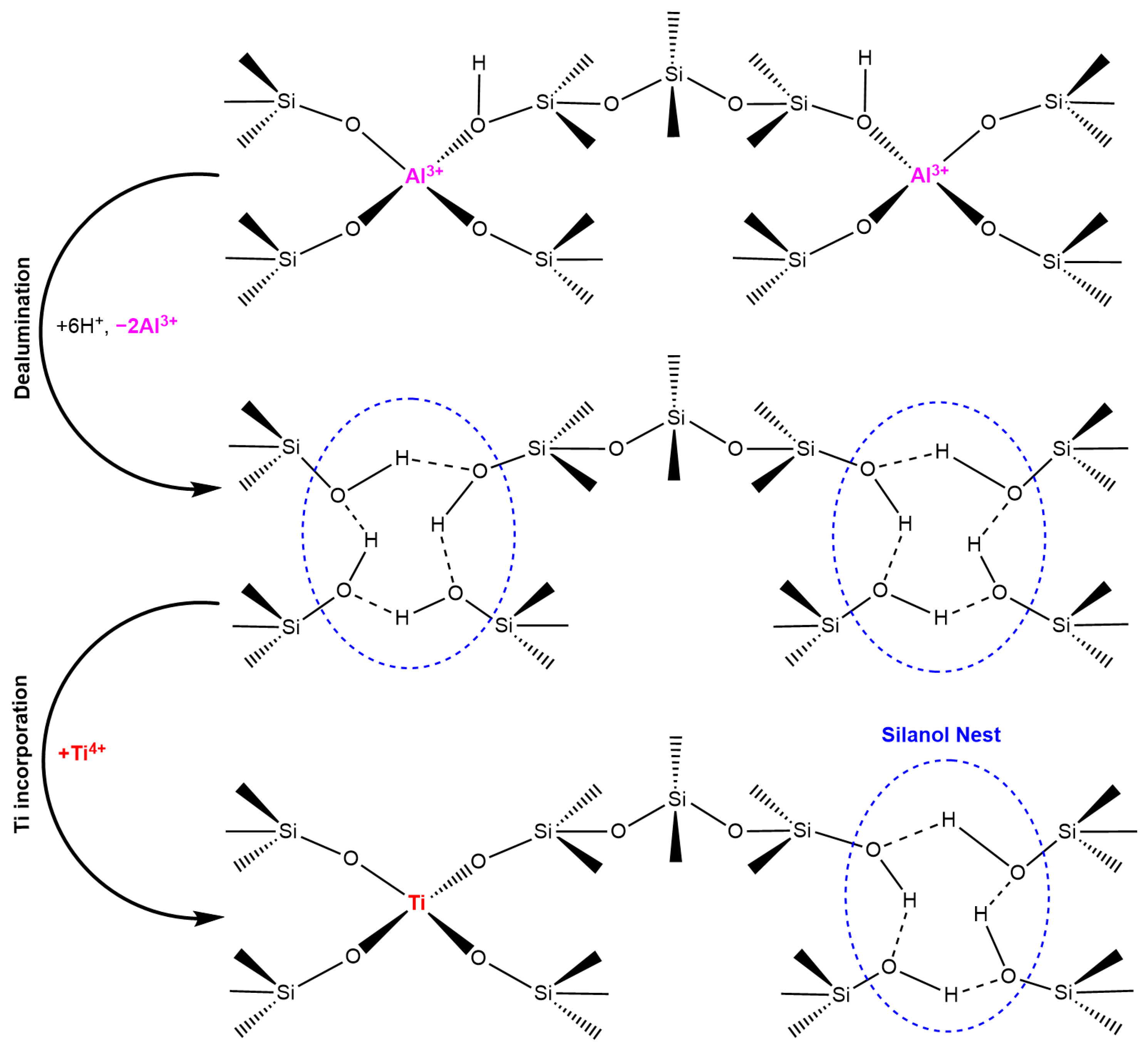
In this context, the combination of dealumination and post-insertion of heteroatoms can produce materials with higher hydrophobicity [38]. According to the IR characterization of dealuminated Ti-Beta, a higher content of Si-OH groups was detected with the decrease in Al content [135]. In contrast, when titanium heteroatoms were incorporated into dealuminated Beta zeolite, the density of isolated silanol groups decreased, whereas silanol nests (SiOH)4 decreased in Beta zeolites with less amount of Al compared with those with high Al content [38]. As shown in Figure 4, dealumination generates framework vacancy defects that promote the formation of silanol nests, resulting in increased hydrophilicity. Subsequent incorporation of Ti atoms into these vacancies decreases the silanol nest density.
Other alternative methodologies to obtain Al-free Ti-Beta by indirect ways are the synthesis of Ti-Beta using dealuminated seeds of Beta zeolite, and the post-synthetic modification of commercial Beta zeolite [36,136].
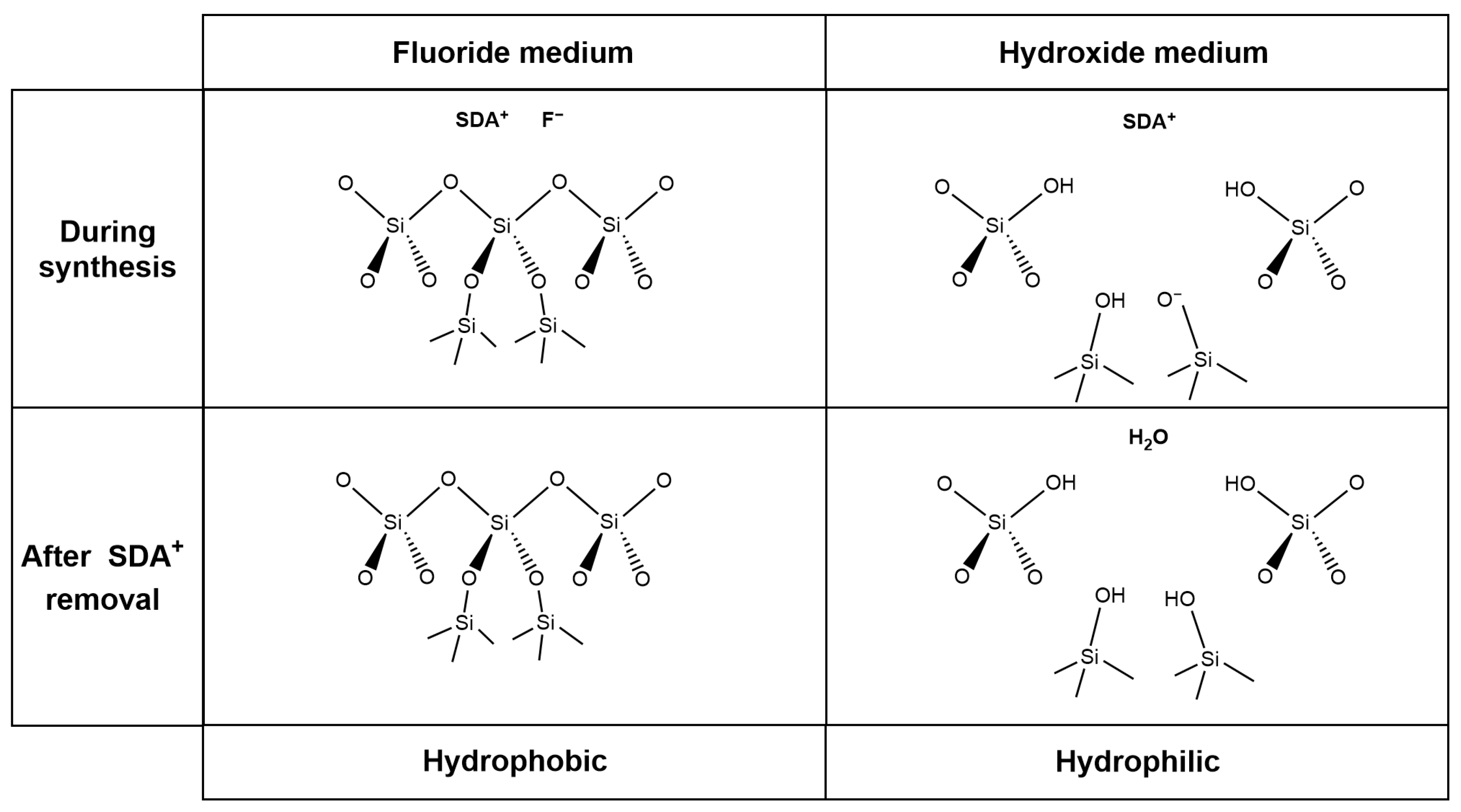
Furthermore, there is a direct way to synthesize hydrophobic Al-free Ti-Beta, which uses fluoride (F) medium instead of aqueous (OH) medium. The F medium prevents the formation of anionic framework vacancy defects since the cationic charges of SDAs employed in the synthesis are counterbalanced by F forming strong ion-pairs [136,137]. As shown in Figure 5, when OH anions are used in the synthesis, anionic framework vacancy defects are produced, and after removal of SDA cations, silanol nests are formed in the zeolite framework, increasing the hydrophilicity of the material.
It should be noted, however, that the strong Si-F interaction may also influence crystallization kinetics and local structural environments during synthesis [138]. Although the overall BEA topology is generally preserved under comparable structure-directing conditions, fluoride-mediated synthesis does not merely act as a surface modifier but as a framework-condensation route that affects defect distribution and structural organization. In this context, the reduced silanol density and improved framework connectivity are the features most directly related to the enhanced intrinsic hydrophobicity relevant for catalytic applications [36,37].
As already mentioned, the silanol surface density of titanosilicates can be modified through the presence of F ions during synthesis. However, the presence of F ions reduces the incorporation of Ti atoms into the final material. Therefore, determining the optimal concentration of F ions able to decrease the silanol surface density while maintaining an effective incorporation of heteroatoms in the titanosilicates is essential. Indeed, the ratio between HF/SDA (SDA corresponds to tetrapropylammonium hydroxide (TPAOH)) was optimized by Bregante et al. for zeolitic materials with MFI structure (Silicalite-1), where heteroatoms Nb, Ta, and Ti were inserted. The relative silanol density was quantified using IR spectroscopy. The authors normalized the area of ν(Si-OH) relative to that of the ν(Si-O-Si), observing a linearly decrement as the HF/TPAOH ratio (x) increases. With x < 1, the relative silanol density decreased by 4–8-fold, whereas for x = 1.5, the relative silanol density decreased 30–100 times compared to materials synthesized in OH medium. For x > 1.5, the relative silanol density was undetectable. The formation of the strong ion-pairs between TPAOH cation (TPA+) and F is reversible, and the concentrations of species are defined by the equilibrium. Finally, water adsorption experiments of TS-1 showed that TS-1 synthesized in F medium stabilized ∼5 water molecules at vapor pressure at 293 K and adsorbed 7–100 times less water than TS-1 synthesized in OH medium. The number of water molecules stabilized by Ti was calculated from the difference between the H2O uptake of TS-1 and silicalite-1, which is then normalized by the number of Ti atoms [139].
Additional approaches currently explored include the conventional synthesis of TS-1 followed by a defect-healing post-treatment using a combination of ammonium fluoride (NH4F) and TEAOH. In contrast to fluoride-mediated synthesis, this post-synthetic approach effectively heals framework defects, yielding defect-free TS-1 with enhanced hydrophobicity [140].
Organic Surface Functionalization
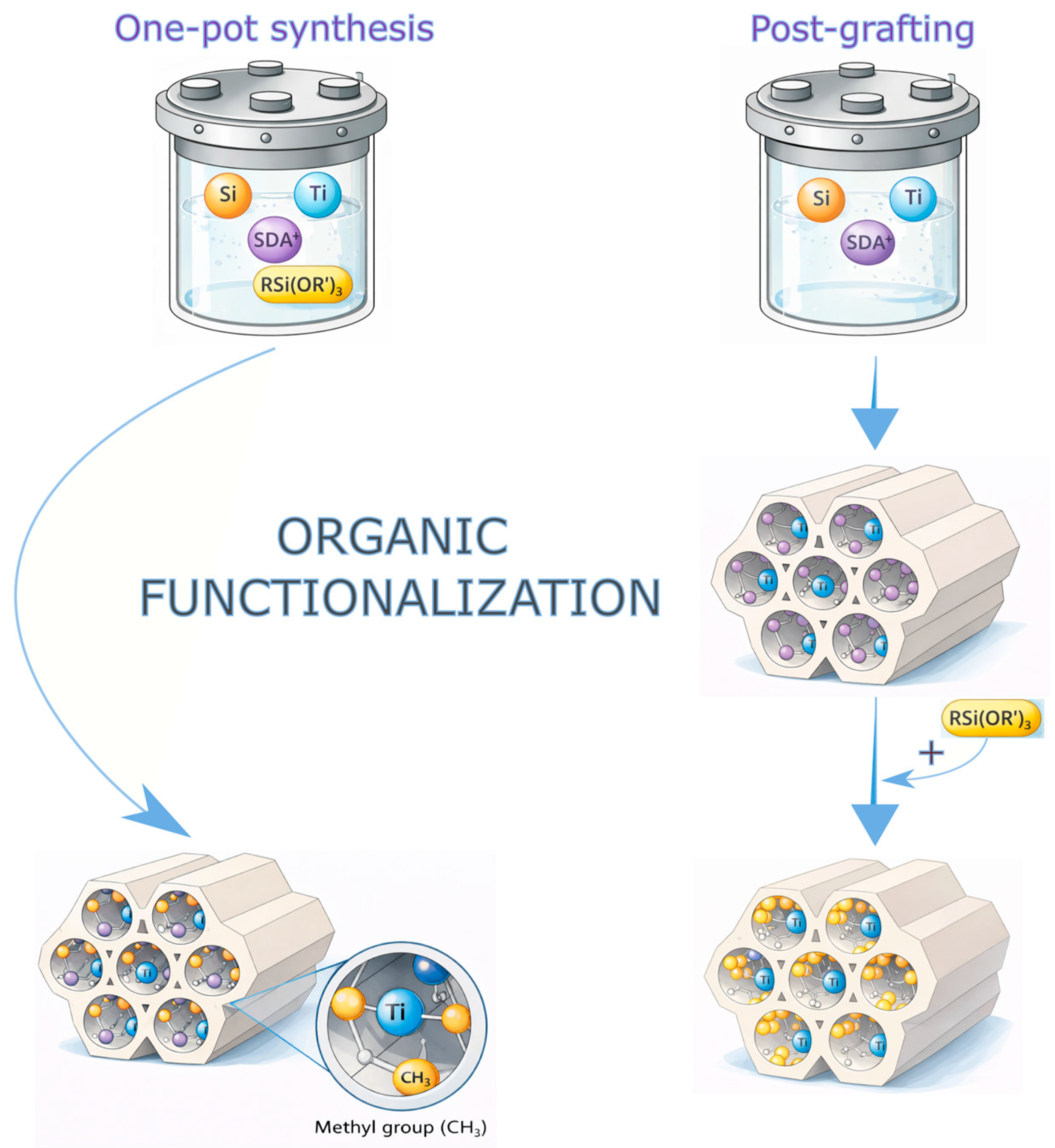
The insertion of organic groups into titanosilicate catalysts has been mainly achieved through two distinct methodologies: one-pot synthesis and post-grafting functionalization (Figure 6).
In the one-pot synthesis, organic silane precursors (e.g., R-Si(OR′)3) are co-condensed with silicon and titanium sources in the presence of an SDA during the hydrothermal synthesis. This approach allows the organic groups to be incorporated directly into the inorganic framework or pore walls as the material forms, leading to a relatively homogeneous distribution of hydrophobic functionalities throughout the mesoporous structure. As a result, the organic groups are intimately integrated with the silica network, often yielding catalysts with uniformly modified internal surfaces and tunable hydrophobicity.
In contrast, post-grafting involves the chemical modification of a pre-synthesized titanosilicate. In this method, organosilanes react selectively with surface silanol groups (Si-OH) after the material has been formed, typically under mild conditions. Consequently, the organic groups are preferentially anchored near the external surface and pore mouths, and their distribution is more heterogeneous and spatially constrained. While post-grafting enables precise control over surface chemistry without altering the bulk structure, excessive grafting may reduce pore accessibility or partially block active sites.
Organic functionalization of titanosilicates through one-pot and post-grafting methods was applied to obtain more hydrophobic catalysts. The silanol density in functionalized materials was lower than in the non-functionalized ones [11,27,39,40,47,48,141]. This low density was mainly attributed to the substitution of Si-OH groups by organic moieties, and it was confirmed by IR spectroscopy and 29Si NMR analysis [11,39,40,48].
The effect of the organic functionalization on the catalytic activity was, in some cases, either positive for Ti-SiO2 [47] and Ti/SiO2 [48], or negative for Ti-Beta [6] or non-significant for TS-1 [6] and Ti/SiO2 [142]. A possible explanation for the different catalytic effects was that the post-grafting can also modify the structure and textural properties of catalysts, and the nature of active sites [44]. For example, Ti/SiO2 functionalized with poly(methylhydrosiloxane) (PMHS) by post-grafting was more hydrophobic than conventional Ti/SiO2 [48]. In the same way, Ti-MCM-41 functionalized by the one-pot procedure with organosilanes exhibited lower silanol surface density and a strong hydrophobic character [39]. Hydrophobic environments, both on the external and internal surface have important consequences on the reactivity of porous catalysts [64].
The principal difference between post-grafting and one-pot methods lies in the Ti dispersion. According to XPS and DRUV-Vis analysis, titanosilicates functionalized by the one-pot method exhibited lower Ti dispersion. One-pot functionalization method is faster, and it can be controlled by the chemistry of precursors [44]. Ti speciation was not affected by post-grafting in most of the cases. Regarding the textural properties, both functionalization procedures diminished the specific surface area and pore size. This difference in textural properties can affect the catalytic performance of functionalized catalysts [47].
Ti dispersion on one-pot synthesis was enhanced using aerosol-assisted sol-gel. With this method, not only the Ti dispersion but also the organic functionalization and textural properties were controlled [11]. The effective dispersion of Ti with this method was attributed to the fast drying of the atomized mixture of precursors, which produces the quenching of kinetic condensation and leads to the formation of stable solid phases with homogeneous compositions [143]. A summary of hydrophobization methodologies applied to titanosilicates is presented in Table 3.

2.2.3. Determination of Hydrophobicity of Titanosilicates

Some analytical techniques applied for the characterization of the hydrophobic character of porous solids will be discussed in this section. Due to the absence of a precise definition of the term hydrophobicity and its origin, the analytical techniques applied to characterize this property in solids differ particularly regarding the experimental method and the physical/chemical properties considered for the evaluation of the porous solid surface. In fact, analytical techniques have ranked a given set of porous solids according to their hydrophobic character, but a quantitative assessment, considering the theory, remains a challenge. Also, it is important to keep in mind that the conditions under which the experimental analysis is carried out do not always correspond to the conditions in the application, especially in the case of catalysts. In addition, the applicability of the characterization techniques will depend on each type of porous solids [123].
Contact Angle Measurement
The contact angle (CA) is a known technique that allows the characterization of surface wettability. The CA is related to the lowest state of energy that characterizes a three-phase system (solid-liquid-gas). This experimental thermodynamic property corresponds to the observed angle at the contact line among these three phases. This angle is bounded by the tangent to the liquid-fluid interface and the tangent to the solid surface [146]. The CA is computed using the Young equation [147]. The Young’s equation associates several terms as the solid surface energy γsv, the solid-liquid surface tension γls, the liquid surface tension γlv and the cosine of the contact angle θ. As soon as a resting drop reaches the mechanical equilibrium on a plane solid surface, these three forces are balanced and can be described as expressed in Equation (1) [148].
γsv = γls + γlv cos θ
For a drop with a certain radius of curvature, the CA equals the Young contact angle as long as this radius is larger than the nanometric scale. The Young contact angle is related to the equilibrium state reached by a drop on an ideal solid. However, a correction term needs to be applied for drops with smaller radii of curvature [146,149,150,151]. The ideal determination of the CA may encounter some difficulties, starting even before the measurements with the correct preparation of the solid surface and then during the measurements with the control of the equilibrium conditions. These challenges render the experimental determination not always feasible [146].
Contact angles are principally reported as static and dynamic. On the one hand, if the three-phase boundary is not moving and the droplet is sitting on the surface, measurements of static contact angles are obtained. On the other hand, if the three-phase boundary moves, measurements of dynamic contact angles are registered. These angles are defined as advancing (when the droplet front is advancing) and receding (when the droplet front is receding). The term hysteresis refers to the contact angles is then established as the comparison between these two angles (advancing and receding). Experimental approaches like the sessile drop and/or captive bubble [152,153,154,155,156] are preferred methods for the measurement of contact angles at ambient conditions on flat surfaces under different pressure and temperature conditions [157].
Several factors affect contact angles, including deformation, roughness, contamination, and surface geometry. Thus, it is not uncommon to find more than one contact angle value reported for a certain system, taking into account all the variables that affect the experimental determination of the CA [146]. Furthermore, in most natural materials, the effective contact angle observed at larger scales is influenced by the surface roughness detected at the nanometer scale. Regarding the porous media as the closest approach to understanding the wettability of porous solids, such as titanosilicates, some challenges are identified. In general, contact angles in porous media can be not only variable throughout the pore space, but also scale-dependent and hysteretic owing to the presence of local surface roughness enhanced by variations in mineralogy and coating. However, it has been possible to determine geometrical contact angle values in the pore space. Some of the more common measurements include automated algorithms [158,159] or visual observation [160,161]. Other methods analyze the solid and fluid interfaces through the deficit curvature between them [162]. Recently, 3D images of fluids in the pore space generated by mCT (micro-computed X-ray tomography) were used for geometrical analysis of contact angles [163,164]. Nevertheless, the interpretation of these measurements is still difficult, regarding the broad range of variation found in the contact angle values obtained by this technique [165,166]. In fact, the scale of the pore size distribution of titanosilicates, which can vary from 5 Å to ~100 nm, is even smaller compared to the roughness scale range (~200 µm) reached through the most sophisticated techniques for determining the contact angle in porous media. Thus, the information that could be eventually obtained from the contact angle of titanosilicates does not adequately describe the whole hydrophilic-hydrophobic nature of the studied material.
Thermogravimetric Analysis (TGA)
Thermogravimetric Analysis (TGA) measures the mass variation in a sample while it is heated, cooled, or isothermally maintained under a defined atmosphere, inert or oxidizing. The analysis can be carried out at constant temperature or constant heating rate. A typical TGA curve shows the mass loss steps generally associated with the loss of volatile components, carbon black combustion, polymer decomposition, and final residues due to the temperature changes. This method permits the study of materials decomposition and their products, drawing conclusions about their individual components [167].
TGA is used to determine the water capacity that is the quotient between the mass loss due to the water desorption and the mass of dry solid [168]. In the hydrophobicity studies, TGA is a common analytical technique used for the determination of water affinity of solids or for the quantification of hydroxyl groups on the surface, which is an indirect way to quantify the water affinity of solid surfaces [169]. However, the sample preparation and storage could have an impact on the measurement of physisorbed water and lead to imprecise conclusions about the hydrophobicity/philicity of a material. Thus, comparison of the hydrophobicity of materials must be performed carefully since the measurement of physisorbed water is expressed per gram of sample, so materials with higher surface areas will display a higher amount of physisorbed water per gram of sample. The comparison is clearer when physisorbed water is normalized by the specific surface area.
One way to quantify the hydrophobicity of the surface of microporous solids is the “hydrophobicity index” (HI), which was first introduced by Anderson and Klinowski [170]. This model is based on water adsorption and is not useful for the characterization of zeolitic sorbents. The mass losses at each temperature range are measured by TGA, and the HI is determined according to Equation (2).
H I = M a s s   l o s s   u p   t o   150   ° C M a s s   l o s s   u p   t o   400   ° C
If HI = 1, the material is considered hydrophobic, and when HI = 0, it is a hydrophilic material. Another definition of HI was given by Giaya et al. [171] as shown in Equation (3):
H I = V t V > 150   ° C V t
where V t is the total pore volume of the sorbent and V > 150   ° C is the volume of water desorbed at a temperature above 150 °C. If HI = 1, the material is presented as very hydrophobic, and when HI = 0, the material is presented as very hydrophilic [171].
TGA measurements provide information about the water adsorbed physically, but not necessarily about the affinity. As Mueller et al. stated in 2003 [172], the water mass loss at temperatures below 120 °C was attributed to the loss of water adsorbed physically, but this value is not related to the water affinity of the material surface. In fact, Mueller found that the presence of OH groups on the SiO2 surface can be measured in the temperature range of 120–800 °C, and the OH content was normalized to the specific surface area to be able to compare the OH/m2 of each material [172].
It is actually a challenge to distinguish between adsorbed water and actual hydroxyl surface density, that is, distinguishing between dehydration and dihydroxylation [173]. For this, an alternative to measure the actual amount of water that a sample contains was proposed by Lin et al. In this study, TG analysis was carried out starting from samples of Ti-MCM-41 Ti-zeolite saturated with NH4Cl solution to guarantee the maximum level of water adsorption. The total number of molecules of water adsorbed on the surface was determined from the mass loss between 25 and 150 °C [128]. In this procedure, the authors controlled the ambient conditions of the sample before TGA experiments, which allowed them to compare the samples independently of the synthesis and storage conditions.
Infrared Spectroscopy (IR)
Infrared Spectroscopy (IR) is a common technique applied to characterize solid catalysts. It can be used as a direct way to study the composition of solid surfaces or as an indirect way, providing information about the interactions between the surface and the adsorbate [169].
IR is a popular technique to measure the affinity of water for solids. With IR spectroscopy, the polar (e.g., OH) or non-polar groups of the solid surface can be directly quantified, providing an idea of the polarity of the surface. Infrared spectra offer information about the types of sorbed water molecules that are identified through the measurement of the frequency of the corresponding IR peaks. The intensity of the absorption band is used to measure the amount of water sorbed [168].
In comparison with TGA, IR spectroscopy provides more information about the distinction between physically adsorbed and chemically bound water. In fact, when IR spectra are analyzed, the water deformation band and the hydroxyl stretching vibration do not overlap; nevertheless, water -OHs contribute to the intensity of the -OH stretching vibration, which entangles the separation between inner and surface hydroxyls [174]. One of the characteristic bands of the IR spectrum of silica is related to the presence of -OH groups at 3750 cm−1, which is assigned to isolated -OH groups. A close-lying band (a tail) formed by the weakly H-bonded -OH groups, appears in the 3600–3750 cm−1 region. The band of strongly H-bonded -OH groups and/or desorbed water appears in the 3400–3500 cm−1 range. The water -OH groups band appears at 1630 cm−1 (water deformation) and contributes to the bands in this region [175,176,177]. In order to quantify the hydrophobicity of metal-substituted zeolites, the silanol IR signals are usually normalized by the band of ν(Si-O-Si) at 1990 and 1865 cm−1 (assuming this band is constant in the compared materials) [38].
In the specific case of titanosilicates, the IR spectra in the OH region display two intense bands at about 3740 and 4550 cm−1 corresponding to terminal Si-OH and hydrogen-bonded silanol groups at defect sites, respectively [52]. For titanosilicates that have been functionalized by post-grafting, the silanol band intensity decreases since the silane binds to surface -OH groups producing Si-O bonds. The C-H vibrational frequency appears after functionalization with organosilane groups [178,179]. C-H stretching and bending vibration bands that reflect the incorporation of alkyl groups appear at 2850–2985 and around 1460 cm−1 [178]. Thus, the lower intensity of the silanol band can be used as an indicator of an increase in hydrophobicity due to the functionalization success [180]. Additionally, the presence of Si-CH3 at 1279 cm−1 [44], Si-CH2 at 1410 cm−1 [181], as well as Si-C, Si-CH2-CH3, is also indicative of functionalization. Furthermore, the IR analysis of titanosilicates shows the characteristic bands at 1082 and 802 cm−1 attributed to the asymmetric and symmetric stretching vibration of Si-O-Si [179] and the Si-OH band that appears at 950 cm−1 in titanosilicates.
Adsorption Isotherms
Information about the affinity of the surface for a specific compound or, in general, properties related to the surface can be analyzed with the application of adsorption techniques. The adsorption from the gas phase on materials has been employed as a tool to evaluate the affinity for water [169].
Water affinity can be understood by recording the water adsorption isotherms. A hydrophobic material displays low affinity for water and low water adsorption capacity. In contrast, a hydrophilic material displays high affinity for water, but does not necessarily exhibit a high water adsorption capacity since the latter depends on the pore volume [168]. Therefore, to know if a material is more hydrophobic or hydrophilic, it is necessary to determine the amount of adsorbed water per unit area or mass in the range of low relative pressures [182]. In fact, the measurement of water adsorption capacity at higher relative pressures does not provide information about water affinity since the adsorbate-adsorbate interactions result in a multilayer adsorption and/or pore condensation. To solve this drawback, the water adsorption capacity must be analyzed at low loading (low amount of water adsorbed), without surpassing the monolayer adsorption, to minimize the influence of adsorbate-adsorbate interactions. Also, it is important to consider that using water as an adsorbent, a defined monolayer is not easy to obtain, and the presence of highly polar sites or acidic sites could increase the local water concentration due to hydrogen bonding. Consequently, it is better to compare materials of the same nature under similar conditions [123].
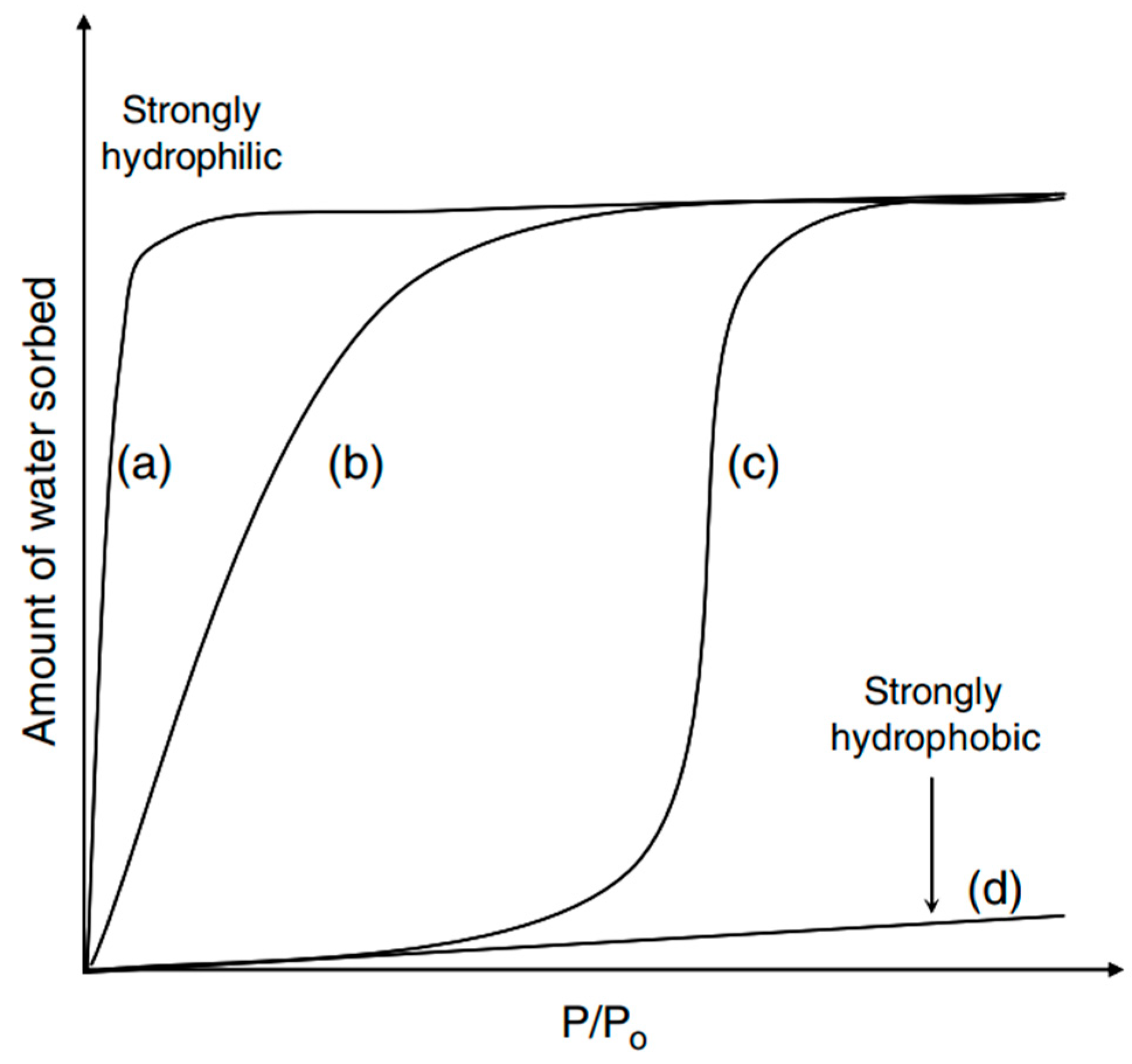
The hydrophobicity of sorbents has been classified according to the International Union of Pure and Applied Chemistry (IUPAC). This assignment is based on the type of adsorption isotherm. There are some characteristic curves of hydrophilic and hydrophobic materials. For instance, the type I isotherm is assigned to a highly hydrophilic material, the type II isotherm corresponds to a hydrophilic material, the type III isotherm represents a hydrophobic/low hydrophilic material with weak sorbent-water interactions, the type IV isotherm represents a hydrophilic material, the type V isotherm is associated with a hydrophobic/low hydrophilic material with weak sorbent-water interactions, the type VI isotherm corresponds to a hydrophilic material with multiple sorbent-water interactions and stepwise sorption, and the type VII isotherm is characteristic of a very hydrophobic material [168].
Figure 7 illustrates three water adsorption isotherms of zeolitic materials with different degrees of hydrophobicity and with the same pore volume [183]. Curve (a) is a type I isotherm in which the sorption equilibrium in the material is reached after the adsorption of high amount of water at very low relative pressures (P/P0), curve (b) is also a type I isotherm in which the sorption equilibrium is reached at higher P/P0, the curve (c) corresponds to a type V isotherm where just a small amount of water is adsorbed at low P/P0 until the sorption capacity is reached, this is a hydrophobic or weakly hydrophilic solid, and curve (d) represents a type VII isotherm where a very small amount of water is adsorbed in all range of relative pressures, this material is considered highly hydrophobic. According to the adsorption isotherms of materials (a) and (b) at low loading, the material with the steeper slope is defined as more hydrophilic [168,183].
Weitkamp et al. used the HI of zeolites for multicomponent sorption based on a competitive sorption between hydrocarbon and water to quantify the hydrophobicity. The HI is calculated by the (4).
H I = X H y d r o c a r b o n X W a t e r
where X is the content of molecules adsorbed. A higher HI means a higher adsorption of hydrocarbon compared to water; thus, it is a more hydrophobic material [184]. In addition, the water adsorption capacity can be obtained by the standard contact porometry and sorptometry, which employ the mass change measures of the sorbents under constant water vapor pressure/humidity [185].
Calorimetric Techniques
Calorimetry has been widely employed to investigate solid-liquid interfacial properties. In this section, we review one of the most commonly used calorimetric techniques to assess the affinity of solid surfaces for water. This approach is based on the measurement of the heat of immersion, also referred to as the heat of wetting or immersion enthalpy, which corresponds to the enthalpy change at constant temperature and pressure upon immersion of a solid in a liquid. The magnitude of the heat of immersion reflects both the chemical interactions between the liquid and the solid surface and the textural characteristics of the solid [123,145,168]. Therefore, characterization of microporous solids by calorimetry is not so simple due to the contributions of interactions of different nature [186]. This technique has been widely used to study microporous materials such as activated carbon and zeolites [187]. Silvestre-Alberó and co-authors employed immersion calorimetry to compare the hydrophobic character of Ti-MCM-41 and silylated Ti-MCM-41. A series of probe liquids with different polarities, ranging from non-polar hydrocarbons to polar molecules such as water and alcohols, was used. Their results showed that silylated Ti-MCM-41 exhibits an enhanced hydrophobic character, as evidenced by a progressive decrease in the heat of immersion in water with increasing degrees of silylation. In contrast, silylation had a much weaker effect on the heat of immersion in cyclohexane, indicating that interactions between hydrophobic surfaces and non-polar liquids are limited and likely dominated by textural properties rather than surface chemistry [145].
Solid State Nuclear Magnetic Resonance (Solid-State NMR)
Nuclear Magnetic Resonance (NMR) spectroscopy is based on the interaction of atomic nuclei with an external magnetic field and radiofrequency radiation. When a sample is placed in a magnetic field and irradiated at an appropriate frequency, its nuclei can absorb energy. The radiation frequency required to produce this absorption depends on the type of nucleus, its position within the magnetic field, and its chemical environment [188,189].
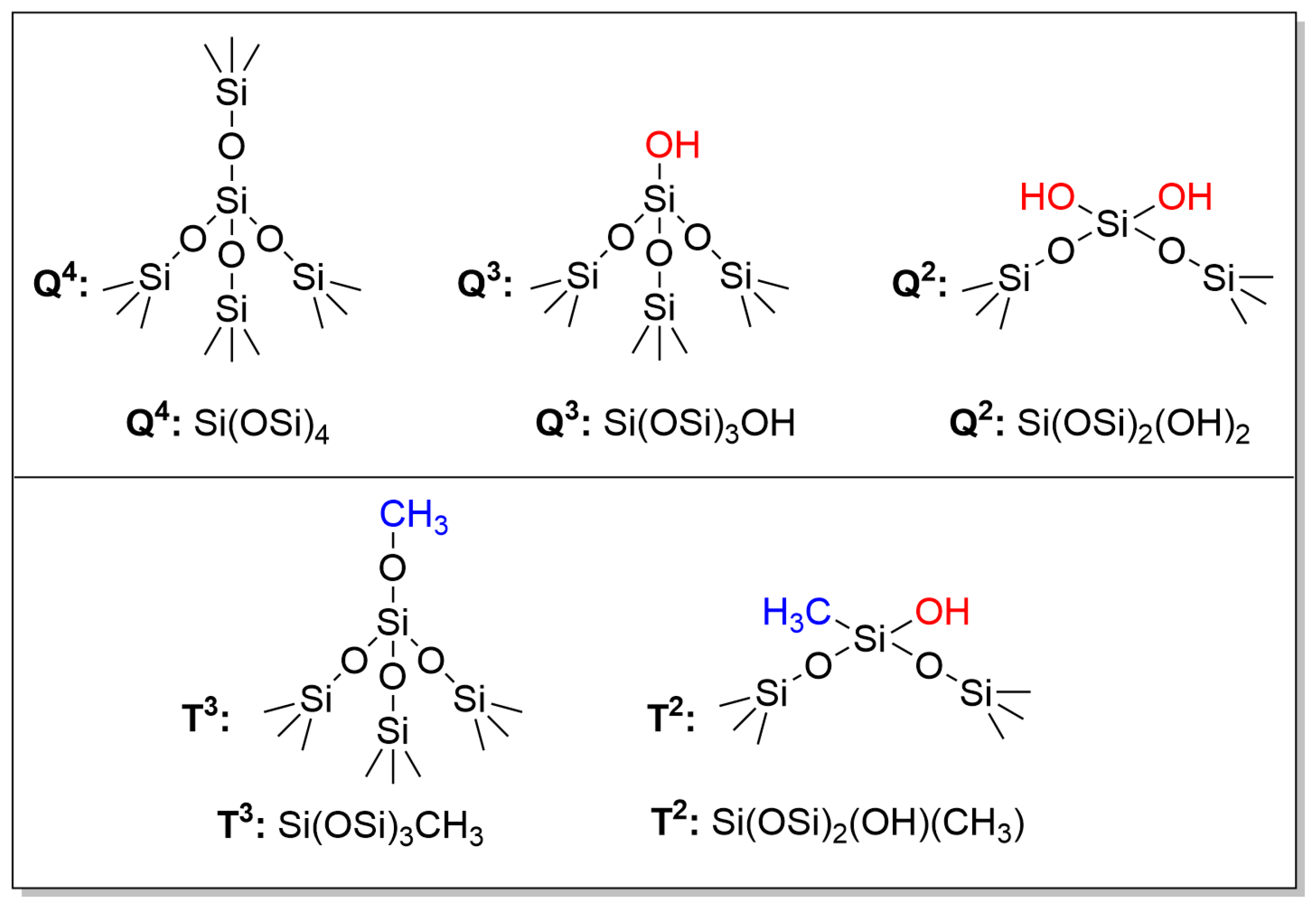
Solid-state NMR is a powerful tool to assess the hydrophobic character of solid materials, as it allows the identification and quantification of hydrophilic sites (-OH groups) as well as organic moieties bonded to Si atoms. For instance, the relative intensities of hydroxyl groups and molecularly adsorbed water can be evaluated from low-temperature 1H NMR spectra [129]. In addition, several studies have employed solid-state NMR to assess the degree of condensation in (titano-)silicates through deconvolution of the 29Si NMR spectrum into Q4, Q3, and Q2 (See Figure 8) [38,46,140]. Besides the condensation degree, this analysis is strongly related to the hydrophobicity/philicity of the material since silanols (Si-OH) are hydrophilic sites, so the higher the fraction of Q3 and Q2 relative to Q4, would indicate a hydrophilic the character. If the origin of hydrophobicity lies in surface functionalization with organic moieties, solid-state NMR spectroscopy can also be employed. For instance, the fraction of Si atoms bonded to methyl groups has been quantified to assess the extent and effectiveness of methyl functionalization in amorphous titanosilicates (Ti-SiO2) [46].
There are two modes for the experimental approaches of solid-state NMR. The cross-polarization mode allows to excite the contributions of T2 and T3, so they are better appreciated even at low organic content. Nevertheless, this method cannot be used for the quantification of each resonance. The direct excitation mode is applied for quantification, and once the spectra are recorded, contributions are quantified by deconvolution of peaks using Gaussian functions. Indeed, some previous studies have used cross-polarization to verify the surface functionalization [46].
Solid-state NMR cannot be used to study the Ti nucleus at very low Ti molar ratios [22,129]. Another nucleus that can be followed by solid-state NMR is 13C. In this case, the analysis provides information about organic functionalization or the degree of removal of the templating agents [190].
A summary of the analytic techniques employed for the evaluation of the hydrophobicity of titanosilicates is presented in Table 4.
Rather than providing only a general overview of available characterization methods, it is useful to offer practical guidance for researchers entering the field. If a recommendation can be made, we consider that water vapor sorption constitutes the most appropriate primary technique to assess hydrophobicity in both microporous and mesoporous titanosilicates, as it directly probes the interaction of water with the internal pore system under catalytically relevant conditions. In microporous materials, adsorption isotherms at low relative pressures are particularly sensitive to silanol defect density and framework polarity. In mesoporous systems, water sorption further captures the combined influence of surface chemistry and pore size distribution [168]. To establish a structural correlation, 29Si MAS NMR spectroscopy should be employed as a complementary method, since it enables quantification of Q3 and Q4 species and provides direct insight into the defect population governing hydrophobic behavior. Although contact angle measurements offer a rapid and straightforward evaluation of wettability, their application to porous powders presents inherent limitations, as they predominantly reflect external surface properties and are strongly affected by sample preparation, compaction, and roughness, which may hinder rigorous quantitative comparison.

3. Discussion

3.1. General Considerations on Hydrophobicity in Titanosilicates-Catalyzed Epoxidation

The hydrophobic modification of titanosilicates has been widely proposed as a strategy to improve their catalytic performance in oxidation reactions, particularly in processes involving peroxides as oxidizing agents [2,39,44]. However, the effects reported in the literature are not unanimous: while numerous studies describe significant increases in activity, selectivity, and stability after hydrophobic modification [32,33,36,39,40,41,128,135,141,144], others report marginal [37,47] or even negative effects [38,44,46,48,73,191,192,193]. This apparent contradiction does not necessarily reflect experimental inconsistencies, but rather the inherent complexity of the catalytic system, where multiple structural and chemical variables operate simultaneously.
The catalytic performance of a hydrophobic titanosilicate depends on an interrelated set of factors, including (i) the structural and textural nature of the material (amorphous or crystalline and microporous or mesoporous), (ii) the type and distribution of Ti sites, (iii) the methodology used to induce hydrophobicity, and (iv) the specific catalytic system, including reactants, solvent, and water concentration. In this context, hydrophobicity should not be understood as an isolated property, but rather as a parameter that modulates the microenvironment of the active site, affecting interactions with reactants, products, intermediate species, and polar molecules in the reaction medium.
Additionally, quantitative comparison of the hydrophobicity of different titanosilicates remains challenging due to the diversity of techniques used for their evaluation (water vapor sorption, IR spectroscopy of silanols, contact angles, solid-state NMR, among others). This lack of standardization makes it difficult to establish direct correlations between hydrophobicity and catalytic performance, reinforcing the need for critical analyses that integrate multiple types of experimental evidence.
The influence of hydrophobicity can be explored in several oxidation reactions, such as phenol hydroxylation and olefin epoxidation, although a comprehensive comparison falls beyond the scope of this review. Here, the focus is placed on olefin epoxidation, a reaction of major industrial relevance in which epoxides serve as key intermediates [32,107,194]. Mechanistically, it provides a suitable model to assess surface hydrophobicity because it involves hydrophobic olefins and more polar products, meaning that the catalyst’s affinity for polar or nonpolar species directly affects adsorption-desorption equilibria and active-site stability under reaction conditions.
Building on the role of hydrophobicity in modulating titanium speciation and oxygen-transfer pathways in the olefin epoxidation, the following section integrates mechanistic and durability aspects by examining the nature of Ti-peroxo species, their competitive reaction pathways, and the influence of solvent and water on peroxide activation and selectivity, while simultaneously addressing stability metrics, regeneration strategies, and structure-stability relationships to connect active-site chemistry with long-term catalyst performance.

3.1.1. Nature of Ti-Peroxo Species, Competitive Pathways, Solvent and Water Effects

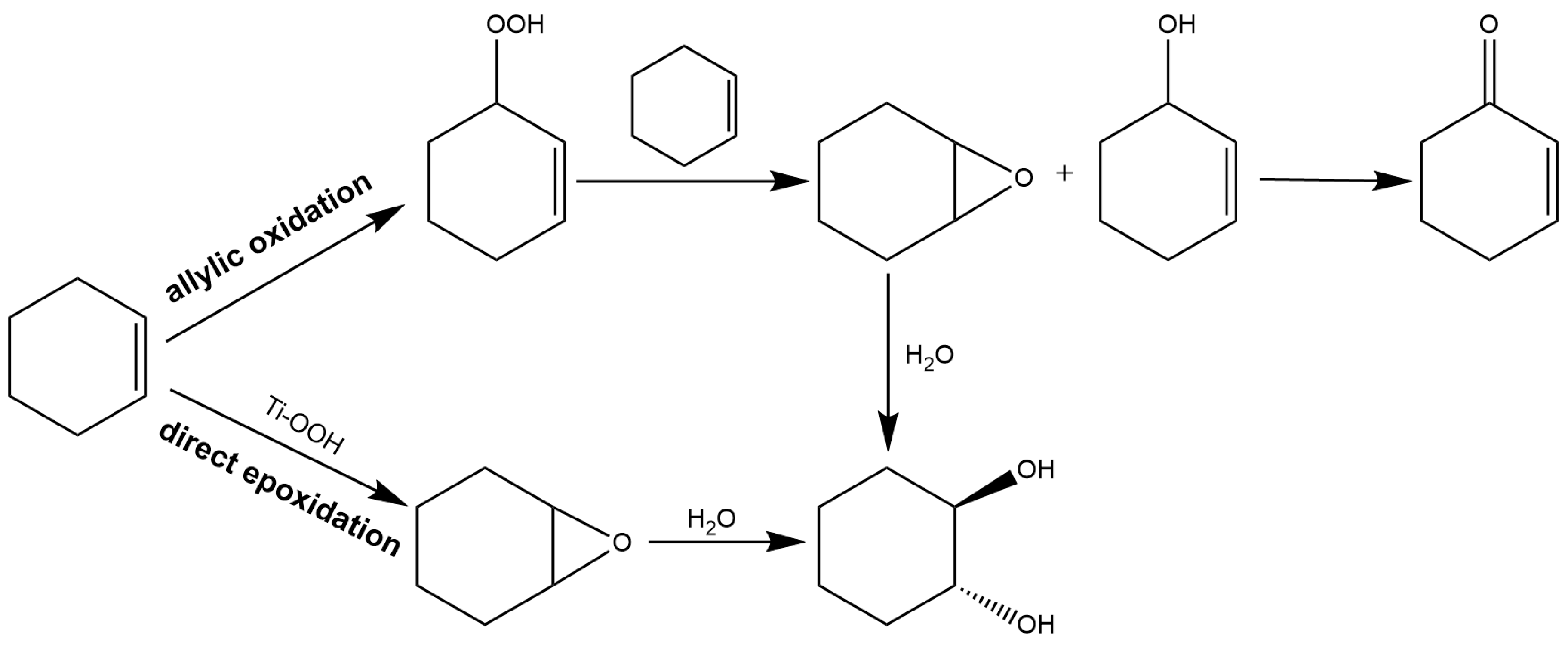
As shown in Figure 9, the epoxidation of olefins catalyzed by titanium silicalites using H2O2 as an oxidizing agent can proceed by two competitive routes: the direct epoxidation, and the allylic oxidation through the formation of Ti-peroxo species, widely recognized as key intermediates in the process. However, various experimental and spectroscopic studies have shown that these species are neither unique nor structurally equivalent, but can exist as hydroperoxo (Ti-OOH) or lateral/bidentate peroxo (Ti-O2) species, whose relative stability critically depends on the chemical environment of the Ti site, including solvent polarity and the presence of adsorbed water [54,195,196,197].
In mechanistic terms, the direct epoxidation pathway is mainly associated with Ti-OOH species, which favor selective oxygen transfer to the olefinic double bond (direct epoxidation) via an Eley–Rideal-type mechanism. In this mechanism, the oxidant initially coordinates to the Ti site, forming active Ti-OOH species, which subsequently react with the olefin from the liquid phase to generate the epoxide, which desorbs from the catalyst. In this mechanistic framework, the hydrophobicity of the Ti environment emerges as a determining factor in controlling the stability and reactivity of these intermediate species [47]. In contrast, allylic oxidation involves radical species (Ti-O· and ·OH) generated by the homolysis of Ti-OOH or by the stabilization of side peroxo species, leading to a broader distribution of oxygenated products, including alcohols and ketones [198]. In this context, it has been established that lateral peroxo species tend to promote less selective pathways and the unproductive decomposition of H2O2, reducing both epoxide selectivity and the overall efficiency of the oxidant.
The presence of water plays a particularly relevant role in the balance between the active species. High water concentrations favor excessive coordination of Ti and the stabilization of highly hydrated species, promoting competitive pathways that decrease selectivity toward the desired epoxide. In addition, water can induce oxirane ring opening, leading to diol formation, and accelerate catalytic deactivation processes associated with the hydrolysis of Ti-OOH species and the cleavage of Ti-O-Si bonds, resulting in the formation of catalytically inactive or poorly selective Ti-(OH)x centers. Consequently, the accumulation of water in the vicinity of the active site affects not only reaction selectivity but also material stability and H2O2 utilization efficiency, highlighting that the reactivity of the system is governed by both the intrinsic nature of the Ti site and its local chemical microenvironment [198].
The selectivity between direct epoxidation and allylic oxidation does not depend exclusively on the intrinsic activation mechanism of the peroxide, but also on the microenvironment in which the active species is generated. The hydrophobicity of the catalyst and the nature of the solvent act in tandem, modulating Ti speciation, oxidant activation, and the stability of the product formed. In relatively hydrophobic frameworks with low silanol density, isolated tetrahedral Ti(IV) sites are preserved, and the local concentration of water around the active center is minimized; this favors the formation of well-defined Ti-OOH or Ti-OOR species and promotes predominantly heterolytic activation of the peroxide, consistent with a highly selective direct epoxidation pathway. In contrast, more hydrophilic environments—associated with defects, silanol nests, or partially open Ti—stabilize higher coordination species through interaction with water and H2O2, altering the equilibrium of surface intermediates and increasing both the non-productive decomposition of the oxidant and the probability of homolytic O-O bond cleavage, which can divert the reaction toward radical-type allylic oxidations.
The solvent reinforces or counteracts these structural tendencies. Aprotic polar solvents such as acetonitrile tend to favor epoxide selectivity by stabilizing peroxo intermediates without contributing significant nucleophilicity or increasing the effective microacidity of the medium, thus limiting secondary epoxide opening and isomerization. However, their coordination ability can slow down the reaction by competing with the hydroperoxide for the Ti site. In contrast, protic solvents such as methanol establish extensive hydrogen bonding networks with the oxidant and water generated in situ, stabilize higher coordination Ti species, and can increase the initial rate; however, they also increase the local activity of nucleophiles and facilitate epoxide opening and solvolysis, reducing overall selectivity. Furthermore, the spatial distribution of active Ti—in hydrophobic internal domains or on more hydrophilic external surfaces—introduces an additional dependence on the substrate and medium, such that the same solvent can favor epoxidation in a confined environment and simultaneously promote consecutive reactions in more exposed regions [6,141,194].
Consequently, the selectivity observed arises from the dynamic equilibrium between the hydrophobicity of the solid, the polarity and proticity of the solvent, competition for coordination in the Ti, and local water concentration. These factors determine which Ti-peroxo species dominates, whether peroxide activation proceeds mainly via heterolytic or homolytic pathways, and how stable the epoxide is within the porous microenvironment, thus integrating structure, reaction medium, and mechanism into a single interpretative framework.

3.1.2. Stability Metrics, Regeneration Strategies, and Structure-Stability Relationships

The stability of titanosilicates in olefin epoxidation should be evaluated not merely in terms of catalyst recyclability, but in relation to their ability to preserve the active Ti speciation responsible for selective heterolytic peroxide activation. Because the catalytic performance arises from a delicate balance between isolated framework Ti(IV), local hydrophobicity, and controlled water activity, stability metrics must capture both catalytic persistence and structural integrity under oxidative conditions.
It is important to distinguish between reversible deactivation processes, such as surface blocking by oxygenated by-products, and irreversible deactivation associated with structural degradation of the Ti environment. Hydrophobic modification has proven to be particularly effective in mitigating this second type of deactivation by reducing water accessibility and stabilizing Ti-O-Si bonds under oxidizing conditions. In some cases, this stabilization even allows for partial regeneration of the catalyst through mild treatments, such as thermal drying or solvent exchange [48,197,199].
From a catalytic standpoint, long-term time-on-stream experiments and cumulative turnover numbers (TON) provide more meaningful indicators than batch reuse tests. Monitoring oxidant efficiency—defined as the fraction of H2O2 or TBHP converted into desired oxygenated products—offers additional insight into the evolution of non-productive peroxide decomposition pathways. A progressive decrease in oxidant utilization efficiency often precedes observable losses in epoxide selectivity and may signal the emergence of extra-framework Ti species or radical-mediated pathways.
Regarding turnover numbers (TON), comparisons between pristine and hydrophobized titanosilicates in most of the cases reveal a positive effect on the stability of the catalyst. Hydrophobization appears to create a protective microenvironment that preserves the integrity of Ti active centers. A quantitative comparison of TON values for pristine and hydrophobized TS-1, Ti-Beta, Ti-MCM-41, Ti-MWW, Ti-SBA-15, and Ti-SiO2 is presented in Figure 10. All reported data correspond to materials modified via organic functionalization, either by post-grafting or one-pot synthesis. Figure 10 is divided into two sections: the upper one compiles data for 1-hexene epoxidation, and the bottom one for cyclohexene epoxidation. The selected studies report TON values measured at 333–338 K. Additionally, Fraile et al. [142] reported that in cyclohexene epoxidation at 353 K, hydrophobized Ti-SiO2 exhibited a tenfold increase in TON relative to the pristine material.
Moreover, some studies evaluated catalyst stability through hot filtration tests [39,105] to examine the integrity of the Ti site and the heterogeneity of the catalytic system. Ti sites in hydrophobized (by one-pot functionalization) titanosilicates exhibited negligible leaching [105]. Organic functionalization of Ti-MCM-41 effectively suppressed Ti leaching during the oxidation reaction, whereas the inorganic Ti-MCM-41 displayed significant framework-Ti loss under similar reaction conditions [39].
Complementary recyclability tests further support these findings. Hydrophobized catalysts maintained their activity over multiple cycles, showing no significant loss after four runs [128]. Similarly, Fraile et al. [142], reported that hydrophobized Ti-SiO2 retained its activity after three cycles, while the hydrophilic analog experienced a ~50% decrease in TOF. Collectively, these results demonstrate that hydrophobic modification generally enhances the stability of Ti-based catalysts.
Structural stability must be assessed in parallel. Changes in the Ti coordination environment can reveal framework-to-extra-framework migration or the formation of TiOx clusters. Variations in silanol density, hydrophobicity, and microporosity provide complementary information on hydrolytic degradation or defect formation. In liquid systems, particularly when protic solvents or aqueous H2O2 are employed, the risk of partial Ti leaching should be evaluated through hot filtration tests and elemental analysis of the reaction medium.
Importantly, stability should be interpreted as a structure-function relationship rather than a purely operational parameter. Conditions that favor selective epoxidation—isolated tetrahedral Ti sites within a hydrophobic microenvironment—are typically those that confer greater resistance to hydrolytic attack, uncontrolled peroxide decomposition, and structural reorganization. Conversely, defect-rich or hydrophilic materials may exhibit higher initial activity but undergo faster deactivation due to site restructuring, Ti migration, or accumulation of strongly adsorbed by-products. Thus, stability metrics must be designed to track not only catalytic longevity but the preservation of the active Ti-peroxo ensemble that governs the mechanistic pathway.
The differences between amorphous and crystalline materials are particularly relevant in this context. In titanosilicates with amorphous silica walls, such as Ti-MCM-41, as or in fully amorphous Ti-SiO2, the Ti sites, although isolated, are found in structurally flexible and frequently stressed environments, located in defect-rich silica walls. This lack of structural rigidity favors excessive coordination of polar molecules, increases susceptibility to hydrolysis, and leads to lower H2O2 efficiency. In these systems, hydrophobic modification acts primarily as a compensatory strategy, necessary to counteract intrinsic structural limitations.
In contrast, in crystalline zeolites such as TS-1 or Ti-BETA, Ti sites are incorporated into a rigid and well-defined crystal lattice, which confers greater geometric and electronic stability. This structural robustness naturally limits overhydration of the active site and favors selective epoxidation pathways. In these materials, hydrophobicity is not strictly necessary to prevent deactivation, but it does function as an optimization strategy, improving selectivity, oxidant efficiency, and stability under demanding operating conditions.
On this basis, the following subsections critically analyze how different hydrophobization strategies—including the control of silanol group density and the incorporation of organic groups—affect the nature of the active species, reaction selectivity, and catalytic stability in microporous and mesoporous materials, encompassing both amorphous and crystalline titanosilicates.

3.2. Discernment of the Results of the Effect of the Hydrophobic Modification on the Catalytic Activity of Titanosilicates

Modification of crystallinity in titanosilicates was used to regulate the amount of hydroxyl groups on the surface of TS-1. A YNU (Yokohama National University) method that consists of the use of (NH4)2CO3 as a crystallization-mediating agent was applied to increase the crystallinity of TS-1 [33]. In this study, the increase in catalytic activity observed after improving the crystallinity of TS-1 should not be interpreted only as a structural effect, but as a direct consequence of the decrease in silanol defects and the resulting hydrophobicity of the Ti environment. This reduction in Si-OH groups is evidenced by the decrease in the IR band at 3738 cm−1 and the increase in the Q4/Q3 ratio in the 29Si MAS NMR spectra, and is accompanied by a predominant incorporation of Ti in framework positions, confirmed by the band at ~210 nm in UV-Vis DR and the Ti-O-Si signal at 960 cm−1 in IR. The lower density of silanol groups limits water adsorption in the vicinity of the active site, favoring the stability of selective Ti-OOH species and suppressing non-productive decomposition pathways of H2O2. Consequently, this result suggests that, in crystalline systems, hydrophobicity acts mainly by reinforcing an already intrinsic selectivity of the Ti site, rather than correcting structural deficiencies, in contrast to what is typically observed in amorphous materials.
Ti-Beta is one of the most extensively studied titanosilicates in relation to hydrophobization strategies, particularly through the regulation of the density of surface silanol groups [6,36,37]. In this material, the presence of Al3+ heteroatoms in the crystal lattice introduces Si-OH or Si-OH-Al structural defects when synthesis is carried out in an alkaline medium (OH), which confers a more hydrophilic character to the material, in addition to generating additional acidic sites (see Section Control of Silanol Surface Density) [64]. Consequently, it was proposed that the removal of Al through the use of de-aluminated Beta seeds during crystallization would allow for the production of more selective and stable Ti-Beta catalysts in epoxidation reactions.
In fact, Al-free Ti-Beta catalysts showed a significant improvement in selectivity toward epoxide in the epoxidation of 1-hexene with H2O2, with a progressive increase in selectivity (~40% to 60% conversion) as the Al content decreased. However, even in samples that were practically Al-free (Si/Al > 5000), epoxide ring opening was detected. This behavior was attributed to the presence of residual silanol groups or Ti species with different acidity. This hypothesis was supported by comparing the oxidation of the epoxide on Ti-Beta without Al, where ring opening was observed, with the reaction on de-aluminated Beta without Ti, where this phenomenon did not occur [135]. These results indicate that, although the removal of Al reduces strong acidity and improves selectivity, the influence of the hydrophilic environment of Ti cannot be ruled out.
Beyond controlling the Al content, a particularly effective strategy for reducing silanol density and increasing the hydrophobicity of Ti-Beta consists of synthesis in a fluoride (F) medium instead of an alkaline medium. In the pioneering studies by Blasco et al. [36,37], F-assisted crystallization led to Al-free Ti-Beta materials with higher crystallinity and significantly superior thermal and hydrothermal stability. In particular, Ti-Beta synthesized in F medium retained its crystalline structure after calcination at 1223 K and after severe hydrothermal treatments (100% humidity at 1023 K), while Ti-Beta synthesized in OH medium suffered structural collapse and loss of Ti under the same conditions.
From a catalytic point of view, the hydrophobization of Ti-Beta through synthesis in F medium had a positive effect on the epoxidation of substrates such as methyl oleate [36] with greater activity, epoxide selectivity, and efficiency in the use of H2O2 observed compared to Ti-Beta synthesized in OH medium. This behavior was attributed to more efficient desorption of the epoxide from the hydrophobic surface of Ti-Beta(F), which reduces its permanence near the active site and, therefore, the probability of oxirane ring opening.
The more hydrophobic nature of Ti-Beta(F) was corroborated by X-ray absorption spectroscopy, where the XANES spectra at the Ti K-edge showed a pre-peak of similar intensity in calcined and rehydrated samples. In contrast, in Ti-Beta(OH), this pre-peak decreased significantly and broadened after rehydration, indicating greater coordination of Ti with water molecules. These results suggest that in Ti-Beta synthesized in OH medium, there is a larger fraction of Ti sites susceptible to overhydration, compared to Ti-Beta(F) [36].
Subsequent studies directly comparing Ti-Beta(F) and Ti-Beta(OH) in the epoxidation of 1-hexene and oleate/oleic acid in different solvents (acetonitrile and methanol) reinforced this interpretation [37]. Although only about 50% of the Ti was incorporated into the network in the case of Ti-Beta(F), due to the formation of soluble Ti-F complexes at low pH, the catalytic activity was comparable to that of Ti-Beta(OH). However, differences in selectivity became apparent in more polar media: while in acetonitrile both catalysts achieved selectivities close to 100%, in methanol Ti-Beta(F) showed a significantly higher epoxide selectivity (76.6%) than Ti-Beta(OH) (54.9%). This behavior confirms that the hydrophobicity of the Ti environment is particularly relevant when the catalytic system favors interaction with polar species.
These results demonstrate that synthesis in fluoride media not only reduces the density of silanol groups and increases the hydrophobicity of Ti-Beta, but also contributes to the stabilization of active sites against water-induced deactivation. However, the amount of F must be carefully controlled, as an excess can limit the incorporation of Ti into the crystal lattice through the formation of Ti(OH)xFy complexes, negatively affecting catalytic performance (see Section Control of Silanol Surface Density) [139].
According to previous reports, hydrophobic catalysts performed better than hydrophilic ones. For instance, TS-1, which is intrinsically more hydrophobic, has shown superior activity in the epoxidation of olefins compared to more hydrophilic titanosilicates such as Ti-Beta [86]. These results stimulated a major effort to increase the hydrophobicity of titanosilicates by systematically reducing surface silanol groups.
However, more recent studies have shown that excessive hydrophobicity does not always lead to improved catalytic activity. In particular, it has been observed that a controlled increase in silanol density can favor epoxide formation in reactions such as the epoxidation of cyclohexene and 1-hexene [38,73,191,192,193]. A paradigmatic example is the work of Bregante et al. [38], who conducted an exhaustive study on the epoxidation of alkenes with H2O2 using Ti-Beta with different silanol defect contents.
In this study, Ti-Beta catalysts with varying densities of silanol (SiOH)4 nests were prepared by controlled dealuminization of commercial Beta zeolites, followed by partial incorporation of Ti. This strategy made it possible to obtain materials with different degrees of surface hydrophilicity while maintaining the structural nature of the active site. Additionally, a Ti-Beta practically free of silanols was synthesized by crystallization in a fluoride medium. Catalytic comparison in the epoxidation of 1-octene revealed that reaction rates increased significantly with (SiOH)4 density, reaching values up to two orders of magnitude higher for materials with approximately five silanol sites per unit cell compared to virtually defect-free Ti-Beta.
Based on spectroscopic, thermodynamic, and kinetic analyses, the authors demonstrated that these differences in activity were not due to changes in the nature of the active Ti-OOH species or in the epoxidation mechanism, but rather to the stabilization of these species by water clusters anchored to the silanol nests. In this case, the presence of localized hydrophilic domains favors molecular interactions that stabilize the active intermediate and reduce the energy barrier of the reaction, highlighting that certain degrees of hydrophilicity can be beneficial for epoxidation kinetics.
These conclusions are particularly useful for interpreting the results reported by Li et al. [140]. Although these authors synthesized TS-1 in fluoride medium (TS-1-HF), using a methodology conceptually similar to that used by Bregante et al. [139], their study focused mainly on TS-1 materials obtained by conventional alkaline synthesis with different Si/Ti ratios, subsequently subjected to a liquid-phase defect curing treatment. This post-treatment selectively removes excessive silanol defects without compromising the active tetrahedral coordination of Ti.
Interestingly, the treated TS-1 catalysts showed superior catalytic performance to TS-1-HF in the epoxidation of olefins, despite being less hydrophobic according to water adsorption measurements. This result indicates that, while fluoride synthesis is effective in suppressing silanol defects, it can also limit the incorporation and accessibility of active Ti, as previously noted [127]. In contrast, the defect-curing strategy developed by Li et al. decouples the control of hydrophobicity from Ti incorporation, allowing efficient active sites to be preserved while finely adjusting the polarity of the porous environment.
These studies demonstrate that catalytic performance does not necessarily increase with absolute hydrophobicity, but rather depends on achieving an optimal balance between silanol density, local polarity, and the stability of the Ti active site. In this context, hydrophobicity should be regarded as a tunable parameter, whose impact can be either kinetic or stabilizing depending on the spatial distribution of silanol groups and the structural environment of the titanosilicate.
While the control of silanol density modulates hydrophobicity through structural defects and framework condensation, organic functionalization introduces hydrophobicity via covalently anchored organic moieties. This strategy enables a more direct tuning of surface polarity but also introduces steric and coordination effects that critically influence catalytic behavior.
Organic functionalization through one-pot synthesis introduces hydrophobicity homogeneously during material formation, generating organic domains distributed throughout the silica matrix. However, unlike silanol control, this strategy does not necessarily eliminate the structural hydrophilicity of the support, especially in titanosilicates with amorphous silica walls, such as Ti-MCM-41, as well as in fully amorphous Ti-SiO2 systems. In these systems, the induced hydrophobicity is predominantly superficial, and its catalytic impact depends on a delicate balance between local polarity, active site accessibility, and steric effects.
Studies on one-pot functionalized Ti-MCM-41 consistently show that not all organic groups produce the same catalytic effect, despite increasing overall hydrophobicity. In particular, only functionalization with small groups such as methyl leads to significant improvements in olefin epoxidation activity, while more bulky groups (phenyl, pentyl) have marginal or even negative effects [39,128,141]. This behavior indicates that hydrophobicity alone is not a sufficient descriptor of catalytic performance in one-pot systems, and that the size and chemistry of the organic group determine whether the modification favors or disrupts the Ti environment.
From a structural point of view, one-pot functionalization can compromise the dispersion and nature of active Ti when the degree of functionalization is high. In Ti-SiO2 functionalized with methyl groups, for example, the Si-O-Ti/Si-O-Si ratio decreased from 0.75 in the pristine material to values between 0.49 and 0.57 after functionalization, indicating a lower incorporation of Ti in tetrahedral coordination [46]. This structural disturbance resulted in decreased activity in the epoxidation of 1-hexene and cyclohexene, attributed to a combination of reduced surface area, pore blockage, and decreased Ti dispersion [46].
Consistently, several studies showed that catalytic activity increases with the degree of organic functionalization only up to a critical threshold. In methyl-functionalized Ti-SiO2 with increasing degrees of methylation (1, 5, and 14%), the initial epoxidation rate of cyclooctene increased up to an intermediate degree of functionalization but decreased markedly at 14%, even below that of the non-functionalized material [44]. This behavior was attributed to partial inhibition of oxidant adsorption, reinforcing the idea that one-pot functionalization generates beneficial hydrophobicity only when it does not interfere with the formation and reactivity of Ti-OOH species.
A direct comparison between one-pot functionalization and post-grafting reveals a fundamental conceptual difference: while the one-pot strategy inevitably couples hydrophobicity with framework formation and Ti dispersion, post-grafting allows the adjustment of hydrophobicity to be decoupled from the generation of the active site [47].
In Ti-SiO2 catalysts prepared by non-hydrolytic sol-gel, one-pot functionalization with methyl groups further reduced activity in acetonitrile/water mixtures, resulting in epoxide yields lower than those of the pristine material (2.1% vs. 18.3% under conditions comparable to TS-1) [47]. This effect was attributed to the capping of active Ti sites, which prevents the formation of effective oxidizing species in the presence of water. In contrast, post-grafting functionalization led to a clear improvement in epoxide yield (5.1% vs. 2.1%) without affecting overall conversion, demonstrating greater resistance to water-induced deactivation [47].
These results demonstrate that, in systems where the stability of Ti against hydrolysis is critical, hydrophobicity must be introduced after the formation of the active site to avoid inhibitory effects. In this context, post-grafting acts primarily as a strategy for stabilizing Ti, rather than as a simple modifier of surface affinity.
Post-grafting studies on Ti-MCM-41, Ti-MCM-48, and Ti-SBA-15 show that partial silylation of silanol groups is sufficient to drastically reduce water adsorption and improve oxidant efficiency. For example, although only ~21% of Si-OH groups were silylated by trimethylsilylation, the amount of adsorbed water decreased from ~55% by mass to ~0.29% after functionalization. This modification resulted in up to 20-fold increases in conversion and TON in the epoxidation of cyclohexene [41].
More importantly, several studies show that post-grafting can directly modify the nature of the active site. In silylated Ti-MCM-41, the appearance of 29Si NMR signals assigned to (CH3)3Si-O-Ti(OSi)3 species increased with silylation time and Ti content, correlating with an increase in catalytic activity [144]. This result suggests that the formation of functionalized Si-O-Ti bonds favors direct epoxidation over allylic pathways.
An even more detailed analysis was obtained in Ti-SBA-15 functionalized with silyl amides of different chain lengths. Epoxide selectivity increased significantly when both Si-OH and Ti-OH groups were silylated, reaching values of 66% compared to only 11.6% in the non-functionalized material [32]. These results confirm that the improvement in selectivity is not solely due to an increase in surface hydrophobicity, but to a chemical redefinition of the active Ti environment.
Finally, post-grafting functionalization with hydrophobic polymers such as PMHS highlights the role of hydrophobicity as a long-term stabilization strategy. Although this modification reduced the initial activity in the epoxidation of 1-octene with TBHP, PMHS-modified catalysts showed much lower deactivation rates in the presence of water (−0.03 to −0.09% h−1) compared to pristine Ti/SiO2 (−0.32% h−1). After Soxhlet extraction in hot water, the pristine Ti/SiO2 catalyst lost up to 62% of its TON, while the PMHS-1-modified material showed no appreciable loss of TON [48]. The transformation from active tetrahedral Ti to inactive octahedral species observed by UV-Vis DR in the unprotected material confirms that the hydrophobicity introduced by post-grafting acts as a barrier to hydrolysis of the active site.
The studies discussed in this section demonstrate that the impact of hydrophobic modification affects olefin epoxidation in fundamentally different ways depending on whether it is achieved through silanol density control, one-pot organic functionalization, or post-synthetic grafting, with catalytic performance emerging from a balance between local polarity, steric accessibility, and preservation of the Ti coordination environment rather than from maximal surface hydrophobicity.
Figure 11 reveals a consistent, non-monotonic dependence of epoxide yield on the degree of organic functionalization for titanosilicates, predominantly Ti-MCM-41 and Ti-SiO2.
It should be noted that the catalytic data compiled in this analysis originate from independent studies performed under non-identical reaction conditions. Parameters such as solvent nature, oxidant type and concentration, substrate-to-oxidant ratio, catalyst loading, titanium content, and reaction time vary from one report to another. Although a strict quantitative comparison is therefore not possible, the data have been selected and grouped to minimize these differences, focusing primarily on similar substrates (cyclohexene and cyclooctene), comparable temperatures (typically around 333 K), and closely related titanium silicalite frameworks. Consequently, the trends discussed herein should be interpreted with caution and regarded as qualitative rather than absolute. Nonetheless, when analyzed collectively, these datasets provide meaningful insight into the general influence of hydrophobic modification strategies, silanol density, and framework structure on the epoxidation performance of titanium-based silicalite catalysts.
Despite these limitations, joint analysis of the data reveals a recurring behavior for both one-pot and post-grafting strategies: epoxide yield initially increases with increasing organic content, reaches a maximum at intermediate loads (typically below 15% organic groups), and decreases markedly with further increases in the degree of functionalization.
This conduct suggests that moderate hydrophobization optimizes the local environment of the Ti active site by balancing water management and reactant accessibility, while excessive functionalization introduces steric restrictions, partial pore blockage, or excessive dilution of the polar character of the framework necessary for efficient H2O2 activation.
The behavior observed for Ti-SiO2 catalysts (purple symbols) highlights the importance of active site integrity. Despite exhibiting a more hydrophobic character after functionalization, these materials show consistently low epoxide yields, which has been attributed to the partial or total deactivation of Ti sites in the presence of water, even when organic modification strategies are employed [47]. This result reinforces the idea that surface hydrophobicity alone does not guarantee high catalytic performance if the coordination environment of Ti is not adequately preserved.
The trends observed in Figure 11 closely match the conclusions of Bregante et al. [38], who demonstrated that localized hydrophilicity—in particular the presence of silanol (Si-OH)4—can favor epoxidation rates by stabilizing peroxo intermediate species through hydrogen bridge interactions, rather than through direct modification of the nature of the Ti active site. In this context, excessive hydrophobicity suppresses beneficial water-framework interactions and can compromise catalytic efficiency.
Complementarily, this analysis also rationalizes the results of Li et al. [140], who showed that post-synthetic defect-healing treatments can improve catalytic performance by selectively removing excessive silanol defects while preserving isolated Ti sites in tetrahedral coordination. This strategy avoids the limitations associated with fluoride-mediated synthesis—which, as previously evidenced, effectively removes silanols but can hinder Ti incorporation—and allows for an optimal compromise between hydrophobicity, local polarity, and active site accessibility.
This analysis supports a unified view in which maximum epoxidation activity is not achieved through extreme hydrophobicity, but rather through fine-tuning of the surface environment to preserve isolated Ti sites while maintaining sufficient hydrophilicity to stabilize reactive intermediates. This conceptual framework reconciles the apparent disparity in results reported for hydrophobic and hydrophilic titanosilicates and explains why controlled modification strategies can outperform fully hydrophobic materials, even when the latter have a lower residual silanol density.
Figure 12 reveals a clear structure-dependent separation when turnover frequency (TOF) is plotted against epoxide yield. To see more details about the reaction conditions, see Figure S1 in the Supplementary Information. Figure S2 shows the comparison of TOF (h−1) as a function of Epoxide selectivity (%).
Catalysts based on crystalline TS-1 systematically populate the high-TOF region, whereas mesoporous Ti-MCM-41/48 remain confined to lower TOFs, even when comparable epoxide yields are achieved through hydrophobic modification. This distinction indicates that catalytic performance cannot be rationalized solely in terms of surface hydrophobicity, but instead reflects how silanol groups are controlled within a given framework and how this control impacts the nature and accessibility of isolated Ti sites.
The superior TOFs (h−1) reported by Li et al. [140] arise from a strategy fundamentally different from conventional hydrophobization. As mentioned earlier, their catalysts were synthesized in alkaline medium, ensuring high incorporation of framework-isolated Ti species, followed by a liquid-mediated defect healing treatment that selectively condenses vicinal silanol defects without disrupting Ti speciation. As a result, these materials retain catalytically competent Ti-OOH intermediates while minimizing non-coordinated silanol nests that promote unproductive hydrogen-bonding networks or water over-stabilization. In contrast, TS-1, which is synthesized directly in fluoride medium, following the methodology developed by Bregante et al. [139], effectively suppresses silanol defects but simultaneously reduces Ti incorporation.
By contrast, hydrophobic modification via organic group insertion (one-pot or post-grafting) in mesoporous Ti-MCM-41/48 increases epoxide yields by mitigating diffusional limitations and water adsorption, but does not recover the high TOFs characteristic of crystalline TS-1. This limitation reflects the broader distribution of Ti environments, weaker confinement effects, and the absence of the cooperative hydrophilic domains identified by Bregante as kinetically beneficial.
On the other hand, the lower TOF values observed for the modified samples (via organic group insertion) in the oxidation of α-terpineol, in contrast to the positive effect seen for 1-hexene and 1-octene, highlight the substrate-dependent nature of hydrophobization. Unlike linear, apolar olefins, α-terpineol is bulkier and contains a hydroxyl group, which increases its polarity and enables competitive interactions with the Ti center. In hydrophobized materials, the reduced silanol density and increased surface hydrophobicity may limit favorable interactions between the polar substrate and the active site, while steric effects arising from organic modification can further hinder diffusion within mesoporous channels. Additionally, when H2O2 is used as an oxidant, the more hydrophobic microenvironment may alter the balance between aqueous oxidant accessibility and substrate adsorption, particularly for polar molecules. These combined factors can decrease the effective formation rate of reactive Ti-peroxo species or their interaction with α-terpineol, leading to lower apparent TOF [6,54,58]. This behavior underscores that the catalytic consequences of hydrophobization are not universal but strongly dependent on substrate structure, oxidant nature, and the interplay between diffusion, adsorption, and active-site speciation.

4. Current Needs in the Research Area

4.1. Discussion of Current Challenges in Understanding the Effect of the Hydrophobization of Titanosilicates on Their Catalytic Activity

Various titanosilicates were hydrophobized in an attempt to enhance their catalytic performance on the basis that the olefin adsorption and epoxide desorption would be improved by a hydrophobic catalyst surface. With the advances in catalyst synthesis, characterization and hydrophobization methodologies, the nature of the active sites was identified as an important role-player in the selectivity to epoxide. Thus, the fabrication of titanosilicates with high hydrophobicity and well distribution of Ti active sites became crucial to promote the direct epoxidation over the allylic route. Several works have been published about this topic, but these results have not yet been compiled in a review. In this context, we discuss the challenges in understanding the effect of hydrophobization of titanosilicates on the catalytic performance in the epoxidation of olefins according to the hydrophobization methodology.
Despite significant advances in the synthesis and characterization of titanosilicates, understanding the effect of hydrophobicity on their catalytic performance in the epoxidation of olefins continues to face conceptual and methodological challenges. One of the main obstacles lies in the fact that hydrophobicity is not a one-dimensional property, but rather a set of interrelated structural and chemical characteristics. The density and nature of silanol groups (isolated or forming nests), the degree of organic functionalization, the local polarity of the pore, and the accessibility to the active site all contribute simultaneously to defining the microenvironment of Ti. Consequently, it is not possible to interpret hydrophobicity as an isolated descriptor of catalytic behavior.
A second challenge consists of separating the purely hydrophobic effect from the structural changes induced by the modification methodologies. Many hydrophobization strategies alter not only surface polarity but also Ti dispersion, coordination (tetrahedral vs. octahedral), pore accessibility, and material acidity. Therefore, improvements observed in activity or selectivity cannot be attributed exclusively to a lower affinity for water or better epoxide desorption, but are often associated with a concomitant modification of the electronic and structural environment of the active site. This overlap of effects makes it difficult to establish direct and universal relationships between hydrophobicity and catalytic performance.
Furthermore, most hydrophobicity characterizations are performed under dry or static conditions, whereas epoxidation occurs in the liquid phase and in the simultaneous presence of olefin, oxidant, solvent, and water. Under these conditions, the Ti environment is dynamic and governed by competitive solvation processes, hydrogen bond network formation, and local reorganization of the medium. In this context, the effective “hydrophobicity” of the catalyst is not solely an intrinsic property of the solid, but rather the result of the interaction between the surface and the entire reactive system. The stabilization or destabilization of Ti-OOH species, the formation of lateral peroxo species, and the probability of oxirane ring opening depend on this dynamic microenvironment rather than on a surface parameter measured ex situ.
Another critical aspect is the strong dependence of catalytic performance on the reaction system used. The type of oxidant (H2O2 versus organic hydroperoxides), the nature and polarity of the solvent, the water concentration, and the size or polarity of the olefin have a decisive influence on the balance between direct epoxidation and allylic oxidation pathways. In fact, the direct epoxidation route depends on the electrophilicity (strength of the Lewis acidity) of the Ti active species. Moreover, the choice of the oxidant also plays an important role, since the reaction route depends on the electrophilicity of the active intermediate species. It is known that Ti-OOR (R = alkyl), formed from the activation of an organic hydroperoxide with the Ti active sites, displays lower electrophilicity than Ti-OOH, formed from the activation of hydrogen peroxide with the Ti active sites. The alkyl group is an electron-donor group that decreases the electrophilicity of the oxygen-donating species for epoxidation [22]. Therefore, a hydrophobization strategy that is beneficial in one specific system may not reproduce the same effect under different conditions.
From a methodological point of view, it remains difficult to quantify and compare the hydrophobicity of materials from different studies (see the techniques for measuring the hydrophobicity/philicity of a catalyst in Section 2.2.3). There is no universal descriptor that comprehensively captures the density of hydrophilic sites, the degree of organic functionalization, and actual accessibility under reaction conditions. Although combinations of techniques (water adsorption, solid-state NMR, FTIR, TGA, XPS) have made it possible to establish trends within individual studies, cross-sectional comparisons between different systems remain limited. The development of standardized metrics—for example, expressed per unit of specific area or in relation to the density of accessible active sites—could contribute to a more robust interpretation.
To conclude, the accumulated evidence indicates that maximum activity and selectivity in epoxidation are not achieved through extreme hydrophobicity, but through fine-tuning of the chemical microenvironment that preserves isolated Ti sites, maintains adequate local polarity, and controls interaction with water and the oxidant. Future research integrating operating spectroscopic studies, detailed kinetic analysis, and computational modeling will be essential to unravel the interactions between surface and reactive medium and advance toward the rational design of titanosilicates with optimized properties.

4.2. Broader Catalytic Relevance of Hydrophobicity Beyond Epoxidation

This review focused on the catalytic performance of hydrophobized titanosilicates in olefin epoxidation. However, titanosilicates have also been evaluated in other reactions in which surface hydrophobicity plays a critical role, including saccharide isomerization, phenol oxidation, and propionic acid ketonization. For instance, Cordon et al. [200] reported higher glucose isomerization rates over hydrophobic Ti-Beta compared to its hydrophilic counterpart. In the same line, lower saccharide isomerization rate constants were observed for hydrophilic Ti-Beta, which were partially attributed to enhanced coordination of polar solvent molecules to the hydroxyl groups neighboring the Ti sites [201]. Similarly, enhanced phenol oxidation efficiency has been associated with increased hydrophobicity of titanosilicate catalysts [202]. In the ketonization of propionic acid, the superior catalytic performance of TS-1 was attributed to its higher intrinsic hydrophobicity compared to Ti-Beta [203].
Complementary computational studies on Ti-FAU have further demonstrated that solvation thermodynamics within zeolitic pores are dictated by both pore hydrophobicity and adsorbate polarity, explaining the complexity of confined solvation phenomena and rationalizing the conflicting results reported across different reaction systems, zeolite frameworks, and solvent environments [24].
Beyond titanosilicates, the influence of surface hydrophobicity extends to other catalytic systems in which solvent-surface interactions critically determine activity and stability. This is particularly evident in biomass valorization processes, where the balance between hydrophobic and hydrophilic domains governs water tolerance and substrate adsorption. For example, hydrophilic Sn-Beta exhibited gradual deactivation during hydroxymethylfurfural etherification with ethanol, which was attributed to proton exchange between ethanol and surface hydroxyl groups. Similarly, in Meerwein-Ponndorf-Verley-Oppenauer oxidation (MPV-O) reactions, higher reaction rates were reported for hydrophobic Sn-Beta relative to more hydrophilic analogs [204]. Dehydration of sugars to furans over hydrophobized SBA-15 (by organic functionalization) reached higher fructose conversions and selectivity to 5-hydroxymethylfurfural (HMF) [205]. Vivian et al. [190], demonstrated that organic functionalization of Sn-silicates led to improved catalytic activity and selectivity in the conversion of dihydroxyacetone to ethyl lactate. Modification of surface hydrophobicity has also been successfully implemented in metal-organic frameworks (MOFs) in photocatalytic oxidation of tetrahydrofuran (THF) [206] and hydrogenation of nitrobenzene [24].
More recently, analogous considerations have emerged in electrochemical systems, where the local microenvironment at the catalyst-electrolyte interface critically determines reaction pathways and product selectivity. In electrocatalysis, tuning surface hydrophobicity can modulate mass transport, interfacial solvation, and local reactant, providing an additional lever to control catalytic performance [207].
In electrocatalytic hydrogen evolution reaction (HER), one of the most intensively studied research areas due to global efforts toward sustainable energy development, the efficiency is significantly hindered by mass transport limitations, related to reactant delivery to the electrode surface and product removal from the electrode-electrolyte interface. In recent years, engineering balanced hydrophobic/hydrophilic interfaces has therefore emerged as an effective strategy to facilitate interfacial transport and bubble detachment, thereby enhancing HER [207,208]. This approach is particularly relevant for gas-involving reactions such as CO2 reduction (CO2RR). Incorporating hydrophobic additives, e.g., polytetrafluoroethylene (PTFE) nanoparticles, into the catalyst layer enhances CO2 availability at active sites and promotes selectivity to multicarbon products [207]. Although copper (Cu) electrocatalysts can convert CO2 into value-added multicarbon products, their selectivity is strongly dictated by the local microenvironment at the catalyst surface [209].
Overall, the collected evidence demonstrates that surface hydrophobicity is a decisive parameter governing catalytic activity, selectivity, and stability across heterogeneous and electrochemical systems. From titanosilicates in oxidation, isomerization, and ketonization reactions to biomass valorization catalysts, MOFs, and electrocatalytic processes such as HER and CO2RR, modulation of the interfacial microenvironment consistently influences solvation, reactant accessibility, mass transport, and product removal. These findings highlight hydrophobicity modulation as a versatile strategy for catalyst design across diverse reaction platforms.

Supplementary Materials

The following supporting information can be downloaded at: https://www.mdpi.com/article/10.3390/catal16040299/s1.

Author Contributions

Conceptualization, A.B.L., L.E.M.-P. and E.M.G.; methodology, A.B.L. and L.E.M.-P.; formal analysis, A.B.L., L.E.M.-P. and A.V.; investigation, A.B.L. and L.E.M.-P.; writing—original draft preparation, A.B.L., L.E.M.-P. and E.M.G.; writing—review and editing, L.E.M.-P., D.E. and E.M.G.; visualization, A.B.L., L.E.M.-P. and A.V.; supervision, L.E.M.-P. and E.M.G.; project administration, L.E.M.-P., E.d.l.T. and E.M.G.; funding acquisition, L.E.M.-P., E.d.l.T. and E.M.G. All authors have read and agreed to the published version of the manuscript.

Funding

This research was funded by Escuela Politécnica Nacional through the research project PIGR-22–08. The authors also acknowledge financial support from the Communauté française de Belgique through the ARC programme (Polarcat 15/20-069). A.B.L. and A.V. acknowledge the Conseil de l’Action Internationale (CAI) of UCLouvain for their Partenariat Sud scholarships. A.V. also acknowledges support from the Erasmus+ programme during her Master’s studies.

Data Availability Statement

No new data were generated or analyzed in this review. All data discussed are available in the cited literature.

Acknowledgments

A.B.L. and A.V. acknowledge UCLouvain for the Partenariat Sud scholarships for their doctoral studies. The authors thank Escuela Politecnica Nacional for the financial support through the research project PIGR-22-08. The artificial intelligence tool ChatGPT-5.3 (developed by OpenAI) was used occasionally as writing assistant. It was used to reformulate certain passages to improve clarity, flow and structure, but not to modify the scientific content or the data presented. All ideas, analyses and interpretations are the author’s own.

Conflicts of Interest

The authors declare no conflicts of interest. The funders had no role in the design of the study; in the collection, analyses, or interpretation of data; in the writing of the manuscript; or in the decision to publish the results.

References

  1. Vayssilov, G.N. Structural and Physicochemical Features of Titanium Silicalites. Catal. Rev. 1997, 39, 209–251. [Google Scholar] [CrossRef]
  2. Přech, J. Catalytic Performance of Advanced Titanosilicate Selective Oxidation Catalysts—A Review. Catal. Rev.-Sci. Eng. 2018, 60, 71–131. [Google Scholar] [CrossRef]
  3. Hutter, R.; Dutoit, D.C.M.; Mallat, T.; Schneider, M.; Baiker, A. Novel Mesoporous Titania-Silica Aerogels Highly Active for the Selective Epoxidation of Cyclic Olefins. J. Chem. Soc. Chem. Commun. 1995, 163–164. [Google Scholar] [CrossRef]
  4. Ward, D.A.; Ko, E.I. Preparing Catalytic Materials by the Sol-Gel Method. Ind. Eng. Chem. Res. 1995, 34, 421–433. [Google Scholar] [CrossRef]
  5. Keshavaraja, A.; Ramaswamy, V.; Soni, H.S.; Ramaswamy, A.V.; Ratnasamy, P. Synthesis, Characterization, and Catalytic Properties of Micro-Mesoporous, Amorphous Titanosilicate Catalysts. J. Catal. 1995, 157, 501–511. [Google Scholar] [CrossRef]
  6. Fan, W.; Wu, P.; Tatsumi, T. Unique Solvent Effect of Microporous Crystalline Titanosilicates in the Oxidation of 1-Hexene and Cyclohexene. J. Catal. 2008, 256, 62–73. [Google Scholar] [CrossRef]
  7. Liu, Z.F.; Tabora, J.; Davis, R.J. Relationships between Microstructure and Surface Acidity of Ti-Si Mixed Oxide Catalysts. J. Catal. 1994, 149, 117–126. [Google Scholar] [CrossRef]
  8. Liu, Z.; Crumbaugh, G.M.; Davis, R.J. Effect of Structure and Composition on Epoxidation of Hexene Catalyzed by Microporous and Mesoporous Ti-Si Mixed Oxides. J. Catal. 1996, 159, 83–89. [Google Scholar] [CrossRef]
  9. Kochkar, H.; Figueras, F. Synthesis of Hydrophobic TiO2–SiO2Mixed Oxides for the Epoxidation of Cyclohexene. J. Catal. 1997, 171, 420–430. [Google Scholar] [CrossRef]
  10. Smeets, V.; Boissière, C.; Sanchez, C.; Gaigneaux, E.M.; Peeters, E.; Sels, B.F.; Dusselier, M.; Debecker, D.P. Aerosol Route to TiO2–SiO2 Catalysts with Tailored Pore Architecture and High Epoxidation Activity. Chem. Mater. 2019, 31, 1610–1619. [Google Scholar] [CrossRef]
  11. Manangon-Perugachi, L.E.; Smeets, V.; Vivian, A.; Kainthla, I.; Eloy, P.; Aprile, C.; Debecker, D.P.; Gaigneaux, E.M. Mesoporous Methyl-Functionalized Titanosilicate Produced by Aerosol Process for the Catalytic Epoxidation of Olefins. Catalysts 2021, 11, 196. [Google Scholar] [CrossRef]
  12. Xu, H.; Wu, P. Recent Progresses in Titanosilicates. Chin. J. Chem. 2017, 35, 836–844. [Google Scholar] [CrossRef]
  13. Kong, Z.; Yue, B.; Deng, W.; Zhu, K.; Yan, M.; Peng, Y.; He, H. Direct Synthesis of Hierarchically Porous TS-1 through a Solvent-Evaporation Route and Its Application as an Oxidation Catalyst. Appl. Organomet. Chem. 2014, 28, 239–243. [Google Scholar] [CrossRef]
  14. Drago, R.S.; Dias, S.C.; McGilvray, J.M.; Mateus, A.L.M.L. Acidity and Hydrophobicity of TS-1. J. Phys. Chem. B 1998, 102, 1508–1514. [Google Scholar] [CrossRef]
  15. Bellussi, G.; Carati, A.; Clerici, M.G.; Maddinelli, G.; Millini, R. Reactions of Titanium Silicalite with Protic Molecules and Hydrogen Peroxide. J. Catal. 1992, 133, 220–230. [Google Scholar] [CrossRef]
  16. Xia, Q.-H.; Chen, X.; Tatsumi, T. Epoxidation of Cyclic Alkenes with Hydrogen Peroxide and Tert-Butyl Hydroperoxide on Na-Containing Tiβ Zeolites. J. Mol. Catal. A Chem. 2001, 176, 179–193. [Google Scholar] [CrossRef]
  17. Ouyang, X.; Hwang, S.-J.; Xie, D.; Rea, T.; Zones, S.I.; Katz, A. Heteroatom-Substituted Delaminated Zeolites as Solid Lewis Acid Catalysts. ACS Catal. 2015, 5, 3108–3119. [Google Scholar] [CrossRef]
  18. Boronat, M.; Corma, A.; Renz, M.; Viruela, P.M. Predicting the Activity of Single Isolated Lewis Acid Sites in Solid Catalysts. Chem.-A Eur. J. 2006, 12, 7067–7077. [Google Scholar] [CrossRef]
  19. Boronat, M.; Concepción, P.; Corma, A.; Renz, M.; Valencia, S. Determination of the Catalytically Active Oxidation Lewis Acid Sites in Sn-Beta Zeolites, and Their Optimisation by the Combination of Theoretical and Experimental Studies. J. Catal. 2005, 234, 111–118. [Google Scholar] [CrossRef]
  20. Boronat, M.; Concepción, P.; Corma, A.; Navarro, M.T.; Renz, M.; Valencia, S. Reactivity in the Confined Spaces of Zeolites: The Interplay between Spectroscopy and Theory to Develop Structure–Activity Relationships for Catalysis. Phys. Chem. Chem. Phys. 2009, 11, 2876–2884. [Google Scholar] [CrossRef]
  21. Jenzer, G.; Mallat, T.; Maciejewski, M.; Eigenmann, F.; Baiker, A. Continuous Epoxidation of Propylene with Oxygen and Hydrogen on a Pd–Pt/TS-1 Catalyst. Appl. Catal. A Gen. 2001, 208, 125–133. [Google Scholar] [CrossRef]
  22. Ratnasamy, P.; Srinivas, D.; Knözinger, H. Active Sites and Reactive Intermediates in Titanium Silicate Molecular Sieves. Adv. Catal. 2004, 48, 196702692. [Google Scholar]
  23. Burtch, N.C.; Jasuja, H.; Walton, K.S. Water Stability and Adsorption in Metal-Organic Frameworks. Chem. Rev. 2014, 114, 10575–10612. [Google Scholar] [CrossRef]
  24. Chen, X.; Qian, P.; Zhang, T.; Xu, Z.; Fang, C.; Xu, X.; Chen, W.; Wu, P.; Shen, Y.; Li, S.; et al. Catalyst Surfaces with Tunable Hydrophilicity and Hydrophobicity: Metal–Organic Frameworks toward Controllable Catalytic Selectivity. Chem. Commun. 2018, 54, 3936–3939. [Google Scholar] [CrossRef]
  25. Jayaramulu, K.; Geyer, F.; Schneemann, A.; Kment, Š.; Otyepka, M.; Zboril, R.; Vollmer, D.; Fischer, R.A. Hydrophobic Metal–Organic Frameworks. Adv. Mater. 2019, 31, 1900820. [Google Scholar] [CrossRef]
  26. Wang, C.; Guo, H.; Leng, S.; Yu, J.; Feng, K.; Cao, L.; Huang, J. Regulation of Hydrophilicity/Hydrophobicity of Aluminosilicate Zeolites: A Review. Crit. Rev. Solid State Mater. Sci. 2020, 46, 330–348. [Google Scholar] [CrossRef]
  27. Ruddy, D.A.; Brutchey, R.L.; Tilley, T.D. The Influence of Surface Modification on the Epoxidation Selectivity and Mechanism of TiSBA15 and TaSBA15 Catalysts with Aqueous Hydrogen Peroxide. Top. Catal. 2008, 48, 99–106. [Google Scholar] [CrossRef]
  28. Figueras, F.; Kochkar, H.; Caldarelli, S. Crystallization of Hydrophobic Mesoporous Titano-Silicates Useful as Epoxidation Catalysts. Microporous Mesoporous Mater. 2000, 39, 249–256. [Google Scholar] [CrossRef]
  29. Sheldon, R.A.; Dakka, J. Heterogeneous Catalytic Oxidations in the Manufacture of Fine Chemicals. Catal. Today 1994, 19, 215–245. [Google Scholar] [CrossRef]
  30. Bregante, D.T.; Flaherty, D.W. Periodic Trends in Olefin Epoxidation over Group IV and V Framework-Substituted Zeolite Catalysts: A Kinetic and Spectroscopic Study. J. Am. Chem. Soc. 2017, 139, 6888–6898. [Google Scholar] [CrossRef]
  31. Corma, A.; Domine, M.; Gaona, J.A.; Jordá, J.L.; Navarro, M.T.; Rey, F.; Pérez-Pariente, J.; Tsuji, J.; McCulloch, B.; Nemeth, L.T. Strategies to Improve the Epoxidation Activity and Selectivity of Ti-MCM-41. Chem. Commun. 1998, 2211–2212. [Google Scholar] [CrossRef]
  32. Brutchey, R.L.; Ruddy, D.A.; Andersen, L.K.; Tilley, T.D. Influence of Surface Modification of Ti−SBA15 Catalysts on the Epoxidation Mechanism for Cyclohexene with Aqueous Hydrogen Peroxide. Langmuir 2005, 21, 9576–9583. [Google Scholar] [CrossRef]
  33. Fan, W.; Duan, R.-G.; Yokoi, T.; Wu, P.; Kubota, Y.; Tatsumi, T. Synthesis, Crystallization Mechanism, and Catalytic Properties of Titanium-Rich TS-1 Free of Extraframework Titanium Species. J. Am. Chem. Soc. 2008, 130, 10150–10164. [Google Scholar] [CrossRef] [PubMed]
  34. D’Amore, M.B.; Schwarz, S. Trimethylsilylation of Ordered and Disordered Titanosilicates: Improvements in Epoxidation with Aqueous H2O2 from Micro- to Meso-Pores and Beyond. Chem. Commun. 1999, 121–122. [Google Scholar] [CrossRef]
  35. Corma, A.; Esteve, P.; Martinez, A.; Valencia, S. Oxidation of Olefins with Hydrogen Peroxide and Tert-Butyl Hydroperoxide on Ti-Beta Catalyst. J. Catal. 1995, 152, 18–24. [Google Scholar] [CrossRef]
  36. Blasco, T.; Camblor, M.A.; Corma, A.; Esteve, P.; Martínez, A.; Prieto, C.; Valencia, S. Unseeded Synthesis of Al-Free Ti-β Zeolite in Fluoride Medium: A Hydrophobic Selective Oxidation Catalyst. Chem. Commun. 1996, 2367–2368. [Google Scholar] [CrossRef]
  37. Blasco, T.; Camblor, M.A.; Corma, A.; Esteve, P.; Guil, J.M.; Martínez, A.; Perdigón-Melón, J.A.; Valencia, S. Direct Synthesis and Characterization of Hydrophobic Aluminum-Free Ti−Beta Zeolite. J. Phys. Chem. B 1998, 102, 75–88. [Google Scholar] [CrossRef]
  38. Bregante, D.T.; Johnson, A.M.; Patel, A.Y.; Ayla, E.Z.; Cordon, M.J.; Bukowski, B.C.; Greeley, J.; Gounder, R.; Flaherty, D.W. Cooperative Effects between Hydrophilic Pores and Solvents: Catalytic Consequences of Hydrogen Bonding on Alkene Epoxidation in Zeolites. J. Am. Chem. Soc. 2019, 141, 7302–7319. [Google Scholar] [CrossRef]
  39. Igarashi, N.; Kidani, S.; Ahemaito, R.; Hashimoto, K.; Tatsumi, T. Direct Organic Functionalization of Ti–MCM-41: Synthesis Condition, Organic Content, and Catalytic Activity. Microporous Mesoporous Mater. 2005, 81, 97–105. [Google Scholar] [CrossRef]
  40. Igarashi, N.; Hashimoto, K.; Tatsumi, T. Catalytical Studies on Trimethylsilylated Ti-MCM-41 and Ti-MCM-48 Materials. Microporous Mesoporous Mater. 2007, 104, 269–280. [Google Scholar] [CrossRef]
  41. Tatsumi, T.; Koyano, K.A.; Igarashi, N. Remarkable Activity Enhancement by Trimethylsilylation in Oxidation of Alkenes and Alkanes with H2O2 Catalyzed by Titanium-Containing Mesoporous Molecular Sieves. Chem. Commun. 1998, 325–326. [Google Scholar] [CrossRef]
  42. Bu, J.; Rhee, H.-K. Improvement in Hydrophobicity of Ti-MCM-41 Using a New Silylation Agent MSTFA. Catal. Lett. 2000, 65, 141–145. [Google Scholar] [CrossRef]
  43. Bu, J.; Rhee, H.-K. Silylation of Ti-MCM-41 by Trimethylsilyl-Imidazole and Its Effect on the Olefin Epoxidation with Aqueous H2O2. Catal. Lett. 2000, 66, 245–249. [Google Scholar] [CrossRef]
  44. Manangon-Perugachi, L.E.; Vivian, A.; Eloy, P.; Debecker, D.P.; Aprile, C.; Gaigneaux, E.M. Hydrophobic Titania-Silica Mixed Oxides for the Catalytic Epoxidation of Cyclooctene. Catal. Today 2019, 363, 128–136. [Google Scholar] [CrossRef]
  45. Müller, C.A.; Deck, R.; Mallat, T.; Baiker, A. Hydrophobic Titania-Silica Aerogels: Epoxidation of Cyclic Compounds. Top. Catal. 2000, 11, 369–378. [Google Scholar]
  46. Müller, C.A.; Maciejewski, M.; Mallat, T.; Baiker, A. Organically Modified Titania-Silica Aerogels for the Epoxidation of Olefins and Allylic Alcohols. J. Catal. 1999, 184, 280–293. [Google Scholar] [CrossRef]
  47. Smeets, V.; Ben Mustapha, L.; Schnee, J.; Gaigneaux, E.M.; Debecker, D.P. Mesoporous SiO2-TiO2 Epoxidation Catalysts: Tuning Surface Polarity to Improve Performance in the Presence of Water. Mol. Catal. 2018, 452, 123–128. [Google Scholar] [CrossRef]
  48. Guo, Y.; Hwang, S.-J.; Katz, A. Hydrothermally Robust Ti/SiO2 Epoxidation Catalysts via Surface Modification with Oligomeric PMHS. Mol. Catal. 2019, 477, 110509. [Google Scholar] [CrossRef]
  49. Lozada, A.B.; Sango, A.; Sangurima-Cedillo, A.; Debut, A.; Endara, D.; de la Torre, E.; Gaigneaux, E.M.; Manangon-Perugachi, L.E. Mesoporous Titanosilicate-Silica-Coated Cobalt Ferrite Core-Shell Catalysts for the Oxidation of Styrene. Catal. Today 2024, 430, 114513. [Google Scholar] [CrossRef]
  50. Notari, B. Microporous Crystalline Titanium Silicates; Eley, D.D., Haag, W.O., Gates, B.B.T., Eds.; Advances in Catalysis; Academic Press: Cambridge, MA, USA, 1996; Volume 41, pp. 253–334. ISBN 0360-0564. [Google Scholar]
  51. Taramasso, M.; Perego, G.; Notari, B. Preparation of Porous Crystalline Synthetic Material Comprised of Silicon and Titanium Oxides US 4410501, 18 October 1983.
  52. Lamberti, C.; Bordiga, S.; Zecchina, A.; Artioli, G.; Marra, G.; Spanò, G. Ti Location in the MFI Framework of Ti−Silicalite-1:  A Neutron Powder Diffraction Study. J. Am. Chem. Soc. 2001, 123, 2204–2212. [Google Scholar] [CrossRef] [PubMed]
  53. Millini, R.; Previde Massara, E.; Perego, G.; Bellussi, G. Framework Composition of Titanium Silicalite-1. J. Catal. 1992, 137, 497–503. [Google Scholar] [CrossRef]
  54. Clerici, M.G.; Ingallina, P. Epoxidation of Lower Olefins with Hydrogen Peroxide and Titanium Silicalite. J. Catal. 1993, 140, 71–83. [Google Scholar] [CrossRef]
  55. Notari, B. Titanium Silicalite: A New Selective Oxidation Catalyst. In Chemistry of Microporous Crystals; Inui, T., Namba, S., Tatsumi, T., Eds.; Studies in Surface Science and Catalysis; Elsevier: Amsterdam, The Netherlands, 1991; Volume 60, pp. 343–352. ISBN 0167-2991. [Google Scholar]
  56. Corma, A.; Camblor, M.A.; Esteve, P.; Martinez, A.; Perezpariente, J. Activity of Ti-Beta Catalyst for the Selective Oxidation of Alkenes and Alkanes. J. Catal. 1994, 145, 151–158. [Google Scholar] [CrossRef]
  57. Blasco, T.; Corma, A.; Navarro, M.T.; Pariente, J.P. Synthesis, Characterization, and Catalytic Activity of Ti-MCM-41 Structures. J. Catal. 1995, 156, 65–74. [Google Scholar] [CrossRef]
  58. Yu, Y.; Wang, R.; Liu, W.; Chen, Z.; Liu, H.; Huang, X.; Tang, Z.; Liu, Y.; He, M. Control of Ti Active-Site Microenvironment in Titanosilicate Catalysts and Its Effect on Oxidation Pathways. Appl. Catal. A Gen. 2021, 610, 117953. [Google Scholar] [CrossRef]
  59. Wang, Y.; Wang, K.; Wang, F.; Zhai, Y.; Bing, C.; Fan, X.; Shen, Q.; Zhang, X. A Review on the Active Sites for Titanium Species in Zeolites: Coordination Structure, Synthetic Strategies and Activity. Mater. Chem. Front. 2025, 9, 8–29. [Google Scholar] [CrossRef]
  60. Davis, M.E.; Lobo, R.F. Zeolite and Molecular Sieve Synthesis. Chem. Mater. 1992, 4, 756–768. [Google Scholar] [CrossRef]
  61. Li, Y.; Li, L.; Yu, J. Applications of Zeolites in Sustainable Chemistry. Chem 2017, 3, 928–949. [Google Scholar] [CrossRef]
  62. Chen, N.Y. Hydrophobic Properties of Zeolites. J. Phys. Chem. 1976, 80, 60–64. [Google Scholar] [CrossRef]
  63. Cundy, C.S.; Cox, P.A. The Hydrothermal Synthesis of Zeolites:  History and Development from the Earliest Days to the Present Time. Chem. Rev. 2003, 103, 663–702. [Google Scholar] [CrossRef] [PubMed]
  64. Gounder, R. Hydrophobic Microporous and Mesoporous Oxides as Brønsted and Lewis Acid Catalysts for Biomass Conversion in Liquid Water. Catal. Sci. Technol. 2014, 4, 2877–2886. [Google Scholar] [CrossRef]
  65. Young, G.J. Interaction of Water Vapor with Silica Surfaces. J. Colloid Sci. 1958, 13, 67–85. [Google Scholar] [CrossRef]
  66. Arca, V.; Boscolo Boscoletto, A.; Fracasso, N.; Meda, L.; Ranghino, G. Epoxidation of Propylene on Zn-Treated TS-1 Catalyst. J. Mol. Catal. A Chem. 2006, 243, 264–277. [Google Scholar] [CrossRef]
  67. Lin, W.; Frei, H. Photochemical and FT-IR Probing of the Active Site of Hydrogen Peroxide in Ti Silicalite Sieve. J. Am. Chem. Soc. 2002, 124, 9292–9298. [Google Scholar] [CrossRef] [PubMed]
  68. Klinyod, S.; Yomthong, K.; Suttipat, D.; Pornsetmetakul, P.; Kidkhunthod, P.; Choojun, K.; Namuangruk, S.; Sooknoi, T.; Wattanakit, C. Tailoring the First Coordination Shell of Isolated Ti(IV) Active Sites in Zeolite Frameworks Boosting Catalytic Activity in Epoxidation. ChemCatChem 2025, 17, e202401862. [Google Scholar] [CrossRef]
  69. Leofanti, G.; Tozzola, G.; Padovan, M.; Petrini, G.; Bordiga, S.; Zecchina, A. Catalyst Characterization: Characterization Techniques. Catal. Today 1997, 34, 307–327. [Google Scholar] [CrossRef]
  70. Moliner, M.; Corma, A. Advances in the Synthesis of Titanosilicates: From the Medium Pore TS-1 Zeolite to Highly-Accessible Ordered Materials. Microporous Mesoporous Mater. 2014, 189, 31–40. [Google Scholar] [CrossRef]
  71. Bai, R.; Song, Y.; Bai, R.; Yu, J. Creation of Hierarchical Titanosilicate TS-1 Zeolites. Adv. Mater. Interfaces 2020, 8, 2001095. [Google Scholar] [CrossRef]
  72. Sasaki, M.; Sato, Y.; Tsuboi, Y.; Inagaki, S.; Kubota, Y. Ti-YNU-2: A Microporous Titanosilicate with Enhanced Catalytic Performance for Phenol Oxidation. ACS Catal. 2014, 4, 2653–2657. [Google Scholar] [CrossRef]
  73. Ge, T.; Hua, Z.; Lv, J.; Zhou, J.; Guo, H.; Zhou, J.; Shi, J. Hydrophilicity/Hydrophobicity Modulated Synthesis of Nano-Crystalline and Hierarchically Structured TS-1 Zeolites. CrystEngComm 2017, 19, 1370–1376. [Google Scholar] [CrossRef]
  74. Wang, B.; Lu, L.; Ge, B.; Chen, S.; Zhu, J.; Wei, D. Hydrophobic and Hierarchical Modification of TS-1 and Application for Propylene Epoxidation. J. Porous Mater. 2019, 26, 227–237. [Google Scholar] [CrossRef]
  75. Koyano, K.A.; Tatsumi, T. Synthesis of Titanium-Containing Mesoporous Molecular Sieves with a Cubic Structure. In Studies in Surface Science and Catalysis; Chon, H., Ihm, S.-K., Uh, Y.S., Eds.; Elsevier: Amsterdam, The Netherlands, 1996; Volume 105, pp. 93–100. ISSN 0167-2991, ISBN 9780444823441. [Google Scholar] [CrossRef]
  76. Camblor, M.A.; Corma, A.; Pérez-Pariente, J. Synthesis of Titanoaluminosilicates Isomorphous to Zeolite Beta, Active as Oxidation Catalysts. Zeolites 1993, 13, 82–87. [Google Scholar] [CrossRef]
  77. Wu, P.; Komatsu, T.; Yashima, T. Characterization of Titanium Species Incorporated into Dealuminated Mordenites by Means of IR Spectroscopy and 18O-Exchange Technique. J. Phys. Chem. 1996, 100, 10316–10322. [Google Scholar] [CrossRef]
  78. Přech, J.; Čejka, J. UTL Titanosilicate: An Extra-Large Pore Epoxidation Catalyst with Tunable Textural Properties. Catal. Today 2016, 277, 2–8. [Google Scholar] [CrossRef]
  79. Luan, H.; Xu, C.; Wu, Q.; Xiao, F.-S. Recent Advances in the Synthesis of TS-1 Zeolite. Front. Chem. 2022, 10, 1080554. [Google Scholar] [CrossRef]
  80. Na, K.; Jo, C.; Kim, J.; Ahn, W.-S.; Ryoo, R. MFI Titanosilicate Nanosheets with Single-Unit-Cell Thickness as an Oxidation Catalyst Using Peroxides. ACS Catal. 2011, 1, 901–907. [Google Scholar] [CrossRef]
  81. Wu, P.; Nuntasri, D.; Ruan, J.; Liu, Y.; He, M.; Fan, W.; Terasaki, O.; Tatsumi, T. Delamination of Ti-MWW and High Efficiency in Epoxidation of Alkenes with Various Molecular Sizes. J. Phys. Chem. B 2004, 108, 19126–19131. [Google Scholar] [CrossRef]
  82. Chen, H.L.; Li, S.W.; Wang, Y.M. Synthesis and Catalytic Properties of Multilayered MEL-Type Titanosilicate Nanosheets. J. Mater. Chem. A 2015, 3, 5889–5900. [Google Scholar] [CrossRef]
  83. Corma, A.; Diaz, U.; Domine, M.E.; Fornés, V. New Aluminosilicate and Titanosilicate Delaminated Materials Active for Acid Catalysis, and Oxidation Reactions Using H2O2. J. Am. Chem. Soc. 2000, 122, 2804–2809. [Google Scholar] [CrossRef]
  84. Wang, J.; Zhao, Y.; Yokoi, T.; Kondo, J.N.; Tatsumi, T. High-Performance Titanosilicate Catalyst Obtained through Combination of Liquid-Phase and Solid-Phase Transformation Mechanisms. ChemCatChem 2014, 6, 2719–2726. [Google Scholar] [CrossRef]
  85. Chen, L.Y.; Chuah, G.K.; Jaenicke, S. Propylene Epoxidation with Hydrogen Peroxide Catalyzed by Molecular Sieves Containing Framework Titanium. J. Mol. Catal. A Chem. 1998, 132, 281–292. [Google Scholar] [CrossRef]
  86. Corma, A.; Esteve, P.; Martínez, A. Solvent Effects during the Oxidation of Olefins and Alcohols with Hydrogen Peroxide on Ti-Beta Catalyst: The Influence of the Hydrophilicity–Hydrophobicity of the Zeolite. J. Catal. 1996, 161, 11–19. [Google Scholar] [CrossRef]
  87. Wang, J.; Yokoi, T.; Kondo, J.N.; Tatsumi, T.; Zhao, Y. Titanium(IV) in the Organic-Structure-Directing-Agent-Free Synthesis of Hydrophobic and Large-Pore Molecular Sieves as Redox Catalysts. ChemSusChem 2015, 8, 2476–2480. [Google Scholar] [CrossRef]
  88. Fan, W.; Wu, P.; Namba, S.; Tatsumi, T. Synthesis and Catalytic Properties of a New Titanosilicate Molecular Sieve with the Structure Analogous to MWW-Type Lamellar Precursor. J. Catal. 2006, 243, 183–191. [Google Scholar] [CrossRef]
  89. Wang, J.; Duan, N.; Li, P.; Liu, Y.; Wu, X.; Li, B. Recent Advances in the Synthesis and Application of TS-1 Zeolite for Green Catalytic Oxidation. Adv. Sustain. Syst. 2025, 9, 2400719. [Google Scholar] [CrossRef]
  90. Yang, J.; Liu, S.; Liu, Y.; Zhou, L.; Wen, H.; Wei, H.; Shen, R.; Wu, X.; Jiang, J.; Li, B. Review and Perspectives on TS-1 Catalyzed Propylene Epoxidation. iScience 2024, 27, 109064. [Google Scholar] [CrossRef] [PubMed]
  91. Xue, Y.; Liu, S.; Wang, J.; Zhang, H.; Wei, H.; Liu, Y.; Wang, X.; Tian, J.; Jiang, J.; Li, B. A Review on Understanding and Strengthening of Active Species in Titanium Silicalite-1 (TS-1) Catalysts. Adv. Sci. 2025, 12, e12531. [Google Scholar] [CrossRef] [PubMed]
  92. Wulff, H.P. Process for the Oxidation of Olefins to Olefin Oxides. UK Patent 1 249 079, 6 October 1971. [Google Scholar]
  93. Hutter, R.; Mallat, T.; Baiker, A. Titania-Silica Mixed Oxides: III. Epoxidation of α-Isophorone with Hydroperoxides. J. Catal. 1995, 157, 665–675. [Google Scholar] [CrossRef]
  94. Calvino, J.J.; Cauqui, M.A.; Gatica, J.M.; Perez, J.A.; Rodriguez-Izquierdo, J.M. Development of Acidity on Sol-Gel Prepared TiO2-SiO2 Catalysts. In Proceedings of the Materials Research Society Symposium Proceedings; PN: Pittsburgh, PA, USA, 1994; Volume 346, pp. 685–690. [Google Scholar]
  95. Neumann, R.; Chava, M.; Levin, M. Hydrogen Peroxide Oxidations Catalysed by Metallosilicalite Xerogels. J. Chem. Soc. Chem. Commun. 1993, 1685–1687. [Google Scholar] [CrossRef]
  96. Hutter, R.; Mallat, T.; Baiker, A. Titania Silica Mixed Oxides: II. Catalytic Behavior in Olefin Epoxidation. J. Catal. 1995, 153, 177–189. [Google Scholar] [CrossRef]
  97. Dutoit, D.C.M.; Schneider, M.; Hutter, R.; Baiker, A. Titania-Silica Mixed Oxides: IV. Influence of Ti Content and Aging on Structural and Catalytic Properties of Aerogels. J. Catal. 1996, 161, 651–658. [Google Scholar] [CrossRef]
  98. Itoh, M.; Hattori, H.; Tanabe, K. The Acidic Properties of TiO2-SiO2 and Its Catalytic Activities for the Amination of Phenol, the Hydration of Ethylene and the Isomerization of Butene. J. Catal. 1974, 35, 225–231. [Google Scholar] [CrossRef]
  99. Ko, E.I.; Chen, J.-P.; Weissman, J.G. A Study of Acidic Titania/Silica Mixed Oxides and Their Use as Supports for Nickel Catalysts. J. Catal. 1987, 105, 511–520. [Google Scholar] [CrossRef]
  100. Nakabayashi, H. Properties of Acid Sites on TiO2–SiO2 and TiO2–Al2O3 Mixed Oxides Measured by Infrared Spectroscopy. Bull. Chem. Soc. Jpn. 1992, 65, 914–916. [Google Scholar] [CrossRef]
  101. Sohn, J.R.; Jang, H.J. Correlation between the Infrared Band Frequency of the Silanol Bending Vibration in TiO2-SiO2 Catalysts and Activity for Acid Catalysis. J. Catal. 1991, 132, 563–565. [Google Scholar] [CrossRef]
  102. Radu, D.C.; Pârvulescu, V.I.; Câmpeanu, V.; Bartha, E.; Jonas, A.; Grange, P. Chemoselective Oxidation of 2-Thiomethyl-4,6-Dimethyl-Pyrimidine and 2-Thiobenzyl-4,6-Dimethyl-Pyrimidine over Titania-Silica Catalysts. Appl. Catal. A Gen. 2003, 242, 77–84. [Google Scholar] [CrossRef]
  103. Gisler, A.; Bürgi, T.; Baiker, A. Epoxidation on Titania-Silica Aerogel Catalysts Studied by Attenuated Total Reflection Fourier Transform Infrared and Modulation Spectroscopy. Phys. Chem. Chem. Phys. 2003, 5, 3539–3548. [Google Scholar] [CrossRef]
  104. Beck, C.; Mallat, T.; Baiker, A. Epoxidation of Allylic Alcohols with TiO2-SiO2: Hydroxy-Assisted Mechanism and Dynamic Structural Changes during Reaction. Catal. Lett. 2003, 88, 203–209. [Google Scholar] [CrossRef]
  105. Lorret, O.; Lafond, V.; Mutin, P.H.; Vioux, A. One-Step Synthesis of Mesoporous Hybrid Titania−Silica Xerogels for the Epoxidation of Alkenes. Chem. Mater. 2006, 18, 4707–4709. [Google Scholar] [CrossRef]
  106. Gao, X.; Wachs, I.E. Titania-Silica as Catalysts: Molecular Structural Characteristics and Physico-Chemical Properties. Catal. Today 1999, 51, 233–254. [Google Scholar] [CrossRef]
  107. Clerici, M.G.; Kholdeeva, O.A. Liquid Phase Oxidation via Heterogeneous Catalysis: Organic Synthesis and Industrial Applications; Wiley: Hoboken, NJ, USA, 2013; ISBN 9781118356753. [Google Scholar]
  108. Dusi, M.; Mallat, T.; Baiker, A. Titania-Silica Mixed Oxides: Influence of Reaction Additives on the Epoxidation of (E)-2-Hexen-1-Ol. J. Catal. 1998, 173, 423–432. [Google Scholar] [CrossRef]
  109. Gisler, A.; Müller, C.A.; Schneider, M.; Mallat, T.; Baiker, A. Synthesis of Organically Modified Titania-Silica Aerogels: Application for Epoxidation of Cyclohexenol. Stud. Surf. Sci. Catal. 2000, 130, 1637–1642. [Google Scholar] [CrossRef]
  110. Murata, C.; Yoshida, H.; Hattori, T. Titania-Silica Catalysts Prepared by Sol-Gel Method for Photoepoxidation of Propene with Molecular Oxygen. Stud. Surf. Sci. Catal. 2000, 143, 845–853. [Google Scholar]
  111. Müller, C.A.; Schneider, M.; Gisler, A.; Mallat, T.; Baiker, A. Titania-Silica Epoxidation Catalysts Modified by Acetoxypropyl Groups. Catal. Lett. 2000, 64, 9–14. [Google Scholar] [CrossRef]
  112. Müller, C.A.; Schneider, M.; Mallat, T.; Baiker, A. Titania-Silica Epoxidation Catalysts Modified by Polar Organic Functional Groups. J. Catal. 2000, 189, 221–232. [Google Scholar] [CrossRef]
  113. Berlini, C.; Ferraris, G.; Guidotti, M.; Moretti, G.; Psaro, R.; Ravasio, N. A Comparison between [Ti]-MCM-41 and Amorphous Mesoporous s Ilica Silica-Titanica as Catalysts for the Epoxidation of Bulky Unsaturated Alcohols. Microporous Mesoporous Mater. 2001, 44–45, 595–602. [Google Scholar] [CrossRef]
  114. Davis, R.J.; Liu, Z. Titania-Silica: A Model Binary Oxide Catalyst System. Chem. Mater. 1997, 9, 2311–2324. [Google Scholar] [CrossRef]
  115. Mariscal, R.; López-Granados, M.; Fierro, J.L.G.; Sotelo, J.L.; Martos, C.; Van Grieken, R. Morphology and Surface Properties of Titania-Silica Hydrophobic Xerogels. Langmuir 2000, 16, 9460–9467. [Google Scholar] [CrossRef]
  116. Beck, C.; Mallat, T.; Bürgi, T.; Baiker, A. Nature of Active Sites in Sol-Gel TiO2-SiO2 Epoxidation Catalysts. J. Catal. 2001, 204, 428–439. [Google Scholar] [CrossRef]
  117. Beck, C.; Mallat, T.; Baiker, A. On the Limited Selectivity of Silica-Based Epoxidation Catalysts. Catal. Lett. 2001, 75, 131–136. [Google Scholar] [CrossRef]
  118. Mohamed, M.M.; Salama, T.M.; Yamaguchi, T. Synthesis, Characterization and Catalytic Properties of Titania-Silica Catalysts. Colloids Surfaces A Physicochem. Eng. Asp. 2002, 207, 25–32. [Google Scholar] [CrossRef]
  119. Pabón, E.; Retuert, J.; Quijada, R.; Zarate, A. TiO2-SiO2 Mixed Oxides Prepared by a Combined Sol-Gel and Polymer Inclusion Method. Microporous Mesoporous Mater. 2004, 67, 195–203. [Google Scholar] [CrossRef]
  120. Cao, S.; Yao, N.; Yeung, K.L. Synthesis of Freestanding Silica and Titania-Silica Aerogels with Ordered and Disordered Mesopores. J. Sol-Gel Sci. Technol. 2008, 46, 323–333. [Google Scholar] [CrossRef]
  121. Gisler, A.; Müller, C.A.; Schneider, M.; Mallat, T.; Baiker, A. Titania-Silica Epoxidation Catalysts Modified by Mono- and Bidentate Organic Functional Groups. Top. Catal. 2001, 15, 247–255. [Google Scholar] [CrossRef]
  122. Hu, S.; Willey, R.J.; Notari, B. An Investigation on the Catalytic Properties of Titania-Silica Materials. J. Catal. 2003, 220, 240–248. [Google Scholar] [CrossRef]
  123. Gläser, R.; Weitkamp, J. Surface Hydrophobicity or Hydrophilicity of Porous Solids. Handb. Porous Solids 2002, 395–431. [Google Scholar]
  124. Blokzijl, W.; Engberts, J.B.F.N. Hydrophobic Effects. Opinions and Facts. Angew. Chem. Int. Ed. Engl. 1993, 32, 1545–1579. [Google Scholar] [CrossRef]
  125. Kinloch, A.J. The Science of Adhesion. J. Mater. Sci. 1980, 15, 2141–2166. [Google Scholar] [CrossRef]
  126. Wang, L.; Xiao, F.-S. The Importance of Catalyst Wettability. ChemCatChem 2014, 6, 3048–3052. [Google Scholar] [CrossRef]
  127. Iglesias, J.; Melero, J.A.; Sainz-Pardo, J. Direct Synthesis of Organically Modified Ti-SBA-15 Materials. J. Mol. Catal. A Chem. 2008, 291, 75–84. [Google Scholar] [CrossRef]
  128. Lin, K.; Pescarmona, P.P.; Houthoofd, K.; Liang, D.; Van Tendeloo, G.; Jacobs, P.A. Direct Room-Temperature Synthesis of Methyl-Functionalized Ti-MCM-41 Nanoparticles and Their Catalytic Performance in Epoxidation. J. Catal. 2009, 263, 75–82. [Google Scholar] [CrossRef]
  129. Parker, W.O.; Millini, R. Ti Coordination in Titanium Silicalite-1. J. Am. Chem. Soc. 2006, 128, 1450–1451. [Google Scholar] [CrossRef]
  130. Csicsery, S.M. Catalysis by Shape Selective Zeolites-Science and Technology. Pure Appl. Chem. 1986, 58, 841–856. [Google Scholar] [CrossRef]
  131. Takeuchi, M.; Kimura, T.; Hidaka, M.; Rakhmawaty, D.; Anpo, M. Photocatalytic Oxidation of Acetaldehyde with Oxygen on TiO2/ZSM-5 Photocatalysts: Effect of Hydrophobicity of Zeolites. J. Catal. 2007, 246, 235–240. [Google Scholar] [CrossRef]
  132. Sano, T.; Yamashita, N.; Iwami, Y.; Takeda, K.; Kawakami, Y. Estimation of Dealumination Rate of ZSM-5 Zeolite by Adsorption of Water Vapor. Zeolites 1996, 16, 258–264. [Google Scholar] [CrossRef]
  133. Zhang, K.; Lively, R.P.; Noel, J.D.; Dose, M.E.; McCool, B.A.; Chance, R.R.; Koros, W.J. Adsorption of Water and Ethanol in MFI-Type Zeolites. Langmuir 2012, 28, 8664–8673. [Google Scholar] [CrossRef] [PubMed]
  134. Zhao, X.S.; Lu, G.Q.; Whittaker, A.K.; Millar, G.J.; Zhu, H.Y. Comprehensive Study of Surface Chemistry of MCM-41 Using 29Si CP/MAS NMR, FTIR, Pyridine-TPD, and TGA. J. Phys. Chem. B 1997, 101, 6525–6531. [Google Scholar] [CrossRef]
  135. Camblor, M.A.; Costantini, M.; Corma, A.; Gilbert, L.; Esteve, P.; Martínez, A.; Valencia, S. Synthesis and Catalytic Activity of Aluminium-Free Zeolite Ti-β Oxidation Catalysts. Chem. Commun. 1996, 1339–1340. [Google Scholar] [CrossRef]
  136. Camblor, M.A.; Corma, A.; Valencia, S. Spontaneous Nucleation and Growth of Pure Silica Zeolite-β Free of Connectivity Defects. Chem. Commun. 1996, 2365–2366. [Google Scholar] [CrossRef]
  137. Gounder, R.; Davis, M.E. Beyond Shape Selective Catalysis with Zeolites: Hydrophobic Void Spaces in Zeolites Enable Catalysis in Liquid Water. AIChE J. 2013, 59, 3349–3358. [Google Scholar] [CrossRef]
  138. Camblor, M.A.; Corma, A.; Valencia, S. Synthesis in Fluoride Media and Characterisation of Aluminosilicate Zeolite Beta. J. Mater. Chem. 1998, 8, 2137–2145. [Google Scholar] [CrossRef]
  139. Bregante, D.T.; Potts, D.S.; Kwon, O.; Ayla, E.Z.; Tan, J.Z.; Flaherty, D.W. Effects of Hydrofluoric Acid Concentration on the Density of Silanol Groups and Water Adsorption in Hydrothermally Synthesized Transition-Metal-Substituted Silicalite-1. Chem. Mater. 2020, 32, 7425–7437. [Google Scholar] [CrossRef]
  140. Li, B.; Iyoki, K.; Techasarintr, P.; Elangovan, S.P.; Simancas, R.; Okubo, T.; Yokoi, T.; Wakihara, T. Hydrophobicity Manipulation of Titanium Silicalite-1 with Enhanced Catalytic Performance via Liquid-Mediated Defect Healing Treatment. ACS Catal. 2023, 13, 15155–15163. [Google Scholar] [CrossRef]
  141. Roy, S.K.; Dutta, D.; Talukdar, A.K. Highly Effective Methylated Ti MCM-41 Catalyst for Cyclohexene Oxidation. Mater. Res. Bull. 2018, 103, 38–46. [Google Scholar] [CrossRef]
  142. Fraile, J.M.; García, J.I.; Mayoral, J.A.; Vispe, E. Effect of the Reaction Conditions on the Epoxidation of Alkenes with Hydrogen Peroxide Catalyzed by Silica-Supported Titanium Derivatives. J. Catal. 2001, 204, 146–156. [Google Scholar] [CrossRef]
  143. Debecker, D.P. Innovative Sol-Gel Routes for the Bottom-Up Preparation of Heterogeneous Catalysts. Chem. Rec. 2018, 18, 662–675. [Google Scholar] [CrossRef] [PubMed]
  144. Lin, K.; Wang, L.; Meng, F.; Sun, Z.; Yang, Q.; Cui, Y.; Jiang, D.; Xiao, F.-S. Formation of Better Catalytically Active Titanium Species in Ti-MCM-41 by Vapor-Phase Silylation. J. Catal. 2005, 235, 423–427. [Google Scholar] [CrossRef]
  145. Silvestre-Alberó, J.; Domine, M.E.; Jordá, J.L.; Navarro, M.T.; Rey, F.; Rodríguez-Reinoso, F.; Corma, A. Spectroscopic, Calorimetric, and Catalytic Evidences of Hydrophobicity on Ti-MCM-41 Silylated Materials for Olefin Epoxidations. Appl. Catal. A Gen. 2015, 507, 14–25. [Google Scholar] [CrossRef]
  146. Marmur, A.; Della Volpe, C.; Siboni, S.; Amirfazli, A.; Drelich, J.W. Contact Angles and Wettability: Towards Common and Accurate Terminology. Surf. Innov. 2017, 5, 3–8. [Google Scholar] [CrossRef]
  147. Young, T., III. An Essay on the Cohesion of Fluids. Philos. Trans. R. Soc. Lond. 1805, 95, 65–87. [Google Scholar] [CrossRef]
  148. Subedi, D. Contact Angle Measurement for the Surface Characterization of Solids. Himal. Phys. 2011, 2, 1–4. [Google Scholar] [CrossRef]
  149. Amirfazli, A.; Neumann, A.W. Status of the Three-Phase Line Tension: A Review. Adv. Colloid Interface Sci. 2004, 110, 121–141. [Google Scholar] [CrossRef]
  150. Drelich, J. The Significance and Magnitude of the Line Tension in Three-Phase (Solid-Liquid-Fluid) Systems. Colloids Surf. A Physicochem. Eng. Asp. 1996, 116, 43–54. [Google Scholar] [CrossRef]
  151. Schimmele, L.; Napiórkowski, M.; Dietrich, S. Conceptual Aspects of Line Tensions. J. Chem. Phys. 2007, 127, 164715. [Google Scholar] [CrossRef]
  152. Dingle, N.M.; Harris, M.T. A Robust Algorithm for the Simultaneous Parameter Estimation of Interfacial Tension and Contact Angle from Sessile Drop Profiles. J. Colloid Interface Sci. 2005, 286, 670–680. [Google Scholar] [CrossRef]
  153. Espinoza, D.N.; Santamarina, J.C. Water-CO2-Mineral Systems: Interfacial Tension, Contact Angle, and Diffusion—Implications to CO2 Geological Storage. Water Resour. Res. 2010, 46, W07537. [Google Scholar] [CrossRef]
  154. Promraksa, A.; Chen, L.-J. Modeling Contact Angle Hysteresis of a Liquid Droplet Sitting on a Cosine Wave-like Pattern Surface. J. Colloid Interface Sci. 2012, 384, 172–181. [Google Scholar] [CrossRef]
  155. Iglauer, S.; Pentland, C.H.; Busch, A. CO2 Wettability of Seal and Reservoir Rocks and the Implications for Carbon Geo-Sequestration. Water Resour. Res. 2015, 51, 729–774. [Google Scholar] [CrossRef]
  156. Schmitt, M.; Groß, K.; Grub, J.; Heib, F. Detailed Statistical Contact Angle Analyses; “Slow Moving” Drops on Inclining Silicon-Oxide Surfaces. J. Colloid Interface Sci. 2015, 447, 229–239. [Google Scholar] [CrossRef]
  157. Arif, M.; Al-Yaseri, A.Z.; Barifcani, A.; Lebedev, M.; Iglauer, S. Impact of Pressure and Temperature on CO2–Brine–Mica Contact Angles and CO2–Brine Interfacial Tension: Implications for Carbon Geo-Sequestration. J. Colloid Interface Sci. 2016, 462, 208–215. [Google Scholar] [CrossRef]
  158. AlRatrout, A.; Raeini, A.Q.; Bijeljic, B.; Blunt, M.J. Automatic Measurement of Contact Angle in Pore-Space Images. Adv. Water Resour. 2017, 109, 158–169. [Google Scholar] [CrossRef]
  159. Scanziani, A.; Singh, K.; Blunt, M.J.; Guadagnini, A. Automatic Method for Estimation of in Situ Effective Contact Angle from X-Ray Micro Tomography Images of Two-Phase Flow in Porous Media. J. Colloid Interface Sci. 2017, 496, 51–59. [Google Scholar] [CrossRef]
  160. Andrew, M.; Menke, H.; Blunt, M.J.; Bijeljic, B. The Imaging of Dynamic Multiphase Fluid Flow Using Synchrotron-Based X-Ray Microtomography at Reservoir Conditions. Transp. Porous Media 2015, 110, 1–24. [Google Scholar] [CrossRef]
  161. Khishvand, M.; Alizadeh, A.H.; Oraki Kohshour, I.; Piri, M.; Prasad, R.S. In Situ Characterization of Wettability Alteration and Displacement Mechanisms Governing Recovery Enhancement Due to Low-Salinity Waterflooding. Water Resour. Res. 2017, 53, 4427–4443. [Google Scholar] [CrossRef]
  162. Sun, C.; McClure, J.E.; Mostaghimi, P.; Herring, A.L.; Berg, S.; Armstrong, R.T. Probing Effective Wetting in Subsurface Systems. Geophys. Res. Lett. 2020, 47, e2019GL086151. [Google Scholar] [CrossRef]
  163. Santini, M.; Guilizzoni, M.; Fest-Santini, S. X-Ray Computed Microtomography for Drop Shape Analysis and Contact Angle Measurement. J. Colloid Interface Sci. 2013, 409, 204–210. [Google Scholar] [CrossRef]
  164. Mascini, A.; Cnudde, V.; Bultreys, T. Event-Based Contact Angle Measurements inside Porous Media Using Time-Resolved Micro-Computed Tomography. J. Colloid Interface Sci. 2020, 572, 354–363. [Google Scholar] [CrossRef]
  165. Blunt, M.J.; Lin, Q.; Akai, T.; Bijeljic, B. A Thermodynamically Consistent Characterization of Wettability in Porous Media Using High-Resolution Imaging. J. Colloid Interface Sci. 2019, 552, 59–65. [Google Scholar] [CrossRef]
  166. Akai, T.; Alhammadi, A.M.; Blunt, M.J.; Bijeljic, B. Modeling Oil Recovery in Mixed-Wet Rocks: Pore-Scale Comparison Between Experiment and Simulation. Transp. Porous Media 2019, 127, 393–414. [Google Scholar] [CrossRef]
  167. Gabbott, P. Principles and Applications of Thermal Analysis; Wiley: Hoboken, NJ, USA, 2008; ISBN 9780470698129. [Google Scholar]
  168. Ng, E.-P.; Mintova, S. Nanoporous Materials with Enhanced Hydrophilicity and High Water Sorption Capacity. Microporous Mesoporous Mater. 2008, 114, 1–26. [Google Scholar] [CrossRef]
  169. Cavuoto, D.; Zaccheria, F.; Ravasio, N. Some Critical Insights into the Synthesis and Applications of Hydrophobic Solid Catalysts. Catalysts 2020, 10, 1337. [Google Scholar] [CrossRef]
  170. Anderson, M.W.; Klinowski, J. Zeolites Treated with Silicon Tetrachloride Vapour. Part 1.—Preparation and Characterisation. J. Chem. Soc. Faraday Trans. 1 Phys. Chem. Condens. Phases 1986, 82, 1449–1469. [Google Scholar] [CrossRef]
  171. Giaya, A.; Thompson, R.W.; Denkewicz, R., Jr. Liquid and Vapor Phase Adsorption of Chlorinated Volatile Organic Compounds on Hydrophobic Molecular Sieves. Microporous Mesoporous Mater. 2000, 40, 205–218. [Google Scholar] [CrossRef]
  172. Mueller, R.; Kammler, H.K.; Wegner, K.; Pratsinis, S.E. OH Surface Density of SiO2 and TiO2 by Thermogravimetric Analysis. Langmuir 2003, 19, 160–165. [Google Scholar] [CrossRef]
  173. Vansant, E.F.; Van Der Voort, P.; Vrancken, K.C. Characterization and Chemical Modification of the Silica Surface; Elsevier Science: Amsterdam, The Netherlands, 1995; ISBN 9780080528953. [Google Scholar]
  174. Fripiat, J.J.; Uytterhoeven, J. Hydroxyl Content in Silica Gel “Aerosil”. J. Phys. Chem. 1962, 66, 800–805. [Google Scholar] [CrossRef]
  175. Peri, J.B. Infrared Study of OH and NH2 Groups on the Surface of a Dry Silica Aerogel. J. Phys. Chem. 1966, 70, 2937–2945. [Google Scholar] [CrossRef]
  176. Hambleton, F.H.; Hockey, J.A.; Taylor, J.A.G. Investigation by Infra-Red Spectroscopic Methods of Deuterium Exchange Properties of Aerosil Silicas. Trans. Faraday Soc. 1966, 62, 801–807. [Google Scholar] [CrossRef]
  177. Hockey, J.A.; Pethica, B.A. Surface Hydration of Silicas. Trans. Faraday Soc. 1961, 57, 2247–2262. [Google Scholar] [CrossRef]
  178. Wei, Y.; Li, G.; Liu, J.; Yi, Y.; Guo, H. Organic Groups-Regulated High-Efficiency Catalysis of Hybrid Ti-Containing Mesoporous Silicates for Bi-Phase Interfacial Epoxidation. Microporous Mesoporous Mater. 2021, 310, 110668. [Google Scholar] [CrossRef]
  179. Li, X.; Shi, B.; Li, M.; Mao, L. Synthesis of Highly Ordered Alkyl-Functionalized Mesoporous Silica by Co-Condensation Method and Applications in Surface Coating with Superhydrophilic/Antifogging Properties. J. Porous Mater. 2015, 22, 201–210. [Google Scholar] [CrossRef]
  180. Bui, T.V.; Umbarila, S.J.; Wang, B.; Sooknoi, T.; Li, G.; Chen, B.; Resasco, D.E. High-Temperature Grafting Silylation for Minimizing Leaching of Acid Functionality from Hydrophobic Mesoporous Silicas Used as Catalysts in the Liquid Phase. Langmuir 2019, 35, 6838–6852. [Google Scholar] [CrossRef]
  181. Barczak, M.; Dąbrowski, A.; Iwan, M.; Rzączyńska, Z. Mesoporous Organosilicas Functionalized by Alkyl Groups: Synthesis, Structure and Adsorption Properties. J. Phys. Conf. Ser. 2009, 146, 12002. [Google Scholar] [CrossRef]
  182. Pires, J.; Pinto, M.; Estella, J.; Echeverría, J.C. Characterization of the Hydrophobicity of Mesoporous Silicas and Clays with Silica Pillars by Water Adsorption and DRIFT. J. Colloid Interface Sci. 2008, 317, 206–213. [Google Scholar] [CrossRef]
  183. Olson, D.H.; Haag, W.O.; Borghard, W.S. Use of Water as a Probe of Zeolitic Properties: Interaction of Water with HZSM-5. Microporous Mesoporous Mater. 2000, 35–36, 435–446. [Google Scholar] [CrossRef]
  184. Weitkamp, J.; Kleinschmit, P.; Kiss, A.; Berke, C.H. The Hydrophobicity Index—A Valuable Test for Probing the Surface Properties of Zeolitic Adsorbents or Catalysts; von Ballmoos, R., Higgins, J.B., Treacy, M.M.J.B.T., Eds.; Proceedings from the Ninth International Zeolite Conference; Butterworth-Heinemann: Oxford, UK, 1993; pp. 79–87. ISBN 978-1-4832-8383-8. [Google Scholar]
  185. Rübner, K.; Balköse, D.; Robens, E. Methods of Humidity Determination Part I: Hygrometry. J. Therm. Anal. Calorim. 2008, 94, 669. [Google Scholar] [CrossRef][Green Version]
  186. Silvestre-Albero, J.; Gómez de Salazar, C.; Sepúlveda-Escribano, A.; Rodríguez-Reinoso, F. Characterization of Microporous Solids by Immersion Calorimetry. Colloids Surf. A Physicochem. Eng. Asp. 2001, 187–188, 151–165. [Google Scholar] [CrossRef]
  187. Piraján, J.C.M. Calorimetry: Design, Theory and Applications in Porous Solids; IntechOpen: London, UK, 2018; ISBN 9781789234381. [Google Scholar]
  188. Rule, G.S.; Hitchens, T.K. Fundamentals of Protein NMR Spectroscopy; Focus on Structural Biology; Springer: Dordrecht, The Netherlands, 2006; ISBN 9781402035005. [Google Scholar]
  189. Koutcher, J.A.; Burt, C.T. Principles of Nuclear Magnetic Resonance. J. Nucl. Med. 1984, 25, 101–111. [Google Scholar] [CrossRef]
  190. Vivian, A.; Fusaro, L.; Debecker, D.P.; Aprile, C. Mesoporous Methyl-Functionalized Sn-Silicates Generated by the Aerosol Process for the Sustainable Production of Ethyl Lactate. ACS Sustain. Chem. Eng. 2018, 6, 14095–14103. [Google Scholar] [CrossRef]
  191. Grosso-Giordano, N.A.; Schroeder, C.; Okrut, A.; Solovyov, A.; Schöttle, C.; Chassé, W.; Marinković, N.; Koller, H.; Zones, S.I.; Katz, A. Outer-Sphere Control of Catalysis on Surfaces: A Comparative Study of Ti(IV) Single-Sites Grafted on Amorphous versus Crystalline Silicates for Alkene Epoxidation. J. Am. Chem. Soc. 2018, 140, 4956–4960. [Google Scholar] [CrossRef]
  192. Wang, L.; Sun, J.; Meng, X.; Zhang, W.; Zhang, J.; Pan, S.; Shen, Z.; Xiao, F.-S. A Significant Enhancement of Catalytic Activities in Oxidation with H2O2 over the TS-1 Zeolite by Adjusting the Catalyst Wettability. Chem. Commun. 2014, 50, 2012–2014. [Google Scholar] [CrossRef]
  193. Wu, L.; Tang, Z.; Yu, Y.; Yao, X.; Liu, W.; Li, L.; Yan, B.; Liu, Y.; He, M. Facile Synthesis of a High-Performance Titanosilicate Catalyst with Controllable Defective Ti(OSi)3OH Sites. Chem. Commun. 2018, 54, 6384–6387. [Google Scholar] [CrossRef]
  194. Laha, S.C.; Kumar, R. Selective Epoxidation of Styrene to Styrene Oxide over TS-1 Using Urea–Hydrogen Peroxide as Oxidizing Agent. J. Catal. 2001, 204, 64–70. [Google Scholar] [CrossRef]
  195. Wu, H.; Lin, H.; Jin, Y.; Liu, D.; Yu, Y.; Liu, Y. Efficient Allylic Oxidation of Cyclohexene Catalyzed by Ti-MCM-41 Using H2O2 as Oxidant. Microporous Mesoporous Mater. 2024, 378, 113263. [Google Scholar] [CrossRef]
  196. Bonino, F.; Damin, A.; Ricchiardi, G.; Ricci, M.; Spanò, G.; D’Aloisio, R.; Zecchina, A.; Lamberti, C.; Prestipino, C.; Bordiga, S. Ti-Peroxo Species in the TS-1/H2O2/H2O System. J. Phys. Chem. B 2004, 108, 3573–3583. [Google Scholar] [CrossRef]
  197. Deng, X.; Xu, Y.; Liu, J.; Lin, D.; Zong, Z.; Yuan, J.; Li, Z.; Zhao, G.; Zhang, Y.; Liu, Y.; et al. Regulating the Coordination Mode of Ti Atoms in the Beta Zeolite Framework to Enhance the 1-Hexene Epoxidation. Ind. Eng. Chem. Res. 2024, 63, 3817–3826. [Google Scholar] [CrossRef]
  198. Jorda, E.; Tuel, A.; Teissier, R.; Kervennal, J. Synthesis, Characterization, and Activity in the Epoxidation of Cyclohexene with Aqueous H2O2 of Catalysts Prepared by Reaction of TiF4 with Silica. J. Catal. 1998, 175, 93–107. [Google Scholar] [CrossRef]
  199. Yao, Y.; Yang, Z.; Zheng, P.; Diao, Z. Enhancing the Accessible TiO6 Concentration and the Hydrophobicity of Hierarchical TS-1 Zeolites for Alkene Epoxidation and Oxidative Desulfurization. Chem. Eng. J. 2023, 475, 146053. [Google Scholar] [CrossRef]
  200. Cordon, M.J.; Harris, J.W.; Vega-Vila, J.C.; Bates, J.S.; Kaur, S.; Gupta, M.; Witzke, M.E.; Wegener, E.C.; Miller, J.T.; Flaherty, D.W.; et al. Dominant Role of Entropy in Stabilizing Sugar Isomerization Transition States within Hydrophobic Zeolite Pores. J. Am. Chem. Soc. 2018, 140, 14244–14266. [Google Scholar] [CrossRef]
  201. Gounder, R.; Davis, M.E. Monosaccharide and Disaccharide Isomerization over Lewis Acid Sites in Hydrophobic and Hydrophilic Molecular Sieves. J. Catal. 2013, 308, 176–188. [Google Scholar] [CrossRef]
  202. Inagaki, S.; Takeyama, M.; Asanuma, K.; Yokose, Y.; Zhang, S.; Okuda, T.; Nakamura, K.; Nishi, Y.; Kubota, Y. Preparation of Hydrophobic Ti-Beta Catalyst Derived from Al-Rich Zeolite Beta Synthesized without Using Organic Structure-Directing Agent and Its Enhanced Catalytic Performance for Phenol Oxidation. Microporous Mesoporous Mater. 2022, 346, 112323. [Google Scholar] [CrossRef]
  203. Yang, Z.; Yu, Q.; Wang, H.; Ge, Q.; Zhu, X. Ketonization of Propionic Acid over TS-1 and Ti-Beta Zeolites: Mechanism and Effects of Topology and Hydrophobicity. J. Catal. 2024, 429, 115247. [Google Scholar] [CrossRef]
  204. Di Iorio, J.R.; Johnson, B.A.; Román-Leshkov, Y. Ordered Hydrogen-Bonded Alcohol Networks Confined in Lewis Acid Zeolites Accelerate Transfer Hydrogenation Turnover Rates. J. Am. Chem. Soc. 2020, 142, 19379–19392. [Google Scholar] [CrossRef]
  205. Crisci, A.J.; Tucker, M.H.; Lee, M.-Y.; Jang, S.G.; Dumesic, J.A.; Scott, S.L. Acid-Functionalized SBA-15-Type Silica Catalysts for Carbohydrate Dehydration. ACS Catal. 2011, 1, 719–728. [Google Scholar] [CrossRef]
  206. Shi, W.; Cao, L.; Zhang, H.; Zhou, X.; An, B.; Lin, Z.; Dai, R.; Li, J.; Wang, C.; Lin, W. Surface Modification of Two-Dimensional Metal–Organic Layers Creates Biomimetic Catalytic Microenvironments for Selective Oxidation. Angew. Chemie Int. Ed. 2017, 56, 9704–9709. [Google Scholar] [CrossRef]
  207. Shi, K.; Ren, Z.; Meng, Z.; Feng, X. Hydrophilic or Hydrophobic? Optimizing the Catalyst Microenvironment for Gas-Involving Electrocatalysis. ChemCatChem 2024, 16, e202301308. [Google Scholar] [CrossRef]
  208. Zhang, C.; Xu, Z.; Han, N.; Tian, Y.; Kallio, T.; Yu, C.; Jiang, L. Superaerophilic/Superaerophobic Cooperative Electrode for Efficient Hydrogen Evolution Reaction via Enhanced Mass Transfer. Sci. Adv. 2026, 9, eadd6978. [Google Scholar] [CrossRef]
  209. Kim, C.; Bui, J.C.; Luo, X.; Cooper, J.K.; Kusoglu, A.; Weber, A.Z.; Bell, A.T. Tailored Catalyst Microenvironments for CO2 Electroreduction to Multicarbon Products on Copper Using Bilayer Ionomer Coatings. Nat. Energy 2021, 6, 1026–1034. [Google Scholar] [CrossRef]
Figure 1. Number of publications per year related to titanosilicates. Source: Scopus, November 2025.
Catalysts 16 00299 g001
Figure 2. Titanium species in titanosilicates: framework titanium (FW-Ti): (a) open site, (b) close site and (c) extraframework titanium (EFW-Ti).
Catalysts 16 00299 g002
Figure 3. Schematic illustration of hydrophobic/hydrophilic interactions at titanosilicate surfaces governed by surface groups. Surface silanol groups and hydrogen-bonded water molecules are shown in blue, grafted hydrophobic organic groups in yellow, and the silica surface as the pink hatched region.
Catalysts 16 00299 g003
Figure 4. Dealumination and post-incorporation of Ti to prepare Ti-Beta.
Catalysts 16 00299 g004
Figure 5. Preparation of zeolites in fluoride medium and aqueous medium. Adapted from Ref. [137]. Copyright © 2013 American Institute of Chemical Engineers.
Catalysts 16 00299 g005
Figure 6. Schematic comparison of organic functionalization strategies in Ti-MCM-41 catalysts. In the one-pot approach, organic silanes are co-introduced with Si and Ti precursors during hydrothermal synthesis, leading to a relatively homogeneous distribution of organic groups along the pore walls. In contrast, post-grafting involves the anchoring of organic moieties onto pre-formed Ti-MCM-41, typically resulting in a higher concentration of organic groups near pore entrances and external surfaces. These differences in spatial distribution may influence pore accessibility, local polarity, and the interaction between reactants, solvent, and Ti active sites.
Catalysts 16 00299 g006
Figure 7. Water adsorption isotherms for ideally hydrophobic and hydrophilic zeolitic materials normalized to pore volume. Curve (a) corresponds to a highly hydrophilic material (type I isotherms) with steep adsorption at very low relative pressures (P/P0). Curve (b) represents a less hydrophilic material (type I isotherm), where adsorption equilibrium is reached at higher P/P0. Curve (c) corresponds to a hydrophobic or weakly hydrophilic material (type V isotherm), while curve (d) represents a highly hydrophobic material (type VII isotherm). Reproduced with permission from Ref. [168]. Copyright © 2008 Elsevier.
Catalysts 16 00299 g007
Figure 8. Typical types of resonance contributions of a solid-state 29Si NMR spectrum. Hydroxyl groups (-OH) are highlighted in red, while methyl groups (-CH3) are shown in blue.
Catalysts 16 00299 g008
Figure 9. Direct epoxidation and allylic route for cyclohexene oxidation. Adapted from Ref. [47]. Copyright © 2018 Elsevier.
Catalysts 16 00299 g009
Figure 10. Turnover number (TON, mol/mol) as a function of the mol of substrate converted per mole of Ti in the catalyst for hydrophobically modified titanosilicate catalysts, compiled from representative literature reports. The data predominantly correspond to the epoxidation of 1-hexene (A, B, C [6]) and cyclohexene (D [27]; E, F, G [6]; H, J, L [40]; M, I, K [47]) using H2O2 as oxidant at 333–338 K. Pristine catalysts are shown with cross-hatching symbols while functionalized materials are shown with filled symbols.
Catalysts 16 00299 g010
Figure 11. Epoxide yield as a function of organic group content for hydrophobically modified titanosilicate catalysts, compiled from representative literature reports. The data predominantly correspond to the epoxidation of cyclohexene (Ti-MCM-41 Catalysts 16 00299 i001 [141], Catalysts 16 00299 i002 [46], Catalysts 16 00299 i003 [128], Catalysts 16 00299 i004 [40], Catalysts 16 00299 i005 [39]; Ti-MCM-48 Catalysts 16 00299 i006 [40]) and cyclooctene (Ti-SiO2 Catalysts 16 00299 i007 [44], Catalysts 16 00299 i008, Catalysts 16 00299 i009 [47]) at 333 K using methyl-functionalized catalysts. Pristine catalysts are shown with open symbols, while functionalized materials are shown with filled symbols. The shaded region is a guide to the eye, highlighting the positive organic functionalization rather than strict statistical boundaries.
Catalysts 16 00299 g011
Figure 12. Turnover frequency (TOF, h−1) as a function of the epoxide yield ratio for hydrophobically modified titanosilicate catalysts, compiled from representative literature reports. The data predominantly correspond to the epoxidation of cyclohexene (Catalysts 16 00299 i010 [128]), 1-octene (Catalysts 16 00299 i011, Catalysts 16 00299 i012 [144]) and terpineol (Catalysts 16 00299 i013 [40]) using Ti-MCM-41 and Ti-MCM-48 (Catalysts 16 00299 i014 [40]), and 1-hexene (Catalysts 16 00299 i015, Catalysts 16 00299 i016, Catalysts 16 00299 i017, Catalysts 16 00299 i018 [140]) using amorphous TS-1, at 333 K. Pristine catalysts are shown with open symbols, while functionalized materials are shown with filled symbols. The arrows indicate the general trend showing how TOF increases relative to epoxide yield under the corresponding conditions.

Catalysts 16 00299 g012
Table 1. Pore size of conventional Ti-zeolites [2].
GroupSub-GroupRing PoresDiameter (Å)
Medium-pore104.5–5.5
Conventional Ti-zeolitesLarge-pore125.5–7.0
Extra-large-pore14>7.0
Table 2. Functional groups that affect the hydrophilic character of solid porous surfaces. Adapted from Ref. [123]. Copyright © 2008 John Wiley and Sons.
Functional Group Occurrence
Hydroxyl-OHOxides, hydroxides
Carboxyl-COOHCarbons
Carbonyl-C=OCarbons
Ether-O-Oxides, carbons
Ionic species (i.e., H+, Na+, Mg+2, Cl)Ion exchanger
Table 3. Hydrophobization methodologies applied to titanosilicates.
MaterialHydrophobization Technique
Improvement of Crystallization/Ti InsertionSynthesis in Fluoride (F) MediumOne-Pot SynthesisPost-Grafting
TS-1[33] *[139,140] [6]
Ti-Beta [36,37,38]
Ti-MCM-41 [39,128,141][40,41,144,145]
Ti-MCM-48 [40,41]
Ti-SBA-15 [27,32]
Ti-SiO2 [11,44,45,46,47][47,48]
* as post-treatment.
Table 4. Analytic techniques used for the characterization of the hydrophobicity of titanosilicates.
Characterization TechniqueMeasurementReferences
Thermogravimetric Analysis (TGA)Mass losses of catalysts under controlled temperature[11,32,33,41,44,45,46,47,128,141]
Infrared Spectroscopy (IR)OH adsorption band (isolated and hydrogen bonding), and Si-CHx vibration band in the IR spectrum[11,32,33,37,38,40,44,46,47,111,139,140,141,144]
Adsorption IsothermsWater adsorption capacity[11,32,37,38,39,40,44,47,128,139,186]
Calorimetric TechniquesHeat of immersion (heat of wetting or immersion enthalpy)[145]
Solid State Nuclear Magnetic Resonance (Solid-State NMR)Hydrophilic sites (-OH) and organic moieties bonded to Si atoms of 29Si NMR and 1H NMR spectra
1H and 29Si NMR for TS-1
[11,33,37,38,39,40,44,46,111,128,139,144]
[129]
Disclaimer/Publisher’s Note: The statements, opinions and data contained in all publications are solely those of the individual author(s) and contributor(s) and not of MDPI and/or the editor(s). MDPI and/or the editor(s) disclaim responsibility for any injury to people or property resulting from any ideas, methods, instructions or products referred to in the content.