Article

On the Reactivity Descriptors of Low-Coordinated Atoms on Foreign Solid Substrates as Models of Single-Atom Catalysts


by
Ana S. Dobrota
1,
Aleksandar Z. Jovanović
1,
Bӧrje Johansson
2,
Natalia V. Skorodumova
3 and
Igor A. Pašti
1,4,*
1
Faculty of Physical Chemistry, University of Belgrade, Studentski trg 12-16, 11158 Belgrade, Serbia
2
Department of Physics and Astronomy, Uppsala University, P.O. Box 516, 75120 Uppsala, Sweden
3
Applied Physics, Division of Materials Science, Department of Engineering Sciences and Mathematics, Luleå University of Technology, 97187 Luleå, Sweden
4
Serbian Academy of Sciences and Arts, Kneza Mihaila 35, 11000 Belgrade, Serbia
*
Author to whom correspondence should be addressed.
Catalysts 2026, 16(3), 278; https://doi.org/10.3390/catal16030278
Submission received: 12 February 2026 / Revised: 11 March 2026 / Accepted: 13 March 2026 / Published: 20 March 2026

Abstract

Catalysis has entered everyday life through a range of technological processes that rely on different catalytic systems. The increasing demand for such systems requires rationalization of the use of their expensive components, such as noble-metal catalysts. As such, a catalyst with low noble-metal concentration, in which each one of the noble atoms is active, would reach the lowest price possible. Nevertheless, no clear reactivity descriptors have been outlined for this type of low-coordinated supported atom. Using DFT calculations, we consider three diverse systems as models of single-atom catalysts. We investigate monomers and bimetallic dimers of Ru, Rh, Pd, Ir, and Pt on MgO(001), Cu adatom on thin Mo(001)-supported films (NaF, MgO, and ScN), and single Pt adatoms on oxidized graphene surfaces. The reactivity of these metal atoms was probed by CO. In each case, we see the interaction through the donation–backdonation mechanism. In some cases, CO adsorption energies can be linked to the position of the d-band center and the adatom’s charge. A higher-lying d-band center and less-charged, supported single atoms bind CO more weakly. Also, in some cases, metal atoms that are less strongly bound to the substrate bind CO more strongly. The results suggest that the identification of common activity descriptor(s) for single metal atoms on foreign supports is a difficult task with no unique solution. However, it is also suggested that the stability of adatoms and strong anchoring to the support are prerequisites for the application of descriptor-based search to novel single-atom catalysts.

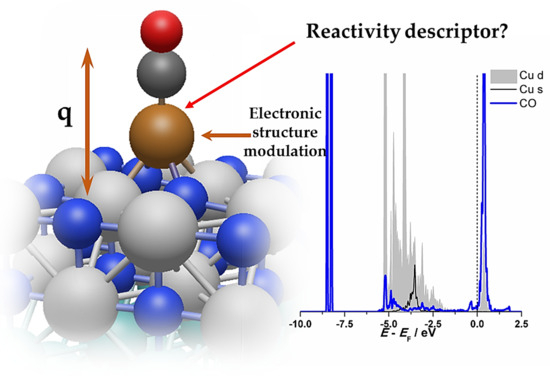
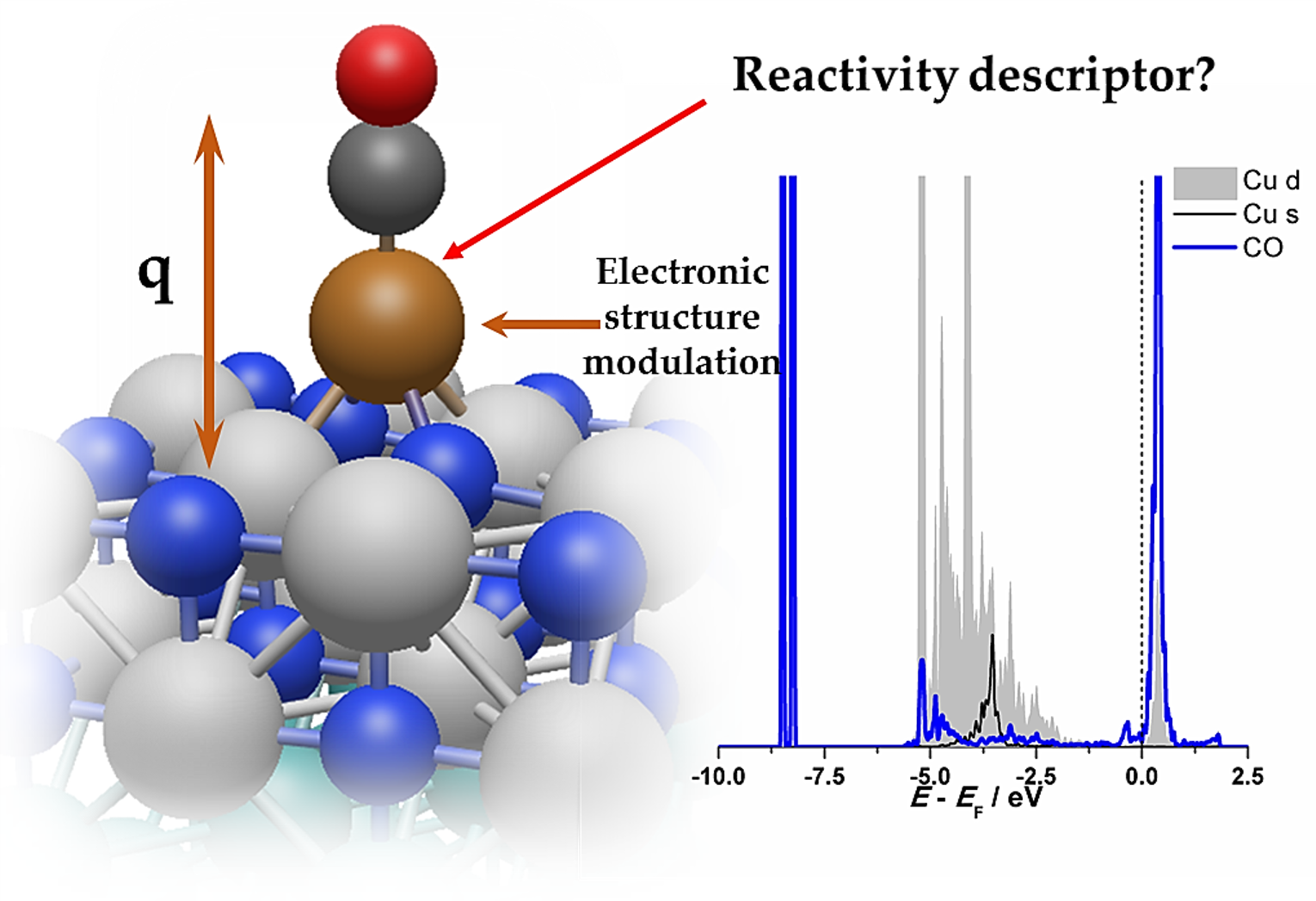
Graphical Abstract

1. Introduction

Many important technological processes depend on the use of expensive catalytic components, such as noble metals, which impose practical and economic limitations on their widespread use. For these reasons, reducing the content of expensive catalytic components is a motivation for intensive scientific research, bringing experts from different fields to the same table.
In heterogeneous catalysis, catalyst activity is governed by its surface. Exposing more of the surface to the reactants increases the number of active sites and improves catalytic activity. This is achieved by dispersing catalyst particles over a suitable support. While the particle sizes are large enough, their behavior can be understood based on the properties of the bulk catalyst, taking into account the number of exposed active sites [1]. However, once the dispersion is sufficiently high, to understand catalytic performance, other factors must be taken into account, including the specific atomic configuration, the number of atoms in the particle/metal cluster [2], and their interactions with the support [3,4]. Such a situation is driven to the extreme when the catalyst is found in the form of single supported atoms on a foreign substrate [1,5]. While single-atom catalysts (SACs) have already found practical applications [6,7], recent advancements produced a great deal of new SACs and catalytic systems in which these are applied [5]. A comprehensive overview of the recent results can be found, for example, in the papers by Liu [1], Gates et al. [5], Li et al. [8], and Wang et al. [9].
Considering monoatomic dispersion, SACs maximize the utilization of (expensive) metal components in the catalyst but also provide the strategy to tune the activity and selectivity of a catalytic reaction [1]. One of the main challenges for the practical use of such catalysts is the necessity of strong anchoring of the single metal atoms to the support, followed by keeping them stable and functional under reaction conditions [1,10]. In addition to these issues, Gates et al. [5] have listed a number of questions that must be considered when developing atomically dispersed supported metal catalysts. These can be classified into those related to (i) synthesis, (ii) characterization and identification of their properties, (iii) catalyst stability, and (iv) integration into more complex systems. In our view, among other questions, those related to the identification of crucial properties of SACs and to confirming that the atomically dispersed species are indeed catalytically active stood out as particularly important. Additionally, a very important question is are the single atoms in SACs “ideal” and truly single, or do they undergo changes (e.g., adsorption of certain species) under the catalyst’s operating conditions (pH, electrode potential) [11]?
As in heterogeneous catalysis, the interaction between the catalyst and reactants/intermediates plays a decisive role in catalytic performance, the reactivity of single supported atoms must be understood. There are numerous examples of the successful use of highly dispersed metals and SACs for different catalytic reactions [12,13,14,15], but there are no general strategies to predict the reactivity of supported metal atoms necessary for the rational design of such materials. Namely, in the case of extended solid catalysts, numerous activity descriptors have been identified [16,17,18,19,20,21,22] offering clear links between the electronic structure, chemisorption properties, and reactivity. In contrast, in the case of single supported atoms, there are no universal descriptors which can be applied over various classes of SACs and different catalytic reactions. The charge state of supported atoms was often outlined as an important parameter [23,24,25,26]. It was considered that an extra charge can boost bond cleavage in molecular adsorbates [27] and alter chemisorption properties of supported metals [28]. Our work on MgO(001)-supported bimetallic dimers suggested that for such systems, the d-band centers can be linked to the reactivity of low-coordinated atoms [29]. Combined experimental and theoretical study by Vorobyeva et al. [30] pointed out the metal (Pd) oxidation state, assessed by XPS, as an important activity descriptor for the semi-hydrogenation of 2-methyl-3-butyn-2-ol.
In this contribution, we consider three fundamentally different metal support systems, analyze the properties of supported metal atoms, and probe their reactivity. For each system, we attempt to link the reactivity trends to bonding and the electronic structure parameters of supported metal atoms.

2. Results and Discussion

2.1. Reactivity of Metal Atoms and Dimers on MgO(001)

In the first part, we analyze a model case of oxide-supported metal catalysts. MgO(001) is chosen as support due to its importance in surface science and catalysis [25,31,32,33]. We analyzed the reactivity of supported single Ru, Rh, Pd, Ir, and Pt atoms, metals of great importance for many contemporary technologies. As we reported previously [29], these metal adatoms prefer adsorption on the O-site of the pristine MgO(001) surface and bond to it with a variable strength (Table 1).
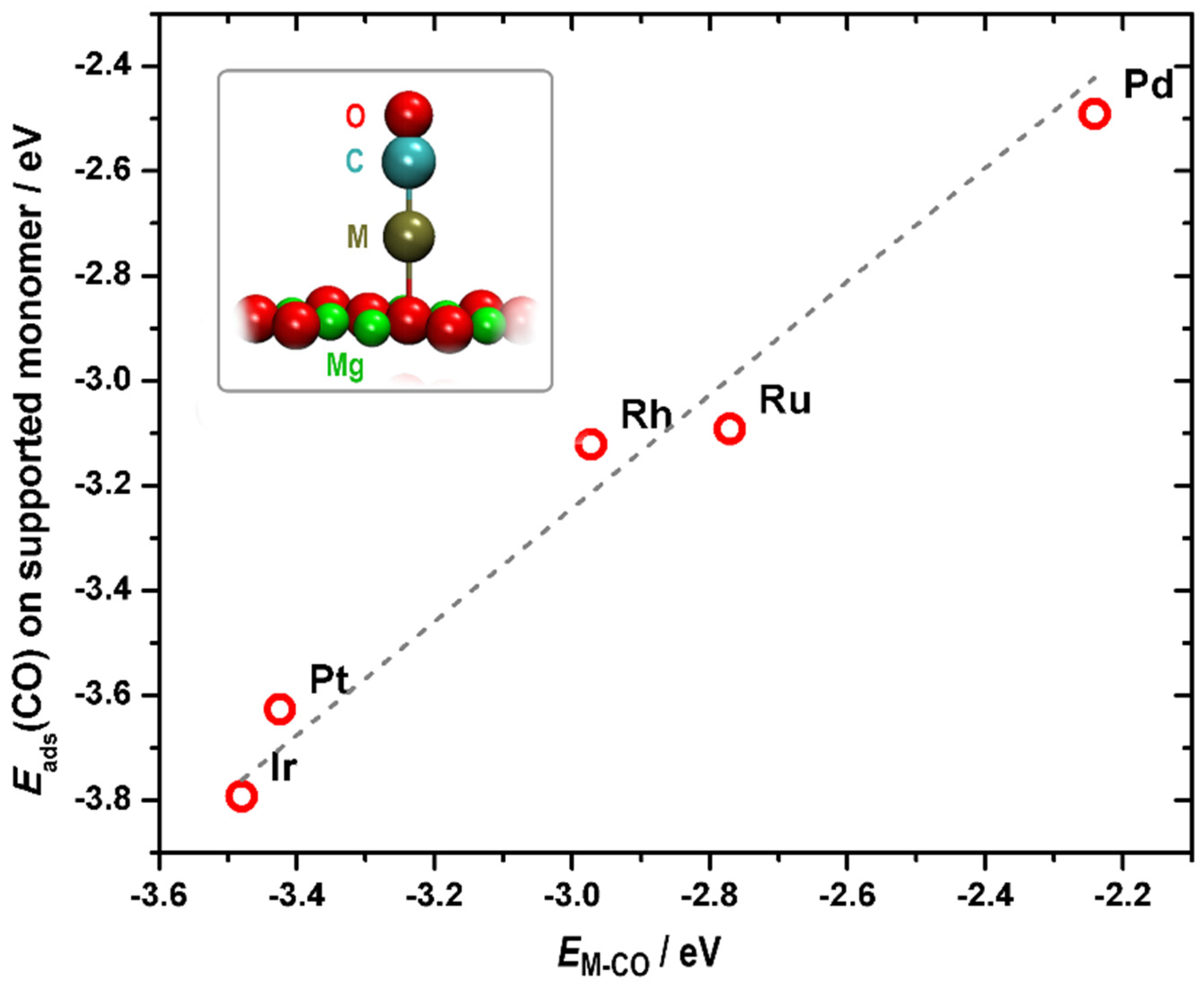
A certain amount of charge is transferred to each metal adatom, and it ranges from 0.24 |e| in the case of Pd to 0.46 |e| in the case of Ir adatom. We have calculated the d-band centers for the studied adatoms. The trends in the d-band center values do not follow those of pure metallic surfaces [34]. Next, we calculated the CO adsorption energies on supported metal atoms. A rather strong interaction with CO can be seen, which is much stronger than the interaction of CO with clean metallic surfaces [34,35]. This is understandable, taking into consideration the low coordination of supported metal atoms compared to the atoms at metal surfaces. Nevertheless, we could not correlate CO adsorption energies on low-coordinated atoms to those on the corresponding metallic surfaces. However, we have calculated the energy of the M–CO bond in the gas phase and found that CO adsorption energies on M@MgO(001) systems correlate well with the M–CO bond energy (Figure 1).
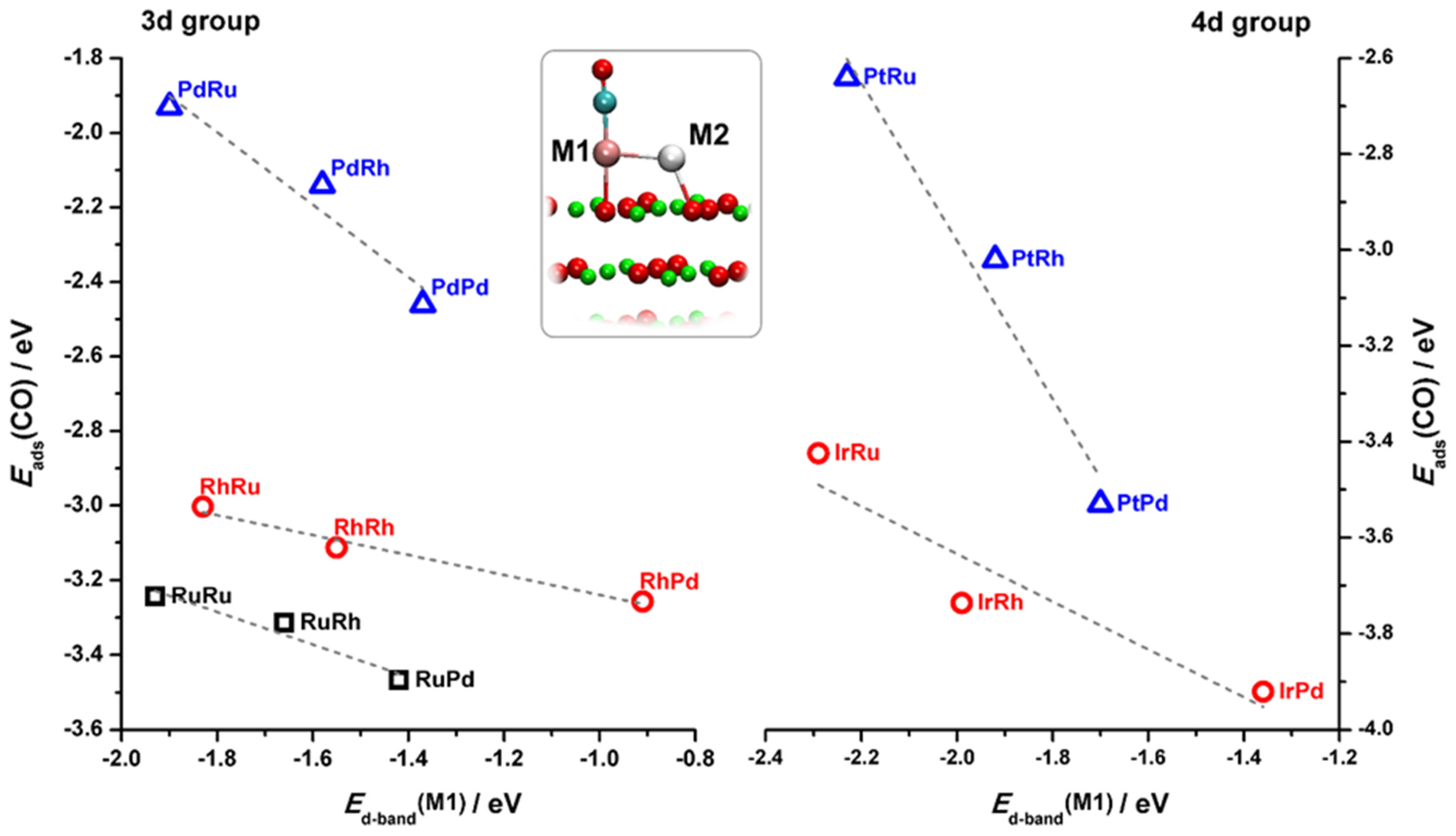
While single supported atoms can bind CO with different strengths, the question is how to further modulate the interaction strength. In practice, this would relate to fine-tuning of reactivity and catalytic activity. For this purpose, we turn to the case of MgO(001) supported bimetallic dimers (M1M2) and probe the reactivity of given atoms in dimers using CO. Dimers oriented parallel to MgO(001) are considered. The probe molecule was placed on top of M1 (M1 = Ru, Rh, Pd, Ir, Pt) atom in M1M2 dimer (M2 = Ru, Rh, Pd), and the structure was fully relaxed. Here, we do not investigate the ways CO can approach the dimers, or the possibility that CO can simultaneously attach to the dimer and the MgO support, although such bonding is important in heterogeneous catalysis [36,37,38]. By changing the chemical environment of the considered M1 atoms, it is possible to adjust their charge state and d-band center positions (Table 2) [29]. We have calculated the binding energy of each M1 to M2@MgO(001), where the final result is the considered M1M2@MgO(001) dimer (Table 2). All these properties show certain regularities. Namely, we see that M1 binding energy to M2@MgO(001) decreases as M2 goes from Ru to Pd, just as for the case of dimers in the gas phase [29]. In the same order, the charge transferred to M1 upon its bonding to M2@MgO(001) decreases, and the d-band center shifts to higher values.
It can be observed that CO binding at M1 increases in strength as the M1 binding to M2@MgO(001) weakens. This can be understood intuitively: a more saturated M1 is less reactive. In addition, we also observe the link between Eads(CO) and the charge and d-band center of M1. In particular, we observe that CO adsorption is stronger on M1 with less charge. In the same way, we observe the link between the CO adsorption energies and the d-band center of M1 (Figure 2), which was previously described for CO adsorption on PtM2 and PdM2 dimers [29]. The behavior is the same as in the case of metallic surfaces: as the d-band center shifts towards the Fermi level, the interaction with CO becomes stronger [29,39,40].
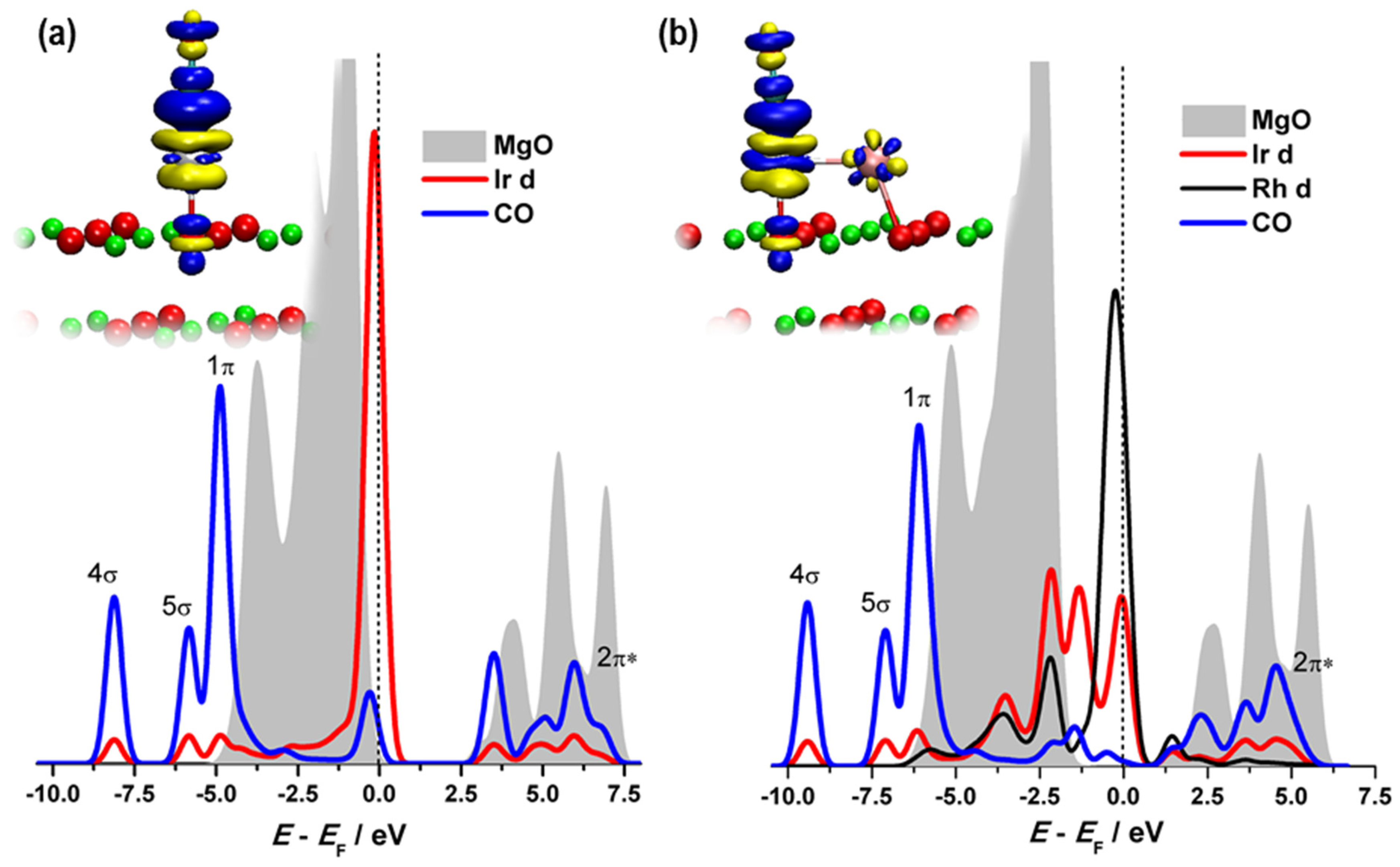
In order to analyze the observed trends, we turn to the investigation of the electronic structure of adsorbed CO and supported metals. Also, we analyze charge redistribution patterns upon the adsorption of CO (Figure 3). We observe that in all the cases a certain amount of charge is transferred to the adsorbed CO molecule, resulting in the elongation of the C–O bond (in all the cases, the bond length in the adsorbed CO molecule is around 1.16 Å or slightly longer, while in isolated CO it is 1.134 Å [41]). This indicates that the CO chemisorption can be described within the Blyholder model as coupling of the CO 5σ (donation) and 2π* states (backdonation) to the metal d-valence states [42] in the case of the considered low-coordinated atoms. Such behavior is clearly seen from Figure 3, where the d-states of the Ir atom (either a single supported atom or in IrRh dimer) show strong coupling with the states of the adsorbed CO molecule. It is also obvious that the presence of Rh has a great impact on the electronic structure of Ir in the dimer, so that the d-band center is shifted away from the Fermi level significantly. However, the reactivity, as seen by Eads(CO), is similar to that of an isolated Ir atom on MgO(001) (Table 1 and Table 2). Although the connection between the d-band center and the CO adsorption energies can be useful, obviously, it cannot fully describe the behavior of low-coordinated atoms, as monomers generally do not follow the trends given by the same atoms in dimers.
In contrast to d-band centers, we find that the charge state of the considered atoms (Ru, Rh, Pd, Ir, and Pt) can be generally linked to the adsorption energy of CO on a given atom, but certain deviations exist (Table 2). As a simple rule of thumb, we see that more negatively charged atoms bind CO less strongly. Similar observations were previously obtained, for example, in the case of charged Au clusters in the gas phase [43]. Positively charged atoms and clusters were found to bind CO much more strongly than negatively charged counterparts, suggesting that the forward donation from CO is the dominant mechanism of interaction between Aun± and CO. This was also possible to see through the elongation of the C–O bond, which was more prominent in the case of negatively charged Aun clusters [43]. Here we see the same behavior: in the case of Ir monomer on MgO(001) (charge −0.46|e|), C–O bond length is 1.17 Å, while in the case of Ir in Rh dimer (charge −0.53|e|), C–O bond length is 1.18 Å. The effects of charging on CO adsorption were also analyzed and compared for the cases of Au and Pd surfaces, where a strong effect was seen for Au and a small one for Pd [44].

2.2. Tuning the Reactivity by Charging Metal Atoms—Cu Adatom on Mo-Supported NaF, MgO, and ScN Thin Films

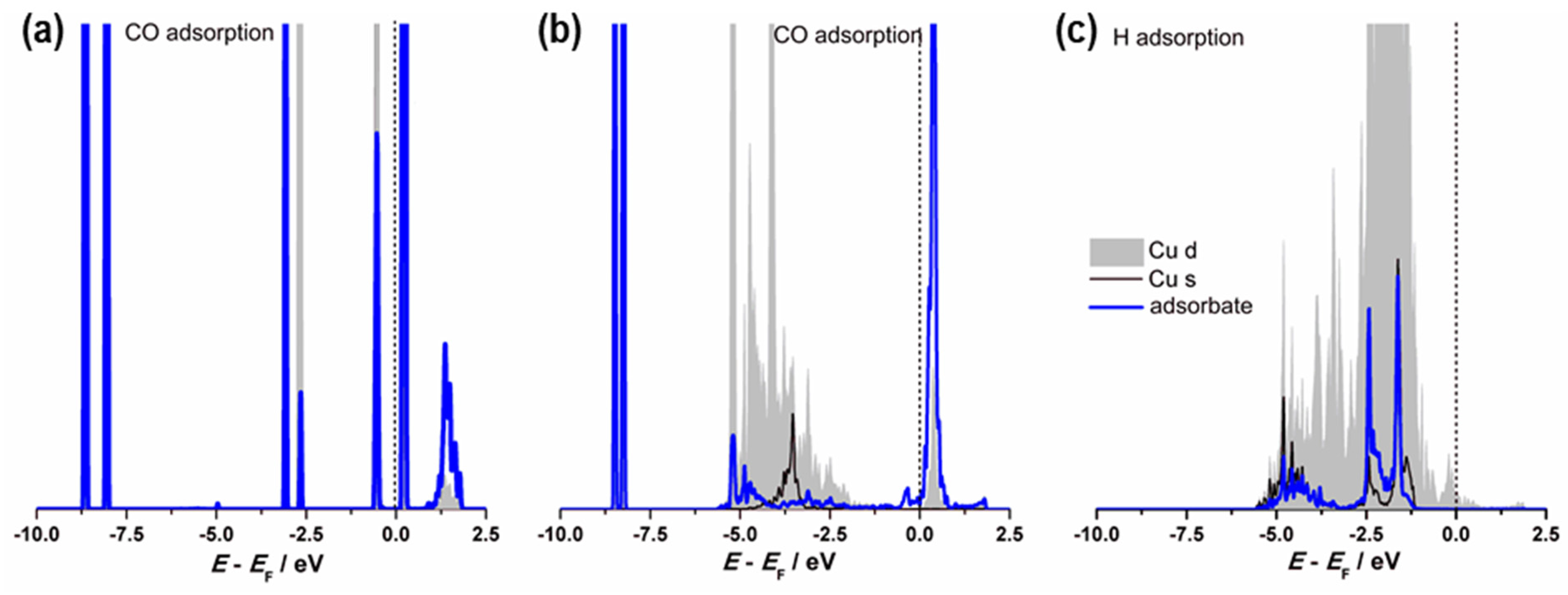
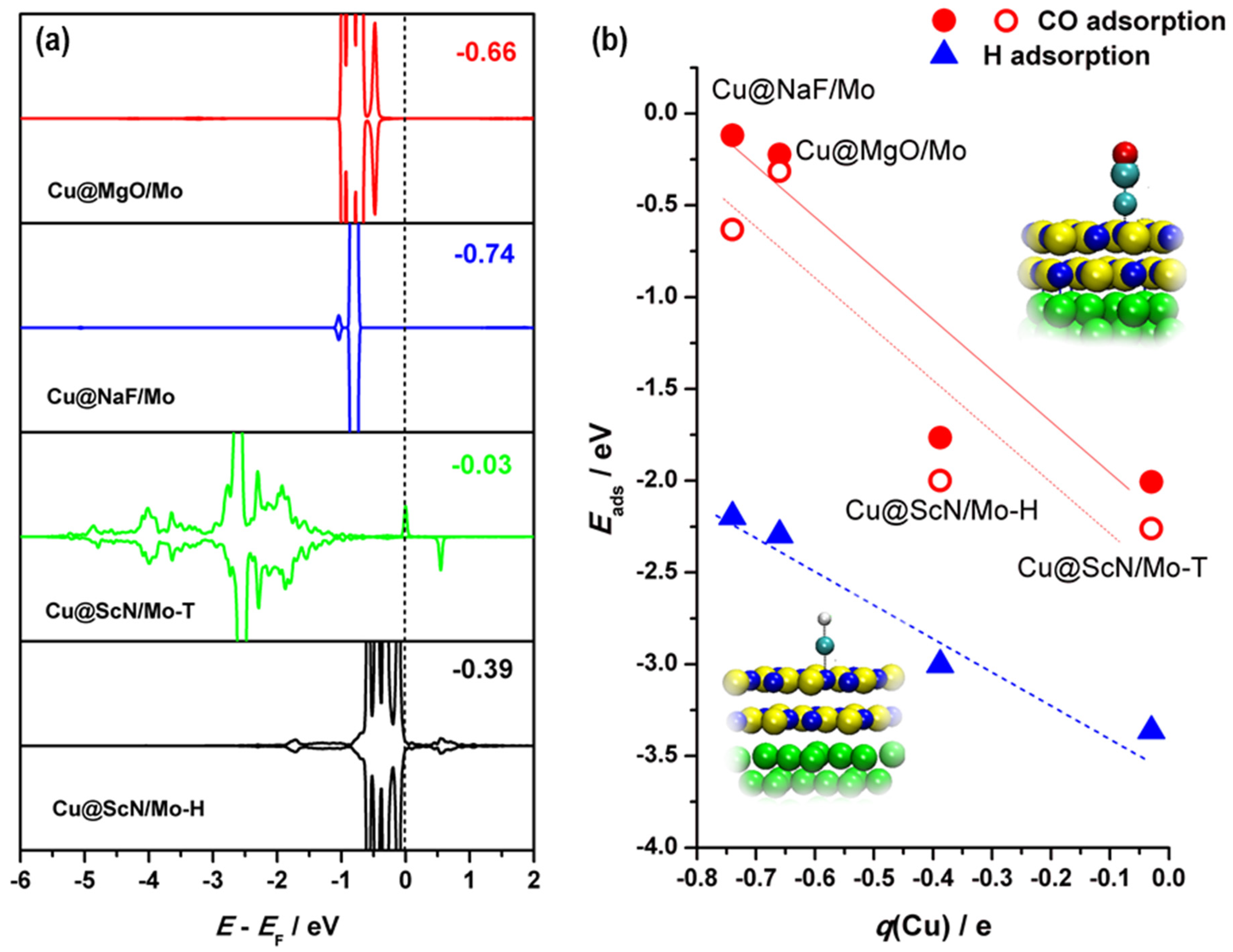
In the next step, we further explore the effect of charging supported single metal atoms on their chemisorption properties. We employ the phenomena of adatom charging when on thin insulating metal-supported films. We do such analysis for Cu adatoms on thin films described in detail in ref. [45]. By changing the type of the thin, insulating film (from purely ionic compound as NaF to covalent compound ScN), one can tune the charge state of metal adatom from nearly Cu1− (in the case of NaF film) to Cu0 (in the case of ScN film). The results are summarized in Table 3. The inspection of the electronic structure of supported Cu atoms (Figure 4, left) clearly shows the tremendous influence of the underlying substrate. This can be attributed to the change in the bonding between the Cu adatom and the substrate from predominantly ionic to predominantly covalent. As expected, the reactivity of Cu atoms is also greatly influenced, which is clear from the calculated CO and H adsorption energies. It is also significantly altered compared to the reactivity of isolated Cu (Table 3), like in the case of the considered metals on MgO(001) (Table 1). We see that the CO adsorption energies span in a 2 eV wide energy window, while the H adsorption energy ranges between −2.20 and −3.36 eV (Table 3). Moreover, there is no clear connection between the d-band center position and the CO/H adsorption energy—the most reactive Cu adatom is the one supported by ScN@Mo(001), which actually has the d-band located at the lowest energies (Figure 4). However, the correlation between the charge state of Cu adatom and the adsorption energies holds for both CO and H adsorption (Figure 4).
Again, the interaction between the CO molecule and Cu adatom can be rationalized in terms of a donation–backdonation mechanism. The more negative charge is located at the Cu adatom, the weaker the bonding of CO is going to be due to more backdonation to 2π* orbitals of CO. As the charge of adatom decays from −0.76 (NaF@Mo(001) substrate) to −0.67 (MgO@Mo(001) substrate) and −0.03 (ScN@Mo(001) substrate), the net negative charge of the adsorbed CO molecule goes from −0.24 to −0.15 and finally −0.10|e|. The interaction between the d-states of Cu adatoms and CO states is clearly seen in Figure 5. In contrast, H adatom interacts with the s-states of Cu (Figure 5), which also offers an explanation for the observed behavior. Namely, as the s-states of Cu adatom start to fill due to the charge injected from the substrate, Cu adatom is more saturated and tends to bond more weakly through its s orbital.
When comparing the electronic structures of the Cu adatom on ScN@Mo(001) with the other cases (Figure 4), we see a rather wide d-band, which is a consequence of the covalent interaction with the underlying ScN. Moreover, these adatoms are very reactive compared to the other cases. Cu supported by ScN@Mo(001) binds H similarly to the Cu(111) surface [46], while it binds CO much more strongly than Cu(111) [47]. We consider that this is due to the differences in the electronic structure of supported Cu and the Cu(111) surface. It is known that the electronic structure of Cu(111) is characterized by a wide half-filled s-band and a narrow, completely filled d-band. Due to the narrow d-band, it binds CO very weakly, but the interaction between the wide s-band and the s-states of H makes the interaction stronger. In contrast, a wide d-band of Cu adatom on ScN@Mo(001) makes the interaction with CO strong as well (Figure 4 and Figure 5). In order to further investigate the reactivity of adatoms covalently bonded to the substrate, we chose graphene-supported Pt atoms, a system that was considered as SAC from both theoretical [48] and experimental [15] viewpoints.

2.3. CO Adsorption on Graphene and rGO-Supported Pt Monomers

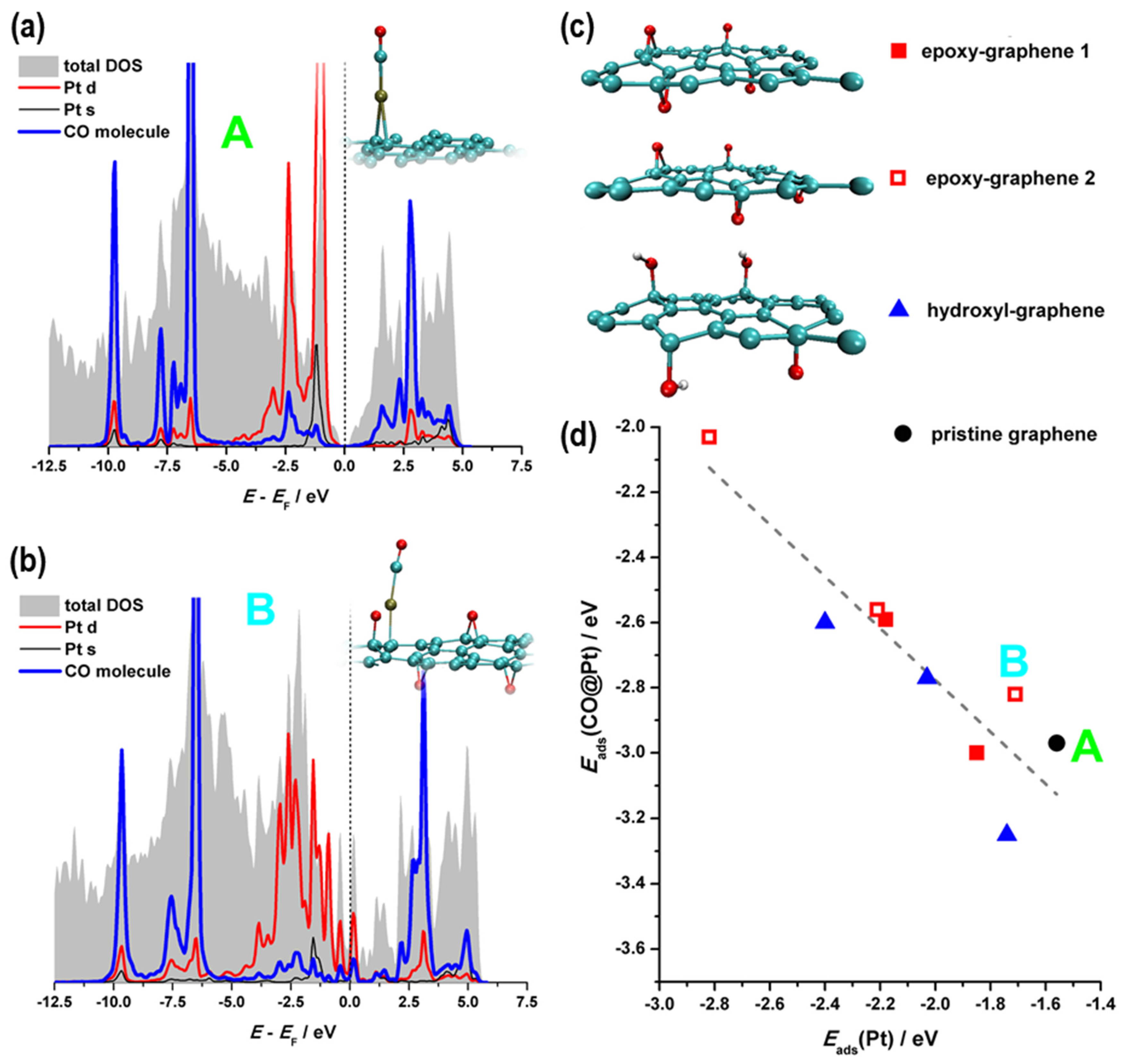
As a model of the support, we use previously described epoxy- and hydroxyl-graphene models [49,50]. As shown before [50], the reactivity of the graphene basal plane can be significantly altered by attaching different oxygen functional groups on its surface. This is clearly reflected in enhanced bonding of Pt to oxidized graphene surfaces [50] (see Table 4). While Pt is adsorbed at the bridge site on pristine graphene, this is not a general case for the oxidized surfaces. The introduction of the oxygen surface groups results in strong bonding of Pt adatoms at top sites of C atoms in the vicinity of oxygen-functional groups (Table 4). Depending on the specific adsorption site, the charge transferred to the Pt adatom can vary, but, in general, less charge is transferred to Pt when compared to the case of MgO(001) support (Section 2.1). The position of the d-band center is governed by the interaction with the sp-states of the carbon atom (see Figure 6) and is typically much higher in energy than the d-band center of Pt in Pt(111) [51]. The bonding of CO to single Pt adatoms is much stronger than bonding on the Pt(111) surface (−1.48 eV) [41].
In this case, we have not observed any correlation with the d-band center position of Pt adatoms. No connection between the charge transferred to the Pt adatom and CO adsorption energy is seen, either. In comparison, Liu and Huang have investigated O2 adsorption on Pt single atoms adsorbed on a graphene single vacancy and C2N, CN2, and N3 moieties incorporated into the graphene lattice [52]. They have reported Pt d-band centers as low as −4.93 eV for the case of Pt at a graphene single vacancy, while good correlation between O2 adsorption energies and d-band centers has been observed. Also, authors observed a positive charge on Pt atoms and stronger binding of O2 for more positively charged Pt adatoms [52]. However, in our case, we could only correlate the CO adsorption energies to Pt binding energies on model surfaces of graphene (Figure 6). Our results suggest that weaker bonding of a Pt adatom to the surface results in stronger adsorption of CO on a given adatom. As already stated, this is intuitively clear as a stronger bond between Pt and the substrate means that the adatom is more saturated and, in this way, less reactive. Interestingly, the same correlation can be derived from the results in the ref. [52]. However, their Eads(CO@Pt) = f(Eb(Pt)) line falls far from the one in Figure 6. The observed difference can be ascribed to the interaction of Pt atoms with N atoms incorporated in the graphene lattice, being considered as anchoring sites for Pt in ref. [52]. This emphasizes again that the chemical environment of supported single atoms is crucially important for its state and reactivity [53].
To analyze the CO bonding, we turn to the inspection of the electronic structure (Figure 6). We see general features that are in accordance with the already discussed donation–backdonation mechanism. The states of Pt (s and d) clearly interact with the electronic states of the CO molecule. The backdonation of charge to the 2π* state of the CO molecule gives rise to the elongation of the C–O bond, which was found to be approximately. 1.16 Å in all the considered cases. So, the question is why is it not possible to use the same descriptors as for the previous substrates, if the mechanism of the interaction is the same? We have inspected the relaxed structures and observed that significant relaxation of the oxidized graphene support occurs upon the adsorption of CO on Pt adatoms. As a result, Pt–C bonds are significantly elongated (in some cases even up to 10%), and the CO@Pt complex moves along the surface, so that the Pt adatom is not actually located at the same adsorption site as before CO adsorption. Moreover, the interaction between the CO@Pt complex and the oxygen functional groups located on the surface presents an additional factor that affects both the electronic structure of Pt adatoms, their interaction with the support, and the CO adsorption energy. In contrast, in ref. [52] Pt single atoms are much more strongly anchored at the defect sites of the graphene basal plane with the adsorption energies between −7.25 and −3.02 eV, as is expected considering the high reactivity of single vacancies [54] and N-containing centers in graphene [55]. As a result, the adatoms remain at the same sites upon the adsorption of O2, which could explain why the correlations with the Ed-band and the charge of the adatom are observed. The presented results turn the focus back to the stability issues, outlined in ref. [1], as the main question related to the performance of SACs. However, another dimension can be added—in order to be able to predict the reactivity of SACs, with the aim to design such a catalyst, the stability of a single supported adatom under operating conditions must be ensured. Therefore, constructing Pourbaix plots, taking into account pH and electrode potential under experimental conditions, is of great importance for a valid discussion of the state of the single atoms in a given support [55], but is not in the focus of the present study.
Finally, we note that the SAC models presented in this work do not exhaust all the classes of SACs present in the literature, such as single-atom alloys, M-N-C catalysts (with different metal coordinations, or metal-exchanged MOFs/zeolites) [5,10,55]. Likely, each of these additional classes of SACs might have its own activity descriptor. Nevertheless, we believe that at least in the case of single-atom alloys, which are essentially metallic systems, the d-band center theory or some of its modifications mentioned here should be applicable at least for simple adsorbates. On the other hand, in the case of M-N-C catalyst and other molecular-like systems where metal centers are surrounded by covalent networks, the situation might be more complicated. These systems resemble graphene-supported SACs the most, in terms of the nature of the matrix, but the electronic structure of the metal center is strongly dependent on the coordination of the metal center, and small changes in the chemical composition of the metal center environment could lead to dramatic changes in the reactivity [53].

3. Materials and Methods

We analyzed the reactivity of three rather diverse low-coordinated supported metal atom systems. First, we address the reactivity of single metal atoms and bimetallic dimers supported by MgO(001). Our previous combinatorial study of MgO(001)-supported metal dimers suggested that d-band centers of individual atoms can be used to predict their chemisorption properties [29]. We probe the reactivity using the CO molecule. Next, we analyze the effects of Cu adatom charging on its chemisorption properties. Controllable charging of Cu is accomplished by changing the support. In specific terms, we have used 2 monolayers (ML) thick overlayers (NaF, MgO, and ScN) over the Mo(001) substrate as described in ref. [45]. For these cases, we use CO and atomic H to probe the reactivity of single Cu adatoms. Finally, we investigate the reactivity of single Pt atoms supported by oxidized graphene using CO as the probe adsorbate.

3.1. MgO(001) Supported Metal Atoms and Bimetallic Dimers

The Density Functional Theory (DFT) calculations were performed within the generalized gradient approximation (GGA) employing Perdew–Burke–Ernzerhof (PBE) exchange correlation functional [56]. The calculations were performed using the PWscf code (v.4.3.2) of Quantum ESPRESSO distribution [57,58]. The kinetic energy cutoff for the selection of the plane-wave basis set was 28 Ry, and the charge density cutoff was 16 times higher. The lattice constant of MgO was calculated to be 4.22 Å, in good agreement with the experimental value of 4.21 Å [59]. The MgO(001) surface was modeled as a three-layer slab with the (2 × 2) unit cell. Monomers and dimers of investigated transition metals were placed on one side of MgO(001) in the geometry corresponding to that described in ref. [29]. Full relaxation was allowed for all the atoms except the ones in the bottom layer of MgO(001). The Brillouin zone was sampled using the (2 × 2 × 1) Monkhorst–Pack grid [60]. Vacuum thickness and the dipole correction were adjusted to prevent supercells’ interaction along the z direction [61]. The model of the MgO(001) surface used here is described in detail in ref. [62]. Additional information regarding the accuracy of the model can be found in ref. [29].

3.2. Cu Adatom on Mo-Supported Thin Films

DFT calculations were performed using the projector augmented wave method [63] in combination with the GGA in the PBE parametrization [56] as implemented in Vienna Ab initio Simulation Package (v 5.3.5) [64,65,66,67,68]. The cutoff energy of 800 eV was used in the calculations. The Brillouin zone was sampled over the (8 × 8 × 1) Pack–Monkhorst k-points mesh [60]. We have used a symmetric slab consisting of Mo(001) (7 layers) and two layers of NaF, MgO, or ScN on each side of the Mo slab. Cu adatom was also placed on both sides of the slab. During geometry optimization the relaxation of all atoms, except for the Mo atoms in the central Mo layer, was allowed. More details about this set of calculations can be found in ref. [45].

3.3. Single Pt Atoms on Oxygen-Functionalized Graphene

The DFT calculations were carried out within the GGA-PBE approach [56] using ultrasoft pseudopotentials as implemented in the PWscf code (v.4.3.2) of Quantum ESPRESSO distribution [57,58]. The Kohn–Sham orbitals were expanded in a plane-wave basis set with the kinetic energy cutoff of 30 Ry, while the charge density cutoff was 448 Ry. Pristine graphene was modeled as a 32-carbon-atom layer within an orthorhombic 9.88 × 8.65 × 16 Å supercell, as used previously in refs. [48,49]. Oxidized graphene (ox-graphene) was modeled as p-graphene with epoxy or hydroxyl groups attached to both sides of the layer. The detailed description of the surface models is given in ref. [49].

3.4. Interactions Quantified

In order to quantify the interaction of low-coordinated atoms with the support, we define metal binding energy (Eb(M)) as
Eb(M) = EM@subsEsubsEM
EM@subs, Esubs, and EM stand for the total energy of metal atom M on foreign substrate, the total energy of substrate, and the total energy of isolated atom M. Reactivity was probed using CO for all the studied metal atoms and using atomic H for Cu on layered substrates. Reactivity is quantified using the adsorption energy of adsorbate A (CO or H) as
Eads(A) = EA+M@subsEM@subsEA
EA+M@subs and EA are the total energy of a metal atom M on a foreign substrate with A adsorbed and the total energy of the isolated adsorbate. We define the CO binding energy to an isolated metal atom (EM–CO) in the same way, as
EM–CO = EM+COEMECO
where EM+CO, EM, and ECO stand for the total energy of the M + CO complex, the total energy of an isolated M atom, and the total energy of an isolated CO molecule. In order to characterize the electronic structure of supported adatoms, we calculated their d-band centers (Ed-band) as the first moments of the d-bands and the charge states. The charge transfer was analyzed using the Bader algorithm [69] on a charge density grid by Henkelman et al. [70]. Graphical presentation was made using the VMD code [71].

4. Conclusions

We have considered several rather different systems consisting of single supported metal atoms or dimers on different supports as models of single-atom catalysts. The systems include Ru, Rh, Pd, Ir, and Pt and their dimers on MgO(001), Cu adatoms on different Mo(001)-supported thin films, and, finally, single Pt atoms on oxidized graphene surfaces. By testing the reactivity of these single atoms with the CO molecule, we observe that single atoms and dimers are more reactive than corresponding metallic surfaces. Moreover, the donation–backdonation mechanism is found to be operative in all the studied cases. However, there is a limited number of potential descriptors that seem to be applicable in the considered cases. For MgO(001)-supported metal dimers, the reactivity of a particular atom can be easily tuned by changing the composition of the dimer, while scaling between the adsorption energies and d-band centers or charge of atoms in dimers was observed. Moreover, if the binding energy of the considered atom in the dimer structure is considered as a measure of atom saturation, then less saturated atoms bind CO more strongly. The effects of adatom charge on its reactivity were tested for the case of Cu adatom on thin Mo(001)-supported films. We observe that more negatively charged atoms bind CO more weakly. The same was the case for the adsorption of the H atom, although the mechanism is considered to be different here. For the case of covalently bonded Pt adatoms on oxidized graphene surfaces, the d-band center and the adatom charge cannot be connected to CO adsorption energy. In this case, we observe a link between Pt binding energy to the support and CO adsorption energy on Pt atoms—more strongly bonded Pt atoms adsorb CO more weakly.
Generally, several possible physically justified reactivity descriptors of low-coordinated/single metal atoms on foreign supports might be outlined. Some of them, like the d-band center or metal atom charge, do have a physical background and could offer a strategy for a rational design of a single-atom catalyst. However, this study also shows that the stability of single metal adatoms over foreign substrates is not only of paramount importance for the practical use of single-atom catalysts but also for the identification of reliable activity descriptors and their use in establishing reactivity trends.

Author Contributions

Conceptualization, N.V.S. and I.A.P.; methodology, N.V.S. and I.A.P.; validation, A.S.D. and I.A.P.; formal analysis, A.S.D. and A.Z.J.; investigation, A.S.D. and A.Z.J.; resources, B.J., N.V.S. and I.A.P.; data curation, N.V.S. and B.J.; writing—original draft preparation, A.S.D. and A.Z.J.; writing—review and editing, B.J., N.V.S. and I.A.P.; visualization, A.Z.J. and I.A.P.; supervision, B.J., N.V.S. and I.A.P.; funding acquisition, B.J., N.V.S. and I.A.P. All authors have read and agreed to the published version of the manuscript.

Funding

A.S.D., A.Z.J., and I.A.P. acknowledge the financial support provided by the Serbian Ministry of Science, Technological Development, and Innovations (contract no. 451-03-34/2026-03/200146) and the Serbian Academy of Sciences and Arts (projects F-49 and F-190). The computations and data handling were enabled by resources provided by the National Academic Infrastructure for Supercomputing in Sweden (NAISS) at the National Supercomputer center (NSC) at Linköping University, partially funded by the Swedish Research Council through grant agreement No. NAISS 2024/5-718 and NAISS 2025/5-713.

Data Availability Statement

Data is available upon a reasonable request.

Acknowledgments

The authors would like to thank Pjotr Žguns for providing the models of layered substrates described in Section 2.2.

Conflicts of Interest

The authors declare no conflicts of interest.

References

  1. Liu, J. Catalysis by Supported Single Metal Atoms. ACS Catal. 2017, 7, 34–59. [Google Scholar] [CrossRef]
  2. Roduner, E. Size Matters: Why Nanomaterials Are Different. Chem. Soc. Rev. 2006, 35, 583–592. [Google Scholar] [CrossRef] [PubMed]
  3. Tauster, S.J.; Fung, S.C.; Baker, R.T.; Horsley, J.A. Strong Interactions in Supported-Metal Catalysts. Science 1981, 211, 1121–1125. [Google Scholar] [CrossRef] [PubMed]
  4. Campbell, C.T. Ultrathin Metal Films and Particles on Oxide Surfaces: Structural, Electronic and Chemisorptive Properties. Surf. Sci. Rep. 1997, 27, 1–111. [Google Scholar] [CrossRef]
  5. Gates, B.C.; Flytzani-Stephanopoulos, M.; Dixon, D.A.; Katz, A. Atomically Dispersed Supported Metal Catalysts: Perspectives and Suggestions for Future Research. Catal. Sci. Technol. 2017, 7, 4259–4275. [Google Scholar] [CrossRef]
  6. Copéret, C.; Allouche, F.; Chan, K.W.; Conley, M.P.; Delley, M.F.; Fedorov, A.; Moroz, I.B.; Mougel, V.; Pucino, M.; Searles, K.; et al. Bridging the Gap between Industrial and Well-Defined Supported Catalysts. Angew. Chem. Int. Ed. 2018, 57, 6398–6440. [Google Scholar] [CrossRef] [PubMed]
  7. Bordiga, S.; Damin, A.; Bonino, F.; Lamberti, C. Single Site Catalyst for Partial Oxidation Reaction: TS-1 Case Study. In Surface and Interfacial Organometallic Chemistry and Catalysis; Springer: Berlin/Heidelberg, Germany, 2005; pp. 37–68. [Google Scholar]
  8. Li, X.; Yang, X.; Huang, Y.; Zhang, T.; Liu, B. Supported Noble-Metal Single Atoms for Heterogeneous Catalysis. Adv. Mater. 2019, 31, 1902031. [Google Scholar] [CrossRef]
  9. Wang, S.; Wang, L.; Wang, D.; Li, Y. Recent Advances of Single-Atom Catalysts in CO2 Conversion. Energy Environ. Sci. 2023, 16, 2759–2803. [Google Scholar] [CrossRef]
  10. Liang, S.; Hao, C.; Shi, Y. The Power of Single-Atom Catalysis. ChemCatChem 2015, 7, 2559–2567. [Google Scholar] [CrossRef]
  11. Dobrota, A.S.; Pašti, I.A. Single-Atom Catalysts: Are You Really Single? J. Phys. Chem. Lett. 2024, 16, 77–86. [Google Scholar] [CrossRef]
  12. Qiao, B.; Wang, A.; Yang, X.; Allard, L.F.; Jiang, Z.; Cui, Y.; Liu, J.; Li, J.; Zhang, T. Single-Atom Catalysis of CO Oxidation Using Pt1/FeOx. Nat. Chem. 2011, 3, 634–641. [Google Scholar] [CrossRef]
  13. Muratsugu, S.; Weng, Z.; Nakai, H.; Isobe, K.; Kushida, Y.; Sasaki, T.; Tada, M. Surface-Assisted Transfer Hydrogenation Catalysis on a γ-Al2O3-Supported Ir Dimer. Phys. Chem. Chem. Phys. 2012, 14, 16023. [Google Scholar] [CrossRef] [PubMed]
  14. Yardimci, D.; Serna, P.; Gates, B.C. Surface-Mediated Synthesis of Dimeric Rhodium Catalysts on MgO: Tracking Changes in the Nuclearity and Ligand Environment of the Catalytically Active Sites by X-Ray Absorption and Infrared Spectroscopies. Chem.—A Eur. J. 2013, 19, 1235–1245. [Google Scholar] [CrossRef] [PubMed]
  15. Sun, S.; Zhang, G.; Gauquelin, N.; Chen, N.; Zhou, J.; Yang, S.; Chen, W.; Meng, X.; Geng, D.; Banis, M.N.; et al. Single-Atom Catalysis Using Pt/Graphene Achieved through Atomic Layer Deposition. Sci. Rep. 2013, 3, 1775. [Google Scholar] [CrossRef]
  16. Nørskov, J.K.; Abild-Pedersen, F.; Studt, F.; Bligaard, T. Density Functional Theory in Surface Chemistry and Catalysis. Proc. Natl. Acad. Sci. USA 2011, 108, 937–943. [Google Scholar] [CrossRef] [PubMed]
  17. Stamenkovic, V.R.; Fowler, B.; Mun, B.S.; Wang, G.; Ross, P.N.; Lucas, C.A.; Marković, N.M. Improved Oxygen Reduction Activity on Pt3Ni(111) via Increased Surface Site Availability. Science 2007, 315, 493–497. [Google Scholar] [CrossRef] [PubMed]
  18. Kitchin, J.R.; Nørskov, J.K.; Barteau, M.A.; Chen, J.G. Role of Strain and Ligand Effects in the Modification of the Electronic and Chemical Properties of Bimetallic Surfaces. Phys. Rev. Lett. 2004, 93, 156801. [Google Scholar] [CrossRef]
  19. Bhattacharjee, S.; Waghmare, U.V.; Lee, S.-C. An Improved D-Band Model of the Catalytic Activity of Magnetic Transition Metal Surfaces. Sci. Rep. 2016, 6, 35916. [Google Scholar] [CrossRef]
  20. Peterson, A.A.; Nørskov, J.K. Activity Descriptors for CO 2 Electroreduction to Methane on Transition-Metal Catalysts. J. Phys. Chem. Lett. 2012, 3, 251–258. [Google Scholar] [CrossRef]
  21. Subbaraman, R.; Tripkovic, D.; Chang, K.-C.; Strmcnik, D.; Paulikas, A.P.; Hirunsit, P.; Chan, M.; Greeley, J.; Stamenkovic, V.; Markovic, N.M. Trends in Activity for the Water Electrolyser Reactions on 3d M(Ni,Co,Fe,Mn) Hydr(Oxy)Oxide Catalysts. Nat. Mater. 2012, 11, 550–557. [Google Scholar] [CrossRef]
  22. Calle-Vallejo, F.; Inoglu, N.G.; Su, H.-Y.; Martínez, J.I.; Man, I.C.; Koper, M.T.M.; Kitchin, J.R.; Rossmeisl, J. Number of Outer Electrons as Descriptor for Adsorption Processes on Transition Metals and Their Oxides. Chem. Sci. 2013, 4, 1245. [Google Scholar] [CrossRef]
  23. Fu, Q.; Saltsburg, H.; Flytzani-Stephanopoulos, M. Active Nonmetallic Au and Pt Species on Ceria-Based Water-Gas Shift Catalysts. Science 2003, 301, 935–938. [Google Scholar] [CrossRef]
  24. Sauer, J.; Döbler, J. Structure and Reactivity of V2O5: Bulk Solid, Nanosized Clusters, Species Supported on Silica and Alumina, Cluster Cations and Anions. Dalton Trans. 2004, 19, 3116–3121. [Google Scholar] [CrossRef]
  25. Yoon, B.; Häkkinen, H.; Landman, U.; Wörz, A.S.; Antonietti, J.M.; Abbet, S.; Judai, K.; Heiz, U. Charging Effects on Bonding and Catalyzed Oxidation of CO on Au8 Clusters on MgO. Science 2005, 307, 403–407. [Google Scholar] [CrossRef] [PubMed]
  26. Zhai, H.J.; Döbler, J.; Sauer, J.; Wang, L.S. Probing the Electronic Structure of Early Transition-Metal Oxide Clusters: Polyhedral Cages of (V2O5)n (n = 2–4) and (M2O5)2 (M = Nb, Ta). J. Am. Chem. Soc. 2007, 129, 13270–13276. [Google Scholar] [CrossRef]
  27. Molina, L.M.; Hammer, B. Some Recent Theoretical Advances in the Understanding of the Catalytic Activity of Au. Appl. Catal. A Gen. 2005, 291, 21–31. [Google Scholar] [CrossRef]
  28. Lin, X.; Yang, B.; Benia, H.-M.; Myrach, P.; Yulikov, M.; Aumer, A.; Brown, M.A.; Sterrer, M.; Bondarchuk, O.; Kieseritzky, E.; et al. Charge-Mediated Adsorption Behavior of CO on MgO-Supported Au Clusters. J. Am. Chem. Soc. 2010, 132, 7745–7749. [Google Scholar] [CrossRef]
  29. Pašti, I.A.; Baljozović, M.R.; Granda-Marulanda, L.P.; Skorodumova, N.V. Bimetallic Dimers Adsorbed on a Defect-Free MgO(001) Surface: Bonding, Structure and Reactivity. Phys. Chem. Chem. Phys. 2015, 17, 9666–9679. [Google Scholar] [CrossRef]
  30. Vorobyeva, E.; Chen, Z.; Mitchell, S.; Leary, R.K.; Midgley, P.; Thomas, J.M.; Hauert, R.; Fako, E.; López, N.; Pérez-Ramírez, J. Tailoring the Framework Composition of Carbon Nitride to Improve the Catalytic Efficiency of the Stabilised Palladium Atoms. J. Mater. Chem. A Mater. 2017, 5, 16393–16403. [Google Scholar] [CrossRef]
  31. Amft, M.; Skorodumova, N.V. Catalytic Activity of Small MgO-Supported Au Clusters towards CO Oxidation: A Density Functional Study. Phys. Rev. B Condens. Matter Mater. Phys. 2010, 81, 195443. [Google Scholar] [CrossRef]
  32. Frusteri, F.; Freni, S.; Spadaro, L.; Chiodo, V.; Bonura, G.; Donato, S.; Cavallaro, S. H2production for MC Fuel Cell by Steam Reforming of Ethanol over MgO Supported Pd, Rh, Ni and Co Catalysts. Catal. Commun. 2004, 5, 611–615. [Google Scholar] [CrossRef]
  33. Frusteri, F.; Freni, S.; Chiodo, V.; Spadaro, L.; Di Blasi, O.; Bonura, G.; Cavallaro, S. Steam Reforming of Bio-Ethanol on Alkali-Doped Ni/MgO Catalysts: Hydrogen Production for MC Fuel Cell. Appl. Catal. A Gen. 2004, 270, 1–7. [Google Scholar] [CrossRef]
  34. Ruban, A.; Hammer, B.; Stoltze, P.; Skriver, H.L.; Nørskov, J.K. Surface Electronic Structure and Reactivity of Transition and Noble Metals. J. Mol. Catal. A Chem. 1997, 115, 421–429. [Google Scholar] [CrossRef]
  35. Hammer, B.; Morikawa, Y.; Nørskov, J.K. CO Chemisorption at Metal Surfaces and Overlayers. Phys. Rev. Lett. 1996, 76, 2141–2144. [Google Scholar] [CrossRef]
  36. Molina, L.M.; Hammer, B. Active Role of Oxide Support during CO Oxidation at [Formula Presented]. Phys. Rev. Lett. 2003, 90, 4. [Google Scholar] [CrossRef]
  37. Molina, L.M.; Hammer, B. Theoretical Study of CO Oxidation on Au Nanoparticles Supported by MgO(100). Phys. Rev. B 2004, 69, 155424. [Google Scholar] [CrossRef]
  38. Pašti, I.A.; Skorodumova, N.V.; Mentus, S.V. Theoretical Studies in Catalysis and Electrocatalysis: From Fundamental Knowledge to Catalyst Design. React. Kinet. Mech. Catal. 2015, 115, 5–32. [Google Scholar] [CrossRef]
  39. Hammer, B.; Nørskov, J.K. Electronic Factors Determining the Reactivity of Metal Surfaces. Surf. Sci. 1995, 343, 211–220. [Google Scholar] [CrossRef]
  40. Mavrikakis, M.; Hammer, B.; Nørskov, J.K. Effect of Strain on the Reactivity of Metal Surfaces. Phys. Rev. Lett. 1998, 81, 2819–2822. [Google Scholar] [CrossRef]
  41. Pašti, I.; Mentus, S. DFT Study of Adsorption of Hydrogen and Carbon Monoxide on Pt XBi1-x/Pt(111) Bimetallic Overlayers: Correlation to Surface Electronic Properties. Phys. Chem. Chem. Phys. 2009, 11, 6225–6233. [Google Scholar] [CrossRef] [PubMed]
  42. Blyholder, G. Molecular Orbital View of Chemisorbed Carbon Monoxide. J. Phys. Chem. 1964, 68, 2772–2777. [Google Scholar] [CrossRef]
  43. Wu, X.; Senapati, L.; Nayak, S.K.; Selloni, A.; Hajaligol, M. A Density Functional Study of Carbon Monoxide Adsorption on Small Cationic, Neutral, and Anionic Gold Clusters. J. Chem. Phys. 2002, 117, 4010–4015. [Google Scholar] [CrossRef]
  44. Gan, L.Y.; Zhao, Y.J. Charge Effect in S Enhanced CO Adsorption: A Theoretical Study of CO on Au, Ag, Cu, and Pd (111) Surfaces Coadsorbed with S, O, Cl, and Na. J. Chem. Phys. 2010, 133, 094703. [Google Scholar] [CrossRef] [PubMed]
  45. Žguns, P.A.; Wessel, M.; Skorodumova, N.V. Cu Adatom Charging on Mo Supported ScN, MgO and NaF. RSC Adv. 2015, 5, 94436–94445. [Google Scholar] [CrossRef]
  46. Vasić, D.; Ristanović, Z.; Pašti, I.; Mentus, S. Systematic DFT-GGA Study of Hydrogen Adsorption on Transition Metals. Russ. J. Phys. Chem. A 2011, 85, 2373–2379. [Google Scholar] [CrossRef]
  47. Gajdoš, M.; Hafner, J. CO Adsorption on Cu(111) and Cu(001) Surfaces: Improving Site Preference in DFT Calculations. Surf. Sci. 2005, 590, 117–126. [Google Scholar] [CrossRef]
  48. Tang, Y.; Dai, X.; Yang, Z.; Pan, L.; Chen, W.; Ma, D.; Lu, Z. Formation and Catalytic Activity of Pt Supported on Oxidized Graphene for the CO Oxidation Reaction. Phys. Chem. Chem. Phys. 2014, 16, 7887–7895. [Google Scholar] [CrossRef]
  49. Dobrota, A.S.; Pašti, I.A.; Skorodumova, N.V. Oxidized Graphene as an Electrode Material for Rechargeable Metal-Ion Batteries—A DFT Point of View. Electrochim. Acta 2015, 176, 1092–1099. [Google Scholar] [CrossRef]
  50. Dobrota, A.S.; Pašti, I.A.; Mentus, S.V.; Skorodumova, N.V. A General View on the Reactivity of the Oxygen-Functionalized Graphene Basal Plane. Phys. Chem. Chem. Phys. 2016, 18, 6580–6586. [Google Scholar] [CrossRef]
  51. Pašti, I.A.; Gavrilov, N.M.; Mentus, S.V. Hydrogen Adsorption on Palladium and Platinum Overlayers: DFT Study. Adv. Phys. Chem. 2011, 2011, 305634. [Google Scholar] [CrossRef]
  52. Liu, S.; Huang, S. Theoretical Insights into the Activation of O2 by Pt Single Atom and Pt4 Nanocluster on Functionalized Graphene Support: Critical Role of Pt Positive Polarized Charges. Carbon 2017, 115, 11–17. [Google Scholar] [CrossRef]
  53. Ritopečki, M.S.; Dobrota, A.S.; Skorodumova, N.V.; Pašti, I.A. The Local Coordination Effects on the Reactivity and Speciation of Active Sites in Graphene-Embedded Single-Atom Catalysts over Wide PH and Potential Range. Nanomaterials 2022, 12, 4309. [Google Scholar] [CrossRef] [PubMed]
  54. Pašti, I.A.; Jovanović, A.; Dobrota, A.S.; Mentus, S.V.; Johansson, B.; Skorodumova, N.V. Atomic Adsorption on Graphene with a Single Vacancy: Systematic DFT Study through the Periodic Table of Elements. Phys. Chem. Chem. Phys. 2018, 20, 858–865. [Google Scholar] [CrossRef]
  55. Dobrota, A.S.; Skorodumova, N.V.; Mentus, S.V.; Pašti, I.A. Surface Pourbaix Plots of M@N4-Graphene Single-Atom Electrocatalysts from Density Functional Theory Thermodynamic Modeling. Electrochim. Acta 2022, 412, 140155. [Google Scholar] [CrossRef]
  56. Perdew, J.P.; Burke, K.; Ernzerhof, M. Generalized Gradient Approximation Made Simple. Phys. Rev. Lett. 1996, 77, 3865–3868. [Google Scholar] [CrossRef] [PubMed]
  57. Giannozzi, P.; Baroni, S.; Bonini, N.; Calandra, M.; Car, R.; Cavazzoni, C.; Ceresoli, D.; Chiarotti, G.L.; Cococcioni, M.; Dabo, I.; et al. QUANTUM ESPRESSO: A Modular and Open-Source Software Project for Quantum Simulations of Materials. J. Phys. Condens. Matter 2009, 21, 395502. [Google Scholar] [CrossRef]
  58. Giannozzi, P.; Andreussi, O.; Brumme, T.; Bunau, O.; Buongiorno Nardelli, M.; Calandra, M.; Car, R.; Cavazzoni, C.; Ceresoli, D.; Cococcioni, M.; et al. Advanced Capabilities for Materials Modelling with Quantum ESPRESSO. J. Phys. Condens. Matter 2017, 29, 465901. [Google Scholar] [CrossRef]
  59. Wyckoff, R.W.G. Interscience Publishers, New York, New York Rocksalt Structure. In Crystal Structures; Interscience Publishers: New York, NY, USA, 1963; Volume 1, pp. 85–237. [Google Scholar]
  60. Monkhorst, H.J.; Pack, J.D. Special Points for Brillouin-Zone Integrations. Phys. Rev. B 1976, 13, 5188–5192. [Google Scholar] [CrossRef]
  61. Bengtsson, L. Dipole Correction for Surface Supercell Calculations. Phys. Rev. B Condens. Matter Mater. Phys. 1999, 59, 12301–12304. [Google Scholar] [CrossRef]
  62. Pašti, I.A.; Baljozović, M.; Skorodumova, N.V. Adsorption of Nonmetallic Elements on Defect-Free MgO(001) Surface—DFT Study. Surf. Sci. 2015, 632, 39–49. [Google Scholar] [CrossRef]
  63. Blöchl, P.E. Projector Augmented-Wave Method. Phys. Rev. B 1994, 50, 17953–17979. [Google Scholar] [CrossRef]
  64. Kresse, G.; Hafner, J. Ab Initio Molecular Dynamics for Liquid Metals. Phys. Rev. B 1993, 47, 558–561. [Google Scholar] [CrossRef] [PubMed]
  65. Kresse, G.; Hafner, J. Ab Initio Molecular-Dynamics Simulation of the Liquid-Metalamorphous- Semiconductor Transition in Germanium. Phys. Rev. B 1994, 49, 14251–14269. [Google Scholar] [CrossRef] [PubMed]
  66. Kresse, G.; Furthmüller, J. Efficiency of Ab-Initio Total Energy Calculations for Metals and Semiconductors Using a Plane-Wave Basis Set. Comput. Mater. Sci. 1996, 6, 15–50. [Google Scholar] [CrossRef]
  67. Kresse, G.; Furthmüller, J. Efficient Iterative Schemes for Ab Initio Total-Energy Calculations Using a Plane-Wave Basis Set. Phys. Rev. B 1996, 54, 11169–11186. [Google Scholar] [CrossRef]
  68. Kresse, G.; Joubert, D. From Ultrasoft Pseudopotentials to the Projector Augmented-Wave Method. Phys. Rev. B Condens. Matter Mater. Phys. 1999, 59, 1758–1775. [Google Scholar] [CrossRef]
  69. Bader, R.F.W. Atoms in Molecules. In Encyclopedia of Computational Chemistry; John Wiley & Sons, Ltd.: Chichester, UK, 2002. [Google Scholar]
  70. Henkelman, G.; Arnaldsson, A.; Jónsson, H. A Fast and Robust Algorithm for Bader Decomposition of Charge Density. Comput. Mater. Sci. 2006, 36, 354–360. [Google Scholar] [CrossRef]
  71. Humphrey, W.; Dalke, A.; Schulten, K. VMD: Visual Molecular Dynamics. J. Mol. Graph. 1996, 14, 33–38. [Google Scholar] [CrossRef] [PubMed]
Figure 1. CO adsorption energies on supported metal monomers vs. M–CO binding energy in the gas phase. The inset shows an example structure of CO adsorbed at the M@MgO(001) system.
Catalysts 16 00278 g001
Figure 2. Correlation of the CO adsorption energy on the M1 atom of the M1M2 dimer supported on defect-free MgO(001) (inset) with the d-band center of M1.
Catalysts 16 00278 g002
Figure 3. Projected density of states for CO adsorption on MgO-supported Ir monomer (a) and IrRh dimer (b). Insets give charge redistribution patterns with blue colored regions indicating the increase in the charge density and yellow colored regions indicating depleted charge density (isosurface values are ±0.007 e Å−3).
Catalysts 16 00278 g003
Figure 4. (a) Projected densities of states of Cu adatoms adsorbed on Mo-supported thin films of MgO, NaF, and ScN (T–N top site, H–hollow site at ScN thin film). Vertical line indicates the Fermi level, while the numbers indicated in the top right corner of each plot give the partial charge of Cu adatom; (b) Correlation between the charge state of supported Cu atom (before atom/molecule adsorption) and the adsorption energy of H (triangles) and CO molecule (full circle—constrained to Cnv symmetry, opened circles—non-constrained). The insets represent example CO (top right) and H (bottom left) adsorption structures.
Catalysts 16 00278 g004
Figure 5. PDOS of the CO molecule and Cu atom for the case of Cu supported by (a) NaF@Mo(001) and (b) ScN@Mo(001) (Cu adsorbed at N-top site); (c) PDOS of H and Cu atoms for the case of H adsorption on Cu/ScN@Mo(001). Doted vertical lines indicate the Fermi levels.
Catalysts 16 00278 g005
Figure 6. PDOS for CO molecule adsorbed on Pt atom supported by pristine graphene (a) and epoxy-graphene (b). Total DOS is also included (vertical line gives the Fermi level). The models of oxidized graphene used in this work (c) and the correlation between CO adsorption energy on supported Pt atom and Pt binding energy (d) are given on the right. The structures whose PDOSes are presented in (a,b) are indicated in (d) by (A) and (B). Doted lines in (a,b) indicate the Fermi levels.
Catalysts 16 00278 g006
Table 1. Binding energies of the selected single atoms on MgO(001) (Equation (1)), their charge states (q) and d-band centers, along with CO adsorption energies on M@MgO(001) (Equation (2)) and M–CO bond energies in the gas phase (EM–CO, Equation (3)).
Eb(M)/eV aq(M)/e aEd-band(M)/eV aEads(CO)/eV aEM–CO/eV
Ru−1.09−0.28−0.80−3.09−2.77
Rh−1.68−0.28−0.83−3.12−2.97
Pd−1.35−0.24−1.49−2.49−2.24
Ir−1.98−0.46−0.99−3.79−3.48
Pt−2.27−0.45−1.44−3.63−3.42
a ref. [29].
Table 2. M1 binding energies to M2@MgO(001) complex (according to Equation (1)), charge state, and d-band centers of M1 atoms in M1M2@MgO(001) dimers and CO adsorption energies at M1 atoms of dimers (Equation (2)).
M1M2Eb(M1)
/eV
q(M1)
/e b
Ed-band(M1)
/eV b
Eads(CO)
/eV
RuRu−4.12−0.23 a−1.93−3.24
Rh−3.38−0.08−1.66−3.31
Pd−2.11−0.12−1.42−3.47
RhRu−4.15−0.43−1.83−3.00
Rh−3.43−0.28 a−1.55−3.11
Pd−2.56−0.23−0.91−3.26
PdRu−2.71−0.37−1.90−1.93 b
Rh−2.39−0.30−1.58−2.14 b
Pd−1.83−0.23 a−1.37−2.46 b
IrRu−5.01−0.59−2.29−3.42
Rh−4.11−0.53−1.99−3.74
Pd−3.05−0.42−1.36−3.92
PtRu−4.15−0.66−2.23−2.64 b
Rh−3.62−0.57−1.92−3.02 b
Pd−2.84−0.55−1.70−3.35 b
a average for two atoms in a homonuclear dimer; b ref. [29].
Table 3. Cu binding energies to XY@Mo(001) substrate, charge state of Cu adatoms, and CO and H adsorption energies on supported Cu adatoms.
SubstrateCu ads. Site aEb(Cu)/eV aq(M)/|e| aEads(CO)/eVEads(H)/eV
NaF@Mo(001)F on-top−1.88−0.76−0.63−2.20
MgO@Mo(001)hollow−1.47−0.67−0.31−2.30
ScN@Mo(001)hollow−0.91−0.37−2.00−3.08
ScN@Mo(001)N on-top−1.50−0.03−2.26−3.36
isolated Cu 0.00−0.78−2.88
a ref. [45].
Table 4. Adsorption of Pt on pristine and oxidized graphene, charge states and d-band centers of Pt adatoms, and CO adsorption energies on Pt adatoms. The data for the preferential adsorption sites on the given surfaces are given in bold.
Surface ModelEb(Pt)/eVPt ads. Siteq(Pt)/eEd-band(Pt)/eVEads(CO)/eV
pristine graphene−1.56Bridge−0.03−1.60−2.97
epoxy-graphene-1−2.18Top−0.10−1.57−2.59
−1.85Bridge−0.11−1.72−3.00
epoxy-graphene-2−2.82Top−0.43−2.40−2.03
−1.71Bridge−0.14−1.44−2.82
−2.21Bridge−0.11−1.60−2.56
hydroxyl-graphene−2.40Bridge−0.05−1.80−2.60
−2.03Bridge−0.06−1.68−2.77
−1.73Bridge−0.17−1.73−3.25
Disclaimer/Publisher’s Note: The statements, opinions and data contained in all publications are solely those of the individual author(s) and contributor(s) and not of MDPI and/or the editor(s). MDPI and/or the editor(s) disclaim responsibility for any injury to people or property resulting from any ideas, methods, instructions or products referred to in the content.