Article

Bi-Dentate Pyridyl Alkoxide Complexes of Aluminium and Vanadium: Synthesis, Structure and ROP Capability


1
Department of Chemistry, Graduate School of Science, Tokyo Metropolitan University, 1-1 Minami Osawa, Hachioji 192-0397, Tokyo, Japan
2
Chemistry Department, Loughborough University, Loughborough LE11 3TU, UK
*
Author to whom correspondence should be addressed.
Catalysts 2026, 16(3), 259; https://doi.org/10.3390/catal16030259
Submission received: 12 February 2026 / Revised: 5 March 2026 / Accepted: 10 March 2026 / Published: 13 March 2026
(This article belongs to the Special Issue Synthetic Coordination and Organometallic Chemistry)

Abstract

The reaction of the pyridylalcohol Ph2C(OH)CH2-2-py-6-Me (IH) with Me3Al in refluxing toluene led to the isolation of the dimer [AlMe2(μ-OC(Me)Ph2)]2 (1), whilst at ambient temperature the complex [(I)AlMe2]·MeCN (2·MeCN) was isolated. Complex 1 is also readily available via the interaction of diphenylethanol and Me3Al. Similar treatment of iPr2C(OH)CH2-2-py-6-Me (IIH) at ambient temperature afforded [(II)AlMe2] (3). Treatment of IH and IIH with [VO(OiPr)3] led to oxo-bridged complexes of the type [(VO)(μ2-O)(I/II)]2 (I (4·0.67MeCN), II (5)). The molecular structures of 15 are reported. These complexes have been employed as catalysts for the ring-opening polymerization (ROP) of the cyclic esters ε-caprolactone (ε-CL) and δ-valerolactone (δ-VL). For aluminium, complex 1/BnOH produced medium- to high-molecular-weight (Mn) PCL at 20 to 110 °C in solution, though some bi-/multi-modal behaviour was observed; for melts the Mn values were toward the lower end. For complexes 2 and 3, far lower Mn values for PCL were observed at 20 °C in solution and as melts, whilst in solution at 110 °C higher Mn values were achieved, though with less control. In general, Mn values for the PCL obtained using the vanadium complexes were low (≤8560 Da for 4, ≤2920 Da for 5). In the case of PVL, 1/BnOH in solution exhibited higher Mn values at lower temperatures with good control, and when employed as a melt, the Mn was toward the higher end (30,830 Da) observed. For 2/BnOH, much lower Mn values (≤2740 Da) were recorded both in solution and as a melt, whilst for 3, high Mn values were only observed in the absence of BnOH. Low Mn values (≤2920 Da) were also observed for the vanadium complexes 4 and 5. Kinetic results (both ε-CL and δ-VL) revealed that the vanadium complexes, particularly 4, outperformed the aluminium complexes. MALDI-ToF spectra revealed the formation of linear PCL polymers with BnO/H end groups for the aluminium/BnOH complexes in solution, and cyclic polymers when employed as melts. For vanadium, cyclic PCL polymers were the major family present. In the case of PVL, linear (BnO/H end groups) and cyclic polymers were observed when employing the Al/BnOH systems, whilst cyclic polymers were observed for vanadium. Copolymerization of ε-CL and δ-VL using 4/BnOH at 110 °C over 24 h led to incomplete conversion and formation of a random-type copolymer.

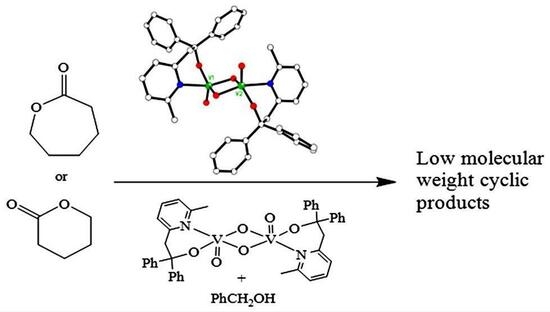
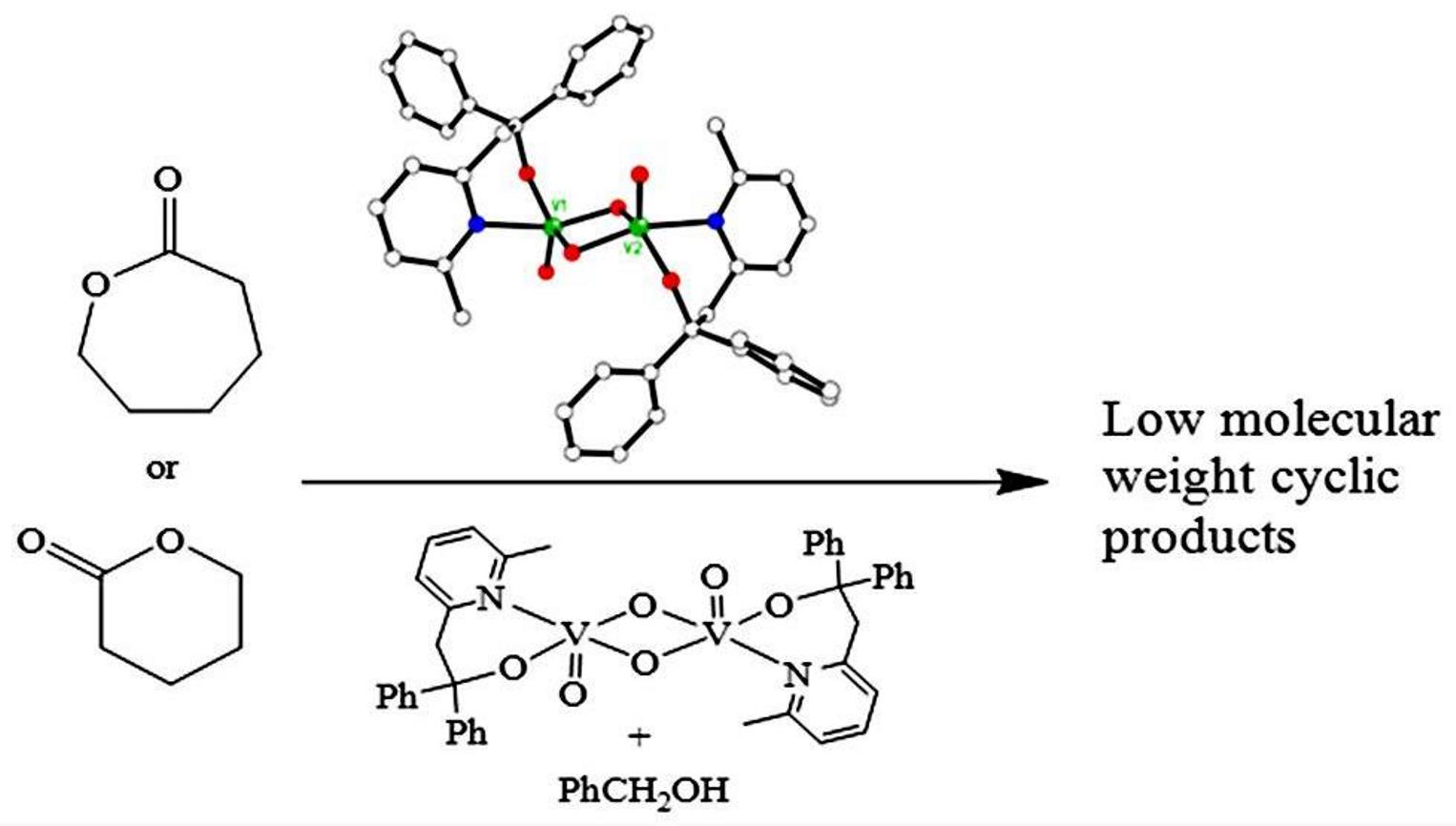
Graphical Abstract

1. Introduction

Plastic pollution continues to be a significant global issue. With this in mind, much research is being devoted to exploring methods of accessing more environmentally friendly polymer products. One possibility that is attracting the attention of coordination chemists is the use of metal catalysts in the ring-opening polymerization (ROP) of cyclic esters [1,2,3,4,5,6,7]. The ability to modify the ligation at the metal allows for control over not only the catalytic behaviour of the catalyst but can also greatly influence the resulting polymer properties [8]. For such a catalytic system, it is useful to employ earth-abundant elements as the catalytic centre. A number of such elements have been utilised to good effect in ROP systems, and these include the likes of zinc [9,10,11,12,13,14,15,16,17], aluminium [18,19,20,21,22,23,24,25,26,27,28,29,30], calcium [31,32,33,34,35,36,37,38,39], magnesium [40,41,42,43,44,45,46,47,48,49,50,51], potassium [52,53,54,55,56], iron [18,57], and titanium [58]. It is also noteworthy that the use of mixed-metal initiators is proving an effective method for the ROP of cyclic esters on a large scale (e.g., 500 g) [59]. Industrially, the catalyst of choice is tin octanoate, [Sn(Oct)2], due to high reaction/conversion rates and competitive pricing; though it does suffer from the cytotoxicity issues associated with tin species [60].
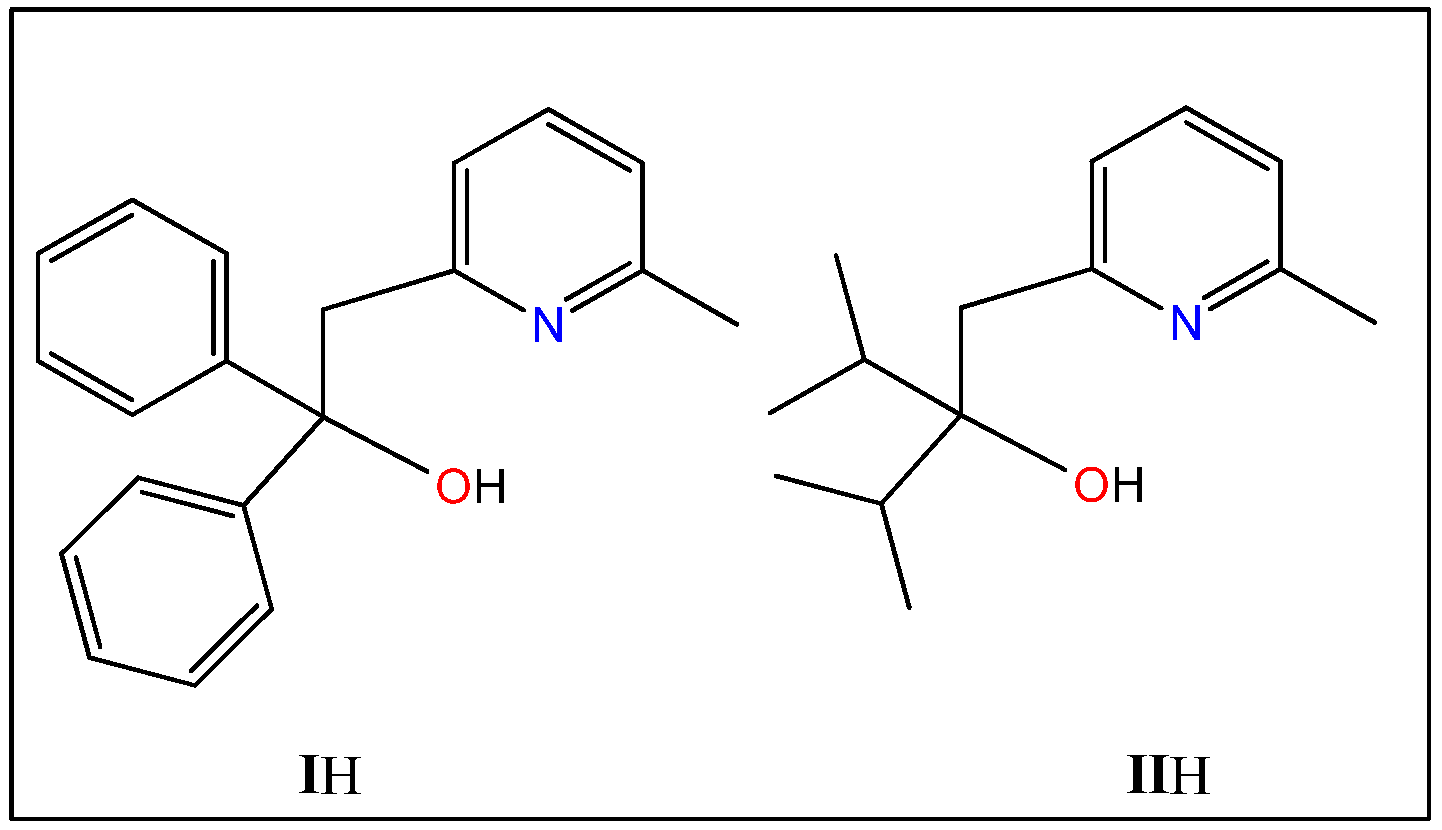
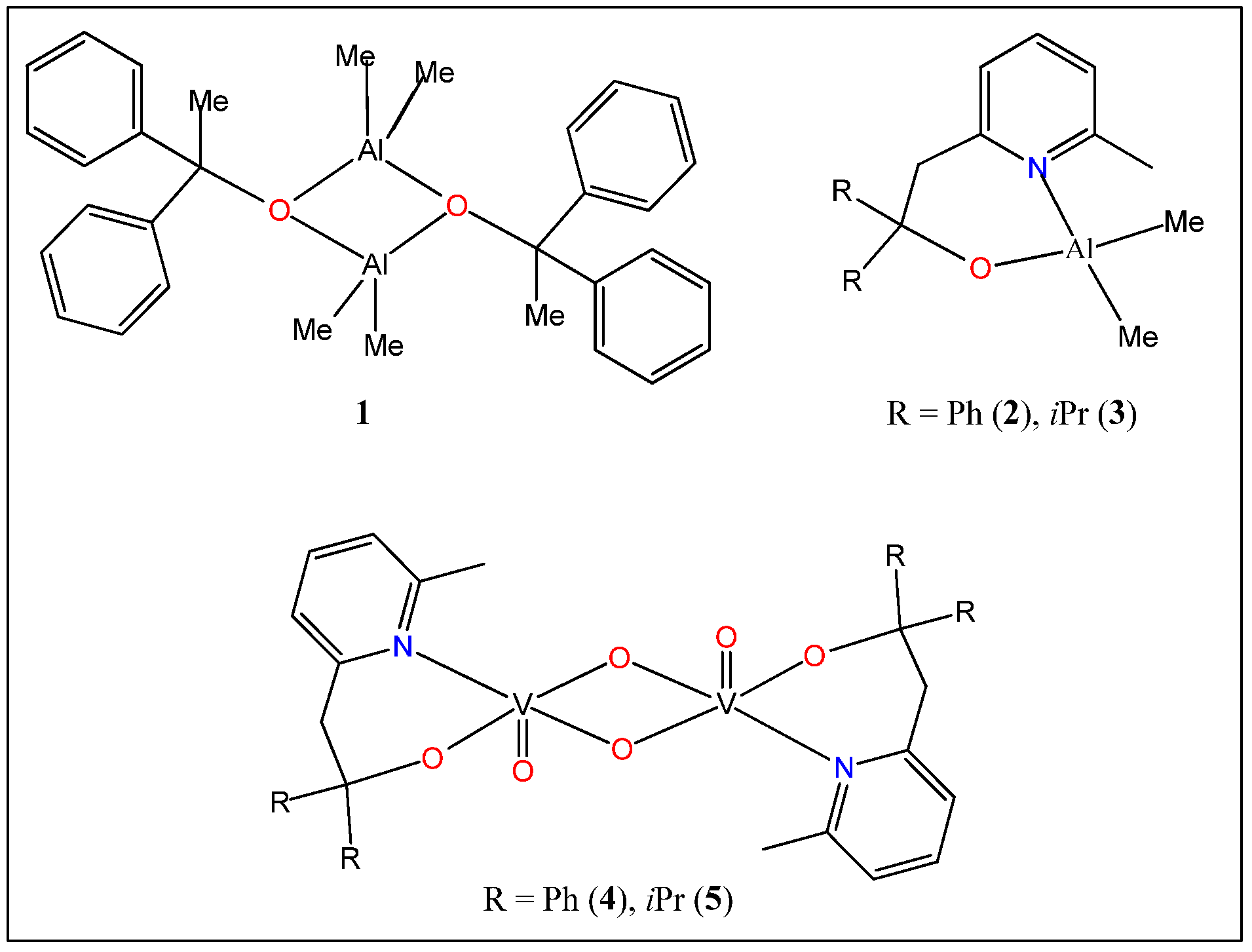
We and others have been exploring the use of the potentially tridentate ligand family 6-bis(o-hydroxyaryl/alkyl)pyridine, 2,6-{HOC(R)2CH2}2(NC5H3) R = Ph or iPr, and a number of titanium and vanadium complexes that are capable of the ROP of ε-CL and rac-lactide were reported [61,62]. In related studies, the use of the bis(pyridine)alkoxide (tBu)C(OH)[CH2(C5H3Me-5)]2 was explored, and it was found to bind in bidentate N,O fashion to vanadium via the pyridine and an alkoxide group [62]. Given this, we decided to extend such studies to N,O-chelates of the type 2-Me,6-{HOC(R)2CH2}(NC5H3) R = Ph (IH) or iPr (IIH), see Chart 1, which are readily available via reaction of n-butyllithium, 2,6-lutidine and the respective ketone [63,64,65]. Herein, we explore the coordination chemistry of the pyridyl alcohols IH and IIH with vanadium (using [VO(OiPr)3]) and aluminium (using Me3Al) and investigate the ROP potential of the resulting complexes 15 (Chart 2).

2. Results and Discussion

2.1. Synthesis of Ligands

The pyridyl alcohols were prepared using the method of Kellogg et al. (phenyl derivative) [63], and by Suzuki et al. (phenyl and isopropyl derivatives) [64,65].

2.2. Aluminium Complexes

We initially reacted IH with Me3Al in refluxing toluene which, following work-up, led to the isolation of the complex [AlMe2(μ-OC(Me)Ph2)]2 (1) in which the lutidine motif had been cleaved off resulting in diphenylethoxide-type ligation. Whilst the exact nature of this reaction remains unclear, we note that there is growing interest in the cleavage of non-strained C–C bonds [66], and examples have been reported where the presence of a 2-pyridyl group plays a key role [67]. Complex 1 can be more conveniently prepared via the use of diphenylethanol with Me3Al in good yield. This second route is more amenable to scale up and follows a well-established pathway, i.e., loss of methane.
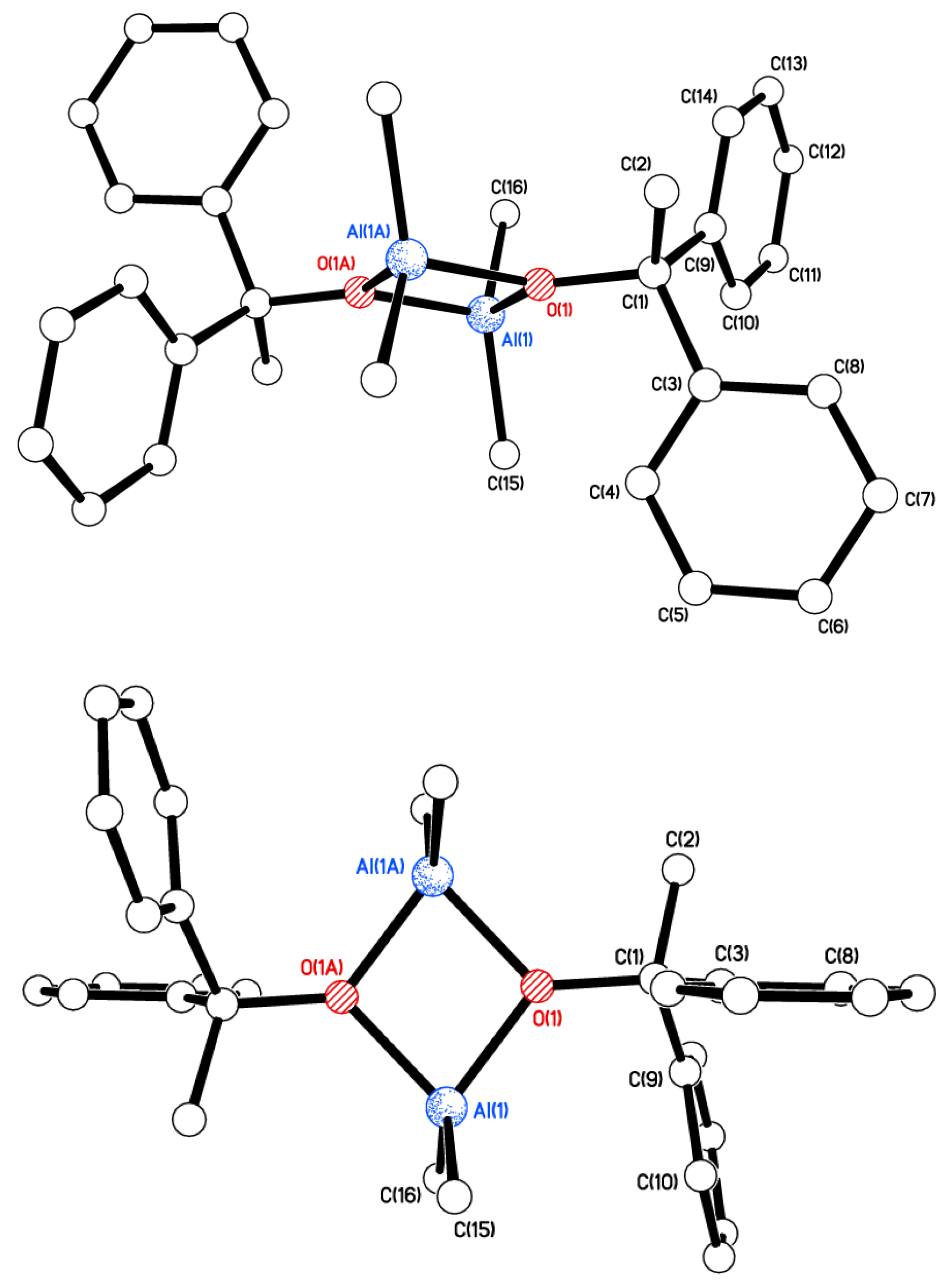
Two views of the molecular structure are shown in Figure 1, with selected bond lengths and angles given in the caption. Two views of the packing 1 are provided in the Supplementary Materials (Figure S1). Half a molecule resides in the asymmetric unit which lies on an inversion centre. Complex 1 can be described as an Al2O2 bridged dimer in which the 4-membered ring is almost symmetrical [Al(1)–O(1) = 1.8562(8) Å and Al(1)–O(1A) = 1.8650(9) Å]. Molecules are arranged in stacks along the x direction with no significant intermolecular interactions.
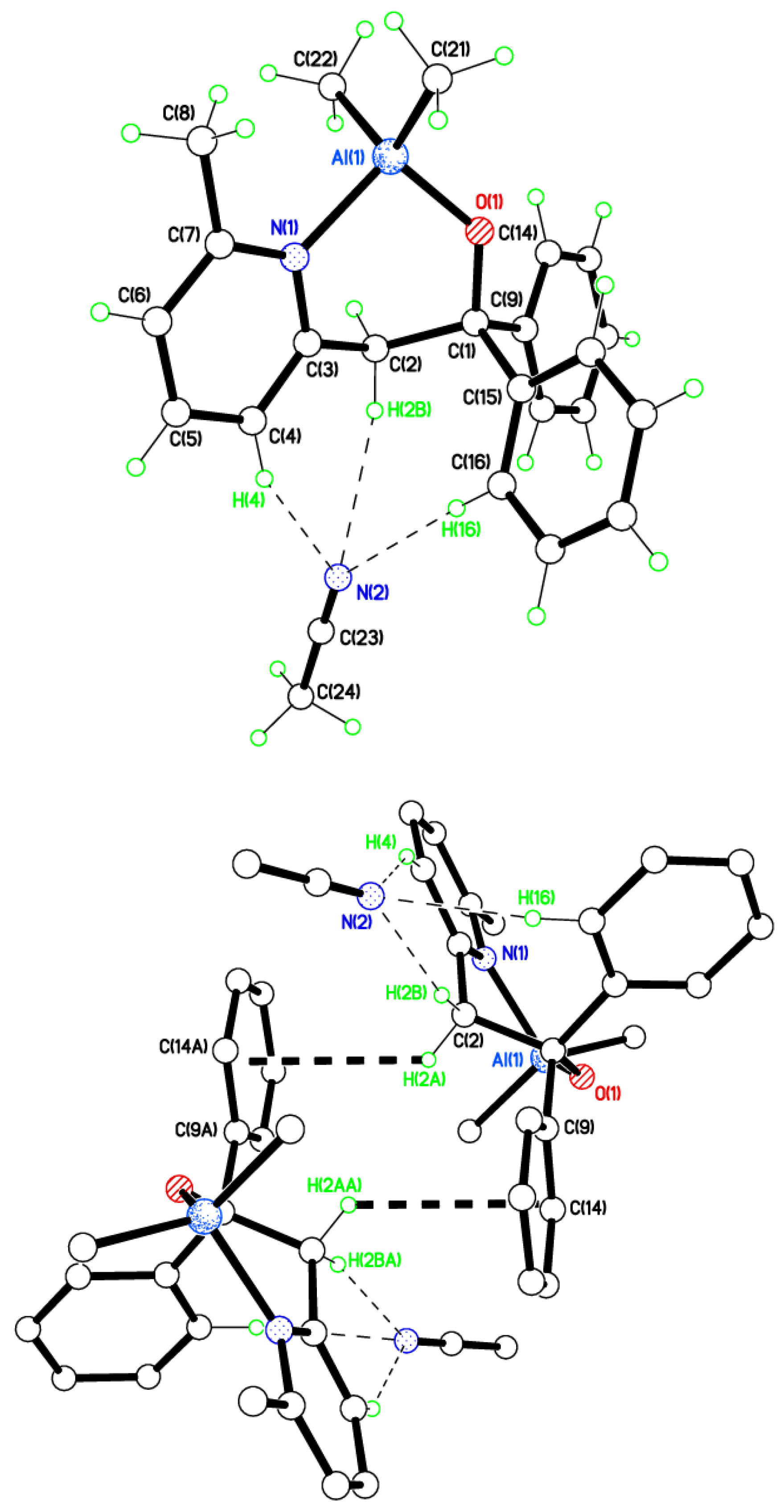
Given the fragmentation of IH during the formation of 1, we then conducted the reaction at ambient temperature which, following work-up, led to the expected product [(I)AlMe2]·MeCN (2·MeCN) in good yield. Two views of the molecular structure are shown in Figure 2, with selected bond lengths and angles given in the caption.
The formula given above is the asymmetric unit. As expected, there is tetrahedral geometry at the Al centre. A boat conformation is adopted by the six-membered chelate ring.
There is one MeCN of crystallisation which H-bonds to three of the CH atoms in the Al complex and so is held in a pocket.
Molecules form centro-symmetric dimer pairs via head-to-tail C–H∙∙∙π interactions. The molecules also form quite slipped π∙∙∙π interactions via overlap of the C(5)/C(6)/C(7) atoms on neighbouring molecules. Combined, these two types of interaction give rise to weakly bound supramolecular chains of molecules in the c direction. A view of the packing in 2 is provided in the Supplementary Materials (Figure S2).
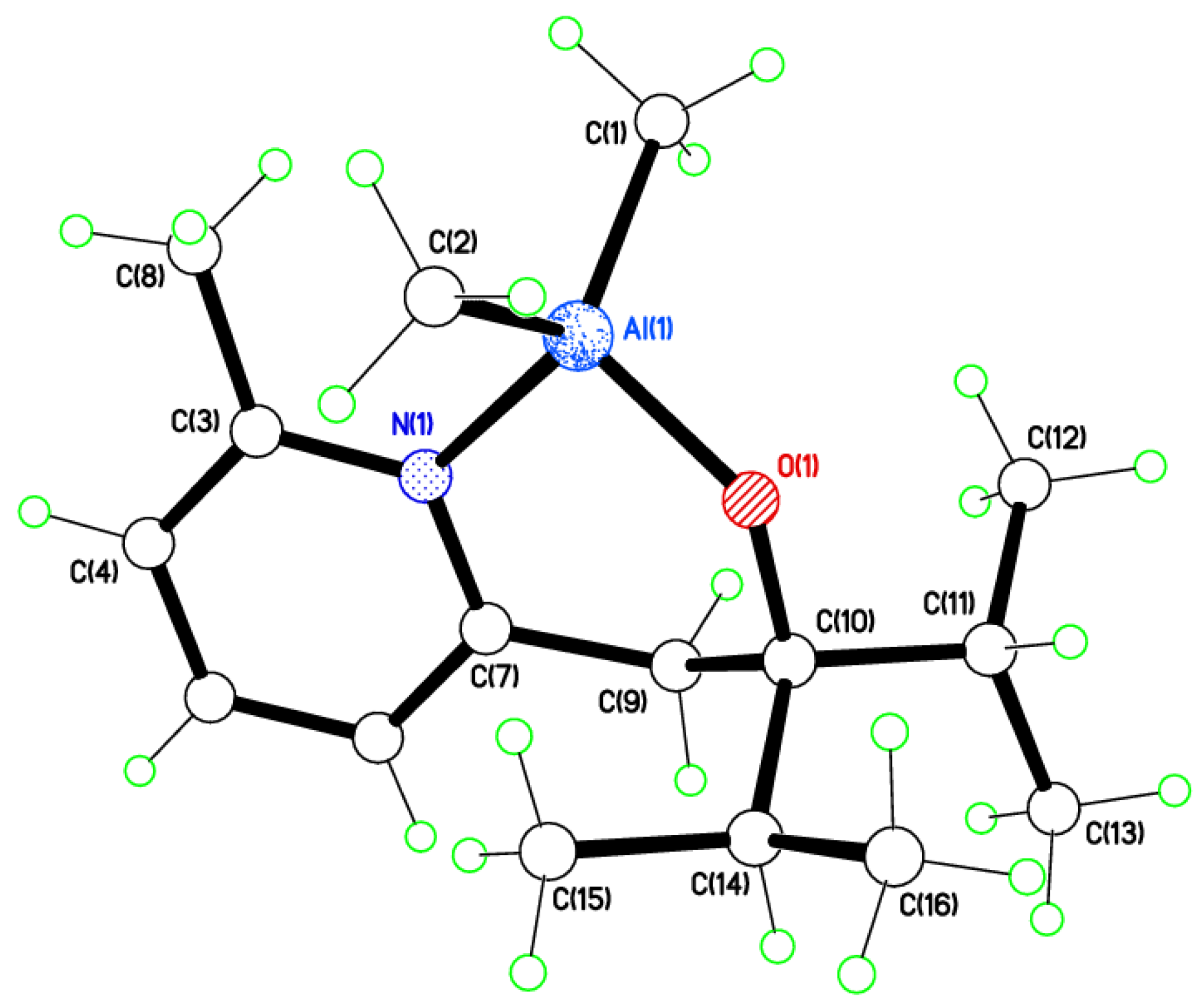
Given the above results, we then treated iPr2C(OH)CH2-2-py-6-Me (IIH) at ambient temperature with Me3Al which, following the same work-up as above, led to the isolation of [(II)AlMe2] (3). The molecular structure is shown in Figure 3, with selected bond lengths and angles given in the caption; an alternative view of 3 is provided in Figure S3 in the Supplementary Materials. There is one molecule in the asymmetric unit. The six-membered chelate ring adopts a distorted boat conformation with Al(1) slightly elevated and C(9) significantly elevated out of the N(1)/O(1)/C(7)/C(10) plane.

2.3. Pyridylalkoxide Vanadium Complexes

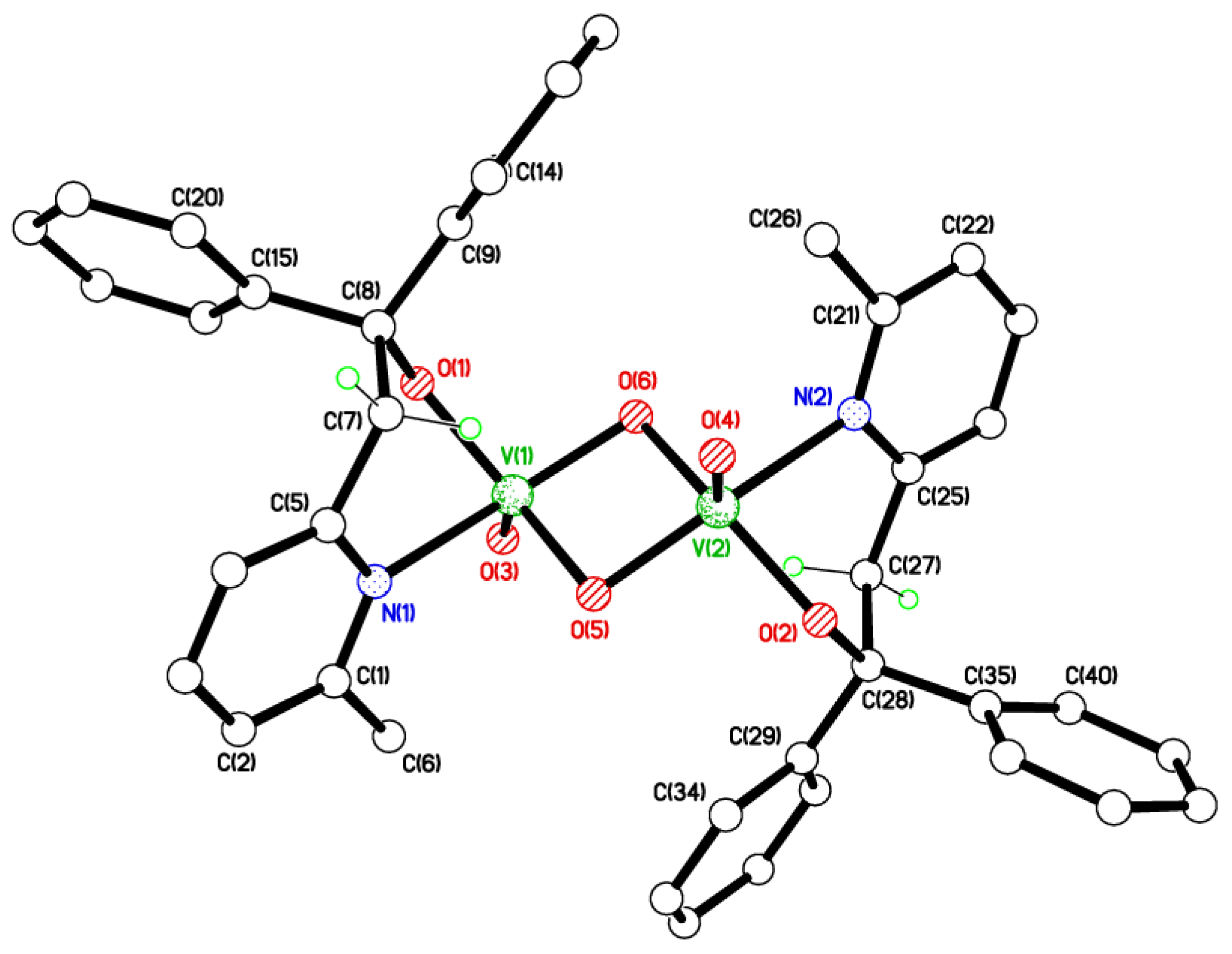
Reaction of IH with [VO(OiPr)3] led, following work-up (MeCN), to small golden/yellow crystals. The molecular structure, as shown in Figure 4, revealed an oxo-bridged structure, namely [(VO)(μ2-O)(I)]2·0.67MeCN (4·0.67MeCN); two alternative views of 4·0.67MeCN are provided in Figure S4 in the Supplementary Materials. There are one and a half complex molecules plus an MeCN of crystallisation present in the asymmetric unit. Unfortunately, the crystal died rapidly in the X-ray beam, hence the poor completeness. However, the connectivity is clearly established. Each vanadium centre is five-coordinate with a square-based pyramidal geometry, with the oxo at the apex and τ = 0.09 [68]. The six-membered chelate rings are boat-shaped with the V and CH2 atoms elevated. We note that a recent data mining and analysis of six-membered vanadium chelate rings revealed that of the 28 structures in the CSD containing the OVN unit, only two possessed six-membered rings with boat conformations, whilst 11 others were considered twist boats [69]. The molecule containing V(1) and V(2) is approximately centrosymmetric but does not lie on a crystallographic centre of symmetry, while that containing V(3) does lie on a crystallographic inversion centre. The oxo dianions form a slightly asymmetric bridge with the bond trans to N being slightly longer. The unique MeCN of crystallisation lies in the cleft of the ligand coordinated to V(3), see Figure S4, Supplementary Materials.
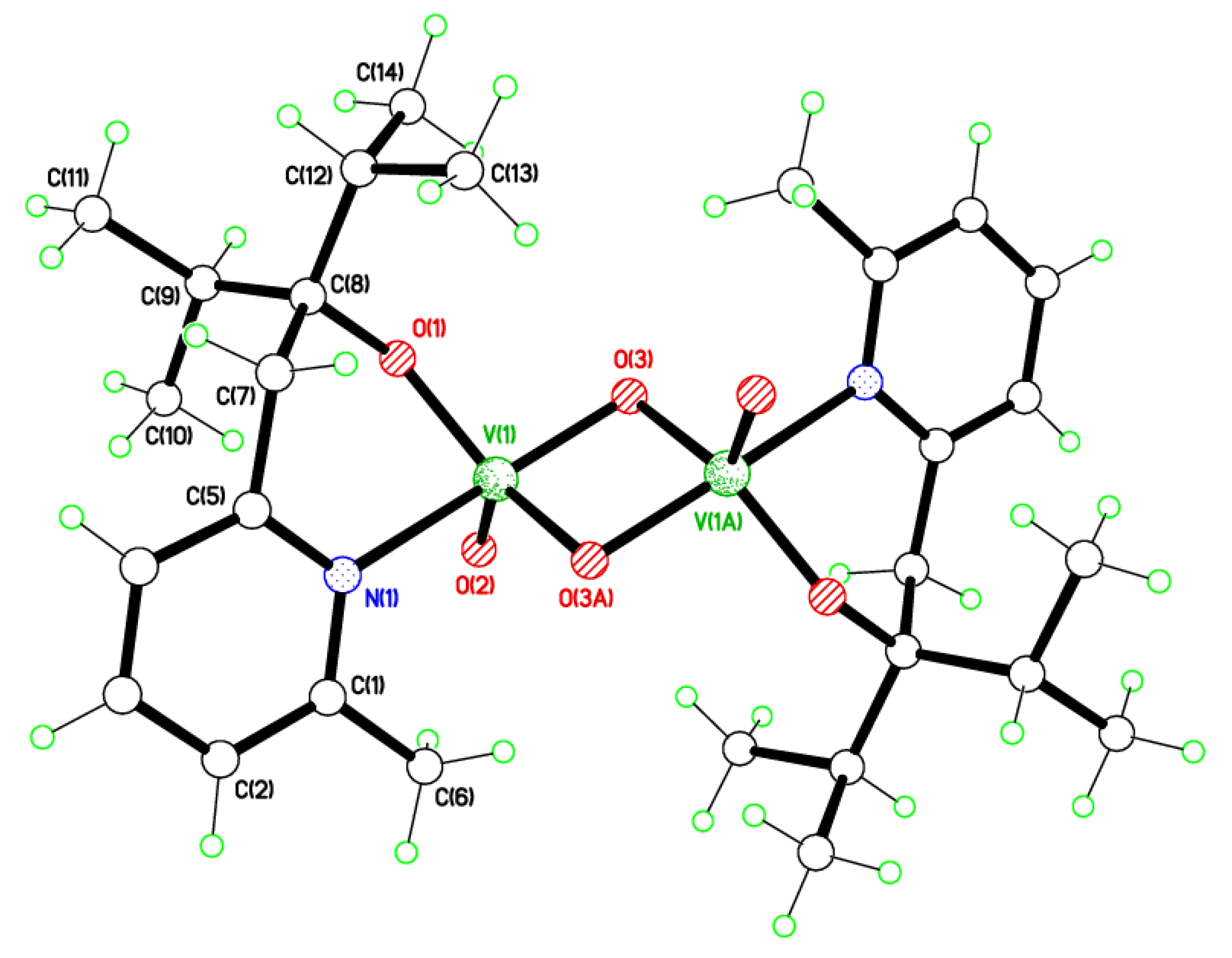
Similar use of IIH and [VO(OiPr)3] led, following work-up, to the isolation of yellow crystalline [(VO)(μ2-O)(II)]2 (5). The molecular structure is shown in Figure 5, with selected bond lengths and angles given in the caption; an alternative view of 5 is provided in Figure S5, Supplementary Materials. Half the molecule is unique and lies on an inversion centre. The vanadium (V) possesses a distorted square-based pyramidal coordination geometry with τ = 0.37 [68]. The oxo bridging bond lengths are close to symmetrical. The six-membered chelate ring adopts a boat conformation with V(1) and C(7) as the bow and stern respectively.

3. Ring Opening Polymerization (ROP)

3.1. Ring Opening Polymerization

Complexes 1 to 5 have been screened for their ability to act as catalysts for the ROP of ε-caprolactone (ε-CL) and δ-valerolactone (δ-VL), both in solution and as melts in the presence of varying amounts of benzyl alcohol (BnOH); the results are presented in Table 1 (ε-CL) and Table 2 (δ-VL).

3.1.1. ε-Caprolactone (ε-CL)

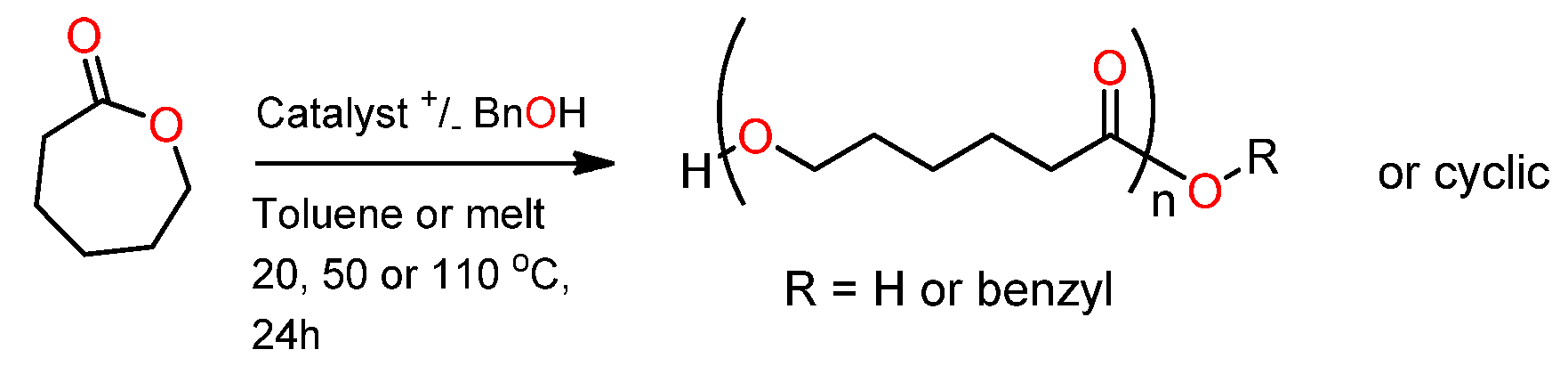
The ratio of 500:1 for [ε-CL]:[M] was selected for these studies (Figure 6) based on our results using other aluminium- and vanadium-based systems [62,70]. Results using 1 revealed near-quantitative conversion between ambient temperature and 110 °C in toluene over 24 h (entries 1–4, Table 1). The molecular weight (Mn) peaked at ambient temperature (48,290 Da), falling to about half this value as the temperature increased. When employed as a melt (entry 5, Table 1), a conversion of 84% was observed with bimodal behaviour and affording low-molecular-weight (Mn) products. All systems exhibited similar control (Ð = 1.05–1.38).
Table 1. The ROP of ε-CL catalysed by 15.
EntryCatalystTemp (°C)Monomer:M:BnOHConv. a
(%)
Mnb,c
(kDa)
Ð b
1120500:1:2>9948,2901.16
2150500:1:4>9924,3901.09
31110500:1:1>9925,240/9801.38/1.01
41110500:1:2>9926,2201.21
5 d1110500:1:4848410/30301.05/1.15
6220500:1:2<15901.09
72110500:1:26614,740/9501.32/1.75
8 d2110500:1:2892410/10201.21/1.03
9320500:1:2221001.09
103110500:1:067--
113110500:1:2>9950,680/21801.05/1.01
12 d3110500:1:4>9927,230/65301.33/1.15
13420500:1:27613901.05
14450500:1:2>992800/17601.05/1.01
154110500:1:02713801.19
164110500:1:288560/12401.29/1/17
17 d4110500:1:2>9955301.17
18520500:1:2369001.03
195110500:1:2603870/21101.08/1.01
20 d5110500:1:2>9920901.21
a Determined by 1H NMR spectroscopy. b Measured by GPC in THF relative to polystyrene standards; c Mn calculated values after Mark–Houwink correction [71,72]; Mn corrected = 0.56 × Mn obsd. d Conducted as a melt. All runs conducted over 24 h unless specified.
Table 2. The ROP of δ-VL catalysed by 15.
EntryCatalystTemp (°C)Monomer:M:BnOHConv. a
(%)
Mnb,c
(kDa)
Ð b
1120100:1:2>9920,670/30701.47/1.13
2120500:1:2>9938,0501.09
3150500:1:2>9936,4501.07
4150500:1:4>9913,1601.24
51110500:1:2>9911,6701.09
61110500:1:4>9911,900/35901.31/1.05
7 d1110500:1:2>9930,8301.12
8220500:1:2897201.07
92110500:1:2>992410/9501.17/1.03
10 d2110500:1:2>992740/10701.07/1.03
11320500:1:2>996901.22
123110500:1:2>9918001.26
133110500:1:0>9932,2101.22
14 d3110500:1:28819101.40
15420500:1:2>9913601.11
16450500:1:2>992450/9701.16/1.03
174110500:1:0>9917401.15
18 d4110500:1:2>9932501.24
19520500:1:2>9923201.22
20550500:1:2>9914501.14
215110500:1:28637001.13
22 d5110500:1:2>9929201.16
a Determined by 1H NMR spectroscopy. b Measured by GPC in THF relative to polystyrene standards; c Mn calculated values after Mark–Houwink correction [71,72]; Mn corrected = 0.57 × Mn obsd. d Conducted as a melt. All runs conducted over 24 h unless specified.
In the case of 2, conversions were less impressive, particularly in solution (entries 6 and 7, Table 1), presumably due to aluminium centre being less accessible (versus in 1). Bimodal behaviour was observed at high temperature, and the molecular weight (Mn) of the product isolated when 2 was employed as a melt was much lower (≤2410 Da). Conversions using 3 were similar to 2, though the molecular weights (Mn) were considerably higher particularly at high temperature (entries 11 and 12, Table 1).
In the case of vanadium complex 4, when employed in solution (toluene), high conversion was noted at ambient temperature (entry 13, Table 1), which peaked at 50 °C (entry 14, Table 1) and then fell dramatically at 110 °C (entries 15 and 16, Table 1). Bimodal behaviour was observed at these higher temperatures, with low molecular weights being afforded in all cases, albeit with reasonable control (Đ ≤ 1.29). When employed as a melt, 4 exhibited near-quantitative conversion (entry 17, Table 1). In the case of the isopropyl derivative 5, only moderate conversion was noted in solution, but with near-quantitative conversion when employed as a melt (entry 20, Table 1); in all cases, low-molecular-weight (Mn) products were formed (≤3870 Da).
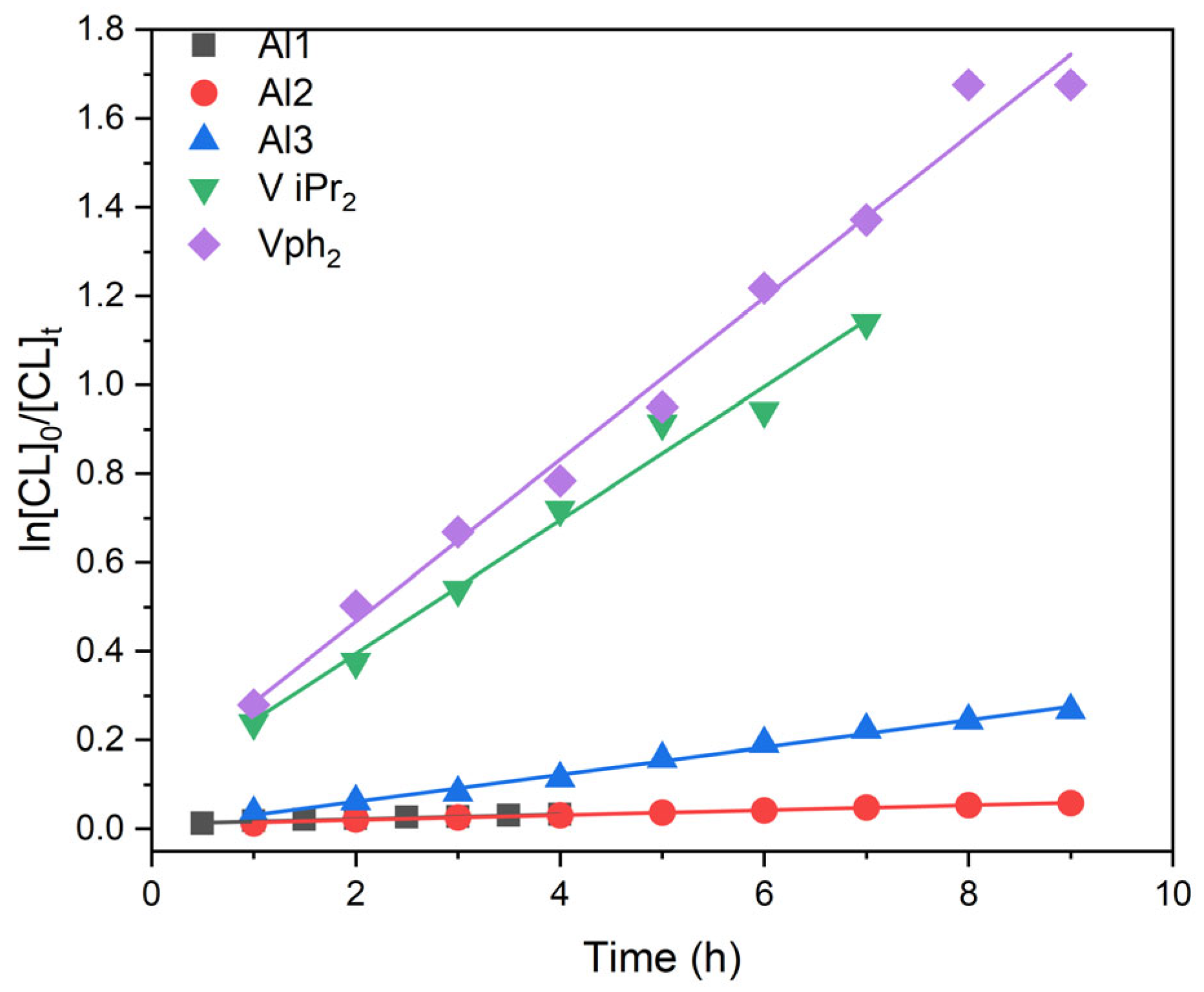
A kinetic study (Figure 7) conducted using 500:1:2 ([ε-CL]:[Cat]:[BnOH]) for 13 and 500:1:0 for 4 and 5 under N2 as a melt revealed the rate trend 4 > 5 >> 3 > 23. The two vanadium complexes clearly outperform the aluminium complexes in terms of rate, with 4 slightly better than 5 which may well be due to its slightly better solubility. Within the aluminium series, complex 3/BnOH performs best, presumably due to favourable steric factors. For the individual kinetic traces see Figure S6 in the Supplementary Materials.
Representative GPC traces for the PCL formed are given in Figure S7–S14, Supplementary Materials.
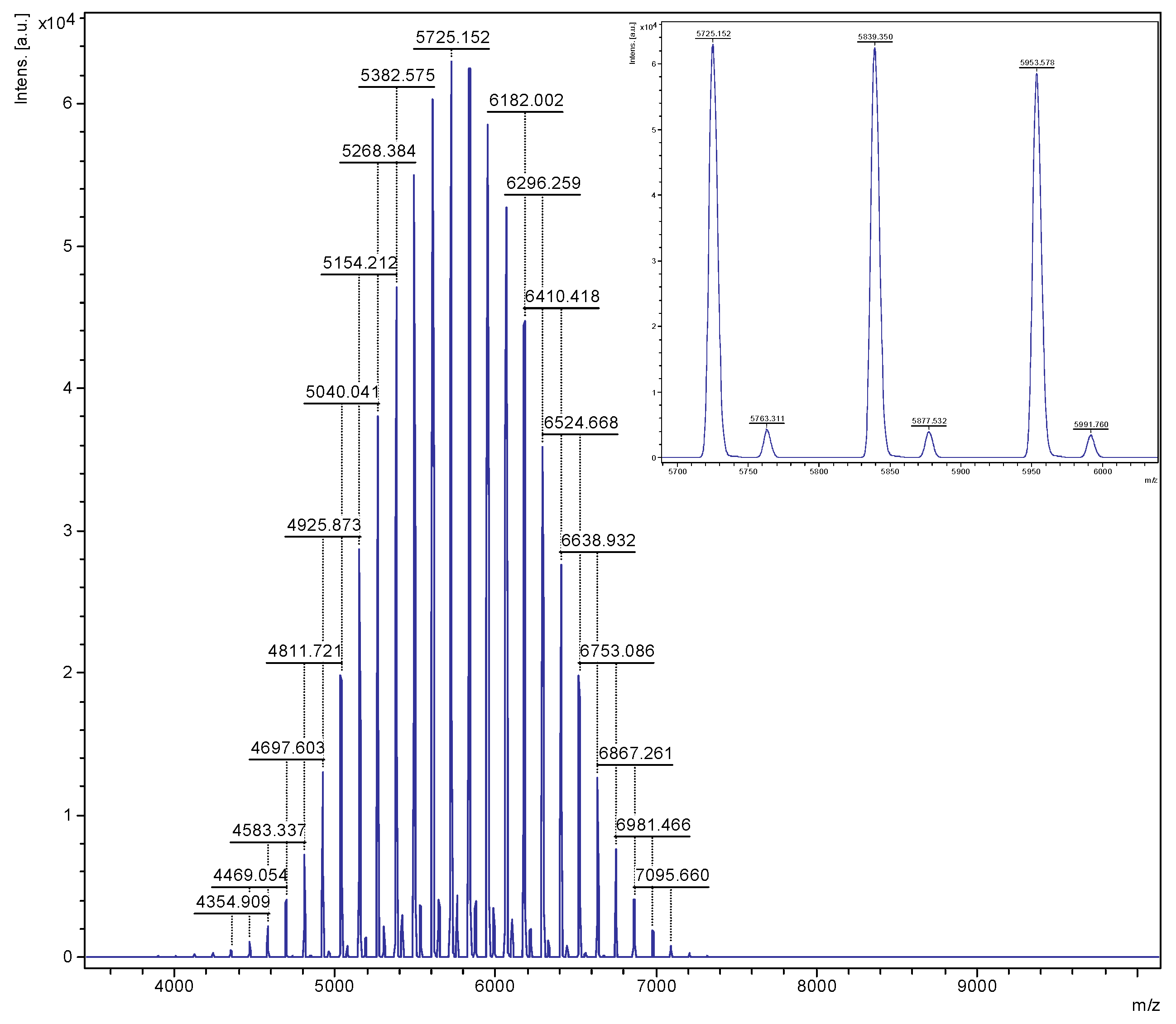
To further verify the end groups present, the PCL samples were analysed by MALDI-ToF mass spectrometry. A representative example is shown in Figure 8 (see also Figure S15–S17, Supplementary Materials), and in each case, one main family of polymers was evident as sodium adducts with end groups comprising BnO/H. Cyclic polymers (as potassium adducts) and a minor family of linear polymers with H/OH end groups as potassium adducts were observed when using 5.

3.1.2. Comparison with Other Systems (ε-CL)

In order for meaningful comparison, it is important that the systems have been evaluated under the same conditions. In the Supplementary Materials, tabulated data is present for aluminium (Table S1, Supplementary Materials), and vanadium-based systems (Tables S2 and S4, Supplementary Materials) as well as the commercial catalyst [Sn(Oct)2] (Tables S3 and S5, Supplementary Materials), all of which have been screened under the same conditions as herein.
On comparison with the tetranuclear species A (Figure S18, Supplementary Materials) [73], complex 1 competes favourably in terms of conversion at ambient temperature, affording a PCL product of slightly lower molecular weight (cf entry 1, Table S1, Supplementary Materials). Complex 1 also exhibits superior control versus A, which given the differing aluminium centres in A is not unexpected. Complexes 2 and 3 require elevated temperatures (110 °C) to compete with the conversions exhibited by A at room temperature, with the increased temperature allowing 3 to achieve similar molecular weights (Mn) to A.
In the case of the vanadium complexes 4 and 5, comparisons can be made versus the systems B, C and D (Figure S19, Supplementary Materials) which bear chelating ligands involving bound pyridine [62].
At lower temperatures, 4 outperforms B and D (entries 1 and 11, Table S2, Supplementary Materials) in terms of conversion, molecular weight (Mn) and control (Đ). However, as the temperature increases to 110 °C, B and D exhibit enhanced thermal stability, with the conversion using 4 peaking at 50 °C in solution. When employed as melts, 4 has the higher conversion (versus B and C, entries 6 and 9, Table S2, Supplementary Materials) and is on a par with D (entry 12, Table S2, Supplementary Materials) with 4 affording the higher molecular weight albeit with slightly less control. Complex 5 competes in terms of conversion and molecular weight (Mn) with D (entry 10, Table S2, Supplementary Materials), but with better control (Đ).
When compared against tin octanoate (Table S3, Supplementary Materials) [74], the aluminium system 1 and vanadium systems 4 and 5 perform better at lower temperatures (cf entries 5 and 6, Table S3, Supplementary Materials). At higher temperatures, especially in solution, [Sn(Oct)2] affords higher molecular weight (Mn) than the systems herein (e.g., entry 1, Table S3, Supplementary Materials), albeit with worse control (Đ).

3.1.3. δ-Valerolactone (δ-VL)

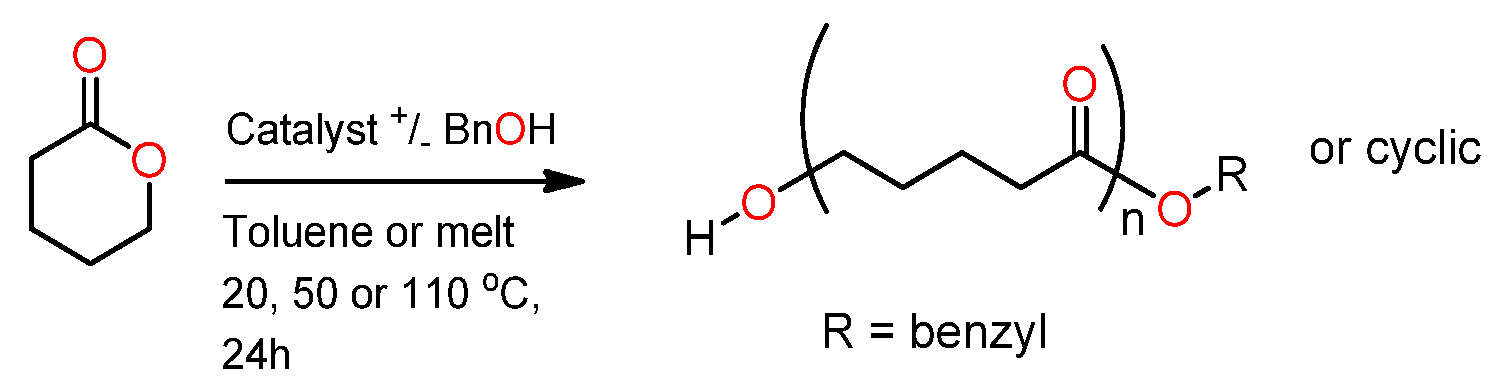
Data for the ROP of δ-VL (Figure 9) is presented in Table 2. Runs were recorded at 20 °C, 50 °C, and 110 °C in toluene with or without BnOH present, and as melts. For 1/BnOH, under all conditions, near-quantitative conversions were observed. In solution, the molecular weight (Mn) peaked (38,050 Da) at ambient temperature using 500:1:2 (entry 2, Table 2) and decreased rapidly as the temperature increased to 110 °C (entry 5, Table 2). However, when employed as a melt (entry 7, Table 2), high molecular weight (Mn) was again achieved.
Under similar conditions, conversions using 2/BnOH were similar (entries 8-10, Table 2), however the observed molecular weights (Mn) were far lower (≤2740 Da), with bimodal behaviour observed at high temperature.
In the case of 3/BnOH, conversions were high at all temperatures, with products of similar molecular weight (Mn) to 2/BnOH observed. In the absence of BnOH (entry 13, Table 2), higher molecular weight (Mn) was achieved.
For the vanadium-based systems 4 and 5, only low-molecular-weight (Mn ≤ 3879 Da) products were observed, with the phenyl derivative 4 achieving high conversion at all temperatures (entries 15–18, Table 2), whereas the iPr derivative 5 exhibited near-quantitative conversion at lower temperatures and as a melt (entries 19, 20 and 22, Table 2) with the conversion falling slightly to 86% in solution at 110 °C (entry 21, Table 1).
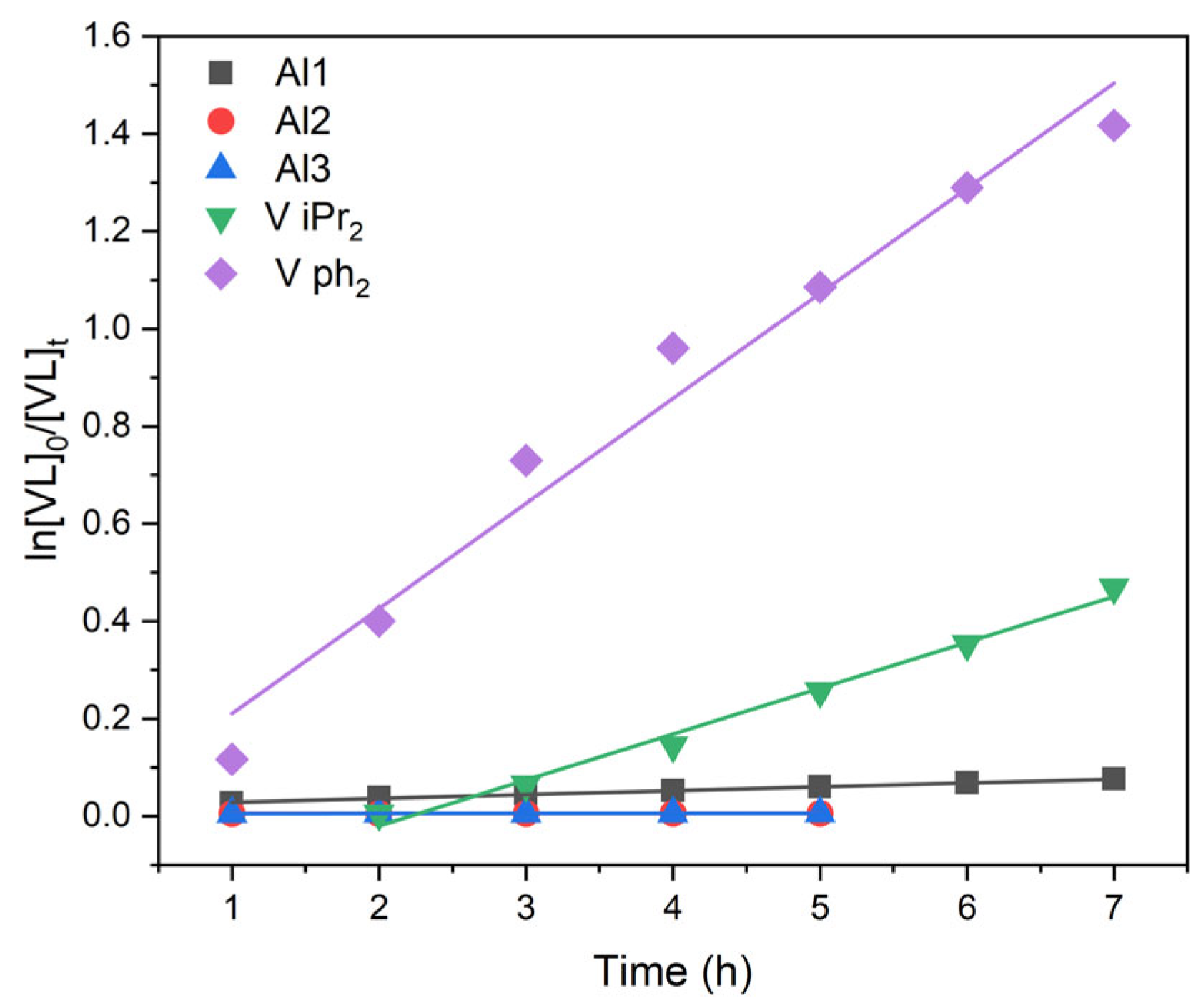
A kinetic study (Figure 10) conducted using 500:1:2 ([δ-VL]:[Cat]:[BnOH]) for 13 and 500:1:0 for 4 and 5 under N2 as a melt revealed the rate trend 4 >> 5 > 1 > 23. In this case, vanadium complex 4 clearly outperforms the aluminium complexes 13 in terms of rate, whilst 5 is only slightly better (than 13) over the time period studied. The three aluminium complexes exhibit almost the same rates with 1/BnOH only slightly better than 2/BnOH and 3/BnOH.
For the individual kinetic traces see Figure S20 in the Supplementary Materials.
Representative GPC traces for the PVL formed are given in Figure S21–S24, Supplementary Materials.
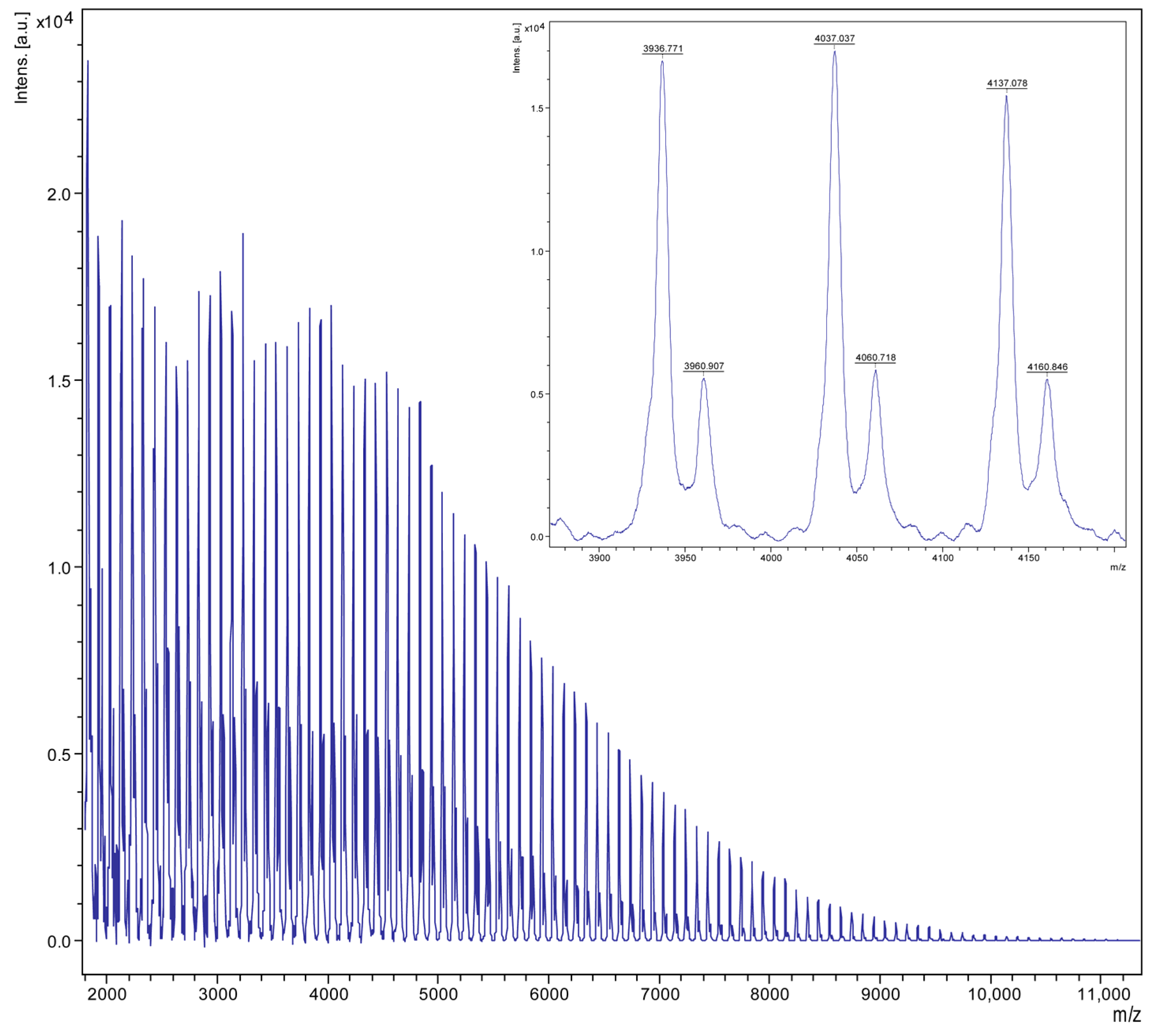
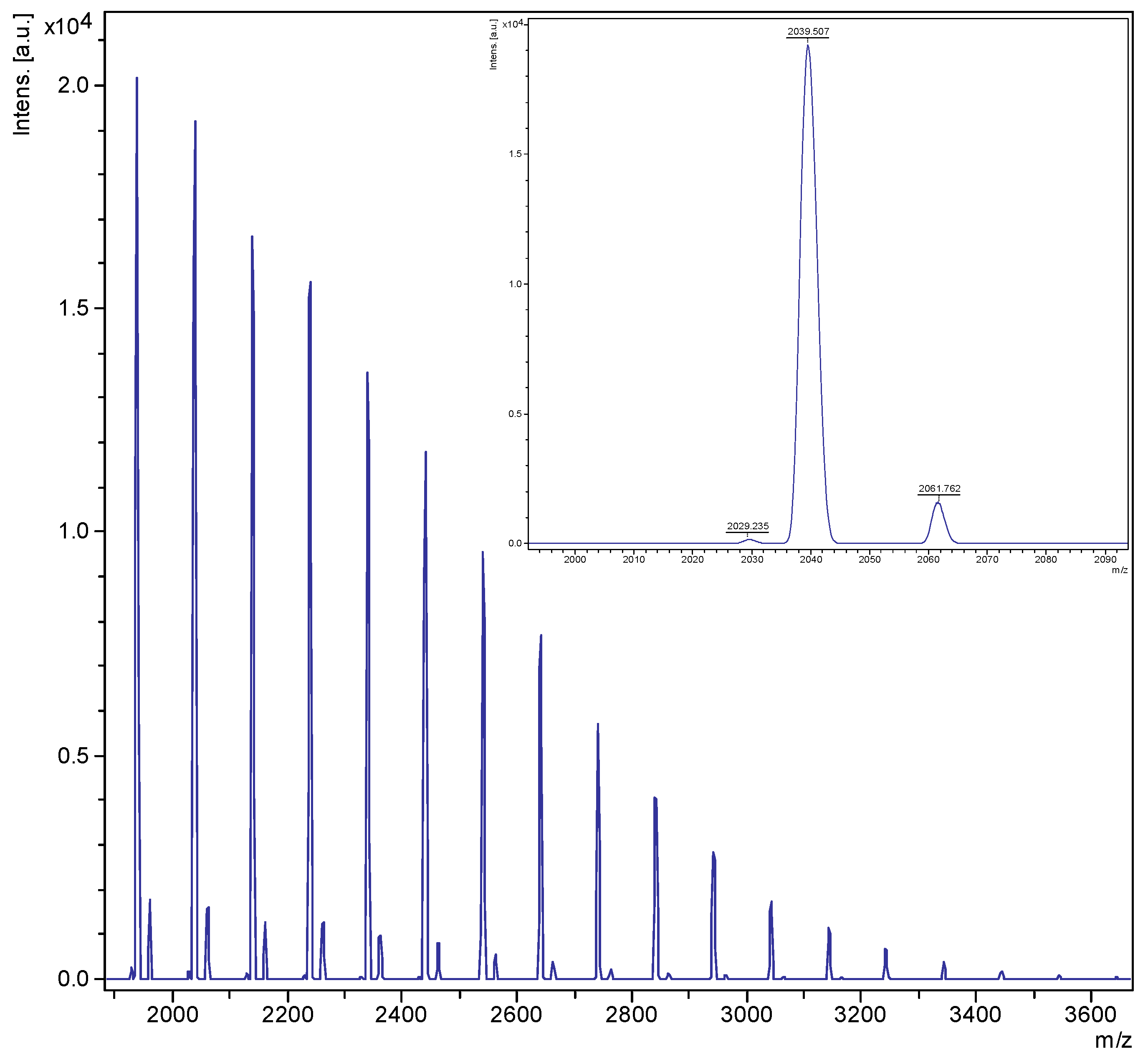
As for the PCL, analysis of the polymers by MALDI-ToF (Figure 11 and Figure 12, see also Figures S25 and S26, Supplementary Materials) revealed the formation of chain polymers, as sodium adducts, with end groups comprising BnO/H. However, in the majority of cases, cyclic products, as potassium adducts, were also evident.

3.1.4. Comparison with Other Systems (δ-VL)

Aluminium complex A (Figure S18, Supplementary Materials) was not screened for δ-VL polymerization [73]. The vanadium complexes B, C and D (Figure S19, Supplementary Materials) were screened as melts only (Table S4, Supplementary Materials) [62], for which observed conversions, molecular weights (Mn) and control (Đ) were all lower than observed herein for 4 and 5. Comparison with [Sn(Oct)2] (Table S5, Supplementary Materials) [74] revealed better conversion for 4 and 5 at ambient temperature with similar molecular weight (Mn) products afforded. At higher temperatures (110 °C), and as melts, 4 and 5 compete with [Sn(Oct)2] in terms of conversion; although in most cases the molecular weight (Mn) using the latter tended to be higher; the control (Đ) was superior when using 4 and 5.

3.1.5. Copolymerization of ε-CL and δ-VL

Given the high activity exhibited by 4 for the homopolymerization runs, we selected this system for a preliminary investigation of its copolymerization potential for ε-CL with δ-VL. Use of the conditions of 250:250:1:2 for [ε-CL]:[δ-VL]:[4]:[BnOH] at 110 °C over 24 h in toluene revealed incomplete conversion (ca. 80%), affording a polymer of moderate molecular weight (Mn = 14,500 Da) with relatively narrow dispersity (Đ 1.46). 1H NMR spectroscopic analysis (Figure S27, Supplementary Materials) of the crude reaction mixture suggested a Cl:VL ratio of 50:50 and was consistent with the presence of BnO/H end groups. The copolymer composition was further investigated by 13C NMR spectroscopy, and peaks associated with the CL-VL, CL-CL, VL-VL and VL-CL dyads were observed between 64.3 and 63.9 ppm (Figure S28, Supplementary Materials). The number average sequence for CL and VL was found to be about 2.4 and 1.7 respectively, with a randomness degree (R) of about 1.0 compatible with a random-type copolymer [75,76,77].

4. TGA Measurements

The stability of the complexes at the polymerization temperature was checked by TGA. The runs indicated that the systems 1, 3, 5 were stable beyond 200 °C, and in the case of 2∙MeCN and 4∙0.67MeCN, only solvent of crystallisation (MeCN) was lost (with calc./obsv. values of ~7%) (see Figure S29 in the Supplementary Materials).

5. Experimental Section

5.1. General

All reactions were conducted under an inert atmosphere using standard Schlenk techniques. Toluene was dried over sodium, acetonitrile was distilled from calcium hydride, and all solvents were degassed prior to use. IR spectra (nujol mulls, KBr windows) were recorded on a Nicolet (Nicolet, QC, Canada) Avatar 360 FTIR spectrometer; NMR spectra were recorded at 400.2 MHz on a JEOL (Peabody, MA, USA) ECZ 400S spectrometer, with residual protic solvent as the internal standard. Chemical shifts are given in ppm (δ) and coupling constants (J) are given in Hertz (Hz). Elemental analyses were performed by the elemental analysis service at London Metropolitan University or Xi’an Rare Metal Materials Research Institute Co., Ltd. (Xi’an, China).
Matrix-assisted laser desorption/ionisation time-of-flight (MALDI-ToF) mass spectrometry was performed in a Bruker (Billerica, MA, USA) autoflex III smart beam in linear mode, and the spectra were acquired by averaging at least 100 laser shots.
For the TGA runs, data were collected on a PerkinElmer TGA 400 (Shelton, CT, USA) using PyrisTM software and a rate of 10 °C per min over the 30 °C to 800 °C under N2. Sample weights were typically between 3 and 5 mg. Molecular weights were calculated from the experimental traces using the OmniSEC software, v 11.35 (Malvern Panalytical Ltd., Malvern, Worcestershire, UK).
ε-Caprolactone (Fisher Scientific, Loughborough, UK) and δ-valerolactone (Sigma Aldrich, Gillingham, UK) were dried over CaH2 and then distilled. The known compounds IH and IIH were prepared by the literature methods [63,64,65]. The reagent Me3Al was purchased from Sigma Aldrich and was used as received. [VO(OiPr)3] was purchased from TCI Chemicals (Tokyo, Japan). The aluminium species 13 are air and moisture sensitive and need to be handled under an inert atmosphere. The vanadium complexes 4 and 5 are less sensitive and can be exposed to air for short periods (e.g., for weighing-out purposes).

5.1.1. Synthesis of [AlMe2(μ-OC(Me)Ph2)]2 (1)

From diphenylethanol: To diphenylethanol (1.00 g, 5.04 mmol) in toluene (20 mL) was added Me3Al (2.52 mL, 2M in toluene, 5.04 mmol) and the system was refluxed for 12 h. On cooling, volatiles were removed in vacuo, and the residue was taken up in MeCN (20 mL). Filtration and standing at ambient temperature for 2 days afforded colourless prisms of 1 (Yield 1.10 g, 86%).
From IH: To IH (1.00 g, 3.46 mmol) in toluene (20 mL) was added AlMe3 (1.73 mL, 3.46 mmol, 2.0M solution in toluene) and the system was refluxed for 24 h. On cooling, the volatiles were removed in vacuo, and the residue was extracted into MeCN (20 mL). Standing at 0 °C for 2 days afforded 1 as colourless prisms. Yield: 0.71 g, 81%.
Found: C 75.78, H 7.61%. C32H38Al2O2 requires C 75.57, H 7.53%. IR: 1492m, 1315w, 1261w, 1233w, 1214w, 1189m, 1096w, 1080w, 1049m, 1027m, 984w, 966w, 918m, 900m, 849w, 839w, 774m, 762m, 722s, 694s, 659m, 614w. 1H NMR (C6D6) δ: 7.35 (m, 4H, arylH), 7.34 (m, 4H, arylH), 7.09* (m, 2H, arylH), 7.07 (m, 4H, arylH), 7.06 (m, 2H, arylH), 7.01–6.97 (3xm, 4H, arylH), 1.95 (s, 6H, Me),–0.79 (s, 12H AlMe). *partially obscured by the NMR solvent (see Figure S30, Supplementary Materials). LCMS: 312 (MH+—C14H13O).

5.1.2. Synthesis of [Me2Al(I)]·MeCN (2·MeCN)

To IH (1.00 g, 3.46 mmol) in toluene (20 mL) was added AlMe3 (1.73 mL, 3.46 mmol, 2.0M solution in toluene) and the system was stirred for 24 h. On cooling, the volatiles were removed in vacuo, and the residue was extracted into MeCN (20 mL). Standing at 0 °C for 1 day afforded 2·MeCN as colourless prisms. Yield: 1.01 g, 75.4%. Found: C 74.74, H 6.68, N 4.42%. C22H24AlNO requires C 76.50, H 7.00, N 4.06%. IR: 2920w, 1609s, 1571m, 1311s, 1296m, 1269s, 1224m, 1193s, 1166m, 1126s, 1105s, 1074s, 1025s, 989w, 960m, 936m, 920w, 908w, 878w, 852w, 805s, 789s, 774s, 761m, 749s, 733s, 700s, 661s. 1H NMR (C6D6) δ: 7.71 (dd, 3H, J = 8.4 Hz, J’ = 1.2 Hz, arylH), 7.13 (s, 1H, arylH), 7.11 (bs, 1H, arylH), 7.09 (bs, 4H, arylH), 6.93 (tm, 1H, J = 7.6 Hz, arylH), 6.46 (bt, 1H J = 7.6 Hz, arylH), 6.20 (bd, 1H, J = 7.6 Hz, arylH), 5.82 (bd, 1H, J = 7.6 Hz, arylH), 3.51 (s, 2H, CH2), 2.06 (s, 3H, CH3), −0.19 (s, 6H AlMe2) (see Figure S31, Supplementary Materials).

5.1.3. Synthesis of [Me2Al(II)] (3)

As for 2, but using IIH (1.00 g, 4.52 mmol) and AlMe3 (2.26 mL, 4.52 mmol, 2.0M solution in toluene) affording 3 as colourless prisms. Yield: 0.99 g 79.2%. Found: C 69.57, H 10.30, N 4.73%. C16H28AlNO requires C 69.28, H 10.17, N 5.05%. IR: 2356w, 2291m, 2223w, 1594m, 1579m, 1260s, 1094s, 1019s, 922w, 850w, 799s, 752w, 721w, 702w. 1H NMR (C6D6) δ: 6.66 (m, 1H, arylH), 6.33 (m, 1H, arylH), 6.09 (m, 1H, arylH), 2.71 (s, 2H, CH2), 2.21 (s, 3H, CH3), 1.93 (sept, 2H, J 7.2 Hz, CHMe2), 0.96 (d, 6H, J 7.2 Hz, CHMe2), 0.92 (d, 6H, J 7.2 Hz, CHMe2), −0.28 (s, 6H AlMe2) (see Figure S32, Supplementary Materials). LCMS 386 (M+), 356 (M+—2Me), 340 (M+—2Me—O).

5.1.4. Synthesis of [(VO)(μ2-O)(I)]2·0.67MeCN (4·0.67MeCN)

IH (1.00 g, 4.52 mmol) and [VO(OiPr)3] (1.07 mL, 4.54 mmol) were refluxed in toluene (20 mL) for 12 h. On cooling, volatiles were removed to afford a yellow oily product. Trituration with MeCN (30 mL) afforded 4·0.67MeCN as yellow prisms. Yield: 1.39 g, 79.9%. Found: C 64.42, H 4.67, N 3.60%. C40H36N2O6V2 (sample dried in-vacuo) requires C 64.70, H 4.89, N 3.77%. IR: 2291w, 2223w, 1666m, 1655m, 1600m, 1575m, 1491m, 1317m, 1276m, 1261s, 1223w, 1189w, 1176w, 1154w, 1106s, 1051s, 1021s, 1004s, 985s, 939m, 916m, 876w, 796s, 761s, 724s, 700s, 654s, 639s. LCMS: 744 MH22+.

5.1.5. Synthesis of [(VO)(μ2-O)(II)]2 (5)

As for 4, but using IIH (1.00 g, 4.52 mmol) and [VO(OiPr)3] (1.10 mL, 4.66 mmol) affording 5 as yellow prisms. Yield: 1.02 g, 74.5%. Found: C 55.27, H 7.98, N 4.15%. C28H44N2O6V2 requires C 55.45, H 7.31, N 4.62%. IR: 2001w, 1926w, 1600m, 1574m, 1410m, 1332m, 1262m, 1221w, 1182m, 1168m, 1141w, 1116m, 1094s, 1026s, 990m, 966s, 930m, 912m, 894w, 857w, 801s, 772m, 749m, 735m, 723m, 694s, 667s, 636s.

5.2. Procedure for ROP of ε-Caprolactone or δ-Valerolacone

A toluene solution of pre-catalyst (0.010 mmol, 1.0 mL toluene) was added into a Schlenk tube in the glove box at room temperature. The solution was stirred for 2 min, and then the appropriate equivalent of BnOH (from a pre-prepared stock solution of 1 mmol BnOH in 100 mL toluene) and the appropriate amount of ε-CL (or δ-VL) along with 1.5 mL toluene was added to the solution. For example, for Table 2, entry 5, a toluene solution of pre-catalyst 1 (0.010 mmol, 1.0 mL toluene) was added into a Schlenk tube, then 2 mL BnOH solution (1 mmol BnOH/100 mL toluene) and 20 mmol ε-CL along with 1.5 mL toluene was added to the solution. The reaction mixture was then placed into an oil/sand bath pre-heated at 130 °C, and the solution was stirred for the prescribed time (24 h). The polymerization mixture was quenched on addition of an excess of glacial acetic acid (0.2 mL) into the solution, and the resultant solution was then poured into methanol (200 mL). The resultant polymer was then collected on filter paper and was dried in vacuo. Using this procedure, we isolated up to 5 g of polymer.
For the copolymerization, the monomers (2.5 mmol of each) were initially combined in toluene (5 mL) and then 4/BnOH (0.01 mmol of 4/0.02 mmol of BnOH in 1 mL toluene) was added and the system was heated at 110 °C for 24 h. Work-up was then as above.

5.3. Procedure for the Kinetic Studies

The polymerizations were carried out at 110 °C as melts using 0.010 mmol of complex. The molar ratio of monomer to initiator was fixed at 500:1:2 (for 1–3) and 500:1:0 (for 4 and 5), and at appropriate time intervals, 0.5 μL aliquots were removed (under N2) and were quenched with wet CDCl3. The percent conversion of monomer to polymer was determined using 1H NMR spectroscopy.

5.4. Crystallographic Experimental

All single-crystal batches were grown from saturated solutions of acetonitrile on standing for 1 to 2 days at ambient temperature (for 1, 4·0.67MeCN and 5) or 0 °C (for 2·MeCN and 3). The crystal structures of 1, 2∙MeCN, 3, 4∙0.67MeCN, and 5 were solved [78] and refined [79] routinely, except as described below. Further data is provided in Table 3. Diffraction data were collected on Rigaku 007HF or FRE+ diffractometers equipped with rotating anode X-ray sources, varimax mirrors, and hypix detectors. For 4∙0.67MeCN, the crystal died rapidly in the X-ray beam, so data is somewhat incomplete at ca. 87% coverage. However, the connectivity is clearly established, and most other quality indicators are respectable. CCDC 2487402-6 contain the supplementary crystallographic data for this paper. These data can be obtained free of charge from The Cambridge Crystallographic Data Centre via www.ccdc.cam.ac.uk/structures (accessed on 9 March 2026).

6. Conclusions

Treatment of the pyridylalcohol Ph2C(OH)CH2-2-py-6-Me with Me3Al at elevated temperature (110 °C) leads to loss of lutidine and the formation of the dimer [AlMe2(μ-OC(Me)Ph2)]2 (1). The same complex bearing diphenylethoxide-type ligation is also readily accessible via the treatment of diphenylethanol with Me3Al. By contrast, at ambient temperature, the pyridylalcohols R2C(OH)CH2-2-py-6-Me (R = Ph, IH; iPr, IIH) on reaction with equimolar amounts of Me3Al afford the complexes [(I/II)AlMe2] (I, (2); II, (3)). In the case of the reaction with [VO(OiPr)3], the oxo-bridged complexes [(VO)(μ2-O)(I/II)]2 (I, (4); II, (5)) were isolated.
These aluminium and vanadium systems are active as catalysts for the ROP of ε-caprolactone and δ-valerolactone when employed in solution (toluene) under N2 or as melts. Kinetic profiles indicated that the vanadium complexes, particularly the diphenyl derivative 4, outperformed the aluminium complexes. For PCL, within the aluminium series, complex 1 exhibited best conversions, particularly at lower temperatures, with the highest molecular weight (Mn) achieved at ambient temperature. The better performance of 1 (versus 2 and 3) is thought to be due to the increased space available around the Al centre. For the vanadium complexes, in solution the diphenyl derivative 4 exhibited better conversions at lower temperatures than the isopropyl derivative 5, though the performance of the latter was better at higher temperature. As melts, both systems exhibited near-quantitative conversion.
In the case of PVL, the kinetics profile trend again revealed that the vanadium complexes performed best, especially the system employing 4. For both ε-CL and δ-VL, low-molecular-weight (Mn) products (≤8560 Da) were observed for the vanadium-based systems, whilst for the aluminium systems, higher-molecular-weight (Mn) products were accessible at ambient temperature for 1 (≤48,290 Da for PCL, ≤38,040 Da for PVL). For 2 and 3, despite the related structures, the molecular weights (Mn) of the isolated products differed considerably. For both, the highest molecular weight (Mn) for PCL was observed at 110 °C (14,740 Da for 2, 50,680 Da for 3), whilst for PVL, only low-molecular-weight (Mn) products were observed for 2 (≤2740 Da) and 3 (≤1910 Da). In the absence of BnOH, it was noted for 3 that the molecular weight of the polymer increased significantly.
In all cases, the control was generally good with narrow dispersity Ð in the range 1.01–1.38 for PCL; 1.03–1.47 for PVL. MALDI-ToF mass spectra of the polymers indicated that for the aluminium-based systems, chain polymers (as sodium adducts) with BnO/H end groups as well as cyclic products as sodium or potassium adducts are favoured, whilst for the vanadium-based systems, cyclic products (as potassium adducts) were formed. TGA profiles revealed the complexes were stable at the temperatures employed for the ROP process. Copolymerization of ε-CL and δ-VL using 4/BnOH at 110 °C over 24 h led to incomplete conversion affording a random-type copolymer.

Supplementary Materials

The following supporting information can be downloaded at https://www.mdpi.com/article/10.3390/catal16030259/s1: Figures S1–S5, alternative views of 15. Figure S6, Individual kinetic graphs for PCL. Figures S7–S14, representative GPC traces for PCL. Figures S15–S17, MALDI-ToF spectra of PCL. Figure S18, Structure of aluminium complex A. Table S1, PCL comparison data for catalyst A [71,72,73]. Figure S19, Structures of vanadium complexes BD. Table S2, PCL comparative data for vanadium catalysts B, C and D [62,71]. Table S3, PCL comparative data for [Sn(Oct)2] [71,74]. Figure S20, Individual kinetic graphs for PVL. Figures S21–S24, representative GPC traces for PVL. Figures S25 and S26, MALDI-ToF spectra of PVL. Table S4, PVL comparative data for vanadium catalysts B, C and D. Table S5, PVL comparative data for [Sn(Oct)2]. Figure S27, 1H NMR spectrum of the crude copolymerization mixture. Figure S28, Carbonyl range of the 13C NMR spectrum of the PCL/PVL copolymer. Figure S29, TGA traces for 1–5. Figures S30–S32, representative 1H NMR spectra for 13 [62,71,72,73,74].

Author Contributions

S.S.: Investigation. I.M.: Investigation. M.R.J.E.: Investigation, Writing—review and editing. K.N.: Supervision, Writing—review and editing. C.R.: Conceptualization, Supervision, Writing—original draft, Writing—review and editing. All authors have read and agreed to the published version of the manuscript.

Funding

We thank the Royal Society for support (grant number IECR32113010).

Data Availability Statement

Data are contained within the article and Supplementary Materials.

Acknowledgments

The UK EPSRC National Crystallographic Service at the University of Southampton is thanked for data collection.

Conflicts of Interest

The authors declare that they have no known competing financial interests or personal relationships that could have appeared to influence the work reported in this paper.

References

  1. Labet, M.; Thielemans, W. Synthesis of polycaprolactone: A review. Chem. Soc. Rev. 2009, 38, 3484–3504. [Google Scholar] [CrossRef] [Scilit] [PubMed]
  2. Arbaoui, A.; Redshaw, C. Metal Catalysts for ε-caprolactone polymerisation. Polym. Chem. 2010, 1, 801–826. [Google Scholar] [CrossRef] [Scilit]
  3. Thomas, C.M. Stereo-controlled ring-opening polymerization of cyclic esters: Synthesis of new polyester microstructures. Chem. Soc. Rev. 2010, 39, 165–173. [Google Scholar] [CrossRef] [Scilit] [PubMed]
  4. Sarazin, Y.; Carpentier, J.-F. Discrete Cationic Complexes for Ring-Opening Polymerization Catalysis of Cyclic Esters and Epoxides. Chem. Rev. 2015, 115, 3564–3614. [Google Scholar] [CrossRef] [Scilit]
  5. Gao, J.; Zhu, D.; Zhang, W.; Solan, G.A.; Ma, Y.; Sun, W.-H. Recent progress in the application of group 1, 2 & 13 metal complexes as catalysts for the ring opening polymerization of cyclic esters. Inorg. Chem. Front. 2019, 6, 2619–2652. [Google Scholar] [CrossRef] [Scilit]
  6. Santoro, O.; Zhang, X.; Redshaw, C. Synthesis of biodegradable polymers: A review on the use of Schiff-base metal complexes as catalysts for the Ring Opening Polymerization (ROP) of cyclic esters. Catalysts 2020, 10, 800. [Google Scholar] [CrossRef] [Scilit]
  7. Wu, L.-J.; Lee, W.; Ganta, P.K.; Chang, Y.-L.; Chang, Y.-C.; Chen, H.-Y. Multinuclear metal catalysts in ring-opening polymerization of ε-caprolactone and lactide: Cooperative and electronic effects between metal centers. Coord. Chem. Rev. 2023, 475, 214847. [Google Scholar] [CrossRef] [Scilit]
  8. Munzeiwa, W.A.; Omondi, B.O.; Nyamori, V.O. A perspective into ring-opening polymerization of ε-caprolactone and lactides: Effect of, ligand, catalyst structure and system dynamics, on catalytic activity and polymer properties. Polym. Bull. 2024, 81, 9419–9464. [Google Scholar] [CrossRef] [Scilit]
  9. Yuan, Y.; Jing, X.; Xiao, H.; Chen, X.; Huang, Y. Zinc-based catalyst for the ring-opening polymerization of cyclic esters. J. Appl. Polym. Sci. 2011, 121, 2378–2385. [Google Scholar] [CrossRef] [Scilit]
  10. Walton, M.J.; Lancaster, S.J.; Wright, J.A.; Elsegood, M.R.J.; Redshaw, C. Zinc calixarene complexes for the Ring Opening Polymerization of Cyclic Esters. Dalton Trans. 2014, 43, 18001–18809. [Google Scholar] [CrossRef] [Scilit]
  11. Żółtowska, K.; Sobczak, M.; Olędzka, E. Novel Zinc-Catalytic Systems for Ring-Opening Polymerization of ε-Caprolactone. Molecules 2015, 20, 2816–2827. [Google Scholar] [CrossRef] [Scilit] [PubMed]
  12. Al-Khafaji, Y.F.; Elsegood, M.R.J.; Frese, J.W.A.; Redshaw, C. Ring opening polymerization of lactides and lactones by multimetallic alkyl zinc complexes derived from the acids Ph2C(X)CO2H (X = OH, NH2). RSC Adv. 2017, 7, 4510–4517. [Google Scholar] [CrossRef] [Scilit]
  13. Bai, J.; Xiao, X.; Zhang, Y.; Chao, J.; Chen, X. β-Pyridylenolate zinc catalysts for the ring-opening homo- and copolymerization of ε-caprolactone and lactides. Dalton Trans. 2017, 46, 9846–9858. [Google Scholar] [CrossRef] [Scilit] [PubMed]
  14. Petrus, R.; Sobota, P. Magnesium and zinc alkoxides and aryloxides supported by commercially available ligands as promotors of chemical transformations of lactic acid derivatives to industrially important fine chemicals. Coord. Chem. Rev. 2019, 396, 72–88. [Google Scholar] [CrossRef] [Scilit]
  15. Chen, J.; Wu, X.; Zhang, L.; Duan, Z.; Liu, B. Ring-opening polymerization of ε-caprolactone mediated by a di-zinc complex bearing a macrocyclic thioether-phenolate [OSSO]-type ligand. Polym. Chem. 2022, 13, 2971–2979. [Google Scholar] [CrossRef] [Scilit]
  16. Su, R.-R.; Ganta, P.K.; Cheng, C.A.; Hu, Y.-T.; Chamg, Y.-C.; Chang, C.-J.; Ding, S.; Chen, H.-Y.; Wu, K.-H. Ring-opening polymerization of ε-caprolactone and L-lactide using ethyl salicylate-bearing zinc complexes as catalysts. Mol. Catal. 2023, 537, 112965. [Google Scholar] [CrossRef] [Scilit]
  17. Naik, S.S.; Vedpathak, S.; Nair, K.S. Optimization and mechanistic insights of zinc ascorbate catalysts for ring opening polymerization of caprolactone using RSM methodology and DFT calculations. Polym. Adv. Technol. 2025, 36, e70182. [Google Scholar] [CrossRef] [Scilit]
  18. Wang, Y.; Wang, X.; Zhang, W.; Sun, W.-H. Progress of Ring-Opening Polymerization of Cyclic Esters Catalyzed by Iron Compounds. Organometallics 2023, 42, 1680–1692. [Google Scholar] [CrossRef] [Scilit]
  19. Iwasa, N.; Fujiki, M.; Nomura, K. Ring-opening polymerization of various cyclic esters by Al complex catalysts containing a series of phenoxy-imine ligands: Effect of the imino substituents for the catalytic activity. J. Mol. Catal. A Chem. 2008, 292, 67–75. [Google Scholar] [CrossRef] [Scilit]
  20. Liu, J.; Iwasa, N.; Nomura, K. Synthesis of Al complexes containing phenoxy-imine ligands and their use as the catalyst precursors for efficient living ring-opening polymerisation of ε-caprolactone. Dalton Trans. 2008, 3978–3988. [Google Scholar] [CrossRef] [Scilit]
  21. Iwasa, N.; Katao, S.; Liu, J.; Fujiki, M.; Furukawa, Y.; Nomura, K. Notable effect of fluoro substituents in the imino group in ring-opening polymerization of ε-caprolactone by Al complexes containing phenoxyimine ligands. Organometallics 2009, 28, 2179–2187. [Google Scholar] [CrossRef] [Scilit]
  22. Jianming, R.; Anguo, X.; Hongwei, W.; Hailin, Y. Review—Recent development of ring-opening polymerization of cyclic esters using aluminum complexes. Des. Monomers Polym. 2014, 17, 345–355. [Google Scholar] [CrossRef] [Scilit]
  23. Li, Y.; Zhao, K.-Q.; Elsegood, M.R.J.; Prior, T.J.; Sun, X.; Mo, S.; Redshaw, C. Organoaluminium complexes of o-, m-, p-anisidines: Synthesis, structural studies and ROP of ε-caprolactone. Catal. Sci. Technol. 2014, 4, 3025–3031. [Google Scholar] [CrossRef] [Scilit]
  24. Wei, Y.; Wang, S.; Zhou, S. Aluminum alkyl complexes: Synthesis, structure, and application in ROP of cyclic esters. Dalton Trans. 2016, 45, 4471–4485. [Google Scholar] [CrossRef] [Scilit]
  25. Wang, K.; Zhao, K.-Q.; Mo, S.; Al-Khafaji, Y.; Prior, T.J.; Elsegood, M.R.J.; Redshaw, C. Organoaluminium complexes derived from Anilines or Schiff bases for ring opening polymerization of ε-caprolactone, δ-valerolactone and rac-lactide. Eur. J. Inorg. Chem. 2017, 2017, 1951–1965. [Google Scholar] [CrossRef] [Scilit]
  26. Fuoco, T.; Pappalardo, D. Aluminum Alkyl Complexes Bearing Salicylaldiminato Ligands: Versatile Initiators in the Ring-Opening Polymerization of Cyclic Esters. Catalysts 2017, 7, 64. [Google Scholar] [CrossRef] [Scilit]
  27. Gessibauer, S.; Hutchinson, G.; White, A.J.P.; Burés, J.; Romain, C. Chirality-induced catalyst aggregation: Insights into catalyst speciation and activity using chiral aluminium catalysts in cyclic ester ring-opening polymerization. ACS Catal. 2021, 11, 4084–4093. [Google Scholar] [CrossRef] [Scilit]
  28. Sumrit, P.; Kamavichanurat, S.; Joopor, W.; Wattanathana, W.; Nakornkhet, C.; Hormnirun, P. Aluminium complexes of phenoxy-azo ligands in the catalysis of rac-lactide polymerisation. Dalton Trans. 2024, 53, 13854–13870. [Google Scholar] [CrossRef] [Scilit]
  29. Ganta, K.G.; Huang, F.; Halima, T.B.; Kamaraj, R.; Chu, Y.-T.; Tseng, H.-C.; Ding, S.; Wu, K.-H.; Chen, H.-Y. Evolution of aluminum aminophenolate complexes in the ring-opening polymerization of ε-caprolactone: Electronic and amino-chelating effects. Dalton Trans. 2025, 54, 511–532. [Google Scholar] [CrossRef] [Scilit]
  30. Lin, T.-Y.; Liou, Y.-C.; Halima, T.B.; Huang, S.-Y.; Kamaraj, R.; Tseng, H.-C.; Ding, S.; Chen, H.-Y.; Lee, C.-M. Comparison of catalytic activities of aluminum complexes with sulfur and oxygen containing ligands for the ring-opening polymerization of ε-caprolactone. Dalton Trans. 2025, 54, 13562–15573. [Google Scholar] [CrossRef] [Scilit]
  31. Piao, L.; Deng, M.; Chen, X.; Jiang, L.; Jing, X. Ring-opening polymerization of ε-caprolactone and L-lactide using organic amino calcium catalyst. Polymer 2003, 44, 2331–2336. [Google Scholar] [CrossRef] [Scilit]
  32. Poirier, V.; Roisnel, T.; Carpentier, J.-F.; Sarazin, Y. Versatile cataltyic systems based on complexes of zinc, magnesium and calcium supported by a bulky bis(morpholinomethyl)phenoxy ligand for the large-scale immortal ring-opening polymerization of cyclic esters. Dalton Trans. 2009, 9820–9827. [Google Scholar] [CrossRef] [Scilit] [PubMed]
  33. Gallaway, J.B.L.; McRae, J.R.K.; Decken, A.; Shaver, M.P. Ring-opening polymerization of rac-lactide and ε-caprolactone using zinc and calcium salicylaldiminato complexes. Can. J. Chem. 2012, 90, 419–426. [Google Scholar] [CrossRef] [Scilit]
  34. Hsiao, M.-W.; Wu, G.-S.; Huang, B.-H.; Lin, C.-C. Synthesis and characterization of calcium complexes: Efficient catalyst for ring-opening polymerization of L-lactide. Inorg. Chem. Commun. 2013, 36, 90–95. [Google Scholar] [CrossRef] [Scilit]
  35. Clark, L.; Deacon, G.B.; Forsyth, C.M.; Junk, P.C.; Mountford, P.; Townley, J.P.; Wang, J. Synthesis and structures of calcium and strontium 2,4-di-tert-butylphenolates and their reactivity towards the amine co-initiated ring-opening polymerisation of rac-lactide. Dalton Trans. 2013, 42, 9294–9312. [Google Scholar] [CrossRef] [Scilit]
  36. Kottalanka, R.K.; Harinath, A.; Panda, T.K. Chiral alkaline earth metal complexes with M-Se direct bond (M = Mg, Ca, Sr, Ba): Syntheses, structures and ε-caprolactone polymerisation. RSC Adv. 2015, 5, 37755–37767. [Google Scholar] [CrossRef] [Scilit]
  37. Liu, N.; Liu, B.; Cui, D. Alkaline earth metal complexes stabilized by amidine and guanidine ligands: Synthesis, structure and their catalytic activity towards polymerization of rac-lactide. Dalton Trans. 2018, 47, 12623–12632. [Google Scholar] [CrossRef] [Scilit]
  38. Jones, R.L.; Turner, Z.R.; Rice, C.G.C.; O’Hare, D. Heteroleptic calcium complexes supported by a phenoxy-imine NON ligand: Polymerization of cyclic esters by a ligand assisted, activated-monomer insertion. Organometallics 2024, 42, 1005–1020. [Google Scholar] [CrossRef] [Scilit]
  39. Naranjo, J.; Castro-Osma, J.A.; de la Cruz-Martínez, F.; Lara-Sánchez, A. Recent progress in calcium-catalyzed polyester synthesis. Dalton Trans. 2025, 54, 5640–5649. [Google Scholar] [CrossRef] [Scilit]
  40. Sánchez-Barba, L.F.; Garcés, A.; Fajardo, M.; Alonso-Moreno, C.; Fernández-Baeza, J.; Otero, A.; Antiñolo, A.; Tejeda, J.; Lara-Sánchez, A.; López-Solera, M.I. Well-Defined Alkyl Heteroscorpionate Magnesium Complexes as Excellent Initiators for the ROP of Cyclic Esters. Organometallics 2007, 26, 6403–6411. [Google Scholar] [CrossRef] [Scilit]
  41. Ireland, B.J.; Wheaton, C.A.; Hayes, P.G. Cationic Organomagnesium Complexes as Highly Active Initiators for the Ring-Opening Polymerization of ε-Caprolactone. Organometallics 2010, 29, 1079–1084. [Google Scholar] [CrossRef] [Scilit]
  42. Walton, M.J.; Lancaster, S.J.; Redshaw, C. Highly Selective and Immortal Magnesium Calixarene Complexes for Ring Opening Polymerization of rac-Lactide. ChemCatChem 2014, 6, 1892–1898. [Google Scholar] [CrossRef] [Scilit]
  43. Gao, B.; Zhao, D.; Li, X.; Cui, Y.; Duan, R.; Pang, X. Magnesium complexes bearing N,N-bidentate phenanthrene derivatives for the steteroselective ring-opening polymerization of rac-lactides. RSC Adv. 2015, 5, 440–447. [Google Scholar] [CrossRef] [Scilit]
  44. Raghavendra, B.; Bakthavachalam, K.; Ramakrishna, B.; Reddy, D.N. N-Benzoylbenzamidinate Complexes of Magnesium: Catalysts for the Ring-Opening Polymerization of ε-Caprolactone and CO2/Epoxide Coupling. Organometallics 2017, 36, 4005–4012. [Google Scholar] [CrossRef] [Scilit]
  45. Rosen, T.; Goldberg, I.; Navarra, W.; Venditto, V.; Kol, M. Divergent [{ONNN}Mg-Cl] complexes in highly active and living lactide polymerization. Chem. Sci. 2017, 8, 5476–5481. [Google Scholar] [CrossRef] [Scilit]
  46. Duan, R.; Hu, C.; Sun, Z.; Pang, X.; Chen, X. Zinc and Magnesium Complexes Bearing Oxazoline-Derived Ligands and Their Application for Ring Opening Polymerization of Cyclic Esters. ACS Omega 2018, 3, 11703–11709. [Google Scholar] [CrossRef] [Scilit]
  47. Chen, X.-L.; Wang, B.; Pan, L.; Li, Y.-S. Homoleptic, bis-ligated magnesium complexes for ring-opening polymerization of lactide and lactones: Synthesis, structure, polymerization behavior and mechanism studies. Appl. Organomet. Chem. 2019, 33, e4770. [Google Scholar] [CrossRef] [Scilit]
  48. Slattery, R.M.; Stahl, A.E.; Brereton, K.R.; Rheingold, A.L.; Green, D.B.; Fritsch, J.M. Ring opening polymerization and copolymerization of L-lactide and ɛ-caprolactone by bis-ligated magnesium complexes. J. Polym. Sci. A: Polym. Chem. 2019, 57, 48–59. [Google Scholar] [CrossRef] [Scilit]
  49. Ghosh, S.; Wölper, C.; Tjaberings, A.; Gröschel, A.H.; Schulz, S. Syntheses, structures and catalytic activity of tetranuclear Mg complexes in the ROP of cyclic esters under insdustrially relevant conditions. Dalton Trans. 2020, 49, 375–387. [Google Scholar] [CrossRef] [Scilit]
  50. Hu, M.; Song, X.; Wang, F.; Zhang, W.; Ma, W.; Han, F. Ring-opening polymerization of rac-lactide catalyzed by magnesium and zinc complexes supported by an NNO ligand. New J. Chem. 2022, 46, 1175–1181. [Google Scholar] [CrossRef] [Scilit]
  51. Gruszka, W.; Sha, H.; Buchard, A.; Garden, J.A. Heterometallic cooperativity in divalent metal prophenol catalysts: Combining zinc with magnesium or calcium for cyclic ester ring-opening polymerization. Catal. Sci. Technol. 2022, 12, 1070–1079. [Google Scholar] [CrossRef] [Scilit]
  52. Harinath, A.; Bhattacharjee, J.; Sarkar, A.; Panda, T.K. Alkali metal complex-mediated ring-opening polymerization of rac-LA, ε-caprolactone, and δ-valerolactone. New J. Chem. 2019, 43, 8882–8891. [Google Scholar] [CrossRef] [Scilit]
  53. Gao, J.; Zhang, W.; Cao, F.; Solan, G.A.; Zhang, X.; Jiang, Y.; Hao, X.; Sun, W.-H. Potassium N-arylbenzimidates as readily accessible and benign (pre)catalysts for the ring opening polymerization of ε-CL and L-LA. Mol. Catal. 2020, 498, 111280. [Google Scholar] [CrossRef] [Scilit]
  54. Bhattacharjee, J.; Sarkar, A.; Panda, T.K. Recent development of alkali metal complex promoted iso-selective ring-opening polymerization of rac-Lactide. Curr. Opin. Green Sustain. Chem. 2021, 31, 100545. [Google Scholar] [CrossRef] [Scilit]
  55. Ren, F.; Li, X.; Xian, J.; Han, X.; Cao, L.; Pan, X.; Wu, J. Bench-stable potassium complexes for living and isoselctive ring-opening polymerization of rac-lactide. J. Polym. Sci. 2022, 60, 2847–2854. [Google Scholar] [CrossRef] [Scilit]
  56. Wang, J.; Ma, H. Syntheses of sodium and potassium complexes based on pyridine-2,6-diyl-bis(methylene)-bridged bis(aminophenolate) ligands and catalytic ring-opening polymerization of rac-Lactide. Acta Chim. Sin. 2024, 82, 1058–1068. [Google Scholar] [CrossRef] [Scilit]
  57. Champouret, Y.; Hashmi, O.H.; Visseaux, M. Discrete iron-based complexes: Applications in homogeneous coordination-insertion polymerization catalysis. Coord. Chem. Rev. 2019, 390, 127–170. [Google Scholar] [CrossRef] [Scilit]
  58. Wang, W. Recent advances in the Titanium-based catalysts for ring opening polymerization. ACS Omega 2024, 9, 29983–29993. [Google Scholar] [CrossRef] [Scilit]
  59. Limwanich, W.; Rithchumpon, P.; Cheechana, N.; Punyodom, W.; Meepowpan, P. Scale-up of the ring-opening polymerization of cyclic esters using tri-n-butyltin(IV) n-butoxide/aluminum tri-s-butoxide mixed initiators. Polym. Bull. 2025, 82, 1281–1295. [Google Scholar] [CrossRef] [Scilit]
  60. Kricheldorf, H.R.; Weidner, S.M. About the Toxicity of Polymerization Catalysts and Polymer Additives Based on Tin(II) Salts and Tin(IV) Compounds. ACS Chem. Health Saf. 2025, 32, 677–689. [Google Scholar] [CrossRef] [Scilit]
  61. Lai, F.-J.; Huang, T.-W.; Chang, Y.-L.; Chang, H.-Y.; Lu, W.-Y.; Ding, S.; Chen, H.-Y.; Chiu, C.-C.; Wu, K.-H. Titanium complexes bearing 2,6-Bis(o-hydroxyalkyl)pyridine ligands in the ring-opening polymerization of L-Lactide and ε-caprolactone. Polymer 2020, 204, 122860. [Google Scholar] [CrossRef] [Scilit]
  62. Elsegood, M.R.J.; Clegg, W.; Redshaw, C. O,N,O-tridentate 6-bis(o-hydroxyalkyl/aryl)pyridines: Structural studies and use in the ring opening polymerization of ε-caprolactone and ethylene polymerization. Catalysts 2023, 13, 988. [Google Scholar] [CrossRef] [Scilit]
  63. Koning, B.; Buter, J.; Hulst, R.; Stroetinga, R.; Kellogg, R.M. Improved synthesis of C2-symmetrical pyridinediols and synthesis of Cs-symmetrical pyridinediols. Eur. J. Org. Chem. 2000, 2000, 2735–2743. [Google Scholar] [CrossRef] [Scilit]
  64. Suzuki, N.; Kobayashi, G.; Hasegawa, T.; Masuyama, Y. Syntheses and structures of titanium complexes having O,N,O-tridentate ligands and their catalytic ability for ethylene polymerization. J. Organomet. Chem. 2012, 717, 23–28. [Google Scholar] [CrossRef] [Scilit]
  65. Suzuki, N.; Haraga, K.; Shimamura, T.; Masuyama, Y. Synthesis and Structures of Ti-Pd Heterobimetallic Complexes. Eur. J. Inorg. Chem. 2015, 2015, 5480–5487. [Google Scholar] [CrossRef] [Scilit]
  66. Song, F.; Gou, T.; Wang, B.-Q.; Shi, Z.-J. Catalytic activations of unstarined C–C bond involving organometallic intermediates. Chem. Soc. Rev. 2018, 47, 7078–7115. [Google Scholar] [CrossRef] [Scilit]
  67. Niwa, T.; Yorimitsu, H.; Oshima, K. Palladium-catalyzed 2-pyridylmethyl transfer from 2-(2-pyridyl)ethanol derivatives to organic halides by chelation-assisted cleavage of unstrained Csp3–Csp3 bonds. Angew. Chem. Int. Ed. 2007, 46, 2643–2645. [Google Scholar] [CrossRef] [Scilit]
  68. Addison, A.W.; Rao, T.N.; Reedijk, J.; van Rijn, J.; Verschoor, G.C. Synthesis, structure, and spectroscopic properties of copper(II) compounds containing nitrogen–sulphur donor ligands; the crystal and molecular structure of aqua [1,7-bis(N methylbenzimidazol-2′-yl)-2,6-dithiaheptane]copper(II) perchlorate. J. Chem. Soc. Dalton Trans. 1984, 1349–1356. [Google Scholar] [CrossRef] [Scilit]
  69. Markham, S.A.; Jenkins, K.E.; Gibson, A.M.; McLauchlan, C.C.; Crans, D.C. Conformation of six-membered vanadium chelate rings. J. Inorg. Biochem. 2026, 274, 113078. [Google Scholar] [CrossRef] [Scilit]
  70. Sato, S.; Motuniz, I.; Elsegood, M.R.J.; Nomura, K.; Redshaw, C. Bi-Dentate Pyridyl Amine-Derived Complexes of Aluminium: Synthesis, Structure and ROP Capability. Catalysts 2025, 15, 1119. [Google Scholar] [CrossRef] [Scilit]
  71. Huang, C.-H.; Wang, F.-C.; Ko, B.-T.; Yu, T.-L.; Lin, C.-C. Ring-Opening Polymerization of ε-Caprolactone and L-Lactide Using Aluminum Thiolates as Initiator. Macromolecules 2001, 34, 356–361. [Google Scholar] [CrossRef] [Scilit]
  72. Save, M.; Schappacher, M.; Soum, A. Controlled Ring-Opening Polymerization of Lactones and Lactides Initiated by Lanthanum Isopropoxide, 1. General Aspects and Kinetics. Macromol. Chem. Phys. 2002, 203, 889–899. [Google Scholar] [CrossRef] [Scilit]
  73. Arbaoui, A.; Redshaw, C.; Hughes, D.L. Multi-nuclear alkylaluminium macrocyclic Schiff base complexes: Influence of pro-catalyst structure on the ring opening polymerisation of ε-caprolactone. Chem. Commun. 2008, 4717–4719. [Google Scholar] [CrossRef] [Scilit] [PubMed]
  74. Prior, T.J.; Redshaw, C. Tin complexes derived from the acids Ph2C(X)CO2H (X = OH, NH2): Structure and ROP capability. Catalysts 2025, 15, 261. [Google Scholar] [CrossRef] [Scilit]
  75. Hunley, M.T.; Sari, N.; Beers, K.L. Microstructure Analysis and Model Discrimination of Enzyme-Catalyzed Copolyesters. ACS Macro Lett. 2013, 2, 375–379. [Google Scholar] [CrossRef] [Scilit] [PubMed]
  76. Wu, T.; Wei, Z.; Ren, Y.; Yu, Y.; Leng, X.; Li, Y. Highly branched linear-comb random copolyesters of ε-caprolactone and δ-valerolactone: Isodimorphism, mechanical properties and enzymatic degradation behavior. Polym. Degrad. Stab. 2018, 155, 173–182. [Google Scholar] [CrossRef] [Scilit]
  77. Hu, Q.; Jie, S.-Y.; Braunstein, P.; Lia, B.-G. Ring-opening copolymerization of ε-caprolactone and δ-valerolactone catalyzed by a 2,6-bis(amino)phenol zinc complex. Chin. J. Polym. Sci. 2020, 38, 240–247. [Google Scholar] [CrossRef] [Scilit]
  78. Sheldrick, G.M. SHELXT—Integrated space-group and crystal structure determination. Acta Crystallogr. Sect. A: Found. Adv. 2015, 71, 3–8. [Google Scholar] [CrossRef] [Scilit]
  79. Sheldrick, G.M. Crystal structure refinement with SHELXL. Acta Crystallogr. Sect. C Struct. Chem. 2015, 71, 3–8. [Google Scholar] [CrossRef] [Scilit]
Chart 1. Pyridyl alcohols IH and IIH employed herein.
Catalysts 16 00259 ch001
Chart 2. Aluminium complexes 13 and vanadium complexes 4 and 5 prepared herein.
Catalysts 16 00259 ch002
Figure 1. Two views of [AlMe2(μ-OC(Me)Ph2)]2 (1). Selected bond lengths (Å) and bond angles (°): Al(1)–O(1) 1.8562(9), Al(1)–O(1A) 1.8650(9), Al(1)–C(15) 1.9581(13), Al(1)–C(16) 1.9524(13); O(1)–Al(1)–O(1A) 80.41(4), C(15)–Al(1)–C(16) 120.51(6).
Catalysts 16 00259 g001
Figure 2. Two views of [(I)AlMe2]·MeCN (2·MeCN). Selected bond lengths (Å) and bond angles (°): Al(1)–O(1) 1.7406(5), Al(1)–N(1) 2.0194(5), Al(1)–C(21) 1.9714(7), Al(1)–C(22) 1.9692(7); O(1)–Al(1)–N(1) 97.59(2), C(21)–Al(1)–C(22) 116.20(3).
Catalysts 16 00259 g002
Figure 3. Molecular structure of [Me2Al(I)] (3). Selected bond lengths (Å) and bond angles (°): Al(1)–O(1) 1.7332(5), Al(1)–N(1) 2.0175(6), Al(1)–C(1) 1.9695(8), Al(1)–C(2) 1.9755(8); O(1)–Al(1)–N(1) 98.77(2), C(1)–Al(1)–C(2) 117.49(4).
Catalysts 16 00259 g003
Figure 4. Molecular structure of [(VO)(μ2-O)(I)]2·0.67MeCN (4·0.67MeCN). Second, half-molecule and MeCN of crystallisation omitted for clarity. Selected bond lengths (Å) and bond angles (°): V(1)–O(1) 1.806(4), V(1)–O(3) 1.604(4), V(1)–O(5) 1.845(4), V(1)–O(6) 1.803(4), V(1)–N(1) 2.208(5); O(1)–V(1)–N(1) 81.16(17), O(1)–V(1)–O(3) 105.60(18), V(1)–O(5)–V(2) 97.37(19), V(1)–O(6)–V(2) 97.70(19).
Catalysts 16 00259 g004
Figure 5. Molecular structure of [(VO)(μ2-O)(II)]2 (5). Selected bond lengths (Å) and bond angles (°): V(1)–O(1) 1.7645(16), V(1)–O(2) 1.6072(18), V(1)–O(3) 1.8280(16), V(1)–O(3A) 1.8180(16), V(1)–N(1) 2.2701(19); O(1)–V(1)–N(1) 83.84(7), O(1)–V(1)–O(3) 97.11(7), V(1)–O(3)–V(2) 96.60(7).
Catalysts 16 00259 g005
Figure 6. ROP of ε-CL.
Catalysts 16 00259 g006
Figure 7. Kinetics for PCL using 15.
Catalysts 16 00259 g007
Figure 8. MALDI-ToF spectrum of PCL formed using 1 in the presence of BnOH under N2 at 110 °C (entry 5, Table 1). Chain polymers present with BnO end groups [M = n × 114.14 (CL) + 108.05 (BnOH) + 22.99 (Na+)] (e.g., for n = 50, calc 5838.0, obsv. 5839.3; for n = 60, calc 6979.4, obsv. 6981.5.
Catalysts 16 00259 g008
Figure 9. ROP of δ-VL.
Catalysts 16 00259 g009
Figure 10. Kinetics for PVL using 15.
Catalysts 16 00259 g010
Figure 11. MALDI-ToF spectrum of PVL using 1 in the presence of BnOH under N2 at 50 °C (entry 4, Table 2). Chain polymers present with BnO/H end groups [M = n × 100.12 (VL) + 108.05 (BnOH) + 22.99 (Na+)] (e.g., for n = 40, calc 4135.8, obsv. 4137.0; for n = 50, calc 5137.0, obsv. 5138.4).
Catalysts 16 00259 g011
Figure 12. MALDI-ToF spectrum of PVL using 5 as a melt (entry 22, Table 2): cyclic/K+ n = 2- calc = 2041.5, obsv = 2039.5.
Catalysts 16 00259 g012
Table 3. Crystallographic data for 13, 4·0.67MeCN and 5.
Compound12·MeCN3
CCDC No.2,487,4022,487,403 2,487,404
FormulaC32H38Al2O2C22H24AlNO·(C2H3N)C16H28AlNO
Formula weight508.58386.45277.37
Crystal systemTriclinicTriclinicMonoclinic
Space group P   1 P   1 P21/c
Unit cell dimensions
a (Å)8.46320 (16)9.04199 (10)8.57312 (13)
b (Å)9.05787 (15)10.28523 (17)25.7817 (3)
c (Å)10.4323 (2)12.73368 (16)8.23466 (13)
a (°)102.0606 (15)94.3326 (12)90
β (°)100.0219 (16)91.9897 (10)115.4419 (19)
γ (°)109.4405 (16)113.1461 (13)90
V3)709.39 (2)1083.10 (3)1643.59 (5)
Z124
Temperature (K)100 (2)100 (2)100 (2)
Wavelength (Å)1.541780.710730.71073
Calculated density
(g.cm−3)
1.1941.1851.121
Absorption coefficient
(mm−1)
1.120.110.12
Transmission factors
(min./max.)
0.859 and 0.9630.759 and 1.0000.846 and 1.000
Crystal size (mm3)0.22 × 0.10 × 0.060.32 × 0.22 × 0.180.31 × 0.23 × 0.02
θ(max) (°)70.138.136.1
Reflections measured21,594102,116135,495
Unique reflections264211,4247530
Rint0.0320.0280.035
Reflections with F2 > 2σ(F2)245199416754
Number of parameters239257179
R1 [F2 > 2σ(F2)]0.0300.0350.036
wR2 (all data)0.0770.1040.101
GOOF, S1.071.041.06
Largest difference
peak and hole (e Å−3)
0.27 and −0.280.55 and −0.210.57 and −0.32
Compound4·0.67MeCN5
CCDC No.2,487,4052,487,406
FormulaC40H36N2O6V20.67 (C2H3N)C28H44N2O6V
Formula weight769.96606.53
Crystal systemTriclinicOrthorhombic
Space group P   1 Pccn
Unit cell dimensions
a (Å)13.5151 (7)17.16461 (16)
b (Å)13.9953 (7)12.71527 (11)
c (Å)14.8487 (10)13.05840 (11)
a (º)74.272 (5)90
β (º)87.795 (5)90
γ (º)89.230 (4)90
V3)2701.4 (3)2250.03 (4)
Z34
Temperature (K)100 (2)100 (2)
Wavelength (Å)1.541781.54178
Calculated density
(g.cm−3)
1.4201.414
Absorption coefficient
(mm−1)
4.785.86
Transmission factors
(min./max.)
0.841 and 1.0000.625 and 1.000
Crystal size (mm3)0.12 × 0.03 × 0.020.10 × 0.09 × 0.04
θ(max) (°)75.572.8
Reflections measured24,68024,963
Unique reflections91732805
Rint0.0940.028
Reflections with F2 > 2σ(F2)53572750
Number of parameters707177
R1 [F2 > 2σ(F2)]0.0710.039
wR2 (all data)0.2040.119
GOOF, S0.981.12
Largest difference
peak and hole (e Å−3)
1.04 and −0.680.39 and −0.69
Disclaimer/Publisher’s Note: The statements, opinions and data contained in all publications are solely those of the individual author(s) and contributor(s) and not of MDPI and/or the editor(s). MDPI and/or the editor(s) disclaim responsibility for any injury to people or property resulting from any ideas, methods, instructions or products referred to in the content.