Next Article in Journal
Concentration-Dependent Surface Oxidation of Polystyrene Microplastics in TiO2-Coated Hollow Glass Microsphere Composites Under UV Radiation in Solid-State Conditions
Next Article in Special Issue
Effect of Al Doping on the Photoelectrochemical OER Performance of Anisotropic SrTiO3 Crystals
Previous Article in Journal
Regulating Iron Carbide Evolution over CNT-Supported Fe Catalysts by Mn Incorporation for Selective CO Hydrogenation to Linear α-Olefins
Previous Article in Special Issue
Development of Highly Active and Stable SmMnO3 Perovskite Catalysts for Catalytic Combustion
 
 
Due to scheduled maintenance work on our servers, there may be short service disruptions on this website between 11:00 and 12:00 CEST on March 28th.
Article

Photothermal CO2 Reduction over Geopolymer/Ag9(SiO4)2NO3 Catalysts Modified by Photoreduced Co2+

1
Pollution Resource Monitoring Center of Jinchang, Jinchang 737100, China
2
Jinchuan Nickel & Cobalt Research and Engineering Institute, Jinchang 737100, China
3
School of Materials Science and Engineering, Lanzhou University of Technology, Lanzhou 730050, China
*
Author to whom correspondence should be addressed.
Catalysts 2026, 16(3), 245; https://doi.org/10.3390/catal16030245
Submission received: 13 February 2026 / Revised: 25 February 2026 / Accepted: 2 March 2026 / Published: 5 March 2026
(This article belongs to the Special Issue Advanced Catalysts for Energy Conversion and Environmental Protection)

Abstract

A type of photothermal catalyst was prepared by photoreducing cobalt ions with geopolymer/Ag9(SiO4)2NO3 (GA). The loading of Co0 significantly expanded the visible-light response range. Due to the photoreduction effect, the loading of Ag0 and Co0 facilitated the transfer of photogenerated electrons and strong thermal excitation, significantly enhancing the photothermal synergy effect. The photothermal catalyst achieved a CO production rate of 70.20 mmol·gcat−1·h−1, and the selectivity of CO reached 97.67% at 400 °C. The CO product rate in the fifth cycle still reached 68.8 mmol·gcat−1·h−1, which provided a reference for extending the functionality of photocatalysts after the photoreduction of heavy metal ions.

1. Introduction

Photocatalytic technology can utilize solar energy to reduce heavy metal ions [1,2] and convert CO2 into energy molecules (CO and CH4, etc.) [3,4], which has become one of the important strategies for addressing heavy metal pollution and the greenhouse effect. Nevertheless, the separation of heavy metal nanoclusters enriched on photocatalysts is exceptionally difficult. This not only leads to the deactivation or even destruction of the photocatalyst, but also makes it challenging to obtain high-purity reduced heavy metals, which poses a major obstacle to the efficient reuse of the recovered heavy metals. However, in CO2 photothermal reduction, a common strategy involves loading heavy metal nanoclusters such as Co and Ni, etc., onto catalysts to enhance photoelectron transfer efficiency and the thermal effect [5,6]. Consequently, applying the heavy-metal-enriched photocatalyst to CO2 photothermal reduction effectively enhances the metal recovery value while creating a novel application route for recycled materials.
In practical applications, the efficient capture of heavy metal ions and CO2 is a prerequisite for further photo(thermal) reduction treatment. The rational matching of adsorbents and catalysts is an effective strategy for enhancing the synergistic effect between adsorption and catalytic kinetics. Nevertheless, even when nanopowders or precursors are uniformly mixed to fabricate composite materials, it can still readily result in the mutual shielding of adsorption and catalytic active sites [7,8]. Moreover, the relatively large distance between adsorption active sites and catalytic active sites makes it difficult to achieve efficient synergy between adsorption capture and in situ photo(thermal) reduction. Therefore, achieving nanoscale intergrowth of adsorption and active sites is key to advancing the practical application of adsorbent–photocatalyst systems. Geopolymer (GP) is a type of inorganic polymer that forms through a mild alkali-activation reaction [9,10]. GP consists of an aluminosilicate skeleton (composed of [AlO4] and [SiO4]) and alkali metal ions (such as Li+ [11], Na+ [12] or K+ [13], etc.). While the GP skeleton exhibits a relatively weak binding capacity for alkali metal ions, it enables the efficient adsorption and enrichment of heavy metal ions through ion exchange in solution [14,15]. Moreover, hydroxyl groups ((-Si-OH and -Al-OH)) and alkaline substances within the GP all contribute to the adsorption capture of CO2 [16,17]. The alkali metal ions can also facilitate the desorption of CO under gas–solid conditions [18], which is conducive to the highly selective reduction of CO2 to produce CO. Therefore, GP has become a promising green, low-cost adsorbing material that functions both as an adsorbent for heavy metal ions [19,20] and CO2 [17,21] and as a support to capture targets to facilitate catalytic processes.
Moreover, the alkali-activating solution (e.g., NaOH-SiO2-sol system [22]) used in GP preparation can undergo co-precipitation with silver nitrate to form a type of semiconductor of Ag9(SiO4)2NO3 (ASN) [7,8]. In the ASN structure, the co-coordination of [SiO4] and [NO3] with Ag+ induces polarization in the originally centrosymmetric Ag-O-Si bonds, generating a built-in electric field distributed throughout the crystal along the dipole moment direction [23,24]. This effectively promotes the separation of photogenerated charge carriers. Meanwhile, the light response range of ASN can extend up to approximately 700 nm, making it a highly promising novel broadband-responsive photocatalytic material. Based on the synergistic application of the alkali-activating solution, our previous work utilized concurrent geopolymerization and co-precipitation reactions to synthesize the geopolymer/Ag9(SiO4)2NO3 (GA) adsorbent–photocatalyst featuring the intergrowth of GP nanoclusters and ASN nanocrystals [7]. This structural design enables a highly efficient synergistic match between the adsorption kinetics and the catalytic kinetics. The loading of suitable heavy metals onto the GA interface via photoreduction can further enhance the separation efficiency of photogenerated carriers and the thermal effect of the composite, thereby enabling efficient photothermal reduction in CO2.
Motivated by the aforementioned scientific questions, the series Co-loaded GA (GAC) adsorbent–photocatalysts were prepared by photocatalytic reduction of different concentrations of Co2+. A comparative study was conducted on the phase composition, chemical state evolution and CO2 photothermal reduction performance of GAC. Series characterizations were conducted to elucidate the phase and morphology of the GAC sample. The CO2 photothermal reduction performance under different photothermal conditions, pure-photoreduction, pure-thermal reduction and cycle performance was compared and studied. Then, based on the determination of photoelectrochemical properties, a possible mechanism for the photothermal reduction of CO2 was proposed. The implementation of this work can provide a reference for the development of GA-based CO2 photothermal reduction catalysts.

2. Results and Discussion

2.1. Characterization of GAC Photothermal Catalysts

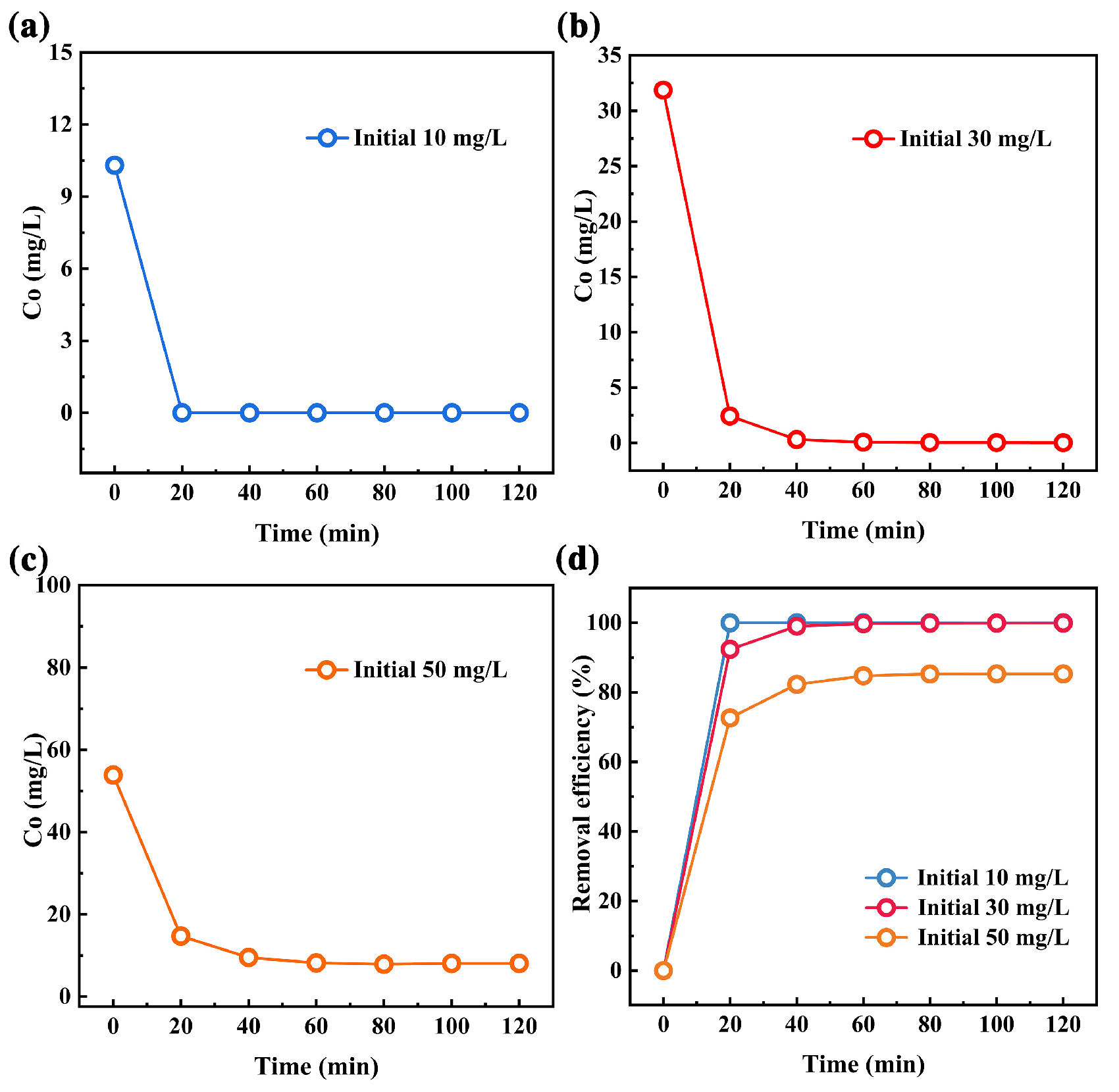
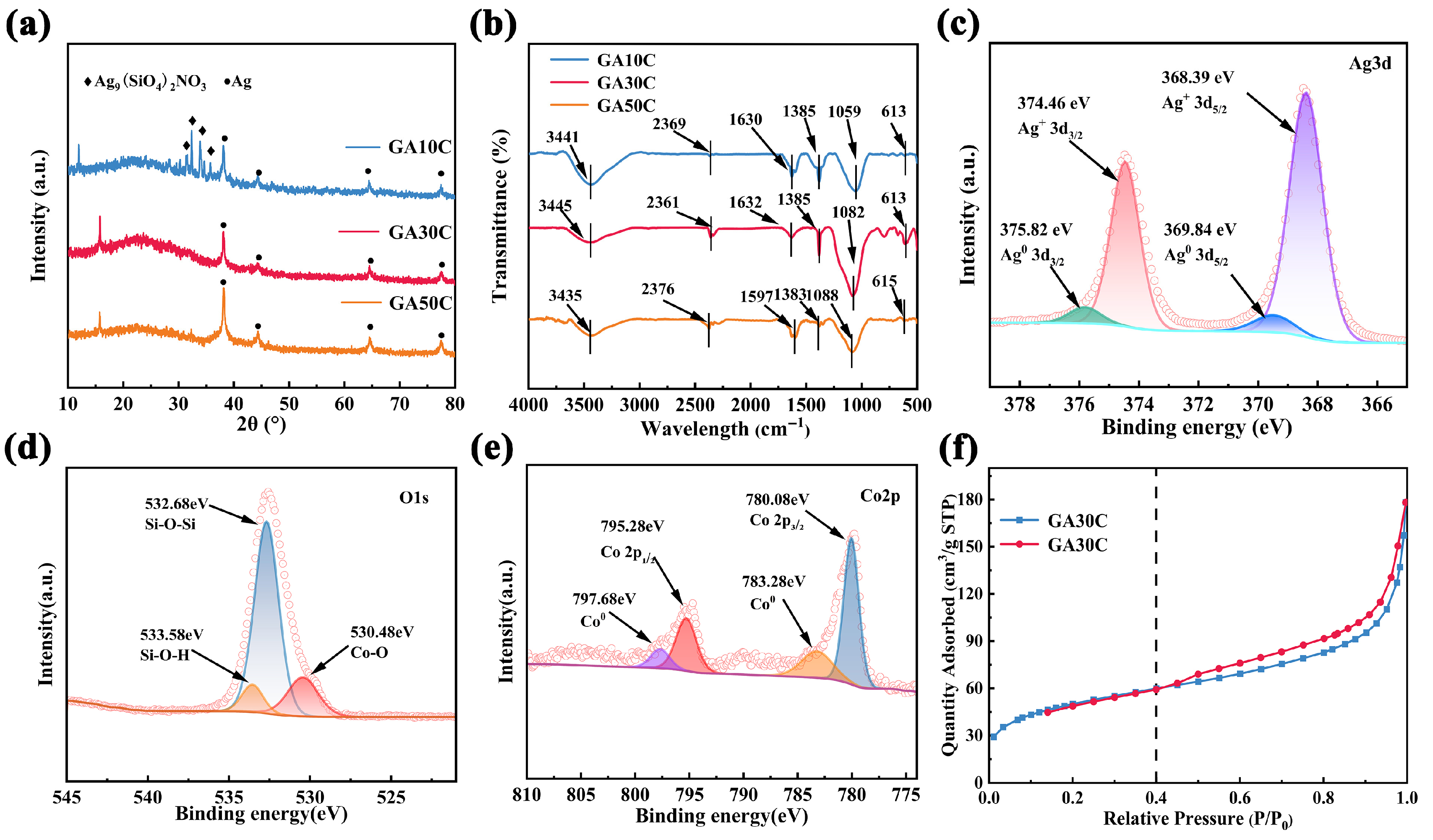
The GAC samples were prepared by photocatalytic reduction of different concentrations of Co2+ using GA. Figure 1 shows the residual concentrations of Co2+ after photocatalytic treatment by GA of different initial concentrations. Due to the efficient adsorption capacity of the GP component in GA towards Co2+, GA exhibited remarkable adsorption response rates and high enrichment efficiency. After 20 min, the Co2+ from solutions with an initial concentration of 10 mg/L was almost completely adsorbed. The residual concentrations of Co2+ from solutions with initial concentrations of 30 and 50 mg/L were 0.02 and 8.10 mg/L, respectively (Figure 1a–c). After 120 min of illumination during the preparation process, the removal efficiencies for the respective solutions reached 99.99%, 99.93%, and 85.32%, respectively (Figure 1d). Accordingly, the loading amount for each sample was 10.00 mg/g, 29.98 mg/g, and 34.13 mg/g (Figure S1). This indicates that although the Co2+ removal efficiency decreased at higher concentrations, the loading amount of the samples increased with the increase in initial Co2+ concentration. Initial GA exhibited well-crystallized Ag9(SiO4)2NO3 diffraction peaks [7]. After conversion to the GAC samples, the diffraction peaks corresponding to the (111) crystal plane of Ag0 at 2θ = 38.1° were detected in all samples (Figure 2a). Furthermore, at initial Co2+ concentrations of 10 mg/L, the Ag9(SiO4)2NO3 diffraction peaks remained in the GAC samples, indicating that the photoreduction process did not significantly alter the Ag9(SiO4)2NO3 structure. Additionally, with further increase in Co2+ concentration, the Ag9(SiO4)2NO3 diffraction peaks become progressively weaker.
Figure 2b presents the FTIR spectra of the GAC samples, showing asymmetric bands around 3441 cm−1 that were assigned to the -OH stretching vibration [25]. The characteristic peaks detected around 1385 cm−1 in all samples were attributed to the Ag-O bond absorption band of ASN [26]. The absorption peak observed around 1082 cm−1 in GA30C was attributed to the Si(Al)-O bonds in GP [25]. However, this characteristic peak exhibited a significant high-frequency shift compared to that of the blank GP and initial GA samples [7,27]. Moreover, the characteristic peak shifted further toward higher frequencies with increasing concentrations of Co2+ subjected to photocatalytic treatment. This phenomenon may be attributed to the inductive effect on the Si(Al)-O bonds generated by the substitution of Na+ with Co2+ in GP. Additionally, Co-O stretching vibration peaks were detected at 613 cm−1, originating from Co(OH)2 [28] and indicating the generation of Co(OH)2. The XPS result confirmed the presence of Ag 3p1/2, Ag 3d5/2, Co 2p, Co 3p, O 1s, Si 2p and Al 2s in GA30C (Figure S2). The Ag 3d spectra of GA30C exhibited characteristic peaks for Ag+ (3d3/2) and Ag+ (3d5/2) [29]. Additionally, peaks corresponding to metallic Ag0 were also detected, indicating the formation of Ag0 during the GAC preparation process (Figure 2c). Therefore, the attenuation of the Ag9(SiO4)2NO3 XRD diffraction peaks in GA30C and GA50C may be primarily attributed to the partial reduction of Ag+ and the combined effect of the relatively substantial formation of Co(OH)2 and Co0 at the interface. The O 1s spectrum of GA exhibited characteristic peaks corresponding to Si-O-H (533.55 eV), Si-O-Si (532.68 eV), and Co-O (530.44 eV) bonds (Figure 2d) [30,31]. In the Co 2p fitting spectrum, there were two characteristic main peaks near 780.08 and 795.18 eV, which respectively belong to Co 2p3/2 and Co 2p1/2 (Figure 2e) [32]. Additionally, characteristic satellite peaks of Co0 were observed at around 783.18 eV and 797.48 eV [33], indicating that cobalt existed in two chemical states of Co2+ and metallic Co0 in the GA30C. Figure 2f shows the N2 adsorption–desorption isotherms of GA30C, which were typical type IV isotherms. The H3-type hysteresis loops observed in the isotherms suggested the presence of slit-shaped mesopores with a polydisperse size distribution. The presence of pore sizes centered around 2.1, 2.6, 5.3,10.8, 14.9 and 91.1 nm in GAC30 may be attributed to the influence of Co-based composition loading on the pore structure (Figure S3). The specific surface area of GA30C reached 180 m2/g, demonstrating outstanding potential for CO2 adsorption and mass transfer. This proved that the specific surface area of GA30C significantly increased compared with that of GA (14 m2/g) [24].
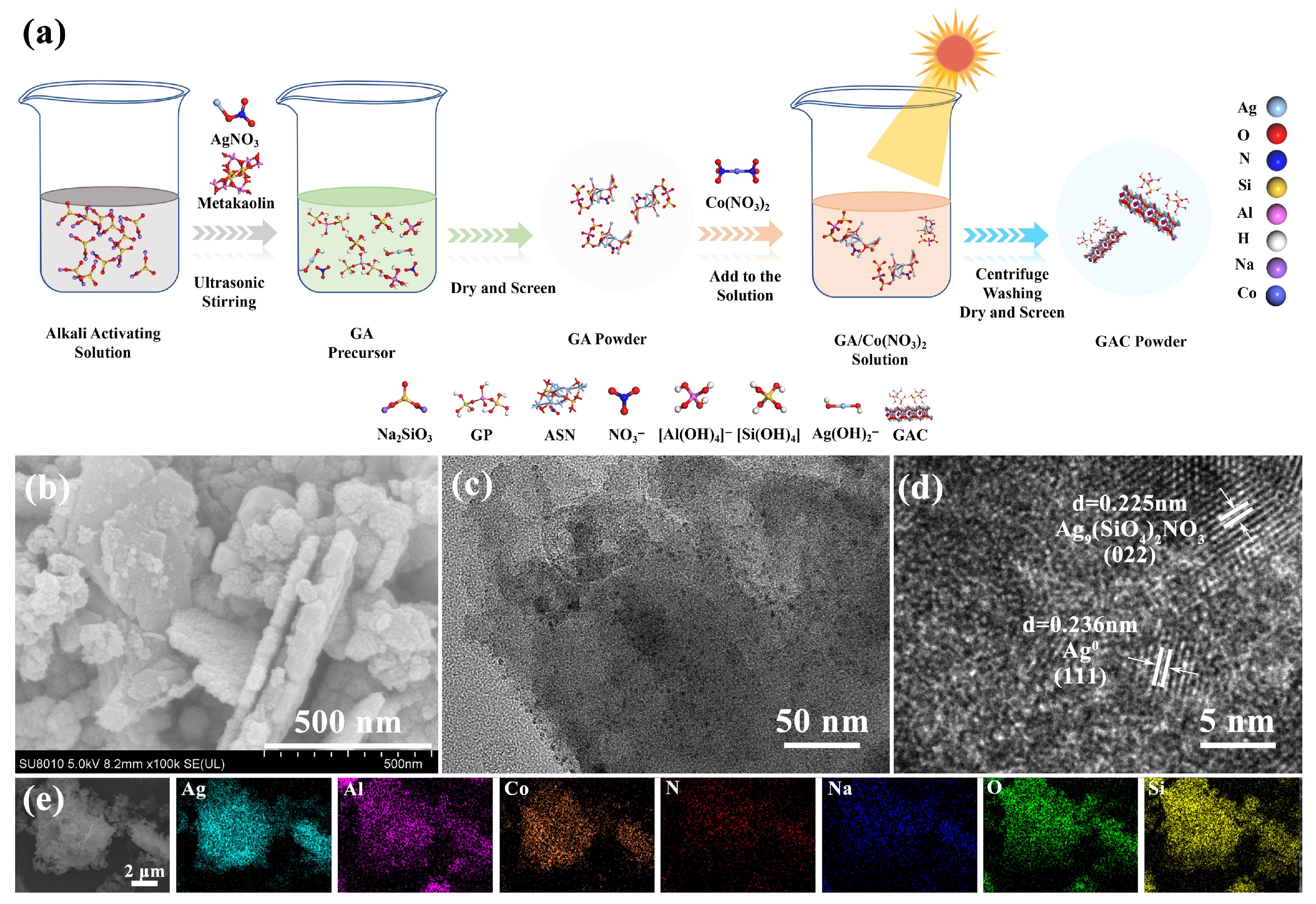
Based on the above analysis, it can be concluded that the cobalt in GAC exists in the forms of metallic Co0. During the photocatalytic treatment, Co2+ was initially incorporated via ion exchange with Na+ of the GP in GA and subsequently captured by the negatively charged aluminosilicate skeleton (Figure 3a). Based on previous work, the conduction band (CB) position of GA (0.68 eV) is insufficient to drive the reduction of Co2+/Co (−0.28 eV) [7]. This indicates that the initial interaction between GA and Co2+ was primarily governed by adsorptive capture. Subsequently, the reduction of the captured Co2+ to Co0 proceeded. Figure 3b shows the SEM image of series GA30C, which exhibited a layered structure composed of nano-particle clusters. TEM analysis confirmed that GA30C possessed a structure composed of nanocrystalline and amorphous phases with nanoscale intervals (Figure 3c). The distinct lattice fringes with measured spacings of 0.225 nm and 0.236 nm corresponded to the (022) plane of ASN [8] and the (111) plane of Ag0, respectively (Figure 3d). The SEM-EDS elemental mapping further revealed that GA30C was composed of uniform Si, Al, O, Na, Ag, N, and Co elements (Figure 3e). This indicated that Co-based compositions were uniformly loaded at the GP and ASN interface through Co2+ diffusion and reduction.

2.2. Photothermal Reduction Performance of CO2

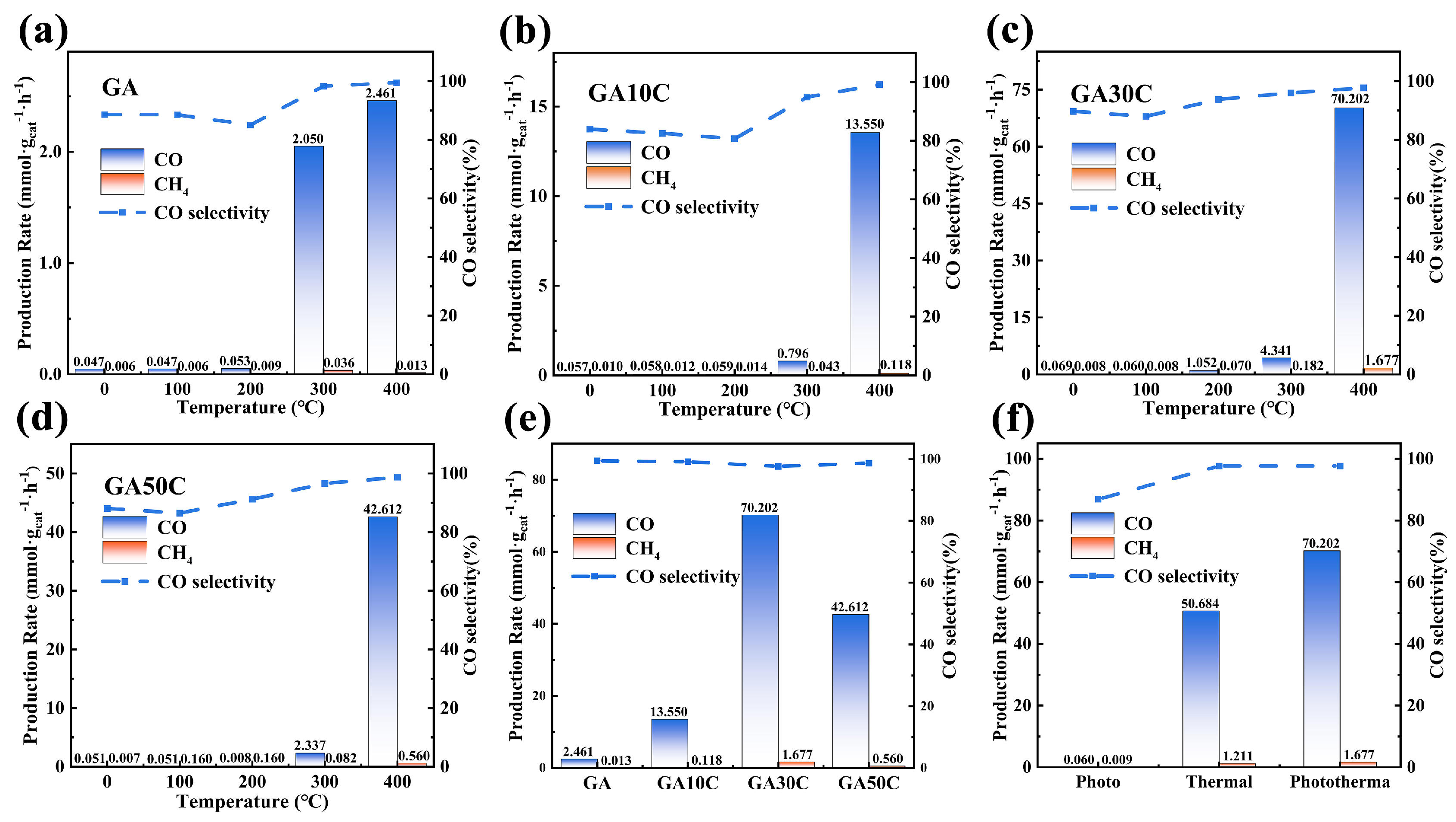
Temperature is a critical parameter in the photothermal hydrogenation of CO2. Figure 4a–d show the photothermal CO2 reduction performance of GA and series GACs at different temperatures. The main reduction products for all samples were CO and CH4, and their product rates increased with rising temperature. Although the CB of GA was mismatched with the CO/CO2 redox potential, product rates of 2.05 (300 °C) mmol·gcat−1·h−1 and 2.46 (400 °C) mmol·gcat−1·h−1 were exhibited (Figure 4a). This might be due to the higher temperature reducing the activation energy of CO2 [34]. The photothermal reduction performance of GA10C at 400 °C was significantly higher than that of GA (Figure 4b). The loading of Co0 and Ag0 generated hot electrons, promoting the transfer of photogenerated electrons and leading to an increase in CO yield. The CO product rates at 400 °C showed a significant increase and exhibited a trend of first increasing and then decreasing with the rise in Co2+ concentration (Figure 4e). Among them, the CO product rates of GA30C reached 70.20 mmol·gcat−1·h−1 at 400 °C, which was 28.53 times that of GA at the same temperature. This indicates that an appropriate loading of cobalt-based materials can significantly enhance the photothermal CO2 reduction performance. Furthermore, CO2 reduction was compared under photocatalytic and thermal (without irradiation) conditions at 400 °C (Figure 4f). Due to the limitation of the photocatalytic process to reduction by photogenerated electrons, it was difficult to effectively attack the C=O bond in CO2, resulting in its CO product rate being confined to the micromolar level (59.71 μmol·gcat−1·h−1). In contrast, thermal effects substantially lowered the activation energy for C=O bond cleavage and facilitated CO desorption, resulting in a markedly enhanced CO production rate of 50.68 mmol·gcat−1·h−1. This indicated that the thermal catalytic effect played a dominant role in the photothermal reduction of GAC. The combination of photo and thermal effects helped to enhance the transmission and separation efficiency of photoelectrons, promoted electron-driven reduction reactions on the catalyst surface, and thereby improved the reduction efficiency of CO2.
Comparative analysis of selectivity confirmed that GA exhibited relatively low CO selectivity at 200 °C and below but demonstrated exceptionally high CO selectivity at 300 and 400 °C. This was likely because the further formation of metallic Ag0 at high temperatures significantly promoted the reverse water-gas shift (RWGS) reaction through the plasmonic resonance effect [35]. Ag0 can also facilitate CO desorption, resulting in high CO selectivity [36]. For the GAC system, under low-temperature conditions, the Co0 clusters had stronger CO adsorption capabilities than Ag0, which led to the occurrence of deep hydrogenation of CO and a decrease in CO selectivity [37]. However, with increasing Co2+ concentration during the photothermal treatment, the temperature required to achieve over 90% CO selectivity tended to decrease across all GAC samples. This indicated that a higher loading of cobalt optimized the chemical state of the catalyst, enabling the highly selective RWGS reaction to become the dominant pathway at lower temperatures.
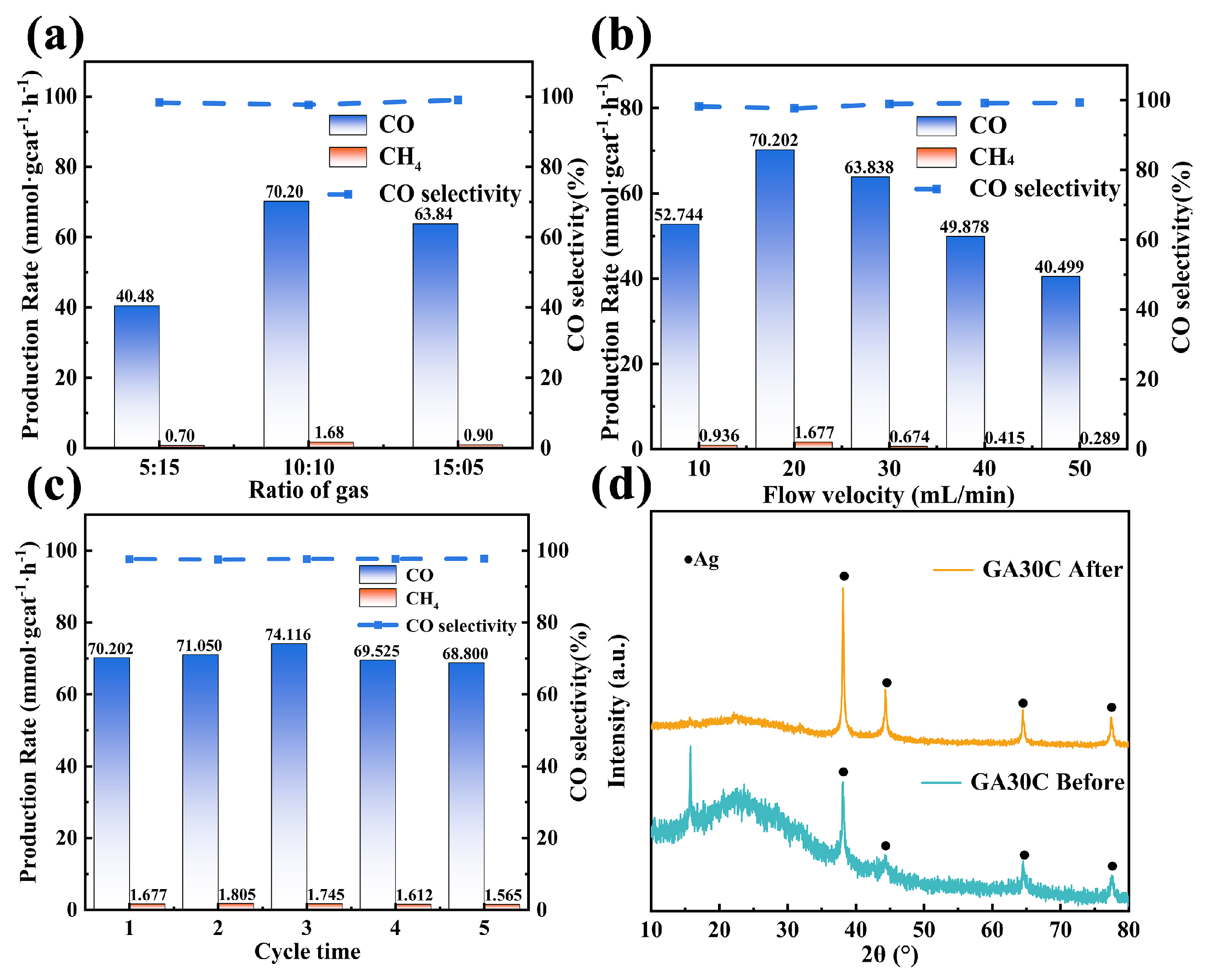
Based on temperature quantification, the CO2/H2 ratio and flow velocity were further optimized at 400 °C. Figure 5a shows the CO production rates under different CO2/H2 ratios. Under the pure CO2 atmosphere, the CO production rate can reach 42.84 mmol·gcat−1·h−1. Since GP was inherently rich in –OH groups and alkaline species (OH), they may serve as a source of protons in the early stages of the photothermal reaction, participating in the photoreduction of CO2 to CO or CH4. After the consumption of these protons, high-energy hot electrons generated at the Ag0 and Co0 interface under photothermal excitation can directly participate in CO2 reduction, thereby generating CO. In the absence of H2, the RWGS reaction was excluded, and the reduction process was likely primarily driven by photogenerated electrons acting on CO2. With the appropriate introduction of H2, the CO production rate increased significantly, reaching 70.20 mmol·gcat−1·h−1 at a CO2/H2 ratio of 1:1. In the pure CO2 environment, the activation of CO2 requires direct dissociation (cleavage of the C=O bond), and this process demands substantial energy input. In contrast, the RWGS reaction involving H2 significantly reduced the energy required for the reaction and promoted the reduction of CO2. However, when the CO2/H2 ratio decreased to 1:3, the carbon source became limited, and excessive H2 competed with CO2 for adsorption sites, thereby negatively affecting the CO production rate. Figure 5b shows the CO production rate under different flow velocities. The CO production rates overall exhibited a trend of first increasing and then decreasing with flow velocity. The highest CO production rate was achieved at a flow velocity of 20 mL/min, resulting from the optimal balance among reactant supply, reaction kinetics, and product desorption.
Furthermore, the cyclic application performance of GA30C was verified at 400 °C (Figure 5c). With increasing cycle numbers, the CO product rates first increased and then decreased, reaching a maximum value of 74.12 mmol·gcat−1·h−1 in the third cycle. XRD analysis after the fifth cycle confirmed that the diffraction peaks of metallic Ag0 were detected in the samples and gradually intensified (Figure 5d). This indicates that the gradually increasing metallic Ag0 facilitates H2 dissociation and participates in the RWGS reaction of CO2, as well as in multiple photoelectron-involved reactions. However, as the number of cycles increases, the more interfacial Ag0 loading led to a relative reduction in active sites that readily capture CO2, thereby partially suppressing CO generation. Moreover, the enhanced H2 dissociation by the Co0 promoted deep hydrogenation of CO, resulting in a decline in selectivity. Nevertheless, the overall performance degradation rate of GA30C after the fifth cycle remained within 68.80% compared to the first cycle, demonstrating exceptional cyclic application performance.

2.3. Photoelectric Properties of GAC

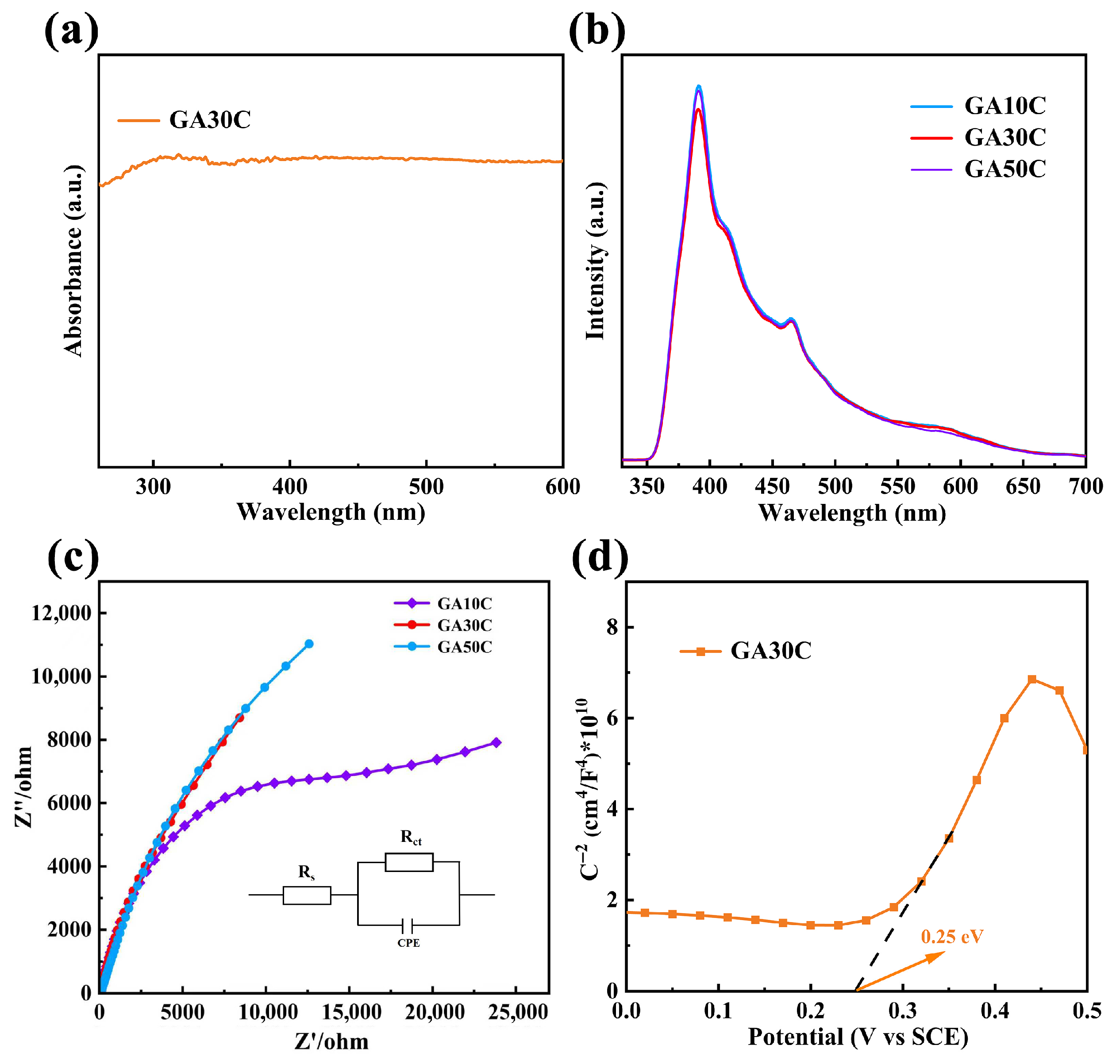
The UV-Vis DRS result for GA30C is shown in Figure 6a. GA30C possessed strong light absorption response capability in both the ultraviolet and visible light range. The photoresponsive ranges of GA30C were significantly expanded compared to GA [24], which may be attributed to the loading of photoreduced Ag0 and Co0 nanoclusters. Figure 6b shows the PL spectra of GA and GACs. Compared to GA, the PL intensities of GACs were decreased. Among the GACs, the differences in PL intensity were relatively small; however, as the Co2+ concentration increased, the PL intensities initially increased and then declined. This indicated that an appropriate amount of Ag0 and Co0 forming the metal-semiconductor interfaces and electron transfer pathway on GA can significantly enhance the separation efficiency of photogenerated electron-hole pairs. However, excessive Co-based composition tended to agglomerate, forming new carrier recombination centers, which led to a further increase in photoluminescence intensity. Figure 6c shows equivalent-circuit fitting results of the electrochemical impedance spectra (EIS) of GACs. The radii of the Nyquist plots for GACs increased with increasing concentrations of photoreduced Co2+. This may be attributed to the blocking of the more conductive Ag0 network by the increased loading of Co-based species. Figure 6d shows the Mott-Schottky curve of GA30C. The slope of this curve is positive, indicating that GA30C is a n-type semiconductor [38]. The flat band potential of GA30C was 0.25 eV. In this work, a saturated calomel electrode was used. The difference in electrode potential between this electrode and the standard hydrogen electrode (NHE) was 0.24 eV. The Tauc plot calculation of UV-Vis DRS of GA30C indicated a bandgap of 0.24 eV (Figure S4). Furthermore, the valence band potential of GA30C was determined to be 0.73 eV. This indicated that the bandgap width of GA30C was reduced to 0.24 eV due to the loading of Ag0 and Co0, suggesting its transformation into a metal–semiconductor composite, which facilitated the transfer of photogenerated electrons and strong thermal excitation.

2.4. Photothermal Reduction Mechanism

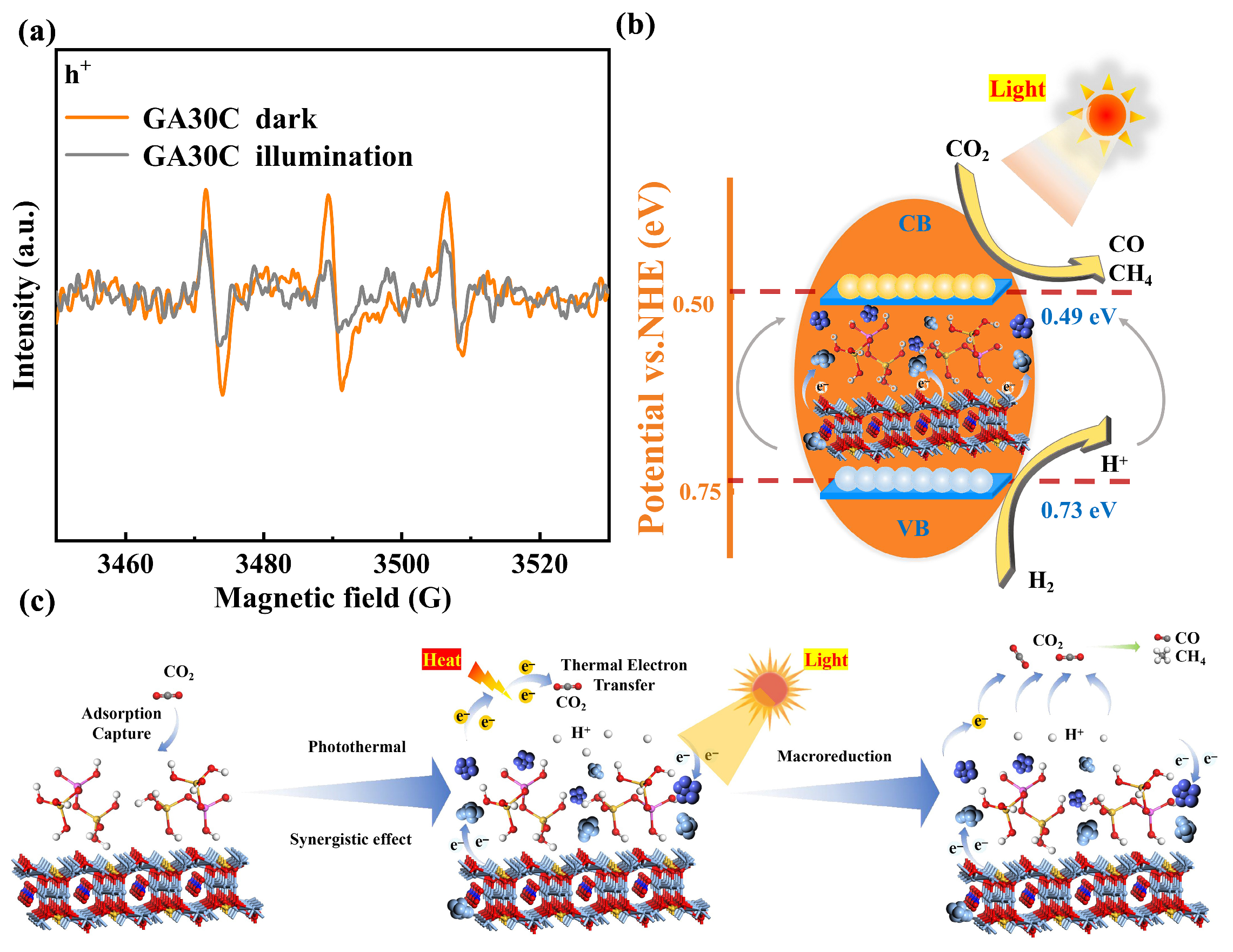
To elucidate the photothermal CO2 reduction mechanism of GAC, EPR analysis was conducted. Figure 7a shows the EPR signals of GA30C under illumination and dark conditions. After 60 s of illumination, the h+ signal was detected in GA30C, while the corresponding signal was significantly weakened under dark conditions. This indicates that light irradiation can trigger the generation of photogenerated electron-hole pairs in GA30C. As a metal-semiconductor composite material, GA30C enabled the effective transfer of photogenerated electrons from ASN via Ag0 and Co0, thereby improving the separation efficiency of photogenerated charge carriers (Figure 7b). Therefore, as shown in Figure 7c, during the process of GA30C reducing CO2, Ag0 and Co0 acted as adsorption and activation sites for CO2, while the alkaline environment in the GP also facilitates the adsorption of acidic CO2. Then, by using a higher temperature, the dissociation barrier of CO2 can be reduced. The heterojunction formed by the simultaneous loading of Ag0 and Co0 can significantly enhance the transfer efficiency of photogenerated electrons. As a result, the conversion of CO2 to CO was achieved through the reaction of photoelectrons accelerated by high temperature with CO2 (Equation (1)) and the RWGS under thermal action (Equation (2)). The high-temperature reaction conditions and the Na+ ions in the GP can also facilitate the rapid desorption of CO, which prevented the deep hydrogenation of CO to CH4. This further ensured the high selectivity of CO.
CO2 + 2e + 2H+ → CO + H2O
CO2 + H2 → CO + H2O

3. Experimental Details

3.1. Materials

Metakaolin was produced by calcining kaolin (Shanghai Fengxian Chemical Co., Ltd., Shanghai, China) at 800 °C for 2 h. The alkali-activating solution was prepared by reacting SiO2-sol (40.0 wt%, Jiangyin Xiagang Chemical Co., Ltd., Jiangyin, China) with NaOH (≥96.0%, Shanghai Aladdin Biochemical Technology Co., Ltd., Shanghai, China). Hexahydrated cobalt nitrate (Co(NO3)2·6H2O) was provided by Sinopharm Chemical Reagent Co., Ltd., (Shanghai, China). All chemical reagents were used as they were without any further purification. Deionized water was used throughout the entire experiment.

3.2. Preparation of GA and GAC Photothermal Catalysts

The materials used to prepare GA were consistent with the previous work [7]. The metakaolin and silver nitrate were added successively to react with the alkali-activating solution and to obtain the GA precursor. After the GA precursor was solidified at 60 °C for 24 h and crushed, the solidified body was sifted through a 300-mesh sieve to obtain the GA powder. Based on this foundation, GA powder was added to a solution containing different concentrations of Co2+ (10 mg/L, 30 mg/L, and 50 mg/L). The mixture was irradiated under simulated sunlight using a 300 W xenon lamp (HSX-F300, NBeT, Beijing, China) for 2 h. The products were dried in an oven at 35 °C for 24 h. After centrifugation and ethanol washing, the products were crushed and passed through a 300-mesh sieve to obtain series GAC samples, which were named GA10C, GA30C and GA50C.

3.3. Characterization

An inductively coupled plasma optical emission spectrometer (ICP-OES, Agilent 720ES, Santa Clara, CA, USA) was used to measure the residual Co2+ concentration after the photoreduction reaction. The phases of series GACs, and the GA30C after the fifth cycle were detected by X-ray diffraction (XRD, D8 Advance, Bruker, Karlsruhe, Germany). Scanning electron microscopy (SEM, SU8010, Hitachi, Hitachinaka, Japan) was used to observe the morphology of GA30C, and energy-dispersive spectroscopy (EDS, 500i, IXRF, Austin, TX, USA) was used to determine the elemental composition of GA30C. Transmission electron microscopy (TEM, Talos F200X, Thermo Fisher Scientific, Waltham, MA, USA) was applied to investigate the microstructure of GA30C.
The specific surface area of GA30C was determined by conducting a Brunauer–Emmett–Teller (BET) analysis on nitrogen adsorption–desorption isotherms using the ASAP 2020M analyzer (Micromeritics Corporation, Norcross, GA, USA). The pore size distribution was obtained from the adsorption branch of the isotherms using the Barrett–Joyner–Halder (BJH) method. The functional groups of series GACs were investigated by Fourier transform infrared spectroscopy (FTIR, Nexus 670, Nicolet, WI, USA). The chemical valence state of GA30C was detected by X-ray photoelectron spectroscopy (XPS, AXIS Supra, Shimadzu, Kyoto, Japan), and the XPS valence band spectrum was used to determine the valence band potential of GA30C.
The visible-light absorption capacity was evaluated by UV-visible diffuse reflectance spectroscopy (UV-Vis DRS, U-3900H, Hitachi, Hitachinaka, Japan). Photoluminescence spectroscopy (PL, F97Pro, Lengguang Technology, Shanghai, China) was used to analyze the separation efficiency of photogenerated charge. The transient photocurrent, electrochemical impedance spectroscopy and Mott–Schottky curves were measured by an electrochemical workstation (CHI660B, Chenhua, Shanghai, China).

3.4. Photothermal Reduction of CO2 Experiments

The performance tests for photothermal reduction of CO2 were conducted in a micro photothermal catalytic reaction system (CEL-GPPCM, Education Au-light Technology, Beijing, China). A total of 10 mg of catalyst powder was loaded into the quartz tube of the reaction channel. N2 was purged through the reactor at a flow rate of 10 mL·min−1 for 1 h to ensure the reactor was filled with pure N2. Simulated solar irradiation was provided by a 300 W xenon lamp (Education Au-light Technology, Beijing, China). Quantitative analysis of the reaction products was performed using the external standard method. Calibration curves correlating the peak area with the concentration of each component (CO, CH4, CO2) were established using standard gases. During sample analysis, the reactor outlet gas was quantitatively introduced into the gas chromatograph via an online auto-sampling valve, and the molar concentration of each product was calculated based on the calibration curve.
During the test, after 30 min of illumination, the N2 flow was stopped, and a mixture of CO2 and H2 with a flow rate of 10 mL·min−1 was introduced. The reaction was carried out using a continuous flow of H2/CO2 mixed gas. Following 30 min of reacting to achieve a stable, homogeneous gas environment, a 1 mL gas sample was extracted and analyzed by gas chromatography to determine the CO and CH4 concentrations. Different ratios of CO2 to H2 (pure CO2, 15:5, 10:10 and 5:15) were measured. The cycle performance was tested using GA30C, and the selectivity for CO and CH4 was determined using their respective peak areas and calibration factors. The product rate and selectivity of CO and CH4 were calculated using Equations (3) and (4).
P r o d u c t i o n   R a t e   ( C O / C H 4 ) = mole   of   CO / CH 4   ( m m o l ) weight   of   catalyst   ×   time   ( g cat · h )   ( mmol · g cat 1 . h 1 )
S e l e c t i v i t y   o f   ( C O / CH 4 ) = mole   of   CO / CH 4   ( m m o l ) total   moles   of   all   products   ( mmol ) × 100 %   ( % )

4. Conclusions

This work involved using the GAC sample obtained by the photoreduction of Co2+ with the GA photocatalyst for the photothermal reduction of CO2. Cobalt existed in GAC in the forms of Co2+ and Co0, and the amounts of both increased as the concentration of photoreduced Co2+ increased. Loading of Co2+ and Co0 significantly expanded the light-responsive capacity of GAC and increased the specific surface area to enhance mass transfer. Compared with GA, the photothermal performance of GA significantly improved, and the thermal effect significantly enhanced the CO2 reduction performance of GAC. The CO product rate of GAC was 28.5 times that of GA at 400 °C. Moreover, the CO reduction performance of GAC under the combined action of light and heat was significantly higher than that under pure heat or pure light conditions, demonstrating the excellent photothermal synergy effect. The cyclic performance confirmed the outstanding service potential of the GAC sample. After five cycles, the CO production rate still reached 68.8 mmol·g−1·h−1, demonstrating an outstanding potential for service. This research can provide technical support for the expanded application of the photocatalyst after the reduction of heavy metals through the photocatalytic reduction.

Supplementary Materials

The following supporting information can be downloaded at: https://www.mdpi.com/article/10.3390/catal16030245/s1, Figure S1: The loading amount for each GAC sample. Figure S2: The XPS result of GA30C. Figure S3: The pore size distribution of GA30C. Figure S4: The Tauc plot calculation of UV-Vis DRS of GA30C.

Author Contributions

Y.W., Y.L., S.W., J.L. and H.J. contributed to the concept of the research, study design, data collection, statistical analysis, writing of the original draft, and reading and editing of the final paper. All authors have read and agreed to the published version of the manuscript.

Funding

This work was supported by the Jinchang City Science and Technology Plan Projects (No. 2025GY009) from Jinchang City Science and Technology Bureau.

Data Availability Statement

The datasets generated and/or analyzed during the present study are available from the corresponding author upon reasonable request.

Conflicts of Interest

The authors declare no conflicts of interest.

Abbreviations

The following abbreviations are used in this manuscript:
GPgeopolymer
ASNAg9(SiO4)2NO3
GAgeopolymer/Ag9(SiO4)2NO3
GACCo-loaded geopolymer/Ag9(SiO4)2NO3
ICP-OESinductively coupled plasma optical emission spectrometer
XRDX-ray diffraction
SEMscanning electron microscopy
EDSenergy-dispersive spectroscopy
TEMtransmission electron microscopy
BETBrunauer–Emmett–Teller
BJHBarrett–Joyner–Halder
FTIRFourier transform infrared spectroscopy
XPSX-ray photoelectron spectroscopy
UV-vis DRSUV-visible diffuse reflectance spectroscopy
PLphotoluminescence spectroscopy
CEL-GPPCMmicro photothermal catalytic reaction system
CBconduction band
RWGSreverse water-gas shift

References

  1. Shen, C.; Sun, K.; Yang, Y.; Liu, C.; Liu, Y.; Wang, X. Photoreductive elimination of heavy metal ions and radionuclides by g-C3N4-based materials: A review. Membr. Biol. 2025, 363, 132023. [Google Scholar]
  2. Yu, C.; Song, C.; Zhang, X.; Wang, Y.; Lin, J.; Huang, Y.; Guo, Z.; Li, C.; Zhang, Y.; Liu, Z.; et al. Complete chromium removal via photocatalytic reduction and adsorption using bimetallic UiO-66(Zr/Al). J. Environ. Chem. Eng. 2024, 12, 113934. [Google Scholar] [CrossRef]
  3. Xue, Y.; Chew, J. UiO-66 (Zr) metal-organic framework for photocatalytic CO2 reduction: functional design strategies for sustainable carbon utilization. J. Mater. Chem. A 2025, 13, 11989–12008. [Google Scholar] [CrossRef]
  4. Jing, Y.; Yin, X.; Li, L.; Wang, Y.; Liu, D.; Xu, Z.; Chen, C.; Liu, E.; Han, B. CuO/TiO2 S-Scheme heterostructure for efficient photocatalytic CO2 reduction with nearly 100 % CO selectivity. Ceram. Int. 2025, 51, 8260–8268. [Google Scholar] [CrossRef]
  5. Wang, J.; Liu, W.; Huang, H.; Hu, Y.; Zhao, M.; Lin, Z.; Yang, Z.; Liu, J.; Feng, J.; Yu, T.; et al. Chemical microenvironment manipulation promotes selective photothermal CO2 hydrogenation to CO over Co-based catalysts. Sci. China Chem. 2025, 68, 4399–4407. [Google Scholar] [CrossRef]
  6. Song, R.; Wen, J.; Liu, H.; Song, W.; Sun, C.; Wang, B.; Tao, S.; Alodhayb, A.N.; Zhao, J.; Chen, Z.; et al. Boosting photothermal reverse water gas shift reaction performance by creating oxygen vacancies in Ni/MgO catalysts. Environ. Chem. Eng. 2025, 519, 165238. [Google Scholar]
  7. Jin, H.; Liu, J.; Guo, Y.; Hong, K.; Zhu, M.; Li, C.; Wang, Q. Nanoscale intergrowth of adsorption-photocatalysis active sites of geopolymer/Ag9(SiO4)2NO3 for efficient synergistic capture and photocatalytic degradation of tetracycline. J. Environ. Chem. Eng. 2025, 13, 116319. [Google Scholar] [CrossRef]
  8. Jin, H.; Hong, K.; Nie, C.; Li, C.; Wang, Q. Structural-functional geopolymer/Ag9(SiO4)2NO3/g-C3N4 adsorbent-photocatalysts with efficient charge transfer and adsorption-photocatalytic degradation synergistic kinetics effect. Sustain. Mater. Technol. 2025, 45, 01630. [Google Scholar] [CrossRef]
  9. Jin, H.; Hong, K.; Liu, J.; Qiu, C.; Zhu, M.; Li, C.; Wang, Q. Structural and functional design of CTAB-geopolymer adsorbents for rapid removal of tetracycline: A comparative study. Sep. Purif. Technol. 2025, 356, 129872. [Google Scholar] [CrossRef]
  10. Xing, X.; Xu, W.; Zhang, G.; Wen, X. The Mechanical Performance and Reaction Mechanism of Slag-Based Organic–Inorganic Composite Geopolymers. Materials 2024, 17, 734. [Google Scholar] [CrossRef] [PubMed]
  11. Singh, V.; Srivastava, G. Development of a sustainable geopolymer using blast furnace slag and lithium hydroxide. Sustain. Mater. Technol. 2024, 40, 00934. [Google Scholar] [CrossRef]
  12. Jin, H.; Qiu, C.; Li, Y.; Liu, B.; Liu, J.; Chen, Q.; Lu, X.; Li, C.; Wang, Q. Structural and functional design of geopolymer adsorbents: A review. Tungsten 2024, 6, 48–76. [Google Scholar]
  13. Jia, L.; Yang, T.; Chen, Z.; Liao, X.; He, P.; Jia, D.; Duan, X.; Yang, Z.; Zhou, Y. In-situ chemically synthesized Fe3O4/K-geopolymer composite with microwave absorbency for additive manufacturing. Ceram. Int. 2024, 50, 45692–45702. [Google Scholar]
  14. Liang, K.; Yang, G.; Wang, X.; Chow, C.; Lau, D. Development of effective porous geopolymer adsorbent with high strength for copper(II) ion removal. J. Clean. Prod. 2024, 449, 141752. [Google Scholar] [CrossRef]
  15. Li, Y.; Li, J.; Jin, S.; Zhao, B.; Zhang, X.; Wu, L.; Shang, X. Synthesis of novel geopolymer microspheres from electrolytic manganese residue and burnt coal cinder: High-efficiency selective adsorption of Pb(II) from aqueous solution. Sep. Purif. Technol. 2026, 380, 135344. [Google Scholar] [CrossRef]
  16. Hossain, S.; Akhtar, F. Development of lightweight architecture of geopolymer via extrusion-based 3D printing for CO2 capture. J. Eur. Ceram. Soc. 2025, 45, 117191. [Google Scholar] [CrossRef]
  17. Di Pietro, C.; Guzman, W.F.C.; Papa, E.; Landi, E.; Miccio, F.; Minelli, M.; Medri, V. Cold sintered geopolymer and geopolymer-zeolite composite sorbents for CO2 capture. J. Environ. Chem. Eng. 2025, 13, 117098. [Google Scholar] [CrossRef]
  18. Pahija, E.; Panaritis, C.; Gusarov, S.; Shadbahr, J.; Bensebaa, F.; Patience, G.; Boffito, D.C. Experimental and Computational Synergistic Design of Cu and Fe Catalysts for the Reverse Water-Gas Shift: A Review. ACS Catal. 2022, 12, 6887–6905. [Google Scholar] [CrossRef]
  19. Lin, H.; Zhang, J.; Wang, R.; Zhang, W.; Ye, J. Adsorption properties and mechanisms of geopolymers and their composites in different water environments: A comprehensive review. J. Water Process Eng. 2024, 62, 105393. [Google Scholar] [CrossRef]
  20. Yuan, L.; Wang, H.; He, T.; Gao, S. Review on the effect collision between hazardous metal ions and geopolymer as adsorbents or in situ stabilization/solidification. Appl. Clay Sci. 2024, 249, 107258. [Google Scholar] [CrossRef]
  21. Freire, A.L.; Moura-Nickel, C.D.; Scaratti, G.; De Rossi, A.; Araújo, M.H.; De Noni, A.; Rodrigues, A.E.; Castellón, E.R.; Moreira, R.P.M. Geopolymers produced with fly ash and rice husk ash applied to CO2 capture. J. Clean. Prod. 2020, 273, 122917. [Google Scholar] [CrossRef]
  22. Jin, H.; Zhang, Y.; Zhang, X.; Chang, M.; Li, C.; Lu, X.; Wang, Q. 3D printed geopolymer adsorption sieve for removal of methylene blue and adsorption mechanism. Colloids Surf. A Physicochem. Eng. Asp. 2022, 648, 129235. [Google Scholar]
  23. Zhu, X.; Wang, Z.; Huang, B.; Wei, W.; Dai, Y.; Zhang, X.; Qin, X. Synthesis of Ag9(SiO4)2NO3 through a reactive flux method and its visible-light photocatalytic performances. APL Mater. 2015, 3, 104413. [Google Scholar] [CrossRef]
  24. Kim, T.G.; Yeon, D.H.; Kim, T.; Lee, J.; Im, S.J. Silver silicates with three-dimensional d10-d10 interactions as visible light active photocatalysts for water oxidation. Appl. Phys. Lett. 2013, 103, 043904. [Google Scholar] [CrossRef]
  25. Kljajevic, L.M.; Nenadovic, S.S.; Nenadovic, M.T.; Bundaleski, N.K.; Todorovic, B.Z.; Pavlovic, V.B.; Rakocevic, Z.L. Structural and chemical properties of thermally treated geopolymer samples. Ceram. Int. 2017, 43, 6700–6708. [Google Scholar] [CrossRef]
  26. Wang, T.; Stadler, F.J.; Husein, D.Z.; Zhang, D.; Cai, J.; Wang, Y.; Li, M.; Qiang, Y.; Zheng, J. Comparative study of enhanced adsorption-photodegradation activity using activated biochar composited with Ag3PO4 or Ag6Si2O7 in wastewater treatment and disinfection: Effects and mechanisms. Colloids Surf. A Physicochem. Eng. Asp. 2022, 655, 130235. [Google Scholar] [CrossRef]
  27. Song, X. Development and Performance of Class F Fly Ash Based Geopolymer Concretes Against Sulphuric Acid Attack. Ph.D. Thesis, University of New South Wales, Sydney, Australia, 2007. [Google Scholar]
  28. Huang, Z.; Zhao, Y.; Song, Y.; Li, Y.; Wu, G.; Tang, H.; Zhao, J. Study on the oxidation process of cobalt hydroxide to cobalt oxides at low temperatures. RSC Adv. 2016, 6, 80059–80064. [Google Scholar] [CrossRef]
  29. Zhu, X.; Wang, P.; Huang, B.; Ma, X.; Qin, X.; Zhang, X.; Dai, Y. Synthesis of novel visible light response Ag10Si4O13 photocatalyst. Appl. Catal. B 2016, 199, 315–322. [Google Scholar] [CrossRef]
  30. Zhu, K.; Zhang, F.; Cai, W.; Liu, C.; Wang, Y.; Meng, Z.; Mi, C. A novel I-type 0D/0D ZnS/Ag6Si2O7 heterojunction for photocatalytic hydrogen evolution. J. Phys. Chem. Solids 2023, 175, 111206. [Google Scholar] [CrossRef]
  31. Kong, F.; Zhang, W.; Sun, L.; Huo, L.; Zhao, H. Interface Electronic Coupling in Hierarchical FeLDH(FeCo)/Co(OH)2 Arrays for Efficient Electrocatalytic Oxygen Evolution. ChemSusChem 2019, 12, 3592–3601. [Google Scholar] [CrossRef]
  32. Babar, P.T.; Lokhande, A.C.; Pawar, B.S.; Gang, M.G.; Jo, E.; Go, C.; Suryawanshi, M.P.; Pawar, S.M.; Kim, J.H. Electrocatalytic performance evaluation of cobalt hydroxide and cobalt oxide thin films for oxygen evolution reaction. Appl. Surf. Sci. 2017, 427, 253–259. [Google Scholar] [CrossRef]
  33. Khassin, A.A.; Yurieva, T.M.; Kaichev, V.V.; Bukhtiyarov, V.I.; Budneva, A.A.; Paukshtis, E.A.; Parmon, V.N. Metal–support interactions in cobalt-aluminum co-precipitated catalysts: XPS and CO adsorption studies. J. Mol. Catal. A Chem. 2001, 175, 189–204. [Google Scholar] [CrossRef]
  34. Liu, H.; Wang, W.; Fu, X.; Liu, J.; Jia, C. Direct cleavage of C=O double bond in CO2 by the subnano MoOx surface on Mo2N. Nat. Commun. 2024, 15, 9126. [Google Scholar] [CrossRef]
  35. Molina, P.M.; Meulendijks, N.; Xu, M.; Verheijen, M.A.; Den Hartog, T.; Buskens, P.; Sastre, F. Low Temperature Sunlight-Powered Reduction of CO2 to CO Using a Plasmonic Au/TiO2 Nanocatalyst. ChemCatChem 2021, 13, 21. [Google Scholar]
  36. Qu, Z.; Zhou, S.; Wu, W.; Li, C.; Bao, X. CO adsorption and correlation between CO surface coverage and activity/selectivity of preferential CO oxidation over supported Ag catalyst: An In Situ FTIR study. Catal. Lett. 2005, 101, 21–26. [Google Scholar] [CrossRef]
  37. Wang, L.; Wang, L.; Xiao, F. Tuning product selectivity in CO2 hydrogenation over metal-based catalysts. Chem. Sci. 2021, 12, 14660. [Google Scholar] [CrossRef] [PubMed]
  38. Feizpoor, S.; Habibi-Yangjeh, A.; Seifzadeh, D.; Ghosh, S. Combining carbon dots and Ag6Si2O7 nanoparticles with TiO2: Visible-light-driven photocatalysts with efficient performance for removal of pollutants. Sep. Purif. Technol. 2020, 248, 116928. [Google Scholar] [CrossRef]
Figure 1. (ac) The residual concentrations of Co2+ from solutions with initial concentrations of 10 mg/L, 30 mg/L and 50 mg/L; (d) the removal efficiencies for the solutions with initial concentrations of 10, 30, and 50 mg/L.
Catalysts 16 00245 g001
Figure 2. (a) The XRD patterns of GAC samples; (b) the FTIR spectra of GAC samples; (c) the Ag 3d spectrum of GA30C; (d) the O 1s spectrum of GA30C; (e) the Co 2p spectra of GA30C; (f) the N2 adsorption–desorption isotherms of GA30C.
Catalysts 16 00245 g002
Figure 3. (a) The synthesis mechanism of GAC photothermal photocatalyst; (b) the SEM image of GA30C photothermal photocatalyst; (c) the TEM image of GA30C photothermal photocatalyst; (d) the HRTEM image of GA30C photothermal photocatalyst; (e) the SEM-mapping image of GA30C photothermal photocatalyst.
Catalysts 16 00245 g003
Figure 4. (ad) The photothermal CO2 reduction performance of GA, GA10C, GA30C and GA50C at different temperatures; (e) the CO product rates of series GACs at 400 °C; (f) the CO product rates of photocatalysis, thermal catalysis and photothermal catalysis condition.
Catalysts 16 00245 g004
Figure 5. (a) The CO production rates under different CO2/H2 ratios; (b) the CO production rate under different flow velocities; (c) the cyclic application performance of GA30C; (d) the XRD patterns of GA30C and after the 5th cycle.
Catalysts 16 00245 g005
Figure 6. (a) The UV-Vis DRS results for GACs; (b) the PL spectra of GA and GACs; (c) the electrochemical impedance spectra of GACs; (d) the Mott-Schottky curve of GA30C.
Catalysts 16 00245 g006
Figure 7. (a) The EPR signals of GA30C under illumination and dark conditions; (b) the band structure of GAC30; (c) the photothermal reduction mechanism of GAC30.
Catalysts 16 00245 g007
Disclaimer/Publisher’s Note: The statements, opinions and data contained in all publications are solely those of the individual author(s) and contributor(s) and not of MDPI and/or the editor(s). MDPI and/or the editor(s) disclaim responsibility for any injury to people or property resulting from any ideas, methods, instructions or products referred to in the content.