Article

Regulating Iron Carbide Evolution over CNT-Supported Fe Catalysts by Mn Incorporation for Selective CO Hydrogenation to Linear α-Olefins


1
College of Chemistry and Chemical Engineering, Taiyuan University of Technology, Taiyuan 030024, China
2
State Key Laboratory of Coal Liquefaction, Gasification and Utilization with High Efficiency and Low Carbon Technology, Shanghai Yankuang Energy R&D Co., Ltd., Shanghai 201203, China
*
Authors to whom correspondence should be addressed.
Catalysts 2026, 16(3), 244; https://doi.org/10.3390/catal16030244
Submission received: 11 February 2026 / Revised: 23 February 2026 / Accepted: 27 February 2026 / Published: 5 March 2026
(This article belongs to the Section Catalytic Materials)

Abstract

Linear α-olefins (LAOs) from CO/H2 represent an attractive non-petroleum route, yet their selective formation over Fe catalysts is often limited by CO2 formation via water–gas shift (WGS) reaction and by secondary hydrogenation that consumes terminal olefins. In this work, we demonstrate that these competing pathways can be regulated on carbon-nanotube (CNT) supported Fe catalysts by controlling the CNT interfacial oxygen environment through NO treatment or high-temperature annealing and by adjusting the Mn incorporation protocol between co-impregnation and stepwise addition. Under identical reaction conditions at 280 °C and 3.0 MPa with an H2-to-CO ratio of 1, high-temperature treated CNTs improve olefin preservation and LAO retention compared with NO-treated CNTs. Mn promotion further shifts selectivity toward α-olefins and lowers CO2 selectivity. At the same Fe-to-Mn ratio, the Mn introduction sequence produces distinct reducibility and CO-binding behaviors that lead to different steady-state oxide and carbide phases. XPS, H2-TPR, and CO-TPD collectively suggest that CNT pretreatment and the Mn protocol modulate near-surface oxygen speciation, reduction kinetics, and CO adsorption strength. Mössbauer spectroscopy confirms a predominantly χ-Fe5C2 population and indicates the presence of ε-Fe2C in selected samples together with residual oxide and superparamagnetic Fe species. These results highlight the importance of controlling the CNT–metal interface and Mn–Fe proximity to enhance LAO retention under high-temperature CO hydrogenation.

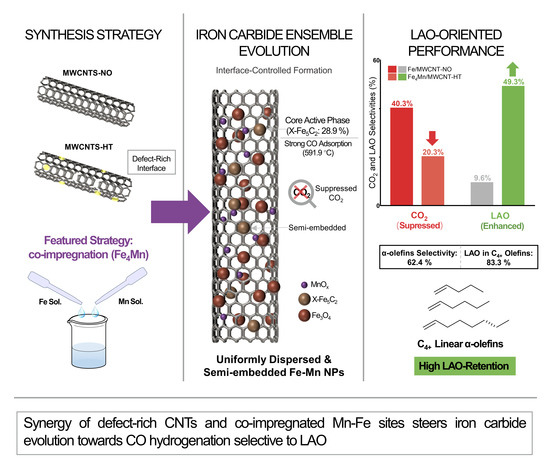
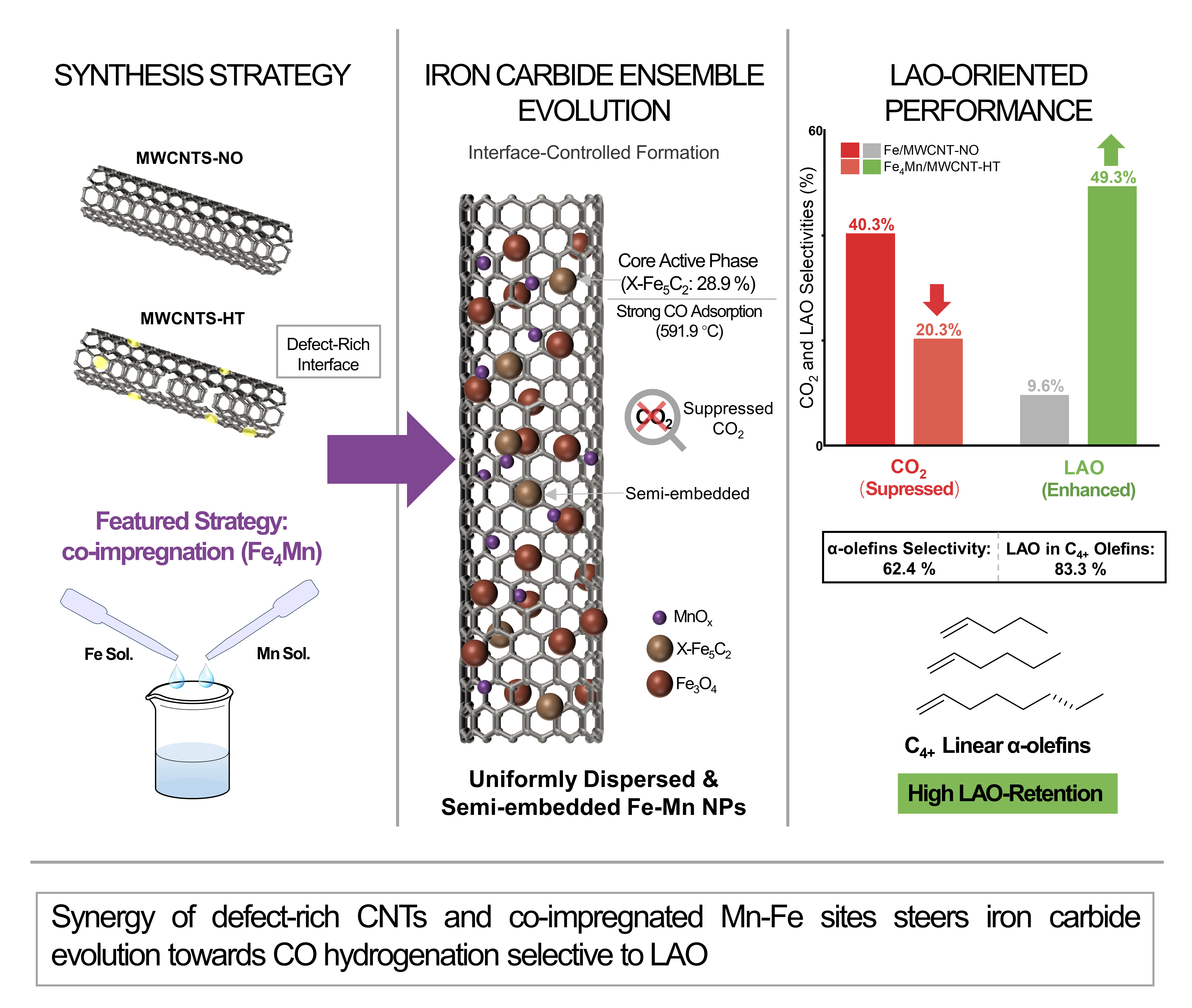
Graphical Abstract

1. Introduction

The selective synthesis of linear α-olefins (LAOs) from syngas offers a compelling non-petroleum route to high-value chemical feedstocks. LAOs are indispensable intermediates for detergents, lubricants, plasticizers, and polymer production [1,2], yet their efficient generation from CO/H2 remains difficult because syngas conversion typically suffers from broad product distributions and carbon-efficiency losses caused by CO2 formation and secondary hydrogenation reactions [3,4]. Recent advances have demonstrated that tailoring iron carbide phases can substantially improve LAO productivity and suppress undesired pathways under industrially relevant conditions, underscoring the importance of active-phase control for LAO-oriented Fischer–Tropsch (F–T) chemistry [1,3].
Iron-based catalysts are attractive for syngas conversion due to their low cost and their intrinsic capability for CO activation, while simultaneously catalyzing the water-gas shift (WGS) reaction [3,4]. However, this dual functionality makes product control particularly sensitive to the dynamic evolution of iron phases during activation and reaction. In practice, catalyst performance is often governed not only by bulk composition but also by how iron transforms among oxides and carbides and how these transformations couple with surface adsorption, chain growth, and termination steps [4,5]. As a result, apparently modest changes in synthesis protocols or promoter incorporation can redirect carburization pathways, shift the steady-state carbide population, and ultimately alter olefin selectivity and stability [3,4,5].
It is now well established that iron carbides constitute the catalytically relevant phases in FT-type reactions [5,6]. Among them, χ-Fe5C2 (Hägg carbide) is frequently associated with efficient chain growth and hydrocarbon formation, and phase-controlled χ-Fe5C2 has recently enabled notably improved LAO production with reduced CO2 selectivity [1,6,7]. Meanwhile, ε-Fe2C has been reported to exhibit high intrinsic activity and comparatively low CO2 selectivity, but it is often metastable under high-temperature FT conditions and can transform into other iron carbides or oxides depending on the local chemical potential and the catalyst microenvironment [8,9,10,11]. Therefore, a central challenge is to steer iron into a desired carbide ensemble and maintain it under realistic reaction conditions.
Manganese is a widely used promoter in iron-based F-T catalysts and is known to influence reducibility, CO activation and adsorption, and product selectivity; nevertheless, its mechanistic role remains debated because Mn incorporation can modify the electronic properties of Fe species and the surface reaction environment in multiple ways [10,11,12,13]. In particular, how the Mn introduction sequence affects the reducibility, adsorption behavior, and subsequent carburization of Fe species remains insufficiently resolved. Carbon nanotubes (CNTs), featuring tunable surface chemistry, high conductivity, and controllable defect density, provide a useful platform to examine such promoter effects while minimizing strong metal-oxide interactions. Prior studies have shown that CNT surface structure and defects can substantially alter Fe carburization behavior and olefin selectivity in CO hydrogenation to olefins catalysis [14,15], suggesting that CNTs can serve as an effective scaffold to probe promoter-controlled phase evolution.
In this work, we systematically examine how Mn loading and Mn introduction sequence govern carburization pathways and iron carbide evolution over CNT-supported Fe catalysts. By combining catalytic evaluation with XRD, TEM, XPS, H2-TPR, CO-TPD, and Mössbauer, we correlate Mn-promoted changes in reducibility and CO adsorption behavior with the steady-state distribution of iron carbide phases and LAO selectivity. These insights provide a practical basis for the rational design of Fe-based catalysts, in which promoter effects on reducibility, adsorption behavior, and iron carbide formation are collectively considered to achieve selective LAO synthesis from syngas.

2. Results

The catalyst set was designed to decouple the effects of CNT pretreatment, Mn addition, and the Mn introduction sequence. Mn-free reference catalysts were prepared on NO-treated CNTs and high-temperature-treated CNTs, denoted as Fe/MWCNT-NO and Fe/MWCNT-HT. Co-impregnated Fe–Mn catalysts with an Fe-to-Mn ratio of 4 were prepared on both supports, denoted as Fe4Mn/MWCNT-NO and Fe4Mn/MWCNT-HT. To isolate the effect of the introduction sequence, two stepwise routes were further prepared on high-temperature-treated CNTs at the same Fe-to-Mn ratio of 4, namely Mn-first Fe4–Mn/MWCNT-HT and Fe-first Mn–Fe4/MWCNT-HT. In addition, a lower-Mn co-impregnated sample, Fe8Mn/MWCNT-HT, was included to separate the effect of Mn loading from the sequence effect.

2.1. Structural Properties

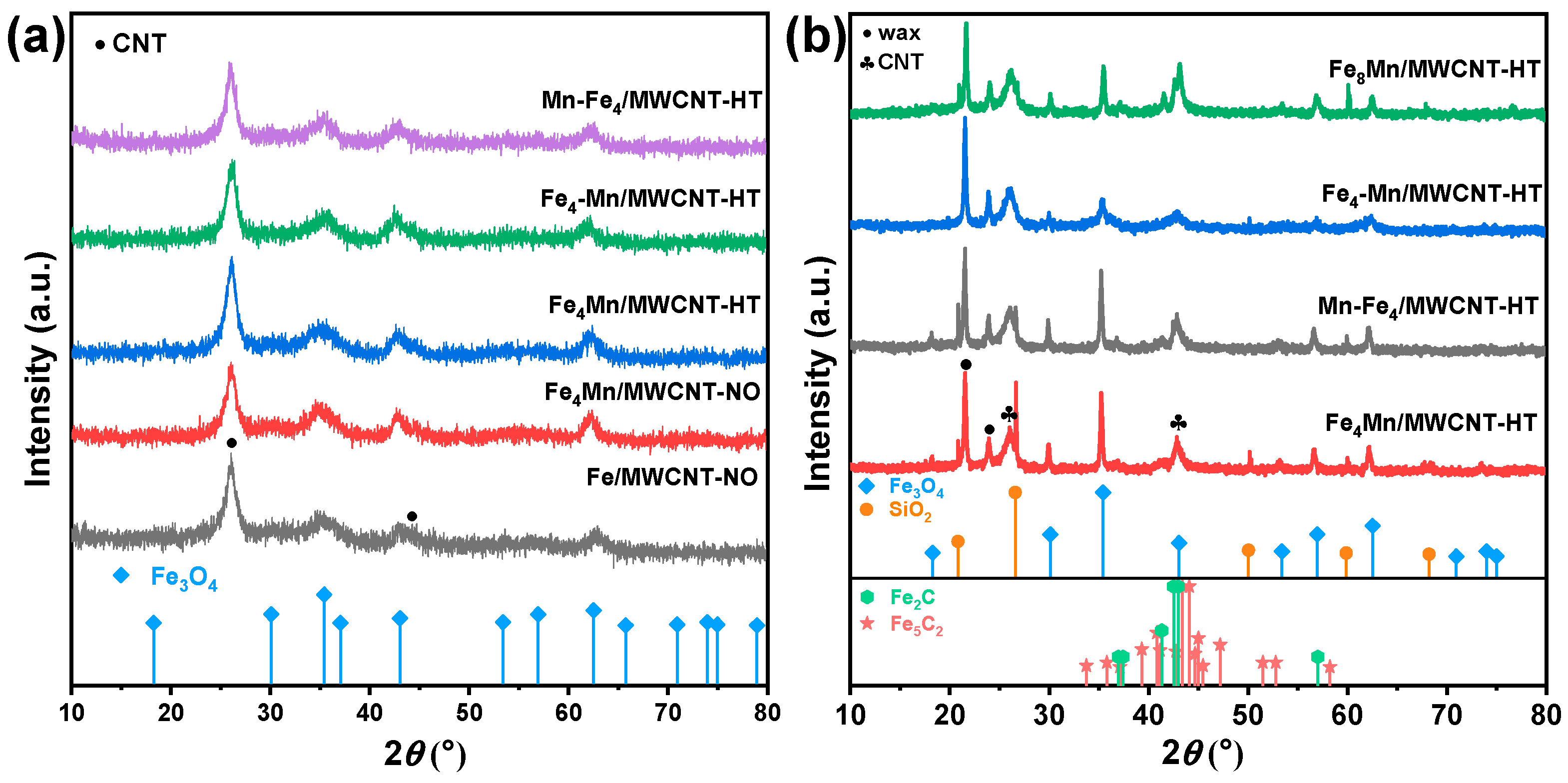
All fresh catalysts display similar XRD patterns (Figure 1a). The reflections at 2θ = 25.7° and 43.7° can be assigned to the CNT support, indicating that the CNT framework remains intact during catalyst preparation [15]. In addition, peaks at 2θ = 30.1°, 35.4°, 43.0°, 57.0°, and 62.5° are indexed to magnetite Fe3O4 (JCPDS 87-2334), suggesting that Fe3O4 is the dominant crystalline iron phase in the fresh catalysts. No discernible Mn oxide reflections are observed, implying that Mn species are highly dispersed and largely X-ray amorphous or present as interfacial species, and thus are not readily identifiable by bulk XRD. Notably, both NO-treated and HT-treated CNT-supported samples show the same CNT reflections and Fe3O4 as the dominant crystalline phase after calcination. Thus, the NO-HT pretreatment effect is not readily resolved by XRD and is instead captured by surface-sensitive probes, including O 1s XPS, discussed below.
The XRD patterns of the spent catalysts are shown in Figure 1b. Besides the CNT reflections, Fe3O4 remains the major crystalline phase. Sharp reflections at 2θ = 20.9°, 26.6°, 50.2°, and 60.0° are attributed to α-quartz (SiO2, JCPDS 83-0539), likely originating from the quartz sand used for dilution packing in the reaction. Two sharp low-angle peaks at 2θ = 21.5° and 23.9° are most plausibly assigned to crystalline long-chain hydrocarbons (wax) retained on the spent catalyst, which is commonly encountered for Fischer–Tropsch products [16]. In the 2θ = 40–50° region, additional reflections consistent with ε-Fe2C (PDF#36-1249) and χ-Fe5C2 (Hägg carbide, PDF#51-0997) are observed, indicating the likely formation of iron carbide phases under reaction conditions. Notably, the characteristic reflections of ε-Fe2C and χ-Fe5C2 partially overlap with each other and with Fe3O4 in this region, making phase discrimination by XRD alone challenging [5]. Moreover, XRD alone is insufficient to reliably resolve and quantify individual iron carbide species in the spent catalysts, and Mössbauer spectroscopy is required as a more sensitive and quantitative probe of iron carbides, oxidic, and superparamagnetic (spm) iron components [9,10,11].
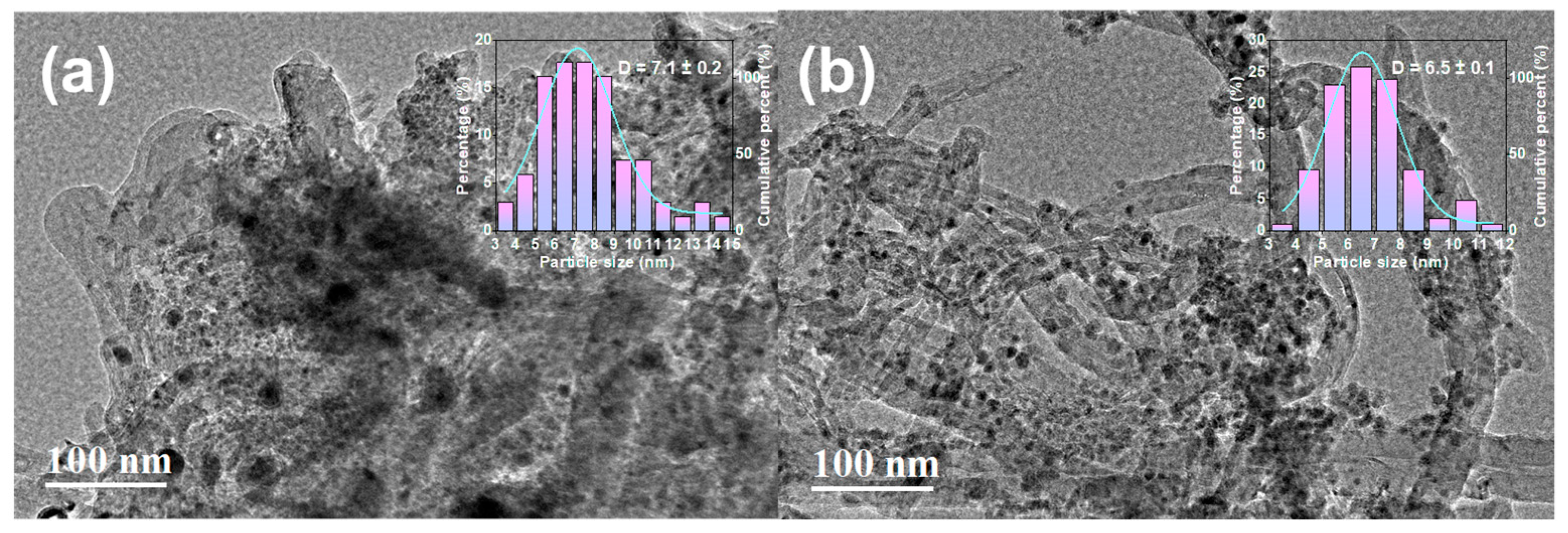
High-resolution transmission electron microscopy (HRTEM) was employed to directly probe the local structure of the MWCNT support and the size and distribution of Fe-containing nanoparticles. Representative TEM images are shown in Figure 2. For Fe/MWCNT-HT (Figure 2a), the nanoparticles exhibit a broader size dispersion with occasional aggregates, indicating locally non-uniform deposition. In contrast, Fe4Mn/MWCNT-HT (Figure 2b) shows a more intact nanotube framework and a more homogeneous dispersion of nanoparticles, with most particles distributed along the inner cavities and the tube-surface and interface region. Statistical analysis based on multiple particles with clearly resolved edges (Figure 2a,b) yields mean particle sizes of 7.1 nm for Fe/MWCNT-HT and 6.5 nm for Fe4Mn/MWCNT-HT. The slightly reduced particle size and improved dispersion suggest that Mn incorporation suppresses particle growth and promotes a more uniform distribution on CNTs, consistent with CNT confinement and support effects that can regulate the redox and structural evolution of Fe species [16]. Because smaller Fe domains generally provide a higher density of accessible interfacial sites, such size and dispersion changes may facilitate CO adsorption and activation and promote subsequent carburization on CNT-supported Fe catalysts [11].
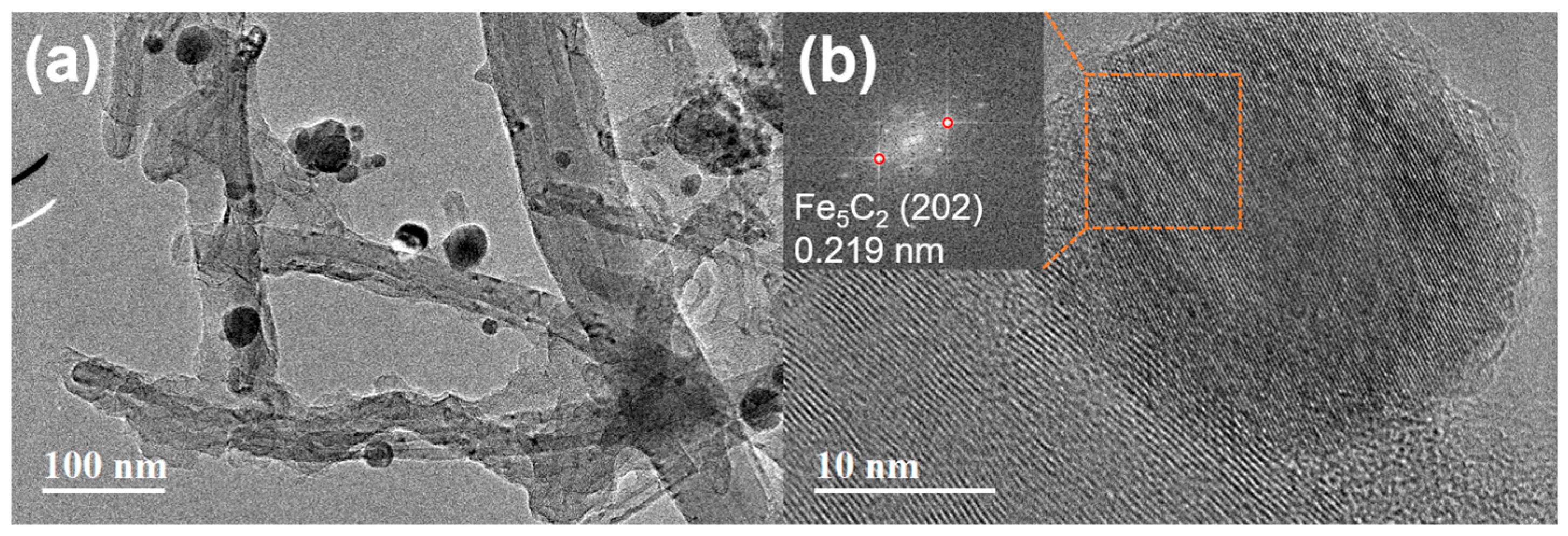
Post-reaction structural details were further examined for Fe4Mn/MWCNT-HT. As shown in Figure 3a, some larger particles are observed inside the nanotubes and at the CNT interface, indicating limited sintering and coalescence during reaction. Importantly, these particles remain intimately associated with the CNT framework, often appearing embedded or strongly anchored at interfacial sites. Lattice-fringe analysis was performed for particles located at the CNT interface. A representative HRTEM image (Figure 3b) gives an average lattice spacing of 0.219 nm, which can be indexed to the (202) plane of χ-Fe5C2 (Hägg carbide). This assignment is consistent with reported HRTEM lattice fringes of 0.219 nm for χ-Fe5C2 (202) [17]. The corresponding SAED pattern further supports the presence of χ-Fe5C2, matching the diffraction features expected for this carbide phase (Figure 3b). Given that χ-Fe5C2 is widely recognized as a key iron carbide phase responsible for CO dissociation and C-C coupling in Fischer–Tropsch-type chemistry, the direct observation of χ-Fe5C2 lattice fringes at the CNT interface supports the formation of catalytically relevant carbide domains under CO hydrogenation conditions [6].
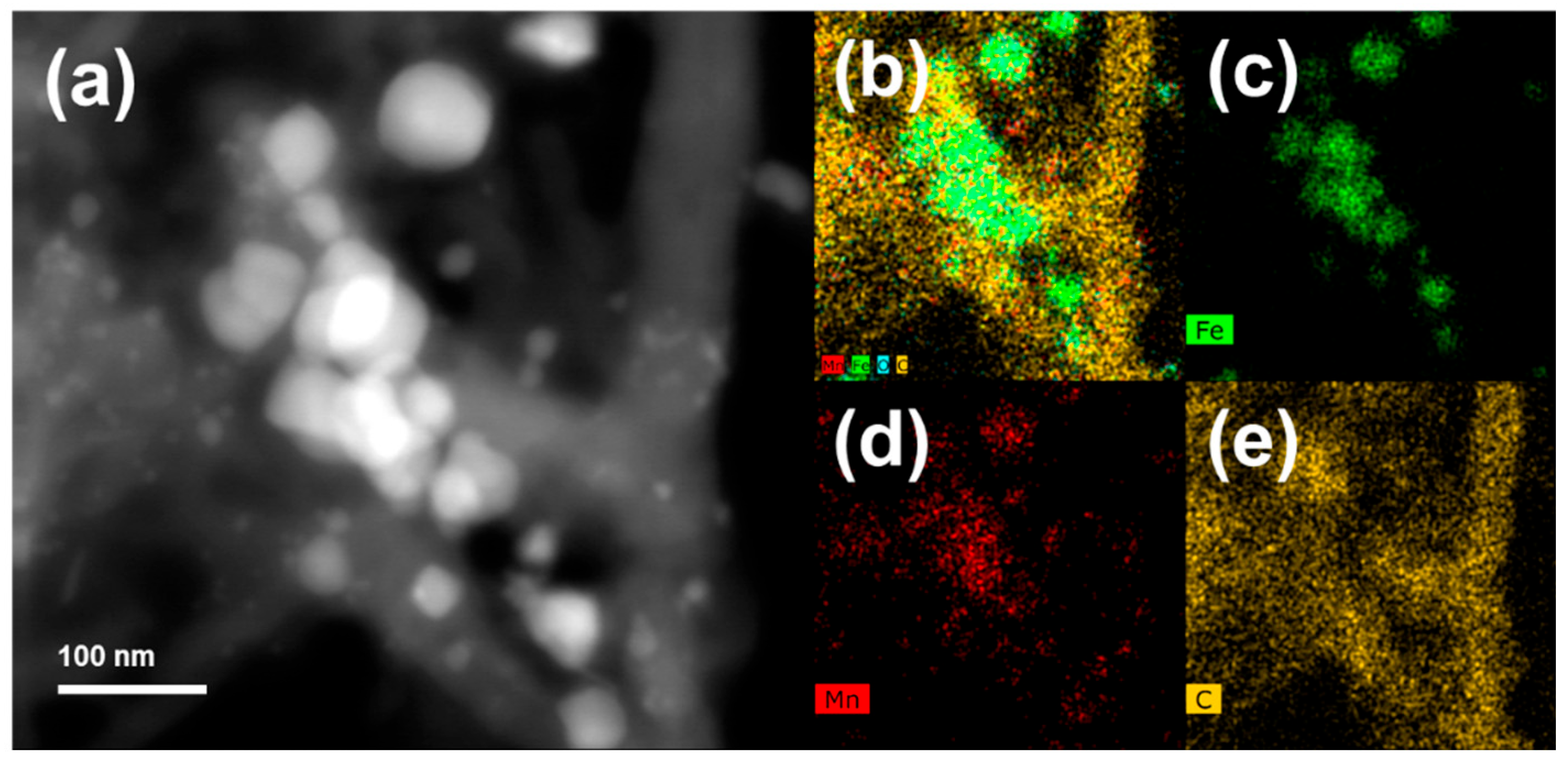
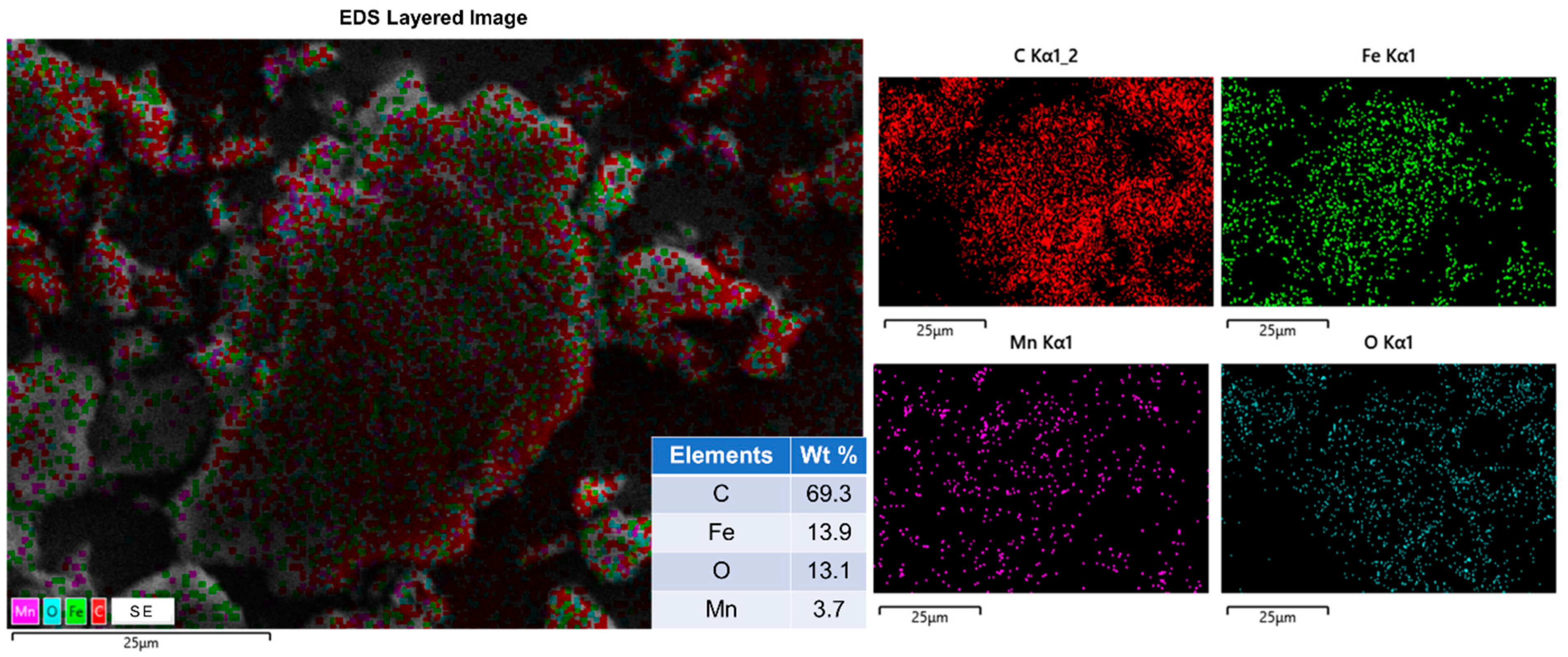
The elemental distribution of the spent catalyst was then assessed by SEM-EDS (Figure 4). At the micrometer scale, the measured Fe/Mn molar ratio is 3.7, close to the nominal value of 4, indicating no obvious macroscopic deviation at the probed surface region. In addition, no obvious macroscopic segregation of C, O, Fe, or Mn is observed, consistent with good overall dispersion. Nanoscale TEM-EDX mapping (Figure 5) further shows that Mn remains broadly co-distributed with Fe-containing particles while maintaining intimate contact with the CNT framework. Although distinct MnOx crystallites are not evident in XRD, the persistent Fe-Mn co-localization implies that Mn modifies the local chemical environment of Fe, which can influence reducibility, CO adsorption behavior, and ultimately the carburization pathway and carbide evolution [18].

2.2. Surface Properties

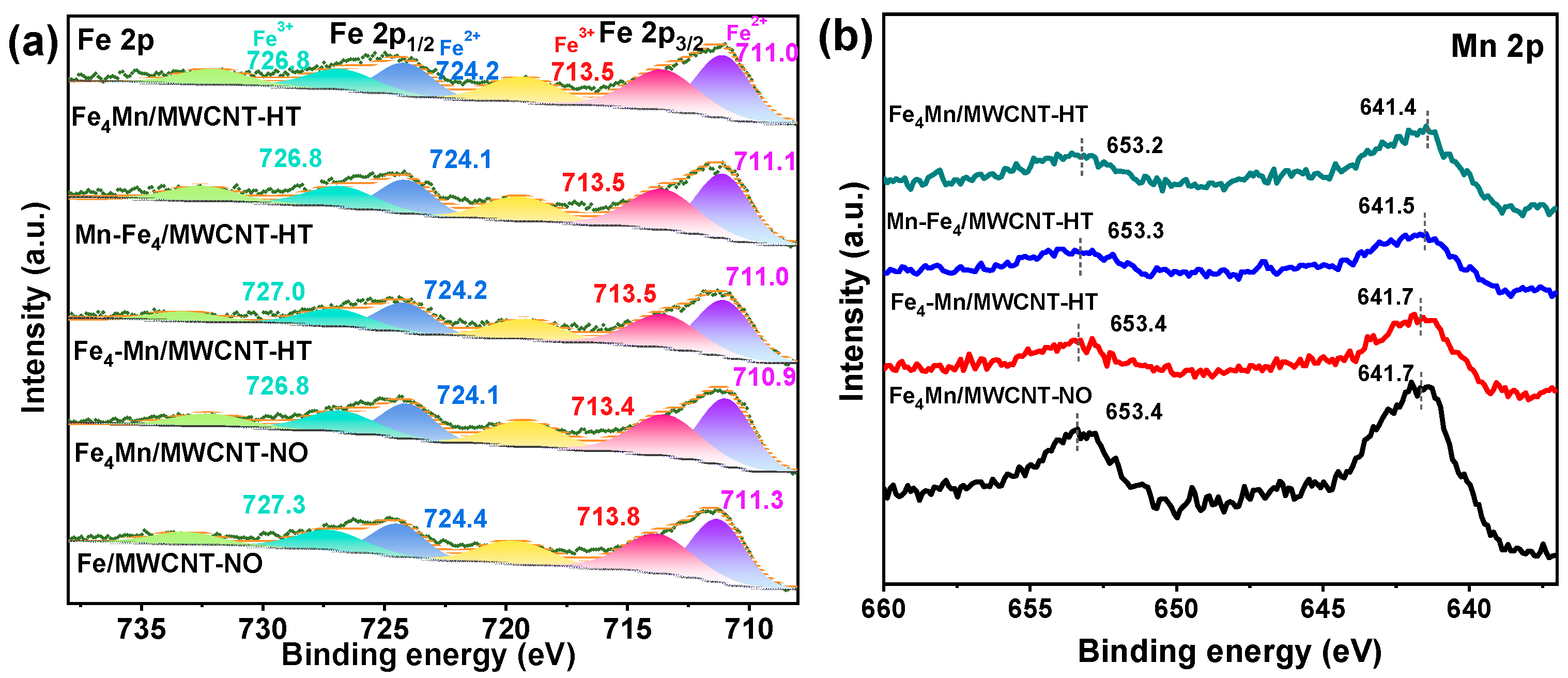
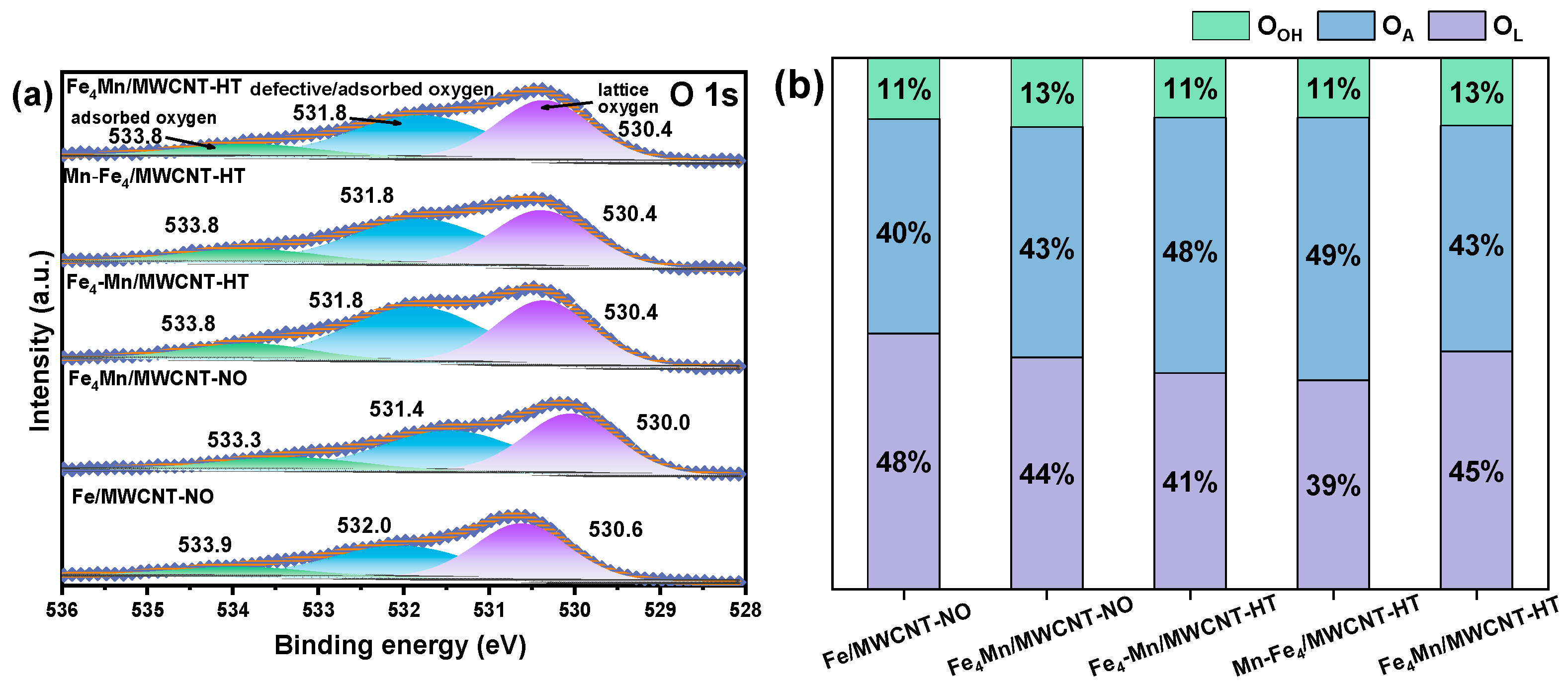
X-ray photoelectron spectroscopy (XPS) was employed to examine the surface chemical states of Fe and Mn in the calcined catalysts and to assess how CNT pretreatment and the Mn incorporation route modify the near-surface oxygen environment prior to reduction and reaction. Figure 6 shows the Fe 2p and Mn 2p regions, while Figure 7 presents the O 1s spectra and the relative fractions of the deconvoluted oxygen species. The Fe 2p3/2 binding energies and the Fe3+/Fe2+ ratios derived from peak deconvolution are summarized in Table 1.
As shown in Figure 6a, all catalysts exhibit Fe 2p features characteristic of mixed-valence iron oxide. The Fe 2p3/2 envelope is centered at 711 eV, and the Fe 2p1/2 feature appears at 724–725 eV, accompanied by weak shake-up satellites, consistent with an Fe3O4-like surface environment in the calcined catalysts [19]. This assignment agrees with the XRD results, identifying Fe3O4 as the major crystalline phase after calcination [20,21]. Within this common spectral envelope, only minor variations are observed. The Fe 2p3/2 position spans 710.9–711.3 eV (Table 1), indicating that CNT pretreatment and Mn incorporation route slightly modulate the local electronic environment of surface Fe without altering the dominant oxide identity. Peak deconvolution further suggests that surface Fe remains largely mixed-valent across the series (Fe3+/Fe2+ = 0.79–0.87). Notably, Fe4-Mn/MWCNT-HT shows the lowest Fe3+/Fe2+ value (0.79), whereas Fe4Mn/MWCNT-HT gives the highest value (0.87), implying that the Mn introduction sequence can bias the relative population of Fe2+ rich versus Fe3+ rich surface sites. Such differences are often linked to variations in reduction kinetics and carburization behavior in Fe-based CO hydrogenation catalysts [22,23].
The Mn 2p spectra (Figure 6b) display Mn 2p3/2 at 641.4–641.7 eV and Mn 2p1/2 at 653.2–653.4 eV for all Mn-containing catalysts, with only marginal differences among Fe4Mn/MWCNT-HT, Mn-Fe4/MWCNT-HT, Fe4-Mn/MWCNT-HT, and Fe4Mn/MWCNT-NO. Given the limited diagnosticity of Mn 2p alone and the absence of Mn 3s in this study, Mn is discussed conservatively as highly dispersed oxidic MnOx in comparable near-surface environments [21,24]. Together with the lack of distinct Mn oxide reflections in XRD, these spectra indicate that Mn is present predominantly as highly dispersed MnOx species associated with Fe oxides, likely forming Fe–Mn–O interfacial motifs, rather than as a separate, well-crystallized MnOx phase, which is consistent with proximity-sensitive promoter effects reported for Fe-Mn catalysts [25,26].
O 1s analysis reveals a clear CNT pretreatment effect (Figure 7). The O 1s spectra can be deconvoluted into lattice oxygen (OL, 530.0–530.6 eV), defective or adsorbed oxygen-related species (OA, 531.4–532.0 eV), and hydroxyl-type oxygen (OOH, 533.3–533.9 eV). Compared with the NO-treated catalysts, HT pretreatment increases the OA fraction from 40–43% to 48–49% while decreasing OL from 44–48% to 39–41%, with OOH remaining nearly constant (11–13%). The 531–532 eV contribution is denoted as OA because it cannot be uniquely assigned to oxygen vacancies based on ex situ O 1s fitting alone [27,28,29]. This redistribution indicates that HT pretreatment primarily modifies the interfacial oxygen environment by enriching defective or adsorbed oxygen-related species rather than increasing hydroxyl coverage. Such changes may influence the heterogeneity of Fe–O bonding; therefore, the reduction behavior and CO adsorption characteristics discussed in the next section [30,31]. XPS confirms that the calcined catalysts expose predominantly Fe3O4-like mixed-valence Fe species together with highly dispersed MnOx species on the surface. CNT pretreatment and the Mn incorporation route slightly tune the Fe electronic environment and more distinctly regulate the balance between OL and OA.

2.3. Reducibility and CO Adsorption

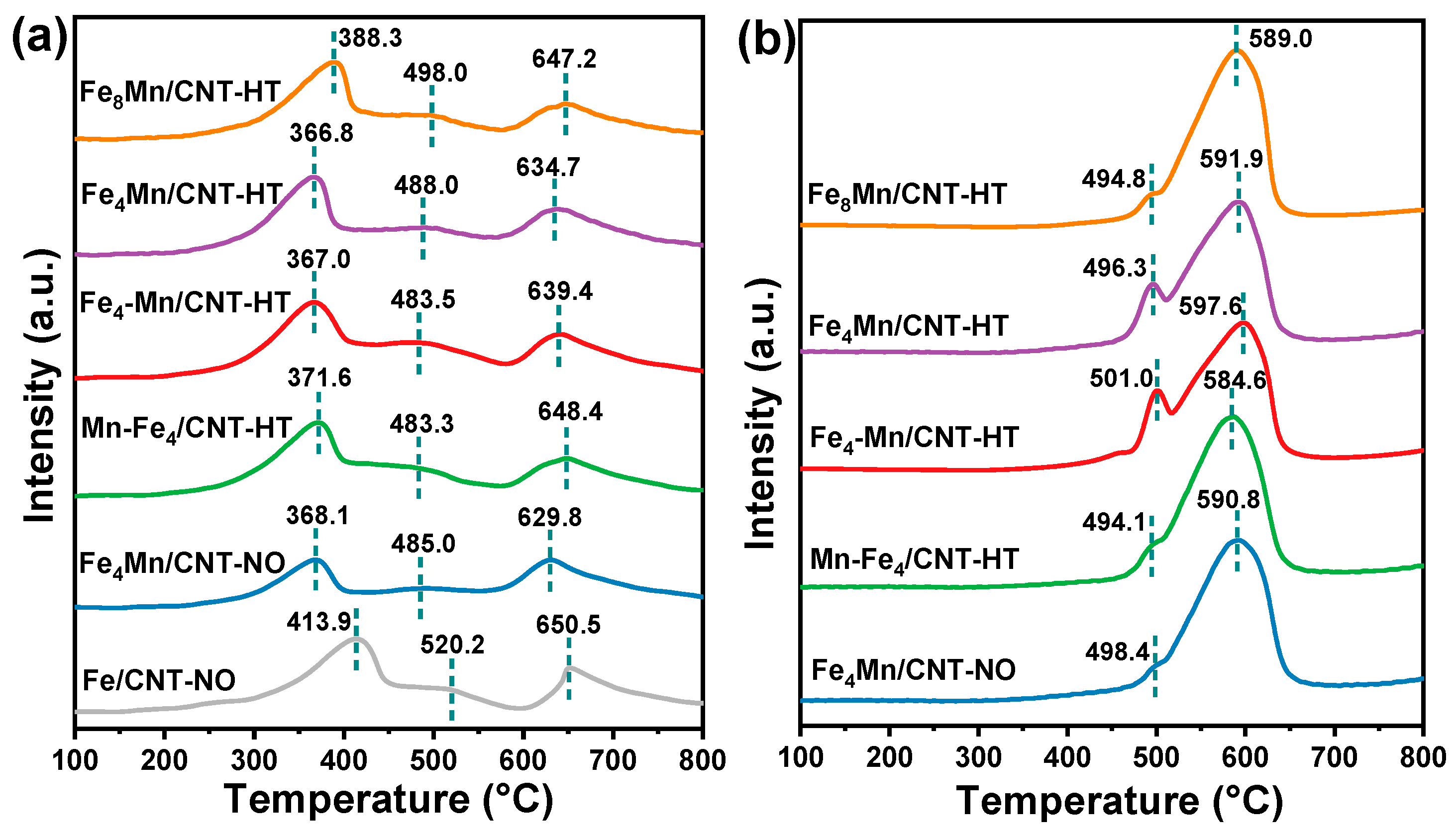
The reduction in Fe species and the subsequent CO adsorption and activation on the reduced surface are prerequisite steps for CO hydrogenation, as they determine the accessible Fe sites and influence carburization. Figure 8 compares the H2-TPR and CO-TPD profiles to examine the effects of CNT pretreatment, Mn promotion, and Mn incorporation sequence.
All catalysts show three broad H2-consumption regions (Figure 8a). For Fe/MWCNT-NO, the low-temperature feature (~360–420 °C) is attributed to the initial reduction in Fe3+ to Fe2+ (Fe3O4 → FeO), whereas the mid-temperature region (~480–520 °C) corresponds to deeper reduction in FeOx toward metallic Fe (FeO → Fe0) and strongly interacting FeOx species [32]. The high-temperature region (~630–660 °C) is assigned to the most strongly bound and encapsulated FeOx species and may overlap with CNT-related processes (such as hydrogenation and gasification of carbon species), which broadens the envelope in CNT-supported catalysts [33]. Mn incorporation shifts the low-temperature region to a lower temperature (typically ~360–380 °C), indicating facilitated initial reduction, while the overall peak shapes remain broad; therefore, we discuss trends using temperature ranges rather than over-precise maxima [34].
The CO-TPD profiles (Figure 8b) are discussed relative to Mn-free baselines (Fe/MWCNT-NO and Fe/MWCNT-HT). All samples show two dominant desorption domains. A lower-temperature peak around 494–501 °C and a higher-temperature peak around 585–598 °C, consistent with CO species bound with different strengths or on different Fe surface ensembles [35]. Mn introduction affects the high-temperature domain primarily. At a fixed Fe/Mn ratio of 4 on HT-treated CNTs, co-impregnation (Fe4Mn/MWCNT-HT) shifts the high-temperature maximum to a higher temperature than the stepwise routes, which may be consistent with stronger CO binding and activation on Fe–Mn proximity sites [36]. Where available, peak deconvolution and area integration (after baseline correction) can be used to quantify the relative contribution of the 494–501 °C domain versus the 585–598 °C domain and to support a more quantitative discussion of CO binding strength distributions [37].

2.4. Iron Species of the Spent Catalysts

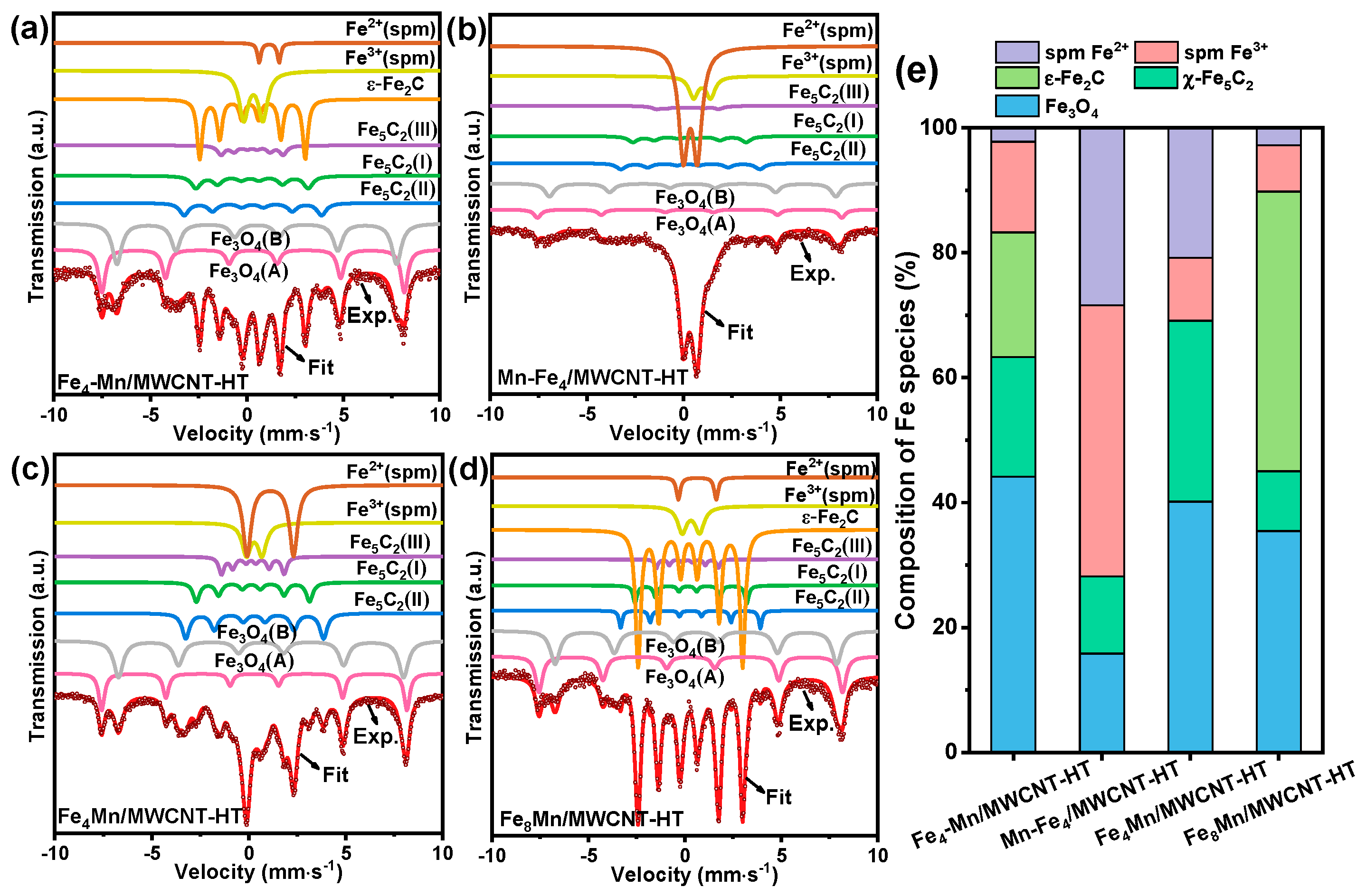
Mössbauer spectroscopy was used to quantify the iron species in the spent catalysts, with particular relevance to iron carbides that can be nanosized or poorly crystalline after CO hydrogenation [38,39]. The spectra and fits are shown in Figure 9a–d, and the phase fractions are summarized in Figure 9e and Table 2.
All spent catalysts contain Fe3O4 and carburized iron species dominated by χ-Fe5C2, while ε-Fe2C is additionally observed for selected samples. The persistence of Fe3O4 indicates that oxide-to-carbide conversion remains incomplete under the present high-temperature CO hydrogenation environment, which is consistent with concurrent carburization and re-oxidation processes under Fischer–Tropsch-type conditions [40]. The co-presence of Fe3O4 and χ-Fe5C2 is also reasonable because mixed oxide–carbide motifs, including core–shell-like arrangements, have been reported during carburization and under syngas conversion environments [41,42]. Among the carburized phases, χ-Fe5C2 is detected in every sample and remains a key component, consistent with its established role in CO activation and chain growth on iron carbide surfaces [43]. All spent samples were cooled under Ar, purged, and handled using the same transfer procedure. Moreover, Mössbauer spectroscopy is bulk-sensitive, reducing the likelihood that minor near-surface air exposure dominates the quantified phase fractions. Nevertheless, we interpret phase–performance correlations conservatively because very near-surface re-oxidation and wax coverage can still influence accessible active sites. Superparamagnetic (spm) Fe2+ and Fe3+ doublets in the room-temperature Mössbauer spectra are commonly linked to highly dispersed nanoscale iron species with fast magnetic relaxation [44]. In the absence of operando evidence, the spm contribution is interpreted conservatively and is discussed only in terms of its correlation with the measured phase fractions and catalytic trends.
The phase distribution depends strongly on how Mn is introduced, and this dependence parallels the selectivity trends [45]. The co-impregnated Fe4Mn/MWCNT-HT exhibits a comparatively carbide-enriched oxide–carbide ensemble, featuring the highest χ-Fe5C2 fraction (28.9%) together with a substantial but non-dominant Fe3O4 fraction (40.2%). This ensemble is consistent with its catalytic behavior, namely higher α-olefin and LAO selectivities and relatively lower CO2 selectivity within the studied set. By comparison, the sequence-controlled samples redistribute the oxide and carbide fractions in ways that may be less favorable for preserving terminal olefins. Fe4-Mn/MWCNT-HT contains lower χ-Fe5C2 (19.2%) and a higher Fe3O4 fraction (44.1%), along with a notable ε-Fe2C contribution (20.0%), which correlates with its lower LAO selectivity relative to Fe4Mn/MWCNT-HT. Mn-Fe4/MWCNT-HT shows an even lower χ-Fe5C2 fraction (15.5%) and a larger fraction of non-carburized or highly dispersed Fe species, suggesting that this incorporation sequence could suppress the establishment of well-defined carbide domains under steady-state conditions.
Lowering Mn at constant total metal loading shifts the carbide identity and the steady-state distribution. For Fe8Mn/MWCNT-HT, ε-Fe2C becomes dominant at 44.8% while χ-Fe5C2 decreases to 9.6% and Fe3O4 remains significant at 35.4%. This shift indicates that the carburization pathway is sensitive to Mn level and the local microenvironment around Fe, consistent with reports that ε-type carbides can be highly reactive yet sensitive to promoter and interfacial effects under Fischer–Tropsch conditions [46]. In the present catalyst set, however, enriching ε-Fe2C does not translate into the best LAO performance, suggesting that selectivity is governed by the overall oxide–carbide balance and the accessibility of the active carbide ensemble rather than by a single carbide fraction alone.
Overall, Mössbauer analysis supports that co-impregnation on HT-treated CNTs is the most effective route to establish and maintain a carbide-rich steady-state ensemble while restraining the oxide fraction, thereby favoring chain growth and olefin termination and limiting pathways that increase CO2 formation.

2.5. Catalytic Performance

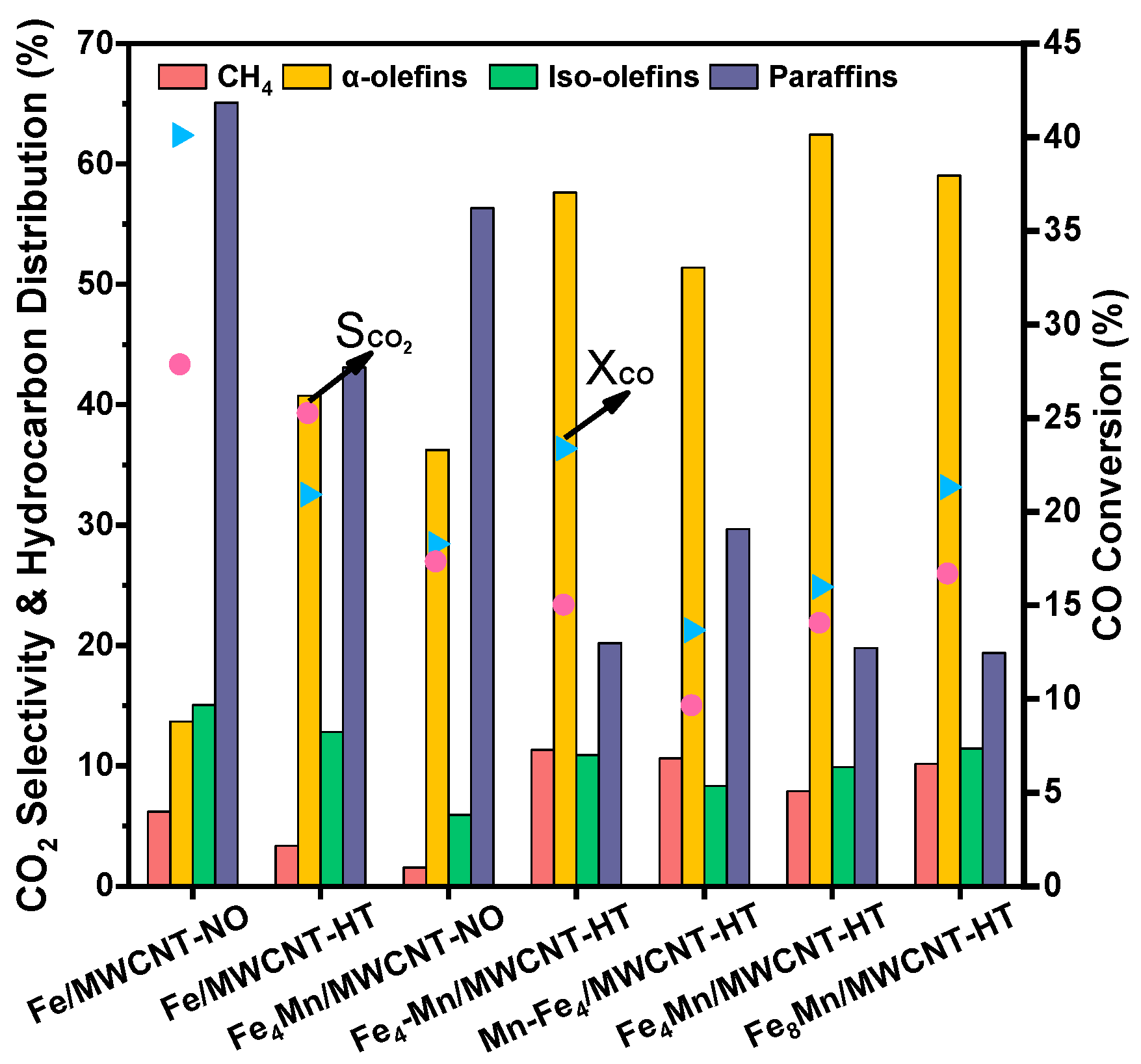
Catalytic CO hydrogenation was evaluated at 280 °C and 3.0 MPa with H2/CO/Ar = 4.5/4.5/1 and a GHSV of 6000 mL·gcat−1·h−1. The catalytic data in Figure 10 and Table 3 were collected at 108–120 h on stream to represent steady-state performance. Within this catalyst set, selectivity is governed by the competition among chain growth on carburized Fe ensembles, CO2 formation via WGS-related pathways, and secondary hydrogenation and readsorption processes that erode olefin retention [2,3,4,5,47].
Fe/MWCNT-NO shows the highest CO conversion (40.1%), yet its selectivity pattern is clearly unfavorable for linear α-olefins. CO2 selectivity reaches 40.3%, and the hydrocarbon slate is paraffin-dominated, resulting in very low α-olefin and LAO selectivities (13.7% and 9.6%) and a low LAOs/O ratio (39.0%). Switching the CNT pretreatment from NO to HT markedly improves olefin preservation even without Mn. Although CO conversion decreases for Fe/MWCNT-HT (20.9%), α-olefin and LAO selectivities increase sharply to 40.8% and 38.1%, and LAOs/O rises to 74.8, indicating that the HT-treated CNT interface suppresses secondary hydrogenation to a substantial extent [15,48].
Introducing Mn further drives the product distribution toward α-olefins and LAOs, while also lowering CO2 formation compared with Fe-only catalysts. On the NO-treated support, Fe4Mn/MWCNT-NO reduces CO2 selectivity to 25.1% and improves α-olefin and LAO selectivities to 36.2% and 34.3%, together with the highest LAOs/O ratio (85.3%). The most attractive overall balance, however, is achieved on the HT-treated support with co-impregnated Fe4Mn/MWCNT-HT, which delivers the highest α-olefin selectivity (62.4%) and LAO selectivity (49.3%) while maintaining relatively low CO2 selectivity (20.3%) and a high LAOs/O ratio (83.3%). This combination identifies Fe4Mn/MWCNT-HT as the best catalyst in this series for LAO-oriented CO hydrogenation under the present high-temperature conditions.
At an identical nominal Fe–Mn composition on HT-treated CNTs, the Mn incorporation sequence also impacts selectivity. Fe4-Mn/MWCNT-HT exhibits a higher share of light hydrocarbons and the lowest chain-growth probability, whereas Mn-Fe4/MWCNT-HT achieves the lowest CO2 selectivity (14.0%) while keeping high α-olefin and LAO selectivities (51.4% and 42.1%) and a high LAOs/O ratio (83.5%). Finally, lowering Mn content at constant total metal loading (Fe8Mn/MWCNT-HT) does not further improve α-olefin and LAO metrics relative to Fe4Mn/MWCNT-HT, indicating that sufficient Mn in close proximity to Fe is required to sustain the promotion toward olefin-rich products [12,48].
Benchmarking against representative literature, the performance trends observed here are consistent with the broader understanding that olefin and LAO selectivity in Fe-based CO hydrogenation is highly sensitive to the steady-state carbide ensemble and the local interfacial and promoter environment [49]. For example, phase-pure χ-Fe5C2 has enabled efficient syngas-to-LAO conversion with reduced CO2 formation [1], while Mn tuning of ε-Fe2C or hydrophobic Fe–Mn interfaces has been shown to suppress C1 by-products and improve overall olefin selectivity [10,49]. In addition, Na-promoted Fe–Zn oxides have been reported to selectively produce linear α-olefins under high-temperature F–T conditions [50], and Zn-promoted precipitated Fe catalysts can enhance LAO yields and stability via modulating the surface carbon chemical potential [51]. Together, these comparisons support that tailoring the CNT–metal interfacial oxygen environment and Mn–Fe proximity offers a complementary route to promote terminal-olefin and LAO retention under high-pressure CO hydrogenation.

3. Discussion

Across this catalyst series, selectivity to α-olefins and LAOs is dictated by how CNT pretreatment and the Mn incorporation protocol steer the reduction–carburization evolution, rather than by nominal composition alone. The key result is that Fe4Mn/MWCNT-HT, prepared by co-impregnation, delivers the highest α-olefin and LAO selectivities while maintaining a comparatively low CO2 selectivity. This outcome reflects an effective balance between suppressing WGS-related CO2 formation and limiting secondary hydrogenation or readsorption that erodes terminal olefin retention under high-temperature CO hydrogenation conditions [2,3,4,5,14,15].
CNT pretreatment establishes the support contribution that underpins this balance. Although Fe 2p suggests similar Fe3O4-like mixed-valence features for the fresh catalysts, O 1s is more responsive to pretreatment and indicates that HT mainly reshapes the interfacial oxygen environment. This is consistent with modified Fe–O interactions and a changed reduction response, and it coincides with the shift from a paraffin-rich slate on Fe/MWCNT-NO to a markedly more olefin-rich distribution on Fe/MWCNT-HT, even without Mn [14,15].
On the HT-derived interface, the advantage of co-impregnation becomes most evident. Introducing Fe and Mn together favors intimate Fe–Mn contact during oxide formation and calcination, increasing the likelihood that Mn acts through interfacial Fe–Mn–O motifs rather than as spatially separated MnOx domains. Since Mn promotion is proximity dependent, this structural intimacy is expected to influence reducibility and CO binding and to bias the steady-state competition between carburization and re-oxidation. These effects are consistent with the selectivity pattern of Fe4Mn/MWCNT-HT, where CO2 formation remains restrained while α-olefins and LAOs are most strongly enriched [12].
Mössbauer spectroscopy provides a phase-level rationale for the performance differences. All spent catalysts retain Fe3O4 together with iron carbides, indicating incomplete oxide-to-carbide conversion under the present CO hydrogenation conditions. Within this common phase landscape, the co-impregnated Fe4Mn/MWCNT-HT shows the highest χ-Fe5C2 fraction among the HT-treated Mn-containing samples, together with a moderated Fe3O4 contribution. This oxide–carbide balance is consistent with sustaining carbide domains that support chain growth and olefin termination while restraining oxide-associated pathways that promote CO2 formation. In contrast, the sequence-controlled catalysts shift the steady-state distribution away from χ-Fe5C2, either by retaining more Fe3O4 or by allocating a larger fraction of Fe to highly dispersed species, which aligns with their less favorable α-olefin and LAO outcomes [7,43,44,45].
The sequence-controlled samples further highlight that how Mn is introduced can be as important as how much Mn is introduced. At the same nominal Fe/Mn ratio on HT-treated CNTs, the stepwise routes redistribute MnOx relative to FeOx, changing Fe–Mn proximity and thereby biasing reducibility, CO adsorption energetics, and the resulting χ-Fe5C2 and ε-Fe2C balance. In parallel, changing Mn loading between such as Fe8Mn and Fe4Mn at constant total metal alters the local carburizing environment and can shift carbide identity even for co-impregnated samples. Thus, carbide composition reflects the combined effects of Mn proximity (sequence) and Mn level (loading), rather than sequence alone.
Overall, HT pretreatment and co-impregnation act cooperatively to guide the activation trajectory toward a phase ensemble that enhances α-olefin and LAO retention while limiting CO2 formation. This identifies CNT interfacial control and the Mn introduction protocol as practical levers for improving selectivity in high-temperature CO hydrogenation [2,3,4,5,14,15]. The interface-related discussion is kept conservative and is based on catalyst-level evidence and internally consistent trends in activity and selectivity. Direct characterization of the CNT supports before and after treatment would further strengthen the mechanistic interpretation. Future work will include dedicated support characterization and quantitative impurity analysis to validate the role of CNT oxygen environments in governing Fe–Mn proximity and carbide evolution.

4. Materials and Methods

4.1. Materials and Catalyst Preparation

Multi-walled carbon nanotubes (MWCNTs, length 5–15 μm, diameter 10–40 nm) were supplied by Naco New Materials Company (Jiaxing, China). Ammonium ferric citrate (FAC), manganese(II) nitrate tetrahydrate (Mn(NO3)2·4H2O), nitric acid (HNO3), and other chemicals were purchased from Sinopharm Chemical Reagent Co., Ltd (Shanghai, China). All reagents were used as received without further purification. Deionized water was used throughout.
MWCNTs were pretreated prior to metal loading. The raw MWCNTs were purified and oxidized by refluxing in 8 M HNO3 at 110 °C for 4 h under stirring to remove residual metal species and introduce oxygenated anchoring sites. After cooling, the solids were washed with deionized water until the filtrate reached neutral pH (pH ≈ 7), filtered, and dried at 60 °C overnight. The obtained nitric-acid-treated CNTs were denoted as MWCNT-NO. In this work, the effects of CNT pretreatments are discussed primarily based on catalyst-level surface chemistry (XPS), reducibility (H2-TPR), CO adsorption (CO-TPD), and catalytic performance.
MWCNT-HT was obtained by further Ar annealing of MWCNT-NO to modify the CNT surface prior to metal loading. In this case, the MWCNTs-NO sample was further heat-treated in a tubular furnace under flowing Ar (100 mL·min−1) to tune defect density and remove unstable oxygenated groups. The temperature was increased to 850 °C at 5 °C·min−1 and maintained for 2 h, then cooled to room temperature under Ar. The resulting sample was labeled MWCNT-HT.
FAC was used as the Fe precursor. CNT-supported Fe catalysts were prepared by incipient wetness impregnation to obtain a nominal total metal loading of 30 wt%. An aqueous FAC solution was added dropwise onto MWCNT-NO or MWCNT-HT, followed by ultrasonic dispersion and aging at room temperature for several hours. The samples were dried at 60 °C overnight. The dried powders were calcined under Ar at 500 °C for 2 h with a heating rate of 2 °C·min−1, yielding Fe/MWCNT-NO and Fe/MWCNT-HT.
For Mn-modified catalysts prepared by co-impregnation, FAC and Mn(NO3)2·4H2O were simultaneously dissolved in deionized water at a Fe: Mn molar ratio of 4:1, while maintaining the total metal loading at 30 wt%. The mixed solution was impregnated onto CNT supports following the same drying and calcination procedures, producing Fe4Mn/MWCNT-NO and Fe4Mn/MWCNT-HT.
To investigate the effect of Mn introduction sequence, catalysts with identical Fe: Mn molar ratios (4:1) and total metal loadings (30 wt%) were prepared by stepwise impregnation on MWCNT-HT. In the “Mn-first” route, MWCNT-HT was impregnated with manganese nitrate solution, dried, then impregnated with FAC solution and dried again. the resulting sample was labeled Fe4–Mn/MWCNT-HT. In the “Fe-first” route, MWCNT-HT was first impregnated with FAC solution, dried, then impregnated with manganese nitrate solution and dried again. The resulting sample was labeled Mn–Fe4/MWCNT-HT. Each impregnation step was followed by drying prior to the subsequent metal addition. For comparison, the co-impregnated Fe4Mn/MWCNT-HT catalyst was also prepared. All stepwise and co-impregnated samples were finally calcined together under Ar at 500 °C for 2 h.

4.2. Catalyst Characterization

Powder X-ray diffraction (XRD) patterns of fresh and spent catalysts were collected on a Bruker D8 Advance diffractometer using Cu Kα radiation (40 kV, 40 mA) to identify crystalline phases.
The morphology and microstructure of the catalysts were examined by scanning electron microscopy (SEM), and elemental distributions were obtained by energy-dispersive X-ray spectroscopy (EDS) using a Helios 5 UC microscope (Thermo Fisher Scientific, Hillsboro, OR, USA) equipped with an Ultim Max 65 detector (Oxford Instruments, High Wycombe, UK). Transmission electron microscopy (TEM) observations were performed on a JEM-2100F microscope (JEOL Ltd., Tokyo, Japan) operated at 200 kV to evaluate particle size and dispersion. Particle sizes were measured from HRTEM images using ImageJ software (v1.53k, ≥100 particles per sample). Only particles with clearly resolved boundaries were included, and results are reported as mean ± standard deviation.
X-ray photoelectron spectroscopy (XPS) measurements were carried out on a Thermo Scientific ESCALAB 250Xi spectrometer (Thermo Fisher Scientific, Waltham, MA, USA) using Al Kα radiation to analyze surface chemical states. Binding energies were calibrated using the C 1s peak at 284.8 eV as reference. Fe 2p, Mn 2p, and O 1s spectra were deconvoluted after Shirley background subtraction.
H2 temperature-programmed reduction (H2-TPR) and CO temperature-programmed desorption (CO-TPD) experiments were conducted on a Micromeritics AutoChem II 2930 analyzer (Micromeritics Instrument Corporation, Norcross, GA, USA). For H2-TPR, 50 mg of sample was heated from room temperature to 800 °C at 10 °C·min−1 under 5% H2/Ar (30 mL·min−1). For CO-TPD, the samples were first reduced in situ under H2 at 350 °C for 1 h, followed by CO adsorption using 5% CO/He at 50 °C. After purging with He to remove physisorbed CO, desorption profiles were recorded by heating to 800 °C at 10 °C·min−1.
Mössbauer spectra of the spent catalysts were recorded at room temperature using a conventional constant-acceleration spectrometer with a 57Co/Rh source. Spectra were fitted to quantify iron species, including Fe3O4, χ-Fe5C2, ε-Fe2C, and spm Fe2+/Fe3+ components.

4.3. Catalyst Performance Evaluation

CO hydrogenation reactions were carried out in a fixed-bed stainless-steel reactor. Typically, 3.0 g of catalyst (20–40 mesh) was thoroughly mixed with an equal mass of quartz sand and loaded into the isothermal zone of the reactor. Prior to reaction, the catalyst was reduced in situ under a syngas atmosphere (H2/CO/Ar = 6/3/1) at 280 °C and atmospheric pressure with a space velocity of 2000 mL·gcat−1·h−1 for 8 h. After reduction, the reactor was purged with Ar and then pressurized to the desired reaction pressure.
All CO hydrogenation tests were conducted at 280 °C and 3.0 MPa with a feed gas composition of H2/CO/Ar = 4.5/4.5/1 (molar ratio), containing 10 vol% Ar as an internal standard. The total gas hourly space velocity (GHSV) was maintained at 6000 mL·gcat−1·h−1. The reactor effluent was analyzed online using a gas chromatograph equipped with a thermal conductivity detector (TCD) for permanent gases (H2, CO, and CO2) and a flame ionization detector (FID) for hydrocarbons. CO conversion and product selectivities were calculated on a carbon basis.
The olefin-to-paraffin (O/P) ratio was defined as the molar ratio of total C2+ olefins to the corresponding paraffins. The selectivity of linear α-olefins (LAOs/O) was defined as the fraction of terminal α-olefins in C4+ hydrocarbons relative to total olefins. Each catalytic test was performed until steady-state operation was achieved. After reaction, the catalysts were purged with Ar and cooled to room temperature prior to post-reaction characterization.
CO conversion ( X CO ), CO2 selectivity ( S CO 2 ), and hydrocarbon selectivities ( S C i H m ) were calculated according to Equations (1)–(3).
X CO   ( % ) = N CO in - N CO out N CO in   ×   100 % ,
S CO 2   ( % ) = N C O 2 out N CO in - N CO out   ×   100 % ,
S C i H m   ( % ) = i N C i H m out i = 1 n i N C i H m out   ×   100 % ,
where N CO in , N CO out , and N C O 2 out represent the molar flow rates of CO and CO2 at the reactor inlet and outlet, respectively.

5. Conclusions

CNT pretreatment and the Mn incorporation protocol are key variables for steering olefin and LAO selectivity in high-temperature CO hydrogenation over CNT-supported Fe catalysts. Switching from NO-treated to HT-treated CNTs improved olefin preservation (such as LAOs/O increased from 39.0% on Fe/MWCNT-NO to 74.8% on Fe/MWCNT-HT) by suppressing secondary hydrogenation and readsorption. Beyond promoter loading, the Mn introduction protocol strongly affected CO2 selectivity and LAO retention at the same nominal Fe/Mn ratio. Among all samples, the co-impregnated Fe4Mn/MWCNT-HT achieved the most favorable balance at steady state (108–120 h), combining CO conversion of 16.0% with CO2 selectivity of 20.3%, the highest α-olefin selectivity of 62.4%, and the highest LAO selectivity of 49.3% (LAOs/O = 83.3%). Mössbauer analysis confirms that these trends track changes in the steady-state oxide and carbide/spm ensemble, with co-impregnation on HT-treated CNTs favoring a higher fraction of catalytically relevant χ-Fe5C2 while maintaining a moderated residual oxide fraction. Overall, regulating the CNT interfacial environment together with controlled Mn–Fe proximity provides a practical route to suppress CO2 formation and enhance LAO retention under high-temperature CO hydrogenation.

Author Contributions

Conceptualization, H.Z. Methodology, H.Z., Z.S. and J.W. Software, H.Z. validation, H.Z. Formal analysis, H.Z. Investigation, H.Z., Z.S. and Y.S. Data curation, H.Z. and Z.S. Writing—original draft preparation, H.Z. Writing—review and editing, H.Z. and Y.S. Visualization, H.Z. Supervision, Y.S., Q.S. and J.W. Project administration, Y.S. Funding acquisition, Q.S. All authors have read and agreed to the published version of the manuscript.

Funding

This research was funded by the National Key Research and Development Program of China, grant number 2023YFB4103200, and the Shandong Key Research and Development Program (Competitive Innovation Platform), grant number 2024CXPT069.

Data Availability Statement

All data supporting this study are available from authors upon request.

Conflicts of Interest

Authors Hengxuan Zhang, Zixing Shi, Yan Sun and Qiwen Sun were employed by the company Shanghai Yankuang Energy R&D Co., Ltd. The remaining author declare that the research was conducted in the absence of any commercial or financial relationships that could be construed as a potential conflict of interest.

Abbreviations

The following abbreviations are used in this manuscript:
MWCNTMulti-walled carbon nanotubes
CNTCarbon nanotubes
LAOLinear α-olefin
WGSWater-gas shift
F-TFischer–Tropsch
FACAmmonium ferric citrate

References

  1. Wang, P.; Chiang, F.-K.; Chai, J.; Dugulan, A.I.; Dong, J.; Chen, W.; Broos, R.J.P.; Feng, B.; Song, Y.; Lv, Y.; et al. Efficient conversion of syngas to linear α-Olefins by Phase-Pure χ-Fe5C2. Nature 2024, 635, 102–107. [Google Scholar] [CrossRef]
  2. Zhai, P.; Li, Y.; Wang, M.; Liu, J.; Cao, Z.; Zhang, J.; Xu, Y.; Liu, X.; Li, Y.-W.; Zhu, Q.; et al. Development of direct conversion of syngas to unsaturated hydrocarbons based on Fischer-Tropsch route. Chem 2021, 7, 3027–3051. [Google Scholar] [CrossRef]
  3. Li, W.; Lin, Q.; Lv, Y.; Li, H.; Liu, W.; Liu, Y.; Zhang, M.; Men, Z. Optimization strategy and research progress of iron-based Fischer-Tropsch synthesis catalysts: A green and low-carbon perspective. Clean Energy 2025, 9, 39–54. [Google Scholar] [CrossRef]
  4. Amin, M.; Usman, M.; Kella, T.; Khan, W.U.; Khan, I.A.; Lee, K.H. Issues and challenges of Fischer-Tropsch synthesis catalysts. Front. Chem. 2024, 12, 1462503. [Google Scholar] [CrossRef] [PubMed]
  5. Chai, J.; Jiang, J.; Gong, Y.; Wu, P.; Wang, A.; Zhang, X.; Wang, T.; Meng, X.; Lin, Q.; Lv, Y.; et al. Recent Mechanistic Understanding of Fischer-Tropsch Synthesis on Fe-Carbide. Catalysts 2023, 13, 1052. [Google Scholar] [CrossRef]
  6. Yang, C.; Zhao, H.; Hou, Y.; Ma, D. Fe5C2 Nanoparticles: A Facile Bromide-Induced Synthesis and as an Active Phase for Fischer-Tropsch Synthesis. J. Am. Chem. Soc. 2012, 134, 15814–15821. [Google Scholar] [CrossRef] [PubMed]
  7. Pham, T.H.; Duan, X.; Qian, G.; Zhou, X.; Chen, D. CO Activation Pathways of Fischer-Tropsch Synthesis on χ-Fe5C2 (510): Direct versus Hydrogen-Assisted CO Dissociation. J. Phys. Chem. C 2014, 118, 10170–10176. [Google Scholar] [CrossRef]
  8. Wang, P.; Chen, W.; Chiang, F.-K.; Dugulan, A.I.; Song, Y.; Pestman, R.; Zhang, K.; Yao, J.; Feng, B.; Miao, P.; et al. Synthesis of stable and low-CO2 selective ε-iron carbide Fischer-Tropsch catalysts. Sci. Adv. 2018, 4, eaau2947. [Google Scholar] [CrossRef]
  9. Lyu, S.; Wang, L.; Li, Z.; Yin, S.; Chen, J.; Zhang, Y.; Li, J.; Wang, Y. Stabilization of ε-iron carbide as high-temperature catalyst under realistic Fischer-Tropsch synthesis conditions. Nat. Commun. 2020, 11, 6219. [Google Scholar] [CrossRef]
  10. Qian, F.; Bai, J.; Cai, Y.; Yang, H.; Cao, X.-M.; Liu, X.; Liu, X.-W.; Yang, Y.; Li, Y.-W.; Ma, D.; et al. Stabilized ε-Fe2C catalyst with Mn tuning to suppress C1 byproduct selectivity for high-temperature olefin synthesis. Nat. Commun. 2024, 15, 5128. [Google Scholar] [CrossRef]
  11. Lu, F.; Chen, X.; Lei, Z.; Wen, L.; Zhang, Y. Revealing the activity of different iron carbides for Fischer-Tropsch synthesis. Appl. Catal. B 2021, 281, 119521. [Google Scholar] [CrossRef]
  12. Ding, X.; Zhu, M.; Han, Y.-F.; Yang, Z. Revisiting the syngas conversion to olefins over Fe-Mn bimetallic catalysts: Insights from the proximity effects. J. Catal. 2023, 417, 213–225. [Google Scholar] [CrossRef]
  13. Wang, J.; Xu, Y.; Ma, G.; Lin, J.; Wang, H.; Zhang, C.; Ding, M. Directly Converting Syngas to Linear α-Olefins over Core–Shell Fe3O4@MnO2 Catalysts. ACS Appl. Mater. Interfaces 2018, 10, 43578–43587. [Google Scholar] [CrossRef] [PubMed]
  14. Yahyazadeh, A.; Borugadda, V.B.; Dalai, A.K.; Zhang, L. Optimization of olefins’ yield in Fischer-Tropsch synthesis using carbon nanotubes supported iron catalyst with potassium and molybdenum promoters. Appl. Catal. A 2022, 643, 118759. [Google Scholar] [CrossRef]
  15. Zhang, Z.; Zhang, J.; Wang, X.; Si, R.; Xu, J.; Han, Y.-F. Promotional effects of multiwalled carbon nanotubes on iron catalysts for Fischer-Tropsch to olefins. J. Catal. 2018, 365, 71–85. [Google Scholar] [CrossRef]
  16. Li, L.; Zheng, Y.; Xu, B.; Xu, Y.; Liu, Z. Wax Separated Effectively from Fischer-Tropsch Wax Residue by Solvent Desorption: Thermodynamic and Kinetic Analysis. Appl. Sci. 2021, 11, 7745. [Google Scholar] [CrossRef]
  17. Chen, W.; Fan, Z.; Pan, X.; Bao, X. Effect of Confinement in Carbon Nanotubes on the Activity of Fischer-Tropsch Iron Catalyst. J. Am. Chem. Soc. 2008, 130, 9414–9419. [Google Scholar] [CrossRef]
  18. Yang, X.; Zhang, H.; Liu, Y.; Ning, W.; Han, W.; Liu, H.; Huo, C. Preparation of Iron Carbides Formed by Iron Oxalate Carburization for Fischer-Tropsch Synthesis. Catalysts 2019, 9, 347. [Google Scholar] [CrossRef]
  19. Han, X.; Li, Y.; Gong, H.; Wang, Y.; Lv, J.; Wang, Y.; Huang, S.; Ma, X. Effect of Mn-dopant on carburization of the Fe3O4 catalysts in Fischer-Tropsch synthesis. Chem. Eng. Sci. X 2021, 11, 100106. [Google Scholar] [CrossRef]
  20. Grosvenor, A.P.; Kobe, B.A.; Biesinger, M.C.; McIntyre, N.S. Investigation of multiplet splitting of Fe 2p XPS spectra and bonding in iron compounds. Surf. Interface Anal. 2004, 36, 1564–1574. [Google Scholar] [CrossRef]
  21. Biesinger, M.C.; Payne, B.P.; Grosvenor, A.P.; Lau, L.W.M.; Gerson, A.R.; Smart, R.S.C. Resolving surface chemical states in XPS analysis of first row transition metals, oxides and hydroxides: Cr, Mn, Fe, Co and Ni. Appl. Surf. Sci. 2011, 257, 2717–2730. [Google Scholar] [CrossRef]
  22. Nielsen, M.R.; Moss, A.B.; Bjørnlund, A.S.; Liu, X.; Knop-Gericke, A.; Klyushin, A.Y.; Grunwaldt, J.-D.; Sheppard, T.L.; Doronkin, D.E.; Zimina, A.; et al. Reduction and carburization of iron oxides for Fischer-Tropsch synthesis. J. Energy Chem. 2020, 51, 48–61. [Google Scholar] [CrossRef]
  23. Ding, M.; Yang, Y.; Wu, B.; Li, Y.; Wang, T.; Ma, L. Study on reduction and carburization behaviors of iron phases for iron-based Fischer-Tropsch synthesis catalyst. Appl. Energy 2015, 160, 982–989. [Google Scholar] [CrossRef]
  24. Nesbitt, H.W.; Banerjee, D. Interpretation of XPS Mn(2p) spectra of Mn oxyhydroxides and constraints on the mechanism of MnO2 precipitation. Am. Mineral. 1998, 83, 305–315. [Google Scholar] [CrossRef]
  25. Akbari, M.; Mirzaei, A.A. Fischer-Tropsch to olefin reaction over Fe-based catalysts: Effect of preparation method and synergistic effect of Mn and Zr promoters. J. Taiwan Inst. Chem. Eng. 2024, 159, 105484. [Google Scholar] [CrossRef]
  26. Huang, S.; Liu, C.; Chen, Y.; Hong, J.; Zhao, Y.; Zhang, Y.; Li, J. The effect of Mn on the performance of MCF-supported highly dispersed iron catalysts for Fischer-Tropsch synthesis. Catal. Sci. Technol. 2020, 10, 502–513. [Google Scholar] [CrossRef]
  27. Idriss, H. On the wrong assignment of the XPS O1s signal at 531–532 eV attributed to oxygen vacancies in photo- and electro-catalysts for water splitting and other materials applications. Surf. Sci. 2021, 712, 121894. [Google Scholar] [CrossRef]
  28. Wang, J.; Mueller, D.N.; Crumlin, E.J. Recommended strategies for quantifying oxygen vacancies with X-ray photoelectron spectroscopy. J. Eur. Ceram. Soc. 2024, 44, 116709. [Google Scholar] [CrossRef]
  29. Graf, A.; Isaacs, M.A.; Morgan, D.J. Insight Notes: Considerations in the XPS Analysis of O1s Spectra for Metal Oxides. Surf. Interface Anal. 2026, 58, 89–95. [Google Scholar] [CrossRef]
  30. Zhu, J.; Wang, P.; Zhang, X.; Zhang, G.; Li, R.; Li, W.; Senftle, T.P.; Liu, W.; Wang, J.; Wang, Y.; et al. Dynamic structural evolution of iron catalysts involving competitive oxidation and carburization during CO2 hydrogenation. Sci. Adv. 2022, 8, eabm3629. [Google Scholar] [CrossRef]
  31. Nascimento, J.P.S.; Oliveira, A.C.; Fernandes, F.A.N.; Pinheiro, G.S.; Holgado, J.P.; Martinez, A.C.; Guerrero-Pérez, O.; Jiménez-Jiménez, J.; Rodríguez-Castellón, E. Surface Sensitivity of Mesoporous Carbon-Supported Iron Catalysts in the Fischer-Tropsch Synthesis: An In Situ XPS Site Evolution at Distinct Reaction Conditions. Energy Fuels 2025, 39, 15634–15647. [Google Scholar] [CrossRef]
  32. Liang, H.; Zhao, Q.; Liu, S.; Wei, C.; Wang, Y.; Wang, Y.; Huang, S.; Ma, X. Synergistic effect of Fe-Mn bimetallic sites with close proximity for enhanced CO2 hydrogenation performance. Front. Chem. Sci. Eng. 2024, 18, 140. [Google Scholar] [CrossRef]
  33. Oliveira, J.P.B.; Iwasaki, M.T.; Milanezi, H.C.; Barros, J.L.M.; Simionato, A.A.; Marques, B.S.; Franchini, C.A.; Urquieta-González, E.A.; Chimentão, R.J.; Bueno, J.M.C.; et al. Production of Sustainable Synthetic Natural Gas from Carbon Dioxide and Renewable Energy Catalyzed by Carbon-Nanotube-Supported Ni and ZrO2 Nanoparticles. Catalysts 2025, 15, 675. [Google Scholar] [CrossRef]
  34. Zhang, Z.; Wei, C.; Jia, L.; Liu, Y.; Sun, C.; Wang, P.; Tu, W. Insights into the regulation of FeNa catalysts modified by Mn promoter and their tuning effect on the hydrogenation of CO2 to light olefins. J. Catal. 2020, 390, 12–22. [Google Scholar] [CrossRef]
  35. Najari, S.; Saeidi, S.; Sápi, A.; Kónya, Z.; Somorjai, G.A. Unveiling the Power of Proximity of Prevalent Fe-Based Tandem Catalysts in CO2 Hydrogenation via Modified Fischer-Tropsch: Crucial Relations toward Industrialization. Chem. Rev. 2025, 125, 10179–10247. [Google Scholar] [CrossRef]
  36. Vasiliades, M.A.; Moodley, D.; Crous, R.; Potgieter, J.; Botha, T.; Efstathiou, A.M. Influence of the Mn Promoter on the Composition and Activity of the Adsorbed Phase in the Carbon Paths of the CO Hydrogenation Reaction on 20 wt% Co/MnOx-Al2O3: An Operando-SSITKA and Transient Kinetic Study. ACS Catal. 2025, 15, 5318–5338. [Google Scholar] [CrossRef]
  37. Burgun, U.; Zonouz, H.R.; Okutan, H.; Atakül, H.; Senkan, S.; Sarioglan, A.; Gur, G.G. Effects of Rare Earth Metal Promotion over Zeolite-Supported Fe-Cu-Based Catalysts on the Light Olefin Production Performance in Fischer-Tropsch Synthesis. ACS Omega 2023, 8, 648–662. [Google Scholar] [CrossRef]
  38. Liu, X.-W.; Zhao, S.; Meng, Y.; Peng, Q.; Dearden, A.K.; Huo, C.-F.; Yang, Y.; Li, Y.-W.; Wen, X.-D. Mössbauer Spectroscopy of Iron Carbides: From Prediction to Experimental Confirmation. Sci. Rep. 2016, 6, 26184. [Google Scholar] [CrossRef] [PubMed]
  39. Otun, K.O.; Yao, Y.; Liu, X.; Hildebrandt, D. Synthesis, structure, and performance of carbide phases in Fischer-Tropsch synthesis: A critical review. Fuel 2021, 296, 120689. [Google Scholar] [CrossRef]
  40. Claeys, M.; van Steen, E.; Botha, T.; Crous, R.; Ferreira, A.; Harilal, A.; Moodley, D.J.; Moodley, P.; du Plessis, E.; Visagie, J.L. Oxidation of Hägg Carbide during High-Temperature Fischer-Tropsch Synthesis: Size-Dependent Thermodynamics and In Situ Observations. ACS Catal. 2021, 11, 13866–13879. [Google Scholar] [CrossRef]
  41. Niu, L.; Liu, X.; Zhou, X.; Huo, C.; Xu, J.; Wen, X.; Niemantsverdriet, J.W.; Yang, Y.; Li, Y. Genesis of an Fe5C2@Fe3O4 core/shell structure during CO carburization of metallic iron nanoparticles. J. Catal. 2022, 407, 97–103. [Google Scholar] [CrossRef]
  42. Tang, L.; Zhou, B.-C.; Liu, X.; Xu, S.; Wang, J.; Xu, W.; Liu, X.; Chen, L.; Lu, A.-H. Selective synthesis of the core–shell structured catalyst χ-Fe5C2 surrounded by nanosized Fe3O4 for the conversion of syngas to liquid fuels. Catal. Sci. Technol. 2022, 12, 1978–1985. [Google Scholar] [CrossRef]
  43. Chen, B.; Wang, D.; Duan, X.; Liu, W.; Li, Y.; Qian, G.; Yuan, W.; Holmen, A.; Zhou, X.; Chen, D. Charge-Tuned CO Activation over a χ-Fe5C2 Fischer-Tropsch Catalyst. ACS Catal. 2018, 8, 2709–2714. [Google Scholar] [CrossRef]
  44. Lázár, K. Mössbauer spectroscopy in studying industrial catalysts and processes in recycling. Interactions 2024, 245, 242. [Google Scholar] [CrossRef]
  45. Niemantsverdriet, J.W.; van der Kraan, A.M.; van Dijk, W.L.; van der Baan, H.S. Behavior of Metallic Iron Catalysts during Fischer-Tropsch Synthesis Studied with Mössbauer Spectroscopy, X-ray Diffraction, Carbon Content Determination, and Reaction Kinetic Measurements. J. Phys. Chem. 1980, 84, 3363–3370. [Google Scholar] [CrossRef]
  46. Xu, K.; Sun, B.; Lin, J.; Wen, W.; Pei, Y.; Yan, S.; Qiao, M.; Zhang, X.; Zong, B. ε-Iron carbide as a low-temperature Fischer-Tropsch synthesis catalyst. Nat. Commun. 2014, 5, 5783. [Google Scholar] [CrossRef] [PubMed]
  47. Gholami, Z.; Gholami, F.; Tišler, Z.; Hubáček, J.; Tomas, M.; Bačiak, M.; Vakili, M. Production of Light Olefins via Fischer-Tropsch Process Using Iron-Based Catalysts: A Review. Catalysts 2022, 12, 174. [Google Scholar] [CrossRef]
  48. Yang, Q.; Fedorova, E.A.; Cao, D.-B.; Saraçi, E.; Kondratenko, V.A.; Kreyenschulte, C.R.; Lund, H.; Bartling, S.; Weiß, J.; Doronkin, D.E.; et al. Understanding Mn-modulated restructuring of Fe-based catalysts for controlling selectivity in CO2 hydrogenation to olefins. Nat. Catal. 2025, 8, 595–606. [Google Scholar] [CrossRef]
  49. Xu, Y.; Li, X.; Gao, J.; Wang, J.; Ma, G.; Wen, X.; Yang, Y.; Li, Y.; Ding, M. A hydrophobic FeMn@Si catalyst increases olefins from syngas by suppressing C1 by-products. Science 2021, 371, 610–613. [Google Scholar] [CrossRef]
  50. Yang, S.; Lee, S.; Kang, S.C.; Han, S.J.; Jun, K.-W.; Lee, K.-Y.; Kim, Y.T. Linear α-olefin production with Na-promoted Fe–Zn catalysts via Fischer–Tropsch synthesis. RSC Adv. 2019, 9, 14176–14187. [Google Scholar] [CrossRef]
  51. Lee, G.W.; Kim, K.Y.; Rhim, G.B.; Lee, H.S.; Ro, Y.H.; Lim, B.Y.; Youn, M.H.; Lee, K.-Y.; Chun, D.H. Effect of Zn promoter on precipitated iron catalyst for linear alpha olefin production via high-temperature Fischer–Tropsch synthesis: Modulating carbon chemical potential. Fuel 2025, 391, 134748. [Google Scholar] [CrossRef]
Figure 1. XRD patterns of the (a) fresh and (b) spent catalysts.
Catalysts 16 00244 g001
Figure 2. HRTEM images and the corresponding size distribution of calcined (a) Fe/MWCNT-HT and (b) Fe4Mn/MWCNT-HT catalysts.
Catalysts 16 00244 g002
Figure 3. (a) HRTEM image and (b) the FFT pattern of selected area of spent Fe4Mn/MWCNT-HT catalyst.
Catalysts 16 00244 g003
Figure 4. SEM-EDS element mapping of spent Fe4Mn/MWCNT-HT catalyst.
Catalysts 16 00244 g004
Figure 5. (a) TEM images and (b) EDX elemental mapping images of (c) Fe, (d) Mn, and (e) C elements over the spent Fe4Mn/MWCNT-HT catalyst.
Catalysts 16 00244 g005
Figure 6. XPS spectra of (a) Fe 2p and (b) Mn 2p over the fresh catalysts.
Catalysts 16 00244 g006
Figure 7. XPS spectra of (a) O 1s and (b) proportion of oxygen species over the fresh catalysts.
Catalysts 16 00244 g007
Figure 8. (a) H2-TPR and (b) CO-TPD profiles of the catalysts.
Catalysts 16 00244 g008
Figure 9. (ad) Mössbauer spectra of the spent catalysts, and (e) their composition of the iron species.
Catalysts 16 00244 g009
Figure 10. Catalytic performance of CO hydrogenation. Sampling time was at 108–120 h. Reaction conditions. 3 g of catalyst, 280 °C, 3.0 MPa, H2/CO/Ar = 4.5/4.5/1, 6000 mL⸱gcat−1⸱h−1.
Catalysts 16 00244 g010
Table 1. Atomic percentages and binding energies of Fe 2p3/2 of the fresh catalysts.
CatalystsFe2+Fe3+Fe3+/Fe2+
Peak (eV)AreaPeak (eV)Area
Fe/MWCNT-NO711.33665.5713.83096.50.84
Fe4Mn/MWCNT-NO710.96971.1713.45917.50.85
Fe4-Mn/MWCNT-HT711.02705.6713.52131.50.79
Mn-Fe4/MWCNT-HT711.12495.4713.52123.20.85
Fe4Mn/MWCNT-HT711.03340.2713.52896.70.87
Table 2. Mössbauer parameters of the spent catalysts after reaction *.
CatalystsPhaseHhf
(kOe)
IS (mm/s)QS (mm/s)Area (%)
Fe4-Mn/MWCNT-HTFe3O44870.320.0019.2
4500.510.0024.9
χ-Fe5C22210.300.027.3
1810.220.117.6
1000.270.004.3
ε-Fe2C1700.230.1220.0
Fe3+ (spm)N/A0.340.9914.5
Fe2+ (spm)N/A1.151.032.2
Mn-Fe4/MWCNT-HTFe3O44890.2906.3
4570.64013.5
χ-Fe5C22210.30.036.2
1810.180.086.2
1010.170.13.1
Fe3+ (spm)N/A0.290.854.3
Fe2+ (spm)N/A1.122.410.5
Fe4Mn/MWCNT-HTFe3O44890.300.0115.2
4600.470.0025.0
χ-Fe5C22230.290.1313.4
1820.240.139.0
1000.140.146.5
Fe3+ (spm)N/A0.350.7210.1
Fe2+ (spm)N/A0.950.8820.8
Fe8Mn/MWCNT-HTFe3O44890.310.0015.8
4540.580.0019.6
χ-Fe5C22250.300.003.5
1800.240.174.3
1000.130.001.8
ε-Fe2C1680.250.0844.8
Fe3+ (spm)N/A0.320.907.4
Fe2+ (spm)N/A0.651.962.8
* N/A represents the parameter not available.
Table 3. Catalytic performance of the catalysts for CO hydrogenation a.
Catalysts bCO Conv.
(%)
CO2 Sel.
(%)
Distribution of Hydrocarbons (C%)α-Olefins
Sel. (%)
LAO Sel.
(%)
LAOs/O c
(%)
α d
CH4C2–C3C4+=C4+0
Fe/MWCNT-NO40.140.36.27.724.761.413.79.639.00.86
Fe/MWCNT-HT20.936.53.44.050.941.840.838.174.80.75
Fe4Mn/MWCNT-NO18.325.11.52.440.255.836.234.385.30.74
Fe4-Mn/MWCNT-HT23.421.711.320.052.716.057.641.879.30.58
Mn-Fe4/MWCNT-HT13.714.010.612.750.426.351.442.183.50.62
Fe4Mn/MWCNT-HT16.020.37.915.559.217.462.449.383.30.61
Fe8Mn/MWCNT-HT21.324.110.217.756.215.959.044.879.70.59
a Conditions. 3 g of catalyst, 280 °C, 3.0 MPa, H2/CO/Ar = 4.5/4.5/1, 6000 mL⸱gcat−1⸱h−1. b The selectivity of hydrocarbons (including α-Olefins and LAOs) was based on all hydrocarbons excluding CO2. c The LAOs/O is the ratio of linear α-olefins to olefins in C4–30 hydrocarbons. d The chain growth probability α was calculated by C1–C30 hydrocarbons.
Disclaimer/Publisher’s Note: The statements, opinions and data contained in all publications are solely those of the individual author(s) and contributor(s) and not of MDPI and/or the editor(s). MDPI and/or the editor(s) disclaim responsibility for any injury to people or property resulting from any ideas, methods, instructions or products referred to in the content.