1. Introduction
Photoelectrochemical (PEC) water splitting has been widely investigated as a promising route for sustainable hydrogen production, enabling direct conversion of solar energy into chemical fuel [
1,
2,
3,
4,
5,
6]. In a PEC system, semiconductor photoelectrodes play a central role by harvesting light, generating charge carriers, transporting them to reactive interfaces, and driving water oxidation or reduction reactions [
7,
8]. Although PEC hydrogen production has been successfully demonstrated at the laboratory scale, its commercial viability remains fundamentally constrained by the overall cost of hydrogen (H
2) production. A critical but often underestimated contributor to this cost is the fabrication process of PEC components.
Conventional thin-film fabrication techniques frequently rely on vacuum-based, high-temperature, or high-pressure processes, which impose substantial economic and environmental burdens. Such energy-intensive routes stand in contrast to the core motivation of renewable energy technologies—minimizing lifecycle environmental impact. Consequently, there is growing interest in low-energy, solution-based processing strategies that can simultaneously achieve high performance and process scalability.
In this context, electrodeposition has emerged as a versatile and potentially scalable alternative for fabricating semiconductor photoelectrodes and electrocatalysts. Early foundational studies established the fundamental principles of electrochemical growth of metal oxides and hydroxides, elucidating nucleation and interfacial reaction mechanisms that govern film formation [
9,
10]. Building on this foundation, subsequent works have demonstrated that electrodeposition enables precise control over composition, morphology, and catalytic interfaces, thereby enhancing photoelectrochemical efficiency and electrocatalytic performance for water splitting and CO
2 reduction [
3,
11,
12,
13]. In addition, attention has expanded toward scalability and system-level process considerations. For example, electrochemical methodologies inspired by battery chemistry have highlighted pathways for safe, scalable, and industrially adaptable synthesis routes [
14]. These developments highlight the potential of electrodeposition not only as a materials synthesis tool but also as a process-level strategy aligned with large-scale implementation.
As previous studies discussed, electrodeposition offers distinct advantages as a fabrication platform for PEC photoelectrodes. First, electrodeposition is a solution-based technique operable under ambient conditions or near-ambient conditions, enabling low-cost, energy-efficient, and scalable manufacturing compatible with industrial processes. Second, electrochemical synthesis is applicable to a broad range of materials, encompassing most semiconductors and electrocatalysts relevant to PEC water splitting. Third, the solution-based nature of electrodeposition allows systematic control over diverse synthesis parameters—including electrolyte composition, pH, additives, solvent type, and temperature—which directly influence nucleation, crystal growth, and resulting film morphology [
9,
15,
16,
17,
18,
19]. In particular, electrical control modes—such as potentiostatic, galvanostatic, and pulsed deposition—directly modulate the temporal and spatial distribution of the electric field and ionic species at the electrode–electrolyte interface. These effects strongly influence microstructural features, including grain size, porosity, and connectivity, which are critical for light absorption, charge transport, and interfacial reaction kinetics in PEC photoelectrodes [
20].
Despite the versatility of electrodeposition, a comprehensive understanding of how electrodeposition parameters govern photoelectrode structure and, ultimately, PEC performance remains limited. In particular, systematic correlations between deposition potential, current mode, growth dynamics, and PEC activity are still underexplored, hindering the rational design of high-performance photoelectrodes via electrochemical routes. Traditionally, electrodeposition studies have relied on conventional parameter optimization, in which individual variables—such as precursor concentration, applied current density, or deposition time—are adjusted within a fixed deposition scheme to improve performance metrics. While such approaches can yield incremental improvements, they typically treat the deposition process as a static framework and optimize isolated parameters in an empirical manner. In contrast, the concept of system-level control considers electrodeposition as an integrated electrochemical system in which boundary conditions, interfacial electric fields, and growth kinetics are dynamically regulated. Rather than merely tuning scalar parameters, system-level control focuses on governing the electrical driving mode itself (e.g., DC, pulsed, reverse-pulsed bias), which fundamentally alters nucleation–growth pathways, interfacial double-layer dynamics, and structural evolution.
In this work, beyond optimizing deposition conditions, we establish system-level control primarily through modulation of the electrical driving mode and establish its direct correlation with morphology evolution and PEC performance. Using bismuth vanadate (BiVO4) photoanodes and copper oxides (CuO/Cu2O) photocathodes as representative oxide systems, we systematically investigate how deposition potential, current density, and electrical control modes—from direct current (DC) to pulsed and reverse-pulsed electrodeposition—govern film morphology, phase composition, and PEC activity. The CuO/Cu2O system is employed to establish fundamental structure–performance relationships under DC deposition by controlling precursor concentration and current density. Building on this baseline, BiVO4 photoanodes are used to demonstrate how pulsed and reverse-pulsed electrodeposition enable dynamic interfacial regulation, allowing precise tuning of nucleation–growth balance and surface architecture. By correlating electrochemical growth conditions with microstructural evolution and PEC behavior, this study establishes practical design guidelines for electrodeposition-based photoelectrode fabrication. Although this work focuses on electrical-mode-driven regulation, the broader framework is inherently extensible to additional system dimensions—including cell geometry, mass transport conditions, electrolyte engineering, and feedback-controlled deposition strategies—providing a generalized platform for rational photoelectrode design beyond conventional parameter optimization. The insights presented here highlight electrodeposition as a versatile and scalable system-level platform for engineering high-performance PEC photoelectrodes, offering general principles that can be extended to a broad range of materials and solar-driven energy conversion applications.
2. Results and Discussion
2.1. Principle of Electrodeposition
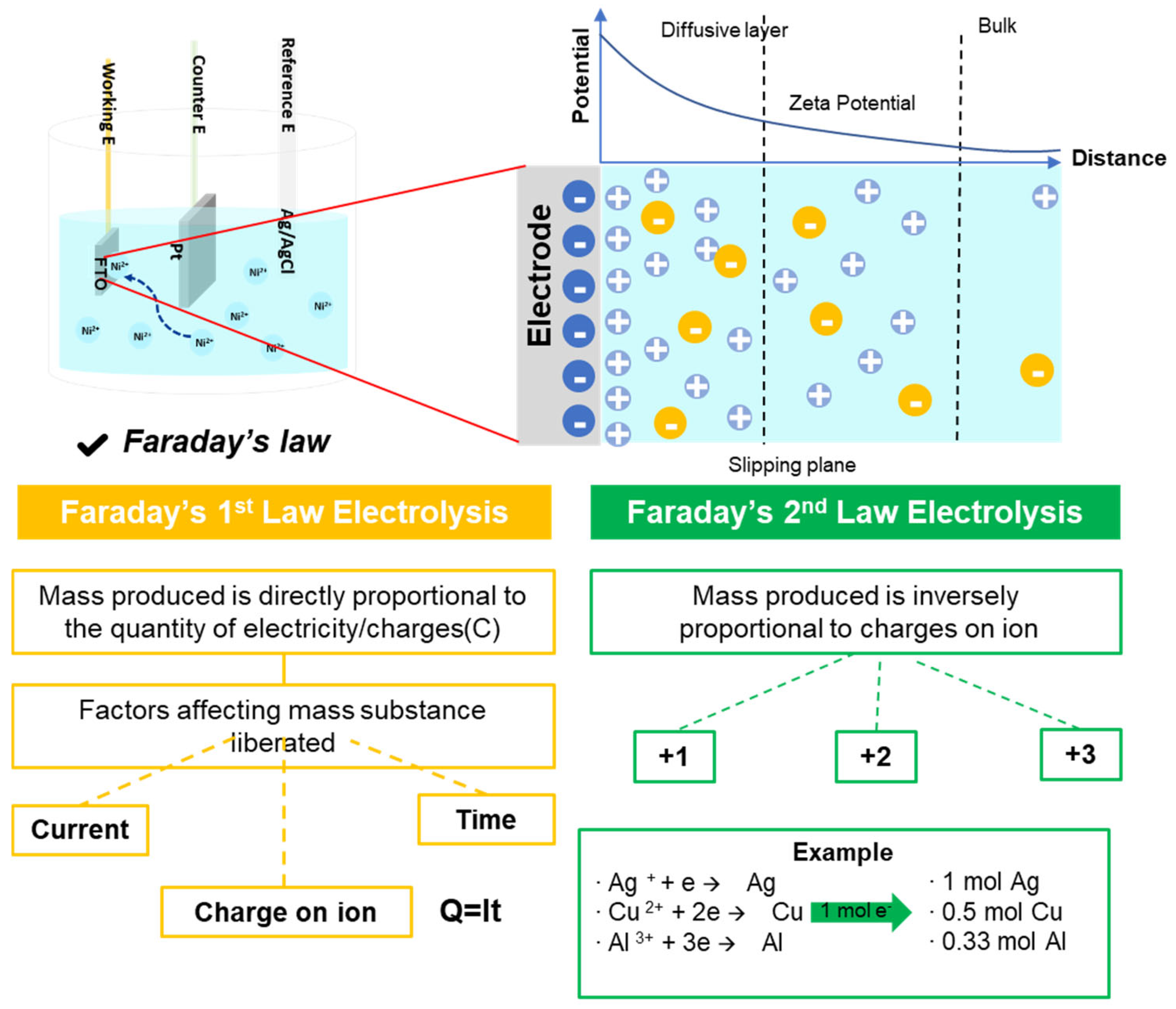
The fundamental principles of electrodeposition are schematically illustrated in
Figure 1. As shown in the left panel, a conventional three-electrode electrochemical cell is employed, consisting of a WE, a CE, and a RE. The precursor species are dissolved in the electrolyte, and an external potential or current is applied between the WE and CE, while the RE provides an accurate reference for monitoring the WE potential. Under an applied electric field, ionic species migrate through the electrolyte toward the electrode surfaces, where electrochemical reduction or oxidation reactions occur, leading to the formation of solid deposits directly on the electrode [
3,
9,
10,
11,
13,
16,
17,
21,
22,
23,
24,
25,
26,
27,
28,
29].
The key interfacial processes governing electrodeposition are highlighted in the magnified view of the electrode–electrolyte interface in
Figure 1 (right). Upon polarization of the electrode, an electrical double layer is established, and electroactive ions are transported from the bulk electrolyte to the interface via diffusion and migration. The local ion concentration and electric field strength in this interfacial region critically determine nucleation density and growth kinetics. Accordingly, the temporal evolution of the deposition current—typically characterized by an initial high current followed by gradual decay—reflects the transition from nucleation-dominated to diffusion-limited growth regimes. The quantitative relationship between the passed charge and the deposited material is governed by Faraday’s laws of electrolysis, which are also summarized in
Figure 1. The deposited mass is directly proportional to the total charge passed, while the stoichiometry of the deposited phase is dictated by the number of electrons involved in the electrochemical reaction. As a result, film thickness and loading can be precisely controlled by charge integration, providing a robust and scalable route for reproducible photoelectrode fabrication [
3,
9,
11,
13,
16].
Beyond material loading, electrodeposition offers multiple electrochemical degrees of freedom for tailoring film properties. As illustrated in
Figure 1 and
Figure 2, parameters such as deposition time, applied potential or current, electrolyte composition, pH, additives, and temperature collectively regulate nucleation density, crystal size, phase composition, and surface morphology. In galvanostatic (current-controlled) deposition, nucleation and growth behavior can be systematically tuned by adjusting the applied current density and deposition duration, often yielding films with uniform morphology and strong substrate adhesion. In contrast, potentiostatic (potential-controlled) deposition typically requires prior electrochemical analysis, such as linear sweep or cyclic voltammetry, to identify an appropriate deposition potential within the electrochemical stability window of the electrolyte.
For aqueous systems, electrodeposition is generally constrained within the potential window defined by the hydrogen evolution reaction and oxygen evolution reaction. When the target deposition potential lies outside this window, alternative electrolytes with wider electrochemical stability must be considered. Under constant potential conditions, the deposition current commonly decays over time due to mass-transport limitations arising from finite ion diffusion from the bulk electrolyte to the electrode surface. These limitations can be partially alleviated by enhancing convective transport (e.g., stirring or electrode rotation). More fundamentally, however, they can be addressed through pulsed potential or pulsed current deposition modes, which periodically refresh interfacial ion concentrations and dynamically regulate nucleation and growth processes.
2.2. System-Level Control in Electrodeposition: Potential, Current, and Pulse Modes
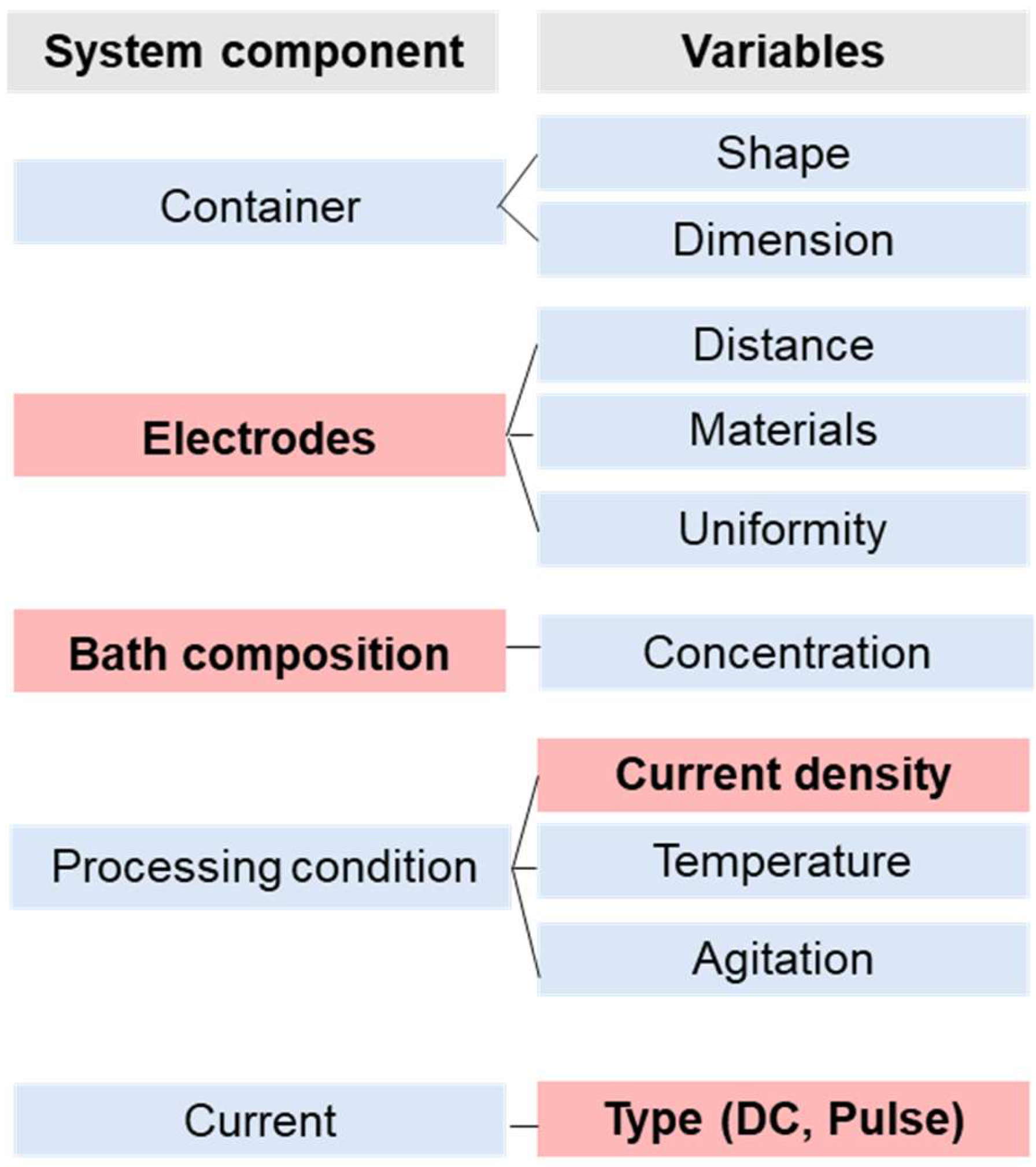
Electrodeposition is intrinsically a multivariable process in which the properties of deposited photoelectrodes arise from coupled interactions between electrochemical driving forces and system-level components. As summarized in
Figure 2, parameters related to cell geometry, electrode configuration, bath composition, processing conditions, and electrical control modes collectively govern ion transport, interfacial charge distribution, and nucleation–growth dynamics. Among these factors, the electrical driving mode—namely constant potential, constant current, or pulsed operation—plays a particularly decisive role in defining the interfacial growth environment and, consequently, the resulting film morphology and functionality [
13,
16,
25].
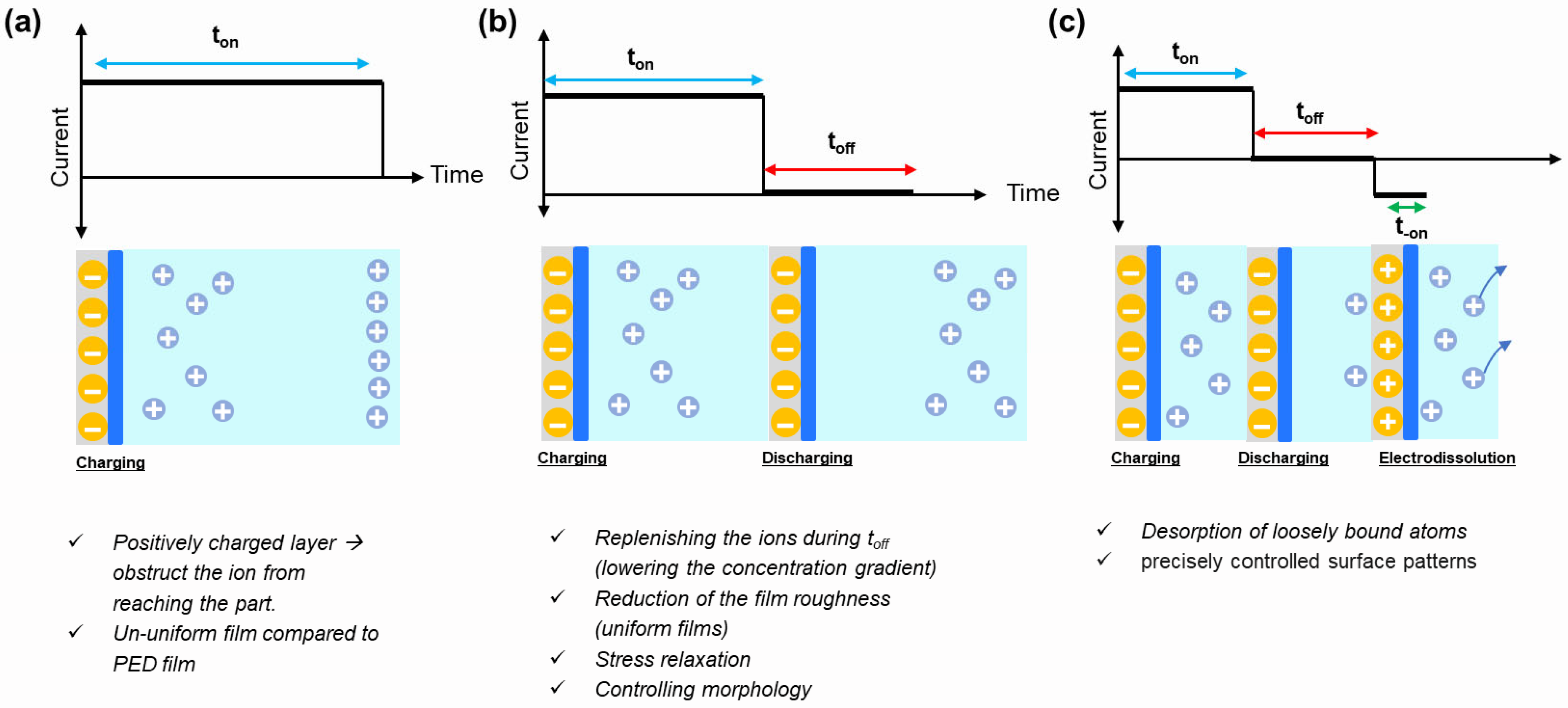
The influence of different electrical control modes on interfacial ion distribution and growth behavior is schematically illustrated in
Figure 3. Under constant potential (potentiostatic) conditions, a fixed electrochemical driving force is applied to the working electrode, leading to rapid formation of an electrical double layer and preferential accumulation of electroactive ions near the electrode surface. As deposition proceeds, however, depletion of precursor species in the interfacial region induces diffusion-limited growth, accompanied by current decay and broadened concentration gradients extending into the bulk electrolyte. This non-uniform ion distribution often promotes uncontrolled lateral growth and heterogeneous film thickness, particularly during prolonged deposition [
30,
31,
32].
In galvanostatic (current-controlled) deposition, a constant current density enforces a fixed rate of charge transfer across the electrode–electrolyte interface. This mode results in more uniform consumption of electroactive species and redistributes concentration gradients over a larger diffusion length, leading to improved predictability of nucleation density, growth rate, and film thickness. Nevertheless, sustained high current densities can still induce localized ion depletion and stress accumulation within the growing film, especially when mass transport is insufficient [
10,
11,
33].
Pulsed electrodeposition provides a dynamic alternative by temporally modulating the applied potential or current. As depicted in
Figure 3b,c, the pulse “ON” period generates a high instantaneous driving force that favors rapid and localized nucleation, while the “OFF” period allows replenishment of ions from the bulk electrolyte and relaxation of the electrical double layer. This temporal separation of nucleation and growth suppresses concentration polarization and mitigates diffusion limitations. In addition, the “OFF” period facilitates partial detachment or rearrangement of weakly bound species, enabling finer control over surface structure and interfacial uniformity.
Furthermore, reverse “ON” potential functions as a dynamic interfacial regulation step rather than a simple interruption of deposition [
34,
35,
36,
37]. Specifically, the reverse pulse influences the electrode–electrolyte interface through three coupled mechanisms [
38]. First, electrical double-layer (EDL) reconfiguration occurs upon application of a short reverse bias. During the anodic deposition pulse, charge accumulation and ion migration establish an asymmetric interfacial electric field. The introduction of a reverse bias perturbs this accumulated interfacial charge distribution, promoting partial relaxation and redistribution of the EDL structure. Second, the reverse pulse induces partial relaxation of the concentration gradient within the diffusion layer. Third, the reverse potential contributes to the suppression of unstable protrusions and kinetically favored nuclei. Collectively, these effects demonstrate that the reverse pulse functions as an active interfacial regulation mechanism that couples electric-field redistribution, diffusion-layer modulation, and selective surface restructuring. From a system-level perspective, tuning the magnitude of the reverse potential enables dynamic control over nucleation stability, growth uniformity, and interfacial transport, thereby governing the structural and functional evolution of the electrodeposited film.
As a result, pulsed deposition enables the formation of well-defined nanostructures, multilayered architectures, and uniform surface morphologies that are difficult to achieve under steady-state conditions. Importantly, the interfacial control achieved through pulsed operation directly links system-level electrical parameters to functional photoelectrode performance. By tailoring pulse amplitude, duration, and duty cycle, nucleation density, grain size, defect distribution, and phase evolution can be systematically regulated, thereby optimizing light absorption, charge transport pathways, and interfacial reaction kinetics. This capability is particularly critical for complex photoelectrode architectures, where subtle differences in interfacial structure can lead to pronounced variations in PEC activity [
10,
21,
27,
30,
31,
32,
39].
Taken together, electrodeposition should be regarded not as a single-parameter synthesis technique but as a system-level design platform in which electrical control modes interact synergistically with cell geometry, bath chemistry, and processing conditions. Understanding and exploiting these coupled effects enables rational control over interfacial ion dynamics and growth mechanisms, providing a versatile framework for designing high-performance, scalable, and environmentally benign photoelectrodes for PEC water splitting.
2.3. Case Study on CuO/Cu2O Photocathodes: DC Electrodeposition with Concentration and Current Control
In photoanodes, the microstructural characteristics of the semiconductor—such as grain size, porosity, and surface uniformity—play a decisive role in governing light absorption, charge transport, and interfacial reaction kinetics. Consequently, systematic correlation between morphological features and PEC performance is essential for identifying the key structure-function relationships that dictate PEC efficiency. Before discussing advanced pulsed electrodeposition strategies, we first examined a model system based on DC electrodeposition to establish fundamental structure–performance relationships under steady-state conditions. CuO/Cu
2O photocathodes were selected as representative p-type oxide materials [
20,
37].
Under DC electrodeposition, the growth behavior of CuO/Cu
2O films is governed primarily by two coupled parameters: precursor concentration in the electrolyte and applied current density. Unlike pulsed systems, where temporal modulation provides additional control over nucleation and growth, DC deposition proceeds under continuous driving force, making the interplay between mass transport and charge transfer particularly critical [
20].
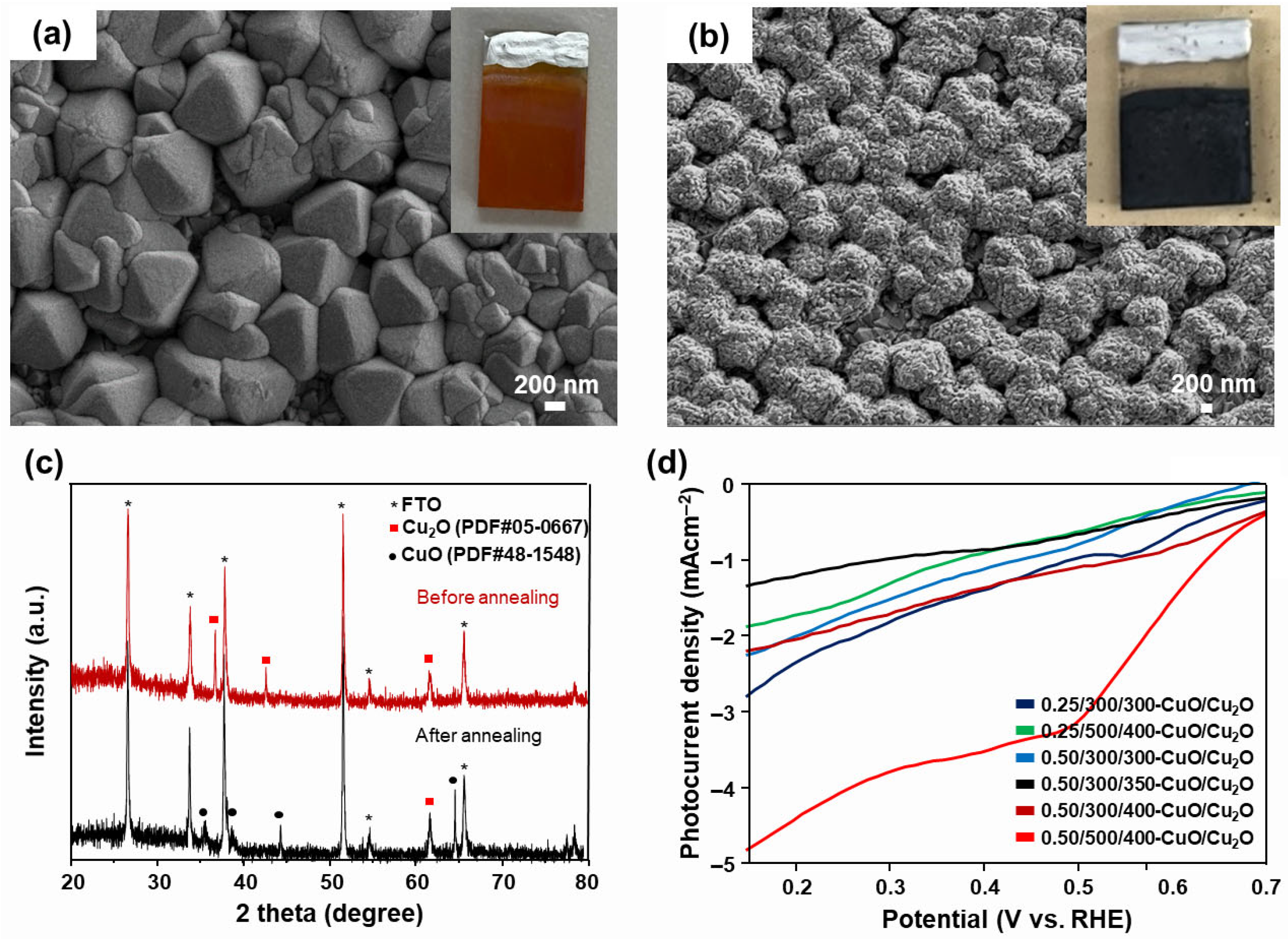
Figure 4 summarizes the structural and PEC characteristics of CuO/Cu
2O photocathodes synthesized by DC electrodeposition under different growth conditions. The SEM images reveal a pronounced dependence of surface morphology on the electrochemical growth regime. As shown in
Figure 4a, Cu
2O films deposited under mild DC conditions exhibited densely packed polyhedral grains with well-defined facets and relatively smooth surfaces. This morphology is characteristic of growth-dominated electrodeposition, where continuous ion supply and moderate current density allow crystal relaxation and facet development. In contrast, the CuO/Cu
2O film shown in
Figure 4b, prepared under an annealing process, displayed a highly roughened and cauliflower-like morphology composed of aggregated nanograins. XRD analysis (
Figure 4c) confirmed partial phase evolution toward CuO upon annealing, verifying the successful formation of a CuO/Cu
2O heterostructure. Specifically, the characteristic Cu
2O diffraction peaks at 36.418° (111) and 42.297° (200) markedly decreased after annealing, whereas the peak of 61.344° (220) remained relatively preserved. Concurrently, new diffraction peaks corresponding to CuO emerged at 35.543° (11-1), 38.708° (111), 44.2°, and 61.524° (202), in good agreement with JCPDS PDF#48-1548 (CuO) and PDF#05-0667 (Cu
2O). The selective attenuation of Cu
2O peaks together with the appearance of CuO reflections indicates that annealing induces partial surface oxidation rather than complete bulk conversion, resulting in a CuO shell formed on a Cu
2O-rich core.
The corresponding photocurrent density of the CuO/Cu
2O photocathodes synthesized under different conditions is presented in
Figure 4d and summarized in
Table 1.
According to previous reports on CuO/Cu
2O heterojunction systems, heterostructure formation typically results in enhanced visible-light absorption due to the narrower bandgap of CuO and the establishment of favorable interfacial band alignment [
40,
41]. Literature studies have also shown that CuO/Cu
2O interfaces induce built-in electric fields that promote charge separation, often manifested as shifts in flat-band potential and reduced charge-transfer resistance in electrochemical impedance measurements. In particular, the previous works demonstrated that CuO/Cu
2O heterostructures exhibited improved interfacial charge-transfer kinetics and suppressed recombination compared to single-phase counterparts. Therefore, although additional optical and electrochemical analyses were not conducted in this study, the enhanced photocathodic performance observed after annealing can reasonably be attributed to interfacial band engineering and improved charge separation arising from heterojunction formation.
Among the seven investigated conditions, the CuO/Cu2O photocathode synthesized at a 0.5 M, applied current density of 500 μA/cm2, and an annealing temperature of 400 °C recorded the highest photocurrent density of −4.8 mA/cm2 at 0.15 VRHE. In general, when the precursor concentration is low, the electrodeposition process is dominated by diffusion-limited transport of Cu2+ species to the electrode surface. Under such conditions, nucleation events are sparse and localized, leading to discontinuous or poorly interconnected Cu2O domains. Increasing the electrolyte concentration enhances the availability of electroactive species, promoting higher nucleation density and more uniform film coverage. However, excessively high concentrations can accelerate uncontrolled growth, resulting in coarse grains and reduced surface roughness, which are detrimental to interfacial reaction kinetics. In addition, the applied current density further modulates the balance between nucleation and growth. At low current densities, CuO/Cu2O films grow slowly, allowing sufficient time for ion redistribution and crystal relaxation, typically yielding compact and relatively smooth morphologies. In contrast, higher current densities impose strong kinetic driving forces that favor rapid nucleation, producing nanostructured or porous architectures. This suggests that a high concentration of Cu2+ precursor and moderate current density is best for PEC performance. The combined control of electrolyte concentration and current density enabled systematic regulation of the CuO/Cu2O morphology, which directly led to differences in PEC performance.
2.4. Case Study on BiVO4 Photoanodes
Similar to CuO/Cu
2O photocathodes, we intentionally combine SEM-based morphological analysis with photocurrent measurement to elucidate how pulse-controlled growth dynamics translate into functional improvements in BiVO
4 photoanodes. In particular, to experimentally validate the electrical-mode-driven framework illustrated in
Figure 3, we apply DC, pulsed, and reverse-pulsed electrodeposition modes to BiVO
4 photoanodes and systematically compare their morphological and PEC characteristics.
In the following sections, the surface morphologies of DC- and pulsed-deposited BiVO4 photoanodes are first examined by SEM, and the resulting structural differences are subsequently correlated with PEC performance metrics obtained from linear sweep voltammetry (LSV) measurements. This integrated analysis provides a coherent framework for understanding how system-level electrical control during electrodeposition governs both microstructure formation and PEC activity.
2.4.1. Morphological Comparison Between DC and Pulsed Modes
Pulsed electrodeposition offers a powerful strategy for tailoring the nucleation and growth behavior of photoanodes by temporally modulating the electrochemical driving force. Unlike steady-state potentiostatic or galvanostatic modes, pulsed operation decouples nucleation and growth processes into distinct time domains, enabling systematic control over interfacial ion distribution, crystallization kinetics, and resulting film morphology. In this section, BiVO
4 is employed as a model photoanode material to elucidate how pulse parameters govern structural evolution and PEC performance. As summarized in
Table 2, the pulsed electrodeposition conditions were systematically varied in a matrix-like manner by independently controlling pulse potential, on-time (
tON and
t-ON), off-time (
tOFF), and duty cycle, while maintaining a comparable total charge passed for all samples. This approach allows the effects of pulse timing on nucleation density and growth dynamics to be isolated from those arising purely from film thickness differences.
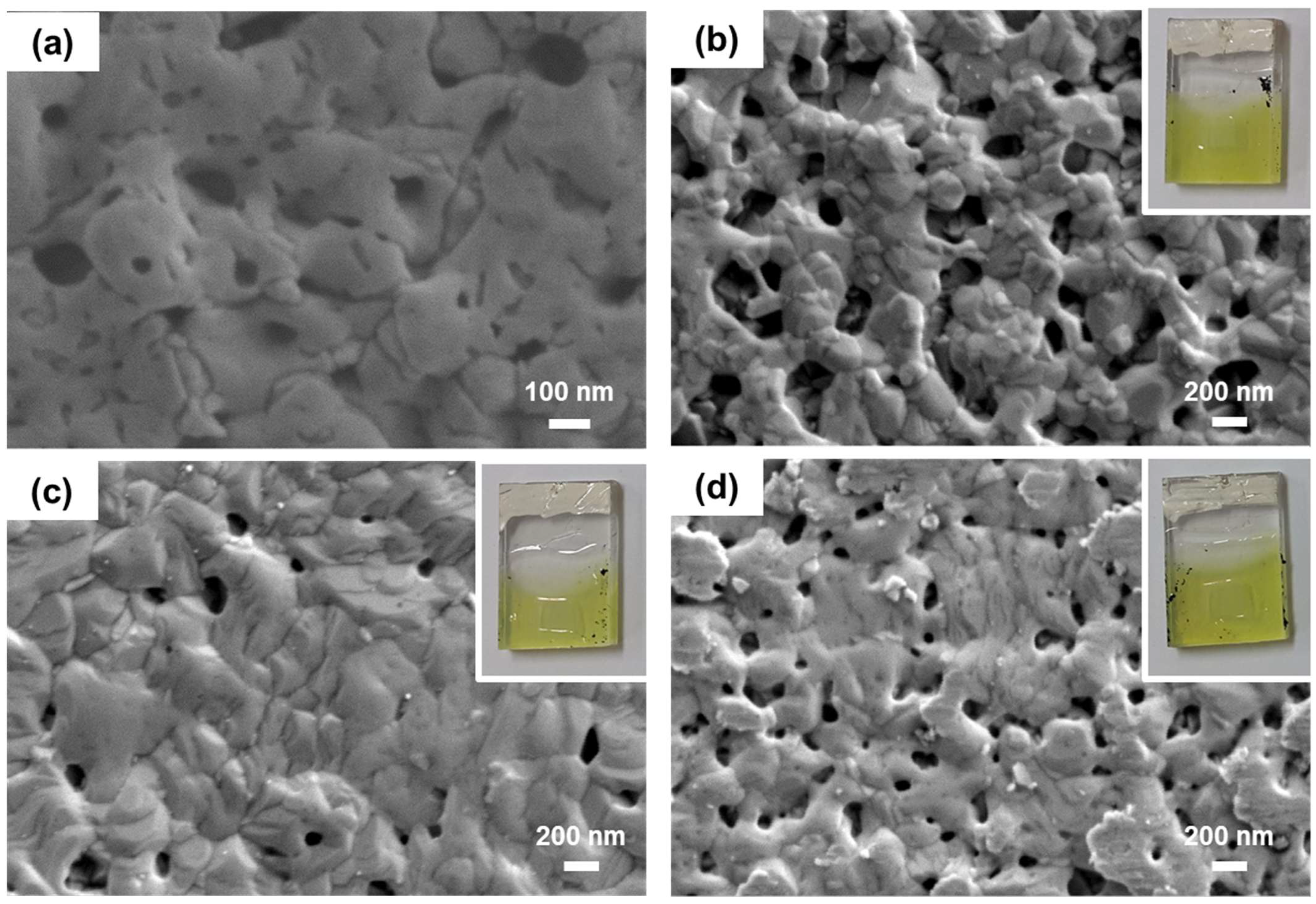
To demonstrate the difference between DC and pulsed modes, the surface morphologies of BiVO
4 photoanodes prepared under different electrical control modes were examined by SEM, as shown in
Figure 5. The BiVO
4 film deposited under DC conditions (
Figure 5a) exhibited a relatively compact and featureless morphology composed of irregularly coalesced grains with limited open porosity. Poorly defined grain boundaries and restricted pore connectivity indicate growth dominated by diffusion-limited processes under sustained interfacial ion depletion. Such dense morphologies are expected to hinder electrolyte penetration and increase carrier transport distances, thereby exacerbating charge recombination during PEC operation.
In contrast, BiVO
4 photoanodes fabricated via pulsed electrodeposition displayed markedly different morphologies. The sample deposited under pulsed conditions of 1.95 V/0 V (1 s/10 s, short pulse sequence) (P1-BVO,
Figure 5b) showed the emergence of a porous nanogranular network with clearly defined grain boundaries and interconnected voids on the order of tens of nanometers. This structure suggests repeated nucleation events during the pulse “on” periods, coupled with partial growth relaxation during the “off” periods, resulting in enhanced surface roughness and accessible active area. Increasing the pulse
tON (P5-BVO,
Figure 5c) resulted in a more uniformly packed nanocrystalline architecture with improved grain connectivity and reduced structural heterogeneity. The pores remained well distributed but became more refined, indicating a balanced interplay between nucleation and controlled grain growth. This morphology is particularly favorable for photoanode operation, as it simultaneously provides efficient charge transport pathways and abundant electrochemically active sites. Further increases in
tON (P10-BVO,
Figure 5d) led to a slightly grain-coarsened but uniform porous framework.
2.4.2. PEC Performance of BiVO4 Anodes Synthesized by DC and Pulsed Modes
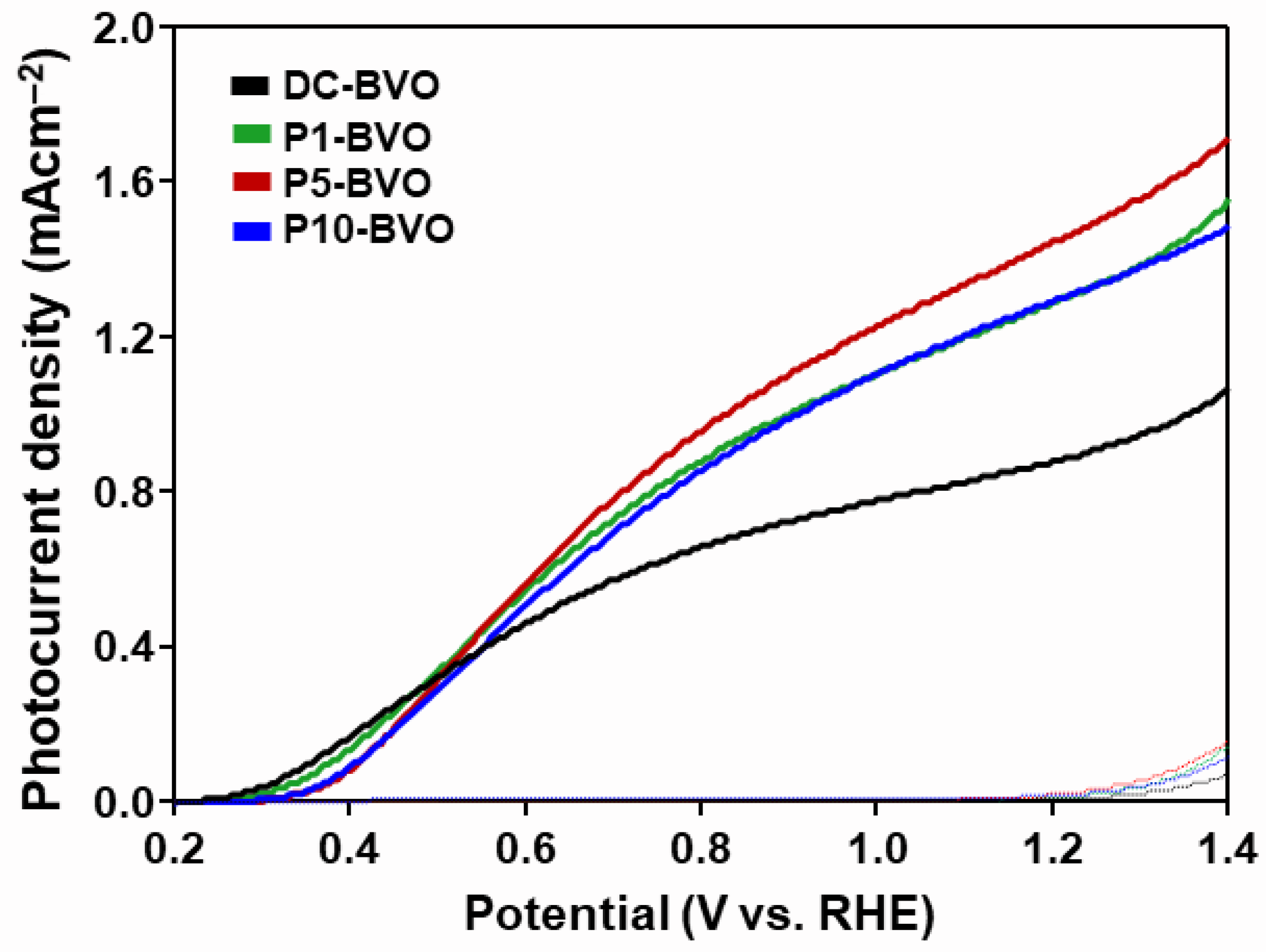
The PEC performance of BiVO
4 photoanodes prepared under DC and pulsed electrodeposition conditions was evaluated by LSV, as shown in
Figure 6. Compared to the DC-deposited electrode, all pulsed-deposited BiVO
4 photoanodes exhibited markedly enhanced photocurrent responses, consistent with the pulse-induced morphological evolution observed by SEM.
The DC-deposited BiVO
4 photoanode showed the lowest photocurrent density across the entire potential range. This behavior can be attributed to its compact and weakly porous morphology (
Figure 5a), in which dense grain packing and limited intergranular pathways hinder electrolyte penetration and increase bulk and interfacial charge recombination. As a result, charge extraction and utilization during PEC operation are significantly suppressed. In contrast, BiVO
4 photoanodes fabricated via pulsed electrodeposition demonstrate substantially improved PEC performance. Among them, the P1-BVO and P5-BVO samples showed progressively increased photocurrent densities, reflecting the beneficial effects of enhanced porosities and refined grain structures (
Figure 5b,c). The interconnected porous networks generated under pulsed conditions increase the electrochemically active surface area while shortening the hole transport distance to the electrolyte interface, thereby improving charge separation and utilization efficiency. Notably, the P5-BVO photoanode delivered the highest photocurrent density among all samples, indicating an optimal balance between nucleation density and controlled grain growth. This morphology enabled the provision of sufficient surface area for water oxidation while maintaining effective electronic connectivity within the BiVO
4 film. Further intensification of pulsed conditions (P10-BVO) maintained a high photocurrent response but did not lead to a proportional performance gain, suggesting that excessive pulse modulation may induce partial grain coarsening or increased structural disorder, which can offset the benefits of increased porosity [
9,
13,
21].
Overall, the LSV results corroborate the SEM observations and demonstrate that pulsed electrodeposition enables rational tuning of BiVO4 photoanode performance by regulating interfacial growth dynamics. The strong correlation between pulse-controlled morphology and PEC activity highlights the importance of system-level electrical modulation in overcoming the intrinsic limitations of DC-deposited photoanodes.
2.4.3. Effect of Deposition “ON” Time Under Fixed Reverse-Pulse Conditions
To achieve more precise interfacial growth control beyond conventional pulsed electrodeposition, a reverse “ON” potential was incorporated into the pulse sequence to periodically invert the interfacial electric field. This reverse-pulsing strategy enables dynamic reorganization of the electrical double layer, thereby suppressing preferential growth pathways that can develop under unidirectional pulsed operation, as we discussed in
Section 3.2 [
21,
42,
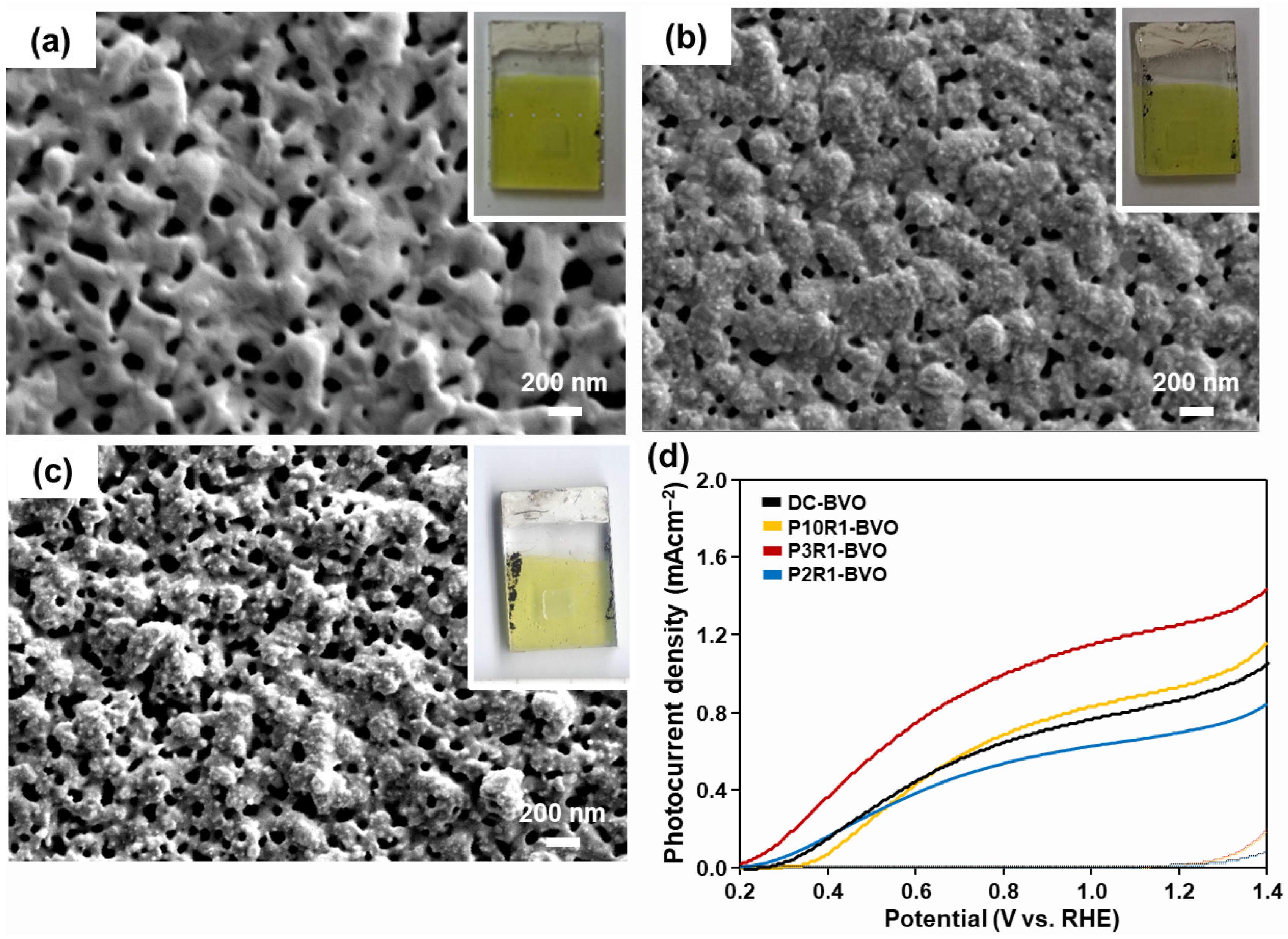
43]. In this context, the reverse pulse applied in the present study is interpreted as a transient interfacial perturbation step that promotes structural homogenization. To isolate the effect of temporal asymmetry in this reverse-pulsed system, the magnitude and duration of the reverse “ON” potential were fixed, while only the “ON” time of the original deposition potential was systematically varied. This experimental design decouples the influence of interfacial reset induced by the reverse pulse from that of prolonged growth periods, allowing direct assessment of how deposition “ON” time governs morphological evolution and PEC performance. The resulting structure–performance relationships are summarized in
Figure 7.
As the deposition
tON was progressively reduced under fixed reverse-pulse conditions, a pronounced evolution in BiVO
4 surface morphology was observed, as shown in
Figure 7a–c. When a relatively long deposition
tON was applied, the BiVO
4 film exhibited partially coalesced grains with locally thickened walls, indicating that extended growth windows promote diffusion-assisted grain growth despite the presence of periodic interfacial reset by the reverse pulse. Upon decreasing the deposition
tON, the morphology transitioned toward a more uniformly porous architecture composed of finely distributed nanograins and interconnected pore networks. This structural refinement suggests that shorter growth intervals limit uninterrupted crystal growth and favor repeated nucleation events during successive pulse cycles. The fixed reverse “ON” potential effectively redistributes ionic species and relaxes the electrical double layer between pulses, while the reduced deposition
tON prevents excessive lateral grain expansion. Further reduction in the deposition
tON led to the formation of a highly porous, sponge-like framework with thin walls and abundant nanoscale voids. Although this morphology maximizes electrochemically accessible surface area, excessive shortening of the growth window resulted in incomplete grain interconnection, which can compromise electronic percolation pathways within the BiVO
4 film.
These morphology-dependent trends are directly reflected in the corresponding PEC behavior (
Figure 7d). The BiVO
4 photoanode prepared with an intermediate deposition
tON exhibited the highest photocurrent density of 1.26 mA/cm
2 at 1.23 V
RHE. In contrast, longer deposition
tON probably suffered from limited PEC enhancement due to reduced porosity and increased carrier transport distances, while excessively short
tON led to diminished performance gains, likely caused by poor electronic connectivity and increased recombination at discontinuous grain boundaries.
Overall, reverse pulsing serves as an effective interfacial reset mechanism; however, optimal PEC performance was achieved only within a narrow temporal window where nucleation control and grain connectivity are simultaneously satisfied. These finding highlights deposition tON as a critical design parameter for fine-tuning BiVO4 photoanode morphology and performance beyond conventional pulsed electrodeposition strategies.
2.4.4. Effect of the Magnitude of Reverse Potential on BiVO4 Photoanodes
Following the investigation of deposition
tON asymmetry under fixed reverse-pulse conditions, the magnitude of the reverse potential was systematically tuned to further elucidate its role in interfacial growth regulation. In this set of experiments, the pulse sequence and deposition
tON were kept constant, while the absolute magnitude of the reverse potential was progressively decreased, thereby weakening the extent of interfacial electric-field inversion. This approach enables direct assessment of how the strength of interfacial reset influences morphological evolution and PEC behavior [
21,
42,
43].
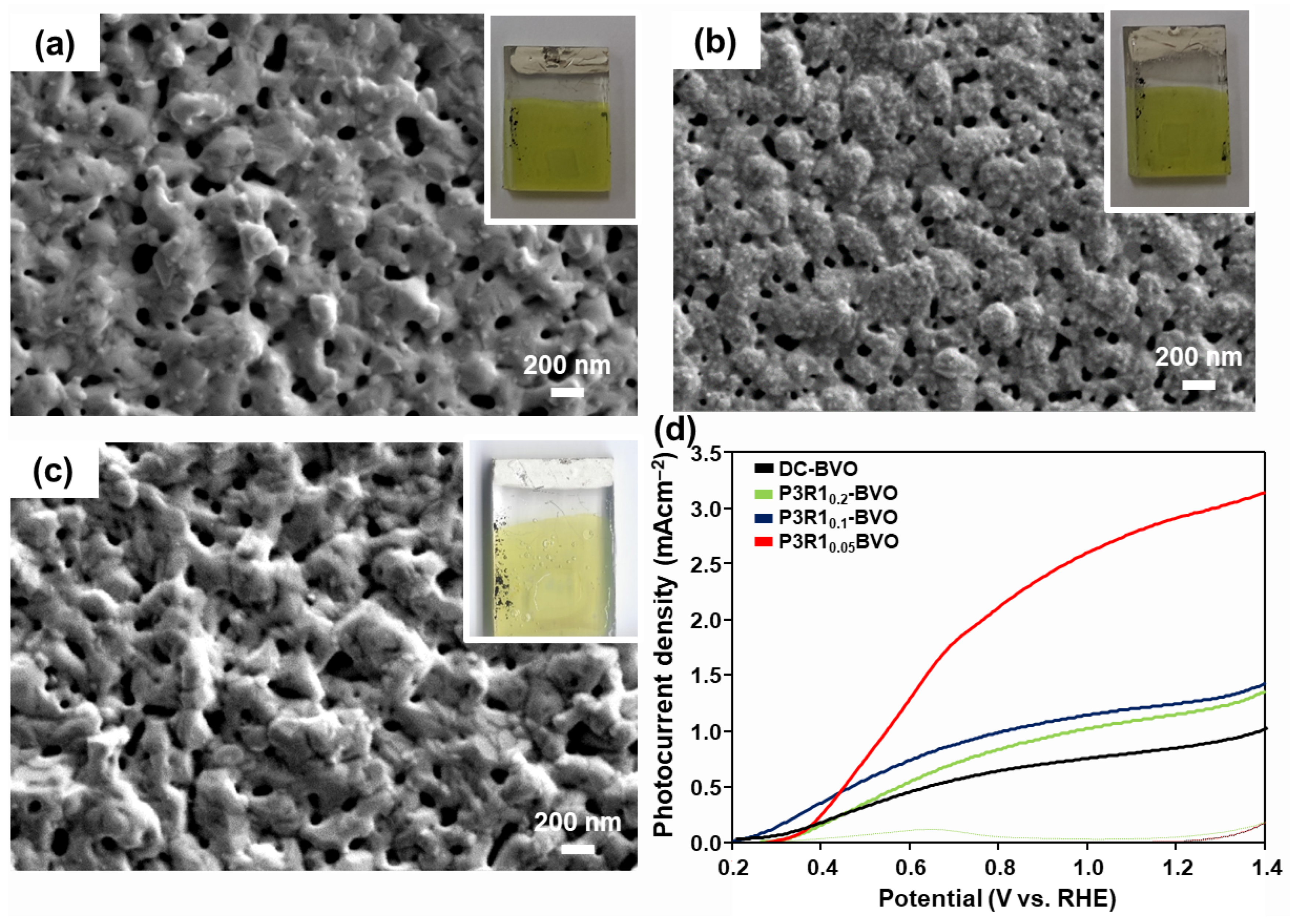
As the reverse potential magnitude was reduced, distinct changes in both surface morphology and PEC performance were observed (
Figure 8). Notably, the BiVO
4 photoanode synthesized at the lowest reverse potential of −0.05 V exhibited the highest photocurrent density of 2.94 mA/cm
2, which is the highest photocurrent density among the tested samples SEM analysis (
Figure 8c) revealed that this weak reverse-bias condition probably produces a uniformly porous yet electronically well-connected nanostructure, in which fine pore networks are preserved without inducing excessive grain thinning or structural fragmentation. Otherwise, at higher reverse-potential magnitudes (−0.2 V vs. Ag/AgCl, 7BVO), the strong interfacial electric-field inversion led to aggressive reorganization of the electrical double layer, resulting in overly thin walls and locally disconnected domains that hinder lateral charge transport. Therefore, for BiVO
4 photoanodes, the −0.05 V condition represents an optimal regime in which interfacial reset is sufficiently activated while electronic percolation pathways remain intact.
In other words, under moderate reverse bias (e.g., −0.05 V), the pulse-reverse process can suppress kinetically favored protrusion growth and promote more homogeneous structural evolution. Excessive reverse bias, however, destabilizes the deposited layer, as confirmed by the absence of continuous film formation at higher negative potentials. The experimentally observed dependence on reverse potential magnitude further supports this interpretation, as excessive reverse bias leads to film destabilization, while moderate reverse bias improves structural uniformity and leads to improved photocurrent density.
In contrast to the standard reverse-pulsed sequence (1.95 V → 0 V → negative bias), the modified ON/OFF order (0 V → 1.95 V → 0 V → negative bias) failed to produce continuous film formation. The initial 0 V stage does not provide sufficient overpotential to initiate nucleation, and the subsequent short deposition pulse (5 s at 1.95 V) was insufficient to establish stable nuclei before growth was interrupted by the second resting stage. Furthermore, the application of a reverse potential—particularly at −0.5 V—likely induced partial dissolution or destabilization of early-stage nuclei. As a result, RO0.5-BVO exhibited no observable film formation, while RO0.05-BVO showed only non-uniform coverage. These results highlight the critical importance of nucleation-first sequencing in electrical-mode-driven electrodeposition.
Overall, this case study demonstrated that pulsed electrodeposition is not merely a variation in conventional electrochemical synthesis but a distinct system-level control strategy for engineering BiVO4 photoanodes. By a judicious selection of reverse-pulse magnitude, duration, and sequence, it is possible to regulate nucleation stability, growth kinetics, and interfacial structure, thereby establishing direct correlations between deposition conditions and PEC performance. These insights emphasized the broader applicability of pulsed electrodeposition as a versatile and scalable tool for designing high-performance photoelectrodes for solar-driven water splitting.
3. Experimental
3.1. Synthesis of CuO/Cu2O Photocathode
The fluorine-doped tin oxide (FTO) substrate was cleaned by ultrasonication using acetone, ethanol, and deionized water (DI) for 10 min, respectively, before the Cu2O deposition. The Cu2O films were deposited on the cleaned FTO substrate by electrodeposition. In detail, the X M (X = 0.25, 0.5) copper(ii) lactate aqueous solution (pH 12) containing 0.06 M CuSO4 (DAEJUNG, Gyeonggi-do, Republic of Korea), 3 M lactic acid (DAEJUNG, Republic of Korea), and 2 M KOH (DAEJUNG, Republic of Korea) was used as an electrolyte for the electrodeposition. The bath temperature was maintained at 30 °C using a jacketed beaker with a water circulation system during the electrodeposition. The electrodeposition was carried out in a standard three-electrode system with the FTO as a working electrode (WE), a saturated calomel electrode (SCE) reference electrode (RE), and a platinum (Pt) mesh counter electrode (CE) at a constant current of 300–500 μA/cm2 applied by a potentiostat (Ivium-n-Stat, Ivium Technologies, Eindhoven, The Netherlands). The deposition area was fixed at 1 cm2. To form CuO/Cu2O heterostructure, the electrodeposited Cu2O film was annealed at different temperatures (300 to 400 °C) for 1 h in air.
3.2. Synthesis of BiVO4 Photoanode
Precursor was prepared by dissolving bismuth nitrate pentahydrate (BiN
3O
9·5H
2O, 98%, JUNSEI, Kyoto, Japan) in a solution of vanadium oxide sulfate hydrate (VOSO
4·5H
2O, 99.99%, Aldrich, Yongin, Republic of Korea) at pH < 0.5 with the addition of nitric acid (HNO
3, 67%, JUNSEI). Then, 2 M sodium acetate (CH
3COONa, Aldrich) was added, raising the pH to ≈5.1, which was then adjusted to pH 4.7 using a few drops of concentrated HNO
3. This mildly acidic pH condition is necessary because at pH values > 5, V (IV) precipitates form in the solution. DC and pulsed electrodeposition were conducted in a standard three-electrode system with a WE of FTO, RE of Ag/AgCl, and CE of Pt mesh for 10 min (total on time) at 80 °C (≈2–3 mA cm
−2) [
44,
45,
46,
47]. In particular, for the pulsed electrodeposition, the duration time and pulse voltage were controlled to optimize the nanoporous BiVO
4 films. The pulse parameters were selected based on electrochemical and kinetic considerations rather than arbitrary screening. The deposition potential (1.95 V) was determined from prior DC and pulsed electrodeposition studies, where stable BiVO
4 nucleation and uniform film growth were observed. To isolate the influence of temporal modulation, this potential was fixed for all pulsed and reverse-pulsed experiments. The ON and OFF durations were designed based on nucleation kinetics and diffusion-layer relaxation behavior. Short
tON enhances instantaneous nucleation under high overpotential, whereas
tOFF allows partial recovery of the diffusion layer and relaxation of interfacial electric fields. To promote controlled nucleation–growth decoupling while maintaining film continuity,
tOFF was selected to be longer than
tON, and
tON was systematically varied from 1 s to 10 s to span different kinetic regimes. Although not a full factorial design-of-experiments, this parameter space was rationally constructed to probe electrically modulated growth dynamics.
All freshly prepared samples were then rinsed and annealed at 500 °C for 6 h in air, at a heating rate of 2 °C min−1. After annealing, as-deposited films were converted to a crystalline monoclinic phase of BiVO4.
3.3. Characterization
The morphologies of BiVO4 and CuO/Cu2O were characterized by field-emission scanning electron microscopy (FESEM, MERLIN Compact, JEOL, Freising, Germany). X-ray diffraction (XRD, Rigaku SmartLab SE, Tokyo, Japan) characterization using Cu Kα radiation in the 2θ range of 20° to 80° with a scanning rate of 2° min−1 was performed to confirm the crystalline phase of BiVO4.
3.4. Measurement of PEC Performance
The photocurrent density of BiVO4-based anodes was measured in phosphate-buffered solution with the presence of 0.1 M sodium sulfite (Na2SO3), which served as an efficient hole scavenger. The oxidation of sulfite is thermodynamically and kinetically more facile than the oxidation of water, since the photogenerated holes are rapidly consumed for the oxidation of sulfite; thus, measuring the photocurrent in the sulfite oxidation enables investigation of the PEC properties of BiVO4-based electrodes independently of its poor water oxidation kinetics. The photocurrent versus potential curve was recorded while sweeping the potential in the positive direction with a scan rate of 10 mV s−1 under a solar simulator with an AM 1.5 G filter; the light intensity of the solar simulator was calibrated to 1 sun (100 mW cm−2), using a reference cell. Similar to BiVO4-based anodes, the photocurrent density of CuO/Cu2O photocathode was measured in a 0.1 M Na2SO4 electrolyte (pH 6.25) under chopped illumination (1 sun, 100 mW cm−2) from a solar simulator.
4. Conclusions
In this study, we established electrodeposition as a system-level control platform for rational photoelectrode engineering, demonstrating that electrical driving modes fundamentally regulate interfacial growth pathways and, consequently, PEC performance. Rather than treating deposition parameters as isolated variables, we showed that temporal modulation of the electrical boundary condition governs nucleation–growth coupling, mass transport behavior, and final architecture of photoelectrodes. Through comparative case studies on CuO/Cu2O photocathodes and BiVO4 photoanodes, we demonstrated that a clear regulatory pattern emerged across different electrical modes. Continuous DC deposition defines a steady-state growth regime constrained by mass transport and persistent concentration gradients, limiting structural tunability. Pulsed deposition introduces temporal decoupling between nucleation and growth, enabling refined nanostructuring and improved charge utilization. Importantly, reverse-pulsed operation provides an additional degree of dynamic interfacial modulation. By transiently perturbing the electrical double layer and partially relaxing concentration gradients, moderate reverse bias suppresses preferential growth and promotes structural homogenization, whereas excessive reverse bias destabilizes film continuity. These observations collectively highlight that electrical control modes function as dynamic boundary engineering tools that dictate morphology–property–performance relationships.
Beyond the specific CuO/Cu2O and BiVO4 systems investigated here, the system-level control principles identified in this work are broadly transferable to other metal oxide photoelectrode platforms such as WO3, Fe2O3, and related semiconductor oxides—where charge transport limitations and interfacial recombination critically determine performance—could particularly benefit from temporally engineered deposition strategies. The ability to modulate nucleation density, diffusion-layer relaxation, and interfacial electric-field distribution through tailored electrical modes provides a scalable and materials-agnostic strategy for controllable photoelectrode preparation.
Overall, this work reframes electrodeposition from a conventional fabrication technique into a mechanism-informed system design methodology, offering generalizable guidance for the scalable synthesis of high-performance photoelectrodes and advancing electrically engineered materials strategies for solar-driven and electrochemical energy conversion technologies.