Article

The Etching of Al-Doped Co3O4 with NaOH to Enhance Ethyl Acetate Catalytic Degradation

1
School of Environment and Architecture, University of Shanghai for Science and Technology, Shanghai 200093, China
2
Institute of Chemical Pharmaceutical, Taizhou Vocation & Technical College, Taizhou 318000, China
3
Shanghai Non-Carbon Energy Conversion and Utilization Institute, Shanghai 200240, China
*
Authors to whom correspondence should be addressed.
Catalysts 2026, 16(2), 158; https://doi.org/10.3390/catal16020158
Submission received: 25 December 2025 / Revised: 15 January 2026 / Accepted: 26 January 2026 / Published: 3 February 2026
(This article belongs to the Special Issue Recent Advances in Catalytic Materials for Water and Air Treatment)

Abstract

In this work, a series of defective Co3O4 catalysts (Al@Co3O4−x, x = 4, 6, 8 mmol/L, representing the NaOH concentration) were prepared by Al doping and NaOH etching via hydrothermal method for ethyl acetate degradation. The results indicated that the Al@Co3O4-6 catalyst presented the optimal catalytic performance for ethyl acetate degradation (T90 = 207 °C). The results of many characterizations, such as X-ray diffraction (XRD), scanning electron microscope (SEM), Fourier transform infrared (FT-IR) spectra, Raman, and temperature-programmed H2 reduction (H2-TPR), etc., showed that the Al doping and NaOH etching induced the production of defects and oxygen vacancies in the catalyst, improved the surface area, boosted the low-temperature reducibility, and promoted the low-temperature oxygen species desorption, which enhanced ethyl acetate oxidation over Al@Co3O4-6. Importantly, the possible ethyl acetate degradation pathway was revealed by in situ diffuse reflectance infrared Fourier transform spectroscopy (DRIFTS), in the sense that the adsorbed ethyl acetate was gradually oxidized to ethanol and acetaldehyde, acetic acid, formate, and finally to CO2 and H2O.

1. Introduction

Volatile organic compounds (VOCs), as a considerable precursor of ozone (O3) and the fine particulate matter PM2.5, have brought great harm to human health and the environment [1,2]. Therefore, it is urgent to eliminate VOCs for beautiful home construction. In recent years, many technologies, such as adsorption [3,4], photocatalysis [5], photothermocatalysis [6], and catalytic oxidation [7,8,9,10], etc., have been exploited for the removal of VOCs. Among these various technologies, catalytic oxidation, possessing advantages of no secondary pollution and high efficiency, has been deemed the most promising technique for the erasure of gaseous pollutants [11]. As the high-efficiency catalysts are essential for the application of catalytic oxidation, the development of catalysts with outstanding catalytic performance has been widely studied.
Generally, metal oxide catalysts and noble metal catalysts are two common categories of catalysts used in catalytic oxidation. Hereinto, metal oxide catalysts with the advantages of low cost, abundant reserves, strong oxygen storage capacity, and excellent catalytic stability have attracted extensive attention [12,13]. Among the numerous metal oxide catalysts, Co-based catalysts, especially Co3O4, due to their remarkable redox properties, adjustable structure, and better lattice oxygen mobility, have been widely applied in the removal of VOCs [14]. For instance, Fan et al. [15] synthesized some Co3O4 catalysts by using different precipitants for formaldehyde oxidation. The prepared Co3O4 catalyst realized the complete degradation of formaldehyde to CO2 and H2O at 90 °C, which was ascribed to its better reducibility. Ren et al. [16] prepared Co3O4 catalysts with different morphologies via the hydrothermal method for toluene oxidation. The Co3O4 catalyst with the nanoflower structure presented the best catalytic activity for toluene combustion, which was ascribed to its low-temperature reducibility and abundant surface Co3+ species. It has been recorded that the catalytic performance of Co3O4 is closely related to its surface area, surface low-valence Co ion, and active oxygen species [17]. However, Co3O4 catalysts are still faced with the challenges of low surface area and low exposure of active sites, which suppress the accessibility of the reaction molecules and active oxygen species formation, limiting the employment of Co3O4 catalysts for VOCs oxidation.
To address these issues, much research has been conducted. It was found that by constructing multi-component transition metal oxide catalysts, it is possible to effectively increase the surface defect concentration and generate synergistic effects between the various components, thereby boosting reactive oxygen species production and enhancing the catalytic performance [18]. For example, Wen et al. [19] adopted the impregnation method to prepare CuO/Co3O4 catalysts for ethyl acetate degradation. It was found that the introduction of CuO induced the formation of abundant oxygen vacancies, which greatly improved the catalytic performance in comparison to Co3O4 catalysts. Recently, a doping strategy has been proposed as one of the most efficient methods to tune the physical–chemical properties of metal oxides. For example, Su et al. [20] found that the doping of La in δ-MnO2 greatly increased the surface area, decreased the generation energy of oxygen vacancies, which promoted the production of abundant oxygen vacancies, enhanced the mobility of sub-surface lattice species, and boosted the catalytic degradation of toluene. Ma et al. [21] prepared an indium-doped Co3O4 catalyst for CO and C3H6 oxidation. The results suggested that the doping of indium affected the chemical status of Co3O4 and increased the lattice oxygen mobility, which improved the catalytic performance. Meanwhile, our previous work [22] also found that the doping strategy could introduce surface defects into Co3O4, increasing its surface area and surface oxygen mobility and accelerating VOCs oxidation. Additionally, alkali etching, as a surface modification method, can effectively create a variety of surface defects and oxygen vacancies. Xu et al. [23] found that the in situ alkali-etched strategy changed the metal–oxygen bond in the CuMn2O4 catalyst, weakened the Mn–O bond, and promoted the production of cation defects, enhancing the catalytic activity for acetone degradation. Based on the above analysis, metal doping followed by alkali etching would be an effective method to prepare high-efficiency catalysts for VOC catalytic combustion.
Herein, a series of modified Co3O4 catalysts was prepared via in situ Al doping followed by the etching of NaOH solution with different concentrations (Al@Co3O4−x, x = 4, 6, 8 mmol/L, represented by the NaOH concentration). The physicochemical properties of the Co3O4 catalysts were investigated via many characterization techniques. The catalytic activity of the as-prepared Co3O4 catalysts was evaluated via ethyl acetate catalytic combustion. Meanwhile, the structure–performance relationship of the catalyst was analyzed and discussed. Importantly, the ethyl acetate degradation intermediates were determined via in situ diffuse reflectance infrared Fourier transform spectroscopy (DRIFTS), and the degradation pathway was revealed.

2. Results and Discussions

2.1. Characterization of Physical Structure

Figure 1a presents the X-ray diffraction (XRD) patterns of Co3O4, Al@Co3O4, and different concentrations of NaOH-etched Al@Co3O4 catalysts. As presented in Figure 1a, Co3O4 presented eight characteristic diffraction peaks at 19.0°, 31.3°, 36.9°, 38.5°, 44.5°, 55.7°, 59.4°, and 65.2°, corresponding to the (111), (220), (311), (222), (400), (422), (511), and (440) crystal facet of Co3O4 (PDF#42-1467). After Al doping, the diffraction peaks of Co3O4 were maintained in Al@Co3O4, suggesting that the doping of Al did not affect the crystal structure of Co3O4. Meanwhile, no other impurity peaks were observed in the Al-doped Co3O4 catalysts, which indicated the existence of Al in Al-doped samples was in the form of an ion state [24]. Notably, after the doping of Al, the diffraction peaks of Co3O4 were weakened, and the (311) crystal facet diffraction peak was shifted to the high angle, which might be attributed to the formation of obvious lattice shrinkage induced by the doping of Al [25]. This lattice shrinkage was attributed to the fact that the smaller size of Al3+ (0.053 nm) was incorporated into the Co3O4 lattice (Co3+, 0.061 nm; Co2+, 0.0745 nm) to replace the Co ion, which caused the crystal lattice to shrink and decrease in interplanar spacing [26]. Additionally, after the etching by NaOH solution, the diffraction peaks of Co3O4 were further weakened, suggesting the NaOH etching could further result in partial amorphization of the surface and the disruption of the long-range ordered structure [27]. To further confirm that the doping of Al and NaOH etching induced the shrinkage of the crystal lattice, the crystal size and lattice parameter of the as-prepared catalysts were calculated. As shown in Table 1, compared with Co3O4, the crystal size and lattice parameter of Al-doped samples decreased. Meanwhile, the NaOH etching caused a further decrease in the crystal size and lattice parameter, which indicated that the doping of Al and NaOH etching led to the doping of Al in the Co3O4 lattice and the formation of defects.
Further, the Raman spectra were used to study the Co3O4 catalyst’s structure. As illustrated in Figure 1b, five Raman peaks at 190 cm−1 (F2g), 467 cm−1 (Eg), 510 cm−1 (F2g), 602 cm−1 (F2g), and 670 cm−1 (A1g), which matched well with the characteristic peaks of Co3O4, were observed [22,28,29]. The F2g (190, 510, and 602 cm−1) and A1g (670 cm−1) modes were ascribed to the Co2+-O2− and Co3+-O2− bond, respectively, which suggested that the as-prepared Co3O4 presented the typical cubic phase [30,31]. Notably, after Al doping, the A1g mode of Al@Co3O4 shifted to a high Raman shift in comparison to Co3O4, which was due to the confinement effect of photons caused by the formation of oxygen vacancies induced by Al doping [31]. Additionally, further NaOH etching caused the weakening of the Raman peaks, which indicated that alkali etching led to an increase in surface defects of Co3O4, the formation of oxygen vacancies, and partial amorphization, disrupting the original long-range ordered structure. Meanwhile, during the NaOH etching process, some of the Al elements dissolve from the catalysts, which may cause local structural collapse and further weaken the intensity of the A1g peak. Furthermore, with the improvement of NaOH concentration from 4 to 8 mmol/L, the Raman peaks were weakened and even induced the disappearance of some Raman peaks, which suggested that the high concentration of NaOH might destroy the catalyst structure slightly.
Figure 1c displayed the Fourier transform infrared (FT-IR) spectra of the catalysts. The bands at 3434 and 1630 cm−1 were assigned to the O–H longitudinal stretching vibration and H–O–H bond bending vibration, respectively, suggesting the presence of H2O molecules in the catalysts [32,33]. The other two bands at 567 and 663 cm−1 were accredited to the typical Co2+-O and Co3+-O vibration of Co3O4, respectively, which also suggested the successful synthesis of Co3O4 [34,35]. Compared with Co3O4, after the doping of Al in Al@Co3O4 and Al@Co3O4−x, the vibration band of Co–O was widened and the intensity was weakened, which might be due to the disruption of Co3O4 lattice-periodicity induced by Al doping. This was consistent with the results of XRD patterns and Raman spectra.

2.2. Morphology and Texture Structure

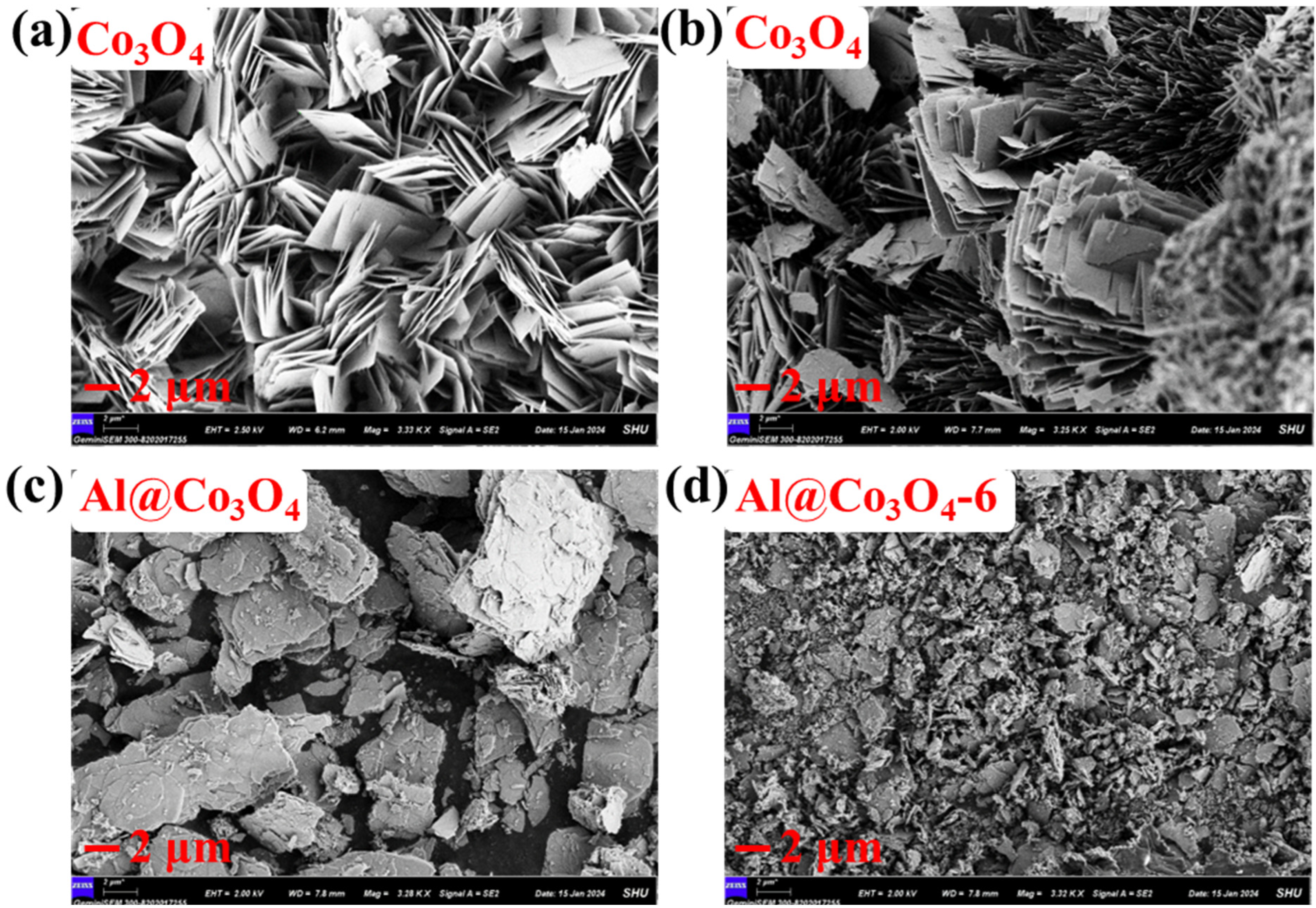
The morphology of Co3O4, Al@Co3O4, and NaOH-etched Al@Co3O4 was investigated by scanning electron microscope (SEM), and the results are presented in Figure 2. As shown in Figure 2a,b, Co3O4 exhibited a regular sheet morphology with smooth and densely stacked layers. After the doping of Al (Figure 2c), the closely stacked nanosheet structure was disrupted. Meanwhile, the spacing between the nanosheets significantly decreased. These changes in the morphology might be related to the lattice stress or structural rearrangement caused by the doping of Al3+ ions, suggesting that the Al doping has a significant impact on the microstructure of Co3O4. Figure 2d displayed the SEM image of the NaOH-etched Al@Co3O4 (Al@Co3O4-6). As displayed in Figure 2d, after the NaOH etching, the nanosheet was broken and the morphology was converted to a mixture of irregular nanosheet morphology. These changes might be accredited to the dissolution of some Al sources from the material surface during the NaOH solution etching process, which results in the collapse of the local structure. However, XRD results showed that the NaOH etching did not destroy the crystal structure of Co3O4, which suggested that the etching mainly affected the properties of the catalyst’s surface, such as the formation of surface defects. The generation of surface defects is usually accompanied by the formation of oxygen vacancies [36,37], which could boost the surface activity, promoting the enhancement of catalytic activity for VOC oxidation.
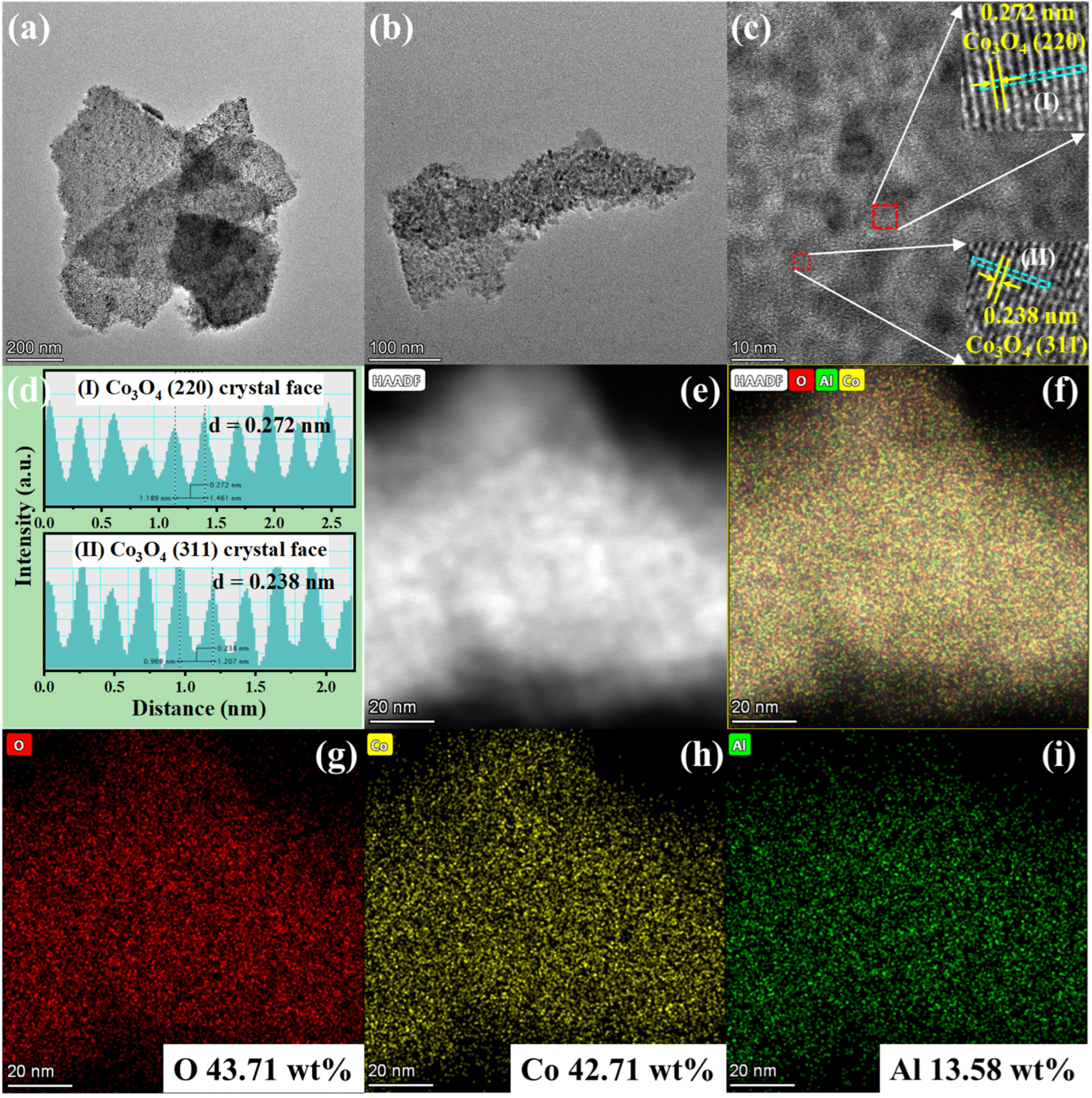
Transmission electron microscopy (TEM), high-resolution TEM (HRTEM), and the corresponding element mapping were applied to explore the texture structure, lattice space, and element distribution of the Al@Co3O4-6 catalyst, respectively. Figure 3a,b display the TEM images of the Al@Co3O4-6 catalyst. As presented in Figure 3a,b, the irregular nanosheet morphology could be found, which was kept in line with the results of the SEM images. Figure 3c,d show the HRTEM image and the lattice space of Al@Co3O4-6. Apparently, two lattice spaces of 0.272 nm and 0.238 nm were determined, which could be ascribed to the (220) and (311) lattice facets of Co3O4, respectively. Compared with the standard lattice space of Co3O4 (311) crystal face in PDF#42-1467 (0.244 nm), the Al doping and NaOH etching induced a decrease in lattice space, suggesting that the lattice contraction appeared. This was consistent with the XRD results. Figure 3e–i display a high-angle annular dark-field (HAADF) image and the corresponding element mapping of Al@Co3O4-6. As shown in the element mapping (Figure 3f–i), except for the even distribution of O and Co in the catalyst, Al with the mass percent of 13.58 wt% could also be found, suggesting the successful doping of Al in Co3O4.

2.3. Pore Structure and Chemical Properties

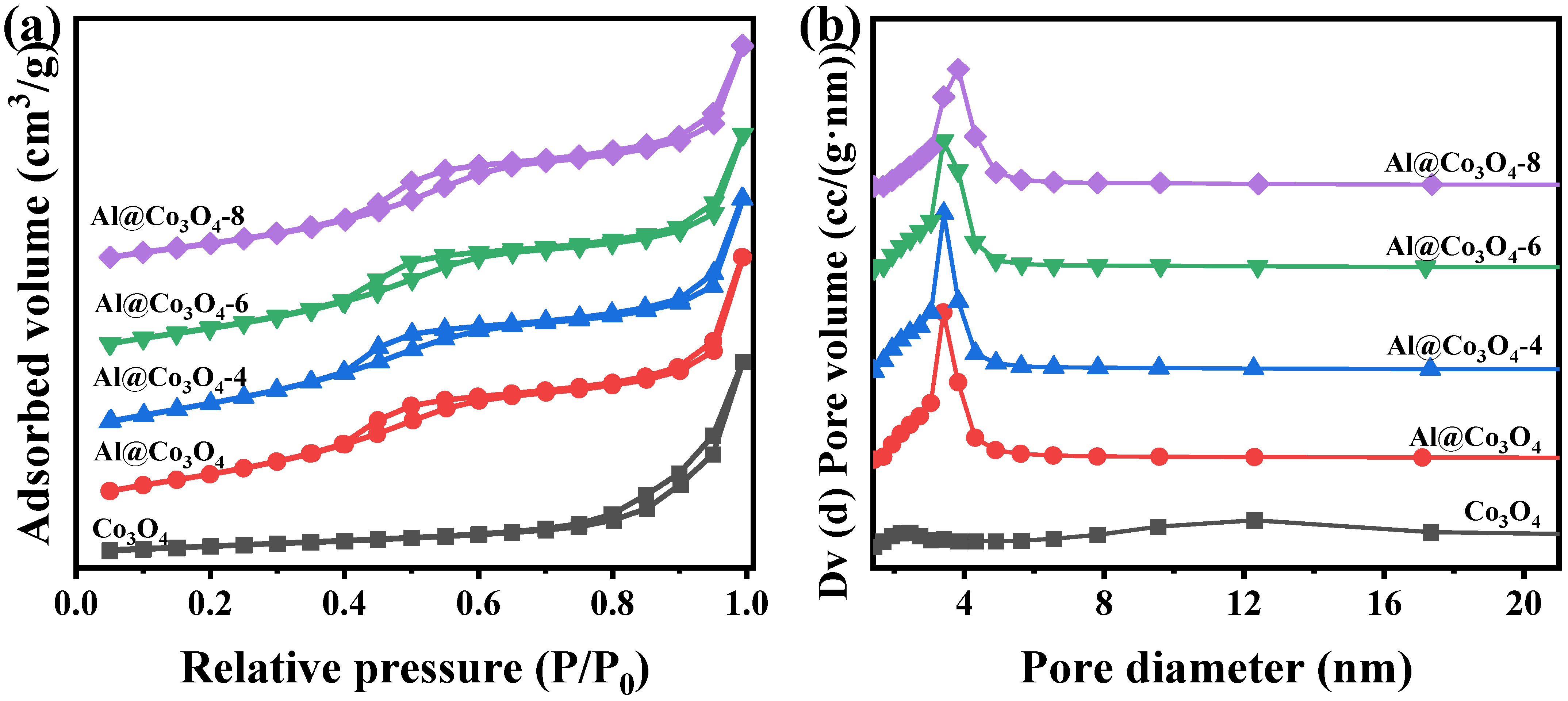
The surface area and pore channel structure of Co3O4 and the corresponding Al-doped Co3O4 catalysts were investigated using a physical adsorption instrument with N2 as the probe molecule at −196 °C. Figure 4a,b present the N2 adsorption–desorption curves and pore size distributions of the samples. Table 2 lists the corresponding physical parameters. As shown in Figure 4a, Co3O4 presents a typical IV-typed curve with an H3-typed hysteresis loop, suggesting that Co3O4 is a mesopore material [38]. After the doping of Al, the N2 adsorption–desorption curve of Al@Co3O4 maintained the typical IV-typed curve, while the hysteresis loop was changed to H2, which suggested that the doping of Al induced changes in the pore structure. For the NaOH-etched samples, similar N2 adsorption–desorption curves and hysteresis loops could be found. Figure 4b displays the pore size distribution of the catalysts. For Co3O4, the obvious pore size in the range of 1.4–3.8 and 6.5–17.3 nm was observed, suggesting the existence of mesopores in Co3O4, which is in accordance with the result of the N2 adsorption–desorption curve. After Al doping, the pore size of Al@Co3O4 was 1.4–6.5 nm, which indicated that the introduction of Al caused changes in the pore structure. Namely, a more even pore size was formed. Further NaOH etching has an unobvious effect on the pore size. As listed in Table 2, the values of surface area and total pore volume for Co3O4, Al@Co3O4, Al@Co3O4-4, Al@Co3O4-6, and Al@Co3O4-8 were 43.6 m2/g and 0.278 cm3/g, 184.2 m2/g and 0.348 cm3/g, 201.5 m2/g and 0.388 cm3/g, 205.4 m2/g and 0.370 cm3/g, and 169.8 m2/g and 0.350 cm3/g, respectively. Apparently, the doping of Al and the NaOH etching both increased the surface area and total pore volume [20]. Meanwhile, as the NaOH concentration improved, the surface area of the as-prepared NaOH-etched Al@Co3O4 catalysts increased first and then decreased, which might be ascribed to the fact that the high NaOH concentration induced the collapse of a part of the pore channel. According to the above, it could be inferred that the Al@Co3O4-6 presented the largest surface area, which might be beneficial for the adsorption of VOCs and enhance their degradation [39].
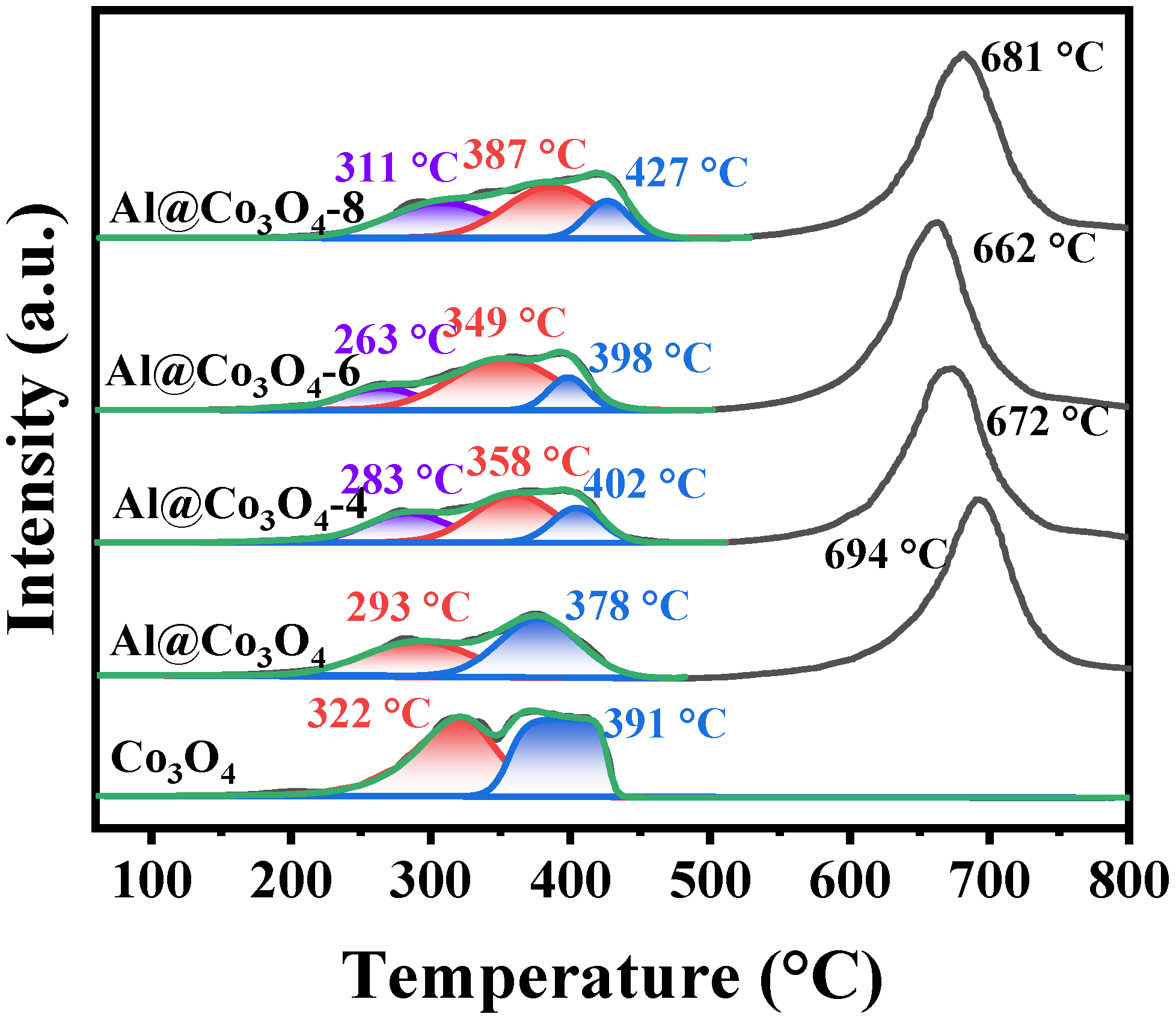
The redox properties of the Co3O4 catalysts were investigated by H2 temperature-programmed reduction (H2-TPR) in a chemical adsorption instrument. As illustrated in Figure 5, two reduction peaks at 322 and 391 °C were found in Co3O4, corresponding to the step reduction in Co3+ → Co2+ → Co0 [40,41]. After Al doping, the reduction peaks of Co3+ → Co2+ → Co0 were shifted to a lower temperature (293 and 378 °C), which suggested the enhancement of reducibility via Al doping. Meanwhile, a new reduction peak at 694 °C, ascribed to the reduction in cobalt oxide and alumina interaction species, appeared, which suggests the formation of interaction via Al doping [42]. The further etching of NaOH induced the appearance of three reduction peaks below 500 °C. The first peak was attributed to the reduction in highly reactive oxygen species absorbed on the surface oxygen vacancies [43]. The following two reduction peaks were ascribed to the reduction in Co3+ and Co2+. The large reduction peak above 650 °C was assigned to the reduction in cobalt oxide and alumina interaction species. Compared with the Al@Co3O4 catalyst, the reduction temperature of cobalt oxide and alumina interaction species shifted to a lower temperature in the NaOH-etched catalysts, implying the enhancement of the redox properties via NaOH etching. Meanwhile, Al-Co3O4-6 presents the lowest reduction temperatures of reactive oxygen species and cobalt oxide and alumina interaction, which suggests its better reducibility.
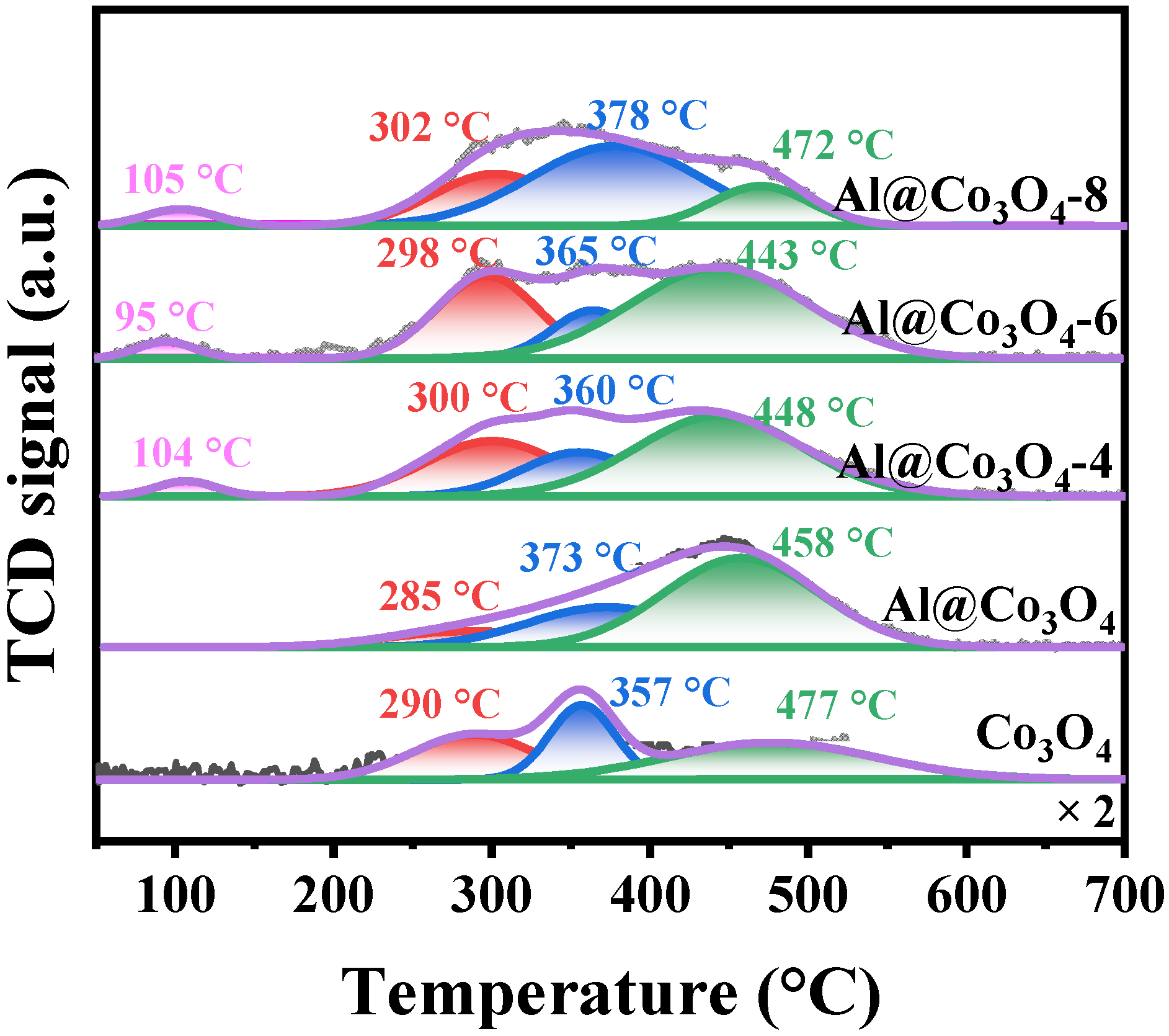
The oxygen species of the Co3O4 catalysts were explored by temperature-programmed O2 desorption. As presented in Figure 6, three oxygen desorption peaks at 290, 357, and 477 °C could be found in Co3O4, which were attributed to the desorption of oxygen species chemically adsorbed on the catalyst surface, surface, and the bulk lattice oxygen species, respectively [44,45]. After the doping of Al, the oxygen desorption peaks, especially the lattice oxygen species, were greatly enhanced, indicating that the doping of Al weakened the Co–O bond and promoted the easier desorption of lattice oxygen species. For the NaOH-etched Al@Co3O4 catalysts, a new peak centered at ~100 °C, which was ascribed to the surface physically adsorbed gaseous oxygen species, appeared [46]. Meanwhile, compared with Al@Co3O4, the desorption of chemically adsorbed oxygen species was greatly improved in this NaOH-etched Al@Co3O4. Furthermore, the temperature for the degradation of lattice oxygen species was shifted to a lower temperature, suggesting that the NaOH etching further weakened the Co–O bond. Additionally, compared with Al@Co3O4-4 and Al@Co3O4-8, Al@Co3O4-6 presented more surface chemically adsorbed oxygen species at a lower temperature. These results suggested that Al@Co3O4-6 has the better oxygen storage and release capacity. Generally, the surface chemically adsorbed oxygen was the main active reaction oxygen species in VOC oxidation [47]. Therefore, the suitable NaOH etching concentration could improve the oxygen storage ability and accelerate surface oxygen species desorption, enhancing the degradation of VOCs.
To comprehensively understand the physicochemical properties of the as-prepared catalysts, the structural and chemical characteristics caused by Al doping and NaOH etching were summarized according to the above characterization results. Firstly, the doping of Al in the lattice of Co3O4 caused Co3+and/or Co2+ to be replaced by smaller Al3+, resulting in a decrease in crystal size, lattice parameters, and lattice contraction (Figure 1a and Table 1), and the formation of oxygen vacancies (Figure 1b). Meanwhile, Al doping disrupts the ordered stacking structure of the Co3O4 nanosheets (Figure 2), increasing the specific surface area (Table 2) and improving the low-temperature reducibility (H2-TPR, Figure 5) and oxygen desorption capacity (O2-TPD, Figure 6). No individual Al2O3 or other crystal impurity phases were detected by XRD analysis (Figure 1a), indicating that the Al is mainly incorporated into the Co3O4 lattice as ions rather than forming isolated aluminum regions. This conclusion is further supported by the uniform Al distribution observed in the element mapping images (Figure 3f–i), suggesting the formation of a uniform Al-doped Co3O4 structure. Secondly, the NaOH etching selectively dissolved a portion of the Al from the near-surface region. This can be confirmed by the weakening of the Raman peaks (Figure 1b) and the further increase in surface area (Table 2). Additionally, the etching process has been proven to enhance the amorphization of the surface, generate more oxygen vacancies, and further promote the desorption of surface oxygen species (Figure 6). The pore structure is still mainly of a mesoporous structure, but the surface becomes more defective and more accessible. Furthermore, after NaOH etching, the decrease in lattice parameter reflected the lattice contraction caused by Al doping, which was further slightly increased (Table 1). The H2-TPR profiles (Figure 5) showed that etching lowered the reduction temperature of surface oxygen and Co–Al interaction, indicating an enhanced redox performance. O2-TPD (Figure 6) confirmed that etching increased the amount of chemisorbed oxygen and decreased the desorption temperature of lattice oxygen, indicating a higher oxygen vacancy concentration and more active surface oxygen. Finally, the SEM images directly reflect that after Al doping and NaOH etching, the originally smooth Co3O4 nanosheets transform into irregular and fragmented nanostructures. This morphological change, combined with the increase in surface area and pore volume, leads to a highly defective surface, rich in oxygen vacancies, which is conducive to the adsorption and activation of ethyl acetate and oxygen molecules.

2.4. Catalytic Performance

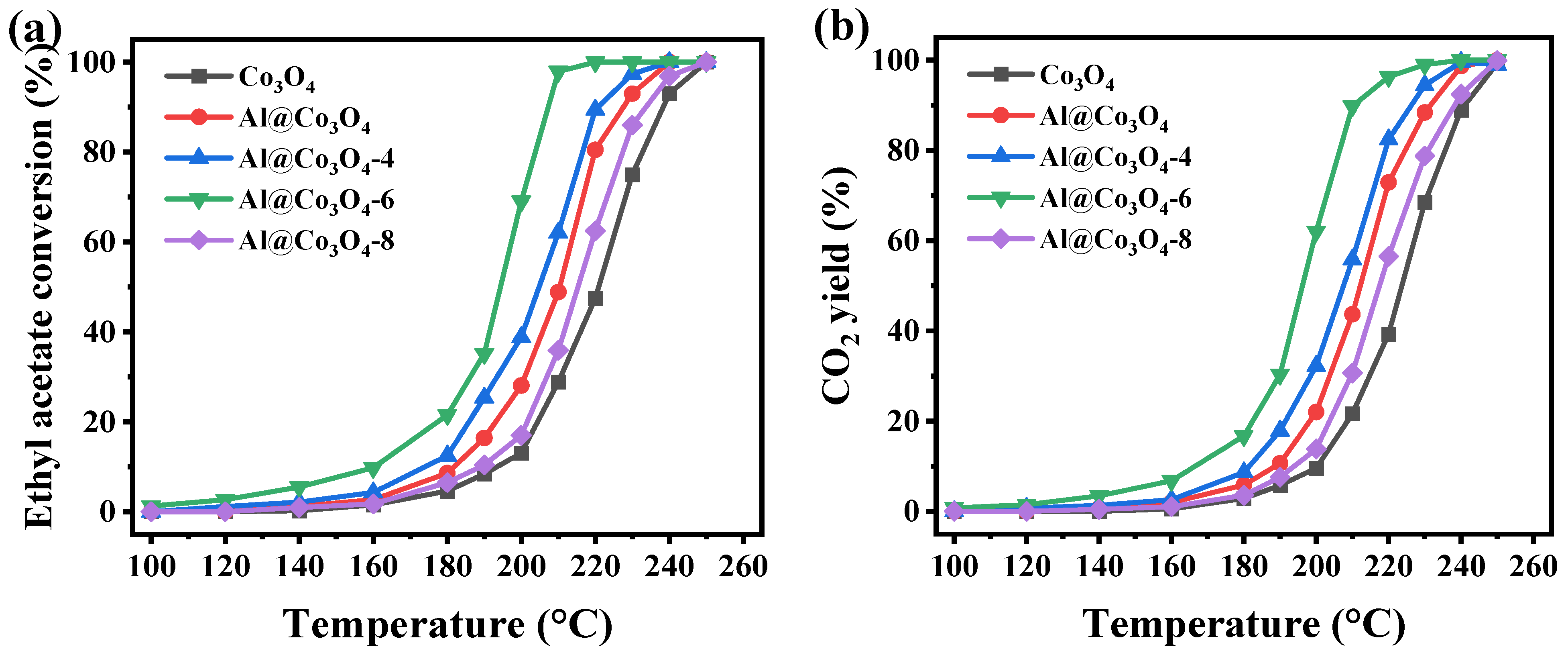
The catalytic activity of the as-prepared Co3O4 catalysts was investigated via the typical VOC, ethyl acetate, catalytic degradation at 100–250 °C. Figure 7a,b show the ethyl acetate conversion and corresponding CO2 yield at various temperatures over the Co3O4 catalysts. The temperatures at which ethyl acetate conversion reached 10%, 50%, and 90% (T10, T50, and T90) were also calculated to estimate the catalytic performance of the as-synthesized catalysts, and the detailed values are listed in Table 3. As shown in Figure 7a and Table 3, Co3O4 presents a complete ethyl acetate degradation temperature at 250 °C with the T90 value of 238 °C. After the doping of Al, the catalytic performance of Al@Co3O4 was enhanced, with the T90 value of 227 °C. The NaOH etching treatment could induce further improvement of catalytic performance. Meanwhile, with the increase in NaOH concentration, the ethyl acetate conversions were first increased and then decreased. The Al@Co3O4-6 displayed the optimal ethyl acetate degradation performance (T90 = 207 °C), followed by Al@Co3O4-4 (T90 = 220 °C), Al@Co3O4 (T90 = 227 °C), Al@Co3O4-8 (T90 = 233 °C), and Co3O4 (T90 = 238 °C). As presented in Figure 7b, the CO2 yield presented a similar tendency with ethyl acetate conversion, which also suggested Al@Co3O4-6 possesses the optimal catalytic performance for ethyl acetate catalytic combustion.
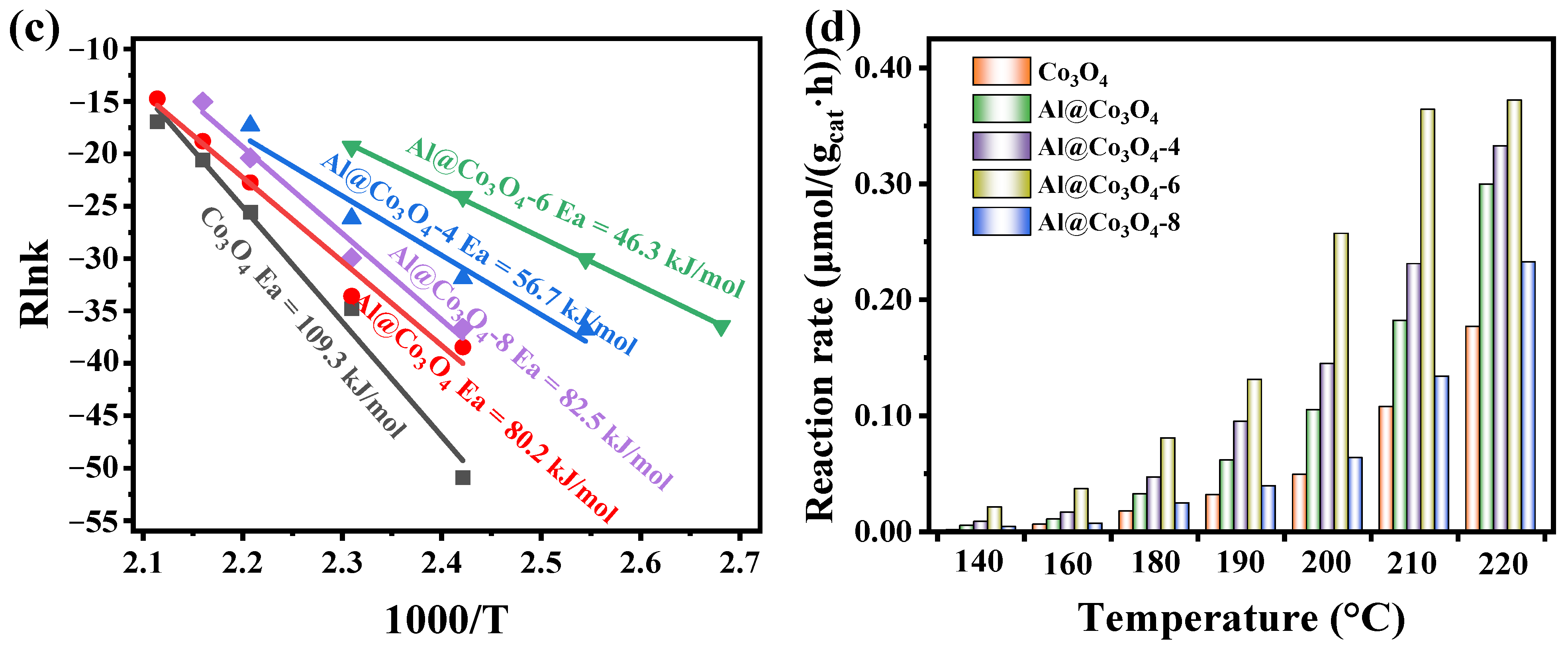
To further estimate the catalytic performance of the Co3O4 catalysts, the apparent activation energy (Ea) and the reaction rate (r) were calculated; the results are illustrated in Figure 7c and Figure 7d, respectively, and the corresponding values are summarized in Table 3. The Ea values for Co3O4, Al@Co3O4, Al@Co3O4-4, Al@Co3O4-6, and Al@Co3O4-8 were 109.3, 80.2, 56.7, 46.3, and 82.5 kJ/mol. The lowest Ea value for ethyl acetate degradation over Al@Co3O4-6 suggests its optimal catalytic performance. As presented in Figure 7d and Table 3, the higher reaction rate at low temperature also implied the better catalytic performance of Al@Co3O4-6 for ethyl acetate catalytic oxidation. Additionally, compared with the reported Co3O4 catalysts [17,19], other metal oxide catalysts [48,49,50,51], and even supported noble metal catalysts [52,53] listed in Table 4, the synthesized NaOH-etched Al-doped Co3O4 catalysts (Al@Co3O4-6) also presented better ethyl acetate degradation performance.
Typically, the catalytic performance of a catalyst was closely related to its physicochemical properties [54]. Based on the above characterization and catalytic performance results, the reasons for the optimal catalytic performance of Al@Co3O4-6 for ethyl acetate degradation could be acquired. Firstly, the Al doping and NaOH etching induced the generation of oxygen vacancies in Al@Co3O4-6 (Figure 1 and Figure 3), which enhanced the adsorption and activation of oxygen [55]. Secondly, the doping of Al and NaOH etching improved the surface area of Al@Co3O4-6 (Figure 4 and Table 1), which was beneficial to ethyl acetate molecules adsorption [56]. Finally, the reducibility and the desorption of oxygen species were enhanced in Al@Co3O4-6 via Al doping and NaOH etching (Figure 5 and Figure 6). Therefore, the optimal ethyl acetate degradation performance of Al@Co3O4-6 could be owed to its large surface area, better low-temperature reducibility, and better oxygen desorption ability.

2.5. Catalytic Mechanism and Ethyl Acetate Degradation Pathway

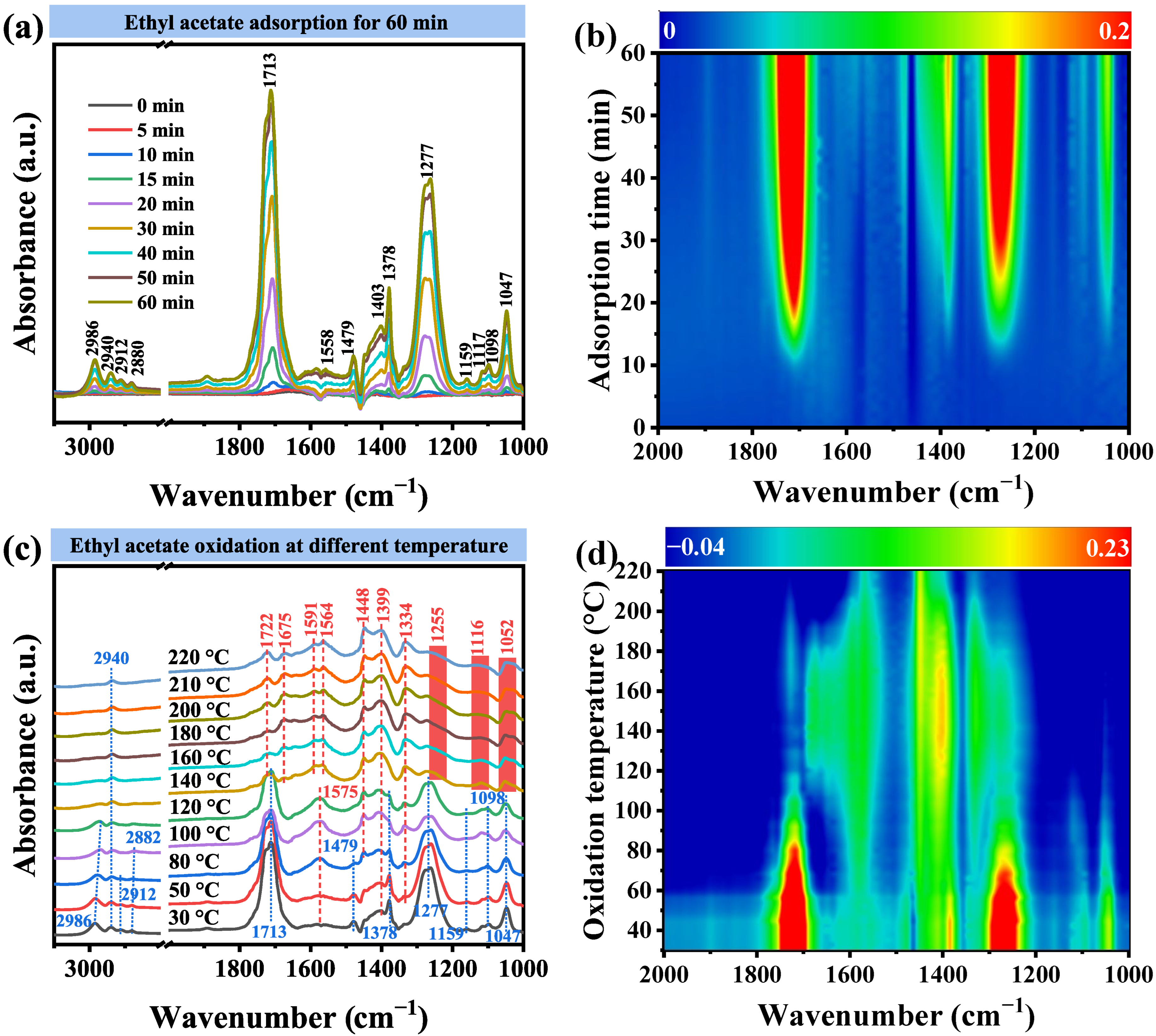
The ethyl acetate degradation intermediates were detected via the in situ DRIFTS spectra. Figure 8 presents the in situ ethyl acetate adsorption and oxidation DRIFTS spectra for over Al@Co3O4-6. Figure 8a,b display the in situ DRIFTS spectra for ethyl acetate adsorption at 30 °C for 60 min, and the assignment of the typical absorption peaks is listed in Table 5. As illustrated in Figure 8a,b, the absorption peaks at 2986, 2940, 2912, and 2880 cm−1 were assigned to the C–H stretching vibration of -CH3 [57,58]. The absorption band at 1713 cm−1 was ascribed to the C=O vibration of ester carbonyl in ethyl acetate [59,60]. The two absorption peaks at 1558 and 1403 cm−1 were attributed to the antisymmetric and symmetric stretching vibration of COO- in acetate acid species [61,62]. According to the literature [57,63], the absorption bands at 1479, 1378, 1098, and 1047 cm−1 were attributed to the adsorption of ethyl acetate molecules. Two other bands at 1277 and 1156 cm−1 were ascribed to the C–O vibration of ethyl acetate and vinyl acetate, respectively [59,64]. Apparently, with the adsorption time increased, the absorption bands attributed to the ethyl acetate were enhanced gradually. Meanwhile, the weak absorption peaks corresponding to acetic acid and vinyl acetate appeared, which suggested that the adsorbed ethyl acetate was reacted with surface-adsorbed oxygen species in the oxygen vacancies and surface lattice oxygen species, which induced the partial decomposition of absorbed ethyl acetate.
Figure 8c,d show the in situ DRIFTS spectra for ethyl acetate degradation over Al@Co3O4-6, and the assignment of the absorption bands is listed in Table 6. As shown in Figure 8c,d, with the reaction temperature increased from 30 to 220 °C, the intensity of these absorption peaks at 2986, 2912, 2882, 1713, 1479, 1378, 1227, 1159, 1098, and 1047 cm−1, corresponding to the adsorbed ethyl acetate molecules, decreased and vanished. At the same time, some new absorption bands appeared. These suggested that as the reaction temperature increased, ethyl acetate degraded gradually, accompanied by some intermediate formation on the catalyst’s surface. The newly absorbed band at 1722 cm−1 was attributed to the C=O stretching vibration of acetaldehyde species, indicating the production of acetaldehyde species during ethyl acetate degradation [61,65]. The band at 1675 cm−1 was assigned to the C=C stretching vibration of ethylene [64]. The bands at 1591 and 1564 cm−1 were due to the antisymmetric stretching vibrations of COO-, suggesting the formation of the formate and acetic acid species on the catalyst’s surface [51,66]. Meanwhile, the appearance of COO- symmetric stretching vibration at 1448 and 1399 cm−1 also confirmed the generation of formate and acetate acid species on the catalyst surface [51,67]. Two absorption peaks at 1334 and 1255 cm−1 were owed to the O–H deformation vibration of ethanol and C–O stretching vibration of acetate species, respectively, indicating the formation of ethanol and acetic acid species during ethyl acetate degradation [59,63,68]. Two other bands at 1116 and 1052 cm−1 were ascribed to the C–O stretching vibration of ethanol [69,70]. As illustrated in Figure 8c,d, with the reaction temperature increased, the intensity of the generated intermediates’ absorption bands firstly enhanced and then decreased, suggesting that the formed intermediates were degraded gradually. Therefore, the degradation pathway of ethyl acetate could be obtained. Ethyl acetate was first adsorbed on the catalyst’s surface and then gradually oxidized to ethanol and acetaldehyde, acetic acid, formate, and finally to CO2 and H2O.
Generally, the degradation of VOCs over the metal oxide catalysts obeys the Mars van Krevelen (MVK) mechanism. Herein, according to the above, the absorbed ethyl acetate could react with the adsorbed oxygen species in the oxygen vacancies and surface lattice oxygen species at 30 °C. The consumed surface lattice oxygen species would induce the formation of oxygen vacancies and low oxidation state Co ions (Co2+). As the temperature increased, the gaseous oxygen was adsorbed and activated by the oxygen vacancies to supply the consumed surface lattice oxygen species, which can react with the adsorbed ethyl acetate and its degradation intermediates to form CO2 and H2O. From this point on, an oxidation-reduction reaction comes to an end. Therefore, the degradation of ethyl acetate obeyed the MVK mechanism.

3. Materials and Methods

3.1. Materials and Chemistry

The chemicals utilized in this study included cobalt(II) nitrate hexahydrate (Co(NO3)2·6H2O, AR, ≥98.5%), aluminum nitrate nonahydrate (Al(NO3)3·9H2O, AR, ≥99.0%), sodium hydroxide (NaOH, AR, ≥98.5%), absolute methanol (CH3OH, AR, ≥99.7%), and urea (CO(NH2)2, AR, ≥99.0%). All chemicals were A.R. grade and bought from Sinopharm Chemical Reagent Co., Ltd. (Shanghai, China). Meanwhile, these chemical reagents were used without any treatment.

3.2. Catalysts Synthesis

3.2.1. Preparation of Co3O4

The sheet-like Co3O4 was synthesized via the traditional hydrothermal method based on the reported literature [71]. Typically, 20 mmol of urea and 4 mmol of Co(NO3)2·6H2O were dissolved in 75 mL of deionized water. After stirring for 30 min, the clear solution was transferred to the high-pressure reactor and reacted at 120 °C for 10 h. After cooling naturally, the Co3O4 precursor with pink color could be acquired after undergoing centrifugal separation, washing with anhydrous methanol and deionized water, and drying in an oven at 80 °C overnight. Finally, the pink Co3O4 precursor was first calcinated in a muffle furnace at 300 °C for 3 h and then heated to 350 °C for another 3 h with a heating rate of 1 °C/min to obtain the black Co3O4 powder.

3.2.2. Synthesis of Al-Doped Co3O4 (Al@Co3O4)

The Al-doped Co3O4 catalyst was also synthesized via the traditional hydrothermal method. The synthesis processes were similar to the preparation of Co3O4, except that 2 mmol of Al(NO3)3·9H2O was added to the solution during stirring. The Al-doped Co3O4 catalyst was named Al@Co3O4.

3.2.3. Synthesis of NaOH-Etched Al@Co3O4

The etched Al@Co3O4 was prepared via the NaOH solution washing. Typically, the as-prepared Al@Co3O4 was soaked in 40 mL of NaOH solution (4 mmol/L) for 24 h under stirring. After that, the precipitation was centrifuged and washed with deionized water until neutral. Finally, the washed black precipitation was dried in an oven at 80 °C overnight to obtain the NaOH-etched Al@Co3O4, named Al@Co3O4-4. Additionally, the different concentrations of NaOH solution (6 and 8 mmol/L)-etched Al@Co3O4 were prepared. The NaOH solution-etched Al@Co3O4 was named Al@Co3O4-x (x represented the NaOH concentration of 4, 6, and 8 mmol/L).

3.3. Catalysts Characterization

Many characterization methods, including XRD, Raman, FT-IR, SEM, N2 adsorption–desorption curves, H2-TPD, and O2-TPD, etc., were applied to characterize the catalysts. The specific processes were presented as follows:
(1) XRD: An X-ray diffractometer (Bruker D8 Advance, Billerica, MA, USA), which is equipped with a monochromatic detector and Cu–Kα radiation, was used to acquire the XRD patterns of the catalysts. The XRD patterns were obtained under the emission current of 40 mA and the accelerating voltage of 40 kV. The scanning rate and 2θ range were 5°/min and 5–80°, respectively.
(2) Raman: A Raman spectrograph (Horiba, LabRAM HR Evolution, Paris, France) with an excitation wavelength of 532 nm was applied to measure the Raman spectra.
(3) FT-IR: A Nicolet iS50 (Thermo Fisher, Waltham, MA, USA) with a resolution ratio of 4 and scan times of 64 was employed to acquire the FT-IR spectra.
(4) SEM: A scanning electron microscope (JEOL JSM-7800F, Tokyo, Japan) was used to obtain the morphology of catalysts.
(5) TEM: A transmission electron microscope equipped with X-ray energy-dispersive spectroscopy (FEI Talos F200S, Portland, OR, USA) was applied to investigate the TEM, HRTEM images, and TEM mapping.
(6) N2 adsorption–desorption curves: A physical adsorption instrument (Autosorb iQ2, Quantachrome, Boca Raton, FL, USA) was employed to investigate the N2 adsorption–desorption curves. Typically, 0.08–0.1 g of the catalyst powder was degassed under vacuum at 200 °C for 12 h. Then, the N2 adsorption–desorption curves were determined at −196 °C.
(7) H2-TPR and O2-TPD: A chemical adsorption instrument (Quantachrome ChemBET TPR/TPD, Boca Raton, FL, USA) was applied to detect the H2-TPR and O2-TPD profiles of the catalysts. The process was the same as our previous work [22].

3.4. Catalytic Performance Test

The catalytic performance of the as-prepared catalysts was determined in a fixed-bed microreactor using ethyl acetate as the probe molecule equipped with a U-type reaction tube (6 mm outside diameter, 4 mm inside diameter). The specific process can be found in our previous work [22]. The ethyl acetate conversion (XEA) and CO2 yield (YCO2) were calculated according to the following equations:
XEA = (C0 − Ci)/C0 × 100%
YCO2 = CCO2/(4 × C0) × 100%
where C0, Ci, and CCO2 were the inlet ethyl acetate concentration, the outlet ethyl acetate, and CO2 concentration, respectively.
For the kinetic study, generally, ethyl acetate oxidation under excessive oxygen should obey the pseudo-first-order reaction mechanism. The reaction rate (r) could be calculated according to the following Equations (3) and (4):
r =   k c
r = F m × l n ( 1 X E A )
where k, c, F, and m were the reaction rate constant, the concentration of ethyl acetate in the feed stream, the reaction flow rate (mol/s) of ethyl acetate, and the mass of catalyst (g), respectively.
The apparent activation energy (Ea) was calculated according to the Arrhenius Equation (5):
ln k = E a R T + ln A
where R, T, and A were the gas constant (J/(mol·K)), reaction temperature (K), and pre-exponential factor, respectively.

3.5. Athyl Acetate Degradation Intermediates Detection

The ethyl acetate degradation intermediates were detected via the in situ DRIFTS spectra, performed on an infrared spectrometer (Thermo Fisher, Nicolet/iS50, Waltham, MA, USA) with an in situ reaction cell. For the adsorption spectra, 50 mg of the catalyst was treated under an Ar atmosphere at 250 °C for 60 min. After cooling to 30 °C, the gas was changed into 20.0 vol.% O2 balanced with Ar, and the background was taken. Then, 1000 ppm ethyl acetate was introduced to the reaction cell, and the adsorption spectra were gathered for 60 min. For the oxidation spectra, after the 60 min adsorption, the temperature was raised, and the oxidation spectra were collected at a certain temperature. The scanning times and resolution were set at 32 and 4 during the spectra collection, respectively.

4. Conclusions

In summary, the series of NaOH-etched Al-doping Co3O4 catalysts were successfully synthesized via the hydrothermal method. The physical–chemical properties were characterized by many characterizations, and the catalytic performance was determined for the typical VOC, ethyl acetate degradation. It was observed that the Al doping and NaOH etching destroyed the sheet morphology of Co3O4, which induced the formation of a large amount of lattice defects and oxygen vacancies. Meanwhile, the Al doping and NaOH etching caused a great improvement in the catalyst’s surface area, which facilitated the adsorption of ethyl acetate. Furthermore, the redox properties and oxygen desorption ability were also enhanced via Al doping and NaOH etching. Based on these characterization results, the Al@Co3O4-6 catalyst with a large surface area, better low-temperature reducibility, and easier oxygen desorption ability presented the optimal ethyl acetate degradation performance (T90 = 207 °C). Finally, the ethyl acetate degradation pathway over Al@Co3O4-6 surface was uncovered by in situ DRIFTS spectra; ethyl acetate was adsorbed on the catalyst surface and gradually oxidized to ethanol and acetaldehyde, acetic acid, formate, and finally to CO2 and H2O. This work could provide guidance for the preparation of high-performance catalysts via metal doping and lye etching for VOC degradation.

Author Contributions

Writing—original draft, data curation, and formal analysis, J.W.; data curation and investigation, S.L.; methodology and software, D.L.; investigation and software, H.Y.; conceptualization and validation, Y.W.; project administration, funding acquisition, and writing—review and editing, F.B.; conceptualization, funding acquisition, and writing—review and editing, X.Z. All authors have read and agreed to the published version of the manuscript.

Funding

This research was funded by the National Natural Science Foundation of China (Nos. 22506124 and 12175145) and the Shanghai Rising-Star Program (24YF2729800).

Data Availability Statement

The authors declare that all data supporting the findings of this study are available within the article.

Acknowledgments

The authors acknowledge the sponsor of the Energy Science and Technology discipline under the Shanghai Class IV Peak Disciplinary Development Program.

Conflicts of Interest

The authors declare no conflicts of interest.

References

  1. Zhao, N.; Zhang, H.Y.; Wang, G. Revealing the nonlinear responses of PM2.5 and O3 to VOC and NOx emissions from various sources in Shandong, China. J. Hazard. Mater. 2025, 489, 137655. [Google Scholar] [CrossRef]
  2. Bi, F.K.; Feng, X.B.; Huang, J.H.; Wei, J.F.; Wang, H.M.; Du, Q.X.; Liu, N.; Xu, J.C.; Liu, B.L.; Huang, Y.D.; et al. Unveiling the Influence Mechanism of Impurity Gases on Cl-Containing Byproducts Formation during VOC Catalytic Oxidation. Environ. Sci. Technol. 2025, 59, 15526–15537. [Google Scholar] [CrossRef]
  3. Yu, S.J.; Li, S.; Hu, H.Y.; Gao, L.X.; Huang, Y.D.; Pu, F.G.; Yao, H. Enhanced VOCs adsorption mechanism on biochar synthesized by one-step molten salt thermal treatment: Experimental and DFT insights. J. Environ. Manag. 2026, 397, 128310. [Google Scholar]
  4. Ma, X.W.; Liu, J.J.; Zhou, J.; Yao, Z.T. Unveiling adsorption mechanism of low-concentration VOCs on waste circuit board-derived porous carbon: A combined experimental and molecular simulation study. Sep. Purif. Technol. 2026, 385, 136447. [Google Scholar]
  5. Huang, J.H.; Wei, J.F.; Tian, F.Y.; Bi, F.K.; Rao, R.Z.; Wang, Y.X.; Tao, H.C.; Liu, N.; Zhang, X.D. Nitrogen-induced TiO2 electric field polarization for efficient photodegradation of high-concentration ethyl acetate: Mechanisms and reaction pathways. Mater. Today Chem. 2024, 41, 102292. [Google Scholar]
  6. Feng, Y.; Chu, P.Q.; Hou, Z.Q.; Wu, L.K.; Liu, Y.X.; Deng, J.G.; Dai, H.X. Single-atom catalysts in the photothermal catalysis: Fundamentals, mechanisms, and applications in VOCs oxidation. Chem. Syth. 2025, 5, 64. [Google Scholar]
  7. Guo, L.; Li, Z.; Guo, M.Z.; Lu, Z.H.; Bi, F.K.; Wang, Y.X.; Zhang, X.D. Study on the difference in catalytic performance and chlorine-resistance of Universitetet i Oslo-derived M@ZrO2 (M = Pd, Pt) catalysts for o-Xylene degradation. Mater. Today Chem. 2025, 49, 103046. [Google Scholar] [CrossRef]
  8. Zhang, Y.F.; Chen, J.N.; Buren, T.; Li, Z.; Zhang, X.J.; Ma, S.T.; Wei, J.F.; Bi, F.K.; Zhang, X.D. Electron beam irradiation defective UiO-66 supported noble metal catalysts for binary VOCs removal: Insight into the synergistic degradation mechanism of mutual promotion. Sep. Purif. Technol. 2025, 380, 135236. [Google Scholar] [CrossRef]
  9. Jiang, Z.Y.; Li, Y.T.; Tang, Z.Y.; Yuan, D.K.; Lin, F.W. Strong Metal–Support Interactions in Catalytic Oxidation of VOCs: Mechanistic Insights, Support Engineering Strategies, and Emerging Catalyst Design Paradigms. Environ. Sci. Technol. 2025, 59, 19644–19666. [Google Scholar] [CrossRef] [PubMed]
  10. Zhou, Z.X.; Wang, Y.X.; Hu, H.T.; Wei, J.F.; Qiao, R.; Bi, F.K.; Zhang, X.D. Recent progress of cerium-based catalysts for the catalytic oxidation of volatile organic compounds: A review. Fuel 2025, 399, 135603. [Google Scholar] [CrossRef]
  11. Ruan, D.H.; Wu, S.P.; Yuan, C.Y.; Huang, Z.; Shen, W.; Xu, H.L. Development of Highly Active and Stable SmMnO3 Perovskite Catalysts for Catalytic Combustion. Catalysts 2025, 15, 1149. [Google Scholar] [CrossRef]
  12. Wang, M.M.; Xiao, J.; Li, N.J.; Xu, Q.F.; Li, H.; Chen, D.Y.; Lu, J.M. Surface engineering of ternary mixed transition metal oxides for highly efficient catalytic oxidation of low concentration VOCs. Sep. Purif. Technol. 2024, 334, 126000. [Google Scholar] [CrossRef]
  13. Zhou, B.; Bai, B.Y.; Zhu, X.F.; Guo, J.J.; Wang, Y.; Chen, J.J.; Peng, Y.; Si, W.Z.; Ji, S.F.; Li, J.H. Insights into effects of grain boundary engineering in composite metal oxide catalysts for improving catalytic performance. J. Colloid Interf. Sci. 2024, 653, 1177–1187. [Google Scholar] [CrossRef]
  14. Xiao, M.L.; Zhao, T.Y.; Li, Y.J.; Zhu, B.; Yu, T.G.; Liu, W.T.; Zhao, M.Q.; Cui, B. Co3O4-Based Catalysts for the Low-Temperature Catalytic Oxidation of VOCs. ChemCatChem 2024, 16, e202301524. [Google Scholar] [CrossRef]
  15. Fan, Z.Y.; Zhang, Z.X.; Fang, W.J.; Yao, X.; Zou, G.C.; Shangguan, W.F. Low-temperature catalytic oxidation of formaldehyde over Co3O4 catalysts prepared using various precipitants. Chin. J. Catal. 2016, 37, 947–954. [Google Scholar] [CrossRef]
  16. Ren, Q.M.; Feng, Z.T.; Mo, S.P.; Huang, C.L.; Li, S.J.; Zhang, W.X.; Chen, L.M.; Fu, M.L.; Wu, J.L.; Ye, D.Q. 1D-Co3O4, 2D-Co3O4, 3D-Co3O4 for catalytic oxidation of toluene. Catal. Today 2019, 332, 160–167. [Google Scholar] [CrossRef]
  17. Zhu, X.F.; Bai, B.Y.; Zhou, B.; Ji, S.F. Co3O4 nanoparticles with different morphologies for catalytic removal of ethyl acetate. Catal. Commun. 2021, 156, 106320. [Google Scholar] [CrossRef]
  18. Wang, Z.L.; Xiao, M.; You, J.K.; Liu, G.; Wang, L.Z. Defect Engineering in Photocatalysts and Photoelectrodes: From Small to Big. Acc. Mater. Res. 2022, 3, 1127–1136. [Google Scholar] [CrossRef]
  19. Wen, J.L.; Hu, Z.Y.; Jia, H.P.; Chen, J.; Lu, C.Z. Constructing CuO/Co3O4 Catalysts with Abundant Oxygen Vacancies to Achieve the Efficient Catalytic Oxidation of Ethyl Acetate. Catalysts 2025, 15, 538. [Google Scholar] [CrossRef]
  20. Su, M.L.; Zhang, H.; Zhang, P.Y. Tuning ozone decomposition intermediates on δ-MnO2 to improve its moisture-resistance in ozone catalytic oxidation of toluene. Appl. Catal. B 2025, 378, 125526. [Google Scholar] [CrossRef]
  21. Ma, L.; Seo, C.Y.; Chen, X.Y.; Sun, K.; Schwank, J.W. Indium-doped Co3O4 nanorods for catalytic oxidation of CO and C3H6 towards diesel exhaust. Appl. Catal. B 2018, 222, 44–58. [Google Scholar] [CrossRef]
  22. Bi, F.K.; Wei, J.F.; Zhuo, Z.X.; Zhang, Y.F.; Gao, B.; Liu, N.; Xu, J.C.; Liu, B.L.; Huang, Y.D.; Zhang, X.D. Insight into the Synergistic Effect of Binary Nonmetallic Codoped Co3O4 Catalysts for Efficient Ethyl Acetate Degradation under Humid Conditions. JACS Au 2025, 5, 363–380. [Google Scholar] [CrossRef]
  23. Cu, M.; Wang, L.; Sun, Y.G.; Ma, Y.L.; Zhang, X.; Zhang, J.; Zhu, Y.B.; Zhu, L.; Qiao, S.; Wei, J.P.; et al. Unveiling the mechanism of alkali etched CuMn2O4-δ spinel catalysis enhance for acetone catalytic Oxidation: The roles of Metal-Oxygen bond and oxygen defect site. Sep. Purif. Technol. 2024, 345, 127339. [Google Scholar]
  24. Xin, J.G.; Wang, W.X.; Xie, L.L.; Li, X.Y.; Li, X.Y.; Yao, Y.; Zhao, X.L.; Zhu, Z.G. MOF-derived Al3+-doped Co3O4 nanocomposites for highly n-butanol gas sensing performance at low operating temperature. J. Alloys Compd. 2024, 978, 173341. [Google Scholar] [CrossRef]
  25. Meng, W.H.; Sun, S.Q.; Xie, D.H.; Dai, S.T.; Shao, W.; Zhang, Q.D.; Qin, C.L.; Liang, G.M.; Li, X.Y. Engineering defective Co3O4 containing both metal doping and vacancy in octahedral cobalt site as high performance catalyst for methane oxidation. Mol. Catal. 2024, 553, 113768. [Google Scholar]
  26. Ahmad, J.; Awan, M.Q.; Mazhar, M.E.; Ashiq, M.N. Effect of substitution of Co2+ ions on the structural and electrical properties of nanosized magnesium aluminate. Phys. B 2011, 406, 254–258. [Google Scholar]
  27. Dai, W.L.; Zou, M.L.; Zhao, C.; Zhang, J.; Wang, L.G.; Wang, X.S.; Yang, L.X.; Zhou, L.; Zou, J.P.; Luo, X.B.; et al. Monoatomic oxygen fueled by oxygen vacancies governs the photothermocatalytic deep oxidation of toluene on Na-doped Co3O4. Appl. Catal. B 2022, 317, 121769. [Google Scholar] [CrossRef]
  28. Swaminathan, J.; Puthirath, A.B.; Sahoo, M.R.; Nayak, S.K.; Costin, G.; Vajtai, R.; Sharifi, T.; Ajayan, P.M. Tuning the Electrocatalytic Activity of Co3O4 through Discrete Elemental Doping. ACS Appl. Mater. Interfaces 2019, 11, 39706–39714. [Google Scholar] [CrossRef] [PubMed]
  29. Han, D.W.; Ma, X.Y.; Yang, X.Q.; Xiao, M.L.; Sun, H.; Ma, L.J.; Yu, X.L.; Ge, M.F. Metal organic framework-templated fabrication of exposed surface defect-enriched Co3O4 catalysts for efficient toluene oxidation. J. Colloid Interf. Sci. 2021, 603, 695–705. [Google Scholar] [CrossRef]
  30. Wang, X.X.; Li, T.T.; Zheng, Y.Q. Co3O4 nanosheet arrays treated by defect engineering for enhanced electrocatalytic water oxidation. Int. J. Hydrogen Energy 2018, 43, 2009–2017. [Google Scholar] [CrossRef]
  31. Lv, X.W.; Liu, Y.P.; Hao, R.; Tian, W.W.; Yuan, Z.Y. Urchin-like Al-Doped Co3O4 Nanospheres Rich in Surface Oxygen Vacancies Enable Efficient Ammonia Electrosynthesis. ACS Appl. Mater. Interfaces 2020, 12, 17502–17508. [Google Scholar] [CrossRef]
  32. Dash, C.S.; Sukumar, M.; Ravi, V.; Anitha, G.; Rajabathar, J.R.; Katubi, K.M.; Alsaiari, N.S.; Abualnaja, K.M.; Rajkumar, R.; Kamalakannan, M.; et al. Effect of Zinc Doping on Structural, Optical, Magnetic, and Catalytic Behavior of Co3O4 Nanoparticles Synthesized by Microwave-Assisted Combustion Method. J. Clust. Sci. 2023, 34, 2093–2101. [Google Scholar] [CrossRef]
  33. Yang, Y.Q.; Jie, B.R.; Zhai, Y.X.; Zeng, Y.J.; Kang, J.Y.; Cheng, G.; Zhang, X.D. Performance and mechanism of efficient activation of peroxymonosulfate by Co-Mn-ZIF derived layered double hydroxide for the degradation of enrofloxacin. J. Mol. Liq. 2024, 394, 123723. [Google Scholar] [CrossRef]
  34. Jiang, Q.H.; Guo, X.F.; Wang, C.; Jia, L.H.; Zhao, Z.L.; Yang, R.; Zhang, Y.; Deng, Q.F. Ultra-responsive and selective ethanol and acetone sensor based on Ce-doped Co3O4 microspheres assembled by submicron spheres with multilayer core-shell structure. Colloids Surf. A Physicochem. Eng. Asp. 2023, 666, 131301. [Google Scholar] [CrossRef]
  35. Muradov, M.B.; Mammadyarova, S.J.; Eyvazova, G.M.; Balayeva, O.O.; Hasanova, I.; Aliyeva, G.; Melikova, S.Z.; Abdullayev, M.I. The effect of Cu doping on structural, optical properties and photocatalytic activity of Co3O4 nanoparticles synthesized by sonochemical method. Opt. Mater. 2023, 142, 114001. [Google Scholar] [CrossRef]
  36. Jin, S.W.; Zhou, X.Y.; Wu, W.B.; Zhu, C.F.; Weng, H.M.; Wang, H.Y.; Zhang, X.F.; Ye, B.J.; Han, R.D. Vacancy defects in epitaxial La0.7Sr0.3MnO3 thin films probed by a slow positron beam. J. Phys. D Appl. Phys. 2004, 37, 1841. [Google Scholar] [CrossRef][Green Version]
  37. Zhang, X.F.; Yoko, A.; Zhou, Y.; Jee, W.; Mayoral, A.; Liu, T.F.; Guan, J.C.; Lu, Y.; Keal, T.W.; Buckeridge, J.; et al. Surface-Driven Electron Localization and Defect Heterogeneity in Ceria. J. Am. Chem. Soc. 2025, 147, 33888–33902. [Google Scholar] [CrossRef]
  38. Wang, H.M.; Huang, J.H.; Ding, S.S.; Li, Z.; Zhao, Z.Y.; Wei, J.F.; Zhou, D.X.; Chu, H.X.; Bi, F.K.; Zhang, X.D. Catalytic oxidation of binary VOCs over MnO2 with different crystal structures: Mechanisms of promotion and inhibition. Sep. Purif. Technol. 2026, 382, 135895. [Google Scholar] [CrossRef]
  39. Qiao, R.; Wang, Y.X.; Chen, J.N.; Hu, H.T.; Wei, J.F.; Bi, F.K.; Zheng, Y.; Zhang, X.D. A Study on the Photothermal Catalytic Performance of Pt@MnO2 for O-Xylene Oxidation. Molecules 2025, 30, 4193. [Google Scholar] [CrossRef]
  40. Yang, Y.; Bi, F.K.; Wei, J.F.; Gao, B.; Qiao, R.; Xu, J.C.; Liu, N.; Zhang, X.D. Boosting the Photothermal Oxidation of Multicomponent VOCs in Humid Conditions: Synergistic Mechanism of Mn and K in Different Oxygen Activation Pathways. Environ. Sci. Technol. 2025, 59, 11341–11352. [Google Scholar] [CrossRef]
  41. Lu, X.Y.; Hu, J.L.; Hou, J.C.; Wang, J.C.; Bao, W.R.; Chang, L.P. Study on the synthesis of CeO2-Co3O4 catalyst by flame spray pyrolysis method and its catalytic oxidation performance for ethane. J. Fuel Chem. Technol. 2025, 53, 1470–1481. [Google Scholar] [CrossRef]
  42. Ai, X.Y.; Zhang, Y.H.; Lyu, S.; Liu, C.C.; Zhao, Y.X.; Li, J.L. The Effect of Al2O3 Pore Diameter on the Fischer–Tropsch Synthesis Performance of Co/Al2O3 Catalyst. Catal. Lett. 2023, 153, 3689–3697. [Google Scholar] [CrossRef]
  43. Luo, Y.J.; Zheng, Y.B.; Feng, X.S.; Lin, D.F.; Qian, Q.R.; Wang, X.Y.; Zhang, Y.F.; Chen, Q.H.; Zhang, X.H. Controllable P Doping of the LaCoO3 Catalyst for Efficient Propane Oxidation: Optimized Surface Co Distribution and Enhanced Oxygen Vacancies. ACS Appl. Mater. Interfaces 2020, 12, 23789–23799. [Google Scholar] [CrossRef] [PubMed]
  44. Li, R.; Shi, X.J.; Huang, Y.; Chen, M.J.; Zhu, D.D.; Ho, W.; Cao, J.J.; Lee, S. Catalytic oxidation of formaldehyde on ultrathin Co3O4 nanosheets at room temperature: Effect of enhanced active sites exposure on reaction path. Appl. Catal. B 2022, 319, 121902. [Google Scholar] [CrossRef]
  45. Liu, W.; Yang, S.; Yu, H.Q.; Wang, X.X.; Liu, S.C.; Feng, Y.; Song, Z.X.; Chen, X.; Zhang, X.J. Regulating surface properties of Co3O4@MnO2 catalysts through Co3O4-MnO2 interfacial effects for efficient toluene catalytic oxidation. Sep. Purif. Technol. 2024, 352, 128221. [Google Scholar] [CrossRef]
  46. Wang, S.Y.; Zhang, P.F.; Zhang, X.; Xia, D.T.; Zhao, P.; Meng, J.; Feng, N.J.; Wan, H.; Guan, G.F. Tuning the water resistance of Co3O4 catalysts via Ce incorporation for enhanced catalytic oxidation of toluene. Appl. Surf. Sci. 2025, 692, 162721. [Google Scholar] [CrossRef]
  47. Zhao, Y.C.; Cao, J.; Tian, S.H.; Zhang, X.X.; Yang, Y.D.; Gong, Z.A.; Yao, X.J. Supported Co3O4 catalyst on modified UiO-66 by Ce4+ for completely catalytic oxidation of toluene. J. Rare Earths 2025, 43, 1425–1445. [Google Scholar] [CrossRef]
  48. Wen, X.Y.; Li, W.C.; Yan, J.X.; Wang, X.J.; Ren, E.B.; Shi, Z.F.; Li, J.; Ding, X.G.; Mo, S.P.; Mo, D.Q. Strong Metal-Support Interaction in Pd/CeO2 Promotes the Catalytic Activity of Ethyl Acetate Oxidation. J. Phys. Chem. C 2022, 126, 1450–1461. [Google Scholar] [CrossRef]
  49. Konsolakis, M.; Carabineiro, S.A.C.; Marnellos, G.E.; Asad, M.F.; Soares, O.S.G.P.; Pereira, M.F.R.; Órfão, J.J.M.; Figueiredo, J.L. Effect of cobalt loading on the solid state properties and ethyl acetate oxidation performance of cobalt-cerium mixed oxides. J. Colloid Interf. Sci. 2017, 496, 141–149. [Google Scholar] [CrossRef]
  50. Ye, Y.C.; Gao, L.J.; Xu, J.; Wang, L.H.; Mo, L.Y.; Zhang, X.D. Effect of CuO species and oxygen vacancies over CuO/CeO2 catalysts on low-temperature oxidation of ethyl acetate. J. Rare Earths 2023, 41, 862–869. [Google Scholar] [CrossRef]
  51. Ma, M.D.; Feng, X.B.; Yang, R.; Li, L.; Jiang, Z.Y.; Chen, C.W.; He, C. Engineering CoCexZr1−x/Ni foam monolithic catalysts for ethyl acetate efficient destruction. Fuel 2022, 317, 123574. [Google Scholar] [CrossRef]
  52. Long, Y.P.; Meng, Q.J.; Chen, M.L.; Luo, X.Q.; Dai, Q.G.; Lu, H.F.; Wu, Z.B.; Weng, X.L. Selective Ru Adsorption on SnO2/CeO2 Mixed Oxides for Efficient Destruction of Multicomponent Volatile Organic Compounds: From Laboratory to Practical Possibility. Environ. Sci. Technol. 2022, 56, 9762–9772. [Google Scholar] [CrossRef] [PubMed]
  53. Wang, J.L.; Shi, Y.J.; Kong, F.Z.; Zhou, R.X. Low-temperature VOCs oxidation performance of Pt/zeolites catalysts with hierarchical pore structure. J. Environ. Sci. 2023, 124, 505–512. [Google Scholar] [CrossRef]
  54. Bi, F.K.; Wang, Y.X.; He, J.Y.; Qu, H.Y.; Li, H.X.; Liu, B.L.; Wang, Y.X.; Zhang, X.D. Mn-MOFs with Different Morphologies Derived MnOx Catalysts for Efficient CO Catalytic Oxidation. Catalysts 2025, 15, 1145. [Google Scholar] [CrossRef]
  55. Li, Y.F.; Chen, T.Y.; Zhao, S.Q.; Wu, P.; Chong, Y.N.; Li, A.Q.; Zhao, Y.; Chen, G.X.; Jin, X.J.; Qiu, Y.C.; et al. Engineering Cobalt Oxide with Coexisting Cobalt Defects and Oxygen Vacancies for Enhanced Catalytic Oxidation of Toluene. ACS Catal. 2022, 12, 4906–4917. [Google Scholar] [CrossRef]
  56. Zhou, Z.X.; Wang, Y.X.; Cao, M.K.; He, Z.Q.; Qiao, R.; Bi, F.K.; Wang, Y.X.; Zhang, X.D. Preparation of CeXMn1−XO2 Catalysts with Strong Mn-Ce Synergistic Effect for Catalytic Oxidation of Toluene. Materials 2025, 18, 3809. [Google Scholar] [CrossRef]
  57. Pan, T.T.; Deng, H.; Lu, Y.Z.; Ma, J.Z.; Wang, L.; Zhang, C.B.; He, H. Synergistic Catalytic Oxidation of Typical Volatile Organic Compound Mixtures on Mn-Based Catalysts: Significant Promotion Effect and Reaction Mechanism. Environ. Sci. Technol. 2023, 57, 1123–1133. [Google Scholar] [CrossRef]
  58. Wang, H.Q.; Chen, S.; Wang, Z.; Zhou, Y.; Wu, Z.B. A novel hybrid Bi2MoO6-MnO2 catalysts with the superior plasma induced pseudo photocatalytic-catalytic performance for ethyl acetate degradation. Appl. Catal. B 2019, 254, 339–350. [Google Scholar] [CrossRef]
  59. Ma, M.D.; Yang, R.; Jiang, Z.Y.; Chen, C.W.; Liu, Q.Y.; Albilali, R.; He, C. Fabricating M/Al2O3/Cordierite (M = Cr, Mn, Fe, Co, Ni and Cu) Monolithic Catalysts for Ethyl Acetate Efficient Oxidation: Unveiling the Role of Water Vapor and Reaction Mechanism. Fuel 2021, 303, 121244. [Google Scholar] [CrossRef]
  60. Wang, X.; Wu, L.K.; Wang, Z.W.; Feng, Y.; Liu, Y.X.; Dai, H.X.; Wang, Z.H.; Deng, J.G. Photothermal synergistic catalytic oxidation of ethyl acetate over MOFs-derived mesoporous N-TiO2 supported Pd catalysts. Appl. Catal. B 2023, 322, 122075. [Google Scholar] [CrossRef]
  61. Mo, S.P.; Zhao, X.; Huang, L.L.; Zhou, J.J.; Li, S.D.; Peng, R.S.; Tu, Z.H.; Liao, L.; Xie, Q.L.; Chen, Y.F.; et al. Uncovering the Role of Unsaturated Coordination Defects in Manganese Oxides for Concentrated Solar-Heating Photothermal OVOCs Oxidation: Experimental and DFT Explorations. Appl. Catal. B 2024, 342, 123435. [Google Scholar] [CrossRef]
  62. Dong, N.; Ye, Q.; Zhang, D.; Xiao, Y.; Dai, H. Reduced Graphene Oxide as An Effective Promoter to The Layered Manganese Oxide-Supported Ag Catalysts for The Oxidation of Ethyl Acetate and Carbon Monoxide. J. Hazard. Mater. 2022, 431, 128518. [Google Scholar] [CrossRef]
  63. Zhang, W.; Innocenti, G.; Ferbinteanu, M.; Ramos-Fernandez, E.V.; Sepulveda-Escribano, A.; Wu, H.; Cavani, F.; Rothenberg, G.; Shiju, N.R. Understanding the Oxidative Dehydrogenation of Ethyl Lactate to Ethyl Pyruvate over Vanadia/Titania. Catal. Sci. Technol. 2018, 8, 3737–3747. [Google Scholar] [CrossRef]
  64. Ma, M.D.; Yang, R.; He, C.; Jiang, Z.Y.; Shi, J.W.; Albilali, R.; Fayaz, K.; Liu, B.J. Pd-Based Catalysts Promoted by Hierarchical Porous Al2O3 and ZnO Microsphere Supports/Coatings for Ethyl Acetate Highly Active and Stable Destruction. J. Hazard. Mater. 2021, 401, 132281. [Google Scholar] [CrossRef]
  65. Yang, Y.; Li, Y.; Zhang, Q.; Zeng, M.; Wu, S.; Lan, L.; Zhao, X. Novel Photoactivation and Solar-Light-Driven Thermocatalysis on ε-MnO2 Nanosheets Lead to Highly Efficient Catalytic Abatement of Ethyl Acetate without Acetaldehyde as Unfavorable By-Product. J. Mater. Chem. A 2018, 6, 14195–14206. [Google Scholar] [CrossRef]
  66. Bao, M.M.; Liu, Y.X.; Deng, J.G.; Jing, L.; Hou, Z.Q.; Wang, Z.W.; Lu, W.; Yu, X.H.; Dai, H.X. Catalytic Performance and Reaction Mechanisms of Ethyl Acetate Oxidation over the Au–Pd/TiO2 Catalysts. Catalysts 2023, 13, 643. [Google Scholar] [CrossRef]
  67. Liu, X.L.; Han, Q.Z.; Shi, W.B.; Zhang, C.; Li, E.W.; Zhu, T.Y. Catalytic oxidation of ethyl acetate over Ru–Cu bimetallic catalysts: Further insights into reaction mechanism via in situ FTIR and DFT studies. J. Catal. 2019, 369, 482–492. [Google Scholar] [CrossRef]
  68. Ye, Y.C.; Xu, J.; Gao, L.J.; Zang, S.H.; Chen, L.Q.; Wang, L.H.; Mo, L.Y. CuO/CeO2 Catalysts Prepared by Modified Impregnation Method for Ethyl Acetate Oxidation. Chem. Eng. J. 2023, 471, 144667. [Google Scholar] [CrossRef]
  69. Li, J.; Mo, S.; Ding, X.; Huang, L.; Zhou, X.; Fan, Y.; Zhang, Y.; Fu, M.; Xie, Q.; Ye, D. Hollow Cavity Engineering of MOFs-Derived Hierarchical MnOx Structure for Highly Efficient Photothermal Degradation of Ethyl Acetate under Light Irradiation. Chem. Eng. J. 2023, 464, 142412. [Google Scholar] [CrossRef]
  70. Sun, Y.L.; Liu, P.X.; Wang, Z.H.; Tang, H.R.; He, Y.; Zhu, Y.Q. Efficient Catalytic Ozonation of Ethyl Acetate over Cu-Mn Catalysts: Further Insights into the Reaction Mechanism. Chem. Eng. J. 2023, 477, 147282. [Google Scholar] [CrossRef]
  71. Zhao, Q.; Zheng, Y.F.; Song, C.F.; Liu, Q.L.; Ji, N.; Ma, D.G.; Lu, X.B. Novel monolithic catalysts derived from in-situ decoration of Co3O4 and hierarchical Co3O4@MnOx on Ni foam for VOC oxidation. Appl. Catal. B 2020, 265, 118552. [Google Scholar] [CrossRef]
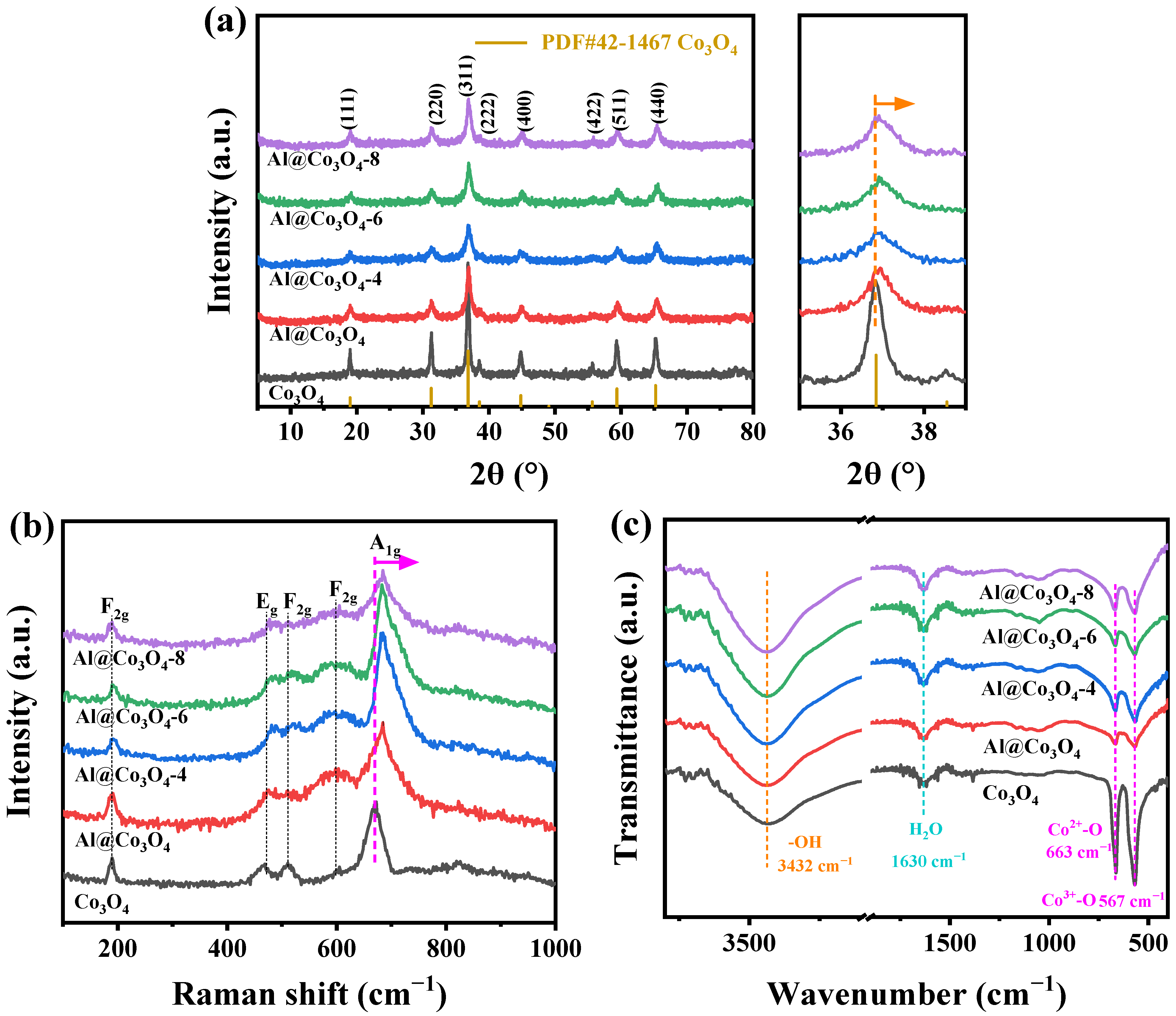
Figure 1. XRD patterns (a), Raman spectra (b), and FT-IR spectra (c) of Co3O4, Al@Co3O4, and different concentrations of NaOH-etched Al@Co3O4.
Catalysts 16 00158 g001
Figure 2. SEM images of Co3O4 (a,b), Al@Co3O4 (c), and Al@Co3O4-6 (d).
Catalysts 16 00158 g002
Figure 3. TEM images (a,b), HRTEM image (c) and the enlarged images (insert in (c)), the crystal spacing (d), HAADF image (e), and the corresponding mapping (fi) of Al@Co3O4-6 catalyst.
Catalysts 16 00158 g003
Figure 4. N2 adsorption–desorption curves (a) and pore size distributions (b) of Co3O4, Al-Co3O4, and different concentrations of NaOH-etched Al@Co3O4.
Catalysts 16 00158 g004
Figure 5. H2-TPR profiles of Co3O4, Al-Co3O4, and different concentrations of NaOH-etched Al@Co3O4.
Catalysts 16 00158 g005
Figure 6. O2-TPD profiles of Co3O4, Al-Co3O4, and different concentrations of NaOH-etched Al@Co3O4.
Catalysts 16 00158 g006
Figure 7. Ethyl acetate conversions (a), the corresponding CO2 yield (b), Ea plots (c), and the reaction rate (d) of ethyl acetate oxidation over Co3O4, Al-Co3O4, and different concentrations of NaOH-etched Al@Co3O4.
Catalysts 16 00158 g007aCatalysts 16 00158 g007b
Figure 8. In situ DRIFTS spectra for ethyl acetate adsorption (a,b) and oxidation (c,d) over Al@Co3O4-6.
Catalysts 16 00158 g008
Table 1. Crystal size and lattice parameters of Co3O4, Al@Co3O4, and different concentrations of NaOH-etched Al@Co3O4 catalysts.
CatalystsCrystal Size (nm) aLattice Parameters (Å) b
abc
Co3O420.88.083728.083728.08372
Al@Co3O414.68.072018.072018.07201
Al@Co3O4-412.58.068148.068148.06814
Al@Co3O4-612.48.061408.061408.06140
Al@Co3O4-813.28.068848.068848.06884
a The crystal size was calculated based on the (311) crystal face in the XRD patterns according to Shearler’s formula; b the lattice parameters were calculated via Jade 6.0 based on the XRD patterns.
Table 2. Physical properties of Co3O4, Al@Co3O4, and different concentrations of NaOH-etched Al@Co3O4 catalysts.
CatalystsSBET (m2/g) aV (cm3/g) bD (nm) c
Co3O443.60.2781.4–3.8, 6.5–17.3
Al@Co3O4184.20.3481.4–6.5
Al@Co3O4-4201.50.3881.4–6.5
Al@Co3O4-6205.40.3701.4–6.5
Al@Co3O4-8169.80.3501.4–6.5
a The surface area calculated by the Brunauer–Emmett–Teller (BET) method; b the total pore volume measured at P/P0 = 0.99; and c the pore size calculated via the Barrett–Joyner–Halenda (BJH) method according to the desorption branch of the N2 adsorption–desorption curves.
Table 3. Catalytic performance of Co3O4, Al@Co3O4, and different concentrations of NaOH-etched Al@Co3O4 catalysts for ethyl acetate oxidation.
CatalystsT10 (°C)T50 (°C)T90 (°C)Reaction Activation Energy (Ea, kJ/mol)Reaction Rate at 200 °C (r, μmol/(gcat·h))
Co3O4193221238109.30.049
Al@Co3O418121022780.20.104
Al@Co3O4-417320522056.70.144
Al@Co3O4-616019420746.30.257
Al@Co3O4-819021523382.50.063
Table 4. The comparison of ethyl acetate catalytic oxidation performance over various catalysts reported in the literature.
CatalystsPreparation MethodEthyl Acetate Concentration (ppm)Reaction Flow (mL/(g·h))Catalytic PerformanceRef.
Co3O4-100060,000T90 = 250 °C[19]
Co3O4-15CuImpregnation method100060,000T90 = 226 °C[19]
NR-Co3O4Hydrothermal method100030,000T100 = 260 °C[17]
CeO2-NCHydrothermal method100060,000T90 = 229 °C[48]
20Co/CeO2Impregnation method466.760,000T100 = 260 °C[49]
CuO/CeO2Ball milling method100060,000T100 = 220 °C[50]
CoCe0.75Zr0.25-NFSol–gel method100060,000T90 = 227 °C[51]
Ru/Sn-Ce-(5.8)Wet impregnation method50010,000T100 = 250 °C[52]
Pt/S-1Ethylene glycol method100022,500T90 = 238 °C[53]
Al@Co3O4-6Hydrothermal method100030,000T90 = 207 °CThis work
Table 5. The assignment of the characteristic peaks formed during ethyl acetate adsorption over Al@Co3O4-6 catalysts.
Position (cm−1)AssignmentCharacteristic ofRef.
~2986, ~2940, ~2912, ~2880C–H stretching modes-CH3[57,58]
~1713C=O vibration of ester carbonylEthyl acetate[59,60]
~1558, ~1403Asymmetric and symmetric stretching vibration of COO-Acetate acid[61,62]
~1479, ~1378, ~1098, ~1047Adsorbed EA moleculesEthyl acetate[57,63]
~1277C–O vibration of ethyl acetateEthyl acetate[59]
~1156C–O vibration of vinyl acetateVinyl acetate[64]
Table 6. The assignment of the characteristic peaks formed during ethyl acetate oxidation over Al@Co3O4-6 catalysts.
Position (cm−1)AssignmentCharacteristic ofRef.
~1722C=O stretching vibration of acetaldehydeAcetaldehyde[61,65]
~1675C=C stretching vibration of ethyleneethylene[64]
~1591, ~1564Antisymmetric stretching vibrations of COO-Formate and acetic acid species[51,66]
~1448, ~1399Symmetric stretching vibration of COO-Formate and acetic acid species[51,67]
~1334O–H deformation vibration of ethanolEthanol[59,63,68]
~1255C–O stretching vibration of the acetate speciesAcetate acid[69]
~1116, ~1052C–O stretching vibration of ethanolEthanol[70]
Disclaimer/Publisher’s Note: The statements, opinions and data contained in all publications are solely those of the individual author(s) and contributor(s) and not of MDPI and/or the editor(s). MDPI and/or the editor(s) disclaim responsibility for any injury to people or property resulting from any ideas, methods, instructions or products referred to in the content.