


Abstract
This work reports the synthesis and photocatalytic performance of TiO2–MgO/kaolinite nanocomposites for the degradation of crystal violet (CV) and butyraldehyde under UV irradiation. MgO incorporation enhanced charge separation by limiting electron–hole recombination, while the halloysite-type kaolinite support increased surface area and improved dispersion of the active phases. The materials exhibited strong synergy between adsorption and photocatalysis, as the clay support pre-concentrated pollutants and facilitated their rapid degradation. The composite containing 10 wt% MgO (TK10) showed the highest efficiency, achieving 99.8% CV removal and outperforming commercial P25. The catalyst also demonstrated efficient degradation of gaseous butyraldehyde, highlighting its dual applicability for water and air purification. Kinetic analysis indicated a pseud-second-order adsorption mechanism, and isothermal data fitted the Langmuir model, suggesting monolayer adsorption. The TK10 composite showed excellent stability and reusability over multiple cycles, underscoring its potential as a cost-effective and environmentally benign photocatalyst for integrated environmental remediation.
1. Introduction
Water and air pollution pose major challenges to both human and environmental health. Among the most concerning pollutants are synthetic dyes, such as crystal violet, which is widely used in the textile and pharmaceutical industries, as well as volatile organic compounds (VOCs) like butyraldehyde, which is a common by–product of industrial activities. The presence of these substances in water and air poses a significant risk due to their high toxicity and resistance to conventional degradation methods [1,2,3]. Among the various technologies developed to address these contaminants, heterogeneous photocatalysis has emerged as one of the most promising approaches. This technique uses light energy to activate catalysts, such as titanium dioxide (TiO2), which are capable of degrading a wide range of organic pollutants [4,5,6,7].
In addition to aqueous–dye degradation, butyraldehyde was selected as a model volatile organic compound (VOC) to evaluate the photocatalyst performance in gas–phase applications. Unlike dyes in liquid media, VOCs such as butyraldehyde represent air pollutants. The photocatalyst was immobilized inside a sealed reactor, and butyraldehyde vapors were injected to simulate air treatment conditions [8].
Titanium dioxide (TiO2), particularly in its anatase form, is one of the most extensively studied photocatalysts due to its optical and chemical properties, as well as its stability under various environmental conditions. However, limitations such as the rapid recombination of charge carriers (electrons and holes) and aggregation during use hinder its overall efficiency [9,10]. To address these issues, recent research has focused on enhancing the photocatalytic activity of TiO2 by incorporating secondary materials, such as magnesium oxide (MgO), which is known to reduce charge carrier recombination [11,12,13,14,15,16,17].
In this context, the use of halloysite, a clay mineral with a nanotubular structure, as a support for TiO2 has attracted increasing interest. Thanks to its unique structure and textural properties, halloysite provides a large surface area for the dispersion of active phases while promoting stronger interaction between the components of the composite. This type of support can enhance the adsorption capacity, reactivity, and overall efficiency of the photocatalytic material [18,19,20,21,22].
The synthesis of composites from a mixture of clay, TiO2 and MgO combines the advantages of the photocatalytic activity of TiO2 and its good stability, the improved charge separation of MgO, and the structural and adsorptive properties of clay. The natural abundance, low cost and large surface area of clay minerals (kaolinite, halloysite) make them very effective substrates for depositing TiO2/MgO nanoparticles, thus preventing both aggregation and improving stability. The layered structure of the clay and its ion exchange capacity favor the adsorption of contaminants, bringing the molecules closer to the active degradation sites. The layered morphology of kaolinite provides a high surface area and accessible interlayer spaces, which facilitate the adsorption of dye molecules. In addition, the ion–exchangeable surface sites of the clay can electrostatically attract cationic pollutants, anchoring them near the TiO2 active sites. This proximity enhances the probability of interfacial charge transfer and therefore improves photocatalytic degradation efficiency. At the same time, MgO doping reduces electron–hole recombination in TiO2 and introduces surface basicity, improving the removal of acidic organic pollutants such as dyes and VOCs. This synergy results in superior photocatalytic performance compared to pure TiO2 or MgO, as demonstrated by the degradation of contaminants such as crystal violet and butyric aldehyde [23]. In addition, clay supports facilitate catalyst recovery and reuse, addressing the practical challenges of wastewater treatment [24].
In recent studies, several strategies have been proposed to enhance the optical and photocatalytic properties of TiO2–based materials. Among these, the formation of heterojunctions between two or more metal oxides has emerged as a particularly promising approach. Such combinations not only integrate the individual properties of each oxide but also generate new features resulting from the synergistic interaction between the components.
Other strategies, including the deposition of noble metals (Au, Ag) and non–metal doping (N, S), have also achieved high degradation rates of organic dyes, often exceeding 80–90% within relatively short irradiation times [25,26]. Furthermore, bismuth–based oxides (BiVO4, Bi2O3) have attracted growing attention due to their remarkable potential in various applications, such as environmental remediation, photocatalytic hydrogen production, biosensing, and energy storage [27,28].
Among these eco–friendly approaches, the use of adsorbent materials as photocatalyst supports has emerged as a particularly attractive alternative. This strategy not only reduces production and operational costs but also increases the active surface area while taking advantage of a synergistic interaction between adsorption and photocatalysis. Such synergy leads to a significant improvement in both the efficiency and the overall performance of the process. Various supports have been investigated in this context, including activated carbon, clays, zeolites, and kaolinite. Several studies have focused on metal oxide systems supported on clays. However, TiO2–MgO composites supported on clay materials remain relatively unexplored. Although their photocatalytic activity may appear lower than that of other systems, these materials offer several key advantages, such as low cost, reusability, high adsorption capacity, and strong resistance to aggregation [29].
In this context, the present work aims to investigate the synergistic effect between the TiO2–MgO heterojunction and a local clay support, with the object of valorizing natural resources. The originality of this study lies in the development of an eco–friendly and low–cost TiO2–MgO/kaolinite composite that synergistically combines adsorption and photocatalytic processes. In line with this approach, the present study also focuses on the synthesis and characterization of a TiO2–MgO composite supported on halloysite, a natural, abundant, and cost–effective clay mineral. This composite was evaluated for the photocatalytic degradation of crystal violet and butyraldehyde, selected as model organic pollutants in aqueous and gaseous phases, respectively. The main objective of this work is to assess the enhanced photocatalytic performance of the system under UV irradiation while exploring the potential synergies among TiO2, MgO, and halloysite. Moreover, this study aims to promote the valorization of a local natural resource, halloysite, as an efficient and sustainable functional support. The combination of these three components is expected to enhance photoinduced charge separation, increase the active surface area, and improve the structural stability of the catalyst, thus providing an eco–friendly, cost–effective, and high–performance solution for environmental remediation. This material, therefore, offers a promising solution for large–scale water and air purification, while also opening up new perspectives for the development of industrial technologies, such as air filters based on this type of heterostructured system.
In recent studies, various strategies have been explored to enhance the photocatalytic activity of TiO2–based materials, such as noble metal deposition (Au, Ag), heterojunction formation with ZnO or g–C3N4 [30,31] and non–metal doping (N, S). These approaches have shown significant improvements in dye degradation, often exceeding 80–90% within short irradiation times [25,26] with bismuth–based oxides (BiVO4, Bi2O3). These materials have demonstrated remarkable potential in various applications, including environmental remediation, photocatalytic hydrogen production, biosensing, and energy storage [27]. However, many of these methods involve high synthesis costs, complex procedures, or limited stability under real environmental conditions. Compared to these systems, clay–supported TiO2 composites remain less investigated, particularly those incorporating MgO. Although the photocatalytic efficiency of clay–based materials may appear lower, they offer notable advantages in terms of cost, reusability, adsorption capacity, and resistance to aggregation [29].
In this study, we synthesized and characterized a TiO2–MgO composite supported on halloysite and investigated its application in the photocatalytic degradation of crystal violet and butyraldehyde. The aim is to assess the enhanced photocatalytic performance of the composite for the degradation of organic pollutants under UV light conditions. This work seeks to explore the potential synergies between TiO2, MgO, and halloysite in order to optimize the efficiency of the composite for environmental applications.
2. Results and Discussions
2.1. XRD Spectrum
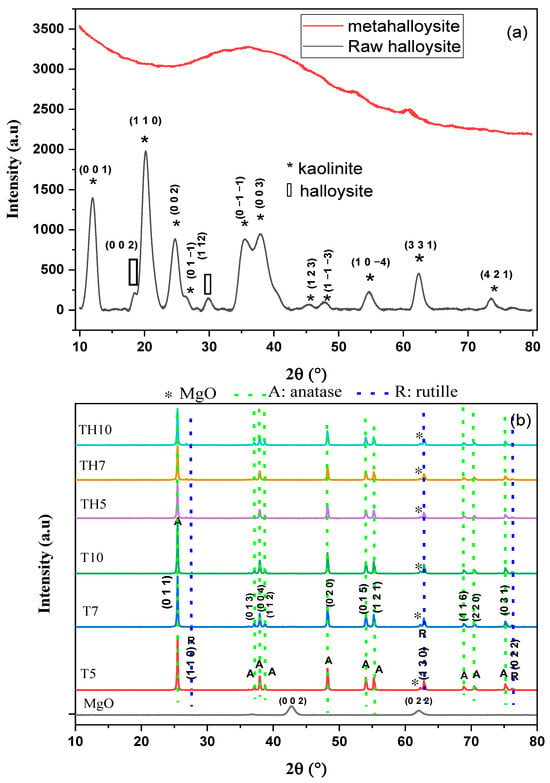
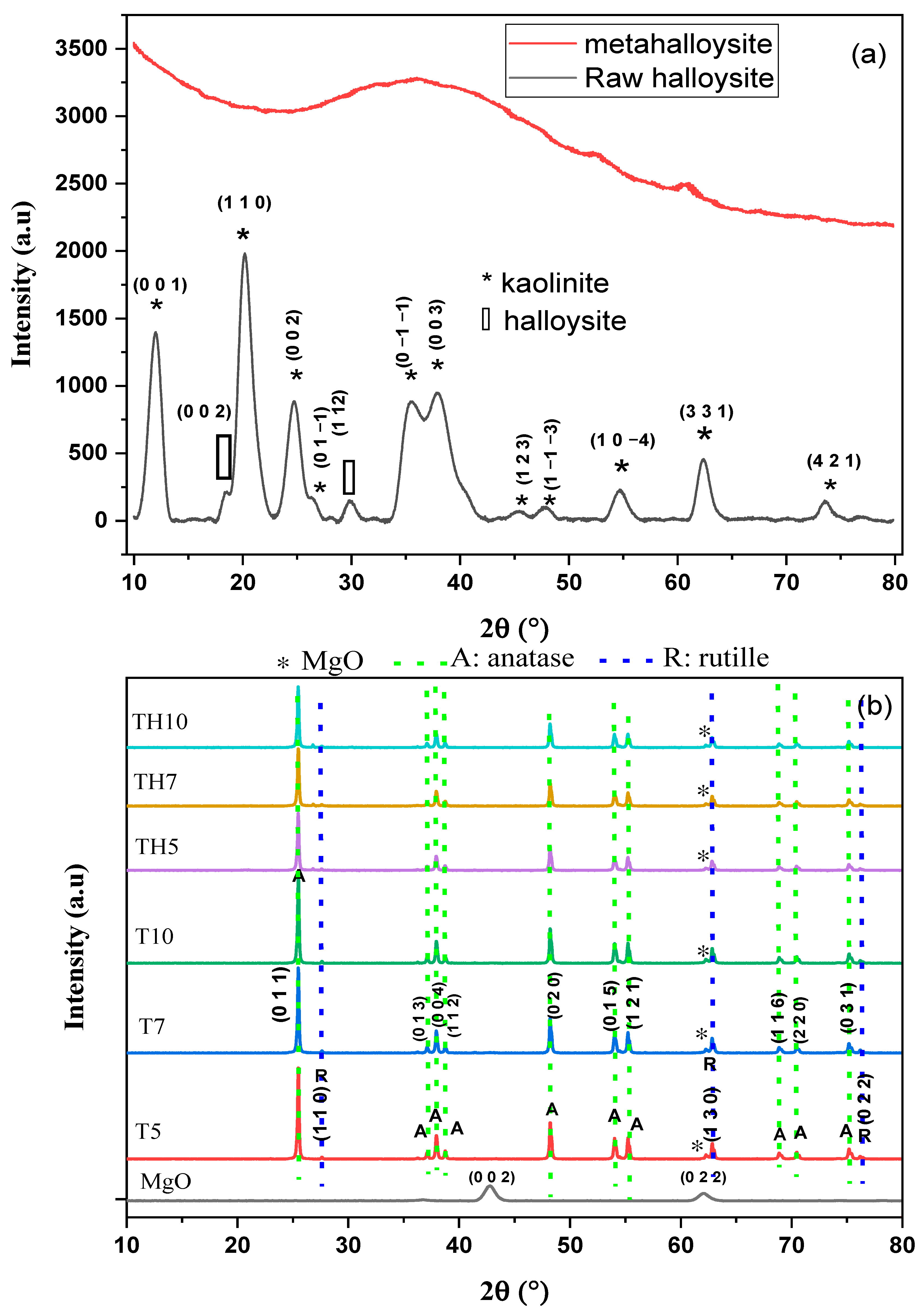
Figure 1a shows X–ray diffraction (XRD) analysis of sample DD3, derived from Djebel Debbagh kaolin, revealing the presence of two distinct mineral phases: kaolinite and halloysite [32]. The XRD data exhibit well–defined characteristic peaks at the following 2θ positions: 12.4°, 20.15°, 24.9°, 35.7°, 38.22°, 45.2°, 48.05°, 54.8°, 62.3°, and 73.53°, indicating the predominant presence of kaolinite (JCPDS 96-900-9235). These peaks correspond to the following crystallographic planes: (002), (111), (004), (202), (132), (134), (223), (136), (313), and (402).
Figure 1.
XRD of (a): kaolinite samples before and after calcination and (b) TiO2–MgO/kaolinite composites.
In addition, the peaks at 17.7° and 29.9°, corresponding to the (002) and (113) planes, confirm the presence of halloysite (JCPDS 96-101-1247) in the sample. The simultaneous presence of these two minerals indicates a complex composition of the Djebel Debbagh kaolin, where kaolinite is the dominant phase, but halloysite is also significantly present [33].
Calcination of the DD3 sample at 500 °C induces significant thermal transformation of its mineral phases. The original diffraction peaks of kaolinite and halloysite either disappear or decrease markedly in intensity, indicating dehydration and a loss of the initial crystalline order. This transition leads to the formation of dehydrated phases such as meta–halloysite and meta–kaolinite. These structural changes are evident through the altered characteristic patterns observed in the XRD spectrum [34].
The XRD patterns shown in Figure 1b are primarily composed of anatase with a minor rutile phase (80:20) in TiO2–P25. All prepared solids exhibit the dominant anatase phase peaks (JCPDS 96-900-8214) at 2θ = 25.5°, 37.1°, 37.96°, 38.74°, 54.03°, 55.22°, 68.9°, and 75.13°, corresponding to the diffraction planes (011), (013), (004), (112), (015), (121), (116), and (125), respectively. A small rutile fraction (JCPDS 96-900-4143) is identified by peaks at 2θ = 27.65°, 62.84°, and 70.18°, indexed to the (110), (002), and (230) planes. Peaks at 36.63°, 42.92°, and 61.96° are attributed to periclase MgO (JCPDS 96-100-0054), corresponding to the (111), (200), and (220) planes, respectively. The decrease in MgO peak intensity may be due to the proper dispersion of MgO on the surface of the composites [35]. The disappearance of kaolinite–related peaks in the TiO2–MgO/kaolinite composite after calcination at 500 °C is attributed to the breakdown of its crystalline structure and the subsequent formation of an amorphous phase of kaolinite [36].
2.2. SEM and EDX Analysis
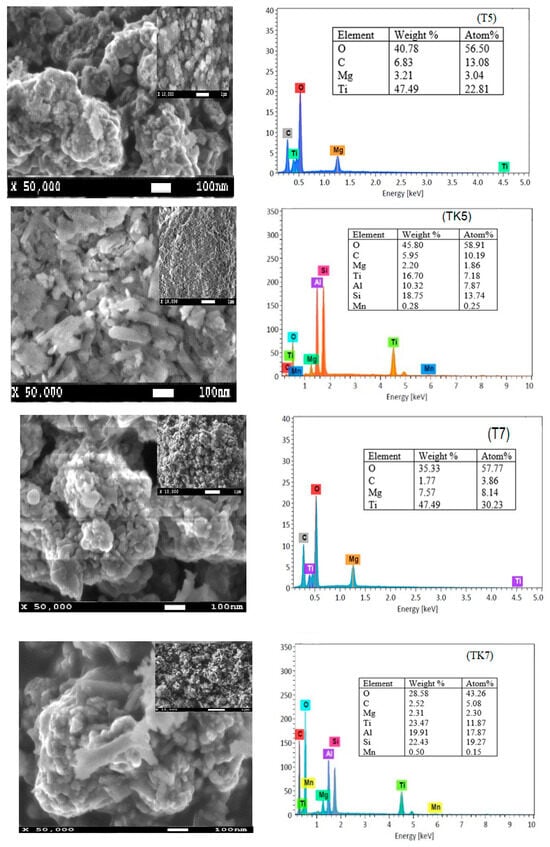
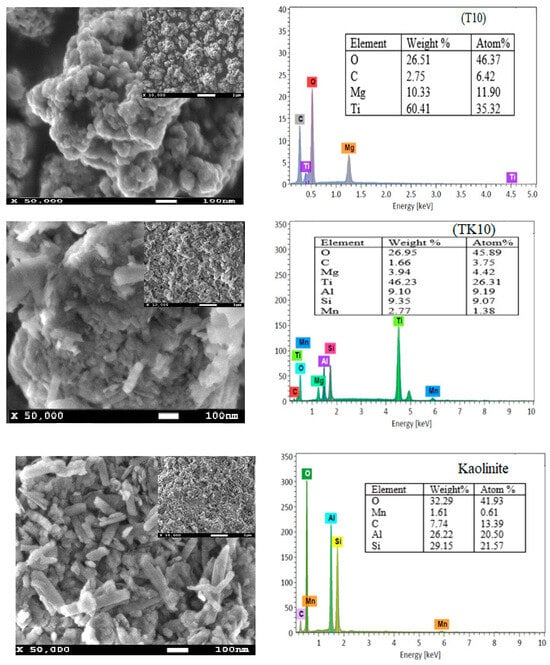
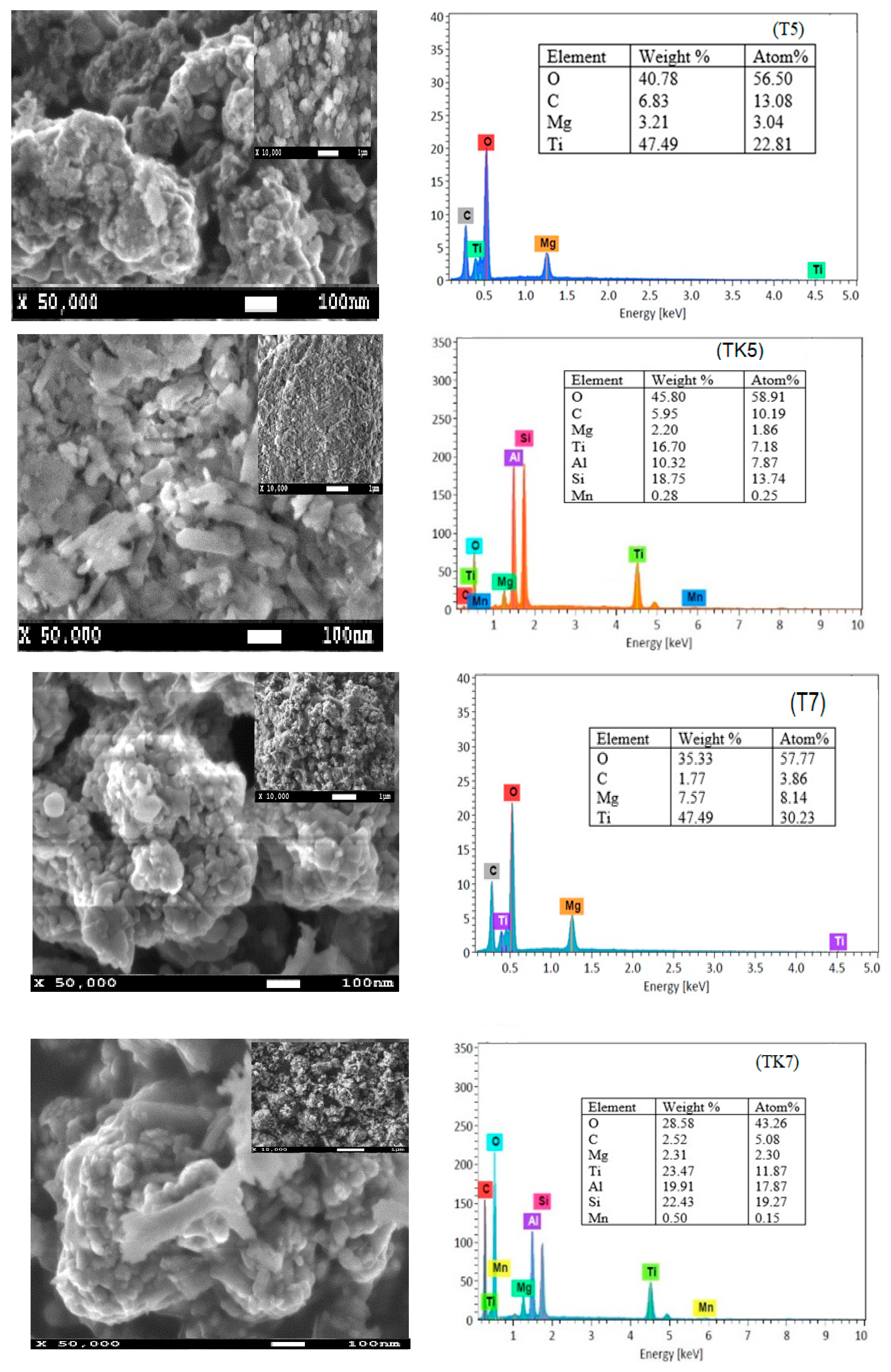
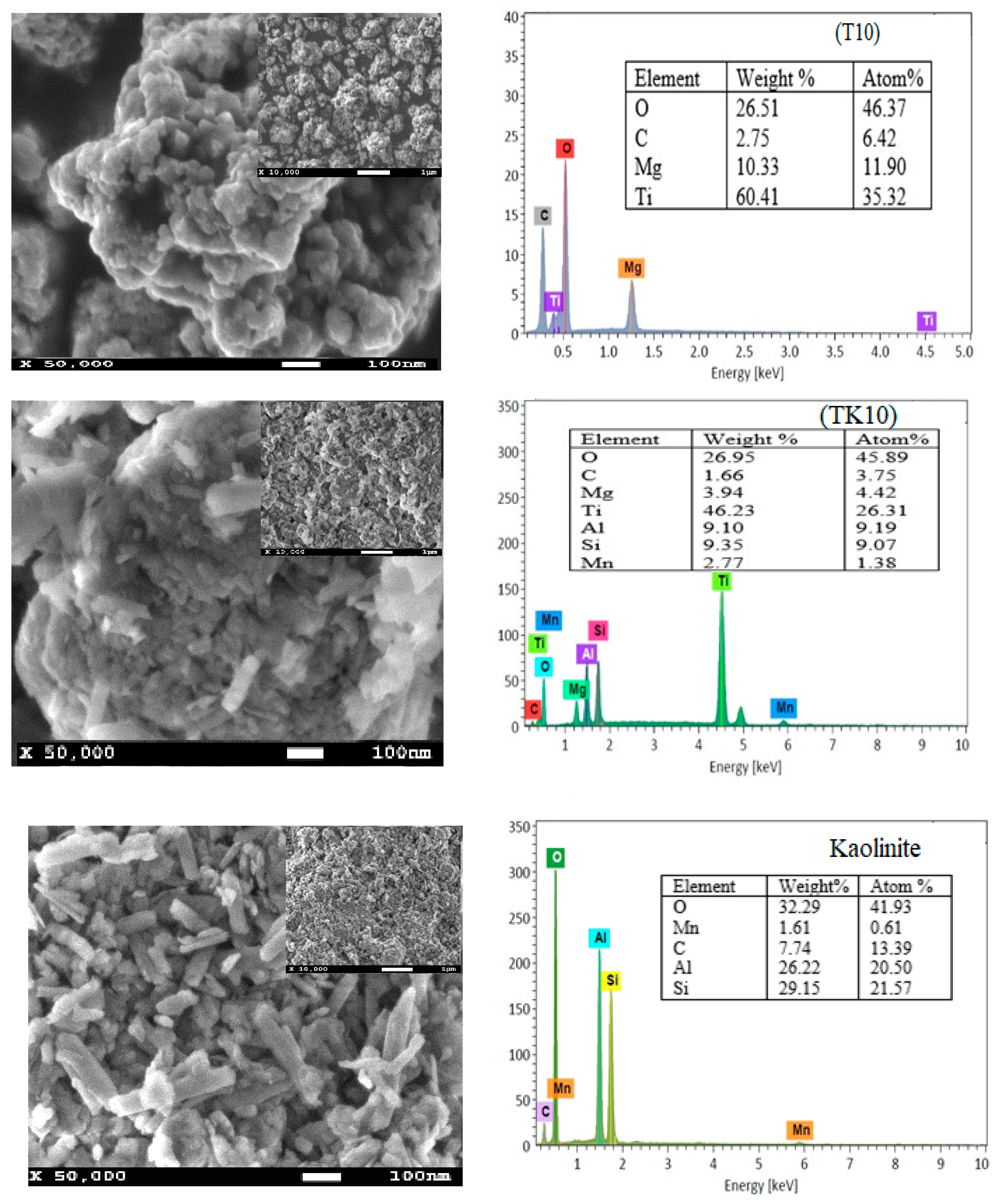
The SEM analysis of the TiO2–MgO/kaolinite nanocomposites reveals that the halloysite retains its tubular morphology, while the kaolinite exhibits a sheet–like structure [37], providing an optimal surface for the dispersion of TiO2–MgO nanoparticles. The images (Figure 2) show a homogeneous distribution of TiO2–MgO across the clay surface, indicating strong interaction between the nanoparticles and the clay matrix, which contributes to a well–integrated composite structure. This observed morphology suggests that the incorporation of TiO2–MgO with kaolinite enhances particle dispersion, potentially improving the functional properties of the material. The uniform distribution of TiO2–MgO on kaolinite supports increased photocatalytic activity and improved adsorption capacity, critical factors for environmental applications [38].
Figure 2.
SEM images and EDX of composites T5, TK5, T7, TK7, T10, TK10 and raw kaolinite.
Furthermore, EDX analysis (Figure 2) confirms the successful incorporation of MgO into TiO2 at weight ratios of 5%, 7%, and 10% of Mg, as well as the presence of impurities such as manganese in the raw clay [39]. The detected carbon peak is therefore attributed to adventitious carbon, mainly from atmospheric CO2 adsorbed on the sample surface and/or carbon tape used during SEM mounting. The manuscript has been revised accordingly. These features suggest that the composite offers promising performance due to its homogeneous mixture and effective phase dispersion [40].
2.3. BET Analysis
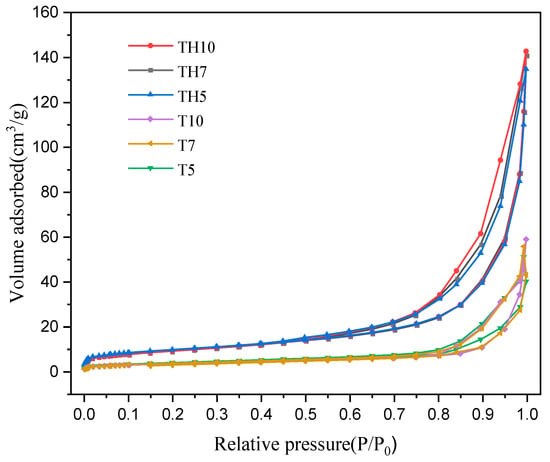
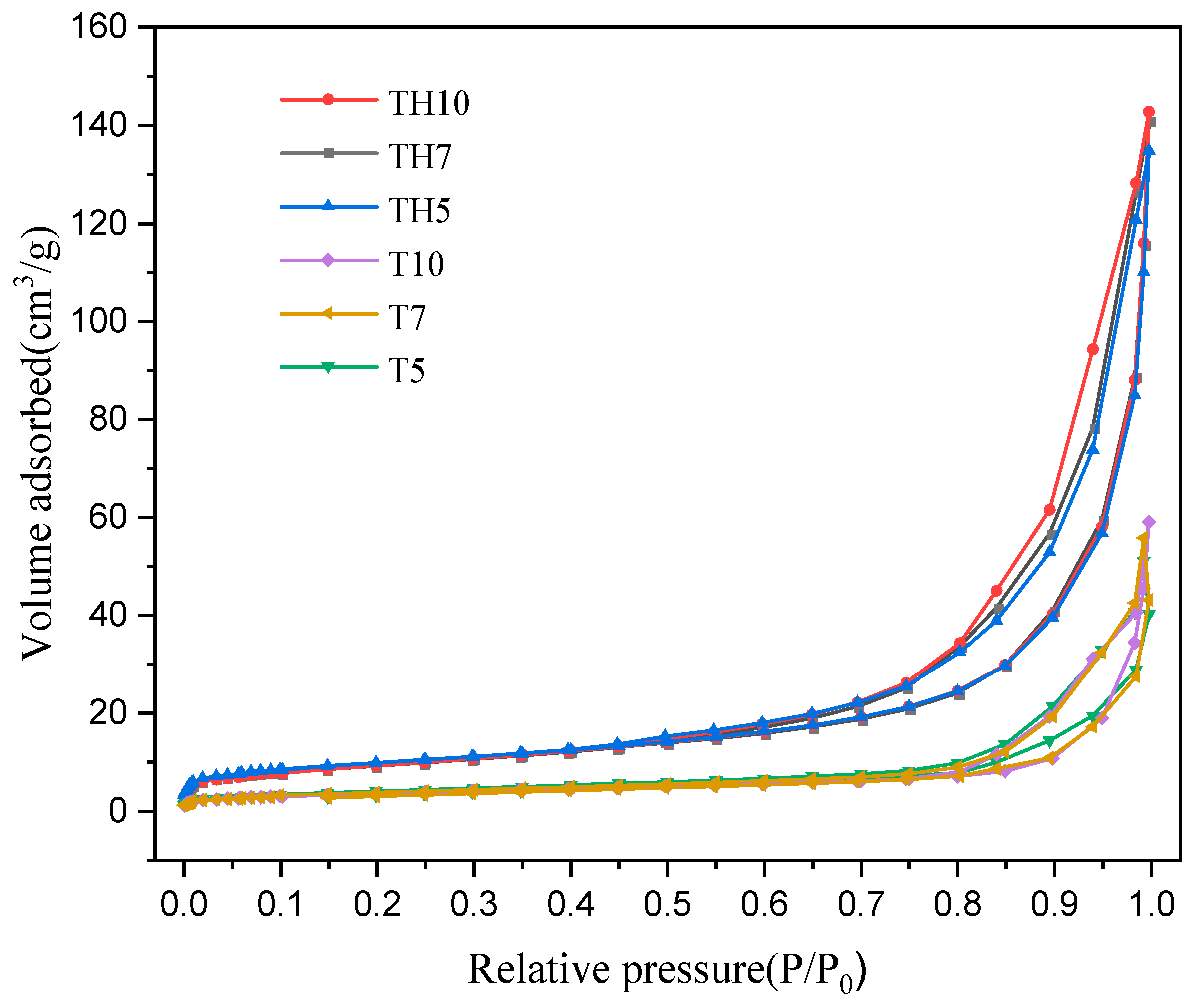
The N2 adsorption–desorption isotherms of TiO2–MgO and TiO2–MgO/kaolinite composites exhibit a type IV (Figure 3) behavior according to the IUPAC classification, which is characteristic of mesoporous materials. A type–H3 hysteresis loop is observed in these composites [21,41]. indicating the presence of slit–like pores typically associated with plate–like particles or aggregates. The analyses (Table 1) show that the TiO2–MgO/kaolinite composite possesses a significant BET surface area, a high pore volume, and an average pore diameter ranging from 16 to 19 nm [12,42], which are typical features of mesoporous materials such as TiO2–based mixed oxides.
Figure 3.
N2 adsorption–desorption isotherms.
Table 1.
MMean pore diameter, pore volume, and specific surface area of samples.
After the incorporation of kaolinite, the porous structure of TiO2 and MgO is preserved, although variations in pore volume and size are noted, suggesting an optimization of the textural properties of the composite. Moreover, mixed oxides containing low MgO content exhibited lower specific surface areas compared to TiO2 nanoparticles (P25), likely due to sintering during calcination [43]. The incorporation of kaolinite into these composites led to an increase in specific surface area, indicating an enhancement of the composite’s textural characteristics. The TiO2–MgO/kaolinite sample with 5% MgO showed the highest BET surface area, reaching approximately 34 m2/g (Table 1). The addition of TiO2 to halloysite nanotubes increased the pore volume while reducing the pore diameter, suggesting that the mesoporous structure is retained after TiO2–MgO loading, with beneficial textural modifications for potential applications.
2.4. DRS UV–Vis Spectra
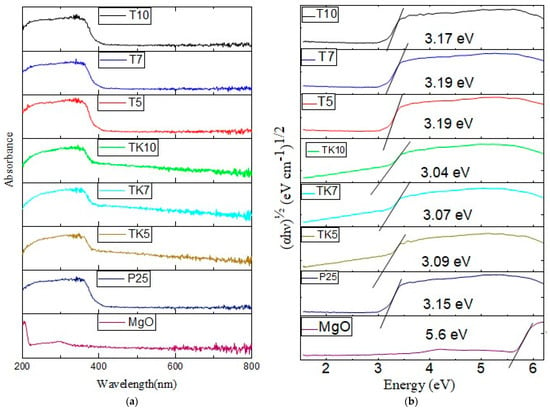
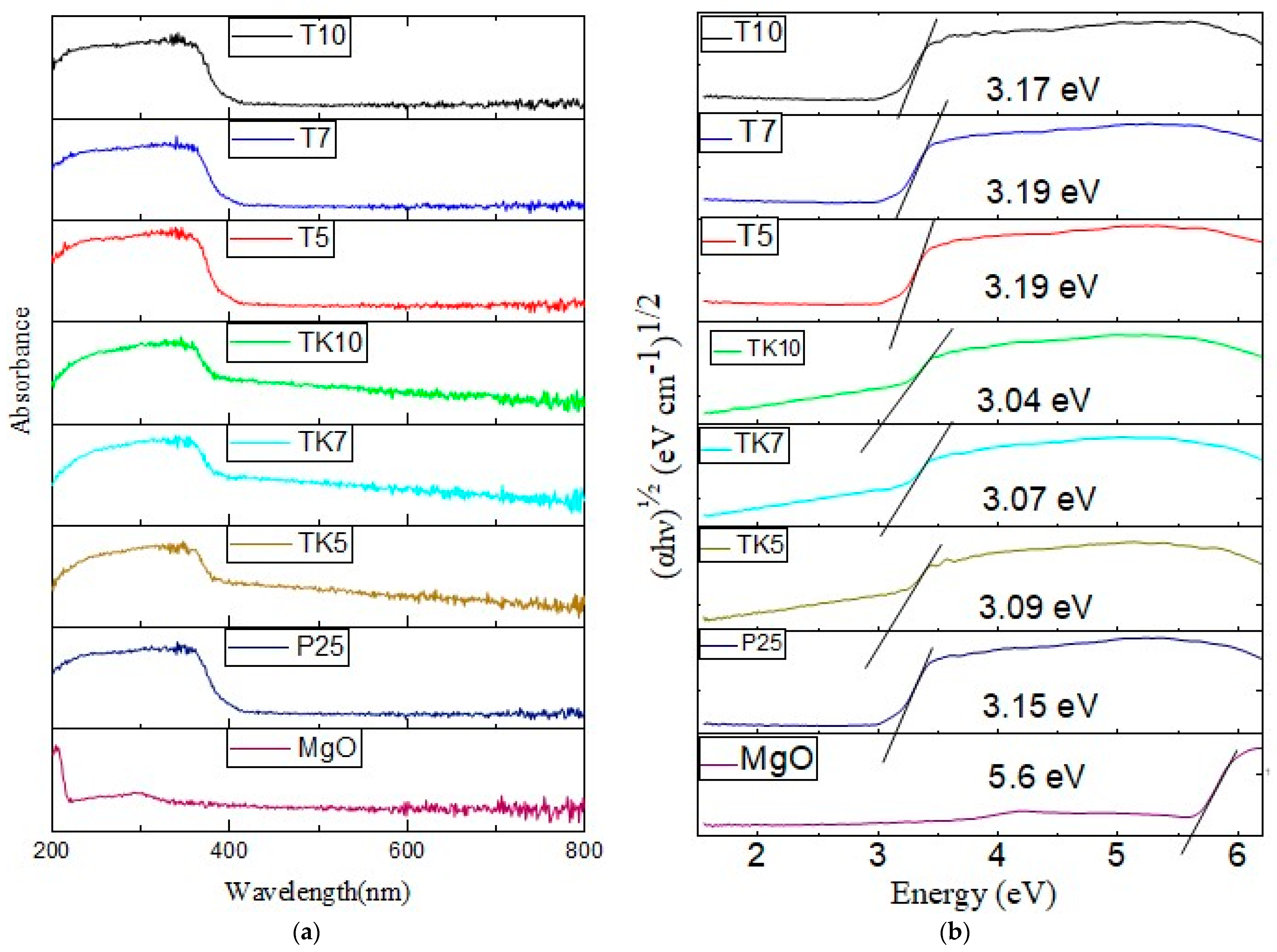
Figure 4a shows the DRS UV–vis spectra of TiO2–MgO, TiO2–MgO/kaolinite composites, and MgO–synthesized and TiO2 (P25) solids. The band gap calculation is most important from the point of energy conversion efficiency. The optical band gap of the photocatalyst was estimated using Tauc’s equation:
where A represents a constant; hν is photon energy; α is absorption coefficient; represent forbidden band; and n = ½ (for a direct transition) or n = 2 (for an indirect transition).
Figure 4.
(a) DRS UV–vis spectra of TiO2–MgO, TiO2–MgO/kaolinite composites, MgO–synthesized and TiO2 (P25) solids. (b) Tauc plot.
The intersection of the linear part of the Tauc plot (αhν)½ with the energy–axis gives the value of the band gap [44].
To better understand the light–harvesting properties of the MgO/TiO2 nanocomposites, solid–state UV–vis analysis of TiO2–MgO and TiO2–MgO/kaolinite nanocomposites revealed significant modifications in the band gap energy compared to pure TiO2. It was observed that commercial P25 TiO2 exhibited no absorption in the visible–light region. The Tauc plots (Figure 4b) show that the incorporation of MgO into TiO2 induces a red shift of the absorption edge toward the visible region, indicating a slight narrowing of the optical band gap. The absorption range of the nanocomposites was nearly similar to that of P25 TiO2 nanoparticles. A slight variation in the band gap was noted with the formation of TiO2/MgO (3.18 eV) compared to pure TiO2 (3.15 eV) [16].
Despite the insulating nature of MgO, the coating of TiO2 with MgO does not significantly alter the absorption properties of TiO2, since the excitation energy of MgO lies above that of TiO2 [38]. Thus, the MgO layer does not hinder light absorption by TiO2, allowing TiO2 to remain the primary photocatalyst.
In contrast, the TiO2–MgO/halloysite samples exhibited absorption in the visible–light region [45], while TiO2–MgO/kaolinite showed a redshift in the absorption edge. This suggests that the incorporation of kaolinite introduces energy levels that enhance light absorption in the visible range. The visible-light absorption in halloysite–based composites is likely due to impurities introduced during synthesis, possibly from doping. The strong UV absorption and homogeneous dispersion of TiO2–MgO on halloysite surfaces contribute to the high catalytic activity observed.
Kaolinite, acting as a support, plays a multifunctional role. It not only enhances the dispersion of TiO2–MgO but also helps suppress charge carrier recombination within the TiO2 crystalline lattice under UV light [20]. This further confirms the successful immobilization of crystalline TiO2–MgO nanoparticles on halloysite surfaces in the TiO2–MgO/kaolinite nanocomposites [46], making these materials promising candidates for photocatalytic applications under light irradiation. These findings highlight the importance of both structural and chemical modifications in optimizing photocatalytic performance.
2.5. Infrared Spectrum (ATR)
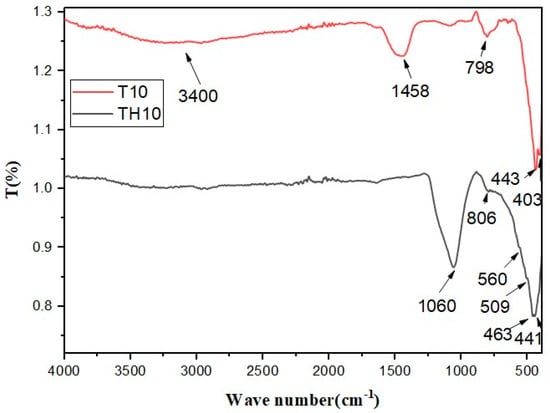
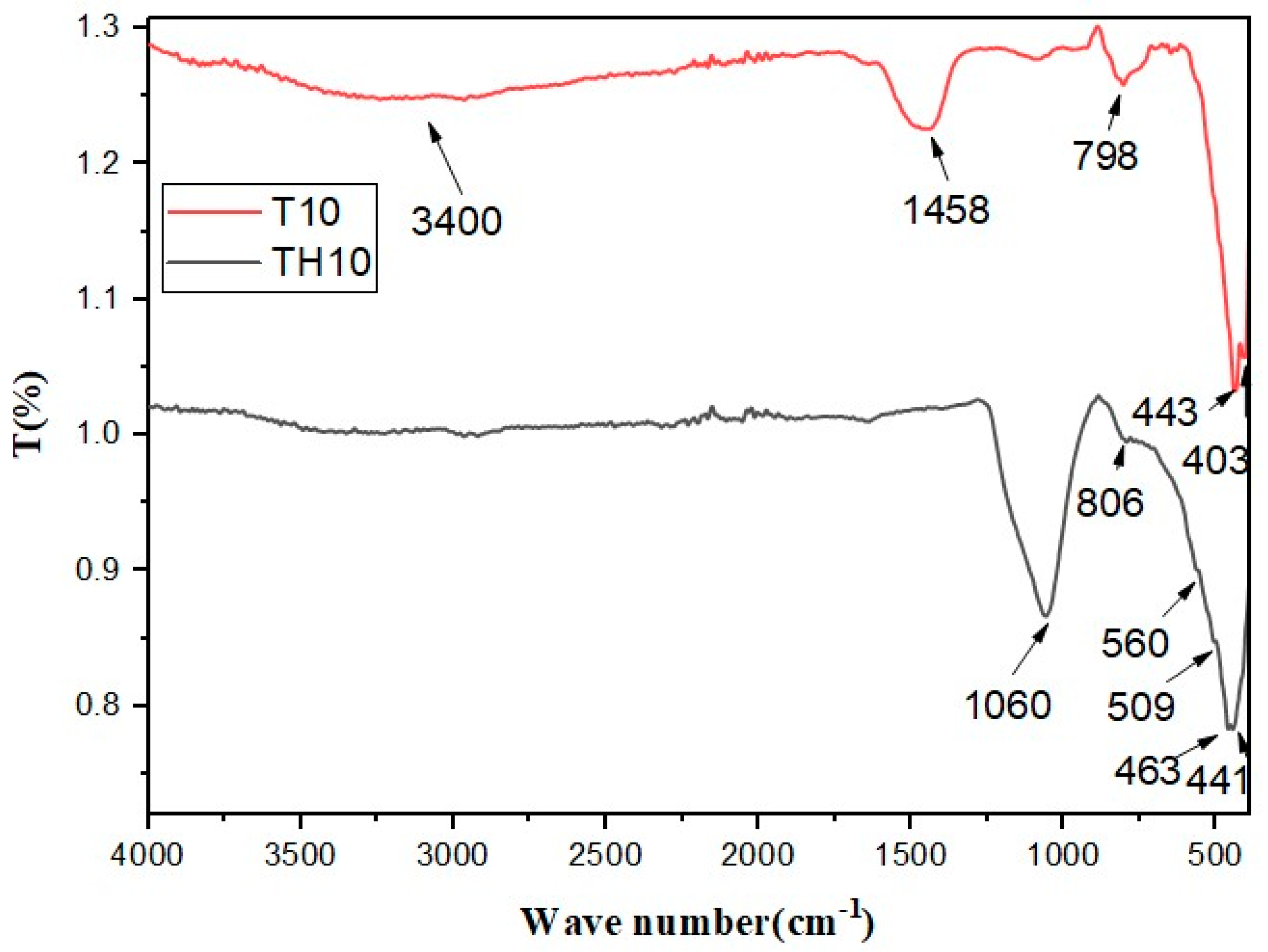
The infrared (FTIR) spectra of TiO2–MgO/K and TiO2–MgO composites are shown in Figure 5. Two main absorption bands are observed: the bands at approximately 403 cm−1, 443 cm−1, and 798 cm−1 correspond to the stretching vibrations of Mg–O, Ti–O, and Ti–O–Mg groups, respectively [13]. A broad absorption band around 3400 cm−1, along with a band centered at 1458 cm−1, is observed in the TiO2–MgO composite and is attributed to the O–H stretching vibrations of adsorbed water molecules [47]. In the TiO2–MgO/Kaolinite composite, the absence of characteristic bands around 3400 cm−1 and 3600 cm−1, typically associated with internal and external –OH vibrations, suggests structural dehydroxylation and the transformation of kaolinite into meta–kaolinite. The band at 1060 cm−1 corresponds to the Si–O–Si stretching vibrations [48,49,50] while the weak peaks observed at 560 cm−1 and 509 cm−1 are attributed to Si–O–Al vibrations [51]. Furthermore, in the TiO2–MgO/K composite, the characteristic Mg–O, Ti–O, and Ti–O–Mg bands, originally observed at 403, 443, and 798 cm−1, are shifted to 441 cm−1, 463 cm−1, and 806 cm−1, respectively. This shift may result from the deposition of TiO2–MgO on the outer surfaces of meta–halloysite nanotubes [20].
Figure 5.
Infrared spectrum of TiO2–MgO and TiO2–MgO/Kaolinite composites: case with 10 w% MgO.
Ti–O–Si bonds, although potentially present, may appear with low intensity due to the dominance of stronger signals from kaolinite and TiO2. Consequently, these vibrations might be either masked or too weak to be clearly identified, making their detection more challenging.
2.6. Photocatalytic Experiments
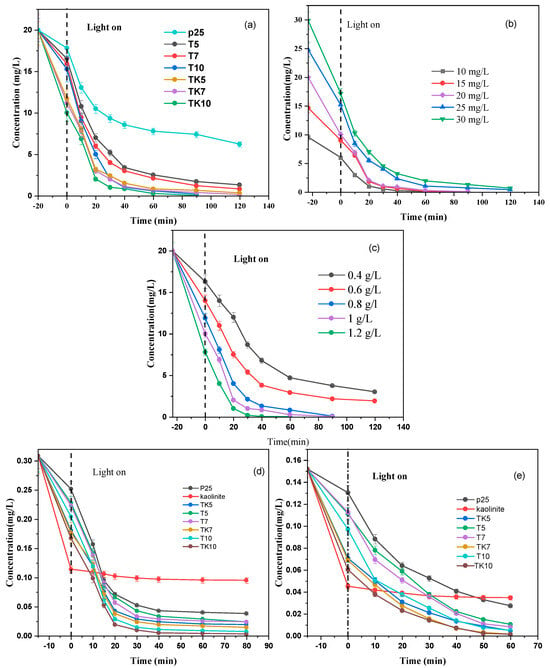
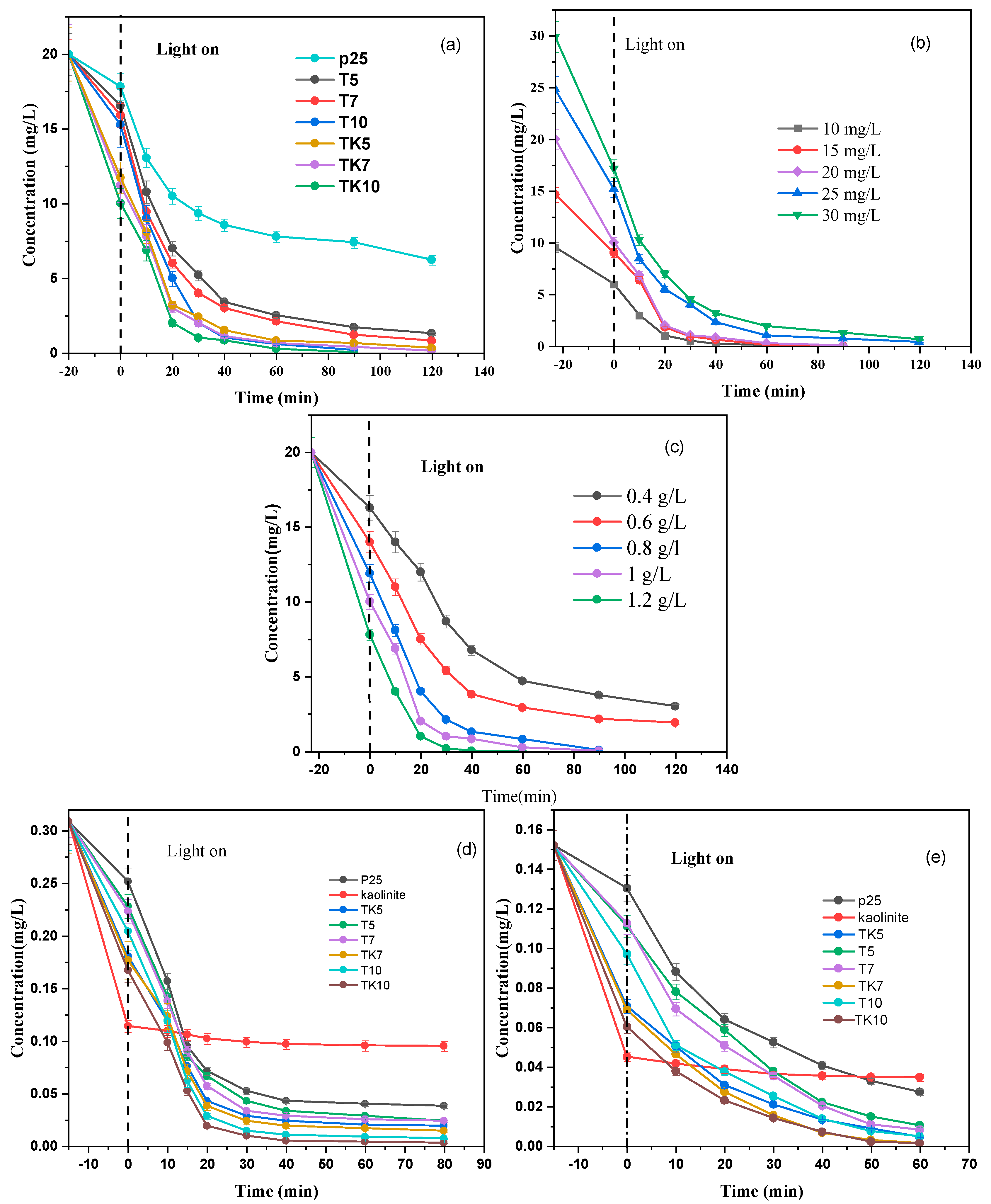
Figure 6a shows the photocatalytic performance of samples T5, T7, T10, TK5, TK7, TK10, and commercial P25 was evaluated for the degradation of crystal violet (CV) under UV irradiation. The corresponding degradation efficiencies were 93.5%, 96%, 99.1%, 98.4%, 99.3%, 99.8%, and 76.7%, respectively. Notably, KT10 exhibited outstanding photocatalytic activity.
Figure 6.
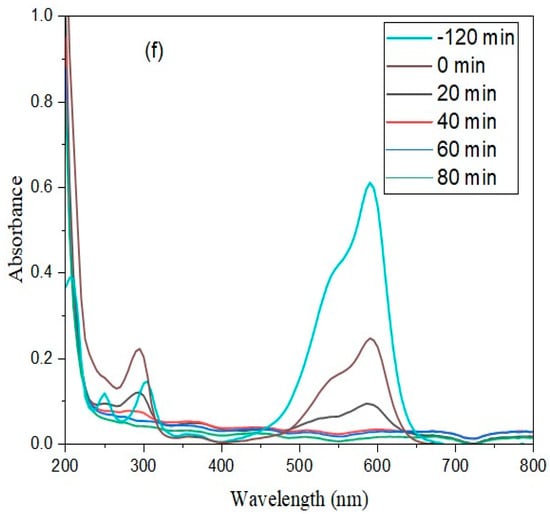
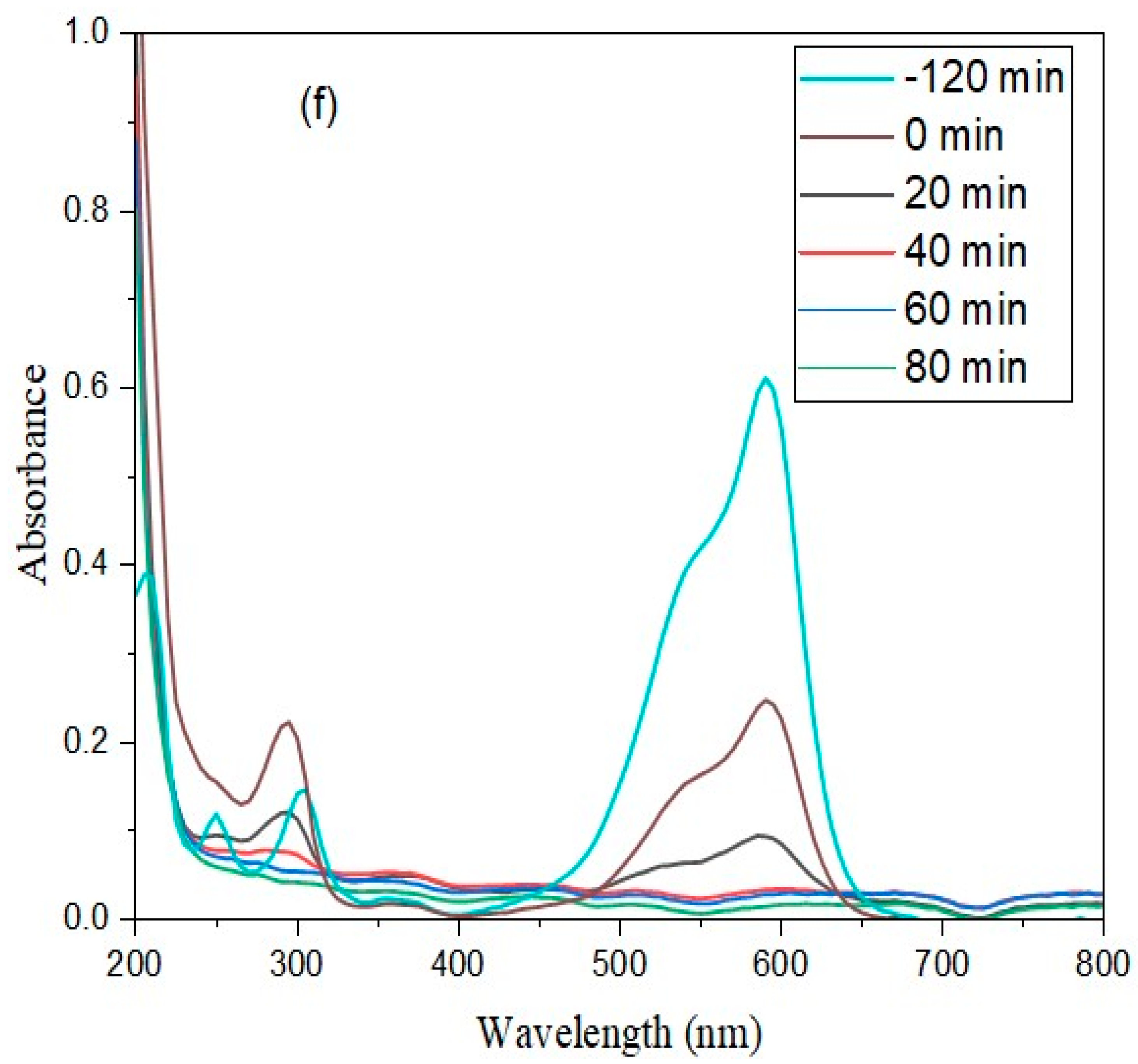
Photocatalytic experiments: Effect of nature of photocatalyst composites (a); effect of initial crystal violet–dye concentration with TK10 (b); effect of photocatalyst dose on removal of crystal violet with TK10 (c); effect of photocatalyst nature at initial butyraldehyde concentration of 0.303 mg/L and 0.125 mg/L respectively (d,e); UV–Vis spectra of crystal violet–dye photodegradation with TK10 as a function of time (f).
The addition of MgO and kaolinite to TiO2 significantly enhanced its photocatalytic performance by optimizing several key parameters [17]. MgO acts as an electron trap, suppressing the rapid recombination of photogenerated electron–hole pairs under UV irradiation. This increases the charge carrier lifetime and enhances photocatalytic reactions. MgO also alters the surface properties of TiO2 by increasing its porosity and specific surface area, thereby improving CV adsorption and accelerating its degradation. Additionally, it influences the optical properties of TiO2 by modifying the band gap, optimizing UV light absorption.
Moreover, the incorporation of halloysite–type kaolinite plays a crucial role as a structural support. Due to its high specific surface area and enhanced porosity, it promotes better dispersion of TiO2 and MgO, preventing particle agglomeration and maintaining more active sites accessible to both light and reactants [29].
2.7. Effect of Dye Concentration
To investigate the effect of initial crystal violet–dye concentration, a series of batch adsorption experiments using the TK10 nanocomposite was conducted with initial dye concentrations ranging from 10 to 30 mg/L. The study of the influence of initial crystal violet concentration on photocatalysis with the TK10 composite revealed a clear trend: increasing the dye concentration leads to a reduction in degradation efficiency [52,53,54].
At lower concentrations (10–20 mg/L) (Figure 6b), degradation was rapid and nearly complete within 90 min, suggesting that the generation of hydroxyl radicals (⋅OH) was sufficient to oxidize the dye molecules. However, at higher concentrations (25–30 mg/L), the degradation rate decreased and became incomplete. This behavior is attributed to the saturation of active sites on the photocatalyst surface and a shielding effect that reduces UV light penetration [55]. Moreover, the halloysite–type kaolinite plays a key role by enhancing dye adsorption and promoting a uniform dispersion of the TiO2–MgO nanoparticles, thereby improving the photocatalytic reactivity. Consequently, the degradation efficiency is maximized at moderate initial dye concentrations (10–20 mg/L).
2.8. Influence of Photocatalyst Amount
Figure 6c illustrates the impact of varying photocatalyst dosages (ranging from 0.4 to 1.2 g/L) on the photocatalytic degradation of crystal violet (20 mg/L) using the TK10 composite. The results indicate that increasing the catalyst dosage enhances the degradation rate, with a faster reduction in dye concentration observed as the mass increases from 0.4 g/L to 1.0 g/L. This improvement is attributed to the higher number of active sites available for dye adsorption and greater production of hydroxyl radicals (⋅OH), which are primarily responsible for photodegradation [56]. However, at 1.2 g/L, a slight plateau in the degradation rate is observed, suggesting a saturation effect. Excessive catalyst loading may lead to increased turbidity of the suspension, which hinders UV–light penetration and limits the activation of photocatalytic sites. Furthermore, particle agglomeration at higher concentrations could reduce the available surface area. Thus, the optimal photocatalyst dosage appears to be around 1.0 g/L, where a balance is achieved between UV absorption and the availability of reactive sites for efficient dye degradation [57].
2.9. Air Treatment
The photocatalytic kinetic curves for butyraldehyde show a gradual decrease in its concentration under UV irradiation, confirming the effectiveness of the tested photocatalysts. The incorporation of MgO into TiO2 enhances photocatalytic performance by reducing the recombination of electron–hole pairs, thereby promoting the generation of reactive oxygen species. Furthermore, the use of kaolinite as a support optimizes butyraldehyde adsorption, increasing the availability of the pollutant for degradation.
The TK10 composite exhibits the highest activity, with a degradation rate 1.21 times faster than commercial TiO2, demonstrating the synergistic effect between MgO doping and the porous structure of kaolinite [58]. The effect of initial butyraldehyde concentration is also significant: at 0.125 mg/L (Figure 6e), degradation occurs faster than at 0.303 mg/L (Figure 6d), suggesting saturation of active sites at higher concentrations.
At the start of the reaction, adsorption plays a crucial role, followed by a rapid degradation phase in which the TK10 composite outperforms other catalysts [59]. After 40 min, the degradation reaches a plateau, indicating an equilibrium between the formation and decomposition of intermediate products. These findings confirm that the combination of TiO2 with MgO and kaolinite significantly improves photocatalytic efficiency, offering a promising approach for the degradation of organic pollutants. The originality of this study lies in the comparative evaluation of two photocatalysts (TiO2 and MgO) supported on the adsorbent kaolinite applied in two complementary environmental media: the degradation of a dye in aqueous solution and the oxidation of butyraldehyde in the gas phase. This dual approach is particularly relevant because organic pollutants are present in both water and air, making it essential to identify materials capable of performing efficiently in both contexts. Unlike most studies reported in the literature, which typically focus on a single medium, our work aims to demonstrate the versatility and dual applicability of these photocatalysts. Each system was investigated using parameters specifically adapted to its medium, ensuring a coherent, comprehensive, and representative assessment of its potential for real environmental applications.
2.10. Adsorption Study
Adsorption Kinetics
Kinetic models are essential for understanding the adsorption mechanism, with the most commonly used being the pseudo–first–order (PFO) and pseudo–second–order (PSO) equations [60,61]. The PFO model, proposed by Lagergren [60], assumes that the rate of occupancy of adsorption sites is proportional to the number of unoccupied sites. It is expressed as follows:
Here, qe and qt represent the amounts of adsorbate adsorbed per unit mass of adsorbent at equilibrium and at a given time t (in minutes), respectively. The constant kn (1/min) denotes the rate constant of the pseudo–nth–order kinetic model.
Which can be expressed in a nonlinear form.
The kinetics and rate constant of CV photodegradation have been studied using the Langmuir–Hinshelwood equation following the first–order kinetic model as the nonlinear equation [61].
where k [mg/(min L)] and K (L/mg) correspond to the photocatalytic and adsorption rate values, respectively, and Ct is the concentration at time t (min).
When
- is higher, K increasing, so the value of 1 + K ≈ K
- is lower, K ≪ 1, to be a result, the denominator 1 + K ≈ 1
Using these two mathematical theorems and the modest dye concentrations used in photocatalysis, the Langmuir–Hinshelwood equation has been created:
The integral of the equation results in
When t = 0 and = C0 = B, as seen below, the nonlinear equation can be simplified:
The expression of the pseudo–second–order (PSO) adsorption kinetic model proposed by Ho et al. [62] was derived from Equation (3) by setting n = 2:
Integrating this equation using the boundary conditions (t = 0, qt = 0 and t = t, qt = qe) yields the following expression:
Here, qe (mg/g) and qt (mg/g) represent the amounts of adsorbate adsorbed at equilibrium and at a given time t (min), respectively, while k2 (g/mg·min) is the rate constant of the pseudo–second–order (PSO) kinetic model.
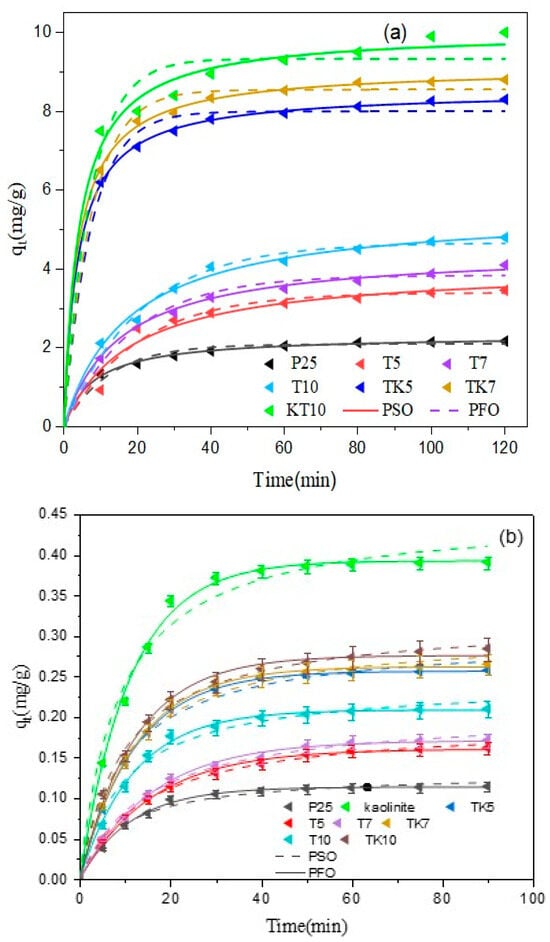
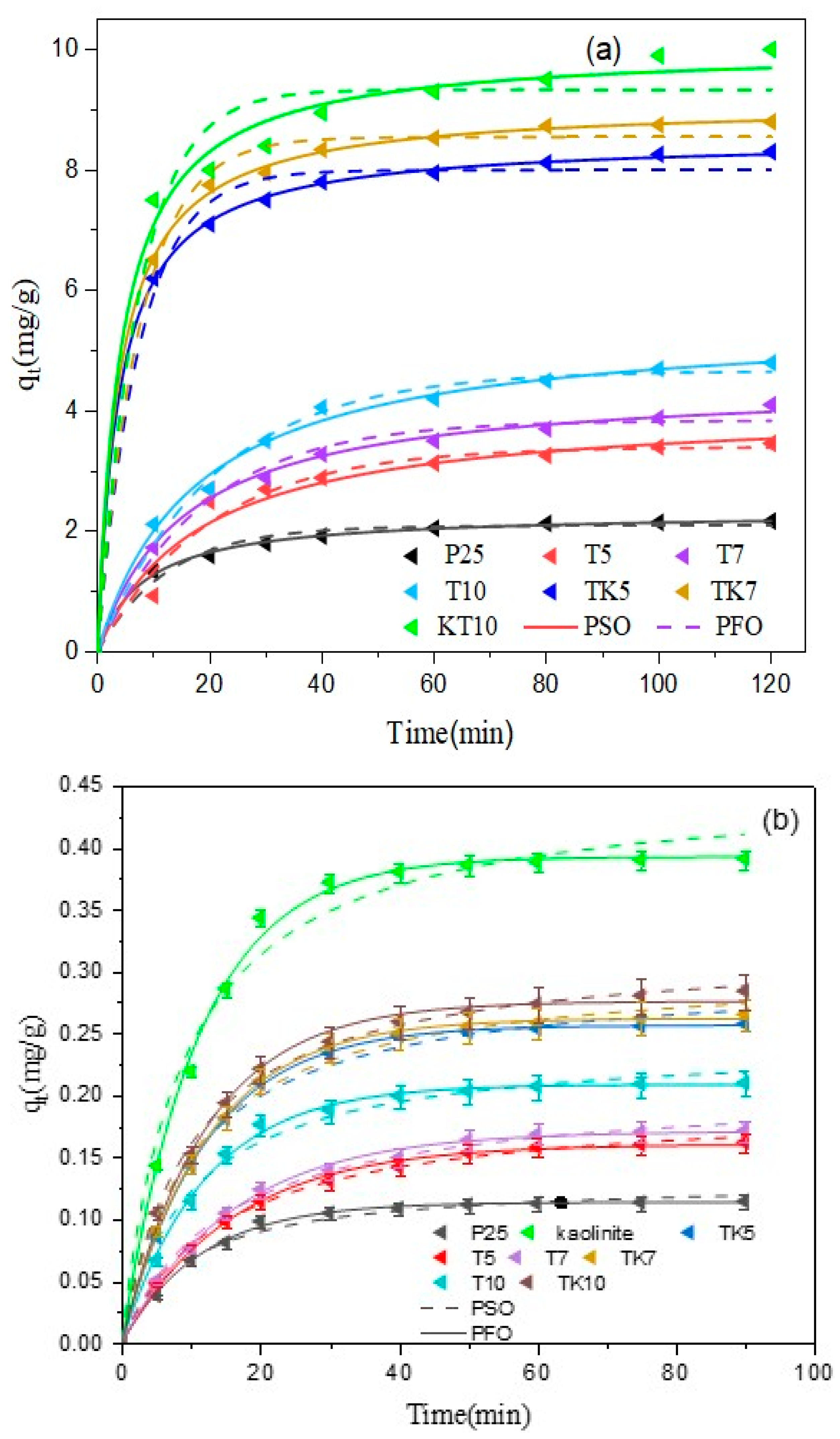
The adsorption kinetics of crystal violet (CV) at an initial concentration of 20 mg/L were investigated for a series of TiO2–MgO and TiO2–MgO/kaolinite nanocomposites containing 5%, 7%, and 10% Mg by weight in TiO2. Figure 7a shows the variation in adsorption capacity qt as a function of time, along with the fitting curves for both the PFO and PSO models.
Figure 7.
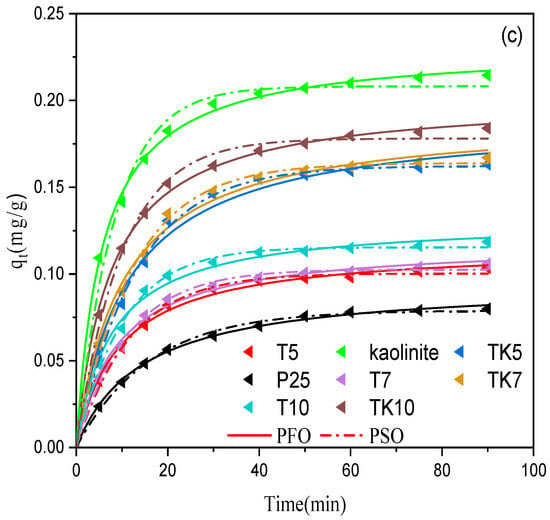
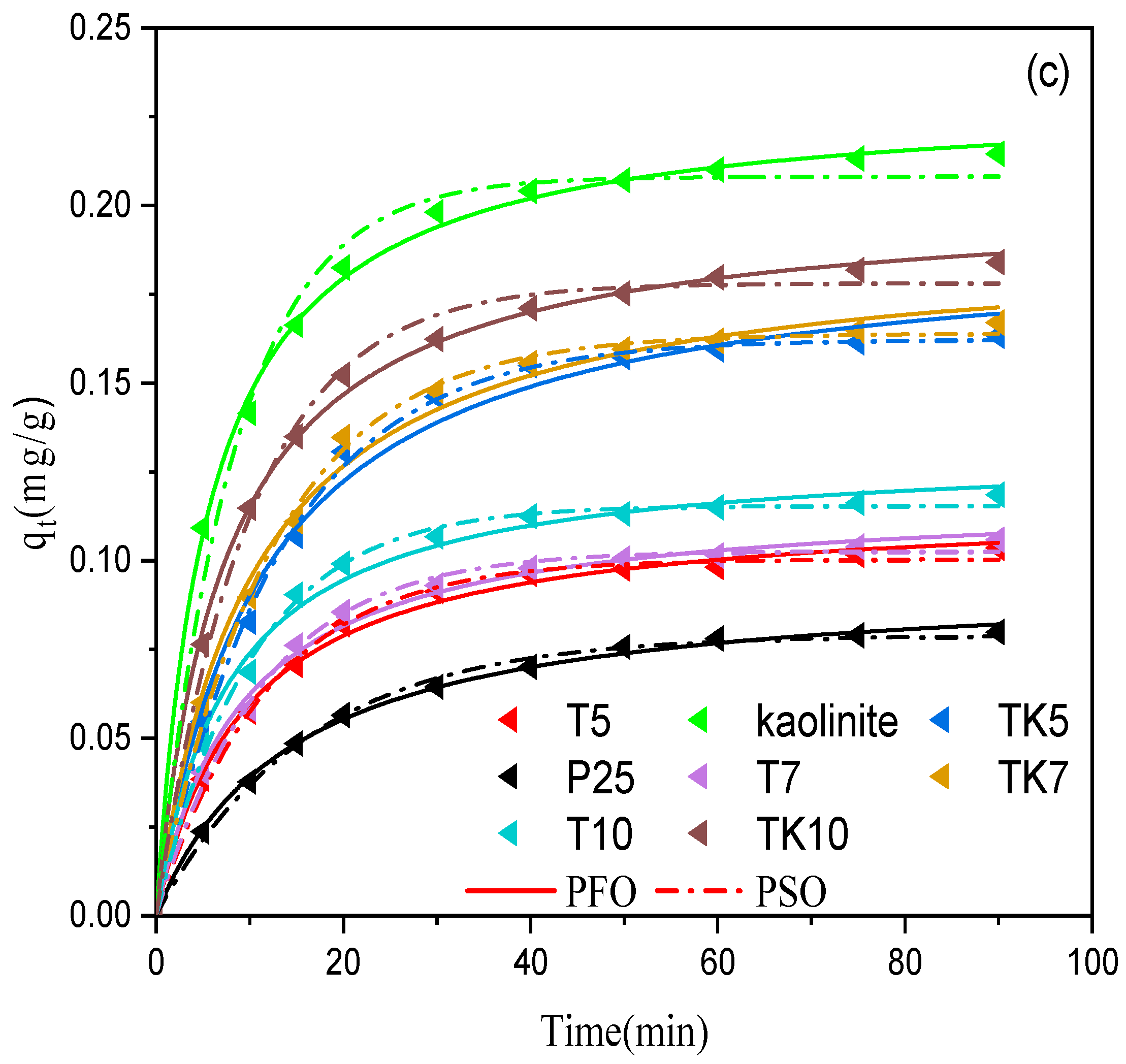
Adsorption kinetics of: crystal violet 20 mg/L (a); butyraldehyde 0.303 mg/L (b); and butyraldehyde 0.125 mg/L (c). (PFO: pseudo first order and PSO: pseudo second order).
The results reveal that the addition of kaolinite significantly improves the adsorption capacity compared to TiO2–MgO composites. This enhancement is attributed to the layered structure and high specific surface area of kaolinite, which provides additional adsorption sites and promotes better interaction between the dye molecules and the composite surface [62]. Furthermore, increasing the MgO content leads to a gradual increase in adsorption capacity, suggesting that MgO introduces more basic active sites that can interact effectively with the cationic crystal violet dye.
Among all tested composites, TK10 showed the best adsorption performance, with a maximum capacity of approximately 10 mg/g (Table 2). These findings demonstrate that the synergistic combination of TiO2, MgO, and kaolinite, especially with a higher MgO content, offers a promising strategy for enhancing the removal of organic dyes such as crystal violet from aqueous media [60].
Table 2.
Kinetics parameters for the adsorption of CV.
The analysis of the butyraldehyde adsorption curves for both concentrations (0.303 mg/L and 0.125 mg/L) (Figure 7b,c, Table 3 and Table 4) reveals distinct behaviors depending on the material used and the kinetic model applied. The results show that kaolinite alone exhibits a higher adsorption capacity, which can be attributed to its porous structure and high specific surface area, enhancing interactions with butyraldehyde [63]. In contrast, the TiO2–MgO/kaolinite composites display faster initial adsorption, followed by equilibrium at a lower capacity, suggesting a trade–off between adsorption and potential photocatalytic activity. To isolate the individual contributions of MgO doping and the kaolinite support to the overall photocatalytic performance, the degradation kinetics of crystal violet were systematically compared between the binary TiO2–MgO composite and the ternary TiO2–MgO/kaolinite system (Figure 6). This synergy between targeted adsorption and enhanced charge separation facilitated by MgO explains the significantly higher degradation efficiency observed in the ternary composite, providing clear mechanistic insight into the cooperative effects governing the photocatalytic process.
Table 3.
Kinetics parameters for the adsorption of butyraldehyde (0.303 mg/L).
Table 4.
Kinetics parameters for the adsorption of butyraldehyde (0.125 mg/L).
To further evaluate the adsorption kinetics of butyraldehyde, kinetic rate constants (k1 and k2), equilibrium adsorption capacities (qe), and correlation coefficients (R2) were determined. Fitting the data to pseudo–first–order (PFO) and pseudo–second–order (PSO) models allowed for analysis of the adsorption mechanism. In contrast, the PFO model, which assumes diffusion–controlled adsorption, does not fit the data as accurately [64]. Additionally, increasing the initial concentration of butyraldehyde results in higher adsorption, confirming that the availability of active sites plays a key role in the process. These results highlight the importance of material composition in the adsorption mechanism and its potential effectiveness as a precursor for efficient photocatalytic degradation.
2.11. Adsorption Isotherms
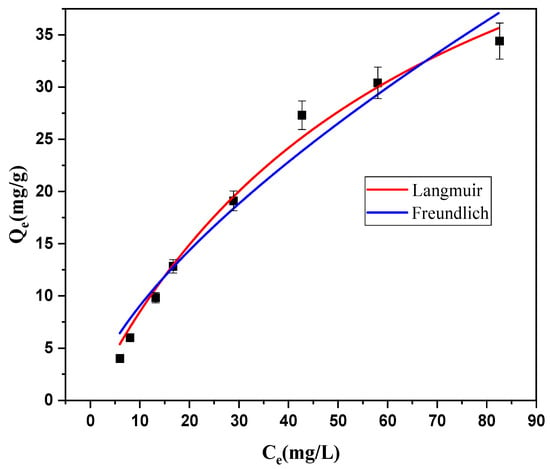
The adsorption behavior of crystal violet (CV) onto the TK10 composite was investigated to better understand the mechanisms governing the interaction between the dye and the adsorbent surface in aqueous solution. The experimental data were fitted to the two most widely used isotherm models: the Freundlich and Langmuir models.
The Freundlich model, which assumes multilayer adsorption on heterogeneous surfaces, is represented as follows [65]:
The Langmuir model, which assumes monolayer adsorption on a homogeneous surface, is given by [66]
where qe (mg/g) is the amount of CV adsorbed at equilibrium, Ce (mg/L) is the equilibrium dye concentration, KF (mg/g) and n are Freundlich constants, qm (mg/g) is the maximum monolayer adsorption capacity, and KL (L/mg) is the Langmuir constant related to the adsorption energy.
The isotherm curves reveal that both models fit the experimental data reasonably well, though the Langmuir model (red curve) provides a slightly better fit, especially at low concentrations. This suggests that the adsorption process predominantly follows a monolayer adsorption mechanism on homogeneously distributed sites, which aligns with the well–dispersed structure of the TK10 [67]. Despite this, the Freundlich model (blue curve) also offers a good correlation, indicating some heterogeneity in the adsorbent surface, characteristic of clay–based composites. The maximum adsorption capacity obtained from the Langmuir model is approximately 65 mg/g, as shown in Figure 8. The corresponding isotherm constants for both models are presented in Table 5.
Figure 8.
Adsorption isotherms of crystal violet with TK10.
Table 5.
Adsorption isotherms of CV on TK10 at room temperature.
The correlation coefficient (R2) values indicate that the Langmuir model (R2 = 0.99) better represents the experimental data than the Freundlich model, further supporting the monolayer adsorption assumption [67]. Overall, these results confirm that TK10 has a strong affinity for crystal violet and is an effective material for dye removal in water treatment applications [68].
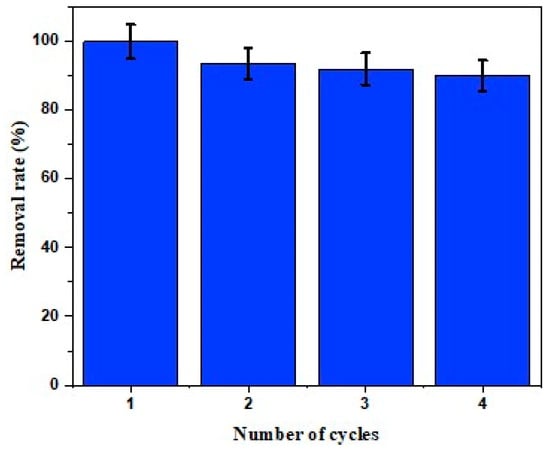
Stability is considered another important property of the catalyst [69]. The recycling tests of the KT10 photocatalyst were performed through the degradation of crystal violet, as illustrated in Figure 9.
Figure 9.
Recycling experiments of TK10 photocatalyst.
After five successive cycles, the degradation efficiency of crystal violet was found to decrease slightly from 99.8% to 90%. These findings demonstrate that the KT10 photocatalyst can be regarded as stable and reusable.
To support this research, Table 6 summarizes recent advances in the field of clay–supported TiO2 photocatalysts for the degradation of organic pollutants. The design of our TiO2–MgO/kaolinite nanocomposite incorporates established approaches, such as coupling TiO2 with metal oxides to improve charge separation and using clay substrates to increase adsorption capacity, while introducing the innovative use of halloysite–type kaolinite as a multifunctional platform for synergistic adsorption and photocatalysis. It should be noted that, under optimized conditions, the composite achieved 99.3% degradation of crystal violet in 90 min, demonstrating superior activity and synergy compared to systems described in previous studies.
Table 6.
Photodegradation efficiency of nanocomposites for different pollutants.
3. Materials and Methods
3.1. Materials
Commercial TiO2 (P25) was supplied by Evonik Industries (Essen, Germany), formerly marketed as Degussa P25. This photocatalyst is composed of a mixed–crystal structure containing approximately 80% anatase and 20% rutile. It is provided as a fine, white nanopowder with an average primary particle size of about 21 nm and a specific surface area ranging from 50 to 60 m2/g [75]. Ethanol (C2H6O; 96%, Germany) and NaOH were purchased from Sigma Aldrich (Steinheim, Germany). Magnesium sulfate MgSO4, crystal violet dye, butyraldehyde (C4H8O), and barium chloride (BaCl2) were purchased from Biochem (Cosne–Cours–sur–Loire, France). A local kaolinite–halloysite clay was collected in Djebel Debbagh mine (Guelma, northeast Algeria) and designated as DD3. The chemicals were used without any further purification or treatment.
3.2. Synthesis of TiO2–MgO/Kaolinite Nanocomposites
Firstly, the raw kaolinite sample was ground using a laboratory ball mill (Fritsch planetary ball mono mill, Idar–Oberstein, Germany) for 3 h at a speed of 200 rpm. The resulting powder was then sieved through a 100–micron mesh. Subsequently, 1 g of the product was mixed with 30 mL of a water/ethanol solution at a 2:1 ratio (solution A).
To synthesize TiO2–MgO composites, magnesium sulfate (MgSO4) was added in amounts corresponding to 5%, 7% and 10% by weight of Mg relative to the final composite composition. The synthesis procedure involved the following steps: First, 1 g of P25 TiO2 was dispersed in 30 mL of absolute ethanol, and the resulting suspension was left under gentle stirring for 30 min at room temperature. This suspension was then heated to 50 °C with continuous stirring.
At the same time, a basic solution (Solution B) was prepared by adjusting the pH of a sodium hydroxide solution (0.1 M) to 11 using standard methods. The TiO2 suspension (Solution B) was gradually added to Solution A at a volumetric ratio of 40%. The mixture was then subjected to ultrasonic treatment (Tierratech LT–100 PRO, Guarnizo, Spain) for 15 min to ensure proper homogenization. This was followed by two hours of continuous stirring at 50 °C, after which the mixture was allowed to cool naturally to room temperature.
The resulting precipitate was purified by undergoing multiple washing cycles using distilled water and absolute ethanol to ensure the complete removal of residual sulfate ions and sodium hydroxide. The washing process was monitored as follows: the presence of sulfate ions in the rinsing solution was tested using a few drops of barium chloride (BaCl2) solution. The absence of a white precipitate of barium sulfate (BaSO4) confirmed the complete removal of sulfate ions. Similarly, the elimination of residual NaOH was verified by measuring the pH of the rinsing water; washing was continued until a neutral pH (~7) was achieved.
After purification, the samples were dried under vacuum at 60 °C for 12 h. Finally, the dried material was calcined in a muffle furnace under an air atmosphere at 500 °C for two hours, using a controlled heating rate of 5 °C/min, to ensure proper phase formation.
The synthesis of TiO2–MgO and MgO alone followed the same procedure, in the absence of kaolinite and TiO2, respectively. The final composites were labeled T5, T7, T10, TK5, TK7, and TK10, corresponding to the Mg content and the absence or presence of kaolinite.
3.3. Characterization of TiO2–MgO/Kaolinite Composite
The samples were examined using X–ray diffraction (XRD) on a PANALYTICAL (Almelo, The Netherlands) diffractometer with Cu Kα radiation. The structural morphology and element analysis of TiO2–MgO/kaolinite composites were investigated using a JEOL JSM–7610F Plus emission scanning electron microscope (UHR–FESEM) (Tokyo, Japan). Infrared spectroscopy spectra (diamond ATR) were obtained at room temperature using a Bruker Platinum spectrometer (Billerica, MA, USA) in a 400–4000 cm−1 range. The UV–visible absorption spectra (UV–vis DRS) of the samples were obtained using a UV–Vis spectrophotometer Agilent Technologies Cary 60 (Penang, Malaysia). Nitrogen adsorption/desorption isotherms were measured at 77 K using the Quantachrome (Boynton Beach, FL, USA) instrument. The pore volume was calculated using the t–plot method, and the sample specific surface area was calculated using the conventional BET (Brunauer–Emmett–Teller) method. The samples were degassed and dehumidified by heating them at 200 °C for 8 h. The analysis of butyraldehyde was performed using gas chromatography coupled with a flame ionization detector (GC–FID, Fisons). A Chrompack FFAP–CB column (25 m in length and 0.32 mm outer diameter), suitable for volatile fatty acid analysis, was used. Nitrogen served as the carrier gas and constituted the mobile phase.
3.4. Adsorption Kinetic Experiment
The kinetic study of crystal violet adsorption was performed in the dark to eliminate any photocatalytic contribution. A solid sample of 0.3 g was added to 300 mL of crystal violet aqueous solution (initial concentration, C0 = 20 mg/L), and the suspension was stirred continuously at 300 rpm using a magnetic stirrer at room temperature (25 °C). At predetermined time intervals, aliquots were withdrawn and immediately filtered to separate the solid phase. The residual concentrations of crystal violet were determined by UV–vis spectrophotometry (Agilent Technologies Cary 60 UV–Vis, Santa Clara, CA, USA). The maximum absorbance wavelength (λmax) for crystal violet was observed at 590 nm, and the corresponding molar absorptivity (ε) was 8.72 × 10⁴ L·mol−1·cm−1. The experimental adsorption kinetics were analyzed using both the pseudo–first–order (PFO) and pseudo–second–order (PSO) models to investigate the adsorption mechanism.
3.5. Evaluation of the Photoactivity
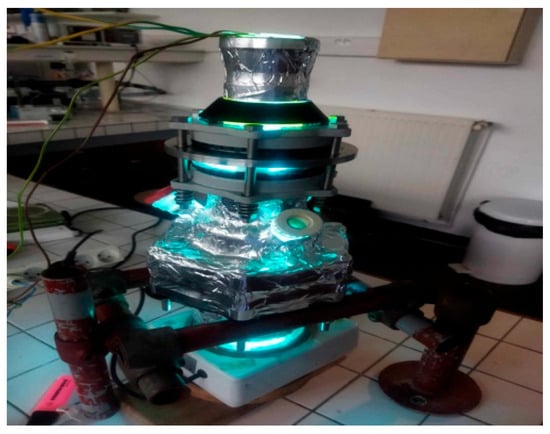
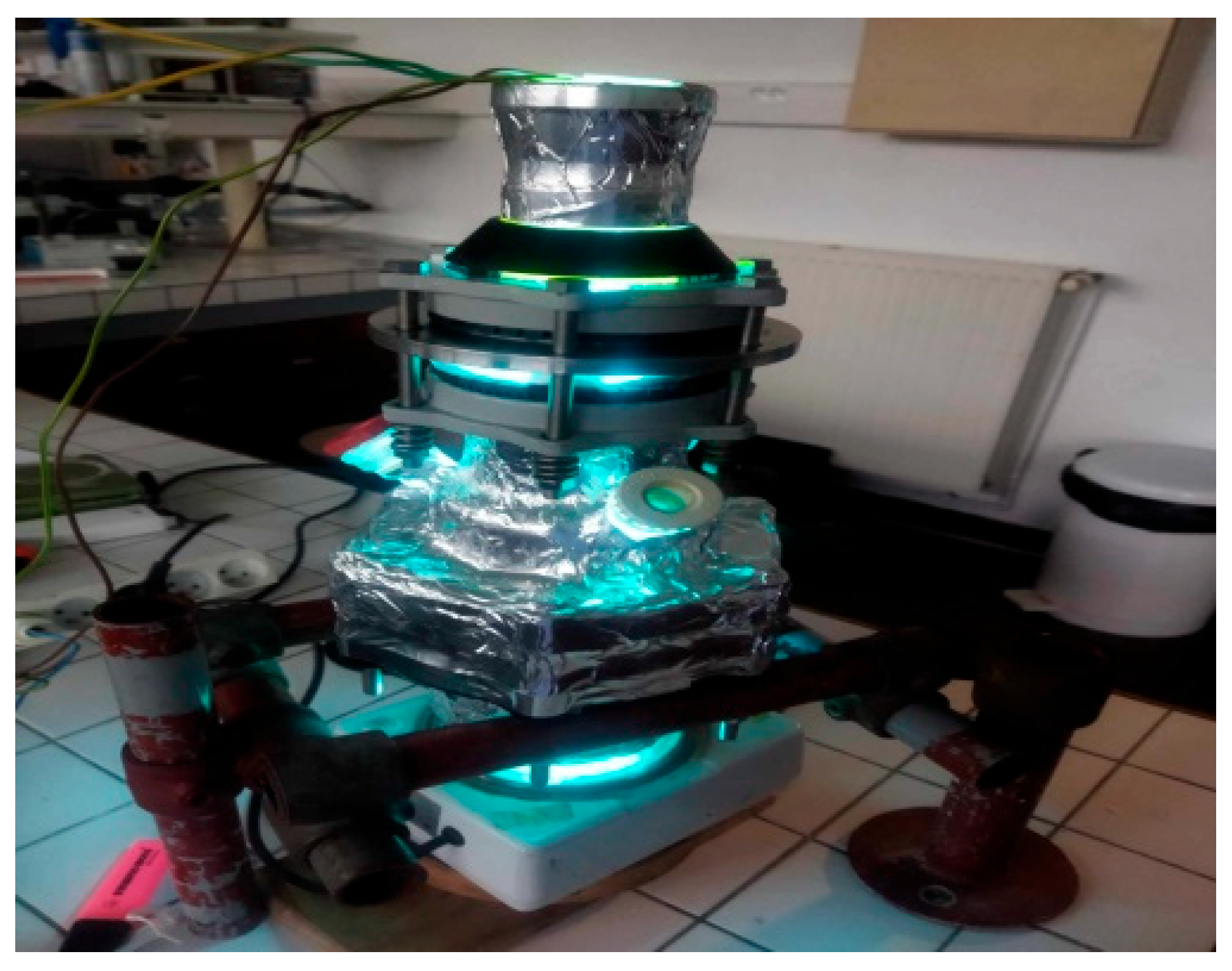
The solutions were prepared to evaluate the practical performance of the synthesized composites. A volume of 300 mL of crystal violet solution (20 mg/L) was placed in a cylindrical photoreactor (see Figure 10 below), followed by the addition of the photocatalyst at a concentration of 1 g/L. Initially, the suspension was stirred in the dark for 120 min to reach adsorption–desorption equilibrium and determine the amount adsorbed by the material. Each photocatalytic test was performed in triplicate to ensure reproducibility.
Figure 10.
Photocatalytic reactor for air treatment.
After this stage, the suspension was irradiated using a UVC lamp light source (12 W) under constant stirring. During the irradiation process, samples were periodically collected, centrifuged, and the supernatants were analyzed using UV–vis spectrophotometry.
In this study, the photodegradation of CV was carried out using the various samples prepared to determine the most effective catalyst and anticipate its performance in photocatalytic reactions.
The decolorization efficiency was calculated using the following equation:
where C0 (mg/L) is the initial dye concentration and Ct is the concentration at time t (min).
In the second part of the study, dry air was supplied via an air system. The photocatalyst was deposited and fixed onto the inner walls of a sealed reactor. Then, liquid butyraldehyde was directly injected into the reactor using a syringe.
To achieve adsorption–desorption equilibrium and determine the amount of pollutant adsorbed by the solid material, the air–butyraldehyde mixture was magnetically stirred in the dark for 90 min. After this initial step, the mixture was irradiated using a Philips UVB lamp (24 W, laboratory model). The experiment was carried out at room temperature and atmospheric pressure. Sampling ports with septa allowed for gas sampling from the reactor.
Then, 0.1 g of the composite material was placed in the reactor, which was a closed cylindrical tube with a volume of 2 × 10⁻³ m3. The reactor was irradiated internally with a 24 W UVB lamp. A volume of 0.5 μL and 0.25 μL of liquid butyraldehyde was injected into the reactor using a microsyringe. After injection, the liquid rapidly volatilized inside the reactor, generating gas–phase–butyraldehyde concentrations of 303 mg/L and 125 mg/L, respectively. Subsequently, 500 μL of the butyraldehyde–containing gas was sampled and analyzed using a gas chromatography (GC) system to determine the inlet and outlet concentrations.
4. Conclusions
This work reports the successful development of a highly efficient TiO2–MgO/kaolinite composite designed for the removal of organic pollutants in both aqueous and gaseous media. The optimized catalyst containing 10 wt% MgO (KT10) demonstrated exceptional photocatalytic activity, achieving up to 99.8% degradation of crystal violet and clearly surpassing the performance of commercial TiO2 (P25). This remarkable efficiency stems from the strong synergistic interaction between adsorption and photocatalysis: kaolinite enhances pollutant pre–concentration at the catalyst surface, while MgO improves charge separation in TiO2 by suppressing electron–hole recombination.
Kinetic and isotherm analyses confirmed that adsorption follows a pseudo–second–order model, indicative of chemisorption, and fits well with the Langmuir isotherm, suggesting monolayer adsorption on a homogeneous surface. Parametric studies further revealed that both catalyst dosage and initial pollutant concentration strongly influence degradation efficiency, highlighting the importance of process optimization for practical implementation.
Importantly, the photocatalyst also proved effective in degrading gaseous VOCs such as butyraldehyde, demonstrating its versatility beyond dye removal and extending its potential to air purification technologies.
Overall, the TiO2–MgO/kaolinite composite emerges as a cost–effective, environmentally benign, and multifunctional photocatalyst. Its dual–action mechanism—combining strong adsorption with enhanced photocatalytic activity—provides a robust platform for advanced environmental remediation in both water and air matrices.
Author Contributions
Conceptualization, K.F., N.B., R.B. and A.M.; methodology, A.M., R.B., A.M. and M.K.; software, A.S.; validation, K.F., A.M., M.K. and J.-C.B.; formal analysis, A.M., M.K. and Y.G.A.E.-R.; investigation, A.M., A.S., Y.G.A.E.-R. and K.F.; resources, K.F. and Y.G.A.E.-R.; data curation, A.M. and M.K.; writing—original draft preparation, A.M. and A.S.; writing—review and editing, R.B., K.F., N.B. and L.M.; visualization, A.S., E.S.A.-F. and M.A.A.; supervision, L.M.; project administration, N.B.; funding acquisition, E.S.A.-F., M.A.A. and L.M. All authors have read and agreed to the published version of the manuscript.
Funding
This work was supported and funded by the Deanship of Scientific Research at Imam Mohammad Ibn Saud Islamic University (IMSIU) (grant number IMSIU-DDRSP2603).
Data Availability Statement
Data is contained within the article.
Conflicts of Interest
The authors declare no conflicts of interest.
References
- Damgaard, A.; Riber, C.; Fruergaard, T.; Hulgaard, T.; Christensen, T.H. Life-cycle-assessment of the historical development of air pollution control and energy recovery in waste incineration. Waste Manag. 2010, 30, 1244–1250. [Google Scholar] [CrossRef] [Scilit] [PubMed]
- Winchester, J.W.; Nifong, G.D. Water pollution in lake michigan by trace elements from pollution aerosol fallout. Water Air Soil Pollut. 1971, 1, 50–64. [Google Scholar] [CrossRef] [Scilit]
- Puri, C.; Sumana, G. Highly effective adsorption of crystal violet dye from contaminated water using graphene oxide intercalated montmorillonite nanocomposite. Appl. Clay Sci. 2018, 166, 102–112. [Google Scholar] [CrossRef] [Scilit]
- Qureshi, M.I.; Rasli, A.M.; Awan, U.; Ma, J.; Ali, G.; Faridullah; Alam, A.; Sajjad, F.; Zaman, K. Environment and air pollution: Health services bequeath to grotesque menace. Environ. Sci. Pollut. Res. 2015, 22, 3467–3476. [Google Scholar] [CrossRef] [Scilit] [PubMed]
- Portela, R.; Suárez, S.; Rasmussen, S.; Canela, M.; Ávila, P.; Sánchez, B. Photocatalysis for continuous air purification in wastewater treatment plants: From lab to reality. Environ. Sci. Technol. 2012, 46, 5040–5048. [Google Scholar] [CrossRef] [Scilit]
- Mani, S.; Bharagava, R.N. Exposure to crystal violet. its toxic, genotoxic and carcinogenic effects on environment and its degradation and detoxification for environmental safety. Rev. Environ. Contam. Toxicol. 2016, 237, 71–104. [Google Scholar] [CrossRef] [Scilit]
- Fabryanty, R.; Valencia, C.; Soetaredjo, F.E.; Putro, J.N.; Santoso, S.P.; Kurniawan, A.; Ju, Y.H.; Ismadji, S. Removal of crystal violet dye by adsorption using bentonite—Alginate composite. J. Environ. Chem. Eng. 2017, 5, 5677–5687. [Google Scholar] [CrossRef] [Scilit]
- Huang, C.; Chen, D.H.; Li, K. Photocatalytic oxidation of butyraldehyde over titania in air: By-product identification and reaction pathways. Chem. Eng. Commun. 2003, 190, 373–392. [Google Scholar] [CrossRef] [Scilit]
- Shkrob, I.A.; Sauer, M.C. Hole scavenging and photo-stimulated recombination of electron-hole pairs in aqueous TiO2 nanoparticles. J. Phys. Chem. B 2004, 108, 12497–12511. [Google Scholar] [CrossRef] [Scilit]
- Jassby, D.; Budarz, J.F.; Wiesner, M. Impact of aggregate size and structure on the photocatalytic properties of TiO2 and ZnO nanoparticles. Environ. Sci. Technol. 2012, 46, 6934–6941. [Google Scholar] [CrossRef] [Scilit] [PubMed]
- Choi, J.S.; Kwon, H.H.; Lim, T.H.; Hong, S.A.; Lee, H.I. Development of nickel catalyst supported on MgO-TiO2 composite oxide for DIR-MCFC. Catal. Today 2004, 93–95, 553–560. [Google Scholar] [CrossRef] [Scilit]
- Shrestha, K.M.; Sorensen, C.M.; Klabunde, K.J. MgO-TiO2 mixed oxide nanoparticles: Comparison of flame synthesis versus aerogel method; Characterization. and photocatalytic activities. J. Mater. Res. 2013, 28, 431–439. [Google Scholar] [CrossRef] [Scilit]
- Sharma, A.K.; Lee, B.K. Surfactant-aided sol-gel synthesis of TiO2–MgO nanocomposite and their photocatalytic azo dye degradation activity. J. Compos. Mater. 2020, 54, 1561–1570. [Google Scholar] [CrossRef] [Scilit]
- Mihoubi, N.; Ferhat, S.; Nedjhioui, M.; Zenati, B.; Lekmine, S.; Boudraa, R.; Ola, M.S.; Zhang, J.; Amrane, A.; Tahraoui, H. A Novel Halophilic Bacterium for Sustainable Pollution Control: From Pesticides to Industrial Effluents. Water 2025, 17, 888. [Google Scholar] [CrossRef] [Scilit]
- Wolde, G.S.; Kuo, D.; Abdullah, H. Solar-light-driven ternary MgO/TiO2/g-C3N4 heterojunction photocatalyst with surface defects for dinitrobenzene pollutant reduction. Chemosphere 2022, 307, 135939. [Google Scholar] [CrossRef] [Scilit]
- Arikal, D.; Kallingal, A. Photocatalytic Degradation of Azo and Anthraquinone dye using TiO2/MgO nanocomposite immobilized Chitosan hydrogels. Environ. Technol. 2019, 42, 2278–2291. [Google Scholar] [CrossRef] [Scilit] [PubMed]
- Mishra, A.; Mehta, A.; Sharma, M.; Basu, S. Enhanced heterogeneous photodegradation of VOC and dye using microwave synthesized TiO2/Clay nanocomposites: A comparison study of different type of clays. J. Alloys Compd. 2017, 694, 574–580. [Google Scholar] [CrossRef] [Scilit]
- Papoulis, D.; Komarneni, S.; Panagiotaras, D.; Stathatos, E.; Toli, D.; Christoforidis, K.C.; Fernández-garcía, M.; Li, H.; Yin, S.; Sato, T.; et al. Applied Catalysis B: Environmental Halloysite—TiO2 nanocomposites: Synthesis, characterization and photocatalytic activity. Appl. Catal. B 2013, 132–133, 416–422. [Google Scholar] [CrossRef] [Scilit]
- Szczepanik, B. Applied Clay Science Photocatalytic degradation of organic contaminants over clay-TiO2 nanocomposites: A review. Appl. Clay Sci. 2017, 141, 227–239. [Google Scholar] [CrossRef] [Scilit]
- Papoulis, D.; Komarneni, S.; Nikolopoulou, A.; Tsolis-Katagas, P.; Panagiotaras, D.; Kacandes, H.G.; Zhang, P.; Yin, S.; Sato, T.; Katsuki, H. Palygorskite- and Halloysite-TiO2 nanocomposites: Synthesis and photocatalytic activity. Appl. Clay Sci. 2010, 50, 118–124. [Google Scholar] [CrossRef] [Scilit]
- Li, C.; Wang, J.; Feng, S.; Yang, Z.; Ding, S. Low-temperature synthesis of heterogeneous crystalline TiO2-halloysite nanotubes and their visible light photocatalytic activity. J. Mater. Chem. A Mater. 2013, 1, 8045–8054. [Google Scholar] [CrossRef] [Scilit]
- Wu, A.; Wang, D.; Wei, C.; Zhang, X.; Liu, Z.; Feng, P.; Ou, X.; Qiang, Y.; Garcia, H.; Niu, J. A comparative photocatalytic study of TiO2 loaded on three natural clays with different morphologies. Appl. Clay Sci. 2019, 183, 105352. [Google Scholar] [CrossRef] [Scilit]
- Elashery, S.E.A.; Ibrahim, I.; Gomaa, H.; El-Bouraie, M.M.; Moneam, I.A.; Fekry, S.S.; Mohamed, G.G. Comparative Study of the Photocatalytic Degradation of Crystal Violet Using Ferromagnetic Magnesium Oxide Nanoparticles and MgO-Bentonite Nanocomposite. Magnetochemistry 2023, 9, 56. [Google Scholar] [CrossRef] [Scilit]
- Baloyi, J.; Ntho, T.; Moma, J. Synthesis and application of pillared clay heterogeneous catalysts for wastewater treatment: A review. RSC Adv. 2018, 8, 5197–5211. [Google Scholar] [CrossRef] [Scilit] [PubMed]
- Lian, P.; Qin, A.; Liu, Z.; Ma, H.; Liao, L.; Zhang, K.; Qin, Y. One-Step Synthesis of Nitrogen-Doped TiO2 Heterojunctions and Their Visible Light Catalytic Applications. Materials 2025, 18, 2400. [Google Scholar] [CrossRef] [Scilit]
- Divakaran, K.; Baishnisha, A.; Balakumar, V.; Perumal, N.K.; Meenakshi, C.; Kannan, R.S. Photocatalytic degradation of tetracycline under visible light using TiO2@sulfur doped carbon nitride nanocomposite synthesized via in-situ method. J. Environ. Chem. Eng. 2021, 9, 105560. [Google Scholar] [CrossRef] [Scilit]
- Bui, V.D.; Tran, T.P.A.; Vu, T.H.; Dao, T.P.; Aminabhavi, T.M.; Vasseghian, Y.; Joo, S.W. Integrating 3D-printed Mo2CTx-UiO-66@rGQDs nanocatalysts with semiconducting BiVO4 to improve interfacial charge transfer and photocatalytic degradation of atrazine. Appl. Catal. B 2025, 365, 124924. [Google Scholar] [CrossRef] [Scilit]
- Hashemi, E.; Poursalehi, R.; Delavari, H. Ternary Bi2O3/(BiO)2CO3/g-C3N4 multi-heterojunction nanoflakes for highly efficient photocatalytic degradation of dyes and xanthates under visible light. J. Sci. Adv. Mater. Devices 2025, 10, 100834. [Google Scholar] [CrossRef] [Scilit]
- Yang, D.; Chen, J.; Hong, X.; Cui, J.; Li, L. One-Pot Synthesis of TiO2/Hectorite Composite and Its Photocatalytic Degradation of Methylene Blue. Catalysts 2022, 12, 297. [Google Scholar] [CrossRef] [Scilit]
- Mousa, H.M.; Alenezi, J.F.; Mohamed, I.M.A.; Yasin, A.S.; Hashem, A.F.M.; Abdal-hay, A. Synthesis of TiO2@ZnO heterojunction for dye photodegradation and wastewater treatment. J. Alloys Compd. 2021, 886, 161169. [Google Scholar] [CrossRef] [Scilit]
- Sewnet, A.; Abebe, M.; Asaithambi, P.; Alemayehu, E. Visible-Light-Driven g-C3N4/TiO2 Based Heterojunction Nanocomposites for Photocatalytic Degradation of Organic Dyes in Wastewater: A Review. Air Soil Water Res. 2022, 15, 11786221221117266. [Google Scholar] [CrossRef] [Scilit]
- Benkacem, S.; Boudeghdegh, K.; Zehani, F.; Hamidouche, M.; Belhocine, Y. Preparation, microstructure studies and mechanical properties of glazes ceramic sanitary ware based on kaolin. Sci. Sinter. 2021, 53, 209–221. [Google Scholar] [CrossRef] [Scilit]
- Senoussi, H.; Osmani, H.; Courtois, C.; Bourahli, M.E.H. Mineralogical and chemical characterization of DD3 kaolin from the east of Algeria. Bol. Soc. Esp. Ceram. Vidr. 2016, 55, 121–126. [Google Scholar] [CrossRef] [Scilit]
- Andrini, L.; Toja, R.M.; Conconi, M.S.; Requejo, F.G.; Rendtorff, N.M. Halloysite nanotube and its firing products: Structural characterization of halloysite. metahalloysite, spinel type silicoaluminate and mullite. J. Electron Spectros. Relat. Phenom. 2019, 234, 19–26. [Google Scholar] [CrossRef] [Scilit]
- Nezhad, A.M.; Talaiekhozani, A.; Mojiri, A.; Sonne, C.; Cho, J.; Rezania, S.; Vasseghian, Y. Photocatalytic removal of ceftriaxone from wastewater using TiO2/MgO under ultraviolet radiation. Environ. Res. 2023, 229, 115915. [Google Scholar] [CrossRef] [Scilit] [PubMed]
- Du, Y.; Zheng, P. Adsorption and photodegradation of methylene blue on TiO2-halloysite adsorbents. Korean J. Chem. Eng. 2014, 31, 2051–2056. [Google Scholar] [CrossRef] [Scilit]
- Amrane, B.; Ouedraogo, E.; Mamen, B.; Djaknoun, S.; Mesrati, N. Experimental study of the thermo-mechanical behaviour of alumina-silicate refractory materials based on a mixture of Algerian kaolinitic clays. Ceram. Int. 2011, 37, 3217–3227. [Google Scholar] [CrossRef] [Scilit]
- Talat-Mehrabad, J.; Khosravi, M.; Modirshahla, N.; Behnajady, M.A. Synthesis, characterization, and photocatalytic activity of co-doped Ag–, Mg–TiO2-P25 by photodeposition and impregnation methods. Desalination Water Treat. 2016, 57, 10451–10461. [Google Scholar] [CrossRef] [Scilit]
- Kheloui, M.; Boumchedda, K.; Naitbouda, A. Study, with Different Characterization Techniques, of the Formation of Cordierite from both Natural and Activated Algerian DD3 Kaolin. Trans. Indian Ceram. Soc. 2020, 79, 88–93. [Google Scholar] [CrossRef] [Scilit]
- Onwubiko, V.; Matsushita, Y.; Elshehy, E.A.; El-Khouly, M.E. Facile synthesis of TiO2-carbon composite doped nitrogen for efficient photodegradation of noxious methylene blue dye. RSC Adv. 2024, 14, 34298–34310. [Google Scholar] [CrossRef] [Scilit]
- Taufik, A.; Muzakki, A.; Saleh, R. Effect of nanographene platelets on adsorption and sonophotocatalytic performances of TiO2/CuO composite for removal of organic pollutants. Mater. Res. Bull. 2018, 99, 109–123. [Google Scholar] [CrossRef] [Scilit]
- Shao, G.N.; Engole, M.; Imran, S.M.; Jeon, S.J.; Kim, H.T. Sol-gel synthesis of photoactive kaolinite-titania: Effect of the preparation method and their photocatalytic properties. Appl. Surf. Sci. 2015, 331, 98–107. [Google Scholar] [CrossRef] [Scilit]
- Lin, S.; Chen, C.; Juang, R. Structure and thermal stability of toxic chromium (VI) species doped onto TiO2 powders through heat treatment. J. Environ. Manage. 2009, 90, 1950–1955. [Google Scholar] [CrossRef] [Scilit]
- Chawla, P.; Sharma, S.K.; Toor, A.P. Techno-economic evaluation of anatase and p25 TiO2 for treatment basic yellow 28 dye solution through heterogeneous photocatalysis. Environ. Dev. Sustain. 2020, 22, 231–249. [Google Scholar] [CrossRef] [Scilit]
- Bandara, J.; Hadapangoda, C.C.; Jayasekera, W.G. TiO2/MgO composite photocatalyst: The role of MgO in photoinduced charge carrier separation. Appl. Catal. B 2004, 50, 83–88. [Google Scholar] [CrossRef] [Scilit]
- Li, X.; Peng, K.; Chen, H.; Wang, Z. TiO2 nanoparticles assembled on kaolinites with different morphologies for efficient photocatalytic performance. Sci. Rep. 2018, 8, 11663. [Google Scholar] [CrossRef] [Scilit] [PubMed]
- Kutlákova, K.M.; Tokarský, J.; Kovář, P.; Vojtěšková, S.; Kovářová, A.; Smetana, B.; Kukutschová, J.; Čapková, P.; Matějka, V. Preparation and characterization of photoactive composite kaolinite/TiO2. J. Hazard. Mater. 2011, 188, 212–220. [Google Scholar] [CrossRef] [Scilit]
- Hadjltaief, H.B.; Galvez, M.E.; Zina, M.B.; Da Costa, P. TiO2/clay as a heterogeneous catalyst in photocatalytic/photochemical oxidation of anionic reactive blue 19. Arab. J. Chem. 2019, 12, 1454–1462. [Google Scholar] [CrossRef] [Scilit]
- Awwad, A.M.; Amer, M.W.; Al-aqarbeh, M.M. TiO2-kaolinite nanocomposite prepared from the Jordanian Kaolin clay: Adsorption and thermodynamic of Pb (II) and Cd (II) ions in aqueous solution. Chem. Int. 2020, 6, 168–178. [Google Scholar] [CrossRef]
- Silvestri, S.; Hennemann, B.; Zanatta, N.; Foletto, E.L. Photocatalytic Efficiency of TiO2 Supported on Raw Red Clay Disks to Discolour Reactive Red 141. Water Air Soil Pollut. 2018, 229, 40. [Google Scholar] [CrossRef] [Scilit]
- Wang, C.; Shi, H.; Zhang, P.; Li, Y. Applied Clay Science Synthesis and characterization of kaolinite/TiO2 nano-photocatalysts. Appl. Clay Sci. 2011, 53, 646–649. [Google Scholar] [CrossRef] [Scilit]
- Chen, F.; Fang, P.; Gao, Y.; Liu, Z.; Liu, Y.; Dai, Y. Effective removal of high-chroma crystal violet over TiO2-based nanosheet by adsorption-photocatalytic degradation. Chem. Eng. J. 2012, 204–205, 107–113. [Google Scholar] [CrossRef] [Scilit]
- Sacco, O.; Matarangolo, M.; Vaiano, V.; Libralato, G.; Guida, M.; Lofrano, G.; Carotenuto, M. Crystal violet and toxicity removal by adsorption and simultaneous photocatalysis in a continuous flow micro-reactor. Sci. Total Environ. 2018, 644, 430–438. [Google Scholar] [CrossRef] [Scilit] [PubMed]
- Ameen, S.; Akhtar, M.S.; Nazim, M.; Shin, H.S. Rapid photocatalytic degradation of crystal violet dye over ZnO flower nanomaterials. Mater. Lett. 2013, 96, 228–232. [Google Scholar] [CrossRef] [Scilit]
- Vardikar, H.S.; Bhanvase, B.A.; Rathod, A.P.; Sonawane, S.H. Sonochemical synthesis, characterization and sorption study of Kaolin-Chitosan-TiO2 ternary nanocomposite: Advantage over conventional method. Mater. Chem. Phys. 2018, 217, 457–467. [Google Scholar] [CrossRef] [Scilit]
- Kumar, A. A Review on the Factors Affecting the Photocatalytic Degradation of Hazardous Materials. Mater. Sci. Eng. Int. J. 2017, 1, 106–114. [Google Scholar] [CrossRef] [Scilit]
- Fendi, K.; Bouzidi, N.; Boudraa, R.; Saidani, A.; Manseri, A.; Quesada, D.E.; Hai, T.N.; Bollinger, J.C.; Salvestrini, S.; Kebir, M.; et al. Testing of kaolinite/TiO2 nanocomposites for methylene blue removal: Photodegradation and mechanism. Int. J. Chem. React. Eng. 2025, 22, 1493–1508. [Google Scholar] [CrossRef] [Scilit]
- Chen, Z.; Li, W.; Huang, S.; Zhuang, P.; Jia, D.; Evrendilek, F.; Zhong, S.; Ninomiya, Y.; Yang, Z.; He, Y.; et al. Dynamic, synergistic, and optimal emissions and kinetics of volatiles during co-pyrolysis of soil remediation plants with kaolin/modified kaolin. Chem. Eng. J. 2024, 483, 149214. [Google Scholar] [CrossRef] [Scilit]
- Zou, W.; Gao, B.; Ok, Y.S.; Dong, L. Integrated adsorption and photocatalytic degradation of volatile organic compounds (VOCs) using carbon-based nanocomposites: A critical review. Chemosphere 2019, 218, 845–859. [Google Scholar] [CrossRef] [Scilit]
- Kibanova, D.; Sleiman, M.; Cervini-Silva, J.; Destaillats, H. Adsorption and photocatalytic oxidation of formaldehyde on a clay-TiO2 composite. J. Hazard. Mater. 2012, 211–212, 233–239. [Google Scholar] [CrossRef] [Scilit]
- Azizian, S. Kinetic models of sorption: A theoretical analysis. J. Colloid Interface Sci. 2004, 276, 47–52. [Google Scholar] [CrossRef] [Scilit] [PubMed]
- Ho, Y.S.; Mckay, G. Sorption of dye from aqueous solution by peat. Chem. Eng. J. 1998, 70, 115–124. [Google Scholar] [CrossRef]
- Tatarchuk, T.; Bououdina, M.; Al-Najar, B.; Bitra, R.B. Green and ecofriendly materials for the remediation of inorganic and organic pollutants in water. In A New Generation Material Graphene: Applications in Water Technology; Springer: Cham, Switzerland, 2019; pp. 69–110. [Google Scholar] [CrossRef] [Scilit]
- Boudraa, R.; Talantikite-Touati, D.; Souici, A.; Djermoune, A.; Saidani, A.; Fendi, K.; Amrane, A.; Bollinger, J.-C.; Tran, H.N.; Hadadi, A.; et al. Optical and photocatalytic studies of TiO2-Bi2O3-CuO supported on natural zeolite for degrading Safranin-O dye in water and wastewater. J. Photochem. Photobiol. A Chem. 2023, 443, 114845. [Google Scholar] [CrossRef] [Scilit]
- Debord, J.; Chu, K.H.; Harel, M.; Salvestrini, S.; Bollinger, J.-C. Yesterday, Today and Tomorrow. Evolution of a Sleeping Beauty: The Freundlich Isotherm. Langmuir 2023, 8, 3062–3071. [Google Scholar] [CrossRef] [Scilit] [PubMed]
- Swenson, H.; Stadie, N.P. Langmuir’s Theory of Adsorption: A Centennial Review. Langmuir 2019, 35, 5409–5426. [Google Scholar] [CrossRef] [Scilit]
- Boukhemkhem, A.; Rida, K. Improvement adsorption capacity of methylene blue onto modified Tamazert kaolin. Adsorpt. Sci. Technol. 2017, 35, 753–773. [Google Scholar] [CrossRef] [Scilit]
- Hai, Y.; Li, X.; Wu, H.; Zhao, S.; Deligeer, W.; Asuha, S. Modification of acid-activated kaolinite with TiO2 and its use for the removal of azo dyes. Appl. Clay Sci. 2015, 114, 558–567. [Google Scholar] [CrossRef] [Scilit]
- Zhao, Z.; Wang, N.; Zhang, H.; Shang, R.; Xing, J.; Zhang, D.; Li, J. Fabrication of ZSM-5 zeolite supported TiO2-NiO heterojunction photocatalyst and research on its photocatalytic performance. J. Solid State Chem. 2022, 309, 122895. [Google Scholar] [CrossRef] [Scilit]
- Nohong, N.; Baratau, J.T.L.; Wibowo, D.; Mustapa, F.; Zulfan, A.; Maulidiyah, M.; Nurdin, M. Thermal activation and loading of Clay/TiO2/CTAB composite: Physicochemical characterization and adsorption-photodegradation of methyl orange. Adv. Environ. Technol. 2025, 11, 193–206. [Google Scholar] [CrossRef]
- Chanani, J.; Buazar, F.; Nikpour, Y. Promoted Photocatalytic Activity of Green Titanium Oxide-Clay Nanocomposite Toward Polychlorinated Biphenyl Degradation in Actual Samples. Water Air Soil Pollut. 2023, 234, 364. [Google Scholar] [CrossRef]
- Bekena, F.T.; Kuo, D.H. 10 nm sized visible light TiO2 photocatalyst in the presence of MgO for degradation of methylene blue. Mater. Sci. Semicond. Process. 2020, 116, 105152. [Google Scholar] [CrossRef] [Scilit]
- Dao, B.T.T.; Ha, T.L.T.; Nguyen, T.D.; Le, H.N.; Vu, T.T.; Nguyen, H.T.; Ha-Thuc, C.N. Synthesis and photocatalytic activity of montmorillonite/TiO2 nanocomposites for rhodamine B degradation under UVC irradiation. Clays Clay Miner. 2024, 72, e22. [Google Scholar] [CrossRef] [Scilit]
- Napruszewska, B.D.; Duraczyńska, D.; Kryściak-Czerwenka, J.; Nowak, P.; Serwicka, E.M. Clay Minerals/TiO2 Composites—Characterization and Application in Photocatalytic Degradation of Water Pollutants. Molecules 2024, 29, 4852. [Google Scholar] [CrossRef] [Scilit] [PubMed]
- Djellabi, R.; Ghorab, M.F. Solar photocatalytic decolourization of Crystal violet using supported TiO2: Effect of some parameters and comparative efficiency. Desalination Water Treat. 2015, 53, 3649–3655. [Google Scholar] [CrossRef] [Scilit]

Disclaimer/Publisher’s Note: The statements, opinions and data contained in all publications are solely those of the individual author(s) and contributor(s) and not of MDPI and/or the editor(s). MDPI and/or the editor(s) disclaim responsibility for any injury to people or property resulting from any ideas, methods, instructions or products referred to in the content. |
© 2026 by the authors. Licensee MDPI, Basel, Switzerland. This article is an open access article distributed under the terms and conditions of the Creative Commons Attribution (CC BY) license.