Article

Functional Characterization and Metabolic Engineering of Key Genes in L-Cysteine Biosynthesis in Bacillus licheniformis

1
Key Laboratory of Carbohydrate Chemistry and Biotechnology of Ministry of Education, School of Biotechnology, Jiangnan University, Wuxi 214122, China
2
National Engineering Research Center of Cereal Fermentation and Food Biomanufacturing, Jiangnan University, Wuxi 214122, China
*
Author to whom correspondence should be addressed.
Catalysts 2026, 16(2), 129; https://doi.org/10.3390/catal16020129
Submission received: 22 December 2025 / Revised: 12 January 2026 / Accepted: 19 January 2026 / Published: 29 January 2026
(This article belongs to the Special Issue Catalysis and Sustainable Green Chemistry)

Abstract

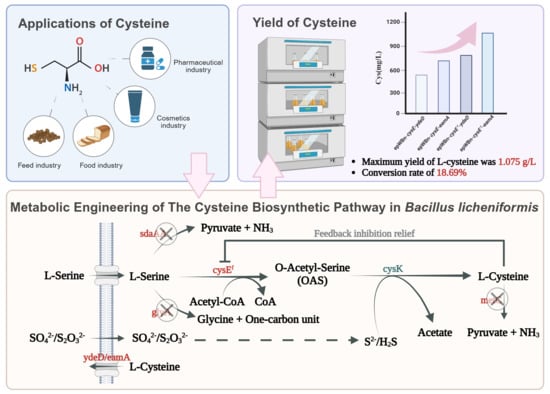
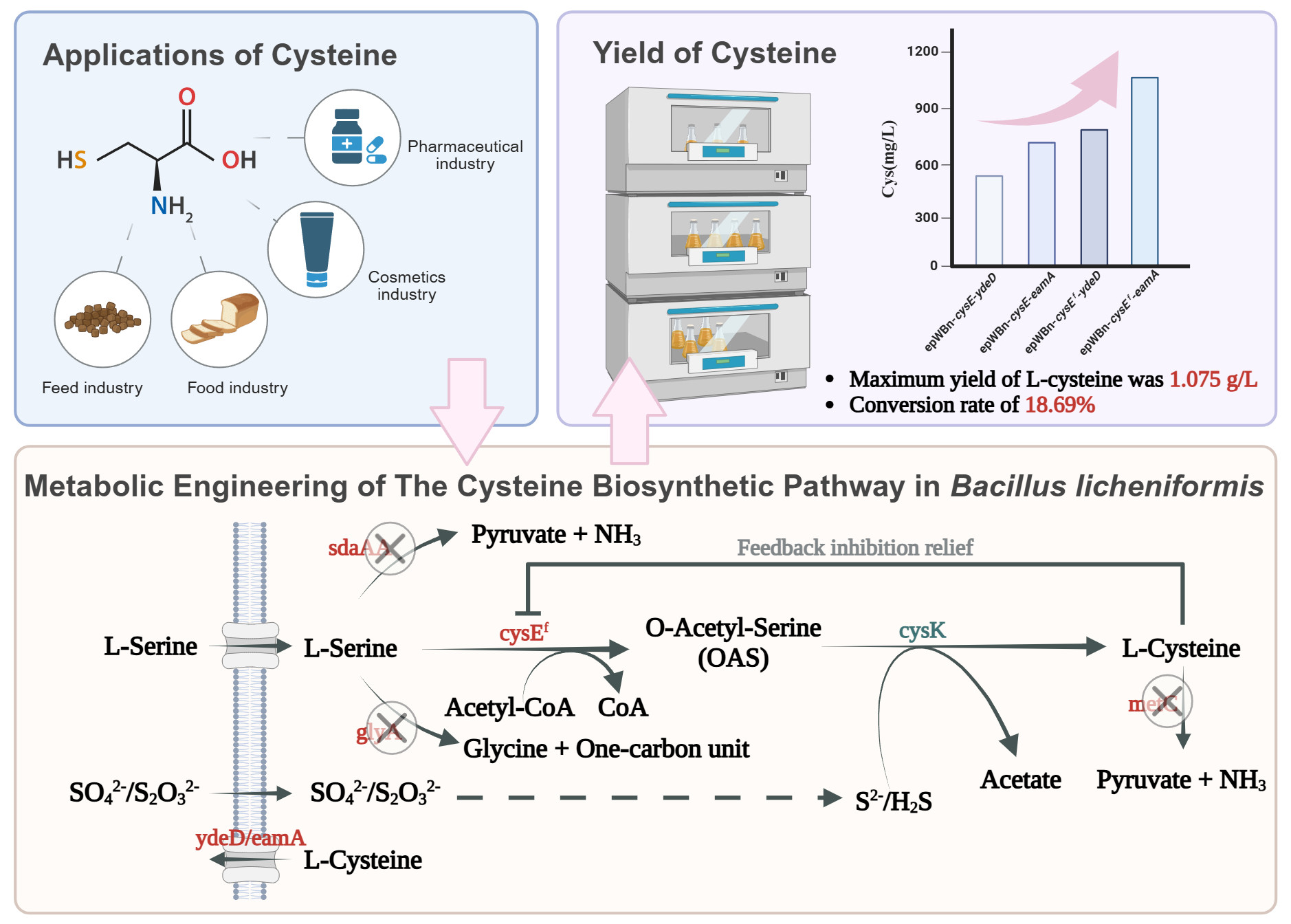
This study systematically characterized the L-cysteine biosynthetic pathway in Bacillus licheniformis and demonstrated that exogenous serine supplementation significantly upregulated the expression of pathway-associated genes, confirming serine as the primary precursor driving L-cysteine synthesis. Through targeted gene deletions, we generated knockout strains BL2ΔglyA, BL2ΔsdaAA, BL2ΔmetC, BL2Δ2, and BL2Δ3 to minimize precursor diversion and product degradation. Combinatorial overexpression of the feedback-resistant mutant cysEf and the transporter eamA yielded an engineered strain achieving 1.075 g/L L-cysteine in shake-flask fermentation with an 18.69% molar conversion yield. These findings highlight the potential of B. licheniformis as a platform for sulfur metabolic engineering and provide a sustainable fermentation strategy to replace traditional high-pollution hydrolysis-based L-cysteine production. Additionally, this work reveals fundamental differences in sulfur metabolism networks between Gram-positive and Gram-negative bacteria, elucidating microbial metabolic diversity and the cross-regulatory mechanisms linking sulfur, carbon, and nitrogen metabolism.

Graphical Abstract

1. Introduction

L-Cysteine (Cys), a sulfur-containing amino acid, plays an indispensable role in living organisms. In microorganisms, Cys is a central metabolite in sulfur amino acid metabolism and a protein building block [1,2,3]. It not only directly participates in protein folding and stability maintenance via the formation of disulfide bonds but also acts as a substrate for methionine (Met) synthesis and further functions as an essential precursor for the biosynthesis of a variety of key bioactive substances, including glutathione (GSH), coenzyme A, and S-adenosylmethionine (SAM) [4].
The industrial applications of L-cysteine are extensive, with continuously growing market demand. In pharmaceuticals, it functions as a detoxifying agent, mucolytic drug, and nutritional supplement [5,6,7]. The cosmetics industry utilizes its antioxidant properties and ability to promote skin metabolism in skincare and haircare formulations. Furthermore, the food industry employs L-cysteine as an effective dough conditioner, flavor enhancer, and natural antioxidant [8,9,10]. Despite these diverse applications, industrial L-cysteine production has long relied on chemical hydrolysis of keratin-rich materials such as human hair and feathers. This process requires harsh acid/alkali treatment, consumes substantial energy, and generates large volumes of sulfur- and nitrogen-containing organic wastewater, causing severe environmental pollution [11,12,13,14]. Consequently, developing green, sustainable, and precisely controllable microbial fermentation-based alternatives has emerged as both a research priority and an inevitable trend in this field [12,15,16,17,18].
Current research frontiers in L-cysteine fermentative production primarily focus on developing non-traditional host strains and implementing novel metabolic engineering strategies [19]. Recent breakthrough yields have predominantly originated from studies on Escherichia coli and Corynebacterium glutamicum. The construction strategies of relevant genetically engineered strains and the corresponding L-cysteine production yields are summarized in Table 1.
Bacillus licheniformis has emerged as a valuable industrial workhorse due to its robust environmental adaptability—including thermotolerance, desiccation resistance, and chemical stress tolerance—coupled with highly efficient metabolic networks. These attributes have positioned this organism as a key platform for applications spanning industrial fermentation, biopharmaceuticals, and environmental bioremediation [23,24,25].
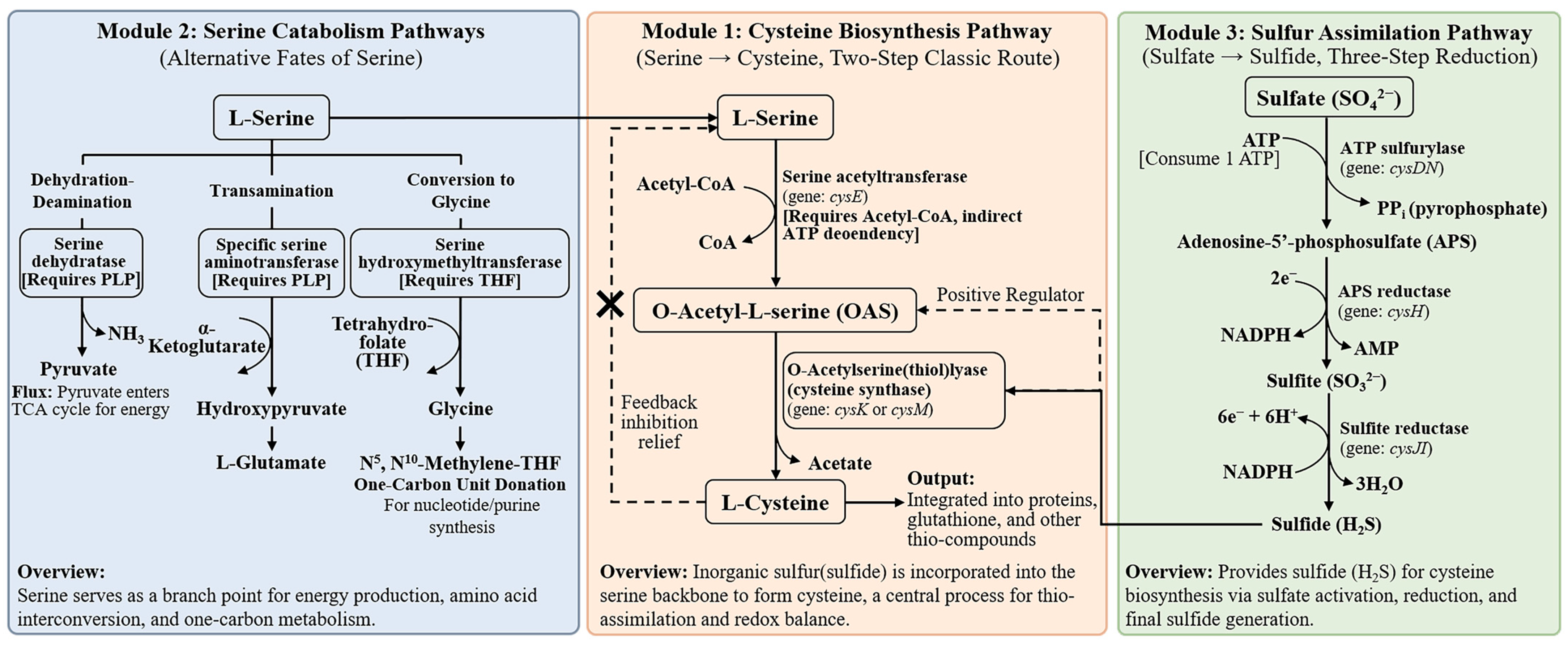
While sulfur metabolism pathways in Escherichia coli and Corynebacterium glutamicum have been extensively characterized [26,27], B. licheniformis—as a representative Gram-positive bacterium—exhibits fundamental differences from Gram-negative species in cellular architecture, stress response mechanisms, and global regulatory networks [28]. These distinctions suggest the potential existence of unique sulfur assimilation regulatory circuits and L-cysteine biosynthetic routes in this organism. Figure 1 illustrates the metabolic pathway involved in the conversion of serine to L-cysteine that may exist in Bacillus licheniformis. The systemic nature and metabolic plasticity of its biochemical networks render B. licheniformis an ideal model system for elucidating sulfur metabolism principles in Gram-positive bacteria. Investigating its L-cysteine biosynthetic pathway not only advances our understanding of interspecies metabolic diversity but also provides theoretical foundations for optimizing industrial applications of this versatile microorganism [29].

2. Results

2.1. Key Genes in the Cysteine Biosynthesis Pathway

2.1.1. Serine and Cysteine Utilization by the Wild-Type Strain

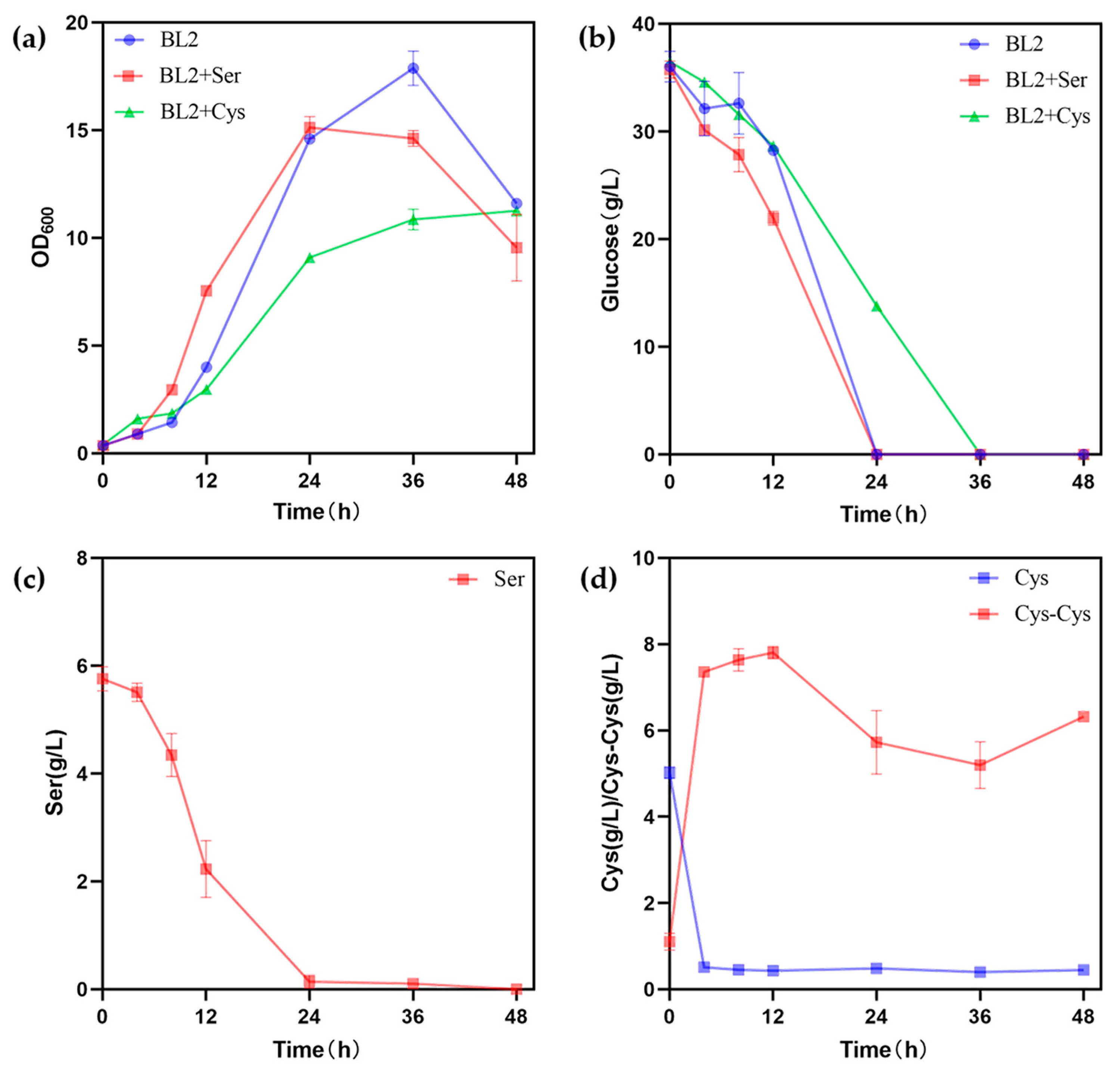
Wild-type B. licheniformis was cultivated in fermentation medium 1 for 48 h in shake flasks to assess substrate utilization patterns. Growth and glucose consumption curves are shown in Figure 2a,b, respectively. Supplementation with 5.76 g/L Ser enhanced growth of strain BL2, whereas addition of 5.02 g/L Cys exerted inhibitory effects on cell growth. As illustrated in Figure 2c, the strain rapidly consumed 5.76 g/L Ser within the first 24 h, with the period from 4 to 24 h representing the phase of rapid Ser depletion. This phase coincided with the logarithmic growth phase, suggesting that Ser serves as a preferentially utilized nutrient during rapid cell proliferation. Given the inherent cytotoxicity of L-Cys and its propensity for spontaneous oxidation to Cys-Cys in the extracellular environment, both Cys and Cys-Cys utilization was monitored. As shown in Figure 2d, Cys oxidation in shake flask cultures proceeded extremely rapidly: at 0 h, 5.02 g/L Cys and 1.10 g/L Cys-Cys were present; by 4 h, Cys had been almost completely converted to Cys-Cys; during the 12–24 h interval, 2.08 g/L Cys-Cys was consumed, indicating the potential presence of L-Cys degradation genes in the strain.

2.1.2. Identification of Key Genes in the Cysteine Biosynthesis Pathway

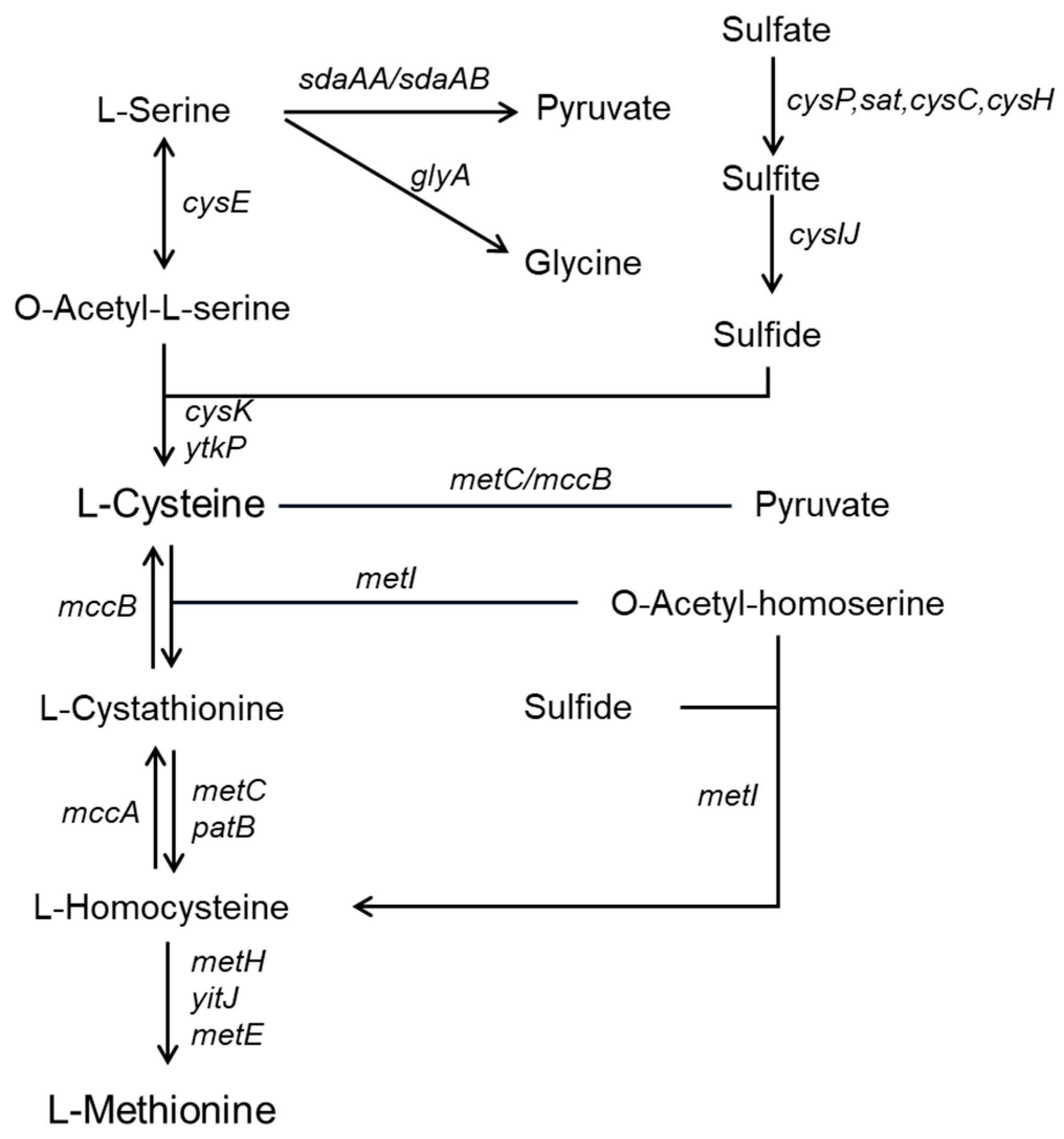
The metabolic pathway for microbial cysteine biosynthesis was retrieved from the KEGG database (https://www.genome.jp/kegg/ (accessed on 31 December 2025)). Building upon this foundation and integrating published literature on L-cysteine metabolism in Escherichia coli and Corynebacterium glutamicum [15], as well as studies on the sulfur assimilation pathway in Bacillus subtilis [30,31], the corresponding pathway in B. licheniformis was preliminarily elucidated (Figure 3). Subsequently, key genes in this pathway were identified through the NCBI database (https://www.ncbi.nlm.nih.gov/ (accessed on 31 December 2025)), and homology analysis of their encoded amino acid sequences was performed (Table 2).
Amino acid sequence homology analysis revealed that key genes in the L-cysteine biosynthetic pathway of B. subtilis, a model organism within the Bacillus genus, exhibited high sequence similarity (>80%) with their counterparts in B. licheniformis. In contrast, several genes (e.g., cysE, metI, and metC) showed substantially lower homology (<50%).

2.2. Transcriptional Profiling of Key Pathway Genes

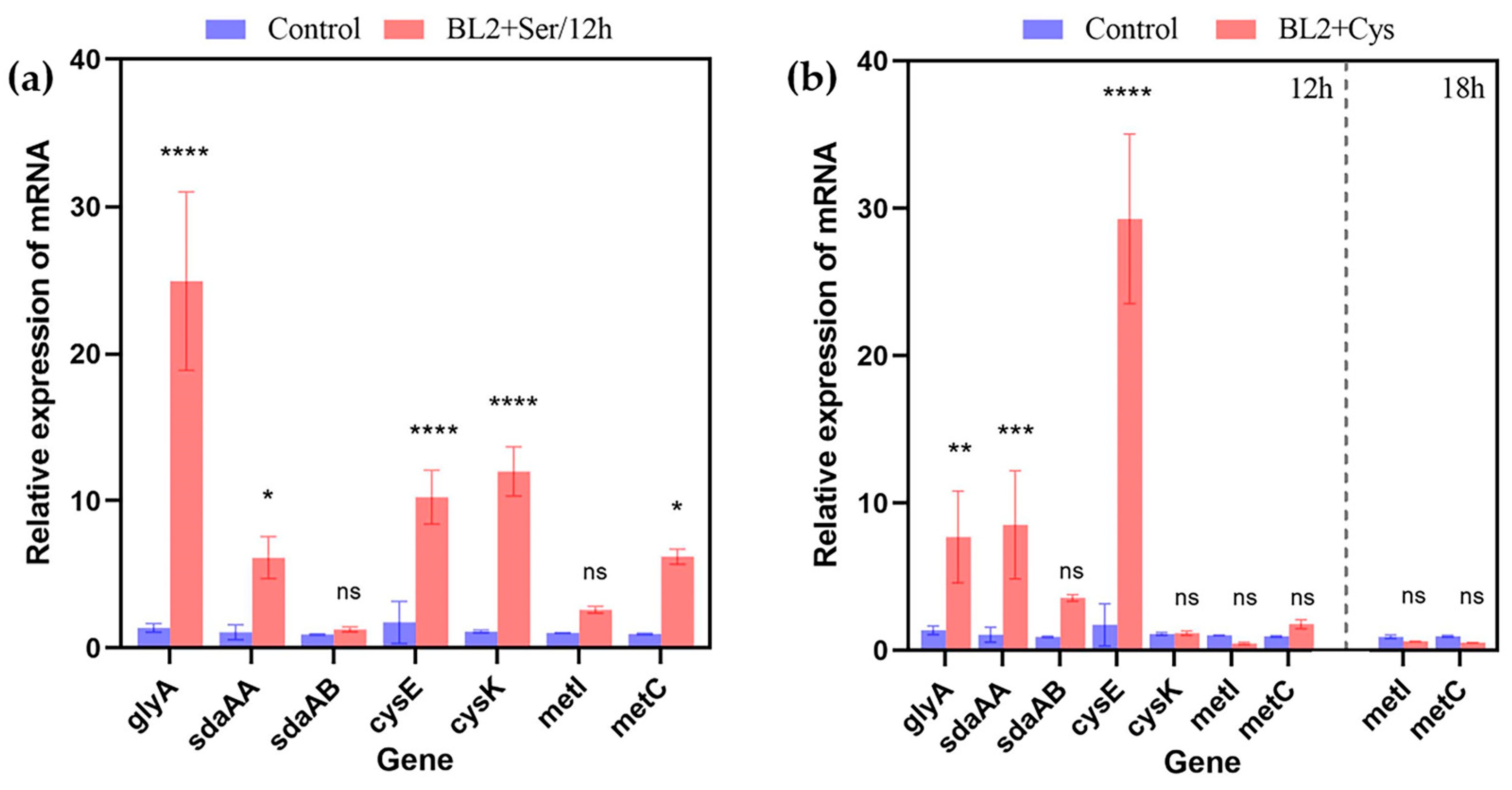
Based on the substrate utilization kinetics observed in Section 2.1.1, rapid L-serine uptake was closely associated with exponential cell growth. Therefore, transcriptional analysis of candidate pathway genes was conducted at 12 h, a critical time point during the logarithmic growth phase. Since L-cystine (Cys-Cys) uptake commenced after 12 h, gene expression was examined at both 12 h (initial utilization phase) and 18 h (sustained uptake phase) to capture dynamic transcriptional responses.
As shown in Figure 4a, during the rapid serine absorption phase at 12 h, transcriptional upregulation was observed across all seven genes examined. Notably, five genes—glyA, sdaAA, cysE, cysK, and metC—exhibited significant transcriptional enhancement, with relative mRNA expression levels increasing by 18.34-fold, 5.72-fold, 5.88-fold, 10.69-fold, and 6.51-fold, respectively. Integration of these transcriptional profiles with enzymatic characterization data from B. subtilis and amino acid sequence homology comparisons with B. licheniformis enabled the following mechanistic inferences: (1) Upregulation of glyA and sdaAA indicated activation of serine catabolic pathways. The glyA-encoded serine hydroxymethyltransferase catalyzes the reversible conversion of serine to glycine while generating one-carbon units for methylation reactions, representing a critical metabolic junction linking serine metabolism to the cellular one-carbon pool. Conversely, the sdaAA-encoded L-serine dehydratase irreversibly dehydrates serine to pyruvate, which subsequently enters central carbon metabolism for energy production. The concurrent upregulation of these genes suggested that rapidly absorbed serine served dual metabolic roles: as a one-carbon donor and as a carbon skeleton/energy source supporting cellular growth. (2) Enhanced expression of cysE and cysK strongly implicated augmented cysteine biosynthetic capacity during this phase. The cysE-encoded serine acetyltransferase functions as the rate-limiting enzyme initiating cysteine biosynthesis, with serine serving as its essential substrate. Abundant serine availability likely stimulated cysE expression or enzymatic activity through direct or indirect regulatory mechanisms. Subsequently, elevated expression of the cysK-encoded cysteine synthase ensured efficient conversion of biosynthetic intermediates to cysteine. This coordinated transcriptional response provided compelling evidence that cells actively channeled absorbed serine toward sulfur-containing amino acid biosynthesis. (3) Upregulation of metC suggested metabolic flux redirection toward methionine biosynthesis. The metC-encoded cystathionine β-lyase represents a key enzyme in the methionine biosynthetic pathway. Its transcriptional induction potentially indicated that sulfur atoms derived from cysteine metabolism were being redirected into methionine biosynthesis to satisfy cellular methionine requirements.
As illustrated in Figure 4b, at 12 h when Cys-Cys utilization commenced, three genes—glyA, sdaAA, and cysE—exhibited significant transcriptional upregulation among the seven genes monitored, with relative mRNA expression levels increasing by 5.67-fold, 7.94-fold, and 16.83-fold, respectively. During the initial phase of exogenous Cys-Cys uptake, imported Cys-Cys undergoes reduction to cysteine within the cell. As intracellular cysteine concentrations rise, feedback inhibition of cysteine biosynthesis would be anticipated; however, the marked elevation in cysE expression at 12 h suggested a more complex regulatory scenario. This phenomenon may reflect dynamic homeostatic mechanisms governing small-molecule metabolites such as O-acety-L-serine and hydrogen sulfide within the sulfur metabolic network. Exogenous cysteine influx likely perturbed this metabolic equilibrium, thereby triggering compensatory transcriptional activation of cysE and related genes. During the 18 h Cys-Cys absorption phase, relative mRNA expression levels of the cysteine catabolic genes metI and metC showed no significant deviation from control group values.

2.3. Knockout of Key Genes in Competing and Catabolic Pathways

Transcriptional profiling data from Section 2.2. enabled identification of critical metabolic nodes governing intracellular cysteine biosynthesis. Targeted deletion of highly expressed genes in pathways competing for cysteine biosynthetic precursors, coupled with elimination of key genes in cysteine catabolic pathways, effectively minimized precursor diversion and reduced cysteine degradation. This dual-knockout strategy not only facilitated functional validation of candidate genes but also enabled directional enhancement of cysteine biosynthetic flux.

Growth Kinetics and Serine Utilization of Knockout Strains

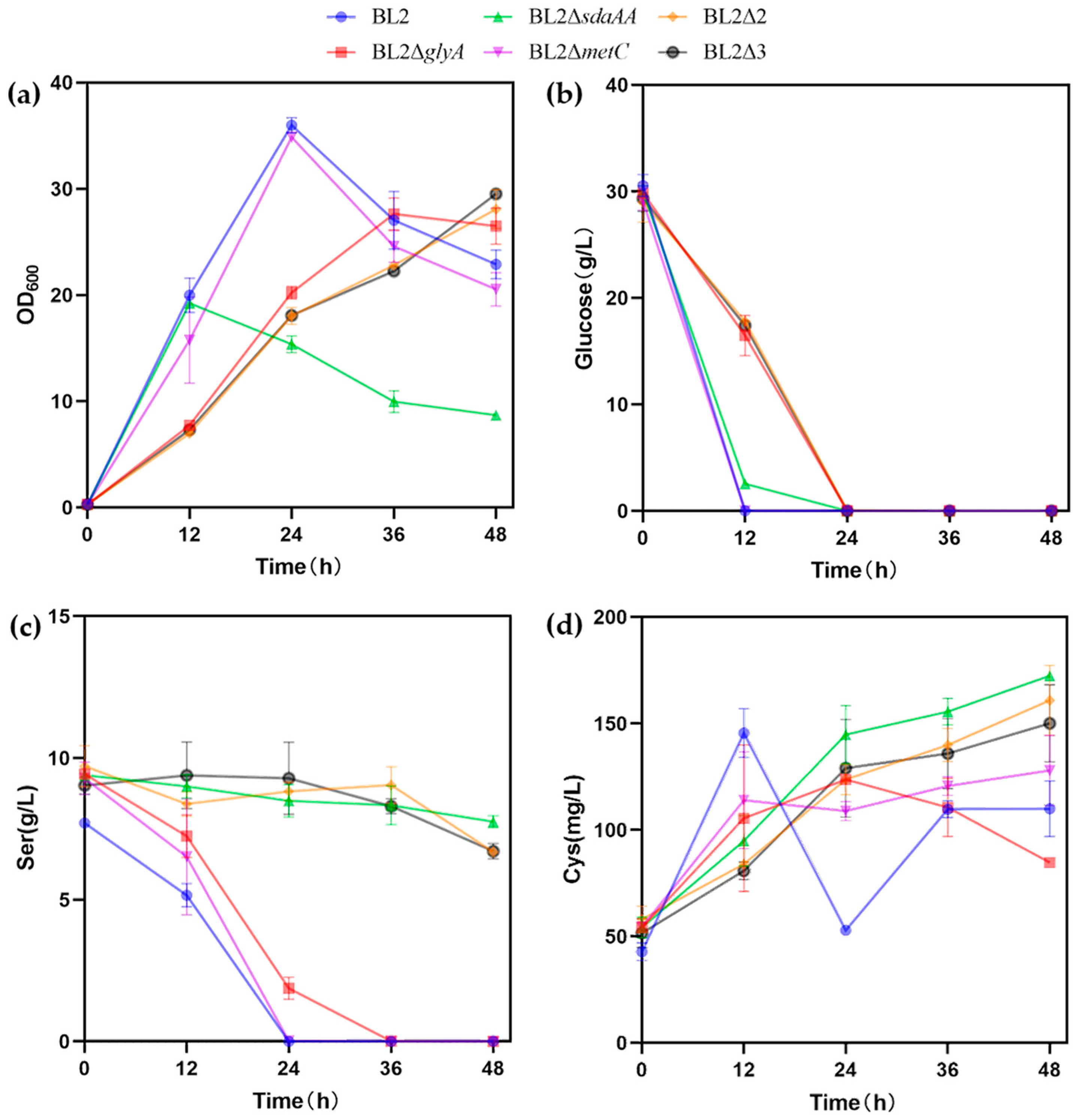
The knockout strains BL2ΔglyA, BL2ΔsdaAA, BL2ΔmetC, BL2Δ2 and BL2Δ3 were constructed according to the method described in Section 4.2.3. Fermentation medium 2 supplemented with 0.1 M serine, 0.5 M sodium sulphate and 0.25 M sodium metabisulphite, investigate the utilization of serine, the precursor for L-cysteine biosynthesis, by knockout strains.
As illustrated in Figure 5a,b, deletion of glyA and sdaAA significantly impaired cell growth. Strains BL2ΔglyA, BL2Δ2, and BL2Δ3 exhibited delayed growth kinetics, reaching maximum OD600 values of 26.48, 28.06, and 29.5, respectively, only after 48 h—substantially lower than the wild-type strain BL2, which peaked at OD600 = 35.96 within 24 h. In contrast, BL2ΔsdaAA displayed declining OD600 after 12 h despite continuous glucose consumption, suggesting entry into stationary phase between 12 and 24 h.
Regarding serine utilization (Figure 5c), sdaAA deletion exerted the most pronounced effect: BL2ΔsdaAA and its derivative multi-knockout strains consumed only approximately 2 g/L serine over 48 h, markedly lower than the wild-type BL2, which completely depleted 7.71 g/L serine within 24 h. Deletion of glyA resulted in delayed serine uptake, with complete consumption occurring only at 36 h. Conversely, metC deletion had negligible effects on both cell growth and serine utilization.
As shown in Figure 5d, sdaAA deletion enhanced L-cysteine biosynthesis, with BL2ΔsdaAA achieving the highest titer of 172.40 mg/L at 48 h among all knockout strains. This exceeded wild-type BL2, which accumulated a maximum of 145.52 mg/L at 12 h, as well as BL2Δ2 (160.89 mg/L) and BL2Δ3 (150.08 mg/L).
Based on integrated analysis of growth kinetics, substrate utilization, and product synthesis across multiple knockout strains, BL2Δ3 was selected as the chassis for L-cysteine biosynthesis. Although BL2ΔsdaAA exhibited the highest L-cysteine titer, BL2Δ3 demonstrated superior growth stability and substrate assimilation capacity. In contrast to BL2ΔsdaAA, which rapidly entered the death phase, BL2Δ3 sustained glucose consumption while achieving elevated final biomass, thereby maintaining metabolic activity throughout extended fermentation cycles. Regarding precursor supply, the dual knockout in BL2Δ3 (ΔsdaAA and ΔglyA) exerted critical synergistic effects. Deletion of sdaAA prevented serine degradation, while glyA knockout blocked the primary route for serine consumption via one-carbon metabolism. This dual blockade effectively minimized competitive serine depletion, promoting intracellular accumulation of this direct L-cysteine precursor and substantially enhancing its channeling into the cysteine biosynthetic pathway. Although comparison between BL2Δ2 and BL2Δ3 revealed negligible differences in growth and serine consumption regardless of metC deletion status, the theoretical rationale for metC knockout was to eliminate endogenous cysteine biosynthesis capacity, thereby directing and concentrating carbon flux toward more efficient L-cysteine synthesis.

2.4. Biosynthesis of L-Cysteine

Combinatorial Gene Expression for L-Cysteine Production

L-Cysteine biosynthesis represents a pivotal metabolic node linking intracellular carbon metabolism with sulfur assimilation, and its efficient realization is typically governed by stringent multilayered regulation. Within this biosynthetic pathway, serine acetyltransferase encoded by cysE is recognized as the rate-limiting enzyme, whose activity is subject to strong feedback inhibition by the end product L-cysteine. Consequently, elucidating and relieving this feedback inhibition is paramount for enhancing L-cysteine productivity. Studies have demonstrated that site-directed mutagenesis of the CysE protein in Escherichia coli to generate cysEfbr variants (T167A and G245S) significantly reduces sensitivity to L-cysteine, thereby effectively derepressing feedback inhibition [32]. Concurrently, to facilitate product export, mitigate cytotoxic effects from intracellular accumulation, and drive the synthetic reaction forward, co-expression of key L-cysteine biosynthetic genes with transporter-encoding genes (such as ydeD or eamA) has emerged as an effective metabolic engineering strategy. Overexpression of these transporters has been validated to stimulate L-cysteine secretion [22].
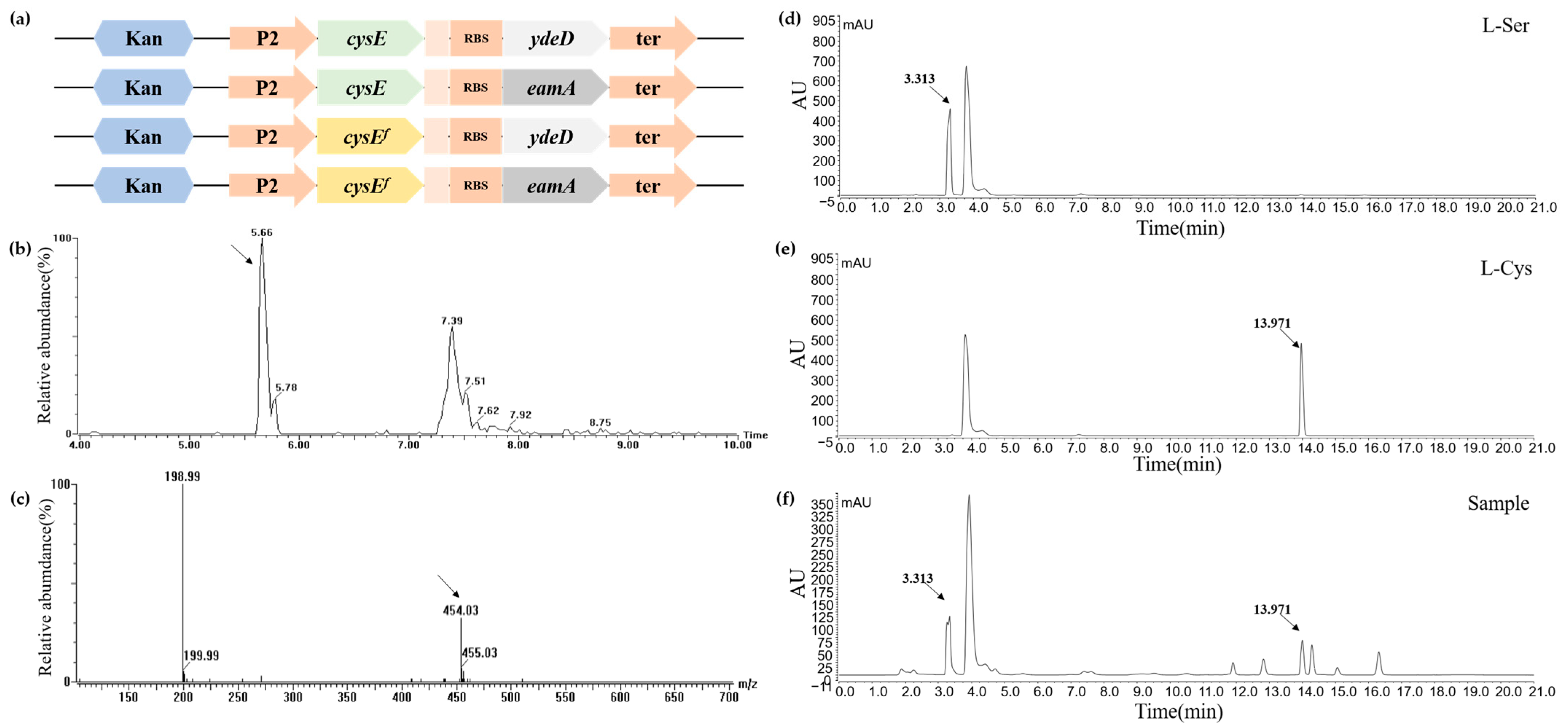
Based on the above rationale, overexpression strains epWBn-cysE-ydeD/BL2, epWBn-cysE-eamA/BL2, epWBn-cysEf-ydeD/BL2, epWBn-cysEf-eamA/BL2, epWBn-cysE-ydeD/BL2Δ3, epWBn-cysE-eamA/BL2Δ3, epWBn-cysEf-ydeD/BL2Δ3, and epWBn-cysEf-eamA/BL2Δ3 were constructed following the methodology described in Section 4.2.4. The genetic architecture of these overexpression plasmids is illustrated in Figure 6a. The cysE and ydeD genes originated from B. licheniformis, whereas eamA and cysEf (T167A) were codon-optimized for Escherichia coli to enhance their expression efficiency in B. licheniformis. Using Fermentation Medium 2 supplemented with 0.1 M serine, 0.5 M sodium sulphate and 0.25 M sodium metabi-sulphite, we investigated serine utilization and L-cysteine production by strains epWBn-cysE-ydeD/BL2, epWBn-cysE-eamA/BL2, epWBn-cysEf-ydeD/BL2, epWBn-cysEf-eamA/BL2, epWBn-cysE-ydeD/BL2Δ3, epWBn-cysE-eamA/BL2Δ3, epWBn-cysEf-ydeD/BL2Δ3, and epWBn-cysEf-eamA/BL2Δ3. LC-MS analysis of derivatized fermentation broth from strain epWBn-cysEf-eamA/BL2Δ3 confirmed these identifications (Figure 6b,c). Samples were processed and analyzed by HPLC according to Section 4.2.6. As shown in Figure 6d–f, L-serine eluted at approximately 3.313 min and L-cysteine at approximately 13.971 min, with retention times matching those of authentic standards.
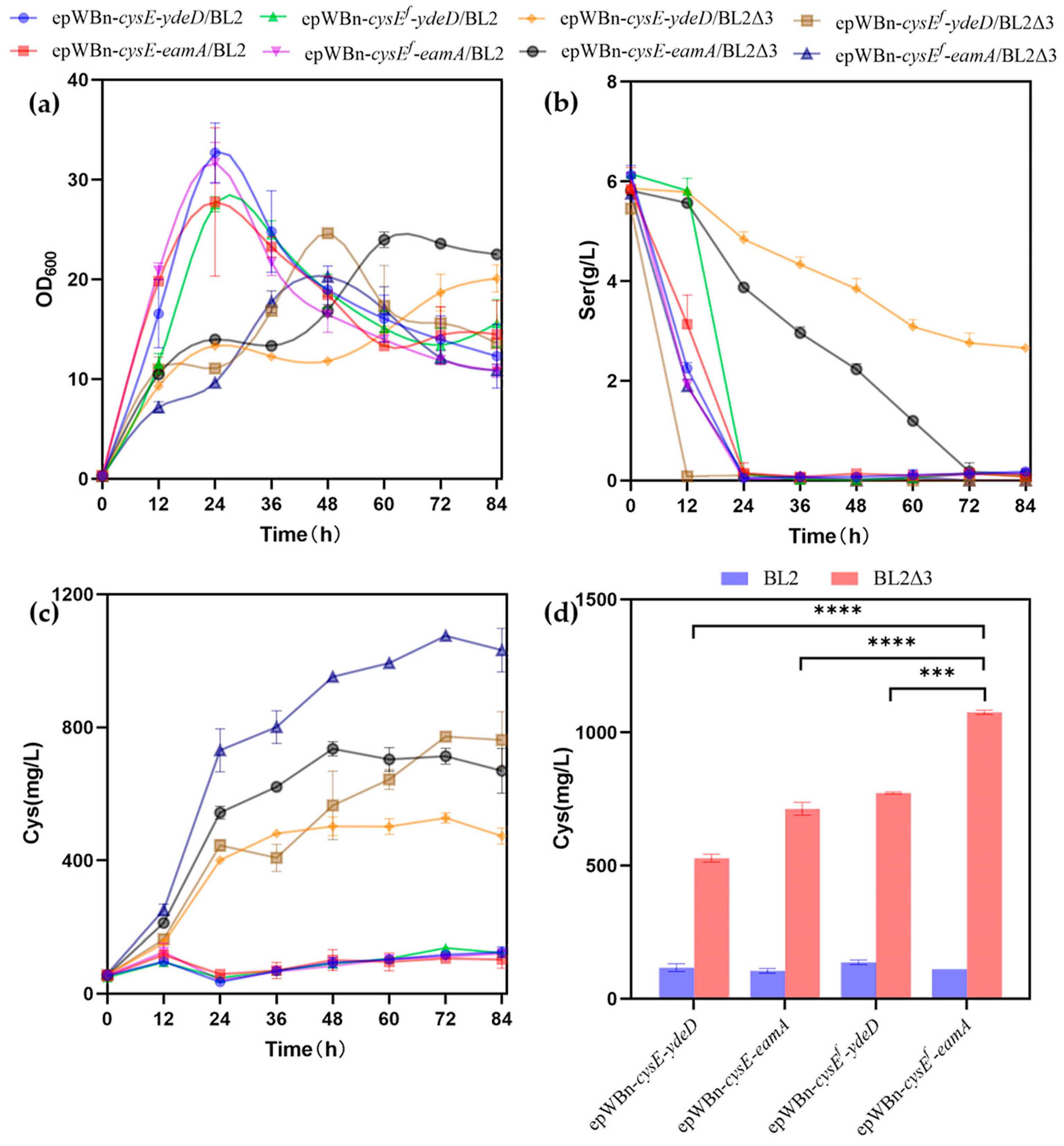
As shown in Figure 7a,b, BL2-based strains exhibited comparable growth patterns with no statistically significant differences. In contrast, strains harboring the BL2Δ3 chassis displayed pronounced growth variations depending on the overexpression construct. Strains epWBn-cysEf-ydeD/BL2Δ3 and epWBn-cysEf-eamA/BL2Δ3 reached maximum OD600 values of 24.62 and 20.24 at 48 h, respectively, whereas epWBn-cysE-ydeD/BL2Δ3 and epWBn-cysE-eamA/BL2Δ3 attained peak densities of 20.08 and 23.96 at 84 h and 60 h, respectively. Serine consumption profiles closely mirrored growth curves, indicating dual utilization for both biomass synthesis and L-cysteine biosynthesis. Notably, strains epWBn-cysEf-ydeD/BL2Δ3 and epWBn-cysEf-eamA/BL2Δ3, which entered stationary phase earlier, depleted serine more rapidly—nearly exhausting the substrate within 24 h. In contrast, epWBn-cysE-eamA/BL2Δ3 consumed serine more gradually, achieving complete depletion by 72 h, while epWBn-cysE-ydeD/BL2Δ3 utilized 3.202 g/L serine over 84 h. These findings suggest that co-expression of cysEf with either transporter gene (ydeD or eamA) in the BL2Δ3 background may alleviate metabolic burden or more effectively channel metabolic flux toward growth-supporting pathways, thereby conferring a growth advantage.
For L-cysteine biosynthesis, strain epWBn-cysEf-eamA/BL2Δ3 demonstrated superior fermentation performance compared to all other recombinant B. licheniformis strains tested. As depicted in Figure 7c,d, this strain achieved a peak L-cysteine titer of 1.075 g/L at 72 h, substantially exceeding all other constructs. Analysis of substrate utilization revealed that this strain consumed 5.752 g/L serine during the fermentation period, corresponding to a molar conversion yield of 18.69%. By comparison, strain epWBn-cysE-ydeD/BL2Δ3, despite consuming the least total serine, achieved a comparable conversion efficiency of 18.45%. Integrating biomass accumulation with product formation dynamics revealed partial coupling between L-cysteine synthesis and bacterial growth. As shown in Figure 7a,c, product accumulation exhibited a biphasic pattern: during the first 24 h (exponential growth phase), L-cysteine accumulated rapidly; thereafter, as cultures transitioned into stationary or decline phases, product formation continued at a reduced but sustained rate, defining a distinct production phase. This biphasic profile indicates that L-cysteine biosynthesis occurs during both active growth and post-exponential phases, reflecting a hybrid growth-associated and non-growth-associated production phenotype.

3. Discussion

The elucidate of the metabolic fate of L-serine in Bacillus licheniformis reveals a distinct genetic architecture governing serine degradation compared to the well-characterized networks in Escherichia coli and Corynebacterium glutamicum. In this study, we identified and characterized three primary genes associated with serine catabolism: glyA, encoding serine hydroxymethyltransferase (SHMT), and the sdaAA/sdaAB operon, encoding L-serine deaminase (L-SD). Our transcriptional profiling demonstrated that both glyA and sdaAA were significantly upregulated (18.34-fold and 5.72-fold, respectively) during the rapid serine consumption phase, confirming their pivotal roles in driving metabolic flux away from biosynthesis. This differs structurally from E. coli, which typically possesses a redundant array of three L-serine deaminases (sdaA, sdaB, and tdcG) alongside SHMT to manage serine toxicity and carbon/nitrogen utilization [33,34]. While E. coli utilizes this redundancy to fine-tune degradation in response to diverse environmental signals, such as anaerobiosis or catabolite repression, B. licheniformis appears to rely on a more streamlined system where sdaAA serves as the dominant catabolic valve. The function of GlyA (SHMT) remains evolutionarily conserved across these species, catalyzing the reversible interconversion of L-serine and glycine. However, the metabolic context differs; in C. glutamicum, GlyA activity is tightly coupled to the supply of one-carbon units (C1) essential for folate metabolism and purine synthesis, often making its deletion deleterious to growth in minimal media [35,36]. Our data suggests that in B. licheniformis, glyA acts not merely as a biosynthetic enzyme for glycine but as a significant competitive sink for serine, particularly when extracellular serine is abundant. This is evidenced by the rapid upregulation of glyA in the presence of exogenous serine, aiming to balance the intracellular C1 pool while dissipating excess substrate. Furthermore, the irreversible deamination catalyzed by sdaAA generates pyruvate and ammonia, directly linking serine catabolism to the central TCA cycle and nitrogen metabolism. This linkage highlights a fundamental metabolic logic in B. licheniformis: unlike C. glutamicum, which often prioritizes serine as a building block, B. licheniformis readily scavenges serine as an energy source, necessitating the aggressive disruption of these pathways to engineer an efficient cell factory. The distinction is further amplified by the Gram-positive nature of B. licheniformis, where the regulation of these genes likely involves unique transcription factors distinct from the leucine-responsive regulatory protein (Lrp) often seen in E. coli, underscoring the necessity of the specific knockout strategies (glyA/sdaAA) employed in this work to occlude these competing drains.
Physiological impact of serine degradation gene deletions on growth kinetics and precursor availability. The systematic deletion of serine degradation genes in B. licheniformis uncovered a complex trade-off between cell viability and precursor preservation, presenting a scenario distinct from that observed in E. coli metabolic engineering. In our study, the deletion of sdaAA (strain BL2ΔsdaAA) resulted in the most dramatic cessation of serine consumption, confirming its status as the primary catabolic route. However, this blockade imposed a severe physiological cost: the strain exhibited a precipitous decline in biomass and rapid entry into a death phase after only 12 h, despite ample residual glucose. This phenotype implies that sdaAA-mediated deamination is critical for maintaining intracellular homeostasis, possibly by detoxifying excess serine or providing essential pyruvate for energy maintenance when glycolytic flux is perturbed. This contrasts with E. coli, where deletion of the dominant deaminase sdaA typically slows growth but does not induce such rapid lethality, as the organism can compensate via alternative pyruvate-generating pathways or redundant deaminases (sdaB/tdcG). Similarly, in C. glutamicum, disrupting serine degradation often leads to growth retardation due to glycine auxotrophy rather than acute toxicity. Our results with the glyA deletion further illustrate species-specific differences; BL2ΔglyA showed significantly delayed growth and extended serine consumption time (36 h) rather than complete consumption arrest. This suggests that while GlyA is a major consumer of serine, its absence primarily creates a metabolic bottleneck in one-carbon metabolism—limiting biosynthesis of downstream metabolites like purines—rather than acting as a sole catabolic valve. The most striking finding was the synergistic rescue effect observed in the multiplex knockout strain BL2/Δ3. Unlike the single sdaAA mutant, BL2/Δ3 maintained sustained glucose consumption and achieved higher final biomass. This suggests that simultaneous blockage of the glycine pathway (glyA) and the deamination pathway (sdaAA) forces the cell to re-equibrate its central metabolism, perhaps by relieving the immediate buildup of toxic intermediates or ammonia that might occur when only one pathway is blocked.
The biosynthesis of L-cysteine is tightly regulated at the step of serine acetyltransferase (SAT), encoded by cysE, which catalyzes the acetylation of L-serine to O-acety-L-serine (OAS). Our study confirms that relieving feedback inhibition at this node is the single most critical factor for high-yield production in B. licheniformis, mirroring the established paradigm in E. coli and C. glutamicum. We employed a mutant cysEf (T167A), analogous to feedback-resistant alleles used in E. coli, and observed a massive increase in production when coupled with transport engineering. Interestingly, our transcriptional analysis of the wild-type strain revealed a counter-intuitive phenomenon: cysE expression was significantly upregulated (16.83-fold) upon exposure to exogenous cysteine/cystine. This contradicts the classic repression model seen in E. coli, where elevated end-product levels typically repress biosynthetic operons. This anomaly suggests that B. licheniformis possesses a distinct, possibly feed-forward, regulatory circuit where cysteine or its degradation products (e.g., sulfide) act as inducers to prime the sulfur assimilation machinery, highlighting a unique regulatory architecture in this Gram-positive bacterium. Despite this native regulation, the introduction of the heterologous, feedback-resistant cysEf was essential to decouple synthesis from these complex endogenous controls. Furthermore, our comparative analysis of transporters revealed that the E. coli-derived transporter eamA significantly outperformed the native B. licheniformis transporter ydeD in the BL2/Δ3 background, achieving a titer of 1.075 g/L. In E. coli studies, ydeD is often the primary target for enhancing export; however, our results indicate that eamA offers superior export kinetics or stability in the Bacillus membrane environment, effectively acting as a “metabolic pull” to shift the equilibrium of the reversible CysK reaction toward synthesis. The success of the epWBn-cysEf-eamA/BL2Δ3 strain highlights a convergent evolution in metabolic engineering strategies: while the specific genetic tools (transporters, promoters) must be optimized for the host, the fundamental logic—deregulating the rate-limiting enzyme (SAT) and enhancing product efflux—remains universally applicable across E. coli, C. glutamicum, and B. licheniformis. However, our strain achieved an 18.69% molar conversion yield 15, which, while promising, suggests that downstream limitations (likely in sulfide supply or ATP regeneration) still exist compared to the highly optimized E. coli strains capable of >30 g/L titers. This underscores the potential of B. licheniformis not just as a distinct biological model, but as a robust industrial platform that, with further optimization of cofactor supply and sulfur uptake, could rival traditional Gram-negative producers.
The purpose of this study was to systematically elucidate the biosynthetic pathway of L-cysteine in Bacillus licheniformis, including the functions of key genes, the regulatory mechanisms of metabolic flux, and the distribution rules of the precursor (L-serine), so as to achieve a relatively optimal yield of cysteine. In the existing research on L-cysteine biosynthesis, the core hosts are concentrated on two major model microorganisms, namely Escherichia coli and Corynebacterium glutamicum. Nevertheless, Bacillus licheniformis, an important chassis strain in industrial fermentation, inherently exhibits remarkable thermostability, stress resistance (including tolerance to acid-base fluctuations, osmotic pressure changes and toxicity of metabolic intermediates) and a highly integrated, efficient metabolic network. These traits endow it with a broader process window for large-scale industrial production. Notably, as a sulfur-containing amino acid, the intracellular accumulation of L-cysteine can induce cytotoxicity via mechanisms such as disrupting redox homeostasis and inhibiting the activity of key enzymes. In contrast, Bacillus licheniformis can not only resist such toxic stress by virtue of its robust stress resistance, but also further optimize the synthetic pathway through its efficient protein secretion system and metabolic flux distribution capacity. This circumvents the issues of production capacity fluctuations or strain inactivation in Escherichia coli and Corynebacterium glutamicum during industrial production due to insufficient environmental stability, thereby providing core physiological support for the stable and high-yield microbial synthesis of L-cysteine.
It is worth emphasizing that as the direct precursor for L-cysteine synthesis, the cost proportion of L-serine directly determines the economic viability of industrial production. This study did not investigate strategies for reducing L-serine costs in the context of L-cysteine biosynthesis in terms of production efficiency and cost. At present, Bacillus licheniformis still cannot surpass E. coli and C. glutamicum in this aspect. To truly achieve the goals of “reducing substrate consumption costs and improving conversion efficiency” in Bacillus licheniformis, it is feasible to consider genetic modification of the relevant genes involved in the de novo cysteine biosynthesis pathway using glucose as the substrate, and in-depth research in this area is urgently needed.

4. Materials and Methods

4.1. Materials

4.1.1. Strains and Plasmids

The bacterial strains and plasmids employed in this study are listed in (Table 3).

4.1.2. Reagents and Instrumentation

Restriction endonucleases were obtained from Thermo Fisher Scientific (Thermo Fisher Scientific, Waltham, MA, USA). Molecular biology reagents, including 2 × Taq PCR Master Mix, 2 × Phanta PCR Master Mix, plasmid DNA extraction kits, DNA purification kits, total RNA extraction kits, reverse transcription kits, and quantitative PCR (qPCR) kits, were purchased from Nanjing Vazyme Biotech Co., Ltd. (Nanjing Vazyme Biotech Co., Ltd., Nanjing, China). Microbiological media components (peptone, yeast extract, agar powder) were sourced from OXOID (OXOID, Basingstoke, UK). DNA molecular weight standards Marker were obtained from Takara Bio (Takara Bio. Kusatsu, Japan). Antibiotics (kanamycin) were purchased from Merck Sigma-Aldrich (Merck Sigma-Aldrich, St. Louis, MO, USA).
Instrumentation included an automatic high-pressure steam sterilizer (Sanyo, Tokyo, Japan); S100D thermal cycler (Bio-Rad, Hercules, CA, USA); DYY-6C nucleic acid electrophoresis apparatus (Beijing Liuyi Factory, Beijing, China); Chemi Doc XRS+ gel imaging system (Bio-Rad, Hercules, CA, USA); constant-temperature metal bath (Shanghai Yiheng Scientific Instruments Co., Ltd., Shanghai, China); PICO17 high-speed centrifuge (Thermo Fisher Scientific, Waltham, MA, USA); UV-1200 spectrophotometer (Shanghai Mapada Instruments Co., Ltd., Shanghai, China); laminar flow hood (Dalian Bao Biological Engineering Co., Ltd., Dalian, China); FiveEasy Plus pH meter (Mettler-Toledo Instruments, Shanghai, China); CFX96 Real-Time PCR Detection System (Bio-Rad, Hercules, CA, USA); and high-performance liquid chromatography system (Agilent Technologies, Santa Clara, CA, USA).

4.1.3. Media and Reagent Preparation

All chemicals used in the preparation of all media and reagents were purchased from Aladdin Reagent Co., Ltd., Shanghai, China.
  • Fermentation Media
Luria–Bertani (LB) medium contained 5 g/L yeast extract, 10 g/L tryptone, and 10 g/L sodium chloride. For solid medium preparation, agar powder was added at 1.5–2.0% (w/v).
Fermentation medium 1 contained 30 g/L glucose, 10 g/L dipotassium hydrogen phosphate, 1.36 g/L potassium dihydrogen phosphate, 5 g/L ammonium sulfate, 10 g/L urea, 2 g/L magnesium sulfate heptahydrate, 10 g/L monosodium glutamate, and 2 g/L MKF.
Fermentation medium 2 was supplemented with 20 g/L tryptone and 10 g/L yeast extract in addition to the components of fermentation medium 1.
MKF contained 54.4 g/L ammonium ferric citrate, 9.8 g/L manganese chloride tetrahydrate, 1.6 g/L cobalt chloride hexahydrate, 1 g/L copper chloride dihydrate, 1.9 g/L boric acid, 9 g/L zinc sulfate heptahydrate, 1.1 g/L sodium molybdate dihydrate, 1.5 g/L sodium selenite, 1.5 g/L nickel sulfate hexahydrate, with deionized water as the solvent.
All media were autoclaved at 115 °C for 20 min. When required, tetracycline, ampicillin, and kanamycin were added to final concentrations of 40, 100, and 50 μg/mL, respectively.
2.
Media and Reagents for B. licheniformis Electrotransformation
Medium I consisted of liquid LB medium supplemented with 0.5 M sorbitol. Used for the expansion culture of Bacillus licheniformis to obtain bacterial cells in the mid-logarithmic growth phase, which are the optimal materials for competent cell preparation.
Recovery medium consisted of liquid LB medium supplemented with 0.5 M sorbitol and 0.38 M mannitol. Used for the repair and resuscitation of electroporated damaged cells, so as to improve the survival rate of transformants.
Buffer BW contained 0.5 M sorbitol, 0.5 M mannitol, and 10% glycerol. Used for the washing, resuspension and cryopreservation of competent cells, and it is a key reagent that determines the electroporation efficiency.

4.1.4. Primers

Primers used in this study are listed in (Table 4). Primer design was performed using SnapGene version 6.0.2 (Insightful Science, San Diego, CA, USA). Primer synthesis and DNA sequencing services were provided by Sangon Biotech (Sangon Biotech Co., Ltd., Shanghai, China).

4.2. Experimental Methods

4.2.1. Real-Time Quantitative PCR Analysis

Reverse transcription quantitative PCR (RT-qPCR) determination of relative gene expression levels in B. licheniformis was performed according to the method of Liu et al. [37]. Relevant primers were designed using the Primer3Plus online platform (https://www.primer3plus.com/index.html (accessed on 31 December 2025)), with sequences listed in (Table 5).
Fermentation medium 1 was employed under standard fermentation conditions. At 0 h, 5 g/L L-serine was added to induce expression, and RT-qPCR was used to investigate transcriptional changes in key genes in the sulfur assimilation pathway of B. licheniformis. Samples were collected at 0, 4, 8, 12, 18, 24, and 48 h for determination of glucose, serine, and biomass, while cells were harvested for mRNA extraction. Total RNA was extracted using the FastPure Complex Tissue/Cell Total RNA Isolation Kit (Nanjing Vazyme Biotech Co., Ltd., Nanjing, China) and quantified using a visible spectrophotometer. Extracted RNA was subjected to genomic DNA removal and reverse transcription using the HiScript® III All-in-one RT SuperMix Perfect for qPCR kit (Nanjing Vazyme Biotech Co., Ltd., Nanjing, China). The resulting cDNA served as the template for RT-qPCR, which was performed using the Bio-Rad CFX Manager Real-Time PCR System (Bio-Rad, Hercules, CA, USA) and ChamQ Universal SYBR qPCR Master Mix kit (Nanjing Vazyme Biotech Co., Ltd., Nanjing, China), with primers listed in Table 5 to detect transcriptional levels of relevant genes.
Reaction conditions were as follows: 95 °C for 10 min, followed by 40 cycles of denaturation at 95 °C for 15 s and annealing/extension at 60 °C for 1 min. The rpsE gene was used as the internal reference, amplified with primers rpsE-F/R. Relative transcriptional levels were calculated using the 2−ΔΔCt method.

4.2.2. Preparation and Electroporation of B. licheniformis Competent Cells

The methods for the preparation of B. licheniformis competent cells, transformation, and screening of positive transformants were all performed according to the protocol of Xiao et al. [23]. Wild-type Bacillus licheniformis or marker-free knockout strains were inoculated into 15 mL of LB medium and subjected to overnight activation culture at 37 °C with shaking at 220 rpm. The overnight activated bacterial culture was transferred into 30 mL of Medium I and further cultured at 37 °C with shaking at 220 rpm for 4.5 h until the OD600 value reached 0.85–0.95. Subsequently, the bacterial suspension was ice-bathed for 30 min, and the cells were harvested by centrifugation at 5000× g for 5 min at 4 °C, followed by four rounds of washing with buffer BW. Finally, the harvested cells were resuspended in 750 μL of buffer BW, aliquoted into 1.5 mL centrifuge tubes at a volume of 80 μL per tube, and stored at −70 °C for subsequent use.
The inducible expression vector was introduced into Bacillus licheniformis via the electroporation method. Specifically, 8–10 μg of plasmid was added to 80 μL of Bacillus licheniformis competent cells and mixed thoroughly. The mixture of competent cells was transferred into a pre-chilled 0.1 cm electroporation cuvette, followed by ice incubation for 5 min. Then, the 0.1 cm Gene Pulser cuvette was placed into an electroporation apparatus and stimulated with a voltage of 2100 V. After the shock, 800 μL of L recovery medium was immediately added. The resultant strains were cultured at 37 °C with shaking at 220 rpm for 3 h and then spread onto the corresponding antibiotic-containing plates.

4.2.3. Gene Knockout

To knockout target genes using the CRISPR-Cpf1 gene knockout system, with reference to the protocol described by Liu et al. [38]. The core principle of CRISPR-Cpf1 system-mediated gene knockout is to utilize the Cpf1 nuclease, guided by a single crRNA, to recognize and cleave the target gene DNA for generating double-stranded breaks (DSB), and achieve target gene deletion relying on the bacterial homologous recombination (HR) repair mechanism (combined with homology arm templates). Its strategy specifically including: constructing knockout vectors using the small vector pJOE8999 harboring a kanamycin resistance marker to reduce transformation pressure; regulating the conditional expression of Cpf1 through the maltose-inducible promoter Pmal to minimize host toxicity; designing specific crRNAs (single-target or multi-target arrays) to realize single-gene or multi-gene targeting. The realization of double crossover events depends on the synergistic effect of the selection pressure from DSB induced by Cpf1 and the repair mediated by homology arms, ensuring only successfully recombinant strains can survive. Regarding the marker strategy, the “marker construction-marker elimination” approach is adopted: after obtaining positive transformants through kanamycin screening, the resistance marker is eliminated in antibiotic-free medium by leveraging the temperature-sensitive replication characteristic of the vector, ultimately yielding marker-free knockout strains.
  • Construction of Knockout Plasmids
The glyA gene encoding serine hydroxymethyltransferase from B. licheniformis CICIM B1391 was selected as the target for gene knockout experiments. The knockout plasmid pJOE8999-glyA was constructed using the shuttle vector pJOE8999 as the backbone. Using the B. licheniformis genome as template, primer pairs glyA-STY-F/R and glyA-XTY-F/R were employed in PCR to amplify 500 bp fragments upstream and downstream of the glyA gene, respectively. These two 500 bp homologous arm fragments served as templates for overlap extension PCR using primers glyA-STY-F/glyA-XTY-R to generate a 1000 bp glyA-TY homologous arm fragment. A laboratory-derived vector containing the PN2 [38] promoter, target gene site, and repeat sequences was used as template with primer pairs PN2-glyA-F/PN2-glyA-R and glyA-F/glyA-R to amplify the PN2 and BD fragments, respectively. Subsequently, these PN2 and BD fragments served as templates for another round of overlap extension PCR using primers PN2-glyA-F/glyA-R to obtain the PN2-BD fragment. Finally, using glyA-TY and PN2-BD as templates, primers PN2-glyA-F and glyA-XTY-R were employed in a third overlap extension PCR to generate the glyA knockout cassette. The knockout cassette was assembled with pJOE8999 through homologous recombination following EcoRI/BamHI double digestion of the shuttle vector, yielding plasmid pJOE8999-glyA containing the complete knockout cassette. Knockout plasmids for the sdaAA gene (encoding L-serine deaminase) and the metC gene (encoding cystathionine-β-lyase) were constructed using the same methodology and designated pJOE8999-sdaAA and pJOE8999-metC, respectively.
2.
Construction of Knockout Strains
The total length of the knockout plasmids pJOE8999-glyA, pJOE8999-sdaAA, and pJOE8999-metC is 8424 bp. Sequence-verified plasmids were subjected to double digestion with EcoRI and BamHI, which theoretically yielded two fragments of 1303 bp and 7121 bp. The plasmids were then sequentially electroporated into competent cells of BL2, BL2ΔglyA, and BL2Δ2 to generate recombinant strains harboring the knockout constructs. Recombinant colonies were activated on agar plates, and single colonies were inoculated into shake flasks containing 15 mL LB medium and cultured at 37 °C and 220 rpm for 16 h. The cultures were subsequently transferred to fresh 15 mL LB medium and incubated at 42 °C and 220 rpm for 24 h. Serial dilutions (10−6 and 10−7) were then plated on kanamycin-containing agar and incubated at 37 °C for 16 h. Verification of gene deletions was performed using primer pairs glyA-YZ-F/glyA-YZ-R, sdaAA-YZ-F/sdaAA-YZ-R, and metC-YZ-F/metC-YZ-R. A single band with a size of 1400 bp observed in colony PCR indicates a transformant that has undergone double crossover. Transformants exhibiting double-crossover events were selected and inoculated into 15 mL LB medium, cultured at 42 °C for 16 h, and streaked for single colonies. Colonies were replica-plated onto both kanamycin-containing and antibiotic-free plates; strains growing on antibiotic-free plates but not on kanamycin plates were identified as plasmid-cured. The final knockout strains—BL2ΔglyA, BL2ΔsdaAA, BL2ΔmetC, BL2Δ2, and BL2Δ3—were preserved and stored at −70 °C.

4.2.4. Construction of Overexpression Recombinant Strains

The laboratory-available plasmid epWBn-P2-treA was first linearized by double digestion with KpnI and BamHI restriction endonucleases. Primer pairs cysE-F/R and ydeD-F/R were then used to amplify the cysE and ydeD gene fragments from the B. licheniformis genome (the cysEf and eamA genes were synthesized by Shanghai Bioengineering Co., Ltd. following codon optimization). Using the amplified fragments as templates, primers cysE-F/ydeD-R were employed in overlap extension PCR to generate the cysE-ydeD fusion fragment. A terminator (Ter) was added to the 3′ end of the combined gene. The resulting vector and target gene fragments were purified by gel extraction. The purified fragments were ligated to the epWBn-P2 vector via homologous recombination. The successfully constructed recombinant DNA was subsequently transformed into competent E. coli JM109 cells and spread uniformly on agar plates containing kanamycin. Selected transformants were verified by colony PCR using primers epWBn-F/R. PCR-positive transformants were inoculated into 15 mL LB liquid medium for preservation and plasmid extraction, followed by Sanger sequencing. Upon confirmation of correct plasmid construction, the plasmid was electroporated into competent cells of wild-type B. licheniformis. Transformants were spread on kanamycin-containing plates and verified by colony PCR using primers epWBn-F/R. Positive transformants were inoculated into 15 mL LB liquid medium for preservation, ultimately yielding the recombinant strain epWBn-cysE-ydeD/BL2. Recombinant strains with gene overexpression in both wild-type and knockout backgrounds were constructed using the same methodology and designated epWBn-cysE-ydeD/BL2, epWBn-cysE-eamA/BL2, epWBn-cysEf-ydeD/BL2, epWBn-cysEf-eamA/BL2, epWBn-cysE-ydeD/Δ3, epWBn-cysE-eamA/Δ3, epWBn-cysEf-ydeD/Δ3, and epWBn-cysEf-eamA/Δ3, respectively.

4.2.5. Fermentation Conditions

Wild-type Bacillus licheniformis and recombinant strains were separately inoculated into 15 mL of antibiotic-free or kanamycin-supplemented LB medium, followed by cultivation at 37 °C with shaking at 220 rpm for 18–24 h to obtain seed cultures with an OD600 value of 4–5. Subsequently, the seed cultures were transferred at an inoculum size of 3% (v/v) into kanamycin-supplemented fermentation medium 1 or 2 and cultured at either 37 °C or 42 °C with shaking at 220 rpm for 2–4 days. Samples were harvested every 12 h to determine the OD600 value, glucose concentration, L-serine concentration, and L-cysteine concentration of the fermentation broth.

4.2.6. Detection of Fermentation Parameters

  • Biomass Determination
Cell-containing fermentation broth at the end of cultivation was thoroughly mixed and diluted appropriately with sterile water. Three milliliters of the diluted fermentation broth was transferred to a cuvette with a 1 cm path length, and absorbance was measured at 600 nm. Blank culture medium diluted by the same factor served as the control. Biomass was calculated by multiplying the absorbance value obtained from the spectrophotometer by the dilution factor.
2.
Glucose Determination
During fermentation, 1 mL samples were collected and centrifuged at 12,000 rpm for 5 min. A 500-μL aliquot of the supernatant was mixed with an equal volume of 10% trichloroacetic acid solution and incubated for 10 h to precipitate proteins. The protein-precipitated fermentation broth was then centrifuged at 12,000 rpm for 20 min to achieve complete solid–liquid phase separation. A 200-μL aliquot of the supernatant was transferred to a vial insert and analyzed using a CarboPac Ca2+ column with ultrapure water as the mobile phase at a flow rate of 0.8 mL/min and column temperature of 80 °C to determine sugar content in the medium.
3.
Amino Acid Detection
Sample derivatization: During fermentation, 0.5 mL of the fermentation broth was transferred into a 1.5 mL Eppendorf (EP) tube. An equal volume of 0.04 M tris(2-carboxyethyl)phosphine hydrochloride (TCEP-HCl) reducing agent was added, followed by incubation at 37 °C for 30 min. After the reaction, the sample was diluted to 4-fold with deionized water. A 50 μL aliquot of the diluted sample was taken, mixed with 300 μL of 0.5 M sodium carbonate-sodium bicarbonate (Na2CO3-NaHCO3) buffer (pH = 9.0), and then supplemented with 50 μL of 0.5% DNFB (mixing 99.5% acetonitrile and 0.5% 2,4-dinitrofluorobenzene, Anhui Zesheng Technology Co., Ltd., Shanghai, China) derivatizing agent. The mixture was incubated at 60 °C for 1 h, and the reaction was terminated by adding 600 μL of 0.05 M sodium acetate solution (pH = 6.0). The resulting sample was centrifuged, filtered through a membrane, and transferred into an HPLC vial for subsequent analysis.
Detection conditions: UV detector at 360 nm wavelength, Alphasil XD-C18AQ column (4.6 × 250 mm, 5 μm), flow rate of 1 mL/min, column temperature of 35 °C, run time of 21 min, injection volume of 5 μL.
Mobile phase A: 50% acetonitrile.
Mobile phase B: 4.1 g sodium acetate, 900 mL ultrapure water, 100 mL acetonitrile, 1 mL triethylamine, 1 mL of 1 g/L EDTA, pH adjusted to 6.0 with glacial acetic acid.

4.2.7. Statistical Analysis Methods

All experiments were independently repeated three times, and the average value was taken as the final result. The differences between two sets of data were analyzed using two-way ANOVA. “ns”: not significant, “*”, “**”, “***” and “****” were used to indicate the significance of p < 0.05, p < 0.01, p < 0.001 and p < 0.0001, respectively.

Author Contributions

Conceptualization, Y.L. and G.S.; methodology, F.X.; validation, J.Y.; formal analysis, J.Y. and J.T.; investigation, J.Y.; data curation, J.Y.; writing, J.Y.; supervision, Y.L., F.X. and G.S. All authors have read and agreed to the published version of the manuscript.

Funding

This research was funded by Wuxi Industrial Innovation Research Institute Pilot Technology Pre-research Project (XD24024), Jiangsu Funding Program for Excellent Postdoctoral Talent (2024ZB371), Jiangsu Basic Research Center for Synthetic Biology (Grant No. BK20233003), and the National Natural Foundation of China (32172174).

Data Availability Statement

The data supporting the findings of this study are available from the corresponding author upon reasonable request.

Conflicts of Interest

The authors declare no conflicts of interest.

References

  1. Kredich, N.M. Biosynthesis of cysteine. EcoSal Plus 2008, 3, 10-1128. [Google Scholar] [CrossRef]
  2. Takagi, H.; Ohtsu, I. L-Cysteine metabolism and fermentation in microorganisms. Adv. Biochem. Eng. Biotechnol. 2017, 159, 129–151. [Google Scholar] [CrossRef]
  3. Romero, L.C.; Aroca, M.; Laureano-Marín, A.M.; Moreno, I.; García, I.; Gotor, C. Cysteine and cysteine-related signaling pathways in Arabidopsis thaliana. Mol. Plant 2014, 7, 264–276. [Google Scholar] [CrossRef]
  4. Hicks, J.L.; Oldham, K.E.A.; McGarvie, J.; Walker, E.J. Combatting antimicrobial resistance via the cysteine biosynthesis pathway in bacterial pathogens. Biosci. Rep. 2022, 42, BSR20220368. [Google Scholar] [CrossRef]
  5. Cerbon, D.A.C.; Weuster-Botz, D. Exchange of the L-cysteine exporter after in-vivo metabolic control analysis improved the L-cysteine production process with engineered Escherichia coli. Microb. Cell Factories 2025, 24, 95. [Google Scholar] [CrossRef]
  6. Caballero Cerbon, D.A.; Gebhard, L.; Dokuyucu, R.; Ertl, T.; Härtl, S.; Mazhar, A.; Weuster-Botz, D. Challenges and advances in the bioproduction of L-cysteine. Molecules 2024, 29, 486. [Google Scholar] [CrossRef]
  7. Wang, L.; Guo, Y.; Shen, Y.; Yang, K.; Cai, X.; Zhang, B.; Liu, Z.; Zheng, Y. Microbial production of sulfur-containing amino acids using metabolically engineered Escherichia coli. Biotechnol. Adv. 2024, 73, 108353. [Google Scholar] [CrossRef]
  8. Ohtsu, I.; Wiriyathanawudhiwong, N.; Morigasaki, S.; Nakatani, T.; Kadokura, H.; Takagi, H. The L-cysteine/L-cystine shuttle system provides reducing equivalents to the periplasm in Escherichia coli. J. Biol. Chem. 2010, 285, 17479–17487. [Google Scholar] [CrossRef] [PubMed]
  9. Wendisch, V.F. Metabolic engineering advances and prospects for amino acid production. Metab. Eng. 2020, 58, 17–34. [Google Scholar] [CrossRef] [PubMed]
  10. Hicks, J.L.; Mullholland, C.V. Cysteine biosynthesis in Neisseria species. Microbiology 2018, 164, 1471–1480. [Google Scholar] [CrossRef] [PubMed]
  11. Zhang, Y.; Liang, X.; Lin, Y. Study on preparation and properties of environment protected type iron and steel blackening liquid at normal temperature. Chem. Times 2002, 3, 46–47. [Google Scholar]
  12. Liu, H.; Fang, G.; Wu, H.; Li, Z.; Ye, Q. L-Cysteine production in Escherichia coli based on rational metabolic engineering and modular strategy. Biotechnol. J. 2018, 13, e1700695. [Google Scholar] [CrossRef]
  13. Caballero Cerbon, D.A.; Widmann, J.; Weuster-Botz, D. Metabolic control analysis enabled the improvement of the L-cysteine production process with Escherichia coli. Appl. Microbiol. Biotechnol. 2024, 108, 108. [Google Scholar] [CrossRef]
  14. Heieck, K.; Arnold, N.D.; Brück, T.B. Metabolic stress constrains microbial L-cysteine production in Escherichia coli by accelerating transposition through mobile genetic elements. Microb. Cell Factories 2023, 22, 10. [Google Scholar] [CrossRef]
  15. Li, W.W.; Zhou, Z.; Wang, D. Recent advances, challenges, and metabolic engineering strategies in L-cysteine biosynthesis. Fermentation 2023, 9, 802. [Google Scholar] [CrossRef]
  16. Wei, L.; Wang, H.; Xu, N.; Zhou, W.; Ju, J.; Liu, J.; Ma, Y. Metabolic engineering of Corynebacterium glutamicum for L-cysteine production. Appl. Microbiol. Biotechnol. 2019, 103, 1325–1338. [Google Scholar] [CrossRef] [PubMed]
  17. Du, H.; Qi, Y.; Qiao, J.; Li, L.; Xu, N.; Shao, L.; Wei, L.; Liu, J. Balancing redox homeostasis to improve l-cysteine production in Corynebacterium glutamicum. J. Agric. Food Chem. 2023, 71, 13848–13856. [Google Scholar] [CrossRef]
  18. Gao, J.; Du, M.; Zhao, J.; Yue, Z.; Xu, N.; Du, H.; Ju, J.; Wei, L.; Liu, J. Design of a genetically encoded biosensor to establish a high-throughput screening platform for L-cysteine overproduction. Metab. Eng. 2022, 73, 144–157. [Google Scholar] [CrossRef] [PubMed]
  19. Liu, H.; Hou, Y.; Wang, Y.; Li, Z. Enhancement of sulfur conversion rate in the production of l-cysteine by engineered Escherichia coli. J. Agric. Food Chem. 2020, 68, 250–257. [Google Scholar] [CrossRef]
  20. Liu, H.; Wang, Y.; Hou, Y.; Li, Z. Fitness of chassis cells and metabolic pathways for l-cysteine overproduction in Escherichia coli. J. Agric. Food Chem. 2020, 68, 14928–14937. [Google Scholar] [CrossRef]
  21. Zhang, B.; Shi, Y.; Yang, H.; Wu, Z.; Chen, K.; Cai, X.; Liu, Z.; Zheng, Y. Enhancement of L-cysteine production in Escherichia coli through fermentation optimization. Food Ferment. Ind. 2021, 47, 6. [Google Scholar] [CrossRef]
  22. Yang, H.; Zhang, B.; Wu, Z.D.; Chen, L.F.; Pan, J.Y.; Xiu, X.L.; Cai, X.; Liu, Z.Q.; Zheng, Y.G. Combinatorial metabolic engineering of Escherichia coli for enhanced L-cysteine production: Insights into crucial regulatory modes and optimization of carbon-sulfur metabolism and cofactor availability. J. Agric. Food Chem. 2023, 71, 13409–13418. [Google Scholar] [CrossRef]
  23. Xiao, F.; Li, Y.; Zhang, Y.; Wang, H.; Zhang, L.; Ding, Z.; Gu, Z.; Xu, S.; Shi, G. Construction of a novel sugar alcohol-inducible expression system in Bacillus licheniformis. Appl. Microbiol. Biotechnol. 2020, 104, 5409–5425. [Google Scholar] [CrossRef]
  24. Zhang, Y.; Li, Y.; Xiao, F.; Wang, H.; Zhang, L.; Ding, Z.; Xu, S.; Gu, Z.; Shi, G. Engineering of a biosensor in response to malate in Bacillus licheniformis. ACS Synth. Biol. 2021, 10, 1775–1784. [Google Scholar] [CrossRef] [PubMed]
  25. Schallmey, M.; Singh, A.; Ward, O.P. Developments in the use of Bacillus species for industrial production. Can. J. Microbiol. 2004, 50, 1–17. [Google Scholar] [CrossRef] [PubMed]
  26. Lee, H.S.; Hwang, B.J. Methionine biosynthesis and its regulation in Corynebacterium glutamicum: Parallel pathways of transsulfuration and direct sulfhydrylation. Appl. Microbiol. Biotechnol. 2003, 62, 459–467. [Google Scholar] [CrossRef] [PubMed]
  27. Wada, M.; Takagi, H. Metabolic pathways and biotechnological production of L-cysteine. Appl. Microbiol. Biotechnol. 2006, 73, 48–54. [Google Scholar] [CrossRef]
  28. Tjalsma, H.; Antelmann, H.; Jongbloed, J.D.; Braun, P.G.; Darmon, E.; Dorenbos, R.; Dubois, J.Y.; Westers, H.; Zanen, G.; Quax, W.J.; et al. Proteomics of protein secretion by Bacillus subtilis: Separating the “secrets” of the secretome. Microbiol. Mol. Biol. Rev. 2004, 68, 207–233. [Google Scholar] [CrossRef]
  29. Khan, M.Z.; Hunt, D.M.; Singha, B.; Kapoor, Y.; Singh, N.K.; Prasad, D.V.S.; Dharmarajan, S.; Sowpati, D.T.; de Carvalho, L.P.S.; Nandicoori, V.K. Divergent downstream biosynthetic pathways are supported by L-cysteine synthases of Mycobacterium tuberculosis. Elife 2024, 12, RP91970. [Google Scholar] [CrossRef]
  30. Albanesi, D.; Mansilla, M.C.; Schujman, G.E.; de Mendoza, D. Bacillus subtilis cysteine synthetase is a global regulator of the expression of genes involved in sulfur assimilation. J. Bacteriol. 2005, 187, 7631–7638. [Google Scholar] [CrossRef]
  31. Hullo, M.F.; Auger, S.; Soutourina, O.; Barzu, O.; Yvon, M.; Danchin, A.; Martin-Verstraete, I. Conversion of methionine to cysteine in Bacillus subtilis and its regulation. J. Bacteriol. 2007, 189, 187–197. [Google Scholar] [CrossRef]
  32. Maier, T.H. Semisynthetic production of unnatural L-alpha-amino acids by metabolic engineering of the cysteine-biosynthetic pathway. Nat. Biotechnol. 2003, 21, 422–427. [Google Scholar] [CrossRef]
  33. Cicchillo, R.M.; Baker, M.A.; Schnitzer, E.J.; Newman, E.B.; Krebs, C.; Booker, S.J. Escherichia coli L-serine deaminase requires a [4Fe-4S] cluster in catalysis. J. Biol. Chem. 2004, 279, 32418–32425. [Google Scholar] [CrossRef]
  34. Zhang, X.; El-Hajj, Z.W.; Newman, E. Deficiency in L-serine deaminase interferes with one-carbon metabolism and cell wall synthesis in Escherichia coli K-12. J. Bacteriol. 2010, 192, 5515–5525. [Google Scholar] [CrossRef]
  35. Schweitzer, J.E.; Stolz, M.; Diesveld, R.; Etterich, H.; Eggeling, L. The serine hydroxymethyltransferase gene glyA in Corynebacterium glutamicum is controlled by GlyR. J. Biotechnol. 2009, 139, 214–221. [Google Scholar] [CrossRef]
  36. Peters-Wendisch, P.; Stolz, M.; Etterich, H.; Kennerknecht, N.; Sahm, H.; Eggeling, L. Metabolic engineering of Corynebacterium glutamicum for L-serine production. Appl. Environ. Microbiol. 2005, 71, 7139–7144. [Google Scholar] [CrossRef] [PubMed]
  37. Liu, X.; Li, Y.; Zhang, L.; Ding, Z.; Xu, S.; Gu, Z.; Shi, G. The transcriptional regulation characteristics of xylose-inducible promoter in Bacillus licheniformis. Chin. J. Appl. Environ. Biol. 2019, 25, 695–701. [Google Scholar] [CrossRef]
  38. Liu, S.; Xiao, F.; Li, Y.; Zhang, Y.; Wang, Y.; Shi, G. Establishment of the CRISPR-Cpf1 gene editing system in Bacillus licheniformis and multiplexed gene knockout. Synth. Syst. Biotechnol. 2025, 10, 39–48. [Google Scholar] [CrossRef] [PubMed]
Figure 1. Metabolic pathway in B. licheniformis for L-cysteine biosynthesis from serine.
Catalysts 16 00129 g001
Figure 2. The utilization patterns of wild-type Bacillus licheniformis BL2 when supplemented separately with a certain amount of serine and cysteine as substrates. (a) Growth curve; (b) Glucose consumption; (c) Serine uptake; (d) Cysteine uptake.
Catalysts 16 00129 g002
Figure 3. Cysteine biosynthesis pathway in B. licheniformis.
Catalysts 16 00129 g003
Figure 4. Relative mRNA expression profiles of the relevant genes in wild-type Bacillus licheniformis BL2 when supplemented separately with a certain amount of serine and cysteine as substrates. (a) Transcriptional changes in pathway genes at 12 h following L-serine supplementation; (b) Transcriptional dynamics of pathway genes at 12 h and 18 h following L-cystine supplementation. Statistical analysis was performed by two-way ANOVA. “ns”: not significant, “*”, “**”, “***” and “****” were used to indicate the significance of p < 0.05, p < 0.01, p < 0.001 and p < 0.0001, respectively.
Catalysts 16 00129 g004
Figure 5. Growth dynamics, glucose consumption, and substrate utilization of knockout strains in fermentation medium 2. (a) Growth curves; (b) Glucose consumption; (c) Serine uptake; (d) L-Cysteine production.
Catalysts 16 00129 g005
Figure 6. (a) Linear structure of co-expression plasmid; (b) Extracted ion chromatogram of epWBn-cysEf-eamA/Δ3 fermentation broth sample; (c) Secondary mass spectrum of epWBn-cysEf-eamA/Δ3 fermentation broth sample; (d) L-Serine Standard Liquid Chromatogram; (e) L-Cysteine Standard Solution Liquid Chromatogram; (f) Sample Liquid Chromatogram.
Catalysts 16 00129 g006
Figure 7. Growth dynamics, substrate consumption, and product formation of overexpression strains in Fermentation Medium 2. (a) Growth profiles; (b) Serine consumption; (c) L-cysteine production kinetics; (d) L-cysteine titers at 72 h for all overexpression strains. Statistical analysis was performed by two-way ANOVA. “***” and “****” were used to indicate the significance of p < 0.001 and p < 0.0001, respectively.
Catalysts 16 00129 g007
Table 1. Major strategies for achieving L-cysteine production.
StrainsMain Engineering StrategiesFermentation ConditionsTiter (mg/L)References
CYS-19
(C. glutamicum)
Knockout of L-cysteine degradation genes, expression of feedback-insensitive key enzymes (CysE mutants), overexpression of synthase (CysK) and efflux transporter (Bcr), enhancement of the synthesis of the precursor L-serine, and use of sodium thiosulfate as a low-energy-consuming sulfur source.Shake flask0.9479 ± 0.0465[16]
BW25113
(E. coli)
Enhancing precursor biosynthetic pathways and the thiosulfate assimilation pathway, optimizing synthetic pathway gene expression through two constitutive promoters, and disrupting major degradation pathway genes.Shake flask1.724 ± 0.0314[20]
1.5 L bioreactors8.34
MCYS-7
(E. coli)
Combining the optimization of medium components by response surface methodology, 2L fermenters were employed for scale-up cultivation.Shake flask3.85[21]
2 L bioreactors10.25
BW15-3/PED
(E. coli)
Knock out L-cysteine degradation-related genes, overexpress feedback inhibition-resistant mutant synthetic genes and key thiosulfate assimilation genes, modify the glyA promoter to optimize C1 unit metabolism, use CRISPRi to screen and regulate glycolytic node genes, optimize NADPH regeneration, and introduce the L-cysteine transporter gene ydeD.5 L bioreactors12.60[22]
E. coli W3110 pCysK
(E. coli)
The coding gene of the L-cysteine exporter YdeD in plasmid pCysK was replaced via Gibson assembly. Subsequently, the coding gene of YfiK with higher selectivity was introduced, and its ribosome binding site was engineered to match the original expression level.15 L bioreactors33.80[5]
epWBn-cysEf-eamA/BL2Δ3
(B. licheniformis)
Reduce precursor diversion and product degradation, while combining gene overexpression with the introduction of the feedback inhibition-relieved mutant cysEf and the transporter protein eamA.Shake flask1.075This study
Table 2. Putative Key Genes in the Cysteine Biosynthesis Pathway and Their Homology with Bacillus licheniformis.
GeneFunctionHomology
E. coliB. subtilis
cysEL-Cysteine biosynthetic pathwayEncodes L-serine O-acetyltransferase (SAT), catalyzing the reaction between L-serine and acetyl-CoA to produce O-acetyl-L-serine (OAS)27.15%84.79%
cysKEncodes O-acetylserine (thiol)-lyase, catalyzing the synthesis of L-cysteine from sulfide and O-acetyl-L-serine (OAS)50.31%86.60%
metI/metBL-Cysteine catabolic pathwayEncodes cystathionine γ-synthase, catalyzing the synthesis of cystathionine from O-acetylhomoserine and L-cysteine38.78%85.29%
metCEncodes cystathionine β-lyase, catalyzing the conversion of cystathionine to L-homocysteine27.83%83.12%
sdaAAL-Serine catabolic pathway (competing with L-cysteine biosynthesis)Encodes L-serine ammonia-lyase, catalyzing the conversion of L-serine to pyruvate-85.33%
sdaABEncodes L-serine dehydratase, catalyzing the conversion of L-serine to pyruvate-83.18%
glyAEncodes serine hydroxymethyltransferase, catalyzing the conversion of L-serine to glycine56.87%90.36%
Table 3. Strains and plasmids used in this study.
Strains/PlasmidsCorrelated CharacteristicSources
Strains
Escherichia coli JM109Wild type, used for gene cloningThis lab
BL2Bacillus licheniformis CICIM B1391, Wild typeThis lab
BL2ΔglyAB. licheniformis CICIM B1391, ∆glyAThis work
BL2ΔsdaAAB. licheniformis CICIM B1391, ∆sdaAAThis work
BL2ΔmetCB. licheniformis CICIM B1391, ∆metCThis work
BL2Δ2B. licheniformis CICIM B1391, ∆glyAΔsdaAAThis work
BL2Δ3B. licheniformis CICIM B1391, ∆glyAΔsdaAAΔmetCThis work
epWBn-cysE-ydeD/BL2Wild type, harboring epWBn-cysE-ydeDThis work
epWBn-cysE-eamA/BL2Wild type, harboring epWBn-cysE-eamAThis work
epWBn-cysEf-ydeD/BL2Wild type, harboring epWBn-cysEf-ydeDThis work
epWBn-cysEf-eamA/BL2Wild type, harboring epWBn-cysEf-eamAThis work
epWBn-cysE-ydeD/BL2Δ3BL2Δ3, harboring epWBn- cysE-ydeDThis work
epWBn-cysE-eamA/BL2Δ3BL2Δ3, harboring epWBn-cysE-eamAThis work
epWBn-cysEf-ydeD/BL2Δ3BL2Δ3, harboring epWBn-cysEf-ydeDThis work
epWBn-cysEf-eamA/BL2Δ3BL2Δ3, harboring epWBn-cysEf-eamAThis work
Plasmids
pJOE8999-glyApJOE8999, carrying glyA gene knockout cassetteThis work
pJOE8999-sdaAApJOE8999, carrying sdaAA gene knockout cassetteThis work
pJOE8999-metCpJOE8999, carrying metC gene knockout cassetteThis work
epWBn-cysE-ydeDepWBn, with the cysE and ydeD gene mediated by P2 promoterThis work
epWBn-cysE-eamAepWBn, with the cysE and eamA gene mediated by P2 promoterThis work
epWBn-cysEf-ydeDepWBn, with the cysEf and ydeD gene mediated by P2 promoterThis work
epWBn-cysEf-eamAepWBn, with the cysEf and eamA gene mediated by P2 promoterThis work
Table 4. Primers used in DNA fragment amplification in this study.
Primer NamePrimer Sequence (5′→3′)
glyA-STY-FCTGCAACTGAAAAGTTTATACCCGGGagcttgacataatattcaacaggc
glyA-STY-Ratgaaacatttacctgcgcaataccgggcttgattactaagat
glyA-XTY-Fttagtaatcaagcccggtattgcgcaggtaaatgtttcatc
glyA-XTY-RAGTGAATGGTTTTTTACCCGGTACCTGGATCCtgttcctgttccgaaagcg
sdaAA-STY-FCTGCAACTGAAAAGTTTATACCCGGGccttttggattttgatacatttgatgaaag
sdaAA-STY-Rctaagttgcagattgtgttctcttttacatttcgaaacatatcgtctc
sdaAA-XTY-Fatgtttcgaaatgtaaaagagaacacaatctgcaacttagtatatctg
sdaAA-XTY-RAGTGAATGGTTTTTTACCCGGTACCTGGATCCaaatggctgcggacg
metC-STY-FCTGCAACTGAAAAGTTTATACCCGGGcaaaaggcgaagagctgtc
metC-STY-Rttatgatcgggcgaacgctcgtccagttttcatgactcatgc
metC-XTY-Fatgagtcatgaaaactggacgagcgttcgcccgatcata
metC-XTY-RAGTGAATGGTTTTTTACCCGGTACCTGGATCCgggtgaccagttcctgct
PN2-glyA-FTTCCTTTTTGCGTGTGATGCGAATTCTCTTTTCGATTTTTATGAAACAATTCAACC
PN2-glyA-RaacgcgattccttatgatcctgaATCTACAACAGTAGAAATTAAATGCTCC
glyA-FtcaggatcataaggaatcgcgttAATTTCTACTGTTGTAGATCAAATAAAACGA
glyA-RgttgaatattatgtcaagctCCCGGGTATAAACTTTTCAGTTG
PN2-sdaAA-FTTCCTTTTTGCGTGTGATGCGAATTCTCTTTTCGATTTTTATGAAACAATTCAACC
PN2-sdaAA-RtcgttcccatcgcagcgttgactATCTACAACAGTAGAAATTAAATGCTCC
sdaAA-FagtcaacgctgcgatgggaacgaAATTTCTACTGTTGTAGATCAAATAAAACGA
sdaAA-RatgtatcaaaatccaaaaggCCCGGGTATAAACTTTTCAGTTG
PN2-metC-FTTCCTTTTTGCGTGTGATGCGAATTCTCTTTTCGATTTTTATGAAACAATTCAACC
PN2-metC-RagagccttgatgaaaggttgaggATCTACAACAGTAGAAATTAAATGCTCC
metC-FcctcaacctttcatcaaggctctAATTTCTACTGTTGTAGATCAAATAAAACGA
metC-RagacagctcttcgccttttgCCCGGGTATAAACTTTTCAGTTG
glyA-YZ-Fgcccaatccgggaacgatata
glyA-YZ-Rccacatcgtcgtcatcgga
metC-YZ-Fggcactgtttgtagaaacgcc
metC-YZ-Rccggcgcttaaatggtttcaaaag
sdaAA-YZ-Fggaatctgtgtgtaaaagggggataagg
sdaAA-YZ-Rgttttaaaggtgtggctgattccgt
cysE-FCCAAAATTAATTAAGAGGTGAAGGAAAgtgttctttaaaatgctgaaagaagatgtagatgtc
cysE-RATCGTTTTCTTTAAACAAATCACAAATGATATTTTTTGAATTCAGAATCAGTTGTTAATTtcacagctcatcttccctttcttttct
ydeD-FATTTGTTTAAAGAAAACGATTTAAAAATTTAAAAgccacctaaaaaggagcgatttaatgaaatcagctcatgtgaaaggtgtattg
ydeD-RAAAAAAAAGCGGGCAAAATGGGGCAAAAAGCCACCGCCGCCGGCGGCGGCTctacacccgttcattcacggaa
cysEf-FCCAAAATTAATTAAGAGGTGAAGGAAAatgagctgcgaagaactggaaat
cysEf-RATCGTTTTCTTTAAACAAATCACAAATGATATTTTTTGAATTCAGAATCAGTTGTTAATTttagattccatctccatattcaaatgtatgattaattccat
eamA-FATTTGTTTAAAGAAAACGATTTAAAAATTTAAAAgccacctaaaaaggagcgatttaatgagcagaaaagatggcgtcc
eamA-RAAAAAAAAGCGGGCAAAATGGGGCAAAAAGCCACCGCCGCCGGCGGCGGCTttagctgccgactttgaccg
ter-RgtcggggtttgtaccgtacaccactgagaccgcggtggttgaccagacaaaccacgacAAAAAAAAGCGGGCAAAATGGGG
ter-ter-RTTGCATGCCTGCAGGTCGACTCTAGAGGATCCgtcggggtttgtaccgtacacc
epWBn-FGGTCTTAAAGGTTTTATGGTTTTGGTCGG
epWBn-RTGTGCTGAAGCTAGCTTGCATG
Table 5. RT-qPCR primers used in this study.
Primer NamePrimer Sequence (5′→3′)
cysE-qPCR-Facaggaatcgaaattcac
cysE-qPCR-Rttttgcccctgttgaga
cysK-qPCR-Fgagatacactgattgaaccg
cysK-qPCR-Rttccgcttttttaatcgc
glyA-qPCR-Ftttgaattcgtcttttaaagc
glyA-qPCR-Rctgttccttactctgact
metC-qPCR-Fgcacttaccggatgatta
metC-qPCR-Rtcaagaaacgtcagacag
metI-qPCR-Fcactgtttgtagaaacgc
metI-qPCR-Rgaacatttcctcagacagc
sdaAA-qPCR-Ftccgctttttatttacatcg
sdaAA-qPCR-Rtagaccgagtacgttttt
sdaAB-qPCR-Ftgaagaaaagggaatcgc
sdaAB-qPCR-Rgttatggacgactaaaatagca
rpsE-FTGGTCGTCGTTTCCGCTTCG
rpsE-RTCGCTTCTGGTACTTCTTGTGCTT
Disclaimer/Publisher’s Note: The statements, opinions and data contained in all publications are solely those of the individual author(s) and contributor(s) and not of MDPI and/or the editor(s). MDPI and/or the editor(s) disclaim responsibility for any injury to people or property resulting from any ideas, methods, instructions or products referred to in the content.