Article

Preparation of Perovskite Cs3Bi2Br9/Biochar Composites and Their Photocatalytic Properties

by
Jin Zhang
*,
Yuxin Zhong
,
Bin Yu
,
Xinyue Xu
and
Dan Xu
School of Environmental Science, Nanjing Xiaozhuang University, 3601 Hongjing Avenue, Jiangning District, Nanjing 211171, China
*
Author to whom correspondence should be addressed.
Catalysts 2026, 16(2), 120; https://doi.org/10.3390/catal16020120
Submission received: 22 December 2025 / Revised: 16 January 2026 / Accepted: 20 January 2026 / Published: 26 January 2026

Abstract

Halide perovskites have many advantages in environmental remediation. The photocatalytic performance of halide perovskites is often hindered by low specific surface area and rapid photogenerated carrier recombination. The aim of this work is to prepare a green, novel photocatalyst in the form of biochar-anchored Cs3Bi2Br9 perovskite composites. The rose-petal-derived biomass carbon (RC) provides adsorption sites and high electrical conductivity, while the perovskite Cs3Bi2Br9 can efficiently capture visible right and degrade pollutants, and the reciprocal effect can enhance the photocatalytic efficiency of the composite. The results of scanning electron microscopy (SEM) showed the Cs3Bi2Br9 particles were loaded on the surface of RC. Compared with bare Cs3Bi2Br9, Cs3Bi2Br9/RC composite has a more perfect structure, higher specific surface area, enhanced ability to absorb visible light, and reduced bandgap value. As visible-light-driven photocatalysts, the prepared Cs3Bi2Br9/RC composites can enhance the removal efficiency of Rhodamine B. The Cs3Bi2Br9/RC–0.2 composite displays the highest degradation efficiencies for RhB (10 mg/L), reaching 98% within 60 min. And the rate constant (k) is 1.9 times that of bare Cs3Bi2Br9. The results of electrochemical impedance spectroscopy (EIS) show that the interaction between RC and Cs3Bi2Br9 speeds up charge carrier separation and transfer. During photocatalytic process, holes (h+) and superoxide radicals (·O2) played major roles. The composites also showed excellent stability. It is meaningful to deal with a large number of withered rose petals to make them high-value products. This work not only provides a guideline for the construction of perovskite composites materials but also shows the promising prospects of biochar composites in deep treatment for contaminated water.

1. Introduction

In 1976, Carey [1] et al. discovered that TiO2 suspensions could oxidize and decompose organic pollutants under near-ultraviolet light, beginning the application of photocatalysis in environmental pollution control. Due to cleanliness, excellent catalytic performance, and environmental friendliness, photocatalysis is considered one of the most promising solutions to current energy and environmental crises. The core of photocatalysis lies in developing highly active and stable photocatalysts. TiO2 was once regarded as an ideal catalyst in photocatalytic applications due to its low cost, easy availability, good stability, and excellent catalytic activity. However, because of TiO2’s wide bandgap (3.2 eV), photocatalytic activity can only be generated under ultraviolet light (accounting for only 4% of solar energy), resulting in low efficiency in utilizing visible light, which significantly limits its applications. And ZnO also faces the same dilemma [2,3]. Therefore, developing highly efficient photocatalysts capable of utilizing visible light has become a focus in photocatalysis. Thereby, a large number of new visible light-responsive photocatalysts, such as BiWO6 [4], BiOX (X = Cl, Br, I) [5], InMO4 (M = V, Nb, Ta) [6], and perovskite oxides (ABO3) [7], have been prepared. Among them, halide perovskites have attracted attention due to their outstanding charge transport performance, adjustable bandgap, and high extinction coefficients [8]. Halide perovskites have been used in dye degradation [9], hydrogen evolution [10], organic synthesis [11], solar cells [12], and so on.
However, the soluble lead (Pb2+) in halide perovskites is harmful to ecosystems and humans, so it is significant to devise halide perovskites without lead for overcoming harmful effects [9,13]. Previous studies have demonstrated that substituting Pb with Bi can mitigate these risks. Then, Bi3+-based perovskites, written as A3Bi2X9 (X = Cl, Br, I) stoichiometry, have gained increasing attention [14]. Various Bi3+-based perovskites, including Cs3BiBr6, Cs3Bi2Br9, CsBi3I10, and Cs2AgBiBr6, have been successfully synthesized. Among them, all-inorganic halide perovskite Cs3Bi2Br9 nanocrystals with eco-friendliness and superior optoelectronic properties have shown potential applications in hazardous substance removal, CO2 reduction, and organic synthesis [15,16,17]. However, the catalytic efficiency of Cs3Bi2Br9 materials is still restricted by their weak visible-light absorption and relatively insufficient charge separation [18]. Thus, various strategies, including designing semiconductor heterojunctions, elemental doping, and selecting a substrate for compositing with Cs3Bi2Br9, are employed to address these issues. Xiao et al. incorporated Cs3Bi2Br9 into UiO-66 (a zirconium-based MOF) efficiently boosted photocatalytic NO removal [19]. In Xu et al.’s work, the Cs3Bi2Br9/C3N4 heterojunction was prepared by electrostatic self-assembly; the material can degrade RhB dye effectively [20]. In these modification processes, synthetic or semi-synthetic materials are usually added, which are uneconomical and environmentally unfriendly.
It is reported that carbon materials have excellent adsorption capacity and high electrical conductivity. And biomass is considered as an ideal carbon source to prepare functional carbon materials. Various types of biomass, such as rape straw [21] and locust leaves [22], are used as the carbon source during the preparation of photocatalysts, which not only maximizes the utilization of solid waste but also enhances the photocatalytic performance of the loaded object. Therefore, biochar has attracted much attention in energy conversion and environmental remediation [23,24]. Roses, plants of the rosaceae family, are widely cultivated all over the world. Rosa species are widely used in cosmetics and pharmaceutical industries due to their antioxidant and anti-inflammatory properties [25]. Rose petals exhibit adhesiveness and hydrophobicity, known as the petal effect, which has been used to design surfaces through bionics [26]. The surface of thermal-treated rose petals is wrinkled and porous, and this is beneficial for the attachment of catalysts and the adsorption of pollutants [27,28]. To our knowledge, there are few reports on the preparation of perovskite-based composites using rose petals as a biochar source. In our vision, the perovskite Cs3Bi2Br9 can efficiently capture visible light and degrade pollutants, while the biochar provides abundant adsorption sites and high electrical conductivity, thereby accelerating the catalytic oxidation process. The reciprocal effect of Cs3Bi2Br9 and biochar can enhance the photocatalytic efficiency of the composite.
Herein, environmentally friendly (not containing Pb) halide perovskite Cs3Bi2Br9/biochar composites were prepared by an anti-solvent precipitation method using rose petals as a carbon source. The structure and properties of the composites were characterized by X-ray diffraction (XRD), infrared spectrometer (FI-IR), scanning electron microscopy (SEM), transmission electron microscopy (TEM), Brunauer–Emmett–Teller (BET), UV–visible diffusion reflection (UV-Vis-DRS), and fluorescence spectroscopy (PL). RhB, a cationic alkaline dye, is commonly used in the printing and dyeing, cosmetics, and additive industries. RhB has potential carcinogenicity and is harmful to water bodies. And carcinogenic dyes have caused serious environmental problems due to their toxicity and resistance to traditional processing techniques [29]. Therefore, RhB solution was used as a model pollutant to investigate the photocatalytic performance of the as-prepared samples under visible light. The effects of different biochar dosages on the photocatalytic properties of Cs3Bi2Br9 were investigated. Repetitive tests were conducted, and the reaction mechanism was also discussed.

2. Results

2.1. Characterization

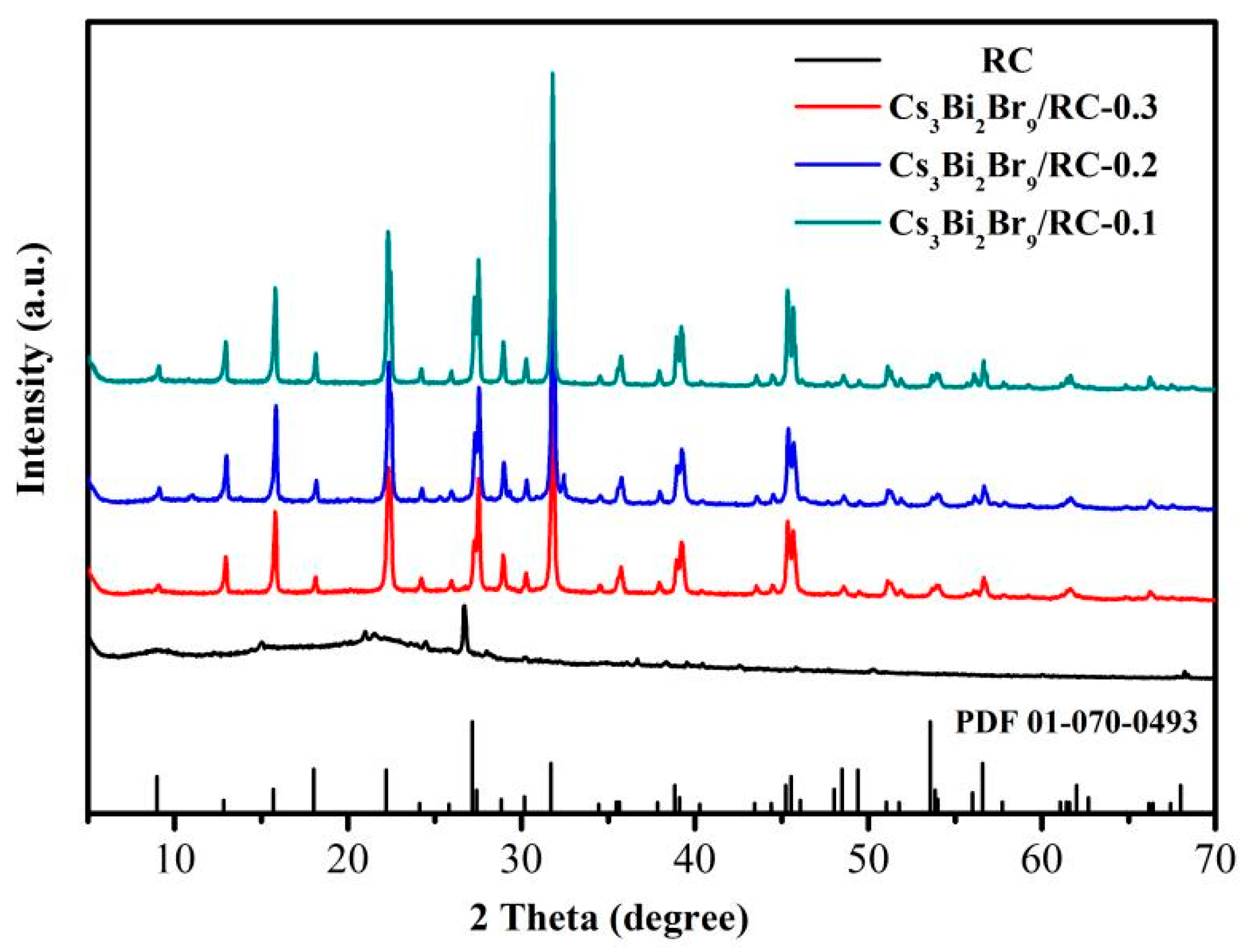
Figure 1 shows the diffraction pattern of RC, Cs3Bi2Br9, and Cs3Bi2Br9/RC composites. For RC sample, the wide diffraction peak with a diffraction angle (2θ) of 26.7° corresponds to the (002) lattice plane of carbon [30]. The XRD pattern of Cs3Bi2Br9 and Cs3Bi2Br9/RC samples exhibit peaks at 12.84°, 15.69°, 18.01°, 22.19°, 27.16°, 31.68°, 35.46°, 38.83°, 45.24°, and 56.01°, corresponding to (100), (011), (002), (110), (003), (022), (121), (122), (220), and (042), which are well indexed to the hexagonal phase of Cs3Bi2Br9 (PDF 01-070-0493). Because the Cs3Bi2Br9/RC–0.2 composite demonstrates the optimal photocatalytic performance, it is the main focus for further structural characterizations.
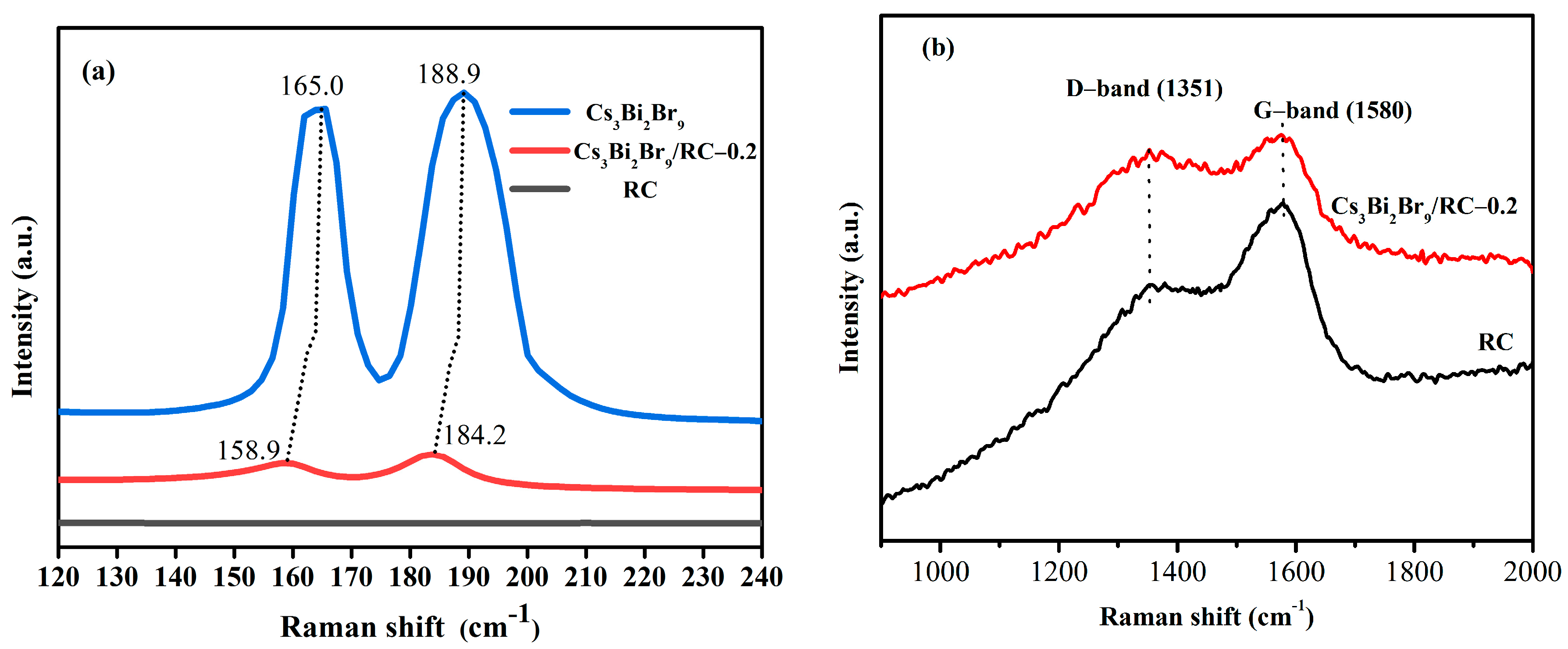
The results of Raman spectroscopy are presented in Figure 2. In Figure 2a, the pristine Cs3Bi2Br9 shows intense peaks at 188.9 cm−1 and 165.0 cm−1, corresponding to Bi–Br vibrations in the [BiBr6]3− octahedron [31]. Compared with pristine Cs3Bi2Br9, Bi–Br vibration peaks in the Cs3Bi2Br9/RC composite shift to low frequency, due to the formation of many lattice defects deriving from strong lattice distortion, which may produce more active sites [32]. In Figure 2b, both RC and Cs3Bi2Br9/RC exhibits peaks at 1351 cm−1 and 1580 cm−1, attributable to the D-band and G-band of carbon. The D-band corresponds to the graphite structural defects, specifically generated by C sp3 hybridization, whereas the G-band is related to graphitization. The relative strength, ID/IG, can be used to characterize the degree of defects in carbon. Hence, the ID/IG of Cs3Bi2Br9/RC (1.19) is stronger than that of RC (0.84), suggesting that Cs3Bi2Br9/RC had more defect structures [33,34]. These defects can change the electronic structure and promote charge transfer, thus affecting the photocatalytic performance of samples [35].

2.2. Morphology and Microstructural Characterization

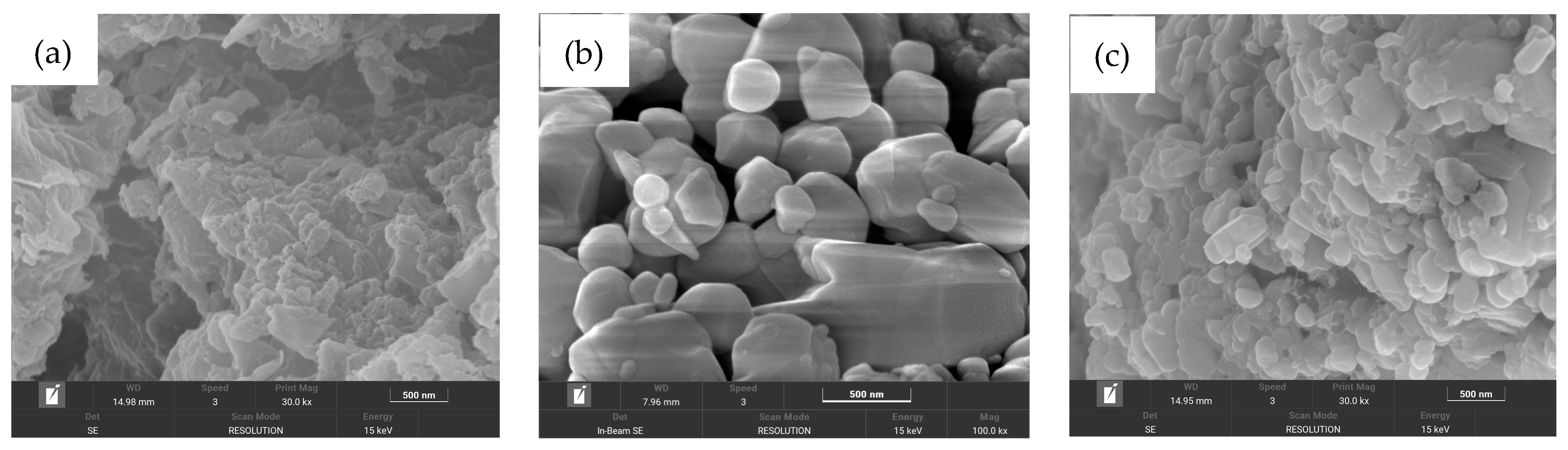
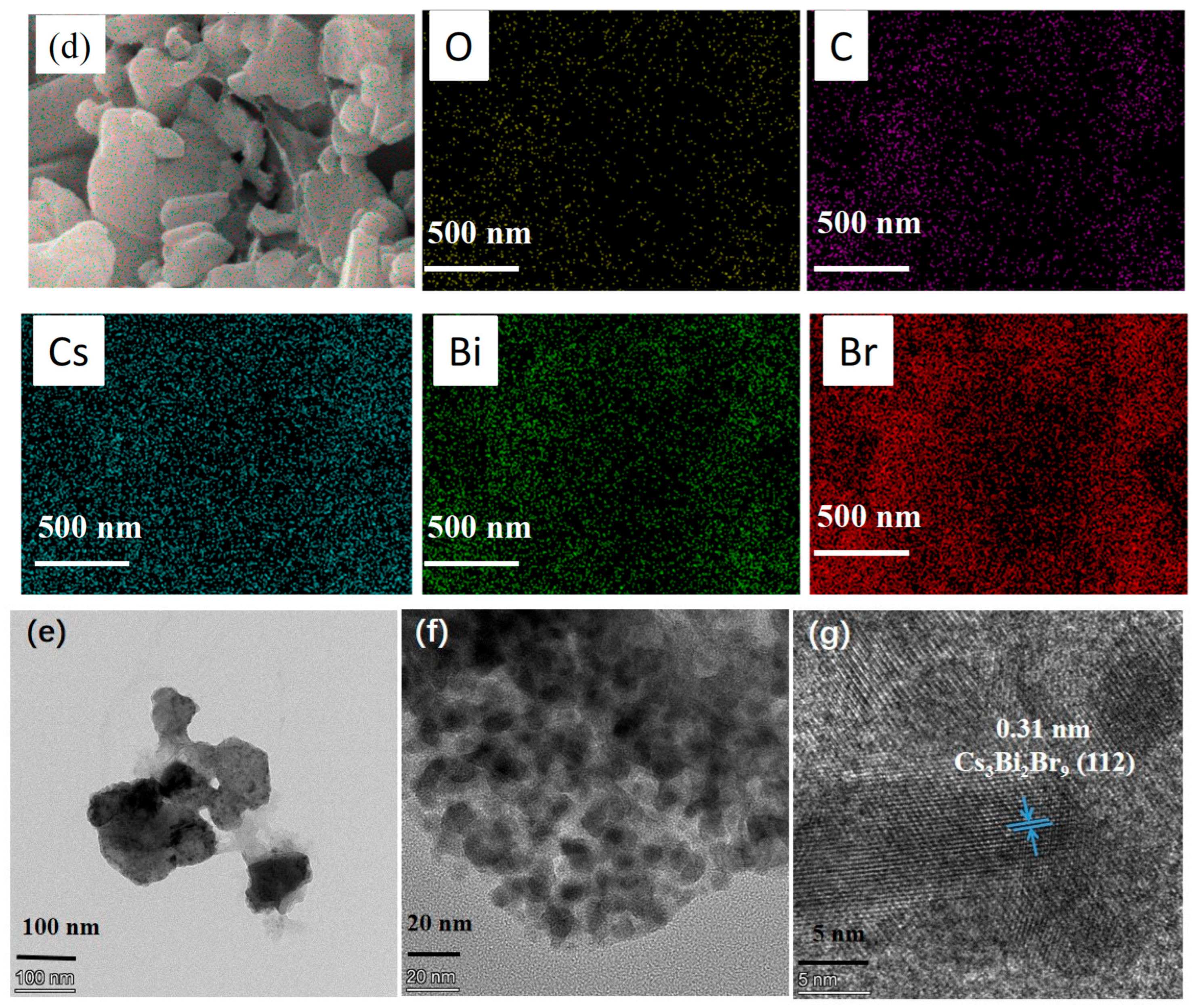
The SEM images of the samples are shown in Figure 3. RC made from rose petals exhibits a rough, wrinkled layered structure (Figure 3a). Compared to a smoother morphology, this rough wrinkled structure is in favor of the adhesion of Cs3Bi2Br9 nanoparticles, thereby promoting the formation of the composite [36]. Displayed in Figure 3b,c, the Cs3Bi2Br9 was dispersed on the surface of RC. And the Cs3Bi2Br9/RC composite boasted smaller grains than that of Cs3Bi2Br9. It can be seen that the introduction of RC can regularize material structure and reduce particle aggregation and thereby improve the catalytic performance of Cs3Bi2Br9 [37]. In Figure 3d, the EDS plot shows that Cs, Bi, Br, C, and O were dispersed on Cs3Bi2Br9/RC, confirming that Cs3Bi2Br9/RC was prepared successfully. Figure 3e,f show a TEM image of Cs3Bi2Br9/RC–0.2, demonstrating that particles with an average diameter of 19.4 nm were attached to the surface of RC and many pores replicated by petal structure. The HRTEM image of the composite (Figure 3g) displays a clear lattice fringe with a d-spacing of 0.31 nm, which corresponds to the (112) crystallographic plane of Cs3Bi2Br9 [18].
The BET surface area and pore diameter of the samples were listed in the Table 1. Compared with the bare Cs3Bi2Br9, the BET surface area, micropore volume, and pore diameter increase when Cs3Bi2Br9 particles are loaded onto the RC, indicating that RC can adjust the specific surface area and introduce more pore structures.
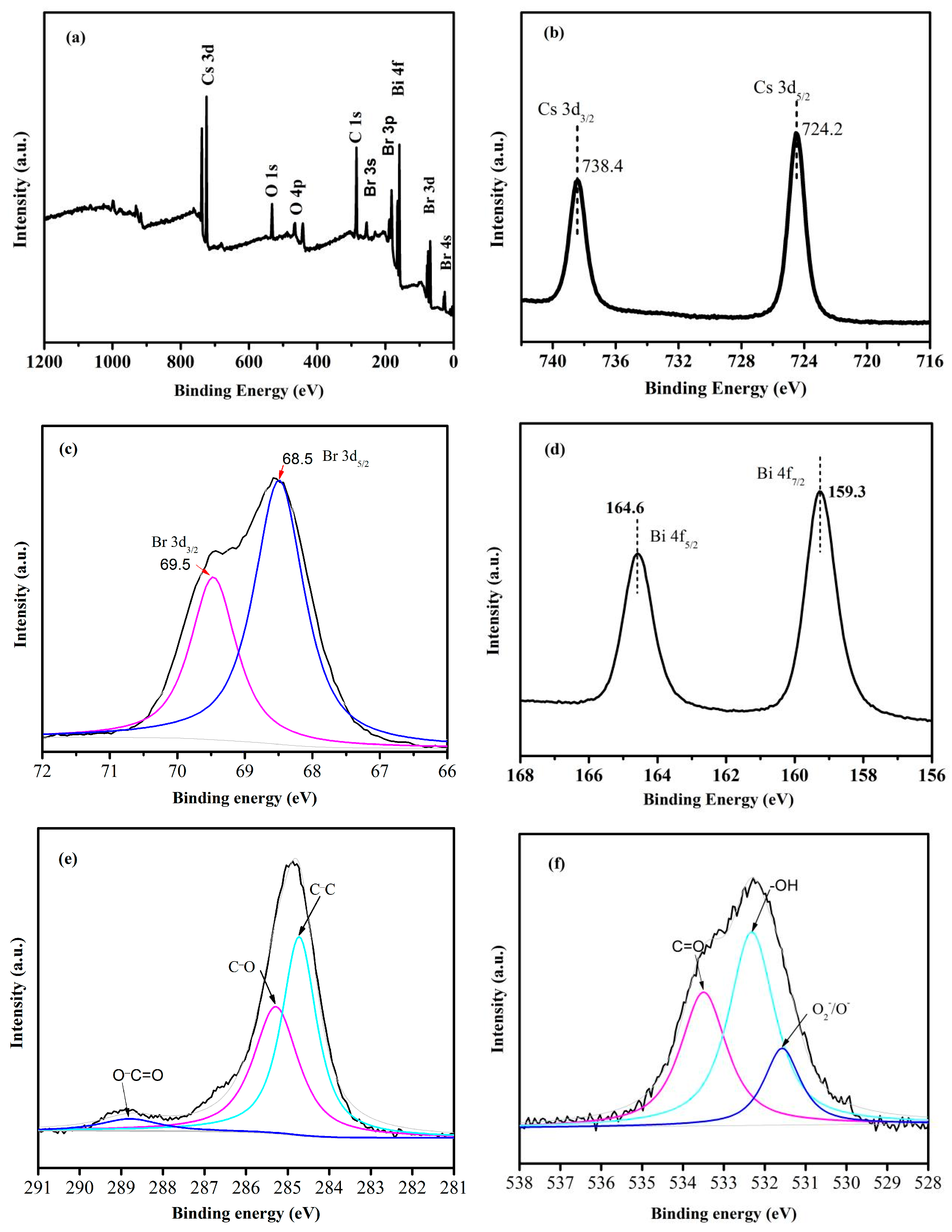
The XPS results of Cs3Bi2Br9/RC are shown in Figure 4. The as-prepared Cs3Bi2Br9/RC contains C, O, Cs, Bi, and Br, which can be confirmed using Figure 4a. For the Cs 3d (Figure 4b), the binding energy (BE) at 724.2 eV and 738.4 eV corresponded to Cs 3d5/2 and Cs 3d3/2. The Br 3d spectrum (Figure 4c) was segmented into two peaks, the BE at 68.5 eV (Br 3d5/2) and 69.5 eV (Br 3d3/2) [19]. In Figure 4d, two peaks at 159.3 eV and 164.6 eV, ascribed to Bi4f7/2 and Bi4f5/2. In the C 1s spectrogram (Figure 4e), the peaks at 284 eV, 285 eV, and 288 eV, were recognized as C–C, C=C, and O=C, respectively [21]. The O 1 s spectrum (Figure 4f), three peaks arranged in descending order of bonding energy, represent surface-adsorbed oxygen, hydroxyl (–OH), and O=C, respectively [9,33].

2.3. Optical and Photoelectrochemical Properties

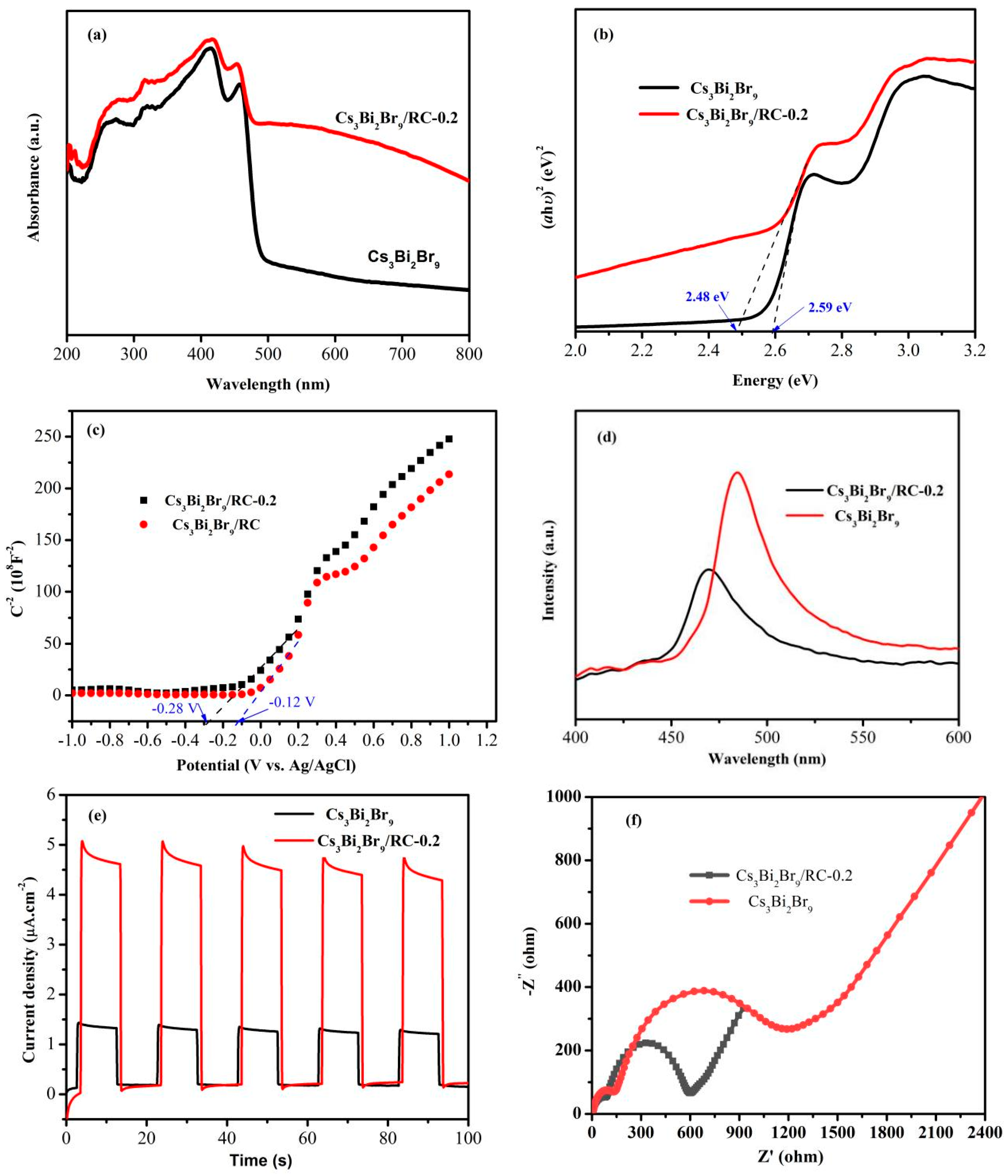
The DRS diagram of the sample is shown in Figure 5a. It is seen that the Cs3Bi2Br9/RC sample exhibits improved absorption activity in the wavelength of 500–800 nm. The bandgap energies (Eg), calculated using the Kubelka–Munk expression, were Cs3Bi2Br9 (2.59 eV) and Cs3Bi2Br9/RC (2.48 eV), respectively (Figure 5b). Obviously, Cs3Bi2Br9/RC has a smaller bandgap and can utilize visible light more efficiently [21]. In addition, the flat band potential (EFB) of the catalyst was determined using the Mott–Schottky (M-T) plots (Figure 5c). As shown in Figure 5c, the samples are n-type semiconductors, and the EFB of Cs3Bi2Br9 and the Cs3Bi2Br9/RC–0.2 sample is −0.12 V and −0.28 V (vs. Ag/AgCl), respectively. According to the method given in the literature [38,39], the conduction band (CB) positions, compared to a normal hydrogen electrode (NHE), are −0.22 V (Cs3Bi2Br9) and −0.38 V (Cs3Bi2Br9/RC–0.2), respectively. The CB value of Cs3Bi2Br9/RC–0.2 is lower than that of Cs3Bi2Br9, suggesting that the e in Cs3Bi2Br9/RC–0.2 more easily captured by oxygen, generating more ·O2 radicals [32]. Combining Eg results obtained above, the valence band (VB) for Cs3Bi2Br9 and the Cs3Bi2Br9/RC–0.2 sample is 2.37 V and 2.10 V (vs. NHE).
Figure 5d shows the PL spectra of Cs3Bi2Br9 and Cs3Bi2Br9/RC composite under 370 nm, which is the excitation wavelength. In Figure 5d, bare perovskite Cs3Bi2Br9 shows a strong fluorescence at 484 nm, consistent with the published literature [39]. The fluorescence peak position of Cs3Bi2Br9/RC has blue-shifted to 470 nm. The reason for the blue shift could be the particle size reduction of the perovskite after the introduction of RC, as seen through SEM observation [40]. Compared to Cs3Bi2Br9, the fluorescence intensity of Cs3Bi2Br9/RC has an obvious decline, which implies that the rate of photogenerated carriers transferred to RC becomes faster, inhibiting electron (e)–hole (h+) recombination.
Figure 5e shows the current density vs. time curve, in which Cs3Bi2Br9/RC exhibited stronger photocurrent density than Cs3Bi2Br9, indicating more electron–hole pairs generated by photoexcitation. Consequently, more carriers can participate in the catalytic reaction. Figure 5f shows the EIS Nyquist plots of the samples. In Figure 5f, the Cs3Bi2Br9/RC sample has a smaller arc radius, meaning lower electron transfer resistance, thus higher e-h+ separation efficiency, and thereby enhancing catalytic efficiency. Therefore, the coupling of RC with Cs3Bi2Br9 will boost the photocatalytic performance [39].

2.4. Photocatalytic Activity

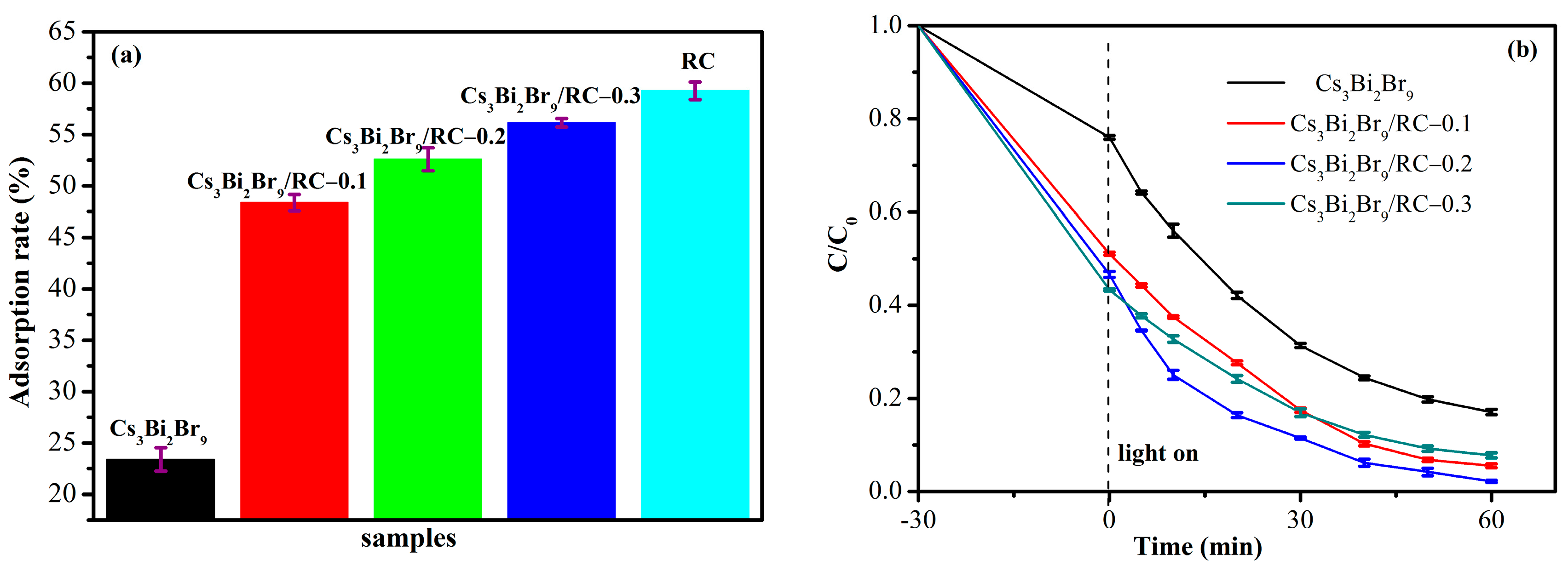
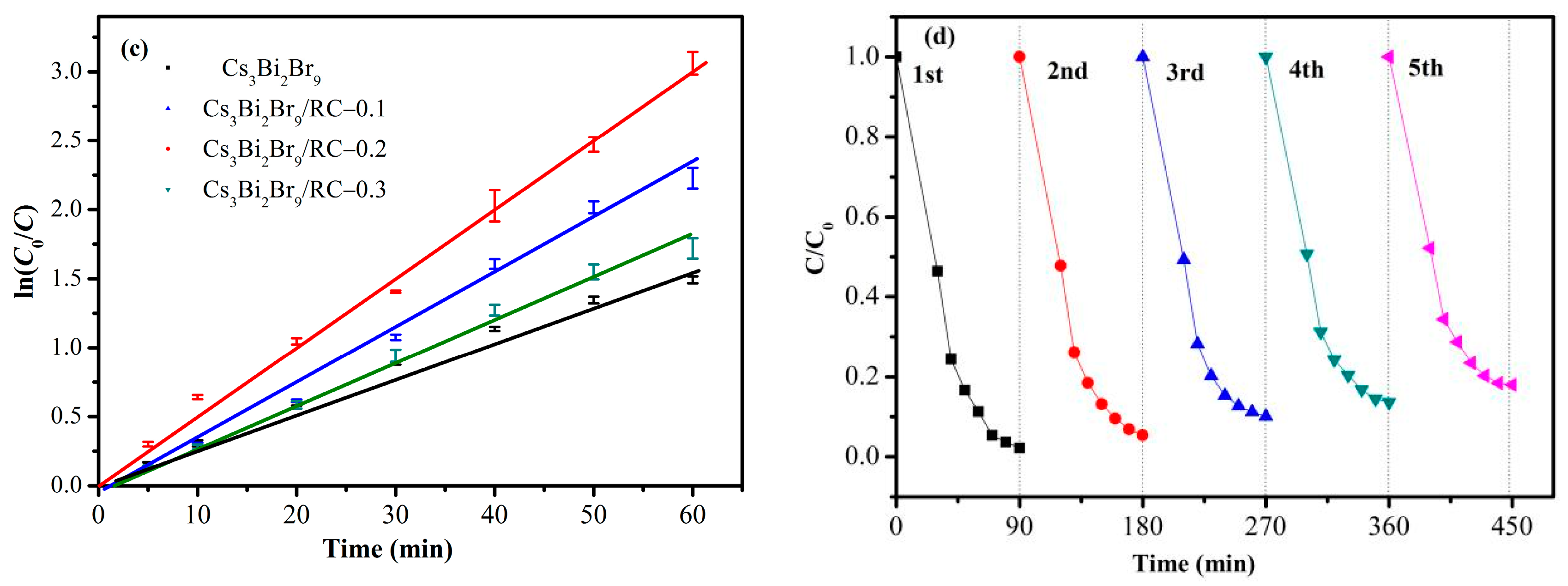
Before photocatalysis, the solid–liquid system consisting of RhB solution and catalyst was stirred in the dark for 30 min to reach adsorption equilibrium. As shown in Figure 6a,b, the introduction of RC enhances the adsorption rate of the materials during the dark reaction. Upon visible light irradiation, RhB can be degraded. The degradation efficiency of RhB on Cs3Bi2Br9, Cs3Bi2Br9/RC–0.1, Cs3Bi2Br9/RC–0.2, and Cs3Bi2Br9/RC–0.3 samples after 60 min is 83.5%, 95.3% 97.2%, and 92.8%, respectively. Obviously, Cs3Bi2Br9/RC composites present a higher removal rate (η) than that of pure Cs3Bi2Br9. However, the η will decrease if the amount of RC is excessive. As shown in Figure 6b, the suitable mass ratio of RC is 0.2, and an overdose of RC results in light scattering [22]. Moreover, the degradation curve of RhB (Figure 6c) conforms to a first-order dynamics model, and the rate constant (k) is obtained from the slope of the curve. In Figure 6c, obviously, the Cs3Bi2Br9/RC–0.2 sample has the maximum k (0.0501 min−1), which is better than the reference Cs3Bi2Br9 (0.0258 min−1). Therefore, the as-prepared Cs3Bi2Br9/RC composites can facilitate the removal of RhB dye. Table 2 compares the photocatalytic performance between Cs3Bi2Br9/RC–0.2 and other representative photocatalysts for RhB degradation. And the results listed in Table 2 demonstrate the potential application of Cs3Bi2Br9/RC composites in the removal of water pollutants.
Additionally, consecutive removal-of-RhB experiments, using the Cs3Bi2Br9/RC–0.2 composite as photocatalyst, were conducted to test the stability. After each cycle, centrifugation is carried out, and the photocatalysts are dried. In Figure 6d, the removal efficiency of RhB on Cs3Bi2Br9/RC–0.2 is 83% after five cycles, indicating the excellent stability of the as-prepared Cs3Bi2Br9/RC composite.
Figure 6. (a) Adsorption rate of RhB on different samples, (b) RhB dye degradation performance charts of the as-prepared photocatalysts, (c) photodegradation kinetic curve, and (d) recycling test over the Cs3Bi2Br9/RC–0.2 for degradation of RhB.
Catalysts 16 00120 g006aCatalysts 16 00120 g006b
Table 2. A comparison of photocatalytic performance of different photocatalysts.
CatalystCatalyst Loading (g/L)RhB (mg/L)Time (min)Efficiency (%)k (min−1)Ref.
ZnO0.25320920.009[41]
TiO2/C3N40.071014098.40.0421[42]
PANI@NiTiO315180940.0198[43]
BiOCl/biochar11032990.0642[21]
Cs2AgBiBr60.255751000.069[44]
Cs3Bi2Br92.4201001000.0297[9]
Cs3Bi2Br9/C3N40.5106098 [20]
Cs3Bi2Br9/RC–0.20.31060980.0501This work

2.5. Photocatalytic Mechanism

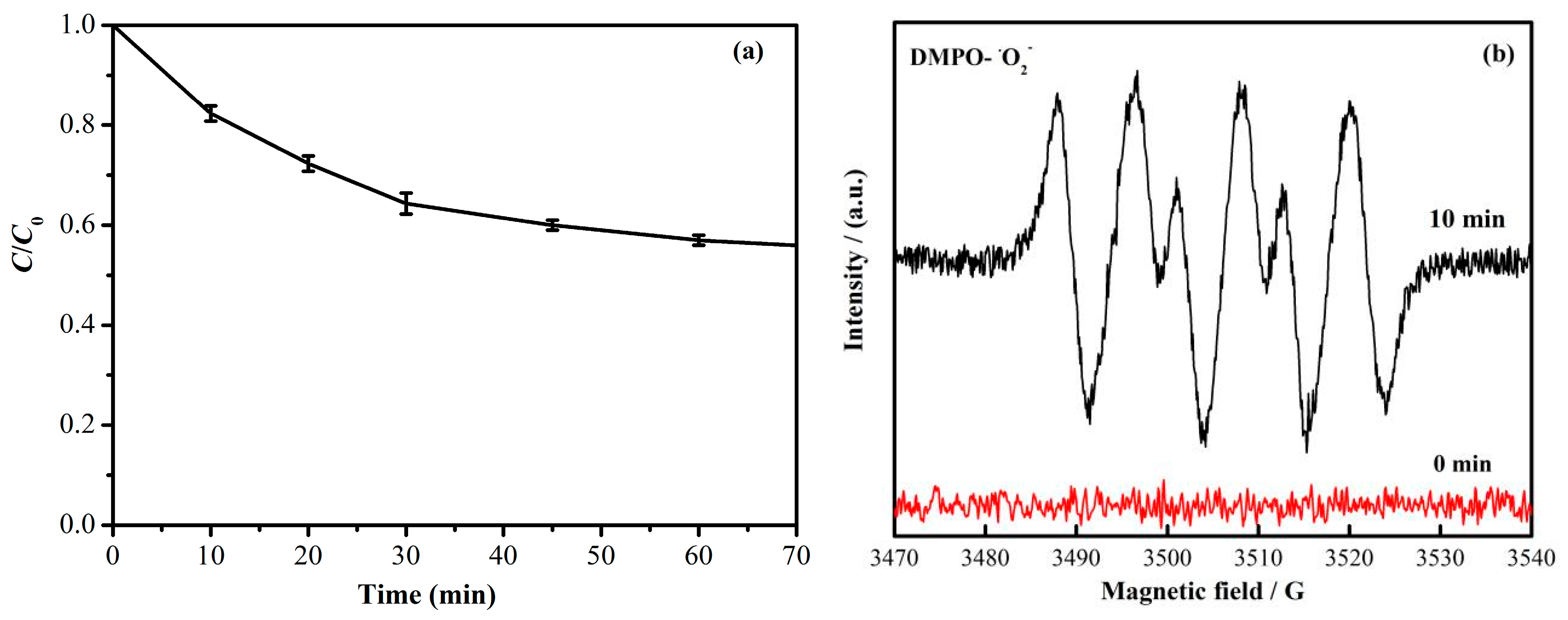
The photocatalytic reaction process involves photogenerated charge carrier generation, separation, migration, and surface redox reaction. By adding capture agents, verify the presence and role of some active species, such as e, holes (h+), hydroxyl radicals (·OH), and superoxides (·O2), then deduce the mechanism of photocatalytic reaction [18]. TEMPO, 2,2,6,6-tetramethylpiperidine-1-oxyl, is a generally accepted free radical scavenger. As shown in Figure 7a, the photocatalytic degradation efficiency of RhB on the Cs3Bi2Br9/RC sample decreased from 97.2% to 46.0% after TEMPO was added to the solution, which indicates that the process was inhibited [45]. The dominant free radicals are further determined through EPR analysis. Displayed in Figure 7b, no peaks of active species were observed in darkness. When illuminated by visible light for 10 min, the Cs3Bi2Br9/RC–0.2 exhibited six characteristic peaks, indicating the generation of ·O2.
Hence, a photocatalytic mechanism on Cs3Bi2Br9/RC–0.2 is described as follows. Under visible light irradiation, Cs3Bi2Br9 absorbs photons (bandgap > 2.48 eV), exciting electrons located in the valence band (VB) to the conduction band (CB), forming e- and h+ pairs. The EVB of Cs3Bi2Br9 is 2.10 V, more positive than E(·OH/OH−) (1.99 V); therefore, the h+ can directly degrade pollutants [21]. Then, the e from the CB of Cs3Bi2Br9 are conveyed to RC, captured by O2 molecules to generate ·O2 radicals [9,45,46,47]. Moreover, ECB of Cs3Bi2Br9 (−0.38 V) is more negative than E(O2/·O2−) (−0.33 V); thus, O2 can react with the electrons located in the CB to form ·O2. And these ·O2 degrade RhB into small molecules. During the photocatalytic process, h+ and ·O2 played a major role.
Figure 7. (a) RhB dye degradation charts with the adding of TEMPO and (b) the ESR spectra of Cs3Bi2Br9/RC–0.2 for DMPO–·O2.
Catalysts 16 00120 g007

3. Materials and Methods

3.1. Materials

Bismuth bromide (BiBr3, Aladdin Biochemical Technology Co., Ltd., Shanghai, China), Rhodamine B (C28H31ClN2O3, China Pharmaceutical Group Chemical Reagents, Shanghai, China), Dimethyl sulfoxide (DMSO), Isopropanol (C3H8O, Nanjing Chemical Reagent Co., Ltd., Nanjing, China), and Cesium Bromide (CsBr, China Pharmaceutical Group Chemical Reagents, Shanghai, China). All chemicals were used directly.

3.2. Material Synthesis

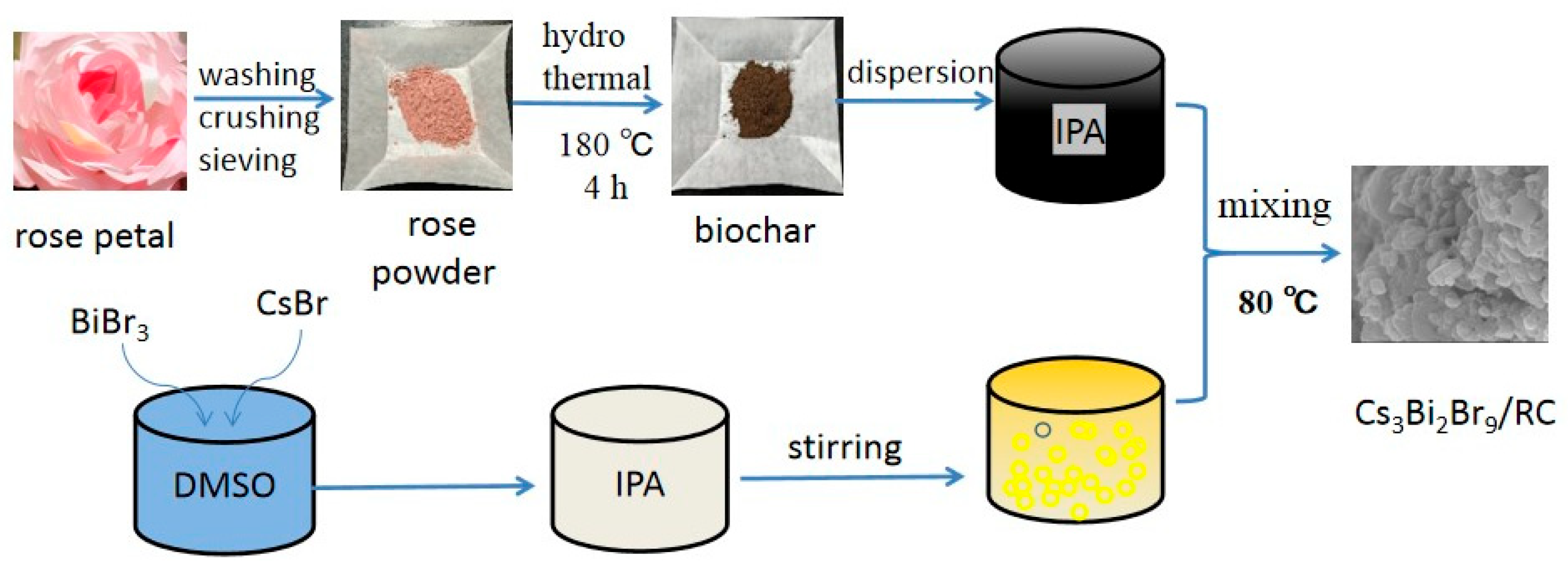
The synthesis process is illustrated in Scheme 1.

3.2.1. Preparation of Biochar

The rose petals were taken from Nanjing City, Jiangsu Province, China. Fresh rose petals were rinsed with clean water and dried at 70 °C for 4 h. After drying, the petals were crushed and sieved to obtain rose petal powder (<100 mesh). Subsequently, 5 g of petal particles was ultrasonically dispersed in deionized water for 30 min then was heated at 180 °C for 4 h [48]. At last, this resulted in petal biochar, labeled as RC.

3.2.2. Preparation of Cs3Bi2Br9/RC Composite Catalysts

We used a specific preparation process using Cs3Bi2Br9/RC−0.2 as an example. We dissolved 3.26 g CsBr and 4.59 g BiBr3 in 50 mL dimethyl sulfoxide, forming a precursor solution. Then, the precursor solution was added into 100 mL of isopropanol, stirring to yield solution A. Subsequently, 2 g of RC was dispersed in 30 mL of isopropanol, sonicated to form uniform black dispersion B. Next, solution A was injected into dispersion B with intensive stirring, and the precipitate was washed 4 times and finally dried at 80 °C for 12 h. The other Cs3Bi2Br9/RC composites were prepared by varying the mass ratios of RC to Cs3Bi2Br9, as 0, 0.1, and 0.3, and the obtained products were labeled as Cs3Bi2Br9, Cs3Bi2Br9/RC–0.1, and Cs3Bi2Br9/RC–0.3, respectively.

3.3. Characterizations

X-ray diffraction (XRD) patterns of samples were filed by using a Bruker D8 Advance X-ray diffractometer with Cu radiation (Billerica, MA, USA). Raman spectroscopy was performed with a JASCO NRS4500 NMDS instrument (Tokyo, Japan), employing a 532 nm excitation laser. The surface morphology of the samples was determined by scanning electron microscopy (SEM, Sigma 500 of the Carl Zeiss company, Oberkochen, Germany). An energy-dispersive X−ray spectrum (EDS) microanalysis probe (IE250, Oxford Instruments, Oxfordshire, UK) was used to analyze the elemental composition of Cs3Bi2Br9/RC. X-ray photoelectron spectroscopy (XPS) was carried out using a Perkin Elmer PHI 5000 (Japan) instrument (Waltham, MA, USA). Diffuse reflectance spectra (DRS) were performed using a UV-vis spectrophotometer (Shimadzu UV-2450, Nakagyo-ku, Japan). The photoelectrochemical experiment was conducted on an electrochemical workstation (Chenhua CHI 760E, Shanghai, China) in a conventional three-electrode configuration. ROS were captured by scavenger [5,5-dimethyl-1-pyrroline N-oxide (DMPO)], and the formed adducts were analyzed using an EMX Plus electron paramagnetic resonance (EPR) spectrometer (Bruker, Billerica, MA, USA).

3.4. Photocatalytic Performance

The removal processes of RhB on the as-prepared samples, including the removal efficiency, photocatalytic rate, and mechanism, were investigated with a 300 W Xe lamp as a visible light source (>420 nm). During each experiment, 0.06 g of sample was added to RhB solution (10 mg/L, 200 mL). And, prior to turning on the lamp, the mixture was stirred vigorously at 20 °C in the dark. After 30 min, the solid–liquid system attained adsorption–desorption equilibrium. Then, turn on the light for photocatalytic experiment. At some intervals, 5 mL of solution was withdrawn and centrifuged, and the supernatant was monitored to obtain its concentration.

4. Conclusions

Rose-petal-derived biomass carbon (RC)-anchored Cs3Bi2Br9 perovskite composites were prepared by an anti-solvent precipitation method. The Cs3Bi2Br9/RC composites as a photocatalyst promoted the photocatalytic degradation of RhB dye. Raman spectra show that Cs3Bi2Br9/RC had more defect structures. And these defects can alter the energy band edges and electronic structure of the material, which were confirmed by optical and electrochemical characterization. The introduction of RC in Cs3Bi2Br9 perovskite composites reduced the Eg and enhanced the absorption of visible light. The results of EIS show that the interaction between RC and Cs3Bi2Br9 speeds up charge carrier separation and transfer, thereby reducing the recombination of carriers. Therefore, the interaction between Cs3Bi2Br9 and RC can improve photodegradation activity. The Cs3Bi2Br9/RC–0.2 sample possessed the best photoelectrical performance and degradation efficiencies for RhB (10 mg/L) reached 98% within 60 min. The prepared perovskite Cs3Bi2Br9/RC does not contain lead and has higher RhB removal than bare Cs3Bi2Br9 and RC. As an efficient and low-cost green materials, biochar has enticing prospects in the field of environmental remediation. The as-prepared composites will be used to treat antibiotic wastewater. Based on this work, more novel and sustainable perovskite materials can be prepared by adjusting the elemental composition for catalyzing organic synthesis.

Author Contributions

Conceptualization, J.Z.; methodology, J.Z. and B.Y.; validation, Y.Z., X.X.; formal analysis, Y.Z.; investigation, D.X.; resources, J.Z. and B.Y.; data curation, Y.Z. and X.X.; writing—original draft preparation, Y.Z.; writing—review and editing, J.Z.; supervision, B.Y. and D.X.; funding acquisition, J.Z. All authors have read and agreed to the published version of the manuscript.

Funding

This work was financially supported by the Natural Science Research Project of Jiangsu Provincial Department of Education (20KJD150002).

Data Availability Statement

Data will be made available on request.

Conflicts of Interest

The authors declare no conflicts of interest.

References

  1. Carey, J.; Lawrence, J.H.; Tosine, H.M. Photodechlorination of PCBs in the presence of titanium dioxide in aqueous suspensions. Bull. Environ. Contam. Toxicol. 1976, 16, 697–701. [Google Scholar] [CrossRef]
  2. Ao, C.H.; Lee, S.C.; Mak, C.L.; Chan, L.Y. Photodegradation of volatile organic compounds (VOCs) and NO for indoor air purification using TiO2: Promotion versus inhibition effect of NO. Appl. Catal. B Environ. 2003, 42, 119–129. [Google Scholar] [CrossRef]
  3. Zhu, Z.H.; Guo, F.; Li, A.M.; Xu, W.C.; Zhang, X.H. Simple synthesis of BiOI/ZnO/rGO for efficient photocatalytic degradation of antibiotic chloramphenicol under visible light. J. Environ. Sci. 2023, 134, 65–76. [Google Scholar] [CrossRef]
  4. Zhang, J.; Huang, Z.H.; Xu, Y. Hydrothermal synthesis of graphene/Bi2WO6 composite with high adsorptivity and photoactivity for azo dyes. J. Am. Chem. Soc. 2013, 96, 1562–1569. [Google Scholar]
  5. Zhang, Y.X.; Wang, H.; Huang, L.; Chen, J.K.; Wu, C.L. Orbital hybridization-guided BiOX (X = F, Cl, Br, I) photocatalysts: Halogen-induced bandgap engineering and performance optimization. Mater. Lett. 2026, 405, 139824. [Google Scholar] [CrossRef]
  6. Zhao, G.Q.; Zhang, Q.E.; Hu, C.C.; Liu, J.W.; Jiao, F.P.; Yu, J.G.; Lu, L.M. Recent intensification strategies of Indium vanadate-based materials for photocatalytic application. Sep. Purif. Technol. 2024, 346, 127462. [Google Scholar] [CrossRef]
  7. Haroonabadi, L.; Sharifnia, S. Efficient photocatalytic water splitting of BiFeO3–BaTiO3 as a perovskite based n-n heterojunction toward H2 evolution without using sacrificial agent. Int. J. Hydrogen Energy 2024, 82, 1263–1274. [Google Scholar] [CrossRef]
  8. Wang, H.Y.; Sun, Y.; Chen, J.; Wang, F.C.; Han, Y.R.; Zhang, C.Y.; Kong, J.F.; Li, L.; Yang, J. A Review of perovskite-based photodetectors and their applications. Nanomaterials 2022, 12, 4390. [Google Scholar] [CrossRef] [PubMed]
  9. Akinbami, O.; Moepya, R.; Ngubeni, G.N.; Tetyana, P.; Mubiayi, K.P.; Moloto, M.J.; Moloto, N. Lead-free Rudorffite-type Cs3Bi2Br9 nanoparticles for photocatalytic degradation of rhodamine B and methylene blue. J. Photochem. Photobiol. A 2021, 419, 113460. [Google Scholar] [CrossRef]
  10. Romani, L.; Speltini, A.; Dibenedetto, C.N.; Listorti, A.; Ambrosio, F.; Mosconi, E.; Simbula, A.; Saba, M.; Profumo, A.; Quadrelli, P. Experimental strategy and mechanistic view to boost the photocatalytic activity of Cs3Bi2Br9lead-free perovskite derivative by g-C3N4composite engineering. Adv. Funct. Mater. 2021, 31, 2104428. [Google Scholar] [CrossRef]
  11. Zhu, X.L.; Lin, Y.X.; Jovan, S.M.; Sun, Y.; Zhu, D. Lead halide perovskites for photocatalytic organic synthesis. Nat. Commun. 2019, 10, 2843–2854. [Google Scholar] [CrossRef]
  12. Lian, X.X.; Jin, M.J.; Dai, W.D.; Lv, Y.J.; Luo, M.; Hu, Y.; Wang, Z.J.; Li, H.Y.; Xu, C.Y.; Jiang, D.R.; et al. A supramolecular approach to improve the performance and operational stability of all-perovskite tandem solar cells. Nat. Commun. 2025, 16, 7173. [Google Scholar] [CrossRef]
  13. Yang, B.; Chen, J.S.; Hong, F.; Mao, X.; Zheng, K.B.; Yang, S.Q.; Li, Y.J.; Pullerits, T.; Deng, W.Q.; Han, K.L. Lead-Free, Air-stable all-inorganic Cesium Bismuth Halide perovskite nanocrystals. Angew. Chem. Int. Ed. 2017, 56, 12471–12475. [Google Scholar] [CrossRef]
  14. Lehner, A.J.; Fabini, D.H.; Evans, H.A.; Hebert, C.A.; Smock, S.R.; Hu, J.; Wang, H.B.; Zwanziger, J.W.; Chabinyc, M.L.; Seshadri, R. Crystal and electronic structures of complex Bismuth Iodides A3Bi2I9 (A = K, Rb, Cs) Related to Perovskite: Aiding the Rational Design of Photovoltaics. Chem. Mater. 2015, 27, 7137–7148. [Google Scholar] [CrossRef]
  15. Htun, T.; Elattar, A.; Elbohy, H.; Tsutsumi, K.; Horigane, K.; Nakano, C.; Gu, X.Y.; Suzuki, H.; Nishikawa, T.; Kyaw, A.K.; et al. Lead-free iron-doped Cs3Bi2Br9 perovskite with tunable properties. RSC. Adv. 2024, 14, 23177–23183. [Google Scholar] [CrossRef]
  16. Ren, K.K.; Yue, S.Z.; Li, C.H.; Fang, Z.B.; Gasem, K.A.; Leszczynski, J.; Qu, S.C.; Wang, Z.J.; Fan, M.H. Metal halide perovskites for photocatalysis applications. J. Mater Chem. A 2022, 10, 407–429. [Google Scholar] [CrossRef]
  17. Lee, J.; Kumar, A.; Tüysüz, H. Solar-light-driven photocatalytic oxidative coupling of phenol derivatives over bismuth-based porous metal halide perovskites. Angew. Chem. Int. Ed. 2024, 63, e202404496. [Google Scholar] [CrossRef] [PubMed]
  18. Cui, Z.H.; Zhang, Q.Q.; Fu, H.; Liu, Q.H.; Liu, X.L.; Wu, Y.Q.; Gao, P.; Wang, Z.Y.; Zheng, Z.K.; Cheng, H.F.; et al. Composite of lead-free halide perovskite Cs3Bi2Br9 with TiO2 as an efficient photocatalyst for C(sp3)-H bond activation. Appl. Catal. B Environ. 2023, 333, 122812. [Google Scholar] [CrossRef]
  19. Xiao, Z.J.; Yang, W.D.; Wang, J.; Cao, S.; Yang, J.L.; Zhu, M.S. The lead-free halide perovskite/UiO-66 with dual Lewis acid sites for efficient photocatalytic NO removal. Chem. Eng. J. 2025, 504, 159022. [Google Scholar] [CrossRef]
  20. Xu, W.L.; Hu, J.L.; Yang, Q.Y.; Lian, Y.B.; Zheng, M.; Du, E.W. Charge transfer dynamics in C3N4 encapsulated Cs3Bi2Br9 nanocrystals heterojunction for photocatalytic application. J. Alloys Compd. 2024, 988, 174275. [Google Scholar] [CrossRef]
  21. Yang, P.H.; Luo, S.; Liu, Q.H.; Ma, S.W.; Zhong, J.B.; Ma, D.M. Rape straw biochar-assisted preparation of flower-like BiOCl with enriched oxygen vacancies for efficient photocatalytic CO2 reduction and pollutants degradation. J. Phys. Chem. Solids 2025, 196, 112400. [Google Scholar] [CrossRef]
  22. Wang, H.T.; Fan, X.R.M.; Yan, M.; Guo, T.Y.; Li, X.F.; Chen, C.; Qi, Y. BiOBr nanosheets coupling with biomass carbon derived from locust leaves for enhanced photocatalytic degradation of rhodamine B. Chin. J. Chem. Eng. 2024, 74, 31–43. [Google Scholar] [CrossRef]
  23. Ren, Y.; Zhu, Y.; Gao, S.; Liu, X.Y.; Li, H.R.; Rui, S.P. Preparation of HC/BiOCl composite photocatalyst and its visible photocatalytic performance. Inorg. Chem. Commun. 2024, 163, 112329. [Google Scholar] [CrossRef]
  24. Sarkar, D.; Panicker, T.F.; Mishra, R.K.; Kini, M.S. A comprehensive review of production and characterization of biochar for removal of organic pollutants from water and wastewater. Water-Energy Nexus 2024, 7, 243–265. [Google Scholar] [CrossRef]
  25. Barone, A.; Mancuso, A.; Cristiano, M.C.; Sacco, J.; Silletta, A.; Tolomeo, A.M.; Fresta, M.; Paolino, D. Rose petal-derived nanovesicles as a sustainable and functional ingredient for next-generation cosmetics. J. Drug Deliv. Sci. Technol. 2026, 116, 107897. [Google Scholar] [CrossRef]
  26. Dhiman, R.; Lai, A.K.; Dolez, P.I. Exploring the tactile and thermal behaviour of rose petals for bio-inspired material design. Colloids Surf. B Biointerfaces 2025, 256, 115041. [Google Scholar] [CrossRef]
  27. Wu, Q.; Liu, X.C.; Hou, S.; Qiang, L.; Zhang, K.; Yang, Z. Biotemplate synthesis and photocatalysis performance of multilayer porous ZnWO4 nano-photocatalyst with rose petals as template. Colloids Surf. A Physicochem. Eng. Asp. 2021, 629, 127459. [Google Scholar] [CrossRef]
  28. Zhang, R.; Jiang, J.C.; Peng, L.; Shu, Y.; Jiang, L.M.; Chen, Z.Y. The reusable g-C3N4/BiOCl-Template Z heterojunction photocatalyst prepared from rose templates effectively degrades mixed pollutants and high concentration pollutants while reducing system ecological toxicity. Diam. Relat. Mater. 2024, 143, 110915. [Google Scholar] [CrossRef]
  29. Mahajan, U.; Srivastava, A.; Kumar, A.; Dhonde, M.; Sahu, K.; Shirage, P.M. Cr-doped barium stannate perovskite as an advanced photocatalyst for degrading carcinogenic rhodamine B. Ceram. Int. 2026, 52, 1083–1095. [Google Scholar] [CrossRef]
  30. Tai, Y.H.; Sun, J.L.H.; Tian, R.; Liu, F.Y.; Han, B.Y.; Fu, W.; Liu, Z.P. Efficient degradation of organic pollutants by S-NaTaO3/biochar under visible light and the photocatalytic performance of a permonosulfate-based dual-effect catalytic system. J. Environ. Sci. 2023, 125, 388–400. [Google Scholar] [CrossRef]
  31. Geng, H.F.; Huang, Z.Z.; Geng, H.X.; Liu, S.Y.; Naumova, M.A.; Chen, S.Q.; Wei, J.L. Controlled synthesis of highly stable lead-free bismuth halide perovskite nanocrystals: Structures and photophysics. Sci. China Mater. 2023, 66, 2079–2089. [Google Scholar] [CrossRef]
  32. Zhang, J.; Wu, K.; Xiong, J.; Ren, Q.M.; Zhong, J.P.; Cai, H.D.; Huang, H.M.; Chen, P.R. Static and dynamic quantification tracking of asymmetric oxygen vacancies in copper-ceria catalysts with superior catalytic activity. Appl. Catal. B Environ. 2022, 316, 121620. [Google Scholar] [CrossRef]
  33. Yu, S.; Zhou, J.; Ren, Y.; Yang, Z.W.; Zhong, M.; Feng, X.Q.; Su, B.T.; Lei, Z.Q. Excellent adsorptive-photocatalytic performance of zinc oxide and biomass derived N, O contained biochar nanocomposites for dyes and antibiotic removal. Chem. Eng. J. 2023, 451, 138959. [Google Scholar] [CrossRef]
  34. Zhang, G.Q.; Rong, X.L.; Huang, W.Y.; Xiao, Z.F.; Xue, Z.R.; Cheng, H. High dye removal and H2O2 production efficiency of KOH-activated bagasse cellulose carbon aerogel-ZnO composite material. Colloids Surf. A Physicochem. Eng. Asp. 2025, 709, 136202. [Google Scholar] [CrossRef]
  35. Xiong, J.; Di, J.; Xia, J.X.; Zhu, W.S.; Li, H.M. Surface defect engineering in 2D nanomaterials for photocatalysis. Adv. Funct. Mater. 2018, 28, 1801983. [Google Scholar] [CrossRef]
  36. Luo, H.; Yu, S.; Zhong, M.; Han, Y.; Su, B.T.; Lei, Z.Q. Waste biomass-assisted synthesis of TiO2 and N/Ocontained graphene-like biochar composites for enhanced adsorptive and photocatalytic performances. J. Alloys Compd. 2022, 899, 163287. [Google Scholar] [CrossRef]
  37. Zheng, Y.Y.; Zhu, H.B.; Xie, X.M.; Liu, Y.; Fan, Q.W.; Le, Z.G.; Xie, Z.B. Lead-free perovskite Cs3Bi2Br9/TiO2 composites for atmospheric photocatalytic oxidation of sulfides. Green Chem. 2024, 26, 7031–7037. [Google Scholar] [CrossRef]
  38. Chen, F.; Liu, L.L.; Zhang, Y.J.; Wu, J.H.; Huang, G.X.; Yang, Q.; Chen, J.J.; Yu, H.Q. Enhanced full solar spectrum photocatalysis by nitrogen-doped graphene quantum dots decorated BiO2-x nanosheets: Ultrafast charge transfer and molecular oxygen activation. Appl. Catal. B Environ. 2020, 277, 119218. [Google Scholar] [CrossRef]
  39. Zhang, J.B.; Mao, Y.; Wang, B.H.; Chen, L.; Tian, S.; Hu, B.; Li, Y.J.; Au, C.T.; Yin, S.F. Tuning photocatalytic performance of Cs3Bi2Br9 perovskite by g-C3N4 for C(sp3)-H bond activation. Nano Res. 2023, 16, 6104–6112. [Google Scholar] [CrossRef]
  40. Sun, Q.M.; Ye, W.; Wei, J.L.; Li, L.X.; Wang, J.; He, J.H.; Lu, J.M. Lead-free perovskite Cs3Bi2Br9 heterojunctions for highly efffcient and selective photocatalysis under mild conditions. J. Alloys Compd. 2022, 893, 162326. [Google Scholar] [CrossRef]
  41. Enaganti, J.; Saineetha1, A.; Kumar, P.J.; Meher, S.; Kumar, V.S.; Prajvala1, C.; Avinash1, A.; Tomar, A. Surface oxygen vacancy-rich distorted ZnO nanofowers for efficient photocatalytic degradation of rhodamine B dye. J. Mater. Sci. Mater. Electron. 2026, 37, 16433. [Google Scholar] [CrossRef]
  42. Fanyana, M.M.; Ntaote, D.S.; Bamidele, J.O.; Jagdeep, K.; Teketel, G.G. High-performance photocatalytic hydrogen generation and rhodamine B degradation by TiO2 modiffed g-C3N4 photocatalysts. J. Photochem. Photobiol. 2026, 31, 100273. [Google Scholar] [CrossRef]
  43. Abouri, M.; Benzaouak, A.; Elouardi, M.; Hamdaoui, L.E.; Zaaboul, F.; Azzaoui, K.; Hammouti, B.; Sabbahi, R.; Jodeh, S.; Belghiti, M.A.; et al. Enhanced photocatalytic degradation of Rhodamine B using polyaniline-coated XTiO3 (X = Co, Ni) nanocomposites. Sci. Rep. 2025, 15, 3595. [Google Scholar] [CrossRef]
  44. Martinelli, B.; Laranjeira, J.A.; Ücker, C.; Fabra, G.M.; Rodrigues, J.E.; Romualdo, S.J.; Alonso, J.A.; Sambrano, J.R.; Ferrer, M.M. Evaluating the photocatalytic potential of the lead-free double perovskite halide Cs2AgBiBr6 for rhodamine-B degradation. J. Alloys Compd. 2025, 6, 100064. [Google Scholar] [CrossRef]
  45. Zhang, Z.; Liang, Y.; Huang, H.L.; Liu, X.Y.; Li, Q.; Chen, L.X.; Xu, D.S. Stable and highly efficient photocatalysis with lead-free double-perovskite of Cs2AgBiBr6. Angew. Chem. Int. Ed. 2019, 58, 7263–7267. [Google Scholar] [CrossRef]
  46. Qiu, X.Y.; Lin, S.; Li, J.M.; Guo, L. One-step coprecipitation synthesis of BiOClxBr1-xphotocatalysts decorated with CQDs at room temperature with enhanced visible-light response. Inorg. Chem. 2022, 61, 10999–11010. [Google Scholar] [CrossRef]
  47. AbdElAziz, H.H.; El Rouby, W.M.; Khedr, M.H.; Saad, L. Recent progress in Lead-free metal halide perovskite materials for photocatalytic H2 evolution, CO2, and organic pollutant degradation. J. Electron. Mater. 2025, 4, 2518–2532. [Google Scholar] [CrossRef]
  48. Pan, B.F.; Feng, Z.; Yuan, L.; Wu, L.G.; Wang, T. The mechanism of Zn-Fe bimetal/biochar composite catalyst for the activation of persulfate in pollutant degradation. Acta Sci. Circumstantiae 2025, 45, 45–58. [Google Scholar] [CrossRef]
Figure 1. X-ray diffraction (XRD) spectra of samples.
Catalysts 16 00120 g001
Figure 2. Raman spectra of samples (a,b).
Catalysts 16 00120 g002
Figure 3. SEM maps of (a) RC, (b) Cs3Bi2Br9, (c,d) Cs3Bi2Br9/RC and EDS distribution of Cs3Bi2Br9/RC–0.2, (e,f) TEM and HRTEM, (g) image of Cs3Bi2Br9/RC–0.2.
Catalysts 16 00120 g003aCatalysts 16 00120 g003b
Figure 4. (a) XPS data of Cs3Bi2Br9/RC–0.2. (b) Cs 3d, (c) Br 3d, (d) Bi 4f, (e) C1s, and (f) O 1s spectra of the Cs3Bi2Br9/RC–0.2.
Catalysts 16 00120 g004
Figure 5. (a) The DRS spectra, (b) (αhv)2–hv curves, (c) M-S curves (d) PL spectra, (e) transient current density vs. time plots, and (f) EIS Nyquist plots of the Cs3Bi2Br9 and Cs3Bi2Br9/RC–0.2 samples.
Catalysts 16 00120 g005
Scheme 1. Schematic diagram of the preparation process.
Catalysts 16 00120 sch001
Table 1. Surface area, pore volume and pore size of as-prepared samples.
SampleSBET/(m2·g−1)Micropore Volume/(cm3·g−1)Pore Diameter/nm
Cs3Bi2Br90.530.001916.4
Cs3Bi2Br9/RC–0.25.320.025719.3
Disclaimer/Publisher’s Note: The statements, opinions and data contained in all publications are solely those of the individual author(s) and contributor(s) and not of MDPI and/or the editor(s). MDPI and/or the editor(s) disclaim responsibility for any injury to people or property resulting from any ideas, methods, instructions or products referred to in the content.