
Article

Valorization of Industrial Mill Scales into Multiphase Iron Oxide Nanostructures for Alkaline Water Splitting and Photocatalytic Dye Degradation


1
Thin Films Lab, Advanced Materials and Sustainable Environments Research Group, Department of Metallurgical Engineering, NED University of Engineering & Technology, Karachi 75270, Pakistan
2
School for Engineering Matter, Transport and Energy, Arizona State University, Tempe, AZ 85287, USA
3
Department of Energy and Environment Engineering, Dawood University of Engineering & Technology, Karachi 74800, Pakistan
4
Department of Metallurgy and Materials Engineering, Dawood University of Engineering & Technology, Karachi 74800, Pakistan
5
Electrical Engineering Department, College of Engineering, King Saud University, Riyadh 11451, Saudi Arabia
6
Department of Mechanical and Industrial Engineering, Sultan Qaboos University, Muscat 123, Oman
*
Authors to whom correspondence should be addressed.
Catalysts 2026, 16(10), 896; https://doi.org/10.3390/catal16100896 (registering DOI)
Submission received: 15 September 2026 / Revised: 5 October 2026 / Accepted: 7 October 2026 / Published: 9 October 2026
(This article belongs to the Special Issue Waste-Derived Catalysts: Design, Performance and Applications)

Abstract

Herein, value-added iron oxide nanostructures are successfully synthesized directly from industrial steel mill scale via a simple precursor-free planetary ball milling technique for sustainable hydrogen production and environmental remediation. Comprehensive XRD analysis confirms heterogeneous crystalline phases comprising wüstite, magnetite, and hematite. The waste-derived catalysts demonstrate robust bifunctional electrocatalytic activity toward HER and OER in alkaline media, achieving low overpotentials of 342 and 356 millivolts at ten milliamperes per square centimeter for the hydrogen and oxygen evolution reactions, respectively, alongside favorable Tafel slopes and exceptional long-term operational stability. Furthermore, under natural sunlight, the nanostructures achieve efficient photocatalytic degradation of methylene blue, attaining 86.4 and 89.7 percent degradation efficiencies for 15 and 30 milligrams of catalyst. This comprehensive study successfully converts secondary metallurgy industrial byproducts into highly cost-effective multifunctional nanomaterials, thus presenting an exceptionally promising dual-purpose pathway for green hydrogen generation coupled with advanced industrial wastewater purification and environmental pollution control.

1. Introduction

The growing demand for clean energy and sustainable environmental technologies has sparked global efforts to develop advanced catalytic materials for dealing with both pollution and energy conversion issues [1,2,3]. Rapid industrialization, population growth, and increasing consumption of fossil fuels have led to major environmental issues, including water contamination, greenhouse gas emissions, and depletion of natural resources [4,5,6]. Among these issues, the discharge of dye-containing effluents from textile, pharmaceutical, and printing industries poses a substantial hazard to aquatic ecosystems because of their toxicity, persistence, and resistance to current treatment techniques [7,8,9,10,11]. Simultaneously, the transition to renewable and sustainable energy sources has highlighted the significance of effective electrocatalysts for electrochemical reactions such as water splitting, fuel cells, and metal-air batteries [12,13,14]. As a result, the development of multifunctional materials capable of both photocatalytic and electrocatalytic activity has arisen as a key study area in modern materials science [14,15].
Semiconductor photocatalysis has attracted substantial attention as a green and energy-efficient solution for the degradation of organic contaminants, using sunlight as a renewable energy source [16]. The photocatalysis process begins when incoming photons with energy equal to or greater than the semiconductor band gap excite electrons in the valence band (VB) and conduction band (CB), resulting in electron-hole pairs [17,18]. These photoinduced carriers migrate to the catalyst surface and become part of redox processes. This process generates highly reactive oxygen species (ROS), such as hydroxyl radicals (OH), superoxide radicals (O2−), and hydroperoxyl radicals (-HO2), which convert complicated organic compounds into products, like carbon dioxide and water [19,20]. However, rapid electron-hole recombination, limited visible light harvesting, and low charge-transfer kinetics restrict photocatalytic efficiency. Addressing these challenges, significant efforts have been made to develop nonstructural photocatalysts with larger surface area, faster charge separation, and stronger light absorption [21]. In parallel, electrocatalysis has emerged as a crucial enabling technology for sustainable energy conversion and storage systems [22]. Electrochemical reactions such as the oxygen evolution reaction (OER), oxygen reduction reaction (ORR), and hydrogen evolution reaction (HER) are fundamental to water electrolysis, renewable metal-air batteries, and fuel cell technologies [23,24]. The efficiency of electrocatalysts is significantly determined by their electronic conductivity, active surface area, reaction kinetics, and adsorption behavior toward intermediates. Efficient electrocatalysts are required to eliminate kinetic barriers, reduce overpotential, and preserve long-term stability under operational conditions. Therefore, the development of low-cost, earth-abundant, and environmentally friendly substitutes to noble metal catalysts such as Pt, IrO2, and RuO2 is the main goal for material scientists and researchers [25,26].
Among the metal-based catalytic materials investigated to date, iron oxide-based catalysts have emerged as one of the attractive candidates. Because of their earth abundance, low toxicity, outstanding chemical stability, magnetic characteristics, and flexible Fe2+/Fe3+ redox activity [27,28,29]. Iron oxides exist in various polymorphic forms, such as hematite (α-Fe2O3), magnetite (Fe3O4), maghemite (γ-Fe2O3), and wüstite (FeO) [30,31,32]. Each phase has different crystallographic patterns and electronic properties that greatly influence catalytic efficiency. Hematite possesses a narrow band gap in the range 2.0 to 2.2 eV, enabling efficient adsorption of visible light [32]. Meanwhile, magnetite has a mixed-valence Fe2+/Fe3+ inverse spinel structure that allows for rapid electron transport through hopping mechanisms [33]. These characteristics make iron oxides excellent candidates for photocatalytic and electrocatalytic applications. Recent advances in nanotechnology have shown that reducing material dimensions to nanoscale can significantly improve catalytic activity [34]. Nanostructured iron oxides exhibit a high surface-to-volume ratio, shorter carrier diffusion lengths, a greater concentration of exposed active sites, and stronger interfacial interaction with reactants [35]. Furthermore, mill-scale-derived iron oxides inherently exhibit defect-rich structures owing to their multiphase composition and synthesis-induced phase transformations [31]. Trace impurities like Mn, Si, S, and P, which are often found in steel-derived ingredients, may alter the electronic structure by introducing localized defect states and extra catalytic centers [36]. These structural characteristics enhance reactant adsorption, increase charge-carrier mobility, inhibit electron-hole recombination, and enable interfacial electron transfer.
Numerous researchers have found that rational nanostructured engineering can significantly improve photocatalytic performance [34,37,38]. ZnO-based nanocatalysts have been widely investigated for wastewater remediation with a band gap of 3.10–3.37 eV, strong oxidizing potential, greater electron mobility, and excellent stability [39,40]. Shah and his co-workers prepared Cu-doped ZnO nanorods and observed that the addition of Cu lowered the optical band gap from 3.46 to 3.10 eV, resulting in an approximately 10.4% reduction in band-gap energy. The improved photocatalyst obtained degradation efficiencies of 57.5% for methyl orange (MO) within 105 min and 60% for methylene blue (MB) within 180 min under UV irradiation. In their research, it was further noted that photocatalytic performance was influenced by operational conditions, including solution pH (6.79 for MB and 3.65 for MO), catalyst loading, dye concentration, and irradiation time, emphasizing the critical role of reaction environment in determining degradation kinetics. Li and co-authors developed interstitial N-doped TiO2 catalysts and demonstrated that the optimized 5% N-TiO2 achieved 56% MB degradation within 150 min under visible light irradiation, compared to just 15% for pristine TiO2 [41]. Furthermore, hybrid nanoparticles photocatalysts exhibit superior performance due to synergetic interfacial interactions. For example, Li et al. synthesized g-C3N4/BiVO4 heterostructure that degraded 90.4% of Rhodamine B (RhB) dye, attributing the enhancement to efficient charge separation across the heterojunction interface [42]. Similarly, substantial advancements have been achieved in the development of effective electrocatalysts for water splitting. Their efficiency is usually evaluated using overpotential (η), Tafel slope, and electrochemical stability. In 2022, Ghanshyam and Jeong investigated the influence of size on the electrocatalytic efficiency of MoS2. The 90 nm MoS2 nanosheets showed the best catalytic activity, achieving an HER overpotential of 0.28 V at 10 mA cm−2 and an OER overpotential of 1.52 V at 300 mA cm−2 [43]. Additionally, Ibrahim and coworkers examined chemical and green-synthesized AgNPs for water splitting applications. Among the prepared electrodes, clove-extracted AgNPs (AgNPs-C) attained superior electrocatalytic performance, achieving 10 mA cm−2 at 0.70 V for HER and 1.53 V for OER, with Tafel slopes of 61 and 155 mV/dec, respectively. The AgNPs also remained stable for 5 h [44]. Qureshi et al. recently developed a series of novel bimetallic phosphate-based electrocatalysts using a wet chemical approach. Notably, the cobalt-iron phosphate (CIP) emerged as the most efficient bifunctional electrocatalyst. The superior activity was attributed to its unique dandelion-flowery and rod morphology, smallest crystallite size (28.03 nm), and high electrochemically active surface area (342.5 cm2), which collectively enhanced active-site exposure and charge transport. Consequently, CIP demonstrated low overpotentials of 325 and 300 mV at 10 mA cm−2 for HER and OER, respectively, with excellent Tafel slopes of 53.6 and 58.4 mV/dec. Furthermore, the catalyst displayed outstanding endurance for 40–45 h in alkaline conditions and gave the greatest theoretical H2 and O2 generation rates of 470.6 × 10⁻⁶ and 44.5 × 10⁻⁶ mol s−1 cm−1, respectively [45].
Despite significant developments in photocatalytic and electrocatalytic materials, several obstacles remain in their large-scale deployment. Many reported catalysts are based on expensive precursors, difficult synthesis processes, and materials with limited practical scalability. Although significant efforts have been made to develop iron oxide-based photocatalysts and electrocatalysts, studies that investigate the photocatalytic degradation and bifunctional HER/OER electrocatalytic performance of mill-scale-derived iron oxide nanoparticles are limited. Furthermore, the use of steel mill scales as a direct precursor to synthesize multifunctional catalysts via a straightforward top-down processing pathway has received little attention. As a result, turning this plentiful industrial byproduct into value-added catalytic nanomaterials is a promising strategy for waste valorization and long-term catalyst development.
Unlike many reported multifunctional catalysts that require chemical synthesis routes and costly reagents, the present study demonstrates a straightforward and scalable waste-to-resource strategy based on the direct conversion of steel mill scale into iron oxide nanoparticles through high-energy ball milling. In addition, the simultaneous evaluation of photocatalytic dye degradation and bifunctional electrocatalytic HER/OER performance provides a comprehensive assessment of the catalytic potential of waste-derived IONPs for both environmental remediation and renewable energy applications. The integration of waste valorization, photocatalysis, and alkaline water-splitting within a single material system constitutes the primary novelty of this work.

2. Results and Discussion

2.1. XRF Results

The elemental composition of mill scale used in this study was determined by XRF analysis, and results are given in Table 1. The results demonstrate that the major constituents were Fe (70.03 wt.%) and O (29.13 wt.%), confirming that the initial raw materials were iron oxide-rich. Minor amounts of Mn (0.41 wt.%), Si (0.034 wt.%), Cr (0.028 wt.%), Al (0.024 wt.%), Cu (0.006 wt.%), S (0.019 wt.%), and P (0.014 wt.%) were also observed. These trace elements are commonly associated with steelmaking activities and could influence catalytic performance by introducing defects and altering the charge transfer characteristics.

2.2. XRD Analysis

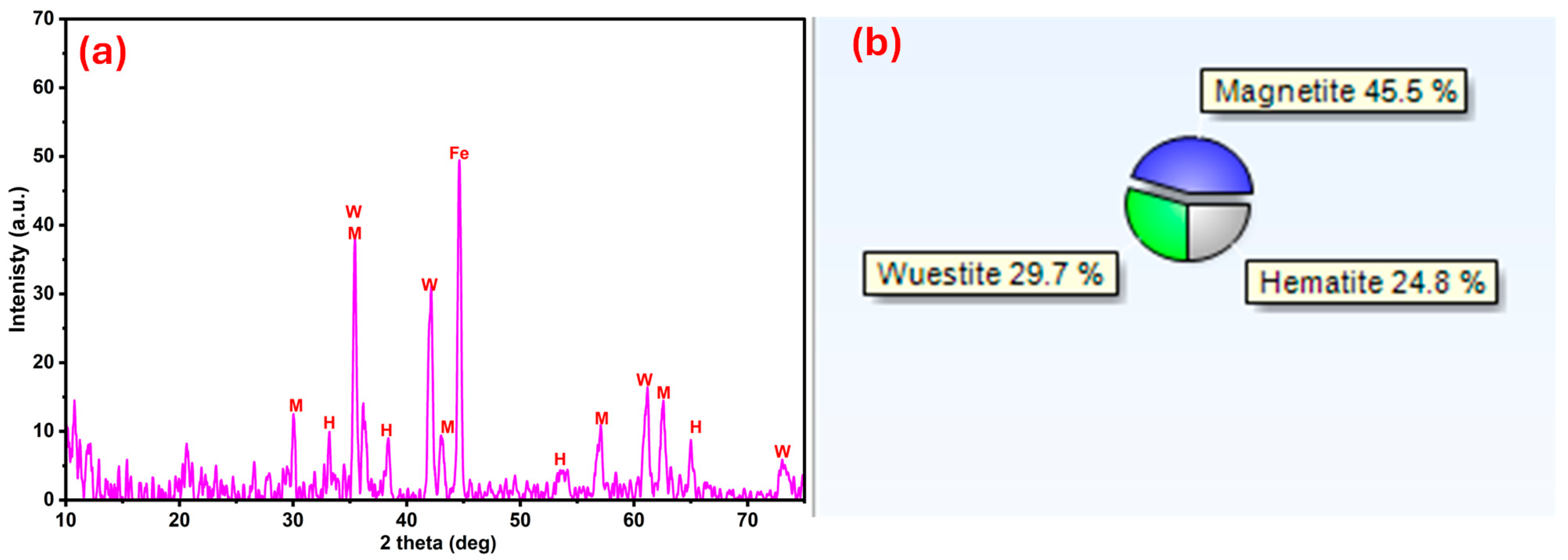
XRD was employed on the prepared IONPs to analyze their crystallinity, and the results are shown in Figure 1a. Many diffraction peaks in the 2θ range of 10–75° confirmed the crystalline nature of the catalyst material. The presence of wüstite (FeO), magnetite (Fe3O4), and hematite (α-Fe2O3) indicates the multiphase nature of IONPs. Peaks at 30.15°, 35.4°, 43.0°, 57.0°, and 62.6° correspond to (220), (311), (400), (422), and (511) planes of cubic magnetite, as reported in the literature [46]. Additional peaks were identified near 33.6°, 40.8°, 53.7°, and 64.7°, which are associated with (104), (113), (116), and (300) planes and are assigned to the hematite phase [47]. Moreover, peaks at 36.4°, 42.1°, 61.1°, and 73.1° were attributed to the (111), (200), and (311) planes of cubic wüstite [48]. A noticeable diffraction peak at approximately 44.7° corresponds to the (110) plane of metallic iron (Fe). The phase percentages presented in Figure 1b represent the relative distribution of the identified iron oxide phases (FeO, Fe3O4, and α-Fe2O3) and were normalized within the oxide fraction. The metallic Fe phase was identified qualitatively from the XRD pattern and was therefore not included in the oxide phase percentage calculation. FeO and Fe3O4 phases have cubic crystal structures, while α-Fe2O3 exhibits a rhombohedral structure. The crystallite sizes of the detected phases range from 12 to 30 nm (102–326 Å), with an average crystallite size of 20–25 nm, confirming the nanocrystalline nature of the produced IONPs.

2.3. Morphological and PSD Analysis

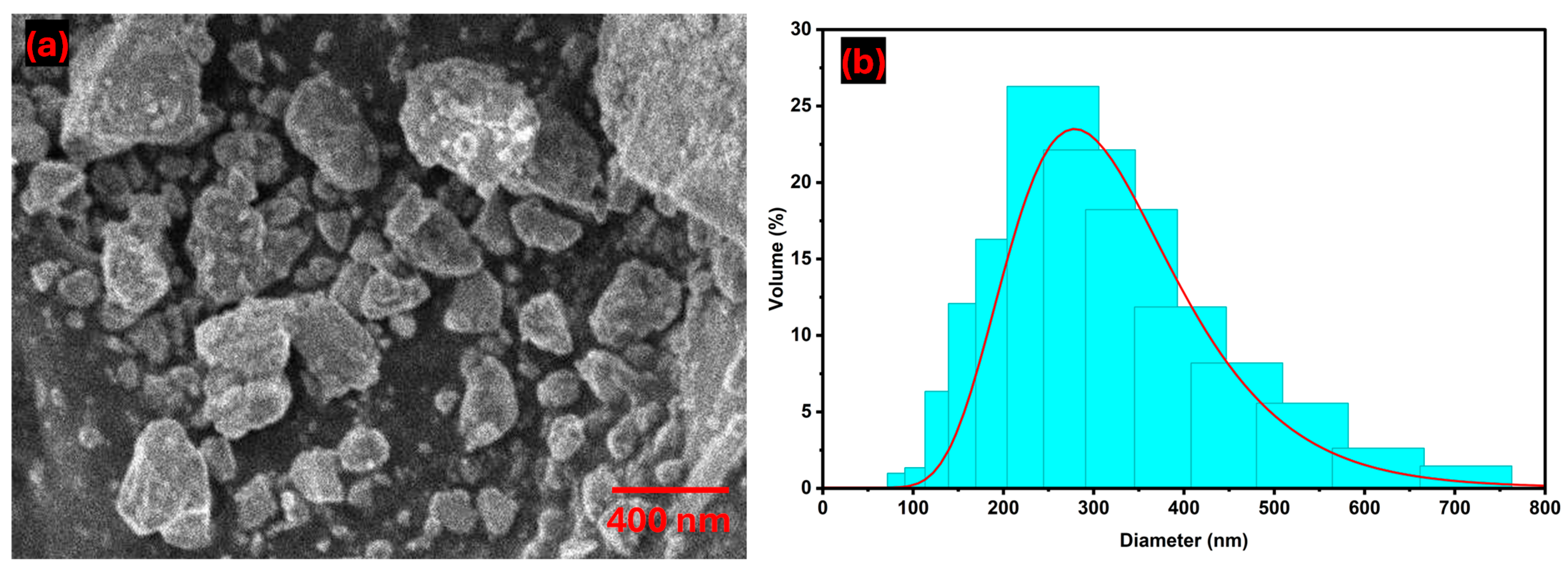
The morphological and particle size characteristics of the synthesized IONPs were examined using a scanning electron microscope and ZetaSizer, as shown in Figure 2. SEM images (Figure 2a) reveal heterogeneous morphology, which consists of irregularly shaped particles with polyhedral morphology and rough surface textures. The IONPs show strong agglomeration, which is attributed to their high surface energy and magnetic interactions. The resulting morphology is characteristic of the top-down ball milling technique, where repeated particle fracture and refinement produce irregularly shaped particles with rough surfaces. Figure 2b shows a particle size distribution ranging from 100 nm to 750 nm, with a bulk of particle concentration between 200 nm and 400 nm and a maximum of 300 nm. The broader distribution indicates that particle fragmentation and agglomeration happened concurrently throughout the milling process. Similar behavior has been seen in mechanically milled iron oxide systems, where particle refinement coincides with the formation of secondary aggregates. A significant contrast was found between the particle sizes acquired from PSD analysis and the crystallite sizes calculated from XRD (12–30 nm). Overall, the XRD, SEM, and PSD results collectively confirm the successful formation of IONPs, which can contribute to improved catalytic activity by increasing surface activity for adsorption–desorption reactions.

2.4. Optical Properties and Band Gap Analysis

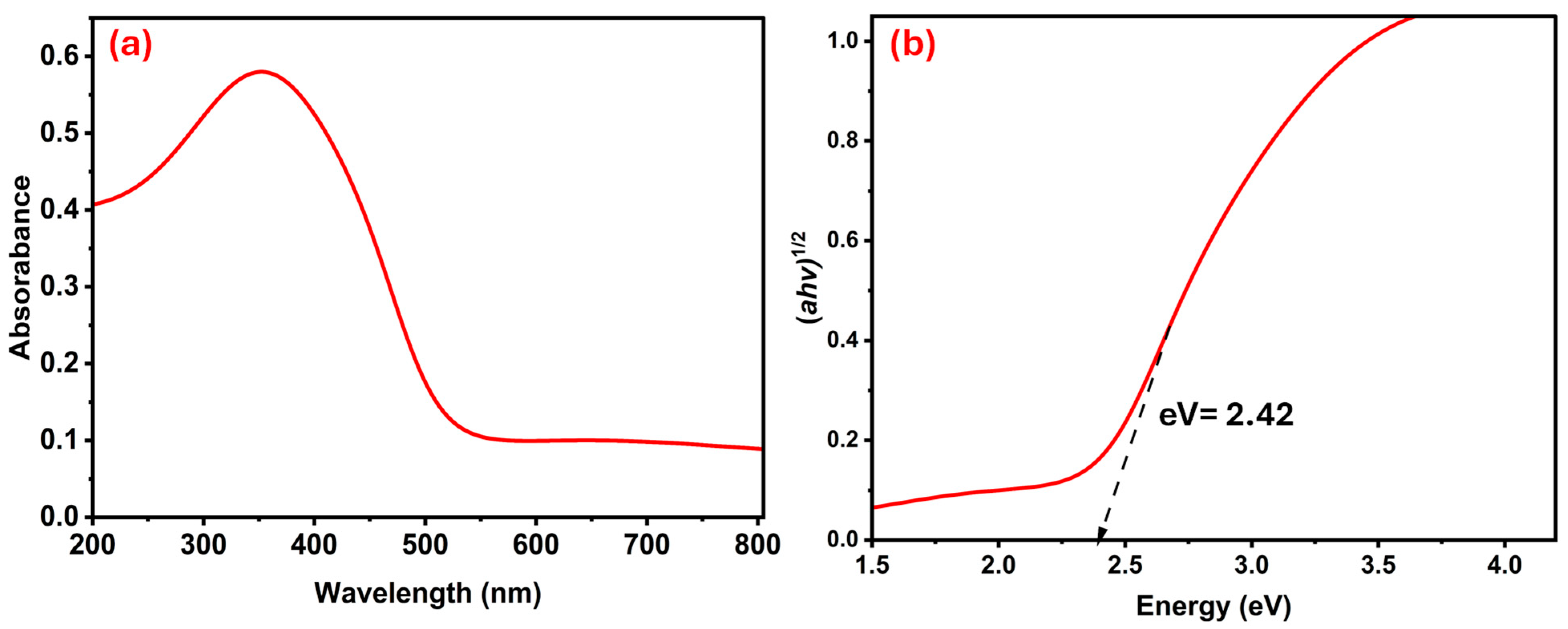
The optical characteristics of the prepared IONPs were investigated using UV-Vis spectroscopy, while the optical band gap was calculated by means of a Tauc plot, as shown in Figure 3a,b. As illustrated in Figure 3a, the nanoparticles exhibit a broad absorption band with a peak around 368 nm, showing high absorption in the near-UV region. The absorption tail further extending into the visible range suggests that the synthesized nanomaterial can absorb a broader fraction of the sunlight rather than UV light absorption. The behavior can be related to the mixed-valence character of iron oxides (Fe2+/Fe3+), structural disorder, and defect states formed during the high-energy ball-milling process, which introduce localized electronic states inside the band structure. Figure 3b shows that extrapolating the linear component of the (αhv)1/2 versus photon energy plot results in a band gap energy of 2.42 eV. The obtained value verifies the semiconducting nature of the IONPs and is within the normal range reported for iron oxide-based nanomaterials. It should be noted that the measured band gap does not necessarily correspond to that of an individual iron oxide phase, as the synthesized IONPs consist of a multiphase FeO/Fe3O4/α-Fe2O3 system. The observed optical band gap represents the collective optical response of the material and may be influenced by interfacial interactions among the constituent phases. In addition, structural defects, localized electronic states, and lattice disorder introduced during high-energy ball milling can modify the electronic structure and optical transitions, resulting in an apparent band gap different from those of the individual iron oxide phases. Similar effects of size, structure, defects, and non-stoichiometry on the optical properties of iron oxide nanomaterials have been reported in previous studies. A relatively low band gap is advantageous for photocatalytic applications because it enhances photon absorption and the formation of electron-hole pairs under irradiation. Furthermore, the combination of nanocrystallinity, multiphase composition, and defect-rich microstructure is projected to improve charge separation and interfacial electron transfer, resulting in increased production of reactive oxygen species responsible for pollutant destruction. As a result, the optical properties of the synthesized IONPs show their promise as effective photocatalytic materials for environmental remediation applications.

2.5. Photocatalyst Performance and Kinetics of IONPs

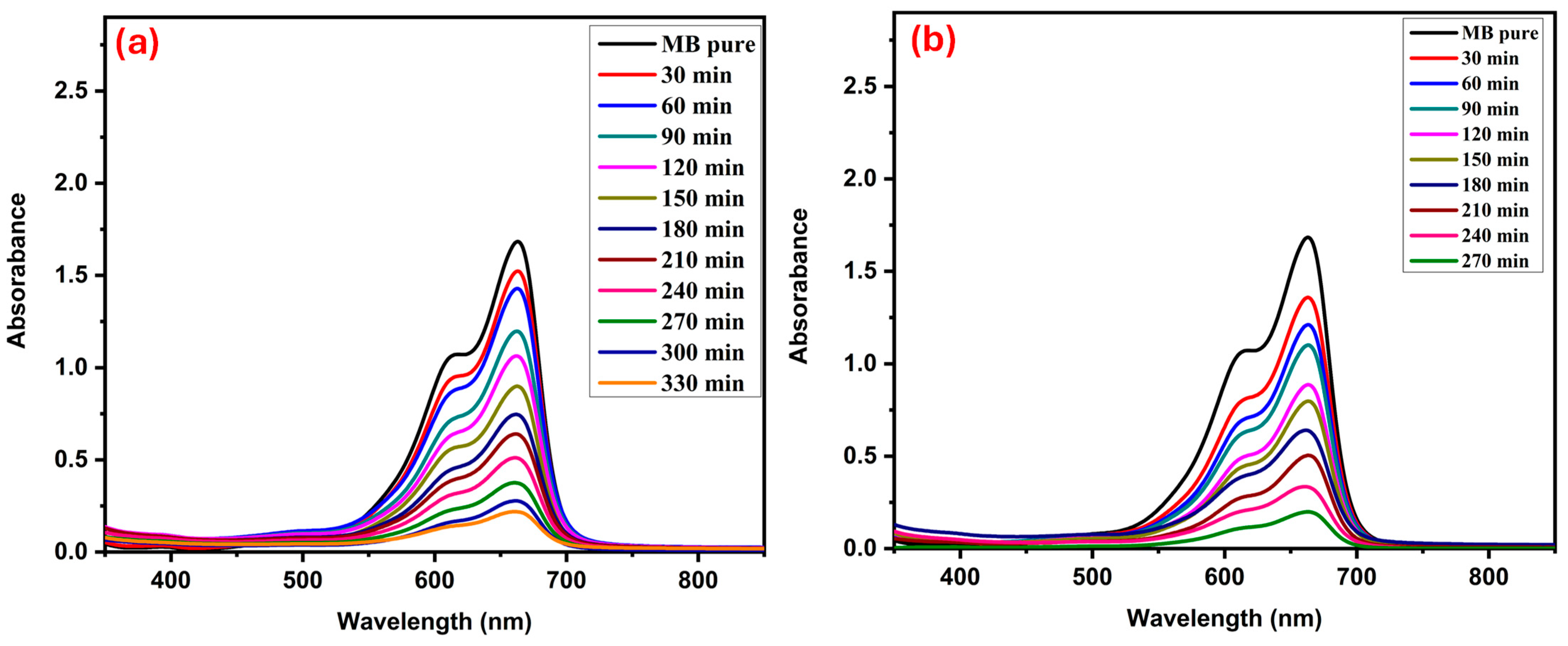
The photocatalytic efficiency of the IONPs was examined by degrading methylene blue (MB) under sunlight irradiation. Figure 4a,b illustrate how the UV-Vis absorption spectra change over time at different catalyst loadings of 15 mg and 30 mg. The characteristic absorption peak of MB was observed close to 663 nm [49] and gradually reduced with increasing irradiation time for both catalyst dosages, suggesting the continuous degradation of dye molecules. Additionally, the shoulder peak identified at 613 nm reduced significantly, confirming the breakdown of the conjugated aromatic structure of the dye [50].
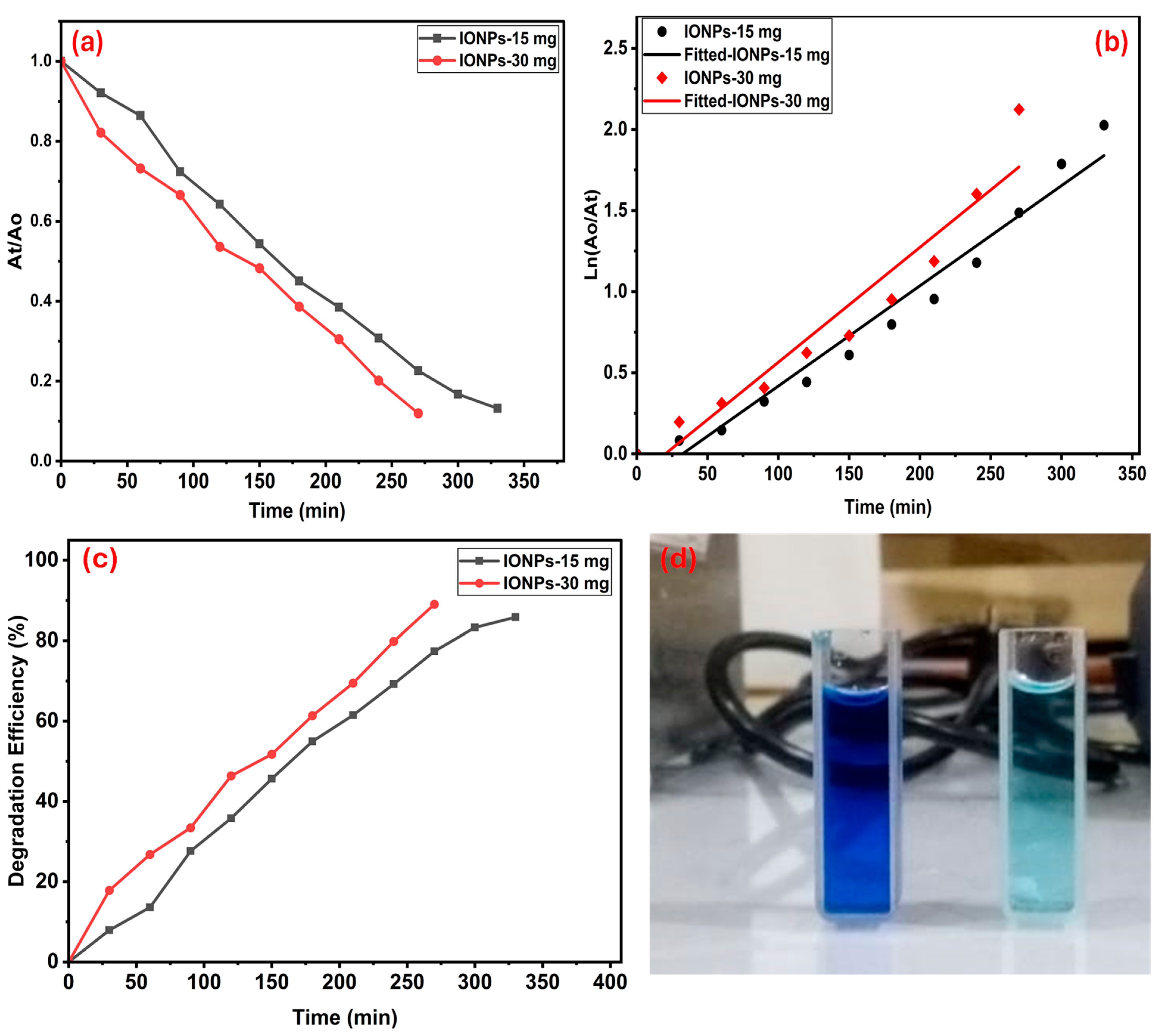
To investigate the degradation, the data of the normalized concentration ratio (At/A0) versus irradiation time were plotted, as depicted in Figure 5a. The relative dye concentration decreased steadily for both catalyst dosages during the irradiation period. However, the concentration decrease was substantially faster with the 30 mg catalyst dosage. Following 270 min of exposure, the At/A0 value for the 30 mg dosage decreased to around 0.105, whereas the 15 mg catalyst required a longer irradiation period to reach a comparable level of degradation. This increased concentration decay at higher catalyst dosages suggests a more effective use of incident sunlight and faster overall degradation kinetics. The calculated photocatalysis efficiency from absorbance measurements is shown in Figure 5c. For all tested conditions, degradation efficiency increased steadily with irradiation time, demonstrating the long-term photocatalytic activity of IONPs under natural sunlight. Specifically, after 330 min, the 15 mg catalyst reached a maximum degradation efficiency of around 86.4%, while the 30 mg catalyst achieved an even higher efficiency of 89.7% in only 270 min. Despite the minor difference in final degradation efficiency, the 30 mg dosage achieved a shorter degradation time. The non-proportional improvement relative to catalyst loading may be attributed to partial light shielding and reduced utilization of additional active sites at higher catalyst concentrations.
The degradation kinetics were further investigated using the pseudo-first-order model, with the corresponding kinetic plots presented in Figure 5b. The pseudo-first-order kinetic model, derived from the Langmuir-Hinshelwood mechanism, is widely used for heterogeneous photocatalytic degradation processes. As adsorption–desorption equilibrium was established prior to irradiation, adsorption effects remained approximately constant during the reaction, and the degradation process was primarily governed by photocatalytic surface reactions, resulting in pseudo-first-order behavior. A strong linear relationship between ln(A0/At) and irradiation time was observed for both catalyst dosages, confirming the applicability of the kinetic model under the investigated conditions. The apparent rate constant (k) was calculated from the slope of the fitted linear regression of the ln(A0/At) vs. irradiation time plots, and the accompanying R2 values were used to evaluate the applicability of the pseudo-first-order kinetic model. As summarized in Table 2, the rate constantly increased from 6.18 × 10⁻³ min−1 for the 15 mg catalyst loading to 7.08 × 10⁻³ min−1 for the 30 mg catalyst loading. The higher rate obtained at increased catalyst loading is consistent with enhanced degradation efficiency, indicating improved photocatalytic activity under the investigated conditions.
The experimental data exhibit a strong fit with the pseudo-first-order kinetic model, yielding R2 values of 0.9631 and 0.9418 for the 15 mg and 30 mg samples, respectively. This behavior suggests that surface-mediated reactions play an important role in the degradation process. Moreover, the comparatively high degradation efficiencies obtained under natural sunlight irradiation demonstrate that the synthesized IONPs effectively use the visible portion of the solar spectrum. This observation is compatible with the optical characterization results and the multiphase iron oxide composition determined by XRD analysis. The coexistence of FeO, Fe3O4, and α-Fe2O3 phases may contribute to improved photocatalytic activity through possible interfacial charge-transfer interactions, thereby facilitating degradation processes. Furthermore, heterophase interfaces within multiphase semiconductor systems can promote charge separation and suppress electron-hole recombination, leading to prolonged charge-carrier lifetimes and enhanced generation of reactive species responsible for pollutant degradation. Similar improvements in photocatalytic performance resulting from interfacial charge-transfer processes and reduced charge recombination have been reported for other multiphase photocatalytic systems [51,52,53].
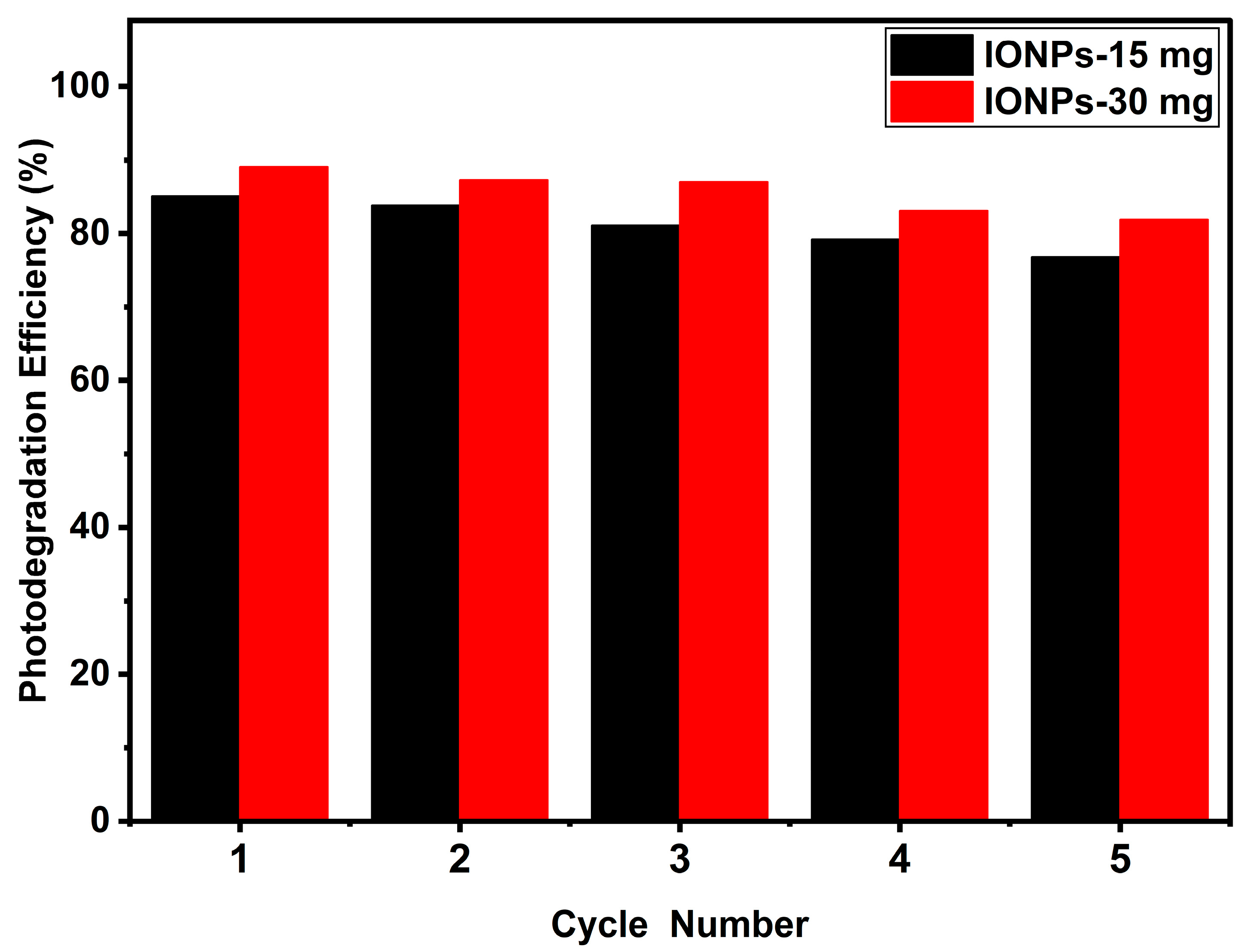
To evaluate the stability and reusability of the synthesized IONPs, we conducted photocatalytic recycling tests over five successive degradation cycles using catalyst doses of 15 and 30 mg. As shown in Figure 6, degradation efficiency gradually decreased with increasing cycle number. The degradation efficiency decreased from 85.09% to 80.00% for the 15 mg catalyst dosage and from 90.40% to 81.00% for the 30 mg catalyst dosage after five cycles. Despite this decline, the catalyst retained a substantial portion of its initial photocatalytic activity, demonstrating satisfactory stability and reusability. The slight reduction in performance may be attributed to catalyst loss during recovery and the partial blockage of active sites by adsorbed reaction intermediates.

2.6. Electrocatalytic Performance Towards HER and OER

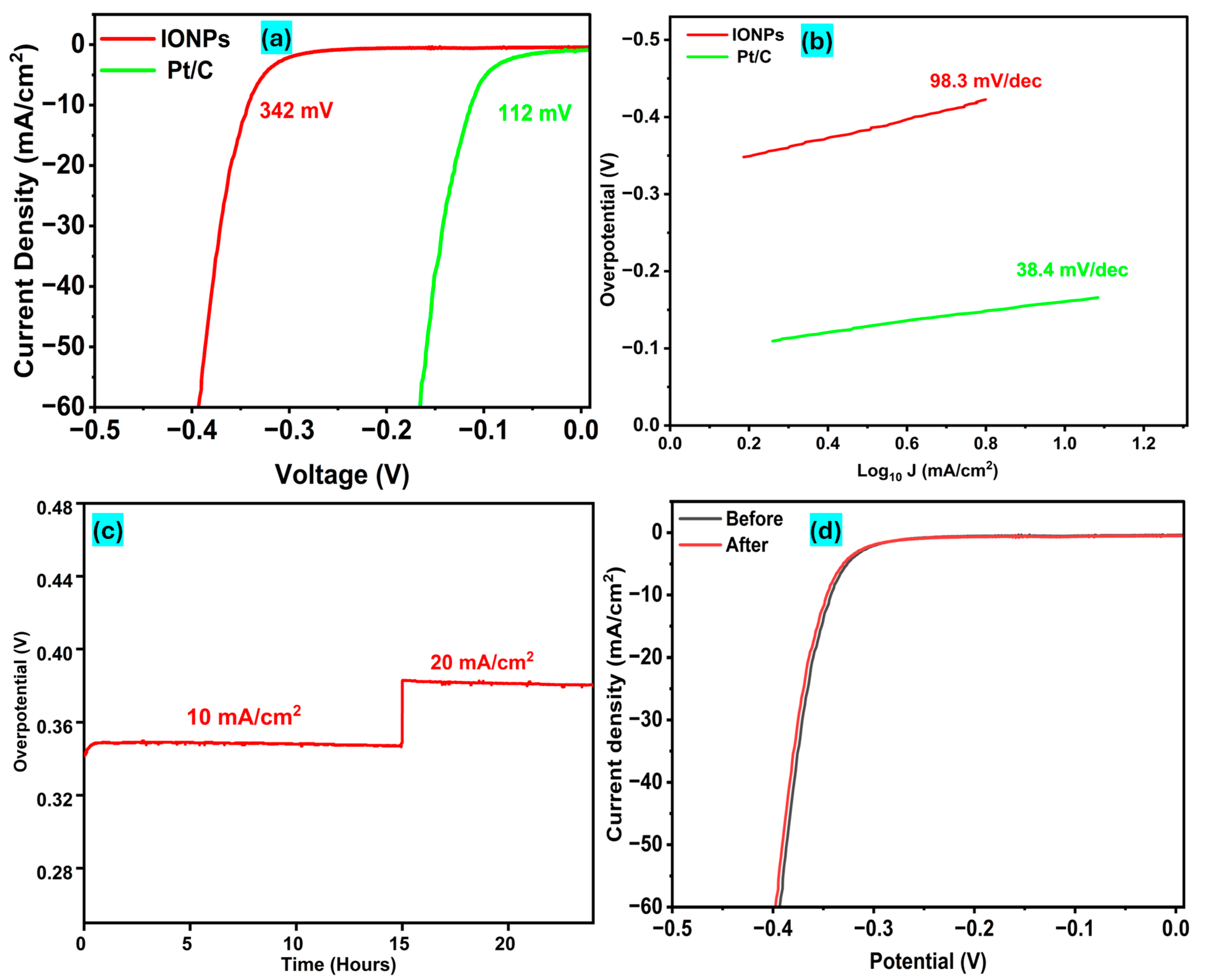
The bifunctional electrocatalytic performance of the synthesized IONPs toward HER and OER was investigated in 1.0 KOH through LSV, Tafel analysis, and chronopotentiometric durability measurements. For the HER process, the LSV curves shown in Figure 7a reveal that the synthesized IONPs, as a catalyst, require an overpotential of 342 mV to achieve a current density of 10 mA/cm2. The resulting HER activity shows that the synthesized IONPs can be a promising cathodic electrocatalyst for alkaline water splitting. However, the obtained overpotential value is higher than that of commercial Pt/C (112 mV); the observed activity confirms the ability of the waste-derived iron oxide catalyst to facilitate hydrogen production in alkaline media. Furthermore, it is widely reported that small Tafel slope values are indicative of faster reaction kinetics and a more efficient charge-transfer process at the catalyst-electrolyte interface [54,55]. The resulting Tafel slope of 98.3 mV/dec illustrated in Figure 7b suggests appreciable HER activity and provides insight into the reaction kinetics occurring at the catalyst-electrolyte interface. The obtained Tafel slope value suggests that water dissociation and hydrogen adsorption processes may contribute to the observed HER kinetics under alkaline conditions.
In alkaline media, the reaction starts with the Volmer step, in which water molecules adsorb and dissociate on the catalyst surface, generating adsorbed hydrogen species (MHads) and hydroxide ions (OH−).
H2O + e−+M → MHads + OH−  (Volmer step)
The produced hydrogen species (MHads) subsequently participates in the Heyrovsky step.
H2O + MHads + e−→H2 + M + OH−  (Heyrovsky step)
Additionally, hydrogen evolution can be through the recombination of two adjacent adsorbed hydrogen species
MHads + MHads → H2 + 2M
The observed HER performance of the synthesized IONPs may be associated with their relatively narrow band-gap energy (2.42 eV), which promotes electron mobility and supports charge-transfer processes during hydrogen evolution [56]. The chronopotentiometric curves for HER at 10 and 20 mA/cm2 (Figure 7c) showed only slight changes during testing, indicating steady catalytic operation. The overpotential remained stable at approximately 344 mV and 382 mV for current densities of 10 and 20 mA/cm2, respectively, throughout the 24 h test. Moreover, the small variation in polarization curves obtained before and after durability testing (Figure 7d) further demonstrates good electrochemical stability and catalytic durability of the synthesized IONPs under prolonged alkaline HER conditions.
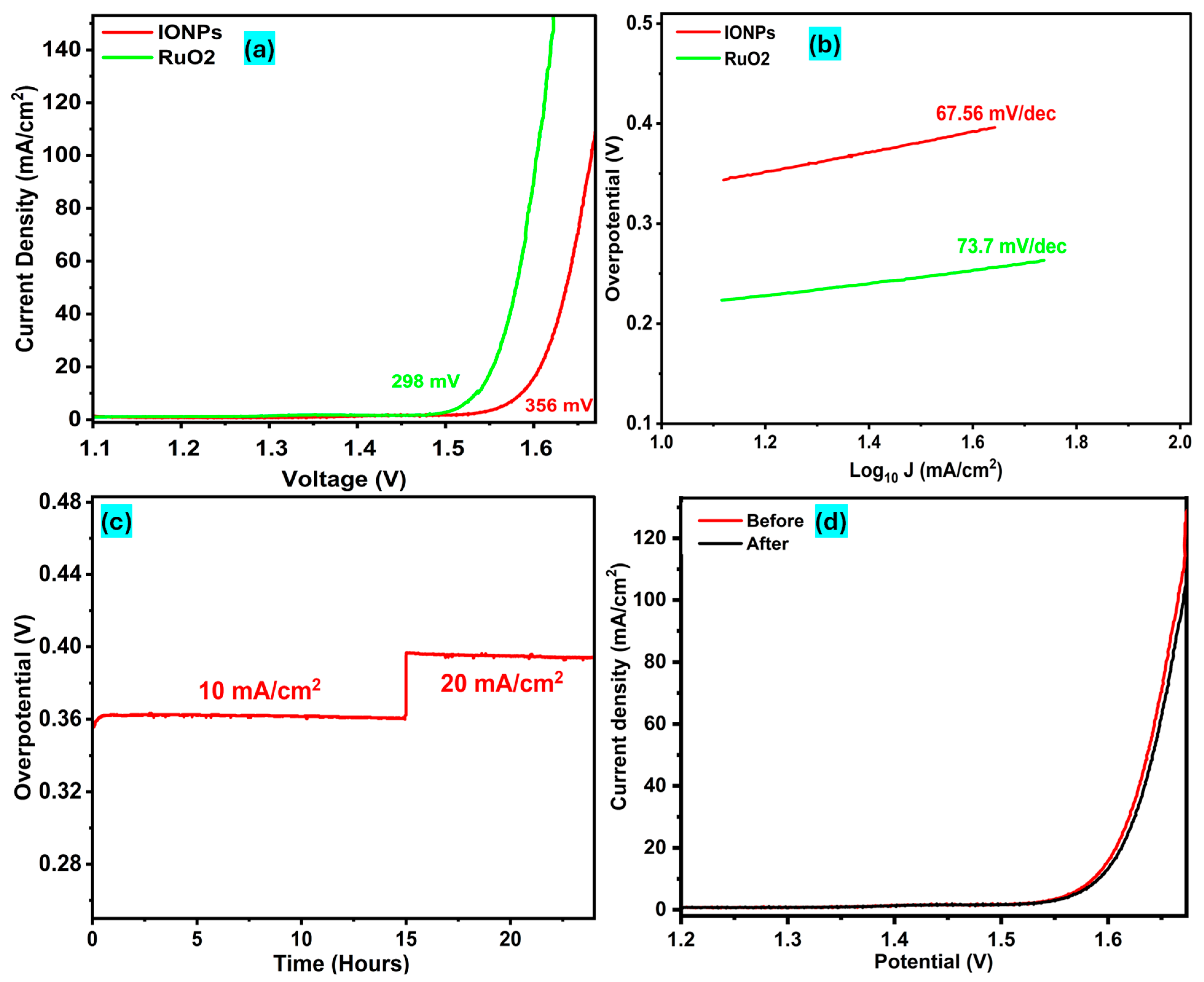
Likewise, the oxygen evolution reaction (OER) activity of the IONPs was investigated in 1.0 M KOH using LSV, Tafel analysis, and chronopotentiometric durability tests. As shown in Figure 8a, the mill scales derived from IONPs required an overpotential of 356 mV to achieve a current density of 10 mA/cm2, whereas commercial RuO2 attained the same current density at 298 mV. Despite RuO2 showing higher catalytic activity, the synthesized IONPs showed significant anodic activity for OER in 1.0 KOH. Furthermore, smaller Tafel slope values are associated with more favorable reaction kinetics and faster electron transfer processes at the catalyst-electrolyte interface. The prepared IONPs exhibited a Tafel slope of 67.5 mV/dec (Figure 8b), compared with 73.7 mV dec−1 for RuO2. Although the IONPs displayed a slightly lower Tafel slope, RuO2 required a lower overpotential to achieve 10 mA cm−2. Therefore, the two catalysts exhibit advantages in different performance metrics, and direct superiority cannot be established from Tafel slope values alone.
Interestingly, the IONPs required a slightly higher overpotential for OER (356 mV) than for HER (342 mV), but the OER Tafel slope (67.5 mV/dec) was substantially lower than that obtained for HER (98.3 mV/dec). This observation indicates faster reaction kinetics towards OER as the reaction began, while a slightly higher driving force was required to achieve the same current density.
In alkaline media, OER proceeds by a multistep four-electron transfer process that includes adsorption and oxidation of hydroxide ions on active catalytic sites. The basic reactions can be characterized as follows:
M + OH− → MOHads + e−
MOHads + OH− → MOads + H2O
MOads → MO + e−
2MO → 2M + O2 + 2e−
Theoretical Tafel slope benchmarks of 120, 60, 40, and 15 mV/dec are used to evaluate the rate-determining step of OER in alkaline media. The IONPs displayed a Tafel slope of 67.5 mV/dec, which is closer to the theoretical value of 60 mV/dec. This observation may suggest the possible involvement of the second elementary step in the OER process. However, Tafel slope analysis alone is insufficient to definitively identify the reaction mechanism or the rate-determining step, and additional mechanistic investigations would be required for confirmation. The overpotential remained approximately 355 mV and 396 mV at current densities of 10 and 20 mA/cm2, respectively, throughout the 24 h stability test. The chronopotentiometric curves in Figure 8c showed relatively small potential variations over the testing period, indicating steady catalytic operation during oxygen evolution. Similarly, close overlap of the polarization curves obtained before and after the durability test (Figure 8d) shows excellent electrochemical stability and catalytic performance maintained for prolonged alkaline conditions.

3. Materials and Methods

3.1. Materials and Chemicals

Mill scale was collected from Naveena Steel Mill, Karachi, Pakistan. Potassium hydroxide (KOH), 5% Nafion, Ethanol (C2H5OH), and methylene blue (C16H18C1N3S) of high analytical grade were purchased from Sigma-Aldrich (St. Louis, MO, USA) through their local distributor in Karachi, Pakistan. Deionized (DI) water was used throughout the experimental work.

3.2. Preparation of IONPs

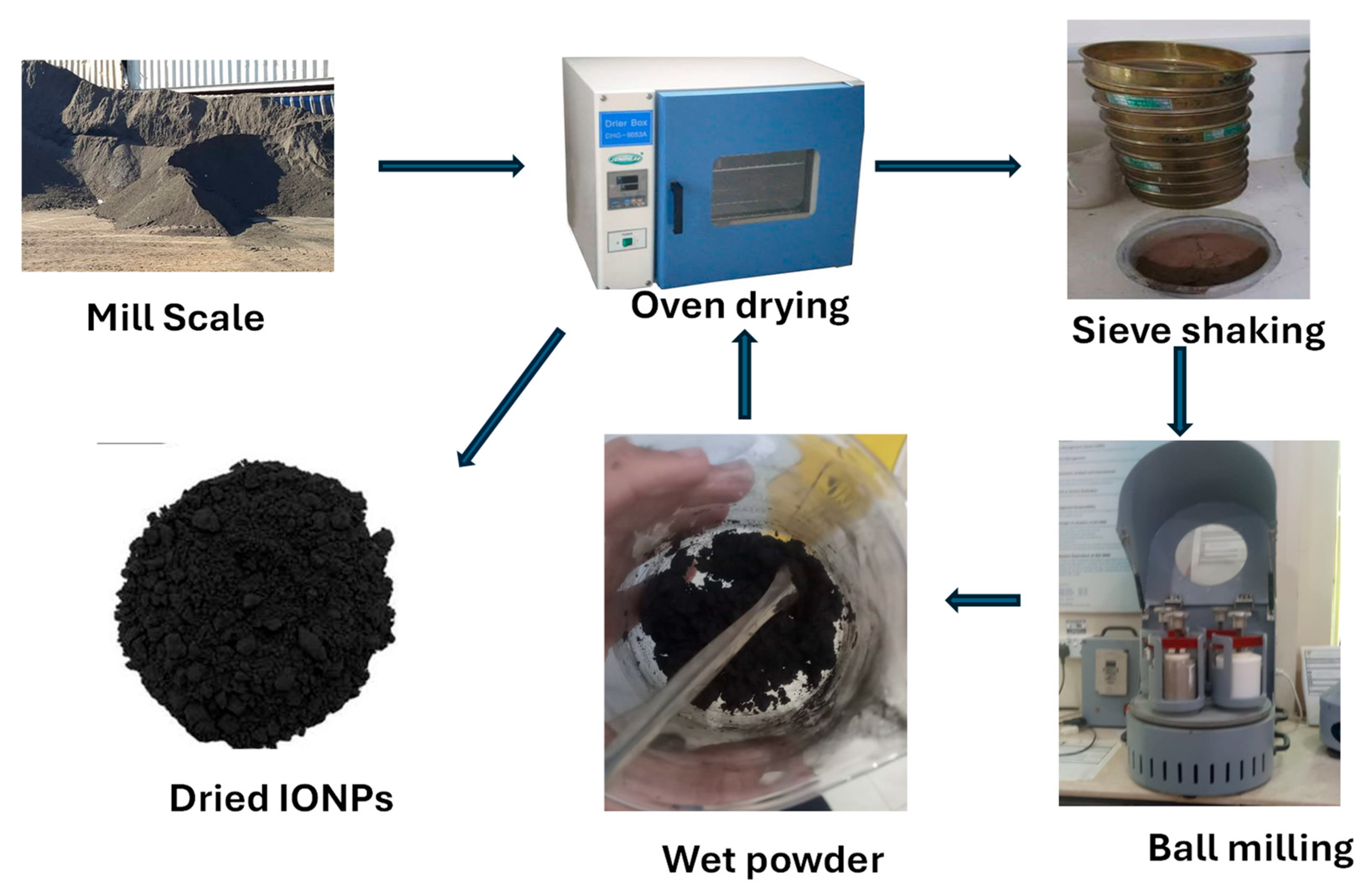
Mill scale was initially washed off several times with DI water to remove dust and other contamination (steps are shown in Figure 9). The recovered mill scale was then dried at 100 °C to remove any remaining moisture. After drying, the material was sieved to select particles smaller than 53 µm for further processing. The sieved powder was further treated in a high-energy planetary ball mill for 56 h with a ball-to-powder weight ratio (BPR) of 10:1 and a milling speed of 300 rpm. The nanoparticles obtained were separated and washed with ethanol to remove any residue. Finally, the IONPs were dried at 100 °C and utilized for further investigation. The treatment of the raw mill scale is necessary, as untreated mill scale has large, dense, millimeter-scale flakes with a very low specific surface area and few accessible active sites. Its particle size is also far outside the range required for photocatalytic and electrocatalytic applications. Thus, the treated mill scale is used for the analysis.

3.3. Characterization of Prepared IONPs

The particle size distribution and zeta potential of the achieved IONPs were determined using dynamic light scattering (DLS) with a Malvern Zetasizer Nano ZS (Malvern Instruments Ltd., Worcestershire, UK). The crystal structure of the prepared IONPs was investigated through powder X-ray diffraction (X’Pert PRO, PANalytical, Almelo, The Netherlands) employing Cu Kα radiation (λ = 1.5406 Å). The measurements were performed at an operating voltage of 45 kV and a current of 45 mA over a range of 10–80°. The crystallite size was determined using the Scherrer equation.
D = k λ β cos θ
where D is crystallite size, K is the shape factor, λ is the X-ray wavelength, β is the full width at half maximum (FWHM), and θ is the Bragg diffraction angle. The morphology of the synthesized nanocatalyst was examined using a JEOL JSM 6480A scanning electron microscope (JEOL, Tokyo, Japan) operated at 3.0 kV. Furthermore, the optical properties of IONPs were investigated using a UV–Visible spectrometer. The band gap energy was calculated using the Tauc relation.
(αhv)n = A(hv − Eg)
where α is the absorption coefficient, hv is the photon energy, A is the proportionality constant, and Eg is the band gap energy. The band gap was calculated by extrapolating the linear component of the Tauc figure along the energy axis.

3.4. Photocatalytic Degradation of Methylene Blue (MB)

The photocatalytic performance of IONPs was investigated using the organic dye MB under natural sunlight. An aqueous MB solution with an initial concentration of 5 ppm was prepared for the photodegradation. Catalyst dosages of 15 mg and 30 mg were mixed in 50 mL of the MB solution and magnetically stirred in the dark for 20 min to achieve adsorption–desorption equilibrium. The photocatalytic experiments were conducted in May 2026, with the dye solutions exposed to sunlight. The dye suspensions were exposed outdoors between 10:00 a.m. and 3:00 p.m. under ambient conditions, with an average temperature of 30 ± 5 °C. Before irradiation, the suspensions were magnetically stirred in the dark for 20 min to establish adsorption–desorption equilibrium. Samples were collected at 30 min intervals, separated from the photocatalyst by centrifugation, and analyzed using a Peak Instruments T-9200 UV-Visible Spectrophotometer (Peak Instruments (Shanghai) Co., Ltd., Shanghai, China). The absorbance of MB was monitored at its maximum absorption wavelength (λmax = 663 nm), and the relative concentration was determined from the corresponding absorbance values. Finally, the photocatalytic degradation was calculated from absorbance measurements using Equation (3).
DE % = A 0 − A t A 0 × 100
where A0 and At are initial and final absorbance values, respectively. Additionally, pseudo-first-order kinetics were employed to investigate the kinetics of photodegradation of MB. The expression is given in Equation (4).
ln A 0 A 0 = K app × t
Here, Kapp demonstrates the reaction rate constant; A0 is the initial absorbance at irradiation time 0 min, and At indicates the MB absorbance at the reaction time t.

3.5. Electrochemical Measurements

To investigate the electrocatalytic activity of prepared IONPs, linear sweep voltammetry (LSV) and chronopotentiometry were employed using a potentiostat (Corrtest-CS 350M EIS) (Wuhan Corrtest Instruments Corp., Ltd., Wuhan, China). Electrochemical measurements were carried out in a conventional three-electrode cell, including a glassy carbon electrode (GCE) as the working electrode (surface area: 0.18 cm2, diameter: 3 mm), a Pt wire as the counter electrode with a surface area of 0.18 cm2, and a silver-silver chloride (Ag/AgCl) as a reference electrode. For electrode preparation, 25 mg of IONPs were dispersed in 1.0 mL of DI water containing 0.3 mL of 5% Nafion solution and ultrasonicated for 25 min to ensure a homogeneous catalyst ink. Subsequently, 15 µL of catalyst ink was drop-cast onto the surface of GCE and dried at ambient conditions. Approximately 0.2 mg of catalyst was deposited on the GCE surface. The 1.0 M KOH electrolyte was used in this experiment. LSV was initially employed to evaluate the electrochemical response towards HER (0 to −1.5 V) and OER (0 to 0.7 V) at a scan rate of 5 mV/s. Additionally, long-term electrochemical durability of the prepared electrode was assessed using chronopotentiometry for 24 h for both HER and OER at current densities of 10 mA/cm2 and 20 mA/cm2. The polarization curves were corrected for iR losses using the uncompensated solution resistance obtained from electrochemical impedance spectroscopy (EIS). Tafel slope values were calculated by linear fitting of the overpotential (η) versus log(j) plots within the kinetically controlled linear region of the corresponding polarization curves. The mathematical equations shown below were used for conversion of experimental potentials measured against Ag/AgCl and to calculate Tafel slopes.
E RHE = E Ag / AgCl + 0.059   pH + E Ag / AgCl 0
overpotntaal (η) = Onset potntiel (ERHE) − ERHE
η = blog(j) + a
Herein, the EAg/AgCl is 0.197 V for the reference electrode of Ag/AgCl; the value of the onset thermodynamic potential is 0 V for HER and 1.23 V for OER. Similarly, b represents the Tafel slope, j is the current density, and a is the constant.

4. Conclusions

This work successfully synthesized iron oxide nanoparticles (IONPs) from mill scale using a simple ball-milling route, offering an effective method for the upcycling of industrial waste into multifunctional catalytic materials. Structural and optical analyses revealed the formation of a multiphase nanocrystalline system composed of FeO, Fe3O4, α-Fe2O3, and residual Fe with a relatively narrow band-gap energy of 2.42 eV. The combined interaction among these phases with the nanocrystalline nature of the material contributed significantly to its catalytic performance. The IONPs exhibited strong sunlight-driven photocatalytic performance toward methylene blue degradation, reaching efficiencies of 86.4% and 89.78% at catalyst loadings of 15 and 30 mg, respectively. This degradation process followed pseudo-first-order kinetics, indicating the efficiency of the produced reactive species for pollutant removal. Furthermore, electrochemical analysis confirmed that the IONPs are active for both the hydrogen evolution reaction (HER) and the oxygen evolution reaction (OER) in alkaline media. Overpotentials of 342 and 356 mV were needed to achieve a current density of 10 mA/cm2 for HER and OER, respectively. The lower OER Tafel slope (67.5 mV/dec) compared to HER (98.3 mV/dec) indicates faster oxygen evolution kinetics once the reaction is underway. Based on the measured Tafel slope, the conversion of adsorbed hydroxyl species to oxygen-containing intermediates may be involved in the OER pathway. However, Tafel slope analysis alone is insufficient to conclusively identify the reaction pathway or the rate-determining step, and additional mechanistic investigations are required for confirmation. Furthermore, insignificant variations in activity during durability testing demonstrated remarkable electrochemical stability under prolonged alkaline operation.

Author Contributions

A.C.: Conceptualization, methodology, investigation, software, writing—original draft; I.A.C.: Conceptualization, methodology, formal analysis, data curation, project administration, writing—original draft; M.K.: Methodology, visualization, writing—review and editing; A.A.S.: Formal analysis, data curation, writing—review and editing; E.B.: Validation, resources, writing—reviewing and editing; J.A.: Methodology, validation, writing—review and editing; A.Q.C.: Methodology, validation, writing—review and editing; T.P.: Investigation, validation, writing—review and editing; A.D.C.: Resources, supervision, validation, writing—review and editing. All authors have read and agreed to the published version of the manuscript.

Funding

This research received support provided by the Ongoing Research Funding program (ORF-2026-1830), King Saud University, Riyadh, Saudi Arabia.

Data Availability Statement

The data used in this study can be obtained from the corresponding authors on request.

Acknowledgments

The authors acknowledge the support provided by the Ongoing Research Funding program (ORF-2026-1830), King Saud University, Riyadh, Saudi Arabia.

Conflicts of Interest

The authors declare no conflicts of interest.

References

  1. Ajmal, Z.; Ullah, M.H.; Qadeer, A.; Zhang, H.; Khan, M.A.; Shen, S.; Orooji, Y.; Imran, M.; Ali, M.; Taha, R.; et al. Exploring critical development in photocatalytic overall water splitting: Recent trend, races predictions and environmental impacts. Green Energy Environ. 2026, 11, 401–453. [Google Scholar] [CrossRef] [Scilit]
  2. Chen, K.; Dong, W.; Huang, Y.; Wang, F.; Zhou, J.L.; Li, W. Photocatalysis for sustainable energy and environmental protection in construction: A review on surface engineering and emerging synthesis. J. Environ. Chem. Eng. 2025, 13, 117529. [Google Scholar] [CrossRef] [Scilit]
  3. Potbhare, A.K.; Madankar, R.S.; Nimje, A.B.; Tripathy, S.S.; Bhilkar, P.R.; Norek, M.; Abdala, A.A.; Chaudhary, R.G. A sustainable approach for enhanced photocatalytic degradation of dyes/drugs using Neolamarckia cadamba—Mediated TiO2–rGO NCs. New J. Chem. 2026, 50, 11962–11981. [Google Scholar] [CrossRef] [Scilit]
  4. Pan, A.; Xu, S.; Zaidi, S.A.H. Environmental impact of energy imports: Natural resources income and natural gas production profitability in the Asia-Pacific Economic Cooperation Countries. Geosci. Front. 2024, 15, 101756. [Google Scholar] [CrossRef] [Scilit]
  5. Bhutto, Y.A.; Pandey, A.; Saidur, R.; Laghari, I.A.; Khir, H.; Islam, A.; Zaed, A. Electrical and thermal performance assessment of photovoltaic thermal system integrated with organic phase change material. E3S Web Conf. 2024, 488, 01007. [Google Scholar] [CrossRef] [Scilit]
  6. Wang, J.; Azam, W. Natural resource scarcity, fossil fuel energy consumption, and total greenhouse gas emissions in top emitting countries. Geosci. Front. 2024, 15, 101757. [Google Scholar] [CrossRef] [Scilit]
  7. Al-Tohamy, R.; Ali, S.S.; Li, F.; Okasha, K.M.; Mahmoud, Y.A.-G.; Elsamahy, T.; Jiao, H.; Fu, Y.; Sun, J. A critical review on the treatment of dye-containing wastewater: Ecotoxicological and health concerns of textile dyes and possible remediation approaches for environmental safety. Ecotoxicol. Environ. Saf. 2022, 231, 113160. [Google Scholar] [CrossRef] [Scilit] [PubMed]
  8. Samal, K.; Mahapatra, S.; Ali, H. Pharmaceutical wastewater as Emerging Contaminants (EC): Treatment technologies, impact on environment and human health. Energy Nexus 2022, 6, 100076. [Google Scholar] [CrossRef] [Scilit]
  9. Koslowski, L.A.D.; Cristofolini, M.; Pauli, C.S.; Lach, C.E.; Paulino, A.T. Electrocoagulation+biochar hybrid process for the treatment of printing industry wastewater. J. Water Process Eng. 2025, 73, 107613. [Google Scholar] [CrossRef] [Scilit]
  10. Dutta, S.; Adhikary, S.; Bhattacharya, S.; Roy, D.; Chatterjee, S.; Chakraborty, A.; Banerjee, D.; Ganguly, A.; Nanda, S.; Rajak, P. Contamination of textile dyes in aquatic environment: Adverse impacts on aquatic ecosystem and human health, and its management using bioremediation. J. Environ. Manag. 2024, 353, 120103. [Google Scholar] [CrossRef] [Scilit] [PubMed]
  11. Kong, X.; Wang, X.; Zeng, W. Nanostructured Catalysts for Electro—And Photocatalytic Energy Conversion: Design Strategies, Mechanistic Descriptors, and Practical Applications. Nanomaterials 2026, 16, 788. [Google Scholar] [CrossRef] [Scilit] [PubMed]
  12. Marinoiu, A.; Iordache, M.; Borta, E.S.; Oubraham, A. Graphene-Based Nanostructured Cathodes for Polymer Electrolyte Membrane Fuel Cells with Increased Resource. C 2024, 10, 105. [Google Scholar] [CrossRef] [Scilit]
  13. Dong, A.; Li, Z.; Ma, Y.; Liao, W.; Zhao, F.; Zhang, X.; Gao, H. Recent Advances in Non-Noble Metal Electrocatalysts for Hydrogen Evolution Reaction in Water Splitting. Nanomaterials 2025, 15, 1106. [Google Scholar] [CrossRef] [Scilit] [PubMed]
  14. Rajaitha, P.M.; Hajra, S.; Mistewicz, K.; Panda, S.; Sahu, M.; Dubal, D.; Yamauchi, Y.; Kim, H.J. Multifunctional materials for photo-electrochemical water splitting. J. Mater. Chem. A Mater. 2022, 10, 15906–15931. [Google Scholar] [CrossRef] [Scilit]
  15. Haider, H.; Azeem, H.; Anwar, M.; S.A, M.A.; Khoja, A.H.; Hassan, M.; Liaquat, R.; Bahadar, A. Photo—And electrocatalytic hydrogen production from dye-degraded wastewater using samarium-doped ceria as a catalyst. Int. J. Hydrogen Energy 2025, 111, 606–622. [Google Scholar] [CrossRef] [Scilit]
  16. Khan, Z.; Kamal, M.; Rehman, G.U.; Niaz, U.; Rizqi, H.D.; Jaafar, J.; Irfan, M.; Ismail, A.F. Recent advancements, modification strategies, and practical implications in semiconductor photocatalysts for efficient wastewater treatment: A review. Environ. Eng. Res. 2025, 31, 250435. [Google Scholar] [CrossRef] [Scilit]
  17. Lv, K.; Li, Z.; Huang, X.; Cheng, Z.; Wang, Z.; Zhao, H. CsPbBr3 Perovskite-Based Heterostructures in Photocatalysis: Mechanisms, Stability, and Multifunctional Performance. Adv. Sci. 2025, 12, e07747. [Google Scholar] [CrossRef] [Scilit] [PubMed]
  18. Hassaan, M.A.; El-Nemr, M.A.; Elkatory, M.R.; Ragab, S.; Niculescu, V.-C.; El Nemr, A. Principles of Photocatalysts and Their Different Applications: A Review. Top. Curr. Chem. 2023, 381, 31. [Google Scholar] [CrossRef] [Scilit] [PubMed]
  19. Dvoranová, D.; Barbieriková, Z.; Brezová, V. Radical Intermediates in Photoinduced Reactions on TiO2 (An EPR Spin Trapping Study). Molecules 2014, 19, 17279–17304. [Google Scholar] [CrossRef] [Scilit] [PubMed]
  20. Ribao, P.; Corredor, J.; Rivero, M.J.; Ortiz, I. Role of reactive oxygen species on the activity of noble metal-doped TiO2 photocatalysts. J. Hazard. Mater. 2019, 372, 45–51. [Google Scholar] [CrossRef] [Scilit] [PubMed]
  21. Wu, Y.; Gao, Z.; Li, H.; Sun, X.; Li, D.; Zhou, G.; Cai, H.-L.; Wu, X. Promoting carrier separation efficiently by macroscopic polarization charges and interfacial modulation for photocatalysis. Chem. Eng. J. 2021, 410, 128393. [Google Scholar] [CrossRef] [Scilit]
  22. Yergaziyeva, G.; Kuspanov, Z.; Mambetova, M.; Khudaibergenov, N.; Makayeva, N.; Daulbayev, C. Advancements in catalytic, photocatalytic, and electrocatalytic CO2 conversion processes: Current trends and future outlook. J. CO2 Util. 2024, 80, 102682. [Google Scholar] [CrossRef] [Scilit]
  23. Aguado-Ruiz, I.; Urrego-Ortiz, R.; Calle-Vallejo, F. The electrochemical symmetries of the oxygen reduction and evolution reactions are connected. Electrochim. Acta 2025, 542, 147410. [Google Scholar] [CrossRef] [Scilit]
  24. Wang, H.; Cheng, J.; Chen, H.; Li, X.; Liu, D.; Li, X.; Li, W.; Wei, G.; Shen, S.; Chi, B.; et al. Applications of perovskite oxides for oxygen evolution and oxygen reduction reactions in alkaline media. Energy Rev. 2025, 4, 100139. [Google Scholar] [CrossRef] [Scilit]
  25. Gao, G.; Sun, Z.; Chen, X.; Zhu, G.; Sun, B.; Yamauchi, Y.; Liu, S. Recent advances in Ru/Ir-based electrocatalysts for acidic oxygen evolution reaction. Appl. Catal. B 2024, 343, 123584. [Google Scholar] [CrossRef] [Scilit]
  26. Baruah, M.J.; Dutta, R.; Zaki, M.E.A.; Bania, K.K. Heterogeneous Iron-Based Catalysts for Organic Transformation Reactions: A Brief Overview. Molecules 2024, 29, 3177. [Google Scholar] [CrossRef] [Scilit] [PubMed]
  27. Sun, W.; Wang, S.; Yu, Z.; Cao, X. Characteristics and application of iron-based materials in heterogeneous Fenton oxidation for wastewater treatment: A review. Environ. Sci. 2023, 9, 1266–1289. [Google Scholar] [CrossRef] [Scilit]
  28. Baabu, P.R.S.; Kumar, H.K.; Gumpu, M.B.; K., J.B.; Kulandaisamy, A.J.; Rayappan, J.B.B. Iron Oxide Nanoparticles: A Review on the Province of Its Compounds, Properties and Biological Applications. Materials 2022, 16, 59. [Google Scholar] [CrossRef] [Scilit] [PubMed]
  29. Wollschläger, J. Reactive Molecular Beam Epitaxy of Iron Oxide Films: Strain, Order, and Interface Properties. In Encyclopedia of Interfacial Chemistry: Surface Science and Electrochemistry; Elsevier: Amsterdam, The Netherlands, 2018; pp. 284–296. [Google Scholar] [CrossRef] [Scilit]
  30. Rivera, E.; Muñoz-Meneses, R.A.; Marín, L.; Mora, M.; Tabares, J.A.; Manotas-Albor, M.; Rodríguez, L.A.; Diosa, J.E.; Mosquera-Vargas, E. Structural, optical, and magnetic properties of submicron hematite (α-Fe2O3) particles synthesized from industrial steel waste. Mater. Sci. Eng. B 2023, 288, 116170. [Google Scholar] [CrossRef] [Scilit]
  31. de Oliveira, E.M.; Dal-Bó, A.G.; Junior, A.D.N.; de Oliveira, C.M.; Peterson, M. Steel mill scale nanoparticles prepared via high-energy wet milling. Mater. Chem. Phys. 2025, 340, 130855. [Google Scholar] [CrossRef] [Scilit]
  32. Asif, A.H.; Wang, S.; Sun, H. Hematite-based nanomaterials for photocatalytic degradation of pharmaceuticals and personal care products (PPCPs): A short review. Curr. Opin. Green Sustain. Chem. 2021, 28, 100447. [Google Scholar] [CrossRef] [Scilit]
  33. Gürsoy, E.; Vonbun-Feldbauer, G.B.; Meißner, R.H. Oxidation-State Dynamics and Emerging Patterns in Magnetite. J. Phys. Chem. Lett. 2023, 14, 6800–6807. [Google Scholar] [CrossRef] [Scilit] [PubMed]
  34. Khalil, M.; Kadja, G.T.; Ilmi, M.M. Advanced nanomaterials for catalysis: Current progress in fine chemical synthesis, hydrocarbon processing, and renewable energy. J. Ind. Eng. Chem. 2021, 93, 78–100. [Google Scholar] [CrossRef] [Scilit]
  35. Chaudhari, D.; Panda, G. A Brief Overview on Iron Oxide Nanoparticle Synthesis, Characterization, and Applications. Matererials Today Proc. 2023; in press. [CrossRef] [Scilit]
  36. Kargin, J.; Valladares, L.D.L.S.; Borja-Castro, L.E.; Xize, J.; Mukhambetov, D.G.; Konyukhov, Y.V.; Moreno, N.O.; Dominguez, A.G.B.; Barnes, C.H.W. Characterization of iron oxide waste scales obtained by rolling mill steel industry. Hyperfine Interact. 2022, 243, 14. [Google Scholar] [CrossRef] [Scilit]
  37. Shah, A.A.; Bhatti, M.A.; Tahira, A.; Chandio, A.D.; Channa, I.A.; Sahito, A.G.; Chalanger, E.; Willander, M.; Nur, O.; Ibupoto, Z.H. Facile synthesis of copper doped ZnO nanorods for the efficient photo degradation of methylene blue and methyl orange. Ceram. Int. 2020, 46, 9997–10005. [Google Scholar] [CrossRef] [Scilit]
  38. Cui, H.; Chen, C.; Lu, X.; Wang, Q.; Guan, G.; Han, M.-Y. Innovative strategies to significantly boost photocatalytic hydrogen production: From high-performance photocatalysts to potential industrialization. Energy Mater. 2026, 6, 600003. [Google Scholar] [CrossRef] [Scilit]
  39. Davis, K.; Yarbrough, R.; Froeschle, M.; White, J.; Rathnayake, H. Band gap engineered zinc oxide nanostructures via a sol–gel synthesis of solvent driven shape-controlled crystal growth. RSC Adv. 2019, 9, 14638–14648. [Google Scholar] [CrossRef] [Scilit] [PubMed]
  40. Ahmad, M.R.; Ansari, A.A.; Dhayal, M.; Lv, R. Bandgap engineering of ZnO nanomaterials for enhanced electrochemical and photocatalytic efficiency. Renew. Sustain. Energy Rev. 2025, 219, 115767. [Google Scholar] [CrossRef] [Scilit]
  41. Li, D.; Calebe, V.C.; Li, Y.; Liu, H.; Lei, Y. Interstitial N-Doped TiO2 for Photocatalytic Methylene Blue Degradation under Visible Light Irradiation. Catalysts 2024, 14, 681. [Google Scholar] [CrossRef] [Scilit]
  42. Li, P.; Hu, Y.; Lu, D.; Wu, J.; Lv, Y. Study on g-C3N4/BiVO4 Binary Composite Photocatalytic Materials. Micromachines 2023, 14, 639. [Google Scholar] [CrossRef] [Scilit] [PubMed]
  43. Ghanashyam, G.; Jeong, H.K. Size Effects of MoS2 on Hydrogen and Oxygen Evolution Reaction. J. Electrochem. Sci. Technol. 2022, 13, 120–127. [Google Scholar] [CrossRef] [Scilit]
  44. Ibrahim, N.M.; Fouad, O.A.; Eliwa, A.S.; Mohamed, G.G.; Hosny, W.M.; Hefnawy, M.A. Chemical and green synthesis of silver nanoparticles and their use as an electrocatalyst for water splitting. Int. J. Hydrogen Energy 2025, 159, 150536. [Google Scholar] [CrossRef] [Scilit]
  45. Qureshi, R.A.; Ali, A.; Solangi, M.Y.; Shar, M.A.; Alhazaa, A.; Soomro, I.A.; Qureshi, M.A.; Kumar, M.; Ansari, H.M.; Hanan, A.; et al. Bi-metallic phosphate: Active and stable bifunctional electrocatalysts for alkaline overall water splitting. Int. J. Hydrogen Energy 2025, 155, 150288. [Google Scholar] [CrossRef] [Scilit]
  46. Othi, N.A.; Hanan, A.; Solangi, M.Y.; AlSalhi, M.S.; Devanesan, S.; Shar, M.A.; Bhutto, M.A.; Abro, M.I.; Aftab, U. Facile preparation of amino acid-assisted Fe3O4 nanoparticles for low-density lipoprotein cholesterol removal. Chem. Pap. 2023, 77, 7749–7759. [Google Scholar] [CrossRef] [Scilit]
  47. Yekeen, M.O.; Ibrahim, M.; Wachira, J.; Pramanik, S. Green Synthesis and Characterization of Iron Oxide Nanoparticles Using Egeria densa Plant Extract. Appl. Biosci. 2025, 4, 27. [Google Scholar] [CrossRef] [Scilit]
  48. Rosdi, N.; Azis, R.S.; Mustaffa, M.S.; Abdullah, N.H.; Sulaiman, S.; Ling, T.T. Synthesis and characterization of Mg–Ti substituted barium hexaferrite (BaMg0.6Ti0.6Fe10.8O19) derived from millscale waste for microwave application. J. Mater. Sci. Mater. Electron. 2019, 30, 8636–8644. [Google Scholar] [CrossRef] [Scilit]
  49. Trocha, A.; Impert, O.; Katafias, A.; van Eldik, R. Mechanistic details of the catalytic degradation of methylene blue by hydrogen peroxide in basic solution. The unexpected innocence of percarbonate. Polyhedron 2021, 210, 115507. [Google Scholar] [CrossRef] [Scilit]
  50. Bollinger, J.-C.; Lima, E.C.; Mouni, L.; Salvestrini, S.; Tran, H.N. Molecular properties of methylene blue, a common probe in sorption and degradation studies: A review. Environ. Chem. Lett. 2025, 23, 1403–1424. [Google Scholar] [CrossRef] [Scilit]
  51. Gawal, P.M.; Golder, A.K. Green Synthesis of Z-Scheme SnO2/CdS Heterostructures: Density Functional Theory Calculation and Photocatalytic CO2 Reduction to Methanol and Hydrogen. Langmuir 2026, 42, 3490–3502. [Google Scholar] [CrossRef] [Scilit] [PubMed]
  52. Gawal, P.M.; Golder, A.K. Plant-Based Phytochemicals for Synthesis of Z-Scheme In2 O3/CdS Heterostructures: DFT Analysis and Photocatalytic CO2 Reduction to HCOOH and CO. Langmuir 2024, 40, 13538–13549. [Google Scholar] [CrossRef] [Scilit] [PubMed]
  53. Chaudhari, S.M.; Gawal, P.M.; Sane, P.K.; Sontakke, S.M.; Nemade, P.R. Solar light-assisted photocatalytic degradation of methylene blue with Mo/TiO2: A comparison with Cr- and Ni-doped TiO2. Res. Chem. Intermed. 2018, 44, 3115–3134. [Google Scholar] [CrossRef] [Scilit]
  54. Elsharkawy, S.; Youssif, M.M.; Żabiński, P. Synergistic Effect of Temperature and Magnetic Field Orientation on Ni Electrocatalyst Activity and Morphology for Hydrogen Evolution Reaction. Coatings 2026, 16, 585. [Google Scholar] [CrossRef] [Scilit]
  55. Humayun, A.; Manivelan, N.; Prabakar, K. Charge Transfer in n-FeO and p-α-Fe2O3 Nanoparticles for Efficient Hydrogen and Oxygen Evolution Reaction. Nanomaterials 2024, 14, 1515. [Google Scholar] [CrossRef] [Scilit] [PubMed]
  56. Peighambardoust, N.S.; Mohammadpour, R.; Asl, S.K. Band-gap narrowing and electrochemical properties in N-doped and reduced anodic TiO2 nanotube arrays. Electrochim. Acta 2018, 270, 245–255. [Google Scholar] [CrossRef] [Scilit]
Figure 1. (a) XRD pattern of prepared IONPs showing coexistence of (b) wüstite (FeO), magnetite (Fe3O4), hematite (Fe2O3), and metallic iron (Fe), which indicates a multiphase crystalline structure of the catalyst. The red colored letters in (a) represent phases such as H represent Hematite, M represent magnetite, and W represent Wuestite.
Catalysts 16 00896 g001
Figure 2. Morphological and particle size distribution (PSD) characterization of the synthesized IONPs: (a) SEM images demonstrating particle morphology and (b) PSD data obtained using Zeta Sizer.
Catalysts 16 00896 g002
Figure 3. (a) UV-Visible absorption spectra of IONPs and (b) corresponding indirect Tauc plot derived as (have) 1/2 versus energy (eV).
Catalysts 16 00896 g003
Figure 4. UV–Vis absorption spectra of MB during photodegradation under different irradiation times using IONPs (a) 15 mg and (b) 30 mg IONPs.
Catalysts 16 00896 g004
Figure 5. Photodegradation efficiency of IONPs for MB: (a) plot of At/A0 versus time, (b) pseudo-first-order kinetic plots, (c) degradation efficiency (%) versus irradiation time, and (d) MB-containing solution before and after degradation.
Catalysts 16 00896 g005
Figure 6. Reusability and stability of IONPs during five consecutive photocatalytic degradation cycles of methylene blue using catalyst dosages of 15 mg and 30 mg.
Catalysts 16 00896 g006
Figure 7. Electrochemical analysis of IONPs as electrocatalysts for HER in 1.0 M KOH: (a) LSV with iR-corrected data; (b) Tafel slope values; (c) chronopotentiometric durability test; (d) stability analysis through LSV measurement before and after the durability test.
Catalysts 16 00896 g007
Figure 8. Electrochemical analysis of IONPs as electrocatalysts for OER in 1.0 M KOH: (a) LSV with IR-corrected data; (b) Tafel slope values; (c) chronopotentiometric durability test; (d) stability analysis through LSV measurement before and after the durability test.
Catalysts 16 00896 g008
Figure 9. Schematic representation of the top-down ball milling synthesis process for obtaining iron oxide nanoflakes derived from steel mill scale.
Catalysts 16 00896 g009
Table 1. Elemental composition of industrial mill scale determined by XRF analysis.
ElementFeOPSSiMnAlCuCrNi
wt.%70.0329.130.0140.0190.0340.410.0240.0060.0280.009
Table 2. Photocatalytic degradation efficiency and pseudo-first-order kinetic parameters for methylene blue degradation using different loadings of iron oxide nanoparticles (IONPs).
Catalyst (mg)Maximum Irradiation Time (min)Degradation Efficiency (%)k (min−1)R2
IONPs-15 mg33086.46.18 × 10−30.963
IONPs-30 mg27089.787.09 × 10−30.941
Disclaimer/Publisher’s Note: The statements, opinions and data contained in all publications are solely those of the individual author(s) and contributor(s) and not of MDPI and/or the editor(s). MDPI and/or the editor(s) disclaim responsibility for any injury to people or property resulting from any ideas, methods, instructions or products referred to in the content.