Communication

Scalable Electro-Oxidation Engineering of Raney Nickel Toward Enhanced Oxygen Evolution Reaction

by
Yutian Ma
1,†,
Xu Zhang
2,†,
Li Tong
2,†,
Quanbin Huang
2,†,
Junhu Ma
1,
Hongfu Gao
1,
Juan Zhang
1,
Hailong Xi
1,
Yipu Liu
2,* and
Shiwei Lin
2,*
1
State Key Laboratory of Ni&Co Associated Minerals Resources Development and Comprehensive Utilization, Jinchang 737101, China
2
Key Laboratory of Pico Electron Microscopy of Hainan Province, School of Materials Science and Engineering, Hainan University, Haikou 570228, China
*
Authors to whom correspondence should be addressed.
These authors contributed equally to this work.
Catalysts 2026, 16(1), 8; https://doi.org/10.3390/catal16010008
Submission received: 8 October 2025 / Revised: 11 December 2025 / Accepted: 17 December 2025 / Published: 23 December 2025

Abstract

The efficiency and durability of oxygen evolution reaction (OER) catalysts at industrially relevant current high densities are critical determinants of energy consumption and operating cost of alkaline electrolyzers. However, Raney nickel, widely adopted as a commercial electrode, still lacks sufficient intrinsic activity, leading to excessive energy consumption. Herein, a facile electro-oxidation engineering strategy with strong industrial compatibility is developed, and constructs a high-performance OER electrode Raney Ni–Fe3+ without compromising the inherent stability and scalability. The optimized electrode achieves 100 mA/cm2 at a small overpotential of 265.1 mV with a Tafel slope of 36.17 mV/dec. It further demonstrates exceptional durability, remaining stable for at least 100 h at 300 mA/cm2. By in situ constructing Fe3+-doped NiOOH phases on the Raney Ni framework, the proposed strategy effectively realizes the precise synthesis of high-performance active layers and greatly enhances the intrinsic catalytic activity. This work provides a new perspective for improving alkaline electrolyzer efficiency and contributing to the large-scale advancement of green hydrogen technology.

1. Introduction

The growing energy crisis and environmental pollution highlight the urgent need for clean renewable energy and high-efficiency energy conversion systems [1,2,3]. Hydrogen, with its high energy density and zero carbon emissions, is widely regarded as an ideal green energy carrier [4,5,6]. Among the various approaches, producing “green hydrogen” via water electrolysis powered by renewable electricity represents a key route toward sustainable energy development [7,8,9,10]. Water electrolysis involves two half-reactions: the hydrogen evolution reaction (HER) at the cathode and the oxygen evolution reaction (OER) at the anode [11,12]. The OER, involving multiple proton-electron transfers and sluggish kinetics, requires a high overpotential and thus constitutes the major bottleneck limiting the overall energy conversion efficiency [13,14]. Commercial noble metal-based electrocatalysts, such as Ir- and Ru-based materials, exhibit superior activity but are costly and scarce, restricting large-scale applications [15,16,17]. Especially in industrial alkaline electrolyzers operating at high current densities, the activity and durability of OER catalysts directly influence energy consumption and operational costs [18,19]. Therefore, developing efficient, durable, and low-cost OER electrocatalysts is critical for reducing energy consumption and accelerating the industrial-scale realization of green hydrogen.
With their high conductivities and robust stabilities in alkaline media, nickel-based materials are widely regarded as promising candidates for OER electrocatalysis [20]. In recent years, significant progress has been made to further boost their OER performances [21]. One effective strategy is the incorporation of noble metals like Ir and Ru at the atomic level or forming heterostructures, which markedly improves both intrinsic activity and reaction kinetics [22]. For example, Zheng et al. prepared IrOx/Ni(OH)2 by anchoring amorphous IrOx nanosheets onto Ni(OH)2 nanoflakes via a two-step electrochemical deposition, achieving an overpotential of 250 mV at 100 mA/cm2 [23]. Ma’s group developed Ru–S–NiFe–LDH through a hydrothermal method [24]. The isolated Ru atoms act as highly active centers and improve electrical conductivity, whereas S anions facilitate the formation of active phases and mitigate Ru over-oxidation. Consequently, Ru–S–NiFe–LDH delivered an overpotential of 279 mV at 100 mA/cm2. Non-noble metal doping or forming composites has also proven effective in modulating the electronic properties of active sites and optimizing intermediate adsorption, thereby boosting the overall catalytic activity [25]. Niu et al. fabricated Cr- and Co-codoped NiFe–LDH nanocages using a Cu2O template through coordination etching, followed by in situ electro-oxidation to generate VCr,Co–NiFeOOH with Cr vacancies [26]. This amorphous catalyst required 239 mV to reach 100 mA/cm2. Cai et al. proposed a two-step dealloying strategy involving partial sulfidation and anodic polarization to construct asymmetric Fe–O–Ni sites in the shell of NiOOH@FeOOH/NiOOH nanocube heterostructures, which delivered an overpotential of 232 mV at 10 mA/cm2 on glassy carbon [27]. Although these strategies yield high catalytic efficiency, their reliance on noble metals or complex synthesis steps results in high production costs and limited scalability, presenting challenges for large-scale industrial implementation.
Raney nickel, benefiting from its unique three-dimensional porous structure, outstanding chemical stability, and large specific surface area, is among the most mature commercial electrode materials for alkaline water electrolysis [28,29,30]. However, its intrinsic activity, particularly toward the sluggish OER, is still insufficient to meet the growing demand for higher efficient green hydrogen production [31,32]. Accordingly, the design of effective modification strategies that significantly improve the OER activity of Raney nickel without compromising its inherent stability and scalability, provides a promising pathway toward the industrial deployment of green hydrogen. Notably, any strategy aimed at industrial application must consider technical feasibility and economic benefit [33]. Ideal approaches should avoid complex synthesis or costly, scarce noble metals to guarantee the feasibility and cost-effectiveness of the technological upgrade [34].
Post-treatment strategies have attracted considerable attention due to their operational simplicity, low cost, and strong compatibility with existing industrial production lines. These strategies can be classified into three types. (i) Corrosion engineering: The substrate is partially transformed through controlled corrosion reactions, leading to the in situ growth of defect-rich, highly active catalytic structures [35]. Wang et al. treated NiFe foam with a NaCl–CoCl2 aqueous solution, resulting in the in situ generation of amorphous CoFe hydroxides [36]. With its amorphous structure and ultrathin nanosheet features, the fabricated electrode demonstrated an overpotential of 274 mV at 100 mA/cm2. (ii) Deposition strategy: The deposition of catalytic layers with targeted composition and structure on the substrate is achieved through careful control of nucleation and growth using electrochemical, chemical, or vapor-phase techniques [37]. Song and co-workers developed a highly porous Ni–P electrode through a rapid 10 s electrodeposition, delivering a 323 mV overpotential at 100 mA/cm2 [38]. (iii) Impregnation method: The substrates are generally immersed in solutions containing target metal ions, achieving surface modification via adsorption or ion-exchange mechanisms [35]. Li et al. fabricated NiFe(OH)x@Raney Ni anodes by immersing Raney Ni mesh in a Ni2+/Fe3+ solution at 60 °C, reaching an overpotential of 240 mV at 10 mA/cm2 [38]. While straightforward, these methods still leave room to enhance catalytic activity, underlining the need for alternative facile methods to produce high-performance electrodes.
In this work, we develop a post-treatment modification strategy that is highly compatible with existing industrial practices. By immersing commercial Raney nickel in an activation solution prepared from readily available industrial precursors and applying a simple electro-oxidative treatment, we successfully construct a high-performance OER electrode (Raney Ni–Fe3+). Raney Ni–Fe3+ only requires 265.1 mV overpotential to drive a current density of 100 mA/cm2 and exhibits a low Tafel slope of 36.17 mV/dec. More importantly, it can operate stably at 300 mA/cm2 for at least 100 h. This study offers a rapid and easily scalable method to boost the electrocatalytic OER performance of commercial Raney nickel, showing promising potential for industrial application.

2. Results and Discussion

The activation solution is prepared from easily accessible industrial raw materials by adding a small amount of Fe(NO3)3 into a 5% NaOH solution. Raney nickel is then immersed in this solution and electrochemically activated at a constant current density of 250 mA/cm2 for 4 h to obtain the optimized electrode (named Raney Ni–Fe3+). Structural characterizations are then performed for Raney Ni–Fe3+.
The microstructure of Raney Ni before and after activation is first examined by scanning electron microscopy (SEM). Figure S1 and Figure 1a reveal that Raney Ni is composed of micron-scale flakes deposited on the Ni mesh. The flake surfaces display porous features, corresponding to the intrinsic porous nickel framework of the Raney Ni [39]. As shown in Figure 1b,c, the Raney Ni–Fe3+ retains the porous morphology characteristic of pristine Raney Ni, indicating that the activation process does not damage the morphological structure. Energy dispersive X-ray spectroscopy (EDS) mapping images (Figure 1d–g) further demonstrate the uniform distribution of Ni, Fe, O elements across the nanosheets with the Fe content reaching 2.13 At%, as summarized in Table S1, confirming the successful introduction of Fe species. Subsequently, the crystal structures of Raney Ni and Raney Ni–Fe3+ are analyzed by X-ray diffraction (XRD). As the activation process mainly modifies the catalyst surface rather than the bulk structure, both catalysts exhibit similar diffraction patterns (Figure S2). The diffraction peaks observed at 2θ = 44.6°, 52.0°, and 76.5° are indexed to the (111), (200), and (220) planes of metallic Ni (PDF #04-0850). The slight peak shifts could be ascribed to residual aluminum within the Raney Ni lattice.
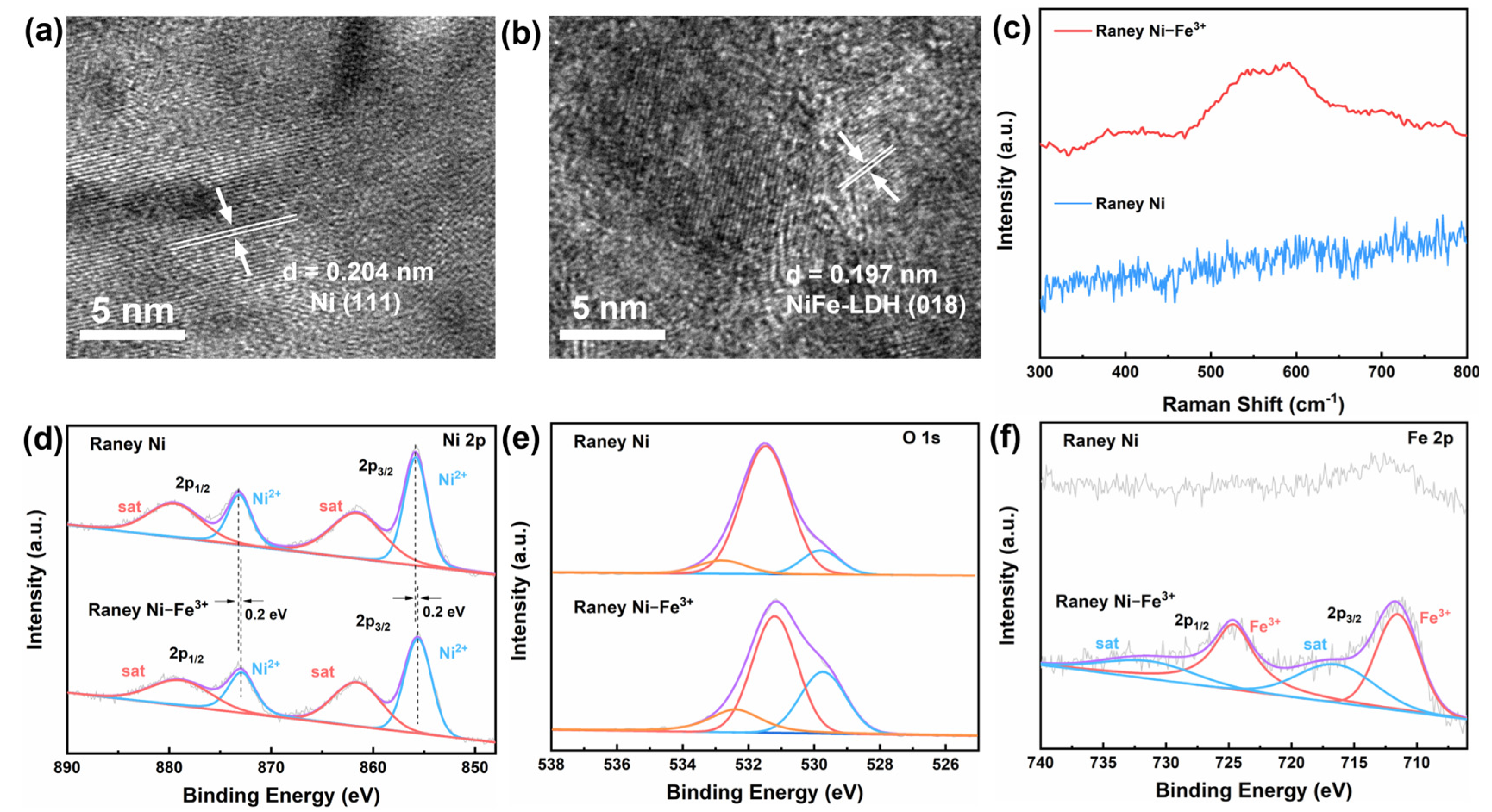
The microstructure and crystal structure of Raney Ni–Fe3+ are further investigated by transmission electron microscopy (TEM). The TEM image in Figure S3 shows nanosheet-like features from Raney Ni–Fe3+. High-resolution transmission electron microscopy (HRTEM) images (Figure 2a,b) clearly display lattice fringes, with measured spacings of 0.204 and 0.197 nm, corresponding to the (111) plane of Ni (PDF#04-0850) derived from Raney Ni and the (018) plane of NiFe–LDH (PDF#40-0215), respectively [40,41,42]. Raman analysis further distinguishes the structural evolution of Raney Ni during activation. As shown in Figure 2c, no characteristic peaks appear in the spectrum of pristine Raney Ni, but Raney Ni–Fe3+ presents four clear peaks at 397, 542, 590, and 701 cm−1. The peaks at 397 and 590 cm−1 are ascribed to the Eg modes of Fe–O, while those at 542 and 701 cm−1 correspond to the A1g modes of Ni–O and Fe–O, respectively [43,44]. This suggests the formation of a new active surface layer induced by the activation process [45,46,47].
X-ray photoelectron spectroscopy (XPS) analysis provides further insights into the elemental states of Raney Ni before and after activation. The Ni spectrum of pristine Raney Ni (Figure 2d) can be deconvoluted into four peaks. Those at 855.80 and 873.10 eV correspond to Ni2+, likely originating from the formation of a surface oxide on Raney Ni during high-temperature processing or long-term exposure [48,49]. The peaks at 861.56 and 879.47 eV are attributed to satellites. Similarly, Raney Ni–Fe3+ exhibits four fitted peaks, with those at 855.60 and 872.90 eV assigned to Ni2+ and the others to satellites. Compared to Raney Ni, the Ni2+ peaks in Raney Ni–Fe3+ shift by −0.2 eV, implying that activation and Fe3+ incorporation can alter the electronic environment of the surface Ni species. As depicted in Figure 2e, the O 1s spectrum of Raney Ni is composed of lattice oxygen (529.80 eV), defect oxygen (531.48 eV), and adsorbed oxygen (532.80 eV), while Raney Ni–Fe3+ exhibits three analogous peaks at 529.73, 531.20, and 532.39 eV [50,51,52]. The relative increase in lattice oxygen and decrease in defect oxygen may originate from NiFe–LDH, generated via activation of the poorly crystalline oxide layer on Raney Ni. The adsorbed oxygen increases as well, likely due to surface hydration or OH- adsorption. Furthermore, the Fe 2p spectra (Figure 2f) show only a weak Fe signal in Raney Ni, probably originating from Fe impurities during synthesis, but strong signals in Raney Ni–Fe3+. Peaks at 711.53 and 724.63 eV are assigned to Fe3+, and those at 716.42 and 731.39 eV to satellites [53]. The findings demonstrate that Fe3+ species from the electrolyte is spontaneously incorporated into the NiOOH lattice during the activation of Raney Ni, followed by transformation into a stable NiFe–LDH phase after removal of the activation potential. This strategy thus enables the effective synthesis of high-performance active layers.
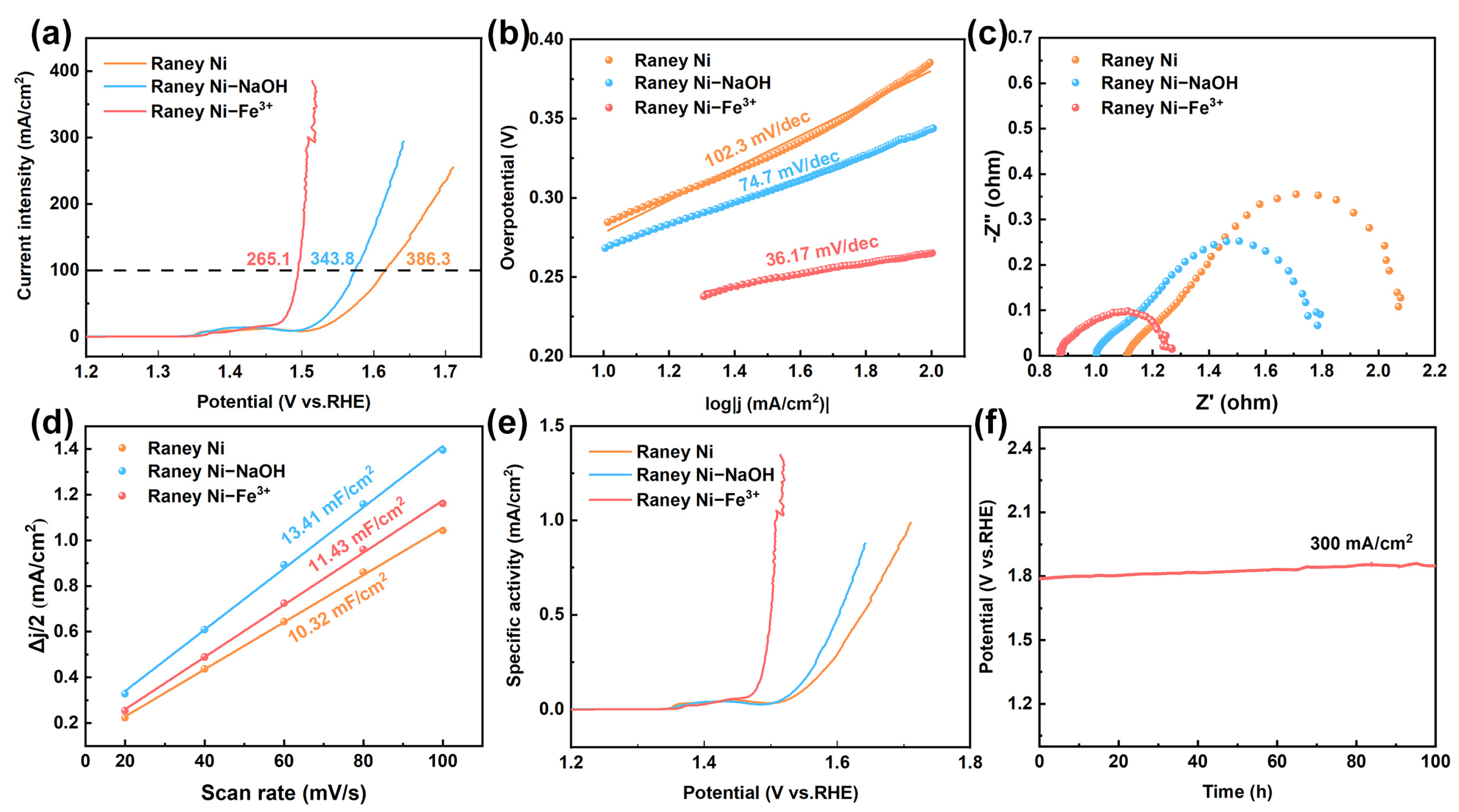
All electrochemical measurements for the OER are carried out in 1 M KOH using a three-electrode system. As a control, Raney Ni is activated in 5% NaOH solution without Fe3+, yielding Raney Ni–NaOH. The polarization curves compensated for 95% of the solution resistance are displayed in Figure 3a. Raney Ni–Fe3+ delivers 100 mA/cm2 at an overpotential of 265.1 mV, surpassing Raney Ni–NaOH (343.8 mV) and Raney Ni (386.3 mV). When the potential surpasses 1.47 V, the current density escalates sharply, corresponding to the highest OER efficiency under equivalent conditions. Furthermore, the Tafel slopes provide additional evidence of kinetic advantages (Figure 3b). Raney Ni–Fe3+ shows the lowest slope value of 36.17 mV/dec, in stark contrast to Raney Ni–NaOH (74.7 mV/dec) and Raney Ni (102.3 mV/dec), underscoring its accelerated charge-transfer kinetics and superior intrinsic activity [54]. The comparison presented in Table S2 with other NiFe–LDH catalysts further reveals that Raney Ni–Fe3+ is recognized as maintaining a competitive edge among reported non-noble metal catalysts. Collectively, these observations establish that the dramatic enhancement in OER performance originates from the formation of NiFe–LDH active phases on the Raney Ni surface induced by Fe3+-saturated NaOH activation.
The electrode kinetics of Raney Ni–Fe3+ are examined using EIS at 1.574 V. As presented in Figure 3c, Raney Ni–Fe3+ features the smallest semicircle, and the fitted data indicates the lowest charge-transfer resistance (Rct = 0.41 Ω), demonstrating rapid reaction kinetics and accelerated interfacial charge transport. The electrochemical active surface area (ECSA) of Raney Ni–Fe3+ is further assessed by calculating the double-layer capacitance (Cdl) from cyclic voltammetry (CV) measurements. The Cdl is derived from CV profiles collected at scan rates between 20 and 100 mV/s in the non-faradaic potential region (0.924–1.024 V) [55]. As illustrated in Figure 3d, Raney Ni–Fe3+ shows a Cdl of 11.43 mF/cm2, similar to Raney Ni–NaOH (13.41 mF/cm2) and Raney Ni (10.32 mF/cm2). This similarity implies that activation in alkaline solution barely affects the morphology of Raney Ni, consistent with SEM analysis. It also indicates that the improved catalytic behavior originates mainly from the intrinsic activity enhancement of active sites upon Fe3+ incorporation (Figure 3e).
Electrochemical stability represents a crucial factor in determining OER catalyst performance and industrial prospects. In practical alkaline electrolyzers, electrocatalysts must endure sustained operation at 200–400 mA/cm2 with minimal performance degradation [56,57]. Here, the Raney Ni–Fe3+ catalyst is evaluated at 300 mA/cm2 through a 100 h chronoamperometric potential test (Figure 3f). The working potential of Raney Ni–Fe3+ is found to increase by only 50 mV after 100 h. Moreover, under a constant potential of 1.8 V (vs. RHE), a chronopotentiometry test reveals that the current density is stably maintained at approximately 300 mA/cm2 during a 50 h test, with the LSV exhibiting only minor changes before and after testing (Figure S4). Collectively, these findings demonstrate the notable electrochemical stability of the Raney Ni–Fe3+ catalyst.

3. Materials and Methods

3.1. Chemicals and Reagents

Raney Ni was purchased from Hebei Huierui Wire Mesh Manufacturing Co., Ltd. (Hengshui, China). Potassium hydroxide (KOH, 95%) and sodium hydroxide (NaOH, 97%) were obtained from Macklin Biochemical Co., Ltd. (Shanghai, China). Ferric nitrate (Fe(NO3)3·9H2O, AR) was supplied by Xilong Scientific Co., Ltd. (Shantou, China). Deionized water with a resistivity greater than 18 MΩ cm was obtained using a Heal Force Water Purification System.

3.2. Preparation of the Raney Ni–Fe3+ and Raney Ni–NaOH

Solution A was obtained by dissolving 5 g of NaOH in 100 mL of deionized water. Solution B was prepared by ultrasonic dissolution of 0.1 g of Fe(NO3)3 in 4 mL of deionized water. The dropwise addition of a small volume of Solution B into Solution A immediately produced a vivid scarlet precipitate of iron hydroxide, creating a characteristic supersaturated state of ferric ions in the sodium hydroxide solution. The electrochemical system consists of a 1 cm × 3 cm Raney Ni as the working electrode, another Raney Ni as the counter electrode, and an Hg/HgO reference electrode. Electrochemical oxidation was performed at room temperature for 4 h with a constant current of 250 mA, applied by a CHI electrochemical workstation (Chenhua, Shanghai, China). After the reaction, the anodic Raney Ni was collected, thoroughly rinsed with deionized water, and dried overnight in a vacuum oven at 60 °C, yielding the final product denoted as Raney Ni–Fe3+. As a control, the same procedure was carried out in Fe(NO3)3-free NaOH solution, yielding Raney Ni–NaOH.

3.3. Characterization

An X-ray diffractometer (XRD, SmartLab SE, Rigaku, Japan) was employed to characterize the crystalline structure of the materials. Field emission scanning electron microscopy (FESEM, Hitachi SU8020, Tokyo, Japan) was applied to characterize the surface morphology. Transmission electron microscopy (TEM, FEI Tecnai Gz F30, FEI Company, Hillsboro, OR, USA), coupled with energy-dispersive X-ray spectroscopy (EDS), was employed to analyze the internal microstructure and phase distribution. The chemical states and elemental composition were further investigated by X-ray photoelectron spectroscopy (XPS, Thermo Scientific Nexsa, Hillsboro, OR, USA).

3.4. Electrochemical Measurements

All electrochemical measurements were performed in 1 M KOH electrolyte using a standard three-electrode configuration on a German Zahner electrochemical workstation (Zennium, Zahner, ZAHNER Elektrik GmbH & Co. KG, Bavaria, Germany). The working electrode was the prepared material (1 cm × 1 cm), while the counter and reference electrodes are a carbon rod and Hg/HgO electrode, respectively. Potentials versus Hg/HgO were converted to the reversible hydrogen electrode (RHE) scale using ERHE = EHg/HgO + 0.098 + 0.059 × pH. Linear sweep voltammetry (LSV) was performed at 2 mV/s to obtain polarization curves, with 95% iR compensation applied unless otherwise indicated. Cyclic voltammetry (CV) at scan rates of 20–100 mV/s was used to determine the electrochemical double-layer capacitance (Cdl), from which the electrochemical surface area (ECSA) was calculated as ASA*Cdl/Cs (ASA is the actual surface area of the electrode. Cs = 40 μF/cm2). Electrochemical impedance spectroscopy (EIS) was employed to assess the electrode kinetics, performed over a frequency range of 0.1 Hz to 100 kHz with an AC amplitude of 10 mV. Furthermore, stability tests were conducted on an electrode with a geometric area of (1 cm × 0.5 cm). This included a chronopotentiometry test at a constant current density of 300 mA/cm2 for 100 h and a chronoamperometry test at a constant potential of 1.8 V (vs. RHE) for 50 h, respectively.

4. Conclusions

In summary, this work develops a novel electrochemical oxidation activation strategy for commercial Raney Ni. Raney Ni–Fe3+ electrode is successfully prepared with outstanding OER activity and long-term stability, and it delivers 100 mA/cm2 at an overpotential of only 265.1 mV, with a low Tafel slope of 36.17 mV/dec. Furthermore, Raney Ni–Fe3+ demonstrates durability over 100 h at 300 mA/cm2, representing a highly promising candidate for practical application. Systematic experimental and characterization results reveal that this approach realizes precise synthesis of high-performance active layers through the in situ construction of Fe3+-doped NiOOH on the Raney Ni framework, significantly enhancing its intrinsic catalytic activity. The proposed modification strategy requires no advanced instrumentation or disruptive changes to existing workflows, instead relying on low-cost precursors and a simple activation process. It effectively reduces the cost and accessibility barrier for fabricating high-performance electrodes, and thus delivers a viable and economical route for upgrading alkaline electrolyzers and accelerating the scale-up of green hydrogen technologies.

Supplementary Materials

The following supporting information can be downloaded at https://www.mdpi.com/article/10.3390/catal16010008/s1, Figure S1: SEM image of Raney Ni; Figure S2: XRD patterns of Raney Ni and Raney Ni–Fe3+; Figure S3: HRTEM images of Raney Ni–Fe3+; Figure S4: (a) Chronoamperometric test of Raney Ni–Fe3+ at a constant potential of 1.8 V (vs. RHE) in 1 M KOH; (b) LSV curves before and after stability test; Table S1: Atomic percent (At%) of different elements in Raney Ni–Fe3+ determined from EDS; Table S2: Summary of oxygen evolution reaction (OER) performance of reported NiFe–LDH electrocatalysts. Refs. [58,59,60,61,62,63,64,65,66] is cited in Supplementary Materials.

Author Contributions

Methodology, Y.M. and X.Z.; Validation, Q.H., J.M. and H.G.; Resources, Y.M., Y.L. and S.L.; Data curation, J.Z. and H.X.; Writing-original draft, X.Z., L.T. and Q.H.; Writing-review and editing, Y.M., Y.L. and S.L.; Supervision, Y.M., Y.L. and S.L.; Project administration, Y.M., Y.L. and S.L.; Funding acquisition, Y.M., Y.L. and S.L. All authors have read and agreed to the published version of the manuscript.

Funding

The authors acknowledge financial support from the National Natural Science Foundation of China (Grant No. 22369003), Hainan Provincial Natural Science Foundation of China (Grant No. 223QN185), Scientific Research Starting Foundation of Hainan University (Grant No. KYQD(ZR) -22022), the Hainan Provincial Innovative Research Project of Postgraduates (Nos. Qhys2023-173, Qhyb2023-48).

Data Availability Statement

The data are contained within the article and Supplementary Materials.

Conflicts of Interest

The authors declare no competing interests.

References

  1. Zhao, Z.; Sun, J.; Li, X.; Qin, S.; Li, C.; Zhang, Z.; Li, Z.; Meng, X. Engineering active and robust alloy-based electrocatalyst by rapid Joule-heating toward ampere-level hydrogen evolution. Nat. Commun. 2024, 15, 7475. [Google Scholar] [CrossRef] [PubMed]
  2. Zhao, W.; Yang, J.; Xu, F.; Weng, B. Recent Advancements on Spin Engineering Strategies for Highly Efficient Electrocatalytic Oxygen Evolution Reactions. Small 2024, 5, e2401057. [Google Scholar] [CrossRef]
  3. Huang, Q.Z.X.; Lin, S.; Liu, Y.; Zou, X.; Chen, H. Corrosion engineering for electrode fabrication toward alkaline water electrolysis. Chem. Synth. 2025, 5, 57. [Google Scholar] [CrossRef]
  4. Zeng, H.; Chen, Z.; Jiang, Q.; Zhong, Q.; Ji, Y.; Chen, Y.; Li, J.; Liu, C.; Zhang, R.; Tang, J.; et al. Sustainable and cost-efficient hydrogen production using platinum clusters at minimal loading. Nat. Commun. 2025, 16, 4314. [Google Scholar] [CrossRef]
  5. Yang, Y.; Pang, D.; Wang, C.; Fu, Z.; Liu, N.; Liu, J.; Wu, H.; Jia, B.; Guo, Z.; Fan, X.; et al. Vacancy and Dopant Co-Constructed Active Microregion in Ru-MoO3-x/Mo2AlB2 for Enhanced Acidic Hydrogen Evolution. Angew. Chem. Int. Ed. Engl. 2025, 64, e202504084. [Google Scholar] [CrossRef]
  6. Liu, G.; Song, C.; Li, X.; Jia, Q.; Wu, P.; Lou, Z.; Ma, Y.; Cui, X.; Zhou, X.; Jiang, L. Defect-rich FeCoNiMnRu high-entropy alloys with activated interfacial water for boosting alkaline water/seawater hydrogen evolution. Chem. Eng. J. 2025, 509, 161070. [Google Scholar] [CrossRef]
  7. Sha, Q.; Wang, S.; Yan, L.; Feng, Y.; Zhang, Z.; Li, S.; Guo, X.; Li, T.; Li, H.; Zhuang, Z.; et al. 10,000-h-stable intermittent alkaline seawater electrolysis. Nature 2025, 639, 360–367. [Google Scholar] [CrossRef]
  8. Liu, J.K.; Kang, M.; Huang, K.; Xu, H.G.; Wu, Y.X.; Zhang, X.Y.; Zhu, Y.; Fan, H.; Fang, S.R.; Zhou, Y.; et al. Stable Ni(II) sites in Prussian blue analogue for selective, ampere-level ethylene glycol electrooxidation. Nat. Commun. 2025, 16, 3458. [Google Scholar] [CrossRef] [PubMed]
  9. Wu, X.F.; Li, Z.Y.; Wang, H.; Wang, J.C.; Xi, G.Q.; Zhao, X.J.; Zhang, C.X.; Liao, W.G.; Ho, J.C. Defect-Engineered Multi-Intermetallic Heterostructures as Multisite Electrocatalysts for Efficient Water Splitting. Adv. Sci. 2025, 12, 2502244. [Google Scholar] [CrossRef]
  10. Zhang, J.; Xu, L.; Yang, X.; Guo, S.; Zhang, Y.; Zhao, Y.; Wu, G.; Li, G. Amorphous MnRuOx Containing Microcrystalline for Enhanced Acidic Oxygen-Evolution Activity and Stability. Angew. Chem. Int. Ed. 2024, 136, e202405641–e202405648. [Google Scholar] [CrossRef]
  11. Zhao, Y.; Wan, W.; Erni, R.; Pan, L.; Patzke, G.R. Operando Spectroscopic Monitoring of Metal Chalcogenides for Overall Water Splitting: New Views of Active Species and Sites. Angew. Chem. Int. Ed. Engl. 2024, 63, e202400048. [Google Scholar] [CrossRef] [PubMed]
  12. Zhang, Y.; Xu, H.; Shi, X.; Bao, Y.; Chen, Y. Construction of triple heterogeneous interfaces optimizing electronic structure with B-doped amorphous CoP deposited on crystalline Cu2S/Ni3S2 nanosheets to enhance water electrolysis. J. Mater. Chem. A 2024, 12, 16592–16604. [Google Scholar] [CrossRef]
  13. Zhu, Y.; Chen, Y.; Feng, Y.; Meng, X.; Xia, J.; Zhang, G. Constructing Ru-O–TM bridge in NiFe–LDH enables high current hydrazine-assisted H2 production. Adv. Mater. 2024, 36, 2401694–2401704. [Google Scholar] [CrossRef]
  14. Zhou, Y.; Gao, J.Q.; Ju, M.; Chen, Y.P.; Yuan, H.F.; Li, S.M.; Li, J.L.; Guo, D.X.; Hong, M.; Yang, S.H. Combustion growth of NiFe layered double hydroxide for efficient and durable oxygen evolution reaction. ACS Appl. Mater. Interfaces 2024, 16, 28526–28536. [Google Scholar] [CrossRef]
  15. Zhang, M.; Liu, Q.; Sun, W.; Sun, K.; Shen, Y.; An, W.; Zhang, L.; Chen, H.; Zou, X. Nanostructured intermetallics: From rational synthesis to energy electrocatalysis. Chem. Synth. 2023, 3, 28. [Google Scholar] [CrossRef]
  16. Wang, Q.; Gong, Y.; Zi, X.; Gan, L.; Pensa, E.; Liu, Y.; Xiao, Y.; Li, H.; Liu, K.; Fu, J.; et al. Coupling nano and atomic electric field confinement for robust alkaline oxygen evolution. Angew. Chem. Int. Ed. Engl. 2024, 63, e202405438. [Google Scholar] [CrossRef] [PubMed]
  17. Wang, J.; Zhou, M.; Fu, R.; Ge, J.; Yang, W.; Hong, X.; Sun, C.; Liao, X.; Zhao, Y.; Wang, Z. Iron Molybdenum Sulfide-Supported Ultrafine Ru Nanoclusters for Robust Sulfion Degradation-Assisted Hydrogen Production. Adv. Funct. Mater. 2024, 34, 2315326. [Google Scholar] [CrossRef]
  18. Wang, N.; Song, S.Z.; Wu, W.T.; Deng, Z.F.; Tang, C. Bridging laboratory electrocatalysts with industrially relevant alkaline water electrolyzers. Adv. Energy Mater. 2024, 14, 2303451–2303463. [Google Scholar] [CrossRef]
  19. Zhang, X.; Jin, M.; Jia, F.; Huang, J.; Amini, A.; Song, S.; Yi, H.; Cheng, C. Noble-Metal-Free oxygen evolution reaction electrocatalysts working at high current densities over 1000 mA cm−2: From fundamental understanding to design principles. Energy Environ. Mater. 2023, 6, e12457. [Google Scholar] [CrossRef]
  20. Wang, W.-W.; Chen, C.; Liu, Z.-X.; Zhu, Q.-X.; Xu, Y.-X.; Lu, Z.-Q.; Zhang, B.; Yu, Z.-P.; Xu, G.-Y. From laboratory to industrial scale: Nickel-based catalysts for hydrogen evolution under highcurrent-density alkaline electrolysis. Rare Met. 2025, 1–36. [Google Scholar] [CrossRef]
  21. Abd-Elrahim, A.G.; Ali, M.A.; Chun, D.-M. Enhanced oxygen evolution using sulfate-intercalated amorphous FeNiS@FeS layered double hydroxide nanoflowers for advanced water-splitting performance. J. Power Sources 2025, 635, 236472. [Google Scholar] [CrossRef]
  22. Zeng, Q.; Tang, J.; Ji, Y.; Jiang, Q.; Xia, C. Recent Developments in Single-Atom Engineering Ir/Ru-Based Catalysts for the Oxygen Evolution Reaction in Acidic Media. Adv. Energy Mater. 2025, e04414. [Google Scholar] [CrossRef]
  23. Zheng, Q.; Yan, Y.; Zhong, J.; Yan, S.; Zou, Z. Reagent-adaptive active site switching on the IrOx/Ni(OH)2 catalyst. Energy Environ. Sci. 2024, 17, 748–759. [Google Scholar] [CrossRef]
  24. Zhu, Y.; Wang, J.; Weiser, G.; Klingenhof, M.; Koketsu, T.; Liu, S.; Pi, Y.; Henkelman, G.; Shi, X.; Li, J.; et al. Ru Single Atoms and Sulfur Anions Dual-Doped NiFe Layered Double Hydroxides for High-Current-Density Alkaline Oxygen Evolution Reaction. Adv. Energy Mater. 2025, 15, 2500554. [Google Scholar] [CrossRef]
  25. Zhang, S.; Shi, M.; Wang, F.; Lei, W.; Qiang, H.; Xia, M. Research progress on non-precious-metal-based transition metal alkaline OER electrocatalysts. J. Environ. Chem. Eng. 2025, 13, 120378. [Google Scholar] [CrossRef]
  26. Niu, H.-J.; Ran, N.; Zhou, W.; An, W.; Huang, C.; Chen, W.; Zhou, M.; Lin, W.-F.; Liu, J.; Guo, L. Synergistic Atomic Environment Optimization of Nickel-Iron Dual Sites by Co Doping and Cr Vacancy for Electrocatalytic Oxygen Evolution. J. Am. Chem. Soc. 2025, 147, 2607–2615. [Google Scholar] [CrossRef]
  27. Cai, C.; Huang, X.; Han, S.; Xie, C.; Yang, F.; Wu, X.; Ye, S.; Huang, L.; Zheng, L.; Yang, X.; et al. Asymmetric Fe–O–Ni Pair Sites in Two-Step Dealloyed Prussian Blue Analogue Nanocubes Enrich Linear-Adsorbed Intermediates for Efficient Oxygen Evolution. ACS Nano 2025, 19, 33230–33245. [Google Scholar] [CrossRef]
  28. Sun, Z.; Zhang, Z.-H.; Yuan, T.-Q.; Ren, X.; Rong, Z. Raney Ni as a Versatile Catalyst for Biomass Conversion. ACS Catal. 2021, 11, 10508–10536. [Google Scholar] [CrossRef]
  29. Di, F.; Chen, C.; Shen, J.; Wei, Z.; Dong, W.; Peng, Y.; Fan, R.; Shen, M.; Olu, P.-Y. Dynamic and interconnected influence of dissolved iron on the performance of alkaline water electrolysis. Chem. Sci. 2025, 16, 9913–9919. [Google Scholar] [CrossRef] [PubMed]
  30. Zhu, Z.X.; Lin, Y.X.; Fang, P.; Wang, M.S.; Zhu, M.Z.; Zhang, X.Y.; Liu, J.S.; Hu, J.G.; Xu, X.Y. Orderly nanodendritic nickel substitute for Raney nickel catalyst improving Alkali Water Electrolyzer. Adv. Mater. 2024, 36, 2307035–2307045. [Google Scholar] [CrossRef]
  31. Jiang, T.; Jiang, X.; Jiang, C.; Wang, J.; Danlos, Y.; Liu, T.; Deng, C.; Chen, C.; Liao, H.; Kyriakou, V. Novel Fe-Modulating Raney-Ni Electrodes toward High-Efficient and Durable AEM Water Electrolyzer. Adv. Energy Mater. 2025, 15, 2501634. [Google Scholar] [CrossRef]
  32. Mao, Y.; Zhang, K.; Wei, S.; Li, J.; Xiao, H.; Liu, G. Raney nickel induced interface modulation of active NiFe-hydroxide as efficient and robust electrocatalyst towards oxygen evolution reaction. Appl. Catal. A Gen. 2024, 683, 119858. [Google Scholar] [CrossRef]
  33. Wang, X.; Li, Y.; Liu, L.; Lv, J.; Lu, X.; Shen, W. Multiscale Design for Neutral-Electrolyte H2O2 Electrosynthesis: Catalysts, Electrodes, Devices, and Hybrid Processes. Adv. Funct. Mater. 2025, e11806. [Google Scholar] [CrossRef]
  34. Choi, Y.-I.; Wang, E.-C.; Kim, H.-A. Fabrication of highly porous Raney Ni electrocatalyst using hot-dip galvanizing. Int. J. Hydrogen Energy 2025, 165, 150894. [Google Scholar] [CrossRef]
  35. Huang, C.; Zhou, Q.; Duan, D.; Yu, L.; Zhang, W.; Wang, Z.; Liu, J.; Peng, B.; An, P.; Zhang, J.; et al. The rapid self-reconstruction of Fe-modified Ni hydroxysulfide for efficient and stable large-current-density water/seawater oxidation. Energy Environ. Sci. 2022, 15, 4647–4658. [Google Scholar] [CrossRef]
  36. Wang, Y.; Zhuang, Y.; Yang, G.; Dong, C.; He, M. Unraveling the Dynamic Reconstruction of Active Co(IV)-O Sites on Ultrathin Amorphous Cobalt-Iron Hydroxide Nanosheets for Efficient Oxygen-Evolving. Small 2024, 20, 2404205. [Google Scholar] [CrossRef] [PubMed]
  37. Li, Z.; Shao, M.; An, H.; Wang, Z.; Xu, S.; Wei, M.; Evans, D.G.; Duan, X. Fast electrosynthesis of Fe-containing layered double hydroxide arrays toward highly efficient electrocatalytic oxidation reactions. Chem. Sci. 2015, 6, 6624–6631. [Google Scholar] [CrossRef]
  38. Song, D.; Hong, D.; Kwon, Y.; Kim, H.; Shin, J.; Lee, H.M.; Cho, E. Highly porous Ni–P electrode synthesized by an ultrafast electrodeposition process for efficient overall water electrolysis. J. Mater. Chem. A 2020, 8, 12069–12079. [Google Scholar] [CrossRef]
  39. Wang, S.; Xue, S.X.; Tang, C.J.; Gao, H.F.; Gao, D.Y. FeCoNi(OH)x/Ni mesh electrode boosting oxygen evolution reaction for high-performance alkaline water electrolysis. Appl. Phys. A-Mater. Sci. Process. 2023, 129, 789–795. [Google Scholar] [CrossRef]
  40. Huang, Q.; Zhang, X.; Tong, L.; Liu, Y.; Lin, S. Growing Nanocrystalline Ru on Amorphous/Crystalline Heterostructure for Efficient and Durable Hydrogen Evolution Reaction. Catalysts 2025, 15, 434. [Google Scholar] [CrossRef]
  41. Zhang, X.; Chen, Y.; Ye, Z.; Hu, H.; Lei, L.; You, F.; Yao, J.; Yang, H.; Jiang, X. Magnetic field-assisted microbial corrosion construction iron sulfides incorporated nickel-iron hydroxide towards efficient oxygen evolution. Chin. J. Struct. Chem. 2024, 43, 100200–100206. [Google Scholar] [CrossRef]
  42. Deng, J.; Wang, Z.C.; Yang, H.; Jian, R.; Zhang, Y.F.; Xia, P.; Liu, W.; Fontaine, O.; Zhu, Y.C.; Li, L.M.; et al. Superfast hydrous-molten salt erosion to fabricate large-size self-supported electrodes for industrial-level current OER. Chem. Eng. J. 2024, 482, 148887–148902. [Google Scholar] [CrossRef]
  43. Nguyen, X.S.; Zhang, G.; Yang, X. Mesocrystalline Zn-doped Fe3O4 hollow submicrospheres: Formation mechanism and enhanced photo-Fenton catalytic performance. ACS Appl. Mater. Interfaces 2017, 9, 8900–8909. [Google Scholar] [CrossRef]
  44. Zander, J.; Wölfel, J.P.; Weiss, M.; Jiang, Y.; Cheng, N.; Zhang, S.; Marschall, R. Medium-and high-entropy spinel ferrite nanoparticles via low-temperature synthesis for the oxygen evolution reaction. Adv. Funct. Mater. 2024, 34, 2310179. [Google Scholar] [CrossRef]
  45. Zhang, X.; Tong, L.; Shi, X.; Li, Z.; Xiao, Z.; Liu, Y.; Zhang, T.; Lin, S. Tailoring atomically local electric field of NiFe layered double hydroxides with Ag dopants to boost oxygen evolution kinetics. J. Colloid Interface Sci. 2024, 668, 502–511. [Google Scholar] [CrossRef]
  46. Shi, X.; Tong, L.; Zhang, X.; Wang, C.Z.; Ma, J.; Liu, Y.; Xiao, Z.; Lin, S. Intentional Replacement Acceleration Layer Strategy Achieves Superior Water/Seawater Electrolysis at Industrial-Level Current Densities. Adv. Funct. Mater. 2025, 35, 2502055. [Google Scholar] [CrossRef]
  47. Chen, H.; Li, J.; Shen, Y.; Jiao, W.; Wang, J.; Zou, Y.; Zou, X. Room temperature, fast fabrication of square meter-sized oxygen evolution electrode toward industrial alkaline electrolyzer. Appl. Catal. B Environ. 2022, 316, 121605–121613. [Google Scholar] [CrossRef]
  48. Hou, M.; Zheng, L.; Zhao, D.; Tan, X.; Feng, W.; Fu, J.; Wei, T.; Cao, M.; Zhang, J.; Chen, C. Microenvironment reconstitution of highly active Ni single atoms on oxygen-incorporated Mo2C for water splitting. Nat. Commun. 2024, 15, 1342. [Google Scholar] [CrossRef]
  49. Wang, F.L.; Tan, J.L.; Jin, Z.Y.; Gu, C.Y.; Lv, Q.X.; Dong, Y.W.; Lv, R.Q.; Dong, B.; Chai, Y.M. In Situ Electrochemical Rapid Induction of Highly Active gamma-NiOOH Species for Industrial Anion Exchange Membrane Water Electrolyzer. Small 2024, 20, e2310064. [Google Scholar] [CrossRef]
  50. Zou, D.; Yi, Y.; Song, Y.; Guan, D.; Xu, M.; Ran, R.; Wang, W.; Zhou, W.; Shao, Z. The BaCe0.16Y0.04Fe0.8O3-δ nanocomposite: A new high-performance cobalt-free triple-conducting cathode for protonic ceramic fuel cells operating at reduced temperatures. J. Mater. Chem. A 2022, 10, 5381–5390. [Google Scholar] [CrossRef]
  51. Nie, J.; Shi, J.; Huang, T.; Xie, M.Y.; Ouyang, Z.Y.; Xian, M.H.; Huang, G.F.; Wan, H.; Hu, W.; Huang, W.Q. Cation-Induced Deep Reconstruction and Self-Optimization of NiFe Phosphide Precatalysts for Hydrogen Evolution and Overall Water Splitting. Adv. Funct. Mater. 2024, 34, 2314172–2314186. [Google Scholar] [CrossRef]
  52. Yan, L.; Du, Z.; Lai, X.; Lan, J.; Liu, X.; Liao, J.; Feng, Y.; Li, H. Synergistically modulating the electronic structure of Cr-doped FeNi LDH nanoarrays by O-vacancy and coupling of MXene for enhanced oxygen evolution reaction. Int. J. Hydrogen Energy 2023, 48, 1892–1903. [Google Scholar] [CrossRef]
  53. Zhang, Z.H.; Yu, Z.R.; Zhang, Y.; Barras, A.; Addad, A.; Roussel, P.; Tang, L.C.; Naushad, M.; Szunerits, S.; Boukherroub, R. Construction of desert rose flower-shaped NiFe LDH-Ni3S2 heterostructures via seawater corrosion engineering for efficient water-urea splitting and seawater utilization. J. Mater. Chem. A 2023, 11, 19578–19590. [Google Scholar] [CrossRef]
  54. Yang, H.; Chen, F.; Wang, X.; Qian, J.; Wang, J.; Li, J.; Lv, C.; Li, L.; Bandaru, S.; Gao, J. Self-Reconstructed Spinel with Enhanced SO42− Adsorption and Highly Exposed Co3+ From Heterostructure Boosts Activity and Stability at High Current Density for Overall Water Splitting. Adv. Funct. Mater. 2025, 35, 2419978. [Google Scholar] [CrossRef]
  55. Li, X.G.; Liu, C.; Fang, Z.T.; Xu, L.; Lu, C.L.; Hou, W.H. Ultrafast room-temperature synthesis of self-supported NiFe-layered double hydroxide aslLarge-current-density oxygen evolution electrocatalyst. Small 2022, 18, 2104354–2104363. [Google Scholar] [CrossRef]
  56. Ysea, N.B.; Gómez, M.J.; Humana, T.E.; Lacconi, G.I.; Correa Perelmuter, G.; Diaz, L.; Franceschini, E.A. Alkaline seawater as an electrolyte for hydrogen production: A feasibility and performance study. J. Alloys Compd. 2025, 1032, 181110. [Google Scholar] [CrossRef]
  57. Demnitz, M.; van der Schaaf, J.; de Groot, M.T. Alkaline Water Electrolysis Beyond 3 A/cm2 Using Catalyst Coated Diaphragms. J. Electrochem. Soc. 2025, 172, 014504. [Google Scholar] [CrossRef]
  58. Ju, X.; He, X.; Sun, Y.; Cai, Z.; Sun, S.; Yao, Y.; Li, Z.; Li, J.; Wang, Y.; Ren, Y. Fabrication of a hierarchical NiTe@NiFe–LDH core-shell array for high-efficiency alkaline seawater oxidation. Iscience 2024, 27, 108736. [Google Scholar] [CrossRef] [PubMed]
  59. Li, C.; Zhang, K.; Wang, W.; Wang, Z.; Yang, S.; Wei, L.; Wang, H.; Lin, C.; Su, J.; Guo, L. Synergistic yttrium doping accelerates surface reconstruction and optimizes d-band centers in NiFe–LDH for superior oxygen evolution catalysis. J. Mater. Chem. A 2025, 13, 37435–37447. [Google Scholar] [CrossRef]
  60. Tan, L.; Wang, H.; Qi, C.; Peng, X.; Pan, X.; Wu, X.; Wang, Z.; Ye, L.; Xiao, Q.; Luo, W. Regulating Pt electronic properties on NiFe layered double hydroxide interface for highly efficient alkaline water splitting. Appl. Catal. B-Environ. 2024, 342, 123352. [Google Scholar] [CrossRef]
  61. Lee, Y.J.; Park, S.K. Metal-organic framework-derived hollow CoSx nanoarray coupled with NiFe layered double hydroxides as efficient bifunctional electrocatalyst for overall water splitting. Small 2022, 18, 2200586. [Google Scholar] [CrossRef]
  62. Liao, Y.; He, R.; Pan, W.; Li, Y.; Wang, Y.; Li, J.; Li, Y. Lattice distortion induced Ce-doped NiFe–LDH for efficient oxygen evolution. Chem. Eng. J. 2023, 464, 142669. [Google Scholar] [CrossRef]
  63. Wang, H.; Chen, L.; Tan, L.; Liu, X.; Wen, Y.; Hou, W.; Zhan, T. Electrodeposition of NiFe-layered double hydroxide layer on sulfur-modified nickel molybdate nanorods for highly efficient seawater splitting. J. Colloid Interface Sci. 2022, 613, 349–358. [Google Scholar] [CrossRef]
  64. Sun, Y.; Yang, F.; Sun, S.; Wei, K.; Wang, Y.; Ma, G.; An, J.; Yuan, J.; Zhao, M.; Liu, J. Phase regulation of Ni (OH)2 nanosheets induced by W doping as self-supporting electrodes for boosted water electrolysis. J. Colloid Interface Sci. 2025, 684, 1–10. [Google Scholar] [CrossRef] [PubMed]
  65. Wang, Y.; Tao, S.; Lin, H.; Wang, G.; Zhao, K.; Cai, R.; Tao, K.; Zhang, C.; Sun, M.; Hu, J. Atomically targeting NiFe LDH to create multivacancies for OER catalysis with a small organic anchor. Nano Energy 2021, 81, 105606. [Google Scholar] [CrossRef]
  66. Tan, L.; Yu, J.; Wang, C.; Wang, H.; Liu, X.; Gao, H.; Xin, L.; Liu, D.; Hou, W.; Zhan, T. Partial sulfidation strategy to NiFe–LDH@FeNi2S4 heterostructure enable high-performance water/seawater oxidation. Adv. Funct. Mater. 2022, 32, 2200951. [Google Scholar] [CrossRef]
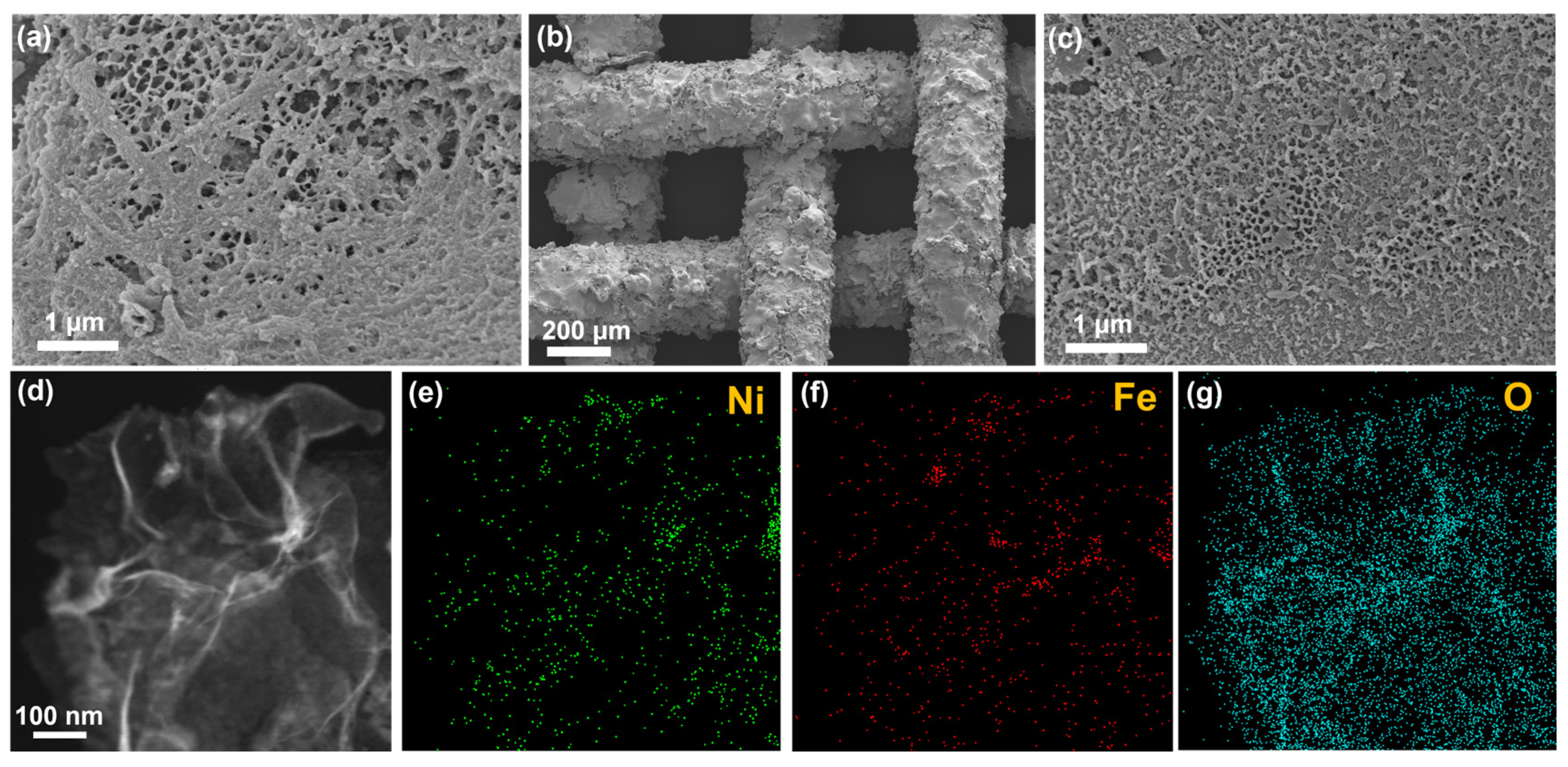
Figure 1. SEM images of (a) Raney Ni, and (b,c) Raney Ni–Fe3+. (dg) HAADF-STEM and corresponding EDS mapping images of Raney Ni–Fe3+.
Catalysts 16 00008 g001
Figure 2. (a,b) HRTEM images of Raney Ni–Fe3+. (c) Raman spectra of Raney Ni and Raney Ni–Fe3+. (d) Ni 2p, (e) O 1s and (f) Fe 2p XPS spectra of Raney Ni and Raney Ni–Fe3+.
Catalysts 16 00008 g002
Figure 3. (a) LSV polarization curves (1 M KOH, scan rate: 2 mV/s), (b) corresponding Tafel plots, (c) Nyquist plots (frequency range: 100 kHz to 0.1 Hz, amplitude: 10 mV), (d) double-layer capacitance (Cdl) determined from cyclic voltammetry scans at various scan rates (e.g., 20–100 mV/s), and (e) ECSA-normalized LSV curves showing intrinsic activity for Raney Ni–Fe3+, Raney Ni–NaOH, and Raney Ni. (f) Chronopotentiometry test of Raney Ni–Fe3+ at a constant current density of 300 mA/cm2 in 1 M KOH. All measurements were performed using a standard three-electrode setup at room temperature (about 25 °C).
Catalysts 16 00008 g003
Disclaimer/Publisher’s Note: The statements, opinions and data contained in all publications are solely those of the individual author(s) and contributor(s) and not of MDPI and/or the editor(s). MDPI and/or the editor(s) disclaim responsibility for any injury to people or property resulting from any ideas, methods, instructions or products referred to in the content.