


Abstract
This work is based on our previous research on sulfur-assisted graphitization of biopitch by focusing on catalyst-driven optimization of biomass-derived pitch (BDP) composites as sustainable alternatives to coal tar pitch (CTP). Biomass from eucalyptus sawdust was pyrolyzed to produce BDP, which was used as a binder for carbon–carbon composites. The properties of BDP/graphite and CTP/graphite composites, including bending strength, electrical conductivity, hardness, density, porosity, mass loss, and shrinkage, were compared. Furthermore, the influence of catalysts (NiSO4, K2SO4, CuSO4, FeSO4, and KOH) on composite performance was systematically investigated. Results show that catalyst selection significantly enhances structural, electrical, and mechanical properties, demonstrating the potential of combining eco-friendly materials with strategic catalyst engineering to develop high-performance, sustainable composites.
1. Introduction
Coal tar pitch (CTP) has been extensively used as a binder for carbon-based materials in various industrial applications due to its strong adhesion, excellent mixability, and ability to form dense, carbonizable structures. It plays a crucial role in producing carbon composites, particularly in the manufacturing of carbon electrodes, seals, electric brushes, and metal processing components that operate under extreme conditions [1,2,3,4]. CTP’s effectiveness comes from its ability to penetrate the porous structure of carbon particles such as coke and graphite, forming a cohesive matrix that, upon heating, carbonizes and strengthens the material. When subjected to high temperatures exceeding 2000–3000 °C, CTP undergoes graphitization, improving the electrical conductivity, mechanical strength, and thermal stability of the resulting composite [5,6,7]. These properties make CTP an irreplaceable material in industries such as aluminum smelting, steelmaking, and renewable energy. Despite its widespread use and effectiveness, CTP has huge environmental concerns, such as toxicity and fossil origin [8,9]. For example, a byproduct of coal processing, CTP contains polycyclic aromatic hydrocarbons (PAHs), a group of organic compounds known for their carcinogenic and mutagenic properties. Exposure to PAHs has been linked to severe health risks, including lung, skin, and bladder cancer, raising significant safety concerns for workers involved in its processing and handling [10,11,12,13,14]. The European Chemicals Agency (ECHA) has classified CTP as a ‘sunset material’ under REACH (Registration, Evaluation, Authorization, and Restriction of Chemicals) due to its toxicity, meaning that industries using CTP must actively seek alternatives or face stringent regulatory restrictions. Beyond toxicity, their sustainability is another issue, making them difficult to recycle [15,16,17,18]. With increasing global efforts to reduce reliance on fossil-derived materials, the development of bio-based alternatives has become essential to provide similar structural integrity and performance while minimizing environmental and health risks. One of the most promising alternatives is bio-pitch, a carbonizable binder derived from biomass feedstocks through thermochemical processing [19,20]. Unlike fossil-based pitches, bio-pitch is sourced from renewable materials such as wood, lignin, and agricultural waste, reducing dependency on non-renewable resources. Biomass-derived carbon materials have been investigated for several decades, and early studies demonstrated the feasibility of biomass-derived bio-pitch for carbon electrode fabrication. The results indicated that bio-pitch could match the performance of petroleum-based carbon materials, exhibiting comparable electrical conductivity, mechanical strength, and thermal expansion properties. More recent advancements in bio-pitch synthesis have further improved its viability. Pyrolysis of wood sawdust, lignin, and other organic residues has led to the production of bio-oil, which can then be distilled to obtain bio-pitch [21,22,23,24]. Compared to CTP, bio-pitch exhibits significantly lower PAH content, reduced sulfur levels, and improved environmental safety. Additionally, controlled distillation techniques allow researchers to fine-tune properties such as softening point, viscosity, and coking value, making bio-pitch adaptable for different industrial applications. Studies have shown that the thermal treatment of sawdust-derived bio-pitch results in composites with similar density and mechanical properties to those made with CTP, supporting its potential as a viable substitute [25,26]. However, despite these promising findings, challenges remain in optimizing the processing and structural properties of bio-pitch to meet industrial standards. Feedstock selection, pyrolysis conditions, and refining techniques are key factors influencing bio-pitch performance. The molecular structure of bio-pitch should allow for efficient carbonization and graphitization to ensure it can effectively replace CTP in high-performance applications [27,28,29,30]. Furthermore, the impact of catalysts on the graphitization process requires more attention. Catalysts can significantly alter the microstructure, porosity, and conductivity of carbon composites, making their role in bio-pitch processing more critical [31].
Unlike our earlier work [32] that examined sulphur as a graphitization promoter for wood tar biopitch (WTB), this study focuses on catalyst-assisted optimization of biomass-derived pitch (BDP) composites [33,34,35,36,37,38,39]. Eucalyptus sawdust was pyrolyzed to produce bio-oil, which was distilled to obtain bio-pitch. A detailed comparison of BDP/graphite and CTP/graphite composites is presented, evaluating chemical composition, porosity, density, mass loss, shrinkage, electrical conductivity, hardness, and flexural strength. The influence of catalysts (NiSO4, K2SO4, CuSO4, FeSO4, and KOH) on graphitization and composite performance is systematically investigated, alongside microstructural and functional differences. Findings highlight the potential of bio-pitch as a non-toxic, renewable alternative to fossil-based binders for industrial applications.
2. Results and Discussion
2.1. Chemical Composition and Surface Wettability Analysis of BDP and CTP
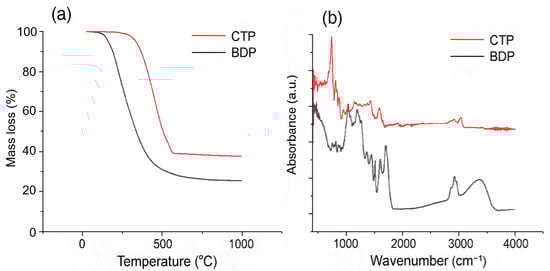
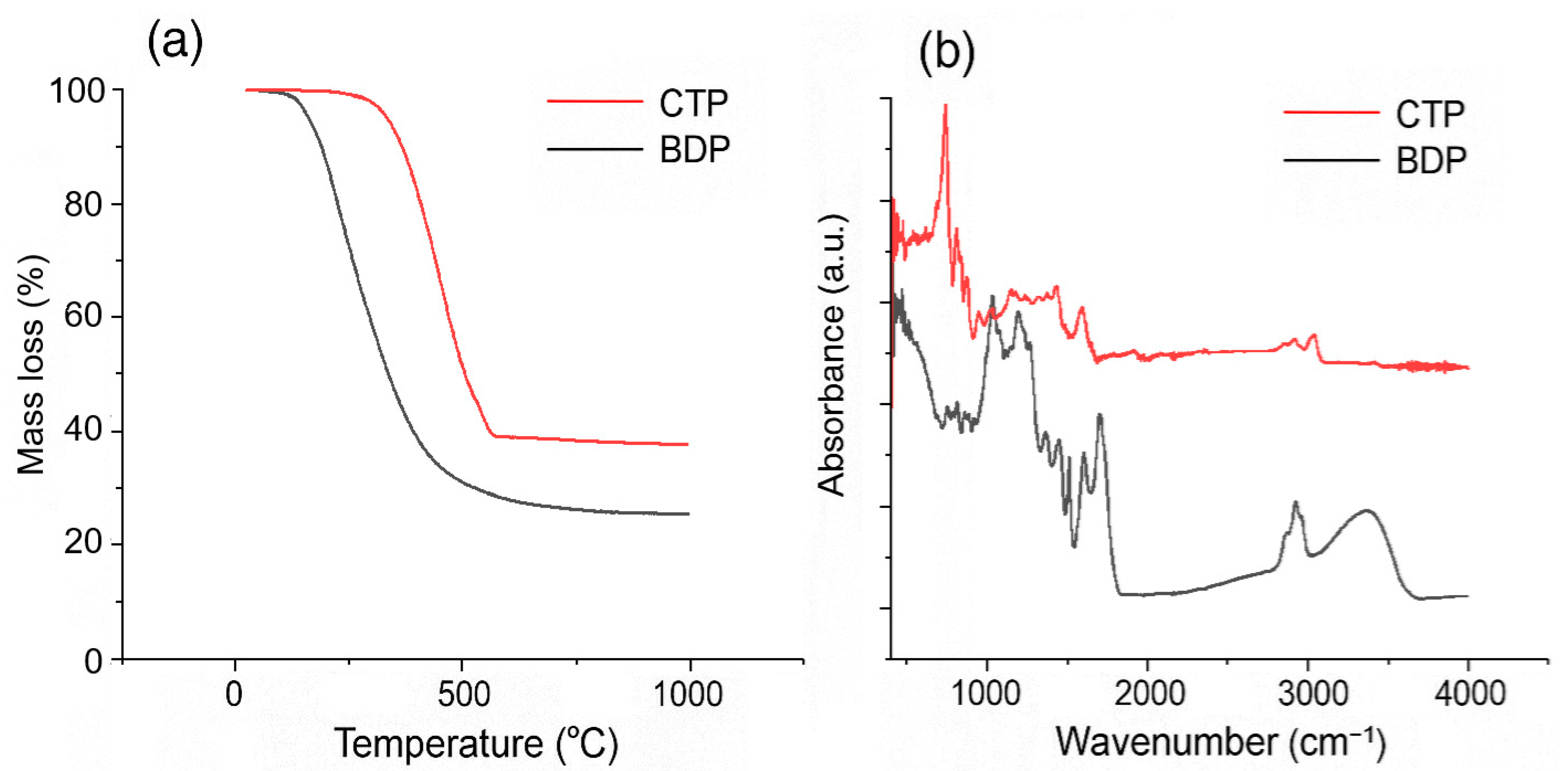
Thermogravimetric analysis (TGA) and Fourier Transform Infrared (FT-IR) spectroscopy were performed to characterize the as-synthesized bio-oil as shown in Figure 1a and b, respectively. The chemical composition of the biomass-derived pitch and coal tar pitch was analyzed using Fourier Transform Infrared Spectroscopy (FTIR), with the resulting spectra presented in Figure 1b.
Figure 1.
TGA (a) and FT-IR (b) of pure CTP and BDP samples [32].
A summary of the spectral features is also included in the Supplementary Information to provide a clearer interpretation. The FTIR spectra of both pitches exhibit characteristic vibrations in the 3300–3600 cm−1 region, typically associated with moisture, hydrogen bonding, amine groups, and the C-O stretching of carboxyl (-COOH) functional groups [40]. Both materials also show C-H stretching vibrations within the range of 2835–2940 cm−1, alongside additional features in the 1440–1460 cm−1 region, which correspond to CH2 and CH3 vibrations in aliphatic groups. Peaks appearing between 1110 and 1270 cm−1 indicate the presence of oxygen-containing non-aromatic compounds such as aliphatic ethers, phenols, and alkyl aryl ethers, confirming a degree of oxygen functionalization in both binders. However, significant differences can be observed in their compositions. The biomass-derived pitch displays more intense FTIR bands associated with oxygen-containing functional groups, suggesting a higher concentration of hydroxyl, ether, and carbonyl species compared to coal tar pitch [37,41]. Additionally, a distinct set of peaks in the 1700–1740 cm−1 region was detected exclusively in the biomass-derived pitch, corresponding to C=O stretching in ketones and aldehydes, indicating a richer presence of oxygen-functionalized species in this binder. In contrast, the FTIR spectrum of coal tar pitch exhibits strong absorptions in the 600–860 cm−1 region, characteristic of C-H stretching in aromatic rings, which are absent in the biomass-derived pitch [42]. This suggests a significantly higher aromatic content in coal tar pitch, aligning with its origin from coal tar, a material known for its high polycyclic aromatic hydrocarbon (PAH) content and environmental concerns [33,34,36]. These compositional differences can be attributed to the distinct synthesis pathways of the two materials, with coal tar pitch derived from fossil-based feedstocks, whereas the biomass-derived pitch originates from renewable sources, potentially offering a more environmentally sustainable alternative.
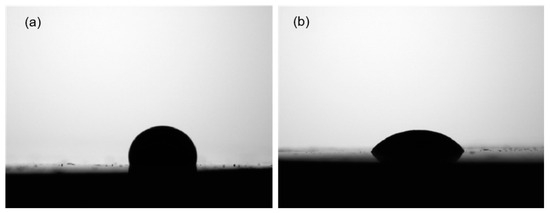
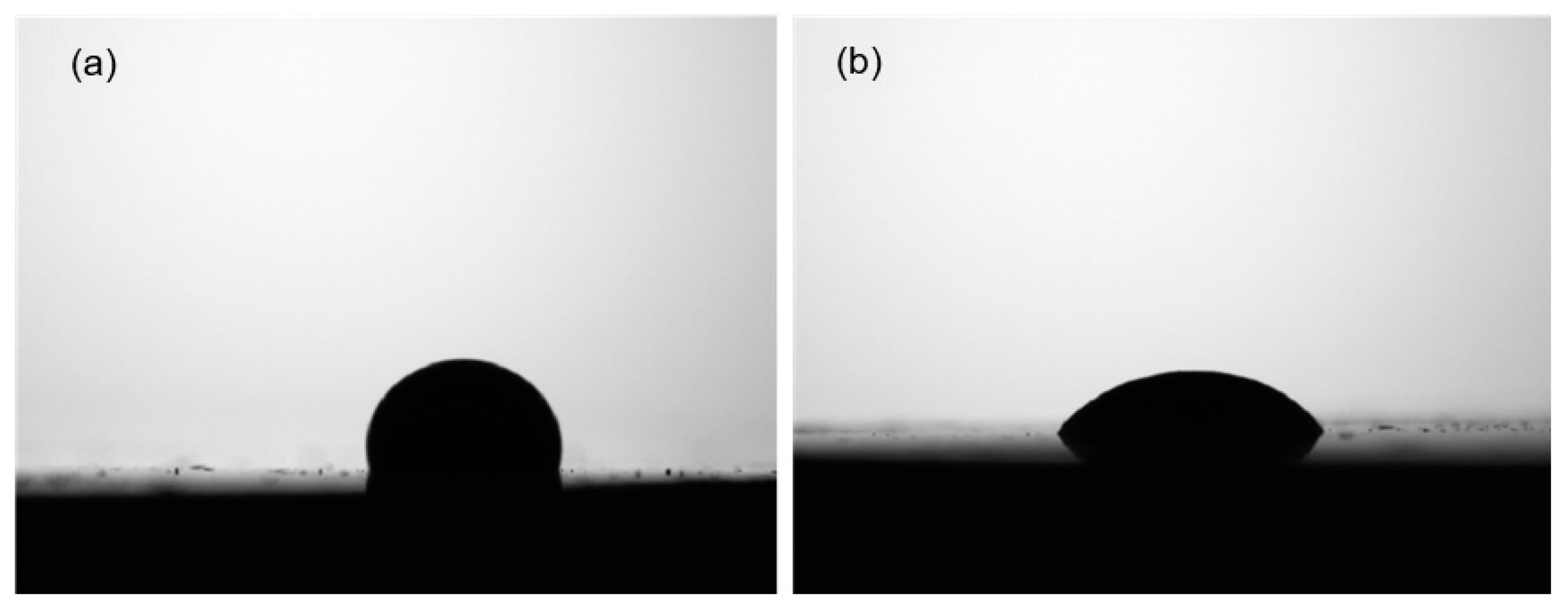
As shown in Figure 2a, CTP exhibited a higher apparent contact angle of 106° on the graphite surface, indicating a more hydrophobic behavior under the solid-state measurement conditions. In contrast, BDP showed lower apparent contact angles, with BDP measuring 56° (Figure 2b). Additional data are provided in the Supplementary Information Since the angles were measured after the pitch had solidified, the values should be interpreted as qualitative indicators rather than true wettability values for molten pitches. These apparent angles suggest that BDP may have better surface interaction with graphite compared to CTP; however, this reflects solid-state behavior only. Therefore, any conclusions regarding adhesion, infiltration, or performance of the pitches during processing must be treated cautiously. Further measurements at the corresponding liquid-state processing temperatures will be required to accurately assess true wettability and infiltration potential.
Figure 2.
Contact angle measurement of pure CTP (a) and BDP (b) on a graphite surface.
2.2. Thermal Stability and pH Analysis of BDP and CTP
The thermal behaviour of CTP and BDP under non-oxidative conditions was evaluated using TGA (Figure 1a). Both materials exhibited major mass loss between 250 and 500 °C, with BDP losing ~57 wt% and CTP ~50 wt%. CTP showed a small initial weight loss of ~4 wt% at ~150 °C, attributed to low-molecular-weight volatile fractions commonly present in coal-tar-derived materials. In contrast, BDP displayed a single dominant decomposition event at ~380 °C, with no early volatilization. Importantly, CTP exhibits a slightly higher onset of decomposition, indicating marginally better thermal stability at lower temperatures. However, BDP produced a higher final carbon residue (34 wt%) compared to CTP (27 wt%) at 1000 °C, demonstrating a superior carbonization yield, which is advantageous for binder applications. These distinctions highlight that while CTP decomposes at a higher onset temperature, BDP ultimately retains more carbon after pyrolysis.
The pH measurements showed that CTP had a pH of 4.0, while BDP had a slightly higher pH of 4.7, indicating both are acidic [43,44,45,46,47,48,49,50,51]. CTP’s lower pH is due to polycyclic aromatic hydrocarbons and phenolic compounds, which affect its reactivity [43,44,45,46]. BDP’s higher pH suggests the presence of oxygenated functional groups like carboxyl and hydroxyl, which may influence adhesion, graphitization, and compatibility with other materials [7,16].
2.3. Carbon-Carbon Composites Based on BDP and CTP
2.3.1. Microstructure of the Graphitized Composites
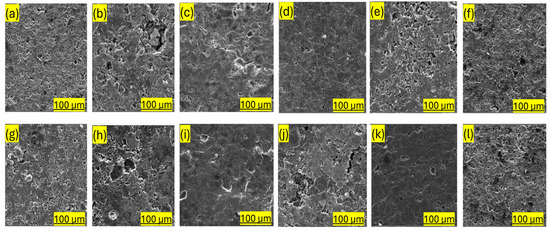
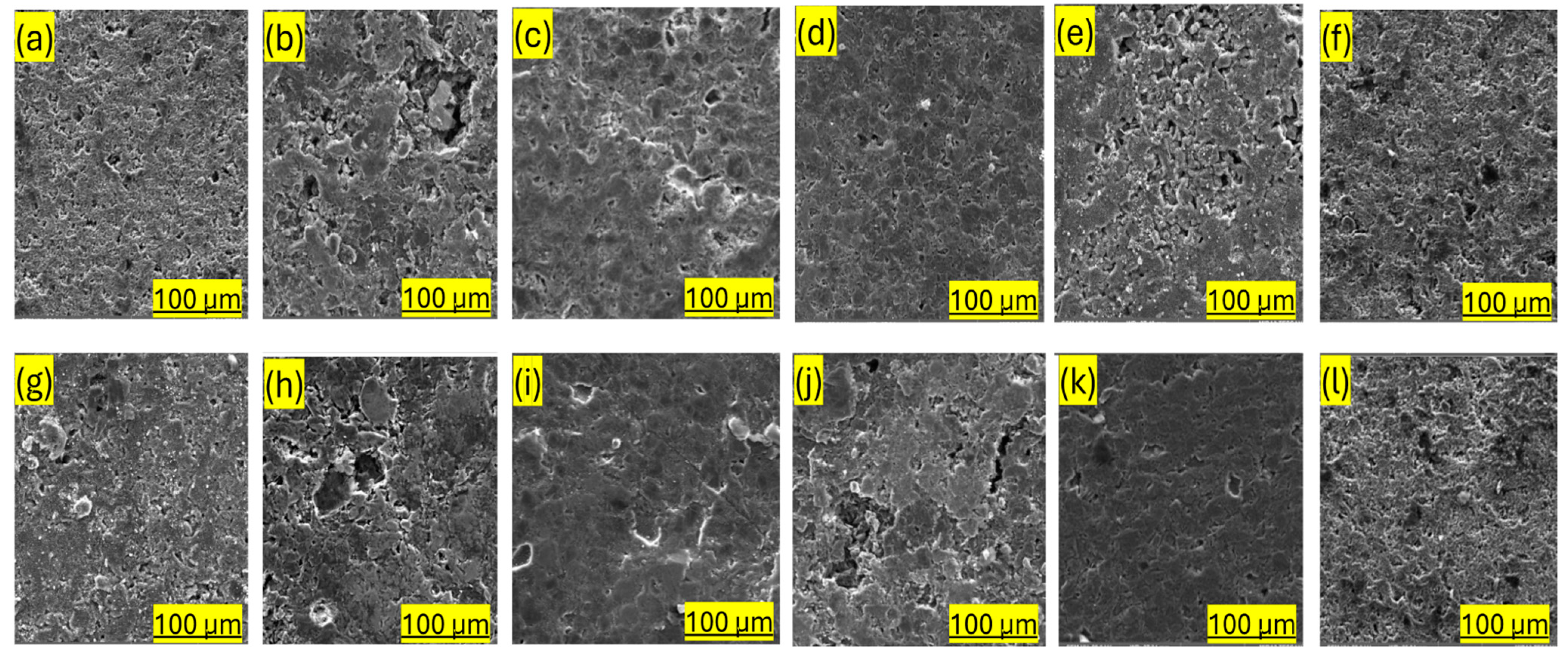
SEM images provided detailed morphology of as-synthesis composite materials, as shown in Figure 3. The pure CTP/G composite (Figure 3a) exhibited a moderately rough surface with irregular particle distribution and visible porosity. The surface became significantly rougher and highly porous after adding KOH (Figure 3b), consistent with its reduced flexural strength observed experimentally [47]. In contrast, CuSO4-modified CTP/G composites (Figure 3d) displayed remarkably smooth and densely packed surfaces, indicative of efficient catalyst-driven densification and enhanced graphitization and can be correlated with significantly improved mechanical properties. Adding FeSO4 (Figure 3c), K2SO4 (Figure 3e), and NiSO4 (Figure 3f) to composites, moderately porous surfaces with less roughness compared to KOH, suggesting intermediate levels of catalyst-induced densification and structural refinement [48]. For BDP-based composites, the pure BDP/G composite (Figure 3g) presented a relatively uniform surface with reduced porosity compared to its CTP counterpart. CuSO4-modified BDP/G composite (Figure 3h) exhibited significantly increased porosity and surface roughness, and can weaken mechanical strength, possibly due to limited catalytic interaction with the BDP matrix. Conversely, the KOH-modified BDP/G composite (Figure 3i) demonstrated a smoother, more compact, and less porous surface, supporting its higher mechanical performance and confirming effective catalytic action in enhancing matrix-filler adhesion and overall densification. The FeSO4-treated BDP/G composite (Figure 3j) displayed increased porosity, indicative of limited structural improvement. NiSO4-modified composite (Figure 3k) showed moderate porosity with relatively smoother surfaces, suggesting partial catalytic effectiveness. Lastly, the K2SO4-modified BDP/G composite remained notably porous, suggesting limited improvement in structural integrity. These SEM observations highlight the critical role of catalyst selection in influencing microstructural properties, which directly impacts composite performance. Thus, SEM provides an essential pathway to understanding and optimizing catalyst-composite interactions for enhanced industrial application potential.
Figure 3.
SEM images of graphitized composite samples: (a) pure CTP/G, (b) CTP/G/KOH, (c) CTP/G/FeSO4, (d) CTP/G/CuSO4, (e) CTP/G/K2SO4, (f) CTP/G/NiSO4, (g) pure BDP/G, (h) BDP/G/CuSO4, (i) BDP/G/KOH, (j) BDP/G/FeSO4, (k) BDP/G/NiSO4, (l) BDP/G/K2SO4.
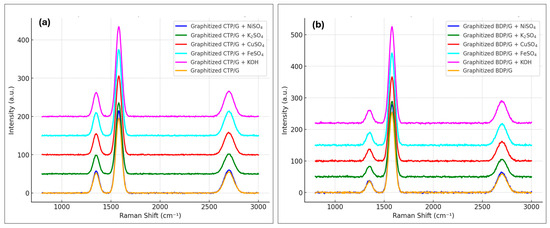
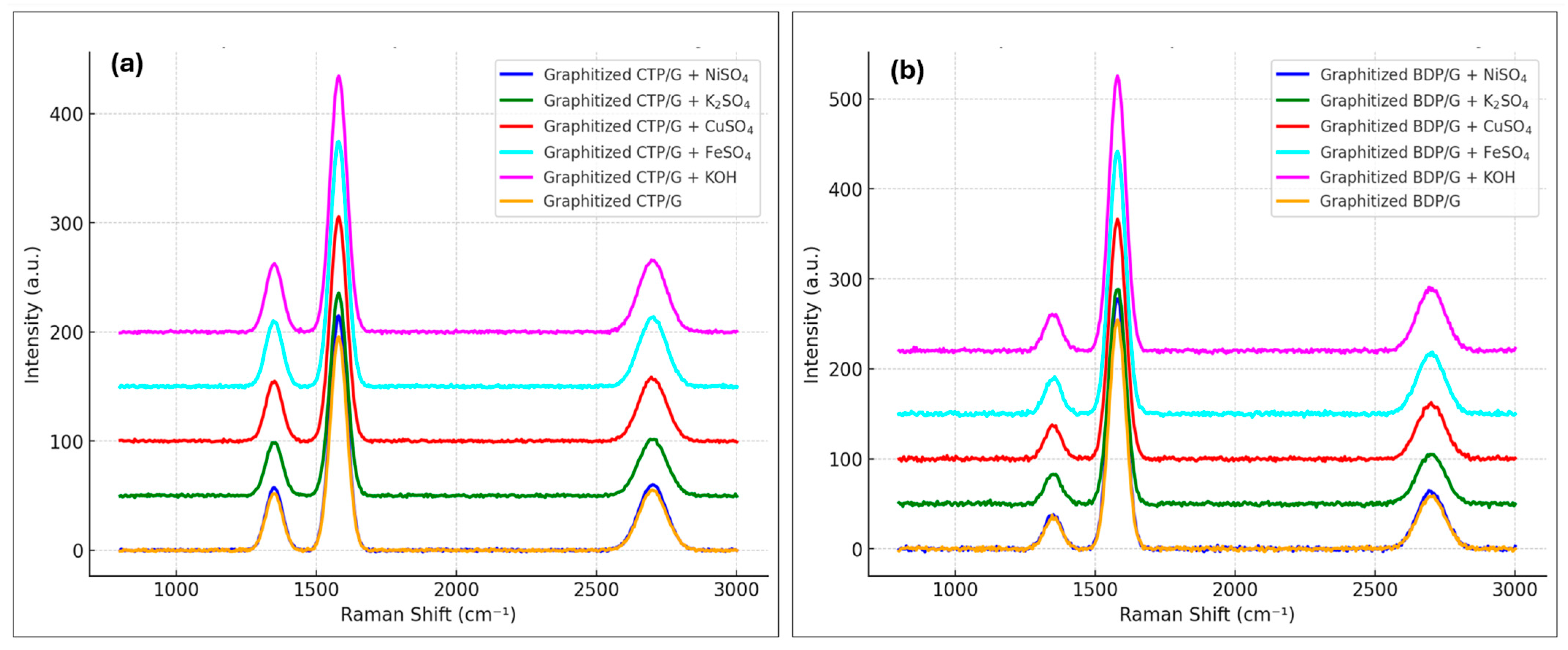
The Raman spectra of the graphitized composites based on CTP and BDP, prepared with different catalysts, provide valuable insights into their structural transformation during thermal treatment (Figure 4). The D-band at approximately 1350 cm−1 corresponds to structural disorder, while the G-band at around 1580 cm−1 indicates an ordered carbon structure. The 2D-band near 2700 cm−1 serves as an indicator of graphitic stacking and overall crystallinity [21]. Following graphitization at 2800 °C, significant structural improvements are observed in the CTP/G composites (Figure 4a). The decrease in D-band intensity reflects a notable reduction in structural defects, while the sharper and more intense G-band confirm improved ordering of the carbon framework. The increase in 2D-band intensity suggests enhanced graphitic stacking. Among the catalysts, NiSO4 and CuSO4 exhibit the highest 2D/G ratios, highlighting their strong role in promoting graphitization. In contrast, KOH and FeSO4 retain higher D-band intensities, suggesting they are less effective in improving structural order. The reduction in the ID/IG ratio confirms that high-temperature treatment significantly enhances graphitization in CTP/G composites.
Figure 4.
(a) Raman spectra of graphitized CTP/G composites, and (b) graphitized BDP/G composites with different catalysts.
The graphitized BDP/G composites show even greater structural improvements compared to their CTP/G counterparts (Figure 4b). The G-band appears sharper and more intense, reflecting superior graphitic ordering, although the D-band remains slightly visible, likely due to residual functional groups from the biomass precursor. The 2D-band intensity increases, confirming improved graphitic stacking, though slightly less pronounced than in graphitized CTP/G, suggesting minor differences in stacking behavior. Catalysts again play a significant role, with CuSO4 and FeSO4 contributing to the most substantial reductions in the ID/IG ratio in BDP/G composites (Figure 4b), reinforcing their role in facilitating graphitization. In contrast, KOH retains the highest ID/IG ratio, indicating that disorder persists in its presence even after graphitization.
A direct comparison of graphitized CTP/G and BDP/G composites (Figure 4) confirms that BDP/G consistently exhibits a lower ID/IG ratio, reinforcing its superior structural integrity and reduced defect density. The 2D/G ratio, which serves as an indicator of graphitic stacking, shows significant improvement in graphitized samples, particularly those treated with NiSO4 and CuSO4. Conversely, KOH consistently introduces more disorder, as evidenced by its higher ID/IG ratio across all graphitized samples. These findings highlight the critical impact of both precursor selection and catalyst choice in determining the final structural properties of carbon materials. The results suggest that BDP offers distinct advantages in producing well-ordered graphitic structures, making it a promising alternative for high-performance carbon materials. Additionally, the Raman spectra of the green composites before graphitization are shown in Figures S1 and S2 (Supplementary Information) for comparison.
2.3.2. Physical Properties of Graphitized Carbon-Carbon Composites
The physical properties of the graphitized carbon–carbon composites were strongly influenced by the type of catalyst and binder system, affecting density, porosity, shrinkage, and mass loss in distinct ways. The structural evolution induced by these catalysts during high-temperature treatment resulted in noticeable differences between CTP- and BDP-based composites.
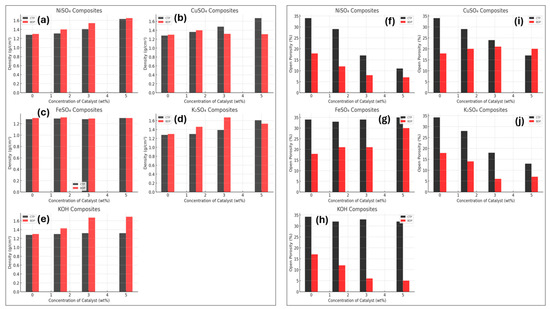
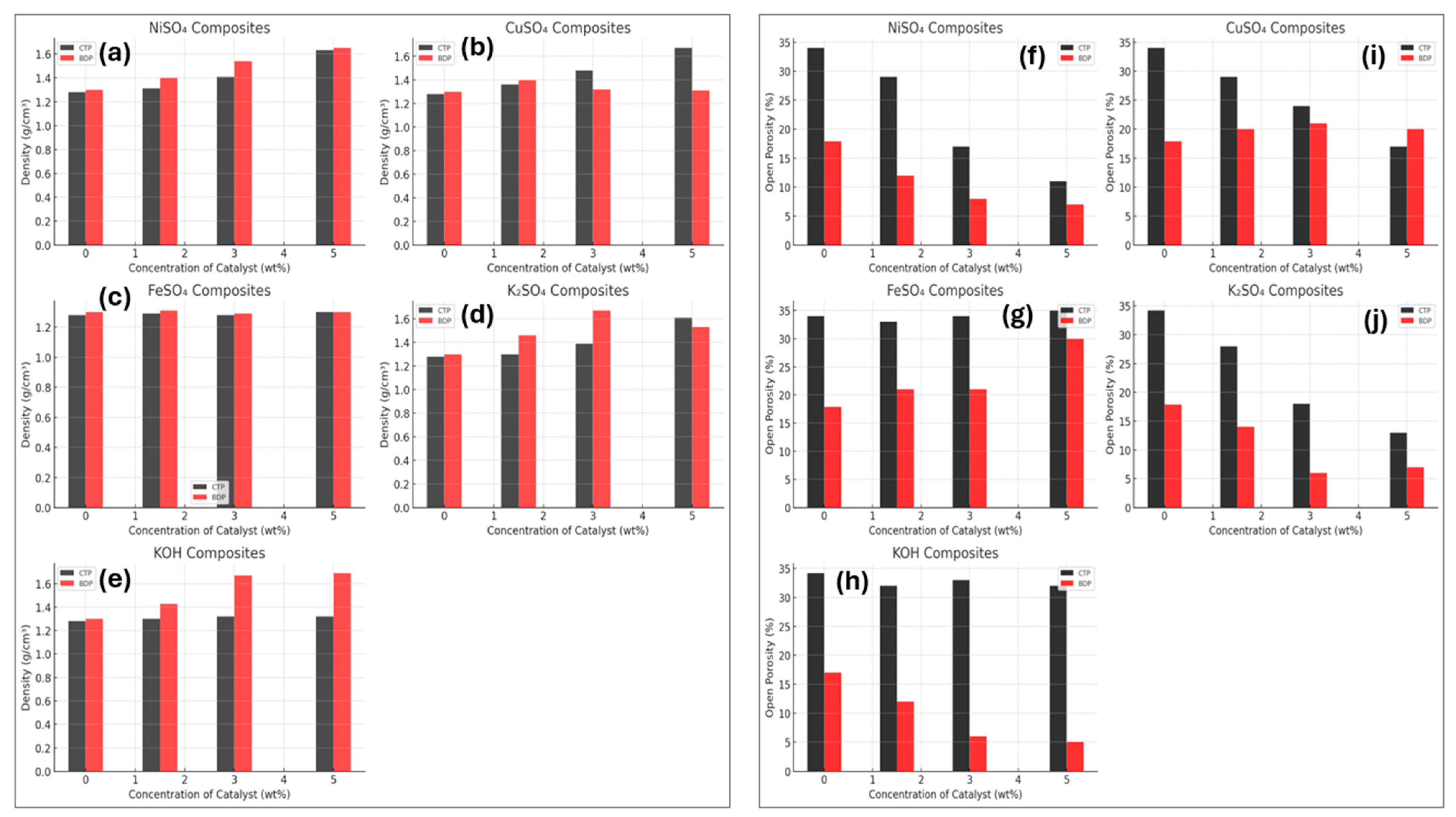
The density of the graphitized composites varied depending on the catalyst used, reflecting differences in structural compactness and material retention. NiSO4 promoted the highest densification in both binder systems, leading to a well-packed carbon structure with minimal volume reduction. K2SO4 and CuSO4 also increased density, although to a lesser extent, with CuSO4 showing a more pronounced effect in CTP-based composites than in BDP-based ones. FeSO4 resulted in moderate densification in both systems, though its effect was weaker than that of NiSO4 and CuSO4.
In contrast, the effect of KOH was strongly dependent on the binder type. In CTP-based composites, KOH acted as a strong activating agent, increasing porosity and reducing structural compactness. However, in BDP-based composites, KOH treatment led to a comparatively higher density and a more compact structure, indicating a fundamentally different interaction between KOH and the BDP matrix. These trends are reflected in the density values shown in Figure 5a.
Figure 5.
(a) Density of graphitized CTP/G/NiSO4 composites, (b) CTP/G/CuSO4 composites (c) CTP/G/FeSO4 composites, (d) CTP/G/K2SO4 composites (e) CTP/G/KOH composites (f) Open porosity (%) of graphitized CTP/G/NiSO4 composites, (g) CTP/G/CuSO4 composites, (h) CTP/G/FeSO4 composites, (i) CTP/G/K2SO4 composites (j) CTP/G/KOH composites.
Porosity followed an inverse relationship with density. Catalysts that enhanced densification generally reduced porosity. NiSO4 significantly lowered porosity by promoting the formation of a compact carbon matrix. K2SO4 and CuSO4 also contributed to porosity reduction, although their effects depended on the binder system. FeSO4 showed minimal influence on porosity in CTP-based composites but increased porosity in BDP-based systems, likely due to its interaction with volatile species during pyrolysis.
KOH exhibited contrasting behavior: in CTP/G composites, it produced the highest porosity due to strong chemical activation, whereas in BDP/G composites, KOH resulted in a lower-porosity, smoother microstructure. This difference is attributed to the oxygen-rich and lower-molecular-weight nature of BDP, which favors KOH-assisted structural rearrangement and crosslinking rather than extensive pore generation. The porosity variations induced by different catalysts are illustrated in Figure 5b.
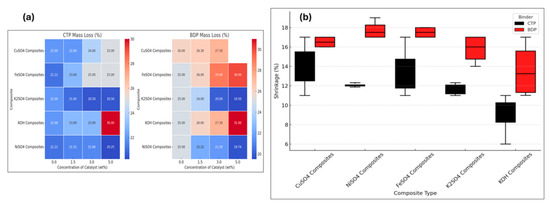
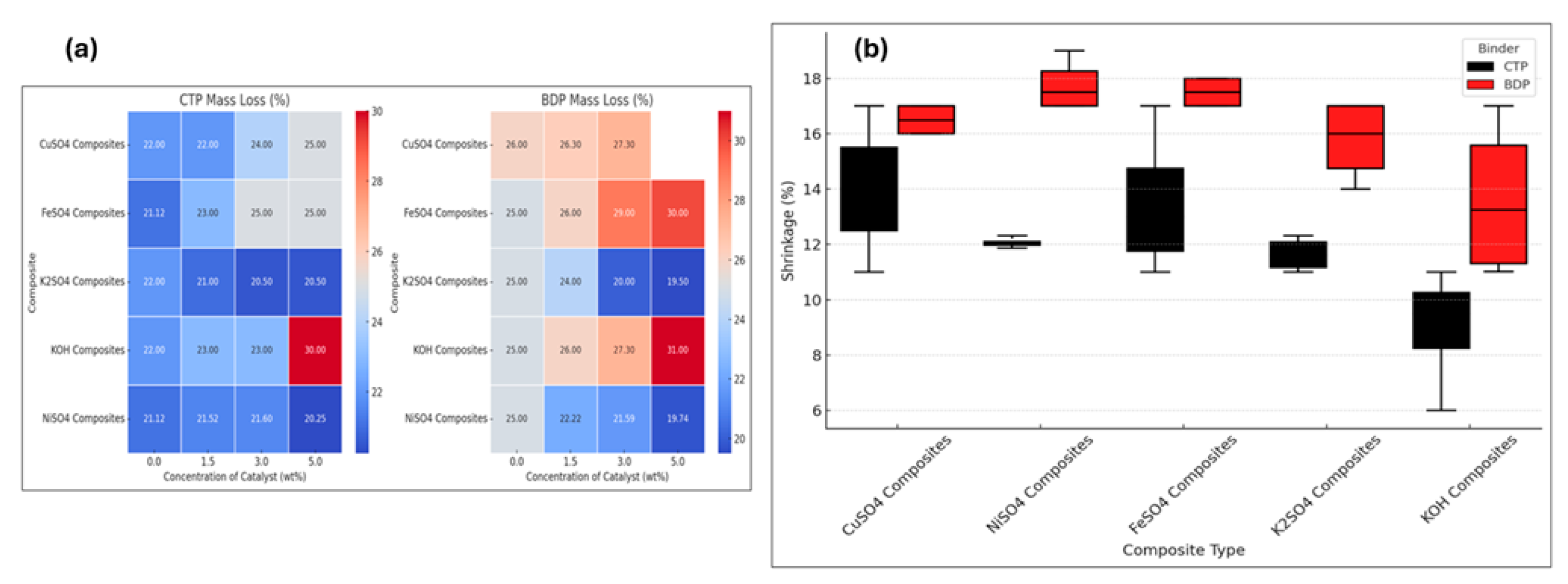
Shrinkage behavior was strongly influenced by using catalyst as well as the type of binder. Composites treated with NiSO4 exhibit minimal shrinkage, with volume reduction remaining below 5%, suggesting strong structural retention during graphitization process. In contrast, K2SO4 caused significant shrinkage, reaching up to 30–40%, indicating a more substantial structural rearrangement during high-temperature processing. CuSO4 had a variable effect, causing minimal shrinkage in CTP-based composites but leading to shrinkage levels of 25–35% in BDP-based materials. FeSO4 resulted in relatively low shrinkage in BDP-based composites, remaining under 4%, but showed a more pronounced effect in CTP-based systems, where shrinkage reached between 20 and 25%. KOH also induced substantial shrinkage, reflecting its strong structural modification effects. The differences in shrinkage behavior among the catalysts are presented in Figure 6, showing their varying influences on the final composite structure. Mass loss during high-temperature treatment was closely linked to the catalytic activity of each species and its interaction with the carbon matrix. NiSO4 resulted in the lowest mass loss, suggesting that it primarily contributed to structural ordering without significant material degradation. K2SO4 also showed low mass loss, indicating that potassium species remained within the composite, likely in the form of stable compounds. In contrast, CuSO4 led to greater mass loss in BDP composites compared to CTP-based ones, highlighting a stronger interaction with volatile species in the former system. FeSO4 resulted in moderate mass loss, with around 20% of the material lost in both composite types. KOH exhibited the highest mass loss among all catalysts, reaching 36% in CTP composites and 24% in BDP composites, emphasizing its aggressive activation effect on the carbon structure. The overall trends in mass retention and loss across different catalysts are summarized in Figure 7a, illustrating the varying degrees of stability in the composites.
Figure 6.
(a) Mass loss for graphitized CTP/G composites and graphitized BDP/G composites with different catalysts (b) Shrinkage for graphitized CTP/G composites and graphitized BDP/G composites with different catalysts.
Figure 7.
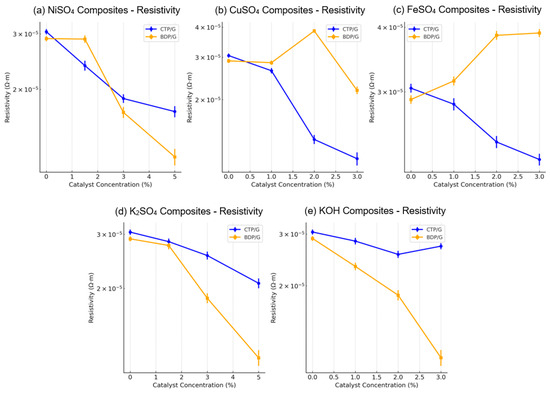
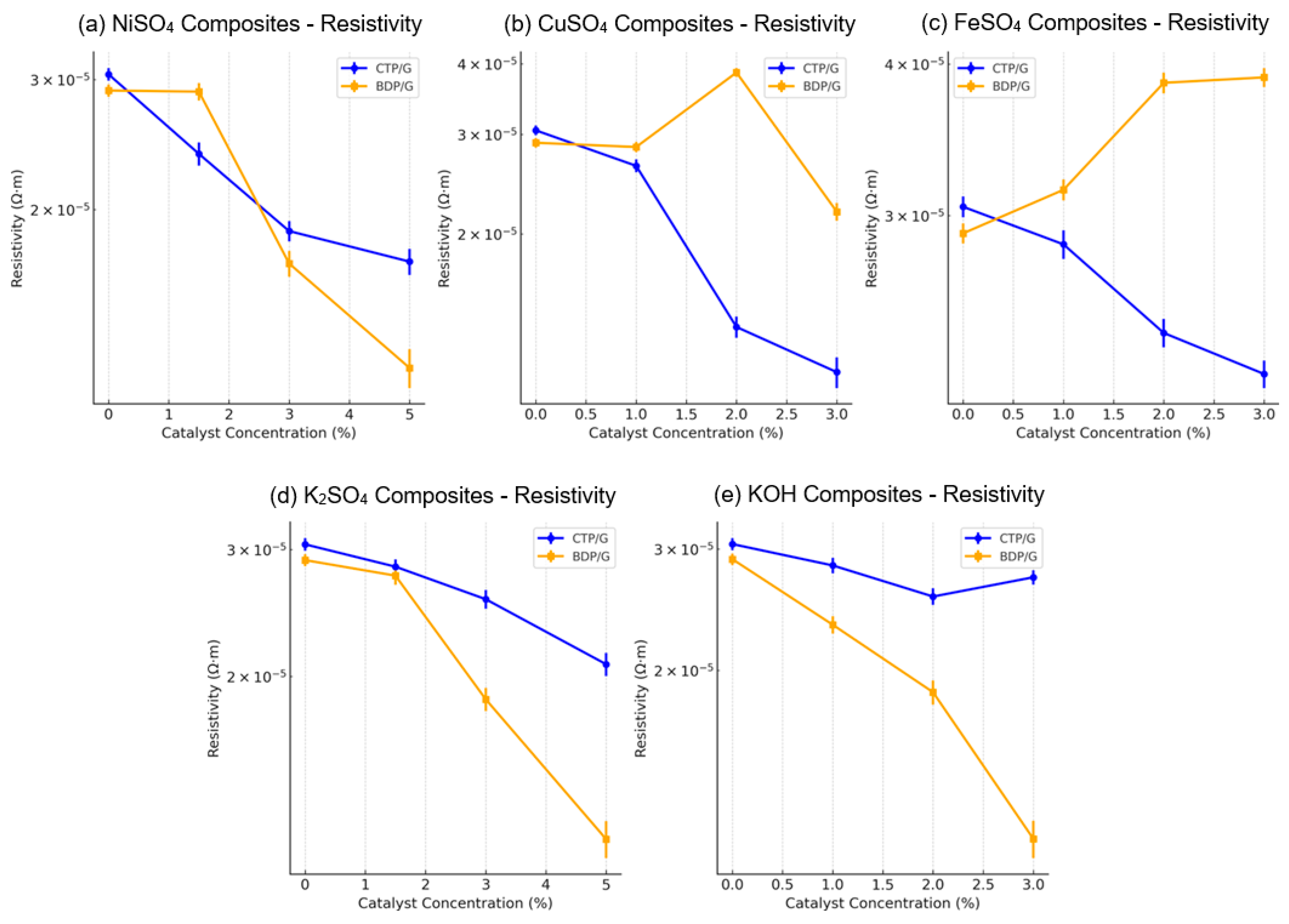
(a) Resistivity (Ω·m) of graphitized CTP/G/NiSO4 composites, (b) CTP/G/CuSO4 composites (c) CTP/G/KOH composites, (d) CTP/G/K2SO4 Composites (e) CTP/G/FeSO4 composites.
The observed differences in physical properties can be attributed to the thermal decomposition behavior of each catalyst and its interaction with the evolving carbon matrix. NiSO4, CuSO4, and FeSO4 primarily contributed to densification and structural stability, whereas K2SO4 and KOH played a greater role in modifying porosity, shrinkage, and mass loss. Shrinkage patterns were largely dictated by the binder system, with K2SO4 and CuSO4 causing more significant contraction in BDP-based composites compared to CTP-based composites. These findings provide valuable insight into how catalysts influence the structural evolution of carbon-carbon composites during graphitization, offering opportunities to tailor processing conditions for enhanced material performance.
2.3.3. Electrical Properties of the Carbon-Carbon Composites
Figure 7 presents the electrical resistivity results of composites based on CTP/G and BDP/G with different catalysts. The results indicate that pure BDP/G composites (without catalysts) had slightly higher resistivity compared to pure CTP/G composites. The lower electrical conductivity of BDP composites compared to CTP composites is primarily due to the higher concentration of oxygenated functional groups (e.g., hydroxyl, carbonyl, and ether) in BDP. These groups introduce localized defects, disrupting the continuity of the carbon network and hindering electron mobility. In contrast, CTP composites exhibit superior conductivity due to their higher graphitization potential, lower impurity content, and more interconnected carbon structure. The dominance of aromatic carbon (C=C) and polyaromatic hydrocarbons, along with minimal oxygen-containing groups, facilitates efficient electron transport, enhancing overall conductivity [26]. As shown in Figure 7, adding catalysts to the composites led to a reduction in electrical resistivity, likely due to the formation of more compact structures and improved graphitization, as confirmed by Raman spectra (Figure 4). This indicates that the catalysts help enhance conductivity by promoting structural order in the material [49].
Among the metallic catalysts, NiSO4 (Figure 7a) and CuSO4 (Figure 7b) were particularly effective in significantly lowering electrical resistivity in both BDP- and CTP-based composites. FeSO4 also had a strong effect, but mainly in the CTP-based composites. Additionally, KOH, K2SO4, and CuSO4 (Figure 7c–e) proved to be highly efficient in reducing resistivity across both systems. These findings highlight the critical role of metallic catalysts in enhancing the electrical properties of carbon-carbon composites [50,51]. Overall, our results demonstrate the potential of these catalysts to tailor the electrical performance of carbon-carbon composites. Notably, the measured resistivities were all around ~10−5 Ω·m, suggesting that all studied composites exhibit sufficient electrical conductivity for typical graphite-based applications.
2.3.4. Mechanical Properties Enhancement with Different Catalysts
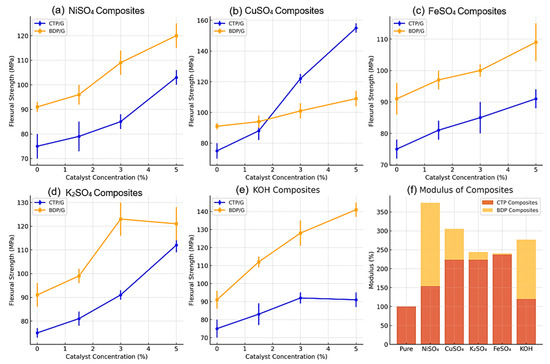
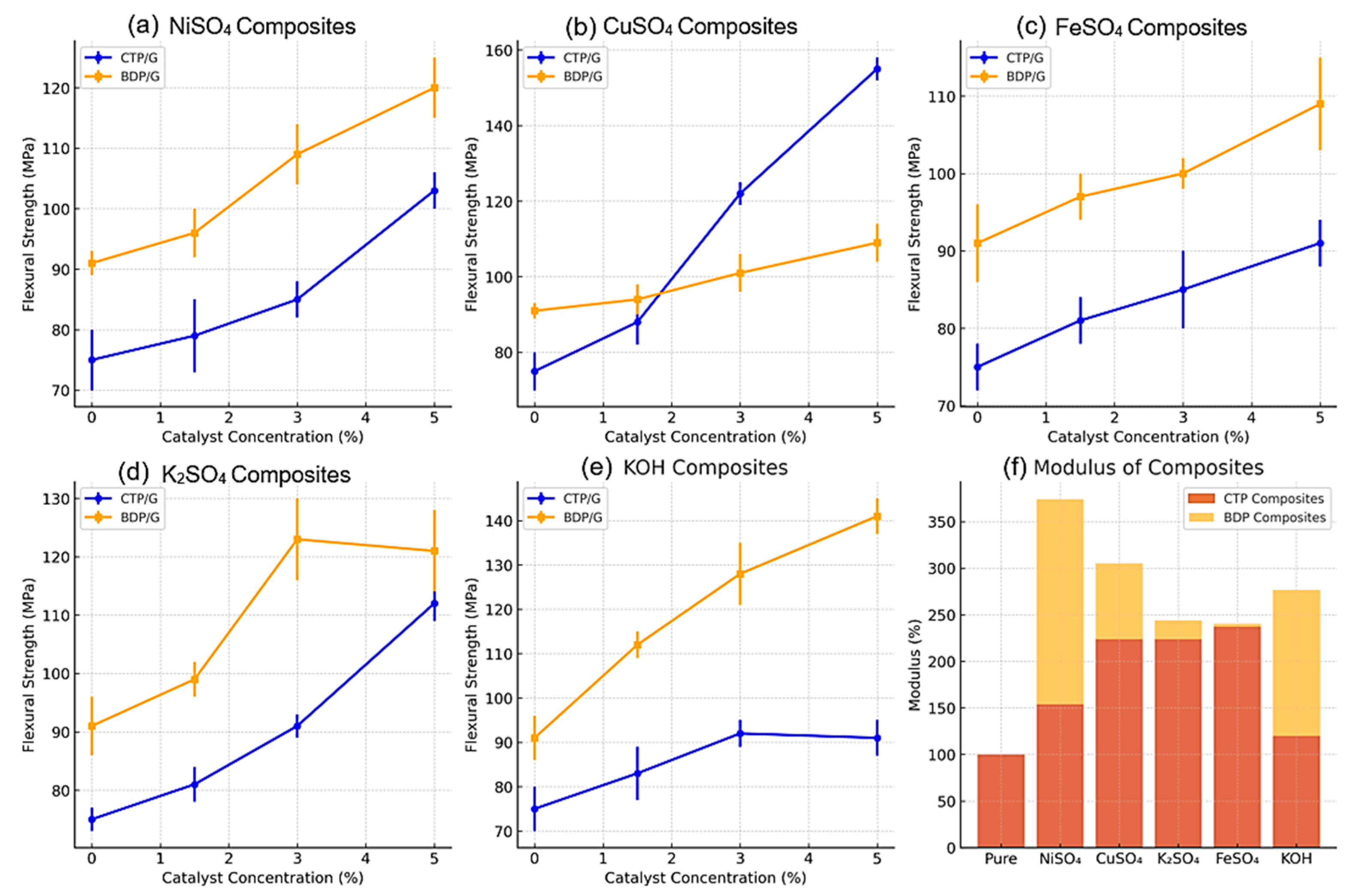
The flexural strength of the graphitized composites, a key mechanical property, was evaluated using the three-point bending method, and its variation with different catalyst incorporations is presented in Figure 8. The addition of different catalysts had a noticeable impact on both the flexural strength and modulus of carbon-carbon composites using CTP and BDP as binders. The results, summarized in Figure 8, show a clear trend for improvement of both properties progressively with increasing catalyst content. Among the tested catalysts, CuSO4 (Figure 8b) had the strongest effect on CTP composites, with flexural strength increasing by ∼106.7% and modulus reaching ∼374.3%. For BDP-based composites, KOH (Figure 8e) proved to be the most effective, leading to a ∼54.9% increase in flexural strength and a modulus improvement of ∼276.7%. Each catalyst influenced the composites differently. NiSO4 improved CTP strength by ∼37.3% (Figure 8a) with a corresponding modulus increase of ∼305.2% (Figure 8f), while for BDP, strength rose by ∼31.9%, and modulus reached ∼223.8%. K2SO4 provided a slightly greater effect, with strength gains of ∼49.3% for CTP and ∼33.0% for BDP (Figure 8d,f), accompanied by modulus increases of ∼244.1% and ∼223.8%, respectively. FeSO4 contributed moderately, improving strength by ∼18.7% for both composites, while the modulus increased to ∼240.5% in CTP and ∼227.1% in BDP (Figure 8c). KOH, the best performer for BDP, increased strength by ∼54.9% and significantly enhanced the modulus to ∼276.7% (Figure 8e), while for CTP, the strength increase was ∼20.0%. The results suggest that CuSO4 is particularly effective for strengthening CTP composites, likely due to its role in promoting graphitization and densification [32]. On the other hand, KOH had the greatest influence on BDP composites, possibly due to its ability to modify microstructure and reduce porosity, leading to enhanced mechanical performance. These findings highlight the potential of BDP as a viable alternative to CTP in carbon-carbon composite applications. BDP-based composites typically have lower mechanical properties than CTP-based ones, but catalyst additions help reduce this gap. In general, CTP-based samples exhibited higher hardness than their BDP-based counterparts. The highest value was recorded for CTP/G/FeSO4 with a Shore D of 70, followed by CTP/G/NiSO4 at 67 and CTP/G/CuSO4 at 65, indicating that transition metal sulfates significantly enhanced surface hardness. This improvement is likely due to increased crosslinking and matrix densification during high-temperature graphitization at 2800 °C. In contrast, composites with KOH showed the lowest values, with CTP/G/KOH at 48 and BDP/G/KOH at 45, likely due to the pore-forming or etching effect of KOH on the carbon structure. The pure composites without catalysts showed intermediate hardness values of 56 for CTP and 51 for BDP. These results highlight the role of catalysts, particularly NiSO4, CuSO4, and FeSO4, in promoting structural ordering, improved surface integrity, and enhanced mechanical properties [47,52].
Figure 8.
(a) Variation in the flexural strength of graphitized CTP/G/NiSO4 and BDP/G/NiSO4 composites, (b) CTP/G/CuSO4 and BDP/G/CuSO4 composites (c) CTP/G/FeSO4 and BDP/G/FeSO4 composites, (d) CTP/G/K2SO4 and BDP/G/K2SO4 composites (e) CTP/G/KOH and BDP/G/KOH composites (f) Modulus of the graphitized CTP/G and BDP/G composites with the amount of different catalysts.
2.3.5. The Role of Catalysts in Enhancing Carbon-Carbon Composites
The incorporation of NiSO4, K2SO4, CuSO4, FeSO4, and KOH significantly influenced the structural properties of carbon–carbon composites during graphitization. Catalysts such as NiSO4, CuSO4, and FeSO4 promoted densification and graphitization by facilitating carbon layer rearrangement, leading to higher density, lower porosity, and reduced shrinkage. These effects contributed to improved mechanical integrity and electrical performance.
K2SO4 induced moderate densification but also caused noticeable shrinkage, particularly in BDP-based composites. KOH displayed a system-dependent role: while it caused extensive activation, high porosity, and mass loss in CTP/G composites, it produced a denser microstructure with improved flexural properties in BDP/G composites. This contrasting behavior highlights the importance of binder chemistry in controlling catalyst–carbon interactions during graphitization.
Among the catalysts studied, NiSO4 showed the strongest enhancement of graphitization, as evidenced by Raman analysis, leading to reduced defect density and improved electrical conductivity. CuSO4 contributed significantly to densification and mechanical strength, particularly in CTP-based composites. FeSO4 and K2SO4 exhibited intermediate effects. Overall, these results emphasize that catalyst selection must be tailored to the binder system to effectively tune the properties of CTP- and BDP-based carbon–carbon composites.
3. Materials and Methods
3.1. Materials
Eucalyptus sawdust from a local wood company in Brazil, with an average particle size of ~500 μm, was used as the starting material for the synthesis of BDP. CTP and natural graphite powder with particle lateral dimensions of ~17 μm were purchased from Graphcoa company. Iron(II) Sulfate heptahydrate (FeSO4) 98.0%, Nickel(II) sulfate hexahydrate (NiSO4) 98.0%, Copper (II) sulfate, anhydrous (CuSO4) 98.0%, and Potassium sulfate (K2SO4) 99.0% were purchased from Thermo Fisher Scientific (Waltham, MA, USA). Potassium Hydroxide (KOH) 97.0% was purchased from Honeywell Fluka (Morris Plains, NJ, USA).
3.2. Production and Characterization of Bio-Oil
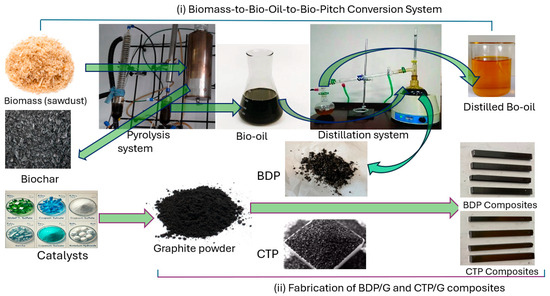
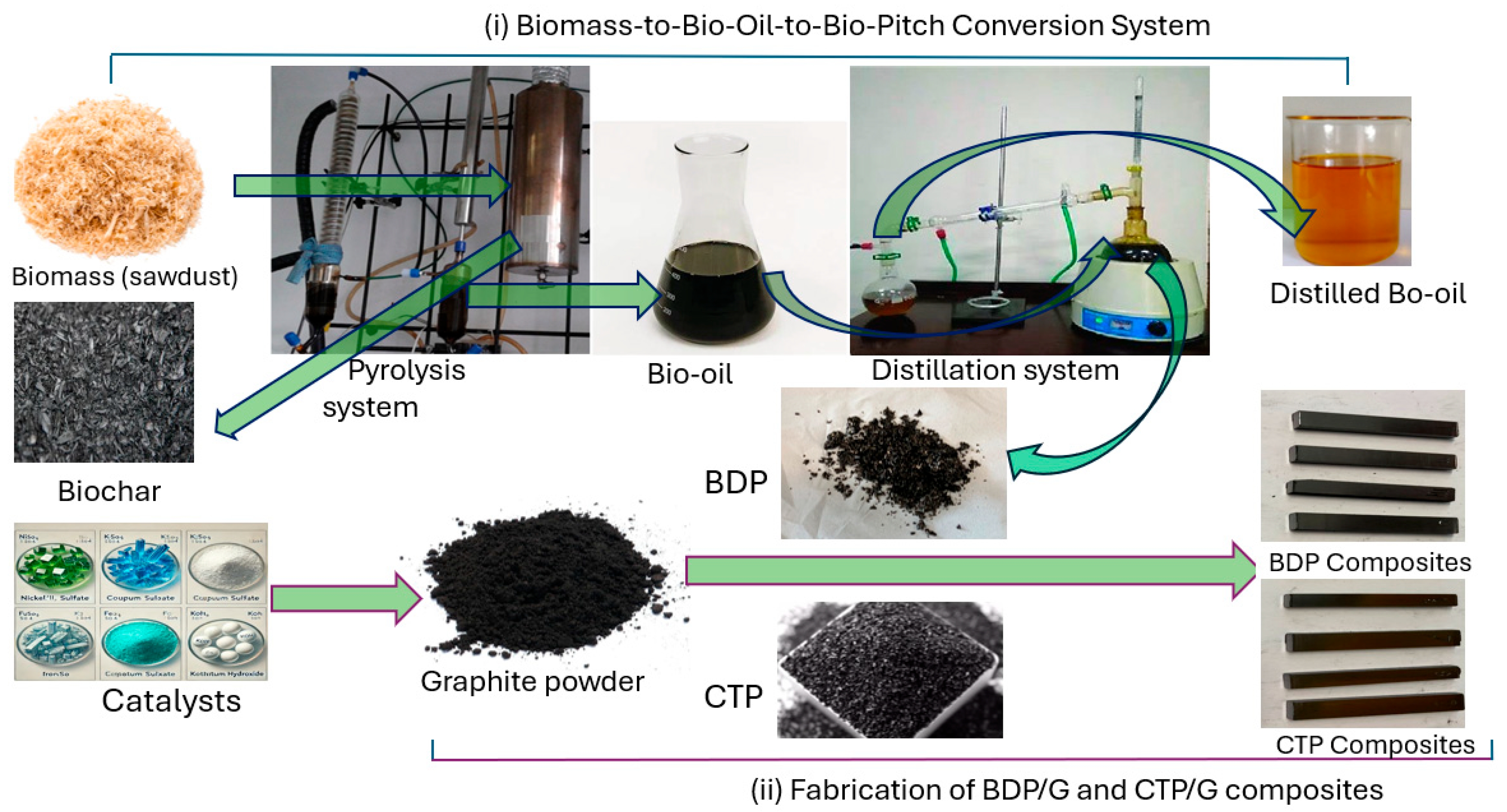
To produce bio-oil, fresh eucalyptus sawdust was subjected to pyrolysis in an argon (Ar) atmosphere using a custom-built pyrolysis system, according to our previous work [32,35,37]. As illustrated in Scheme 1, the process began by loading 1 kg of eucalyptus sawdust into a stainless-steel reactor connected to a series of two condensers. The reactor was then gradually heated to 800 °C at a rate of 10 °C/min for 2 h. During this time, the biomass decomposed into biochar, while biogas was released and passed through the condensers at 5 °C. As Volatile species evolving during the pyrolysis process condense, generating a mixture of bio-oil and water. This mixture was transferred to a separatory funnel, where it was left to settle for 2–3 h. The bio-oil naturally separated and formed a distinct layer above the water fraction. Thermogravimetric analysis (TGA) and Fourier Transform Infrared (FT-IR) spectroscopy were performed to characterize the as-synthesized bio-oil. A Mettler-Toledo DSC/TGA analyzer was used for thermal analysis, while a Nicolet iS50 FT-IR spectrometer (Waltham, MA, USA) was employed to analyze its chemical composition, and the results are presented in Figure 1 (Additional information in Table S1 in SI).
Scheme 1.
Schematic synthesis route of Bio-Oil, BDP, and CTP/G, BDP/G composites.
3.3. Synthesis and Characterization of BDP
The BDP was obtained through the distillation of as-synthesized bio-oil. A total of 200 mL of bio-oil was subjected to an atmospheric distillation system, which is heated from room temperature to 150 °C at a heating rate of 3 °C min−1. Approximately 40% of the initial bio-oil mass was evaporated at this temperature and monitored from graduated beaker. The residual dark viscous material was then allowed to cool to room temperature as a BDP, while the condensed evaporated fraction was termed distilled bio-oil. For characterization, the FT-IR spectra of BDP were acquired using a Nicolet iS50 FT-IR spectrometer within the frequency range of 4000–400 cm−1. Moreover, TGA was conducted on BDP using a Mettler-Toledo DSC/TGA analyzer (Columbus, OH, USA), reaching temperatures up to 1000 °C under an N2 atmosphere. The heating rate was set at 20 °C/min, and the gas flow rate at 100 mL min−1. The same procedures were applied to CTP for reference purposes. The wettability (contact angle) between both binders and graphite was calculated by pressing the graphite powder into 32 mm diameter disks at 110 MPa. Approximately 0.005 g of each pitch was placed onto the graphite disk. The graphite disk with the binder was then positioned on a hotplate set at 165 °C and covered with a watch glass for 5 min. Subsequently, the hotplate was turned off, allowing the binders to cool and solidify on the graphite surface. Once the samples had cooled down, they were removed and subjected to measurement of the contact angle, using the Biolin Scientific Attension Theta Lite (Gothenburg, Sweden). The average contact angle was calculated based on measurements taken from both the left and right sides of the samples. The pH of the samples was determined using an Eutech Waterproof pH Spear 510 pH meter. The instrument was calibrated with standard buffer solutions (pH 4.0, 7.0, and 10.0) prior to measurement. To ensure accuracy and prevent cross-contamination, the probe was rinsed with deionized water between measurements. Each sample was analyzed in triplicate, and the mean pH value was recorded.
3.4. Synthesis and Characterization of Carbon-Carbon Composites
Graphite-based carbon–carbon composites were prepared using natural graphite powder and binders (CTP and BDP) in a 50:50 weight ratio, following our previously reported methodology [32]. The graphite and binder were blended at room temperature for 10–15 min using a Kika Werke M20 blender to ensure uniform mixing. During the blending step, catalysts including NiSO4, CuSO4, K2SO4, FeSO4, and KOH were incorporated at 5 wt% relative to the binder content, consistent with our earlier work where additive loadings of 1.5–5 wt% were evaluated and 5 wt% produced optimal structural modification. The mixture was then heated to 150 °C for 2 h to remove low-molecular-weight volatiles. Green composites were produced by pressing the mixture into 40 mm × 10 mm × 4 mm molds under 61 MPa for 5 min. These were graphitized in an argon atmosphere at 2800 °C using a heating rate of 35 °C/h and a dwell time of 30 min to obtain the graphitized CTP/G and BDP/G composites. Bulk density and open porosity were measured using hydrostatic weighing, and shrinkage during graphitization was calculated using Equation (1). This study extends our previous work by employing the 50/50 CTP and BDP binder ratio, with additional ratios to be explored in future work.
where Vi and Vf represent the initial and final volumes of the specimens, respectively.
The mass loss of a composite from the initial (green) state to the graphitized state can be calculated using the following Equation (2):
where Mi is the initial (green samples) mass of the composite before any thermal treatment, and Mf is the final mass of the composite after graphitization. The microstructural analysis of the graphitized composites was conducted using scanning electron microscopy (SEM) on a Quanta 250 SEM operated at 20 kV. Raman spectroscopy was performed using a Renishaw 1000 Raman spectrometer equipped with a 633 nm He−Ne laser, with a laser power of ~10 mW to minimize heating effects. The elemental composition of the green and graphitized composites was analyzed using a Thermo FLASH 2000 organic elemental analyzer (Waltham, MA, USA). Elemental analysis (Table S5) showed that sulfur and oxygen were fully removed during high-temperature graphitization, while the metal components (Ni, Cu, Fe, K) remained in trace amounts; this trend confirms that catalyst sulfates decompose to volatile SO2/O2 species and leave only the corresponding metal oxides/metals behind, which correlates with the observed improvements in graphitization and densification. The electrical resistance of graphitized composites was measured using the four-point probe method, employing a Keithley Tektronix 2450 Source Meter. For mechanical performance evaluation, three-point bending tests were conducted on the graphitized composites using an Instron 3365 Universal Testing System. Test specimens with dimensions 40 mm × 10 mm × 4 mm were subjected to bending at a crosshead speed of 1.5 mm/min to determine their flexural strength and modulus. Shore D hardness was measured using a calibrated durometer following ASTM D2240. Each composite, including pure and catalyst-modified samples with CTP or BDP binders, was tested at five points. Table S6 (SI) lists average values and standard deviations, with comparative results.
4. Conclusions
In this work, BDP/G composites were successfully fabricated and systematically compared with CTP/G composites to evaluate their structural, thermal, electrical, and mechanical performance. Elemental analysis and thermal behaviour confirmed that BDP contains higher oxygen content, which improved interfacial adhesion with graphite and contributed to more uniform microstructural development compared with CTP. Catalyst-assisted processing played a decisive role in enhancing material performance: among all catalysts tested, K2SO4 consistently delivered the greatest improvements in graphitization, densification, and electrical conductivity, while also producing the lowest porosity across both BDP- and CTP-based systems. NiSO4 and CuSO4 also enhanced structural order, but their effects were less pronounced. Overall, the results demonstrate that BDP is a viable and sustainable alternative to CTP, capable of achieving comparable or superior performance when paired with the appropriate catalyst. The ability to tune composite properties through catalyst selection, particularly using K2SO4, highlights a clear pathway for optimizing next-generation carbon–carbon composites using more environmentally responsible binder systems.
Supplementary Materials
The following supporting information can be downloaded at: https://www.mdpi.com/article/10.3390/catal16010074/s1, Figure S1. Raman spectra of CTP/G green sample. Figure S2. Raman spectra of BDP/G green sample. Table S1. Summary of the chemical composition of the BDP and CTP revealed by FT-IR. Table S2. Summary of the thermal degradation of the BDP and CTP revealed by TGA. Table S3. The contact angle measurements obtained for CTP and BDP on graphite are presented. Table S4. Raman Spectroscopy Analysis Summary. Table S5. Elements Remaining vs. Removed After 2500 °C Graphitization. Table S6. Shore D hardness values with a standard deviation of CTP/G and BDP/G composites with and without catalysts.
Author Contributions
Conceptualization, Z.S., S.A.S., S.Z. and H.U.; methodology, Z.S.; software, M.N.; validation, M.Y., I.U. and A.O.A.; formal analysis, Z.S., S.A.S. and H.U.; investigation Z.S.; resources, S.A.S. and H.U.; data curation, M.Y.; writing—original draft preparation, Z.S., I.U. and M.Y.; writing—review and editing, S.A.S. and H.U.; visualization, M.N.; supervision, S.A.S. and H.U.; project administration, H.U.; funding acquisition, Z.S., S.A.S., S.Z. and H.U. All authors have read and agreed to the published version of the manuscript.
Funding
For the purpose of open access, the authors have applied a Creative Commons Attribution (CC BY) license to any Author Accepted Manuscript version arising from this work. M.N. The authors also thank the Chilean Agency for Research and Development (ANID) for financial support under the FONDECYT Project No 11251269.
Data Availability Statement
The raw data supporting the conclusions of this article will be made available by the authors on request.
Acknowledgments
We would like to acknowledge the Faculty of Environment, Science and Economy, University of Exeter, UK, and funding support from the Engineering and Physical Sciences Research Council (EPSRC). During the preparation of this manuscript, the authors used ChatGPT 5.2 solely for language editing and proofreading. The authors reviewed and revised the AI-generated suggestions and take full responsibility for the final content of this publication.
Conflicts of Interest
The authors declare no conflicts of interest.
References
- Lu, Y.; Li, D.; Huang, X.; Picard, D.; Mollaabbasi, R.; Ollevier, T.; Alamdari, H. Synthesis and Characterization of Bio-pitch from Bio-oil. ACS Sustain. Chem. Eng. 2020, 8, 11772–11782. [Google Scholar] [CrossRef] [Scilit]
- Lu, Y.; Mollaabbasi, R.; Picard, D.; Ziegler, D.; Alamdari, H. Physical and Chemical Characterization of Bio-pitch as a Potential Binder for Anode. In Light Metals; Chesonis, C., Ed.; The Minerals, Metals & Materials Series; Springer: Cham, Switzerland, 2019; pp. 1229–1235. [Google Scholar]
- Coutinh, A.R.; Luengo, C.A. Mass balance of biocarbon electrodes obtained by experimental bench production. In Developments in Thermochemical Biomass Conversion; Bridgwater, A.V., Boocock, D.G.B., Eds.; Springer: Berlin/Heidelberg, Germany, 1997. [Google Scholar]
- Lis, T.; Korzec, N.; Frohs, W.; Tomala, J.; Frączek-Szczypta, A.; Błażewicz, S. Wood-derived tar as a carbon binder precursor for carbon and graphite technology. J. Wood Chem. Technol. 2016, 36, 393–400. [Google Scholar] [CrossRef] [Scilit]
- Lu, Y.; Hussein, A.; Lauzon-Gauthier, J.; Ollevier, T.; Alamdari, H. Biochar as an Additive to Modify Biopitch Binder for Carbon Anodes. ACS Sustain. Chem. Eng. 2021, 9, 12406–12414. [Google Scholar] [CrossRef] [Scilit]
- Ōya, A.; Marsh, H. Phenomena of Catalytic Graphitization. J. Mater. Sci. 1982, 17, 309–322. [Google Scholar] [CrossRef] [Scilit]
- Lu, Y.; Hussein, A.; Li, D.; Huang, X.; Mollaabbasi, R.; Picard, D.; Ollevier, T.; Alamdari, H. Properties of Bio-pitch and Its Wettability on Coke. ACS Sustain. Chem. Eng. 2020, 8, 15366–15374. [Google Scholar] [CrossRef] [Scilit]
- Coutinho, A.R.; Luengo, C.A. Preparing and Characterizing Electrode Grade Carbons from Eucalyptus Pyrolysis Products. In Advances in Thermochemical Biomass Conversion; Bridgwater, A.V., Ed.; Springer: Berlin/Heidelberg, Germany, 1994; pp. 1230–1240. [Google Scholar]
- Coutinho, A.R.; Rocha, J.D.; Luengo, C.A. Preparing and Characterizing Biocarbon Electrodes. Fuel Process. Technol. 2000, 67, 93–102. [Google Scholar] [CrossRef] [Scilit]
- Sarkar, A.; Kocaefe, D.; Kocaefe, Y.; Sarkar, D.; Bhattacharyay, D.; Morais, B.; Chabot, J. Coke-Pitch Interactions During Anode Preparation. Fuel 2014, 117, 598–607. [Google Scholar] [CrossRef] [Scilit]
- Hussein, A.; Picard, D.; Alamdari, H. Biopitch as a Binder for Carbon Anodes: Impact on Carbon Anode Properties. ACS Sustain. Chem. Eng. 2021, 9, 4681–4687. [Google Scholar] [CrossRef] [Scilit]
- Cataluna, R.; Shah, Z.; Venturi, V.; Caetano, N.R.; da Silva, B.P.; Azevedo, C.M.N.; Oliveira, L.P. Production Process of Di-Amyl Ether and Its Use as an Additive in the Formulation of Aviation Fuels. Fuel 2018, 228, 226–233. [Google Scholar] [CrossRef] [Scilit]
- Tamási, K.; Kollár, M.S. Effect of Different Sulfur Content in Natural Rubber Mixture on Their Thermo-Mechanical and Surface Properties. Int. J. Eng. Res. Sci. 2018, 4, 28–37. [Google Scholar]
- Mohammed, M.; Babadagli, T. Wettability Alteration: A Comprehensive Review of Materials/Methods and Testing the Selected Ones on Heavy-Oil Containing Oil-Wet Systems. Adv. Colloid Interface Sci. 2015, 220, 54–77. [Google Scholar] [CrossRef] [Scilit] [PubMed]
- Shah, Z.; Veses, R.C.; Silva, R.D. A Comparative Study and Analysis of Two Types of Bio-Oil Samples Obtained from Freshwater Algae and Microbial-Treated Algae. Mod. Chem. Appl. 2016, 4, 1000185. [Google Scholar] [CrossRef]
- EU Coal-Tar Pitch. High Temperature. In Summary Risk Assessment Report—Environment; EU Coal-Tar Pitch: Maastricht, The Netherlands, 2008. [Google Scholar]
- Shah, Z.; Cataluña Veses, R.; da Silva, R. Using GC-MS to Analyze Bio-Oil Produced from Pyrolysis of Agricultural Wastes: Discarded Soybean Frying Oil, Coffee, and Eucalyptus Sawdust in the Presence of 5% Hydrogen and Argon. J. Anal. Bioanal. Tech. 2016, 7, 1000300. [Google Scholar]
- Diefendorf, R.J.; Tokarsky, E. High-Performance Carbon Fibers. Polym. Eng. Sci. 1975, 15, 150–159. [Google Scholar] [CrossRef] [Scilit]
- Sevilla, M.; Fuertes, A.B. The Production of Carbon Materials by Hydrothermal Carbonization of Cellulose. Carbon 2009, 47, 2281–2289. [Google Scholar] [CrossRef] [Scilit]
- Lu, Y.; Kocaefe, D.; Kocaefe, Y.; Huang, X.; Bhattacharyay, D.; Coulombe, P. Study of the Wettability of Coke by Different Pitches and Their Blends. Energy Fuels 2016, 30, 9210–9216. [Google Scholar] [CrossRef] [Scilit]
- Romanyuk, O.; Varga, M.; Tulic, S.; Izak, T.; Jiricek, P.; Kromka, A.; Skakalova, V.; Rezek, B. Study of Ni-catalyzed graphitization process of diamond by in situ X-ray photoelectron spectroscopy. J. Phys. Chem. C 2018, 122, 6629–6636. [Google Scholar] [CrossRef] [Scilit]
- Amini, S.; Garay, J.; Liu, G.; Balandin, A.A.; Abbaschian, R. Growth of Large-Area Graphene Films from Metal-Carbon Melts. J. Appl. Phys. 2010, 108, 094321. [Google Scholar] [CrossRef] [Scilit]
- Kanada, S.; Nagai, M.; Ito, S.; Matsumoto, T.; Ogura, M.; Takeuchi, D.; Yamasaki, S.; Inokuma, T.; Tokuda, N. Fabrication of Graphene on Atomically Flat Diamond (111) Surfaces Using Nickel as a Catalyst. Diam. Relat. Mater. 2017, 75, 105–109. [Google Scholar] [CrossRef] [Scilit]
- Huang, L.; Chang, Q.H.; Guo, G.L.; Liu, Y.; Xie, Y.Q.; Wang, T.; Ling, B.; Yang, H.F. Synthesis of High-Quality Graphene Films on Nickel Foils by Rapid Thermal Chemical Vapor Deposition. Carbon 2012, 50, 551–556. [Google Scholar] [CrossRef] [Scilit]
- Klunk, M.A.; Shah, Z.; Wander, P.R. Use of Montmorillonite Clay for Adsorption of Malachite Green Dye. Periódico Tchê Química 2019, 16, 279. [Google Scholar] [CrossRef] [Scilit]
- Namsheer, K.; Rout, C.S. Conducting polymers: A comprehensive review on recent advances in synthesis, properties and applications. RSC Adv. 2021, 11, 5659–5697. [Google Scholar] [CrossRef] [Scilit]
- Shah, Z.; Cataluña Veses, R.; Aguilhera, R.A.; Silva, R.D. Bio-oil production from pyrolysis of coffee and eucalyptus sawdust in the presence of 5% hydrogen. Int. J. Eng. Res. Sci. 2016, 2, 34–42. [Google Scholar]
- García, J.M.; He, R.; Jiang, M.P.; Kim, P.; Pfeiffer, L.N.; Pinczuk, A. Multilayer Graphene Grown by Precipitation upon Cooling of Nickel on Diamond. Carbon 2011, 49, 1006–1012. [Google Scholar] [CrossRef] [Scilit]
- Adeoye, A.O.; Quadri, R.O.; Lawal, O.S.; Emojevu, E.O. Physicochemical characterization, valorization of lignocellulosic waste (Kola nut seed shell) via pyrolysis, and ultrasonication of its crude bio-oil for biofuel production. Clean. Waste Syst. 2024, 7, 100138. [Google Scholar] [CrossRef] [Scilit]
- Yaseen, M.; Khattak, M.A.K.; Khan, A.; Khan, M.S.; Ahmad, M.; Shah, Z.; Bibi, S. Physico-Chemical Investigations on the Catalytic Production of Biofuel from Algal Biomass. Russ. J. Phys. Chem. A 2022, 96, S31–S37. [Google Scholar] [CrossRef] [Scilit]
- Adeoye, A.O.; Quadri, R.O.; Lawal, O.S.; Malomo, D.; Emojevu, E.O.; Omonije, O.O.; Odeniyi, O.K.; Fadahunsi, M.O.; Yelwa, M.J.; Aasa, S.A.; et al. Advanced Techniques in Upgrading Crude Bio-Oil to Biofuel; Springer Nature: Singapore, 2024; pp. 321–353. [Google Scholar]
- Shah, Z.; Saberian, M.; Hodgeman, D.; Kinloch, I.; Vallés, C. Effect of Sulfur on Wood Tar Biopitch as a Sustainable Replacement for Coal Tar Pitch Binders. ACS Appl. Eng. Mater. 2023, 1, 2567–2576. [Google Scholar] [CrossRef] [Scilit]
- Elkasabi, Y.; Mullen, C.A.; Strahan, G.D.; Wyatt, V.T. Biobased Tar Pitch Produced from Biomass Pyrolysis Oils. Fuel 2022, 318, 123300. [Google Scholar] [CrossRef] [Scilit]
- Wang, W.; Liu, G.; Shen, J.; Chang, H.; Li, R.; Du, J.; Yang, Z.; Xu, Q. Reducing polycyclic aromatic hydrocarbons content in coal tar pitch by potassium permanganate oxidation and solvent extraction. J. Environ. Chem. Eng. 2015, 3, 1513–1521. [Google Scholar] [CrossRef] [Scilit]
- Shah, Z.; Veses, R.C.; Vaghetti, J.C.; Amorim, V.D.; Silva, R.D. Preparation of Jet Engine Range Fuel from Biomass Pyrolysis Oil Through Hydrogenation and Its Comparison with Aviation Kerosene. Int. J. Green Energy 2019, 16, 350–360. [Google Scholar] [CrossRef] [Scilit]
- Sakhakarmy, M.; Kemp, A.; Biswas, B.; Kafle, S.; Adhikari, S. A Comparative Analysis of Bio-Oil Collected Using an Electrostatic Precipitator from the Pyrolysis of Douglas Fir, Eucalyptus, and Poplar Biomass. Energies 2024, 17, 2800. [Google Scholar] [CrossRef] [Scilit]
- Veses, R.C.; Shah, Z.; Kuamoto, P.M.; Caramão, E.B.; Machado, M.E. Bio-Oil Production by Thermal Cracking in the Presence of Hydrogen. J. Fundam. Renew. Energy Appl. 2015, 6, 1000194. [Google Scholar]
- Shah, Z.; Renato, C.V.; Marco, A.C.; Rosangela, D.S. Separation of Phenol from Bio-oil Produced from Pyrolysis of Agricultural Wastes. Mod. Chem. Appl. 2017, 5, 2. [Google Scholar] [CrossRef]
- Cataluña, R.; Shah, Z.; Pelisson, L.; Caetano, N.R.; Silva, R.D.; Azevedo, C. Biodiesel Glycerides from the Soybean Ethylic Route Incomplete Conversion on the Diesel Engines Combustion Process. J. Braz. Chem. Soc. 2017, 28, 2447–2454. [Google Scholar] [CrossRef] [Scilit]
- Shah, Z.; Cataluña Veses, R.; Silva, R.D. GC-MS and FTIR Analysis of Bio-oil Obtained from Freshwater Algae (Spirogyra) Collected from Freshwater. Int. J. Environ. Agric. Res. 2016, 2, 134–141. [Google Scholar]
- Wang, X.; He, X.; Wang, X. FTIR Analysis of the Functional Group Composition of Coal Tar Residue Extracts and Extractive Residues. Appl. Sci. 2023, 13, 5162. [Google Scholar] [CrossRef] [Scilit]
- Shah, Z.; Veses, R.C.; Brum, J.; Klunk, M.A.; Rocha, L.A.O.; Missaggia, A.B.; Caetano, N.R. Sewage Sludge Bio-Oil Development and Characterization. Inventions 2020, 5, 36. [Google Scholar] [CrossRef] [Scilit]
- Zeban, S.; Veses, R.C.; Ullah, I.; Yaseen, M.; Aguilhera, R.A.; Jamal, S.; Silva, R. Analysis of Bio-Oil Obtained from Pyrolysis of Scenedesmus and Spirogyra Mixture Algal Biomass. J. Ongoing Chem. Res. 2016, 2, 1–13. [Google Scholar]
- Klunk, M.A.; Dasgupta, S.; Das, M.; Shah, Z. System of Adsorption of CO2 in Coalbed. S. Braz. J. Chem. 2018, 26, 2–9. [Google Scholar]
- De Oliveira, A.P.; Lorenzini, G.; Shah, Z.; Klunk, M.A.; de Carvalho Lima, J.E.; Rocha, L.A.O.; Caetano, N.R. Hierarchical Criticality Analysis of Clean Technologies Applied to a Coal-Fired Power Plant. Int. J. Des. Nat. Ecodyn. 2020, 15, 609–619. [Google Scholar] [CrossRef] [Scilit]
- Caetano, N.R.; Lorenzini, G.; Lhamby, A.R.; Shah, Z.; Klunk, M.A.; Rocha, L.A.O. Modelling Safety Distance from Industrial Turbulent Non-Premixed Gaseous Jet Flames. Int. J. Mech. Eng. 2020, 5, 41–49. [Google Scholar]
- Klunk, M.A.; Dasgupta, S.; Das, M.; Wander, P.R.; Shah, Z. Estudo Da Adsorção Dos Corantes Violeta Cristal E Verde Malaquita Em Material Zeolítico. Periódico Tchê Química 2019, 16, 70–81. [Google Scholar]
- Dias, S.L.P.; Shah, Z.; Cataluña Veses, R.; Leite, A.J.B. Processo de Obtenção de Biocarvão e de Bio-óleo Cru, Processo de Obtenção de Carvão Ativado Magnético, Carvão Ativado Magnético e Seu Uso, Uso do Bio-óleo Cru ou da Fração de Destilado de Bio-óleo e Uso do Biocarvão. UFRGS Pat. 2019. [Google Scholar]
- Zhang, Y.; Wang, L.; Liu, J.; Zhang, H.; Zhang, L.; Yu, M.; Zhou, J. Coal Tar Pitch-Based Porous Carbon Loaded MoS2 and Its Application in Supercapacitors. ACS Omega 2023, 8, 12045–12056. [Google Scholar]
- Chen, Z.; Li, X.; Wang, Q.; Xu, Y.; Zhao, T. Highly Graphitized Coal Tar Pitch-Derived Porous Carbon as High-Performance Anode for Lithium-Ion Batteries. Chem. A Eur. J. 2024, 30, e202400189. [Google Scholar]
- Gao, X.; Wu, J.; Ren, L.; Wang, D.; Zhao, Y. Supercapacitor Performances of Coal Tar Pitch-Based Spherical Activated Carbons. J. Carbon Res. 2023, 12, 125–139. [Google Scholar]
- Liu, D.; Yang, F.; Zhao, H.; Song, J.; Zhang, P. Preparation and Characterization of High-Performance Coal Tar Pitch-Based Carbon Fibers. Carbon Lett. 2023, 34, 1342–1351. [Google Scholar]
Disclaimer/Publisher’s Note: The statements, opinions and data contained in all publications are solely those of the individual author(s) and contributor(s) and not of MDPI and/or the editor(s). MDPI and/or the editor(s) disclaim responsibility for any injury to people or property resulting from any ideas, methods, instructions or products referred to in the content. |
© 2026 by the authors. Licensee MDPI, Basel, Switzerland. This article is an open access article distributed under the terms and conditions of the Creative Commons Attribution (CC BY) license.