Article

Synergistic Induction by Deep Eutectic Solvent and Carbon Dots for Rapid Construction of FeOOH Electrocatalysts Toward Efficient Oxygen Evolution Reaction


State Key Laboratory of Heavy Oil Processing, College of Chemistry and Chemical Engineering, China University of Petroleum (East China), Qingdao 266580, China
*
Authors to whom correspondence should be addressed.
Catalysts 2026, 16(1), 73; https://doi.org/10.3390/catal16010073
Submission received: 30 November 2025 / Revised: 24 December 2025 / Accepted: 29 December 2025 / Published: 8 January 2026

Abstract

The development of efficient and stable oxygen evolution reaction (OER) electrocatalysts based on non-precious metals is pivotal for advancing sustainable energy conversion technologies. We present a facile and green strategy for synthesizing a high-performance HO-CDs-FeOOH/NF(D) composite catalyst by leveraging a synergistic system of FeCl3/urea deep eutectic solvent (DES) and hydroxyl-functionalized carbon dots (HO-CDs). This system orchestrates the rapid, in situ growth of FeOOH on nickel foam (NF) via simple immersion, wherein the DES acts as both an etchant and an iron source, while the HO-CDs induce a morphological transformation from sheet-like to granular stacking, thereby constructing highly active interfaces and increasing the density of accessible catalytic sites. The optimized catalyst exhibits exceptional OER performance, requiring an overpotential of only 251 mV to achieve 50 mA cm−2, with a Tafel slope of 55.4 mV dec−1. Moreover, it demonstrates outstanding stability, maintaining 98% of its initial current density after 24 h of continuous operation and showing negligible performance decay after 3000 cycles. This work presents a straightforward approach for designing high-performance Fe-based electrocatalysts through carbon dot-mediated morphology control via a facile DES-based impregnation strategy.

1. Introduction

The escalating global energy demand and pressing environmental concerns have rendered the development of renewable energy imperative [1,2,3,4]. Recognized as a green energy carrier with high energy density and zero carbon emissions, hydrogen is an ideal fossil fuel alternative and storage medium [5,6,7,8]. However, most hydrogen is still produced from fossil fuels like natural gas and coal, perpetuating dependence on conventional energy [9,10,11]. Water electrolysis powered by renewables offers a promising clean alternative with high purity, efficiency, and environmental benefits [12]. This process involves two half-reactions: the hydrogen evolution reaction (HER) and the oxygen evolution reaction (OER) [13,14,15,16]. The anodic OER, with its slow kinetics involving a complex four-electron transfer and O–O bond formation, remains the bottleneck for scaling electrolytic hydrogen production [17,18]. Noble metal oxides (e.g., IrO2, RuO2) are state-of-the-art OER catalysts, but their high cost and limited stability hinder widespread use. Therefore, developing efficient, stable, and low-cost non-precious metal OER catalysts is crucial for sustainable hydrogen production [19].
In recent years, transition metal-based catalysts (e.g., those based on Fe, Co, Ni, and Cu) have emerged as a pivotal research direction for replacing precious metal-based catalysts for the OER, owing to their abundant reserves and low cost [20]. Among various transition metal compounds, metal oxyhydroxides (MOOH) have garnered significant attention as they are often identified as the true active species during the OER process [21]. Notably, FeOOH demonstrates particularly outstanding potential, exhibiting superior OER activity even compared to cobalt and nickel oxyhydroxides, with the activity trend following FeOOH > CoOOH > NiOOH [22]. However, despite its high intrinsic OER activity, the practical application of FeOOH is still hampered by its inherent limitation. The primary challenge lies in its poor intrinsic electrical conductivity, which severely impedes rapid electron transfer and necessitates a higher overpotential at high current densities [23]. Furthermore, pure FeOOH typically possesses a limited density of active sites, and its nanostructure requires optimization to enhance electrolyte penetration and full exposure of active sites [24]. These issues collectively make it difficult for standalone FeOOH materials to simultaneously achieve high activity, high conductivity, and high stability. Consequently, constructing composite materials and employing interface engineering to synergistically enhance the overall performance represent a crucial research focus in this field.
Carbon dots (CDs), as an emerging class of zero-dimensional nanomaterials, demonstrate unique potential in addressing these challenges [25]. Their rapid charge transfer kinetics, abundant surface functional groups, structural defects, and large specific surface area enable them to function dually as both conductive additives and morphology regulators [26]. Currently, hydrothermal/solvothermal methods are the mainstream approaches for preparing CDs-based composites, primarily due to their operational simplicity [27]. These methods control the reaction process by utilizing the thermodynamic properties of solvents under high-temperature and high-pressure conditions, thereby regulating the catalyst’s morphology, structure, and composition. Wu et al. [28] introduced nitrogen-doped carbon dots (NCDs) into an ethylene glycol solution containing Fe(DDTC)3 and Co(DDTC)2. The mixture was heated at 180 °C for 12 h in a sealed high-pressure autoclave to synthesize the FeCoSy/NCDs catalyst sample through the solvothermal method. Owing to the synergistic effect between the low-crystallinity FeCoSy and the NCDs, the FeCoSy/NCDs composite exhibited an overpotential of only 284 mV at 10 mA cm−2, a Tafel slope of 52.1 mV dec−1, and excellent electrochemical durability in alkaline solution. Similarly, Ding et al. [29] utilized nitrogen-doped carbon dots (N-CDs) to prepare an N-CDs/NiFe-LDH/NF catalyst through a hydrothermal method. This catalyst achieved an overpotential of merely 260 mV at a current density of 100 mA cm−2 and a Tafel slope of only 43.4 mV dec−1. However, the hydrothermal/solvothermal processes are typically conducted in sealed polytetrafluoroethylene (PTFE)-lined autoclaves under high temperature and pressure, which not only increases experimental hazards but also is time-consuming, with preparation cycles often extending to several tens of hours [30].
Deep eutectic solvents (DES) are a novel green solvent that offers a promising solution to the aforementioned challenges due to their unique physicochemical properties [31]. Composed of a hydrogen bond acceptor (HBA) and a hydrogen bond donor (HBD) interacting via hydrogen bonding, DES exhibits a melting point lower than that of any individual component, and is characterized by safety, low toxicity, renewability, and low cost [32]. Furthermore, DES can serve not only as both a solvent and a template for nanomaterial preparation but also directly participate as a reactant in the synthesis process. This multi-functionality reduces the required number of additional reactants, minimizes the introduction of impurities, and simplifies the preparation procedure [33]. The efficacy of DES in constructing high-performance Fe-based OER catalysts has been demonstrated. For instance, Zhang et al. [34] synthesized a hierarchically structured iron alkoxide (glycerate) in a ChCl/glycerol DES, which subsequently underwent in situ transformation into active γ-FeOOH during electrocatalysis, achieving an overpotential of 280 mV at 10 mA cm−2 and a Tafel slope of 47 mV dec−1. This work highlights the dual role of DES as a reaction medium and a structure-directing agent, enabling the formation of catalysts with favorable morphologies and compositions. The highly flexible and tunable composition of DES allows for optimized design tailored to the requirements of the target product, thereby further enhancing the catalyst’s performance. As such, DES represents an ideal reaction medium for synthesizing high-efficiency OER catalysts.
Based on the foregoing discussion, this study proposes a DES-based impregnation strategy for the facile synthesis of a high-performance OER electrocatalyst. Specifically, a DES composed of FeCl3 and urea serves as the reaction medium and iron source, while hydroxyl-functionalized carbon dots (HO-CDs), derived from the oxidative cracking of petroleum coke, act as a morphological inducer. This synergistic combination enables the rapid and mild construction of the HO-CDs-FeOOH/NF(D) composite on NF under ambient conditions. A schematic illustration depicting the three-dimensional structure and synergistic mechanism of the composite is provided in the Supplementary Materials (Figure S1). Notably, the FeCl3/urea DES system distinguishes itself from previously reported Fe-based DES systems by integrating the iron source directly into the solvent and, in cooperation with HO-CDs, facilitating the rapid in situ growth of granular FeOOH without requiring additional precursors or transformation steps. This approach eliminates the need for the high-temperature and high-pressure environments typically associated with conventional hydrothermal/solvothermal methods. The resulting catalyst was systematically characterized, and its OER performance was rigorously evaluated. The HO-CDs-FeOOH/NF(D) composite demonstrates outstanding electrocatalytic activity and remarkable stability, attributed to the synergistic effects of the DES and HO-CDs. This work thus presents an efficient and sustainable pathway for designing advanced Fe-based electrocatalysts, offering a promising alternative to traditional synthesis methods.

2. Results and Discussion

2.1. Morphological Structure Analysis

The morphology of the catalysts was first characterized by scanning electron microscopy (SEM), with the results presented in Figure 1 and Figure S2. For FeOOH/NF (Figure S2), the SEM images show an irregular and rough morphology on the NF surface, indicating successful deposition of FeOOH onto the NF substrate. Remarkably, after the introduction of HO-CDs, the SEM images of HO-CDs-FeOOH/NF (Figure 1c,d) reveal the presence of irregular granular material on the nickel foam surface, suggesting that HO-CDs effectively alter the growth trajectory and aggregation behavior of FeOOH. This morphological directing role of HO-CDs is further corroborated by comparing FeOOH/NF(D) (Figure 1a,b) with HO-CDs-FeOOH/NF(D) (Figure 1e,f). The catalyst morphology transitions from a stacked sheet-like architecture to an accumulation of granular blocks upon the incorporation of HO-CDs. This transformation is crucial, as the resulting granular structure offers a higher specific surface area, which promises increased exposure of active sites and enhanced mass transport during the OER. Furthermore, a comparison across different synthesis systems reveals that the catalysts prepared using the FeCl3/urea DES, namely FeOOH/NF(D) and HO-CDs-FeOOH/NF(D), exhibit more distinct rough surface morphology and more uniform particle distribution than their counterparts synthesized without DES. This observation underscores the stronger etching capability of the DES system on the NF substrate, which promotes a more complete and uniform surface reaction under identical immersion conditions, facilitating more thorough catalyst growth.
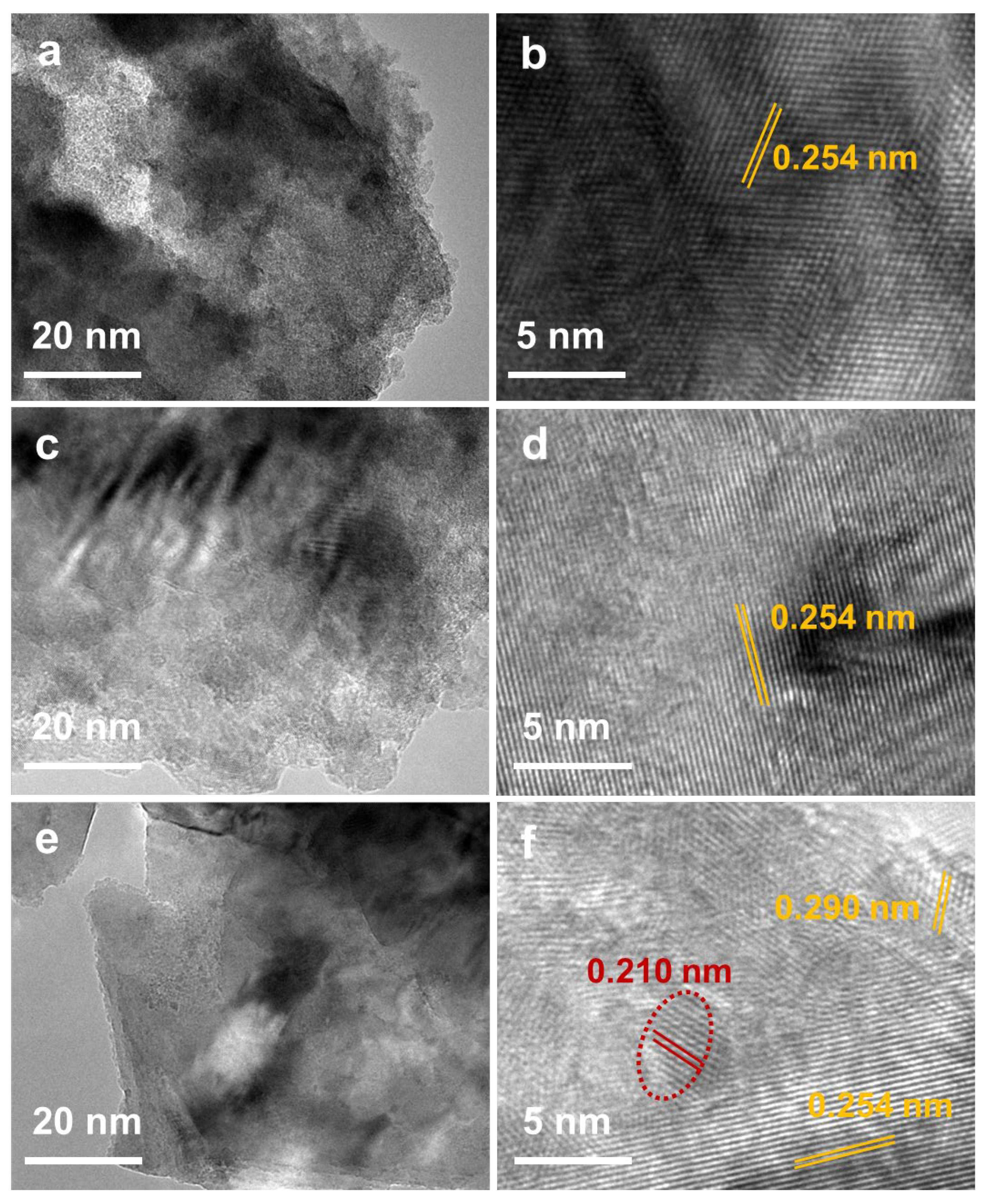
Transmission electron microscope (TEM) characterization was further performed on FeOOH/NF(D), HO-CDs-FeOOH/NF, and HO-CDs-FeOOH/NF(D) to further investigate their microscopic morphology and crystal structure. It should be noted that the original morphology of the catalysts might have been partially damaged during the ultrasonic dispersion process. Consequently, as observed in Figure 2a,c,e, the three catalysts do not exhibit significant morphological differences in the TEM images. Nevertheless, crystal structure information of the respective catalysts can still be obtained through HRTEM analysis. Well-ordered lattice fringes are clearly observed in the HRTEM images of FeOOH/NF(D) and HO-CDs-FeOOH/NF (Figure 2b,d). The measured lattice spacing of 0.254 nm corresponds well to the standard (211) plane spacing of FeOOH [35]. Figure 2f shows the HRTEM image of HO-CDs-FeOOH/NF(D), where lattice fringes with spacings of 0.254 nm and 0.290 nm are assigned to the (211) and (101) planes of FeOOH [36], respectively. Additionally, lattice fringes with a spacing of 0.21 nm are identified, which correspond to the (100) plane of graphite [37]. This result provides clear evidence for the successful formation of a composite between HO-CDs and FeOOH, laying an important structural foundation for subsequent electrochemical performance studies.
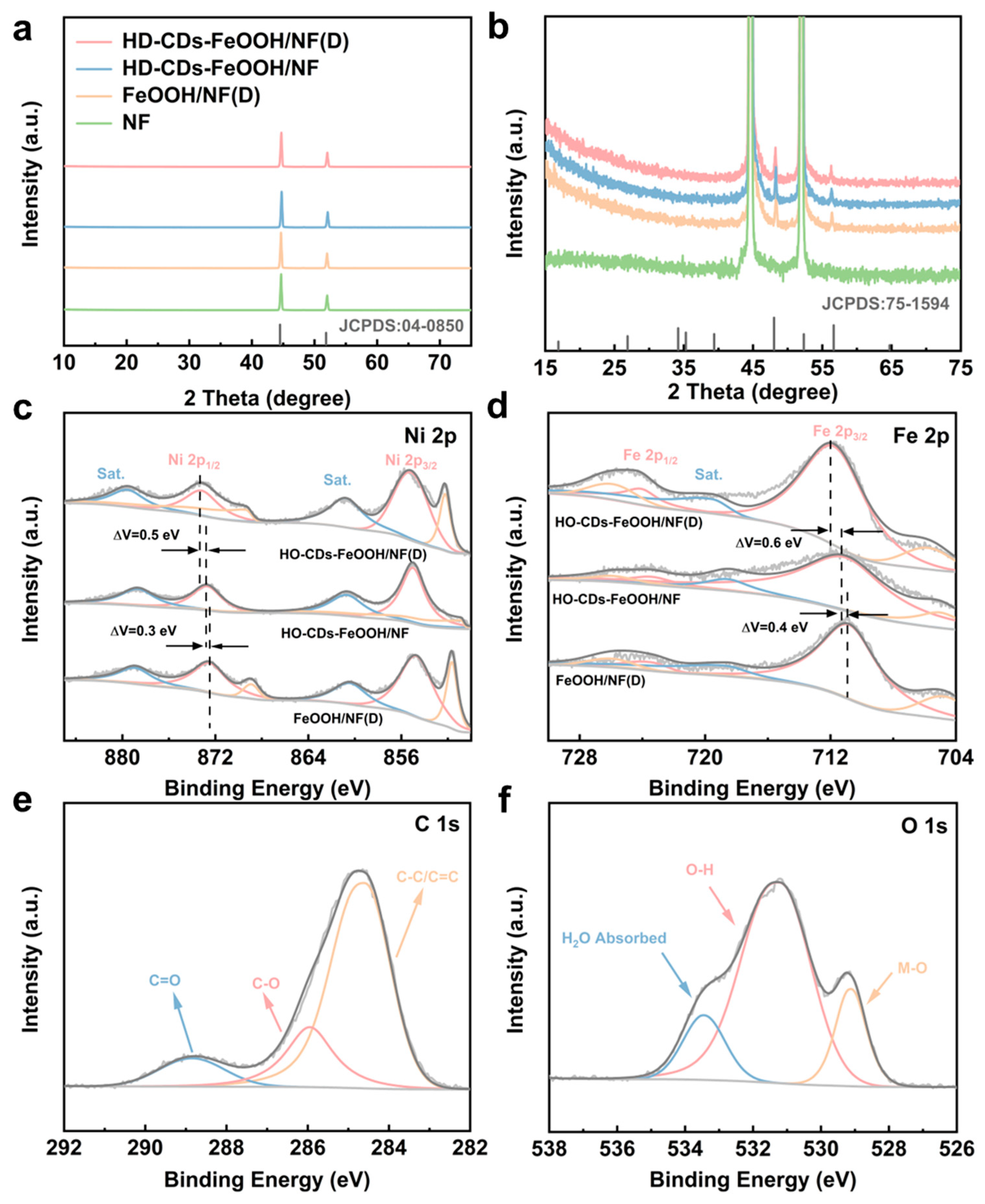
To determine the phase structure of the catalysts, X-ray diffraction (XRD) was employed to characterize the as-synthesized samples, with the results shown in Figure 3a,b. The two sharp peaks located at 44.4° and 51.6° are attributed to the characteristic diffraction peaks of the NF substrate (JCPDS: 04-0850), corresponding to the (200) and (220) crystal planes [38], respectively. However, due to the significantly higher intensity of the NF substrate signals compared to those from the active catalyst components, the patterns are partially enlarged to better resolve the phase structure of the deposited materials. In the magnified view, a series of weaker diffraction peaks can be clearly observed. The positions and relative intensities of these peaks match well with the standard diffraction pattern of FeOOH (JCPDS: 75-1594) [39]. Therefore, it can be confirmed that the active species, FeOOH, has been successfully loaded onto the nickel foam substrate, which provides a structural basis for its high performance in subsequent electrochemical applications.
X-ray photoelectron spectroscopy (XPS) characterization was conducted on the catalysts to further analyze the elemental composition and chemical states of the composite materials, with the results presented in Figure 3c–f. The survey spectra indicate that the catalysts primarily consist of C, O, Ni, and Fe elements. In the high-resolution Ni 2p spectra (Figure 3c) of HO-CDs-FeOOH/NF(D), HO-CDs-FeOOH/NF, and FeOOH/NF(D), the two peaks located at approximately 873.4 eV and 855.4 eV are assigned to Ni 2p1/2 and Ni 2p3/2, respectively, accompanied by their corresponding satellite peaks at 880.1 eV (2p1/2) and 862.1 eV (2p3/2). The peak appearing near 852.0 eV is attributed to Ni atoms in the NF substrate [40]. Compared with HO-CDs-FeOOH/NF and FeOOH/NF(D), the Ni 2p1/2 peak in HO-CDs-FeOOH/NF(D) exhibits a positive shift of 0.5 eV and 0.8 eV, respectively. This change in binding energy suggests a decrease in the electron density of the Ni species, likely due to electron transfer from Ni species to HO-CDs via their strong interaction, which optimizes the interfacial charge transfer kinetics. From the high-resolution Fe 2p spectra (Figure 3d), the two peaks at 724.1 eV and 711.9 eV correspond to Fe 2p1/2 and Fe 2p3/2, respectively [41]. The Fe 2p3/2 peak in HO-CDs-FeOOH/NF(D) shows a positive shift of 0.6 eV and 1.0 eV compared to that in HO-CDs-FeOOH/NF and FeOOH/NF(D), respectively. These positive binding energy shifts indicate an electron redistribution between the Ni and Fe species, implying a strong interaction between HO-CDs and FeOOH where electrons are transferred from the Ni and Fe species to the HO-CDs. This electron redistribution can optimize the reaction kinetics and reduce the charge transfer resistance, thereby enhancing the catalytic performance of HO-CDs-FeOOH/NF(D). In the C 1s spectrum (Figure 3e), the primary forms of carbon originate from functional groups on the carbon dots, further confirming the successful integration of HO-CDs with FeOOH. In the O 1s spectrum (Figure 3f), the two characteristic peaks near 529.4 eV and 532.8 eV can be attributed to M-O bonds and physically adsorbed oxygen, respectively.

2.2. Electrocatalytic OER Performance

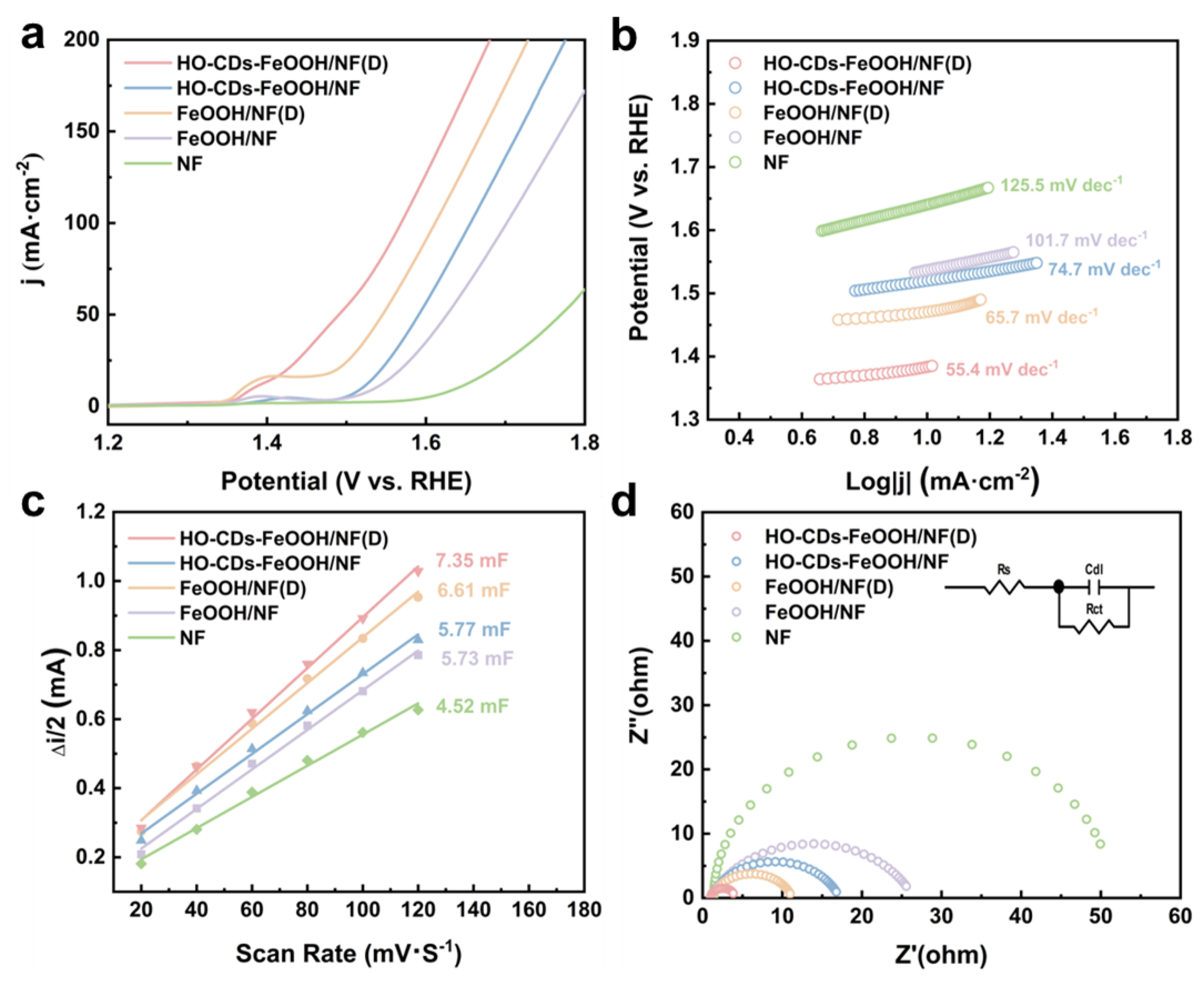
The electrocatalytic OER performance of the synthesized materials was systematically evaluated to elucidate the individual and synergistic effects of DES etching and HO-CDs incorporation. As shown in the polarization curves (Figure 4a), the HO-CDs-FeOOH/NF(D) electrode demonstrates superior activity, requiring an overpotential of only 251 mV to achieve a current density of 50 mA cm−2. Notably, the oxidation peaks observed around 1.4 V (vs. RHE) in the LSV curves for both HO-CDs-FeOOH/NF(D) and FeOOH/NF(D) are attributed to the characteristic electrochemical oxidation process of Ni species derived from the NF substrate, which is consistent with the XPS analysis (Figure 3c). This intrinsic electrochemical feature is associated with the pre-oxidation step of the active Ni species. This performance significantly surpasses that of the control samples, with overpotentials of 362 mV for HO-CDs-FeOOH/NF, 316 mV for FeOOH/NF(D), 397 mV for FeOOH/NF, and 518 mV for bare NF. The 65 mV lower overpotential of HO-CDs-FeOOH/NF(D) compared to FeOOH/NF(D) highlights the crucial contribution of HO-CDs to the enhanced catalytic activity. The corresponding Tafel plots were derived by processing the LSV data of the materials, and the results are shown in Figure 4b. The Tafel slopes for HO-CDs-FeOOH/NF(D), HO-CDs-FeOOH/NF, FeOOH/NF(D), FeOOH/NF, and NF are 55.4 mV dec−1, 74.7 mV dec−1, 65.7 mV dec−1, 101.7 mV dec−1, and 125.5 mV dec−1, respectively. HO-CDs-FeOOH/NF(D) possesses the lowest Tafel slope, indicating faster reaction kinetics. This low Tafel value suggests that the overall reaction rate is facilitated by the synergistic enhancement of interfacial properties. Specifically, the HO-CD-induced granular morphology affords a larger electrochemical surface area, which is quantitatively supported by the highest double-layer capacitance (Cdl, Figure 4c), promoting the accessibility of active sites and mass transport. Concurrently, the conductive HO-CDs network effectively lowers the charge-transfer resistance, as confirmed by electrochemical impedance spectroscopy (EIS, Figure 4d), thereby accelerating electron transfer. Therefore, the boosted OER kinetics can be primarily attributed to the combined effects of optimized mass transport and expedited charge transfer, which collectively lower the kinetic barrier for the reaction. The prepared HO-CDs-FeOOH/NF(D) catalyst still exhibits relatively superior electrochemical OER activity when compared with recently reported Fe-based catalysts, as shown in Figure S3.
Cyclic voltammetry (CV) tests were performed on five samples, namely HO-CDs-FeOOH/NF(D), HO-CDs-FeOOH/NF, FeOOH/NF(D), FeOOH/NF, and NF, within a non-Faradaic potential range (1.02–1.22 V) at scan rates of 20, 40, 60, 80, 100, and 120 mV s−1. The resulting curves are shown in Figures S4–S6. Analysis of these curves allows for effective evaluation of the electrochemical performance of each sample. By linearly fitting half of the charging–discharging current difference at 1.12 V against the scan rate, a linear relationship was obtained, as depicted in Figure 4c. The slope of the fitted line corresponds to the double-layer capacitance (Cdl) value. The electrochemical surface area (ECSA) is proportional to the Cdl value and can be estimated using the formula ECSA = Cdl/Cs, where Cs represents the specific capacitance per unit area under identical conditions and is typically taken as 0.04 mF cm−2 for a flat surface in alkaline media. A larger Cdl corresponds to a larger electrochemical active area of the material [42]. The Cdl values for HO-CDs-FeOOH/NF(D), HO-CDs-FeOOH/NF, FeOOH/NF(D), FeOOH/NF, and NF were determined to be 7.35, 5.77, 6.61, 5.73, and 4.52 mF, respectively. Correspondingly, the calculated ECSA values are 183.75 cm2, 144.25 cm2, 165.25 cm2, 143.25 cm2, and 113.00 cm2. The results indicate that HO-CDs-FeOOH/NF(D) possesses the largest Cdl and ECSA values, corresponding to the largest electrochemical active area. This conclusion is consistent with the previous morphological analysis, further confirming that the incorporation of HO-CDs with FeOOH in HO-CDs-FeOOH/NF(D) more effectively facilitates the exposure of active sites, thereby significantly enhancing the electrochemical performance of the composite material. Furthermore, to verify the role of HO-CDs in improving the material’s conductivity, electrochemical impedance spectroscopy (EIS) was conducted on the samples; the results are shown in Figure 4d. HO-CDs-FeOOH/NF(D) exhibited a significantly reduced electrochemical impedance, indicating that the composite of HO-CDs with Ni(OH)2 effectively enhances the charge transfer capability of the material, resulting in higher electronic conductivity. The specific values of solution resistance (Re) and charge transfer resistance (Rct), obtained from equivalent circuit fitting, are listed in Table S1 (Supplementary Materials). The similar Re values across all samples confirm the consistency of the test conditions, while the markedly lower Rct value (4.0 Ω) of HO-CDs-FeOOH/NF(D) provides direct quantitative evidence for its optimal charge-transfer kinetics.
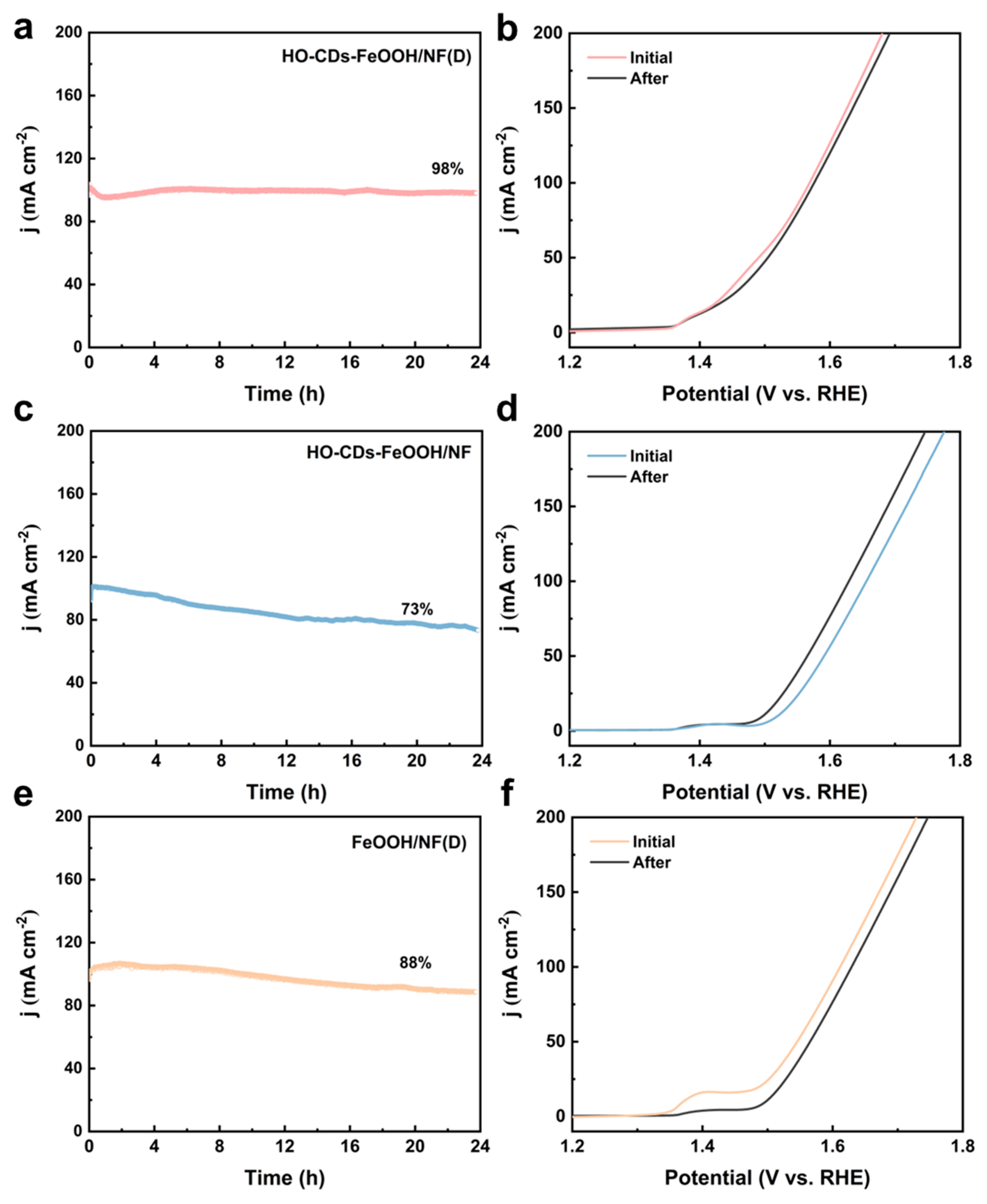
The long-term stability of the catalysts was evaluated through chronoamperometry tests at 1.75 V vs. RHE for 24 h (Figure 5) and cyclic durability tests involving 3000 CV cycles (Figure S7). Remarkably, HO-CDs-FeOOH/NF(D) maintains 98% of its initial current density after 24 h of continuous operation, significantly outperforming HO-CDs-FeOOH/NF (73% retention) and FeOOH/NF(D) (88% retention). Furthermore, the LSV curves of HO-CDs-FeOOH/NF(D) show negligible changes after 3000 cycles, while the control samples exhibit noticeable performance degradation. To further confirm the structural and compositional integrity of the catalyst under OER conditions, post-catalysis characterization, including XRD, SEM, and XPS, was conducted on the HO-CDs-FeOOH/NF(D) sample after the stability tests. As shown in Figures S8–S10, the catalyst retained its original crystalline phase (FeOOH), granular stacking morphology, and chemical states of key elements (Fe, Ni, C, O), indicating excellent structural durability and resistance to degradation during prolonged electrochemical operation. These results collectively demonstrate that the incorporation of HO-CDs substantially enhances both the activity and durability of the FeOOH-based electrocatalyst. When benchmarked against recently reported Fe-based OER catalysts (Figure S2), HO-CDs-FeOOH/NF(D) demonstrates highly competitive performance, underscoring the effectiveness of the synthetic strategy in developing efficient and stable electrocatalysts for OER.

3. Materials and Methods

3.1. Materials

The petroleum coke was supplied by China National Petroleum Corporation (Beijing, China). H2O2 (30.0 wt%), acetone (99.5 wt%), hydrochloric acid (36.0–38.0 wt%), urea (analytical grade), KOH (95 wt%), and anhydrous ethanol (analytical grade) were all purchased from China National Medicines Chemical Reagents Co., Ltd. (Beijing, China). FeCl3·6H2O (97 wt%) was provided by Aladdin Reagent (Shanghai, China). The NF was commercially sourced from Kunshan Maipengchen Electronic Technology Co., Ltd. (Suzhou, China).

3.2. Catalyst Preparation

Synthesis of HO-CDs: Petroleum coke powder (1.0 g) was mixed with 10 mL of 30 wt% H2O2 and 30 mL of deionized water in a beaker. After magnetic stirring for 30 min at room temperature, the homogeneous suspension was subjected to hydrothermal treatment at 140 °C for 12 h in a 100 mL Teflon-lined autoclave. Upon cooling to room temperature, the resulting black solution was vacuum-filtered to remove unreacted particles. The filtrate was dialyzed (molecular weight cutoff: 3000 Da) against deionized water for 72 h, and the final HO-CD powder was obtained via freeze-drying for 48 h.
Synthesis of HO-CDs-FeOOH/NF(D): A piece of NF was cut into 1 cm × 1 cm squares. These NF squares were sequentially ultrasonicated in acetone and 3 M HCl solution for 30 min each to remove surface oxides and other impurities, followed by ultrasonic cleaning with deionized water and ethanol for 15 min each to thoroughly cleanse the surface. The cleaned NF was then dried at 60 °C in a vacuum drying oven for later use. In a sample vial, 1.0 mmol of FeCl3·6H2O and 5 mmol of urea were combined with 100 mg of HO-CDs. The mixture was stirred at 70 °C for 30 min to form a DES system. The pretreated NF was immersed in this DES and reacted at 70 °C for 25 min. After the reaction, the NF was removed and alternately ultrasonically cleaned three times with deionized water and ethanol. The cleaned sample was dried at 60 °C in a vacuum drying oven for 12 h, yielding the final HO-CDs-FeOOH/NF(D) sample.
For comparison, control samples were prepared as follows: by omitting urea from the above procedure, the HO-CDs-FeOOH/NF sample was obtained; by excluding HO-CDs, the FeOOH/NF(D) sample was obtained; and by omitting both HO-CDs and urea, the FeOOH/NF sample was obtained.

3.3. Characterization

The morphology of the as-prepared catalysts was investigated using scanning electron microscopy (SEM, Hitachi S4800, Tokyo, Japan) and transmission electron microscopy (TEM, JEOL JEM-2100UHR, Akishima, Japan). The crystalline phase was analyzed by X-ray diffraction (XRD, X’Pert PRO MPD, PANalytical, Almelo, The Netherlands). The surface composition and chemical states were examined by X-ray photoelectron spectroscopy (XPS, PHI 5000 VersaProbe, PerkinElmer, Springfield, IL, USA), with the C 1s peak at 284.8 eV used as a reference.

3.4. Electrochemical Performance Tests

Electrochemical measurements were performed using a CHI760E workstation (CH Instruments, Shanghai, China) with a standard three-electrode configuration. The working electrode was the catalyst (1 cm × 1 cm), paired with a graphite rod counter electrode and a Ag/AgCl reference electrode. A 1.0 M KOH solution was used as the electrolyte. Linear sweep voltammetry (LSV) was conducted in O2-saturated electrolyte at a scan rate of 5 mV s−1. The electrochemical double-layer capacitance (Cdl) was determined by performing cyclic voltammetry (CV) in the non-Faradaic region at scan rates ranging from 20 to 120 mV s−1. The slope of the linear relationship between the scan rate and the current density difference (Δj/2), calculated as half the difference between the anodic and cathodic current densities, was used to derive the Cdl value. Cycling stability was evaluated by performing 3000 CV cycles at a scan rate of 100 mV s−1. Furthermore, long-term stability was assessed via chronoamperometry by measuring the current retention over 24 h at a fixed potential.

4. Conclusions

In summary, we have developed a high-performance HO-CDs-FeOOH/NF(D) electrocatalyst through a facile and green synthetic route that synergistically combines a FeCl3/urea deep eutectic solvent (DES) with hydroxyl-functionalized carbon dots (HO-CDs). This innovative approach not only circumvents the energy-intensive conditions of conventional hydrothermal methods but also achieves rapid catalyst preparation under mild conditions. Detailed characterization demonstrates that the HO-CDs effectively direct a morphological evolution of FeOOH from sheet-like assemblies to granular stacking architectures, while the DES system ensures uniform growth and structural optimization. This synergistic cooperation yields exceptional electrocatalytic performance, with the composite catalyst achieving an overpotential of only 251 mV at 50 mA cm−2 and a Tafel slope of 55.4 mV dec−1. Moreover, the composite exhibits exceptional stability, maintaining 98% of its initial current after 24 h of continuous operation and showing negligible degradation after 3000 cycles. This work provides a green and efficient synthesis strategy for developing high-performance Fe-based electrocatalysts, demonstrating the great potential of DES-carbon dot synergistic systems in advanced energy materials design.

Supplementary Materials

The following supporting information can be downloaded at: https://www.mdpi.com/article/10.3390/catal16010073/s1, Figure S1. Schematic of the structure of the HO-CDs-FeOOH/NF(D); Figure S2. SEM images of FeOOH/NF; Figure S3. Comparison of the OER performance of HO-CDs-FeOOH/NF(D) with recently reported Fe-based catalysts; Figure S4. Cyclic voltammograms of (a) HO-CDs-FeOOH/NF(D) and (b) HO-CDs-FeOOH/NF; Figure S5. Cyclic voltammograms of (a) FeOOH/NF(D) and (b) FeOOH/NF; Figure S6. Cyclic voltammograms of NF; Figure S7. (a) Long-time stability test at a constant voltage for 24 h and (b) LSV curves before and after 3000 CV scans of FeOOH/NF; Figure S8. XRD patterns of the HO-CDs-FeOOH/NF(D) catalyst after 24 h chronoamperometry testing and 3000 CV cycles; Figure S9. SEM images of the HO-CDs-FeOOH/NF(D) catalyst after 24 h chronoamperometry testing and 3000 CV cycles; Figure S10. XPS spectra of the HO-CDs-FeOOH/NF(D) catalyst after 24 h chronoamperometry testing and 3000 CV cycles: (a) Fe 2p, (b) Ni 2p, (c) C 1s, (d) O 1s; Table S1. Electrochemical impedance spectroscopy fitting parameters. References [43,44,45,46,47,48,49,50,51] are cited in the Supplementary Materials.

Author Contributions

W.X.: formal analysis, data curation, writing—original draft preparation, and visualization. H.W.: conceptualization, resources. X.H.: methodology, validation, formal analysis, data curation. S.Q.: investigation, writing—original draft preparation, visualization. Y.Y.: data curation, investigation. B.Z.: formal analysis, data curation. H.Z.: resources, supervision, and project administration. Q.Z.: resources, writing—review and editing, visualization, supervision, and project administration. All authors have read and agreed to the published version of the manuscript.

Funding

This work is financially supported by the National Natural Science Foundation of China (Nos. 22578500, 22208375), China; the Fundamental Research Funds for the Central Universities (No. 24CX02025A), China; the Key Technology Research and Industrialization Demonstration Projects in Qingdao City (No. 24-1-4-xxgg-6-gx), China.

Data Availability Statement

Data are contained within the article and Supplementary Materials.

Conflicts of Interest

The authors declare no conflicts of interest.

References

  1. Weitensfelder, L.; Moshammer, H.; Ataniyazova, O. Energy Consumption, Energy Distribution, and Clean Energy Use Together Affect Life Expectancy. Sustainability 2024, 16, 678. [Google Scholar] [CrossRef]
  2. Jithin, P.; Renjith, R. Towards sustainable energy access: Investigating the relationship between renewable energy consumption and energy poverty. Energy Policy 2025, 100, 114553. [Google Scholar]
  3. Bergougui, B.; Ben-Salha, O. The Impact of Environmental Governance on Energy Transitions: Evidence from a Global Perspective. Sustainability 2025, 17, 8759. [Google Scholar] [CrossRef]
  4. Xu, X.X.; Lieuea, B. Contribution of modern renewables to final energy consumption, energy intensity, and environmental quality: The role of world energy balances, economic performance, and shadow economies. Energy 2025, 332, 137191. [Google Scholar] [CrossRef]
  5. Ullah, S.; Sohail, S.; Majeed, M.T.; Sohail, M.T. Future of hydrogen energy: The role of environmental policy and political globalization. Int. J. Hydrogen Energy 2025, 122, 12–21. [Google Scholar] [CrossRef]
  6. Osman, S.H.; Yatim, N.S.M.; Elham, O.S.J.; Shaari, N.; Zakaria, Z. Three decades of hydrogen energy research: A bibliometric analysis on the evolution of green hydrogen technologies. Sustain. Energy Fuels 2025, 9, 3182–3202. [Google Scholar] [CrossRef]
  7. Zhao, H.; Xu, Y.Q. Risk assessment of zero-carbon hydrogen energy storage systems coupled with renewable energy power generation systems. Int. J. Hydrogen Energy 2025, 149, 150141. [Google Scholar] [CrossRef]
  8. Ribeiro, B.; Baptista, J.; Cerveira, A. Optimizing Renewable Microgrid Performance Through Hydrogen Storage Integration. Algorithms 2025, 18, 656. [Google Scholar] [CrossRef]
  9. Lu, T.G.; Yi, Y.N.; Li, J.; Wu, S.C. Collaborative planning of integrated hydrogen energy chain multi-energy systems: A review. Appl. Energy. 2025, 393, 126019. [Google Scholar] [CrossRef]
  10. Yang, J.Z.; Lam, T.Y.; Luo, Z.X.; Cheng, Q.; Wang, G.B.; Yao, H. Renewable energy driven electrolysis of water for hydrogen production, storage, and transportation. Renew. Sustain. Energy Rev. 2025, 218, 115804. [Google Scholar] [CrossRef]
  11. Iamarino, M.; D’Angola, A. Trends, Challenges, and Viability in Green Hydrogen Initiatives. Energies 2025, 18, 4476. [Google Scholar] [CrossRef]
  12. Cai, M.X.; Zhang, Y.R.; He, P.L.; Zhang, Z.C. Recent Advances in Revealing the Electrocatalytic Mechanism for Hydrogen Energy Conversion System. Small 2024, 20, 2405008. [Google Scholar] [CrossRef]
  13. Vadivel, N.; Murthy, A.P. Recent Developments in Membrane-Free Hybrid Water Electrolysis for Low-Cost Hydrogen Production Along with Value-Added Products. Small 2024, 20, 2407845. [Google Scholar]
  14. Wang, H.J.; Su, R.; Liu, Y.Y.; Kong, Y.; Ren, Z.J.; Jiang, B. Iron-group Metal Compound Electrocatalysts for Efficient Hydrogen Production: Recent Advances and Future Prospects. ChemCatChem 2024, 16, e202301241. [Google Scholar]
  15. Jiang, Y.W.; Gao, S.S.; Liu, X.J.; Wang, Y.; Zhou, S.X.; Liu, Q.; Abdukayum, A.; Hu, G.Z. Recent achievements in selenium-based transition metal electrocatalysts for pH-universal water splitting. Nano Res. 2024, 17, 5763–5785. [Google Scholar] [CrossRef]
  16. Song, Y.J.; Du, Z.X.; Sun, C.T.; Qiu, L.K.; Zhang, Y.; Luan, Y.W.; Yang, X.; Ma, J.W.; Gao, H.T. Cobalt-Based Catalysts for Electrocatalytic Water-Splitting Reactions: Mini Review of Material Synthesis, HER, and OER Catalytic Performance. ChemCatChem 2025, 14, e00832. [Google Scholar]
  17. Han, X.; Guo, C.; Wang, H.; Xu, W.J.; Liu, Q.L.; Zhao, Q.S.; Wu, M.B. Defect-Rich Co(OH)2 Induced by Carbon Dots for Oxygen Evolution Reaction. Catalysts 2025, 15, 219. [Google Scholar]
  18. Zhu, B.X.; Liu, Y.C.; Yan, Y.; Wang, H.; Zhang, Y.; Xin, Y.; Xu, W.J.; Zhao, Q.S. DES-Mediated Mild Synthesis of Synergistically Engineered 3D FeOOH-Co2(OH)3Cl/NF for Enhanced Oxygen. Evolution Reaction. Catalysts 2025, 15, 725. [Google Scholar]
  19. Zeng, Q.; Tang, J.; Ji, Y.; Jiang, Q.; Xia, C. Recent Developments in Single-Atom Engineering Ir/Ru-Based Catalysts for the Oxygen Evolution Reaction in Acidic Media. Adv. Energy Mater. 2025, e04414. [Google Scholar] [CrossRef]
  20. Zhang, S.L.; Shi, M.X.; Wang, F.Y.; Wu, L.; Hua, Q.; Xia, M.Z. Research progress on non-precious-metal-based transition metal alkaline OER electrocatalysts. J. Environ. Chem. Eng. 2025, 13, 120378. [Google Scholar]
  21. Li, Y.X.; Zhang, Z.; Yang, Y.L.; Li, C.G.; Shi, Z.; Feng, S.H. Manipulation of Electrochemical Surface Reconstruction on Spinel Oxides for Boosted Water Oxidation Reaction. ACS Catal. 2025, 15, 8361–8389. [Google Scholar] [CrossRef]
  22. Yang, K.; Ren, W.J.; Li, L.W.; Ye, B.J.; Li, W.; Fang, W.H.; Liu, S.X. Constructing heterojunction interface between Co-Fe layered double hydroxide and Ni-Fe metal–organic framework as efficient oxygen evolution electrocatalyst: Mechanism insights into CoOOH-FeOOH-NiOOH ternary system. J. Colloid Interface Sci. 2025, 698, 137991. [Google Scholar] [CrossRef] [PubMed]
  23. Hou, Q.L.; Jiang, Z.G.; Wang, C.; Yang, S.H.; Liu, H.Z.; Xing, B.; Cheng, H.H.; Wang, K.K. Unveiling the Synergistic Effect of Two-Dimensional Heterostructure NiFeP@FeOOH as Stable Electrocatalyst for Oxygen Evolution Reaction. Catalysts 2024, 14, 511. [Google Scholar] [CrossRef]
  24. Sun, M.H.; Zhang, Q.C.; Chen, Q.M.; Hou, X.H.; Peng, W.C.; Li, Y.; Zhang, F.B.; Xia, Q.; Fan, X.B. Coupling LaNiO3 Nanorods with FeOOH Nanosheets for Oxygen Evolution Reaction. Catalysts 2022, 12, 594. [Google Scholar] [CrossRef]
  25. Selvaraju, N.; Sasi, S.; Sivalingam, Y.; Venugopal, G. Enhanced oxygen evolution reaction performance of nitrogen-doped carbon dots sensitized with rare-earth metal nanorods. Diamond Relat. Mater. 2024, 148, 111362. [Google Scholar] [CrossRef]
  26. Rehman, M.Y.U.; Khan, M.M.; Nayer, S.; Shah, S.I.A.; Alsaiari, N.S.; Ehsan, M.F.; Chughtai, A.H.; Ashiq, M.N. Development of carbon dots supported on Zr-MOFs nano-composites for effective oxygen evolution reaction. Diamond Relat. Mater. 2024, 149, 111559. [Google Scholar] [CrossRef]
  27. Rashid, A.R.; Fatima, S.; Siddique, Z.; Tighezza, A.M.; Abid, A.G.; Shah, J.H.; Qin, H.L. Development of a Durable and Robust Co3O4@Carbon Dot Heterostructure Electrocatalyst for Clean Hydrogen Production. Energy Fuels 2025, 39, 9056–9065. [Google Scholar] [CrossRef]
  28. Wu, L.; Qin, H.; Ji, Z.Y.; Zhou, H.; Shen, X.P.; Zhu, G.X.; Yuan, A.H. Nitrogen-Doped Carbon Dots Modified Fe–Co Sulfide Nanosheets as High-Efficiency Electrocatalysts toward Oxygen Evolution Reaction. Small 2023, 20, 2305965. [Google Scholar] [CrossRef]
  29. Ding, P.; Song, H.Q.; Chang, J.W.; Lu, S.Y. N-doped carbon dots coupled NiFe-LDH hybrids for robust electrocatalytic alkaline water and seawater oxidation. Nano Res. 2022, 15, 7063–7070. [Google Scholar] [CrossRef]
  30. Khan, M.J.; Sawatdee, S.; Suksaard, M.; Nantarattikul, Y.; Botalo, A.; Juntree, N.; Pongchaikul, P.; Arjfuk, P.; Khemthong, P.; Wanmolee, W.; et al. Ultrafast magneto-inductive synthesis of carbon dots from plant-based precursors using deep eutectic solvents: A comparative study with traditional hydrothermal methods. Process Saf. Environ. Prot. 2025, 195, 106752. [Google Scholar] [CrossRef]
  31. Guan, S.Q.; Xu, B.E.; Wu, J.C.; Han, J.; Guan, T.T.; Yang, Y.; Li, K.X.; Wang, J.L. High-entropy materials based on deep eutectic solvent for boosting oxygen evolution reaction. Fuel 2024, 358, 130315. [Google Scholar] [CrossRef]
  32. Yang, H.Y.; Cheng, Z.F.; Wu, P.C.; Wei, Y.H.; Jiang, J.Y.; Xu, Q. Deep eutectic solvents regulation synthesis of multi-metal oxalate for electrocatalytic oxygen evolution reaction and supercapacitor applications. Electrochim. Acta 2022, 427, 140879. [Google Scholar] [CrossRef]
  33. Viyanni, P.M.; Sethuraman, M.G. Influence of diverse hydrogen bond donors in deep eutectic solvents on the electrochemical deposition of NiCu alloy on stainless steel mesh: Exploring NiCu efficacy in water splitting and methanol oxidation reactions. Int. J. Hydrogen Energy 2025, 130, 615–630. [Google Scholar] [CrossRef]
  34. Zhang, C.Y.; Zhang, B.H.; Li, Z.H.; Hao, J.C. Deep Eutectic Solvent-Mediated Hierarchically Structured Fe-Based Organic−Inorganic Hybrid Catalyst for Oxygen Evolution Reaction. ACS Appl. Energy Mater. 2019, 2, 3343–3351. [Google Scholar]
  35. Čižmar, T.; Kojić, V.; Rukavina, M.; Brkljačić, L.; Salamon, K.; Grčić, L.; Radetić, L.; Gajović, A. Hydrothermal Synthesis of FeOOH and Fe2O3 Modified Self-Organizing Immobilized TiO2 Nanotubes for Photocatalytic Degradation of 1H-Benzotriazole. Catalysts 2020, 10, 1371. [Google Scholar] [CrossRef]
  36. Shi, H.C.; Lv, J.; Feng, Y.C.; Zhang, H.R.; Xiong, Z.B.; Lu, S.J.; Jin, J.; Tontiwachwuthikul, P. Catalytic CO2 Desorption from MEA Solution of Al-FeOOH Composite Catalysts’ Desorption Performance, Structure–Activity Relationship, and New Mechanism. Catalysts 2024, 14, 779. [Google Scholar] [CrossRef]
  37. Wang, H.; Xu, W.J.; Han, X.; Yan, Y.; Zhu, B.X.; Wang, Z.Y.; Wang, L.B.; Zhao, Q.S.; Wu, M.B. One-Pot Hydrothermal Oxidation Enables In Situ Construction of CDs/Ni(OH)2 Composite for Electrocatalytic Oxygen Evolution. Front. Chem. 2025, 13, 1656451. [Google Scholar] [CrossRef]
  38. Wang, J.; Lian, Y.F. The Self-Supporting NiMn-LDHs/rGO/NF Composite Electrode Showing Much Enhanced Electrocatalytic Performance for Oxygen Evolution Reaction. Catalysts 2023, 13, 1012. [Google Scholar] [CrossRef]
  39. Dutta, D.P.; Abraham, S. Composite of α-FeOOH and Mesoporous Carbon Derived from Indian Blackberry Seeds as Low-Cost and Recyclable Photocatalyst for Degradation of Ciprofloxacin. Catalysts 2023, 13, 191. [Google Scholar]
  40. Lu, M.J.; Cheng, R.; Wang, L.; Liang, D.D.; Qin, M.; Wang, B.L.; Song, R.; Chen, D. One-Step Scalable Synthesis of 3D Self-Supported Superaerophobic Ce-Coupled Ni3S2/NiS@NF Nanobud Catalyst for Efficient Oxygen Evolution Reaction. Catalysts 2024, 14, 752. [Google Scholar] [CrossRef]
  41. Grinberg, V.A.; Emets, V.V.; Modestov, A.D.; Averin, A.A.; Shiryaev, A.A.; Botryakova, L.G.; Shapagin, A.V. Sn-Doped Hematite Films as Photoanodes for Photoelectrochemical Alcohol Oxidation. Catalysts 2023, 13, 1397. [Google Scholar] [CrossRef]
  42. Radinović, K.; Samancı, M.; Bayrakçeken, A.; Bajuk-Bogdanović, D.; Gavrilov, N.; Santos, D.M.F.; Šljukić, B. Maximizing electrochemical energy conversion and storage performance of carbon aerogel with Co-Fe by tuning the synthesis method. Mater. Chem. Phys. 2026, 348, 131614. [Google Scholar]
  43. Sun, Q.M.; Zhong, W.G.; Wang, H.; Ao, X.; Zhai, Y.L.; Zhai, J.S.; Wu, B.; Romero-Salguero, F.J.; Qiao, J.L.; Li, Z.S.; et al. Unveiling the role of FeOOH on catalyst evolution for advanced water oxidation. Rare Met. 2025, 44, 5462–5474. [Google Scholar] [CrossRef]
  44. Wang, Y.J.; Zhu, Q.X.; Zhang, P.; Liu, S.L.; Wang, J.K. Boosting the electrocatalytic activity and stability of Ni/NiO toward the oxygen evolution reaction by coupling FeOOH nanosheets. New J. Chem. 2024, 48, 9954. [Google Scholar] [CrossRef]
  45. Huang, X.R.; Xiao, L.Y.; Han, C.Y.; Zhang, W.; Liu, Y.; Zhang, J.T.; Tan, H.W.; Zhang, R.; Yin, P.F.; Dong, C.K.; et al. Impact of electron modulation on V-doped NiFeOOH: Insights into enhanced OER activity and stabilization of vanadium incorporation. Int. J. Hydrogen Energy 2025, 140, 187–193. [Google Scholar]
  46. Sun, H.Y.; Gu, X.Y.; Yu, J.; Zhang, N.N.; Wu, Z.Y.; Qiang, J.W.; Song, Z.G.; Du, Y.K. Self-supported Fe, Mn-CoCH/NF electrocatalyst for oxygen evolution reaction. J. Colloid Interface Sci. 2026, 703, 139149. [Google Scholar]
  47. Yuan, Y.D.; Wang, J.W.; Gu, Z.L.; Huang, Y.B.; Gong, H.Y.; Zhao, Z.Q.; Sun, C.G.; Li, Y.S.; Bao, F.X. Construction of FeS/NiCo-LDH heterostructure for enhancing oxygen evolution reaction kinetics. Colloids Surf. A Physicochem. Eng. Asp. 2025, 727, 138215. [Google Scholar]
  48. Yang, Y.Y.; Chen, Y.Z.; Xiong, Y.L.; He, Y.L.; Sun, Q.N.; Xu, D.Y.; Hu, Z.A. Self-supported monometallic FeS2/FeOOH-ZnO@NF with abundant oxygen vacancies as efficient and stable electrocatalysts for the OER and HER. J. Alloys Compd. 2024, 991, 174525. [Google Scholar]
  49. Zhou, H.B.; Hao, X.; Guan, J.X.; Deng, Y.L.; Wei, Z.; Liu, Y.S.; Zhu, G.X. Coordination tuning of Ni/Fe complex-based electrocatalysts for enhanced oxygen evolution. Inorg. Chem. Front. 2024, 11, 8110. [Google Scholar] [CrossRef]
  50. Zhu, L.Q.; Wang, R.Z.; Liu, X.H.; Yang, S.H.; Liu, H.Z.; Xing, B.; Wang, K.K. Three-dimensional heterostructured MnNiCoP/FeOOH cross-linked nano-flake supported by Ni Foam as a bifunctional electrocatalysts for overall water splitting. Appl. Surf. Sci. 2024, 656, 159711. [Google Scholar]
  51. Yin, X.Y.; Mu, X.; Qi, S.N.; Li, H.; Qi, M.L.; Yusuf, A. Se-doped FeS2/CoS nanosphere catalysts bifunctional electrocatalyst for superior OER and HER activity. Res. Chem. Intermed. 2025, 51, 3229–3242. [Google Scholar] [CrossRef]
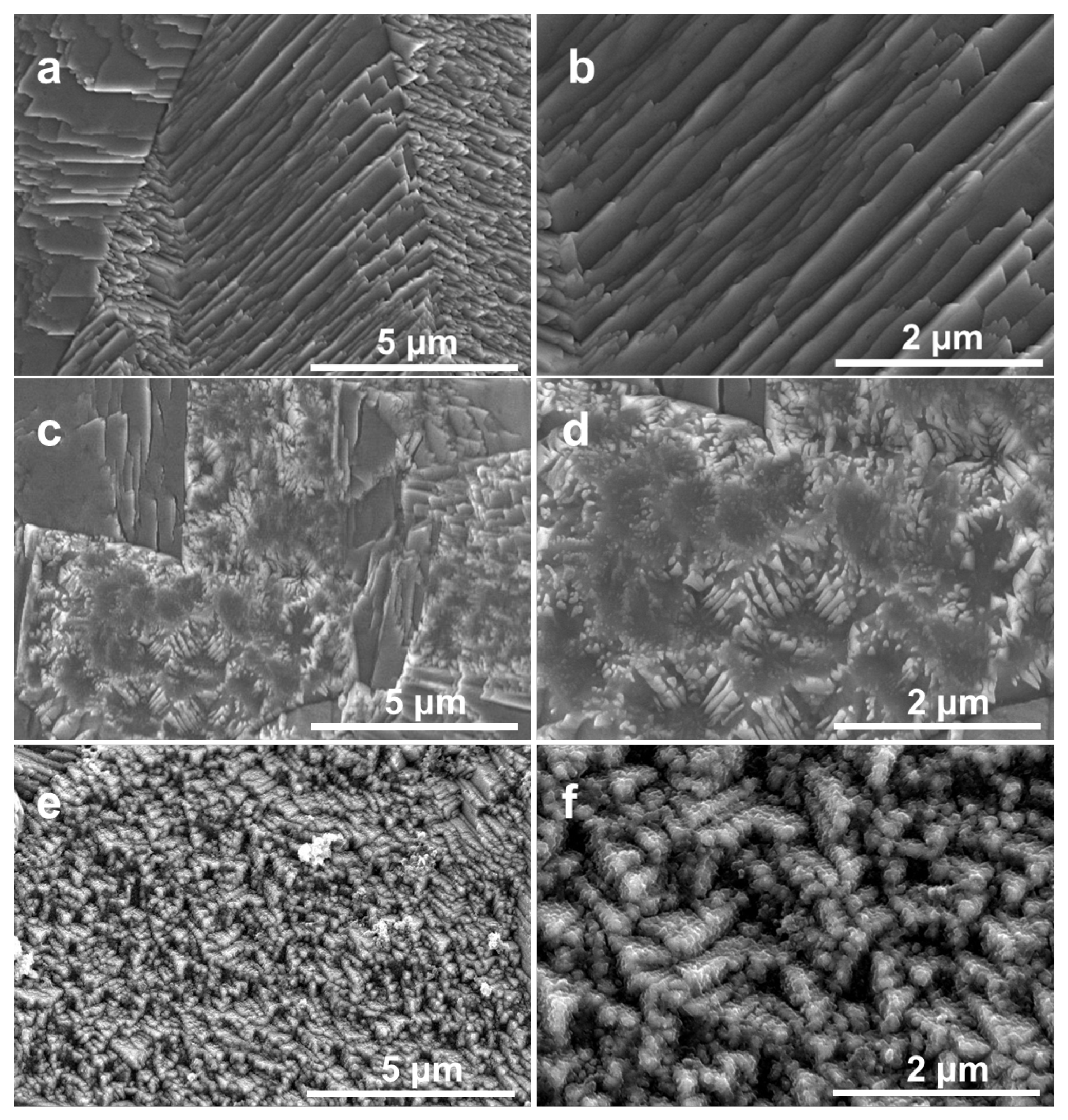
Figure 1. SEM images of (a,b) FeOOH/NF(D), (c,d) HO-CDs-FeOOH/NF, and (e,f) HO-CDs-FeOOH/NF(D).
Catalysts 16 00073 g001
Figure 2. (a) TEM image, (b) HRTEM image of FeOOH/NF(D). (c) TEM image, (d) HRTEM image of HO-CDs-FeOOH/NF. (e) TEM image, (f) HRTEM image of HO-CDs-FeOOH/NF(D).
Catalysts 16 00073 g002
Figure 3. (a,b) XRD patterns of the various catalysts. (c) Ni 2p spectra, (d) Fe 2p spectra of HO-CDs-FeOOH/NF(D) and FeOOH/NF(D). (e) C 1s spectrum and (f) O 1s spectrum of FeOOH/NF(D).
Catalysts 16 00073 g003
Figure 4. (a) OER polarization curves, (b) Tafel plots, (c) the Cdl values and (d) EIS Nyquist plots of samples.
Catalysts 16 00073 g004
Figure 5. (a,c,e) Long-time stability test at a constant voltage for 24 h. (b,d,f) LSV curves before and after 3000 CV scans.
Catalysts 16 00073 g005
Disclaimer/Publisher’s Note: The statements, opinions and data contained in all publications are solely those of the individual author(s) and contributor(s) and not of MDPI and/or the editor(s). MDPI and/or the editor(s) disclaim responsibility for any injury to people or property resulting from any ideas, methods, instructions or products referred to in the content.