Review

Conventional and Intensified Steam Reforming of Bio-Oil for Renewable Hydrogen Production: Challenges and Future Perspectives


Département de Génie Chimique, Université Laval, 1065 Avenue de la Médecine, Québec, QC G1V 0A6, Canada
*
Author to whom correspondence should be addressed.
Catalysts 2026, 16(1), 59; https://doi.org/10.3390/catal16010059
Submission received: 15 September 2025 / Revised: 24 October 2025 / Accepted: 2 November 2025 / Published: 4 January 2026
(This article belongs to the Special Issue Recent Advances in Catalytic Reforming for Hydrogen/Syngas Production)

Abstract

The increasing demand for clean and sustainable energy has driven significant research into hydrogen production from biomass-derived feedstocks. Unlike the gasification route, the pyrolysis of biomass followed by steam reforming of bio-oil (SRBO) offers several advantages, including the liquid nature of bio-oil and the operation at lower temperatures, which facilitate easier transportation and storage compared to raw biomass. The conventional SRBO process faces several limitations, mainly catalyst deactivation due to significant coke formation and metallic sintering, as well as low hydrogen yield and purity. Hence, the intensified sorption-enhanced steam reforming of bio-oil (SESRBO) is a promising strategy to overcome these drawbacks, to simultaneously produce high-purity hydrogen and capture carbon dioxide in situ from the reaction media. This critical review presents an in-depth comparative analysis of conventional and intensified steam reforming of bio-oil, with a focus on associated challenges. Special attention is given to recent developments in the design of bifunctional materials (BFMs), which integrate both catalyst and sorbent into a single particle, along with process optimization focusing on key parameters, i.e., reforming temperature and steam presence. Finally, the review highlights key research gaps and future directions to overcome existing challenges in achieving cost-effective and scalable hydrogen production.

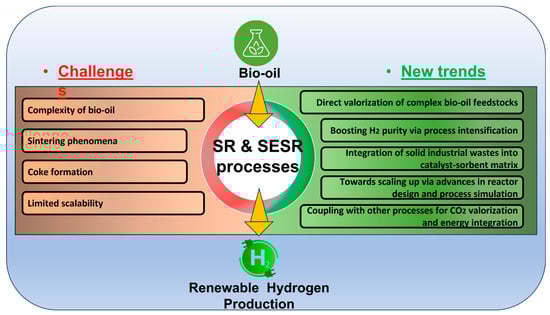
Graphical Abstract

1. Introduction

According to the recommendation of the UN Climate Change Conference COP-27 (held in Sharm El-Sheikh, Egypt, 2022) and the goal commitment to achieve climate neutrality by 2050, new challenges are emerging for the energy sector. All countries are urged to make an extra effort to combat the climate crisis. Serious concerns have been expressed about greenhouse gas (GHG) emissions. In this context, hydrogen has attracted considerable interest as a carbon-free energy carrier that features a high energy density (120 MJ/kg) [1]. It also has numerous applications as a chemical feedstock (e.g., the production of ammonia, alcohols, dimethyl ether (DME), formic acid, etc.), as a reducing agent in metallurgy, and in fuel cell applications. Currently, the demand for hydrogen is around 45 million tons per year, according to the International Energy Agency (IEA), and it is predicted to increase by 4–5% annually over the next five years [2]. Until now, H2 production has relied predominantly on steam reforming (SR) of fossil fuels, particularly natural gas as a common feedstock [3]. However, this approach is becoming less and less favorable due to (i) the excessive production of CO2 (environmental considerations; large amounts of CO2 (>9 kg CO2 per only 1 kg H2) are generated during steam reforming of natural gas [4]) and (ii) the non-renewable nature of fossil fuel feedstock (sustainability considerations).
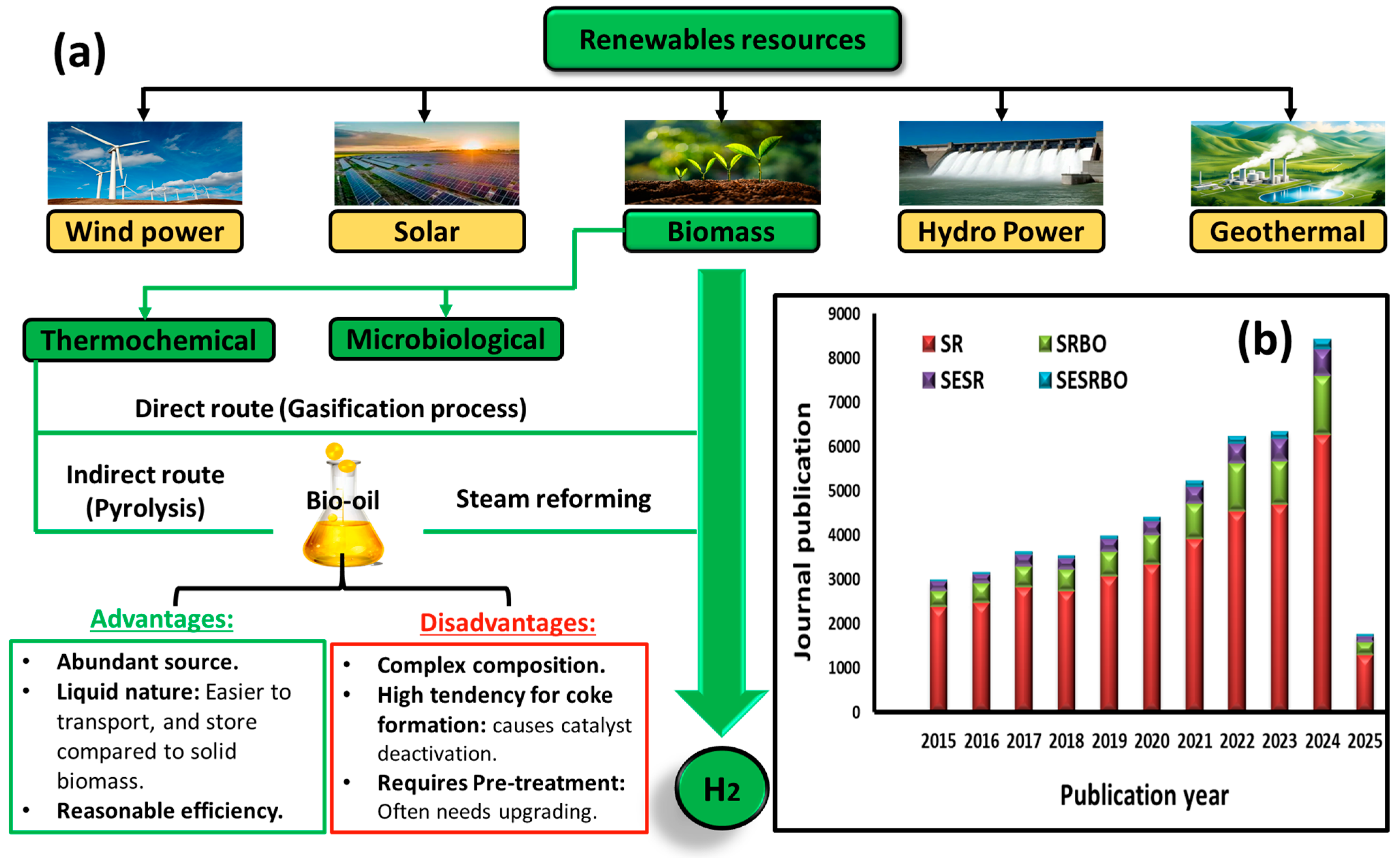
Significant effort is being made to produce renewable hydrogen to reduce reliance on fossil fuels and their environmental impact (Figure 1a). By 2050, renewable energy sources are anticipated to account for approximately 75% of total energy consumption, with hydrogen energy contributing around 34% [5]. To produce hydrogen from biomass, two main thermochemical pathways can be adopted, namely (i) gasification and (ii) fast pyrolysis followed by the steam reforming of the resulting liquid phase, commonly referred to bio-oil (BO) [6]. Basically, bio-oil is a complex mixture of oxygenated organic compounds. It is composed of light and heavy fractions, including acids, alcohols, phenols, and aldehydes. Due to its liquid nature, bio-oil is more convenient to store and transport than raw biomass, making it a promising feedstock for hydrogen production via steam reforming [7]. Compared to gasification, the pyrolysis-based route offers several advantages, such as operating at lower temperatures (typically 500–700 °C instead of 800–1000 °C) and minimizing tar formation. These advantages together lead to lower energy consumption, reduced operating costs, and fewer technical complications, making this approach more efficient and cost-effective [8].
Over the past decade, significant attention has been given to hydrogen production via conventional steam reforming of bio-oil (SRBO). However, key challenges such as low hydrogen purity and catalyst deactivation caused by metal sintering and excessive coke deposition, hinder its efficiency [9,10]. In energy sector applications (such as fuel cell applications), highly pure hydrogen (>99.9%) is imperative. However, during conventional SR processes, the hydrogen concentration in the gas product is typically limited to around 70% due to thermodynamic constraints, while CO2 concentrations can exceed more than 20% [11]. To achieve a high level of hydrogen purity, it is essential to implement purification and separation procedures in the downstream process, which increases total capital costs and complexity and reduces overall process efficiency. There are several techniques for separating CO2 from gas mixtures, based on solid sorbents, liquid solvents, membranes, cryogenic distillation, pressure swing adsorption (PSA), etc. [12]. Given the efficiency of solid sorbents at high temperatures, sorption-enhanced steam reforming (SESR) has been proposed as a promising intensified technology that integrates CO2 capture into the steam reforming process [13]. The primary aim of SESR is not merely to separate CO2 from a gas mixture but rather to shift the reaction equilibrium toward higher H2 yield and purity according to Le Chatelier’s principle. For this purpose, various high-temperature solid sorbents can be used to capture CO2 generated in the reaction environment. To this end, SESR relies on hybrid materials, either physical (mechanical) mixtures of catalyst and sorbent or bifunctional materials (BFMs) that integrate a reforming catalyst and a CO2 sorbent into a single particle. As a result, this intensified process enables the production of high-purity hydrogen in a single step (in situ) without additional purification.

Interest of the Review Within Current Literature

A bibliometric analysis was conducted using data from the past decade (2015–2025), sourced from the Scopus database, widely recognized for its reliability in scientific research. As illustrated in Figure 1b, the number of publications on hydrogen production through both conventional and intensified processes has shown a significant upward (exponential) trend, particularly in the last 3 years. Since keyword analysis plays a crucial role in indexing publications, it helps researchers identify hot topics and emerging trends in a specific field. For the purpose of this review, a keyword map-view generated using VOSviewer (version 1.6.20) is presented in Figure 2. In this map, the size of the nodes reflects the frequency of keyword occurrence, while the thickness of the connecting lines indicates the strength of co-occurrence between keywords. The results highlight that “hydrogen production” and “steam reforming” form a strong cluster with a thick link. In contrast, “sorption-enhanced steam reforming” and “BFMs” are associated with smaller nodes and much thinner links, confirming that this approach remains relatively underrepresented. Furthermore, although various feedstocks can be utilized for hydrogen production, the analysis demonstrated that bio-oil has gained considerable research attention in recent years.
Given the rapid advancement and growing interest in hydrogen production from bio-oil, several reviews have been published on various aspects of the SRBO process. These works include: synthesis and performance of different catalysts [14,15], optimization of operating conditions [1,16], reaction mechanism and kinetics considerations [7,17,18], as well as techno-economic analysis [19]. However, reviews dedicated specifically to SESR of bio-oil (SESRBO) remain extremely scarce. To the best of our knowledge, only one recent review has attempted to address this topic [20], but it provided only a general overview of SESRBO fundamentals without offering an in-depth analysis of the challenges associated with bio-oil feedstocks within this complex process.
For the first time, this review fills an important gap in the current literature by benchmarking SESRBO vs. SRBO in terms of benefits and challenges. This critical review presents a systematic understanding of the fundamental aspects of the cyclic carbonation-calcination behavior of hybrid materials (i.e., BFMs and mechanical mixtures of both catalyst and sorbent particles). Particular attention is devoted to assessing the effects of the main operating parameters, such as temperature, steam-to-carbon (S/C) ratio, and feed flow rate, on both catalytic activity and carbonation process. Furthermore, it provides a detailed discussion of the strategies developed to improve the sorption capacity and cyclic stability of BFMs. While SESR is well known for its effectiveness in limiting coke formation, recent studies on SESRBO have frequently reported this unwanted phenomenon stemming from the high complexity of bio-oil. Given the considerable impact of coke deposition on the catalytic activity and sorption capacity of BFMs, this review also devotes an in-depth analysis of coke deposition during the SESRBO process. Overall, the present work intends to provide a timely and valuable contribution to the field of sustainable hydrogen production.

2. Challenges of H2 Production from Bio-Oil

2.1. Complexity of Bio-Oil as Feedstock

Despite its visual similarity to crude oil (a dark brown color), bio-oil is characterized by a high content of oxygenated compounds. Typically, it is derived from biomass and contains a complex mixture of more than 300 oxygenated compounds belonging to different chemical families [21]. These compounds range from highly volatile to non-volatile fractions, making their separation and upgrading more difficult. Except for water, the majority of oxygenates are acids, alcohols, phenols and their derivatives, and cyclic aldehyde compounds. The constituents of bio-oil can also be categorized as: (i) light components like methanol, ethanol, acetic acid, and acetone, and (ii) heavy components like furan, phenol, catechol, and m-methyl phenol. Most of them are frequently studied as representative model compounds. The compositional complexity of bio-oil poses several challenges, including high acidity, corrosiveness, and thermal instability. Moreover, bio-oil properties can vary depending on the feedstock and pyrolysis conditions, as well as storage conditions and duration. The key properties of bio-oil are summarized in Table 1. These complex characteristics also introduce operational challenges, such as reactor clogging. Studies have reported that different simulated bio-oils composed mainly of lighter fractions tend to achieve higher hydrogen yields at lower temperatures and S/C ratios, whereas heavier fractions require more severe reaction conditions to achieve comparable performance [22]. This behavior is attributed to the increased aromatic content, which promotes coke formation due to the low solubility and high polymerization tendency of aromatic compounds.

2.2. Catalyst Deactivation

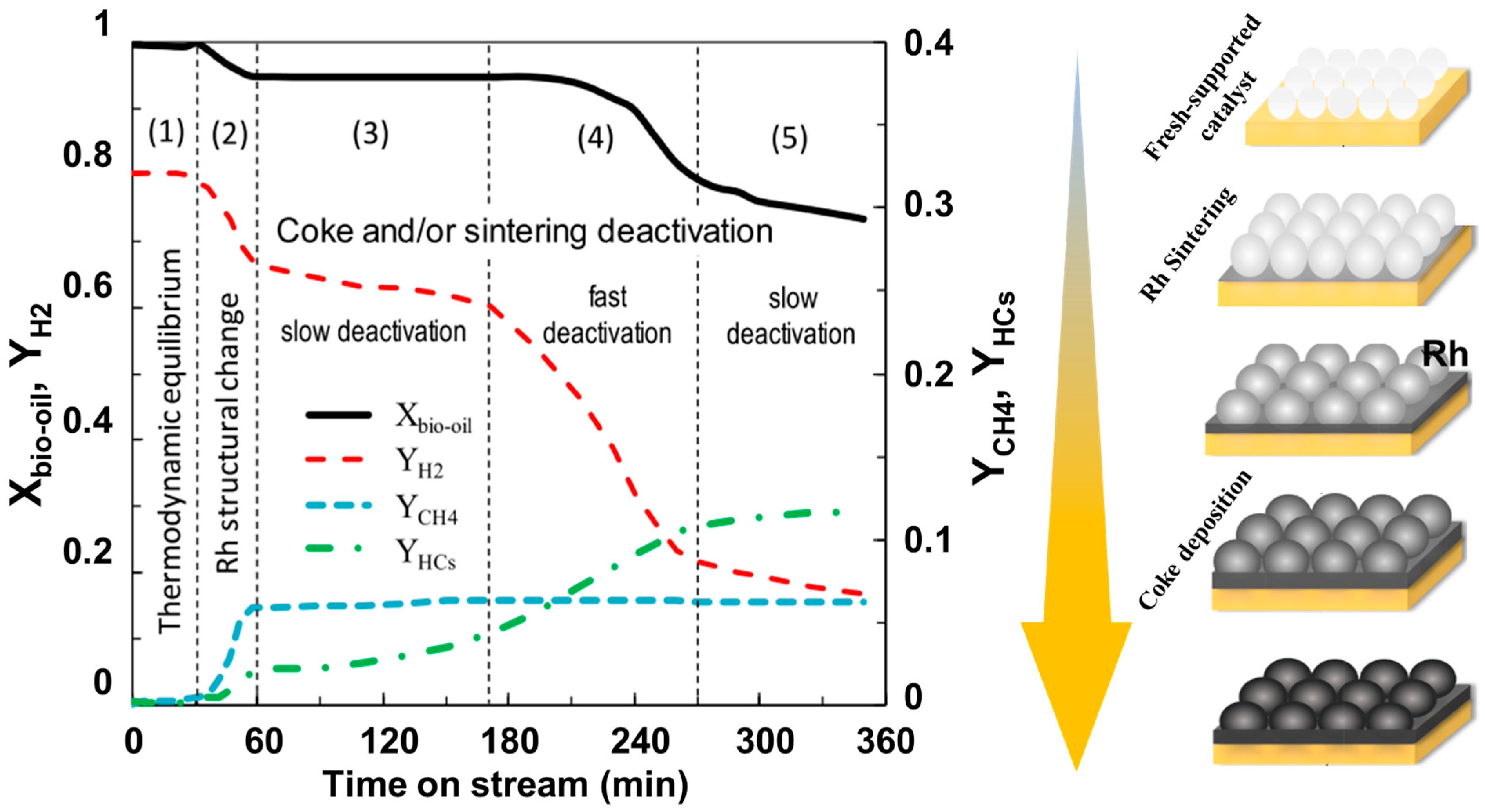
During the SRBO process, the main catalyst deactivation typically progresses through five stages, as presented in Figure 3.
(1)
Stable equilibrium: The reaction operates under thermodynamic equilibrium. During this stage, excess catalyst compensates for initial deactivation.
(2)
Initial deactivation: The catalyst activity slightly declines owing to morphological changes in the catalyst due to catalyst sintering phenomena.
(3)
Pseudostable state: Despite some deactivation, the catalyst retains high activity.
(4)
Major deactivation: A sharp drop in H2 and CO2 production, with increased hydrocarbon formation. The reaction indices change rapidly but slow down as time-on-stream (TOS) increases. This stage is highly linked to excessive coke deposition over the catalytic sites.
(5)
Slow deactivation: The catalyst loses reforming activity but retains residual function, particularly for cracking oxygenates and facilitating the water-gas shift (WGS) reaction. This remaining activity is linked to the support interactions with catalytic active sites.

2.2.1. Coke Formation

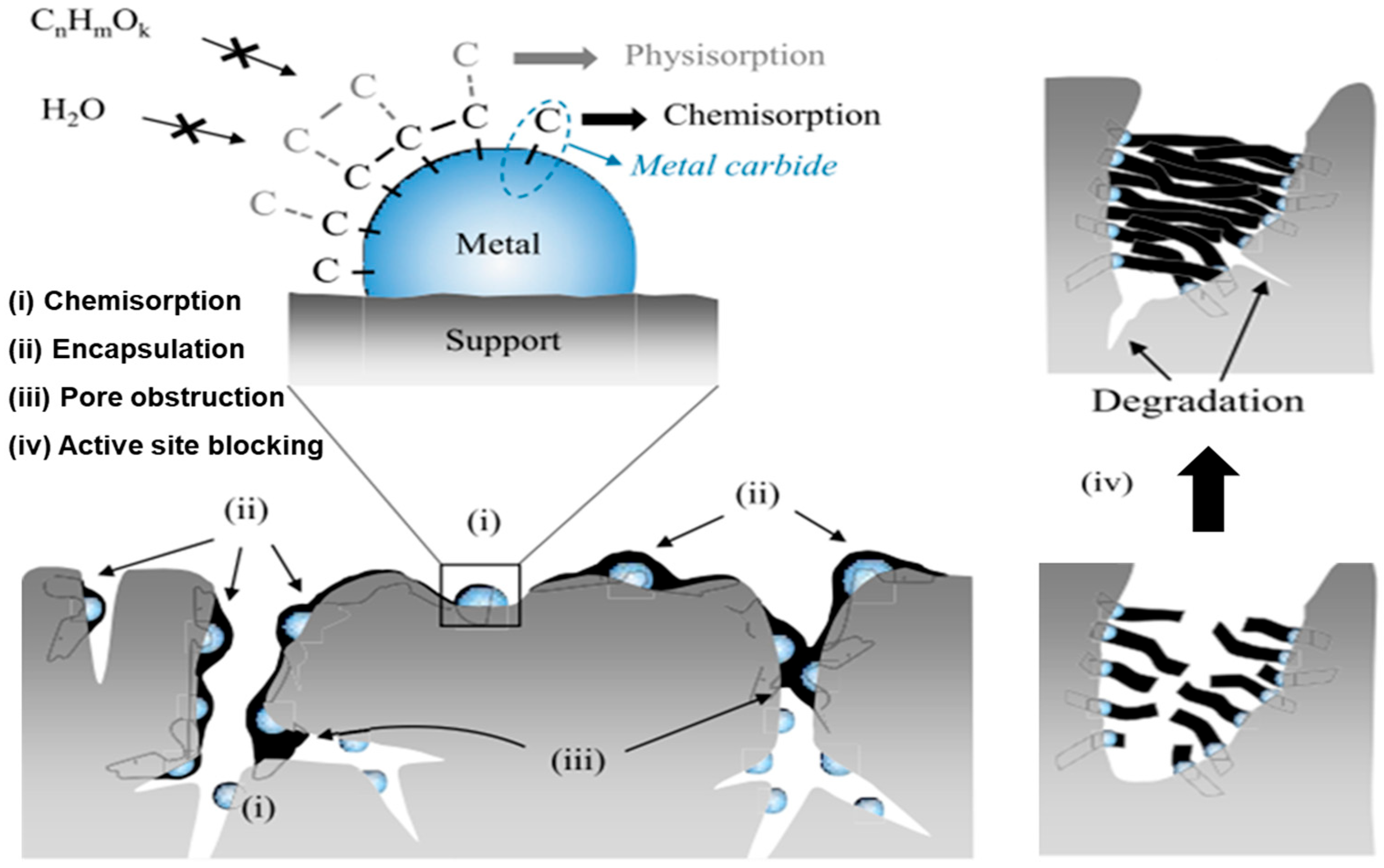
Coke or fouling is the physical deposition of unwanted carbonaceous species from the fluid phase onto the catalyst surface, leading to activity loss due to blockage of active sites and/or pores. The coke properties and their effect on catalytic activity are usually explained in terms of four main features: content, location on the catalyst surface, morphology, and chemical nature [25]. These features determine not only the rate of deactivation but also the possibility of catalyst regeneration. SRBO is always associated with low H2 yield and excessive coke formation, causing catalyst deactivation. In this context, Ochoa et al. [15] presented a comprehensive review of coke formation and deactivation during the catalytic reforming of biomass, highlighting the mechanisms of coke formation and the features of coke deposits. Figure 4 shows the possible deactivation pathways for metal-supported catalysts during SRBO: (i) strong chemisorption in the form of monolayers, leading to carbide formation or physisorption in multilayers, which hinders access to active sites; (ii) complete encapsulation of the active site, consequently becoming inaccessible to (CnHmOk oxygenates and steam) reactants; (iii) obstruction of micropores and/or mesopores in the catalyst; (iv) blocking access to active sites within inner pores; (v) changes and/or disintegration of the catalyst structure and reactor blockage at advanced stages of coke growth.
The formation of various oxygenated hydrocarbons, CnHm groups, and aromatic polymers under high-temperature SRBO conditions can readily block catalyst pores, resulting in accelerated deactivation [26,27]. Coke deposition is considered to be primarily attributed to the polymerization of aromatic and unsaturated components present in the lignin-derived fraction of bio-oil, particularly phenolic compounds [28]. These compounds are highly reactive and tend to condense on the catalyst surface, forming dense carbon layers. In addition, poly-substituted hydroxy- and methoxy-phenols derived from lignin pyrolysis are considered undesired components in raw bio-oil, as they undergo condensation and repolymerization reactions that generate carbonaceous material, leading not only to severe catalyst deactivation but also to reactor fouling and operational instability [29]. In an investigation of the effect of some common impurities (acetic acid, oxalic acid, and methanol) on the performance of UpGraded Slag Oxides (UGSO)-supported Ni catalyst during the steam reforming of glycerol (SRG) under varying operational conditions (temperature range 580–730 °C, S/C ratio of 3 and 6), the authors reported that the presence of these acidic compounds significantly enhances coke formation by generating reactive intermediate species, which in turn reduces hydrogen yield [30].
Coke deposition is influenced by several factors, including operating conditions, bio-oil composition, and catalyst type and morphology, which determine the type and position of the carbon deposits. For example, low temperatures (<450 °C) favor coke deposition, as secondary reactions are promoted over reforming and coke gasification [10]. Other works [31,32] highlighted the effect of temperature on the nature of the formed coke, e.g., the formation of amorphous carbon at 550 °C and a filamentous structure at 700 °C, during the SR of raw bio-oil (derived from pine sawdust). Conversely, a higher space time, which corresponds to a higher proportion of catalyst mass relative to the fed reactants flow, is reported to reduce the amount of coke deposited, since secondary reactions are minimized. In this regard, Valle et al. [32] studied the effect of space time on the nature of coke deposited during the steam reforming of raw bio-oil over the Ni/La2O3-αAl2O3 catalyst. The authors claimed that low values of space time increase the content of encapsulating and filamentous fractions, and high values decrease the formation of encapsulating coke. It has been concluded that a S/C molar feed ratio greater than 4 is suitable at high temperature (700 °C) and high space time (0.38 gcatalyst·h/gbio-oil), presenting an initial H2 yield of 87%, which decreased to 70% after TOS of 5 h. Furthermore, an increase in the presence of steam and oxygen favors the gasification and/or combustion of coke precursors and coke itself, if formed. On the other hand, an increase in the aromatic nature of the feed subjected to reforming is reported to promote coke deposition due to polymerization reactions of aromatics [33].
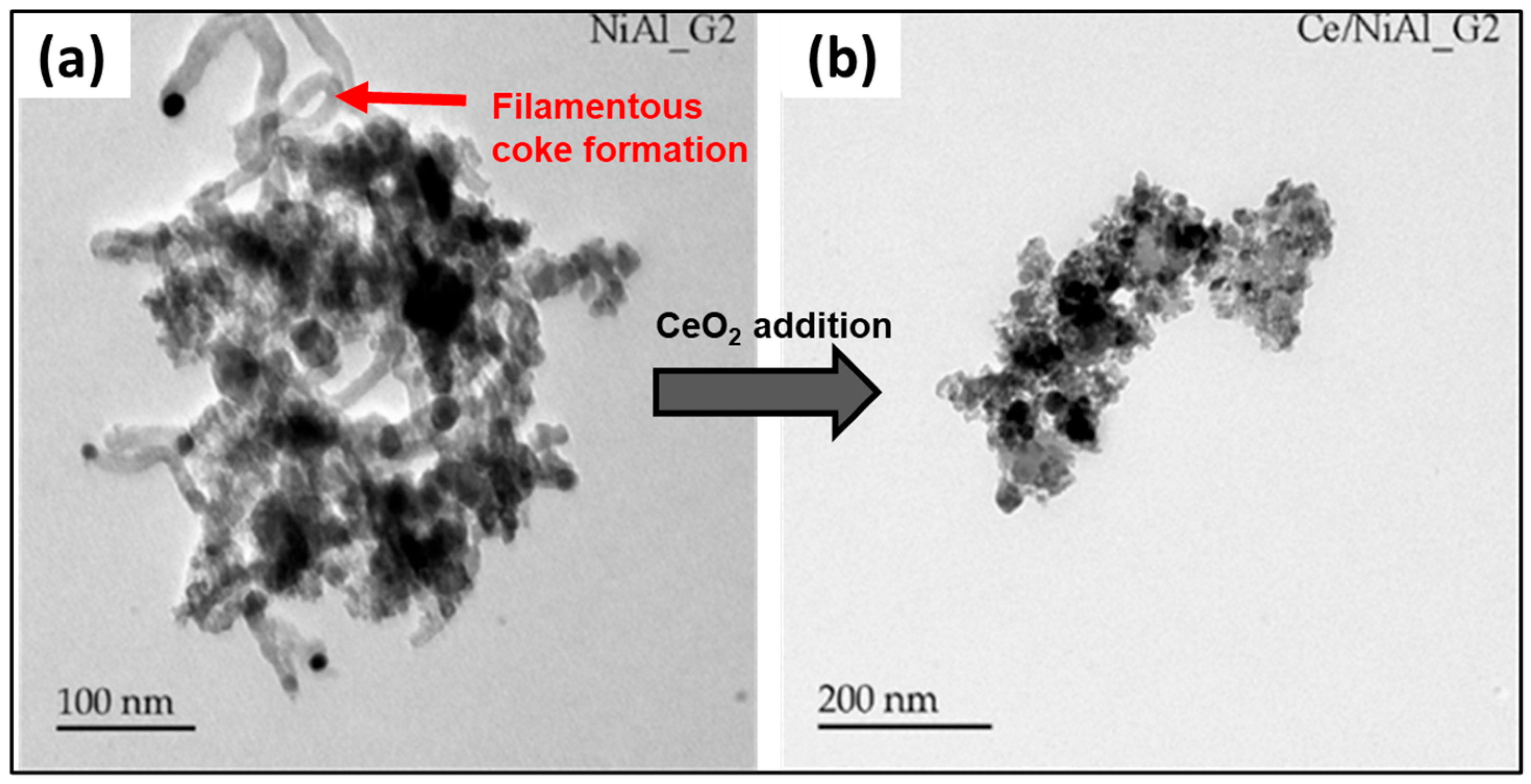
To reduce this phenomenon, numerous efforts have been made to improve the resistance of Ni-based catalysts to coke formation by incorporating noble metals (e.g., Pt, Ru, Rh, Pd, Ir) or redox promoters/supports such as CeO2, ZrO2, and La2O3. It is reported that adding CeO2 to Ni-based catalysts favors coke gasification, thereby reducing catalyst deactivation [34]. Meanwhile, incorporation of CeO2 to ZrO2 support improves the capacity of H2O sorption and dissociation, keeping the Ni surface free of carbon due to their high redox ability [35]. In this framework, Rioche et al. [36] conducted SRBO experiments using Pt, Pd, and Rh catalysts supported on Al2O3 and CeO2-ZrO2 materials. Their findings indicated that the catalyst supported on CeO2-ZrO2 exhibited superior activity compared to Al2O3-based catalyst. In another study, Shokrollahi Yancheshmeh et al. [37] reported that the incorporation of CeO2 into NiAl2O4 spinel catalyst significantly reduced filamentous carbon formation on the nickel surface and promoted coke gasification by providing an oxidative environment around nickel active sites, thanks to the formation of well-dispersed CeAlO3 (Figure 5).
Another promising trend focuses on improving the catalyst-support framework to achieve strong metal-support interaction, i.e., spinel or perovskite [10], mesoporous framework [38], and nanocomposites [39]. These highly stabilized structures reduce the rate of carbon formation. For example, Xu et al. [40] investigated the impact of the Ce/Zr ratio and mesopore structure on promoting catalytic performances and found that the catalyst supported on Ce/Zr (molar ratio 1:1) showed the highest catalytic activity due to the redox property of CeO2-ZrO2 mesoporous nanocrystalline solid solution. Other studies [41,42] explored SRBO on Ni/CeO2-ZrO2 composite catalysts and demonstrated that CeO2-ZrO2 plays a key role in activating H2O molecules, promoting the WGS reaction, and mitigating coke formation.

2.2.2. Sintering of Active Sites

Sintering is a thermally activated physical phenomenon that occurs in both supported and unsupported catalysts. It involves the growth of surface metal particles, thereby remarkably reducing the active surface area. This loss of surface area results in fewer accessible active sites, thereby diminishing the catalytic activity per unit mass of catalyst. Besides particle growth, sintering is frequently accompanied by the agglomeration of fine particles (Ostwald ripening phenomenon) [43]. Thus, the combined effects of surface area loss and pore blockage hinder reactant diffusion, ultimately leading to a substantial decline in catalytic performance over reaction time. It has been reported that elevated temperatures (>700 °C), high pressures (>40 bar), and the presence of steam and certain impurities containing poisoning elements (S and Cl) in the reaction atmosphere significantly accelerate the sintering process [15]. In contrast, filamentous carbon formed on the spent catalyst surface may help reduce sintering by physically separating Ni particles.
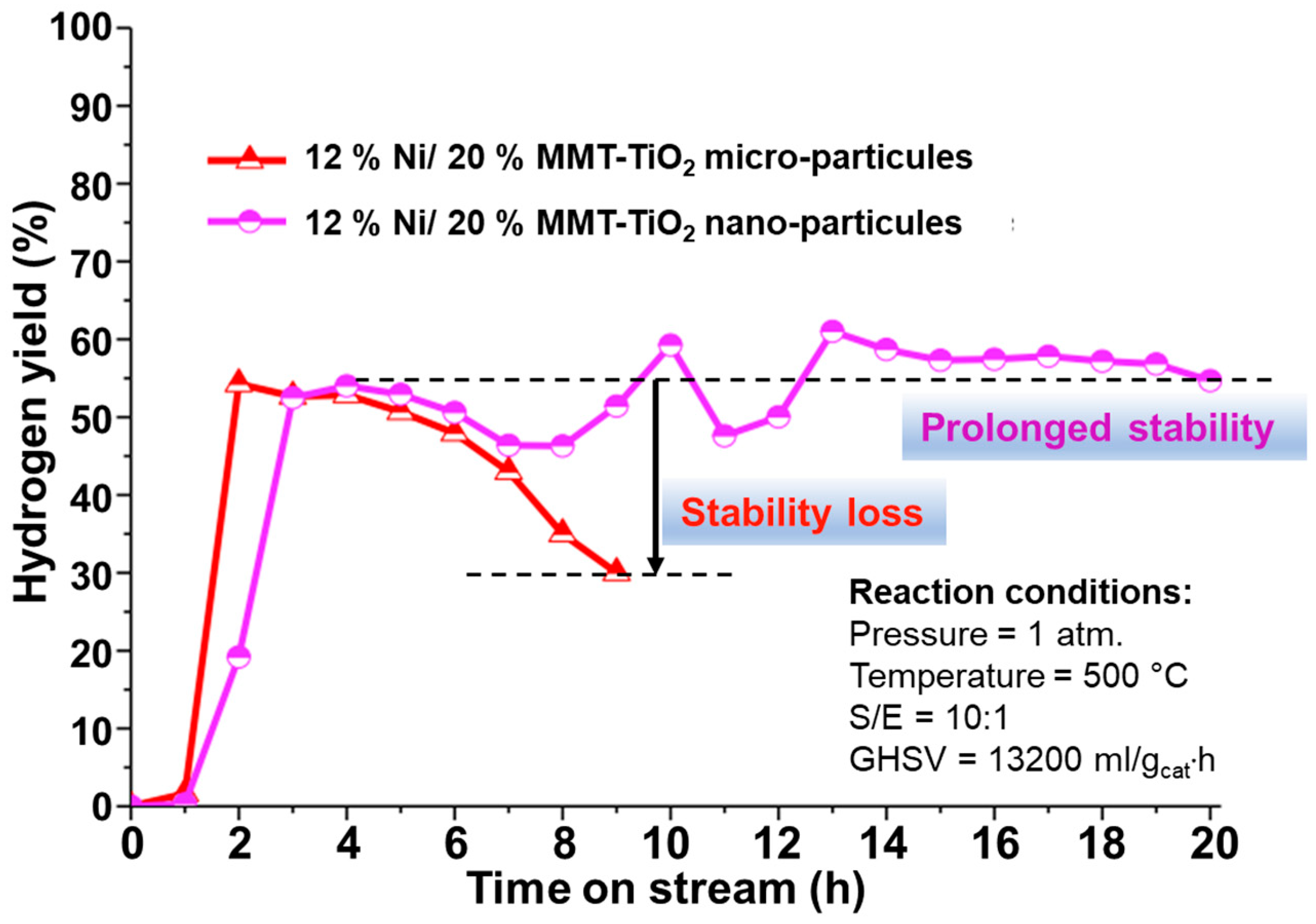
There are two main approaches to minimizing the sintering of active sites. The first involves the use of noble metals, i.e., Ir and Rh, and bimetallic catalysts such as Ni-Cu or Ni-Co alloys [44,45]. The second approach focuses on improving the metal dispersion and strengthening the metal-support interaction to eliminate particle migration. Sintering typically occurs above the Tamman temperature (TT), at which metal atoms become mobile. Several studies have therefore focused on developing the morphological characteristics of the support to favor metal dispersion [46,47,48]. For instance, Mulewa et al. [48] reported that the use of nanocomposite catalysts (Ni/TiO2 nanoparticles supported on montmorillonite (MMT) clay) significantly improved Ni resistance to sintering during the steam reforming of ethanol (ESR). As shown in Figure 6, the Ni/MMT-TiO2 nanocomposite, synthesized via a sol-gel-assisted impregnation method, demonstrated prolonged catalytic stability and a hydrogen yield 1.5 times higher than that of its microparticle counterpart over a 20-h reaction period.

3. Conventional Steam Reforming of Bio-Oil

Bio-oil, derived from the fast pyrolysis of biomass, contains a considerable amount of water, typically ranging from 20 to 50 wt.% depending on the feedstock characteristics and pyrolysis operating conditions [49]. Water removal is not only technically challenging due to its strong miscibility with polar oxygenated compounds in bio-oil but also economically unfeasible with current technologies because of the high energy demand and operational costs associated with separation methods [16]. However, the inherent water content in bio-oil is beneficial, as it acts as a reactant in the SRBO process [50]. During SRBO, various reactions can occur simultaneously, affecting the hydrogen yield and purity (Table 2). Furthermore, coke generation (Equations (5)–(7)) and gasification (Equation (8)) lead to the reduction of catalyst activity and H2 yield.

3.1. Catalyst

Selecting an appropriate catalyst is crucial for maximizing hydrogen yield, as catalyst performance is influenced by several factors such as active metal type, particle size, support material, and promoter addition. A high-performance catalyst can achieve hydrogen yields approaching or exceeding 80% from bio-oil via steam reforming, while the resulting gas mixture typically contains less than 70% H2 and approximately 20% or more CO2 [25]. The ideal catalyst for SRBO should possess the following characteristics: (i) high catalytic activity for reforming reactions, (ii) strong selectivity toward hydrogen generation, and (iii) resistance to deactivation caused by carbon deposition and metal particle sintering.
Catalysts are generally classified into two main categories: transition metal oxides and noble metal-based catalysts [7]. Among the transition metal oxide catalysts, nickel (Ni) has significant advantages due to its remarkable intrinsic activity at moderate temperatures, favorable effect on the WGS reaction, high availability, and cost-effectiveness [36]. Whereas Fe is often used as a metal catalyst due to its ability to break the C-C bond, it is known for its poor reactivity and low reducibility [51]. On the other hand, Cu-based catalysts can break the C-H bond and are effective for SRBO, but they lack the ability to break the C-C bond in compounds such as acetic acid or acetone [52]. Hu et al. [53] conducted a comparative study to evaluate the performance of different catalysts (Ni, Co, Fe, and Cu) in the steam reforming of acetic acid as a bio-oil model compound. Among them, Ni and Co catalysts were the most effective owing to their ability to activate both C-C and C-H bonds. In terms of activity, the catalysts ranked in the order of decreasing activity as Ni > Co > Fe > Cu. Table 3 lists several examples of transition metal oxide catalyst formulations, along with preparation methods, operational conditions, and performance in the SRBO process. It is evident that Ni remains the most widely utilized catalyst.
Regarding the noble metal-based catalysts, palladium (Pd), platinum (Pt), ruthenium (Ru), and rhodium (Rh) have been considered due to their (i) high activity in converting bio-oils into gaseous products and (ii) superior resistance to coke (carbon) formation and sulfur poisoning, which prevents catalyst deactivation [36]. In a study by Basagiannis et al. [71], the performances of Pd, Pt, Ru, and Rh catalysts supported on Al2O3 were compared for SR of acetic acid. The results ranked them according to their activity as follows: Rh > Ru > Pd > Pt. The main limitation of using this category in industry is the high cost associated with producing them on a large scale. Therefore, combining Ni with a second metal M (noble or non-noble) to form a Ni-M alloy can improve catalyst properties by enhancing metal distribution, reducing metal particle size, and strengthening metal-support interactions. Bimetallic systems, such as Ni-Ru and Ni-Co, effectively combine the advantages of different active metals to enhance catalyst activity. In addition, the incorporation of Ru or Rh as promoters in Ni-based systems positively affects activity by improving the reducibility of Ni species. On the other hand, Ni-Co bimetallic catalysts with varied Ni and Co loadings exhibit synergistic interactions between Ni and Co, resulting in high reforming activity that promotes the SR reaction and does not favor methanation [65].

3.2. Catalyst Support

In catalyst design, the support also plays a vital role in enhancing performance, durability, and overall efficiency of the catalytic system. It significantly influences the dispersion and reducibility of the active phase and helps prevent sintering by stabilizing metal particles through strong metal-support interactions. A highly porous support promotes better dispersion of metal or metal oxide phases, thereby increasing the number of accessible active sites and improving catalytic performance compared to bulk metals. Moreover, the support contributes to mechanical strength and thermal stability, allowing the catalyst to sustain the harsh conditions of SR.
Various support materials are used in the SR process, including common oxides, alkaline earth oxides, redox oxides, and mineral-type materials, each type presenting its own advantages and disadvantages. Although Al2O3 is the most widely used support for Ni-based catalysts (Table 3), thanks to its high specific surface area and excellent chemical and mechanical stability under reaction conditions, it is prone to deactivation via carbon deposition and sintering due to its acidic sites. In contrast, basic oxide supports such as MgO and ZrO2 have been shown to enhance metal dispersion and reduce carbon buildup. Therefore, a balance must be maintained between catalytic activity and resistance to deactivation to develop catalysts with optimal acidic properties.
As a redox oxide, CeO2 has attracted significant interest in the SRBO process due to the oxygen vacancies on its surface, which readily form during the reduction process. CeO2 also has redox cycles between oxidation states of +4 (oxidized) and +3 (reduced) and effective acid-base surface properties. Moreover, the incorporation of CeO2 into ZrO2 significantly increases the oxygen storage capacity and promotes the mobility of lattice oxygen atoms, thereby improving the coke-resistance of the catalyst. In this regard, Yan et al. [41] evaluated the performance of Ni/CeO2-ZrO2 catalyst with varying Ni and Ce loading in the production of hydrogen from raw bio-oil in comparison with the commercial catalyst Z417 (Ni/Al2O3-K2O), in a fixed-bed reactor. The reaction temperature ranged from 400 °C to 850 °C, and the steam-to-bio-oil (S/BO) ratio ranged from 3.2 to 5.8. The results showed that at 800 °C, Ni/CeO2-ZrO2 catalyst with Ni and Ce loadings of 12 wt.% and 7.5 wt.%, respectively, and a S/BO ratio of 4.9 led to the highest H2 yield of 69.7%, which significantly surpasses the H2 yield obtained over the commercial Z417 catalyst (≈62%). Similarly, Gallegos-Suarez et al. [72] studied the application of a Ni/CeO2 composite catalyst and found that Ni was highly dispersed and exhibited a small crystallite size in contact with ceria, resulting in high hydrogen selectivity (98.8%) and low carbon deposition (0.04 gcarbon/gcatalyst).
Another interesting category involves industrial waste-driven supports, such as fly ash (FA) and UGSO. For example, Wang et al. [73] evaluated the performance of the Ni/FA catalyst using acetic acid and phenol as model compounds and compared it with that obtained with FA. The study found that the Ni/FA catalyst exhibited some activity and stability at a reaction temperature of 700 °C and an S/C ratio of 9.2. The conversion of acetic acid was found to be 98.4%, which was almost double compared to FA (57.5%). The corresponding hydrogen yields were 85.6% and 50.2% for Ni/FA and FA, respectively. The excellent performance of the Ni/FA catalyst can be mainly attributed to the formation of highly dispersed Ni active sites, which strongly interact with the Al2O3-rich FA support, thereby promoting both reforming and WGS reactions. Likewise, the steam reforming of two raw bio-oils over Ni/UGSO catalyst was evaluated at various temperatures and weight hourly space velocities [70]. The catalyst remained stable throughout the tests, even when some coke deposition occurred. The highest yield (94%) and carbon conversion (Xc = 100%) were observed at temperatures above 800 °C and WHSV = 1.7 h−1. Beyond their effectiveness, the use of waste-derived materials offers notable environmental and economic benefits by valorizing industrial residues.

4. Intensified SESRBO for High-Purity H2 Production

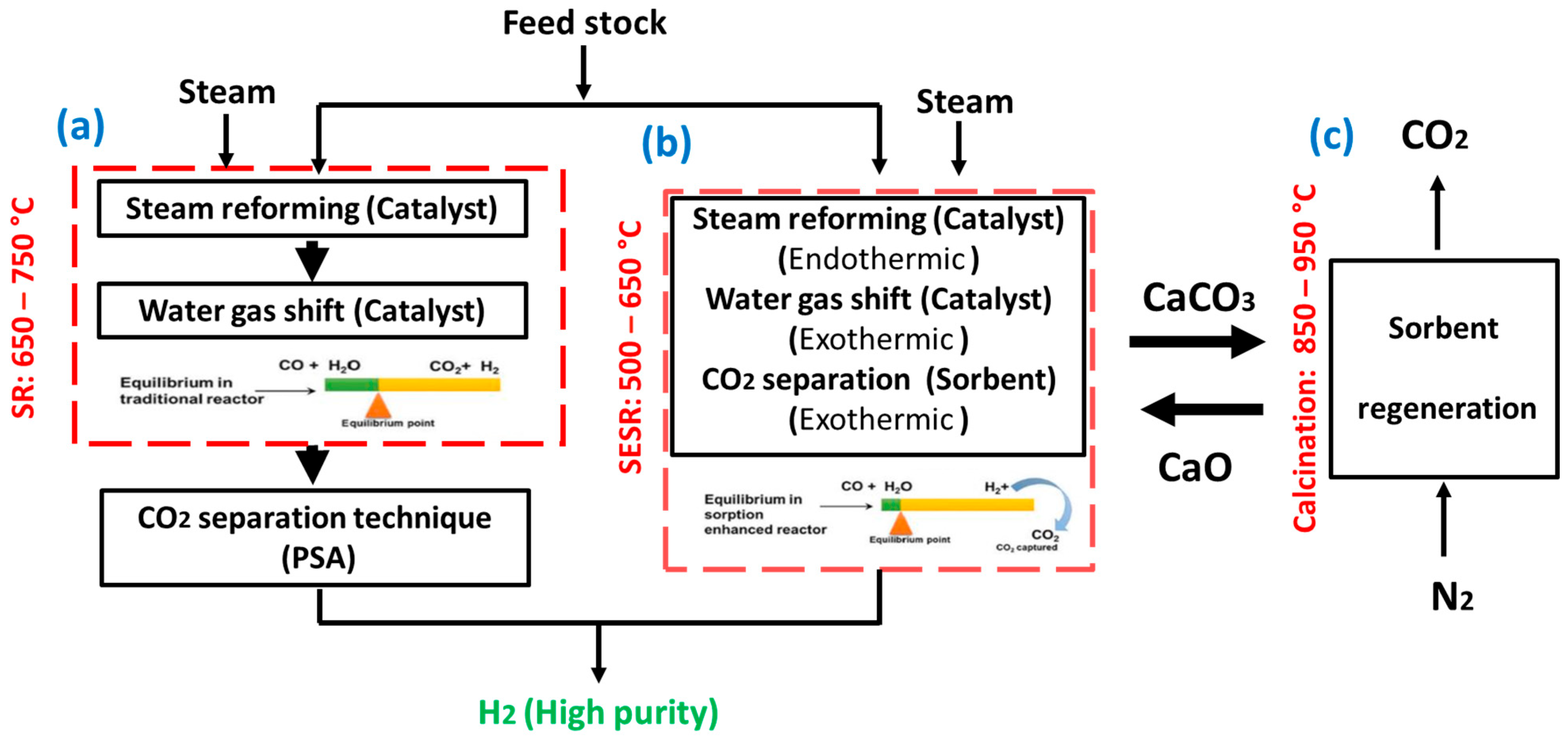
Sorption-enhanced steam reforming (SESR) is an intensified process with notable advantages over conventional SR. A major benefit is the ability to achieve significantly higher hydrogen purity and yield at lower reforming temperatures within the range of 400 to 500 °C [74]. Additionally, SESR integrates hydrogen production and CO2 separation in a single step, thereby eliminating, in most hydrogen-based applications, the need for downstream purification (Figure 7). From an economic perspective, SESR enhances energy efficiency by utilizing the heat released during the carbonization reaction and the WGS process to offset the endothermic reforming reaction. Moreover, the use of lower reaction temperatures in SESR contributes to retarding catalyst deactivation, ultimately extending the effective lifetime of the catalyst and sustainability of the overall process [75].
The selection of appropriate solid CO2 sorbent materials is the key factor for a successful SESR process. An effective sorbent must combine adequate sorption capacity with rapid sorption kinetics, as well as adequate thermal stability during cyclic carbonation-calcination at elevated temperatures [76]. Common high-performance sorbents for this process include CaO-based (synthetic or natural ones like limestone and dolomite) and alkaline ceramics (e.g., Li4SiO4, Li2ZrO3, and Na2ZrO3) [77]. Among them, CaO-based sorbents are appealing due to their cost-effectiveness, high CO2 sorption capacity, and favorable reaction kinetics [78].
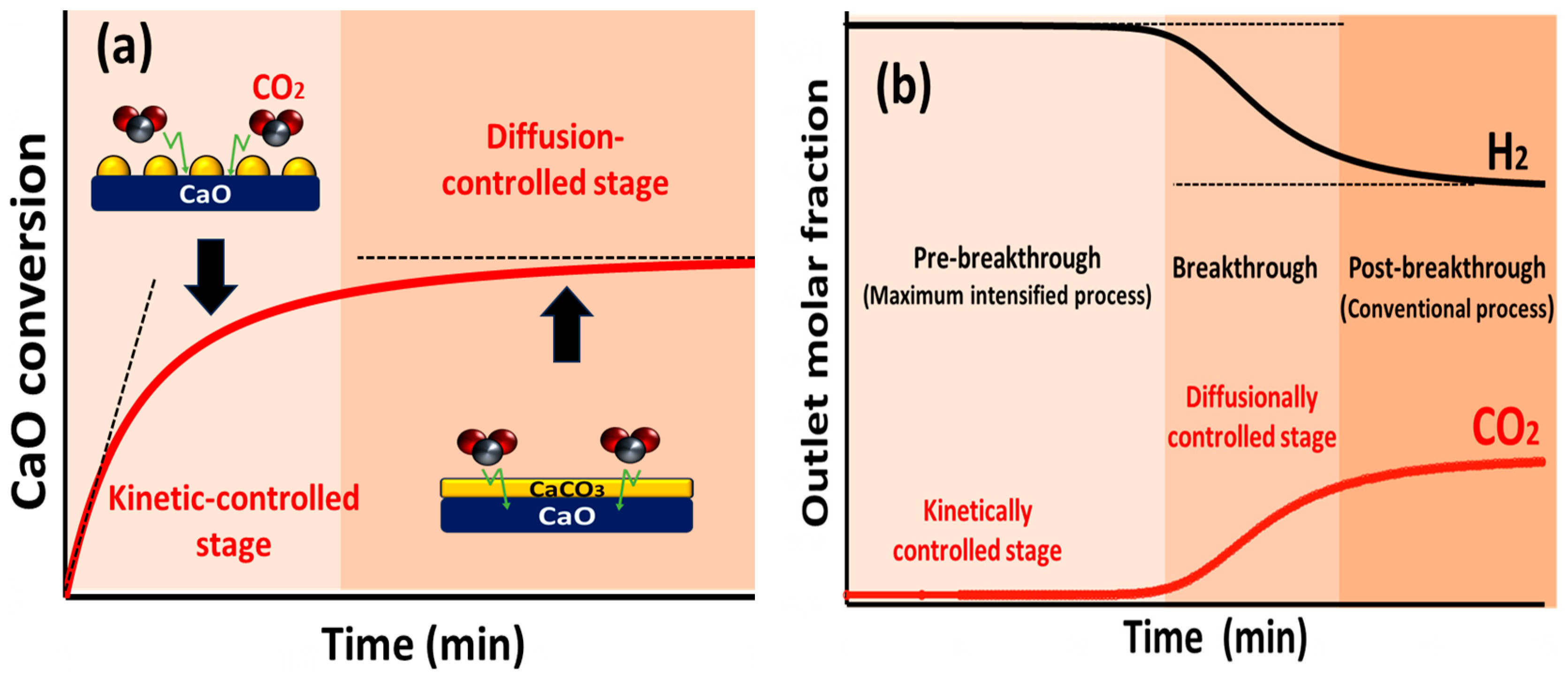
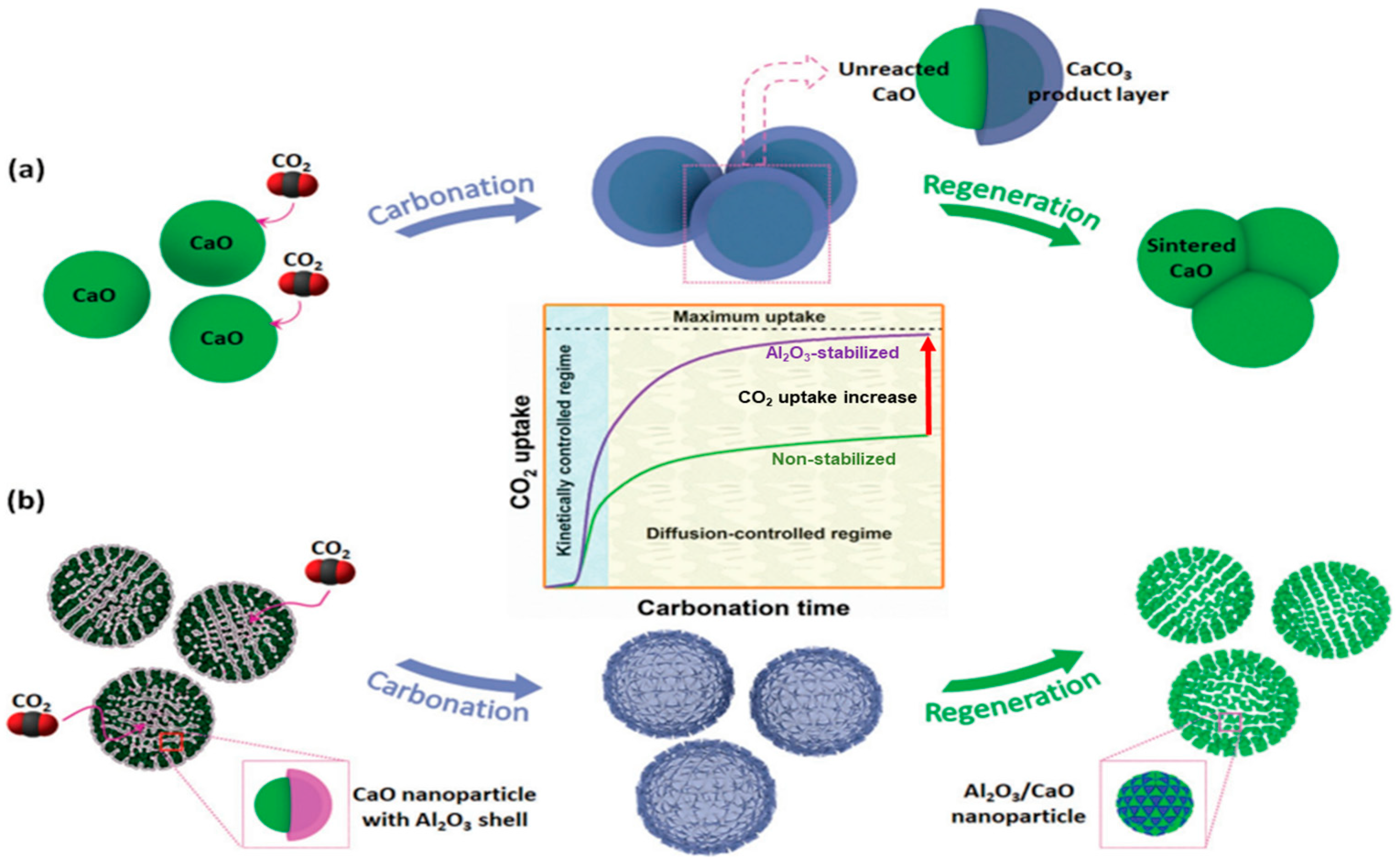
To understand the mechanism of SESR as an intensified process, it is important to pay attention to the calcium looping mechanism, which is based on the reversible gas-solid reaction between calcium oxide (CaO) and carbon dioxide (CO2) to form calcium carbonate (CaCO3) (Equation (9)). The sorbent is generally present in a high mass percentage (>70%), making it the dominant compound in hybrid catalyst-sorbent materials (physical mixture and BFMs) [79]. As displayed in Figure 8a, the typical curve of CaO conversion vs. carbonation time is characterized as the knee-bended shape (initial steep straight line and final quasi-horizontal plateau joined by a rounded knee-bend). The carbonation reaction occurs according to two subsequent regimes: (i) the rapid kinetically controlled stage and (ii) the CO2 diffusionally controlled stage [80]. In the rapid stage, carbonation occurs on the CaO surface through nucleation and growth of CaCO3. According to CO2-based chemistry, the adsorption and transformation of CO2 into negatively charged intermediates govern subsequent reaction pathways. The rapid termination of the fast stage occurs when the formed CaCO3 creates a continuous layer over the unreacted sorbent. As a result, the first rapid stage is mainly controlled by kinetics, while the subsequent, much slower, is governed by CO2 diffusion through the CaCO3 layer. During the carbonation reaction, the ratio of reaction rates between the initial and subsequent stages is usually very high, approximately 100 [81].
C a O   s + C O 2 g   C a C O 3 s  
As depicted in Figure 8b, SESR is generally characterized by three stages. The pre-breakthrough stage is linked to the fast-kinetic step of the carbonation reaction, which is controlled by the surface reaction. At this duration, the fresh sorbent could exclusively capture all the generated CO2; as a result, CO2 concentration is retained at an extremely low level. In contrast, H2 purity is maximized and sustained at a high level. In the breakthrough stage, the CO2 concentration in the output gas stream gradually increases, resulting in a continuous decrease in H2 purity and, to some extent, an increase in CO and CH4 concentrations. This transition stage is characterized by the slow kinetics of the carbonation reaction, in which CO2 diffuses through a thick CaCO3 product layer to access the active CaO particles. In the post-breakthrough stage, the sorbent becomes fully saturated. As a consequence, the corresponding process represents the traditional SR without any intensification effect. Table 4 summarizes some published papers on the SESR of bio-oil using model compounds, simulated bio-oil, and raw bio-oil, and summarizes the main characteristics and operating conditions. The effectiveness of the SESRBO process in producing highly pure H2 is clearly evident.

4.1. Effect of Operating Parameters

4.1.1. Effect of Temperature

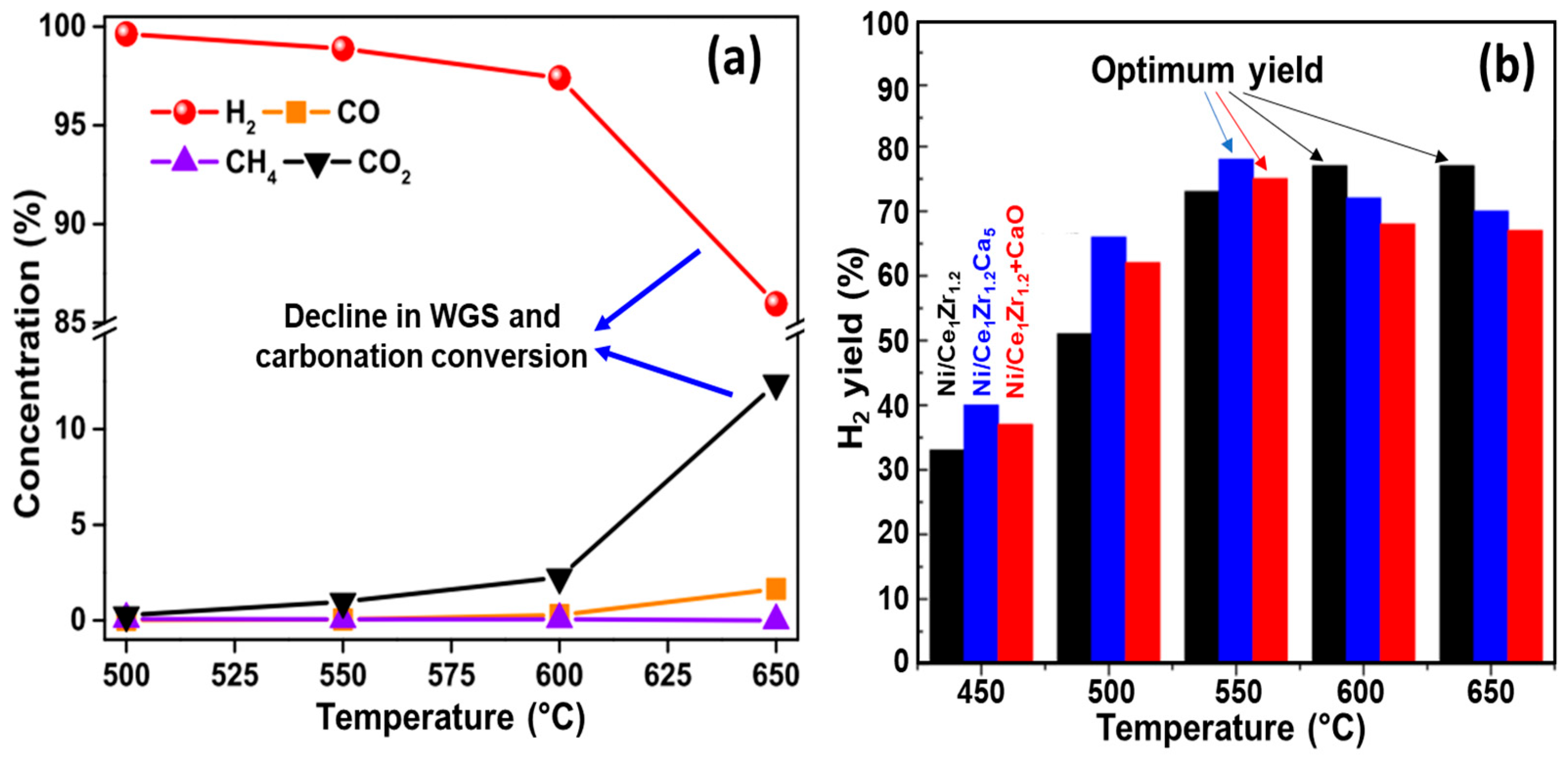
Temperature is a critical parameter that influences not only the catalytic performance but also the CO2 sorption capacity of BFMs. Furthermore, it directly affects the overall reliability of the process and the long-term stability of BFMs by governing key deactivation mechanisms, i.e., coke deposition and sintering. Basically, the carbonation reaction occurs when the CO2 partial pressure ( P C O 2 ) in the flow stream exceeds the equilibrium partial pressure of CO2 ( P C O 2 , e q ) at a specific temperature. The difference between these terms represents the driving force ( P C O 2 P C O 2 , e q ) of the carbonation process [96]. When P C O 2 increases, the system shifts towards CaCO3 formation [101]. However, it is important to recognize that P C O 2 , e q also rises with the temperature, as described by Equation (10), thereby reducing the driving force and the carbonation reaction rate. Thus, a moderate increase in temperature can enhance reaction kinetics and CO2 diffusion only to a certain extent, beyond which the thermal degradation of CaCO3 occurs (usually around 700 °C) [102]. Wang et al. [103] further optimized the temperature in both steam reforming of glycerol (SRG) and sorption-enhanced steam reforming of glycerol (SESRG). From a thermodynamic perspective, SESR is inherently more complex than conventional SR, primarily because it simultaneously involves both the carbonation and WGS reactions, which are exothermic. These reactions provide additional heat to the integrated system; as a result, the optimal reaction temperature for SESR was found to be approximately 100 °C lower than that for conventional SR. In support of this, Dang et al. [89] experimentally evaluated the effect of reaction temperature on the performance of SESR of phenol in the range of 500–650 °C at a S/C ratio of 11 over a 5Ni/CaO-Ca12Al14O33 BFM with Ca:Al = 2.8. Their results showed that above 650 °C, the purity of H2 exhibited a gradual decline, whereas the concentrations of CO and CO2 followed an opposite trend (Figure 9a) because WGS and carbonation reactions are not favored at such high temperatures.
P C O 2 , e q ( a t m ) = 4.137 × 10 7 e x p ( 20474 T ( K ) )
In their study on SESR of raw bio-oil over a Ni/Ce1.2Zr1Ca5 BFM, Li et al. [84] reported a noticeable decrease in H2 yield from 77.8% to 71.8% when the temperature increased from 550 °C to 650 °C, respectively (Figure 9b). Although steam reforming is an endothermic process that typically benefits from higher temperatures, excessive heating (>650 °C) can promote coke formation and favor undesired thermal cracking reactions of organic compounds. However, operating at temperatures lower than 500 °C is also detrimental, as it promotes the formation of unstable by-products from the decomposition and dehydration of bio-oil constituents. In line with this, Esteban-Díez et al. [94] concluded that 575 °C was optimal for the SESR of acetic acid and acetone, model compounds of bio-oil. A remarkably high H2 purity (99.3–99.4%) and high H2 yields (90.2–95.9%), together with low concentrations of CH4, CO, and CO2 were achieved using S/C ratios of 3 for acetic acid and 5 for acetone. Additionally, the SESR of tested blends of acetic acid and acetone (with molar ratio of 1:3, 1:1 and 3:1, respectively) led to lower H2 yield values, ranging from 83.3% to 88.6%, when compared to the SESR of individual model compounds, whose yields were 90.2% (acetic acid) and 95.9% (acetone). This decrease in H2 yield becomes more pronounced as the proportion of acetone in the blend increases, due to the relative stability of its carbonyl group. It therefore becomes difficult to convert it completely under SESR conditions.
The energy requirements associated with elevated temperatures significantly influence the overall energy efficiency of the SESR system. Therefore, a blind increase in reaction temperature is not an effective strategy. Instead, an optimal temperature must be carefully determined to balance the kinetics and thermodynamics of SR, WGS, and carbonation. At relatively low temperatures (<500 °C), the reforming reaction is kinetically limited, resulting in incomplete hydrocarbon conversion and lower hydrogen yield. In contrast, at higher temperatures (>650 °C), faster kinetics enhance the overall conversion, but the exothermic WGS and carbonation reactions become less favorable, consequently reducing CO2 capture efficiency and increasing the risk of catalyst sintering and coke formation. To sum up, operating temperatures between 550 °C and 600 °C seem to be a reasonable regime for SESRBO.

4.1.2. Effect of Steam

Another key factor is the presence of steam, which directly affects the sorption and reforming processes. In the intensified process that integrates steam reforming with in situ CO2 capture, steam is a predominant component of the reaction environment (>40% of the reaction gas). Steam plays a dual role as a reactant and a medium for heat transfer. Numerous studies have reached a consensus that the presence of steam improves the overall sorbent capacity. For instance, Linden et al. [104] observed that raising the steam pressure to 0.3 atm at a carbonation temperature of 550 °C resulted in a 33% improvement in CaO conversion. The precise mechanism by which steam impacts the carbonation reaction remains, however, under debate. Thus, several hypotheses have been proposed in the literature, which can be broadly categorized and summarized as follows:
(i)
Chemical and kinetic points of view: The enhancement of carbonation conversion in the fast reaction-controlled stage is attributed to the formation of Ca(OH)2 as a transient intermediate (Equation (11)). This hypothesis found support in experiments conducted by Shokrollahi Yancheshmeh et al. [75], who associated the accelerated carbonation rate during the initial stage with the formation of bicarbonates, which enable the sorption of two CO2 molecules per active site, thereby enhancing the CO2 capture efficiency of CaO-based sorbents (Equation (12)). Consequently, it could be concluded that the carbonation reaction in CaO-based BFMs is kinetically more favorable at wet carbonation conditions.
C a O ( s ) + H 2 O ( g ) C a ( O H ) 2 ( s ) ,   Δ H 298 o   =   69.1   kJ / mol
C a ( O H ) 2 ( s ) + 2 C O 2 ( g ) C a ( H C O 3 ) 2 ,   Δ H 298 o   =   158   kJ / mol
(ii)
Morphological point of view: The dynamic formation and decomposition of Ca(OH)2 leads to an increase in the surface area and an expansion in pore volume. This improvement in the textural properties under wet conditions promotes CO2 diffusion. Increasing the steam concentration during the carbonation process serves to alleviate the decline in CO2 capture capacity by developing a more stable pore structure. As a result, it supports a higher carbonation rate, particularly during the second carbonation step, which is predominantly controlled by CO2 diffusion. Wang et al. [105] proposed that OH formation is crucial for enhancing CO2 diffusion in the product layer. Therefore, the carbonation reaction is governed by the diffusion of CO32− and O2− ions between reaction interfaces.
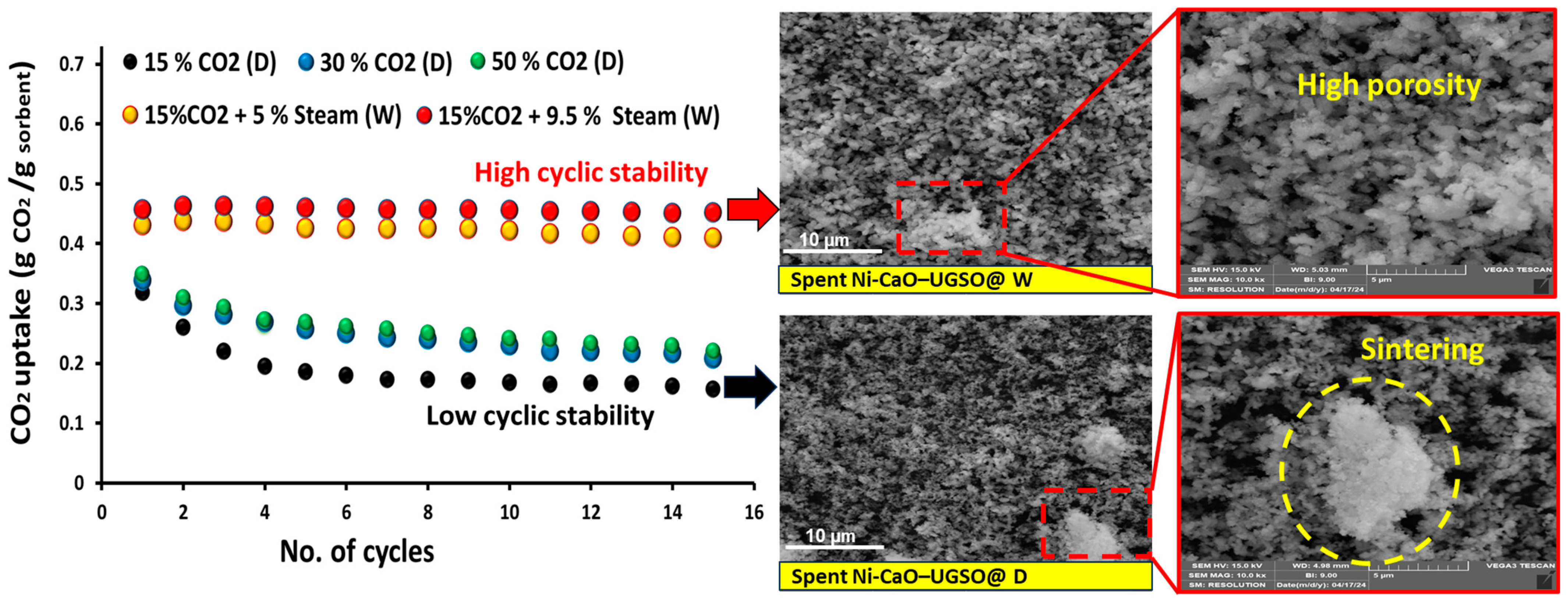
Although several studies reported that the role of steam during carbonation was limited to promoting the sorption capacity [106,107], Elsaka et al. [97] recently demonstrated that the presence of steam improved both sorption capacity and cyclic stability of UGSO-stabilized BFM (Ni-CaO-UGSO) under wet conditions (5 and 9.5 vol.% steam), with nearly zero reduction in CO2 capture capacity over 15 carbonation-calcination cycles (Figure 10). Nevertheless, while moderate steam improves the sorption performance, an excessive increase in its concentration during the carbonation process can negatively impact performance by reducing P C O 2 in the reaction environment. This reduction in P C O 2 lowers the driving force for carbonation, thereby potentially diminishing CO2 uptake. Also, during the calcination stage, steam plays a beneficial role. The introduction of steam into the calcination atmosphere lowers the decomposition temperature of CaCO3, thereby reducing the risk of CaO sintering [75].
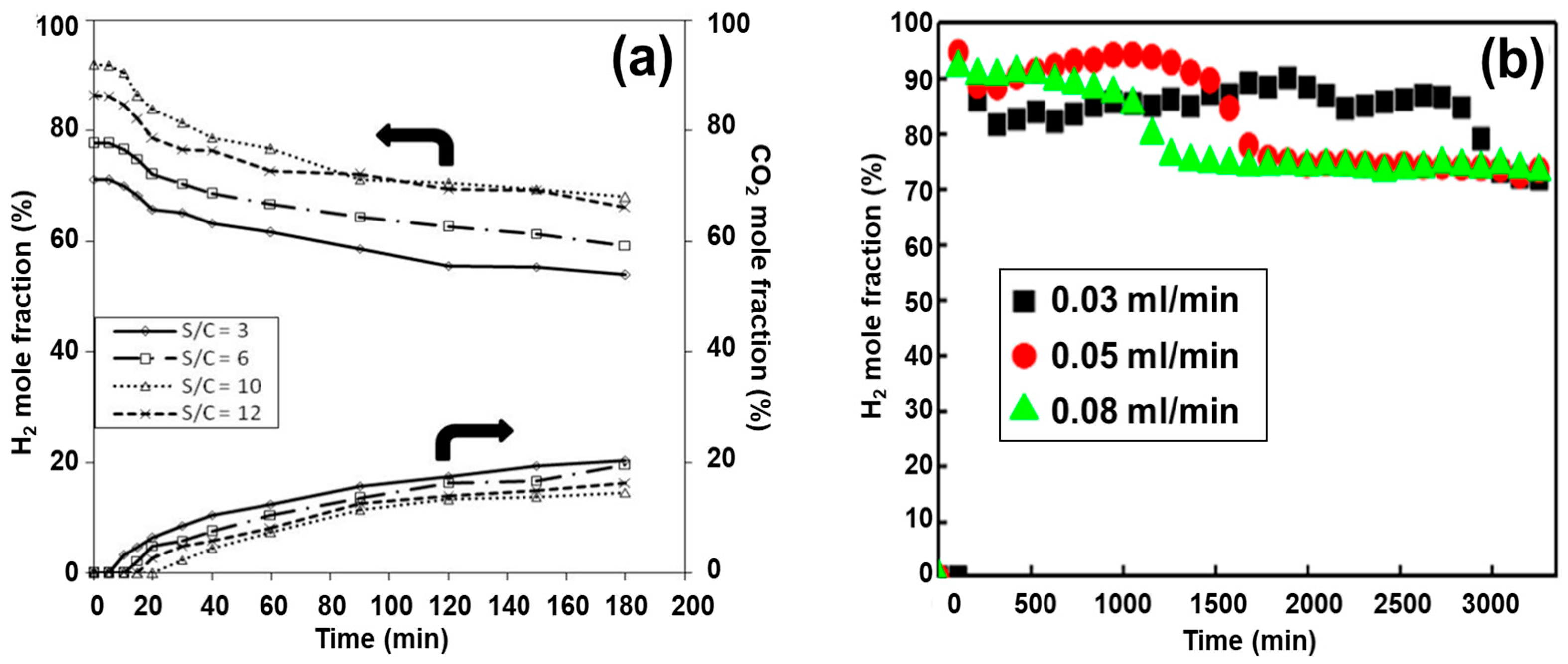
Regarding the effect of steam on the reforming process, the S/C (or (S/BO)) ratio directly influences energy consumption, gas product quality, and H2 yield. For both SR and SESR processes, increasing the S/C molar ratio consistently improves hydrogen yield and purity. This enhancement is accompanied by a reduction in CH4 and CO concentrations. A noteworthy advantage of a high S/C is the reduction of coke formation by promoting steam dissociation and enhancing coke gasification (Equation (8)) [1]. For example, in SRBO over a Ni/La2O3–αAl2O3 catalyst, the S/C ratio (1.5–6) was systematically studied [108]. At 700 °C and S/C of 6, H2 purity (66%) and yield (93%) were achieved. Although the hydrogen yield decreased to 70% after 7 h due to catalyst deactivation, increasing the S/C ratio effectively minimized coke deposition and enhanced catalyst durability. In comparison, lower S/C ratios (1.5 and 3) resulted in more severe deactivation, with hydrogen yields dropping to 40% and 63%, respectively. In a related work, Ghungrud and Vaidya [109] studied the effect of the S/C ratio (3–12) in the sorption-enhanced steam reforming of ethanol (SESRE) over BFMs composed of cobalt (10 wt.%) and calcium-based sorbents stabilized with CeO2, ZrO2, and MgO. The highest H2 concentration (92.1%) was achieved with Co-CaO-CeO2 for a S/C ratio of 10 (Figure 11a). Notably, an extremely high S/C ratio led to the dilution of H2 concentration and limited CO2 sorption. As a result, from an economic perspective, it has been recommended that a S/C value within 3–6 would be reasonable for reforming reactions on an industrial scale. This suggestion underscores the importance of balancing the S/C ratio to achieve optimal performance in industrial processes and economic considerations.

4.1.3. Effect of Other Operating Factors

Selection of an appropriate space velocity in the SESR process is crucial for achieving high H2 production and minimizing the reactor size. It has been reported that H2 yield decreases with the space velocity. The shorter contact time at higher weight hourly space velocity (WHSV) values results not only in lower fuel conversion but also in increased coke deposits.
It is important to note that the feeding flow rate in SESR is more critical than in traditional SR because reforming is a faster reaction than carbonation. Therefore, achieving complete CO2 separation from the product stream resulting from reforming and WGS reactions is more effective at lower feeding rates, thereby enhancing the sorption process. In their work, Liu et al. [86] conducted a set of experiments using Ni-CaO-Al2O3 BFM to explore the effect of feeding rate ranging from 0.03 to 0.08 mL/min on the SESR of bio-ethanol. The findings illustrated in Figure 11b indicate a clear trend: increasing the feeding rate significantly shortened the duration of the pre-breakthrough period.
The effectiveness of the SESR process largely depends on the reactor configuration, especially when processing complex feedstocks such as raw bio-oil. Landa et al. [99] investigated the effect of reactor configuration (specifically, fixed-bed (FB) and fluidized-bed (FDB) reactors) on coke deposition during SESR of raw bio-oil, using a mixture of NiAl2O4 catalyst and dolomite. Under optimized conditions (600 °C and S/C ratio of 3.4), the initial hydrogen yields during the CO2 capture period reached 99% in the PBR and 92% in the FBR. Despite the slightly lower H2 yield observed in the FBR, this configuration provided better resistance to catalyst deactivation, mainly due to enhanced coke gasification enabled by continuous particle movement.

4.2. Progress in the SESRBO

4.2.1. Development and Application of Hybrid Catalyst-Sorbent Materials

Hybrid materials in the SESR process can be broadly categorized into two main patterns: (i) bifunctional materials (BFMs), in which both the catalyst and sorbent are integrated within the same particles, and (ii) mechanically mixed systems, where the catalyst and sorbent are physically blended but remain as separate entities. Among them, BFMs are considered more advantageous due to the shorter distance between the catalyst, sorbent, and stabilizer components [26]. This intimate contact promotes more efficient heat and mass transfer, thereby accelerating the carbonation reaction and improving the overall sorption kinetics [41].
Still, sintering of the sorbent is the main cause of BFM deactivation, leading to two main issues: (i) the agglomeration of ultrafine particles resulting in the destruction of the porous structure [83], and (ii) a reduction in the specific surface area and pore volume of CaO-based sorbents [110]. It is widely recognized that the sintering of sorbents is significant, especially in the initial cycles of carbonation-calcination [111]. Silaban et al. [112] noticed a reduction of the sorption capacity of CaO-derived limestone from 61% to 35% of its theoretical value only after 6 carbonation-calcination cycles. Similarly, other studies reported a reduction of more than 45% in the sorption capacity of CaO sorbent derived from limestone after only 5 carbonation-calcination cycles [113]. This degradation is due to the fact that the carbonation reaction of CaO occurs at temperatures higher than TT of CaCO3 (533 °C), which leads to a dramatic deterioration in specific surface area due to the agglomeration of small CaO particles [114].
It is important to note that the regeneration step, particularly with CaO-based sorbents, typically requires temperatures above 700 °C; consequently, it increases energy consumption and accelerates sintering. Therefore, optimizing regeneration conditions, particularly calcination temperature and duration, is crucial for preserving the structural integrity and reactivity of CaO [13]. Excessively high calcination temperatures (>850 °C) or prolonged regeneration times accelerate pore collapse, resulting in a significant loss of surface area and CO2 uptake capacity. Conversely, incomplete regeneration at too low temperatures (<650 °C) can result in residual CaCO3, lowering sorption efficiency in subsequent cycles [99]. Two approaches have been proposed to improve the calcination process: the first involves developing materials with high resistance to sintering, while the second focuses on lowering P C O 2 by injecting steam, thereby reducing the driving force for CaCO3 decomposition [115,116]. Alternatively, Dang et al. [117] introduced an innovative approach by developing an integrated process combining SESRG with methane reforming of carbonates over a 1% palladium (Pd) incorporated into Ni-Ca-Al bifunctional material. Through this strategy, several advantages are achieved: (i) the sintering of CaO particles was eliminated by lowering the calcination temperature from 800 °C to a more practical 650 °C. Such a reduction in calcination temperature can significantly decrease thermal energy demand; for example, Nimmas [118] reported that even a 50 °C reduction in calcination temperature during SESRE resulted in a 14% decrease in thermal energy consumption. (ii) Validation of the sustainable carbon cycle was achieved through valorization of the released CO2 during the calcination process. The developed material demonstrated about 80% CH4 conversion, and 98.5% H2 concentration was also generated.
Improvement of Sorption Capacity
The growth of CaO grain sizes and the generation of CaCO3 on the sorbent surface led to a dramatic reduction in sorbent porosity and, consequently, the CO2 sorption capacity over multiple cycles. To enhance the sorption capacity of CaO-based sorbents, various strategies, including additional pretreatments such as using organic CaO precursors, hydration reactivation, and the template-assisted approach, have been explored. Furthermore, researchers have investigated the effects of different calcium precursors and the doping of elements on improving texture properties [92].
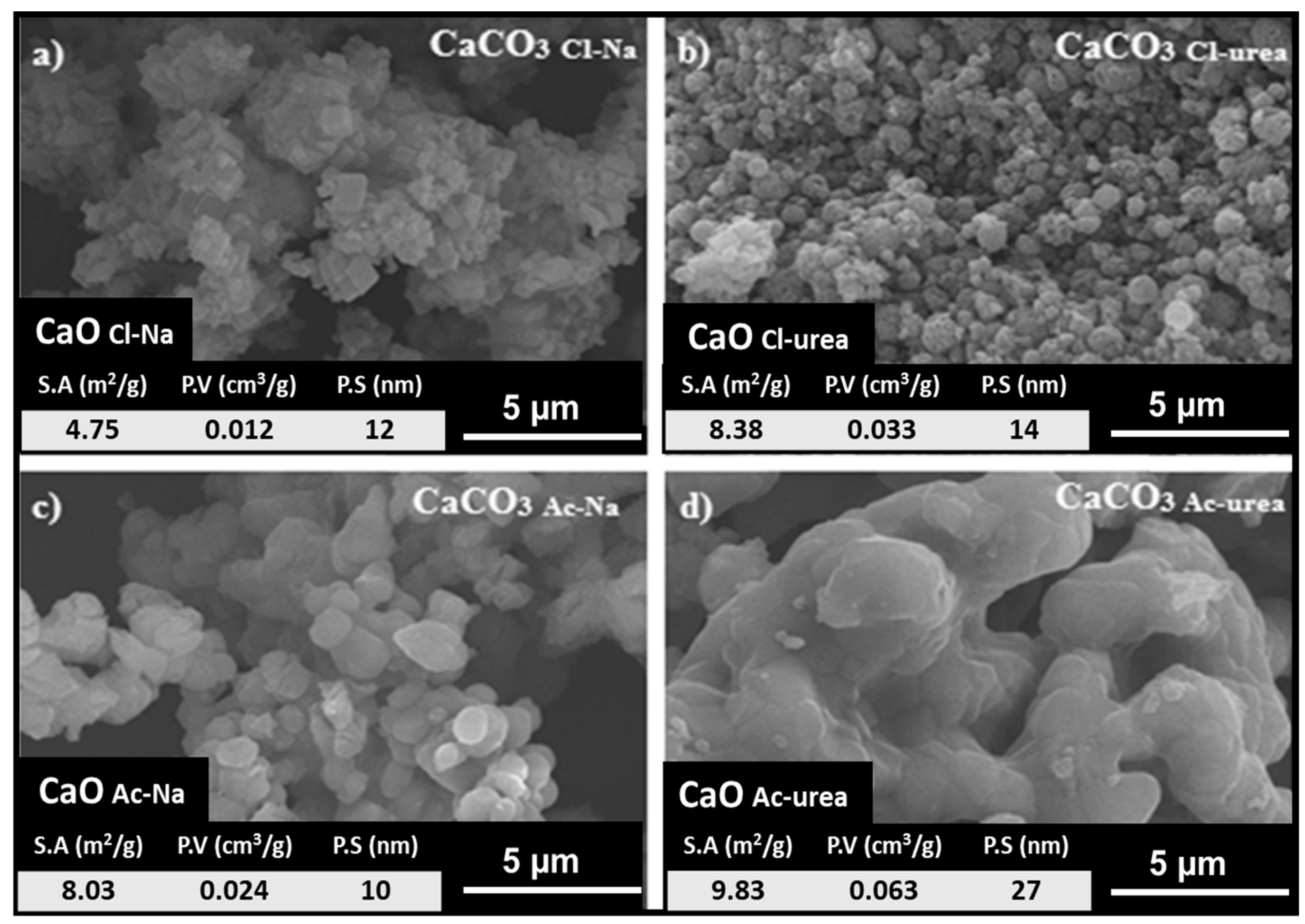
Basically, synthetic CaO-based sorbents have better performance than natural sorbents due to the enhanced porosity and the presence of nanosized particles [84]. This superiority is linked to the decomposition of organic precursors (e.g., citric acid) during calcination, which releases gases and volatile organic compounds such as acetone, thereby fostering a more porous structure. For example, Nimmas et al. [87] studied the effect of different precursors on the properties of CaCO3. Four distinct sorbent precursors, including calcium chloride (CaCl2) and calcium acetate (CaAc2) as calcium precursors, and sodium carbonate (Na2CO3) and urea (CO(NH2)2) were used as carbonate precursors. The results revealed that the sorbent derived from CaAc2-Urea showed the highest CaO conversion of 80% at 700 °C due to its textural properties (S.A: 9.83 m2/g, P.V: 0.063 cm3/g, and P.S: 27 nm, see Figure 12). Additionally, whole synthetic CaO-based sorbents were employed in (Ni/Ca12Al14O33-stabilized CaO) BFMs for H2 production via SESRE. Among them, NiO/CaOAc2-Urea-Ca12Al14O33 achieved reasonable H2 purity (87%) at pre-breakthrough duration for 60 min with good cyclic stability over 10 SESR cycles. A similar investigation was conducted by Yang et al. [119] to produce four types of CaO-based sorbents from different calcium precursors (calcium acetate monohydrate, calcium carbonate, calcium hydroxide, and calcium oxide) through a combination of calcination and hydration reactions. In cyclic CO2 capture experiments, it was observed that the CaO-based sorbents obtained from calcium acetate and calcium carbonate exhibited better CO2 sorption capacities (0.299 and 0.284 gCO2/gsorbent at 650 °C, respectively) compared to 0.253 gCO2/gsorbent for CaO. These developed sorbents showed excellent cyclic stability, maintaining CO2 capture capacities of 0.303 and 0.285 gCO2/gsorbent, respectively, after 9 carbonation-calcination cycles.
During the carbonation process, the transition to the 2nd carbonation (diffusion-controlled) stage (Figure 8a) occurs when the CaCO3 layer reaches a thickness of approximately 50 nm [120]. Therefore, nano-scaled CaO helps accommodate the significant volumetric expansion during the carbonation process, because CaCO3 has nearly twice the molar volume of CaO (36.9 vs. 16.7 cm3/mol, respectively). In light of this concept, Luo et al. [121] successfully synthesized nano-sized CaO-based sorbent using a sol-gel method with a calcium nitrate tetrahydrate precursor. Compared to micro-sized sorbent, the resulting sorbent displayed well-dispersed, uniform particles of 200 nm. This innovative sorbent demonstrated a remarkable CO2 sorption capacity of 0.51 gCO2/gsorbent and good stability over 20 carbonation-calcination cycles.
Hydration is a pivotal strategy for enhancing the efficiency of CO2 capture in CaO-based sorbents; the associated reaction is represented by Equation (11). It is well known that Ca(OH)2 has a higher CO2 sorption capacity compared to CaO [122]. The morphological characteristics of sorbents produced from hydrated and untreated dolomite were compared by Rong et al. [123], who found that hydrated dolomite produced sorbents with a more porous structure, a higher surface area, and a higher pore volume than those produced from untreated dolomite.
The template-assisted approach is a reliable route for producing hollow and porous CaO-based materials, offering benefits such as enhanced stability, precise control, and predictable properties. This process involves three key steps: (i) creating the template, (ii) covering it with CaO-based precursors, and subsequently (iii) burning the template. The final materials typically retain the structure of the template, resulting in a highly porous framework with a large surface area. In their study, Akgsornpeak et al. [124] utilized the sol-gel method to synthesize CaO from Ca(NO3)2 precursor and explored the influence of Ca(NO3)2 concentration and the addition of cetyltrimethylammonium ammonium bromide (CTAB), a widely used cationic surfactant, on CaO properties. The results indicated that a higher Ca(NO3)2 concentration led to a reduction in particle size. The addition of CTAB, however, had mixed effects: it resulted in larger agglomerated particles (negative effect) but also increased porosity and reduced particle size (positive effect). This led to the tailoring of morphology, indicative of an optimal porous structure that offered a higher active area for CO2 capture.
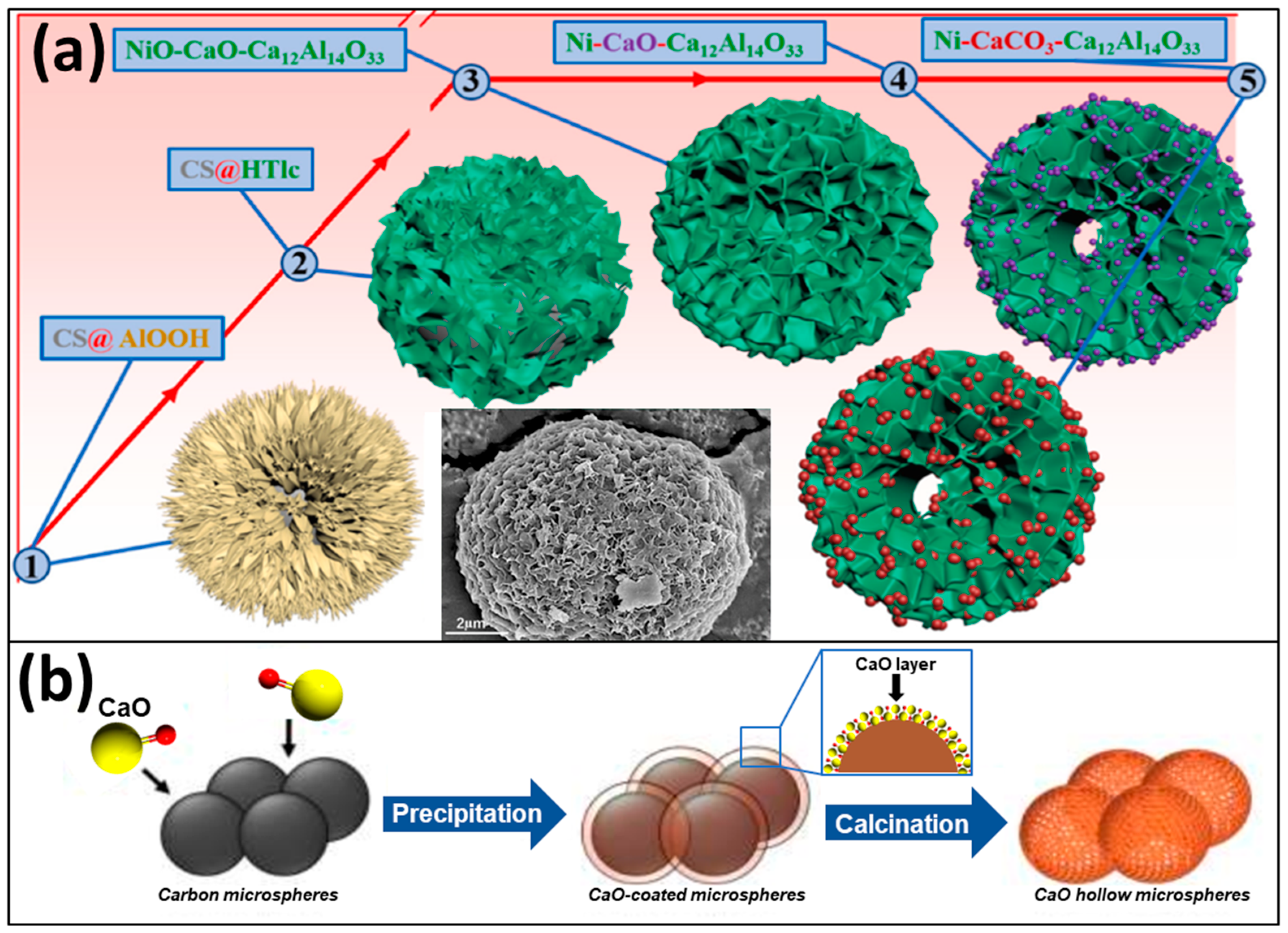
Dang et al. [125] proposed a hollow porous Ni-Ca-Al-O BFM synthesized from an HTl precursor using a two-step hydrothermal method (Figure 13a) to enhance the performance of SESRG. The hollow microsphere structure formed by layered metal oxides effectively alleviated the sintering of Ni and CaO. As a result, the developed BFM demonstrated good performance, maintaining 99% hydrogen purity for 25 min (pre-breakthrough period). However, after 20 consecutive SESRG-regeneration cycles, the duration of this intensified process decreased to less than 15 min, corresponding to approximately 60% of its initial value. In a recent study, Olivier et al. [126] synthesized Ca12Al14O33-stabilized CaO sorbent using a microsphere-assisted method to create a hollow sphere structure (Figure 13b). This advanced approach significantly improved both sorption capacity and cyclic stability of the developed materials compared to traditional methods. After 15 carbonation-calcination cycles at 600 °C, the material exhibited minimal sorption capacity loss (<1%), whereas the material produced without carbon microspheres underwent a 34% decline.
Other treatments have also demonstrated significant improvements in sorbent effectiveness. For example, Radfarnia et al. [127] proposed a novel two-step calcination technique, involving an initial treatment in argon (inert) atmosphere followed by calcination in air, which significantly improved sorption activity compared to one-step calcination. In another study, Shokrollahi Yancheshmeh et al. [34] developed a novel synthesis approach for Ni-CaO-based BFMs, namely Ca3Al2O6-CaO/NiO-CeO2. They first prepared three pure CaO sorbents from natural limestone using three different treatment methods (i.e., thermal decomposition, acid treatment, and ethanol/water treatment). The results revealed that the ethanol/water treatment method yielded the highest CaO molar conversion, owing to the formation of a well-developed porous structure. The cyclic experiments demonstrated higher activity and stability over 10 SESRG cycles, with a constant H2 purity of around 96%. Even simple treatments, such as washing natural limestone, have proven essential for removing impurities (e.g., NaCl and sulfur-containing species) that could negatively affect the sorption capacity of CaO. By investigating the influence of ball milling treatment of UGSO on the CO2 capture performance of CaO-10 wt.% UGSO sorbent, Aissaoui et al. [93] demonstrated that reducing the UGSO particle size by ball-milling significantly enhanced the cyclic stability of the developed material during repeated carbonation-calcination cycles. After 18 cycles, the ball-milled sorbent exhibited more than a 7% higher CaO conversion compared to the untreated sample. This enhancement was attributed to the improved textural properties (30.5 vs. 13.5 m2/g), which mitigated sintering and maintained higher sorption activity over repeated operation.
Enhancement of Pore Structure Stability
During SESR cyclic operation, the tendency of CaO to sinter and agglomerate into larger particles becomes pronounced. Therefore, incorporation of a stabilizer into the BFM matrix may prove to be essential due to (i) the large gap between the desorption temperature of CaO (>800 °C) and the TT of CaCO3 (~533 °C), and (ii) the weak interaction between Ni and CaO [128]. For optimal stabilization, the employed synthesis methods must ensure uniform distribution of the inert phase between CaO particles to effectively reduce particle agglomeration [129] (Figure 14). Additionally, the ratio between sorbent and stabilizer must be optimized. A higher ratio of stabilizers improves the cyclic stability. However, it reduces the portion of active CaO, resulting in a lower sorption capacity. It is therefore imperative to develop and synthesize well-designed BFMs in order to significantly improve the efficiency of SESR processes.
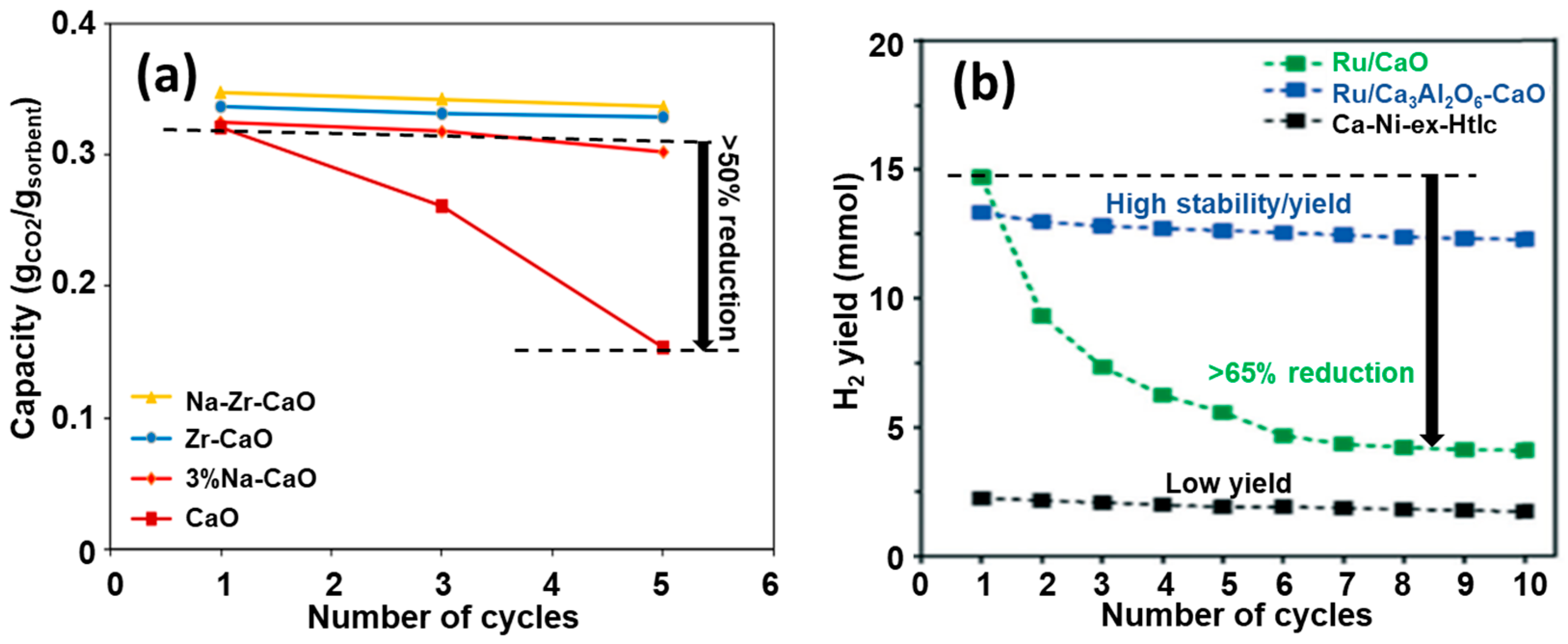
Hashemi [131] used seven distinct metals (aluminum, cerium, lanthanum, magnesium, neodymium, yttrium, and zirconium) with an established molar ratio of metal to sorbent (M:Ca = 1:14) to investigate their performance as stabilizers within a Ca-based sorbent. The findings revealed that Mg-stabilized CaO demonstrated the highest cyclic stability, its superiority being attributed to the elevated TT of MgO, which exceeds 1250 °C. In another study, Rahmanzadeh and Taghizadeh [132] reported an enhancement in the CO2 sorption capacity and cyclic stability of several developed CaO-based sorbents. As shown in Figure 15a, Zr-CaO and Na-Zr-CaO demonstrated more stable sorption capacity, slightly shifting from 0.337 and 0.348 in the 1st cycle to 0.329 and 0.336 at the 5th cycle, respectively. In contrast, the unmodified CaO sorbent displayed significant instability, with more than a 50% reduction in the sorption capacity at the last carbonation cycle. Ca3Al2O6 has also demonstrated a significant stabilizer effect in the Ru/Ca3Al2O6-CaO BFM [133]. As it has yielded excellent results during methane SESR (Figure 15b), this BFM could find potential applications in other SESR processes, including SESRBO.
Using stabilizers with high redox properties is of great interest. Since it can facilitate the oxidation of carbonaceous species and the activation of water, which ultimately increases both the activity and stability of BFM. In particular, CeO2 is an appealing choice for this purpose [134]. In this regard, Ghungrud et al. [109] studied the effect of CeO2, ZrO2, and MgO as inert stabilizers for Co-CaO BFMs over 20 SESRE cycles. The study emphasized that CeO2 and ZrO2-stabilized BFMs displayed superior sorption capabilities and an extended pre-breakthrough period compared to MgO-stabilized BFM. Specifically, the CeO2-stabilized BFM achieved the longest pre-breakthrough duration, lasting up to 45 min. In another study, Hu et al. [85] synthesized a series of Ni/CexZr1-xO2-CaO (Ni/CZC) BFMs and reported that Ni/CZC-2.5 displayed excellent CO2 sorption capacity over 15 consecutive carbonation-calcination cycles, even at a high calcination temperature of 900 °C. During SESR of acetic acid at 550 °C and S/C = 4, Ni/CZC-2.5 showed a high H2 purity (98%) during the pre-breakthrough (maximum intensified) period of 18 min. This performance was attributed to the presence of CaZrO3 phase, which acted as a barrier against CaO sintering at high temperature.
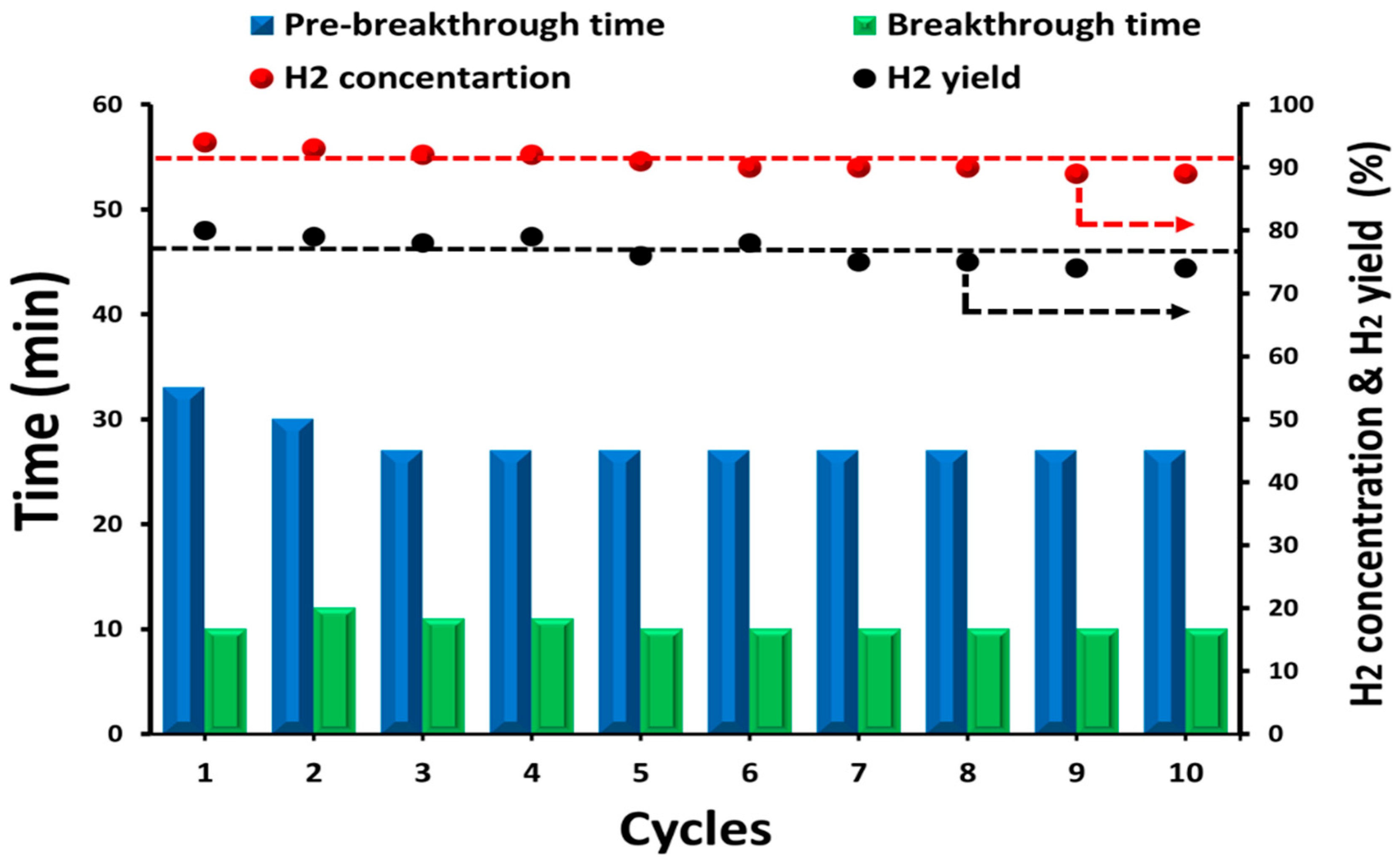
Developed BFMs stabilized on porous materials, e.g., meso- and microporous, spinels, perovskites, and nanocomposite materials, offer enhanced metal dispersion and reduced sintering for the effective SESR process [15]. In this context, Elsaka et al. [98] successfully synthesized a well-designated CeO2-ZrO2 nanocomposite (CZ) via a hydrothermal method and investigated it, for the first time, as a stabilizer in Ni/(CaO-20CZ) BFM for the SESRBO. As shown in Figure 16, the developed BFM demonstrated good stability over 10 consecutive SESRBO cycles in terms of hydrogen purity, yield, and pre-breakthrough duration. Up to the 10th cycle, the catalyst sustained stable performance, achieving an average hydrogen purity of 92% for approximately 27 min. The slight decline observed during the initial cycles, particularly the reduction of the pre-breakthrough period, was ascribed to incomplete decarbonation and/or structural rearrangements occurring at the regeneration temperature (750 °C) [135]. In another study, Aihara et al. [136] developed CaO/CaTiO3 composites, which demonstrated a CaO conversion rate of 0.65 (2.6 times higher than that recorded for pure CaO without CaTiO3 incorporation) after 10 carbonation-calcination cycles. By using hydrothermal synthesis, Wu et al. [137] synthesized a CaO-based metal-organic framework (MOF) co-promoted with MgO/Al2O3, which exhibited excellent CO2 capacity (up to 0.72 gCO2/gsorbent) and maintained a stable performance level of 77% over a series of 100 cyclic tests.
Although a direct comparison among the various BFMs is very difficult due to wide variations in operating and regeneration conditions, Table 5 provides an overview of the cyclic stability of BFMs prepared through different synthesis routes. Obviously, BFMs developed via hydrothermal and carbon-template methods (in particular, Ni/CaO-Ca12Al14O33) demonstrate superior stability, maintaining nearly constant H2 purity and exhibiting minimal decay in CO2 uptake during multiple cycles. In addition to the presence of stable mixed oxide phases such as Ca12Al14O33, this improved stability primarily stems from the structural and morphological advantages of these synthesis techniques. In the hydrothermal route, controlled crystallization promotes the integration of Ni and CaO phases, thereby generating highly dispersed particles that remarkably reduce sorbent agglomeration [123]. Similarly, the carbon-template approach typically produces mesoporous structures that enhance CO2 diffusion and provide sufficient space to accommodate the volume expansion during carbonation [137]. Therefore, controlled synthesis strategies and well-optimized regeneration conditions are crucial for mitigating sorbent deactivation and ensuring the sustained performance of BFMs during cyclic SESR processes.
From a sustainable perspective, valorization of waste materials derived from different industrial processes related to coal-fired thermal power plants, mines, metallurgy, etc., is an extremely attractive approach [141]. This strategy offers cost-effectiveness and a positive environmental impact [142]. Given that this topic is relatively recent, and the majority of studies have emerged in literature within the last ten years, there is ample space for innovative ideas in several key areas: (i) the exploration of waste sources, (ii) their suitable pre-treatment/activation routes, and (iii) advanced synthesis methods for waste-derived-material-supported and -stabilized catalysts and BFM. Table 6 shows the potential of industrial wastes to provide a practical and effective approach to mitigating material sintering. It demonstrates the ability of industrial waste materials to produce highly reactive sorbents with suitable thermal stability during cyclic performance.
In Iliuta’s research group, many efforts are being made to valorize complex wastes (such as UGSO and FA) in order to develop catalytic and BFMs [148]. For example, Aissaoui et al. [93] studied the effect of UGSO as a stabilizer for increasing the cyclic stability of CaO-based sorbents. A UGSO-stabilized CaO material was developed via a wet mixing method involving limestone acidification followed by sonication and two-step calcination. During SESRG at T = 550 °C and S/C = 3, H2 purity of about 95% was achieved during the pre-breakthrough period and lasted for ≈ 30 min. In another study, Gao et al. [92] investigated the use of various FA samples (from different sources around the world, referred to as FA1-FA12) as stabilizers for synthesizing CaO-FA sorbents and Ni-CaO-FA BFM. CaO-FA5 BFM containing 10 wt.% FA5 displayed the best sorption capacity and cyclic stability during 20 sorption-calcination cycles, attributed to a higher specific surface area of this BFM and the presence of relatively high amounts of inert components (Al6Si2O13 and SiO2) in FA5. Ni-CaO-FA5 consistently achieved high and stable hydrogen purity of approximately 97% and a yield of about 90% in SESRG. Similarly, the application of Ni/CaO-based BFMs stabilized by FA or UGSO in the SESRBO [97] led to very high H2 purity (>96%) at 550 °C. The remarkable cyclic stability of BFM-UGSO was mainly due to the uniform distribution of mixed oxides generated by Ni and CaO interaction with UGSO-containing metal oxides.
Improvement of Coke Deposition Resistance
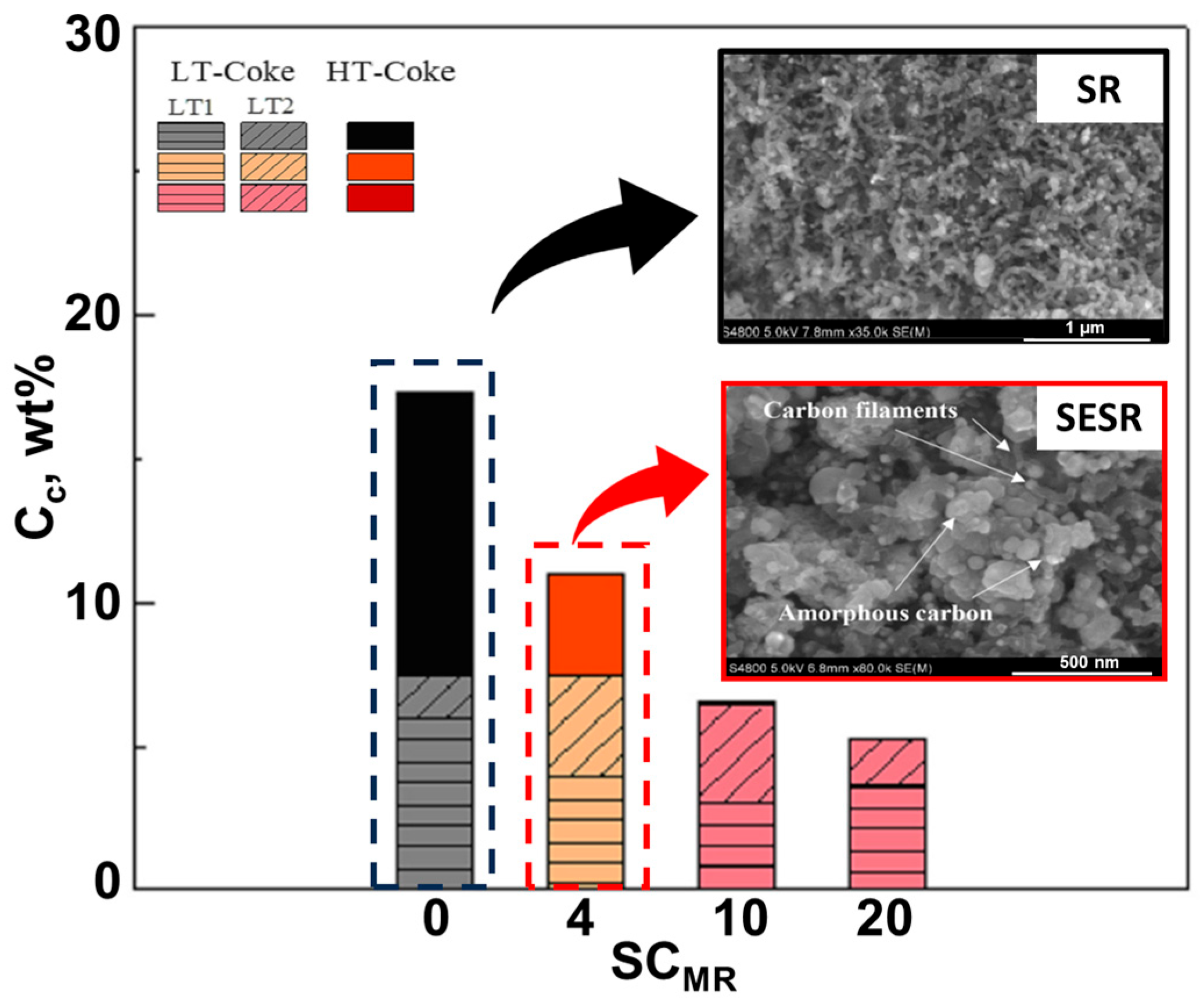
Whereas the SESR process has widely demonstrated the advantage in reducing the coke deposits due to (i) the basic nature of the CO2 sorbent (e.g., CaO) and (ii) the relatively low operating temperature compared to SR [89,92], SESRBO still faces this issue, albeit to a lesser extent [31,99]. In this context, Landa et al. [31] highlighted that the type of reforming process influences both the content and the nature of coke deposits. As illustrated in Figure 17, the total coke deposition under SESRBO conditions was significantly lower than that of conventional SRBO. In the absence of sorbent (sorbent to catalyst ratio (SCMR) = 0), SRBO led to a coke content exceeding 18 wt.%, predominantly consisting of high-temperature (HT) filamentous carbon, whereas SESRBO has reduced coke formation by nearly half, with a larger fraction of low-temperature (LT) amorphous carbon. Further increasing SCMR to 10–20 effectively suppressed coke accumulation.
In general, coke deposition during the SESR reaction is affected by three main factors:
(i)
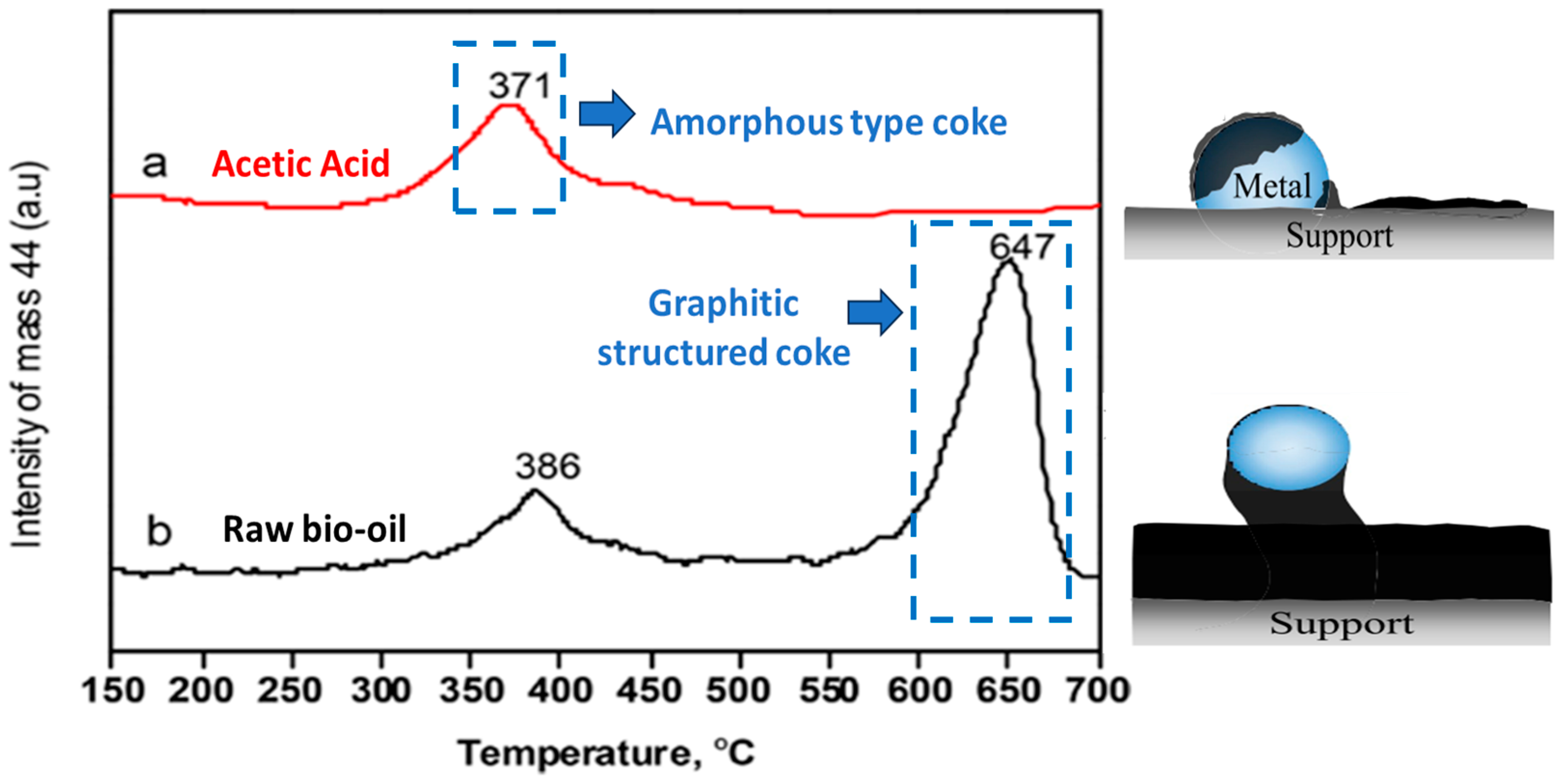
The chemical composition of the feeding stock [31,99]. For example, Dang et al. [90] and Gao et al. [92] observed low carbon deposition during SESR of glycerol. However, for crude glycerol, the tendency of coke formation (both amorphous and graphitic) becomes much more significant due to the presence of some constituents, especially acetic and oleic acids [30]. An increased formation of coke was also noted in another study on SESR of crude glycerol, mainly due to the presence of fatty acid methyl esters [149]. According to TPO results reported by Li et al. [84] (Figure 18), the amount of coke in the case of raw bio-oil (resulting from sawdust pyrolysis) was much higher than that of acetic acid after SESR over Ni/Ce1.2Zr1Ca5 BFMs. The authors argued that the presence of high C/H compounds, such as phenols and their derivatives, in raw bio-oil accelerates coke formation, as these compounds polymerize into complex carbonaceous structures (coke precursors), leading to catalyst deactivation [150]. Similarly, Esteban-Diez et al. [94] achieved high H2 purities (99.2–99.4%) and H2 yields of 90.2–95.9% during the SESR of individual model compounds of BO (acetic acid and acetone) at 575 °C (optimized temperature) and a S/C of 3, using a mechanical mixture of Pd/Co-Ni + dolomite with an SCMR ratio of 5. However, when processing the blend of these compounds in the same conditions, H2 yield was reduced to 83.3–88.6%. This significant decline was attributed to incomplete reactant conversion caused by excessive coke deposition.
(ii)
Operating temperature. Valle et al. [32] emphasized that temperature has a significant influence on the nature of the coke formed. After SR of raw bio-oil (from pine sawdust) at 550 °C, amorphous carbon was detected on the spent catalyst (Ni/La2O3-αAl2O3), compared to the filamentous one at 700 °C. A similar conclusion was reached by Landa [31]. The reactor type also influences the coke deposition. Unlike fixed-bed reactors, fluidized-bed reactors are less prone to coke formation. For instance, after 30 min of time on stream (TOS) during SESRBO runs operated by [99], the coke deposited on the developed hybrid material (mechanical mixture of Ni/Al2O3 (catalyst) + dolomite (sorbent)) was reported as 3.7% and 2.9% in the fixed- and fluidized-bed reactors, respectively.
(iii)
BFM composition. Supporting materials and catalyst promoters play a crucial role in enhancing the removal of carbon deposits from the catalyst/BFM surface. In particular, rare-earth oxides such as CeO2, ZrO2, and La2O3 are widely recognized for their effectiveness in enhancing coke resistance in catalytic processes by facilitating redox reactions, enhancing oxygen mobility, and promoting carbon gasification. The presence of basic oxide supports like alkaline earth oxides (e.g., MgO) and transition metal oxides (e.g., Fe2O3) improves the neutral property of acidic supports, such as alumina, by mitigating coke formation on strong acidic sites [35,151].

4.2.2. Process Simulation and Kinetics Insights

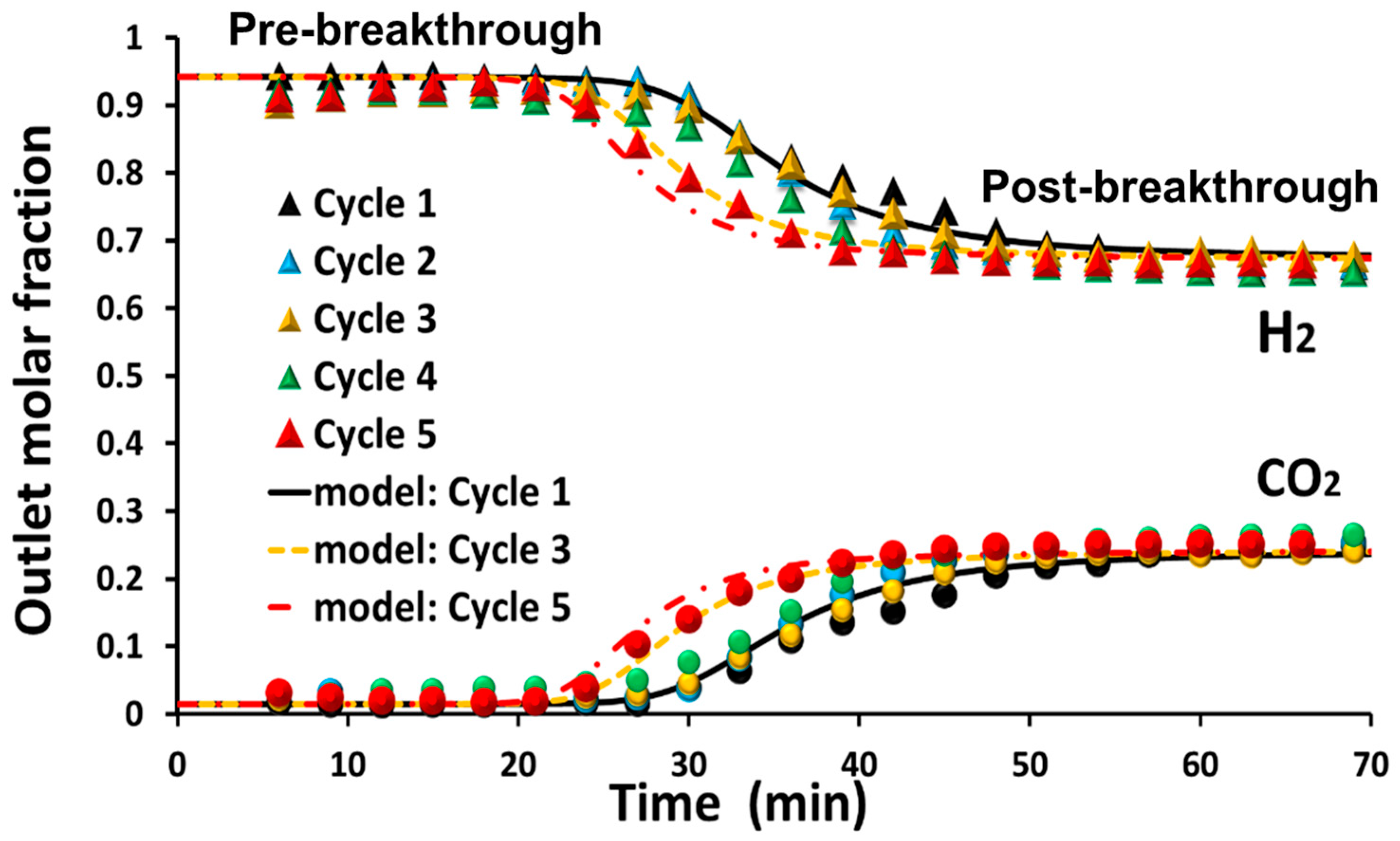
To obtain a reliable intensification suitable for industrial application, achieving high H2 purity is not the sole objective; a prolonged pre-breakthrough period is also imperative in the process design and operation to minimize the reactor switching, thereby enhancing the process reliability [78]. This conclusion was also highlighted by Iliuta et al. [152], who developed a mathematical model for simulating the SESRBO process. The results showed that the extended pre-breakthrough stage associated with high H2 production can be achieved through increasing the sorbent loading and S/C ratio, as well as reducing the inlet gas velocity. While raising the inlet temperature increases the pre-breakthrough duration, it decreases the H2 purity. The same group evaluated for the first time the kinetics of CO2 sorption and steam reforming of bio-oil over Ni-CaO-UGSO and CeNi-CaO-UGSO BFMs, and further developed a comprehensive mathematical reactor model to evaluate the performance of the SESR process [153]. The good agreement between the simulation and the experimental data of different operation temperatures (600–650 °C), WHSVs (1.408–2.816 h−1), and SESRBO cycles (1–5 cycles) (Figure 19) confirms the reliability of the proposed models in facilitating the design of larger-scale SESRBO operations.

5. Conclusions and Recommendations

This review highlights the recent advancements, challenges, and opportunities in steam reforming and sorption-enhanced steam reforming of bio-oil for hydrogen production. Based on the key findings discussed, several limitations and future trends are summarized as follows:
(1)
Bio-oil (derived from biomass) has a high energy density. While it represents a complex mixture of very interesting compounds, such as ethanol, acetic acid, and phenol, it also contains considerable amounts of water. Therefore, the steam reforming of bio-oil enables its direct utilization and eliminates the need for an expensive water separation step before use (an economic and practical advantage). This process displays the feasibility of reliable H2 production.
(2)
Due to the intrinsic complexity of bio-oil, most works considered single-model compounds to study the steam reforming of bio-oil. However, to truly understand the complexity of this process, significant research on a more realistic bio-oil composition is highly needed.
(3)
Combining the valorization of (i) bio-oil (liquid waste from residual biomass) as reforming feedstock and (ii) solid residues as supporting material for SRBO and/or stabilizers for SESRBO represents an effective approach for sustainable and renewable hydrogen production, maximizing the benefit of the available resources, while also reducing the environmental impact.
(4)
Metal sintering and coke deposition are key challenges for commonly used catalysts. Further in-depth research is still required to better understand the mechanisms underlying these phenomena.
(5)
Achieving high H2 purity alone is not sufficient to ensure the practicality of the intensification process in industry. Extending the pre-breakthrough period through proper system design and operation is equally vital to limit switching between reforming/carbonation and sorbent regeneration periods, thereby optimizing efficiency and economic viability.
(6)
In the context of the future development of SESRBO, particular attention should be paid to catalyst activity loss caused by coke deposition, which is particularly pronounced for feedstocks with a high C/H ratio, such as simulated and raw bio-oils.
(7)
The successful industrial implementation of SESRBO requires sustained development and optimization of cost-effective BFMs that exhibit high activity, long-term stability, and strong regenerative capacity. Integrating solid industrial waste into the formulation of BFMs can also represent a promising approach, offering strong synergy between economic benefits and environmental considerations.
(8)
The combination of SESRBO with other advanced technologies, such as dry reforming of methane, could offer significant potential in terms of reducing thermal energy requirements and improving overall system efficiency. In such a configuration, the CO2 captured by the sorbent during the SESR process can then be used as a reactant in dry reforming of methane, enabling the production of high-purity hydrogen.
(9)
Converting the in situ-captured CO2 into value-added chemicals (e.g., CO/syngas, methanol, formic acid, etc.) could enhance the process economics and establish integrated biorefinery concepts.
(10)
Further research is still needed to fully understand the reaction kinetics and mechanisms involved in sorption-enhanced processes, as well as to optimize the treatment of raw or aqueous bio-oil mixtures for practical applications. In this context, reactor simulation can be combined with quantum mechanical modeling, such as Density Functional Theory (DFT), which provides a powerful tool for investigating reaction mechanisms with high accuracy and microscopic resolution, particularly in CO2 capture and related catalytic processes.
(11)
To assess the economic feasibility of the SESRBO process, a comprehensive techno-economic analysis of the integrated system would be of interest, considering factors such as high-temperature regeneration and reactor switching requirements for cyclic operation.

Author Contributions

Conceptualization, Methodology, Investigation, Visualization, and Writing—original draft, E.E. and E.M.; Conceptualization, Methodology, Validation, Writing—review & editing, Supervision, Resources, Project administration, Funding acquisition, M.C.I. All authors have read and agreed to the published version of the manuscript.

Funding

This work received no external funding.

Data Availability Statement

No new data were created or analyzed in this study. Data sharing is not applicable to this article.

Acknowledgments

Eslam Elsaka sincerely appreciates the support of the Egyptian Government Scholarship for his doctoral studies at Laval University.

Conflicts of Interest

The authors declare no conflicts of interest.

References

  1. Chong, C.C.; Cheng, Y.W.; Ng, K.H.; Vo, D.V.N.; Lam, M.K.; Lim, J.W. Bio-Hydrogen Production from Steam Reforming of Liquid Biomass Wastes and Biomass-Derived Oxygenates: A Review. Fuel 2022, 311, 122623. [Google Scholar] [CrossRef]
  2. Masoudi Soltani, S.; Lahiri, A.; Bahzad, H.; Clough, P.; Gorbounov, M.; Yan, Y. Sorption-Enhanced Steam Methane Reforming for Combined CO2 Capture and Hydrogen Production: A State-of-the-Art Review. Carbon Capture Sci. Technol. 2021, 1, 100003. [Google Scholar] [CrossRef]
  3. Desgagnés, A.; Alizadeh Sahraei, O.; Iliuta, M.C. Improvement Strategies for Ni-Based Alcohol Steam Reforming Catalysts. J. Energy Chem. 2023, 86, 447–479. [Google Scholar] [CrossRef]
  4. Shahid, M.M.; Abbas, S.Z.; Maqbool, F.; Ramirez-Solis, S.; Dupont, V.; Mahmud, T. Modeling of Sorption Enhanced Steam Methane Reforming in an Adiabatic Packed Bed Reactor Using Various CO2 Sorbents. J. Environ. Chem. Eng. 2021, 9, 105863. [Google Scholar] [CrossRef]
  5. Tan, K.B.; Zhan, G.; Sun, D.; Huang, J.; Li, Q. The Development of Bifunctional Catalysts for Carbon Dioxide Hydrogenation to Hydrocarbonsviathe Methanol Route: From Single Component to Integrated Components. J. Mater. Chem. A 2021, 9, 5197–5231. [Google Scholar] [CrossRef]
  6. Jacobson, K.; Maheria, K.C.; Kumar Dalai, A. Bio-Oil Valorization: A Review. Renew. Sustain. Energy Rev. 2013, 23, 91–106. [Google Scholar] [CrossRef]
  7. Trane, R.; Dahl, S.; Skjøth-Rasmussen, M.S.; Jensen, A.D. Catalytic Steam Reforming of Bio-Oil. Int. J. Hydrogen Energy 2012, 37, 6447–6472. [Google Scholar] [CrossRef]
  8. Setiabudi, H.D.; Aziz, M.A.A.; Abdullah, S.; Teh, L.P.; Jusoh, R. Hydrogen Production from Catalytic Steam Reforming of Biomass Pyrolysis Oil or Bio-Oil Derivatives: A Review. Int. J. Hydrogen Energy 2020, 45, 18376–18397. [Google Scholar] [CrossRef]
  9. García-Gómez, N.; Valecillos, J.; Remiro, A.; Valle, B.; Bilbao, J.; Gayubo, A.G. Effect of Reaction Conditions on the Deactivation by Coke of a NiAl2O4 Spinel Derived Catalyst in the Steam Reforming of Bio-Oil. Appl. Catal. B Environ. 2021, 297, 120445. [Google Scholar] [CrossRef]
  10. Landa, L.; Remiro, A.; Valecillos, J.; Valle, B.; Bilbao, J.; Gayubo, A.G. Unveiling the Deactivation by Coke of NiAl2O4 Spinel Derived Catalysts in the Bio-Oil Steam Reforming: Role of Individual Oxygenates. Fuel 2022, 321, 124009. [Google Scholar] [CrossRef]
  11. Wang, X.; He, Y.; Xu, T.; Xiao, B.; Liu, S.; Hu, Z.; Li, J. CO2 Sorption-Enhanced Steam Reforming of Phenol Using Ni–M/CaO–Ca12Al14O33 (M = Cu, Co, and Ce) as Catalytic Sorbents. Chem. Eng. J. 2020, 393, 124769. [Google Scholar] [CrossRef]
  12. MacDowell, N.; Florin, N.; Buchard, A.; Hallett, J.; Galindo, A.; Jackson, G.; Adjiman, C.S.; Williams, C.K.; Shah, N.; Fennell, P. An Overview of CO2 Capture Technologies. Energy Environ. Sci. 2010, 3, 1645–1669. [Google Scholar] [CrossRef]
  13. Wang, Y.; Memon, M.Z.; Seelro, M.A.; Fu, W.; Gao, Y.; Ji, G. A Review of CO2 Sorbents for Promoting Hydrogen Production in the Sorption-Enhanced Steam Reforming Process. Int. J. Hydrogen Energy 2021, 46, 23358–23379. [Google Scholar] [CrossRef]
  14. Chen, J.; Sun, J.; Wang, Y. Catalysts for Steam Reforming of Bio-Oil: A Review. Ind. Eng. Chem. Res. 2017, 56, 4627–4637. [Google Scholar] [CrossRef]
  15. Ochoa, A.; Bilbao, J.; Gayubo, A.G.; Castaño, P. Coke Formation and Deactivation during Catalytic Reforming of Biomass and Waste Pyrolysis Products: A Review. Renew. Sustain. Energy Rev. 2020, 119, 109600. [Google Scholar] [CrossRef]
  16. Wang, G.; Dai, Y.; Yang, H.; Xiong, Q.; Wang, K.; Zhou, J.; Li, Y.; Wang, S. A Review of Recent Advances in Biomass Pyrolysis. Energy Fuels 2020, 34, 15557–15578. [Google Scholar] [CrossRef]
  17. Ogo, S.; Sekine, Y. Recent Progress in Ethanol Steam Reforming Using Non-Noble Transition Metal Catalysts: A Review. Fuel Process. Technol. 2020, 199, 106238. [Google Scholar] [CrossRef]
  18. Cai, J.; Rahman, M.M.; Zhang, S.; Sarker, M.; Zhang, X.; Zhang, Y.; Yu, X.; Fini, E.H. Review on Aging of Bio-Oil from Biomass Pyrolysis and Strategy to Slowing Aging. Energy Fuels 2021, 35, 11665–11692. [Google Scholar] [CrossRef]
  19. Adeniyi, A.G.; Otoikhian, K.S.; Ighalo, J.O. Steam Reforming of Biomass Pyrolysis Oil: A Review. Int. J. Chem. React. Eng. 2019, 17, 20180328. [Google Scholar] [CrossRef]
  20. Guo, S.; Zhang, Y.; Liu, L. Sorption Enhanced Steam Reforming of Biomass-Based Feedstocks: Towards Sustainable Hydrogen Evolution. Chem. Eng. J. 2024, 485, 149760. [Google Scholar] [CrossRef]
  21. Arandia, A.; Remiro, A.; García, V.; Castaño, P.; Bilbao, J.; Gayubo, A.G. Oxidative Steam Reforming of Raw Bio-Oil over Supported and Bulk Ni Catalysts for Hydrogen Production. Catalysts 2018, 8, 322. [Google Scholar] [CrossRef]
  22. Wu, C.; Sui, M.; Yan, Y. A Comparison of Steam Reforming of Two Model Bio-Oil Fractions. Chem. Eng. Technol. 2008, 31, 1748–1753. [Google Scholar] [CrossRef]
  23. Remiro, A.; Arandia, A.; Oar-Arteta, L.; Bilbao, J.; Gayubo, A.G. Stability of a Rh/CeO2-ZrO2 Catalyst in the Oxidative Steam Reforming of Raw Bio-Oil. Energy Fuels 2018, 32, 3588–3598. [Google Scholar] [CrossRef]
  24. Arandia, A.; Remiro, A.; Valle, B.; Bilbao, J.; Gayubo, A.G. Deactivation of Ni Spinel Derived Catalyst during the Oxidative Steam Reforming of Raw Bio-Oil. Fuel 2020, 276, 117995. [Google Scholar] [CrossRef]
  25. Chen, D.; He, L. Towards an Efficient Hydrogen Production from Biomass: A Review of Processes and Materials. ChemCatChem 2011, 3, 490–511. [Google Scholar] [CrossRef]
  26. Ochoa, A.; Valle, B.; Resasco, D.E.; Bilbao, J.; Gayubo, A.G.; Castaño, P. Temperature Programmed Oxidation Coupled with In Situ Techniques Reveal the Nature and Location of Coke Deposited on a Ni/La2O3-Al2O3 Catalyst in the Steam Reforming of Bio-Oil. ChemCatChem 2018, 10, 2311–2321. [Google Scholar] [CrossRef]
  27. Palma, V.; Ruocco, C.; Cortese, M.; Martino, M. Bioalcohol Reforming: An Overview of the Recent Advances for the Enhancement of Catalyst Stability. Catalysts 2020, 10, 665. [Google Scholar] [CrossRef]
  28. Rennard, D.; French, R.; Czernik, S.; Josephson, T.; Schmidt, L. Production of Synthesis Gas by Partial Oxidation and Steam Reforming of Biomass Pyrolysis Oils. Int. J. Hydrogen Energy 2010, 35, 4048–4059. [Google Scholar] [CrossRef]
  29. García-Gómez, N.; Valle, B.; Valecillos, J.; Remiro, A.; Bilbao, J.; Gayubo, A.G. Feasibility of Online Pre-Reforming Step with Dolomite for Improving Ni Spinel Catalyst Stability in the Steam Reforming of Raw Bio-Oil. Fuel Process. Technol. 2021, 215, 106769. [Google Scholar] [CrossRef]
  30. Dang, T.N.M.; Alizadeh Sahraei, O.; Olivier, A.; Iliuta, M.C. Effect of Impurities on Glycerol Steam Reforming over Ni-Promoted Metallurgical Waste Driven Catalyst. Int. J. Hydrogen Energy 2022, 47, 4614–4630. [Google Scholar] [CrossRef]
  31. Landa, L.; Remiro, A.; Valecillos, J.; Valle, B.; Sun, S.; Wu, C.; Bilbao, J.; Gayubo, A.G. Sorption Enhanced Steam Reforming (SESR) of Raw Bio-Oil with Ni Based Catalysts: Effect of Sorbent Type, Catalyst Support and Sorbent/Catalyst Mass Ratio. Fuel Process. Technol. 2023, 247, 107799. [Google Scholar] [CrossRef]
  32. Valle, B.; Aramburu, B.; Olazar, M.; Bilbao, J.; Gayubo, A.G. Steam Reforming of Raw Bio-Oil over Ni/La2O3-Al2O3: Influence of Temperature on Product Yields and Catalyst Deactivation. Fuel 2018, 216, 463–474. [Google Scholar] [CrossRef]
  33. Megía, P.J.; Vizcaíno, A.J.; Ruiz-Abad, M.; Calles, J.A.; Carrero, A. Coke Evolution in Simulated Bio-Oil Aqueous Fraction Steam Reforming Using Co/SBA-15. Catal. Today 2021, 367, 145–152. [Google Scholar] [CrossRef]
  34. Shokrollahi Yancheshmeh, M.; Iliuta, M.C. Embedding Ni in Ni-Al Mixed-Metal Alkoxide for the Synthesis of Efficient Coking Resistant Ni-CaO-Based Catalyst-Sorbent Bifunctional Materials for Sorption-Enhanced Steam Reforming of Glycerol. ACS Sustain. Chem. Eng. 2020, 8, 16746–16756. [Google Scholar] [CrossRef]
  35. Shejale, A.D.; Yadav, G.D. Sustainable and Selective Hydrogen Production by Steam Reforming of Bio-Based Ethylene Glycol: Design and Development of Ni–Cu/Mixed Metal Oxides Using M (CeO2, La2O3, ZrO2)–MgO Mixed Oxides. Int. J. Hydrogen Energy 2021, 46, 4808–4826. [Google Scholar] [CrossRef]
  36. Rioche, C.; Kulkarni, S.; Meunier, F.C.; Breen, J.P.; Burch, R. Steam Reforming of Model Compounds and Fast Pyrolysis Bio-Oil on Supported Noble Metal Catalysts. Appl. Catal. B Environ. 2005, 61, 130–139. [Google Scholar] [CrossRef]
  37. Shokrollahi Yancheshmeh, M.; Alizadeh Sahraei, O.; Aissaoui, M.; Iliuta, M.C. A Novel Synthesis of NiAl2O4 Spinel from a Ni-Al Mixed-Metal Alkoxide as a Highly Efficient Catalyst for Hydrogen Production by Glycerol Steam Reforming. Appl. Catal. B Environ. 2020, 265, 118535. [Google Scholar] [CrossRef]
  38. Deshmane, V.G.; Owen, S.L.; Abrokwah, R.Y.; Kuila, D. Mesoporous Nanocrystalline TiO2 Supported Metal (Cu, Co, Ni, Pd, Zn, and Sn) Catalysts: Effect of Metal-Support Interactions on Steam Reforming of Methanol. J. Mol. Catal. A Chem. 2015, 408, 202–213. [Google Scholar] [CrossRef]
  39. David, E.; Kopac, J. Assessment of the Catalytic Performances of Nanocomposites Materials Based on 13X Zeolite, Calcium Oxide and Metal Zinc Particles in the Residual Biomass Pyrolysis Process. Nanomaterials 2022, 12, 3841. [Google Scholar] [CrossRef]
  40. Xu, L.; Song, H.; Chou, L. Mesoporous Nanocrystalline Ceria-Zirconia Solid Solutions Supported Nickel Based Catalysts for CO2 Reforming of CH4. Int. J. Hydrogen Energy 2012, 37, 18001–18020. [Google Scholar] [CrossRef]
  41. Yan, C.F.; Cheng, F.F.; Hu, R.R. Hydrogen Production from Catalytic Steam Reforming of Bio-Oil Aqueous Fraction over Ni/CeO2-ZrO2 Catalysts. Int. J. Hydrogen Energy 2010, 35, 11693–11699. [Google Scholar] [CrossRef]
  42. Mondal, T.; Kaul, N.; Mittal, R.; Pant, K.K. Catalytic Steam Reforming of Model Oxygenates of Bio-Oil for Hydrogen Production Over La Modified Ni/CeO2–ZrO2 Catalyst. Top. Catal. 2016, 59, 1343–1353. [Google Scholar] [CrossRef]
  43. Lin, M.; Fu, Z.Y.; Tan, H.R.; Tan, J.P.Y.; Ng, S.C.; Teo, E. Hydrothermal Synthesis of CeO2 Nanocrystals: Ostwald Ripening or Oriented Attachment? Cryst. Growth Des. 2012, 12, 3296–3303. [Google Scholar] [CrossRef]
  44. Yu, N.; Rahman, M.M.; Chen, J.; Sun, J.; Engelhard, M.; Hernandez, X.I.P.; Wang, Y. Steam Reforming of Simulated Bio-Oil on K-Ni-Cu-Mg-Ce-O/Al2O3: The Effect of K. Catal. Today 2019, 323, 183–190. [Google Scholar] [CrossRef]
  45. Liu, X.; Bao, C.; Zhu, Z.; Zheng, H.; Song, C.; Xu, Q. Thermo-Photo Synergic Effect on Methanol Steam Reforming over Mesoporous Cu/TiO2–CeO2 Catalysts. Int. J. Hydrogen Energy 2021, 46, 26741–26756. [Google Scholar] [CrossRef]
  46. Natewong, P.; Prasongthum, N.; Mhadmhan, S.; Reubroycharoen, P. Fibrous Platelet Carbon Nanofibers-Silica Fiber Composite Supports for a Co-Based Catalyst in the Steam Reforming of Acetic Acid. Appl. Catal. A Gen. 2018, 560, 215–224. [Google Scholar] [CrossRef]
  47. Abbas, T.; Tahir, M. Tri-Metallic Ni–Co Modified Reducible TiO2 Nanocomposite for Boosting H2 Production through Steam Reforming of Phenol. Int. J. Hydrogen Energy 2021, 46, 8932–8949. [Google Scholar] [CrossRef]
  48. Mulewa, W.; Tahir, M.; Amin, N.A.S.; Aishah, N.; Amin, S.; Amin, N.A.S. MMT-Supported Ni/TiO2 Nanocomposite for Low Temperature Ethanol Steam Reforming toward Hydrogen Production. Chem. Eng. J. 2017, 326, 956–969. [Google Scholar] [CrossRef]
  49. Remiro, A.; Valle, B.; Aguayo, A.T.; Bilbao, J.; Gayubo, A.G. Steam Reforming of Raw Bio-Oil in a Fluidized Bed Reactor with Prior Separation of Pyrolytic Lignin. Energy Fuels 2013, 27, 7549–7559. [Google Scholar] [CrossRef]
  50. Reeve, J.; Grasham, O.; Mahmud, T.; Dupont, V. Advanced Steam Reforming of Bio-Oil with Carbon Capture: A Techno-Economic and CO2 Emissions Analysis. Clean Technol. 2022, 4, 309–328. [Google Scholar] [CrossRef]
  51. Wang, S.; Zhang, F.; Cai, Q.; Zhu, L.; Luo, Z. Steam Reforming of Acetic Acid over Coal Ash Supported Fe and Ni Catalysts. Int. J. Hydrogen Energy 2015, 40, 11406–11413. [Google Scholar] [CrossRef]
  52. Cunha, A.F.; Wu, Y.J.; Li, P.; Yu, J.G.; Rodrigues, A.E. Sorption-Enhanced Steam Reforming of Ethanol on a Novel K-Ni-Cu-Hydrotalcite Hybrid Material. Ind. Eng. Chem. Res. 2014, 53, 3842–3853. [Google Scholar] [CrossRef]
  53. Hu, X.; Lu, G. Comparative Study of Alumina-Supported Transition Metal Catalysts for Hydrogen Generation by Steam Reforming of Acetic Acid. Appl. Catal. B Environ. 2010, 99, 289–297. [Google Scholar] [CrossRef]
  54. Román Galdámez, J.; García, L.; Bilbao, R. Hydrogen Production by Steam Reforming of Bio-Oil Using Coprecipitated Ni-Al Catalysts. Acetic Acid as a Model Compound. Energy Fuels 2005, 19, 1133–1142. [Google Scholar] [CrossRef]
  55. Nabgan, W.; Abdullah, T.A.T.; Mat, R.; Nabgan, B.; Jalil, A.A.; Firmansyah, L.; Triwahyono, S. Production of Hydrogen via Steam Reforming of Acetic Acid over Ni and Co Supported on La2O3 Catalyst. Int. J. Hydrogen Energy 2017, 42, 8975–8985. [Google Scholar] [CrossRef]
  56. Luo, S.; Fu, P.; Sun, F.; Wang, B.; Zhang, A.; Wang, J.; Sun, Q. Catalytic Steam Reforming of Bio-Oil-Derived Acetic Acid over CeO2-ZnO Supported Ni Nanoparticle Catalysts. ACS Omega 2020, 5, 19727–19736. [Google Scholar] [CrossRef]
  57. Riani, P.; Garbarino, G.; Canepa, F.; Busca, G. Cobalt Nanoparticles Mechanically Deposited on α-Al2O3: A Competitive Catalyst for the Production of Hydrogen through Ethanol Steam Reforming. J. Chem. Technol. Biotechnol. 2019, 94, 538–546. [Google Scholar] [CrossRef]
  58. Gonçalves, A.A.S.; Faustino, P.B.; Assaf, J.M.; Jaroniec, M. One-Pot Synthesis of Mesoporous Ni-Ti-Al Ternary Oxides: Highly Active and Selective Catalysts for Steam Reforming of Ethanol. ACS Appl. Mater. Interfaces 2017, 9, 6079–6092. [Google Scholar] [CrossRef]
  59. Sohn, H.; Celik, G.; Gunduz, S.; Dogu, D.; Zhang, S.; Shan, J.; Tao, F.F.; Ozkan, U.S. Oxygen Mobility in Pre-Reduced Nano- and Macro-Ceria with Co Loading: An AP-XPS, In-Situ DRIFTS and TPR Study. Catal. Lett. 2017, 147, 2863–2876. [Google Scholar] [CrossRef]
  60. Santander, J.A.; Tonetto, G.M.; Pedernera, M.N.; López, E. Ni/CeO2–MgO Catalysts Supported on Stainless Steel Plates for Ethanol Steam Reforming. Int. J. Hydrogen Energy 2017, 42, 9482–9492. [Google Scholar] [CrossRef]
  61. Xie, H.; Yu, Q.; Yao, X.; Duan, W.; Zuo, Z.; Qin, Q. Hydrogen Production via Steam Reforming of Bio-Oil Model Compounds over Supported Nickel Catalysts. J. Energy Chem. 2015, 24, 299–308. [Google Scholar] [CrossRef]
  62. Xu, Y.; Zhu, Y.; Shen, P.; Chen, G.; Li, X. Production of Hydrogen by Steam Reforming of Phenol over Ni/Al2O3-Ash Catalysts. Int. J. Hydrogen Energy 2022, 47, 13592–13603. [Google Scholar] [CrossRef]
  63. Fermoso, J.; He, L.; Chen, D. Sorption Enhanced Steam Reforming (SESR): A Direct Route towards Efficient Hydrogen Production from Biomass-Derived Compounds. J. Chem. Technol. Biotechnol. 2012, 87, 1367–1374. [Google Scholar] [CrossRef]
  64. Garbarino, G.; Wang, C.; Valsamakis, I.; Chitsazan, S.; Riani, P.; Finocchio, E.; Flytzani-Stephanopoulos, M.; Busca, G. A Study of Ni/Al2O3 and Ni–La/Al2O3 Catalysts for the Steam Reforming of Ethanol and Phenol. Appl. Catal. B Environ. 2015, 174–175, 21–34. [Google Scholar] [CrossRef]
  65. Calles, J.A.; Carrero, A.; Vizcaíno, A.J.; García-Moreno, L.; Megía, P.J. Steam Reforming of Model Bio-Oil Aqueous Fraction Using Ni-(Cu, Co, Cr)/SBA-15 Catalysts. Int. J. Mol. Sci. 2019, 20, 512. [Google Scholar] [CrossRef]
  66. Marquevich, M.; Czernik, S.; Chornet, E.; Montané, D. Hydrogen from Biomass: Steam Reforming of Model Compounds of Fast-Pyrolysis Oil. Energy Fuels 1999, 13, 1160–1166. [Google Scholar] [CrossRef]
  67. Valle, B.; Remiro, A.; Aguayo, A.T.; Bilbao, J.; Gayubo, A.G. Catalysts of Ni/α-Al2O3 and Ni/La2O3-Al2O3 for Hydrogen Production by Steam Reforming of Bio-Oil Aqueous Fraction with Pyrolytic Lignin Retention. Int. J. Hydrogen Energy 2013, 38, 1307–1318. [Google Scholar] [CrossRef]
  68. Quan, C.; Xu, S.; Zhou, C. Steam Reforming of Bio-Oil from Coconut Shell Pyrolysis over Fe/Olivine Catalyst. Energy Convers. Manag. 2017, 141, 40–47. [Google Scholar] [CrossRef]
  69. Qiu, S.B.; Gong, L.; Liu, L.; Hong, C.G.; Yuan, L.X.; Li, Q.X. Hydrogen Production by Low-Temperature Steam Reforming of Bio-Oil over Ni/HZSM-5 Catalyst. Chin. J. Chem. Phys. 2011, 24, 211–217. [Google Scholar] [CrossRef]
  70. Bali, A.; Blanchard, J.; Chamoumi, M.; Abatzoglou, N. Bio-Oil Steam Reforming over a Mining Residue Functionalized with Ni as Catalyst: Ni-UGSO. Catalysts 2018, 8, 1. [Google Scholar] [CrossRef]
  71. Basagiannis, A.C.; Verykios, X.E. Catalytic Steam Reforming of Acetic Acid for Hydrogen Production. Int. J. Hydrogen Energy 2007, 32, 3343–3355. [Google Scholar] [CrossRef]
  72. Gallegos-Suárez, E.; Guerrero-Ruiz, A.; Fernández-García, M.; Rodríguez-Ramos, I.; Kubacka, A. Efficient and Stable Ni-Ce Glycerol Reforming Catalysts: Chemical Imaging Using X-Ray Electron and Scanning Transmission Microscopy. Appl. Catal. B Environ. 2015, 165, 139–148. [Google Scholar] [CrossRef]
  73. Wang, S.; Zhang, F.; Cai, Q.; Li, X.; Zhu, L.; Wang, Q.; Luo, Z. Catalytic Steam Reforming of Bio-Oil Model Compounds for Hydrogen Production over Coal Ash Supported Ni Catalyst. Int. J. Hydrogen Energy 2014, 39, 2018–2025. [Google Scholar] [CrossRef]
  74. Dou, B.; Dupont, V.; Rickett, G.; Blakeman, N.; Williams, P.T.; Chen, H.; Ding, Y.; Ghadiri, M. Hydrogen Production by Sorption-Enhanced Steam Reforming of Glycerol. Bioresour. Technol. 2009, 100, 3540–3547. [Google Scholar] [CrossRef]
  75. Shokrollahi Yancheshmeh, M.; Radfarnia, H.R.; Iliuta, M.C. Sustainable Production of High-Purity Hydrogen by Sorption Enhanced Steam Reforming of Glycerol over CeO2-Promoted Ca9Al6O18-CaO/NiO Bifunctional Material. ACS Sustain. Chem. Eng. 2017, 5, 9774–9786. [Google Scholar] [CrossRef]
  76. Wu, Y.J.; Li, P.; Yu, J.G.; Cunha, A.F.; Rodrigues, A.E. High-Purity Hydrogen Production by Sorption-Enhanced Steam Reforming of Ethanol: A Cyclic Operation Simulation Study. Ind. Eng. Chem. Res. 2014, 53, 8515–8527. [Google Scholar] [CrossRef]
  77. Shokrollahi Yancheshmeh, M.; Radfarnia, H.R.; Iliuta, M.C. High Temperature CO2 Sorbents and Their Application for Hydrogen Production by Sorption Enhanced Steam Reforming Process. Chem. Eng. J. 2016, 283, 420–444. [Google Scholar] [CrossRef]
  78. Teixeira, P.; Bacariza, C.; Correia, P.; Pinheiro, C.I.C.; Cabrita, I. Hydrogen Production with In Situ CO2 Capture at High and Medium Temperatures Using Solid Sorbents. Energies 2022, 15, 4039. [Google Scholar] [CrossRef]
  79. Sun, H.; Wu, C.; Shen, B.; Zhang, X.; Zhang, Y.; Huang, J. Progress in the Development and Application of CaO-Based Adsorbents for CO2 Capture—A Review. Mater. Today Sustain. 2018, 1–2, 1–27. [Google Scholar] [CrossRef]
  80. Di Giuliano, A.; Gallucci, K.; Foscolo, P.U. Determination of Kinetic and Diffusion Parameters Needed to Predict the Behavior of CaO-Based CO2 Sorbent and Sorbent-Catalyst Materials. Ind. Eng. Chem. Res. 2020, 59, 6840–6854. [Google Scholar] [CrossRef]
  81. Konopacka-Łyskawa, D.; Czaplicka, N.; Szefer, A. CaO-Based High Temperature CO2 Sorbents—Literature Review. Chem. Process Eng.—Inz. Chem. I Proces. 2021, 42, 411–438. [Google Scholar] [CrossRef]
  82. Zhao, X.Y.; Xue, Y.P.; Yan, C.F.; Wang, Z.D.; Guo, C.Q.; Huang, S.L. Sorbent Assisted Catalyst of Ni-CaO-La2O3 for Sorption Enhanced Steam Reforming of Bio-Oil with Acetic Acid as the Model Compound. Chem. Eng. Process. Process Intensif. 2017, 119, 106–112. [Google Scholar] [CrossRef]
  83. Omoniyi, O.A.; Dupont, V. Optimised Cycling Stability of Sorption Enhanced Chemical Looping Steam Reforming of Acetic Acid in a Packed Bed Reactor. Appl. Catal. B Environ. 2019, 242, 397–409. [Google Scholar] [CrossRef]
  84. Li, D.; Xue, H.; Hu, R. Effect of Ce/Ca Ratio in Ni/CeO2-ZrO2-CaO Catalysts on High-Purity Hydrogen Production by Sorption-Enhanced Steam Reforming of Acetic Acid and Bio-Oil. Ind. Eng. Chem. Res. 2020, 59, 1446–1456. [Google Scholar] [CrossRef]
  85. Hu, R.; Li, D.; Xue, H.; Zhang, N.; Liu, Z.; Liu, Z. Hydrogen Production by Sorption-Enhanced Steam Reforming of Acetic Acid over Ni/CexZr1−xO2-CaO Catalysts. Int. J. Hydrogen Energy 2017, 42, 7786–7797. [Google Scholar] [CrossRef]
  86. Liu, L.; Hong, D.; Wang, N.; Guo, X. High Purity H2 Production from Sorption Enhanced Bio-Ethanol Reforming via Sol-Gel-Derived Ni–CaO–Al2O3 Bi-Functional Materials. Int. J. Hydrogen Energy 2020, 45, 34449–34460. [Google Scholar] [CrossRef]
  87. Nimmas, T.; Jamrunroj, P.; Wongsakulphasatch, S.; Kiatkittipong, W.; Laosiripojana, N.; Gong, J.; Assabumrungrat, S. Influence of CaO Precursor on CO2 Capture Performance and Sorption-Enhanced Steam Ethanol Reforming. Int. J. Hydrogen Energy 2019, 44, 20649–20662. [Google Scholar] [CrossRef]
  88. Gunduz, S.; Dogu, T. Sorption-Enhanced Reforming of Ethanol over Ni- and Co-Incorporated MCM-41 Type Catalysts. Ind. Eng. Chem. Res. 2012, 51, 8796–8805. [Google Scholar] [CrossRef]
  89. Dang, C.; Wu, S.; Yang, G.; Cao, Y.; Wang, H.; Peng, F.; Wang, S.; Yu, H. Hydrogen Production from Sorption-Enhanced Steam Reforming of Phenol over a Ni-Ca-Al-O Bifunctional Catalyst. ACS Sustain. Chem. Eng. 2020, 8, 7111–7120. [Google Scholar] [CrossRef]
  90. Dang, C.; Wang, H.; Yu, H.; Peng, F. Co-Cu-CaO Catalysts for High-Purity Hydrogen from Sorption-Enhanced Steam Reforming of Glycerol. Appl. Catal. A Gen. 2017, 533, 9–16. [Google Scholar] [CrossRef]
  91. Wang, C.; Dou, B.; Jiang, B.; Song, Y.; Du, B.; Zhang, C.; Wang, K.; Chen, H.; Xu, Y. Sorption-Enhanced Steam Reforming of Glycerol on Ni-Based Multifunctional Catalysts. Int. J. Hydrogen Energy 2015, 40, 7037–7044. [Google Scholar] [CrossRef]
  92. Gao, K.; Shokrollahi Yancheshmeh, M.; Duchesne, J.; Iliuta, M.C. Valorization of Coal Fly Ash as a Stabilizer for the Development of Ni/CaO-Based Bifunctional Material. ACS Sustain. Chem. Eng. 2020, 8, 3885–3895. [Google Scholar] [CrossRef]
  93. Aissaoui, M.; Alizadeh Sahraei, O.; Shokrollahi Yancheshmeh, M.; Iliuta, M.C. Development of a Fe/Mg-Bearing Metallurgical Waste Stabilized-CaO/NiO Hybrid Sorbent-Catalyst for High Purity H2 Production through Sorption-Enhanced Glycerol Steam Reforming. Int. J. Hydrogen Energy 2020, 45, 18452–18465. [Google Scholar] [CrossRef]
  94. Esteban-díez, G.; Gil, M.V.; Pevida, C.; Chen, D.; Rubiera, F. Effect of Operating Conditions on the Sorption Enhanced Steam Reforming of Blends of Acetic Acid and Acetone as Bio-Oil Model Compounds. Appl. Energy 2016, 177, 579–590. [Google Scholar] [CrossRef]
  95. Acha, E.; Chen, D.; Cambra, J.F. Comparison of Novel Olivine Supported Catalysts for High Purity Hydrogen Production by CO2 sorption Enhanced Steam Reforming. J. CO2 Util. 2020, 42, 101295. [Google Scholar] [CrossRef]
  96. Xie, H.; Yu, Q.; Wei, M.; Duan, W.; Yao, X.; Zuo, Z. Hydrogen Production from Steam Reforming of Simulated Bio-Oil over Ce-Ni/Co Catalyst with in Continuous CO2 Capture. Int. J. Hydrogen Energy 2015, 40, 1420–1428. [Google Scholar] [CrossRef]
  97. Elsaka, E.; Desgagnés, A.; Iliuta, M.C. Towards Renewable High-Purity H2 Production via Intensified Bio-Oil Sorption-Enhanced Steam Reforming over Wastes-Driven-Stabilized Ni/CaO Bifunctional Materials. Int. J. Hydrogen Energy 2024, 91, 1330–1342. [Google Scholar] [CrossRef]
  98. Elsaka, E.; Iliuta, M.C. CeO2-ZrO2 Nanocomposite-Stabilized Ni/CaO Bifunctional Material: Novel Candidate for Sustainable Hydrogen Production via SESR of Bio-Oil. Chem. Eng. Process.-Process Intensif 2025, 218, 110531. [Google Scholar] [CrossRef]
  99. Landa, L.; Valecillos, J.; Remiro, A.; Valle, B.; Bilbao, J.; Gayubo, A.G. Comparison of the NiAl2O4 Derived Catalyst Deactivation in the Steam Reforming and Sorption Enhanced Steam Reforming of Raw Bio-Oil in Packed and Fluidized-Bed Reactors. Chem. Eng. J. 2023, 458, 141494. [Google Scholar] [CrossRef]
  100. Xie, H.; Yu, Q.; Zuo, Z.; Han, Z.; Yao, X.; Qin, Q. Hydrogen production via sorption-enhanced catalytic steam reforming of bio-oil. Int. J. Hydrogen Energy 2016, 41, 2345–2353. [Google Scholar] [CrossRef]
  101. Chen, J.; Duan, L.; Sun, Z. Review on the Development of Sorbents for Calcium Looping. Energy Fuels 2020, 34, 7806–7836. [Google Scholar] [CrossRef]
  102. Zhao, C.; Zhou, Z.; Cheng, Z.; Fang, X. Sol-gel-derived, CaZrO3-stabilized Ni/CaO-CaZrO3 bifunctional Catalyst for Sorption-Enhanced Steam Methane Reforming. Applied Catal. B Environ. 2016, 196, 16–26. [Google Scholar] [CrossRef]
  103. Wang, P.; Xie, H.; Zhang, J.; Jia, L.; Yu, Z.; Li, R. Optimization of Two Bio-Oil Steam Reforming Processes for Hydrogen Production Based on Thermodynamic Analysis. Int. J. Hydrogen Energy 2022, 47, 9853–9863. [Google Scholar] [CrossRef]
  104. Lindén, I.; Backman, P.; Brink, A.; Hupa, M. Influence of Water Vapor on Carbonation of CaO in the Temperature Range 400–550 °C. Ind. Eng. Chem. Res. 2011, 50, 14115–14120. [Google Scholar] [CrossRef]
  105. Wang, H.; Li, Z.; Cai, N. Multiscale Model for Steam Enhancement Effect on the Carbonation of CaO Particle. Chem. Eng. J. 2020, 394, 124892. [Google Scholar] [CrossRef]
  106. Arcenegui Troya, J.J.; Moreno, V.; Sanchez-Jiménez, P.E.; Perejón, A.; Valverde, J.M.; Pérez-Maqueda, L.A. Effect of Steam Injection during Carbonation on the Multicyclic Performance of Limestone (CaCO3) under Different Calcium Looping Conditions: A Comparative Study. ACS Sustain. Chem. Eng. 2022, 10, 850–859. [Google Scholar] [CrossRef] [PubMed]
  107. Bai, R.; Li, N.; Liu, Q.Q.; Chen, S.; Liu, Q.Q.; Zhou, X. Effect of Steam on Carbonation of CaO in Ca-Looping. Molecules 2023, 28, 4910. [Google Scholar] [CrossRef]
  108. Valle, B.; Aramburu, B.; Benito, P.L.; Bilbao, J.; Gayubo, A.G. Biomass to Hydrogen-Rich Gas via Steam Reforming of Raw Bio-Oil over Ni/La2O3-Al2O3 Catalyst: Effect of Space-Time and Steam-to-Carbon Ratio. Fuel 2018, 216, 445–455. [Google Scholar] [CrossRef]
  109. Ghungrud, S.A.; Vaidya, P.D. Improved Hydrogen Production from Sorption-Enhanced Steam Reforming of Ethanol (SESRE) Using Multifunctional Materials of Cobalt Catalyst and Mg-, Ce-, and Zr-Modified CaO Sorbents. Ind. Eng. Chem. Res. 2020, 59, 693–703. [Google Scholar] [CrossRef]
  110. Ma, X.; Li, Y.; Huang, X.; Feng, T.; Mu, M. Sorption-Enhanced Reaction Process Using Advanced Ca-Based Sorbents for Low-Carbon Hydrogen Production. Process Saf. Environ. Prot. 2021, 155, 325–342. [Google Scholar] [CrossRef]
  111. Di Stasi, C.; Cortese, M.; Greco, G.; Renda, S.; González, B.; Palma, V.; Manyà, J.J. Optimization of the Operating Conditions for Steam Reforming of Slow Pyrolysis Oil over an Activated Biochar-Supported Ni–Co Catalyst. Int. J. Hydrogen Energy 2021, 46, 26915–26929. [Google Scholar] [CrossRef]
  112. Silaban, A.; Narcida, M.; Harrison, D.P. Characteristics of the Reversible Reaction between CO2(g) and Calcined Dolomite. Chem. Eng. Commun. 1996, 146, 149–162. [Google Scholar] [CrossRef]
  113. Grasa, G.S.; Abanades, J.C. CO2 Capture Capacity of CaO in Long Series of Carbonation/Calcination Cycles. Ind. Eng. Chem. Res. 2006, 45, 8846–8851. [Google Scholar] [CrossRef]
  114. Sun, H.; Wang, J.; Liu, X.; Shen, B.; Parlett, C.M.A.; Adwek, G.O.; John Anthony, E.; Williams, P.T.; Wu, C. Fundamental Studies of Carbon Capture Using CaO-Based Materials. J. Mater. Chem. 2019, 7, 9977–9987. [Google Scholar] [CrossRef]
  115. Han, R.; Wang, Y.; Xing, S.; Pang, C.; Hao, Y.; Song, C.; Liu, Q. Progress in Reducing Calcination Reaction Temperature of Calcium-Looping CO2 Capture Technology: A Critical Review. Chem. Eng. J. 2022, 450, 137952. [Google Scholar] [CrossRef]
  116. Sarrión, B.; Perejón, A.; Sánchez-Jiménez, P.E.; Amghar, N.; Chacartegui, R.; Manuel Valverde, J.; Pérez-Maqueda, L.A. Calcination under Low CO2 Pressure Enhances the Calcium Looping Performance of Limestone for Thermochemical Energy Storage. Chem. Eng. J. 2021, 417, 127922. [Google Scholar] [CrossRef]
  117. Dang, C.; Long, J.; Li, H.; Cai, W.; Yu, H. Pd-Promoted Ni-Ca-Al Bi-Functional Catalyst for Integrated Sorption-Enhanced Steam Reforming of Glycerol and Methane Reforming of Carbonate. Chem. Eng. Sci. 2021, 230, 116226. [Google Scholar] [CrossRef]
  118. Nimmas, T.; Wongsakulphasatch, S.; Kui Cheng, C.; Assabumrungrat, S. Bi-Metallic CuO-NiO Based Multifunctional Material for Hydrogen Production from Sorption-Enhanced Chemical Looping Autothermal Reforming of Ethanol. Chem. Eng. J. 2020, 398, 125543. [Google Scholar] [CrossRef]
  119. Yang, L.; Yu, H.; Wang, S.; Wang, H.; Zhou, Q. Carbon Dioxide Captured from Flue Gas by Modified Ca-Based Sorbents in Fixed-Bed Reactor at High Temperature. Chin. J. Chem. Eng. 2013, 21, 199–204. [Google Scholar] [CrossRef]
  120. Li, Z.; Sun, H.; Cai, N. Rate Equation Theory for the Carbonation Reaction of CaO with CO2. Energy Fuels 2012, 26, 4607–4616. [Google Scholar] [CrossRef]
  121. Luo, C.; Zheng, Y.; Zheng, C.; Yin, J.; Qin, C.; Feng, B. Manufacture of Calcium-Based Sorbents for High Temperature Cyclic CO2 Capture via a Sol-Gel Process. Int. J. Greenh. Gas Control 2013, 12, 193–199. [Google Scholar] [CrossRef]
  122. Salaudeen, S.A.; Acharya, B.; Dutta, A. CaO-Based CO2 Sorbents: A Review on Screening, Enhancement, Cyclic Stability, Regeneration and Kinetics Modelling. J. CO2 Util. 2018, 23, 179–199. [Google Scholar] [CrossRef]
  123. Rong, N.; Wang, Q.; Fang, M.; Cheng, L.; Luo, Z.; Cen, K. Steam Hydration Reactivation of CaO-Based Sorbent in Cyclic Carbonation/Calcination for CO2 Capture. Energy Fuels 2013, 27, 5332–5340. [Google Scholar] [CrossRef]
  124. Akgsornpeak, A.; Witoon, T.; Mungcharoen, T.; Limtrakul, J. Development of Synthetic CaO Sorbents via CTAB-Assisted Sol-Gel Method for CO2 Capture at High Temperature. Chem. Eng. J. 2014, 237, 189–198. [Google Scholar] [CrossRef]
  125. Dang, C.; Li, Z.; Long, J.; Yang, W.; Cai, W. Sorption-Enhanced Glycerol Steam Reforming over Hierarchical Hollow Ni-CaO-Ca12Al14O33 Bi-Functional Catalyst Derived from Hydrotalcite-like Compounds. Fuel 2022, 324, 124468. [Google Scholar] [CrossRef]
  126. Olivier, A.; Desgagnés, A.; Iliuta, M.C. Development of a Bifunctional Material Incorporating Carbon Microspheres for the Intensified Hydrogen Production by Sorption-Enhanced Glycerol Steam Reforming. Chem. Eng. Process.-Process Intensif. 2024, 200, 109790. [Google Scholar] [CrossRef]
  127. Radfarnia, H.R.; Iliuta, M.C. Limestone Acidification Using Citric Acid Coupled with Two-Step Calcination for Improving the CO2 Sorbent Activity. Ind. Eng. Chem. Res. 2013, 52, 7002–7013. [Google Scholar] [CrossRef]
  128. Sang, S.; Zhao, Z.J.; Tian, H.; Sun, Z.; Li, H.; Assabumrungrat, S.; Muhammad, T.; Zeng, L.; Gong, J. Promotional Role of MgO on Sorption-Enhanced Steam Reforming of Ethanol over Ni/CaO Catalysts. AIChE J. 2020, 66, e16877. [Google Scholar] [CrossRef]
  129. Palma, V.; Ruocco, C.; Meloni, E.; Gallucci, F.; Ricca, A. Enhancing Pt-Ni/CeO2 Performances for Ethanol Reforming by Catalyst Supporting on High Surface Silica. Catal. Today 2018, 307, 175–188. [Google Scholar] [CrossRef]
  130. Armutlulu, A.; Naeem, M.A.; Liu, H.J.; Kim, S.M.; Kierzkowska, A.; Fedorov, A.; Müller, C.R. Multishelled CaO Microspheres Stabilized by Atomic Layer Deposition of Al2O3 for Enhanced CO2 Capture Performance. Adv. Mater. 2017, 29, 1702896. [Google Scholar] [CrossRef] [PubMed]
  131. Hashemi, S.M.; Mohamedali, M.; Sedghkerdar, M.H.; Mahinpey, N. Stability of CaO-Based Sorbents under Realistic Calcination Conditions: Effect of Metal Oxide Supports. ACS Sustain. Chem. Eng. 2022, 10, 9760–9769. [Google Scholar] [CrossRef]
  132. Rahmanzadeh, L.; Taghizadeh, M. Sorption-Enhanced Ethanol Steam Reforming on Ce-Ni/MCM-41 with Simultaneous CO2 Adsorption over Na- and Zr- Promoted CaO Based Sorbent. Int. J. Hydrogen Energy 2019, 44, 21238–21250. [Google Scholar] [CrossRef]
  133. Kim, S.M.; Abdala, P.M.; Hosseini, D.; Armutlulu, A.; Margossian, T.; Copéret, C.; Müller, C. Bi-Functional Ru/Ca3Al2O6-CaO Catalyst-CO2 Sorbent for the Production of High Purity Hydrogen: Via Sorption-Enhanced Steam Methane Reforming. Catal. Sci. Technol. 2019, 9, 5745–5756. [Google Scholar] [CrossRef]
  134. Pakharukova, V.P.; Potemkin, D.I.; Rogozhnikov, V.N.; Stonkus, O.A.; Gorlova, A.M.; Nikitina, N.A.; Suprun, E.A.; Brayko, A.S.; Rogov, V.A.; Snytnikov, P.V. Effect of Ce/Zr Composition on Structure and Properties of Ce1−xZrxO2 Oxides and Related Ni/Ce1−xZrxO2 Catalysts for CO2 Methanation. Nanomaterials 2022, 12, 3207. [Google Scholar] [CrossRef] [PubMed]
  135. Landa, L.; Remiro, A.; Valecillos, J.; Valle, B.; Bilbao, J.; Gayubo, A.G. Performance of NiAl2O4 Spinel Derived Catalyst + Dolomite in the Sorption Enhanced Steam Reforming (SESR) of Raw Bio-Oil in Cyclic Operation. Int. J. Hydrogen Energy 2024, 58, 1526–1540. [Google Scholar] [CrossRef]
  136. Aihara, M.; Nagai, T.; Matsushita, J. Development of Porous Solid Reactant for Thermal-Energy Storage and Temperature Upgrade Using Carbonation/Decarbonation Reaction. Appl. Energy 2001, 69, 225–238. [Google Scholar] [CrossRef]
  137. Wu, S.C.; Chang, P.H.; Lin, C.Y.; Peng, C.H. Multi-Metals CaMgAl Metal-Organic Framework as CaO-Based Sorbent to Achieve Highly CO2 Capture Capacity and Cyclic Performance. Materials 2020, 13, 2220. [Google Scholar] [CrossRef]
  138. Dang, C.; Yu, H.; Wang, H.; Peng, F.; Yang, Y. A Bi-Functional Co-CaO-Ca12Al14O33 Catalyst for Sorption-Enhanced Steam Reforming of Glycerol to High-Purity Hydrogen. Chem. Eng. J. 2016, 286, 329–338. [Google Scholar] [CrossRef]
  139. Xu, Y.; Lu, B.; Luo, C.; Chen, J.; Zhang, Z.; Zhang, L. Sorption Enhanced Steam Reforming of Ethanol over Ni-Based Catalyst Coupling with High-Performance CaO Pellets. Chem. Eng. J. 2021, 406, 126903. [Google Scholar] [CrossRef]
  140. Dang, C.; Liang, S.; Yang, W.; Cai, W. High-Purity Hydrogen Production from Phenol on Ni-CaO-Ca12Al14O33 Multifunctional Catalyst Derived from Recovered Layered Double Hydroxide. Fuel 2023, 332, 126041. [Google Scholar] [CrossRef]
  141. Alizadeh Sahraei, O.; Gao, K.; Iliuta, M.C. Application of industrial solid wastes in catalyst and chemical sorbent development for hydrogen/syngas production by conventional and intensified steam reforming. In New Dimensions in Production and Utilization of Hydrogen; Elsevier: Amsterdam, The Netherlands, 2020; Chapter 2; pp. 21–55. [Google Scholar] [CrossRef]
  142. Ayesha, M.; Khoja, A.H.; Butt, F.A.; Sikandar, U.; Javed, A.H.; Naqvi, S.R.; Din, I.U.; Mehran, M.T. Sorption Enhanced Steam Reforming of Methane over Waste-Derived CaO Promoted MgNiAl Hydrotalcite Catalyst for Sustainable H2 production. J. Environ. Chem. Eng. 2022, 10, 107651. [Google Scholar] [CrossRef]
  143. Chen, H.; Zhao, C.; Ren, Q. Feasibility of CO2/SO2 Uptake Enhancement of Calcined Limestone Modified with Rice Husk Ash during Pressurized Carbonation. J. Environ. Manag. 2012, 93, 235–244. [Google Scholar] [CrossRef]
  144. Li, Y.; Zhao, C.; Ren, Q.; Duan, L.; Chen, H.; Chen, X. Effect of Rice Husk Ash Addition on CO2 Capture Behavior of Calcium-Based Sorbent during Calcium Looping Cycle. Fuel Process. Technol. 2009, 90, 825–834. [Google Scholar] [CrossRef]
  145. Chen, H.; Khalili, N. Fly-Ash-Modified Calcium-Based Sorbents Tailored to CO2 Capture. Ind. Eng. Chem. Res. 2017, 56, 1888–1894. [Google Scholar] [CrossRef]
  146. Ma, X.; Li, Y.; Shi, L.; He, Z.; Wang, Z. Fabrication and CO2 Capture Performance of Magnesia-Stabilized Carbide Slag by by-Product of Biodiesel during Calcium Looping Process. Appl. Energy 2016, 168, 85–95. [Google Scholar] [CrossRef]
  147. Yan, F.; Jiang, J.; Li, K.; Tian, S.; Liu, Z.; Shi, J.; Chen, X.; Fei, J.; Lu, Y. Cyclic Performance of Waste-Derived SiO2 Stabilized, CaO-Based Sorbents for Fast CO2 Capture. ACS Sustain. Chem. Eng. 2016, 4, 7004–7012. [Google Scholar] [CrossRef]
  148. Iliuta, M.C. Intensified Processes for CO2 Capture and Valorization by Catalytic Conversion. Chem. Eng. Process.-Process Intensif. 2024, 205, 109995. [Google Scholar] [CrossRef]
  149. Fermoso, J.; He, L.; Chen, D. Production of High Purity Hydrogen by Sorption Enhanced Steam Reforming of Crude Glycerol. Int. J. Hydrogen Energy 2012, 37, 14047–14054. [Google Scholar] [CrossRef]
  150. Pafili, A.; Charisiou, N.D.; Douvartzides, S.L.; Siakavelas, G.I.; Wang, W.; Liu, G.; Papadakis, V.G.; Goula, M.A. Recent Progress in the Steam Reforming of Bio-Oil for Hydrogen Production: A Review of Operating Parameters, Catalytic Systems and Technological Innovations. Catalysts 2021, 11, 1526. [Google Scholar] [CrossRef]
  151. Palma, V.; Ruocco, C.; Castaldo, F.; Ricca, A.; Boettge, D. Ethanol Steam Reforming over Bimetallic Coated Ceramic Foams: Effect of Reactor Configuration and Catalytic Support. Int. J. Hydrogen Energy 2015, 40, 12650–12662. [Google Scholar] [CrossRef]
  152. Iliuta, I.; Desgagnés, A.; Aulestia, A.Y.; Pfeiffer, H.; Iliuta, M.C. Intensified Bio-Oil Steam Reforming for High-Purity Hydrogen Production: Numerical Simulation and Sorption Kinetics. Int. J. Hydrogen Energy 2022, 48, 8783–8806. [Google Scholar] [CrossRef]
  153. Elsaka, E.; Iliuta, I.; Desgagnés, A.; Poulin, C.; Iliuta, M.C. Intensified Simulated Bio-Oil Steam Reforming for Renewable Hydrogen Production over CeO2-Promoted Ni/CaO Bifunctional Material: Experimental Kinetics and Reactor Modeling. Renew. Energy 2026, 256, 124932. [Google Scholar] [CrossRef]
Figure 1. (a) Routes of H2 production from biomass, and (b) Increasing number of scientific papers devoted to steam reforming and bio-oil steam reforming (Scopus 18 February 2025).
Catalysts 16 00059 g001
Figure 2. VOSviewer of keywords co-occurrences of “bio-oil” and “hydrogen production” in clustering view and their network visualization; 1000 most cited papers published in Web of Science in 2015–2025.
Catalysts 16 00059 g002
Figure 3. Typical deactivation stages of the catalyst during SRBO process with the schematic illustration of each stage in order. Adapted from [23,24]. Rh: Rhodium, representative active species.
Catalysts 16 00059 g003
Figure 4. Deactivation pathways for metal-supported catalysts. Adapted from [15].
Catalysts 16 00059 g004
Figure 5. TEM images illustrating the beneficial effect of CeO2 incorporation on coke deposition: spent (a) Ni-Al catalyst and (b) Ce/Ni-Al catalyst after 4 h of SRG reaction. Adapted from [37].
Catalysts 16 00059 g005
Figure 6. Stability comparison between micro-particles and nanocomposite concerning H2 yield. Adapted from [48].
Catalysts 16 00059 g006
Figure 7. General schematic diagram of (a) SR, (b) SESR, and (c) carbonation-calcination process.
Catalysts 16 00059 g007
Figure 8. (a) Schematic of the sorbent conversion during carbonation reaction, and (b) Typical curve of SESR process.
Catalysts 16 00059 g008
Figure 9. (a) Effect of temperature on composition of outlet gas at pre-breakthrough SESR of phenol over 5Ni-CA2.8 catalyst and (b) H2 yield during SESR of raw bio-oil over Ni/Ce1.2Zr1Ca5 catalyst. Adapted from [84,89].
Catalysts 16 00059 g009
Figure 10. Effect of the steam presence on the sorption capacity and cyclic stability of Ni-CaO-UGSO BFM. D: Dry carbonation conditions (15 vol.% CO2), and W: wet carbonation conditions (15 vol.% CO2, 9.5 vol.% H2O). Adapted from [97].
Catalysts 16 00059 g010
Figure 11. (a) Impact of S/C ratio on 10 wt.% Co/Ce-CaO (Conditions: T = 500 °C, GHSV = 3600 mL/g. h, TOS = 3 h) and (b) effect of flow rate of feed on behavior of SERP over Ni/CaO-Al2O3 (Conditions: 600 °C, 0.1 MPa and steam/ethanol of 4:1) (Adapted from [86,109]). The arrows correspond to the two Y axes.
Catalysts 16 00059 g011
Figure 12. SEM images of CaCO3 synthesized from different calcium and carbonate precursors: (a) CaCO3,Cl-Na; (b) CaCO3,Cl-urea; (c) CaCO3,Ac-Na; and (d) CaCO3,Ac-urea. Cl and Ac denote chloride- and acetate-based calcium precursors, while Na (sodium carbonate) and urea represent carbonate precursors. S.A, P.V, and P.S are surface area, pore volume, and pore size diameter, respectively, for the corresponding CaO-derived sorbents: CaO,Cl-Na; CaO,Cl-urea; CaO,Ac-Na; and CaO,Ac-urea. Adapted from [87].
Catalysts 16 00059 g012
Figure 13. (a) Schematic illustration of hollow Ni-Ca-Al-O BFM synthesized by two-step hydrothermal approach, and (b) CaO sorbent synthesized using carbon microspheres as a template. Adapted from [125,126].
Catalysts 16 00059 g013
Figure 14. Scheme of pore stabilization mechanism: (a) conventional CaO sintering during cyclic process, and (b) Al2O3-stabilized CaO nanoparticle with enhanced CO2 sorption capacity and cyclic stability. Adapted from [130].
Catalysts 16 00059 g014
Figure 15. (a) CO2 sorption capacity of various modified sorbents, and (b) the H2 yields at pre-breakthrough as a function of the number of repeated cycles (Adapted from [132,133]).
Catalysts 16 00059 g015
Figure 16. H2 concentration and pre-breakthrough time as a function of the number of SESRBO cycles [98].
Catalysts 16 00059 g016
Figure 17. Comparison of coke deposition on Ni/CeO2 catalyst during SRBO and SESRBO with dolomite as CO2 sorbent at different sorbent to catalyst ratio (SCMR) values. Adapted from [31].
Catalysts 16 00059 g017
Figure 18. TPO profiles for the Ni/Ce1.2Zr1Ca5 catalysts after the SESR cycles of (a) acetic acid and (b) bio-oil. Adapted from [15,84].
Catalysts 16 00059 g018
Figure 19. Bio-oil SESR cyclic operation over Ni-CaO-UGSO. Reaction conditions: 600 °C, S/C = 3, WHSV = 1.408 h−1. Regeneration conditions: 800 °C, N2, 15 min [153].
Catalysts 16 00059 g019
Table 1. Main features of raw bio-oil.
ParameterProperties
ViscosityA dense complex mixture of oxygenated organic compounds, consequently, it becomes difficult to pump (operational challenge).
pHAcidic nature, with a pH commonly between 2 and 4. The acidity of bio-oil can cause corrosion and stability issues.
Heating valueRelatively low, typically lower than traditional fossil fuels such as gasoline and diesel.
StabilityHighly unstable and incompatible with conventional liquid fuels, primarily due to its high-water content. Over time, bio-oil degrades, resulting in the formation of sludge and solid residues. This degradation can be further accelerated by factors such as elevated temperatures, exposure to oxygen, and UV light.
CompositionThe composition of bio-oil varies depending mainly on the applied feedstock and the pyrolysis conditions. It also may contain some impurities, especially sulfur, which can deactivate the catalyst.
Table 2. Main chemical reactions during steam reforming of oxygenates.
ProcessReaction Δ H 298 o (kJ/mol)Equation
SR of oxygenates C n H m O k + n k H 2 O n C O + n + m 2 k H 2 >0(1)
Water gas shift (WGS) n C O + n H 2 O n C O 2 + n H 2 −41.2(2)
Overall reaction
(SR (1) + WGS (2))
C n H m O k + 2 n k   H 2 O   n C O 2   + 2 n + m 2 k H 2 >0(3)
SR of methane C H 4 + H 2 O C O + 3 H 2 206(4)
Boudouard reaction 2 C O C O 2 + C ( c o k e ) 172.4(5)
Cracking of oxygenates C n H m O k C x H y O z + C r H s + C H 4 + H 2 O + C O + C O 2 + H 2 + C ( c o k e ) >0(6)
Methane decomposition C H 4 2 H 2 + C ( c o k e ) 74.9(7)
Coke gasification C c o k e + H 2 O C O + H 2 131.3(8)
Table 3. Transition metal oxide catalyst used for hydrogen production from model compounds and bio-oil (simulated and raw).
FeedstockOperating ConditionsReactorCatalystCatalytic
Activity
Ref. &
Year
T
(°C)
S/CFeeding RateTypePrep. MethodConv. (%)YH2
(%)
Model compound
Acetic acid6505.58GHSV = 13,000 h−1FDBNi/Al2O3CP46-[54]
2005
7007.5:1LHSV =
5.1 h−1
FBNi/La2O3
Co/La2O3
Ni-Co/La2O3
WI96.9–100-[55]
2016
8003WHSV =
5 h−1
FBNi/CeO2-ZnOCP & WI-57.8:69.4[56]
2020
Ethanol5003GHSV =
51,700 h−1
FBCo/α-Al2O3WI & MM8664[57]
2019
5001.5WHSV =
2773 h−1
FBNi/Al2O3-TiO2WI9388[58]
2017
4505WHSV =
0.19–2.88 h−1
FBCo/CeO2-97.193.3[59]
2017
6006GHSV =
10,432 mL/g·h
FBNi/CeO2-MgODip-coating technique10070[60]
2017
Acetone7009LHSV =
850 h−1
FBCe-Ni/CeWI-72[61]
2015
Phenol6005GHSV =
4968 h−1
FBNi/Al2O3WI94.780.8[62]
2022
Glycerol5753WHSV =
0.85 h−1
FB20Ni-20Co HTl cCP-97[63]
2012
Bio-oil
Ethanol and phenol
(sBO a)
6002.65GHSV = 54,000 h−1FBNiO/Al2O3WI8166[64]
2015
Acetic acid -hydroxy acetone,
furfural and
phenol a
6004
2.67
13.2
11
-FBNi/SBA-15
Ni-Cu/SBA-15
Ni-Co/SBA-15
Ni-Cr/SBA-15
WI91.5–98.4>95[65]
2019
Acetic acid,
Cresol and
Benzyl
Ether a
650–8103
and
6
GHSV =
500:11,790
h−1
FBCommercial Ni-based
catalyst d
--70:90[66]
1999
Aqueous fraction a8004.9-FBNi/CeO2-ZrO2WI-69.7[41]
2010
Acetic acid,
Acetone and
Glycerol a
600–8004-FBNi/CeO2-ZrO2
&
La-Promoted Ni/CeO2-ZrO2
CP & WI60–8542–70[42]
2016
Ethanol, acetone, acetic acid, and
phenol a
7009LHSV =
850 h−1
FBNi/Al2O3 modified by Mg, Ce and CoWI92.3-[61]
2015
Fresh aqueous fraction of bio-oil a7002ST = 0.22
gcatalyst/h·gbio-oil
FDBNi/α-Al2O3
&
Ni/La2O3-Al2O3
WI10096[67]
2012
Raw
bio-oil
(rBO b)
550–7006ST = 0.10 gcatalyst·h/gbio-oil.FDBNi/La2O3-αAl2O3WI10088[32]
2018
8002WHSV =
0.5 h−1
FBFe/olivineWI97.279.3[68]
2016
45017GHSV =
6000 h−1
FBNi/HZSM-5
Zeolite
WI≈10090[69]
2011
800-WHSV =
1.7 h−1
FBNi/UGSOSSI≈10094[70]
2018
Conv.: bio-oil conversion, YH2: hydrogen yield, FDB: fluidized-bed reactor, FB: fixed-bed reactor, SBA-15: mesostructured silica, CP: co-precipitation, WI: wet impregnation, MM: mechanical mixing, SSI: solid-state impregnation, ST: space time, WHSV: weight hourly space velocity, a simulated bio-oil, b raw bio-oil, c hydrotalcite-like material, and d UC G-90C catalyst manufactured by United Catalyst Inc. (Fountain Inn, SC, USA).
Table 4. Investigations related to SESR of bio-oil (simulated and raw) and its model compounds.
FeedstockBFMPrep. MethodReactorOperating ConditionsNo. of Cycles
(-)
H2
Purity
(%) c
H2
Yield
(%)
Ref.
T
(°C)
S/CWHSV
(h−1)
Model compound
Acetic acidNi/CaO-La2O3Sol–gelFB65030.63992.2/8581[82]
2017
Ni/CaO-Ca12Al14O33WIFB65031.182096/8378[83]
2019
Ni/CeO2-ZrO2-CaOWIFB55040.481595/9080[84]
2020
Ni/CexZr1−x O2-CaOSol–gelFB550 4-1598/88-[85]
2017
EthanolNi/Al2O3-CaOCP FB500 4-1096/9073.5[86]
2020
NiO/CaO-Ca12Al14O33CPFB60020.61087/8570[87]
2019
Ce-Ni/
MCM41/CaO
WIFB60031.9919094[88]
2012
PhenolNi/CaO-Ca12Al14O33CPFB500–65011-5098.8/9678[89]
2020
Ni-M/CaO-Ca12Al14O33
(M = Cu, Co, and Ce)
WIFB6503-569.7/-62.3[11]
2020
GlycerolCo-Cu/CaOCP FB52543.411099.2/97.581[90]
2017
NiO/CaO-Al2O3CPFB5503-590/80-[91]
2015
NiO/CaO-Ca9Al6O18CPFB55091.55598/9891[75]
2017
Ni/CaO-FAWIFB55031.722097/9690[92]
2020
Ni/CaO-UGSOWIFB55031.55295/9590[93]
2020
Bio-oil
Acetic acid and acetone (sBO a)Pd-Ni/Co-DolomiteWIFDB475–7253.33–6.670.6757–1.3158199.2–
99.4
83.3–
88.6
[94]
2016
Acetic acid, acetone, phenol, furfural and 1-butanol aNi-Co/Olivine-DolomiteWIFB57570.8–3.8399/9770[95]
2020
Ethanol, acetic acid, acetone and phenol aCe-Ni-Co/
Al2O3-CaO
WIFB70090.23193.383.8[96]
2015
Acetic acid, acetone, ethanol, and phenol aNi/CaO-UGSOWIFB55031.408196.290[97]
2024
Acetic acid, acetone, ethanol, and phenol aNi/CaO-CeO2-ZrO2WIFB60031.4081094/9080[98]
2025
(rBO b)Ni/CeO2-ZrO2-CaOWIFB55040.481590/8977[84]
2020
NiAl2O4 spinel/DolomiteCP FB &
FDB
6003.46.671099/9569[99]
2023
Ce-Ni-Co/Al2O3-CaOWIFB750120.1519085[100]
2023
a simulated bio-oil, b raw bio-oil, c 1st cycle/last cycle
Table 5. Performance of BFMs prepared by different synthesis methods during cyclic SESR operation.
Hybrid
Material (SESR Feedstock)
Prep.
Method
ConditionsCO2 Capture
Capacity
(gCO2/gsorbent)
SESR ConditionsH2 Purity (%)Ref.
CarbonationCalcinationNo. of Cycles1st
Cycle
Last
Cycle
ReactionRegenerationNo. of Cycles1st
Cycle
Last
Cycle
Co/CaO-Ca12Al14O33
(Glycerol)
WI550 °C, 20% CO2/N2,
40 min
700 °C, 100% N2,
60 min
100.220.17525 °C,
S/C: 4,
FR:0.02 mL/min
700 °C, 100% Ar, 60 min509694[138]
Ni/CeO2-ZrO2 + CaO (Mechanical
mixture)
(sBO a)
WI600 °C, 15% CO2 + 9.5% H2O/N2, 25 min750 °C, 100% N2,
40 min
150.370.22-----[98]
Ni/CaO-CeO2-ZrO2
(sBO a)
WI + HT600 °C, 15 vol.% CO2 + 9.5% H2O/N2, 25 min750 °C, 100% N2,
40 min
150.420.38600 °C, S/C: 3, WHSV: 1.408 h−1750 °C, 100% Ar, 20 min109490[98]
Ni/CaO-CeO2-ZrO2
(Acetic acid)
SG600 °C,10% CO2/Ar,
40 min
900 °C, 100% Ar150.310.27550 °C,
S/C: 4,
FR: 0.016 mL/min
700 °C, 100% N2, 60 min159888[85]
Ni-Al2O3/CaO pellet b
(Ethanol)
SG + CT850 °C, 70% CO2/N2,
5 min
850 °C, 100% N2,
5 min
1000.570.21650 °C,
S/E = 4,
FR: 0.08 mL/min
900 °C, 100% N2, 15 min109590[139]
Ni/CaO-Al2O3
(Ethanol)
CP600 °C, 15% CO2/N2,
30 min
900 °C, 100% N2,
30 min
200.610.48600 °C, S/E: 4,
FR: 0.05 mL/min
900 °C, 10% H2/N2,
15 min
109690[86]
Ni/CaO-Ca12Al14O33
(Phenol)
CP + CAT-----575 °C,
FR: 0.04 mL/min
800 °C, 100% N2, 30 min509898[140]
Ni/CaO-Ca12Al14O33
(Glycerol)
HT-----550 °C,
S/C = 4,
FR: 0.02 mL/min
800 °C, 100% N2, 30 min209999[125]
Ni/CaO-Ca12Al14O33
(Glycerol)
WI + CM650 °C, 20% CO2/N2, 30 min750 °C, 100% N2,
30 min
150.450.37600 °C, S/C:3,
WHSV:
2.59 h−1
700 °C, 100% Ar99391[126]
a simulated bio-oil composed of 35% acetic acid, 35% acetone, 20% ethanol, and 10% phenol. b CaO pellets were manufactured by an extrusion-spherization technique. S/E: steam-to-ethanol; SG: Sol–gel; CT: Cellulose template; CAT: carbon template; CM: carbon microsphere.
Table 6. Performance of different waste material-stabilized CaO sorbents.
SorbentWastePrep.
Method
Carbonation
Conditions
Calcination
Conditions
CyclesSorption Capacity at Last Cycle
(gCO2/gsorbent)
Specific Surface Area
(m2/g)
Ref.
CaO-24% SiO2Husk ashDM700 °C, 15% CO2,
25 min
950 °C, 100% N2,
10 min
100.44-[143]
2012
CaO-SiO2Husk ashWI700 °C, 15% CO2,
15 min
850 °C, 100% N2,
20 min
200.3925[144]
2012
CaO-10% UGSOUGSOWI650 °C, 15% CO2, 9.5% H2O, 20 min750 °C, 100% Ar,
40 min
180.5430.5[93]
2020
CaO-50% FAFly ashCP700 °C, 15% CO2, 20 min850 °C, 100% N2,
10 min
200.3716.41[145]
2017
CaO–CSCarbide slag (CS)-750 °C, 100% CO2, 60 min900 °C, 100% N2,
90 min
200.4220.8[146]
2016
CaO–Nano SiO2Photovoltaic waste (SiCl4)DM700 °C, 100% CO2,
5 min
900 °C, 100% N2,
3 min
300.327.46[147]
2016
CaO-10% FAFly ashWI650 °C, 15% CO2, 9.5% H2O, 30 min750 °C, 100% N2,
40 min
200.4528.95[92]
2020
Ni-CaO-10% FAFly ashWI550 °C, 15% CO2, 9.5% H2O, 30 min800 °C, 100% N2,
20 min
200.5723.83[92]
2020
Ni-CaO-UGSOUGSOWI650 °C, 15% CO2, 9.5% H2O, 25 min750 °C, 100% N2,
40 min
180.4510.5[97]
2024
DM: dry mixing.
Disclaimer/Publisher’s Note: The statements, opinions and data contained in all publications are solely those of the individual author(s) and contributor(s) and not of MDPI and/or the editor(s). MDPI and/or the editor(s) disclaim responsibility for any injury to people or property resulting from any ideas, methods, instructions or products referred to in the content.