Article

One-Pot Direct Synthesis of b-Axis-Oriented and Al-Rich ZSM-5 Catalyst via NH4NO3-Mediated Crystallization for CO2 Hydrogenation


Department of Chemical Engineering, Laval University, Québec, QC G1V 0A6, Canada
*
Author to whom correspondence should be addressed.
Catalysts 2026, 16(1), 47; https://doi.org/10.3390/catal16010047 (registering DOI)
Submission received: 3 December 2025 / Revised: 18 December 2025 / Accepted: 19 December 2025 / Published: 2 January 2026

Abstract

Al-rich NH4-ZSM-5 with highly oriented crystals was directly synthesized through a one-pot hydrothermal technique, using ammonium nitrate as a metal-free mineralizer. The samples were characterized by XRD, N2 adsorption–desorption, SEM, FTIR, Py-FTIR, 27Al MAS NMR, 29Si MAS NMR, 1H MAS NMR, and TGA techniques. The impact of aluminum source, ammonium source, and H2O/SiO2 molar ratio was studied. XRD results showed that the ZSM-5 catalyst with a low Si/Al ratio (13) was successfully synthesized without any amorphous phase, including a microporous/mesoporous structure. A low H2O/SiO2 molar ratio (75) resulted in coffin-shape surface morphology, large b-axis-oriented particles (ca. 19 µm), and high specific surface area (>300 m2 g−1), providing a large portion of straight channels (90.5%). The catalytic activity of the catalysts was evaluated in the CO2 hydrogenation reaction in tandem configuration with a Na/Fe2O3 catalyst. The results confirmed that highly b-oriented crystals improved the product shape selectivity to p-xylene by affecting the diffusion resistance. Therefore, the developed catalyst provided high CO2 conversion (45%) and high aromatic selectivity (77%), with p-xylene accounting for 82% of the produced xylene compounds, over a long-term time on stream (17 h). These results demonstrate the effectiveness of the direct synthesis strategy in producing Al-rich ZSM-5 catalysts with tailored textural and acidic properties for tandem and shape-selective catalysis.

1. Introduction

Zeolites are attractive materials as efficient catalysts or adsorbents owing to their unique textural/acidity properties and high chemical/thermal stability. ZSM-5 is one of the most common types of zeolites, with a pore diameter of 0.54 nm and a wide range of Si/Al ratios. ZSM-5 catalysts are being applied in numerous processes, including methanol to olefins [1], furan deoxygenation [2], biodiesel production [3], and CO2 hydrogenation [4] to name just a few. It is worth noting that alkali ions, especially Na+, are used in the conventional synthesis of ZSM-5, while the H-form of ZSM-5, which can be prepared through ion-exchange process of Na-ZSM-5, is the one active as an acid catalyst. In general, at least one ion-exchange process is required to exchange Na+ ions with NH4+ ions to form H-ZSM-5 through the decomposition of NH4+ ions by calcination at a high temperature. These processes can lead to some water pollution and high energy consumption. Direct synthesis of H-ZSM-5 using ammonium ions instead of alkali ions can eliminate the ion-exchange step, leading to a faster and more repeatable synthesis process. Ammonium hydroxide (NH4OH) and tetrapropyl ammonium hydroxide (TPAOH) are the most common ammonium ion source and structure directing agent (SDA), respectively, for the direct NH4-ZSM-5 synthesis [5]. Bibby et al. [6] reported the direct synthesis of NH4-ZSM-5 using NH4OH for the first time. Wu et al. [7] applied NH4F through a solvent-free route for direct synthesis of NH4-ZSM-5. Feng et al. [8] used NH4OH and glucose, the latter as an additive, to directly prepare NH4-ZSM-5 (Si/Al = 25). Xue et al. [5] studied the direct synthesis of nano-sized NH4-ZSM-5 with a high Si/Al ratio (>15) using ammonium solution and TPAOH template in a silicalite-1 seed-induced technique. They found that samples with Si/Al ratios lower than 30 were amorphous silica without any ZSM-5 crystalline phase. A similar result was reported by Hou et al. [9]. This can be explained by the reduction in nucleation and growth rates at a high aluminum (Al) content [5]. It is reported that Al sitting is significantly controlled by the surrounding electronic environment because Al species should be located near the charge balance agent [10]. Within the ZSM-5 framework, there are 12 different tetrahedral sites (T sites) that are located at straight or sinusoidal channels or channel intersections. The synthesis conditions are mainly effective for controlling the Al distribution through T sites in the ZSM-5 framework [11]. Precisely controlling the location of the Al species offers a promising approach to optimize the acidity as well as the catalytic properties of the ZSM-5 catalyst. It is well documented that more Al atoms at the channel intersection favor aromatization reactions, while Al atoms at channels enhance olefin formation in methanol to olefins [4]. The 3D pore structure of ZSM-5 includes a sinusoidal channel (0.51 × 0.55 nm) and a straight channel (0.53 × 0.56 nm), which are along the a-axis and b-axis crystallographic directions, respectively. Therefore, crystal orientation can influence the percentage of straight and sinusoidal channels as well as the catalytic activity. Several research works have shown that the sinusoidal channels, involving higher diffusion resistance, accelerate the catalyst deactivation while the straight channels, with lower diffusion resistance, favor a long-term catalytic lifetime [12]. Therefore, a b-axis-oriented ZSM-5 catalyst can promote product selectivity in tandem reactions owing to the improved shape selectivity of the straight channels as well as the appropriate residence time of intermediate compounds to form desired products. For instance, Wang et al. [13] maximized sinusoidal channels in micro-sized ZSM-5 particles to enhance xylene isomerization in the methanol/toluene alkylation reaction, leading to high p-xylene selectivity.
Zhao et al. [14] studied ZSM-5 synthesis with different anionic species derived from varied Al sources. They found that the presence of NO3 in the synthesis gel influenced the electron environment and pathway of the framework formation, enhancing the incorporation of Al species during the early stage of ZSM-5 crystallization. They reported that aluminum nitrate (Al(NO3)3) as the Al source resulted in particles with a-axis, c-axis, and b-axis lengths of 100 nm, 880 nm, and 370 nm, respectively. Guo et al. [15] studied the impact of different alkali metal cations and their counter anions on the ZSM-5 synthesis. The results showed different crystallization pathways for the Na+ and K+ systems, leading to different crystal morphology. However, the role of anions in the ZSM-5 crystallization and the Al sitting needs to be studied thoroughly. More information on these effects is essential to optimize the ZSM-5 synthesis and the resulting catalytic properties.
To the best of our knowledge, there is no report on using ammonium nitrate as a metal-free mineralizer in the direct synthesis of NH4-ZSM-5 with a very low Si/Al ratio (<13). In the present work, a one-pot hydrothermal technique was applied to synthesize b-oriented Al-rich NH4-ZSM-5 with a large particle size along the b-axis and c-axis, leading to a high-volume fraction of the straight channels as well as longer sinusoidal channels. Furthermore, the catalytic activity of the catalysts was evaluated in the CO2 hydrogenation reaction to achieve high aromatic and p-xylene selectivity for a long-term time on stream.

2. Materials and Methods

2.1. Materials

The precursors for the catalyst synthesis, namely sodium aluminate (NaAlO2, 55 wt.% Al2O3), aluminum isotropies (Al(O-i-Pr)3, >98%), tetrapropyl ammonium bromide (TPABr, C12H28BrN, >99 wt.%), ammonium nitrate (NH4NO3, 99 wt.%), sodium hydroxide (NaOH, 99.6 wt.%), tetrapropyl ammonium hydroxide (TPAOH, C12H29NO, 40 wt.% in H2O), ferrous sulphate heptahydrate (FeSO4·7H2O), sodium carbonate (Na2CO3), and tetraethyl orthosilicate (TEOS, 99%) were obtained from Sigma Aldrich (Saint Louis, MO, USA) and Fisher Scientific (Waltham, MA, USA).

2.2. Catalyst Preparation

2.2.1. Metal Catalyst

The Fe2O3 catalyst was prepared using the precipitation method. Typically, 7.0 g of FeSO4·7H2O was dissolved in 20 mL of H2O to obtain the solution A (1 M). Then, 10.2 g of Na2CO3 was dissolved in 100 mL of water (solution B). Solution A was added dropwise into solution B at 50 °C under magnetic stirring for 1 h. The obtained solid product was filtered, washed three times with water, dried, and calcined at 550 °C for 6 h with a ramp rate of 2 °C min−1. A calculated amount of Na2CO3 was added to the Fe2O3 catalyst via the incipient wetness impregnation method (IWI) to obtain 4 wt.% of Na in the material, which was denoted as Na/Fe2O3.

2.2.2. ZSM-5 Catalyst

The Al-rich ZSM-5 catalysts (Si/Al = 13) were synthesized by the hydrothermal method. As the first step, a solution of ammonium nitrate, aluminum source, and distilled water was stirred for 15 min. TPABr was then added to the gel and stirred for 45 min (solution A). Simultaneously, TEOS was added to distilled water (solution B). Solution A was added to solution B dropwise under continuous agitation and stirred for 4 h. The pH of the solution was adjusted to 10.5 using TPAOH (less than 4 mL). The molar composition of the final solution was 3948H2O:26.3SiO2:1Al2O3:11.8template:xNH4NO3:yNa2O. The catalysts were denoted based on the applied composition of the synthesis gel, as shown in Table 1. It is worth noting that NaOH was not used for the synthesis of the catalysts with y = 1, and Na+ cations were only provided by NaAlO2. For the ZM-7 and ZM-8 catalysts, the amount of water was reduced to obtain H2O/SiO2 ratios of 75 and 10, respectively. The crystallization was performed in a static stainless steel Teflon-lined autoclave at 180 °C under autogenous pressure for 48 h. After filtration and washing, the powder was dried at 110 °C for 12 h and calcined at 540 °C for 12 h (heating rate of 3 °C min−1) in a muffle furnace under airflow.

2.3. Characterization Methods

Wide-angle X-ray diffraction (XRD) analyses were performed with a Siemens (Munich, Germany) 80 model D5000 diffractometer using CuKα radiation (λ = 0.15496 nm), operating at 40 kV and 40 mA. Data were collected in the 2θ range of 5–50° with a step size of 0.02° and a scanning rate of 2° min−1. Textural properties were determined from the N2 physisorption isotherm at 77 K obtained using a Quantachrome (Boynton Beach, FL, USA) Nova 2000 series instrument. Prior to measurement, samples were degassed under vacuum at 300 °C for 4 h to remove adsorbed moisture and impurities. The total surface area (SBET) and total volume (Vmeso) were determined by the Brunauer–Emmet–Teller (BET) isothermal equation within the p/po range of 0.05–0.2 and the pore diameter was estimated by density functional theory (DFT) mode. The t-plot method was applied to calculate the micropore volume (Vmicro). The mesopore volume (Vmeso) is the difference between the calculated total data and the corresponding micropore value. FT-IR measurements were performed in a Nexus Model infrared spectrophotometer (Nicolet Co., Mountain, WI, USA) at the resolution of 4 cm−1. Self-supported wafer containing the powder in KBr was prepared. Scanning electron microscopy (SEM) was performed using a KYKY (Model, EM3200, Beijing, China) device at a potential difference of 26 kV. Prior to analysis, samples were dispersed on conductive carbon tape and sputter-coated with a thin layer of gold or platinum to minimize charging effects. X-ray fluorescence (XRF), Rigaku (Tokyo, Japan) ZSX Primus II, was employed to determine and quantify the elemental composition of as-prepared zeolites. Solid-state magic angle spinning (MAS) nuclear magnetic resonance (NMR) spectra were obtained with a Bruker (Billerica, MA, USA) Avance 300 MHz spectrometer. 27Al MAS NMR spectra were collected at a resonance frequency of ~104 MHz, using a spinning rate of 10–12 kHz, a pulse width of ~1 µs, and a recycle delay of 1 s. 29Si MAS NMR spectra were recorded at ~79 MHz, with a spinning rate of 5–8 kHz and a recycle delay of 30–60 s. Ammonia-temperature desorption (NH3-TPD) was performed using an RXM-100 analyzer (Advanced Scientific Designs, Inc., Millersburg, OH, USA). Prior to each test, about 70 mg of sample was preheated at 500 °C for 1 h in an argon flow (30 mL min−1), then cooled down to ambient temperature. The sample was saturated in NH3 stream for 5 min at ambient temperature, followed by flushing in argon flow (50 mL min−1) for at least 12 h. A diluted solution of bromothymol blue was employed to test complete evacuation of the physisorbed-NH3 in the outlet stream. The analysis was carried out from room temperature to 650 °C at a ramp rate of 10 °C min−1 under argon flow (30 mL min−1). For FT-IR spectroscopy of chemisorbed pyridine (Py-FTIR), in situ diffuse reflectance infrared Fourier transform spectroscopy (DRIFTS) experiments using pyridine as a probe molecule were performed on a PerkinElmer spectrum 3 equipped with a liquid nitrogen-cooled Hg-Cd-Te (MCT) detector and a Praying Mantis cell from Harrick Scientific (Mount Kisco, NY, USA). A sample was loaded in the cell and in situ preheated at 300 °C for 1 h under vacuum to remove all moisture. The sample was then cooled down to 150 °C, followed by saturating in a pyridine/argon flow for 0.5 h and evacuation for 1 h. The IR spectra were acquired as an accumulation of 32 scans at a resolution of 4 cm−1.

2.4. Experiments

CO2 hydrogenation experiments were carried out in a fixed-bed reactor. The reactor was a stainless steel tube, including a K-type thermocouple probe near the catalyst bed. The bed included two separate zones where the Na/Fe2O3 metal catalyst (0.5 g) and ZSM-5 catalyst (0.5 g) were located in the top and bottom zone, respectively. The catalysts were fixed in the middle of the reactor using quartz wool on top, between, and at the bottom of the zones. The general operation conditions were 320 °C, 2.5 MPa, and GHSV of 4000 mL g−1 h−1. The feed was a gas mixture of CO2 and H2 (H2/CO2 = 3). Before the reaction, the catalyst was heated from 25 °C to 350 °C at a rate of 10 °C min−1. Then, a flow of hydrogen was used to activate the catalyst at 350 °C for 1 h. During the reaction, the gas products were analyzed online using a GC HP-5890 chromatograph (Agilent Technologies, Inc., Santa Clara, USA) equipped with a thermal conductivity detector (TCD) and a HayeSep N packed column. The liquid products, obtained via condenser, were analyzed and quantified using GC-MS (Agilent 8890 GC, Santa Clara, CA, USA) equipped with a capillary column DB-WAX Ultra inert.
CO2 conversion and product selectivity were calculated on a carbon atom basis according to the following equations:
C o n v e r s i o n , % = ( C O 2 ) i n ( C O 2 ) o u t ( C O 2 ) i n × 100
where ( C O 2 ) i n and ( C O 2 ) o u t represent C O 2 the molar flow rate at the inlet and the outlet of the reactor, respectively.
Product selectivity was calculated as shown in Equation (2):
S i , % = m o l   C i × i i = 1 n m o l   C i × i × 100
where Ci is an individual hydrocarbon product molar concentration and i = 1 n m o l   C i × i   is the number of moles of carbon in the products.
STY (space–time yield) of products is calculated using Equation (3):
S T Y i = n C i m c a t a l y s t × t
where n C i is the amount of mmol of product collected over time t (h). mcatalyst is the mass of catalyst (g).
The carbon balance was calculated as shown in Equation (4):
C a r b o n   b a l a n c e , % = n ( C ) p r o d u c t s n ( C ) c o n v e r t e d × 100
where n(C)products is the number of moles of C atoms in the detected gas and liquid products and n(C)converted is the number of moles of C atoms in the converted CO2.

3. Results and Discussion

3.1. Characterization

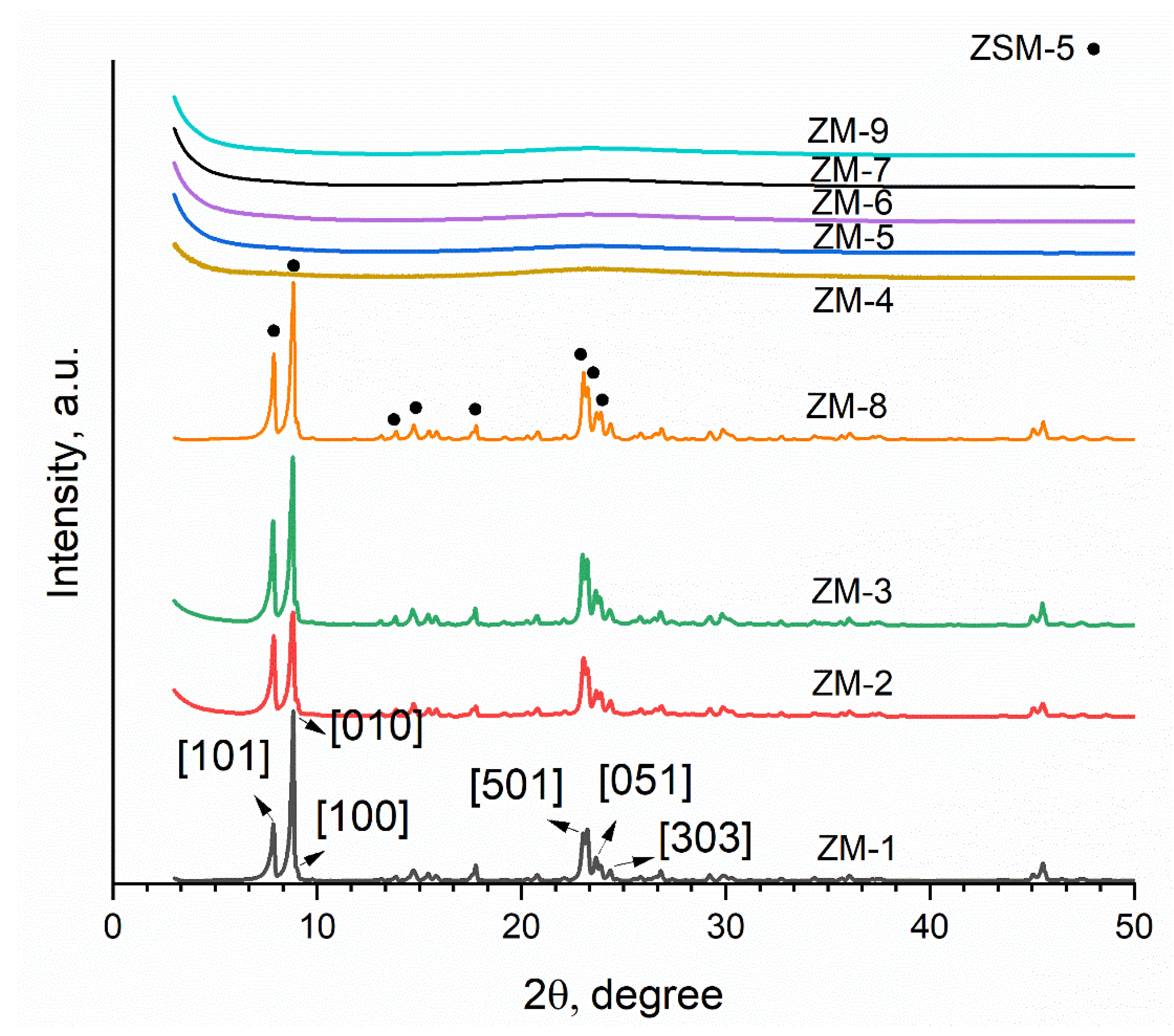
Figure 1 shows the XRD patterns of the synthesized catalysts. The patterns of the ZM-1, ZM-2, ZM-3, and ZM-8 catalysts display the characteristic peaks related to the MFI framework (JCPDS: 44-0003 [16]). Increasing the amount of NH4+ ions in the synthesis gel leads to lower peak intensities compared with the ZM-1 catalyst, owing to the low growth rate [17]. The lack of a broad feature centered at 23.5° indicates the non-existence of an amorphous silica phase for these catalysts. The synthesis of the ZM-1 catalyst has been repeated three times successfully, confirming the repeatability of the developed technique. The impact of Na impurity from NaAlO2 on the direct synthesis of NH4-ZSM-5 was studied by comparing catalysts ZM-1 and ZM-2 with ZM-3, which was synthesized using Al(O-i-Pr)3 as the Al source. The ZSM-5 crystalline phase of the ZM-3 confirms the capability of the NH4NO3 to act as a metal-free mineralizer agent in the direct synthesis of Al-rich NH4-ZSM-5 through a Na-free system. It is confirmed that the ionic Na impurity in the NaAlO2, applied as the Al source, does not influence the crystallization owing to the very low Na concentration. Li et al. [18] reported that the ZSM-5 crystalline phase can only be obtained at a Na+/Si molar ratio of 0.6 for Al-rich ZSM-5 catalysts (Si/Al < 15). Five characteristic peaks of ZSM-5 catalysts at 2θ = 7.96°, 8.83°, 23.18°, 23.99°, and 24.45° were selected to determine the relative crystallinity (based on the ZM-3 catalyst), calculated by summing the peak area for each catalyst [8]. The results in Table 2 show that the ZM-3 catalyst has the highest relative crystallinity compared with the others. These results are in line with the literature [19].
Synthesis of the ZM-5 and ZM-6 catalysts was performed without NH4NO3 and NaOH using TPABr and TPAOH as templates, respectively. The XRD results show that these catalysts are amorphous silica, highlighting the role of NH4NO3 in the ZSM-5 synthesis. It is accepted that TPAOH is a stronger SDA than TPABr because it can act as a template and a mineralizer agent simultaneously. However, the high cost of TPAOH limits its application in industry, while TPABr is a cheap and cost-effective template for use at an industrial scale [20]. In order to compare NH4+ and Na+ cations in the ZSM-5 crystallization, the ZM-4 sample was synthesized using NaOH at the same cation/Al molar ratio (Na+/Al = 1) as the ZM-1 catalyst (NH4+/Al = 1). The XRD pattern of the ZM-4 includes a broad diffraction band at 22–27°, indicating an amorphous silica phase. Li et al. [18] reported that the ZSM-5 crystalline phase can only be obtained at a Na+/Si molar ratio of 0.6 for Al-rich ZSM-5 catalysts (Si/Al < 15). Karim et al. [21] reported that the Na content influenced the polymerization reaction of silicate as well as the substitution rate of Al to Si species in the framework. Therefore, the synthesis failure for ZM-4 can be explained by the low amount of Na+ (Na+/Al = 1). Yuan et al. [22] reported that different anions (Cl, Br, I) in the synthesis gel led to the variation in ZSM-11 acid site location owing to the different covalent interaction with tetrabutylammonium (TBA+). This may affect the nucleation step rate as well as the location of Al species. Pashkova et al. [23] concluded that the type of anions in the synthesis gel influenced the distribution of Al pairs in the ZSM-5 framework. The anions with low polarizability favored a less positive charge on the nitrogen atom, leading to more Al atoms localized near the tetrapropyl ammonium (TPA+). Lario et al. [24] applied a density DFT study and found that the ionic radii of the cation (Na+ or K+) determined their capabilities for incorporation in the chabazite framework as well as Al distribution. They found that the use of K+ (ionic radii of 1.38 Å) allowed CHA zeolite (Si/Al = 10–16) crystallization from a synthesis solution with a lower amount of organic template compared with Na+ (ionic radii of 1.02 Å) owing to the higher structure-directing ability of K+ cation. The larger ionic radii of NH4 (1.48 Å) can result in a behavior like K+ in terms of accelerating ZSM-5 crystallization.
The index peaks at 8.8° and 23° are assigned to [010] and [501] crystallographic faces of the ZSM-5 crystal, respectively, so that the ratio of their intensities can represent the volume fraction of b-oriented crystals. A large index peak at 8.8° confirms the synthesis of b-oriented crystals through the direct synthesis of NH4-ZSM-5 using a NH4NO3 mineralizer. The ZM-1 catalyst displays the highest fraction of b-oriented crystals (3.57) compared with the ZM-2 (1.72), ZM-3 (2.30), and ZM-8 (2.3) catalysts.
Table 2. Framework data of the H-ZSM-5 catalysts.
CatalystCrystallite Size 1, nmRelative Crystallinity, %Straight Channel 2, %Sinusoidal Channel 3, %(Si/Al)bulk 4
ZM-10.958479.5920.418.2
ZM-21.587284.8215.185.0
ZM-31.6510087.3512.657.6
ZM-81.598590.509.508.0
1 Determined using the Debye–Scherrer equation; 2 determined by the method reported in [25]; 3 determined by (100 straight channel); 4 determined by XRF.
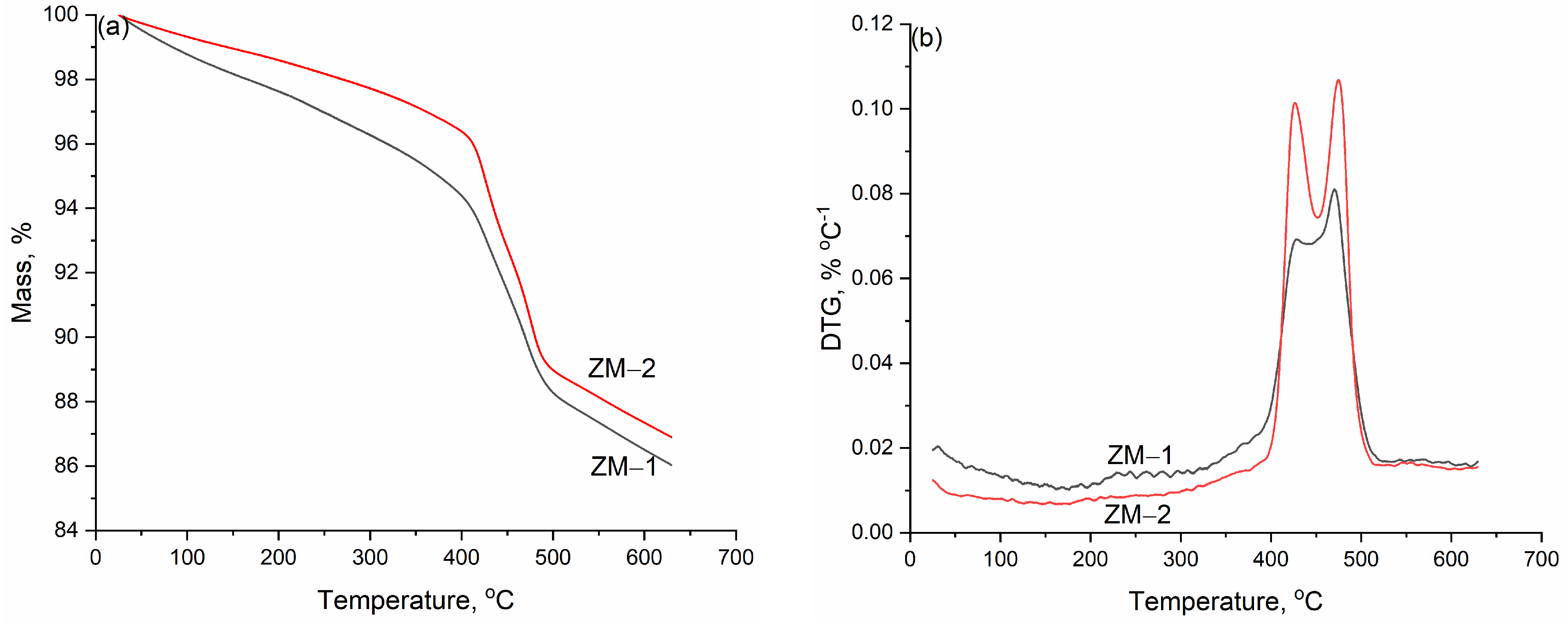
During direct synthesis of NH4-ZSM-5 catalysts, both TPA+ and NH4+ cations can be incorporated into the lattice to compensate the negative charge in the ZSM-5 framework. TGA analysis can be used to characterize these cations in the NH4-ZSM-5 catalysts with different amounts of NH4+ cation in the synthesis gel (Figure 2a). The weight loss in the range of 50–200 °C is assigned to the evaporation of physically adsorbed water. The weight loss in the range of 200–450 °C indicates the combustion of organic template. There is another weight loss step in the range of 450–500 °C, which is more obvious in the DTG curve (Figure 2b). This step can be attributed to decomposition of the NH4+ cation that interacts with the framework to compensate the negative charge [5]. The ZM-2 catalyst shows higher weight loss (9.8%) than the ZM-1 catalyst (9.4%) because of the higher NH4+/Al (2) ratio in the synthesis gel.
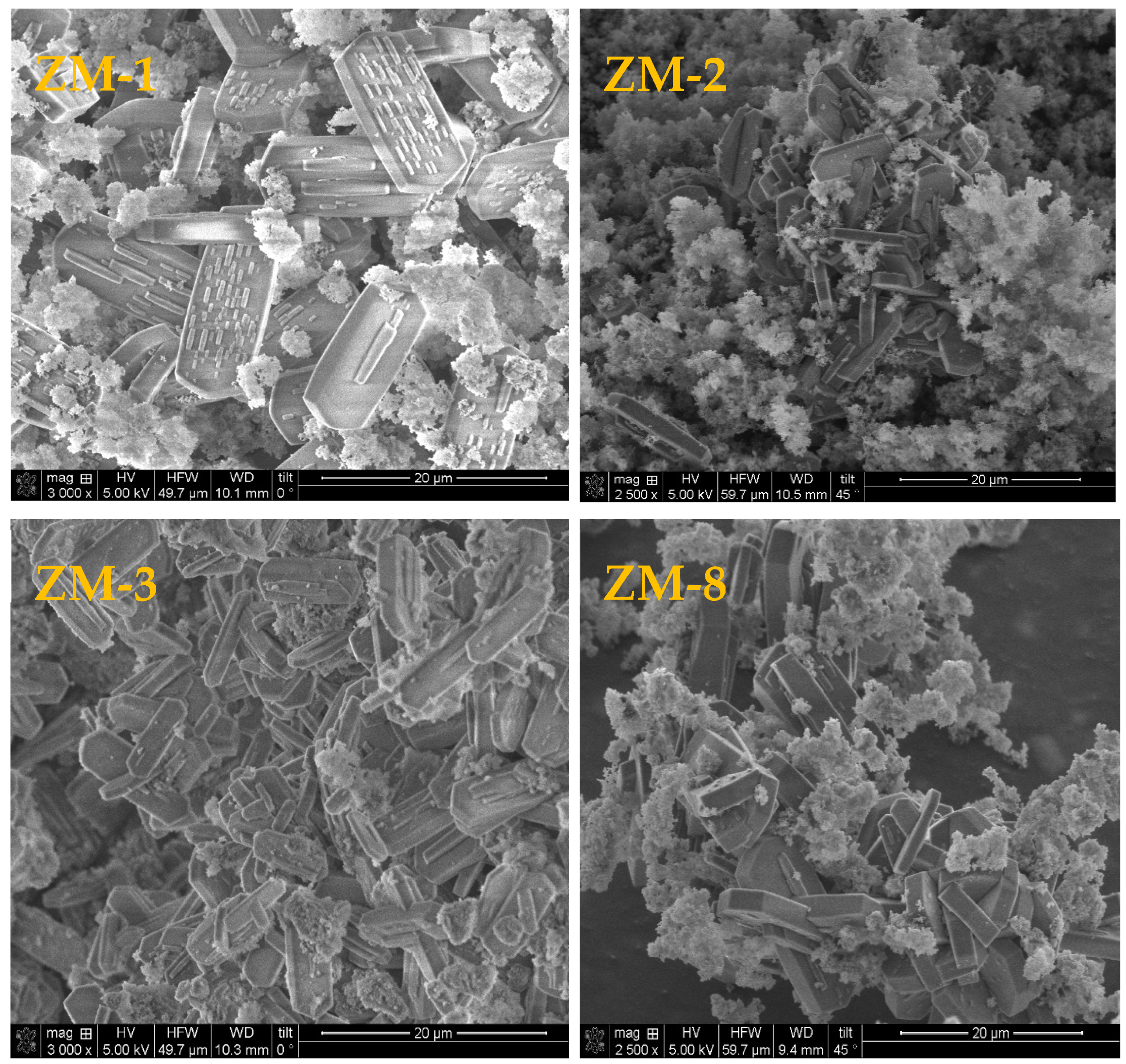
As shown in Figure 3, the morphology of the catalysts is coffin-shaped particles at a micron scale. For the NH4+ system, the interaction of these cations and the aluminosilicate anions is the main factor of crystallization owing to the large molecular size of NH4+ and TPA+ cations. In addition, there is a weak interaction between NH4+ and water molecules so that the “hydrated structure” value of NH4+ (1.54 Å) is very much lower than that of the alkali cations [9]. As a result, less association of TPA+ and aluminosilicates leads to limited nucleation rate, leading to larger particle size. The ZM-1 catalyst exhibits the largest particle size compared with the ZM-2 and ZM-3 catalysts. The higher polarizability of the isopropoxide anion compared with the NO3 anion enhances the fluidity of the synthesis solution as well as the nucleation process. Therefore, the relative growth rate of the ZM-3 is low and smaller particles are formed. Zhao et al. [14] studied the effect of different aluminum sources on the crystallization of ZSM-5 particles. They found that the presence of the NO3 anion resulted in the largest particle size (880 nm) and the largest thickness of the b-axis (370 nm). The b-axis thickness of the ZM-1 and ZM-3 catalysts is 1.25 and 0.79 µm, respectively. It is well established that straight channels (along the b-axis) provide lower diffusion resistance compared with sinusoidal channels (along the c-axis) so that the high number of straight channels and longer sinusoidal channels of the ZSM-5 catalyst will bring exceptional advantages for catalytic reactions, reducing reactants and product diffusion resistance as well as coke formation. For instance, it is confirmed that, in CO2 hydrogenation, large ZSM-5 crystals show higher shape selectivity of p-xylene than small crystals because the longer diffusion path promotes m- and o-xylene isomerization to p-xylene [26].
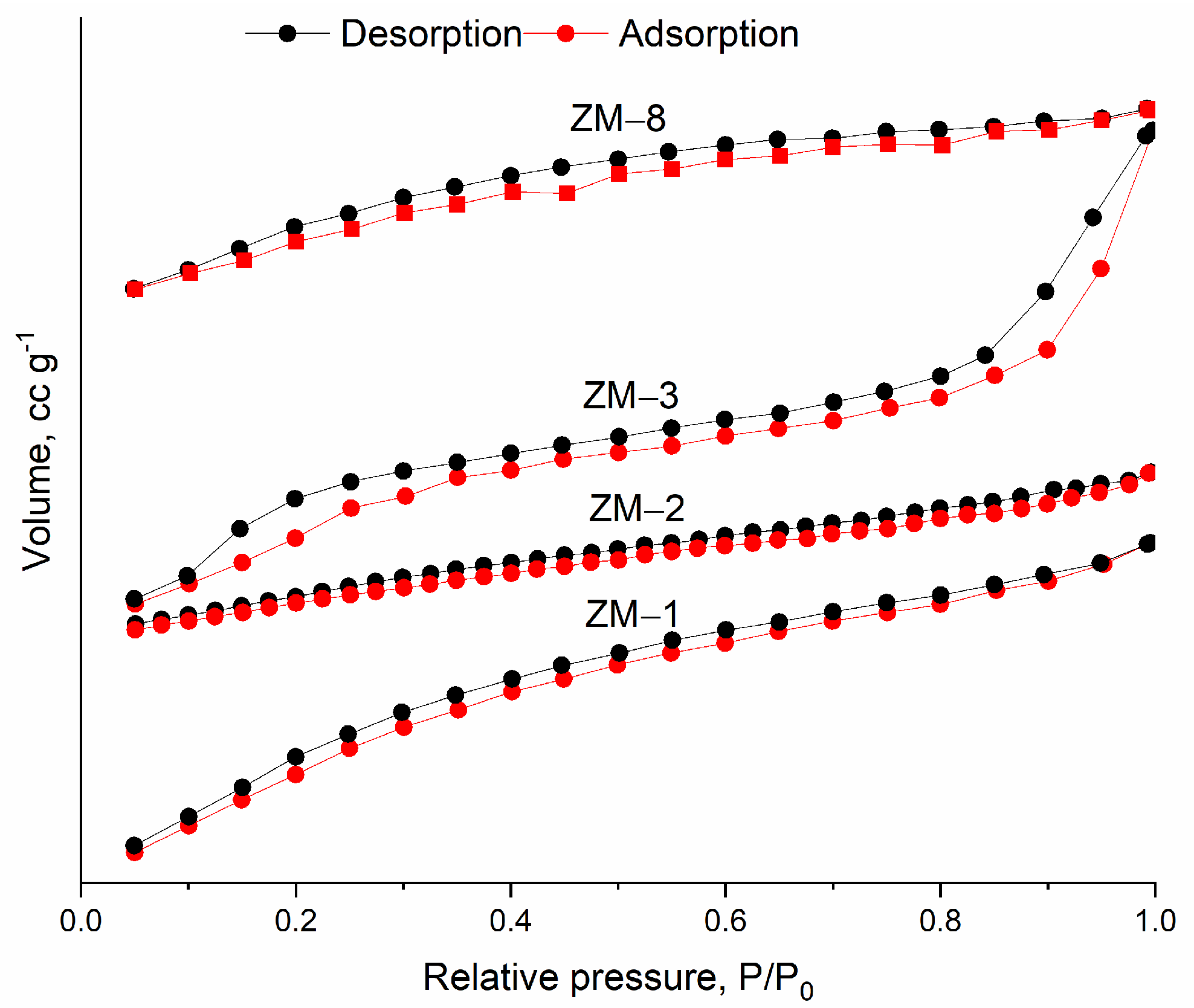
Figure 4 shows N2 adsorption–desorption isotherms. The catalysts show type I (ZM-2 and ZM-8) and IV (ZM-1 and ZM-3) isotherms according to IUPAC classification, indicating micropores and mesoporous structures. The H4 type hysteresis indicates slit-shaped meso- and macropores in the catalysts [27]. The calculated textural data (Table 3) represent the higher surface area (368 m2 g−1) and total pore volume (0.2 cc g−1) of the ZM-1 catalyst compared with the others. The high external surface area of the ZM-1 catalyst (144 m2 g−1) can result from intracrystalline mesopores [28]. Increasing the content of NH4NO3 in the synthesis gel (ZM-2) decreases the particle size compared with the ZM-1 catalyst owing to the reduced growth rate [17]. ZM-1 has the highest HF factor (0.18), which indicates its more hierarchical structure compared with the other catalysts. The average pore size of the catalysts reflects their mesoporous structure.
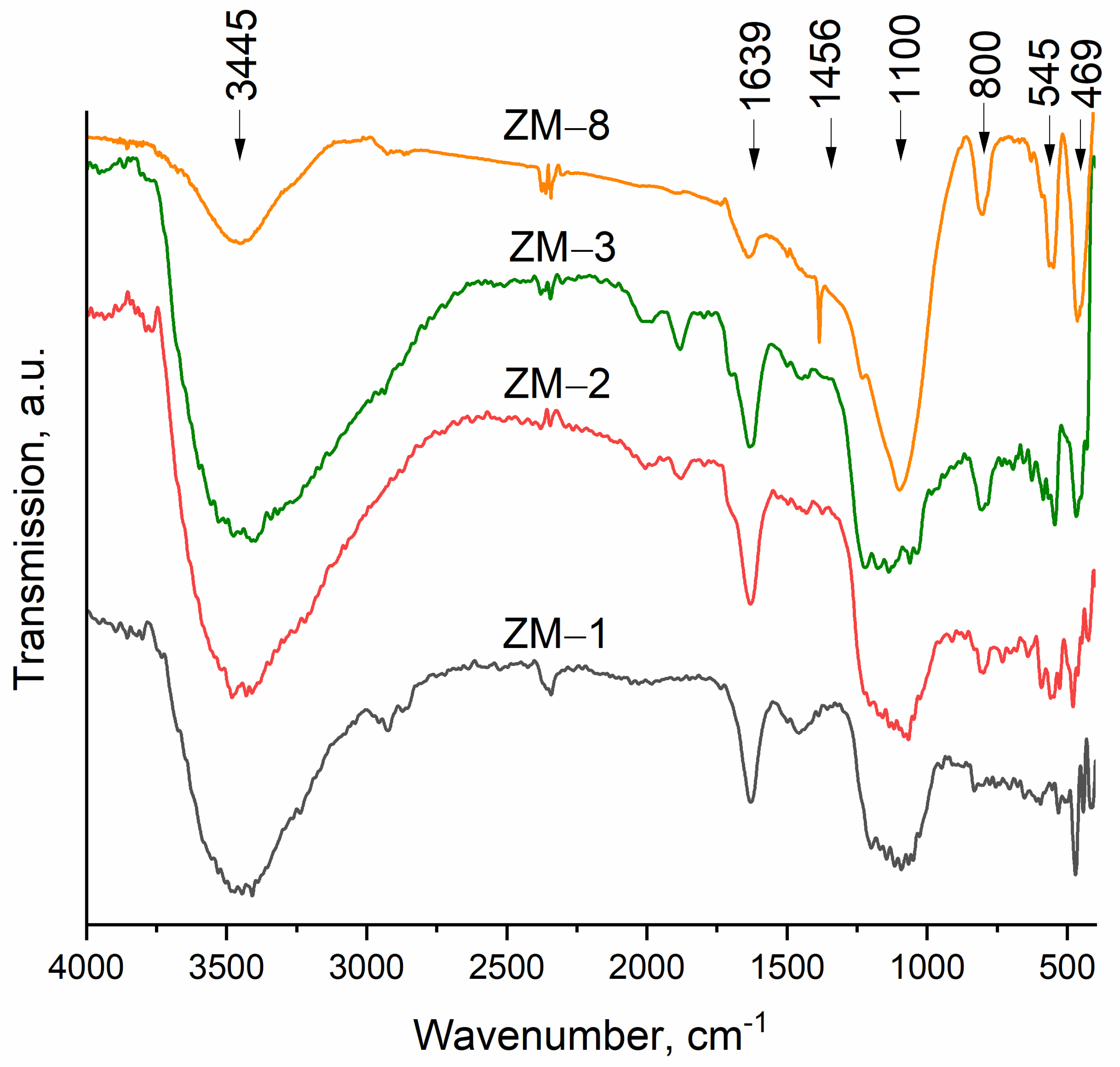
Figure 5 shows the FTIR spectra of the catalysts. The bands at 469, 800, and 1100–1200 cm−1 are assigned to the symmetric stretching vibration of TO4 (T = Si or Al) bonds [29,30]. The band at ca. 545 cm−1 is attributed to the asymmetric tension of the five-membered rings of the ZSM-5 framework. The band at 1456 cm−1 is attributed to N-H bending vibration modes of the NH4+ moieties, which is in line with the band at 1887 cm−1, resulting from the adsorption of NO/NOx compounds (produced through NH4+ decomposition) [31]. The band at 1639 cm−1 is associated with OH bending vibrations and physically adsorbed water [32,33]. The band at ca. 2925 cm−1 is assigned to the C–H stretching of the TPA+ template [34]. The presence of hydroxyl groups is indicated by the band at 3445 cm−1 [30,35].
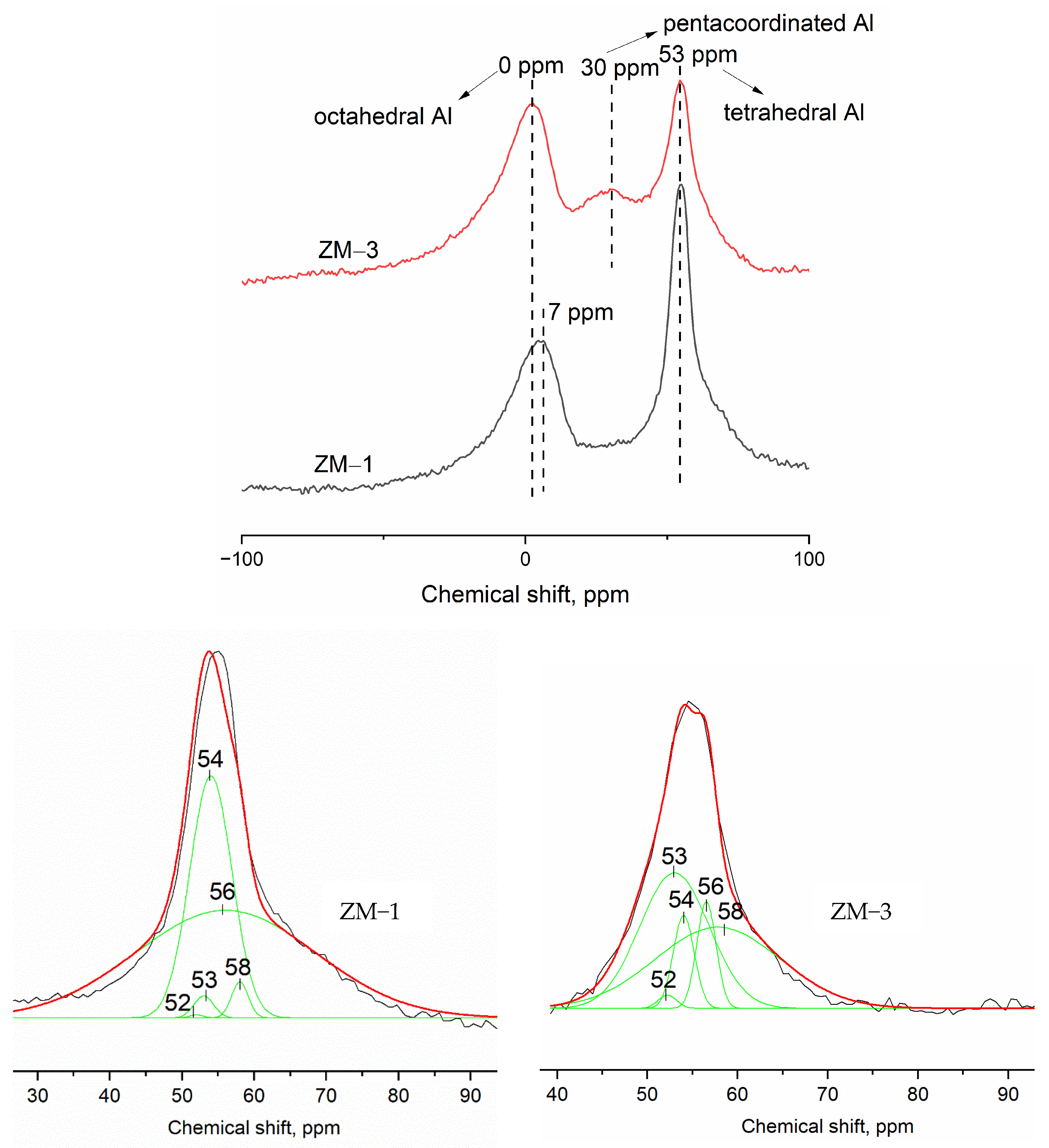
Figure 6 shows 27Al MAS NMR results for the ZM-1 and ZM-3 catalysts to study the impact of aluminum source in Al siting through the direct synthesis of ZSM-5. There are two distinct peaks at ca. 53 ppm and ca. 0 ppm, which are assigned to four-coordinated framework and six-coordinated extra-framework Al (EFAl) species, respectively [36]. In the spectrum of ZM-1, the peak at 53 ppm is stronger than the peak at 0 ppm, indicating that the majority of Al species are in tetrahedral coordination and incorporated in the ZSM-5 framework. The ZM-3 catalyst includes more extra-framework. These results can be related to the smaller crystal size of ZM-3 and the higher content of EFAl species. The peak located at ca. 53 ppm can be deconvoluted into several peaks, including maximums at 52, 53, 54, 56, and 58 ppm. It is reported that the peak with a maximum at 56 characterizes the Al species located in the channel intersections, whereas the peak with a maximum at 54 ppm is attributed to the Al located in the straight/sinusoidal channels [37]. The deconvolution results in Table 4 show that the ZM-1 sample comprises more Al species (63%) in the channel intersections compared with ZM-3 (8.6%). This is expected to be beneficial for aromatic production through CO2 hydrogenation reaction. The larger size of the intersection zone (0.64 nm) compared with the channel zone (ca. 0.54 nm) is believed to provide sufficient space for aromatization reactions [4]. Furthermore, the ZM-3 shows a clear broad signal at ca. 30 ppm, related to Al clusters with less-organized extra-framework phase and penta-coordinated Al species [38]. The ZM-3 catalyst includes more EFAl in agreement with the XRF results, which indicate the lower bulk Si/Al ratio of the ZM-3 sample (7.6) compared with ZM-1 (8.2) (Table 2).
The location, concentration, and strength of Brønsted acid sites significantly impact the catalytic performance of ZSM-5 catalysts. The reactivity of these active sites is determined by the concentration, spatial arrangement, and local environment of Al species in the framework. DFT simulation results confirmed that kinetic factors are more important for Al siting during the synthesis compared with thermodynamic factors [39]. The high content of framework Al species implies a high concentration of Brønsted acid sites at the channel intersection. The strength of the Brønsted acid sites can be tuned through hydrothermal/calcination treatments by dealumination of the framework and formation of EFAl species [40]. It is worth noting that EFAl species involve Lewis acid sites, leading to improved catalytic activity. Almutairi et al. [41] found that the FAU-type zeolite catalyst, including EFAl species, showed higher performance in the catalytic cracking of propane due to the synergistic effect of the Brønsted acid sites and EFAl species. In fact, the existence of bulkier EFAl species in zeolite micropores can change the zeolite confinement space, which can enhance the non-covalent stabilization of intermediate compounds throughout the catalytic reaction [42].
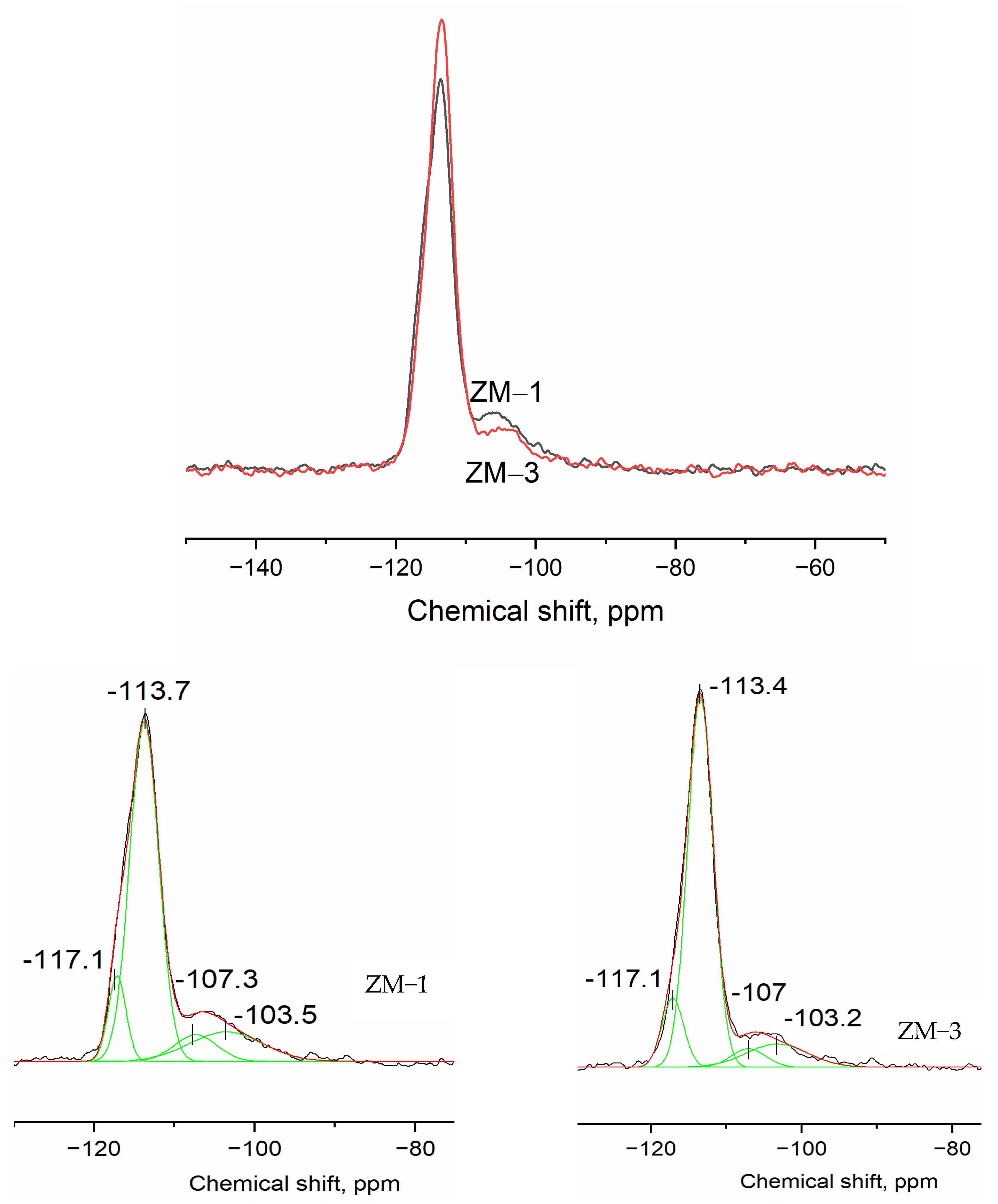
The 29Si MAS NMR spectrum of the catalysts includes a dominant resonance signal at ca. −113 ppm that is assigned to the Si in SiO4 tetrahedron units (Figure 7). A careful deconvolution of the spectra shows four peaks. The peak at −103 ppm is related to the terminal silanol groups [43]. The peaks at −113.7 and −113.4 ppm are attributed to resonances of the Si surrounded by 4Si (4Si, 0Al) units. The peaks at −107 and −107.3 ppm stem from resonances of the Si surrounded with 3Si and 1Al (3Si, 1Al) units. The shoulder peak at −117.1 ppm results from crystallographic inequivalent sites in the zeolites [43]. Based on Loewenstein’s rule, the framework the Si/Al ratio can be determined from the peak areas in the 29Si MAS NMR spectrum [44]. The calculated framework Si/Al ratio of the ZM-1 and ZM-3 catalysts is 12.8 and 20.4, respectively (Table 4). The higher Si/Al ratio of the ZM-3 catalyst is in line with its higher content of EFAl compared with the ZM-1 catalyst. Indeed, the difference between the framework Si/Al ratio and the bulk Si/Al ratio (Table 2) results from the existence of EFAl in the samples.
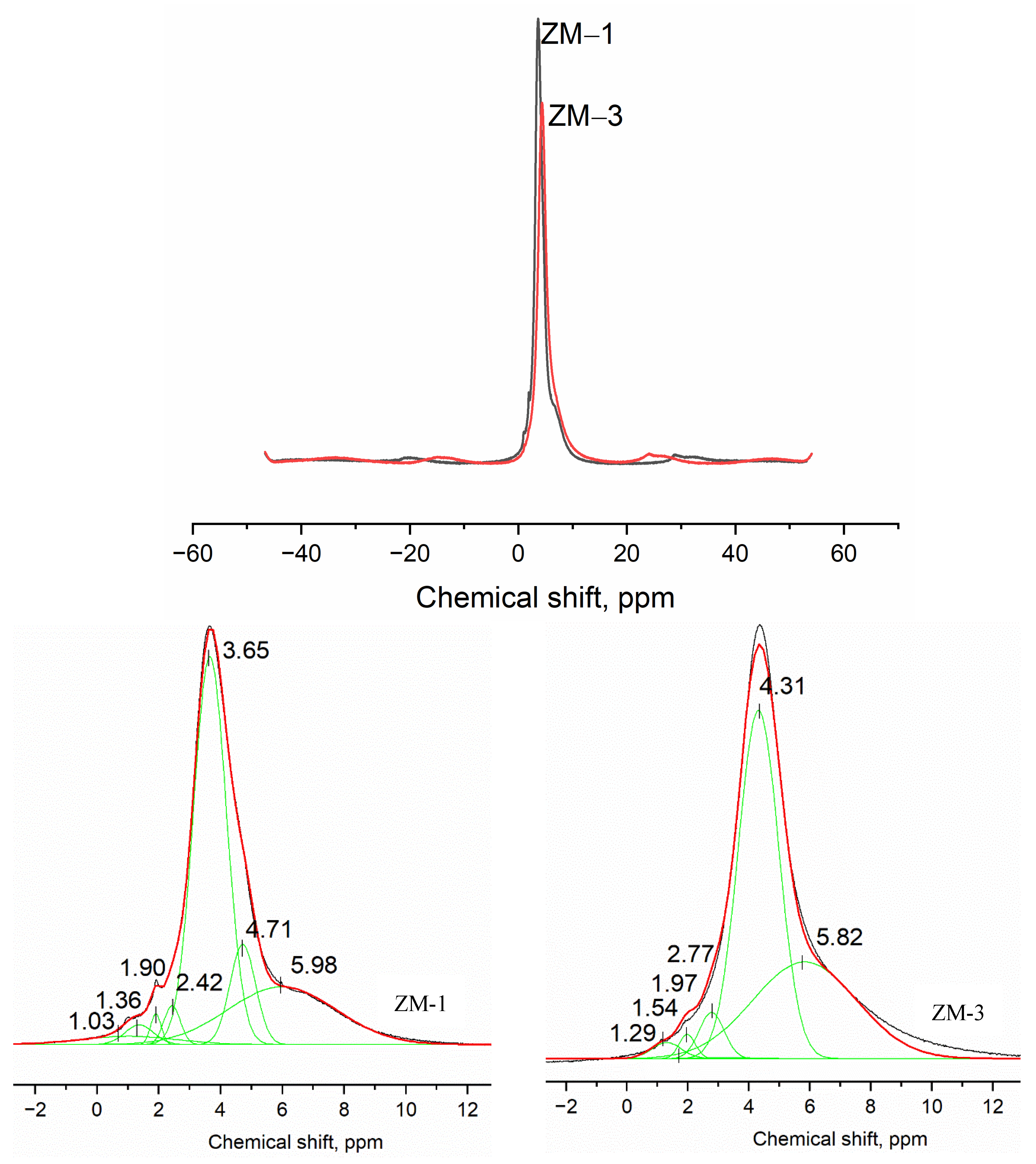
1H MAS NMR is a powerful technique to characterize the local environment of protons in ZSM-5, including type and strength of the acid sites as well as their location in the framework [43]. Figure 8 shows 1H MAS NMR results of the catalysts. The quantitative deconvolution of the spectra leads to five different peaks. The peaks with a maximum at 1.7 and 3.9 ppm are related to the silanol groups (nonacidic hydroxyl) and bridging hydroxyl groups (Si(OH)Al), respectively. The peak at ca. 2.4 ppm is assigned to the hydroxyl group interacting with EFAl [43]. The peak with a maximum at 5.9 ppm is attributed to a second Brønsted acid site (see below) of the HZSM-5 catalyst [45]. The results show that the ZM-1 catalyst includes a higher concentration of the silanol groups than the ZM-3 catalyst. It is reported that the Brønsted acid sites in ZSM-5 can be categorized into two groups [46]: (i) unperturbed Brønsted acid sites that have no additional interaction with the framework and (ii) perturbed Brønsted acid sites that form hydrogen bonds with another framework oxygen atom. The hydrogen-bonding interaction helps anchor or stabilize the proton, which may reduce unwanted mobility that might be detrimental under certain reaction conditions. Moreover, the acid strength of perturbed Brønsted acid sites can be modulated because the proton is partially delocalized by the hydrogen bond [46], leading to moderate strength (i.e., not too weak, not too strong), which favors many catalytic reactions. It is well documented that strong acid sites of the ZSM-5 catalyst are the main sites responsible for coke formation and catalyst deactivation in various reactions [4,47]. The high intensity of the peak at 5.9 ppm for the ZM-1 catalyst indicates a high amount of the second Brønsted acid sites, which have a hydrogen bond with another framework oxygen atom [48]. Given the geometric flexibility and denser framework oxygen environment at the channel intersections of the MFI structure, perturbed Brønsted acid sites—where the acidic proton forms an intraframework hydrogen bond—are expected to be more probable in these regions. This hypothesis aligns with DFT models and 1H NMR observations [46], which indicate that such hydrogen-bonded Brønsted acid sites are energetically favored in distorted or spacious environments characteristic of channel intersections. These results support the 29Al MAS NMR results, indicating more Al siting in channel intersections of the ZM-1 catalyst.
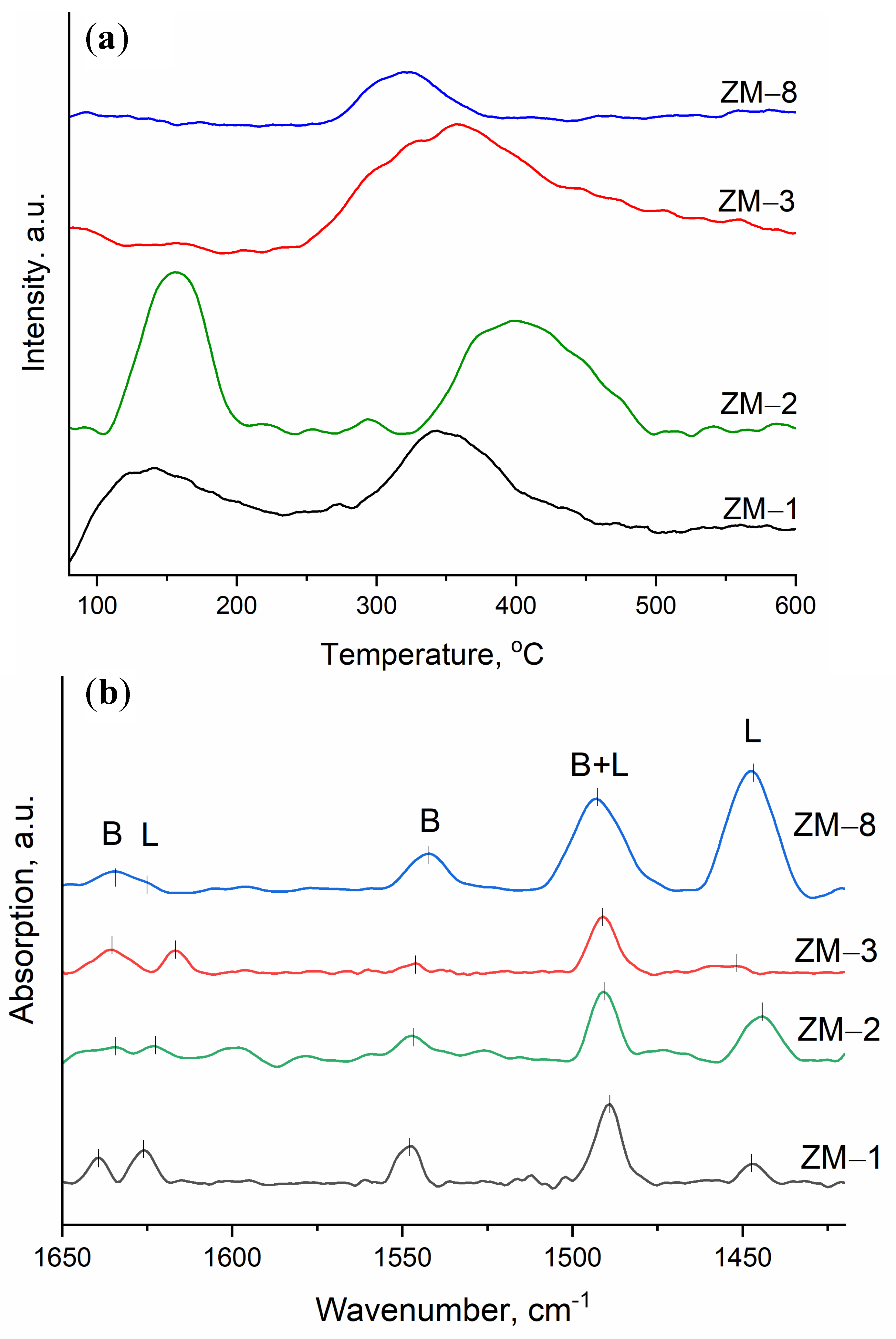
The acidity properties of the samples were studied by NH3−TPD technique (Figure 9a). The results show that the ZM-2 and ZM-3 catalysts include higher concentration and strength of the acid sites compared with the ZM-1 catalyst. The type of acid site pyridine was characterized by adsorption and desorption using in situ FTIR spectroscopy (Figure 9b). It is worth noting that preheating the catalysts (at 300 °C) reduces the impact of physisorbed water and pyridine compounds. The band at 1447 and 1625 cm−1 is assigned to Lewis acid sites. The band at 1547 and 1640 cm−1 is attributed to Brønsted acid sites. The band at 1490 cm−1 is related to pyridine interacting with both Lewis and Brønsted acid sites [48]. The results show that the ZM-1 includes more Brønsted acid sites compared with the ZM-2 and ZM-3 catalysts (Table 5), which can play a key role in catalytic activity in CO2 hydrogenation.

3.2. Effect of H2O/Si Ratio

The XRD results (Figure 1) show that the ZM-8 catalyst with the H2O/SiO2 ratio of 75 displays the typical XRD pattern of the MFI structure. The lower water content (H2O/SiO2 = 75) does not influence the relative crystallinity of the ZM-8 sample (Table 2). However, a further decrease in the H2O/SiO2 ratio (10) in the ZM-9 sample leads to an amorphous phase. The SEM images of the ZM-8 catalyst represent a coffin-shape surface morphology with a larger particle size compared with the ZM-1 catalyst (Figure 3), including the a- and b-axis length of 18.97 and 3.29 µm, respectively. Yu et al. [49] found that a lower H2O/SiO2 ratio affected the crystallization rate, involving a long nucleation period and fast crystal growth. Interestingly, the particles with a long a-axis show the straight channels of the ZM-8 catalyst reaching 90.5% (Table 2), which may be expected to significantly affect the shape selectivity of p-xylene in the production of the aromatic compounds in CO2 hydrogenation. The ZM-8 catalyst represents the N2 adsorption–desorption isotherm of type IV (Figure 4), indicating a microporous/mesoporous structure. The lower surface area (306 m2 g−1) and lower external surface area (83 m2 g−1) of ZM-8 compared with ZM-1 (Table 3) are in line with its larger particle size. The FTIR spectrum of the ZM-8 catalyst (Figure 5) shows all the characteristic bands for the MFI structure, as discussed above, which supports the XRD results. The lower water content in the synthesis gel significantly increases Lewis and Brønsted acid sites in the ZM-8 catalyst (Table 5), favoring catalytic activity in CO2 hydrogenation through cyclization, dehydrogenation, and oligomerization reactions [50].

3.3. Catalytic Tests

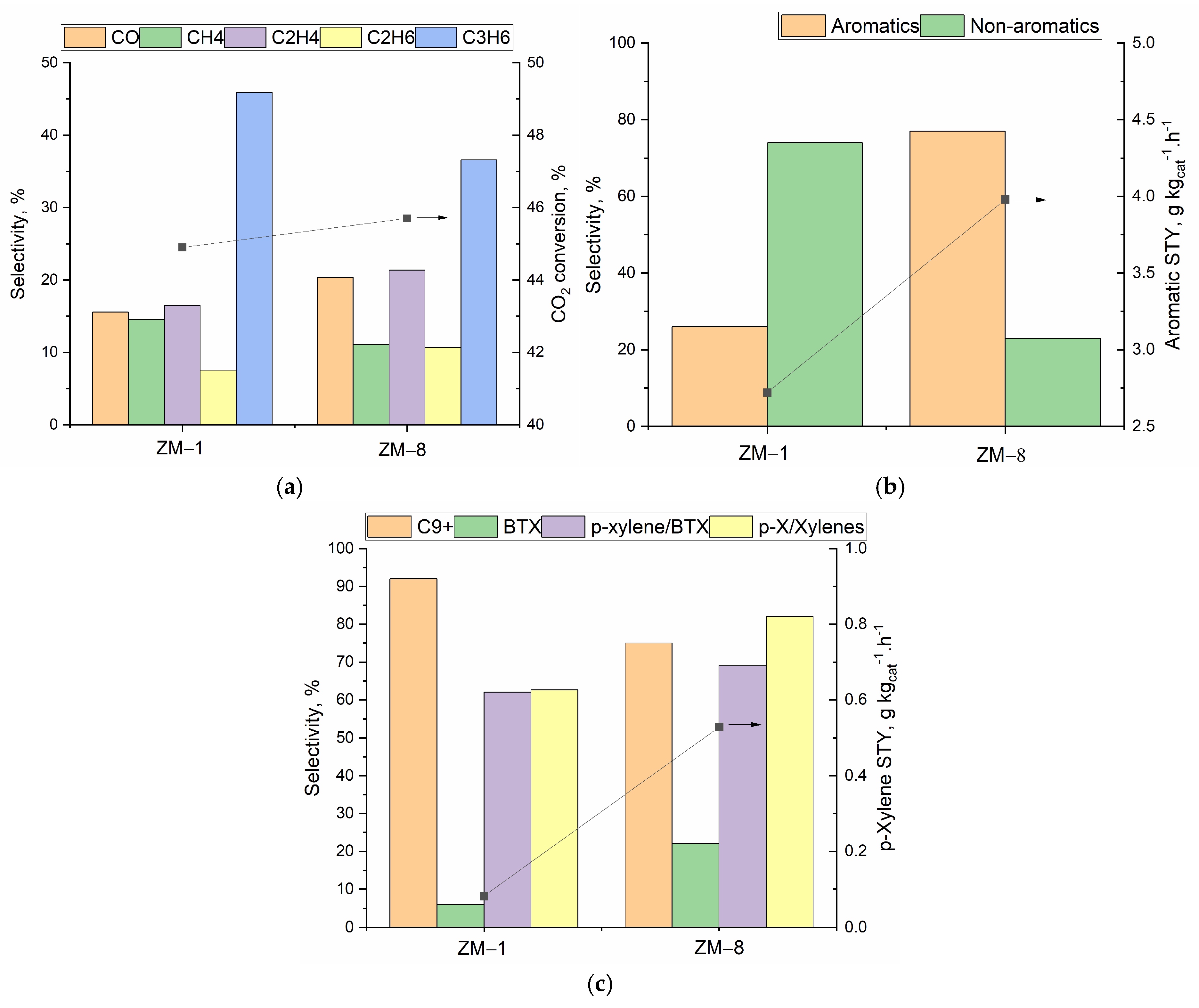
The ZM-1 and ZM-8 catalysts were selected to check the catalytic activity experiments owing to their appropriate textural and acidity properties. The experiments were studied in a dual-bed fixed-bed reactor, comprising separate beds of the Na/Fe2O3 metal catalyst, and of the zeolite, under reaction conditions of 320 °C, 2.5 MPa, and 4000 mL gcat−1h−1 (Figure 10). The iron-based catalyst promoted with 4 wt% sodium exhibited a stable and high CO2 conversion (ca. 45%) for a long time on stream (17 h). Our previous work on the effect of alkali promoters on iron carburization for C-C coupling indicated that sodium yielded a superior activity compared with other alkali such as potassium and cesium in iron-based catalyst systems [51]. For that reason, we employed this metal catalyst to prepare tandem catalysts with zeolite. The ZM-1 and ZM-8 catalysts show low CO and CH4 selectivity (<20%), indicating a limited reverse water–gas shift reaction for these catalysts. Xu et al. [52] reported that a hollow b-oriented ZSM-5 catalyst improved aromatic production through methane co-aromatization with propane. The literature suggests that b-oriented ZSM-5 favors the aromatization in CO2 hydrogenation due to the improved diffusion of the aromatic compounds [53,54]. In this regard, the ZM-8 catalyst provides a higher selectivity of aromatic products (77%) compared with the ZM-1 catalyst (26%). The aromatic STY improves significantly over the ZM-8 catalyst (4 g kgcat−1h−1) compared with Z-1 (2.7 g kgcat−1h−1). It is accepted that Brønsted acid sites are the main active sites for aromatic production through CO2 hydrogenation [55] as more Brønsted acidity of the ZM-8 catalyst promotes aromatic formation. Furthermore, the results can be related to the longer sinusoidal channels of the ZM-8 catalyst, providing sufficient residence time for the conversion of non-aromatic compounds to aromatics through cyclization and dehydrogenation reactions. Liu et al. [56] found that the conversion of bulky compounds over ZSM-5 catalyst was directly attributed to the role of b-oriented ZSM-5 particles because almost all mesopores in the b-axis were opened to the surface of ZSM-5 particles, so they were more accessible to bulky compounds. Most of the disordered mesopores in the bulk of the ZSM-5 particles were, however, not accessible to the bulky compounds. These results are in line with the higher BTX selectivity (22%) and lower C9+ selectivity (75%) over the ZM-8 catalyst (Figure 10c) compared with the ZM-1 catalyst (6% and 92%, respectively). Lim et al. [57] reported that larger ZSM-5 particles (>10 µm) favored production of BTX aromatics through the hydrodealkylation of C9+ aromatics. Furthermore, the high Lewis acidity of the ZM-8 catalyst can accelerate dehydrogenation reactions to convert non-aromatics to aromatics [58].
The ZM-8 catalyst shows higher p-xylene selectivity (69%) in BTX products compared with the ZM-1 catalyst (62%). Moreover, p-xylene STY increases almost 6.5 times over the ZM-8 catalyst (0.53 g kgcat−1h−1), highlighting the key role of its higher fraction of straight channels (90.5%) compared with the ZM-1 catalyst. Murciano et al. [59] concluded that BTX production directly increased with the concentration of the Brønsted acid sites in CO2 hydrogenation over the K-Fe/Al2O3 + HZSM-5 catalyst. Zhang et al. [54] concluded that the b-axis-oriented ZSM-5 catalyst improved p-xylene selectivity through the alkylation of benzene with methanol owing to fast diffusion in the straight channels. Wang et al. [13] reported that xylene molecules (meta and ortho) have to diffuse into the sinusoidal channels of the b-oriented ZSM-5 catalyst, favoring xylene isomerization and higher p-xylene formation. Chen et al. [60] applied computational studies based on ab initio molecular dynamic simulation and reported that the diffusion of m-xylene through the sinusoidal channels of the ZSM-5 catalyst is more difficult than its conversion to p-xylene by isomerization. Hence, the long sinusoidal channels increase the probability of the xylene isomerization reactions. p-xylene diffuses faster than m- and o-xylene in the straight channels owing to the smaller molecular size that promotes the fast exit of p-xylene as well as its selectivity [55]. Consequently, the ZM-8 catalyst provides a high percentage of p-xylene (82%) in xylene compounds over a long time on stream (17 h), which can be assigned to the excellent textural/acidity properties of the developed catalyst.

4. Conclusions

A direct hydrothermal technique was applied for the one-pot synthesis of b-oriented H-ZSM-5 with a high Al content. The results showed that TPA+ and NH4+ cations were incorporated in the ZSM-5 framework as charge compensating agents. The NaAlO2 as the Al source and NH4NO3 as the metal-free mineralizer resulted in large particles, including high surface area, high concentration of straight channels, and high concentration of acid sites located at channel intersection zone. Furthermore, the concentrated synthesis gel (low H2O/SiO2 ratio) favored large particle size. Therefore, the catalyst showed improved catalytic performance for long-term time on stream (17 h) in the CO2 hydrogenation reaction, including high aromatic STY and high aromatic and p-xylene selectivity. The results represent the capability of the developed direct synthesis for the preparation of highly Al-rich ZSM-5 catalysts with high catalytic performance in CO2 hydrogenation.

Author Contributions

Conceptualization, M.R.; methodology, M.R.; validation, M.R. and C.-C.T.; formal analysis, C.-C.T.; investigation, M.R. and C.-C.T.; resources, T.-O.D. and S.K.; writing—original draft, M.R.; writing—review and editing, M.R. and S.K.; supervision, T.-O.D. and S.K.; project administration, T.-O.D. and S.K.; funding acquisition, T.-O.D. and S.K. All authors have read and agreed to the published version of the manuscript.

Funding

This research was funded by the Natural Sciences and Engineering Research Council (NSERC) of Canada (No. 2074).

Data Availability Statement

The original contributions presented in this study are included in the article. Further inquiries can be directed to the corresponding author.

Conflicts of Interest

The authors declare no conflicts of interest.

References

  1. Dalirian, F.; Rostamizadeh, M.; Alizadeh, R. High-efficient hierarchical [B]-ZSM-5 catalyst by simultaneously using of CTAB surfactant and boron promoter for methanol to olefins reaction. Res. Chem. Intermed. 2021, 47, 3201–3215. [Google Scholar] [CrossRef]
  2. Biriaei, R.; Madadi, S.; Kaliaguine, S. Mesostructured Zn/ZSM-5 Zeolite as Catalyst for Furan Deoxygenation. ChemistrySelect 2022, 7, e202103149. [Google Scholar] [CrossRef]
  3. Mohebbi, S.; Rostamizadeh, M.; Kahforoushan, D. Efficient sulfated high silica ZSM-5 nanocatalyst for esterification of oleic acid with methanol. Microporous Mesoporous Mater. 2020, 294, 109845. [Google Scholar] [CrossRef]
  4. Rostamizadeh, M.; Tran, C.C.; Babar, N.E.A.; Do, T.O.; Dubois, J.L.; Kaliaguine, S. 5 Catalyst development for hydrogenation of carbon dioxide to aromatic hydrocarbons: A review. In Industrial Green Chemistry; Serge, K., Jean-Luc, D., Eds.; De Gruyter: Berlin, Germany, 2025. [Google Scholar]
  5. Xue, T.; Wang, Y.M.; He, M.-Y. Facile synthesis of nano-sized NH4-ZSM-5 zeolites. Microporous Mesoporous Mater. 2012, 156, 29–35. [Google Scholar] [CrossRef]
  6. Bibby, D.; Milestone, N.; Aldridge, L. NH4+-tetraalkyl ammonium systems in the synthesis of zeolites. Nature 1980, 285, 30–31. [Google Scholar] [CrossRef]
  7. Wu, D.; Yu, X.; Chen, X.; Yu, G.; Zhang, K.; Qiu, M.; Xue, W.; Yang, C.; Liu, Z.; Sun, Y. Morphology-Controlled Synthesis of H-type MFI Zeolites with Unique Stacked Structures through a One-Pot Solvent-Free Strategy. ChemSusChem 2019, 12, 3871–3877. [Google Scholar] [CrossRef]
  8. Feng, R.; Yan, X.; Hu, X.; Wu, J.; Yan, Z. Direct synthesis of b-axis oriented H-form ZSM-5 zeolites with an enhanced performance in the methanol to propylene reaction. Microporous Mesoporous Mater. 2020, 302, 110246. [Google Scholar] [CrossRef]
  9. Hou, L.-Y.; Sand, L.B.; Thompson, R.W. Nucleation and growth of NH4-ZSM-5 zeolites. In Studies in Surface Science and Catalysis; Elsevier: Amsterdam, The Netherlands, 1986; Volume 28, pp. 239–246. [Google Scholar]
  10. Al-Nahari, S.; Dib, E.; Cammarano, C.; Saint-Germes, E.; Massiot, D.; Sarou-Kanian, V.; Alonso, B. Impact of Mineralizing Agents on Aluminum Distribution and Acidity of ZSM-5 Zeolites. Angew. Chem. 2023, 135, e202217992. [Google Scholar] [CrossRef]
  11. Li, C.; Vidal-Moya, A.; Miguel, P.J.; Dedecek, J.; Boronat, M.; Corma, A. Selective introduction of acid sites in different confined positions in ZSM-5 and its catalytic implications. ACS Catal. 2018, 8, 7688–7697. [Google Scholar] [CrossRef]
  12. Grahn, M.; Faisal, A.; Öhrman, O.G.; Zhou, M.; Signorile, M.; Crocellà, V.; Nabavi, M.S.; Hedlund, J. Small ZSM-5 crystals with low defect density as an effective catalyst for conversion of methanol to hydrocarbons. Catal. Today 2020, 345, 136–146. [Google Scholar] [CrossRef]
  13. Wang, C.; Zhang, L.; Huang, X.; Zhu, Y.; Li, G.; Gu, Q.; Chen, J.; Ma, L.; Li, X.; He, Q.; et al. Maximizing sinusoidal channels of HZSM-5 for high shape-selectivity to p-xylene. Nat. Commun. 2019, 10, 4348. [Google Scholar] [CrossRef]
  14. Zhao, L.; Wang, Y.; Xiao, P.; Toyoda, H.; Li, Q.; Sun, Y.; Samya, B.; Gies, H.; Yokoi, T. Impact of anionic species on the crystallization and aluminum localization in the zeolite framework. Microporous Mesoporous Mater. 2025, 384, 113456. [Google Scholar] [CrossRef]
  15. Liu, C.; Gu, W.; Kong, D.; Guo, H. The significant effects of the alkali-metal cations on ZSM-5 zeolite synthesis: From mechanism to morphology. Microporous Mesoporous Mater. 2014, 183, 30–36. [Google Scholar] [CrossRef]
  16. Wang, P.; Xiao, X.; Pan, Y.; Zhao, Z.; Jiang, G.; Zhang, Z.; Meng, F.; Li, Y.; Fan, X.; Kong, L.; et al. Facile Synthesis of Nanosheet-Stacked Hierarchical ZSM-5 Zeolite for Efficient Catalytic Cracking of n-Octane to Produce Light Olefins. Catalysts 2022, 12, 351. [Google Scholar] [CrossRef]
  17. Ghamami, M.; Sand, L. Synthesis and crystal growth of zeolite (NH4, TPA)-ZSM-5. Zeolites 1983, 3, 155–162. [Google Scholar] [CrossRef]
  18. Li, S.; Ren, X.; Mezari, B.; Liu, Y.; Pornsetmetakul, P.; Liutkova, A.; Kosinov, N.; Hensen, E.J. Direct synthesis of Al-rich ZSM-5 nanocrystals with improved catalytic performance in aromatics formation from methane and methanol. Microporous Mesoporous Mater. 2023, 351, 112485. [Google Scholar] [CrossRef]
  19. Van Grieken, R.; Sotelo, J.L.; Menéndez, J.M.; Melero, J.A. Anomalous crystallization mechanism in the synthesis of nanocrystalline ZSM-5. Microporous Mesoporous Mater. 2000, 39, 135–147. [Google Scholar] [CrossRef]
  20. Ding, Y.; Gao, Q.; Wang, B.; Li, G.; Yan, L.; Suo, J. Some new features on synthesis of titanium silicalite-1 in a non-TPAOH inorganic reactant synthetic system. J. Porous Mater. 2005, 12, 131–141. [Google Scholar] [CrossRef]
  21. Karim, T.M.; Toyoda, H.; Sawada, M.; Zhao, L.; Wang, Y.; Xiao, P.; Wang, L.; Huang, J.; Yokoi, T. Aluminum Distribution on the Microporous and Hierarchical ZSM-5 Intracrystalline and Its Impact on the Catalytic Performance. Chem. Bio Eng. 2024, 1, 805–816. [Google Scholar] [CrossRef]
  22. Yuan, K.; Jia, X.; Wang, S.; Fan, S.; He, S.; Wang, P.; Qin, Z.; Dong, M.; Fan, W.; Wang, J. Regulating the distribution of acid sites in ZSM-11 zeolite with different halogen anions to enhance its catalytic performance in the conversion of methanol to olefins. Microporous Mesoporous Mater. 2022, 341, 112051. [Google Scholar] [CrossRef]
  23. Pashkova, V.; Klein, P.; Dedecek, J.; Tokarová, V.; Wichterlová, B. Incorporation of Al at ZSM-5 hydrothermal synthesis. Tuning of Al pairs in the framework. Microporous Mesoporous Mater. 2015, 202, 138–146. [Google Scholar] [CrossRef]
  24. Di Iorio, J.R.; Li, S.; Jones, C.B.; Nimlos, C.T.; Wang, Y.; Kunkes, E.; Vattipalli, V.; Prasad, S.; Moini, A.; Schneider, W.F. Cooperative and competitive occlusion of organic and inorganic structure-directing agents within chabazite zeolites influences their aluminum arrangement. J. Am. Chem. Soc. 2020, 142, 4807–4819. [Google Scholar] [CrossRef]
  25. Liu, X.; Shi, J.; Yang, G.; Zhou, J.; Wang, C.; Teng, J.; Wang, Y.; Xie, Z. A diffusion anisotropy descriptor links morphology effects of H-ZSM-5 zeolites to their catalytic cracking performance. Commun. Chem. 2021, 4, 107. [Google Scholar] [CrossRef]
  26. Zhang, L.; Li, T.; Xiang, W.; Ye, Z.; Wu, L.; Xia, W.; Huang, H.; Liu, Z.; Jiang, X.; Liu, G.; et al. Direct Synthesis of para-Xylene from CO2 Hydrogenation with a Record-High Space-Time Yield. J. Am. Chem. Soc. 2025, 147, 24442–24450. [Google Scholar] [CrossRef] [PubMed]
  27. Qin, Z.; Pinard, L.; Benghalem, M.A.; Daou, T.J.; Melinte, G.; Ersen, O.; Asahina, S.; Gilson, J.-P.; Valtchev, V. Preparation of Single-Crystal “House-of-Cards”-like ZSM-5 and Their Performance in Ethanol-to-Hydrocarbon Conversion. Chem. Mater. 2019, 31, 4639–4648. [Google Scholar] [CrossRef]
  28. Galarneau, A.; Villemot, F.; Rodriguez, J.; Fajula, F.; Coasne, B. Validity of the t-plot Method to Assess Microporosity in Hierarchical Micro/Mesoporous Materials. Langmuir 2014, 30, 13266–13274. [Google Scholar] [CrossRef]
  29. Pedrosa, A.M.G.; Souza, M.J.; Melo, D.M.; Araujo, A.S. Cobalt and nickel supported on HY zeolite: Synthesis, characterization and catalytic properties. Mater. Res. Bull. 2006, 41, 1105–1111. [Google Scholar] [CrossRef]
  30. Holmberg, B.A.; Wang, H.; Norbeck, J.M.; Yan, Y. Controlling size and yield of zeolite Y nanocrystals using tetramethylammonium bromide. Microporous Mesoporous Mater. 2003, 59, 13–28. [Google Scholar] [CrossRef]
  31. Zdravkova, V.; Drenchev, N.; Ivanova, E.; Mihaylov, M.; Hadjiivanov, K. Surprising Coordination Chemistry of Cu+ Cations in Zeolites: FTIR Study of Adsorption and Coadsorption of CO, NO, N2, and H2O on Cu–ZSM-5. J. Phys. Chem. C 2015, 119, 15292–15302. [Google Scholar] [CrossRef]
  32. Guo, D.; Liu, X.; Cheng, F.; Zhao, W.; Wen, S.; Xiang, Y.; Xu, Q.; Yu, N.; Yin, D. Selective hydrogenolysis of 5-hydroxymethylfurfural to produce biofuel 2, 5-dimethylfuran over Ni/ZSM-5 catalysts. Fuel 2020, 274, 117853. [Google Scholar] [CrossRef]
  33. Khalil, K.M.S. Cerium modified MCM-41 nanocomposite materials via a nonhydrothermal direct method at room temperature. J. Colloid Interface Sci. 2007, 315, 562–568. [Google Scholar] [CrossRef]
  34. Creci, S.; Wang, X.; Carlsson, P.-A.; Skoglundh, M. Tuned Acidity for Catalytic Reactions: Synthesis and Characterization of Fe- and Al-MFI Zeotypes. Top. Catal. 2019, 62, 689–698. [Google Scholar] [CrossRef]
  35. Kianfar, E. Ethylene to propylene conversion over Ni-W/ZSM-5 catalyst. Russ. J. Appl. Chem. 2019, 92, 1094–1101. [Google Scholar] [CrossRef]
  36. Holzinger, J.; Beato, P.; Lundegaard, L.F.; Skibsted, J. Distribution of Aluminum over the Tetrahedral Sites in ZSM-5 Zeolites and Their Evolution after Steam Treatment. J. Phys. Chem. C 2018, 122, 15595–15613. [Google Scholar] [CrossRef]
  37. Liu, H.; Luo, W.; Wang, K.; Wang, Y.; Yuan, H. Hierarchical ZSM-5 nanosheets for production of light olefins and aromatics by catalytic cracking of oleic acid. Sustain. Energy Fuels 2025, 9, 152–171. [Google Scholar] [CrossRef]
  38. Batool, S.R.; Sushkevich, V.L.; van Bokhoven, J.A. Factors Affecting the Generation and Catalytic Activity of Extra-Framework Aluminum Lewis Acid Sites in Aluminum-Exchanged Zeolites. ACS Catal. 2024, 14, 678–690. [Google Scholar] [CrossRef]
  39. Li, G.; Pidko, E.A. The nature and catalytic function of cation sites in zeolites: A computational perspective. ChemCatChem 2019, 11, 134–156. [Google Scholar] [CrossRef]
  40. Li, S.; Zheng, A.; Su, Y.; Fang, H.; Shen, W.; Yu, Z.; Chen, L.; Deng, F. Extra-framework aluminium species in hydrated faujasite zeolite as investigated by two-dimensional solid-state NMR spectroscopy and theoretical calculations. Phys. Chem. Chem. Phys. 2010, 12, 3895–3903. [Google Scholar] [CrossRef]
  41. Almutairi, S.M.; Mezari, B.; Filonenko, G.A.; Magusin, P.C.; Rigutto, M.S.; Pidko, E.A.; Hensen, E.J. Influence of extraframework aluminum on the brønsted acidity and catalytic reactivity of faujasite zeolite. ChemCatChem 2013, 5, 452–466. [Google Scholar] [CrossRef]
  42. Schallmoser, S.; Ikuno, T.; Wagenhofer, M.; Kolvenbach, R.; Haller, G.; Sanchez-Sanchez, M.; Lercher, J. Impact of the local environment of Brønsted acid sites in ZSM-5 on the catalytic activity in n-pentane cracking. J. Catal. 2014, 316, 93–102. [Google Scholar] [CrossRef]
  43. Zhang, W.; Bao, X.; Guo, X.; Wang, X. A high-resolution solid-state NMR study on nano-structured HZSM-5 zeolite. Catal. Lett. 1999, 60, 89–94. [Google Scholar] [CrossRef]
  44. Goursot, A.; Berthomieu, D. Calculations of Nuclear Magnetic Resonance Parameters in Zeolites. In Calculation of NMR and EPR Parameters: Theory and Applications; Wiley: Hoboken, NJ, USA, 2004; pp. 449–460. [Google Scholar]
  45. Roth, W.J.; Gil, B.; Tarach, K.A.; Góra-Marek, K. Top-down engineering of zeolite porosity. Chem. Soc. Rev. 2025, 54, 7484–7560. [Google Scholar] [CrossRef]
  46. Schroeder, C.; Siozios, V.; Mück-Lichtenfeld, C.; Hunger, M.; Hansen, M.R.; Koller, H. Hydrogen bond formation of Brønsted acid sites in zeolites. Chem. Mater. 2020, 32, 1564–1574. [Google Scholar] [CrossRef]
  47. Beyraghi, S.; Rostamizadeh, M.; Alizadeh, R. Dual-templated synthesis of Si-rich [B]-ZSM-5 for high selective light olefins production from methanol. Polyolefins J. 2021, 8, 93–103. [Google Scholar]
  48. Wu, W.; Weitz, E. Modification of acid sites in ZSM-5 by ion-exchange: An in-situ FTIR study. Appl. Surf. Sci. 2014, 316, 405–415. [Google Scholar] [CrossRef]
  49. Yu, J.; Du, K.; Pan, D.; Li, H.; Ding, L.; Chen, W.; Zhang, Y.; Tang, Y. Distinguishing and unraveling classical and non-classical pathways in MFI zeolite crystallization: Insights into their contributions and impact on the final product. Inorg. Chem. Front. 2025, 12, 4048–4058. [Google Scholar] [CrossRef]
  50. Liu, T.; Liu, Z.; Jiang, S.; Peng, P.; Liu, Z.; Chowdhury, A.D.; Liu, G. Selectivity control by zeolites during methanol-mediated CO2 hydrogenation processes. Chem. Soc. Rev. 2025, 54, 2726–2761. [Google Scholar] [CrossRef] [PubMed]
  51. Tran, C.-C.; Kaliaguine, S. Rhodium-doped iron oxides promoted by sodium for highly selective hydrogenation of CO2 to ethanol and C2+ hydrocarbons. Chem. Eng. J. 2024, 496, 153636. [Google Scholar] [CrossRef]
  52. Xu, G.; Liu, J.; Gao, X.; Zhu, X. Preparation of a hollow b-oriented ZSM-5 zeolite-supported zinc catalyst with enhanced catalytic properties via desilication–recrystallization for methane co-aromatization with propane. New J. Chem. 2025, 49, 7870–7878. [Google Scholar] [CrossRef]
  53. Zhang, J.; Ren, L.; Zhang, A.; Guo, X.; Song, C. MFI nanosheets: A rising star in zeolite materials. Mater. Chem. Front. 2024, 8, 595–602. [Google Scholar] [CrossRef]
  54. Zhang, J.; Zhou, A.; Gawande, K.; Li, G.; Shang, S.; Dai, C.; Fan, W.; Han, Y.; Song, C.; Ren, L.; et al. b-Axis-Oriented ZSM-5 Nanosheets for Efficient Alkylation of Benzene with Methanol: Synergy of Acid Sites and Diffusion. ACS Catal. 2023, 13, 3794–3805. [Google Scholar] [CrossRef]
  55. Wei, J.; Yao, R.; Ge, Q.; Xu, D.; Fang, C.; Zhang, J.; Xu, H.; Sun, J. Precisely regulating Brønsted acid sites to promote the synthesis of light aromatics via CO2 hydrogenation. Appl. Catal. B 2021, 283, 119648. [Google Scholar] [CrossRef]
  56. Liu, F.; Willhammar, T.; Wang, L.; Zhu, L.; Sun, Q.; Meng, X.; Carrillo-Cabrera, W.; Zou, X.; Xiao, F.-S. ZSM-5 zeolite single crystals with b-axis-aligned mesoporous channels as an efficient catalyst for conversion of bulky organic molecules. J. Am. Chem. Soc. 2012, 134, 4557–4560. [Google Scholar] [CrossRef]
  57. Lim, D.; Jang, J.; Kim, T.; Shim, S.E.; Baeck, S.-H. Selective hydrodealkylation of C9+ aromatics to benzene, toluene, and xylenes (BTX) over a Pt/H-ZSM-5 catalyst. J. Mol. Catal. A Chem. 2015, 407, 147–151. [Google Scholar] [CrossRef]
  58. Yang, X.; Wang, R.; Yang, J.; Qian, W.; Zhang, Y.; Li, X.; Huang, Y.; Zhang, T.; Chen, D. Exploring the Reaction Paths in the Consecutive Fe-Based FT Catalyst–Zeolite Process for Syngas Conversion. ACS Catal. 2020, 10, 3797–3806. [Google Scholar] [CrossRef]
  59. Murciano, R.; Serra, J.M.; Martínez, A. Direct hydrogenation of CO2 to aromatics via Fischer-Tropsch route over tandem K-Fe/Al2O3+H-ZSM-5 catalysts: Influence of zeolite properties. Catal. Today 2024, 427, 114404. [Google Scholar] [CrossRef]
  60. Chen, Q.; Liu, J.; Yang, B. Identifying the key steps determining the selectivity of toluene methylation with methanol over HZSM-5. Nat. Commun. 2021, 12, 3725. [Google Scholar] [CrossRef] [PubMed]
Figure 1. The XRD pattern of the H-ZSM-5 catalysts.
Catalysts 16 00047 g001
Figure 2. (a) TGA and (b) DTG results of the NH4-ZSM-5 catalysts.
Catalysts 16 00047 g002
Figure 3. SEM images of the H-ZSM-5 catalysts.
Catalysts 16 00047 g003
Figure 4. N2 adsorption–desorption isotherms of the H-ZSM-5 catalysts.
Catalysts 16 00047 g004
Figure 5. FTIR spectra of the H-ZSM-5 catalysts.
Catalysts 16 00047 g005
Figure 6. 27Al MAS NMR results of the H-ZSM-5 catalysts.
Catalysts 16 00047 g006
Figure 7. 29Si MAS NMR results of the H-ZSM-5 catalysts.
Catalysts 16 00047 g007
Figure 8. 1H MAS NMR results of the H-ZSM-5 catalysts.
Catalysts 16 00047 g008
Figure 9. (a) NH3-TPD pattern and (b) Py-FTIR spectra of the H-ZSM-5 catalysts.
Catalysts 16 00047 g009
Figure 10. The product distribution over the H-ZSM-5 catalysts: (a) gas products, (b) liquid products, (c) aromatic products. Operating conditions: 320 °C, 2.5 MPa, GHSV of 4000 mL gcat−1h−1, time on stream of 17 h. Carbon balance: 90–95%.
Catalysts 16 00047 g010
Table 1. Composition of the synthesis gels for the different catalysts investigated.
CatalystAl SourceTemplateNH4+ SourceH2O/SiO2x (NH4+/Al)y (Na+/Al)
ZM-1NaAlO2TPABrNH4NO315011
ZM-2NaAlO2TPABrNH4NO315021
ZM-3Al(O-i-Pr)3TPABrNH4NO315010
ZM-4NaAlO2TPABr-15002
ZM-5NaAlO2TPABr-15001
ZM-6NaAlO2TPAOH-15001
ZM-7NaAlO2TPABrNH4OH15011
ZM-8NaAlO2TPABrNH4NO37511
ZM-9NaAlO2TPABrNH4NO31011
Table 3. Textural data of the H-ZSM-5 catalysts.
CatalystSBET (m2 g−1)Sexternal (m2 g−1)Vtotal (cc g−1)Vmicro (cc g−1)Vmeso
(cc g−1)
DFT Pore (nm)HF *
ZM-13681440.200.090.111.10.18
ZM-2114510.080.030.053.10.17
ZM-3258990.190.060.132.80.12
ZM-8306830.150.080.073.50.15
* Hierarchical factor = (Smeso/SBET) × (Vmicro/Vtotal).
Table 4. Al species distribution in the H-ZSM-5 catalysts.
CatalystChemical Shift (ppm) Assignment of Al Sites and Relative Peak Areas, %56 + 54, %54/56(Si/Al)framework *
5253545658
ZM-10.11.433.363.02.096.30.512.8
ZM-31.039.58.28.642.516.80.920.4
* Based on 29Si MAS NMR.
Table 5. Acidity data of the H-ZSM-5 catalysts.
CatalystAcidity, μmol NH3 g−1Peak Temperature, °CPy-FTIR
WeakStrongTotalTP1TP2BrønstedLewisBrønsted/Lewis
ZM-17.212.519.71413410.340.172.03
ZM-216.020.836.81523740.220.540.41
ZM-30.625.025.61583570.110.120.91
ZM-80.203.723.921733220.522.230.23
Disclaimer/Publisher’s Note: The statements, opinions and data contained in all publications are solely those of the individual author(s) and contributor(s) and not of MDPI and/or the editor(s). MDPI and/or the editor(s) disclaim responsibility for any injury to people or property resulting from any ideas, methods, instructions or products referred to in the content.