Perspective

Towards Flow Heterogeneous Photocatalysis as a Practical Approach to Point-of-Use Water Remediation Strategies


Department of Chemistry and Biomolecular Sciences, University of Ottawa, Ottawa, ON K1N 6N5, Canada
*
Author to whom correspondence should be addressed.
Catalysts 2026, 16(1), 35; https://doi.org/10.3390/catal16010035 (registering DOI)
Submission received: 9 November 2025 / Revised: 3 December 2025 / Accepted: 8 December 2025 / Published: 1 January 2026
(This article belongs to the Special Issue Remediation of Natural Waters by Photocatalysis)

Abstract

The United Nations and the World Health Organization provide clear guidelines to ensure water security for urban and rural populations. Common contaminants include bacteria and a variety of organic contaminants, such as medications and agricultural runoff. The rapid advancement of point-of-use water treatment is crucial to align with these international recommendations. While some problems are chronic and require long-term solutions, others are transient contamination issues that occur without warning and frequently lead to boil water advisories that can last for extended periods. In these cases, providing reliable water security requires solutions that can be deployed rapidly, are affordable, and can be implemented at the point of use with minimal operator training. Our research explores the state of the art in photocatalysis as a method for purifying water from organic contaminants and bacteria. We present a comparative analysis of various catalysts, supports, and light sources, along with our perspective on the benefits of flow systems. Practical solutions require flow techniques that are portable and can address at least the recommended survival requirements of ~7.5 L per capita per day for small communities, schools, or small hospitals. In this perspective, we propose that flow-compatible modified TiO2 catalysts can offer practical solutions implemented with either solar light or LED sources in the UVA or visible region.

Graphical Abstract

1. Introduction

Many communities worldwide face unsafe water sources that pose a threat to their health [1,2]. Boil water advisories provide a temporary solution, but they are not a reliable remedy for the uncertainty of drinking water quality due to bacterial or organic contamination. Given the persistence of this contamination, substantial research has been directed toward developing photocatalytic methods that offer both efficacy and economic viability. Research often focuses on proof-of-concept strategies using powder-based catalysts that can destroy small amounts of contaminants. Sometimes, these catalysts use surrogate contaminants like dyes that can be photobleached when exposed to light in the presence of the catalyst. However, these solutions are far from practical and do not meet the recommendations of the World Health Organization (WHO) regarding the per capita water requirements for daily consumption. Practical solutions must operate in flow systems, preferably using fixed-bed photocatalysts that can utilize solar light or readily available LED light sources, preferably in the visible region.
Water contaminants can be categorized into three distinct groups: bacterial and organic contaminants, as previously mentioned, and transition metals, as illustrated in Figure 1. Photocatalytic treatment is an effective approach to addressing bacterial and organic contaminants, but its effectiveness is limited in the case of transition metal pollutants. While light can easily alter the oxidation state of metal ions, it does not eliminate them. Further, techniques that involve their precipitation would likely require the addition of other reactants. In contrast, alternative strategies based on adsorption may be more promising in this scenario [3], but they will not be explored in this perspective.
We aim to map the road towards easily deployable and accessible water treatment alternatives that are crucial for some populations, particularly in remote locations facing water security challenges. Flow-compatible solutions are essential because water treatment methods are more scalable when utilizing flow strategies. In this context, light-based alternatives, such as inorganic photocatalysts, emerge as excellent candidates. These solutions can utilize both artificial and natural light sources.
While we may mention other catalytic systems, we will emphasize solutions that involve titanium dioxide, reflecting its excellent catalytic properties, the tunability of its absorption properties, its low cost and low toxicity, and naturally, our own interests.

2. Defining the Problem

Long-term purification requirements are currently met in industrial facilities. However, there are instances where unexpected releases of materials, whether accidental or due to natural events, create a sudden demand for a point-of-use (POU) water treatment. In these situations, portable and easily deployable equipment would be highly beneficial.
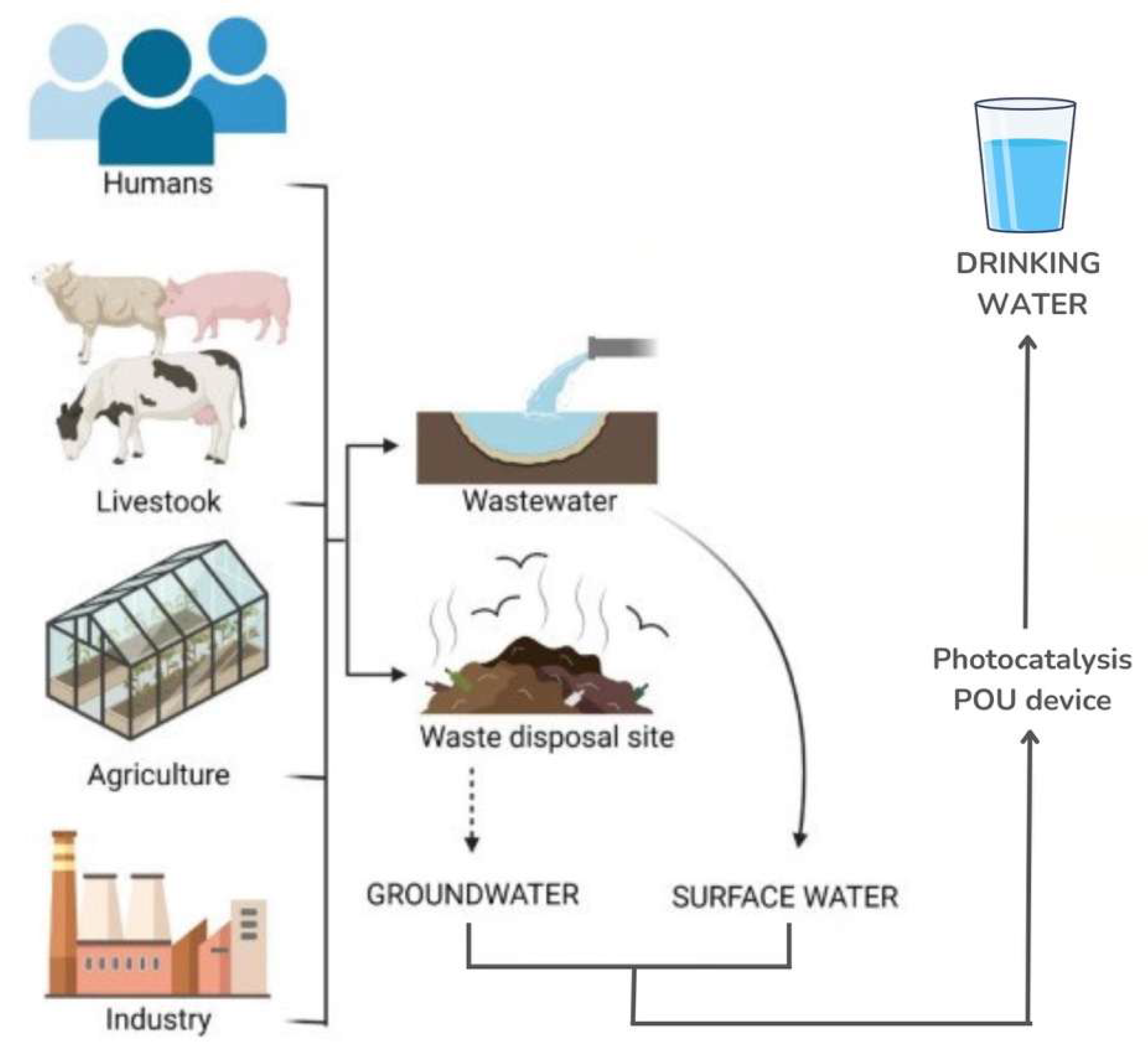
This contribution focuses on treating water contaminated with bacteria or organics, such as pharmaceuticals commonly found in regional populations (e.g., estrogens, ibuprofen, diuretics). It also addresses agricultural contaminants like pesticides, which are often a concern for rural communities. This approach is not intended for producing drinking water from sewage or highly contaminated sources but rather for water that has a treatable level of contamination An adapted diagram from a recent publication [4] is reproduced in Figure 2 and illustrates the problems that concerns us in this perspective well.
A recent report analyzes the water quality in 163 sites across southern Canada. Of these, only about half rate the water quality as fair to excellent, and 17% are rated as poor or marginal [5].

2.1. Organic and Bacterial Contamination

Common organic contaminants, which include both naturally occurring and man-made chemicals, can pose chronic health risks from long-term exposure, even at low concentrations [6]. Man-made chemicals are often categorized as Synthetic Organic Compounds (SOCs) or Volatile Organic Compounds (VOCs). Regulated values known as the Maximum Contaminant Levels (MCLs) from the World Health Organization (WHO) [7], the US Environmental Protection Agency (EPA) [8], and the European Union (EU) [9] can be found in Table 1.
Other water contaminants that raise concern are pharmaceuticals such as ibuprofen and other pain medications, estrogens, and diuretics and their metabolic subproducts [4,10,11]. Unexpected releases of these materials, whether accidental or due to natural events, create a sudden and urgent need for effective water treatment solutions. Given the wide array of organic contaminants, the term “Total Organic Carbon” (TOC) was introduced as a more practical way to refer to their collective sum [12]. While source water can naturally contain levels up to 10 mg/L or more, treated water must usually show a high percentage of TOC removal to limit not only direct consequences but also undesired microorganism growth. Indeed, TOC can serve as a nutrient for microbes; this fraction is referred to as Assimilable Organic Carbon (AOC) [13]. Therefore, if treatment fails to remove sufficient natural organic matter, the overall bacterial population in the water will multiply. An AOC value for outgoing drinking water around 10 µg acetate-C/L (C=Carbon) is not considered to pose a risk, but the higher the value above that, the greater the risk of unwanted bacterial growth. However, the primary concern is the presence of pathogenic microorganisms that can cause acute illness. Regulatory agencies around the world set stringent standards (MCL: 0 CFU/mL) to ensure these are absent. In light of practical constraints that hinder the rapid identification of specific pathogenic bacterial strains, routine measurements of indicator bacteria are used to assess potential fecal contamination [14].

2.2. Contaminant Degradation vs. Full Mineralization

The ideal endpoint for removing organic contaminants from water is full mineralization, which is the destruction of the compound into simple, harmless inorganic substances like carbon dioxide and water [15]. This offers the highest assurance of safety by eliminating all residual toxicity. However, achieving full mineralization is often costly and involves highly energy-intensive technologies such as reverse osmosis, electrochemical treatments, or the full oxidation of pollutants [16]. Alternatively, contaminant degradation (structural change) is faster and cheaper, involving the partial breakdown of the contaminant into a new, smaller chemical [17]. This approach is favored for its efficiency and ability to meet the MCLs for the parent compound. Its major drawback is the risk of incomplete degradation, where the new chemical product (a transformation product) might be more toxic or carcinogenic than the original. For example, breaking azo dyes into smaller chemical compounds releases highly toxic substances, such as aromatic amines (like benzidine), which are known carcinogens [18].
Therefore, degradation is acceptable only if all resulting byproducts are proven non-toxic. In fact, many photocatalysts have proven to efficiently break contaminant molecules into smaller, safer compounds [19]. The advantage of this approach is the easiest translation into flow systems for POU devices.

2.3. International Guidelines for Drinking Water Security

The United Nations (UN) recognizes access to safe and clean drinking water and sanitation as a human right essential for life and the enjoyment of all rights [20]. The resolution calls on states and international organizations to mobilize finance, build capacity, and transfer technology to secure universal access. In 2015, the UN General Assembly reaffirmed and further clarified these as distinct but interrelated rights (to safe drinking water and to sanitation) setting expectations for national policies, plans, and budgets that prioritize universal, sustainable access and address structural inequalities [20]. The right to water specifies that water must be sufficient and continuous (availability), safe, acceptable, physically accessible, and affordable for personal and domestic uses.
The World Health Organization (WHO) guidance links how much water people can actually use to how close, reliable, and affordable that water is, and it shows that health gains follow step-changes in access, not just liters supplied. The updated second edition of Domestic water quantity, service level and health (2020) reviews the evidence and recommends targets that combine quantity, accessibility, reliability/continuity, and price to secure public health benefits [21].
At the survival/consumption end, the WHO’s foundational analysis by Howard and Bartram estimates that ~7.5 L per capita per day (lpcd) covers typical drinking and food preparation needs for most people under most conditions. Crucially, this does not include water for hygiene. In humanitarian operations, the WHO advises rapidly achieving ≥15 lpcd, with ~20 lpcd preferred to enable basic handwashing and food hygiene; higher volumes are needed for laundry/bathing unless performed at the source [22]. It is unrealistic to meet these recommendation with anything other than flow technologies.
For technologies and utility upgrades purporting to enhance drinking water security, the WHO’s benchmarks translate into design and monitoring targets: (1) guarantee the consumption minimum (≥7.5 lpcd per person equivalent) in all contexts; (2) reach ≥ 15–20 lpcd rapidly in emergencies and step up toward ~50–100+ lpcd by prioritizing on-plot access; (3) engineer for reliability/continuity (pressure management, storage, backup power) and affordability by design so households can actually use enough water; and (4) report outcomes using service levels, not liters in isolation, to capture real health protection. Together, these principles convert volume targets into rights-compatible, health-protective services suitable for policy and investment decisions.

3. Choosing a Photocatalyst

Eventually, a photocatalyst must be flow-compatible. However, on the journey to such a catalyst, the use of heterogeneous materials, particularly powders, can be a stepping stone in the learning process until the perfect catalyst is invented. We begin this section by reporting on studies of pristine titanium dioxide, predominantly the anatase form, which is abundant, inexpensive, and widely studied.

3.1. Titanium Dioxide Powders

Titanium dioxide is a semiconductor which has been extensively studied for its use as a photocatalyst [23,24]. In nature, this metal oxide can exist in three polymorphs: anatase, rutile, and brookite. Of these, rutile is the thermodynamically stable crystalline phase of TiO2, with a tetragonal crystal structure containing TiO6 octahedra with a slight distortion. Anatase and brookite are metastable [25], with the former detaining a tetragonal crystal structure with a greater distortion in the TiO6 octahedron. The least naturally abundant of these, brookite, is difficult to synthesize and therefore has not been the centerpiece of as many studies relative to rutile and anatase. Additionally, the more abundant metastable phases generally display higher photocatalytic activity [26] when compared with brookite. This is reflected in the wide commercial availability of rutile and anatase, which can be acquired as pristine white powders.
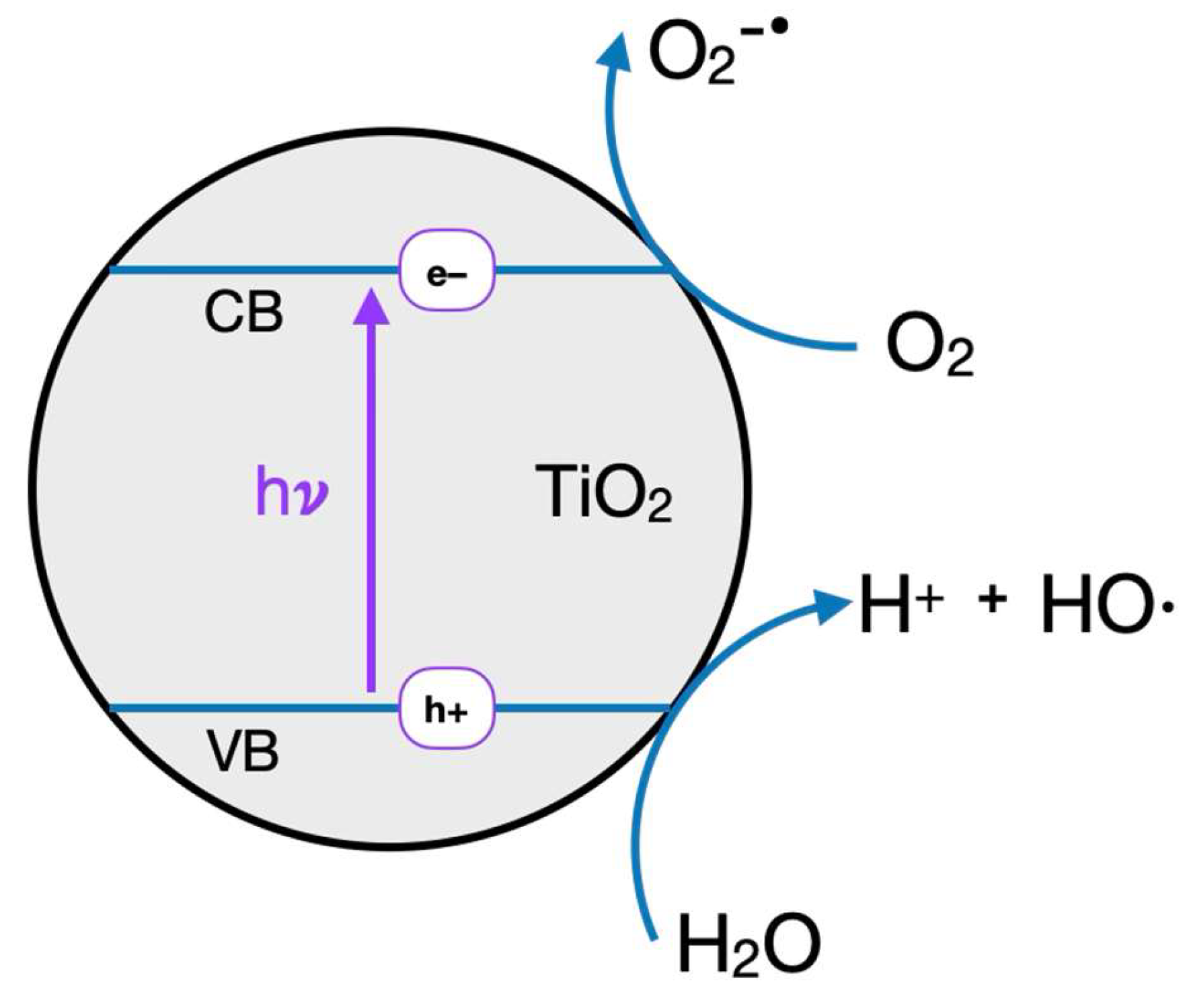
Pristine TiO2 is a suitable starting point when selecting an optimal catalytic candidate for pollutant degradation because, relative to other semiconductors, it has demonstrated long-term stability, strong oxidizing ability, and non-toxicity. Moreover, the ubiquitous use of this catalyst for environmental applications is directly tied to its bandgap being approximately 3.2 eV, making it photoactive under UVA light irradiation [27]. This results in TiO2 being capable of generating photo-induced electrons which move into the conduction band to perform reductive processes, while holes in the valence band are key to the catalyst’s oxidative ability. A classic representation is shown in Figure 3; much of this perspective is concerned with ways to improve this process to develop effective water remediation strategies.

3.2. Improvements to Titanium Dioxide Powders

While photoexcited pristine TiO2 is known to degrade organic matter either by trapping holes via organics or through ROS reactions following the trapping of conduction band electrons by oxygen, the process is inefficient due to rapid and facile electron–hole recombination and TiO2’s inability to absorb visible light photons. To address this issue, two strategies are employed: reductive treatments can produce black TiO2, which exhibits excellent visible light absorption, and doping or decorating with metal ions or their oxides.

3.2.1. Reduction of Titanium Dioxide

Typically, introducing Ti3+ centers into the crystalline structure of titanium dioxide leads to the achievement of a narrower bandgap [28,29]. In recent years, the reduction of pristine TiO2 has emerged as an effective pathway to generating Ti3+ sites within the photocatalyst’s structure. Chen et al. successfully obtained “black TiO2” through a hydrogenation process, resulting in a reduced bandgap of 1.7 eV [28]. This dark powder becomes photoactive in the visible region. The key factor contributing to increased visible light absorption in blackened TiO2 is the enhanced hydrogen mobility. The defects introduced into the lattice facilitate rapid hydrogen diffusion and exchange, leading to a modified electronic structure and enhanced visible light absorption [30]. Within a semiconductor, the valence band primarily comprises oxygen 2p states, while the conduction band comprises titanium 3d states. Consequently, a smaller bandgap arises from midgap levels that overlap with the O 2p and Ti 3d orbitals [31].
When examining pristine and blackened TiO2, the reduced form exhibits greater photocatalytic activity as a result of its enhanced light absorption. Black TiO2 possesses a bandgap as low as 1.54 eV due to the presence of lattice defects originating from the Ti3+ impurities and subsequent oxygen vacancies. A variety of reports have developed methods for introducing Ti3+ centers or oxygen vacancies to distort the electronic structure and improve the visible light absorption of TiO2. Amongst these techniques, high-pressure hydrogenation [32], plasma treatment [33], chemical reduction via NaBH4 [34], and laser ablation [35] have been successful in achieving black TiO2. Despite obtaining the desired material, these methods are costly in terms of energy or relatively expensive due to high temperatures, pressures, or vacuums being needed. An alternative route using ethanol as reducing agent has been developed in our laboratory [19], which presented a greener approach to fabricating black TiO2.

3.2.2. Doping and Decorating TiO2 to Improve Its Performance

With the goal of reducing the bandgap of TiO2, decorating and doping this semiconductor with metals and non-metals have been shown to help in attaining this goal [36]. A smaller bandgap is obtained by forming an acceptor level near the valence band (VB) or donor levels near the conduction band (CB) of TiO2.
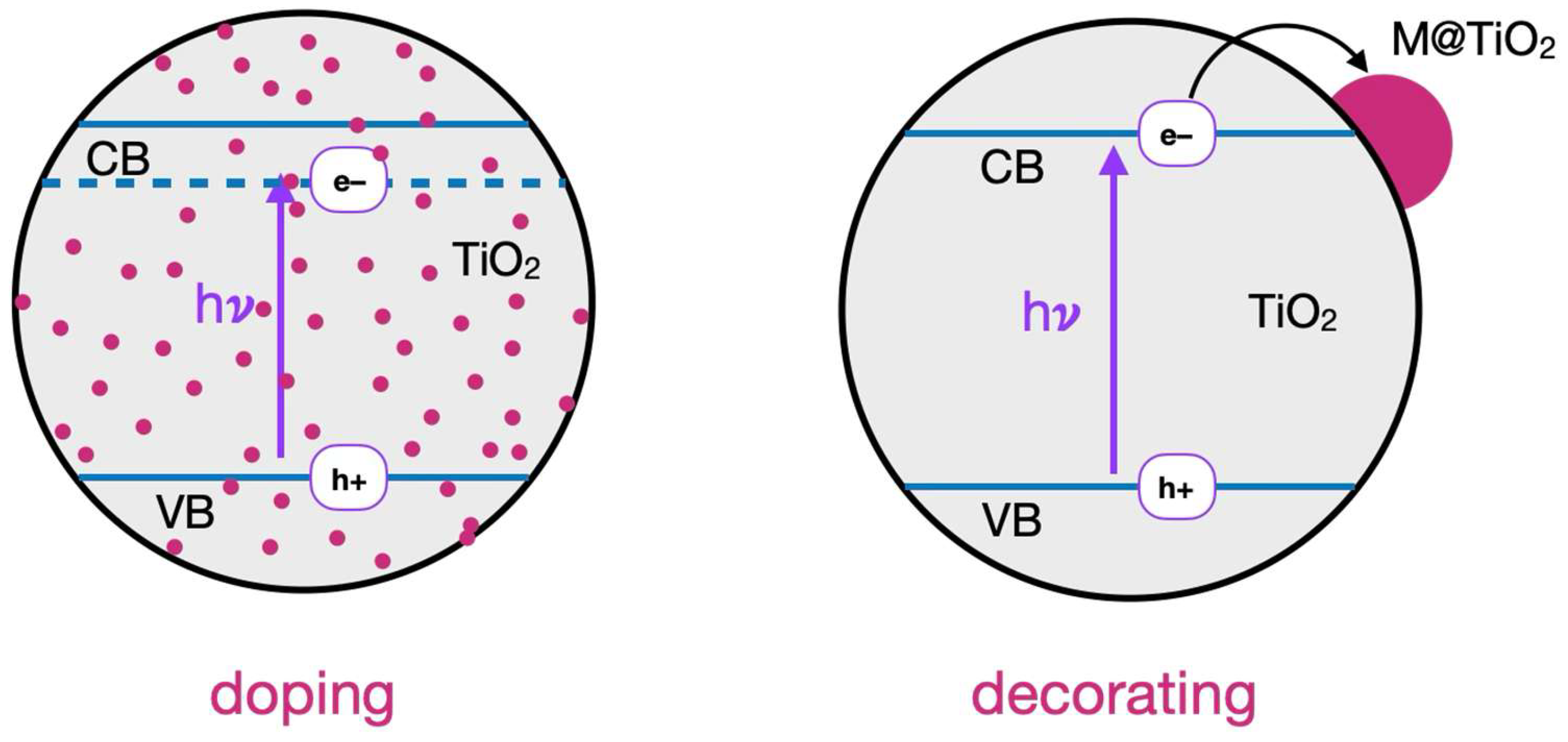
In the context of this perspective, it is important to note the use of the terms “doping” and “decorating”. The former refers to impurities that are incorporated in the bulk of the material as is frequently performed in the semiconductor industry, for example, by adding boron or arsenic to silicon. The term “decorating” is used for discrete particles, frequently nanoparticles that are incorporated on the surface of other materials, as in AuNP@TiO2, where gold nanoparticles are on the surface of TiO2 particles. These concepts are illustrated in Figure 4.
Some illustrative examples of methods for introducing donor states are nitrogen, carbon, and boron doping. In the case of nitrogen, when doped into TiO2, the N 2p levels pair with the O 2p states which generate acceptor levels and effectively lower the bandgap of the catalyst [37]. Similarly, carbon-doped TiO2 possesses a smaller bandgap than the pristine metal oxide due to the additional states generated after C-Ti-O is formed [38]. In the case of boron doping, B replaces O in the TiO2 structure, and consequently, Ti4+ sites are converted into Ti3+. This modification, which echoes the properties observed in blackened TiO2, provides a shortened bandgap by the creation of half-filled states under the CB and expands the photoactive range of the catalyst into the visible region. Similarly, doping using transition metals has been shown to shorten the bandgap of TiO2 by providing mid-level bands to the initial bandgap of the catalyst [39]. The use of transition metals allows d states to help modify the spectral properties of the initial material. An example of this was shown by Hou et al. who found that Ag-doped TiO2 had an extended absorption edge into the visible region because of hybridized Ag 4d and Ti 3d states [40]. Guo and Du demonstrated that metal doping using Cu, Ag, or Au resulted in the addition of new states near the valence band of TiO2 [41]. A list of bandgap values of doped TiO2 is shown in Table 2.
Despite the advantage of generating a smaller bandgap, doping and creating defects in the material can result in additional recombination sites for the photogenerated electrons and holes [52]. The recombination of these charge carriers limits the photocatalytic ability of the semiconductor, so techniques such as the metal decoration of TiO2 have been employed to minimize charge carrier recombination [53]. The addition of metal nanoparticles on the surface of TiO2 allows photoexcited electrons to migrate from the conduction band semiconductor to the metal surface where photodegradation can take place through reduction processes. In tandem, this leaves holes in the valence band, which provide sites for oxidation reactions to occur; see “decorating” in Figure 4.
It is important to note that, although metal decoration can provide the desired optical and catalytic properties, there is a concern regarding metal leaching into the waters being treated and thus becoming an additional source of contamination. It is therefore imperative to test the synthesized catalysts to ensure there is no metal ion leaching, especially for materials used under flow conditions, which must be robust and reusable. Moreover, the implementation of toxic metals into our photocatalytic materials such as lead, chromium, arsenic, and cadmium, to name a few, is strongly discouraged for remediation applications [54]. These metals have been shown to be harmful to aquatic wildlife and humans when consumed at the microgram scale. With this in mind, our work in this field has focused on utilizing catalysts decorated with metals deemed safe, a few examples being iron, copper, and silver. An examination of preferred materials is presented in Section 3.4 [54].

3.3. Beyond Titanium Dioxide: Other Possible Photocatalysts

Following the discovery of TiO2’s photocatalytic activity, a widespread effort began to identify alternative materials [55]. This research is driven by the need for catalysts with enhanced properties, such as a narrower bandgap to maximize solar light absorption, high charge carrier mobility to suppress recombination, and superior chemical stability [56]. This has expanded the classes of functional photocatalysts to include metal oxides, chalcogenides, carbon-based materials, nitrides, and perovskites [57]. The primary goal is to develop materials that are intrinsically robust under solar irradiation, eliminating the need for sacrificial scavengers while maximizing solar energy harvesting.
Because achieving all desired characteristics in a single material is challenging, significant research has focused on synthesizing heterostructure photocatalysts, including dual, tertiary, and quaternary systems. The design of Type II and Z-scheme heterojunctions is a popular strategy to promote efficient charge separation across component interfaces [58].
Beyond their performance, the practical applicability of these materials for water treatment hinges on several other factors. Cost-effective synthesis, environmental friendliness, and a low risk of material leaching and toxicity must be assessed. These constraints frequently limit the viability of certain highly performing photocatalysts.
While TiO2 remains the most extensively studied photocatalyst for water remediation, alternatives like ZnO, g-C3N4, BiVO4, WO3, Ag3PO4, Fe2O3, Cu2O/CuO, and CdS offer distinct advantages, especially for flow-based and POU systems. ZnO, with a similar bandgap to TiO2, exhibits superior electron mobility and UV stability. It generates ROS, effectively degrading dyes, pharmaceuticals, and pesticides with minimal secondary pollution. Doping and surface modifications further enhance its photocatalytic efficiency [56].
Other materials of interest are copper-based catalysts. Copper oxides (Cu2O, CuO) are low-cost, visible light-active semiconductors capable of generating ROS for pollutant degradation. Despite challenges with charge recombination and photodegradation, their performance is enhanced through heterojunctions and surface engineering [59,60,61]. Table 3 summarizes several other materials that hold promise for applications in the field of environmental remediation.
Beyond performance metrics, the practical applicability of these materials for water treatment depends on additional factors: cost-effective synthesis, environmental safety, and a low risk of leaching or toxicity. These constraints often limit the viability of certain high-performing photocatalysts [73]. For example, CdS-based systems, despite their visible light activity, pose toxicity concerns due to cadmium leaching, while complex perovskites and transition metal oxides may involve costly or resource-intensive synthesis routes [74]. TiO2 is the preferred catalyst for scalable photocatalysis primarily due to its advantages in cost, toxicity, and industrial scalability [74]. Derived from abundant mineral ores, TiO2 offers a low production cost that far surpasses that of alternatives containing rare or noble metals. Its established non-toxic and biocompatible profile enables its safe use in food, cosmetics, and medical applications, eliminating environmental and health risks associated with heavy-metal-based catalysts such as CdS or high copper concentrations [75]. Furthermore, TiO2 benefits from numerous synthesis methods that yield large quantities of material with robust physical properties, ensuring reliable integration into existing industrial processes. This scalability contrasts sharply with many novel photocatalysts that, while promising in laboratory settings, remain synthetically challenging and economically impractical for large-scale deployment [76].

3.4. Looking for the Perfect Catalytic Couple: Different Supports

For the practical remediation of aqueous contaminants using continuous flow chemistry, the immobilization of TiO2 is a fundamental requirement. Various solid-state supports are employed, such as silica, glass wool, glass fiber, polymeric matrices, and carbon-based materials. In general, the support material is not an inert base, and its role goes beyond catalyst immobilization; its physical and chemical properties inherently influence the overall photocatalytic performance. A comprehensive understanding of the support–interfacial interaction is essential for optimizing the desired degradation pathways.
Further, when incident light is the only source of photocatalytic activation, the geometry and opacity of the chosen support must be carefully considered. It is essential that the immobilized system facilitates maximal light penetration and efficient photon harvesting to sustain high levels of activity throughout the flow reactor. Research is actively exploring methods for improving the activity and reusability of immobilized TiO2. A study demonstrated that the mesoporous silica structure SBA-15 can enhance photocatalytic activity by up to eight times. Furthermore, efforts to immobilize TiO2 within polymeric matrices (in shapes of membranes or monoliths) have shown significant promise. Specifically, polymeric membranes exhibited excellent reusability and stability, maintaining performance even after 20 reaction cycles [77,78,79].
A comparative study investigated various immobilization supports for TiO2, specifically examining glass filters, glass wool, and titanium nanofibers has been reported [80]. This research conclusively demonstrated that, within a continuous flow system, glass wool exhibited superior overall photocatalytic performance and convenience.
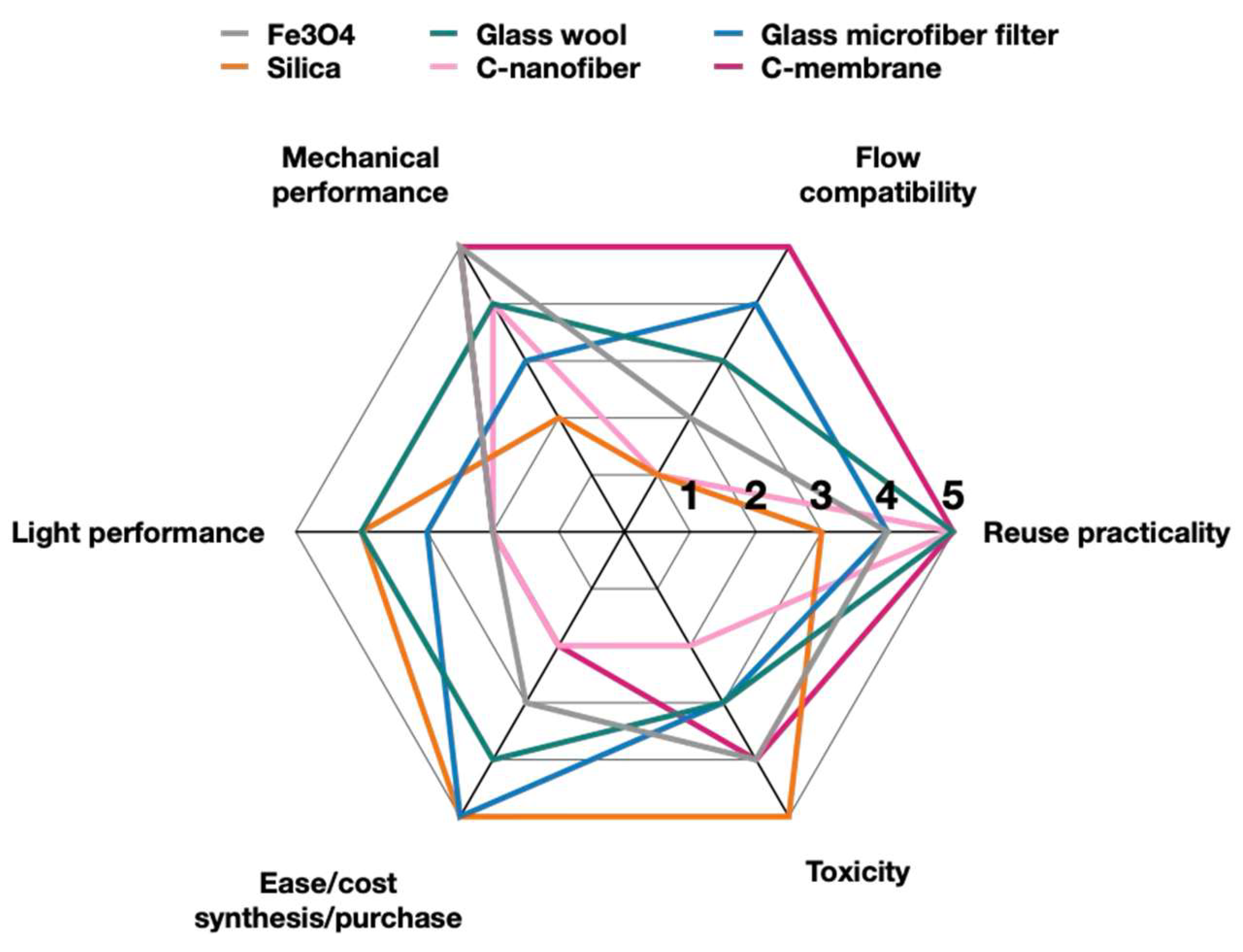
The final selection of a support material needs a comprehensive evaluation of practical factors beyond flow compatibility and pure reaction kinetics. When assessing critical metrics like cost-effectiveness, synthetic convenience, and mechanical durability, glass fiber was shown to possess advantages over glass wool in these categories. This distinction highlights an important trade-off: researchers must often balance the maximum catalytic efficiency with the requirements for scalable, economically viable, and mechanically robust industrial applications [80]. Figure 5 shows a radar plot where each of the important parameters received a score from 1 to 5, with 5 being the most desirable score, so for toxicity, a score of 5 corresponds to essentially non-toxic. Table 4 offers an explanation of the various scores and the rationalization of the values selected.
The criteria used to assign scores to different materials and properties are summarized in Table 4. The criteria chosen to assign scores were developed by our group for this specific case but can be adapted and widely used by others. These factors are ranked based on priority from our point of view from high to low. “Reuse” is defined as ease of recyclability and how many full cycles it remains effective for. “Toxicity” includes hazards to human health if the material was ingested and environmental concern if released into an ecosystem. “Ease/cost” analyzes commercial availability, ease of synthesis, the cost of synthesis (electricity, precursors) or purchase, and the safety of synthesis (if required). “Light” refers to the interaction of the support: transparency, optical inertness in the active region for the catalyst, its ability to help the photocatalyst as a photosensitizer, and photostability under irradiation. “Mechanical” ranks how the supports’ mechanical properties improved their capabilities as a heterogeneous support for ease of modification, loading capability, and fragility. “Flow” categorizes the immobilization ability of the supports in the reactor and their compatibility with different flows (fragility in aqueous solution under high flow rates), as well as flexibility.

3.5. Developing Flow-Compatible Photocatalysts

As previously mentioned, any practical solution that can contribute to water security for communities affected by water contamination issues must employ flow techniques, be easy to deploy, and operate at the point of use. In our own research, we highlighted materials that meet these criteria, and this section focuses on our own experience in developing novel flow-compatible photocatalysts.
As previously mentioned, a study was conducted by our research group examining various supports and showed that glass fiber was an optimal choice for flow compatibility. With this knowledge, studies by Yaghmaei et al. looked at immobilizing TiO2 on glass fiber for in-flow contaminant degradation [19]. The use of titanium isopropoxide as a liquid precursor allowed TiO2 to directly be deposited onto the glass fiber paper when submerged in water. Following a heat treatment, the catalyst was directly attached to the support, which allowed a strip of the glass fiber paper to be cut and shaped appropriately for utilization in a flow system. Moreover, the immobilized TiO2 could then be reduced using volatile ethanol under inert conditions to obtain strips of black TiO2 that were flow-compatible and photoactive in the visible region. This direct deposition strategy is advantageous for the fabrication of supported catalysts and can be expanded to be applied to TiO2 that is doped or decorated with metals or non-metals.
In cases where the powder catalyst is synthesized first and then immobilized, an anchoring agent is used to secure the powder and prevent leaching under flow. Work by Wang et al. made use of 3-Aminopropyltriethoxysilane (APTES) to anchor Pd onto glass wool during a nitro-to-amine reduction reaction [94]. Their studies showed that APTES was successful in increasing the stability of the catalyst by having minimal Pd migration across several hours of flow. Work with this anchoring agent has proven to be reliable in immobilizing various catalysts including pristine TiO2 on glass wool for water remediation [80]; Ag nanoparticles on rice-husk-derived silica for antimicrobial studies [95]; and decatungstate on silica, alumina, titania, and glass wool for oxidative photocatalysis [96]. These works demonstrate that APTES can be a powerful tool in the design of a flow-compatible material which can combine a robust support with an optimized photocatalyst.
Flow systems, utilizing the optimized catalyst/support combinations discussed previously, represent a promising approach for point-of-use applications. Prototype testing demonstrates that the WHO standard of 20 lpcd can be achieved within hours using a device with a compact footprint. However, upscaling this technology for industrial water treatment presents distinct challenges, specifically regarding the uniform irradiation of large water volumes and the mitigation of catalyst fouling caused by high organic loads.

4. Choosing Light and Light Sources

In the pure form, the bandgap of TiO2 enables excitation with wavelengths as low-energy as those in the UVA region, spanning from 320 to 400 nanometers. This, compared to higher-energy UVB and UVC light, is relatively accessible and safe to work with. Common fluorescent UVA lamps emit light around 365 nm, and newer, more affordable UV-LED alternatives operate within the same spectral range. In recent years, additional powerful ultraviolet LED sources have emerged, offering shorter wavelengths in the UVB and UVC regions. Some of these LEDs possess the potential to kill bacteria or degrade organic matter even without a catalyst, although their efficiency is limited, their cost is increased, and additional training is required for point-of-use operators. Consequently, the use of UVA or visible light remains the more appealing option. This principle extends to solar energy, as sunlight contains about ten times more photons in the visible light spectrum compared to the ultraviolet region. Nonetheless, there is a growing preference in research to move farther along the spectrum into the visible region. Along with being the predominant portion of solar emission, visible light sources are also typically safer, more energy-efficient, and more affordable than UVA sources. The selection of light sources can thus be complicated at times, as many factors come into play.
With a typical bandgap of the anatase form of approximately 3.2 eV [27] and photocatalytic activity as reported by Fukishima and Honda [55], TiO2 has since become a material that is ubiquitous in terms of photocatalysis. From a purely research standpoint, the focus often settles on abiding by the first law of photochemistry [97]—that is, the selected wavelength of emission must match well with the absorbance of the photoactive species to encourage the desired reaction. In these bench-scale cases, the other factors mentioned earlier are often not as strongly considered, and more specialized, high-intensity lamps are employed to maximize reaction efficiency. However, this creates a barrier when trying to move technologies from the laboratory setting into applications, especially for those in environmental remediation wherein the application may be as a POU in a community or residential area, rather than in an industrial setting. Here, these other considerations become prominent, and it is imperative that the light source and the setup as a whole are simple to operate, do not require significant specialized safety measures, and are affordable and robust overall, bearing in mind that on-the-ground technologies will likely see continuous use compared to working-hour use in the laboratory. It is here, therefore, that the appeal for visible light becomes more apparent. Both broad-spectrum LEDs (white lights) and narrow-emission LEDs of specific colors are widely available in a variety of sizes and intensities, offering flexibility and tailoring to suit the catalyst and reactor components; some examples are provided in Section 5.2. More appealing yet is the harnessing of visible light from the sun, intrinsically affordable and simple, though the location of the application may dictate the extent to which this can be feasible—for instance, for point-of-use water purification sources for a community in northern Canada, sunlight may work for select parts of the year, but come winter, daylight hours are extremely limited, and thus an alternative white lamp should also be included in the reactor setup to facilitate year-round use.

5. Dye Bleaching as a Quick Screening Test

While dye bleaching studies may not provide a long-term solution to address water security issues, they serve as the fastest screening method for identifying potential catalysts. It is crucial to recognize that a key characteristic of common dyes is their strong light-absorbing properties, which could aid in their own degradation through various mechanisms, such as Type II photooxidation [98,99], involving singlet oxygen mechanisms. Additionally, dye bleaching simply involves the loss of conjugation in the dye structure, not necessarily on the pathway to mineralization. Despite these shortcomings, the strategy remains a valuable screening method. Furthermore, there are several reports suggesting that the dye contamination of rivers may actually contribute to water insecurity in certain locations [100,101].
The subsequent subsections present a curated selection of reported studies, along with our own research endeavors aimed at assessing dye bleaching under standardized and reproducible illumination conditions.

5.1. Photocatalytic Dye Bleaching in the Literature

In evaluating the photocatalytic performance of a given photocatalyst (PC) using dye degradation, many studies often overlook critical control experiments that are essential for reliably attributing dye removal to true photocatalytic activity. A systematic evaluation should include three key control experiments:
  • Photolysis control: The dye solution is exposed to the same light source for a defined period (t) in the absence of the photocatalyst, to assess any direct photodegradation.
  • Dark adsorption control: The dye is mixed with the photocatalyst and kept in the dark for the same duration (t) to evaluate dye adsorption on the catalyst surface.
  • Thermal control: The system temperature is monitored and maintained constant—using a fan or cooling setup, for instance—to ensure that any observed dye degradation is not thermally induced.
It is also essential to record the UV–Vis absorption or diffuse reflectance spectra of the photocatalyst before and after the experiment to detect possible dye adsorption or surface changes. The choice of dye plays a crucial role as well; dyes susceptible to self-sensitized degradation or singlet oxygen generation [102] under illumination should be avoided. Robust and well-characterized dyes such as Rhodamine B, Methylene Blue, Methyl Orange, and Congo Red are generally preferred for evaluating photocatalytic activity.
Furthermore, the accurate reporting of the light source irradiance (in W/m2) and its spectral distribution is critical for a meaningful comparison of the photocatalytic results across studies. Unfortunately, these details are frequently omitted, compromising reproducibility. Including such parameters would ensure transparent and comparable assessments of photocatalytic performance.
A summary of selected dye photodegradation data is presented in Table 5.

5.2. Photocatalytic Dye Bleaching from Our Laboratory

Work from our laboratory has included dye photobleaching in several cases [125], including Crocin [19,80] (the dye in saffron) [126], a convenient one, which, while absorbing in the visible region, is not a sensitizer for singlet oxygen.
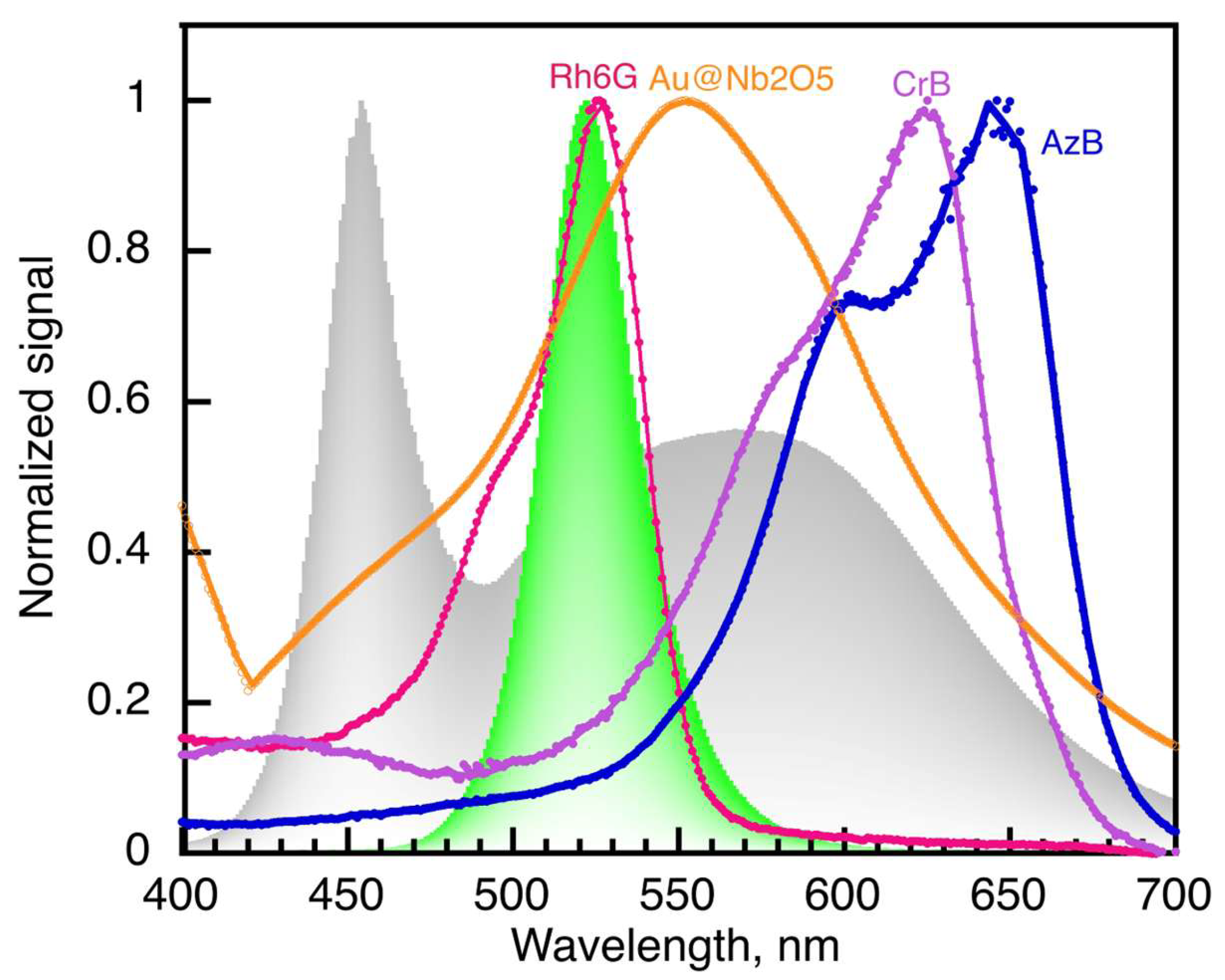
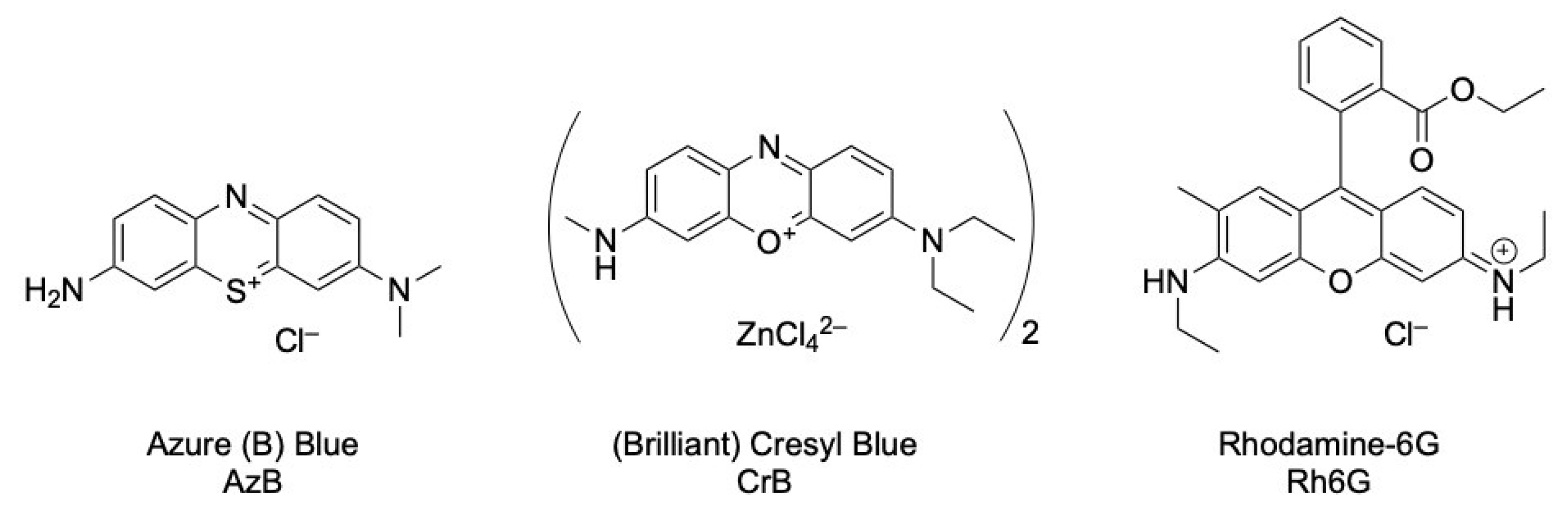
For this contribution, we selected gold on niobium oxide, Au@Nb2O5, as the catalyst and Cresyl Blue (CrB), Rhodamine 6G (Rh6G), and Azure Blue (AzB) as test dyes (Scheme 1) and illuminated them with white and green LED lights.
The catalyst, Au@Nb2O5, contained 32 ppm gold, and each sample of 5 mL contained 20 mg of this catalyst and 10 μg/mL of the selected dye. The samples were irradiated under air in sealed, crimped, fused silica vials that were rotated at 6 rpm while exposed to either green or white LED light. The irradiance was 88.3 W/m2 for the green LEDs and 1420 W/m2 for the white LEDs. The spectra of these light sources are the shaded regions in Figure 6.
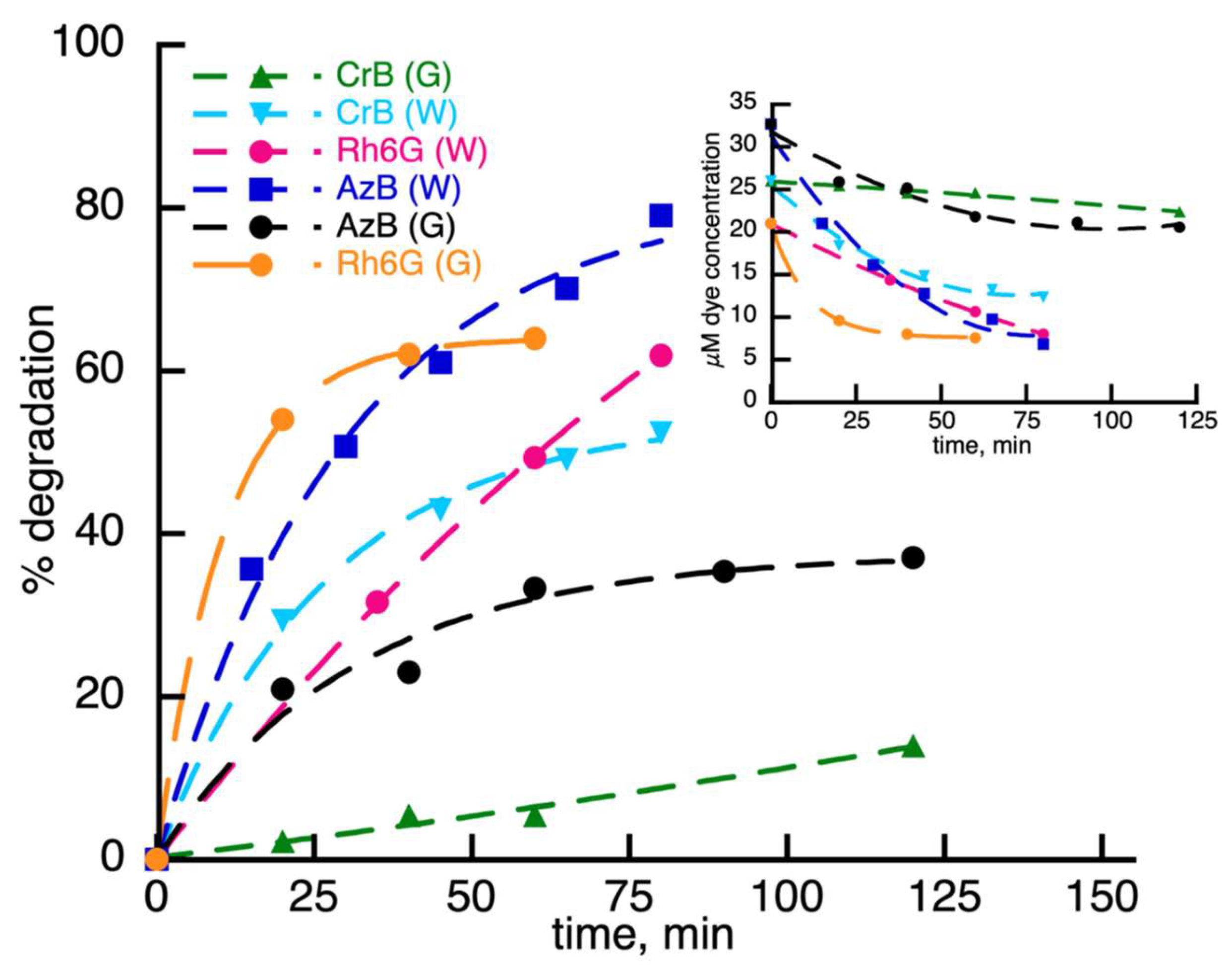
The rates of degradation are illustrated in Figure 7, and the data for each dye and conditions and initial rates are presented in Table 6.
Table 6 and Figure 6 illustrate the type of data that is required for a catalyst screening test to serve as a practical approach for preliminary catalyst evaluation. Unfortunately, this level of information is frequently not available for the data collected in Table 5. In general, green light is remarkably efficient, even if the catalyst’s AuNPs have a very broad absorption (see orange line in Figure 6); this suggests that irradiating monomeric AuNP is particularly effective, as long wavelength absorptions are usually due to nanoparticle aggregates.

6. Batch Photocatalytic Degradation of Drug Water Contaminants

6.1. Work Involving TiO2 and Related Catalysts

The most influential early work on the batch photocatalytic degradation of estrogens using TiO2 is characterized by two essential studies. The first was focused on natural estrogen, demonstrating that suspensions under UV light not only achieved complete degradation but, crucially, caused the immediate loss of estrogenic activity [128]. This was attributed to the rapid oxidative attack on the phenol moiety, the site responsible for biological activity. Following this, the research scope expanded to include more persistent synthetic hormones. For instance, in 2012, Frontistis et al. established that the problematic contraceptive ingredient, 17-alpha-Ethinylestradiol (EE2), also exhibited rapid, high-efficiency degradation kinetics in TiO2 batch systems [129]. Collectively, these two lines of inquiry showed that TiO2-based photocatalysis was a highly promising advanced oxidation technology for effectively detoxifying wastewater from both natural and synthetic estrogenic drug contaminants. Several studies followed and expanded on this [24,130].

6.2. Work from Our Laboratories with TiO2 Materials

Our group has explored many applications of TiO2 in its pure and modified forms. In an earlier contribution, we demonstrated the efficacy of TiO2 fibers decorated with Pd, Co, and zinc phthalocyanine nanoparticles; such additions enable the use of visible light as the irradiation source. In the absence of oxygen, these decorated and/or blackened TiO2 materials may be used for hydrogen generation with the help of an organic sacrificial electron donor (SED) [131]. This idea has been carried forward in recent work to generate hydrogen while simultaneously degrading pharmaceutical pollutants commonly found in water, as they may act as the needed SEDs [132].
Our group has been focusing on developing a highly efficient and sustainable method for water contaminant degradation using modified blackened TiO2 as a photocatalyst. This change allowed us to overcome a critical limitation of conventional TiO2 which requires high-energy ultraviolet (UV) light for activation. This black TiO2 catalyst operates effectively under visible light illumination, such as sunlight or white LEDs. To ensure practical utility in water treatment, black TiO2 is deposited onto a glass fiber support, resulting in a robust, flow-compatible photocatalyst. This fixed-bed configuration is essential for large-scale applications, as it eliminates the need for post-treatment filtration to recover catalyst powders. We demonstrated that, under visible light, this supported black TiO2 degrades water contaminants with greater efficiency than its conventional counterpart [130,133]. Specifically, its effectiveness was validated against persistent pollutants, including hormonal disruptors such as 17-beta-estradiol, a chemical of significant environmental and health concern. We envision that this catalyst would be suitable for producing inexpensive, durable, and easily deployable solar or LED-driven water decontamination systems.

7. Batch Antibacterial Studies Using Powder Photocatalysts

7.1. Antibacterial Studies Using TiO2 in Any Form

The ROS production triggered by light allows TiO2 to be effective against a broad spectrum of microorganisms, including various Gram-positive bacteria (e.g., Staphylococcus aureus, Streptococcus pneumonia, Bacillus subtilis), Gram-negative bacteria (e.g., Proteus vulgaris, Pseudomonas aeruginosa, Escherichia coli), fungi like Candida albicans, and even viruses like SARS-CoV-2 [134].
Studies have explored various forms of TiO2 and methods to enhance its antimicrobial activity. For instance, the antimicrobial activity of TiO2 also tends to increase with decreasing nanoparticle size [135]; sadly, its toxicity increases too. Alternatively, doping TiO2 with other elements, such as silver, has been shown to significantly enhance its antibacterial properties under visible light irradiation while maintaining its biocompatibility. The phase structure, crystallite size, and crystallinity of TiO2 directly affect reactive oxygen species (ROS) generation, which is ultimately responsible for damaging bacterial cell walls, disrupting enzyme activity, and causing genotoxicity [136].
Beyond pristine TiO2, various modifications and composites have been investigated. Cellulose/TiO2 nanocomposites, for example, have been synthesized and characterized for their antibacterial properties against common pathogenic bacteria, showing promise for applications in food packaging and biomedical devices. Despite extensive research, there is an ongoing effort to optimize factors such as particle size, shape, composition, and synthesis parameters to further enhance the antimicrobial efficacy of TiO2 nanoparticles [63].
Despite the promising photoactivity of TiO2, early batch setup systems for water decontamination using a form of blackened TiO2 were deemed inadequate for comprehensively testing catalyst bactericidal properties. The short lifespan and limited travel distance of reactive oxygen species (ROS) meant that only bacteria immediately near the catalyst were affected. Other limitations of the batch system include sample inhomogeneity due to limited stirring and the risk of bacteria settling and forming biofilms that could deactivate the TiO2 catalyst [133].

7.2. Approaching Antibacterial Studies with TiO2 Forms Adaptable to Flow Catalysis

Challenges in the batch setup motivated a shift to flow systems to prevent bacterial settling. Strips were made from glass fiber functionalized with black TiO2 and set up inside a glass tube to be irradiated with white light. While water flowed through this strip, the increased surface contact resulted in a slightly higher inactivation compared to batch tests [80,137].
It was only in our latest flow setup (vertical tube), when gas (air or oxygen) was added through the rubber septum at the bottom and flowed in small bubbles up the catalyst, that we noticed considerably more bacterial inactivation. This added more turbulence to the flow and provided more oxygen for ROS creation by the black TiO2. Details on the flow setups can be found in the published master thesis [137]. The system was the most successful to date, achieving a bacterial inactivation of up to two log units within 30 min of exposure. There is still room for improvement as the times of action need to be quicker. Zigzag, or spiral shapes, instead of planar strips, could help in this sense. Our latest vertical tube flow setup, incorporating gas (air or oxygen) introduced via a bottom rubber septum, demonstrated significantly enhanced bacteria inactivation.

8. Flow Photocatalysis for the Treatment of Drug and Bacterial Contamination: A Promising Future for Point-of-Use Applications

Our lab is not the only one exploring the transition from batch to flow. Several examples of flow-supported catalysts have been noted for the purpose of removing bacteria and organic contaminants—namely pharmaceuticals—for water decontamination. Both bacteria and pharmaceutical contaminants can be removed by an advanced oxidation process (AOP) initiated by ROS formation—something at which TiO2 excels. TiO2’s photocatalytic properties make it an excellent candidate to remove pharmaceuticals from water. TiO2 has prior success in laboratory flow setups to rapidly remove pharmaceuticals from secondary sewage effluent [138]. TiO2 is also an antimicrobial agent, which can successfully remove E. Coli, S. Aureus, and other bacteria in flow [137].
In point-of-use applications, an integrated system capable of removing several different types of contaminants is the most logical strategy. To this effect, studies [139,140] have begun to present options which have several targets, such as combined bacteria and organic contaminant removal. While some materials, such as ZnO and TiO2, have been reported to be effective in removing both these contaminants, another option is to decorate such materials with noble metals [141]. Silver, for instance, has had longstanding use as an antimicrobial material, although other metals, such as gold, have also been reported to have strong light-activated antibacterial properties due to strong surface plasmon resonance [142,143]. Further, there are many ways that a photocatalyst can be modified to maximize its output specifically in a flow setup, as have been discussed.
Continuous flow is generally considered a more feasible method compared to batch setup to meet the high-throughput requirements of a water source for remote communities. It requires photocatalysts capable of generating enough ROS to degrade bacterial and pharmaceutical products in water over a short period of time. Even in flow development, however, bench-scale flow rates can be quite low, generating sub-liter quantities hourly, though some examples offer larger volumes suitable for applications. Indeed, at elevated volume outputs, factors such as pump capacities, tube diameters, and the relative amounts and surface area of catalysts must be considered and adjusted in tandem in order to achieve the desired efficacy. Thus, much remains to be performed in efforts for multi-target systems at scales beyond the lab bench.

9. Conclusions and Outlook

With increasing environmental pollution and the longstanding need for clean water in remote communities around the world, point-of-use water treatment is becoming indispensable. Heterogenous flow photocatalysis holds significant promise for developing compact, reusable devices capable of purifying water of various pollutants. Moreover, flexibility in scale, light source, and bandgap tuning enables systems which are energy-efficient, accessible, and readily deployed in remote areas. In the future, we may see artificial intelligence and machine learning become true contributors to the evaluation and development of new catalysis tools and materials [144].
Our research indicates that a flow system illuminated by LEDs offers several advantages which meet these criteria, with catalysts like black TiO2 having the crucial visible light activity needed for such applications. Further work should focus on enhancing reusability and ensuring flexibility towards a range of contaminants, ideally with continued scale-up to enable a portable and comprehensive water purification system.

Author Contributions

Conceptualization, J.C.S. and M.J.S.C.; methodology, J.C.S. and J.O.; investigation, J.C.S. and J.O.; writing—original draft preparation, J.C.S.; writing—review and editing, all authors; visualization, J.C.S., M.J.S.C., J.O. and C.J.F.; supervision, J.C.S. and M.J.S.C.; funding acquisition, J.C.S. All authors have read and agreed to the published version of the manuscript.

Funding

This work was supported by the Natural Sciences and Engineering Research Council of Canada and the Canada Foundation for Innovation.

Data Availability Statement

The original contributions presented in this study are included in the article. Further inquiries can be directed to the corresponding author.

Acknowledgments

Thanks are due to Daliane R. C. da Silva and Sara Currie whose contributions while they were part of the Scaiano group helped us start our work on water security.

Conflicts of Interest

The authors declare no conflicts of interest.

Abbreviations

The following abbreviations are used in this manuscript:
AOCAssimilable Organic Carbon
APTES3-Aminopropyltriethoxysilane
BGBandgap
CBConduction Band
EPAEnvironmental Protection Agency
lpcdLiters Per Capita Per Day
MCLsMaximum Contaminant Levels
PCPhotocatalyst
PECPhotoelectrochemical
POUPoint of Use
PVCPoly Vinyl Chloride
ROSReactive Oxygen Species
SOCsSynthetic Organic Compounds
TOCTotal Organic Carbon
VBValence Band
VOCsVolatile Organic Compounds
WHOWorld Health Organization

References

  1. Stackelberg, P.E.; Furlong, E.T.; Meyer, M.T.; Zaugg, S.D.; Henderson, A.K.; Reissman, D.B. Persistence of pharmaceutical compounds and other organic wastewater contaminants in a conventional drinking-water-treatment plant. Sci. Total Environ. 2004, 329, 99–113. [Google Scholar] [CrossRef]
  2. Farenhorst, A.; Li, R.; Jahan, M.; Tun, H.M.; Mi, R.; Amarakoon, I.; Kumar, A.; Khafipour, E. Bacteria in drinking water sources of a First Nation reserve in Canada. Sci. Total Environ. 2017, 575, 813–819. [Google Scholar] [CrossRef] [PubMed]
  3. Zaimee, M.Z.; Sarjadi, M.S.; Rahman, M.L. Heavy Metals Removal from Water by Efficient Adsorbents. Water 2021, 13, 2659. [Google Scholar] [CrossRef]
  4. Ortúzar, M.; Esterhuizen, M.; Olicón-Hernández, D.R.; González-López, J.; Aranda, E. Pharmaceutical Pollution in Aquatic Environments: A Concise Review of Environmental Impacts and Bioremediation Systems. Front. Microbiol. 2022, 13, 869332. [Google Scholar] [CrossRef] [PubMed]
  5. Environment and Climate Change Canada. Canadian Environmental Sustainability Indicators: Water Quality in Canadian Rivers; Environment and Climate Change Canada: Gatineau, QC, Canada, 2025. [Google Scholar]
  6. Wang, F.; Xiang, L.; Leung, K.S.-Y.; Elsner, M.; Zhang, Y.; Guo, Y.; Pan, B.; Sun, H.; An, T.; Ying, G.; et al. Emerging contaminants: A One Health perspective. Innovation 2024, 5, 100612. [Google Scholar] [CrossRef]
  7. WHO. Drinking-Water Quality Guidelines. Available online: https://www.who.int/teams/environment-climate-change-and-health/water-sanitation-and-health/water-safety-and-quality/drinking-water-quality-guidelines (accessed on 1 December 2025).
  8. EPA. National Primary Drinking Water Regulations. Available online: https://www.epa.gov/ground-water-and-drinking-water/national-primary-drinking-water-regulations (accessed on 1 December 2025).
  9. European Comission. Drinking Water; Improving Access to Drinking Water for All. Available online: https://environment.ec.europa.eu/topics/water/drinking-water_en (accessed on 1 December 2025).
  10. Collier, R. Swallowing the pharmaceutical waters. Can. Med. Assoc. J. 2012, 184, 163. [Google Scholar] [CrossRef]
  11. Chopra, S.; Kumar, D. Ibuprofen as an emerging organic contaminant in environment, distribution and remediation. Heliyon 2020, 6, e04087. [Google Scholar] [CrossRef]
  12. Welker, R. Developments in Surface Contamination and Cleaning; Kohli, R., Mittal, K.L., Eds.; William Andrew Publishing: Oxford, UK, 2010; pp. 121–175. [Google Scholar] [CrossRef]
  13. Pick, F.C.; Fish, K.E.; Boxall, J.B. Assimilable organic carbon cycling within drinking water distribution systems. Water Res. 2021, 198, 117147. [Google Scholar] [CrossRef]
  14. Holcomb, D.A.; Stewart, J.R. Microbial Indicators of Fecal Pollution: Recent Progress and Challenges in Assessing Water Quality. Curr. Environ. Health Rep. 2020, 7, 311–324. [Google Scholar] [CrossRef]
  15. Zhang, Y.-J.; Yu, H.-Q. Mineralization or Polymerization: That Is the Question. Environ. Sci. Tech. 2024, 58, 11205–11208. [Google Scholar] [CrossRef]
  16. Magni, M.; Jones, E.R.; Bierkens, M.F.P.; van Vliet, M.T.H. Global energy consumption of water treatment technologies. Water Res. 2025, 277, 123245. [Google Scholar] [CrossRef] [PubMed]
  17. Ghazal, H.; Koumaki, E.; Hoslett, J.; Malamis, S.; Katsou, E.; Barcelo, D.; Jouhara, H. Insights into current physical, chemical and hybrid technologies used for the treatment of wastewater contaminated with pharmaceuticals. J. Clean. Prod. 2022, 361, 132079. [Google Scholar] [CrossRef]
  18. Balachandran, B.; Sabumon, P.C. A comprehensive review on biodegradation of azo dye mixtures, metabolite profiling with health implications and removal strategies. J. Hazard. Mater. Adv. 2025, 19, 100834. [Google Scholar] [CrossRef]
  19. Yaghmaei, M.; da Silva, D.R.C.; Rutajoga, N.; Currie, S.; Li, Y.; Vallieres, M.; Silvero, M.J.; Joshi, N.; Wang, B.; Scaiano, J.C. Innovative Black TiO2 Photocatalyst for Effective Water Remediation Under Visible Light Illumination Using Flow Systems. Catalysts 2024, 14, 775. [Google Scholar] [CrossRef]
  20. United Nations. The Human Rights to Safe Drinking Water and Sanitation: Resolution/Adopted by the General Assembly. Available online: https://digitallibrary.un.org/record/821067?v=pdf (accessed on 31 October 2025).
  21. Howard, G.; Bartram, J.; Williams, A.; Overbo, A.; Fuente, D.; Geere, J.-A. Domestic Water Quantity, Service Level and Health, Geneva, Switzerland. 2020. Available online: https://iris.who.int/server/api/core/bitstreams/ca623971-c9ee-4a72-9f60-f2a389ffb5c7/content (accessed on 1 December 2025).
  22. Reed, B.; Reed, B. WHO Technical Note No. 9: How Much Water is Needed. Loughborough University. 2013. Available online: https://doi.org/10.17028/rd.lboro.27984446.v1 (accessed on 1 December 2025).
  23. Rajaraman, T.S.; Parikh, S.P.; Gandhi, V.G. Black TiO2: A review of its properties and conflicting trends. Chem. Eng. J. 2020, 389, 123918. [Google Scholar] [CrossRef]
  24. Vinu, R.; Madras, G. Energy Efficiency and Renewable Energy Through Nanotechnology; Zang, L., Ed.; Springer: London, UK, 2011; pp. 625–677. [Google Scholar] [CrossRef]
  25. Zhu, T.; Gao, S.-P. The Stability, Electronic Structure, and Optical Property of TiO2 Polymorphs. J. Phys. Chem. C 2014, 118, 11385–11396. [Google Scholar] [CrossRef]
  26. Zhang, J.; Zhou, P.; Liu, J.; Yu, J. New understanding of the difference of photocatalytic activity among anatase, rutile and brookite TiO2. PCCP 2014, 16, 20382–20386. [Google Scholar] [CrossRef]
  27. Dette, C.; Pérez-Osorio, M.A.; Kley, C.S.; Punke, P.; Patrick, C.E.; Jacobson, P.; Giustino, F.; Jung, S.J.; Kern, K. TiO2 Anatase with a Bandgap in the Visible Region. Nano Lett. 2014, 14, 6533–6538. [Google Scholar] [CrossRef]
  28. Chen, S.; Wang, Y.; Li, J.; Hu, Z.; Zhao, H.; Xie, W.; Wei, Z. Synthesis of black TiO2 with efficient visible-light photocatalytic activity by ultraviolet light irradiation and low temperature annealing. Mat. Res. Bull. 2018, 98, 280–287. [Google Scholar] [CrossRef]
  29. Ali, I.; Suhail, M.; Alothman, Z.A.; Alwarthan, A. Recent advances in syntheses, properties and applications of TiO2 nanostructures. RSC Adv. 2018, 8, 30125–30147. [Google Scholar] [CrossRef]
  30. Chen, X.; Liu, L.; Liu, Z.; Marcus, M.A.; Wang, W.-C.; Oyler, N.A.; Grass, M.E.; Mao, B.; Glans, P.-A.; Yu, P.Y.; et al. Properties of Disorder-Engineered Black Titanium Dioxide Nanoparticles through Hydrogenation. Sci. Rep. 2013, 3, 1510. [Google Scholar] [CrossRef] [PubMed]
  31. Nair, R.V.; Gummaluri, V.S.; Matham, M.V.; C, V. A review on optical bandgap engineering in TiO2 nanostructures via doping and intrinsic vacancy modulation towards visible light applications. J. Phys. D 2022, 55, 313003. [Google Scholar] [CrossRef]
  32. Wang, B.; Shen, S.; Mao, S.S. Black TiO2 for solar hydrogen conversion. J. Mater. 2017, 3, 96–111. [Google Scholar]
  33. Zhu, G.; Yin, H.; Yang, C.; Cui, H.; Wang, Z.; Xu, J.; Lin, T.; Huang, F. Black Titania for Superior Photocatalytic Hydrogen Production and Photoelectrochemical Water Splitting. ChemCatChem 2015, 7, 2614–2619. [Google Scholar] [CrossRef]
  34. Fang, W.; Xing, M.; Zhang, J. A new approach to prepare Ti3+ self-doped TiO2 via NaBH4 reduction and hydrochloric acid treatment. Appl. Catal. B Environ. 2014, 160–161, 240–246. [Google Scholar] [CrossRef]
  35. Gurbatov, S.O.; Modin, E.; Puzikov, V.; Tonkaev, P.; Storozhenko, D.; Sergeev, A.; Mintcheva, N.; Yamaguchi, S.; Tarasenka, N.N.; Chuvilin, A.; et al. Black Au-Decorated TiO2 Produced via Laser Ablation in Liquid. ACS Appl. Mat. Interfac. 2021, 13, 6522–6531. [Google Scholar] [CrossRef]
  36. Basavarajappa, P.S.; Patil, S.B.; Ganganagappa, N.; Reddy, K.R.; Raghu, A.V.; Reddy, C.V. Recent progress in metal-doped TiO2, non-metal doped/codoped TiO2 and TiO2 nanostructured hybrids for enhanced photocatalysis. Int. J. Hydr. Ener. 2020, 45, 7764–7778. [Google Scholar] [CrossRef]
  37. Ansari, S.A.; Khan, M.M.; Ansari, M.O.; Cho, M.H. Nitrogen-doped titanium dioxide (N-doped TiO2) for visible light photocatalysis. New J. Chem. 2016, 40, 3000–3009. [Google Scholar] [CrossRef]
  38. Zhang, C.; Cao, A.; Chen, L.; Lv, K.; Wu, T.; Deng, K. One-step topological preparation of carbon doped and coated TiO2 hollow nanocubes for synergistically enhanced visible photodegradation activity. RSC Adv. 2018, 8, 21431–21443. [Google Scholar] [CrossRef]
  39. Wang, Y.; Zhang, R.; Li, J.; Li, L.; Lin, S. First-principles study on transition metal-doped anatase TiO2. Nanoscale Res. Lett. 2014, 9, 46. [Google Scholar] [CrossRef]
  40. Hou, X.-G.; Liu, A.-D.; Huang, M.-D.; Liao, B.; Wu, X.-L. First-Principles Band Calculations on Electronic Structures of Ag-Doped Rutile and Anatase TiO2. Chin. Phys. Lett. 2009, 26, 077106. [Google Scholar]
  41. Guo, M.; Du, J. First-principles study of electronic structures and optical properties of Cu, Ag, and Au-doped anatase TiO2. Phys. B Cond. Mat. 2012, 407, 1003–1007. [Google Scholar] [CrossRef]
  42. Delegan, N.; Daghrir, R.; Drogui, P.; El Khakani, M.A. Bandgap tailoring of in-situ nitrogen-doped TiO2 sputtered films intended for electrophotocatalytic applications under solar light. J. Appl. Phys. 2014, 116, 153510. [Google Scholar] [CrossRef]
  43. Gwag, E.H.; Moon, S.Y.; Mondal, I.; Park, J.Y. Influence of carbon doping concentration on photoelectrochemical activity of TiO2 nanotube arrays under water oxidation. Catal. Sci. Tech. 2019, 9, 688–694. [Google Scholar] [CrossRef]
  44. Niu, P.; Wu, G.; Chen, P.; Zheng, H.; Cao, Q.; Jiang, H. Optimization of Boron Doped TiO2 as an Efficient Visible Light-Driven Photocatalyst for Organic Dye Degradation With High Reusability. Front. Chem. 2020, 8, 172. [Google Scholar] [CrossRef]
  45. Ali, T.; Ahmed, A.; Alam, U.; Uddin, I.; Tripathi, P.; Muneer, M. Enhanced photocatalytic and antibacterial activities of Ag-doped TiO2 nanoparticles under visible light. Mat. Chem. Phys. 2018, 212, 325–335. [Google Scholar] [CrossRef]
  46. Yu, Y.; Wen, W.; Qian, X.-Y.; Liu, J.-B.; Wu, J.-M. UV and visible light photocatalytic activity of Au/TiO2 nanoforests with Anatase/Rutile phase junctions and controlled Au locations. Sci. Rep. 2017, 7, 41253. [Google Scholar] [CrossRef]
  47. El-Rady, A.A.; Abd El-Sadek, M.; El-Sayed Breky, M.; Assaf, F. Characterization and Photocatalytic Efficiency of Palladium Doped-TiO2 Nanoparticles. Adv. Nanopart. 2013, 2, 372–377. [Google Scholar] [CrossRef]
  48. Akshay, V.R.; Arun, B.; Mandal, G.; Mutta, G.R.; Chanda, A.; Vasundhara, M. Observation of Optical Band-Gap Narrowing and Enhanced Magnetic Moment in Co-Doped Sol–Gel-Derived Anatase TiO2 Nanocrystals. J. Phys.Chem. C 2018, 122, 26592–26604. [Google Scholar] [CrossRef]
  49. Mathew, S.; Ganguly, P.; Rhatigan, S.; Kumaravel, V.; Byrne, C.; Hinder, S.J.; Bartlett, J.; Nolan, M.; Pillai, S.C. Cu-Doped TiO2: Visible Light Assisted Photocatalytic Antimicrobial Activity. Appl. Sci. 2018, 8, 2067. [Google Scholar] [CrossRef]
  50. Aware, D.V.; Jadhav, S.S. Synthesis, characterization and photocatalytic applications of Zn-doped TiO2 nanoparticles by sol–gel method. Appl. Nanosci. 2016, 6, 965–972. [Google Scholar] [CrossRef]
  51. Singh, D.; Singh, N.; Sharma, S.D.; Kant, C.; Sharma, C.P.; Pandey, R.R.; Saini, K.K. Bandgap modification of TiO2 sol–gel films by Fe and Ni doping. J. Sol-Gel Sci. Tech. 2011, 58, 269–276. [Google Scholar] [CrossRef]
  52. Khan, M.E.; Khan, M.M.; Min, B.-K.; Cho, M.H. Microbial fuel cell assisted band gap narrowed TiO2 for visible light-induced photocatalytic activities and power generation. Sci. Rep. 2018, 8, 1723. [Google Scholar] [CrossRef]
  53. Zhang, Q.; Lima, D.Q.; Lee, I.; Zaera, F.; Chi, M.; Yin, Y. A Highly Active Titanium Dioxide Based Visible-Light Photocatalyst with Nonmetal Doping and Plasmonic Metal Decoration. Angew. Chem. Int. Ed. 2011, 50, 7088–7092. [Google Scholar] [CrossRef] [PubMed]
  54. Tchounwou, P.B.; Yedjou, C.G.; Patlolla, A.K.; Sutton, D.J. Molecular, Clinical and Environmental Toxicology: Volume 3: Environmental Toxicology; Luch, A., Ed.; Springer: Basel, Switzerland, 2012; pp. 133–164. [Google Scholar] [CrossRef]
  55. Fujishima, A.; Honda, K. Electrochemical Photolysis of Water at a Semiconductor Electrode. Nature 1972, 238, 37. [Google Scholar] [CrossRef]
  56. Ghamarpoor, R.; Fallah, A.; Jamshidi, M. A Review of Synthesis Methods, Modifications, and Mechanisms of ZnO/TiO2-Based Photocatalysts for Photodegradation of Contaminants. ACS Omega 2024, 9, 25457–25492. [Google Scholar] [CrossRef]
  57. Kumar, A.; Thakur, P.R.; Sharma, G.; Naushad, M.; Rana, A.; Mola, G.T.; Stadler, F.J. Carbon nitride, metal nitrides, phosphides, chalcogenides, perovskites and carbides nanophotocatalysts for environmental applications. Environ. Chem. Lett. 2019, 17, 655–682. [Google Scholar] [CrossRef]
  58. Shabbir, A.; Sardar, S.; Mumtaz, A. Mechanistic investigations of emerging type-II, Z-scheme and S-scheme heterojunctions for photocatalytic applications—A review. J. Alloys Comp. 2024, 1003, 175683. [Google Scholar] [CrossRef]
  59. Havryliuk, O.; Rathee, G.; Blair, J.; Hovorukha, V.; Tashyrev, O.; Morató, J.; Pérez, L.M.; Tzanov, T. Unveiling the Potential of CuO and Cu2O Nanoparticles against Novel Copper-Resistant Pseudomonas Strains: An In-Depth Comparison. Nanomaterials 2024, 14, 1644. [Google Scholar] [CrossRef]
  60. Xu, L.; Li, J.; Sun, H.; Guo, X.; Xu, J.; Zhang, H.; Zhang, X. In situ Growth of Cu2O/CuO Nanosheets on Cu Coating Carbon Cloths as a Binder-Free Electrode for Asymmetric Supercapacitors. Front. Chem. 2019, 7, 1–9. [Google Scholar] [CrossRef]
  61. Baran, T.; Visibile, A.; Busch, M.; He, X.; Wojtyla, S.; Rondinini, S.; Minguzzi, A.; Vertova, A. Copper Oxide-Based Photocatalysts and Photocathodes: Fundamentals and Recent Advances. Molecules 2021, 26, 7271. [Google Scholar] [CrossRef] [PubMed]
  62. Tuntithavornwat, S.; Saisawang, C.; Ratvijitvech, T.; Watthanaphanit, A.; Hunsom, M.; Kannan, A.M. Recent development of black TiO2 nanoparticles for photocatalytic H2 production: An extensive review. Int. J. Hydrogen Energy 2024, 55, 1559–1593. [Google Scholar] [CrossRef]
  63. Serov, D.A.; Gritsaeva, A.V.; Yanbaev, F.M.; Simakin, A.V.; Gudkov, S.V. Review of Antimicrobial Properties of Titanium Dioxide Nanoparticles. Int. J. Mol. Sci. 2024, 25, 10519. [Google Scholar] [CrossRef] [PubMed]
  64. Rehman, S.; Ullah, R.; Butt, A.M.; Gohar, N.D. Strategies of making TiO2 and ZnO visible light active. J. Hazard. Mat. 2009, 170, 560–569. [Google Scholar] [CrossRef]
  65. Kumar, S.; Karthikeyan, S.; Lee, A.F. g-C3N4-Based Nanomaterials for Visible Light-Driven Photocatalysis. Catalysts 2018, 8, 74. [Google Scholar] [CrossRef]
  66. Ahmed, M.A.; Mahmoud, S.A.; Mohamed, A.A. Unveiling the photocatalytic potential of graphitic carbon nitride (g-C3N4): A state-of-the-art review. RSC Adv. 2024, 14, 25629–25662. [Google Scholar] [CrossRef]
  67. Tolod, K.R.; Hernández, S.; Russo, N. Recent Advances in the BiVO4 Photocatalyst for Sun-Driven Water Oxidation: Top-Performing Photoanodes and Scale-Up Challenges. Catalysts 2017, 7, 13. [Google Scholar] [CrossRef]
  68. Aldrees, A.; Khan, H.; Alzahrani, A.; Dan’azumi, S. Synthesis and characterization of tungsten trioxide (WO3) as photocatalyst against wastewater pollutants. Appl. Water Sci. 2023, 13, 156. [Google Scholar] [CrossRef]
  69. Mohamed, F.; Salim, E.; Hassan, A. Monoclinic tungsten trioxide (WO3) thin films using spraying pyrolysis: Electrical, structural and stoichiometric ratio at different molarity. Digest J. Nanomat. Biostr. 2022, 17, 1029–1043. [Google Scholar] [CrossRef]
  70. Martin, D.J.; Liu, G.; Moniz, S.J.A.; Bi, Y.; Beale, A.M.; Ye, J.; Tang, J. Efficient visible driven photocatalyst, silver phosphate: Performance, understanding and perspective. Chem. Soc. Rev. 2015, 44, 7808–7828. [Google Scholar] [CrossRef]
  71. Tamirat, A.G.; Rick, J.; Dubale, A.A.; Su, W.-N.; Hwang, B.-J. Using hematite for photoelectrochemical water splitting: A review of current progress and challenges. Nanoscale Horiz. 2016, 1, 243–267. [Google Scholar] [CrossRef]
  72. Zhang, Y.; Liang, H. Cadmium sulfide nanoparticles compositing with chitosan and metal-organic framework: Enhanced photostability and increased carbon dioxide reduction. Adv. Comp. Hybrid Mater. 2024, 7, 21. [Google Scholar] [CrossRef]
  73. Mancuso, A.; Iervolino, G. Synthesis and Application of Innovative and Environmentally Friendly Photocatalysts: A Review. Catalysts 2022, 12, 1074. [Google Scholar] [CrossRef]
  74. Shivaji, K.; Sridharan, K.; Kirubakaran, D.D.; Velusamy, J.; Emadian, S.S.; Krishnamurthy, S.; Devadoss, A.; Nagarajan, S.; Das, S.; Pitchaimuthu, S. Biofunctionalized CdS Quantum Dots: A Case Study on Nanomaterial Toxicity in the Photocatalytic Wastewater Treatment Process. ACS Omega 2023, 8, 19413–19424. [Google Scholar] [CrossRef] [PubMed]
  75. Musial, J.; Krakowiak, R.; Mlynarczyk, D.T.; Goslinski, T.; Stanisz, B.J. Titanium Dioxide Nanoparticles in Food and Personal Care Products—What Do We Know about Their Safety? Nanomaterials 2020, 10, 1110. [Google Scholar] [CrossRef]
  76. Gao, J.; Fu, Y. Large-Scale Synthesis of TiO2 Nanospindle by Liquid Phase Method for Photocatalytic Sewage Treatment. Ind. Sci. Eng. 2024, 1, 32–37. [Google Scholar] [CrossRef]
  77. López-Muñoz, M.-J.; Grieken, R.V.; Aguado, J.; Marugán, J. Role of the support on the activity of silica-supported TiO2 photocatalysts: Structure of the TiO2/SBA-15 photocatalysts. Catal. Today 2005, 101, 307–314. [Google Scholar] [CrossRef]
  78. Ma, L.; Chen, Y.; Zheng, J. An efficient, stable and reusable polymer/TiO2 photocatalytic membrane for aqueous pollution treatment. J. Mat. Sci. 2021, 56, 11335–11351. [Google Scholar] [CrossRef]
  79. Yu, Y.; Meng, X.; Zeng, N.; Dan, Y.; Jiang, L. Covalent immobilization of TiO2 within macroporous polymer monolith as a facilely recyclable photocatalyst for water decontamination. Coll. Polym. Sci. 2018, 296, 1419–1429. [Google Scholar] [CrossRef]
  80. Da Silva, D.R.C.; Mapukata, S.; Currie, S.; Kitos, A.A.; Lanterna, A.E.; Nyokong, T.; Scaiano, J.C. Fibrous TiO2 Alternatives for Semiconductor-Based Catalysts for Photocatalytic Water Remediation Involving Organic Contaminants. ACS Omega 2023, 8, 21585–21593. [Google Scholar] [CrossRef]
  81. Malhotra, N.; Lee, J.-S.; Liman, R.A.D.; Ruallo, J.M.S.; Villaflores, O.B.; Ger, T.-R.; Hsiao, C.-D. Potential Toxicity of Iron Oxide Magnetic Nanoparticles: A Review. Molecules 2020, 25, 3159. [Google Scholar] [CrossRef] [PubMed]
  82. Maksoud, M.I.A.A.; Elgarahy, A.M.; Farrell, C.; Al-Muhtaseb, A.A.H.; Rooney, D.W.; Osman, A.I. Insight on water remediation application using magnetic nanomaterials and biosorbents. Coord. Chem. Rev. 2020, 403, 213096. [Google Scholar] [CrossRef]
  83. Wilson, R.; Langer, A.M.; Nolan, R.P. A Risk Assessment for Exposure to Glass Wool. Reg. Toxicol. Pharmacol. 1999, 30, 96–109. [Google Scholar]
  84. Elhage, A.; Wang, B.; Marina, N.; Marin, M.L.; Cruz, M.; Lanterna, A.E.; Scaiano, J.C. Glass wool: A novel support for heterogeneous catalysis. Chem. Sci. 2018, 9, 6844–6852. [Google Scholar] [CrossRef]
  85. Environment Canada and Health Canada. Mineral Fibres (Man-Made Vitreous Fibres); Environment Canada and Health Canada: Ottawa, ON, Canada, 1993. [Google Scholar]
  86. De Ceglie, C.; Pal, S.; Murgolo, S.; Licciulli, A.; Mascolo, G. Investigation of Photocatalysis by Mesoporous Titanium Dioxide Supported on Glass Fibers as an Integrated Technology for Water Remediation. Catalysts 2022, 12, 41. [Google Scholar]
  87. Janjua, T.I.; Cao, Y.; Kleitz, F.; Linden, M.; Yu, C.; Popat, A. Silica nanoparticles: A review of their safety and current strategies to overcome biological barriers. Adv. Drug Del. Rev. 2023, 203, 115115. [Google Scholar] [CrossRef]
  88. Pant, B.; Ojha, G.P.; Acharya, J.; Park, M. Ag3PO4-TiO2-Carbon nanofiber Composite: An efficient Visible-light photocatalyst obtained from electrospinning and hydrothermal methods. Sep. Purif. Tech. 2021, 276, 119400. [Google Scholar]
  89. Helland, A.; Wick, P.; Koehler, A.; Schmid, K.; Som, C. Reviewing the Environmental and Human Health Knowledge Base of Carbon Nanotubes. Environ. Health Persp. 2007, 115, 1125–1131. [Google Scholar]
  90. Khanna, V.; Bakshi, B.R.; Lee, L.J. Carbon Nanofiber Production. J. Ind. Ecol. 2008, 12, 394–410. [Google Scholar] [CrossRef]
  91. Zhang, X.; Li, L.; Zeng, Y.; Liu, F.; Yuan, J.; Li, X.; Yu, Y.; Zhu, X.; Xiong, Z.; Yu, H.; et al. TiO2/Graphitic Carbon Nitride Nanosheets for the Photocatalytic Degradation of Rhodamine B under Simulated Sunlight. ACS Appl. Nano Mat. 2019, 2, 7255–7265. [Google Scholar] [CrossRef]
  92. Maliwan, T.; Hu, J. Release of microplastics from polymeric ultrafiltration membrane system for drinking water treatment under different operating conditions. Water Res. 2025, 274, 123047. [Google Scholar] [CrossRef] [PubMed]
  93. Shen, X.; Song, L.; Luo, L.; Zhang, Y.; Zhu, B.; Liu, J.; Chen, Z.; Zhang, L. Preparation of TiO2/C3N4 heterojunctions on carbon-fiber cloth as efficient filter-membrane-shaped photocatalyst for removing various pollutants from the flowing wastewater. J. Coll. Interf. Sci. 2018, 532, 798–807. [Google Scholar] [CrossRef] [PubMed]
  94. Wang, B.; Bourgonje, C.R.; Scaiano, J.C. Fiber-glass supported catalysis: Real-time, high-resolution visualization of active palladium catalytic centers during the reduction of nitro compounds. Catal. Sci. Tech. 2023, 13, 1021–1031. [Google Scholar] [CrossRef]
  95. Frank, C.J.; He, V.; Scaiano, J.C.; Silvero C, M.J. Photoinduced Transport and Activation of Polymer-Embedded Silver on Rice Husk Silica Nanoparticles for a Reusable Antimicrobial Surface. Nanomaterials 2025, 15, 1224. [Google Scholar] [CrossRef]
  96. Ong, J.; Cajka, B.; Scaiano, J.C. Comparison of Composite Materials Designed to Optimize Heterogeneous Decatungstate Oxidative Photocatalysis. Molecules 2025, 30, 3597. [Google Scholar] [CrossRef]
  97. Scaiano, J.C.T. Photochemistry Essentials; American Chemical Society: Washington, DC, USA, 2022. [Google Scholar]
  98. Baptista, M.S.; Cadet, J.; Di Mascio, P.; Ghogare, A.A.; Greer, A.; Hamblin, M.R.; Lorente, C.; Nunez, S.C.; Ribeiro, M.S.; Thomas, A.H.; et al. Type I and Type II Photosensitized Oxidation Reactions: Guidelines and Mechanistic Pathways. Photochem. Photobiol. 2017, 93, 912–919. [Google Scholar] [CrossRef]
  99. Foote, C.S. Type I and Type II Mechanisms of Photodynamic Action. ACS Symp. Ser. 1987, 339, 22–38. [Google Scholar]
  100. Liu, Y.; Chen, J.; Duan, D.; Zhang, Z.; Liu, C.; Cai, W.; Zhao, Z. Environmental Impacts and Biological Technologies Toward Sustainable Treatment of Textile Dyeing Wastewater: A Review. Sustainability 2024, 16, 10867. [Google Scholar] [CrossRef]
  101. Paraschiv, D.M.; Tudor, C.; Petrariu, R. The Textile Industry and Sustainable Development: A Holt–Winters Forecasting Investigation for the Eastern European Area. Sustainability 2015, 7, 1280–1291. [Google Scholar] [CrossRef]
  102. Wilkinson, F.; Helman, W.P.; Ross, A.B. Quantum Yields for the Photosensitized Formation of the Lowest Electronically Excited Singlet State of Molecular Oxygen in Solution. J. Phys. Chem. Ref. Data 1993, 22, 113–262. [Google Scholar] [CrossRef]
  103. Nimmy, A.V.; Indujalekshmi, J.; Chithra, S.; Anandakumar, V.M.; Biju, V. Elucidation of augmented visible-light photocatalysis in surface-modified coloured rutile TiO2. J. Solid State Chem. 2026, 353, 125685. [Google Scholar] [CrossRef]
  104. Khan, R.; Rahman, N.; Prasannan, A.; Ganiyeva, K.; Chakrabortty, S.; Sangaraju, S. Phase transition and bandgap modulation in TiO2 nanostructures for enhanced visible-light activity and environmental applications. Sci. Rep. 2025, 15, 20309. [Google Scholar] [CrossRef] [PubMed]
  105. Mohammed, W.; Matalkeh, M.; Al Soubaihi, R.M.; Elzatahry, A.; Saoud, K.M. Visible Light Photocatalytic Degradation of Methylene Blue Dye and Pharmaceutical Wastes over Ternary NiO/Ag/TiO2 Heterojunction. ACS Omega 2023, 8, 40063–40077. [Google Scholar] [CrossRef] [PubMed]
  106. Simanjuntak, M.; Joni, I.M.; Faizal, F.; Gultom, N.S.; Kuo, D.-H.; Panatarani, C. Photoluminescence of oxygen vacancy-rich nano-TiO2 photocatalyst for methylene blue color degradation. Mater. Sci. Eng. B 2025, 320, 118401. [Google Scholar] [CrossRef]
  107. De la Garza, A.R.; Zeghioud, H.; Benítez-Rico, A.; Romero-Nuñez, A.; Djelal, H.; Chávez-Miyauchi, T.E.; Guillén-Cervantes, J.Á. Visible LED active photocatalyst based on cerium doped titania for Rhodamine B degradation: Radical’s contribution, stability and response surface methodology optimization. Mat. Sci. Semicond. Proc. 2024, 176, 108349. [Google Scholar] [CrossRef]
  108. Li, Q.-Y.; Han, S.-D.; Liu, J.-G.; Sun, L.-Y.; Wang, Y.-L.; Wei, Q.; Cui, S.-P. Controllable preparation and photocatalytic performance of hollow hierarchical porous TiO2/Ag composite microspheres. Coll. Surf. A 2023, 658, 130707. [Google Scholar] [CrossRef]
  109. Nimmy, A.V.; Mahesh, A.; Anandakumar, V.M.; Biju, V. Revealing the role of defect-induced trap levels in sol–gel-derived TiO2 samples and the synergistic effect of a mixed phase in photocatalytic degradation of organic pollutants. J. Phys. Chem. Solid. 2024, 185, 111774. [Google Scholar]
  110. Nguyen, C.H.; Fu, C.-C.; Juang, R.-S. Degradation of methylene blue and methyl orange by palladium-doped TiO2 photocatalysis for water reuse: Efficiency and degradation pathways. J. Clean. Prod. 2018, 202, 413–427. [Google Scholar] [CrossRef]
  111. Karimi-Maleh, H.; Kumar, B.G.; Rajendran, S.; Qin, J.; Vadivel, S.; Durgalakshmi, D.; Gracia, F.; Soto-Moscoso, M.; Orooji, Y.; Karimi, F. Tuning of metal oxides photocatalytic performance using Ag nanoparticles integration. J. Molec. Liq. 2020, 314, 113588. [Google Scholar] [CrossRef]
  112. Jo, W.-K.; Kumar, S.; Isaacs, M.A.; Lee, A.F.; Karthikeyan, S. Cobalt promoted TiO2/GO for the photocatalytic degradation of oxytetracycline and Congo Red. Appl. Catal. B Environ. 2017, 201, 159–168. [Google Scholar] [CrossRef]
  113. Wu, S.; Li, X.; Tian, Y.; Lin, Y.; Hu, Y.H. Excellent photocatalytic degradation of tetracycline over black anatase-TiO2 under visible light. Chem. Eng. J. 2021, 406, 126747. [Google Scholar] [CrossRef]
  114. Li, Y.; Feng, Y.; Bai, H.; Liu, J.; Hu, D.; Fan, J.; Shen, H. Enhanced visible-light photocatalytic performance of black TiO2/SnO2 nanoparticles. J. Alloy Comp. 2023, 960, 170672. [Google Scholar] [CrossRef]
  115. Chen, S.; Xiao, Y.; Wang, Y.; Hu, Z.; Zhao, H.; Xie, W. A Facile Approach to Prepare Black TiO2 with Oxygen Vacancy for Enhancing Photocatalytic Activity. Nanomaterials 2018, 8, 245. [Google Scholar] [CrossRef] [PubMed]
  116. Rachmantyo, R.; Afkauni, A.A.; Reinaldo, R.; Zhang, L.; Arramel, A.; Birowosuto, M.D.; Wibowo, A.; Judawisastra, H. Fabrication of black TiO2 through microwave heating for visible light-driven photocatalytic degradation of rhodamine 6G. React. Chem. Eng. 2024, 9, 3003–3015. [Google Scholar] [CrossRef]
  117. Veziroglu, S.; Obermann, A.-L.; Ullrich, M.; Hussain, M.; Kamp, M.; Kienle, L.; Leißner, T.; Rubahn, H.-G.; Polonskyi, O.; Strunskus, T.; et al. Photodeposition of Au Nanoclusters for Enhanced Photocatalytic Dye Degradation over TiO2 Thin Film. ACS Appl. Mat. Interfac. 2020, 12, 14983–14992. [Google Scholar] [CrossRef]
  118. Muraro, P.C.L.; Mortari, S.R.; Vizzotto, B.S.; Chuy, G.; Santos, C.D.; Brum, L.F.W.; da Silva, W.L. Iron oxide nanocatalyst with titanium and silver nanoparticles: Synthesis, characterization and photocatalytic activity on the degradation of Rhodamine B dye. Sci. Rep. 2020, 10, 3055. [Google Scholar] [CrossRef]
  119. Qutub, N.; Singh, P.; Sabir, S.; Sagadevan, S.; Oh, W.-C. Enhanced photocatalytic degradation of Acid Blue dye using CdS/TiO2 nanocomposite. Sci. Rep. 2022, 12, 5759. [Google Scholar] [CrossRef]
  120. Dalanta, F.; Widiyandari, H.; Kartikowati, C.W.; Arif, A.F.; Filardli, A.M.I.; Arutanti, O. Green-synthesized Schottky junction Ni-TiOx suboxide photocatalyst enriched with oxygen vacancies for solar-driven degradation of emerging contaminants. J. Water Proc. Eng. 2025, 77, 108446. [Google Scholar] [CrossRef]
  121. Magdalane, C.M.; Priyadharsini, G.M.A.; Kaviyarasu, K.; Jothi, A.I.; Simiyon, G.G. Synthesis and characterization of TiO2 doped cobalt ferrite nanoparticles via microwave method: Investigation of photocatalytic performance of congo red degradation dye. Surf. Interfac. 2021, 25, 101296. [Google Scholar] [CrossRef]
  122. Landge, V.K.; Huang, C.-M.; Hakke, V.S.; Sonawane, S.H.; Manickam, S.; Hsieh, M.-C. Solar-Energy-Driven Cu-ZnO/TiO2 Nanocomposite Photocatalyst for the Rapid Degradation of Congo Red Azo Dye. Catalysts 2022, 12, 605. [Google Scholar] [CrossRef]
  123. Xu, D.; Yu, H.; Qin, Y.; Di, Y.; Jia, H.; Li, F.; Liu, J. Hollow TiO2–SiO2 Nanospheres for Photocatalytic Degradation of Organic Dyes. ACS Appl. Nano Mat. 2024, 7, 2630–2638. [Google Scholar] [CrossRef]
  124. Hu, X.; Yang, Y.; Wang, W.; Wang, Y.; Gong, X.; Geng, C.; Tang, J. Hollow Fe3+-Doped Anatase Titanium Dioxide Nanosphere for Photocatalytic Degradation of Organic Dyes. ACS Appl. Nano Mat. 2023, 6, 18999–19009. [Google Scholar] [CrossRef]
  125. Sindelo, A.; Britton, J.; Lanterna, A.E.; Scaiano, J.C.; Nyokong, T. Decoration of glass wool with zinc (II) phthalocyanine for the photocatalytic transformation of methyl orange. J. Photochem. Photobiol. A Chem. 2022, 432, 114127. [Google Scholar] [CrossRef]
  126. Ali, A.; Yu, L.; Kousar, S.; Khalid, W.; Maqbool, Z.; Aziz, A.; Arshad, M.S.; Aadil, R.M.; Trif, M.; Riaz, S.; et al. Crocin: Functional characteristics, extraction, food applications and efficacy against brain related disorders. Front. Nutr. 2022, 9, 1–13. [Google Scholar] [CrossRef] [PubMed]
  127. Kubelka, P. New Contributions to the Optics of Intensely Light-Scattering Materials. J. Opt. Soc. Am. 1948, 38, 448. [Google Scholar] [CrossRef]
  128. Ohko, Y.; Iuchi, K.-I.; Niwa, C.; Tatsuma, T.; Nakashima, T.; Iguchi, T.; Kubota, Y.; Fujishima, A. 17β-Estradiol Degradation by TiO2 Photocatalysis as a Means of Reducing Estrogenic Activity. Environ. Sci. Tech. 2002, 36, 4175–4181. [Google Scholar] [CrossRef]
  129. Frontistis, Z.; Daskalaki, V.M.; Hapeshi, E.; Drosou, C.; Fatta-Kassinos, D.; Xekoukoulotakis, N.P.; Mantzavinos, D. Photocatalytic (UV-A/TiO2) degradation of 17α-ethynylestradiol in environmental matrices: Experimental studies and artificial neural network modeling. J. Photochem. Photobiol. A Chem. 2012, 240, 33–41. [Google Scholar] [CrossRef]
  130. Zarzzeka, C.; Goldoni, J.; de Paula de Oliveira, J.D.R.; Lenzi, G.G.; Bagatini, M.D.; Colpini, L.M.S. Photocatalytic action of Ag/TiO2 nanoparticles to emerging pollutants degradation: A comprehensive review. Sust. Chem. Environ. 2024, 8, 100177. [Google Scholar] [CrossRef]
  131. Mapukata, S.; Hainer, A.S.; Lanterna, A.E.; Scaiano, J.C.; Nyokong, T. Decorated titania fibers as photocatalysts for hydrogen generation and organic matter degradation. J. Photochem. Photobiol. A Chem. 2020, 388, 112185. [Google Scholar] [CrossRef]
  132. Rutajoga, N.; Velez, V.; Scaiano, J.C. Scavenging of photogenerated holes in TiO2-based catalysts uniquely controls pollutant degradation and hydrogen formation under UVA or visible irradiation. Catal. Sci. Tech. 2025, 15, 5886–5892. [Google Scholar] [CrossRef]
  133. Da Silva, D.R.C. Unveiling the Versatility of Titanium and Iron Nanostructures: Applications Across Medicine, Environmental Remediation and Organic Reactions. Ph.D. Thesis, University of Ottawa, Ottawa, ON, Canada, 2024. [Google Scholar]
  134. Prakash, J.; Cho, J.; Mishra, Y.K. Photocatalytic TiO2 nanomaterials as potential antimicrobial and antiviral agents: Scope against blocking the SARS-CoV-2 spread. Micro Nano Eng. 2022, 14, 100100. [Google Scholar] [CrossRef]
  135. Younis, A.B.; Haddad, Y.; Kosaristanova, L.; Smerkova, K. Titanium dioxide nanoparticles: Recent progress in antimicrobial applications. WIREs Nanomed. Nanobiotech. 2023, 15, e1860. [Google Scholar] [CrossRef]
  136. Raj, L.F.A.A.; Annushrie, A.; Namasivayam, S.K.R. Anti bacterial efficacy of photo catalytic active titanium di oxide (TiO2) nanoparticles synthesized via green science principles against food spoilage pathogenic bacteria. Microbe 2025, 7, 100331. [Google Scholar] [CrossRef]
  137. Currie, S. Bactericidal Properties of Blackened Titanium Dioxide on Glass Filter: A Proof of Concept for Water Decontamination. Master’s Thesis, University of Ottawa, Ottawa, ON, Canada, 2025. [Google Scholar]
  138. Navidpour, A.H.; Ahmed, M.B.; Zhou, J.L. Photocatalytic Degradation of Pharmaceutical Residues from Water and Sewage Effluent Using Different TiO2 Nanomaterials. Nanomaterials 2024, 14, 135. [Google Scholar] [CrossRef] [PubMed]
  139. Dufner, L.; Aresté-Saló, L.; Graells, M.; Pérez-Moya, M.; Kern, F.; Rheinheimer, W. Photocatalytic degradation of paracetamol on immobilized TiO2 in a low-tech reactor by solar light for water treatment. Open Ceram. 2024, 18, 100599. [Google Scholar] [CrossRef]
  140. Zhao, W.-B.; Du, M.-R.; Liu, K.-K.; Zhou, R.; Ma, R.-N.; Jiao, Z.; Zhao, Q.; Shan, C.-X. Hydrophilic ZnO Nanoparticles@Calcium Alginate Composite for Water Purification. ACS Appl. Mat. Interf. 2020, 12, 13305–13315. [Google Scholar] [CrossRef] [PubMed]
  141. Qi, Z.; Miyazaki, Y.; Sugasawa, M.; Yang, Y.; Negishi, N. Antibacterial silver-loaded TiO2 ceramic photocatalyst for water purification. J. Water Proc. Eng. 2022, 50, 103225. [Google Scholar] [CrossRef]
  142. Lozovski, V.; Rybalchenko, N.; Petrik, I.; Kryvokhyzha, K.; Vasiljev, A.; Vasyliev, T. Surface Plasmon Resonance Influence on the Antibacterial Effect of a Nanostructured Gold Surface. e-J. Surf. Sci. Nanotech. 2025, 23, 160–167. [Google Scholar] [CrossRef]
  143. Huang, X.; El-Sayed, I.H.; Qian, W.; El-Sayed, M.A. Cancer Cell Imaging and Photothermal Therapy in the Near-Infrared Region by Using Gold Nanorods. J. Am. Chem. Soc. 2006, 128, 2115–2120. [Google Scholar] [CrossRef]
  144. Belkhode, P.N.; Awatade, S.M.; Prakash, C.; Shelare, S.D.; Marghade, D.; Gajghate, S.S.; Noor, M.M.; Dennison, M.S. An integrated AI-driven framework for maximizing the efficiency of heterostructured nanomaterials in photocatalytic hydrogen production. Sci. Rep. 2025, 15, 24936. [Google Scholar] [CrossRef]
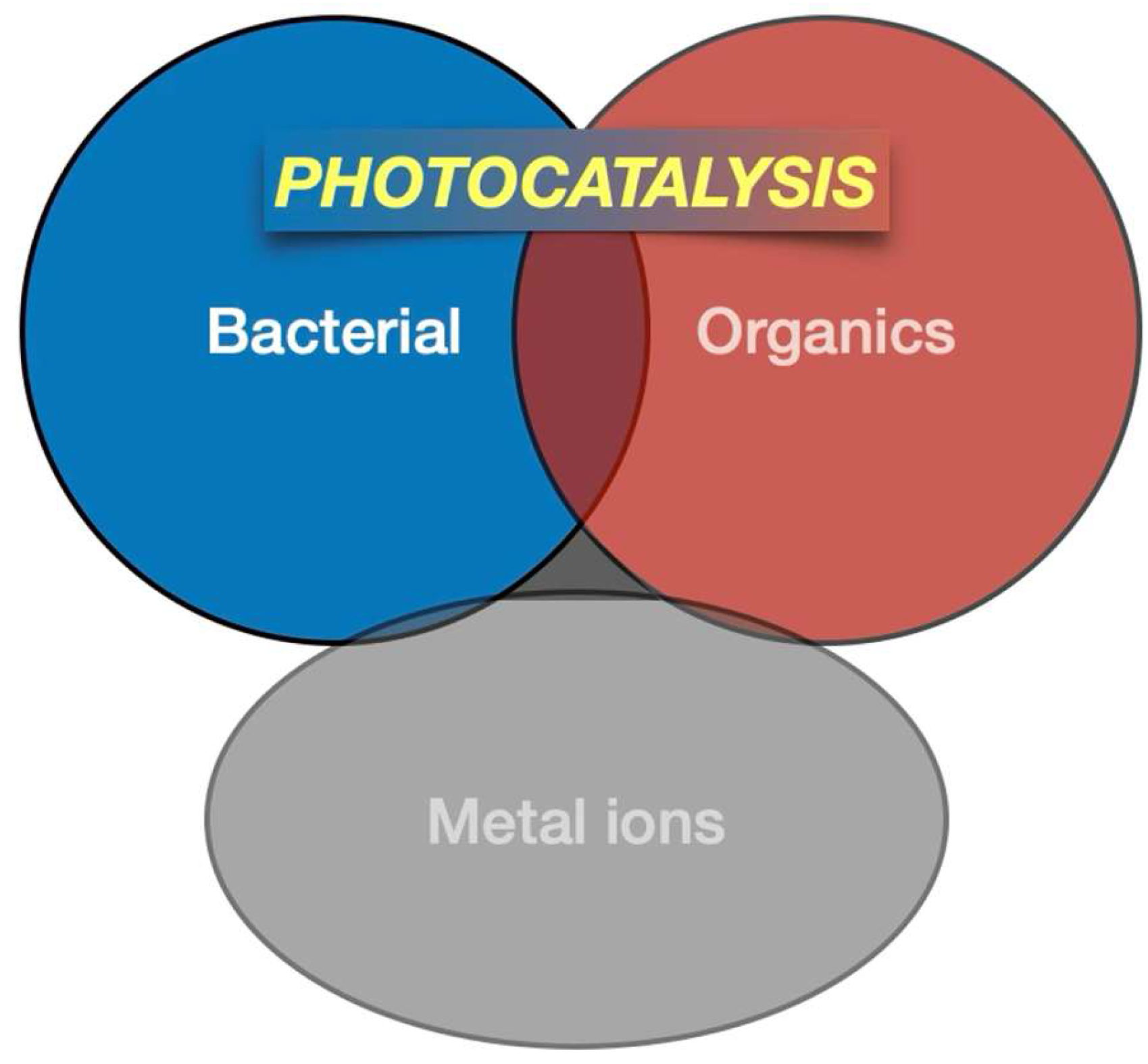
Figure 1. Of the three classic types of contaminants, photocatalysis can access two of them easily: organics and microorganisms.
Catalysts 16 00035 g001
Figure 2. The pharmaceutical route to a body of water and photocatalytic remediation technologies that tackle contamination accumulating in surface water and groundwater. Adapted from an original figure from Ortúzar et al. [4] under the Creative Commons Attribution License (CC-BY).
Catalysts 16 00035 g002
Figure 3. Classic representation of TiO2 generating ROS following absorption of UVA light. This common representation does not necessarily meet quantum yield or absorption properties preferred for efficient water remediation strategies.
Catalysts 16 00035 g003
Figure 4. Cartoons illustrating the differences between doping and decorating with “M” in purple, typically a metal, such as gold.
Catalysts 16 00035 g004
Figure 5. A radar plot for six different support materials that have been or could be utilized to support TiO2. In this type of plot, scores that are at or near the periphery of the figure represent preferred values.
Catalysts 16 00035 g005
Scheme 1. Dyes selected for testing.
Catalysts 16 00035 sch001
Figure 6. The gray and green areas correspond to the normalized irradiance spectra from the two LEDs used, while the orange spectrum is the diffuse reflectance from the Au@Nb2O5 catalyst using the F(R) Kubelka–Munk [127] function, also normalized. The other spectra are the absorptions of the three dyes used.
Catalysts 16 00035 g006
Figure 7. The main figure shows the rate of degradation of the dyes studied as a function of time, while the inset shows the concentration decay as a function of time. Note that all dyes were present at 10 µg/mL, and the different starting points are due to the different molecular weights.
Catalysts 16 00035 g007
Table 1. MCL a of common SOCs and VOCs in drinking water.
ContaminantTypePrimary Source/UseWHO
Guidelines [7]
US EPA Limits [8]EU Limits [9]
BenzeneVOCFuel/Gasoline, Solvents1051.0
Carbon TetrachlorideVOCIndustrial Solvent, Refrigerant450.5
Vinyl ChlorideVOCPlastic Manufacturing (PVC)0.320.5
1,2-DichloroethaneVOCVinyl Chloride Production, Solvents3053.0
p-DichlorobenzeneVOCMothballs, Air Fresheners300750.5
Trichloroethylene (TCE)VOCIndustrial Solvent, Degreaser70510 (for tetrachloroethene and trichloroethene sum)
AtrazineSOCHerbicide (Agricultural Runoff)10030.1 (for individual pesticides)
AlachlorSOCHerbicide (Agricultural Runoff)2020.1 (for individual pesticides)
Total Trihalomethanes (TTHMs)VOCChlorination Byproduct10080100
a Units of MCL are expressed in µg/mL.
Table 2. A list of bandgap values for doped TiO2 from the literature.
Doped TiO2Bandgap (eV)Reference
Pristine TiO23.2[27]
N2-doped TiO22.30[42]
C-doped TiO22.75[43]
B-doped TiO22.85[44]
Ag-doped TiO22.60[45]
Au-doped TiO22.61[46]
Pd-doped TiO23.06[47]
Co-doped TiO22.24[48]
Cu-doped TiO22.80[49]
Zn-doped TiO22.83[50]
Ni-doped TiO22.90[51]
Fe-doped TiO22.73[51]
Table 3. Summary of some selected photocatalysts capable of being used for water remediation applications.
Photo-CatalystBG (eV)LimitationsAdvantagesEnhancement StrategiesApplicationsRef
TiO2~3.2Limited visible light activityWidely studied, stable, effective under UV lightDoping, surface modification, heterojunctionsWater remediation and bacterial inactivation[19,55,62,63]
ZnO~3.2Similar UV-only limitation as TiO2, photocorrosion under acidic conditionsHigh electron mobility, UV stability, ROS generationDoping, surface modification, heterojunctionsDye, pharmaceutical, pesticide degradation[56,64]
g-C3N4~2.7Low quantum efficiency, fast recombinationVisible light-active, metal-free, stable, basic sitesBandgap engineering, heterojunctions, oxidant coupling (e.g., H2O2, persulfate)Water splitting, CO2 reduction, organic degradation[65,66]
BiVO4~2.4Poor charge mobility, recombinationVisible light-active, solar-driven PEC applicationsDoping, heterojunctions, MXene compositesPollutant degradation, water splitting[67]
WO3~2.6Fast electron–hole recombination, limited conduction band positionStable, Earth-abundant, visible light-activeDoping, heterojunctions, oxygen vacancy engineeringDye and pharmaceutical degradation[68,69]
Ag3PO4~2.4Photocorrosion, poor recyclabilityHigh quantum efficiency, strong oxidantDoping, noble metal deposition, magnetic supportsPollutant degradation, water oxidation[70]
α-Fe2O3~2.1Poor conductivity, recombinationNon-toxic, inexpensive, abundantDoping, morphology control, composites (e.g., Fe2O3–g-C3N4)Dye degradation, hydrogen production[71]
Cu2O/CuO~2.0–2.2Charge recombination, photodegradationLow-cost, visible light-active, ROS generationHeterojunctions, graphene oxide decoration, surface engineeringDecentralized water treatment, dye and drug degradation[59,60,61]
CdS~2.4Cadmium toxicity, photocorrosionExcellent solar-driven activityBiofunctionalization, composites to reduce Cd2+ leachingWater splitting, pollutant degradation[72]
Table 4. Properties of different materials that could be used as supports for TiO2.
ReuseToxicityEase/CostLightMechanicalFlow
Fe3O4 NPs4
Magnetically separable.
Surface can oxidize to Fe(III) after 3–10 cycles.
4
Can produce ROS.
Oxidizes to inert and biocompatible Fe(II) [81].
3
Safe, eco-friendly, and low-cost [82].
2
Absorbs visible light. Can compete with photocatalysts.
5
Magnetic.
Easy-to-decorate surface.
2
Not flow-compatible, unless anchored by magnets.
Glass wool5
Easily separable.
Washing surface can remove active sites
(5–7 cycles).
3
Microfibers can detach and potentially be ingested (high aspect ratio) [83].
4
Low-cost, widely available, easy to modify [84].
4
Highly scattering.
4
Easy to decorate. Silanization-compatible. Shape-adaptable to setup.
3
High flow rate challenge.
Glass microfiber filter
(GMF)
4
Separable from most matrices.
Small fibers can be released
(5–7 cycles).
3
Microfibers can detach and potentially be ingested. Inert [85].
5
Low-cost and stable under irradiation [86].
3
Opaque,
might affect light absorbance.
3
Can accept large loads.
High abrasion risk.
4
Highly flexible, light-weight, thermally stable [86].
Silica3
Catalyst loss possible during recycling.
Efficacy can decrease after ~3 cycles.
5
Inert and non-toxic at bulk or nanoscale [87].
5
Low cost for commercial silica.
4
Good UV scatterer.
2
Large surface area, inert.
High abrasion risk.
1
Powder.
Carbon nanofibers5
Electrospinning TiO2, decreases catalyst loss and increases reusability to >10 cycles [88].
2
High aspect ratio causes pulmonary issues.
Can produce harmful ROS [89].
2
High energy requirements
(electrospinning/CVD) [90].
2
Broad light absorption.
4
Withstands flow stress.
Flexible; adapts to reaction setups.
1
Powder.
Carbon membranes5
Low separation from support. May lose active sites after multiple cycles (>10 cycles) [91].
4
Thin films; low risk of dissolution. May release microplastics. Inert [92].
2
High cost—electrospinning.
2
Broad light absorption.
5
Withstands high pressure gradients.
Resistant to abrasion.
5
Flexible [93].
Table 5. List of selected TiO2-based photocatalysts and evaluation of their photocatalytic performance by monitoring photobleaching of dyes.
PC
(Specific Sample)
BG (eV)DyeDegradation Efficiency PC
(mg/mL)
Light SourceIrradiance
W-m−2
Ref
Colored rutile TiO2
(rR3)
2.97MB68% in 90 min0.6White LED
(400–700 nm)
150[103]
TiO2 doped with Al3+/Al2+ and S6+ ions
(X4)
1.98MB96.4% in 150 min0.4Halogen lamp, 200 WNR[104]
Ternary NiO/Ag/TiO2 composite2.5MB93.2% in 60 min1 Halogen lamp, 400 W
f ≥ 400 nm)
170 [105]
Oxygen vacancy-rich nano-TiO2
(T150)
2.65MB93.8% in 180 min 0.2Direct sunlight104.5 Klux[106]
Ce-doped TiO2
(7% of Ce doping of TiO2)
2.42RhB70% in 150 min1.3420 nm LED (7.5 W)20[107]
Hollow hierarchical porous TiO-Ag composite
(HHPA6 (10:0.5))
3.08MO98.4% in 125 min1.25 15W lamp (λmax 395 nm)NR[108]
Sol–gel-derived TiO2 (T2)2.97MB99% in 75 min0.6Direct sunlight500–800 [109]
Pd-doped TiO2
(0.5% Pd-TiO2)
3.12MB, MO99.4% in 120 min (MB); 92.6% in 120 min (MO)1.0100 W Hg lamp65[110]
Ag-TiO22.78MO86% in 180 min1.0Solar simulator 1.5 GNR[111]
Co3O4/TiO2/GO
(2 wt% Co3O4/TiO2/GO-1)
3.04CR91% in 90 min0.25300 W Xe lamp (λf > 400 nm)1000[112]
Black TiO21.3 TC66.6% in 240 min0.20 1000 W Xe lamp (λf > 400 nm)400[113]
Black TiO2/SnO2
(BTS3)
2.55RhB96.6% in 90 min0.62150 W Xe lamp (λf > 420 nm)NR[114]
Black TiO2NRRhB, MB>90% in 120 min (RhB); 70% in 220 min (MB)0.5 800 W Xe lamp
(λf > 420 nm)
NR[115]
Black TiO21.5Rh6G49.2% in 240 min0.3100 W white LED 6500K9000 lumen[116]
Au nanocluster-decorated
TiO2 thin film
NR MB90% in 120 min1 cm wafer in 6.5 mL solution UV lamp (λpeak 365 nm)45[117]
Fe2O3-TiO2
(TiNP-Fe2O3)
2.0RhB48.4% in 120 min1.41 mg/mLVisible light
(no details)
202[118]
CdS/TiO2 nanocomposite3.5AB84% in 90 min1.0Halogen lamp (500 W)9500 lum[119]
Ni-TiOx2.68RhB, MO, TC98.2% (RhB); 99.5% (MO); 93.5% (TC) in 120 min0.15Solar simulator1000[120]
TiO2-doped CoFe2O42.88CR99.9% in 250 min0.8150 W metal halide lamp; λ > 400 nmNR[121]
Cu-ZnO/TiO2 nanocomp. (CZT-2)2.68CR100% in 20 min0.5 Direct sunlight NR[122]
TiO2-SiO2 nanospheresNRRhB100% in 110 min0.8Xe lamp
(300 W, λ < 390 nm)
NR[123]
Fe−TiO2 hollow nanospheres (2% Fe−TiO2)3.04RhB95% in 115 min1.0Hg Lamp, XPA-Photoreactor 500 WNR[124]
Abbreviations: λf = cut-off filter; BG = bandgap; MB = methylene blue; MO = methyl orange; Rh6G = rhodamine 6G; RhB = rhodamine B; CR = Congo red; AB = acid blue; TC = tetracycline;
Table 6. Kinetic and spectroscopic data for aqueous dyes photobleached in presence of Au@Nb2O5 catalyst.
DyeConc., µMλmax (nm)Rate,
µM/min
LEDIrradiance
W/m2
Rh6G21.0527(0.62) Green88.3
Rh6G21.05270.21White1420
AzB32.76460.23Green88.3
AzB32.76460.61White1420
CrB26.06260.030Green88.3
CrB26.06260.36White1420
Fast consumption, but detailed data is compromised by high levels of light scattering when the excitation (green) overlaps extensively with the dye absorption, as shown in Figure 7.
Disclaimer/Publisher’s Note: The statements, opinions and data contained in all publications are solely those of the individual author(s) and contributor(s) and not of MDPI and/or the editor(s). MDPI and/or the editor(s) disclaim responsibility for any injury to people or property resulting from any ideas, methods, instructions or products referred to in the content.