Review

A Comprehensive Review on Hydrogen Production via Catalytic Ammonia Decomposition

by
Domenico Maccarrone
1,
Cristina Italiano
1,*,
Gianfranco Giorgianni
2,*,
Gabriele Centi
2,
Siglinda Perathoner
2,
Antonio Vita
1 and
Salvatore Abate
2
1
Institute of Advanced Energy Technology (ITAE) of the National Research Council (CNR), Via S. Santa Lucia Sopra Contesse 5, 98126 Messina, Italy
2
Department of ChiBioFarAm, ERIC (European Research Institute of Catalysis) aisbl, and INSTM/CASPE (Consorzio Interuniversitario Nazionale per la Scienza e Tecnologia dei Materiali/Catalysis for Sustainable Production and Energy), University of Messina, V.le F. Stagno d’Alcontres 31, 98166 Messina, Italy
*
Authors to whom correspondence should be addressed.
Catalysts 2025, 15(9), 811; https://doi.org/10.3390/catal15090811
Submission received: 19 July 2025 / Revised: 15 August 2025 / Accepted: 22 August 2025 / Published: 26 August 2025
(This article belongs to the Special Issue Feature Review Papers in Catalysis for Sustainable Energy)

Abstract

A comprehensive literature review highlights how the nature of active metals, support materials, promoters, and synthesis methods influences catalytic performance, with particular attention to ruthenium-based catalysts as the current benchmark. Kinetic models are presented to describe the reaction pathway and predict catalyst behavior. Various reactor configurations, including fixed-bed, membrane, catalytic membrane, perovskite-based, and microreactors, are evaluated in terms of their suitability for ammonia decomposition. While ruthenium remains the benchmark catalyst, alternative transition metals such as iron, nickel, and cobalt have also been investigated, although they typically require higher operating temperatures (≥500 °C) to achieve comparable conversion levels. At the industrial scale, catalyst development must balance performance with cost. Inexpensive and scalable materials (e.g., MgO, Al2O3, CaO, K, Na) and simple preparation techniques (e.g., wet impregnation, incipient wetness) may offer lower performance than more advanced systems but are often favored for practical implementation. From a reactor engineering standpoint, membrane reactors emerge as the most promising technology for combining catalytic reaction and product separation in a single unit operation. This review provides a critical overview of current advances in ammonia decomposition for hydrogen production, offering insights into both catalytic materials and reactor design strategies for sustainable energy applications.

Graphical Abstract

1. Introduction

Over the last century, industrial development and the use of fossil resources have led to significant improvements in living standards. However, the current fossil-based economy has also resulted in serious environmental consequences, including climate change and the progressive depletion of fossil fuels, factors that jeopardize the well-being of future generations. Accordingly, the International Energy Agency’s (IEA) Net Zero by 2050 report presents an ambitious roadmap towards a sustainable energy future [1]. The primary goal is to drastically reduce greenhouse gas emissions from the energy sector, aiming for net-zero emissions by mid-century, in alignment with the Paris Agreement on Climate Change. The report outlines a pathway to radically transform the global energy system by replacing fossil fuels with renewable energy sources. It also demonstrates that the transition to a low-carbon economy can stimulate economic growth and create new job opportunities [1].
The urgency for sustainable development has driven research into green and renewable energy carriers. Among these, solar and wind electricity are expected to play a central role. However, their intermittent nature, the challenges associated with energy storage, and the demand for continuous energy output have highlighted the importance of secondary energy carriers. Hydrogen is currently regarded as one of the most promising energy storage media due to its availability, sustainability, and versatility of use [2]. Nevertheless, its conventional storage in compressed form suffers from low volumetric energy density (9.1 MJ L−1 at cryogenic temperatures and 5.6 MJ L−1 at 700 bar), along with notable safety concerns, which limit its widespread adoption, especially in the transportation sector [2].
Consequently, alternative hydrogen carriers such as methanol, methane, and ammonia are under investigation. Among these, ammonia is not only a key bulk chemical in industry but also a promising hydrogen carrier for the energy transition [3,4]. Indeed, its use could significantly impact the power, chemical, and transport sectors. Ammonia enables renewable hydrogen storage, preventing the curtailment of excess energy, and facilitates load balancing by releasing stored energy during periods of high demand [5]. Moreover, ammonia can be used as a low-emission fuel in internal combustion engines (ICE) and gas turbines [6]. It also offers a reliable and cost-effective hydrogen source for industrial applications such as refining and steelmaking. In the transport sector, ammonia could be deployed in fuel cell vehicles, offering a clean and efficient alternative to fossil fuels [7,8]. The establishment of ammonia-based hydrogen refueling stations could further support the transition to hydrogen-powered mobility.
Producing hydrogen from ammonia presents notable advantages in terms of energy density, storage, safety, and material compatibility when compared to other storage technologies, making it attractive for industrial and transport applications [9]. Recent advances in catalysis and reactor engineering have significantly improved the efficiency of ammonia decomposition. This renewed interest has led to technological innovations that enable lower-temperature operation, reducing the associated energy demand. Strategies such as the integration of membrane reactors, allowing the selective removal of hydrogen to overcome thermodynamic limitations, and the use of promoters and basic supports in catalyst design have proven effective [10,11,12,13,14,15,16], especially in facilitating nitrogen desorption [17].
Ammonia decomposition is a highly endothermic process typically carried out at elevated temperatures (400–700 °C) to ensure sufficient reaction rates. The main challenge lies in balancing energy efficiency with conversion: reducing the operating temperature is essential to minimize energy input, but it must not compromise hydrogen yield [18]. In addition, ammonia’s inherent toxicity presents safety challenges. One proposed solution involves storing ammonia in liquid and solid forms using existing infrastructure. The main kinds of storage systems include pressure storage, semi-refrigerated storage, low-temperature (LT) storage, and solid-state storage. LT storage currently offers the highest capacity (4500–45,000 tons), while solid-state storage—using adsorbents such as metal halides—has attracted increasing attention due to its ability to mitigate ammonia toxicity by forming stable metal-amine complexes at room temperature [19,20]. Another approach to improving safety and performance involves diluting ammonia with inert gases, which can enhance conversion efficiency while reducing corrosion and toxicity issues [21].
The catalytic decomposition of ammonia for hydrogen production has recently drawn significant attention, as shown by the number of comprehensive reviews published on this subject in the last five years [22,23,24,25,26,27,28,29]. Among these, for instance, Lucentini et al. [29] detail the active phases of catalysts, investigating all metals useful for the reaction. More focused reviews, such as that by Farooqi et al. [24], have specifically addressed the kinetic mechanisms over non-noble metals, particularly nickel. Furthermore, Huang et al. [27] and Zhao et al. [23] have comprehensively discussed emerging reactor technologies, including plasma and photo-electrocatalysis. Numerical simulations are key aspects of this topic, and Ao et al. [30] offer a detailed review of simulations performed on various reactor types, including membrane reactors, microreactors, and solid oxide fuel cells. Regarding practical applications, Andriani et al. [31] provide a detailed review of the integration of catalytic ammonia decomposition systems with solar energy plants.
However, while these reviews have thoroughly explored specific aspects of ammonia decomposition, a gap remains in the literature, especially when comparing the results of studies cited therein in terms of key performance parameters. Our review, in contrast, along with thermodynamic, catalytic, and reactor aspects, focuses on the industrial-scale implementation of this process to enhance the hydrogen recovery performance. Specifically, by standardizing the use of the WHSV (Weight Hourly Space Velocity, often confused with gas hourly space velocity, GHSV) and other operational parameters (such as the WHSV based on the amount of metal, the purified hydrogen productivity and the hydrogen recovery factor), we enable direct and meaningful comparisons across different studies, thereby providing a clear pathway for determining the most effective and economically viable approach for industrial applications. Therefore, this work aims to consolidate previous findings into a comprehensive dataset that supports the practical deployment of ammonia as a sustainable energy carrier.
This review aims to bridge the gap between fundamental research and industrial application by offering a comprehensive analysis of recent advances and identifying key areas for improvement. The discussion begins with a thermodynamic assessment of the reaction, emphasizing the most favorable operating conditions. Subsequently, the review explores the main catalysts and kinetic aspects, with a particular focus on ruthenium-based systems, examining the influence of support choice, promoters, preparation methods, and metal loading. More economical catalysts, including those based on nickel, cobalt, iron, and molybdenum, are also reviewed. The kinetic models and rate laws used to describe the reaction mechanism are analyzed in a broader context. Reactor configurations are compared in terms of efficiency and scalability, highlighting the transition from conventional fixed-bed reactors to more advanced systems such as microreactors and membrane reactors. Membrane reactors offer significant operational flexibility depending on the membrane type, which is discussed in detail. Finally, this review outlines key findings, existing research gaps, and future perspectives aimed at improving catalyst design and reactor systems for the efficient and sustainable decomposition of ammonia.

2. Thermodynamics

Ammonia decomposition is a thermochemical process in which ammonia decomposes into H2 and N2 (Equation (1)). The reaction is endothermic and proceeds with net entropy increase, as shown by the formation of 4 moles of products out of 2 moles of reacted ammonia, resulting in an endergonic process.
N H 3 3 2 H 2 + 1 2 N 2
Δ H ° = + 45.984   k J · m o l N H 3 1 ; Δ S ° = + 99.046 J K ; Δ G ° = + 16.610   k J · m o l N H 3 1 .
Accordingly, the reaction is thermodynamically unfavorable at ambient conditions but becomes spontaneous at high temperatures and low pressures. As a result, ammonia decomposition is typically performed at temperatures above 400 °C and near-atmospheric pressure [32]. Under these conditions, the assumption of ideal gas behavior is valid, allowing the equilibrium composition—expressed as the molar fraction of each component (yᵢ)—to be calculated using Equation (2) within the pressure range of 1–20 bar [33]. The equilibrium constant (Kₚ) is a function of temperature only.
K p = y N 2 · P t o t 0.5 y H 2 · P t o t 1.5 y N H 3 · P t o t = y N 2 0.5 · y H 2 1.5 y N H 3 · P t o t
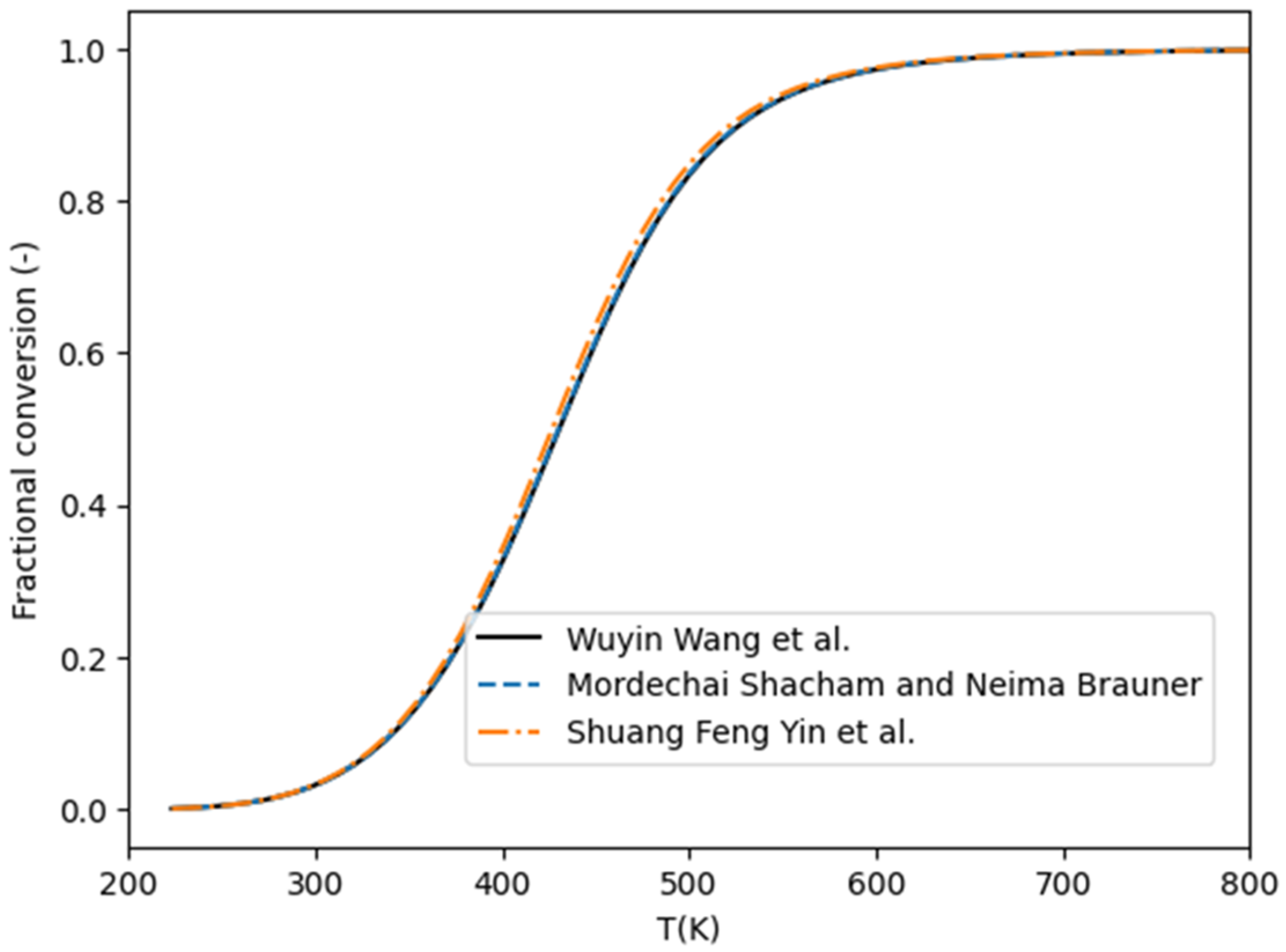
The K p dependence on the temperature was explored by several researchers using polynomial correlations (Equations (3)–(5)) [33,34,35]. The correlation reported by Shuang-Feng Yin (Equation (3)) [36], based on thermodynamic data at room temperature, compared with the other reported correlations (Figure 1a), predicts slightly larger Kp in the whole investigated temperature range, probably due to the approximated method employed for its derivation. The correlation reported by Mordechai Shacham (Equation (4)) [33], based on experimental data for the ammonia synthesis at 30 bar, and Wuyin Wang (Equation (5)) [35], based on a previous thermodynamic paper on ammonia synthesis, shows negligible differences at T > 700 K.
K p T = e 40100 25.46 T log ( T ) + 0.00917 T 2 103000 T + 64.81 T R · T
K p T = 1 10 2.10 + 1 4.571 9591 T 0.00046 · T + 0.85 10 6 · T 2 4.98 1.985 log 10 T
K p T = 1 2250.322 · T 1 0.85340 1.52049 log T 2.58987 · 10 4 · T + 1.48961 · 10 7 · T 2
With all the underlined limitations, the above-reported correlations were employed for calculating the spontaneity of the reaction, ammonia conversion, and the effect of an inert in the system. The spontaneity of the ammonia decomposition, as a function of temperature, can be derived by substituting the above-reported correlations into the Gibbs equation G T , K p = R T log K p . For temperatures exceeding 450 K, the equilibrium constant becomes negative (Figure 1b).
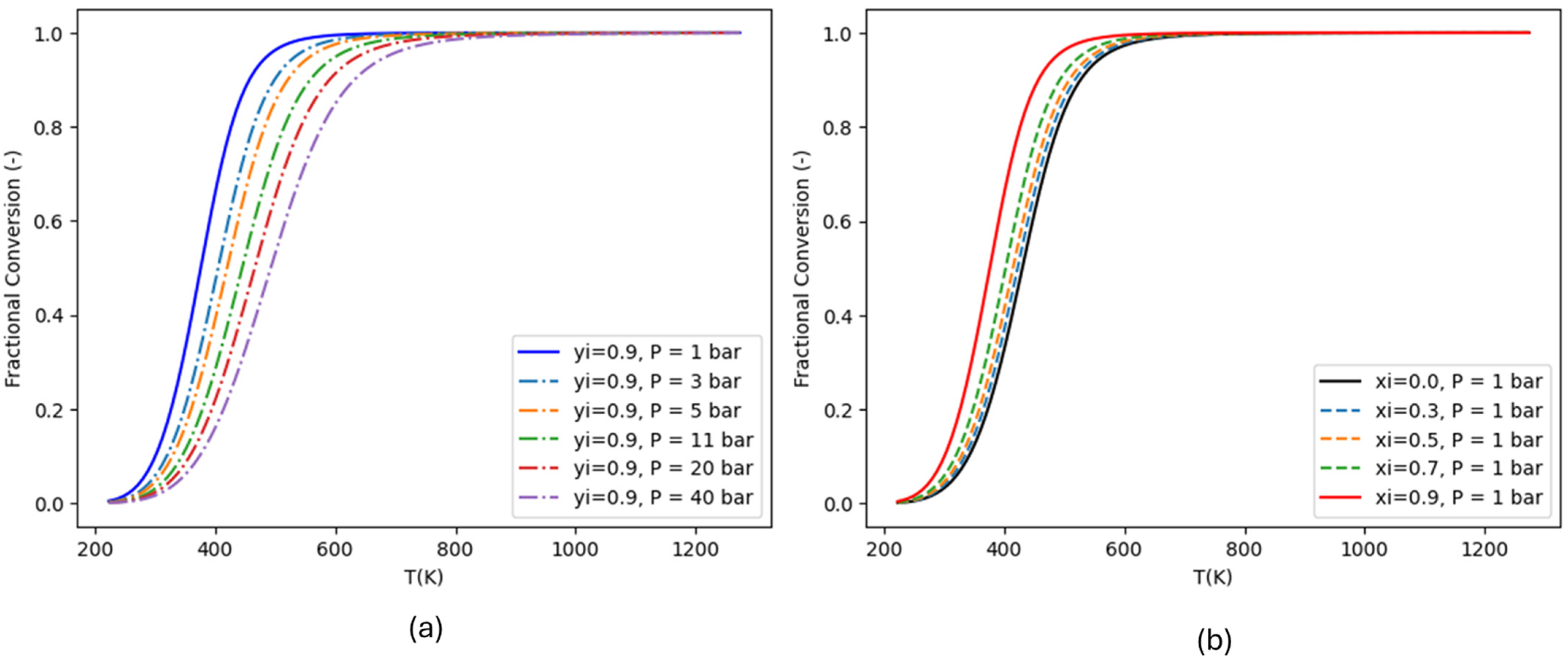
The fractional conversion of pure ammonia under atmospheric pressure follows a logistic trend when plotted against temperature (Figure 2). The reaction approaches completion around 550 K, with the inflection point, indicating the maximum rate of conversion, occurring at 350 K. All three models exhibit the same trend, typical of endothermic reactions, where conversion increases with rising temperature. Among the selected correlations, the one by Shuang-Feng Yin [36] shows the largest deviations across the entire temperature range, in line with its higher Kp values. In contrast, the other correlations show no significant differences within the range investigated. In particular, the model by Wuyin Wang [35] provides a highly accurate description of both ammonia synthesis and decomposition over the temperature range of 500 to 1300 K, where both processes are significant. It exhibits a very low average deviation of 0.00055, indicating excellent agreement with experimental data. Even in the worst case, the maximum deviation is only 0.0016, demonstrating the model’s reliability [36].
According to Le Chatelier’s principle, increasing the system pressure determines a decrease in the ammonia conversion (Figure 3a). This phenomenon is directly attributable to the increase in the number of moles involved in the reaction, which shifts the equilibrium position towards the reactants. Conversely, introducing an inert gas into the reaction system results in a diminution of the partial pressure of ammonia, thereby favoring the forward reaction and enhancing conversion (Figure 3b). The extent of this enhancement is directly correlated with the degree of dilution, with higher dilutions requiring lower temperatures to attain equilibrium conversion.

3. Catalysts

3.1. Ru–Based Catalysts

Ruthenium is widely recognized as one of the most efficient catalysts for ammonia decomposition due to its exceptional catalytic activity [37]. Its ability to activate ammonia molecules, facilitating the cleavage of N-H bonds and promoting hydrogen and nitrogen formation, is unparalleled [12]. Furthermore, it offers excellent durability, maintaining its catalytic activity over extended periods. However, the high cost and limited availability of ruthenium pose significant challenges for large-scale applications [38]. Consequently, research is focused on developing novel catalytic materials based on more affordable metals, while striving to maintain the performance levels of ruthenium [38,39].
Ammonia decomposition proceeds through a sequence of elementary steps occurring on the catalyst surface (* denotes an active site), including molecular adsorption (Equation (6)), stepwise dehydrogenation (Equations (7)–(9)), and products’ desorption (Equations (10) and (11)), as follows:
NH3 + * ↔ NH3*
NH3* ↔ NH2* + H*
NH2* ↔ NH* + H*
NH* ↔ N* + H*
N* + N* ↔ N2 + 2*
H* + H* ↔ H2 + 2*
In the reverse reaction (ammonia synthesis), nitrogen adsorption is widely recognized as the rate-determining step (RDS) [40]. By analogy, nitrogen desorption is often proposed as the RDS in ammonia decomposition [41,42]. However, this assignment remains a subject of debate, as the rate-limiting step can vary depending on the metal catalyst. For example, nitrogen desorption is commonly considered the RDS on Ru, Ni, Co, Fe, and Cr, while N–H bond cleavage is more frequently identified as the limiting step on Rh, Ir, Pt, Pd, and Cu surfaces [43]. Although the influence of the metal d-band center on catalytic activity has been extensively investigated, this parameter alone is insufficient to fully explain the variation in the rate-determining step (RDS) observed among different metals [42]. In particular, the percentage d-character of the metal (Table 1) affects electronic interactions with adsorbates but cannot solely account for differences in catalytic behavior. For instance, while Ru, Ni, and Co exhibit similar d-character, they may exhibit different RDS due to additional structural and electronic factors. Besides, nitrogen temperature-programmed desorption (N2-TPD) experiments can provide indirect evidence regarding the nature of the RDS. In the case of Ru/C12A7:e, for example, the activation energy for nitrogen desorption was found to be 64 kJ mol−1, higher than that for the overall ammonia decomposition reaction (55 kJ mol−1). This discrepancy suggests that N–H bond cleavage, rather than N2 desorption, may represent the actual rate-limiting step in this specific system [37].
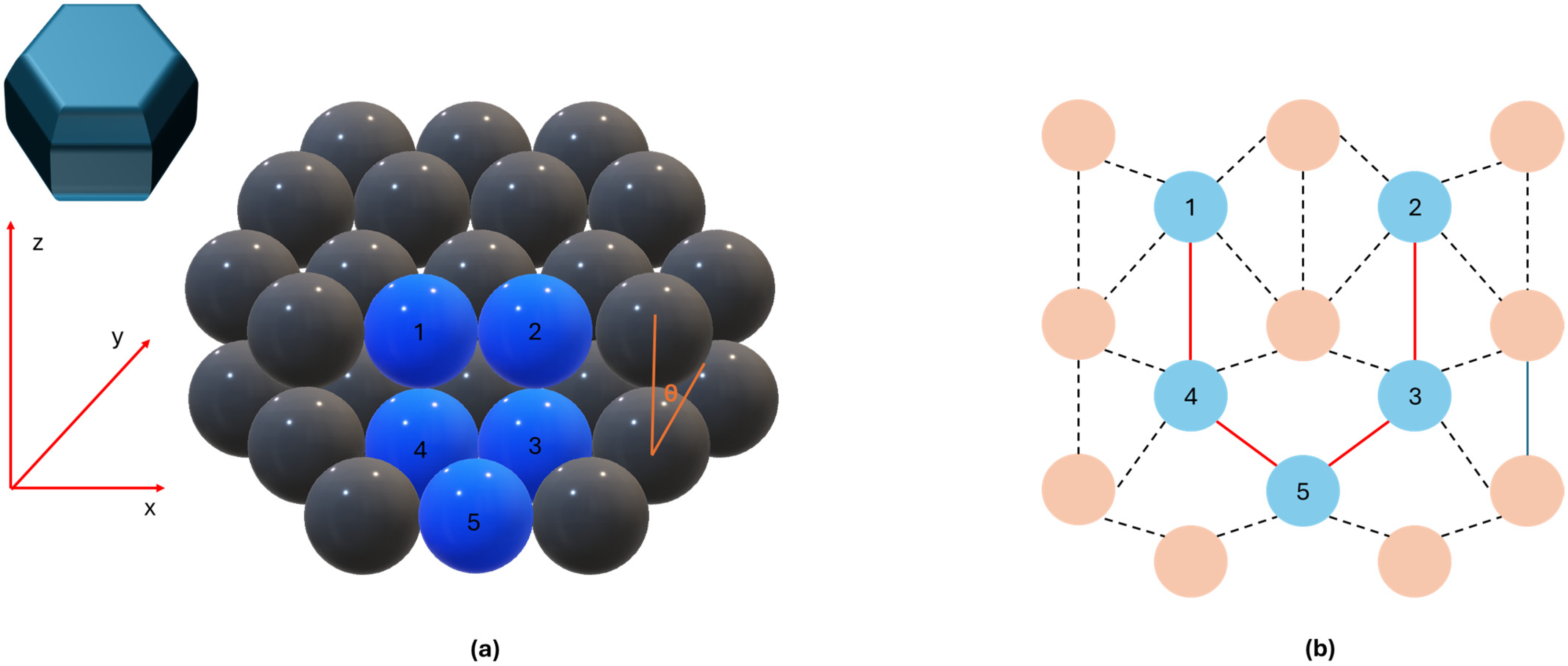
Ammonia decomposition is highly sensitive to the structural characteristics of the catalyst. Several studies [15,41,44] have highlighted the pivotal role of the B5 site, specific Ru ensembles consisting of three ruthenium atoms in the basal plane coordinated with two atoms in the top layer (Figure 4). These metallic configurations are considered catalytically active centers for ammonia decomposition. The concentration of B5 sites is strongly dependent on the size of the Ru nanoparticles, with an optimal range between 1.8 and 3 nm [15,41,45]. Nevertheless, Shao et al. [46] reported that such sites remain abundant even in particles smaller than 8 nm, indicating that high metal dispersion and controlled nanoparticle size are key parameters for maximizing catalytic performance. The formation of B5 sites can also be promoted by the addition of metallic promoters and high-temperature reduction treatments (e.g., 700 °C) [15].
Despite their recognized importance, the role of B5 sites as the sole descriptor of catalytic activity remains debated. Some authors argue that catalyst efficiency is more strongly influenced by metal–support interactions than by the presence of specific Ru ensembles. For instance, Ru/MgO(111), which lacks B5 sites, has demonstrated high catalytic activity attributed instead to a Frustrated Lewis Pair (FLP) mechanism, whereby the MgO support activates ammonia through cooperative acid–base interactions at the interface [14]. Moreover, the role of B5 sites may be more complex. Duan et al. [44] observed that N* adatoms tend to adsorb preferentially on the inclined facets of B5-type structures (terraces) rather than on flat surfaces. In small Ru nanoparticles, these reactive sites may become saturated with N*, leading to site blockage and a consequent reduction in catalytic activity due to the loss of available surface area.
An effective strategy to promote the formation of B5 sites and stabilize sub-nanometric Ru clusters involves the use of host–guest architectures. Li et al. [45] investigated a series of Ru-based catalysts supported on MIL-101 metal–organic frameworks (MOFs), modified with MgO, Cs, or both. The 3 nm cavities of MIL-101 allow for the encapsulation of the Ru precursor together with the dopants, enabling the in situ formation of uniformly distributed Ru clusters (~1 nm). While confinement within the MOF structure contributes to maintaining nanoscale dispersion, the incorporation of basic dopants such as MgO and Cs proved to have a more pronounced effect on catalytic performance. Notably, catalysts synthesized within the MIL-101 framework outperformed analogous systems supported on activated carbon or carbon nanotubes, highlighting the synergistic effect of structural confinement and surface basicity.
The most employed ruthenium precursors for catalyst synthesis include hydrated ruthenium chloride (RuCl3·xH2O), ruthenium nitrosyl nitrate (Ru(NO)(NO3)3), and ruthenium acetylacetonate (Ru(acac)3). Among these, Ru(acac)3 is the most expensive due to its organic ligand matrix, making it less favorable for large-scale applications. In contrast, hydrated RuCl3 is the most widely used in the literature because of its relatively low cost and ease of handling. It is available in both hydrated and anhydrous forms, with the latter preferred in syntheses involving non-aqueous solvents. Ruthenium nitrosyl nitrate is typically supplied in nitric acid-stabilized aqueous solution. Li et al. [45] reported the use of ruthenium nitrosyl nitrate instead of RuCl3, emphasizing that chloride ions released during synthesis may strongly adsorb onto the catalyst surface, adversely affecting its activity. This observation is supported by Yin et al. [34], who compared three different ruthenium precursors—RuCl3, Ru(acac)3, and Ru3(CO)12—and found that chloride residues persist even after calcination, negatively impacting catalytic performance in ammonia decomposition. Karim et al. [48] synthesized Ru/Al2O3 catalysts using both Ru(NO)(NO3)3 and Ru(acac)3 precursors under identical preparation conditions. Both catalysts achieved comparable NH3 conversions (90% and 85%, respectively), but the one derived from nitrosyl nitrate exhibited slightly higher productivity, attributed to improved dispersion.

3.2. Metal Loadings and Synthesis Methods

The metal loading and the resulting nanoparticle size critically influence the catalytic performance of Ru-based catalysts for ammonia decomposition. As demonstrated by Zheng et al. [41], Ru nanoparticles with an average diameter of ~2 nm offer optimal activity, highlighting the importance of particle size control. Increasing the Ru loading typically enhances catalytic performance by raising the number of active sites. However, excessive loading leads to particle growth, which reduces the surface-to-volume ratio and promotes sintering, ultimately compromising catalytic activity and stability [44,49].
An optimal balance between Ru loading and particle size is thus essential: nanoparticles must remain small and well-dispersed to maintain a high density of active sites while minimizing the use of precious metal. For example, Pinzón et al. [50] showed that a 2.5 wt% Ru/SiC catalyst reduced at 400 °C achieved complete ammonia conversion. The same catalyst reduced at 600 °C reached only 80% conversion, due to metal sintering and loss of dispersion at higher temperatures. Moreover, the 2.5 wt% loading outperformed both 1 wt% and 5 wt% variants, producing Ru nanoparticles in the 5–7 nm range, ideal for maximizing the density of B5 sites. In a similar study, Shao et al. [46] investigated Ru/CeO2 catalysts synthesized via wet impregnation. Despite the limitations of this method, high catalytic performance was achieved with a low Ru loading of 1.4 wt%. Increasing the metal content beyond this threshold did not improve activity and instead caused a decline, likely due to particle agglomeration and surface site blockage.
While the metal loading and particle size are central to catalyst performance, the synthesis method also plays a critical role in controlling these parameters. For example, Ru/Al2O3 catalysts prepared via ethanol-based wet impregnation have been shown to perform comparably to Ru/CNTs under optimized conditions [41,51]. However, conventional impregnation methods often fail to prevent particle growth at higher loadings. Fujitani et al. [52] examined the impact of different synthesis techniques, including deposition-precipitation (DP), chemical precipitation (CPT), and wet impregnation (WI), on a 3 wt% Ru/MgO catalyst. At 400 °C, DP and CPT catalysts reached ~60% NH3 conversion, while WI achieved only 17%. At 500 °C, both DP and CPT reached equilibrium conversion (~99%), whereas WI plateaued at 90%. Although all catalysts used the same MgO support, DP and CPT catalysts featured mesopores (3–5 nm), facilitating hydrogen diffusion, and a slightly oxidized Ru state, which appeared to promote NH3 activation. Interestingly, despite having a less well-defined support morphology than the WI catalyst, the DP and CPT samples outperformed it, highlighting the crucial role of pore structure and the electronic state of Ru over simple morphological uniformity. In summary, catalytic performance depends on a synergistic balance between Ru loading, nanoparticle size, and synthesis technique. Optimizing these parameters is key to designing efficient, stable, and cost-effective catalysts for ammonia decomposition.

3.3. Support Effect

Metal oxides, with their surface oxygen vacancies, redox properties, and acidity or basicity, can significantly influence the structure and properties of supported metal catalysts, leading to distinct catalytic activities in ammonia decomposition [53]. Among various metal oxides, Al2O3, MgO, and SiO2 have been extensively studied as supports for Ru catalysts [54]. Fang et al. [14] highlight the crucial role of a tailored support in the reaction mechanism: unlike Ru deposited on MgO (100), where alternating Mg and O atoms hinder hydrogen migration, the MgO (111) surface, with alternating Mg and O layers, facilitates hydrogen movement. Ru/MgO (111) exhibits exceptional conversion efficiency, achieving equilibrium at a significantly low temperature (425 °C) and high space velocity (30,000 NmL NH3 g_cat−1 h−1). The MgO (111) orientation promotes hydrogen hopping, where protons (H+) migrate from the Ru metal along the oxygen anion (O2−) layer. This behavior suggests a frustrated Lewis pair (FLP) mechanism, involving a Lewis acid (Ru δ+, with empty d orbitals) and a Lewis base (O δ, with a lone pair), whose direct interaction is prevented by steric hindrance. Temperature-programmed surface reaction (TPSR) confirms a lower activation energy for ammonia decomposition on Ru/MgO (111) (71 kJ mol−1) compared to Ru/MgO (100) (119 kJ mol−1), indicating easier ammonia activation around 200 °C. Hydrogen temperature-programmed desorption (H2-TPD) analysis reveals efficient hydrogen desorption from Ru/MgO (111) at a low temperature (125 °C), whereas other MgO orientations exhibit strong hydrogen adsorption on the support, requiring much higher temperatures (475 °C) for desorption [14].
Frustrated Lewis pairs (FLPs) also play a crucial role, as highlighted by Chee Leung et al. [55] in ammonia decomposition catalyzed by ruthenium anchored within a Na-13X faujasite zeolite (Na96Al96Si96O384). In this system, the zeolite acts as a Lewis base and forms an FLP with Ru, which behaves as a Lewis acid, thereby promoting heterolytic N–H bond cleavage. The liberated H+ is captured by the zeolite’s basic oxygen sites. Concurrently, Ru forms a transition state with NHx species. The inherent Brønsted acidity of the zeolite, arising from hydroxyl bridges [55,56], is crucial for regenerating active sites by abstracting the H+ generated during ammonia dehydrogenation [55]. The zeolite support provides a confined environment that prevents Ru sintering and ensures high dispersion, maximizing the availability of active sites. The authors also emphasize the importance of Ru’s oxidation state: ammonia, a Lewis base, interacts more effectively with Ru as its acidity increases, which correlates with higher oxidation states. Ru3+ favors the reaction more than Ru2+ or Ru1+ [55].
According to X. Hu et al. [57], CeO2 shows higher activity compared to MgO and Al2O3. This enhanced performance is explained by NH3-TPD analysis, which shows that Ru/CeO2 displays significantly higher ammonia adsorption peaks than Ru/MgO and Ru/Al2O3, indicating the strong ammonia adsorption capacity of the ceria-supported catalyst. In contrast, N2 and H2 desorption profiles reveal that Ru/MgO and Ru/Al2O3 experience difficulty in releasing reaction products, as evidenced by their high-temperature desorption peaks [57].
Carbon materials, characterized by their large specific surface area and excellent electrical properties, are promising supports for ammonia decomposition catalysts. Commonly used carbon-based support for Ru catalysts includes carbon nanotubes (CNTs), carbon nanofibers (CNFs), and graphene [53]. The structure of these materials greatly influences catalytic performance, as evident in the contrasting behavior of Ru catalysts supported on CNTs and CNFs, both composed of aligned graphene sheets. CNTs have a cylindrical structure with graphene sheets rolled parallel to the axis, whereas CNFs exhibit an inclined arrangement that exposes the edges of the graphene sheets on the surface. This difference in morphology results in CNFs having a larger total and external surface area compared to CNTs (180 vs. 140 m2 g−1 and 157 vs. 116 m2 g−1, respectively). Although Ru particle sizes are similar on both supports (~1 nm), CNFs achieve complete Ru dispersion (100%), while CNTs reach only 83%. This structural advantage translates into superior catalytic performance for CNFs, which achieve complete ammonia conversion, whereas CNT-supported catalysts reach only 70%. The distinct behaviors of Ru/CNFs and Ru/CNTs highlight the crucial role of catalyst structure and electronic properties in ammonia cracking [44].

3.4. Promoters and Basicity Effects

The incorporation of heteroatoms and promoters into Ru-based catalyst systems is a well-established strategy to enhance catalytic performance [36]. Structural doping of the support can suppress the sintering of the active phase during thermal treatments, improve metal dispersion, and modulate the acid–base properties of the material. At the same time, promoters such as alkali, alkaline-earth, and lanthanide elements can increase catalytic activity through electron-donating effects that facilitate nitrogen desorption, widely recognized as the rate-determining step (RDS) in ammonia decomposition [58,59,60]. According to Aika et al. [60], the catalytic activity of Ru improves when supported or promoted with elements of lower electronegativity, due to stronger electronic interactions with the active metal. An illustrative example is the doping of Al2O3 with 50 mol% La, which induces a structural transformation to LaAlO3 and leads to nearly complete ammonia conversion at 550 °C [59]. XPS analysis of the Ru 3d5/2 region shows a reduction in binding energy with increasing La content, indicating enhanced electron density on Ru via electron transfer from La. The LaAlO3 phase also stabilizes the active sites by inhibiting sintering. Similarly, Tan et al. demonstrated that doping mesoporous Al2O3 with 20 wt% MgO significantly improves performance, raising NH3 conversion from 70% to 99%. CO2-TPD profiles confirmed a higher density of basic sites upon MgO addition, which improves metal dispersion and mitigates hydrogen poisoning [16].
Sayas et al. [61] investigated the effect of potassium on 3 wt% Ru/CaO. Increasing K loading from 0 to 10 wt% enhanced NH3 conversion at 450 °C from 20% to nearly 90%, due to increased Ru dispersion (from 9.8% to 15.5%) and metallic surface area (from 52 to 87 m2 g−1_metal). However, further increasing K to 15 wt% resulted in lower dispersion and surface area, with a corresponding decrease in catalytic performance, highlighting the need to optimize promoter loading [61].
Wang et al. [62] compared two Ru/ZrO2 catalysts promoted with barium, differing in the method of Ba incorporation. In the first case, the ZrO2 support was modified via sol–gel synthesis in the presence of Ba, forming a BaZrO3 perovskite structure (Ru/Ba–ZrO2). In the second, Ba was introduced by wetness impregnation onto the preformed ZrO2 support (Ru–Ba/ZrO2). In both cases, Ru was deposited by incipient wetness impregnation. The Ba-modified ZrO2 structure obtained via sol–gel was found to promote electron donation to Ru and improve metal dispersion. At 450 °C, the Ru/Ba–ZrO2 catalyst achieved complete ammonia conversion, whereas Ru–Ba/ZrO2 reached only 10%, indicating a significant influence of the support structure on catalytic performance. The basicity of the catalysts, assessed by CO2-TPD analysis, revealed key differences: both materials exhibited low-temperature desorption peaks corresponding to weakly basic sites; however, only the BaZrO3-containing catalyst showed a pronounced high-temperature desorption peak with greater intensity and area, indicative of the presence of strong basic sites. This feature was absent in the impregnated Ru–Ba/ZrO2 sample, underlining the importance of the synthesis method and support basicity in enhancing the catalytic efficiency [62].
In some instances, acidity rather than basicity becomes the key parameter, as assessed by NH3-TPD. For instance, Shao et al. [46] found that Ru/CeO2 with 1.4 wt% Ru exhibited high-temperature NH3 desorption peaks, suggesting superior ammonia adsorption compared to samples with lower or higher loadings. Finally, Zhang et al. [63] compared the effects of K and Cs on Ru/MgO, reporting that Cs led to higher ammonia conversion, attributed to its greater electron-donating ability and lower electronegativity relative to K.
Table 2 summarizes key Ru-based catalysts reported in the literature, including their synthesis methods, supports, metal loadings, and catalytic performance for ammonia decomposition.

3.5. Transition Metal-Based Catalysts as Alternatives to Ruthenium

3.5.1. Ni-Based Catalysts

Nickel-based catalysts, like their ruthenium counterparts, exhibit structure sensitivity, and their performance is influenced by the overall basicity of the system, which depends on factors such as the catalyst’s structure, support, and particle size. Lucentini et al. [64] investigated the performance of Ru and Ni catalysts, both monometallic and bimetallic, supported on alumina and CeO2; as expected, ruthenium-based catalysts outperform nickel-based ones, while bimetallic catalysts show intermediate activity between the two monometallic catalysts. When comparing the catalytic behavior of Ru and Ni, ruthenium exhibits stable ammonia conversion from 350 °C onward, with only minor deactivation observed at lower temperatures. In contrast, the Ni catalyst undergoes mild deactivation, likely due to partial reoxidation, up to 450 °C, after which it stabilizes and sustains conversion throughout the remainder of the reaction [64]. Interestingly, the authors argue, contrary to some literature reports, that the acidity or basicity of the catalyst (e.g., alumina-based catalysts being significantly more acidic than ceria-based ones) does not significantly impact ammonia decomposition. Instead, the support properties and metal-support interactions play a more critical role. In situ XPS analyses revealed that nickel undergoes sintering and partial oxidation at low temperatures, forming stable metallic phases around 450 °C, which are responsible for ammonia conversion, indicating that the catalytically active species is metallic nickel rather than its oxide. Ruthenium, on the other hand, is stable from 350 °C and achieves maximum activity near 450 °C [64].
In a complementary study, Younghwan et al. [39] explored how the basicity of the support influences catalyst performance while keeping the active phase and loading constant (20% Ni) [39]. They found that a barium-based support significantly outperforms supports based on strontium, calcium, and magnesium. The Ni/Ba-Al-O catalyst exhibits a CO2 desorption peak at approximately 850 °C, indicating the presence of strong basic sites. In contrast, catalysts with Sr, Ca, or Mg supports show CO2 desorption peaks around 100 °C, corresponding to weaker basic sites. This strong basicity in the Ba-based catalyst correlates with enhanced catalytic performance.

3.5.2. Co–Based Catalysts

Cobalt has emerged as a promising alternative to ruthenium for ammonia decomposition, although the exact nature of its active phase remains unclear, with both metallic and oxidized cobalt species exhibiting catalytic activity [38]. Unlike ruthenium-based catalysts, cobalt catalysts can be negatively affected by electron-donating promoters (such as Cs, K, and Na) or supports (e.g., CNTs), which diminish their catalytic effectiveness.
Table 2. Catalytic performances of Ru–based catalysts.
CatalystMetals
(%)
Catalyst PreparationWHSV
(NmLNH3 gCat−1 h−1)
WHSV
(NmLNH3 gMe−1 h−1)
NH3
(%)
T
(°C)
Conv
(%)
P (bar)Productivity
(mmolNH3 gRu−1 min−1)
H2 Production
(mmolH2 gRu−1min−1)
Ref
Ru/Al2O30.5Acetone-assisted WI 1--100580-1--[42]
Ru/La (50%)-Al2O30.7WI2300328,57110500991242363[59]
Ru/Al2O34.7Ethanol-assisted WI30,000526,315100500851380570[41]
(4.5%) Na-Ru/AC2WI2000100,0001050099174110[15]
Ru/MgO (111)3Ru3(CO)12-I/D 230,0001,000,0001004259917441104[14]
Ru@13X4.8IE 315,000312,50010045052.51122183[49]
0.815,0001,875,00026.5369554
4.830,000625,00038.5179268
0.2530,00012,000,0008.17231084
Ru/Al2O38.5C 4-WI286336110050099.7124923738[65]
98.5524623693
97.21024293644
50099.7124923738
45099.524873730
40099.124773715
Ru/C12A7: e2.2CVD 515,000681,818100400701355532[37]
Ru/C12A7: O2−2750,00041.5231347
Ru-K/C2.7555,55656231347
Ru/C12A7: e2.2681,81846099502753
Ru/C12A7: O2−2750,00080446669
Ru-K/C2.7555,55678322483
Ru/CNFs3.2WI6500203,125100500991150224[44]
Ru/CNTs3.2203,12575113170
Ru/CNFs7.982,278450905583
Ru/CNFs3.2203,12570106159
Ru/Al2O3 [Ru(NO)(NO3)]4WI12,000300,00010450901201301[48]
Ru/Al2O3 [Ru(acac)3]4.5266,66785169253
Ru/Mg-Al/Monolith0.025NH3-assisted precipitation935,6871006259812639[66]
Ru/Ma-Al/Foam0.030NH3-assisted precipitation1652,766933654
Ru/Al2O30.5C-WI21513010046
Ru/CaO3Acetone assisted-WI900030,0001004502014567[61]
Ru-5%K/CaO60134201
Ru-10%K/CaO90201301
Ru-10%K/CaO500981219328
8010178268
6520145217
6040134201
Ru/La0.8Sr0.2AlO32.55I 630,0001,176,47110050071.61626940[67]
Ru/Ba-ZrO23I3000100,000100447100174112[62]
Ru-Ba/ZrO210711
Ru/MgO5DP 736,000720,000100475711380570[68]
K-Ru/MgO100535803
Ru/MgO4.7DP30,000638,29810045080.61383574[69]
Ru/K2SiO33.2Ethanol-assisted I30,000937,50010045060.51423635[70]
Ru/Na2SiO33.5857,14353.5331497
Ru/Li2SiO33.4882,35331.2203304
Ru/SiO23.6833,33317108162
Ru/MgO3DP15,000500,000100400601223335[52]
CP 862231346
WI176395
DP50099368552
CP99368552
WI90335502
Ru/SiC1 aRotovapor-assisted WI60,0006,000,0005350601134201[50]
1 b6,000,0004089134
2.5 a2,400,0009988133
2.5 b2,400,0008071107
4.4 a1,363,636904668
4.4 b1,363,636904668
Ru/Y2O35KOH-assisted precipitation30,000600,000100500991442513[71]
21,500,00090483725
Ru/SiO221,500,000103451
Ru/CeO22WI13,800690,00044450991223335[64]
Ru/CeO21.6WI15,000937,500100475921641962[46]
1.8833,33386533799
Cs-Ru/MgO2.8PR 9 (EG)30,0001,071,4291005009817811171[63]
K-Ru/MgO2.8967651147
Ru/CeO21PR (EG)22,0002,200,00010045099116202429[57]
WI30491736
Ru/MgO1PR (EG)7512271840
Ru/Al2O31.130426669
Ru-Cs/MgO-MIL1013.1Organic solvent-assisted I15,000483,871100400981353529[45]
Ru-Cs/MIL3500,00078290435
Ru/MgO-MIL6.3238,09558103154
Ru@MIL-1013.4441,17656184276
Ru/CNTs7WI520074,2861004505012841[72]
Ru/AX–21301725
1 Wetness Impregnation; 2 Impregnation-Decomposition; 3 Ion Exchange; 4 Commercial; 5 Chemical Vapor Deposition; 6 Impregnation; 7 Deposition—Precipitation; 8 Co-Precipitation; 9 Polyol Reduction (ethylene glycol); a Reduced at 400 °C; b Reduced at 600 °C.
Torrente-Murciano et al. [73] compared Ru and Co catalysts supported on carbon materials, including CNTs and Ax-21 activated carbon (AC). They observed that CNTs enhanced Ru catalytic performance but adversely affected Co activity. Conversely, Ax-21 supports led to decreased Ru performance but improved Co activity. Notably, whereas increased support graphitization benefits ruthenium catalysts, the opposite is true for cobalt. The microporous structure of Ax-21 facilitates the formation and confinement of highly active 2 nm Co nanoparticles, which likely accounts for the improved cobalt activity [73].
Morlanès et al. [11,74] studied cobalt-ceria catalysts with varying Co-to-ceria molar ratios and evaluated the impact of barium as a promoter [11,74]. Catalytic conversion increased proportionally with cobalt content, which was co-precipitated with ceria serving as the support. Characterization revealed that Co3O4 was almost completely reduced to Co nanoparticles during catalyst activation. The employed synthesis method effectively achieved high active phase dispersion and prevented particle agglomeration. Regarding promoters, this study confirmed literature reports that alkali metals such as Cs and K do not significantly influence cobalt catalytic activity. However, the addition of Ba significantly enhanced catalyst performance. XPS analysis indicated that Ba does not induce electronic effects like Cs and K, consistent with findings by Torrente-Murciano et al. [73]. Indeed, the addition of 0.5% Ba significantly improved conversion and suppressed H2 re-adsorption and NHₓ species formation, which are detrimental to activity [73].

3.5.3. Fe-Based Catalysts

Iron-based catalysts have been extensively studied and are widely used industrially for ammonia synthesis. More recently, their use in ammonia decomposition has attracted attention, especially when combined with non-noble metals and supported on high-performance materials [38]. Iron’s abundance and low cost make it a desirable option. However, iron exhibits lower kinetic activity compared to ruthenium, primarily due to the formation of Fe-N nitrides upon exposure to ammonia. These nitrides can be removed at elevated temperatures but tend to promote iron particle sintering, which negatively affects catalyst stability and activity [38].
Cui et al. [75] evaluated iron catalysts supported on CeO2 and TiO2, as well as unsupported magnetite (Fe3O4) spheres. XRD analysis suggested that the amounts of ceria and titania were too low for detection, indicating a predominance of Fe3O4 in all catalysts. The CeO2-supported catalyst outperformed both the TiO2-supported and unsupported magnetite spheres, highlighting the significant role of the support. TEM analyses after ammonia exposure showed particle agglomeration and active phase separation in the TiO2-supported catalyst, whereas the CeO2-supported catalyst maintained its crystalline structure and particle dispersion. The unsupported magnetite particles agglomerated completely. These structural changes correlate with the observed catalytic conversions. In terms of stability, the CeO2-supported catalyst maintained conversion over time, while the unsupported magnetite initially showed high conversion that gradually declined before stabilizing. The TiO2-supported catalyst required a longer time to reach optimal conversion [75].

3.5.4. Mo-Based Catalysts

Molybdenum nitrides have attracted attention due to their performance comparable to that of ruthenium.
Li et al. [76] investigated the catalytic performance of two Mo-based catalysts encapsulated in a carbon matrix. Both catalysts were synthesized via hydrothermal synthesis and carbonized under an inert atmosphere. To differentiate the catalysts, one of the catalysts was nitrided using ammonia. Consequently, one catalyst was molybdenum oxide (Mo@C), while the other was molybdenum nitride (MoN). At 625 °C, the nitrided catalyst achieved complete conversion, while the non-nitrided catalyst only reached 90% conversion. However, observing the productivity, it was noted that Mo@C was slightly higher due to a slightly lower metal loading. The authors suggest the porosity developed by the catalysts provides better diffusion and activation of ammonia [76].
Podila et al. [77] found that MoN benefits not only from the addition of Co but also from the synthesis method, specifically citric acid-assisted synthesis. By varying the citric acid to molybdenum precursor ratio, different precursor materials are formed, with the best catalytic performance achieved at an intermediate ratio of 3:1. At these concentrations, an abundant formation of the nanostructured ϒ-MoN phase is obtained. Promoting the catalyst with 3% Co results in a new nanostructured phase (Co3Mo3N), which, together with the previous phase, results in a catalyst with high surface area and a high density of active sites for ammonia decomposition, as well as excellent dispersion of the nanostructures. Citric acid, acting as a chelating agent, helps to disperse the active phase and promotes the crystallization of the ϒ-MoN and Co3Mo3N structures. While Co promotes the formation of Co3Mo3N, the citric acid promotes the dispersion of Co3Mo3N on the ϒ-MoN platelets [77].
The incorporation of various non-noble metals, including Mo, Co, Fe, and Ni, plays a crucial role in enhancing catalytic performance [38,78].
In recent years, high-entropy alloys (HEA) have emerged as promising alternatives to noble metal catalysts. These materials extend beyond traditional bi-metallic alloy systems by comprising a complex mixture of at least five elements, characterized by high-entropy mixing [79]. This compositional diversity not only imparts superior stability under extreme temperature and pressure conditions but also creates a multitude of favorable adsorption sites [79,80]. The catalytic efficiency is further improved through synergistic interactions among the multiple non-noble metal components [79,80,81].
For instance, Xie et al. synthesized a multimetallic high-entropy alloy (HEA) composed of various elements, including Mo, Co, Fe, Ni, and Cu. Through the formation of nanoparticles, they were able to precisely adjust the Co-to-Mo ratio, thereby overcoming the miscibility constraints typically observed in conventional bimetallic Co-Mo catalysts. In the specific application of ammonia decomposition, these innovative catalysts exhibited a substantial increase in productivity compared to the ruthenium catalyst, along with an even greater enhancement relative to standard Co-Mo catalysts [81]. This class of catalysts also presents potential applications in the electro- and photocatalytic decomposition of ammonia to be investigated.
Table 3 summarizes Ru-free catalysts for ammonia decomposition reported in the literature, including their synthesis methods, supports, metal loadings, and their catalytic performance.

3.6. Structured Catalysts

Catalyst shaping critically affects performance, mechanical strength, and pressure drop. While randomly packed fixed beds of small particles (extrudates, granules, spheres) are common, monolithic and foam structures, consisting of large, single catalytic entities, are gaining interest [82]. Monoliths are rigid structures featuring networks of channels (crossflow, parallel, semi-parallel) with various geometries (circular, square, triangular, sinusoidal, hexagonal) tailored to reactor needs. Flow within these channels is typically laminar and uniform [83]. They are usually coated with a porous catalytic washcoat. Foams, in contrast, have an open, flexible structure, offering lower pressure drop and enabling radial flow, which enhances reactant turbulence [84]. Both monoliths and foams can be ceramic or metallic, ensuring improved reactant and heat distribution and minimizing cold spots [83,84].
Monoliths and foams are often considered superior to conventional packed bed catalysts due to enhanced heat and mass transfer, low pressure drop, and high catalytic efficiency [83]. Young Koo et al. [66] investigated Ru-based structured catalysts fabricated as multi-metallic monoliths and foams (Fe, Cr, Al, Zr, Y) coated with a Mg-Al oxide washcoat via precipitation. The different geometries of monoliths, foams, and pellets influence reactor performance. Ruthenium loadings were very low (0.025% on monoliths and 0.030% on foams), requiring relatively high operating temperatures (550–700 °C). Despite low loadings, a commercial Ru catalyst with 0.5% metal loading nearly reached equilibrium conversion. At 600 °C, the monolith slightly outperformed the foam (97.5% vs. 92.5% conversion), though both showed high activity. The use of structured catalysts presents advantages and challenges, notably in achieving uniform catalyst deposition and target metal loading [66]. However, the limited radial transport in monoliths may restrict lateral diffusion of reactants and products, which can limit their application in specific reactor designs, such as membrane reactors [85].

4. Kinetic Models

Most of the existing models for ammonia decomposition are based on the Temkin-Pyzhev model [44,65,72] (Equation (12)), where r is the reaction rate of decomposition, β is the reaction order, while Eapp and kapp are the apparent activation energy and the apparent reaction rate constant, respectively. The reaction rate constant can be derived from the Arrhenius equation (Equation (13)), where k0,app represents the pre-exponential factor, while R and T are the universal gas constant (8.314 J K−1 mol−1) and temperature. β and Eapp are strongly dependent on the type of metal used, while the pre-exponential factor k0,app depends on the metal loading [65].
r = k a p p p N H 3 2 p H 2 3 β p N 2 K e q 2 p H 2 3 p N H 3 2 1 β
k a p p = k 0 , a p p e E a p p R T
Based on the above-reported model, several rate equations have been proposed (Table 4). The following equation (Equation (14)) is a commonly used form under atmospheric pressure conditions [61].
r = k   p N H 3 α   p H 2 γ
In this equation, the partial pressure of nitrogen is often neglected, indicating its limited influence on the overall reaction kinetics. Still, under industrially relevant conditions (high temperature and pressure), Sayas et al. [61] proposed a refined model that also includes the reverse reaction, which becomes significant at equilibrium. The resulting rate expression (Table 4) incorporates both the forward and reverse contributions and provides a more accurate description of the system dynamics. The reaction orders reported by the authors are in excellent agreement with the Temkin–Pyzhev model, with α ≈ 0.5 and γ ≈ −1.2, particularly when using Ru-K/CaO-based catalysts (Table 5) [61].
Hayashi et al. [37] further explored the reaction orders α and γ using various Ru-based catalysts supported on different oxides (Table 5). With Ru/CaO and Ru/Al2O3, they found low positive values for α (≈0.4) and large negative values for γ, indicative of strong hydrogen adsorption that limits catalytic performance. In contrast, catalysts such as Ru/C12A7:O2, Ru-K/C, and Ru-Cs/MgO exhibit small, positive values for both α and γ, suggesting weaker hydrogen adsorption and fewer active site blockages. However, nitrogen desorption remained a limiting factor in these systems. Notably, for Ru/C12A7:e, the kinetic parameters α = 0.9 and γ = 0.04 indicate minimal hindrance from hydrogen and enhanced nitrogen desorption, attributed to the electron-donating nature of the values of C12A7:e support.
A more mechanistic approach was proposed by Itoh et al. [10], who conducted a very detailed kinetic study, considering adsorption, surface reaction, and desorption states. For each step, a dominant species influences the reaction rate. They proposed seven kinetic models and found that the Langmuir–Hinshelwood model best fit all the data, with nitrogen desorption as the RDS and N* as the dominant adsorbed species. The equation does not include exponential factors (alpha, beta, and gamma), but introduces kf, kn, and kp constants, representing the rate constant (expressed in mmol s/(kgcat MPa)), the adsorption constant (MPa), and the pressure constant (MPa2), respectively. The authors also carried out a simulation to evaluate ammonia conversion as a function of reactor length, using three kinetic models based on different rate-determining steps: adsorption, surface reaction, and desorption. The surface reaction model resulted in only a minor improvement in conversion, whereas the adsorption and desorption models exhibited more significant enhancements due to kinetic promotion effects. These findings could support the development of catalysts suitable for membrane reactors operating at lower temperatures [10].
Finally, the influence of the active phase on both the kinetic parameters and the RDS was investigated by Y. Im et al. [39] for nickel-based catalysts. Despite including the nitrogen partial pressure in the rate law, they found it had a negligible influence on reaction kinetics. In this case, the rate-limiting step was hydrogen desorption, a behavior differing from most Ru-based catalysts and highlighting the need for tailored kinetic models depending on catalyst composition. A comprehensive summary of kinetic parameters, catalyst compositions, and observed rate-determining steps is provided in Table 5.

5. Reactors

5.1. Packed–Bed Reactors (PBR)

Packed-bed reactors are widely used in chemical engineering for carrying out catalytic reactions. They consist of a cylindrical vessel filled with a stationary bed of catalyst particles, through which the reactant gas mixture flows continuously. The reactants meet the catalyst particles, facilitating the desired chemical transformation. Typically, packed-bed reactors are widely employed to assess catalytic activity under controlled conditions [86].
However, despite their widespread use, these reactors present several limitations, particularly when applied to endothermic reactions such as ammonia decomposition [87,88,89,90,91]. One of the main challenges is related to thermodynamic equilibrium. In equilibrium-limited reactions, the conversion is inherently constrained by the presence of both reactants and products within the same reaction environment, which limits the maximum achievable yield. Another critical issue concerns heat distribution. Due to the static nature of the catalyst bed, temperature gradients may arise along the reactor, leading to the formation of cold spots that fail to reach the optimal reaction temperature. This non-uniform heating can negatively affect both the reaction rate and the selectivity of the products [87]. Catalyst deactivation also represents a significant drawback. In the specific case of ammonia decomposition, the presence of hydrogen can strongly adsorb on the active sites of the catalyst, thereby competing with ammonia for adsorption and progressively reducing catalytic activity. This effect is especially detrimental for ruthenium-based catalysts, which are particularly sensitive to hydrogen poisoning [14].
Multi-bed and multi-tubular reactors can mitigate some of the problems affecting PBRs.
The multi-bed reactors consist of a series of evenly spaced packed beds arranged within cylindrical reactors, where the flow is heated or cooled between each adiabatic or semi-adiabatic bed (inter-stage heating or cooling). These reactor designs are common for exothermic reactions (inter–cooling system) such as hydrogenation [92] or ammonia synthesis [93]. In the case of ammonia decomposition, multi-bed reactors with inter-stage heating are still less commonly studied, even though they can exceed the productivity observed in classical PBRs by optimizing the thermal profiles within the reactor and the operation within the zone of the maximum reaction rates [94]. Moreover, coupling these systems with membrane separations can further improve their productivity, as shown by results highlighting almost complete equilibrium conversion at the exit of the reactor [94].
Multi-tubular reactors consist of several tubes filled with packed beds, housed inside a shell through which a heat transfer fluid flows to regulate the temperature. Particularly, a significant increase in ammonia conversions can be achieved by the PBR diameters, due to the improved heat transfer within the radial section of the reactor [95]. In such a case, the tube density also affects reactor efficiency [95], while factors like the wall temperatures, bed diameters and shapes, catalyst particle size, and shell diameter remain critical parameters to be optimized [87]. Particularly, the bed diameter is a very important factor influencing directly fixed costs for reactors, the choice of the catalyst dimensions, and consequently, pressure drops.

5.2. Packed–Bed Membrane Reactors (PBMR)

Membrane reactors integrate chemical reaction and product separation within a single unit operation. This integrated approach simplifies the overall process configuration, leading to reduced capital investment, lower energy consumption, and decreased operational costs [96]. Despite ongoing challenges related to heat transfer, particularly due to the presence of a fixed catalytic bed, their ability to continuously extract hydrogen through the membrane markedly improves catalyst performance. This selective removal of hydrogen not only mitigates the inhibitory effects associated with product accumulation but also drives the reaction equilibrium toward greater ammonia conversion, especially in equilibrium-limited systems like ammonia decomposition [97]. By constantly removing one of the products, membrane reactors effectively overcome thermodynamic constraints in accordance with Le Chatelier’s principle (Le Chatelier’s principle) [98].
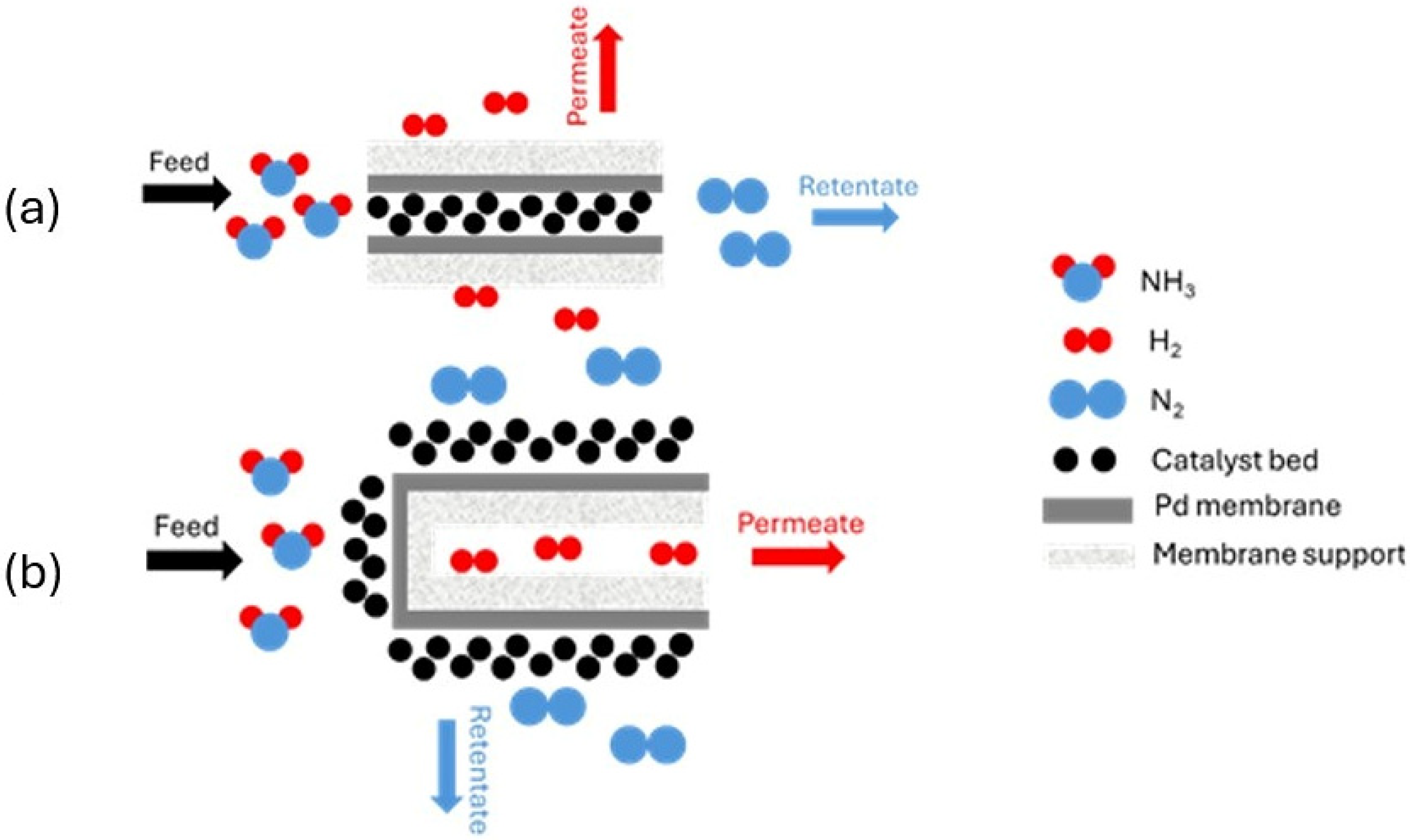
The choice of membrane reactor configuration depends on the specific reaction involved, as well as on the desired direction of gas separation and catalyst arrangement. Two main configurations are commonly adopted, based on the relative position of the membrane with respect to the support structure (Figure 5), as follows:
  • Internal: The membrane is deposited internally, and the catalyst is positioned within the support. The gas to be separated flows from inside to outside (Figure 5a).
  • External: The membrane is deposited externally to the support. The catalyst is positioned externally, and the gas to be separated flows from outside to inside (Figure 5b).
A membrane reactor typically generates two output streams: the permeate, which contains the species that pass through the membrane (in this case, hydrogen), and a retentate, which consists of the remaining gas mixture [99]. The driving force behind hydrogen permeation is typically the partial pressure difference of hydrogen (ΔpH2) between the retentate and permeate sides. This gradient can originate from the following:
  • Pressure differences, i.e., a disparity in total or partial pressure across the membrane;
  • Concentration differences, when the hydrogen concentration varies significantly between the two sides;
  • Electrical or ionic gradients, relevant in membranes where ionic transport is involved.
ΔPH2 (pH2,Ret–pH2,Perm) must remain positive to ensure continuous hydrogen transport from the reaction zone to the permeate side. A value of zero would imply no net flux, while a negative ΔpH2 would cause undesired reverse flow. To maintain a positive and effective ΔpH2, two main strategies are employed, as follows:
  • Sweep Gas Introduction: An inert gas (e.g., argon or nitrogen) or water vapor is introduced on the permeate side to dilute hydrogen and reduce its partial pressure. While effective, this method introduces an additional separation step downstream, partially offsetting the advantages of membrane integration [100].
  • Vacuum Pumping: Applying a vacuum on the permeate side efficiently lowers the hydrogen partial pressure without introducing contaminants. This approach is particularly suitable for industrial applications, offering high hydrogen purity and simplifying downstream processing [101].
Figure 5. Schematic representation of the membrane reactor. Internal (a) and external (b) packed–bed configurations (Readapted from Chiuta et al. [102] and Garcìa-Garcìa et al. [58]).
Catalysts 15 00811 g005
A key performance metric in membrane reactors is the Hydrogen Recovery Factor (HRF), which quantifies the proportion of hydrogen recovered in the permeate stream relative to the total available hydrogen. Two common definitions are reported in the literature (Table 6), as follows:
  • HRF based on the produced hydrogen. Used by Cerrillo et al. [11], this definition considers only the amount of hydrogen generated during the reaction.
  • HRF based on theoretical hydrogen: Employed by Itoh et al. [10,101], this method accounts for the total amount of hydrogen that could theoretically be produced from the complete conversion of ammonia.
The membrane reactor initially emerged from applications in gas separation [103,104] and dehydrogenation processes involving methanol [105], propane [106], and other hydrocarbons [107]. Its versatility has been further demonstrated in hydrogenation reactions, such as the conversion of CO2 to dimethyl ether (DME) [97] and the production of hydrogen peroxide [108]. This broad spectrum of applications highlights the membrane reactor’s potential as a highly adaptable tool for catalytic processes. More recently, research has focused on ammonia decomposition within membrane reactors, driven by the growing demand for green hydrogen and the associated challenges in its transportation [17]. Although this field is still in its early stages, it has already provided valuable insights (Table 7).
Table 6. H2 recovery factor equations.
HRFRef.
H 2 , P e r m H 2 , P e r m + H 2 , R e t [11,109]
H 2 , P e r m 1.5   N H 3 , F e e d [10,101]
García-García et al. [58] were pioneers in employing a palladium-based membrane reactor (PBMR) fed with 10% diluted ammonia. Using an ultra-thick (40 μm) pure Pd inner membrane combined with a ruthenium-based catalyst, they achieved ammonia conversion beyond the equilibrium limit at 362 °C. Their study highlighted how increasing the sweep gas flow rate reduces the hydrogen partial pressure on the permeate side, thereby enhancing hydrogen extraction and overall conversion. By raising the sweep gas flow from 100 to 300 mL/min, complete conversion was achieved at 360 °C instead of 400 °C. Notably, SEM analysis after 100 h of operation showed no signs of membrane degradation due to ammonia corrosion [58].
Although sweep gas is commonly used in membrane reactors to lower the hydrogen partial pressure on the permeate side, its application in industrial settings is limited due to the risk of hydrogen contamination. As a result, many researchers have turned to vacuum pumps for hydrogen extraction. For example, Kim et al. [109] employed a vacuum pump maintained at 0.10 bar to drive ammonia decomposition beyond equilibrium at 472 °C, using a WHSV of 8520 NmL gcat−1 h−1. They used a highly selective membrane comprising a YSZ and alumina interdiffusion barrier on a porous steel support. Coupled with a commercial ruthenium catalyst, this system achieved hydrogen purity exceeding 99.99%. This study demonstrated the trade-off between conversion, hydrogen recovery, and production rate as a function of WHSV, with a maximum hydrogen production rate of 0.25 Nm3 h−1 [109]. As the WHSV increases, the reactant spends less time in contact with the catalyst, which limits ammonia conversion. This leads to a lower hydrogen partial pressure on the reaction side, reducing the driving force across the membrane and consequently decreasing hydrogen recovery.
Park et al. [110] deviated from conventional approaches by integrating a fuel cell with the membrane reactor, creating a closed-loop system. In this setup, hydrogen produced by the membrane reactor directly fueled the fuel cell, which generated water vapor as a byproduct. This water vapor was then used as a sweep gas to extract hydrogen from the permeate side. This strategy offers advantages over inert sweep gases because water vapor is more easily separable. However, depositing the palladium membrane on both the inner and outer surfaces of the tantalum support compromised long-term stability due to interdiffusion phenomena [110]. To prevent performance degradation, the incorporation of an interdiffusion barrier is necessary [111].
Itoh et al. [10] compared a fixed bed with a membrane reactor, showing that the introduction of a 200 μm membrane increased ammonia conversion by 15% from 75% to 85% and achieved a hydrogen recovery of 60% at 400 °C. Moreover, reducing the membrane thickness further improved both conversion and hydrogen recovery [10].
Jiang et al. [112] conducted a comparative study of three membrane reactor configurations for ammonia decomposition, testing palladium-silver (Pd-Ag), modified zeolite, and carbon molecular sieve (CMS) membranes. In terms of hydrogen permeability and selectivity for gas mixtures, the Pd-Ag membrane exhibited superior performance, followed by CMS and zeolite membranes. Despite these differences, all three membranes achieved nearly complete ammonia conversion. Under optimal conditions, the CMS membrane exhibited the highest hydrogen recovery, attributed to the molecular sieving mechanism. However, the hydrogen purity in the permeate was highest for the Pd-Ag membrane, reaching almost 100% because of its superior selectivity. CMS and MFI membranes, while offering higher hydrogen recovery, allowed some passage of other gases, resulting in lower hydrogen purity in the permeate (95.98% for CMS and 87.26% for MFI). Overall, the Pd-Ag membrane showed the best overall performance [112]. Nonetheless, with suitable optimizations, CMS and MFI membranes could potentially compete with Pd-based membranes, especially considering their significantly lower production costs.
Cerrillo et al. [11] introduced an innovative and cost-effective approach capable of producing hydrogen at elevated pressures directly from the permeate side, thereby eliminating the need for subsequent compression stages. This results in significant energy savings and a reduction in CO2 emissions related to hydrogen compression (6.0 kWh/kg for pressurizing H2 to 700 bars, corresponding to 1.3 kg of CO2/kg of hydrogen). The authors demonstrate that the energy costs linked to compressing hydrogen for various applications (fuel cells, vehicles, storage) can be substantially reduced. For instance, compressing hydrogen from 1 to 700 bar requires 6 kWh/kg H2, while compressing it from 20 to 700 bar lowers the energy demand to around 4.5 kWh/kg H2.
A summary of the main catalytic performance metrics reported for these configurations is provided in Table 7, offering a comparative overview of their effectiveness in terms of ammonia conversion and hydrogen recovery.

5.3. Catalytic Membrane Reactors (CMR)

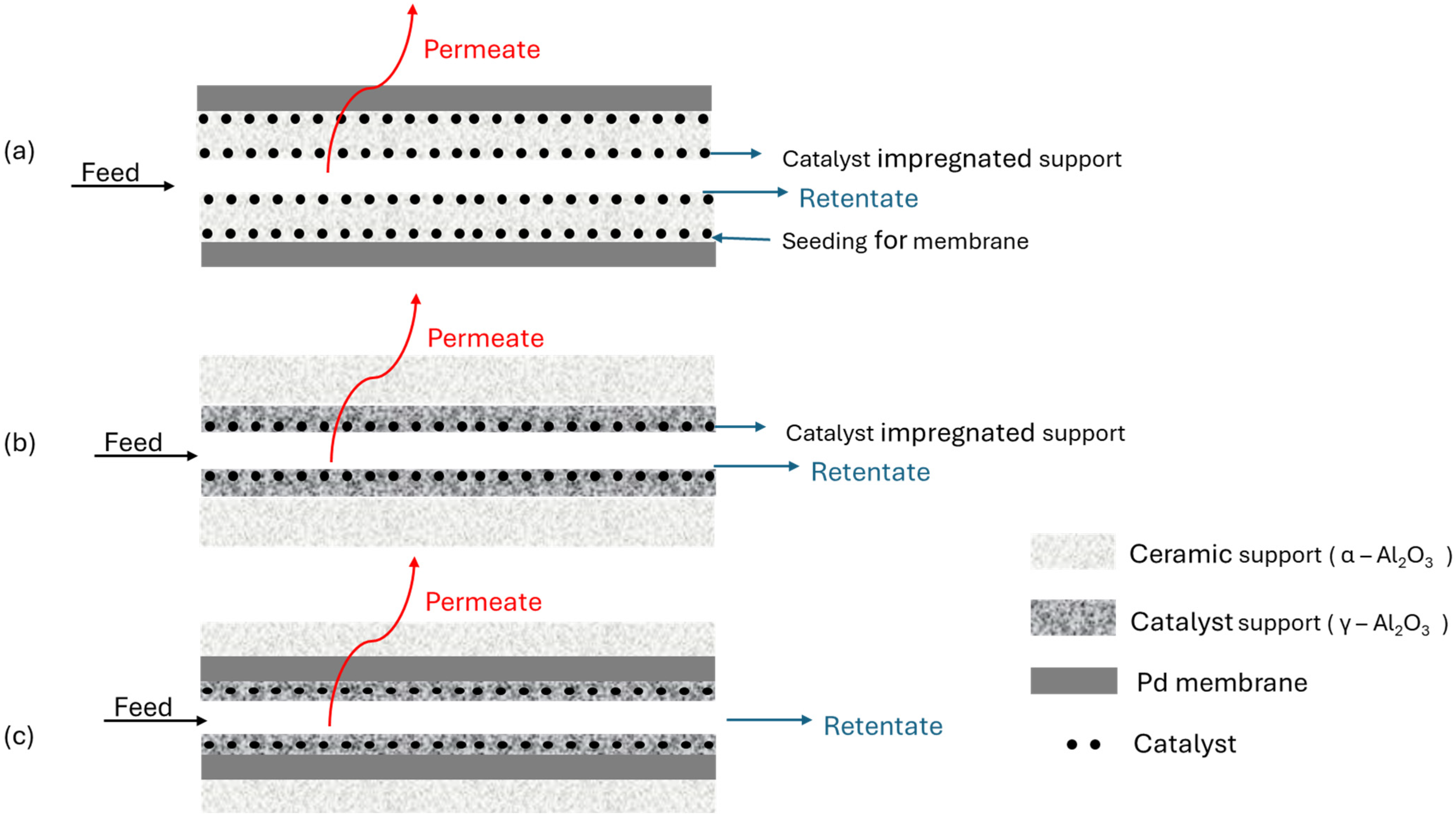
Catalytic membrane integrates a permselective membrane with a catalyst layer, minimizing the distance between the active catalytic sites and the separation interface (Figure 6). This configuration enables the immediate removal of reaction products as they are formed, significantly reducing the likelihood of back-reactions and side reactions [90,113,114]. The proximity between the catalyst and the membrane also reduces diffusion limitations, thereby enhancing product recovery and overall system efficiency.
CMRs are specifically engineered to address critical limitations inherent to conventional packed-bed membrane reactors (PBMRs), such as temperature gradients and concentration polarization [114]. The direct contact between the catalyst layer and the membrane enhances heat transfer efficiency, promoting a more uniform temperature distribution throughout the reactor. This thermal homogeneity contributes to improved reaction kinetics and product selectivity. Additionally, catalytic membranes effectively reduce concentration polarization, a phenomenon in PBMRs caused by the buildup of non-permeable species near the membrane surface, which impedes hydrogen permeation. By minimizing the diffusion distance between the catalytic sites and the membrane, these systems facilitate faster mass transport and accelerated reaction rates, thereby reducing concentration gradients and enhancing overall membrane performance [115].
Figure 6. Configurations of catalytic membrane reactors. Dense membrane on the external surface with catalyst placed internally (Readapted from Sitar et al. [90,116] and Zhang et al. [114]) (a); Double-layer configuration with catalyst impregnated into a porous ceramic membrane (Readapted from Li Gang et al. [115]) (b); Dense membrane coated with a ceramic catalytic layer (c) (Readapted from Xu et al. [117]).
Catalysts 15 00811 g006
Figure 6 illustrates the main configurations of catalytic membrane reactors, highlighting different arrangements of membrane and catalytic layers. Table 7 summarizes the key catalytic performance results reported in the literature for these configurations, providing a comparative overview of their effectiveness in ammonia decomposition and hydrogen recovery. In the literature, three main configurations of catalytic membranes are reported, as follows:
  • Dense membrane deposited over a catalyst-impregnated support (Figure 6a);
  • Catalyst impregnated onto a ceramic membrane (Figure 6b);
  • Dense membrane coated with a catalyst-impregnated layer (Figure 6c).
In the first configuration, the ceramic support is impregnated with a catalyst that also serves as a seeding layer for the subsequent deposition of the dense palladium membrane. For instance, Zhang et al. [114] and Sitar et al. [90,116] developed such catalytic membranes by impregnating the ceramic support with ruthenium, which functions simultaneously as a catalyst and as a seeding layer for palladium deposition (Figure 6a). Specifically, Zhang et al. [114] proposed an advanced membrane design in which the YSZ support is impregnated with ruthenium both internally and externally. In this arrangement, the inner ruthenium layer acts as the catalyst, while the outer layer provides the template for palladium membrane growth. The catalytic activity is further enhanced by promoting the inner layer with Cs. This dual-function approach enabled complete ammonia conversion at 400 °C, surpassing thermodynamic equilibrium, with a hydrogen recovery rate of 88% and hydrogen purity reaching 99%. Additionally, the improved design facilitated more efficient heat transfer (Table 7). However, issues related to mass transport still limit the industrial scalability of this system. The external deposition of the membrane also raises concerns about its long-term adhesion to the support under operational pressures and high transmembrane fluxes. While YSZ is expected to improve membrane-to-support bonding, further studies are required to establish its durability, especially at pressures up to 5 bar. Moreover, since the system does not employ a sweep gas or vacuum, the mechanism driving hydrogen flux through the membrane under the given pressure differential remains to be clarified. Meanwhile, Sitar et al. [90,116] conducted an in-depth study on a novel catalytic membrane reactor that combines a fixed-bed reactor with an external catalytic membrane. This dual setup enables the generation of carbon-free H2/NH3 fuel mixtures by utilizing ammonia as a sweep gas (Table 7). The integration of the fixed bed and the catalytic membrane not only improved reactor efficiency but also allowed operation at lower temperatures, since the membrane could further decompose any ammonia not converted in the fixed bed. The authors also investigated the use of methane as a sweep gas to produce hydrogen-enriched natural gas (HENG), a crucial step toward achieving a renewable energy economy. Adding hydrogen to natural gas has notable benefits, such as increased efficiency, reduced NOx emissions, and the ability to operate under leaner conditions. Nonetheless, it is essential to keep operating temperatures low to avoid methane decomposition and prevent membrane poisoning. In both ammonia- and methane-based systems, increasing the sweep gas flow rate significantly enhanced ammonia conversion and hydrogen recovery, largely due to the reduction in hydrogen partial pressure and the resulting higher driving force.
The second configuration of catalytic membrane involves the straightforward impregnation of the catalyst onto a ceramic membrane (Figure 6b). For example, Li Gang et al. [115] fabricated a catalytic membrane using α-alumina (with a pore size of 1 micron) as the support. A γ-alumina sol-gel was introduced into the inner side of the support to fill most of the macropores. The inner surface of the γ-alumina layer was subsequently impregnated with ruthenium to impart catalytic activity, while the outer side of the support was coated with a SiO2-ZrO2 layer, which enabled hydrogen separation through molecular sieving mechanisms. Effective hydrogen separation from ammonia and nitrogen was achieved due to hydrogen’s smaller kinetic diameter (296 pm) compared to ammonia (326 pm) and nitrogen (345 pm). The γ-alumina layer plays a crucial role in promoting ammonia decomposition. The authors systematically varied the γ-alumina content under otherwise identical conditions, observing that higher γ-alumina loading improved conversion rates. This enhancement was attributed to a greater quantity of ruthenium that could be impregnated onto the support. However, increasing the γ-alumina content also reduced membrane permeability and pore volume, despite a marked increase in surface area. Under optimal conditions (500 °C, NH3 flow rate of 10 mL min−1), complete ammonia conversion was achieved. At 450 °C and a higher NH3 flow rate (40 mL min−1), hydrogen recovery reached 72% (Table 7). In a related approach, and building on their previous work on PBMRs, Itoh et al. [10,118] evaluated the performance of a catalytic membrane reactor incorporating an ultrathin (2 μm) membrane to enhance both conversion and permeability. To address heat transfer limitations, ruthenium was impregnated onto an aluminum tube placed outside the membrane, in proximity to the furnace heating elements. Complete ammonia conversion was achieved at 375 °C, representing a notable improvement over the previous study. While data on hydrogen purity and recovery were not reported, this work constitutes a state-of-the-art development in the field [115].
The final CMR configuration involves the synthesis of a bimetallic membrane, in which palladium and the catalyst can be either co-deposited [119] or sequentially deposited [117], sometimes utilizing a ceramic intermediate layer for catalyst deposition (Figure 6c). For example, Gade et al. [119] reported the fabrication of catalytic membranes consisting of a co-deposited alloy containing 4.5 wt% Ru and 95.5 wt% Pd. Similarly, Xu et al. [117] developed membranes by depositing a thin ruthenium layer onto a palladium membrane. However, these bimetallic membranes have so far only been evaluated for hydrogen permeation, and not for ammonia decomposition.
Owing to their compactness and high efficiency, catalytic membrane reformers show great promise for on-board and on-demand fueling applications, particularly in commercial transport and heavy industry, where decarbonization remains a significant challenge.
Table 7. Membrane reactor performances.
Reactor TypePBMRPBMR-CMRCMRPBMRCMR
#123456791011121314
CatalystBa-CoCeRu/ACRu/(La)Al2O3Ru/γAl2O3Ru/α-Al2O3 + Pd/0.45% Ru/YSZPd/Ru/YSZRu/γ-Al2O3/αAl2O3/SiO2-ZrO23%Ru/1%Y/12%K/Al2O3Ru/SiO2Ru/γAl2O3
Cat. Preparation 1CPIW-Com.IWUIWIWIWI + NaBH4
Act. Metal (wt. %)41.720.6520.50.50.4534.12
y F ,   N H 3 100%10%100%100%100%100%100%50%100%
WHSVNH3
( N m L     g c a t 1     h 1 )
60030002000120085201203601071 --6004000600-
WHSVNH3,
( N m L     g R u 1     h 1 )
--100,000184,615426,0006000720214,286234,267--20,000133,33314,634682
Membrane
Comp 2
Pd-AuPdPd/PdPd-AgPdPdRu/PdSiO2-ZrO2MFIPd-AgCMSPdPd
Membrane
Support 3
PSSPSSTaIYAAYSZYSZYSZYSZαAl2O3HF---αAl2O3
Membrane (μm)8401.54.64.614.852.6360.30.381.80.92002
Driving Force 4VVArH2O, N2VVNoneNH3NoneVVNoneVV
Sweep gas conf. 5--CoCCC---CoC--------
T (°C)485485370425472400520400400450500450450375
P (bar)4121555465107101
Conversion99%99%100%99%99%99%98%99%98%78%99%98.695.4599.559999
HRF80%-27%85%96.3%93.5%66%98%87.5%72%-93.391.494.460-
PP H2 61.475 **-29.7451.854.46.2556.4960 *189 *--13.68110.0110.356.463-
Reactor conf. 7AABCAAADEDAAF
Ref[11][58][110][109][120][121][90,116][114][115][112][10][118]
1 CP (Co—Precipitation), WI (Wetness Impregnation), Com. (Commercial), UI (Ultrasound—assisted impregnation), 2 CMS: Carbon molecular sieve; MFI: zeolite membrane framework, 3 PSS: porous stainless steel; HF: Hollow fiber, Al2O3; YSZ: Yttria-stabilized zirconia; IYA: Inconel 600—YSZ—γAl2O3; AYSZ: αAl2O3-YSZ, 4 V (Vacuum), 5 CoC: co-current flow; CC: counter-current flow, 6 PP H2 (Purified Productivity: moles of hydrogen produced in the reactor collected at permeate—side), 7 Membrane/Catalyst configuration: (A) external, catalyst outside; (B) internal catalyst inside; (C) internal/external membrane (Palladium deposited on both support sides, catalyst inside; (D) external catalytic membrane, catalyst inside; (E) Catalytic membrane only (selective layer + catalyst coupled); (F) Catalytic membrane only, *Approximated values, ** Use of non-noble metal catalyst.

5.4. Micro–Reactors (μR)

Microreactors emerged as a transformative technology in chemical engineering, offering a novel approach to reaction processes. Inspired by microelectronics fabrication techniques, these systems operate at the millimeter scale and provide several advantages over conventional reactors. Their high surface-to-volume ratio facilitates efficient mass and heat transfer, making them suitable for compact and energy-efficient systems. The latter aligns with the growing demand for compact energy distribution systems [38,39].
One of the key strengths of microreactors is their ability to mitigate the temperature gradients typically encountered in fixed-bed reactors. Their compact dimensions and superior heat transfer characteristics enable precise temperature control and improved thermal uniformity. This is particularly advantageous for ammonia decomposition, a kinetically rapid reaction that occurs on the order of milliseconds. In such cases, microreactors can provide the short residence times and controlled reaction environments necessary for optimal performance [30,54,122]. Microreactor technology finds wide employment in many fields, from engineering to fine chemicals or pharmaceuticals. Some important applications include methanol [123] and steam methane reforming [124], catalytic cracking of hydrocarbons [125], and hydrogenation and ozonolysis [126].
Various microreactor configurations have been investigated for ammonia decomposition, including suspended-bed and post microreactors [30,51]. Suspended-bed designs, however, are often limited by high pressure drops, whereas post microreactors, featuring a pillar-like internal architecture, struggle to maintain performance at elevated temperatures and in directly producing high-purity hydrogen suitable for fuel cell applications [122].
As highlighted in a study by Ganley et al. [51], microchannel microreactors demonstrate superior performance compared to post microreactors for ammonia decomposition. Such superior performance was attributed to the ability of microchannels to effectively address back mixing, a phenomenon where products mix with reactants, hindering reaction efficiency. Microchannels provide a well-defined flow path and minimize back mixing, leading to enhanced conversion [54,122].
Since microreactors are compact and enable precise temperature control for endothermic reactions such as ammonia decomposition, this technology—capable of producing hydrogen on a small scale—could support the wider use of portable PEM fuel cells [127]. This integration offers benefits for directly converting chemical energy into electricity, providing on-demand power in advanced micro power generators and electronic devices by utilizing ammonia’s much higher energy density compared to batteries [128].

5.5. Ion–Electron Conducting Membrane Reactors (IECMR) or Mixed Proton–Electron Conducting Membrane Reactors (MPECMR)

Palladium-based membranes are the frontrunners in membrane reactors for hydrogen separation, operating effectively within a temperature range of 350–500 °C [129]. The hydrogen permeability of these membranes is influenced by thickness, length, the presence or absence of pinholes, and the synthesis method. Exposure of palladium membranes to hydrogen at temperatures lower than their operating range can lead to membrane embrittlement, a phenomenon that compromises the mechanical integrity of the membrane [130]. Doping with other metals, such as silver, copper, or gold, mitigates the embrittlement at lower temperatures, extending the range of working temperature, but at the same time reduces the hydrogen permeability [131]. However, striking a balance between hydrogen permeability and selectivity towards undesirable products remains a challenge. Researchers are actively exploring alternative membrane materials that offer enhanced permeability while maintaining adequate selectivity [47]. Proton-conducting/electronic membranes have emerged as promising candidates for hydrogen and oxygen separation. Perovskite materials, with their unique structural versatility and properties, hold immense promise as potential replacements for palladium membranes [132]. Perovskite membranes also offer the advantage of reduced cost, as palladium is one of the most expensive elements in the world [38]. In palladium membranes, hydrogen transport occurs through the solution-diffusion mechanism, where hydrogen diffuses atomically [133]. Hydrogen transport in perovskite membranes involves a coupled proton-electron vacancy mechanism [132]: once adsorbed and dissociated on the perovskite surface, the hydrogen atom loses its electron, transforming into a protonic defect, and enters the perovskite lattice, diffusing towards the permeate side. Upon reaching the permeate side, the protonic defect recombines with other components, forming hydrogen, which desorbs from the membrane surface. The movement of protons and electrons across the membrane is driven by conditions and processes occurring on opposing surfaces. In hydrogen separation applications, the driving force originates from a concentration gradient, mathematically represented by the Nernst equation [132]. However, this kind of electrified reactor does not reach the values of permeability required for commercial applications. The critical challenge lies in identifying the optimal synthesis route to achieve commercially viable (industrial scale) improvements in membrane permeability.
H. Cheng et al. [134] developed a mixed proton-electron conducting membrane (MPEC) reactor for ammonia decomposition. The MPEC consists of a double-layered hollow fiber with alternating porous and dense layers. The porous layer, impregnated with nickel as the active phase, serves as both a catalyst and a support for the dense NMW layer, which functions as the protonic membrane. The reactor concept resembles a catalytic membrane reactor (CMR), but differs in the hydrogen separation mechanism, which is based on ion-electron transport. The system operates at 1 bar pressure, with the sweep gas as the sole driving force, reducing the permeate-side hydrogen partial pressure. Despite achieving maximum conversion only at 750 °C using 20% diluted ammonia, the MPEC reactor exhibits excellent selectivity due to its ion-electron separation mechanism, preventing permeate-side contamination except for the sweep gas (He) [134].

5.6. New Frontiers: Plasma Reactors and Photo-Electrocatalytic Systems

Recently, catalytic systems that directly utilize electricity, such as plasma reactors and photo-electrocatalytic cells, have been gaining increasing interest.
Plasma consists of high-energy electrons, ions, and radicals; despite this, it remains electrically neutral overall. Generally, plasma can be classified as either low-temperature (where the electron temperature is higher than that of the other components) or high-temperature plasma [135]. Furthermore, low-temperature plasma can be subdivided into thermal plasma (where electrons and gas reach thermal equilibrium at similar temperatures) and non-thermal plasma (where electron temperature is significantly higher than that of ions and radicals) [135]. In the field of heterogeneous catalysis, non-thermal plasma is considered a promising technology, particularly Dielectric Barrier Discharge (DBD) [135,136,137]. The electric discharge in DBD is generated by applying a high-voltage alternating current between two electrodes separated by an insulating material (such as quartz or ceramic), which serves to stabilize the electrical flow by limiting current and preventing sparks or electrical arcs [138]. A typical plasma reactor setup generally includes a high-voltage power supply connected on one side to a high-voltage electrode (commonly made of stainless steel), and on the other side to a grounded electrode (often aluminum foil) [136]. Before reaching the grounded electrode, the current passes through a high-voltage probe and subsequently an oscilloscope, allowing on-site monitoring of discharge voltage, current, and input power [136].
Wang et al. [137] compared various Ru-based catalysts and found that combining DBD plasma with a 1.5%-Ru/La2O3 catalyst enabled nearly complete NH3 conversion at relatively low temperatures (around 380 °C), significantly improving efficiency compared to purely thermal or plasma-only processes. In plasma-only mode (without a catalyst), increasing the supplied power led to only a slight increase in NH3 conversion. However, in plasma-catalysis mode (plasma combined with catalyst), NH3 conversion was markedly enhanced, as compared with plasma-only and plasma-catalysis mode, exceeding the simple sum of conversions observed in the latter, demonstrating a synergistic effect between plasma and the catalyst. The catalyst plays a critical role in elementary steps such as NH3 adsorption and N2 desorption. Under purely thermal catalytic conditions, Ru/La2O3 exhibited the highest activity, followed by Ru/La2O3, Ru/CeO2, Ru/Y2O3, and Ru/SiO2. Nevertheless, in plasma-catalytic processes, Ru/Y2O3 and Ru/La2O3 showed significantly higher NH3 conversions than Ru/CeO2 and Ru/SiO2, indicating that catalysts with low thermal catalytic activity can achieve excellent performance via plasma-catalyst synergistic interactions. In addition, the threshold temperature for thermal catalytic NH3 decomposition with these catalysts was approximately 300 °C, while using plasma catalysis, it decreased below 180 °C, suggesting that plasma introduces additional reaction pathways. Accordingly, active reaction intermediates generated in the plasma (excited NH3*, NH radicals) accelerate the adsorption of the ammonia on the catalyst surface and facilitate nitrogen desorption. These reactive species are absent under conventional thermal catalytic conditions and can open novel reaction routes with reduced activation energies [137].
Yi et al. [136] investigated various Ni-Fe-Co-based catalysts with different loadings and molar ratios, finding that plasma catalysis does not follow the conventional rules of thermal catalysis. In thermal catalysis experiments, the Fe-Ni catalyst exhibited a lower NH3 conversion (12.7%) compared to Ni-Co and Fe-Co catalysts, suggesting that Fe-Ni is not the most effective catalyst under purely thermal conditions. However, in the plasma-catalyst mode, Fe-Ni showed the highest NH3 conversion (59.6%), significantly surpassing the others, confirming its superior performance in the plasma-catalysis mode. In thermal catalysis alone, NH3 conversion gradually increased with higher Ni content in the Fe–Ni catalysts, while in the plasma-catalyst mode, NH3 conversion initially increased, peaking at the 6Fe–4Ni composition, then declined with further increase in Ni content. Using the 6Fe–4Ni catalyst at increasing temperatures, both NH3 conversion and synergistic capability improved, reaching complete conversion at 500 °C in the plasma-catalyst mode. Comparatively, at 500 °C, NH3 conversion using only the catalyst or only plasma was approximately 28% and 22%, respectively, highlighting the clear synergy between plasma and the catalyst. The authors also observed that the 6Fe–4Ni catalyst exhibited the lowest emission intensities in NH3 bands, indicating a more effective adsorption of excited species (NH3*, ˙NH2, ˙NH) than the other catalysts tested. They hypothesized that Fe catalysts strongly adsorb nitrogen atoms, while Ni facilitates hydrogenation/dehydrogenation reactions and promotes hydrogen spillover from the surface. In the Fe–Ni alloy, excited NHx species are proposed to adsorb readily, with nitrogen atoms interacting with Fe sites and hydrogen atoms interacting with adjacent Ni sites [136].
The synergistic combination of plasma and catalyst, along with the formation of highly reactive intermediates, is crucial for achieving high conversion and is considered the core principle of plasma catalysis.
Electrocatalytic systems consist of two electrodes (anode and cathode) connected to an external circuit and immersed in an electrolyte solution. The electrode structure is critical to ensure optimal contact among reactants, protons, and electrons, while the catalyst is deposited onto a conductive substrate that provides a uniform distribution of electrical current across its entire surface [139]. When the electrode is immersed in the electrolyte, the reactivity depends on the contact and mass transport of solubilized reactants to the electrocatalyst surface. Limitations in mass transport and local electronic conduction affect the catalytic activity and also product selectivity [139]. Furthermore, the resistance associated with electron transport from the substrate to the nanoparticles induces an additional overpotential. Consequently, the onset overpotential—often considered an intrinsic property of the electrocatalyst—can be influenced by factors related to the electrode structure [139].
Photoelectrocatalytic (PEC) systems, on the other hand, originate from the concept of directly harnessing solar energy [140]. Different configurations include PECa devices, where the photoactive unit is integrated into the anode, and PV/EC systems, in which a photovoltaic unit is separate and supplies electrical power to the electrocatalytic system [140]. A key advantage of the PECa design is that the anode and cathode are positioned directly on opposite sides of a membrane, thereby reducing transport limitations that typically affect system performance. Additionally, it is possible to eliminate the liquid electrolyte by employing gas diffusion electrodes, enabling so-called “zero-gap” cells with further operational benefits [140]. The fundamental operating principle of PEC systems is the generation of a photocurrent that drives electrocatalytic processes. Therefore, the reaction mechanism and overall effectiveness are broadly similar between EC and PEC systems. However, the main limitations of PEC devices involve the available potential and internal current densities, which depend on the characteristics of the photoactive components. In EC systems, current density can be externally modulated for optimization, whereas this control is more challenging to achieve in PEC devices [140].
Regarding ammonia decomposition in these systems, it can be carried out using reagents in the liquid phase (employing the ammonium ion) or directly in the gas phase, although the former method is the most widely used [141].
Zhang et al. [142] investigated the ammonia oxidation reaction (AOR) performance in alkaline media by comparing LaNiCuO perovskite catalysts with commercial Pt/C catalysts. Cyclic voltammetry (CV) tests showed characteristic Ni(II)/Ni(III) redox peaks. Upon the introduction of ammonia, a significant increase in anodic current density was observed, with an onset potential near 0.42 V, confirming the catalysts’ activity for ammonia oxidation. The AOR activity was further enhanced with increasing pH, as indicated by higher current densities and lowered charge transfer resistance. Additionally, raising the ammonia concentration increased the anodic current. For the hydrogen evolution reaction (HER), potentials of approximately −1.10 V, −1.34 V, and −1.41 V were required to reach current densities of −1, −10, and −20 mA cm−2, respectively. The electrochemical reactions induced morphological changes such as particle size reduction, which increased the number of exposed active sites; second, annealing in an argon atmosphere generated oxygen vacancies within the lattice, beneficially modifying the catalyst’s electronic structure and surface chemistry [142].
Utsunomiya et al. [143] investigated the photocatalytic decomposition of ammonia over TiO2 catalysts loaded with various metals under UV irradiation in an aqueous NH3 solution at room temperature. Among the tested catalysts, only Ni/TiO2 significantly enhanced H2 production, highlighting the key role of nickel in promoting the reaction. To explain the final formation of H2 and N2 from NH2 radicals, the authors proposed three reaction pathways: route 1 involving the formation of NH radicals via double hydrogen abstraction from NH3; route 2 involving decomposition through hydrazine (H2N–NH2) formation via coupling of NH2 radicals; and route 2′, a variant of route 2 where H2N–NH3 is formed. The presence of Ni0 in the Ni/TiO2 catalyst is suggested to facilitate these pathways through H2N–NH2 formation, contributing to the higher catalytic activity observed compared to other metal-loaded catalysts or pure TiO2 [143].
While plasma reactors and photocatalytic systems require further investigations to enable scale-up, electrocatalytic systems are already promising candidates for the development of ammonia-based electrolyzers. For example, Zhang et al. [142] realized a symmetric electrolyzer based on a LaNiCuO perovskite catalyst. This electrolyzer demonstrated excellent ammonia removal efficiency, achieving nearly 100% removal from low-concentration solutions after 100 h of operation at a constant applied voltage of 1.23 V. Moreover, in ammonia-containing landfill leachate, over 70% of the initial ammonia was successfully removed after 50 h of continuous operation [142].
Such technologies could therefore open new avenues for the reuse and valorization of wastewater and effluent streams.

6. Economic Feasibility

Ammonia has been compared with various hydrogen carriers such as methanol [144], methane [145], and metal hydride [146], particularly in terms of cost, infrastructure readiness, and transport logistics. Both ammonia and methanol benefit from existing infrastructure, improved safety profiles, and relatively simple storage requirements [20].
Cui et al. [144] suggest that ammonia may be more economically viable than methanol, mainly due to its mature global infrastructure, which allows for economies of scale. Methanol could remain competitive only for small-scale applications, especially where CO2 capture systems are already in place. A key distinction lies in feedstock availability: nitrogen for ammonia is easier and cheaper to capture from air than CO2 for methanol, making ammonia more cost-effective in many contexts. Regarding physical transportation, ships are the most economical mode for both ammonia and methanol, while rail and truck transport are viable options for land distribution [144].
Ammonia transport itself requires careful consideration. Tanker trucks, railcars, pipelines, and maritime vessels are all technically feasible, but they vary in cost, capacity, and associated risk. Zaho et al. [19] conducted a techno-economic analysis comparing pipeline and ship transport of ammonia as a hydrogen carrier. They concluded that pipelines are cost-effective only for short distances, as capital expenditures increase sharply with length. While pipelines offer low transport costs per unit for large volumes, they require high up-front investment and are sensitive to operational risks, particularly boil-off gas (BOG) and leak hazards. Maritime transport, by contrast, has lower operational risks and is more flexible for long-distance shipping [5].
The source of electricity used for ammonia decomposition plays a pivotal role in determining the environmental and economic sustainability of the hydrogen production process. While renewable sources like solar and wind power offer low emissions, their intermittency poses challenges for continuous operation.
Devkota et al. [88] investigate a multi-bed catalytic reactor for ammonia decomposition, analyzing variables such as furnace design, operating temperature, and pressure, and hydrogen purification steps. Their economic analysis found a levelized cost of hydrogen (LCOH) of $6/kg H2, with ammonia costs accounting for 62% of total expenditures. The process yielded a strong return on investment (ROI > 23.7%). In terms of environmental performance, the CO2 emissions per kg of H2 varied drastically depending on the energy source: 1.11 kg CO2/kg H2 for coal, 0.055 kg CO2/kg H2 for solar, and 0.014 kg CO2/kg H2 for wind.
From a plant engineering perspective, the selection of the most appropriate decomposition technology (thermal or electrochemical), reactor configuration, and hydrogen purification system is essential. These choices directly impact the cost structure and process efficiency. A comparative study by Kanaan et al. [147] evaluated thermal and electrocatalytic decomposition approaches, including fixed-bed reactors, membrane reactors, and alkaline ammonia electrolysis, across three application scales, as follows:
  • Heavy-duty trucks (on-board production);
  • Hydrogen refueling stations;
  • Ammonia import terminals (large-scale H2 generation).
For large-scale applications, membrane reactors proved the most cost-effective, with an LCOH of $7.72/kg H2. In contrast, for on-board generation in trucks, alkaline electrolysis was the most economical, achieving an LCOH of $9.67/kg H2, 12% lower than the thermal membrane option. For small-scale applications, alkaline electrolysis again emerged as the most attractive, with a projected LCOH of $5.79/kg H2, corresponding to a 20% cost reduction compared to membrane reactors [147].
Regarding emerging systems such as plasma catalysis and photo-electrocatalysis, studies are still limited as these technologies remain under optimization, particularly concerning their potential scalability.
In this context, Peng et al. [148] investigated the economics of emerging ammonia decomposition techniques as alternatives to conventional thermo-chemical decomposition, specifically plasma-assisted decomposition and ammonia electrolysis. Thermocatalysis is currently the most mature technology; when coupled with PEM electrolysis, it offers the lowest levelized cost of energy (LCOE), below $0.5/kWh. Ammonia electrolysis is still at an early stage of development, with an LCOE of almost $2.3/kWh, and requires further research to improve efficiency, durability, and system stability. Plasma-assisted decomposition represents the most expensive pathway, with an LCOE between $2.1 and $6.3/kWh, mainly due to the high energy consumption and the significant costs associated with plasma generator equipment [148].
In addition, Electrocatalytic (EC) devices can operate continuously (24/7), although their environmental impact depends on the electricity source, while PEC devices operate only when sunlight is available, resulting in intermittent operation [140].

7. Industrial Overview and Conclusions

From an industrial perspective, wetness impregnation remains the most widely adopted method for catalyst synthesis (Table 2). Although it may yield lower performance compared to more advanced techniques such as polyol reduction or chemical vapor deposition (CVD), its simplicity, scalability, and low cost make it attractive for large-scale production. Techniques like polyol reduction require costly solvents (e.g., ethylene glycol), high temperatures, and complex precursors. Similarly, CVD, despite its success in microelectronics, involves expensive equipment, inert gas usage, and precursor vapor stability, challenges that complicate its application to bulk catalyst production. Wetness impregnation is not without drawbacks: sintering of active particles and residual contaminants such as chlorides or nitrates can impair performance. Nonetheless, on an industrial scale, these issues are often negligible compared to the cost and ease of implementation. For instance, the use of ruthenium nitrosyl nitrate over ruthenium chloride is preferred to minimize chlorine-related deactivation [149]. Beyond activity, long-term stability and catalyst recyclability are key for industrial applications. Spent catalysts are classified as hazardous waste, and their disposal poses environmental concerns. The recovery of precious and transition metals, through roasting, hydrometallurgy, or pyrometallurgy, presents both opportunities and challenges, as the economic viability of such processes depends on metal content, recovery costs, and market prices [150].
A closer analysis (Table 2) reveals that the support material and promoter choice often have a greater impact on catalyst performance than the synthesis method itself. Oxides such as alumina and magnesia are widely used as supports due to availability and cost. Magnesia is often preferred over γ-alumina because of its neutral surface properties, while ceria, though effective, suffers from poor economic viability due to its classification as a rare earth element. Carbon-based materials, including nanotubes and nanofibers, show excellent promise as supports, with CVD being the most scalable method for their production, albeit still limited in terms of industrial adoption. Among alkali promoters, sodium and potassium offer a cost-effective route to improve performance, whereas lanthanum and caesium, though effective, are less attractive due to their higher cost.
The use of non-noble metals in membrane reactors (Table 3) introduces additional complexity. These materials generally require reduction temperatures above 600 °C, while membrane reactors typically operate at 300–500 °C. This mismatch can cause membrane delamination. Solutions such as ex-situ reduction, as demonstrated by Cerrillo et al. [11] for cobalt catalysts, help mitigate this, but the high oxidation sensitivity of reduced non-noble metals remains a significant obstacle.
Comparing results from different studies is challenging due to inconsistent reporting of metrics such as WHSV (Volume of reactants over catalyst mass, NmL gCat−1 h−1) and GHSV (Volume of reactants over catalyst bed volume, h−1). Many publications use these values interchangeably or omit definitions. To enable accurate comparisons, this study adopted WHSV based on metal content (Volume of reactants over metal mass, NmL gMetal−1 h−1), which normalizes flow rates relative to active sites and provides a more meaningful comparison, particularly in multi-reactor setups (Table 2 and Table 3).
In the case of membrane reactors, key performance indicators include the hydrogen recovery factor (HRF) and permeate-side productivity (PP H2). These metrics reflect both catalytic activity and membrane separation efficiency. However, parameters like membrane thickness also play a crucial role: while thicker membranes improve selectivity and product purity, they also lower hydrogen permeability and raise material costs, especially when palladium is involved.
In conclusion, ammonia stands out as a promising hydrogen carrier due to its existing infrastructure, safer handling, and storage advantages. As Cui et al. [144] note, it offers economic advantages over methanol on a large scale, thanks to the simplicity of nitrogen capture. Moreover, the choice of decomposition technology (thermal, catalytic, or electrocatalytic) should be matched to the application context. For example, Kanaan et al. [147] show that membrane reactors are ideal for large-scale hydrogen production, while alkaline electrolysis is more suitable for small, distributed systems.
While significant technical and economic hurdles remain, ongoing innovation in catalyst design, reactor configuration, and membrane technology continues to advance the feasibility of ammonia-based hydrogen production. The integration of these developments will be key to enabling sustainable, scalable, and cost-effective hydrogen supply chains in the near future.

Funding

This research was funded by the European Union—NextGeneration EU from the Italian Ministry of Environment and Energy Security POR H2 AdP MMES/ENEA with involvement of CNR and RSE, PNRR—Mission 2, Component 2, Investment 3.5 “Ricerca e sviluppo sull’idrogeno”, CUP: B93C22000630006 (WP2.3—LA2.3.3).Catalysts 15 00811 i001

Data Availability Statement

Data are contained within the article and the included cited papers.

Conflicts of Interest

The authors declare no conflicts of interest.

References

  1. IEA. Net Zero by 2050: A Roadmap for the Global Energy Sector; International Energy Agency: Paris, France, 2021; p. 224. [Google Scholar]
  2. Valera-Medina, A.; Xiao, H.; Owen-Jones, M.; David, W.I.F.; Bowen, P.J. Ammonia for Power. Prog. Energy Combust. Sci. 2018, 69, 63–102. [Google Scholar] [CrossRef]
  3. Lee, B.; Park, J.; Lee, H.; Byun, M.; Yoon, C.W.; Lim, H. Assessment of the Economic Potential: COx-Free Hydrogen Production from Renewables via Ammonia Decomposition for Small-Sized H2 Refueling Stations. Renew. Sustain. Energy Rev. 2019, 113, 109262. [Google Scholar] [CrossRef]
  4. Hu, X.C.; Wang, W.W.; Si, R.; Ma, C.; Jia, C.J. Hydrogen Production via Catalytic Decomposition of NH3 Using Promoted MgO-Supported Ruthenium Catalysts. Sci. China Chem. 2019, 62, 1625–1633. [Google Scholar] [CrossRef]
  5. Zhao, F.; Wang, Z.; Dong, B.; Li, M.; Ji, Y.; Han, F. Comprehensive Life Cycle Cost Analysis of Ammonia-Based Hydrogen Transportation Scenarios for Offshore Wind Energy Utilization. J. Clean. Prod. 2023, 429, 139616. [Google Scholar] [CrossRef]
  6. Pashchenko, D. Ammonia Fired Gas Turbines: Recent Advances and Future Perspectives. Energy 2024, 290, 130275. [Google Scholar] [CrossRef]
  7. Davis, S.C.; Boundy, R.G. Transport Energy Data Book; Oak Ridge National Laboratory: Oak Ridge, TN, USA, 2022; ISBN 1800553684. [Google Scholar]
  8. Ajanovic, A.; Sayer, M.; Haas, R. The Economics and the Environmental Benignity of Different Colors of Hydrogen. Int. J. Hydrogen Energy 2022, 47, 24136–24154. [Google Scholar] [CrossRef]
  9. Karabeyoglu, A.; Evans, B. Conditioning System for Ammonia-Fired Power Plants. In Proceedings of the 9th Annual NH3 Fuel Association Conference, San Antonio, TX, USA, 1 October 2012; p. 43. [Google Scholar]
  10. Itoh, N.; Oshima, A.; Suga, E.; Sato, T. Kinetic Enhancement of Ammonia Decomposition as a Chemical Hydrogen Carrier in Palladium Membrane Reactor. Catal. Today 2014, 236, 70–76. [Google Scholar] [CrossRef]
  11. Cerrillo, J.L.; Morlanés, N.; Kulkarni, S.R.; Realpe, N.; Ramírez, A.; Katikaneni, S.P.; Paglieri, S.N.; Lee, K.; Harale, A.; Solami, B.; et al. High Purity, Self-Sustained, Pressurized Hydrogen Production from Ammonia in a Catalytic Membrane Reactor. Chem. Eng. J. 2022, 431, 134310. [Google Scholar] [CrossRef]
  12. McCullough, K.; Chiang, P.H.; Jimenez, J.D.; Lauterbach, J.A. Material Discovery and High Throughput Exploration of Ru Based Catalysts for Low Temperature Ammonia Decomposition. Materials 2020, 13, 1869. [Google Scholar] [CrossRef]
  13. Huang, D.C.; Jiang, C.H.; Liu, F.J.; Cheng, Y.C.; Chen, Y.C.; Hsueh, K.L. Preparation of Ru-Cs Catalyst and Its Application on Hydrogen Production by Ammonia Decomposition. Int. J. Hydrogen Energy 2013, 38, 3233–3240. [Google Scholar] [CrossRef]
  14. Fang, H.; Wu, S.; Ayvali, T.; Zheng, J.; Fellowes, J.; Ho, P.L.; Leung, K.C.; Large, A.; Held, G.; Kato, R.; et al. Dispersed Surface Ru Ensembles on MgO(111) for Catalytic Ammonia Decomposition. Nat. Commun. 2023, 14, 647. [Google Scholar] [CrossRef]
  15. García-García, F.R.; Guerrero-Ruiz, A.; Rodríguez-Ramos, I. Role of B5-Type Sites in Ru Catalysts Used for the NH3 Decomposition Reaction. Top. Catal. 2009, 52, 758–764. [Google Scholar] [CrossRef]
  16. Tan, H.; Li, K.; Sioud, S.; Cha, D.; Amad, M.H.; Hedhili, M.N.; Al-Talla, Z.A. Synthesis of Ru Nanoparticles Confined in Magnesium Oxide-Modified Mesoporous Alumina and Their Enhanced Catalytic Performance during Ammonia Decomposition. Catal. Commun. 2012, 26, 248–252. [Google Scholar] [CrossRef]
  17. Mukherjee, S.; Devaguptapu, S.V.; Sviripa, A.; Lund, C.R.F.; Wu, G. Low-Temperature Ammonia Decomposition Catalysts for Hydrogen Generation. Appl. Catal. B Environ. 2018, 226, 162–181. [Google Scholar] [CrossRef]
  18. Klerke, A.; Christensen, C.H.; Nørskov, J.K.; Vegge, T. Ammonia for Hydrogen Storage: Challenges and Opportunities. J. Mater. Chem. 2008, 18, 2304–2310. [Google Scholar] [CrossRef]
  19. Sun, S.; Jiang, Q.; Zhao, D.; Cao, T.; Sha, H.; Zhang, C.; Song, H.; Da, Z. Ammonia as Hydrogen Carrier: Advances in Ammonia Decomposition Catalysts for Promising Hydrogen Production. Renew. Sustain. Energy Rev. 2022, 169, 112918. [Google Scholar] [CrossRef]
  20. Wingreen, N.S. Ammonia Transport. EcoSal Plus 2004, 1, 1. [Google Scholar] [CrossRef]
  21. Maccarrone, D.; Giorgianni, G.; Italiano, C.; Perathoner, S.; Centi, G.; Abate, S. Comparative Analysis of Hydrogen Production from Ammonia Decomposition in Membrane and Packed Bed Reactors Using Diluted NH3 Streams. Int. J. Hydrogen Energy 2024, 82, 513–522. [Google Scholar] [CrossRef]
  22. Zhang, M.; Wen, J.; Zhang, Y.; Wu, Y.; Zhao, Z.; Yan, J.; Song, W.; Ali, A.M.; Zhang, H. Advances in the Development of Ammonia Decomposition to CO -Free Hydrogen: Catalyst Materials and Activity Optimization. Int. J. Hydrogen Energy 2025, 102, 571–593. [Google Scholar] [CrossRef]
  23. Zhao, Z.; He, W.; Guo, B.; Yu, J.; Wang, Z.; Yu, H. A Comprehensive Review of Ammonia Decomposition for Hydrogen Production. Energy Fuels 2025, 39, 13825–13847. [Google Scholar] [CrossRef]
  24. Farooqi, A.S.; Ramli, R.M.; Hasnain, S.M.W.U.; Farooqi, A.S.; Sharaf Addin, A.H.; Abdullah, B.; Arslan, M.T.; Farooqi, S.A. A Comprehensive Review on Hydrogen Production via Catalytic Ammonia Decomposition over Ni-Based Catalysts. Int. J. Hydrogen Energy 2025, 97, 593–613. [Google Scholar] [CrossRef]
  25. Su, Z.; Guan, J.; Liu, Y.; Shi, D.; Wu, Q.; Chen, K.; Zhang, Y.; Li, H. Research Progress of Ruthenium-Based Catalysts for Hydrogen Production from Ammonia Decomposition. Int. J. Hydrogen Energy 2024, 51, 1019–1043. [Google Scholar] [CrossRef]
  26. Zhao, Z.; Zhang, M.; Wu, Y.; Song, W.; Yan, J.; Qi, X.; Yang, J.; Wen, J.; Zhang, H. Ammonia Energy: Synthesis and Utilization. Ind. Eng. Chem. Res. 2024, 63, 8003–8024. [Google Scholar] [CrossRef]
  27. Huang, X.; Lei, K.; Mi, Y.; Fang, W. Recent Progress on Hydrogen Production from Ammonia Decomposition: Technical Roadmap and Catalytic Mechanism. Molecules 2023, 28, 5245. [Google Scholar] [CrossRef]
  28. Lee, J.E.; Lee, J.; Jeong, H.; Park, Y.K.; Kim, B.S. Catalytic Ammonia Decomposition to Produce Hydrogen: A Mini-Review. Chem. Eng. J. 2023, 475, 146108. [Google Scholar] [CrossRef]
  29. Lucentini, I.; Garcia, X.; Vendrell, X.; Llorca, J. Review of the Decomposition of Ammonia to Generate Hydrogen. Ind. Eng. Chem. Res. 2021, 60, 18560–18611. [Google Scholar] [CrossRef]
  30. Ao, R.; Lu, R.; Leng, G.; Zhu, Y.; Yan, F.; Yu, Q. A Review on Numerical Simulation of Hydrogen Production from Ammonia Decomposition. Energies 2023, 16, 921. [Google Scholar] [CrossRef]
  31. Andriani, D.; Bicer, Y. A Review of Hydrogen Production from Onboard Ammonia Decomposition: Maritime Applications of Concentrated Solar Energy and Boil-Off Gas Recovery. Fuel 2023, 352, 128900. [Google Scholar] [CrossRef]
  32. Ojelade, O.A.; Zaman, S.F. Ammonia Decomposition for Hydrogen Production: A Thermodynamic Study. Chem. Pap. 2021, 75, 57–65. [Google Scholar] [CrossRef]
  33. Shacham, M.; Brauner, N. A Hundred Years of Chemical Equilibrium Calculations—The Case of Ammonia Synthesis. Educ. Chem. Eng. 2015, 13, 17–23. [Google Scholar] [CrossRef]
  34. Yin, S.F.; Xu, B.Q.; Zhu, W.X.; Ng, C.F.; Zhou, X.P.; Au, C.T. Carbon Nanotubes-Supported Ru Catalyst for the Generation of CO x-Free Hydrogen from Ammonia. Catal. Today 2004, 93–95, 27–38. [Google Scholar] [CrossRef]
  35. Wang, W.; Padban, N.; Ye, Z.; Andersson, A.; Bjerle, I. Ammonia Decomposition in Hot Gas Cleaning. Ind. Eng. Chem. Res. 1999, 38, 4175–4182. [Google Scholar] [CrossRef]
  36. Yin, S.-F.; Zhang, Q.-H.; Xu, B.-Q.; Zhu, W.-X.; Ng, C.-F.; Au, C.-T. Investigation on the Catalysis of COx-Free Hydrogen Generation from Ammonia. J. Catal. 2004, 224, 384–396. [Google Scholar] [CrossRef]
  37. Hayashi, F.; Toda, Y.; Kanie, Y.; Kitano, M.; Inoue, Y.; Yokoyama, T.; Hara, M.; Hosono, H. Ammonia Decomposition by Ruthenium Nanoparticles Loaded on Inorganic Electride C12A7:E-. Chem. Sci. 2013, 4, 3124–3130. [Google Scholar] [CrossRef]
  38. Bell, T.E.; Torrente-Murciano, L. H2 Production via Ammonia Decomposition Using Non-Noble Metal Catalysts: A Review. Top. Catal. 2016, 59, 1438–1457. [Google Scholar] [CrossRef]
  39. Im, Y.; Muroyama, H.; Matsui, T.; Eguchi, K. Ammonia Decomposition over Nickel Catalysts Supported on Alkaline Earth Metal Aluminate for H2 Production. Int. J. Hydrogen Energy 2020, 45, 26979–26988. [Google Scholar] [CrossRef]
  40. Prasad, V.; Karim, A.M.; Arya, A.; Vlachos, D.G. Assessment of Overall Rate Expressions and Multiscale, Microkinetic Model Uniqueness via Experimental Data Injection: Ammonia Decomposition on Ru/γ-Al 2O 3 for Hydrogen Production. Ind. Eng. Chem. Res. 2009, 48, 5255–5265. [Google Scholar] [CrossRef]
  41. Zheng, W.; Zhang, J.; Xu, H.; Li, W. NH3 Decomposition Kinetics on Supported Ru Clusters: Morphology and Particle Size Effect. Catal. Lett. 2007, 119, 311–318. [Google Scholar] [CrossRef]
  42. Ganley, J.C.; Thomas, F.S.; Seebauer, E.G.; Masel, R.I. A Priori Catalytic Activity Correlations: The Difficult Case of Hydrogen Production from Ammonia. Catal. Lett. 2004, 96, 117–122. [Google Scholar] [CrossRef]
  43. Tehenics, A. Bachelor Thesis Chemical Engineering Ammonia Decomposition over Ruthenium Catalysts. Bachelor’s Thesis, University of Groningen, Groningen, The Netherlands, 2020. [Google Scholar]
  44. Duan, X.; Zhou, J.; Qian, G.; Li, P.; Zhou, X.; Chen, D. Carbon Nanofiber-Supported Ru Catalysts for Hydrogen Evolution by Ammonia Decomposition. Cuihua Xuebao/Chinese J. Catal. 2010, 31, 979–986. [Google Scholar] [CrossRef]
  45. Li, J.; Wang, W.; Chen, W.; Gong, Q.; Luo, J.; Lin, R.; Xin, H.; Zhang, H.; Wang, D.; Peng, Q.; et al. Sub-Nm Ruthenium Cluster as an Efficient and Robust Catalyst for Decomposition and Synthesis of Ammonia: Break the “Size Shackles”. Nano Res. 2018, 11, 4774–4785. [Google Scholar] [CrossRef]
  46. Shao, R.; Zhang, L.; Wang, L.; Wang, J.; Zhang, X.; Han, S.; Cheng, X.; Wang, Z. Cerium Oxide-Based Catalyst for Low-Temperature and Efficient Ammonia Decomposition for Hydrogen Production Research. Int. J. Hydrogen Energy 2024, 68, 311–320. [Google Scholar] [CrossRef]
  47. Arevalo, R.L.; Aspera, S.M.; Sison Escaño, M.C.; Nakanishi, H.; Kasai, H. First Principles Study of Methane Decomposition on B5 Step-Edge Type Site of Ru Surface. J. Phys. Condens. Matter 2017, 29, 184001. [Google Scholar] [CrossRef]
  48. Karim, A.M.; Prasad, V.; Mpourmpakis, G.; Lonergan, W.W.; Frenkel, A.I.; Chen, J.G.; Vlachos, D.G. Correlating Particle Size and Shape of Supported Ru/γ-Al 2 O 3 Catalysts with NH 3 Decomposition Activity. J. Am. Chem. Soc. 2009, 131, 12230–12239. [Google Scholar] [CrossRef] [PubMed]
  49. Leung, K.C.; Hong, S.; Li, G.; Xing, Y.; Ng, B.K.Y.; Ho, P.-L.; Ye, D.; Zhao, P.; Tan, E.; Safonova, O.; et al. Confined Ru Sites in a 13X Zeolite for Ultrahigh H 2 Production from NH 3 Decomposition. J. Am. Chem. Soc. 2023, 145, 14548–14561. [Google Scholar] [CrossRef] [PubMed]
  50. Pinzón, M.; Romero, A.; de Lucas Consuegra, A.; de la Osa, A.R.; Sánchez, P. Hydrogen Production by Ammonia Decomposition over Ruthenium Supported on SiC Catalyst. J. Ind. Eng. Chem. 2021, 94, 326–335. [Google Scholar] [CrossRef]
  51. Ganley, J.C.; Seebauer, E.G.; Masel, R.I. Development of a Microreactor for the Production of Hydrogen from Ammonia. J. Power Sources 2004, 137, 53–61. [Google Scholar] [CrossRef]
  52. Fujitani, T.; Nakamura, I.; Hashiguchi, Y.; Kanazawa, S.; Takahashi, A. Effect of Catalyst Preparation Method on Ammonia Decomposition Reaction over Ru/MgO Catalyst. Bull. Chem. Soc. Jpn. 2020, 93, 1186–1192. [Google Scholar] [CrossRef]
  53. Chen, C.; Wu, K.; Ren, H.; Zhou, C.; Luo, Y.; Lin, L.; Au, C.; Jiang, L. Ru-Based Catalysts for Ammonia Decomposition: A Mini-Review. Energy and Fuels 2021, 35, 11693–11706. [Google Scholar] [CrossRef]
  54. Soler, L.; Divins, N.J.; Vendrell, X.; Serrano, I.; Llorca, J. Hydrogen Production in Microreactors. In Current Trends and Future Developments on (Bio-) Membranes; Elsevier: Amsterdam, The Netherlands, 2020; ISBN 9780128173848. [Google Scholar]
  55. Verdoliva, V.; Saviano, M.; De Luca, S. Zeolites as Acid/Basic Solid Catalysts: Recent Synthetic Developments. Catalysts 2019, 9, 248. [Google Scholar] [CrossRef]
  56. Busca, G. Acidity and Basicity in Zeolites: A Fundamental Approach. Microporous Mesoporous Mater. 2017, 254, 3–16. [Google Scholar] [CrossRef]
  57. Hu, X.C.; Fu, X.P.; Wang, W.W.; Wang, X.; Wu, K.; Si, R.; Ma, C.; Jia, C.J.; Yan, C.H. Ceria-Supported Ruthenium Clusters Transforming from Isolated Single Atoms for Hydrogen Production via Decomposition of Ammonia. Appl. Catal. B Environ. 2020, 268, 118424. [Google Scholar] [CrossRef]
  58. García-García, F.R.; Ma, Y.H.; Rodríguez-Ramos, I.; Guerrero-Ruiz, A. High Purity Hydrogen Production by Low Temperature Catalytic Ammonia Decomposition in a Multifunctional Membrane Reactor. Catal. Commun. 2008, 9, 482–486. [Google Scholar] [CrossRef]
  59. Chung, D.B.; Kim, H.Y.; Jeon, M.; Lee, D.H.; Park, H.S.; Choi, S.H.; Nam, S.W.; Jang, S.C.; Park, J.H.; Lee, K.Y.; et al. Enhanced Ammonia Dehydrogenation over Ru/La(x)-Al2O3 (x = 0–50 Mol%): Structural and Electronic Effects of La Doping. Int. J. Hydrogen Energy 2017, 42, 1639–1647. [Google Scholar] [CrossRef]
  60. Aika, K.; Ohya, A.; Ozaki, A.; Inoue, Y.; Yasumori, I. Support and Promoter Effect of Ruthenium Catalyst. II. Ruthenium/Alkaline Earth Catalyst for Activation of Dinitrogen. J. Catal. 1985, 92, 305–311. [Google Scholar] [CrossRef]
  61. Sayas, S.; Morlanés, N.; Katikaneni, S.P.; Harale, A.; Solami, B.; Gascon, J. High pressure ammonia decomposition on Ru–K/CaO catalysts. Catal. Sci. Technol. 2020, 10, 5027–5035. [Google Scholar] [CrossRef]
  62. Wang, Z.; Qu, Y.; Shen, X.; Cai, Z. ScienceDirect Ruthenium Catalyst Supported on Ba Modified ZrO 2 for Ammonia Decomposition to CO x -Free Hydrogen. Int. J. Hydrogen Energy 2019, 44, 7300–7307. [Google Scholar] [CrossRef]
  63. Zhang, J.; Xu, H.; Ge, Q.; Li, W. Highly Efficient Ru/MgO Catalysts for NH3 Decomposition: Synthesis, Characterization and Promoter Effect. Catal. Commun. 2006, 7, 148–152. [Google Scholar] [CrossRef]
  64. Lucentini, I.; Casanovas, A.; Llorca, J. Catalytic Ammonia Decomposition for Hydrogen Production on Ni, Ru and Ni[Sbnd]Ru Supported on CeO2. Int. J. Hydrogen Energy 2019, 44, 12693–12707. [Google Scholar] [CrossRef]
  65. Di Carlo, A.; Vecchione, L.; Del Prete, Z. Ammonia Decomposition over Commercial Ru/Al2O3 Catalyst: An Experimental Evaluation at Different Operative Pressures and Temperatures. Int. J. Hydrogen Energy 2014, 39, 808–814. [Google Scholar] [CrossRef]
  66. Koo, K.Y.; Im, H.B.; Song, D.; Jung, U. Ammonia Decomposition over Ru-Coated Metal-Structured Catalysts for COx-Free Hydrogen Production. Int. J. Hydrogen Energy 2024, 52, 534–545. [Google Scholar] [CrossRef]
  67. Cao, C.; Wu, K.; Zhou, C.; Yao, Y.; Luo, Y.; Chen, C.; Lin, L.; Jiang, L. Electronic Metal-Support Interaction Enhanced Ammonia Decomposition Efficiency of Perovskite Oxide Supported Ruthenium. Chem. Eng. Sci. 2022, 257, 117719. [Google Scholar] [CrossRef]
  68. Ju, X.; Liu, L.; Yu, P.; Guo, J.; Zhang, X.; He, T.; Wu, G.; Chen, P. Mesoporous Ru/MgO Prepared by a Deposition-Precipitation Method as Highly Active Catalyst for Producing COx-Free Hydrogen from Ammonia Decomposition. Appl. Catal. B Environ. 2017, 211, 167–175. [Google Scholar] [CrossRef]
  69. Ju, X.; Liu, L.; Zhang, X.; Feng, J.; He, T.; Chen, P. Highly Efficient Ru/MgO Catalyst with Surface-Enriched Basic Sites for Production of Hydrogen from Ammonia Decomposition. ChemCatChem 2019, 11, 4161–4170. [Google Scholar] [CrossRef]
  70. Zhiqiang, F.; Ziqing, W.; Dexing, L.; Jianxin, L.; Lingzhi, Y.; Qin, W.; Zhong, W. Catalytic Ammonia Decomposition to CO x -Free Hydrogen over Ruthenium Catalyst Supported on Alkali Silicates. Fuel 2022, 326, 125094. [Google Scholar] [CrossRef]
  71. Feng, J.; Liu, L.; Ju, X.; Wang, J.; Zhang, X.; He, T.; Chen, P. Highly Dispersed Ruthenium Nanoparticles on Y2O3 as Superior Catalyst for Ammonia Decomposition. ChemCatChem 2021, 13, 1552–1558. [Google Scholar] [CrossRef]
  72. Hansen, J.B. Kinetics of Ammonia Synthesis and Decomposition on Heterogeneous Catalysts; Springer: Berlin/Heidelberg, Germany, 1995. [Google Scholar]
  73. Torrente-Murciano, L.; Hill, A.K.; Bell, T.E. Ammonia Decomposition over Cobalt/Carbon Catalysts—Effect of Carbon Support and Electron Donating Promoter on Activity. Catal. Today 2017, 286, 131–140. [Google Scholar] [CrossRef]
  74. Morlanés, N.; Sayas, S.; Shterk, G.; Katikaneni, S.P.; Harale, A.; Solami, B.; Gascon, J. Development of a Ba-CoCe Catalyst for the Efficient and Stable Decomposition of Ammonia. Catal. Sci. Technol. 2021, 11, 3014–3024. [Google Scholar] [CrossRef]
  75. Cui, H.Z.; Gu, Y.Q.; He, X.X.; Wei, S.; Jin, Z.; Jia, C.J.; Song, Q.S. Iron-Based Composite Nanostructure Catalysts Used to Produce COx-Free Hydrogen from Ammonia. Sci. Bull. 2016, 61, 220–226. [Google Scholar] [CrossRef]
  76. Li, L.; Chu, W.; Ding, C.; Xi, X.; Jiang, R.; Yan, J. Embedded MoN@C Nanocomposites as an Advanced Catalyst for Ammonia Decomposition to COx-Free Hydrogen. Int. J. Hydrogen Energy 2017, 42, 30630–30638. [Google Scholar] [CrossRef]
  77. Podila, S.; Zaman, S.F.; Driss, H.; Al-Zahrani, A.A.; Daous, M.A.; Petrov, L.A. High Performance of Bulk Mo2N and Co3Mo3N Catalysts for Hydrogen Production from Ammonia: Role of Citric Acid to Mo Molar Ratio in Preparation of High Surface Area Nitride Catalysts. Int. J. Hydrogen Energy 2017, 42, 8006–8020. [Google Scholar] [CrossRef]
  78. Zhao, Z.; Liu, Z.; Li, M.; Yang, Y.; Deng, L.; Zhao, Y.; Dou, B.; Bin, F. Enhancing Ammonia Decomposition for Hydrogen Production via Optimization of Interface Effects and Acidic Site in Supported Cobalt-Nickel Alloy Catalysts. Sep. Purif. Technol. 2025, 360, 131144. [Google Scholar] [CrossRef]
  79. Sun, L.; Wen, K.; Li, G.; Zhang, X.; Zeng, X.; Johannessen, B.; Zhang, S. High-Entropy Alloys in Catalysis: Progress, Challenges, and Prospects. ACS Mater. Au 2024, 4, 547–556. [Google Scholar] [CrossRef]
  80. Yeh, J.W. Recent Progress in High-Entropy Alloys. Ann. Chim. Sci. des Mater. 2006, 31, 633–648. [Google Scholar] [CrossRef]
  81. Xie, P.; Yao, Y.; Huang, Z.; Liu, Z.; Zhang, J.; Li, T.; Wang, G.; Shahbazian-Yassar, R.; Hu, L.; Wang, C. Highly Efficient Decomposition of Ammonia Using High-Entropy Alloy Catalysts. Nat. Commun. 2019, 10, 4011. [Google Scholar] [CrossRef]
  82. Carty, W.M.; Lednor, P.W. Monolithic Ceramics and Heterogeneous Catalysts: Honeycombs and Foams. Curr. Opin. Solid State Mater. Sci. 1996, 1, 88–95. [Google Scholar] [CrossRef]
  83. Cybulski, A.; Moulijn, J.A. Catalysis Reviews: Science and Engineering Monoliths in Heterogeneous Catalysis. Catal. Rev. 2015, 36, 179–270. [Google Scholar] [CrossRef]
  84. Govender, S.; Friedrich, H.B. Monoliths: A Review of the Basics, Preparation Methods and Their Relevance to Oxidation. Catalysts 2017, 7, 62. [Google Scholar] [CrossRef]
  85. Tomašić, V.; Jović, F. State-of-the-Art in the Monolithic Catalysts/Reactors. Appl. Catal. A Gen. 2006, 311, 112–121. [Google Scholar] [CrossRef]
  86. Iranshahi, D.; Golrokh, A.; Pourazadi, E.; Saeidi, S.; Gallucci, F. Progress in Spherical Packed-Bed Reactors: Opportunities for Refineries and Chemical Industries. Chem. Eng. Process. Process Intensif. 2018, 132, 16–24. [Google Scholar] [CrossRef]
  87. Badescu, V. Optimal Design and Operation of Ammonia Decomposition Reactors. Int. J. Energy Res. 2020, 44, 5360–5384. [Google Scholar] [CrossRef]
  88. Devkota, S.; Cha, J.Y.; Shin, B.J.; Mun, J.H.; Yoon, H.C.; Mazari, S.A.; Moon, J.H. Techno-Economic and Environmental Assessment of Hydrogen Production through Ammonia Decomposition. Appl. Energy 2024, 358, 122605. [Google Scholar] [CrossRef]
  89. Collins, J.P.; Way, J.D. Catalytic Decomposition of Ammonia in a Membrane Reactor. J. Memb. Sci. 1994, 96, 259–274. [Google Scholar] [CrossRef]
  90. Sitar, R.; Shah, J.; Zhang, Z.; Wikoff, H.; Way, J.D.; Wolden, C.A. Compact Ammonia Reforming at Low Temperature Using Catalytic Membrane Reactors. J. Memb. Sci. 2022, 644, 120147. [Google Scholar] [CrossRef]
  91. Gallucci, F.; Fernandez, E.; Corengia, P.; van Sint Annaland, M. Recent Advances on Membranes and Membrane Reactors for Hydrogen Production. Chem. Eng. Sci. 2013, 92, 40–66. [Google Scholar] [CrossRef]
  92. Torcida, M.F.; Curto, D.; Martín, M. Design and Optimization of CO2 Hydrogenation Multibed Reactors. Chem. Eng. Res. Des. 2022, 181, 89–100. [Google Scholar] [CrossRef]
  93. Tripodi, A.; Conte, F.; Rossetti, I. Process Intensification for Ammonia Synthesis in Multibed Reactors with Fe-Wustite and Ru/C Catalysts. Ind. Eng. Chem. Res. 2021, 60, 908–915. [Google Scholar] [CrossRef]
  94. Abashar, M.E.E. Multi-Stage Membrane Reactors for Hydrogen Production by Ammonia Decomposition. Int. J. Petrochemistry Res. 2018, 2, 109–115. [Google Scholar] [CrossRef]
  95. Miao, B.; Deng, Z.; Han, P.; Yan, N.; Pan, Z.; Chan, S.H. The Modelling of a Multi-Tubular Packed-Bed Reactor for Ammonia Cracking and SOFC Waste Heat Utilization. Chem. Eng. J. 2025, 504, 159062. [Google Scholar] [CrossRef]
  96. Arratibel Plazaola, A.; Pacheco Tanaka, D.A.; Van Sint Annaland, M.; Gallucci, F. Recent Advances in Pd-Based Membranes for Membrane Reactors. Molecules 2017, 22, 51. [Google Scholar] [CrossRef]
  97. De Falco, M.; Capocelli, M.; Giannattasio, A. Membrane Reactor for One-Step DME Synthesis Process: Industrial Plant Simulation and Optimization. J. CO2 Util. 2017, 22, 33–43. [Google Scholar] [CrossRef]
  98. Smart, S.; Liu, S.; Serra, J.M.; Basile, A.; Diniz da Costa, J.C. Perovskite Membrane Reactors: Fundamentals and Applications for Oxygen Production, Syngas Production and Hydrogen Processing. In Membranes for Clean and Renewable Power Applications; Woodhead Publishing Limited: Sawston, UK, 2013; ISBN 9780857095459. [Google Scholar]
  99. Naquash, A.; Qyyum, M.A.; Chaniago, Y.D.; Riaz, A.; Yehia, F.; Lim, H.; Lee, M. Separation and Purification of Syngas-Derived Hydrogen: A Comparative Evaluation of Membrane- and Cryogenic-Assisted Approaches. Chemosphere 2023, 313, 137420. [Google Scholar] [CrossRef]
  100. Miyamoto, M.; Hayakawa, R.; Makino, Y.; Oumi, Y.; Uemiya, S.; Asanuma, M. CO2 Methanation Combined with NH3 Decomposition by in Situ H2 Separation Using a Pd Membrane Reactor. Int. J. Hydrogen Energy 2014, 39, 10154–10160. [Google Scholar] [CrossRef]
  101. Ongis, M.; Di Marcoberardino, G.; Baiguini, M.; Gallucci, F.; Binotti, M. Optimization of Small-Scale Hydrogen Production with Membrane Reactors. Membranes 2023, 13, 331. [Google Scholar] [CrossRef]
  102. Chiuta, S.; Everson, R.C.; Neomagus, H.W.J.P.; Van Der Gryp, P.; Bessarabov, D.G. Reactor Technology Options for Distributed Hydrogen Generation via Ammonia Decomposition: A Review. Int. J. Hydrogen Energy 2013, 38, 14968–14991. [Google Scholar] [CrossRef]
  103. Sánchez, J.M.; Barreiro, M.M.; Maroño, M. Hydrogen Enrichment and Separation from Synthesis Gas by the Use of a Membrane Reactor. Biomass Bioenergy 2011, 35, S132–S144. [Google Scholar] [CrossRef]
  104. Chen, Y.; Wang, Y.; Xu, H.; Xiong, G. Efficient Production of Hydrogen from Natural Gas Steam Reforming in Palladium Membrane Reactor. Appl. Catal. B Environ. 2008, 81, 283–294. [Google Scholar] [CrossRef]
  105. Brinkmann, T.; Perera, S.P.; Thomas, W.J. An Experimental and Theoretical Investigation of a Catalytic Membrane Reactor for the Oxidative Dehydrogenation of Methanol. Chem. Eng. Sci. 2001, 56, 2047–2061. [Google Scholar] [CrossRef]
  106. Jowkary, H.; Farsi, M.; Rahimpour, M.R. Supporting the Propane Dehydrogenation Reactors by Hydrogen Permselective Membrane Modules to Produce Ultra-Pure Hydrogen and Increasing Propane Conversion: Process Modeling and Optimization. Int. J. Hydrogen Energy 2020, 45, 7364–7373. [Google Scholar] [CrossRef]
  107. Dittmeyer, R.; Höllein, V.; Daub, K. Membrane Reactors for Hydrogenation and Dehydrogenation Processes Based on Supported Palladium. J. Mol. Catal. A Chem. 2001, 173, 135–184. [Google Scholar] [CrossRef]
  108. Giorgianni, G.; Cozza, D.; Dalena, F.; Giglio, E.; Abate, S. Direct Synthesis of H2O2 on Pd/Al2O3 Contactors: Understanding the Effect of Pd Particle Size and Calcination through Kinetic Analysis. Chem. Eng. Trans. 2021, 84, 205–210. [Google Scholar] [CrossRef]
  109. Kim, T.W.; Lee, E.H.; Byun, S.; Seo, D.W.; Hwang, H.J.; Yoon, H.C.; Kim, H.; Ryi, S.K. Highly Selective Pd Composite Membrane on Porous Metal Support for High-Purity Hydrogen Production through Effective Ammonia Decomposition. Energy 2022, 260, 125209. [Google Scholar] [CrossRef]
  110. Park, Y.; Cha, J.; Oh, H.T.; Lee, T.; Lee, S.H.; Park, M.G.; Jeong, H.; Kim, Y.; Sohn, H.; Nam, S.W.; et al. A Catalytic Composite Membrane Reactor System for Hydrogen Production from Ammonia Using Steam as a Sweep Gas. J. Memb. Sci. 2020, 614, 118483. [Google Scholar] [CrossRef]
  111. Ryi, S.K.; Xu, N.; Li, A.; Lim, C.J.; Grace, J.R. Electroless Pd Membrane Deposition on Alumina Modified Porous Hastelloy Substrate with EDTA-Free Bath. Int. J. Hydrogen Energy 2010, 35, 2328–2335. [Google Scholar] [CrossRef]
  112. Jiang, J.; Dong, Q.; McCullough, K.; Lauterbach, J.; Li, S.; Yu, M. Novel Hollow Fiber Membrane Reactor for High Purity H2 Generation from Thermal Catalytic NH3 Decomposition. J. Memb. Sci. 2021, 629, 119281. [Google Scholar] [CrossRef]
  113. Abate, S.; Barbera, K.; Centi, G.; Giorgianni, G.; Perathoner, S. Role of Size and Pretreatment of Pd Particles on Their Behaviour in the Direct Synthesis of H2O2. J. Energy Chem. 2016, 25, 297–305. [Google Scholar] [CrossRef]
  114. Zhang, Z.; Liguori, S.; Fuerst, T.F.; Way, J.D.; Wolden, C.A. Efficient Ammonia Decomposition in a Catalytic Membrane Reactor To Enable Hydrogen Storage and Utilization. ACS Sustain. Chem. Eng. 2019, 7, 5975–5985. [Google Scholar] [CrossRef]
  115. Li, G.; Kanezashi, M.; Lee, H.R.; Maeda, M.; Yoshioka, T.; Tsuru, T. Preparation of a Novel Bimodal Catalytic Membrane Reactor and Its Application to Ammonia Decomposition for CO X-Free Hydrogen Production. Int. J. Hydrogen Energy 2012, 37, 12105–12113. [Google Scholar] [CrossRef]
  116. Sitar, R.; Shah, J.; Way, J.D.; Wolden, C.A. Efficient Generation of H2/NH3Fuel Mixtures for Clean Combustion. Energy Fuels 2022, 36, 9357–9364. [Google Scholar] [CrossRef]
  117. Xu, N.; Kim, S.S.; Li, A.; Grace, J.R.; Lim, C.J.; Boyd, T. Novel Electroless Plating of Ruthenium for Fabrication of Palladium-Ruthenium Composite Membrane on PSS Substrate and Its Characterization. J. Membr. Sci. Res. 2015, 1, 73–78. [Google Scholar] [CrossRef]
  118. Itoh, N.; Kikuchi, Y.; Furusawa, T.; Sato, T. Tube-Wall Catalytic Membrane Reactor for Hydrogen Production by Low-Temperature Ammonia Decomposition. Int. J. Hydrogen Energy 2021, 46, 20257–20265. [Google Scholar] [CrossRef]
  119. Gade, S.K.; Keeling, M.K.; Davidson, A.P.; Hatlevik, O.; Way, J.D. Palladium-Ruthenium Membranes for Hydrogen Separation Fabricated by Electroless Co-Deposition. Int. J. Hydrogen Energy 2009, 34, 6484–6491. [Google Scholar] [CrossRef]
  120. Cechetto, V.; Di Felice, L.; Medrano, J.A.; Makhloufi, C.; Zuniga, J.; Gallucci, F. H2 Production via Ammonia Decomposition in a Catalytic Membrane Reactor. Fuel Process. Technol. 2021, 216, 106772. [Google Scholar] [CrossRef]
  121. Lundin, S.T.B.; Law, J.O.; Patki, N.S.; Wolden, C.A.; Way, J.D. Glass Frit Sealing Method for Macroscopic Defects in Pd-Based Composite Membranes with Application in Catalytic Membrane Reactors. Sep. Purif. Technol. 2017, 172, 68–75. [Google Scholar] [CrossRef]
  122. Kockmann, N. Pressure Loss and Transfer Rates in Microstructured Devices with Chemical Reactions. Chem. Eng. Technol. 2008, 31, 1188–1195. [Google Scholar] [CrossRef]
  123. Mdlovu, N.V.; Lin, K.S.; Yeh, H.P.; François, M.; Hussain, A.; Badshah, S.M. Autothermal Reforming of Methanol in a Microreactor Using Porous Alumina Supported CuO/ZnO with CeO2 Sol Catalysts Washcoat. J. Energy Inst. 2025, 119, 101949. [Google Scholar] [CrossRef]
  124. Chen, J.; Song, W.; Xu, D. Compact Steam-Methane Reforming for the Production of Hydrogen in Continuous Flow Microreactor Systems. ACS Omega 2019, 4, 15600–15614. [Google Scholar] [CrossRef]
  125. Mostad, H.B.; Riis, T.U.; Ellestad, O.H. Catalytic Cracking of Naphthenes and Naphtheno-Aromatics in Fixed Bed Micro Reactors. Appl. Catal. 1990, 63, 345–364. [Google Scholar] [CrossRef]
  126. Tanimu, A.; Jaenicke, S.; Alhooshani, K. Heterogeneous Catalysis in Continuous Flow Microreactors: A Review of Methods and Applications. Chem. Eng. J. 2017, 327, 792–821. [Google Scholar] [CrossRef]
  127. Deshmukh, S.R.; Mhadeshwar, A.B.; Vlachos, D.G. Microreactor Modeling for Hydrogen Production from Ammonia Decomposition on Ruthenium. Ind. Eng. Chem. Res. 2004, 43, 2986–2999. [Google Scholar] [CrossRef]
  128. Maleki, H.; Fulton, M.; Bertola, V. Kinetic Assessment of H2 Production from NH3 Decomposition over CoCeAlO Catalyst in a Microreactor: Experiments and CFD Modelling. Chem. Eng. J. 2021, 411, 128595. [Google Scholar] [CrossRef]
  129. Peters, T.; Caravella, A. Pd-Based Membranes: Overview and Perspectives. Membranes 2019, 9, 25. [Google Scholar] [CrossRef]
  130. Ferrer, M.; Nott, J.; Prinke, J.; Goodrich, S.; Massicotte, F.; Rebeiz, K.; Nesbit, S.; Flanagan, T.B.; Craft, A. Evidence for Hydrogen-Assisted Recovery of Cold-Worked Palladium: Hydrogen Solubility and Mechanical Properties Studies. AIMS Energy 2017, 5, 625–635. [Google Scholar] [CrossRef]
  131. Rahimpour, M.R.; Samimi, F.; Babapoor, A.; Tohidian, T.; Mohebi, S. Palladium Membranes Applications in Reaction Systems for Hydrogen Separation and Purification: A Review. Chem. Eng. Process. Process Intensif. 2017, 121, 24–49. [Google Scholar] [CrossRef]
  132. Hashim, S.S.; Somalu, M.R.; Loh, K.S.; Liu, S.; Zhou, W.; Sunarso, J. Perovskite-Based Proton Conducting Membranes for Hydrogen Separation: A Review. Int. J. Hydrogen Energy 2018, 43, 15281–15305. [Google Scholar] [CrossRef]
  133. Pal, N.; Agarwal, M. Advances in Materials Process and Separation Mechanism of the Membrane towards Hydrogen Separation. Int. J. Hydrogen Energy 2021, 46, 27062–27087. [Google Scholar] [CrossRef]
  134. Cheng, H.; Meng, B.; Li, C.; Wang, X.; Meng, X.; Sunarso, J.; Tan, X.; Liu, S. Single-Step Synthesized Dual-Layer Hollow Fiber Membrane Reactor for on-Site Hydrogen Production through Ammonia Decomposition. Int. J. Hydrogen Energy 2020, 45, 7423–7432. [Google Scholar] [CrossRef]
  135. Li, J.; Ma, C.; Zhu, S.; Yu, F.; Dai, B.; Yang, D. A Review of Recent Advances of Dielectric Barrier Discharge Plasma in Catalysis. Nanomaterials 2019, 9, 1428. [Google Scholar] [CrossRef]
  136. Yi, Y.; Wang, L.; Guo, Y.; Sun, S.; Guo, H. Plasma-Assisted Ammonia Decomposition over Fe–Ni Alloy Catalysts for COx-Free Hydrogen. AIChE J. 2019, 65, 691–701. [Google Scholar] [CrossRef]
  137. Wang, Z.; He, G.; Zhang, H.; Liao, C.; Yang, C.; Zhao, F.; Lei, G.; Zheng, G.; Mao, X.; Zhang, K. Plasma-Promoted Ammonia Decomposition over Supported Ruthenium Catalysts for COx-Free H2 Production. ChemSusChem 2023, 16, e202202370. [Google Scholar] [CrossRef] [PubMed]
  138. Bryjak, M.; Gancarz, I.; Smolinska, K. Plasma Nanostructuring of Porous Polymer Membranes. Adv. Colloid Interface Sci. 2010, 161, 2–9. [Google Scholar] [CrossRef] [PubMed]
  139. Ampelli, C.; Tavella, F.; Giusi, D.; Ronsisvalle, A.M.; Perathoner, S.; Centi, G. Electrode and Cell Design for CO2 Reduction: A Viewpoint. Catal. Today 2023, 421, 114217. [Google Scholar] [CrossRef]
  140. Centi, G.; Perathoner, S. Electrocatalysis: Prospects and Role to Enable an E-Chemistry Future. Chem. Rec. 2025, 25, e202400259. [Google Scholar] [CrossRef]
  141. Pei, Q.; Wang, Y.; Tan, K.C.; Guo, J.; He, T.; Chen, P. Hydrogen Production via Photocatalytic Ammonia Decomposition. Chem. Sci. 2025, 16, 9076–9091. [Google Scholar] [CrossRef] [PubMed]
  142. Zhang, M.; Li, H.; Duan, X.; Zou, P.; Jeerh, G.; Sun, B.; Chen, S.; Humphreys, J.; Walker, M.; Xie, K.; et al. An Efficient Symmetric Electrolyzer Based On Bifunctional Perovskite Catalyst for Ammonia Electrolysis. Adv. Sci. 2021, 8, 14–17. [Google Scholar] [CrossRef]
  143. Utsunomiya, A.; Okemoto, A.; Nishino, Y.; Kitagawa, K.; Kobayashi, H.; Taniya, K.; Ichihashi, Y.; Nishiyama, S. Mechanistic Study of Reaction Mechanism on Ammonia Photodecomposition over Ni/TiO2 Photocatalysts. Appl. Catal. B Environ. 2017, 206, 378–383. [Google Scholar] [CrossRef]
  144. Cui, J.; Aziz, M. Techno-Economic Analysis of Hydrogen Transportation Infrastructure Using Ammonia and Methanol. Int. J. Hydrogen Energy 2023, 48, 15737–15747. [Google Scholar] [CrossRef]
  145. Burchell, T.; Rogers, M. Low Pressure Storage of Natural Gas for Vehicular Applications. SAE Tech. Pap. 2000, 1, 2205. [Google Scholar] [CrossRef]
  146. Mulky, L.; Srivastava, S.; Lakshmi, T.; Sandadi, E.R.; Gour, S.; Thomas, N.A.; Shanmuga Priya, S.; Sudhakar, K. An Overview of Hydrogen Storage Technologies—Key Challenges and Opportunities. Mater. Chem. Phys. 2024, 325, 129710. [Google Scholar] [CrossRef]
  147. Kanaan, R.; Affonso Nóbrega, P.H.; Achard, P.; Beauger, C. Economical Assessment Comparison for Hydrogen Reconversion from Ammonia Using Thermal Decomposition and Electrolysis. Renew. Sustain. Energy Rev. 2023, 188, 113784. [Google Scholar] [CrossRef]
  148. Peng, P.; Su, J.; Breunig, H. Benchmarking Plasma and Electrolysis Decomposition Technologies for Ammonia to Power Generation. Energy Convers. Manag. 2023, 288, 117166. [Google Scholar] [CrossRef]
  149. Vasiliadou, E.S.; Heracleous, E.; Vasalos, I.A.; Lemonidou, A.A. Ru-Based Catalysts for Glycerol Hydrogenolysis-Effect of Support and Metal Precursor. Appl. Catal. B Environ. 2009, 92, 90–99. [Google Scholar] [CrossRef]
  150. Michałek, T.; Hessel, V.; Wojnicki, M. Production, Recycling and Economy of Palladium: A Critical Review. Materials 2024, 17, 45. [Google Scholar] [CrossRef] [PubMed]
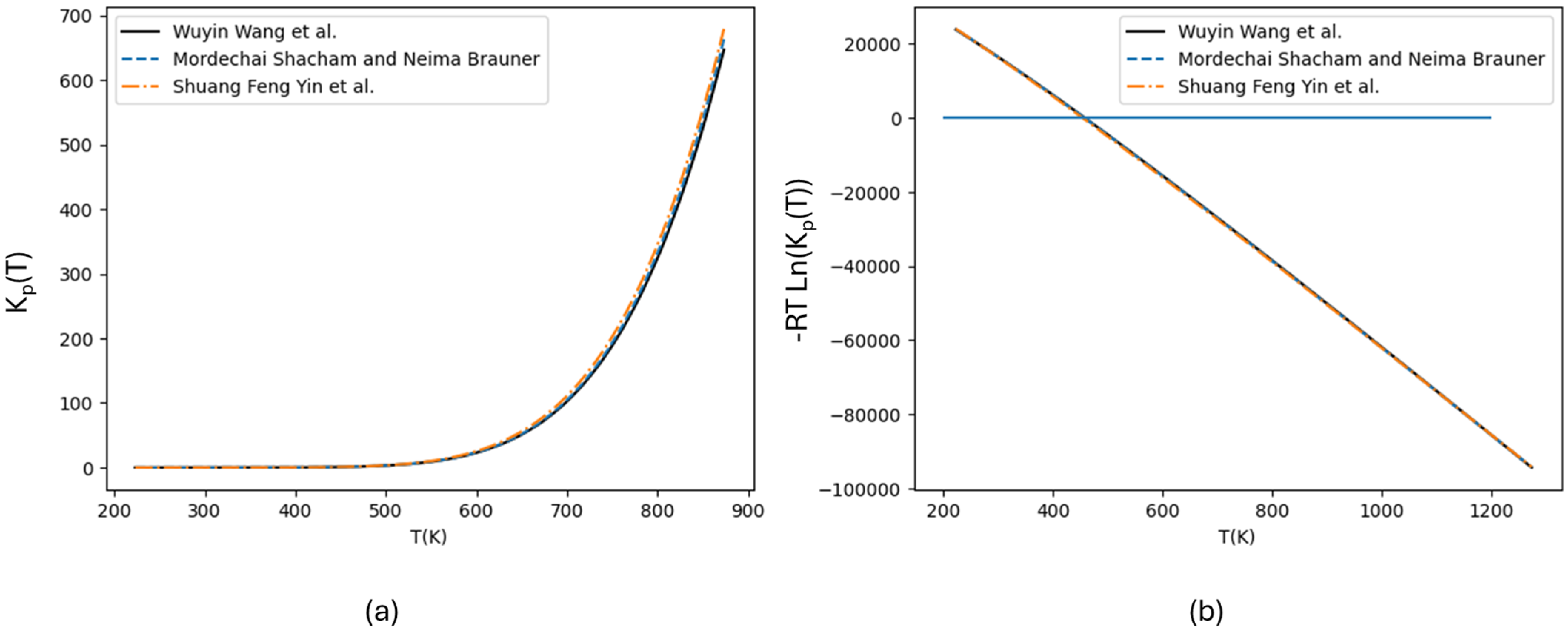
Figure 1. Temperature dependence of the equilibrium constant Kp(T) (a) and reaction spontaneity; (b) comparison between different models [33,35,36].
Catalysts 15 00811 g001
Figure 2. Conversion and correlation models (Pure ammonia, 1 bar) [33,35,36].
Catalysts 15 00811 g002
Figure 3. Effect of pressure on pure ammonia conversion (a); effect of inert gas on isobaric ammonia conversion (b).
Catalysts 15 00811 g003
Figure 4. 3D hexagonal bipyramid geometry (a) and atomic coordination (b) of B5 site (Readapted from Garcìa-Garcìa et al. [15] and Arevalo et al. [47]).
Catalysts 15 00811 g004
Table 1. Percentage d-character of Metals (Data from Ganley et al. [42]).
Metal% d-CharacterMetal% d-Character
Ru50Cr39
Ni40Pd46
Rh50Cu36
Co39.5Te0
Ir49Se0
Fe39.7Pb0
Pt44
Table 3. Catalytic performances of transition metal-based catalysts as alternatives to ruthenium.
CatalystMetals (%)Cat. Prep.WHSV
(NmLNH3 gCat−1 h−1)
WHSV
(NmLNH3 gMe−1 h−1)
NH3
(%)
T(°C)Conv
(%)
P
(bar)
Productivity
(mmolNH3 gRu−1min−1)
H2 Production
(mmolH2 gRu−1 min−1)
Ref
Ni/Ba–Al–O20I 1600030,00010055090.312030[39]
Ni/Sr–Al–O78.81826
Ni/Ca–Al–O62.21421
Ni/Mg–Al–O38.8913
Ni/CeO210WI 213,800138,000444506212842[64]
Ni/Al2O3301420
Co/AX–217WI520074,2861004502511421[73]
Co/CNT1068
Co-Cs/AX–21322
CoCe41.7CP 3900021,5831004506511016[74]
30.229,801451015
17.950,279301117
0.5% Ba–CoCe41.721,583801319
1% Ba–CoCe21,5833057
MoN@C25.9HT 415,00057,91510062510015279[76]
Mo@C2171,429905887
MoN94.6AC 56000638310055087146[77]
3% Co MoN83AC72298758
Fe3O472 *ST 624,00033,3331006004511117[75]
Fe3O4@TiO2ST802030
Fe3O4@CeO2K-C C 7882233
1 Impregnation; 2 Wetness Impregnation; 3 Co-precipitation;4 Hydrothermal Synthesis; 5 Citric acid–assisted; 6 Solvothermal synthesis: 7 Kinetic–Controlled Coating. * Considering the catalyst composed of Fe3O4 only.
Table 4. Ammonia decomposition rate laws.
Rate LawRef
r N H 3 = k d e c p N H 3 p H 2 1.5 [14]
r N H 3 = k   p N H 3 α   p H 2 γ 1 1 K e q p H 2 3 p N 2 p N H 3 2 [61]
r = k f p N H 3 2 p H 2 3 p N 2 k p p H 2 1.5 + k n p N H 3 2 2 [10]
Table 5. Estimated modeling parameters based on the Temkin—Pyzhev model.
CatalystLoad
(%)
Eapp
(kJ mol−1)
T
(°C)
K0,appαβγRDSRef
Ru/Al2O38.5117 1.5 × 10⁻⁹ mol m−3 s−1-0.27-N2 Desorb[65]
Ru/C12A7: e2.222.1600-0.9-0.04N2 Desorb[37]
Ru/C12A7:O2−224.6-0.4-0.14
Ru-K/C2.741.8 0.58-0.15
Ru-10%K/CaO31113508584.8 mol gcat−1s−10.5-−1.2N2 Desorb/N–H cleavage[61]
Ni/Ba–Al–O2076.5450-0.47-−0.32H2 Desorb[39]
Ni/Sr–Al–O81.1-0.58-−0.38
Ni/Ca–Al–O87.2-0.70-−0.42
Ni/Mg–Al–O89.3-0.39-−0.62
Disclaimer/Publisher’s Note: The statements, opinions and data contained in all publications are solely those of the individual author(s) and contributor(s) and not of MDPI and/or the editor(s). MDPI and/or the editor(s) disclaim responsibility for any injury to people or property resulting from any ideas, methods, instructions or products referred to in the content.