

Harnessing High-Valent Metals for Catalytic Oxidation: Next-Gen Strategies in Water Remediation and Circular Chemistry

 , , , , ,
  and
and 
Abstract
1. Introduction
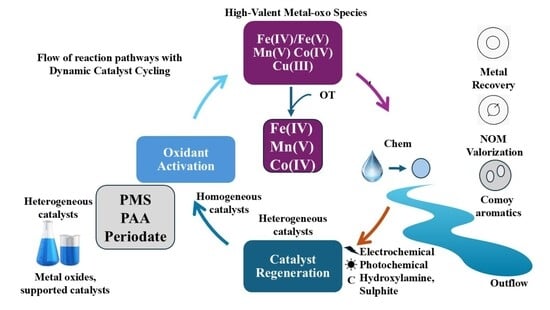
2. Advancing High-Valent Metals in AOPs: From Oxidants to Reaction Mediators

| Metal-Oxo Species | Approx. Redox Potential (E0, V vs. NHE) | Primary Formation Pathway | Dominant Reaction Mechanism | Lifetime in Aqueous Solution | Electron Efficiency | Reference |
|---|---|---|---|---|---|---|
| Fe(IV)=O | 0.7–1.0 (pH-dependent) | Fe(II)/PMS, Fe(II)/PAA, Fe(VI) reduction | OAT, hydride abstraction | Milliseconds to seconds | Moderate (40–60%) | [41] |
| Fe(VI)=O | ~1.7–2.0 | Fe(III)/PAA, Fe(VI) activation | Electrophilic attack, OAT | Sub milliseconds | Low to moderate | [61] |
| Mn(V)=O | ~1.5–1.8 | Mn(II)/periodate, Mn(II)/PAA | Selective OAT, electron transfer | Milliseconds | High (>70%) | [62] |
| Co(IV)=O | ~1.8–2.1 | Co(II)/PMS, Co(II)/PAA | OAT, C–H bond activation | Seconds (ligand-stabilized) | High (60–75%) | [63,64] |
| Cu(III) | >2.0 | Cu(II)/PMS with activating ligands | Direct electron transfer | Transient (stabilized by ligands) | Very high (~77%) | [65] |
| Ru(VIII) | ~1.3–1.6 | Electrochemical oxidation, RuO4−/O3 | Selective oxidation, radical generation | Very short | Moderate | [53] |
3. Emergent Synthesis Pathways for Stable High-Valent Metal Complexes
4. Synergistic Hybrid AOPs: Integration of High-Valent Metals with Photocatalysis, Sonocatalysis, and Fenton-like Systems
5. Sustainability Perspectives on the Environmental Fate and Transformation of High-Valent Metal Species
6. High-Valent Metal AOPs in the Circular Economy: Toward Zero Wastewater Treatment
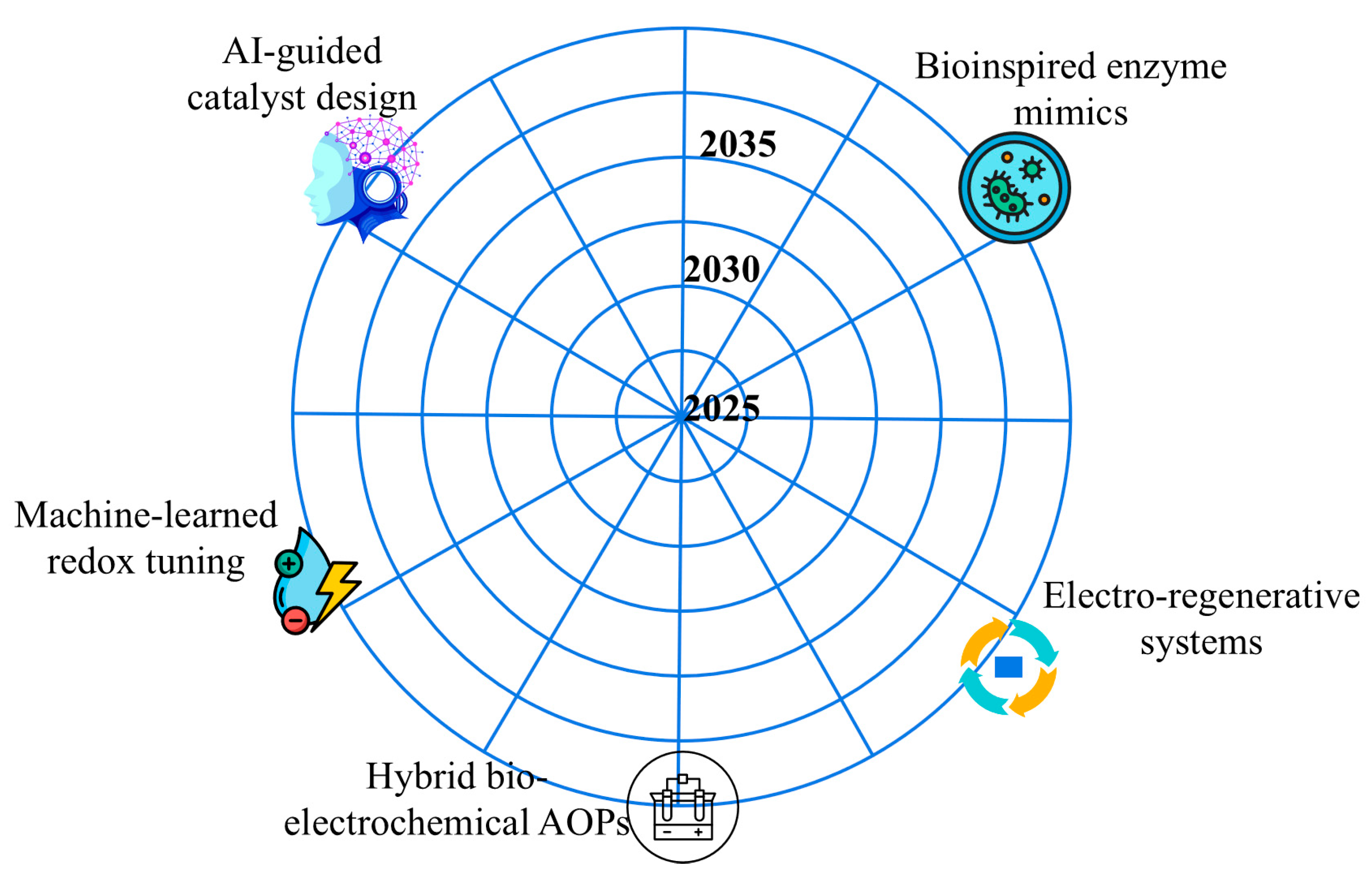
7. Nano-Engineered, Bioinspired, and Machine Learned High-Valent Systems
8. Challenges and Future Prospective
9. Conclusions
Author Contributions
Funding
Acknowledgments
Conflicts of Interest
References
- Nabeel, M.I.; Hussain, D.; Ahmad, N.; Najam-Ul-Haq, M.; Musharraf, S.G. Recent advancements in the fabrication and photocatalytic applications of graphitic carbon nitride-tungsten oxide nanocomposites. Nanoscale Adv. 2023, 5, 5214–5255. [Google Scholar] [CrossRef]
- Dicataldo, G.; Desmond, P.; Al-Maas, M.; Adham, S. Feasibility and application of membrane aerated biofilm reactors for industrial wastewater treatment. Water Res. 2025, 280, 123523. [Google Scholar] [CrossRef]
- Nabeel, M.I.; Gulzar, T.; Kiran, S.; Ahmad, N.; Raza, S.A.; Batool, U.; Rehan, Z.A. Tailoring Graphitic Carbon Nitride (g-C3N4) for Multifunctional Applications: Strategies for Overcoming Challenges in Catalysis and Energy Conversion. Int. J. Energy Res. 2025, 2025, 5599894. [Google Scholar] [CrossRef]
- Kumar, A.; Singh, A.K.; Chandra, R. Recent advances in physicochemical and biological approaches for degradation and detoxification of industrial wastewater. In Emerging Treatment Technologies for Waste Management; Springer: Berlin/Heidelberg, Germany, 2021; pp. 1–28. [Google Scholar] [CrossRef]
- Ahmad, N.; Rasheed, S.; Mohyuddin, A.; Fatima, B.; Nabeel, M.I.; Riaz, M.T.; Najam-Ul-Haq, M.; Hussain, D. 2D MXenes and their composites; design, synthesis, and environmental sensing applications. Chemosphere 2024, 352, 141280. [Google Scholar] [CrossRef] [PubMed]
- Nabeel, M.I.; Hussain, D.; Ahmad, N.; Xiao, H.-M.; Ahmad, W.; Musharraf, S.G. Facile one-pot synthesis of metal and non-metal doped g-C3N4 photocatalyst for rapid acetaminophen remediation. Carbon 2025, 243, 120472. [Google Scholar] [CrossRef]
- Simarro-Gimeno, C.; Pitarch, E.; Albarrán, F.; Rico, A.; Hernández, F. Ten years of monitoring pharmaceuticals and pesticides in the aquatic environment nearby a solid-waste treatment plant: Historical data, trends and risk assessment. Environ. Pollut. 2025, 366, 125496. [Google Scholar] [CrossRef] [PubMed]
- Negi, A. Environmental impact of textile materials: Challenges in fiber–dye chemistry and implication of microbial biodegradation. Polymers 2025, 17, 871. [Google Scholar] [CrossRef]
- Ghernaout, D. Water treatment chlorination: An updated mechanistic insight review. Chem. Res. J. 2017, 2, 125–138. [Google Scholar]
- Arif, S.; Rasheed, S.; Nabeel, M.I.; Ahmad, W.; Riaz, M.T.; Musharraf, S.G.; Hussain, D. Enhanced Photocatalytic Activity of Sulfur–Nitrogen Co-Doped TiO2 Nanoparticles Synthesized using Dactylorhiza hatagirea Root Extract. ChemistrySelect 2025, 10, e01568. [Google Scholar] [CrossRef]
- Iqbal, K.; Sohail, M.; Rind, K.H.; Habib, S.S. Agrochemical contamination and fish health: Eco-toxicological impacts and mitigation strategies. Chem. Ecol. 2025, 41, 959–993. [Google Scholar] [CrossRef]
- Martinez IQuer, A.; Gholipour, A.; Plestenjak, G.; Carvalho, P.N. Emerging contaminants in sludge treatment reed beds: Removal, persistence, or accumulation? Water Res. 2025, 287, 124423. [Google Scholar] [CrossRef] [PubMed]
- Fernandes, J.; Ramísio, P.J.; Puga, H. A comprehensive review on various phases of wastewater technologies: Trends and future perspectives. Eng 2024, 5, 2633–2661. [Google Scholar] [CrossRef]
- Ibrahim, M.N.A.; Joseph, C.G.; Surugau, N.; Nabeel, M.I.; Ismail, S.S. From waste to water cleanup: Preliminary study on sargassum-derived activated carbon (AC) for pollutant adsorption. Mater. Emerg. Technol. Sustain. 2025, 1, 2550015. [Google Scholar] [CrossRef]
- NI, B.-J.; Yu, H.-Q. Microbial products of activated sludge in biological wastewater treatment systems: A critical review. Crit. Rev. Environ. Sci. Technol. 2012, 42, 187–223. [Google Scholar] [CrossRef]
- Yin, C.Y.; Aroua, M.K.; Daud, W.M.A.W. Review of modifications of activated carbon for enhancing contaminant uptakes from aqueous solutions. Sep. Purif. Technol. 2007, 52, 403–415. [Google Scholar] [CrossRef]
- Ullah, Z.; Joseph, C.G.; Tian, Z.-Y.; Yasin, M.; Khan, M.N.; Alshehri, A.S.; Ali, S.; Khan, A.; Suazo-Hernández, J.; Poblete-Grant, P.; et al. The Production of Biochar and Its Impact on the Removal of Various Pollutants of Emerging Concerns from Wastewater: A Comprehensive Review. Environ. Sci. 2025. Preprints. [Google Scholar]
- Khalid, R.; Amin, H.M.A.; Shahid, M.; Kazuya, N.; Xing, R.; Liu, S.; Fujishima, A. Integrated photothermal and photocatalytic degradation of micro-/nanoplastics: A mini-review with mechanistic insights and future perspectives. J. Mater. Chem. A 2025, 13, 26110–26128. [Google Scholar] [CrossRef]
- Khan, N.M.; Moeid, A.; Kiran, S.; Gulzar, T.; Pervez, I.; Shahid, R.; Nabeel, M.I.; Ali, A. Prunus armeniaca assisted green synthesis of Fe2O3/NiO nanohybrids using unripened fruit extract for remediation of acid orange 7 dye: A sustainable environmental cleaner approach. Waste Biomass-Valorization 2025, 16, 581–599. [Google Scholar] [CrossRef]
- Vallejo, M.; Román, M.F.S.; Ortiz, I.; Irabien, A. Overview of the PCDD/Fs degradation potential and formation risk in the application of advanced oxidation processes (AOPs) to wastewater treatment. Chemosphere 2015, 118, 44–56. [Google Scholar] [CrossRef]
- Antonopoulou, M.; Evgenidou, E.; Lambropoulou, D.; Konstantinou, I. A review on advanced oxidation processes for the removal of taste and odor compounds from aqueous media. Water Res. 2014, 53, 215–234. [Google Scholar] [CrossRef]
- Li, Z.; Sun, Y.; Liu, D.; Yi, M.; Chang, F.; Li, H.; Du, Y. A review of sulfate radical-based and singlet oxygen-based advanced oxidation technologies: Recent advances and prospects. Catalysts 2022, 12, 1092. [Google Scholar] [CrossRef]
- Ali, M.A.; Nabeel, M.I.; Bokhari, T.H.; Arif, S.; Haq, M.H.; Ajmal, Z.; Awwad, F.A.; Ismail, E.A.; Mustafa, A.; Rasool, R.T.; et al. Radiation-Induced Degradation of PVA 26 by UV Radiation in the Presence of Zno Nanocatalyst. J. Biomed. Res. Environ. Sci. 2023, 4, 1745–1754. [Google Scholar] [CrossRef]
- Satyam, S.; Patra, S. The evolving landscape of advanced oxidation processes in wastewater treatment: Challenges and recent innovations. Processes 2025, 13, 987. [Google Scholar] [CrossRef]
- Amin, H.M.; Baltruschat, H.; Wittmaier, D.; Friedrich, K. A highly efficient bifunctional catalyst for alkaline air-electrodes based on a Ag and Co3O4 hybrid: RRDE and online DEMS insights. Electrochim. Acta 2015, 151, 332–339. [Google Scholar] [CrossRef]
- Amin, H.M.A.; Sani, M.A.; El Arrassi, A.; Saddeler, S.; Schulz, S.; Tschulik, K. Probing the Intrinsic Oxygen Evolution Kinetics at Single CoFe2O4 Nano-Catalysts. ChemCatChem 2025, 17, e01234. [Google Scholar] [CrossRef]
- Fockenberg, T.; Sülzner, N.; Amin, H.M.A.; Wölper, C.; Hättig, C.; Schulz, S. Synthesis, Characterization, and Electrochemical Properties of Tri-and Tetranuclear CoIII-Oxo Complexes. Eur. J. Inorg. Chem. 2025, 28, e202500170. [Google Scholar] [CrossRef]
- Yang, B.; Liu, H.; Zhang, J. High-valent metals in advanced oxidation processes: A critical review of their identification methods, formation mechanisms, and reactivity performance. Chem. Eng. J. 2023, 460, 141796. [Google Scholar] [CrossRef]
- Shao, B.; Dong, H.; Zhou, G.; Ma, J.; Sharma, V.K.; Guan, X. Degradation of organic contaminants by reactive iron/manganese species: Progress and challenges. Water Res. 2022, 221, 118765. [Google Scholar] [CrossRef] [PubMed]
- Fan, Y.; Zhang, Q.; Peng, Y.; Zeng, J.; Ren, W.; Xiao, X.; Luo, X. Activation of High-Valent Metal Oxidants on Carbon Catalysts: Mechanisms, Applications and Challenges. ACS EST Eng. 2025, 5, 1338–1356. [Google Scholar] [CrossRef]
- Kumar, C.H.V.; Jagadeesh, R.V.; Shivananda, K.N.; Sandhya, Y.S.; Raju, C.N. Catalysis and mechanistic studies of Ru(III), Os(VIII), Pd(II), and Pt(IV) metal ions on oxidative conversion of folic acid. Ind. Eng. Chem. Res. 2010, 49, 1550–1560. [Google Scholar] [CrossRef]
- Zhang, J.; Xiang, H.; Li, S.; Wang, D.; Yang, B. A review on the role of high-valent metals in peracetic acid-based advanced oxidation processes. Desalination Water Treat. 2024, 317, 100182. [Google Scholar] [CrossRef]
- Lee, Y.; Um, I.-H.; Yoon, J. Arsenic(III) oxidation by iron(VI) (ferrate) and subsequent removal of arsenic(V) by iron(III) coagulation. Environ. Sci. Technol. 2003, 37, 5750–5756. [Google Scholar] [CrossRef] [PubMed]
- Zong, Y.; Shao, Y.; Zeng, Y.; Shao, B.; Xu, L.; Zhao, Z.; Liu, W.; Wu, D. Enhanced oxidation of organic contaminants by iron(II)-activated periodate: The significance of high-valent iron–oxo species. Environ. Sci. Technol. 2021, 55, 7634–7642. [Google Scholar] [CrossRef]
- Zhang, H.; Luo, M.; Zhou, P.; Liu, Y.; Du, Y.; He, C.; Yao, G.; Lai, B. Enhanced ferrate(VI)) oxidation of sulfamethoxazole in water by CaO2: The role of Fe(IV) and Fe(V). J. Hazard. Mater. 2022, 425, 128045. [Google Scholar] [CrossRef] [PubMed]
- Zhou, H.; He, Y.-L.; Peng, J.; Duan, X.; Lu, X.; Zhang, H.; Liu, Y.; He, C.-S.; Xiong, Z.; Ma, T.; et al. High-valent metal-oxo species transformation and regulation by co-existing chloride: Reaction pathways and impacts on the generation of chlorinated by-products. Water Res. 2024, 257, 121715. [Google Scholar] [CrossRef] [PubMed]
- Duan, X.; Sun, H.; Shao, Z.; Wang, S. Nonradical reactions in environmental remediation processes: Uncertainty and challenges. Appl. Catal. B Environ. 2018, 224, 973–982. [Google Scholar] [CrossRef]
- Yan, Y.; Wei, Z.; Duan, X.; Long, M.; Spinney, R.; Dionysiou, D.D.; Xiao, R.; Alvarez, P.J.J. Merits and limitations of radical vs. nonradical pathways in persulfate-based advanced oxidation processes. Environ. Sci. Technol. 2023, 57, 12153–12179. [Google Scholar] [CrossRef] [PubMed]
- Lin, J.; Zou, J.; Cai, H.; Huang, Y.; Li, J.; Xiao, J.; Yuan, B.; Ma, J. Hydroxylamine enhanced Fe(II)-activated peracetic acid process for diclofenac degradation: Efficiency, mechanism and effects of various parameters. Water Res. 2021, 207, 117796. [Google Scholar] [CrossRef]
- Wang, Z.; Qiu, W.; Pang, S.-Y.; Guo, Q.; Guan, C.; Jiang, J. Aqueous iron(IV)–oxo complex: An emerging powerful reactive oxidant formed by iron(II)-based advanced oxidation processes for oxidative water treatment. Environ. Sci. Technol. 2022, 56, 1492–1509. [Google Scholar] [CrossRef]
- Liang, S.; Zhu, L.; Hua, J.; Duan, W.; Yang, P.-T.; Wang, S.-L.; Wei, C.; Liu, C.; Feng, C. Fe2+/HClO reaction produces FeIVO2+: An enhanced advanced oxidation process. Environ. Sci. Technol. 2020, 54, 6406–6414. [Google Scholar] [CrossRef] [PubMed]
- Bera, M.; Kaur, S.; Keshari, K.; Santra, A.; Moonshiram, D.; Paria, S. Structural and Spectroscopic Characterization of Copper(III) Complexes and Subsequent One-Electron Oxidation Reaction and Reactivity Studies. Inorg. Chem. 2023, 62, 5387–5399. [Google Scholar] [CrossRef] [PubMed]
- Wei, Y.; Miao, J.; Ge, J.; Lang, J.; Yu, C.; Zhang, L.; Alvarez, P.J.J.; Long, M. Ultrahigh peroxymonosulfate utilization efficiency over CuO nanosheets via heterogeneous Cu(III) formation and preferential electron transfer during degradation of phenols. Environ. Sci. Technol. 2022, 56, 8984–8992. [Google Scholar] [CrossRef]
- Abdel-Mageed, A.M.; Rungtaweevoranit, B. Metal-organic frameworks-based heterogeneous single-atom catalysts (MOF-SACs)—Assessment and future perspectives. Catal. Today 2024, 439, 114786. [Google Scholar] [CrossRef]
- Ishmael, A.; Nasser, M.; Abdel-Nasser, M.; Hossni, H.; Abdel-Hamed, Y.; Abdel-Salam, M.; Abdel-Gawad, S.; El-Sherif, R. Eco-friendly and cost-effective recycling of batteries for utilizing transition metals as catalytic materials for purifying tannery wastewater through Advanced Oxidation Techniques: A critical review. Nanotechnol. Appl. Sci. J. 2025, 1, 1–28. [Google Scholar] [CrossRef]
- Du, J.; Zhang, B.; Li, J.; Lai, B. Decontamination of heavy metal complexes by advanced oxidation processes: A review. Chin. Chem. Lett. 2020, 31, 2575–2582. [Google Scholar] [CrossRef]
- Vasileiadou, A. From Organic wastes to Bioenergy, Biofuels, and value-added products for urban sustainability and circular economy: A review. Urban Sci. 2024, 8, 121. [Google Scholar] [CrossRef]
- Li, D.; Pan, C.; Zong, Y.; Wu, D.; Ding, Y.; Wang, C.; Wang, S.; Crittenden, J.C. Ru(III)-periodate for high performance and selective degradation of aqueous organic pollutants: Important role of Ru(V) and Ru(IV). Environ. Sci. Technol. 2023, 57, 12094–12104. [Google Scholar] [CrossRef]
- Jiang, J. Advances in the development and application of ferrate(VI) for water and wastewater treatment. J. Chem. Technol. Biotechnol. 2014, 89, 165–177. [Google Scholar] [CrossRef]
- Pei, J.; Fu, K.; Fu, Y.; Liu, X.; Luo, S.; Yin, K.; Luo, J. Manipulating high-valent cobalt-oxo generation on Co/N codoped carbon beads via PMS activation for micropollutants degradation. ACS EST Eng. 2023, 3, 1997–2007. [Google Scholar] [CrossRef]
- Liu, Y.; Zhou, R.; Tang, Y.; Li, X.; Xu, L.; Fu, Y. Enhanced Mn(II)/peracetic acid by nitrilotriacetic acid to degrade organic contaminants: Role of Mn(V) and organic radicals. Sci. Rep. 2024, 14, 29686. [Google Scholar] [CrossRef]
- Yang, S.; Yue, K.; Liu, X.; Li, S.; Zheng, H.; Yan, Y.; Cao, R.; Zhang, W. Electrocatalytic water oxidation with manganese phosphates. Nat. Commun. 2024, 15, 1410. [Google Scholar] [CrossRef]
- Shi, Z.; Li, J.; Wang, Y.; Liu, S.; Zhu, J.; Yang, J.; Wang, X.; Ni, J.; Jiang, Z.; Zhang, L.; et al. Customized reaction route for ruthenium oxide towards stabilized water oxidation in high-performance PEM electrolyzers. Nat. Commun. 2023, 14, 843. [Google Scholar] [CrossRef]
- Wu, X.; Kim, J.-H. Outlook on single atom catalysts for persulfate-based advanced oxidation. ACS EST Eng. 2022, 2, 1776–1796. [Google Scholar] [CrossRef]
- Ou, J.; Liu, Y.; Zhang, L.; Wang, Z.; Tang, Y.; Fu, Y.; Zhao, D. Tremendously enhanced catalytic performance of Fe(III)/peroxymonosulfate process by trace Cu(II): A high-valent metals domination in organics removal. J. Environ. Sci. 2025, 147, 487–497. [Google Scholar] [CrossRef]
- Bouzayani, B.; Lomba-Fernández, B.; Fdez-Sanromán, A.; Elaoud, S.C.; Sanromán, M.Á. Advancements in Copper-based catalysts for efficient generation of reactive oxygen species from peroxymonosulfate. Appl. Sci. 2024, 14, 8075. [Google Scholar] [CrossRef]
- Deng, C.; Su, Y.; Li, F.; Shen, W.; Chen, Z.; Tang, Q. Understanding activity origin for the oxygen reduction reaction on bi-atom catalysts by DFT studies and machine-learning. J. Mater. Chem. A 2020, 8, 24563–24571. [Google Scholar] [CrossRef]
- Huang, B.; Wu, Z.; Zhou, H.; Li, J.; Zhou, C.; Xiong, Z.; Pan, Z.; Yao, G.; Lai, B. Recent advances in single-atom catalysts for advanced oxidation processes in water purification. J. Hazard. Mater. 2021, 412, 125253. [Google Scholar] [CrossRef] [PubMed]
- Yang, Y.; Si, W.; Peng, Y.; Wang, Y.; Liu, H.; Su, Z.; Li, J. Defect engineering on CuMn2O4 spinel surface: A new path to high-performance oxidation catalysts. Environ. Sci. Technol. 2022, 56, 16249–16258. [Google Scholar] [CrossRef]
- Xiao, Z.; Yang, B.; Feng, X.; Liao, Z.; Shi, H.; Jiang, W.; Wang, C.; Ren, N. Density functional theory and machine learning-based quantitative structure–Activity relationship models enabling prediction of contaminant degradation performance with heterogeneous peroxymonosulfate treatments. Environ. Sci. Technol. 2023, 57, 3951–3961. [Google Scholar] [CrossRef]
- Gao, Y.; Zhou, Y.; Pang, S.-Y.; Wang, Z.; Shen, Y.-M.; Jiang, J. Quantitative evaluation of relative contribution of high-valent iron species and sulfate radical in Fe(VI) enhanced oxidation processes via sulfur reducing agents activation. Chem. Eng. J. 2020, 387, 124077. [Google Scholar] [CrossRef]
- Yu, Y.; Dong, H.; Lian, L.; Guan, X. Selective and rapid degradation of organic contaminants by Mn(V) generated in the Mn(II)-nitrilotriacetic acid/periodate process. Chem. Eng. J. 2022, 443, 136387. [Google Scholar] [CrossRef]
- Zou, Y.; Li, J.; Tan, J.; Lyu, L.; Li, S.; Wang, Y.; Lu, Y.; Zhu, X.; Zhang, T. High-valent cobalt-oxo species triggers singlet oxygen for rapid contaminants degradation along with mild peroxymonosulfate decomposition in single Co atom-doped g-C3N4. Chem. Eng. J. 2023, 471, 144531. [Google Scholar] [CrossRef]
- Yi, Q.; Li, X.; Li, Y.; Dai, R.; Wang, Z. Unraveling the Co(IV)-mediated oxidation mechanism in a Co3O4/PMS-based hierarchical reactor: Toward efficient catalytic degradation of aromatic pollutants. ACS EST Eng. 2022, 2, 1836–1846. [Google Scholar] [CrossRef]
- Shen, P.; Shi, M.; Yin, Q.; Mao, Y.; Zhou, L. Organically coordinated Cu(II) activated peroxymonosulfate for enhanced degradation of emerging contaminants. J. Environ. Chem. Eng. 2024, 12, 114083. [Google Scholar] [CrossRef]
- Zhou, L.; Yan, J.; Cui, C.; Xu, Y.; Zhang, K.; Du, M.; Zhang, Z.; Wu, X.; Li, B. Nanozymes in Reactive Oxygen Species-Dependent Diseases: From Design and Preclinical Studies to Clinical Translation Prospects. Small Struct. 2025, 6, 2500195. [Google Scholar] [CrossRef]
- Lin, Y.; Wang, Y.; Weng, Z.; Zhou, Y.; Liu, S.; Ou, X.; Xu, X.; Cai, Y.; Jiang, J.; Han, B.; et al. Coordination engineering of heterogeneous high-valent Fe(IV)-oxo for safe removal of pollutants via powerful Fenton-like reactions. Nat. Commun. 2024, 15, 10032. [Google Scholar] [CrossRef]
- Huang, W.; Zhang, W.; Gan, Y.; Yang, J.; Zhang, S. Laccase immobilization with metal-organic frameworks: Current status, remaining challenges and future perspectives. Crit. Rev. Environ. Sci. Technol. 2022, 52, 1282–1324. [Google Scholar] [CrossRef]
- Ali, A.; Akram, W.; Liu, H.-Y. Reactive cobalt–oxo complexes of tetrapyrrolic macrocycles and N-based ligand in oxidative transformation reactions. Molecules 2018, 24, 78. [Google Scholar] [CrossRef] [PubMed]
- Collins, T.J.; Ryabov, A.D. Targeting of high-valent iron-TAML activators at hydrocarbons and beyond. Chem. Rev. 2017, 117, 9140–9162. [Google Scholar] [CrossRef] [PubMed]
- Chanda, A.; Shan, X.; Chakrabarti, M.; Ellis, W.C.; Popescu, D.L.; de Oliveira, F.T.; Wang, D.; Lawrence, Q., Jr.; Collins, T.J.; Münck, E.; et al. Bominaar (TAML) FeIV=O Complex in Aqueous Solution: Synthesis and Spectroscopic and Computational Characterization. Inorg. Chem. 2008, 47, 3669–3678. [Google Scholar] [CrossRef]
- Rigoni, G.; Nylund, P.V.S.; Albrecht, M. Manganese(III) complexes stabilized with N-heterocyclic carbene ligands for alcohol oxidation catalysis. Dalton Trans. 2023, 52, 7992–8002. [Google Scholar] [CrossRef]
- Mitra, M.; Nimir, H.; Demeshko, S.; Bhat, S.S.; Malinkin, S.O.; Haukka, M.; Lloret-Fillol, J.; Lisensky, G.C.; Meyer, F.; Shteinman, A.A.; et al. Nonheme Fe(IV) oxo complexes of two new pentadentate ligands and their hydrogen-atom and oxygen-atom transfer reactions. Inorg. Chem. 2015, 54, 7152–7164. [Google Scholar] [CrossRef]
- Nam, W. High-valent iron(IV)–oxo complexes of heme and non-heme ligands in oxygenation reactions. Acc. Chem. Res. 2007, 40, 522–531. [Google Scholar] [CrossRef] [PubMed]
- Xiong, Z.; Jiang, Y.; Wu, Z.; Yao, G.; Lai, B. Synthesis strategies and emerging mechanisms of metal-organic frameworks for sulfate radical-based advanced oxidation process: A review. Chem. Eng. J. 2021, 421, 127863. [Google Scholar] [CrossRef]
- Liang, J.; Duan, X.; Xu, X.; Chen, K.; Zhang, Y.; Zhao, L.; Qiu, H.; Wang, S.; Cao, X. Persulfate oxidation of sulfamethoxazole by magnetic iron-char composites via nonradical pathways: Fe(IV) versus surface-mediated electron transfer. Environ. Sci. Technol. 2021, 55, 10077–10086. [Google Scholar] [CrossRef] [PubMed]
- Feng, Y.; Li, Y.; Yang, B.; Yang, Z.; Fan, Y.; Shih, K.; Li, H.; Wu, D.; Zhang, L. Mechanistic insight into the generation of high-valent iron-oxo species via peroxymonosulfate activation: An experimental and density functional theory study. Chem. Eng. J. 2021, 420, 130477. [Google Scholar] [CrossRef]
- Liu, N.; Lu, N.; Yu, H.; Chen, S.; Quan, X. Degradation of aqueous bisphenol A in the CoCN/Vis/PMS system: Catalyst design, reaction kinetic and mechanism analysis. Chem. Eng. J. 2021, 407, 127228. [Google Scholar] [CrossRef]
- Zhou, X.; Yin, R.; Kang, J.; Li, Z.; Pan, Y.; Bai, J.; Li, A.J.; Qiu, R. Atomic cation-vacancy modulated peroxymonosulfate nonradical oxidation of sulfamethoxazole via high-valent iron-oxo species. Appl. Catal. B Environ. 2023, 330, 122640. [Google Scholar] [CrossRef]
- Zhang, Y.; Sun, W.; Yin, W. Precise regulation of UV/H2O2 processes: •OH generation/reaction and DOM transformation as the main free radical scavenger. Water Res. 2025, 277, 123282. [Google Scholar] [CrossRef]
- Pan, Q.; Wang, C.; Zhan, P.; Zhao, F.; Dai, H.; Hu, Y.; Hu, F.; Peng, X. Generation and regulation of high-valent metal species in advanced oxidation processes. Environ. Funct. Mater. 2025, in press. [Google Scholar] [CrossRef]
- Zhang, B.; Rui, J.; Zhang, Y.; Yang, L.; Kubuki, S.; Yong, Y.-C.; Zhang, L. Geometric and electronic perspectives on dual-atom catalysts for advanced oxidation processes. Inorg. Chem. Front. 2025, 12, 4968–5002. [Google Scholar] [CrossRef]
- Wu, Q.; Siddique, M.S.; Guo, Y.; Wu, M.; Yang, Y.; Yang, H. Low-crystalline bimetallic metal-organic frameworks as an excellent platform for photo-Fenton degradation of organic contaminants: Intensified synergism between hetero-metal nodes. Appl. Catal. B Environ. 2021, 286, 119950. [Google Scholar] [CrossRef]
- Ahmad, W.; Ahmad, N.; Rasheed, S.; Nabeel, M.I.; Mohyuddin, A.; Riaz, M.T.; Hussain, D. Silica-based superhydrophobic and superoleophilic cotton fabric with enhanced self-cleaning properties for oil–water separation and methylene blue degradation. Langmuir 2024, 40, 5639–5650. [Google Scholar] [CrossRef]
- Ahmad, N.; Nabeel, M.I.; Ali, S.J.; Fatima, B.; Rashid, H.N.; Najam-Ul-Haq, M.; Musharraf, S.G.; Hussain, D. Hierarchically grown CeO2/GO on nylon filter with enhanced hydrophilicity and permeation flux for oil-water separation. Sustain. Mater. Technol. 2023, 37, e00698. [Google Scholar] [CrossRef]
- Fu, J.; Yu, J.; Jiang, C.; Cheng, B. g-C3N4-Based heterostructured photocatalysts. Adv. Energy Mater. 2018, 8, 1701503. [Google Scholar] [CrossRef]
- Moradi, S.; Rodriguez-Seco, C.; Hayati, F.; Ma, D. Sonophotocatalysis with photoactive nanomaterials for wastewater treatment and bacteria disinfection. ACS Nanosci. Au 2023, 3, 103–129. [Google Scholar] [CrossRef]
- Yuan, Q.; Xiao, L.; Gao, S.; Abdukayum, A.; Kong, Q.; Hu, G.; Dubal, D.; Zhou, Y. From Fundamentals to Mechanisms: Peroxyacetic acid catalysts in emerging pollutant degradation. Mater. Today 2025, 87, 197–230. [Google Scholar] [CrossRef]
- Xu, F.; Lai, C.; Zhang, M.; Yao, Z.; Ma, D.; Li, B.; Qin, M.; Yan, H.; Huo, X.; Fan, X.; et al. Mechanistic insights into H2O2 activation by high-density iron single-atom catalysts for efficient water treatment: Surface-bound radical and singlet oxygen. J. Environ. Chem. Eng. 2025, 13, 118931. [Google Scholar] [CrossRef]
- Chakma, S.; Moholkar, V.S. Investigations in synergism of hybrid advanced oxidation processes with combinations of Sonolysis + Fenton process + UV for degradation of bisphenol A. Ind. Eng. Chem. Res. 2014, 53, 6855–6865. [Google Scholar] [CrossRef]
- Kolluru, A.; Shuaibi, M.; Palizhati, A.; Shoghi, N.; Das, A.; Wood, B.; Zitnick, C.L.; Kitchin, J.R.; Ulissi, Z.W. Open challenges in developing generalizable large-scale machine-learning models for catalyst discovery. ACS Catal. 2022, 12, 8572–8581. [Google Scholar] [CrossRef]
- Sun, Y. Control Effect of Peracetic Acid on Chlorinated DBP Formation and the Application of PAA Pre-Oxidation in Drinking Water Treatment. Master’s Thesis, University of Massachusetts, Amherst, MA, USA, 2021. [Google Scholar]
- Zhang, J.; Chen, M.; Zhu, L. Activation of persulfate by Co3O4 nanoparticles for orange G degradation. RSC Adv. 2015, 6, 758–768. [Google Scholar] [CrossRef]
- Osabuohien, F.O.; Djanetey, G.E.; Nwaojei, K.; Aduwa, S.I. Wastewater treatment and polymer degradation: Role of catalysts in advanced oxidation processes. World J. Adv. Eng. Technol. Sci. 2023, 9, 443–455. [Google Scholar] [CrossRef]
- Liu, B.; Guo, W.; Jia, W.; Wang, H.; Si, Q.; Zhao, Q.; Luo, H.; Jiang, J.; Ren, N. Novel nonradical oxidation of sulfonamide antibiotics with Co(II)-doped g-C3N4-activated peracetic acid: Role of high-valent cobalt–oxo species. Environ. Sci. Technol. 2021, 55, 12640–12651. [Google Scholar]
- Guo, Y.; Zhang, Y.; Yu, G.; Wang, Y. Revisiting the role of reactive oxygen species for pollutant abatement during catalytic ozonation: The probe approach versus the scavenger approach. Appl. Catal. B Environ. 2021, 280, 119418. [Google Scholar] [CrossRef]
- Lee, Y.; Von Gunten, U. Oxidative transformation of micropollutants during municipal wastewater treatment: Comparison of kinetic aspects of selective (chlorine, chlorine dioxide, ferrateVI, and ozone) and non-selective oxidants (hydroxyl radical). Water Res. 2010, 44, 555–566. [Google Scholar] [CrossRef] [PubMed]
- Nabeel, M.I.; Ahmad, N.; Arif, S.; Hussain, D.; Musharraf, S.G. Facile Two-Step Synthesis of Yttrium-Doped g-C3N4 for Enhanced Photocatalytic Degradation of Methylene Blue with Self-Cleaning Properties. Nanoscale Adv. 2025. [Google Scholar] [CrossRef]
- Guo, J.; Lei, M.; Yan, L.; Huang, J.; Liu, C.; Ye, L.; Li, B.; Xu, X.; Li, Y. Sustainable Water Decontamination: Advanced High-Valent Iron Active Species-Driven Peroxymonosulfate Activation for Global Challenges. CleanMat 2025, 2, 88–103. [Google Scholar] [CrossRef]
- Shi, H.; Liu, Y.; Liu, R.; Li, B.; Zhou, M.; Chen, C.; Teng, J.; Li, R.; Zhao, L.; Lin, H. Mechanistic Unveiling of Radical and Nonradical Pathways in Periodate Activation for Water Treatment: Generation Mechanism, Oxidative Behaviors, and Functional Merits. Small 2025, 21, e08443. [Google Scholar] [CrossRef]
- Deng, Y.; Guan, X. Unlocking the potential of ferrate(VI) in water treatment: Toward one-step multifunctional solutions. J. Hazard. Mater. 2024, 464, 132920. [Google Scholar] [CrossRef] [PubMed]
- Wang, L.K.; Wang, M.-H.S.; Shammas, N.K.; Hahn, H.H. Physicochemical Treatment Consisting of Chemical Coagulation, Precipitation, Sedimentation, and Flotation. In Integrated Natural Resources Research; Springer: Berlin/Heidelberg, Germany, 2021; pp. 265–397. [Google Scholar]
- Sharma, V.K.; Zboril, R.; Varma, R.S. Ferrates: Greener oxidants with multimodal action in water treatment technologies. Acc. Chem. Res. 2015, 48, 182–191. [Google Scholar] [CrossRef]
- Lu, X.; Yue, Y.; Deng, S.; Xu, B.; Zeng, Z.; Wang, X.; Lv, G.; Jiang, Q.; Xiao, H.; Wang, D.; et al. Enhanced Decontamination in Mn(II)/Periodate Systems with EDTA: Mechanistic Insights into Self-Accelerating Degradation of Pollutants. Environ. Sci. Technol. 2025, 59, 14170–14181. [Google Scholar] [CrossRef] [PubMed]
- Sharma, V.K. Oxidation of inorganic contaminants by ferrates (VI, V, and IV)–kinetics and mechanisms: A review. J. Environ. Manag. 2011, 92, 1051–1073. [Google Scholar] [CrossRef]
- Huang, Z.; Zhu, S.; Duan, Y.; Pi, C.; Zhang, X.; Woldu, A.R.; Jian, J.-X.; Chu, P.K.; Tong, Q.-X.; Hu, L.; et al. Insights into ionic association boosting water oxidation activity and dynamic stability. J. Energy Chem. 2023, 89, 99–109. [Google Scholar] [CrossRef]
- Ren, W.; Cheng, C.; Shao, P.; Luo, X.; Zhang, H.; Wang, S.; Duan, X. Origins of electron-transfer regime in persulfate-based nonradical oxidation processes. Environ. Sci. Technol. 2021, 56, 78–97. [Google Scholar] [CrossRef]
- Hui, F.; Pang, Z.; Viau, C.; Balcke, G.U.; Fobil, J.N.; Basu, N.; Xia, J. Integrative Modeling of Urinary Metabolomics and Metal Exposure Reveals Systemic Impacts of Electronic Waste in Exposed Populations. Metabolites 2025, 15, 456. [Google Scholar] [CrossRef]
- Peiró, L.T.; Méndez, G.V.; Ayres, R.U. Material flow analysis of scarce metals: Sources, functions, end-uses and aspects for future supply. Environ. Sci. Technol. 2013, 47, 2939–2947. [Google Scholar] [CrossRef] [PubMed]
- Amin, H.; Tayyab, A.; Umair, M.; Naveed, M.R.; Yaseen, H.R.; Qasim, M.; Muzammal, M.; Saif, S.; Ali, M.A.; Sultan, M.A. Recent Progress in Wastewater Treatment: Exploring the Roles of Zero-Valent Iron and Titanium Dioxide Nanoparticles. Indus J. Biosci. Res. 2025, 3, 97–107. [Google Scholar] [CrossRef]
- Zhu, Z.-S.; Zhong, S.; Cheng, C.; Zhou, H.; Sun, H.; Duan, X.; Wang, S. Microenvironment engineering of heterogeneous catalysts for liquid-phase environmental catalysis. Chem. Rev. 2024, 124, 11348–11434. [Google Scholar] [CrossRef]
- Kumar, M.; Xiong, X.; Sun, Y.; Yu, I.K.M.; Tsang, D.C.W.; Hou, D.; Gupta, J.; Bhaskar, T.; Pandey, A. Critical review on biochar-supported catalysts for pollutant degradation and sustainable biorefinery. Adv. Sustain. Syst. 2020, 4, 1900149. [Google Scholar] [CrossRef]
- Descorme, C.; Gallezot, P.; Geantet, C.; George, C. Heterogeneous catalysis: A key tool toward sustainability. ChemCatChem 2012, 4, 1897–1906. [Google Scholar] [CrossRef]
- Guo, Z.; Liu, B.; Zhang, Q.; Deng, W.; Wang, Y.; Yang, Y. Recent advances in heterogeneous selective oxidation catalysis for sustainable chemistry. Chem. Soc. Rev. 2014, 43, 3480–3524. [Google Scholar] [CrossRef]
- Makatsa, T.J.; Baloyi, J.; Ntho, T.; Masuku, C.M. Catalytic wet air oxidation of phenol: Review of the reaction mechanism, kinetics, and CFD modeling. Crit. Rev. Environ. Sci. Technol. 2021, 51, 1891–1923. [Google Scholar] [CrossRef]
- Zhao, T.; Tang, Z.; Zhao, X.; Zhang, H.; Wang, J.; Wu, F.; Giesy, J.P.; Shi, J. Efficient removal of both antimonite (Sb(III)) and antimonate (Sb(v)) from environmental water using titanate nanotubes and nanoparticles. Environ. Sci. Nano 2019, 6, 834–850. [Google Scholar] [CrossRef]
- Mubarak, H.; Chai, L.Y.; Mirza, N.; Yang, Z.H.; Pervez, A.; Tariq, M.; Mahmood, Q. Antimony (Sb)–pollution and removal techniques–critical assessment of technologies. Toxicol. Environ. Chem. 2015, 97, 1296–1318. [Google Scholar] [CrossRef]
- Mitrakas, M.; Mantha, Z.; Tzollas, N.; Stylianou, S.; Katsoyiannis, I.; Zouboulis, A. Removal of antimony species, Sb(III)/Sb(V), from water by using iron coagulants. Water 2018, 10, 1328. [Google Scholar] [CrossRef]
- Guo, T.; Chen, X.; Yin, L. Recent advancements in modified SnO2–Sb electrodes for electrochemical treatment of wastewater. J. Mater. Chem. A 2024, 12, 4397–4420. [Google Scholar] [CrossRef]
- Shugrue, C.R.; Miller, S.J. Applications of nonenzymatic catalysts to the alteration of natural products. Chem. Rev. 2017, 117, 11894–11951. [Google Scholar] [CrossRef] [PubMed]
- Dubey, K.D.; Shaik, S. Cytochrome P450—The wonderful nanomachine revealed through dynamic simulations of the catalytic cycle. Acc. Chem. Res. 2019, 52, 389–399. [Google Scholar] [CrossRef] [PubMed]


| AOP System | Target Pollutant | Degradation Efficiency (%) | Mineralization Efficiency (% TOC Removal) | Dominant ROS | Energy Intensity (kWh/m3) | Key Advantages | Key Limitations | Reference |
|---|---|---|---|---|---|---|---|---|
| Fe(VI)/UV | Sulfamethoxazole | 98% | 65% | Fe(V)/Fe(IV) | 0.8 | No radical scavenging; dual oxidation–coagulation | High Fe(VI) synthesis cost | [35] |
| Mn(V)/Periodate | Phenol | 95% | 70% | Mn(V)=O | 0.5 | High selectivity; low chloride interference | Requires ligand stabilization (e.g., NTA) | [62] |
| Co(IV)/PMS | Bisphenol A | 99% | 78% | Co(IV)=O | 1.2 | High oxidation potential; fast kinetics | Cobalt leaching at low pH | [78] |
| Cu(III)/PAA | Carbamazepine | 97% | 60% | Cu(III) | 1.0 | High electron efficiency (77%) | Limited oxidant stability | [28] |
| Fe(IV)/PMS-LDH | Sulfamethoxazole | 96% | 68% | Fe(IV)=O | 0.9 | Heterogeneous, reusable, neutral pH operation | Complex synthesis of LDH supports | [79] |
| Ru(VIII)/O3 | Diclofenac | 94% | 82% | Ru(VIII), •OH | 2.1 | Complete mineralization | High cost; rare metal | [48] |
| UV/H2O2 (Radical AOP) | Atrazine | 80% | 45% | •OH | 1.5 | Mature technology; scalable | Radical scavenging by NOM; low selectivity | [80] |
| Hybrid AOP System | Primary Energy Input | Specific Energy Consumption (kWh/m3) | Mineralization Efficiency (% COD/TOC) | Dominant Reactive Species | Key Transformation Byproducts | Ecotoxicity Change (Post-Treatment) | References |
|---|---|---|---|---|---|---|---|
| Fe(II)/PAA/UV | UV-C (254 nm) | 0.75 | 68% | Fe(IV)=O, Fe(V)=O | Hydroquinone, benzoquinone (from phenol) | Decreased (Microtox assay) | [92] |
| Co3O4/PMS/Sonication | Ultrasound (20 kHz) | 1.8 | 75% | Co(IV)=O, SO4•− | Low MW carboxylic acids (oxalic, acetic) | Significantly decreased | [93,94] |
| Mn(II)/Periodate/O3 | Ozone generation | 2.1 | 70% | Mn(V)=O, •OH | Iodate (IO3−), aldehydes | Slight decrease | [29] |
| Fe(III)/PMS/Cu(II) | Chemical (no external energy) | 0.05 | 55% | Fe (IV)=O, Cu(III) | Chlorinated organics (low yield) | Stable or slightly decreased | [55] |
| g-C3N4/Co-N-C/PMS/Visible Light | Visible light (λ > 420 nm) | 0.4 | 72% | Co(IV)=O, non-radical electron transfer | Aromatic ring-opening products | Decreased | [95] |
| Conventional Fenton (Fe2+/H2O2) | Chemical (no external energy) | 0.03 | 40% | •OH | Halogenated DBPs (trihalomethanes) | Increased (in halide-rich water) | [96] |
| UV/H2O2 | UV-C (254 nm) | 1.5 | 45% | •OH | Ketones, aldehydes, carboxylic acids | Variable | [97] |
Disclaimer/Publisher’s Note: The statements, opinions and data contained in all publications are solely those of the individual author(s) and contributor(s) and not of MDPI and/or the editor(s). MDPI and/or the editor(s) disclaim responsibility for any injury to people or property resulting from any ideas, methods, instructions or products referred to in the content. |
© 2025 by the authors. Licensee MDPI, Basel, Switzerland. This article is an open access article distributed under the terms and conditions of the Creative Commons Attribution (CC BY) license (https://creativecommons.org/licenses/by/4.0/).
Share and Cite
Qasim, M.; Manzoor, S.; Nabeel, M.I.; Hussain, S.; Waqas, R.; Joseph, C.G.; Suazo-Hernández, J. Harnessing High-Valent Metals for Catalytic Oxidation: Next-Gen Strategies in Water Remediation and Circular Chemistry. Catalysts 2025, 15, 1168. https://doi.org/10.3390/catal15121168
Qasim M, Manzoor S, Nabeel MI, Hussain S, Waqas R, Joseph CG, Suazo-Hernández J. Harnessing High-Valent Metals for Catalytic Oxidation: Next-Gen Strategies in Water Remediation and Circular Chemistry. Catalysts. 2025; 15(12):1168. https://doi.org/10.3390/catal15121168
Chicago/Turabian StyleQasim, Muhammad, Sidra Manzoor, Muhammad Ikram Nabeel, Sabir Hussain, Raja Waqas, Collin G. Joseph, and Jonathan Suazo-Hernández. 2025. "Harnessing High-Valent Metals for Catalytic Oxidation: Next-Gen Strategies in Water Remediation and Circular Chemistry" Catalysts 15, no. 12: 1168. https://doi.org/10.3390/catal15121168
APA StyleQasim, M., Manzoor, S., Nabeel, M. I., Hussain, S., Waqas, R., Joseph, C. G., & Suazo-Hernández, J. (2025). Harnessing High-Valent Metals for Catalytic Oxidation: Next-Gen Strategies in Water Remediation and Circular Chemistry. Catalysts, 15(12), 1168. https://doi.org/10.3390/catal15121168