Article

Synergistic Remediation of Cr(VI) and P-Nitrophenol Co-Contaminated Soil Using Metal-/Non-Metal-Doped nZVI Catalysts with High Dispersion in the Presence of Persulfate


1
School of Environment and Architecture, University of Shanghai for Science and Technology, Shanghai 200093, China
2
School of Materials Science and Engineering, Shanghai University, Shanghai 200444, China
*
Authors to whom correspondence should be addressed.
Catalysts 2025, 15(11), 1077; https://doi.org/10.3390/catal15111077
Submission received: 23 September 2025 / Revised: 16 October 2025 / Accepted: 11 November 2025 / Published: 13 November 2025
(This article belongs to the Special Issue Porous Catalytic Materials for Environmental Purification)

Abstract

In this work, two novel nanoscale zero-valent iron (nZVI) composites (nanoscale zero-valent iron and copper-intercalated montmorillonite (MMT-nFe0/Cu0) and carbon microsphere-supported sulfurized nanoscale zero-valent iron (CMS@S-nFe0)) were used to treat soil contaminated with both Cr(VI) and p-nitrophenol (PNP), and added persulfate (PMS). Experiments found that the pollutant removal effect has a great relationship with the ratio of water to soil, the amount of catalyst, the amount of PMS, and the pH value. When the conditions are adjusted to the best (water–soil = 2:1, catalyst 30 g/kg, PMS 15 g/kg, pH 7–9), both materials fix Cr(VI) well and decompose PNP. The removal rates of Cr(VI) and PNP by the MMT-nFe0/Cu0 system are 90.4% and 72.6%, respectively, while the CMS@ S-nFe0 system is even more severe, reaching 94.8% and 81.3%. Soil column leaching experiments also proved that the fixation effect of Cr can last for a long time and PNP can be effectively decomposed. Through detection methods such as X-ray diffraction (XRD), Fourier transform infrared spectroscopy (FT-IR) and X-ray photoelectron spectroscopy (XPS), we found that Cr(VI) was effectively reduced to Cr(III) by Fe0 and Fe2+ ions and subsequently transformed into stable FeCr2O4 spinel oxides, and the groups produced after the decomposition of PNP could also help fix the metal. This work provides a way to simultaneously treat Cr(VI) and PNP pollution, and also allows the use of multifunctional nZVI composites in complex soil environments.

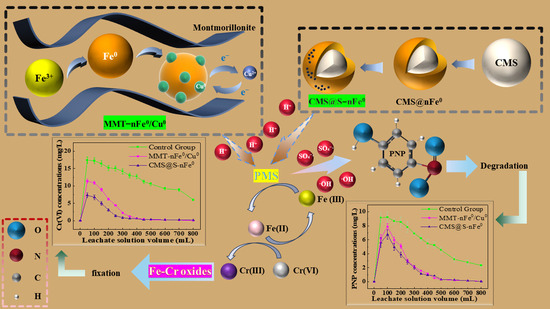
Graphical Abstract

1. Introduction

The problem of combined soil pollution is becoming more and more serious, mainly manifested in the joint pollution of heavy metals [1,2,3] (such as Cd, As, and Pb) and organic pollutants [4] (including polycyclic aromatic hydrocarbons and pesticide residues), which harm ecosystems, agricultural product safety, and human health [4,5]. Among these pollutants, hexavalent chromium (Cr(VI)) [6] and p-nitrophenol (PNP) [7] are of particular concern because of their widespread distribution and high toxicity [8]. Cr(VI) is highly mobile and is carcinogenic and teratogenic, while PNP is a refractory nitro aromatic compound that may interfere with endocrine and accumulate in organisms [9,10]. Cleaning up soil contaminated with both Cr(VI) and PNP is difficult because they differ in biogeochemical behavior: Cr(VI) needs to be converted to less mobile and toxic Cr(III) through a reduction reaction to be fixed [11], while PNP requires oxidative degradation to be mineralized [12].
Nanoscale zero-valent iron (nZVI) has become a popular method for treating Cr(VI) and other oxidizing pollutants because of its strong reactivity and good reduction effect [13,14,15]. However, conventional nZVI faces significant limitations in practical applications, particularly for co-contamination scenarios. Its inherent instability leads to rapid oxidation and aggregation, drastically reducing reactivity [16,17]. Crucially, nZVI primarily functions as a reductant and is largely ineffective against co-present organic pollutants like PNP, which require oxidative degradation pathways [18,19]. Furthermore, unmodified nZVI particles exhibit poor mobility and distribution in the complex soil matrix [20]. To overcome the limitations of pristine nZVI, particularly its inability to handle combined redox contaminants, our research group has focused on developing stabilized and multifunctional nZVI composites. Our team has developed materials modified by doping and loading of zero-valent iron [21,22]. Specifically, they fixed nFe0 on carbon microspheres (CMSs) and then turned it into a sulfide state, thus creating a multi-layered core–shell structure. Carbon microspheres supported sulfurized nanoscale zero-valent iron (CMS@ S-nFe0) material, while a Fe-Cu bimetallic system was innovatively incorporated into montmorillonite (MMT) to fabricate the doped and modified nanoscale zero-valent iron and copper-intercalated montmorillonite (MMT-nFe0/Cu0) composite, which have been shown to effectively enhance material performance and degrade pollutants in aqueous environments. These materials were designed to integrate chemical reduction (for Cr(VI)) with advanced oxidation processes (AOPs [23,24,25], for organics like PNP), leveraging peroxymonosulfate (PMS) activation to generate powerful sulfate radicals (SO4·, E0 = 2.5~3.1 V) [26,27,28].
However, our previous investigations have primarily focused on aqueous systems, whereas soils constitute a more complex environment. Soil constituents (e.g., organic matter, clays, oxides) can scavenge reactive species, compete for adsorption sites, and restrict contaminant accessibility [29], while soil properties such as pH, moisture, and porosity markedly influence reaction kinetics and material stability [5]. Consequently, the promising performance of these nZVI composites in water remediation cannot be directly extrapolated to soil applications. This gap underscores the necessity of systematically exploring their degradation performance and mechanisms in soil, thereby providing the basis for the present study.
Therefore, this study aims to systematically compare the degradation performance of materials prepared using two previously developed modification strategies for nZVI. The specific objectives are to (i) optimize degradation conditions, (ii) evaluate the long-term remediation performance, and (iii) elucidate the degradation mechanisms in soil matrices through characterization methods for the treated soil. By extending the application of nZVI-based materials from aqueous systems to soil environments, this work highlights their potential for effective multi-media pollution remediation.

2. Results and Discussions

2.1. Characterization of nFe0, MMT-nFe0/Cu0 and CMS@S-nFe0

In Figure 1, we observed the surface structures of nFe0, MMT-nFe0/Cu0, and CMS@ S-nFe0 using a scanning electron microscope (SEM). The freshly made nFe0 particles stick together obviously (Figure 1a). However, no clear nFe0 particles can be seen on the surface of MMT-nFe0/Cu0 (Figure 1b), indicating that the nanoparticles are hidden in the clay layer. With increasing Cu loading, the clay layers became thinner and more disordered. For CMS@S-nFe0 (Figure 1c), the microspheres displayed a rougher spherical surface as the nFe0 loading increased, which confirmed the successful FeS modification on the microsphere surface. Compared with MMT-nFe0/Cu0, the CMS@S-nFe0 system provided a more uniform dispersion of nFe0 and better structural stability, indicating superior modification efficiency.
The N2 adsorption–desorption isotherms and pore size distributions for MMT-nFe0/Cu0 and CMS@S-nFe0 are shown in Figure S1. Both samples showed Type IV isotherms and H4-type hysteresis rings [30], indicating that they have a mesoporous structure. For MMT-nFe0/Cu0, the pore size distribution is mainly between 2.2 and 4.3 nm, and there is also a peak around 2.1–3.4 nm, indicating that adding Cu helps create more pores. In contrast, CMS@S-nFe0 displayed smaller mesopores, as indicated by the closure of the hysteresis loop at a relative pressure of p/p0 ≈ 0.4 [31]. Brunauer–Emmett–Teller (BET) analysis (Table S1) further showed that the specific surface area of CMS@S-nFe0 (88.259 m2/g) was significantly higher than that of nFe0 (36.376 m2/g), demonstrating improved dispersion of nFe0. Meanwhile, the modified sample exhibited a decreased total pore volume but an enlarged average pore size. Despite its smaller total pore volume compared with MMT-nFe0/Cu0, the larger surface area and pore size of CMS@S-nFe0 facilitated more efficient adsorption and pollutant removal. This structure–performance relationship is consistent with the SEM observations.
Figure S2 shows the Fourier transform infrared spectroscopy (FT-IR) spectra of Fe0, MMT-nFe0/Cu0 and CMS@ S-nFe0. In MMT-nFe0/Cu0, the peak at 3624 cm−1 corresponds to the Al-OH group in montmorillonite. The main peaks at 1103 and 1019 cm−1 are related to the stretching vibrations of the external and internal Si-O skeletons, respectively. In addition, Fe-O stretching vibration signals at 459 and 612 cm−1 indicate the presence of iron oxide in MMT-nFe0/Cu0. The obvious feature of 526 cm−1 in MMT-nFe0/Cu0 may come from the Cu-O lattice vibration in copper oxide. For CMS@S-nFe0, the characteristic functional groups of carbon spheres appear at 1709 cm−1 (C=O), 1624 cm−1 (C=C), and 1296 cm−1 (C-H). Additional peaks at 1020 cm−1 (C-O) and 670 cm−1 (Fe-O) confirmed the presence of iron oxide. The peak of 1020 cm−1 corresponds to S-O stretching vibration, which may be the result of surface oxidation of FeS. In addition, after the FeS layer was loaded on CMS@nFe0, the carbon-related CMS signal and the Fe-O peak intensity of nFe0 were significantly weakened, indicating that FeS was successfully deposited on the surface of CMS@nFe0.

2.2. Effects of Parameters

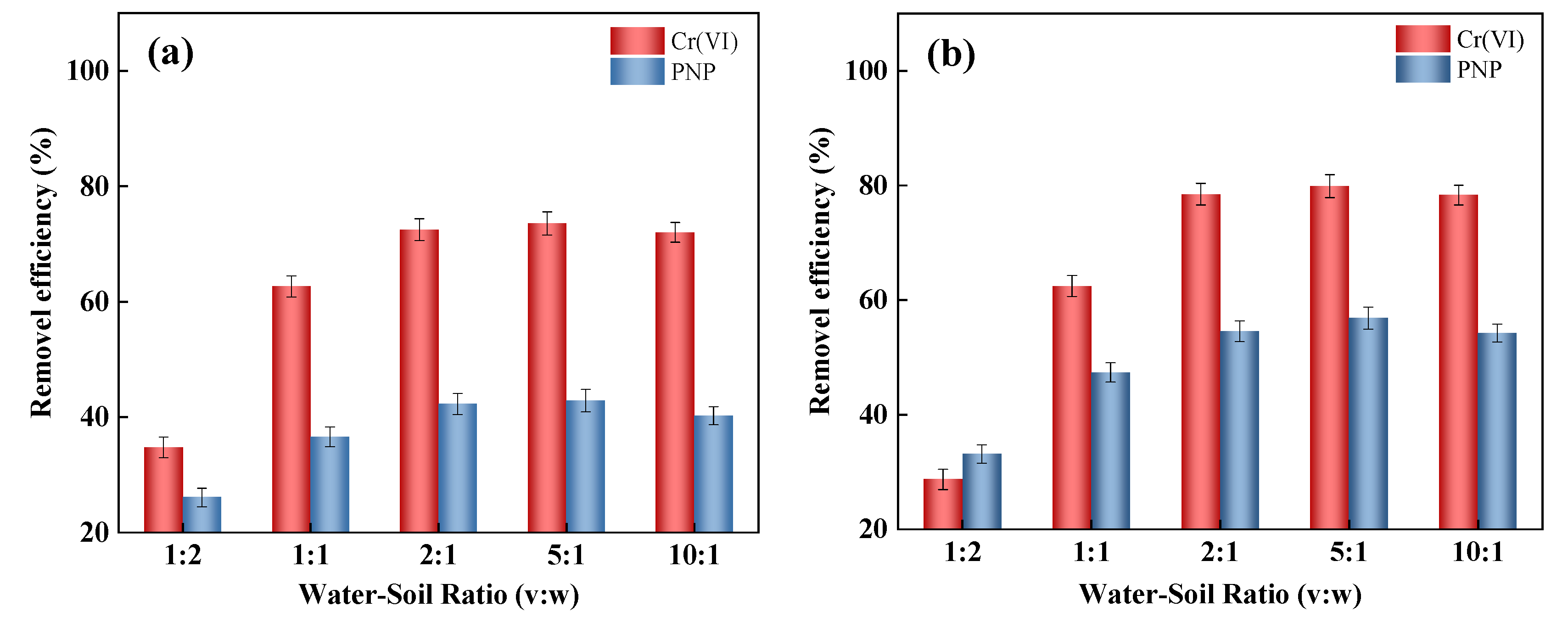
The ratio of water to soil, the dosage of different materials, the concentration of PMS, and the pH value will have a great impact on the degradation effect. To design the best repair system, these factors must be adjusted well [32]. As shown in Figure 2, at a water–soil ratio of 1:2, the removal efficiencies of Cr(VI) and PNP were 34.74% and 26.06% in the MMT-nFe0/Cu0 system (Figure 2a), and 28.67% and 33.12% in the CMS@S-nFe0 system (Figure 2b), respectively. The limited removal efficiency under this condition was attributed to incomplete soil wetting [33,34]. When the ratio was increased to 1:1, sufficient soil wetting was achieved, resulting in a marked improvement in removal efficiencies of 63.44% (Cr(VI)) and 38.26% (PNP) for MMT-nFe0/Cu0, and 64.21% (Cr(VI)) and 50.14% (PNP) for CMS@S-nFe0. Further increasing the ratio to 2:1 enhanced removal to 75.46% and 42.26% for Cr(VI) and PNP in the MMT-nFe0/Cu0 system, and 79.46% and 58.54% in the CMS@S-nFe0 system, respectively. No significant improvement was observed at higher ratios (5:1 and 10:1), suggesting that a 2:1 ratio provided nearly complete contaminant leaching and further increase did not enhance removal efficiency. Notably, both systems exhibited similar trends in Cr(VI) immobilization and PNP degradation.
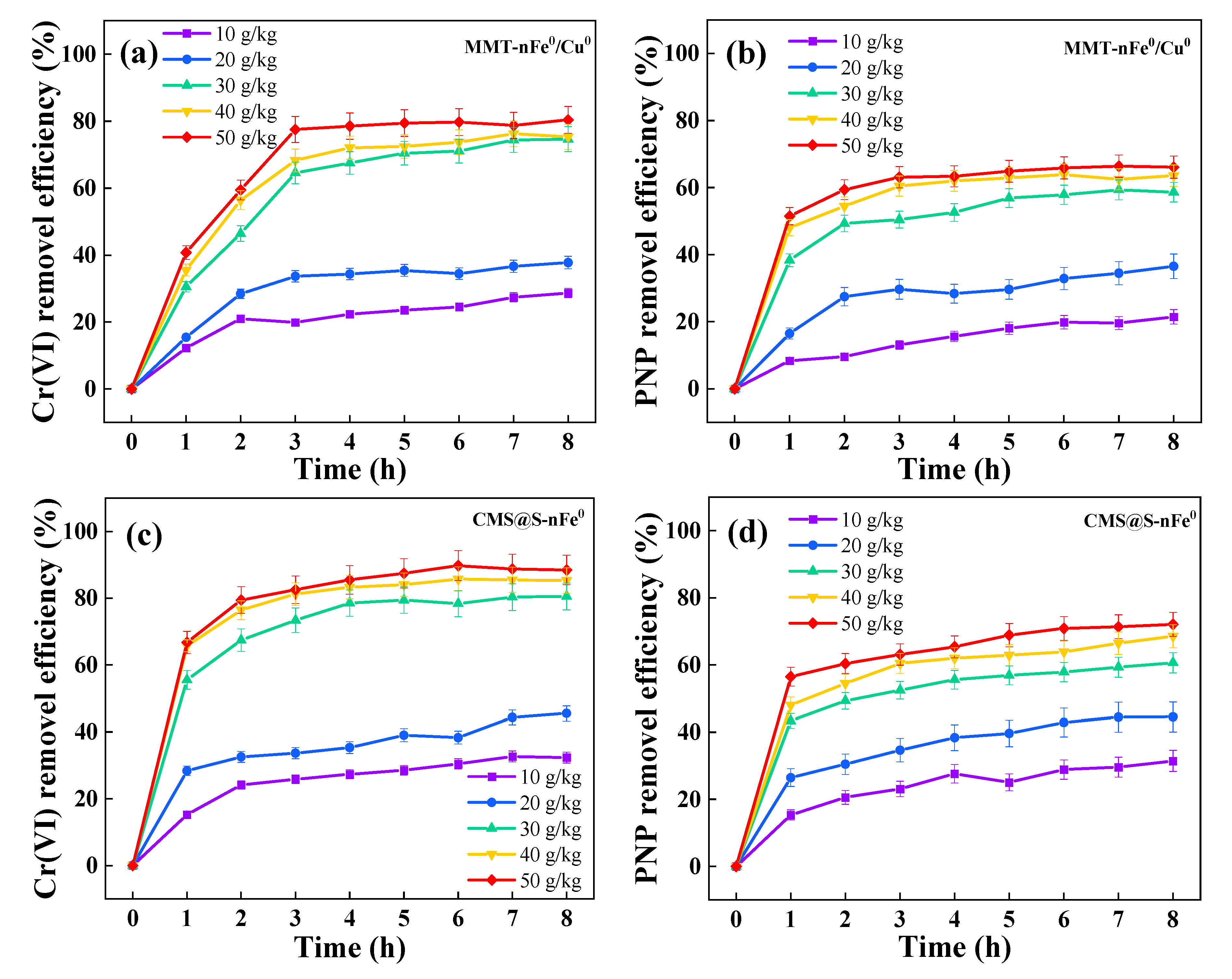
Figure 3 illustrates the removal efficiencies of Cr(VI) and PNP at different material dosages. For both systems, the removal efficiencies of Cr(VI) and PNP increased with increasing dosage. In the MMT-nFe0/Cu0 system (Figure 3a,b), after 8 h of treatment, the removal efficiencies were 28.67% and 37.76% at dosages of 10 and 20 g/kg, respectively. When the dosage was raised to 30 g/kg, the efficiency sharply increased to 74.63%. Further increases to 40 and 50 g/kg resulted in only slight improvements, with efficiencies of 75.34% and 80.42%, respectively. The most pronounced enhancement occurred between 20 and 30 g/kg, where the removal efficiency nearly doubled (from 37.76% to 74.63%). Beyond 30 g/kg, however, only marginal gains were observed (from 74.63% to 80.42%). The CMS@S-nFe0 system (Figure 3c,d) displayed a similar trend but achieved slightly higher Cr(VI) removal efficiency. Considering both cost reduction and the potential adverse impacts of overdosing on the soil environment, 30 g/kg was identified as the optimal application rate.
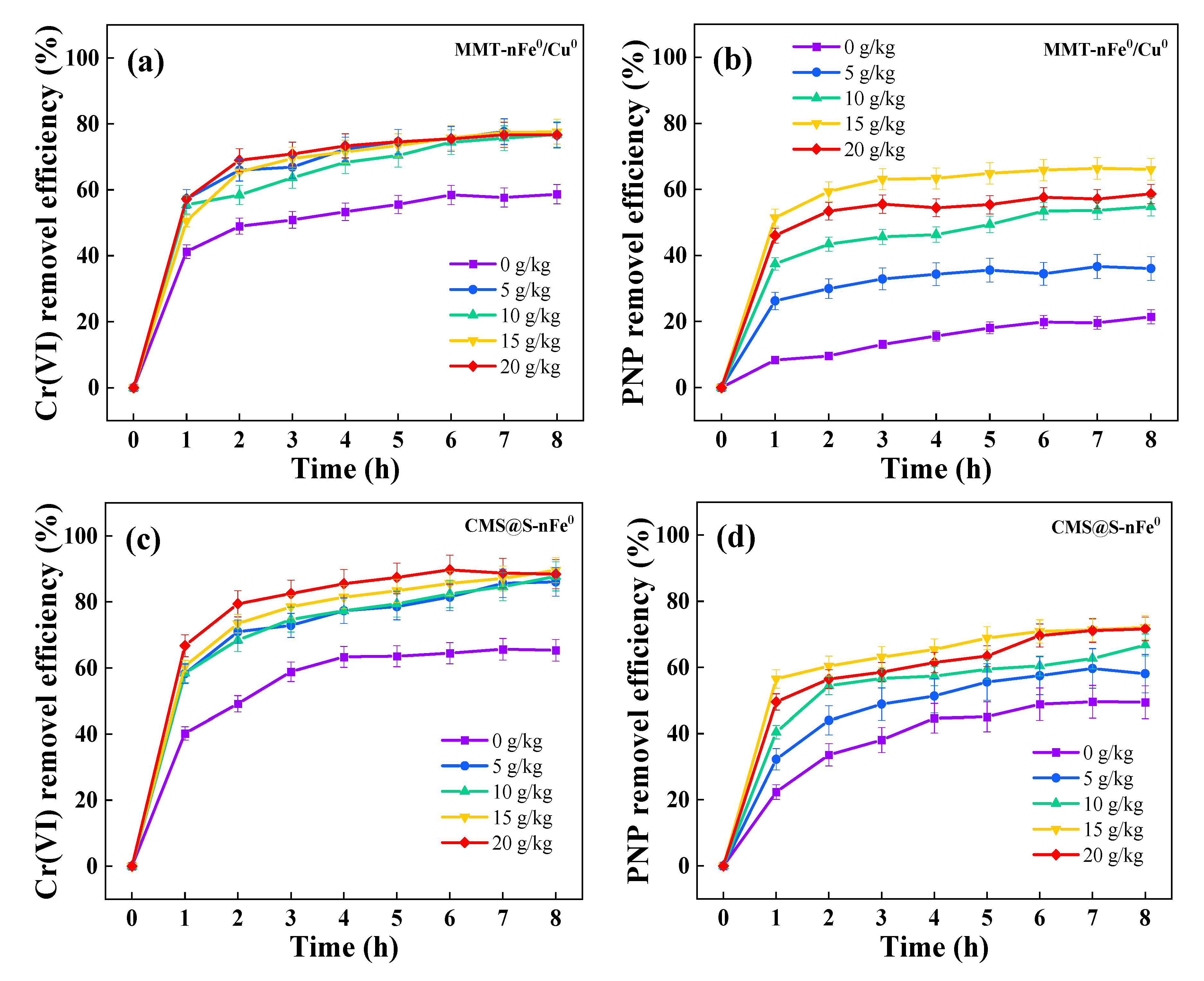
The effect of MMT-nFe0/Cu0 and CMS@S-nFe0 reaction systems on the removal of Cr(VI) and PNP from the soil was investigated at different PMS concentrations, and the results are shown in Figure 4. As shown in Figure 4a,c, without the addition of PMS, MMT-nFe0/Cu0 and CMS@S-nFe0 had the lowest removal rates for Cr(VI), at 58.67% and 65.48%, respectively. The introduction of 5 g/kg PMS significantly enhanced removal to 77.56% and 85.75%, respectively. However, further PMS increases (5~20 g/kg) maintained stable removal efficiencies within 76–78% and 85–88%, demonstrating that adding a small amount of PMS can promote the removal of Cr(VI), but increasing the concentration of PMS has no significant effect on Cr(VI) removal. PNP removal exhibited distinct concentration dependence (Figure 4b,d). Both systems showed progressive efficiency improvements with increasing PMS concentration (0~15 g/kg). This is mainly due to the increase in SO4· and ·OH produced by activated PMS, which helps in the oxidation and removal of PNP [35]. Notably, CMS@S-nFe0 demonstrated superior activation capability throughout the concentration range. However, when the concentration of PMS increased from 15 g/kg to 20 g/kg, the removal rate of PNP decreased slightly. This phenomenon may be due to the fact that when the concentration of PMS exceeds 15 g/kg, the free radical scavenging ability of PMS increases [36].
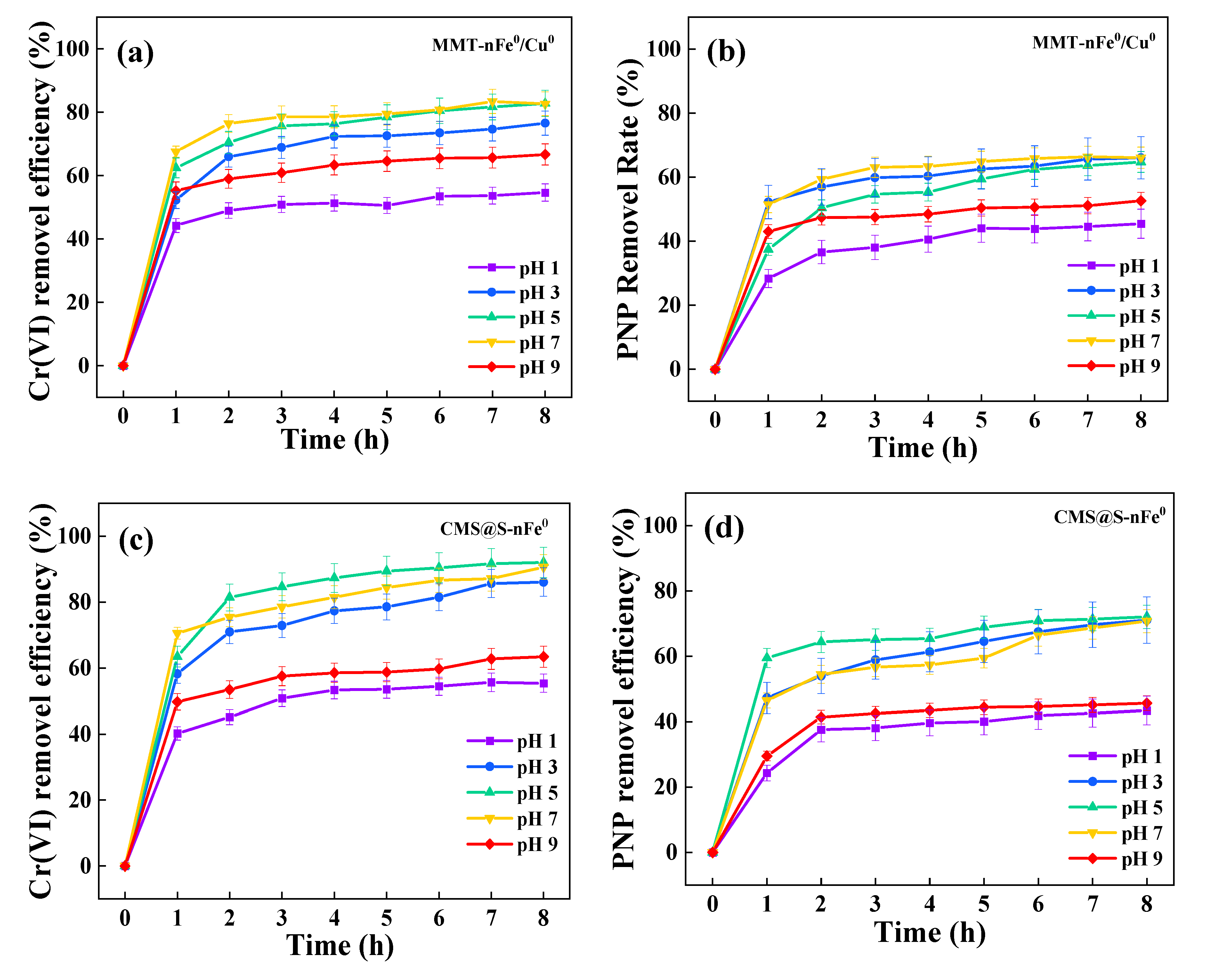
As pH significantly influences reaction activity in soil systems, its effects on Cr(VI) and PNP removal by MMT-nFe0/Cu0 and CMS@S-nFe0 were investigated. As shown in Figure 5a, Cr(VI) removal by MMT-nFe0/Cu0 increased from 51.35% to 80.53% as pH rose from 3 to 9 but declined to 62.45% at pH 11. A similar trend was observed for PNP removal (Figure 5b). In the CMS@S-nFe0 system, Cr(VI) removal increased from 55.35% to 92.02% when pH increased from 3 to 7 but decreased to 63.43% at pH 11 (Figure 5c), with PNP removal following the same pattern (Figure 5d). The soil’s acidity and alkalinity strongly influenced pollutant removal. Under acidic conditions (low pH), abundant H+ promoted nFe0 corrosion, generating Fe(II) that facilitated Cr(VI) reduction and activated PMS to produce SO4·, enhancing PNP oxidative degradation [37]. Conversely, at higher pH, free and surface-bound Fe(II) was more readily oxidized, forming a dense iron hydroxide layer that hindered nFe0 corrosion, reducing Cr(VI) removal [38]. Additionally, in alkaline solutions, SO4· reacted with H2O or OH to form less reactive ·OH while SO4· was consumed, further decreasing PNP removal efficiency [39].

2.3. Degradation Performance in Soil Column

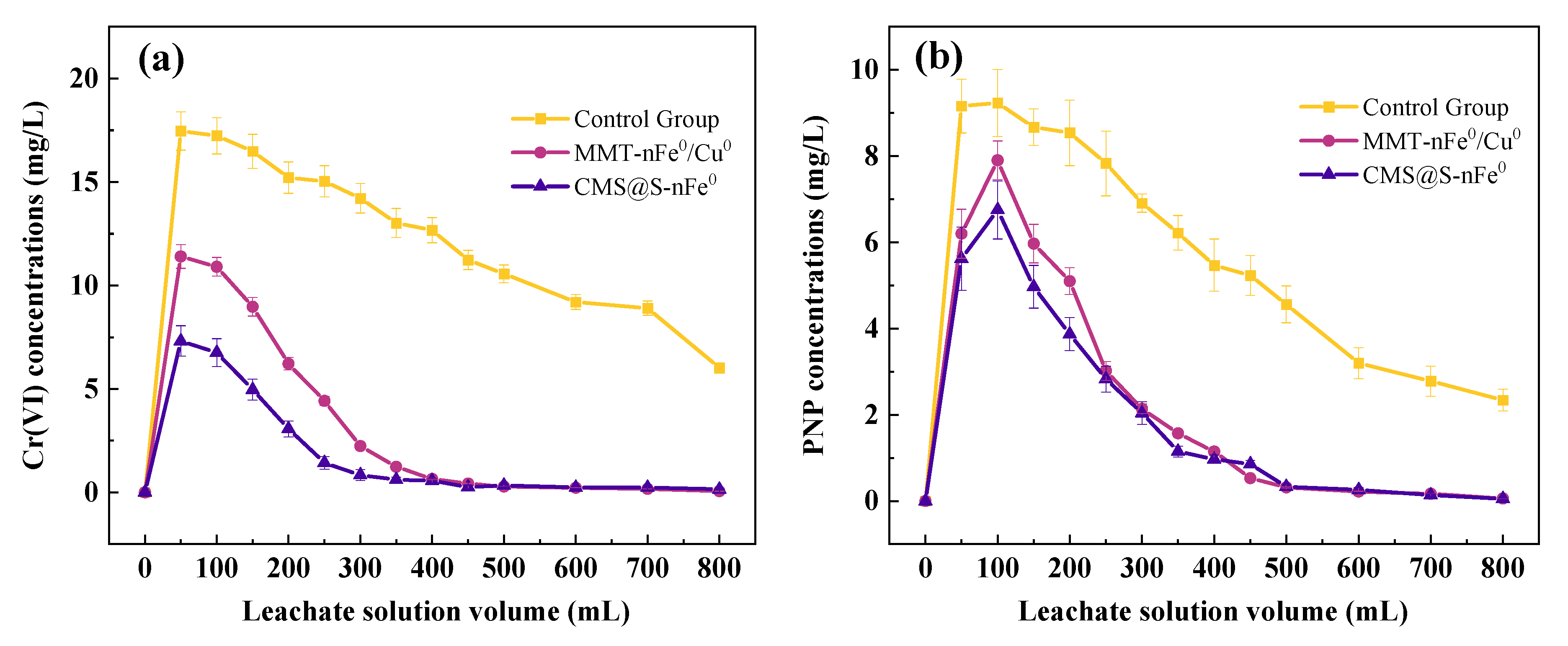
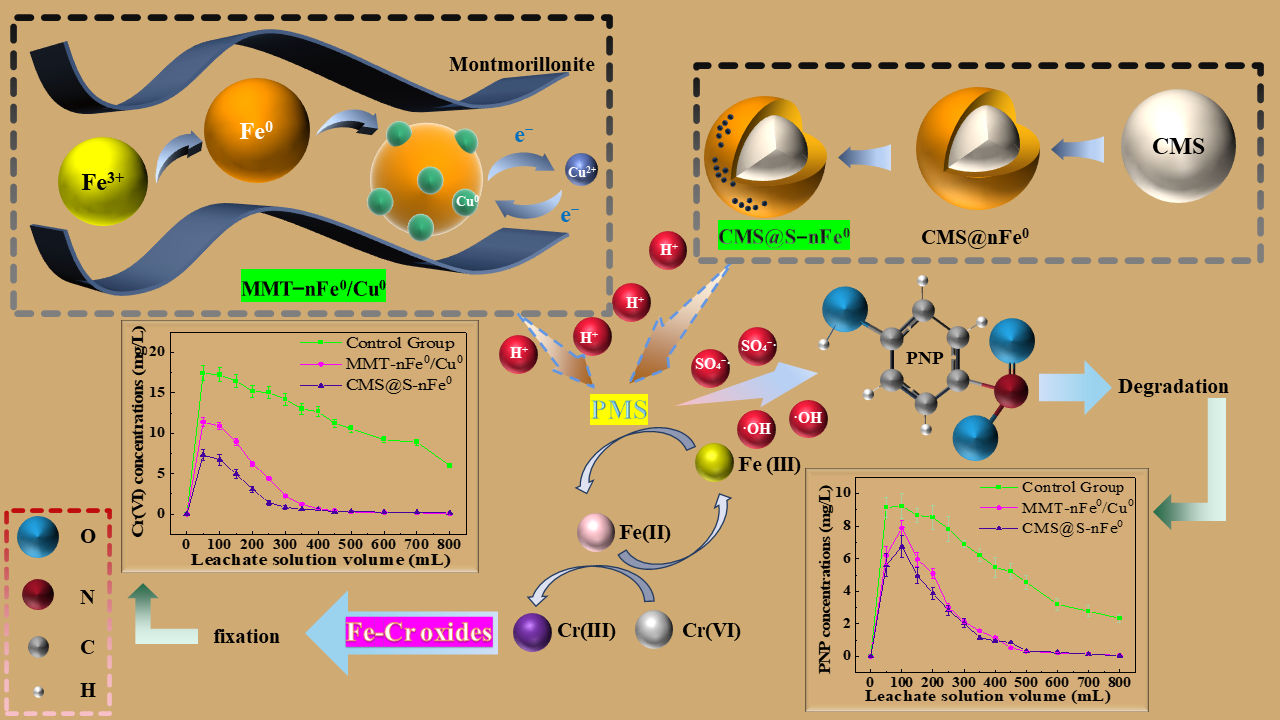
To assess the long-term stabilization of Cr(VI) and PNP in soil column, leaching experiments were performed. As illustrated in Figure 6a, distinct differences in Cr(VI) concentrations were observed in control group, MMT-nFe0/Cu0, and CMS@S-nFe0 systems. At an effluent volume of 50 mL, Cr(VI) concentrations peaked at 17.46 mg/L in the control, 11.4 mg/L in the MMT-nFe0/Cu0 system, and 7.32 mg/L in the CMS@S-nFe0 system. With increasing elution, Cr(VI) concentrations progressively declined, yet the control group exhibited the slowest reduction, remaining as high as 6.02 mg/L at 800 mL. In contrast, the MMT-nFe0/Cu0 and CMS@S-nFe0 systems achieved nearly complete immobilization, with terminal concentrations of 0.06 mg/L and 0.15 mg/L, respectively. These results demonstrate that, although soil columns inherently retain a portion of Cr(VI) through physical filtration, the introduction of modified materials substantially enhances Cr(VI) fixation, with CMS@S-nFe0 exhibiting superior stabilization efficacy compared to MMT-nFe0/Cu0.
Similarly, Figure 6b depicts the PNP leaching behavior across the three systems. At 100 mL, the maximum PNP concentrations in the effluent were 9.16 mg/L in the control, 6.20 mg/L in the MMT-nFe0/Cu0 system, and 5.62 mg/L in the CMS@S-nFe0 system. Although both amendments facilitated PNP removal compared with the control, the removal efficiency was lower than that observed for Cr(VI), likely due to the weaker affinity of PNP for soil surfaces. During continuous leaching, PNP concentrations gradually decreased, with the control group again exhibiting the slowest decline (2.34 mg/L at 800 mL). In contrast, the MMT-nFe0/Cu0 and CMS@S-nFe0 systems achieved near-complete PNP removal by 500 mL, stabilizing at 0.06 mg/L and 0.05 mg/L, respectively. Notably, the CMS@S-nFe0 system consistently outperformed MMT-nFe0/Cu0, reflecting the higher density of reactive sites and stronger adsorption/complexation capacity of CMS, which promoted more efficient PNP stabilization.
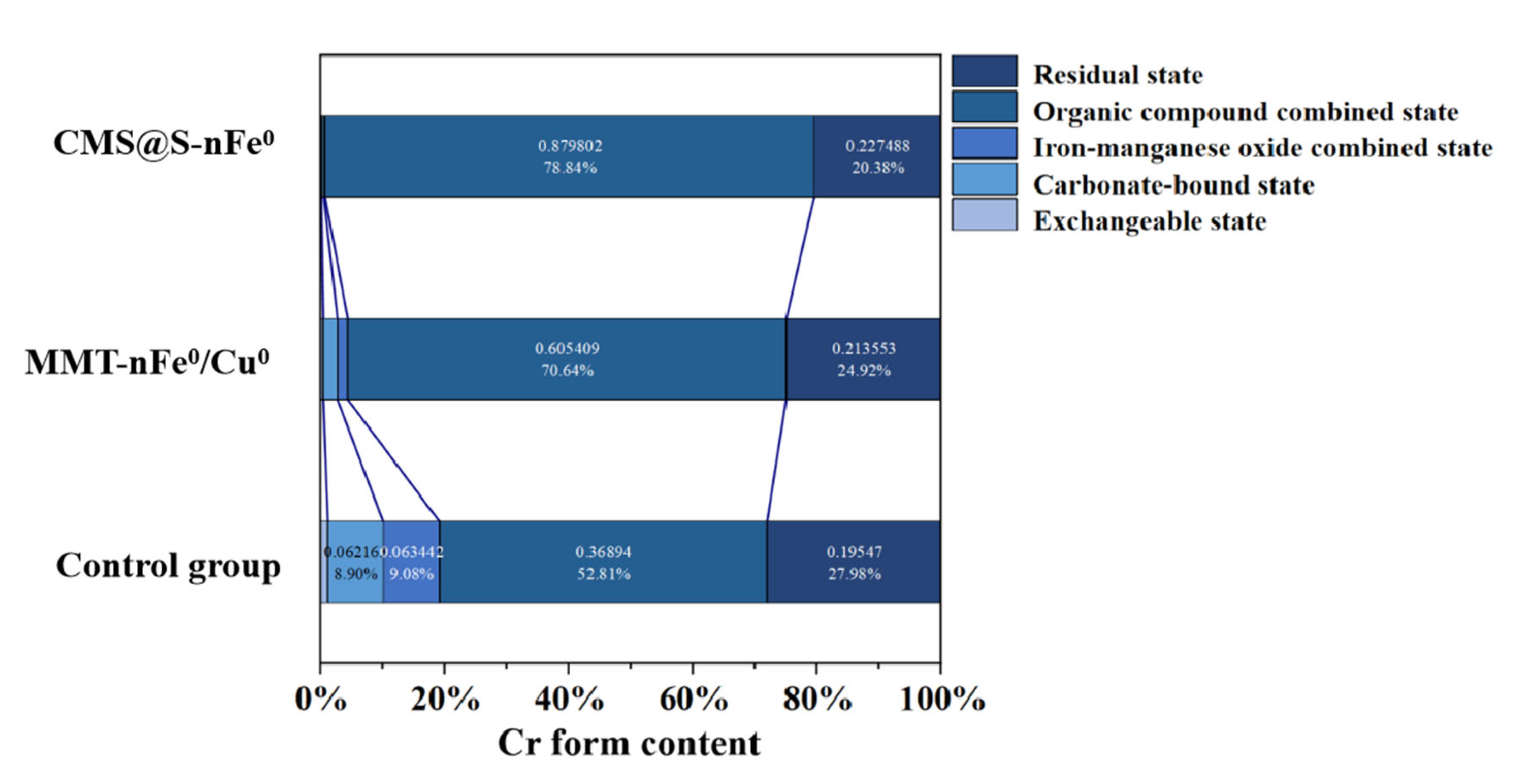
To further elucidate the transformation of Cr speciation in different systems, soil samples were taken from the bottom layer of the columns after the leaching experiments, and the five fractions of Cr were determined using the Tessier sequential extraction method [40].The results (Figure 7) reveal distinct differences in morphological distribution of Cr among the three systems (control, MMT-nFe0/Cu0, and CMS@S-nFe0). Compared with the control group, the contents of exchangeable, carbonate-bound, ferromanganese oxide and residue-bound states of heavy metal Cr in soil were significantly reduced, while the contents of organic-bound states were elevated in the MMT-nFe0/Cu0 and CMS@S-nFe0 reaction systems. The organic-bound form became the dominant Cr species, followed by the residual fraction. Given that the mobility of Cr fractions follows the order exchangeable > carbonate-bound > organic-bound > residual, these findings indicate that the addition of the material effectively converts Cr from an unstable form that is relatively easy to leach to a more stable form [41].
The leaching concentrations of metals in three sets of soil columns were evaluated using the TCLP leaching toxicity test [42] to assess the potential environmental risks of secondary metal release during remediation. As shown in Table S2, compared with the MMT-nFe0/Cu0 system, the CMS@S-nFe0 system exhibited a higher total Fe leaching concentration but a lower total Cr concentration. This phenomenon may be attributed to the stronger corrosive effect of the CMS@S-nFe0 system on the Fe surface of the catalyst during the reaction, whereas the adsorption capacity of MMT effectively inhibited the dissolution of Fe ions in the nFe0 system [43,44]. In contrast, the CMS@S-nFe0 system demonstrated stronger immobilization of Cr, which further confirmed that the Cr(VI) removal efficiency of CMS@S-nFe0 was superior to that of MMT-nFe0/Cu0.

2.4. Remediation Mechanism

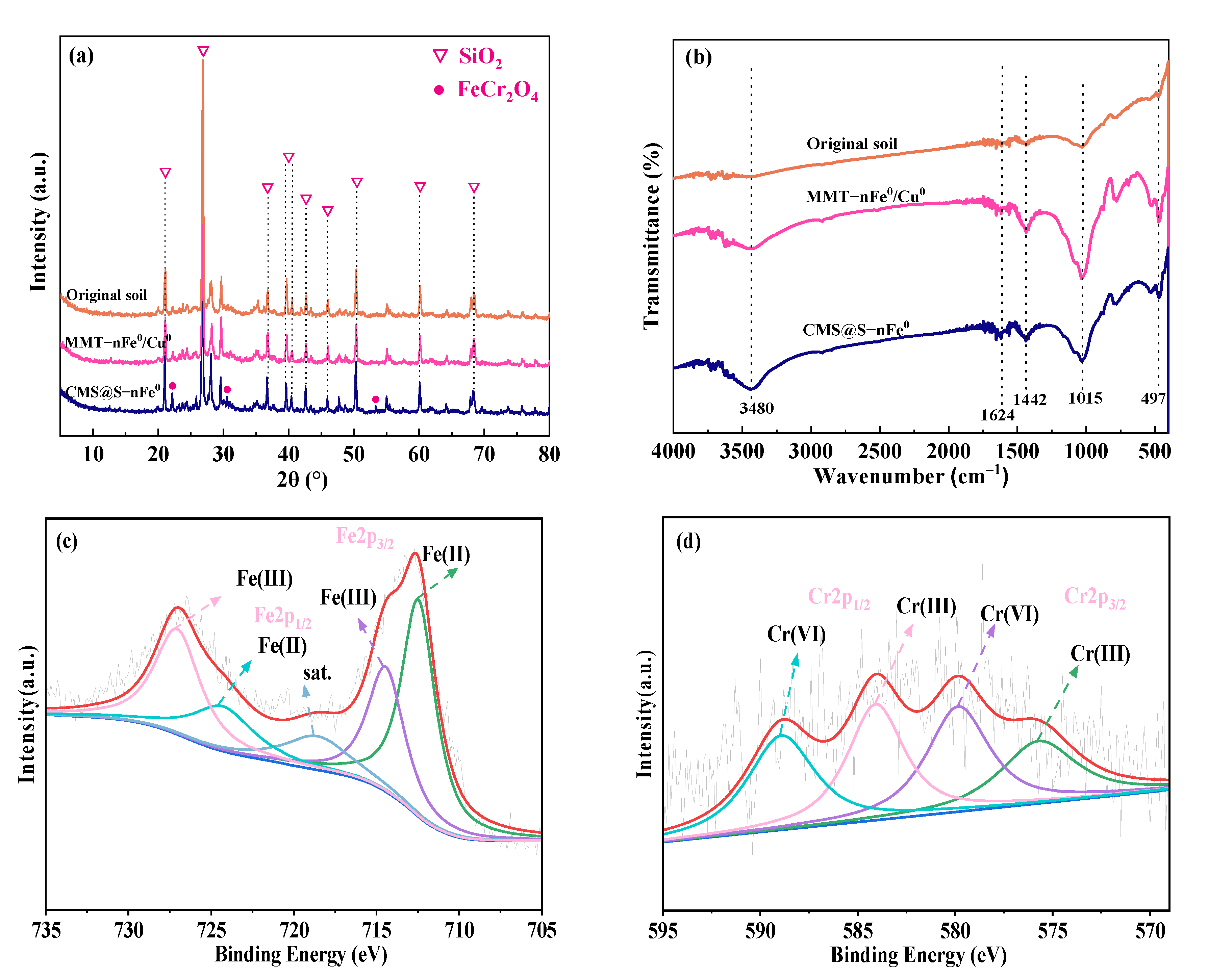
To elucidate the reaction mechanisms and stabilization pathways of Cr(VI) in the treated soils, a series of characterization analyses, including X-ray diffractometer (XRD), FT-IR, and X-ray photoelectron spectroscopy (XPS), were performed. The XRD patterns of soil samples before and after treatment are presented in Figure 8a. The MMT-nFe0/Cu0 treated soil showed no new characteristic peaks beyond the original SiO2 peaks, likely due to the low heavy metal content. In contrast, distinct FeCr2O4 peaks [16] were observed in the CMS@S- nFe0 system, indicating effective Cr(VI) reduction to Cr(III) and subsequent formation of Fe-Cr oxides [45]. This transformation suggests that Fe0 served as an electron donor, promoting the conversion of soluble Cr(VI) to stable FeCr2O4 spinel oxides through redox coupling reactions between Fe and Cr species [46,47].
FT-IR spectra of the treated soils (Figure 8b) exhibited a characteristic absorption band observed at approximately 497 cm−1, attributed to the Fe-O stretching vibration of iron oxides (Fe2O3/Fe3O4) formed during the redox transformation of Fe0, confirming the presence of iron oxide species bonded with the soil matrix with markedly enhanced intensities in both MMT-nFe0/Cu0 and CMS@S-nFe0 systems compared to untreated soil. The enhanced intensities at 3480, 1624, 1442, and 1015 cm−1 correspond to N-H, C=O, C-N, and C-O stretching vibrations [48], respectively, which can be assigned to the formation and adsorption of carbon-containing and nitrogen-containing intermediates such as p-aminophenol, hydroquinone, benzenetriol, and 4-nitrocatechol generated during PNP degradation [49]. These intermediates introduced additional hydroxyl, amino, and carbonyl functional groups on the soil surface, thereby strengthening metal–organic complexation [50] and Cr(VI) immobilization. Notably, CMS-based materials provided more abundant reactive sites and functional moieties than MMT, further facilitating pollutant immobilization.
XPS analysis provided further evidence supporting the proposed Cr(VI) removal mechanism in the CMS@S-nFe0 system. The Fe 2p were deconvoluted into four main components corresponding to the Fe 2p3/2 and Fe 2p1/2 spin–orbit doublets of Fe2+ and Fe(III) species, along with distinct satellite features. As shown in Figure 8c, the Fe 2p3/2 peaks located at 712.45 eV (Fe(II)) and 714.43 eV (Fe(III)), and a noticeable satellite peak (Sat., 718.56 eV) attributed to Fe(III), together with their corresponding Fe 2p1/2 peaks at 724.3 eV and 727.06 eV, respectively, confirm the coexistence of mixed-valence iron species [51]. The Fe 2p spectra revealed a notable shift in the Fe valence state before and after the reaction. The proportion of Fe(II) decreased from 67.4% to 51.8%, while Fe(III) increased from 32.6% to 48.2%, indicating the progressive oxidation of Fe(II) to Fe(III) during the reaction. This transformation suggests that Fe0 and Fe(II) were actively involved in electron transfer processes, serving as major reductants for Cr(VI) reduction. The concurrent increase in Fe(III) content implies the formation of Fe (hydr)oxides, such as Fe(OH)3 or FeOOH, which not only act as oxidation products but also provide additional adsorption and co-precipitation sites for Cr species. Similarly, the Cr 2p spectra (Figure 8d) were deconvoluted into the characteristic Cr 2p3/2 and Cr 2p1/2 components corresponding to Cr(III) and Cr(VI) species. The fitted peaks appeared at 575.72 eV and 579.85 eV for Cr 2p3/2, and at 584.08 eV and 588.92 eV for Cr 2p1/2, respectively [52,53]. Quantitative analysis showed that Cr(III) accounted for approximately 46.87% of the total chromium after reaction, confirming that Cr(VI) was predominantly reduced to Cr(III). The coexistence of Cr(VI) and Cr(III) signals suggests that reduction and surface complexation occurred concurrently, forming stable Fe-O-Cr linkages on the CMS@S-nFe0 surface. XPS elemental analysis results are summarized in Table S3.
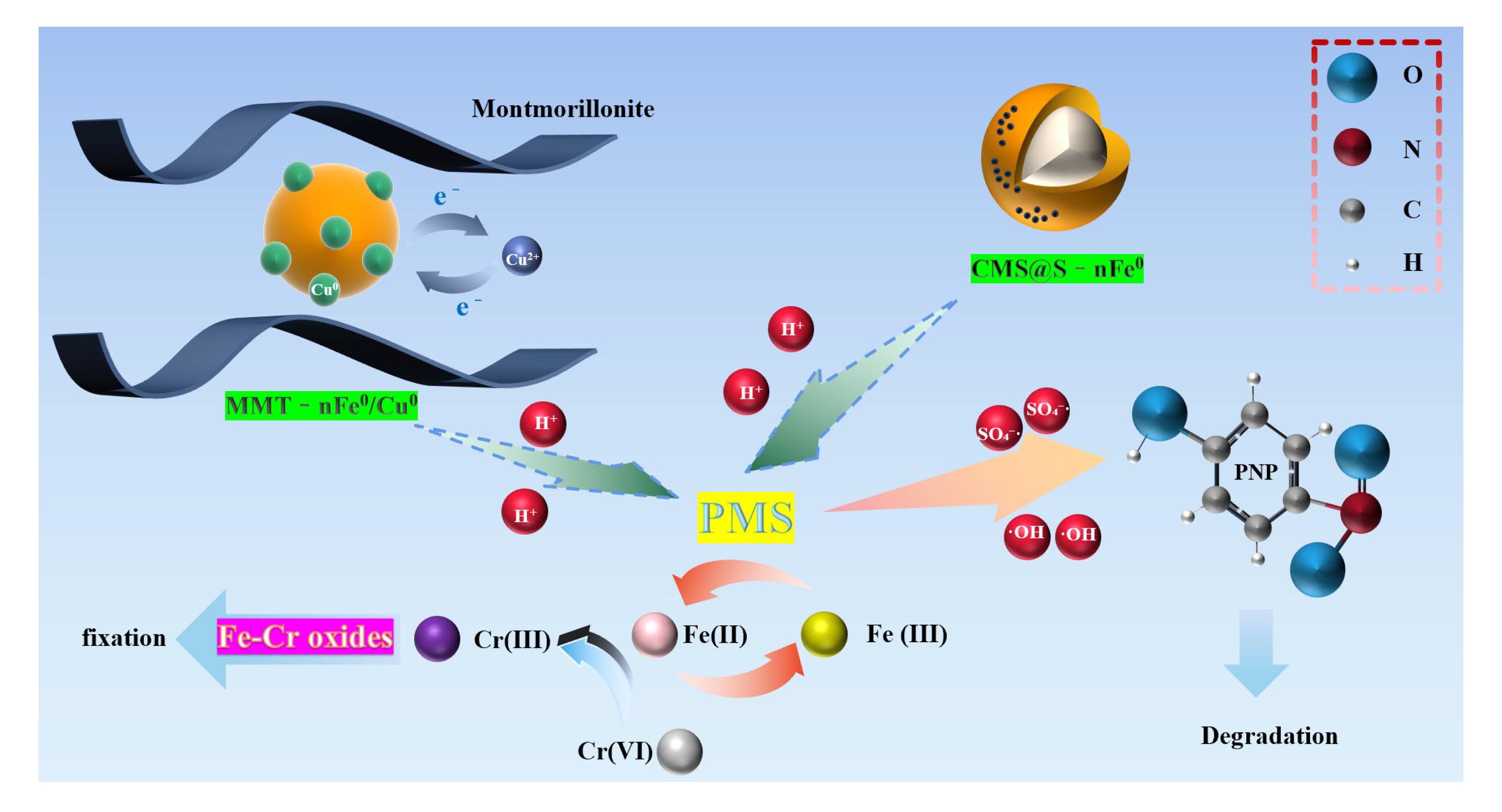
Figure 9 illustrates the proposed mechanism for the synergistic remediation of Cr(VI) and p-nitrophenol (PNP) in soil using metal-/non-metal-doped nZVI catalysts with high dispersion under persulfate activation. The pH value plays a crucial role in regulating the redox transformation of Cr species and the evolution of Fe phases. Under acidic conditions (pH < 6), abundant protons accelerate Fe0 corrosion, leading to the continuous release of Fe(II) and Fe(III) species. These species act as key reductants and intermediates that rapidly reduce Cr(VI) to Cr(III) through Equations (1–3) [54]. Meanwhile, the enhanced oxidation of Fe0 promotes the formation of amorphous Fe(OH)3 or FeOOH, which can adsorb or co-precipitate Cr(III), contributing to its immobilization. In addition, the degradation of PNP generates hydroxyl, amino, and carbonyl functional groups, which facilitate the adsorption and complexation of residual metal ions. As the pH increases toward neutral or slightly alkaline conditions, Fe0 corrosion becomes slower, but the stability of secondary Fe and Cr phases improves. Under such conditions, Fe(II) and Cr(III) species tend to transform into more crystalline and thermodynamically stable FeCr2O4 spinel oxides according to Equation (4) [55], leading to the long-term structural fixation of Cr(III) and decreased mobility. Compared with MMT-nFe0/Cu0, the CMS@S-nFe0 system provides more reactive sites and facilitates electron transfer, thereby promoting both the formation of Fe-Cr spinel oxides and the activation of persulfate for efficient PNP degradation. Therefore, pH governs both the kinetics and transformation pathways of Cr(VI), where acidic environments favor rapid reduction and amorphous Fe (hydr)oxide formation, while neutral alkaline conditions promote spinel oxide precipitation and persistent Cr stabilization.
C r 2 O 7 2 + 3 F e 0 + 14 H + 3 F e 2 + + 2 C r 3 + + 7 H 2 O
H C r O 4 + 3 F e 2 + + 7 H + 3 F e 3 + + C r 3 + + 4 H 2 O
2 C r O 4 2 + 3 F e 2 + + 8 H + 2 C r 3 + + 3 F e 3 + + 4 H 2 O
C r 2 O 7 2 + 3 F e 0 + 8 H + 2 F e C r 2 O 4 + 4 H 2 O

3. Materials and Methods

3.1. Chemical and Reagents

NaOH (AR), HCl (AR), K2Cr2O7 (AR), C6H5NO3 (AR), MgCl2·6H2O (AR), C2H3NaO2 (AR), NH2OH·HCl (AR), C2H4O2 (GR), C2H7NO2 (AR), HNO3 (AR), HClO4 (GR). All are produced by Sinopharm Chemical Reagent Co., Ltd. (Shanghai, China). KHSO5.0.5KHSO4·0.5K2SO4 (≥42% KHSO5) are purchased from Aladdin Biochemical Technology Co., Ltd. (Shanghai, China). All the water used in the experiment was completely deoxidized and deionized water.

3.2. Preparation of MMT-nFe0/Cu0 and CMS@S-nFe0

MMT-nFe0/Cu0 and CMS@S-nFe0 were synthesized following previously established methods [21,22]. The detailed information is presented in the Supplementary Materials (Text S1).

3.3. Soil Preparation

The original soil was collected from the farmland of Jianshe Town, Chongming District, Shanghai, China. The basic physicochemical characteristics of the tested soil, including organic matter content, clay fraction, redox potential, and buffering capacity, are summarized in Table S4. Surface weeds, stones and other foreign substances were removed. After it dried naturally, it was ground through a 2 mm sieve and set aside for later use. The concentration of soil complex pollution was set at 100 mg/kg Cr(VI) and 50 mg/kg PNP. The preparation process was as follows: First, a certain amount of K2Cr2O7 and PNP reagents was weighed to prepare 100 mg/L Cr(VI) and 100 mg/L PNP solutions. Take 1 kg of the reserved raw soil and put it in a 1 L beaker. Pour 1000 mL of Cr(VI) and 500 mL of PNP solution into the soil. Place it under a spiral stirrer and stir for 12 h to mix evenly. Subsequently, the soil was naturally air-dried at ambient temperature and homogenized by grinding to pass through a 1 mm sieve. Then it was placed in a sealed container and kept in a refrigerator at 4 °C for one month before being used as the test soil.

3.4. Batch Experiments

Degradation experiments of Cr(VI) and PNP were carried out in 100 mL conical flasks containing 5 g of composite contaminated soil and deionized water. The influences of water–soil ratio (0.5–10, v:w), catalyst dosage (10–50 g/kg of MMT-nFe0/Cu0 or CMS@S-nFe0), PMS dosage (0–20 g/kg), and pH (3–11) were systematically evaluated. Unless otherwise specified, the reaction conditions were set as follows: water–soil ratio of 2, catalyst dosage of 30 g/kg, PMS dosage of 15 g/kg, and pH = 5. The mixtures were shaken at 200 rpm in a constant-temperature air bath (25 °C) for 8 h. At predetermined intervals, 2 mL aliquots were withdrawn, centrifuged (5000 rpm, 10 min), and filtered through a 0.45 μm membrane prior to the determination of Cr(VI) and PNP concentrations.

3.5. Soil Column Leaching Experiment

The soil column leaching experiments were performed using a purpose-designed soil column apparatus (Figure S3); detailed information on the design of the soil column device is in Text S2. Soil column experiments were conducted with three groups: control, MMT-nFe0/Cu0, and CMS@S-nFe0. Each column was packed with 200 g of soil, and the amendments were mixed with the top 1–2 cm layer together with PMS (15 g/kg). Columns were saturated with 1 L deionized water at a flow rate of 0.15 mL/min and allowed to equilibrate for 120 h. Continuous leaching was then performed at room temperature using a Mariotte bottle under constant head, and effluent samples were collected periodically for Cr(VI) and PNP analysis.
The morphological distribution of Cr in soil was analyzed using the Tessier sequential extraction method, and the leaching toxicity was evaluated by the TCLP procedure. The detailed information is presented in the Supplementary Materials (Text S3 and Text S4).

3.6. Characterization

We used a scanning electron microscope (SEM, S-4800, Hitachi, Tokyo, Japan) to observe the shape characteristics of the samples. The surface area was measured using the Brunauer–Emmett–Teller (BET) method, the equipment was a nitrogen adsorption–desorption instrument (BET, Autosorb-iQ-2MP, Quantachrome Instruments, Boynton Beach, FL, USA), and the pore size distribution was calculated using Barrett–Joyner–Halenda (BJH) analysis. Fourier transform infrared spectroscopy (FTIR, Nicolet iS10, Thermo Fisher Scientific, Waltham, MA, USA) was used to detect functional groups on the sample surface. An X-ray diffractometer (XRD, D8 Advance, Bruker, Karlsruhe, Germany) was used to determine the crystal phase. X-ray photoelectron spectroscopy (XPS, ESCALAB 250Xi, Thermo Fisher Scientific, Waltham, MA, USA) was used to analyze the material composition. Additional information about XRD and XPS can be found in Text S5.

3.7. Analytic Methods

The Cr(VI) concentration was determined by dibenzoyl dihydrazide (C13H14N4O) spectrophotometric method (GB7467-87). The corresponding absorbance values were measured at 540 nm by taking Cr(VI) standard solution with different concentration gradients. The labeled curves are plotted as follows:
A = 0.7563 C + 0.0012   ( R 2 = 0.9999 )
where A is the absorbance value; C is the Cr(VI) concentration (mg/L); and R2 is the curve correlation coefficient.
The total chromium content was measured using inductively coupled plasma spectroscopy (ICP-MS, NexIon 300X, PerkinElmer Co., Ltd., Waltham, MA, USA). The amount of Cr(III) is calculated by subtracting the content of Cr(VI) from total chromium.
The concentration of PNP was determined at a wavelength of 400 nm using a UV–Vis spectrophotometer (UV-2600, Shimadzu Corporation, Kyoto, Japan). The corresponding absorbance values were measured by taking different concentration gradients of the PNP standard solution (pH ≥ 9), and the labeled curves were plotted as follows:
A = 0.1274 C + 0.0017   ( R 2 = 0.9993 )
where A is the absorbance value; C is the PNP concentration (mg/L); and R2 is the curve correlation coefficient.
The removal rate of Cr(VI) and PNP was calculated as follows:
R % = C 0 C t C 0 × 100 %
where R is the Cr(VI) and PNP removal rate (%); C0 is the initial concentration of Cr(VI) and PNP (mg/L); and Ct is the remaining concentration of Cr(VI) and PNP after reaction time t (mg/L).

4. Conclusions

This study demonstrated the effective remediation of Cr(VI) and p-nitrophenol (PNP) co-contaminated soil using two modified nZVI composites, MMT-nFe0/Cu0 and CMS@S-nFe0, in the presence of PMS. Batch experiment and soil column leaching experiment confirmed that both materials significantly enhanced pollutant removal, with CMS@S-nFe0 consistently exhibiting superior performance due to its higher dispersion, larger surface area, and stronger fixation capacity. Cr(VI) was effectively reduced to Cr(III) by Fe0 and Fe2+ ions and subsequently transformed into stable FeCr2O4 spinel oxides, while PNP underwent oxidative degradation and adsorption. Long-term soil column tests further revealed that labile Cr fractions were transformed into more stable forms, indicating sustained immobilization and reduced leaching risks. Compared with MMT-nFe0/Cu0, CMS@S-nFe0 showed enhanced PMS activation and greater stabilization efficiency, highlighting its potential as a multifunctional amendment for complex soil remediation. Overall, this work provides new insights into the synergistic redox mechanisms of modified nZVI composites and expands their applicability to addressing heavy metal–organic co-contamination in soil systems.

Supplementary Materials

The following supporting information can be downloaded at https://www.mdpi.com/article/10.3390/catal15111077/s1, Text S1: Preparation of MMT-nFe0/Cu0 and CMS@S-nFe0; Text S2: Design of the soil column system; Text S3: Morphological distribution of Cr in soil columns; Text S4: The leaching toxicity experiment; Text S5: XRD and XPS measurements; Figure S1: N2 adsorption–desorption isotherms and the corresponding pore size distributions; Figure S2: FT-IR spectra of nFe0, MMT-nFe0/Cu0 and CMS@S-nFe0; Figure S3: Diagram of soil column device; Table S1: Surface area, total pore volume, and average pore size of materials; Table S2: TCLP leaching concentration of heavy metal elements; Table S3: XPS elemental analysis results; Table S4: Basic physical and chemical properties of soil.

Author Contributions

Writing—original draft, methodology, Y.W.; conceptualization, investigation, S.X.; software, validation, Y.Y.; data curation, visualization, Y.G.; formal analysis, resources, L.L.; writing—review and editing, funding acquisition, H.J.; writing—review and editing, supervision, and project administration, X.Z. All authors have read and agreed to the published version of the manuscript.

Funding

This research work was supported by Shanghai Rising-Star Program (No. 23QA1406900) and National Natural Science Foundation of China (No. 42177269, 12175132).

Data Availability Statement

The original contributions presented in this study are included in the article/Supplementary Materials. Further inquiries can be directed to the corresponding authors.

Conflicts of Interest

The authors declare no conflicts of interest.

References

  1. Han, W.; Fu, F.; Cheng, Z.; Tang, B.; Wu, S. Studies on the Optimum Conditions Using Acid-Washed Zero-Valent Iron/Aluminum Mixtures in Permeable Reactive Barriers for the Removal of Different Heavy Metal Ions from Wastewater. J. Hazard. Mater. 2016, 302, 437–446. [Google Scholar] [CrossRef]
  2. Chang, F.-C.; Ko, C.-H.; Tsai, M.-J.; Wang, Y.-N.; Chung, C.-Y. Phytoremediation of Heavy Metal Contaminated Soil by Jatropha Curcas. Ecotoxicology 2014, 23, 1969–1978. [Google Scholar] [CrossRef]
  3. Fonseca, B.; Pazos, M.; Figueiredo, H.; Tavares, T.; Sanromán, M.A. Desorption Kinetics of Phenanthrene and Lead from Historically Contaminated Soil. Chem. Eng. J. 2011, 167, 84–90. [Google Scholar] [CrossRef]
  4. Fu, L.; Li, J.; Wang, G.; Luan, Y.; Dai, W. Adsorption Behavior of Organic Pollutants on Microplastics. Ecotoxicol. Environ. Saf. 2021, 217, 112207. [Google Scholar] [CrossRef]
  5. Chen, C.; Yuan, Z.; Sun, S.; Xie, J.; Zhang, K.; Zhai, Y.; Zuo, R.; Bi, E.; Tao, Y.; Song, Q. Remediation of Polycyclic Aromatic Hydrocarbon-Contaminated Soil by Using Activated Persulfate with Carbonylated Activated Carbon Supported Nanoscale Zero-Valent Iron. Catalysts 2024, 14, 311. [Google Scholar] [CrossRef]
  6. Geng, W.-Y.; Guo, S.-F.; Zhang, H.; Luo, Y.-H.; Lu, X.-X.; Chen, F.-Y.; Wang, Z.-X.; Zhang, D.-E. Assembly of Anthracene-Based Donor-Acceptor Conjugated Organic Polymers for Efficient Photocatalytic Aqueous Cr(VI) Reduction and Organic Pollution Degradation under Visible Light. J. Solid State Chem. 2022, 310, 123004. [Google Scholar] [CrossRef]
  7. Wang, Y.; Ma, Y.; Zhang, C.; Shen, Y.; Zhang, D.; Huang, S.; Li, P. Exclusion of the Main Role of Oxygen Vacancy in Cu-Mn-O/N-Doped Carbon Catalysts for Activating Peroxymonosulfate to Degrade p-Nitrophenol (PNP) and Reducing PNP in Water by NaBH4. J. Environ. Chem. Eng. 2024, 12, 113100. [Google Scholar] [CrossRef]
  8. Li, T.; Zhu, F.; Liang, W.; Hu, G.; Deng, X.; Xue, Y.; Guan, J. Simultaneous Removal of P-Nitrophenol and Cr(VI) Using Biochar Supported Green Synthetic Nano Zero Valent Iron-Copper: Mechanistic Insights and Toxicity Evaluation. Process Saf. Environ. Prot. 2022, 167, 629–640. [Google Scholar] [CrossRef]
  9. Zhao, C.; Xue, L.; Shi, H.; Chen, W.; Zhong, Y.; Zhang, Y.; Zhou, Y.; Huang, K. Simultaneous Degradation of P-Nitrophenol and Reduction of Cr(VI) in One Step Using Microwave Atmospheric Pressure Plasma. Water Res. 2022, 212, 118124. [Google Scholar] [CrossRef]
  10. Zhu, H.; Guo, A.; Xian, L.; Wang, Y.; Long, Y.; Fan, G. Facile Fabrication of Surface Vulcanized Co-Fe Spinel Oxide Nanoparticles toward Efficient 4-Nitrophenol Destruction. J. Hazard. Mater. 2022, 430, 128433. [Google Scholar] [CrossRef]
  11. Fu, F.; Cheng, Z.; Dionysiou, D.D.; Tang, B. Fe/Al Bimetallic Particles for the Fast and Highly Efficient Removal of Cr(VI) over a Wide pH Range: Performance and Mechanism. J. Hazard. Mater. 2015, 298, 261–269. [Google Scholar] [CrossRef]
  12. Li, W.; Fan, X.; Liu, B.; Zhang, Y.; Zhou, L.; Lan, Y. Synthesis of Microscale Zinc–Copper Bimetallic Particles and Their Performance Toward p-Nitrophenol Removal: Characterization, Mineralization, and Response Surface Methodology. Environ. Eng. Sci. 2020, 37, 263–271. [Google Scholar] [CrossRef]
  13. Li, X.; Elliott, D.W.; Zhang, W. Zero-Valent Iron Nanoparticles for Abatement of Environmental Pollutants: Materials and Engineering Aspects. Crit. Rev. Solid State Mater. Sci. 2006, 31, 111–122. [Google Scholar] [CrossRef]
  14. Yang, S.; Zheng, D.; Ren, T.; Zhang, Y.; Xin, J. Zero-Valent Aluminum for Reductive Removal of Aqueous Pollutants over a Wide pH Range: Performance and Mechanism Especially at Near-Neutral pH. Water Res. 2017, 123, 704–714. [Google Scholar] [CrossRef]
  15. Wu, J.; Yi, Y.; Li, Y.; Fang, Z.; Tsang, E.P. Excellently Reactive Ni/Fe Bimetallic Catalyst Supported by Biochar for the Remediation of Decabromodiphenyl Contaminated Soil: Reactivity, Mechanism, Pathways and Reducing Secondary Risks. J. Hazard. Mater. 2016, 320, 341–349. [Google Scholar] [CrossRef]
  16. Ruan, X.; Liu, H.; Ning, X.; Zhao, D.; Fan, X. Screening for the Action Mechanisms of Fe and Ni in the Reduction of Cr(VI) by Fe/Ni Nanoparticles. Sci. Total Environ. 2020, 715, 136822. [Google Scholar] [CrossRef]
  17. Jia, T.; Zhang, B.; Huang, L.; Wang, S.; Xu, C. Enhanced Sequestration of Cr(VI) by Copper Doped Sulfidated Zerovalent Iron (SZVI-Cu): Characterization, Performance, and Mechanisms. Chem. Eng. J. 2019, 366, 200–207. [Google Scholar] [CrossRef]
  18. Ji, Q.; Li, J.; Xiong, Z.; Lai, B. Enhanced Reactivity of Microscale Fe/Cu Bimetallic Particles (MFe/Cu) with Persulfate (PS) for p-Nitrophenol (PNP) Removal in Aqueous Solution. Chemosphere 2017, 172, 10–20. [Google Scholar] [CrossRef] [PubMed]
  19. Teng, W.; Bai, N.; Liu, Y.; Liu, Y.; Fan, J.; Zhang, W. Selective Nitrate Reduction to Dinitrogen by Electrocatalysis on Nanoscale Iron Encapsulated in Mesoporous Carbon. Environ. Sci. Technol. 2018, 52, 230–236. [Google Scholar] [CrossRef] [PubMed]
  20. Ullah, S.; Hussain, B.; Iqbal, N.; Salam, M.; Raza, M.M.; Pu, S. Navigating Soil Microbiota Shifts to Organic Pollutants: Insights into the Roles of nZVI-Biochar in Soil Ecosystem Restoration. Appl. Soil Ecol. 2025, 212, 106144. [Google Scholar] [CrossRef]
  21. Wang, Y.; Gong, Y.; Lin, N.; Yu, L.; Du, B.; Zhang, X. Enhanced Removal of Cr(VI) from Aqueous Solution by Stabilized Nanoscale Zero Valent Iron and Copper Bimetal Intercalated Montmorillonite. J. Colloid Interface Sci. 2022, 606, 941–952. [Google Scholar] [CrossRef] [PubMed]
  22. Wang, Y.; Li, H.; Xia, W.; Yu, L.; Yao, Y.; Zhang, X.; Jiang, H. Synthesis of Carbon Microsphere-Supported Nano-Zero-Valent Iron Sulfide for Enhanced Removal of Cr(VI) and p-Nitrophenol Complex Contamination in Peroxymonosulfate System. J. Mol. Liq. 2023, 390, 123089. [Google Scholar] [CrossRef]
  23. Aziz, F.F.A.; Jalil, A.A.; Hassan, N.S.; Hitam, C.N.C.; Rahman, A.F.A.; Fauzi, A.A. Enhanced Visible-Light Driven Multi-Photoredox Cr(VI) and p-Cresol by Si and Zr Interplay in Fibrous Silica-Zirconia. J. Hazard. Mater. 2021, 401, 123277. [Google Scholar] [CrossRef] [PubMed]
  24. Zhang, B.; Zhang, M.; Zhang, L.; Bingham, P.A.; Tanaka, M.; Li, W.; Kubuki, S. BiOBr/MoS2 Catalyst as Heterogenous Peroxymonosulfate Activator toward Organic Pollutant Removal: Energy Band Alignment and Mechanism Insight. J. Colloid Interface Sci. 2021, 594, 635–649. [Google Scholar] [CrossRef]
  25. Yu, J.; Li, H.; Lin, N.; Gong, Y.; Jiang, H.; Chen, J.; Wang, Y.; Zhang, X. Oxygen-Deficient Engineering for Perovskite Oxides in the Application of AOPs: Regulation, Detection, and Reduction Mechanism. Catalysts 2023, 13, 148. [Google Scholar] [CrossRef]
  26. Hong, Q.; Liu, C.; Wang, Z.; Li, R.; Liang, X.; Wang, Y.; Zhang, Y.; Song, Z.; Xiao, Z.; Cui, T.; et al. Electron Transfer Enhancing Fe(II)/Fe(III) Cycle by Sulfur and Biochar in Magnetic FeS@biochar to Active Peroxymonosulfate for 2,4-Dichlorophenoxyacetic Acid Degradation. Chem. Eng. J. 2021, 417, 129238. [Google Scholar] [CrossRef]
  27. Huang, Y.; Nengzi, L.; Zhang, X.; Gou, J.; Gao, Y.; Zhu, G.; Cheng, Q.; Cheng, X. Catalytic Degradation of Ciprofloxacin by Magnetic CuS/Fe2O3/Mn2O3 Nanocomposite Activated Peroxymonosulfate: Influence Factors, Degradation Pathways and Reaction Mechanism. Chem. Eng. J. 2020, 388, 124274. [Google Scholar] [CrossRef]
  28. Gao, Y.; Wang, Q.; Ji, G.; Li, A. Degradation of Antibiotic Pollutants by Persulfate Activated with Various Carbon Materials. Chem. Eng. J. 2022, 429, 132387. [Google Scholar] [CrossRef]
  29. Zhang, P.; Ke, X.; Zhang, M.; Yang, C.; Cai, Y.; He, L. Systemic Assessment of Fenpropathrin and 3-Phenoxybenzoic Acid in Soil: Adsorption, Desorption, and Effects on Soil Enzyme and Microbial Community. Pestic. Biochem. Physiol. 2025, 212, 106473. [Google Scholar] [CrossRef]
  30. Zhang, X.; Bi, F.; Zhu, Z.; Yang, Y.; Zhao, S.; Chen, J.; Lv, X.; Wang, Y.; Xu, J.; Liu, N. The Promoting Effect of H2O on Rod-like MnCeOx Derived from MOFs for Toluene Oxidation: A Combined Experimental and Theoretical Investigation. Appl. Catal. B: Environ. 2021, 297, 120393. [Google Scholar] [CrossRef]
  31. Gao, R.; Hu, P.; Dai, Y.; Zhang, Y.; Liu, L.; Yang, W. Removal of Cadmium(II) from Aqueous Solutions by a Novel Sulfide-Modified Nanoscale Zero-Valent Iron Supported on Kaolinite: Treatment Efficiency, Kinetics and Mechanisms. Appl. Surf. Sci. 2022, 602, 154353. [Google Scholar] [CrossRef]
  32. Ge, J.; She, D.; Ju, X.; Cao, T.; Xia, Y. Revealing Soil Hydraulic Parameters via X–Ray Tomography Depends on the Relationship between Soil Pore Structure and Saturated Hydraulic Conductivity. J. Hydrol. Reg. Stud. 2025, 60, 102563. [Google Scholar] [CrossRef]
  33. Shi, H.; Xiang, Y.; Tang, Z.; Du, R.; Sun, T.; Liu, X.; Huang, X.; Li, Z.; Zhang, F. Improving Surface Soil Moisture Content Estimation of Winter Oilseed Rape by Integrating Multimodal Remote Sensing Information and Structural Characteristics. Comput. Electron. Agric. 2025, 237, 110779. [Google Scholar] [CrossRef]
  34. Younis, S.M.Z.; Iqbal, J. Estimation of Soil Moisture Using Multispectral and FTIR Techniques. Egypt. J. Remote Sens. Space Sci. 2015, 18, 151–161. [Google Scholar] [CrossRef]
  35. Miao, J.; Wang, P.; Zhou, X.; Zhang, N.; Zhang, R.; Wei, X.; Peng, S. Cobalt Oxide/Polypyrrole Derived Co/NC to Activate Peroxymonosulfate for Benzothiazole Degradation: Enhanced Conversion Efficiency of PMS to Free Radicals. J. Water Process Eng. 2024, 57, 104639. [Google Scholar] [CrossRef]
  36. Pang, Y.; Lei, H. Degradation of P-Nitrophenol through Microwave-Assisted Heterogeneous Activation of Peroxymonosulfate by Manganese Ferrite. Chem. Eng. J. 2016, 287, 585–592. [Google Scholar] [CrossRef]
  37. Yuan, Y.; Wei, X.; Yin, H.; Zhu, M.; Luo, H.; Dang, Z. Synergistic Removal of Cr(VI) by S-nZVI and Organic Acids: The Enhanced Electron Selectivity and pH-Dependent Promotion Mechanisms. J. Hazard. Mater. 2022, 423, 127240. [Google Scholar] [CrossRef]
  38. Ogawa, T.; Kawase, Y. Effect of Solution PH on Removal of Anionic Surfactant Sodium Dodecylbenzenesulfonate (SDBS) from Model Wastewater Using Nanoscale Zero-Valent Iron (nZVI). J. Environ. Chem. Eng. 2021, 9, 105928. [Google Scholar] [CrossRef]
  39. Xu, H.; Sheng, Y. New Insights into the Degradation of Chloramphenicol and Fluoroquinolone Antibiotics by Peroxymonosulfate Activated with FeS: Performance and Mechanism. Chem. Eng. J. 2021, 414, 128823. [Google Scholar] [CrossRef]
  40. Sut-Lohmann, M.; Ramezany, S.; Kästner, F.; Raab, T.; Heinrich, M.; Grimm, M. Using Modified Tessier Sequential Extraction to Specify Potentially Toxic Metals at a Former Sewage Farm. J. Environ. Manag. 2022, 304, 114229. [Google Scholar] [CrossRef]
  41. Guo, Q.; Yu, D.; Yang, J.; Zhao, T.; Yu, D.; Li, L.; Wang, D. A Novel Sequential Extraction Method for the Measurement of Cr(VI) and Cr(III) Species Distribution in Soil: New Insights into the Chromium Speciation. J. Hazard. Mater. 2024, 480, 135864. [Google Scholar] [CrossRef]
  42. Yadav, S.; Yadav, S. Investigations of Metal Leaching from Mobile Phone Parts Using TCLP and WET Methods. J. Environ. Manag. 2014, 144, 101–107. [Google Scholar] [CrossRef]
  43. Jia, H.; Wang, C. Adsorption and Dechlorination of 2,4-Dichlorophenol (2,4-DCP) on a Multi-Functional Organo-Smectite Templated Zero-Valent Iron Composite. Chem. Eng. J. 2012, 191, 202–209. [Google Scholar] [CrossRef]
  44. Wu, X.; Wang, Z.; Chen, K.; Li, Z.; Hu, B.; Wang, L.; Wu, M. Unravelling the Role of Strong Metal-Support Interactions in Boosting the Activity toward Hydrogen Evolution Reaction on Ir Nanoparticle/N-Doped Carbon Nanosheet Catalysts. ACS Appl. Mater. Interfaces 2021, 13, 22448–22456. [Google Scholar] [CrossRef]
  45. Lan, Y.; Sun, Y.; Chu, S.; Yang, B.; Zhang, L.; Xiao, L.; Li, J.; Yuan, X.; Yan, X.; Galvita, V.V.; et al. Efficient Removal and Transformation of Cr(VI) from Alkaline Wastewater to Form a Ferrochromium Spinel Multiphase via a Modified Ferrite Process. Chemosphere 2024, 351, 141185. [Google Scholar] [CrossRef] [PubMed]
  46. Tian, H.; Wang, L.; Xu, Y.; Du, Y.; Ma, Y.; Chen, Y.; Ye, H.; Chen, S.; Zhang, T.C. Efficient Reduction of Cr(VI) and Recovery of Fe from Chromite Ore Processing Residue by Waste Biomass. Environ. Technol. Innov. 2023, 30, 103046. [Google Scholar] [CrossRef]
  47. Jia, H.; Ye, J.; Dong, S.; Zeng, Z.; Tang, D.; Wang, X.; Chen, S. New Insights into the Mechanism for Fe Coordination Promoting Photocatalytic Reduction of Cr(VI) by Graphitic Carbon Nitride: The Boosted Transformation of Cr(V) to Cr(III). Appl. Surf. Sci. 2025, 679, 161142. [Google Scholar] [CrossRef]
  48. Dong, F.-X.; Yan, L.; Zhou, X.-H.; Huang, S.-T.; Liang, J.-Y.; Zhang, W.-X.; Guo, Z.-W.; Guo, P.-R.; Qian, W.; Kong, L.-J.; et al. Simultaneous Adsorption of Cr(VI) and Phenol by Biochar-Based Iron Oxide Composites in Water: Performance, Kinetics and Mechanism. J. Hazard. Mater. 2021, 416, 125930. [Google Scholar] [CrossRef]
  49. Da, Y.; Gu, X.; Wang, Y.; Lu, X.; Xie, G.; Zhang, L.; Liu, S.; Zhao, X.; Tian, J.; Xiao, Y.; et al. Electron Transfer Enhancing Fe2+/Fe3+ Cycle by Persistent Free Radicals (PFRs) Contained Biochars to Active H2O2 for PNP Degradation. Surf. Interfaces 2025, 72, 107344. [Google Scholar] [CrossRef]
  50. Sheng, G.; Li, J.; Shao, D.; Hu, J.; Chen, C.; Chen, Y.; Wang, X. Adsorption of Copper(II) on Multiwalled Carbon Nanotubes in the Absence and Presence of Humic or Fulvic Acids. J. Hazard. Mater. 2010, 178, 333–340. [Google Scholar] [CrossRef]
  51. Xing, Y.; Chen, Y.; Zhang, J.; Shi, H.; Yang, Y.; Li, J.; Cui, Z.; Yang, S.; Wang, L.; Li, X. Reductive Immobilization of Cr(VI) during Fe(II)-Induced Vivianite Organo-Mineral Dissolution and Recrystallization: Kinetic and Mechanistic Investigations. Chem. Eng. J. 2025, 523, 168896. [Google Scholar] [CrossRef]
  52. Zhang, H.; Liu, X.; Zhou, B.; Chen, Z.; Cheng, J.; Zeng, K.; Zhang, L.; Sun, H.; Ai, Z. Phosphorylated Zerovalent Iron Boosts Active Hydrogen Species Generation from Water Dissociation for Superior Hg(II) Reduction. Water Res. 2025, 283, 123787. [Google Scholar] [CrossRef]
  53. Cantrell, K.J.; Kaplan, D.I.; Wietsma, T.W. Zero-Valent Iron for the in Situ Remediation of Selected Metals in Groundwater. J. Hazard. Mater. 1995, 42, 201–212. [Google Scholar] [CrossRef]
  54. Gao, Y.; Yang, X.; Lu, X.; Li, M.; Wang, L.; Wang, Y. Kinetics and Mechanisms of Cr(VI) Removal by nZVI: Influencing Parameters and Modification. Catalysts 2022, 12, 999. [Google Scholar] [CrossRef]
  55. Hu, H.; Zhao, D.; Wu, C.; Xie, R. Sulfidized Nanoscale Zerovalent Iron Supported by Oyster Powder for Efficient Removal of Cr (VI): Characterization, Performance, and Mechanisms. Materials 2022, 15, 3898. [Google Scholar] [CrossRef]
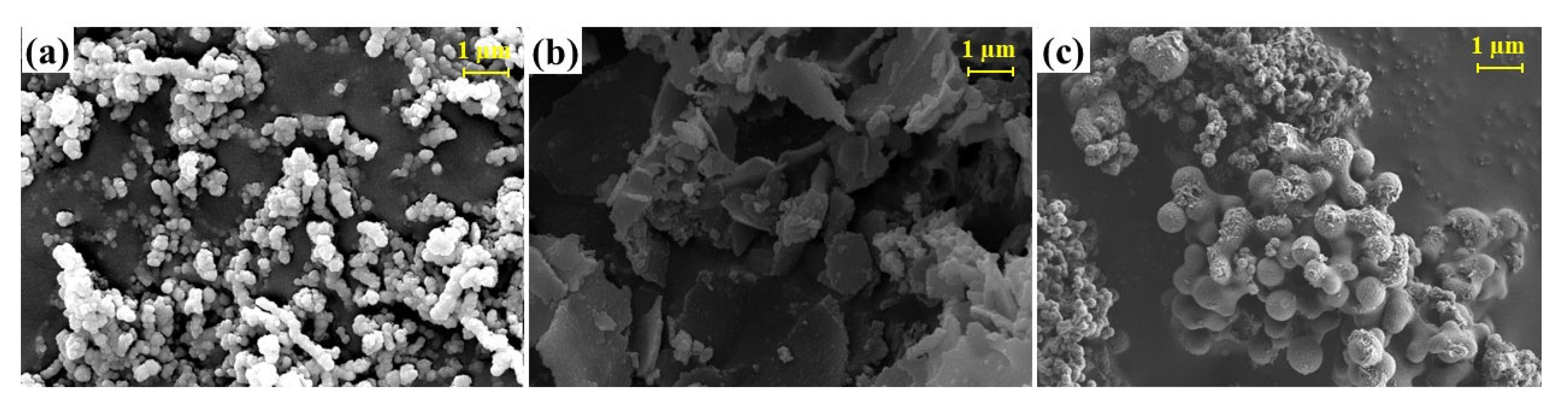
Figure 1. SEM images of (a) nFe0; (b) MMT-nFe0/Cu0; (c) CMS@S-nFe0.
Catalysts 15 01077 g001
Figure 2. Effect of water–soil ratio in (a) MMT-nFe0/Cu0 and (b) CMS@S-nFe0 reaction systems on the removal of Cr(VI) and PNP in soil.
Catalysts 15 01077 g002
Figure 3. Effect of MMT-nFe0/Cu0 dosage on the removal of (a) Cr(VI) and (b) PNP; effect of CMS@S-nFe0 dosage on the removal of (c) Cr(VI) and (d) PNP.
Catalysts 15 01077 g003
Figure 4. Effect of PMS concentration in MMT-nFe0/Cu0 system on the removal of (a) Cr(VI) and (b) PNP; effect of PMS concentration in CMS@S-nFe0 system on the removal of (c) Cr(VI) and (d) PNP.
Catalysts 15 01077 g004
Figure 5. Effect of pH in MMT-nFe0/Cu0 system on the removal of (a) Cr(VI) and (b) PNP; effect of pH in CMS@S-nFe0 system on the removal of (c) Cr(VI) and (d) PNP.
Catalysts 15 01077 g005
Figure 6. The variation in (a) Cr(VI) and (b) PNP leachate concentrations with the volume of leachate solution in soil column leaching test.
Catalysts 15 01077 g006
Figure 7. Morphological distribution of Cr in the system of control group, MMT-nFe0/Cu0, and CMS@S-nFe0.
Catalysts 15 01077 g007
Figure 8. (a) XRD patterns of original soil, MMT-nFe0/Cu0, and CMS@S-nFe0 reaction systems; (b) FT-IR patterns of original soil, MMT-nFe0/Cu0, and CMS@S-nFe0 reaction systems; XPS patterns of CMS@S-nFe0: (c) Fe 2p and (d) Cr 2p.
Catalysts 15 01077 g008
Figure 9. Mechanism for the synergistic remediation of Cr(VI) and p-nitrophenol in soil using metal-/non-metal-doped nZVI catalysts with high dispersion in the presence of persulfate activation.
Catalysts 15 01077 g009
Disclaimer/Publisher’s Note: The statements, opinions and data contained in all publications are solely those of the individual author(s) and contributor(s) and not of MDPI and/or the editor(s). MDPI and/or the editor(s) disclaim responsibility for any injury to people or property resulting from any ideas, methods, instructions or products referred to in the content.