Article

Development of a Au/TiO2/Ti Electrocatalyst for the Oxygen Reduction Reaction in a Bicarbonate Medium


1
Department of Chemistry, College of Science, King Saud University, P.O. Box 2455, Riyadh 11451, Saudi Arabia
2
Electrochemistry & Catalysis Research Laboratory (ECRL), Department of Chemistry, School of Physical Sciences, Shahjalal University of Science and Technology, Sylhet 3114, Bangladesh
3
Department of Chemistry, Faculty of Science, Noakhali Science and Technology University, Noakhali 3814, Bangladesh
4
Division of Chemistry, Department of Science and Humanities, Military Institute of Science and Technology, Mirpur Cantonment-1216, Dhaka 1216, Bangladesh
5
Department of Chemistry, Mawlana Bhashani Science and Technology University, Tangail 1902, Bangladesh
6
Center for Nanotechnology, Department of Natural Sciences, Coppin State University, 2500 W. North Ave., Baltimore, MD 21216, USA
*
Authors to whom correspondence should be addressed.
Catalysts 2025, 15(11), 1074; https://doi.org/10.3390/catal15111074
Submission received: 9 September 2025 / Revised: 11 November 2025 / Accepted: 11 November 2025 / Published: 13 November 2025

Abstract

The oxygen reduction reaction (ORR) is a pivotal electrochemical process in energy technologies and in the generation of hydrogen peroxide (H2O2), which serves as both an effective agent for dye degradation and a fuel in H2O2-based fuel cells. In this regard, a titanium (Ti) sheet was anodized to generate a TiO2 layer, and then the oxide layer was modified with gold (presented as Au/TiO2/Ti) via electrodeposition. The developed electrocatalyst was confirmed by X-ray photoelectron spectroscopy (XPS), which showed characteristic binding energies for Ti4+ in TiO2 and metallic Au. In addition, the Nyquist plot verified the electrode modification process, since the diameter of the semicircular arc, corresponding to charge transfer resistance, significantly decreased due to Au deposition. Voltametric studies revealed that the TiO2 layer with a Ti surface exhibited a good synergistic effect on Au and the ORR in a bicarbonate medium (0.1 M KHCO3) by lowering the overpotential, enhancing current density, and boosting durability. The scan rate-dependent study of the ORR produced by the developed electrocatalyst showed a Tafel slope of 180 ± 2 mV dec−1 over a scan rate range of 0.05–0.4 V s−1, thereby indicating a 2e transfer process in which the initial electron transfer process was the rate-limiting step. The study also revealed that the Au/TiO2/Ti electrode caused oxygen electro-reduction with a heterogenous rate constant (k0) of 4.40 × 10 3 cm s−1 at a formal potential (E0′) of 0.54 V vs. RHE.

1. Introduction

The global energy landscape faces a critical and escalating paradox: an infrastructure under unprecedented strain from the rapid depletion of finite fossil fuels and the continuously growing demand for power [1]. This unsustainable trajectory is driven by the fact that the world’s insatiable energy appetite, propelled by rampant industrialization and demographic expansion, is exhausting the planet’s finite reserves of coal, oil, and natural gas at a catastrophic pace [2]. In addition, this reliance on carbon-intensive fuels is the primary contributor to severe environmental pollution, manifesting as atmospheric greenhouse gas accumulation, climate change, ocean acidification, and public health crises [3]. It is precisely this convergence of pressing challenges like resource depletion, soaring demand, environmental degradation, and the current limitations of alternatives that has catalyzed an urgent global imperative [4]. Consequently, the focus has decisively shifted from mere consideration to the active and strategic development of a diversified green energy portfolio recently termed as green bond financing [5,6]. The mission is no longer to simply utilize renewables but to advance their efficiency, scalability, and economic viability through innovation, infrastructure investment, and policy support, thereby securing a sustainable and resilient energy future [7].
This urgent challenge has, in turn, galvanized research into sustainable energy alternatives. Among these, fuel cells are recognized as highly efficient, low-emission energy conversion technologies pivotal for mitigating climate impacts. Concomitantly, the development of highly efficient electrocatalysts constitutes a central thrust in modern materials science research [8]. This intense focus is driven by the pivotal role that these catalysts play in enhancing kinetic rates and minimizing overpotential, thereby directly determining the energy conversion efficiency and practical viability of next-generation technologies such as fuel cells, electrolyzers, and metal–air batteries [9]. Within the pursuit of sustainable energy, the oxygen reduction reaction (ORR) is the crucial electrochemical process at the heart of next-generation energy technologies like fuel cells and metal–air batteries [10,11]. This reaction is also highly promising for the generation of hydrogen peroxide (H2O2), which serves as both an effective agent for dye degradation and a fuel for H2O2-based fuel cells. It is worth mentioning that H2O2 has garnered significant interest as an alternative fuel in fuel cell applications due to its abundance, low cost, high volumetric energy density, and carbon-free emissions [12]. It is already adopted as a promising oxidant due to the following advantages: (i) being a carbon-free liquid [13]; (ii) its operation in an oxygen-free environment [14]; (iii) its ability to enhance overall cell performance by increasing cell voltage [15]; (iv) its ability to reduce activation loss [16]; (v) its ability to alleviate the water flooding problem in fuel cells [17]. Generally, hydrogen peroxide is used as oxidant in conventional two-compartment fuel cells where ethanol [15], sodium borohydrides [14], hydrazine [18], or metals [19] are used as fuel. In this type of configuration, H2O2 undergoes a reduction reaction and produces water molecules. The efficacy of H2O2 as an oxidant in these systems is governed by its reduction mechanism.
However, it is well established that this cathodic process can proceed via two primary pathways in a basic aqueous medium: efficient four-electron (4e) transfer to hydroxide (OH) or two-electron (2e) transfer to peroxide (HO2) as per Equations (1) and (2) [20].
4 e   pathway : O 2   +   2 H 2 O   +   4 e     4 OH
2 e   pathway : O 2   +   H 2 O   +   2 e     H O 2   + OH
The 4e pathway is preferred for fuel cells due to its high current density and energy efficiency, while the 2e pathway is industrially significant for the sustainable production of hydrogen peroxide [21,22]. The electrochemical generation of H2O2 from oxygen via the 2e pathway has drawn significant attention, often preferred to conventional techniques such as direct synthesis from H2 and O2 gases and the anthraquinone method, as this method is eco-friendly and sustainable, avoids explosive reagents, provides on-site production, consumes relatively low energy, and shows high product selectivity [23,24,25,26,27]. So, the strategic development of catalysts is essential to steer this reaction toward the production of H2O2 through the 2e pathway which has further utilization in fuel cells or dye degradation. Consequently, the quest to develop high-performance ORR catalysts is a major frontier in materials science and electrochemistry, especially for proton exchange membranes (PEMs) and H2O2-based fuel cells. To address the inherent inefficiencies of the currently developed catalysts, researchers are employing sophisticated strategies such as nano-structuring, doping, and defect engineering to tailor the electronic properties and surface chemistry of materials [28,29,30]. Moreover, catalysts such as N-doped carbon, metal–organic frameworks (MOFs), and single-atom catalysts are promising materials available to improve ORR efficiency [31,32,33,34]. The aim is to optimize the binding energy of oxygen intermediates, thereby steering the reaction toward the production of H2O2 via a more efficient pathway and dramatically boosting the performance of electrochemical devices.
In parallel, it is established that the incorporation of semiconducting metal oxides, such as TiO2, SnO2, or WO3, significantly enhances the durability of metal–carbon electrocatalysts [35]. These oxides function as robust, corrosion-resistant supports, mitigating the carbon corrosion that typically occurs under harsh electrochemical operating conditions [36]. One of the most commonly used metal oxides is TiO2, and of interest are TiO2 nanotube (TNT) arrays, which have been extensively studied and used for a wide range of electrochemical applications [37,38,39,40]. However, conventionally, TiO2 is a poor electrocatalyst for the oxygen reduction reaction (ORR) due to its inherently low electrical conductivity and lack of electroactive sites. Moreover, TiO2 is highly resistant to oxidation and corrosion under fuel cell operating conditions [41]. In anodically prepared TiO2 electrodes, such as the ones in our study, it has been confirmed that a four-electron process is the dominant reduction process in alkaline media [42]. The foundational TiO2 layer, grown on a Ti substrate, provides a stable, high-surface-area scaffold but remains electrochemically inert [43]. Within this context, gold nanoparticles (Au NPs) have emerged as a promising, highly tunable platform due to their unique catalytic properties, which are known to be profoundly influenced by their size and morphology. Notably, it is also found that Au has superior catalytic ability regarding the ORR. A study by Wang et al. [44] provided a seminal investigation into the precise structure–property relationships that govern ORR activity on shaped-controlled Au nanoparticles. In our recent study, we incorporated Au nanoparticles on a GCE electrode for dye degradation via the ORR [45]. With this in mind, in our current study, the addition of gold (Au) nanoparticles over anodized TiO2 primarily addresses the critical issue of conductivity, creating electron pathways and providing initial active sites for oxygen adsorption.
Guided by established design principles for high-performance electrocatalytic systems, we engineered a composite electrode architecture (Au/TiO2/Ti) aimed at enhancing both stability and activity for the ORR in neutral media. Specifically, the foundation consists of an anodically grown TiO2 layer on a titanium sheet, providing a robust, high-surface-area support conducive to efficient mass transport. The incorporation of Au is intended to electronically modify the surface. This strategic combination is designed to optimize the adsorption behavior of oxygenated intermediates on catalytic sites, thereby favorably enhancing ORR kinetics. Following fabrication, to validate the surface morphology and chemical composition of the Au/TiO2/Ti electrode, scanning electron microscopy (SEM) and X-ray photoelectron spectroscopy (XPS) were employed. These techniques confirmed the successful formation and distribution of the Au particles on the TiO2 layer. To complement these structural analyses, for electrochemical characterization, cyclic voltammetry (CV), and electrochemical impedance spectroscopy (EIS) were employed to evaluate the catalytic activity, reaction kinetics, and charge transfer behavior of the electrode toward the oxygen reduction reaction (ORR) in a slightly basic medium, namely a bicarbonate medium.

2. Results and Discussion

2.1. Surface Characterization

X-ray photoelectron spectroscopy (XPS) was employed to obtain information about the elemental composition and chemical/electronic state of the developed electrode material. Figure 1A represents the spectrum of the anodized Ti electrode, which illustrates two peaks at 458.26 and 463.86 eV, with a peak difference of 5.6 eV. As per previous studies [46,47,48], these two peaks can be assigned to Ti 2p3/2 at 458.26 eV and to Ti 2p1/2 at 463.86 eV; such observation indicates the Ti4+ of TiO2 in anatase form.
After depositing the Au metal, XPS analysis of the modified electrode was performed. The peak position of Ti in Au-modified TiO2 was again assessed to find any changes in the chemical states. It is observed in Figure 1B that the peaks corresponding to Ti 2p3/2 and Ti 2p1/2 retained approximately the same position after Au deposition. The O 1 s spectrum of the TiO2 surface (see Figure 1C) exhibits a prominent peak centered at 531.50 eV, which is characteristic of lattice oxygen (O2−) in the Ti–O–Ti framework of TiO2. In addition, a secondary peak is also observed at higher binding energy (533.25 eV), which corresponds to surface hydroxyl groups (–OH) or adsorbed oxygen species (O22−/O) on the TiO2 surface. Such surface oxygen species and hydroxyl groups can enhance surface reactivity and play a crucial role in catalytic and electrochemical processes by facilitating charge transfer and the adsorption of reactant molecules (e.g., O2 or intermediates during ORR). Figure 1D shows two peaks at 84.03 and 87.71 eV, which can be assigned to Au 4f7/2 and Au 4f5/2, respectively, and such observation indicates Au in its metallic state, thereby demonstrating the successful deposition of Au on the TiO2 layer.
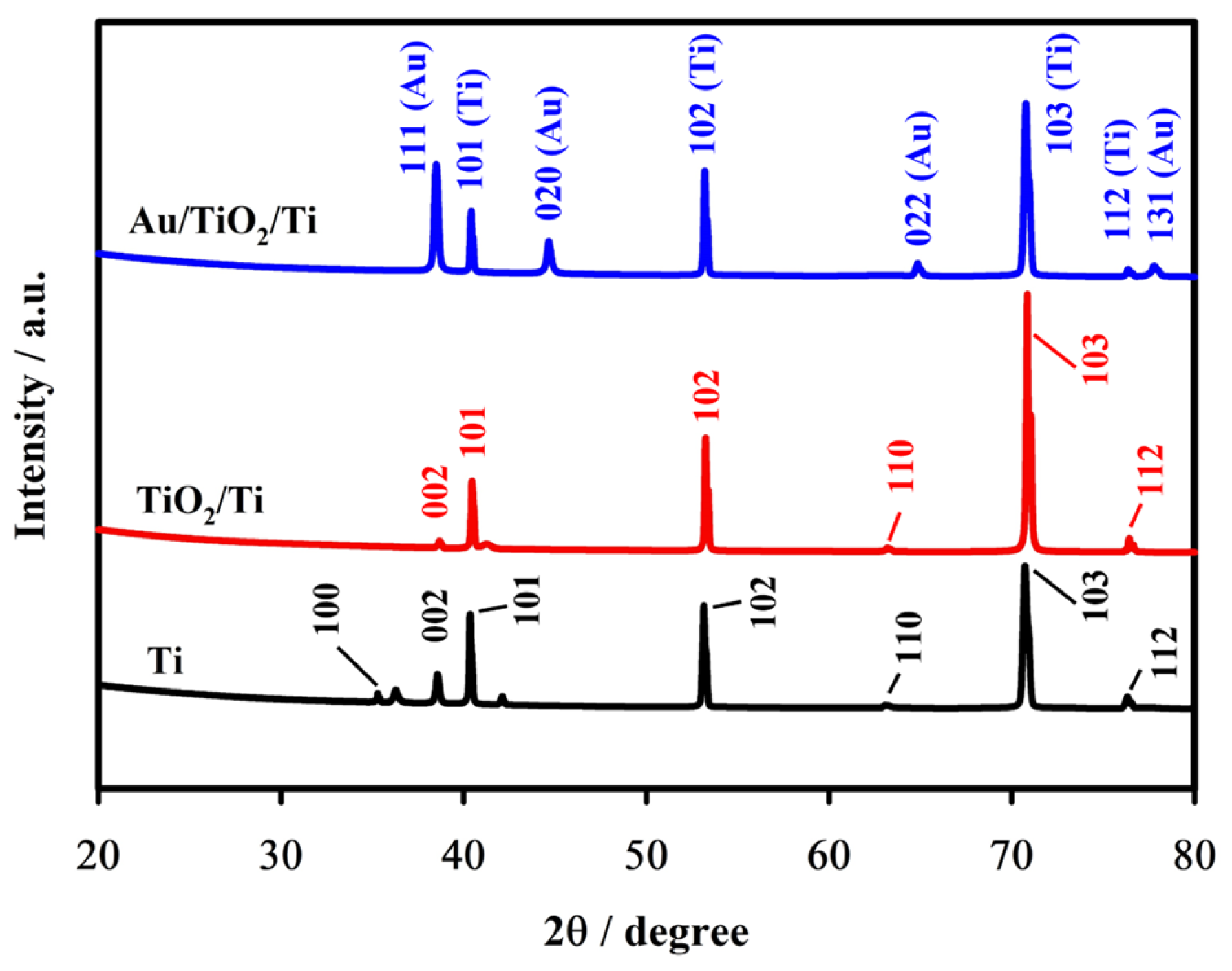
In addition to XPS characterization, X-ray diffraction (XRD) analysis was performed to examine the crystalline structure and phase composition of the synthesized electrocatalyst. Figure 2 depicts the comparative XRD patterns of pristine Ti, TiO2/Ti, and Au/TiO2/Ti samples, in which no detectable new diffraction peaks appeared after the anodization process. This observation from these XRD signals indicates that the anodized Ti surface does not contain any crystalline TiO2 phase detectable by XRD, meaning the oxide layer formed is either amorphous or too thin to generate measurable diffraction patterns [49,50,51,52,53,54]. In line with previous studies, the absence of distinct TiO2 peaks is often observed for anodically produced TiO2 films, which typically remain amorphous prior to thermal treatment [49,50,51,52,53]. It is observed from the figure that the Ti diffraction peaks of (101) and (200) planes at 2θ = 36.26° and 42.11° weakened or vanished after the anodization process. This finding can be attributed to the coating of the Ti surface by a new amorphous oxide film and alterations in the Ti’s underlying crystal structure during anodization [2,3]. The relative intensity changes among the remaining Ti reflections further suggest a texture evolution in the underlying substrate. Moreover, the changes in intensities of the Ti diffraction peaks suggest a textural evolution underlying the Ti substrate. Following Au deposition, new peaks appeared in the diffraction pattern, confirming the presence of a face-centered cubic (fcc) Au structure. The strong intensity of the (111) reflection relative to other Au peaks reveals that the deposited Au illustrates a pronounced (111) preferred orientation [55].
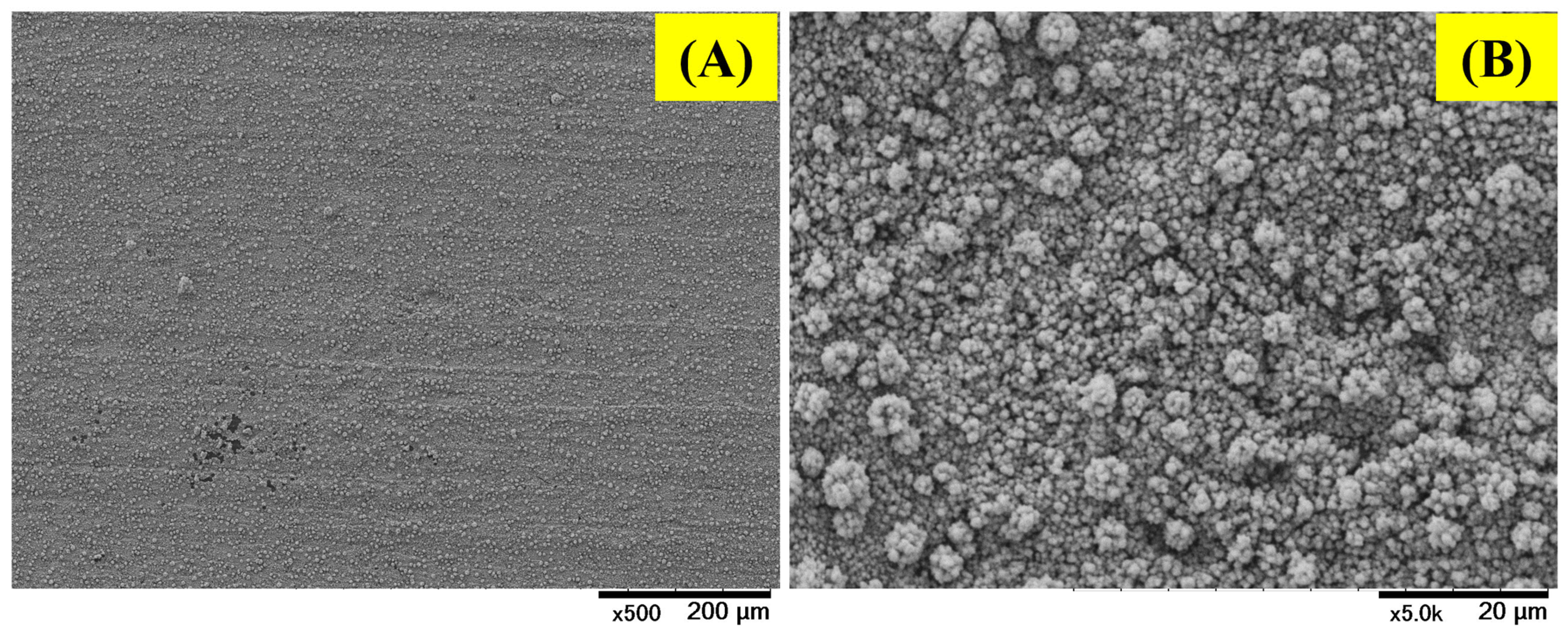
At this point, the surface of the developed electrode was assessed with a scanning electron microscope (SEM). Figure 3A,B show the SEM micrograph of the Au/TiO2/Ti composite electrode at different magnifications. The surface appears to be composed of aggregated clusters, which enhance the effective surface area of the electrode. The distribution of bright regions across the surface corresponds to the presence of Au particles, which exhibit higher electron density and thus appear brighter in the SEM image. The underlying porous TiO2 network serves as a framework, providing anchoring sites for Au particles. The overall morphology demonstrates that anodization followed by Au deposition produced a heterogeneous yet well-integrated composite surface, which is expected to promote enhanced catalytic activity due to the synergistic interaction between Au and TiO2.
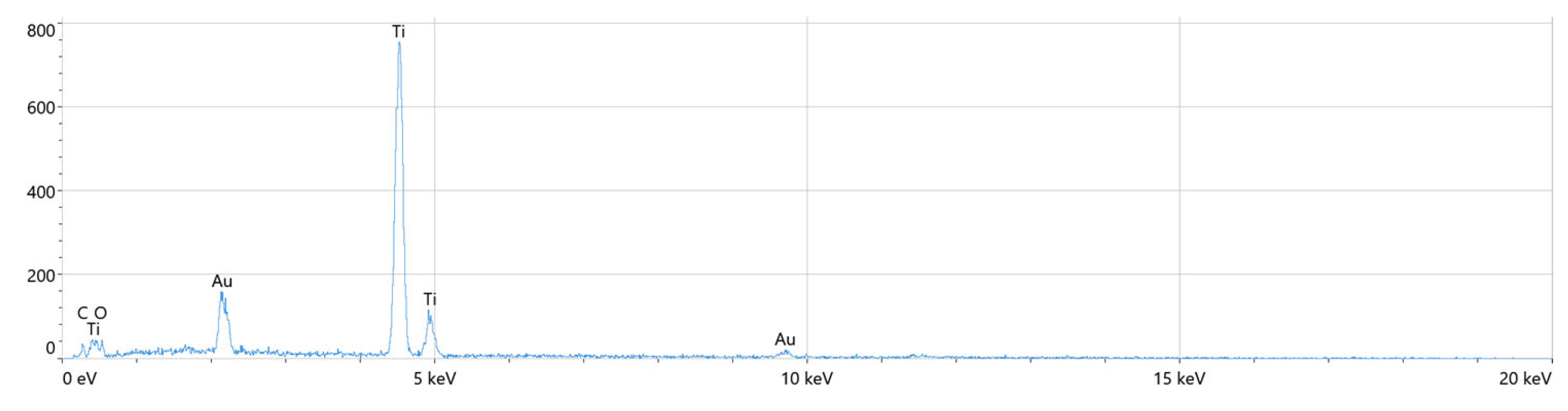
The EDX spectrum of the Au/TiO2/Ti electrode (see Figure 4) confirms the elemental composition of the surface. The detected elements are Ti, O, Au, and C, consistent with the expected structure of the anodized TiO2 layer decorated with Au nanoparticles. The elemental composition of the Au/TiO2/Ti electrode is summarized in Table 1.
A strong Ti signal (70.8 at%) is observed due to the Ti substrate and the anodically formed TiO2 layer. The O peak (14.8 at%) arises from the oxide layer on the Ti surface, confirming the presence of TiO2. The Au signal (6.5 at%) indicates the successful deposition of Au particles on the anodized TiO2 surface. The relatively low atomic percentage of Au compared to Ti is expected since Au is present as a dispersed particulate layer. The corresponding weight percentages (Ti: 67.7 wt.%, Au: 25.7 wt.%, O: 4.7 wt.%) further emphasize the dominance of the Ti substrate and the significant presence of the deposited Au. These findings confirm that the electrode surface comprises mainly Ti and Au, with a TiO2 layer, validating the successful fabrication of the Au/TiO2/Ti composite structure.

2.2. Electrochemical Characterization

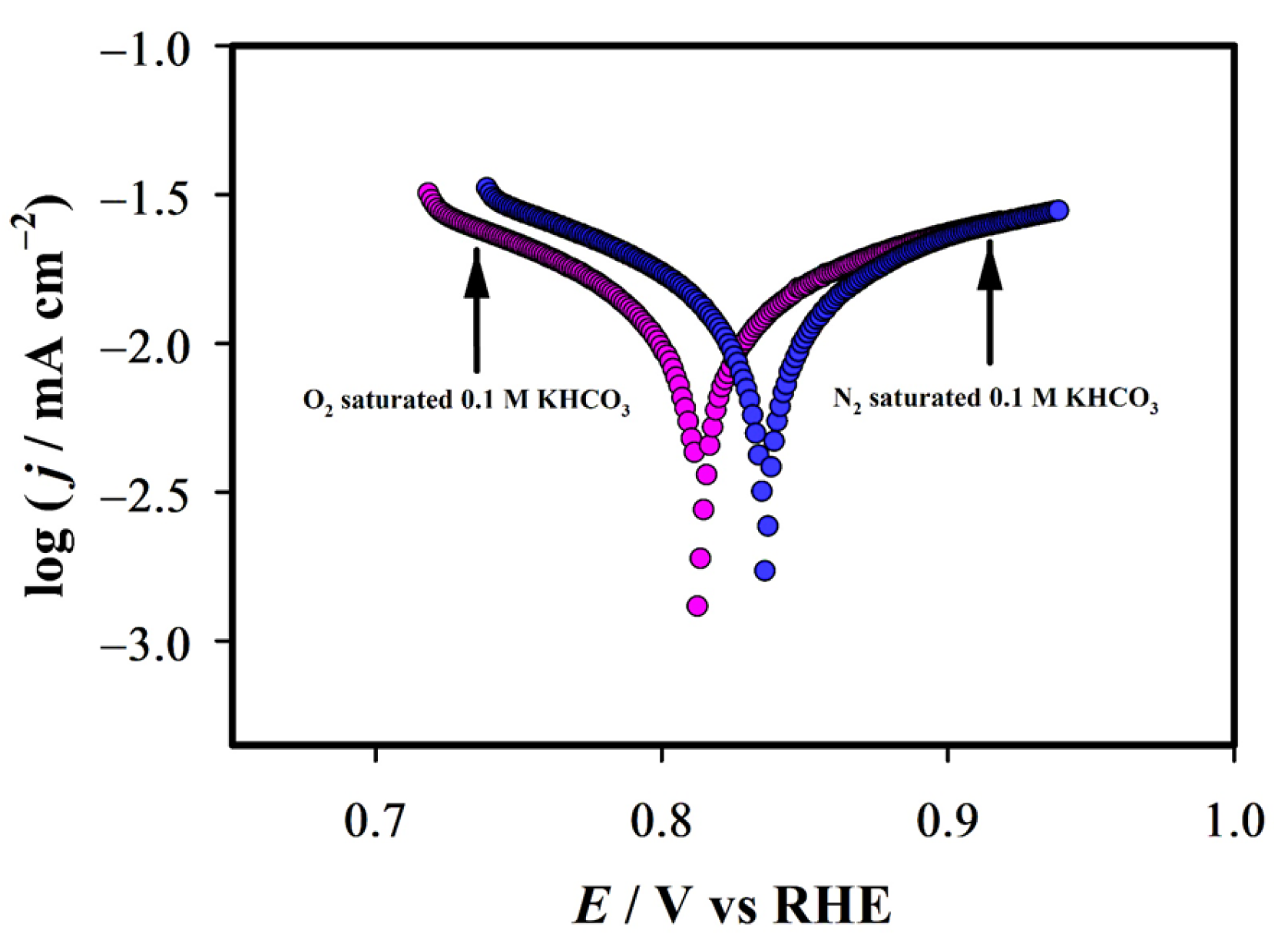
When there is no current flowing through an electrode, its internal potential can be expressed by measuring the open circuit potential (OCP). To distinguish the interfacial electrochemical properties that emerged at the surface of the Au/TiO2/Ti electrode in the presence and absence of O2, the OCP was examined in this study in an O2 and N2-saturated 0.1 M KHCO3 electrolyte.
The polarization curves recorded for the Au/TiO2/Ti electrode in O2-saturated and N2-saturated 0.1 M KHCO3 medium, as portrayed in Figure 5, show that the OCP value for O2-saturated alkaline medium is +0.81 V, but when the electrolyte becomes saturated with N2, the value shifts to +0.84 V. The less positive charge developed in the oxygen-saturated medium indicates that applying a minimal amount of negative potential would catalyze the reduction process in the presence of oxygen species.
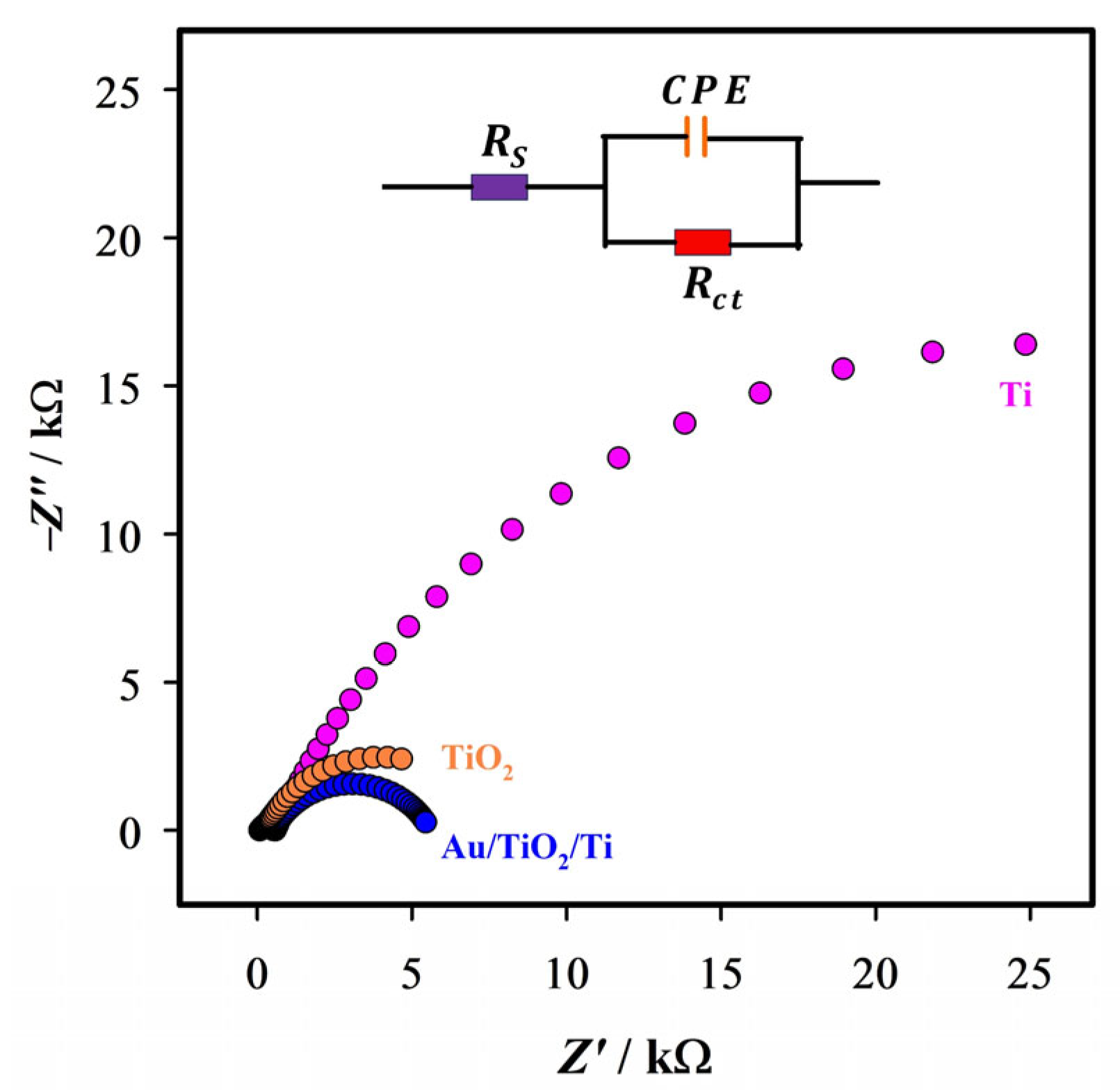
Electrochemical impedance spectroscopy (EIS) is a powerful tool for examining an electrode surface’s electrical characteristics. To study the charge transfer resistance (Rct), EIS spectra were recorded at same potential for bare Ti, TiO2/Ti, and Au/TiO2/Ti electrodes in O2-saturated 0.1 M KHCO3 to differentiate between the electrical properties and efficiency of the electrodes.
Figure 6 illustrates three Nyquist plots: a bigger semicircular EIS spectrum of a pristine Ti electrode and two progressively smaller semicircular spectra for the TiO2/Ti and Au/TiO2/Ti electrodes. The values of the corresponding circuit elements are summarized in Table 2. The value of the Rct corresponding to bare Ti is 36.6 kΩ, which decreases significantly to 7.55 kΩ after formation of the TiO2 layer over Ti via anodization, demonstrating enhanced charge transfer kinetics due to the formation of the TiO2 layer. Further attenuation of Rct to 3.80 kΩ can be observed upon Au deposition on the TiO2 surface, indicating that the particles of Au over the layer facilitate faster electron transfer and improve the overall interfacial conductivity. The markedly lower Rct of the Au/TiO2/Ti electrode signifies minimal barrier to charge transfer during the electrochemical reaction, while the higher resistance of bare Ti reflects sluggish reaction kinetics. Thus, the comparison clearly demonstrates that Au/TiO2/Ti exhibits superior electrochemical activity and is more effective for the ORR than the unmodified Ti electrode.

2.3. Catalytic Activity

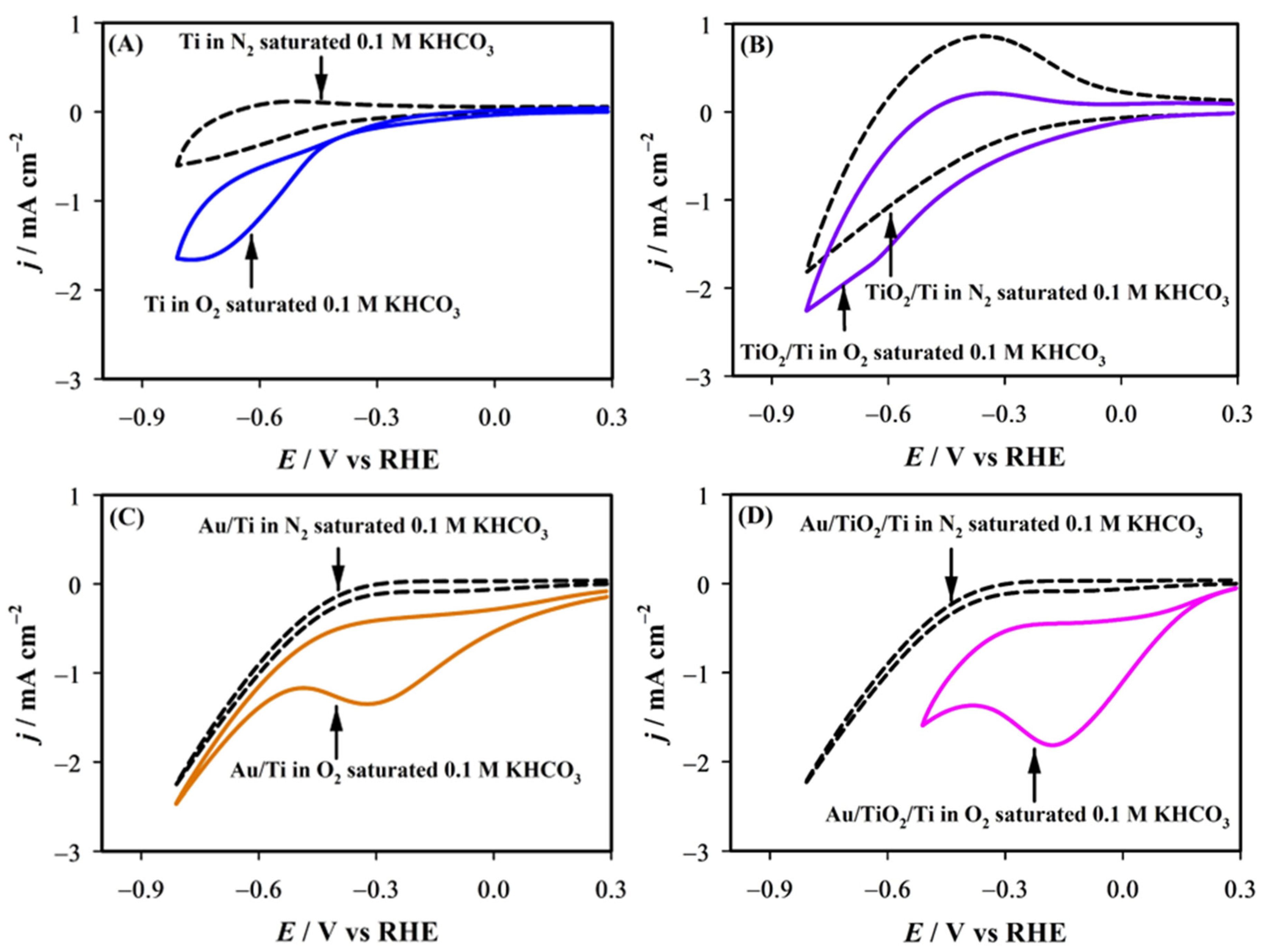
In order to elucidate the viability of the reduction process, the activity of bare Ti and the modified Ti electrodes for the ORR was examined by utilizing the cyclic voltametric technique, in which the range of the applied potential was from 0.3 to −0.8 V vs. RHE at a scan rate of 0.1 V s−1.
Figure 7A depicts the cyclic voltammograms (CVs) of the oxygen reduction reaction on the Ti electrode in N2 and O2-saturated 0.1 M KHCO3 electrolytic solutions. t is evident from the figure that the peak current density of 1.64 mA cm−2 at −0.78 V vs. RHE with an onset potential of −0.38 V vs. RHE on bare Ti in O2-saturated 0.1 M KHCO3 medium compared to in the N2-saturated medium, indicating the reduction of O2 on the electrode. The formation of the TiO2 layer on the Ti electrode via anodization diminished the activity of the ORR rather than enhancing the ORR, as shown in Figure 7B. Furthermore, Au deposition on the Ti electrode enhanced ORR performance by lowering the peak potential and onset potential by 480 and 650 mV, respectively. However, the combination of Au and Ti was still insufficient since the electrode reduced the current density by 0.3 mA cm−2, as shown in in Figure 7C. On the contrary, the deposition of Au on the TiO2 layer modifying the Ti electrode considerably improved ORR performance, as illustrated in Figure 7D, since it reduced oxygen molecules with a current density of −1.81 mA cm−2 at −0.18 V vs. RHE, with a set potential of 0.26 V vs. RHE. The reduction performance was improved in terms of peak current density, peak potential, and onset potential, as presented in Table 3; therefore, the combination of Au and TiO2 with a Ti surface has a good synergistic effect.

2.4. Scan Rate Effect

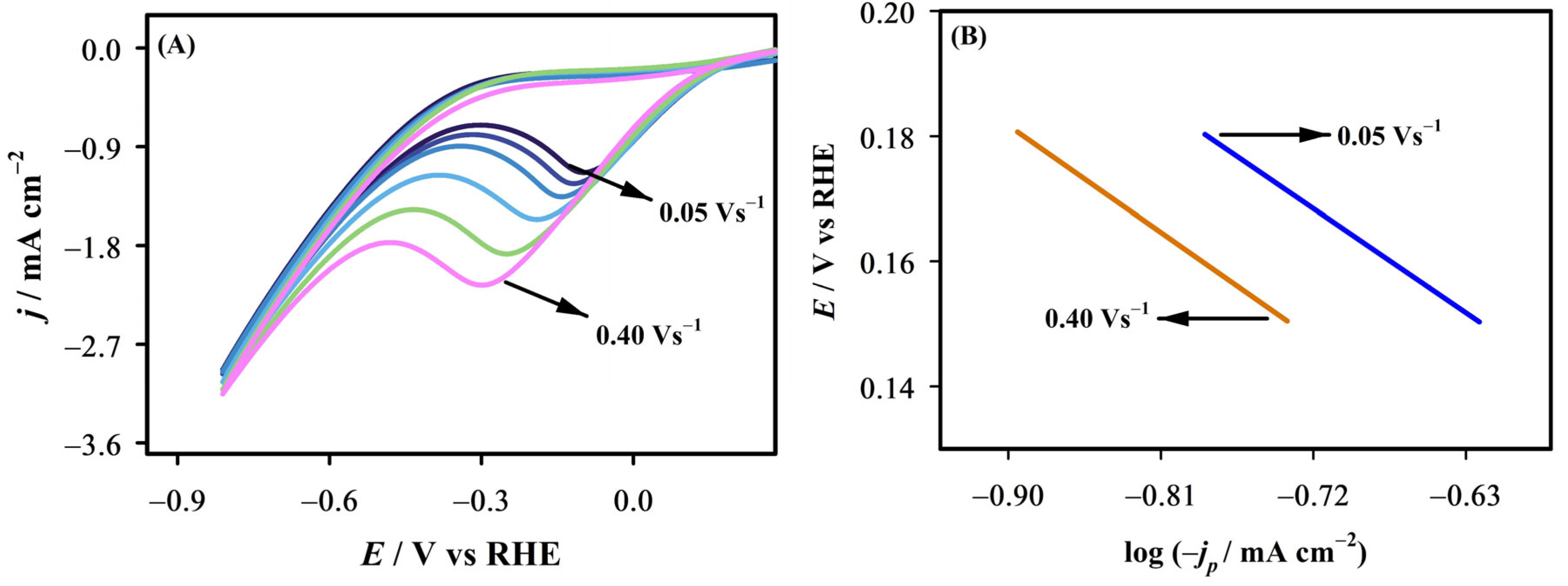
A scan rate-dependent study helps to elucidate the important information about an electrochemical process in terms of mechanisms and kinetics; therefore, the CVs of the Au/TiO2/Ti electrode in related to the ORR were recorded at variable scan rates (0.05–0.4 V s−1). The voltammograms, as illustrated in Figure 8A, show two fundamental features of an irreversible electrode process, i.e., a gradual increase in the peak current density (jp) and the negative shifting of the peak potential (Ep) with scan rate (see Figure S1A,B) [45,56,57,58].
In connection to the irreversible electrode process, the potential separation between the value of the peak (Ep) and half peak (Ep/2), i.e., ΔEp/2, was evaluated for each scan rate and was found to be around 0.51 V over the investigated scan rate range, as illustrated in Figure S1C. The value was almost invariant with respect to scan rate, thereby indicating that the electrode process followed a conventional kinetic framework given by the Butler–Volmer equation [45,56,57,59]. Regarding this adherence, the Tafel slope was evaluated by plotting E vs. log (−j) and was found to be 180 ± 2 mV dec−1 as per Equation (3) over the scan rate range of 0.05–0.4 V s−1 (see Figure 8B). The observed Tafel slope implies that the electron-transfer kinetics play an important role in controlling the overall two-electron reduction of O2 to H2O2 on the Au/TiO2/Ti surface [60].
E = E 0 + b × log j 0 b × log j
where b = 2.303 R T α F is the Tafel slope and j 0 is the exchange current density.
In order to evaluate the formal potential from the intercept of the Tafel slope in this particular case, the value of j 0 must be known. The value of the exchange current density can be determined indirectly from the relation j 0 = n F C k 0 , which connects j0 with a heterogeneous rate constant. The value of k0 is only applicable to the case in which the diffusional current density shows deviation from linearity with further scan rate increment, which can be evaluated using Equation (4).
k 0 = 1.11   D ϑ E p E p / 2  
where D is the diffusion coefficient of O2 (2.0 × 10⁻⁵ cm2 s−1), υ is the scan rate (V s−1) after which the linearity deviates, and EpEp/2 is the difference between the peak potential and the half-peak potential (0.51 V).
The developed electrode showed deviation from linearity after reaching a 0.4 V s−1 scan rate, and the value of the k0 was calculated to be 4.40 × 10 3 cm s−1 by evaluating the peak width at this scan rate. By using the values of these parameters, the formal electrode potential was calculated to be 0.54 V vs. RHE.

2.5. Stability Evaluation

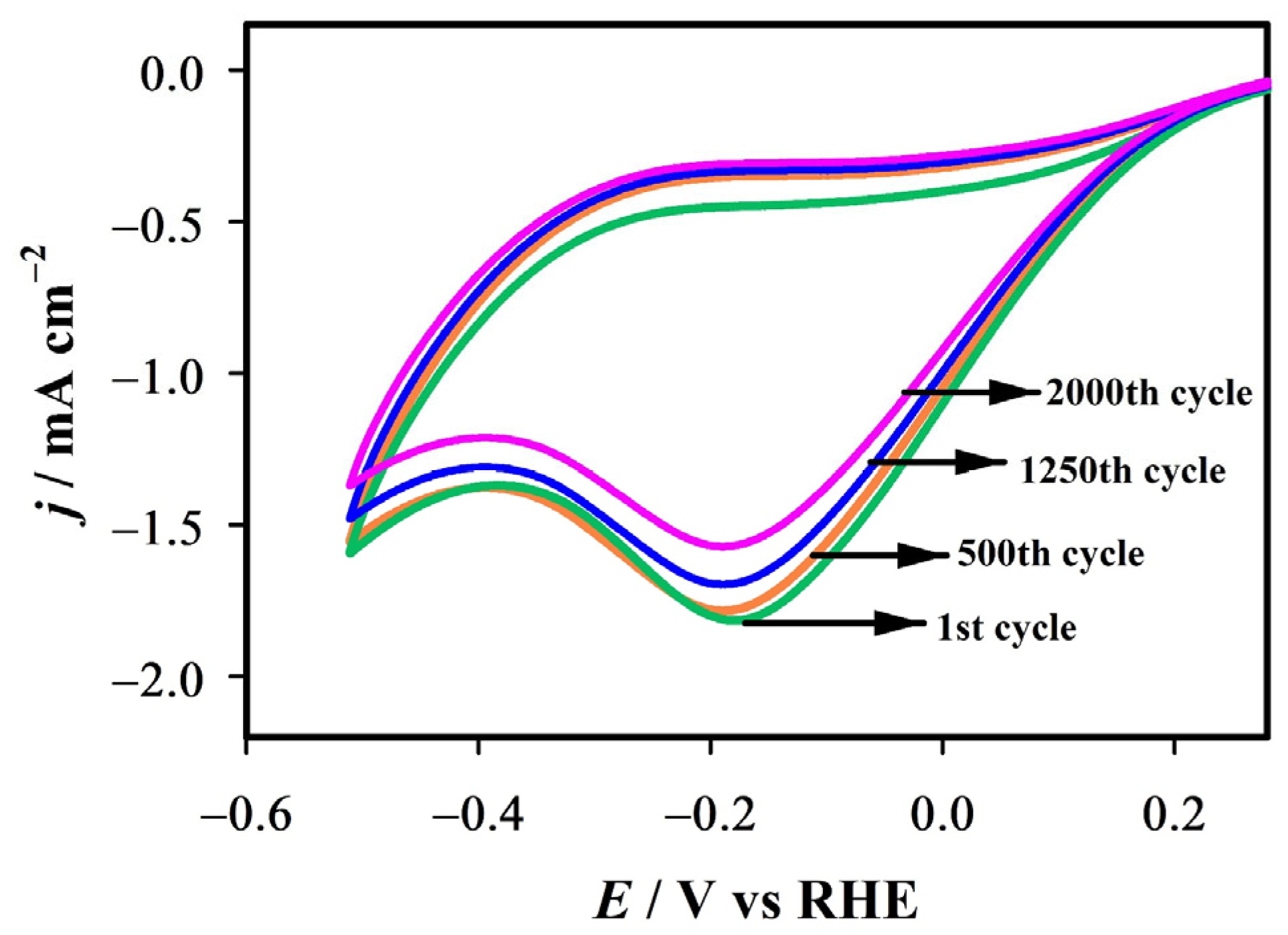
A catalyst can be considered efficient and practically applicable if it exhibits sufficient stability. This is the key factor in choosing an electrode catalyst with confirmed durability during the reaction process. The modified Au/TiO2/Ti electrode catalyst was assessed in terms of stability using the voltametric technique for the ORR in O2-saturated 0.1 M KHCO3. As illustrated in Figure 9, both the potential and peak current density demonstrated negligible changes after 500 voltametric cycles, indicating excellent stability. Furthermore, only a slight decrease in current density—approximately 5% after 1250 cycles and 12% after 2000 cycles—was observed. These results indicate that the modified electrode possesses outstanding durability and stability for the ORR under the tested conditions.

3. Experimental

3.1. Chemicals and Instruments

All chemicals employed in this study were of analytical grade and used as received, without any additional purification. A sheet of titanium (Ti) metal, tetrachloroauric (III) acid (HAuCl4), 98% sulfuric acid (H2SO4), 37% hydrochloric acid (HCl), sodium hydroxide (NaOH) pellets, potassium bicarbonate (KHCO3), absolute ethanol (C2H5OH), and acetone (CH3COCH3) were purchased from Sigma Aldrich (St. Louis, MO, USA).
The electrochemical experiments were carried out in a three-electrode Pyrex glass cell utilizing an Autolab PGSTAT 128N or a CHI 602E (CH Instruments) potentiostat. The electrochemical cell consists of a Ti sheet working electrode, an Ag/AgCl (sat. KCl) reference electrode, and a Pt counter electrode. A Milli-Q water system provided the high-purity water for all solutions. The experimental setup also employed a sonicator for electrode preparation, a hot plate with temperature control, and N2/O2 cylinders for solution purging. All measured potentials versus the Ag/AgCl reference electrode were converted to the reversible hydrogen electrode (RHE) scale according to Equation (5) (note: pH of 0.1 M KHCO3 is 8.3) [61]:
ERHE = EAg/AgCl + 0.059 pH + 0.1971

3.2. Electrode Fabrication

3.2.1. Synthesis of TiO2 Layer on Ti Sheet

The formation of the TiO2 layer was achieved through the anodization process. In order to accomplish this, a Ti sheet with a geometric area of 0.196 cm2 was taken and cleaned by sonicating it in a mixture of acetone and deionized water for 10 min to remove adsorbed substances from the Ti surface. The sonicated sheet was then placed in a beaker containing 6.0 M HCl and heated at 85 °C on a hot plate for another 10 min. Subsequently, the sheet was sonicated in deionized water for an additional 10 min. Once thoroughly cleaned, the sheet was placed in an electrochemical cell with a three-electrode configuration containing 1.0 M H2SO4. A potential of 12.0 V was applied using a DC power adapter (12 V, 2 A) [62]. After 2 h of treatment, the color of the Ti sheet changed from gray to brown, indicating the formation of TiO2.

3.2.2. Au/Ti Electrode Fabrication

Metallic gold was electrodeposited onto the titanium sheet substrate from a 0.05 M chloroauric acid (HAuCl4) solution. The electrolyte was prepared by dissolving 0.0759 g of HAuCl4 in 5 mL of Milli-Q water. Deposition was performed using a three-electrode configuration via cyclic voltammetry by scanning the potential from 0 to −1.0 V (vs. Ag/AgCl (sat. KCl)) at a rate of 0.1 V s−1. This process was repeated for three consecutive cycles to ensure complete coverage.

3.2.3. Au/TiO2/Ti Electrode Fabrication

Metallic Au was deposited on the anodized Ti sheet (that is, TiO2/Ti) via electrochemical deposition. Briefly, the TiO2/Ti electrode was subjected to the cyclic voltametric technique, with electrochemical scanning from 0 V to −1.0 V at a scan rate of 0.1 V s−1 for three cycles in an electrochemical cell configured with a three-electrode system, containing 10 mL of a 0.05 M chloroauric acid solution.

3.3. Surface Properties Analysis

Surface morphological characterization was performed via scanning electron microscopy (SEM) using a Hitachi TM3030 Plus system (Hitachi, Tokyo, Japan), coupled with energy-dispersive X-ray spectroscopy (EDX) for elemental analysis. To evaluate the surface chemical states and elemental composition, X-ray photoelectron spectroscopy (XPS) was conducted on a Kratos Axis-Ultra instrument (Shimazu-Kratos, Tokyo, Japan) equipped with a monochromatic Al Kα source (1486.68 eV). Furthermore, the crystalline structure of the synthesized electrocatalyst was analyzed using an X-ray diffractometer (SmartLab, Rigaku, Japan) equipped with Cu Kα radiation (λ = 1.54 Å). The diffraction patterns were recorded over an appropriate 2θ range at room temperature to identify the crystalline phases present.

4. Conclusions

This study successfully developed and characterized a novel Au/TiO2/Ti composite electrode for the electrocatalytic oxygen reduction reaction; the electrode was fabricated via the anodization of a Ti sheet, followed by the electrochemical deposition of Au particles. Extensive surface characterization including XPS and SEM confirmed the successful formation of metallic Au nanoparticles on the anodized TiO2 surface. Subsequently, electrochemical evaluation demonstrated enhanced ORR activity, as evidenced by a higher cathodic current density (−1.81 mA cm−2) and a drastically lower charge transfer resistance (3.80 kΩ) compared to the pure Ti sheet (36.6 kΩ). Additionally, the kinetic evaluation revealed a Tafel slope of 180 mV dec−1, implying that the rate-limiting step involves the initial electron transfer. Furthermore, the electrode exhibited exceptional durability, maintaining its catalytic performance over 2000 cycles without significant degradation. In summary, the synergistic combination of Au particles and the TiO2/Ti substrate creates a highly active, stable, and selective electrocatalyst for the ORR, thereby presenting a promising candidate for applications in sustainable energy conversion and environmental remediation.

Supplementary Materials

The following supporting information can be downloaded at https://www.mdpi.com/article/10.3390/catal15111074/s1, Figure S1: (A) Variation of peak current density against square root of scan rate; (B) Variation of peak potential with respect to scan rate; (C) Variation of peak potential difference against scan rate.

Author Contributions

Investigation, formal analysis, funding acquisition, software, writing—original draft preparation, writing—review and editing, M.R.; validation, formal analysis, investigation, visualization, data curation, writing—original draft preparation, M.F.I.; writing—original draft preparation, visualization, M.A.; investigation, visualization, writing—review and editing, M.I.H.; writing—review and editing, funding acquisition, F.M.; investigation, formal analysis, writing—original draft preparation, T.A.O.; writing—review and editing, validation, M.A.R.; writing—review and editing, validation, funding acquisition, J.U.; conceptualization, supervision, methodology, resources, project administration, funding acquisition, M.A.H. All authors have read and agreed to the published version of the manuscript.

Funding

The authors acknowledge the Ongoing Research Funding program, (ORF-2025-674), King Saud University, Riyadh, Saudi Arabia, for funding this research work. The research center of Shahjalal University of Science and Technology, Bangladesh is acknowledged for supporting a research grant (PS/2025/03).

Data Availability Statement

The data will be provided upon reasonable request and with valid justification.

Acknowledgments

The authors acknowledge the Ongoing Research Funding program, (ORF-2025-674), King Saud University, Riyadh, Saudi Arabia, for funding this research work. The research center of Shahjalal University of Science and Technology, Bangladesh is acknowledged for supporting a research grant (PS/2025/03).

Conflicts of Interest

The authors declare no conflicts of interest.

References

  1. Pablo-Romero, P.; Pozo-Barajas, R.; Sánchez, J.; García, R.; Holechek, J.L.; Geli, H.M.E.; Sawalhah, M.N.; Valdez, R. A Global Assessment: Can Renewable Energy Replace Fossil Fuels by 2050? Sustainability 2022, 14, 4792. [Google Scholar] [CrossRef]
  2. Hussain, J.; Khan, A.; Zhou, K. The Impact of Natural Resource Depletion on Energy Use and CO2 Emission in Belt & Road Initiative Countries: A Cross-Country Analysis. Energy 2020, 199, 117409. [Google Scholar] [CrossRef]
  3. Chen, N.; Usman, M. Energy Use, Energy Depletion, and Environmental Degradation: Exploitation of Natural Resources. Nat. Resour. Forum 2025, 49, 3984–3995. [Google Scholar] [CrossRef]
  4. Wang, J.; Azam, W. Natural Resource Scarcity, Fossil Fuel Energy Consumption, and Total Greenhouse Gas Emissions in Top Emitting Countries. Geosci. Front. 2024, 15, 101757. [Google Scholar] [CrossRef]
  5. Ning, Y.; Cherian, J.; Sial, M.S.; Álvarez-Otero, S.; Comite, U.; Zia-Ud-Din, M. Green Bond as a New Determinant of Sustainable Green Financing, Energy Efficiency Investment, and Economic Growth: A Global Perspective. Environ. Sci. Pollut. Res. 2023, 30, 61324–61339. [Google Scholar] [CrossRef]
  6. Zhao, L.; Chau, K.Y.; Tran, T.K.; Sadiq, M.; Xuyen, N.T.M.; Phan, T.T.H. Enhancing Green Economic Recovery through Green Bonds Financing and Energy Efficiency Investments. Econ. Anal. Policy 2022, 76, 488–501. [Google Scholar] [CrossRef]
  7. Gielen, D.; Boshell, F.; Saygin, D.; Bazilian, M.D.; Wagner, N.; Gorini, R. The Role of Renewable Energy in the Global Energy Transformation. Energy Strategy Rev. 2019, 24, 38–50. [Google Scholar] [CrossRef]
  8. Letchumanan, I.; Mohamad Yunus, R.; Mastar@Masdar, M.S.; Karim, N.A. Advancements in Electrocatalyst Architecture for Enhanced Oxygen Reduction Reaction in Anion Exchange Membrane Fuel Cells: A Comprehensive Review. Int. J. Hydrogen Energy 2025, 104, 527–546. [Google Scholar] [CrossRef]
  9. Li, J.; Gong, J. Operando Characterization Techniques for Electrocatalysis. Energy Environ. Sci. 2020, 13, 3748–3779. [Google Scholar] [CrossRef]
  10. Jin, H.; Kou, Z.; Cai, W.; Zhou, H.; Ji, P.; Liu, B.; Radwan, A.; He, D.; Mu, S. P–Fe Bond Oxygen Reduction Catalysts toward High-Efficiency Metal–Air Batteries and Fuel Cells. J. Mater. Chem. A Mater. 2020, 8, 9121–9127. [Google Scholar] [CrossRef]
  11. Chen, Y.; Ji, S.; Zhao, S.; Chen, W.; Dong, J.; Cheong, W.C.; Shen, R.; Wen, X.; Zheng, L.; Rykov, A.I.; et al. Enhanced Oxygen Reduction with Single-Atomic-Site Iron Catalysts for a Zinc-Air Battery and Hydrogen-Air Fuel Cell. Nat. Commun. 2018, 9, 5422. [Google Scholar] [CrossRef] [PubMed]
  12. Sanli, A.E.; Aytaç, A. Response to Disselkamp: Direct Peroxide/Peroxide Fuel Cell as a Novel Type Fuel Cell. Int. J. Hydrog. Energy 2011, 36, 869–875. [Google Scholar] [CrossRef]
  13. An, L.; Zhao, T.; Yan, X.; Zhou, X.; Tan, P. The Dual Role of Hydrogen Peroxide in Fuel Cells. Sci. Bull. 2015, 60, 55–64. [Google Scholar] [CrossRef]
  14. Miley, G.H.; Luo, N.; Mather, J.; Burton, R.; Hawkins, G.; Gu, L.; Byrd, E.; Gimlin, R.; Shrestha, P.J.; Benavides, G.; et al. Direct NaBH4/H2O2 Fuel Cells. J. Power Sources 2007, 165, 509–516. [Google Scholar] [CrossRef]
  15. An, L.; Zhao, T.S.; Xu, J.B. A Bi-Functional Cathode Structure for Alkaline-Acid Direct Ethanol Fuel Cells. Int. J. Hydrogen Energy 2011, 36, 13089–13095. [Google Scholar] [CrossRef]
  16. Yamada, Y.; Fukunishi, Y.; Yamazaki, S.I.; Fukuzumi, S. Hydrogen Peroxide as Sustainable Fuel: Electrocatalysts for Production with a Solar Cell and Decomposition with a Fuel Cell. Chem. Commun. 2010, 46, 7334–7336. [Google Scholar] [CrossRef]
  17. Luo, N.; Miley, G.H.; Kim, K.J.; Burton, R.; Huang, X. NaBH4/H2O2 Fuel Cells for Air Independent Power Systems. J. Power Sources 2008, 185, 685–690. [Google Scholar] [CrossRef]
  18. Yan, X.; Meng, F.; Xie, Y.; Liu, J.; Ding, Y. Direct N2H4/H2O2 Fuel Cells Powered by Nanoporous Gold Leaves. Sci. Rep. 2012, 2, 941. [Google Scholar] [CrossRef]
  19. Shu, C.; Wang, E.; Jiang, L.; Tang, Q.; Sun, G. Studies on Palladium Coated Titanium Foams Cathode for Mg–H2O2 Fuel Cells. J. Power Sources 2012, 208, 159–164. [Google Scholar] [CrossRef]
  20. Nurnobi Islam, M.; Abir, A.Y.; Ahmed, J.; Faisal, M.; Algethami, J.S.; Harraz, F.A.; Hasnat, M.A. Electrocatalytic Oxygen Reduction Reaction at FeS2-CNT/GCE Surface in Alkaline Medium. J. Electroanal. Chem. 2023, 941, 117568. [Google Scholar] [CrossRef]
  21. Singh, A.; Pakhira, S. Synergistic Niobium Doped Two-Dimensional Zirconium Diselenide: An Efficient Electrocatalyst for O2 Reduction Reaction. ACS Phys. Chem. Au 2024, 4, 40–56. [Google Scholar] [CrossRef]
  22. Luo, J.; Zhang, Y.; Lu, Z.; Liu, C.; Xu, Y.; Chen, H.; Wang, Q.; Wu, D.; Dang, D.; Deng, Y.; et al. Oxygen-Coordinated Cr Single-Atom Catalyst for Oxygen Reduction Reaction in Proton Exchange Membrane Fuel Cells. Angew. Chem.—Int. Ed. 2025, 64, e202500500. [Google Scholar] [CrossRef]
  23. Zhu, Q.; Pan, Z.; Hu, S.; Kim, J.H. Cathodic Hydrogen Peroxide Electrosynthesis Using Anthraquinone Modified Carbon Nitride on Gas Diffusion Electrode. ACS Appl. Energy Mater. 2019, 2, 7972–7979. [Google Scholar] [CrossRef]
  24. Zhang, B.; Xu, W.; Lu, Z.; Sun, J. Recent Progress on Carbonaceous Material Engineering for Electrochemical Hydrogen Peroxide Generation. Trans. Tianjin Univ. 2020, 26, 188–196. [Google Scholar] [CrossRef]
  25. Zhang, J.Y.; Xia, C.; Wang, H.F.; Tang, C. Recent Advances in Electrocatalytic Oxygen Reduction for On-Site Hydrogen Peroxide Synthesis in Acidic Media. J. Energy Chem. 2022, 67, 432–450. [Google Scholar] [CrossRef]
  26. Wu, Z.; Vagin, M.; Boyd, R.; Ding, P.; Leanderson, P.; Kozyatnyk, I.; Greczynski, G.; Odén, M.; Björk, E.M. Effect of Product Removal in Hydrogen Peroxide Electrosynthesis on Mesoporous Chromium(III) Oxide. ACS Appl. Nano Mater. 2023, 6, 18748–18756. [Google Scholar] [CrossRef]
  27. Yu, A.; Liu, S.; Yang, Y. Recent Advances in Electrosynthesis of H2O2 via Two-Electron Oxygen Reduction Reaction. Chem. Commun. 2024, 60, 5232–5244. [Google Scholar] [CrossRef]
  28. Wei, X.; Luo, X.; Wang, H.; Gu, W.; Cai, W.; Lin, Y.; Zhu, C. Highly-Defective Fe-N-C Catalysts towards PH-Universal Oxygen Reduction Reaction. Appl. Catal. B 2020, 263, 118347. [Google Scholar] [CrossRef]
  29. Zhang, J.; Zhang, J.; He, F.; Chen, Y.; Zhu, J.; Wang, D.; Mu, S.; Yang, H.Y. Defect and Doping Co-Engineered Non-Metal Nanocarbon ORR Electrocatalyst. Nano-Micro Lett. 2021, 13, 65. [Google Scholar] [CrossRef]
  30. Zhao, Y.; Chen, Z.; Ma, N.; Cheng, W.; Zhang, D.; Cao, K.; Feng, F.; Gao, D.; Liu, R.; Li, S.; et al. Atomically Engineered Defect-Rich Palladium Metallene for High-Performance Alkaline Oxygen Reduction Electrocatalysis. Adv. Sci. 2024, 11, 2405187. [Google Scholar] [CrossRef]
  31. Dey, G.; Jana, R.; Saifi, S.; Kumar, R.; Bhattacharyya, D.; Datta, A.; Sinha, A.S.K.; Aijaz, A. Dual Single-Atomic Co-Mn Sites in Metal-Organic-Framework-Derived N-Doped Nanoporous Carbon for Electrochemical Oxygen Reduction. ACS Nano 2023, 17, 19155–19167. [Google Scholar] [CrossRef]
  32. Xiao, F.; Xu, G.L.; Sun, C.J.; Xu, M.; Wen, W.; Wang, Q.; Gu, M.; Zhu, S.; Li, Y.; Wei, Z.; et al. Nitrogen-Coordinated Single Iron Atom Catalysts Derived from Metal Organic Frameworks for Oxygen Reduction Reaction. Nano Energy 2019, 61, 60–68. [Google Scholar] [CrossRef]
  33. Huang, S.; Geng, Y.; Chen, D.; Li, N.; Xu, Q.; Li, H.; Lu, J. Metal-Organic Framework-Derived Fe/Fe3C Embedded in N-Doped Carbon as a Highly Efficient Oxygen Reduction Catalyst for Microbial Fuel Cells. Chem. Eng. Sci. 2023, 278, 118906. [Google Scholar] [CrossRef]
  34. Li, L.; Li, N.; Xia, J.; Zhou, S.; Qian, X.; Yin, F.; He, G.; Chen, H. Metal–Organic Framework-Derived Co Single Atoms Anchored on N-Doped Hierarchically Porous Carbon as a PH-Universal ORR Electrocatalyst for Zn–Air Batteries. J. Mater. Chem. A Mater. 2023, 11, 2291–2301. [Google Scholar] [CrossRef]
  35. Tiido, K.; Alexeyeva, N.; Couillard, M.; Bock, C.; MacDougall, B.R.; Tammeveski, K. Graphene–TiO2 Composite Supported Pt Electrocatalyst for Oxygen Reduction Reaction. Electrochim. Acta 2013, 107, 509–517. [Google Scholar] [CrossRef]
  36. Pham, T.M.; Im, K.; Kim, J. A Highly Stable Tungsten-Doped TiO2-Supported Platinum Electrocatalyst for Oxygen Reduction Reaction in Acidic Media. Appl. Surf. Sci. 2023, 611, 155740. [Google Scholar] [CrossRef]
  37. Moon, S.; Patil, S.S.; Yu, S.; Lee, W.; Lee, K. Electrochemical Characteristic Assessments toward 2,4,6-Trinitrotoluene Using Anodic TiO2 Nanotube Arrays. Electrochem. Commun 2022, 135, 107214. [Google Scholar] [CrossRef]
  38. Xiao, F.-X.; Miao, J.; Wang, H.-Y.; Yang, H.; Chen, J.; Liu, B. Electrochemical Construction of Hierarchically Ordered CdSe-Sensitized TiO2 Nanotube Arrays: Towards Versatile Photoelectrochemical Water Splitting and Photoredox Applications. Nanoscale 2014, 6, 6727–6737. [Google Scholar] [CrossRef]
  39. Peighambardoust, N.S.; Khameneh Asl, S.; Mohammadpour, R.; Asl, S.K. Band-Gap Narrowing and Electrochemical Properties in N-Doped and Reduced Anodic TiO2 Nanotube Arrays. Electrochim. Acta 2018, 270, 245–255. [Google Scholar] [CrossRef]
  40. Yang, Y.; Hoffmann, M.R. Synthesis and Stabilization of Blue-Black TiO2 Nanotube Arrays for Electrochemical Oxidant Generation and Wastewater Treatment. Environ. Sci. Technol. 2016, 50, 11888–11894. [Google Scholar] [CrossRef]
  41. Tsai, M.C.; Nguyen, T.T.; Akalework, N.G.; Pan, C.J.; Rick, J.; Liao, Y.F.; Su, W.N.; Hwang, B.J. Interplay between Molybdenum Dopant and Oxygen Vacancies in a TiO2 Support Enhances the Oxygen Reduction Reaction. ACS Catal. 2016, 6, 6551–6559. [Google Scholar] [CrossRef]
  42. Siddika, M.; Hosen, N.; Althomali, R.H.; Al-Humaidi, J.Y.; Rahman, M.M.; Hasnat, M.A. Kinetics of Electrocatalytic Oxygen Reduction Reaction over an Activated Glassy Carbon Electrode in an Alkaline Medium. Catalysts 2024, 14, 164. [Google Scholar] [CrossRef]
  43. Banerjee, A.N.; Anitha, V.C.; Joo, S.W. Improved Electrochemical Properties of Morphology-Controlled Titania/Titanate Nanostructures Prepared by in-Situ Hydrothermal Surface Modification of Self-Source Ti Substrate for High-Performance Supercapacitors. Sci. Rep. 2017, 7, 13227. [Google Scholar] [CrossRef]
  44. Lee, Y.; Loew, A.; Sun, S. Surface- and Structure-Dependent Catalytic Activity of Au Nanoparticles for Oxygen Reduction Reaction. Chem. Mater. 2010, 22, 755–761. [Google Scholar] [CrossRef]
  45. Islam, M.T.; Hasan, M.M.; Shabik, M.F.; Islam, F.; Nagao, Y.; Hasnat, M.A. Electroless Deposition of Gold Nanoparticles on a Glassy Carbon Surface to Attain Methylene Blue Degradation via Oxygen Reduction Reactions. Electrochim. Acta 2020, 360, 136966. [Google Scholar] [CrossRef]
  46. Ahn, K.; Pham-Cong, D.; Choi, H.S.; Jeong, S.Y.; Cho, J.H.; Kim, J.; Kim, J.P.; Bae, J.S.; Cho, C.R. Bandgap-Designed TiO2/SnO2 Hollow Hierarchical Nanofibers: Synthesis, Properties, and Their Photocatalytic Mechanism. Curr. Appl. Phys. 2016, 16, 251–260. [Google Scholar] [CrossRef]
  47. Stefanov, P.; Shipochka, M.; Stefchev, P.; Raicheva, Z.; Lazarova, V.; Spassov, L. XPS Characterization of TiO2 Layers Deposited on Quartz Plates. J. Phys. Conf. Ser. 2008, 100, 012039. [Google Scholar] [CrossRef]
  48. Chinh, V.D.; Broggi, A.; Di Palma, L.; Scarsella, M.; Speranza, G.; Vilardi, G.; Thang, P.N. XPS Spectra Analysis of Ti2+, Ti3+ Ions and Dye Photodegradation Evaluation of Titania-Silica Mixed Oxide Nanoparticles. J. Electron. Mater. 2018, 47, 2215–2224. [Google Scholar] [CrossRef]
  49. Indrawati, D.; Syarif, N.; Rohendi, D. Synthesis and Characterization of Amorphous TiO2 Anode Prepared by Anodizing Method for Na-Ion Batteries. Indones. J. Fundam. Appl. Chem. 2021, 6, 20–26. [Google Scholar] [CrossRef]
  50. Wang, Z.; Chen, K.; Xue, D. Crystallization of Amorphous Anodized TiO2 Nanotube Arrays. RSC Adv. 2024, 14, 8195–8203. [Google Scholar] [CrossRef]
  51. Kužel, R.; Nichtová, L.; Matěj, Z.; Hubička, Z.; Buršík, J. X-Ray Diffraction Investigations of TiO2 Thin Films and Their Thermal Stability. Mater. Res. Soc. Symp. Proc. 2012, 1352, 57–62. [Google Scholar] [CrossRef]
  52. Cao, C.; Zhang, G.; Song, X.; Sun, Z. Morphology and Microstructure of As-Synthesized Anodic TiO2 Nanotube Arrays. Nanoscale Res. Lett. 2010, 6, 64. [Google Scholar] [CrossRef]
  53. Vera, M.L.; Rosenberger, M.R.; Schvezov, C.E.; Ares, A.E. Fabrication of TiO2 Crystalline Coatings by Combining Ti-6Al-4V Anodic Oxidation and Heat Treatments. Int. J. Biomater. 2015, 2015, 395657. [Google Scholar] [CrossRef]
  54. Pisarek, M.; Holdynski, M.; Roguska, A.; Kudelski, A.; Janik-Czachor, M. TiO2and Al2O3nanoporous Oxide Layers Decorated with Silver Nanoparticles—Active Substrates for SERS Measurements. J. Solid State Electrochem. 2014, 18, 3099–3109. [Google Scholar] [CrossRef]
  55. Talebi Tadi, A.; Farhadiannezhad, M.; Nezamtaheri, M.S.; Goliaei, B.; Nowrouzi, A. Biosynthesis and Characterization of Gold Nanoparticles from Citrullus colocynthis (L.) Schrad Pulp Ethanolic Extract: Their Cytotoxic, Genotoxic, Apoptotic, and Antioxidant Activities. Heliyon 2024, 10, e35825. [Google Scholar] [CrossRef]
  56. Islam, M.F.; Islam, M.T.; Hasan, M.M.; Rahman, M.M.; Nagao, Y.; Hasnat, M.A. Facile Fabrication of GCE/Nafion/Ni Composite, a Robust Platform to Detect Hydrogen Peroxide in Basic Medium via Oxidation Reaction. Talanta 2022, 240. [Google Scholar] [CrossRef]
  57. Islam, M.F.; Shahriar, M.H.; Rahaman, M.; Aoki, K.; Nagao, Y.; Aldalbahi, A.; Uddin, J.; Hasnat, M.A. Electrokinetics of Nitrite to Ammonia Conversion in the Neutral Medium Over A Platinum Surface. Chem. Asian J. 2024, 19, e202400362. [Google Scholar] [CrossRef]
  58. Ahsan, M.; Asaduzzaman, M.; Ahmed, J.; Rashid, K.H.; Aoki, K.; Nagao, Y.; Faisal, M.; Algethami, J.S.; Harraz, F.A.; Hasnat, M.A. Theoretical Insights into Enhanced Electrocatalytic Arsenic Oxidation on Au-Decorated Pt Surfaces in Neutral Medium. Chem. Asian J. 2025, e00682. [Google Scholar] [CrossRef]
  59. Mumtarin, Z.; Rahman, M.M.; Marwani, H.M.; Hasnat, M.A. Electro-Kinetics of Conversion of NO3− into NO2− and Sensing of Nitrate Ions via Reduction Reactions at Copper Immobilized Platinum Surface in the Neutral Medium. Electrochim. Acta 2020, 346, 135994. [Google Scholar] [CrossRef]
  60. Shinagawa, T.; Garcia-Esparza, A.T.; Takanabe, K. Insight on Tafel Slopes from a Microkinetic Analysis of Aqueous Electrocatalysis for Energy Conversion. Sci. Rep. 2015, 5, 13801. [Google Scholar] [CrossRef]
  61. Alshammari, B.H.; Begum, H.; Ibrahim, F.A.; Hamdy, M.S.; Oyshi, T.A.; Khatun, N.; Hasnat, M.A. Electrocatalytic Hydrogen Evolution Reaction from Acetic Acid over Gold Immobilized Glassy Carbon Surface. Catalysts 2023, 13, 744. [Google Scholar] [CrossRef]
  62. Barjaktarević, D.R.; Cvijović-Alagić, I.; Dimić, I.D.; Đokić, V.R.; Rakin, M.P. Anodization of Ti-Based Materials for Biomedical Applications: A Review. Metall. Mater. Eng. 2016, 22, 129–144. [Google Scholar] [CrossRef]
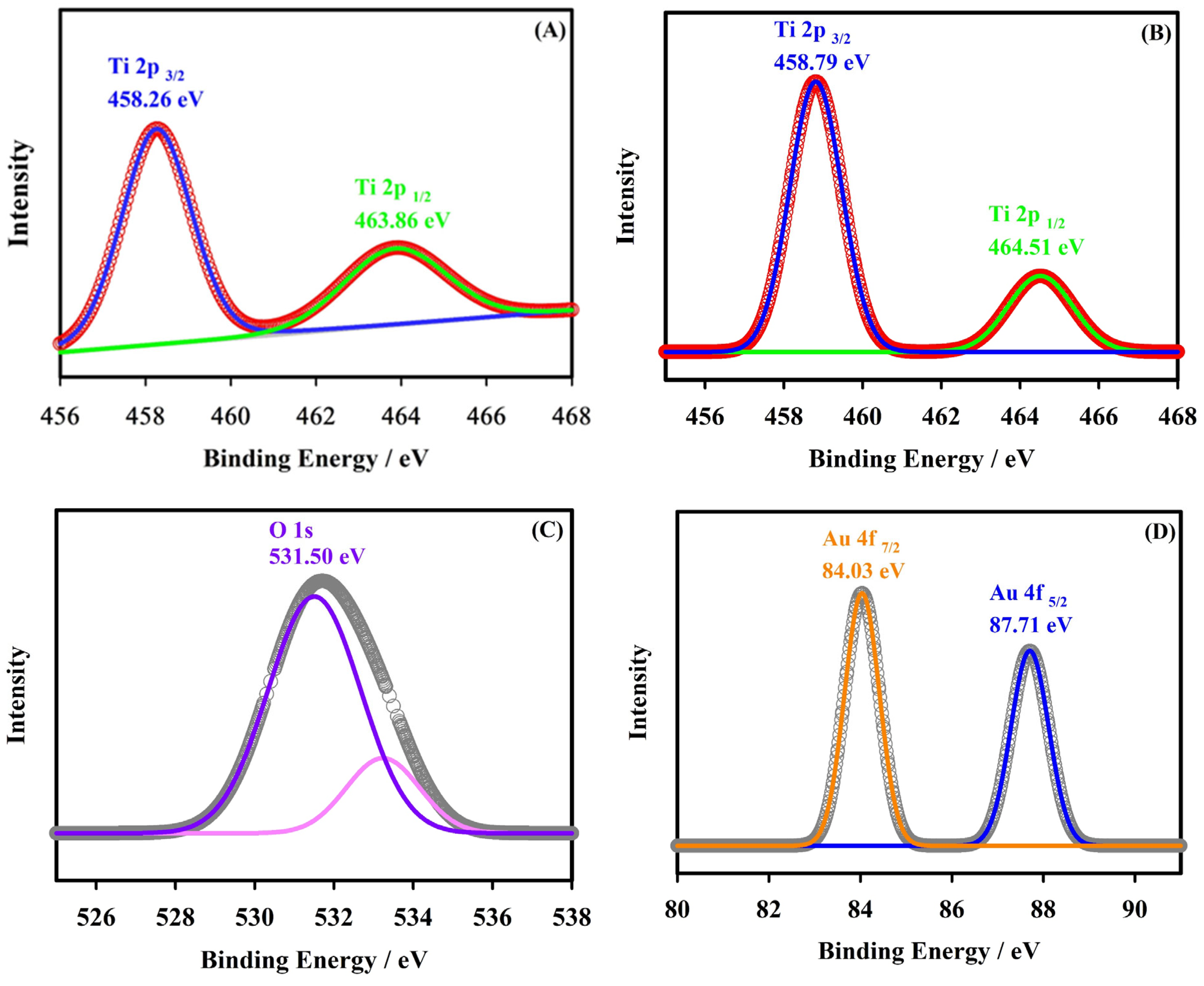
Figure 1. XPS spectra of (A) Ti 2p before Au deposition, (B) Ti 2p after Au deposition, (C) O 1 s, and (D) Au 4f on Au/TiO2/Ti surface.
Catalysts 15 01074 g001
Figure 2. Comparative XRD patters of pure Ti (black), TiO2/Ti (red), and Au/TiO2/Ti (blue).
Catalysts 15 01074 g002
Figure 3. SEM images of Au/TiO2/Ti at 200 μm (A) and 20 μm (B).
Catalysts 15 01074 g003
Figure 4. Elemental mapping of Au/TiO2/Ti electrode in energy-dispersive X-ray analysis.
Catalysts 15 01074 g004
Figure 5. Polarization curves of Au/TiO2/Ti electrode in O2 and N2-saturated 0.1 M KHCO3.
Catalysts 15 01074 g005
Figure 6. Nyquist plots of Ti, TiO2/Ti, and Au/TiO2/Ti electrodes in O2-saturated 0.1 M KHCO3 with excitation potential of −0.15 V vs. RHE. [Inset: Equivalent circuit model used for fitting].
Catalysts 15 01074 g006
Figure 7. Cyclic voltammograms (0.1 V s−1) in N2-saturated and O2-saturated 0.1 M KHCO3: (A) bare Ti electrode; (B) TiO2/Ti electrode; (C) Au/Ti electrode; (D) Au/TiO2/Ti electrode.
Catalysts 15 01074 g007
Figure 8. Oxygen reduction reaction (ORR) kinetics with Au/TiO2/Ti electrode in O2-saturated 0.1 M KHCO3: (A) cyclic voltammograms at scan rates ranging from 0.05 to 0.4 V s−1; (B) Tafel plots (E vs. log|j|) at 0.05 and 0.4 V s−1.
Catalysts 15 01074 g008
Figure 9. Cyclic voltametric stability testing of the Au/TiO2/Ti electrode in O2-saturated 0.1 M KHCO3 at 0.1 V s−1, showing stable performance after 500 (orange solid line), 1250 (blue solid line), and 2000 (purple solid line) cycles.
Catalysts 15 01074 g009
Table 1. Elemental composition of Au/TiO2/Ti electrode resulting from EDX analysis.
ElementsAtomic %Atomic % ErrorWeight %Weight % ErrorNet Counts
O14.84.04.71.386
C *7.90.81.90.2131
Ti70.80.967.70.99 825
Au6.50.725.72.9440
* C is observed due to carbon tap.
Table 2. EIS properties recorded for bare Ti, TiO2/Ti, and Au/TiO2/Ti for ORR at −0.15 V vs. RHE potential in experimental conditions.
ElectrodesRs/ΩRct/kΩCPE/µMho
Ti57136.627
TiO25157.55145
Au/TiO2/Ti5073.8025.2
Table 3. Voltametric properties obtained by using Ti, TiO2/Ti, Au/Ti, and Au/TiO2/Ti electrodes in O2-saturated 0.1 M KHCO3 at 0.1 V s−1.
ElectrodeEi/V vs. RHEEp/V vs. RHEjp/mA cm−2
Bare Ti−0.38−0.78 1.63
TiO2/Ti---
Au/Ti0.27−0.32 1.35
Au/TiO2/Ti0.27−0.18 1.81
Disclaimer/Publisher’s Note: The statements, opinions and data contained in all publications are solely those of the individual author(s) and contributor(s) and not of MDPI and/or the editor(s). MDPI and/or the editor(s) disclaim responsibility for any injury to people or property resulting from any ideas, methods, instructions or products referred to in the content.