Article

The Green Preparation of ZrO2-Modified WO3-SiO2 Composite from Rice Husk and Its Excellent Oxidative Desulfurization Performance


1
College of Chemistry and Environmental Engineering, Yangtze University, Jingzhou 434023, China
2
College of Agriculture, Yangtze University, Jingzhou 434000, China
*
Author to whom correspondence should be addressed.
Catalysts 2025, 15(10), 996; https://doi.org/10.3390/catal15100996
Submission received: 13 September 2025 / Revised: 11 October 2025 / Accepted: 17 October 2025 / Published: 19 October 2025
(This article belongs to the Special Issue Heterogeneous Catalysis in China: New Horizons and Recent Advances)

Abstract

Recently, the resource utilization of agricultural biomass wastes for the preparation of a wide range of high-value-added chemicals and functional materials, especially heterogeneous catalysts, has received extensive attention from researchers. In this work, mesoporous WO3/ZrO2-SiO2 catalysts are prepared by a two-step incipient-wetness impregnation method using agricultural biomass waste rice husk (RH) as both the silicon source and mesoporous template. The effects of different WO3 and ZrO2 loadings on the oxidative desulfurization (ODS) performance of samples are investigated, and the suitable WO3 and ZrO2 loadings are 11 and 30%, respectively. The relevant characterization results indicate that, compared to 11%WO3/SiO2, the introduction of ZrO2 leads to the formation of stronger W-O-Zr bonds, which makes the tungsten species stabilized in the state of W6+. The strong preferential interaction between Zr and W facilitates the formation of stable and highly dispersed WOx clusters on the mesoporous ZrO2-SiO2 carrier. Furthermore, it also prevents the formation of WO3 crystallites, significantly reducing their content and thus inhibiting the loss of the WO3 component during cycling experiments. Therefore, the 11%WO3/30%ZrO2-SiO2 sample shows excellent catalytic activity and recycling performance (DBT conversion reaches 99.2% after 8 cycles, with a turnover frequency of 12.7 h–1; 4,6-DMDBT conversion reaches 99.0% after 7 cycles, with a turnover frequency of 6.3 h–1). The kinetics of the ODS reactions are further investigated. The mechanism of the ODS reaction is explored through experiments involving leaching, quenching, and the capture of the active intermediate. Finally, a possible reaction mechanism for the ODS process for the 11%WO3/30%ZrO2-SiO2 sample is proposed.

1. Introduction

Agriculture is the foundation of the national economy, and the rapid development of agriculture is inevitably accompanied by the generation of large amounts of agricultural biomass wastes. Common agricultural biomass wastes mainly include crop straw, corncob, mushroom residue, rattan, bagasse, nut shells, fruit peels, and rice husk (RH) [1]. Agricultural biomass wastes are cheap and readily available natural organic resources [2], and their reuse is important in terms of ecological security and the economy [3]. The traditional methods of treating agricultural biomass wastes mainly include natural stacking, incineration, and landfills. However, these treatment methods not only waste abundant biomass resources, but also cause damage to water, air, and land environments, and affect the sustainable development of agricultural production [4]. In recent years, the resource utilization of agricultural biomass wastes for the preparation of biodiesel [5,6], high-value-added chemicals [7,8], activated carbon [9], catalysts [10], etc., has received extensive attention from researchers.
Rice is one of the most important food crops for human consumption. In 2023, China’s rice production exceeded 200 million tons [11]. RH is a major by-product of rice processing. For every kilogram of green rice produced, 0.16–0.25 kg of RH is generated [12]. RH consists of four main components, namely cellulose (~35 wt.%), hemicellulose (~25 wt.%), lignin (~20 wt.%), and ash (~20 wt.%) [13]. Rice husk ash (RHA) contains over 90% silica and some metal oxides. RH, as a high-yield, typical, and renewable agricultural biomass waste, has a wide range of applications in many fields, such as high-value-added chemicals [14], activated carbon (AC) [15] and AC-based catalysts [16], rice husk-based SiO2 (SiO2-RH) [17,18], and SiO2-RH-based catalysts [19].
Compared with traditional SiO2 raw materials, SiO2-RH exhibits significant environmental and economic advantages. Firstly, the utilization of SiO2-RH significantly reduces the environmental damage caused by traditional silica sand mining and processing. Secondly, the resource utilization of RH can realize the turning of waste into treasure, which effectively alleviates the pressure of agricultural solid waste treatment. Again, the production cost of SiO2-RH is more competitive, which provides economic feasibility for the wide application of SiO2-RH in many fields [20,21,22]. Based on the above advantages, the preparation of SiO2-RH-based catalysts using RH as raw material has become a research hotspot in recent years (Table 1) [23,24,25,26,27,28]. In 1997, Chang et al. [23] obtained SiO2-RH for the first time by treating RH through acid leaching and pyrolysis. Ni/SiO2-RH catalysts were prepared by the incipient-wetness impregnation method using SiO2-RH as a carrier, and the catalytic performance of samples was investigated in a CO2 methanation reaction. The results showed that the 5 wt.%Ni/SiO2-RH sample exhibited higher CH4 selectivity and yield compared to the 5 wt.%Ni/SiO2-gel sample prepared with silica gel as the carrier. Similarly, Selva Priya et al. [24] prepared CeO2-Sm2O3/SiO2-RH catalysts by using four different impregnation methods with SiO2-RH as the silicon source. Among them, the sample prepared by the rotary evaporator-assisted impregnation method gave a levulinic acid conversion of 94.9% and an n-butyl levulinate selectivity of 97.2% in the esterification reaction of levulinic acid with n-butanol without deactivation after four cycles. Adam et al. [25] obtained an aqueous solution of sodium silicate by treating the acid-leached RH with an aqueous NaOH solution. The WO3-SiO2-RH catalysts were further prepared by the sol–gel method using the sodium silicate solution as the silicon source and ammonium tungstate pentahydrate as the tungsten source. Under the optimized reaction conditions, the sample prepared at a pH of 3 gave a styrene conversion of 61.9% and a benzaldehyde selectivity of 100% in the selective oxidation of styrene and was not deactivated after three reuses. Similarly, Gan et al. [26] prepared the Fe(OH)3-SiO2-RH catalyst by the sol–gel method, using the sodium silicate solution extracted from RH as the silicon source and Fe(NO3)3 as the iron source. The sample showed good catalytic activity and stability in the Fenton-like degradation of Rhodamine B, and there was no significant decrease in the activity after three reuses. Ramalingam et al. [27] treated RH sequentially by acid leaching, pyrolysis, and NaOH solution extraction to obtain the sodium silicate solution. Monometallic and bimetallic doped MCM-41 molecular sieves were prepared by a fast sol–gel method using the sodium silicate solution as the silicon source, cetyltrimethylammonium bromide as the template, and ruthenium trichloride and copper chloride as the metal sources. Among them, RuO2-CuO-MCM-41 showed good glycerol conversion (99%) and shape selectivity for the formation of diacetin and triacetin in the acetylation reaction of glycerol. Unglaube et al. [28] directly prepared a series of supported silver catalysts (Ag/silica–carbon) by the excessive impregnation method using a milled RH powder as both the silicon and carbon sources, and silver nitrate as the silver source. Among them, the sample prepared at a carbothermal reduction temperature of 873 K showed excellent activity and selectivity in the hydrogenation of nitro groups in both aromatic and aliphatic substrates with good tolerance to functional groups. The above studies used different methods to extract SiO2 from RH, and a series of catalysts were prepared by using it as raw material or carrier, and they showed good catalytic performances in different chemical transformations. As far as we know, there are few studies on the preparation of supported transition metal oxide catalysts using SiO2-RH and their application in the oxidative desulfurization (ODS) of fuel oils.
In two recent papers [29,30], we used acid-leached RH as both the silicon source and mesoporous template to synthesize mesoporous TiO2-SiO2 and WO3/SiO2 catalysts via the incipient-wetness impregnation method. Both mesoporous TiO2-SiO2 and WO3/SiO2 samples exhibited high catalytic activity and stability in the ODS of dibenzothiophene (DBT) and 4,6-dimethyldibenzothiophene (4,6-DMDBT) model oils. However, there was a significant loss of the active component, WO3, from the mesoporous WO3/SiO2 sample during the recycling tests. As a continuation of the above work, the carrier SiO2-RH is improved here by introducing ZrO2 to enhance the interaction between WO3 and the ZrO2-SiO2 carrier, to promote the dispersion of tungsten species, to prevent the generation of WO3 crystallites, and thus to inhibit the loss of the active component, WO3, during the recycling process. The effects of different WO3 and ZrO2 loadings on the ODS properties of samples are investigated, and the appropriate WO3 and ZrO2 loadings are screened. The reaction parameters of the ODS are optimized, and the recycling performance of the samples is investigated under the optimized conditions. The reaction kinetics and catalytic mechanism of the ODS of DBT and 4,6-DMDBT model oils are further studied.

2. Results and Discussion

2.1. Structural Characterizations

To make the discussion easier to follow, the catalyst nomenclature is introduced here. For example, in ‘yW/xZS-RHr’, ‘W’ is the abbreviation of WO3, ‘ZS’ is the abbreviation of ZrO2-SiO2 sample, ‘RH’ is the abbreviation of rice husk, ‘x’ represents the loading of ZrO2, ‘y’ represents the loading of WO3, ‘yW/xZS-RH’ represents yWO3/xZrO2-SiO2 samples prepared from RH, and ‘r’ represents the regenerated sample (see Section 3.2 and Section 3.4 for details).
Figure 1 shows the XRD patterns of 30ZS-RH, 11WS-RH, SiO2-RH, pure WO3, pure ZrO2, yW/30ZS-RH, and 11W/30ZS-RHr samples. As shown in Figure 1a, the SiO2-RH sample exhibits a wide and diffuse diffraction peak around 23°, indicating that it has an amorphous structure. The diffraction peaks at 23.1°, 23.7°, 24.1°, 28.8°, 33.3°, and 34.0° for pure WO3 correspond to the (001), (020), (200), (111), (021), and (220) crystal planes of the orthorhombic phase of WO3 (JCPDS no. 20-1324), respectively [31]. Pure ZrO2 exhibits diffraction peaks at 24.1°, 24.4°, 28.1°, 31.5°, 34.2°, 50.2°, and 60.1°, which correspond to the (110), (011), (−111), (111), (200), (022), and (−203) crystal planes of the monoclinic phase of ZrO2 (JCPDS no. 37-1484), respectively [32]. The 30ZS-RH sample shows distinct diffraction peaks at 30.2°, 35.2°, 50.4°, and 60.3°, which are attributed to the characteristic peaks of tetragonal ZrO2 [33]. In addition, no diffraction peaks of monoclinic ZrO2 can be seen in 30ZS-RH, which is attributed to the inhibition of the formation of monoclinic-phase ZrO2 by the Si-O-Zr bond formed by the interaction of ZrO2 and SiO2 [33]. Compared with SiO2, 11WS-RH shows pronounced WO3 diffraction peaks at 23.0°, 23.5°, 24.0°, and 33.8°, which corresponded to the (002), (020), (200), and (202) crystal planes of monoclinic WO3 (JCPDS no. 43-1035), respectively. Compared with 30ZS-RH, with the increase in WO3 loading from 2.5 to 11%, the characteristic diffraction peaks of WO3 do not appear in the samples. Continuing to increase the WO3 loading, the characteristic diffraction peaks of monoclinic WO3 begin to appear at 23.0°, 23.5°, and 24.0°, indicating that larger WO3 crystallites started to form in the sample. Compared with 11WS-RH, the characteristic diffraction peaks of WO3 do not appear in the 11W/30ZS-RH sample, indicating that (a) the introduction of ZrO2 contributes to the dispersion of tungsten species and prevents the aggregation of tungstate species into crystalline WO3 [34], and (2) the WO3 grain size in the 11W/30ZS-RH sample is less than 5 nm. The above results indicate that WO3 in the 11W/30ZS-RH sample shows a highly dispersed state on the 30ZS-RH carrier, with relatively small grain sizes. In addition, compared with the fresh sample (Figure 1b), the peak intensities of the regenerated samples do not change much, demonstrating that the crystal structure of the regenerated samples remains good.
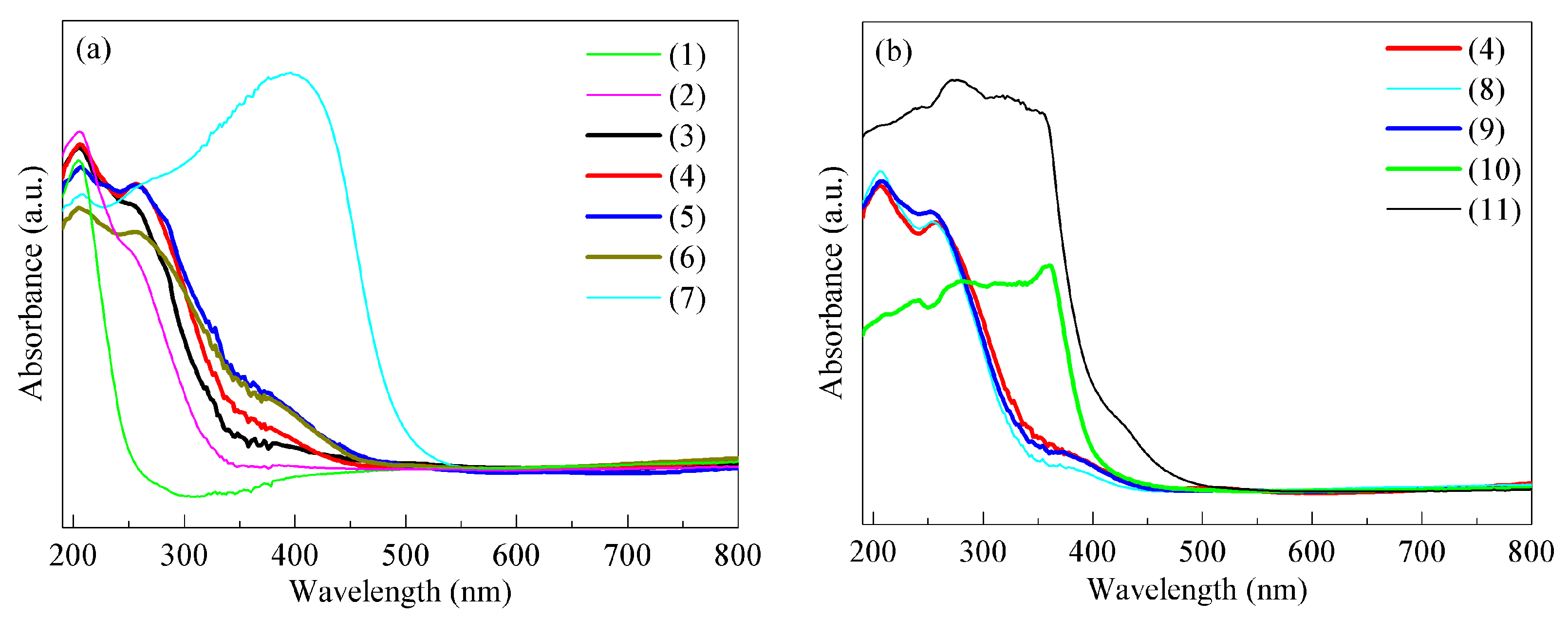
Figure 2 displays the UV–Vis spectra of the samples. As shown in Figure 2a, the pure WO3 exhibits absorption peaks around 208, 265, and 395 nm, corresponding to the tetrahedral monomeric tungstate species, octahedral polytungstate species, and WO3 crystallites, respectively [35,36]. The 30ZS-RH sample exhibits a sharp absorption band at 204 nm, which can be attributed to isolated tetrahedral zirconium species [37]. This result indicates that there is interaction between SiO2 and ZrO2, which is consistent with the XRD results. After loading WO3 onto the 30ZS-RH carrier, the sample showed clear absorption bands at 206, 260, and 360 nm, corresponding to the tetrahedral monomeric tung-state species, octahedral polytungstate species, and WO3 crystallites, respectively. As the WO3 loading increases from 2.5 to 15%, the intensity of the absorption band at 206 nm progressively decreases. The intensity of the absorption band at 260 nm first increases and then remains constant, while the intensity of the absorption band at 360 nm steadily increases. Compared with the 11WS-RH sample, the peak intensities of the absorption bands at 206 and 260 nm of the 11W/30ZS-RH sample increase significantly, while the peak intensity of the absorption band at 360 nm decreases markedly. These results indicate that, compared with WOx-SiO2 and WOx-WOx, ZrOx-WOx exhibits stronger interactions. The introduction of ZrO2 promotes the dispersion of tetrahedral monomeric tungstate species and octahedral polytungstate species on the carrier surface, while inhibiting the formation of WO3 crystallites [38]. These results are in good agreement with those obtained by XRD. Generally, the octahedral polytungstate species have higher ODS activity than the tetrahedral monomeric tungstate species, and the tetrahedral monomeric tungstate species have higher ODS activity than the WO3 crystallites [39,40]. Therefore, it is clear that the introduction of ZrO2 increases the amount of highly active tungsten species in the 11W/30ZS-RH sample, thereby improving the catalytic activity and stability of the sample in the ODS reaction.
As can be seen from Figure 2b, compared with the spectra of oxidation products of DBT and 4,6-DMDBT, the 11W/30ZS-RHr samples regenerated by calcinating do not contain the oxidation products. Compared with the fresh 11W/30ZS-RH sample, the peak intensities of the absorption bands at 206 and 260 nm of the regenerated samples increase slightly, while the peak intensity of the absorption band at 360 nm decreases. These results indicate that there is a slight loss of the WO3 component in the sample after the recycling tests, and the lost portion is mainly WO3 crystallites.
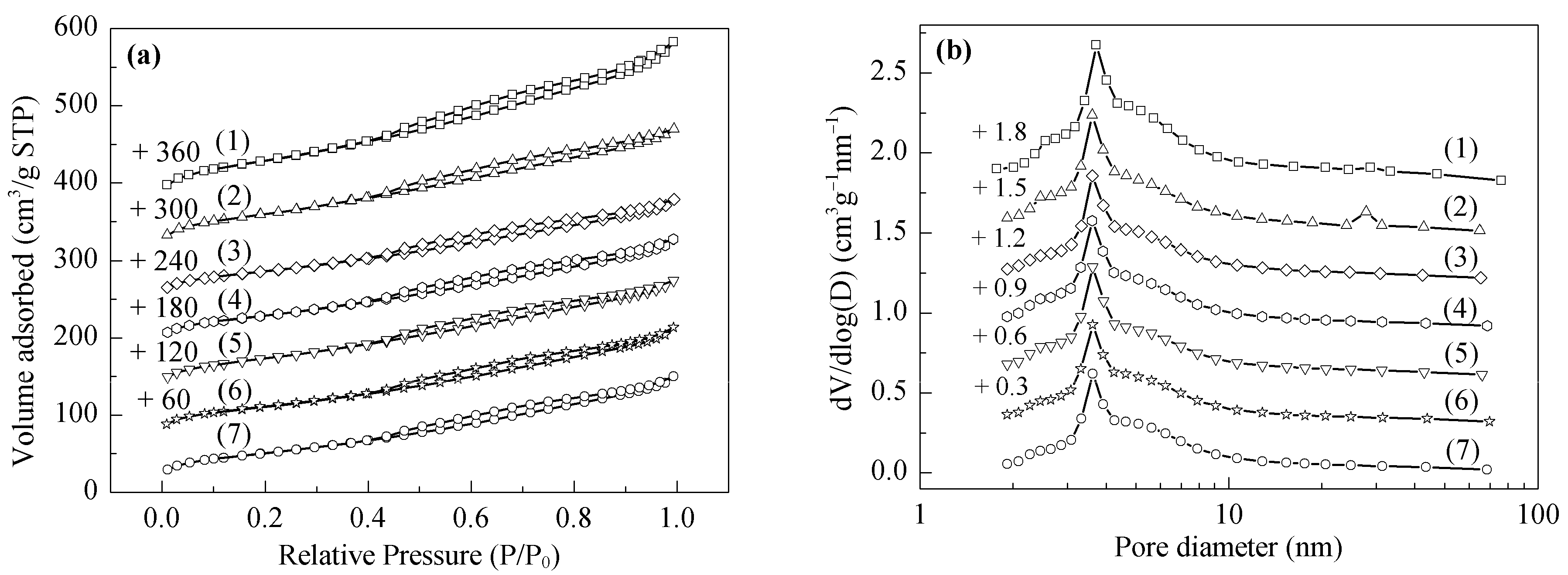
Figure 3 illustrates the N2 adsorption–desorption isotherms and pore size distributions for the 30ZS-RH, 11WS-RH, and yW/30ZS-RH samples. As shown in Figure 3a, according to the IUPAC classification method, the samples all display typical type IV isotherms, and a distinct H4 hysteresis loop is observed when P/P0 exceeds 0.40. Moreover, the shapes of the isotherms of these samples are basically consistent. These results suggest that they have similar mesoporous structures. The mesopores in the 30ZS-RH carrier are concentrated in the range of 1.9 to 64.8 nm, and the most probable pore size (D) is 3.6 nm (Figure 3b). As the WO3 loading increases from 2.5 to 15%, the pore distribution and the D values of the yW/30ZS-RH samples remain largely unchanged, while the specific surface area (SBET) and the cumulative pore volume (Vmeso) decrease slowly (Table 2). These results suggest that the WO3 grains are well-dispersed on the surface and within the pores of the SiO2-RH, without blocking the pores of the carrier. Pure SiO2-RH has high SBET and Vmeso, while pure WO3 has low SBET and Vmeso (Table 2). Compared with pure WO3, the supported WO3 samples have larger SBET and Vmeso (Table 2), which facilitates the easy access of bulky substrates to active sites, overcomes the diffusion effect, and thereby enhances the catalytic performances of the samples [30]. Compared to the fresh 11W/30ZS-RH sample, the regenerated samples exhibit minimal changes in the shapes of their isotherms and pore size distribution curves, with small variations in SBET and Vmeso (Table 2). These results demonstrate that the pore structures of the regenerated samples remain well-maintained after the recycling tests.
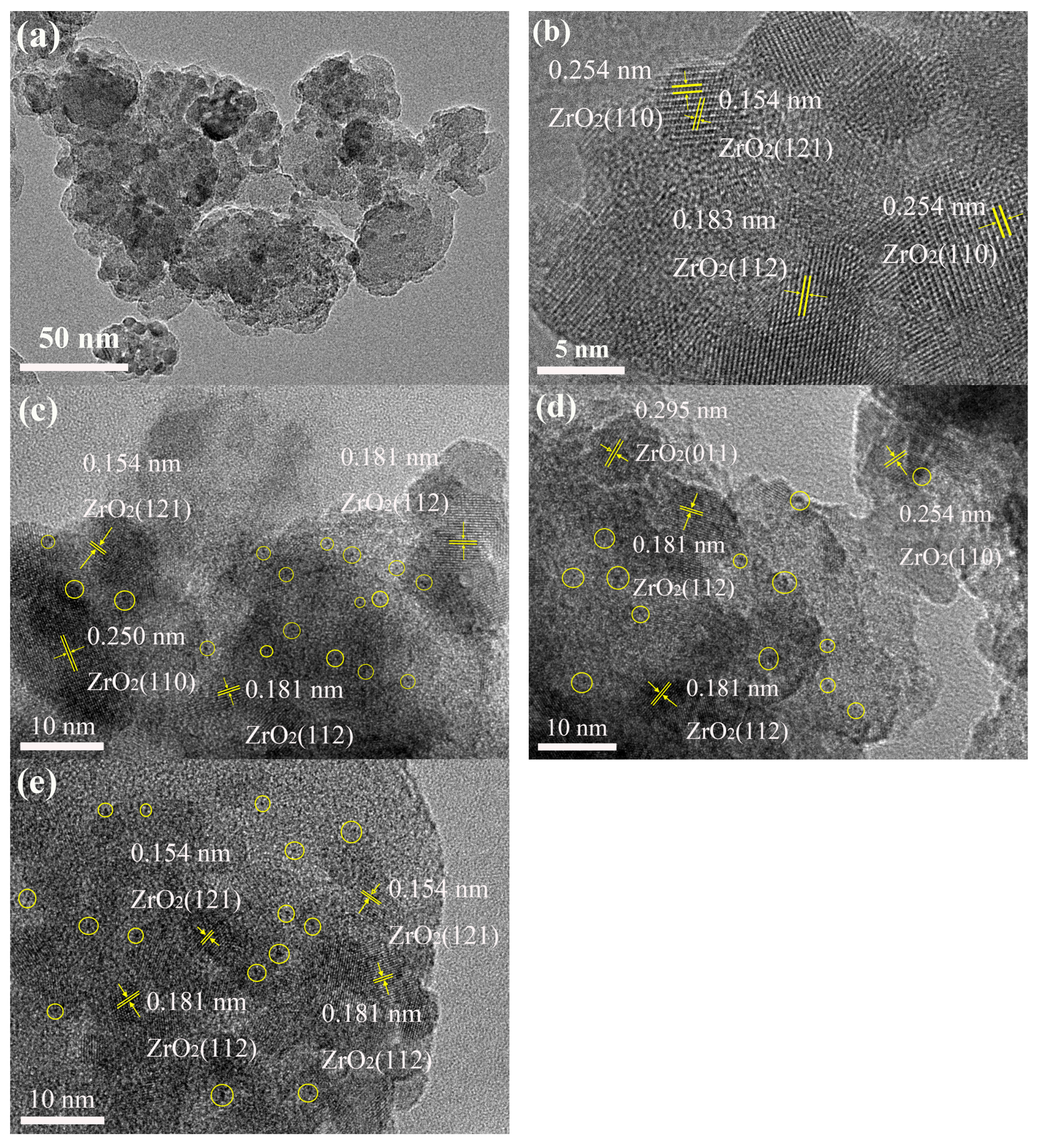
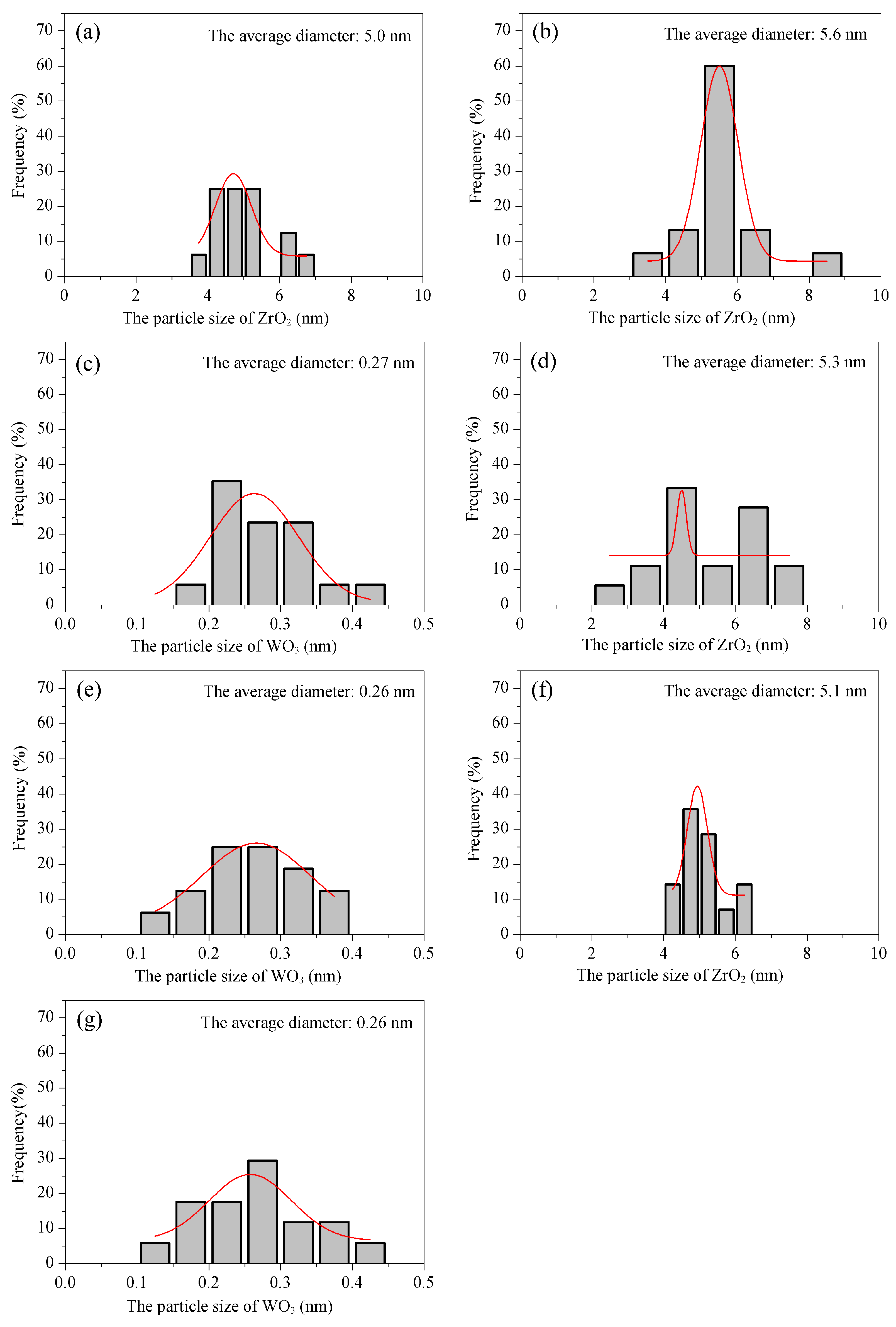
Figure 4 and Figure 5 display the TEM images and particle size distribution histograms of the samples, respectively. The TEM image of the SiO2-RH sample is available in Reference [30]. No distinct crystalline particles were observed in the SiO2-RH sample, but instead, many mesopores and macropores were present. This finding is consistent with the results from XRD and N2 adsorption–desorption isotherms. It can be seen from Figure 4a that the 30ZS-RH sample exhibits numerous mesopores, which is in good agreement with the results of N2 adsorption–desorption isotherms. In the high-magnification image (Figure 4b), three clear lattice fringes of 0.154, 0.183, and 0.254 nm are observed for ZrO2 grains, which are matched with the interplanar spacing of (121), (112), and (110) planes of the orthorhombic ZrO2. Moreover, Figure 5a shows that the average diameter of these ZrO2 grains is 5.0 nm. From Figure 4c and Figure 5c, it can be seen that in addition to the obvious ZrO2 lattice fringes, the 11W/30ZS-RH sample also exhibits numerous WOx clusters with an average diameter of 0.27 nm, and these WOx clusters are evenly dispersed on the surface of the 30ZS-RH (yellow circles). These results are similar to those reported by Ross-Medgaarden et al. [41]. After the recycling tests, uniformly distributed nanoscale WOx clusters are still observed on the 30ZS-RH carrier, and the average diameter of WOx clusters is almost unchanged compared to the fresh 11W/30ZS-RH sample (Figure 4d,e, yellow circles; Figure 5c,e,g). In addition, the average diameter of ZrO2 grains in the 11W/30ZS-RHr samples does not change much compared to the fresh 11W/30ZS-RH sample (Figure 5b,d,f). The above results indicate that the WOx clusters do not aggregate and grow up during the process of multiple calcination and regeneration, which causes the 11W/30ZS-RH sample to have good catalytic activity and stability.
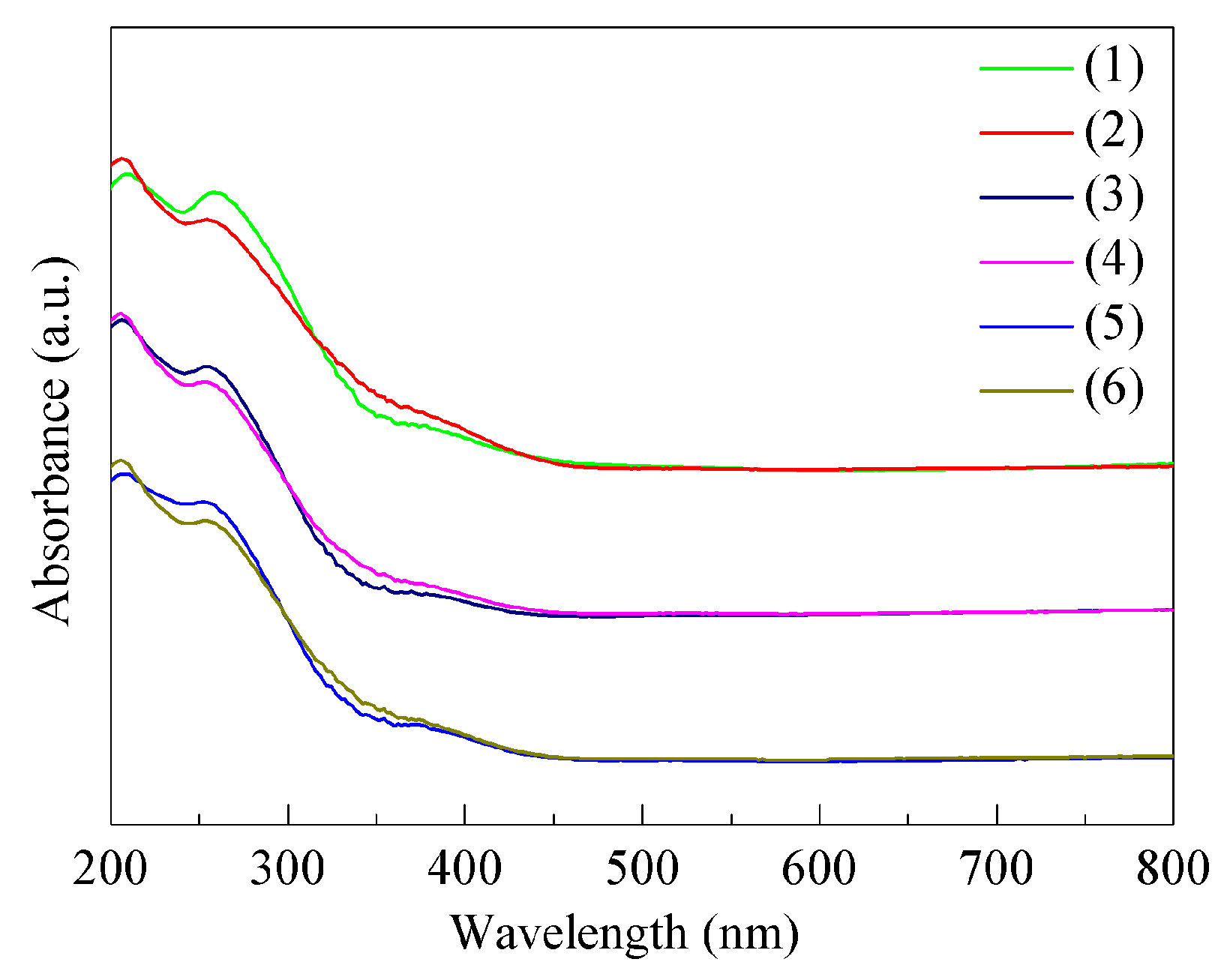
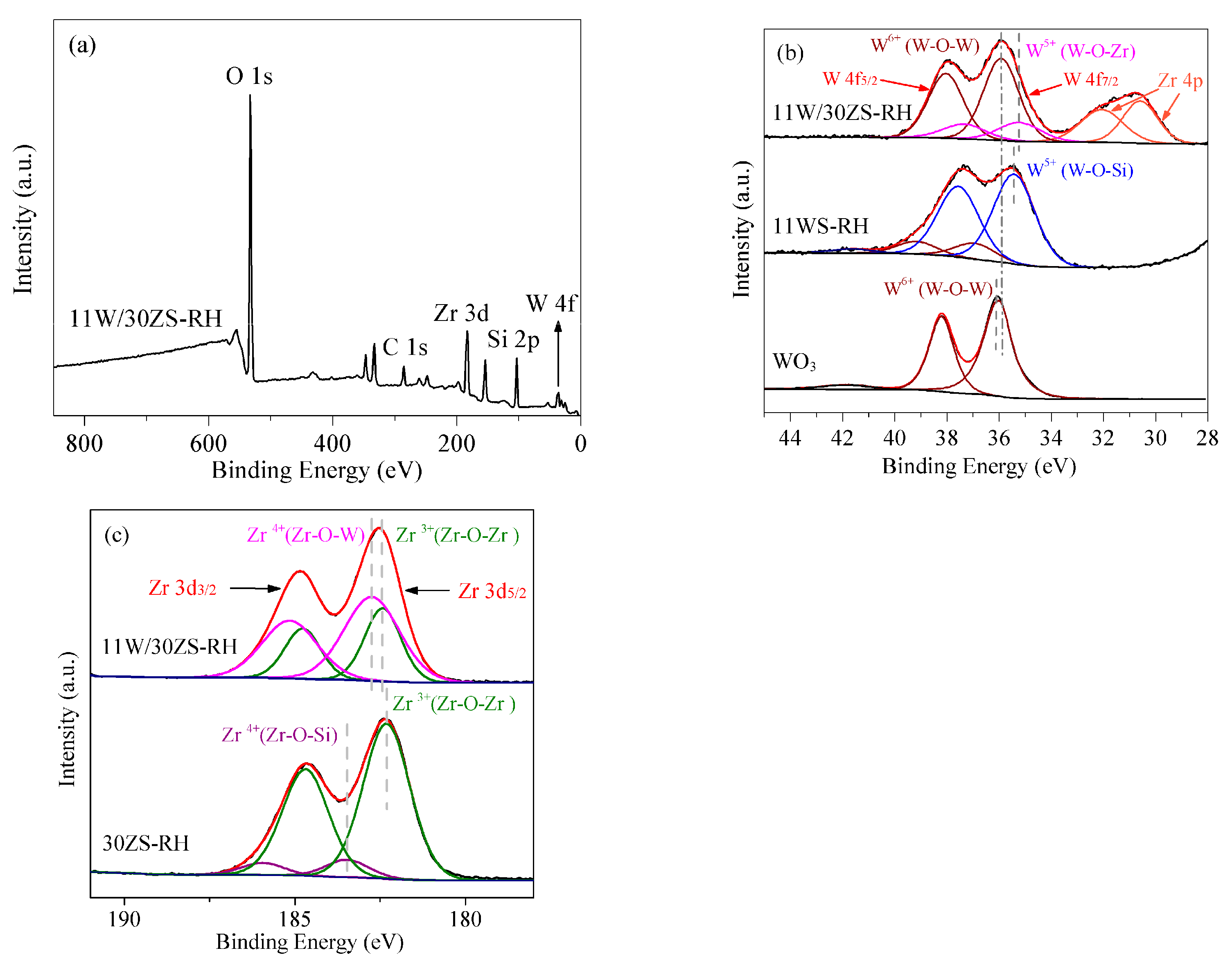
In order to study the surface chemical states and elemental composition of the 11W/30ZS sample, the relevant samples were analyzed by means of XPS. As shown in Figure 6a, the 11W/30Z-RH sample contains the W, Zr, Si, and O elements. It can be seen from Figure 6b that the W 4f spectrum of pure WO3 after deconvolution has two peaks at binding energy (BE) of 35.99 and 38.21 eV, corresponding to the W6+ species [42]. After loading WO3 onto SiO2-RH, the corresponding peaks of W6+ species shift toward the high-BE direction, and their peak intensities decrease significantly. In addition, two new peaks with high intensity appear at 35.42 and 37.56 eV in the W 4f region, which can be attributed to W5+ species [34,40,43]. These results indicate that there is a strong interaction between Si and W, resulting in the formation of the W-O-Si bond [33]. Compared with the 11WS-RH sample, the peaks corresponding to the W6+ species in the 11W/30ZS-RH sample shift toward the low BE direction, and their peak intensities increase significantly. The peaks corresponding to the W5+ species also shift toward the low BE direction, while their peak intensities decrease significantly. In addition, the W 4f double peaks of the 11W/30Z-RH sample extend toward the low-BE direction and slightly overlap with the Zr 4p region. These results indicate that there is a strong interaction between W and Zr, leading to the formation of the W-O-Zr bond, and that the stability of the W-O-Zr bond is superior to that of the W-O-Si bond [34,40,44]. Obviously, the addition of ZrO2 stabilizes the tungsten species in a more oxidized state (W6+). As shown in Figure 6c, the Zr 3d spectrum of the 30ZS-RH sample exhibits two pairs of double peaks after deconvolution. Among them, the two peaks at BE values of 182.31 and 184.69 eV are attributed to the Zr3+ (Zr-O-Zr) species of bulk ZrO2 [45,46]. This result is consistent with the XRD results shown in Figure 1. The two peaks at BE values of 183.46 and 185.94 eV are attributed to Zr4+ (Zr-O-Si) species, which is due to the higher electronegativity of Si atoms compared to Zr atoms [46]. After loading WO3 onto the 30ZS-RH carrier, the peaks corresponding to the Zr3+ (Zr-O-Zr bond) species shift toward the high BE direction, and the peak intensities decrease significantly. At the same time, a pair of peaks with higher intensities appear at 182.74 and 185.15 eV, which are attributed to the Zr4+ species. These results indicate that, in addition to interacting with Si atoms, Zr atoms also interact more strongly with W atoms, promoting the formation of W-O-Zr bonds [34,40,44]. The above results show that the addition of ZrO2 forms a strong W-O-Zr bond in the sample, which makes the tungsten species exist stably in the state of W6+.
As shown in Figure S2a, the deconvoluted O 1s spectrum of pure WO3 exhibits two peaks at BE values of 530.37 and 532.03 eV, corresponding to lattice oxygen (OL) and OH groups in WO3, respectively [47]. In the O 1s spectra of SiO2-RH, 30ZS-RH, 11WS-RH, and 11W/30ZS-RH samples, the peak at a BE value of 530.2-530.5 eV corresponds to lattice oxygen (OL) in the metal oxide. The peak at a BE value of 532.0–533 eV attributes to the Si-O-Si bond in SiO2, while the peak at a BE of 534–535 eV can be attributed to adsorbed water molecules [44,48,49]. Compared to the SiO2-RH sample, the peak corresponding to the Si-O-Si bond in the 30ZS-RH sample shifts toward the low BE direction, and the intensity of the peak corresponding to OL increases. These results indicate that there is a strong interaction between Si and Zr. [50]. After loading WO3 onto SiO2-RH, the BE values and peak intensities show little change, indicating that the interaction between Si and W is relatively weak. After loading WO3 onto 30ZS-RH, the BE values and intensities of the peak corresponding to the Si-O-Si bond do not change much, while the peak corresponding to OL shifts toward the high BE direction, and its peak intensity increases markedly. Compared to the 11WS-RH sample, the peak corresponding to OL in the 11W/30ZS-RH sample shifts toward the high BE direction, and its peak intensity increases significantly. These results indicate the presence of strong interactions between Zr and W [44]. Additionally, the FT-IR spectra of the samples (Figure S3) indicate that the intensity of the Si-OH absorption peak (at 3464 cm−1) in the SiO2-RH sample decreases with the introduction of WO3 and ZrO2. Based on the results of the O1s spectra mentioned above, this phenomenon is likely caused by the coverage of metal oxides on the SiO2 surface.
Furthermore, the Si 2p spectra of the samples (see Figure S2b) indicate that the introduction of ZrO2 also results in noticeable changes in the spectral bands of the carrier SiO2-RH and the 11WS-RH sample. Based on the results of XRD, UV–Vis, TEM, and XPS, the strong preferential interaction between Zr atoms and W atoms contributes to the formation of stable and highly dispersed WOx clusters on the surface of mesoporous 30ZS-RH, and it inhibits the formation of WO3 crystallites.
Py-FTIR characterization was performed on SiO2-RH, 30ZS-RH, 11WS-RH, and 11W/30ZS-RH samples, with results shown in Figure S4. As shown in Figure S4a, the absorption peaks observed at 1596, 1578, and 1446 cm−1 are attributed to pyridine adsorbed coordinatively on Lewis (L) acid sites. The absorption peaks appearing at 1637 and 1540 cm−1 are attributed to pyridine cations formed by adsorption at Brønsted (B) acid sites. The absorption peak at 1490 cm−1 can be attributed to pyridine adsorbed simultaneously on adjacent B and L acid sites [51,52]. Since the peak area associated with the L acid sites is significantly larger than that associated with the B acid sites, these samples predominantly contain the L acid sites, which constitutes the dominant proportion (Table S1). As the desorption temperature increases from 423 to 523 K, the peak intensity of B acid in the 11W/30ZS-RH sample decreases rapidly, while the peak intensity of L acid decreases more slowly, indicating that the L acid sites exhibit greater intensity than the B acid sites (Figure S4b). It is well-known that pure SiO2-RH does not contain acid sites [53]. However, the data in Table S1 indicates that the B acid, L acid, and total acid contents in the SiO2-RH sample are 3.75, 74.76, and 78.51 μmol/g, respectively. This is likely attributable to the residual metal oxides present in the RH after acid leaching treatment. Compared to the SiO2-RH sample, both B and L acid sites are significantly increased in the 30ZS-RH sample. Among these, L acid sites primarily originate from coordinately unsaturated Zr4+ (Zr-O-Si) [35]. B acid sites originate from the formation of bridging Si-O(H)-Zr groups following the isomorphous substitution of Si4+ ions by Zr4+ cations [54]. Compared to the SiO2-RH sample, the 11WS-RH sample exhibits increased amounts of B and L acid sites. The L acid sites are attributed to the W=O terminal groups, while the B acid sites are associated with W-(OH)-W or W-OH bonds [50]. Compared to 30ZS-RH, the B acid, L acid, and total acid contents in 11W/30ZS-RH are slightly reduced. This may be related to the formation of Zr-O-W and W-O-Si bonds. Compared to 11WS-RH, the introduction of ZrO2 increases the B acid, L acid, and total acid contents in 11W/30ZS-RH. The above results indicate that L acid sites are predominant in the 11W/30ZS-RH sample, which will be beneficial to improve the catalytic efficiency of the sample in the ODS reactions [52].
Table 3 presents the composition of metal oxides in the samples. As can be seen from the table, the loadings of ZrO2 and/or WO3 in the 30ZS-RH and 11W/30ZS-RH samples are close to the theoretical loadings. The 11W/30ZS-RHr sample regenerated from the ninth ODS reaction of DBT exhibits a slight increase in ZrO2 loading and a 35.2% decrease in WO3 loading compared to the fresh 11W/30ZS-RH sample. The 11W/30ZS-RHr sample regenerated from the eighth ODS reaction of 4,6-DMDBT shows a slight increase in ZrO2 loading and a 30.4% decrease in WO3 loading compared to the fresh 11W/30ZS-RH sample. It is worth noting that the loadings of ZrO2 and WO3 measured by XPS are higher than those measured by ICP-OES, indicating that the metal oxides are mainly distributed in the surface layer of the samples. This component distribution characteristic of the 11W/30ZS-RH sample facilitates the easy approach of reaction substrates to the active sites, overcoming the diffusion effect and consequently enhancing the catalytic performance of the sample. Furthermore, compared with the WO3/SiO2 sample previously reported by our team [30], the introduction of ZrO2 significantly suppresses the loss of the active component, WO3.

2.2. Catalytic Activity

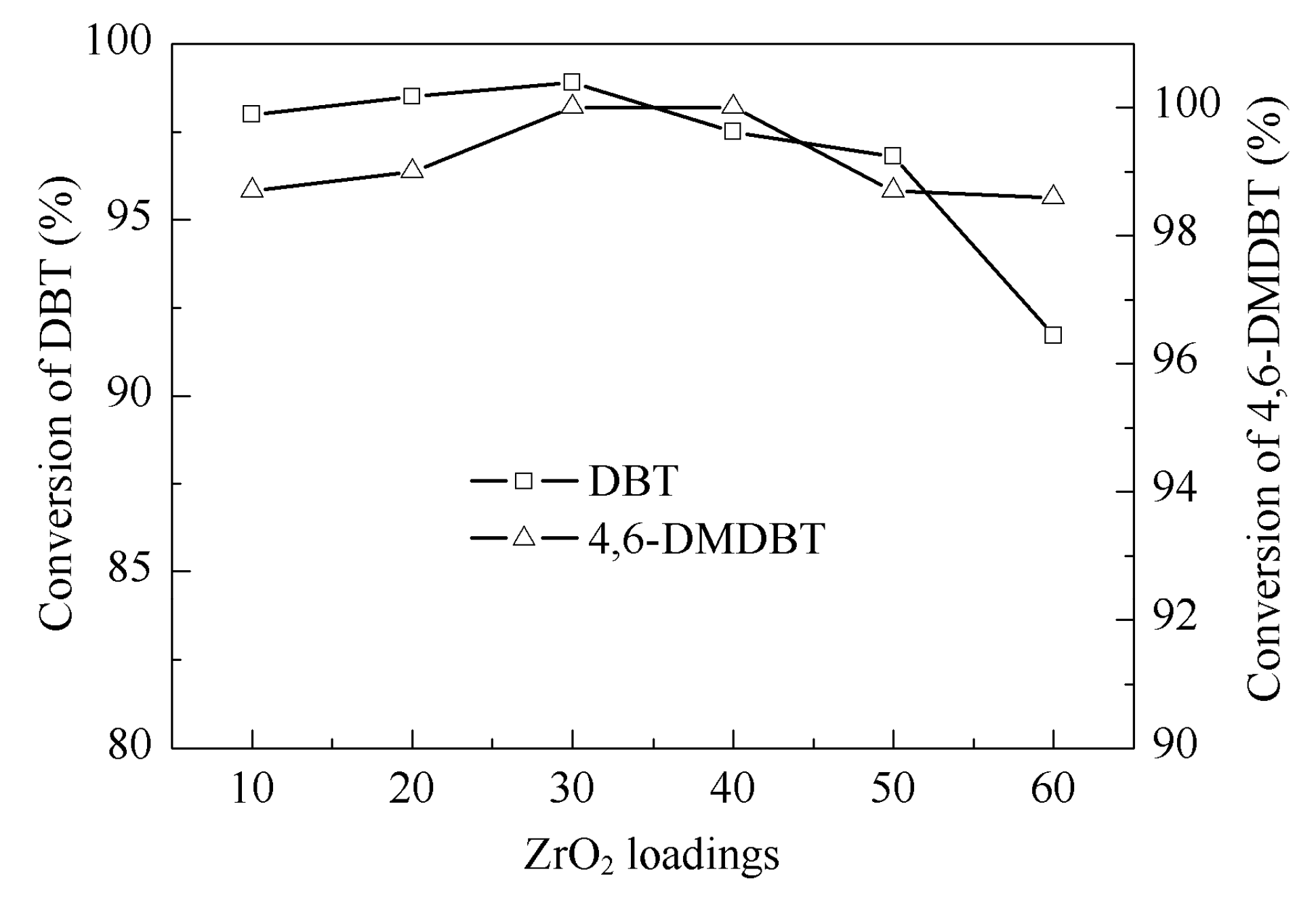
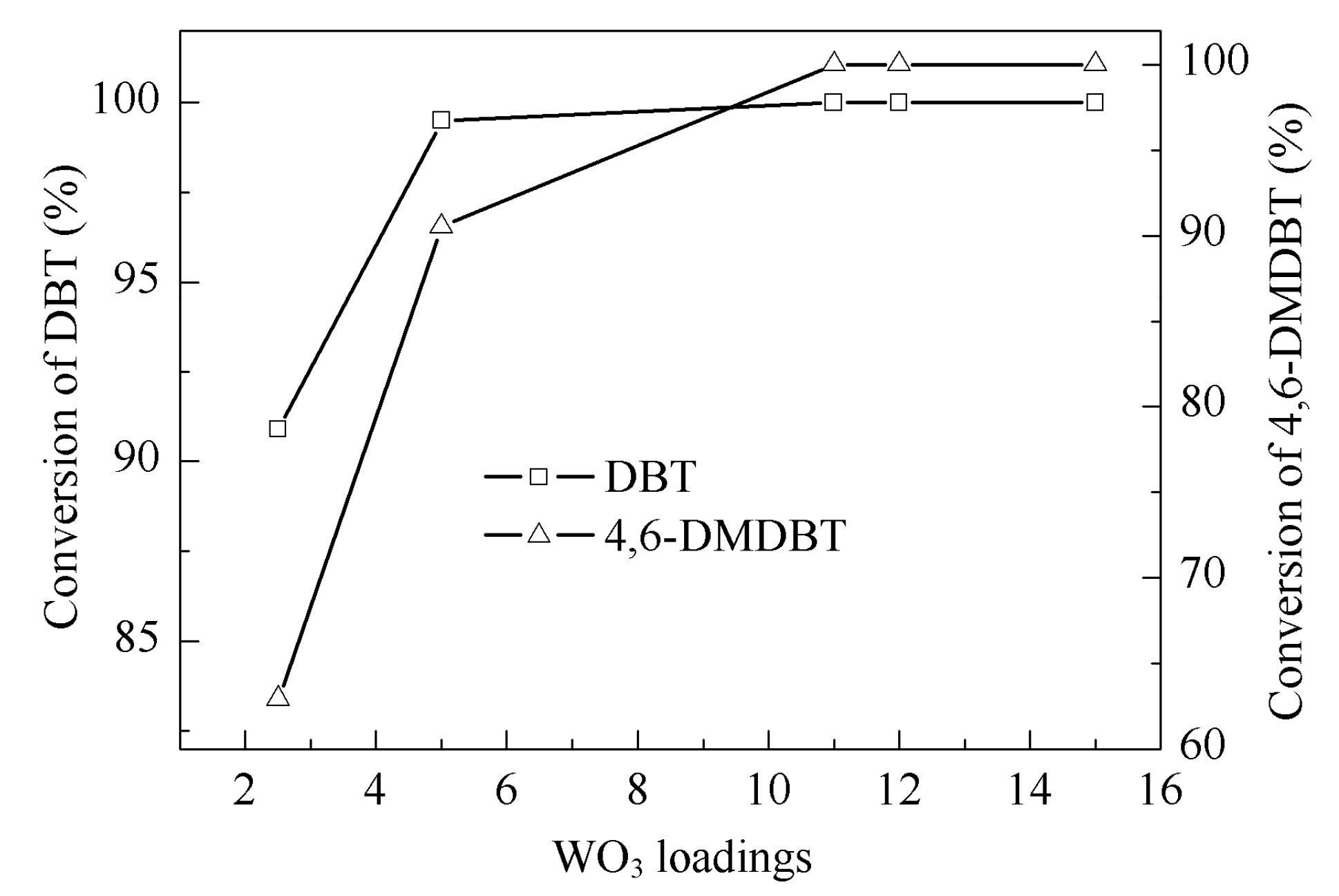
Figure 7 illustrates the impact of ZrO2 loading on the ODS performance of the samples. As can be seen from the figure, as the loading of ZrO2 increases from 10 to 30%, the conversions of DBT and 4,6-DMDBT gradually increase. However, further increasing the loading of ZrO2 leads to a decrease in the conversions of DBT and 4,6-DMDBT. Therefore, a ZrO2 loading of 30% is more appropriate. As shown in Figure 8, as the WO3 loading increases from 2.5 to 11.0%, the conversions of DBT and 4,6-DMDBT continuously increase, reaching 100%. Continuing to increase the WO3 loading, the conversions of DBT and 4,6-DMDBT remain constant. Therefore, the suitable WO3 loading is 11%. These results suggest that the optimal catalyst is 11W/30ZS-RH.
The reaction conditions for the ODS are further optimized by using a single-factor multilevel approach, and the results are shown in Table 4 and Table 5. As can be seen from Table 4, the conversion of DBT increases linearly as the reaction temperature (T) is increased from 313 to 333 K (Runs 1 to 3). Continuing to increase the reaction temperature (Runs 4 and 5), there is little change in the conversion of DBT. Therefore, the suitable reaction temperature is 333 K. As the H2O2/S molar ratio increases from 2.0 to 6.0 (Runs 6 to 8), the conversion of DBT increases linearly to 100.0%. Continuing to increase the H2O2/S molar ratio (Runs 3 and 9), the conversion of DBT changes little. Therefore, the proper H2O2/S molar ratio is 6.0. As the catalyst-to-oil ratio is increased from 1.0 to 8.0 g/L (Runs 10, 11, 12, and 8), the conversion of DBT increases rapidly to 100.0%. Continuing to increase the catalyst-to-oil ratio (Run 13), the conversion of DBT remains constant. Therefore, the suitable catalyst-to-oil ratio is 8.0 g/L. As the reaction time is extended from 5 min to 1.0 h (Runs 14, 15, 16, and 8), the conversion of DBT increases first rapidly and then slowly to 100.0%. Continuing to prolong the reaction time (Run 17), the conversion of DBT remains constant. Therefore, the suitable reaction time is 1.0 h. The above results show that the optimal reaction conditions for the ODS of the DBT model oil are as follows: DBT model oil, 10 mL; acetonitrile, 10 mL; temperature, 333 K; catalyst-to-oil ratio, 8.0 g/L; H2O2/S molar ratio, 6.0; time, 1 h; and stirring speed, 900 rpm.
As can be seen from Table 5, as the reaction temperature is increased from 313 to 333 K (Runs 1 to 3), the conversion of 4,6-DMDBT increases linearly to 100%. Continuing to increase the reaction temperature (Runs 4 and 5), the conversion of 4,6-DMDBT remains constant. Thus, the suitable reaction temperature is 333 K. As the H2O2/S molar ratio is increased from 2.0 to 6.0 (Runs 6 to 8), the conversion of 4,6-DMDBT increases linearly to 100.0%. Upon continuing to increase the H2O2/S molar ratio (Runs 3 and 9), the conversion of 4,6-DMDBT remains constant. Therefore, the suitable H2O2/S molar ratio is 6.0. As the catalyst-to-oil ratio is increased from 1.0 to 10.0 g/L (Runs 10, 11, 12, 13, and 8), the conversion of 4,6-DMDBT increases continuously to 100.0%. Continuing to increase the catalyst-to-oil ratio (Run 14), the conversion of 4,6-DMDBT remains constant. Therefore, the suitable catalyst-to-oil ratio is 10.0 g/L. As the reaction time is extended from 15 min to 1.5 h (Runs 15 to 18), the conversion of 4,6-DMDBT increases continuously to 100.0%. Continuing to prolong the reaction time (Run 8), the conversion of 4,6-DMDBT remains constant. Therefore, the suitable reaction time is 1.5 h. The above results suggest that the optimized reaction conditions for the ODS of 4,6-DMDBT model oil are as follows: 4,6-DMDBT model oil, 10 mL; acetonitrile, 10 mL; temperature, 333 K; catalyst-to-oil ratio, 10.0 g/L; H2O2/S molar ratio, 6.0; time, 1.5 h; and stirring speed, 900 rpm.
Under the above optimized conditions, several controlled experiments were carried out. As can be seen from Table 6, the conversions of DBT and 4,6-DMDBT extracted by solvent acetonitrile are 60.5 and 49.8%, respectively (Run 1). Compared with Run 1, the conversions of DBT and 4,6-DMDBT remain nearly constant in the presence of H2O2, indicating that the oxidant alone contributes insignificantly to the ODS (Run 2). Compared with Run 2, the conversions of DBT and 4,6-DMDBT given by pure WO3 and 30ZS-RH do not increase much, indicating that their catalytic activities are poor. Compared with Run 1, the conversions of DBT and 4,6-DMDBT given by 11W/30ZS-RH increased slightly (Run 6), indicating that the sample has weak adsorption desulfurization activity. Compared with Run 3, the samples show high catalytic activity after loading WO3 on the carriers of SiO2-RH and 30ZS-RH. The results of the controlled experiments and related characterizations clearly demonstrate that the supported 11W/30ZS-RH catalyst exhibits superior catalytic performance compared to pure WO3. This is because the supported WO3 catalyst has a large specific surface area and more dispersed, nanoscale WOx clusters. In addition, compared to the 11%WO3/SiO2-gel and 11%WO3/30%ZrO2-SiO2-gel catalysts (Runs 8 and 9), the samples prepared using SiO2-RH as the support exhibit significantly higher catalytic activity. These results confirm that SiO2-RH is a superior catalyst support compared to silica gel.
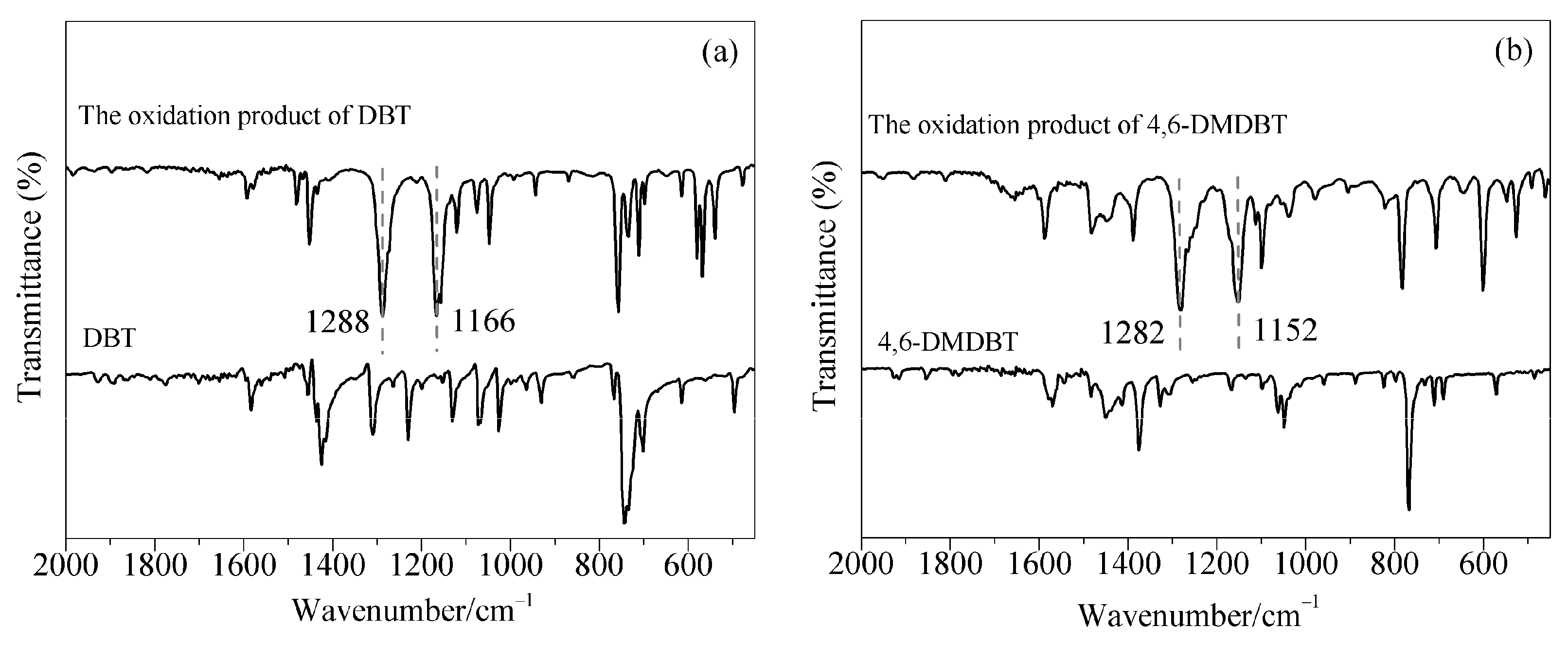
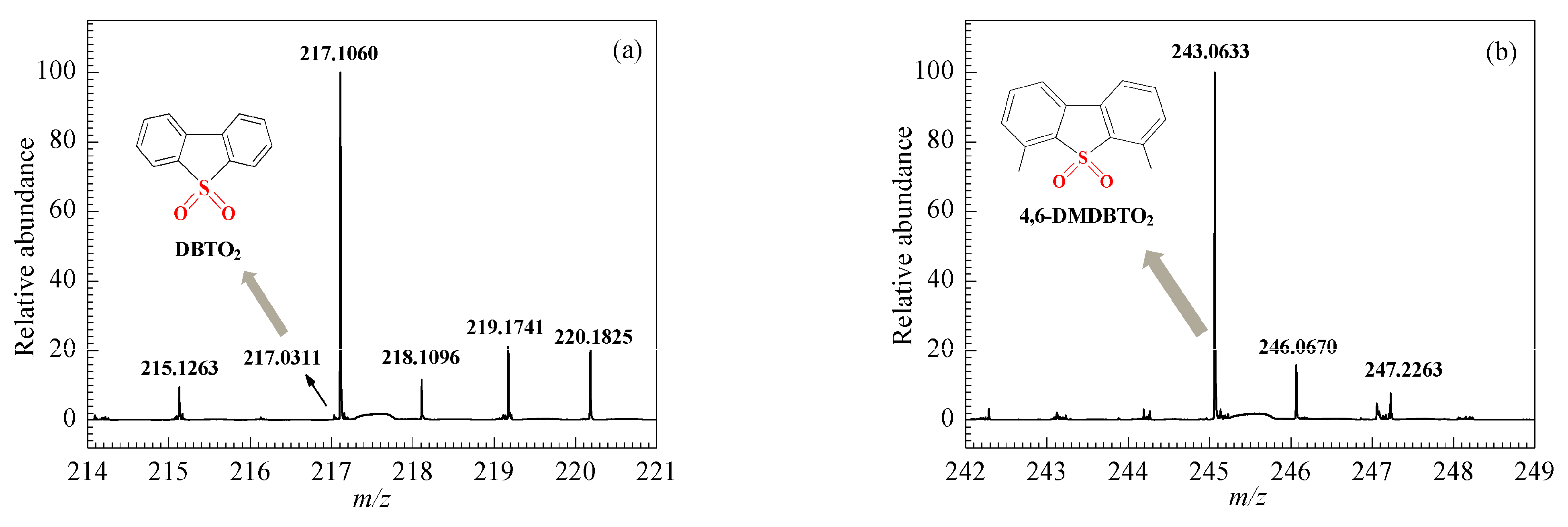
Usually, organic sulphones have two very strong bands due to the asymmetric and symmetric stretching vibrations of the –SO2 group, at 1345–1275 cm–1 and 1170–1120 cm–1, respectively [55]. As shown in Figure 9a, the oxidation product of DBT exhibit characteristic absorption peaks of sulfones (1166 and 1288 cm–1). Also, it can be seen from Figure 9b that the oxidation product of 4,6-DMDBT show obvious characteristic absorption peaks of sulfone (1152 and 1282 cm–1). The oxidation products of DBT and 4,6-DMDBT were further identified by LC-MS spectroscopy, and the results are shown in Figure 10. As shown in Figure 10a, the ion peak at the mass-to-charge ratio of 217.0311 belongs to dibenzothiophene sulfone (DBTO2). It can be seen from Figure 10b that the ion peak at a mass-to-charge ratio of 245.0633 corresponds to 4,6-dimethyldibenzothiophene sulfone (4,6-DMDBTO2). The above results show that DBT and 4,6-DMDBT are oxidized to DBTO2 and 4,6-DMDBTO2, respectively, in the ODS reaction catalyzed by the 11W/30ZS-RH sample.
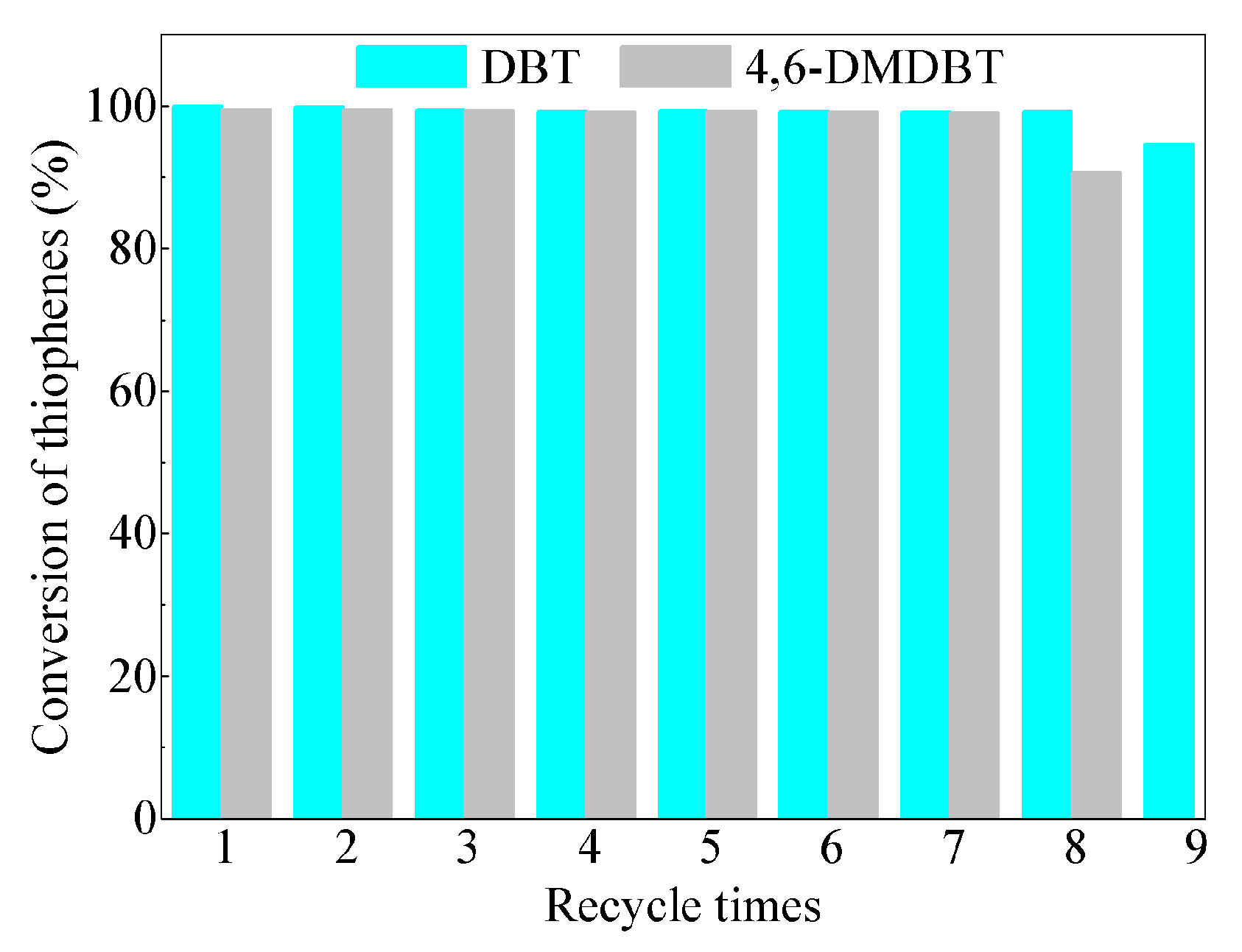
The good renewability of the catalyst is one of the key factors for its industrial application. Under the optimized conditions, the recycling performance of 11W/30ZS-RH was investigated, and the results are shown in Figure 11. As can be seen from the figure, the conversion of DBT is still as high as 99.2% after eight cycles. The conversion of DBT begins to decrease as the number of cycles continues to increase. After seven cycles, the conversion of 4,6-DMDBT is still 99.0%. When continuing to increase the number of cycles, the conversion of 4,6-DMDBT decreases. The regenerated samples were characterized by XRD, UV–Vis, TEM, ICP-OES, and N2 adsorption–desorption isotherms. The results show the following: (1) The 11W/30ZS-RH sample can withstand multiple calcinations at 823 K, with its crystal structure and pore structure remaining intact. (2) The nanoscale WOx clusters remain uniformly distributed on the 30ZS-RH carrier and do not agglomerate. (3) The WO3 loading exhibits a slight decrease after multiple uses. However, compared to the WS-923-15 catalyst previously reported [30], with the loss of the active component, WO3, is effectively suppressed. These results indicate that the 11W/30ZS-RH sample possesses excellent catalytic activity and recycling performance. Additionally, Table 7 presents some reported results of reusability of WO3-containing catalysts. Among them, there are other forms of SiO2 materials as carriers, such as mesoporous SBA-15 and KIT-6. The table demonstrates that the 11W/30ZS-RH catalyst prepared in this study exhibits superior cycling performance compared to previously reported samples, indicating that SiO2-RH serves as a more effective catalyst carrier than alternatives like SBA-15 and KIT-6.

2.3. Kinetics of the ODS Reaction

As shown in Figure S5, the particle size of the 11W/30ZS-RH sample ranges from 1.0 to 5.3 μm. The Sengupta group [66,67] investigated the effect of particle size on the ODS reaction for Titanium silicate-1 catalysts. The results revealed that when the catalyst particle size ranged from 845 to 215 μm, the internal mass transfer resistance became negligible. Furthermore, by conducting the ODS reaction at a higher stirring speed (900 rpm), the influence of external mass transfer resistance is eliminated, thereby placing the reaction under kinetic control [68,69,70]. Therefore, the ODS kinetic study conducted in this paper can be considered to have eliminated the effects of external and internal diffusion, making the reaction under kinetic control.
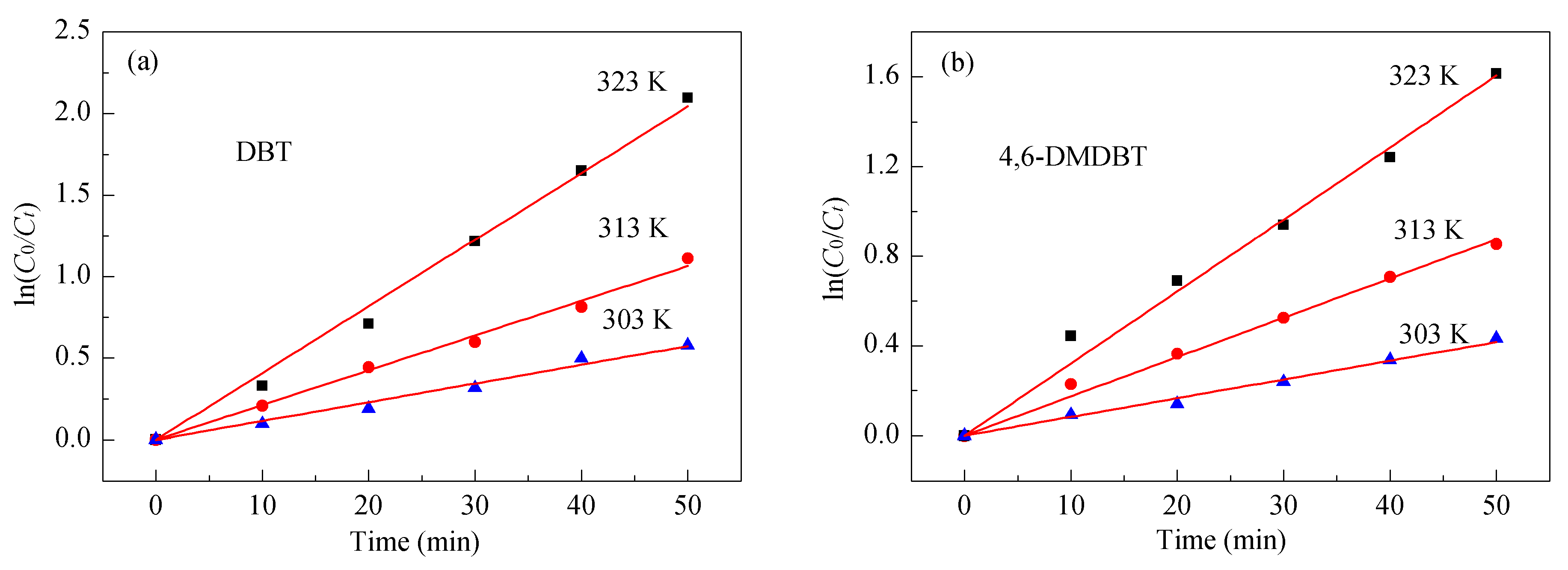
In order to determine the oxidation kinetic parameters of DBT and 4,6-DMDBT, a number of ODS reactions of DBT and 4,6-DMDBT model oils catalyzed by 11W/30ZS-RH were designed and conducted. Among them, the reaction conditions for the ODS of DBT model oil were as follows: DBT model oil, 10 mL; acetonitrile, 10 mL; catalyst-to-oil ratio, 8.0 g/L; H2O2/S molar ratio, 6.0; and stirring speed, 900 rpm. The reaction conditions for the ODS of 4,6-DMDBT model oil were as follows: 4,6-DMDBT model oil, 10 mL; acetonitrile, 10 mL; catalyst-to-oil ratio, 10.0 g/L; H2O2/S molar ratio, 6.0; and stirring speed, 900 rpm. Based on the pseudo-first-order model, the apparent rate constant k (min−1) can be calculated by plotting ln(C0/Ct) versus reaction time (t). The formulas used are shown in Equations (1) and (2). In Equations (1) and (2), C0 and Ct represent the sulfur content (μg/g) of DBT or 4,6-DMDBT model oil at reaction times of 0 and t min, respectively:
r = d C d t = k C
l n C 0 C t = k t
As can be seen from Figure 12, there is a good linear relationship between ln (C0/Ct) and t in the ODS reactions of DBT and 4,6-DMDBT model oils, and their correlation factors (R2) are more than 0.99 (Table 8). Therefore, the ODS reactions of DBT and 4,6-DMDBT model oils are considered to effectively follow the pseudo-first-order reaction kinetics. As shown in Table 8, with the increase in reaction temperature, the k values of the ODS reactions of DBT and 4,6-DMDBT model oils increase continuously, indicating that higher temperatures can increase the reaction rate of the ODS reactions. At the same reaction temperature, the k values of the ODS reaction of DBT model oil are all greater than those of 4,6-DMDBT model oil. The reason for this phenomenon is that the steric hindrance of the methyl group in 4,6-DMDBT hinders the sulfur atom from approaching the active species in the heterogeneous catalytic system, thereby reducing the reactivity [71].
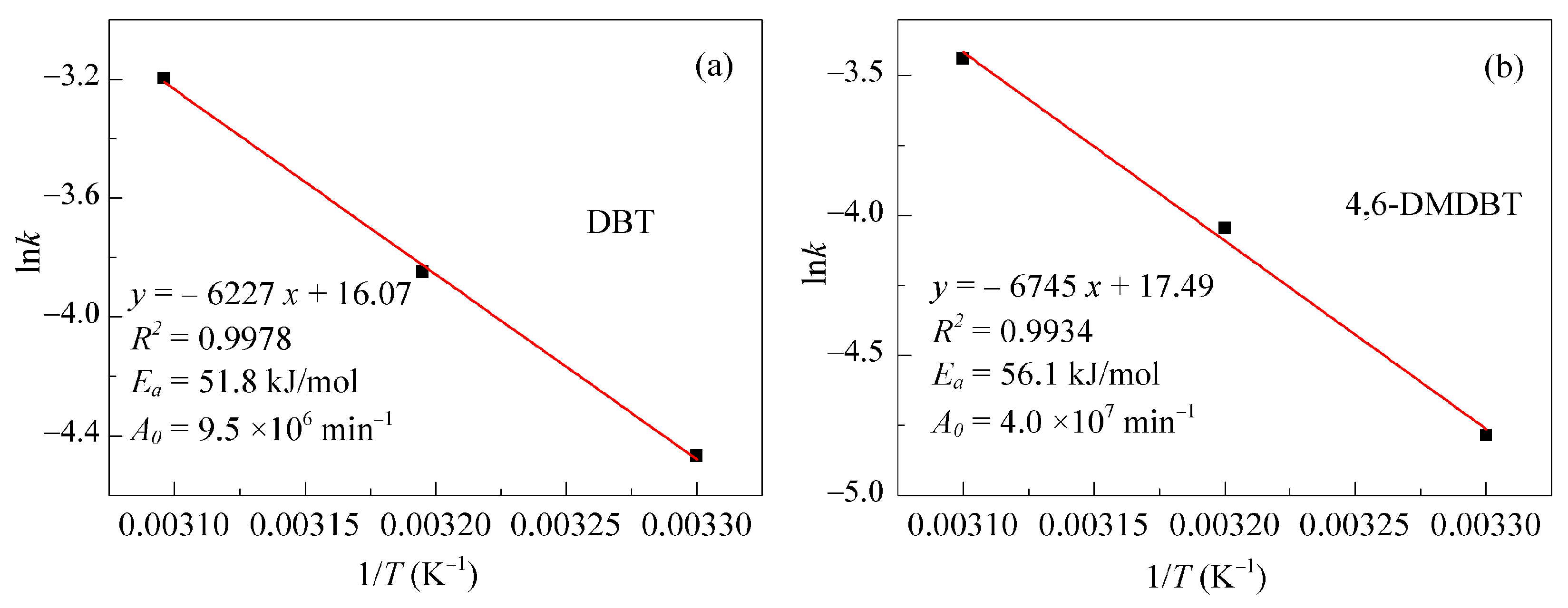
On the basis of the above kinetic experiments, Arrhenius plots for the ODS reactions of DBT and 4,6-DMDBT model oils are constructed using the Arrhenius equation (Equation (3)), and the results are shown in Figure 13. As can be seen from the figure, the R2 values of both curves are greater than 0.99, indicating that the experimental data are in good agreement with the Arrhenius equation. The calculated results show that, for the ODS reaction of DBT model oil, the apparent activation energy (Ea) is 51.8 kJ/mol, and the pre-exponential factor (A0) is 9.5 × 10⁶ min−1. For the ODS reaction of 4,6-DMDBT model oil, the Ea is 56.1 kJ/mol, and the A0 is 4.0 × 10⁷ min−1. Compared with the ODS reaction of 4,6-DMDBT model oil, the Ea of the ODS reaction of DBT model oil is smaller, indicating that the ODS reaction of DBT model oil is easy to carry out. This result is consistent with the conclusion that the conditions required to achieve complete desulfurization are more stringent for 4,6-DMDBT model oil (Table 4 and Table 5). It was reported that the Ea values of DBT oxidation in ‘20% WOx/meso-SnO2/H2O2 system’ [64], ‘WO3/mesoporous ZrO2/H2O2 system’ [59], and ‘WOx-ZrO2/H2O2 system’ [72] were 54.8, 54.8, and 68.1 kJ/mol, respectively. Komintarachat et al. [73] and Te et al. [74] reported that the Ea values of 4,6-DMDBT oxidation in polyoxometalate/H2O2 system were 57.4 and 58.7 kJ/mol, respectively. It can be said that the results of this study are consistent with the Ea values reported above.
l n k = l n A 0 1 T ( E a R )

2.4. Reaction Mechanism of the ODS Process

To gain insight into the reaction mechanism of the ODS process, we performed leaching and quenching experiments to detect the formation of active species in the reaction. Under the optimized reaction conditions, after 5 min of reaction, the mixture of the ODS reaction of DBT model oil is thermally filtered to separate 11W/30ZS-RH, and the remaining reaction solution continued to react for 55 min. The results showed that the conversion of DBT was 75.8 and 77.8% at 5 min and 1 h of reaction, respectively. Similarly, the catalyst was thermally filtered out of the ODS reaction system of 4,6-DMDBT model oil after 15 min of reaction, and the reaction was continued for 75 min. The results showed that the conversion of 4,6-DMDBT was 78.1 and 77.6% at 15 and 90 min of reaction, respectively. The above results show that the catalytic activity is completely suppressed after filtering the 11W/30ZS-RH sample out of the ODS system, and the sample is not leached out during the reaction process, which should be a good heterogeneous catalyst.
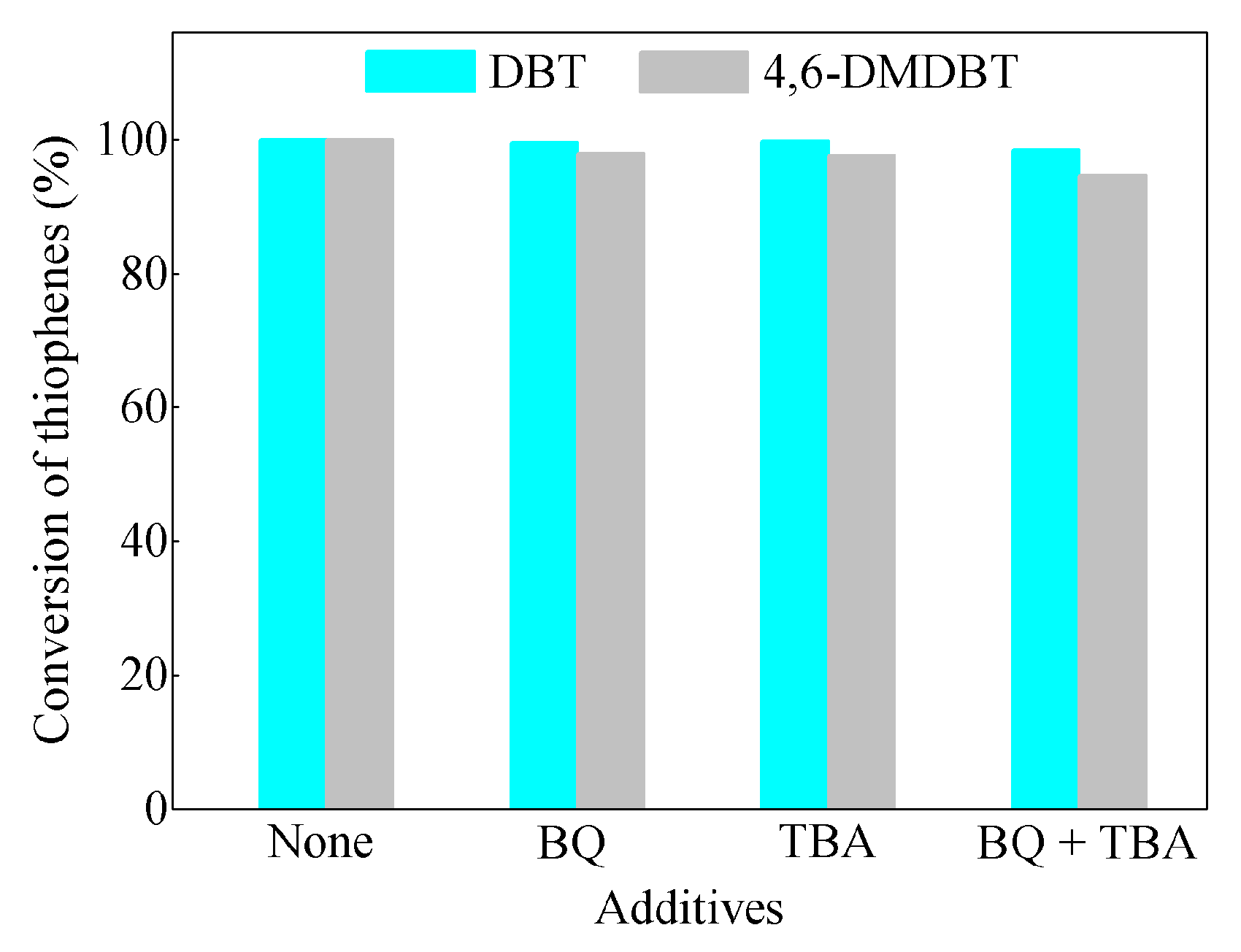
It is well known that tert-butanol (TBA) and p-benzoquinone (BQ) are good quenchers for hydroxyl radicals (HO•) and superoxide radicals (O2), respectively [75]. In order to monitor the potential presence of reactive oxygen species in the ODS catalytic system, selective radical quenching experiments are carried out under optimized conditions using TBA and BQ as quenchers, and the results are shown in Figure 14. As can be seen from the figure, the conversion of DBT remains almost unchanged after the addition of these radical quenchers to the ODS reaction of DBT model oil. The conversion of 4,6-DMDBT is only slightly affected by the addition of these radical quenchers to the ODS reaction of 4,6-DMDBT model oil. These results suggest that HO• and O2 are not the main active species in this oxidation process, and that the ODS reaction of model oils catalyzed by 11W/30ZS-RH proceeds through a non-radical mechanism [75].
The samples treated with H2O2 aqueous solution were analyzed via UV–Vis spectroscopy to capture tungsten-peroxo species [30], with results shown in Figure 15. Compared to the 11W/30ZS-RH sample, the H2O2-treated sample exhibits a distinct absorption band around 360 nm, attributed to the tungsten-peroxo species formed by the interaction between the tungsten active sites (W=O groups) and H2O2 [30,76]. Such species is widely recognized as the active intermediate in the ODS reaction catalyzed by tungsten-containing catalysts [30,39,53,59,72,76]. Interestingly, the regenerated samples also exhibit this distinct characteristic absorption band, indicating that the regenerated samples still possess a strong ability to bind H2O2 to form the tungsten-peroxo species. This result aligns well with the outcomes obtained from the cyclic experiments.
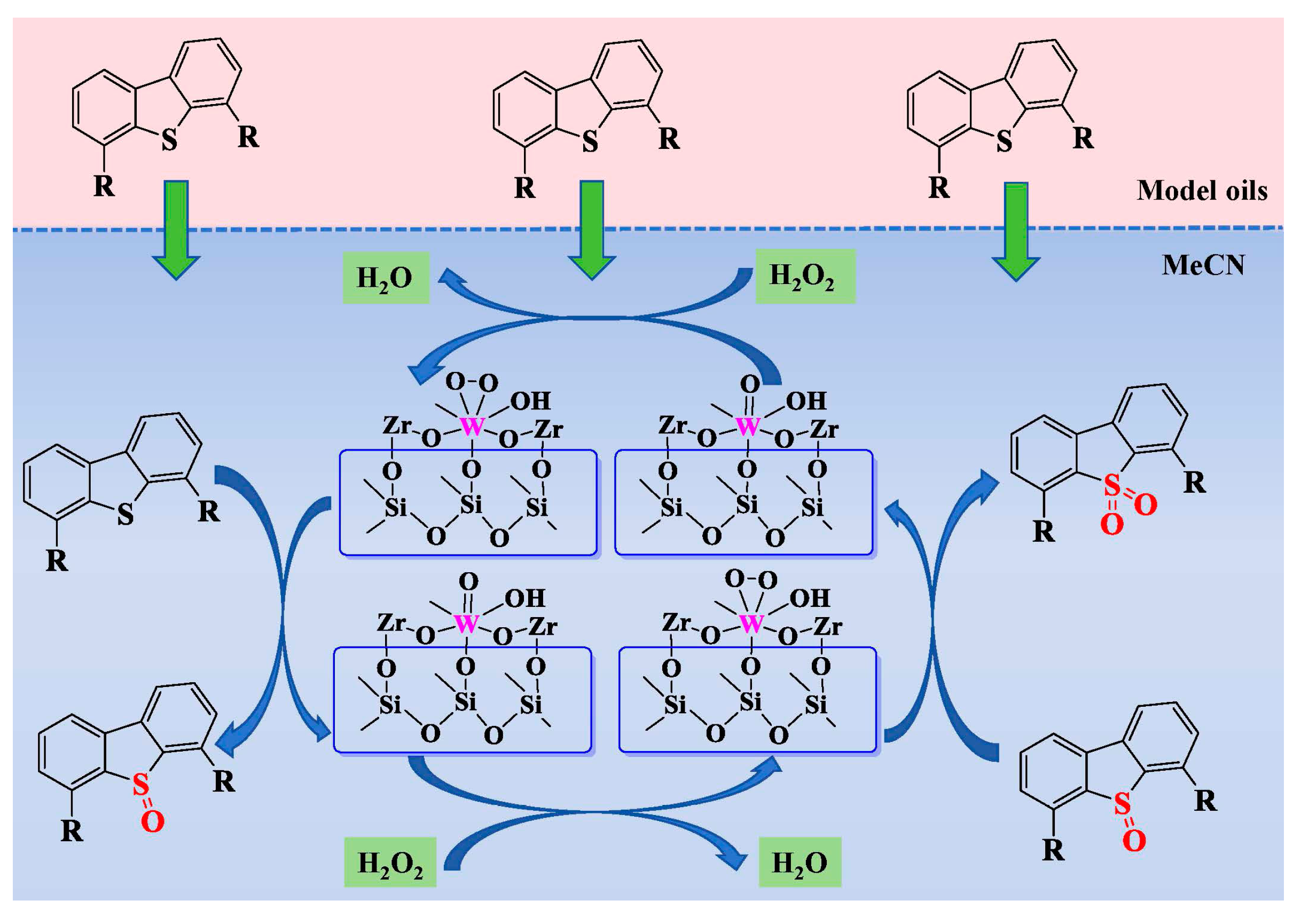
Based on the above results, we propose a reaction mechanism for the ODS of DBT and 4,6-DMDBT on 11W/30ZS-RH with H2O2, as shown in Scheme 1. The mechanism involves the following three steps: (1) DBT (or 4,6-DMDBT) present in the oil phase migrates into the acetonitrile phase and is subsequently adsorbed onto the catalyst surface together with H2O2. (2) The L acid centers of the sample, i.e., the tungsten active sites (W=O groups), react with H2O2 to form the tungsten-peroxo intermediates while simultaneously losing one molecule of H2O. (3) The sulfurs atom in DBT (or 4,6-DMDBT) undergoes nucleophilic attack on the tungsten-peroxo intermediates, resulting in the formation of sulfoxides and simultaneous release of the catalyst. Since the resulting sulfoxides are very unstable, the tungsten-peroxo intermediates can rapidly oxidize them to form the sulfones and release the catalyst [39,53,59,72]. It is worth noting that acetonitrile can be used as an extractant for DBT and 4,6-DMDBT, and it can also dissolve the sulfoxides and sulfones adsorbed on the catalyst surface in a timely manner, thereby re-exposing the active sites. Therefore, at the end of the reaction, simple filtration and liquid separation are sufficient to obtain the desulfurized model oil.

3. Materials and Methods

3.1. Materials

The RH originated from the College of Agriculture of Yangtze University (Jingzhou, China). Silica gel (184.0 m2/g; named as SiO2-gel) for thin-layer chromatography (HG/T2354, C.P.) was purchased from Qingdao Haiyang Chemical Co., Ltd. (Qingdao, China). Ammonium metatungstate hydrate (AMT, 99.5%), zirconium nitrate pentahydrate (AR), zirconium acetate (Zr content: 15.3%), dibenzothiophene (DBT, 99%), 4,6-dimethyldibenzothiophene (4,6-DMDBT, 97%), and hydrogen peroxide (30%) were purchased from Shanghai Macklin Biochemical Technology Co., Ltd. (Shanghai, China). Hydrochloric acid (AR), n-octane (AR), and acetonitrile (AR) were purchased from Sinopharm Chemical Reagent Co., Ltd. (Shanghai, China).

3.2. Preparation of WO3/ZrO2-SiO2-RH Samples

According to the method reported by our team [30], the RH was pretreated with hydrochloric acid aqueous solution (0.5 mol/L) to obtain the pretreated RH powder. The pretreated RH powder was thoroughly dried at 383 K to obtain the absolutely dried RH powder. Then, the absolutely dried RH powder was calcined at 873 K to obtain the SiO2 powder from RH, labeled SiO2-RH. The mass fraction of SiO2 in the absolutely dried RH powder is 19.6%. Additionally, ICP-OES analysis was employed to determine the contents of Al, Fe, Ca, Na, K, Mg, Zn, and Mn in the SiO2-RH sample, and the contents of Al2O3, Fe2O3, CaO, Na2O, K2O, MgO, ZnO and MnO were 0.168, 0.934, 0.342, 0.057, 0.127, 0.062, 0.012 and 0.029%, respectively. These results indicate that the SiO2-RH sample is almost entirely composed of SiO2 (98.267%), with extremely low contents of other mineral components.
Using absolutely dried RH powder as the mesoporous template and silicon source, ZrO2-SiO2 catalysts were prepared via the incipient-wetness impregnation method, with the detailed steps similar to our previous literature [30]. First, a certain amount of zirconium nitrate pentahydrate was dissolved in 12.5 mL of deionized water to obtain a colorless, clear solution. Then, the solution was added dropwise to 10.0 g of absolutely dried RH powder while stirring continuously until it reached a saturated impregnation state. The resulting mixture was aged at room temperature for 24 h. Subsequently, the mixture was dried at 383 K for 8 h and ground into a fine powder. Finally, the powder was calcined at 973 K for 5 h (1 K/min). The resulting ZrO2-SiO2 sample was abbreviated as xZS-RH, where ‘x’ represents the mass percentage of ZrO2/SiO2, i.e., the loading of ZrO2. Additionally, due to the limited solubility of zirconium nitrate in deionized water, samples with ZrO2 loading above 40% were prepared using zirconium acetate as the zirconium source, with the procedure similar to that described above.
Using the obtained xZS-RH as the carrier and AMT as the tungsten source, the WO3/xZS-RH catalyst was prepared by the same method as described above. The only difference was that the calcination temperature of the catalyst precursor was 873 K. The resulting WO3/xZS-RH sample was named yW/xZS-RH, where ‘y’ represents the mass percentage of WO3/SiO2, i.e., the loading of WO3. For comparison, using the absolutely dried RH powder as the silicon source and mesoporous template, and AMT as the tungsten source, an 11%WO3/SiO2 sample was prepared by a similar method and labeled as 11WS-RH. Meanwhile, 11%WO3/SiO2-gel and 11%WO3/30%ZrO2-SiO2-gel samples were prepared by a similar method using SiO2-gel as the carrier. Moreover, pure WO3 was obtained by calcining AMT at 873 K for 5 h, and pure ZrO2 was obtained by calcining zirconium nitrate pentahydrate at 973 K for 5 h.

3.3. Characterization

The XPS spectra were recorded using a K-Alpha photoelectron spectrometer (Thermo Fisher Scientific Inc., Waltham, MA, USA) equipped with Al Kα radiation. There was a total of 10 scans, the scanning time was 576 s, and the step size was 0.05 eV. The recorded spectra were calibrated using the binding energy peak of C 1 s at 284.8 eV as a reference. The curves of the obtained XPS spectra were analyzed using Avantage software (version 6.6.0) for deconvolution. The Fourier-Transform Infrared Spectra of adsorbed pyridine (Py-FTIR) were obtained using a Bruker Tensor 27 spectrometer (Bruker Corporation, Billerica, MA, USA). The sample was pressed into 13 mm self-supporting disks and sealed in an in situ cell. It was degassed for 1 h at 623 K under a vacuum of 10−3 Pa, then cooled to room temperature. After acquiring the background at room temperature, pyridine vapor was introduced into the in situ cell for adsorption, with equilibration maintained for 30 min. The cell was then heated to the target temperature, evacuated again to 10−3 Pa, and held for 30 min. Finally, the sample was cooled to room temperature, and IR spectra at the target temperature were recorded in the wavenumber range of 1400–1700 cm−1. Spectral data were obtained at 423, 473, and 523 K, respectively. The number of Brønsted acid sites and Lewis acid sites was calculated based on the integral areas of the peaks at 1540 and 1446 cm−1, respectively. In addition, the samples were also characterized using XRD, UV–Vis, FT-IR, ICP-OES, SEM, TEM, LC-MS, and N2 adsorption–desorption isotherms. For detailed characterization information, please refer to our previous report [30].

3.4. Catalytic Activity and Recycling Tests

Detailed information on the catalytic activity and recycling tests of the samples is provided in the Supplementary Materials.

4. Conclusions

In short, mesoporous yW/xZS-RH samples derived from RH were successfully prepared using the two-step incipient-wetness impregnation method. The samples were characterized using XRD, UV–Vis, FT-IR, ICP-OES, TEM, XPS, LC-MS, and N2 adsorption–desorption isotherms. Compared to 11WS-RH, the introduction of ZrO2 led to the formation of stronger W-O-Zr bonds in the sample, which stabilized the tungsten species in the W6+ state. The strong preferential interaction between Zr and W not only contributed to the formation of stable and highly dispersed WOx clusters on the surface of mesoporous 30ZS-RH but also prevented the tungstate species from aggregating into WO3 crystallites, which led to a significant decrease in the amount of WO3 crystallites, and thus inhibited the loss of the WO3 component during cycling experiments. The effects of different WO3 and ZrO2 loadings on ODS performance of the samples were studied, and a suitable catalyst of 11W/30ZS-RH was obtained. The reaction parameters of the ODS reaction were optimized, and the appropriate reaction conditions were obtained. After the eighth run, the sample still showed a DBT conversion of 99.2%. After the seventh run, the sample still showed a 4,6-DMDBT conversion of 99.0%. The relevant characterization results indicated that the crystal structure, pore structure, and dispersion of active components on the carrier of the regenerated samples remained good, and the problem of WO3 active component loss was effectively solved.
The kinetics of the ODS reactions of DBT and 4,6-DMDBT model oils were further studied. The results showed that they effectively follow the pseudo-first-order reaction kinetics, and the Ea of the ODS reaction of DBT and 4,6-DMDBT model oils was 51.8 and 56.1 kJ/mol, respectively. The results of leaching experiments showed that 11W/30ZS-RH is a good heterogeneous catalyst. The results of quenching experiments showed that the ODS reaction of model oils catalyzed by 11W/30ZS-RH was carried out by a non-radical mechanism. Furthermore, the active intermediate tungsten-peroxo species of the ODS reaction was successfully captured by the UV–Vis technique, and a possible mechanism for the ODS of bulky organic sulfides catalyzed by 11W/30ZS-RH was proposed. Finally, compared to tungsten-containing catalysts prepared using other forms of SiO2, the 11W/30ZS-RH sample demonstrated superior catalytic performance. These findings confirmed that SiO2-RH serves as a superior catalyst carrier compared to silica gel, SBA-15, and KIT-6.

Supplementary Materials

The following supporting information can be downloaded at https://www.mdpi.com/article/10.3390/catal15100996/s1. Catalytic Activity and Recycling Tests: Figure S1: The standard curves for DBT and 4,6-DMDBT model oils; Figure S2: XPS analysis of the samples: (a) O 1s (OL stands for lattice oxygen), (b) Si 2p; Figure S3: The FT-IR spectra of the samples; Figure S4: The Py-FTIR spectra of different samples at 423 K (a), and the Py-FTIR spectra of the 11W/30ZS-RH sample at different temperatures (b); Figure S5: SEM image of the 11W/30ZS-RH sample; Table S1: Acidic properties of the samples determined by Py-FTIR at 423 K.

Author Contributions

Conceptualization, H.L. and X.X.; methodology, X.X. and Y.Z.; validation, H.C. and Q.C.; formal analysis, H.C. and F.W.; investigation, Q.C. and F.W.; resources, X.X., Q.C., and X.L. (Xiang Li); data curation, Y.Z. and H.C.; writing—original draft preparation, X.X., H.L., and Y.Z.; writing—review and editing, X.L. (Xiang Li), X.X., and H.L.; visualization, X.L. (Xiaoxue Liu) and X.L. (Xiang Li); supervision, X.L. (Xiaoxue Liu) and H.L.; project administration, X.L. (Xiaoxue Liu); funding acquisition, H.L. All authors have read and agreed to the published version of the manuscript.

Funding

This work is supported by the National Natural Science Foundation of China (21303008) and the Natural Science Foundation of Hubei Province of China (2012FFB00103).

Institutional Review Board Statement

Not applicable.

Data Availability Statement

The original contributions presented in the study are included in the article; further inquiries can be directed to the corresponding author.

Conflicts of Interest

The authors declare no conflicts of interest.

References

  1. Lin, Y.; Ren, Y.; Wang, X.; Wang, J.; Gao, Y.; Wang, Y.; Yang, X. Research progress of functional materials for conversion of agricultural biomass wastes. Huanjing Kexue 2024, 45, 4332–4351. [Google Scholar]
  2. Xue, H.; Chen, Y.; Liu, X.; Qian, Q.; Luo, Y.; Cui, M.; Chen, Y.; Yang, D.P.; Chen, Q. Visible light-assisted efficient degradation of dye pollutants with biomass-supported TiO2 hybrids. Mater. Sci. Eng. C. 2018, 82, 197–203. [Google Scholar] [CrossRef] [PubMed]
  3. Nath, B.; Basumatary, B.; Wary, N.; Basumatary, U.R.; Basumatary, J.; Rokhum, S.L.; Azam, M.; Min, K.M.; Basumatary, S. Agricultural waste-based heterogeneous catalyst for the production of biodiesel: A ranking study via the VIKOR method. Int. J. Energy Res. 2023, 2023, 7208754. [Google Scholar] [CrossRef]
  4. Deng, L.; Wang, C.; Xu, A.; Zha, F.; Liu, T.; Hu, X.; Wang, Y. Environmentally friendly biological activated carbon derived from sugarcane waste as a promising carbon source for efficient and robust rechargeable zinc-air battery. Catalysts 2024, 14, 740. [Google Scholar] [CrossRef]
  5. Melero, J.A.; Bautista, L.F.; Morales, G.; Iglesias, J.; Sánchez-Vázquez, R. Biodiesel production from crude palm oil using sulfonic acid-modified mesostructured catalysts. Chem. Eng. J. 2010, 161, 323–331. [Google Scholar] [CrossRef]
  6. Eldiehy, K.S.H.; Daimary, N.; Borah, D.; Sarmah, D.; Bora, U.; Mandal, M.; Deka, D. Towards biodiesel sustainability: Waste sweet potato leaves as a green heterogeneous catalyst for biodiesel production using microalgal oil and waste cooking oil. Ind. Crops Prod. 2022, 187, 115467. [Google Scholar] [CrossRef]
  7. Perveen, F.; Farooq, M.; Naeem, A.; Humayun, M.; Saeed, T.; Khan, I.W.; Abid, G. Catalytic conversion of agricultural waste biomass into valued chemical using bifunctional heterogeneous catalyst: A sustainable approach. Catal. Commun 2022, 171, 106516. [Google Scholar] [CrossRef]
  8. Mansur, D.; Tago, T.; Masuda, T.; Abimanyu, H. Conversion of cacao pod husks by pyrolysis and catalytic reaction to produce useful chemicals. Biomass Bioenergy 2014, 66, 275–285. [Google Scholar] [CrossRef]
  9. Vu, D.L.; Seo, J.S.; Lee, H.Y.; Lee, J.W. Activated carbon with hierarchical micro-mesoporous structure obtained from rice husk and its application for lithium-sulfur batteries. RSC Adv. 2017, 7, 4144–4151. [Google Scholar] [CrossRef]
  10. Unglaube, F.; Atia, H.; Bartling, S.; Carsten, R.; Kreyenschulte, C.R.; Mejía, E. Hydrogenation of epoxides to anti-markovnikov alcohols over a nickel heterogenous catalyst prepared from biomass (rice) waste. Helv. Chim. Acta 2023, 106, e202200167. [Google Scholar] [CrossRef]
  11. National Bureau of Statistics Announces Grain Production Data for 2023. Available online: https://www.stats.gov.cn/sj/zxfb/202312/t20231211_1945417.html (accessed on 12 December 2024).
  12. Peralta, Y.M.; Molina, R.; Moreno, S. Rice HUSK silica: A review from conventional uses to new catalysts for advanced oxidation processes. J. Environ. Manag. 2025, 370, 122735. [Google Scholar] [CrossRef]
  13. Zhang, H.; Ding, X.; Chen, X.; Ma, Y.; Wang, Z.; Zhao, X. A new method of utilizing rice husk: Consecutively preparing d-xylose, organosolv lignin, ethanol and amorphous superfine silica. J. Hazard. Mater. 2015, 291, 65–73. [Google Scholar] [CrossRef] [PubMed]
  14. Herrera, K.; Morales, L.F.; Tarazona, N.A.; Aguado, R.; Saldarriaga, F.J. Use of biochar from rice husk pyrolysis: Part A: Recovery as an adsorbent in the removal of emerging compounds. ACS Omega 2022, 7, 7625–7637. [Google Scholar] [CrossRef] [PubMed]
  15. Muhammad, M.U.; Hadi, B.A.; Idris, B.; Abduljalil, M.M. Preparation of high surface area activated carbon from native rice husk. Lond. J. Eng. Res. 2021, 21, 13–19. [Google Scholar]
  16. Khan, L.A.; Liaquat, R.; Aman, M.; Kanan, M.; Saleem, M.; khoja, A.H.; Bahadar, A.; Khan, W.U.H. Investigation of novel transition metal loaded hydrochar catalyst synthesized from waste biomass (rice husk) and its application in biodiesel production using waste cooking oil (WCO). Sustainability 2024, 16, 7275. [Google Scholar] [CrossRef]
  17. Cui, J.; Cheng, F.; Lin, J.; Yang, J.; Jiang, K.; Wen, Z.; Sun, J. High surface area C/SiO2 composites from rice husks as a high-performance anode for lithium ion batteries. Powder Technol. 2017, 311, 1–8. [Google Scholar] [CrossRef]
  18. Steven, S.; Restiawaty, E.; Pasymi, P.; Bindar, Y. An appropriate acid leaching sequence in rice husk ash extraction to enhance the produced green silica quality for sustainable industrial silica gel purpose. J. Taiwan Inst. Chem. Eng. 2021, 122, 51–57. [Google Scholar] [CrossRef]
  19. Priya, A.S.; Devi, K.R.S.; Karthik, K.; Sugunan, S. Modified rice husk silica from biowaste: An efficient catalyst for transesterification of diethyl malonate and benzyl alcohol. Waste Biomass Valorization 2020, 11, 4809–4819. [Google Scholar] [CrossRef]
  20. Taiye, M.A.; Hafida, W.; Kong, F.; Zhou, C. A review of the use of rice husk silica as a sustainable alternative to traditional silica sources in various applications. Environ. Prog. Sustain. Energy 2024, 43, e14451. [Google Scholar] [CrossRef]
  21. Alyosef, H.A.; Uhlig, H.; Muenster, T.; Kloess, G.; Einicke, W.D.; Glaeser, R.; Enke, D. Biogenic silica from rice husk ash-sustainable sources for the synthesis of value added silica. Chem. Eng. Trans. 2014, 37, 667–672. [Google Scholar]
  22. Gebretatios, A.G.; Pillantakath, A.R.K.K.; Witoon, T.; Lim, J.W.; Banat, F.; Cheng, C.K. Rice husk waste into various template-engineered mesoporous silica materials for different applications: A comprehensive review on recent developments. Chemosphere 2023, 310, 136843. [Google Scholar] [CrossRef]
  23. Chang, F.W.; Hsiao, T.J.; Chung, S.W.; Lo, J.J. Nickel supported on rice husk ash-activity and selectivity in CO2 methanation. Appl. Catal. A 1997, 164, 225–236. [Google Scholar] [CrossRef]
  24. Selva Priya, A.; Sunaja Devi, K.R. Designing biomass rice husk silica as an efficient catalyst for the synthesis of biofuel additive n-butyl levulinate. BioEnergy Res. 2020, 13, 746–756. [Google Scholar] [CrossRef]
  25. Adam, F.; Iqbal, A. The liquid phase oxidation of styrene with tungsten modified silica as a catalyst. Chem. Eng. J. 2011, 171, 1379–1386. [Google Scholar] [CrossRef]
  26. Gan, P.P.; Li, S.F.Y. Efficient removal of rhodamine B using a rice hull-based silica supported iron catalyst by fenton-like process. Chem. Eng. J. 2013, 229, 351–363. [Google Scholar] [CrossRef]
  27. Ramalingam, R.J.; Appaturi, J.N.; Pulingam, T.; Al-Lohedan, H.A.; Al-dhayan, D.M. In-situ incorporation of ruthenium/copper nanoparticles in mesoporous silica derived from rice husk ash for catalytic acetylation of glycerol. Renew. Energy 2020, 160, 564–574. [Google Scholar] [CrossRef]
  28. Unglaube, F.; Kreyenschulte, C.R.; Mejía, E. Development and application of efficient Ag-based hydrogenation catalysts prepared from rice husk waste. ChemCatChem 2021, 13, 2583–2591. [Google Scholar] [CrossRef]
  29. Liu, X.; Zhang, L.; Hu, J.; Zhang, W.; Xiang, X.; Cheng, H.; Li, Q.; Li, H. The utilization of rice husk as both the silicon source and mesoporous template for the green preparation of mesoporous TiO2/SiO2 and its excellent catalytic performance in oxidative desulfurization. Molecules 2024, 29, 3856. [Google Scholar] [CrossRef] [PubMed]
  30. Zhang, Y.; Liu, X.; Zhao, R.; Zhang, J.; Zhang, L.; Zhang, W.; Hu, J.; Li, H. The green preparation of mesoporous WO3/SiO2 and its application in oxidative desulfurization. Catalysts 2024, 14, 103. [Google Scholar] [CrossRef]
  31. Labbé, P. Tungsten oxides, tungsten bronzes and tungsten bronze-type structures. Key Eng. Mater. 1992, 68, 293–340. [Google Scholar] [CrossRef]
  32. Guo, C.; Wang, P.; Liao, S.; Si, H.; Chen, S.; Fan, G.; Wang, Z. Morphology-controllable hydrothermal synthesis of zirconia with the assistance of a rosin-based surfactant. Appl. Sci. 2019, 9, 4145. [Google Scholar] [CrossRef]
  33. Chen, M.; Liu, Y. Synthesis of DL-tartaric acid from maleic anhydride over SiO2-modified WO3-ZrO2 catalyst. Catal. Lett. 2024, 154, 1411–1419. [Google Scholar] [CrossRef]
  34. Kim, T.Y.; Park, D.S.; Choi, Y.; Baek, J.; Park, J.R.; Yi, J. Preparation and characterization of mesoporous Zr-WOx/SiO2 catalysts for the esterification of 1-butanol with acetic acid. J. Mater. Chem. 2012, 22, 10021–10028. [Google Scholar] [CrossRef]
  35. Jin, C.; Xu, B.; Xu, B.; Guo, J.; Li, S. Improved acidity of mesoporous ZrO2-WO3 through NH3-air subsection-calcination treatment. Quim. Nova 2024, 47, e-20240029. [Google Scholar] [CrossRef]
  36. Lucas, A.D.; Valverde, J.L.; CanÄizares, P.; Rodriguez, L. Partial oxidation of methane to formaldehyde over W/SiO2 catalysts. Appl. Catal. A 1999, 184, 143–152. [Google Scholar] [CrossRef]
  37. Thunyaratchatanon, C.; Luengnaruemitchai, A.; Chaisuwan, T.; Chollacoop, N.; Chen, S.Y.; Yoshimura, Y. Synthesis and characterization of Zr incorporation into highly ordered mesostructured SBA-15 material and its performance for CO2 adsorption. Microporous Mesoporous Mater. 2017, 253, 18–28. [Google Scholar] [CrossRef]
  38. Wang, H.; Guo, Y.; Chang, C.; Zhu, X.; Liu, X.; Han, J.; Ge, Q. Enhancing tungsten oxide/SBA-15 catalysts for hydrolysis of cellobiose through doping ZrO2. Appl. Catal. A 2016, 523, 182–192. [Google Scholar] [CrossRef]
  39. Luna, M.L.; Alvarez-Amparán, M.A.; Cedeño-Caero, L. Performance of WOx-VOx based catalysts for ODS of dibenzothiophene compounds. J. Taiwan Inst. Chem. Eng. 2019, 95, 175–184. [Google Scholar] [CrossRef]
  40. Wang, C.; Li, A.; Xu, J.; Wen, J.; Zhang, H.; Zhang, L. Preparation of WO3/CNT catalysts in presence of ionic liquid [C16mim]Cl and catalytic efficiency in oxidative desulfurization. J. Chem. Technol. Biotechnol. 2019, 94, 3403–3412. [Google Scholar] [CrossRef]
  41. Ross-Medgaarden, E.I.; Knowles, W.V.; Kim, T.; Wong, M.S.; Zhou, W.; Kiely, C.J.; Wachs, I.E. New insights into the nature of the acidic catalytic active sites present in ZrO2-supported tungsten oxide catalysts. J. Catal. 2008, 256, 108–125. [Google Scholar] [CrossRef]
  42. Zhang, M.; Liao, W.; Wei, Y.; Wang, C.; Fu, Y.; Gao, Y.; Zhu, L. Aerobic oxidative desulfurization by nanoporous tungsten oxide with oxygen defects. ACS Appl. Nano Mater. 2021, 4, 1085–1093. [Google Scholar] [CrossRef]
  43. Cortés-Jácome, M.A.; Angeles-Chavez, C.; Lόpez-Salinas, E.; Navarrete, J.; Toribio, P.; Toledo, J.A. Migration and oxidation of tungsten species at the origin of acidity and catalytic activity on WO3-ZrO2 catalysts. Appl. Catal. A 2007, 318, 178–189. [Google Scholar] [CrossRef]
  44. Ding, G.R.; Wang, Y.F.; Duan, G.Y.; Fan, Y.Q.; Xu, B.H. Adjustment of W−O−Zr boundaries boosts efficient nitrilation of dimethyl adipate with ammonia on WOx/ZrO2 catalysts. ACS Appl. Mater. Interfaces 2023, 15, 3633–3643. [Google Scholar] [CrossRef]
  45. Qiang, T.; Zhao, J.; Li, J. Direct synthesis of homogeneous Zr-doped SBA-15 mesoporous silica via masking zirconium sulfate. Microporous Mesoporous Mater. 2018, 257, 162–174. [Google Scholar] [CrossRef]
  46. Colmenares-Zerpa, J.; Gajardo, J.; Peixoto, A.F.; Silva, D.S.A.; Silva, J.A.; Gispert-Guirado, F.; Llorca, J.; Urquieta-Gonzalez, E.A.; Santos, J.B.O.; Chimentao, R.J. High zirconium loads in Zr-SBA-15 mesoporous materials prepared by direct-synthesis and pH-adjusting approaches. J. Solid State Chem. 2022, 312, 123296. [Google Scholar] [CrossRef]
  47. Azimirad, R.; Naseri, N.; Akhavan, O.; Moshfegh, A.Z. Hydrophilicity variation of WO3 thin films with annealing temperature. J. Phys. D Appl. Phys. 2007, 40, 1134–1137. [Google Scholar] [CrossRef]
  48. Shpak, A.P.; Korduban, A.M.; Medvedskij, M.N.; Kandyba, V.O. XPS studies of active elements surface of gas sensors based on WO3−x nanoparticles. J. Electron Spectrosc. Relat. Phenom. 2007, 156, 172–175. [Google Scholar] [CrossRef]
  49. Li, J.; Liu, Y.; Zhou, X.; Yang, Y. Boosting oxidative adsorptive desulfurization of fuel oil by constructing a mesoporous coupled desulfurizer with bimetal of MoO3 and WO3. J. Porous Mater. 2025, 32, 1429–1441. [Google Scholar] [CrossRef]
  50. Cecilia, J.A.; García-Sancho, C.; Mérida-Robles, J.M.; Santamaría Gonzalez, J.; Moreno-Tost, R.; Moreno-Torres, P. WO3 supported on Zr doped mesoporous SBA-15 silica for glycerol dehydration to acrolein. Appl. Catal. A 2016, 516, 30–40. [Google Scholar] [CrossRef]
  51. de la Fuente, N.; Wang, J.A.; Chen, L.; Valenzuela, M.A.; Noreña, L.E.; Rojas, E.; onzález, J.; He, M.; Peng, J.; Zhou, X. Achieving ultra-low-sulfur model diesel through defective keggin-type heteropolyoxometalate Catalysts. Inorganics 2024, 12, 274. [Google Scholar] [CrossRef]
  52. Ramos, J.M.; Wang, J.A.; Flores, S.O.; Chen, L.; Arellano, U.; Noreña, L.E.; González, J.; Navarrete, J. Ultrasound-assisted hydrothermal synthesis of V2O5/Zr-SBA-15 catalysts for production of ultralow sulfur fuel. Catalysts 2021, 11, 408. [Google Scholar] [CrossRef]
  53. Ma, R.; Guo, J.; Wang, D.; He, M.; Xun, S.; Gu, J.; Zhu, W.; Li, H. Preparation of highly dispersed WO3/few layer g-C3N4 and its enhancement of catalytic oxidative desulfurization activity. Colloids Surf. A 2019, 572, 250–258. [Google Scholar] [CrossRef]
  54. Foraita, S.; Liu, Y.; Haller, G.L.; Baráth, E.; Zhao, C.; Lercher, J.A. Controlling hydrodeoxygenation of stearic acid to n-heptadecane and n-octadecane by adjusting the chemical properties of Ni/SiO2–ZrO2 catalyst. ChemCatChem 2017, 9, 195–203. [Google Scholar] [CrossRef]
  55. Socrates, G. Sulphur and selenium compounds. In Infrared and Raman Characteristic Group Frequencies: Tables and Charts, 3rd ed.; John Wiley & Sons Ltd.: Chichester, UK, 2001; pp. 211–218. [Google Scholar]
  56. Li, X.; Huang, S.; Xu, Q. Preparation of WO3-SBA-15 mesoporous molecular sieve and its performance as an oxidative desulfurization catalyst. Transit. Met. Chem. 2009, 34, 943–947. [Google Scholar] [CrossRef]
  57. Yuan, J.; Xiang, J.; Wang, J.; Ding, W.; Yang, L.; Zhang, M.; Zhu, W.; Li, H. Structure and catalytic oxidative desulfurization properties of SBA-15 supported silicotungstic acid ionic liquid. J. Porous Mater. 2016, 23, 823–831. [Google Scholar] [CrossRef]
  58. Li, Z.; Jeong, H.J.; Sivaranjani, K.; Song, B.J.; Park, S.B.; Li, D.; Lee, C.W.; Jin, M.; Kim, J.M. Highly ordered mesoporous WO3 with excellent catalytic performance and reusability for deep oxidative desulfurization. Nano 2015, 10, 1550075. [Google Scholar] [CrossRef]
  59. Xun, S.; Hou, C.; Li, H.; He, M.; Ma, R.; Zhang, M.; Zhu, W.; Li, H. Synthesis of WO3/mesoporous ZrO2 catalyst as a high-efficiency catalyst for catalytic oxidation of dibenzothiophene in diesel. J. Mater. Sci. 2018, 53, 15927–15938. [Google Scholar] [CrossRef]
  60. Qi, H.X.; Zhai, S.R.; Zhang, W.; Zhai, B.; An, Q.D. Recyclable HPW/PEHA/ZrSBA-15 toward efficient oxidative desulfurization of DBT with hydrogen peroxide. Catal. Commun. 2015, 72, 53–56. [Google Scholar] [CrossRef]
  61. Saeed, M.; Munir, M.; Intisar, A.; Waseem, A. Facile synthesis of a novel Ni-WO3@g-C3N4 nanocomposite for efficient oxidative desulfurization of both model and real fuel. ACS Omega 2022, 7, 15809–15820. [Google Scholar] [CrossRef]
  62. Feng, Z.; Zhu, Y.; Zhou, Q.; Wu, Y.; Wu, T. Magnetic WO3/Fe3O4 as catalyst for deep oxidative desulfurization of model oil. Mater. Sci. Eng. B 2019, 240, 85–91. [Google Scholar] [CrossRef]
  63. El-Aty, D.M.A.; Alkahlawy, A.A.; Soliman, F.S. Eco-friendly catalyst in ultrasonic-assisted oxidative desulfurization of dibenzothiophene compound. Mater. Chem. Phys. 2024, 320, 129414. [Google Scholar] [CrossRef]
  64. Piao, W.; Li, Z.; Li, C.; Park, J.S.; Lee, J.; Li, Z.; Kim, K.Y.; Jin, M. Efficient and reusable ordered mesoporous WOx/SnO2 catalyst for oxidative desulfurization of dibenzothiophene. RSC Adv. 2021, 11, 27453–27460. [Google Scholar] [CrossRef] [PubMed]
  65. Ahmed, I.; Jhung, S.H. Room-temperature oxidative desulfurization with tungsten oxide supported on NU-1000 metal–organic framework. Fuel 2025, 393, 135043. [Google Scholar] [CrossRef]
  66. Sengupta, A.; Kamble, P.D.; Basu, J.K.; Sengupta, S. Kinetic study and optimization of oxidative desulfurization of benzothiophene using mesoporous titanium silicate-1 catalyst. Ind. Eng. Chem. Res. 2012, 51, 147–157. [Google Scholar] [CrossRef]
  67. Jose, N.; Sengupta, S.; Basu, J.K. Optimization of oxidative desulfurization of thiophene using Cu/titanium silicate-1 by box-behnken design. Fuel 2011, 90, 626–632. [Google Scholar] [CrossRef]
  68. Tang, L.; Luo, G.; Kang, L.; Zhu, M.; Dai, B. A novel [Bmim]PW/HMS catalyst with high catalytic performance for the oxidative desulfurization process. Korean J. Chem. Eng. 2013, 30, 314–320. [Google Scholar] [CrossRef]
  69. Rajasuriyan, S.; Mohd Zaid, H.F.; Majid, M.F.; Ramli, R.M.; Jumbri, K.; Lim, J.W.; Mohamad, M.; Show, P.L.; Yuliarto, B. Oxidative extractive desulfurization system for fuel oil using acidic eutectic-based ionic liquid. Processes 2021, 9, 1050. [Google Scholar] [CrossRef]
  70. Zhu, W.; Zhu, G.; Li, H.; Chao, Y.; Zhang, M.; Du, D.; Wang, Q.; Zhao, Z. Catalytic kinetics of oxidative desulfurization with surfactant-type polyoxometalate-based ionic liquids. Fuel Process. Technol. 2013, 106, 70–76. [Google Scholar] [CrossRef]
  71. Akbari, A.; Omidkhah, M.; Darian, J.T. Facilitated and selective oxidation of thiophenic sulfur compounds using MoOx/Al2O3-H2O2 system under ultrasonic irradiation. Ultrason. Sonochem. 2015, 23, 231–237. [Google Scholar] [CrossRef]
  72. Ramírez-Verduzco, L.F.; Reyes, J.A.D.L.; Torres-García, E. Solvent effect in homogeneous and heterogeneous reactions to remove dibenzothiophene by an oxidation-extraction scheme. Ind. Eng. Chem. Res. 2008, 47, 5353–5361. [Google Scholar] [CrossRef]
  73. Komintarachat, C.; Trakarnpruk, W. Oxidative desulfurization using polyoxometalates. Ind. Eng. Chem. Res. 2006, 45, 1853–1856. [Google Scholar] [CrossRef]
  74. Te, M.; Fairbridge, C.; Ring, Z. Oxidation reactivities of dibenzothiophenes in polyoxometalate/H2O2 and formic acid/H2O2 systems. Appl. Catal. A 2001, 219, 267–280. [Google Scholar] [CrossRef]
  75. Ye, G.; Yang, Z.; Shi, G.; Huang, R.; Liu, X.; Zhang, Q.; Song, R. Synthesis of amorphous titanium isophthalic acid catalyst with hierarchical porosity for efficient oxidative desulfurization of model feed with minimum oxidant. Sep. Purif. Technol. 2025, 354, 128669. [Google Scholar] [CrossRef]
  76. Wang, H.; Tang, M.; Shi, F.; Ding, R.; Wang, R.; Wu, J.; Li, X.; Liu, Z.; Lv, B. Amorphous Cr2WO6-modified WO3 nanowires with a large specific surface area and rich lewis acid sites: A highly efficient catalyst for oxidative desulfurization. ACS Appl. Mater. Interfaces 2020, 12, 38140–38152. [Google Scholar] [CrossRef] [PubMed]
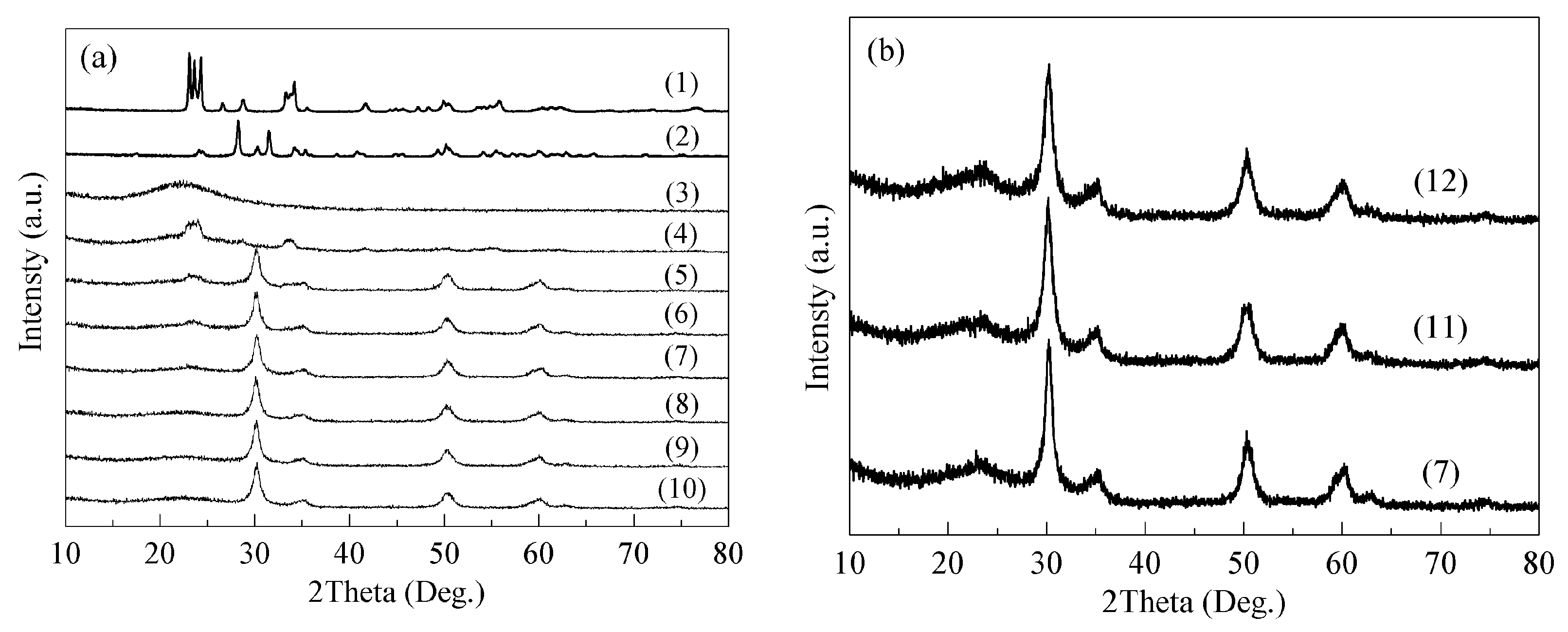
Figure 1. The XRD patterns of the SiO2-RH, pure WO3, pure ZrO2, and yW/30ZS-RH samples (a), and the fresh and regenerated 11W/30ZS-RH samples (b): (1) pure WO3, (2) pure ZrO2, (3) SiO2-RH, (4) 11WS-RH, (5) 15W/30ZS-RH, (6) 12W/30ZS-RH, (7) 11W/30ZS-RH, (8) 5W/30ZS-RH, (9) 2.5W/30ZS-RH, (10) 30ZS-RH, (11) 11W/30ZS-RHr regenerated from the ninth ODS reaction of DBT, and (12) 11W/30ZS-RHr regenerated from the eighth ODS reaction of 4,6-DMDBT.
Catalysts 15 00996 g001
Figure 2. UV–Vis spectra of the SiO2-RH, pure WO3, pure ZrO2, and yW/30ZS-RH samples (a), and the fresh and regenerated 11W/30ZS-RH samples, as well as oxidation products of DBT and 4,6-DMDBT (b): (1) 30ZS-RH, (2) 2.5W/30ZS-RH, (3) 5W/30ZS-RH, (4) 11W/30ZS-RH, (5) 15W/30ZS-RH, (6) 11WS-RH, (7) pure WO3, (8) 11W/30ZS-RHr regenerated from the ninth ODS reaction of DBT, (9) 11W/30ZS-RHr regenerated from the eighth ODS reaction of 4,6-DMDBT, (10) oxidation product of DBT, and (11) oxidation product of 4,6-DMDBT.
Catalysts 15 00996 g002
Figure 3. N2 adsorption–desorption isotherms (a) and pore size distribution curves (b) of the samples: (1) 11WS-RH, (2) 30ZS-RH, (3) 5W/30ZS-RH, (4) 11W/30ZS-RH, (5) 15W/30ZS-RH, (6) 11W/30ZS-RHr regenerated from the ninth ODS reaction of DBT, and (7) 11W/30ZS-RHr regenerated from the eighth ODS reaction of 4,6-DMDBT. The ‘+ value’ above the curve indicates that this curve was obtained by vertically translating the original curve upward by that specified value.
Catalysts 15 00996 g003
Figure 4. TEM images of the samples: (a) and (b) 30ZS-RH, (c) 11W/30ZS-RH, (d) 11W/30ZS-RHr regenerated from the ninth ODS reaction of DBT, and (e) 11W/30ZS-RHr regenerated from the eighth ODS reaction of 4,6-DMDBT. The black dots within the yellow circles in the figure represent WOx clusters. The yellow parallel lines, along with the arrows on either side, denote the spacing of the lattice fringes. The values for the lattice fringes spacing appear beside the parallel lines, with the corresponding ZrO2 crystal planes listed below these values.
Catalysts 15 00996 g004
Figure 5. Particle size distribution histograms of the samples: (a) 30ZS-RH, (b,c) 11W/30ZS-RH, (d,e) 11W/30ZS-RHr regenerated from the ninth ODS reaction of DBT, and (f,g) 11W/30ZS-RHr regenerated from the eighth ODS reaction of 4,6-DMDBT. The gray bars chart shows the statistical distribution frequencies of the sample across different particle size ranges, while the red lines represent the fitted curves for these frequencies.
Catalysts 15 00996 g005
Figure 6. XPS analysis of the samples: (a) element survey, (b) W 4f and Zr 4p, and (c) Zr 3d. The black curves represent the raw XPS spectra for different regions. The red curve represents the overall fitted curve obtained after deconvolution, while the other colored curves correspond to peaks of W and Zr elements in different chemical states.
Catalysts 15 00996 g006
Figure 7. Effect of ZrO2 loadings on the ODS of DBT and 4,6-DMDBT model oils catalyzed by the 7.5W/xZS-RH samples. Reaction conditions: (1) DBT model oil, 10 mL; acetonitrile, 10 mL; temperature, 333 K; catalyst-to-oil ratio, 8 g/L; H2O2/S molar ratio, 12; time, 1 h; and stirring speed, 900 rpm. (2) 4,6-DMDBT model oil, 10 mL; acetonitrile, 10 mL; temperature, 333 K; catalyst-to-oil ratio, 10 g/L; H2O2/S molar ratio, 12; time, 2 h; and stirring speed, 900 rpm.
Catalysts 15 00996 g007
Figure 8. Effect of WO3 loadings on the ODS of DBT and 4,6-DMDBT model oils catalyzed by the yW/30ZS-RH samples. Reaction conditions: (1) DBT model oil, 10 mL; acetonitrile, 10 mL; temperature, 333 K; catalyst-to-oil ratio, 8 g/L; H2O2/S molar ratio, 6; time, 1 h; and stirring speed, 900 rpm. (2) 4,6-DMDBT model oil, 10 mL; acetonitrile, 10 mL; temperature, 333 K; catalyst-to-oil ratio, 10 g/L; H2O2/S molar ratio, 6; time, 1.5 h; and stirring speed, 900 rpm.
Catalysts 15 00996 g008
Figure 9. FT-IR spectra of ODS reaction products: (a) DBT and its oxidation product, (b) 4,6-DMDBT and its oxidation product.
Catalysts 15 00996 g009
Figure 10. LC-MS spectra of ODS reaction products: (a) the oxidation product of DBT, (b) the oxidation product of 4,6-DMDBT.
Catalysts 15 00996 g010
Figure 11. Recycling tests for the catalytic oxidation of DBT and 4,6-DMDBT over 11W/30ZS-RHr samples.
Catalysts 15 00996 g011
Figure 12. Pseudo-first-order kinetic plots for the oxidation of DBT (a) and 4,6-DMDBT (b) over 11W/30ZS-RH at different temperatures. Symbols of different colors represent data points for ln(C0/Ct) at different temperatures and times. The red lines represent the linear regression lines fitted to the data points obtained at different temperatures.
Catalysts 15 00996 g012
Figure 13. Arrhenius plots for the oxidation of DBT (a) and 4,6-DMDBT (b) over 11W/30ZS-RH. The black squares in the figure represent data points for lnk at different 1/T values, while the red lines are the linear fit of these data points.
Catalysts 15 00996 g013
Figure 14. Quenching experiments for the ODS reactions of DBT and 4,6-DMDBT over 11W/30ZS-RH. Reaction conditions: (1) DBT model oil, 10 mL; acetonitrile, 10 mL; temperature, 333 K; catalyst-to-oil ratio, 8 g/L; H2O2/S molar ratio, 6; time, 1 h; and BQ/H2O2 or TBA/H2O2 molar ratio, 1. (2) 4,6-DMDBT model oil, 10 mL; acetonitrile, 10 mL; temperature, 333 K; catalyst-to-oil ratio, 10 g/L; H2O2/S molar ratio, 6; time, 1.5 h; and BQ/H2O2 or TBA/H2O2 molar ratio, 1.
Catalysts 15 00996 g014
Figure 15. UV–Vis spectra of fresh 11W/30ZS-RH and regenerated 11W/30ZS-RHr samples: (1) 11W/30ZS-RH, (2) fresh 11W/30ZS-RH treated with H2O2, (3) 11W/30ZS-RHr regenerated from the ninth ODS reaction of DBT, (4) 11W/30ZS-RHr regenerated from the ninth ODS reaction of DBT and treated with H2O2, (5) 11W/30ZS-RHr regenerated from the eighth ODS reaction of 4,6-DMDBT, (6) and 11W/30ZS-RHr regenerated from the eighth ODS reaction of 4,6-DMDBT and treated with H2O2.
Catalysts 15 00996 g015
Scheme 1. A proposed cyclic mechanism for the ODS of DBT and 4,6-DMDBT catalyzed by 11W/30ZS-RH in the presence of H2O2 (R represents H or CH3). The pink background color in the figure represents the model oil phase, while the gradient light blue background color represents the acetonitrile phase.
Catalysts 15 00996 sch001
Table 1. Preparation and application of SiO2-RH based catalysts in the literature.
Treatment of RHPreparation MethodCatalystApplicationRef.
Acid leaching +
Calcination
Incipient-wetness impregnationNi/SiO2-RHCO2 methanation[23]
Acid leaching +
Calcination
Four different impregnation
methods
CeO2-Sm2O3/SiO2-RHEsterification[24]
Acid leaching +
NaOH extraction
Sol–gelWO3-SiO2-RHSelective oxidation[25]
Acid leaching +
NaOH extraction
Sol–gelFe(OH)3-SiO2-RHFenton-like
degradation
[26]
Acid leaching + Calcination
+ NaOH extraction
Sol–gelRuO2-CuO-MCM-41Acetylation[27]
Ball millingExcessive impregnationAg/silica-carbonHydrogenation[28]
Table 2. The pore structure parameters of the samples.
SampleSBET (m2/g)Vmeso (cm3/g)D (nm)
Pure WO30.10.01not detected
SiO2-RH294.40.393.62
30ZS-RH216.80.253.62
11WS-RH250.50.363.71
2.5W/30ZS-RH204.30.253.62
5W/30ZS-RH193.70.233.61
11W/30ZS-RH177.90.243.61
12W/30ZS-RH172.00.233.62
15W/30ZS-RH168.00.213.62
11W/30ZS-RHr a182.20.233.62
11W/30ZS-RHr b181.40.223.62
a The 11W/30ZS-RHr sample regenerated from the ninth ODS reaction of DBT; b the 11W/30ZS-RHr sample regenerated from the eighth ODS reaction of 4,6-DMDBT.
Table 3. Compositions of the 30ZS-RH, 11W/30ZS-RH, and 11W/30ZS-RHr samples.
SamplesZrO2 Loading (wt.%) aWO3 Loading (wt.%) aZrO2 Loading (wt.%) bWO3 Loading (wt.%) b
30ZS-RH29.637.2
11W/30ZS-RH 29.910.538.012.4
11W/30ZS-RHr c31.16.8
11W/30ZS-RHr d31.27.3
a Measured by ICP-OES; b measured by XPS; c 11W/30ZS-RHr regenerated from the ninth ODS reaction of DBT; and d 11W/30ZS-RHr regenerated from the eighth ODS reaction of 4,6-DMDBT.
Table 4. Effect of reaction parameters on the ODS of DBT model oil catalyzed by 11W/30ZS-RH.
RunT (K)H2O2/S Molar RatioCatalyst/Oil (g/L)t (min)XDBT (%)
131312.08.06092.3
232312.08.06097.3
333312.08.06099.5
434312.08.06099.8
535312.08.060100.0
63332.08.06081.8
73333.08.06091.8
83336.08.060100.0
933318.08.060100.0
103336.01.06070.2
113336.02.06087.9
123336.04.06099.3
133336.012.060100.0
143336.08.0575.8
153336.08.01593.1
163336.08.03098.8
173336.08.0120100.0
Reaction conditions: DBT model oil, 10 mL; acetonitrile, 10 mL; and stirring speed, 900 rpm.
Table 5. Effect of reaction parameters on the ODS of 4,6-DMDBT model oil catalyzed by 11W/30ZS-RH.
RunT (K)H2O2/S Molar RatioCatalyst/Oil (g/L)t (min)X4,6-DMDBT (%)
131312.010.012078.8
232312.010.012097.2
333312.010.0120100.0
434312.010.0120100.0
535312.010.0120100.0
63332.010.012069.9
73333.010.012091.1
83336.010.0120100.0
933318.010.0120100.0
103336.01.012074.5
113336.02.012088.6
123336.04.012096.7
133336.06.012099.0
143336.015.0120100.0
153336.010.01578.1
163336.010.03092.3
173336.010.06099.1
183336.010.090100.0
Reaction conditions: 4,6-DMDBT model oil, 10 mL; acetonitrile, 10 mL; and stirring speed, 900 rpm.
Table 6. Controlled experiments on ODS of DBT and 4,6-DMDBT model oils.
RunSampleOxidantXDBT (%)X4,6-DMDBT (%)
160.549.8
2H2O258.946.1
3WO3 H2O268.357.3
430ZS-RHH2O265.454.0
511WS-RHH2O299.899.8
611W/30ZS-RH62.250.9
711W/30ZS-RHH2O2100.0100.0
811%WO3/SiO2-gelH2O270.061.5
911%WO3/30%ZrO2-SiO2-gelH2O284.381.0
The catalyst dosages for DBT and 4,6-DMDBT are 0.08 and 0.10 g, respectively, which is equal to the amount of WO3 contained in 11W/30ZS-RH. Reaction conditions: (1) DBT model oil, 10 mL; acetonitrile, 10 mL; temperature, 333 K; catalyst-to-oil ratio, 8 g/L; H2O2/S molar ratio, 6; time, 1 h; and stirring speed, 900 rpm. (2) 4,6-DMDBT model oil, 10 mL; acetonitrile, 10 mL; temperature, 333 K; catalyst-to-oil ratio, 10 g/L; H2O2/S molar ratio, 6; time, 1.5 h; and stirring speed, 900 rpm.
Table 7. Comparison of the 11W/30ZS-RH sample with the reported similar catalysts in the ODS of DBT and 4,6-DMDBT model oils.
SampleT (K)Cyclic NumberXDBT a (%)X4,6-DMDBT a
(%)
Ref.
WO3-SBA-15333391.3[56]
HSiW-IL/SBA-15333896.4[57]
Mesoporous WO3/KIT-63235100[58]
WO3/few layer g-C3N43236100[53]
700-C16-WO3/ZrO23231094[59]
HPW/PEHA/Zr/SBA-15333695[60]
Ni-WO3@g-C3N4313590.4[61]
35%WO3/Fe3O4373590.4[62]
10%WO3@activated carbon333497.7[63]
20 wt%WOx/meso-SnO23236100[64]
W(5.0)@NU-1000298699.0[65]
11W/30ZS-RH333899.299.0 bThis work
a The catalytic results of the last cyclic reaction of DBT and 4,6-DMDBT, respectively; b the conversion of 4,6-DMDBT after the seventh run.
Table 8. Pseudo-first-order rate constants and correlation factors for the oxidation of DBT and 4,6-DMDBT at different temperatures.
Model CompoundT (K)k (min−1)R2
DBT3030.01140.9974
DBT3130.02120.9976
DBT3230.04070.9933
4,6-DMDBT3030.00840.9968
4,6-DMDBT3130.01750.9970
4,6-DMDBT3230.03210.9958
Disclaimer/Publisher’s Note: The statements, opinions and data contained in all publications are solely those of the individual author(s) and contributor(s) and not of MDPI and/or the editor(s). MDPI and/or the editor(s) disclaim responsibility for any injury to people or property resulting from any ideas, methods, instructions or products referred to in the content.