Article

Tannic Acid-Induced Morphological and Electronic Tuning of Metal–Organic Frameworks Toward Efficient Oxygen Evolution


1
Department of BioNano Technology, Gachon University, Seongnam 13120, Republic of Korea
2
Department of Civil Engineering, Yeungnam University, Gyeongsan 38541, Republic of Korea
3
Centre for Promotion of Research, Graphic Era (Deemed to be University), Clement Town, Dehradun 248002, Uttarakhand, India
*
Authors to whom correspondence should be addressed.
Catalysts 2025, 15(10), 991; https://doi.org/10.3390/catal15100991
Submission received: 18 September 2025 / Revised: 13 October 2025 / Accepted: 15 October 2025 / Published: 16 October 2025

Abstract

This study presents a novel dual-temperature synthesis strategy for cobalt, zinc, and iron-based metal–organic frameworks (MOFs) integrated with tannic acid (TA) surface modification to enhance oxygen evolution reaction (OER) performance. MOFs were synthesized at room temperature and 80 °C, enabling controlled crystal growth and distinct morphologies. Subsequent TA treatment effectively tuned surface chemistry without altering core crystallinity, as confirmed by PXRD, FT-IR, and XPS analyses. Surface modification introduced oxygen-containing functional groups, improved charge transfer, and increased active-site accessibility. Among the catalysts, the tannic acid-modified Fe-based MOF synthesized at 80 °C (TAFeM-2) exhibited outstanding OER activity, achieving an overpotential of only 254 mV at 10 mA cm−2, outperforming benchmark RuO2 (276 mV) and unmodified counterparts. Tafel slope analysis revealed faster reaction kinetics for surface-tuned MOFs, while electrochemical impedance spectroscopy indicated reduced charge-transfer resistance (12 Ω for TAFeM-2). Chronoamperometry demonstrated exceptional long-term stability, maintaining constant current density over 20 h with minimal performance loss. Post-OER characterization suggested surface oxidation to iron oxyhydroxides without significant structural degradation. This work demonstrates that combining dual-temperature synthesis with TA surface engineering yields MOF-based catalysts with superior activity, conductivity, and durability, offering a promising pathway for developing high-performance electrocatalysts for sustainable energy applications.

1. Introduction

The oxygen evolution reaction (OER) is a fundamental step in electrochemical water splitting and plays a crucial role in renewable energy systems, such as fuel cells and metal–air batteries [1,2]. Despite its importance, OER faces significant challenges due to slow reaction kinetics, high overpotentials, and considerable energy requirements [3,4]. In practical devices, these kinetic limitations also manifest as durability losses tied to poor charge-transfer efficiency and catalyst restructuring under oxidative bias. Developing efficient, durable, and cost-effective electrocatalysts is essential to overcome these obstacles and advance energy-conversion technologies [5]. Recent research has focused on non-precious metal catalysts, particularly multi-element systems, to improve OER efficiency and stability [6].
Transition-metal-based materials—including nickel (Ni) systems—such as oxides, hydroxides, and phosphides, have shown considerable catalytic potential for the oxygen evolution reaction (OER) due to their inherent activity and stability [7]. Within this broad class, Ni-based electrocatalysts have been extensively studied using various modification strategies to enhance performance and durability, making them attractive for large-scale applications [8]. However, their practical application is often hindered by limited structural tenability and low porosity, which reduce active-site exposure and impede efficient reactant diffusion. To address these challenges, metal–organic frameworks (MOFs) have emerged as promising candidates, offering highly ordered porous structures, large surface areas, and adjustable chemical functionalities that facilitate the design of advanced electrocatalysts [9,10]. The tunable nature of MOFs allows for precise control over their composition and architecture, enabling the incorporation of catalytically active sites within their frameworks [11,12,13]. Despite these advantages, pristine MOFs typically suffer from poor electronic conductivity, which restricts their efficiency in OER applications [14,15]. Moreover, pristine MOFs can undergo structural degradation under alkaline OER conditions, further limiting sustained performance. These drawbacks necessitate additional modifications, such as post-synthetic treatments or the incorporation of conductive materials, to enhance their electrochemical performance and unlock their full potential as OER catalysts.
Post-synthetic modification (PSM) has been effective in enhancing MOF properties. Methods such as doping, incorporation of conductive additives, or transformation into derivative materials have been employed to improve catalytic performance [16,17]. Tannic acid (TA), in particular, has shown considerable promise as a PSM agent. Its strong chelating abilities facilitate robust coordination with MOF metal centers, introducing additional active sites and improving structural stability [18,19,20]. TA also promotes the formation of conductive composites, enhancing electron transport during OER. Recent studies have highlighted the advantages of TA-modified MOFs, including increased oxygen vacancies and improved electrochemical interactions [21,22]. For instance, TA-modified MOFs have demonstrated superior stability and conductivity in OER applications. Building on these insights, our strategy leverages TA in a dual role: not only as a surface modifier that increases accessible redox sites and stabilizes local coordination, but also as a controlled “cracking/etching” agent that roughens crystallite surfaces to open diffusion pathways and increase electrochemically active surface area. This single-step PSM thereby targets the key state-of-the-art limitations of active-site scarcity, sluggish mass transport, and poor electronic percolation within the same framework.
This study focuses on iron (Fe)-, cobalt (Co)-, and zinc (Zn)-based metal–organic frameworks (MOFs) for oxygen evolution reaction (OER) application. These transition metals offer high catalytic activity, abundance, and cost-effectiveness, making them ideal for sustainable electrocatalysts. Tannic acid (TA) was used in post-synthetic modification (PSM) to enhance the structural stability, active-site density, and conductivity of Fe-, Co-, and Zn-MOFs. By simultaneously exposing more metal centers, introducing oxygen-vacancy-rich environments, and establishing conductive TA–metal pathways, this approach significantly improved their catalytic performance. The TAFeM-2 catalyst showed excellent OER activity with a low overpotential of 257 mV at 10 mA cm−2 and a Tafel slope of 105 mV dec−1, indicating efficient reaction kinetics. Collectively, these results demonstrate a generalized, non-precious route that overcomes the dominant shortcomings of current MOF-based OER catalysts while improving both activity and durability.

2. Results and Discussion

2.1. Structure and Morphology Elucidation

Figure 1 shows the morphological study of synthesized MOF and post-modified MOF materials. These SEM images show that the surface-tuning agent (tannic acid) plays a major role in morphological changes and creates the roughness on the surface of the MOF materials. Figure 1 depicts Co-, Zn-, and Fe-based MOF at two different temperatures (RT and 80 °C), which shows that Co-MOF has a nanosheet-like morphology (Figure 1a,b). In the case of Zn-MOF, flower-shaped morphology at RT and rod-shaped morphology at 80 °C (Figure 1c,g) are observed. And finally, Fe-MOF shows (Figure 1h,i) spherical and rod-shaped morphology at RT and 80 °C, respectively. After modification with tannic acid, morphology changed from nanosheet to spherical and nano-flack (TACoM-1 and TACoM-2 in Figure 1d,e) and from rod to spherical (TAZnM-2 and TAFeM-2 in Figure 1j,l). Other than these samples, TAZnM-1 (Figure 1f) and TAFeM-1 (Figure 1k) did not exhibit drastic changes in their morphology; nonetheless, roughness was created on the surface of the materials with reduction in particle size as shown in Figure 1d–f,j–l. From these results we could clearly observe that tannic acid has very good surface-tuning and morphological-change capabilities. The morphological differentiation of before and after tannic acid modification can be clearly seen in Figures S2, S5, S8, S11, S14 and S17. Additionally, elemental distribution of the synthesized materials was performed by EDX and elemental-mapping analysis, which is presented in Figures S2–S19.
The crystalline nature of the synthesized MOF materials was analyzed using powder X-ray diffraction (PXRD) following the morphological study. As illustrated in Figure 1m,n, the surface-modified TA-FeM-2 displayed distinct diffraction peaks at 17.2°, 25.4°, and 27.5°, which correspond to the (111), (211), and (311) planes of the FeM-2 structure, respectively. These sharp and intense peaks indicate the high crystallinity of the TA-modified FeM-2 (Figure 1n) [23]. In contrast, the PXRD patterns of the MOFs synthesized at room temperature exhibited (Figure 1m) broad peaks around 10.5°, suggesting the formation of a semi-amorphous structure in both FeM-1 and TAFeM-1 materials. The peak broadening is attributed to reduced crystallite size and poor long-range order, which are common in materials synthesized under lower thermal conditions [24]. Notably, the presence of TA in TAFeM-2 did not significantly affect the crystallinity of the MOF materials, as evidenced by the similar PXRD patterns of FeM-1 and TAFeM-1. This observation indicates that TA modification primarily influences the surface properties without altering the core crystalline structure of the MOFs. The functional groups of the materials were studied (Figure S1) via FT-IR analysis and the formation of MOF was confirmed from the broad peaks around 2950–3650 cm−1 corresponding to C-C bonds. Then, C-H and C=C bonds were observed at the region of 2378, 1000–1090 cm−1, and 1370–1520 cm−1, respectively. The metal–oxygen bond can be confirmed from the peaks around 440–550 cm−1 [25].
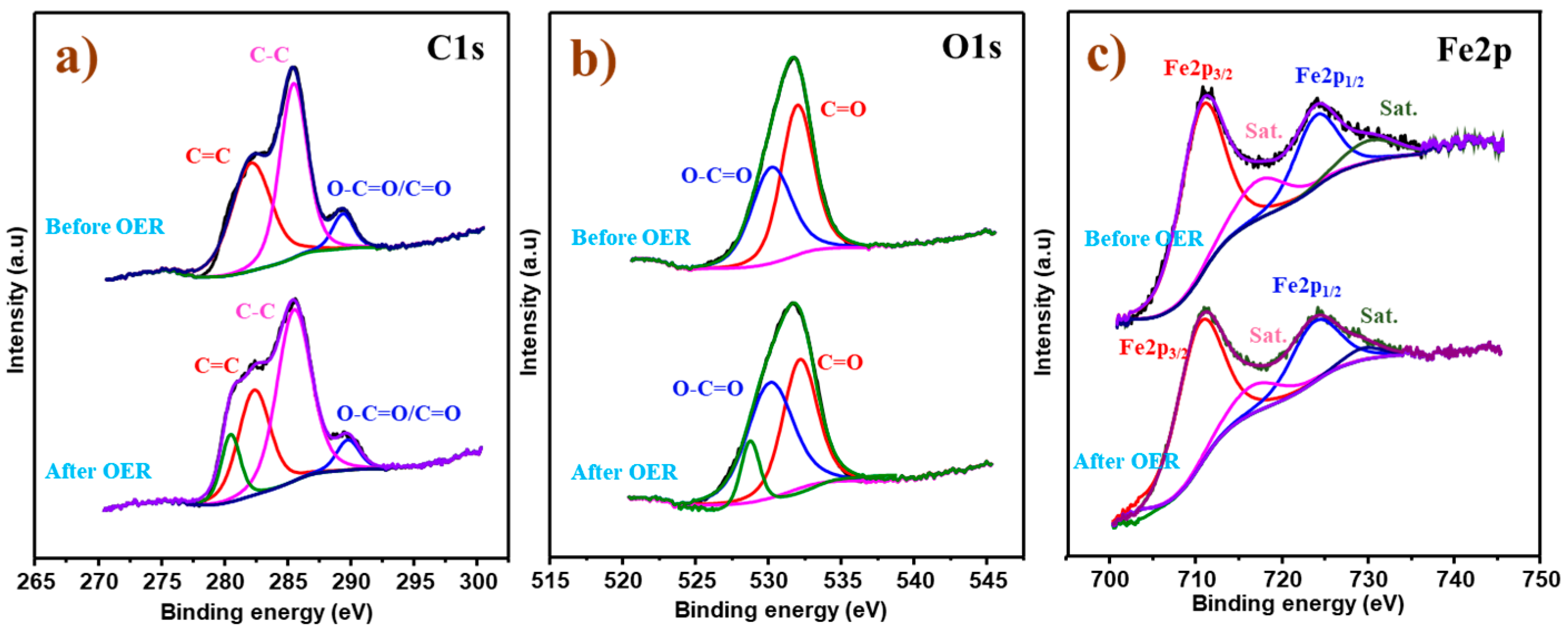
X-ray photoelectron spectroscopy (XPS) was employed to investigate the surface composition and chemical states of TAFeM-2, the sample exhibiting superior catalytic performance. The C 1s spectrum (Figure 2a) was de-convoluted into three distinct peaks positioned at 282.2 eV, 285.46 eV, and 289.5 eV. These peaks are attributed to C=C bonds, C–C bonds, and carbonyl or carboxyl groups (C=O/O–C=O), respectively, indicating the presence of phenyl rings and carboxylic functionalities within the MOF [26]. The O 1s spectrum (Figure 2b) further supports these findings, showing two de-convoluted peaks at 530.2 eV and 532.1 eV. These peaks correspond to oxygen in carboxylate groups (O–C=O) and carbonyl groups (C=O), matching well with the C 1s assignments and confirming the presence of oxygen-containing functional groups in the structure [27]. The Fe 2p spectrum (Figure 2c) displays two prominent peaks at 711.05 eV and 724.3 eV, which are assigned to Fe 2p3/2 and Fe 2p1/2, respectively. Additional satellite peaks at 717.7 eV and 730.1 eV suggest the presence of iron in a mixed oxidation state, which is typical in MOF structures containing iron centers [28]. These XPS results confirm the successful incorporation of tannic acid on the MOF surface without altering the core structure. The coordination between Fe centers and organic linkers, along with the presence of functional groups, likely contributes to the enhanced catalytic activity observed in TAFeM-2.

2.2. Electrocatalytic Activity

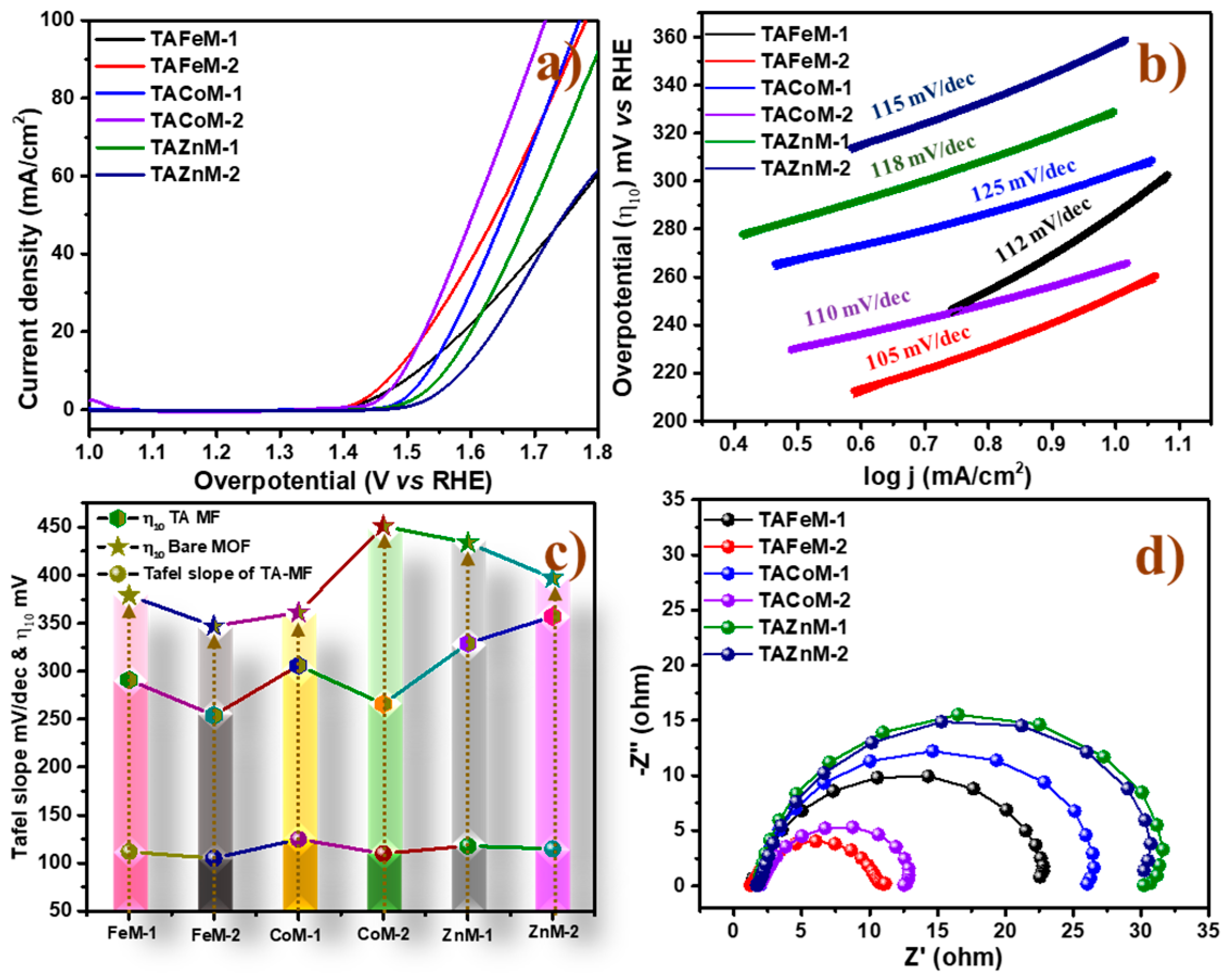
The electrocatalytic performance of the synthesized catalysts was evaluated for the oxygen evolution reaction (OER) in 0.1 M KOH using a three-electrode system. The setup included a catalyst-coated carbon paper as the working electrode, a platinum wire as the counter electrode, and a Ag/AgCl as the reference electrode. The study focused on FeM-1, CoM-1, ZnM-1, and their tannic acid-modified counterparts (TAFeM-2, TACoM-2, TAZnM-2), alongside a benchmark RuO2 catalyst. Figure 3a and Figure S21 highlight the enhanced electrocatalytic activity of surface-modified and unmodified metal–organic frameworks (MOFs). Among the tested catalysts, the surface-tuned Fe-MOF (TAFeM-2) demonstrated superior oxygen evolution reaction (OER) performance, achieving a low overpotential of 254 mV at a current density of 10 mA cm−2. In comparison, the benchmark catalyst RuO2 exhibited a slightly higher overpotential (η10 = 276 mV), indicating the efficacy of the surface modification in improving catalytic activity. The performance of TAFeM-2 also surpassed that of the TACoM-2 catalyst, as shown in Figure S21a. Conversely, the unmodified Fe-MOFs (FeM-1 and FeM-2) displayed significantly higher overpotentials of 379 mV and 347 mV, respectively, underscoring the critical role of surface modification in enhancing electrocatalytic efficiency. These findings are further corroborated by the data in Figure S21b. To decouple intrinsic activity from surface-area effects, we quantified the electrochemically active surface area (ECSA) for TAFeM-2 catalyst using the double-layer capacitance (Cdl) method in a non-faradaic potential window (CV at 5 to 30 mV s−1). ECSA was obtained from ECSA = Cdl/Cs, and representative scan-rate plots and linear fits are provided in Figure S23b. Using these ECSAs, polarization curves were re-processed to give jECSA = I/ECSA (mA cm−2). Importantly, the activity order is preserved after ECSA normalization, with TAFeM-2 remaining the most active across the potential range, demonstrating that the performance gain is not solely attributable to a larger electrochemically accessible area. TAFeM-2 shows an ECSA of 2.0 cm2, and still outperforms its counterparts on an intrinsic basis (Figure S23a).
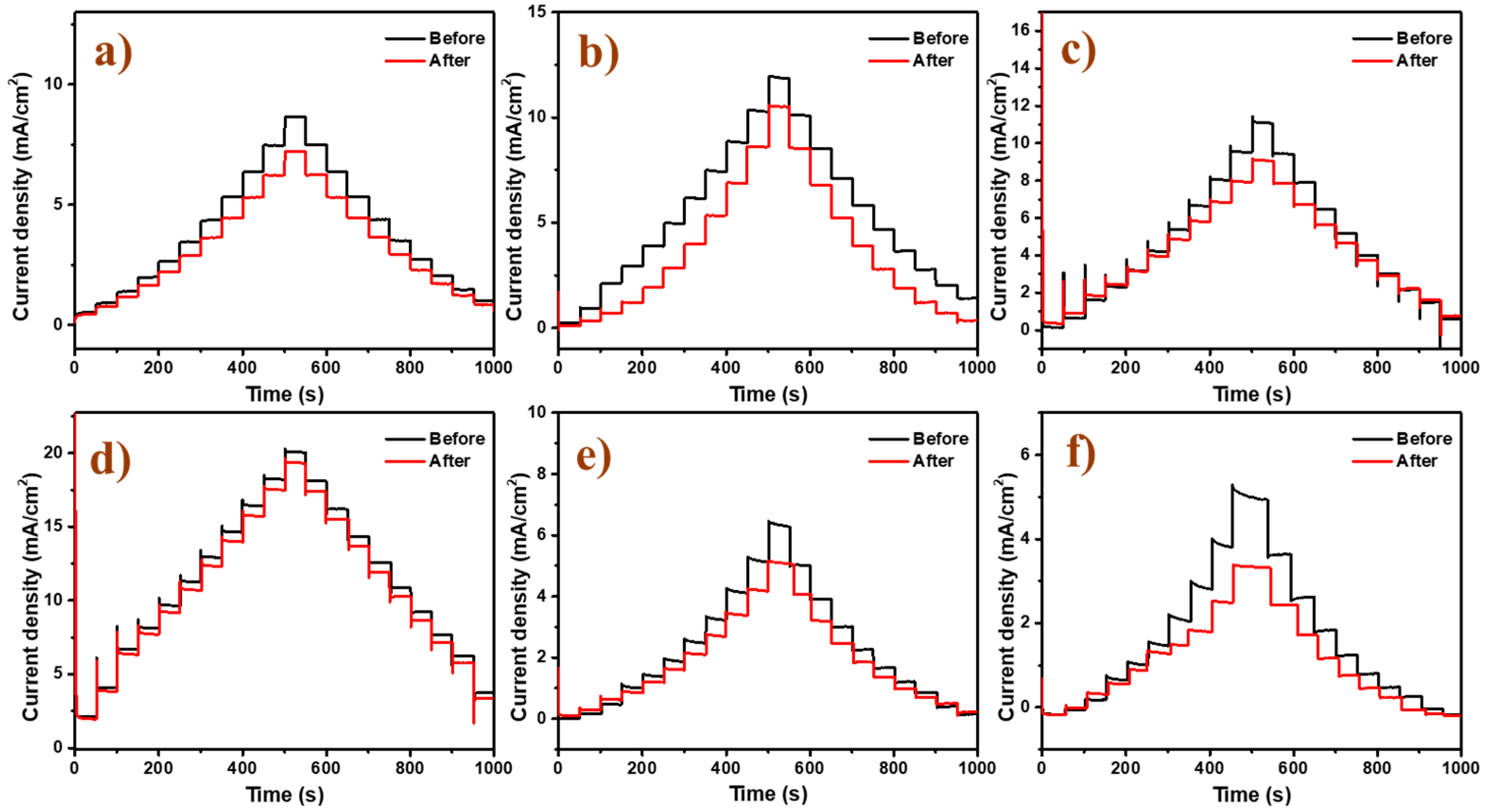
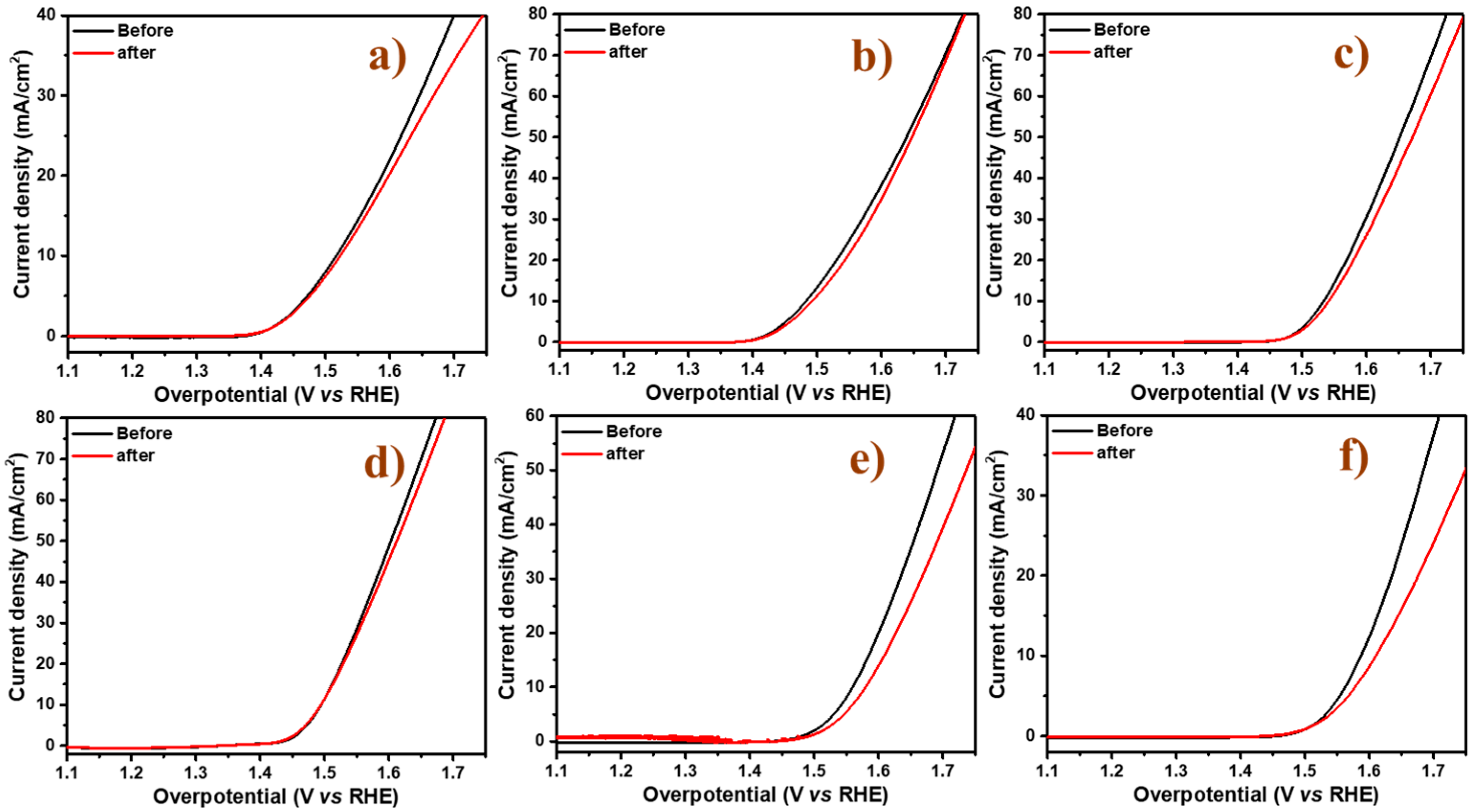
A comparative analysis of surface-modified and unmodified MOFs reveals a consistent trend of improved OER performance upon surface tuning. The overpotentials (η10) for the surface-modified catalysts TAFeM-1, TAFeM-2, TACoM-1, TACoM-2, TAZnM-1, and TAZnM-2 were obtained as 291 mV, 254 mV, 306 mV, 266 mV, 329 mV, and 357 mV (Figure 3c), respectively. In contrast, their unmodified counterparts FeM-1, FeM-2, CoM-1, CoM-2, ZnM-1, and ZnM-2 exhibited higher overpotentials of 379 mV, 347 mV, 361 mV, 450 mV, 434 mV, and 397 mV (Figure 3c), respectively. These results clearly demonstrate that surface modification, particularly with tannic acid, significantly enhances the catalytic efficiency of MOFs. The substantial reduction in overpotential for surface-modified catalysts highlights the improved charge-transfer kinetics and increased active sites, which contribute to their superior OER performance. Tafel slope analysis (Figure 3b) provided further insights into the reaction kinetics. The surface-tuned catalysts exhibited lower Tafel slopes compared to their unmodified counterparts, indicating more efficient electron transfer and faster kinetics. TAFeM-1, TAFeM-2, TACoM-1, TACoM-2, TAZnM-1, and TAZnM-2 displayed Tafel slopes of 112, 105, 125, 110, 118, and 115 mV dec−1 (Figure 3c), respectively. These lower slopes suggest that surface modification not only reduces the energy barrier for OER but also accelerates the overall reaction rate. Moreover, the enhanced catalytic activity of the surface-tuned MOFs can be linked to the increased number of accessible active sites created through tannic acid treatment. This modification likely improves the interaction between the catalyst surface and the electrolyte, leading to better adsorption of OH ions and facilitating the formation of key OER intermediates. These findings confirm that tannic acid surface modification significantly improves both the activity and kinetics of MOF-based catalysts for OER under alkaline conditions. We further examined their stability, comparing their LSV plots before and after CA. The stability of the tannic acid-modified MOF catalyst was evaluated using chronoamprometry (CA) at a fixed overpotential (η10) for approximately 20 h to assess its long-term electrochemical performance. The catalyst maintained a stable current density of 10 mA cm−2 without noticeable current decay, indicating excellent durability and electrochemical stability (Figure S21c). To further understand the catalyst’s behavior under varying conditions, CA was conducted at different overpotentials to monitor the corresponding current responses. The results displayed in Figure 4 reveal a strong correlation between the current densities observed in CA and those obtained from linear sweep voltammetry (LSV), suggesting consistent electrochemical activity and reliable performance across techniques. Moreover, LSV measurements were recorded before and after the CA stability tests to investigate potential changes in the catalyst activity, which is displayed in Figure 5a–f. The post-stability LSV curves exhibited negligible shifts in overpotential for TAFeM-1, TAFeM-2, TACoM-1, TACoM-2, TAZnM-1, and TAZnM-2, about 6, 10, 12, 2, 20, and 15 mV, respectively, which confirms the structural integrity and sustained catalytic activity of the tannic acid-modified MOF after prolonged operation. These results highlight the enhanced stability imparted by tannic acid modification, contributing to the improved electrochemical performance and durability of the catalyst. Furthermore, after evaluating the stability performance, the oxidation states and surface changes were analyzed, as illustrated in Figure 2. The data reveal the emergence of additional peaks in the C 1s and O 1s spectra, which can be attributed to surface oxidation occurring during the oxygen evolution reaction (OER) process. This indicates that the catalyst surface undergoes significant chemical modifications, likely due to the formation of oxygen-containing functional groups. On the other hand, the Fe 2p spectra did not exhibit any new peaks post-OER, suggesting that the core oxidation state of iron remains relatively stable [29]. However, notable peak broadening was observed, which is indicative of the formation of iron-based oxyhydroxide species on the surface. This broadening reflects changes in the local chemical environment of iron atoms, likely due to partial oxidation and the generation of amorphous or poorly crystalline metal oxyhydroxides during the OER process [30,31]. Based on the observed electrochemical trends and surface characterizations, the enhanced activity of TAFeM-2 can be rationalized by a mechanism involving in situ generation of Fe–(oxy)hydroxide species as the true active phase during OER. In alkaline media, OH ions first adsorb onto Fe sites, forming Fe–OH, which undergoes oxidation to yield a high-valent Fe–O• intermediate. This oxo species then participates in the rate-determining O–O bond formation step, either through nucleophilic attack by OH to produce Fe–OOH or via coupling between two Fe–O• units. Subsequent oxidation and O2 release regenerate the Fe–OH site, completing the catalytic cycle.
Tannic acid plays a dual role in this process: its phenolic and carboxylate groups promote proton transfer and stabilize high-valent intermediates, while its chelating nature enhances surface hydrophilicity and electronic connectivity between Fe centers and the conductive substrate. The high-temperature synthesis further contributes by producing a more crystalline framework with optimized Fe–Fe distances, facilitating cooperative binuclear O–O coupling and lowering the overall reaction barrier. This synergy between structural optimization and surface functionalization explains the superior activity and stability observed for TAFeM-2. We investigated the interference resistance of the surface-tuned catalysts by electrochemical impedance spectroscopy (EIS), comparing results before and after the stability test, which is shown in Figure 3d and Figure S22. From the EIS data, the surface-tuned MOF has lower charge-transfer resistance (Rct), which can aid in enhanced activity and higher conductivity. Among the MOF materials, Fe-modified MOF (TAFeM-2) exhibited 12 Ω Rct, which was relatively lower when compared to TACo-2, TAFeM-1, TACoM-1, TAZnM-2, and TAZnM-1, about 13.5, 23, 26.3, 30, and 31.2 Ω, respectively. Results demonstrated that high-temperature synthesized material has higher conductivity and better charge-transfer resistance compared to room-temperature-synthesized MOF material, which is capable of better catalytic activity. We also investigated the conductivity changes after the stability test, as shown in Figure S22. From the EIS data, conductivity of the materials did not change significantly except in high-temperature-synthesized MOF, where it increased by approximately ~10–15 Ω. The surface modification with tannic acid significantly improved both the conductivity and surface roughness, further enhancing the catalytic performance.

3. Materials and Methods

All the chemicals, cobalt(II) nitrate hexahydrate (Co(NO3)2.6H2O > 99.95%), zinc nitrate hexahydrate (Zn(NO3)2. 6H2O > 99.95%), iron(III) nitrate nonahydrate (Fe(NO3)3. 9H2O > 99.95%), terephthalic acid (C6H4-1,4-(CO2H)2 > 99.78%), sodium hydroxide (NaOH > 85%), potassium hydroxide (KOH > 99%), tannic acid (C76H52O46 > 99%), ethanol (CH3CH2OH > 95%), and deionized (DI) water, were purchased from Sigma-Aldrich (St. Louis, MO, USA)/Alfa Aesar (Lancashire, UK) and used without further purification.

3.1. Synthesis of MOF and Surface Tuning by TA

A series of metal-based catalysts were synthesized using a modified approach involving two reaction temperatures. In this process, 1 g of terephthalic acid was dissolved in 2.5 g of a sodium hydroxide solution (Solution 1). Separately, 1.2 g of cobalt, zinc, or iron salts were dissolved in water (Solution 2). Solution 2 was gradually added dropwise to Solution 1 with vigorous stirring to ensure uniform mixing. The reaction mixtures were then treated at two different temperature conditions, room temperature (~25 °C) and 80 °C, for 12 h. After the reaction, the resulting precipitates were repeatedly rinsed with water and ethanol to remove impurities, then filtered and dried at 80 °C for three hours. The catalysts synthesized under these conditions were labeled CoM-1, CoM-2, ZnM-1, ZnM-2, FeM-1, and FeM-2, respectively. This method provides a systematic approach for studying how reaction temperature affects the structural and catalytic properties of Co-, Zn-, and Fe-based MOFs, enhancing their potential applications in catalysis.
To modify the MOF materials (Co-MOFs, Zn-MOFs, and Fe-MOFs) with tannic acid (TA), a reported procedure was followed. Initially, 1 g of each MOF material was dispersed in 10 mL of ethanol and sonicated for 15 min to form a homogeneous suspension. Separately, 1 g of TA was dissolved in 90 mL of deionized water to prepare a solution. This TA solution was gradually added to the MOF suspensions, followed by 30 min of sonication to ensure effective interaction. The resulting solid products, named TACoM-1, TACoM-2, TAZnM-1, TAZnM-2, TAFeM-1, and TAFeM-2, were separated using vacuum filtration, thoroughly washed with methanol and water, and then dried overnight in a vacuum oven at 80 °C. These materials were subsequently used for electrocatalytic studies.

3.2. Physico-Chemical and Electrochemical Characterizations

The synthesized catalysts were characterized using various analytical techniques. X-ray diffraction (XRD) patterns were obtained using a D8 Advance diffractometer (Bruker AXS, Karlsruhe, Germany). Fourier-transform infrared spectroscopy (FT-IR) was performed with an iS5 spectrometer (Thermo Scientific, Waltham, MA, USA) to identify the functional groups present in the materials. Field-emission scanning electron microscopy (FE-SEM) and energy-dispersive X-ray spectroscopy (EDS) analyses were conducted using a Hitachi S-4800 II instrument (Tokyo, Japan). High-resolution X-ray photoelectron spectroscopy (HR-XPS) was carried out using a Thermo Scientific instrument (USA) to determine the surface chemical composition.
Electrochemical measurements were performed on a Biologic 202 workstation (Gamry Instruments, Inc., Warminster, PA, USA) in a three-electrode configuration, employing a catalyst-coated carbon paper as the working electrode, a platinum wire as the counter electrode, and a Ag/AgCl (3 M KCl) electrode as the reference. Linear sweep voltammetry (LSV) was conducted in 0.1 M KOH electrolyte over a potential range of 0–1 V (vs RHE) to evaluate the oxygen evolution reaction (OER) activity. Prior to all electrochemical measurements, the Ag/AgCl reference electrode was calibrated against a reversible hydrogen electrode (RHE) in 1.0 M KOH using a Pt wire as both the working and counter electrodes. The calibration was performed by recording the potential at which the hydrogen oxidation and evolution currents were equal. The conversion of potential from Ag/AgCl to RHE was calculated using the following equation:
ERHE = EAg/AgCl + 0.059 pH + 0.197
All potentials reported in this study are referenced to the RHE scale.
The electrochemical tests, including linear sweep voltammetry (LSV), cyclic voltammetry (CV), chronoamperometry (CA), and electrochemical impedance spectroscopy (EIS), were carried out using a Biologic VSP-202 workstation in 1.0 M KOH solution. The LSV scans were recorded at a sweep rate of 5 mV s−1, while CV measurements for double-layer capacitance (Cdl) determination were performed in a non-faradaic region at scan rates of 5–30 mV s−1. EIS measurements were conducted in the frequency range of 100 kHz to 0.1 Hz.

4. Conclusions

The Co-, Zn-, and Fe-based MOFs synthesized at different temperatures and modified with tannic acid (TA) exhibited significant improvements in morphology, surface roughness, and catalytic performance without altering their core crystalline structures. TA functionalization introduced oxygen-rich groups, enhanced charge transfer, and increased active-site density, leading to superior OER activity and stability compared to their unmodified counterparts. Among them, TAFeM-2 delivered the best performance with a low overpotential of 254 mV at 10 mA cm−2, reduced Tafel slope, excellent durability, and lower charge-transfer resistance than both pristine MOFs and the benchmark RuO2 catalyst. The results highlight the crucial role of TA in stabilizing Fe–(oxy)hydroxide active species and improving conductivity, demonstrating that surface functionalization coupled with optimized synthesis conditions is an effective strategy for designing high-performance MOF-based electrocatalysts.

Supplementary Materials

The following supporting information can be downloaded at https://www.mdpi.com/article/10.3390/catal15100991/s1, Figure S1. FT-IR spectrum of TAFeM-1, TAFeM-2, TACoM-1, TACoM-2, TAZnM-1, and TAZnM-2 materials. Figure S2. SEM images of surface-tuned (a–c) CoM-1 and (d–f) TACoM-1. Figure S3. EDX analysis of CoM-1. Figure S4. EDX and elemental-mapping analysis of TACoM-1. Figure S5. SEM images of surface-tuned (a–c) CoM-2 and (d–f) TACoM-2. Figure S6. EDX analysis of CoM-2. Figure S7. EDX and elemental-mapping analysis of TACoM-2. Figure S8. SEM images of surface-tuned (a–c) ZnM-1 and (d–f) TAZnM-1. Figure S9. EDX analysis of ZnM-1. Figure S10. EDX and elemental-mapping analysis of TAZnM-1. Figure S11. SEM images of surface-tuned (a–c) ZnM-2 and (d–f) TAZnM-2. Figure S12. EDX analysis of ZnM-2. Figure S13. EDX and elemental-mapping analysis of TAZnM-2. Figure S14. SEM images of surface-tuned (a–c) FeM-1 and (d–f) TAFeM-1. Figure S15. EDX and elemental-mapping analysis of FeM-1. Figure S16. EDX and elemental-mapping analysis of TAFeM-1. Figure S17. SEM images of surface-tuned (a–c) FeM-2 and (d–f) TAFeM-2. Figure S18. EDX and elemental-mapping analysis of FeM-2. Figure S19. EDX and elemental-mapping analysis of TAFeM-2. Figure S20. XPS survey spectrum of before- and after-stability-test TAFeM-2. Figure S21. Oxygen evolution reaction (OER) performances of MOF catalysts. (a) LSV plots of tannic acid-modified MOFs: TAFeM-1, TAFeM-2, TACoM-1, TACoM-2, TAZnM-1, and TAZnM-2, compared with RuO2 and bare carbon paper. (b) LSV plots of unmodified MOFs: FeM-1, FeM-2, CoM-1, CoM-2, ZnM-1, and ZnM-2. (c) Chronoamprometry-based stability tests of tannic acid-modified MOFs (TAFeM-1, TAFeM-2, TACoM-1, TACoM-2, TAZnM-1, and TAZnM-2) in 0.1 M KOH electrolyte. Figure S22. Electrochemical impedance data of before- and after-CA-performance (a) TAFeM-1, (b) TAFeM-2, (c) TACoM-1, (d) TACoM-2, (e) TAZnM-1, and (f) TAZnM-2 catalysts. Figure S23. (a) ECSA-normalized polarization curve (jECSA) of TAF@FeM-2 plotted vs. overpotential. (b) Cyclic voltammograms collected in the non-faradaic region at scan rates of 5–30 mV s−1 (vs. Ag/AgCl). Inset: linear fit of the capacitive current (j vs. scan rate) used to extract the double-layer capacitance Cdl; the resulting ECSA was then used to normalize the LSV in panel. Table S1. Summary of overpotential (η10), Tafel slope, and charge-transfer resistance (Rct) values for surface-tuned MOF catalysts. Table S2. Comparison of overpotential, Tafel slope, and electrolyte conditions for TAFeM-2 and previously reported OER catalysts. References [32,33,34,35,36,37,38,39,40,41,42] are cited in the Supplementary Materials.

Author Contributions

S.G.: Writing—original draft, methodology, data curation, conceptualization. M.D.: Investigation, data curation, visualization. K.Y.: Writing—review and editing, project administration, investigation. All authors have read and agreed to the published version of the manuscript.

Funding

This research was supported by the Basic Science Research Program through the National Research Foundation of Korea (NRF), funded by the Ministry of Education (No. RS-2021-NR060117).

Data Availability Statement

No new data were created or analyzed in this study.

Conflicts of Interest

The authors declare that they have no known competing financial interests or personal relationships that could have appeared to influence the work reported in this paper.

References

  1. Feng, Z.; Dai, C.; Zhang, Z.; Lei, X.; Mu, W.; Guo, R.; Liu, X.; You, J. The role of strain in oxygen evolution reaction. J. Energy Chem. 2024, 93, 322–344. [Google Scholar] [CrossRef]
  2. Rong, C.; Huang, X.; Arandiyan, H.; Shao, Z.; Wang, Y.; Chen, Y. Advances in Oxygen Evolution Reaction Electrocatalysts via Direct Oxygen–Oxygen Radical Coupling Pathway. Adv. Mater. 2025, 37, 2416362. [Google Scholar] [CrossRef]
  3. Corbin, J.; Jones, M.; Lyu, C.; Loh, A.; Zhang, Z.; Zhu, Y.; Li, X. Challenges and progress in oxygen evolution reaction catalyst development for seawater electrolysis for hydrogen production. RSC Adv. 2024, 14, 6416–6442. [Google Scholar] [CrossRef]
  4. Park, W.; Chung, D.Y. Activity–Stability Relationships in Oxygen Evolution Reaction. ACS Mater. Au 2024, 5, 1–10. [Google Scholar] [CrossRef] [PubMed]
  5. Wang, G.; Chen, J.; Li, K.; Huang, J.; Huang, Y.; Liu, Y.; Hu, X.; Zhao, B.; Yi, L.; Jones, T.W. Cost-effective and durable electrocatalysts for Co-electrolysis of CO2 conversion and glycerol upgrading. Nano Energy 2022, 92, 106751. [Google Scholar] [CrossRef]
  6. Li, L.; Xuan, H.; Wang, J.; Liang, X.; Li, Y.; Han, Z.; Cheng, L. Nanoporous nonprecious multi-metal alloys as multisite electrocatalysts for efficient overall water splitting. Int. J. Hydrogen Energy 2025, 97, 38–45. [Google Scholar] [CrossRef]
  7. Chen, M.; Kitiphatpiboon, N.; Feng, C.; Abudula, A.; Ma, Y.; Guan, G. Recent progress in transition-metal-oxide-based electrocatalysts for the oxygen evolution reaction in natural seawater splitting: A critical review. EScience 2023, 3, 100111. [Google Scholar] [CrossRef]
  8. Kim, J.; Min, K.; Lee, H.; Kwon, H.; Shim, S.E.; Baeck, S.-H. Enhanced electrocatalytic performance of double-shell structured NixFe2-xP/NiFe2O4 for oxygen evolution reaction and anion exchange membrane water electrolysis. Int. J. Hydrogen Energy 2025, 109, 254–263. [Google Scholar] [CrossRef]
  9. Shi, B.C.; Jin, M.; Zou, Y.; Wang, S.; Nie, Y.; Yao, D.; Tang, Y.J. Cathodic electrodeposition activation of NiFe-based metal–organic frameworks for enhanced oxygen evolution reaction. Rare Met. 2025, 1–11. [Google Scholar] [CrossRef]
  10. Wei, R.; Liu, X.; Ibragimov, A.B.; Gao, J. Recent strategies to improve the electroactivity of metal–organic frameworks for advanced electrocatalysis. Inf. Funct. Mater. 2024, 1, 181–206. [Google Scholar] [CrossRef]
  11. Chen, L.; Xu, Q. Metal-Organic Framework Composites for Catalysis. Matter 2019, 1, 57–89. [Google Scholar] [CrossRef]
  12. Gopi, S.; Kathiresan, M.; Yun, K. Metal-organic and porous organic framework in electrocatalytic water splitting. J. Ind. Eng. Chem. 2023, 126, 127–136. [Google Scholar] [CrossRef]
  13. Han, Z.; Yang, Y.; Rushlow, J.; Huo, J.; Liu, Z.; Hsu, Y.-C.; Yin, R.; Wang, M.; Liang, R.; Wang, K.-Y.; et al. Development of the design and synthesis of metal–organic frameworks (MOFs)—From large scale attempts, functional oriented modifications, to artificial intelligence (AI) predictions. Chem. Soc. Rev. 2025, 54, 367–395. [Google Scholar] [CrossRef]
  14. Zhu, R.; Liu, L.; Zhang, G.; Zhang, Y.; Jiang, Y.; Pang, H. Advances in electrochemistry of intrinsic conductive metal-organic frameworks and their composites: Mechanisms, synthesis and applications. Nano Energy 2024, 122, 109333. [Google Scholar] [CrossRef]
  15. Zheng, X.; Li, M.; Li, J.; Li, X.; Zhou, Y. Progress of pristine metal-organic frameworks for electrocatalytic applications. J. Mater. Sci. Technol. 2025, 230, 291–310. [Google Scholar] [CrossRef]
  16. Marshall, R.J.; Forgan, R.S. Postsynthetic Modification of Zirconium Metal-Organic Frameworks. Eur. J. Inorg. Chem. 2016, 2016, 4310–4331. [Google Scholar] [CrossRef]
  17. Oar-Arteta, L.; Wezendonk, T.; Sun, X.; Kapteijn, F.; Gascon, J. Metal organic frameworks as precursors for the manufacture of advanced catalytic materials. Mater. Chem. Front. 2017, 1, 1709–1745. [Google Scholar] [CrossRef]
  18. Lu, Y.; Zhang, G.; Zhou, H.; Cao, S.; Zhang, Y.; Wang, S.; Pang, H. Enhanced active sites and stability in nano-MOFs for electrochemical energy storage through dual regulation by tannic acid. Angew. Chem. Int. Ed. Engl. 2023, 62, e202311075. [Google Scholar] [CrossRef]
  19. Zhou, H.; Dai, R.; Wang, T.; Wang, Z. Enhancing stability of tannic acid-FeIII nanofiltration membrane for water treatment: Intercoordination by metal–organic framework. Environ. Sci. Technol. 2022, 56, 17266–17277. [Google Scholar] [CrossRef]
  20. Zhang, R.; Zhao, J.; Tian, X.; Ye, J.; Wang, L.; Akaniro, I.R.; Pan, J.; Dai, J. Constructing a highly permeable bioinspired rigid-flexible coupled membrane with a high content of spindle-type MOF: Efficient adsorption separation of water-soluble pollutants. J. Mater. Chem. A 2024, 12, 20202–20214. [Google Scholar] [CrossRef]
  21. Vazhayil, A.; Vazhayal, L.; Thomas, J.; Thomas, N. A comprehensive review on the recent developments in transition metal-based electrocatalysts for oxygen evolution reaction. Appl. Surf. Sci. Adv. 2021, 6, 100184. [Google Scholar] [CrossRef]
  22. Kim, M.; Han, H.; Lee, K.; Kang, S.; Lee, S.-H.; Lee, S.H.; Jeon, H.; Ryu, J.H.; Chung, C.-Y.; Kim, K.M. Unraveling the mechanism of enhanced oxygen evolution reaction using NiOx@Fe3O4 decorated on surface-modified carbon nanotubes. J. Mater. Chem. A 2024, 12, 17596–17606. [Google Scholar] [CrossRef]
  23. Mine, S.; Lionet, Z.; Shigemitsu, H.; Toyao, T.; Kim, T.-H.; Horiuchi, Y.; Lee, S.W.; Matsuoka, M. Design of Fe-MOF-bpdc deposited with cobalt oxide (CoOx) nanoparticles for enhanced visible-light-promoted water oxidation reaction. Res. Chem. Intermed. 2020, 46, 2003–2015. [Google Scholar] [CrossRef]
  24. Flores, J.G.; Delgado-García, R.; Sanchez-Sanchez, M. Semiamorphous Fe-BDC: The missing link between the highly-demanded iron carboxylate MOF catalysts. Catal. Today 2022, 390, 237–245. [Google Scholar] [CrossRef]
  25. Tran, T.K.N.; Ho, H.L.; Nguyen, H.V.; Tran, B.T.; Nguyen, T.T.; Bui, P.Q.T.; Bach, L.G. Photocatalytic degradation of Rhodamine B in aqueous phase by bimetallic metal-organic framework M/Fe-MOF (M = Co, Cu, and Mg). Open Chem. 2022, 20, 52–60. [Google Scholar] [CrossRef]
  26. Zhang, F.; Shi, J.; Jin, Y.; Fu, Y.; Zhong, Y.; Zhu, W. Facile synthesis of MIL-100 (Fe) under HF-free conditions and its application in the acetalization of aldehydes with diols. Chem. Eng. J. 2015, 259, 183–190. [Google Scholar] [CrossRef]
  27. Geng, N.; Chen, W.; Xu, H.; Ding, M.; Lin, T.; Wu, Q.; Zhang, L. Insights into the novel application of Fe-MOFs in ultrasound-assisted heterogeneous Fenton system: Efficiency, kinetics and mechanism. Ultrason. Sonochem. 2021, 72, 105411. [Google Scholar] [CrossRef]
  28. Zheng, X.; Zhang, L.; Fan, Z.; Cao, Y.; Shen, L.; Au, C.; Jiang, L. Enhanced catalytic activity over MIL-100 (Fe) with coordinatively unsaturated Fe2+/Fe3+ sites for selective oxidation of H2S to sulfur. Chem. Eng. J. 2019, 374, 793–801. [Google Scholar] [CrossRef]
  29. Yu, X.; Pan, Z.; Zhao, Z.; Zhou, Y.; Pei, C.; Ma, Y.; Park, H.S.; Wang, M. Boosting the Oxygen Evolution Reaction by Controllably Constructing FeNi3/C Nanorods. Nanomaterials 2022, 12, 2525. [Google Scholar] [CrossRef]
  30. Qiu, Y.; Jia, Q.; Yan, S.; Liu, B.; Liu, J.; Ji, X. Favorable Amorphous–Crystalline Iron Oxyhydroxide Phase Boundaries for Boosted Alkaline Water Oxidation. ChemSusChem 2020, 13, 4911–4915. [Google Scholar] [CrossRef]
  31. Gopi, S.; Choi, D.; Ramu, A.G.; Theerthagiri, J.; Choi, M.Y.; Yun, K. Hybridized bimetallic Ni–Fe and Ni–Co spinels infused N-doped porous carbon as bifunctional electrocatalysts for efficient overall water splitting. Int. J. Hydrogen Energy 2024, 52, 190–201. [Google Scholar] [CrossRef]
  32. Zhang, C.; Qi, Q.; Mei, Y.; Hu, J.; Sun, M.; Zhang, Y.; Huang, B.; Zhang, L.; Yang, S. Rationally reconstructed metal–organic frameworks as robust oxygen evolution electrocatalysts. Adv. Mater. 2023, 35, 2208904. [Google Scholar] [CrossRef]
  33. Yang, G.; Fang, D.; Fu, Y.; Gao, D.; Cheng, C.; Li, J. Partially amorphous NiFe layered double hydroxides enabling highly-efficiency oxygen evolution reaction at high current density. J. Colloid. Interface Sci. 2025, 678, 717–725. [Google Scholar] [CrossRef]
  34. Gao, H.; Yang, Z.; Yu, J.; Kong, A.; Sun, Y.; Yang, S.; Peng, B.; Wang, G.; Yu, F.; Li, Y. Si doped Fe-MOF as efficient bifunctional catalyst for overall water splitting. Int. J. Hydrogen Energy 2024, 81, 718–726. [Google Scholar] [CrossRef]
  35. Yang, Y.; Yang, J.; Liang, P.; Zhang, Z.; Li, Z.; Hu, Z. V2O3/FeOOH with rich heterogeneous interfaces on Ni foam for efficient oxygen evolution reaction. Catal. Commun. 2022, 162, 106393. [Google Scholar] [CrossRef]
  36. Cong, N.; Han, Y.; Tan, L.; Zhai, C.; Chen, H.; Han, J.; Fang, H.; Zhou, X.; Zhu, Y.; Ren, Z. Nanoporous RuO2 characterized by RuO(OH)2 surface phase as an efficient bifunctional catalyst for overall water splitting in alkaline solution. J. Electroanal. Chem. 2021, 881, 114955. [Google Scholar] [CrossRef]
  37. Khandekar, R.V.; Patil, S.S.; Sutar, R.B.; Jamadar, A.S.; Dongale, T.D.; Deshpande, N.G.; Yadav, J.B. Scalable Co-MOF thin films for OER: Achieving low overpotential and enhanced catalytic activity via surface reconstruction. Int. J. Hydrogen Energy 2025, 111, 123–133. [Google Scholar] [CrossRef]
  38. Gong, C.; Li, W.; Lei, Y.; He, X.; Chen, H.; Du, X.; Fang, W.; Wang, D.; Zhao, L. Interfacial engineering of ZIF-67 derived CoSe/Co(OH)2 catalysts for efficient overall water splitting. Compos. Part B Eng. 2022, 236, 109823. [Google Scholar] [CrossRef]
  39. Wu, Y.; Wang, H.; Ji, S.; Tian, X.; Li, G.; Wang, X.; Wang, R. Ultrastable NiFeOOH/NiFe/Ni electrocatalysts prepared by in-situ electro-oxidation for oxygen evolution reaction at large current density. Appl. Surf. Sci. 2021, 564, 150440. [Google Scholar] [CrossRef]
  40. Wu, S.; Yang, X. ZIF-67-derived N-enriched porous carbon doped with Co, Fe and CoS for electrocatalytic hydrogen evolution reaction. Environ. Res. 2021, 200, 111474. [Google Scholar] [CrossRef]
  41. Azmi, Z.; Deepak, D.; Kadadevar, A.; Chowdhury, A.; Nair, M.G.; Roy, S.S.; Das, A.; Mohapatra, S.R. Unveiling the synergy of MXene supported ZIF-8 hybrid catalyst for enhanced oxygen evolution reaction. Surf. Coat. Technol. 2025, 512, 132401. [Google Scholar] [CrossRef]
  42. Qin, X.; Kim, D.; Piao, Y. Metal-organic frameworks-derived novel nanostructured electrocatalysts for oxygen evolution reaction. Carbon Energy 2021, 3, 66–100. [Google Scholar] [CrossRef]
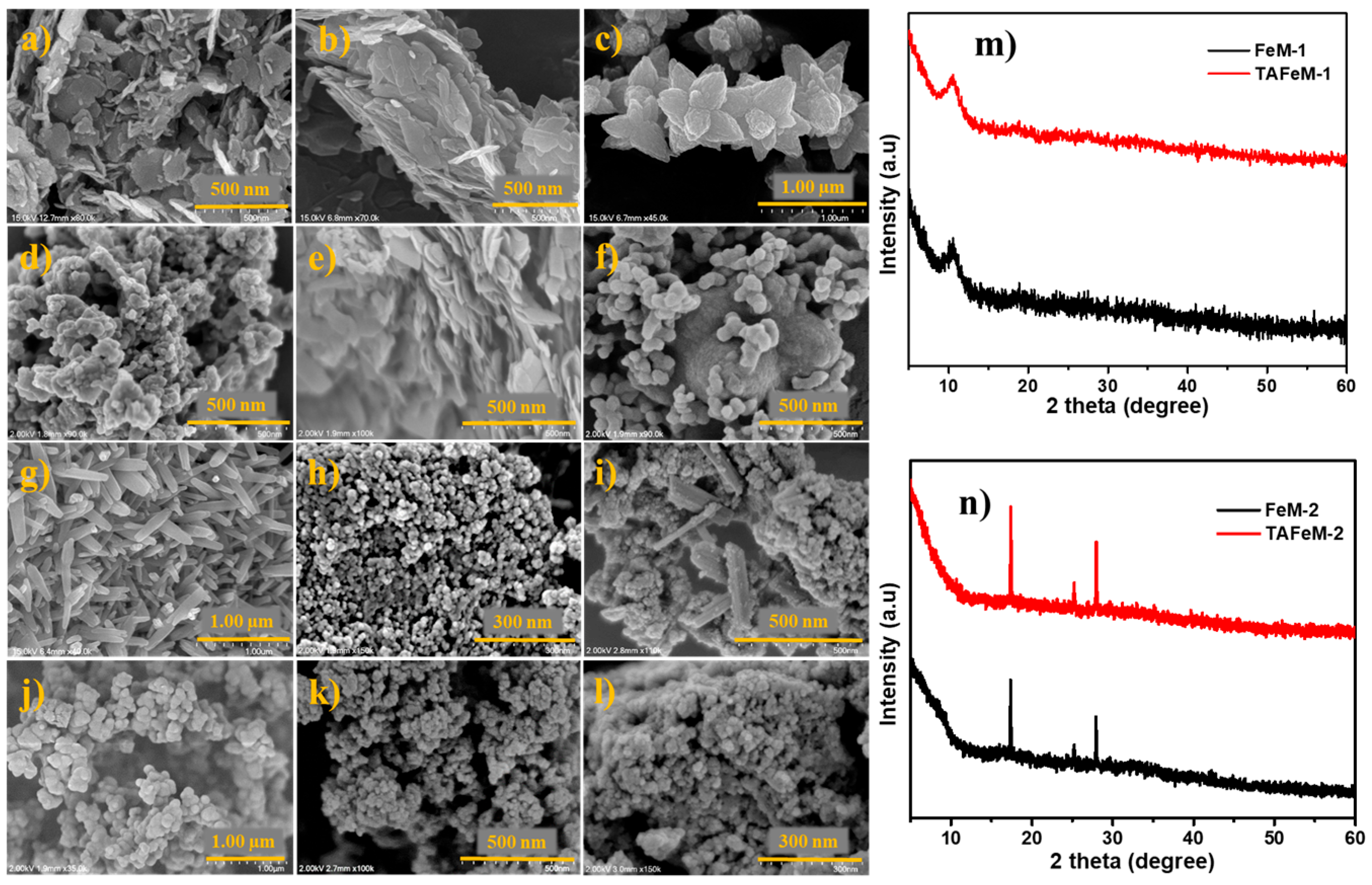
Figure 1. Field-emission scanning electron microscopy (FE-SEM) images of (a) CoM-1, (b) CoM-2, (c) ZnM-1, (d) TACoM-1, (e) TACoM-2, (f) TAZnM-1, (g) ZnM-2, (h) FeM-1, (i) FeM-2, (j) TAZnM-2, (k) TAFeM-1, and (l) TAFeM-2; X-ray diffraction (XRD) of (m) FeM-1, TAFeM-1 and (n) FeM-2, TAFeM-2.
Catalysts 15 00991 g001
Figure 2. X-ray photoelectron spectroscopy spectra of TAFeM-2 catalysts before and after catalytic performance: (a) C1s, (b) O1s, and (c) Fe2p.
Catalysts 15 00991 g002
Figure 3. Electrocatalytic performance: (a) LSV curves of different catalysts measured in 0.1 M KOH at a scan rate of 5 mV s−1. (b) Corresponding Tafel plots derived from the LSV curves. (c) Tafel and overpotential at 10 mA cm−2 comparison for surface modified and unmodified (MOF) catalysts. (d) Impedance spectra of surface-tuned MOFs TAFeM-1, TAFeM-2, TACoM-1, TACoM-2, TAZnM-1, and TAZnM-2 catalysts in 0.1 M KOH solution by three-electrode system.
Catalysts 15 00991 g003
Figure 4. Chronoamprometry study with different overpotentials of before- and after-CA-performance (a) TAFeM-1, (b) TAFeM-2, (c) TACoM-1, (d) TACoM-2, (e) TAZnM-1, and (f) TAZnM-2 catalysts.
Catalysts 15 00991 g004
Figure 5. LSV curves of before- and after-CA-performance (a) TAFeM-1, (b) TAFeM-2, (c) TACoM-1, (d) TACoM-2, (e) TAZnM-1, and (f) TAZnM-2 catalysts at 5 mV scan rate in 0.1 M KOH electrolyte.
Catalysts 15 00991 g005
Disclaimer/Publisher’s Note: The statements, opinions and data contained in all publications are solely those of the individual author(s) and contributor(s) and not of MDPI and/or the editor(s). MDPI and/or the editor(s) disclaim responsibility for any injury to people or property resulting from any ideas, methods, instructions or products referred to in the content.