Review

Lignin Valorization: Production of High Value-Added Compounds by Engineered Microorganisms

Department of Biotechnology and Life Sciences, University of Insubria, via J. H. Dunant 3, 21100 Varese, Italy
*
Author to whom correspondence should be addressed.
Catalysts 2023, 13(3), 555; https://doi.org/10.3390/catal13030555
Submission received: 15 February 2023 / Revised: 3 March 2023 / Accepted: 7 March 2023 / Published: 9 March 2023
(This article belongs to the Section Biocatalysis)

Abstract

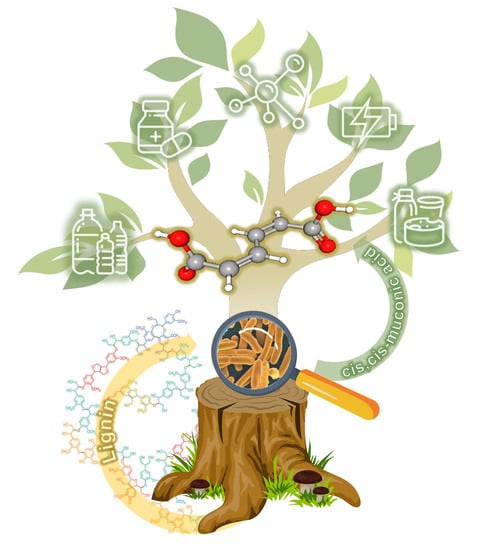
Lignin is the second most abundant polymer in nature, which is also widely generated during biomass fractionation in lignocellulose biorefineries. At present, most of technical lignin is simply burnt for energy supply although it represents the richest natural source of aromatics, and thus it is a promising feedstock for generation of value-added compounds. Lignin is heterogeneous in composition and recalcitrant to degradation, with this substantially hampering its use. Notably, microbes have evolved particular enzymes and specialized metabolic pathways to degrade this polymer and metabolize its various aromatic components. In recent years, novel pathways have been designed allowing to establish engineered microbial cell factories able to efficiently funnel the lignin degradation products into few metabolic intermediates, representing suitable starting points for the synthesis of a variety of valuable molecules. This review focuses on recent success cases (at the laboratory/pilot scale) based on systems metabolic engineering studies aimed at generating value-added and specialty chemicals, with much emphasis on the production of cis,cis-muconic acid, a building block of recognized industrial value for the synthesis of plastic materials. The upgrade of this global waste stream promises a sustainable product portfolio, which will become an industrial reality when economic issues related to process scale up will be tackled.
Keywords: lignin valorization; biocatalysis; cis,cis-muconic acid production; aromatic compounds; value-added compounds; metabolic engineering; platform chemical; microbial cell factory lignin valorization; biocatalysis; cis,cis-muconic acid production; aromatic compounds; value-added compounds; metabolic engineering; platform chemical; microbial cell factory
Graphical Abstract