
Abstract
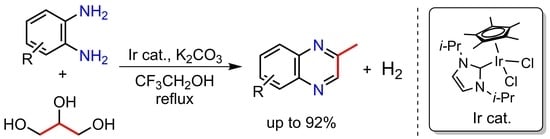
2-Methylquinoxaline derivatives are widely used as intermediates in the synthesis of pharmaceuticals, natural products, and dyes; however, their syntheses usually require excess reagents, making them environmentally burdensome. Meanwhile, glycerol can be sustainably obtained in large quantities as a by-product in the production of biodiesel fuel using waste oil as a raw material. Thus, it is worthwhile to develop a new catalytic system that utilizes glycerol as a C3 source. In this study, an efficient catalytic system was developed to obtain 2-methylquinoxaline derivatives from glycerol and 1,2-phenylenediamines. This system is beneficial because it is environmentally friendly and has excellent atom efficiency.
1. Introduction
N-heterocyclic compounds are an important class of organic compounds with a wide range of applications, such as pharmaceuticals [1,2,3,4], pesticides [5,6,7], natural products [1,4], and even functional organic materials [8,9]; therefore, it is of great significance to develop an efficient method for their synthesis. The conventional synthetic methods towards N-heterocyclic compounds often require excessive amounts of reagents, which imposes a large burden on the environment [10,11,12,13,14]. In addition, there are often difficulties in terms of selectivity and atom efficiency during such syntheses [10,11,12,13,14]. Therefore, studies have been actively conducted with the aim of developing new synthetic protocols for N-heterocyclic compounds using starting materials that are abundant, sustainable, safe, and inexpensive [10,11,12,13,14].
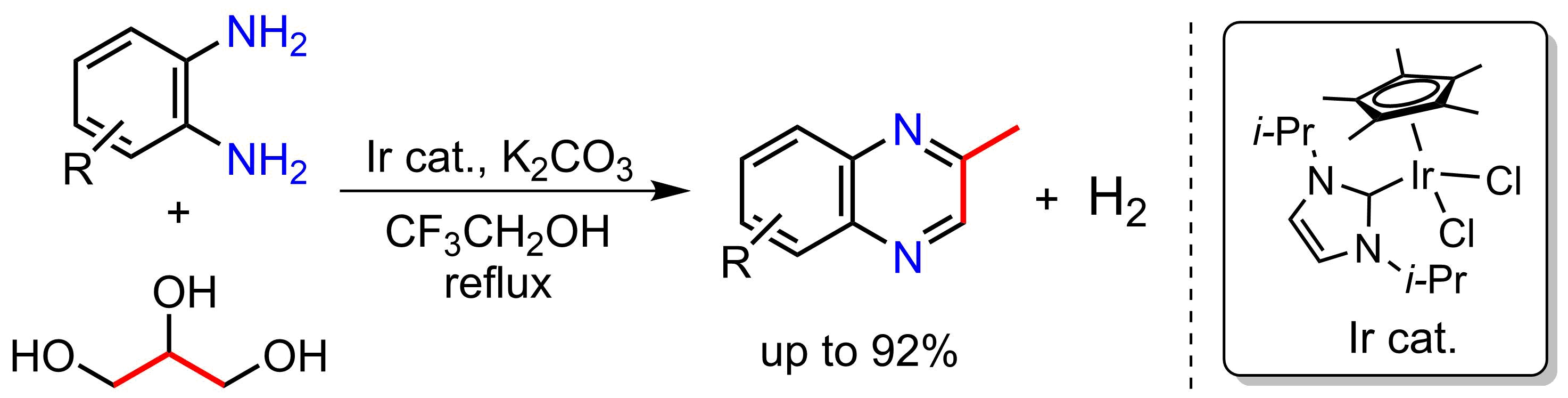
Among the various N-heterocyclic compounds, quinoxalines, particularly 2-methylquinoxaline derivatives, have been utilized as antiviral, anticancer, and antibacterial agents (Figure 1) [15,16,17]. As a specific example, an example of 2-methylquinoxaline derivatives that have been utilized as a medicaments are shown in Figure 1. Thus, it is very important to develop new catalytic reactions towards 2-methylquinoxaline derivatives.
Figure 1.
Examples of 2-methylquinoxaline derivatives that served as medicaments.
Regarding potential reagents for the synthesis of 2-methylquinoxaline derivatives, glycerol is a harmless and safe compound composed of three carbon atoms and three hydroxy groups, and has traditionally been obtained as a by-product of manufacturing processes producing fatty acids and soaps. Recently, glycerol has been obtained in large quantities as a by-product in the production of biodiesel fuel from waste oil [18]. Indeed, the amount of by-product glycerol produced alongside biodiesel fuel has substantially increased over the last two decades; consequently, there is an oversupply of glycerol [19]. Unfortunately, surplus glycerol is often disposed of without being effectively utilized. Therefore, it is worthwhile to develop a new catalytic synthetic method that utilizes such sustainably attained glycerol as a C3 source [20,21].
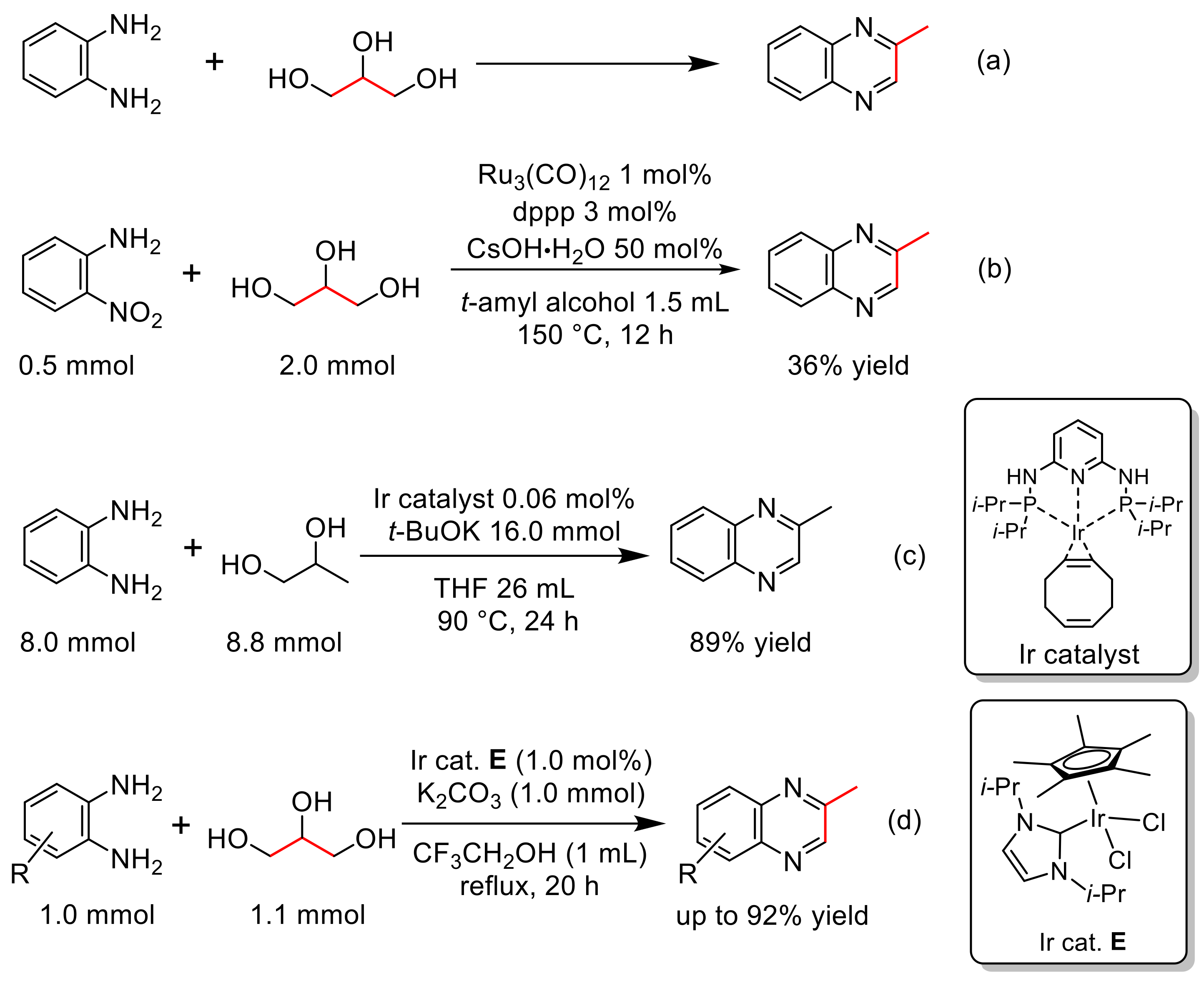
In view of these various backgrounds, it can be said that the reaction of glycerol with 1,2-phenylenediamine (which is also an inexpensive and readily available compound) to synthesize 2-methylquinoxaline derivatives is exceptionally attractive (Scheme 1a). Previously, a ruthenium-catalyzed system reported by Min Zhang et al. produced 2-methylquinoxaline from glycerol and 2-nitroaniline (Scheme 1b) [22]. This catalytic reaction was performed at a relatively high temperature of 150 °C, and four equivalents of glycerol were required. Kempe et al. also discovered an extremely efficient iridium-catalyzed method for synthesizing 2-methylquinoxaline using 1,2-phenylenediamine and 1,2-propanediol as starting materials (Scheme 1c) [23,24,25]. This catalytic system in particular served as the motivation for the present study. We have previously developed various catalytic systems based on hydrogen transfer processes using iridium complexes. Specifically, we have reported several carbon-nitrogen bond-forming reactions that proceed via borrowing-hydrogen [26,27,28,29].
Scheme 1.
Synthesis of 2-methylquinoxaline derivatives.
In this paper, we describe the synthesis of 2-methylquinoxaline derivatives from glycerol and 1,2-phenylenediamines using iridium complexes bearing an N-heterocyclic carbene ligand as a catalyst (Scheme 1d). In this catalytic system, approximately equal amounts of glycerol and the 1,2-phenylenediamines were used, and the desired products were successfully obtained in good yields under reflux conditions in 2,2,2-trifluoroethanol as a solvent (boiling point: 78 °C).
2. Results and Discussion
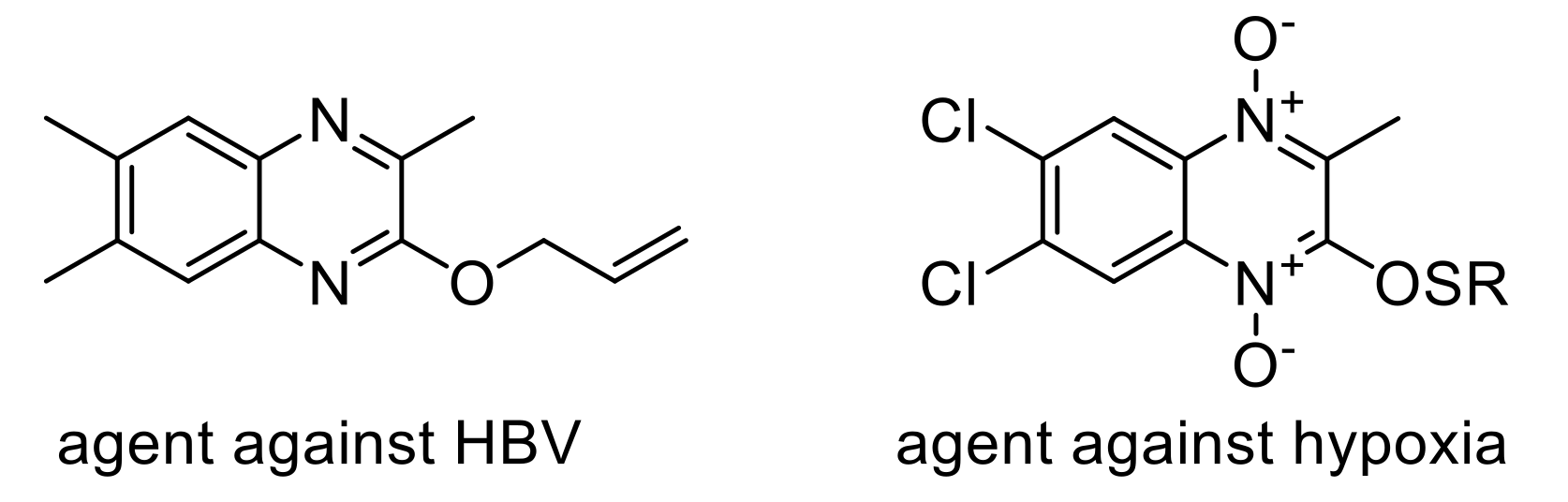
The structures of the iridium catalysts used in this study are shown in Figure 2.
Figure 2.
A series of iridium catalysts used in this study.
First, the reaction of 1,2-phenylenediamine (1a) with glycerol to give 2-methylquinoxaline (2a) was taken up as a model reaction to optimize the reaction conditions. Various catalysts were first evaluated, and the yields of 2a obtained in the presence of these iridium catalysts are summarized in Table 1. In general, the reaction of 1a (1.0 mmol) with glycerol (1.0 mmol) was carried out in the presence of an iridium catalyst (1.0 mol % Ir) and potassium carbonate (0.50 mmol) under reflux in 2,2,2-trifluoroethanol (1.0 mL) for 20 h. Under conditions without an iridium catalyst, 2a was not obtained at all (entry 1). These results indicate that the use of a catalyst is essential for the synthesis of 2a using 1a and glycerol as the starting materials. When simple-structured [Cp*IrCl2]2 (1.0 mol % Ir) was used, only trace amounts of 2a were obtained (entry 2). When the reaction was conducted in the presence of bipyridonate-bearing iridium catalyst A, which we used in the dehydrogenative reactions of alcohols and cyclic amines, 2a was obtained in only 13% yield (entry 3). Water-soluble triammine complex B, which showed high catalytic activity for a hydrogen transfer reaction in water, was also ineffective for the present reaction (entry 4). On the other hand, the yield of 2a was greatly improved (up to 67%) in the presence of iridium complex C, which possesses two iodine ligands and an N-heterocyclic carbene (NHC) ligand having isopropyl groups on its nitrogen atoms (entry 5). A similar yield of 2a was obtained when a dicationic iridium complex D similar to C (it bears ammine ligands instead of iodine ligands) was used as the catalyst (entry 6). The yield of 2a was further improved to 77% using a similar iridium-NHC complex E bearing two chloro ligands (entry 7). However, when the N-isopropyl groups of the NHC ligand of E were replaced with ethyl (F, entry 8) or methyl (G, entry 9) groups, the yield of 2a significantly decreased. From these results, iridium complex E was selected as the optimum catalyst.
Table 1.
Optimization of iridium catalyst for the synthesis of 2-methylquinoxaline (2a).
Subsequent experiments employed catalyst E to optimize the other conditions of the model reaction. To investigate the effects of different bases and solvents, the quantity of glycerol as a starting material was set to 1.1 mmol (Table 2). 2,2,2-Trifluoroethanol was used as the solvent for evaluating the different bases. First, in the reaction without a base, the yield of 2a was very low (entry 1). The yield of 2a was increased to 27% when sodium carbonate (0.50 mmol) was added as a base (entry 2). Among the alkali metal carbonates (entries 2–5), potassium carbonate was most effective as a base to give 2a in the yield of 82% (entry 5). When the amount of potassium carbonate was increased to 1.0 mmol, the yield of 2a reached 92% (entry 6). Potassium hydroxide was also an effective base (entry 7), but did not exceed the yield obtained when potassium carbonate was used. From these results, the optimum base was considered to be potassium carbonate.
Table 2.
Optimization of the base and solvent for the synthesis of 2-methylquinoxaline (2a).
Next, the optimal solvent was explored. Reactions were carried out using toluene, anisole, water, and t-BuOH (entries 8–11) and compared to the reaction using 2,2,2-trifluoroethanol (entry 6). The yield of 2a was highest when using 2,2,2-trifluoroethanol; therefore, it was selected as the optimal solvent.
Using the optimal conditions, we then synthesized various quinoxaline derivatives from different diamines and glycerol (Table 3). When 1,2-phenylenediamines bearing methyl substituents (1b and 1c) were used as starting materials, the corresponding dimethylquinoxalines (2b and 2c) were obtained in good yields (entries 2 and 3). In these reactions, the dimethylquinoxaline derivatives were obtained as a mixture of isomers (2A and 2B) with different substitution positions of the methyl groups. The ratios of the respective isomers were calculated by integrating the corresponding 1H NMR peaks. Reactions using a diamine with a pyridine ring skeleton (1d) also proceeded to afford the cyclized product in moderate yield (entry 4). In addition, the corresponding methylquinoxaline derivatives could also be obtained when 1,2-phenylenediamines (1e–h) with the same substituents at their 4- and 5-positions were used as starting materials. Thus, our protocol afforded various methylquinoxaline derivatives that are useful in the field of synthetic organic chemistry.
Table 3.
Scope of substrates for the synthesis of 2-methylquinoxaline derivatives.
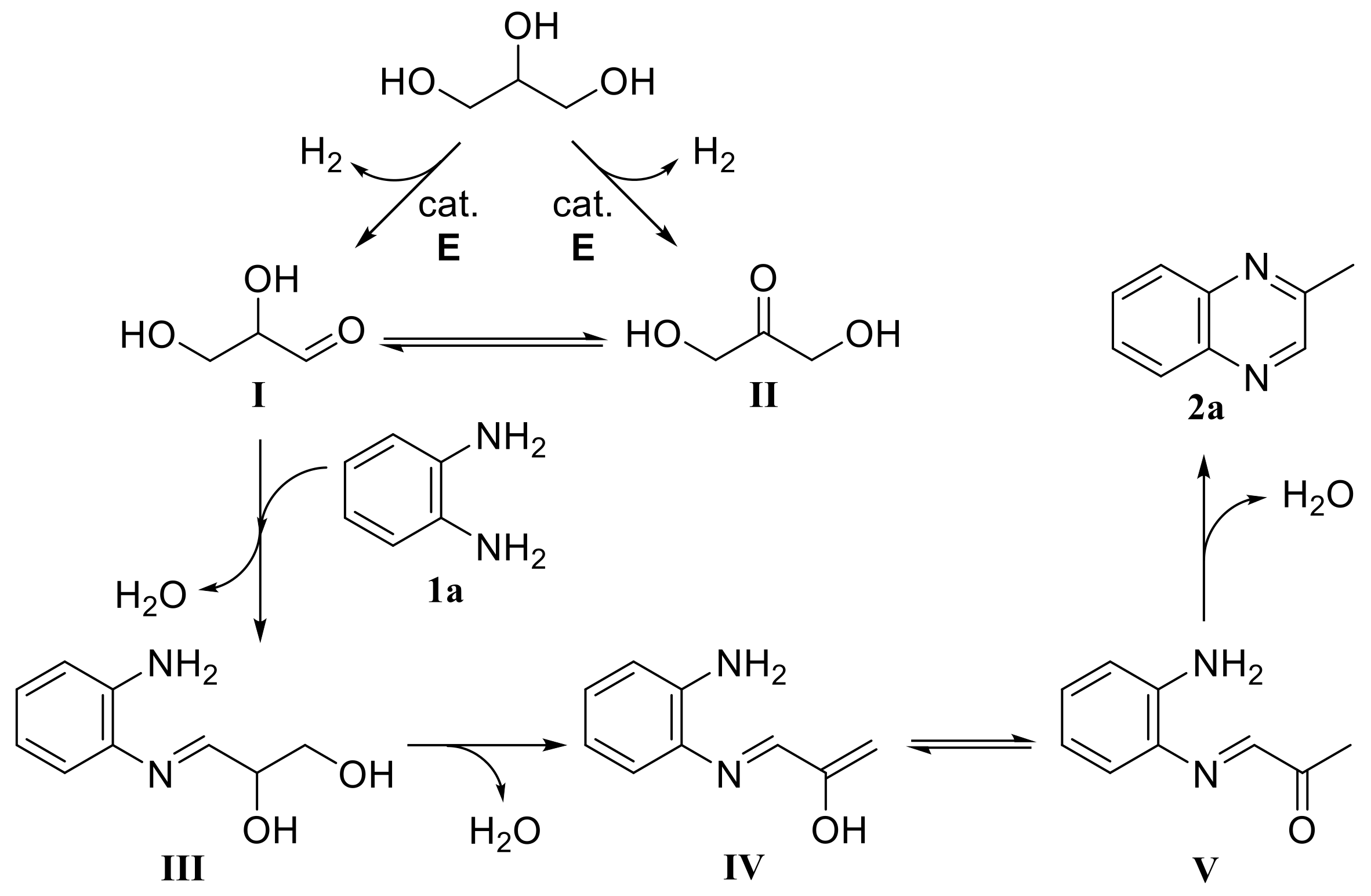
The mechanism for the conversion of 1,2-phenylenediamine (1a) and glycerol to 2-methylquinoxaline (2a) by iridium catalyst E is shown in Scheme 2. Initially, glycerol is dehydrogenated by E to give an equilibrium mixture of glyceraldehyde (I) and dihydroxyacetone (II) [30]. Among them, I is highly reactive and undergoes a dehydration reaction with 1a to produce intermediate III. Subsequently, intermediate III is converted to species IV via dehydration. Finally, the species V, which is a tautomer of IV, undergoes an intramolecular dehydration between its carbonyl and amino groups to produce 2a [31]. Since the dehydration reaction is accelerated in a solvent with a moderately acidic proton source, 2,2,2-trifluoroethanol (pKa = 12.4) is considered to be effective as a reaction solvent.
Scheme 2.
A possible mechanism for the conversion of 1a and glycerol to 2a.
According to the mechanism illustrated in Scheme 2, the reaction producing 2a from 1a and glycerol involves the evolution of hydrogen gas. Therefore, to measure the generated hydrogen gas, the model reaction was carried out on a larger (five-fold) scale. The generated gas was collected in a gas burette to measure its volume. In this experiment, if potassium carbonate was used as the base, carbon dioxide gas would be generated; therefore, potassium hydroxide was used instead. As a result, 2a was produced in 51% yield and hydrogen was obtained in 66% yield (Scheme 3) [32]. This result supports the mechanism proposed in Scheme 2.
Scheme 3.
Quantitative analysis of the evolved hydrogen along with the formation of 2a.
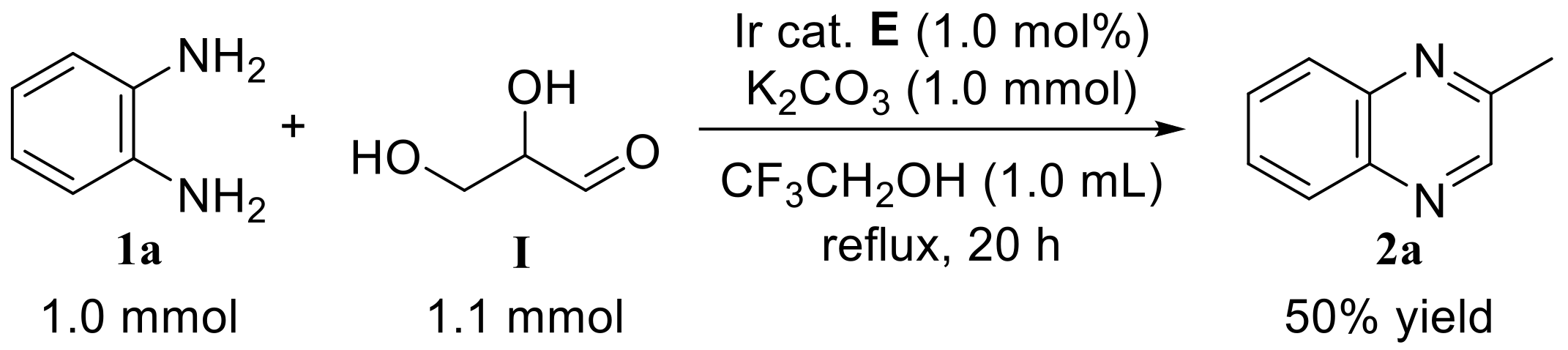
Furthermore, the reaction of 1a with glyceraldehyde, which is proposed as an intermediate I in the possible mechanism shown in Scheme 2, was performed under the optimal catalytic conditions. As a result, 2a was obtained in 50% yield (Scheme 4), supporting the proposed mechanism.
Scheme 4.
Formation of 2a by the catalytic reaction of 1a with glyceraldehyde.
3. Materials and Methods
3.1. General
All reactions and manipulations were performed under argon atmosphere using standard Schlenk techniques. 1H and 13C{1H} NMR spectra were recorded on JEOL ECS-400 (Tokyo, Japan) or ECX-500 spectrometers (Tokyo, Japan). Gas chromatograph analyses of hydrogen were per-formed on a GL-Sciences GC390 (Tokyo, Japan) gas chromatograph with packed columns (Molecular Sieve 5A and Gaskuropack 54). Gas chromatograph analysis of organic product was per-formed on a GL-Sciences GC353B (Tokyo, Japan) gas chromatograph and a GL-Sciences GC4000 gas chromatograph with a capillary column (GL-Sciences InertCap Pure-WAX or InertCap for Amines, Tokyo, Japan). Silica-gel column chromatography was performed using Wako-gel C-200 (Wako Pure Chemical Corporation, Osaka, Japan). The catalysts, [Cp*IrCl2]2 [33] (Cp*: η5-pentamethylcyclopentadienyl), A [34], B [35], C [36], D [36], E [28], F [37], and G [38] were prepared according to the literature methods. The substrate 1i [39] was also prepared according to the literature method. Organic solvents were dried by passage through columns (either alumina or activated molecular sieves) on a Glass Contour solvent system. Other reagents were commercially available and were used as received.
3.2. General Procedure for Optimization of the Reaction Conditions for the Synthesis of 2-Methyquinoxaline (2a)
Initially, glycerol (1.0 mmol in Table 1 and 1.1 mmol in Table 2) was placed in a two-necked test tube. After the introduction of argon, iridium catalyst (1.0 mol % Ir), 1,2-phenylenediamine (1a, 1.0 mmol), base, and solvent (1.0 mL) were added, and the mixture was magnetically stirred and refluxed for 20 h in an oil bath. The reaction setup is illustrated in Figure S1 in the supporting information. The yield of 2a was determined by GC analysis using biphenyl as an internal standard.
3.3. General Procedure for the Synthesis of 2-Methylquinoxaline Derivatives
Initially, glycerol (1.1 mmol) was placed in a two-necked test tube. After the introduction of argon, the catalyst E (1.0 mol %), 1,2-phenylenediamine derivative (1.0 mmol), K2CO3 (1.0 mmol), and 2,2,2-trifluoroethanol (1.0 mL) were added, and the mixture was magnetically stirred and refluxed for 20 h in an oil bath. The reaction setup is illustrated in Figure S1 in the supporting information. In the cases of products 2b-d (Table 3, Entries 2–4), the ratios of isomers 2A and 2B were determined by 1H NMR analyses of the crude products. Then, the products were isolated by silica-gel column chromatography (eluent: hexane/ethyl acetate). Identification of the known products was performed based on the comparison of NMR data with their reported ones. In the case of product 2d (Table 3, Entry 4), the total yield of 2dA and 2dB and the ratio of these products were determined by 1H NMR analysis using triphenylmethane as an internal standard (1H NMR chart of the crude mixture of this reaction is shown in the supporting information).
2-Methylquinoxaline (2a) [22]: 1H NMR (500 MHz, CDCl3): δ 8.71 (s, 1H), 8.05 (dd, J = 8, 1 Hz, 1H), 8.00 (d, J = 8, 1 Hz, 1H), 7.73–7.65 (m, 2H), 2.74 (s, 3H). 13C{1H} NMR (125 MHz, CDCl3): δ 153.6, 145.9, 141.9, 140.8, 129.9, 129.0, 128.8, 128.5, 22.4.
2,7-Dimethylquinoxaline (2bA) [40]: 1H NMR (400 MHz, CDCl3): δ 8.66 (s, 1H), 7.94 (d, J = 9 Hz, 1H), 7.77 (s, 1H), 7.52 (dd, J = 9, 2 Hz, 1H), 2.75 (s, 3H), 2.57 (s, 3H). 13C{1H} NMR (100 MHz, CDCl3): δ 153.7, 145.2, 142.2, 140.6, 139.5, 131.2, 128.7, 127.6, 22.6, 21.9.
2,6-Dimethylquinoxaline (2bB) [40]: 1H NMR (400 MHz, CDCl3): δ 8.69 (s, 1H), 7.89 (d, J = 8 Hz, 1H), 7.82 (s, 1H), 7.56 (dd, J = 8, 2 Hz, 1H), 2.75 (s, 3H), 2.57 (s, 3H). 13C{1H} NMR (100 MHz, CDCl3): δ 152.8, 145.9, 141.1, 140.6, 139.4, 132.3, 128.2, 128.1, 22.5, 21.8.
2,8-Dimethylquinoxaline (2cA) [40]: 1H NMR (400 MHz, CDCl3): δ 8.71 (s, 1H), 7.90–7.88 (m, 1H), 7.59–7.54 (m, 2H), 2.77 (s, 6H). 13C{1H} NMR (100 MHz, CDCl3): δ 152.6, 145.6, 141.4, 141.0, 137.0, 130.0, 128.6, 127.1, 22.8, 17.3.
2,5-Dimethylquinoxaline (2cB) [40]: 1H NMR (400 MHz, CDCl3): δ 8.73 (s, 1H), 7.85 (d, J = 8 Hz, 1H), 7.62 (t, J = 8 Hz, 1H), 7.52 (d, J = 8 Hz, 1H), 2.78 (s, 3H), 2.77 (s, 3H). 13C{1H} NMR (100 MHz, CDCl3): δ 153.4, 144.8, 142.3, 140.2, 137.4, 129.9, 129.1, 126.6, 22.6, 17.4.
2,6,7-Trimethylquinoxaline (2e) [22]: 1H NMR (400 MHz, CDCl3): δ 8.63 (s, 1H), 7.79 (s, 1H), 7.75 (s, 1H), 2.73 (s, 3H), 2.47 (s, 6H). 13C{1H} NMR (100 MHz, CDCl3): δ 152.8, 145.1, 141.1, 140.5, 140.0, 139.3, 128.3, 127.8, 22.6,20.5, 20.3.
6,7-Dichloro-2-methylquinoxaline (2f) [41]: 1H NMR (400 MHz, CDCl3): δ 8.72 (s, 1H), 8.16 (s, 1H), 8.11 (s, 1H), 2.77 (s, 3H). 13C{1H} NMR (100 MHz, CDCl3): δ 155.2, 147.1, 140.9, 139.8, 134.6, 133.5, 129.9, 129.5, 22.8.
6,7-Dibromo-2-methylquinoxaline (2g): pale-pink powder, m.p. 163.9–164.1 °C. 1H NMR (400 MHz, CDCl3): δ 8.72 (s, 1H), 8.34 (s, 1H), 8.29 (s, 1H), 2.76 (s, 3H). 13C{1H} NMR (100 MHz, CDCl3): δ 155.3, 147.2, 141.4, 140.3, 133.3, 132.9, 126.7, 125.4, 22.9. Anal. Calcd for C9H6Br2N2: C, 35.70; H, 2.06; N, 9.26. Found: C, 35.80; H, 2.00; N, 9.28.
6,7-Diphenyl-2-methylquinoxaline (2h): pale-yellow powder, m.p. 139.7–140.1 °C. 1H NMR (400 MHz, CDCl3): δ 8.75 (s, 1H), 8.12 (s, 1H), 8.08 (s, 1H), 7.27–7.22 (m, 10H), 2.79 (s, 3H). 13C{1H} NMR (100 MHz, CDCl3): δ 154.2, 146.4, 143.4, 142.4, 141.4, 140.34, 140.30, 130.4, 130.0, 129.9, 128.1, 127.2, 127.2, 22,8. Anal. Calcd for C21H16N2: C, 85.11; H, 5.44; N, 9.45. Found: C, 84.61; H, 5.45; N, 9.37.
3.4. Procedure for Quantitative Analysis of the Evolved Hydrogen along with the Formation of 2a
Initially, glycerol (5.5 mmol) was placed in a two-necked test tube. After the introduction of argon, the catalyst E (1.0 mol %), 1,2-phenylenediamine (1a, 5.0 mmol), KOH (5.0 mmol), and 2,2,2-trifluoroethanol (5.0 mL) were added, and the mixture was magnetically stirred and refluxed for 20 h in an oil bath. The reaction setup is illustrated in Figure S2 in the supporting information. The evolved gas was collected in a gas burette. The yield of hydrogen was calculated based on the ideal gas law. The chromatogram of the evolved gas is shown in Figure S3a in the supporting information. The chromatogram of the standard pure hydrogen gas is shown in Figure S3b in the supporting information. By the comparison of Figures S3a,b, it was confirmed that pure hydrogen was obtained by the present reaction. On the other hand, the yield of 2a was determined by GC analysis of the reaction mixture using biphenyl as an internal standard.
3.5. Procedure for the Synthesis of 2a by the Catalytic Reaction of 1a with Glyceraldehyde
Initially, glyceraldehyde (I, 1.1 mmol) was placed in a two-necked test tube. After the introduction of argon, the catalyst E (1.0 mol %), 1,2-phenylenediamine (1a, 1.0 mmol), K2CO3 (1.0 mmol), and 2,2,2-trifluoroethanol (1.0 mL) were added, and the mixture was magnetically stirred and refluxed for 20 h in an oil bath. The reaction setup is illustrated in Figure S1 in the supporting information. The yield of 2a was determined by GC analysis using biphenyl as an internal standard.
4. Conclusions
In summary, an efficient catalytic system was developed to synthetically obtain chemically valuable 2-methylquinoxaline derivatives using inexpensive and readily available glycerol and 1,2-phenylenediamines as starting materials. This protocol is beneficial because it is environmentally friendly and has excellent atom efficiency. Furthermore, such a catalyst system that effectively utilizes glycerol is significant because glycerol is easily obtained from natural resources and is currently a surplus C3 carbon source.
Supplementary Materials
The following are available online at https://www.mdpi.com/article/10.3390/catal11101200/s1, Figure S1: Illustration of the reaction setup for optimization of the reaction conditions for the synthesis of 2-methyquinoxaline (2a) shown in Table 1 and Table 2, Figure S2: Illustration of the reaction setup for quantitative analysis of the evolved hydrogen along with the formation of 2a shown in Scheme 3, Figure S3: GC analysis of the evolved hydrogen along with the formation of 2a shown in Scheme 3, and NMR charts of the organic products.
Author Contributions
T.T. performed the experiments, analyzed the results, and wrote the manuscript. A.E. and S.F. performed the experiments and analyzed the results. K.-i.F. guided the research, designed the experiments, and wrote the manuscript. All authors have read and agreed to the published version of the manuscript.
Funding
This work was financially supported by JSPS KAKENHI Grant Number JP18H05517, JP19H02715, and JP19H05053.
Institutional Review Board Statement
Not applicable.
Informed Consent Statement
Not applicable.
Data Availability Statement
Not applicable.
Conflicts of Interest
The authors declare no conflict of interest.
References and Notes
- Yamaguchi, J.; Yamaguchi, A.D.; Itami, K. C-H Bond Functionalization: Emerging Synthetic Tools for Natural Products and Pharmaceuticals. Angew. Chem. Int. Ed. 2012, 51, 8960–9009. [Google Scholar] [CrossRef] [PubMed]
- Müller, K.; Faeh, C.; Diederich, F. Fluorine in Pharmaceuticals: Looking Beyond Intuition. Science 2007, 317, 1881–1886. [Google Scholar] [CrossRef] [PubMed] [Green Version]
- Vaxelaire, C.; Winter, P.; Christmann, M. One-Pot Reactions Accelerate the Synthesis of Active Pharmaceutical Ingredients. Angew. Chem. Int. Ed. 2011, 50, 3605–3607. [Google Scholar] [CrossRef] [PubMed]
- Hoffmann-Röder, A.; Krause, N. Synthesis and Properties of Allenic Natural Products and Pharmaceuticals. Angew. Chem. Int. Ed. 2004, 43, 1196–1216. [Google Scholar] [CrossRef] [PubMed]
- Torborg, C.; Beller, M. Recent Applications of Palladium-Catalyzed Coupling Reactions in the Pharmaceutical, Agrochemical, and Fine Chemical Industries. Adv. Synth. Catal. 2009, 351, 3027–3043. [Google Scholar] [CrossRef]
- Fujiwara, T.; O’Hagan, D. Successful Fluorine-Containing Herbicide Agrochemicals. J. Fluor. Chem. 2014, 167, 16–29. [Google Scholar] [CrossRef]
- Lamberth, C.; Jeanmart, S.; Luksch, T.; Plant, A. Current Challenges and Trends in the Discovery of Agrochemicals. Science 2013, 341, 742–746. [Google Scholar] [CrossRef]
- Dailey, S.; Feast, W.J.; Peace, R.J.; Sage, I.C.; Till, S.; Wood, E.L. Synthesis and Device Characterisation of Side-Chain Polymer Electron Transport Materials for Organic Semiconductor Applications. J. Mater. Chem. 2001, 11, 2238–2243. [Google Scholar] [CrossRef]
- Facchetti, A. Semiconductors for Organic Transistors. Mater. Today 2007, 10, 28–37. [Google Scholar] [CrossRef]
- Nadres, E.T.; Daugulis, O. Heterocycle Synthesis via Direct C-H/N-H Coupling. J. Am. Chem. Soc. 2012, 134, 7–10. [Google Scholar] [CrossRef] [Green Version]
- Estévez, V.; Villacampa, M.; Menéndez, J.C. Multicomponent Reactions for the Synthesis of Pyrroles. Chem. Soc. Rev. 2010, 39, 4402–4421. [Google Scholar] [CrossRef]
- Hill, M.D. Recent Strategies for the Synthesis of Pyridine Derivatives. Chem. Eur. J. 2010, 16, 12052–12062. [Google Scholar] [CrossRef]
- Grondal, C.; Jeanty, M.; Enders, D. Organocatalytic Cascade Reactions as a New Tool in Total Synthesis. Nature. Chem. 2010, 2, 167–178. [Google Scholar] [CrossRef]
- Li, H.; Guo, H.; Fang, Z.; Aida, T.M.; Smith, R.L. Cycloamination Strategies for Renewable N-Heterocycles. Green Chem. 2020, 22, 582–611. [Google Scholar] [CrossRef] [Green Version]
- Ali, I.A.I.; Fathalla, W. N1-Allyl-3-substituted-6,7-dimethyl-1, 2-dihydro-2-quinoxalinone as Key Intermediate for New Acyclonucleosides and Their Regioisomer O-Analogues. Heteroatom Chem. 2006, 17, 280–288. [Google Scholar] [CrossRef]
- Barker, A.J.; Hamilton, E. New Hypoxia-selective Cytotoxines Derived from Quinoxaline 1,4-Dioxides. J. Heterocycl. Chem. 1995, 32, 1213–1217. [Google Scholar]
- Kaushal, T.; Srivastava, G.; Sharma, A.; Negi, A.S. An Insight into Medicinal Chemistry of Anticancer Quinoxalines. Bioorg. Med. Chem. 2019, 27, 16–35. [Google Scholar] [CrossRef]
- Ma, F.; Hanna, M.A. Biodiesel Production: A Review. Bioresour. Technol. 1999, 70, 1–15. [Google Scholar] [CrossRef]
- Ciriminna, R.; Pina, C.D.; Rossi, M.; Pagliaro, M. Understanding the Glycerol Market. Eur. J. Lipid Sci. Technol. 2014, 116, 1432–1439. [Google Scholar] [CrossRef]
- Zhou, C.-H.; Beltramini, J.N.; Fan, Y.-X.; Lu, G.Q. Chemoselective Catalytic Conversion of Glycerol as a Biorenewable Source to Valuable Commodity Chemicals. Chem. Soc. Rev. 2008, 37, 527–549. [Google Scholar] [CrossRef] [PubMed]
- Wang, Y.; Xiao, Y.; Xiao, G. Sustainable Value-Added C3 Chemicals from Glycerol Transformations: A Mini Review for Heterogeneous Catalytic Processes. Chin. J. Chem. Eng. 2019, 27, 1536–1542. [Google Scholar] [CrossRef]
- Xie, F.; Zhang, M.; Jiang, H.; Chen, M.; Lv, W.; Zheng, A.; Jian, X. Efficient Synthesis of Quinoxalines from 2-Nitroanilines and Vicinal Diols via a Ruthenium-Catalyzed Hydrogen Transfer Strategy. Green Chem. 2015, 17, 279–284. [Google Scholar] [CrossRef]
- Hille, T.; Irrgang, T.; Kempe, R. The Synthesis of Benzimidazoles and Quinoxalines from Aromatic Diamines and Alcohols by Iridium-Catalyzed Acceptorless Dehydrogenative Alkylation. Chem. Eur. J. 2014, 20, 5569–5572. [Google Scholar] [CrossRef]
- Lv, D.; Xie, Z.; Gu, B.; Wu, H.; Wan, H. Highly Efficient Synthesis of Quinoxaline Derivatives Catalized by Iridium Complex. Russ. J. Gen. Chem. 2016, 86, 2887–2890. [Google Scholar] [CrossRef]
- Chakrabarti, K.; Maji, M.; Kundu, S. Cooperative Iridium Complex-Catalyzed Synthesis of Quinoxalines, Benzimidazoles and Quinazolines in Water. Green Chem. 2019, 21, 1999–2004. [Google Scholar] [CrossRef]
- The borrowing-hydrogen process is a catalytic method that diversifies the use of alcohols in organic synthesis. First, catalytic elimination of hydrogen from the alcohol proceeds, producing a carbonyl compound. Subsequently, the condensation reaction of the carbonyl compound produces various unsaturated intermediates. Then, the unsaturated intermediate catalytically receives the “borrowed” hydrogen in the first step, giving the final product. In this way, alcohol can be used as an alkylating agent in borrowing-hydrogen reactions, and the only by-product is water. Examples of the catalytic reactions based on the borrowing-hydrogen process are cited in references [26,27,28, 29]: Fujita, K.; Enoki, Y.; Yamaguchi, R. Cp*Ir-Catalyzed N-Alkylation of Amines with Alcohols. A Versatile and Atom Economical Method for the Synthesis of Amines. Tetrahedron 2008, 64, 1943–1954.
- Fujita, K.; Fujii, T.; Yamaguchi, R. Cp*Ir Complex-Catalyzed N-Heterocyclization of Primary Amines with Diols: A New Catalytic System for Environmentally Benign Synthesis of Cyclic Amines. Org. Lett. 2004, 20, 3525–3528. [Google Scholar] [CrossRef]
- Toyooka, G.; Tuji, A.; Fujita, K. Efficient and Versatile Catalytic Systems for the N-Methylation of Primary Amines with Methanol Catalyzed by N-Heterocyclic Carbene Complexes of Iridium. Synthesis 2018, 50, 4617–4626. [Google Scholar]
- Enomoto, A.; Shimbayashi, T.; Fujita, K. Environmentally Friendly Synthesis of N-Methylated Nitrogen Heterocycles from an Aqueous Solution of Methylamine and Diols. Heterocycles 2019, 98, 1119–1129. [Google Scholar]
- Appayee, C.; Breslow, R. Deuterium Studies Reveal a New Mechanism for the Formose Reaction Involving Hydride Shifts. J. Am. Chem. Soc. 2014, 136, 3720–3723. [Google Scholar] [CrossRef]
- Climent, M.J.; Corma, A.; Iborra, S.; Martínz-Silvestre, S. Gold Catalysis Opens Up a New Route for the Synthesis of Benzimidazoylquinoxaline Derivative from Biomass-Derived Products (Glycerol). ChemCatChem 2013, 5, 3866–3874. [Google Scholar] [CrossRef]
- The yield of hydrogen exceeded the yield of 2a because the dehydrogenation of glycerol alone by catalyst E would proceed to some extent, producing hydrogen.
- Ball, R.G.; Graham, W.A.G.; Heinekey, D.M.; Hoyano, J.K.; McMaster, A.D.; Mattson, B.M.; Michel, S.T. Synthesis and Structure of [(η-C5Me5)Ir(CO)]2. Inorg. Chem. 1990, 29, 2023–2025. [Google Scholar] [CrossRef]
- Kawahara, R.; Fujita, K.; Yamaguchi, R. Cooperative Catalysis by Iridium Complexes with a Bipyridonate Ligand: Versatile Dehydrogenative Oxidation of Alcohols and Reversible Dehydrogenation-Hydrogenation between 2-Propanol and Acetone. Angew. Chem. Int. Ed. 2012, 51, 12790–12794. [Google Scholar] [CrossRef]
- Kawahara, R.; Fujita, K.; Yamaguchi, R. Multialkylation of Aqueous Ammonia with Alcohols Catalyzed by Water-Soluble Cp*Ir-Ammine Complexes. J. Am. Chem. Soc. 2010, 132, 15108–15111. [Google Scholar] [CrossRef]
- Fujita, K.; Furukawa, S.; Morishima, N.; Shimizu, M.; Yamaguchi, R. N-Alkylation of Aqueous Ammonia with Alcohols Leading to Primary Amines Catalyzed by Water-Soluble N-Heterocyclic Carbene Complexes of Iridium. ChemCatChem 2018, 10, 1993–1997. [Google Scholar] [CrossRef]
- Tanabe, Y.; Hanasaka, F.; Fujita, K.; Yamaguchi, R. Scope and Mechanistic Studies of Intramolecular Aliphatic C-H Bond Activation of N-Heterocyclic Carbene Iridium Complexes. Organometallics 2007, 26, 4618–4626. [Google Scholar] [CrossRef]
- Xiao, X.-Q.; Jin, G.-X. Functionalized N-Heterocyclic Carbene Iridium Complexes: Synthesis, Structure and Addition Polymerization of Norbornene. J. Organomet. Chem. 2008, 693, 3363–3368. [Google Scholar] [CrossRef]
- Sakai, H.; Shinto, S.; Araki, Y.; Wada, T.; Sakanoue, T.; Takenobu, T.; Hasobe, T. Formation of One-Dimensional Helical Columns and Excimerlike Excited States by Racemic Quinoxaline-Fused [7]Carbohelicenes in the Crystal. Chem. Eur. J. 2014, 20, 10099–10109. [Google Scholar] [CrossRef]
- Imanishi, M.; Sonoda, M.; Miyazato, H.; Sugimoto, K.; Akagawa, M.; Tanimori, S. Sequential Synthesis, Olfactory Properties, and Biological Activity of Quinoxaline Derivatives. ACS Omega 2017, 2, 1875–1885. [Google Scholar] [CrossRef]
- Yang, Y.; Ni, F.; Shu, W.-M.; Wu, A.-X. Copper-Catalyzed Domino Synthesis of 2-Imino-1H-imidazol-5(2H)-ones and Quinoxalines Involving C-C Bond Cleavage with a 1,3-Dicarbonyl Unit as a Leaving Group. Chem. Eur. J. 2014, 20, 11776–11782. [Google Scholar] [CrossRef]
Publisher’s Note: MDPI stays neutral with regard to jurisdictional claims in published maps and institutional affiliations. |
© 2021 by the authors. Licensee MDPI, Basel, Switzerland. This article is an open access article distributed under the terms and conditions of the Creative Commons Attribution (CC BY) license (https://creativecommons.org/licenses/by/4.0/).