
Abstract
Agents involved in a conflicting claims problem may be concerned with the proportion of their claims that is satisfied, or with the total amount they get. In order to relate both perspectives, we associate to each conflicting claims problem a bargaining-in-proportions set. Then, we obtain a correspondence between classical bargaining solutions and usual claims rules. In particular, we show that the constrained equal losses, the truncated constrained equal losses and the contested garment (Babylonian Talmud) rules can be obtained throughout the Nash bargaining solution.
Keywords:
bargaining problem; conflicting claims problem; proportionality; bargaining solutions; claims rules JEL classification:
C71; D63; D71
1. Introduction
As pointed out by [1,2,3], although the literature about conflicting claims problems, which originates in a fundamental paper by [4], proposes a vast number of rules, “the proportional solution is the most widely used”. The main reason is the fact that a proportional sharing allows individuals to compare the treatment afforded to each one, in terms of the proportion of the claim that is honored. Moreover, the principle behind this proportional point of view is that the obtained amount per unit of individual claim (or other proportion defining variable) is the same for all.
An interesting interpretation of proportionality, when analyzing conflicting claims problems, can be found in [5]: “(...) A few years ago I developed what appears to be a new viewpoint which leads to the proportional solution. Since the amount E is not enough to pay off the bankruptcy, one might adopt the following point of view: Instead of giving the claimants less than they are entitled to now, one can postpone paying them off and wait until the available money E grows, by investing it at the current interest rate until the invested amount plus interest totals the amount being claimed. The judge at this future point in time would pay off each claimant his/her full amount. Using the well-known accounting principle of computing the present value of this future asset we can see what amount of money this approach would yield each claimant today. If one does the algebra involved, one sees that the solution is the same as the proportional solution. (...)"
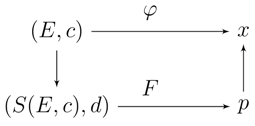
According to this proportional concern, we transform a conflicting claims problem into a claims-in-proportions bargaining problem by associating to each allocation a new variable where is the proportion of the claim that agent i receives, Then, we define the associated bargaining-in-proportions approach. It turns out that well known claims rules can, in this fashion, be described by classical bargaining solutions. For instance, if we apply the Nash bargaining solution [6], we observe that (i) it provides the same allocation when applied to the problem , and when applied directly to the conflicting claims problem ; and (ii) it coincides with the constrained equal awards rule [7]. Nevertheless, in general bargaining solutions do not coincide when applied to problems and Then, we analyze how a claims rule φ and a bargaining solution F in the following diagram are related.
In particular, we show that the egalitarian [8] bargaining solution corresponds with the proportional rule, whereas when considering different reference points r the Nash solution provides the constrained equal losses, the truncated constrained equal losses, and the contested garment (Babylonian Talmud) rules in conflicting claims problems.
The paper is organized as follows. Section 2 contains the main definitions on conflicting claims and bargaining problems. Section 3 defines our model and presents the results about the correspondence between claims rules and bargaining solutions. Finally, Section 4 closes the paper with some remarks.
2. Preliminaries
2.1. Conflicting Claims Problems and Rules
Consider a set of individuals . Each individual is identified by her claim, , on some endowment A conflicting claims problem appears whenever the endowment is not enough to satisfy all the individuals’ claims; that is, The pair represents the conflicting claims problem, and we will denote by the set of all conflicting claims problems. A claims rule is a single valued function such that: (non-negativity and claim-boundedness); and (efficiency). We now present briefly the rules used throughout the paper. The reader is referred to [2,9] for reviews of this literature.
The proportional rule recommends a distribution of the endowment which is proportional to the claims, where
The constrained equal awards rule (Maimonides, 12th century) proposes equal awards to all agents subject to no one receives more than her claim, where μ is such that
The constrained equal losses rule (discussed by Maimonides [10]) proposes equal losses to all agents subject to no one receives a negative amount, where μ is such that
Given a claims rule the associated truncated by the endowment claims rule is defined by where
The adjusted proportional rule [11], which a generalization of the contested garment principle (Babylonian Talmud), recommends the allocation where
2.2. Bargaining Problems and Solutions
A bargaining problem is a pair , such that is a subset in the dimensional Euclidean space, and d is a point in , which is called disagreement point. Furthermore, we consider the set S is convex, bounded, closed from above and comprehensive. Note that S is comprehensive in if implies Given a bargaining problem its individually rational Pareto boundary is defined by The ideal point a represents the maximum amount that each agent can achieve in such a problem: for each A bargaining solution F assigns to each bargaining problem a unique element For additional information, the interested reader is referred to [12].
The Nash solution [6] is the point maximizing the product of utility gains from the disagreement point in
The Egalitarian solution [8] selects the maximal point of S at which all agents’ utility gains are equal, i.e., the intersection point of the line throughout d with gradient 1 and
The Kalai-Smorodinsky solution [13] selects the point in at which the agents’ gains are proportional to their ideal situation, i.e., the intersection point of the line throughout a and d and
The Nash α-asymmetric solution, ([14,15] ) is the point that maximizes the function in
Given a point r such that r ≥ a, the Nash from the reference point r solution [16] is the point that maximizes the function in
3. Bargaining-In-Proportions: Correspondence between Bargaining Solutions and Claims Rules
The bargaining-in-proportions problem associated to a conflicting claims problem is defined by considering the proportion of the claim that each agent is willing to disclaim. So, if we name the proportion of her claim that individual i receives, the set of feasible claims can be written as:
when there is no confusion, we will denote this set simply by Observe that if is a solution in the bargaining-in-proportions problem then it induces a solution in the claims problem .
We name utopia point the ideal point in this transformed problem; that is, the point such that for each Furthermore, we call maximum point to the unitary vector 1 that represents the maximum proportion of the claim that an individual may expect to obtain before knowing the actual endowment
The next example provides an illustration, and relates the rule with the Nash solution.
Example 1.
Consider the three person conflicting claims problem defined by . Then, . The associated bargaining-in-proportions set is defined by The Nash bargaining solution in is, that induces the proposal Therefore, the Nash bargaining solution corresponds with the one given by the rule.
Proposition 1.
The following correspondences between solutions and rules hold:
- and
- and
- and
- and
- and for and
Proof. See Appendix.
The rule is a generalization of the principle (Babylonian Talmud). This particular case, that involves just two individuals, can also be obtained throughout the Nash solution from point
Proposition 2.
For , corresponds with
Proof. See Appendix.
Finally, the next result shows that the Nash bargaining solution (i) from the maximum point corresponds to rule, and (ii) from the utopia point provides the rule.
Proposition 3.
The following correspondences between Nash solutions and claims rules hold:
- and
- and
The proof runs parallel to the one in Proposition 1 part (1).
4. Final remarks
In this work we build a connection between bargaining solutions and claims rules in a new scenario where the relevant notions about what the involved individuals discuss are the proportions of their claims that are (or are not) satisfied. Moreover, this new approach would allow to define new claims rules by using well known bargaining solutions.
Acknowledgments
We sincerely thank the editor and the reviewers for their comments and suggestions, which have helped us to considerably improve this manuscript. The usual caveat applies.
Financial support from Universitat Rovira i Virgili, Banco Santander and Generalitat de Catalunya under project 2011LINE-06, Ministerio de Ciencia e Innovación under project ECO2011-24200 and from the Spanish Ministry of Economy and Competitiveness under project ECO2013-43119 are gratefully acknowledged.
Appendix
A1: Proof of Proposition 1 part (1)
Let be a conflicting claims problem and its associated bargaining-in-proportions problem. We proceed by rounds until all come lower than the unit. In the first round, the associated Nash bargaining Lagrangian is
with After some algebra on the first order conditions, we obtain for each If for each i we have we stop and for each is the induced solution in the conflicting claims problem, that coincides in this case with the . Otherwise, for each in the first optimization round, we set Let be the set of individuals i such that (individual i claim is fully satisfied). Let be the cardinality of this set,
In the second round, the associated Lagrangian with the condition for each is,
with for After some algebra on the first order conditions we obtain
If for each we have we stop and the induced solution in the conflicting claims problem is for each that coincides in this case with the rule.
Otherwise we proceed one more time. The process stops after at most rounds, since at least one individual does not obtain his full claim. Then, after m rounds
which is the rule .
■
A2: Proof of Proposition 1 part (2)
Let be a conflicting claims problem and its associated bargaining problem from a proportional approach. We follow a similar reasoning as in the proof of Proposition 1 part (1), but now the problem is
subject to
where is the claim of the individual The solution to this problem is for all so, for each which is not a corner solution, therefore, which coincides with the P rule.
■
A3: Proof of Proposition 1 part (3)
It can be obtained straightforwardly.
A4: Proof of Proposition 1 part (4)
Let be a conflicting claims problem and its associated bargaining problem from a proportional approach. If for each then and and from Proposition 1 part (3) we know that it induces which, in this case, coincides with If, on the contrary, there is some such that (and then for each ), then In this case, the Kalai-Smorodinsky solution implies for and for This result coincides with the one of applying the egalitarian solution to the problem that induces
■
A5: Proof of Proposition 1 part (5)
It can be obtained straightforwardly from Proposition 1 part (4). Note that
A6: Proof of Proposition 2
Let be a conflicting claims problem and its associated bargaining problem from a proportional approach. It is easy to check that the Nash solution applied to the problem is
and then, the induced solution in the conflicting claims problem coincides with
■
Author Contributions
All authors contributed equally to this article.
Conflicts of Interest
The author declares no conflict of interest.
References
- Chun, Y. The proportional solution for rights problem. Math. Soc. Sci. 1988, 15, 231–246. [Google Scholar] [CrossRef]
- Thomson, W. Axiomatic and game-theoretic analysis of bankruptcy and taxation problems: A survey. Math. Soc. Sci. 2003, 45, 249–297. [Google Scholar] [CrossRef]
- Young, P. Equity in Theory and Practice; Princeton University Press: Princeton, NJ, USA, 1994. [Google Scholar]
- O’Neill, B. A problem of rights arbitration from the Talmud. Math. Soc. Sci. 1982, 2, 345–371. [Google Scholar] [CrossRef]
- Malkevitch, J. Resolving Bankruptcy Claims. Feature Column from the AMS 2012. [Google Scholar]
- Nash, J. The bargaining problem. Econometrica 1950, 18, 155–162. [Google Scholar] [CrossRef]
- Dagan, N.; Volij, O. The bankruptcy problem: A cooperative bargaining approach. Math. Soc. Sci. 1993, 26, 287–297. [Google Scholar] [CrossRef]
- Kalai, E. Proportional Solutions to Bargaining Situations: Interpersonal Utility Comparisons. Econometrica 1977, 45, 1623–1630. [Google Scholar] [CrossRef]
- Thomson, W. Axiomatic and Game-theoretic Analysis of Bankruptcy and Taxation Problems: An Update; Working Paper No. 578; Rochester Center for Economic Research: Rochester, NY, USA, August 2013. [Google Scholar]
- Aumann, R.J.; Maschler, M. Game Theoretic Analysis of a bankruptcy from the Talmud. J. Econ. Theory 1985, 36, 195–213. [Google Scholar] [CrossRef]
- Curiel, J.; Maschler, M.; Tijs, S. Bankruptcy games. Z. Oper. Res. 1987, 31, A143–A159. [Google Scholar] [CrossRef]
- Thomson, W. Cooperative models of bargaining. In Handbook of Game Theory with Economic Applications; Aumann, R., Hart, S., Eds.; Elsevier: Amsterdam, The Netherlands, 1994; Charpter 35; pp. 1237–1284. [Google Scholar]
- Kalai, E.; Smorodinsky, M. Other Solutions to Nash’s Bargaining Problem. Econometrica 1975, 43, 513–518. [Google Scholar] [CrossRef]
- Harsányi, J.; Selten, R. A Generalized Nash Solution for Two-Person Bargaining Games with Incomplete Information. Manag. Sci. 1972, 18, 80–106. [Google Scholar] [CrossRef]
- Roth, A. Axiomatic Models of Bargaining; Springer-Verlag: Berlin, Germany, 1979. [Google Scholar]
- Sudhölter, P.; Zarzuelo, J.M. Extending the Nash solution to choice problems with reference points. Games Econ. Behav. 2013, 80, 219–228. [Google Scholar] [CrossRef]
© 2015 by the authors; licensee MDPI, Basel, Switzerland. This article is an open access article distributed under the terms and conditions of the Creative Commons Attribution license (http://creativecommons.org/licenses/by/4.0/).