1. Introduction
Public goods provision is vulnerable to free riding. This makes sustained cooperation one of the central challenges in economics (
Ledyard, 1995). Behavioral economics has shown that people have social preferences in which they care about fairness, not just material payoffs. These preferences can sustain cooperation even when free riding is individually rational.
However, economic analysis typically treats these preferences as stable individual traits that exist prior to and independent of the social environment. A growing body of evidence suggests otherwise.
Bowles (
1998) argues that economic institutions shape preferences, not just constrain choices.
Kovářík et al. (
2025) provide experimental support for this view, demonstrating a bidirectional link between distributive preferences and behavior. If preferences are endogenous to the environment, standard models may mispredict behavior whenever context changes. Policies that alter the environment may then have effects beyond the direct incentive channel.
This paper formalizes one specific pathway through which context may shape fairness concerns. We focus on the inequity-aversion parameters of
Fehr and Schmidt (
1999): envy and guilt. We propose that these parameters can be represented as functions of an individual’s current normative commitment. Normative commitment erodes when individuals are exposed to cooperative norm violations, such as free riding. As normative commitment weakens, guilt declines and envy rises. The model, therefore, represents a gradual shift from fairness-oriented cooperation toward self-protection. This is a reduced-form mechanism. It should be read as a theoretical framework that generates testable implications, not as direct evidence against alternative explanations, such as belief updating, fatigue, or strategic sophistication.
Fehr and Schmidt’s (
1999) model formalizes fairness through inequity aversion. Individuals experience disutility from two sources. Envy (
) captures the pain of having less than others. Guilt (
) captures the discomfort of having more than others. In public goods games, the standard static framework can explain why some individuals cooperate while others free ride. However, the parameters
and
are treated as fixed. The model can explain differences across individuals, but it does not, by itself, explain why the same individual may become less cooperative over time.
However, the Fehr–Schmidt model has an important limitation: it is a static model. It predicts an equilibrium outcome but does not, by itself, generate how behavior evolves over time. Consider the experiment of
Fischbacher and Gächter (
2010). Groups of four played a public goods game for ten rounds with approximately 23% free riders and a majority (55%) of conditional cooperators. The data show that contributions start high and decline steadily across rounds. Fischbacher and Gächter explain this pattern through belief updating. Most people are imperfect conditional cooperators: they are willing to match others’ contributions but on average contribute slightly less than the group mean. As individuals observe declining contributions and revise their beliefs downward, a downward spiral gradually erodes cooperation. This explanation, however, still assumes stable
and
. We propose an additional possibility. It may not be only beliefs that change over time; fairness concerns may also respond to repeated exposure to norm violations. If observing norm violations makes people care less about fairness, then the decline in cooperation may reflect not just updated expectations about others, but a shift in what individuals value. Our model formalizes this possibility.
Several strands of experimental evidence support the idea that social preferences respond to context.
Fischbacher et al. (
2001) show that most people are conditional cooperators who adjust their contributions based on others’ behavior. Subsequent research confirms that exposure to free riders can trigger cooperation decay (
de Oliveira et al., 2015;
Gächter & Thöni, 2005). Sorting cooperators into homogeneous groups sustains contributions (
Gunnthorsdottir et al., 2007;
Nax et al., 2017). Together, these studies establish that the social environment, specifically, who else is in the group, shapes cooperation outcomes (for a comprehensive survey, see
Chaudhuri, 2011).
A related line of work examines the asymmetry in how people respond to positive and negative social signals.
Engel and Rockenbach (
2024) show that people respond more strongly to negative experiences when others contribute less than expected than to positive ones. This asymmetry is important because it suggests that norm violations inflict lasting damage on cooperative dispositions, rather than being offset by positive experiences. These findings are consistent with preferences changing in response to the social environment. However, they lack a formal framework that connects context to preference parameters.
Kimbrough and Vostroknutov (
2016) offer a psychological mechanism that could bridge this gap: norm sensitivity. They show that individuals differ in how much they care about following social norms. Groups of high-norm-sensitivity individuals sustained nearly full cooperation across all rounds. Groups of low-norm-sensitivity individuals collapsed quickly. Mixed groups showed the typical decline. This demonstrates that group composition, a feature of the social context, determines cooperation outcomes. However, Kimbrough and Vostroknutov treat norm sensitivity as a fixed characteristic. They do not explain why the same individual becomes less cooperative over time.
Our model bridges these two approaches by distinguishing stable norm sensitivity from current normative commitment. People may differ in baseline norm sensitivity, but their current commitment to cooperative norms may change in response to what they observe. We introduce a dynamic state variable, , in which normative commitment erodes with expected exposure to free-rider types. This erosion is then mapped into lower guilt and higher envy through Fehr–Schmidt-style preference mappings.
We present a reduced-form dynamic framework, with a calibrated illustration using experimental data. This paper is not a new micro-foundation: the contribution rule is not derived from utility maximization. Nor does the calibration directly identify preference change. Instead, the framework connects two existing theories, generates model-based predictions, and clarifies how a context-dependent preference channel could be tested in future work.
Within this scope, the paper makes three theoretical contributions. First, it provides a tractable reduced-form framework for studying context-dependent fairness concerns in repeated public goods games. The framework shows how exposure to free riding can be represented as erosion in normative commitment, which is then mapped into weaker guilt and stronger envy. This offers a preference-channel complement to belief-based explanations of cooperation decline. Second, the model links the inequity-aversion framework of
Fehr and Schmidt (
1999) to the norm-sensitivity framework of
Kimbrough and Vostroknutov (
2016). The two approaches are treated as complementary. Norm sensitivity motivates the state variable, while Fehr–Schmidt-style parameters provide an interpretive language for changes in fairness concerns. Third, the model generates testable implications about population-level free-rider prevalence, nonlinear cooperation decline, and the role of institutional floors. These implications are theoretical and should be tested directly in future experimental and field research. In this sense, the contribution is not to identify preference change empirically, but to provide a formal structure for studying how such a channel could operate and be tested.
Calibrated to
Fischbacher and Gächter (
2010), the model provides two main implications. First, it can reproduce the observed aggregate contribution path. Second, it predicts stability when expected free-rider exposure is absent (
). This is a structural implication of the model, not empirical evidence by itself. A sensitivity analysis further shows that, within the model, the minimum level of normative commitment determines the long-run level of cooperation.
The paper proceeds as follows.
Section 2 reviews the theoretical framework in greater detail.
Section 3 develops our dynamic model.
Section 4 presents the calibration, simulation results, and sensitivity analyses.
Section 5 discusses theoretical and policy implications.
Section 6 concludes.
2. Theoretical Framework
As outlined in the Introduction Section, two approaches inform our model. The first is
Fehr and Schmidt’s (
1999) model, which formalizes fairness concerns through inequity aversion. The second is
Kimbrough and Vostroknutov’s (
2016) framework, which formalizes norm-following through norm sensitivity. This section presents the technical details of each framework and identifies the shared limitation that our model addresses.
Fehr and Schmidt (
1999) propose that people care about fairness, not just material payoffs. Their utility function captures two sources of disutility from unequal outcomes. The utility of player
is:
where
is player
’s material payoff, and
is the number of players. The parameter
(envy) measures the disutility of earning less than others. The parameter
(guilt) measures the disutility of earning more than others.
Two constraints structure the model. First, means being exploited hurts more than exploiting others. Second, means that guilt is bounded. Even the most guilt-prone person will not sacrifice everything to achieve equality. These constraints create an important asymmetry. As social conditions deteriorate, envy can grow without bound while guilt remains limited. This asymmetry will play a central role in our dynamic model. When normative commitment erodes, envy rises sharply while guilt declines only gradually.
For public goods games, consider a game where
players each receive endowment
and choose to contribute to a public good
. The public good returns
to each player, where
. Contributing is costly to the individual but beneficial to the group. The monetary payoff of player
is:
In a public goods setting, fairness concerns can make cooperation possible when guilt is strong enough to offset the private cost of contributing. The standard static condition, often written as , is useful as a conceptual reference point. However, it is not used as the calibrated behavioral rule in this paper. In our calibration, the expected maximum guilt parameter is . With , this gives . The static condition, therefore, would not generate the observed positive contributions. For this reason, the static Fehr–Schmidt condition should not be interpreted as a quantitative prediction of the calibrated model. We use Fehr–Schmidt-style parameters to interpret the changing fairness state associated with norm erosion, while contributions are generated by the reduced-form scaling rule introduced below.
The model treats and as fixed. If preferences do not change, behavior should be constant across rounds, a prediction that contradicts the gradual decline consistently observed in experiments. The model explains the level of cooperation but not its trajectory.
Kimbrough and Vostroknutov approach cooperation from a different angle. They emphasize social norms rather than distributional concerns. Their key insight is that people differ in how much they care about doing the right thing. They propose a norm-dependent utility function:
where
is the material payoff;
(phi) measures how much individual
cares about following social norms; and function
captures the cost of deviating from the social norm. Larger deviations cost more.
The parameter functions as a switch between rule-following and self-interest. A high- individual willingly sacrifices material benefits to comply with norms. A low- individual focuses on payoffs and feels little discomfort from norm violations.
Kimbrough and Vostroknutov tested this framework directly. They first measured participants’ norm sensitivity using an unrelated task, then sorted them into groups for a public goods game. The results show that groups of high- individuals maintained nearly full cooperation across all 10 rounds. Groups of low- individuals collapsed quickly to near-zero contributions. Mixed groups showed the typical gradual decline. This demonstrates that group composition, a feature of the social context, determines cooperation outcomes. Rule-followers sustain norms when interacting with each other. The norm erodes when they are mixed with rule-breakers.
Like the Fehr–Schmidt model, Kimbrough and Vostroknutov treat their key parameter () as a fixed individual trait. This explains why different people behave differently; however, it does not explain why the same person behaves differently in Round 10 than in Round 1.
2.3. The Gap
Both frameworks share a critical limitation.
Fehr and Schmidt (
1999) explain why people cooperate and when cooperation collapses, but treat
and
as fixed. Kimbrough and Vostroknutov explain who cooperates and show that group composition matters, but treat
as fixed. Neither explains how behavior changes over time within the same individual.
However, experimental data consistently show within-person change. In
Fischbacher and Gächter (
2010), the same individuals who contribute generously in Round 1 contribute far less by Round 10. This decline is difficult to explain with fixed preferences alone, unless belief updating or another dynamic mechanism is added. Either beliefs change, or preferences change, or both. The belief-updating channel is well-established. What is missing is a formal account of the preference channel, a mechanism through which the social environment systematically reshapes fairness concerns over time.
Several empirical patterns point toward such a mechanism.
Gächter and Thöni (
2005) show that cooperation decays faster in heterogeneous groups, suggesting that exposure to free riders may do more than disappoint expectations and may also be associated with changes in cooperative dispositions.
Engel and Rockenbach (
2024) find that people react more strongly to negative social signals than to positive ones. This asymmetry is difficult to reconcile with a purely symmetric fixed-preference response. The observed asymmetry is more consistent with a process in which norm violations erode cooperative inclinations in a way that positive experiences do not restore.
What is needed is a formal framework that connects observed norm violations to systematic changes in the Fehr–Schmidt preference parameters. The next section develops a model that captures this process. We introduce a dynamic state variable, normative commitment (), that links the social context to the Fehr–Schmidt preference parameters, allowing and to evolve endogenously in response to observed norm violations.
3. Theoretical Model
The two frameworks reviewed above explain why people cooperate and who cooperates most, but not how the same person becomes less cooperative over time. This section develops a model that fills this gap by allowing preferences to respond to the social environment.
The model rests on a simple idea. Normative commitment functions like a form of capital that depreciates when exposed to norm violations. When commitment is strong, people control their envy and feel appropriate guilt. When it weakens, guilt diminishes and envy increases. Behavior shifts from fairness toward self-protection. The key innovation is that we allow this commitment to erode over time.
We introduce (psi) to represent normative commitment as a dynamic state. This distinguishes it from Kimbrough and Vostroknutov’s (phi), which denotes norm sensitivity as a stable individual trait. reflects a baseline personality in the model; reflects their current state. A person with high begins with high , but repeated exposure to norm violations erodes , even though their core disposition remains unchanged.
Formally, we define as the strength of an individual’s normative commitment at time . The upper bound of 1 represents full commitment to cooperative norms. The lower bound represents the minimum level that persists even after extensive exposure to free riding. This floor may be zero in environments without institutional enforcement, or positive in environments with stronger normative structures.
3.1. Preference Mapping
We propose that guilt (
) is a direct expression of norm commitment. Strong commitment produces strong guilt from under-contributing. Weakened commitment reduces this discomfort. We model this as a linear relationship:
where
is the maximum potential guilt of an individual when their norm commitment is maximum (
). As
approaches
, guilt falls proportionally. Free riding feels less wrong when norms have been undermined.
Conversely, we propose that envy (
) increases as norm commitment weakens. When cooperative norms are strong, people trust that others will reciprocate, keeping vigilance low. As norms erode, people shift from trusting cooperation to protecting themselves. We model this inverse relationship as:
where
is baseline envy when norms are strong (
), and
is the highest level of envy when norms have collapsed (
). As
reduces from 1 to 0, envy increases from
to
. Weaker norms mean stronger self-protection.
Together, these mappings generate a psychological shift from fairness concerns (high
) to self-protection (low
). As
erodes,
falls while
rises, and the gap between
and
widens. The model preserves the Fehr–Schmidt constraint
throughout (see
Appendix A.3 for proof).
These preference mappings provide the theoretical content of the model.
Section 3.4 introduces the contribution rule that translates this mechanism into a tractable simulation.
3.2. The Dynamics of Norm Erosion
The core of our model is the erosion equation, which specifies how norm commitment evolves over repeated rounds:
The structure captures three intuitions. First, erosion requires exposure. If no free-rider types are present in expectation (), normative commitment does not erode. Second, greater expected exposure to free riders leads to faster erosion. Third, the process is self-limiting: commitment cannot fall below a baseline level, and the rate of erosion diminishes as this floor is approached, resembling depreciating capital.
The equation has three components.
The first is , the population-level share of free-rider types. Free riders are defined behaviorally as individuals who contribute zero in every round regardless of others’ behavior. This share is determined by the initial type composition and remains constant throughout the baseline model. A higher means greater expected exposure to norm violations.
The second is , the erosion rate, capturing how quickly norms decay in response to observed violations. A low value of means that normative commitment is relatively resilient to observed violations. A high value means that it erodes more quickly. reflects how well institutional, cultural, or psychological factors protect normative commitment from erosion.
The third is , the remaining distance to the floor. Erosion slows as norms approach their minimum. This prevents from falling below .
We use separate notation to distinguish two related quantities. Let
denote the realized share of free-riding co-players observed by individual
in period
:
if player is a free-rider type and otherwise. In a specific four-person group, can take only discrete values: 0, 1/3, 2/3, or 1. This is the realized co-player exposure faced by a particular individual.
By contrast,
denotes the population-level share of free-rider types.
Fischbacher and Gächter (
2010) classify 23% of participants as free riders, so the baseline calibration uses
. The erosion equation and simulations use
, rather than
, because the calibration is based on aggregate data and population-level type shares. When we vary
continuously in
Section 4.4, we trace how different population compositions affect the expected erosion trajectory.
3.3. Closed-Form Solution
As
is treated as constant, Equation (6) is a first-order linear recurrence that admits a closed-form solution:
This expression shows exponential decay toward at rate per round. Neither the erosion rate () nor the population-level free-rider prevalence
() alone determines the trajectory—their product
does. The parameter captures expected exposure to norm violations.
The parameter captures vulnerability to that exposure.
When
, Equation (8) reduces to
for all
. Normative commitment remains constant.
Cooperation, therefore, does not decline within the model. This is a structural
implication of the model. It is not evidence by itself that time, fatigue,
learning, or strategic sophistication are irrelevant in actual experiments (all
proofs appear in
Appendix A.1).
3.4. Contribution Decision Rule
The model distinguishes two agent types.
Their behavior is determined by their type, not by context. These agents are defined by contributing zero in every round, regardless of what others do.
where
is the initial contribution, calibrated so that the group average matches observed Round 1 data (see
Section 4.1). As
declines, contributions decline proportionally. The group-level average contribution is therefore:
Since
and the initial cooperator contribution
are fixed in the baseline model, changes in average contributions over time are driven by
. A cooperative agent’s contribution approaches zero as
approaches
, but never reaches exactly zero in finite time when
. This keeps the free-rider type share
fixed by assumption. This assumption is reasonable at the calibrated value
, but it becomes more restrictive at high values of
. We return to this limitation in
Section 5.3.
This dynamic produces a cumulative process. Free riders generate norm violations. These violations erode the normative commitment of cooperative agents, reducing their guilt and increasing their envy. As contributions decline, the social environment deteriorates further. Within the model, cooperation decays not through strategic calculation, but through the assumed psychological impact of observing others violate cooperative norms. To formalize this process requires a contribution rule that can produce gradual decline, which the standard Fehr–Schmidt framework cannot deliver.
3.5. Methodological Justification
The Fehr–Schmidt utility function is linear in contributions, so maximizing it produces only corner solutions: contribute everything or contribute nothing. Since experimental data show gradual decline, not sudden collapse, we adopt a reduced-form approach.
Fischbacher and Gächter (
2010) similarly use a reduced-form rule for imperfect conditional cooperation. Agent-based approaches to social preferences in public goods games have gained traction as a simulation-based complement to analytical models (
Bühren et al., 2023).
The preference mappings and the contribution rule serve distinct roles. The preference mappings provide the theoretical content of the model: they specify how normative commitment translates into changes in guilt and envy within the Fehr–Schmidt framework. The contribution rule translates this mechanism into a tractable simulation. A simple exponential decline, , can reproduce the aggregate trajectory equally well, but it says nothing about why cooperation declines. Our framework adds such an interpretation: guilt weakens, envy strengthens, and the balance shifts from fairness toward self-protection.
We adopt linear scaling as the simplest specification consistent with proportional erosion. To check whether the qualitative results depend on this choice, we also consider the more general form
, where
governs the curvature of the contribution response. When
, contributions decline more slowly than normative commitment; when
, contributions decline faster.
Appendix A.4 reports the simulations for
and
. The main qualitative implications remain unchanged in these simulations.
3.6. Model Properties
The erosion process has five properties that are consistent with common patterns observed in public goods experiments.
The first is boundedness: normative commitment remains inside . The second is monotonicity: when , can only decrease or remain constant within the game—it does not recover. The third is context dependence: a higher population-level free-rider prevalence produces a faster decline in , holding the erosion rate constant.
The fourth is diminishing erosion: The term shrinks as approaches its floor—decay is rapid at first and slows over time. This generates the concave decline pattern, steep early drops followed by gradual leveling, commonly observed in public goods experiments. The fifth is convergence: As . When > 0, cooperation stabilizes above zero; when = 0, cooperation approaches zero asymptotically.
Formal proofs of all properties, including the preservation of the Fehr–Schmidt constraint
for all
, appear in
Appendix A.2.
4. Results
This section calibrates the model to experimental data and examines its implications. The goal is not to prove that preferences changed in the experiment—the goal is more limited. We show that the proposed mechanism can reproduce the observed decline in cooperation and generate model-based predictions.
An important caveat applies throughout the results that follow. The calibration demonstrates that the model can reproduce the observed aggregate contribution trajectory. It does not constitute a direct test of whether preferences change. The preference mappings () are not independently measured. They are inferred from the model’s structure. The results should, therefore, be interpreted as showing what the model predicts, not as empirical evidence that the preference channel operates in practice.
4.1. Calibration
We calibrate the model to match contribution patterns observed in the C-experiment of
Fischbacher and Gächter (
2010). In their experiment, groups of four participants (
) played a public goods game for ten rounds, with a marginal per capita return of
. Each participant received an endowment of 20 tokens per round. About 23% of participants were identified as free riders. We therefore set the baseline population-level free-rider prevalence to
.
We estimate three parameters,
, by minimizing the mean squared error between simulated and observed average contributions across all ten rounds. The initial cooperator contribution is set so that the group-level average in Round 1 matches the observed value of 8.2 tokens. Since free riders contribute zero, this implies
tokens when
. The simulation code and generated datasets are available in the
Supplementary Materials.
Table 1 reports the calibrated parameter values. The calibrated erosion rate is
. Since erosion depends on the product
, the effective erosion rate in the baseline case is approximately 0.504 × 0.23 = 0.116. This means that each round reduces the remaining distance to the normative floor by about 11.6%. The initial norm commitment
indicates strong but imperfect initial normative commitment. The minimum normative commitment
implies that, within the model, normative commitment can erode completely in the long run.
The calibrated value
= 0 should be interpreted narrowly. It describes the laboratory setting used for calibration. It does not imply that normative commitment always erodes completely in real-world settings.
Section 4.5 examines positive values of
, which represent stronger institutional or normative floors.
The preference mapping bounds are set to the expected values of
Fehr and Schmidt’s (
1999, Table III) distribution: E[
] = 0.850 and E[
] = 0.255. The maximum envy
= 4.0 corresponds to the highest value in the distribution. These mappings apply only to cooperative agents. Free riders contribute zero in all rounds (Equation (9)) and do not enter the preference mappings. These bounds determine the theoretical interpretation but do not affect the contribution dynamics, which are driven entirely by
through the scaling rule (Equation (10)).
4.2. Result 1: Calibration Fit
The calibrated model closely follows the observed aggregate contribution path.
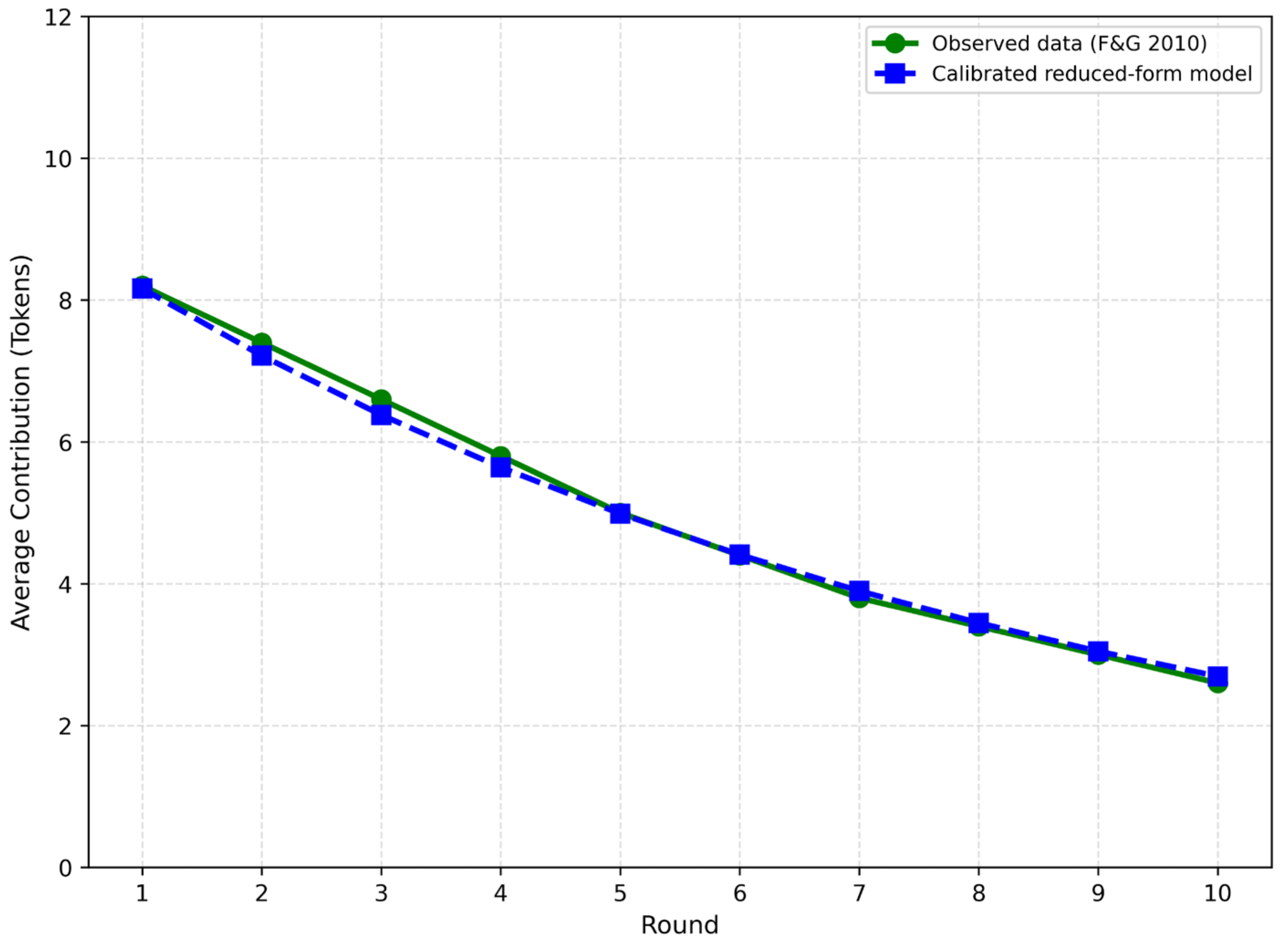
Figure 1 compares simulation contributions with the experimental data from
Fischbacher and Gächter (
2010).
Table 2 reports the fit statistics. The correlation between model predictions and observed contributions is r = 0.999. The root mean squared error is 0.115 tokens, or 0.6% of the endowment. These fit statistics should be interpreted cautiously. The model has three free parameters fitted to ten aggregate data points. A sufficiently flexible decay function could produce a comparable fit.
To assess whether the model’s value lies in fit alone or in its structure, we compare it with two descriptive benchmarks with no behavioral content: a linear decay function (
, two parameters) and an exponential decay function (
, two parameters). Both are fitted to the same ten aggregate data points by least squares.
Table 3 reports the benchmark comparison.
The exponential benchmark achieves a lower RMSE than the proposed model, 0.079 versus 0.115, with one fewer parameter. This confirms that a good fit to a smooth declining trajectory is not, by itself, evidence for any behavioral mechanism. What distinguishes the proposed model is not superior fit. It is the link between decline and expected free-rider exposure. When , the model predicts that contributions remain constant at 10.60 tokens across all rounds. The descriptive benchmarks predict decline over time because they do not include a contextual trigger. This implication is directly testable and provides a prediction beyond curve fitting.
The standard Fehr–Schmidt framework is static. With fixed and , it does not by itself generate the observed gradual decline in contributions. Moreover, the static cooperation condition is not used as a calibrated benchmark here. With and , , so the static condition would not generate the observed positive contributions. The proposed model instead introduces as a dynamic state variable and uses a reduced-form contribution rule. The Fehr–Schmidt-style parameters provide an interpretive mapping, not the behavioral rule that generates the simulated contribution path.
4.3. Result 2: Mechanism
To understand the mechanism driving this contribution decline, we examine the internal dynamics of the model.
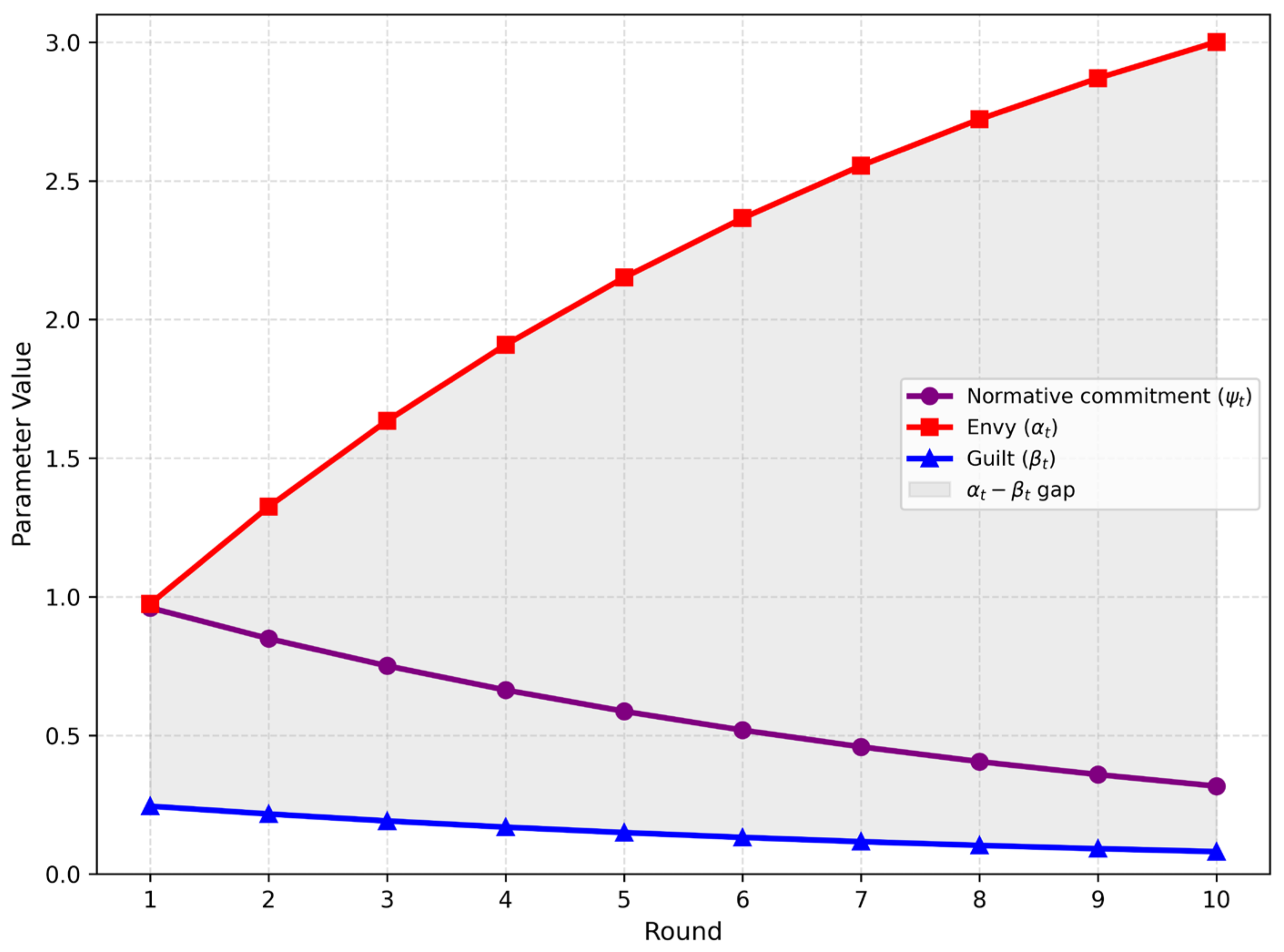
Figure 2 shows the dynamics of normative commitment (
), guilt (
), and envy (
) across the 10 rounds.
With the population-level free-rider prevalence fixed at , normative commitment declines from 0.96 in Round 1 to 0.32 in Round 10. This is a 67% reduction. The decline is faster in the early rounds and slows as approaches its floor. Through the contribution rule, this erosion generates the contribution decline documented in Result 1. Through the preference mappings, it is interpreted as weaker guilt and stronger envy.
Guilt decreases from 0.25 to 0.08, while envy increases from 0.97 to 3.00. These values are model-implied. They are not independently measured psychological parameters. Within the model, they provide a theoretical interpretation of norm erosion: weaker discomfort from under-contributing and stronger concern about being exploited.
Table 4 summarizes the model-implied parameter evolution across selected rounds. The results show that the
gap increases from 0.73 in Round 1 to 2.92 in Round 10. Envy exceeds guilt throughout, which is consistent with the Fehr–Schmidt assumption that disadvantageous inequality is weighted more heavily than advantageous inequality. The Fehr–Schmidt constraint
also holds throughout. Actual contributions are governed by the
-scaling rule.
4.4. Result 3: Free-Rider Prevalence and Cooperation
We now examine how cooperation changes as the population-level free-rider prevalence varies. In the model, norm erosion is triggered by expected exposure to free-rider types. Therefore, when , normative commitment does not erode and cooperation remains constant. This is a model implication. It is not empirical evidence against fatigue, learning, or strategic sophistication.
We vary from 0% to 50%. is interpreted as the population-level share of free-rider types. Individual groups observe discrete values of realized co-player exposure , but the population parameter can vary continuously. This allows us to trace how different population compositions affect expected cooperation paths.
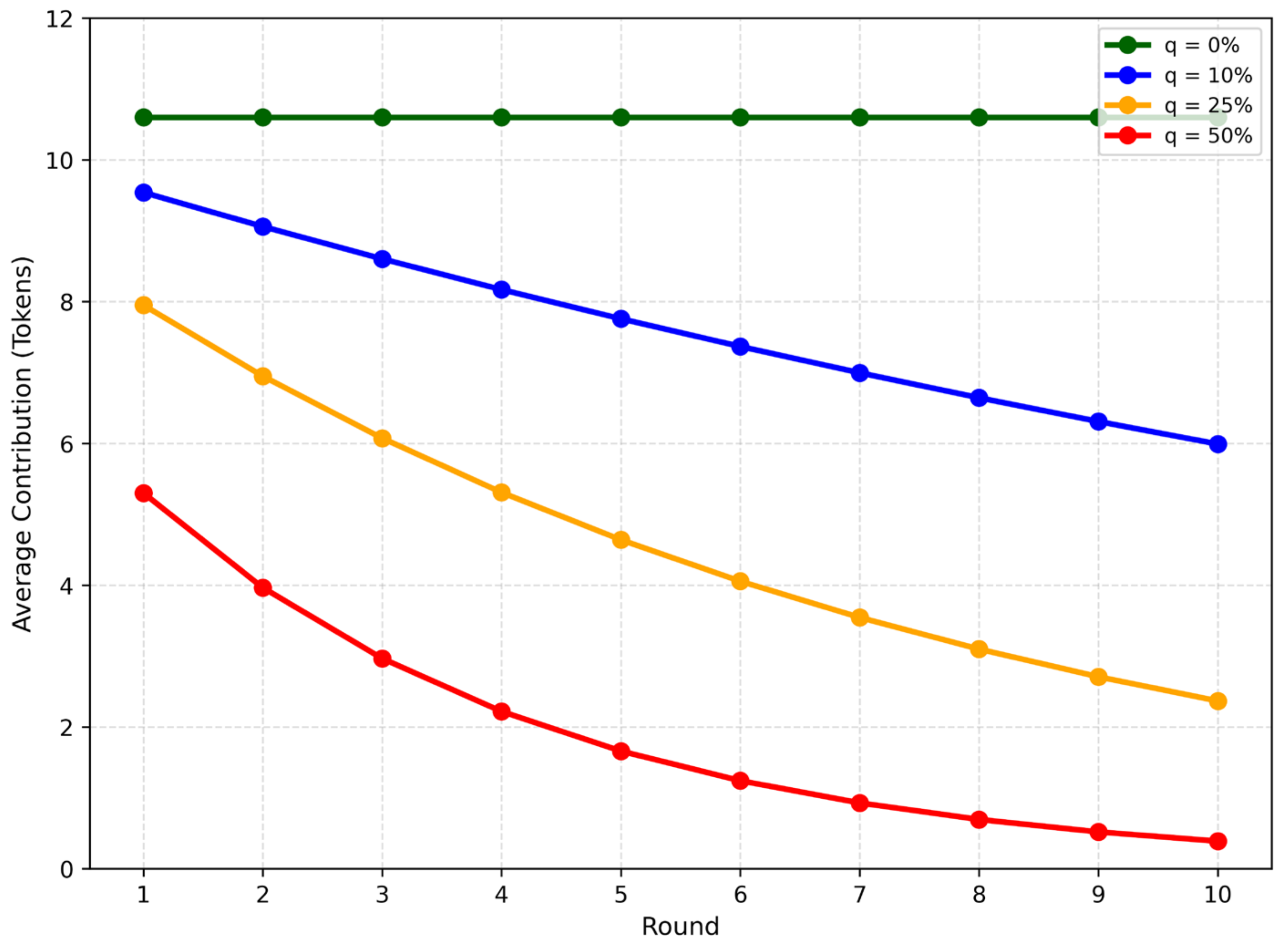
Figure 3 shows simulated contribution paths for different values of
. When
, contributions remain constant across all ten rounds because there is no free-rider exposure in expectation. As
increases, contributions decline faster and reach lower final levels. At
, average contributions fall from 5.30 tokens in Round 1 to 0.39 tokens in Round 10. Part of this decline is mechanical because more agents contribute zero. Another part is dynamic because expected free-rider exposure accelerates norm erosion among cooperative agents.
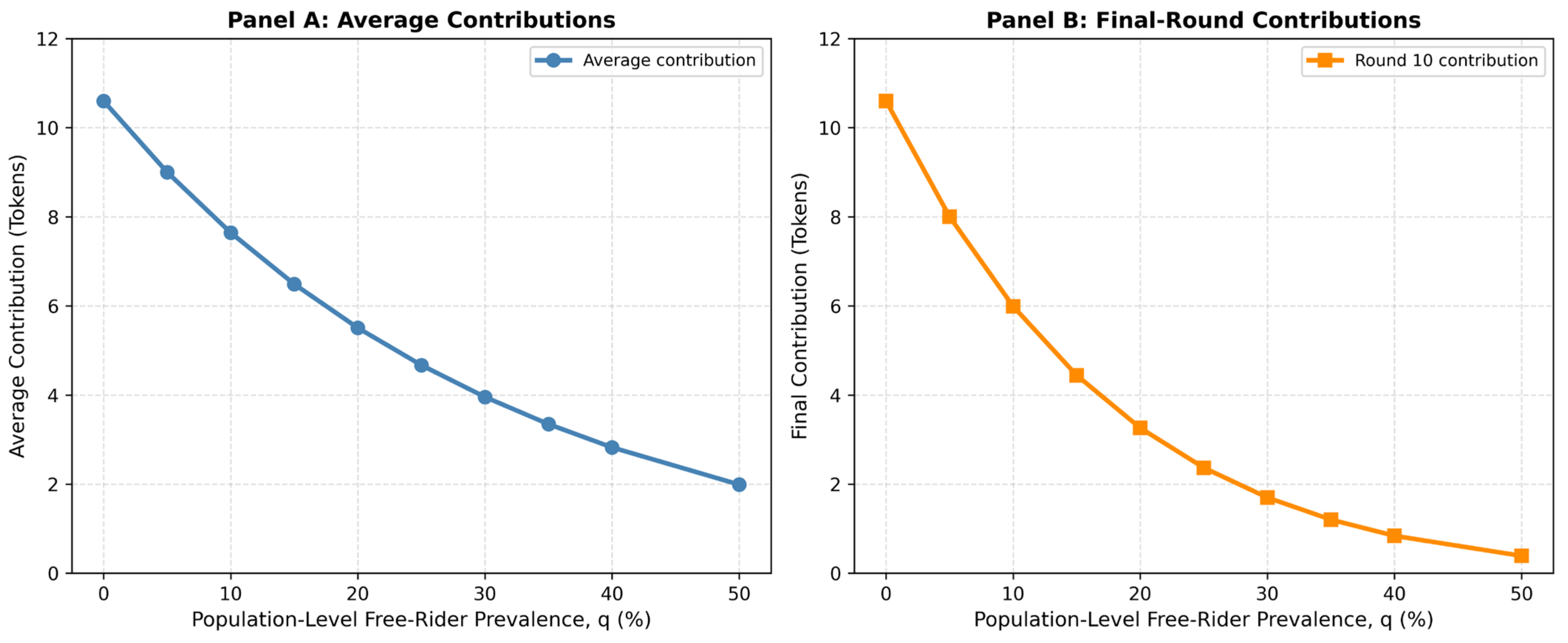
Figure 4 summarizes the relationship between free-rider prevalence and cooperation. Panel A reports the average contributions across all ten rounds. Panel B reports the final-round contributions in Round 10.
Table 5 reports the corresponding values.
Three findings emerge. First, the model predicts a smooth decline in cooperation as increases. There is no binary collapse point in the reduced-form dynamic model. Even a small free-rider prevalence reduces final contributions relative to the no-free-rider baseline. For example, when , final contributions fall from 10.60 to 8.00 tokens.
Second, affects cooperation through both a mechanical and a dynamic channel. The mechanical channel lowers average contributions immediately because a larger share of agents contributes zero. The dynamic channel lowers later contributions because expected free-rider exposure accelerates norm erosion among cooperative agents.
Third, the relationship between free-rider prevalence and cooperation is nonlinear. The nonlinearity is stronger for final-round contributions than for average contributions because final-round contributions reflect accumulated erosion. For example, moving from to reduces final contributions from 5.99 to 2.37 tokens. Moving from to reduces final contributions further, from 2.37 to 0.39 tokens. These results should be interpreted as model predictions, not as proof that free riders caused preference change in the original experiment.
4.5. Result 4: The Institutional Floor () and Long-Run Cooperation
The baseline calibration sets . This means that normative commitment can erode completely in the long run. However, societies differ in their institutional, cultural, and legal structures, and these differences may produce different cooperative floors. A society with strong rule of law or deeply embedded cooperative norms may prevent individuals from abandoning fairness entirely, even when surrounded by free riders. Conversely, a society with weak legal enforcement or fragile cooperative norms may be unable to prevent the complete erosion of normative commitment.
To explore this, we vary
across five illustrative levels, while holding the erosion rate
initial commitment
, and population-level free-rider prevalence
at their calibrated values. These interpretations are illustrative and not empirically calibrated.
Table 6 summarizes the illustrative institutional interpretations.
These descriptions are illustrative. The mapping from real-world institutions to values is speculative and not empirically calibrated.
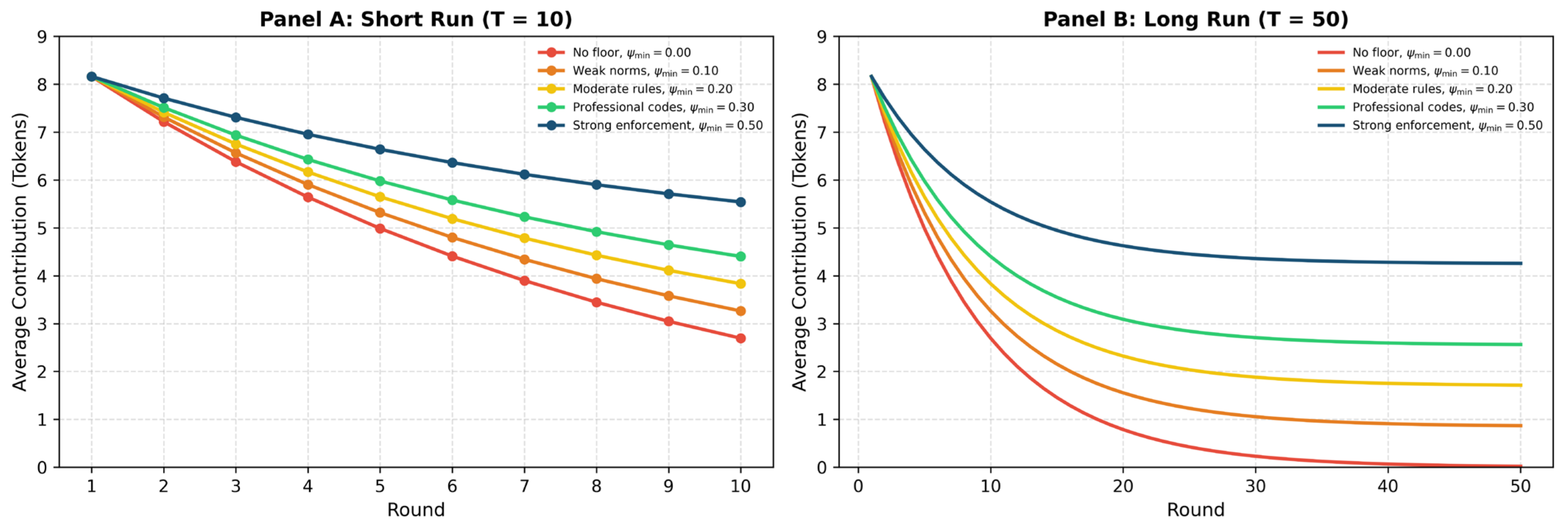
Figure 5 shows the contribution trajectories under each institutional floor. For each institutional environment, we compute contributions at two time horizons: the experimental horizon at T = 10 rounds that matches our calibration data and the long run at T = 50 rounds, where the system has effectively converged to its steady state. The steady-state contribution follows directly from Equation (11) and Proposition A6 (
Appendix A.2.5):
Table 7 shows the impact of the institutional floor on cooperation in the short run and long run. The results show that a higher institutional floor preserves more cooperation. When
(the calibrated laboratory environment), the model predicts that cooperation approaches zero in the long run. Positive values of
prevent complete erosion within the model. For example, when
, about 10% of initial cooperation remains in the steady state. When
, about 31% remains. When
, about 52% remains. These values illustrate the role of the institutional floor. They should not be interpreted as calibrated estimates of real-world institutions.
The effect of becomes more visible over time. At T = 10 (the typical experimental horizon), final contributions are 2.69 tokens when and 5.54 tokens when , a difference of 2.85 tokens. In the steady state, the corresponding values are 0 and 4.25 tokens. This suggests that short-horizon experiments may understate the importance of institutional floors.
This pattern illustrates the speed-level separation. The steady-state column depends on . This follows from the closed-form solution: as approaches infinity (, the transient term vanishes, leaving only . All groups facing the same and converge to the same long-run contribution level, regardless of their erosion rate. The erosion rate determines how fast the system approaches the floor. The institutional floor determines where cooperation settles in the long run.
4.6. Robustness: Varying the Erosion Rate () and Initial Commitment ()
We now examine whether the results depend on the erosion rate and initial normative commitment . We hold the population-level free-rider prevalence at and set the institutional floor to , as in the baseline calibration.
We first vary
across four levels: 0.15 (resilient), 0.35 (moderate), 0.50 (calibrated), and 0.76 (fragile).
Table 8 shows the impact of erosion rate (
on cooperation. All four scenarios converge to the same steady-state contribution of zero because
. The erosion rate
affects how quickly cooperation declines, not where it eventually settles. At the experimental horizon (T = 10), final contributions range from 1.45 tokens (fragile) to 5.95 tokens (resilient). In the long run, all scenarios effectively reach zero.
A lower erosion rate slows the decline in cooperation.
This matters over finite horizons. However, it does not substitute for an
institutional floor in the baseline model. When , all scenarios approach the same
long-run level.
We next examine whether initial commitment () affects the trajectory. Under the baseline
contribution rule, contributions at time depend on the ratio . When , this ratio simplifies to , which is independent of . As a result, changing does not change the contribution path in the
baseline case. This is a feature of the model structure and should not be
interpreted as evidence that initial commitment is generally unimportant.
Together, these robustness checks reinforce the main result. The erosion rate affects the transition path. Initial commitment
cancels out under the baseline scaling rule when = 0. The institutional floor determines the long-run level of cooperation
within the model.
5. Discussion
The previous results show that the model reproduces observed aggregate cooperation trajectories and provides a theoretical interpretation through model-implied and . The model also generates implications about
population-level free-rider prevalence, norm erosion, and institutional floors.
These results should be interpreted carefully. The calibration is illustrative
and does not prove that preferences changed in the original experiment.
This section discusses the theoretical implications, policy implications, and limitations of the model.
5.1. Theoretical Implications
The central theoretical contribution is to provide a simple framework in which fairness concerns may depend on social context. This has several implications.
The Fehr–Schmidt framework is used here as an interpretive language rather than as the behavioral rule that generates contributions. The original framework is static. Our extension adds a dynamic state variable, , so
that cooperation can decline gradually as normative commitment erodes. This
replaces a purely static comparison with a continuous trajectory generated by
the reduced-form mechanism.
This dynamic extension also offers a possible preference-channel complement to the belief-based explanation of
Fischbacher and Gächter (
2010). Their account explains how cooperation decline occurs through belief updating. Our model adds a second channel: within the model, observing norm violations may also weaken commitment to cooperative norms. These channels are not mutually exclusive, and disentangling them requires new data that measure both beliefs and fairness concerns over time.
The preference channel differs from the belief channel in three structural ways. First, within the model, norm erosion is irreversible within a game, whereas beliefs can update in both directions. Second, the two channels differ in what changes. The belief channel changes expectations about others. The preference channel changes the motivational state represented by
.
Batzke and Ernst (
2024) find that social norms change rapidly in response to
observed behavior while personal norms change more slowly. This suggests that
may be interpreted as a slower-moving personal
commitment to cooperative norms. This interpretation remains tentative because
is not directly measured in the calibration. Third, the preference channel admits a
closed-form steady state that depends only on the institutional floor (
), enabling direct policy analysis. The belief
channel does not yield a comparable long-run prediction because the steady
state depends on the specific belief formation process assumed.
Our calibration uses the aggregate round-level contribution trajectory from
Fischbacher and Gächter (
2010). While individual-level contributions and beliefs are available in their data, independently measured preference parameters (
) are not. Any belief-updating benchmark
calibrated to the same contribution path would, therefore, be observationally
equivalent to our preference-erosion model: both reproduce declining
contributions through different latent variables. A meaningful comparison
between the two mechanisms requires data that independently measure both
beliefs and inequity-aversion parameters over time, an experimental design we
propose in
Section 5.3.
The model also provides a formal bridge between the frameworks of
Fehr and Schmidt (
1999) and
Kimbrough and Vostroknutov (
2016). Both frameworks explain cooperation but from different angles, inequity aversion and norm sensitivity, respectively. Our model connects them by showing that normative commitment (
) can be mapped onto the inequity-aversion
parameters (
). Within our framework, the two approaches need
not be competing explanations but can be seen as complementary perspectives on
the same process.
The model further predicts a nonlinear relationship between population-level free-rider prevalence and cooperation. This is consistent with evidence that negative social experiences can have stronger effects than positive ones (
Engel & Rockenbach, 2024). In our model, this asymmetry appears because norm erosion is one-sided within the game. Commitment can decline, but it does not recover during the game.
More broadly, our framework aligns with
Henrich et al.’s (
2005) cross-cultural finding that human sociality is adaptable rather than fixed. Their evidence that market integration correlates with social preferences across 15 diverse societies is consistent with our core premise: preferences respond to the social environment. While their mechanism operates across cultures and over much longer time scales, the shared principle is the same: the social environment shapes what people value.
5.2. Policy Implications
The following policy discussion is speculative. It extends the model’s predictions beyond the laboratory setting in which they were calibrated. The model is fitted to a single ten-round public goods experiment with university students. Real-world institutions operate at different scales, over longer horizons, and with richer social dynamics. The policy implications below should, therefore, be treated as hypotheses suggested by the model, not as evidence-based recommendations. Their value lies in identifying channels that future empirical work could investigate.
Our model identifies three potential channels for sustaining cooperation: reducing the population-level free-rider prevalence , slowing norm erosion through a lower , and raising the minimum normative commitment .
Reducing the population-level free-rider prevalence is the most direct approach, but may be
difficult in practice. It requires
monitoring capacity and enforcement authority to identify and reduce persistent
free riders. In many settings, such as tax compliance, environmental
conservation, and workplace teamwork, free riders cannot be easily identified
or removed.
Our closed-form solution shows that norm erosion () affects the speed of decline, but not the
long-run level, when the institutional floor is fixed. This implies that,
within the model, interventions targeting norm resilience, such as
communication, shared identity, or transparency, may slow erosion over finite
horizons. They do not by themselves determine where cooperation settles in the
long run.
Within the model, institutions that raise the minimum normative commitment () can change the long-run outcome. Examples may
include mandatory minimum contributions, monitoring and enforcement systems,
professional codes, or social contracts. These examples are illustrative. The
model does not estimate the value of any real institution.
Mandatory minimum contributions may establish a behavioral floor through legal mechanisms. Withholding-at-source tax systems are one example: compliance is enforced before individual choice enters, effectively setting a floor independent of normative commitment. Whether such mechanisms raise in
the sense of our model is an empirical question, but the structural logic is
analogous.
Monitoring and enforcement systems may raise
by making the minimum standard credible and
visible. This interpretation is broadly related to
Ostrom’s (
1990) work on commons governance, which emphasizes monitoring and graduated
sanctions as conditions for sustaining cooperation. The mechanisms are not the
same, but both approaches highlight the importance of institutional structures
that protect minimum cooperative standards.
Social contracts may establish shared baselines through collective agreement, creating floors that participants themselves endorse. Team charters with explicit minimum standards are one organizational example. Whether collectively set floors are more resistant to erosion than externally imposed ones is a testable prediction that follows from the model’s structure.
The model’s logic extends to other settings. In environmental conservation, fishers who observe others exceeding catch limits may gradually reduce their compliance, producing the kind of norm erosion our model formalizes. In workplace teams, exposure to free-riding colleagues may erode professional norms over time, particularly without institutional floors, such as performance reviews. These applications remain speculative but illustrate the generality of the norm erosion mechanism across domains.
The model suggests a layered strategy. In finite-horizon settings like short-term projects or one-off collaborations, norm-reinforcing interventions that slow erosion may be the primary available tool. In long-horizon settings like ongoing organizations, communities, or societies, investing in institutions that raise may be the more valuable approach because,
within the model, only determines where cooperation ultimately settles.
Whether these predictions hold outside the laboratory is an open empirical
question.
5.3. Limitations and Future Research
The model has several limitations.
First, the contribution rule is a reduced-form assumption. It is not derived from utility maximization. The Fehr–Schmidt framework yields corner solutions. Agents either contribute fully or contribute zero. It cannot produce the gradual decline observed in experiments. A utility function that includes a norm-following term with diminishing returns could provide a micro-foundation for the -scaling rule. Developing such a function is a
natural next step.
Relatedly, the erosion dynamics follow a linear recurrence. This ensures tractability and a closed-form solution, but it limits the model to a simple exponential form. Future work could allow nonlinear erosion dynamics. Such extensions may generate richer patterns, such as threshold effects or multiple steady states. The present paper leaves this as a theoretical extension rather than introducing an additional model class.
Second, the analysis of represents model predictions, not empirical
validation. Direct experimental tests with predetermined group compositions
would strengthen the conclusions. The model is calibrated to aggregate
contributions and cannot separately identify whether the observed decline
reflects preference change, belief updating, or both. Designing an experiment
that elicits , , normative commitment, and beliefs before and
after exposure to free riding would provide a stronger test.
Third, the model holds constant and treats norm erosion as
irreversible within the game. This assumption is useful for tractability but
restrictive. At high levels of , cooperative agents’ contributions may become so
low that others perceive them as free riders. A richer model could allow
endogenous type switching, a norm-violation threshold, and partial recovery of
normative commitment.
Fourth, our calibration relies on a single dataset and does not model punishment or communication. Cross-cultural calibration would reveal whether erosion rates vary across societies. Applying the framework to field settings, such as tax compliance or environmental conservation, would test its generalizability.
Fifth, our sensitivity analysis varies , , , and independently. Future work should explore
interaction effects, particularly how and jointly shape cooperation over intermediate
horizons.
6. Conclusions
This paper develops a reduced-form dynamic framework for studying cooperation decline in repeated public goods games. The main contribution is to clarify a possible preference-channel mechanism rather than to establish it empirically. The model starts from a simple idea. Observed free riding may erode normative commitment. As commitment declines, guilt weakens and envy rises. These changes are represented through Fehr–Schmidt-style parameters, while behavior is generated by a contribution-scaling rule.
The model highlights a testable implication. When expected free-rider exposure is absent (), normative commitment does not erode, and
cooperation remains stable within the model. This implication differs from
purely time-driven explanations, such as fatigue, learning, or strategic
sophistication, because those explanations do not condition decline on group
composition. However, this difference is a model-based prediction, not
empirical evidence against those alternatives. Whether it holds empirically is
a question for future experimental work.
The value of the framework lies in organizing several mechanisms within one simple structure. Free-rider prevalence determines expected exposure to norm violations. The erosion rate determines how quickly cooperation declines. The
institutional floor determines where cooperation settles in the long
run. This speed-level distinction suggests that interventions that slow erosion
may preserve cooperation in the short run, while institutions that maintain a
positive floor may matter more for long-run cooperation. The framework is
therefore useful as a source of testable hypotheses, even though the
calibration itself does not identify preference change.
The broader message is that fairness concerns may not be entirely fixed. They may respond to social context. They may also be protected by institutions that preserve minimum cooperative standards. These claims remain theoretical and should be tested directly in future experimental and field research.