


Federated Learning: A Survey of Core Challenges, Current Methods, and Opportunities

Abstract
1. Introduction


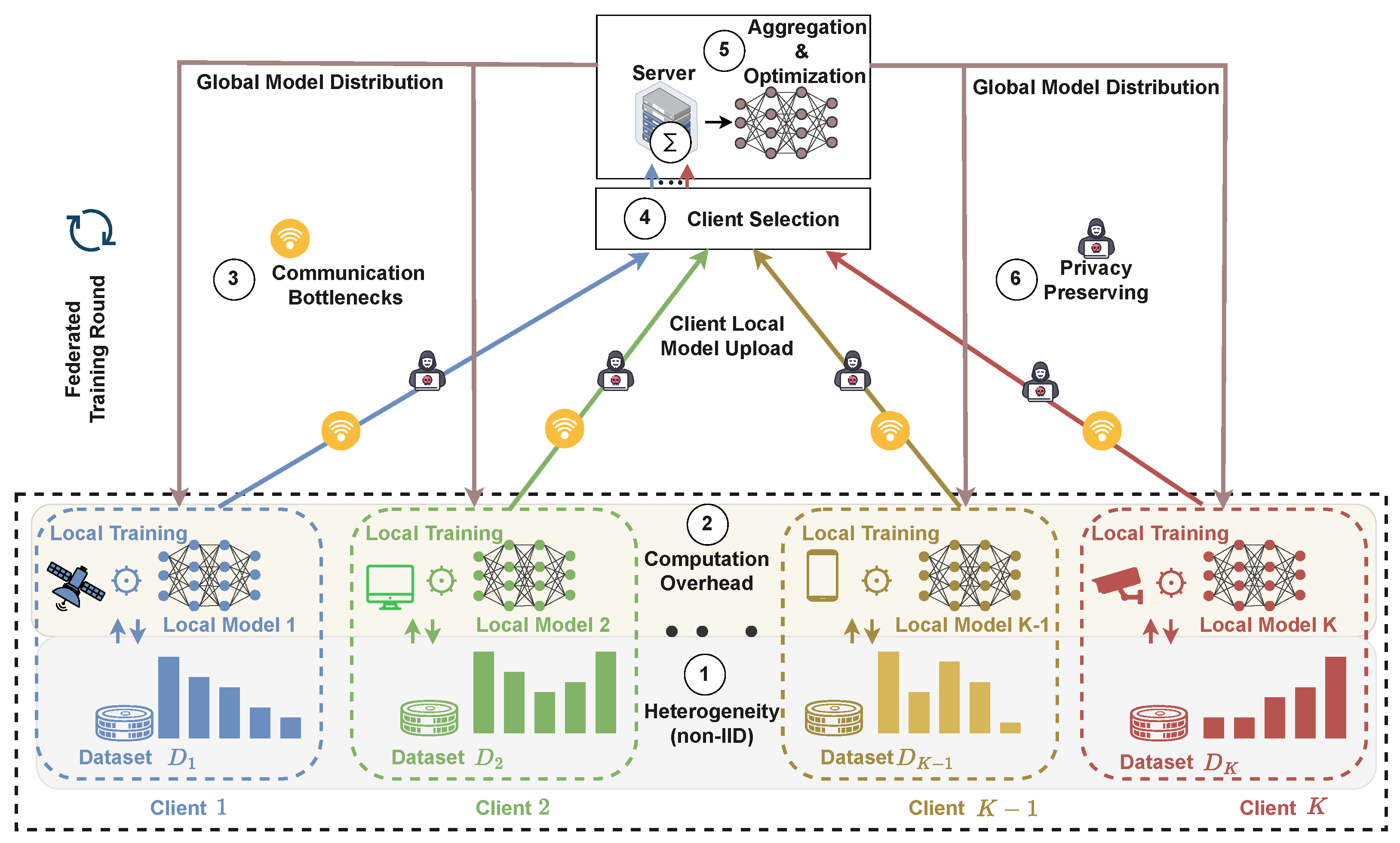
| Challenge | Typical Bottleneck | Key Metrics (Section 11) | Cross-Layer Interactions (Examples) |
|---|---|---|---|
| Heterogeneity | Non-IID data, unequal client data sizes, and device diversity induce client drift and unstable convergence | Client-level utility distribution (percentiles, worst-client); personalization gap; fairness dispersion | Affects aggregation stability and robust rules; biases client selection; amplifies privacy leakage risk under unique local data |
| Computation overhead | On-device runtime/energy limits and stragglers dominate wall-clock time-to-accuracy | Time-to-accuracy; per-round client runtime/energy; straggler/dropout rate | Coupled with client selection (deadline-aware participation); trades off with communication via local steps; crypto/DP can add compute overhead |
| Communication bottlenecks | Bandwidth/latency constraints and intermittent connectivity limit feasible rounds/bytes | Bytes transferred; latency; rounds-to-target accuracy; robustness to dropouts | Compression and local-step policies interact with optimization dynamics; privacy mechanisms (e.g., SecAgg) increase communication; hierarchy/decentralization changes convergence behavior |
| Client selection | Partial participation, churn, and representativeness vs. efficiency tensions | Time-to-accuracy; participation fairness; reliability under churn; selection overhead | Selection policies interact with heterogeneity (representative sampling) and computation (stragglers); privacy constraints can limit data-aware selection; affects robustness exposure |
| Aggregation and optimization | Biased/noisy/adversarial updates under non-IID and partial participation | Convergence/stability; robustness to outliers/poisoning; global and client-level utility | Depends on heterogeneity and client selection; interacts with communication (compression, staleness); SecAgg can constrain per-client robust detection and personalization/clustering |
| Privacy preservation | Inference/poisoning risks and compliance requirements under strict overhead budgets | Privacy budget ; attack success; utility drop; runtime/bytes overhead | DP/SecAgg/crypto increase computation and communication; SecAgg constrains fine-grained aggregation and selection; heterogeneity can increase leakage from updates |
- We propose a unified and challenge-centric taxonomy that systematically organizes federated learning research across the entire FL pipeline, explicitly highlighting the interdependencies and trade-offs among six foundational challenges, rather than treating them in isolation.
- We provide a comprehensive synthesis of state-of-the-art methods for each challenge category, critically analyzing their underlying assumptions, algorithmic designs, theoretical guarantees, empirical performance, and practical limitations across diverse deployment settings.
- We present a structured synthesis of federated learning evaluation methodologies, major real-world application domains, and widely adopted open-source FL systems, analyzing performance metrics, deployment considerations, and practical system trade-offs.
- We identify open research problems and emerging directions at the algorithmic, system, and application levels, and outline promising future research directions toward building scalable, communication-efficient, robust, and trustworthy federated learning systems.
2. Background and Foundations
2.1. Definition of Federated Learning
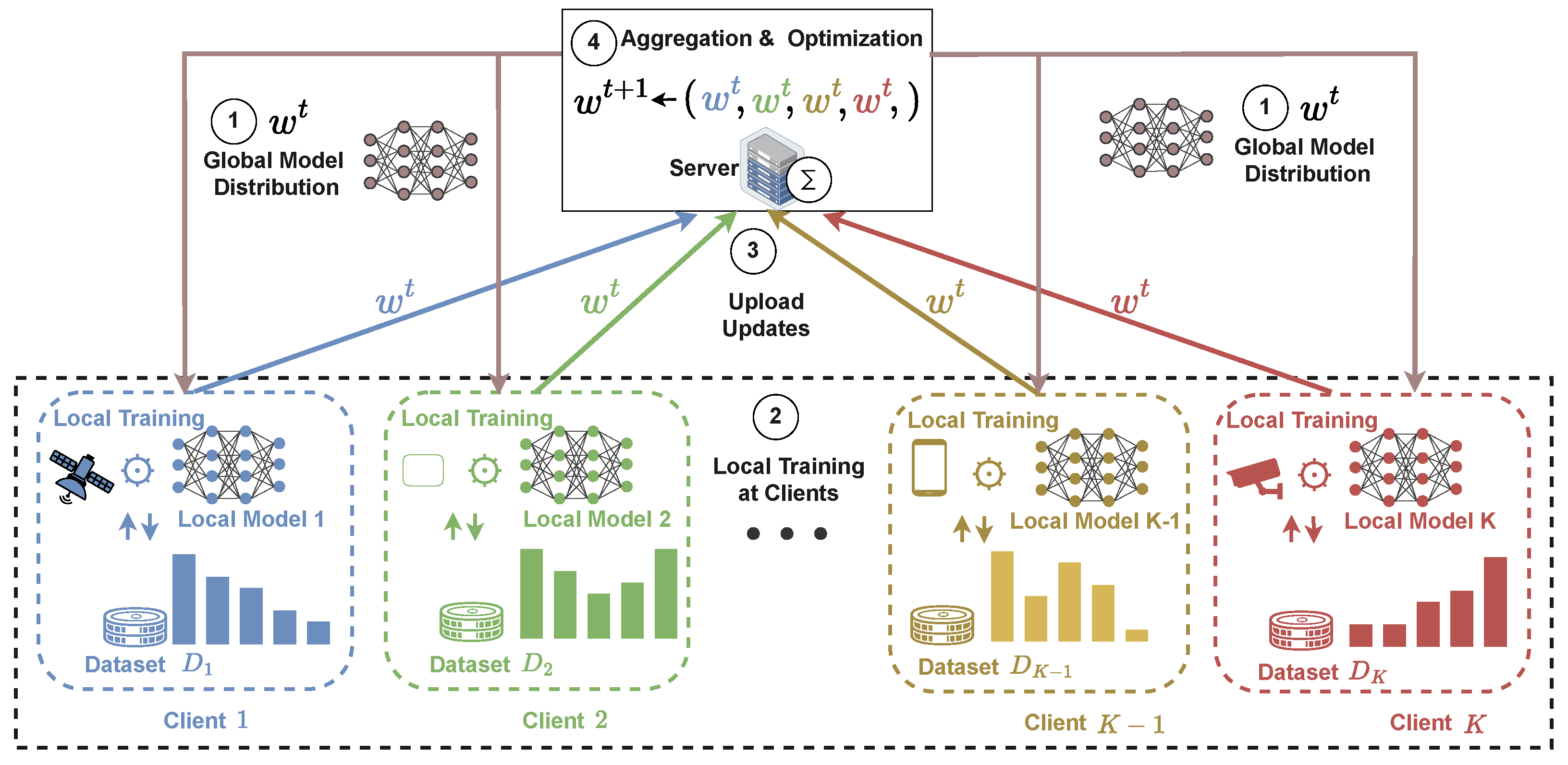
2.2. Architecture for a Federated Learning System
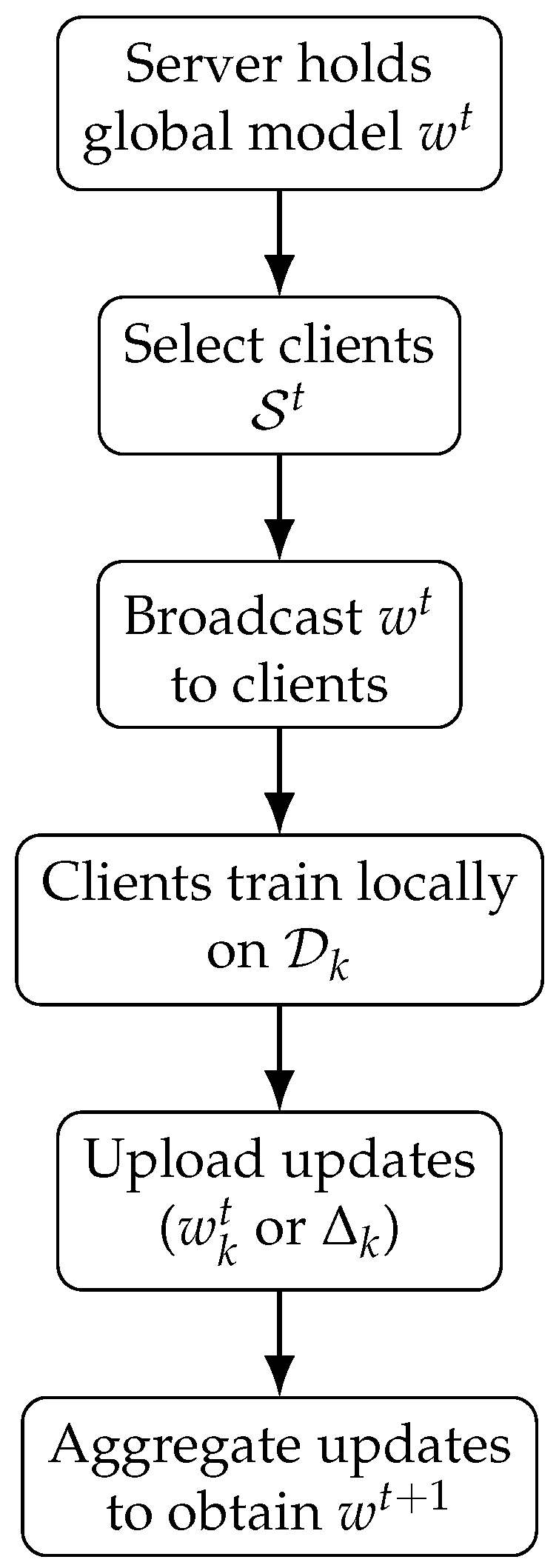
- Step 1 (Global Model Distribution): At communication round t, the server maintains the current global model and selects a subset of available clients for participation. The server broadcasts along with basic training settings, such as the learning rate and number of local training epochs.
- Step 2 (Local Training at Clients): Each selected client k updates the received global model using its own local dataset . All clients begin local training from the same model parameters and perform training independently, while all data remain stored and processed locally.
- Step 3 (Model Update Upload): After completing local training, each participating client sends its updated model parameters (or model changes relative to ) back to the server. Only model-related information is communicated; the underlying datasets are never shared.
- Step 4 (Model Aggregation at the Server): The server aggregates the updates received from participating clients to form the next global model . The aggregation reflects the collective contribution of the clients, commonly accounting for differences in local dataset sizes.
- Step 5 (Iterative Model Refinement): The updated global model is redistributed to clients, and Steps 1–4 are repeated over multiple communication rounds until convergence or a predefined stopping criterion is met. The final outcome is a single global model learned collaboratively across decentralized datasets.
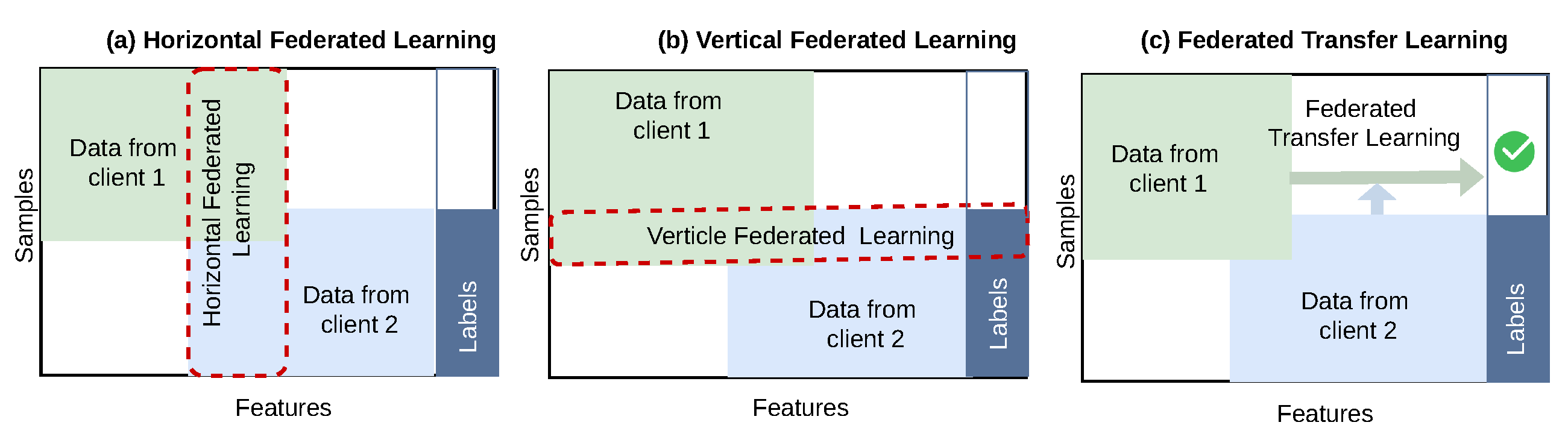
2.3. A Categorization of Federated Learning
2.3.1. Horizontal Federated Learning (HFL)
2.3.2. Vertical Federated Learning (VFL)
2.3.3. Federated Transfer Learning (FTL)
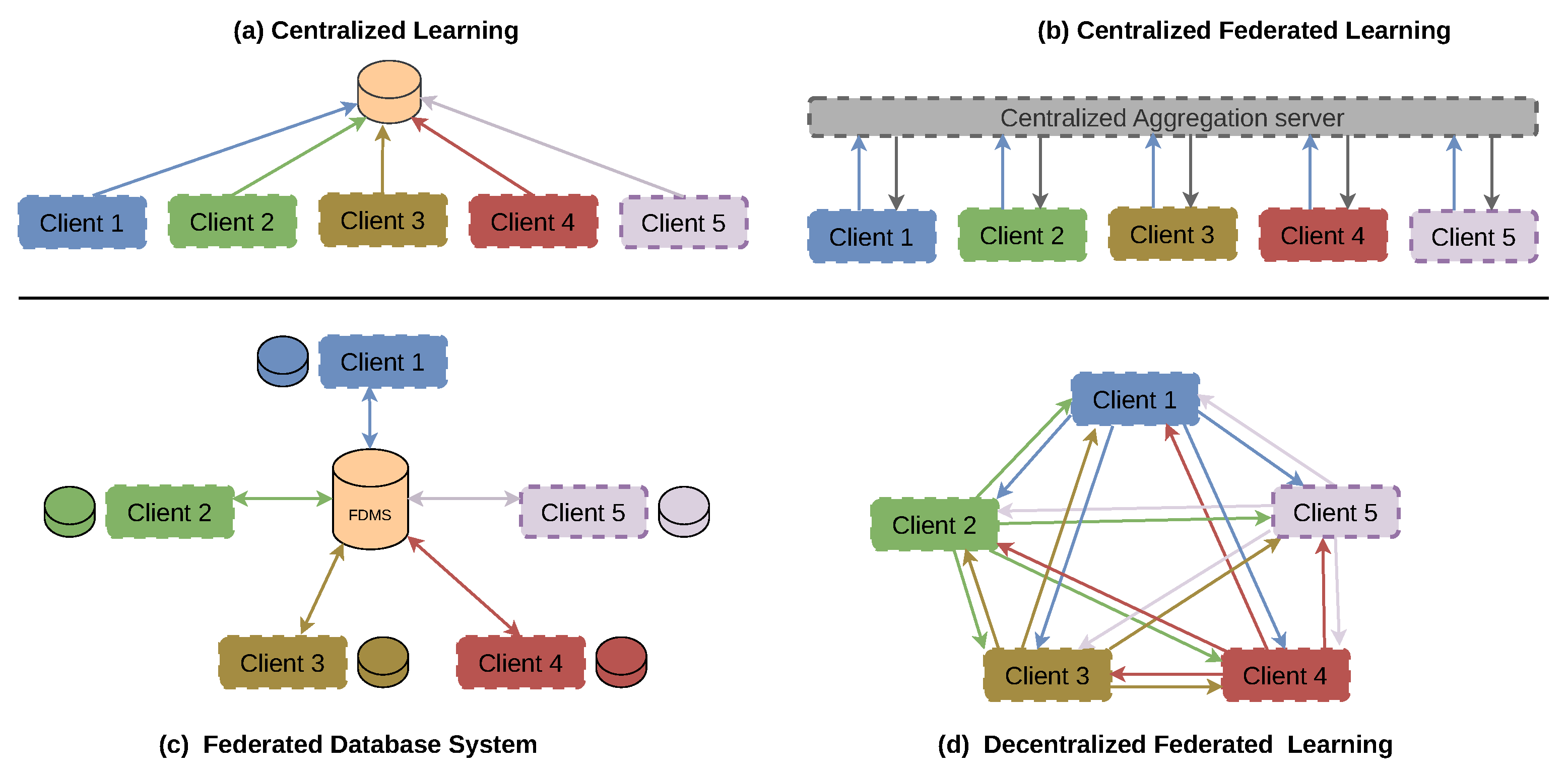
2.4. Centralized, Federated, and Decentralized Learning
2.4.1. Centralized Learning
2.4.2. Centralized Federated Learning
2.4.3. Federated Database Systems
2.4.4. Decentralized Federated Learning
2.5. Federated Learning Versus Edge Computing
2.5.1. Edge Computing
2.5.2. Federated Learning
2.5.3. Conceptual Relationship
2.5.4. Learning and Communication Perspective
2.5.5. Complementarity and Integration
3. Related Surveys
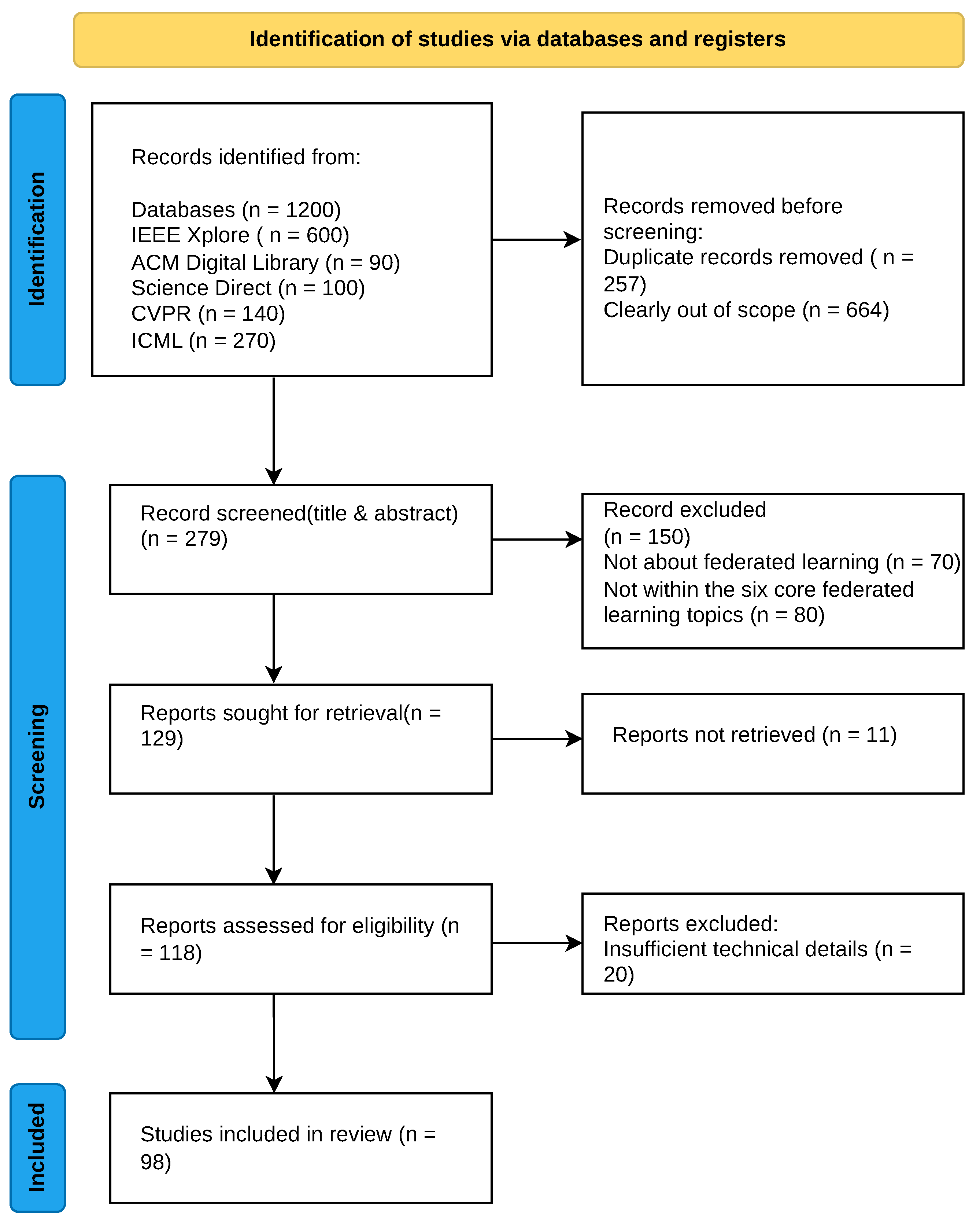
- Replicable review protocol: we add a PRISMA-like flow with stage counts (Figure 6), provide the main keyword sets (Table 5), and release a machine-readable included-studies mapping (Supplementary Materials; Appendix A).
- Standardized evaluation guidance: we consolidate recommended metrics and minimum reporting practices to improve comparability and reproducibility (Section 11, Table 7).
4. Survey Protocol and Taxonomy
4.1. Research Questions
- RQ1: What are the major research directions, system architectures, and application domains of federated learning across academia and industry?
- RQ2: What fundamental challenges arise when deploying federated learning in realistic, large-scale, and heterogeneous environments?
- RQ3: What algorithmic techniques, system designs, and optimization strategies have been proposed to address these challenges?
- RQ4: How do these challenges interact across the federated learning pipeline, and what trade-offs emerge among communication efficiency, optimization performance, privacy guarantees, fairness, and robustness?
- RQ5: Which challenges remain insufficiently addressed, and what open problems and research opportunities emerge from current limitations?
4.2. Search Strategy
4.3. Study Selection Criteria
4.4. Replicability and Review Statistics
4.5. Taxonomy Construction and Cross-Challenge Interdependencies
4.5.1. Interdependencies and Internal Conflicts
4.5.2. Toward Unified Trade-Off Management
5. Challenge 1: Heterogeneity
6. Challenge 2: Computation Overhead
7. Challenge 3: Communication Bottlenecks
8. Challenge 4: Client Selection
9. Challenge 5: Aggregation and Optimization
10. Challenge 6: Privacy Preservation
11. Evaluation of the Performance of Federated Learning Algorithms
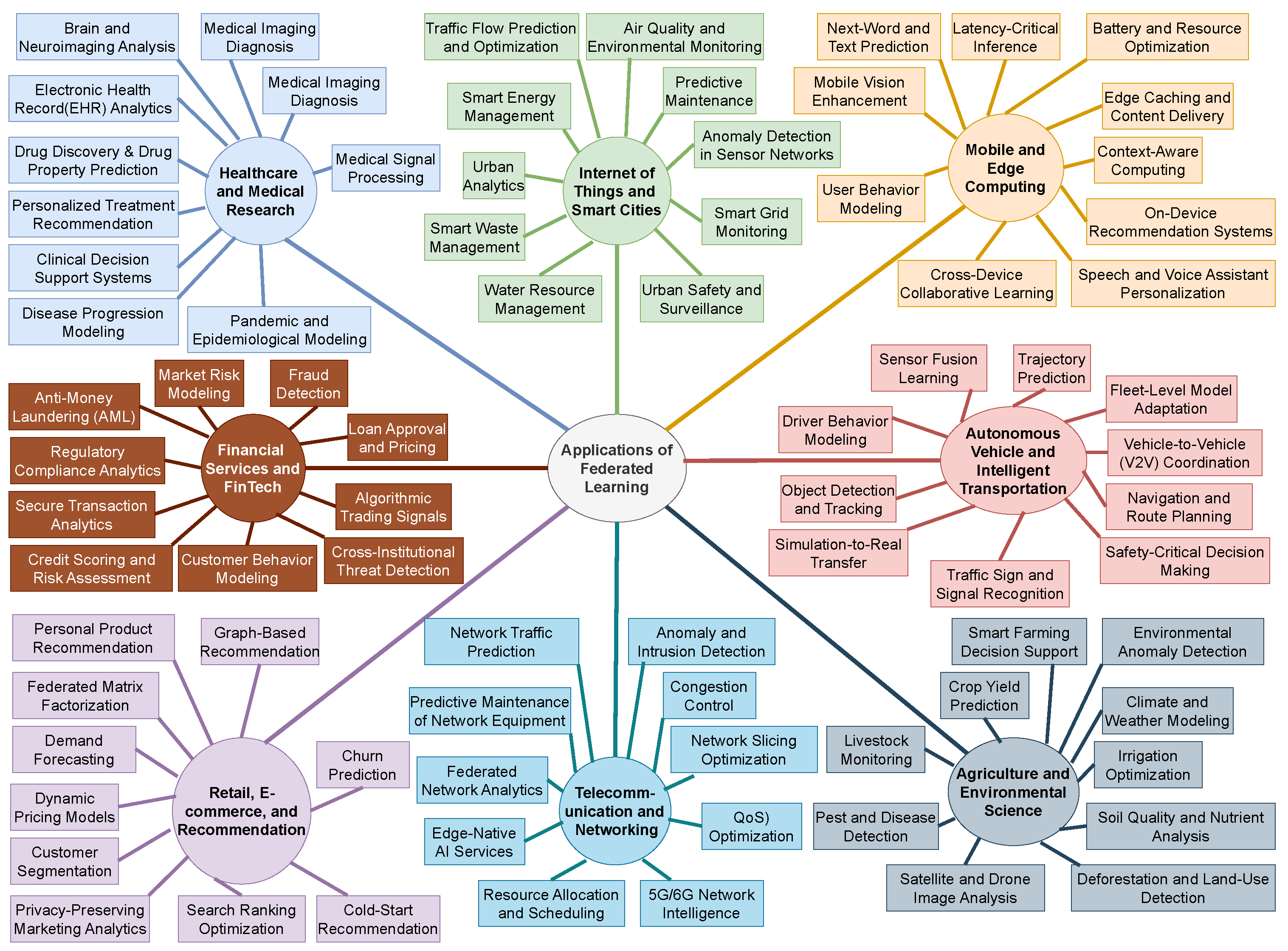
12. Applications of Federated Learning
13. Open-Source Systems
| Framework | Typical FL Setting(s) | Strengths/Key Capabilities | When to Choose |
|---|---|---|---|
| Flower (FLWR) [259,260] | General-purpose (cross-device/cross-silo experimentation) | Framework-agnostic orchestration with a clean client–server separation; supports multiple ML backends and rapid prototyping of new FL algorithms | Rapid research prototyping and benchmarking across heterogeneous ML stacks |
| TensorFlow Federated (TFF) [32,81] | Research-oriented FL (TensorFlow ecosystem) | Explicit abstractions for federated computations and aggregation operators; well suited for principled algorithm design and reproducible experiments | When the workflow is TensorFlow-centric and you need precise control over federated computations |
| FedML [262] | Cross-device, cross-silo, and decentralized settings | End-to-end pipeline (algorithms, benchmarks, and deployment tooling) with an emphasis on reproducibility and system-level evaluation | Large-scale benchmarking and system-aware experimentation under realistic constraints |
| PySyft (OpenMined) [261,263] | Privacy-/security-centric FL and privacy-preserving ML | Integrates privacy-enhancing technologies (e.g., DP- and MPC-style primitives) to study privacy–utility trade-offs under explicit threat models | Studies where privacy guarantees and adversarial robustness are first-class requirements |
| FATE [80,264] | Cross-organization collaboration, especially vertical FL | Support for feature-partitioned learning with cryptographic security mechanisms for regulated, multi-party settings | Enterprise and regulated scenarios (e.g., finance/healthcare) with vertical FL and strict governance constraints |
14. Open Problems and Emerging Directions
15. Conclusions
Supplementary Materials
Author Contributions
Funding
Data Availability Statement
Conflicts of Interest
Appendix A. Replicability Artifact: Included Studies and Taxonomy Labels
| BibTeX Key | Challenge(s) | Subtopic Label(s) |
|---|---|---|
| aji2017sparse | 3 | Gradient sparsification and update compression |
| MLSYS2020_1f5fe839 | 1; 5 | Heterogeneity overview; correction-term optimization |
| oort2021 | 2; 4 | Computation/client selection overview |
| 10.1145/3133956.3133982 | 6 | Secure aggregation; interacting guarantees |
| pmlr-v139-zhu21b | 5 | KD-enhanced aggregation |
References
- Kuutti, S.; Bowden, R.; Jin, Y.; Barber, P.; Fallah, S. A Survey of Deep Learning Applications to Autonomous Vehicle Control. IEEE Trans. Intell. Transp. Syst. 2021, 22, 712–733. [Google Scholar] [CrossRef]
- Mozaffari, S.; Al-Jarrah, O.Y.; Dianati, M.; Jennings, P.; Mouzakitis, A. Deep Learning-Based Vehicle Behavior Prediction for Autonomous Driving Applications: A Review. IEEE Trans. Intell. Transp. Syst. 2022, 23, 33–47. [Google Scholar] [CrossRef]
- Liu, L.; Lu, S.; Zhong, R.; Wu, B.; Yao, Y.; Zhang, Q.; Shi, W. Computing Systems for Autonomous Driving: State of the Art and Challenges. IEEE Internet Things J. 2021, 8, 6469–6486. [Google Scholar] [CrossRef]
- Wang, B.; Zheng, Y.; Han, X.; Kong, L.; Xiao, G.; Xiao, Z.; Chen, S. A Systematic Literature Review on Integrating AI-Powered Smart Glasses into Digital Health Management for Proactive Healthcare Solutions. NPJ Digit. Med. 2025, 8, 410. [Google Scholar] [CrossRef] [PubMed]
- Yalcin, N.; Alisawi, M. Enhancing Social Interaction for the Visually Impaired: A Systematic Review of Real-Time Emotion Recognition Using Smart Glasses and Deep Learning. IEEE Access 2025, 13, 102092–102108. [Google Scholar] [CrossRef]
- Hoang, M.L. A Review of Developments and Metrology in Machine Learning and Deep Learning for Wearable IoT Devices. IEEE Access 2025, 13, 106035–106054. [Google Scholar] [CrossRef]
- Xiong, J.; Hsiang, E.L.; He, Z.; Zhan, T.; Wu, S.T. Augmented Reality and Virtual Reality Displays: Emerging Technologies and Future Perspectives. Light. Sci. Appl. 2021, 10, 216. [Google Scholar] [CrossRef]
- Liberatore, M.J.; Wagner, W.P. Virtual, Mixed, and Augmented Reality: A Systematic Review for Immersive Systems Research. Virtual Real. 2021, 25, 773–799. [Google Scholar] [CrossRef]
- Tong, Y.; Liu, H.; Zhang, Z. Advancements in Humanoid Robots: A Comprehensive Review and Future Prospects. IEEE/CAA J. Autom. Sin. 2024, 11, 301–328. [Google Scholar] [CrossRef]
- Carpentier, J.; Wieber, P.B. Recent Progress in Legged Robots Locomotion Control. Curr. Robot. Rep. 2021, 2, 231–238. [Google Scholar] [CrossRef]
- Kotha, S.S.; Akter, N.; Abhi, S.H.; Das, S.K.; Islam, M.R.; Ali, M.F.; Ahamed, M.H.; Islam, M.M.; Sarker, S.K.; Badal, M.F.R.; et al. Next Generation Legged Robot Locomotion: A Review on Control Techniques. Heliyon 2024, 10, e37237. [Google Scholar] [CrossRef] [PubMed]
- Ahmed, F.; Mohanta, J.C.; Keshari, A.; Yadav, P.S. Recent Advances in Unmanned Aerial Vehicles: A Review. Arab. J. Sci. Eng. 2022, 47, 7963–7984. [Google Scholar] [CrossRef] [PubMed]
- Küçükerdem, H.; Yilmaz, C.; Kahraman, H.T.; Sönmez, Y. Autonomous Control of Unmanned Aerial Vehicles: Applications, Requirements, Challenges. Clust. Comput. 2025, 28, 734. [Google Scholar] [CrossRef]
- Mohsan, S.A.H.; Othman, N.Q.H.; Li, Y.; Alsharif, M.H.; Khan, M.A. Unmanned Aerial Vehicles (UAVs): Practical Aspects, Applications, Open Challenges, Security Issues, and Future Trends. Intell. Serv. Robot. 2023, 16, 109–137. [Google Scholar] [CrossRef]
- IoT Analytics. State of IoT 2025: Number of Connected IoT Devices Growing 1421.1 Billion Globally and Projected to 39 Billion by 2030. 2025. Available online: https://iot-analytics.com/number-connected-iot-devices/ (accessed on 16 December 2025).
- Fayyad, U.; Piatetsky-Shapiro, G.; Smyth, P. The KDD process for extracting useful knowledge from volumes of data. Commun. ACM 1996, 39, 27–34. [Google Scholar] [CrossRef]
- Shearer, C. The CRISP-DM Model: The New Blueprint for Data Mining. J. Data Warehous. 2000, 5, 13–22. [Google Scholar]
- Baylor, D.; Breck, E.; Cheng, H.T.; Fiedel, N.; Foo, C.Y.; Haque, Z.; Haykal, S.; Ispir, M.; Jain, V.; Koc, L.; et al. TFX: A TensorFlow-Based Production-Scale Machine Learning Platform. In Proceedings of the 23rd ACM SIGKDD International Conference on Knowledge Discovery and Data Mining, Halifax, NS, Canada, 13–17 August 2017. [Google Scholar]
- Mohd Noor, M.H.; Ige, A.O. A survey on state-of-the-art deep learning applications and challenges. Eng. Appl. Artif. Intell. 2025, 159, 111225. [Google Scholar] [CrossRef]
- Baduwal, M. Hybrid(Transformer+CNN)-based Polyp Segmentation. arXiv 2025, arXiv:2508.09189. [Google Scholar]
- General Data Protection Regulation (GDPR). 2016. Available online: https://gdpr.eu/ (accessed on 12 January 2026).
- California Consumer Privacy Act (CCPA). 2018. Available online: https://oag.ca.gov/privacy/ccpa (accessed on 12 January 2026).
- Drainakis, G.; Katsaros, K.V.; Pantazopoulos, P.; Sourlas, V.; Amditis, A. Federated vs. Centralized Machine Learning under Privacy-elastic Users: A Comparative Analysis. In Proceedings of the 2020 IEEE 19th International Symposium on Network Computing and Applications (NCA), Cambridge, MA, USA, 24–27 November 2020; pp. 1–8. [Google Scholar] [CrossRef]
- Silver, D.; Huang, A.; Maddison, C.J.; Guez, A.; Sifre, L.; van den Driessche, G.; Schrittwieser, J.; Antonoglou, I.; Panneershelvam, V.; Lanctot, M.; et al. Mastering the Game of Go with Deep Neural Networks and Tree Search. Nature 2016, 529, 484–489. [Google Scholar] [CrossRef]
- NVIDIA. Nemotron 3 Nano: Open, Efficient Mixture-of-Experts Hybrid Mamba-Transformer Model for Agentic Reasoning; Technical Report; NVIDIA: Santa Clara, CA, USA, 2025. [Google Scholar]
- Yang, A.; Li, A.; Yang, B.; Zhang, B.; Hui, B.; Zheng, B.; Yu, B.; Gao, C.; Huang, C.; Lv, C. Qwen3 Technical Report. arXiv 2025, arXiv:2505.09388. [Google Scholar] [CrossRef]
- ChatGPT: Proprietary AI Agent and Conversational Assistant. OpenAI Product, 2025. Closed-Source Large Language Model Agent for Conversational AI and Automated Workflows. 2025. Available online: https://openai.com/ (accessed on 12 January 2026).
- Microsoft Copilot: AI-Driven Agentic Assistance. Microsoft Product, 2025. Enterprise-Grade Proprietary Agent Integrated with MICROSOFT 365 and Developer Tools. 2025. Available online: https://www.microsoft.com/en-us/microsoft-365-copilot/enterprise (accessed on 12 January 2026).
- Google Antigravity: Proprietary Agent-First AI IDE. Google Product, 2025. Agent-Centric Proprietary Coding Environment Powered by Gemini 3 Pro and Integrated Agents. 2025. Available online: https://blog.google/innovation-and-ai/technology/developers-tools/gemini-3-developers/ (accessed on 12 January 2026).
- Anthropic Claude with Opus Agentic Capabilities. Anthropic AI Model, 2025. Proprietary Agentic Reasoning and Task Automation Enhancements in Claude Powered by Opus 4.5. 2025. Available online: https://www.anthropic.com/news/claude-opus-4-5 (accessed on 12 January 2026).
- IBM Watsonx: Enterprise-Grade Proprietary AI Agents. IBM Product Suite, 2025. Proprietary AI Agents and Orchestration Within IBM’s Watsonx Platform for Businesses. 2025. Available online: https://www.ibm.com/products/watsonx (accessed on 12 January 2026).
- McMahan, B.; Moore, E.; Ramage, D.; Hampson, S.; y Arcas, B.A. Communication-efficient learning of deep networks from decentralized data. In Proceedings of the Artificial Intelligence and Statistics, Fort Lauderdale, FL, USA, 20–22 April 2017; pp. 1273–1282. [Google Scholar]
- European Data Protection Supervisor. Opinion on Privacy and Federated Learning. 2020. Available online: https://edps.europa.eu (accessed on 12 January 2026).
- Mothukuri, V.; Parizi, R.M.; Pouriyeh, S.; Huang, Y.; Dehghantanha, A.; Srivastava, G. A survey on security and privacy of federated learning. Future Gener. Comput. Syst. 2021, 115, 619–640. [Google Scholar] [CrossRef]
- Yurdem, B.; Kuzlu, M.; Gullu, M.K.; Catak, F.O.; Tabassum, M. Federated learning: Overview, strategies, applications, tools and future directions. Heliyon 2024, 10, e38137. [Google Scholar] [CrossRef] [PubMed]
- Rauniyar, A.; Hagos, D.H.; Jha, D.; Håkegård, J.E.; Bagci, U.; Rawat, D.B.; Vlassov, V. Federated Learning for Medical Applications: A Taxonomy, Current Trends, Challenges, and Future Research Directions. IEEE Internet Things J. 2024, 11, 7374–7398. [Google Scholar] [CrossRef]
- Alterkawi, L.; Dib, F.K. Federated Learning for Smart Cities: A Thematic Review of Challenges and Approaches. Future Internet 2025, 17, 545. [Google Scholar] [CrossRef]
- Dayan, I.; Roth, H.R.; Zhong, A.; Harouni, A.; Gentili, A.; Abidin, A.Z.; Liu, A.; Costa, A.B.; Wood, B.J.; Tsai, C.S.; et al. Federated learning for predicting clinical outcomes in patients with COVID-19. Nat. Med. 2021, 27, 1735–1743. [Google Scholar] [CrossRef]
- Naz, S.; Phan, K.T.; Chen, Y.P. A comprehensive review of federated learning for COVID-19 detection. Int. J. Intell. Syst. 2022, 37, 2371–2392. [Google Scholar] [CrossRef]
- Stripelis, D.; Ambite, J.L.; Lam, P.; Thompson, P. Scaling neuroscience research using federated learning. In Proceedings of the 2021 IEEE 18th International Symposium on Biomedical Imaging (ISBI), Nice, France, 13–16 April 2021; pp. 1191–1195. [Google Scholar]
- Stripelis, D.; Gupta, U.; Saleem, H.; Dhinagar, N.; Ghai, T.; Anastasiou, C.; Sánchez, R.; Ver Steeg, G.; Ravi, S.; Naveed, M.; et al. A federated learning architecture for secure and private neuroimaging analysis. Patterns 2024, 5, 101031. [Google Scholar] [CrossRef]
- Li, X.; Gu, Y.; Dvornek, N.; Staib, L.H.; Ventola, P.; Duncan, J.S. Multi-site fMRI analysis using privacy-preserving federated learning and domain adaptation: ABIDE results. Med. Image Anal. 2020, 65, 101765. [Google Scholar] [CrossRef]
- Thapaliya, B.; Ohib, R.; Geenjaar, E.; Liu, J.; Calhoun, V.; Plis, S.M. Efficient Federated Learning for Distributed Neuroimaging Data. Front. Neuroinform. 2024, 18, 1430987. [Google Scholar] [CrossRef]
- Sadilek, A.; Liu, L.; Nguyen, D.; Kamruzzaman, M.; Serghiou, S.; Rader, B.; Ingerman, A.; Mellem, S.; Kairouz, P.; Nsoesie, E.O.; et al. Privacy-first health research with federated learning. npj Digit. Med. 2021, 4, 132. [Google Scholar] [CrossRef]
- Xu, J.; Glicksberg, B.S.; Su, C.; Walker, P.; Bian, J.; Wang, F. Federated learning for healthcare informatics. J. Healthc. Inform. Res. 2021, 5, 1–19. [Google Scholar] [CrossRef]
- Li, S.; Miao, D.; Wu, Q.; Hong, C.; D’Agostino, D.; Li, X.; Ning, Y.; Shang, Y.; Wang, Z.; Liu, M.; et al. Federated learning in healthcare: A benchmark comparison of engineering and statistical approaches for structured data analysis. Health Data Sci. 2024, 4, 0196. [Google Scholar] [CrossRef] [PubMed]
- Diniz, J.M. The Missing Subject in Health Federated Learning: Preventive and Personalized Care. In Federated Learning Systems: Towards Privacy-Preserving Distributed AI; Springer: Berlin/Heidelberg, Germany, 2025; pp. 107–127. [Google Scholar]
- Zhu, W.; Luo, J.; White, A.D. Federated learning of molecular properties with graph neural networks in a heterogeneous setting. Patterns 2022, 3, 100521. [Google Scholar] [CrossRef] [PubMed]
- Guo, Y.; Gao, Y.; Song, J. Molcfl: A personalized and privacy-preserving drug discovery framework based on generative clustered federated learning. J. Biomed. Inform. 2024, 157, 104712. [Google Scholar] [CrossRef] [PubMed]
- Smajić, A.; Grandits, M.; Ecker, G.F. Privacy-preserving techniques for decentralized and secure machine learning in drug discovery. Drug Discov. Today 2023, 28, 103820. [Google Scholar] [CrossRef]
- Chen, S.; Xue, D.; Chuai, G.; Yang, Q.; Liu, Q. FL-QSAR: A federated learning-based QSAR prototype for collaborative drug discovery. Bioinformatics 2020, 36, 5492–5498. [Google Scholar] [CrossRef]
- Li, C. Breaking data silos in drug discovery with federated learning. Nat. Chem. Eng. 2025, 2, 288–289. [Google Scholar] [CrossRef]
- Huang, D.; Ye, X.; Sakurai, T. Multi-party collaborative drug discovery via federated learning. Comput. Biol. Med. 2024, 171, 108181. [Google Scholar] [CrossRef]
- Hanser, T.; Ahlberg, E.; Amberg, A.; Anger, L.T.; Barber, C.; Brennan, R.J.; Brigo, A.; Delaunois, A.; Glowienke, S.; Greene, N.; et al. Data-driven federated learning in drug discovery with knowledge distillation. Nat. Mach. Intell. 2025, 7, 423–436. [Google Scholar] [CrossRef]
- Oldenhof, M.; Ács, G.; Pejó, B.; Schuffenhauer, A.; Holway, N.; Sturm, N.; Galtier, M. Industry-Scale Orchestrated Federated Learning for Drug Discovery. In Proceedings of the AAAI Conference on Artificial Intelligence, Washington, DC, USA, 7–14 February 2023; Volume 37, pp. 497–505. [Google Scholar]
- Dritsas, E.; Trigka, M.; Kavallieros, D. Federated Learning for IoT: A Survey of Techniques, Challenges, and Applications. Sensors 2025, 25, 9. [Google Scholar] [CrossRef]
- War, M.R.; Singh, Y.; Sheikh, Z.A.; Singh, P.K. Review on the Use of Federated Learning Models for the Security of Cyber-Physical Systems. Scalable Comput. Pract. Exp. 2025, 26, 16–33. [Google Scholar]
- Lu, Y.; Huang, X.; Dai, Y.; Maharjan, S.; Zhang, Y. Federated Learning for Data Privacy Preservation in Vehicular Cyber-Physical Systems. IEEE Netw. 2020, 34, 50–56. [Google Scholar] [CrossRef]
- Long, G.; Tan, Y.; Jiang, J.; Zhang, C. Federated Learning for Open Banking. arXiv 2021, arXiv:2108.10749. [Google Scholar] [CrossRef]
- Awosika, T.; Shukla, R.M.; Pranggono, B. Transparency and Privacy: The Role of Explainable AI and Federated Learning in Financial Fraud Detection. IEEE Access 2024, 12, 64551–64560. [Google Scholar] [CrossRef]
- Wang, Z.; Xiao, J.; Wang, L.; Yao, J. A novel federated learning approach with knowledge transfer for credit scoring. Decis. Support Syst. 2024, 177, 114084. [Google Scholar] [CrossRef]
- Zhao, L.; Cai, L.; Lu, W.S. Federated Learning for Data Trading Portfolio Allocation With Autonomous Economic Agents. IEEE Trans. Neural Netw. Learn. Syst. 2025, 36, 1467–1481. [Google Scholar] [CrossRef]
- Abadi, A.; Doyle, B.; Gini, F.; Guinamard, K.; Murakonda, S.K.; Liddell, J.; Mellor, P.; Murdoch, S.J.; Naseri, M.; Page, H.; et al. Starlit: Privacy-Preserving Federated Learning to Enhance Financial Fraud Detection. arXiv 2024, arXiv:2401.10765. [Google Scholar] [CrossRef]
- Chalamala, S.R.; Kummari, N.K.; Singh, A.K.; Saibewar, A.; Chalavadi, K.M. Federated Learning to Comply with Data Protection Regulations. CSI Trans. ICT 2022, 10, 47–60. [Google Scholar] [CrossRef]
- Blika, A.; Palmos, S.; Doukas, G.; Lamprou, V.; Pelekis, S.; Kontoulis, M.; Ntanos, C.; Askounis, D. Federated Learning for Enhanced Cybersecurity and Trustworthiness in 5G and 6G Networks: A Comprehensive Survey. IEEE Open J. Commun. Soc. 2025, 6, 3094–3130. [Google Scholar] [CrossRef]
- Yang, Z.; Chen, M.; Wong, K.K.; Poor, H.V.; Cui, S. Federated Learning for 6G: Applications, Challenges, and Opportunities. Engineering 2022, 8, 33–41. [Google Scholar] [CrossRef]
- Lee, J.; Solat, F.; Kim, T.Y.; Poor, H.V. Federated Learning-Empowered Mobile Network Management for 5G and Beyond Networks: From Access to Core. IEEE Commun. Surv. Tutor. 2024, 26, 2176–2212. [Google Scholar] [CrossRef]
- Kaswan, K.S.; Dhatterwal, J.S.; Yadav, R.; Malik, K.; Tripathi, A.M. Fededrated Learning: Research, Challenges, and Future Directions. In Proceedings of the 2024 IEEE International Conference on Computing, Power and Communication Technologies (IC2PCT), Greater Noida, India, 9–10 February 2024; Volume 5, pp. 71–76. [Google Scholar] [CrossRef]
- Atlam, M.; Attiya, G.; Elrashidy, M. Federated Learning: A Comprehensive Survey of Applications, Challenges, and Emerging Research Frontiers. In Proceedings of the 2025 4th International Conference on Electronic Engineering (ICEEM), Menouf, Egypt, 4–5 October 2025; pp. 1–8. [Google Scholar] [CrossRef]
- Yang, J.; Zhao, Y.; Wang, L. A Survey of Federated Unlearning: A Taxonomy, Challenges and Future Directions. arXiv 2023, arXiv:2310.19218. Available online: https://arxiv.org/abs/2310.19218 (accessed on 12 January 2026).
- Finn, C.; Abbeel, P.; Levine, S. Model-Agnostic Meta-Learning for Fast Adaptation. In Proceedings of the International Conference on Machine Learning, Sydney, Australia, 6–11 August 2017. [Google Scholar]
- Contrastive Federated Learning: Mitigating Non-IID with Representation Learning. In Proceedings of the Conference on Computer Vision and Pattern Recognition (CVRP), Nashville, TN, USA, 20–25 June 2021.
- Konečný, J.; McMahan, H.B.; Ramage, D.; Richtárik, P. Federated Optimization: Distributed Machine Learning for On-Device Intelligence. arXiv 2016, arXiv:1610.02527. [Google Scholar] [CrossRef]
- Konečný, J.; McMahan, H.B.; Yu, F.X.; Richtárik, P.; Suresh, A.T.; Bacon, D. Federated Learning: Strategies for Improving Communication Efficiency. arXiv 2017, arXiv:1610.05492. [Google Scholar] [CrossRef]
- Li, T.; Sahu, A.K.; Talwalkar, A.; Smith, V. Federated learning: Challenges, methods, and future directions. IEEE Signal Process. Mag. 2020, 37, 50–60. [Google Scholar] [CrossRef]
- Sheller, M.J.; Reina, G.A.; Edwards, B.; Martin, J.; Bakas, S. Federated learning in medicine: Facilitating multi-institutional collaborations without sharing patient data. Sci. Rep. 2020, 10, 12598. [Google Scholar] [CrossRef]
- Shi, W.; Dustdar, S. Edge Computing: Vision and Challenges. IEEE Internet Things J. 2016, 3, 637–646. [Google Scholar] [CrossRef]
- Satyanarayanan, M. The Emergence of Edge Computing. Computer 2017, 50, 30–39. [Google Scholar] [CrossRef]
- Lim, W.Y.B.; Luong, N.C.; Hoang, D.T.; Jiao, Y.; Liang, Y.C.; Yang, Q.; Miao, C. Federated Learning in Mobile Edge Networks: A Comprehensive Survey. IEEE Commun. Surv. Tutor. 2020, 22, 2031–2063. [Google Scholar] [CrossRef]
- Yang, Q.; Liu, Y.; Chen, T.; Tong, Y. Federated Machine Learning: Concept and Applications. ACM Trans. Intell. Syst. Technol. 2019, 10, 12. [Google Scholar] [CrossRef]
- Kairouz, P.; McMahan, H.B. Advances and Open Problems in Federated Learning. Found. Trends Mach. Learn. 2021, 14, 1–210. [Google Scholar] [CrossRef]
- Li, Q.; Wen, Z.; Wu, Z.; Hu, S.; Wang, N.; Li, Y.; Liu, X.; He, B. A Survey on Federated Learning Systems: Vision, Hype and Reality for Data Privacy and Protection. IEEE Trans. Knowl. Data Eng. 2023, 35, 3347–3366. [Google Scholar] [CrossRef]
- Liu, J.; Huang, J.; Zhou, Y.; Liu, X.; Liu, S.; Gu, Q. From distributed machine learning to federated learning: A survey. Knowl. Inf. Syst. 2022, 64, 885–917. [Google Scholar] [CrossRef]
- Liu, B.; Lv, N.; Guo, Y.; Li, Y. Recent advances on federated learning: A systematic survey. Neurocomputing 2024, 597, 128019. [Google Scholar] [CrossRef]
- Wen, J.; Zhang, Z.; Lan, Y.; Cui, Z.; Cai, J.; Zhang, W. A survey on federated learning: Challenges and applications. Int. J. Mach. Learn. Cybern. 2023, 14, 513–535. [Google Scholar] [CrossRef]
- Chaudhary, R.K.; Kumar, R.; Saxena, N. A systematic review on federated learning system: A new paradigm to machine learning. Knowl. Inf. Syst. 2025, 67, 1811–1914. [Google Scholar] [CrossRef]
- Nasim, M.A.A.; Soshi, F.T.J.; Biswas, P.; Ferdous, A.S.M.A.; Rashid, A.; Biswas, A.; Gupta, K.D. Principles and Components of Federated Learning Architectures. arXiv 2025, arXiv:2502.05273. [Google Scholar] [CrossRef]
- Aledhari, M.; Razzak, R.; Parizi, R.M.; Saeed, F. Federated Learning: A Survey on Enabling Technologies, Protocols, and Applications. IEEE Access 2020, 8, 140699–140725. [Google Scholar] [CrossRef]
- Lo, S.K.; Lu, Q.; Wang, C.; Paik, H.Y.; Zhu, L. A Systematic Literature Review on Federated Machine Learning: From a Software Engineering Perspective. ACM Comput. Surv. 2021, 54, 95. [Google Scholar] [CrossRef]
- Gupta, R.; Alam, T. Survey on Federated-Learning Approaches in Distributed Environment. Wirel. Pers. Commun. 2022, 125, 1631–1652. [Google Scholar] [CrossRef]
- Pouriyeh, S.; Shahid, O.; Parizi, R.M.; Sheng, Q.Z.; Srivastava, G.; Zhao, L.; Nasajpour, M. Secure Smart Communication Efficiency in Federated Learning: Achievements and Challenges. Appl. Sci. 2022, 12, 8980. [Google Scholar] [CrossRef]
- Mahlool, D.H.; Alsalihi, M.H. A Comprehensive Survey on Federated Learning: Concept and Applications. In Mobile Computing and Sustainable Informatics; Shakya, S., Ntalianis, K., Kamel, K.A., Eds.; Springer: Singapore, 2022; pp. 539–553. [Google Scholar]
- Nguyen, D.C.; Ding, M.; Pathirana, P.N.; Seneviratne, A.; Li, J.; Vincent Poor, H. Federated Learning for Internet of Things: A Comprehensive Survey. IEEE Commun. Surv. Tutor. 2021, 23, 1622–1658. [Google Scholar] [CrossRef]
- Wahab, O.A.; Mourad, A.; Otrok, H.; Taleb, T. Federated Machine Learning: Survey, Multi-Level Classification, Desirable Criteria and Future Directions in Communication and Networking Systems. IEEE Commun. Surv. Tutor. 2021, 23, 1342–1397. [Google Scholar] [CrossRef]
- Mammen, P.M. Federated Learning: Opportunities and Challenges. arXiv 2021, arXiv:2101.05428. [Google Scholar] [CrossRef]
- Abreha, H.G.; Hayajneh, M.; Serhani, M.A. Federated Learning in Edge Computing: A Systematic Survey. Sensors 2022, 22, 450. [Google Scholar] [CrossRef]
- Sirohi, D.; Kumar, N.; Rana, P.S.; Verma, A.; Singh, M.; Kumar, G. Federated learning for 6G-enabled secure communication systems: A comprehensive survey. Artif. Intell. Rev. 2023, 56, 11297–11389. [Google Scholar] [CrossRef]
- Albshaier, L.; Almarri, S.; Albuali, A. Federated Learning for Cloud and Edge Security: A Systematic Review of Challenges and AI Opportunities. Electronics 2025, 14, 1019. [Google Scholar] [CrossRef]
- Jia, N.; Qu, Z.; Ye, B.; Wang, Y.; Hu, S.; Guo, S. A Comprehensive Survey on Communication-Efficient Federated Learning in Mobile Edge Environments. IEEE Commun. Surv. Tutor. 2025, 27, 3710–3741. [Google Scholar] [CrossRef]
- Li, L.; Fan, Y.; Tse, M.; Lin, K.Y. A review of applications in federated learning. Comput. Ind. Eng. 2020, 149, 106854. [Google Scholar] [CrossRef]
- Bharati, S.; Mondal, M.R.H.; Podder, P.; Prasath, V.S. Federated learning: Applications, challenges and future directions. Int. J. Hybrid Intell. Syst. 2022, 18, 19–35. [Google Scholar] [CrossRef]
- Moshawrab, M.; Adda, M.; Bouzouane, A.; Ibrahim, H.; Raad, A. Reviewing Federated Machine Learning and Its Use in Diseases Prediction. Sensors 2023, 23, 2112. [Google Scholar] [CrossRef]
- Moshawrab, M.; Adda, M.; Bouzouane, A.; Ibrahim, H.; Raad, A. Reviewing Federated Learning Aggregation Algorithms; Strategies, Contributions, Limitations and Future Perspectives. Electronics 2023, 12, 2287. [Google Scholar] [CrossRef]
- Martínez Beltrán, E.T.; Pérez, M.Q.; Sánchez, P.M.S.; Bernal, S.L.; Bovet, G.; Pérez, M.G.; Pérez, G.M.; Celdrán, A.H. Decentralized Federated Learning: Fundamentals, State of the Art, Frameworks, Trends, and Challenges. IEEE Commun. Surv. Tutors 2023, 25, 2983–3013. [Google Scholar] [CrossRef]
- Almanifi, O.R.A.; Chow, C.O.; Tham, M.L.; Chuah, J.H.; Kanesan, J. Communication and computation efficiency in Federated Learning: A survey. Internet Things 2023, 22, 100742. [Google Scholar] [CrossRef]
- Blanco-Justicia, A.; Domingo-Ferrer, J.; Martínez, S.; Sánchez, D.; Flanagan, A.; Tan, K.E. Achieving security and privacy in federated learning systems: Survey, research challenges and future directions. Eng. Appl. Artif. Intell. 2021, 106, 104468. [Google Scholar] [CrossRef]
- Zhang, J.; Zhu, H.; Wang, F.; Zhao, J.; Xu, Q.; Li, H. Security and Privacy Threats to Federated Learning: Issues, Methods, and Challenges. Secur. Commun. Netw. 2022, 2022, 2886795. [Google Scholar] [CrossRef]
- Saha, S.; Hota, A.; Chattopadhyay, A.K.; Banerjee, S.; De, D. A multifaceted survey on privacy preservation of federated learning: Progress, challenges, and opportunities. Artif. Intell. Rev. 2024, 57, 184. [Google Scholar] [CrossRef]
- Hu, K.; Gong, S.; Zhang, Q.; Cheng, S.; Li, Q.; Xu, Y. An overview of implementing security and privacy in federated learning. Artif. Intell. Rev. 2024, 57, 204. [Google Scholar] [CrossRef]
- Gupta, R.; Gupta, J. Federated learning using game strategies: State-of-the-art and future trends. Comput. Netw. 2023, 225, 109650. [Google Scholar] [CrossRef]
- Neto, H.N.C.; Hribar, J.; Dusparic, I.; Mattos, D.M.F.; Fernandes, N.C. A Survey on Securing Federated Learning: Analysis of Applications, Attacks, Challenges, and Trends. IEEE Access 2023, 11, 41928–41953. [Google Scholar] [CrossRef]
- Qammar, A.; Karim, A.; Ning, H.; Li, D.; Sajid, A.; Liu, X. Securing federated learning with blockchain: A systematic literature review. Artif. Intell. Rev. 2023, 56, 3951–3985. [Google Scholar] [CrossRef]
- Zhu, J.; Cao, J.; Saxena, D.; Jiang, S.; Ferradi, H. Blockchain-empowered Federated Learning: Challenges, Solutions, and Future Directions. ACM Comput. Surv. 2023, 55. [Google Scholar] [CrossRef]
- Rahman, R. Federated Learning: A Survey on Privacy-Preserving Collaborative Intelligence. arXiv 2025, arXiv:2504.17703. [Google Scholar] [CrossRef]
- Tariq, A.; Serhani, M.A.; Sallabi, F.M.; Barka, E.S.; Qayyum, T.; Khater, H.M.; Shuaib, K.A. Trustworthy Federated Learning: A Comprehensive Review, Architecture, Key Challenges, and Future Research Prospects. IEEE Open J. Commun. Soc. 2024, 5, 4920–4998. [Google Scholar] [CrossRef]
- Ye, M.; Fang, X.; Du, B.; Yuen, P.C.; Tao, D. Heterogeneous Federated Learning: State-of-the-art and Research Challenges. ACM Comput. Surv. 2023, 56, 79. [Google Scholar] [CrossRef]
- Wu, Q.; He, K.; Chen, X. Personalized Federated Learning for Intelligent IoT Applications: A Cloud-Edge Based Framework. IEEE Open J. Comput. Soc. 2020, 1, 35–44. [Google Scholar] [CrossRef]
- Tan, A.Z.; Yu, H.; Cui, L.; Yang, Q. Towards Personalized Federated Learning. IEEE Trans. Neural Netw. Learn. Syst. 2023, 34, 9587–9603. [Google Scholar] [CrossRef]
- Zhu, H.; Zhang, H.; Jin, Y. From federated learning to federated neural architecture search: A survey. Complex Intell. Syst. 2021, 7, 639–657. [Google Scholar] [CrossRef]
- Che, L.; Wang, J.; Zhou, Y.; Ma, F. Multimodal Federated Learning: A Survey. Sensors 2023, 23, 6986. [Google Scholar] [CrossRef]
- Niknam, S.; Dhillon, H.S.; Reed, J.H. Federated Learning for Wireless Communications: Motivation, Opportunities and Challenges. arXiv 2020, arXiv:1908.06847. [Google Scholar] [CrossRef]
- Kulkarni, V.; Kulkarni, M.; Pant, A. Survey of Personalization Techniques for Federated Learning. In Proceedings of the 2020 Fourth World Conference on Smart Trends in Systems, Security and Sustainability (WorldS4), London, UK, 27–28 July 2020; pp. 794–797. [Google Scholar] [CrossRef]
- Yin, X.; Zhu, Y.; Hu, J. A Comprehensive Survey of Privacy-preserving Federated Learning: A Taxonomy, Review, and Future Directions. ACM Comput. Surv. 2021, 54, 131. [Google Scholar] [CrossRef]
- Khan, L.U.; Saad, W.; Han, Z.; Hossain, E.; Hong, C.S. Federated Learning for Internet of Things: Recent Advances, Taxonomy, and Open Challenges. IEEE Commun. Surv. Tutor. 2021, 23, 1759–1799. [Google Scholar] [CrossRef]
- Gao, D.; Yao, X.; Yang, Q. A Survey on Heterogeneous Federated Learning. arXiv 2022, arXiv:2210.04505. [Google Scholar] [CrossRef]
- Asad, M.; Shaukat, S.; Hu, D.; Wang, Z.; Javanmardi, E.; Nakazato, J.; Tsukada, M. Limitations and Future Aspects of Communication Costs in Federated Learning: A Survey. Sensors 2023, 23, 7358. [Google Scholar] [CrossRef] [PubMed]
- Alotaibi, B.; Khan, F.A.; Mahmood, S. Communication Efficiency and Non-Independent and Identically Distributed Data Challenge in Federated Learning: A Systematic Mapping Study. Appl. Sci. 2024, 14, 2720. [Google Scholar] [CrossRef]
- Xie, Q.; Jiang, S.; Jiang, L.; Huang, Y.; Zhao, Z.; Khan, S.; Dai, W.; Liu, Z.; Wu, K. Efficiency Optimization Techniques in Privacy-Preserving Federated Learning With Homomorphic Encryption: A Brief Survey. IEEE Internet Things J. 2024, 11, 24569–24580. [Google Scholar] [CrossRef]
- Kaur, H.; Rani, V.; Kumar, M.; Singh, A.; Gupta, S. Federated learning: A comprehensive review of recent advances and applications. Multimed. Tools Appl. 2024, 83, 54165–54188. [Google Scholar] [CrossRef]
- Karimireddy, S.P.; Kale, S.; Mohri, M.; Reddi, S.; Stich, S.; Suresh, A.T. SCAFFOLD: Stochastic Controlled Averaging for Federated Learning. In Proceedings of the 37th International Conference on Machine Learning, Virtual, 13–18 July 2020; Volume 119, pp. 5132–5143. [Google Scholar]
- Qi, Z.; Meng, L.; Chen, Z.; Hu, H.; Lin, H.; Meng, X. Cross-Silo Prototypical Calibration for Federated Learning with Non-IID Data. In Proceedings of the 31st ACM International Conference on Multimedia, Ottawa, ON, Canada, 29 October–3 November 2023; pp. 3099–3107. [Google Scholar] [CrossRef]
- Qi, Z.; Zhou, S.; Meng, L.; Hu, H.; Yu, H.; Meng, X. Federated Deconfounding and Debiasing Learning for Out-of-Distribution Generalization. arXiv 2025, arXiv:2505.04979. [Google Scholar] [CrossRef]
- Ma, Y.; Dai, W.; Huang, W.; Chen, J. Geometric Knowledge-Guided Localized Global Distribution Alignment for Federated Learning. In Proceedings of the IEEE/CVF Conference on Computer Vision and Pattern Recognition (CVPR), Nashville TN, USA, 11–15 June 2025; pp. 20958–20968. [Google Scholar]
- Li, Q.; Diao, Y.; Chen, Q.; He, B. Federated Learning on Non-IID Data Silos: An Experimental Study. In Proceedings of the 2022 IEEE 38th International Conference on Data Engineering (ICDE), Virtual, 9–12 May 2022; pp. 965–978. [Google Scholar] [CrossRef]
- Li, T.; Sahu, A.K.; Zaheer, M.; Sanjabi, M.; Talwalkar, A.; Smith, V. Federated Optimization in Heterogeneous Networks. Proc. Mach. Learn. Syst. 2020, 2, 429–450. [Google Scholar]
- Yurochkin, M.; Agarwal, M.; Ghosh, S.; Greenewald, K.; Hoang, N.; Khazaeni, Y. Bayesian Nonparametric Federated Learning of Neural Networks. In Proceedings of the 36th International Conference on Machine Learning, Long Beach, CA, USA, 9–15 June 2019; Volume 97, pp. 7252–7261. [Google Scholar]
- Zhao, Y.; Li, M.; Lai, L.; Suda, N.; Civin, D.; Chandra, V. Federated Learning with Non-IID Data. arXiv 2018, arXiv:1806.00582. [Google Scholar] [CrossRef]
- Luo, M.; Chen, F.; Hu, D.; Zhang, Y.; Liang, J.; Feng, J. No Fear of Heterogeneity: Classifier Calibration for Federated Learning with Non-IID Data. In Proceedings of the Advances in Neural Information Processing Systems; Ranzato, M., Beygelzimer, A., Dauphin, Y., Liang, P., Vaughan, J.W., Eds.; Curran Associates, Inc.: Red Hook, NY, USA, 2021; Volume 34, pp. 5972–5984. [Google Scholar]
- Zheng, H.; Hu, Z.; Yang, L.; Zheng, M.; Xu, A.; Wang, B. FedCALM: Conflict-aware Layer-wise Mitigation for Selective Aggregation in Deeper Personalized Federated Learning. In Proceedings of the IEEE/CVF Conference on Computer Vision and Pattern Recognition (CVPR), Nashville, TN, USA, 11–15 June 2025; pp. 15444–15453. [Google Scholar]
- Dennis, D.K.; Li, T.; Smith, V. Heterogeneity for the Win: One-Shot Federated Clustering. In Proceedings of the 38th International Conference on Machine Learning, Virtual, 18–24 July 2021; Volume 139, pp. 2611–2620. [Google Scholar]
- Stallmann, M.; Wilbik, A. Towards Federated Clustering: A Federated Fuzzy c-Means Algorithm (FFCM). arXiv 2022, arXiv:2201.07316. [Google Scholar]
- Pan, C.; Sima, J.; Prakash, S.; Rana, V.; Milenkovic, O. Machine Unlearning of Federated Clusters. arXiv 2023, arXiv:2210.16424. [Google Scholar] [CrossRef]
- Xu, J.; Chen, H.Y.; Chao, W.L.; Zhang, Y. Jigsaw Game: Federated Clustering. arXiv 2024, arXiv:2407.12764. [Google Scholar] [CrossRef]
- Qiao, D.; Ding, C.; Fan, J. Federated Spectral Clustering via Secure Similarity Reconstruction. In Advances in Neural Information Processing Systems; Oh, A., Naumann, T., Globerson, A., Saenko, K., Hardt, M., Levine, S., Eds.; Curran Associates, Inc.: Red Hook, NY, USA, 2023; Volume 36, pp. 58520–58555. [Google Scholar]
- Wang, S.; Chang, T.H. Federated Matrix Factorization: Algorithm Design and Application to Data Clustering. IEEE Trans. Signal Process. 2022, 70, 1625–1640. [Google Scholar] [CrossRef]
- Yan, J.; Liu, J.; Ning, Y.Z.; Zhang, Z.Y. SDA-FC: Bridging federated clustering and deep generative model. Inf. Sci. 2024, 681, 121203. [Google Scholar] [CrossRef]
- Huang, S.; Fu, L.; Ye, F.; Liao, T.; Deng, B.; Zhang, C.; Chen, C. Soft-consensual Federated Learning for Data Heterogeneity via Multiple Paths. In Proceedings of the Thirty-Ninth Annual Conference on Neural Information Processing Systems, San Diego, CA, USA, 2–7 December 2025. [Google Scholar]
- Fang, X.; Ye, M.; Du, B. Robust Asymmetric Heterogeneous Federated Learning With Corrupted Clients. IEEE Trans. Pattern Anal. Mach. Intell. 2025, 47, 2693–2705. [Google Scholar] [CrossRef]
- Fang, X.; Ye, M. Noise-Robust Federated Learning With Model Heterogeneous Clients. IEEE Trans. Mob. Comput. 2025, 24, 4053–4071. [Google Scholar] [CrossRef]
- Huang, S.; Fu, L.; Li, Y.; Chen, C.; Zheng, Z.; Dai, H.N. A Cross-Client Coordinator in Federated Learning Framework for Conquering Heterogeneity. IEEE Trans. Neural Netw. Learn. Syst. 2025, 36, 8828–8842. [Google Scholar] [CrossRef]
- Qi, Z.; Meng, L.; Li, Z.; Hu, H.; Meng, X. Cross-Silo Feature Space Alignment for Federated Learning on Clients with Imbalanced Data. Proc. Aaai Conf. Artif. Intell. 2025, 39, 19986–19994. [Google Scholar] [CrossRef]
- Xie, H.; Ma, J.; Xiong, L.; Yang, C. Federated Graph Classification over Non-IID Graphs. In Proceedings of the Advances in Neural Information Processing Systems; Ranzato, M., Beygelzimer, A., Dauphin, Y., Liang, P., Vaughan, J.W., Eds.; Curran Associates, Inc.: Red Hook, NY, USA, 2021; Volume 34, pp. 18839–18852. [Google Scholar]
- Baek, J.; Jeong, W.; Jin, J.; Yoon, J.; Hwang, S.J. Personalized Subgraph Federated Learning. In Proceedings of the 40th International Conference on Machine Learning, Honolulu, HI, USA, 23–29 July 2023; Volume 202, pp. 1396–1415. [Google Scholar]
- Yang, Z.; Zhang, Y.; Zheng, Y.; Tian, X.; Peng, H.; Liu, T.; Han, B. Fedfed: Feature distillation against data heterogeneity in federated learning. Adv. Neural Inf. Process. Syst. 2023, 36, 60397–60428. [Google Scholar]
- Yan, Y.; Fu, H.; Li, Y.; Xie, J.; Ma, J.; Yang, G.; Zhu, L. A Simple Data Augmentation for Feature Distribution Skewed Federated Learning. arXiv 2024, arXiv:2306.09363. [Google Scholar]
- Wang, Z.; Wang, Z.; Wang, Z.; Fan, X.; Wang, C. Federated Learning with Domain Shift Eraser. arXiv 2025, arXiv:2503.13063. [Google Scholar] [CrossRef]
- Zhang, X.; Li, S.; Li, A.; Liu, Y.; Zhang, F.; Zhu, C.; Zhang, L. Subspace Constraint and Contribution Estimation for Heterogeneous Federated Learning. In Proceedings of the 2025 IEEE/CVF Conference on Computer Vision and Pattern Recognition (CVPR), Nashville, TN, USA, 10–17 June 2025; pp. 20632–20642. [Google Scholar] [CrossRef]
- Raswa, F.H.; Lu, C.S.; Wang, J.C. HistoFS: Non-IID Histopathologic Whole Slide Image Classification via Federated Style Transfer with RoI-Preserving. In Proceedings of the Computer Vision and Pattern Recognition Conference (CVPR), Nashville, TN, USA, 10–17 June 2025; pp. 30251–30260. [Google Scholar]
- Jiang, Z.; Xu, Y.; Xu, H.; Wang, Z.; Qiao, C.; Zhao, Y. FedMP: Federated Learning through Adaptive Model Pruning in Heterogeneous Edge Computing. In Proceedings of the 2022 IEEE 38th International Conference on Data Engineering (ICDE), Kuala Lumpur, Malaysia, 9–12 May 2022; pp. 767–779. [Google Scholar] [CrossRef]
- Li, Z.; Wen, Y. LotteryFL: Personalized and Communication-Efficient Federated Learning with Lottery Ticket Hypothesis. In Proceedings of the 8th International Conference on Learning Representations (ICLR), Addis Ababa, Ethiopia, 26–30 April 2020. [Google Scholar]
- Liu, P.; Jiang, J.; Zhu, G.; Cheng, L.; Jiang, W.; Luo, W.; Du, Y.; Wang, Z. Training time minimization for federated edge learning with optimized gradient quantization and bandwidth allocation. Front. Inf. Technol. Electron. Eng. 2022, 23, 1247–1263. [Google Scholar] [CrossRef]
- Seo, H. Federated Knowledge Distillation for Resource-Constrained Edge Devices. In Proceedings of the NeurIPS Workshop on Federated Learning, Virtual, 13 December 2021. [Google Scholar]
- Deng, Y.; Lyu, L.; Chen, J. ScaleFL: Resource-Adaptive Federated Learning with Scalable Neural Networks. In Proceedings of the IEEE/CVF Conference on Computer Vision and Pattern Recognition (CVPR), Vancouver, BC, Canada, 20–22 June 2023. [Google Scholar]
- Diao, E.; Ding, J.; Tarokh, V. HeteroFL: Computation and Communication Efficient Federated Learning for Heterogeneous Clients. In Proceedings of the 38th International Conference on Machine Learning ICML, Online, 18–24 July 2021. [Google Scholar]
- Gao, R. Sub-FL: Training Subnetworks for Efficient Federated Learning on Heterogeneous Devices. Pattern Recognit. 2022. [Google Scholar]
- Gupta, S.; Raskar, R. Split Learning for Distributed Deep Learning. arXiv 2019, arXiv:1905.08821. [Google Scholar]
- Thapa, C.; Arachchige, P.; Camtepe, S.; Sun, L. SplitFed: When Federated Learning Meets Split Learning. In Proceedings of the ACL Workshop on Federated Learning, Virtual, 5–10 July 2020. [Google Scholar]
- Chen, W. Hybrid Split-Pruned Federated Learning for Resource-Constrained Edge Devices. IEEE Trans. Mob. Comput. 2023. [Google Scholar]
- Lai, F.; Zhu, X.; Madhyastha, H.V.; Chowdhury, M. Oort: Efficient Federated Learning via Intelligent Client Selection. In Proceedings of the 15th USENIX Symposium on Operating Systems Design and Implementation OSDI, Online, 14–16 July 2021. [Google Scholar]
- Zhou, F. Adaptive Federated Optimization for Heterogeneous Devices. Neurocomputing 2022. [Google Scholar]
- Xie, C.; Koyejo, S.; Gupta, I. Asynchronous Federated Optimization. In Proceedings of the 23rd International Conference on Artificial Intelligence and Statistics (AISTATS), Online, 26–28 August 2020. [Google Scholar]
- Wang, S. Staleness-Aware Asynchronous Federated Learning. IEEE Trans. Neural Netw. Learn. Syst. 2021. [Google Scholar]
- Nguyen, T.D.; Pham, M.; Tran, T. Federated Learning with Buffered Asynchronous Aggregation. In Proceedings of the MLSys Conference, Online, 5–9 April 2021. [Google Scholar]
- He, C. Resource-Aware Federated Learning: Optimizing Performance under System Constraints. IEEE Trans. Mob. Comput. 2021. [Google Scholar]
- Aji, A.F.; Heafield, K. Sparse communication for distributed gradient descent. In Proceedings of the Conference on Empirical Methods in Natural Language Processing, EMNLP, Copenhagen, Denmark, 9–11 September 2017. [Google Scholar]
- Lin, Y.; Han, S. Deep gradient compression: Reducing the communication bandwidth for distributed training. In Proceedings of the 6th International Conference on Learning Representations, (ICLR 2018), Vancouver, BC, Canada, 30 April–3 May 2018. [Google Scholar]
- Stich, S. Sparsified SGD with Memory. In Proceedings of the 32nd Conference on Neural Information Processing Systems (NeurIPS 2018), Montréal, QC, Canada, 3–8 December 2018. [Google Scholar]
- Bernstein, J.; Wang, Y.X.; Azizzadenesheli, K.; Anandkumar, A. signSGD: Compressed Optimization for Non-Convex Problems. In Proceedings of the 5th International Conference on Machine Learning (ICML 2018), Stockholm, Sweden, 10–15 July 2018. [Google Scholar]
- Alistarh, D.; Grubic, D.; Li, J.; Tomioka, R.; Vojnovic, M. QSGD: Communication-Efficient SGD via Gradient Quantization and Encoding. In Proceedings of the 31st Conference on Neural Information Processing Systems (NIPS 2017), Long Beach, CA, USA, 4–9 December 2017. [Google Scholar]
- Wen, W.; Xu, C.; Yan, F.; Wu, C.; Wang, Y.; Chen, Y.; Li, H. TernGrad: Ternary Gradients to Reduce Communication in Distributed Deep Learning. In Proceedings of the 31st Conference on Neural Information Processing Systems (NIPS 2017), Long Beach, CA, USA, 4–9 December 2017. [Google Scholar]
- Horvath, S.; Ho, C.Y.; Horvath, L.; Sahu, A.N.; Canini, M.; Richtárik, P. Natural Compression for Distributed Deep Learning. In Mathematical and Scientific Machine Learning; PMLR: Cambridge, MA, USA, 2022; pp. 129–141. [Google Scholar]
- Wang, S.; Tuor, T.; Salonidis, T.; Leung, K.K.; Makaya, C.; He, T.; Chan, K. Adaptive Federated Learning in Resource-Constrained Edge Computing Systems. In Proceedings of the IEEE International Conference on Computer Communications, Paris, France, 29 April–2 May 2019. [Google Scholar]
- Chen, J. Asynchronous Distributed Learning via Stale Gradient Methods. IEEE J. Sel. Areas Commun. 2019. [Google Scholar]
- Lalitha, A.; Kilinc, O.C.; Javidi, T.; Koushanfar, F. Peer-to-Peer Federated Learning on Graphs. arXiv 2019, arXiv:1901.11173. [Google Scholar]
- Shi, S. Communication-Efficient Edge-Assisted Federated Learning. In Proceedings of the The 2020 IEEE Global Communications Conference (GLOBECOM), Virtual, 7–11 December 2020. [Google Scholar]
- Bonawitz, K.; Eichner, H.; Grieskamp, W.; Huba, D.; Ingerman, A.; Ivanov, V.; Roselander, J. Towards Federated Learning at Scale: System Design. In Proceedings of the The Conference on Systems and Machine Learning (SysML), Stanford, CA, USA, 31 March–1 April 2019. [Google Scholar]
- Basu, D.; Data, D.; Karakus, C.; Diggavi, S. Qsparse-local-SGD: Distributed SGD with Quantization, Sparsification, and Local Computation. In Proceedings of the 33rd Conference on Neural Information Processing Systems (NeurIPS 2019), Vancouver, BC, Canada, 8–14 December 2019. [Google Scholar]
- Sattler, F.; Müller, K.R.; Samek, W. Clustered Federated Learning: Model-Agnostic Distributed Multi-Task Optimization. IEEE Trans. Neural Netw. Learn. Syst. 2021, 32, 3710–3722. [Google Scholar] [CrossRef] [PubMed]
- Ji, Y. Towards Statistical-Quality-Aware Client Selection for Federated Learning. IEEE Trans. Mob. Comput. 2022. [Google Scholar]
- Tang, X.; Yu, Y. Auction-Based Federated Learning via Truthful Mechanism Design. IEEE Trans. Mob. Comput. 2025. [Google Scholar]
- Tang, X.; Yu, H. A Cost-Aware Utility-Maximizing Bidding Strategy for Auction-Based Federated Learning. IEEE Trans. Neural Netw. Learn. Syst. 2025, 36, 12866–12879. [Google Scholar] [CrossRef]
- Cho, Y. Reinforcement Learning-Based Client Selection for Efficient Federated Learning. In Proceedings of the Thirty-Fifth AAAI Conference on Artificial Intelligence, Virtual, 2–9 February 2021. [Google Scholar]
- Li, Q.; Sanjabi, M.; Beirami, A.; Smith, V. Fair Resource Allocation in Federated Learning. In Proceedings of the ICML Workshop on Federated Learning, Virtual, 18 July 2020. [Google Scholar]
- Wang, J.; Liu, Q.; Liang, H.; Joshi, G.; Poor, H.V. Tackling the Objective Inconsistency Problem in Heterogeneous Federated Optimization. In Advances in Neural Information Processing Systems, Virtual, 6–12 December 2020; Larochelle, H., Ranzato, M., Hadsell, R., Balcan, M., Lin, H., Eds.; Curran Associates, Inc.: Red Hook, NY, USA, 2020; Volume 33, pp. 7611–7623. [Google Scholar]
- Lin, T.; Kong, L.; Stich, S.U.; Jaggi, M. Ensemble Distillation for Robust Model Fusion in Federated Learning. In Advances in Neural Information Processing Systems, Virtual, 6–12 December 2020; Larochelle, H., Ranzato, M., Hadsell, R., Balcan, M., Lin, H., Eds.; Curran Associates, Inc.: Red Hook, NY, USA, 2020; Volume 33, pp. 2351–2363. [Google Scholar]
- Zhu, Z.; Hong, J.; Zhou, J. Data-Free Knowledge Distillation for Heterogeneous Federated Learning. In Proceedings of the 38th International Conference on Machine Learning, Online, 18–22 July 2021; Volume 139, pp. 12878–12889. [Google Scholar]
- Wang, H.; Li, Y.; Xu, W.; Li, R.; Zhan, Y.; Zeng, Z. DaFKD: Domain-Aware Federated Knowledge Distillation. In Proceedings of the IEEE/CVF Conference on Computer Vision and Pattern Recognition (CVPR), Denver, CO, USA, 3–7 June 2023; pp. 20412–20421. [Google Scholar]
- Zhao, S.; Liao, T.; Fu, L.; Chen, C.; Bian, J.; Zheng, Z. Data-free knowledge distillation via generator-free data generation for Non-IID federated learning. Neural Netw. 2024, 179, 106627. [Google Scholar] [CrossRef]
- Hu, M.; Cao, Y.; Li, A.; Li, Z.; Liu, C.; Li, T.; Chen, M.; Liu, Y. FedMut: Generalized Federated Learning via Stochastic Mutation. Proc. AAAI Conf. Artif. Intell. 2024, 38, 12528–12537. [Google Scholar] [CrossRef]
- Weng, J.; Xia, Z.; Li, R.; Hu, M.; Chen, M. FedQP: Towards Accurate Federated Learning using Quadratic Programming Guided Mutation. arXiv 2024, arXiv:2411.15847. [Google Scholar] [CrossRef]
- Fraboni, Y.; Vidal, R.; Kameni, L.; Lorenzi, M. Clustered Sampling: Low-Variance and Improved Representativity for Clients Selection in Federated Learning. In Proceedings of the 38th International Conference on Machine Learning, Virtual, 18–24 July 2021; Volume 139, pp. 3407–3416. [Google Scholar]
- Li, A.; Wang, G.; Hu, M.; Sun, J.; Zhang, L.; Tuan, L.A.; Yu, H. Joint Client-and-Sample Selection for Federated Learning via Bi-Level Optimization. IEEE Trans. Mob. Comput. 2024, 23, 15196–15209. [Google Scholar] [CrossRef]
- Chen, C.; Chen, Z.; Zhou, Y.; Kailkhura, B. FedCluster: Boosting the Convergence of Federated Learning via Cluster-Cycling. In Proceedings of the 2020 IEEE International Conference on Big Data (Big Data), Atlanta, GA, USA, 10–13 December 2020; pp. 5017–5026. [Google Scholar] [CrossRef]
- Qi, Z.; Wang, Y.; Chen, Z.; Wang, R.; Meng, X.; Meng, L. Clustering-based Curriculum Construction for Sample-Balanced Federated Learning. In Proceedings of the Artificial Intelligence; Fang, L., Povey, D., Zhai, G., Mei, T., Wang, R., Eds.; Springer: Cham, Switzerland, 2022; pp. 155–166. [Google Scholar]
- Hu, M.; Yue, Z.; Xie, X.; Chen, C.; Huang, Y.; Wei, X.; Lian, X.; Liu, Y.; Chen, M. Is Aggregation the Only Choice? Federated Learning via Layer-wise Model Recombination. In Proceedings of the 30th ACM SIGKDD Conference on Knowledge Discovery and Data Mining, New York, NY, USA, 25–29 August 2024; pp. 1096–1107. [Google Scholar] [CrossRef]
- Hu, M.; Zhou, P.; Yue, Z.; Ling, Z.; Huang, Y.; Li, A.; Liu, Y.; Lian, X.; Chen, M. FedCross: Towards Accurate Federated Learning via Multi-Model Cross-Aggregation. In Proceedings of the 2024 IEEE 40th International Conference on Data Engineering (ICDE), Utrecht, The Netherlands, 13–16 May 2024; pp. 2137–2150. [Google Scholar] [CrossRef]
- Xia, Z.; Hu, M.; Yan, D.; Liu, R.; Li, A.; Xie, X.; Chen, M. MultiSFL: Towards Accurate Split Federated Learning via Multi-Model Aggregation and Knowledge Replay. Proc. AAAI Conf. Artif. Intell. 2025, 39, 914–922. [Google Scholar] [CrossRef]
- Nasr, M.; Shokri, R.; Houmansadr, A. Comprehensive Privacy Analysis of Deep Learning: Passive and Active White-box Inference Attacks against Centralized and Federated Learning. In Proceedings of the 2019 IEEE Symposium on Security and Privacy (SP), San Francisco, CA, USA, 19–23 May 2019; pp. 739–753. [Google Scholar] [CrossRef]
- Yan, H.; Li, S.; Wang, Y.; Zhang, Y.; Sharif, K.; Hu, H.; Li, Y. Membership Inference Attacks Against Deep Learning Models via Logits Distribution. IEEE Trans. Dependable Secur. Comput. 2023, 20, 3799–3808. [Google Scholar] [CrossRef]
- Bonawitz, K.; Ivanov, V.; Kreuter, B.; Marcedone, A.; McMahan, H.B.; Patel, S.; Ramage, D.; Segal, A.; Seth, K. Practical Secure Aggregation for Privacy-Preserving Machine Learning. In Proceedings of the 2017 ACM SIGSAC Conference on Computer and Communications Security, Dallas, TX, USA, 30 October–3 November 2017; pp. 1175–1191. [Google Scholar] [CrossRef]
- Dwork, C.; Roth, A. The Algorithmic Foundations of Differential Privacy. Found. Trends Theor. Comput. Sci. 2014, 9, 211–407. [Google Scholar] [CrossRef]
- Abouelmagd, A.A.; Hilal, A. Emerging Paradigms for Securing Federated Learning Systems. arXiv 2025, arXiv:2509.21147. [Google Scholar] [CrossRef]
- Cao, Y.; Yang, J. Towards Making Systems Forget with Machine Unlearning. In Proceedings of the 2015 IEEE Symposium on Security and Privacy, San Jose, CA, USA, 17–21 May 2015; pp. 463–480. [Google Scholar] [CrossRef]
- Yu, Q.; Li, S.; Raviv, N.; Kalan, S.M.M.; Soltanolkotabi, M.; Avestimehr, S.A. Lagrange Coded Computing: Optimal Design for Resiliency, Security, and Privacy. In Proceedings of the Twenty-Second International Conference on Artificial Intelligence and Statistics, Okinawa, Japan, 16–18 April 2019; Volume 89, pp. 1215–1225. [Google Scholar]
- Li, S.; Hou, S.; Buyukates, B.; Avestimehr, S. Secure Federated Clustering. arXiv 2022, arXiv:2205.15564. [Google Scholar] [CrossRef]
- Wang, Y.; Pang, W.; Pedrycz, W. One-Shot Federated Clustering Based on Stable Distance Relationships. IEEE Trans. Ind. Inform. 2024, 20, 13262–13272. [Google Scholar] [CrossRef]
- Scott, J.; Lampert, C.H.; Saulpic, D. Differentially Private Federated k-Means Clustering with Server-Side Data. arXiv 2025, arXiv:2506.05408. [Google Scholar]
- McQueen, J. Some methods of classification and analysis of multivariate observations. In Proceedings of the Fifth Berkeley Symposium on Mathematical Statistics and Probability, Berkeley, CA, USA, 27 December–7 January 1967; pp. 281–297. [Google Scholar]
- Ikotun, A.M.; Ezugwu, A.E.; Abualigah, L.; Abuhaija, B.; Heming, J. K-means clustering algorithms: A comprehensive review, variants analysis, and advances in the era of big data. Inf. Sci. 2023, 622, 178–210. [Google Scholar] [CrossRef]
- Ng, A.; Jordan, M.; Weiss, Y. On Spectral Clustering: Analysis and an algorithm. In Proceedings of the Advances in Neural Information Processing Systems; Dietterich, T., Becker, S., Ghahramani, Z., Eds.; MIT Press: Cambridge, MA, USA, 2001; Volume 14. [Google Scholar]
- Ding, L.; Li, C.; Jin, D.; Ding, S. Survey of spectral clustering based on graph theory. Pattern Recognit. 2024, 151, 110366. [Google Scholar] [CrossRef]
- Caldas, S.; Duddu, S.M.K.; Wu, P.; Li, T.; Konečný, J.; McMahan, H.B.; Smith, V.; Talwalkar, A. LEAF: A Benchmark for Federated Settings. arXiv 2018, arXiv:1812.01097. [Google Scholar]
- Lai, F.; Dai, Y.; Singapuram, S.S.; Liu, J.; Zhu, X.; Madhyastha, H.V.; Chowdhury, M. FedScale: Benchmarking Model and System Performance of Federated Learning at Scale. In Proceedings of the 39th International Conference on Machine Learning (ICML), Baltimore, MD, USA, 17–23 July 2022; Volume 162. [Google Scholar]
- Nilsson, A.; Smith, S.; Ulm, G.; Gustavsson, E.; Jirstrand, M. A Performance Evaluation of Federated Learning Algorithms. In Proceedings of the Second Workshop on Distributed Infrastructures for Deep Learning (DIDL’18), Rennes, France, 10 December 2018; pp. 1–8. [Google Scholar] [CrossRef]
- Chen, D.; Gao, D.; Kuang, W.; Li, Y.; Ding, B. pFL-Bench: A Comprehensive Benchmark for Personalized Federated Learning. In Proceedings of the Advances in Neural Information Processing Systems (NeurIPS), San Diego, CA, USA, 2–7 December 2022. [Google Scholar]
- Ye, R.; Ge, R.; Zhu, X.; Chai, J.; Du, Y.; Liu, Y.; Wang, Y.; Chen, S. FedLLM-Bench: Realistic Benchmarks for Federated Learning of Large Language Models. In Proceedings of the Advances in Neural Information Processing Systems (NeurIPS), Vancouver, BC, Canada, 9–15 December 2024. [Google Scholar]
- Naeem, A.; Anees, T.; Naqvi, R.A.; Loh, W.K. A comprehensive analysis of recent deep and federated-learning-based methodologies for brain tumor diagnosis. J. Pers. Med. 2022, 12, 275. [Google Scholar] [CrossRef]
- Lo, J.; Timothy, T.Y.; Ma, D.; Zang, P.; Owen, J.P.; Zhang, Q.; Wang, R.K.; Beg, M.F.; Lee, A.Y.; Jia, Y.; et al. Federated learning for microvasculature segmentation and diabetic retinopathy classification of OCT data. Ophthalmol. Sci. 2021, 1, 100069. [Google Scholar] [CrossRef]
- Zhou, S.; Landman, B.A.; Huo, Y.; Gokhale, A. Communication-efficient federated learning for multi-institutional medical image classification. In Proceedings of the Medical Imaging 2022: Imaging Informatics for Healthcare, Research, and Applications, San Diego, CA, USA, 20 February–28 March 2022; Volume 12037, pp. 6–12. [Google Scholar]
- Antunes, R.S.; André da Costa, C.; Küderle, A.; Yari, I.A.; Eskofier, B. Federated Learning for Healthcare: Systematic Review and Architecture Proposal. ACM Trans. Intell. Syst. Technol. 2022, 13, 54. [Google Scholar] [CrossRef]
- Liu, Z.; Chen, Y.; Zhao, Y.; Yu, H.; Liu, Y.; Bao, R.; Jiang, J.; Nie, Z.; Xu, Q.; Yang, Q. Contribution-Aware Federated Learning for Smart Healthcare. Proc. AAAI Conf. Artif. Intell. 2022, 36, 12396–12404. [Google Scholar] [CrossRef]
- Yang, Q.; Zhang, J.; Hao, W.; Spell, G.P.; Carin, L. Flop: Federated learning on medical datasets using partial networks. In Proceedings of the 27th ACM SIGKDD Conference on Knowledge Discovery & Data Mining, Online, 4–18 August 2021; pp. 3845–3853. [Google Scholar]
- Ogier du Terrail, J.; Ayed, S.S.; Cyffers, E.; Grimberg, F.; He, C.; Loeb, R.; Mangold, P.; Marchand, T.; Marfoq, O.; Mushtaq, E.; et al. Flamby: Datasets and benchmarks for cross-silo federated learning in realistic healthcare settings. Adv. Neural Inf. Process. Syst. 2022, 35, 5315–5334. [Google Scholar]
- Sarma, K.V.; Harmon, S.; Sanford, T.; Roth, H.R.; Xu, Z.; Tetreault, J.; Xu, D.; Flores, M.G.; Raman, A.G.; Kulkarni, R.; et al. Federated learning improves site performance in multicenter deep learning without data sharing. J. Am. Med. Inform. Assoc. 2021, 28, 1259–1264. [Google Scholar] [CrossRef] [PubMed]
- Kumar, R.; Khan, A.A.; Kumar, J.; Golilarz, N.A.; Zhang, S.; Ting, Y.; Zheng, C.; Wang, W. Blockchain-federated-learning and deep learning models for COVID-19 detection using ct imaging. IEEE Sens. J. 2021, 21, 16301–16314. [Google Scholar] [CrossRef] [PubMed]
- Yan, B.; Wang, J.; Cheng, J.; Zhou, Y.; Zhang, Y.; Yang, Y.; Liu, L.; Zhao, H.; Wang, C.; Liu, B. Experiments of federated learning for COVID-19 chest X-ray images. In Proceedings of the International Conference on Artificial Intelligence and Security; Springer: Cham, Switzerland, 2021; pp. 41–53. [Google Scholar]
- Yang, D.; Xu, Z.; Li, W.; Myronenko, A.; Roth, H.R.; Harmon, S.; Xu, S.; Turkbey, B.; Turkbey, E.; Wang, X.; et al. Federated semi-supervised learning for COVID region segmentation in chest CT using multi-national data from China, Italy, Japan. Med. Image Anal. 2021, 70, 101992. [Google Scholar] [CrossRef] [PubMed]
- Qayyum, A.; Ahmad, K.; Ahsan, M.A.; Al-Fuqaha, A.; Qadir, J. Collaborative federated learning for healthcare: Multi-modal COVID-19 diagnosis at the edge. IEEE Open J. Comput. Soc. 2022, 3, 172–184. [Google Scholar] [CrossRef]
- Abdul Salam, M.; Taha, S.; Ramadan, M. COVID-19 detection using federated machine learning. PLoS ONE 2021, 16, e0252573. [Google Scholar] [CrossRef]
- Duan, R.; Boland, M.R.; Liu, Z.; Liu, Y.; Chang, H.H.; Xu, H.; Chu, H.; Schmid, C.H.; Forrest, C.B.; Holmes, J.H.; et al. Learning from electronic health records across multiple sites: A communication-efficient and privacy-preserving distributed algorithm. J. Am. Med. Inform. Assoc. 2020, 27, 376–385. [Google Scholar] [CrossRef]
- Huang, L.; Shea, A.L.; Qian, H.; Masurkar, A.; Deng, H.; Liu, D. Patient clustering improves efficiency of federated machine learning to predict mortality and hospital stay time using distributed electronic medical records. J. Biomed. Inform. 2019, 99, 103291. [Google Scholar] [CrossRef]
- Li, Z.; Roberts, K.; Jiang, X.; Long, Q. Distributed learning from multiple EHR databases: Contextual embedding models for medical events. J. Biomed. Inform. 2019, 92, 103138. [Google Scholar] [CrossRef]
- Vaid, A.; Jaladanki, S.K.; Xu, J.; Teng, S.; Kumar, A.; Lee, S.; Somani, S.; Paranjpe, I.; De Freitas, J.K.; Wanyan, T.; et al. Federated learning of electronic health records to improve mortality prediction in hospitalized patients with COVID-19: Machine learning approach. JMIR Med. Inform. 2021, 9, e24207. [Google Scholar] [CrossRef] [PubMed]
- Brisimi, T.S.; Chen, R.; Mela, T.; Olshevsky, A.; Paschalidis, I.C.; Shi, W. Federated learning of predictive models from federated electronic health records. Int. J. Med. Inform. 2018, 112, 59–67. [Google Scholar] [CrossRef] [PubMed]
- Jia, C.; Hu, M.; Chen, Z.; Yang, Y.; Xie, X.; Liu, Y.; Chen, M. AdaptiveFL: Adaptive heterogeneous federated learning for resource-constrained AIoT systems. In Proceedings of the 61st ACM/IEEE Design Automation Conference, San Francisco, CA, USA, 23–27 June 2024; pp. 1–6. [Google Scholar]
- Xia, Z.; Hu, M.; Yan, D.; Xie, X.; Li, T.; Li, A.; Zhou, J.; Chen, M. CaBaFL: Asynchronous Federated Learning via Hierarchical Cache and Feature Balance. IEEE Trans. Comput. Aided Des. Integr. Circuits Syst. 2024, 43, 4057–4068. [Google Scholar] [CrossRef]
- Chen, Z.; Jia, C.; Hu, M.; Xie, X.; Li, A.; Chen, M. FlexFL: Heterogeneous Federated Learning via APoZ-Guided Flexible Pruning in Uncertain Scenarios. IEEE Trans. Comput. Aided Des. Integr. Circuits Syst. 2024, 43, 4069–4080. [Google Scholar] [CrossRef]
- Dai, C.; Wei, S.; Dai, S.; Garg, S.; Kaddoum, G.; Shamim Hossain, M. Federated Self-Supervised Learning Based on Prototypes Clustering Contrastive Learning for Internet of Vehicles Applications. IEEE Internet Things J. 2025, 12, 4692–4700. [Google Scholar] [CrossRef]
- Yan, D.; Yang, Y.; Hu, M.; Fu, X.; Chen, M. MMDFL: Multi-Model-based Decentralized Federated Learning for Resource-Constrained AIoT Systems. In Proceedings of the 2025 62nd ACM/IEEE Design Automation Conference (DAC), San Francisco, CA, USA, 22–25 June 2025; pp. 1–7. [Google Scholar] [CrossRef]
- Moulik, S.; Misra, S.; Gaurav, A. Cost-effective mapping between wireless body area networks and cloud service providers based on multi-stage bargaining. IEEE Trans. Mob. Comput. 2016, 16, 1573–1586. [Google Scholar] [CrossRef]
- Cui, Y.; Cao, K.; Cao, G.; Qiu, M.; Wei, T. Client scheduling and resource management for efficient training in heterogeneous IoT-edge federated learning. IEEE Trans. Comput. Aided Des. Integr. Circuits Syst. 2021, 41, 2407–2420. [Google Scholar] [CrossRef]
- Yu, H.; Xu, R.; Zhang, H.; Yang, Z.; Liu, H. EV-FL: Efficient verifiable federated learning with weighted aggregation for industrial IoT networks. IEEE/ACM Trans. Netw. 2023, 32, 1723–1737. [Google Scholar] [CrossRef]
- Jia, Z.; Zhou, T.; Yan, Z.; Hu, J.; Shi, Y. Personalized meta-federated learning for IoT-enabled health monitoring. IEEE Trans. Comput. Aided Des. Integr. Circuits Syst. 2024, 43, 3157–3170. [Google Scholar] [CrossRef]
- Li, X.; Li, S.; Li, Y.; Zhou, Y.; Chen, C.; Zheng, Z. A Personalized Federated Tensor Factorization Framework for Distributed IoT Services QoS Prediction From Heterogeneous Data. IEEE Internet Things J. 2022, 9, 25460–25473. [Google Scholar] [CrossRef]
- Tan, B.; Liu, B.; Zheng, V.; Yang, Q. A Federated Recommender System for Online Services. In Proceedings of the 14th ACM Conference on Recommender Systems, Virtual, 22–26 September 2020; pp. 579–581. [Google Scholar] [CrossRef]
- Muhammad, K.; Wang, Q.; O’Reilly-Morgan, D.; Tragos, E.; Smyth, B.; Hurley, N.; Geraci, J.; Lawlor, A. FedFast: Going Beyond Average for Faster Training of Federated Recommender Systems. In Proceedings of the 26th ACM SIGKDD International Conference on Knowledge Discovery & Data Mining, Virtual, 6–10 July 2020; pp. 1234–1242. [Google Scholar] [CrossRef]
- Li, Y.; Shan, Y.; Liu, Y.; Wang, H.; Wang, W.; Wang, Y.; Li, R. Personalized Federated Recommendation for Cold-Start Users via Adaptive Knowledge Fusion. In Proceedings of the ACM on Web Conference 2025, Sydney, Australia, 28 April–2 May 2025; pp. 2700–2709. [Google Scholar] [CrossRef]
- Chen, M.; Yang, Z.; Saad, W.; Yin, C.; Poor, H.V.; Cui, S. A Joint Learning and Communications Framework for Federated Learning Over Wireless Networks. IEEE Trans. Wirel. Commun. 2021, 20, 269–283. [Google Scholar] [CrossRef]
- Beutel, D.; Topal, T.; Mathur, A.; Qiu, X.; Parcollet, T.; Lane, N.D. Flower: A Friendly Federated Learning Research Framework. arXiv 2022, arXiv:2007.14390. [Google Scholar] [CrossRef]
- Chen, M.; Tan, V.J.; Lu, Z.; Wu, E.; Hu, J. OpenFed: A Comprehensive and Versatile Open-Source Federated Learning Framework. In Proceedings of the CVPR Workshops (FedVision), Vancouver, BC, Canada, 19 June 2023. [Google Scholar]
- Abadi, M.; Chu, A.; Goodfellow, I.; McMahan, H.B.; Mironov, I.; Talwar, K.; Zhang, L. Deep Learning with Differential Privacy. In Proceedings of the 2016 ACM SIGSAC Conference on Computer and Communications Security, Vienna, Austria, 24–28 October 2016. [Google Scholar]
- He, C.; Annavaram, M.; Avestimehr, S. FedML: A Research Library and Benchmark for Federated Machine Learning. arXiv 2020, arXiv:2007.13518. [Google Scholar] [CrossRef]
- Ryffel, T.; Trask, A.; Dahl, M.; Wagner, B.; Mancuso, J.; Rueckert, D. A Generic Framework for Privacy Preserving Deep Learning. arXiv 2018, arXiv:1811.04017. [Google Scholar] [CrossRef]
- Liu, Y.; Chen, T.; Yang, Q. Secure Federated Learning for Vertical Partitioned Data. IEEE Intell. Syst. 2020, 35, 90–97. [Google Scholar]
- Larasati, H.T.; Firdaus, M.; Kim, H. Quantum federated learning: Remarks and challenges. In Proceedings of the 2022 IEEE 9th International Conference on Cyber Security and Cloud Computing (CSCloud)/2022 IEEE 8th International Conference on Edge Computing and Scalable Cloud (EdgeCom), Xi’an, China, 25–27 June 2022; pp. 1–5. [Google Scholar]
- Ning, W.; Zhu, Y.; Song, C.; Li, H.; Zhu, L.; Xie, J.; Chen, T.; Xu, T.; Xu, X.; Gao, J. Blockchain-Based Federated Learning: A Survey and New Perspectives. Appl. Sci. 2024, 14, 9459. [Google Scholar] [CrossRef]
- Innan, N.; Marchisio, A.; Bennai, M.; Shafique, M. Qfnn-ffd: Quantum federated neural network for financial fraud detection. In Proceedings of the 2025 IEEE International Conference on Quantum Software (QSW), Helsinki, Finland, 7–12 July 2025; pp. 41–47. [Google Scholar]
- Chu, C.; Jiang, L.; Chen, F. Cryptoqfl: Quantum federated learning on encrypted data. In Proceedings of the 2023 IEEE International Conference on Quantum Computing and Engineering (QCE), Bellevue, WA, USA, 17–22 September 2023; Volume 1, pp. 1231–1237. [Google Scholar]
- Zhang, Y.; Zhang, C.; Zhang, C.; Fan, L.; Zeng, B.; Yang, Q. Federated learning with quantum secure aggregation. arXiv 2022, arXiv:2207.07444. [Google Scholar]
- Ren, C.; Yan, R.; Zhu, H.; Yu, H.; Xu, M.; Shen, Y.; Xu, Y.; Xiao, M.; Dong, Z.Y.; Skoglund, M.; et al. Toward Quantum Federated Learning. IEEE Trans. Neural Netw. Learn. Syst. 2025, 36, 15580–15600. [Google Scholar] [CrossRef]
- Yao, Y.; Zhang, J.; Wu, J.; Huang, C.; Xia, Y.; Yu, T.; Zhang, R.; Kim, S.; Rossi, R.; Li, A.; et al. Federated Large Language Models: Current Progress and Future Directions. arXiv 2025, arXiv:2409.15723. [Google Scholar]


| Notation | Description |
|---|---|
| K | Total number of clients participating in FL |
| k | Client index, |
| Local dataset stored at client k | |
| Number of samples at client k | |
| n | Total number of samples, |
| i-th data sample (feature vector) at client k | |
| Corresponding label of | |
| w | Global model parameters |
| Global model at communication round t | |
| Local model of client k at round t | |
| d | Dimensionality of model parameters, |
| Global objective function | |
| Local objective function at client k | |
| Sample-wise loss function | |
| Aggregation weight of client k, | |
| Learning rate | |
| E | Number of local training epochs per round |
| t | Communication round index |
| Set of clients selected at round t |
| Acronym | Meaning |
|---|---|
| FL | Federated Learning |
| HFL | Horizontal Federated Learning |
| VFL | Vertical Federated Learning |
| FTL | Federated Transfer Learning |
| PFL | Personalized Federated Learning |
| DFL | Decentralized Federated Learning |
| FedAvg | Federated Averaging |
| IID | Independent and Identically Distributed |
| Non-IID | Non-Identically Distributed Data |
| SGD | Stochastic Gradient Descent |
| DP | Differential Privacy |
| SMPC | Secure Multi-Party Computation |
| HE | Homomorphic Encryption |
| TEE | Trusted Execution Environment |
| IoT | Internet of Things |
| P2P | Peer-to-Peer |
| QoS | Quality of Service |
| NAS | Neural Architecture Search |
| GNN | Graph Neural Network |
| Survey | Year | Scope/Domain | Main Focus/Taxonomy | Difference from Our Survey |
|---|---|---|---|---|
| Yang et al. [80] | 2019 | General FL; data distribution types | Divides FL into three categories according to data distribution characteristics. | Overview of FL but lacks detailed classification and summary of existing methods. |
| Li et al. [75] | 2020 | General FL; efficiency, heterogeneity, privacy | Challenges of FL from efficiency, heterogeneity, and privacy perspectives; several future research directions. | Our survey provides a more comprehensive and integrated challenge-centric taxonomy, including finer-grained treatment of heterogeneity. |
| Lim et al. [79] | 2020 | Mobile edge networks | Survey of FL in mobile edge networks and edge computing scenarios. | Scenario-specific; our survey is cross-domain and challenge-centric. |
| Niknam et al. [121] | 2020 | Wireless communication networks | Applications and challenges of FL in wireless communication environments. | Domain-centric; our survey is broader and integrates multiple challenges across the FL pipeline. |
| Kulkarni et al. [122] | 2020 | Statistical heterogeneity; personalization | Shows how statistical heterogeneity can hinder FL and highlights the need for personalized FL. | Heterogeneity-focused; our survey treats heterogeneity as one of multiple coupled core challenges. |
| Wu et al. [117] | 2020 | Personalized FL; cloud–edge IoT | Personalized FL framework in a cloud–edge architecture for intelligent IoT applications. | Personalization-centric; our survey covers broader FL schemes and cross-challenge interactions. |
| Aledhari et al. [88] | 2020 | Enabling technologies, protocols, applications | Reviews FL-enabling platforms, protocols, use cases, and key challenges. | Enabling-tech focus; our survey provides a broader pipeline-wide challenge-centric taxonomy. |
| Li et al. [100] | 2020 | FL applications | Reviews major FL applications in industrial engineering and computer science, outlining key research fronts. | Application-focused; our survey emphasizes challenge-centric analysis beyond application categorization. |
| Nguyen et al. [93] | 2021 | IoT, smart services | FL applications in IoT (smart healthcare, transport, UAVs, smart cities); FL-enabled IoT services (caching, offloading, attack detection). | IoT-only; our survey analyzes cross-domain and cross-challenge interactions across the FL pipeline. |
| Yin et al. [123] | 2021 | Privacy-preserving FL | 5W taxonomy; privacy leakage risks; privacy-preservation mechanisms. | Privacy-focused; our survey situates privacy within a broader set of interconnected challenges. |
| Li et al. [82] | 2021 | FL systems | Categorization by data distribution, privacy mechanism, communication architecture, federation scale. | Systems-centric; our survey provides a unified challenge-centric view spanning systems + algorithms + applications. |
| Kairouz et al. [81] | 2021 | General FL; foundations and open problems | Recent advances in FL: comprehensive survey of open problems and challenges. | Broad overview; lacks fine-grained method classification under a unified challenge framework. |
| Wahab et al. [94] | 2021 | General FL; challenges and approaches | Fine-grained classification scheme of existing FL challenges and approaches. | Different organizing principle; our survey emphasizes six tightly coupled core challenges and their interdependencies. |
| Khan et al. [124] | 2021 | IoT applications | Advances in FL for IoT applications and a taxonomy using various parameters (e.g., robustness, privacy, communication cost). | IoT-centric; our survey is cross-domain and pipeline-wide challenge-centric. |
| Zhu et al. [119] | 2021 | FL + NAS | Surveys FL, NAS methods, and emerging federated NAS approaches with a taxonomy of online/offline and single/multi-objective variants. | Focuses on FL–NAS intersection; our survey provides broader FL challenge coverage beyond architecture search. |
| Blanco-Justicia et al. [106] | 2021 | Security and privacy in FL | Surveys privacy and security attacks in FL and mitigation strategies, highlighting challenges in achieving both simultaneously. | Security/privacy-focused; our survey integrates these aspects within a broader, multi-challenge FL taxonomy. |
| Lo et al. [89] | 2021 | FL from a software engineering perspective | Systematic review of FL system development lifecycle: requirements, architecture, implementation, and evaluation. | SE-focused lifecycle view; our survey provides a broader, challenge-centric taxonomy across the full FL pipeline. |
| Liu et al. [83] | 2022 | General FL systems | From distributed ML to FL; system architecture; parallelism; aggregation; communication; security; taxonomy of FL systems. | System architecture-oriented; our survey is challenge-centric and integrates computation, communication, heterogeneity, privacy, and optimization. |
| Gao et al. [125] | 2022 | Heterogeneous FL (data, system, model) | Investigates heterogeneous FL in terms of data-space, statistical, system, and model heterogeneity. | This work classifies existing methods based on problem settings and learning objectives, while our survey classifies methods based on specific techniques. |
| Tan et al. [118] | 2022 | Personalized FL; taxonomy | Explores the field of personalized FL and conducts a taxonomic survey of existing methods. | This work briefly explains statistical heterogeneity, but lacks a comprehensive taxonomy and analysis of the challenges in FL. |
| Pouriyeh et al. [91] | 2022 | Communication efficiency in FL | Reviews communication constraints, efficiency challenges, and secure communication strategies in FL. | Communication-focused; our survey integrates communication with other key FL challenges in a unified framework. |
| Mahlool et al. [92] | 2022 | General FL: concepts and applications | Covers FL components, challenges, and applications with emphasis on medical-use cases. | Application-oriented; our survey offers a broader, structured challenge-centric taxonomy beyond specific domains. |
| Zhang et al. [107] | 2022 | Security and privacy threats in FL | Classifies FL attacks by adversary type; reviews major threat models and mitigation techniques, including DGL, GAN-based attacks, and TEE/blockchain defenses. | Threat-focused; our survey integrates security/privacy with broader FL challenges across the entire pipeline. |
| Bharati et al. [101] | 2022 | General FL; applications and challenges | Reviews FL frameworks, architectures, applications (especially healthcare), and key privacy/security/heterogeneity challenges. | Application-heavy; our survey provides a broader, structured, challenge-centric classification beyond domain-specific analyses. |
| Abreha et al. [96] | 2022 | FL in edge computing | Systematic survey of FL implementation in edge environments, covering architectures, protocols, hardware, applications, and challenges. | Edge computing-focused; our survey provides a broader, cross-environment, challenge-centric taxonomy. |
| Gupta et al. [90] | 2022 | FL in distributed environments | Reviews centralized, decentralized, and heterogeneous FL frameworks, focusing on privacy, DP techniques, and distributed optimization. | Distributed-environment focus; our survey provides a broader, unified, challenge-centric taxonomy across all FL settings. |
| Wen et al. [85] | 2023 | General FL; challenges and applications | Surveys FL basics, privacy/security mechanisms, communication issues, heterogeneity, and practical applications. | Covers core challenges and applications broadly; our survey offers a more structured, challenge-centric taxonomy across all FL dimensions. |
| Moshawrab et al. [103] | 2023 | Aggregation algorithms in FL | Reviews FL aggregation strategies and algorithms, their implementations, limitations, and future directions. | Aggregation-focused; our survey covers aggregation as one component within a broader, multi-challenge FL taxonomy. |
| Beltrán et al. [104] | 2023 | Decentralized FL (DFL) | Examines DFL fundamentals, architectures, communication mechanisms, frameworks, and application scenarios. | DFL-specific focus; our survey provides a broader, unified view across both centralized and decentralized FL challenges. |
| Ye et al. [116] | 2023 | Heterogeneous FL (HFL) | Surveys challenges and solutions in statistical, model, communication, and device heterogeneity, with a taxonomy of HFL methods. | Focused solely on heterogeneity; our survey treats heterogeneity as one challenge within a broader, integrated FL taxonomy. |
| Neto et al. [111] | 2023 | Secure FL; attacks and defenses | Systematic review of FL security vulnerabilities, attack types, mitigation strategies, and secure FL applications. | Security-focused; our survey integrates security alongside other core FL challenges in a unified framework. |
| Almanifi et al. [105] | 2023 | Communication + computation efficiency in FL | Surveys communication- and computation-efficiency techniques, challenges, and optimization strategies in FL. | Efficiency-focused; our survey integrates efficiency with broader FL challenges across the full pipeline. |
| Gupta et al. [110] | 2023 | Game-theoretic FL | Reviews game-theory–based FL models for incentives, authentication, privacy, trust, and threat detection, with bibliometric analysis. | GT-focused; our survey provides a broader, multi-challenge perspective beyond incentive mechanisms. |
| Moshawrab et al. [102] | 2023 | FL for disease prediction | Reviews FL concepts, aggregation approaches, and medical applications, highlighting limitations and future directions. | Healthcare-focused; our survey provides a broader, cross-domain challenge-centric taxonomy beyond specific medical applications. |
| Asad et al. [126] | 2023 | Communication-efficient FL | Surveys communication-reduction techniques, including compression, structured updates, resource management, and client selection. | Communication-specific; our survey integrates communication with broader FL challenges in a unified taxonomy. |
| Che et al. [120] | 2023 | Multimodal FL | Surveys multimodal FL methods, categorizing congruent vs. incongruent MFL, with benchmarks, applications, and future directions. | Modality-focused; our survey provides a broader challenge-centric taxonomy beyond multimodal considerations. |
| Sirohi et al. [97] | 2023 | FL for 6G secure communication systems | Analyzes vulnerabilities, threats, and defenses in FL across 6G application domains. | Domain-specific security focus; our survey provides a broader, unified challenge-centric taxonomy across all FL settings. |
| Qammar et al. [112] | 2023 | Blockchain-based FL | Systematic review of integrating blockchain with FL to enhance security, privacy, accountability, and robustness. | Blockchain-specific focus; our survey provides a broader, multi-challenge FL taxonomy beyond decentralized ledger integration. |
| Zhu et al. [113] | 2023 | Blockchain-empowered FL | Surveys how blockchain addresses coordination, trust, incentives, and security issues in FL, with a taxonomy of BlockFed system models. | Blockchain-focused; our survey provides a broader challenge-centric analysis beyond ledger-integrated FL architectures. |
| Liu et al. [84] | 2024 | General FL; recent advances | Systematic review of recent FL methods, applications, taxonomy, and frameworks. | Broad recent-advances survey; our work provides a more integrated, challenge-centric analysis. |
| Yurdem et al. [35] | 2024 | General FL; overview and strategies | Comprehensive overview of FL principles, strategies, applications, tools, and future directions. | Broad introductory overview; our survey provides deeper, challenge-focused analysis across the full FL pipeline. |
| Alotaibi et al. [127] | 2024 | Non-IID + communication challenges in FL | Systematic mapping of techniques for handling non-IID data and improving communication efficiency in FL. | Focuses on two specific challenges; our survey provides a broader, integrated challenge taxonomy. |
| Tariq et al. [115] | 2024 | Trustworthy FL (interpretability, fairness, robustness) | Reviews trustworthiness foundations in FL, proposing a taxonomy covering interpretability, transparency, fairness, privacy/robustness, and accountability. | Trust-focused; our survey integrates trustworthiness alongside broader technical FL challenges within a unified framework. |
| Saha et al. [108] | 2024 | Privacy-preserving FL | Surveys privacy risks, attacks, and defenses in FL. | Privacy-focused; our survey situates privacy within a broader, multi-challenge FL taxonomy. |
| Hu et al. [109] | 2024 | Security and privacy in FL | Analyzes FL threat models, vulnerabilities, and defense strategies. | Security/privacy-focused; our survey integrates these aspects with other key FL challenges in a unified perspective. |
| Xie et al. [128] | 2024 | HE-based privacy-preserving FL | Surveys efficiency optimization strategies for HE-based FL. | HE-specific efficiency focus; our survey situates HE within a broader, multi-challenge FL landscape. |
| Kaur et al. [129] | 2024 | General FL; recent advances and applications | Reviews FL framework, categories, benefits, and diverse applications, highlighting recent advances and open concerns. | Broad application-oriented review; our survey provides a more detailed, challenge-centric taxonomy across the full FL pipeline. |
| Albshaier et al. [98] | 2025 | FL for cloud and edge security | Systematically reviews FL applications for cloud/edge security. | Domain-specific; our survey provides a broader, cross-domain challenge-centric taxonomy. |
| Jia et al. [99] | 2025 | Communication-efficient FL (mobile edge) | Surveys methods for reducing communication bottlenecks in FL in mobile edge settings. | Communication-centric and edge-focused; our survey integrates communication with broader FL challenges across the full pipeline. |
| Chaudhary et al. [86] | 2025 | General FL systems | Provides a detailed overview of FL systems, architectures, frameworks, applications, and prospects. | Systems-focused; our survey offers a broader, challenge-centric taxonomy across all FL dimensions. |
| Our Survey | 2026 | General FL; cross-domain | Systematic survey of six core challenges: heterogeneity, computation, communication, client selection, aggregation/optimization, privacy, and integration. | Holistic challenge-centric viewpoint, covering cross-layer interactions, emerging FL paradigms, and multi-domain applications. |
| Component | Representative Keywords (Examples) |
|---|---|
| Base FL query | “federated learning” OR “federated optimization” OR “federated averaging” OR “federated training” |
| Heterogeneity | non-IID OR client drift OR personalization OR clustering OR representation learning OR domain shift |
| Computation overhead | straggler OR on-device training OR scheduling OR lightweight model OR pruning OR quantization OR split learning OR offloading |
| Communication bottlenecks | communication-efficient OR compression OR sparsification OR quantization OR sketching OR local steps OR hierarchical aggregation |
| Client selection | client selection OR client sampling OR participation OR incentives OR fairness-aware sampling OR availability/churn |
| Aggregation/optimization | robust aggregation OR Byzantine OR adaptive optimization OR control variates OR distillation OR staleness-aware aggregation |
| Privacy preservation | differential privacy OR secure aggregation OR homomorphic encryption OR MPC OR membership inference OR gradient inversion OR backdoor/poisoning |
| Conflict | How it Manifests | Typical Mitigation Ideas |
|---|---|---|
| Privacy vs. utility/efficiency | DP noise can reduce accuracy; secure aggregation and cryptography add runtime/communication bottlenecks | Adaptive privacy budgets; secure aggregation with protocol optimizations; hybrid privacy mechanisms tailored to the threat model |
| Communication vs. convergence | Compression/quantization/sparsification can introduce biased/noisy updates and slow convergence | Error feedback; adaptive communication frequency; convergence-aware compression schedules |
| Efficiency vs. fairness (client selection) | Selecting only fast/reliable clients reduces wall-clock time but biases the sampled data distribution | Fairness-aware/stratified sampling; exploration–exploitation policies; long-term participation constraints |
| Robustness vs. representativeness (aggregation) | Outlier-robust aggregation may downweight minority clients or non-IID-but-legitimate updates | Clustered/personalized aggregation; robust methods with heterogeneity-aware safeguards |
| Asynchrony vs. stability | Stale updates can destabilize optimization, especially under non-IID data | Staleness-aware weighting; buffered aggregation; bounded staleness protocols |
| Category | What to Report (Minimum) |
|---|---|
| Data and splits | Datasets/benchmark suite; non-IID partition recipe; client-level train/val/test protocol |
| Federation setup | Number of clients K; participation rate; sampling policy; churn/dropout model |
| Optimization | Local steps/epochs E; batch size; optimizer and learning rate schedule; number of rounds T |
| System heterogeneity | Client compute profile (runtime/FLOPs/energy proxy); straggler handling; device/network variability model |
| Communication | Uplink/downlink bytes; compression/quantization scheme; latency assumptions and bandwidth constraints |
| Privacy and security | Threat model; DP parameters (if used); secure aggregation protocol; robustness/poisoning defenses |
| Client-level outcomes | Distributional metrics (e.g., 10th/50th/90th percentiles, worst-client); fairness criteria |
| Reproducibility | Random seeds; number of runs; confidence intervals/variance; code and configuration availability |
| Challenge (Section) | Typical Deployment Question | Common Evaluation Criteria | Representative Solution Families (Survey) |
|---|---|---|---|
| Heterogeneity (Section 5) | How non-IID and unequal are clients, and do we need one global model or per-client personalization? | Global and per-client accuracy; convergence stability; fairness; personalization gap | Regularized objectives; robust aggregation; personalization; representation sharing/distillation; clustering |
| Computation overhead (Section 6) | Can clients finish local training within time/energy limits without becoming stragglers? | Time-to-accuracy; client training time; energy usage; straggler/dropout rate | Model lightweighting (pruning/quantization/distillation); partial training; split learning/offloading; asynchronous FL |
| Communication bottlenecks (Section 7) | Is bandwidth/latency the bottleneck, and how many rounds/bytes can the system afford? | Bytes per round; latency; rounds-to-target accuracy; robustness to intermittent connectivity | Gradient compression/sparsification; low-precision communication; fewer synchronizations (local steps); hierarchical/decentralized aggregation |
| Client selection (Section 8) | Which clients should participate in each round to balance efficiency, representativeness, and fairness? | Time-to-accuracy; participation fairness; selection overhead; reliability under churn | System-aware selection; data-aware sampling; incentive mechanisms; learning-based and fairness-aware policies |
| Aggregation and optimization (Section 9) | How should the server combine updates under biased, noisy, or potentially adversarial client contributions? | Convergence/stability; robustness to outliers/poisoning; global and per-client performance | Robust aggregation rules; adaptive optimization/regularization; personalization-aware aggregation |
| Privacy preservation (Section 10) | What privacy and security guarantees are required, and what accuracy/overhead trade-offs are acceptable? | Privacy budget (e.g., ); attack success rate; accuracy drop; runtime/communication bottlenecks | Differential privacy; secure aggregation; cryptographic protection (MPC/HE); robust defenses against inference/poisoning |
| Challenge Section | Unique Citations |
|---|---|
| Heterogeneity (Section 5) | 31 |
| Computation overhead (Section 6) | 16 |
| Communication bottlenecks (Section 7) | 17 |
| Client selection (Section 8) | 7 |
| Aggregation & optimization (Section 9) | 21 |
| Privacy preservation (Section 10) | 36 |
| Application Domain | Het. | Comp. | Comm. | Selection | Agg./Opt. | Priv./Section |
|---|---|---|---|---|---|---|
| Healthcare and medical research | M | M | M | L | H | H |
| IoT and smart cities | H | H | H | H | H | M |
| Mobile and edge computing | H | H | H | H | H | M |
| Financial services/FinTech | M | M | M | L | H | H |
| Autonomous vehicles/transportation | H | H | H | H | H | M |
| Retail/e-commerce/recommendation | H | M | M | M | H | M |
| Telecommunications and networking | H | M | H | H | H | M |
| Agriculture and environmental science | H | M | M | M | H | L |
Disclaimer/Publisher’s Note: The statements, opinions and data contained in all publications are solely those of the individual author(s) and contributor(s) and not of MDPI and/or the editor(s). MDPI and/or the editor(s) disclaim responsibility for any injury to people or property resulting from any ideas, methods, instructions or products referred to in the content. |
© 2026 by the authors. Licensee MDPI, Basel, Switzerland. This article is an open access article distributed under the terms and conditions of the Creative Commons Attribution (CC BY) license.
Share and Cite
Baduwal, M.; Paudel, P.; Chaudhary, V. Federated Learning: A Survey of Core Challenges, Current Methods, and Opportunities. Computers 2026, 15, 155. https://doi.org/10.3390/computers15030155
Baduwal M, Paudel P, Chaudhary V. Federated Learning: A Survey of Core Challenges, Current Methods, and Opportunities. Computers. 2026; 15(3):155. https://doi.org/10.3390/computers15030155
Chicago/Turabian StyleBaduwal, Madan, Priyanka Paudel, and Vini Chaudhary. 2026. "Federated Learning: A Survey of Core Challenges, Current Methods, and Opportunities" Computers 15, no. 3: 155. https://doi.org/10.3390/computers15030155
APA StyleBaduwal, M., Paudel, P., & Chaudhary, V. (2026). Federated Learning: A Survey of Core Challenges, Current Methods, and Opportunities. Computers, 15(3), 155. https://doi.org/10.3390/computers15030155