

Algorithmic Challenges and Regulatory Frameworks of Artificial Intelligence in Mexico: A Prospective Analysis from the Perspective of Digital Governance Theory

 ,
,  , ,
, ,  and
and 
Abstract
1. Introduction
- Q1:
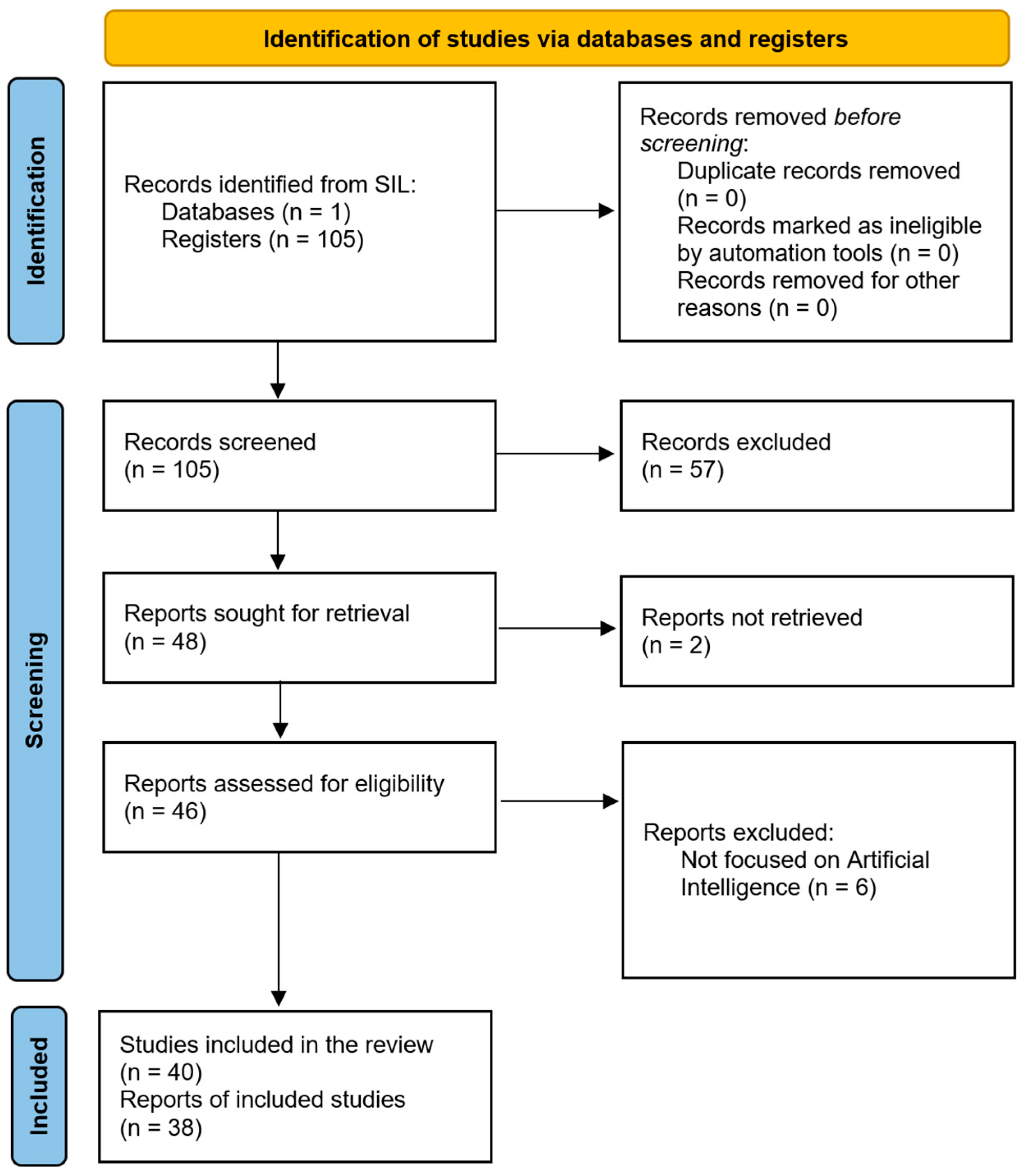
- What legislative initiatives currently exist in Mexico at the federal level that directly or indirectly address the use of artificial intelligence?
- Q2:
- What critical aspects of AI (such as algorithmic bias, transparency, accountability, or privacy) are insufficiently regulated or completely absent in current legislation?
2. Assessment of the Legal Framework Governing AI in Mexico
- Keeping up with technological advancement: Current laws were not designed to address the unique challenges posed by contemporary AI, such as machine learning, automated decision-making, or the use of generative models.
- Protection of human rights: AI can reinforce structural inequalities if not properly regulated. It is vital to guarantee the protection of privacy, non-discrimination, due process, and other fundamental rights against the misuse of automated systems.
- Guidance from international laws: Mexico needs to harmonize its legislation with global frameworks to foster international trust, facilitate cross-border cooperation, and actively participate in multilateral discussions on AI.
- Promoting ethical and responsible innovation: A clear regulatory framework can provide legal certainty for developers and companies, promoting technological innovation based on ethical principles and with social responsibility.
- Prevention of risks and harm: AI applications in security, surveillance, education, or justice can have significant consequences if not subject to appropriate controls. Legislative review must allow for effective mechanisms for impact assessment, oversight, and accountability.
- Initiatives rejected in committees.
- Initiatives withdrawn from the legislation.
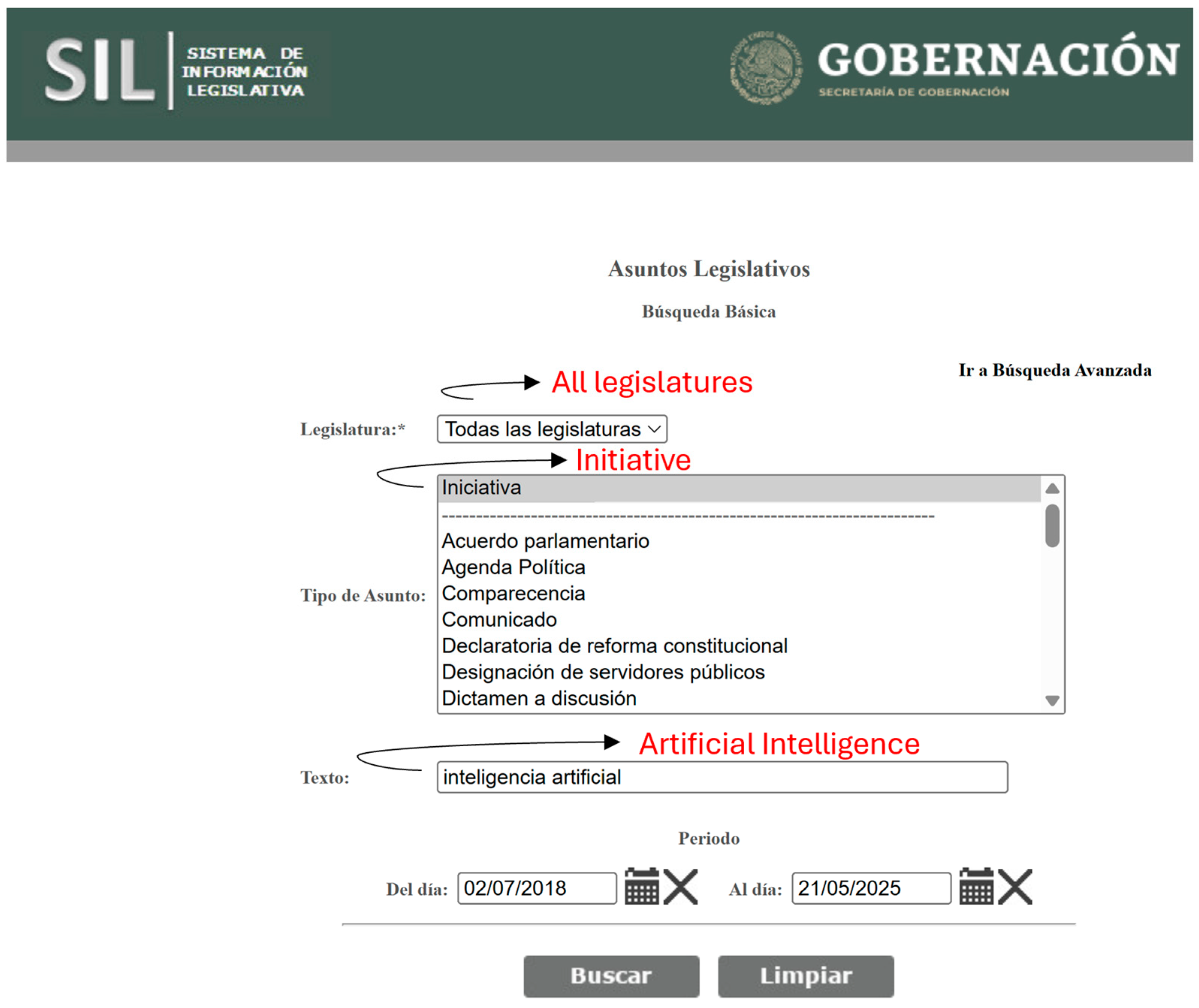
- It contains all initiatives presented in all legislative scenarios.
- It is an official website, hosted by the Secretary of the Interior (Secretaría de Gobernación, in Spanish).
- It contains a search engine that is able to query the information by using text.
- Adding regulation to the federal law of work, related to the workplace rights of workers of digital platforms such as Uber, Amazon, and others.
- Adding regulations to the law of rural sustainable development.
- Adding regulations to the General Law for the Care and Protection of People with Autism Spectrum Disorders.
- To promote the use of information technologies that enable distance learning in situations of violence, health emergencies, or natural disasters.
- To amend and add various provisions to the General Law for the Care and Protection of Persons with Autism Spectrum Disorder.
- To stipulate that the Public Prosecutor’s Office may receive complaints or charges in person and through artificial intelligence platforms or by any other technological means.
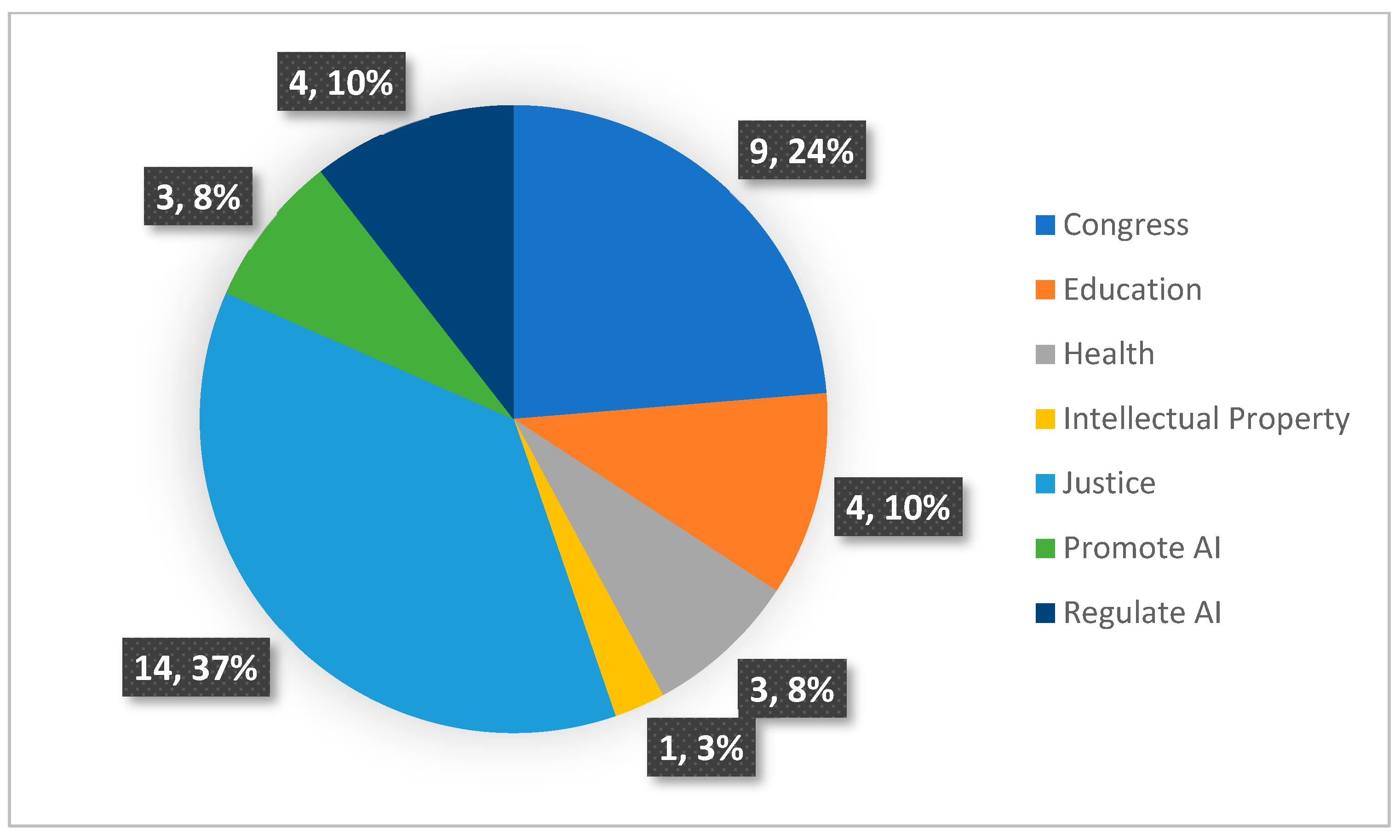
2.1. Congress-Related Initiatives

| Ref. | Party, Date | Proposed Text |
|---|---|---|
| [21] | PT, 30 April 2025 | Article 73. Congress has the power to: (…) XVII. To enact laws on general means of communication, artificial intelligence, information and communications technologies, broadcasting, telecommunications, including broadband and the Internet, postal services and mail, and on the use and exploitation of waters under federal jurisdiction (…) |
| [20] | Morena, 30 April 2025 | Article 73. Congress has the power to: (…) XXXII. To enact general laws regarding emerging, disruptive technologies, and artificial intelligence, establishing the foundations, principles, and guidelines for their ethical, safe, transparent, sustainable, and human rights-respecting use, as well as to promote their development for the benefit of the nation. |
| [22] | PAN, 29 April 2025 | Article 73. Congress has the power: (…) XVII. To enact laws on general means of communication, information and communication technologies, broadcasting, telecommunications, including broadband and the Internet, artificial intelligence, postal services and mail, and on the use and exploitation of waters under federal jurisdiction (…) |
| [23] | Morena, 2 April 2025 | Article 73. Congress has the power: (…) XVII. To enact laws on general means of communication, information and communication technologies, broadcasting, telecommunications, including broadband and the Internet, postal services and mail, the general law on artificial intelligence that establishes principles, bases, limits and prohibitions on the use of such technology, and on the use and exploitation of waters under federal jurisdiction (…) |
| [24] | Morena, 20 March | Article 73. Congress has the power (…) XVII. To enact laws on general means of communication, information and communication technologies, artificial intelligence, broadcasting, telecommunications, including broadband and the Internet, mail, and on the use and use of postal services and mail, and on the use and exploitation of waters under federal jurisdiction (…) |
| [25] | PAN, 20 March 2025 | Article 73. Congress has the power (…) XVII. To enact laws on general means of communication, information and communication technologies, broadcasting, telecommunications, including broadband and the Internet, postal services and mail, artificial intelligence, and on the use and exploitation of waters under federal jurisdiction (…) |
| [26] | PRI, 4 March 2025 | Article 73. Congress has the power: (…) XVII. To enact laws on general means of communication, information and communication technologies, broadcasting, telecommunications, including broadband and the Internet, postal services and mail, on artificial intelligence, providing for limits and restrictions on its use, and on the use and exploitation of waters under federal jurisdiction (…) |
| [27] | Morena, 19 February 2025 | Article 73. Congress has the power: (…) XVII. To enact laws on general means of communication, information and communication technologies, artificial intelligence, broadcasting, telecommunications, including broadband and the Internet, postal services and mail, and on the use and exploitation of waters under federal jurisdiction (…) |
| [19] | PAN, 6 February 2025 | Article 1. (…) Any discrimination motivated by ethnic or national origin, gender, age, disabilities, social status, health conditions, religion, opinions, sexual preferences, marital status, those derived from the use of applications or tools of artificial intelligence, cybertechnology or neurotechnology, or any other that violates human dignity and aims to annul or undermine the rights and freedoms of people is prohibited. Article 6. The State shall promote cybersecurity, as well as the development and implementation of artificial intelligence technologies, tools, and applications, cybertechnologies, among other similar technologies, and shall regulate that these are safe, responsible, and protect people’s human rights, avoiding discriminatory biases and unacceptable risks, as well as balancing innovation with ethical and security standards. National law shall protect people’s neuro-rights, especially safeguarding brain activity and the information derived from it, and shall establish a National Agency for Artificial Intelligence and Cybersecurity. Article 73. Congress has the power: (…) XVII. To issue: (a) Laws regulating general means of communication, information, and communication technologies, broadcasting, telecommunications, including broadband and the Internet, postal services, and mail; (b) National laws on cybersecurity and on technologies, tools, and applications of artificial intelligence, cybertechnologies, neurotechnologies, among other similar technologies, as well as those that protect neuro-rights, in terms of the provisions of articles 1 and 6 of this Constitution. (c) The laws on the use and exploitation of waters under federal jurisdiction (…) |
2.2. Education-Related Initiatives
2.3. Health-Related Initiatives
2.4. Intellectual Property Initiatives
2.5. Justice-Related Initiatives
- IX.
- To defame, slander, insult, or make any expression that denigrates or disqualifies women in the exercise of their political functions, including the creation and dissemination of defamation campaigns or the generation of fake social media accounts or profiles, based on gender stereotypes, with the objective or result of undermining their public image or limiting or nullifying their rights.
- X.
- Disseminating images, messages or private information of a female candidate or in office, as well as manipulating and disseminating images or sounds created or modified through the use of artificial intelligence, or that use contextualized data or statements, by any physical or virtual means, with the purpose of discrediting, defaming, denigrating her and calling into question her capacity or skills for politics, based on gender stereotypes.
- (a)
- Psychological and emotional suffering: depression, anxiety, stress, fear, panic attacks.
- (b)
- Physical: incitement to assault another victim, appearance of pain in different parts of the body, or suicide.
- (c)
- Social isolation: permanent or temporary withdrawal from public, family, and social life.
- (d)
- Economic consequences for victims and their families: job loss, payment of legal fees, online protection services, or long-term treatment for mental illness or sexual health problems.
- (e)
- Limited mobility in online and/or offline spaces: abandonment of a particular internet platform or social network, change in physical address due to threats of aggression on digital networks.
- (a)
- market introduction, commissioning or the exploitation thereof that results in a deliberate, deceptive and non-consensual manipulation to alter or modify images, scenarios or video and audio recordings, making them appear real and to cause prejudice and damage to a person or a group of people and/or diminish the capacity of a person or a group of people to make an informed decision, seeking to make them adopt a position or criterion or make a decision that they would not otherwise have made;
- (b)
- the introduction into the market, the putting into service or the exploitation of technological tools of generative artificial intelligence that are fed by facial recognition data through the non-selective extraction of facial images from the internet or closed circuits as well as data that may be considered private or personal, or that make illicit use of remote biometric identification and information systems or that falsify official information or documents;
- (c)
- the introduction into the market, the putting into service, or the exploitation of technological tools of generative artificial intelligence through which confidential or reserved information, or images, videos, or audios, illegally extracted without the consent of the affected parties, and are disseminated or spread;
- (d)
- the use and exploitation of technological tools of generative artificial intelligence to generate content and works that, without specifying that they have been developed through the use of them, are presented as their own and seek to be registered as such for their commercialization or that infringe existing rights of protected works or that result in the commission of a fraud to the detriment of any natural or legal person.
2.6. Promotion of AI Initiatives
- IX.
- To promote the development of an ethical and human rights framework that governs national science, technology, and innovation policy;
- X.
- To promote the use of artificial intelligence to solve fundamental national problems, contribute to the country’s development, and improve the well-being of the population in all aspects, with strict adherence to and respect for human rights.
- XV.
- Artificial intelligence: any system that exhibits intelligent behavior, by being able to analyze its environment and take action with a certain degree of autonomy, to achieve specific objectives.
- XXVIII.
- Promote the development, use, and application of artificial intelligence (AI) technologies as part of the national policy on science, humanities, technology, and innovation, in accordance with the principles of ethics, inclusion, security, data protection, sustainability, and human rights.
- XXIX.
- Develop, integrate, update, and approve a National Ethical Framework for the use and development of artificial intelligence, in accordance with the principles of this law.
2.7. Regulate AI Initiatives
- (a)
- The introduction into the market, the putting into service, or the use of an Artificial Intelligence system that uses subliminal techniques that transcend a person’s consciousness to substantially alter their behavior in a way that causes or is likely to cause physical or psychological harm to that person or to a third party.
- (b)
- The introduction into the market, the putting into service or the use of an Artificial Intelligence system that takes advantage of any of the vulnerabilities of a specific group of people due to their age or physical or mental disability in order to substantially alter the behavior of a person belonging to that group in a way that causes or is likely to cause physical or psychological harm to that person or to another person.
- (c)
- The introduction into the market, the commissioning or the use of Artificial Intelligence systems by the authorities or on their behalf for the purpose of assessing or classifying the reliability of natural persons during a specified period of time based on their social conduct or known or predicted personal or personality characteristics, such that the resulting social classification causes one or more of the following situations:
- (1)
- Prejudicial or unfavorable treatment towards certain individuals or entire groups in social contexts that are unrelated to the contexts where the data were originally generated or collected;
- (2)
- Harmful or unfavorable treatment towards certain individuals or entire groups that is unjustified or disproportionate with respect to their social behavior or the seriousness thereof.
- (d)
- The use of remote (real-time) biometric identification systems in publicly accessible spaces for law enforcement purposes, except to the extent that such use is strictly necessary, justified, and motivated before the relevant Authority to achieve one or more of the following objectives:
- (1)
- The selective search for specific potential victims of a crime, including missing minors;
- (2)
- The prevention of a specific, significant, and imminent threat to the life or physical safety of individuals or a terrorist attack. Any specific use of a real-time remote biometric identification system in a publicly accessible space for law enforcement purposes will be subject to prior authorization from a judicial or relevant administrative authority, which will grant such authorization upon a reasoned and substantiated request for its implementation. However, in a duly justified emergency situation, the system may be put into use before obtaining the corresponding authorization, which may be requested during or after its use. The competent judicial or administrative authority will only grant authorization when it is convinced, based on objective evidence or clear indications presented to it, that the system is justified.
- The establishment of the national policy for the use and application of Artificial Intelligence through the various mechanisms that facilitate immediate, prompt, and real-time access for people.
- The use and application of Artificial Intelligence in information and communication technologies as a linking tool.
- Establishing the procedures, instances, and mechanisms in which Artificial Intelligence will be applied.
- Define and establish the regulatory bodies, as well as the strategies for the use and exploitation of Artificial Intelligence.
- Promote the use of technologies under which Artificial Intelligence is applied, except for those established by applicable legislation.
- The National Artificial Intelligence System in Article 18 (articulating the mechanism of AI actions that will establish and execute the National Artificial Intelligence Strategy and the actions, policies, and programs of a specific and sectoral nature. It is made up of the Council; the authorities; and the social, private, and academic sectors.
- The National Council for Artificial Intelligence in Article 21 (the highest body for coordination and definition of public policies in this area, includes the presidency of the federal executive branch and the heads of the Secretariats of the Interior, National Defense, Navy, Public Function, Security and Citizen Protection and Education, as well as the heads of the Chief Administrative Office and the National Commission for Regulatory Improvement)
- The National Center for Artificial Intelligence in Article 13 (decentralized body of an operational nature and coordinator of actions for the implementation of the national artificial intelligence policy)
- Processes that require collegial deliberation.
- Resolutions of an administrative contentious nature.
- Hearings and mechanisms for citizen participation and consultation.
- Medical diagnoses.
- The implementation of Alternative Dispute Resolution methods.
- Those whose resolution requires the presence of the authorities.
- (a)
- Use subliminal manipulation techniques or extreme psychological persuasion to alter human behavior without informed consent. (…)
- (e)
- They are developed for the creation, improvement, or use of weapons for the exclusive use of armed forces, or that facilitate the development of chemical, biological, radiological, or nuclear weapons, prohibited by international treaties.
- (f)
- They are intended for the manufacture or dissemination of explosives, toxic agents, or substances intended to cause massive damage to persons or property. (…)
- Generate, recommend, or disseminate content that promotes violence, self-harm, hatred, discrimination, or harmful behaviors;
- They stimulate digital addictions, technological dependence, or serious emotional disturbances;(…)
- Train artificial intelligence models using data from minors without the express, informed, and verifiable consent of the person exercising parental authority, custody, or guardianship.(…)
3. Discussion
3.1. Limitations of the Study
- 6.
- Documentary and normative scope: The analysis is limited to formal legislative initiatives, excluding regulations, administrative guidelines, case law, and informal regulatory practices that also influence AI governance in Mexico.
- 7.
- Static nature of the analysis: Since the study is based on pending initiatives at a specific point in time (31 May 2025), the results may be affected by the rapid evolution of the legislative and technological landscape, which limits the timeliness of the conclusions.
- 8.
- Textual search: The Legislative Information System search engine only allows for textual search; that is, only the words “artificial intelligence” (inteligencia artificial in Spanish) were used in the search.
- 9.
- Lack of empirical validation: This study does not incorporate the perspective of key stakeholders (legislators, regulators, developers, or AI users), which restricts the empirical assessment of the practical impact and potential effectiveness of the initiatives analyzed.
- 10.
- We only focused on the current legislative landscape regarding AI in Mexico. We did not compare it with those in other countries.
3.2. Main Gaps of the Surveyed Initiatives
3.2.1. Congress-Related Initiatives
3.2.2. Education-Related Initiatives
3.2.3. Health-Related Initiatives
3.2.4. Intellectual Property Initiatives
3.2.5. Justice-Related Initiatives
3.2.6. Promoting AI-Related Initiatives
3.2.7. Regulate AI-Related Initiatives
4. Conclusions
- All critical aspects are insufficiently regulated in the reviewed initiatives. There are specific provisions for bias-free training, no enforcement of transparency, insufficient accountability, and privacy is only covered by current data protection laws.
- Privacy and Data Protection: Existing privacy and data protection laws, such as the Federal Law on the Protection of Personal Data Held by Private Parties (in Spanish Ley Federal de Protección de Datos Personales en Posesión de los Particulares), apply indirectly to AI. However, they do not address all of this technology’s specificities.
- Ethics and Transparency: Implementing AI poses significant ethical challenges, including ensuring fairness, equity, and transparency in its use. There are currently no laws that address these aspects from a technical perspective.
- Oversight and Accountability: The algorithms and source code used in AI applications are not clearly supervised or regulated, which can lead to accountability and transparency issues. No current law requires code supervision or accountability for AI systems.
- Cybersecurity: The lack of a robust legislative framework on cybersecurity also affects the use of AI, as many AI applications depend on the security of the data and systems they operate.
5. Challenges and Future Directions for AI Regulation in Mexico
5.1. Actionable Recommendations
- Proportionality and Do No Harm. “The use of AI systems must not go beyond what is necessary to achieve a legitimate aim. Risk assessment should be used to prevent harm which may result from such uses”.
- Safety and Security. “Unwanted harms (safety risks) as well as vulnerabilities to attack (security risks) should be avoided and addressed by AI actors”.
- Right to Privacy and Data Protection. “Privacy must be protected and promoted throughout the AI lifecycle. Adequate data protection frameworks should also be established”.
- Multi-stakeholder and Adaptive Governance & Collaboration. “International law & national sovereignty must be respected in the use of data. Additionally, participation of diverse stakeholders is necessary for inclusive approaches to AI governance”.
- Responsibility and Accountability. “AI systems should be auditable and traceable. There should be oversight, impact assessment, audit, and due diligence mechanisms in place to avoid conflicts with human rights norms and threats to environmental wellbeing”.
- Transparency and Explainability. “The ethical deployment of AI systems depends on their transparency & explainability (T&E). The level of T&E should be appropriate to the context, as there may be tensions between T&E and other principles such as privacy, safety, and security”.
- Human Oversight and Determination. “Member States should ensure that AI systems do not displace ultimate human responsibility and accountability”.
- Sustainability. “AI technologies should be assessed against their impacts on ‘sustainability’, understood as a set of constantly evolving goals including those set out in the UN’s Sustainable Development Goals”.
- Awareness & Literacy. “Public understanding of AI and data should be promoted through open & accessible education, civic engagement, digital skills & AI ethics training, media & information literacy”.
- Fairness and Non-Discrimination. “AI actors should promote social justice, fairness, and non-discrimination while taking an inclusive approach to ensure AI’s benefits are accessible to all”.
- 11.
- The Judiciary must collaborate with AI, ethics, and human rights experts to develop ethical and legal guidelines and standards for the use and application of AI-based technologies in the judicial system.
- 12.
- The capabilities of the National Electoral Institute (INE) should be strengthened through the creation of a regulatory framework that defines the limits and conditions under which AI-based tools can be used in political campaigns, electoral propaganda, and the dissemination of election-related information.
- 13.
- The capabilities and regulatory framework of the National Institute for Transparency, Access to Information, and Personal Data Protection (INAI), as the competent body for personal data protection, should also be strengthened and modified to include the supervision of and compliance with regulations related to the use of AI-based technologies and personal data protection, and establish clear and specific regulations for data management in the cloud and in data centers.
- 14.
- It is recommended to strengthen the capabilities of the Federal Economic Competition Commission (COFECE) as a regulatory body that promotes competition and equitable access to data so that new technologies, such as those based on artificial intelligence, are accessible to all.
5.2. Possible Social Actors That May Influence Technological Decisions in the Country and Technology Regulation
- The Center of Industrial Innovation and Artificial Intelligence (Centro de Innovación Industrial e Inteligencia Artificial, CII.IA).
- fAIrLAC+.
- The Mexican Academy of Computation (Academia Mexicana de Computación, AMEXCOMP).
- The Mexican Academy of Cidersecurity and Digital Law (Academia Mexicana de Ciberseguridad y Derecho Digital, AMCID).
- The Mexican Association of the Information Technology Industry (Asociación Mexicana de la Industria de Tecnologías de Información, AMITI).
- The Mexican Society of Artificial Intelligence (Sociedad Mexicana de Inteligencia Artificial, SMIA).
- The National Alliance for Artificial Intelligence (Alianza Nacional de Inteligencia Artificial, ANIA).
- The White Box Project.
- United Nations Development Program (PNUD Mexico).
Author Contributions
Funding
Data Availability Statement
Acknowledgments
Conflicts of Interest
References
- Bengio, Y.; Mindermann, S.; Privitera, D.; Besiroglu, T.; Bommasani, R.; Casper, S.; Choi, Y.; Fox, P.; Garfinkel, B.; Goldfarb, D. International AI Safety Report. arXiv 2025, arXiv:2501.17805. [Google Scholar] [PubMed]
- Li, W.-H.; Yu, H.-C.J.M. Using KeyGraph and ChatGPT to Detect and Track Topics Related to AI Ethics in Media Outlets. Mathematics 2025, 13, 2698. [Google Scholar] [CrossRef]
- Sanchez-Pi, N.; Martí, L.; Garcia, A.C.B.; Yates, R.B.; Vellasco, M.; Coello, C.A.C. A roadmap for AI in Latin America. In Proceedings of the Side Event AI in Latin America of the Global Partnership for AI (GPAI) Paris Summit, Paris, France, 11–12 November 2021. [Google Scholar]
- Congreso de la Unión. Federal Law on the Protection of Personal Data Held by Private Parties (In Spanish: Ley Federal de Protección de Datos Personales en Posesión de los Particulares). Available online: https://www.diputados.gob.mx/LeyesBiblio/pdf/LFPDPPP.pdf (accessed on 13 February 2025).
- Schneider, I. Democratic governance of digital platforms and artificial intelligence? Exploring governance models of China, the US, the EU and Mexico. JeDEM-Ej. Edemocracy Open Gov. 2020, 12, 1–24. [Google Scholar] [CrossRef]
- Ruvalcaba-Gomez, E.A.; Cifuentes-Faura, J. Analysis of the perception of digital government and artificial intelligence in the public sector in Jalisco, Mexico. Int. Rev. Adm. Sci. 2023, 89, 1203–1222. [Google Scholar] [CrossRef]
- Millan-Vargas, A.O.; Sandoval-Almazan, R.; Valle-Cruz, D. Impact and barriers to AI in the public sector: The case of the State of Mexico. In Proceedings of the 25th Annual International Conference on Digital Government Research, Taipei, Taiwan, 11–14 June 2024; pp. 81–89. [Google Scholar]
- Millan Vargas, A.; Sandoval-Almazan, R. Public managers perception on artificial intelligence: The case of the State of Mexico. In Proceedings of the 57th Hawaii International Conference on System Sciences, Hawaii, HI, USA, 3–6 January 2024; pp. 1860–1869. [Google Scholar]
- Criado, J.I.; Sandoval-Almazan, R.; Valle-Cruz, D.; Ruvalcaba-Gómez, E.A. Chief information officers’ perceptions about artificial intelligence: A comparative study of implications and challenges for the public sector. First Monday 2021, 26, 1–4. [Google Scholar]
- Criado, J.I.; Salvador, M.; Ruvalcaba-Gómez, E.A.; Sandoval-Almazan, R. Artificial Intelligence and Ethics in Public Management (In Spanish: Inteligencia Artificial y ética en la Gestión Pública); Centro Latinoamericano de Administración para el Desarrollo (CLAD): Caracas, Venezuela, 2021. [Google Scholar]
- Arguelles Toache, E.; Amaro Rosales, M. Ethical concerns in the use of artificial intelligence, transparency, and the right of access to information. The case of chatbots in the Mexican government, in the context of COVID-19. Estud. Derecho Inf. 2023, 15, 85–111. [Google Scholar]
- Mendoza Enríquez, O.A. The personal data protection right in artificial intelligence systems. Rev. IUS 2021, 15, 179–207. [Google Scholar]
- Pérez, J.V.; Hernández, V.R.; Fernández-Sabido, S.; Vázquez, Á.T.; Molina-Villegas, A.; Sánchez-Sordia, O. AI Safety in Mexico: A Pilot Survey in Yucatan. Res. Comput. Sci. 2025, 154, 27–39. [Google Scholar]
- Ollerton, N. Mexico’s AI Talent Pipeline Accelerates. Available online: https://magazine.qs.com/qs-insights-magazine-32/mexicos-ai-talent-pipeline (accessed on 18 April 2024).
- De Mariz, F. Finance with a Purpose: FinTech, Development and Financial Inclusion in the Global Economy; World Scientific: London, UK, 2022. [Google Scholar]
- Union, E. Artificial Intelligence Act. Available online: https://artificialintelligenceact.eu/the-act/ (accessed on 18 April 2024).
- ANIA. Legislative Monitoring Artificial Intelligence. Available online: https://www.ania.org.mx/seguimiento-legislativo (accessed on 8 April 2024).
- Tricco, A.C.; Lillie, E.; Zarin, W.; O’Brien, K.K.; Colquhoun, H.; Levac, D.; Moher, D.; Peters, M.D.; Horsley, T.; Weeks, L. PRISMA extension for scoping reviews (PRISMA-ScR): Checklist and explanation. Ann. Intern. Med. 2018, 169, 467–473. [Google Scholar] [CrossRef]
- Dorantes-Lámbarri, A. Draft Decree Amending and Adding Various Provisions to the Political Constitution of the United Mexican States in Cybersecurity, Artificial Intelligence, Cybertechnologies, Neurotechnologies, and Neurorights (In Spanish: Iniciativa con Proyecto de Decreto por el que se Reforman y Adicionan Diversas Disposiciones de la Constitución Política de los Estados Unidos Mexicanos en Materia de Ciberseguridad, Inteligencia Artificial, Cibertecnologías, Neurotecnologías y Neuroderechos). Available online: http://sil.gobernacion.gob.mx/Archivos/Documentos/2025/02/asun_4832468_20250206_1738863808.pdf (accessed on 21 May 2024).
- Herrera-Ruiz, G. Draft Decree Amending Section XXXII and Adding Section XXXIII (Reordering Subsequent Sections) of Article 73 of the Political Constitution of the United Mexican States, Regarding Emerging, Disruptive Technologies, and Artificial Intelligence (In Spanish: Iniciativa con Proyecto de Decreto por el que Reforma la Fracción XXXII y Adiciona una Fracción XXXIII Recorriéndose la Siguiente para su Orden del Artículo 73 de la Constitución Política de los Estados Unidos Mexicanos, en Materia de Tecnologías Emergentes, Disruptivas e Inteligencia Artificial). Available online: http://sil.gobernacion.gob.mx/Archivos/Documentos/2025/04/asun_4896458_20250430_1746051640.pdf (accessed on 21 May 2024).
- Anaya-Gutiérrez, R. Draft Decree Amending Section XVII of Article 73 of the Political Constitution of the United Mexican States, Regarding Empowering the Congress of the Union to Enact the Necessary Regulations to Govern the Research, Development, and Applications of Artificial Intelligence (In Spanish: Iniciativa con Proyecto de Decreto por el que se Reforma la Fracción XVII del Artículo 73 de la Constitución Política de los Estados Unidos Mexicanos, en Materia deFacultar al Congreso de la Unión para Emitir las Normas Necesarias para Regular la Investigación, Desarrollo y Aplicaciones de la Inteligencia Artificial). Available online: http://sil.gobernacion.gob.mx/Archivos/Documentos/2025/04/asun_4894514_20250430_1745856634.pdf (accessed on 21 May 2024).
- Moya-Bastón, M.A. Draft Decree Amending Section XVII of Article 73 of the Political Constitution of the United Mexican States, Regarding Artificial Intelligence (In Spanish: Iniciativa con Proyecto de Decreto por el que se Reforma Reforma la Fracción XVII del Artículo 73 de la Constitución Política de los Estados Unidos Mexicanos en Materia de Inteligencia Artificial). Available online: http://sil.gobernacion.gob.mx/Archivos/Documentos/2025/04/asun_4892696_20250429_1745367458.pdf (accessed on 21 May 2024).
- Ascencio-Ortega, R.C. Draft Decree Amending Section XVII of Article 73 of the Political Constitution of the United Mexican States, Regarding Artificial Intelligence (In Spanish: Iniciativa con Proyecto de Decreto por el que se Reforma Reforma la Fracción XVII del Artículo 73 de la Constitución Política de los Estados Unidos Mexicanos en Materia de Inteligencia Artificial). Available online: http://sil.gobernacion.gob.mx/Archivos/Documentos/2025/04/asun_4869483_20250402_1743615827.pdf (accessed on 21 May 2024).
- Kantún-Can, M.M. Draft Decree Amending Section XVII of Article 73 of the Political Constitution of the United Mexican States, Regarding Artificial Intelligence (In Spanish: Iniciativa con Proyecto de Decreto por el que se Reforma la Fracción XVII del Artículo 73 de la Constitución Política de los Estados Unidos Mexicanos en Materia de Inteligencia Artificial). Available online: http://sil.gobernacion.gob.mx/Archivos/Documentos/2025/03/asun_4859609_20250320_1739467992.pdf (accessed on 21 May 2024).
- Sanmiguel-Sánchez, I.M. Draft Decree Amending Section XVII of Article 73 of the Political Constitution of the United Mexican States, Regarding Artificial Intelligence (In Spanish: Iniciativa con Proyecto de Decreto por el Que se Reforma Reforma la Fracción XVII del Artículo 73 de la Constitución Política de los Estados Unidos Mexicanos en Materia de Inteligencia Artificial). Available online: http://sil.gobernacion.gob.mx/Archivos/Documentos/2025/03/asun_4859513_20250320_1739898936.pdf (accessed on 21 May 2024).
- Ávalos-Zempoalteca, A. Draft Decree Amending Section XVII of Article 73 of the Political Constitution of the United Mexican States, Regarding Empowering Congress to Legislate on Artificial Intelligence Under an Ethical and Prudent Framework that Establishes Limits and Restrictions on the Use of Artificial Intelligence (In Spanish: Iniciativa con Proyecto de Decreto por el que se Reforma Reforma la Fracción XVII del Artículo 73 de la Constitución Política de los Estados Unidos Mexicanos en Materia de Facultar al Congreso Para Legislar en Materia de Inteligencia Artificial Bajo un Parámetro Ético y Prudencial que establezca Límites y Restricciones al uso de la Inteligencia Artificial). Available online: http://sil.gobernacion.gob.mx/Archivos/Documentos/2025/03/asun_4846168_20250304_1740592988.pdf (accessed on 21 May 2024).
- Monreal-Avila, R. Draft Decree Amending Section XVII of Article 73 of the Political Constitution of the United Mexican States, Regarding Artificial Intelligence (In Spanish: Iniciativa con Proyecto de Decreto por el que se Reforma Reforma la Fracción XVII del Artículo 73 de la Constitución Política de los Estados Unidos Mexicanos en Materia de Inteligencia Artificial). Available online: http://sil.gobernacion.gob.mx/Archivos/Documentos/2025/02/asun_4839766_20250219_1739991446.pdf (accessed on 21 May 2024).
- Martín-del-Campo, J.A. Draft Decree Amending Article 3 of the Political Constitution of the United Mexican States (In Spanish: Iniciativa con Proyecto de Decreto que Reforma lel Artículo 3o de la Constitución Política de los Estados Unidos Mexicanos). Available online: http://sil.gobernacion.gob.mx/Archivos/Documentos/2025/04/asun_4894851_20250430_1745941185.pdf (accessed on 21 May 2024).
- Rosa-Ruiz, O.P. Draft Decree Amending Articles 153-C and 153-K of the Federal Labor Law (In Spanish: Iniciativa con Proyecto de Decreto que Reforma los Artículos 153-C y 153-K de la Ley Federal del Trabajo). Available online: http://sil.gobernacion.gob.mx/Archivos/Documentos/2024/11/asun_4799388_20241106_1730916446.pdf (accessed on 21 May 2024).
- Castillo-Morales, F.A. Draft Decree That Amends Article 30 of the General Education Law (In Spanish: Iniciativa que Reforma el Artículo 30 de la Ley General de Educación). Available online: http://sil.gobernacion.gob.mx/Archivos/Documentos/2025/04/asun_4895763_20250430_1740589581.pdf (accessed on 21 May 2024).
- Moreno-Cárdenas, R.A. Draft Decree to Amend and Add Various Provisions to the General Education Law and the General Law on the Rights of Girls, Boys, and Adolescents to Establish the Obligation of the Teaching of Informatic Skills and use of Artificial Intellicence Tools in Plans and Programs of Study of the Basic, Secondary, and High Education (In Spanish: Iniciativa con Proyecto de Decreto que Reforma y Adiciona Diversas Disposiciones de la Ley General de Educación y de la Ley General de los Derechos de Niñas, Niños y Adolescentes para Establecer la Obligatoriedad de la Enseñanza de Habilidades Informáticas y del Manejo de Herramientas de Inteligencia Artificial en los Planes y Programas de Estudio de la Educación básica y Media Superior). Available online: http://sil.gobernacion.gob.mx/Archivos/Documentos/2025/05/asun_4899375_20250514_1747244446.pdf (accessed on 21 May 2024).
- Ramírez-Barba, E.J. Draft Decree Which Adds Various Provisions to the General Health Law, Regarding Artificial Intelligence Applied to Health (In Spanish: Iniciativa que Adiciona Diversas Disposiciones a la Ley General de Salud, en Materia de InteliGencia Artificial Aplicada a la Salud). Available online: http://sil.gobernacion.gob.mx/Archivos/Documentos/2024/08/asun_4769696_20240827_1724256420.pdf (accessed on 21 May 2024).
- Ramírez-Barba, E.J. Initiative with a Draft Decree to Reform and Add Various Provisions to the General Health Law, Regarding Artificial Intelligence Applied to Health (In Spanish: Iniciativa con Proyecto de Decreto que Reforma y Adiciona Diversas Disposiciones a la Ley General de Salud, en Materia de Inteligencia Artificial Aplicada a laSalud). Available online: http://sil.gobernacion.gob.mx/Archivos/Documentos/2024/12/asun_4817597_20241205_1727896740.pdf (accessed on 21 May 2024).
- Lagunes-Soto-Ruíz, A. Draft Decree Promulgating the General Law on Neuro-Rights and Neurotechnologies, and Amending and Adding Various Provisions Related to Neuro-Rights and Neurotechnologies (In Spanish: Iniciativa con Proyecto de Decreto que Expide la Ley General de Neuroderechos y Neurotecnologías y Reforma y Adiciona Diversas Disposiciones en Materia de Neuroderechos y Neurotecnologías). Available online: http://sil.gobernacion.gob.mx/Archivos/Documentos/2024/07/asun_4765214_20240717_1721235743.pdf (accessed on 21 May 2024).
- Rendón-Gómez, J.G. Draft Decree Which Adds Section XIV to Article 17 Bis of the General Health Law (In Spanish: Iniciativa que Adiciona la Fracción XIV al artículo 17 Bis de la Ley General de Salud). Available online: http://sil.gobernacion.gob.mx/Librerias/pp_HProcesoLegislativo.php?SID=bfe2f8280bc35854c0bf3b676bfcc505&Asunto=4898319&Seguimiento=4900189 (accessed on 21 May 2024).
- González-Soto, S. Draft Decree Amending and Adding Various Provisions to the Federal Cinematography Law, the Federal Copyright Law, and the Federal Labor Law, with the Aim of Establishing Protective Measures for Voice Actors in Mexico Regarding the Use of Artificial Intelligence or Emerging Technologies in Dubbing Processes (In Spanish: Iniciativa que Reforma y Adiciona Diversas Disposiciones de la Ley Federal de Cinematografía, de la Ley Federal del Derecho de Autor y de la Ley Federal del Trabajo, en Materia de Establecer Medidas de Protección para las y los Actores de doblaje en México Frente al uso de Inteligencia Artificial o Tecnologías Emergentes en Procesos de Doblaje). Available online: http://sil.gobernacion.gob.mx/Archivos/Documentos/2025/04/asun_4896201_20250430_1745528888.pdf (accessed on 21 May 2024).
- Vences-Valencia, J.K. Draft Decree That Amends and Adds Article 20 Quater of the General Law on Women’s Access to a Life Free from Violence (In Spanish: Iniciativa con Proyecto de Decreto que Reforma y Adiciona el Artículo 20 Quáter de la Ley General de Acceso de las Mujeres a una Vida Libre de Violencia). Available online: http://sil.gobernacion.gob.mx/Librerias/pp_ReporteSeguimiento.php?SID=50b4db49742644687cedaccfd7c2d102&Seguimiento=4756337&Asunto=4754595 (accessed on 21 May 2024).
- González-González, A.I. Draft Decree Amending Article 20 Quater of the General Law on Women’s Access to a Life Free from Violence (In Spanish: Iniciativa con Proyecto de Decreto que Reforma el Artículo 20 Quáter de la Ley General de Acceso de las Mujeres a una Vida Libre de Violencia). Available online: http://sil.gobernacion.gob.mx/Archivos/Documentos/2024/11/asun_4810351_20241127_1732657689.pdf (accessed on 21 May 2024).
- Monreal-Avila, R. Draft Decree that Amends and Adds Article 20 Quater of the General Law on Women’s Access to a Life Free from Violence Against Digital Violence Through the Use of Images, Audio, or Video Generated with Artificial Intelligence (In Spanish: Iniciativa con Proyecto de Decreto que Reforma y Adiciona el Artículo 20 Quáter de la Ley General de Acceso de las Mujeres a una Vida Libre de Violencia Contra la Violencia Digital por el uso de Imágenes, Audio o Video Generados con Inteligencia Artificial). Available online: https://sil.gobernacion.gob.mx/Archivos/Documentos/2025/04/asun_4894650_20250430_1738777186.pdf (accessed on 21 May 2024).
- Gómez-Cárdenas, A.S. Draft Decree Amending Article 5 and Adding Article 20 Septies to the General Law on Women’s Access to a Life Free from Violence, Regarding Generative Artificial Intelligence (In Spanish: Iniciativa con Proyecto de Decreto que Reforma el Artículo 5° y Adiciona un artículo 20 Septies a la Ley General de Acceso de las Mujeres a una Vida Libre de Violencia, en Materia de Inteligencia Artificial Generativa). Available online: http://sil.gobernacion.gob.mx/Archivos/Documentos/2025/04/asun_4892721_20250429_1745435703.pdf (accessed on 21 May 2024).
- Dorantes-Lámbarri, A. Draft Decree to Amends Various Provisions of the Federal Penal Code, the General Law to Prevent, Punish, and Eradicate Crimes Related to Human Trafficking and for the Protection and Assistance of Victims of These Crimes, and the General Law on Women’s Access to a Life Free of Violence, Regarding Sexual Offenses Committed Using Information Technologies and Artificial Intelligence Applications (In Spanish: Iniciativa con Proyecto de Decreto que Reforma Diversas Disposiciones del Código Penal Federal, de la Ley General para Prevenir, Sancionar y Erradicar los Delitos en Materia de Trata de Personas y para la Protección y Asistencia a las Víctimas de Estos Delitos, y de la Ley General de Acceso de las Mujeres a una vida Libre de Violencia en Materia de Delitos Sexuales Cometidos con el uso de Tecnologías de la Información y Aplicaciones de Inteligencia Artificial). Available online: https://sil.gobernacion.gob.mx/Archivos/Documentos/2025/04/asun_4872465_20250408_1744148198.pdf (accessed on 21 May 2024).
- Gómez-Pozos, M. Draft Decree to Amends Various Provisions of the Federal Penal Code and the General Law on Women’s Access to a Life Free of Violence, Regarding the Classification of Digital and Media Violence (In Spanish: Iniciativa con Proyecto de Decreto que Reforma Diversas Disposiciones del Código Penal Federal y de la Ley General de Acceso de las Mujeres a una Vida Libre de Violencia, en Materia de Tipificación de Violencia Digital y Mediática). Available online: https://sil.gobernacion.gob.mx/Archivos/Documentos/2025/03/asun_4852107_20250311_1741730103.pdf (accessed on 21 May 2024).
- Juan-Carlos, I. Draft Decree to Add a Paragraph to Article 199 Septies of the Federal Penal Code (In Spanish: Iniciativa con Proyecto de Decreto que Adiciona un Párrafo al Artículo 199 Septies del Código Penal Federal). Available online: https://sil.gobernacion.gob.mx/Archivos/Documentos/2025/01/asun_4827981_20250115_1736972599.pdf (accessed on 21 May 2024).
- Aguilar-Gil, L. Draft Decree to Add Article 199 Octies to the Federal Penal Code (In Spanish: Iniciativa con Proyecto de Decreto que Adiciona el Artículo 199 Octies del Código Penal Federal). Available online: https://sil.gobernacion.gob.mx/Archivos/Documentos/2025/03/asun_4849442_20250305_1738867210.pdf (accessed on 21 May 2024).
- Mendoza-Amezcua, V. Draft Decree to Add a Third Paragraph to Article 199 Septies of the Federal Penal Code (In Spanish: Iniciativa con Proyecto de Decreto que Adiciona un Tercer un Párrafo al Artículo 199 Septies del Código Penal Federal). Available online: https://sil.gobernacion.gob.mx/Archivos/Documentos/2025/04/asun_4882937_20250423_1745350778.pdf (accessed on 21 May 2024).
- Guerra-Mena, J. Draft Decree to Add Article 199 Undecies to the Federal Penal Code (In Spanish: Iniciativa con Proyecto de Decreto que Adiciona un artículo 199 Undecies al Código Penal Federal). Available online: http://sil.gobernacion.gob.mx/Archivos/Documentos/2025/04/asun_4876919_20250410_1744297525.pdf (accessed on 21 May 2024).
- Moreno-Cárdenas, R.A. Draft Decree to Add Article 252 Bis to the Federal Penal Code (In Spanish: Iniciativa con Proyecto de Decreto que Adiciona un Artículo 252 Bis al Código Penal Federal). Available online: http://sil.gobernacion.gob.mx/Archivos/Documentos/2025/04/asun_4869297_20250401_1742921767.pdf (accessed on 21 May 2024).
- Corona-Arvizu, A. Draft Decree That Amends and Adds Adds to Chapter III and Articles 211 Ter and 211 Ter 1 of the Federal Penal Code, to Penalize the Creation of Fake Audio Recordings of Public Figures Generated by Artificial Intelligence (AI) (In Spanish: Iniciativa con Proyecto de Decreto que Reforma y Adiciona el Capítulo III y los Artículos 211 Ter y 211 Ter 1 al Código Penal Federal, para Sancionar la Creación de Audios Falsos para Personalidades Públicas Generados por Inteligencia Artificial (IA)). Available online: http://sil.gobernacion.gob.mx/Archivos/Documentos/2024/12/asun_4822363_20241211_1733859383.pdf (accessed on 21 May 2024).
- Mejía-Berdeja, R.S. Draft Decree to Add Article 8 Bis to the Federal Law Against Organized Crime (In Spanish: Iniciativa con Proyecto de Decreto que Adiciona el Artículo 8 Bis a la Ley Federal Contra la Delincuencia Organizada). Available online: https://sil.gobernacion.gob.mx/Archivos/Documentos/2025/03/asun_4847347_20250304_1741187708.pdf (accessed on 21 May 2024).
- Pérez-Díaz, V.M. Draft Decree to Amends and Adds Various Provisions to the Federal Penal Code and the Federal Copyright Law, Regarding Generative Artificial Intelligence (In Spanish: Iniciativa con Proyecto de Decreto que Reforma y Adiciona Diversas Disposiciones del Código Penal Federal y de la Ley Federal de Derecho de Autor, en Materia de Inteligencia Artificial Generativa). Available online: https://sil.gobernacion.gob.mx/Archivos/Documentos/2025/04/asun_4896486_20250430_1746052156.pdf (accessed on 21 May 2024).
- Rodríguez-Carrillo, M.A. Draft Decree to Amend and Add Various Provisions to the Science and Technology Act (In Spanish: Iniciativa que Reforma y Adiciona Diversas Disposiciones de la Ley de Ciencia y Tecnología). Available online: http://sil.gobernacion.gob.mx/Archivos/Documentos/2021/01/asun_4128934_20210107_1610032547.pdf (accessed on 21 May 2024).
- Rodríguez-Carrillo, M.A. Draft Decree That Adds Various Provisions to the General Law on Humanities, Sciences, Technology and Innovation in Ethics and Human Rights (In Spanish: Iniciativa con Proyecto de Decreto que Adiciona Diversas Disposiciones de la Ley General en Materia de Humanidades, Ciencias, Tecnologías e Innovación en Materia de ética y Derechos Humanos). Available online: http://sil.gobernacion.gob.mx/Archivos/Documentos/2024/07/asun_4766053_20240724_1721837389.pdf (accessed on 21 May 2024).
- Quiroga-Treviño, L.O. Draft Decree Amending and Adding Articles 4 and 63 to the General Law on Humanities, Sciences, Technology and Innovation (In Spanish: Iniciativa con Proyecto de Decreto que Reforma y Adiciona los Artículos 4o. y 63 de la Ley General en Materia de Humanidades, Ciencias, Tecnologías e Innovación). Available online: http://sil.gobernacion.gob.mx/Archivos/Documentos/2025/04/asun_4890371_20250428_1745888718.pdf (accessed on 21 May 2024).
- Campuzano-González, G.G. Draft Decree to Add Sub-Paragraph XXIII Bis to Article 4 and Article 101 Bis 3 to the General Law on the Rights of Children and Adolescents (In Spanish: Iniciativa con Proyecto de Decreto que Adiciona una Fracción XXIII Bis del Artículo 4 y un Artículo 101 Bis 3 de la Ley General de los Derechos de Niñas, Niños y Adolescentes). Available online: http://sil.gobernacion.gob.mx/Archivos/Documentos/2024/10/asun_4778559_20241002_1727657295.pdf (accessed on 21 May 2024).
- Trasviña-Waldenrath, J.L. Draft Decree Amending and Adding Various Articles to the Federal Telecommunications and BroadCasting Law in Regulation of Artificial Intelligence Systems (In Spanish: Iniciativa con Proyecto de Decreto que Reforma y Adiciona Diversos Artículos de la Ley Federal de Telecomunicaciones y Radiodifusión en Materia de Regulación de los Sistemas de Inteligencia Artificial). Available online: http://sil.gobernacion.gob.mx/Archivos/Documentos/2024/11/asun_4801122_20241112_1731439888.pdf (accessed on 21 May 2024).
- Guerra-Mena, J. Draft Decree Promulgating the National Law That Regulates the Use of Artificial Intelligence (In Spanish: Iniciativa con Proyecto de Decreto que Expide la Ley Nacional que Regula el uso de la Inteligencia Artificial). Available online: http://sil.gobernacion.gob.mx/Archivos/Documentos/2024/12/asun_4825444_20241213_1730224444.pdf (accessed on 21 May 2024).
- Jiménez-Godoy, G.G.; Gutiérrez-Luna, S.C.; Ávila-Villegas, E.; Herrera-Borunda, J.O.; Godoy-Rangel, L.; Flores-Cervantes, H.E.; Ramírez-Cuéllar, A.; Sánchez-Cordero, O.M.d.C.; Arellano-Ávila, G.Y.; López-Santiago, H.; et al. Draft Decree Promulgating the Federal Law for the Ethical, Sovereign, and Inclusive Development of Artificial Intelligence (In Spanish: Iniciativa con Proyecto de Decreto que Expide la Ley Federal Para el Desarrollo Ético, Soberano e Inclusivo de la Inteligencia Artificial). Available online: http://sil.gobernacion.gob.mx/Archivos/Documentos/2025/04/asun_4896460_20250430_1747757009.pdf (accessed on 21 May 2024).
- Moore, J.; Grabb, D.; Agnew, W.; Klyman, K.; Chancellor, S.; Ong, D.C.; Haber, N. Expressing stigma and inappropriate responses prevents LLMs from safely replacing mental health providers. In Proceedings of the 2025 ACM Conference on Fairness, Accountability, and Transparency, Athens, Geece, 23–26 June 2025; pp. 599–627. [Google Scholar]
- Orrù, G.; Melis, G.; Sartori, G. Large language models and psychiatry. Int. J. Law Psychiatry 2025, 101, 102086. [Google Scholar] [CrossRef] [PubMed]
- Rodilosso, E. Filter bubbles and the unfeeling: How AI for social media can foster extremism and polarization. Philos. Technol. 2024, 37, 71. [Google Scholar] [CrossRef]
- Jindal, P.; Gouri, H. AI-personalization paradox: Navigating consumer behavior in a filter bubble era. In AI Impacts in Digital Consumer Behavior; Heinrich Musiolik, T., Villamarin Rodriguez, R., Kannan, H., Eds.; IGI Global Scientific Publishing: Hershey, PA, USA, 2024; pp. 82–111. [Google Scholar]
- Strecker, J.; Bekavac, L.; Bektaş, K.; Mayer, S. Change Your Perspective, Widen Your Worldview! Societally Beneficial Perceptual Filter Bubbles in Personalized Reality. In Proceedings of the Purposeful XR: Affordances, Challenges, and Speculations for an Ethical Future at CHI 2025 (Purposeful XR ’25), Yokohama, Japan, 26 April –1 May 2025; pp. 1–6. [Google Scholar]
- Meng, S.-Q.; Cheng, J.-L.; Li, Y.-Y.; Yang, X.-Q.; Zheng, J.-W.; Chang, X.-W.; Shi, Y.; Chen, Y.; Lu, L.; Sun, Y. Global prevalence of digital addiction in general population: A systematic review and meta-analysis. Clin. Psychol. Rev. 2022, 92, 102128. [Google Scholar] [CrossRef] [PubMed]
- Lendvai, G.F.; Gosztonyi, G. Algorithmic Bias as a Core Legal Dilemma in the Age of Artificial Intelligence: Conceptual Basis and the Current State of Regulation. Laws 2025, 14, 41. [Google Scholar] [CrossRef]
- Cath, C. Governing artificial intelligence: Ethical, legal and technical opportunities and challenges. Philos. Trans. R. Soc. A Math. Phys. Eng. Sci. 2018, 376, 20180080. [Google Scholar] [CrossRef] [PubMed]
- Salas-Pilco, S.Z.; Yang, Y. Artificial intelligence applications in Latin American higher education: A systematic review. Int. J. Educ. Technol. High. Educ. 2022, 19, 21. [Google Scholar] [CrossRef]
- Saheb, T.; Saheb, T. Topical review of artificial intelligence national policies: A mixed method analysis. Technol. Soc. 2023, 74, 102316. [Google Scholar] [CrossRef]
- Schiff, D.; Biddle, J.; Borenstein, J.; Laas, K. What’s next for ai ethics, policy, and governance? a global overview. In Proceedings of the AAAI/ACM Conference on AI, Ethics, and Society, New York, NY, USA, 20–22 October 2020; pp. 153–158. [Google Scholar]
- Zuboff, S. Surveillance capitalism or democracy? The death match of institutional orders and the politics of knowledge in our information civilization. Organ. Theory 2022, 3, 1–79. [Google Scholar] [CrossRef]
- Fatima, S.; Desouza, K.C.; Dawson, G.S. National strategic artificial intelligence plans: A multi-dimensional analysis. Econ. Anal. Policy 2020, 67, 178–194. [Google Scholar] [CrossRef]
- Pedron, S.M.; da Cruz, J.d.A. The future of wars: Artificial intelligence (ai) and lethal autonomous weapon systems (laws). Int. J. Secur. Stud. 2020, 2, 2. [Google Scholar]
- Uhumuavbi, I. An Adaptive Conceptualisation of Artificial Intelligence and the Law, Regulation and Ethics. Laws 2025, 14, 19. [Google Scholar] [CrossRef]
- UNESCO. Recommendation on the Ethics of Artificial Intelligence; UNESCO: Paris, France, 2021. [Google Scholar]
- Lagunes, A.; Martínez, Y.; Cárdenas, C.; De la Peña, S.; Mancilla, D.; Xilotl, R.; Sánchez, O.; Moguel, A.; Cárdenas, J. Proposed National Artificial Intelligence Agenda for Mexico (2024–2030) (In Spanish: Propuesta de Agenda Nacional de la Inteligencia Artificial Para México (2024–2030)). Available online: https://9e0c4dff-4b26-4685-bd5b-a30b96bd4b3c.filesusr.com/ugd/447d95_c7e6ebee6cf44b38a0d386cc9534f6e5.pdf (accessed on 18 April 2024).

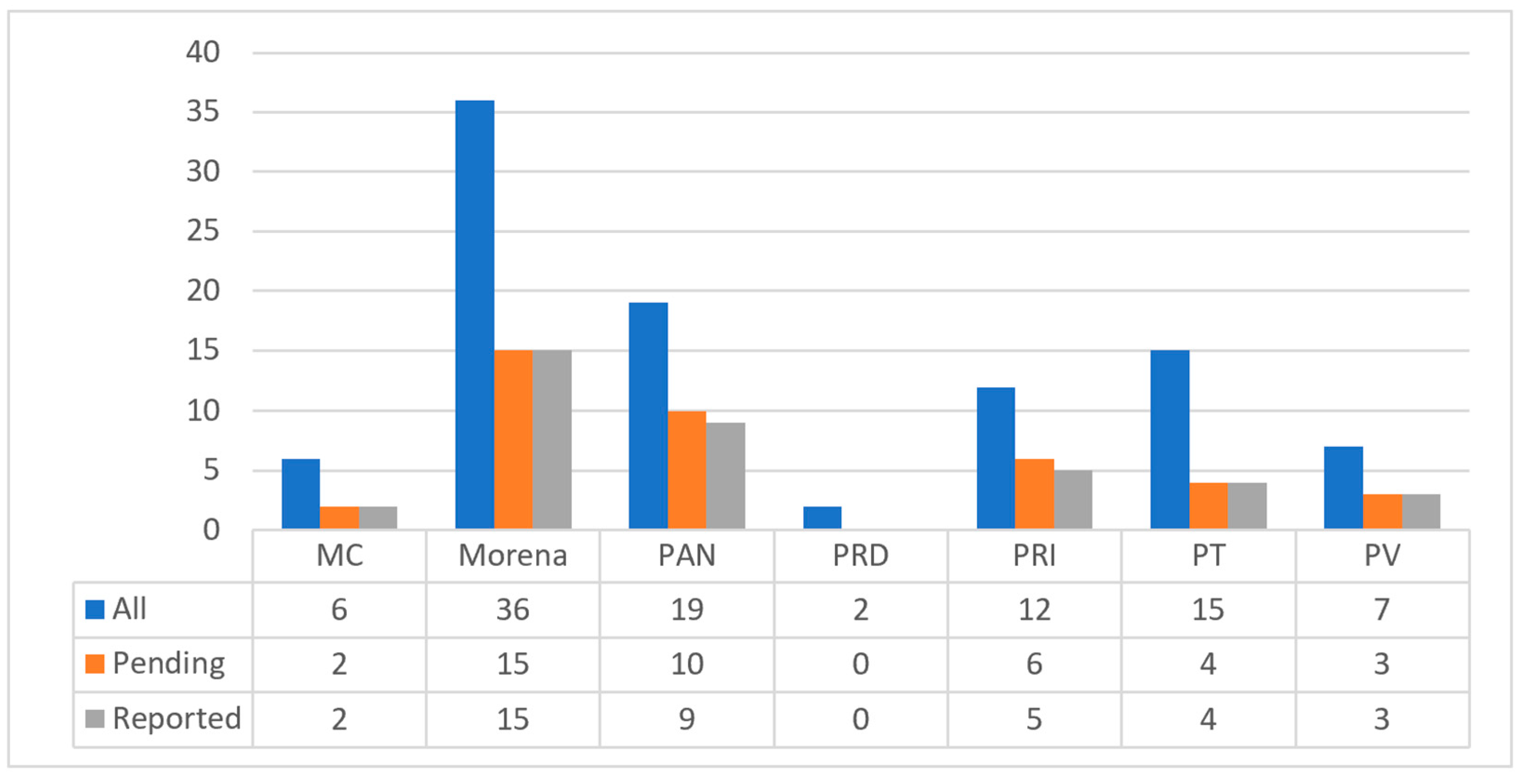

| Area | MC | MORENA | PAN | PRI | PT | PV |
|---|---|---|---|---|---|---|
| Congress | 0 | 4 | 3 | 1 | 1 | 0 |
| Education | 0 | 2 | 1 | 1 | 0 | 0 |
| Health | 0 | 1 | 1 | 0 | 0 | 1 |
| Intellectual Property | 0 | 0 | 0 | 0 | 1 | 0 |
| Justice | 0 | 5 | 3 | 2 | 2 | 2 |
| Promote AI | 2 | 1 | 0 | 0 | 0 | 0 |
| Regulate IA | 0 | 2 | 1 | 0 | 0 | 1 |
| Year | Position/Countries Evaluated | Overall Points | Position/Latin America |
|---|---|---|---|
| 2020 | 55/172 | 49.36 | 5/32 |
| 2021 | 60/160 | 52.62 | 6/26 |
| 2022 | 62/181 | 51.78 | 7/31 |
| 2023 | 68/193 | 50.37 | 8/33 |
| 2024 | 71/188 | 53.29 | 8/32 |
| 2025 | 79/195 | 45.6 | 8/33 |
Disclaimer/Publisher’s Note: The statements, opinions and data contained in all publications are solely those of the individual author(s) and contributor(s) and not of MDPI and/or the editor(s). MDPI and/or the editor(s) disclaim responsibility for any injury to people or property resulting from any ideas, methods, instructions or products referred to in the content. |
© 2026 by the authors. Licensee MDPI, Basel, Switzerland. This article is an open access article distributed under the terms and conditions of the Creative Commons Attribution (CC BY) license.
Share and Cite
Arguijo, E.; Villuendas-Rey, Y.; Cruz-Jiménez, A.; Mireles-Hernández, J.; Camacho-Nieto, O.; Aldape-Pérez, M. Algorithmic Challenges and Regulatory Frameworks of Artificial Intelligence in Mexico: A Prospective Analysis from the Perspective of Digital Governance Theory. Computers 2026, 15, 150. https://doi.org/10.3390/computers15030150
Arguijo E, Villuendas-Rey Y, Cruz-Jiménez A, Mireles-Hernández J, Camacho-Nieto O, Aldape-Pérez M. Algorithmic Challenges and Regulatory Frameworks of Artificial Intelligence in Mexico: A Prospective Analysis from the Perspective of Digital Governance Theory. Computers. 2026; 15(3):150. https://doi.org/10.3390/computers15030150
Chicago/Turabian StyleArguijo, Eduardo, Yenny Villuendas-Rey, Arturo Cruz-Jiménez, Jonatan Mireles-Hernández, Oscar Camacho-Nieto, and Mario Aldape-Pérez. 2026. "Algorithmic Challenges and Regulatory Frameworks of Artificial Intelligence in Mexico: A Prospective Analysis from the Perspective of Digital Governance Theory" Computers 15, no. 3: 150. https://doi.org/10.3390/computers15030150
APA StyleArguijo, E., Villuendas-Rey, Y., Cruz-Jiménez, A., Mireles-Hernández, J., Camacho-Nieto, O., & Aldape-Pérez, M. (2026). Algorithmic Challenges and Regulatory Frameworks of Artificial Intelligence in Mexico: A Prospective Analysis from the Perspective of Digital Governance Theory. Computers, 15(3), 150. https://doi.org/10.3390/computers15030150